Categories B2B

The 10 Best Leadership Podcasts to Make You a Better Leader

Looking for some new leadership podcasts to check out? We’ve got you covered.

From tips on how to be a better leader to interviews with top CEOs, these top leadership podcasts will help you develop your skills and knowledge.

→ Click here to download leadership lessons from HubSpot founder, Dharmesh  Shah [Free Guide].Whether you’re a new or a seasoned leader, there’s something here for everyone.

1. CEO School

best leadership podcast: CEO School

If you’re a leader who is also taking on entrepreneurship, you’ll enjoy this podcast.

Host and founder of a billion-dollar fintech company, Suneera Madhani, regularly brings on experts to discuss everything from scaling your business to creating a positive work culture. In her solo episodes, she shares advice based on her experience running her successful company.

Standout Episodes:

  • How to Have Effective 1:1s with Your Team to Drive Results with Empathy
  • Establishing a Culture that Drives Business Success
  • A Billion-Dollar CEO’s #1 Fundraising Tip

2. HBR’s IdeaCast

best leadership podcast: IdeaCast

If you struggle to find time to listen to podcasts, this bite-size one is a great option.

Each week, HBR’s IdeaCast tackles one facet of leadership in 30 minutes or less. With over 600 episodes, this longstanding podcast has covered just about everything you might want to know about being a better leader.

Standout Episodes:

  • One Way to Fight the Great Resignation? Re-recruit Your Current Employees
  • It’s Time to Fine-Tune Performance Management
  • Fighting Bias and Inequality at the Team Level

3. Let’s Take This Offline: The Podcast for Everyday Leaders

best leadership podcast: Let's Take This Offline

In this podcast, host and former exec Kishshana Palmer looks to redefine what leadership looks like.

“Let’s Take This Offline” breaks down unpopular topics within the leadership space, such as doubt, vulnerability, and shame. Consider this a safe space for leaders who don’t feel like they have it all together and want reassurance that it’s OK.

Standout Episodes:

  • Summer Well Series: Create Your Leadership Roadmap
  • How Doubt Can Boost Your Leadership
  • No Second Guessing, You Are Enough

4. How Leaders Lead

best leadership podcast: How Leaders Lead

When you’re working on improving yourself as a leader, it’s vital to get advice from all angles. This podcast does just that.

“How Leaders Lead” is an interview-style podcast that gives you access to top leaders in business, sports, entertainment, and more. Its host, David Novak, is the co-founder and former chairman of a Fortune 500 company who knows what questions to ask and which insights leaders are looking for.

Standout Episodes:

  • Embrace Big Changes with Curiosity
  • Bill Harrison, JPMorgan Chase Former Chairman & CEO – Preparing the Next Leader
  • Rob Manfred, MLB Commissioner – Finding Common Ground

5. Coaching with Leaders

best leadership podcast: Coaching with Leaders

Want to listen to a leadership podcast but don’t have a whole hour to dedicate to it? Then, this is the podcast for you.

With each episode averaging around 30 minutes, Coaching for Leaders is a short and sweet podcast on all things leadership, from giving feedback and managing difficult stakeholders to fostering inclusivity and improving communication.

Every episode is filled with tactical, actionable advice that you can use every day as a leader, making it a great listen for the morning when you’re getting ready for work.

Standout Episodes:

  • How to Involve Stakeholders in Decisions
  • How Top Leaders Influence Great Teamwork, with Scott Keller
  • How to Lead and Retain High Performers

6. The Unburdened Leader

best leadership podcast: the unburdened leader

When we talk about leadership, we rarely dive into the toll it can take on your mental health. Rebecca ching, LMFT, is here to tackle it.

With a background in family therapy, Ching has built her career around helping leaders navigate through the complex emotions and events associated with this path.

In each episode, she leans on experts in various fields to discuss leadership through the lens of mental health.

Standout episodes:

  • Leading Authentically After Hard Falls with Ref Rodriguez
  • The Intersection of Leadership, Brand, and Inner Work
  • Challenging the Fear of Rejection and Leading with Vulnerability

7. Coaching for Latina Leaders

best leadership podcast: coaching for latina leaders

While this podcast was designed with Latina leaders in mind, it’s a great listen for any leader.

What’s great about this pod is that it looks at leaders from a holistic perspective, helping them see how their personal lives impact their work lives.

That’s why you’ll see episodes focusing on journaling and meditation while others focus on leadership frameworks.

Standout episodes:

  • Living and Leading with ADHD
  • Lead at Work as Powerfully as You Lead at Home
  • Arrival Fallacy: How to Enjoy the Journey Toward Your Next Big Success

8. Coaching Real Leaders

best leadership podcast: coaching real leaders

Backed by the Harvard Business Review, this podcast is led by leadership coach Muriel Wilkins and is geared toward high performers struggling to grow as leaders.

Every episode starts with one question and one leader’s challenge to frame the episode. In one hour or less, Wilkins uses her background in coaching to help her audience navigate everyday challenges.

Standout Episodes:

  • How Do I Move from a Specialist to a General Leadership Role?
  • How Can I Lead Authentically?
  • Finding My Leadership Voice

9. Dare to Lead

best leadership podcast: dare to lead

In 2018, author Brene Brown wrote the New York Times Best Selling book Dare to Lead which serves as the basis for this Spotify Original podcast.

According to their blurb, this podcast features riveting conversations with “change-catalysts, culture-shifters, and as many troublemakers as possible.”

Standout Episodes:

  • Leading with Purpose In the Digital Age
  • Armored versus Daring Leadership
  • Why Every Leader Needs to Worry About Toxic Culture

10. Self-Control and Cheese

best leadership podcast: self control and cheese

Ever wish you could talk candidly with your peers about the challenges you’re going through at work? Consider this podcast that safe space.

Hosts Bridget and Sara, two young leaders working at fast-growing tech companies, talk about everything from securing that promotion to navigating difficult conversations with your direct report.

If you work in tech (or plan to), this is the podcast to hear about what it’s really like and how to move within this space.

Standout Episodes:

  • It’s Not Job Hopping If The Company’s Toxic
  • The Leadership Crash Course
  • 30 Under 30s A Scam

So, if you’re looking to up your leadership game, or just want to learn more about the art of being a great leader, then check out some of these top podcasts on leadership.

New Call-to-action

Categories B2B

The Top Goals of Marketing Leaders in 2023 [New Data + Expert Insights from Uber, Dropbox, and ClickUp]

To effectively lead a marketing team, it’s imperative you know your top goal.

Whether your goal is to increase revenue or improve your customer’s understanding of your products, starting with a clear objective will help you map out a strong strategy for 2023 and beyond.

But it can be difficult to identify the most important goals for your organization — which is why we surveyed 500+ marketing executives to find out the goals that matter most to them.

About half of marketing leaders say they will change their marketing goals in 2023. Here, we’ll take a look at the top five goals those marketing leaders plan to prioritize in the upcoming year. Plus, hear from experts at Uber, Dropbox, and ClickUp on how to achieve them.

Learn from industry leaders on how to take your team to the next level in 2023, plus take a look at data from 300+ marketing directors.

The Top 5 Goals of Marketing Leaders in 2023

1. Increasing revenue and sales.

22% of marketing leaders report ‘increasing revenue and sales’ as their top priority for 2023.

It should come as no surprise that increasing revenue is a top goal for many marketing leaders. At its core, a marketer’s job is to impact a business’ bottom line by attracting the right audiences and driving leads further down the pipeline for sales.

Gaurav Agarwal, Chief Growth Officer at ClickUp, told me increasing revenue and driving sales is a top priority for his team as we enter the new year.

He says, “As a fast-growing company with industry-leading NDR, adding in new revenue sustainably is our top priority. We are hyper-focused on building out different growth and sales capabilities to achieve that goal. As we embark on our 2023 planning, we do so with a renewed focus on efficiency and clear goals around our different self-serve and sales-assisted motions.”

Agarwal continues, “We are also doubling down on organic growth strategies and efforts to better monetize our user base and leads. It is our priority to take a full-funnel approach to build compounding revenue machines.”

clickup chief growth officer talks about his marketing goals for 2023

To increase revenue, marketing leaders need to identify areas of their customer journey that can be further optimized. Additionally, like Agarwal and ClickUp, marketing leaders will want to focus on lead generation. There is no one-size-fits-all approach to effective lead generation. To improve your lead generation strategy, you might test out new landing page CTAs, try creating stronger offers, or re-focus your efforts on more powerful lead nurturing campaigns.

It’s also important to continually test new platforms — like TikTok, or podcasting — to reach new audiences.

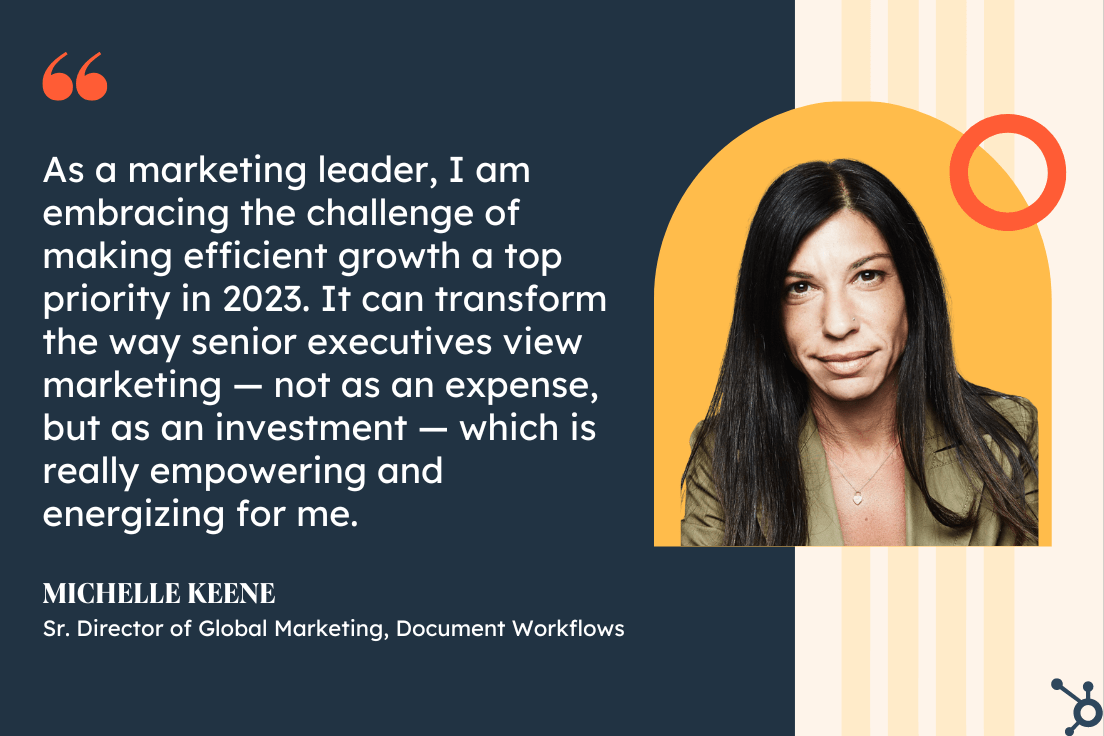
Michelle Keene, Dropbox’s Sr. Director of Global Marketing, Document Workflows, told me that increasing revenue is a top goal of hers for 2023. As she puts it, “In 2023, a year that is expected to be dominated by economic uncertainty, the shift to profitable growth [rather than growth at all costs] will only be accelerated — moving from a nice idea to a requirement.”

To combat this challenge, Keene offers five key principles for marketing leaders to follow: 

1. Move from a revenue-only goal to a revenue and cost-of-acquisition goal.

2. Find technology solutions that enable CAC measurement at the program level.

3. Evolve your marketing attribution models.

4. Deeply understand your target audiences and their needs to deliver the right messages at the right time.

5. Encourage ongoing deployment of hypothesis-driven experiments and optimizations. 

She adds, “As a marketing leader, I am embracing this challenge, making efficient growth a top priority in 2023. While any mindset shift is challenging, the benefits far outweigh the change management costs. It can transform the way senior executives view marketing — not as an expense, but as an investment — which is really empowering and energizing for me.”

senior director at dropbox on marketing challenges

2. Improving sales and marketing alignment.

Ensuring your marketing team is strongly aligned with sales is a critical component of hitting and even exceeding revenue goals. In fact, organizations with tightly aligned sales and marketing teams are 6% more likely to exceed revenue goals.

Which is why ​​19% of marketing executives say improving sales alignment is a top goal of theirs for 2023.

To foster better alignment, consider asking your sales and marketing teams to create your buyer personas together. Sales teams have unique insights into prospects since they speak with them on a daily basis. By partnering with sales teams, you’re able to create a more comprehensive picture of your target persona — including specific challenges or pain points you might’ve missed in your marketing research.

You might also consider working with the sales team to get their input on any content gaps in the buyer’s journey. For instance, a sales rep might point out that you don’t have enough e-books or blog posts that speak to a specific challenge many of your customers have.

By working directly with the sales team, you can create a more seamless buyer experience and retain customers by ensuring you’re consistently creating the content they need to succeed.

3. Fostering relationships with your customers and increasing brand loyalty.

Out of the marketing executives who said they’re changing their goals in 2023, 19% report ‘fostering relationships with customers and increasing brand loyalty’ to be their new top priority.

Customer experience matters more than ever because your happiest customers become the strongest marketers for your brand. A satisfied customer will share their positive experiences online and with friends and family. And people are most likely to trust recommendations from people they know.

Plus, according to an RRD survey of 1,000 consumers, 40% of consumers make purchases based on word-of-mouth recommendations.

All of which is to say: How your customers feel about your brand matters greatly for your bottom line — so it’s vital you do everything you can to foster stronger relationships with them.

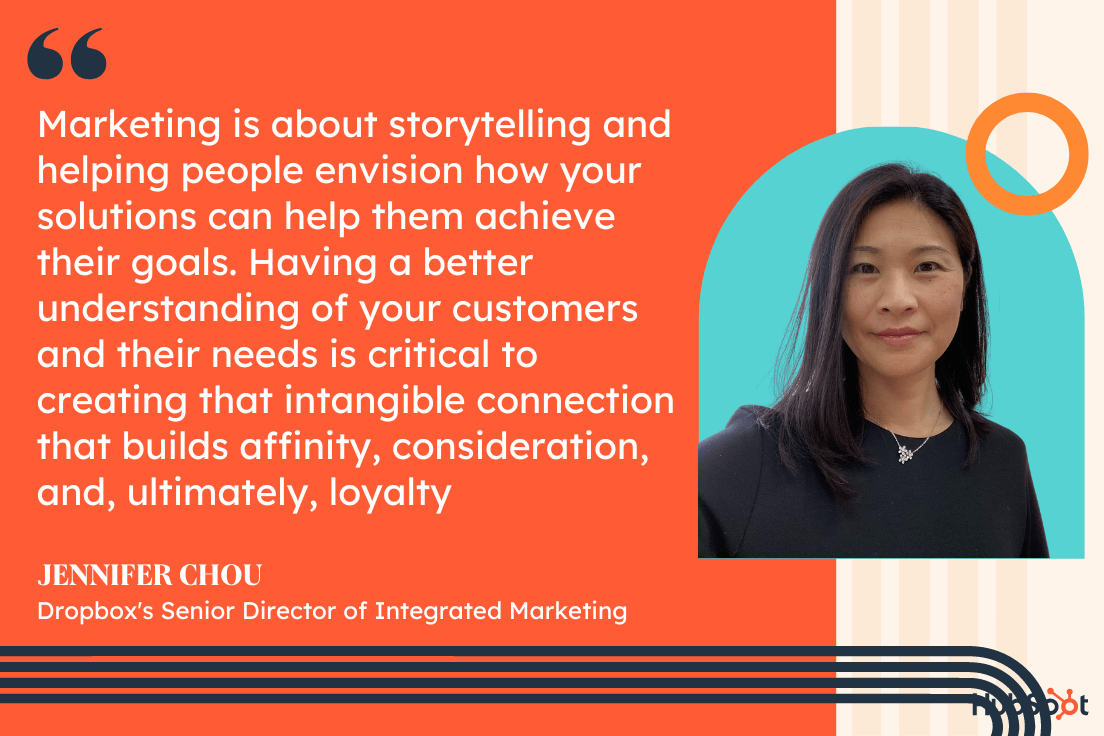
Jennifer Chou, Dropbox’s Senior Director of Integrated Marketing, believes having a strong understanding of your customers is a vital first step in building brand loyalty.

She told me, “Marketing is about storytelling and helping people envision how your solutions can help them achieve their goals. Having a better understanding of your customers and their needs is critical to creating that intangible connection that builds affinity, consideration, and, ultimately, loyalty.”

jennifer quote on storytelling

She continues, “Customers want to relate to companies in new ways and feel that connection that this company understands what I’m dealing with, and is building products for me. This is truly important for us as we think about 2023. Dropbox has so much more to offer with our newest products and features. We are enabling better workflows around our users’ content. This means we need to know their challenges and goals as well or even better than they do, so they can focus on the work that matters.”

(P.S. Are you already a Dropbox customer? If so, click here for 20% off eligible HubSpot products, or sign up for free.) 

To cultivate a strong relationship between your brand and its community, you’ll also want to make sure your marketing materials convey your brand’s values. People will feel more connected to your business if they believe that your company cares about issues that matter most to them.

As Daniel Godoy, Microsoft’s Global Head of Programmatic Evangelist puts it, “The best way to win trust is by putting upfront the values your brand cares about, and having transparent communication that highlights your purpose commitments. According to Microsoft Advertising Research, 85% of consumers only consider brands they trust. And 72% only support brands that are being authentic in their advertising.”

Additionally, try creating opportunities for your customers to interact with each other. For instance, you might create a Facebook group so your customers can engage with each other, share industry best practices, and get ideas or suggestions to help them work through their business challenges. HubSpot’s Social team created a Facebook group and have since leveraged the group to foster a stronger sense of community among its members.

Finally, you’ll want to make sure you create a strong online customer support experience. Among other best practices, consider investing in a CRM, offering omnichannel support via email, phone, online chat, or social media, and training your customer service reps to use customer interactions as opportunities to build brand loyalty.

4. Advertising your products or services.

19% of marketing executives want to focus on advertising their products and services effectively in 2023.

Advertising isn’t what it used to be. This isn’t the days of Mad Men’s Don Draper and creating quippy billboard slogans — at least, not entirely. Beyond the more classic channels like print, TV, radio, and direct mail, many brands now advertise almost exclusively on digital platforms.

Digital advertising is incredibly effective for reaching large audiences for a relatively low cost compared to more traditional methods, like TV. Many digital advertising platforms offer helpful tools for empowering marketers to create engaging ads and iterate quickly if something isn’t working.

Google’s responsive ads feature, for instance, tests various headlines and descriptions and ultimately displays the combination that performs best with an intended audience.

Social media is another powerful option for advertising in 2023. To create a strong social media advertising strategy, you’ll want to:

  • Research your buyer personas and audience.
  • Determine which social platforms you’ll market on most effectively.
  • Establish your most important metrics and KPIs.
  • Get to know your competition.
  • Create unique and engaging content.
  • Organize a schedule for your posts.

Take a look at this post to learn more about how to create a strong social advertising strategy.

5. Improving customers’ understanding of your products and services.

Finally, 19% of marketing executives hope to improve their customers’ understanding of their products or services in 2023.

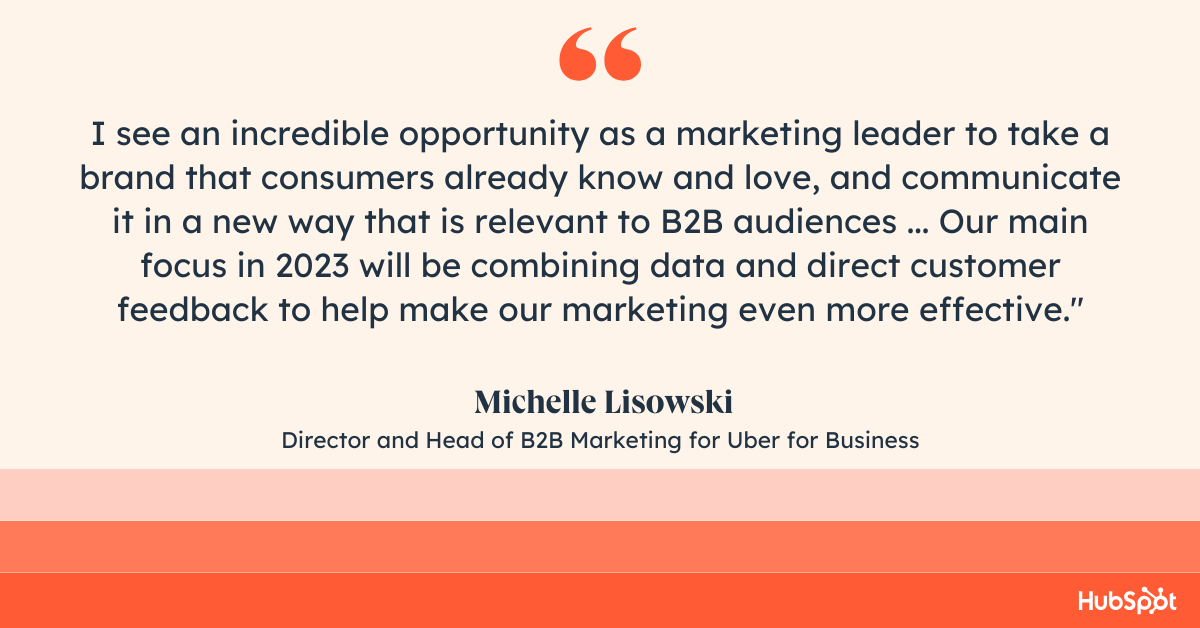
This goal resonates with Michelle Lisowski, Director and Head of B2B Marketing for Uber for Business. She told me, “I see an incredible opportunity as a marketing leader to take a brand that consumers already know and love, and communicate it in a new way that is relevant to B2B audiences. Building this kind of strategy requires taking our buyers’ unique needs and wants into consideration. We have to help them see how Uber products and services can enhance everyday work experiences, whether it’s traveling for business or ordering afternoon coffee for delivery right to the office.”

director and head of b2b at uber on her marketing goals for 2023

Lisowski continues, “In many ways, our team acts like a B2B startup in a large, consumer-oriented company. We have the benefit of being able to plug into established marketing channel teams and expertise, but still need to build go-to-market motions that will resonate with our enterprise audience. Our main focus in 2023 will be combining data and direct customer feedback to help make our marketing even more effective. Ultimately, we want to generate trust and familiarity through one-to-one engagements that build lasting customer relationships.”

If your business is branching out into new markets, it’s vital you take the time to understand your new consumers so you can effectively show them how your product can solve for them. 

A full one-third of consumers prefer to learn about products by searching the internet, so to improve your customers’ understanding of your products or services, you’ll want to start with a strong SEO strategy. Creating product-relevant content can help your prospects get to know your products on a deeper level and help them succeed after they’ve purchased.

Additionally, a good SEO strategy can help you demonstrate what your product is to people who haven’t heard of your brand before. Let’s say you work for a video editing company. By writing content like “Why Video Marketing Matters” and “5 Ways to Create Higher-Quality Videos”, your audience will begin to understand that your company is in the video industry.

Once readers have found value in your content, they’ll explore your site further. This is where it’s vital to have knowledge-base articles to help interested prospects fully understand all the unique features your product offers.

Social media is another good contender for developing an understanding of your products or services. In fact, if you’re marketing to Gen Z or millennials, it’s imperative you use social media for product education, since social media is Gen Z’s favorite channel for learning about new products, and it’s millennials’ second favorite (right behind search engines).

While those are the top five goals shared by marketing leaders, I’d like to highlight an additional five for consideration. These include:

  • Driving traffic to your website (17%)
  • Increasing engagement (17%)
  • Growing your community/following on social media (17%)
  • Leveraging your CRM to its fullest potential (16%)
  • Lead generation (15%)

Ultimately, determining your top goal for the new year will help you lead your team more effectively and stay focused on your north-star metrics as the year progresses. Plus, knowing your goal will help you plan accordingly — including where to allocate budget and resources, who you might need to hire, and areas for improvement in your current strategy.

New call-to-action

Categories B2B

The Top Challenges Marketing Leaders Expect to Face in 2023 & How You Can Solve For Them [Expert Insights & Data]

Every marketer faces different challenges.

Maybe you’re struggling to keep up with the latest trends. Or perhaps your team is finding it difficult to pivot your marketing strategy due to major global events.

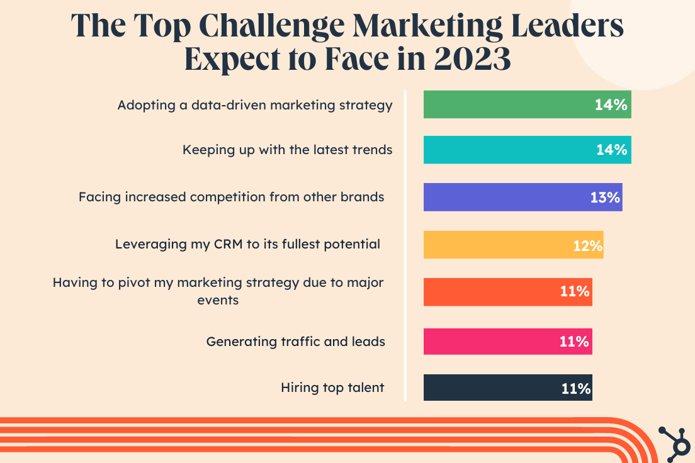
Today, marketing is so fast-paced that it can be difficult to identify which areas you’ll want to focus on to facilitate stronger growth in 2023 and beyond. Which is why we asked 500+ marketing executives to predict the top challenges they expect to face in 2023 — so you can plan your strategies accordingly.

Below, let’s explore the global issues marketing leaders believe they’ll struggle with in 2023, according to new HubSpot Blog data from 500+ marketing executives. Additionally, hear tips on how to combat these challenges from experts at Microsoft, ZoomInfo, and Sprout Social.

Coming Soon: Act Like a Leader, Think Like a Leader [Click Here to Add to Google Calendar]

1. Adopting a data-driven marketing strategy.

Why It’s a Challenge

14% of marketing leaders say adopting a data-driven marketing strategy will be a top challenge of theirs in 2023. And ZoomInfo’s Chief Marketing Officer, Bryan Law, sympathizes.

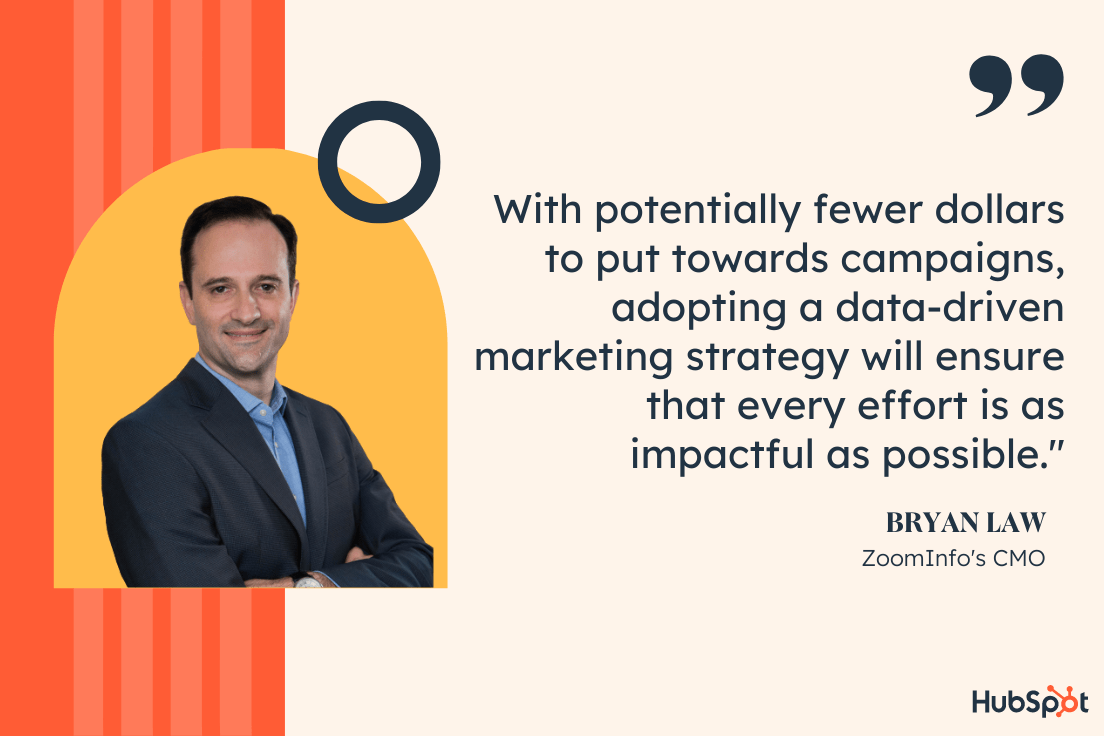
Law told me, “We’re all feeling the pressures of a possible recession and almost every company will face challenges with revenue growth and marketing spend in 2023. With potentially fewer dollars to put towards campaigns, adopting a data-driven marketing strategy will ensure that every effort is as impactful as possible.”

Zoominfo CMO on marketing leaders challenges in 2023

To adopt a data-driven marketing strategy, there are two big levers you’ll want to pull in 2023. Let’s take a look at those now.

What Can You Do?

Effectively Combine First and Third-Party Data

Microsoft’s Global Head of Programmatic Evangelist, Daniel Godoy, told me that it’s critical marketers keep first-party data in-mind if they’re aiming to expand their reach in 2023.

Godoy says, “Marketers feel the pressure to win the ads race in a wild WWW. During this race, it’s worth mentioning that consumer media behavior is changing, and advertising strategies, too. With the cookies deprecation coming (although it has been delayed by Google), it should be on our radar that at least 40% of browsers today don’t get signals.”

He adds, “Shaping your strategy by leveraging 1P or 3P trustable data becomes necessary to expand potential reach and start piloting your data strategy for the future.”

First-party data can ultimately help you ensure you’re reaching the right audiences with your ads and turning those audiences into high-quailty leads.

Develop Unique Messaging that Resonates with Your Prospects

To run a successful data-backed campaign, Law suggests first defining your audience. He told me marketing leaders need to take the time to collect custom attributes, not just basic descriptive information. Then, he advises leaders to create dynamic prospect lists through audience segmentation.

Once you’ve defined your audiences and properly segmented them, you’ll need to develop unique messaging that resonates with your prospects.

As Law puts it, “You’ll need to figure out how to convey your ability to alleviate their challenges in a unique way to penetrate the significant market noise. Practice consistency in your overall theme, and include contextual personalization when applicable.”

You’ll also want to use data to reach the right buyers at the right companies. For instance, Law told me it’s helpful to use technology to identify and engage at the contact or persona level, and automate workflows that allow you to reach people across channels. Finally, you’ll need to test, measure, and iterate.

Law advises, “Before you launch your campaigns, set up metrics to help understand their performance. Use the data to confirm that your messaging is reaching the right people at the right time through the right channels. Data should drive this process and its iterations — and it should fuel your entire marketing strategy if you want to see success in 2023.”

(P.S. — Are you already a ZoomInfo customer? If so, click here for 20% off HubSpot products, or sign up for free.)

Ultimately, preparing a powerful data-driven marketing strategy in 2023 will be essential for outperforming competitors — especially since data can help your team remain flexible and adaptive as trends or consumer preferences shift over time.

2. Keeping up with the latest trends.

Why It’s a Challenge

Staying up-to-date on marketing trends wasn’t just a challenge in 2022. 14% of marketers believe keeping up with the latest marketing trends will continue to be their biggest hurdle in 2023.

This makes sense. From branded audio content to augmented reality (AR) experiences, there’s plenty of trends we saw spike in 2022. As a marketer, it can be difficult to decipher which trends matter most to your business — and which ones you can avoid.

What Can You Do?

Reviewing up-to-date marketing reports like HubSpot’s 2022 State of Marketing Trends can help you stay informed on which marketing trends matter most to consumers. You can also subscribe to marketing podcasts or newsletters to learn more about what’s happening in the industry.

Alternatively, consider asking your consumers what trends matter to them. For instance, perhaps you create a social poll to ask consumers about their favorite TikTok reels — this information can help you better understand the topics that currently matter most to your audience.

Once you have a list of interesting marketing trends, you can try implementing them on a small scale to see how they perform for your business. Testing is critical here. You can read about the effectiveness of short-form video content all day long — but until you try it for your own brand, you can’t know for sure whether it actually matters to your audience.

3. Facing increased competition from other brands.

Why It’s a Challenge

Competition isn’t a new concept for businesses, but it’s a major concern for many marketers when they look ahead. As social media and the SERPs become increasingly saturated with branded content, many marketers struggle to create content that stands out.

In our HubSpot Blog survey, 13% of marketing leaders report increased competition from other brands as their biggest concern for 2023.

What Can You Do?

To combat this challenge, marketing leaders will want to conduct a competitive market analysis, which can help you implement stronger business strategies and identify potential opportunities to out-perform your competition.

Additionally, it’s a good idea to ask your team to flag any interesting tactics other businesses are leveraging. Your social team, for instance, can assess competitors’ social channels to identify any gaps in their current strategy. Alternatively, your blog team might highlight their personal favorite blogs, and share takeaways they can apply to their own content.

Hosting regular team brainstorms around new, innovative ideas can help you ensure your business is ahead-of-the-curve.

However, you don’t want to just follow along with your competitors’ strategies. It’s a good idea to test out new platforms to see what resonates with your intended audience, even if your competitors aren’t using those social channels.

4. Leveraging my CRM to its fullest potential.

Why It’s a Challenge

12% of marketers believe their biggest challenge in 2023 will be leveraging their CRM to its fullest potential.

A CRM can be an incredibly powerful and effective tool for marketing, sales, and service — but it can be intimidating and time-consuming if you don’t know how to use yours.

What Can You Do?

To make the most out of your CRM, take a look at our ultimate guide to using a CRM. You’ll also want to consider purchasing a CRM that enables you to integrate all your other tools in one place.

Additionally, HubSpot’s Product Manager Alexa Starks told me, “To leverage your CRM to its full potential, you’ll want to expand usage with a flagship use case. In other words — figure out a gap or pain point with your current process that is solved by an underutilized feature of the CRM. Then, evangelize how your CRM will address that problem and create more connectedness within the organization.”

Starks adds, “Rinse and repeat to show how implementing additional CRM tools can make the teams lives easier. Over time, this will increase adoption and eventually lead to a compounding effect, as a more connected process increases the ROI of your CRM purchase.”

If you’re instead struggling with how to structure your CRM, or which data is most critical, Starks suggests you get head of your data by figuring out the core questions you have of your data.

She says, “Imagine you have the answers to those questions. Now, think through what next-level questions you might have after you receive those initial answers. Taking time to map this out can help align the team around the ways your process may need to shift to ensure the necessary data is available and structured properly in the future.”

5. Having to pivot my marketing strategy due to major events (e.g. recession, pandemic, political turmoil).

Why It’s a Challenge

The past couple years have required businesses to demonstrate new levels of flexibility and adaptability.

The pandemic, for instance, greatly impacted users’ expectations and preferences when it comes to social media. Now, users’ spend more time watching videos online than they did pre-pandemic, and they crave more fun and authentic content than they used to.

Similarly, political turmoil and recent changes in the economy have required businesses to adjust their marketing strategies accordingly to ensure they’re continuing to meet the needs of their customers.

While it can feel risky to invest in new strategies or pivot as a response to major events, it’s oftentimes worse to stick to the status quo. As the world changes, your consumers’ behaviors and needs change in response, so it’s vital you keep up with global trends to understand what your consumers’ needs are on any given day.

Plus, your marketing could seem tone-deaf if you don’t pivot accordingly.

All of which is to say: It’s no surprise that 11% of marketing leaders believe pivoting their marketing strategies will continue to be a roadblock for them in 2023 and beyond.

What Can You Do?

Godoy is familiar with the challenge of pivoting your strategy appropriately. Fortunately, he has a solution.

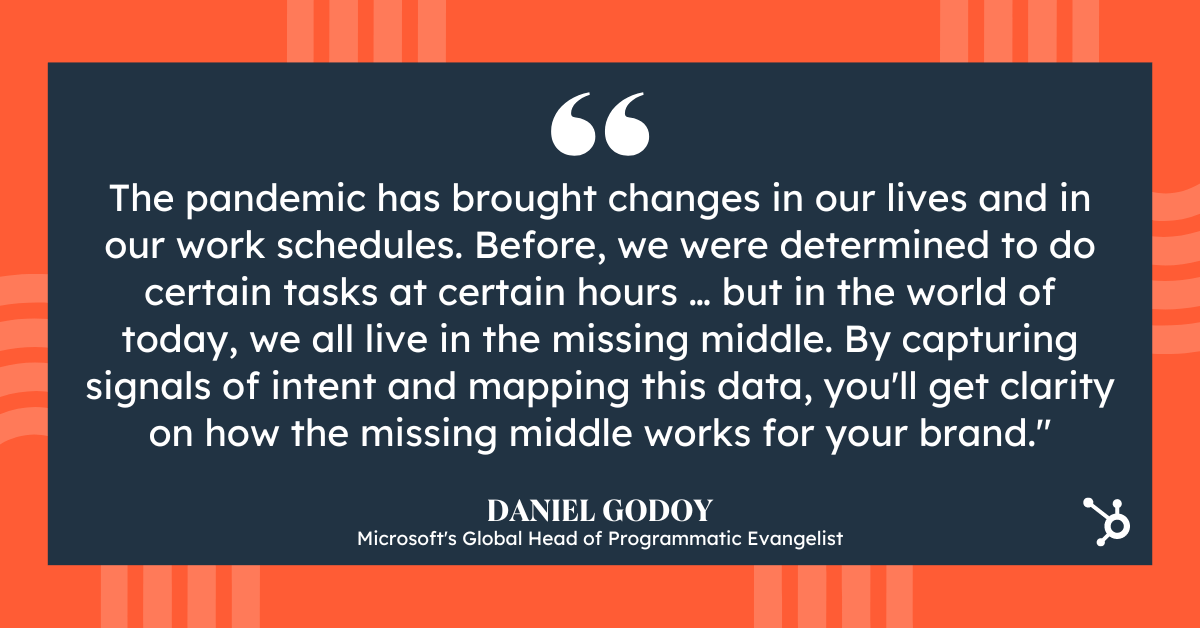
He says, “The pandemic has brought changes in our lives and in our work schedules — and hybrid work opens possibilities to balance work and personal responsibilities at the same time. Before, we were determined to do certain tasks at certain hours … but in the world of today, we all live in the missing middle.”

Microsoft Head of Programming on marketing challenges for 2023

He adds, “We’re paying too much attention to the upper and lower side of the funnel and ignoring what happens in the middle. The real journey reflects that human decisions do not happen in a linear way. Audiences exposed to brand and performance are 6X more likely to convert. By capturing signals of intent and mapping this data, you’ll get clarity on how the missing middle works for your brand.”

Understanding your prospects’ behavior and intent is a critical component of ensuring you can shift quickly if your marketing efforts aren’t working. This is also where agile marketing comes into play. Agile marketing helps you execute by working in short sprints, which helps marketers quickly shift their focus, adapt to customer needs, and change priorities.

Agile marketing can help your team become more adaptable when global events upend your previous plans and force your team to shift focus. And it can help teams rebound more quickly from potential revenue losses.

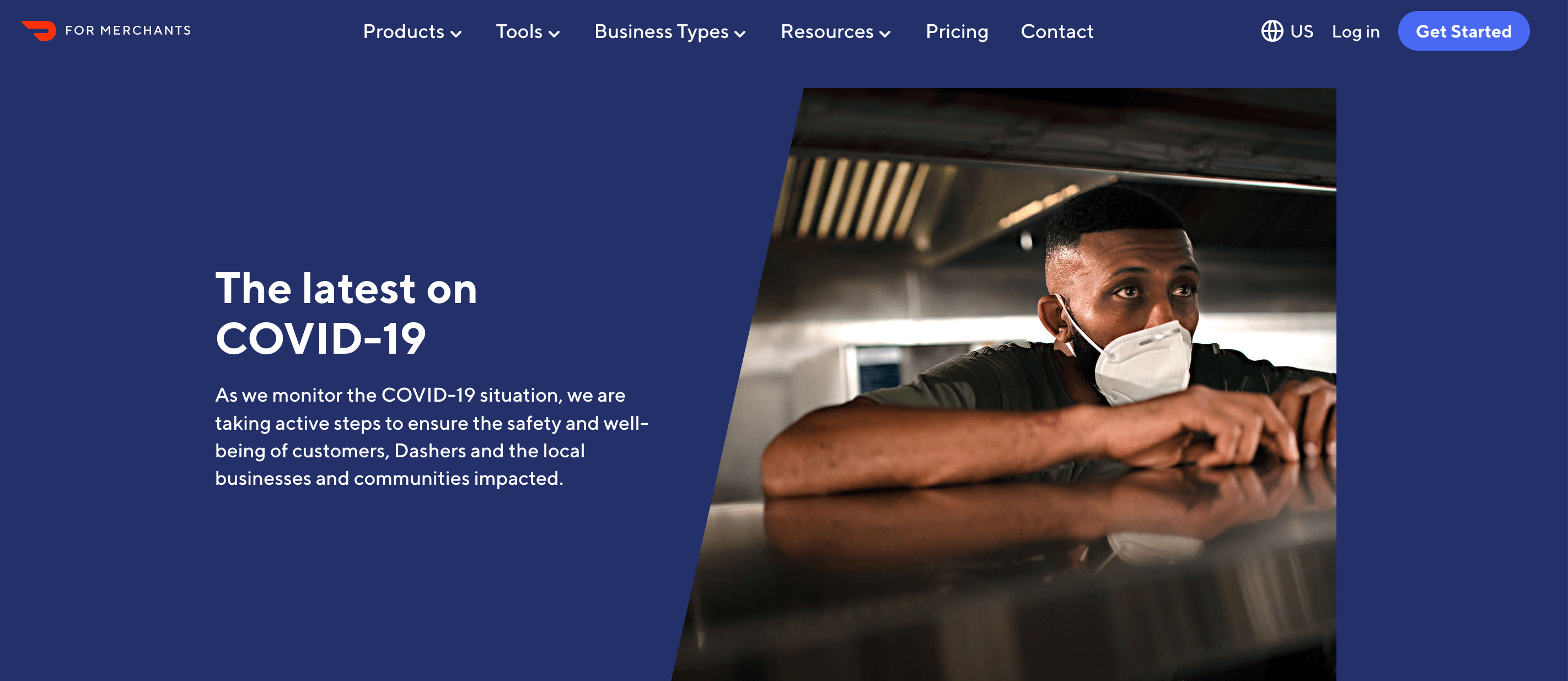
Consider, for instance, how Doordash reported an operating loss of $616 million in 2019 — and then grew to $2.89 billion in revenue in 2020. Their agile approach during the pandemic enabled them to respond to their consumers’ needs by delivering COVID test kits and launching the #OpenforDelivery campaign to support restaurants.

Essentially, Doordash pivoted quickly to support their customer needs, and dropped their pre-planned marketing approach to adopt a new, more timely one.

doordash response to covid

Finally, it’s critical you keep an eye on both marketing trends and global events to ensure you’re pivoting your strategy when necessary.

To ensure you’re up-to-date on the latest trends, you’ll want to monitor your social media channels to respond appropriately to customers. Additionally, consider leveraging social listening tools to keep up with trends happening in the industry.

Most marketers are goaled on two metrics: Traffic and leads.

Which is why it makes sense that 11% of marketing leaders expect that generating traffic and leads will remain their top challenge in 2023.

Even if marketers are doing well with these metrics, they’ll always want to improve them.

6. Generating traffic and leads.

Why It’s a Challenge

Google search features like featured snippets and images have made it increasingly difficult to get traffic to your site at all. In fact, 65% of Google searches now end without a click.

Social media is also becoming saturated with 24/7, around-the-clock content. As the creator economy booms, it’s becoming increasingly difficult for brands to create content that stands out.

Ultimately, marketing leaders are struggling to produce demand for their content. Plus, they’re unsure which platforms will prove best for their business — and how to promote their content effectively.

What Can You Do?

To combat the challenge of creating high-quality content that resonates with your audience, you’ll want to use effective tools to properly track the types of content that performs best with your audiences.

Once you know you’re creating the type of content your audience wants, the focus shifts to promoting it in a way that makes your audience take notice.

More than ever before, people are being flooded with content. Consumers don’t even need to use a search engine to find answers anymore. Instead, articles fill their news feeds or buzz in their pocket via mobile notifications. To keep up, consider exploring alternate distribution methods — like SMS or podcasting — to increase brand awareness.

Additionally, you might test out influencer marketing to generate more traffic and leads. Micro-influencers, for instance, have high rates of engagement and are often seen as experts on certain niche topics — so finding a micro-influencer that aligns well with your brand can help you generate high-quality traffic and leads effectively.

7. Hiring top talent.

Why It’s a Challenge

11% of marketing leaders report hiring top talent as their top anticipated struggle of 2023. And Jamie Gilpin, Chief Marketing Officer at Sprout Social, agrees. She told me that hiring and cultivating top talent is a key focus at Sprout Social as they head into the new year.

Gilpin says, “As a discipline, marketing is ever evolving, which requires candidates with unique, more varied skill sets. Social media in particular is playing a larger and larger role in every brand’s marketing strategy and requires highly skilled professionals with in-depth knowledge of social media’s shifting landscape.”

She adds, “With new platforms, features, and more consumers preferring to interact with brands on social, marketing teams are tasked with hiring and developing talent across their marketing function who understands the total impact social media can have on your organization.”

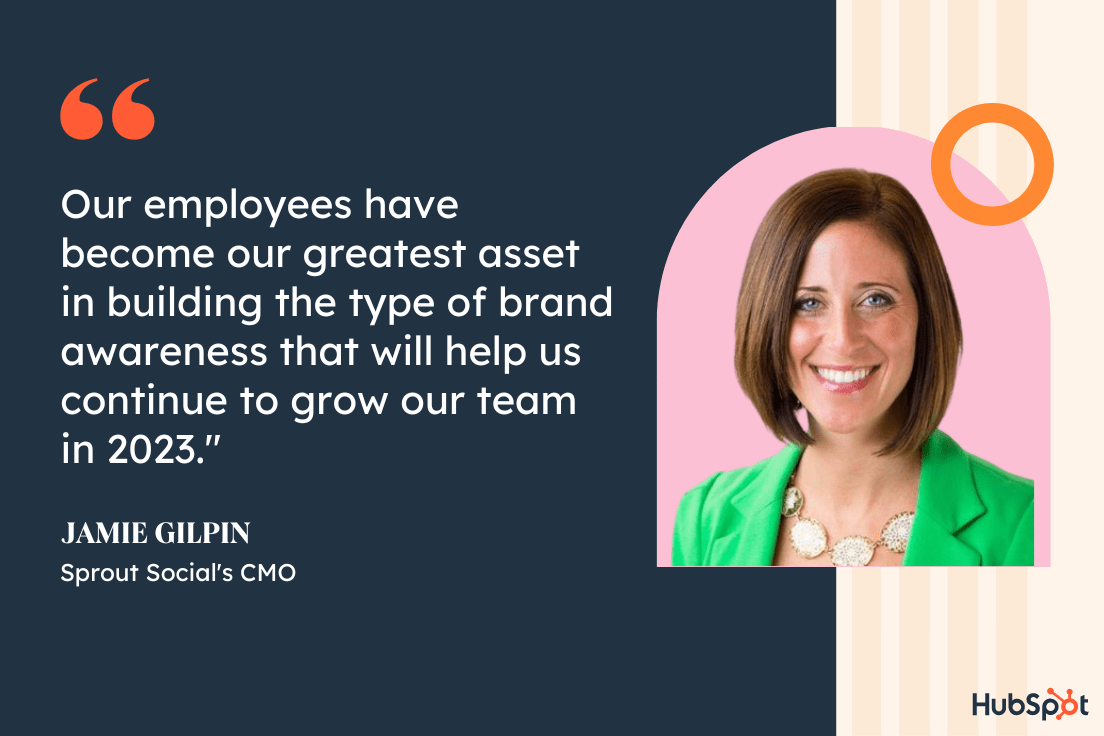
Sprout Social CMO on marketing leaders challenges in 2023

What Can You Do?

To attract top talent, you’ll want to focus on your employer brand.

As Gilpin puts it, “To attract talent with unique skill sets, our company has worked incredibly hard to build a strong employer brand that clearly communicates our values and culture to current and prospective employees. One way we’ve been able to amplify that message is by leveraging the social influence of our own employees.”

She continues, “By going beyond our own social channels and by helping our employees become brand advocates on social, we’ve seen the visibility and authenticity of our content grow. Whether we’re announcing a new product, sharing a company culture initiative, or promoting a job opening, our employees have become our greatest asset in building the type of brand awareness that will help us continue to grow our team in 2023.”

Strengthening your employer brand is one of the most effective ways to attract top talent, and leveraging your employees’ unique perspectives will help you demonstrate more authenticity in your recruiting materials. In 2023, marketing leaders will also want to consider how they can turn their employees into brand advocates.

Interested in other top challenges, trends, and opportunities being discussed amongst marketing leaders? Take a look at Act Like a Leader, Think Like a Leader: Data from 300+ Marketing Directors on How to Take Your Team to the Next Level. Along with the data, you’ll hear from experts at Uber, LinkedIn, G2, SEMRush, and more.

New call-to-action

Categories B2B

LinkedIn Launches Live Audio Events: How They’ll Differ from Clubhouse & Twitter Spaces

Twitter has Spaces. Facebook has Live Audio Rooms. Clubhouse has…Clubhouse. Now, LinkedIn is grabbing a seat at the table with its own audio feature.

Free Guide: How to Use LinkedIn for Business, Marketing, and Networking  [Download Now]

Let’s talk about what LinkedIn Audio Events is, how it works, and what it could mean for marketers.

LinkedIn first launched a beta version of Live Audio Events in January. Then, in June, expanded it to users with the “creator mode” on. Today, all users have access to it and the platform plans to eventually follow up with a video version.

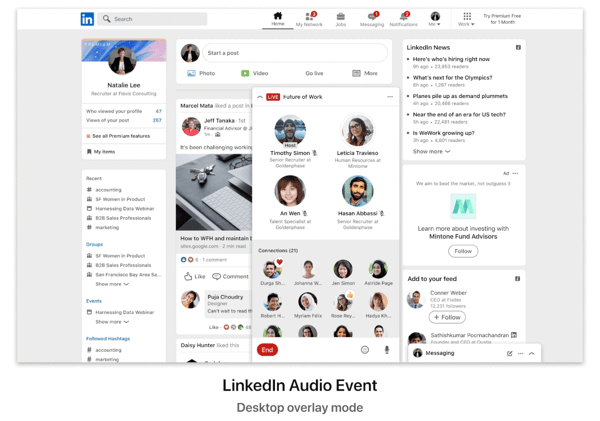
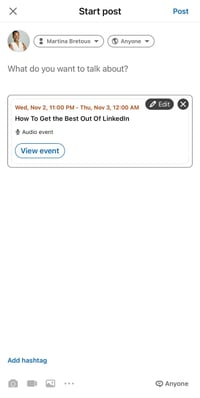
linkedin live audio event interface

Image Source

Here are a few key facts:

  • Events must be at least 15 minutes long and can last for up to three hours.
  • You must have 150 followers and/or connections to host an Audio Event and have a history of following LinkedIn’s community policies. However, any user can attend live audio events.
  • Audio Events are not yet available to users in mainland China.

How to Launch Live Audio Events on LinkedIn

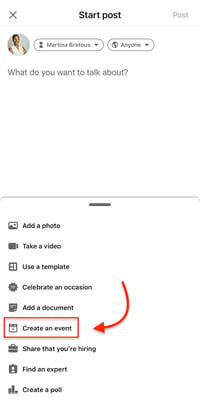
1. Head to the “Post” tab located on the navigation bar.

How to Launch Live Audio Events on LinkedIn step 1

2. Tap on “Create an Event.”

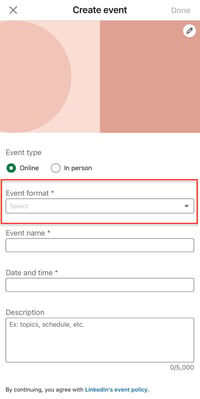
How to Launch Live Audio Events on LinkedIn step 23. Tap “Event Format.”

How to Launch Live Audio Events on LinkedIn step 3

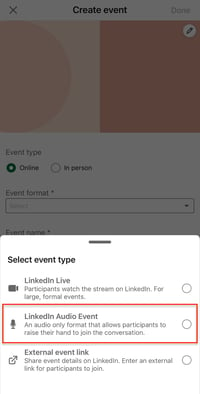
4. Select “LinkedIn Audio Event,” add the remaining details of the event, such as date and time, then click “Done.”

How to Launch Live Audio Events on LinkedIn step 4

5. Share the event details with your audience.

How to Launch Live Audio Events on LinkedIn step 5

How LinkedIn Live Audio Differs from Twitter Spaces and Clubhouse

For now, LinkedIn’s Live Audio Events are pretty similar to Twitter Spaces and Clubhouse. There’s not much differentiating them currently, but according to reports, it won’t stay that way for long.

According to a TechCrunch article, LinkedIn has been working on a paid ticketing feature for its interactive events since September. This could give LinkedIn an edge over other platforms, by allowing brands to create paid, exclusive events for their most engaged audiences.

Clubhouse has stated it’s exploring monetization opportunities for its creators. But, no concrete features have been announced.

From a brand perspective, LinkedIn is one of the better audio platforms to leverage, as it has valuable user data, such as job titles, ages, industry interests, and more. Conversely, users on Clubhouse and Twitter Spaces can remain anonymous, known only by their usernames.

For now, these social media platforms are all on even ground when it comes to audio capabilities. But that could change soon.

How Marketers Can Leverage LinkedIn Live Audio Events

When social media platforms compete with each other, it’s usually a win for brands. Why? As these platforms add new features to keep users engaged, brands have the ability to leverage new strategies without having to start from scratch on a new platform.

For example, when Clubhouse gained traction, a lot of brands opened an account and spent months trying to figure out the platform, its audience, and its features. However, when an established platform like Twitter or Instagram adds a new feature, adoption is much easier and usually happens much faster.

With this in mind, brands that are currently finding success on LinkedIn can use live audio events as an extension of their current strategy. With this new feature, they can:

  • Discover what topics are most interesting to their audiences.
  • Reach new users.
  • Gain real-time insights based on conversations.
  • Build a strong community.

Although LinkedIn’s live audio events feature is new, there is a lot of room to play with – even at this early stage.

New Call-to-action

Categories B2B

6 TikTok Myths, Debunked in 2022

Many marketers have flirted with the idea of trying TikTok, but certain misconceptions have stood in the way.

For instance, isn’t it just a platform for teens? Specifically, teens who lip-sync?

To help curb the confusion, we’ve rounded up a list of common TikTok myths to help you decide whether it deserves a spot on your marking roster. Let’s dive in.

Free Ebook: The Marketer's Guide to TikTok for Business [Download Now]

Myth 1: TikTok’s audience is too young.

Brands mistakenly assume that TikTok is just for teens and young adults. Although it initially exploded in popularity with the Gen Z crowd, TikTok is quickly “growing up.” In fact, 36% of TikTok users in 2021 were between 35 and 54 years old, a 10% increase from the year before.

On top of that, 50% of Millennials report visiting TikTok in the last three months, along with 38% of Gen X-ers, according to HubSpot’s 2022 Consumers Trends Report. We predict these numbers will continue to rise as TikTok cements itself as a mainstream social platform.

Myth 2: TikTok is just for lip-synching and dancing.

While these types of videos certainly exist on TikTok, it’s only the tip of the iceberg. As its audience has grown more diverse, so too has its content.

Nowadays, you can find videos that hit almost any niche. For example, some of the most popular TikTok categories include cooking recipes, beauty tutorials, fitness routines, life hacks, and even pet videos. This also means TikTok can work for a variety of brands across different industries.

For example, Ryanair, a European airline, is a fan favorite on TikTok with almost two million TikTok followers. DuoLingo, a language learning app, is another favorite with over four million followers. Then there’s Red Bull, a popular energy drink, with almost 7 million followers. These are wildly different brands, from different industries, that have built a healthy audience on TikTok.

Curious which brands are winning on TikTok? Check out this helpful guide to get inspired.

Myth 3: If your brand is “serious,” TikTok isn’t for you.

TikTok has a reputation for being quirky — but if your brand is on the serious side, don’t let this scare you away. Instead, try approaching your brand from a different angle.

For example, take a look at Planet Money, an NPR-backed podcast that covers complex topics about the economy. Not the most entertaining topic in the world, right? Yet, it’s raked up almost 750,000 followers.

From gentrification to mortgages, no topic is too serious for Planet Money to tackle with a humorous spin. Need convincing? Take a look at the following video that asks, “Is free shipping really free?”

If you feel your brand is too “serious” for TikTok, take a note from Planet Money and approach your brand — and the content you create — from a different lens. At the end of the day, it’s about sharing value and delivering it in an engaging way — and that’s a goal almost any brand can attain.

Myth 4: You need a lot of followers to go viral.

On TikTok, anyone can go viral. Even accounts with a handful of followers can spark millions of views on a great video.

Its viral nature is a direct result of its algorithm. How does it work? The algorithm pinpoints users that may enjoy your content based on their previous watch history, hashtag searches, and current location. Then, it will push your video to their feed. If enough people engage with it, the algorithm will share it to even more people. Next thing you know, you have a viral hit.

Here’s an example: suppose you post a video of yourself hiking a mountain. The algorithm shows your video to users who live nearby, as well as those who recently searched for hiking trails on the platform. It notices a lot of people “liking” and commenting on the video, so it shares it to more users.

Long story short, if you’re worried you won’t get any traction on TikTok, it’s helpful to remember that the algorithm is on your side, enabling you to reach more people outside of your immediate followers.

Myth 5: Because TikTok videos are shorter, users are less engaged.

TikTok is known for its short, bite-sized content. However, this creates an illusion that users don’t spend much time on the platform.

Fortunately, this couldn’t be farther from the truth. In fact, TikTok has an average user session of 10.85 minutes, far exceeding any other social media platform. On top of that, users in the U.S. open the TikTok app 8 times a day on average.

Myth 6: TikTok is a fad.

Will TikTok meet the same fate as Myspace and Tumblr? While it’s too early to call, I’d argue that it doesn’t really matter.

For one, short-form video is dominating the social media landscape. If TikTok meets its demise, consumers will still crave this content. The audience may jump to a new platform, or migrate to an existing one. Either way, you still need to know how to create engaging, snackable content — and TikTok is the leading platform to hone this skill.

Second, if you build your brand correctly, no rise or fall of a single platform will topple it. If you build a strong community around your brand, it will become unshakeable. But in order to do this, you need to go where your audience is — and, for right now, that might be TikTok.

Back To You

Let’s end with one final myth: it’s too late to join TikTok.

This is untrue, especially if your audience is active there. Further, its high engagement rates, stellar growth potential, and powerful algorithm can take your digital marketing to the next level. That said, time is of the essence. Brands that establish a presence on TikTok now can stay ahead of the curve.

Blog - Content Mapping Template

Categories B2B

How to Implement Affordable AI in 3 Steps, According to the Marketing AI Institute Director

Artificial intelligence is continuing to make an impact on the business world. In fact, McKinsey predicts that up to $2.6 trillion in value will be unlocked by AI in marketing and sales alone.

But, if you’re less tech-savvy, you might be intimidated by terms like “artificial intelligence,” “machine learning,” and “algorithms.” You probably also hear about these technologies and think to yourself, “My business definitely can’t afford that.”

This makes sense. As a good marketer, you should be skeptical about high-priced tech. After all, sometimes it’s hard to tell how a tool works and if it’s actually worth your money. Additionally, if you’re less familiar with AI, it might seem like it’s only necessary for industry-leading behemoths.

Sign up for HubSpot Academy's ML & AI Lesson [Free Online Course]

There are so many misconceptions about AI in marketing that my colleagues and I launched the Marketing AI Institute. At the organization, we aim to make AI approachable and actionable for marketers. To date, we’ve vetted dozens of AI solutions and have monitored more than 1,500 sales and marketing AI companies with combined funding north of $6.2 billion.

As the Institute’s director, I’ve advised small and medium-sized companies on AI implementations. We’ve also piloted several AI tools in our own marketing operations at the Marketing AI Institute – often for no or extremely low cost.

While you might think that AI is totally out of your budget, there’s actually a chance your business is already using a software or app that relies on this technology to do its job.

Let’s get into the three-step process for implementing AI on a budget, as well as examples of affordable tools that can help you.

Table of Contents

How to Implement AI on a Budget [3 Steps]

Affordable Marketing Automation Software

Familiarizing Yourself With AI

How to Implement AI on a Budget [3 Steps]

1. Determine where AI tools could help you eliminate costs.

At some point, you’ll need to spend money to implement AI. But, how you structure an AI pilot project can help you defray some of the costs.

Although AI, when done right, can increase revenue and reduce costs, you’ll still want to start with a cost-reduction pilot before a revenue-increasing experiment.

A cost-reduction pilot aims to improve (or streamline) processes you already have in place. A revenue-generating pilot, on the other hand, might require new processes — which could ultimately cost more time and money.

In order to kickstart your cost-reduction pilot, you need to first identify time-intensive or repetitive tasks that hold you — or your team — back from high-quality projects in your organization. 

affordable marketing automation

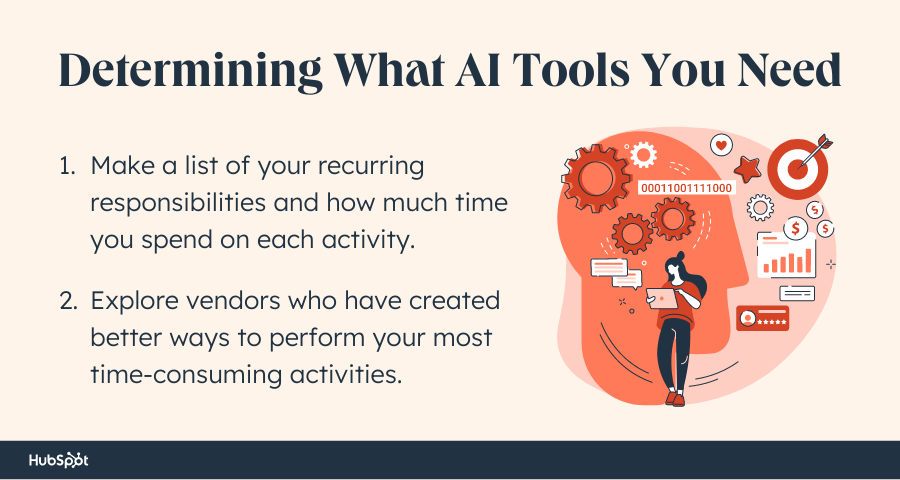
Start by making a list of your recurring responsibilities. Track everything you do every week or month, and list the amount of time you spend on each activity. Chances are, there are a ton of tasks that take way too much time each month. It’s likely they’re also pretty data-driven, too.

Next, explore vendors who have created more intelligent ways to do the tasks that are blocking your team.

For example, you might discover that tagging images on your website takes up too much time. AI software can probably free you up from doing that task. Or, you might spend hours each week managing paid advertising. AI can also help there, too.

In fact, there are dozens of ways you can apply AI to immediately free up team time and resources. And, depending on the cost reductions, these pilots may pay for themselves.

2. Research tools that work out of the box.

A handful of small to medium-sized businesses might worry about blowing their budgets when they hear the words, “artificial intelligence” because — at the moment — many AI solutions are built for corporate enterprise.

The truth is, many AI tools need access to quality data at scale to produce results. Enterprises are often the only source of this data. But this doesn’t mean you need to count out AI as a marketer for a smaller business.

In fact, a number of AI tools are affordable, work out of the box, and cut time on basic marketing tasks.

Additionally, you might not know it, but you might already be using popular office tools that are powered by AI.

3. Ask these questions before investing in an AI product.

There are some vendors out there that claim to be AI but aren’t. If you don’t understand what to look for, you could waste time and money on lackluster solutions.

That’s why we encourage every marketer to establish a baseline knowledge of AI. (Our beginner’s guide will cut down your learning curve.)

Aside from familiarizing yourself with the technology, you also need to ask smart questions of AI vendors about the tools they sell.

Start with questions like:

  • How does ____ use AI today?
  • What AI capabilities are on the product roadmap?
  • What type of data do I need for the solution to work?
  • Is there any type of minimum size dataset I need to use the solution? (i.e. a certain number of emails sent, visitors to the site, etc.)
  • What kinds of in-house capabilities do I need to use and maintain the solution?: Can anyone use it? Do I need dedicated data scientists, machine learning experts?
  • My top use cases for AI are A, B, C, etc. Can ___ help?

Curiosity may have killed the cat. But it also saves marketers tons of money when buying new technology. So, don’t be afraid to ask questions and do deep research on each product you’re considering before you invest.

Affordable Marketing Automation Software

Here are a few examples of popular and affordable AI-powered tools:

1. Grammarly

Price: Free; Premium plans to start at $11.66/mo for an annual commitment.

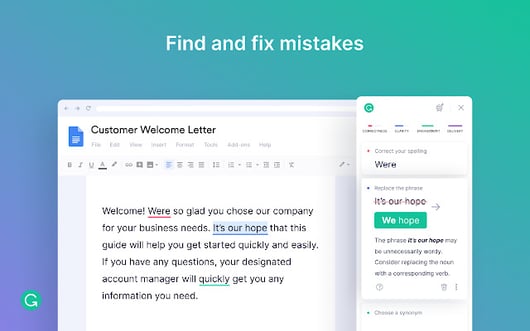
Grammarly is an intuitive copy-editing tool that uses machine learning to recognize and highlight spelling, grammar, and other phrasing errors on different platforms including Google Docs, email, and social media sites.affordable marketing automation: grammarly

Image Source

For an individual user, Grammarly allows you to track your writing performance and get edit suggestions based on your level of writing experience. The software will also send you emails that show you areas where you are excelling and where you need to improve.

Recently, Grammarly also added a feature where it could recognize and sense the emotional tone of your emails. For example, if you’re writing an email with “Thank you” in it, Grammarly will note that your message sounds “appreciative,” or “optimistic.”

Grammarly gives email suggestions with AI

Pro Tip

Grammarly is also available for teams. With the team version, you can unlock customizable editing features that allow the software to make suggestions with your company’s writing styles and branded words in mind.

To learn more about Grammarly and other productivity tools, check out this blog post.

2. Frase.io

Price: Trial available; Plans start at $24.99 per month.

Frase.io is an AI-powered research assistant and question answering bot that uses and analyzes search data on your site. The software can also help you optimize articles and other content for SEO by reading the text, comparing it with similar online content, and offering search and keyword-based suggestions.

affordable marketing automation: Frase.io

Image Source

Aside from the SEO features, Frase.io also provides a bot feature. When a visitor is searching your site and would like to find something, they can simply type a question into the message box on your web page and receive an answer from a bot.

Frase.io website

Image Source

The bot uses machine learning to recognize the phrases given and match the words with content or pages related to those words. For example, if someone says, “I’m looking for a blog post on Instagram Stories,” the bot would reply with a link to one or more blog posts about Instagram Stories.

One company that benefited from this product was Embryo Digital, a small UK-based agency that used Frase.io to conservatively save 180 hours per month on research.

Pro Tip

Battling writer’s block? Frase.io can help with that. It offers a number of tools that create content automatically — such as its Blog Introduction Tool, which automatically generates a 100-word introduction for your blog title.

3. Google Analytics

Price: Free

By now, you’ve probably heard of or already use Google Analytics.

The leading analytics platform’s machine learning capabilities will answer questions about your website data.

affordable marketing automation: google analytics

Although Google Analytics is the leading analytics tool of marketers and already has many AI tools that work upon launching it, it will take marketers time to set up their GA dashboards so that data is understandable and organized for full teams.

To learn more about this platform and how to get started on it, check out this ultimate guide.

Pro Tip

On top of giving you detailed insights on how your website is doing, GA also integrates with all of Google’s marketing products — including Google Ads, Search Console, and Data Studio.

4. Ahrefs

Price: $99-$999/month depending on your number of users and features.

Ahrefs uses data from Google and other search engines to show you where your web pages rank for certain keywords. It also allows you to query words or phrases to see how common people are looking them up on search engines.

This type of tool can quickly help you identify topics that you might want to blog about or see if your blog post or website is actually showing up on Google searches when people make queries related to your industry.

To give you more of an idea of how the software works, here’s a demo that walks you through how to do keyword research with Ahrefs:

If you’d like to better your keyword research strategies, but can’t afford something as intuitive as Ahrefs, you can also check out these tools which similarly leverage AI algorithms to help marketers identify search opportunities.

Pro Tip

Use Ahrefs’ Content Explorer tool to uncover content that generates a lot of social shares. And, if a specific social media platform is important to you — such as Twitter, for example — you can filter shares on that specific site. In addition, you can analyze any page’s social shares over time.

5. HubSpot

Price: Free CRM; Plans start at $50 per month and vary based on team size and tier subscribed to.

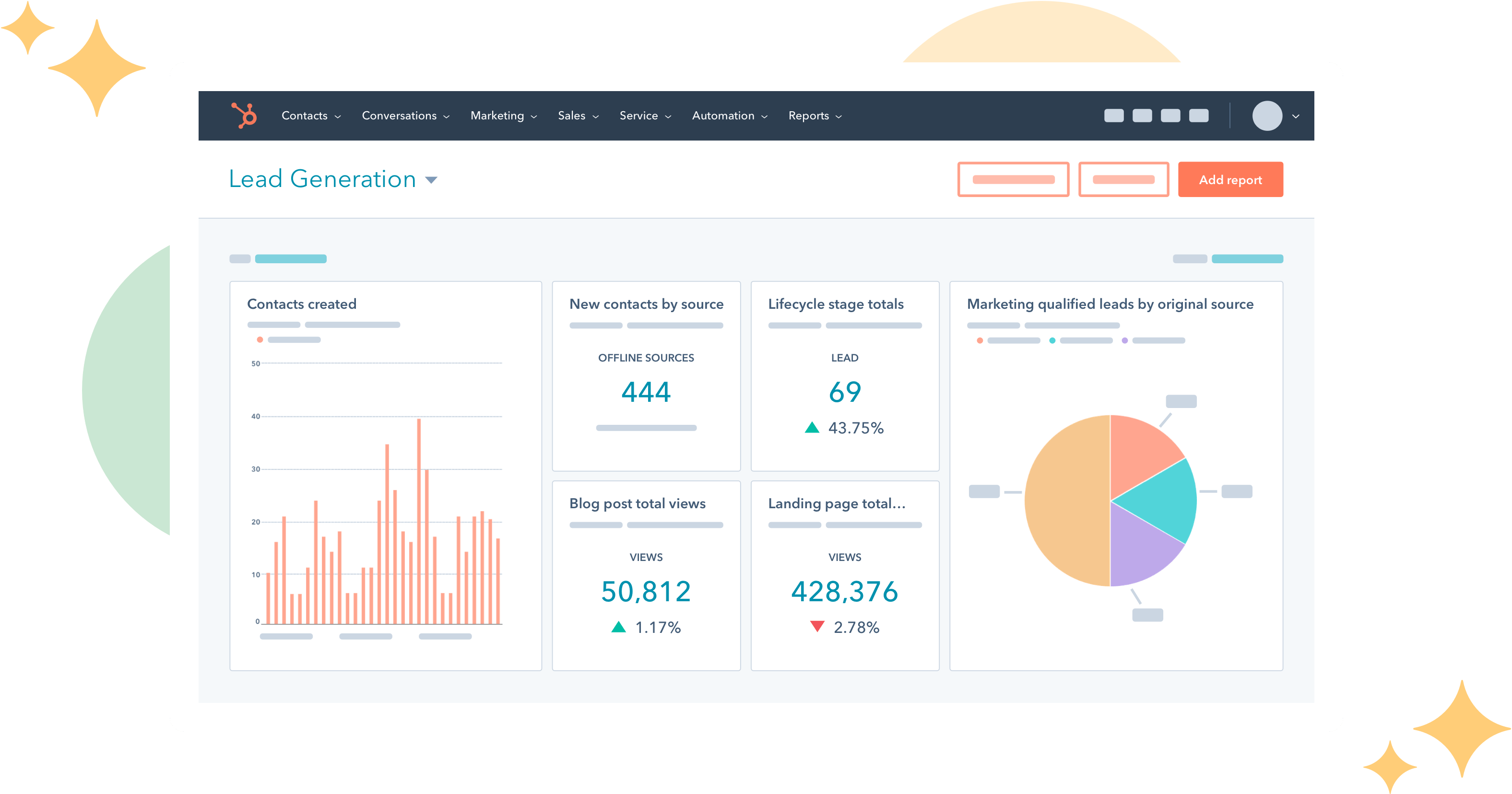
affordable marketing automation: hubspot social media management

HubSpot incorporates AI in a number of ways. Here are just a few:

  • SEO: HubSpot’s COS and CMS use algorithms to scour your posts for search optimization suggestions before you post.
  • Emails and Workflows: When a customer does something such as engage with an email or landing page, this will trigger a canned email to be sent to them with their name and other personalizations in it.
  • Social Media: HubSpot’s social media platform allows you to autogenerate post caption copy using machine learning. This technology recognizes sentences that you might regularly tweet or meta descriptions in a link you’re sharing, then crafts a caption that you can then edit or tweak.
  • Deduplication features: If you upload a new list into a HubSpot CRM, or a pre-existing contact subscribes to your marketing newsletter, HubSpot will search the CRM to find matching contacts and prevent any duplicates from being added.

Pro Tip

For maximum engagement, schedule your emails at the most optimal time for your audience. For instance, if your email open rate plummets on the weekends, schedule them for a weekday.

6. Buffer

Price: Plans start at $6/month per channel and vary depending on your team size and number of channels.

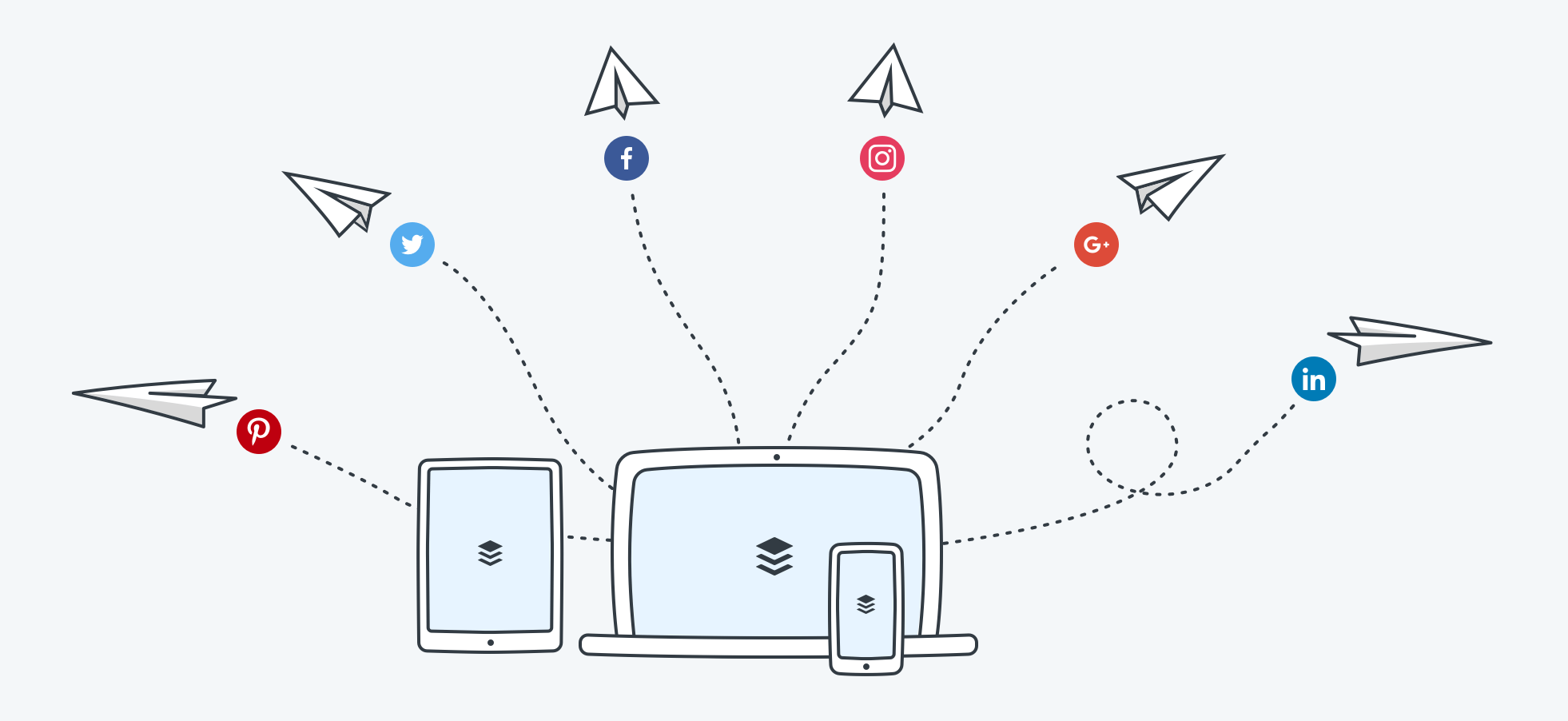
affordable marketing automation: bufferImage Source

If you’re a social media marketer, AI tools can take your work to the next level in a fraction of the time.

Buffer is a social media management software offering a range of tools to publish, track, and measure your social media content. For instance, you can maximize engagement by scheduling posts at the most optimal time of day, when your audience is most active.

Pro Tip

For many social media marketers, creating a steady stream of amazing content is challenging. With Buffer’s Calendar tool, you can schedule content months ahead, identify any content gaps, and hone in on certain holidays.

7. Mailchimp

Price: $11-$299/month, depending on how many contacts you have.

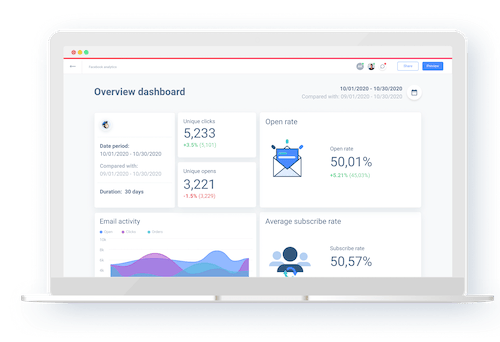
affordable marketing automation: mailchimp

Image Source

Mailchimp is a popular email marketing software that lets you create campaigns and build automated workflows. Depending on your plan, you can also access advanced audience insights and a library of email templates.

Pro Tip

Using Mailchimp’s Customer Journey Builder, you can automate marketing workflows for your contacts. From simple to highly complex, these journey maps can contain multiple starting points, branches, and unique actions — guaranteeing each of your contacts has a personalized experience.

Familiarizing Yourself With AI

Artificial intelligence can sound like an intimidating or expensive technology. But, the truth is, it’s getting more and more prominent in our world and workplaces today.

Ultimately, the best strategy for vetting AI products, tools, and opportunities that may come your way in the future is to research credible sources and ask the right questions about the software you’re considering.

If you’re looking to take the next step with technology implementation, check out HubSpot Academy’s latest course, “Artificial Intelligence and Machine Learning in Marketing.” The course gives an introduction to AI and machine learning while also walking you through how to implement it in your company’s marketing department.

Still in the initial research phase, but want to learn how AI could impact marketing in the next year? Discover four predictions from marketing AI experts in this blog post.

artificial intelligence course

Categories B2B

27 Brilliant Marketing Email Campaign Examples [+ Template]

On any given day, most of our email inboxes are flooded with a barrage of automated email newsletters that do little else besides giving us another task to do on our commutes to work — namely, marking them all as unread without reading or unsubscribing altogether.

Download Now: Email Marketing Planning Template 

It may not seem like a good idea to add to all the noise. However, according to Constant Contact, the average ROI for email marketing is $42 for every $1 spent. Needless to say, email is an important component of a marketing strategy, and its success relies largely on how well you craft your email campaigns.

In this post, we’ll explore:

Let’s get started.

Email campaigns are an important part of inbound marketing, an ongoing process and philosophy coined by HubSpot where marketers meet buyers in whatever stage of the journey they’re in.

Inbound marketing acknowledges that not everyone is ready to buy from you at this exact moment. That’s why email is such an important channel.

Through email, you’re able to stay top-of-mind by providing communication to their personal inbox, and you can do it at scale with marketing automation software. It’s important that an email campaign’s recipients have opted in to receive this content and that each piece offers something valuable.

Effective Email Marketing Campaigns

An email marketing campaign is as effective as its ultimate goal. Here are some examples of different purposes your email campaign may set out to accomplish:

1. Traffic Generation Email Marketing Campaigns

effective email marketing campaigns: traffic generation

One of the biggest benefits of email marketing? Getting click-throughs to pages on your website. Not only does this boost your referral traffic, but it also drives visitors who’ve already shown an interest in your business, making it more likely that they’ll act once they get to your site.

Overall, email is an effective promotion channel for the high-value content you create on your website. It can help you drive qualified traffic to your product pages, blog posts, and web pages, consequently boosting conversions.

2. Awareness Email Marketing Campaigns

effective email marketing campaigns: awareness

Not everyone who opts into your email list is ready to make a purchasing decision. You can use email marketing to stay top of mind while providing the educational content that is most relevant to them.

Indeed, brand awareness email campaigns help you solve for your readers and also establish yourself as a leader in your industry. If subscribers hear more from you than they do from your competitors, they’re more likely to rely on you when they need more information on a topic — or when they need a certain product.

3. Lead Nurturing Email Marketing Campaigns

effective email marketing campaigns: lead nurturing

As you stay top of mind, you may also consider ways to identify the leads with the highest purchase intent and provide conversion-focused content that “nurtures” them toward a sale (or at least toward becoming sales-ready).

In these emails, you can be more up-front about wanting recipients to buy. You can include shopping-centric calls-to-action, such as “Shop now,” “Buy now,” and “Add to cart.” However, it’s essential for recipients to have shown strong purchase intent. Adding items to their cart or having a purchase history are both strong indicators.

(Tip: You can find out behavioral and purchasing data using your ecommerce tool, CRM, or CMS.)

If you target these emails to casual visitors or first-time subscribers, you may be rushing them and inadvertently discouraging them from buying from you.

4. Revenue Generation Email Marketing Campaigns

effective email marketing campaigns: revenue gen

You can create email marketing campaigns for your existing customers to promote upsell and cross-sell opportunities. You can also create campaigns to capture a sales conversion from leads who are close to a purchasing decision.

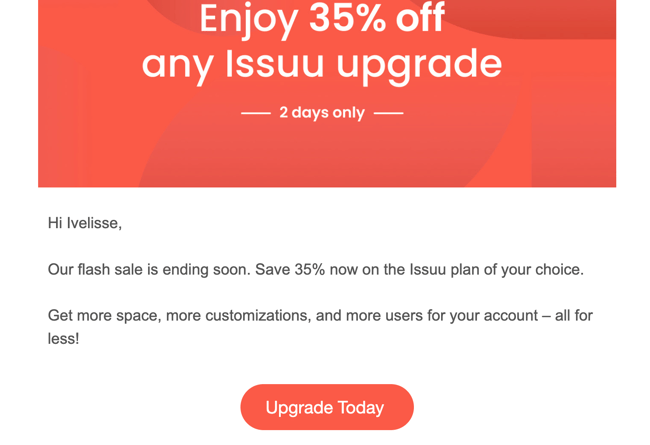
One example might be creating “abandon cart” campaigns for recovering lost sales conversions; or, like in the example above, promoting a flash sale to get users to upgrade. These types of campaigns are best reserved for subscribers at the bottom of the conversion funnel. In other words, they have shown unquestionable purchase intent by either visiting a checkout page or booking a call with your sales team.

Effective email marketing campaigns need to be cleverly written to attract attention in busy inboxes, but the options are endless. Check out these 10 email marketing tips in 60 seconds:

Now that you know the most effective campaigns you can create, grab some inspiration from the masterful email marketing campaigns below.

Best Email Marketing Campaign Examples

If you’re reading this, you probably have an email address (or two, or three …). In fact, you’ve probably been sending and receiving emails for years, and you’ve definitely received some questionable deliveries in your inbox.

Whether they were unexpected, uninformative, or had a subject line tHaT wAs fOrmAtTeD liKe tHiS, we bet you didn’t hesitate to direct them towards the trash, right?

While email has managed to stand the test of time, many marketers have failed to update their strategies since its inception. So to ensure you’re sending modern emails that warrant some of your recipients’ precious time and attention, we’ve compiled a list of effective email examples to inspire your next campaign.

1. ModCloth

Marketing Campaign: Email Preferences

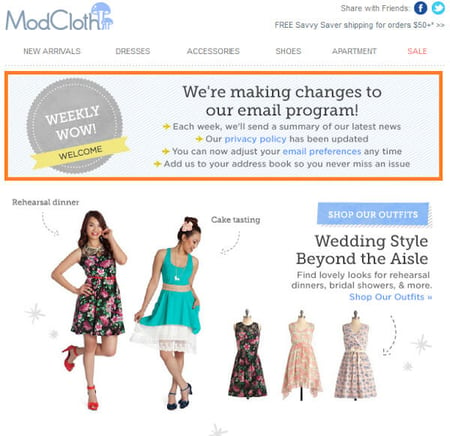
Great companies are always evolving, and your customers expect to experience change. What they don’t expect (because too many companies haven’t lived up to this end of the bargain) is to be told about those changes.

That said, this email from ModCloth serves as a refreshing change of pace. If you’re going to change the way you communicate with a lead or customer, give them clear, fair warning so, if they aren’t on board, they can make the necessary adjustments to keep their inbox clean.


Email Marketing Campaign Example: Modcloth - "We're making changes to our email program!"

Why It Works

It sets expectations for communication moving forward so that the buyer persona can choose what’s best for them.

2. Netflix

Marketing Campaign: Engagement

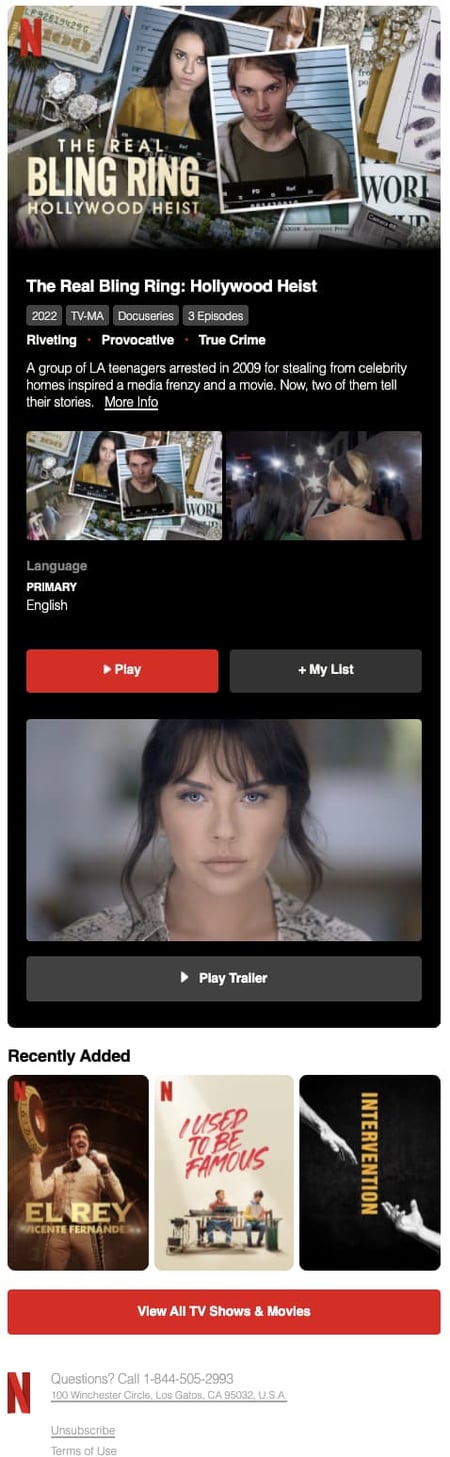
More than half of US households subscribe to multiple streaming channels. With several platforms vying for our attention, brands like Netflix have gotten more targeted with its emails.

This email from Netflix provides a curated list of new shows the customer may be interested in based on their watch history. It’s skimmable with plenty of visuals supporting the new releases and provides a CTA that prompts you to watch the trailer.


email marketing campaign example: netflixWhy It Works

The CTAs in this email entice the user to stop what they’re doing and head over to Netflix to check out the new content.

3. Lita Lewis Fitness

Marketing Campaign: Update

Have a new product or project in the works? It’s a good idea to let your subscribers know prior to the launch, especially if you’ve been away for a while.

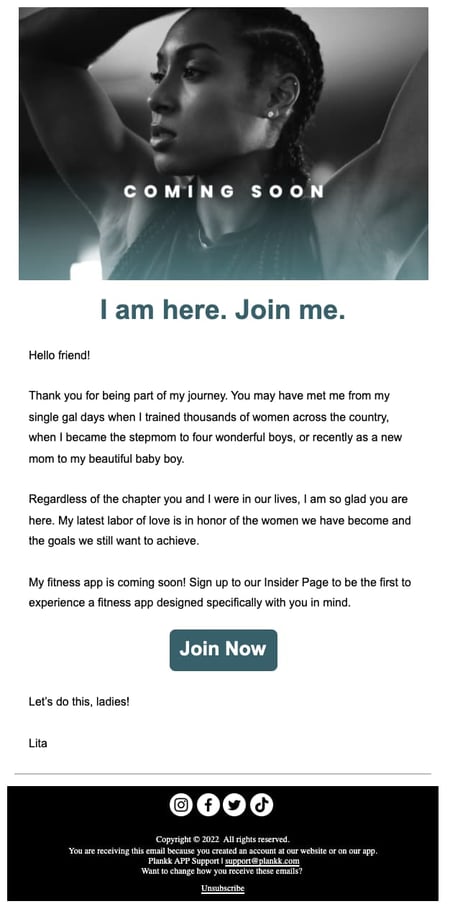
Fitness expert and trainer Lita Lewis did just that in the email below reconnecting with her subscribers and informing them about her upcoming app.

email marketing campaigns example: Lita Lewis fitnessWhy It Works

This email is personable and reads like you’re catching up with an old friend. Additionally, the “join now” CTA makes it easy for readers to sign up for the app and other updates.

4. Tory Burch

Marketing Campaign: Promotion

Did you see that? Did you see it move? Pretty cool, right? This small bit of animation helps to separate this email from Tory Burch from all of the immobile emails in their recipient’s inboxes. They also leverage exclusivity by framing the promotion as a “private” sale. Oftentimes, this type of positioning makes the recipient feel like they’re specially chosen, which encourages them to take advantage of the special opportunity they’ve been presented with.

Email Marketing Campaign Example: Tory Burch - Private Sale Invitation

Why It Works

Emails can get static, boring, and impersonal. This email subverts those expectations without going overboard.


5. RunKeeper

Marketing Campaign: Re-Engagement Campaign

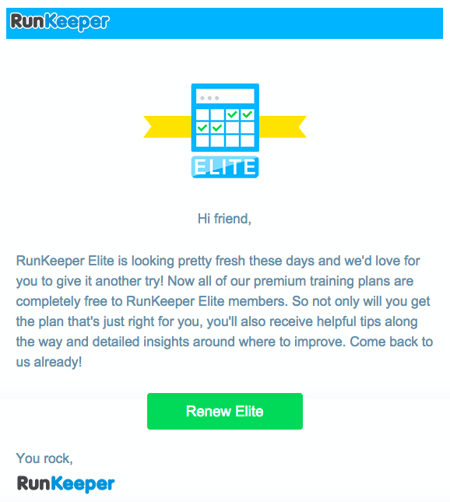
RunKeeper makes an effort to reengage lost users with this friendly, informational email. By highlighting their app’s most recent changes and benefits, the copy works to entice recipients to give the app another chance. It also discusses benefits that the recipient may not know about since the last time they used the service.

Email Marketing Campaign Example: RunKeeper - "RunKeeper Elite is looking pretty fresh these days and we'd love for you to give it another try!"

Why It Works

Small inclusions like the “Hi friend” greeting and the “You rock” closing makes the content feel welcoming and less aggressive.

6. Litmus

Marketing Campaign: Promotion

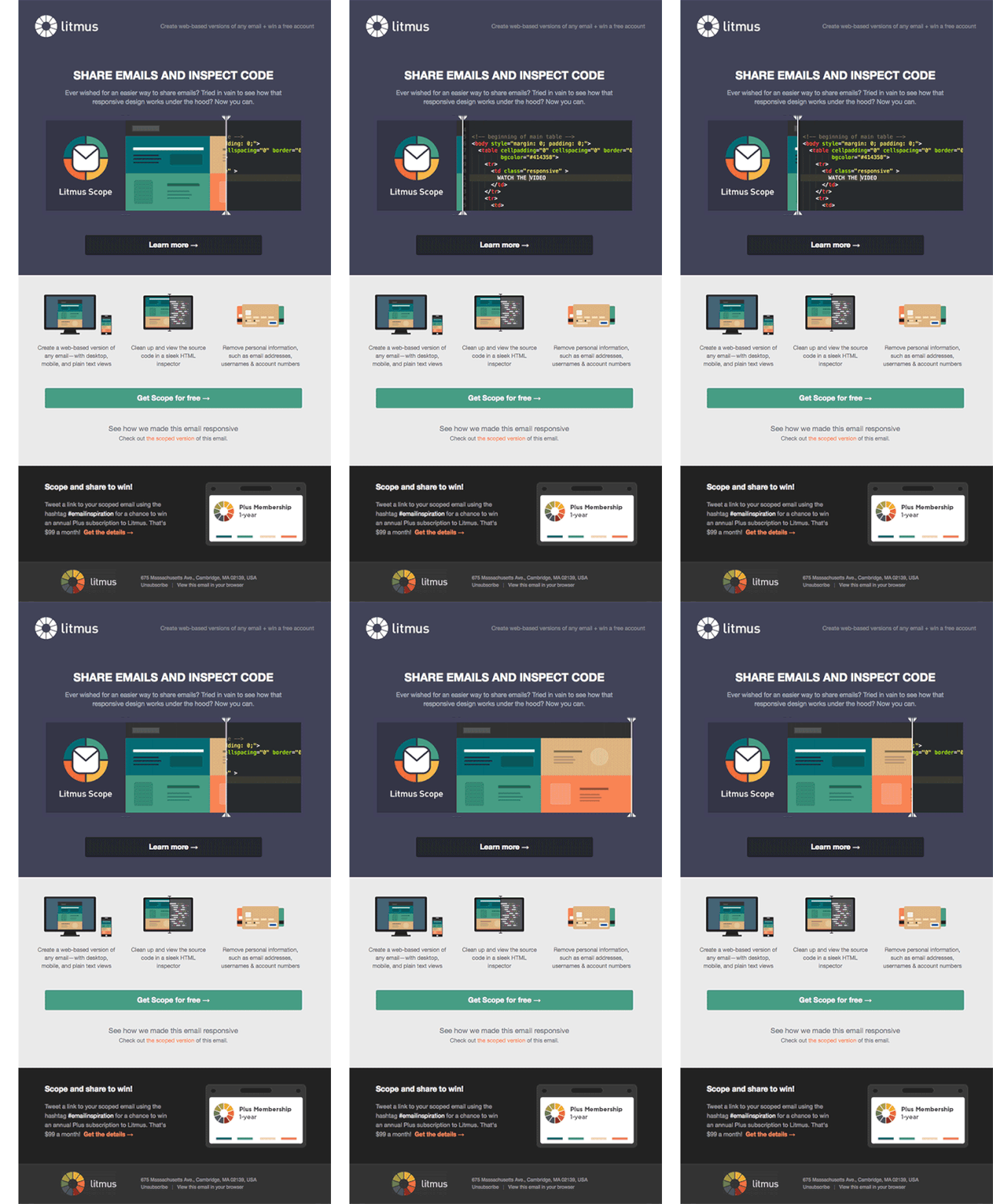
Here’s another great example of animation being used to create a more interesting email marketing design. Unlike static text, the swipe motion used to provide recipients with a look “under the hood” of their email tool is eye-catching and encourages you to take a deeper dive into the rest of the content. Not to mention the header does an excellent job of explicitly stating what this email is about.

Email Marketing Campaign Example: Litmus - "Tried in vain to see how that responsive design works under the hood?"

Why It Works

The animation is subtle, and it’s executed in a way that serves to enhance the email’s body copy. Even better, it works well with the design of the email, creating a matching but contrasting focal point before the reader dives into the rest of the copy below.

7. Loft

Marketing Campaign: Email Preferences

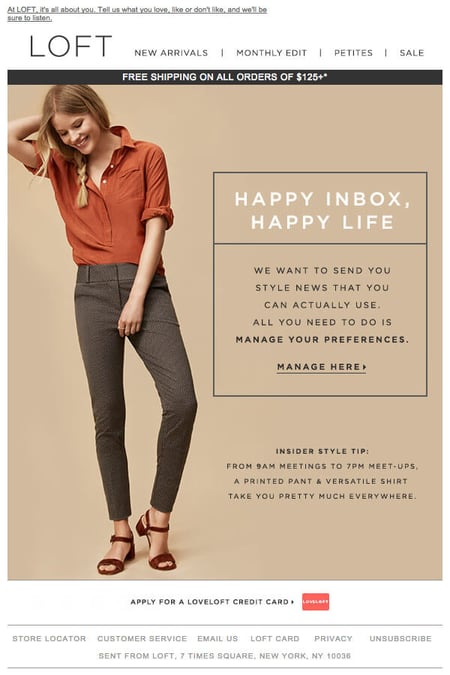
This email from Loft aims to demonstrate their understanding of your crazy, mixed-value inbox. In an effort to provide you with emails that you actually want to open, Loft asks that their recipients update their preferences to help them deliver a more personalized experience. This customer-focused email is super effective in making the recipient feel like their likes, dislikes, and opinions actually matter.

Email Marketing Campaign Example: Loft - "Happy Inbox, Happy Life"

Why It Works

It centers the recipient’s needs with the slogan “Happy Inbox, Happy Life.” Paired with a low-friction CTA, the copy is simple and effective.

8. UncommonGoods

Marketing Campaign: Promotion

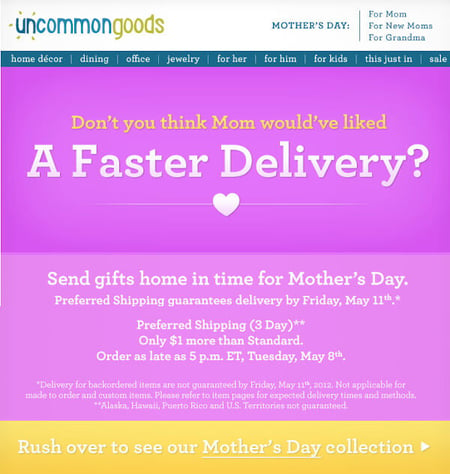
You’ve heard it a million times (and a few thousand of those times may have been from us): You should create a sense of urgency with your calls-to-action. That’s what makes a lead take action, right? Well, this email from UncommonGoods succeeds in creating a sense of urgency by focusing on the value of acting now.

Email Marketing Campaign Example: Uncommon Goods - "Don't you think Mom would've liked a faster delivery?"

Why It Works

Instead of saying, “Order your Mother’s Day gift NOW before Preferred Shipping ends!”, this email asks, “Don’t you think Mom would’ve liked a faster delivery?” Why yes, she would. Thank you for reminding me before it’s too late — I don’t want to be in the dog house because my gift arrived after Mother’s Day.

9. JetBlue

Marketing Campaign: Customer Delight

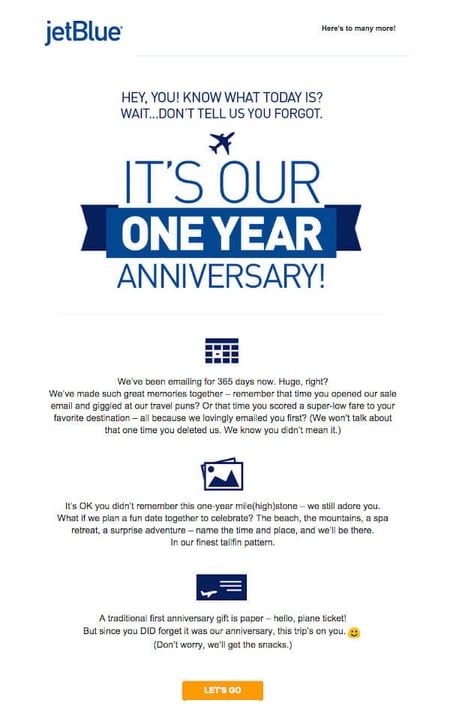
Confession: We have a serious email marketing crush on JetBlue. And they continue to deliver their lovable marketing in this cheeky email campaign that aims to humorously reengage customers. Every element from the header, to the three witty points, to the actionable, contrasting CTA work together to create a lovable campaign that’s promotional without being pushy.

Email Marketing Campaign Example: JetBlue - "It's our one year anniversary"

Why It Works

This copy is bursting with friendly personality and airline jokes. The email is relatable and reads as though it comes from a friend, which will help earn a positive reaction.

10. Harpoon Brewery

Marketing Campaign: Customer Delight

My friends at Harpoon are so thoughtful, aren’t they? This simple, timely email really does feel like it’s coming from a friend, which is why it’s so effective. In an age of email automation, it’s easy for email campaigns to feel a little robotic. And while I’m certain that this email was, in fact, automated, it feels really human.

If you’re looking to strengthen the relationship you have with your existing customers, consider taking the time to set up a quick email like this to let them know you’re thinking of them.
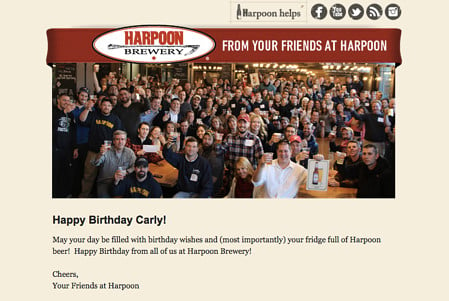
Email Marketing Campaign Example: Harpoon Brewery - "Happy Birthday Carly!"

Why It Works

Personalization: From the timing of the email (birthday) to the personalized salutation, this email was sent to the right person at the right time.

11. Rip Curl

Marketing Campaign: Promotion

“JOIN THE REVOLUTION.”

That’s quite powerful, wouldn’t you agree? Rip Curl, an Australian surfing sportswear retailer, combines urgency and our psychological need to be part of something to create an email headline that jumps off the page. This positioning is designed to lead people to believe that there’s a “revolution” taking place and it’s their turn to get in on the action.
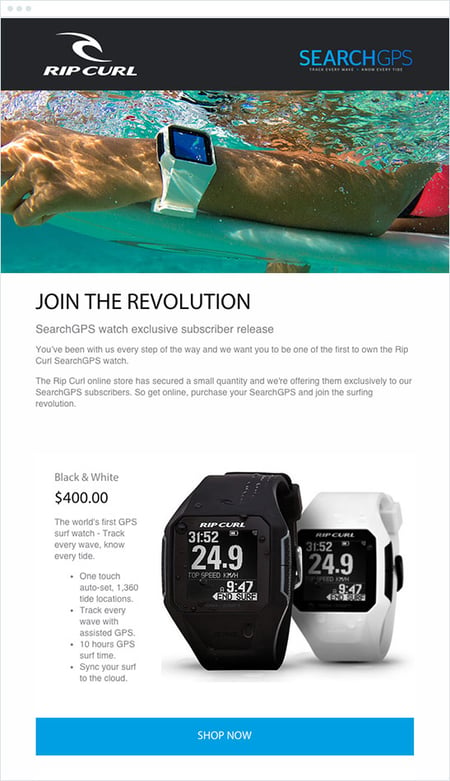
Email Marketing Campaign Example: Ripcurl - "Join the revolution"

Why It Works

At the end of the day, people want to be part of something that’s bigger than themselves, and this email aims to motivate them to do so by purchasing this sleek watch.

12. J.Crew Factory

Marketing Campaign: Promotion

For many of us, when it comes to wrapping gifts, the struggle is real. J.Crew Factory recognized this problem and then created this email to serve as a solution for those incapable of pulling off a Pinterest-esque wrap job: gift cards. The email offers up two different ways to pick up a gift card — in store or online — in an effort to avoid excluding anyone.

They’ve also included a map of the nearest store location at the end of the email to lower the purchasing barrier even further.
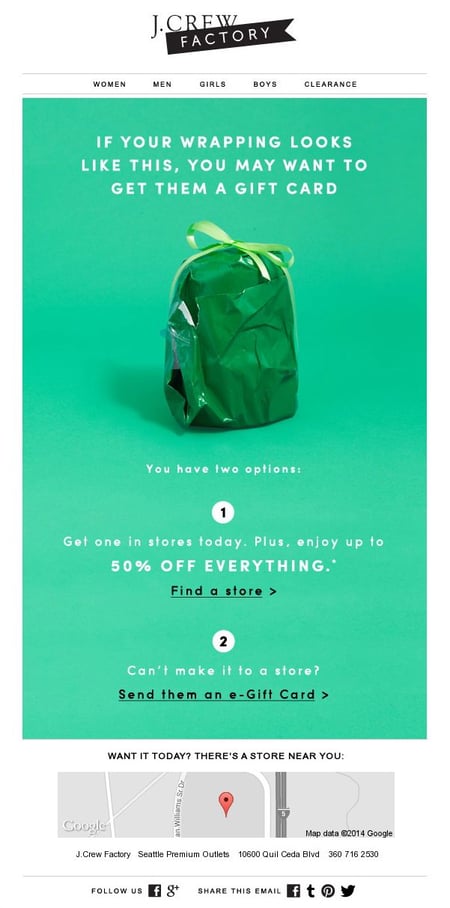
Email Marketing Campaign Example: J.Crew Factory - "If your wrapping looks like this, you may want to get them a giftcard"

Why It Works

It combines humor with a low-stress, low-friction solution.

13. charity: water

Marketing Campaign: Engagement

When people talk about email marketing, lots of them forget to mention transactional emails. These are the automated emails you get in your inbox after taking a certain action on a website. This could be anything from filling out a form to purchasing a product to updating you on the progress of your order. Often, these are plain text emails that marketers set and forget.

Well, charity: water took an alternate route. Once someone donates to a charity: water project, her money takes a long journey. Most charities don’t tell you about that journey at all — charity: water uses automated emails to show donors how their money is making an impact over time. With the project timeline and accompanying table, you don’t even really need to read the email — you know immediately where you are in the whole process so you can move onto other things in your inbox.
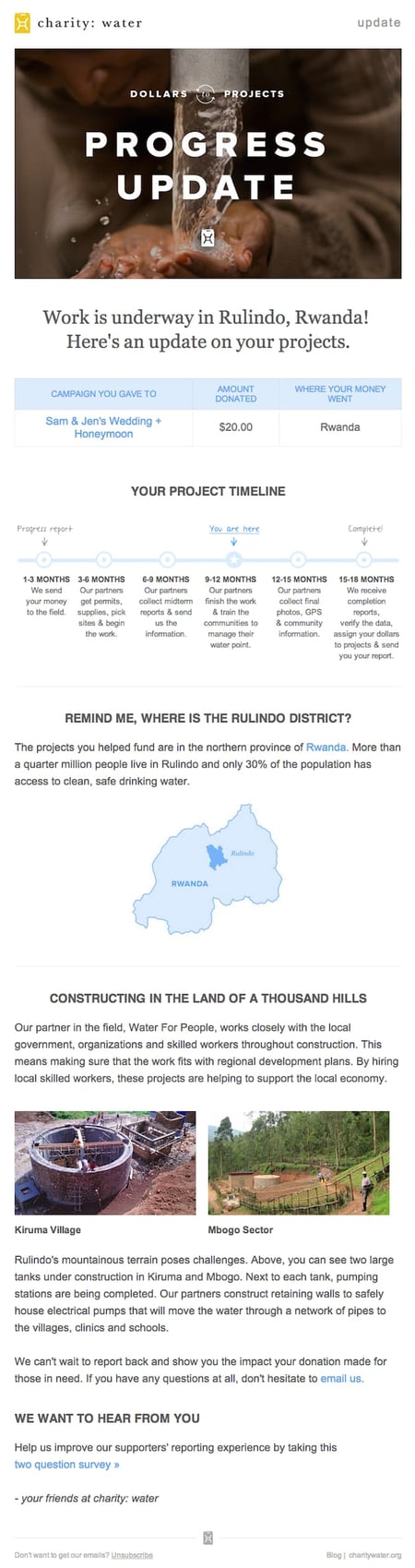
Email Marketing Campaign Example: charity.water - "Progress Update"

Why It Works

It keeps the audience engaged and shows the impact that their actions have made on the organization in the effort of staying top-of-mind and increasing future participation.

14. Uber

Marketing Campaign: Engagement

The beauty of Uber’s emails is in their simplicity. Email subscribers are alerted to deals and promotions with emails like the one you see below. We love how brief the initial description is, paired with a very clear CTA — perfect for subscribers who are quickly skimming the email.

For the people who want to learn more, these are followed by a more detailed (but still pleasingly simple), step-by-step explanation of how the deal works.

We also love how consistent the design of Uber’s emails is with its brand. Like its app, website, social media photos, and other parts of the visual branding, the emails are represented by bright colors and geometric patterns.
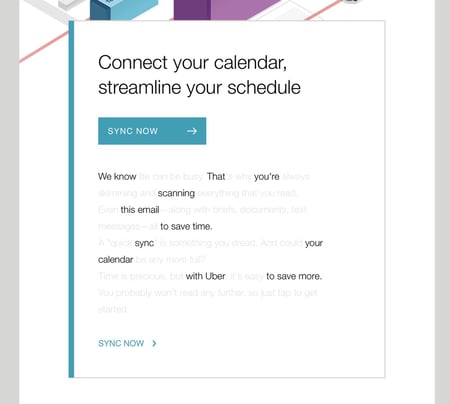
Email Marketing Campaign Example: Uber - "Connect your calendar, streamline your schedule"

Why It Works

All of its communications and marketing assets tell the brand’s story — and brand consistency is one tactic Uber’s nailed in order to gain brand loyalty.

15. TheSkimm

Marketing Campaign: Customer Delight

We love TheSkimm’s daily newsletter — especially its clean design and its short, punchy paragraphs. But newsletters aren’t TheSkimm’s only strength when it comes to email. Check out its subscriber engagement email below, which rewarded one of their subscribers for being subscribed for two years.

Emails triggered by milestones, like anniversaries and birthdays, are fun to get — who doesn’t like to celebrate a special occasion? The beauty of anniversary emails, in particular, is that they don’t require subscribers to input any extra data, and they can work for a variety of senders. Plus, the timeframe can be modified based on the business model.
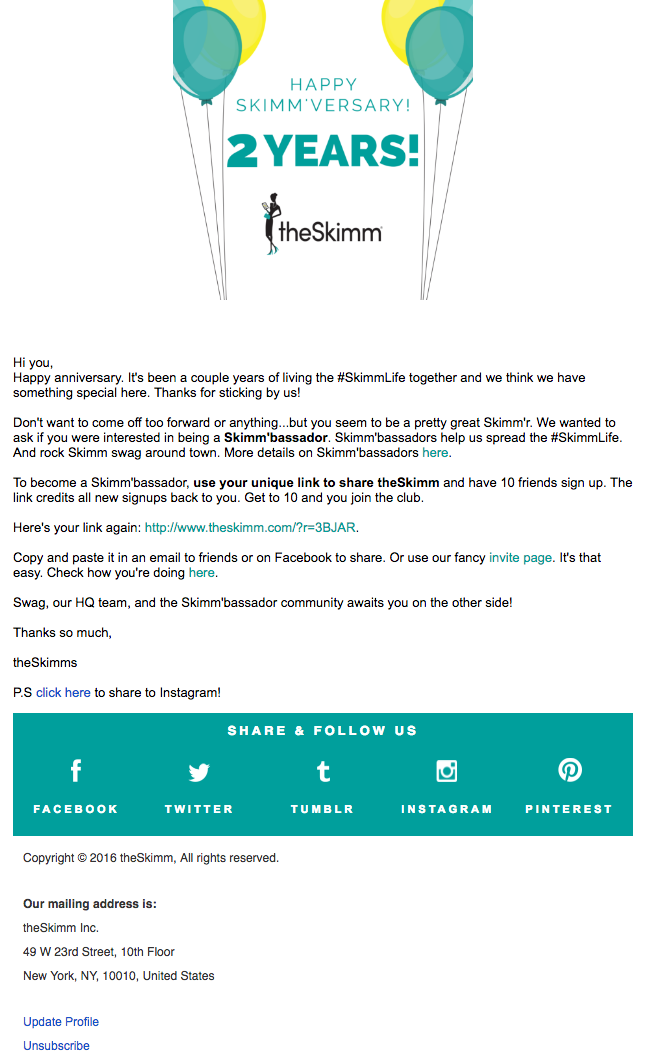
Email Marketing Campaign Example: TheSkimm - "Happy Skimmversary"

Why It Works

The folks at TheSkimm took it a step further by asking Mineo if she’d like to earn the title of brand ambassador as a loyal subscriber — which would require her to share the link with ten friends, of course.

16. Mom and Dad Money

Marketing Campaign: Questionnaire

Think you know all about the people who are reading your marketing emails? How much of what you “know” about them is based on assumptions? The strongest buyer personas are based on insights you gather from your actual readership, through surveys, interviews, and so on — in addition to the market research.

That’s exactly what Matt Becker of Mom and Dad Money does — and he does it very, very well.

Here’s an example of an email I once received from this brand. Design-wise, it’s nothing special — but that’s the point. It reads just like an email from a friend or colleague asking for a quick favor.
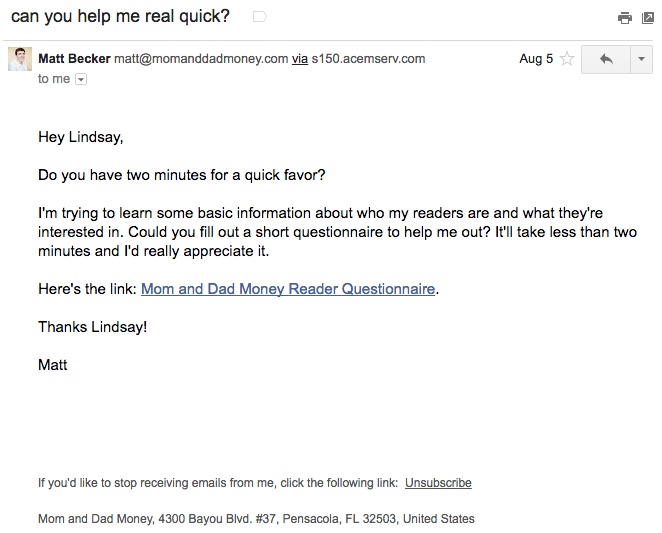
Email Marketing Campaign Example: Mom and Dad Money - "can you help me real quick?"

Why It Works

Not only was this initial email great, but his response to my answers was even better: Within a few days of responding to the questionnaire, I received a long and detailed personal email from Matt thanking me for filling out the questionnaire and offering a ton of helpful advice and links to resources specifically catered to my answers. I was very impressed by his business acumen, communication skills, and obvious dedication to his readers.

17. Birchbox

Marketing Campaign: Promotion

The subject line of this email from beauty product subscription service Birchbox got my colleague Pam Vaughan clicking. It read: “We Forgot Something in Your February Box!” Of course, if you read the email copy below, Birchbox didn’t actually forget to put that discount code in her box — but it was certainly a clever way to get her attention.

As it turned out, the discount code was actually a bonus promo for Rent the Runway, a dress rental company that likely fits the interest profile of most Birchbox customers — which certainly didn’t disappoint. That’s a great co-marketing partnership right there.
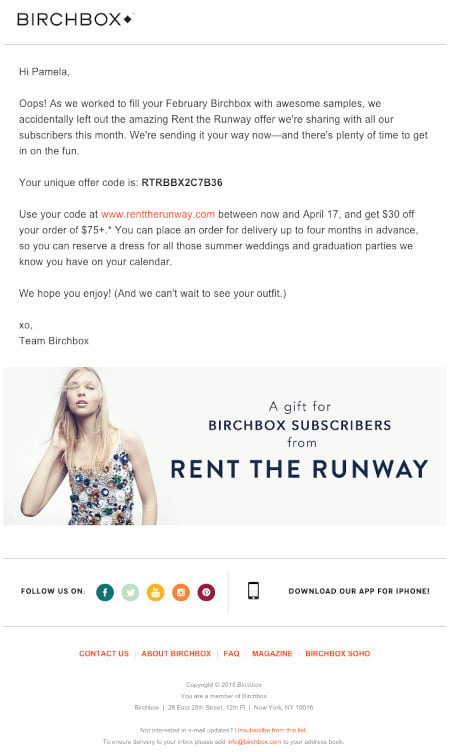
Email Marketing Campaign Example: Birchbox - "Oops!"

Why It Works

It gained her attention and delivered some unexpected delight.

18. Postmates

Marketing Campaign: Promotion

I have to say, I’m a sucker for GIFs. They’re easy to consume, they catch your eye, and they have an emotional impact — like the fun GIF in one of Postmates’ emails that’s not only delightful to watch, but also makes you crave some delicious Chipotle.

You, too, can use animated GIFs in your marketing to show a fun header, draw people’s eyes to a certain part of the email, or display your products and services in action.
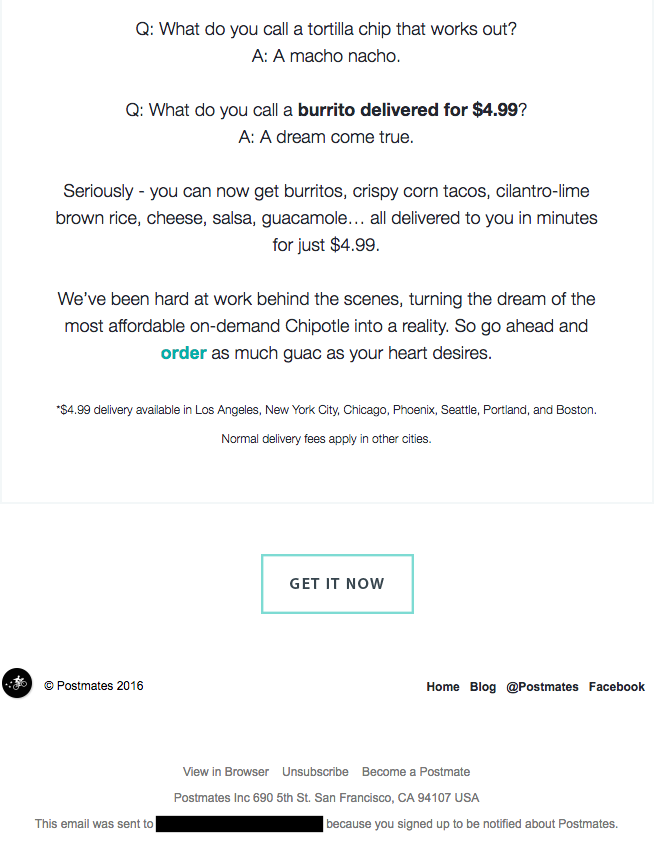
Email Campaign Example: Postmates - "What do you call a tortilla chip that works out? A macho nacho."

Why It Works

It centers the product in a fun, attractive way.

Email Campaign Example: Animated Nachos Gif


19. Dropbox

Marketing Campaign: Re-Engagement

You might think it’d be hard to love an email from a company whose product you haven’t been using. But Dropbox found a way to make its “come back to us!” email cute and funny, thanks to a pair of whimsical cartoons and an emoticon.

Plus, the email was kept short and sweet, to emphasize the message that Dropox didn’t want to intrude — it just wants to remind the recipient that the brand exists, and why it could be helpful. When sending these types of email, you might include an incentive for recipients to come back to using your service, like a limited-time coupon.
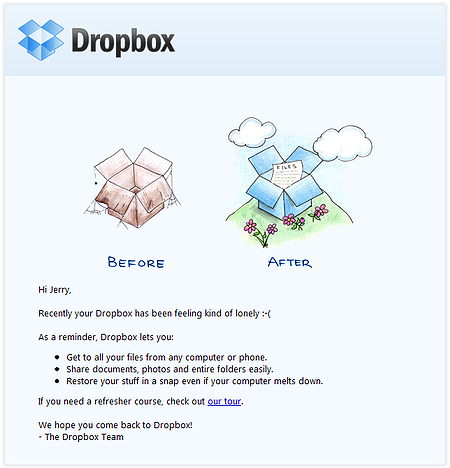
Email Campaign Example: Dropbox - "Recently your Dropbox has been feeling kind of lonely"

Why It Works

It uses the Dropbox logo in a way that’s creative and unique to demonstrate their product as a solution.

20. InVision App

Marketing Campaign: Newsletter

Every week, the folks at InVision send a roundup of their best blog content, their favorite design links from the week, and a new opportunity to win a free t-shirt. (Seriously. They give away a new design every week.) They also sometimes have fun survey questions where they crowdsource for their blog. This week’s, for example, asked subscribers what they would do if the internet didn’t exist.

Email Marketing Campaign Example: Invision - "Designing with your developer in mind"

Why It Works

Not only is InVision’s newsletter a great mix of content, but I also love the nice balance between images and text, making it really easy to read and mobile-friendly — which is especially important, because its newsletters are so long (below is just an excerpt). We like the clever copy on the call-to-action (CTA) buttons, too.

21. Cook Smarts

Marketing Campaign: Newsletter

I’ve been a huge fan of Cook Smarts’ “Weekly Eats” newsletter for a while. The company sends yummy recipes in the form of a meal plan to my inbox every week. But I didn’t just include it because of its delicious recipes — I’m truly a fan of its emails.

I especially love the layout of Cook Smarts’ emails: Each message features three distinct sections: one for the menu, one for kitchen how-to’s, and one for the tips. That means you don’t have to go hunting to find the most interesting part of its blog posts — you know exactly where to look after an email or two.

I also love Cook Smarts’ “Forward to a Friend” CTA in the top-right of the email.

Email Marketing Campaign Example: Cook Smarts - "Weekly Eats"

Why It Works

Emails are super shareable over — you guessed it — email, so you should also think about reminding your subscribers to forward your emails to friends, family, or coworkers.

22. HireVue

Marketing Campaign: Email Preferences

“Saying goodbye is never easy to do… So, we thought we’d give you a chance to rethink things.” That was the subject of this automated unsubscribe email from HireVue. We love the simple, guilt-free messaging here, from the funny header images to the great CTA button copy.

Not only are the design and copy here top-notch, but we applaud the folks at HireVue for sending automated unsubscribe emails in the first place. It’s smart to purge your subscriber lists of folks who aren’t opening your email lists, because low open rates can seriously hurt email deliverability.
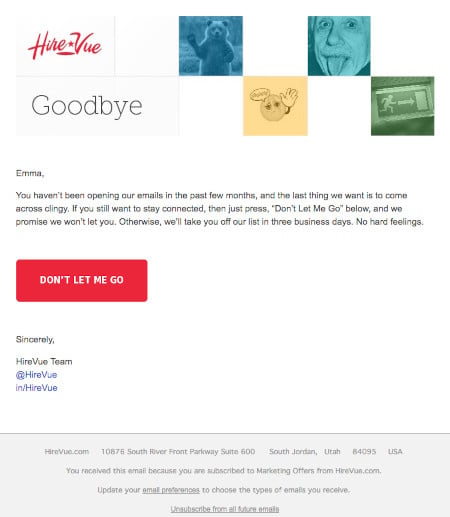
Email Marketing Campaign Example: Hirevue - "Don't Let Me Go"

Why It Works

The button copy is a pattern interrupt that will prompt the recipient to pause and think if they want to take the action.

23. Paperless Post

Marketing Campaign: Promotion

When you think of “holiday email marketing,” your mind might jump straight to Christmas, but there are other holidays sprinkled throughout the rest of the year that you can create campaigns around. (Download these email marketing planning templates to keep yourself organized throughout the year.)

Take the email below from Paperless Post, for example. I love the header of this email: It provides a clear CTA that includes a sense of urgency. Then, the subheader asks a question that forces recipients to think to themselves, “Wait, when is Mother’s Day again? Did I buy Mom a card?”

Below this copy, the simple grid design is both easy to scan and quite visually appealing. Each card picture is a CTA in and of itself — click on any one of them, and you’ll be taken to a purchase page.
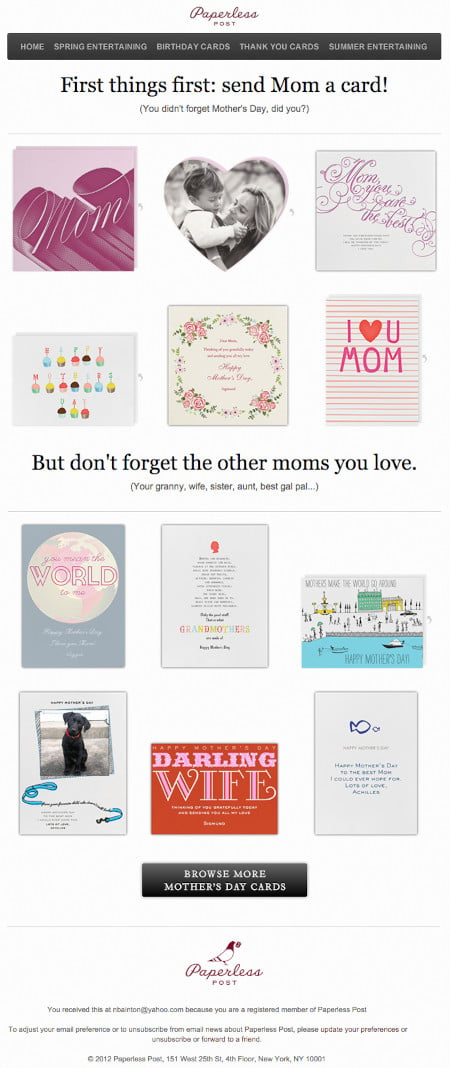
Email Marketing Campaign Example: Paperless Post - "You didn't forget Mother's Day, did you?"

Why It Works

It earns a positive sentiment by prompting the recipient to do something they may have forgotten (send a card). This provides a solution and saves the recipient the pain of feeling guilty about forgetting Mother’s Day.

24. Stitcher

Marketing Campaign: Engagement

I love on-demand podcast/radio show app Stitcher’s “Recommended For You” emails. I tend to listen to episodes from the same podcast instead of branching out to new ones. But Stitcher wants me to discover (and subscribe to) all the other awesome content it has — and I probably wouldn’t without this encouragement.

I think this email also makes quite a brilliant use of responsive design. The colors are bright, and it’s not too hard to scroll and click — notice the CTAs are large enough for me to hit with my thumbs. Also, the mobile email actually has features that make sense for recipients who are on their mobile device. Check out the CTA at the bottom of the email, for example: The “Open Stitcher Radio” button prompts the app to open on your phone.
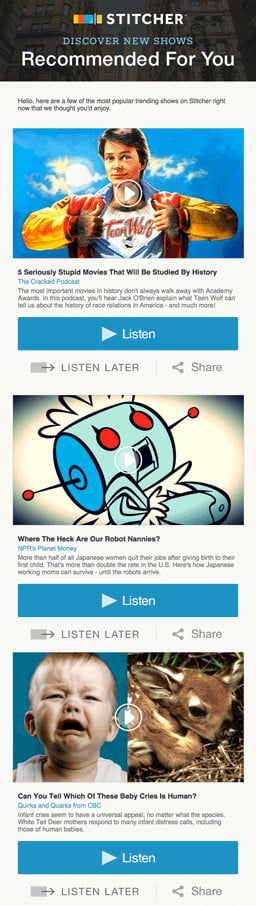
Email Marketing Campaign Example: Stitcher - "Recommended for you"

Why It Works

As humans, we tend to crave personalized experiences. So when emails appear to be created especially for you, you feel special — you’re not just getting what everyone else is getting. You might even feel like the company sending you the email knows you in some way, and that it cares about your preferences and making you happy.

25. RCN

Marketing Campaign: Update

Internet providers and bad weather are natural enemies. You’d think telecommunications companies wouldn’t want to call attention to storm-induced power outages — the one thing that sets off customers’ impatience. Then, there’s RCN.

RCN, a cable and wireless internet service, turned this email marketing campaign into a weather forecast just for its customers. This “storm update” got the company out ahead of an event that threatened its service, while allowing its users to get the weather updates they need right from the company they count on for Wi-Fi.

As you can see below, the email even advises personal safety — a nice touch of care to go with the promise of responsive service. At the bottom of the email, RCN also took the opportunity to highlight its social media channels, which the company appropriately uses to keep users informed of network outages.
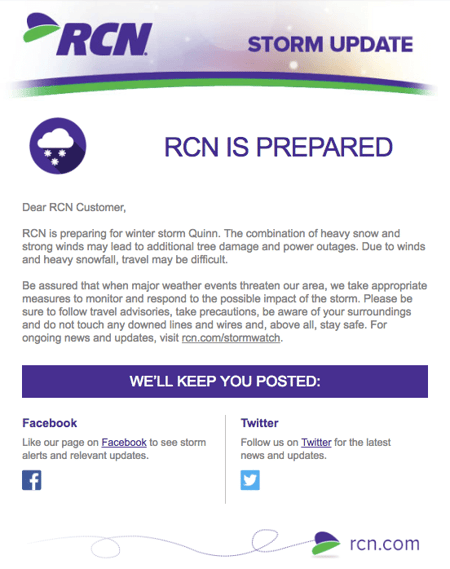
Email Marketing Example: RCN - "RCN is preparing for winter storm Quinn"

Why It Works

It simply offers an update. No promoting, no selling. The recipient’s best interests are in mind, and they’re setting expectations for something that they may imminently care about.

26. Trulia

Marketing Campaign: Newsletter

I’m a huge advocate of thought leadership. To me, some of the best companies gain customer loyalty by becoming the go-to source for expertise on a given topic. Trulia — a property search engine for buyers, sellers, and renters — is that expert in the real estate biz. How do I know? Just read their emails, much like the one below.

“Why aren’t millennials moving?” The subject line of this email campaign reads before citing interesting data about relocation trends in the U.S. Trulia doesn’t benefit from people who choose not to move, but the company does benefit from having its fingers on the pulse of the industry — and showing it cares which way the real estate winds are blowing.
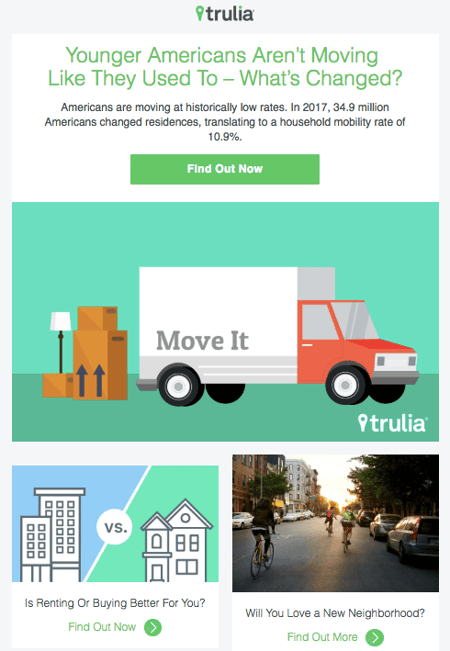
Email Marketing Campaign Example: Trulia - "Younger Americans Aren't Moving Like They Used To - What's Changed?"

Why It Works

It opens a loop by posing a question that the recipient needs to take action to get the answer to.

27. Her First $100K

Marketing Campaign: Promotion

This email marketing campaign crushes it, and for so many reasons.

While it is quite long, the list format works wonderfully in this email from financial education brand Her First $100K. First you’re drawn in with the testimonial at the top, then you’re presented with a list of reasons why you should join their Business Bootcamp — emphasizing the course is now 50% off.

Further down in the email, the details of the course are laid out, giving potential students a breakdown of what they can expect to learn. The language is friendly, succinct, and persuasive.
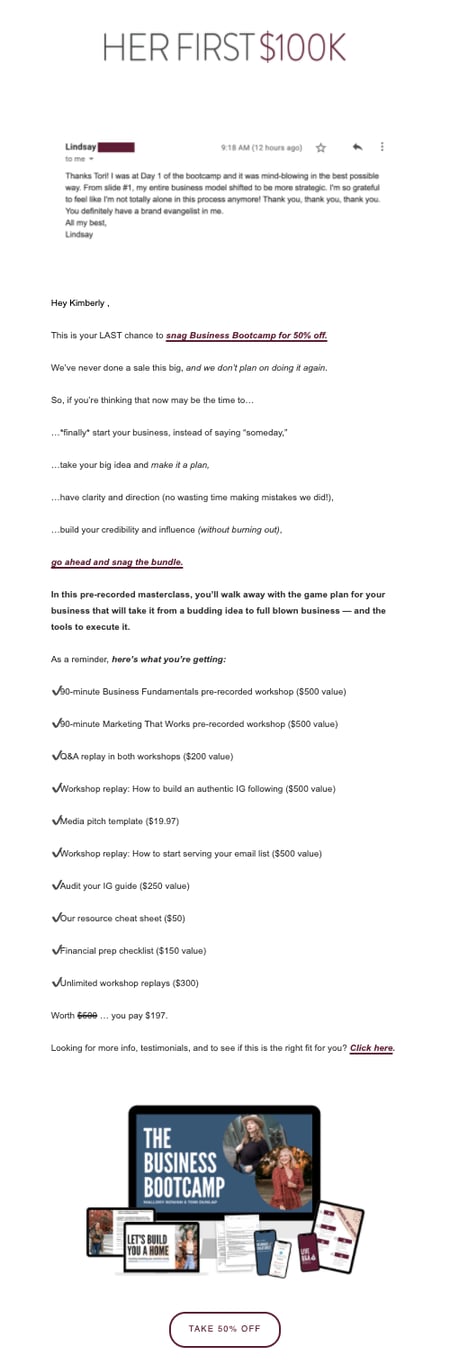
marketing email campaigns: Her First $100k

Why It Works

The email uses a friendly tone and a sense of urgency to entice customers to purchase the course. It harnesses the power of social proof to give an added layer of credibility.

These are just some of our favorite emails. Don’t just follow best practices when it comes to your marketing emails. Every email you send from your work email address also can be optimized to convert with a little planning.

Want a quick refresher on how to master marketing email? Check out this helpful video:


Now that we’ve reviewed great examples, let’s get into how to create an effective email marketing campaign of your own.

1. Use an email planning template.
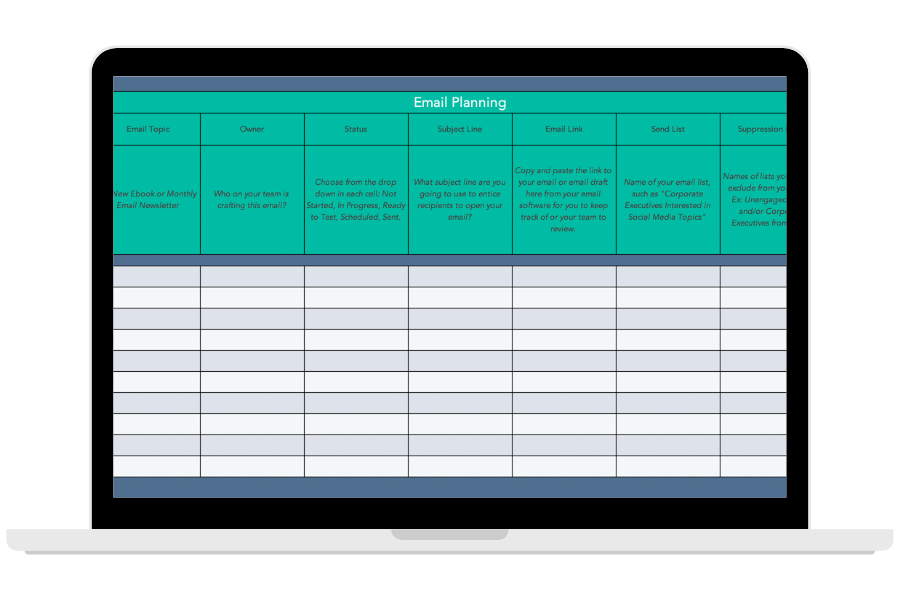
Email Planning Template in Excel

Download This Planning Template

It’s imperative to make a plan before you start emailing your entire customer database. That’s why HubSpot created this free email planning template to help you iron out who you’re emailing, who you’re suppressing from your contact list, and what the email’s message is. Download the template now to get your email campaign planning organized.

2. Identify your goal for the campaign.

Figure out the outcome that you want:

  • Is it to clean up your list?
  • Promote a new product?
  • Follow-up from an abandoned cart event?
  • Stay top of mind with your audience?

Different email campaigns will have different outcomes, requiring different tactics to get there. Once you determine the purpose of your campaign, you can then create the targets you want to hit. Include specific metrics in your goal so that you can determine if your campaign was a success based on quantitative data.

3. Understand who you’re emailing.

Have you ever heard the saying from Meredith Hill, “When you speak to everyone, you speak to no one”? What Hill is getting at here is that if you’re watering down your message to apply to your entire audience, you’re leaving opportunity on the table — opportunity for creating high-value, specific, relevant content that speaks directly to the recipient.

With this in mind, the key to a great email marketing campaign is identifying your audience and using email segmentation to ensure you’re delivering to the right people at the right time. If you can accomplish this and build it into your strategy, you can get more creative and specific with your messaging.

4. Put yourself in the shoes of the buyer persona.

After you’ve identified the outcome and the goals you want to hit, you now need to strategize how to provide value to your buyer persona so that they convert, engage, or take the action you want them to take. Some things to ask yourself might include:

  • How did they subscribe in the first place?
  • What matters to them?
  • What can I provide that will engage and delight them?

5. Build a targeted list and define enrollment criteria.

You know who you’re targeting and what you want them to do. From there, you must build the segment. Thinking about your buyer persona, what properties do they all have in common? How does your CRM describe those properties?

Your software is smart, but it’s not smart enough to automatically know which recipients you’re sending to. Will the recipients receive the emails at the same time, or is there certain criteria they have to meet before they are enrolled in the sequence or campaign?

6. Determine the timeline you want the campaign to run.

You may be running a seasonal campaign that only requires one or two emails, or you might be building a long-term top-of-mind nurturing campaign. Tailor the length of your email sequence to the length of the buying cycle and stage the persona is at in the buyer’s journey. In other words, deliver the right message at the right time.

7. Plan your emails and follow-ups.

Once you know who you’re emailing and why, it’s time to strategize how to move them from A (where they are) to B (where you want them to be, the goal of the campaign).

Over the course of the campaign’s timeline, you may want multiple touchpoints. You may also even consider follow-ups based on the actions that each recipient takes. Plan these emails out, outlining the core message and take-away for each email.

Keep in mind that you can’t expect a single email to do everything. Your email campaign can be made up of multiple emails, so consider taking your email recipients on a journey with each email serving a single purpose. This will increase the odds of each email being successful in its role toward reaching your goal.

For example, if you’re doing a lead nurturing campaign, you might have a few educational emails to take them from the awareness stage to the consideration stage before providing more conversion-focused content.

The longer the buying process and sales cycle, the more emails you’ll need.

8. Write click-worthy subject lines.

The subject line is the gatekeeper of the rest of your email. Your buyer persona will not be exposed to your content unless they first click the subject line. With that in mind, use this precious real estate for copy that compels them to read further. You can do that by:

  • Piquing their interest
  • Promising value
  • Opening a loop (that will be closed in the body of the email)
  • Using your unique voice to start the conversation
  • Using personalization

9. Write copy that’s suited for them.

Once you know the purpose of each email you’re sending and you have the subject lines, you can write the copy that will engage your list. Consider where your audience is in their buying journey and provide the type of content that they’ll find useful. For example, it doesn’t make sense to promote products if you’re emailing a segment of subscribers who are largely in the awareness stage of the buying journey.

10. Create your brand assets.

Few people want to read an email that simply gives them a wall of text. Visuals help your recipients quickly understand the point of the email. In fact, intentional and well-placed imagery can increase click-through rates, so put thought into not just what you want to say but how you want to say it, using visuals to support your message.

11. Put it all together with a comprehensive email builder.

Once you’ve written the copy for your emails, you’ll want to build them out in the email software client you’re intending to use.

There are several options depending on your needs, including HubSpot, MailChimp, Pabbly Email Marketing, and Constant Contact.

With a comprehensive email builder, you can create, optimize, and personalize your own email campaigns without needing any technical or graphic design experience.

12. Include clear calls to action.

Remember, if you’re taking up your audience’s time — and inbox space — with another email, your message must have a point to it. Consider what you want your email recipients to take away from the email.

In most cases, you’ll want to add a call-to-action (CTA) for them to take further action.

Don’t confuse your email contacts by providing too many options. For each email you send, there should be a single action that you want the reader to take. Then, instruct them to take that action and set expectations for what will happen when they do.

Your goal behind the CTA may vary depending on the audience’s buyer’s journey stage and what you want to accomplish with your email campaign. For example, you may simply want to engage them further with another piece of content, or you might want to get them to make a purchase.

Regardless of what it is, you should follow CTA best practices such as making the ask with clear language and emphasizing it with contrasting design elements.

13. Include personalization elements.

Consider the experience. Do your email recipients want to feel like one among hundreds of other people in your database? Or do they want a personalized experience as though you’re talking directly with them?

Automation helps save time, but it should never be at the cost of the experience. Marketing emails need to be personalized to the reader and contain information that is relevant to them.

At the very least, swap out the “Dear Sir/Madam” in favor of their name using personalization tokens.

14. Always provide a way for them to opt out.

People who don’t want to read your emails don’t belong on your list. Keeping them only skews your open rates down and increases the number of people marketing your emails as spam. Besides, according to CAN-SPAM guidelines, you should always provide a way for them to opt out of email if they no longer want to receive communications from you. Typically, this opt-out link lives in the footer of each email you send.

15. Test your emails and make sure they work on all devices.

Once your emails are built out, check them over before hitting the send button. Effective email marketing campaigns are designed for all devices on which users can read their emails — desktop, tablet, and mobile. Consider sending them as a test to a colleague and checking them across multiple devices and email clients.

16. Monitor your metrics.

As the campaign runs, take notes. Are your open rates and click rates what you expected? What went well vs. not well? Are you on track to hitting your goals with the campaign?

The more you pay attention to the data, the more you can understand what’s working and what’s not for your audience, leading to more effective campaigns in the future.

Your Turn to Create Effective Email Marketing Campaigns

Email marketing is a fantastic way to nurture leads, engage subscribers, and retain customers. The examples we shared above will help you brainstorm winning campaigns that drive sales and offer a high ROI. But to make the most out of your efforts, you should use a planning template to organize all of your campaigns in one place.

Editor’s note: This post was originally published in October 2013 and has been updated for comprehensiveness.

New Call-to-action

Categories B2B

40 Office Costume Ideas for Marketing Nerds & Tech Geeks

Halloween is a fun holiday, but it doesn’t always get the attention it deserves — especially if it falls on a weekday when most people have to work. Fortunately, there is still a way to indulge in the spooky holiday while in the office — dress up and join your office’s Halloween festivities!

How many days of the year are you encouraged to dress up and goof around at work? Probably just one — Halloween — and even then, it can be hard to know what’s office-appropriate.

We want you to have fun this year, so we’re taking the work out if it for you. We’ve compiled a list of DIY Halloween costume ideas that are easy to put together, inexpensive, and perfect for the digital marketer or tech professional.

If your family and friends don’t get your costume, your colleagues definitely will.

Download Now: Free Company Culture Code Template

40 Office Costume Ideas for Marketing Nerds & Tech Geeks

Computer or App-Related Costumes

1. Incognito Mode Costume

If you’re looking for a dash of mystery and clever internet humor, dressing up as the Incognito Mode logo is your best bet. The costume is simple and there’s a good chance you already have most of the materials you need around your home.

Here’s what you’ll need:

  • A black fedora or cowboy hat
  • Weak or fake reading glasses with a thin frame
  • A black suit coat and dress pants
  • A black mask
  • Dress shoes
  • A white or black dress shirt
    Man dressed as incognito mode logo for office Halloween partyImage source: Instructables Craft

2. Web Browers

This costume is great because you can either dress up as your favorite web browser on your own, or you can have your friends join in on the fun and make it a group costume.

Either way, it’s a simple and cost-effective costume for your next office party. Just print the browser logos, cut them out, and wear them around your neck with a string or ribbon. For the rest of the outfit, you can color coordinate using the clothes you have at home.

Women dressed as web browsers for office Halloween partyImage source: Pinterest

3. Alt Text

Alt text isn’t just the metadata of an image published on the web — you could also say it’s an “alternative” fashion statement with the text to describe the era. It’s great because you don’t even look dressed up if you have a casual office dress code, so you can just blend in.

To dress as alt text this Halloween, break out your best 90s alternative garb — like black jeans, combat boots, and a flannel. Then, tape hyphenated text that best describes what you’re wearing, much like an image of your outfit would do online to help search engines read the file.

We edited a sash of alt text onto the alternatively dressed girl below, just to help you picture your awesome costume.

Computer costume of girl in 90s alternative outfit with alt text written across her shirtSource: That’s Life

4. Mobile App

Wander around holding an appetizer — candy, cheese and crackers, chips and dip, or whatever you have on hand — and you can call yourself a mobile “app.”

This costume also doubles as a great way to introduce yourself and make friends at a party.

5. Ghostwriter

Have you ever written something for somebody else’s byline? Such is the life of a “ghostwriter.” Turn your author-less accomplishment into this year’s office Halloween costume.

To dress up as a ghostwriter, grab a white sheet and cut a hole for your head and arms. Dab some black ink spots on the sheet, get a book and one of those feather quills (or just get a feather, I suppose), and boo — you’re a ghostwriter.

person dressed as ghost for office Halloween party

6. Whitespace

Whitespace on the internet might just denote all the blank space you use to help your design stand out, but on Halloween, “whitespace” isn’t just the absence of space.

Dress in all white — add a white wig if you’re ultra-committed. Then add a hint of color somewhere on the outfit, like a colored tie or scarf — or even a paint splotch. That color splotch will make the white space more prominent, transforming you into “whitespace.”

7. Error 404 Code

You’ve most likely encountered a funny error 404 page before, and you can make it a funny costume, too. Grab a sheet of paper, write “Error 404: Costume Not Found,” and tape it to your outfit.


A photo posted by RachAel Klopfenstein (@theklopf) on Sep 5, 2015 at 12:33pm PDT

8. (Monty) Python

If you’re into programming code, British comedy, and low-effort costumes, being (Monty) Python is perfect. Dress up in anything remotely snakelike in your closet: olive green clothing, snakeskin accessories, and fake vampire teeth that can serve as your fangs.

Then, to amp up the dork factor on this costume, add two coconuts or a gold chalice to embody Monty Python on his quest for the Holy Grail.

9. Facebook

Grab face paint or eyeliner and write “book” across your cheeks. Just like that, you’re the world’s biggest social network for Halloween.

And for your sake, we hope your colleagues actually get it:

Jim Halpert dressed as Facebook for office Halloween partyImage Source: Sweety High

10. Unicorn

Here’s another tech-friendly, double-entendre costume: Be your own version of a tech unicorn. Here at HubSpot, we love this tech icon, and you can easily make your own version of a unicorn horn with help from this article.

Woman wearing a unicorn horn for office Halloween partyImage Source: WikiHow

11. Phishing Emails

Phishing emails are nothing to joke about — they can seriously threaten your technology and data security. But on Halloween, you can dress up as a play on phishing emails for an easy DIY costume. All you need are a stick, a piece of string, and an envelope. Bonus points if you own a bucket hat and vest to complete the ensemble. Check out an amusing version of this costume below.

Email phishing Halloween costume with fishing rod with Passwords label as baitImage Source: Car and Driver

12. Copycat

“CNTRL + C” is the popular keyboard macro allowing you to copy items from one place to another on your computer. Well, here’s a technology spin on a classic Halloween costume. All you’ll need are cat ears, eyeliner-drawn whiskers, and a sheet of paper. Write “CNTRL + C” on the paper, tape it to your outfit, and you’re a “copycat.”

Girl in copycat Halloween costume with black cat makeup and CNTRL + C labeled necklaceImage Source: BuzzFeed

13. The Blue Screen of Death

You know the screen, even if you don’t know the morbid nickname the tech world has given it. This classic error screen is known for signaling the end of a computer’s useful life, and you know it when you see it. It causes so much stress on site, in fact, that the color alone is scary enough for Halloween.

Believe it or not, there are T-shirts of this ominous screen you can find online. Want to make your own? All you need is a royal blue t-shirt and a printed version of this horrifying error message to pin to it.

T-shirt with Blue Screen of Death error message printed on itImage Source: Spreadshirt

14. GPS Costume

This will work best with two people. You can cut a Point A and Point B pin shape out of cardboard, paint them red, and write A and B on both pieces. From there, you can personalize the costume however you’d like. You can even get more intricate by finding a T-Shirt with a map on it.

GPS office costume

Image Source: Pinterest

15. Dead Battery and Low Wi-Fi

Nothing is more terrifying than a dead battery or no Wi-Fi. This costume brings every techy’s fears to life. It’s also pretty simple to create. Just tape or glue images of dead Wi-Fi and low battery signals onto a black shirt. To emphasize the low-connectivity fears, put on some zombie or skeleton makeup.

Although this can work as a couple’s costume, this could also be a fun option for office colleagues. Since both costumes within the set don’t rely on each other to be understandable, an individual could also wear either the Dead Battery outfit or the No-Wi-Fi suit and still be easily recognized.

Dead Battery and Low Wi-Fi Halloween Costume

Image Source: Pinterest

Emoji Costumes

16. Information Desk Girl

This genius professional found a golden (or, rather, purple) opportunity to be the information desk emoji — the many gestures that we’ve all come to know, love, and use at some point in a text conversation.

The best part about this awesome tech reference is that you don’t need to alter your regular attire to make it work. As Naomi shows us below, it’s all in the hand gestures.

17. Dancing Girls Emoji

If you’re the owner of one of the 2.2 billion Apple iPhones sold worldwide, you’re probably familiar with the dancing girls emoji, shown below.

The easiest version of this costume is to find a buddy and dress all in black together. If you’re committed to emoji authenticity, buy black bunny ears to complete the look.

Women dressed as dancing girl emojisImage Source: Brit + Co

18. Heart Eyes

Are you just in love with Halloween? Prove it with this passionate emoji face. You don’t have to paint your entire face to get the Heart Eyes Emoji just right, but it certainly helps. It’ll also disguise your stress when you’re at your most focused during the day.

“This employee just seems to love her job, I can’t put my finger on why,” your manager will think. See how to paint this emoji onto your face below — you’ll need some help with this one.


Topical Office Costumes

19. 1920s Flapper

The best part about dressing up as a flapper for Halloween is that this fun outfit can be found easily online at affordable prices, or you can assemble it using whatever you have at home or find at the craft store.

The latter is what interior designer and DIY enthusiast Mandi Johnson did last year. She found a simple black dress and managed to make all the jewelry, accessories, and fringe items from materials she bought at a crafts shop.

Woman dressed as flapper for office Halloween partyImage source: A Beautiful Mess

20. Minnie Mouse Costume

You can never go wrong with the classics. Minnie Mouse is a timeless, simple, and inexpensive costume that never goes out of style. And if your Halloween office party allows for a plus one, you can invite your spouse or significant other to dress up as Mickey. Who doesn’t love a cute couple’s costume?

Couple dressed as Mickey and Minnie mouse for office Halloween partyImage source: Pinterest

21. Top Gun

Top Gun-inspired costumes will likely see a boost in popularity this Halloween thanks to the 2022 sequel “Top Gun: Maverick.” While you can find the signature green jumpsuits online for a decent price, you can also put the outfit together at home if you have jeans, a white shirt, a jacket, and sunglasses lying around.

Top Gun movie posterImage source: IMP Awards

22. Formal Apology

Ever bought formal attire for a special occasion and never worn it again? Well, now you have an excuse to bring your formal pieces out of retirement. Dress up as a “formal apology,” because nothing says “quirky office party” like a good play on words. Simply dress up in your formal dress or suit, and have a sign or sash that reads “apology” or “sorry.”

Woman wearing formal gown with a sash that says "apology."Image source: Good Housekeeping

23. Men in Black

This is a great costume to pull off with your best friend at the office, especially if you already have a suit lying around.

Two people dressed as the Men in BlackImage source: Pinterest

24. Fully Vested

At work, “fully vested” usually refers to one’s ability to earn all matching funds of a 401(k) retirement plan. But for some, you just can’t help but picture someone wearing lots of sleeveless jackets at the same time. Now’s the time to personify that image.

If you work in a company where people would get the joke, put on a bunch of vests (at least three, but even more is encouraged), and that’s about it. You’re fully vested.

25. Nerd

What I love about the nerd costume is that it’s effortless and always unique — there are many ways to be a nerd in this day and age. Are you a tech nerd, a video game nerd, or a book nerd? The sky is the limit with this costume. Show up wearing glasses with your favorite accessories — such as a magic wand, book, or lightsaber — to complete the effect.

Worlds cutest nerd costumes. Erin Harrison and Chandler Abney everyone!! ;) Follow me for my next Halloween costume!

Source: Pinterest

26. Sanderson Sisters from Hocus Pocus

The Sanderson Sisters made a comeback in Hocus Pocus 2, which streamed on Disney+ this year — so they’ll likely be a popular costume this Halloween season that will be easy to find at any costume store.

The Sanderson Sisters from Hocus Pocus 2Image source: NBC News

27. Eddie Munson from Stranger Things

Eddie Munson was a fan favorite in the latest season of Stranger Things, and his outfit is pretty easy to put together. If you have a jean vest or jacket at home, you’re already halfway to the look. You can also find Eddie’s Hellfire Club shirt at Target or Walmart for less than $20.

Eddie Munson from Stranger Things

28. Fifty Shades of Grey: PG Paint Swatch Costume

Want to do something cheeky, but still office friendly? This is PG pun costume shares the name of a popular romantic novel and film, “50 Shades of Grey.”

Go to your local paint or hardware store and buy 50 grey paint swatches. Then, tape them to a black shirt and tell your colleagues you’re, “50 Shades of Grey.”

29. Early 2000s Disney Red Carpet Fashion

If you’ve been on social media at all, you’ve likely noticed old red-carpet photos of Disney Channel stars like Ashley Tisdale re-circulating online. Early 2000s Disney fashion was interesting, to say the least, and would make a fun nostalgic costume.

The best part about this idea is that there is a lot of room to improvise. The wilder the accessories the better — and you can likely use almost anything from your closet. Want to wear a skirt over jeans? Or add a chunky belt to the ensemble? The possibilities are endless.

Woman dressed as Ashley Tisdale circa early 2000sImage source: Twitter

30. Eleven from Stranger Things

Eleven from Stranger Things is universally beloved, and it’s a bonus that her signature look is a comfortable and easy-to-assemble costume. Rock your best Eleven with a dress, a denim jacket, and a box of Eggo Waffles.

11 from Stranger Things season 1Source: Business Insider

31. Scoops Ahoy Employee from Stranger Things

While Eleven is an absolute classic Stranger Things character, season two inspired another great costume opportunity. In that season, Steve, played by Joe Keery, worked at an ice cream shop called Scoops Ahoy. As a server, he had to wear a goofy sailor uniform alongside his coworker Robin.

Since it’s a pretty generic sailor uniform, you might be able to easily find one that’s similar in a variety of Halloween shops. This costume could work for both individuals or two colleagues.

32. Dress Up as Your Favorite Anime Character

Anime is seeing a huge surge in popularity, and if you’re an anime fan — why not dress up as your favorite character? Just make sure it’s office appropriate. Some great work-appropriate characters include Aizawa from My Hero Academia, Nanami from Jujutsu Kaisen, and Kiki from Kiki’s Delivery Service.

Woman dressed as Kiki from Kiki's Delivery ServiceGroup Office Costumes

33. The Sales Lifecycle

At HubSpot, we love embracing team costumes. A few years ago, a handful of HubSpot employees grabbed some T-Shirts and wrote the stages of the sales lifecycle on them. Then they lined up accordingly and passed a fake prospect listing around to symbolize the process of making a sale. This was such an easy costume to coordinate that the team could even include an out-of-office employee over a video call.

HubSpot Employee sales cycle halloween costumeSource: Maggie Bomze, Principal Customer Success Manager of Strategic Accounts at HubSpot

34. Social Media Channels

While this Pinterest image shows classmates posing as major social media networks, this could easily be modified to fit the office setting.

Simply pick out a solid list of the hottest social networks, then buy blank T-Shirts that match the colors of each platform. From there, you can either draw, tape, or glue the logos onto each shirt. If you’re not interested in the tutus worn below, you could also find matching pants, or just wear jeans and keep things simple.

Social Media Network team costumes

Source: Pinterest

35. Google Algorithm Update

Find a couple of office buddies for this one — one panda, one penguin, and one pigeon. You might be thinking, “what the heck is the pigeon algorithm update?” Trust me when I say it’s a thing. Also, we checked Amazon for hummingbird costumes, and there aren’t any cheap ones available.

Google algorithm update Halloween costumesSource: Opportunity Max

36. Black Hat and White Hat SEO

This is another SEO-related costume, and I think you can figure this one out on your own. I recommend wearing a black hat for one, and a white hat for the other, and having “SEO” embroidered on each one — which you can easily custom order.

Black hat with SEO label on topSource: SEO-Hacker

37. Snapchat Filters

Here’s another group costume idea that pays tribute to Snapchat’s filters feature.

There are numerous options that you and your team can choose from to embody this costume. You could dress up as vomiting rainbows, cat and dog ears, a flower crown, or a face swap, and this could be as DIY or store-bought as you’re interested in pursuing. For example, here’s some inspiration for a couple of the dog filters:

snapchat filter team costumeSource: PopSugar

38. Snapchat Ghosts

Put a marketing spin on a classic Halloween costume by arriving as a Snapchat ghost. All you’ll need is a white sheet and to pick which ghost you like the most.

Snapchat Ghost team halloween costumeSource: YouTube

39. PAC-MAN and Company

Here’s yet another awesome ghostly costume idea your whole team at work can get in on. Have your team lead wear the yellow pie-shaped garb of PAC-MAN, with each team member dressed as the multi-colored ghosts that roam the screen in this vintage arcade game.

Just make sure the team lead doesn’t actually try to eat the ghosts — you’re in an office, and you’re all technically on the same team.

Group costume with PAC-MAN, four ghosts and fruit from the vintage arcade gameSource: Meningrey

40. Instagram Filters

For this group costume, you’ll need white t-shirts and fabric markers. Draw an Instagram photo frame on the front of your shirts, and each team member can write a different Instagram filter‘s name inside the photo frame. Or, create frame props with different filters on them as the group did below:

Instagram Filter Halloween costumesSource: Nails Magazine

The clothes don’t make the marketer, but the costume can certainly make the culture at your company. Now that you have plenty of ideas for fun, work-appropriate Halloween attire, you’re ready to wow your coworkers at your next spooky office party.

Editor’s Note: This post was originally published October 21, 2018 but was updated in October of 2022 for comprehensiveness.

company culture template

Categories B2B

Topic Clusters: The Next Evolution of SEO

Written with contributions from Leslie Ye, Matthew Barby, Anum Hussain, and Cambria Davies

TL;DR: Influential search engines like Google have changed their algorithm to favor topic-based content. As a result, websites are exploring a new way of linking related content under a “topic clusters” model. This report serves as a tactical primer for marketers responsible for SEO strategies.

HubSpot Research Email Subscribe

Table of Contents (8-minute read)

      1. Introduction
      2. Search Engines are Forcing Websites to Adapt
      3. Do Topic Clusters Actually Impact SERPs?
      4. What Does This Mean for my Website?
      5. How Do I Create a Topic Cluster?
      6. Tactical Tips to Get Started With Topic Clusters
      7. Help is On The Way

While you cheerfully (or apathetically) browse the web, many companies are quietly reconfiguring their web pages in the background. Why?

Because the competition to rank in search engine results is intense. As a result, content-focused websites have adopted new best practices. SEO is now shifting to a topic cluster model.

In this model, a single “pillar” page acts as the main hub of content for an overarching topic. Multiple content pages that are related to that topic link back to the pillar page. This linking action signals to search engines that the pillar page is an authority on the topic, and over time, the page may rank higher for the topic it covers.

The topic cluster model, at its core, is a way of organizing a site’s content pages using a cleaner and more deliberate site architecture.Download Now: Free State of Marketing Report


Source: Matt Barby

Watch the video below to learn more about the topic cluster methodology:


Search Engines Are Forcing Websites to Adapt

Marketers and SEO experts are not going through the tedious process of overhauling their site structure just to get ahead of consumer behavior. They’re being forced to because search engines have changed their algorithms in response to consumers’ behavioral changes.

Years ago, people posed fragmented keyword queries to search engines to find answers to their questions. Nowadays, people are asking search engines more complex questions, and they expect an accurate and timely answer.

Searchers who want a specific answer also use many different phrases in their queries. Search engines are now smart enough to recognize the connections across these queries. Algorithms have evolved to the point where they can understand the topical context behind the search intent, tie it back to similar searches they have encountered in the past, and deliver web pages that best answer the query.

The first big shake-up related to this change occurred with Google’s Hummingbird update in 2013. The search algorithm began parsing out phrases rather than focusing solely on keywords. Many SEO professionals see Hummingbird as Google’s official switch from a keyword to a topic focus.

The next major step toward reliance on topics was Google’s RankBrain update. Launched in 2015, RankBrain is Google’s machine learning algorithm designed to understand the context of people’s search queries. It associates past searches with similar themes and pulls multiple keywords and phrases that are associated with the search query to find the best results.Timeline

Do Topic Clusters Actually Impact SERPs?

In light of these algorithm changes, former HubSpotters Anum Hussain and Cambria Davies launched topic cluster experiments in 2016. The extensive findings from their initial topic cluster experiments showed that the more interlinking they did, the better the placement in search engine results pages (SERPs). Impressions (or views) also increased with the number of links they created.
Data from linkingSource: Anum Hussain and Cambria Davies


What Does This Mean for my Website?

Before the shift to topic clusters, HubSpot’s website structure looked like the image below.

Old structure

Source: Matt Barby

The master URL hosts the homepage and links to subdomains or subdirectories.

You can see the spread of web pages within HubSpot’s subdomains. As HubSpot produces more content, the blog pages increase and the structure becomes more complex because there’s no uniform linking in place. This setup makes it harder for search engines to crawl through all the pages quickly.

HubSpot, and many similar businesses that invest in content, find themselves with dozens of web pages that cover similar topic areas. All these pages end up competing with each other to get found by search engines, and ultimately, the searcher.

To prevent this, a more orderly, thoughtful arrangement is needed — one that tells search engines what page should be prioritized and displayed for the main topic. All the pages related to that topic can then be organized as one interlinked cluster.

Topic clusters rearrange a website’s structure to look more like the image below. Clusters of content that cover a topic area link to a central pillar page that definitively — yet broadly — outlines the topic.

New structure

Source: Matt Barby


How Do I Create a Topic Cluster?

Let’s use the topic of “content marketing” as an example. Audit your existing content pages and group them by topic focus. If needed, create a pillar page on content marketing that captures all the key aspects of the topic in a single page (see the example below).

Example Topic Feature: Content Marketing

  • Content Marketing Strategy
  • Brainstorming Techniques
  • Blogging
  • Blogging Mistakes
  • Buyer Personas
  • Writing Skills
  • Writing Productivity
  • Buyer’s Journey
  • Gated Content
  • Growing Readership
  • Content Planning
  • Content Creation Tools
  • Blog Post Topics
  • Grammar Fails
  • Post Types
  • Scaling Content Output

Note that pillar pages need to broadly cover the topic you’re focusing on so that you can link all related content pages to it in a sensible way.

The cluster content you create or optimize should go into depth on just one area mentioned on the pillar page. For example, if you have a pillar page on search engine optimization, a cluster content page would detail how to optimize your site architecture for search engines.

Think of your content assets in terms of topics you want your business to compete in, rather than discrete keywords. The keywords can still play into your overall strategy, but topics are now the umbrella under which your keyword strategy operates.

Leslie Ye, who overhauled a large number of HubSpot’s content pages into clusters, sums up the art of choosing topics for clusters:

“When considering whether something should be called a pillar page or not, ask yourself this: Would this page answer every question the reader who searched X keyword had, AND is it broad enough to be an umbrella for 20-30 posts?
A good sniff test here is — if you’re trying to get the page you’re working on to rank for a long-tail keyword, it’s not a pillar page. If the page you’re working on explores a very narrow topic in great depth, it’s not a pillar page. If the page you’re working on touches on many aspects of a broad topic, it’s probably a pillar page.

In the example below, if you wanted to own the term “inbound marketing,” you would research related topics or long-tail keywords, create content on those subtopics, and then link back to an inbound marketing pillar page to create your cluster.

Topics over keywords

Once you have a designated pillar page, update the links in the related content pages you’ve identified to form a “cluster” around the pillar page. Every post in the cluster set needs to be linked to at least once with the same anchor text (the part that is hyperlinked) so that a search engine knows it’s part of a topic cluster.

Over time, monitor the pillar page’s ranking within search engines. When your ranking stabilizes and you’ve grown your authority on the topic, you can take the chain of clusters further by linking out to a related topic.

A natural follow-up cluster to the “content marketing” topic could be the next step in the content marketing process, such as how to create content that converts.


Tactical Tips to Get Started With Topic Clusters

Choosing a topic to create cluster content around and auditing existing content can be downright painful, especially if your company has an extensive archive. Here are a few suggestions to help you organize and create topic clusters.

  • Map out five to ten core problems that your buyer persona has. Use surveys, run interviews, and do some secondary research within online communities as needed to gather the data.
  • Group each of the problems into broad topic areas.
  • Build out each of the core topics with subtopics using keyword research.
  • Map out content ideas that align with each of the core topics and corresponding subtopics.
  • Validate each idea with industry and competitive research.
  • Create content, measure the impact, and refine.

To keep track of content and links within a topic cluster, your team can set up a sheet like the one below. Depending on the complexity of the topic and the number of pages you’re linking to, some of the categories may not be necessary.

The categories to track include the following.

  • Page URL
  • Cluster topic
  • Subcluster (if applicable)
  • Keyword to rank for
  • Is it linked to the pillar page? (Y/N)
  • Is it relinked (if applicable)? (Y/N)
  • Any other actions needed
  • Has the other action been taken yet? (Y/N)
  • Links out to pages 1, 2, 3, and/or 4
  • Is it also a sub-pillar page (if applicable)? (Y/N)

Help is On The Way

Many companies are also developing tools to help marketing teams organize content around topics. Point solutions on the market, such as MarketMuse, identify content gaps and can help you organize and optimize content by topic cluster.

Image Source

HubSpot also has a content strategy tool that helps you create, execute, and measure content in topics.

Machine learning helps marketers identify the cluster topics (or long-tail keywords) that their target personas typically search for and offers subtopic suggestions. Soon, there will be more tools to help SEO specialists and marketers create topic clusters to maximize their content strategies.

Image Source

This report contains links for HubSpot Content, Products, and Services.

Editor’s Note: This post was originally published in 2017 but was updated in 2022 for comprehensiveness.

New Call-to-action

Categories B2B

How to Choose a Blog Name That’ll Grow With Your Brand

Rebranding a business can be a smart and necessary step to growing a long-lasting business. However, when it comes to your brand or business blog, renaming your blog doesn’t have to be. From the start, you can choose a blog name that stands the test of time, and the various iterations of your brand’s life-cycle.

Outgrowing a brand, or at least a brand name, is common. Marketing platform Mailchimp used their rebranding to help the company transition to a more “grownup” brand that would allow them to serve more small businesses. Many blogs I read, like “Liv’s Healthy Life,” (Now known as just “Liv B,”) quickly rebrand when they realize their old blog name just doesn’t make sense anymore.

Let’s go over some strategies to use when naming a blog, that will give your blogs longstanding relevance.

Download Now: How to Start a Successful Blog [Free Guide]

How to Choose a Blog Name

1. Identify your niche.

What are you doing? What will your blog be about? Will it be an extension of your business or its own project? Identifying what your blog will be about is key to defining a name that’ll expand with you.

The blog name will represent your unique point of view in your industry or niche. It should match the aesthetic of your blog and define the mood you want to give your readers when they visit your blog’s homepage. It should also be descriptive of the type of content you’ll publish.

An example of a well-named Blog, 'Hot for Food'

Image Source

For example, I love the blog name “Hot for Food.” The blog is a companion to creator Lauren Toyota’s YouTube channel of the same name. It’s a great example of a name that goes well with its cooking niche.

The name is also broad enough that Toyota can grow her brand outward. If she wanted to release a cookware line down the road, “Hot for Food” would still make sense, and have about a million available puns at the ready. How fun would a saucepan labeled “Hot with Sauce” be?

2. Do your research.

Look at what prominent blogs in your industry are doing. Take note of what you like and don’t like, and use their blogs as a springboard for what readers in your industry like to see. Look for how these blogs are branding, the names of their blogs, and the responses their content receives.

For example, if you’re starting a blog about technology, look at TechCrunch, a massive blog about startups and technology. Their name is short, memorable, and professes their content strategy all in one: to dissect and disseminate the latest tech news for their readers.

It’s also a good idea to think about how your blog will stand out from others. This is also a good time to find out if any of the blog names you were thinking of are already being used.

Start with a simple Google search and then get a bit more technical by checking LLCs in your state. Once you’ve found a name that’s free, make sure that the domain is also available, and consider registering your chosen name to protect it. That way, you can refine how you want your brand to be perceived, and how you want it to grow within the market you choose.

3. Think about your message.

What do you want to communicate? Consider your message now and in the future. When looking over your five-year plan, does your message expand as your company does, and will your blog name still reflect that?

For example, to say media giant Buzzfeed has grown exponentially over the past decade would be an understatement. Buzzfeed’s YouTube channels alone each have billions of views and millions of subscribers. As the company has grown, it diversified and expanded its YouTube content.

Buzzfeed YouTube channels were originally named after colors, for example, Buzzfeed Blue, Buzzfeed Ultraviolet, and Buzzfeed Yellow. Recently, those names have been stripped.

Buzzfeed rebranded their content to grow with their company. Yellow rebranded into Boldly, and later, when Boldly outgrew their name, rebranded into As/Is.

According to founder Jonah Peretti, the rebrand of channel names was to reflect “design and product features that reinforce their unique identities and better serve their many fans.”

4. Use a blog name generator.

When you’re brainstorming name ideas by thinking of your niche and message, write down key words and phrases. Then, you can input those in a blog name generator to help you get started with a few ideas.

For example, you can use Themeisle’s Blog Name Generator, Domain Wheel, Zyro, or Panabee.

These can be used as a starting off point to help you brainstorm even more ideas and get the creative juices flowing.

5. Consider your target audience.

One of the first things you need to think about is “Who is reading my blog?” Will your target audience change over time or do you want people to grow with your brand?

For example, The Children’s Place store is always going to be targeting parents of young kids. While those kids will grow up one day, their target audience will always be parents of young children. On the other hand, with a personal brand like Kaitlyn Bristowe’s, while she started off targeting young women who watched The Bachelor, as she gets older, her demographic could grow with her and change to young moms (if she ever decides to have kids and be a blogger).

Those are just two examples, but it’s important to keep in mind that your target audience might change with you, so you want your name to have a timelessness to it.

6. Keep your brand in mind.

In a similar vein, your blog name should be linked to your brand. Whether you use the same font, colors, or use a play on words, you want people to know that it’s your blog.

Additionally, the overall brand messaging should be consistent across your blog, main homepage, social media, etc.

7. Make sure it’s easy to say and spell.

Don’t let wordiness or design get the best of you when you’re choosing a blog name. Ultimately, you want your name to be catchy, easy to remember, and easy to say and spell. You might be thinking, “Why does that matter?”

Well, let’s imagine that a user comes across your blog on Google. They want to come back to your site, but forget the name because it was too long. Or maybe they try to type in the name but misspell it because your blog name used a pun or play on words. This can lead to confusion and lost readers.

Keep it simple and easy to remember so users can come back again and again.

Blog Name Examples

1. LADbible

LADbible, an entertainment company, originally had a blog of the same name. Over time, their messages expanded and required different funnels for them. LADbible now has multiple blogs in tandem with the original: SPORTbible and Tyla (formerly Pretty52).

Image Source

Pro Tip: Flexibility is key, when establishing a brand presence and coming to better understand your audience. Make known, as transparently as is practical, the cause of pivots and overall intention for the changes. Opportunity opens for collective interests and a sensation of shared stakes, when you take your audience on the journey with you.

2. Contently

Similarly, Contently’s blog has a name that’s separate from the company: The Content Strategist. This name suggests that the blog is named after their target audience, a clever way reach the readers they serve.

Example of a blog that has a different name than its parent company

Image Source

Pro Tip: If your company name allows for it, consider derivatives of the name itself – thereby keeping some connection to the company, while maintaining a stand-alone presence.

3. Whole Foods

Rather than name their blog “Whole Foods Blog,” the organic food company went with Whole Story. The name connects to its company but also has its own option for diverse content, telling stories of where their products come from and the customers it satisfies. Whole Foods also kept the keyword in the title, so SEO would be a breeze.

Whole Story is an example of a well-named blog

Image Source

Pro Tip: When naming your blog, think about what makes it’s brand different from the overarching themes and impact of your company.

4. Target

‘A Bullseye View’ is Target’s all-encompassing blog name. Twisting in the logo was Target’s route, which reflects their branding. With a name like that, the opportunities are endless as to what Target can put on their blog as it grows, something the company keeps in mind with categories such as “Lifestyle,” “Team,” and “Company.”

Example of good blog names from Target

Image Source

Pro Tip: We love this approach. Target does a great job of moving away from their main brand presence while maintaining the theme of their name. Try extending your message, in even humorous ways, by making your blog’s name an enjoyable pun.

5. Pottery Barn

Pottery Barn wants you to know their company, ‘Inside and Out’ with this fun, immersive blog name. The name gives interior decorating buffs a nod, hinting that content will provide deeper information about the people behind the design, as well as the homes Pottery Barn caters to.

Example of Pottery Barn's blog name.

Image Source

Pro Tip: Making the blog name related to, but not derived from the company/brand name itself allows for the blog to extend the narrative/idea of what the company/brand’s presence and impact are.

6. Plan A Day Out

Plan a Day Out is a local Orange County parenting blog. The reason I love the name of this blog is that it’s super catchy, easy to remember, and communicates its mission. Talk about a blog name that does it all.

Plan a Day Out home page.

Image Source

Pro Tip: Acronyms do not work in every scenario. Sometimes they make complicated, non-syllabic phrases that are hard to remember, discern or retain. However, when it aligns, acronyms are a great way to have the entirety of your brand’s name be retained, in a consciously short-handed manner.

7. Backlinko

Backlinko is an excellent blog name by SEO expert Brian Dean. This is a great example of a blog name that is catchy, unique, but also easy to remember. Additionally, the niche and messaging is clearly communicated through its name. Anyone in Brian Dean’s target audience will understand the blog name, since backlinks are a common SEO strategy.

Backlinko home page.

Image Source

Pro Tip: It’s possible, and recommended – where applicable, to use the actual mission/purpose/function of your business in it’s name. Try it out – see if it can be done in a seamless and catchy manner!

8. Thrillist

Another great example of a blog name is Thrillist. This blog name is honestly just fun and easy to remember. It doesn’t necessarily correlate to the blog’s message, but that’s okay. Sometimes a fun, catchy blog name will work just as well.

Thrillist blog.

Image Source

Pro Tip: Had you ever heard the word “Thrillist”, prior to learning about this blog? Neither had we! And that makes us all remember it! Something to think about…

9. Marketing Brew

Marketing Brew might be my favorite example of a blog name because it comes from the Morning Brew newsletter. Whoever is running Morning Brew came up with a blog name that was perfect for growth. From Morning Brew, you have Marketing Brew, a blog clearly directed toward marketers. Then, you have Emerging Tech Brew, a blog targeting users interested in emerging technology.

The opportunities are endless for the Morning Brew crew. If they want to start a blog about parenting, it could be called Parenting Brew. The overall concept had growth in mind when it was born.

Marketing Brew blog name.

Image Source

10. Rob Has a Podcast

I know this is a podcast, but I think the name is a great example of a simple blog name that you won’t forget. This is a personal fan favorite of mine since Rob Has a Podcast is a reality TV podcast from a former reality TV contestant (is my nerd showing?).

This is a great example of just using a simple formula that people will remember. Every blog name doesn’t need to be this creative phrase. Sometimes it can just be your own name.

Rob has a podcast home page.

Image Source

Pro Tip: Keep it simple. Many audiences seek out relatability first and foremost. By taking an approach like our friend Rob here, you allow your audience to feel you’re no different than them, and can represent their interests.

Once you’ve finished brainstorming your blog name, it’s time to dive in and learn everything you can about business blogging. In HubSpot Academy’s business blogging course, you’ll learn how to craft a blogging strategy that drives business growth, create quality blog content, and build a guest blogging strategy powered by SEO.

Creating a blog is an important business strategy, and you want to make sure your blog name and content will resonate with your target audience for years.

Editor’s note: This post was originally published in April 2014 and has been updated for comprehensiveness.

New Call to action