Categories B2B

Best 10 Virtual Event Platforms To Host Your Next Event

Are you planning a virtual event and not sure which platform to use?

Download Now: The Guide to Hosting Virtual Events

From large platforms like Hopin to smaller, more niche platforms, we’ve got you covered. Check out our list of the 10 best platforms to host your next virtual event.

You might be wondering, is a virtual event platform the same as a video conferencing platform like Zoom? Technically no. Although both tools will have features that intersect, they are designed for different purposes.

A virtual event platform is designed to scale, and offer immersive experiences and interactive elements meant to simulate in-person events. A video conferencing platform, on the other hand, is unlikely to support interactive features beyond chatrooms and breakout rooms, as their main focus is video conferencing.

Key Features to Look for in Virtual Event Platform

If you’re in the market for a virtual event platform, you’ll want to look for one that’s scalable, customizable, and user-friendly.

Here are some key features to look for:

  • Pre-event:
    • Registration system
    • Payment processing
    • Event referral tracking
    • Email marketing integration
  • During the event:
    • Polling and Q&A
    • Live-streaming
    • Moderating
    • Gamification
    • Captioning and screen reader capabilities
    • Large attendee capacity
    • Multi-camera options
  • Post-event:
    • Analytics dashboard
    • Customizable CTAs
    • Data exports

While this list isn’t comprehensive, it’s a great place to start as you determine what you’re looking for and what you can expect to find from virtual event platforms on the market.

Best Virtual Event Platforms

1. vFairs

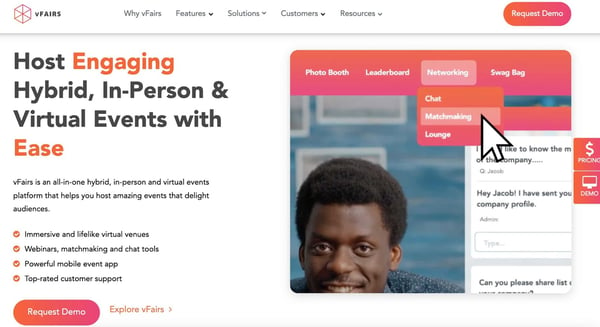
Ranked #1 on G2 with over 1,300 reviews, vFairs is one of the best virtual event platforms in the market.

virtual event platform: vfairs

As its name suggests, this virtual event platform specializes in fairs, such as career, job, education fairs, and trade shows. Their solutions include:

  • Virtual exhibit hall
  • Custom event builder
  • Event gamification
  • Analytics and reporting tools

In addition to virtual events, they also host in-person and hybrid events, which is great for brands looking for a multi-channel approach.

2. Hopin

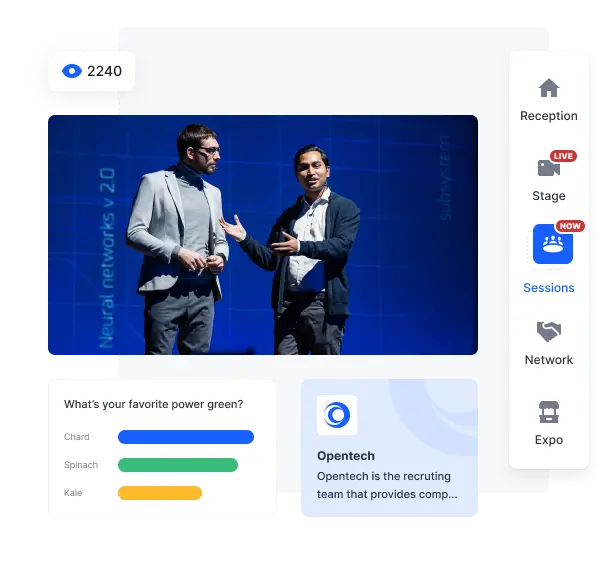
As one of the leading virtual event platforms on the market, Hopin is suitable for both small and large events.

Image Source

Hopin offers a flexible and scalable platform with everything you will need for your event, from registration support to multi-stage sessions to real-time analytics.

Even the free plan offers unlimited events for up to 2 hours with customizable registration, analytics, and multi-venue options.

If you’re looking for a platform that will grow with you, this is a great option.

3. Airmeet

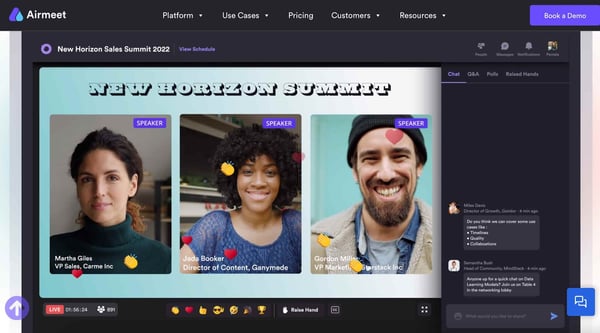
Looking for an approachable, unfussy solution for your virtual events? Then, Airmeet is worth a look.

With a 4.6/5 rating on G2 out of 549 reviews, Airmeet is a user-friendly platform that works for just about any event. It’s been used by some of the top brands out there, like Forbes, Walmart, and FedEx, yet offers packages that work for businesses of any size.

While they have the top features you’d expect from a virtual event platform, they stand out for their platform’s ease of use.

4. GoToWebinar

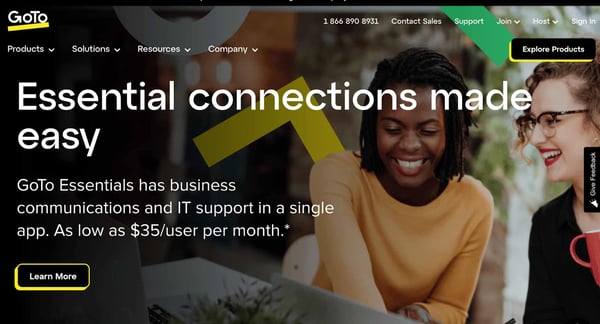
GoTo Webinar is the go-to hosting platform for webinars. Whether you’re doing a product demo or conducting employee training, this tool is a great option. virtual event platform: goto webinar

Their pricing starts at $49/month and goes up to $499 for enterprises. Every plan includes reporting and analytics, registration tools, and event-related email marketing.

Some of the most interesting features on the platform include:

  • Pre-recorded webinars that still include interactive elements, like polls, Q&As, surveys, and handouts
  • Multi-device functionality
  • Integration with CRMs, Google Suite, Microsoft Teams, and more

5. Remo

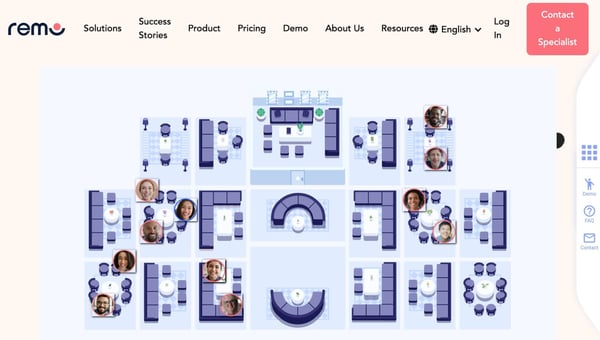
Have a unique vision for your virtual event? Remo will help you bring it to life to your exact specifications.

virtual event platform: remo

Image Source

Remo allows you to create an entire virtual world for your attendees that will keep them engaged and entertained. Their standout feature is the ability to create custom floor plans so that you personalize your attendees’ experience.

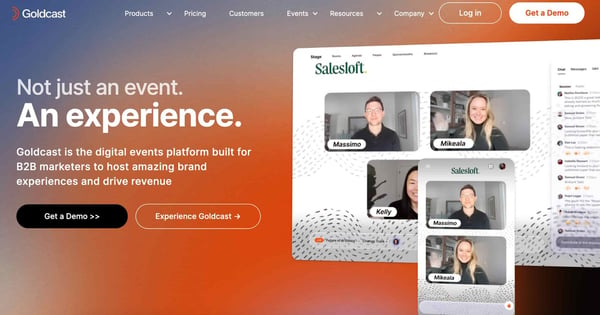
6. Goldcast

If you’re a B2B business, Goldcast is the virtual event platform designed specifically for you.

virtual event platform: goldcast

Their platform is trusted by some of the biggest B2B brands including GitHub, Salesloft, Hootsuite, and Drift. Here are a few reasons why:

  • Simple and user-friendly interface for non-technical users
  • Frictionless CRM integration
  • Dedicated support teams
  • Advanced production tools
  • Hybrid capabilities

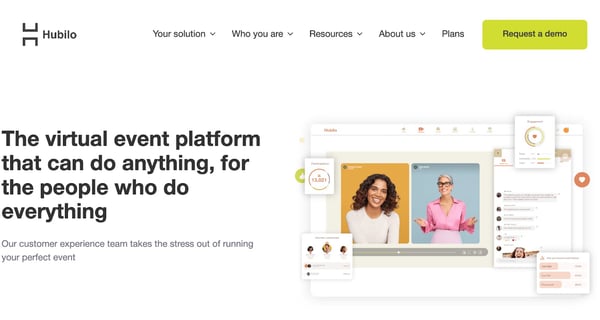
7. Hubilo

If you want to be hands-on in building your virtual event, consider Hubilo.

virtual event platform: hubilo

Many call it a DIY platform, as it has extensive customization features on the front and back end. What’s more, it offers global support for users looking to create engaging in-person, hybrid, and virtual events.

Hubilo is best known for its client support, custom branding options, and extensive engagement features.

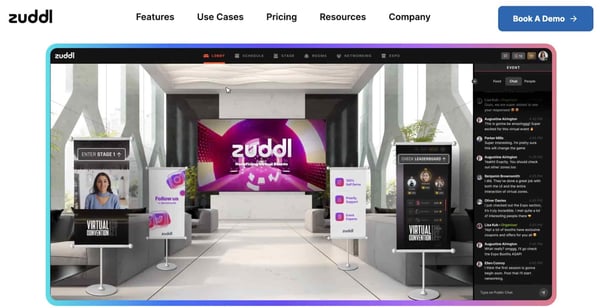
8. Zuddl

Awarded “Best Support” for small businesses by G2, Zuddl is definitely worth a look if you’re in the market for a virtual event platform.

virtual event platform: zuddl

Although they offer the standard features you see on many platforms, they focus on three things: customization, ease of use, and branding.

Zuddl allows brands to create immersive, on-brand virtual experiences that invite attendees to connect. Here’s how they do it:

  • Easy-to-use templates, widgets, and landing pages for branding
  • Tier-based matchmaking, breakout rooms, and virtual business cards for networking
  • Live leaderboards for gamification

These are just some of the tools Zuddl has to offer.

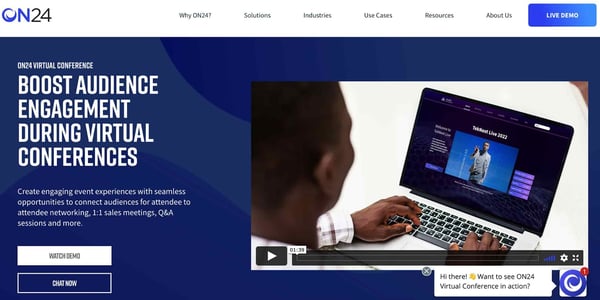
9. ON24

While other platforms focus on customization, ON24 promises to deliver on attendee engagement.

They focus on creating rich, interactive virtual experiences while also collecting valuable insights that you can leverage long after the event is over.

With ON24, you can create:

  • Live or semi-live webinars
  • Engaging roundtable events with video-first participation
  • High-converting landing pages
  • Accessible events that welcome global audiences

10. Accelevents

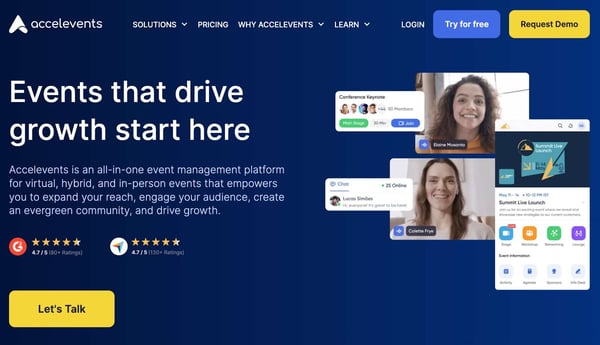
From tradeshows and fundraisers to product launches and career fairs, Accelevents does it all.

virtual event platform: accelevents

They offer a 360 virtual event experience for businesses looking for a sleek interface as well as audience engagement. Key features include:

  • Integrated live streaming
  • Lobby interaction, such as welcome videos, activity walls, and leaderboards
  • Analytics dashboard with registration and session reports
  • Custom booths and expo halls for sponsors

In addition, Accelevents is on Capterra’s 2022 shortlist for “Emerging Favorite” in the virtual event software category, with an overall rating of 4.7/5.

So there you have it — our top 10 virtual event platforms. This list should help you narrow down your choices for hosting your next digital event.

New Call-to-action

Categories B2B

How to Create Your First Web Form (Tutorial)

Forms are often an integral part of a buyer’s journey, and most companies already use web forms as part of their marketing strategy.

In fact, 74% of companies use web forms for lead generation, and 49.7% say their online forms are their highest converting lead generation tool.

Forms can vary greatly in purpose — you might use a form to get more sign-ups to your email newsletter, collect email addresses to send coupons and special offers, create gated content for viewers, or allow leads to sign-up for free versions of your product.

Ultimately, a form is often the fastest and most effective opportunity for you to collect leads and nurture them into sales.

But creating a form can feel like a tricky endeavor, particularly since a form’s design can have a major impact on whether a visitor fills it out, or abandons your site altogether.

Here, we’re going to dive into how to create your first web form to get you started.

Download Now: 28 Free CTA Templates

How to Create a Web Form

For our purposes I’m going to show you how to create a form in HubSpot’s free form builder, but you could also use Google Forms, WordPress, HTML, or another tool of your choice.

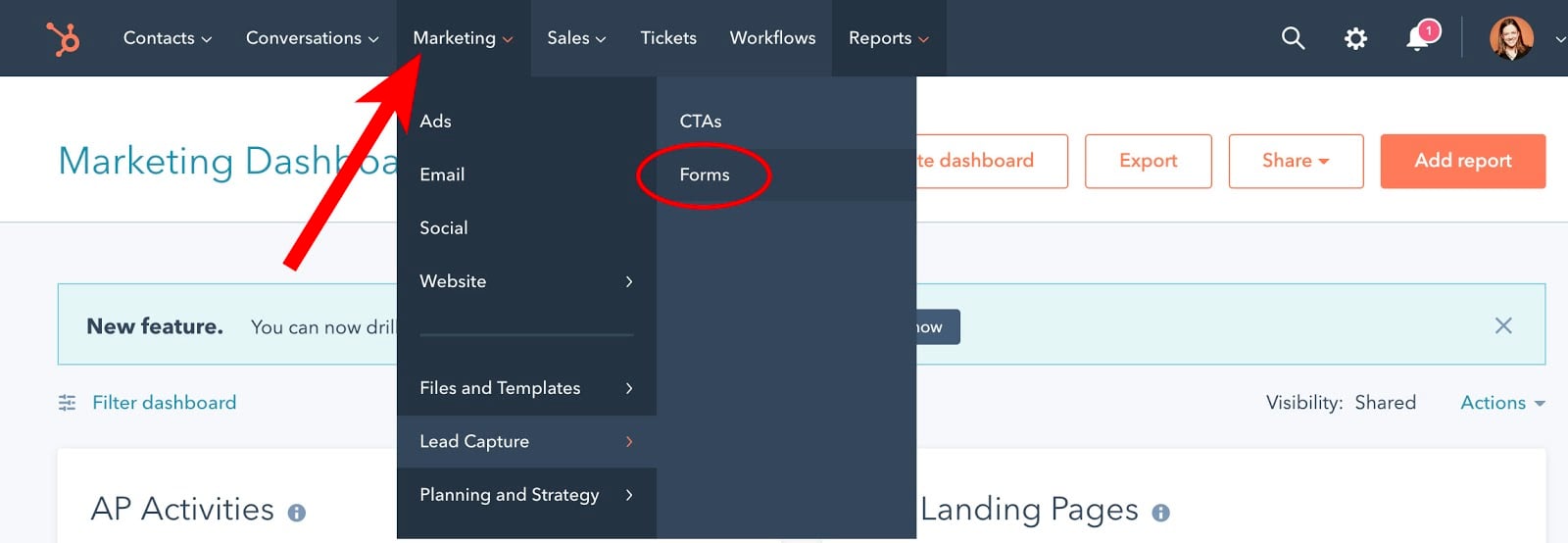
1. To begin creating your form within your HubSpot account, go to “Marketing” > “Lead Capture” > “Forms”.

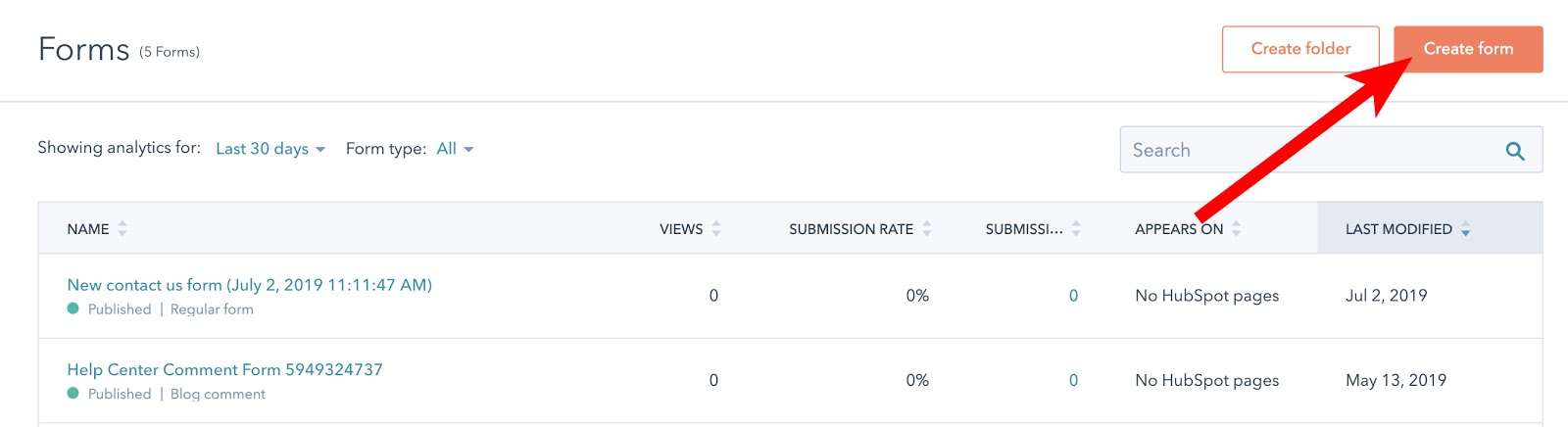
2. In the upper right, click “Create form”.

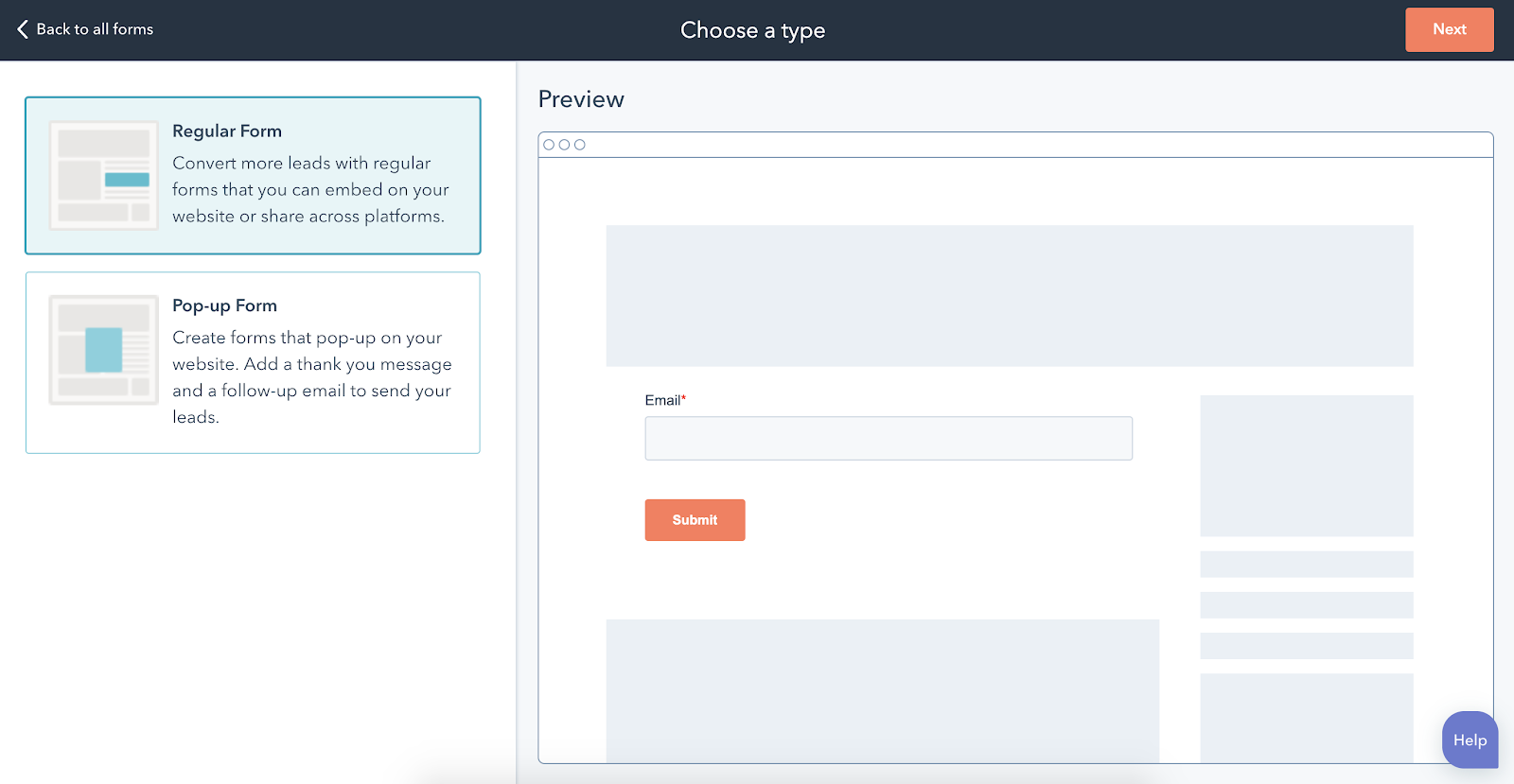
3. In the left panel, click “Regular form”. Then click “Next” in the top right.

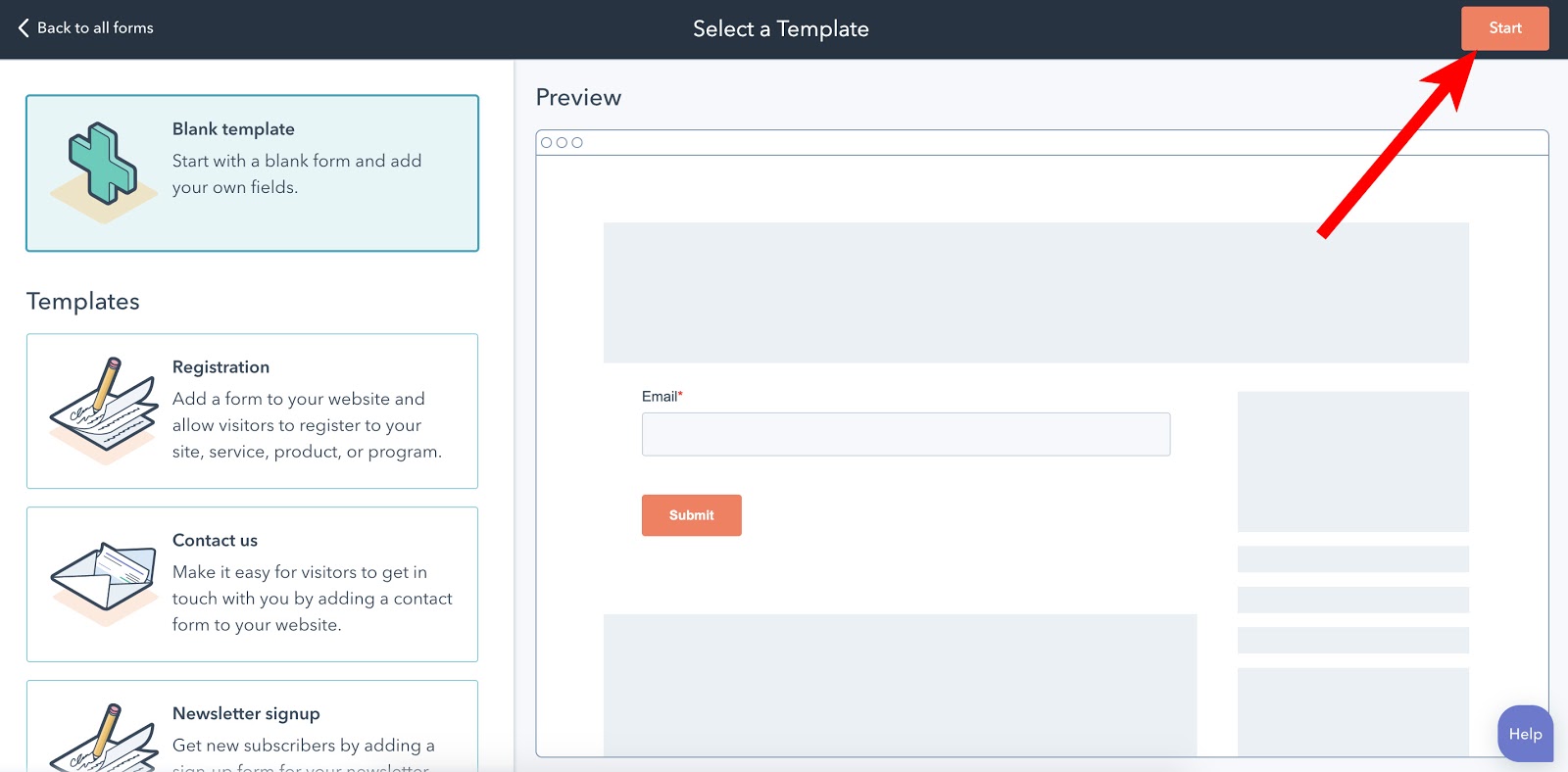
4. Select Blank template to start with a blank form, or a pre-made template for a specific use case. Once you’ve selected your template, click “Start”.

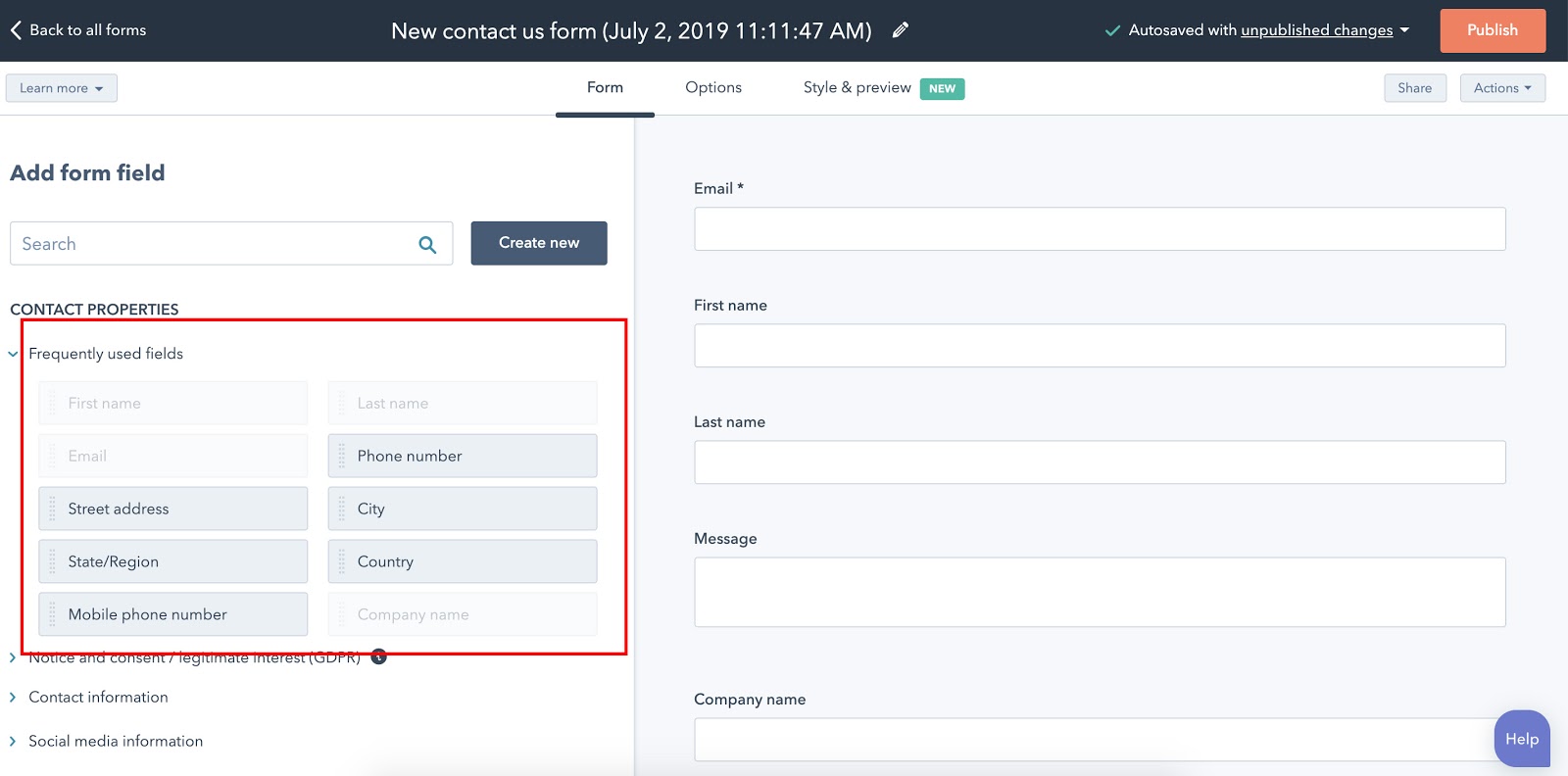
5. Here, you have the option to drag-and-drop any elements on the left side that you’d like in your form. Generally, although not always the case, shorter forms perform better, so try to only ask for the most critical information from your form recipients.

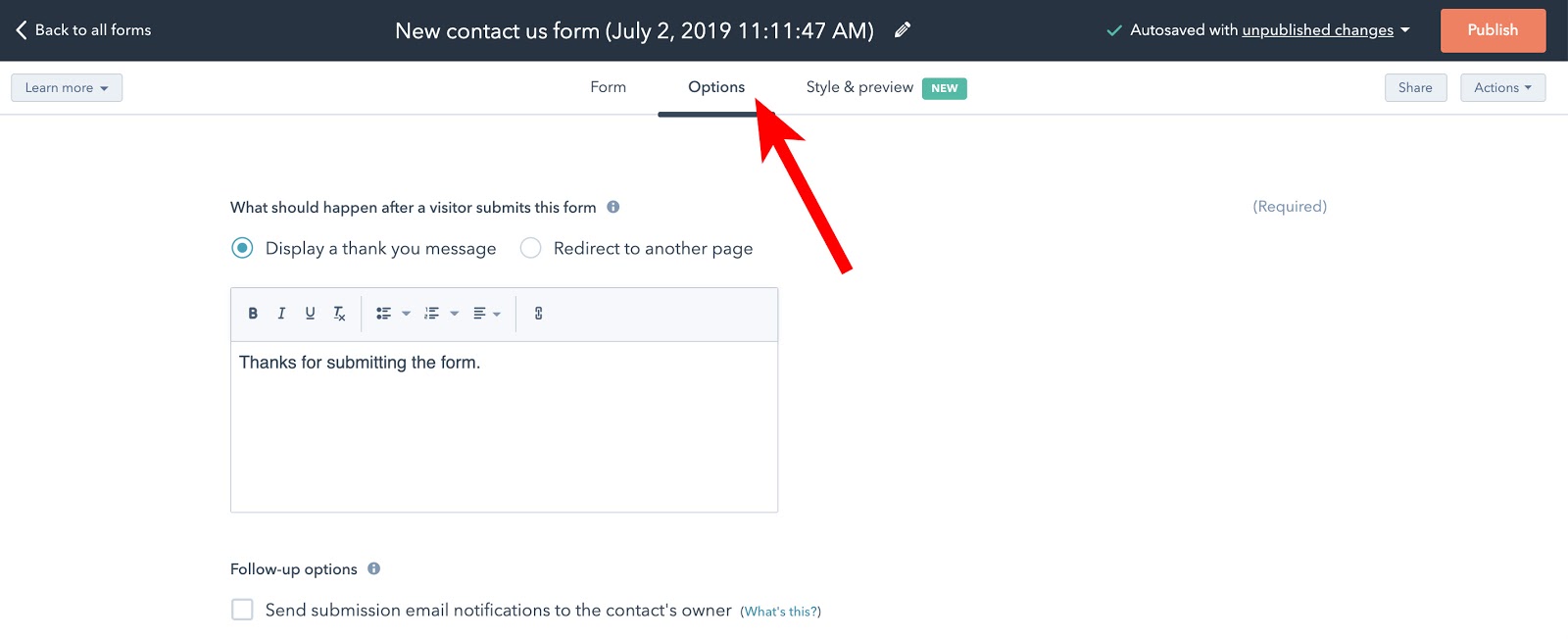
6. Once you’ve chosen your desired form fields, click “Option” at the top middle of the screen. Here, you can decide what message you want your recipients to see when they complete the form.


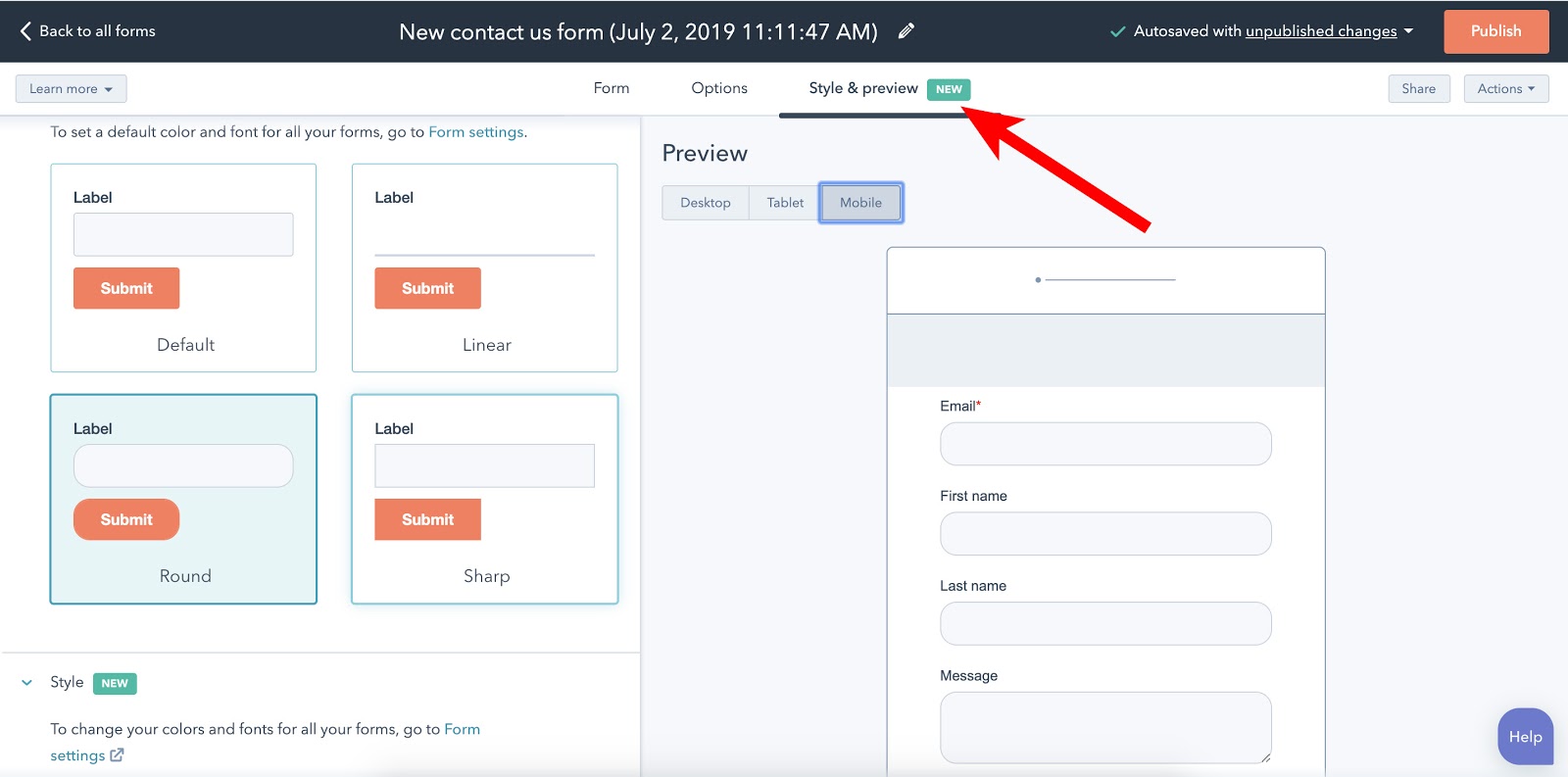
7. Finally, click “Style & preview” at the top right of the screen to preview how your form will look on desktop, tablet, and mobile. Additionally, you can make some changes here to the style of your form — for instance, choosing a round or sharp-edged “Submit” button, or changing the colors and fonts of your form.

When you’re ready, click “Publish” at the top right of your screen.

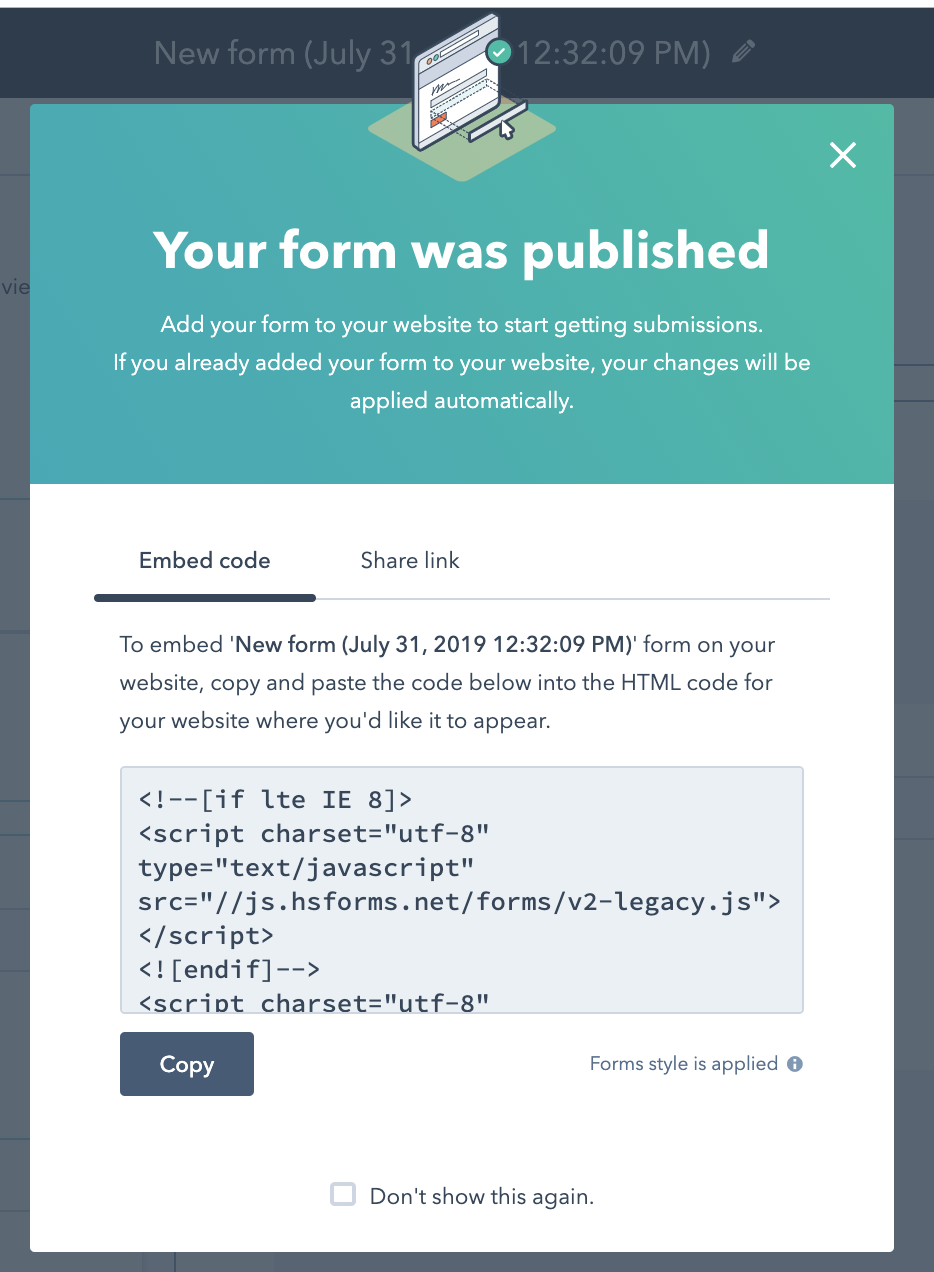
8. Once you click “Publish”, you’ll see this pop-up. Copy and paste the code into your website to embed the form onto one of your web pages, or share the link with recipients via email.

While we created this form using HubSpot’s free online form builder, there are other form building tools at your disposal — take a look at 21 of the Best Form Builder Tools for 2019 for a complete list.

Additionally, check out Form Design Best Practices: 15 Tips to Boost Conversions and UX to ensure your form is ready for optimal conversions.New Call to action

Categories B2B

How to Determine Your A/B Testing Sample Size & Time Frame

Do you remember your first A/B test you ran? I do. (Nerdy, I know.)

I felt simultaneously thrilled and terrified because I knew I had to actually use some of what I learned in college for my job.

There were some aspects of A/B testing I still remembered — for instance, I knew you need a big enough sample size to run the test on, and you need to run the test long enough to get statistically significant results.

But … that’s pretty much it. I wasn’t sure how big was “big enough” for sample sizes and how long was “long enough” for test durations — and Googling it gave me a variety of answers my college statistics courses definitely didn’t prepare me for.

Turns out I wasn’t alone: Those are two of the most common A/B testing questions we get from customers. And the reason the typical answers from a Google search aren’t that helpful is because they’re talking about A/B testing in an ideal, theoretical, non-marketing world.

So, I figured I’d do the research to help answer this question for you in a practical way. At the end of this post, you should be able to know how to determine the right sample size and time frame for your next A/B test. Let’s dive in.

Free Download: A/B Testing Guide and Kit

A/B Testing Sample Size & Time Frame

In theory, to determine a winner between Variation A and Variation B, you need to wait until you have enough results to see if there is a statistically significant difference between the two.

Depending on your company, sample size, and how you execute the A/B test, getting statistically significant results could happen in hours or days or weeks — and you’ve just got to stick it out until you get those results. In theory, you should not restrict the time in which you’re gathering results.

For many A/B tests, waiting is no problem. Testing headline copy on a landing page? It’s cool to wait a month for results. Same goes with blog CTA creative — you’d be going for the long-term lead generation play, anyway.

But certain aspects of marketing demand shorter timelines when it comes to A/B testing. Take email as an example. With email, waiting for an A/B test to conclude can be a problem, for several practical reasons:

1. Each email send has a finite audience.

Unlike a landing page (where you can continue to gather new audience members over time), once you send an email A/B test off, that’s it — you can’t “add” more people to that A/B test. So you’ve got to figure out how squeeze the most juice out of your emails.

This will usually require you to send an A/B test to the smallest portion of your list needed to get statistically significant results, pick a winner, and then send the winning variation on to the rest of the list.

2. Running an email marketing program means you’re juggling at least a few email sends per week. (In reality, probably way more than that.)

If you spend too much time collecting results, you could miss out on sending your next email — which could have worse effects than if you sent a non-statistically-significant winner email on to one segment of your database.

3. Email sends are often designed to be timely.

Your marketing emails are optimized to deliver at a certain time of day, whether your emails are supporting the timing of a new campaign launch and/or landing in your recipient’s inboxes at a time they’d love to receive it. So if you wait for your email to be fully statistically significant, you might miss out on being timely and relevant — which could defeat the purpose of your email send in the first place.

That’s why email A/B testing programs have a “timing” setting built in: At the end of that time frame, if neither result is statistically significant, one variation (which you choose ahead of time) will be sent to the rest of your list. That way, you can still run A/B tests in email, but you can also work around your email marketing scheduling demands and ensure people are always getting timely content.

So to run A/B tests in email while still optimizing your sends for the best results, you’ve got to take both sample size and timing into account.

Next up — how to actually figure out your sample size and timing using data.

How to Determine Sample Size for an A/B Test

Now, let’s dive into how to actually calculate the sample size and timing you need for your next A/B test.

For our purposes, we’re going to use email as our example to demonstrate how you’ll determine sample size and timing for an A/B test. However, it’s important to note — the steps in this list can be used for any A/B test, not just email.

Let’s dive in.

Like mentioned above, each A/B test you send can only be sent to a finite audience — so you need to figure out how to maximize the results from that A/B test. To do that, you need to figure out the smallest portion of your total list needed to get statistically significant results. Here’s how you calculate it.

1. Assess whether you have enough contacts in your list to A/B test a sample in the first place.

To A/B test a sample of your list, you need to have a decently large list size — at least 1,000 contacts. If you have fewer than that in your list, the proportion of your list that you need to A/B test to get statistically significant results gets larger and larger.

For example, to get statistically significant results from a small list, you might have to test 85% or 95% of your list. And the results of the people on your list who haven’t been tested yet will be so small that you might as well have just sent half of your list one email version, and the other half another, and then measured the difference.

Your results might not be statistically significant at the end of it all, but at least you’re gathering learnings while you grow your lists to have more than 1,000 contacts. (If you want more tips on growing your email list so you can hit that 1,000 contact threshold, check out this blog post.)

Note for HubSpot customers: 1,000 contacts is also our benchmark for running A/B tests on samples of email sends — if you have fewer than 1,000 contacts in your selected list, the A version of your test will automatically be sent to half of your list and the B will be sent to the other half.

2. Use a sample size calculator.

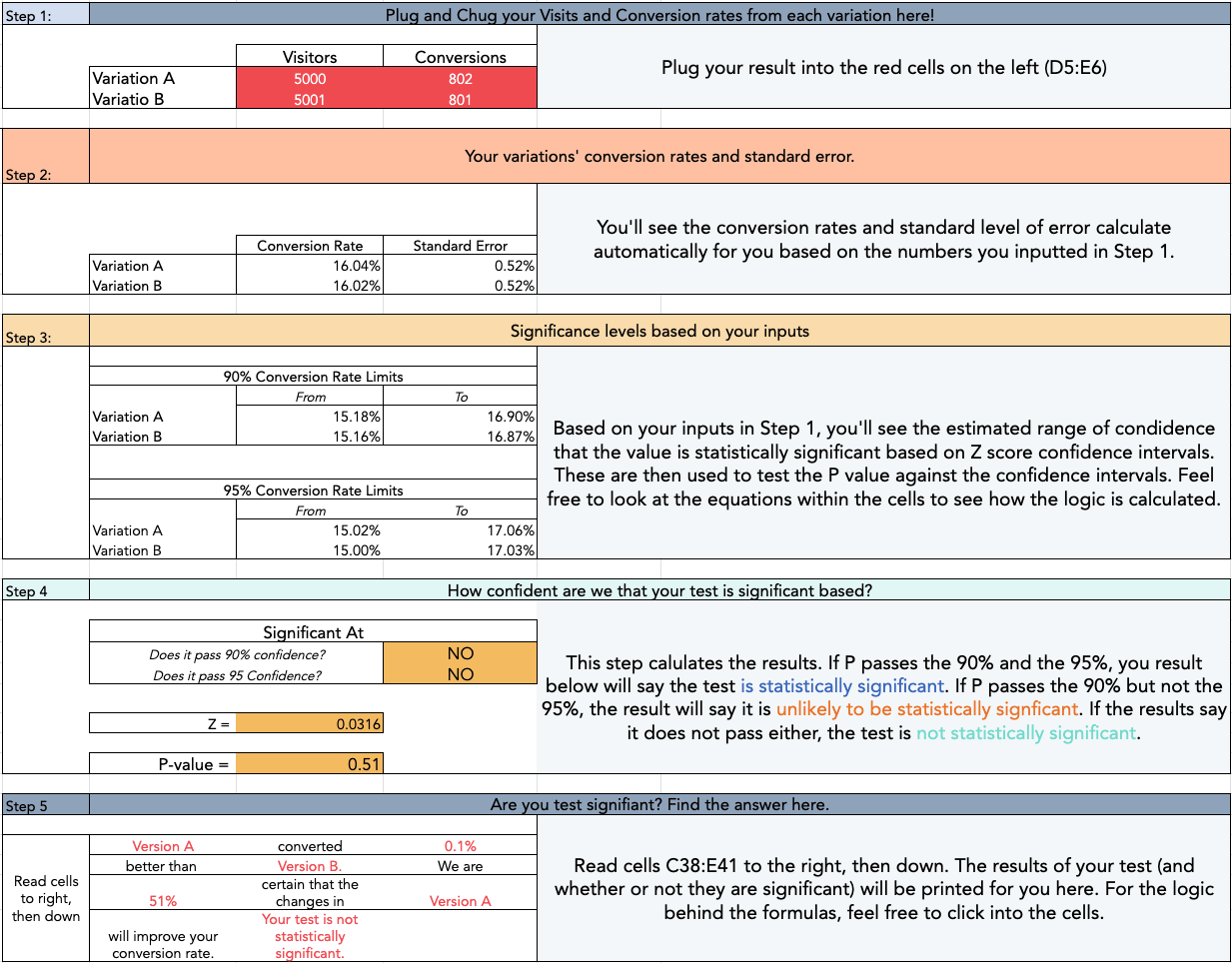
Next, you’ll want to find a sample size calculator — HubSpot’s A/B Testing Kit offers a good, free sample size calculator.

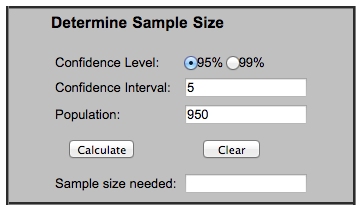
Here’s what it looks like when you download it:

ab significance calculatorDownload for Free

3. Put in your email’s Confidence Level, Confidence Interval, and Population into the tool.

Yep, that’s a lot of statistics jargon. Here’s what these terms translate to in your email:

Population: Your sample represents a larger group of people. This larger group is called your population.

In email, your population is the typical number of people in your list who get emails delivered to them — not the number of people you sent emails to. To calculate population, I’d look at the past three to five emails you’ve sent to this list, and average the total number of delivered emails. (Use the average when calculating sample size, as the total number of delivered emails will fluctuate.)

Confidence Interval: You might have heard this called “margin of error.” Lots of surveys use this, including political polls. This is the range of results you can expect this A/B test to explain once it’s run with the full population.

For example, in your emails, if you have an interval of 5, and 60% of your sample opens your Variation, you can be sure that between 55% (60 minus 5) and 65% (60 plus 5) would have also opened that email. The bigger the interval you choose, the more certain you can be that the populations true actions have been accounted for in that interval. At the same time, large intervals will give you less definitive results. It’s a trade-off you’ll have to make in your emails.

For our purposes, it’s not worth getting too caught up in confidence intervals. When you’re just getting started with A/B tests, I’d recommend choosing a smaller interval (ex: around 5).

Confidence Level: This tells you how sure you can be that your sample results lie within the above confidence interval. The lower the percentage, the less sure you can be about the results. The higher the percentage, the more people you’ll need in your sample, too.

Note for HubSpot customers: The HubSpot Email A/B tool automatically uses the 85% confidence level to determine a winner. Since that option isn’t available in this tool, I’d suggest choosing 95%.

Email A/B Test Example:

Let’s pretend we’re sending our first A/B test. Our list has 1,000 people in it and has a 95% deliverability rate. We want to be 95% confident our winning email metrics fall within a 5-point interval of our population metrics.

Here’s what we’d put in the tool:

  • Population: 950
  • Confidence Level: 95%
  • Confidence Interval: 5

sample_size_calculations

4. Click “Calculate” and your sample size will spit out.

Ta-da! The calculator will spit out your sample size.

In our example, our sample size is: 274.

This is the size one your variations needs to be. So for your email send, if you have one control and one variation, you’ll need to double this number. If you had a control and two variations, you’d triple it. (And so on.)

5. Depending on your email program, you may need to calculate the sample size’s percentage of the whole email.

HubSpot customers, I’m looking at you for this section. When you’re running an email A/B test, you’ll need to select the percentage of contacts to send the list to — not just the raw sample size.

To do that, you need to divide the number in your sample by the total number of contacts in your list. Here’s what that math looks like, using the example numbers above:

274 / 1,000 = 27.4%

This means that each sample (both your control AND your variation) needs to be sent to 27-28% of your audience — in other words, roughly a total of 55% of your total list.

email_ab_test_send

And that’s it! You should be ready to select your sending time.

How to Choose the Right Timeframe for Your A/B Test

Again, for figuring out the right timeframe for your A/B test, we’ll use the example of email sends – but this information should still apply regardless of the type of A/B test you’re conducting.

However, your timeframe will vary depending on your business’ goals, as well. If you’d like to design a new landing page by Q2 2021 and it’s Q4 2020, you’ll likely want to finish your A/B test by January or February so you can use those results to build the winning page.

But, for our purposes, let’s return to the email send example: You have to figure out how long to run your email A/B test before sending a (winning) version on to the rest of your list.

Figuring out the timing aspect is a little less statistically driven, but you should definitely use past data to help you make better decisions. Here’s how you can do that.

If you don’t have timing restrictions on when to send the winning email to the rest of the list, head over to your analytics.

Figure out when your email opens/clicks (or whatever your success metrics are) starts to drop off. Look your past email sends to figure this out.
For example, what percentage of total clicks did you get in your first day? If you found that you get 70% of your clicks in the first 24 hours, and then 5% each day after that, it’d make sense to cap your email A/B testing timing window for 24 hours because it wouldn’t be worth delaying your results just to gather a little bit of extra data.

In this scenario, you would probably want to keep your timing window to 24 hours, and at the end of 24 hours, your email program should let you know if they can determine a statistically significant winner.

Then, it’s up to you what to do next. If you have a large enough sample size and found a statistically significant winner at the end of the testing time frame, many email marketing programs will automatically and immediately send the winning variation.

If you have a large enough sample size and there’s no statistically significant winner at the end of the testing time frame, email marketing tools might also allow you to automatically send a variation of your choice.

If you have a smaller sample size or are running a 50/50 A/B test, when to send the next email based on the initial email’s results is entirely up to you.

If you have time restrictions on when to send the winning email to the rest of the list, figure out how late you can send the winner without it being untimely or affecting other email sends.

For example, if you’ve sent an email out at 3 p.m. EST for a flash sale that ends at midnight EST, you wouldn’t want to determine an A/B test winner at 11 p.m. Instead, you’d want to send the email closer to 6 or 7 p.m. — that’ll give the people not involved in the A/B test enough time to act on your email.

And that’s pretty much it, folks. After doing these calculations and examining your data, you should be in a much better state to conduct successful A/B tests — ones that are statistically valid and help you move the needle on your goals.

The Ultimate A/B Testing Kit

Categories B2B

How to Get Buy-In from Some of the Top Marketing Leaders: 3 Execs Discuss What KPIs Matter to Them

Whether you’re creating a new content campaign, launching a YouTube series, or revising your social strategy, you’re going to be asked the same question by leadership before getting their support: “How will this impact our company’s bottom line?”

That can be a difficult question to answer — which is why it’s critical you know your key performance indicators (KPIs) to:

a) measure the success of your program, and

b) receive executive buy-in — which is typically a prerequisite for getting the budget and resources you need to successfully launch any new paid marketing program.

There are so many different KPIs any marketer might use to measure success, including sales, web traffic, follower growth, conversion rate, or brand awareness. But which ones matter most to leadership? In other words: Which ones should you focus on if you’re seeking executive approval?

Here, we spoke with executives at LinkedIn, G2, and HubSpot to uncover which KPIs matter most to them in 2023. 

Act Like a Leader, Think Like a Leader: Data from 500+ Marketing Executives on How to Get Ahead in 2023

What KPIs Matter Most to Execs in 2023

1. Reach and leads.

If you work backwards from your company’s primary goal — of increasing revenue — then it makes sense that reaching new audiences and converting those audiences into qualified leads for sales would be two of the top KPIs that matter most to marketing leaders.

As Jordan DiPietro, HubSpot’s VP of Marketing, told me, “As a marketing leader, it’s important to choose a KPI that is most aligned with your company’s overarching business objectives — it could be a revenue metric, it could be a reach metric, or in the case of HubSpot Media, it could be both! The important thing is that your KPIs and the action plans associated with those KPIs are ones that can be directly connected to the KPIs of the business.”

For instance, DiPietro told me the two KPIs his team focuses on are overall reach (visits, opens, listeners, and views) and leads (net new contacts driven from media content).

He says, “Our reach KPI is indicative of the fact that HubSpot wants to grow top-of-the-funnel awareness for the business. Our media team does this by increasing the reach of our blog content, newsletters, podcast network, and YouTube network.”

He adds, “Our revenue KPI is indicative of the the fact that HubSpot is a SaaS business — so we want to generate leads that can be shared with the sales team in order to turn those leads into qualified leads, and then into satisfied customers.”

When deciding which KPIs to focus on — whether you’re a marketing leader or individual contributor looking for buy-in — you’ll want to consider which metrics will directly connect to your organization’s broader goals. For instance, if your company is hoping to improve its customer retention, then you’ll want to focus your marketing efforts on KPIs like brand sentiment and churn rate.

But perhaps most importantly — don’t choose too many KPIs. As DiPietro told me, “In terms of secondary KPIs, keep it simple. I’ve noticed that sometimes marketing teams can get too distracted by measuring and tracking and not focused enough on actual impact. So I think it’s fair to have a main KPI, and then I limit it at two sub-metrics.”

DiPietro provides two examples of this. In one, let’s say you’re running a newsletter company that relies on advertising. In this situation, your main KPI is likely ad revenue, and your two sub-metrics might be subscriber growth and unique opens.

Alternatively, if you have a subscription business, your main KPI might be overall revenue, and your two sub-metrics could be LTV: CAC and renewal rate.

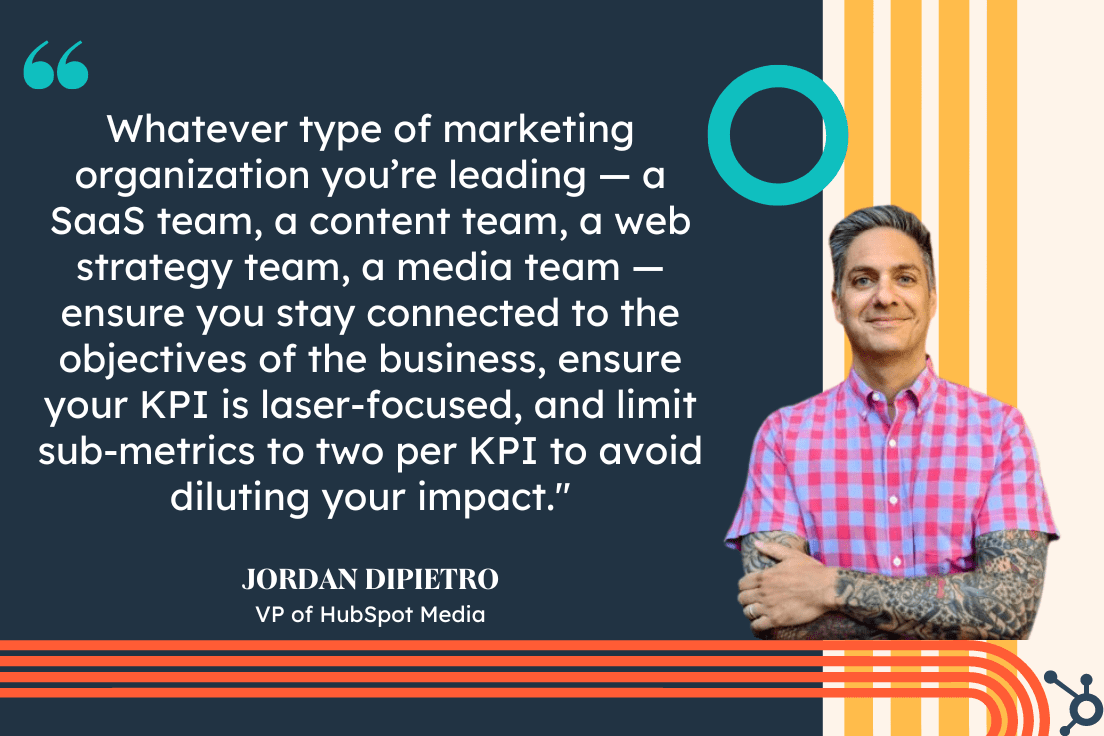
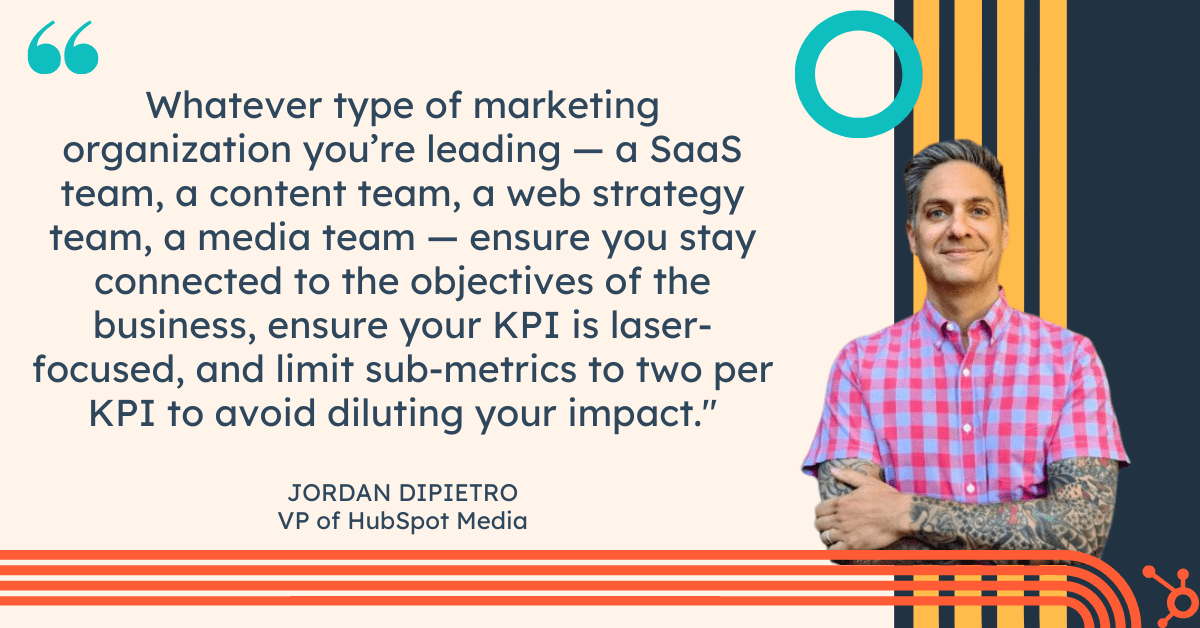
DiPietro advises, “Whatever type of marketing organization you’re leading — a SaaS team, a content team, a web strategy team, a media team — ensure you stay connected to the objectives of the business, ensure your KPI is laser-focused, and limit sub-metrics to two per KPI to avoid diluting your impact.”

hubspot media vp on limiting sub-metrics to two per kpi

2. Number of marketing-qualified leads (MQLs) and conversions to sales.

Ultimately, marketers are only one part of the equation. Which means marketers can only pay attention to the KPIs they can control: Namely, leads and conversions.

As Robin Izsak-Tseng, G2’s VP of Revenue Marketing, puts it, “Though most marketing teams have goals around pipeline, the fact is, marketing doesn’t open pipeline — sales does. Marketing’s role is to create awareness, demand, and inbound interest in your solution. There are factors outside of marketing’s control (changes in sales processes, for example), which can cause wild fluctuation in pipeline production.”

Rather than focusing on pipeline, Izsak-Tseng suggests marketers focus on two primary metrics: MQLs (Marketing Qualified Leads), and conversions.

For starters, she says marketers should track a blend of metrics, including MQL production, as an indicator of inbound interest. It’s equally critical that marketing leaders pay attention to SAL (sales-accepted leads), since that is another indication of lead quality.

A few other metrics Izsak-Tseng suggest marketing leaders focus on include:

  • Conversion of total pipeline to revenue: To track how marketing-sourced pipe is performing against pipe sourced by outbound efforts. Since marketing-sourced pipeline is inbound, the conversion to revenue should be consistent and strong.
  • CAC (customer acquisition cost): Track this over time. Rising costs can indicate diminishing returns on marketing programs — or show that it’s time to explore new markets.

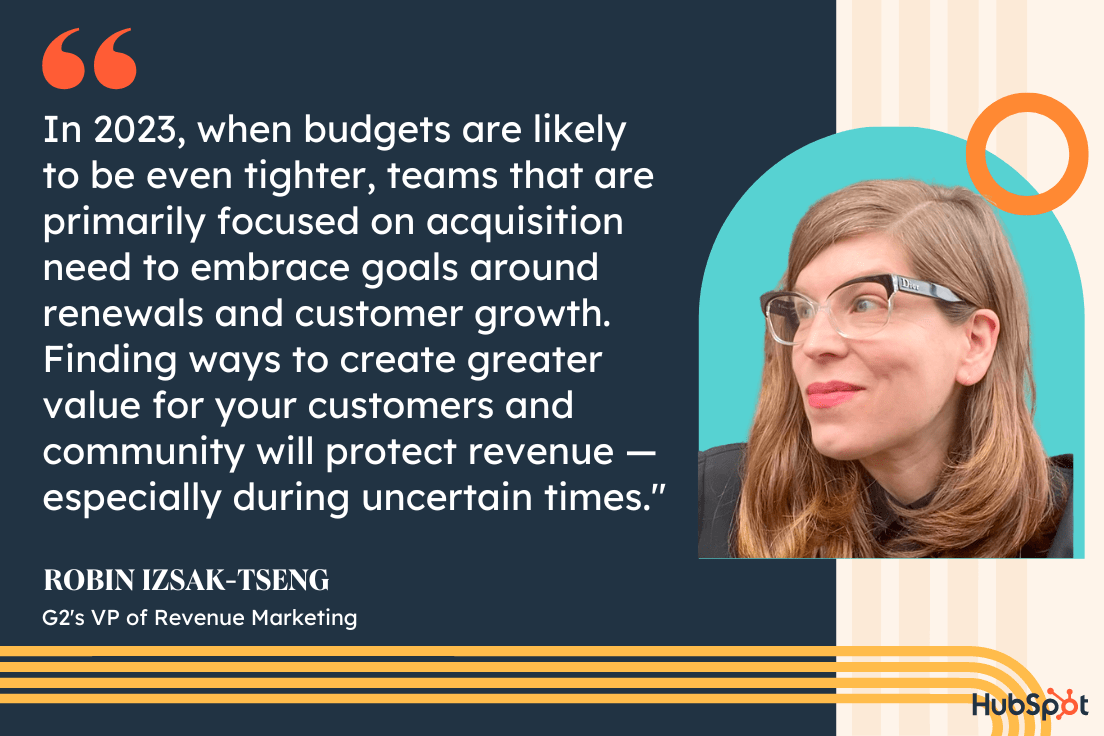
Izsak-Tseng adds, “All of these metrics give growth leaders a view of the full funnel and help us understand marketing’s impact on revenue (not just pipeline). Much of this can also be applied to retention. In 2023, when budgets are likely to be even tighter, teams that are primarily focused on acquisition need to embrace goals around renewals and customer growth. Finding ways to create greater value for your customers and community will protect revenue — especially during uncertain times.”

g2 vp of revenue marketing on which kpi she cares about in 2023

Considering it costs 5-25X less to retain customers than capture new ones, it’s a good idea to focus on customer retention as a primary KPI. But customer retention isn’t always easy. To satisfy and retain more customers, you’ll need to:

  • Build trust with your customers. Ensuring your account managers check-in and show support for customers over the course of a year — and not just when it’s time to renew — is critical for demonstrating to your customers that you care about them and their success.
  • Implement a customer feedback loop. This will help you collect, analyze, and distribute customer reviews and surveys to strengthen areas of your customer experience that aren’t working for your current customers.
  • Provide a personalized customer experience. Providing each customer with tailor-made solutions and content designed to fit their needs is vital for retention. Your customers don’t want to feel like they fit into a one-size-fits-all approach. Ensuring your organization helps them with their specific challenges and needs is critical.

(P.S. Already a G2 customer? Click here for 20% off eligible HubSpot products, or get started for free.)

3. Return-on-investment (ROI) and brand strength.

During times of economic uncertainty when businesses’ budgets are tight, it’s become increasingly important to be able to demonstrate the ROI of your marketing efforts to your leadership team.

In fact, one-third (33%) of marketing executives, VPs, and directors say that using data to demonstrate the ROI and business value of their efforts became more important in 2022.

Jim Habig, VP of Marketing at LinkedIn, agrees that ROI is important — but he encourages marketers to think full-picture when they’re considering their top KPIs, too.

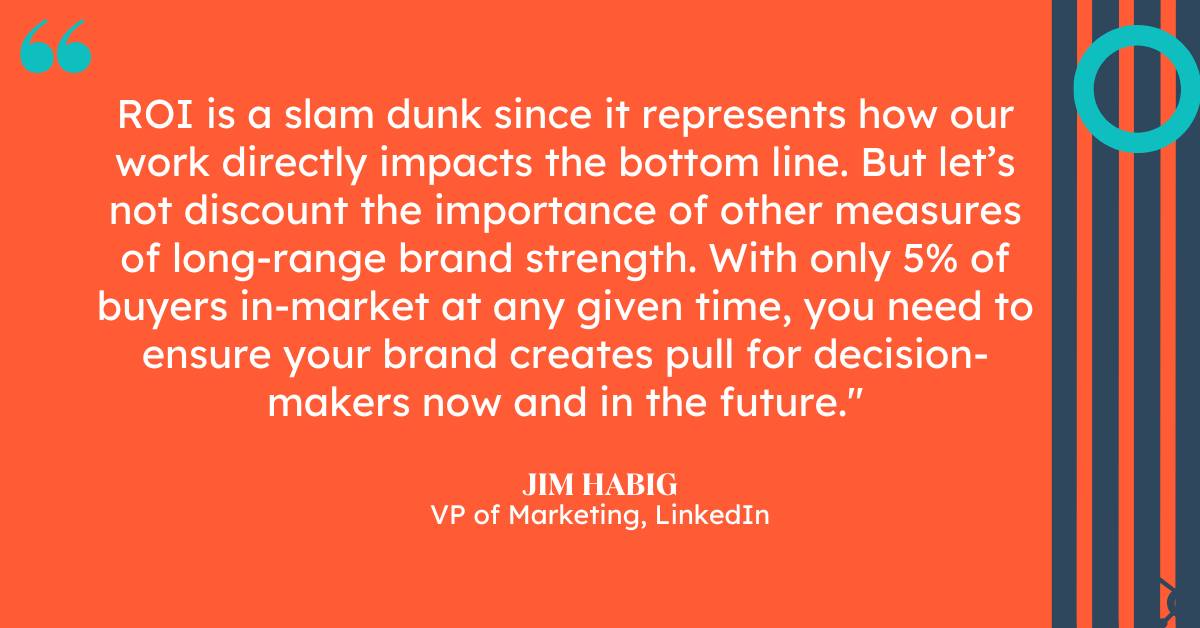
As he puts it, “It’s paramount that we think about the full funnel when it comes to measurement. Of course, ROI is a slam dunk since it represents how our work directly impacts the bottom line.”

He adds, “But let’s not discount the importance of other measures of long-range brand strength. With only 5% of buyers in-market at any given time, you need to ensure your brand creates pull for decision-makers now and in the future.”

To create a strong brand identity, you’ll want to:

  • Create a memorable brand voice.
  • Communicate your consumers’ pain points — and how you can solve for them — effectively.
  • Demonstrate how you’re different from your competitors.
  • Broadcast your brand’s mission statement and brand values to build connection with your audience.
  • Use type, colors, and imagery to represent your brand’s personality.

vp of linkedin marketing on why roi isnt the only kpi that matters

If you’ve created a brand identity already but need to build brand awareness, consider channels that will help you reach new audiences — like podcasting, or other social media platforms. Alternatively, perhaps you can create a strong co-marketing campaign to build credibility in your industry and generate new leads.

Once you’re investing in brand awareness, you’ll want to measure branded keyword search volume to see how many impressions and search volume your brand is getting. This will help you evaluate your brand awareness efforts over time — if your branded keyword search volume is rising, it’s a sign your brand awareness plays are working.

While this is a strong starting point, you’ll need to do your own research to determine your organization’s goals for 2023, as well as your executive team’s marketing plans in particular. From there, you can determine how your KPIs for a specific marketing campaign or program might fit in.

If you can’t see a strong through-line between your own KPIs and the KPIs of the business, it might be time to reassess where you’re focusing your efforts and whether shifting your strategy might better impact the bottom line — and help achieve buy-in from leadership.

New call-to-action

Categories B2B

Act Like a Leader, Think Like a Leader: How 500+ Marketing Executives Plan to Get Ahead in 2023 [+ How You Can Join Them]

In many ways, marketing leadership has never been harder.

Over the past year alone, you’ve needed to navigate economic turmoil; a workplace shift to more globally distributed teams; and new trends that felt like they arose overnight (TikTok, anyone?).  

Which is why 76% of marketing leaders say marketing has seen more change in the past three years than the last 50

Change isn’t always bad, but it is always challenging. And, as we prepare for the year ahead, many marketing leaders are wondering: What should I prepare for? Where should I focus my efforts? And what are my biggest blind spots? 

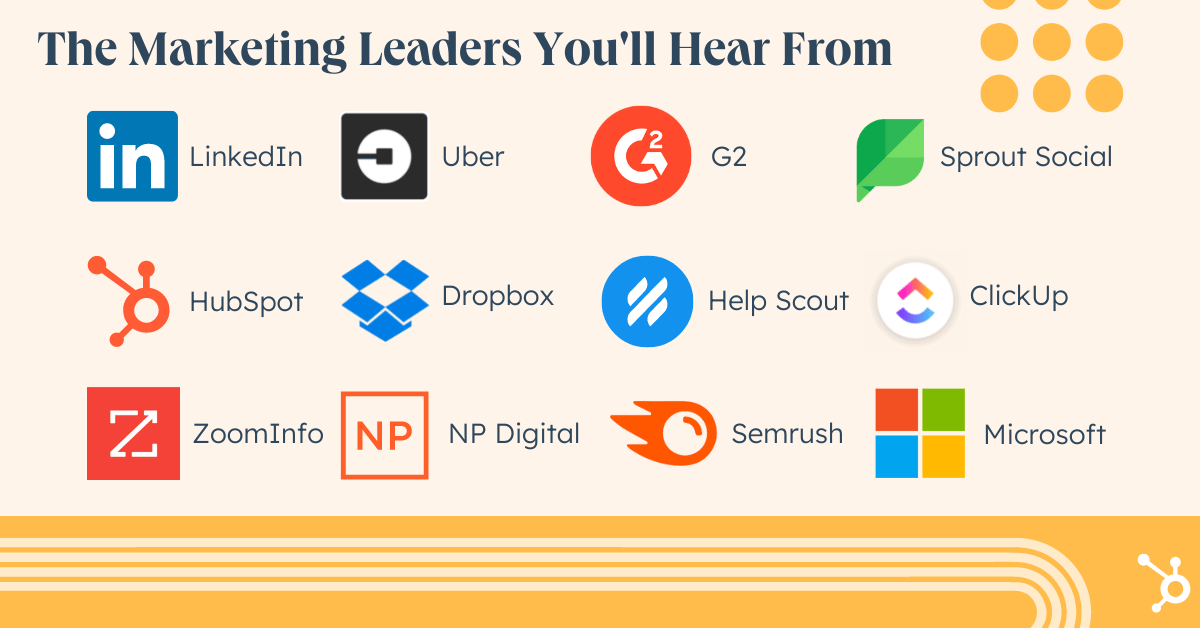
To help you create a powerful and agile strategy for 2023, we’ve surveyed 500+ marketing executives on the biggest challenges, opportunities, and trends ahead of us. Plus, we’ve interviewed some of the biggest experts across the industry — ranging from CMOs and VPs at LinkedIn, Uber, Microsoft, Dropbox, SEMRush, and more — to uncover best practices for becoming a better, more effective leader. 

If you’re not a marketing leader, but interested in becoming one, you’re in luck. We also have plenty of content and best practices on getting ahead in your career — including how to get executive stakeholder buy-in, and how to get promoted on both an individual contributor and manager-level. 

Let’s dive in. marketing leaders youll hear from

Executive Leadership Survey Results [Top Findings You Need to Know About + Expert Insights] 

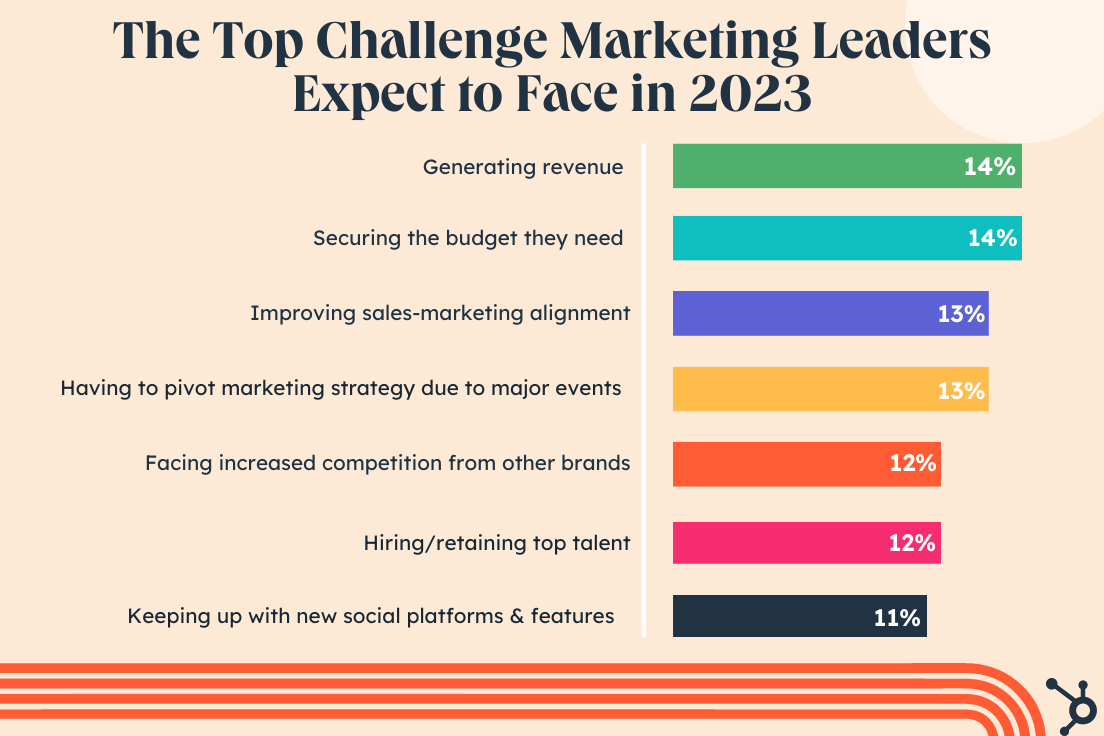
1. The biggest challenges marketing leaders’ expect to face in 2023 include generating revenue, securing budget, and improving sales-marketing alignment.

When asked which challenges marketing leaders’ expect to face in 2023, 14% said generating revenue and securing the budget they need are tied as the top challenge they believe they’ll face. 

Both of these concerns stem from the possibility of an upcoming recession. When asked how marketing leaders would respond if a recession were to occur, 30% of marketing leaders say they would respond by increasing their marketing budget, while 1 in 4 plan to reduce their budget in an economic slowdown.

Other top challenges marketing leaders expect to face include: 

  • Improving sales-marketing alignment (13%)
  • Having to pivot your marketing strategy due to major events, e.g. recession, pandemic, political turmoil (13%)
  • Facing increased competition from other brands (12%)

top challenges marketers expect to face in 2023

Additionally, we surveyed marketing executives in our Marketing Trends report earlier this year, and 14% of marketing leaders say they anticipate ‘adopting a data-driven marketing strategy’ to be a top anticipated challenge of theirs in 2023. While this isn’t a top challenge in our Executive Leadership report, it’s still worth pointing out as many of the experts we spoke with told us it’s a big concern of theirs. 

Collecting data has gotten increasingly difficult as consumers’ become increasingly concerned with protecting their privacy. So adopting a data-driven strategy in 2023 will require marketers to ensure they’re effectively combining first-party and third-party data

Microsoft’s Global Head of Programmatic Evangelist, Daniel Godoy, says, “Shaping your strategy by leveraging 1P or 3P trustable data becomes necessary to expand potential reach and start piloting your data strategy for the future.”

microsoft global head of programmatic evangelist on marketing challenges for 2023

Plus, to create a powerful data-driven strategy, you’ll want to collect custom audience attributes (not just basic descriptive information), and then create dynamic prospect lists through audience segmentation. From there, you’ll want to develop unique messaging that resonates with your prospects. 

ZoomInfo’s Chief Marketing Officer, Bryan Law, told me, “You’ll need to figure out how to convey your ability to alleviate their challenges in a unique way to penetrate the significant market noise. Practice consistency in your overall theme, and include contextual personalization when applicable.”

The Top Challenges Marketing Leaders Expect to Face in 2023 & How You Can Solve For Them [Expert Insights & Data]

2. Out of those that struggle with growing a global audience, 62% say it’s their biggest challenge right now. 

For some context: In our Marketing Trends report, we asked 1,000+ marketers to identify the challenges they’re currently facing. 

Then, we asked them to select the one challenge they struggle with the most

And over half — 62% — told us growing a global audience is their biggest issue. 

The good news? We asked Neil Patel, a New York Times bestselling author, one of the world’s most influential marketers according to the Wall Street Journal and Forbes, and co-founder of NP Digital to provide us with solutions to marketers’ biggest challenges from 2022. Take a look at the full video, below: 

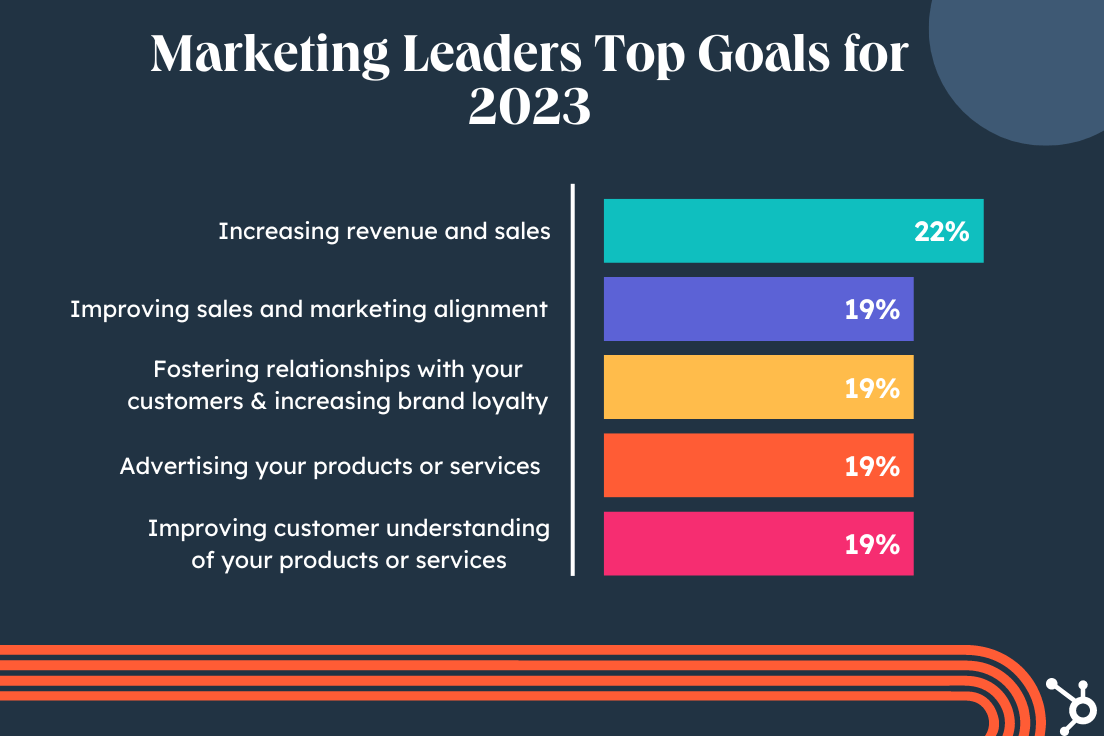
3. Marketing leaders agree that increasing revenue and sales is their top goal for 2023.

Increasing revenue and sales is a top priority for most marketing leaders in 2023, with 22% — or roughly one-fourth — saying it’s their number one goal. 

To increase revenue, marketing leaders will want to identify areas of the customer journey that can be further optimized. For instance, perhaps you’ve observed your audience reach plateau-ing or even shrinking. To continue increasing revenue, you’ll need to consistently reach bigger pools of qualified leads. You might do this by testing out new platforms like TikTok or podcasting. 

marketing leaders top goals for 2023

Alternatively, maybe you notice your marketing team is attracting plenty of leads, but they’re not converting at high rates. To combat this challenge, you’ll want to create stronger offers or a more effective lead generation strategy.  

Gaurav Agarwal, Chief Growth Officer at ClickUp, says increasing revenue and driving sales is a top priority for his team in 2023.

He told me, “As a fast-growing company with industry-leading NDR, adding in new revenue sustainably is our top priority. We are hyper-focused on building out different growth and sales capabilities to achieve that goal. As we embark on our 2023 planning, we do so with a renewed focus on efficiency and clear goals around our different self-serve and sales-assisted motions.”

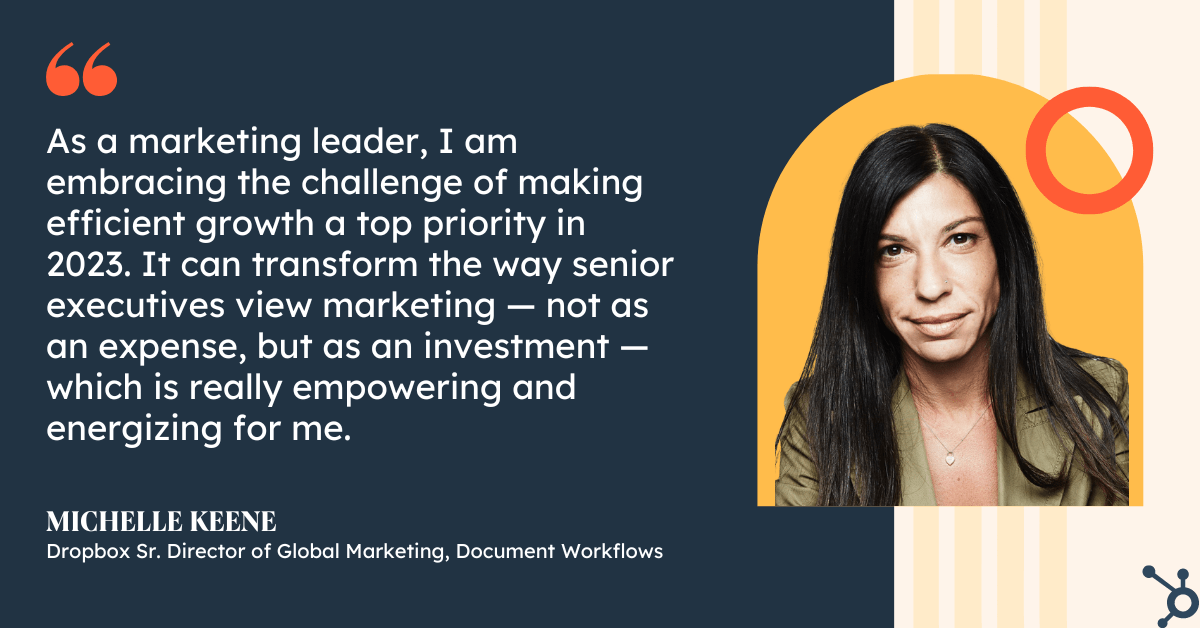
Michelle Keene, Dropbox’s Sr. Director of Global Marketing, Document Workflows, agrees that increasing revenue is a top-priority.

As she puts it, “In 2023, a year that is expected to be dominated by economic uncertainty, the shift to profitable growth [rather than growth at all costs] will only be accelerated — moving from a nice idea to a requirement.”

dropbox director of global marketing on her top goals of 2023-1

The Top Goals of Marketing Leaders in 2023 [New Data + Expert Insights from Uber, Dropbox, and ClickUp]

4. Sales is the KPI that matters most to marketing leaders, followed by customer retention.

To uncover which KPIs will matter most to marketing leaders in 2023, I spoke with executives at G2, LinkedIn, and HubSpot. 

Here’s what they say matters most: Reach, leads, MQLs (marketing-qualified leads), conversion to sales, return-on-investment, and brand strength. 

Ultimately, choosing your primary KPIs comes down to aligning with company goals for 2023. As Jordan DiPietro, HubSpot’s VP of Marketing, puts it, “As a marketing leader, it’s important to choose a KPI that is most aligned with your company’s overarching business objectives — it could be a revenue metric, it could be a reach metric, or in the case of HubSpot Media, it could be both! The important thing is that your KPIs and the action plans associated with those KPIs are ones that can be directly connected to the KPIs of the business.”

vp of hubspot media on which kpis matter most to him

KPIs can vary greatly. For Robin Izsak-Tseng, G2’s VP of Revenue Marketing, leads and conversions matter most. She says marketers should track a blend of metrics, including MQL production, as an indicator of inbound interest. It’s equally critical that marketing leaders pay attention to SAL (sales-accepted leads), since that is another indication of lead quality.

ROI is another equally critical metric for many marketing leaders — and that importance is only growing. In fact, one-third (33%) of marketing executives, VPs, and directors say that using data to demonstrate the ROI and business value of their efforts became more important in 2022.

Jim Habig, VP of Marketing, LinkedIn Marketing Solutions, agrees that ROI is important … but it’s not the only metric that matters to him. He told me, “Let’s not discount the importance of other measures of long-range brand strength. With only 5% of buyers in-market at any given time, you need to ensure your brand creates pull for decision-makers now and in the future.”

jim habig on the kpis that matter most to him in 2023-1

The data aligns with this. In our Executive Leadership survey, we found: 

  • 60% of marketing leaders say sales is one of the most important metrics to track when measuring the performance of your marketing activities (when allowed to select up to three).
  • Sales is followed by customer retention (44%), ROI (43%), and brand awareness (43%) as the most important metrics to track.
  • The top ten metrics that marketing leaders track to measure performance include: Sales (62%), customer retention (55%), return on marketing investment (47%), brand awareness (45%), web traffic (42%), customer testimonials (40%), customer acquisition (39%), organic traffic (38%), conversion rates (38%), and customer lifetime value (37%).
  • Sales, leads, and conversion rates is the KPI the majority (49%) of marketing leaders use to assess the performance of their website.

How to Get Buy-In from Some of the Top Marketing Leaders: 3 Execs Discuss What KPIs Matter to Them

5. The most effective strategy for getting leadership buy-in is clearly demonstrating the impact adopting the new idea will make on achieving the company’s business goals. 

Getting leadership buy-in isn’t easy, particularly when budgets are tight and marketing leaders’ need to be especially careful about where they spend money. 

Which is why it makes sense that clearly demonstrating the impact adopting a new idea will make on achieving a company’s business goals is the number one most effective strategy marketing leaders’ reported for getting buy-in. In our survey, we found roughly one-third (31%) of marketing leaders believe it’s the most effective strategy. 

A few other potentially effective strategies include: 

  • Clearly demonstrating the impact the new idea will have on other teams at the company, e.g. a tool that will improve sales/marketing alignment (29%). 
  • Demonstrating how the new idea aligns with company-wide goals/initiatives (25%).
  • Providing examples/case studies of other companies who adopted the new idea successfully (24%).
  • Demonstrating the challenges the new idea will help solve (23%).
  • Demonstrating the opportunities the new idea presents (22%).

6. Leads, conversion rates, and total monthly visitors are the SEO metrics that matters most to marketing leaders.

SEO is an undeniably powerful strategy for audience growth, brand awareness, and increasing sales. 

In fact, 43% of marketing directors, VPs, and C-suite executives reported SEO as one of the most effective strategies their companies currently leverage.

But there are so many SEO metrics that it can be difficult to determine which ones actually matter. Is it organic traffic? Conversions? Keyword rankings? 

Our data uncovered these are the SEO metrics that matter most to marketing leaders when it comes to assessing the performance of their website: 

  • Sales, leads, and conversion rates (49%)
  • Total monthly visitors (43%)
  • Traffic from social media (40%)
  • New vs. Returning visitors (39%)
  • Click-through rate (38%)

It’s interesting to note — organic traffic or rankings on the SERPs don’t even hit the top five when it comes to important SEO metrics for marketing leaders. 

almost 50% of marketing leaders care most about leads and conversion rates when it comes to seo

Additionally, I spoke with Semrush’s VP of Brand Marketing, Olga Andrienko, to uncover the SEO metrics that she’d advise leaders pay attention to in 2023. Some of her tips include: 

  • Focus on the metrics that tie directly back to revenue — like conversions and new MRR.
  • Don’t forget about branded keyword search volume.
  • Consider click-through rate and how it correlates to organic traffic.
  • Don’t ignore rankings, backlinks, domain authority, and user behavior metrics.

Which SEO Metrics Matter Most to Marketing Leaders, According to Semrush’s VP of Brand Marketing

7. A content strategist is the top role marketing leaders’ plan to hire in 2023. 

When asked which role marketing leaders’ plan to recruit, 32% say ‘content strategist’ is their top priority in 2023 — followed by content marketing manager (23%). 

This makes sense. A strong content creation strategy is one of the most effective marketing plays. As we enter the new year, many companies will need to hire strong content creators to ensure they’re continuing to create unique and compelling content for audiences that likely already feel overloaded. Additionally, many content creators will need to become adapt at shifting the types of content they create for various channels.

A content creator in 2023 might be tasked with creating a TikTok reel one day, then a blog post, and a YouTube video after that. 

Additionally, 37% of marketing leaders say ‘a lack of qualified candidates’ is their biggest challenge in hiring right now. Marketers are expected to be increasingly skilled in niche areas such as TikTok, podcasting, or video creation, so the pool of qualified applicants becomes smaller as companies expect more from their candidates. 

A few other highlights when it comes to hiring and promoting: 

  • 14% of marketing leaders say hiring top talent is the biggest challenge they expect to face in 2023.
  • Leadership (39%), communication skills (33%), and problem-solving skills (33%), are the most important qualities & traits marketing leaders look for when promoting an IC to a senior position. 
  • Leadership skills (27%), a strong work ethic (23%), and communication skills (22%) are most important to marketing leaders when they’re considering promoting a people manager to a director+ position.

8. When promoting individual contributors, 24% of marketing leaders look at an IC’s ability to pivot their marketing strategy in response to major events (e.g. recession, pandemic, political turmoil). 

If you’re hoping to get promoted as an individual contributor (IC), it’s important to know what marketing leaders’ look for when promoting an IC to a senior position. 

These are the promotional factors that matter most to marketing leaders right now when it comes to ICs: 

  • 24% of marketing leaders’ are tied on three factors that matter most when promoting an IC: Their ability to pivot their marketing strategy in response to major events (e.g. recession, pandemic, political turmoil) or new opportunities; Their ability to strategically plan for both the short and long term; and expertise in their industry.
  • 23% of marketing leaders care about an IC’s ability to keep up with and experiment with new platforms and features (e.g. BeReal, YouTube Shorts) when considering a promotion. 

If you’re an IC who is looking to become a people manager, you’re in luck — we also asked marketing leaders’ what they look for when promoting an IC to a people manager, and 26% say they care most about an IC’s ability to build trust and rapport within their team. That’s followed by 25% who say they look for an IC’s ability to bring people together to solve problems. 

On the people manager side, marketing leaders say that people managers can make the greatest impact in their roles by motivating and empowering their team (39%). That’s followed by helping their team exceed goals and expectations (32%) and helping their team exceed goals and expectations (31%). 

help scout vp of brand on what she looks for when promoting ics

As we segue into 2023, it makes sense that both individual contributors and people managers want to know how they can grow at their current companies. 

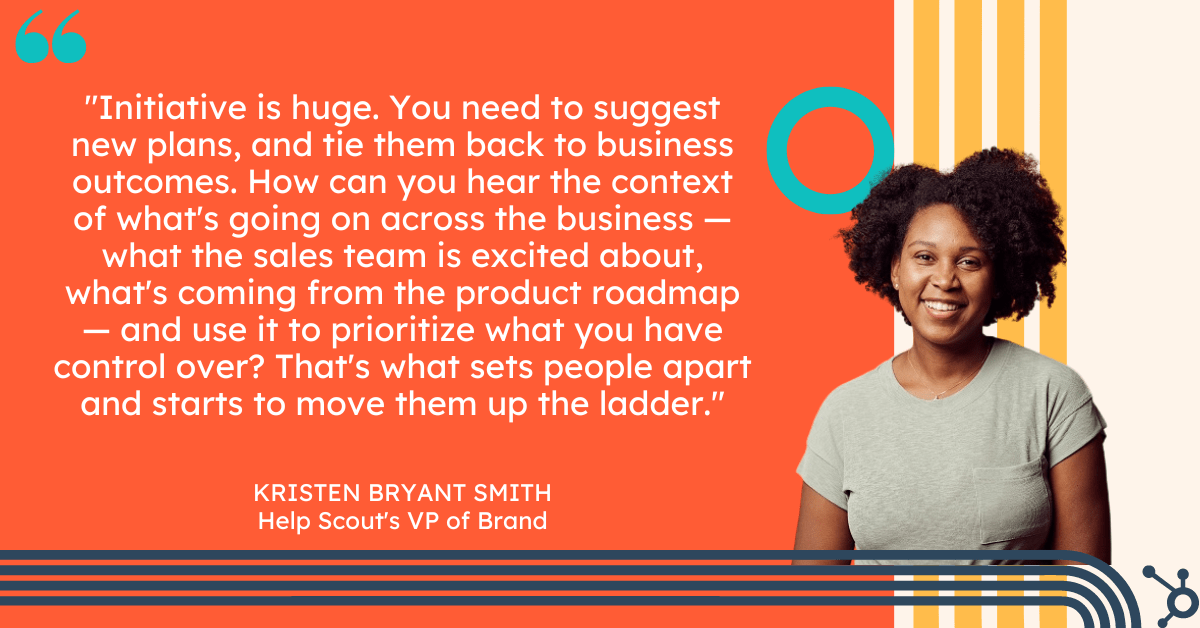
If you’re an individual contributor and you’re hoping to get promoted in 2023, VP of Brand at Help Scout, Kristen Bryant Smith, told me a few factors that could help you stand out. These include: 

  • The ability to tell stories to express the level of impact you’re having on the team. 
  • Being a cross-department translator — in other words, being someone who adds contextual knowledge and listens to others across the business. 
  • Being able to set realistic goals and hit them. 
  • Being consistent. 

Alternatively, perhaps you’re a people manager and you’re looking to get promoted to a director-level. As you a people manager hoping to get promoted, Smith says you’ll stand out if you demonstrate: 

  • An ability to navigate ambiguity and translate it effectively.
  • Providing role clarity to each of your direct reports.
  • Thinking on longer timelines.
  • Demonstrating empathy.

Thinking on longer timelines, and being able to strategically plan for the long and short-term, is supported by the data. 25% of marketing leaders say it’s the most important factor they look at when considering promoting a people manager, along with their ability to set clear goals and expectations for their team (24%). 

What Help Scout’s VP of Brand Considers When Promoting Individual Contributors & People Managers [+ How These Promotions Differ]

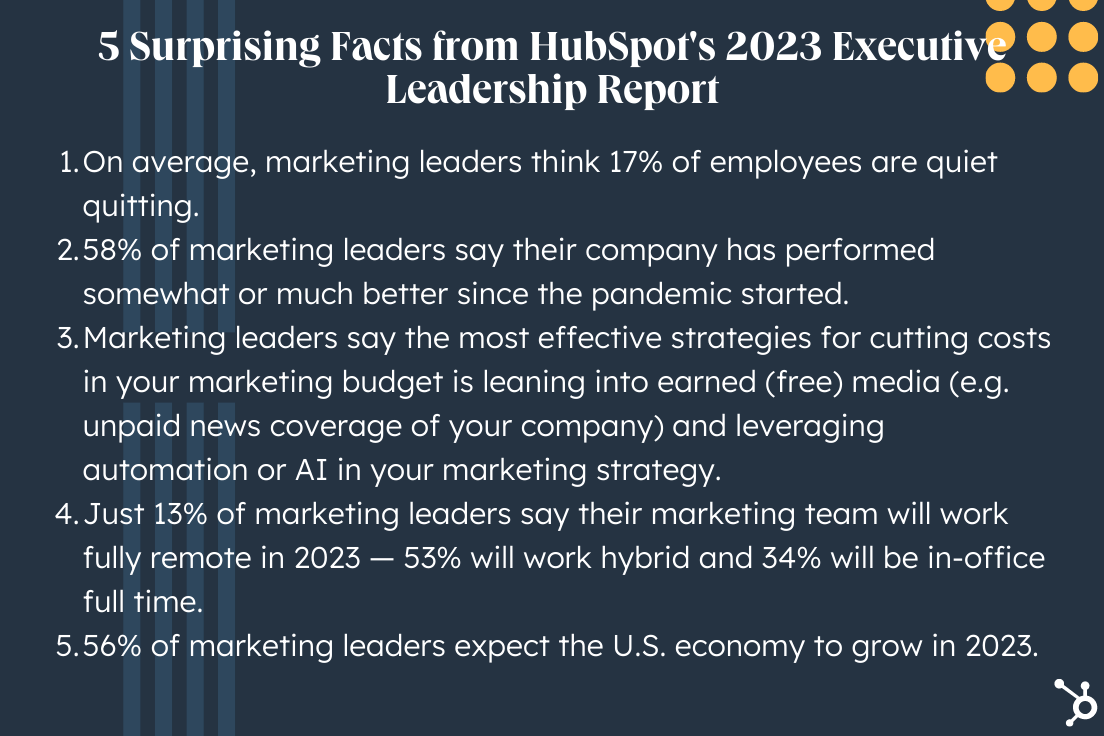
surprising facts from hubspots executive leadership report-1

Other Surprising Findings

  1. On average, marketing leaders think 17% of employees are quiet quitting (which is when employees intentionally do the bare minimum required of them in their role).
  2. 29% of marketing leaders strongly agree that the quality of an employee’s relationship with their direct supervisor is the most important factor in determining whether they engage in quiet quitting. 
  3. 77% of marketing leaders agree that it’s the responsibility of the leadership team to prevent quiet quitting. 
  4. Marketing leaders are optimistic going into 2023, with 78% expecting their company to perform better than in 2022.
  5. 58% of marketing leaders say their company has performed somewhat or much better since the pandemic started.
  6. Marketing leaders report social media marketing to be a critical skill marketers’ should focus on for career growth, with 26% marking it as a top skill they look for when hiring.
  7. On average, marketing leaders say 33% of their overall company budget goes towards marketing.
  8. Marketing leaders say the most effective strategies for cutting costs in your marketing budget is leaning into earned (free) media (e.g. unpaid news coverage of your company) and leveraging automation or AI in your marketing strategy.
  9. 56% of marketing leaders expect the U.S. economy to grow in 2023.
  10. 80% of marketing leaders have taken steps to plan or prepare for an economic slowdown or recession.
  11. Marketing leaders say the most effective strategies during an economic slowdown or recession are focusing your marketing efforts on existing customers and adapting your messaging to empathize with what your audience is experiencing.
  12. Marketing leaders say healthy work-life balance is the most important aspect of company culture for marketers to succeed.
  13. Marketing leaders say unsupportive management is the aspect of company culture most likely to negatively impact marketers ability to succeed in their roles.
  14. Just 13% of marketing leaders say their marketing team will work fully remote in 2023. 53% will work hybrid and 34% will be in-office full time.
  15. 36% of marketing leaders say the best way for marketers to get visibility with their leadership team is by stepping into leadership opportunities (e.g. leading a newly created committee, volunteering to present research findings at a company-wide meeting).
  16. The majority of marketing leaders (53%) say their team’s reliance on third-party data didn’t change in 2022, and 46% don’t believe it will change in 2023, either. Similarly, 52% of marketing leaders say their team’s reliance on first-party data didn’t change in 2022, and 44% don’t expect it to change in 2023, either. 
  17. 74% of marketing leaders say consumers should be directly compensated for sharing their personal data with companies.  

More Data and Insights

New Call-to-action


Categories B2B

Instagram and TikTok Resumes: Are Marketing Managers Watching Them?

Instagram and TikTok are apps typically used to share special moments, connect with others, or promote our brands — but can we also use these platforms to create and share resumes? In 2021, TikTok launched TikTok Resumes, a program designed to “continue expanding and enhancing TikTok as a new channel for recruitment and job discovery,” according to a news release.

The New York Times calls TikTok the new search engine for Gen Z, so it makes sense that Gen Z users could also search for employment opportunities on the app. It also makes sense brands looking for young talent may turn to the app for job postings. But are marketing managers and recruiters watching TikTok videos and accepting them instead of resumes?

To find out, I asked recruiters at HubSpot and surveyed marketing decision-makers for their thoughts on resumes in the form of TikTok videos. Here’s what you need to know if you’re thinking of filming your next resume.

Free Kit: Everything You Need for Your Job Search

What is a TikTok resume?

A TikTok resume is a 60-second video posted to TikTok showcasing the job experience, skills, and creativity of a user looking for employment. To ensure the resume reaches recruiters, job candidates must include #TikTokResumes in their posts.

Below is an example of a TikTok resume:

Almost half of TikTok users in the U.S. are between the ages of 10 and 29, so the program likely targets job seekers looking for entry-level positions.

What do professionals think of TikTok or Instagram resumes?

Since videos on TikTok often find their way to Instagram Reels, I figured it’d be safe to assume users would also upload their videos to Instagram to get more eyes on their resumes. With that in mind, I surveyed 98 marketing professionals to gauge their thoughts on TikTok or Instagram resumes. Here are the results:

  • When asked if they’ve ever considered a candidate with an Instagram or TikTok resume, 68% said they have, and 32% said they have not.
  • When asked if they would review an Instagram or TikTok resume, 71% of respondents said they would.
  • 27% said they would review one, but only with a traditional resume document. The remaining 2% said they do not know and are unfamiliar with Instagram and TikTok resumes.

I also asked respondents to explain their reasoning for why they would (or wouldn’t) accept a TikTok or Instagram resume. Respondents in favor of these video resumes often said they found the resumes to be unique, fun, creative, and interesting.

Respondents not in favor of TikTok and Instagram resumes often said the resumes were unprofessional or wouldn’t give enough insight about the candidate. Once again, some respondents said they’d rather accept the video with a traditional resume document.

I also asked HubSpot marketing recruiters for their perspectives.

“I would more likely want [a TikTok or Instagram resume) as an addition versus replacing a resume completely,” Marketing Recruiter Kassandra Pirela said. “A resume gives more insight on the experience and whatnot … I would like this as an addition to show that they put more effort into applying, and it’s just nice to get to know them a little more.”

Some HubSpot recruiters seemed to agree that video resumes like a TikTok or Reel are best as a supplement, rather than a replacement, for traditional resumes. However, other HubSpot recruiters also pointed out that video resumes can be more efficient than conventional resumes since they’re quicker to view and showcase personality.

However, a common concern brought up by the recruiters is that a video resume could trigger unconscious biases in the job-searching processes. For example, a recruiter may be more interested in the interactive video than a traditional resume, regardless of either candidate’s experience.

Should you make a TikTok or Instagram resume?

In an increasingly digital world, social media resumes could likely become more acceptable in the professional world in the coming years. However, candidates should always research the job they are applying for and adhere to the job posting guidelines.

In other words, if the job posting says to submit a resume document and cover letter — do that. You can include a link to your TikTok resume in your application to stand out, but you still need to have the materials the job posting specifies. A TikTok resume could be beneficial if you’re applying for a reactive position like a videographer or social media manager — but make sure to have a traditional resume on hand.

Apply for a job, keep track of important information, and prepare for an  interview with the help of this free job seekers kit.

Categories B2B

Which SEO Metrics Matter Most to Marketing Leaders, According to Semrush’s VP of Brand Marketing

Having a strong SEO strategy is critical for reaching new audiences and generating leads for your business.

In fact, 43% of marketing directors, VPs, and C-suite executives reported SEO as one of the most effective strategies their companies currently leverage.

Creating a powerful SEO strategy requires consistent testing and iteration. Over time, certain metrics can help you identify which areas of your strategy are working — and which aren’t.

It can be difficult, however, to determine which SEO metrics actually matter. To truly evaluate the success of your SEO, what should you pay attention to? Organic traffic? Leads? Keyword rankings? Conversions?

Here, I sat down with Semrush’s VP of Brand Marketing, Olga Andrienko, to discuss the SEO metrics she’d advise leaders pay attention to in 2023. Let’s dive in.

→ Download Now: SEO Starter Pack [Free Kit]

The SEO Metrics That Matter Most, According to Semrush’s VP of Brand Marketing

1. Focus on the metrics that tie directly back to revenue — like conversions and new MRR.

You might’ve expected Andrienko to start with organic traffic or rankings as a top SEO metric, but instead, she advises leaders to start with the bottom line — revenue — and work backwards.

Andrienko told me, “When we discuss quarterly goals, we always look at new user monthly recurring revenue (new MRR). And, in that case, conversion is the only thing that matters. I think the metrics that matter are the ones that can tie back directly to revenue.”

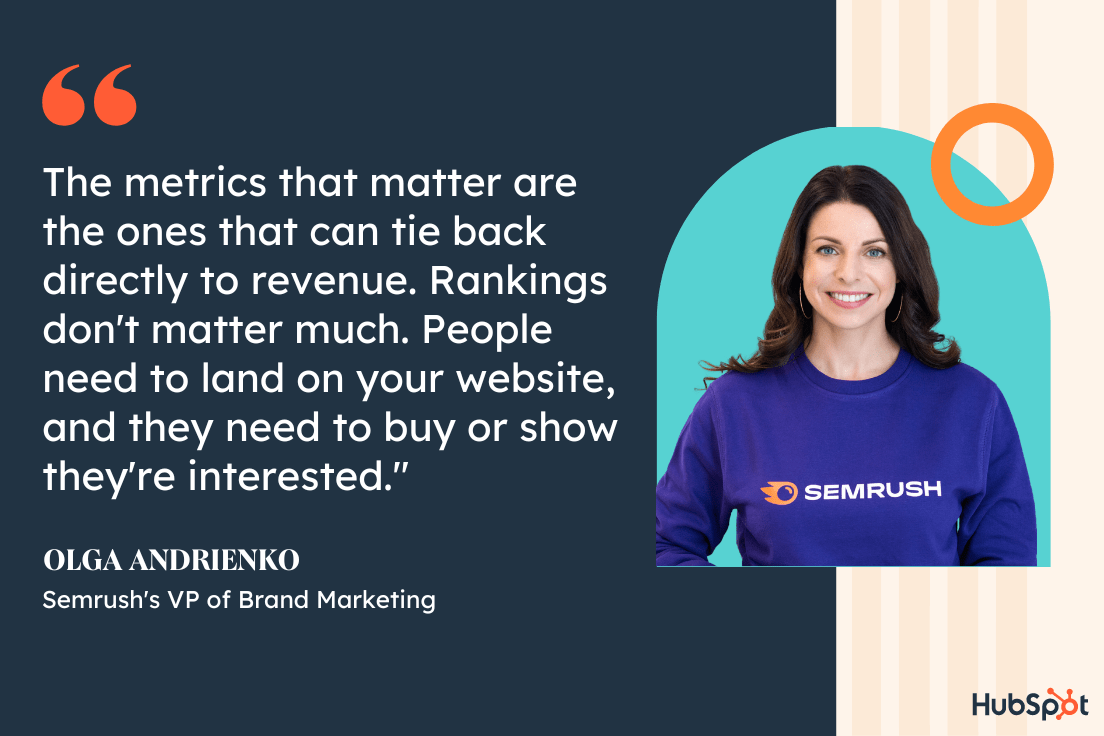
She adds, “For instance, using analytics, you can see where the user came from, and how long it took them to convert and become a customer. So if we know most users come from organic search, then organic would be the metric I’d be focused on measuring. Whatever your success element is is the most important outcome. Rankings don’t matter much. People need to land on your website, and they need to buy or show they’re interested.”

Hearing ‘rankings don’t matter much’ from the VP of Brand Marketing at Semrush, a platform often used for online ranking data, initially surprised me. But it makes sense.

Let’s say you rank #1 for the keyword query: “What is marketing?” If your company sells products or services related to marketing, that’s great. But if that same post isn’t driving the right kind of traffic, or isn’t converting that traffic into qualified leads and revenue for the business … Does it matter, really?

Focusing on the metrics that tie back to revenue can greatly impact where you spend your time and resources. To effectively evaluate your content based on revenue, consider making a spreadsheet that tracks all your top-converting posts. Even if those posts aren’t the ones that bring in the most traffic for your site, those are the posts you’ll want to focus your historical optimization attention on — since those have proven most valuable to your business’ bottom line.

vp of semrush marketing on top seo metrics 2023

2. Don’t forget about branded keyword search volume.

Andrienko admits this next metric likely matters to her because of her role as a brand marketing leader, but it’s worth mentioning since it’s a metric that can demonstrate your brand value.

As she puts it, “For me, being a brand marketing leader, I specifically focus on branded keyword search volume — which means how many impressions and search volume the keyword ‘Semrush’ is getting over time. That gives me an understanding of how good we are at strengthening the brand and growing brand awareness.”

This is a particularly important metric if your goal is to grow brand awareness for your business. As you test strategies meant to increase brand awareness, such as co-marketing campaigns, sponsored events, or new types of content like podcasting, you’ll want to obsess over branded keyword search volume. Is it going up over time? If it is, this is a strong indicator that your brand awareness strategy is working.

While this can seem like a more superficial metric, it’s not. Consumers want to buy from companies they trust — and familiarity is a powerful factor when it comes to developing trust with your prospects.

3. Consider click-through rate and how it correlates to organic traffic.

“If you see a lot of people are searching for select keywords, but your CTR isn’t growing, then that means something is off,” Andrienko told me.

She continues, “For instance, we noticed the organic CTR on one of our keywords was dropping, and we discovered it was because Google added an AdWords top search feature — so we bid on the keyword. Ultimately, we saw that even though organic CTR was dropping, we were able to get the clicks anyway in a different form.”

“It’s important you don’t just look at organic traffic … But also how it correlates with the click-through rate. That’s a very important connection to make.”

In a world where almost two-thirds of Google searches end without a click, it has become increasingly difficult to achieve high click-through rates. And Andrienko admits it’s not always feasible. Consider, for instance, a user who searches “How can I measure click-through rate?” They’ll be shown this featured snippet, which concisely answers their query:

This is where the power of long-tail keywords comes into play.

Andrienko told me about one of Semrush’s customers, a dentist. After struggling for a while with attracting audiences to his website, the dentist decided to search for any dental-related queries. Then, he took those keywords, grabbed a recorder, and went to his doctors. After recording their answers to his questions, he put them up on his blog and started ranking for the long-tail keywords related to his industry.

While this strategy might not work for everyone, it’s worth noting that creating content that requires users’ to click on the link to get the full benefits is critical for optimizing your SEO strategy.

For instance, rather than writing a post that answers the query “how can I measure click-through rate?”, you might also create content that answers more long-form queries, like “What are the best strategies to increase CTR?”.

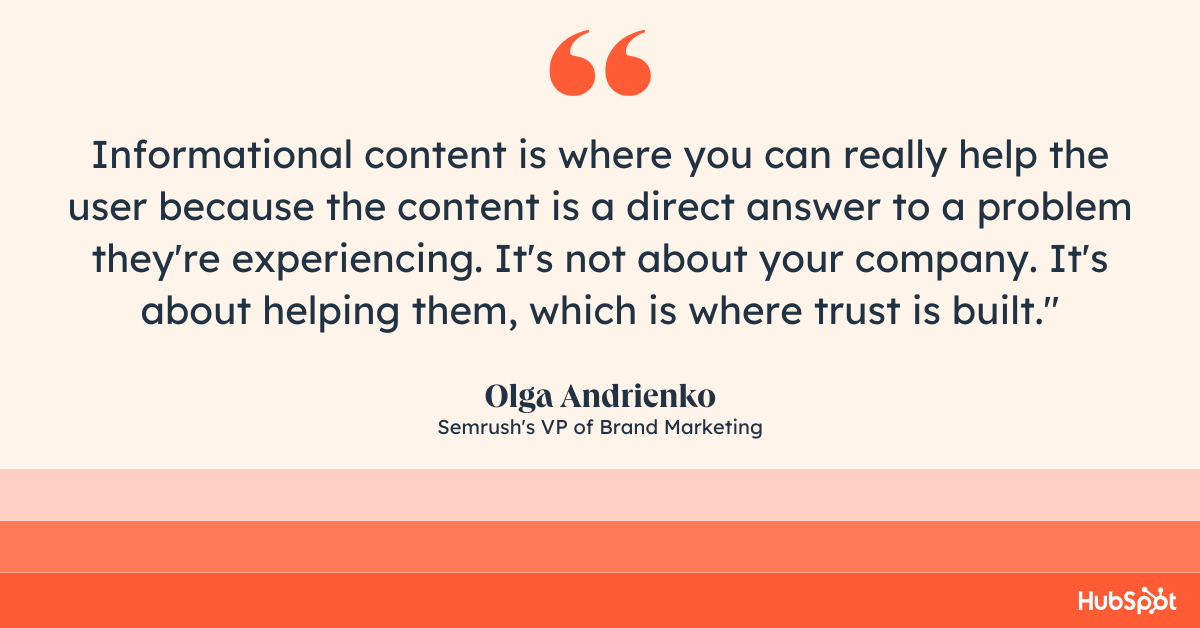
Informative, helpful content that leverages long-tail keywords isn’t just for attracting audiences. It’s also vital for building trust and creating stronger relationships with your audience. In fact, Andrienko told me her favorite type of content is informational. “It’s where you can really help the user because the information is a direct answer to a problem they’re experiencing. It’s not about your company. It’s about helping them, which is where trust is built.”

Semrush VP of marketing on informational content

4. Don’t ignore rankings, backlinks, domain authority, and user behavior metrics.

Finally, Andrienko provided a list of a few other metrics that she believes still deserve a mention in this post.

For one: Rankings and positions.

She told me, “I wouldn’t focus on rankings and positions as the first metric, but you still need to see how you’re performing against competitors. So it’s an important day-to-day metric to watch.”

A few other metrics Andrienko encourages leaders to watch:

  • Backlinks
  • Domain authority
  • User behavior metrics, like page load speed

There are other metrics she uses for more qualitative purposes too, like bounce rate. She says, “Bounce rate is important to track because it indicates whether the content is actually interesting and compelling to your readers.”

She continues, “And pages per session is another metric you’ll want to pay attention to — because let’s say users land on ‘What is SEO?’. We know they won’t immediately convert on that page. We need to encourage them to go to another page, and another page after that, so we’re able to grab their attention and ultimately convert them. If they only visit one page per session, it means we didn’t do a good job of retaining them.”

The SEO metrics you care about ultimately depends largely on your goals as a marketing leader. As you approach 2023, you’ll want to consider your goals, and then work backwards from there to identify which SEO metrics will help you evaluate how aligned your strategy is with those goals.

Not sure which goals to focus on? Take a look at The Top Goals of Marketing Leaders in 2023, or find other helpful content related to leadership in 2023 in the post, Act Like a Leader, Think Like a Leader: Data from 300+ Marketing Directors on How to Take Your Team to the Next Level.

SEO Starter Pack

Categories B2B

The Great Resignation: How It’s Changing Hiring for Companies and Job Prospects [+ Expert Insight]

The U.S. Bureau of Labor Statistics says that over 47 million Americans quit their jobs in 2021 — this is what’s now known as The Great Resignation.

As there has been a significant increase in the number of vacant positions and the number of workers who have left their position, it makes sense that hiring priorities may have changed.

In this post, we’ll discuss The Great Resignation’s impact on hiring with insight from marketing decision-makers and expert HubSpot recruiters.

Download Now: 5 Free Resignation Letter Templates

Has The Great Resignation Impacted Recruiting?

Gabby Reynoso, a Marketing Recruiter, says, “What the great resignation has done is highlight the importance of flexibility, growth opportunities, and work-life balance in the workplace.” She adds that the pandemic has empowered employees, more than ever, to prioritize flexibility, growth opportunities, and work-life balance in the workplace in their current positions and those they are considering.

Kanani Rose, a Senior Sales Recruiter, says, “Anecdotally, I’ve seen a bit of a cool-down in this phenomenon as the market continues to be unpredictable, but I’m certain that one of the long-term effects of the Great Resignation is that workers will continue to be interested in the scope of their work, from a wider lens than just their general job responsibilities.” This can include health insurance, financial benefits, 401K, stock options, work from home stipends — incentives that are becoming just as important as the job itself.

She also says that compensation and job satisfaction were and continue to be top reasons candidates apply for specific positions, but the push that many businesses made to have their employees return to in-person work drove many workers to the job market in search of more flexible work opportunities.

How Has Recruiting Changed Post Great Resignation?

When it comes to the recruiting landscape, candidates are more selective: “Employer branding, pay transparency, and empathy in the recruitment process have all been key strategies on our recruitment team to make sure that we are giving candidates the power to make the best decisions for themselves in a competitive market.”

Rose says, “As a sales recruiter, I’m no stranger to candidates fielding multiple offers during the hiring process, but the market was especially tough in 2022.”

In a recent Glimpse survey, marketing decision-makers in the U.S. have stated that their hiring processes have changed in the past six months, primarily due to the economic changes that arose during the COVID-19 pandemic.

The most commonly reported changes are:

  • Having a harder time getting recruitment traffic and finding qualified candidates
  • Using more and more virtual resources in the hiring process (like online recruitment tools and video interviews)
  • Hiring with remote work in mind as people want more and more flexibility in how they work
  • Working harder to fill positions and attract qualified candidates through things like referral bonuses, sign-on bonuses, more time off, etc.

Over to You

As recruiting and finding top talent is likely a top priority for your business, it’s important to stay on top of workforce trends and what employees are expecting from the businesses they choose to work for.

If your hiring and recruiting have taken a significant hit post great resignation, consider how your business can speak to employees’ selection criteria when applying for jobs, like offering flexible work options, virtual recruiting, increased benefits, etc. You don’t have to overhaul your entire process, but you can forge a new path to successful recruiting.


Apply for a job, keep track of important information, and prepare for an  interview with the help of this free job seekers kit.

Categories B2B

The Top 5 B2C Marketing Trends of 2023 [New HubSpot Blog Data]

In 2022, 51% of B2C marketers plan to increase their marketing budget.

The question is where is that budget going? Will marketers reinvest in the same strategies or try new trends?Download Now: Free State of Marketing Report [Updated for 2022]

To understand what trends B2C marketers are leveraging in 2022, we surveyed 1,067 global marketing professionals working in B2B and B2C companies. 

From influencer marketing to virtual events, there are so many efforts brands can focus on. Let’s see what our latest research says about what worked well for B2C marketers this year and where they plan to invest in 2022.

1. Short-form video will be a priority.

Short-form video took off in early 2020 and shows no signs of slowing down.

Back then, TikTok was the number one place to go for short-form content. Today, Instagram Reels and YouTube Shorts are also competing for users’ attention.

This is good news for brands, as the short-form video trend content offered the second-highest ROI for B2C marketers in 2021, behind influencer marketing.

Despite coming in second for ROI, it’s the trend marketers plan to invest in the most in 2022. Roughly 33% of B2C marketers already invest in short-form content, while one-third of those who haven’t will do so for the first time in 2022.

Why now? Well, short-form video is such a key feature in social media today. And according to the data, social media takes the lead in marketing investments for businesses.

That’s likely because three key goals B2C brands will have when running marketing campaigns in 2022, will be increasing brand awareness (49%), advertising products (44%). and increasing revenue (43%). 

B2C Marketing Campaign Goals 2022 Chart shows that the top B2C campaign goals are increasing brand awareness, advertising products, and increasing revenue.View image as a file.

With social media, you can accomplish at least two out of three. Brand awareness was always the main benefit of using social media but things have evolved.

Today, with so many platforms offering in-app shopping experiences and advanced ad formats, brands can meet more of their marketing goals.

2. Influencer marketing will still be a key lead/revenue driver.

For most B2C marketers, the power of influencers is clear.

In 2022, 61% of B2C marketers surveyed in the study plan to leverage it. In fact, it’s the third-highest trend they plan to prioritize, behind short-form video content and inbound marketing.

This is because in 2021, it offered B2C brands the best returns. When asked to select their top ROI driver from a list of 27 tactics and strategies, 11% of B2C marketers chose influencer marketing. 

A chart shows B2C Trends and Tactics with Highest ROI which include influencer marketing, short-form video, permanent social content, and SEO respectively.

View image as a file.

What might be different in the future is the type of influencer brands focus on. Historically, brands have focused on the biggest and most popular influencers to partner with.

However, some data suggest that micro-influencers with under 100K followers may be more effective.

While the verdict is still out on that, one thing is clear: Influencer marketing isn’t going anywhere.

3. Audio content will take a front seat.

Data suggests that video is the leader when it comes to content marketing. However, audio is slowly creeping up into the mix.

According to the survey, only 19.1% of B2C marketers use podcasts or other audio content in their marketing. Of those who do use it, 37.4% find it to be one of their most effective trends.

Even though adoption was seemingly low in 2021, the data suggests that more B2C marketers will add audio content to their marketing efforts in the new year.

Roughly 43% of B2C marketers plan to increase their investment in podcasts in 2022 while 38.4 plan to keep it the same. Another interesting fun fact is that this particular piece of data is virtually the same for B2B marketers.

This suggests that across all industries, brands recognize the power of audio content.

4. Social responsibility will be more important.

Now more than ever, consumers want and expect brands to be more transparent and take a stand on social media.

In fact, a 2020 Edelman Trust Barometer survey revealed that many consumers see trust as a leading factor in their purchasing decisions.

In the past two years, particularly in the height of the COVID-19 crisis and calls for social justice, consumers have started holding brands more accountable. In 2022, brands will be addressing that demand.

Currently, only a third of B2C marketers surveyed find social responsibility to be an effective marketing trend. Despite that fact, 45% plan to increase their investment in 2022.

5. Brands will continue to apply inbound marketing strategies.

Inbound marketing is all about meeting consumers where they are. Instead of marketing efforts that push messaging out to consumers, this focuses on attracting them toward you.

Behind short-form video, inbound marketing is the top trend marketers will invest in next year.

In fact, over 80% of marketers plan to keep the same budget or add more for this strategy.

This is done by following the “Attract, Delight, Engage” model that leverages content marketing, SEO, marketing automation, social media, and more to nurture consumers at every stage of the buyer’s journey.

There you have it – some of the top trends B2C marketers will invest in 2022. Between publishing regular video/audio content on social media and developing a strong inbound marketing strategy, marketers have a busy year ahead.

To keep up with the latest trends in marketing, stay tuned for more upcoming marketing strategy research posts, download the 2021 HubSpot Not Another State of Marketing report to learn what marketing professionals focused on this year. 

New Call-to-action

Categories B2B

The Top 10 Marketing Challenges Expected Globally in 2023 [HubSpot Data + Expert Tips]

Every marketer faces different challenges. And, ever since 2020, the ways we’ve had to pivot, adjust campaigns, and address challenges has been unlike anything many of us have had to do before.

And, even if you’ve somehow navigated the past three years without any surprising or tough marketing challenges, there’s likely at least one task, tactic, or strategy you’ve always wanted to improve upon. 

Today, marketing is so fast-paced that it can be difficult to identify which areas you’ll want to develop to facilitate stronger growth in 2022 and beyond. For that reason, it’s important to pause for a moment and reflect on the biggest challenges marketers feel they’re facing this year.

Below, let’s review the current global marketing issues impacting the industry, according to data from HubSpot’s 2023 Marketing Industry Trends Report and marketing experts.

Download Now: Free State of Marketing Report [Updated for 2022]

1. Generating Traffic and Leads

While this was the second biggest marketing challenge in 2022, it’s the top challenge marketers will focus on in 2023, with 19% of survey respondents saying it will be their biggest hurdle. As you might expect, generating traffic and leads is always top of mind with marketers. And, even if teams are doing well with these metrics, they’ll always want to improve them. 

Why It’s a Challenge

John Lee, Head of Evangelism at Microsoft Advertising, believes that generating leads will be a particularly big challenge for marketers. He told me, “Getting quality traffic isn’t a challenge today, and likely won’t be tomorrow. There has been growth in search and content marketing in 2021. New channels continue to surface and show promise, too (TikTok or audio chat rooms anyone?).”

Lee adds, “‘Sea change’ is the phrase that comes to mind for the state of digital marketing today. Change in the realm of privacy, identity, and changes to cookies. Change in the form of lost data clarity (will cookie-based conversion tracking continue to work, GA4, access to search queries, etc.). And all of this sits within the context of change to how and where we work and economies in flux as the world continues to move through the pandemic.”

Fortunately, privacy changes don’t mean the end of generating leads — it simply means learning how to re-think strategy.

As Lee told me, “To weather this storm of change, marketers need to be vigilant in monitoring and understanding industry-wide acceptance of privacy protocols and updates to search, social, and display/native platforms (consumer-side and marketing/advertising-side). And last, but not least — lean into the power of peer support and networking for sharing best practices and learning.”

Additionally, marketers are struggling with producing enough demand for their content. And as the year’s progress and competition stiffens, this will only become truer. With so many options of platforms for marketers to publish their content and even more ways to promote it, it’s hard to know where to focus your efforts.

What You Can Do

When it comes to creating content that produces enough traffic and leads, marketers should ask themselves two questions: Are you truly creating high-quality content — the type of content people would pay for? And, do you know the type of content your audience actually wants?

For instance, when asked how they’d most like to learn about a product or service, 69% said they’d prefer to watch a short video over a text-based article, infographic, or ebook. This means, if most of your product-related content is in ebook format, you could be missing out on the majority of consumers who prefer video.

Additionally, the length of videos produced by businesses has increased (albeit more slowly than the increased creation rate of short video). While short-form video is still King/Queen, the number of videos in the 30-60 minute category grew 140% in 2021, compared to 2019 — suggesting that long-form video content is still a viable option for companies.

To ensure you’re creating content that resonates best with your audience, you’ll want to refer to analytics often. Use effective tools to properly track the types of content that perform best with your audience to generate more leads in 2022.

Additionally, once you know you’re creating the type of content your audience wants, the focus shifts to promoting it in a way that makes your audience take notice.

More than ever before, people are being flooded with content. Consumers don’t have to use a search engine to find answers. Instead, articles fill their news feed or buzz in their pocket via mobile notifications. To keep up, consider exploring alternate distribution methods — like social media or podcasting — to increase brand awareness.

Lastly, if you have the budget for online advertising, one example of a helpful distribution method is by promoting your content with HubSpot’s LinkedIn Ads Integration. Learn more about it here.

2. Hiring Top Talent

While “Hiring Top Talent” was low on the list of challenges faced by marketers in 2022, it’s expected to be the biggest challenge of 18% of marketers in 2023.

And, we’re not too surprised. Hiring talent with a great track record takes time, effort, and money — which many marketing teams do not have. 

While hiring is a challenge marketing teams have faced throughout the past five years or so, concerns are continuing news of worker shortages and recruiters competing for applicants that have chosen to shift roles due to the global pandemic or management interests in mandatory office returns

Why It’s a Challenge

Many companies are shifting more resources to inbound marketing, which means higher and higher demand for top marketing talent. But supply simply isn’t keeping up. From sourcing the right candidates to evaluating for the right skills, finding the perfect person could take months … or more.

What’s more, the type of marketing talent companies are looking for is changing, too. According to a report from LinkedIn, employers are seeking marketers with soft creative skill sets as well as hard technical skills. And the quick rate at which the demand for these jobs are rising has caused a marketing skills gap, “making it difficult to find candidates with the technical, creative, and business proficiencies needed to succeed in digital marketing.”

What You Can Do

In 2023, hiring talent could grow even more difficult — particularly as more companies deal with transitions back to office life, competitive hybrid perks, as well as salary budget limitations due to the shifting economy.

Stefanie Grieser, co-founder of Shine Bootcamp, a professional speaker accelerator for women, understands the challenge of hiring top talent.

She told me, “When I talk to high-growth companies or marketing agencies (and the marketers running those teams), I’ve found that hiring not only top talent, but diverse top talent is extremely challenging. In fact, I was just having a conversation with an agency owner who hires SEO and paid marketers, and he told me, ‘Hiring is still the biggest challenge we face.'”

Fortunately, Grieser provided me with a few tips for employers to stand out from the crowd. She told me, “My suggestion here is for marketers to invest heavily in their employer brand for the long-term. Just like you need to market your product, you also need to dedicate resources, time and energy into marketing your company as an employer.”

biggest marketing challenges 2021 is hiring top talentGrieser adds, “I would suggest Diversity Tech Co, Tech Ladies, and Girlboss as go-to resources to post jobs. These organizations are run by incredible individuals who really care about diversity, equity, inclusion and intersectionality. I’m also seeing niche communities and job boards pop up. For marketers specifically, I would post your open roles here: Dave Gerhardt Marketing Group, Hey Marketers, and Superpath (which is focused on content marketers specifically).”

While it might seem random to discuss employer branding in a post about marketing challenges, it isn’t — since it’s often the marketing team that cultivates a strong employer brand.

As Grieser points out, “Airbnb has an Engineering and Data Science blog, Intercom has an Instagram dedicated to their design team, and Dooly posts short, LinkedIn posts (see an example here) interviewing their fun team with a few fun hashtags #doolydreamteam and #meetadooligan.”

“Guess who leads this initiative? The marketing team. Think about how you and your team can showcase your work and your team’s work. I won’t try to assume that employer brand falls solely in your court, but as a marketer, you have natural skills that will lend themselves to marketing the company as whole.”

LinkedIn data shows that the number one reason candidates will consider or accept a job is career growth. This means that job listings and a company culture that offers employees a plan for growth will see the most interest from talent.

3. Marketing Plan Pivots

In 2020, we began learning the art of the pivot as many brands had to stop everything they had planned, observe the current state of everything, and navigate the bbest way forward. But, every time we think we get closer to a boring day in the marketing world, something evolves or changes that will cause us to need to pivot.

And, while some marketers are excited by the idea of working in a fast-paced, ever-evolving environment, it can get very tiring for others. That’s why we’re not shocked that 17% of marketers say that marketing strategy pivots will be the biggest challenge they face in the new year. 

Why It’s a Challenge

While you might think pivoting during COVID-19 gave you all the skills needed to change course when its necessary, every unprecedented event that we aren’t expecting often poses new challenges (as those definitions suggest). When marketers don’t plan for the unexpected, they could risk their performance metrics, budget, or even their audience if they market to targets that are forward-thinking and find untrendy or out of touch brands uninteresting to them. 

What You Can Do

At HubSpot, and many other companies with excellent marketing departments, our marketers always try to be one-step ahead of the potential result (or even a lack of results). 

When creating a large campaign or implementing a big strategy, it’s important to ask yourself and your team, “What do we do if it doesn’t work?” or “How do we pivot if the world changes overnight?”

When it’s time to make that pivot, try to gather as much information as you can about your customers, audiences, and platforms to learn how everything has changed or evolved, and then use what you’ve learned to determine the best course of action. For example, when COVID-19 was declared an emergency, many of our marketers paused comms with audiences and notified them through emails or social posts that it was because we wanted to focus on offering the most helpful or valuable content unrelated to sales and revenue at that time. Then, while we were on pause, we met with each other and performed market research to help us put ourselves in the audience’s shoes and learn how we could best help them.

If you do pivot, learn from what worked effectively and what didn’t. This will help you in future scenarios where a pivot is necessary — even if the situation is totally different next time.

For more information and expert tips on how to change up your content plan in a rush, check out this helpful post.

4. Training Marketing Teams

In 2022, training top talent was the top challenge marketers were focused on. However, as more marketers now focus on recruiting and retaining greaat talent in this time of faster workplace movement, training seems to have fallen to number four. 

However, this doesn’t mean training isn’t an important factor to pay attention to, especially if you have a growing workforce.

After all, even top-tier talent need to have paths to grow, challenge themselves, learn, and become even better at what they do. 

If you’re a manager or marketing leader, you’ll need to take time to teach that employee how your company works. This could include voice and messaging training, helping them understand buyer personas, or getting them acclimated to the tech stack or processes you use. 

Meanwhile, regardless of whether you’re a seasoned marketing team employee or new hire, you might wish your company had more opportunities for training, onboarding, or professional development that could allow you to excel and learn while also hitting your KPIs.

Why It’s a Challenge

Unfortunately, in the fast-paced world of marketing, it can be challenging for leaders to find the time to train while employees might not have the time or money to access professional development outside of their day-to-day tasks. 

That’s why it’s not shocking that 30% of marketers say that team training was the biggest challenge of 2021 and 21% say it will continue to be the top challenge for marketing departments in 2022. 

What You Can Do

The first step to solving this problem, regardless of whether you’re an individual contributor or manager, is reframing what “training” means to you. Remember that even the most top-tier, ROI-generating unicorn marketer will need time to get used to how your company works and grow as an employee and potential leader.

Ultimately, businesses should think of training and professional development offerings as indirect ROI generators. Ultimately, even the most top-tier, unicorn talent will need time to get used to how your company works.

On one end of the spectrum, companies and leadders can retain employees and save money on talent searches because of their offerings. Meanwhile, their talent will learn more, grow more, become even more competitive, and — most importantly — feel more fulfilled and supported in their role. Additionally, you don’t always have to hire instructors or take time out of your day to train. For example, you can:

  • Encourage project managers or individual contributors looking for visibility to present experiments, strategies, or learnings at events, weekly meetings, or annual team conferences.
  • Book an annual professional development day during a slow season where all employees are asked to take a free online course of their choosing and report back on how it went.
  • Consider hosting quarterly or bi-annual new employee or new manager training days where newer hires and new managers can plan to go to in order to train with minimal impact on their quarterly projects. 
  • Create evergreen training videos, internal quizzes, or other resources that you can send to new or newly promoted employees on their first day.
  • Have managers develop 100-Day Plans for new hires or those that transfer to their team which includes training assignments, resources to read through, and a contact list of people to meet or schedule training with.  

On the other hand, if you’re an individual contributor, participating in your company’s professional development training and/or taking free or affordable courses online could help you negotiate a stronger role and salaries for yourself at your company or elsewhere. 

If your company doesn’t offer training or reimbursement for it, check out this list of free courses

5. Keeping Up With the Latest Trends

As you’ve seen, the world is always changing. Even aside from the things you’ve seen all over the news, a brief skim of any social media feed once weekly will show you how much trends change. In one day, we’ll open our TikTok feed and see constant clips filled with “Stranger Things” references all over the place. The next day, we’ve moved on to “CornTok” (a trend that involved us sharing videos with a remixed song sung by a boy who really loves corn). 

Why It’s a Challenge

Essentially, no matter where you look, trends are constantly changing. And, if you’re publishing out of touch content that leverages very out of date or out of touch trends, your audiences might get bored and move on to a brand that feels more interesting to them.

Unfortunately, marketers might not always have the bandwidth or budget to lean into every trend out there. So, what are we supposed to do?

What You Can Do

Just like picking the right channels or social platforms that make the most sense for your brand, pay attention to the industries and trends that make the most sense for you to lean into, or brands that you know most of your target audience is leaning into. For example, one brand that perfectly leaned into “CornTok” was Rumba, which creatively published a TikTok of its products cleaning up — you guessed it — corn. 

@irobot Let’s pretend for the sake of our jobs and the Roomba that this is dried corn🌽
#corn
#cornsong
#trend
#fyp
♬ It’s Corn – Tariq & The Gregory Brothers & Recess Therapy


6. Facing Competition

In our 2023 survey, 16% of marketers cited their biggest challenge as “increasing competition from other brands.” And, that’s not shocking at all.

Business competition is a tale as old as time. And, even when you feel like you’re winning on one channel or another, competitors can come at any moment ready to outperform you. That’s why every platform, from social media to search engines, has gotten vastly more competitive over the past 10 years — and will only get more saturated with competition.

What You Can Do

The concerns of competition are obvious. Ultimately, they could take business or attention away from you and harm your revenue. Luckily, it doesn’t take a marketing genius to get ahead of them. 

Start with a competitive analysis of all of your biggest competitors that you’re most likely to lose audiences or customers to.

Examine their websites, social media, search keyword profiles, and other channels and make a list of what they’re doing right that you can learn from, what they’re doing wrong that you’ll avoid, and the gaps in their strategy that you can take advantage of.

While we encourage you to highlight your unique perks and not copy the competition exactly, use your analysis results to think about the competitive selling points you can market and strategies you can use to innovate on what they’re missing. 

7. Securing Your Budget

In 2023, 16% of marketers are concerned about securing. gaining, and keeping stakeholder support for their marketing budgets. And, although we aren’t surprised that a large chunk of marketers selected this concerm, we were a bit shocked that more marketers aren’t seeing this as top of mind given the current economic landscape.

Why It’s a Challenge

Securing a budget has always been a pressing challenge for marketing globally. And, while marketers seemed to be getting what they needed for budget in 2022, companies could be eager to shift back to pre-pandemic strategies of placing money into sales, facilities, and other departments in the future — especially if the U.S. or other countries enter a recession.

Often, getting and keeping more budget is easier said than done — especially for smaller organizations that aren’t working with sizable or flexible marketing spend. But the key to securing more money for your team might not be that complex. Here’s what you can do.

What You Can Do

The key to unlocking budget lies in being able to prove the ROI, of your marketing efforts (as we’ve noted above). Use your whole budget to demonstrate need, but also ensure you’re spending money on things that will provide high performance, like high-traffic, lead-gen, or revenue-generating projects or headcount.

According to our research, organizations that can calculate ROI are more likely to receive higher budgets.

Again, success with inbound marketing also plays a large role in driving higher budgets. Effective strategies obviously produce results and make a strong case for increasing your budget. But remember, inbound marketing is a long game. If you get off to a slow start, you shouldn’t back off — in fact, you might consider doubling down.

To learn more about how to understand and leverage marketing ROI, check out this simple guide.

8. Demonstrating ROI of Marketing Activities

While this item didn’t make our top challenge list this year, we still think it’s very important to highlight here and focus on in 2023, especially if your business is focused on spending budget wisely — or only on things that provide ROI. 

And, in 2021. 28% of marketers saw it as their top challenge, while 21% of marketers expect to see this continue to be their biggest issue in 2022. 

Measuring and gaining ROI continues to be a vital way for marketers to understand the effectiveness of each particular marketing campaign or piece of content. It also can be what decision-makers at your company rely on when determining if they’ll invest more in your project, deparment, or team headcount in the future. 

Ultimately, proving ROI often goes hand-in-hand with making an argument to increase budget: No ROI tracking, no demonstrable ROI. No ROI, no budget.

Providing ROI often comes down to using effective analytics measurement tools. For instance, Beautiful.ai Director of Marketing Kim Giroux told me, “Marketers are constantly challenged to illustrate the ROI of their efforts and [this year] is no exception. Proving ROI doesn’t always have to mean extra work or effort though. In fact, certain technologies bake ROI into existing work processes.”

Giroux adds, “Take presentation software, for instance. Savvy marketers today can create and use pitch decks with built-in presentation analytics that offer real-time data — such as how much time was spent viewing individual slides. Armed with these insights, marketers can better gauge stakeholder interest, inform their strategies, and adjust their campaigns.”

Christina Mautz, CMO of Moz, believes measuring ROI comes down to redefining the marketing process as a whole. She told me, “My biggest challenge, and one all marketers face in providing ROI, is the prospect of meeting traditional KPIs in the modern workspace.”

Mautz says, “Instead of leads and trade show success, marketing wins are now largely digital: engaging prospects and generating more clicks, downloads, and page visits.”

CMO of Moz Christina Mautz says, “To better measure marketing progress, we have to redefine the marketing process, encouraging collaboration with sales and reaching KPIs together.”

“For example, statistics such as page visits per sale or rising higher in the search engine results page (SERP) give marketers and SEOs tangible evidence as to how their work is meeting their ROI. New buying patterns and a customer-centric world require a divergence from the old, but measuring ROI will look far different than it did before and some leaders may not understand how or why.”

When it comes to providing ROI, there’s a strong case to be made for dedicating time and resources to establishing links between marketing activities and sales results.

This means using both marketing software (like HubSpot) and a CRM solution (like HubSpot’s free CRM) and then tying them together to close the loop between your marketing and sales efforts with a service-level agreement (SLA). That way, you can directly see how many leads and customers are generated through your marketing activities.

Other Common Challenges

While our survey identified the biggest challenges in marketing, teams are still facing dozens of other challenges that are worth mentioning, but weren’t one of the top concerns. Here are just a few:

Website Management

In 2021, 64% of companies said they were investing in website upgrades. Meanwhile, 27% of survey participants said that managing their website was the top challenge in that year, with a chunk more saying they continued to rise to this challenge in 2022. 

In 2023, website challenges aren’t going anywhere. If you have an online presence for your business, your website serves as a key place that consumers will go to when researching your brand.

There, they might find company information, marketing content, and other resources that nurture them into becoming a lead or buying your product. On the marketing end, your site can also be a tool that can help you drive search result and social media awareness when it is optimized and shared around the web. 

Although managing a website is consistently a challenge to marketers, it seems to be growing less threatening. While website management was the third-biggest challenge facing marketers in 2021, it didn’t even make the Top Five Challenge list for 2022. 

Chances are, your website’s performance is high on your list of priorities — particularly since website speed and performance plays a major role in your website’s SEO ranking. It’s an asset that works around the clock to draw in visitors, convert them, and help you hit your goals.

Issues with website management include a variety of different factors, from writing and optimizing the content to designing beautiful webpages. Here are a few things marketers can do to deal with this challenge.

What Can You Do?

First, try HubSpot’s free website grader to determine how your website stacks up on key metrics including SEO, mobile, and security performance — and how you can improve it. 

If your primary challenge with managing a website has to do with the skills and resources you have available, you aren’t alone. This is especially true for small companies who don’t have all the talent in-house required to cover content, optimization, design, and back-end website management.

One solution? Hire freelancers and agency partners. To find freelancers, we recommend:

  • Tapping into your personal and professional network by posting on LinkedIn, Facebook, and other social networks with a description of what you’re looking for.
  • Browsing freelance writers and designers based on their portfolios and areas of interest. 
  • Browsing HubSpot’s Services Marketplace, which lists a wide variety of designers from partner companies and agencies we’ve deemed credible.

Overall, you can make website management easier on your team by hosting your website on a platform that integrates all your marketing channels like HubSpot’s CMS.

Social Media Marketing Challenges

In our survey, 16% of marketers said that their biggest challenge of 2023 will involve keeping up with the latest social media platforms, as well as their growing lists of new features. 

And, with the constant evolution of how social media looks, feels, and functions comes a mess of other social media challenges that marketers are worried about, including — but certainly not limited to:

  • Creating engaging content (which 22% of social media marketers cited)
  • Gaining and keeping followers (22%)
  • Reaching your target audiences (21%)
  • Finding ideas for content (21%)
  • Creating content that generates leads (20%)

Content Marketing Challenges

The content marketing world is vast and full of different strategies. And, each major tactic comes with its own challenge. 

For example, if you’re a blogger or video creator, SEO and ranking on Google will likely be one of the biggest hurdles and opportunities your team will face because both blogs and videos are always competing for the covered first page of search results on Google.

Meanwhile, if you focus on multimedia, such as videos, podcasts, or design, views, view-time, and shareability could be key to nurturing a lead. And, as many marketers struggle with demonstrating ROI — your efforts will be no different. While bloggers could include a form, purchasing link, or landing page URL in their posts which are easier to track, you won’t always be able to easily determine the ROI of content that doesn’t allow URL embedding in it. 

As a content marketer, it’s important to determine which goals are most important to your team and company’s growth and focus first on the challenges that will hinder reaching them. 

Email Marketing Challenges

Over the last year, email marketers have run into all sorts of challenges, such as pandemic-related low engagement and Apple iOS 15‘s privacy protection policy impacting open tracking and open-rate based strategies. 

But, by far, the biggest challenge email marketers will probably always face is gaining and retaining subscribers. In fact, our research found that 19% of marketers see email and social media list growth being a top challenge throughout the year. 

If you identify with our participants, check out this post with more data on why consumers subscribe and unsubscribe from email. 

Some of these challenges aren’t new.

If you’re a marketer who sees the same challenge year-over-year, it might be a barrier worth putting on your radar. However, some challenges can be industry-wide. Year-over-year challenges across the industry are incredibly important to note, regardless of whether they impact you or not.

Why? These challenges might not just be something you’re facing, but could also be faced by your competitors. If you can figure out how to navigate a reoccurring industry challenge effectively, you could have a leg up against the competition. 

Way back in 2021, I surveyed over 120 marketers on our HubSpot Marketing Blog subscriber list to gauge the biggest challenges affecting the industry. Here’s a quick graph highlighting what they said. 

biggest challenges for marketers 2021By far, “Generating traffic and leads” was marked by nearly half as the biggest challenge marketers are facing this year. 

This challenge was followed by 21% who said “providing ROI for your marketing activities” was their biggest challenge. 

“Delivering an account-based marketing strategy” (8%), “securing enough budget” (6%), and “managing your website” (5%) were the other three notable challenges marketers feel they’re facing in 2021. 

It’s important to note, a few other marketers marked “targeting content for an international audience”, “training your team”, and “hiring top talent” as their top challenge … but these three challenges were marked by less than 3% of the respondent pool, so they’re less statistically significant. 

Identifying Your Marketing Challenges

A thorough analysis of your marketing strategy and its current performance will help you discover where your biggest marketing opportunity lies. This will allow you to focus on improving the areas that need the most attention, so you can start making your marketing far more effective.

Another thing to keep in mind is that, sometimes, the best challenges to focus on could involve solving for the biggest pain points of your companies executives or leaders. And while the post above focuses on the challenges of general marketers at all levels, we also did a follow-up survey to learn about the key challenges and pain points director+ marketing leaders are facing daily. Check out this post, from our Act Like a Leader, Think Like a Leader blog series (fully launching Nov. 1), which includes tips from marketing execs and experts at companies like Microsoft, HubSpot, Help Scout, ZoomInfo, Sprout Social, and more.

Just interested in learning about general marketers? Be sure to check out our 2022 State of Marketing Report, which you can download for free below — or get our predictions for how marketing will change in the next year with the HubSpot Blog’s follow-up 2023 Marketing Trends Report.

Editor’s Note: This post was originally published in November 2012 and has been updated annually to include new, exclusive HubSpot data and expert insights. 

New Call-to-action