Categories B2B

Do Blog Posts Actually Lead to Purchases? [New Data]

Our 2023 Marketing Trends Report shows that 29% of marketers use a website or blog to attract and convert leads.

The enduring importance placed on blogging isn’t shocking. Blogs are integral to most digital marketing plans because they can:

  • Boost SEO
  • Improve overall site traffic and a brand’s online presence
  • Help prospects learn more about your industry, brand, product, or service

However, starting and running an effective, traffic-generating blog requires much time and energy. Plus, if you’re a marketing manager on a tight budget, you may wonder, “Will blog posts actually lead to purchases?”

To answer the question, here’s some research we conducted to help you determine if a company blog suits your marketing strategy.

Download Now: How to Start a Successful Blog [Free Guide]

Important Blog Statistics Marketers Should Know

Do Blog Posts Lead to Purchases?

Why Blogs Lead to Purchases

How to Lead Readers to Purchases

Creating Your Blog Nurturing Process

Important Blog Statistics Marketers Should Know

As previously mentioned, blogs remain essential to many marketing strategies, and there are statistics that show why. Here are some blog statistics we gathered from our Marketing Trends Report:

  • One in three marketers are leveraging their blog or website as well as SEO to land on SERPs
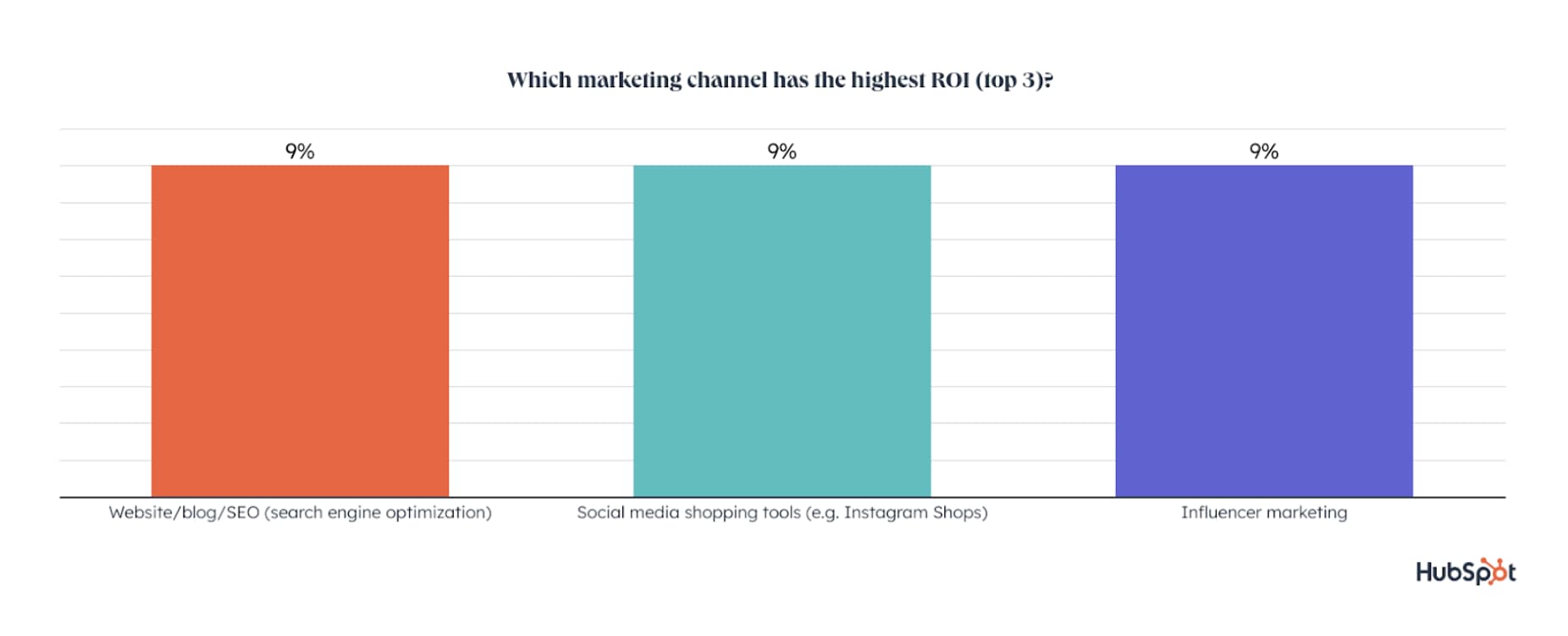
  • Blogs, social media shopping tools, and influencer marketing are all tied for the highest ROI of any marketing channel

A chart graph showing blogging, social media shopping tools, and influencer marketing all tied for highest ROI

  • 33% of marketers are leveraging blog posts in their marketing strategy.
  • Blog posts, interviews, images, and podcasts will see high first-time use among marketers in 2023.

Do Blog Posts Lead to Purchases?

The growth of other content strategies, like video marketing, might make you think consumers will only buy products after seeing them on other platforms.

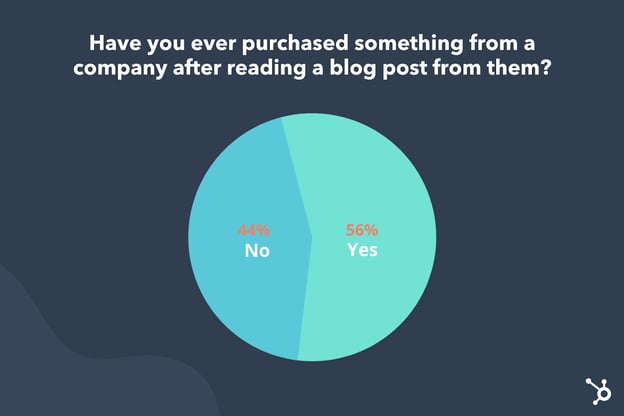
However, when we surveyed 300 consumers via Lucid and asked, “Have you ever purchased something from a company after reading a blog post?” a whopping 56% said, “Yes.”

percentage of people who've bought something after reading a blog is 56%

Furthermore, according to our trends report, blog posts are among the media formats with the highest ROI, along with videos, images, and podcasts.

Why Blogs Lead to Purchases

If your company has a blog that discusses your industry or how your offerings can help with the average reader’s everyday pain points, your audiences can discover and gain trust in your brand’s expertise. That trust and credibility could ultimately lead to purchases.

Why? Suppose a prospect trusts the advice or information given in your blog posts. In that case, they might trust that your offerings are better quality than your competitor’s because your brand knows the industry, what customers want, and the pain points your product or service solves.

Even if you prefer video, social media, or visual marketing strategies, it’s important to remember that blogs can help you sell products in ways other content types can’t.

Videos and images, for example, might only give prospects a glimpse of how a product or service works. However, blog posts can offer extensive information that would otherwise be cut from videos and images to avoid overwhelming viewers on social media.

Blog posts can also increase your search ranking and allow more opportunities to link directly to a landing or purchasing page. Consumers can find your content via search, then read your post, and easily click to a product purchasing page after your content persuades them to buy a product.

Additionally, because most blog sites allow you to embed videos, podcasts, and imagery, your company blog can also be a great place to promote your other marketing assets while still informing prospects about your brand.

How to Lead Blog Readers to Purchases

In the following year, consider a content marketing mix that includes blogging. How do you persuade shoppers with your blog posts? Here are a few quick tips.

Strategically place product page links and CTAs.

Mentioning your brand, product, or service where it feels natural in your blog posts is an excellent way to generate leads and purchases.

However, you can also use hyperlinks to link to product pages or CTA buttons that draw slightly more attention to a product or offer without directing reader attention far away from the blog post.

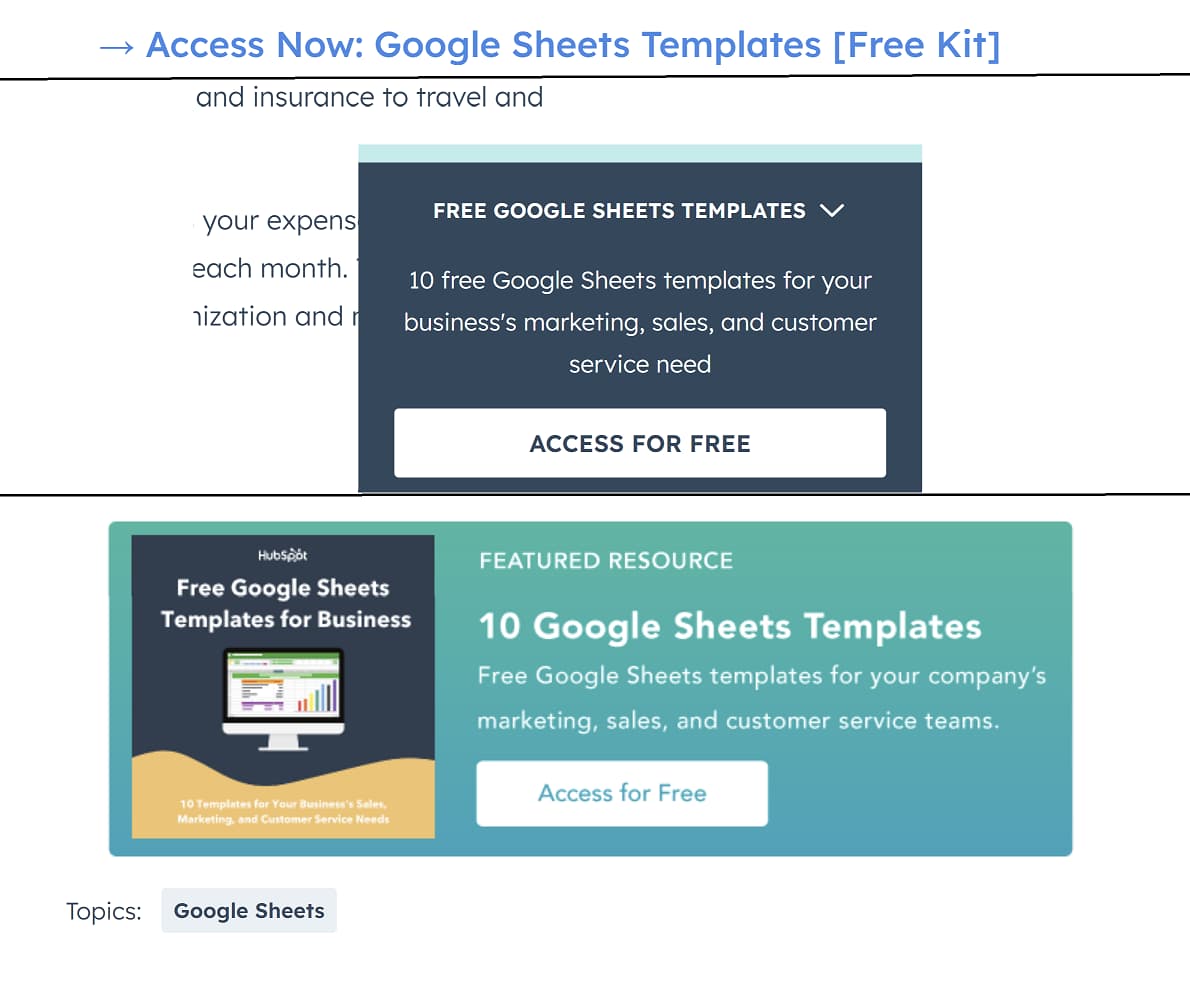
At HubSpot, we usually place at least three CTAs related to a blog topic in each post:

  • A text-based CTA in the introduction
  • A larger banner image at the bottom
  • A slide-in CTA that shows up to the side of your text as you’re scrolling through the middle of the post.

This allows three mentions of a product or offering without interrupting the reader’s experience.

The image below is an example of our CTAs.

From top to bottom: A text-based CTA, a slide-in CTA, and a bottom CTA.From top to bottom: A text-based CTA, a slide-in CTA, and a bottom CTA. (Image source)

Offer a free resource:

You probably noticed the above CTA examples included links to free resources. Though it may sound counterproductive, free resources can help your blog lead consumers to make purchases. Here’s how:

If your brand sells a subscription, service, or product that’s pricier or needs your company’s leadership approval, blog readers might need more than a few blog posts to trust your brand and invest in your product. In that case, you should focus on lead nurturing rather than sending blog readers directly to a purchasing page.

HubSpot and many other blogs have grown their contact and qualified lead lists simply by creating a free downloadable resource, such as an ebook, template, or research report, and offering it through CTAs at the end of blog posts.

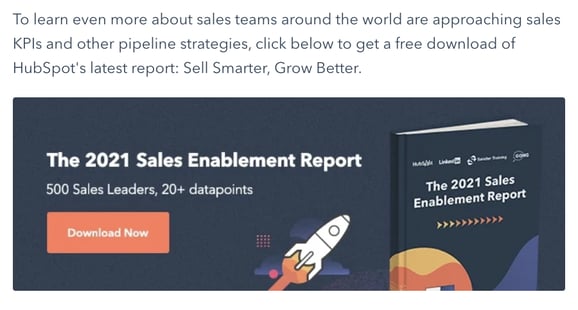
Below is an example of a recent free research report resource we offered at the end of one of our Sales Blog posts:

example of a blog post with a bottom CTA

To access free — but gated — offers, readers must give basic information about themselves and their company. From there, they receive an automated email or instant download of the resource while also becoming a contact — or lead — and enter our lead-qualification process to see if they could be an excellent prospect to reach out to.

The HubSpot Blog’s free resource strategy results in thousands of qualified leads per year that could convert into HubSpot customers. You can learn more about how to implement it on your blog here.

Remember, quality beats over-promotion.

In another recent Lucid survey, one-third of our general consumer respondents most commonly read blog posts to “learn something new.” Meanwhile, roughly 20% read blog posts for the sake of entertainment.

It’s important to remember readers will likely find your blog because they’re looking for information related to an industry they work in. They may also want to learn something related to their hobbies or need solutions for a pain point in their daily or professional lives.

Odds are, they’re not looking solely for promotional content. If a reader visits your blog site and finds nothing but blog posts filled with product shots and cheesy advertorial language, they’ll likely lose interest in your content and may not develop the sense of trust needed to make a purchase.

It’s wise to place a few un-intrusive CTAs in your blog posts and to mention your product or service when it feels relevant. Ensure that your content primarily offers valuable guidance, advice, and information to help your reader fulfill their needs.

For example, in this post about AI social media tools, we give valuable information about implementing AI-based technology in a social media process while listing HubSpot as one of the tools readers can use.

While we still mention our offerings, the post aims to show readers how multiple AI tools can streamline a marketing process.

Creating Your Blog Nurturing Process

Every brand has a target audience with different interests and content needs. While one blog strategy, such as free resources, will work well to generate qualified leads for a B2B company, other tactics, like simply linking to a product in blog posts, might be more lucrative for consumer-facing brands.

As you focus more on turning your blog traffic into revenue, keep these questions in mind:

  • What information is valuable to my audience?
  • Does my product require lead nurturing, such as gated offers?
  • Will the tactic I’m using seem over-promotional or disengaging to my audience?

Want to learn more about how the HubSpot blog generates leads? Check out this post from one of our content acquisition managers. Or, take down these tips on how to make money blogging.

Before you check out those pieces, download the free resource below.


Categories B2B

57 TikTok Stats to Know in 2023

Since launching in 2018, TikTok has racked up millions of downloads globally. It can also be a bit of a mystery since TikTok doesn’t always disclose of key app metrics.

Download Now: The 2023 State of Social Media Trends [Free Report]

As someone who’s gotten sucked into the app, hearted hundreds of posts, and even made a few videos, I’m fairly certain that this platform will stick around for quite some time.

To help you make informed decisions about your strategy, we’ll cover key TikTok statistics and facts to know.

Already know what stats you’re looking for? Jump there with this table of contents:

57 TikTok Stats to Know in 2023

TikTok Stats for Marketers

Before we jump into overall TikTok stats, let’s review some key figures and best practices for marketers to know when using the app.

  • TikTok usage among social media marketers has increased 15% YoY. (HubSpot Blog Research)
  • Marketers say that TikTok and Instagram have the biggest potential to grow in 2023, and 53% of marketers will increase their investments in the app. (HubSpot Blog Research)
  • TikTok has the fourth-best algorithm.
  • The best times to post on the app are 6-9 PM, 3-6P M, and 12-3 PM, and the best day is Friday. (HubSpot Blog Research)
  • Google’s Senior Vice President said that 40% of young people go to TikTok or Instagram when looking for a place to eat instead of Google Maps or Search. (TechCrunch)
  • TikTok has the 4th highest audience engagement rate for UGC campaigns. (HubSpot Blog Research)
  • A TikTok from a macro-influencer receives an average of 38,517 views. (Statista)
  • TikTok says that a few U.S.-based employees can “heat” videos, which means they can intervene to increase their viewership. (Forbes, eMarketer)
  • TikTok’s CPM is half the cost of Instagram, a third of the cost of Twitter, and 62% less than Snapchat. (eMarketer)

Userbase, Downloads, and Growth

Within TikTok’s first year, it reportedly reached 500 million monthly active users. While once considered a fluke, TikTok’s growth has only skyrocketed since then.

  • In September 2021, TikTok celebrated reaching 1 billion monthly active users. (TikTok)
  • Douyin, TikTok’s original standalone app in China, had 300 million users when Musical.ly merged with TikTok. (The Verge)
  • In 2022, TikTok was the most downloaded app globally (850 million downloads), followed by Instagram and WhatsApp. (Statista)

Demographics

While TikTok’s user base is dominated by Gen-Z in the United States, adoption is growing among millennials. And, although it might feel like TikTok is huge in the U.S., the app’s biggest audience actually comes from China, where the platform is called Douyin.

Here’s a breakdown of TikTok’s major demographics. Please note that audience data for individuals who do not identify within the binary are not reported.

  • TikTok’s largest age group is between the ages of 18 and 24. (Statista)
  • 54.1% of global TikTok users are female, and 45.9% are male. (Data Reportal)
  • 62% of Gen Z use TikTok and spend the most time on TikTok.(HubSpot Blog Research)
  • TikTok is the best platform for building an active community for Gen Z. (HubSpot Blog Research)
  • The United States, Indonesia, and Brazil have the largest audiences on TikTok as of January 2023. (Statista)
  • TikTok is now available in more than 200 countries. (Oberlo)

User Behavior

TikTok is a fast-paced app. The second you log in, you see a video at the top of a feed that’s algorithmically curated around your interests.

From my own experience, TikTok can easily cause you to spend more time than expected watching an endless stream of often comedic videos. Since these videos can be anywhere from 6 seconds to 10 minutes, the app is ideal for people seeking quick entertainment or longer-form content.

Because of TikTok’s quick pace and entertainment factor, the stats below aren’t that surprising:

  • The average user spends 89 minutes per day on the app, according to a leaked deck from TikTok. (Music Business Worldwide)
  • TikTok is one of the most downloaded apps in the Google Play Store. (Statista)
  • 36% of Gen Z and 22% of Millennials consumers want to learn about products through short-form videos like TikToks. (HubSpot Blog Research)
  • 88% of people on TikTok report that the sound on the platform is central to the overall app experience. (TikTok)
  • 46% of TikTok users engage with content on TikTok without distractions or using multiple screens at once. (TikTok)
  • A quarter of U.S. adults under 30 regularly get news on TikTok. (Pew Research Center)
  • 38% of TikTok users say entertaining ads teach them something new. (TikTok)
  • TikTokers say ads are entertaining when they’re funny, personalized, and uplifting. (TikTok)
  • 4 in 5 users say TikTok is very or extremely entertaining. (TikTok)
  • TikTok users are 23% more likely than average to say the feeling of taking part would motivate them to promote an organization online. (GWI)

The Impact of TikTok

  • The TikTok community is more frequently and consistently engaging with content on the platform than they are on other social media platforms. (Neuro-Insight).
  • When users see brands organic TikTok content before their paid ads, there is a 27% increase in brand recall. (Neurons Inc.)
  • TikTok users are 1.3x more likely to agree that the platform helps them hear different perspectives than they normally hear vs. other entertainment and social brands. (Material)
  • TikTok users are 1.3x more likely to know about products and trends before their peers. (Material & TikTok)
  • TikTok users are twice as likely as users of other channels to recommend something they found on the platform. (TikTok)
  • Ads on TikTok viewed for less than six seconds still produce a stronger impact compared to ads viewed for 20 seconds or more. (TikTok)
  • Brands are remembered 40% more on TikTok than on other platforms.
  • 71% of TikTok users who take action off platform say that TikTok shows them exactly what they are looking for. (Market Cast)

Shopping on TikTok

  • 2 out of 3 users are likely to buy something while on the platform. (TikTok)
  • 50% of TikTok users have bought something after watching a TikTok LIVE. (TikTok)
  • TikTok users are twice as likely as users of traditional social platforms to recommend a product or service they’ve discovered on the app and 1.5x more successful at convincing others to try the product or service. (Material & TikTok)
  • 55% of users use TikTok to research new brands or products. (TikTok)

  • 50% of TikTok users reported feeling joyful, excited, or happy about the products they purchased, which is 25% higher than on traditional social platforms. (TikTok)

  • Over half of users look for details about where to buy products they’ve seen on the platform. (TikTok)

Viral Trends and Influencers on TikTok

TikTok has opened doors for influencers, comedians, meme creators, and even some brands. Here are a few interesting tidbits about viral trends and influencers on the app:

  • The most followed creator on TikTok is Khaby Lame, with 153.9 million followers. Following close behind is Charlie D’Amelio, with 150 million. (Wikipedia)
  • One of the earliest branded hashtag challenges was Guess’ #InMyDenim challenge. According to TikTok, videos marked with this hashtag have received a grand total of 38.8 million views. (TikTok)
  • 77% of TikTok users like when brands come up with new challenges, trends, or memes for others to join in on. (TikTok)
  • TikTok users say that you don’t need to have thousands of followers to go viral on TikTok. (TikTok)
  • 80% of top TikTok videos had music and upbeat songs. (Invideo)
  • Remixing a TikTok trend leads to a 14% increase in watch time. (TikTok)
  • Rapper Lil Nas X credits the success of his song “Old Town Road” to TikTok. The song was propelled to #1 on the Billboard Top 100 in 2019 after the artist uploaded it to TikTok. (BuzzFeed News)

Here’s a compilation of TikTok’s #CowboyChallenge where people wearing normal clothing cut to themselves in cowboy costumes to the song “Old Town Road.”

Business, Revenue, and Competition

The launch of TikTok not only put its parent company, ByteDance, on the map, but it also resulted in competition from apps like Facebook, which launched a very similar app called Lasso shortly after TikTok went viral. While TikTok and ByteDance are less transparent about revenue and other major details, here’s what we know:

  • TikTok has an ad reach of roughly 885 million people. (DataReportal)
  • TikTok offers five advertising tiers aimed at big brands. One of which, a branded hashtag challenge, reportedly costs $150,000 per day. (TikTok Pitch Deck Notes First Reported by Digiday)
  • eMarketer estimates TikTok will generate $18 billion in ad revenue in 2023. (eMarketer)
  • TikTok is the top global app for consumer spend. (data.ai)
  • TikTok has a 4.8-star rating in the Apple App Store and 4.4 in the Google Play Store. (Apple App Store, Google Play Store)
  • Bytedance, TikTok’s parent company is valued at $140 billion, making it the world’s most valuable startup. (CBInsights)

The Mysteries of TikTok

Although TikTok is a top social platform and is ramping up its options for advertisers, it’s still rather new. When a company or startup is new, it’s not uncommon for leadership to hide early numbers, even when a brand is successful. In fact, we’ve seen this with other major companies like Snapchat and Netflix.

Despite the launch of TikTok For Business in mid 2020, there’s still a lot more to learn as TikTok’s global teams and ByteDance continue to remain hush-hush about major metrics. In the coming years, as TikTok continues to draw in more advertisers, it wouldn’t be surprising if we started to see more transparent information about the app and its user base.

Where to Find TikTok Stats

In the meantime, If you want to learn more about TikTok, you can read up on its short history and early success in this post, or click here to find a how-to guide for using the app. In addition, you can discover important TikTok facts app on various websites:

Want to see what other businesses are doing on TikTok? Check out this roundup of brands on TikTok.

New call-to-action

Categories B2B

How to Tell a Compelling Brand Story [Guide + Examples]

Your audience is programmed to crave and seek out great stories. They want to know your brand’s origin, missions, goals — your entire brand story.

However, since marketers spend a lot of time optimizing content for algorithms, it can be challenging to flex your creative storytelling muscles.

Download Now: Free Brand Building Guide

In this post, we’ve created a guide about the fundamentals of brand stories, including:

When HubSpot started, we noticed traditional, interruptive marketing didn’t appeal to consumers anymore. In the digital age, people were in complete control of the information they consumed, and they were sick and tired of receiving direct mail, email blasts, and cold calls. People wanted help, so we created educational content to solve marketing problems.

Today, we’ve built a passionate community of inbound marketers, expanded our inbound marketing approach to the sales and customer service industries, and strengthened the inbound movement more than ever before.

This is our brand story — a simple, digestible narrative explaining why HubSpot began and how this reason still serves our purpose today.


Why is a brand story important?

A brand story is important because it helps customers understand who you are and why your business exists. When consumers relate to your why, they develop a connection with your brand and may be more likely to purchase your business. Customers who feel connected and enjoy your products are more likely to become loyal customers.

How to Write a Brand Story

1. Highlight your story’s conflict.

Check out the following story. Does it resonate with you?

A girl wearing a red-hooded cloak is strolling through the woods to give her sick grandma some much-needed food and TLC. She passes a wolf on the way, and they exchange an awkward soft smile-nod. She makes it to her grandma’s house, and they eat lunch and play Clue together. Grandma wins by deducing that Colonel Mustard killed Mr. Boddy in the Billiard Room with the candlestick. The End.

So … what’d you think? Did this story keep you on the edge of your seat? Or does it feel … off? For some reason, it doesn’t work, right? That’s because there’s no conflict. Despite the intense game of Clue at the end, there’s nothing at stake. There’s no tension, and the wolf didn’t try to eat the girl. He didn’t even go to Grandma’s house. He barely acknowledged Little Red Riding Hood.

At their core, stories are about overcoming adversity. A lack of conflict means there’s no drama or emotional journey for people to relate to. Without drama or an emotional journey, it won’t hold attention, much less resonate and inspire.

Brands might shy away from revealing any adversity or conflict because a blemish-free story about growth seems like the best way to convince people they’re the best-in-class solution, free of imperfections. In reality, this is a huge misconception because everything (including companies) has flaws. Plus, people don’t expect perfection because they can relate to the experience of adversity, struggling through it, and overcoming it.

Conflict is key to telling compelling stories, so be transparent about the adversity your company has faced and own it. The more honest you are about your shortcomings, the more people will respect you and relate to your brand.

2. Don’t forget about your story’s status quo and resolution.

A compelling story has two other fundamental elements: the status quo and resolution.

The status quo is the way things are and have always been. A conflict disrupts this and puts something at stake, forcing the protagonist, your brand, to actively find a solution to the problem.

The resolution is how the protagonist solves the problem, giving your audience an emotional payoff.

In sum, your brand’s story structure should look like this:

  1. Status Quo
  2. Conflict
  3. Resolution

It’s as simple as that.

If you need an example to crystalize brand story structure, let’s go over the actual Little Red Riding Hood story, followed by brands who are nailing their brand story right now.

Little Red Riding Hood

Status Quo: Little Red Riding Hood walks through the woods to deliver food to her sick grandma.

Conflict: A Big Bad Wolf approaches her, and asks where she’s going. She naively tells him where her grandmother’s house is, and he suggests she picks some flowers as a present for her. While she’s distracted, he breaks into Little Red Riding Hood’s grandmother’s house, eats her, and puts on her clothes to impersonate her.

When Little Red Riding Hood gets to her grandmother’s house, she notices subtle changes in her grandmother appearance but ultimately ignores them. The wolf swallows her whole and falls asleep from a food coma.

Resolution: A hunter hears Little Red Riding Hood’s screams, bursts through grandma’s door, cuts open the wolf’s stomach, and frees Little Red Riding Hood and her grandmother. They then fill the wolf’s body with heavy stones, and when he wakes up, he’s unable to run away.

Wouldn’t you say that was a little more compelling and entertaining than finding out Colonel Mustard can wield a candlestick as a murder weapon? I would, too.

Many brands leverage this same structure to tell their story and generate brand awareness. Read on to learn how they do it.

1. Patagonia

Patagonia is dedicated to creating hearty and durable products, whether it’s workwear clothing or warm socks. It’s extremely committed to environmentalism and doing what it can to slow the process of global warming. One of its programs, Worn Wear, is an excellent example of telling a brand story.

Here’s a great example of its brand story using the structure outlined above.

Status Quo: Thousands of global brands produce pounds and pounds of clothing items per year that customers buy and add to their clothing collections.

Conflict: Thousands of brands produce clothing items every year that people purchase. Clothing waste is also at an all-time high as people continuously buy new products and get rid of old ones, often in ways that harm the environment.

Resolution: Patagonia’s Worn Wear program gives new life to used Patagonia products and refurbishes them to a like-new state at discounted prices. It saves clothing from entering landfills and gives a high-quality option to someone who needs it.

2. Unthinkable Media

Unthinkable Media produces original, narrative-driven podcasts for B2B brands. Its mission is to create refreshing, entertaining shows for clients that can actually retain people’s attention, not just acquire it.

The full story is fleshed out in one of the founder’s blog posts

Status Quo: As makers and marketers, we want our audience’s attention, and so for years, we focused our efforts on acquiring it.

Conflict: Today, thanks to multiple screens, ubiquitous and instantly accessible content, and endless choice in nearly every competitive niche, the buyer now has total control. They only choose experiences they genuinely enjoy, meaning more is needed to capture attention.

Resolution: The new mandate for makers and marketers is to hold attention. Focus needs to shift from impressions and traffic to subscribers and community. Everything we try to achieve becomes possible and gets easier when audiences spend more time with a business, not seconds. Don’t just acquire attention – hold it.

3. Grado Labs

Grado Labs is a third-generation, family-owned headphone and cartridge company. It doesn’t believe in advertising, has operated in the same building for over a century, and even makes its headphones by hand. So why does it operate like this when huge brands like Beats by Dre, Sony, and Bose have celebrity endorsers and mass-produce their headphones? Check out our interpretation to find out.

Status Quo: Music is an essential part of the human experience. Without it, life just isn’t as colorful and exciting. Quality headphones amplify the pleasant, emotional experience of listening to music.

Conflict: In a market where every headphone brand has an enormous advertising budget, state-of-the-art facilities, and high-tech machines that can churn out as many products as they want, why not conform?

Resolution: Sound comes first. As craft-driven creators, prioritizing producing the best product over generating the most hype is important. By creating a better pair of headphones at the expense of publicity and growth, we can serve customers better and foster a passion for our product.

4. Drift

Drift is a conversational marketing platform that helps businesses connect with prospects through genuine, empathetic conversations and interactions. In 2016, it shocked the content marketing world by scrapping arguably the most reliable lead generator from its website — forms.

Even though it was initially anxious about getting rid of a lead generation machine, it knew ungating content on its website would align with its mission, put customers first, and offer as much value as possible, which would produce better long-term results. Here’s our interpretation of its brand story.

Status Quo: The crux of content marketing is treating people like humans. So, we’ve done what most other companies have done: create content to help and educate our customers. In exchange for adding value to their lives, customers will likely to return the favor with their attention, trust, and action.

Conflict: As much as we preach about putting the customer first, we don’t practice it. Instead of offering the most value at a baseline, we request contact information in exchange for what we offer. Are we actually being customer-centric?

Resolution: Getting rid of forms lets us practice what we preach — putting customers first and providing a more human and empathetic marketing experience. We should offer all of our content for free, with no strings attached.

5. Topicals

Topical’s founder grew up without seeing her skin type represented in mainstream TV commercials and advertisements. This led to thoughts of her skin not being perfect because it wasn’t propped up as the “perfect” skin type. The brand was launched from this experience, and below we’ll outline an interpretation of its brand story.

Status Quo: Hundreds of brands offer skincare products and create advertisements targeted toward those looking to improve their skin regimen.

Conflict: Millions of people use skincare products that they discover in advertisements, but these advertisements overwhelmingly feature a specific skin type and skin color, which may give audiences unrealistic expectations for their own skin.

Resolution: A line of science-backed products that provide consumers with an excellent skin care option and a focus on mental health to ensure audiences know there is no “ideal” skin type or skin model and that good skin simply means someone is comfortable with their own skin.

Tips for Telling Your Brand Story

Below we’ll go over a few quick tips for crafting and telling an excellent brand story. For each tip, we’ll include questions to ask yourself that can help you dig deep and uncover what you’re looking for.

1. Find Your Why

Finding your why is finding why your brand exists and what it exists for. Questions to ask yourself can be:

  • Why does your brand exist?
  • What problem arose that inspired you to search for a solution?
  • What is your brand’s mission, or what do you hope your brand will solve?
  • What are your brand values?
  • How do you contribute to the world, or what will you contribute to the world?

2. Know Your Product

Some questions to ask yourself to get to know more about your product and how to talk about it are:

  • What is your product?
  • How does your product work?
  • How does your product relate to your brand’s “why”?
  • How does your product relate to your overall mission and values?
  • What makes your product different from what’s already on the market? What makes it better?

3. Know Your Audience

Knowing your audience and how your product, service, or business relates to them is a key pillar to telling your brand story. To uncover this information, you can ask yourself:

  • Who is your target market?
  • What do you know about your target market and their needs and pain points?
  • How does your target market relate to your “why” based on their needs and pain points?
  • How does your product relate to your target audience? Or, what is your product’s direct relation to your target audience?

Tell your brand’s real story, not its highlight reel.

Spitting out a highlight real, which many brands do, doesn’t actually resonate with people.

Instead, it’s important to tell the truth. What people relate to and get inspired by isn’t endless success — it’s the rocky journey of finding an idea, getting knocked down, and finding a path to success.

brand consistency

Categories B2B

The 29 Dominating Web Design Trends for 2023

Web design is an important part of any marketer’s 2023 plan. Your website houses the information your customers need to learn about your product and make a purchase. Regularly updating your website with cutting-edge web design trends can help your business stand out in crowded cyberspace. 

Free Download: 77 Examples of Brilliant Web Design 

Experimental navigation, scrolling effects, and kinetic typography are just a few ways you can level up your website. Check out the full list of trends that will dominate websites in 2023.

One major theme amongst these 2023 website design trends is motion, from scrolling effects to micro-animation. Check out this video which details some popular website design trends in 2023, and see for yourself what micro-animation and parallax scrolling look like.

1. Experimental Navigation

When we discuss experimental navigation, we’re talking about the navigation patterns that subvert the traditional, which is all-caps navigation on the top of the screen in a sans serif font.) Instead, experimental patterns move in a more creative direction, generating visual interest and guiding users to navigate the site in a specific manner.

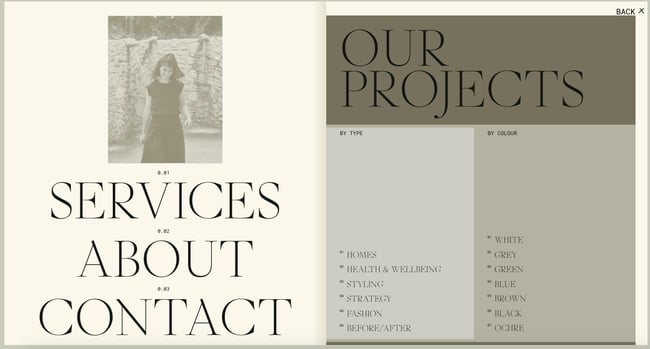
Take Kim Kneipp’s portfolio site, for example. When you click the Menu button in the right corner of the homepage, a menu slides in from the bottom of the screen that looks like the table of contents in a book. Each page is numbered to suggest an order of reading. On the right side of your screen, the projects are numbered and categorized by type and color.

What we like: In 2023, you’re invited to turn your navigation into an extension of your website’s unique branding thanks to experimental navigation.

web design trends: Experimental navigation of Kim Kneipp's portfolio site looks like a table of contents in a book

2. Scrolling Effects

Scrolling effects — animations triggered by scroll action — create more dynamic web experiences, which is why they’re arguably one of the most popular trending web design elements this year. These are increasingly used on interactive websites to intrigue readers to keep scrolling, signify a break in content, and create a three-dimensional experience.

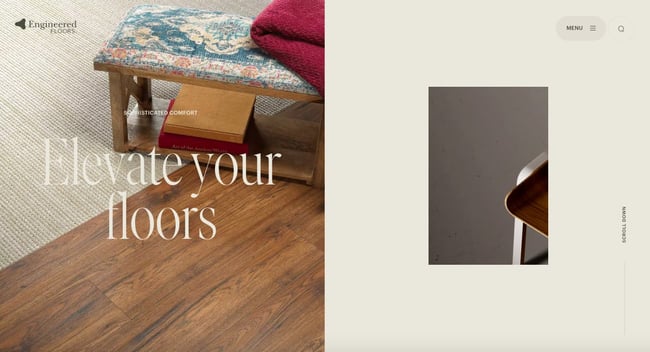
Engineered Floors does just that, combining horizontal and vertical scrolling.

For example, when the user lands on the homepage, they see an image of what appears to be a chair on the right. As the user scrolls, this image zooms out to reveal a living room, which is gradually covered in carpet. This 3D experience is delightful and informative. 

What we like: Scrolling effects can stimulate visitors and encourage them to continue scrolling even below the fold.

web design trends: Engineered Floors employs unique scrolling effects like a carpet rolling out to create a 3d experience

3. Kinetic Typography

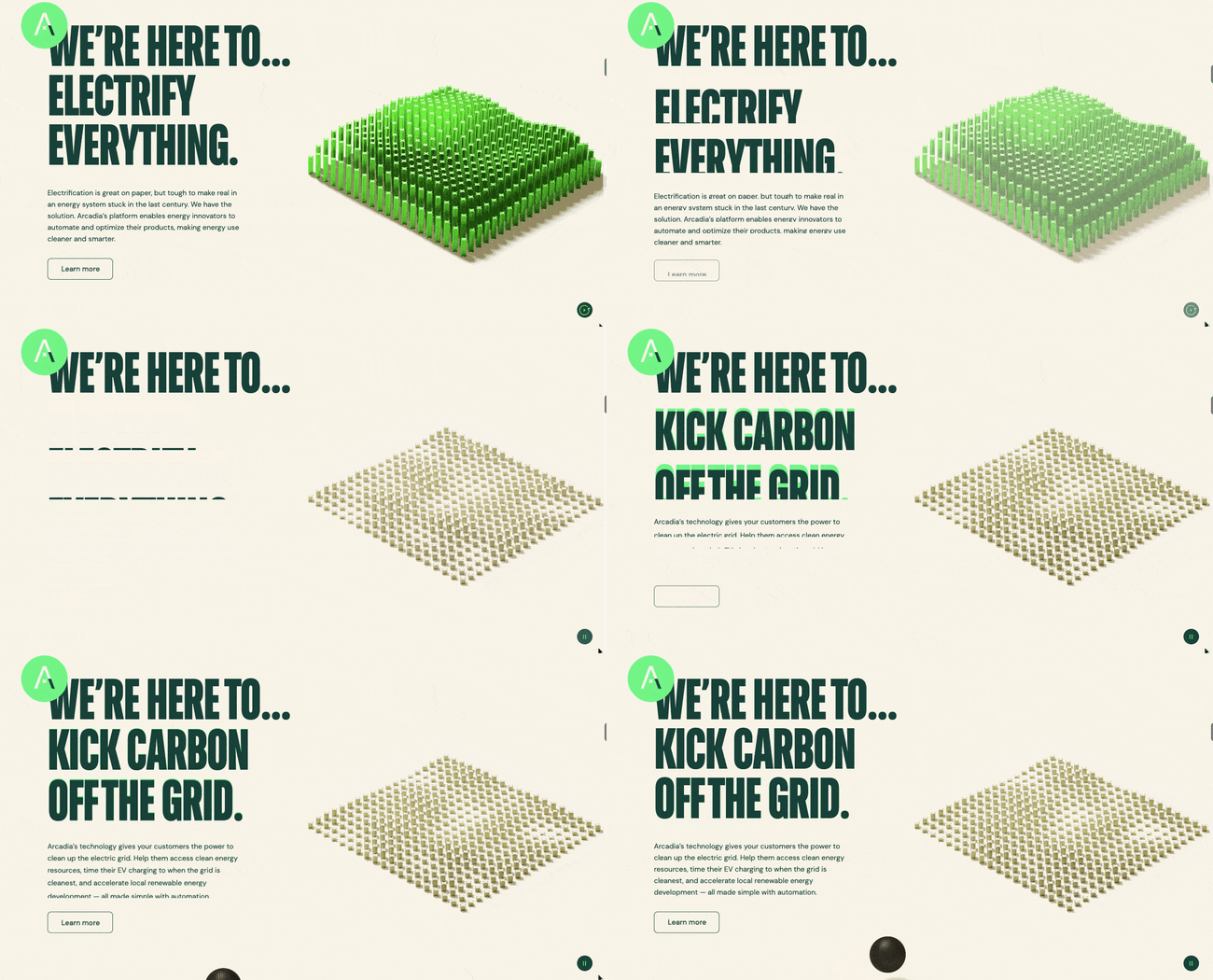
Kinetic typography — or moving text — is an animation technique that gained momentum in the 60s when feature films began using animated opening titles. You can use it for a similar purpose in website design to immediately grab the visitor’s attention once they land on the homepage.

You can also harness the power of kinetic typography to highlight important sections, guide the visitor as they scroll, and gradually reveal information, like on Arcadia.

What we like: Kinetic typography can delight visitors and help them digest your content. Plus, it’s visually attractive and engaging.

web design trends: Arcadia uses kinetic typography to gradually inform visitors of its mission and services

4. Drag Interaction

Gone are the days when users don’t have control over their experience on your website. Because drag interactions are designed to mimic an actual, physical action, they essentially allow visitors to pick up and move objects on the screen. This type of gesture interaction is gaining momentum with more websites. It’s an especially popular option if you have an ecommerce or portfolio site.

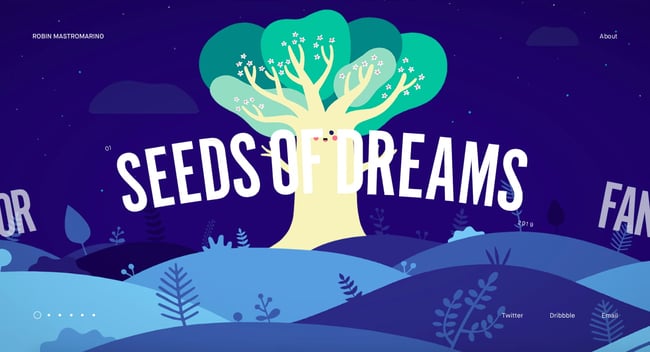
Take Robin Mastromarino’s portfolio site as an example. In addition to clicking on the controls of the homepage slider, you can drag and drop the different slides to browse his featured projects. The page transitions and animations are based on drag speed to give users a sense of control over these effects.

What we like: Drag interaction offers visitors a sense of customization and control over their experience on your site.

web design trends: Robin Mastromarino's portfolio site uses drag interactions for visitors to explore his featured projects

5. Structured Typography

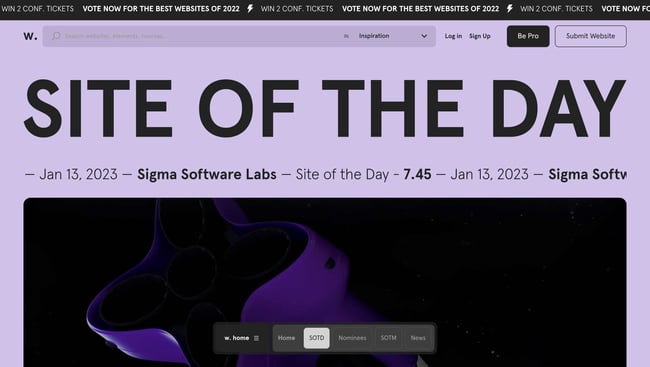
More and more companies are using structured typography to headline their home pages. In a post-pandemic world, consumers crave structure and stability — both of which structured typography is reminiscent of. (Think: All capital letters and strong, solid shapes.)

Here’s an excellent example of how structured typography could look on your website. The Awwwards homepage reveals how much of an impression structured fonts can make.

What we like: Structured typography tells the visitors’ eyes precisely what they should be looking at.

web design trends: the awwwards website has a light purple background and strong, bold, all capitalized text that reads 'site of the day'

6. Cinemagraphs

Motion is the name of the game in web design trends in 2023 — and cinemagraphics are no exception. Cinemagraphs, high-quality videos or GIFs that run on a smooth, continuous loop, have become popular to add movement and visual interest to otherwise static pages.

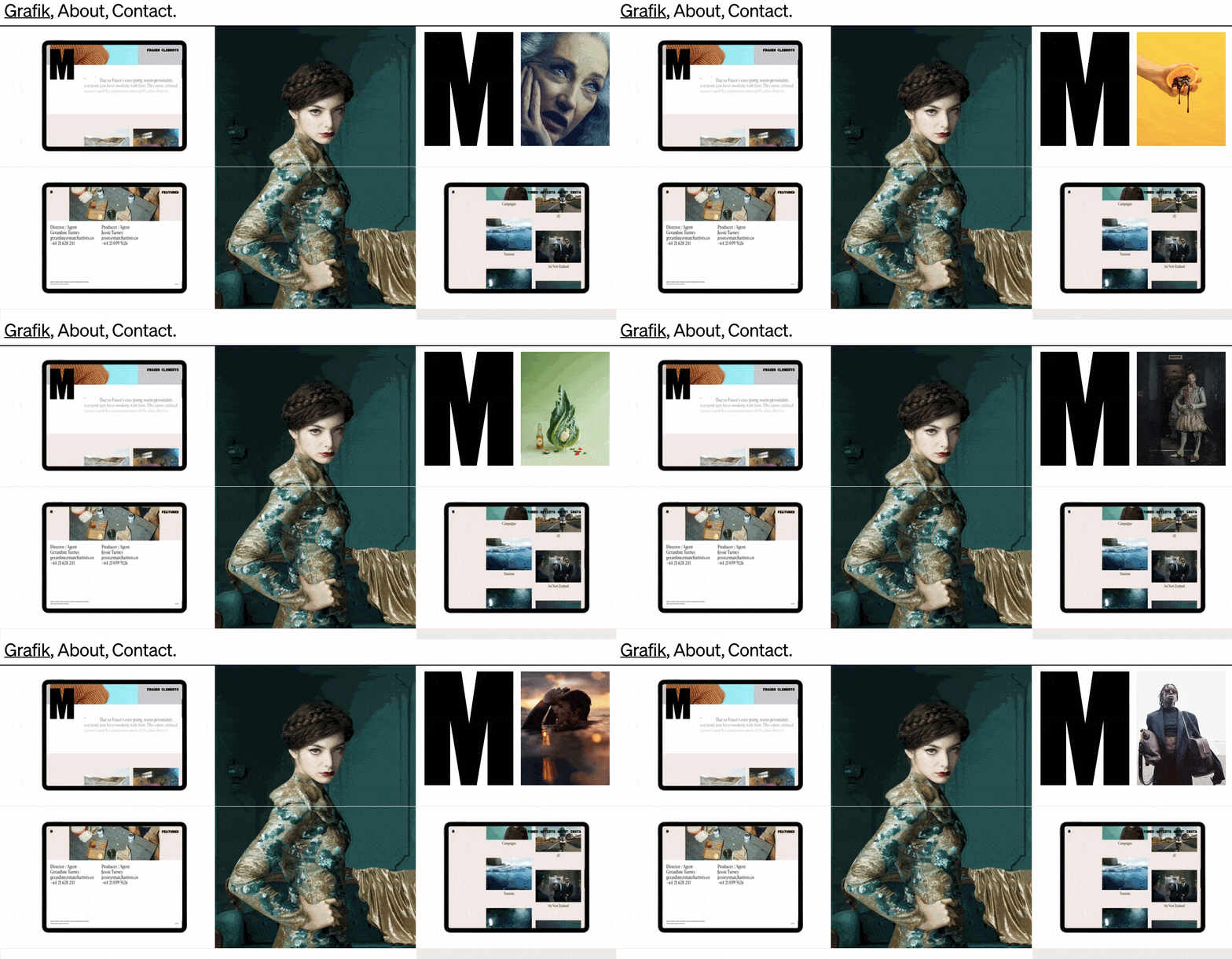
While full-screen loops were more popular in the past, this year you’ll see smaller animations sprinkled throughout complex layouts. The addition of these cinemagraphics draws the eye and helps your readers keep scrolling, like in this example from the design and technology studio Grafik.

What we like: Cinemagraphs can help draw the visitor’s eye around the page, even in the most complex layouts. 

web design trends: cinemagraphs used on Grafik's homepage to keep users scrolling

7. Brutalism

Some designers opt for more eclectic, convention-defying structures to stand out in a sea of tidy, organized websites. While it can seem jarring at first, many popular brands are now incorporating brutalist elements. 

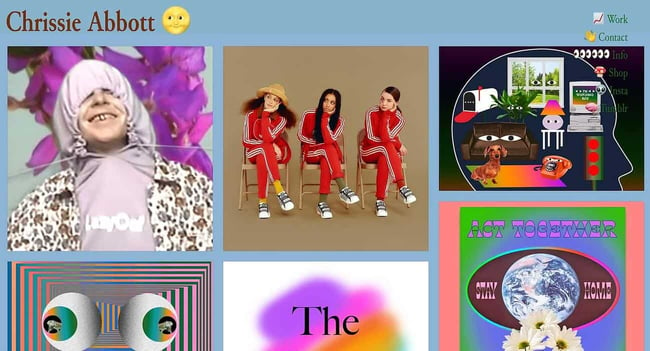
Brutalism emerged as a reaction to the increasing standardization of web design and is often characterized by stark, asymmetrical, nonconformist visuals, and a distinct lack of hierarchy and order. In other words, it’s hard to describe, but you know it when you see it — like the below example from Chrissie Abbott.

What we like: Brutalism prioritizes simplicity and functionality — pillars of the user experience.

web design trends: example of the website design trend brutalism

8. Colorful Gradients

From Instagram to websites to advertisements and beyond, chances are you’ve seen your fair share of gradients in the last few years. Gradients have been all the rage lately, and 2023 is no exception. Last year, gradients were largely monochromatic. This year, they’re getting a makeover: Multi-colored gradients are in.

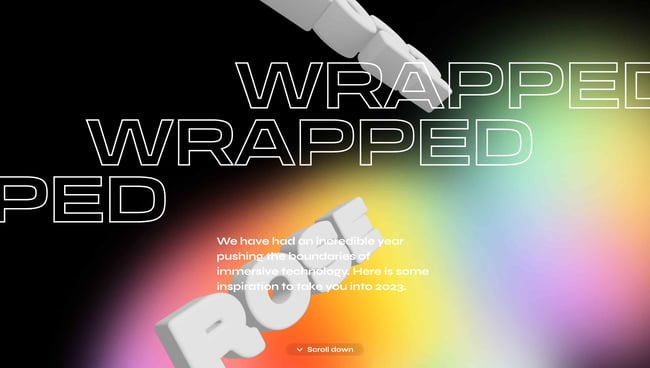
Check out this gorgeous and visually appealing example by ROSE Wrapped for gradient design inspiration. It pairs a colorful gradient with kinetic typography for the ultimate visual impact.

What we like: Gradients are visually exciting and, when used properly, not distracting.

web design trends: Rose Wrapped homepage features rainbow gradient and flying text reading 'Rose'

9. Layering

Layering images, colors, shapes, animations, and other elements add depth and texture to a site that doesn’t have a lot of text. Below is a stylish example from the singer-songwriter SIRUP

What we like: Layering can help add depth to a site and tell the brand’s story. 

web design trends: SIRUP layers backgrounds, colors, shapes, and animations

10. Text-Only

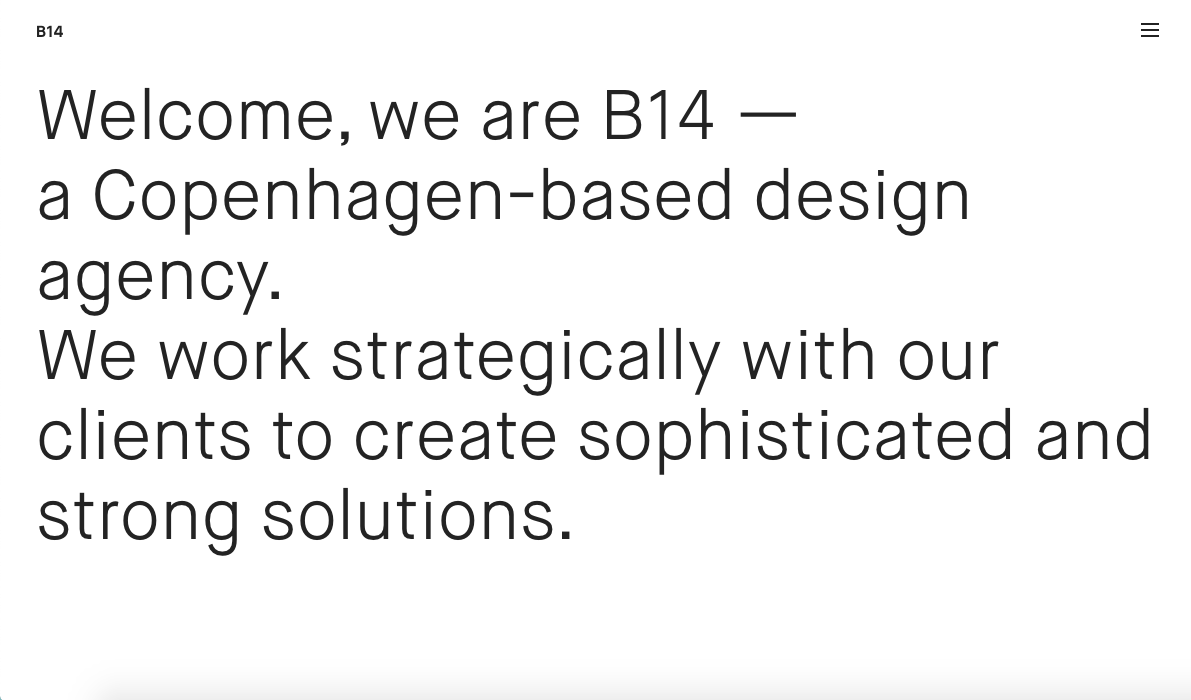
In 2023, web designers will be embracing minimalist design. Some are experimenting with cutting out images and prominent navigation sections altogether, relying on a few choice lines of straightforward text to inform visitors about their company.

Danish agency B14 uses the hero section of its homepage to describe its mission statement simply.

It’s a modern, uncluttered approach to presenting information that provides a stark contrast to its portfolio section, which uses cinemagraphs, hover animations, and an animated cursor effect. 

What we like: This minimalist approach ensures visitors only get the most essential information. 

web design trends: B14 features a text-only hero section on its homepage

11. Animated Illustrations

More companies are turning to illustrators and graphic artists to create bespoke illustrations for their websites because it’s one of the latest web design trends. “Illustration works well to convey more complex ideas that lifestyle photos aren’t always able to capture,” Kendra Pembroke, a Visual Designer at Red Ventures said.

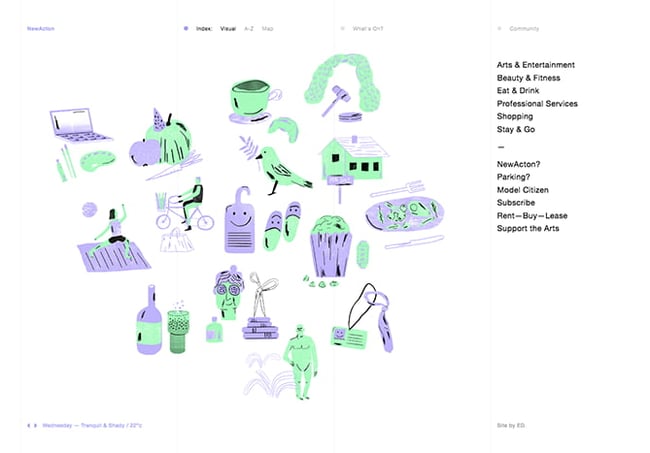
These illustrations are often animated to add interactivity. For example, if you hover over one of the illustrations on the NewActon site (designed by Australian digital agency ED), the illustration and those in the surrounding area will wiggle. Then, only the illustration you’re hovering over will continue to move in a small circle. This design is also functional: each illustration represents one of the categories from the navigation menu on the right.

What we like: Animated illustrations help convey complex ideas and add some personality to a site. 

web design trends: animated illustrations. image shows an image heavy website

12. Ultra-minimalism

Taking classic minimalism to the extreme, some designers defy conventions of what a website needs to look like, displaying just the bare necessities. This trend, known as “ultra-minimalism,” can be great for the user experience and load times.

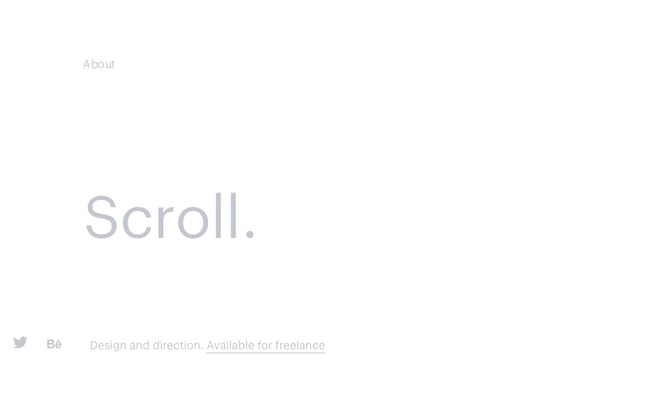
The site from designer Mathieu Boulet is centered around a few choice links to their social profiles and information.

What we like: Ultra-minimalism can positively impact the user experience and website performance.

web design trends: example of the website design trend ultra-minimalism

13. Mixing Horizontal and Vertical Text

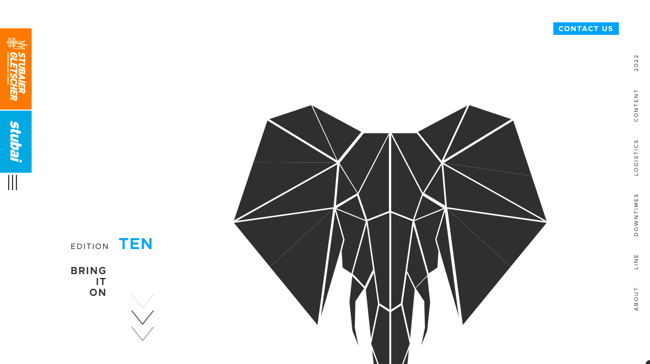
Freeing text from its usual horizontal alignment and placing it vertically on a page adds some refreshing dimension. Take this example from action sports video producers Prime Park Sessions, which combines horizontal and vertical text alignments on a minimal page.

What we like: Mixing horizontal and vertical text defies convention and can therefore delight and intrigue some users. 

web design trends: Prime Park Sessions uses horizontal text for its headline and vertical text for its navigation on its homepage

14. Geometric Shapes and Patterns

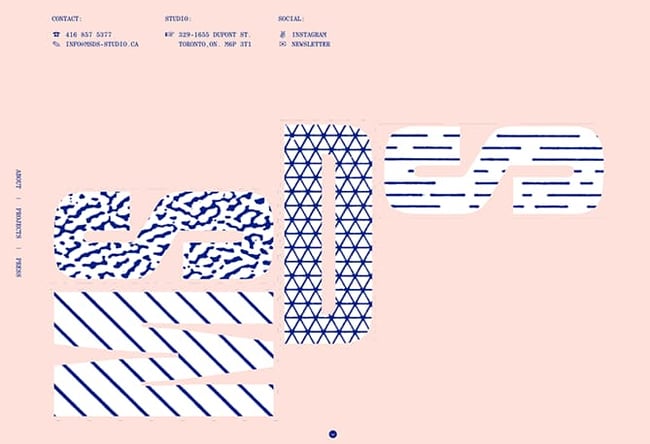
Whimsical patterns and shapes are popping up more frequently on websites, adding some flair to a landscape otherwise ruled by flat and material design. Canadian design studio MSDS uses daring, patterned letters on their homepage.

What we like: Geometric shapes and patterns can direct visitors’ attention to certain products or CTAs.

web design trends: example of the website design trend geometric shapes

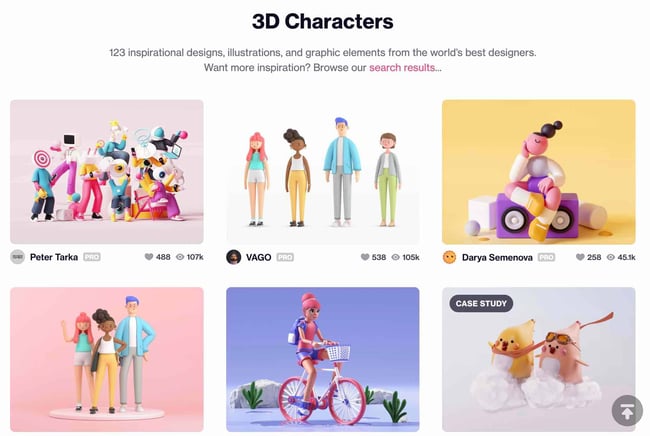
15. 3D Design 

This year, website design is huge on creating an immersive experience for the site visitor. That’s why 3D artwork is gaining momentum.

The latest product from Adobe (3D Modeler) makes it easy for anyone to explore 3D design. The most industry-popular 3D modeler is Maya, but this takes some more expertise. Blender is also a great option as it is a free 3D design software tool. 

If you want to include a 3D design on your website but are overwhelmed by the scope of the project, there are lots of freelance 3D modelers on Fiverr and UpWork. Just check out some of the examples on Dribbble

This style has hints of Japanese Kawaii, a culture of cuteness that focuses on childlike objects and pastel coloring. 

What we like: Cute and playful, this design is both interesting to look at and will keep your customers on your page longer as their eyes explore all the elements. 

 Web design trends, 3D design example.

16. Overlapping Text and Images

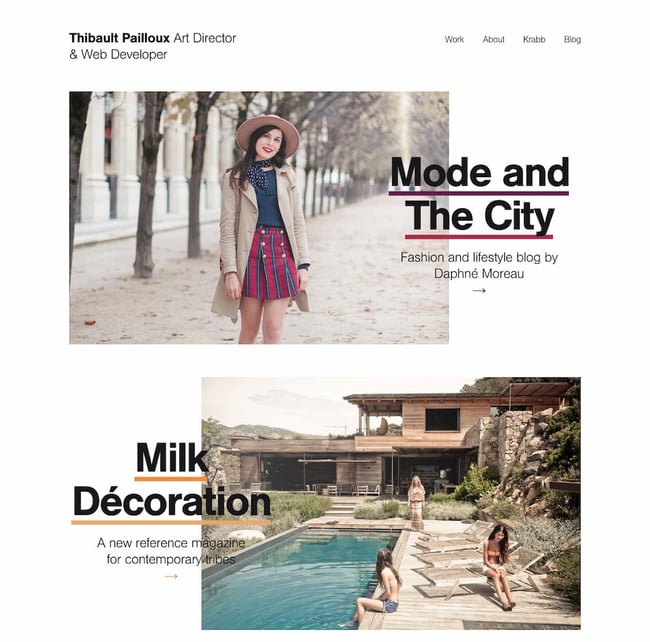
Text that slightly overlaps accompanying images has become a popular effect for blogs and portfolios. Freelance art director and front-end developer Thibault Pailloux demonstrates how by placing overlapping text with a colorful underline beneath each title.

What we like: Overlapping text and images maximize space on the page. 

web design trends: Thibault Pailloux's portfolio site overlaps bold typography and images

17. Broken Grids

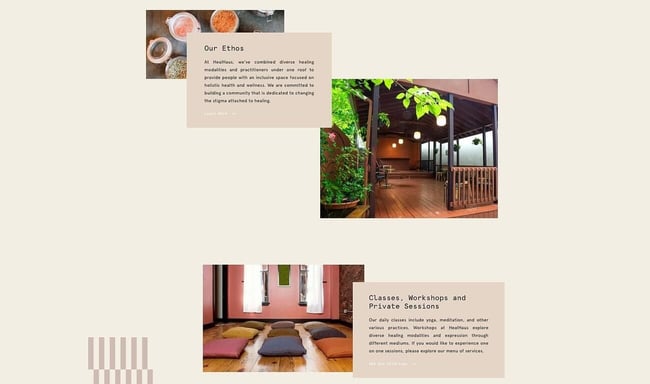
While grids are arguably the most efficient way to display text and images, broken grids continue to make their way into mainstream sites and offer a change-up from the norm. Check out the website for HealHaus, for example. Its homepage features images and text blocks that overlap.

What we like: This convention-defying technique can make standard website pages or sections more interesting.  

web design trends: broken grids shows a website with images overlaying and text on top of neutral colored squares.

18. Organic Shapes

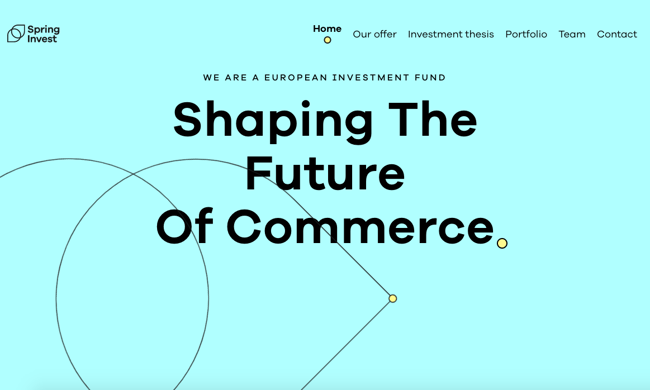
Sharp edges are out, and curved lines are in. Organic shapes are set to dominate web design in 2023. “Organic shapes can help add some playfulness without affecting the way the information is displayed,” Pembroke said.

In the example below from Spring Invest, the organic shapes in the hero section are decorative and functional. The yellow dots act like a cursor, drawing the teardrops that form the company’s logo. These shapes add a moment of delight and help reinforce the brand’s identity and value proposition to “shape the future of commerce.”

What we like: Organic shapes add personality without distracting from the content. 

web design trends: Spring Invest uses organic shapes to reinforce its brand identity and value proposition of shaping the future of commerce

19. Web Textures

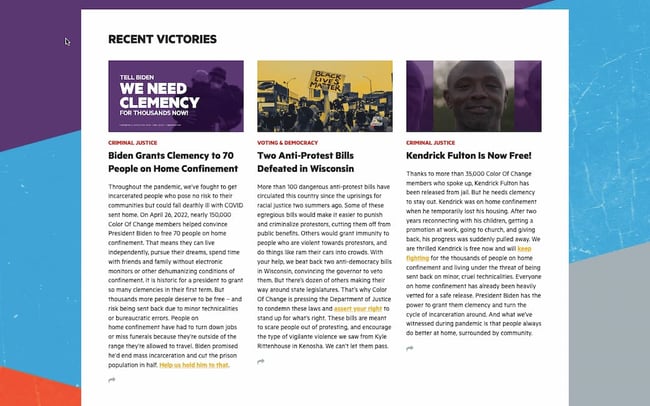
Web textures are background images that visually resemble a three-dimensional surface. When you use them right, you can use web textures to immerse visitors in your website by engaging tactile sense. Need proof? Just check out this example from the Color Of Change website — the background evokes a duct-tape-like texture.

What we like: Web textures draw attention to a particular section on a website.

web design trends: Color of Change uses a web texture background for its featured petition section on the homepage

20. Grid Lines

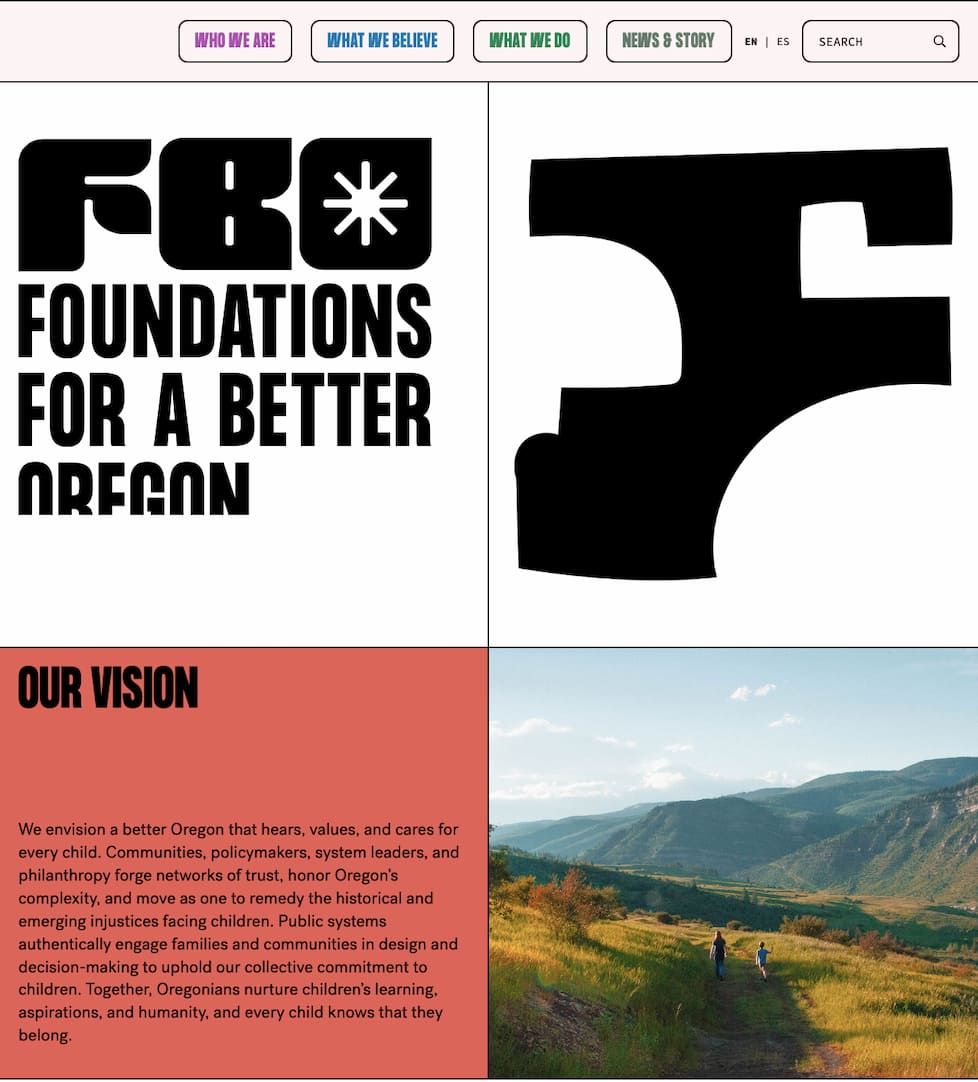
Grid lines began cropping up in 2022, and with good reason — they give site visitors a feeling of order and simplicity. Adding grid lines makes your website easier to digest while adding a modern, visually interesting aesthetic. On the Foundations for a Better Oregon website, grid lines are used to create a clear layout that looks futuristic.

What we like: This trend isn’t just visually engaging — it also gives your site a valuable sense of organization.

web design trends: Foundations for a Better Oregon website features linework

21. Y2K Inspired Design

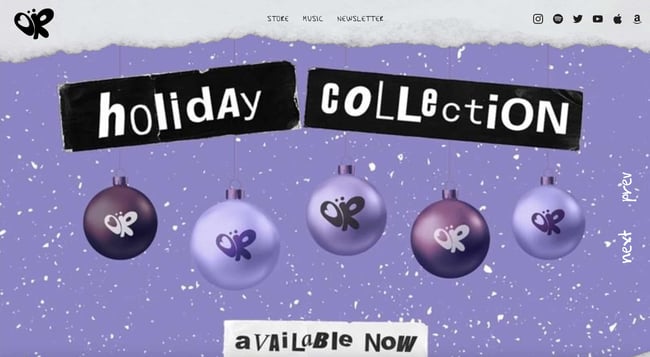
The resurgence of the Y2K aesthetic that started in 2020 is here to stay for at least a bit longer. In 2023, you will see websites adding nods to the coveted Y2K style to evoke a sense of nostalgia. Even celebrities channel the aesthetic on their artist websites — look at singer and actress Olivia Rodrigo’s site for a healthy dose of inspiration.

What we like: This playful aesthetic doesn’t take itself too seriously.

web design trends: Olivia Rodrigo's Y2K inspired website with purple textured background image 22. Scrapbook Aesthetic

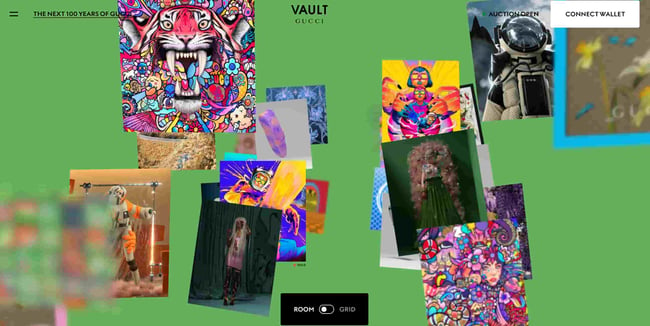
If you need more proof that website visitors are leaning into nostalgia, consider that the scrapbook aesthetic is coming back in 2023. But this isn’t the same scrapbook aesthetic we saw popular in the early 2010s when this web design trend emerged. Today’s scrapbook aesthetic is an updated, buzzy version. In some cases, like this Gucci website, it’s interactive.

What we like: You can now bring your scrapbook-style site to life.

web design trends: updated scrapbook style site by gucci shows floating images

23. Gamified Design

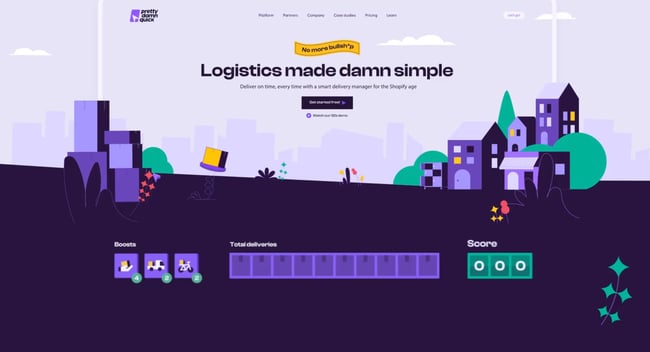
Gamified design is everywhere in 2023, making it one of the most prevalent website design trends this year. Gamification is an excellent idea because it adds an element of human emotion for visitors. For instance, when they arrive on your site, they have the experience of engaging with your content in a unique, memorable manner. This example by PrettyDamnQuick demonstrates exactly what we mean.

What we like: This playful trend is more than fun — it’s genius from a user engagement standpoint.

web design trends: PrettyDamnQuick homepage shows gamified website design in action with an interactive scoreboard in the bottom left corner. 24. Emphasis on Product Photography

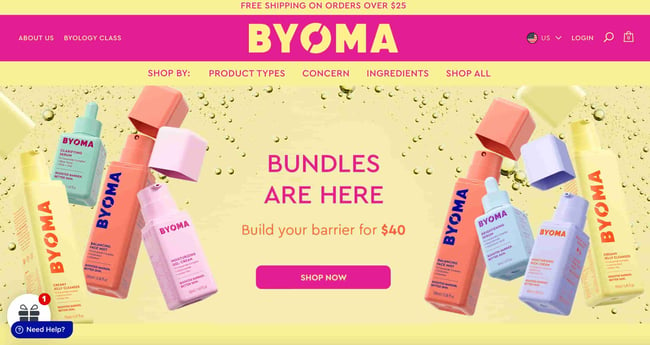
2023 is the year of product photography reigning supreme for ecommerce websites. From beauty companies to clothing brands and beyond, product photography will be front and center in 2023. This example from skincare brand BYOMA shows how impactful keeping your brand’s products centerstage can be.

What we like: Visitors don’t have to hunt down images of what you’re selling — they’re immersed in it from the moment they arrive on your website.

web design trends: BYOMA website puts the products front and center. 25. Pastel Colors

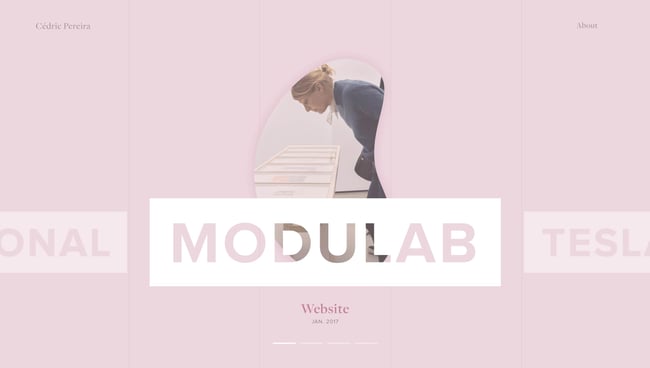
It is predicted that pastel colors will dominate 2023 website design. Pastels are bright, warm, and whimsical — a powerful reprieve from the bleakness of the early 2020s. This portfolio created by Cédric Pereira reveals exactly how visually impactful pastel colors can be.

What we like: Pastels add an element of levity to your website.

web design trends: pastels. image shows a pastel pink homepage.

26. Minimal Vintage

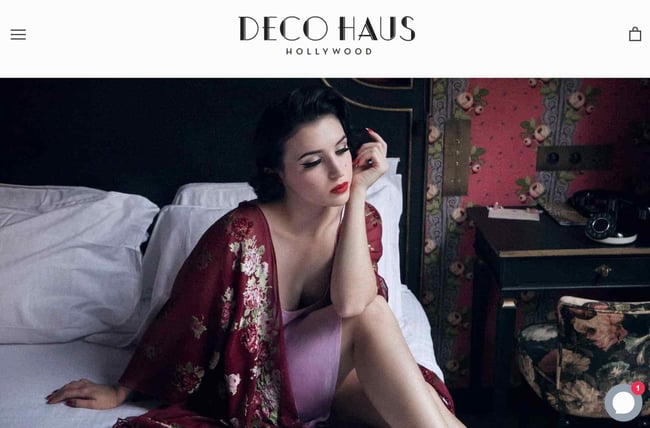
In their report, InDesign Skills claims that minimal vintage will be an important graphic design element in 2023. Similar to minimalist styling in print design, minimal vintage focuses on a retro color palette and type style. 

Minimal vintage might not instantly look old-school. Rather, it subtly nods to different decades of yesteryear, such as this design from Deco Hause.

What we like: This trend invokes the nostalgic feeling of past advertisements.

Web design tends, example of minimal vintage from Royal Brewing Co.

27. Goofy Sans Serif Typography

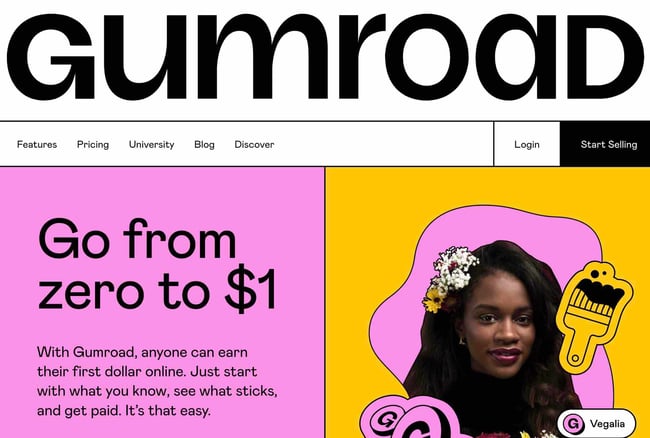
Goofy sans serif typography is ideal for brands that want to show they are fun-loving and not too serious. This optimistic typeface is cartoon inspired with a touch of retro fun. 

When including Goofy sans serif typography in your content or on your website, be sure to let it be front and center, so it doesn’t have to compete with other elements. Gumroad’s font is bold and fun.

What we like: This font is a whimsical approach to clean lines and simplicity. 

Web design trends, goofy sans serif typography example from Gumroad

28. Sci-Fi Inspired Design

With movies coming out this year such as Dune: Part Two, Rebel Moon, and Transformers: Rise of the Beast, there’s no doubt that sci-fi is going to have a moment in 2023. Sci-fi design is a nod to futurism, which is what we anticipate will happen. 

This is a trend that can both catch your viewer’s attention while also positioning your brand as firmly modern. Sci-fi-inspired design is especially useful for tech brands, as technology and science are key elements of this trend. 

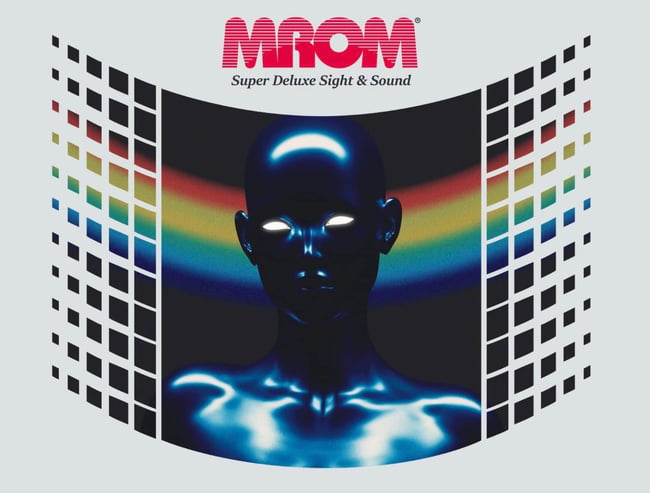
Bright colors and metal tones can help you achieve this look, but don’t be afraid to add a hint of 80s retro to really seal the deal. Matt Romo’s design for the MROM bot hits the nail on the head. 

What we like: Sci-fi-inspired web and brand designs are not afraid of color and tech-related elements.

Web design trends, sci-fi inspired design.

29. Natural and Organic Textures

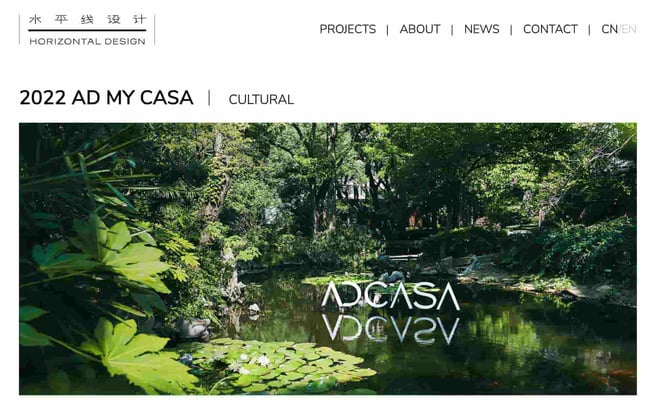
Natural textures make a great background for a fun but simple font. Choose natural textures that relate to your industry and help your viewer envision your products. Just take Horizontal Design as an example. 

Natural textures can also position your company as eco-friendly or a business that cares about natural resources. 

What we like: Organic textures infuse your design with vivid tactile-ness and new life. 

Web design trends, natural textures example.

Design Trends You Can Use on Your Website

Of course, you don’t need to incorporate all of these trends to build one of the best website designs in 2023— we doubt that’s even possible anyways. However, even adding a couple as prominent components or subtler details can improve your site’s UX significantly, leading to higher engagement, more CTA clicks, and a better outcome for your online business.

Editor’s note: This post was originally published in January 2018 and has been updated for comprehensiveness.examples of brilliant homepage, blog, and landing page design


Categories B2B

4 AI Controversies Marketers and Brands Should Avoid

Artificial intelligence is a hot topic, and a recent study shows over 61% of marketers have used AI in their marketing activities. By now, you’ve probably heard all the ways AI can assist you in crafting and executing your marketing strategy, but are there any drawbacks?

To help you avoid missteps as you explore the world of AI, here are four cons of AI that marketers and brands should keep in mind.

Free Guide: How to Use AI in Content Marketing [Download Now]

The Pros of AI in Marketing

Before we get into AI’s drawbacks in marketing, we must look at the positives.

One helpful aspect of AI is that it can automate repetitive parts of the marketing process, such as task automation, data analysis, and campaign personalization.

Automating the above tasks allows marketers to spend more time crafting their strategy, brainstorming content, and finding new ways to connect with consumers.

AI can also significantly reduce errors made in the marketing process by avoiding missed deadlines, spelling and grammar mistakes, and incorrect math or data entry.

Speaking of data, AI can also analyze large sets of data 24/7 without needing rest or getting burnt out.Ultimately, AI is a great tool that can be used to carry out tasks that would otherwise be difficult or impossible for humans to do.

4 Cons of AI in Marketing

While there are many benefits to integrating AI into marketing, it does come with some disadvantages marketers should know.

1. Machines can’t replace human connection.

While AI can personalize marketing campaigns using up-to-date data, this doesn’t remove human connections’ importance. For example, chatbots are a common form of AI used in marketing to automate customer communication and troubleshooting.

In fact, 89% of consumers appreciate customer service chatbots for their quick responses. However, unlike humans, chatbots cannot display emotion and are unlikely to respond to a customer’s inquiry with empathy like a human agent.

Chatbots also have limited responses and may not have the data necessary to answer every customer’s question.

If customers feel like their concerns aren’t taken seriously or aren’t getting the answer they need, they could become frustrated, and their relationship with your brand can sour.

According to a recent study, 53% of consumers have cut spending after a single bad experience with a company.

Quality customer service is integral to retaining customers, so you shouldn’t over-rely on AI when communicating or connecting with your consumers.

2. AI predictions and analyses can sometimes be wrong.

“Reliable sentiment analysis (i.e. figuring out if a sentence is happy, sad, or sarcastic) is really hard for artificial intelligence, along with reliable sentence parsing,” said Pawan Deshpande of Scale AI.

“Visually recognizing a teacup reliably is challenging for current machine vision algorithms,” he said.

In other words, AI doesn’t possess the human intuition to understand and carry out specific tasks — such as analyzing feelings and intentions. An AI can get something wrong without the guidance of human experience and perception.

“The human intuitions underlying what data to look for and what questions to ask are some of the biggest limits now,” Deshpande said.

3. They require huge sets of data and human intervention.

Speaking of data, an AI is only as capable as the data it’s given, and it needs massive data sets. So, you may need to hire someone who understands AI well enough to train and upload these large data sets.

Or, your current team will need to train and expand their skills to work with AI.

If the process seems too tedious and costly for your brand, consider if and how you want to integrate AI into your strategy.

4. AI lacks human creativity.

AI tools can be used in customer segmentation, recommendations, and other parts of the marketing process. However, humans are still needed to brainstorm creative and innovative content strategies that will reach audiences.

For instance, regarding social media marketing strategies, consumers gravitate to content that shows the brand’s values and how it aligns with their own. Funny, trendy, and relatable content is also popular among audiences.

Only a human marketer can spearhead touching, relevant content that fosters connection.

A content strategy that is too reliant on AI-generated content and algorithms may come as dull or disconnected.Consumers want to know a person behind the brand empathizes with their concerns.

Ultimately, AI can be an excellent tool to automate and streamline aspects of the marketing process, but companies should be aware that AI shouldn’t replace the human element.

New Call-to-action

Categories B2B

How These 3 Content Creators Turned a Side Hustle Into a Full-Time Gig

Content creator is a job title that didn’t exist a decade ago. Now, 50 million people consider themselves creators, following their passion in a billion-dollar industry.

Thanks to social media, it’s easier than ever to create, share, and monetize content — flipping the “starving artist” trope on its head. And with massive demand for original and engaging content, there’s never been a better time to jump in.

Of course, turning a side hustle into a full-time gig is no easy feat. After all, creating content is just one small part of the equation. You also need to engage in community building, social media promotion, audience research, and networking.

Download Now: 2022 State of U.S. Consumer Trends Report

And while the business of content creation seems simple enough — create content, build an audience, then make money — these things take a lot of time. In other words, the dream of recording a video, hitting “upload,” and making millions is exactly that — a dream.

Despite the challenges, there are people who’ve succeeded in becoming full-time content creators. Here, I spoke with three creators to learn their biggest tips for quitting your 9-to-5 and becoming a full-time creator. Let’s dive in.

1. Craft an exit strategy.

“Sometimes, it’s not about knowing exactly what you want. Instead, it’s about uncovering what it is you don’t want any longer,” says Jenna Kutcher, author and host of the Goal Digger Podcast.

Kutcher’s revelation drove her to entrepreneurship, but it didn’t happen overnight. She knew she had to be strategic to get there.

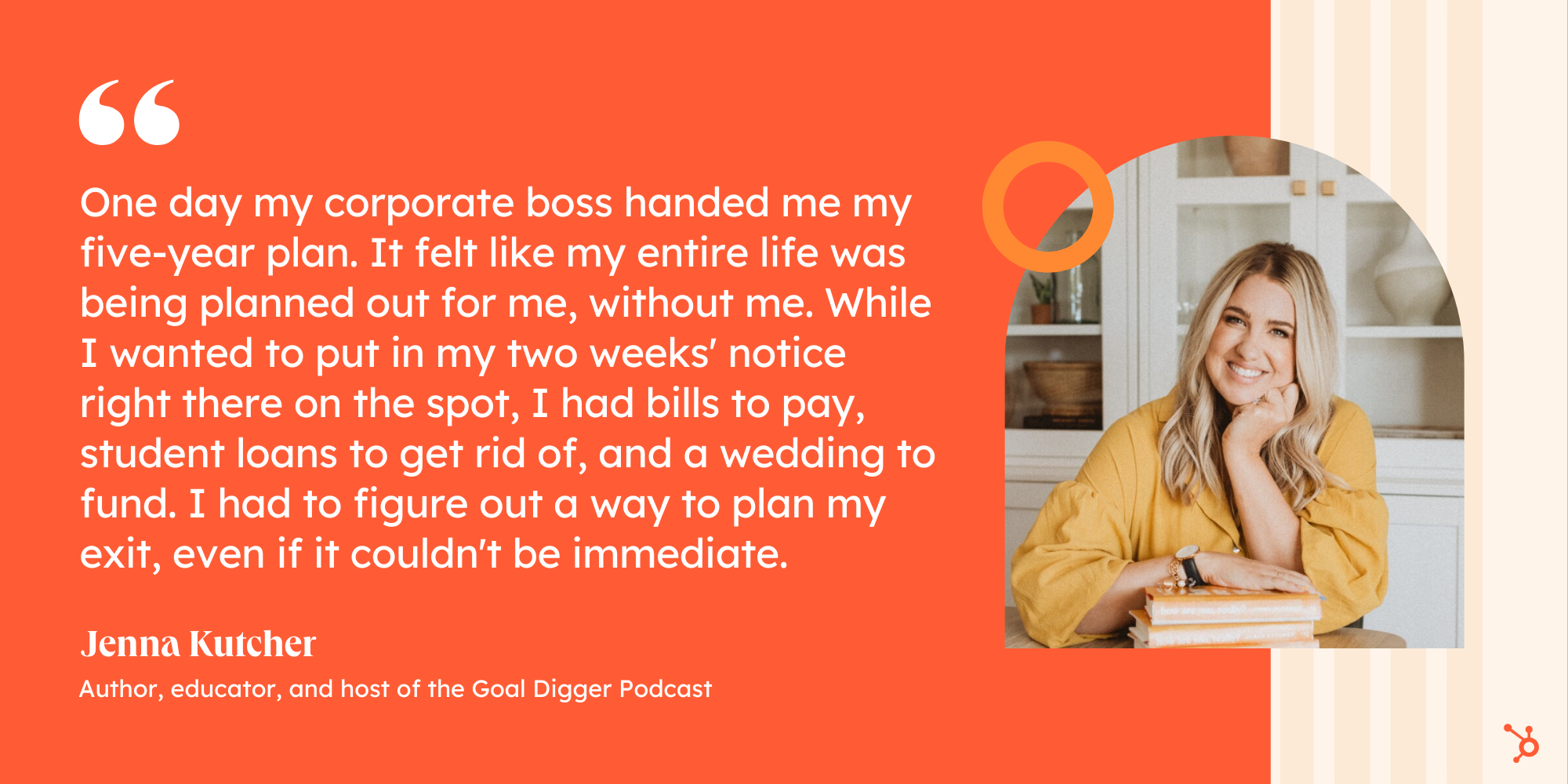
As she puts it, “One day my corporate boss handed me my five-year plan. It felt like my entire life was being planned out for me, without me. While I wanted to put in my two weeks’ notice right there on the spot, I had bills to pay, student loans to get rid of, and a wedding to fund. I had to figure out a way to plan my exit, even if it couldn’t be immediate.”

Jenna Kutcher on becoming a full-time creator

It’s never easy to leave the security of a steady paycheck, but Kutcher argues that you don’t have to. Instead, you can craft an exit strategy that provides enough security for the transition.

For Kutcher, her exit strategy started with a $300 camera from Craigslist and endless weekends spent building a clientele. In her own words: “Nights and weekends were devoted to starting my photography business, and my 9-to-5 was funding this new dream of mine.”

A year later, Kutcher had booked enough gigs to feel confident leaving her corporate job. “In hindsight, I’m glad I didn’t just abandon my job to go after what I wanted. Instead, I leveraged where I was at to get to where I wanted to go,” she told me.

Everyone’s exit strategy looks different. For instance, one person might keep their 9-to-5 and work on the weekends. Another person might freelance part-time and create content the rest of the week.

Remember that entrepreneurship is a journey, and it takes time and effort to build a successful business. With the right exit strategy, you can take calculated risks and leverage your current situation to reach the next step in the journey.

2. Make consistency your golden rule.

Are you more likely to follow a creator who posts once a year or once a week? Chances are, you’re following the creator who gives you more value on a regular basis.

Jay Clouse, founder of Creator Science, knows this all too well. When he started as a content creator in 2017, he wrote an email newsletter every day for a year. That’s hundreds of opportunities to connect with an audience and build their trust. No shortcuts, no quick schemes.

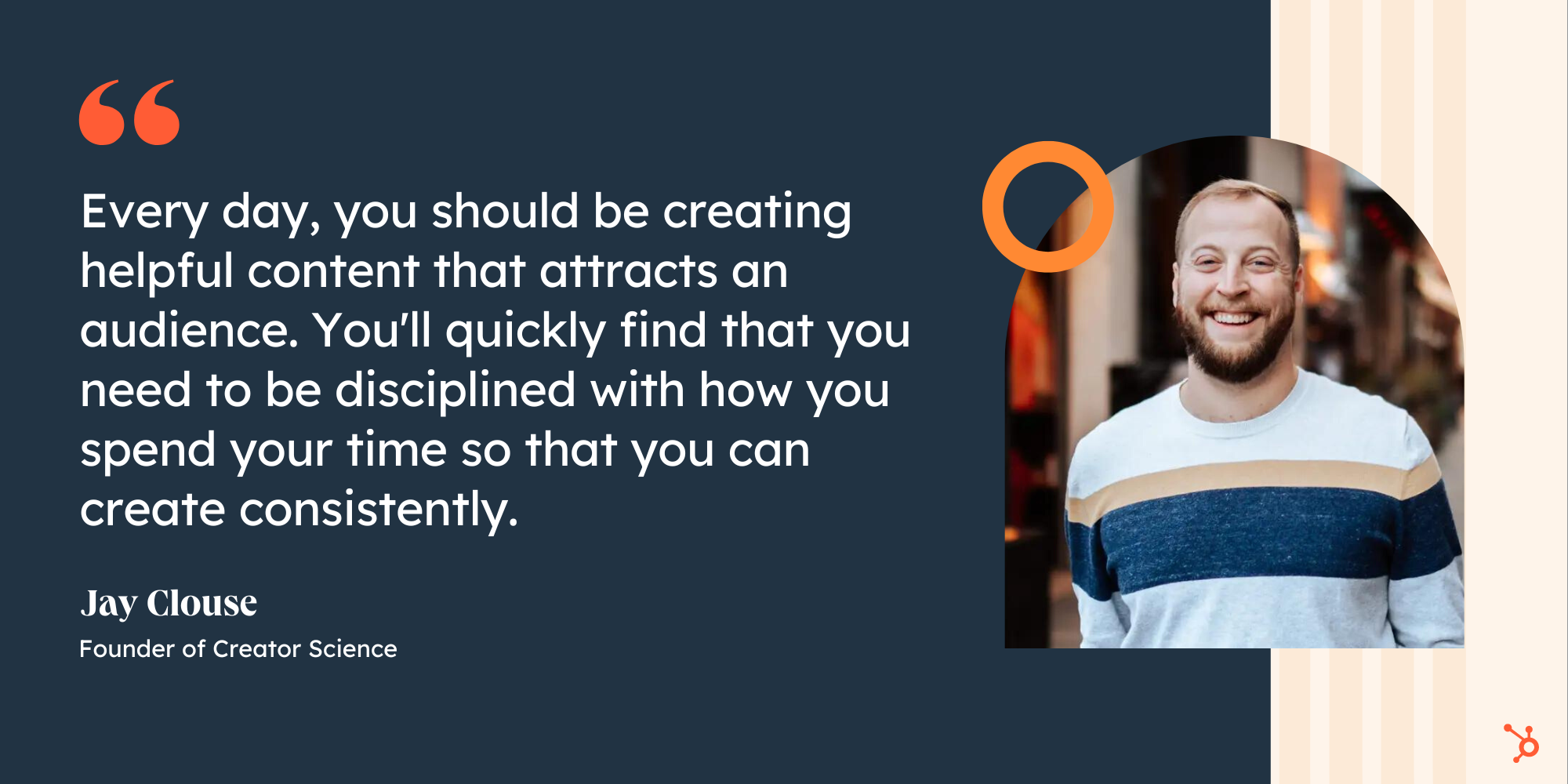
He told me, “Every day, you should be creating helpful content that attracts an audience. You’ll quickly find that you need to be disciplined with how you spend your time so that you can create consistently.”

Jay Clouse on becoming a full-time content creator

Consistency is the golden rule for content creators, but it’s often the hardest part of the job. Life can get in the way, or you may run into a creative rut. As Clouse points out, “This is a long game. You need to be remarkably consistent while also being incredibly patient.”

To keep pace, many creators commit to a posting schedule. If you’re just starting out, be realistic about how much content you can pump out each week. This might be twice a week or every day. Then, leverage a content calendar to help you organize your ideas, plan content in advance, and avoid missing deadlines.

Above all, content creation is an exercise in determination. Try to challenge yourself here, but know your limits to avoid burnout.

3. Approach content creation as a science.

Content creation is both an art and a science. Most content creators enjoy the art-side of the equation. It’s exciting to brainstorm new ideas, create content, and share it with the world. But that alone isn’t enough.

Content creation is also a science, which requires experimentation, testing, and analysis — which isn’t always glamorous, but is just as necessary.

For instance, if you’re posting the same type of content but getting zero engagement, it’s time to experiment with different types of content, platforms, and topics.

Nicaila Matthews Okome, host of the podcast Side Hustle Pro, also recommends looking at your competitors.

“Perform competitive analysis of people who make similar content. Don’t do this to copy, but to assess what your audience resonates with and the best way to present the information so they’ll interact with your content,” she told me.

As you look at your competitors, pay close attention to what topics they’re covering, what formats they’re using, how frequently they post, and how they’re engaging with their audience.

For example, you may find that your competitor only posts on a specific day — or gets the most engagement from a specific topic. As Okome mentioned above, the goal isn’t to copy your competitors but to identify any tactics that can elevate your own strategy.

4. Diversify your revenue streams.

Remember the phrase, “Don’t put all your eggs in one basket”? This is especially true for content creators.

For instance, if you rely on revenue from a single platform — and that platform undergoes a major algorithm change — it could affect your entire income model.

For Okome, the key to income stability is diversifying your revenue streams. That way, your income doesn’t rely on a single platform, partnership, or season.

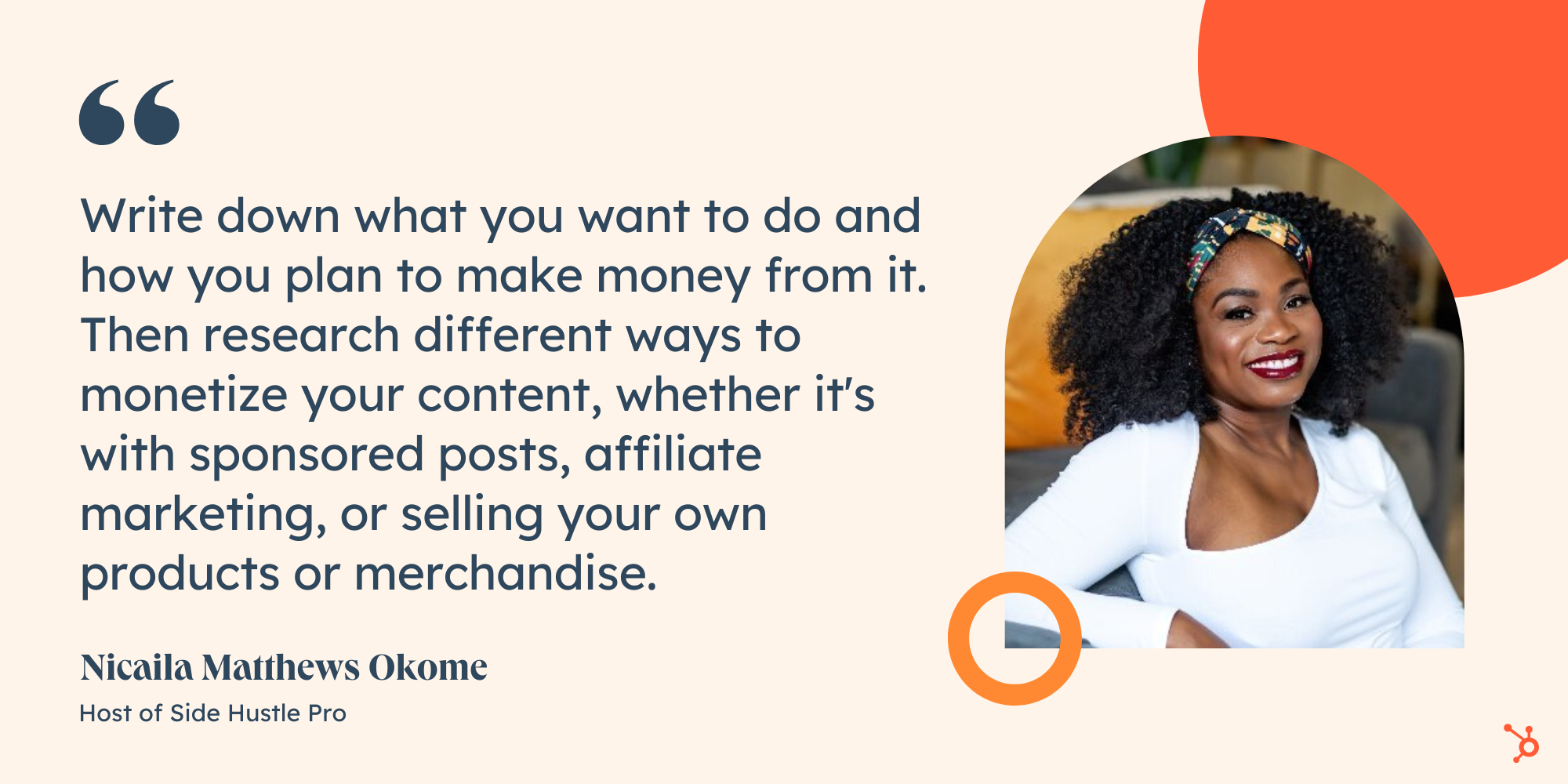
She says, “Write down what you want to do and how you plan to make money from it. Then research different ways to monetize your content, whether it’s with sponsored posts, affiliate marketing, or selling your own products or merchandise.”

Nicaila Matthews Okome on becoming a full-time content creator

As a content creator in 2023, you have more avenues to create and monetize content than ever before. However, not all revenue streams are created equal. Some require more work on the backend, while others are easy to get off the ground but need upkeep (i.e. an email newsletter).

This isn’t about choosing the most lucrative option, but the one you can realistically handle right now. For example, a YouTube vlogger might supplement their income with a membership program on Patreon where they offer bonus videos and exclusive content — rather than a merch store with high start-up costs.

When diversifying your revenue, Okome recommends aiming for two additional streams. “As a content creator, your revenue can be unpredictable due to factors out of your control. Make sure you have at least two revenue streams so if one isn’t reliable, you can still pay your bills.”

5. Invest in yourself and your skills.

At the beginning of her career, Kutcher had to learn how to code her own website from scratch. This is a familiar scene for new content creators — one that involves learning a new skill on the fly with little help.

However, this is a challenge for veteran content creators, too. After all, it’s impossible to “master” content creation when the landscape is always changing. Trends come and go, platforms evolve, and new tools and technologies emerge all the time.

To future-proof yourself, don’t run from learning — embrace it. Okome underlines this point, telling me, “Invest in yourself, take classes, attend conferences, and learn from people who are further ahead of you on this path.”

Whether you join a workshop to improve your video editing skills or attend a networking event, prioritize learning and treat it as another part of the job.

Back to You

Many people assume content creation is an easy job that can turn you into a millionaire overnight. The reality is much different. However, with enough patience, determination, and these tips, you’re well on your way to turning your creative side hustle into a full-time gig.

New Call-to-action

Categories B2B

Your Email Engagement: 10 Ways to Get More People Reading & Clicking

Email marketing remains one of the most effective tools for marketers, and you put a lot of energy into your email marketing strategy. So the last thing you want is to see your efforts result in low email engagement.

→ Download Now: The Beginner's Guide to Email Marketing [Free Ebook]

If you want to increase email engagement and get those coveted clicks on your CTA buttons, read on for 10 tips that will give your messages a boost.

Table of Contents

What is email engagement?

Email engagement is the measurement of interactions your emails receive. These interactions are measured using certain email engagement metrics including open rate, click-through rate, subscribes and unsubscribes, and conversion rate.

Tracking your email engagement can help you understand whether or not your email marketing efforts are effective.

If your email isn’t reaching the goals you set, there are a few proven ways to increase your engagement rate.

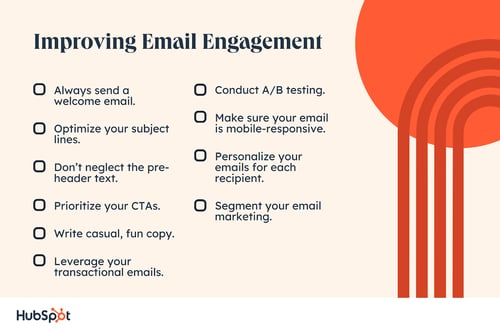
10 Ways to Improve Email Engagement

Always send a welcome email. Optimize your subject lines. Don’t neglect the pre-header text. Prioritize your CTAs. Write casual, fun copy. Leverage your transactional emails. Conduct A/B testing. Make sure your email is mobile-responsive. Personalize your emails for each recipient. Segment your email marketing.

1. Always send a welcome email.

The first email you send to a customer is usually a welcome email. The average open rate for a welcome email is 50%, which makes it much more effective than regular newsletters.

If we bear in mind that 76% of people expect a welcome email immediately after subscribing to your list, it’s clear that this email is an important message, so be sure to make the most of it.

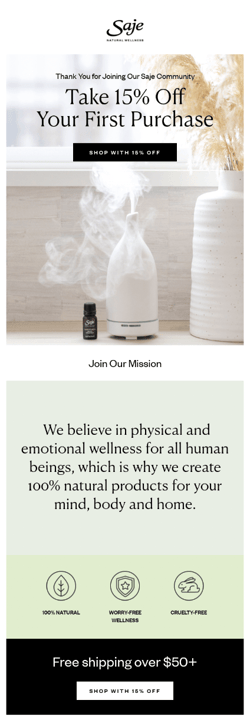
Email engagement. A welcome email from Saje that includes a discount code, which is a great way to increase email engagement.

Image Source

The email delivers a discount code that subscribers were promised in exchange for signing up, includes a beautiful picture, and keeps things super simple.

2. Optimize your subject lines.

Today, 47% of email recipients open emails based on the subject line. So yes, getting the subject line right is crucial.

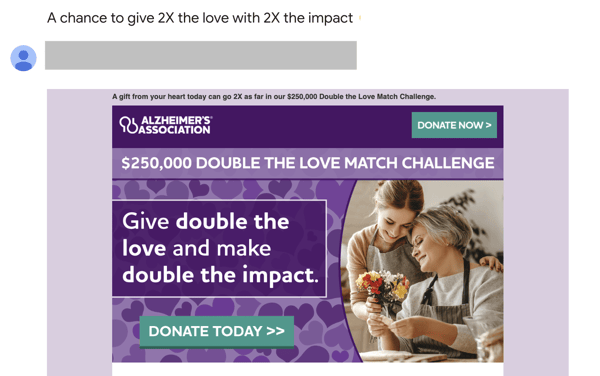
A donations email from the Alzheimer’s association with the subject line “A chance to give 2X the love with 2X the impact” is an example of using FOMO in the subject line to increase email engagement.

But what makes a good subject line?

The best way to succeed is to leverage natural human tendencies such as:

  • Curiosity
  • FOMO (Fear Of Missing Out)
  • Humor

This is a FOMO subject line, where the Alzheimer’s Association makes it clear that their impact will have twice as much impact — but only for a limited time.

3. Don’t neglect the pre-header text.

The pre-header text, or preview text, is the snippet of text that follows the email subject line when a reader views your email in the inbox. It’s shown beside the subject line and sender name.

These pre-header text examples from the lifestyle brand Quince offer a follow-up to the subject line and give subscribers even more reasons to open the email.

An overview of a Gmail inbox displaying subject lines and pre-header text from the brand Quince.

This snippet is valuable real estate that can make or break your email’s performance. But the message has to fit within limited character space to be effective.

The pre-header text can only contain 50-130 characters — even less if you want it to fit on mobile screens. Make sure your message is short and sweet, yet encourages people to open your email.

4. Prioritize your CTAs.

The way you write and design your CTAs, or calls to action, has a significant impact on email engagement and click-through rates.

As readers are so used to being prompted to take action, creativity is crucial to avoid being filtered out.

An email from BHLDN that includes a strong CTA button to boost email engagement rate.

Experiment with everything from copy and design to placement and frequency. You’ll discover what kind of CTAs and buttons yield the best results from your particular target audience.

This message from wedding brand BHLDN uses compelling text to pull readers in. The CTA keeps it short and sweet, sealing the deal by offering a complimentary styling session.

5. Write casual, fun copy.

Write as you talk. Nobody appreciates large, dull, jargon-heavy chunks of text. Make it easy, fun, and rewarding to read your emails. And be ultra-clear about what next step you want the reader to take.

An email from Uber that highlights several words throughout the copy to make the email more scannable and fun.

Image Source

Use active, positive language — and keep sentences concise. And, if appropriate, use humor; people like to smile.

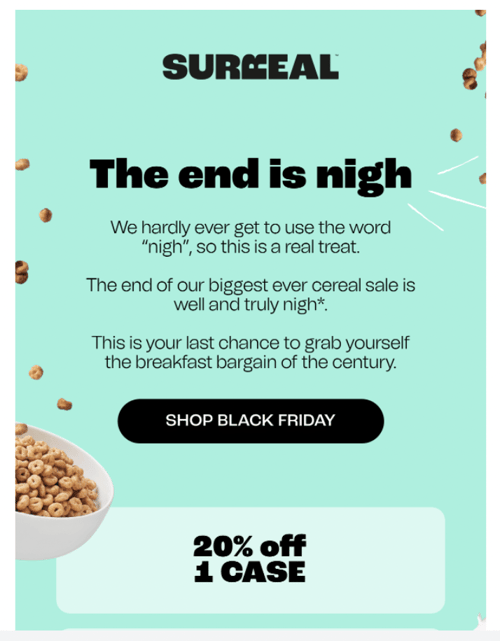
This email copy from Surreal is creative, on-brand, and to the point:

6. Leverage your transactional emails.

After welcome emails, transactional emails have among the highest open rates of all email marketing messages at about 80%-85%. Yet, they rarely contain more information than that of the actual transaction. That means an opportunity for you.

A transactional email is any type of email that is based on an action a subscriber took. Transactional emails include:

  • Order confirmation
  • Password reset
  • Abandoned cart

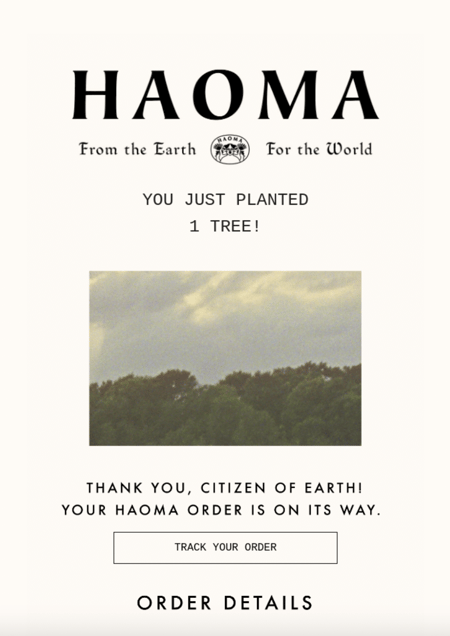
This order confirmation email from skincare Haoma takes an opportunity to remind customers of the impact of their order.

An engaging order confirmation email from Haoma that reads “You just planted one tree.”

Image Source

By giving your transactional emails some extra love and attention, you will wow your customers in a way that many companies miss out on.

7. Conduct A/B testing.

If you’re sending emails, you should be doing A/B testing. You can test every element of your emails, from subject lines and preview tests to copy, images, design, and CTAs.

The more you test, the better you will get to know your target audience. And the better you know your audience, the more you will be able to engage them with your emails.

8. Make sure your email is mobile-responsive.

Most people open emails on their mobile devices. This means that if your emails aren’t mobile responsive, a large portion of them will be going to waste.

Mailchimp found that mobile-responsive email designs can increase click rates by 15%.

As more people continue to open and read emails on their phones, it’s essential to make sure that your design has as good or better UX on mobile as on desktop.

9. Personalize your emails for each recipient.

Customers appreciate personalized experiences. In fact, emails with personalized subject lines are 26% more likely to be opened. This is why tailoring your email marketing to the recipient is crucial.

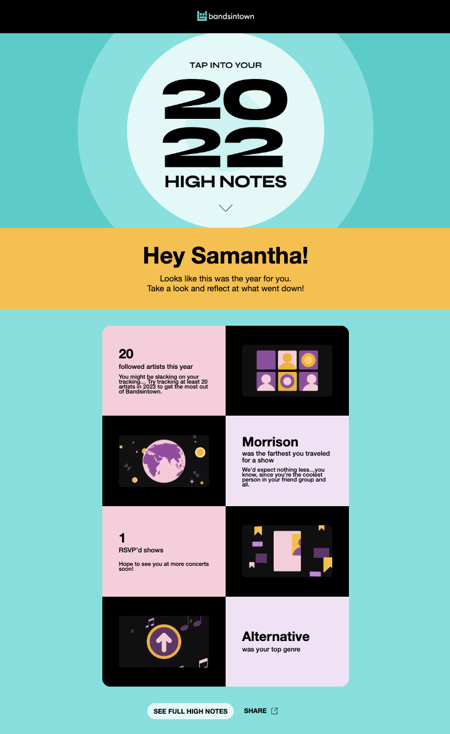
A personalized year-end recap email from Bandsintown that helps boost email engagement.

For example, Bandsintown sends personalized emails with visual recaps of its users’ music activity from the past year.

This type of personalized content is not only a great way to re-engage users, but it also encourages social sharing and engagement within a community, multiplying the effect of your emails.

10. Segment your email marketing.

Segmenting your email list enables you to get the right message to the right buyer persona at the right time in their buyer journey. And that is crucial for increasing conversions.

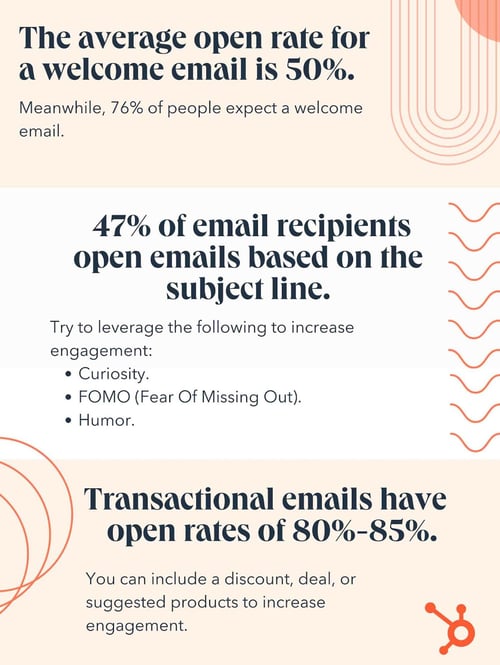
 Email engagement data. The average open rate for a welcome email is 50%. Meanwhile, 76% of people expect a welcome email. 47% of email recipients open emails based on the subject line. Transactional emails have open rates of 80%-85%. You can include a discount, deal, or suggested products to increase engagement.

To send segmented emails that are more likely to convert, first integrate your email and marketing software with your CRM and other sources of customer data.

This gives you a 360-degree view of your contacts everywhere, including your email marketing platform. It’s then easier than ever to send highly personalized emails based on your contacts’ groups, memberships, and other properties.

Better Data Means Better Email Engagement

Email communication is one of the most effective ways that you can reach out to customers and prospects. But keeping your emailing lists up to date and personalizing your content can be challenging.

That’s where integration steps in. Sync the contact databases across your app stack, so you’re always working with fully enriched, up-to-date, and relevant data.

With your CRM and email tool in sync, you can automatically send recent subscribers and leads to your email tool. You can also sync extra data for better segmentation of your marketing and nurturing campaigns.

At the same time, you can merge marketing qualified leads (MQLs) back to your CRM with updated data for sales to work with — all without overwriting existing data.

New Call-to-action

Categories B2B

Fabletics Expands Product Line with New Scrubs Collection

Welcome to HubSpot Marketing News! Tap in for campaign deep dives, the latest marketing industry news, and tried-and-true insights from HubSpot’s media team. 

Activewear subscription brand Fabletics is looking to cover a new market — clothing for medical professionals.

In February, the company launched its first line of medical scrubs, which it calls “The World’s First Activewear Scrubs Collection.” The collection launched with 12 pieces for all genders, as well as the ability to customize with embroidery.

In addition to creating a style quiz potential customers can take to find the items that will suit them best, Fabletics focused on a community-oriented launch.

The brand pledged to donate 25,000 pairs of scrubs to medical professionals across the U.S. and has tapped company spokesperson Kevin Hart to help distribute scrubs to an organization in Philadelphia.

activewear brand Fabletics launches a new line of scrubs for medical professionals

Image Source

Why did an activewear brand start making medical scrubs?

The scrubs market is expected to be worth over $236 million by 2025, and Fabletics saw an opportunity to tap in.

Fabletics surveyed its two million subscribers (referred to as VIP members) and discovered 15% of them wore scrubs for work each day. Realizing there was demand from its existing group of customers for scrubs, the brand got to work.

During the development process, Fabletics got feedback and insights from over 6,500 professionals who wore scrubs to create the initial collection.

Since Fabletics announced the launch of the line on social media, feedback has been generally positive. Social media users have expressed excitement over being able to purchase scrubs from the brand, and have requested additional styles and colors.

Competitors in the direct-to-consumer scrubs market include FIGs and Jaanuu, both founded in 2013. The success of these brands showed clear demand for functional, fashion-forward scrubs.

Marketing Snippets

The latest marketing news and strategy insights.

Diversity efforts: how media companies are measuring on-screen diversity.

Podcast advertising: what a slowdown in the podcast industry could mean for advertisers.

New app alert: ByteDance, the parent company of TikTok, launched a new lifestyle app called Lemon8.

YouTube is rolling out a new feature that dubs videos in multiple languages.

New call-to-action

Categories B2B

Sampling Marketing — The Complete Guide

Oh, samples, the small gifts that help justify any Costco membership. You can get everything from a warmed pizza bite to a smoothie to hand lotion, all in one pass-through.

And don’t get me wrong, this strategy is an incredible tactic that can increase sales, in some cases, by as much as 2,000%. But there is much more to the sample marketing strategy than just enticing snacks and perks.

Product sampling marketing offers benefits to brick-and-mortar companies, online B2C and B2B brands, and everything in between. You can expand your reach, grow customer loyalty, and ultimately increase conversion and decrease churn rates. Sounds intriguing, right? Keep reading to learn how sampling marketing can help your company.

In this article, we will discuss:

→ Download Now: Market Research Templates [Free Kit]

This can manifest in a variety of forms, from Sephora’s free gifts with a purchase to HubSpot’s 14-day free trial.

Sampling marketing. Allowing your customers to try your product before they make a purchasing decision. That may involve giving samples of your product or offering a free trial of your service.

Why Sampling Marketing Works

The strategy behind sampling marketing is rooted in psychology and behavioral economics. Giving a customer a glimpse of your offering can show them the benefits before they buy.

Here are three major benefits of sampling marketing backed by research.

1. Reciprocity

As Dan Ariely, the modern-day king of behavioral economics at Duke University says, “Reciprocity is a very, very strong instinct. If somebody does something for you, you really feel a rather surprisingly strong obligation to do something back for them.”

At Costco, the impact of this theory is clear. The graph below shows the direct translation from samples to purchases.

sampling marketing; Percentage of Shoppers Who Purchased Items Being Sampled by Product

Image source

This same theory stands true for the digital space as well. Giving a potential customer the ability to test out the service before committing creates the same sense of reciprocated obligation.

When they create a relationship with your brand, there is then a further incentive for them to complete the transaction, increasing the number of sales your brand can achieve. You can then build a lasting connection with users that will keep them coming back.

2. Customer Loyalty

Cornell University professor Miguel Gomez conducted a study about wine tastings.

Results showed that customers who enjoyed a tasting were 93% more likely to spend an extra $10 at the winery. They were also highly likely to buy from the business again in the future.

This study furthers the notion that a free sample not only encourages the first purchase but also it promotes a sense of loyalty toward the company.

Customer loyalty is an indispensable tool for growth. In fact, B2B companies with referrals experience a 70% higher conversion rate. This sense of trust will further your business’ customer retention and help you reach new customers alike.

3. Loss Aversion

Sampling marketing works because of our innate human physiological fear of loss, no matter the size. Esteemed of behavioral economist Daniel Kahneman, dedicated much of his studies to this notion and claims that “the concept of loss aversion is certainly the most significant contribution of psychology to behavioral economics.”

Here, when one receives a free trial or sample, they are made to feel as though they own that product. They become much more reluctant to lose it once it’s in their possession. According to Kahneman, the pain of losing is almost twice as powerful as the pleasure of gaining.

Sampling Marketing Best Practices

How much do I give for free? How do I implement these free samples into my marketing strategy?

You’ll need to answer these age-old questions. But not to worry. These best practices can help you build the right sampling marketing strategy.

Find the sweet-spot quantity.

You have to find the sweet spot for your free offering. Don’t give too much, which would remove the customer’s need to purchase your product. Don’t give too little, or they won’t have the chance to try your offering thoroughly.

Databox found that over 40% of B2B SaaS companies have a free trial between 14-29 days.

databox how long should your free trial be?; sampling marketing strategy

Image Source

This timeline is often a sweet spot for software offerings. It’s long enough for users to see how the product can impact their bottom line. However, it’s not so long that users can accomplish everything before the trial is over.

Time-based models won’t work for physical products. For these goods, Shopify shares, “offer a sample that they can use at least two or three times … and customize your sample offering to fit the consumer profile.”

For example, an online news business may offer, on average, five articles a month before asking for a subscription payment.

Bolster new product launches.

The best way to spread the word about a new product is through the users themselves. Product sampling increases the number of users and sales while also promoting user-generated content marketing (UGC).

When these lucky users try out a product, they are more willing to review it and advertise it on their own due to their innate sense of reciprocity.

Today, 89% of shoppers check reviews before making a purchase. Get the word out about your new product through user-generated reviews to reap the benefits.

sampling marketing, data showing that customers trust product reviews and UGC to inform buying decisions Image Source

Use feedback to inform product development.

What better way to understand how your product works for your user than to ask them directly? By giving them a sample of your product for free, with no strings attached, they can try out the product honestly.

Take this opportunity to gather genuine feedback, user reviews, and ratings.

Find ways to tap new markets.

Over 70% of customers look for perspectives that reflect their own, meaning you need to find ways to market to the specific target demographics.

Through product sampling marketing, you can get your foot in the door to these market segments by speaking to them in a relatable way with your UGC strategies.

Sample Marketing Examples

There are thousands of stellar examples to guide your product sampling journey. Here are three case studies to inspire you.

Warby Parker

Sampling marketing example, warby parker

Image Source

Warby Parker is a prime example of how sampling marketing allows the user to try before they buy. The modern, sleek, and trendy eyewear company allows you to choose any five frames to try on at your home for free.

Then, after five days, the customer can buy what makes them feel their best. The rest are shipped back (for free, of course).

After five days of wearing glasses that make me feel like Carrie Bradshaw from Sex and the City, I wouldn’t want to return them either! Warby Parker uses product sampling marketing exactly how it was intended — giving me a taste of the life I could have, but then taking it away before I get too comfortable in my Bradshaw era.

What we love: The personalization of their free samples. Customers can find the perfect frame and then actually use them in practice before committing.

Spotify

If you are an Apple Music user, it’s okay. We all have that friend and still love them. However, I hate to admit it, but Spotify may have you beat in more than a few ways, such as its personalized interface and accessibility.

Yes, Spotify does have a free tier, but it is definitely not as used as their Premium model. That’s why Spotify offers all of its users a three-month free trial to experience all that Premium has in store.

This free trial really does work. In 2019, they had 217 million active users and 100 million subscribers — meaning a 46% conversion rate.

Spotify now has 100 million paid subscribers and 217 million monthly active users in total; product sampling marketing

Image Source

What we love: Spotify’s three months get you hooked. You’ve made an investment in the app by cultivating playlists that, after three months, you can’t part with. Once you lose that advantage, you can’t go back to the free tier again — with advertisements, worsened audio quality, and no exclusive release access.

Zoom

sampling marketing, zoom

Image Source

Whether COVID made you a Zoom fanatic or an avid Zoom hater, video conferencing is here to stay — and Zoom is at the forefront of that.

However, if you are just using a free personal account, you are limited to 40 minutes. Yesterday, I received an email to upgrade my account with the words: “Sick of the 40-minute limit? This holiday season, stay connected through it all — for free! Today only, claim your FREE MONTH of Zoom!”

What we love: Zoom uses seasons and holidays to target its promotions. The holiday season is a time when everyone wants to connect, and Zoom knows it. They are able to tug on our heartstrings and make us feel glad that they are making their service more accessible at a time when it is needed.

Making the Most of Samples

We’ve all made purchases after using a sample — whether that be Spotify, LinkedIn Premium, Costco, or Sephora. There are plenty of benefits to letting customers try a product, getting them hooked, then closing a sale.

Start small by offering samples of select products. Once you prove out your strategy, you can expand your sampling marketing.

New Call-to-action

Categories B2B

17 of the Best Free Website Builders to Check Out in 2023

Today, 27% of small businesses don’t have a website. In today’s digital world that’s a huge mistake. What’s holding them back? The top reasons are cost and lack of technical know-how.

In today’s digital world, having a business website isn’t an option — it’s a must. Luckily, there are many free website builders that make the process easy. We’ve compiled 17 of the best options. They offer robust functionality like SEO benefits, mobile optimization, and professional-looking templates.


Learn More About HubSpot's CMS with Free Web Hosting

These builders are the next best thing if you’re on a tight budget. Better yet? Most of the free website builders have paid options if you need additional features as your business grows.

The 17 Best Free Website Builders

Website Builder Features You Need

1. HubSpot Drag-and-Drop Website Builder

Best free website builder, HubSpot drag-and-drop website builder

Get started with the drag-and-drop builder!

Designing a beautifully branded website doesn’t have to be complicated. If you’re taking the DIY route to create your own website and don’t have coding experience, consider HubSpot’s drag-and-drop website builder.

It comes with everything you need to build a website, including content management system (CMS) tools, themes and templates, security features, and a built-in content delivery network (CDN) to ensure pages load quickly.

It also connects easily with HubSpot CRM. That lets you integrate contact forms, live chat requests, and more. This website solution is ideal for businesses already using HubSpot’s CRM tool.

Core Features

Advantages

  • Personalization (thanks to HubSpot’s CRM)
  • Security
  • Responsive themes and templates

Disadvantages

  • Multi-language blog functionality is still being implemented
  • You’ll need to learn HuBL (HubSpot’s templating language) to build custom modules and coded templates

Pricing: A limited free plan is available. The premium CMS plans with additional features start at $23 a month when billed annually.

What we love: HubSpot’s website builder connects seamlessly with HubSpot CRM, allowing you to easily integrate your favorite marketing tools with your website.

Brands Using HubSpot

2. Wix

free website builders, Wix.com

Image source

With over 200 million users, Wix is one of the most popular free website builders. The easy-to-use, fully-hosted platform offers an easy drag-and-drop editor, an extensive collection of apps, and professional-looking templates.

Wix can even propose a design for your site using its Artificial Design Intelligence (ADI) software, Editor X.

Core Features

  • A drag-and-drop editor
  • A large collection of apps and templates
  • Analytics and reporting

Advantages

  • Easy to use
  • Large collection of apps and templates
  • Optimized for mobile

Disadvantages

  • The free version displays ads
  • The premium plans are pricey when compared to others on this list
  • The only way to change templates is by creating a new site and transferring your premium plan to it

Pricing: A limited free plan is available. Premium plans start at $16 a month when billed annually.

What we love: Wix’s ADI software can help you develop a fully functional website in no time. We like that the ADI software can suggest a website’s text, fonts, colors, and more.

Brands Using Wix

3. WordPress.com

free-website-builder-wordpress (1)Image source

WordPress is the world’s most popular free website builder, with a 43% market share in the content management space. When building websites with WordPress, you have two options: WordPress.org and WordPress.com.

WordPress.org lets you download WordPress’s open-source software so you can build and customize a website to fit your needs. However, there are a few caveats.

Not only will you need a domain name and hosting before you get the website going (which comes at a cost), but you’ll also need to learn how to maintain and keep the website secure on your own.

In contrast, WordPress.com is much more beginner-friendly. It’s a fully-hosted free website-building service offered by Automattic that uses the WordPress framework to provide a smooth website creation experience.

The only downside is that the free version is far less customizable than WordPress.org. For instance, you can’t customize plugins, and domain names are limited to [yourname].wordpress.com.

Still, WordPress.com’s free version empowers you to create visually stunning websites, blogs, and landing pages using the Classic Editor or the powerful new Gutenberg block-based editor.

Besides that, you can add assets like contact forms, videos, and embedded content to WordPress pages using plugins, an add-on feature compatible with WordPress but usually managed by another company.

For example, HubSpot offers a WordPress marketing plugin that lets you capture contacts through WordPress and track them in HubSpot’s free CRM.

Core Features

  • Large collection of themes and plugins
  • Mobile-friendly and optimized for SEO
  • Managed website hosting and security

Advantages

  • Customizable
  • Flexible
  • Mobile and desktop apps available

Disadvantages

  • The free version displays ads
  • More limitations compared to WordPress.org
  • Although intuitive, it’s more difficult to learn than other drag-and-drop builders

Pricing: A limited free plan is available. Premium plans start at $16 a month when billed annually.

What we love: WordPress.com easily integrates third-party apps and widgets, including HubSpot’s WordPress marketing plugin.

Brands Using WordPress.com

4. Elementor Website Builder

website builder, Elementor

Image source

While WordPress makes site building beginner-friendly, WordPress page builders make refining your website and achieving your dream design easier.

Trusted by over 5,000,000 users, Elementor is a no-code drag-and-drop page builder that’s a great option for getting a customized WordPress site off the ground quickly. Choose from hundreds of mobile-optimized page templates without worrying about the underlying code.

Core Features

  • Drag-and-drop builder
  • Live editing
  • A large library of mobile-responsive templates
  • Multiple partners build templates and add-ons for Elementor (e.g., Astra)

Advantages

  • Beginner-friendly
  • Live editing
  • Third-party integrations

Disadvantages

Pricing: A limited free plan is available. Premium plans start at $49 a year (without hosting).

What we love: With Elementor, you do not have to be a pro to edit your site. Live editing makes adding a quick update or changing your website a breeze.

Brands Using Elementor

5. Webnode

Webnode’s free website builder homepage.

Image source

With over 40 million users, Webnode is one of the more popular website builder tools for a good reason. It’s affordable, easy to use, and supports multilingual websites — up to 20 different languages.

Webnode is perfect for personal, professional, and small business websites, as it supports ecommerce stores.

Core Features

  • Pre-designed templates
  • Ecommerce support
  • Mobile-ready

Advantages

  • Multilingual support
  • Mobile-responsive pages
  • Backup and restore features

Disadvantages

  • Webnode doesn’t come with a built-in app store, making it more complicated to add extra functionality to the website
  • Limited customization options
  • Limited blog and ecommerce functionality

Pricing: A limited free plan is available. Premium plans start at $3.90 a month when billed annually.

What we love: We appreciate Webnode supports multiple languages. This makes it possible to expand your strategy to include non-English speaking markets.

Brands Using Webnode

6. Jimdo

website builder, Jimdo

Image source

Founded in 2007, Jimdo is a German-based company that provides AI-powered website builder tools for independent small businesses. The builder, Dolphin, asks users questions and suggests designs based on their answers.

If you’re curious about what these AI-powered designs look like, Jimdo showcases a few examples on its page.

With 500 MB of space, you’ll likely have more than enough space to build your site, and it even provides HTTPS/SSL encryption, meaning your visitor’s information will be kept safe. Plus, you can integrate your site seamlessly with social media accounts.

Jimdo is also an excellent option for international companies because it lets you create mobile-optimized websites in over nine languages.

Core Features

  • AI-powered website builder
  • SSL encryption
  • GDPR-compliant
  • Mobile app available

Advantages

  • Easy to use
  • Mobile-responsive
  • Fast load speeds

Disadvantages

  • Limited range of available features
  • Few design options

Pricing: A limited free plan is available. Premium plans start at $9 a month when billed annually.

What we love: We love Jimbo’s AI-powered website builder. The AI questionnaire and suggestions are helpful for users who may not know exactly what they want out of their website.

Brands Using Jimdo

7. Mozello

Mozello’s free website builder homepage.

Image source

Mozello has all the basic features you need to build a website: a drag-and-drop editor, template library, and ecommerce functionality. One of the biggest selling points for Mozello is that the builder allows you to create a multilingual site for free.

You can check samples of websites built on Mozello on its portfolio page.

Core Features

  • Drag-and-drop website builder
  • Template library

Advantages

  • Easy to use
  • Support for multilingual websites
  • Ecommerce functionality

Disadvantages

  • The drag-and-drop builder isn’t as intuitive as some others on this list.
  • Limited design customization
  • The free version displays ads

Pricing: A limited free plan is available. Premium plans start at $8 a month when billed annually.

What we love: Mozello is an ecommerce-friendly website builder. Use Mozello to turn your website into a digital storefront.

Brands Using Mozello

8. Yola

website builder, Yola

Image source

Founded in 2007, Yola is a free website builder built to eliminate the hassle of creating a website.

It comes with a drag-and-drop builder, hundreds of customizable and mobile-optimized templates, and pre-designed blocks that allow you to create all kinds of websites — even online shops.

Core Features

  • A drag-and-drop website builder
  • Free customizable templates
  • Support for multilingual websites

Advantages

  • Ecommerce features available
  • Social selling features
  • Mobile-optimized

Disadvantages

  • No blogging feature
  • The free version displays ads
  • Navigation and design limitations

Pricing: A limited free plan is available. Premium plans start at $4 a month when billed annually.

What we love: We love that Yola takes the stress out of building a website. Yola features many customizable templates that make building a website a piece of cake.

Brands Using Yola

9. Weebly

Weebly’s free website builder homepage.

Image source

Weebly is an open-source software-as-a-service (SaaS) solution that offers web hosting, domain registration, web design, and ecommerce functions. Weebly is great for businesses and startups.

For a free website builder, Weebly’s particularly flexible. It’s compatible with every device and platform and easy to use.

Like Wix, Weebly has drag-and-drop functionality, an integrated CMS solution, and hand-coded HTML files. The in-house editor comes with SEO tools and Google Analytics.

Core Features

  • Drag-and-drop editor
  • Integrated CMS solution
  • Free SSL certificate
  • SEO tools
  • Analytics and reporting

Advantages

  • Helpful SEO resource tools
  • Good selection of paid and free apps in the app center
  • The free plan has ecommerce functionality

Disadvantages

  • Limited choice of themes
  • The free and basic paid plans display ads
  • Limited SEO functionality

Pricing: A limited free plan is available. Premium plans start at $6 a month when billed annually.

What we love: Weebly features many helpful SEO tools and resources to get you started with an SEO strategy. Build upon Weebly’s SEO tools to boost your website rankings in Google and other search engines.

Brands Using Weebly

10. Webflow

website builder, Webflow

Image source

While most of the other builders in this list are for people without a ton of coding knowledge, Webflow specifically targets advanced users, designers, and agencies that require a solution that gives them more design freedom than traditional website builders.

Although it’s a complex tool, Webflow tries to make it as easy as possible to get your business online. Webflow has a robust set of resources to help you — including blog posts, forums, and FAQ sections. You can also explore a library of websites built on Webflow that you can check for reference.

Core Features

  • A drag-and-drop website builder
  • Widgets to add features like maps and media
  • Third-party integrations

Advantages

  • Offers complete control over your site’s design
  • Drag-and-drop what-you-see-is-what-you-get (WYSIWYG) builder
  • Responsive interface

Disadvantages

  • After building a website on Webflow, you need to transfer it to a content management system
  • Requires some knowledge of HTML and CSS to access full features
  • It has a complex free and paid plan structure
  • You need to sign up for both a Site and Workspace plan

Pricing: A limited free plan is available. Premium plans start at $12 a month when billed annually.

What we love: While we do love that many free website builders appeal to those without coding knowledge, we appreciate that Webflow targets more advanced users. Advanced users on Webflow can completely customize their web pages to their desired aesthetics.

Brands Using Webflow

11. Ucraft

Ucraft’s free website builder homepage.

Image source

Ucraft is one of the more advanced and generous website builders on the list. Like the others, it has a drag-and-drop editor, a good selection of templates, and supports ecommerce functionality.

However, Ucraft stands out because it lets you connect an existing custom domain name with its free plan. It also comes with an SSL certificate and unlimited storage. Ucraft’s portfolio page shows sample websites built by its clients.

Core Features

  • A drag-and-drop editor
  • Free hosting
  • Ecommerce functionality

Advantages

  • Allows you to connect an existing domain name for free
  • Decent selection of free templates
  • Includes SSL and unlimited storage on free plans

Disadvantages

  • Sporadic loading issues and bugs
  • It has a steeper learning curve than most website builders on this list

Pricing: A limited free plan is available. Premium plans start at $10 a month when billed annually.

What we love: We love Ucraft allows users to connect existing custom domains to its free plan. This will potentially save users money in the long run.

Brands Using Ucraft

12. SITE123

Best free website builder, SITE123 lets you build a website in as easy as one, two, and three steps.

Image source

True to its name, SITE123 lets you build a website in as easy as one, two, and three steps. After setting it up with a one-click installation wizard, you can customize your SITE123 website with a free library of images, graphics, and templates.

Moreover, SITE123 offers web hosting, domain registration, and 250 MB of storage space, so you won’t feel pressured to switch to a paid plan.

Core Features

  • Free hosting and domain
  • Mobile-responsive design
  • Free image and icons library

Advantages

  • Easy to use
  • Multilingual support
  • 24/7 tech support

Disadvantages

  • No drag-and-drop function
  • Limited storage on the free plan
  • Lacks advanced customization features

Pricing: A limited free plan is available. Premium plans start at $5.80 a month when billed annually.

What we love: SITE123 is truly a simple website builder. We love that this website builder is easy to use and appeals to users that want a website without all the extra bells and whistles.

Brands Using SITE123

13. Strikingly

free website builder, Strikingly

Image source

Launched in 2012, Strikingly is one of the newer website builder tools on the list. It helps users build websites with no programming skills required. Strikingly sets itself apart from competitors by specializing in single-page websites such as portfolios, event pages, or landing pages.

The free plan includes unlimited free sites, a modest 5 GB monthly bandwidth, 500MB storage, and a branded domain.

Core Features

  • A library of mobile-optimized templates
  • Ecommerce tools
  • Analytics

Advantages

  • An affordable option for those who want to create multiple sites
  • Best for creating single-page websites
  • Responsive support team

Disadvantages

  • No drag-and-drop function
  • Limited SEO functionality

Pricing: A limited free plan is available. Premium plans start at $8 a month when billed annually.

What we love: Strikingly is a great option if you are looking to build a landing page for your product or service.

Brands Using Strikingly

14. GoDaddy

 free website builder, GoDaddy offers an all-in-one website builder tool for beginners

Image source

While GoDaddy is a brand synonymous with affordable web hosting and domains, it’s expanded its offerings to include an all-in-one website builder tool for beginners and small business owners that have purchased hosting and domains.

The website builder is basic, but it has everything you need to build a functional website. That includes a drag-and-drop editor, simple and clean templates, an SSL certificate, and social media tools.

Core Features

  • A drag-and-drop website builder
  • Marketing and analytics dashboard
  • 24/7 customer support

Advantages

  • All-in-one solution
  • Easy to use
  • Mobile-optimized
  • Fast page load speeds

Disadvantages

  • Limited SEO features
  • Limited app store features
  • Having your own web hosting and domain carries an initial cost

Pricing: A limited free plan is available, and you can upgrade features at your own pace. Premium plans start at $9.99 a month when billed annually.

What we love: GoDaddy is the full package for those wishing to create a website. Not only does GoDaddy offer a website builder, but also domains and web hosting.

Brands Using GoDaddy

15. Appy Pie Website

free website builder, Appy Pie’s website builder has a drag-and-drop interface that allows you to create well-designed, highly functional, and professional websites.

Image source

Appy Pie’s website builder has a drag-and-drop interface that allows you to create well-designed, highly functional, and professional websites without any coding skills or programming knowledge.

All the websites created using Appy Pie website builder are lightweight, fast, and secure to ensure a better user experience and complete customer satisfaction. And since they consume low data, all Appy Pie websites can deliver content without any internet connectivity.

Appy Pie has a ton of ready-to-use templates, design themes, and a visual library to make it easy for users to develop websites at competitive prices.

In addition, the Appy Pie Website Builder also provides a rich library of frequently asked questions and video tutorials. You can easily tackle most of the issues without them having to call customer support.

Core Features

  • A no-code website development tool
  • Thousands of pre-built templates and designs
  • Cross-platform accessibility

Advantages

  • Scalability
  • Reusability
  • Integrability

Disadvantages

  • No advanced settings for pro users
  • Dependence on external services
  • Closed development code

Pricing: A limited free plan is available. Premium plans start at $18 a month

What we love: Appy Pie provides users with many ready-to-use templates, designs, and a visual library. Using the templates and designs, users can create a website that stands out among the competition.

Brands Using Appy Pie Website

16. MailChimp

free website builder, MailChimp is your one-stop shop for all things marketing, including building your free basic website. Image source

MailChimp is no longer just an email marketing tool. Now, MailChimp is your one-stop shop for all things marketing, including building your free basic website.

If you’re familiar with MailChimp’s interface for email marketing, you might recognize the same interface functions in their website builder. MailChimp’s website builder features a drag-and-drop interface, meaning you can quickly design your website to match your preferred aesthetics.

Core Features

  • A drag-and-drop editor
  • SEO ready
  • Email marketing integration

Advantages

  • No ads on the free website plan
  • Marketing tools
  • Ready for ecommerce

Disadvantages:

  • Limited free plan
  • No ads on your website
  • No templates on the free plan

Pricing: A limited free plan is available. The Standard Plan, recommended by MailChimp, starts at $20 a month.

What we love: Users of MailChimp’s email marketing service can easily integrate email marketing into the MailChimp website.

Brands Using MailChimp

17. WebStarts

free website builder, Webstarts Image source

Don’t let WebStarts’ somewhat odd homepage fool you. Webstarts is a promising, and more importantly free, website builder with plenty of live support to get you started.

WebStarts does not require the user to have any knowledge of coding or HTML experience. While there is a learning curve, its drag-and-drop interface allows users to create a website that is all their own.

This website builder comes with everything you’ll need to get your website up and running, including apps for form builders, calendars, music playlists, maps, SEO, and more.

Core Features

  • Mobile ready
  • Automatic domain setup
  • Online store

Advantages

  • Live customer support
  • An unlimited number of websites
  • Lots of templates to choose from

Disadvantages

  • No access to third-party widgets
  • Learning curve to use the editor
  • No custom domain for the free plan

Pricing: A limited free plan is available. The Pro Plus Plan starts at $14 a month.

What we love: WebStart users do not have to build their website alone, especially if they have questions or need technical assistance. We appreciate WebStart offering live support to its customers.

Brands Using Appy Pie Website

Website Builder Features You Need

Choosing a website builder tool is easier when you know what you’re looking for. Here are 14 features to look out for.

1. Themes and Templates

Having an assortment of fully customizable themes and templates on the website builder’s theme marketplaces makes it easier for users to change their site’s look.

In that sense, website builders should have theme options that cater to specific niches so users don’t waste time creating new templates from scratch. For example, the website builders on our list have options for blogs, portfolios, ecommerce websites, and more.

Templates should be pre-structured and pre-populated with images, text, and other elements commonly found on websites. For example, every site needs a home page, about page, and contact page. All you need to do is pick one and replace the sample content with your own.

Themes and templates should be easy to customize — with multiple options for backgrounds, layouts, fonts, and colors.

2. Media (Video, Photo, Audio, and Graphics)

Solely having text on your website can be monotonous, so including different forms of media helps break up text and can help information stick. Fill out your website with highly engaging multimedia content and graphics to support vital information and engage users.

You can easily bring your website to life using visual aids and mediums like stock photos, vector images, background images, stock video footage, sound effects, and video editing templates. There are tons of websites that provide media resources that are free to use for content. Freepik is a well-known website that provides illustrations and images.

Many sites also incorporate icons into their sites like within the call-to-actions and resources sections. Flaticon is a great source of icons.

Using these resources will transform your website into something memorable and visually appealing, while also providing a user-friendly experience.

Some website builders offer more robust media capabilities, with multiple gallery layouts, customization options, and editing features.

3. WYSIWYG Editor

Besides an assortment of themes and templates, the best website builder tools make it easy for users to customize their websites with drag-and-drop tools and what-you-see-is-what-you-get (WYSIWYG) editors.

There’s no need to learn how to code when you can update your site in a few clicks. Simply drag and drop elements to the page and see the changes implemented to your website immediately.

4. Malware Scanning

Security is a top consideration when choosing a website builder.

Security features vary depending on the website builder tool you select, but consider it a keeper if it offers malware scanning. Automated malware scanning allows you to address threats before they progress into something catastrophic.

5. Web Application Firewall (WAF)

A web application firewall (WAF) is another must-have security feature.

WAFs sit between your web server and the internet to protect your website from common attacks. You’ll be able to avoid SQL injections and cross-site scripting (XSS) by filtering, monitoring, and blocking malicious traffic from entering the network.

WAFs can come in the form of software-as-a-service (SaaS), and you can customize them to meet your website’s unique needs.

6. Content Delivery Network (CDN)

Besides site security, you should also consider optimizing for page speed. After all, it affects everything from customer experience to conversions and revenue.

According to Portent, a site that loads in one second has a conversion rate 5x higher than a site that loads in 10 seconds.

There are many ways to improve page speed, and a content delivery network (CDN) is one way to do so. CDNs store heavy and static content on distributed servers located worldwide and load the cached content from a location nearest to the user to speed up its delivery.

7. Web Hosting

What good are website builders when they can’t get your website online?

Some solutions only offer website builder tools to make your site. You have to pay separately for web hosting services to get your site online.

The best website builders make it convenient to start websites by offering web hosting. Free website builders offer limited bandwidth and storage just for personal use. You can upgrade to shared, dedicated, or managed hosting for an additional fee.

8. Storage

Web hosting works by providing two services: bandwidth and disk space (or storage).

Most free website builders offer ample (limited) storage for a beginner site but require you to purchase additional storage should you need it.

9. Blogs

People often confuse websites and blogs with each other — they’re similar but not the same.

A blog is a type of website that contains information about different topics. They’re often updated with new articles or posts, while websites only receive updates when needed. In a nutshell, all blogs are websites, but not all websites are or have blogs.

Organizations build websites for different reasons: to sell, showcase a portfolio, or inform — and for those reasons, a blog can be helpful.

Blogs can help your website by:

  • Increasing visibility through SEO.
  • Generating new leads.
  • Building trust and loyalty.
  • Creating brand awareness.

Most free website builders come with basic blogging tools and post creation and comment management features.

10. SEO Capabilities

According to BrightEdge, 53% of traffic comes from organic search. If you want to bring in more traffic and views, your website needs to be search engine-optimized.

Most website builders help with technical SEO by offering free SSL certificates and supporting schema markup and XML sitemaps. They also support on-page SEO by allowing you to enter and modify URLs, meta tags, and image alt attributes.

11. Customer Support

While using website builder tools, you’ll likely run into a problem you can’t troubleshoot. That’s where customer support comes in.

Customer support assists you with anything you need help with — technical, sales, billing, payments, or experiences. Depending on the website builder, assistance can come in any (or a mix) of the following channels:

  • FAQs.
  • Chatbot support.
  • Live support.
  • A knowledge base.
  • Video tutorials.

The best website builders keep a mix of channels and answer inquiries promptly.

12. Ecommerce Capabilities

Are you planning on selling physical or digital products in the future? Consider choosing a website builder with ecommerce capabilities.

There are dedicated ecommerce website builders, but these are often paid solutions with robust functionality such as apps for payment and shipping.

Free website builders often integrate with a third-party ecommerce application or support a simple built-in store.

13. Third-party Integrations

There’s nothing worse than realizing your existing tech stack doesn’t work with the website builder you chose. Thus, it’s crucial to consider whether a website builder allows third-party integrations.

Your website builder should integrate with external tools, such as email marketing, ecommerce, and social software.

14. Analytics and Reporting

Your website builder should also have an analytics and reporting function to measure important metrics like the site’s popular pages, bounce rate, average duration per visit, and more.

Alternatively, you can track your website metrics in an analytics and reporting tool. When you bring your web analytics together with other key funnel metrics like trials or activation rate onto a dashboard, you give everyone on your team the ability to explore your data and uncover insights.

Picking Your Website Builder

There you have it! Since most of these website builders are free, try out a couple if you’re unsure of the best fit. In particular, take note of what you really want to get out of your site to ensure your needs will be met by one of these builders.

Editor’s Note: This post was originally published in November 2018 but was updated in January 2023 for comprehensiveness.

cms