Categories B2B

Marketing Without a Budget? Use These 10 Tactics [Expert Tips]

With a recession looming, many brands are tightening up their budgets, and often, marketing is one of the first ones to go.

Click here to download 8 free marketing budget templates.

If you’re marketing without a budget, find below some free marketing strategies with high ROI. Plus, get some advice from HubSpot marketers who specialize in working with startups.

Below, let’s review the top tactics to implement when you’re marketing without a budget.

1. Develop a content marketing strategy.

Looking for sustainable growth at a low cost? Content marketing is the way to go, according to Janelle Apaydin, head of marketing at HubSpot for Startups.

“A strong content marketing strategy allows you to educate your customers and keep your business top of mind while increasing organic search volume over time,” she says.

Don’t know where to start? Consider videos – specifically short-form videos.

Short-form video is currently used by roughly 33% of marketers surveyed in our 2023 Marketing Trends report, making it the most popular trend among marketers. What’s more, respondents also say it’s the most effective and has the highest ROI.

Next up, blogs – they’re a great way to reach your audience, generate organic traffic on your site, and gain leads.

“Identify your target audience and their pain points. Write blogs that address their pain points with at least one key takeaway,” said Vana Korrapati, a digital marketing strategist. “This helps you build a list of leads that could turn into sales.”

HubSpot owes a lot of its success to blogging, as it became a go-to source for marketers, customer service specialists, and sales leaders to get valuable industry insights.

example of HubSpot's blog as a content marketing strategy

Another one to consider is podcasting. This one might cost a few bucks to set up but the cost to get up and running is low. If you already have a blog, you can repurpose that same content into exciting podcast episodes that take your storytelling to the next level.

One key thing to remember in all of this: quality over quantity.

“It’s not about pumping out 60 blog posts out there or YouTube videos with low quality and hoping that you’re going to get traffic,” says Mina Behrooz, Head of GTM Partnerships at HubSpot for Startups Canada. “All you need is maybe 3 to 5 really high-quality blog posts or a YouTube video that you know is going to stand the test of time.”

From there, Behrooz says, promote them as much as possible and be patient.

To help you get started, marketing software like HubSpot’s Marketing Hub can make this a seamless process.

2. Seek out co-marketing opportunities.

Co-marketing involves partnering with another brand that overlaps with your target audience. Senior marketing manager on the HubSpot for Startups team, Tricia O’Brien, says it’s a great way to pool resources when budgets are tight.

“Together, you can create content that adds value to your prospects and highlights your products or services,” she says. “Through the partnership, each company is able to tap into a new audience of prospective customers while sharing the cost.”

co-marketing example

Want inspiration, read this article on a co-marketing campaign HubSpot ran a few years ago.

3. Invest in your social media presence.

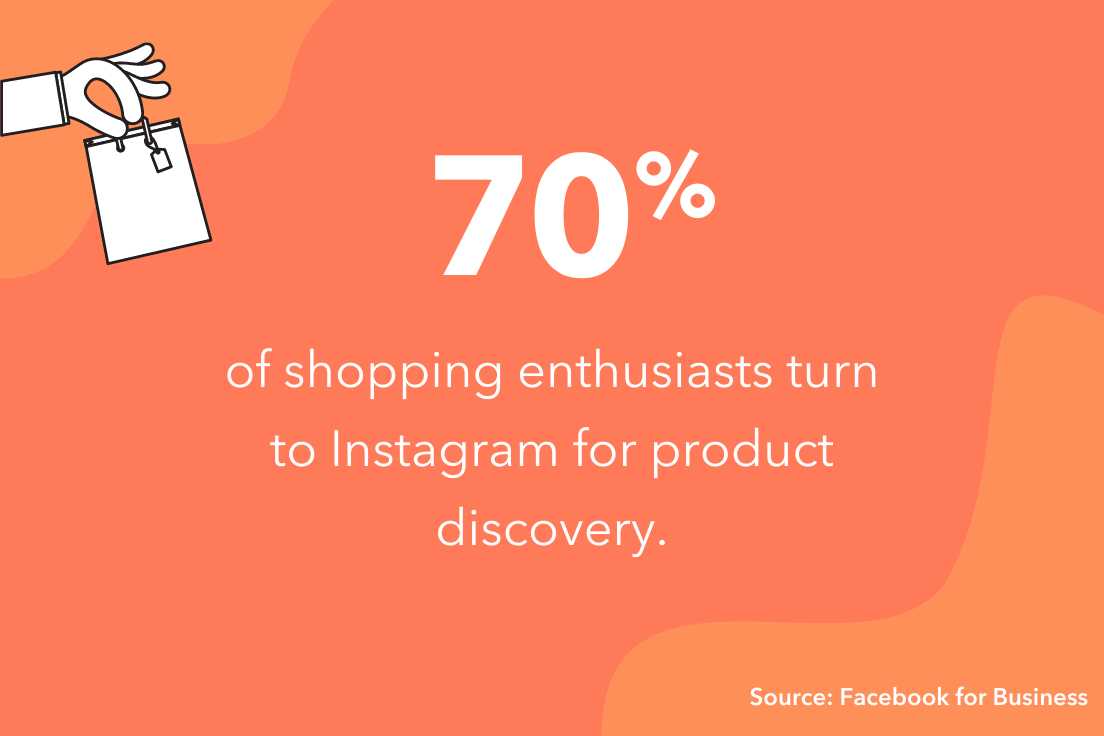
Social media has continued to be a prevalent marketing tactic for any company. In fact, it’s one of the main ways that Gen Z discovers new brands and products.

As long as you have a phone and a camera, you can dominate on social media by focusing on community building and engagement, and storytelling.

@qmdsuite We try our best not to keep our patients waiting and we love when our patients extend the same courtesy!
#blackdentist
#blackdentistsmatter
#blackdentistswhitecoats
#dentalhumor
#queensdentist
#smile
♬ original sound – A Bored Human

With that said, don’t assume you have to be everywhere.

“I always tell startups, ‘Choose your top three.’ You don’t need to be everywhere, work with what’s free and build your authority there,” says Behrooz.

To decide, figure out where your audience lives. Are you targeting Gen-Z? Then, TikTok should be a priority. Focusing on Millennials? Maybe your top three could be Facebook, Instagram, and Twitter. Looking for gamers? Go on Twitch or Discord.

To get started, consider using social media software like HubSpot’s Social Media Management Tools.

4. Increase community engagement.

According to our 2023 Social Media Trends report, social media marketers are seeing now more than ever the importance of building an active social community. 90% of those surveyed say building an active online community is crucial to a successful social media strategy in 2023.

This is reflected by data we collected in our Consumer Trends survey, in which 20% of social media users said they joined an online community within the last three months and 22% reported actively participating in one.

marketing without a budget: example of community engagement

Image Source

All this is to say that building a successful brand doesn’t happen without building a community. Doing so doesn’t have to cost money.

With limited funds, you can start online through Facebook Groups, email lists, and Discord channels.

It all depends on where your audience lives online. If you have a budget to work with, you can host or sponsor community events that bring you closer to your target audience.

5. Offer free trials or free resources.

While this might seem like a corporate or financial decision, offering a free trial period is actually a great marketing tactic.

“Free trials are a great way to prove value to your customers while on a budget,” says Apaydin. “If you believe in your product’s ability to sell itself to its customer, offering a free trial allows you to show them how you are solving their problem before they fully commit.”

Apaydin shares that by using free trials as an incentive to share their information with you, you can capture the lead and continue to nurture them until they are ready to purchase.

“You should let the customer have one foot into your product to experience how amazing it is. You’ll pamper them so much they’ll never want to leave,” Korrapati said.

Even if some don’t buy into your premium product, Korrapati adds, you’ll gain valuable feedback. Plus, you’ll discover pain points you didn’t know before – without spending additional money on market research.

A trial isn’t the only thing you can offer, you can also give information through ebooks, guides, white pages, case studies, and reports. Those are fantastic value-adds that build trust with your prospects and gain you leads – otherwise known as lead magnets.

6. Arrange giveaways.

According to O’Brien, giveaways are a powerful tool to sweeten the deal and incentivize prospects to convert or purchase. The best part? They don’t have to cost you anything.

“A common misconception is that you need a big budget to run giveaways. If cash is tight, companies can run giveaways with goods or services already in their possession,” she says. “For example, one hour of your time to provide consulting services in your area of expertise or a free trial of your services.”

marketing without a budget: giveaway example

Katey Gold, senior partner marketing manager at HubSpot, echoes this and adds that it all comes down to how you package it.

“If you’re asking your customer to take action to receive something, look at how you’re asking,” says Gold. “You need to make sure the customer believes they’re getting a sweet deal and not simply filling in another form to receive a gift that is available to all.”

7. Encourage user-generated content.

UGC is one of the best gifts a brand can get. Why? It serves as social proof, it’s reusable, and it can require little effort on your part.

UGC can look like:

  • A video testimonial from a customer
  • A social media post from a customer
  • A feature on a blogger’s or influencer’s website

With everyone having a phone with a camera and a microphone at their fingertips, user-generated content like customer testimonials no longer require a budget, says O’Brien.

user-generated content example

“Adding testimonials from real customers can add credibility to your marketing and provide social proof that customers are happy with your offering,” she adds.

Gold recommends thinking about how to incentivize your customers to create this content that will serve your company.

“While offering gift cards or swag usually does the trick, it’s worth thinking long-term,” she says. “How can you incentivize customers without having to spend money? It may be as simple as sharing a customer’s review on social media while tagging them in the post – you get UGC, while the customer gets recognition from your followers.”

You can also leverage user-generated content as part of a larger campaign.

For example, Lay’s has done a “Do Us a Flavor” campaign for years, where its audience submits new chip flavor ideas. It’s fun, engaging, and builds more visibility for the brand.

8. Host a webinar.

Inbound marketing is all about using helpful tactics to solve your audience’s problems and attract leads to your company. One way to do this is through webinars.

“Webinars are a great (and cheap) way to educate your customers across various stages of the funnel,” says Apaydin. “They require little to no financial investment and can often be hosted by your team as subject matter experts”

However, Behrooz says there’s one thing you should keep in mind when hosting one.

“You don’t want your webinar to be a sales pitch, you want your webinar to be something that’s educational,” says Behrooz. “[Otherwise], your audience will lose engagement.”

Apaydin echoes this sentiment and recommends starting with a problem your customers are facing.

“Panel discussions featuring your customers and/or partners help drive more interest in the event and also make it more engaging,” she says.

Additionally, you can use webinars to gather leads and build your email list. It’s a win all around.

9. Invest in SEO.

Want your audience to find you organically without paying for ads? Then you need to invest in your SEO strategy.

Building an SEO strategy can seem daunting but one way to simplify it is by focusing on two things: Your audience and Google.

The former because you’ll need to know which keywords to target to make sure you’re showing up when your audience is searching for you. And the latter is to make sure your website is formatted in a way that Google can read it.

A few pillars of SEO are:

  • Keyword research and analysis
  • Link building
  • Site architecture

Learn more about SEO here.

10. List your company on business directories.

Online directories like Yelp, Google My Business, and Facebook are where many consumers discover companies and it’s imperative that you maintain your listing.

Consumers not only find your company information, like name, address, and website but will also read reviews about your business.

Updating these directories is a free and quick way to optimize your online presence and make sure your audience finds you when they’re looking.

Ultimately, marketing doesn’t have to cost an arm and a leg. You can use several tactics with a tighter budget. In fact, most of the strategies above only require the staff it takes to produce the content.

Editor’s Note: This post was originally published in May 2020 and has been updated for comprehensiveness. 

New Call-to-action

Categories B2B

The Ultimate Guide to Technical SEO

List three things you’ve done this year that pertain to search engine optimization (SEO).

Do these tactics revolve around keyword research, meta descriptions, and backlinks?

If so, you’re not alone. When it comes to SEO, these techniques are usually the first ones marketers add to their arsenal.

While these strategies do improve your site’s visibility in organic search, they’re not the only ones you should be employing. There’s another set of tactics that fall under the SEO umbrella.

Technical SEO refers to the behind-the-scenes elements that power your organic growth engine, such as site architecture, mobile optimization, and page speed. These aspects of SEO might not be the sexiest, but they are incredibly important.

The first step in improving your technical SEO is knowing where you stand by performing a site audit. The second step is to create a plan to address the areas where you fall short. We’ll cover these steps in-depth below.

Pro tip: Create a website designed to convert using HubSpot’s free CMS tools.

Improve your website with effective technical SEO. Start by conducting this  audit. 

Technical SEO vs. On-Page SEO vs. Off-Page SEO

Many people break down search engine optimization (SEO) into three different buckets: on-page SEO, off-page SEO, and technical SEO. Let’s quickly cover what each means.

On-Page SEO

On-page SEO refers to the content that tells search engines (and readers!) what your page is about, including image alt text, keyword usage, meta descriptions, H1 tags, URL naming, and internal linking. You have the most control over on-page SEO because, well, everything is on your site.

Off-Page SEO

Off-page SEO tells search engines how popular and useful your page is through votes of confidence — most notably backlinks, or links from other sites to your own. Backlink quantity and quality boost a page’s PageRank. All things being equal, a page with 100 relevant links from credible sites will outrank a page with 50 relevant links from credible sites (or 100 irrelevant links from credible sites.)

Technical SEO

Technical SEO is within your control as well, but it’s a bit trickier to master since it’s less intuitive.

Why is technical SEO important?

You may be tempted to ignore this component of SEO completely; however, it plays an important role in your organic traffic. Your content might be the most thorough, useful, and well-written, but unless a search engine can crawl it, very few people will ever see it.

It’s like a tree that falls in the forest when no one is around to hear it … does it make a sound? Without a strong technical SEO foundation, your content will make no sound to search engines.

tree falls in forest cartoonSource

Let’s discuss how you can make your content resound through the internet.

Understanding Technical SEO

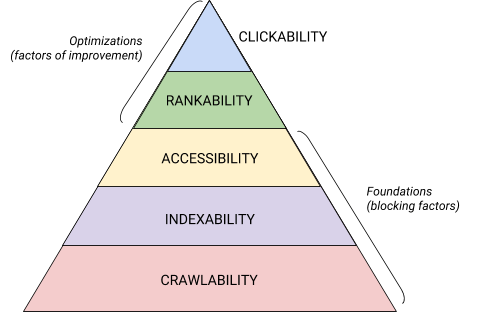
Technical SEO is a beast that is best broken down into digestible pieces. If you’re like me, you like to tackle big things in chunks and with checklists. Believe it or not, everything we’ve covered to this point can be placed into one of five categories, each of which deserves its own list of actionable items.

These five categories and their place in the technical SEO hierarchy is best illustrated by this beautiful graphic that is reminiscent of Maslov’s Hierarchy of Needs but remixed for search engine optimization. (Note that we will use the commonly used term “Rendering” in place of Accessibility.)
technical-seo-checklist-hierarchySource

Technical SEO Audit Fundamentals

Before you begin with your technical SEO audit, there are a few fundamentals that you need to put in place.

Let’s cover these technical SEO fundamentals before we move on to the rest of your website audit.

Audit Your Preferred Domain

Your domain is the URL that people type to arrive on your site, like hubspot.com. Your website domain impacts whether people can find you through search and provides a consistent way to identify your site.

When you select a preferred domain, you’re telling search engines whether you prefer the www or non-www version of your site to be displayed in the search results. For example, you might select www.yourwebsite.com over yourwebsite.com. This tells search engines to prioritize the www version of your site and redirects all users to that URL. Otherwise, search engines will treat these two versions as separate sites, resulting in dispersed SEO value.

Previously, Google asked you to identify the version of your URL that you prefer. Now, Google will identify and select a version to show searchers for you. However, if you prefer to set the preferred version of your domain, then you can do so through canonical tags (which we’ll cover shortly). Either way, once you set your preferred domain, make sure that all variants, meaning www, non-www, http, and index.html, all permanently redirect to that version.

Implement SSL

You may have heard this term before — that’s because it’s pretty important. SSL, or Secure Sockets Layer, creates a layer of protection between the web server (the software responsible for fulfilling an online request) and a browser, thereby making your site secure. When a user sends information to your website, like payment or contact info, that information is less likely to be hacked because you have SSL to protect them.

An SSL certificate is denoted by a domain that begins with “https://” as opposed to “http://” and a lock symbol in the URL bar.

hubspot secure ssl url

Search engines prioritize secure sites — in fact, Google announced as early as 2014 that SSL would be considered a ranking factor. Because of this, be sure to set the SSL variant of your homepage as your preferred domain.

After you set up SSL, you’ll need to migrate any non-SSL pages from http to https. It’s a tall order, but worth the effort in the name of improved ranking. Here are the steps you need to take:

  1. Redirect all http://yourwebsite.com pages to https://yourwebsite.com.
  2. Update all canonical and hreflang tags accordingly.
  3. Update the URLs on your sitemap (located at yourwebsite.com/sitemap.xml) and your robot.txt (located at yourwebsite.com/robots.txt).
  4. Set up a new instance of Google Search Console and Bing Webmaster Tools for your https website and track it to make sure 100% of the traffic migrates over.

Optimize Page Speed

Do you know how long a website visitor will wait for your website to load? Six seconds … and that’s being generous. Some data shows that the bounce rate increases by 90% with an increase in page load time from one to five seconds. You don’t have one second to waste, so improving your site load time should be a priority.

Site speed isn’t just important for user experience and conversion — it’s also a ranking factor.

Use these tips to improve your average page load time:

  • Compress all of your files. Compression reduces the size of your images, as well as CSS, HTML, and JavaScript files, so they take up less space and load faster. 
  • Audit redirects regularly. A 301 redirect takes a few seconds to process. Multiply that over several pages or layers of redirects, and you’ll seriously impact your site speed. 
  • Trim down your code. Messy code can negatively impact your site speed. Messy code means code that’s lazy. It’s like writing — maybe in the first draft, you make your point in 6 sentences. In the second draft, you make it in 3. The more efficient code is, the more quickly the page will load (in general). Once you clean things up, you’ll minify and compress your code.
  • Consider a content distribution network (CDN). CDNs are distributed web servers that store copies of your website in various geographical locations and deliver your site based on the searcher’s location. Since the information between servers has a shorter distance to travel, your site loads faster for the requesting party.
  • Try not to go plugin happy. Outdated plugins often have security vulnerabilities that make your website susceptible to malicious hackers who can harm your website’s rankings. Make sure you’re always using the latest versions of plugins and minimize your use to the most essential. In the same vein, consider using custom-made themes, as pre-made website themes often come with a lot of unnecessary code. 
  • Take advantage of cache plugins. Cache plugins store a static version of your site to send to returning users, thereby decreasing the time to load the site during repeat visits. 
  • Use asynchronous (async) loading. Scripts are instructions that servers need to read before they can process the HTML, or body, of your webpage, i.e. the things visitors want to see on your site. Typically, scripts are placed in the <head> of a website (think: your Google Tag Manager script), where they are prioritized over the content on the rest of the page. Using async code means the server can process the HTML and script simultaneously, thereby decreasing the delay and increasing page load time.

    Here’s how an async script looks: <script async src=”script.js“></script> 

If you want to see where your website falls short in the speed department, you can use this resource from Google.

Once you have your technical SEO fundamentals in place, you’re ready to move onto the next stage — crawlability.

Crawlability Checklist

Crawlability is the foundation of your technical SEO strategy. Search bots will crawl your pages to gather information about your site.

If these bots are somehow blocked from crawling, they can’t index or rank your pages. The first step to implementing technical SEO is to ensure that all of your important pages are accessible and easy to navigate.

Below we’ll cover some items to add to your checklist as well as some website elements to audit to ensure that your pages are prime for crawling.

1. Create an XML sitemap.

Remember that site structure we went over? That belongs in something called an XML Sitemap that helps search bots understand and crawl your web pages. You can think of it as a map for your website. You’ll submit your sitemap to Google Search Console and Bing Webmaster Tools once it’s complete. Remember to keep your sitemap up-to-date as you add and remove web pages.

2. Maximize your crawl budget.

Your crawl budget refers to the pages and resources on your site search bots will crawl.

Because crawl budget isn’t infinite, make sure you’re prioritizing your most important pages for crawling.

Here are a few tips to ensure that you’re maximizing your crawl budget:

  • Remove or canonicalize duplicate pages.
  • Fix or redirect any broken links.
  • Make sure your CSS and Javascript files are crawlable.
  • Check your crawl stats regularly and watch for sudden dips or increases.
  • Make sure any bot or page you’ve disallowed from crawling is meant to be blocked.
  • Keep your sitemap updated and submit it to the appropriate webmaster tools.
  • Prune your site of unnecessary or outdated content.
  • Watch out for dynamically generated URLs, which can make the number of pages on your site skyrocket.

3. Optimize your site architecture.

Your website has multiple pages. Those pages need to be organized in a way that allows search engines to easily find and crawl them. That’s where your site structure — often referred to as your website’s information architecture — comes in.

In the same way that a building is based on architectural design, your site architecture is how you organize the pages on your site.

Related pages are grouped together; for example, your blog homepage links to individual blog posts, which each link to their respective author pages. This structure helps search bots understand the relationship between your pages.

Your site architecture should also shape, and be shaped by, the importance of individual pages. The closer Page A is to your homepage, the more pages link to Page A, and the more link equity those pages have, the more importance search engines will give to Page A.

For example, a link from your homepage to Page A demonstrates more significance than a link from a blog post. The more links to Page A, the more “significant” that page becomes to search engines.

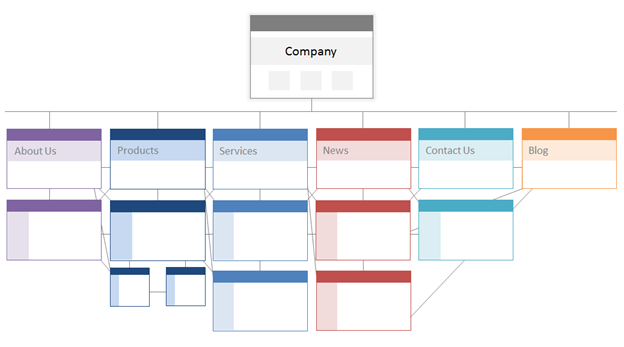
Conceptually, a site architecture could look something like this, where the About, Product, News, etc. pages are positioned at the top of the hierarchy of page importance.
site-architecture-technical-seo

Source

Make sure the most important pages to your business are at the top of the hierarchy with the greatest number of (relevant!) internal links.

4. Set a URL structure.

URL structure refers to how you structure your URLs, which could be determined by your site architecture. I’ll explain the connection in a moment. First, let’s clarify that URLs can have subdirectories, like blog.hubspot.com, and/or subfolders, like hubspot.com/blog, that indicate where the URL leads.

As an example, a blog post titled How to Groom Your Dog would fall under a blog subdomain or subdirectory. The URL might be www.bestdogcare.com/blog/how-to-groom-your-dog. Whereas a product page on that same site would be www.bestdogcare.com/products/grooming-brush.

Whether you use subdomains or subdirectories or “products” versus “store” in your URL is entirely up to you. The beauty of creating your own website is that you can create the rules. What’s important is that those rules follow a unified structure, meaning that you shouldn’t switch between blog.yourwebsite.com and yourwebsite.com/blogs on different pages. Create a roadmap, apply it to your URL naming structure, and stick to it.

Here are a few more tips about how to write your URLs:

  • Use lowercase characters.
  • Use dashes to separate words.
  • Make them short and descriptive.
  • Avoid using unnecessary characters or words (including prepositions).
  • Include your target keywords.

Once you have your URL structure buttoned up, you’ll submit a list of URLs of your important pages to search engines in the form of an XML sitemap. Doing so gives search bots additional context about your site so they don’t have to figure it out as they crawl.

5. Utilize robots.txt.

When a web robot crawls your site, it will first check the /robot.txt, otherwise known as the Robot Exclusion Protocol. This protocol can allow or disallow specific web robots to crawl your site, including specific sections or even pages of your site. If you’d like to prevent bots from indexing your site, you’ll use a noindex robots meta tag. Let’s discuss both of these scenarios.

You may want to block certain bots from crawling your site altogether. Unfortunately, there are some bots out there with malicious intent — bots that will scrape your content or spam your community forums. If you notice this bad behavior, you’ll use your robot.txt to prevent them from entering your website. In this scenario, you can think of robot.txt as your force field from bad bots on the internet.

Regarding indexing, search bots crawl your site to gather clues and find keywords so they can match your web pages with relevant search queries. But, as we’ll discuss later, you have a crawl budget that you don’t want to spend on unnecessary data. So, you may want to exclude pages that don’t help search bots understand what your website is about, for example, a Thank You page from an offer or a login page.

No matter what, your robot.txt protocol will be unique depending on what you’d like to accomplish.

6. Add breadcrumb menus.

Remember the old fable Hansel and Gretel where two children dropped breadcrumbs on the ground to find their way back home? Well, they were on to something.

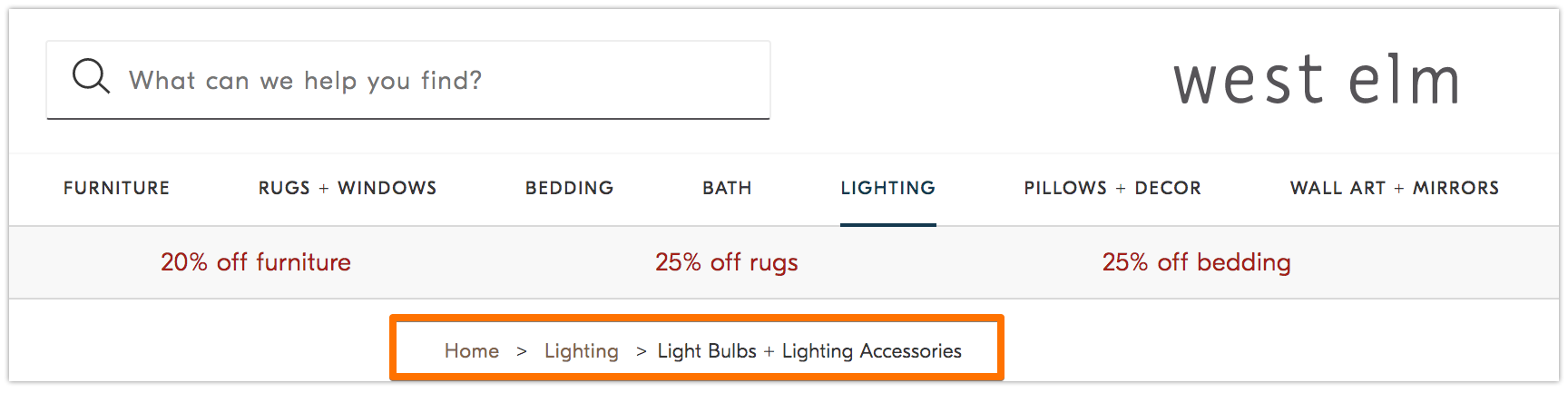
Breadcrumbs are exactly what they sound like — a trail that guides users to back to the start of their journey on your website. It’s a menu of pages that tells users how their current page relates to the rest of the site.

And they aren’t just for website visitors; search bots use them, too. breadcrumb-navigation-menu-technical-seo
Source

Breadcrumbs should be two things: 1) visible to users so they can easily navigate your web pages without using the Back button, and 2) have structured markup language to give accurate context to search bots that are crawling your site.

Not sure how to add structured data to your breadcrumbs? Use this guide for BreadcrumbList.

7. Use pagination.

Remember when teachers would require you to number the pages on your research paper? That’s called pagination. In the world of technical SEO, pagination has a slightly different role but you can still think of it as a form of organization.

Pagination uses code to tell search engines when pages with distinct URLs are related to each other. For instance, you may have a content series that you break up into chapters or multiple webpages. If you want to make it easy for search bots to discover and crawl these pages, then you’ll use pagination.

The way it works is pretty simple. You’ll go to the <head> of page one of the series and use

rel=”next” to tell the search bot which page to crawl second. Then, on page two, you’ll use rel=”prev” to indicate the prior page and rel=”next” to indicate the subsequent page, and so on.

It looks like this…

On page one:

On page two:

Note that pagination is useful for crawl discovery, but is no longer supported by Google to batch index pages as it once was.

8. Check your SEO log files.

You can think of log files like a journal entry. Web servers (the journaler) record and store log data about every action they take on your site in log files (the journal). The data recorded includes the time and date of the request, the content requested, and the requesting IP address. You can also identify the user agent, which is a uniquely identifiable software (like a search bot, for example) that fulfills the request for a user.

But what does this have to do with SEO?

Well, search bots leave a trail in the form of log files when they crawl your site. You can determine if, when, and what was crawled by checking the log files and filtering by the user agent and search engine.

This information is useful to you because you can determine how your crawl budget is spent and which barriers to indexing or access a bot is experiencing. To access your log files, you can either ask a developer or use a log file analyzer, like Screaming Frog.

Just because a search bot can crawl your site doesn’t necessarily mean that it can index all of your pages. Let’s take a look at the next layer of your technical SEO audit — indexability.

Indexability Checklist

As search bots crawl your website, they begin indexing pages based on their topic and relevance to that topic. Once indexed, your page is eligible to rank on the SERPs. Here are a few factors that can help your pages get indexed.

1. Unblock search bots from accessing pages.

You’ll likely take care of this step when addressing crawlability, but it’s worth mentioning here. You want to ensure that bots are sent to your preferred pages and that they can access them freely. You have a few tools at your disposal to do this. Google’s robots.txt tester will give you a list of pages that are disallowed and you can use the Google Search Console’s Inspect tool to determine the cause of blocked pages.

2. Remove duplicate content.

Duplicate content confuses search bots and negatively impacts your indexability. Remember to use canonical URLs to establish your preferred pages.

3. Audit your redirects.

Verify that all of your redirects are set up properly. Redirect loops, broken URLs, or — worse — improper redirects can cause issues when your site is being indexed. To avoid this, audit all of your redirects regularly.

4. Check the mobile-responsiveness of your site.

If your website is not mobile-friendly by now, then you’re far behind where you need to be. As early as 2016, Google started indexing mobile sites first, prioritizing the mobile experience over desktop. Today, that indexing is enabled by default. To keep up with this important trend, you can use Google’s mobile-friendly test to check where your website needs to improve.

5. Fix HTTP errors.

HTTP stands for HyperText Transfer Protocol, but you probably don’t care about that. What you do care about is when HTTP returns errors to your users or to search engines, and how to fix them.

HTTP errors can impede the work of search bots by blocking them from important content on your site. It is, therefore, incredibly important to address these errors quickly and thoroughly.

Since every HTTP error is unique and requires a specific resolution, the section below has a brief explanation of each, and you’ll use the links provided to learn more about or how to resolve them.

  • 301 Permanent Redirects are used to permanently send traffic from one URL to another. Your CMS will allow you to set up these redirects, but too many of these can slow down your site and degrade your user experience as each additional redirect adds to page load time. Aim for zero redirect chains, if possible, as too many will cause search engines to give up crawling that page.
  • 302 Temporary Redirect is a way to temporarily redirect traffic from a URL to a different webpage. While this status code will automatically send users to the new webpage, the cached title tag, URL, and description will remain consistent with the origin URL. If the temporary redirect stays in place long enough, though, it will eventually be treated as a permanent redirect and those elements will pass to the destination URL.
  • 403 Forbidden Messages mean that the content a user has requested is restricted based on access permissions or due to a server misconfiguration.
  • 404 Error Pages tell users that the page they have requested doesn’t exist, either because it’s been removed or they typed the wrong URL. It’s always a good idea to create 404 pages that are on-brand and engaging to keep visitors on your site (click the link above to see some good examples).
  • 405 Method Not Allowed means that your website server recognized and still blocked the access method, resulting in an error message.
  • 500 Internal Server Error is a general error message that means your web server is experiencing issues delivering your site to the requesting party.
  • 502 Bad Gateway Error is related to miscommunication, or invalid response, between website servers.
  • 503 Service Unavailable tells you that while your server is functioning properly, it is unable to fulfill the request.
  • 504 Gateway Timeout means a server did not receive a timely response from your web server to access the requested information.

Whatever the reason for these errors, it’s important to address them to keep both users and search engines happy, and to keep both coming back to your site.

Even if your site has been crawled and indexed, accessibility issues that block users and bots will impact your SEO. That said, we need to move on to the next stage of your technical SEO audit — renderability.

Renderability Checklist

Before we dive into this topic, it’s important to note the difference between SEO accessibility and web accessibility. The latter revolves around making your web pages easy to navigate for users with disabilities or impairments, like blindness or Dyslexia, for example. Many elements of online accessibility overlap with SEO best practices. However, an SEO accessibility audit does not account for everything you’d need to do to make your site more accessible to visitors who are disabled.

We’re going to focus on SEO accessibility, or rendering, in this section, but keep web accessibility top of mind as you develop and maintain your site.

Renderability Checklist

An accessible site is based on ease of rendering. Below are the website elements to review for your renderability audit.

Server Performance

As you learned above, server timeouts and errors will cause HTTP errors that hinder users and bots from accessing your site. If you notice that your server is experiencing issues, use the resources provided above to troubleshoot and resolve them. Failure to do so in a timely manner can result in search engines removing your web page from their index as it is a poor experience to show a broken page to a user.

HTTP Status

Similar to server performance, HTTP errors will prevent access to your webpages. You can use a web crawler, like Screaming Frog, Botify, or DeepCrawl to perform a comprehensive error audit of your site.

Load Time and Page Size

If your page takes too long to load, the bounce rate is not the only problem you have to worry about. A delay in page load time can result in a server error that will block bots from your webpages or have them crawl partially loaded versions that are missing important sections of content. Depending on how much crawl demand there is for a given resource, bots will spend an equivalent amount of resources to attempt to load, render, and index pages. However, you should do everything in your control to decrease your page load time.

JavaScript Rendering

Google admittedly has a difficult time processing JavaScript (JS) and, therefore, recommends employing pre-rendered content to improve accessibility. Google also has a host of resources to help you understand how search bots access JS on your site and how to improve search-related issues.

Orphan Pages

Every page on your site should be linked to at least one other page — preferably more, depending on how important the page is. When a page has no internal links, it’s called an orphan page. Like an article with no introduction, these pages lack the context that bots need to understand how they should be indexed.

Page Depth

Page depth refers to how many layers down a page exists in your site structure, i.e. how many clicks away from your homepage it is. It’s best to keep your site architecture as shallow as possible while still maintaining an intuitive hierarchy. Sometimes a multi-layered site is inevitable; in that case, you’ll want to prioritize a well-organized site over shallowness.

Regardless of how many layers in your site structure, keep important pages — like your product and contact pages — no more than three clicks deep. A structure that buries your product page so deep in your site that users and bots need to play detective to find them are less accessible and provide a poor experience

For example, a website URL like this that guides your target audience to your product page is an example of a poorly planned site structure: www.yourwebsite.com/products-features/features-by-industry/airlines-case-studies/airlines-products.

Redirect Chains

When you decide to redirect traffic from one page to another, you’re paying a price. That price is crawl efficiency. Redirects can slow down crawling, reduce page load time, and render your site inaccessible if those redirects aren’t set up properly. For all of these reasons, try to keep redirects to a minimum.

Once you’ve addressed accessibility issues, you can move onto how your pages rank in the SERPs.

Rankability Checklist

Now we move to the more topical elements that you’re probably already aware of — how to improve ranking from a technical SEO standpoint. Getting your pages to rank involves some of the on-page and off-page elements that we mentioned before but from a technical lens.

Remember that all of these elements work together to create an SEO-friendly site. So, we’d be remiss to leave out all the contributing factors. Let’s dive into it.

Internal and External Linking

Links help search bots understand where a page fits in the grand scheme of a query and gives context for how to rank that page. Links guide search bots (and users) to related content and transfer page importance. Overall, linking improves crawling, indexing, and your ability to rank.

Backlink Quality

Backlinkslinks from other sites back to your own — provide a vote of confidence for your site. They tell search bots that External Website A believes your page is high-quality and worth crawling. As these votes add up, search bots notice and treat your site as more credible. Sounds like a great deal right? However, as with most great things, there’s a caveat. The quality of those backlinks matter, a lot.

Links from low-quality sites can actually hurt your rankings. There are many ways to get quality backlinks to your site, like outreach to relevant publications, claiming unlinked mentions, providing relevant publications, claiming unlinked mentions, and providing helpful content that other sites want to link to.

Content Clusters

We at HubSpot have not been shy about our love for content clusters or how they contribute to organic growth. Content clusters link related content so search bots can easily find, crawl, and index all of the pages you own on a particular topic. They act as a self-promotion tool to show search engines how much you know about a topic, so they are more likely to rank your site as an authority for any related search query.

Your rankability is the main determinant in organic traffic growth because studies show that searchers are more likely to click on the top three search results on SERPs. But how do you ensure that yours is the result that gets clicked?

Let’s round this out with the final piece to the organic traffic pyramid: clickability.

Clickability Checklist

While click-through rate (CTR) has everything to do with searcher behavior, there are things you can do to improve your clickability on the SERPs. While meta descriptions and page titles with keywords do impact CTR, we’re going to focus on the technical elements because that’s why you’re here.

Ranking and click-through rate go hand-in-hand because, let’s be honest, searchers want immediate answers. The more your result stands out on the SERP, the more likely you’ll get the click. Let’s go over a few ways to improve your clickability.

1. Use structured data.

Structured data employs a specific vocabulary called schema to categorize and label elements on your webpage for search bots. The schema makes it crystal clear what each element is, how it relates to your site, and how to interpret it. Basically, structured data tells bots, “This is a video,” “This is a product,” or “This is a recipe,” leaving no room for interpretation.

To be clear, using structured data is not a “clickability factor” (if there even is such a thing), but it does help organize your content in a way that makes it easy for search bots to understand, index, and potentially rank your pages.

2. Win SERP features.

SERP features, otherwise known as rich results, are a double-edged sword. If you win them and get the click-through, you’re golden. If not, your organic results are pushed down the page beneath sponsored ads, text answer boxes, video carousels, and the like.

Rich results are those elements that don’t follow the page title, URL, meta description format of other search results. For example, the image below shows two SERP features — a video carousel and “People Also Ask” box — above the first organic result.
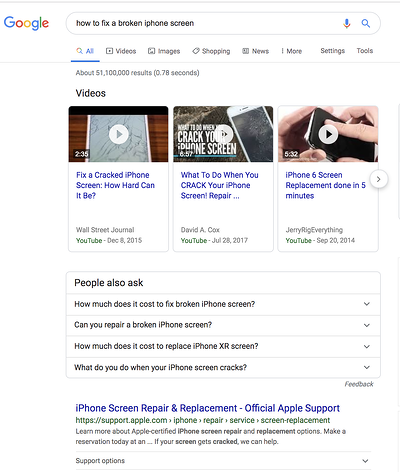
video carousel serp feature rich snippet showing results for how to fix an iphone screen

While you can still get clicks from appearing in the top organic results, your chances are greatly improved with rich results.

How do you increase your chances of earning rich results? Write useful content and use structured data. The easier it is for search bots to understand the elements of your site, the better your chances of getting a rich result.

Structured data is useful for getting these (and other search gallery elements) from your site to the top of the SERPs, thereby, increasing the probability of a click-through:

  • Articles
  • Videos
  • Reviews
  • Events
  • How-Tos
  • FAQs (“People Also Ask” boxes)
  • Images
  • Local Business Listings
  • Products
  • Sitelinks

3. Optimize for Featured Snippets.

One unicorn SERP feature that has nothing to do with schema markup is Featured Snippets, those boxes above the search results that provide concise answers to search queries.
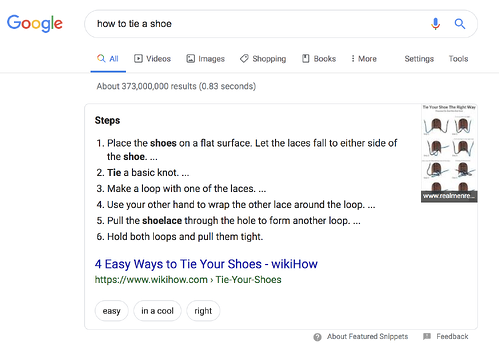
featured snippet example answering the query how to tie a shoe

Featured Snippets are intended to get searchers the answers to their queries as quickly as possible. According to Google, providing the best answer to the searcher’s query is the only way to win a snippet. However, HubSpot’s research revealed a few additional ways to optimize your content for featured snippets.

4. Consider Google Discover.

Google Discover is a relatively new algorithmic listing of content by category specifically for mobile users. It’s no secret that Google has been doubling down on the mobile experience; with over 50% of searches coming from mobile, it’s no surprise either. The tool allows users to build a library of content by selecting categories of interest (think: gardening, music, or politics).

At HubSpot, we believe topic clustering can increase the likelihood of Google Discover inclusion and are actively monitoring our Google Discover traffic in Google Search Console to determine the validity of that hypothesis. We recommend that you also invest some time in researching this new feature. The payoff is a highly engaged user base that has basically hand-selected the content you’ve worked hard to create.

The Perfect Trio

Technical SEO, on-page SEO, and off-page SEO work together to unlock the door to organic traffic. While on-page and off-page techniques are often the first to be deployed, technical SEO plays a critical role in getting your site to the top of the search results and your content in front of your ideal audience. Use these technical tactics to round out your SEO strategy and watch the results unfold.

Improve your website with effective technical SEO. Start by conducting this  audit.  


Categories B2B

14 of the Best Mind Mapping Software to Brainstorm Better Ideas

One of the worst feelings in the world is forgetting a great idea. All you had to do was write it down, but you were confident that you’d never be able to forget something so compelling. When it slid out of your mind, though, the easy loss of such an insightful thought nearly crushed your soul.

Taking the time to jot down your ideas right when they pop into in your head is one of the best ways to remember them and, ultimately, bring them to life.

But if your idea has a lot of moving parts, like a big project, you need to do more than just write your vision down on a piece of paper — it’ll be too scattered and disconnected. The best way to brainstorm, structure, and implement a vision is by visually organizing its data and information. Click here to sharpen your skills with the help of our content marketing  workbook.

Looking at concepts, rather than just reading about them, has always been the best way to learn and remember. In fact, humans can process visual information two times faster than the blink of an eye

To visually flesh out almost any multi-faceted or complex concept, ranging from product launches to organization charts to the list of Oscar-nominated movies you haven’t seen yet, mind maps are your best tool.

Most mind mapping software is also cloud-based and collaborative, so if you want to enhance your project’s clarity, cooperation, and execution, check out this list of the best mind mapping software, ranked by G2Crowd.

14 of the Best Mind Mapping Software for Brainstorming Better Ideas

1. MindGenius

Visual cues help us process and retain information better than text. Using MindGenius, you can structure your ideas in a visually appealing way with an assortment of colors and photos from their built-in image library.

The software also has a collection of mind map templates with different visual styles, so you can brainstorm and implement your plans faster than you could starting from a blank canvas.

G2Crowd Rating:

4.9/5.0 (16 Reviews)

Price:

Subscription Plan – $232 for first year and $56 for second year onwards

One-Time Cost Plan – $392

2. MindManager

MindManager is like a virtual whiteboard. You can easily add ideas, place them wherever you like, and draw connections between them. You can also track the progress of your projects by adding its due dates, priorities, and resources.

MindManager’s most helpful feature is its dashboard map, which integrates all of the data related to your idea or project in one place for everyone on the project to view and access.

G2Crowd Rating:

4.6/5.0 (27 Ratings)

Price:

One-Time Cost of $349 on Windows

One-Time Cost of $179 on Mac

3. ClickUp Mind Maps

ClickUp is an all-in-one productivity tool for individual users and teams across industries to manage projects, collaborate smarter, and work together in one place. Known for its feature-rich experience, ClickUp is designed to help you act on your ideas instantly. ClickUp offers also over 15 ways to view your work including its highly visual Mind Maps to organize the flow of projects, ideas, and tasks in an outline that automatically updates as you progress. Build your Mind Map from scratch or with a template and draw connections between tasks to create a detailed diagram that can be easily edited at any time.

G2Crowd Rating:

4.7/5.0 (4,431 Ratings)

Price:

Free plan available, paid plans starting at $5/month (full pricing options here)

4. Venngage Mind Map Maker 

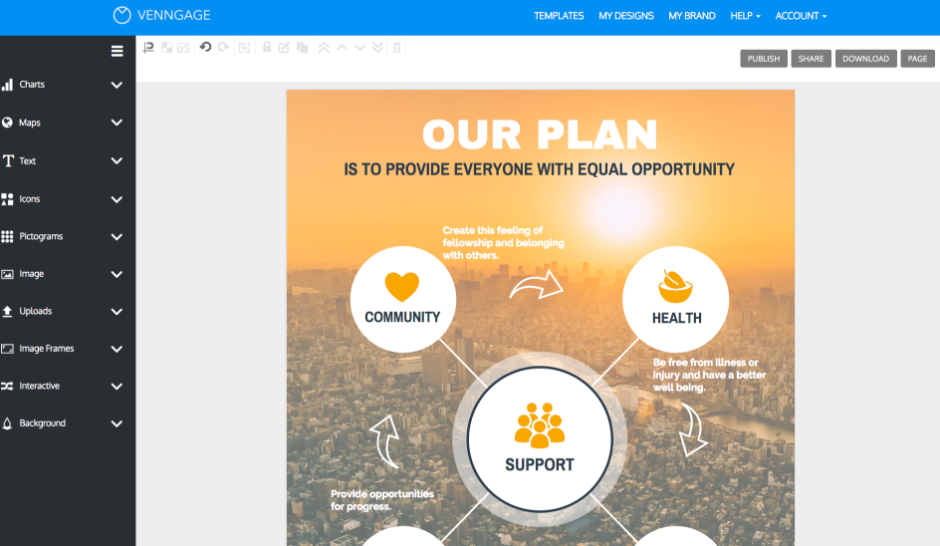
Screen Shot 2019-06-06 at 10.44.27 AMVenngage is already known as an infographic maker and design software, but they’ve recently ramped up their range of mind and diagram templates to help you visualize your strategies in an appealing way. The key differentiator between Venngage’s Mind Map Maker and other diagramming tools is the emphasis placed on communicating complex information in a captivating way.

There are a wide range of professionally designed templates to choose from, and also access to 24-hour support.

G2Crowd Rating:

4.7/5.0 (49 Ratings)

Price: 

$49/Month for a business plan (full pricing options here)

5. Miro

Miro’s interactive Mind Map tool enables distributed and remote teams to collaborate, brainstorm, and build on shared digital canvas. Their product creates a convenient, centralized hub for teams to organize assets, strategize, stay aligned, and work together in real time. 

With hotkeys, color coding, and marketplace integrations, all of your team’s files and project information can live in one place so you can quickly capture, organize and visualize your ideas. 

Price: Free plan available, paid plans starting at $8/month (full pricing here)

6. Creately

creately

With more than 50 types of diagrams and thousands of examples and libraries, Creately lets you quickly flesh out your ideas using their templates. But if you want to create a mind map from scratch, you can still visualize your ideas in a timely fashion by leveraging features like click-to-create, drag-and-drop, and smart shapes, which adapt its size to its location on your map.

Some of Creately’s most useful features are its importing and sharing capabilities. Importing Microsoft Visio files into the software is seamless, and when you’ve finished your project, you can embed private diagrams on your wiki pages and export them into Adobe Illustrator or Inkscape for further modification.

G2Crowd Rating:

4.5/5.0 11 Ratings)

Price:

Public Plan – Free For 5 Public Diagrams

Personal Plan – $5 per month

5 User Team Plan – $25 per month

10 User Team Plan – $45 per month

25 User Team Plan – $75 per month

7. XMind8 Pro

XMind 8 is one of the most popular mind mapping software, featuring a decade-long market presence and millions of users. In the software, you can make your mind maps look more engaging with different themes, fonts, and over 60,000 icons, easily collaborate with others by saving your mind maps to Evernote, and present your mind maps by turning them into slideshows.

One of XMind 8’s main advantages over other mind mapping software is that you can track your project’s progress with its Gannt View, which shows you the start date, end date, and development of each project.

G2Crowd Rating:

4.4/5.0 Rating (24 Ratings)

Price:

One-time cost of $129

8. Lucidchart

Lucidchart is an intuitive, collaborative, and secure mind mapping software. With drag-and-drop functionality, group chat and comments, and revision history, your team can easily create and edit your mind maps.

If your team plans to map out sensitive ideas that need an extra layer of privacy, Lucidchart also offers more security options than other similar software. They partner with Amazon Web Services and leverage data encryption to protect, backup, and secure your data.

G2Crowd Rating:

4.2/5.0 (12 Ratings)

Price:

Single User Basic Plan – $4.95 per month

Single User Pro Plan – $9.95 per month

Team Plan – Starts at $27 per month

Enterprise – Contact Sales

9. MindMup

By helping users structure their stories and measure their projects’ cost and progress, MindMup is arguably the best mind mapping software for marketers. In the software, you can create storyboards, post your maps to social media, and calculate the cost of your projects by adding measurements to your map nodes.

MindMup maps are also compatible with Google Drive, so you can conveniently create your maps right in the app and manage them like any other Google Drive file.

G2Crowd Rating:

4.2/5.0 (5 Ratings)

Price

Free User Plan – Free 

Personal Gold Plan – $2.99 per month

Organisational Gold – $100 per year

10. Cacoo

Just like other mind mapping software, Cacoo provides a lot of collaboration tools to improve your team’s workflow. But Cacoo offers more robust organization tools, like Folders, which can save and store updates and comments to your team’s assets directly in the software.

You can also enhance your productivity with Cacoo by leveraging their integrations with Backlog, Typetalk, Google Drive, Adobe Creative Cloud, and Confluence.

G2Crowd Rating:

4.1 / 5.0 (20 Ratings)

Price:

Single-user Plan – $4.95 per month

Team Plan – Starts at $18 per month

Enterprise Plan – $600 per year

11. SmartDraw

With over 4,500 templates, 70 different diagrams, and availability in 100 languages, Smartdraw is a mind mapping software catered for a lot of different countries and almost every industry. But even though it’s one of the most robust mind mapping software, its automation and user-friendly interface make it intuitive and easy to use.

SmartDraw also integrates with the most popular tools in the workforce, like Microsoft Office, G Suite, Confluence, Jira, and Trello, helping you collaborate with your team across the tools you’re already using.

G2Crowd Rating:

4.1/5.0 (19 Ratings)

Price:

Single User Plan – $9.95 per month

5+ Users Plan – Starts rom $5.95 per month

12. Bubbl.Us

Bubbl.us is a simpler mind mapping software than most, but since it offers all the essential mind mapping features at such an affordable price, its a steal.

With Bubbl.us, you can create and edit mind maps on any device, use templates, add colors, share them and collaborate with colleagues, and export them as images or presentations.

If you work on a small team and need an affordable yet dependable mind mapping software, Bubbl.us could be an ideal solution.

G2Crowd Rating:

4.1/5.0 (15 Reviews)

Price:

Free – Free

Premium – $4.91 per month

13. MindMeister

MindMeister is completely web-based, so you can develop your ideas from any computer, share, and collaborate with as many colleagues as you want, all in real time. There’s also an integrated chat tool that lets you vote on ideas and discuss changes within the tool

MindMeister’s most powerful feature is probably its presentation mode, where you can visually communicate your ideas and plans to colleagues or customers by turning mind maps into slideshows, exporting the slides as PNGs, and embeding presentations into your website.

G2Crowd Rating:

4.0/5.0 (6 Reviews)

Price:

Basic – Free

Personal – $4.99 per month

Pro – $8.25 per month

Business – $12.49 per month

14. Coggle

Coggle is a web-based mind mapping software that lets you visually breakdown your ideas with your colleagues. Just like Google Docs, Coggle makes sure you’ll never lose any of your valuable ideas by letting you see all the change made to your mind map, make a copy of any iteration, and revert the diagram to any of its previous versions.

G2Crowd Rating:

4.0/5.0 (5 Reviews)

Price

Free – Free 

Awesome – $5 per month

Organization – $8 per member per month

Enterprise – Contact Sales

New Call-to-action

Categories B2B

25 Slack Tips to Make You and Your Team More Effective

Slack changed workplace communication. It can be a helpful tool or an amusing diversion — and this makes Slack tips essential to cut through the noise.

Slack is capable of so much that it’s hard to uncover what features you really should be using. To help, we put together some of the best Slack tips and tricks below.

Download our complete workplace productivity guide here.

From creating to-do lists to customizing your theme, these pro tips are worth showing off to your team. Scan the full list of Slack tricks or jump to the section you’re looking for:

Why You Need Tips for Using Slack

Any tool can make your workday more effective and productive. That’s the goal. But it doesn’t always work out that way.

In 2020, offices around the world went through a series of seismic changes. Many teams went remote for the first time. And workplace leaders found themselves looking for digital solutions that could help workers:

  • Build and keep social bonds
  • Answer quick questions
  • Check in on each other
  • Hold social workplace events
  • Send quick thank yous
  • Share updates

Slack was an answer to these questions and more.

This platform organizes chat conversations into channels. It makes it easy to have informal conversations or organized group conversations. This helps in-office and remote teams trade ideas and make decisions together. It can also give teams at-a-glance knowledge of office status, connect docs from different tools, and offer helpful reminders.

Slack is a great way to connect and collaborate. But it can take time to learn the most helpful features. A beginner’s guide to Slack is the best place to start.

Once you have the basics down, the tips below can help you advance your Slack game for more productivity, fun, and connection.

Best Slack Tips for Productivity

1. Sort Slack channels for easy scanning.

The larger your organization is, the more channels your team will have. This seems fine at first, and it lets teams create distinct conversations for work and play. But as channel notifications grow, so will the possibility of Slack overwhelm.

Businesses using Pro, Business+, or Enterprise Grid plans on Slack can add channels, direct messages, and apps to custom sections in the sidebar. Custom sections are just for you, and won’t impact anyone else on your team, so you can organize them in a way that works best for you.

create-section

To create a custom section, click the + at the top right of your top channel in the left navigation menu. Then select “Create a new channel” or “Create a new section.” You can select from the current options or add a unique emoji and name for a custom section.

Note: You can only create custom sections on a desktop computer. But once you’ve added them you’ll be able to use them on both desktop and mobile.

2. Pause notifications for focused work time.

Different work cultures have different expectations for availability on Slack. But there are times when employees need some uninterrupted work time. So, instead of closing a door or hanging a “Do Not Disturb” sign, pause your notifications.

This gives a simple signal to your team so you can get the focused time you need. To pause your notifications, click on your profile. Then, scroll to “Pause notifications” and choose the amount of time that’s best for you.

Slack tips: Pause notifications

You can also set a notification schedule. This is extra helpful for teams that work across different time zones. It helps everyone understand when you’re available to respond quickly, and when getting a response may take more time.

3. Pin messages and links for easy recall.

Slack can also be the digital bulletin board at the center of your office. When you “pin” a message, you’re saving it for the full team in that conversation or channel. This makes it easy for everyone to revisit important learning, documents, and comments.

To pin a message, hover over the message, then click on the three dots in the top right-hand corner. Then, scroll down to “Pin to channel.” The selected message background will change color, and display a message at the top that says “Pinned by [your name].” You can also use the top bar to search for pinned posts.

Slack tips: Pinned items

4. Adjust your sidebar to show unread channels only.

As the number of channels you subscribe to grows, you may be looking for strategies to cut down on overwhelm. Some choose to mute channels, but that can mean missing important communication. Others make an update to the “Channels” section to highlight what they haven’t read yet.

Slack tips: Unread channels

To make this update, head to the “Channels” section in your left-hand sidebar. Hover over Channels, click the three dots to the right, then scroll to “Show” > “Unread channels only.”

5. Connect your tools to Slack.

Another feature of Slack that helps you ramp up productivity is its connectivity. Whether you’re sharing sensitive documents or running a fun icebreaker with your team, there are over 2000 Slack integrations you can use.

For example, many teams are already using Google Drive to create and store files online, so why not get the best of both worlds? When you connect your Google Drive with Slack, you have the ability to read and index imported files, and quickly search for them whenever you need them.

There are two ways to connect your Google Drive to Slack:

If you have a Google Drive link you want to share, simply paste it into a message box. This will prompt Slackbot to deliver the following message:

Slack tips and tricks: Google Drive

Click “Yes” to grant Google Drive permission to read the file.

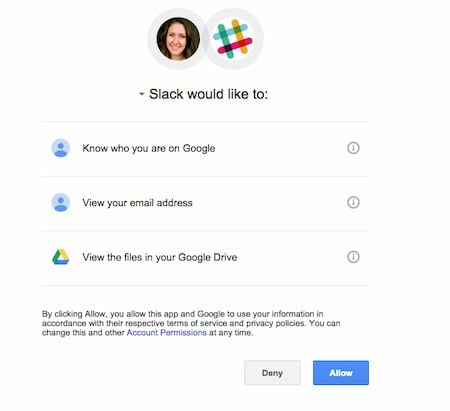
If you don’t have a file you’re ready to share, but want to connect Google Drive for future use, visit the Google Drive app page. From here, click “Configure” next to your team name, then click “Authenticate your Google Drive Account” > “Allow.”

Slack tips and tricks: Connect to Slack

HubSpot customers: If you want to integrate Slack even deeper into your office processes, check out this article that shows you how to make the most of your Slack integration.

6. Use the /remind commands to create a to-do list.

Set a Slackbot reminder to help you keep track of what you need to get done. To get started, simply enter /remind into the text box, followed by your task. (Note: Only you will be able to see the command and the reminder.)

You can schedule a reminder for a specific time or set a date using the MM/DD/YYYY format. Slack recommends this structure for a reminder: /remind [@someone or #channel] “[what]” [when].

Slack tips: Remind

If you want to review your list of reminders, simply use the command /remind list. From there, you can mark certain tasks as complete or delete the ones you no longer need.

Slack tips: Remind list

7. Quickly send a private message using the /msg command.

Sometimes we find ourselves with questions that call for the attention of everyone in a specific channel. You know, important things such as, “Does anyone have a stapler?” or “Who’s free for lunch?”

After you ask a question, avoid any further disruption by following up with people with a private message. For example, once you know Steve is free to grab a bite to eat, use the following command to quickly open up a private message to hash out the details: /msg @user [your message].

8. Jump to recent conversations in seconds.

If you’ve got a really big team, it’s likely that you’re involved with quite a few Slack channels. To quickly and easily switch from a channel to a private message back to a different channel, hit ⌘ + K (Mac) or Ctrl + K (Windows and Linux).

A pop-up will appear where you can begin typing a person or channel and select the correct option to open the conversation.

9. Create a to-do list using Saved Items.

Saved items on Slack are a way to mark a task as important, like pinned messages. But only you can see your saved items, so they can be useful for personal reminders.

To save an item, simply move your mouse to a message or file and select the flag outline to make it turn red. Then, to view your saved items, click Saved items at the top of the left navigation menu.

Slack tips: Saved items

Saving requests and files that you need to work on makes it easy for you to create a to-do list on the fly.

10. Conduct advanced searches.

One of the great things about Slack is that messages and files are easily searchable. Because channels move so fast, you can use these advanced search commands to pull up exactly what you’re looking for without wasting any time.

Channels and Direct Messages

  • in:channelname – Searches only the messages and/or files in a specific channel.
  • in:name – Searches your direct messages with a specific user.

Messages or Files From a Specific Person

  • from:username – Limits your search to messages from a specific person in any channel or direct message.
  • from:me – Searches only messages you’ve sent, anywhere in Slack.

Links, Saved Items, and Emoji Reactions

You can narrow your search to messages that contain a URL, messages you’ve saved, or messages that contain a specific emoji using search results filters.

Slack tips: Search options

Dates and Times

  • before: Use the pop-up to search for messages sent at a specific time.
  • after: Use words like “week,” “month,” or “year.”
  • on: or during: Use specific dates and range keywords, such as “Monday,” “February,” or “2023.”

Slack tips: Before

Pro tip: To use specific dates, use the MM/DD/YYYY (United States) or YYYY/MM/DD (International) format.

11. Add notifications for keywords and phrases.

Managing a specific project? Trying to keep tabs on a department or activity? Adjusting your settings to enable custom notifications can be a huge time saver.

Slack tips: Keywords

To get notified when a specific word or phrase is mentioned, start by selecting your name from the top left corner. Then, click “Preferences” from the drop-down menu. From there, select “Notifications” and scroll down to “My keywords.” In the text box, add words or phrases that you’d like to be notified about (making sure to separate them by commas).

12. Create naming conventions for channels.

Naming your channels in a way that’s simple and consistent helps you engage more users. No more sending an email, texts, AND Slack for every message. Instead, you’ll be able to trust that people on your team are seeing the content you need them to see.

To make this happen, make sure channel names are consistent with what your team already knows. Clever names and inside jokes can seem fun at first, but over time they can create confusion.

Instead, name channels for major departments and topics. Then, use Slack’s default prefixes as a guide when it’s time to add channels for new and more specific channels and sections.

For more productivity tips, check out this guide to being more productive.

Productivity guide, HubSpot

More Slack Tips and Tricks

13. Toggle between statuses using /away or /active commands.

If you have to step away from your computer or head to a meeting, make it clear by adjusting your status. To quickly toggle between “away” and “active,” use the /away command.

For more quick commands, type /shortcuts to open the keyboard shortcuts panel.

14. React with a GIF.

Let’s face it: We all love GIFs. And thanks to the Giphy integration, you can share hilarious GIFs with your coworkers using the /giphy [emotion, word, or phrase] command.

Slack tips: Giphy

To set up the Giphy app, visit this page. From here, all you’ll have to do is click “Install” next to your team name, then click “Add Giphy Integration.”

Note: Giphy can be a hit or miss. Sometimes the GIFs are NSFW or not quite right for the situation. But, if you don’t mind gambling with the results, this hack is easy to set up.

15. Create quick polls with emoji reactions.

Words are hard. Sometimes it’s a lot easier to let our coworkers know how we feel by reacting with an emoji. And on Slack, it’s easy. Simply hover over a message and select the smiley face icon with the plus sign to select an emoji.

Want to take things a step further? Reaction emojis make it really easy to quickly poll your team. Here’s a fun example:

Slack tips: Emoji poll

16. Add text and link formatting to your Slack messages.

Want to call out text, make edits, display a link, or share code? Reference the following syntax:

  • Slack link formatting: To share a link with a preview image, just send a URL in a message. Slack will automatically create a preview unless a user has their preview settings turned off.
  • Emphasis: To create bold text, surround your word or phrase with *asterisks.* To italicize text, place _underscores_ around a section.
  • Strikethrough: To strike out certain words, use ~tilde~ to surround the text.
  • Lists: To create lists, select “Shift” + “Enter” to add a new line. To add bullet points, select Opt+8 (Mac) or Alt+0149 (PC).
  • Insert a paragraph break: If you want to break up words without using a list, use a soft return. Instead of hitting enter at the end of a sentence, which will send the message, hold shift and tap the enter key to start a new line.
  • Blockquotes: To add angle brackets at the start of your message for indents and quotes, type “>” to indent a single line.

17. Edit messages you’ve already sent.

We’ve all said things we wish we could take back. And with Slack, you can — kinda. To quickly edit a message you’ve sent in a conversation, press the ↑ arrow key, edit your message, then press “Enter.”

This feature is especially useful when you do something terribly embarrassing, like use the wrong form of “their”:

Slack tips: Edit comments

18. Customize your Slack theme.

Whether you use Slack for different groups and want to stay organized, or you just want to personalize the look and feel of your account, you can adjust your theme by selecting your name in the top left corner.

Slack tips: Themes

From the drop-down menu next to your name, select “Preferences” > “Themes.” From here, you can explore and select themes or scroll down to “Custom Theme” to put in your own HTML color values.

19. Create your own emoji.

To get started, click the emoji icon in any Slack chat window. Then, click the “Add Emoji” button on the bottom left-hand side.

Slack tips: Custom emoji

Fill out the form to create your custom emoji. First, you’ll need to upload an emoji image. Then, provide a name for the icon — this is what you will enter to display the emoji.

Slack asks that you use a square image no larger than 128px in width or height, with a file size smaller than 64K. To remove the background from the image (as seen in the Ryan Gosling example below), check out this tutorial.

Slack tips and tricks: Custom emoji

20. Pull swatches using HTML color codes.

Collaborating with another team member on a design project? Make quick color suggestions using HTML color codes. When you type out a code — #F7761F, for example — you’ll see a tiny swatch appear, like this:

Slack tips and tricks: Color code swatches

21. Shake it off with a shruggie.

Don’t know the answer? Made a little mistake? Need to signal to your coworker that you actually have no idea what’s going on at this meeting? Send ’em a shruggie.

Slack tips and tricks: Shrug

Serving as the “default Internet feeling,” a shruggie will say everything you need to say without saying anything at all. To pull it up, enter the /shrug command.

22. Update your profile to show when you’re OOO.

Whether you’re OOO on vacation or out on parental leave, you can signal this to your coworkers by adjusting your status on Slack.

To edit your status, click your profile in the top right corner. Then, click the “Set a Status” button to choose a status option or create a unique status with the “What’s your status?” box at the top. Select your status, then click “Save.” This will open a second pop-up window where you can set the timing for your status. Click “Save” again, and you’re all set.

Slack tips: Update status

23. Use the /collapse and /expand commands to open and close files.

Weeding your way through a sea of GIFs to get to the comment you’re looking for? You can collapse all inline images and video by using the /collapse command.

Slack tips: Collapsed

When you need to reference the visuals again, simply enter /expand to make them reappear.

Slack tips: Expand

24. Try /mute to limit distractions.

Maybe you’re new and want to learn about a department, but don’t need to participate. Maybe you’re curious about a new channel, but aren’t sure how much time you’ll have to join the conversation. To update your channels so you have easy access but don’t get distracted by constant notifications, mute the channel.

Slack tips: Mute

To mute, click on the channel name. Then, click on the “Get Notifications” button in the center at the top of the pop-up. Scroll down and select “Mute channel.” You can also type /mute to silence a channel or DM, or type /unmute to activate it again.

25. Play games on Slack for remote team building.

Games and icebreakers are a way to bring members of a team together. They can help people loosen up, preparing them for creativity and collaboration. You can use apps like Polly to create trivia games or other apps to play chess, rock-paper-scissors, and more.

Want to learn more about Slack?

When the HubSpot team first made the switch to Slack, it was hard to get used to. But once we got more comfortable with the platform, we started to realize just how powerful it really is.

The more we used Slack, the better our discoveries got — GIFs, reminders, files — they were all just a click or two away.

We hope the 25 handy Slack tips above help you make your conversations more productive, efficient, and fun too.

Editor’s note: This post was originally published in February 2016 and has been updated for comprehensiveness.

New Call-to-Action

Categories B2B

What Delta’s SkyMiles Program Campaign Tells Us About the Future of the Travel Industry

Welcome to HubSpot Marketing News! Tap in for campaign deep dives, the latest marketing industry news, and tried-and-true insights from HubSpot’s media team.

Are rewards programs keeping airlines afloat? They just might be.

Delta Airlines is taking a different marketing approach in its latest video called “Grow Your World With Every Mile” highlighting its SkyMiles program.

The program was initially launched as the “Delta Airlines Frequent Flyer Program” in 1981 and was renamed SkyMiles in 1995. The recent ad spot marks Delta’s first major investment in marketing the loyalty program. Why the recent focus on marketing a 42-year-old program?

Unsurprisingly, the COVID-19 pandemic.

How Airlines Are Creating Their Own Banks

Though travel demand and spending decreased due to the pandemic in 2020, Delta was able to generate cash by raising $6.5 billion through the SkyMiles program and payouts from its co-branded credit card partnership with American Express.

Delta isn’t alone in using this approach — United used a similar strategy to generate cash from its loyalty program during the pandemic, and recent reports have found that some popular rewards programs are worth more than the airlines.  

In late 2020, Delta created its subsidiary SkyMiles IP Ltd. which essentially serves as the company’s own “bank” that it can purchase miles from to use as financial leverage.

With this move, the success of the SkyMiles program is now integral to the success of Delta, so investing in the program’s growth is a no-brainer for the company. The more miles it can award loyal customers, the more potential capital the airline can leverage if travel demand dips again.

“Grow Your World With Every Mile” may have been the first piece of content we’ve seen promoting Delta SkyMiles, but it certainly won’t be the last.

Marketing Snippets

airport-two-hours-earlyImage Source

The latest marketing news and strategy insights.

Twitter announced it will limit two-factor authentication to Twitter Blue subscribers.

Meta introduced a paid verification option and is testing the subscription in Australia and New Zealand.

YouTube is testing podcast management capabilities in its creator studio.

Instagram rolled out a broadcast channels feature to help creators connect with their audiences.

TikTok is launching a Creativity Program Beta to help users foster creativity and generate revenue on the platform.

Spotify is introducing a TikTok-inspired vertical feed.

New call-to-action

Categories B2B

How to Write an Effective Email: 13 Pro Email Writing Tips

Have you ever had to hype yourself up to send an email? We have too.

Writing compelling professional emails is a superpower that most professionals would love to have. Email is the most common form of professional communication, and sending bad emails can make or break your career.

Download Now: 25 Sales Email Templates  [Free Access]

This article will provide some tips to help you improve the overall quality of your emails. Once you’ve applied these simple strategies to your writing, you should be able to confidently send emails to anyone and get rid of that post-send anxiety.

But first, let’s talk about your goals. What purpose do you want your email to achieve?

Define your email goals.

Writing Effective Emails

How To Write An Effective Email

1. Use a professional email address.

2. Have a compelling subject line.

3. Start with an appropriate greeting.

4. Have a strong attention grabber.

5. Keep your message concise.

6. Be consistent with your font.

7. Check the tone of your message.

8. Write a simple closing.

9. Use a professional signature

10. Use CC and BCC fields wisely.

11. Schedule your emails.

12. Do a final spelling and grammar check.

13. Schedule a follow-up reminder.

Email Writing Tips for International Teams

Imagine receiving the email you’re writing.

Write like you talk.

Get email etiquette right for each work situation.

Define your email goals.

Writing an email is like creating a meal. Just as a chef needs to carefully select and prepare ingredients to create a delicious dish, you need to carefully choose your words and organize your thoughts to create a clear and effective email.

Before you start writing the email, it might help to define your email goals first. Ask yourself the following questions:

  • What purpose do you want to achieve with this email?

  • What are the main points you want the reader to understand?

  • How can you get readers to understand those points concisely?

  • What is the appropriate email etiquette or tone for this recipient?

Defining these elements can help you write quick, effective, and compelling emails.

Think about the last time you received a poorly written email. You might have had to read it a few times to understand it. The message then kicks off a long back-and-forth email thread that could have been avoided if the first email had been properly planned.

That is why we recommend taking the time to plan your communications goals first. It helps you, the sender, come across as a strong communicator while saving the reader’s time.

When you have defined your goals, then you can start crafting the email. Let’s begin.

Writing Effective Emails

Writing an effective email hinges on many factors:

  1. You have to get the recipient to open the email.
  2. Your email must make the intended impression on the reader while successfully relaying the intended message.
  3. It must drive the recipient to take the desired action.

Failure at any point could hurt the email’s effectiveness. So, how can you prevent this? Let’s dive in.

1. Use a professional email address.

The first thing the recipient sees is your email address. First impressions matter. Sending an email from “[email protected]” to a hiring manager might give them the wrong impression about you and might create a bias against you. Always ensure that you send professional emails from a professional email address.

2. Have a compelling subject line.

Subject lines can make or break your email’s success. It’s often the deciding factor on whether someone will open your email.

Unfortunately, a lot of people struggle with this part.

Take a look at this example.

How to write an email, avoid vague subject lines. Subject line shows the text “From United Kingdom”

This particular subject line (real-life example by the way) is vague, indirect, and does not hint to me at all what the content of the email will be about.

The result? I might delete or ignore it altogether.

Here’s a better option.

How to write an email, write compelling subject lines. Subject line shows the text “Daniel recommended I reach out to you”

It’s descriptive, specific, and tells me that this is an introduction.

Subject lines are especially important if you’re reaching out to someone for the first time. The recipient doesn’t know who you are, and can only judge you from your subject line.

Even if you’re sending emails internally at your company, it still pays to write a great subject line so your recipient has an idea of what to expect. Like any busy person, your teammates receive a ton of emails every day, and would certainly appreciate the extra effort of a descriptive subject line.

So, how do you write a good subject line?

Be clear, direct, and describe the content of your email. Don’t be afraid to take up the whole subject line. Here are some great examples of subject lines.

  • [Action Required] Monthly Marketing Meeting
  • FYI/Informational
  • Request for [Insert here]
  • [Reminder] Survey to Complete | Will Take 2 Minutes
  • [Name] suggested I reach out to you
  • I’m going to be in town next Tues — are you available?

If you’re sending a promotional email, avoid deceptive subject lines like:

  • RE:
  • FWD:
  • Urgent
  • Order confirmation
  • Account Status

There’s no need to resort to sneaky tricks or clickbait titles just to induce an open. They make recipients feel cheated and tricked, according to a Litmus survey. You’ll lose trust and may end up in their junk mail as a result.

You want to associate positive feelings with your email, not anger and disappointment.

If you are sending promotional emails or newsletters, we recommend that you test different subject lines to see what works best for your audience. This can help you fine-tune your email strategy and improve your results over time.

3. Start with an appropriate greeting.

To kick off the email, you should begin with an appropriate greeting. There are two components to the greeting: the salutation and the opening sentence.

The appropriate salutation actually depends on the situation. If you’re writing a formal email to a bank or government institution, it would be better to start off with “Dear [X].”

If you’re sending an email to someone you know, or work in a casual environment, then it is perfectly fine to go with a “Hi [Name]” or “Hello [Name].”

There’s also “To Whom It May Concern,” when you’re sending an email to a group email and not sure who will be reading it.

One thing you want to avoid is using gendered and non-inclusive terms like “Hi guys” and “Mr./Ms/Mrs.” in your salutation.

To help you out, here is a list of salutations you can use in your emails.

  • Dear [First Name]
  • [Name]
  • Good morning/afternoon
  • Hi team
  • Hey
  • Hi there

Pro tip: When you are sending an email to a person for the first time, we recommend personalizing the email by addressing the recipient by name. Also, include specific details about their company and make sure to introduce yourself.

This shows that you have done your research and are genuinely interested in them. It can also help you build rapport with them and set the tone for future interactions.

4. Have a strong attention grabber.

Once you’ve gotten the salutation out of the way, it’s time to start your email.

While the subject line determines whether your email is opened, your opening sentence determines whether your email is read till the end.

Author and business coach Daniel Pink recommends using the “20-second rule” when writing emails. This means that you should try to make your main point within the first 20 seconds of the email, as this is the amount of time many people will spend reading it.

If it’s an introduction, you can open with something you know will interest your recipient. You can find this out through a little research on their social media profiles. Perhaps they Tweeted something interesting or recently posted something on LinkedIn you can reference.

This will help you build rapport and show that you’re not sending a generic email to multiple people.

how to write emails, have an attention grabber. The email example reads, “Hey Lindsay, I just wanted to say - Lucy is SUPER Cute! (And slightly un related… I am also a pug lover). Anyway, my name is Redacted, and we’re a 7-figure SaaS company that help restaurant owners get more repeat customers through an automated loyalty program. I am reaching out to see if there is an opportunity to contribute a post to the Ameego blog. I’ve written for CrazyEgg, Grow&Convert, Tech in Asia, and more. Let me know if you’re interested and I’ll send some ideas your way.”

Of course, this is not necessary if you’re emailing a colleague or someone you know. Instead, establish some kind of context so that they know what’s happening.

With a colleague, start with the “why.”

No one has the time (and patience) to guess what an email is about. The sooner you answer the “why,” the faster you’ll capture their attention.

Quick tip: If you’re sending out sales emails and need inspiration on exactly what to say, take a look at HubSpot’s free email templates. With this tool, you can access a library of built-in templates designed for each stage of the customer journey.

5. Keep your message concise.

We send and receive roughly 319 billion emails a day worldwide, according to Statista.

This statistic makes one thing very clear: We spend a lot of time reading emails. And because of this, many people simply scan emails to get the essence of the message and move on to the next.

With this in mind, you want to optimize your email for readability and scannability. This includes:

  • Keeping paragraphs short.
  • Adding bullet points.
  • Using visuals to break up the text.
  • Utilizing formatting tools, such as bolding or italicizing, to help draw the reader’s attention to important points.
  • Using active language and avoiding jargon or technical terms that may not be familiar to the reader.

No one is eagerly awaiting a three-page essay to arrive in their inbox. Think about it this way: What’s the main takeaway from your email and is there a particular action you want your recipient to take?

From there, draft your email and when you re-read it, make sure every line you add is helping you meet this goal. If it’s not, remove it.

When you need to include a lot of information in an email, it’s probably better to suggest a phone call or a meeting instead. You can use this free meeting tool to schedule your meetings faster.

6. Be consistent with your font.

If I get an email like this, I’m immediately deleting or assuming it’s a scam.

picture of an email with bad font

This is an example of what not to do. There are several fonts used in the email, different font sizes along with different colors. As a result, the eye doesn’t know where to go and it’s a bit overwhelming.

Furthermore, the message gets lost, as your recipient is too distracted by all these elements fighting for their attention.

So, as a rule of thumb: Stick to one font. If you want to use a secondary one, use it sparingly. Follow the same rule for color.

If you’re using a non-English keyboard, your fonts may not show up properly on the other person’s device. Instead, use web-safe email fonts like:

  • Arial.
  • Courier.
  • Georgia.
  • Helvetica.
  • Lucida Sans.
  • Tahoma.
  • Times New Roman.
  • Trebuchet MS.
  • Verdana.

In fact, this is the exact list Gmail gives.

picture of the Gmail font list

This will ensure that your recipient will receive your message in a regular font, regardless of device or operating system.

7. Check the tone of your message.

The tone is an essential element of a professional email. It’s always helpful to start the email off in a friendly, positive tone. Here are some examples:

  • “It was a pleasure meeting you at [X event].”
  • “I hope you had a great weekend.”
  • “Thanks for your contributions today in [X meeting].”

However, you will also want to avoid overuse of things like exclamations points and emojis, which can come across as unprofessional to certain audiences. It’s important to know the seriousness of the content and the person you are addressing to decide the tone of your email.

For example, you’ll use different tones for a thank you email after a final interview versus a status update to a peer colleague.

By reading through your email before sending it, you can ensure that the tone of voice you have used fits with your message and intended audience.

8. Write a simple closing.

Once you’re done with the content of your email, it’s time to close it off.

You don’t have to make it fancy — just keep your closing simple and straightforward.

So, nothing like this.

picture of a poor email closing line

Instead, stick to the safe, proven closing lines and you should be good.

You can choose from some of the most common closing lines below.

  • Sincerely
  • Best regards
  • Best
  • Warm regards
  • Warm wishes
  • Kind regards
  • Kind wishes
  • Thank you
  • Take care

Make sure to use a strong call-to-action (CTA) to clearly convey what you want the recipient to do next. This could be scheduling a call, filling out a form, or visiting a specific webpage.

9. Use a professional signature

Try to add a professional signature to the end of your email. Use an email signature that specifies your full name, your role, and the company you work for. You can include your company’s website and social media links.

For example, see the email signature below.

how to write an email, have an email signature.

Make sure that you use simple signatures when the initial email turns into a long thread.

If you are sending an email to a coworker you should probably skip the company website and social media handles. You can make it easy on yourself by saving 2 or 3 signature templates and using the relevant ones in the emails you send.

10. Use CC and BCC fields wisely.

The more people that get added to an email chain, the more complex and tricky it can be to navigate. Remember proper etiquette when using CC and BCC fields in an email. Here’s a quick reminder:

  • If you want a contact to view and respond to an email, use the CC field.
  • If you are sending an email that doesn’t need a response to a wide list, use the BCC field.
  • Use can also use BCC if you think the recipient won’t need to be involved in future conversations.

The main thing to consider when using these fields is the relevance to the recipient. You want to ensure that the proper stakeholders have the information they need without overwhelming them with email communications.

11. Schedule your emails.

A survey by Sleep Advisor found that around 54% of Americans check their work email immediately after or within an hour of waking up.

Another study by Litmus on the State of Email Engagement in the United States supports this. In fact, the most popular time for reading emails is in the morning. Open rates start around 6 a.m. but usually peak between 9 a.m. and noon local time.

Given this information, you can follow one of two strategies: Send your email in the morning when you know they’re scrolling, or wait for a less busy time.

On one hand, your email runs the risk of being buried if you send it in the morning. However, if you wait for a later time, your email may never get opened.

It takes trial and error to figure out what works best when emailing your team.

If you’re writing an email to someone in another state or country, factor in time zones. Noon for you may be 7 pm for someone else. As such, keep in mind who your recipient is and when they would be most receptive to your email.

Pro tip: You can use our free email scheduling tool to ensure that your emails are sent at the right time.

12. Do a final spelling and grammar check.

You’re almost there. Don’t fumble in the home stretch.

Imagine spending time crafting a perfect message, only to be ignored because the email is riddled with spelling and grammar errors.

email reading: We would instroduce one of our product which would be hot sale in your market to you.Smart Universal Remote control  work with Alexa, Google Home. 1, it can replace the classic universal remote control market. Our  remote control,  can control the divices not only by app but also voice control trough google home or amazon echo. Through the smart phone, you can control the divece when you are far away from your device. 2, it  can be as the promotion choice with TV set or other device,  as our remote control os cheap enough to be a sale point with your goods.  only USD6.6/pc 3, if you deal with TV bracket  etc, our remote control would be your new profit  growth point. Our remote control would make the better use of your own channels, to offer better service for customers.

Once you finish drafting your email, copy and paste it into Microsoft Word or Google Docs to give it a quick grammar, phrasing, and spelling check.

Alternatively, you can also use free checkers like Grammarly to automate the process while you’re drafting.

how to write an email, spell check with the Grammarly editor

Image Source

Next, read the message out loud to make sure the sentences aren’t too long, sound clunky, or robotic. You want your email copy to sound human.

All of these tips help the reader focus on your message, not the other elements of your email.

Pro tip: Change the “undo send” option to 30 seconds. We tend to catch our mistakes seconds after the email is already sent. Extending the “undo send” option time helps to eliminate the possibility of sending a bad email.

This is a standard setting that you can change in all of the email apps. Instead of the default time period, update to 30 seconds to minimize risk.

13. Schedule a follow-up reminder.

A thoughtful follow-up email can help make sure your email gets read. Working professionals are often very busy juggling a variety of meetings, deadlines, and obligations. It’s not abnormal to forget to respond to an email promptly.

However, don’t follow up too soon. Wait a few days unless the message is urgent.

Email Writing Tips for International Teams

Most people won’t tell you this, but crafting a good email begins even before you put down a single word. It starts with your mindset.

When you’re in the correct frame of mind, you’ll be able to write effective emails that communicate and persuade.

Sounds logical … but how do you enter the “correct frame of mind”? Well, there are two ways: Put yourself in the recipient’s shoes and write the way you talk.

More on that below.

Imagine receiving the email you’re writing.

Have you ever received an email that was so incoherent you couldn’t even finish reading it, let alone even consider replying? Or included a completely irrelevant proposition?

One of the biggest problems when it comes to email writing is the lack of empathy for the recipient. Ask yourself these questions:

  • Why am I emailing this person?
  • Is this the right person to contact, considering what I’m trying to achieve?
  • Is my message clear and to the point?
  • Would this be better discussed in a meeting?
  • Does each line help or hurt my goal?

This is especially important when emailing someone new but still valuable when contacting a colleague.

Write like you talk.

If you’re not a native English speaker, it’s normal to feel like you should be more formal when it comes to your email writing.

However, this results in emails that are too formal, and come off as awkward or stiff. For example:

picture of an email with an excessively formal language

Native English speakers write more informally. Their writing sounds like one person talking to another.

Here is a quick grammar tip that will always help you sound more native: Write in an active voice and avoid the passive voice.

An “active voice” shows that a subject is performing the verb’s action. For example, “Marilyn mailed the letter.”

In contrast, the “passive voice” shows that the verb is acted upon by the subject. In this case, “The letter was mailed by Marilyn.”

Instead of writing “your feedback would be much appreciated”, try saying “I would appreciate your feedback.” Instead of writing “your request has been received”, try “I received your request.”

Notice how writing in an active voice sounds more human.

Composing an email is like having a conversation. Just as you would consider the tone in a face-to-face conversation, you should consider the tone and style of your emails to make sure they are respectful and appropriate for the recipient.

Get Email Etiquette Right For Each Work Situation

Different work situations require different types of correspondence. Yes, all of the other rules still apply, but every situation is different.

For example, let’s say you interviewed for a job and you want to send a follow-up email after the interview. How do you go about it?

First, you personalize the email by addressing the recipient by their first name, then you express your gratitude for their time, put some emphasis on your interest in the job, and ask about the next steps in the hiring process. For instance:

Dear [interviewer’s name],

I hope your day is going well. Thank you again for the opportunity to interview for [ job title] with [ company name]. It was a pleasure to meet you and the team.

I’m following up to see if there are any updates regarding [ job title] from my interview on [date]. I’m really excited about the opportunity. If you need any more information, please let me know.

Thank you again for your time and consideration. I hope to hear from you soon!

Best regards,

[Your name]

This outline works great after an interview. However, the format would change for a different request. For example, you would use a different tone if you were asking your boss for some time off.

Be sure to familiarize yourself with professional email etiquette to help you craft the perfect message each time.

Writing an email shouldn’t be daunting. By following these simple tips, more of your messages will get read. Soon, you’ll have a reputation as a top communicator at work.

Editor’s Note: This post was originally published in July 2018 and has been updated for comprehensiveness.

New Call-to-Action


Categories B2B

10 Social Media Trends Marketers Should Watch in 2023 [New Data]

It’s a new year and the question on every social media marketer’s mind is, “What social media trends should I expect?

Download Now: The State of Social Media Trends [Free Report]

To learn more about what brands can expect in 2023 and beyond, the HubSpot Blog surveyed 1,283 marketers to discover trends B2B and B2C businesses will leverage in 2023 and which ones they’ve left in 2022.

Below, I’ve compiled ten expert or research-backed trends social media marketers should watch and leverage in 2023.

1. Brands with an engaged social media community will win in 2023.

Many brands think social media is all about sharing content but that’s only half the battle. The second half is building community – in other words, connecting and engaging with your audience.

Social Media Trends graphic

How do you know if you have an engaged community? Here are some signs to look out for:

  • Unprompted promotion of your brand
  • Sharing of your content
  • Communal celebration of brand milestones and successes
  • Relationship building rooted in an interest in your brand and/or products

According to our survey, 90% of social media marketers say building an active online community is crucial to a successful social media strategy in 2023. It’s so important that it’s their second-biggest goal for 2023.

Looking at consumer data, we see why. Our survey found that 20% of social media users joined an online community in the past three months, while 22% actively participated in one.

Of those who take part in online communities, roughly a quarter (21%) say the biggest benefit is product discovery.

So, with that said, where should you build your online community? Social media marketers we split are split between Facebook and Instagram. Our advice is to start wherever your audience lives and use those learnings to inform your strategy on other platforms.

2. Social media is the future of e-commerce.

In 2022, shopping on social media really took off. Platforms like Instagram made it easy to make in-app purchases through shopping tabs, “save later” buttons, and more.

It starts with product discovery. For consumers ages 18 through 54, social media is the preferred channel for finding new products.

As for the purchases. over one in five Gen Z, Millennial, and Gen X social media users bought a product directly in a social media app in the past three months.

Social media marketers have also noticed an uptick in social shopping, with 47% of social media marketers surveyed also reporting in-app sales.

Social Media Trends graphic

In addition, around 80% of social media marketers say consumers will buy products more often on social apps than on brands’ websites or third-party websites like Amazon.

Despite these numbers, many consumers are still wary of purchases through social media. According to our survey, only 41% of social media users feel comfortable making purchases on social media platforms, and only 37% trust social media platforms with their card information.

The three biggest concerns social media users reported having are:

  • The legitimacy of the brand (54%)
  • The ability to get a refund (48%)
  • The quality of the product (44%)

Among all the apps offering in-app purchases, Instagram is the one consumers say offers the best shopping experience. Social media marketers also believe it offers the best ROI and marketing tools.

So, if there’s one place to start, the survey suggests that Instagram is the best call.

3. DMs will be consumers’ preferred customer service channel.

If your brand’s DMs aren’t already flooded with customer service requests, they might be this year.

Social Media Trends graphic

Around one in five Gen Z, Millennial, and Gen X social media users have contacted a brand through DMs for customer service in the past three months. And 84% of social media marketers predict that this will become consumers’ preferred customer service channel in 2023.

It seems like most brands have prepared for this, with 76% of social media marketers saying their company currently offers customer service via social and 42% saying providing customer service through DMs is a primary responsibility of their job.

To dive a bit deeper, 43% of companies providing customer service through DMs have a customer service representative responding to customers, while 41% leave it to the marketer in charge of managing that platform.

So, this is your sign to develop a plan for funneling customer service requests via social through the proper channels.

4. Search engines lose steam as consumers turn to social search.

According to our survey, 87% of social media marketers think consumers will search for brands on social media more often than through search engines in 2023.

Our survey found that 24% of consumers between 18 and 54 years old already search for brands on social media platforms more often than through a search engine. This shoots up to 36% among Gen Z.

How are social media users using search? To find:

  • People (58%)
  • Interesting content (57%)
  • Brands (32%)
  • Ideas/inspiration (32%)
  • Products/services to buy (31%)

This trend was even confirmed in 2022 by Google’s senior vice president of Knowledge & Information, Prabhakar Raghavan. He said that social platforms were eating up Google’s core products: Search and Maps.

“In our studies, something like almost 40% of young people, when they’re looking for a place for lunch, they don’t go to Google Maps or Search,” said the Google exec. “They go to TikTok or Instagram.”

Raghavan explained that nowadays, young consumers are looking for more visual-rich results and steering away from search engines, which favor text.

Social Media Trends graphic

So, the question is, how should you optimize your profiles for social search? Here are the top recommendations from social media marketers:

  • Including relevant keywords and hashtags in your posts and bio. 
  • Making sure your username is easy to search for.
  • Having a consistent username across accounts.

5. Influencer marketers are ditching celebrities for micro-influencers.

Here’s an interesting finding from our study: 80% of influencer marketers work with small creators (1K to 99,999 followers/subscribers), while just 16% work with accounts over 1 million followers.

What are the benefits of this strategy? It’s more affordable, establishes long-term partnerships, and offers access to engaged, tight-knight audiences.

Social Media Trends graphic

In the earlier days of influencer marketing, follower count was the main allure. Today, quality of content and brand alignment weigh much more heavily.

A third of social media users prefer product discovery on social media through an influencer. With Gen-Z, that figure is even higher.

So, it’s clear that influencer marketing’s not going anywhere. What has shifted is which influencers hold the most value.

6. Short-form video is the highest ROI format and will see the most growth of any trend in 2023.

In 2021, we predicted TikTok would have a ripple effect on the social media landscape and we would see the continued rise of short-form video. In 2023, that trend will continue.

Social Media Trends graphic

Short-form video is Gen Z and Millennials’ preferred format to learn about new products, with 57% of Gen Z and 42% of Millennials preferring to learn about products and their features through short-form video.

As for social media marketers, it’s the most popular format used by 54% of marketers surveyed. In addition, 33% of social media marketers plan to invest more in it than any other format, the highest of any format.

But not only is it popular, but it’s also effective – 83% of those who use it say it’s the most effective format they leverage.

This is likely why 42% of social media marketers who don’t use short-form yet plan on trying it for the first time in 2023 – the highest of any format.

7. Funny, trendy, and relatable content will stand out all 2023.

Remember when social media was all about aesthetics? You had to have the highest production value to stand out among the competition. Well, not anymore.

68% of consumers say social media content being authentic and relatable is more important than polished, high-quality content.

Social Media Trends graphic

When it comes to social media, 50% of consumers rank funny content the highest for being the most memorable, followed by relatable content (36%).

However, funny content isn’t offering the highest ROI – relatable and trendy content are tied for #1. Despite this, 66% of social media marketers say funny content is the most effective format they use.

So much so that funny content will be the second-highest investment of any content type in 2023. In addition, of those already leveraging funny content on social media, half plan to increase their investment in it.

8. Instagram is the highest ROI platform and will see the most growth of any social app in 2023.

Our survey found that Instagram will see the most growth in 2023, compared to other social platforms.

Wondering why? Well, if you ask social media marketers their favorite social platform, they’ll likely say Instagram.

Social Media Trends graphic

They rank it #1 for ROI, engagement, and quality leads. Social media marketers also say Instagram has the most accurate algorithm, which is essential for brand awareness and reach.

As a result, 52% of social media marketers using Instagram plan to increase their investment in 2023. On top of that, 36% of those not yet using it plan to leverage Instagram for the first time this year.

9. Social budgets will be put under the microscope.

In 2022, many marketers faced budget cuts with the threat of a recession looming. In 2023, most marketers don’t expect reductions but they are facing more oversight.

Social Media Trends graphic

57% of social media marketers say the way they spend their budgets and the ROI it produces is being scrutinized more than in the past. Despite that, 91% of them are confident about the ROI their social media marketing activities will offer.

With half of marketers expecting budget increases and 41% expecting it to stay the same, extra eyes aren’t the worst news as the economy is still top of mind for many brands.

10. Re-sharing the same content across platforms won’t fly in 2023.

Our survey found that social media marketers manage an average of four platforms. Although the benefits of cross-posting are clear, many are starting to steer away from it.

Social Media Trends graphic

Our survey found that only 17% of marketers are cross-posting the exact same content. Most are shifting away from a copy-paste approach and instead to a tailored one.

According to our survey, 48% are making tweaks to their content when sharing on various platforms. Meanwhile over a third (34%) are starting from scratch each every time.

The social landscape around us is constantly changing. And, although we think we know what to expect with social media, this list of trends is likely not exhaustive of what we’ll see in 2023.

As a social media marketer, the best thing you can do is to continue to research trends, online consumer behaviors, and your team’s social media data to determine which trends or strategies to lean into or how to navigate unprecedented online scenarios.

Categories B2B

5 Key Highlights From ITSMA’s 6th Annual ABM Benchmark Study

In 2023, ABM turns 20. Hey, happy birthday, ABM! 

Two decades into the ABM journey, the core principles established at the start have stood tall, in large part to the practice’s focus on the three R’s—Reputation, Relationships, and Revenue. 

The Three R’s continue to be the common thread found throughout each answer and insight within Momentum ITSMA & ABM Leadership Alliance’s 6th annual benchmark study for B2B marketers. But what, specifically, should they expect to learn and adapt to?

What to Expect From ABM in 2023

Remarkably, the same challenges B2B marketers faced in 2003 (sales and marketing alignment, customization at scale, measurement, and, of course, budgets) still impede them today. 

In Elevating ABM: Building Blocks for Long-Term Growth, marketers will learn:

  • How well marketers are applying core ABM principles
  • How marketers are adapting to constant disruption
  • Where marketers should focus investments in the next phase of ABM development
  • How ABM leaders invest differently
  • And a whole lot more

Before diving into the whole report, we wanted to give you a taste of some of the best insights and findings from this benchmark study.

ABM Continues to Be a Top B2B Priority

28% of B2B marketers polled stated that ABM was their top priority—topping the priority list for the fourth year in a row. 

Results aside, one of the biggest drivers of ABM prioritization is the support of senior leadership. According to Momentum ITSMA research, the vast majority of ABM programs are sponsored and supported by a senior business leader, making it far easier to focus on positive business outcomes from ABM initiatives.

ABM Budgets Expected to Increase

Whenever you place something at the top of your hierarchy, you’re going to devote a considerable amount of resources toward it.

In FY23, a great majority of program leaders expect to increase ABM spending, often by a significant amount. Not all of these programs will add headcount, however, as it was clear budget flexibility was prioritized.

ABM Programs Are Yielding Measurable Organizational Improvements

Most programs are seeing measurable improvements across a range of account, sales, and organizational objectives. The study shared where ABM’s business impact has been measured. 

In 2022, the five specific areas where ABM had the biggest benefit included:

  1. 90% Active Engagement with Selected Accounts
  2. 84% Pipeline Growth
  3. 77% Revenue Growth
  4. 72% ABM Deliver
  5. 66% ABM is Significantly Improving Marketing and Sales Alignment

Any channel delivering positive, double-digit metrics with figures beginning with eights and nines is extraordinary.

ABM is Being Embraced as a Foundational Growth Channel

As we’ve identified, ABM’s perception currently looks like this:

  • #1 B2B Marketing Channel
  • Increased Budget
  • Marginal Uptick in Headcount

It’s quite obvious that leadership sees ABM as a core channel for growth. This is wonderful, but still comes with its own set of growing pains.

As ABM has matured, one of its greatest challenges has been graduating from being a functional, marketing-led program (i.e., engaging key accounts or generating new demand) to an organizationally necessary. integrated, corporate-led GTM strategy. 

As Gemma Davies, Head of Global ABM & CXO Engagement ServiceNow, shares, ABM’s success has made her job much easier (and less “confrontational”).

“One of the things that I’m grateful for when we were starting off our Account-Based Marketing journey,” Davies said, “was that the business understood the need to engage our most strategic accounts to grow their partnership with ServiceNow.” 

“I didn’t have to fight for the business case. It was a board-level directive with top-down-level support with sales on board. We have heads of ABM in our key geos and dedicated resources, curating truly personalized and unique experiences and focusing on making our customers as successful as possible. 

The number one thing I always say to people on the ABM journey is to understand the business strategy and tie your ABM program to what your business is trying to achieve. If you can consistently demonstrate over a long period of time how the work that you’re doing contributes to the bigger picture, you will have less of a fight around resources and investments.”

The 7 Initiatives ABM Leaders Are Focused On in 2023

With the increased interest in ABM in the past five years or so, it’s not surprising we’re reaching a stage in the greater B2B Marketing landscape where ABM programs have become fully integrated. 

As the attention has grown, so has the checklist for creating an effective program. Here’s what ABM marketers have their sights on for 2023.

  1. Expand what we do for accounts currently in our ABM program 
  2. Adopt a blended approach using more than one type of ABM to cover more accounts/ clusters/ segments 
  3. Develop new tools and templates to facilitate reuse and best practice sharing 
  4. Add more marketing resources to cover more accounts/ clusters/ segments 
  5. Add a stronger focus on applying ABM to major defined sales opportunities or deal pursuits 
  6. Add education and training to increase ABM skills among existing marketers 
  7. Add technology to automate and create more leverage for existing programs

The ABM development agenda for 2023 is an expansive one. Program leaders are looking at a wide range of initiatives to strengthen and expand program coverage and capabilities, and to address current shortcomings. 

Learn How Make Your ABM Program Stand Out from the Pack

This is just a taste of everything that’s been packed into this terrific report.

In Elevating ABM: Building Blocks for Long-Term Growth—ITSMA and the ABM Leadership Alliance’s fifth annual ABM benchmark study—you’ll learn about the current state of ABM and the five ways that ABM leaders stand apart to generate more substantial results.

Download your copy of Elevating ABM today.

Categories B2B

Causal Research: The Complete Guide

As we grow up, all humans learn about cause and effect. While it’s not quite as nuanced as causal research, the concept is something our brains begin to comprehend as young as 18 months old. That understanding continues to develop throughout our lives.

→ Download Now: Market Research Templates [Free Kit]

In the marketing world, data collection and market research are invaluable. That’s where causal research, the study of cause and effect, comes in.

First-party data can help you learn more about the impact of your marketing campaigns, improve business metrics like customer loyalty, and conduct research on employee productivity. In this guide, we’ll review what causal research is, how it can improve your marketing efforts, and how to conduct your research.

Table of Contents

Once your team has conducted causal research, your marketers will develop theories on why the relationship developed. Here, your team can study how the variables interact and determine what strategies to apply to future business needs.

Companies can learn how rebranding a product influences sales, how expansion into new markets will affect revenue, and the impact of pricing changes on customer loyalty. Keep in mind that causality is only probable, rather than proven.

what is causal research; Causal research evaluates whether two variables have a cause-and-effect relationship. Marketers can use causal research to see the effect of product changes, rebranding efforts, and more.

Typically, you’d use this research to differentiate between cause-and-effect relationships versus correlated relationships. Just because two variables are correlated doesn’t mean that there is a direct cause-and-effect relationship.

To conduct a study, you’d develop a hypothesis, look at your independent, dependent, control, and confounding variables, and design an experiment.

causal research, causal marketing research, what is causal research, causal research example

Image Source

Now that we know more about what causal research is, let’s dive into the benefits of using this type of research for your business and marketing efforts.

1. You can predict hypothetical situations and improve your business strategy.

The main reason that causal research is useful is that it can help predict the outcome of business decisions, therefore improving your overall business and marketing strategy.

For example, if you’ve done causal research on product changes, you know whether or not to expect a dip in or an influx of sales. Your strategy on how to handle either situation is different, and causal research can help prepare your team for what to expect.

2. You’ll avoid ineffective and costly campaigns.

Additionally, you can avoid ineffective and costly marketing campaigns based on these predictions.

When your team is coming up with a go-to-market strategy, you’ll know the impact of pricing decisions, product enhancements, promotions that will work, etc. That insight will help you allocate your budget and put together a campaign that is effective and brings high ROI.

3. You can resolve issues, optimize strategies, and improve the overall experience.

Causal research allows your business to plan for each situation. This means that you’ll be able to resolve issues that are impacted by the variables you’re studying — whether it’s purchasing patterns, marketing results, or factors improving the customer experience.

The goal here is to always optimize your business strategies. You can improve your customer experience so customer loyalty and revenue increase.

4. You can develop an informed process.

As a business, it’s important to have a process and system for different situations whether it’s a go-to-market strategy, an ad campaign, or customer retention.

Causal research will help you develop your strategies like we’ve said, but also give you the ability to develop a process that you can iterate and use continuously. Essentially, causal research puts into action the phrase, “Work smarter, not harder.”

causal marketing research, how to conduct casual research.

1. Develop a hypothesis.

The first step of conducting your own causal research is to develop a hypothesis. You need to know what you want to study before getting started.

Think about questions that you have when it comes to your team. Have you ever wondered if word length on blogs directly impacts time on page? Or maybe you want to know if your marketing campaign was the cause for an increase in sales.

Either way, the best way to get started is to write down the cause-and-effect questions you have about your team and develop a hypothesis.

2. Choose your variables.

Once you know what you want to study, you have to choose your variables. You need to know the two variables you’re testing – your dependent and independent variables.

Then, you’ll want to list out other confounding variables that may influence your study. This means identifying variables that might alter your study, including how you collect the data.

Additionally, you’ll need to have control variables set in place so you can compare your results.

3. Pick a random sampling of participants.

Now, it’s time to figure out the sample size of your experiment.

You can use technology to determine who you want your target audience to be and how random the sample should be. You can generate a random list using a database or segment your audience with your marketing software.

4. Set up a controlled experiment.

Ready, set, go. The next step is to actually conduct your experiment.

This could include sending out surveys, conducting interviews, gathering statistics and data, and more. It could also mean setting up an A/B test with your marketing software and changing only one variable in your next marketing campaign, blog post, or webinar.

5. Analyze your findings.

After you’ve conducted your experiment, it’s time to look at the results. Look at the data, and use it to see trends or patterns. Then, you’ll have the answer to your question.

However, it’s important to also analyze different correlations between your two variables to develop a nuanced interpretation. Doing this might help you develop more questions for further research, which is where the next step comes in.

6. Conduct supplemental research and report your findings.

Usually, causal research isn’t a one-and-done process. Once you have your results, you’ll have next steps to go through. You might have more questions that require further research, and if that’s the case you’ll need to conduct supplement research.

Additionally, you might just need to write down what you found. If you have a conclusive result, you can develop in-depth marketing strategies and systems.

I know all of this sounds great, but you might also be wondering how to apply this to your business and marketing team. That’s why we’ll review a few examples of causal research below.

Causal Research Examples

 causal research example, market research, campaign roi, customer loyalty and retention, employee productivity

1. Market Research

You can use causal research at your company for market research.

For example, you might want to know how product changes impact sales. And you might want to dive deeper to see how specific types of changes will impact your target audience.

Which product variations make potential customers most interested in buying?

Pro tip: Use causal research to learn more about your target audience. What do they want from you and your product or service? Once you know there’s a cause-and-effect relationship, you’ll be able to theorize why customers make certain decisions.

2. Campaign ROI

As a marketer, you’re producing content every day. Whether it’s an ad campaign or a marketing campaign, you need to understand the results of your efforts.

With causal research, you can study whether your ad campaign directly caused an increase in sales, or whether your email marketing series led to more appointments.

Pro tip: Make sure you look at all variables so you can deduce and infer whether your campaigns were the main factor contributing to an increase in sales.

3. Customer Loyalty and Retention

Causal research can be used to identify effective customer service strategies, whether it’s a product demonstration or call time quota.

With this research, you’ll see if there’s a cause-and-effect relationship between certain customer service strategies and retaining those customers year over year.

Best for: Customer service teams.

4. Employee Productivity

Employee happiness has been a hot topic for recent years, and it makes sense. When morale is high, employee productivity is higher.

How do we know? Because there have been numerous studies done to show the cause-and-effect relationship between employee happiness and increased productivity – which in turn increases your business’ bottom line.

Best for: Internal use.

Getting Started

Causal research is incredibly useful for your business – whether you’re looking at your marketing, sales, or customer service departments. In fact, one of the best ways to use it is to see how these departments interact and impact one another.

Once you’ve conducted your own causal research, you can implement more successful marketing and business strategies that increase revenue and drive sales.

New Call-to-action

Categories B2B

How to Delete Your Instagram [Easy Guide]

Instagram isn’t for everybody. If the latest changes to Instagram aren’t what you’re looking for, this step-by-step process for how to delete your Instagram account is for you.

Once you click that button, your profile, photos, videos, comments, likes, and followers will all be permanently removed from the app.

Access Now: 22 Free Business Instagram Templates

Before you go ahead, keep in mind that deleting your account can’t be undone. Be sure to back up your account data, write personal notes to engaged followers, and update your analytics. If you’re deleting a business Instagram account, you may want to make an archive for the SEC or FINRA, just in case.

Now, if you’re ready, start following these simple instructions, or jump to the section you’re looking for below:

1. Log on to your Instagram app on your iPhone.

2. Go to your account, then tap the menu in the upper left-hand corner of your profile.

3. Head to ‘Settings’ > ‘Account.’

How to delete Instagram example: Account

4. Scroll down the list of options, and select ‘Delete account.’

How to delete Instagram example: Delete account

5. This section includes two choices from Instagram. First, you can deactivate your account. If you deactivate, Instagram will hide your account but you can reactivate it whenever you wish. More on this below.

How to delete Instagram example: Deactivate or Delete account

If you still want to delete your Instagram account, scroll past the ‘Deactivate account’ button and click ‘Delete account.’

6. A pop-up will appear, giving you a deadline for how long you have to reactivate your account if you change your mind after deletion. Click ‘Continue deleting account.’

How to delete Instagram example: Continue deleting account

7. This section starts with a drop-down menu for ‘Why do you want to delete your account?’ Select the best option.

How to delete Instagram example: Why do you want to delete your account?

Once you choose, Instagram will offer other recommendations related to your choice. For example, if your choice is ‘Too busy/too distracting,’ instructions to temporarily remove the app from your phone will appear.

8. Keep scrolling, then re-enter your password.

How to delete Instagram example: Password and delete button

9. Click the ‘Delete’ button.

Once you complete this step, your account will no longer be available on Instagram. You have 30 days to reactivate it if you change your mind. After that, your account is permanently deleted.

How to Delete Instagram Permanently on Android

The Instagram app on Android doesn’t give you a way to delete your account from the app on your mobile phone. But you can open Instagram on your browser and delete your account that way instead.

1. Log on to Instagram.com from a web or mobile browser.

2. Enter https://instagram.com/accounts/remove/request/permanent/ into your browser’s address bar. There is no way to navigate to this page from Instagram.com, so you’ll need to enter this URL directly once you’re logged in.

How to delete Instagram example: Enter this URL directly

3. Once you land on the page, select an answer from the drop-down menu for ‘Why do you want to delete your account?’

How to delete Instagram example, desktop: Why do you want to delete your account?

4. After you’ve chosen an answer, you’ll be prompted to re-enter your password.

How to delete Instagram example: Password

5. The prompt to permanently delete your account will appear.

1. Log on to Instagram.com from a web or mobile browser. You can also disable your account on your iPhone. You won’t be able to disable your account from within the Instagram app on Android.

2. Click the person icon in the upper right-hand corner to navigate to your profile.

3. Click ‘Edit Profile’ on your profile.

How to deactivate Instagram example: Edit Profile

4. Scroll down until you see an option for ‘Temporarily deactivate my account’.

How to deactivate Instagram example: Temporarily deactivate my account

5. Once you land on the page, select an answer from the drop-down menu for ‘Why are you deactivating your account?’

How to deactivate Instagram example: Why are you deactivating your account?

6. After you’ve selected an answer, you’ll be prompted to re-enter your password.

How to deactivate Instagram example: Password

7. The prompt to temporarily deactivate your account will appear.

Why Delete Instagram?

There are many reasons that Instagram is one of the most popular apps in the world. But if it isn’t right for you, it’s simple to delete your profile.

Maybe you’ve found that it’s not a fit for your audience or growth goals. Or you’re streamlining your professional accounts to reduce duplicate messaging or management overwhelm.

No matter why you’ve decided to cut back on Instagram, you have the resources you need. Review these instructions, delete or deactivate your account, and keep moving forward.

Editor’s note: This post was originally published in March 2018 and has been updated for comprehensiveness.

New Call-to-action