Categories B2B

What Exactly Is B2B Intent Data And Where Does It Come From?

If you’re a B2B marketer, chances are you’ve heard of “intent data” but may not understand what it’s all about or how to use it effectively. 

Indeed, if you’ve already been scoring prospects that visit your site, or have created lists of accounts that meet your ideal customer profile, until now it’s quite reasonable to assume that you’ve already been trying to identify those who want to buy from those who don’t.

In this post, we’ll provide a brief overview about intent data; specifically, what is the definition of intent data, why it has become such a hot topic, the types and sources of intent data, and how B2B marketers and salespeople are putting it to use.

What is the Definition of B2B Buyer Intent Data?

According to Gartner, “intent data is information that indicates prospects’ level of interest in a particular product or service online.”

This differentiates intent data from the other types of data that marketers collect and use when trying to reach and engage those who fit their ideal customer profile, such as job function or firmographic data including company size, industry or revenue.

These data points might illustrate the potential for a prospect or company to become a customer and whether they fall into a target audiencebut they do nothing to show whether they are considering making a buying decision or when exactly they might begin the buying process.

By contrast, B2B buyer intent data tells marketers and sales reps which accounts are showing intent, which prospective buyers are actively researching online, and which pain points they are looking to solve based on their content consumption. These data insights revealing purchase intent can help sales teams and marketers to reach out at exactly the right time with relevant content meeting their needs.

Why Has Buyer Intent Data Become Such a Hot Topic for B2B Marketers?

The technology and data sources that marketing and sales teams have access to today would have been unthinkable just a decade ago.

In the past, it would have been impossible for a single marketer or sales rep to identify companies and create lists of thousands of potential customers from scratch. Likewise, it would have been impossible to create marketing campaigns that can reach these potential buyers in the space of a few hours.

However, while this has made today’s B2B marketers and sales professionals potentially far more effective, the overuse of data and technology for marketing and sales campaigns has created a huge amount of noise—both for buyers who have their inboxes swamped by irrelevant cold outreach, and the marketers and sales reps who are trying through data to identify prospects who are active buyers and which target accounts are actually in-market and have purchase intent.

With marketers and salespeople struggling to cut through the noise, identify in-market accounts and then successfully engage the right prospects, interest in buyer intent solutions has ballooned.

As highlighted in a previous NetLine post on buyer intent, data from Ahrefs shows that in the past five years, the number of web pages focused on intent data rose by 2,739.1%.

In short, B2B intent data provides the potential for sales and marketing teams to concentrate their efforts on those who are most likely to buy.

Furthermore, for those accounts and buyers who aren’t yet close to making a purchase decision—or might not have even started a buying cycle—marketers can ensure they see informational and top-of-funnel content, rather than sending them to sales when it is far too early. This leads to a better overall buying experience.

What are the Different Types and Sources of Buyer Intent Data?

The volume of data generated worldwide continues to grow massively. In fact, IDC estimates that by 2025, the size of the global “datasphere” will reach 175 exabytes—equivalent to 175 billion terabytes. To put this in perspective, IDC calculates that to download all this data using the average domestic connection speed in the United States of 25 Mb/s, it would take approximately 1.8 billion years!

Given that marketers are responsible for generating much of this raw data, it follows that marketers can potentially mine it for insights. For this, they would need to sift through it all, surface relevant information and separate out intent data from the rest.

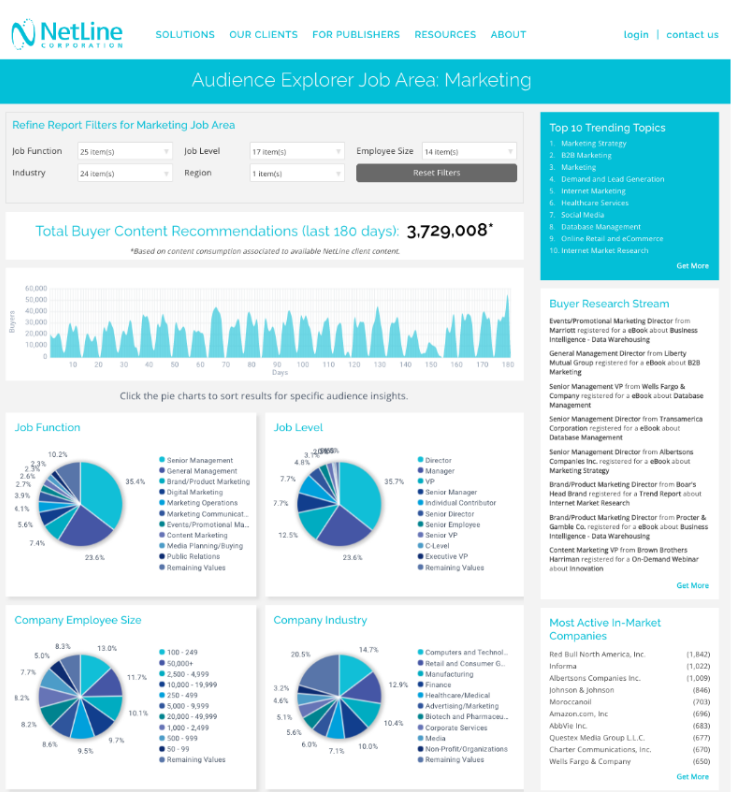
But even though B2B marketers want to take advantage of this intent data, actually finding, structuring and using it is a huge challenge. To address this need, there are now many intent data providers that can analyze your company’s own data in addition to sourcing other intent signals from digital engagement across the web—just as NetLine uses the data from across its network to power products such as Audience Explorer.

Image caption: A screenshot of NetLine Audience Explorer showing content consumption, buyer research and the most active in-market companies with B2B buyers.

Intent data sources can be broken down into two main categories:

  • Your internal data—everything from the clicks, behavioral signals and engagement collected by your marketing automation platform, to customer data and sales outreach data in your CRM.
  • External data—this can include IP addresses used by companies from across the web, visits to vendor review websites, and the content consumed by users associated with companies (via IP address, cookies or other means). This information is most often aggregated at the account-level with the overall total engagement being assessed for intent signals.

As such, listing all the types of intent data would be nearly impossible, because any relevant data has the potential to identify intent. Just a few examples types of buyer intent data collected can include:

  • Themes being researched based on content engagement data from media publishers;
  • Topic searches and specific keywords that align with intent signals;
  • Internal intent data about known contacts, qualified leads and lead generation efforts;
  • Third-party data in your own systems added by data enrichment tools;
  • The specific articles read by potential prospects in the buyer’s journey on your own website and properties—with bottom-of-funnel activity (such as reading pricing pages or downloading case studies) being used to identify readiness-to-buy;
  • The accounts and target audiences that have engaged with your ad campaigns and account-based marketing programs;
  • Sales data and opportunity data;
  • Customer data;
  • …and much, much more.

However, what you might recognize from the above list is that for much buyer intent data, the intent is assumed or inferred indirectly. This can potentially lead to accounts and buyers being flagged as “in-market” when actually they aren’t. Examples of such false intent might include:

  • Lots of topic research on media publisher sites and web searches—when actually the person was an intern doing market research.
  • Multiple visits to pricing pages or review sites—when that person was doing competitive research.
  • A sudden jump in engagement with bottom-of-funnel and sales content—when that person was preparing for a job interview with your company.

For this reason, having a buyer tell you explicitly whether they are in-market or not will always be more accurate and powerful than simply inferring intent based on other information collected. That’s why NetLine adds questions about intent to the forms used across its content syndication network. The answers to these questions help to power its Intent Discovery capabilities.

What is the Difference Between First-Party and Third-Party Intent Data?

First-party intent data is the data that you or your company collect directly. This will include data from your own digital channels and systems, such as website visits and email engagement. 

This type of data typically covers a shorter timeline than third-party intent data and is more closely associated with activities taking place on your web properties or in your CRM—but it also includes proprietary, unique data that you might collect from properties that you do not own, such as on a download form for syndicated content or registrations for a partner webinar hosted by another company.

Third-party intent data refers to the data that isn’t directly sourced by you or your company. This will be data sourced from external sources, such as IP addresses associated with companies browsing the web or content being read on media publisher websites. 

This type of data typically covers a longer timeline and from buyers that have not yet engaged directly with your own web properties. It can be used to detect intent signals from a wider range of sources, with vendors often aggregating behavior into a single and easy-to-use intent score, or a summary list of topics and themes based on their browsing behavior.

Buyer-Level Intent Data Seems Like a Powerful Tool. So, How Are B2B Sales and Marketing Teams Putting Buyer Intent Data to Use?

We will cover exactly how B2B marketers and salespeople are putting intent data to use later in this series—and how you, your marketing team and your sales team can use intent data to accelerate the buyer journey and generate revenue.

For now, we’ll direct you back to our initial buyer-level intent blog post:

  • Personalize dialogue in sales and marketing outreach;
  • Tailor campaign and content messaging with both paid and inbound marketing efforts;
  • Identify likely-to-buy accounts;
  • Inform and augment content-centric lead generation campaign targets; and
  • Possibly most important of all, focus on the “who” within key accounts to narrow down efforts onto the actual person and buyer showing intent.

Hope you’re eager to learn more about intent data and each of its iterations. We’ll certainly have quite a bit to share on the subject moving forward.

Categories B2B

The 5 Phases of Project Management

What problems and obstacles do you face as a project manager? For many, scope creep, poor communication, and task delays top the list.

To state the obvious, project management can be tricky. Without careful planning and strategizing, it can feel like you’re f working blind.

So, if you’re in a project management position, starting with the basics is your best bet. Here, we’ll break down projects into five phases to help you better understand what needs to be done and when.

Download Now: Free Project Management Template

The Project Management Lifecycle

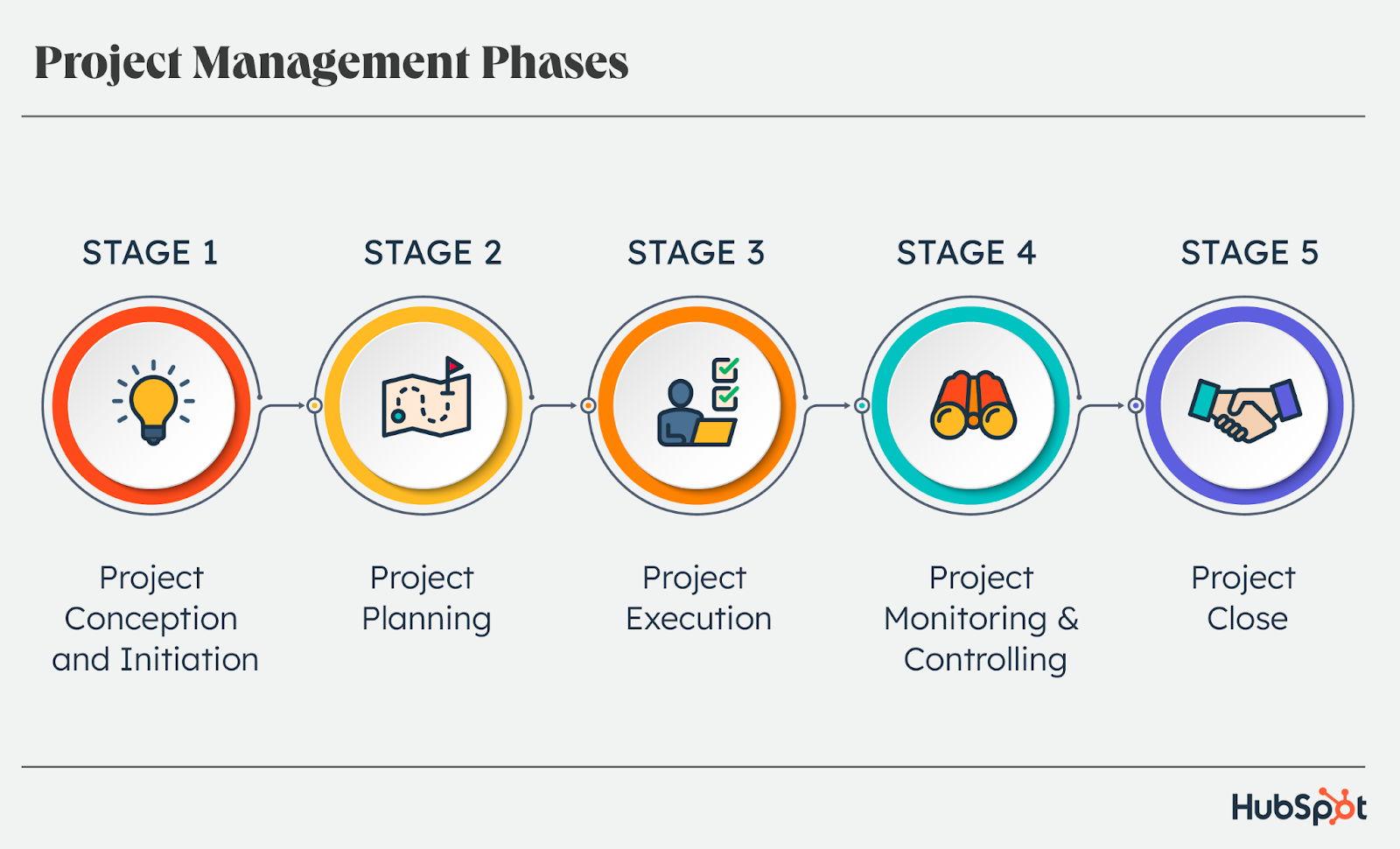
The Five Stages of Project Management

Stage 1: Project Conception and Initiation

Stage 2: Project Planning

Stage 3: Project Execution

Stage 4: Project Monitoring & Controlling

Stage 5: Project Close

The future of project management is looking brighter than ever.

The Project Management Lifecycle

Regardless of size or scope, all projects follow a similar process. In project management, this process is called the lifecycle of a project.

A project lifecycle generally consists of four phases: initiation, planning, execution, and closure. Some project managers, however, add a fifth phase called monitoring and controlling.

The additional step can help managers keep the project on track and ensures that issues are identified and addressed promptly.

As a result, five-phase models are considered more agile and effective in helping projects succeed. In fact, the Project Management Institute (PMI) also promotes a five-phase lifecycle.

In the next section, we’ll take a closer look at each stage in the project management lifecycle.

The Five Stages of Project Management

Every successful project goes through the same five phases: initiation, planning, execution, monitoring, and controlling.

Illustration showing the five project management phases

Stage 1: Project Conception and Initiation

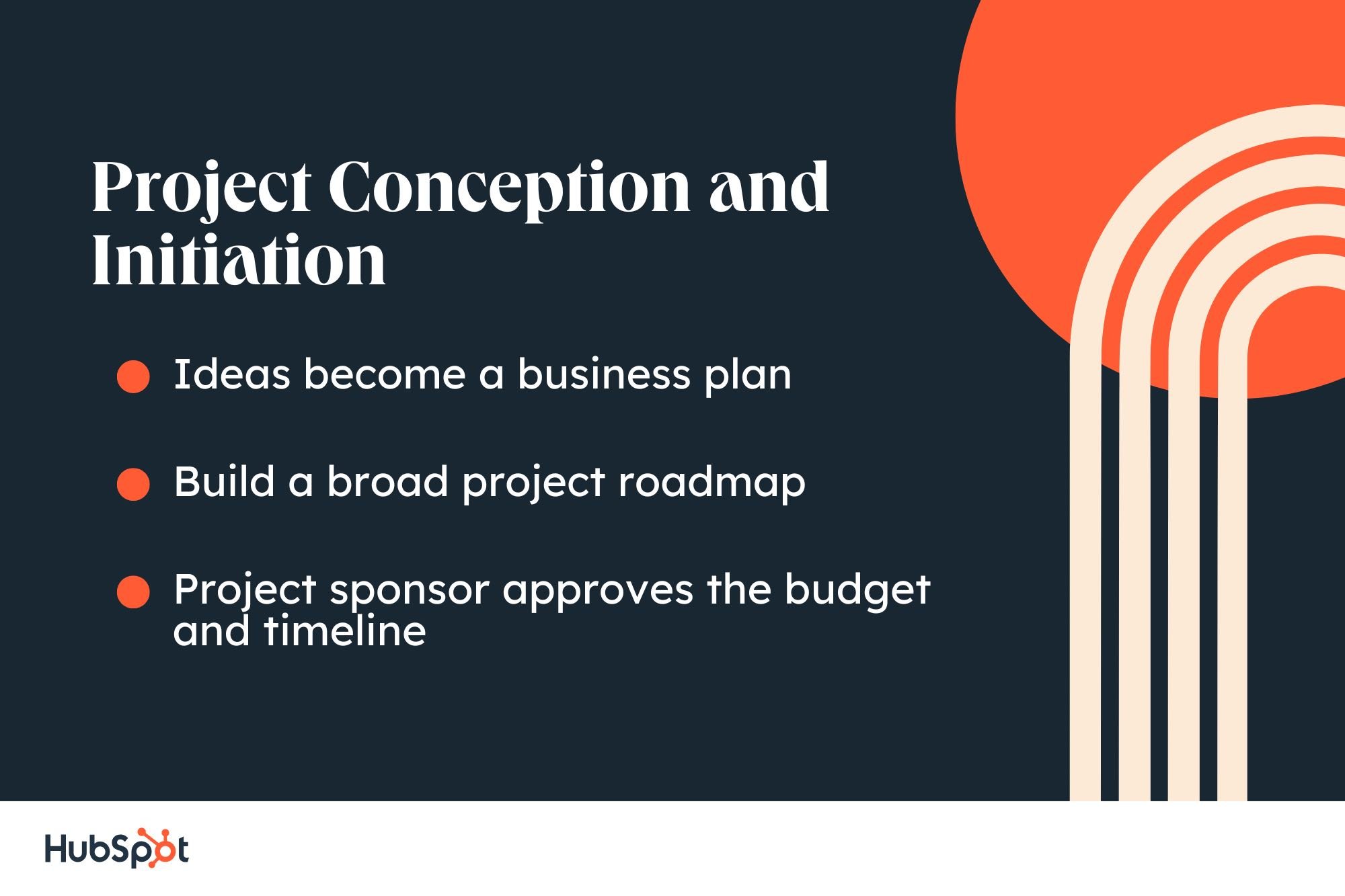
Every project begins with conception and initiation. During this phase, an idea becomes a business plan, complete with goals, project charters, and stakeholders.

This is also when project teams come together—with the project manager—to build a broad roadmap for the project.

Teams should address a few questions at this stage, including:

  • What is the purpose of this project?

  • What are some potential obstacles?

  • Who are the key stakeholders?

  • Does it have a minimum or maximum budget?

  • How long will this project take?

As part of this phase, the project sponsor (the person who requested the completion of the project) approves the budget and timeline.

Graphic showing key takeaways in stage one of project management

Stage 2: Project Planning

Once you’ve defined the project on a broader level, it’s time to nail down the details.

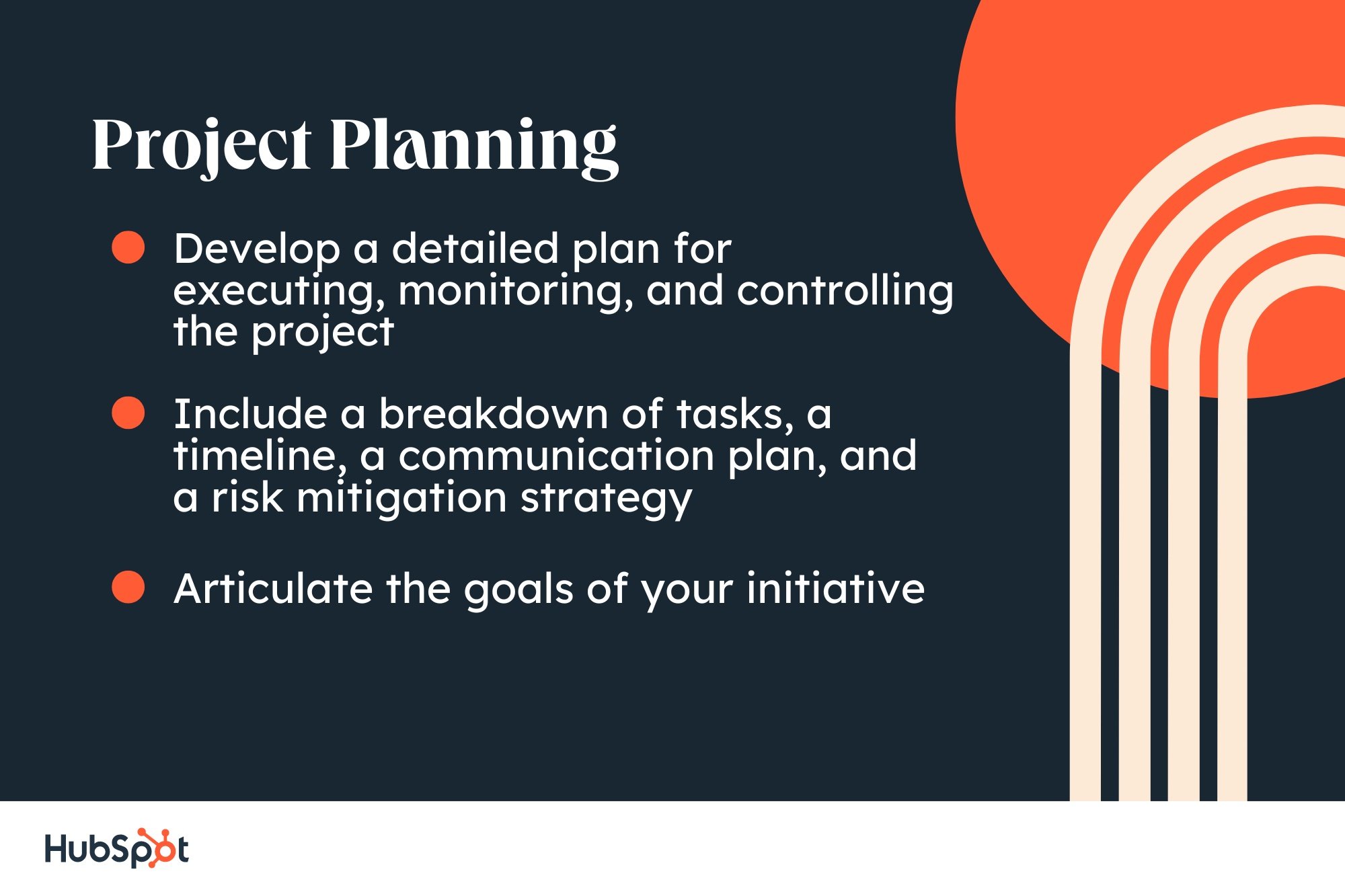
During this phase, the project manager develops a detailed plan for executing, monitoring, and controlling the project. This typically starts with setting goals.

When defining the goals of a project, S.M.A.R.T. and CLEAR methodologies are the most popular.

The acronym S.M.A.R.T. stands for Specific, Measurable, Achievable, Realistic, and Timely. Using this framework ensures your goals are clearly defined, realistic, and achievable.

Let’s look at an example. A vague goal might be, “Develop an app that streamlines order fulfillment.” Using the S.M.A.R.T method, this goal would look something like, “Develop an application that reduces order fulfillment time by 20%.”

The acronym C.L.E.A.R. stands for Collaborative, Limited, Emotional, Acceptable, and Refined.

In this methodology, the project team works towards a goal that is specific and achievable within the project deadline and budget. Everyone should be passionate about achieving it, and it should relate to the overall project objectives.

The plan should also include milestones and deliverables so that everyone knows what needs to be done, who handles what, and when milestones must be completed. It also includes a breakdown of tasks, a timeline, a communication plan, a risk mitigation strategy, and a plan to deal with worst-case scenarios.

There are several ideologies you can employ to plan for this stage. By using agile project management, development resources are effectively used, and client needs are met.

As well as keeping everyone up-to-date on progress, it allows for quick and easy changes to be made. Agile project management makes it possible to manage software development projects more effectively and efficiently.

Graphic showing key takeaways in stage two of project management

Stage 3: Project Execution

As soon as the planning phase is complete, it’s time to start implementing the plan. It’s here that the actual work gets done.

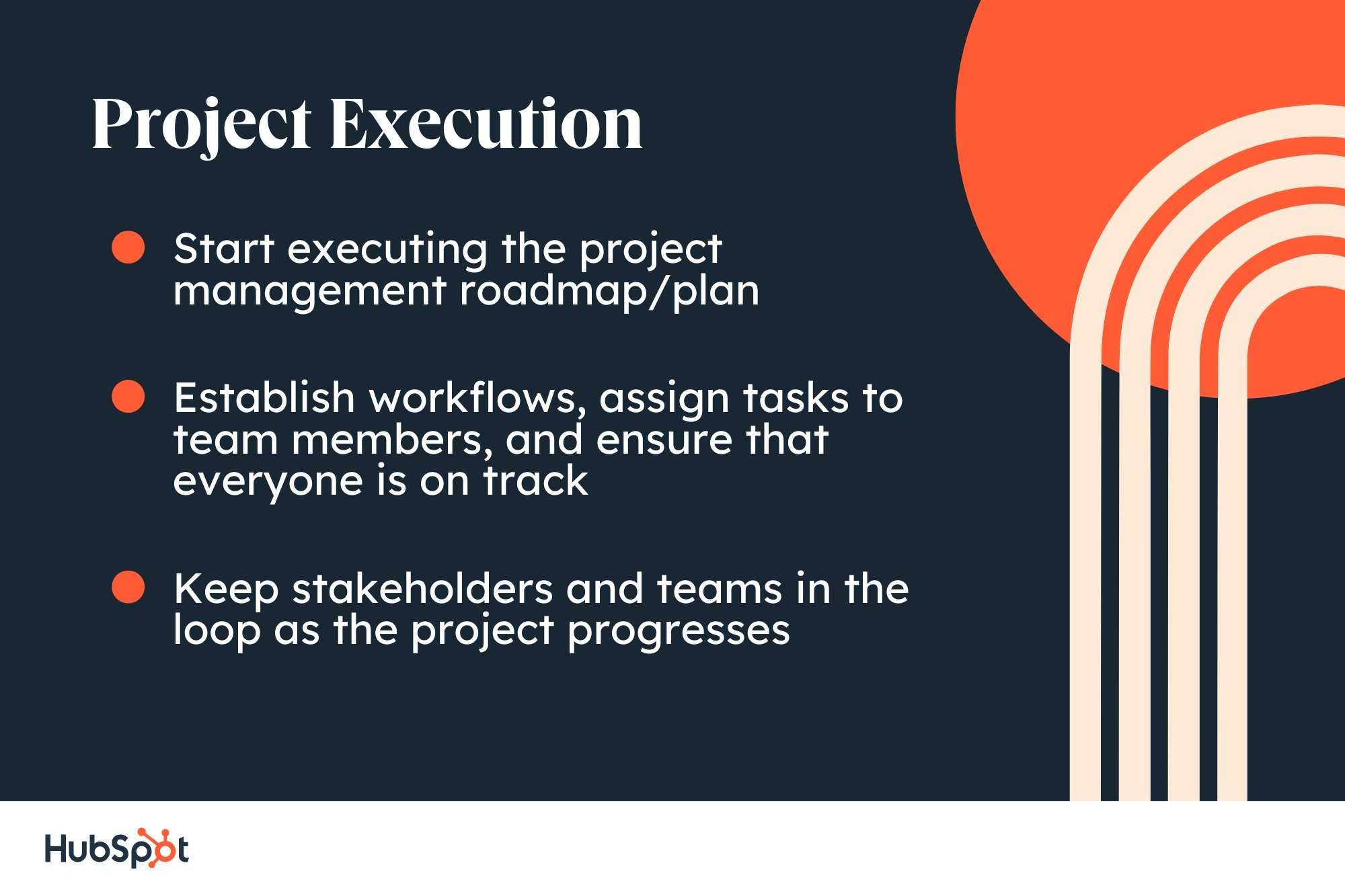
During this stage, project managers establish workflows, assign tasks to team members, and ensure that everyone is on track. They also keep stakeholders and teams in the loop as the project progresses.

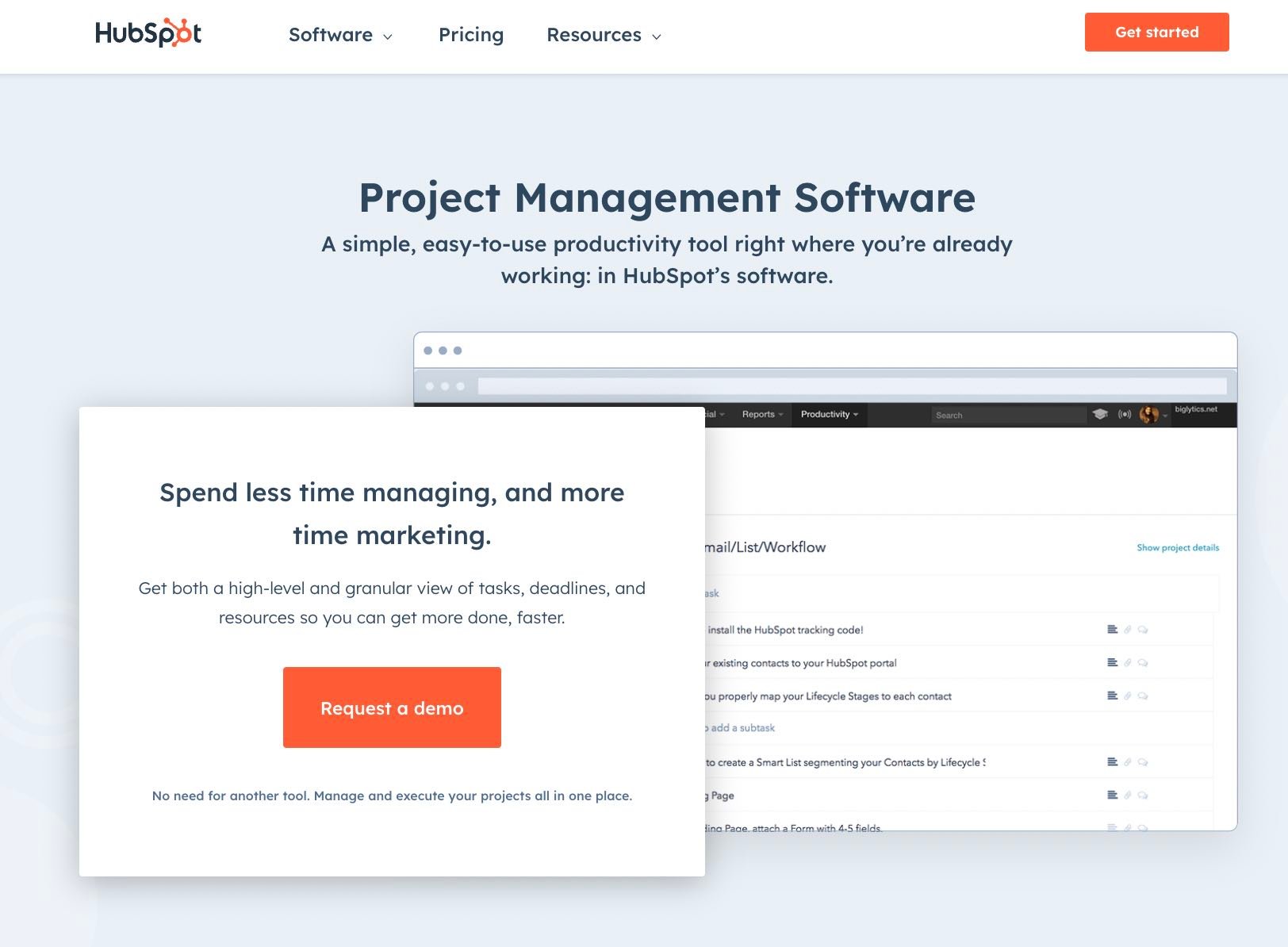
With so many details to juggle, many project managers leverage collaboration tools like Asana, Trello, and HubSpot’s Project Management Software to track tasks, timelines, and budgets in one central location.

Screenshot of HubSpot's Project Management Software

A well-designed project management tool will keep you on track and help you accomplish your goals. For a list of the best project management software, check out this helpful guide.

Graphic showing key takeaways in stage three of project management

Stage 4: Project Monitoring & Controlling

Stage four usually runs concurrently with Stage three. After all, in order to monitor a project, it has to be running in the first place.

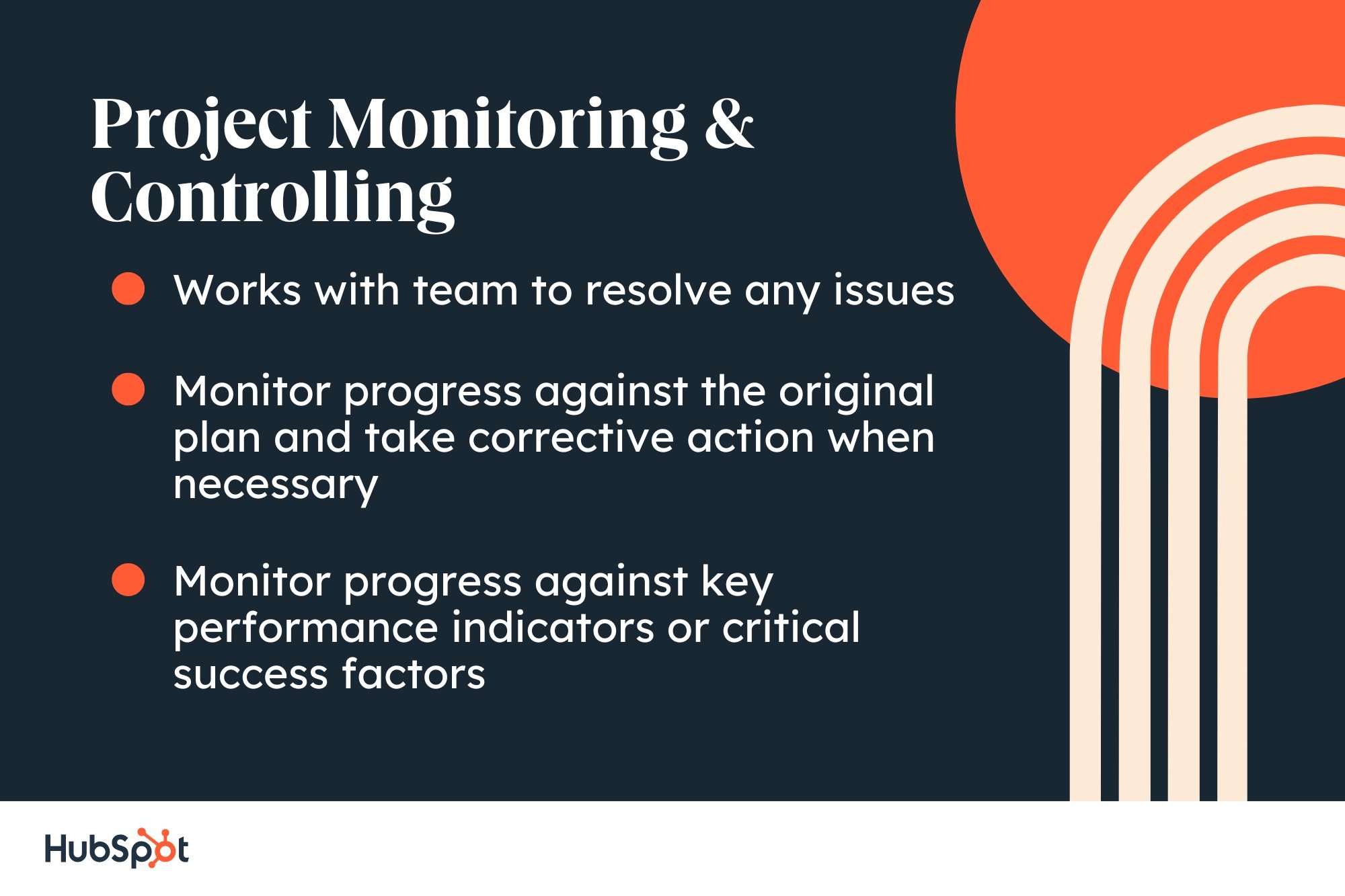
During this phase, the project manager works with their team to resolve any issues. This involves periodic reviews and updates of the plan to reflect changes in the scope of the project or in the availability of resources.

It’s also important to monitor progress against the plan and take corrective action when necessary. For instance, it may be necessary to revise the timeline to accommodate for unexpected delays or changes.

On top of that, project managers can monitor progress against key performance indicators (KPIs) or critical success factors (CSFs). For instance, you can measure if your project is on schedule and budget or if specific tasks are being completed.

Graphic showing key takeaways in stage four of project management

Stage 5: Project Close

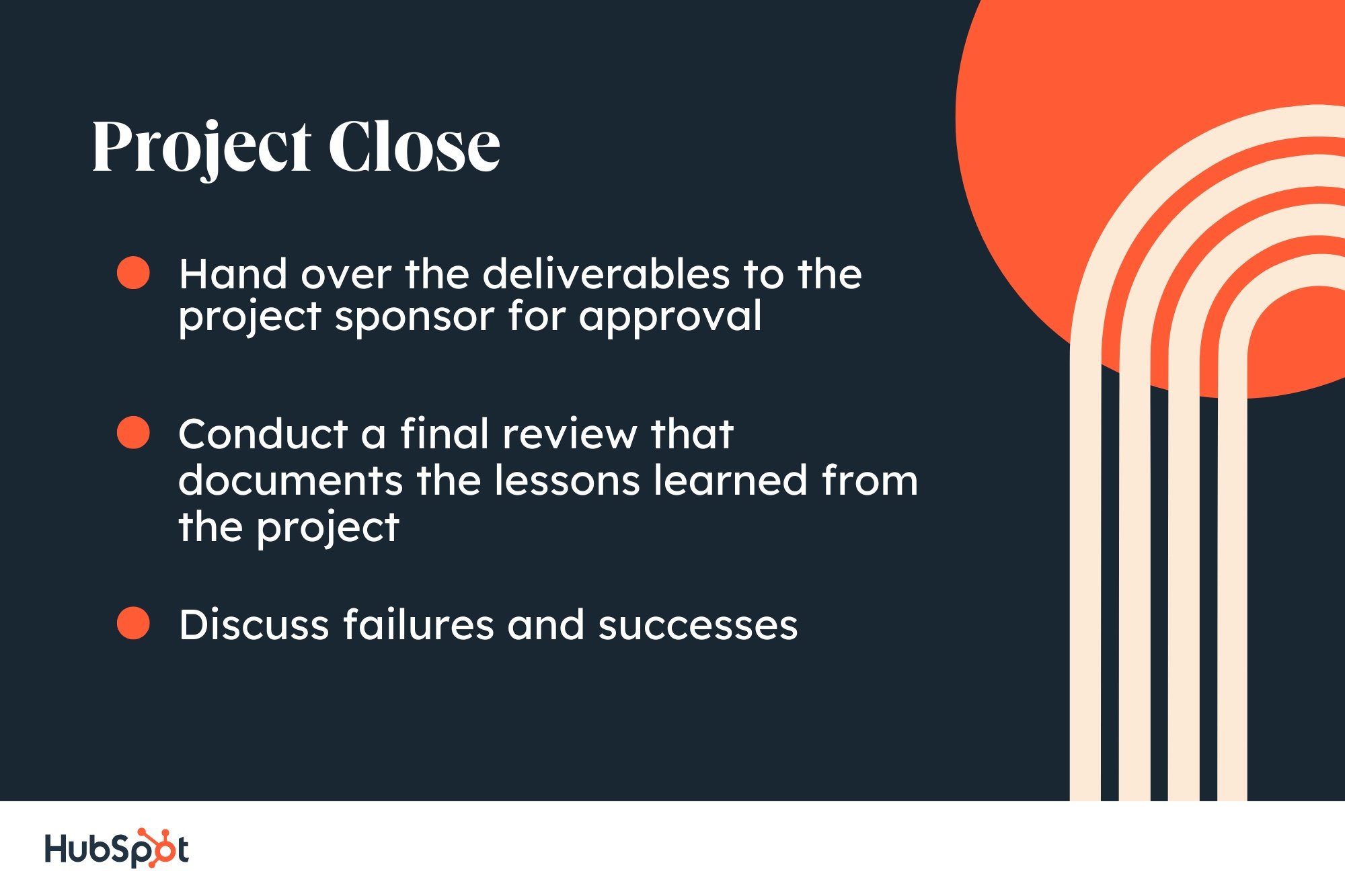
This is the last phase of the project management lifecycle. This is when you hand over the deliverables to the project sponsor for approval. During this phase, the team disbands and any contractual hires for the project will be terminated.

After closure, the project manager conducts a final review that documents the lessons learned from the project, as well as any necessary data that can be useful in the future.

Team members and stakeholders also discuss failures and successes during the presentation of the report. This helps to improve performance and productivity across the organization.

Graphic showing key takeaways in stage five of project management

The future of project management is looking brighter than ever

Traditionally, project management was done with pen and paper or, at best, a spreadsheet. Because of the complexity of projects and the dispersion of the workforce, these methods have become ineffective.

Keeping track of progress and meeting deadlines requires a digital-first approach. HubSpot’s project management software is one tool that can definitely help with project management.

With this software, teams can streamline their workflows, track their progress, share documents, and manage their tasks.

On top of that, the HubSpot CRM platform enables you to easily integrate it with your other sales and marketing tools. This makes it easy to keep track of progress and ensures that everyone is on the same page.

Additionally, the software provides users with real-time insights into their workflows, enabling them to identify bottlenecks and adjust accordingly.

So, if you’ve been looking for ways to level up your project management, here’s your chance. Grab your project management template below to keep track of your team’s progress and streamline your workflows to increase efficiency.

New Call-to-action

Categories B2B

Impression Share: What it is and How to Improve it

Online advertising is booming.

But, when you’re launching digital campaigns, you want to be sure you’re maximizing your efforts — and your profits — by boosting your ad’s impression share. Your impression share tells you how well your ad is performing compared to its total potential audience, and boosting it can help increase engagement as well as profit. 

If you’re only engaging a small portion of your target audience, then analyzing your impression share is usually a good place to start. Increasing this value will help you propel ads to the top of the Search Engine Results Page (SERP) and ultimately generate more engagement for your campaigns.

In this post, we’ll explain what impression share is as well as the different types that your marketing team can track during your online ad campaigns.Free Guide, Template & Planner: How to Use Google Ads for Business

Each time your ad is displayed on a webpage, that’s counted as an impression. Ads have the potential for more impressions for different reasons, especially when they’re keyword-savvy, attractive, and relevant.

When you track impression share, you have a clear representation of how well your ad is performing and how you can improve it over time particularly through keywords. While there are plenty of metrics that can track how well your ads are doing, impression share helps you identify the shortcomings of your ad so you can fix it and make it more engaging to your audience.

Read on to learn about the different types of impression share that your business can track to generate more engagement for its ad campaigns.

Types of Impression Share

Search Impression Share

Search impression share is your ad’s impression share on a search network. According to Google, a search network is “a group of search-related websites where your ads can appear,” including Google search results, Google apps such as Maps and Shopping, and on Google search partners’ websites. This metric divides the impressions that your ad receives by the number of impressions it could receive on the search network.

This metric is greatly impacted by budget. If you have a low daily budget on Google, your ad will no longer be shown once you hit your budget. This means your ad might be getting impressions, but it’s still missing out on more engagement because of this daily limit.

If you’re not looking to spend more on your campaign, another way to improve search impression share is to focus on the quality score, target, bid, and conversion rate of your ads. These metrics gauge the effectiveness of your ad and improving them will lead to more engagement.

Display Impression Share

Google defines its Display Network as a group of over two million websites, videos, and apps where ads can appear. Display Network sites reach up to 90% of internet users and can show your ads in a particular context, or to a specific audience.

With display campaigns, you can increase your ad placements to improve impression share, but you’ll need to adjust your budget to accommodate this increase as well. Or, you can decrease your number of placements to make your campaign more cost-effective, but this will reduce the frequency of your ad’s display. The best approach is testing the number of placements until you’ve reached a point where you’ve optimized impression share without going over your campaign’s budget.

Target Impression Share

Target impression share provides an automatic approach to bidding on ads. With this tool, you can set automated bids for your campaign, which gives your ad a better chance of reaching the top of the SERP. And, with a more prominent position on a search results page, your ad is likely to gain more impressions over time. 

Although impression share is only available per campaign, you can track target impression share for all of your campaigns at once. There are plenty of options for customizing it, too. For example, you can set it to bid for a certain section of the page — like the top half — or for certain times and places.

Adwords Impression Share

Wondering how to access your impression share data in Google Ads?

Once you’ve logged into your Ads account, just go to Campaigns > Columns > Modify Columns > Competitive Metrics > Impression Share, then click Save.

Adwords-impression-share

Image Source

Now, your impression share will appear in a table that you can download.

Exact Match Impression Share

Exact match impression share is just as it sounds. This metric compares the impressions your ad received compared to how many it was eligible to receive for searches that exactly match your keywords. You can use exact match impression share to hone in on your keywords and improve your ads.

Search Lost Impression Share

The “Search Lost Impression Share (budge)” column shows you the percentage of impressions that you’re missing out on because of your budget. A high percentage here may mean that investing in a larger budget could boost your advertising efforts and sales in the long-run.

The “Search Lost Impression Share (rank)” column shows you the number of impressions you’re losing based on a low rank. If this percentage is high, advertisers should consider how to boost rank through quality score and cost-per-click rates. Quality score evaluates your keywords’ past performances, ad relevance, landing page experience, and expected clickthrough rate.

Consider making adjustments to your campaign’s keywords and creative assets if your search lost impression share (rank) is high. A relevant ad with great keywords will rank higher on the SERP, which can lead to more impressions, clicks, and sales.

If you want to manually determine the impression share for an ad, below is a formula that can help you calculate it.

As Google explains, “Eligible impressions are estimated using many factors, including targeting settings, approval statuses, and quality.” Once the maximum number of impressions is determined, all you have to do is divide the number of impressions that the ad receives by the maximum number of impressions that Google decides it’s eligible for.

We can see how this formula is written in the example below. 

Impression-share-formula

Image Source

We can also modify this formula to find the total number of impressions that our ad is eligible for. For instance, if we already know our impression share, we can reformat the formula to look more like this. 

impression-share-available

Image Source

Impression Share Formula Example

Let’s say we created an ad and Google says there are 5,000 potential impressions available. After monitoring our ad’s performance for a month, we recorded about 4,000 impressions. This would mean that our impression share is 80% (4,000 recorded impressions / 5,000 available impressions =  80% impression share). 

Impression share is a handy metric for determining how well an ad campaign is doing and what your team can do to help it reach its full potential. By tracking impression share, you can automate bids, fine-tune your budget, and track keywords and quality score to reach your targeted audiences more often and generate greater brand awareness and profits.

For more ways to boost online ad engagement, read this list of helpful SEO tips. New Call-to-action

Categories B2B

How to Create a Group in Gmail

Growing up, there was only one thing my mom knew how to do on the internet that I could never figure out — creating an email group.

What’s even more surprising is that I sent email blasts to my friends all the time, but I never asked my mom how to make an email group. I would just manually enter my friends’ email addresses into the recipients’ box. Gosh, I was such a rebel.

Get HubSpot's Free Shared Inbox Tool

If you’ve gotten over your teen angst and don’t want to manually enter your family’s, friends, or coworkers’ email addresses every time you want to send an email to them, we’ve got you covered.

Check out our quick guide on creating a group in Gmail. Keep reading, or jump to the section you’re looking for:

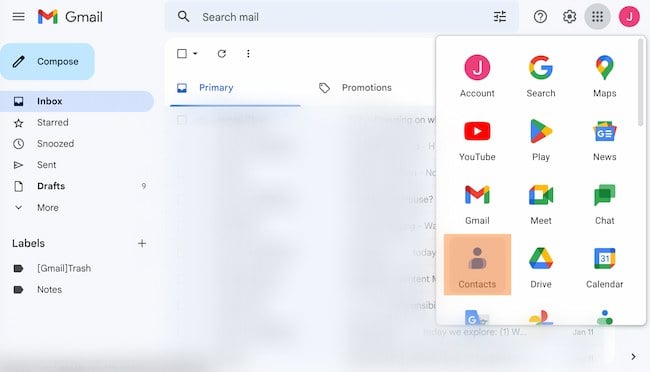
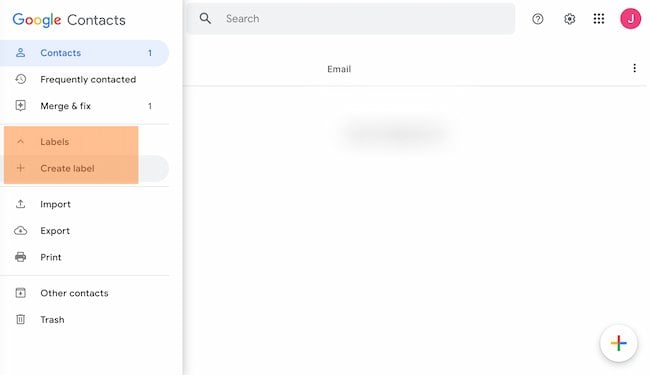
1. Visit Google Contacts.

You can find Google Contacts in the middle of the bottom row of your Google Apps tab.

How to make a group in Gmail example: Google Contacts

2. Under “Labels”, click “Create Label”.

How to make a group in Gmail example: Create label

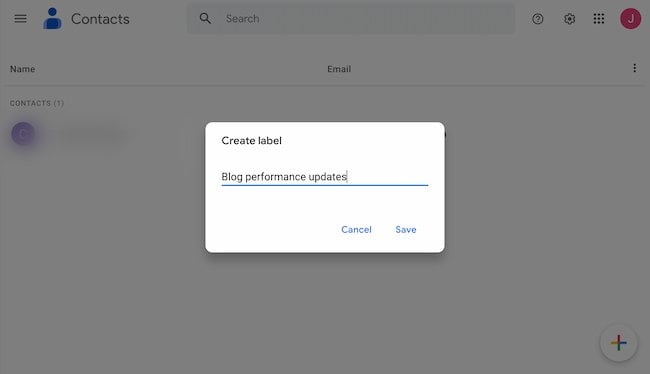
3. Name your label.

How to make a group in Gmail example: Name label

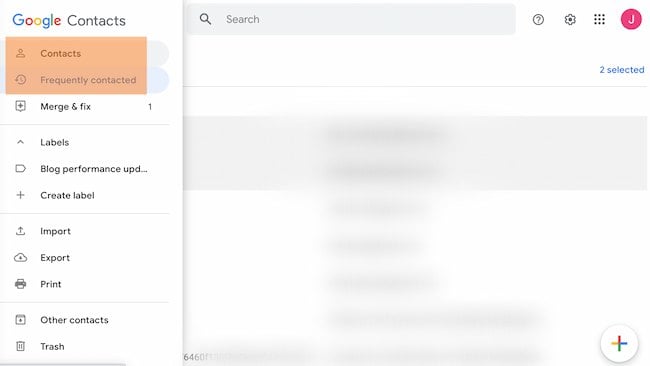
4. Click “Contacts”, “Frequently contacted”, or “Directory.”

It’s likely you won’t have contacts saved in Google Contacts, but you can still access the email addresses of people you interact with regularly by clicking “Frequently contacted” or everyone who currently works at your company by clicking “Directory” on the left sidebar.

How to make a group in Gmail example: Open contact options in Google Contacts

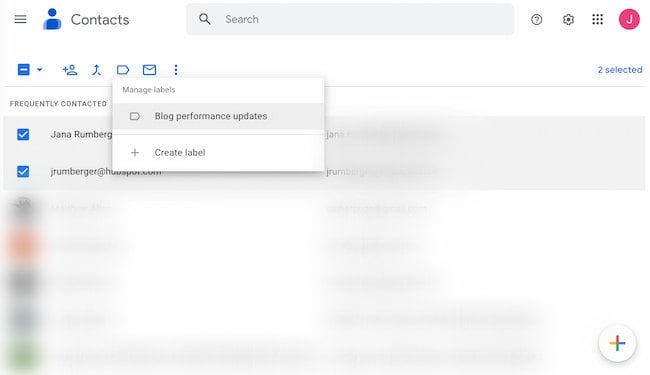
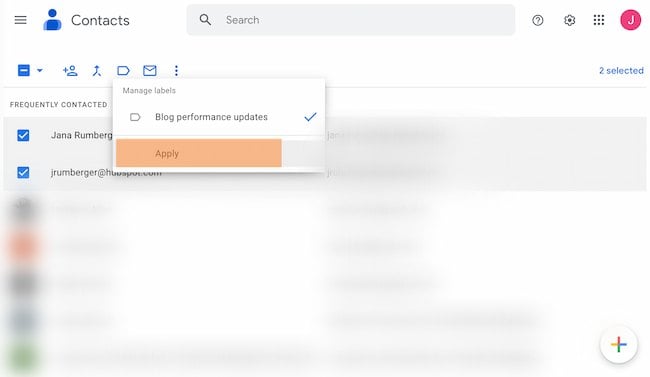
5. Select the contacts you want to include, then click the label icon at the top to add them to your new group.

How to make a group in Gmail example: Select contacts

6. Click “Apply.”

How to make a group in Gmail example: Click Apply

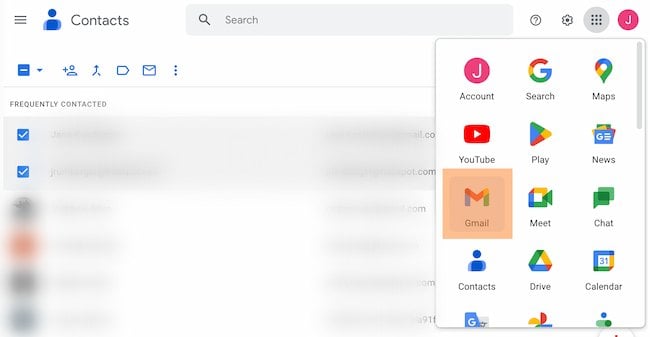
7. Head to your Gmail account.

How to make a group in Gmail example: Go to Gmail

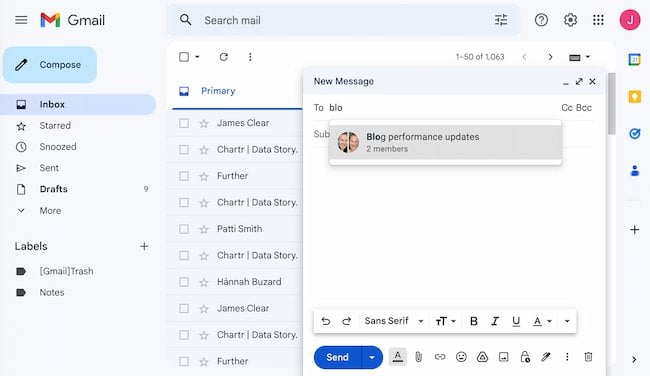
8. Type your group’s name in the recipient’s box to send an email to your group.

How to make a group in Gmail example: Type group name

Quick tip: Trying to send a marketing email? Take a look at HubSpot’s free email marketing software.

1. Open Gmail.

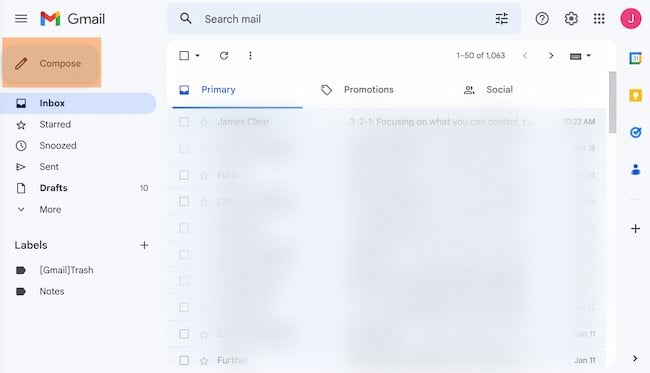
2. Click “Compose” in the top left-hand corner of your Gmail window to create a new email.

How to create a group email in Gmail example: Click compose

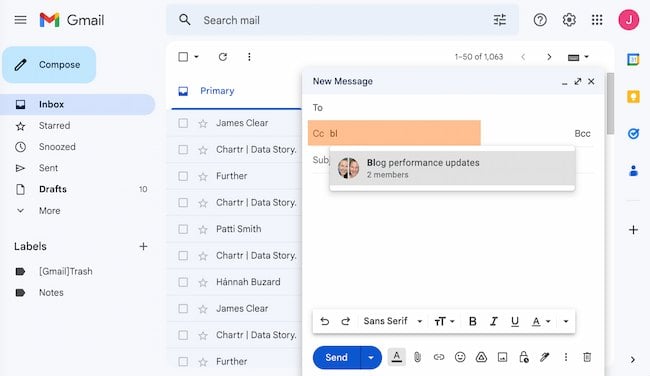
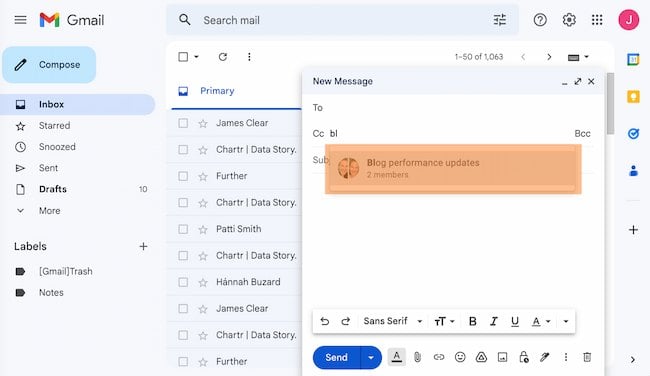
3. In the “To,” “CC,” or “BCC” section at the top of the “New Message” window, start typing your group name.

How to create a group email in Gmail example: To, BCC, or CC section

4. Select your group name from the pop-up list that will appear below.

How to create a group email in Gmail example: Select group name

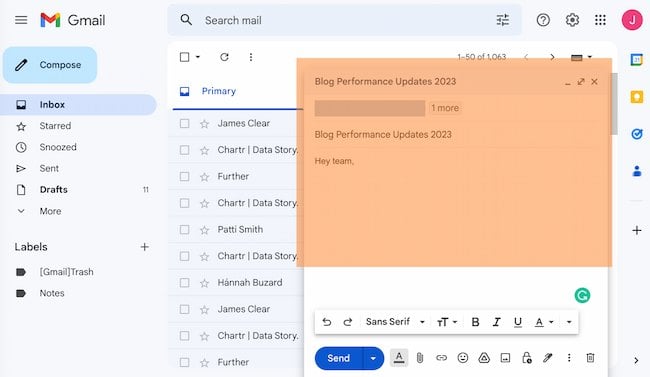
5. Write a message to your group.

How to create a group email in Gmail example: Write email message

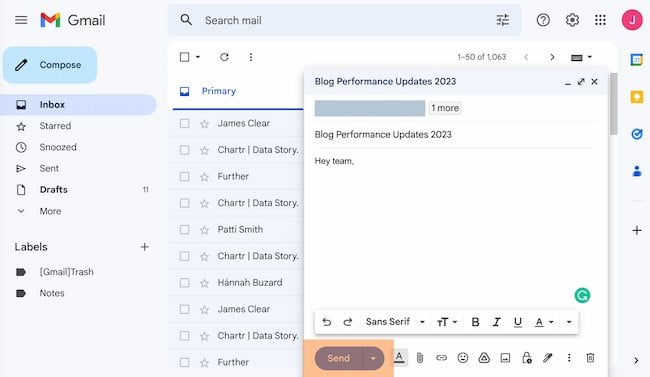
6. Proofread and click “Send” when your group email is complete.

How to create a group email in Gmail example: Click send

How to Make a Group for Email

You know the steps for how to create a group in Gmail, but what makes an email group useful?

It’s common to use email groups to communicate with internal teams at work or to contact groups of sales contacts. But there are other ways to go about making a group for email.

First, you can segment your contacts based on their interests, like news updates, or by location. This can help you organize your email outreach for specific users. It also lets you avoid sending your contacts information that’s confusing or unnecessary.

Another approach is to create project-specific email groups. As the project comes together, you can add contacts to the group. This can help streamline communications as the project builds momentum. It also keeps team members who aren’t involved in a project from getting overwhelmed by project-specific emails.

As you begin to rely on group emails for your communications, remember to add new contacts to your groups early on. This way, they don’t miss any important emails that the rest of the group is seeing.

Gmail Group Email Quick Tips

1. Update your groups consistently.

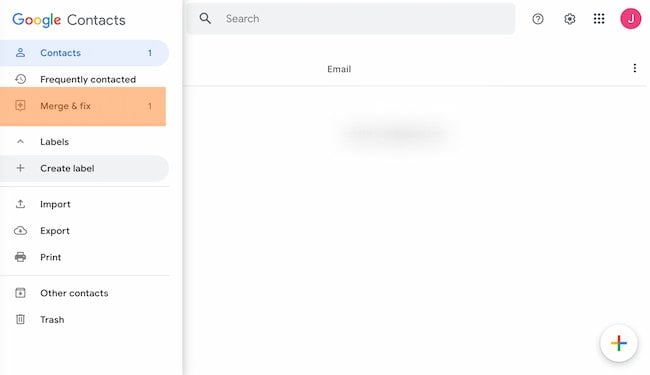
Besides keeping up with new contacts, regular updates and list cleaning are essential. To start, use Merge & Fix to clean out any duplicate contacts.

Gmail group email tips: Merge & Fix

Next, delete any outdated contacts. Then, clean up your contact names to remove typos, misspellings, and outdated names. Finally, add helpful details to your contact records. This might include department names, phone numbers, or time zones to make it easier for the group to connect.

Depending on the nature of your Gmail group, you may also want to create some guidelines for group communication. Google Groups have options for creating collaborative inboxes, posting policies, auto-replies, and member moderation.

2. Engage your group with a specific subject line.

Use a snappy subject line to engage and motivate your group. Because group emails can grow quickly, short, specific subject lines are best. If you’re looking for help, insights, or action, adding a deadline or open-ended question to your subject line can help you get results.

Check out these resources for more subject line tips:

3. Write a great salutation to set expectations.

Salutations can be challenging in a group setting. Some feel too formal, while others could come off as too casual or offend members of the group. So, what’s the right salutation for your group?

To write the perfect salutation, start with your relationship with the group. If you’re close to everyone, a greeting like “Hi all” or “Hey team” works fine.

If your group is five people or less, you may want to add group members’ names to make it more personal. For example, “Hey Bonnie, Ed, Jamie, and Alana.”

For groups that you’re not as close to, salutations like “Greetings team” or “Hello (Group name)” are a good choice.

The right salutation also depends on the personality of your team. For example, fun salutations with relevant cultural references or in-jokes for the group can loop in new group members and create a sense of comfort and belonging. But if you’re addressing a professional group that doesn’t know each other well, a salutation like “Dear team” could be a better fit.

More resources:

4. Personalize for the group, not the individual.

Personalizing an email for someone you’re close to is pretty easy. But making a group email feel personal may take more effort.

Group personalization starts with a quick outline of what connects the people in the group. You can refine this with segmentation if you’re starting with a large group. Other qualities that can help you personalize include a list of shared qualities like:

  • Behaviors, like showing up early
  • Interests, like music, sports, or pop culture trends
  • Habits, like keeping a to-do list

Use these details as you draft conversational copy, add jokes, or highlight different members of the group. These extra touches help make your group email feel like it’s meant for every person in the group.

More resources:

5. Create group email sequences with workflows.

It’s tough to be the new person in a group. When you’re new, you’re not sure what you’ve missed or what other members of the group expect you to know. This can impact your feelings about sticking with and engaging in the group.

To keep anyone in your Gmail group from feeling left out, try adding a workflow. Workflows can automatically add each new member of your group to a series of actions or emails. You can decide how much, what, and when to send these communications.

For example, you can send an email with important links for the group or text new group members a reminder about meeting times or locations.

HubSpot customers: You can create group email sequences in Gmail with workflows.

6. Use BCC to cut down on excess emails.

A top frustration of group mail recipients is the dreaded “Reply all.” This function can be convenient. It can also flood email inboxes with a lot of distracting emails.

One way to avoid this issue in your email group is to use the BCC field for your group emails. This makes each group email feel like a personal email, so it can reduce reply to all messages. It also protects the privacy of the members of your group.

Using the CC field is another choice. This practice lets every email recipient know who else is in the email group and who is receiving the emails if they reply.

Use your knowledge of your email group preferences as you decide which choice is best.

7. Add clear labels to keep your groups organized.

Careful label naming is important, especially for groups that stick together for years. Label names should be succinct, but also specific and useful. Each label name should set an expectation and deliver on that promise.

As you write your labels, think about the different ways users might interpret a label. For example, a label that reads ‘Updates – Blog’ could contain:

  • Updates to a company’s blog
  • Updates for the blog team
  • Updates to blog policies

If you’re not sure which, you may need to look closer at the members of the group. This confusion means extra time and effort and makes the email group less useful for everyone.

Labels like “Blog team updates,” “Blog policies,” or “Blog post updates” are quick to read, specific, and useful.

A few more ways to make sure you have great blog labels include:

  • Check your spelling
  • Check for correct punctuation
  • Write from a new user’s point of view
  • Use color-coding to highlight important groups

Use Gmail Groups to Save Time and Connect

Creating email groups keeps your favorite people from missing out on important information. It saves time and energy. And it helps you keep your contacts organized.

With this quick guide, you have everything you need to create great group vibes on Gmail and beyond. So, create your first group today. Start connecting.

Editor’s note: This post was originally published in April 2019 and has been updated for comprehensiveness.

shared inbox

Categories B2B

40+ Resume Objective Examples to Help You Craft Your Own

With only six seconds to grab a recruiter’s attention, conventional wisdom might tell you to cut right to the chase when you write your resume. A lot of people say a resume objective just wastes precious space. But if you craft it in a way that highlights your qualifications, skills, and fit for a role, an objective can actually enhance your resume by giving recruiters a sneak peek of your background that prompts them to keep reading.

→ Download Now: 12 Resume Templates [Free Download]

In this post we’ll teach you how to leverage a resume objective to your advantage as well as share some examples to help you craft your own.

Skip to:

When to Use a Resume Objective

Including a resume objective, sometimes called a professional summary, in your resume gives the prospective employer a snapshot of your background and talent. They’re the perfect place to specify what you bring to the table for the role you are applying for. As a general rule, you should use a resume objective when you are targeting a specific position or are early in your career with little work experience.

Adding a resume objective is also especially helpful if you are changing careers or industries. It can give context to your transition and how your transferable skills are the perfect fit for the company, despite being new to the industry.

How to Write a Resume Objective

When recruiters read your resume, they want to know three things about you:

  • Are you qualified for this job?
  • Have you made an impact on your company in your current or previous roles?
  • How will you make an impact on our company in this specific role?

If you can give them a clear and concise preview of these three answers within the first few lines of your resume, they’ll start thinking about your potential as an employee at their company. This’ll also give them a positive first impression of you and make them read the rest of your resume to confirm that you’re their best-fit candidate.

Pro tips:

  • Keep it short: Objectives should be 1-3 sentences max.
  • Be specific: Get specific about the role you are applying for, your skills, and how those skills and what impact those skills will have on the organization.
  • Tailor it: Your resume objective should be tailored to fit the role or company you are applying to.

To show you how to craft a compelling resume objective at any stage of your career, we’ve provided some resume objective examples that anyone from a recent graduate to a proven professional can use. We’ll also break down the structure of each resume objective to give you a more concrete understanding of writing a gripping resume objective.

Good Resume Objective Examples

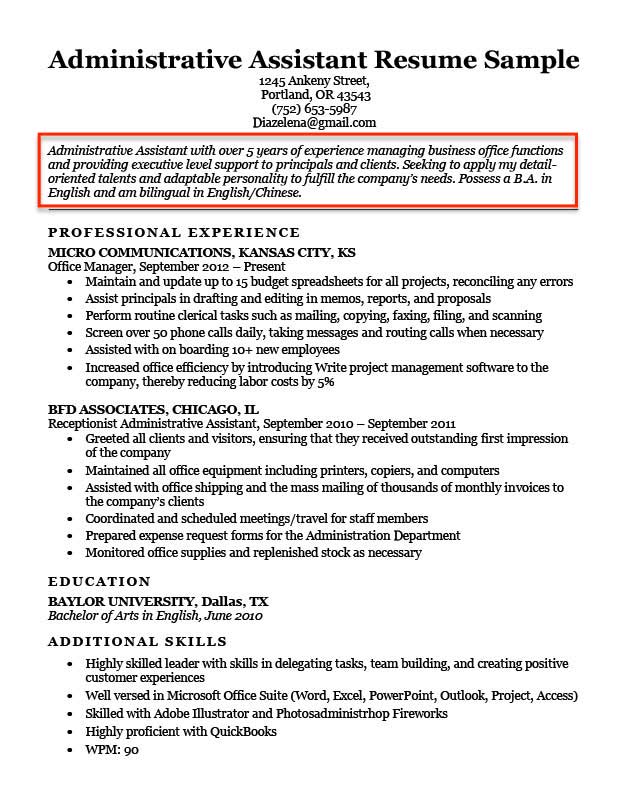
1. The Recent Graduate

Recent double major in English and Economics from Pomona College who has completed four content marketing internships in the MarTech space. Used creative and analytical skills to craft compelling content and refine content marketing strategies. Seeking a position as a Junior Growth Marketer to help HubSpot scale freemium marketing efforts and boost free product signups.

Structure:

Are you qualified for this job?

Recent double major in English and Economics from Pomona College who has completed four content marketing internships in the MarTech space.”

How have you made an impact during your current or previous roles?

Used creative and analytical skills to craft compelling content and refine content marketing strategies.”

How will you make an impact on our company in this specific role?

Seeking a position as a Junior Growth Marketer to help HubSpot scale freemium marketing efforts and boost free product signups.”

2. The Ambitious Entry-Level Worker

Ambitious associate marketing manager with two years of experience strategizing and executing lead generation campaigns. Spearhead Sigstr’s co-marketing program and drove a 25% increase in program leads last year. Seeking a position as Marketing Manager of the Lead Optimization team at HubSpot to optimize blog lead generation strategy.

Structure:

Are you qualified for this job?

Ambitious associate marketing manager with two years of experience strategizing and executing lead generation campaigns.”

How have you made an impact during your current or previous roles?

Spearhead Sigstr’s co-marketing program and drove a 25% increase in program leads last year.”

How will you make an impact on our company in this specific role?

Seeking a position as Marketing Manager of the Lead Optimization team at HubSpot to optimize blog lead generation strategy.”

3. The Career Switcher

Experienced journalist considering a career switch to content marketing. Spent five years digging up and breaking stories about business and technology for The Boston Globe. Hoping to apply my grasp of journalism and storytelling as a Staff Writer to strengthen HubSpot’s thought leadership in the MarTech space.

Structure:

Are you qualified for this job?

Experienced journalist set on making a career switch to content marketing.”

How have you made an impact during your current or previous roles?

Spent five years digging up and breaking stories about business and technology for The Boston Globe.”

How will you make an impact on our company in this specific role?

Hoping to apply my grasp of journalism and storytelling as a Staff Writer to strengthen HubSpot’s thought leadership in the MarTech space.”

4. The Middle Manager Who Wants to Make it to the Top

Savvy marketing manager with five years of experience crafting social media videos, developing social video strategy, and optimizing social media advertising strategy. Lead Sprout Social’s social analytics team and doubled video views and cut CPM costs by 40% this year. Looking to join HubSpot as Director of Buzz to develop an overarching social media strategy that boosts views, engagement, and cuts costs.

Structure:

Are you qualified for this job?

Savvy marketing manager with seven years of experience crafting social media videos, developing social video strategy, and optimizing social media advertising strategy.”

How have you made an impact during your current or previous roles?

Lead Sprout Social’s social analytics team and doubled video views and cut CPM costs by 40% this year.

How will you make an impact on our company in this specific role?

Looking to join HubSpot as Director of Buzz to develop an overarching social media strategy that boosts views, engagement, and cuts costs.”

5. The Proven Professional

Seasoned business operations and analytics veteran with an MBA and ten years of experience leading high-performing sales operations, marketing analytics, and business intelligence teams at Salesforce, Adobe, and Domo. Seeking to utilize my proven analytical, technical, and professional expertise to leverage data and drive crucial business decisions at HubSpot as Vice President of Business Intelligence.

Structure:

Are you qualified for this job?/How have you made an impact during your current or previous roles?

Seasoned business operations and analytics veteran with an MBA and ten years of experience leading high-performing sales operations, marketing analytics, and business intelligence teams at Salesforce, Adobe, and Domo.”

How will you make an impact on our company in this specific role?

Seeking to utilize my proven analytical, technical, and professional expertise to leverage data and drive crucial business decisions at HubSpot as Vice President of Business Intelligence.

General Resume Objective Examples

We’ve rounded up some of the best resume examples available to give you a bit of inspiration to get started writing your own. If you like more resume help, check out the best resume templates and grab the attention of recruiters.

Beginner Resume Objectives

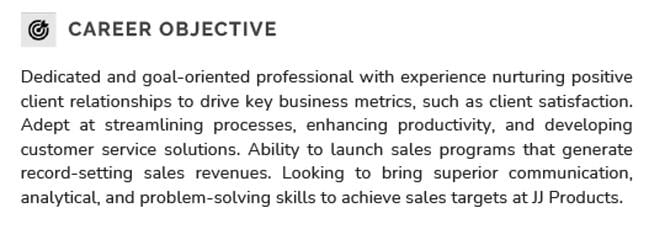
1. Resume Lab

beginner resume objective example: Resume LabImage Source

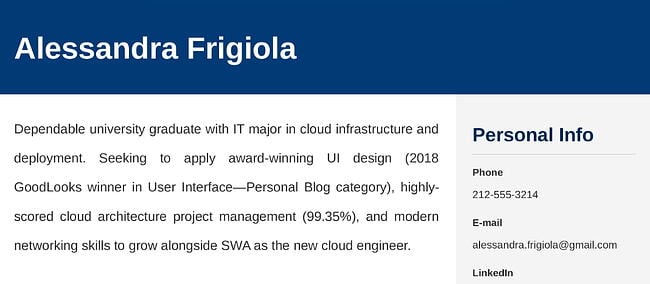
In this sample objective from Resume Lab, the writer chooses to play up her academic achievements to account for a lack in work experience.

What we like:

The writer makes specific reference to awards she’s won and skills related to the role she is seeking. She then makes the connection to how those skills will transfer to the new role.

2. Live Career

beginner resume objective example: Live Career MechanicImage Source

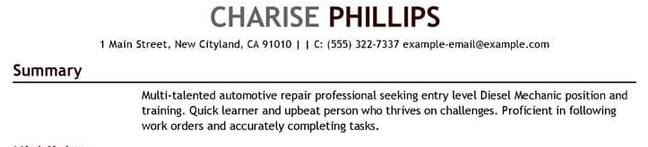
This mechanic objective is short and to the point, while still giving recruiters a bit of insight to their personality and skills (“Quick learner who thrives on challenges”).

What we like:

Since the author is relatively new to the field, they opted to shoot for an entry-level position, setting clear expectations for the recruiter.

3. Naukri

A certified Digital Marketer with a 6-month internship experience with XYZ agency. Excellent understanding of online marketing and an ability to help businesses boost their organic traffic as well as generate high quality leads through SEM Marketing. Looking for a relevant role.

This entry-level career objective from career advice blog Naukri uses past agency intership experience to demonstrate they can handle the new challenges of a full time role.

What we like:

Despite having a short work history (internship experience only), this applicant emphasizes their transferrable digital marketing skills. They also play up the contributions she made to the agency while interning.

4. Resume Builder

beginner resume objective example:  IT Image Source

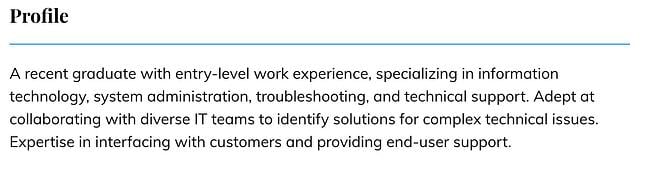
While this is a profile and not a resume objective, it does a good job of hilighting this recent grad’s skills. You can take this format and adjust it to create a persuasive resume objective.

What we like:

While the applicant is new to the workforce, we like that the first sentence highlights that they already has some entry-level IT experience. The profile then goes on to list their transferrable skills.

5. Resume Example

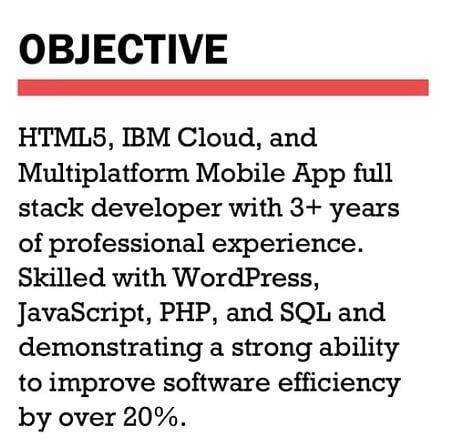
A 4.0 GPA digital marketing graduate looking for an entry-level marketing position at a top agency like Speedex Marketing. Hardworking and motivated to gain experience in social media and content marketing. Currently managing my personal Instagram with 10k+ followers and increased Terny Jewelry’s Facebook page followers by 20% after working with them for three months.

This objective taken from a Resume Example template shows how to showcase work you’ve done on personal projects to make the case for why you should be hired.

What we like:

This recent grad does an excellent job of highlighting their marketing talents running their own brand, complete with data to back it up.

6. Hloom

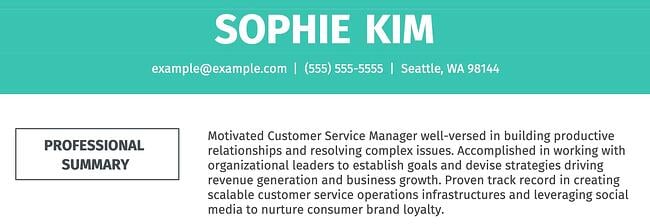
Customer service resume objectiveImage Source

While this entry-level professional summary from Hloom isn’t an objective, it provides a good base to tailor it to the specific role you are applying for.

What we like:

This summary is really good at showing how their skills and actions in previous roles impacted the company. You can adopt this technique when writing your objective, getting specific about the results you delivered in previous roles and how you plan to deliver in the next.

7. Live Career

Looking to secure an entry-level Web UI Developer position with (company name) that will allow for the use of excellent user experience, technical and communication skills.

This short and sweet template from Live Career can easily be modified to craft yoru own objective. Just get more specific about what you bring to the table for the company you are applying to.

What we like:

A good resume objective doesn’t have to be wordy. If you can communicate your talents and intentions in one to two sentences, do it.

8. Resume Genius

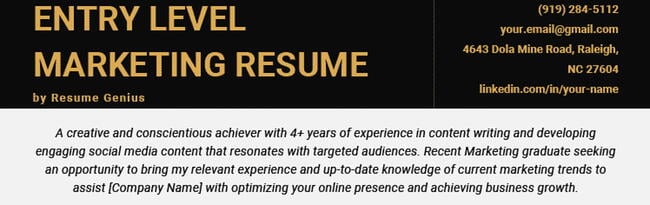
Entry level marketing objective - Resume GeniusImage Source

This objective from Resume Genius is a great teamplate for those pursuing a marketing role. you’ll just need to tailor it to your specific talents.

What we like:

Like previous examples, this objective is specific about the appliant’s experience and qualifications. It also focuses on outomes, which is a great way to demonstrate your qualifications for a role.

9. Springboard

As the daughter of small business owners, I’m really excited about the prospect of using my full-stack Python experience to further the Stripe mission of making payments accessible for companies of all sizes across the globe. I’ve built several projects in Django to scratch my own itch and I’d love to use that skill-set to start my software engineering career at Stripe.

This entry-level objective from Springboard demonstrates the effectiveness of adding a personal touch when relevant to the company you are applying to.

What we like:

This resume objective is so effective because it doesn’t just show off the applicant’s skills, but also her “why”. She’s passionate about helping small businesses succeed because her parents were small business owners — establishing a personal connection to Stripe’s mission.

10. Career Cloud

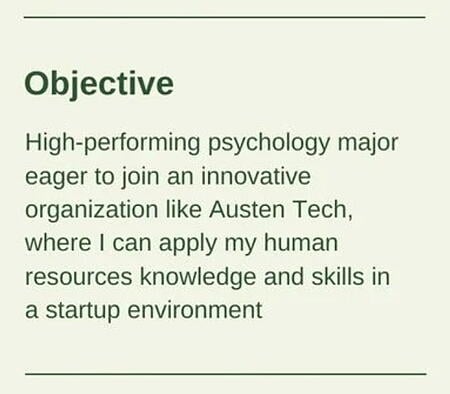
Entry level startup objective - Career CloudImage Source

While this objective from Career Cloud is only one sentence, it quickly sums up the applicant’s background and the role they are applying for.

What we like:

This is a good-one sentence template for how to format a brief resume objective for new grads. If possible, take it a step further and describe how your skills will benefit the company.

11. Resume.com

Recent major in Marketing and Advertising from Blue University where I completed two internships at Global United Agency. Able to use critical thinking and communication skills to attract customers and implement new strategies. Seeking employment as a marketing associate to help Aerial Agency’s overall marketing efforts.

This entry-level marketng resume objective from Resume.com provides a good foundation for those looking to play up their internship experience.

What we like:

This objectibe is specific, showcasing not one, but two internships with relevant experience while also not making the whole paragraph about themselves. It brings everything back to the company with the last sentence “to help Aerial Agency’s overall marketing efforts.”

Professional Resume Objectives

12. Beam Jobs

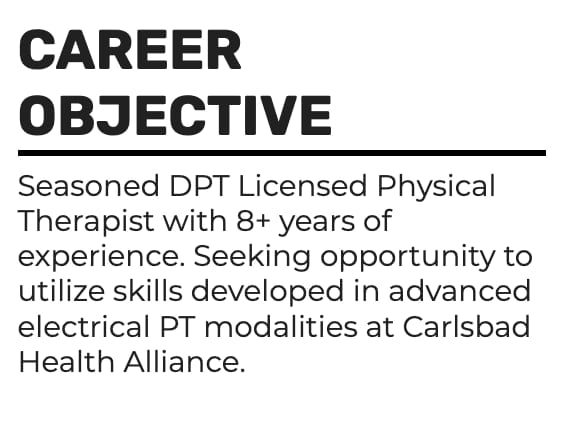
general resume objective examples: Beam Jobs Physical TherapyImage Source

This objective is clear and to the point, quickly outlining their experience and what skills they intend to apply to the new position.

What we like:

This objective is succint and shows that you can craft one that is both concise and effective.

13. Zippia

Zippia Resume ObjectiveImage Source

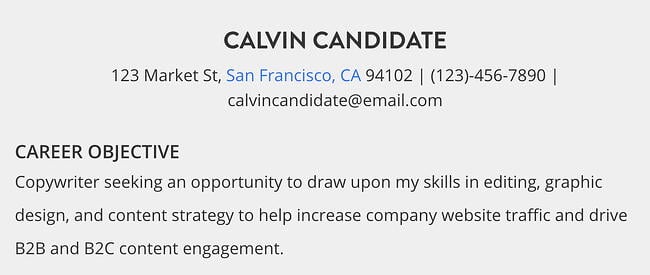
This objective manages to list the applicant’s skills and how they’ll be applied in just one sentence.

What we like:

Like the brief resume objective example above, this one gets the job done in one sentence while stating specifically what they intend to complish in the role (increasing traffic and driving engagement).

14. Resume.io

Motivated human resources professional with a drive for serving as a dedicated support specialist and energetic team member. Adept in assisting with the recruitment of employees, as well as the management of existing employees. Experienced in managing employee and community outreach programs, and dedicated to working towards the mission of a company.

The customizable career objective above is written for a human resources professional, but can be adapted to suit your industry. Simply swap out the role and your skills to craft your own.

What we like:

While this example clearly calls out the applicant’s recruiting skills and experience creating programming, it also ties the focus back to the company mission. If using this as a template, you can easily replace the company’s mission statement and tie it back to your own skills.

15. Resume Companion

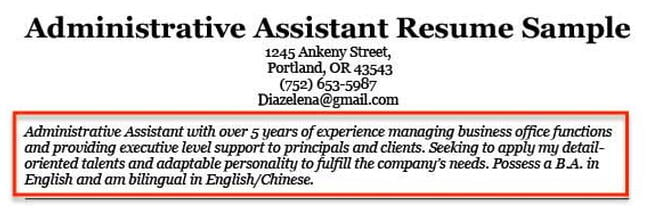
good resume objective example: Admin AssistantImage Source

This resume objective has a heavy focus on the applicant’s professional experience and how their skills will apply to the new role they are applying for.

What we like:
While we wouldn’t normally suggest adding degree information in your objective unless you’re a recent grad, in this case it works to emphasize the candidate is fluent in multiple languages.

16. Beam Jobs

general resume objective examples: teacher Image Source

This resume objective does a great job of highlighting specifically what the applicant brings to the role in a concise way.

What we like:

While this is for a teaching role, you can apply the same level of specificity to your objective, emphasizing why you want the role and who benefits. In this case it’s cultivating student’s passion for a particular subject, but it can be applied to any industry you’re excited about making an impact in.

Sales Resume Objectives

17. Zety

Retail resume objective ZetyImage Source

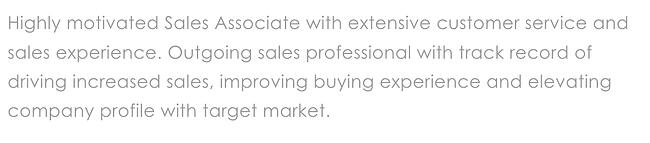
While the wording of this resume objective is a bit clunky, it can still serve as a template for your own with a few adjustments to tailor it to your industry.

What we like:

This resume objective places an emphasis on outcomes, which is great for any industry, but especially in sales. If you have a proven record of driving sales or similar impact, be sure to include it.

18. Resumeway

sales resume objective - ResumewayImage Source

If you’re stuck gettng started, use this template from Resumeway to make writing an objective a little easier. Be sure to have the data points you’d like to include ready beforehand.

What we like:

As we’ve mentioned previously, anytime you can provide data to back up your claims, do so.

19. Resume Genius

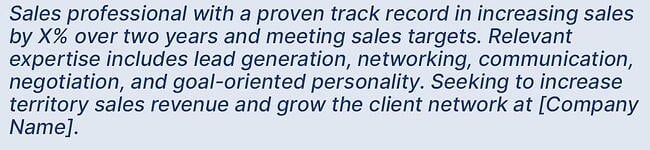
Sales resume objective ResumeGeniusImage Source

Coming in longer than most on this list, this objective is all about skills and the positive outcomes they spearheaded.

Management Resume Objectives

This objective focuses on what the candidate can do for the company, rather than just being a list of accomplishments.

20. The Ladders

Seeking a data analytics supervisor position where I can apply my 7+ years of data science and business analytics skills and experience. I’m eager to improve business intelligence for Company XYZ in a leadership role.

This objective from the Ladders demonstrates how you can leverage your individual contributor experinece to make the case for a management position. The applicant isn’t shy to display enthusiam for the potential new role.

What we like:

This objective is quick to point out years of relevant experience at the start to build the foundation for why they are the right fit for the role. Then they drive the point home by disclosing what they intend to do once hired.

21. Interview Kickstart

With years of proven excellence, I’m looking for the challenging position of a director to be an active initiator of organizational success at MNO Inc. Prolonged experience in full-cycle project management, 6years of experience at multiple clients handling business operation management is ideal for the post in a mutually benefitting work culture to achieve company missions.

This is another quick-start template you can use to save time writing your objective. Simply swap out the default information for your own.

What we like:

This template is easily customizeable while providing a solid format to help you create a resume objective that clearly defines your potential impact if hired.

22. Top Resume

Editor with extensive writing and management experience looking to fill the position ofSenior Editorwith [company name], utilizing my time-management skills to ensure all projects meet deadlines and supervisory experience to effectively manage a team of writers and editors.

This template from Top Resume is perfect for editors or those applying for a similar role.

What we like:

This objective plays to the applicant’s strengths as well as honing in on qualities needed for the position (time management, meeting tight deadlines).

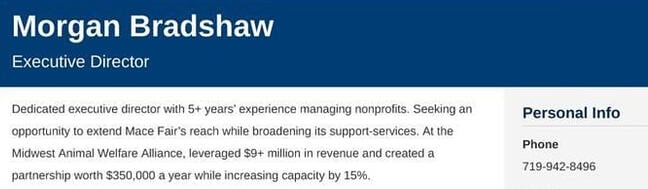
23. Resume Lab

Good resume objective examples: non profitImage Source

As we’ve previously discussed, getting specific about what you’ve accomplished and how you intend to help the company achieve its goals is key, especially when applying for a management position. This example shows the effectveness of providing data to back up your skills and accomplishments.

What we like:

We love the focus on tangible data and stats in this resume objective example. Use them whenever possible to make your case.

24. Tough Nickel

A highly recognized hotel management professional offering over ten years of enhancing organizations’ bottom lines through a customer-centric approach and excellent leadership and interpersonal skills. Seeking a challenging position as(specific role)in order to help grow(company)’s reputation as it continues to expand.

This template from Tough Nickel…will get your objective written in no time. It’s adaptable to any industry.

What we like:

This template emphasizes how you accomplished a particular goal, its impact, and what you intend to apply those skills in your next role.

Marketing Resume Objectives

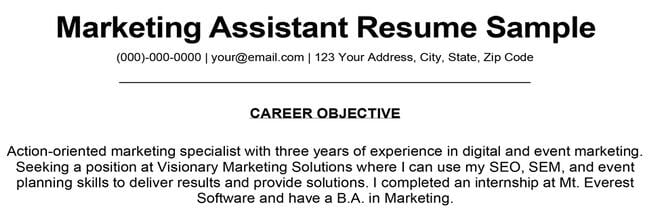
25. Resume Companion

MKTG Asist objective - Resume CompanionImage Source

If you’re early in your marketing career, with a few years of experience, you can use this resume objective for a bit of inspiration. If you have enough work experience to fill the page, you may want to omit the degree info in your draft.

What we like:

We like how this objective highlights two different sectors within the marketing umbrella — event and digital marketing. If you have similar dual, but relavent talents that would be beneficial in your new role, highlight them.

26. Naukri

A resourceful individual with a proven track record in implementing successful marketing strategies, boosting organic traffic, and improving search rankings seeks a position of Marketing Associate at ABC company to maximize brand awareness and revenue through integrated marketing communications.

This objective from career advice blog Naukri provides a good starting point for those applying for marketing associate or assistant roles.

What we like:

While this obective is vague enough to be tailored to your needs, the format with specifics about your skills and how you would apply them provide a good outline for how you should structure your own.

IT & Developer Resume Objectives

27. Interview Guys

good career objective examples: developerImage Source

This brief but effective objective quickly highlights the applican’t most relevant skils and the impact they could potentially have in their new role.

What we like:

It’s easy to make a resume objective one-sided and all about yourself, but this one demonstrates that you can demonstrate your value to potential employers in a clear and concise way.

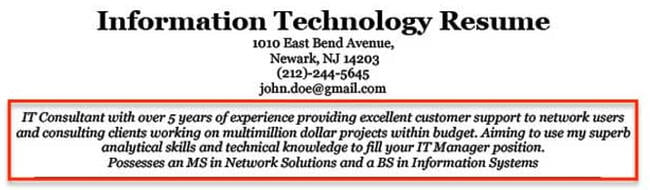
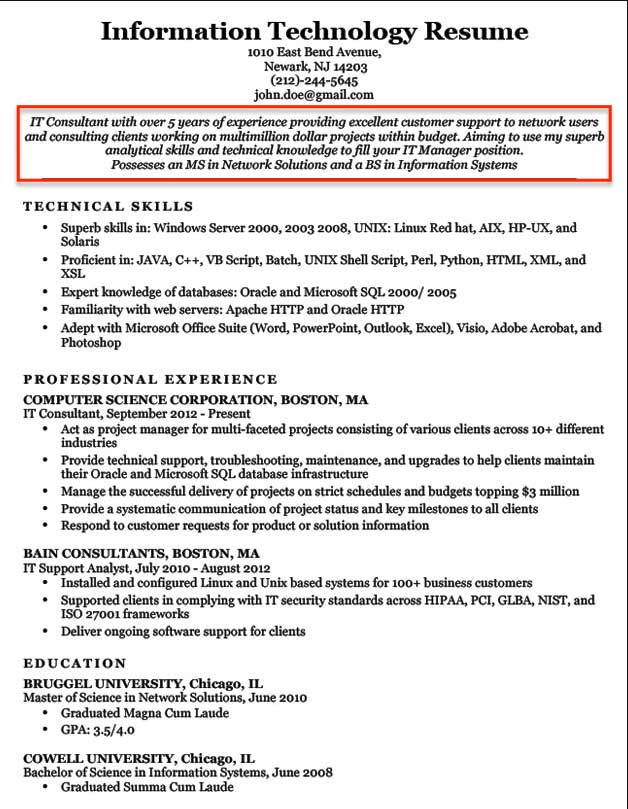
28. Resume Companion

IT resume objective - Resume CompanionImage Source

This is another resume objective example that demonstrates the power getting specific about your contributions and using numbers where appropriate to add context.

What we like:

In just a few sentences, this objective clearly conveys that this IT candidate has ample experience working on projects with large budgets. A recruiter would see this as a plus, if they are hiring for a large account as this person has already shown they are capable.

29. Evolution Coaching

Energetic, technical-minded professional seeking aposition as a (Software Engineer) at (Company Name) where knowledge of software development life cycles, a high technical aptitude, and unyielding commitment to work can effectively be utilized to contribute to the successful and profitable operation of the company.

This plug and play template from Evolution Coaching makes it easy for you to pop in your own accomplisments and contributions.

What we like:

Like other templates on this list, this one highlights the importance of including how your skills and attributes will benefit the company you are applying to. Always align yourself with the company’s goals.

30. Resume Giants

general resume objective example - Full Stack DeveloperImage Source

This objective quickly hones in on the software and skills needed for the role, making it easy for recruiters to skim and want to know more details about your experience.

What we like:

This objective likely used keywords from the job description, a good strategy for signaling to recruiters that you have the skills they’re looking for.

Career Change Resume Objectives

31. Resume.io

Leading Fintech marketing professional, seeking to make a move up to Marketing Director after eight years of award-winning campaigns. MBA-educated social marketeer, who will deliver triple-digit audience growth and double-digit sales increases.

This objective from Resume.io conveys confidence. While everyone may not be able to pull this one off, if you can back up your claims, go for it.

What we like:

This objective is bold and gets very specific about the value the applicant can provide to the company. The employer can read it and know exactly the value can provide once hired.

32. University of Pennsylvania

good resume objective examples:  Career Change Wharton school of BizImage Source

This objective makes the case for an inustry change by playing up the applicant’s transferrable skills.

What we like:

This objective is to the point and doesn’t try to disguise the industry swap with vague jargon. Instead it clearly states what the writer’s experience is and how they’ll apply it to their new pfrofession.

33. Career Contessa

Results-driven technology sales representative, seeking to use pipeline building and negotiation skills to increase revenue at XYZ healthcare company. Drove $2 million in sales revenue during FY20 and eager to increase the bottomline at XYZ company.

This career objective from Career Contessa is a great template to use if you’re applying for a similar role, but in a completely different field. In this case, it’s a sales position, but could be applied to any industry.

What we like:

Since the roles are similar, the writer was keen to play up their relevant experience and data-backed accomplishments. From there she succinctly expressed how she intends to increase revenue for the new company.

34. Federal Resume Guide

Good resume objective examples: career change GovernmentImage Source

Teachers have a bunch of transferrable skills they may not even know they have. From time managment and public speaking to dealing with the public, to conveying ideas and concepts clearly, they have so much to offer when those skills are applied to other industries.

What we like:

This objective was able to connect the applicant’s 15-year experience teaching history to why they’re a great candidate to be a museum curator. They can easily draw on their existing knowlege and people skills to be succcesful in the role.

35. Sweet CV

Successful engineer aiming to change professions and move into business management. Seeking a chance to use project management and leadership skills in a fresh context and use my eye for detail to drive growth in a technology start-up.

This objective from Sweet CV showcases an engineer making the case for a business managment position at a start-up, highlighting their most relevant skills.

What we like:

Again, it’s important to play up any related skills or background that will give you an advantage when switching to a new career. Since the applicant already has engineering experience and is seeking to work for a technology startup, their backround is a bonus.

36. Jobscan

Passionate sales representative with over 5 years of experience working with customers and selling software. Looking to leverage my proven skills in seeing our customers’ pain points and providing solutions to whatever I write as an aspiring Content Manager.

This example from Jobscan shows how you could structure an objective if you are trying to move positions within the same company. Working in customer service gives the applicant useful insight into their audience’s needs.

What we like:

This resume objective plays to the applicant’s strength (insider customer knowledge) to demonstrate why she’s the perfect candidate to write for them. This could greatly improve the company’s content since they will have a better understanding of their audience and how to solve for them.

Write a Resume Objective That Gets Noticed

Now that you know how and when to write a resume objective and checked out a few examples, it’s time to craft your own. Use the tested strategies above to make sure your resume stands out among the crowd.

Editor’s note: This article was originally published in December 2018 and has been updated for comprehensiveness.

New Call-to-action

Categories B2B

The Rise of Paid Verification on Social Media

Welcome to HubSpot Marketing News! Tap in for campaign deep dives, the latest marketing industry news, and tried-and-true insights from HubSpot’s media team. 

Having a verified account on social media was once seen as a point of notoriety or a status symbol.

Now, it’s a commodity that can be purchased.

Verifying social media accounts began on Twitter in 2009. Tony La Russa, then manager of the St. Louis Cardinals, filed a lawsuit against Twitter after a user created an impersonation account and shared insensitive tweets.

Download Now: The State of Social Media Trends [Free Report]

Though the suit was eventually dropped, it led Twitter to launch its Account Verification process giving verified accounts blue check marks as a symbol of authenticity for notable businesses or public figures. The goal was to make impersonation harder to achieve. Instagram followed suit and began verifying accounts in 2014.

In late 2022, Elon Musk announced a revamp of the Twitter Blue subscription program upping the price from $5 to $8 per month (or $11.99 per month through the app store) and offering subscribers a blue check mark among other features.

Earlier this month Meta announced a similar subscription called Meta Verified, offering users on Facebook and Instagram a blue check mark, increased visibility in the feed, and increased customer service support starting at $11.99 per month.

When these subscriptions were announced, pushback from users was immediate.

On one hand, there are security concerns at play. After the initial rollout of Twitter Blue verification, some users were able to create fake accounts that mimicked real brands, defeating the initial intent of verification.

Additionally, Twitter now only offers two-factor authentication to Twitter Blue subscribers, making accounts that aren’t paying less secure and more susceptible to being hacked.

Meanwhile, Instagram users who are already frustrated with the platform’s difficult-to reach-customer service in the event of a hack or other issues will likely need to pay to receive basic customer support.

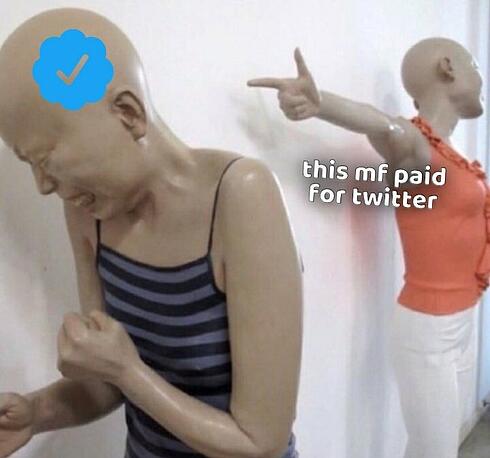
In addition to security concerns, the introduction of these subscriptions solidifies these platforms as being spaces where you have to pay-to-play.

Paid-Twitter-MemeImage Source

With Meta Verified promising increased visibility on Facebook and Instagram for subscribers, users who are already frustrated with their lack of reach may be tempted to opt in so more people see their content.

What’s unclear is whether end-users will know whether or not the content they see is being served through the algorithms or if it’s being shown because an account paid for increased reach.

While this option may be appealing for content creators or small businesses who want to get in front of more people, it could be discouraging for everyday users who visit social media to see updates from their family and friends.

With the advertising challenges social media platforms have experienced over the past few years intensifying, it’s not surprising these companies are evolving to include paid subscription models to generate revenue. Whether verification and increased reach are the right features to offer is to be determined.

Marketing Snippets

The latest marketing news and strategy insights.

Why social media marketing was the real winner of Super Bowl LVII.

Influencer marketing: why some DTC companies are reducing influencer spend in 2023.

Why AI Isn’t Replacing Our Jobs: the HubSpot Blog interviewed Jasper’s Head of Marketing to cover how we can work with AI.

LinkedIn: how tech layoffs are fueling a LinkedIn boom. 

Pinterest extends Idea Pin length to 5 minutes.

Instagram statistics you need to know in 2023.New call-to-action


Categories B2B

What is AI? What Marketers Need to Know

Artificial intelligence is getting a lot of traction in the marketing world. According to Statista, 80% of industry experts integrate some form of AI into their online marketing activities.

However, if you’re like me and are unfamiliar with AI beyond what you’ve seen in science fiction stories like I, Robot or Black Mirror — you’re probably wondering what AI is and how to use it in marketing.

Is AI really what it looks like in the movies? This article will explore the definition of AI, the different types of AI, and how AI can improve marketing processes.

What is artificial intelligence?

How does AI work?

What are the four types of artificial intelligence?

How Marketers Can Use AI

The Pros and Cons of AI

The Future of AI in Marketing

Free Guide: How to Use AI in Content Marketing [Download Now]

So now you know what AI is, let’s explore how it functions.

How does AI work?

AI combines large sets of data with intelligent, repetitive processing algorithms to learn from patterns and features within the data being analyzed. The AI continuously processes and learns from the data.

Within each round of data processing, the AI system tests and measures its own performance to gain additional expertise.

AI can run through thousands, even millions, of tasks repeatedly — improving its performance in a short amount of time. However, there are multiple kinds of AI, each with its capabilities and limitations.

What are the four types of artificial intelligence?

The four types of artificial intelligence are reactive, limited memory, theory of mind, and self-awareness.

Reactive

A reactive AI can only use its intelligence to react and reply to the world around it. It can’t store memory; therefore, it can’t rely on past experiences to inform real-time decision-making or problem-solving.

Reactive machines can only complete a finite amount of specialized tasks. Though this may sound like a drawback, it has its perks. A reactive AI will react the same way to the same stimuli every time — making it reliable and trustworthy.

One of the most famous examples of reactive AI is Deep Blue, a supercomputer created by IMB in the 1990s that won a chess match against chess champion Garry Kasparov. Deep Blue could identify the chess board pieces and how each piece could move based on the game’s rules.

However, the AI could not try to anticipate its opponent’s next move, nor could it think of ways to put its piece in a better position.

Limited Memory

Limited memory AI stores previous data and predictions and uses it for decision-making — looking into past data to predict the future. Limited memory AI is when a machine learning model is continuously trained to analyze and use new data.

Limited-memory AI consists of six steps to follow.

  1. Create the training data.
  2. Create the machine learning model.
  3. Enable the model to make predictions.
  4. Have the model receive human or environmental feedback.
  5. Store the feedback as data.
  6. Repeat all the above steps in a cycle.

Examples of limited memory AI are self-driving cars. Self-driving cars identify civilians crossing the street, traffic signals, and other data to make better driving decisions and avoid future accidents.

Another example of limited memory AI is HubSpot’s adaptive testing tool. The adaptive testing feature splits traffic evenly between page variations at first.

As HubSpot learns how these variations are performing, we adjust the traffic automatically, so optimal-performing variations are shown more than the poorly-performing ones.

Theory of Mind

Theory of mind AI is as it sounds — theoretical. AI has not yet advanced to this type, so theory of mind is still in its innovation stage. This type of AI interacts with the thoughts and emotions of humans. Theory of mind will better understand the entities they interact with so they can understand their needs, beliefs, feelings, and thought processes.

For example, we now know that self-driving cars are a form of limited mind AI. If these autonomous cars could analyze and understand their drivers’ mental and emotional states to improve safety, they would evolve into Theory of Mind AI.

Self-awareness

Once theory of mind is a reality, the next type of AI to emerge will be self-awareness. At this point, machines won’t just be aware of humans’ emotions and mental states — they’ll also be aware of their own. A self-aware AI will have a human-like consciousness and understand its existence in the world and with others.

How Marketers Can Use AI

AI can perform parts of the marketing process — such as task automation, campaign personalization, and data analysis — so you can spend less on repetitive tasks and more on strategy.

For example, our HubSpot mobile app has a business card scanner that uses AI to pick out the name, email address, and other contact information on a business card and map them to your HubSpot properties. Instead of spending time manually entering this data yourself, the AI automates the process for you.

Screenshot of Hubspot's business card scanner, available on the HubSpot app; What is AI?


The Pros and Cons of AI

So, now you know what AI is, how it works, and the four types of AI — let’s get into the pros and cons of AI technology.

The Pros of Artificial Intelligence

Fewer errors

Humans can make mistakes, miss deadlines, misspell words, and get the math wrong. Sometimes we’re distracted or going through burnout; it’s human nature. By implementing an AI-ran automated system, you’re lessening the risk of errors.

24/7 Uptime

AI also doesn’t need rest and can run 24/7. AI’s can run constantly and consistently for as long as it’s programmed to. This makes AI more ideal than humans for repetitive tasks, allowing marketers and business owners to focus their efforts elsewhere.

Can analyze large data sets quickly

As I mentioned earlier, humans sometimes make mistakes — especially when processing large data sets. A solution would be to work slower to prevent errors, but time is money in marketing.

Fortunately, AI machines can quickly process large amounts of information and data, making them more efficient than humans in a deadline crunch.

The Cons of Artificial Intelligence

Lack of creativity

AI is programmed to react to stimuli based solely on data from the past, meaning they’re not currently suitable for creating innovative solutions. Data from the past can help predict future outcomes, but data alone isn’t always enough to address a never-before-seen variable.

Therefore, AI would be better suited for “grunt” or mundane work. From a marketing perspective, humans can develop a creative marketing strategy, while AI can take care of the repetitive tasks that implement the plan.

Impersonal

Sometimes, human connection is the best way to forge a closer relationship with your audience. While a self-aware AI is possible in the future, current AI machines cannot perfectly mimic the human experience.

From a marketing perspective, implementing AI in every customer interaction can create a rift between you and your audience. I mean, there’s a reason many of us can recall shouting, “speak to a representative!” when we’re tired of speaking to a robot on the phone.

The Future of AI in Marketing

According to Grand View Research, the global AI market is expected to reach $1,811.8 billion by 2030, up from $136.6 billion in 2022.

Artificial intelligence, theory of mind, and self-aware machines all sound like things from a distant future. Still, the reality is AI is here now, and its impact across industries will likely grow in the years to come.

While AI has pros and cons, it’s important marketers stay tuned in to its advancements and be open to using AI to streamline certain processes to keep up with competitors.

New Call-to-action


Categories B2B

What’s Mastodon & Should Social Media Marketers Keep it on Their Radar?

A new social network has taken the internet by storm, and it goes by the name of Mastodon. Having amassed a following of almost two million active users by this January, the platform is described as an alternative to Twitter.

So what does this new name have to offer marketers? And can your brand benefit from having a presence on it? In this post, we’ll break down what Mastodon is and how to leverage it — according to an experienced and trusted marketing partner here at HubSpot.

Download Now: The State of Social Media Trends [Free Report]

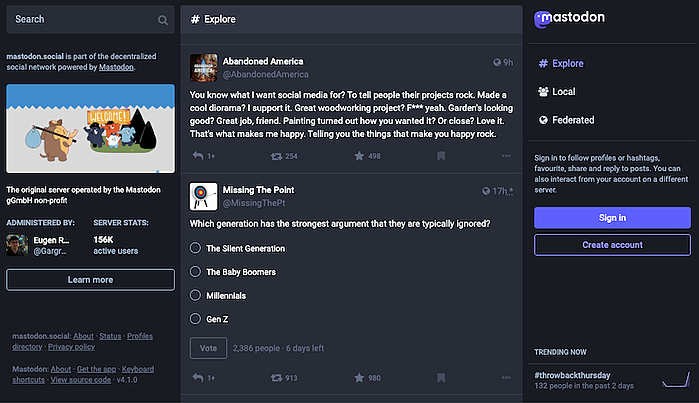
mastodon social home pageImage Source

What can you do on Mastodon?

On Mastodon, users can explore different servers according to their favorite topics of interest or industry spheres. When you find a forum you’re interested in, you can join in and engage with whomever you like — more or less like you would on Twitter. You can:

  • Follow users
  • Reply to other people’s posts
  • Engage in or begin your own conversations

You can build a feed tailored to what you want to see and use features like an explore tab to find new and exciting content.

Tips for New Mastodon Users

We asked Crystal King, one of HubSpot’s very own Senior Marketing Managers and Principal Inbound Professor, if she had any useful tips for people new to the platform. Here’s what she had to say.

  1. Put yourself out there and join a variety of servers.

“Like any new social platform you might join, there is a learning curve with Mastodon. The hardest thing to get used to is the idea that not everyone is on the same server as you are, but that you can still talk to them.

“It doesn’t really matter what server you are using, but if you want to find a topic-specific server to join then it may mean your local feed is slightly more curated toward that topic, but it’s not a necessity to do so.”

No one’s an expert at something when they first begin. When you join Mastodon, don’t feel you belong on only one or two servers. Everyone has a place to share their thoughts and opinions just as much as the next person.

Mastodon has much more freedom of choice regarding the content you’re given. While it can recommend conversations and servers to you, it won’t crowd your personalized feed with content you haven’t followed, like Instagram or Twitter — where recommended, sponsored, or related content can clutter your feed.

2. Find your favorite accounts from Twitter and find where they reside in Mastodon.

“One thing you can do to find your Twitter followers that are also on Mastodon is to go to Twitter and search for the word ‘Mastodon.’ Then, click the three dots to the right of the search bar and click ‘Search filters.’ That narrows down the search to only people you follow, and by doing this you can often see tweets where they have shared their Mastodon profiles.”

If you’re lost on where to start, look at who you already follow on Twitter. Chances are that if they’re a full-time influencer or a frequent poster, they may have already made their way to Mastodon — and can help you identify which servers you’d enjoy the most.

3. Don’t expect visuals, expect conversations.

“Mastodon is a text-heavy platform, and you won’t see many moving .gifs, videos, or big images. Those things are present, but you usually have to click through to see them. Instead, focus on creating and having conversations. Share interesting information. Ask great questions to get people talking. And engage with others. That’s where you’ll find the most value.”

King recommends that new users focus on contributing insightful conversations to gain traction in the platform. While Twitter and Instagram prioritize visual-heavy content, Mastodon will display trending conversations and forums where visuals are more of an added detail than a priority.

Why would a brand want to use Mastodon?

According to King, Mastodon allows marketers to get creative with their digital marketing.

“Brands may feel skeptical about using Mastodon. After all, there are no ads. There aren’t any rewards for having a certain number of followers. There aren’t any algorithms to push content to more people. In short, it feels like Twitter without all the things that made Twitter great for marketers.

“And that’s sort of the point — people don’t typically like to be marketed to, and that’s what the platform’s creators had in mind when developing it. But that doesn’t mean brands can’t or shouldn’t use it. You just can’t think about the platform as a replacement for Twitter. It’s something different. Mastodon is a place to share information and engage with an audience. And brands that can do that will find a niche on the platform.”

Marketers can’t rely on paid or promoted ads to reach targeted audiences. Instead, they can use Mastodon to provide value, insight, or content that engages prospects — rather than sell to them.

“The engagement rate on Mastodon is much higher than that of Twitter. Plus, there’s a heavy journalist presence on the platform as well, which bodes well for your brand’s visibility. If you are a brand that loves chatting with your audience, it may be a great place for you. The best way to find out is to develop a test of three to six months and see how it works for you. Just don’t expect it to look or act like Twitter, because it’s not.”

You can’t approach Mastodon expecting the same results as you’ve gotten from previous social media channels. If anything, King is saying that brands can position themselves for better brand visibility on the platform if they focus on thought leadership — delegating designated content marketers or journalists to post about buzzing conversations and news.

See All the Possibilities Mastodon Has to Offer

With the rise of new social media channels, marketers can use new greenspace to attract prospects. While Mastodon itself isn’t directly optimized for paid advertising, there are many ways to grow a following and engage with your target audience.

New call-to-action

Categories B2B

Why AI Isn’t Replacing Our Jobs — Or Search Engines — According to Jasper’s Head of Enterprise Marketing

A couple years ago, artificial intelligence still seemed like a somewhat far-off, sci-fi version of reality. And it certainly didn’t seem like something that would completely transform how marketers work within the next few years.

But in 2023, generative AI is officially here, and it’s only growing. In fact, the generative AI market size accounted for over 7 billion USD in 2021, and it’s projected to occupy more than 110 billion USD by 2023 — growing at a CAGR of 34.3%.

All of which is to say: Generative AI is poised to completely disrupt — and elevate — business’ content strategies in 2023 and beyond.

And disruption of any kind can be scary. What does generative AI mean for the future of marketing? Will it replace us, or elevate us? And what about SEO? Will Googling be replaced with AI chatbots — and what does all that mean for content creation?

Here, I spoke with Samyutha Reddy, Jasper’s Head of Enterprise Marketing, to explore her perspective on whether AI will replace content creators, as well as SEO, in the future.

Let’s dive in.

Free Guide: How to Use AI in Content Marketing [Download Now]

Will AI Replace Marketers?

AI Augments The Human Experience — but It Doesn’t Replace the Human Within That Experience

Generative AI can research virtually any topic across the internet, and distill that research into original content. It can format that content as a blog post, email, Facebook ad, or something else, depending on the query.

Generative AI is still in its early stages, and it has some issues. The information it collects can be biased or simply false, and it doesn’t have the discernment of a real human to catch those inaccuracies.

But as generative AI continues to learn and grow, it makes sense that marketers are concerned. In the future, rather than needing a team of five or ten content creators, will you just need one — someone to fact-check the AI’s content?

Fortunately, Samyutha isn’t worried. In fact, even though her team currently uses generative AI on a daily basis, she’s still actively hiring and growing her team.

Samyutha Reddy on why AI wont replace marketers

As she puts it, “AI augments the human experience, but it doesn’t replace the human within that experience. We value writers in our society because they’re able to give us a thought-provoking human perspective on the world. It isn’t just about summarizing facts that are out there. It’s about humans sharing opinions on very real topics that help build your perspective on how you feel about something. So an AI could really never replace that human perspective.”

However, AI Will Force Content Creators to Re-skill

Samyutha does acknowledge that AI will force content creators to re-skill, as aspects of their roles become more automated.

She told me, “I think it’ll force content creators to re-skill. And I don’t think that’s a bad thing. I think that’s what every big shift in technology has done for humans.”

She adds, “I’ve never met a content creator who has said, ‘Wait. I really want to spend more time doing all the rote tasks of reading everything I need to know on the internet about a given topic.’ AI will give marketers more time to be creative, form an opinion, and incorporate more data sources into their perspectives.”

Rather than thinking of AI as a content creator replacement, it’s better to think of AI as a marketer’s efficient side-kick.

Consider this: A marketer decides she wants to write a topic about SWOT analysis. Rather than spending her morning chugging coffee and reading up on what SWOT analysis means, effective SWOT analysis examples, and how SWOT analyses can help businesses grow, she can simply plug the query into an AI chatbot.

Once she’s confirmed the sources the chatbot used to pull that information are accurate, she can quickly skim through the AI’s response and learn everything she needs to begin writing about the topic. She can even use the AI’s response as a first draft, and strengthen it with her own unique tone and perspective.

From there, she can leverage the AI’s proofreading skills to edit her final copy.

Additionally, if the marketer has written a piece of content that she’d like to turn into an entire campaign, she can use AI to re-format her blog post into corresponding ad copy and creative, which she can hand over to her sales and paid ad teams.

As Reddy puts it, “I can effectively hand over to sales an entire drip campaign, an entire outbound sequence, complete with landing pages, with the ads that people will click and see. And it really allows me to take control back on what it means to execute a campaign. It enables me to truly be a project manager and a strategist, versus someone who is waiting on other people to deliver their end of the bargain.”

Marketers Will Need to Become Experts in Select AI Platforms

Freelancing platform Upwork recently announced it added a new category, ‘Generative AI’, as a specialty within their marketplace.

This means business leaders can now hire freelance content creators who have expertise with a specific AI platform — and Reddy isn’t surprised.

She says, “AI has biases deeply embedded within its models that people are working on. AI has the tendency to hallucinate and start talking about random things when you’re asking it for outputs, so it would be really tough to just completely remove a human from the process.”

She continues, “Similar to how a marketer can level-up by becoming HubSpot or Salesforce certified, I think we’ll soon see marketers who demonstrate their value by saying, ‘Hey, I’m skilled in using generative AI platforms.'”

AI Will Eliminate Portions of the Creation Process – But it Will Also Elevate Marketers

Reddy admits, “I do think it will eliminate some portions of the content creation process.”

However, she’s quick to add, “I think AI will focus on elevating folks, and I think the angle you take matters on this whole generative AI front. If you’re a writer, content creator, or a marketer, you’ll want to ask yourself, ‘Am I going to be someone that embraces technology and figures out how to upskill myself and actually become the cream of the crop in terms of talent? Or am I going to be someone who pushes technology away, refuses to believe it’s happening, and clings onto an old way of life?’

Samyutha reddy on the power of marketers embracing generative AI

For Reddy, she sees marketers at the forefront of a tool that will ultimately upend all roles within a business, and she believes there’s great privilege in being the first to adopt it.

As she puts it, “I think there’s a certain power here that marketers can reclaim, and instead of being the victims in this story of ‘generative AI is coming for marketing’, I think we really reposition it as saying, ‘generative AI has landed in the most innovative portion of the enterprise: marketing.'”

She continues, “And we are now the stewards of this technology and how it’ll be used within the enterprise, and we get to pilot it and see how it can supercharge our work. And the folks who lean into being the stewards of this powerful technology will reap its benefits. I consider myself and our industry extremely lucky to to be in this position.”

Will Generative AI Replace Search Engines?

As more marketers and consumers use AI chatbots to get quick answers to common queries, it stands to reason that they’ll be leveraging search engines less often.

Reddy doesn’t see search engines going away, particularly since the information supplied on search engines is what powers generative AI results — but she does see it drastically changing.

As she puts it, “Search can help battle AI’s inaccuracies. For instance, Jasper has a function where you can toggle on Google search results. So if I say, ‘Jasper, help me write a paragraph about XYZ,’ it’ll write the paragraph, and at the bottom it’ll put in the Google search results it used while it helped me create that output. So I have factual links which I can cite, and fact-check to ensure they’re the most reliable piece of content on a given topic.”

She continues, “I don’t see search going away. I do see a future where I don’t necessarily want to type things into a search bar, and instead, I want to use chat functionality. That, I think, is imminent. And I think we’re already seeing that with the virality of Chat GPT. In just a couple of days, it’s become the fastest-growing consumer app.”

Ultimately, my conversation with Reddy felt positive and uplifting. As marketers, we don’t need to fear AI: We need to embrace it as technology that will help us do our jobs better.

And, personally, I’m all for any tool that minimizes the amount of time I spend researching, so I can get back to what really matters: creating content with the intention to move, inspire, or challenge readers’ to think differently.

New Call-to-action

Categories B2B

80+ Instagram Stats You Need to Know in 2023

It feels like Instagram, more than any other social media platform, is evolving at a dizzying pace. As it continues to roll out new features, updates, and algorithm changes, it can be hard to keep up.

That’s where the Instagram stats comes in. There’s a whole lot of research out there about Instagram — everything from the demographics of its users and its reach, to how negative space affects the performance of your posts (hint, hint: #68).

Read on to uncover more social media stats that’ll help you get ideas and improve your own Instagram posting strategy.

Download Now: The State of Social Media Trends [Free Report]

80+ Instagram Stats

Click on a category below to jump to the stats for that category:

  1. Instagram’s Growth
  2. Audience & Demographics
  3. Brand Adoption
  4. Instagram Post Content
  5. Instagram Posting Strategy

Instagram’s Growth & Usage

1. Instagram is expected to reach 1.44 billion users by 2025. (Source)

2. The Instagram app has over 78 million monthly active users. (Source)

3. 22% of marketers say Instagram has the most growth potential in 2023 than any other platform. (Source)

instagram statistics

4. Instagram saw a 48% increase in ad reach from January 2020 to January 2022. (Source)

5. Almost a quarter of marketers (23%) predict that Instagram will offer brands the biggest potential to grow their audience in 2023. (Source)

6. Instagram is the most-used platform for influencer marketing in the U.S. (Source)

7. Marketers say Instagram is the social media platform they know how to use best. (Source)

8. There are an estimated 143 million Instagram users in the United States in 2023. (Source)

9. As of January 2023, India has a total of 229 million Instagram users, the largest Instagram audience in the world. (Source)

10. As of January 2022, Instagram was the fourth most popular social media platform in the world in terms of user numbers. YouTube and WhatsApp ranked in second and third place. (Source)

11. On average, U.S. adults spend 30.1 minutes a day on Instagram in 2022. (Source)

instagram statistics (4)

12. As of February 2023, the most-liked post on Instagram is a carousel of Argentine footballer Lionel Messi and his teammates celebrating the 2022 FIFA World Cup win. (Source)

13. Between January and June 2022, the fastest-growing content creator on Instagram was influencer Jorge Gomez, with 573% growth in six months. (Source)

14. Other than Instagram’s own account, the most-followed Instagram account as of January 2023 is professional soccer player Cristiano Ronaldo. (Source)

15. As of May 2022, Instagram’s own account has 504.37 million followers. (Source)

Audience & Demographics

16. More than half of the global Instagram population is 34 years of age or younger. (Source)

17. As of January 2023, almost 17% of global active Instagram users were men between the ages of 18 and 24 years. (Source)

18. Millennials ranked Instagram as their favorite social media app in 2022. (Source)

instagram statistics

19. Gen Z-ers also ranked Instagram as their favorite social media app in 2022. (Source

20. TikTok and Instagram are the most used social media apps among Gen Z women. (Source)

21. In December 2022, 55% of Instagram users in the United States were women and 44% percent were men. (Source)

22. Only 7% of Instagram users in the U.S. belong to the 13 to 17 year age group. (Source)

23. Only 4.7% of Instagram users in the U.S. are 65 plus. (Source)

24. As of 2022, 82% of Instagram users also use Facebook. (Source)

25. 47% of U.S. Instagram users make more than 75,000 per year. (Source)

26. Instagram users worldwide spend an average of 11 hours per month on the Instagram app on Android phones. This number drops to 7 hours for U.S. users. (Source)

27. 72% of teens use Instagram, and 57 million U.S. teenagers say Instagram is their preferred social media platform. (Source)

28. 500 million+ accounts use Instagram Stories every day. (Source)

29. 35% of music listeners in the U.S. who follow artists on Facebook and Instagram do so to connect with other fans or feel like part of a community. (Source)

On instagram, photos showing faces get more likes.

30. The average Instagram user spends 30 minutes a day on the app. (Source)

31. 45% of Instagram users live in urban areas. (Source)

Brand Adoption

32. 72% of marketers work with influencers/creators on Instagram. (Source)

33. 29% of marketers plan to invest the most in Instagram out of any social media platform in 2023. (Source)

34. In terms of brand safety, 86% of marketers feel comfortable advertising on Instagram. (Source)

Instagram statistics

35. 53% of marketers say Instagram has high ROI. Only 7% of marketers say Instagram has low ROI. (Source)

36. 70% of shopping enthusiasts turn to Instagram for product discovery. (Source)

37. Marketers saw the highest engagement rates on Instagram out of any other platform in 2022. (Source)

38. 32% of marketers say Instagram is the easiest platform for working with influencers and creators. (Source)

39. 1 in 4 marketers say Instagram has resulted in the highest ROI out of any platform in 2022. (Source)

40. 27% of marketers plan to use Instagram the most for working creators and influencers in 2023. (Source)

41. More than half of marketers plan to increase their investment in Instagram in 2023. (Source)

Instagram statistics

42. In 2022, marketers saw the highest engagement rates on Instagram for user generated content. (Source)

43. Only 8% of marketers plan to decrease their investment in Instagram in 2023. (Source)

44. 36% of marketers plan to leverage Instagram for the first time in 2023. (Source)

45. 90% of people on Instagram follow at least one business. (Source)

46. 50% of Instagram users are more interested in a brand when they see ads for it on Instagram. (Source)

47. When it comes to posting organic content, 27% of marketers say Instagram offers the highest ROI for this type of content. (Source)

48. 1 in 4 marketers say Instagram provides the highest quality leads out of any social media platform. (Source)

instagram statistics (1)

49. Nearly a quarter of marketers (23%) say Instagram is the most effective platform for brands looking to build a social media strategy for the first time in 2023. (Source)

50. 46% of marketers leverage Instagram Shops. Of the marketers who leverage Instagram Shops, 50% report high ROI. (Source)

51. 41% of marketers leverage Instagram Live Shopping. Of the marketers who leverage Instagram Live Shopping, 51% report high ROI. (Source)

52. In a 2021 report, the higher education industry currently has the highest engagement rate of any other industry per post on Instagram, at 3.19%. Second was sports teams at 1.79%, and third was influencers at 1.42%. (Source)

53. 67% of users surveyed have ‘swiped up’ on the links of branded Stories. (Source)

54. 130 million Instagram accounts tap on a shopping post to learn more about products every month. (Source)

Instagram Post Content

55. Engagement for static photos has decreased by 44% since 2019, around the time Reels made its debut. (Source)

56. The average engagement rate for photo posts is 1.18%. (Source)

57. The average engagement rate for carousel posts is 3.15% (Source)

58. As of January 2022, #love is the most popular hashtag on Instagram. Over two billion posts use this hashtag. (Source)

59. Marketers rank Instagram as the platform with the best in-app search capabilities. (Source)

60. The most popular Instagram Reel has 289+ million views. (Source)

61. Marketers rank Instagram as the platform with the most accurate algorithm, followed by Facebook. (Source)

Instagram statistics (2)

62. A third of marketers say Instagram offers the biggest ROI when selling products directly within the app. (Source)

63. As of 2021, 9 out of 10 users watch Instagram videos weekly. (Source)

64. A third of marketers say Instagram offers the best tools for selling products directly within the app. (Source)

65. 995 photos are uploaded on Instagram every second. (Source)

66. The median posting cadence across all industries is 4 posts per week. The median posting frequency declined by just 8% this year compared to last. (Source)

67. On Instagram, photos showing faces get 38% more Likes than photos not showing faces. (Source)

68. On Instagram, images with a high amount of negative space generate 29% more Likes than those with minimal negative space. (Source)

70% of shopping enthusiasts use instagram for product discovery.

69. On Instagram, images featuring blue as the dominant color generate 24% more Likes than images that are predominantly red. (Source)

70. This is so much so that the latest Instagram statistics show that an average Instagram post contains as many as 10.7 hashtags. (Source)

71. Image posts received 27.55% more likes than permanent video posts. (Source)

72. An average image on Instagram gets 23% more engagement than one published on Facebook. (Source)

73. The most geo-tagged city in the world is Los Angeles, California and the tagged location with the highest engagement is Coachella, California. (Source)

Instagram Posting Strategy

74. The best time to post on Instagram is Friday between 6 p.m. and 9 p.m. in your respective time zone. (Source)

instagram statistics (3)

75. Posts with a tagged location result in 79% higher engagement than posts without a tagged location. (Source)

76. 20% of users surveyed post to Instagram Stories on their business account more than once a week. (Source)

77. 44% of users surveyed use Instagram Stories to promote products or services. (Source)

78. One-third of the most viewed Stories come from businesses. (Source)

79. More than 25 million businesses now use Instagram to reach and engage with audiences. (Source)

80. 69% of US marketers plan to spend most of their influencer budget on Instagram. (Source)

81. The industry that had the highest cooperation efficiency with Instagram influencers was Health Care, where influencer posts were 4.2x more efficient than brand posts. (Source)

82. Instagram is now the most popular social platform for following brands. (Source)

New call-to-action