Categories B2B

The Ultimate Guide to Writing a Cover Letter

Nowadays, companies have a computerized system that puts resumes through an online scanner which will automatically reject some applicants and push other applicants through depending on their qualifications.

So, What does this mean for you as a job seeker? Well, the cover letter attached to your application is more important than ever.

Have you been asked to attach a cover letter to your job application? Perhaps you’re struggling to write one that lands an interview or have no clue what one is at all.

Whichever situation you’re in, we’ve crafted this ultimate guide to cover letters. You’ll find out how to write one that gets read, what to include, and browse tons of templates to gain inspiration.

Are you ready to land the job of your dreams through a perfectly crafted cover letter?

Awesome!

You can dive straight in, or jump to the section you’d like to read.

→ Click here to access 5 free cover letter templates [Free Download]

How Long Should a Cover Letter Be?

Okay, so you’re all fired up and ready to craft the cover letter of the hiring manager’s dream. That’s great! But how do you manage the fine balance between in-depth and overwhelming?

A good cover letter is long enough to communicate why the recruiter should pick you … but not long enough to bore them to the point where they’ll need a strong coffee.

One page is usually enough to cover everything you’ll need to include, without losing the recruiter’s attention and having your cover letter tossed into the trash.

Let’s go into those items in more detail:

Your Name and Address

Kick off your cover letter by adding your name and address to the document.

This step is pretty self-explanatory, but it allows the recruiter to easily connect your cover letter to your resume (especially if they’re being printed).

Your name and address also make it easier for the recruiter to get in touch with a job offer. And that’s the aim of our letter, right?

Their Name and Address

Similarly, you should add the name and address of the company or person you’re writing to.

This shows you’ve done your research and allows the hiring manager to receive your letter if it’s sent to a generic company email address.

The Date of Writing

Make it easier for the hiring manager to file your application by including the date on your cover letter.

Even if you’re not successful this time around, the company might store your letter and refer back to it when they’re hiring for another position!

Why You’re Writing the Letter

We know that the aim of a cover letter is to persuade the hiring manager you’re the best fit for their job. But, be sure to open your letter strongly, with 1-2 sentences that’ll grab their attention and quickly make them realize they’re reading a cover letter.

Something like this will usually do the trick:

“I’m writing to discuss the content strategist role at HubSpot.”

Why You’re a Perfect Fit for the Job

The next section of a cover letter structure is the fun part — it’s where you’ll convince the hiring manager they should hire you — and not the person whose resume is behind yours.

In this section, answer these questions:

  • Why should this company hire you?
  • What skills do you have that will help complete the job better than anyone else?
  • What makes you a good employee?
  • What extra qualifications do you have that are relevant to the role?

Once you’ve answered these, the recruiter will have a solid understanding of who you are, and (hopefully) be convinced to hire you!

What You Can Offer the Company

Have you ever heard the advice to “always sell yourself in a job application”? That concept can be applied to cover letters, but remember that recruitment isn’t all about you.

Businesses measure success in terms of results. The company looking for a new employee will want to know what they bring to the table and how they’ll shape their business’ future. New candidates are rarely brought on board solely for the soft skills listed in their resume.

That’s why this part of your cover letter structure is arguably the most important.

In less than two paragraphs, show the business what you can do — and prove you’ve done it before (preferably with examples).

Not only does this give you the opportunity to show off your skills, but the company can picture the success you’ll bring to their business by hiring you.

Your Availability

In the marketing world, we’re always told the importance a call-to-action can make. But, don’t leave them to your blog posts: Explain your availability to the person reading your cover letter for the best chances of a follow-up call.

Great cover letters end with a brief section on the candidate’s earliest start date. You could also include your availability for an interview and tell them you’re happy to answer any questions they may have.

How to Address a Cover Letter

Earlier, we mentioned the importance of addressing the hiring manager by their name and address. This proves you’ve done your research and ensures the cover letter lands in the right place.

Personalized content does 42% better than non-personalized, so including the first name of the recruiter can go a long way.

But in a world where privacy is held close to our chest, you might need to do a bit of digging before revealing the name your letter should be addressed to.

Luckily, you can use the power of the internet to do this. To find their:

Name

Head over to LinkedIn and find the company’s profile page. You can do this by entering their name into the search bar or searching for a link to their LinkedIn page on the company’s website.

Then, click the number of employees to see all employees who are on LinkedIn:
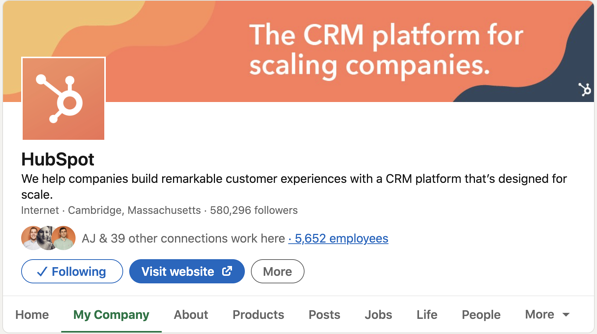
HubSpot LinkedIn company page

You’ll then be greeted with a list of all people (with a LinkedIn profile) that work for your target company. Simply work your way through this list to find the most relevant contact, or search

  • Hiring manager
  • HR manager
  • Recruitment manager

… to find the most suitable name to address in your cover letter.

Address

You can find the address of the company you’re looking to submit a job application to by finding the About or Contact page on their website.

This should be in their navigation bar, but can also be found by Googling their URL and “contact”.

On this page, you should find an address for the company. If not, don’t worry. Simply call one of the numbers listed or send an email to their support team. Ask for the company’s general careers email address, and use this on your cover letter.

Opening a Cover Letter

Great job! You’ve done all of the digging you’ll need to write a cover letter. It’s easy from here.

After you’ve addressed the cover letter to the most relevant person, we’ll need to open the letter with something relevant.

“Dear Ms. H.Spot” (using your own initials, of course) will keep it professional.

But, if you’ve struggled to unveil the hiring manager’s name, stick with “Dear Sir/Madam” or “Dear Hiring Manager”.

How to Close a Cover Letter

Once you’ve followed the above cover letter structure and explained your availability, it’s time to wrap it up.

If you’ve addressed the letter personally, end with “Thanks”.

If you haven’t, opt for “Sincerely”.

Then, sign the cover letter with your full name.

Should You Include Salary Requirements?

Talking about money is a tricky subject. Some feel uncomfortable discussing wages in the first interaction with a company, so it’s best to avoid discussing salary requirements in your cover letter unless it’s stated as a requirement.

Including salary requirements in your cover letter could set a bad tone. Instead, allow your letter to show off your skills and make a convincing argument as to why they should hire you.

Save the money talk until your interview!

Are Cover Letters Necessary?

Cover letters are often a required field for online job applications. But do you really need to include one if it’s optional, you’re sending your resume through email, or applying in-person?

While a few years ago the answer wasn’t clear cut, in today’s age cover letters are more important than ever.

In 2017, just 26% of recruiters considered cover letters important in their decision to hire an applicant. That means they were influential in hiring decisions, but not essential.

However, according to 2021 research, 83% of recruiters agree that, although not strictly necessary, a well-written cover letter gives you the opportunity to demonstrate that you are a great fit for the company you are applying for. Additionally, in a separate question, 83% of respondents claimed that a great cover letter can secure you an interview even if your resume isn’t good enough.

If those stats aren’t enough to convince you of its importance, 74% of recruitment decision-makers prefer to receive job applications that include cover letters apart from resumes. And even if submitting a cover letter is optional, 77% of recruiters will give preference to candidates who did send a cover letter.

Plus, since 69% of surveyed workers believe getting a job in 2021 will be much harder or somewhat harder than in previous years, adding a cover letter to your application is a great way to stand out.

Especially since only 35% of candidates attach a cover letter to their application when it’s optional and only 38% of candidates submit a cover letter when it’s required.

Writing a cover letter will allow you the chance to communicate with the hiring manager. You’re given more space to tell them why you’re the perfect fit for their job, meaning you don’t have to rely on bullet-pointed lists in your resume.

Cover letters also help to build your personal brand. By going the extra mile (even when it’s not required), you’re proving key skills like being a hard worker, having good communication, and taking initiative.

In short: Cover letters aren’t absolutely necessary, but they do have stark advantages. If there’s an option to upload one when applying for any job, do it — even if it’s not required!

How to Write a Cover Letter

Writing a cover letter can be tricky. Even the best writers can struggle with communicating their skills in the right manner, but these tips will help you create a job-winning document.

The structure of your cover letter is arguably the most important thing about writing one.

Not only does a good structure help you to organize your points effectively, but it can help a hiring manager to quickly review the details you’re sharing.

7 Tips for Writing Great Cover Letters

So, you’ve crafted a cover letter and you’re almost ready to hit send.

Now, wait a minute …

Before attaching to your resume and hoping for the best, use these seven tips to make sure your cover letter is as great as can be:

1. Don’t babble.

Earlier, we mentioned how the best cover letters strike the perfect balance in their length.

Our best tip for writing cover letters is to avoid any babble. Don’t add fluff that fails to add anything of value. Not only are you wasting your time by writing it, but you’re wasting the hiring manager’s time, too.

You want to keep the recruiter’s attention, which can be easily lost through babbling. Cut the jargon and corporate-speak that hiring managers have heard before. (Like “leverage” and “thinking outside the box”.)

Yes, professionalism is important, but be harsh and critical when editing your cover letter. If a sentence doesn’t add value, get rid of it!

2. Tailor it for the company and position you’re applying for.

The one-size-fits-all approach doesn’t fit well with cover letters.

You’re applying for different roles at various companies, but don’t let a change in name and address be the only amendments you make.

Remember that a cover letter should explain why you should be hired for a specific role instead of anyone else. It’s highly unlikely that multiple companies will hire for exactly the same position, so take some time to personalize your cover letter for every position you’re applying for.

3. Add more value than your resume.

Although cover letters are used in partnership with resumes, be wary of falling into the trap of making them carbon copies of one another.

Cover letters that regurgitate everything already explained on a resume are useless. Instead, use the documents to compliment each other by:

  • Including new skills.
  • Elaborating on how your qualifications would help you in the role.
  • Sharing how specific experience gives you an advantage over other candidates.

If you need to include the same thing in both documents, add “as listed in my resume …” rather than copy and pasting the same content.

Put yourself in your recruiter’s shoes: Reading the same thing multiple times would be annoying, right? (Remember, we don’t want to bore them!)

4. Include data-backed examples.

When referencing experience from your resume, use your cover letter as an opportunity to explain in detail — with examples.

Examples allow the company to picture the success you could bring if they hired you, rather than the person next in their resume pile. But, data-backed examples give an extra edge.

Let’s use an example. Which of these options is more impressive?

  1. I increased leads for the company.
  2. I increased leads by 35% in one month through a single blog post, which became the company’s biggest revenue source.

It’s option B, right?

5. Tell a story.

Following on from the previous step, you could elaborate on your data-backed examples by telling a story.

Storytelling helps with relatability and gives a hint of your personality in a cover letter. It also makes the recruiter remember your cover letter amongst a sea of other one-page documents in their review pile.

However, this cover letter tip comes with a warning: Don’t overdo it, and make it relevant. Remember what we said about babbling?

Including a story about how you adopted your pet cat is unlikely to influence someone into hiring you. On the other hand, a story on how you created a company’s blogging strategy to achieve your data-backed results is.

6. Get a second pair of eyes on it.

Even the best writers make occasional mistakes, but some hiring managers can be strict with grammatical errors — even if you’re not applying for a role where writing features heavily in your daily to-do’s.

That’s why our sixth cover letter tip is to get a second pair of eyes on it.

Email it to a friend or ask a family member to glance over it before you hit “send”. Ask them to highlight any spelling mistakes or suggestions to improve how you’re communicating with the person reading it.

You never get a second chance to make a first impression. Seeing as though a cover letter is one of the first documents a recruiter sees, try to make it perfect!

7. Be unique.

Finally, make your cover letter unique.

If you’re applying for a creative role, experiment with colors, subheadings, and layouts.

If you’re applying for more of a traditional role, be wary. Not everyone is a fan of bright, bold cover letters, but you can scope your limits by getting a feel of their company culture.

Are they strict and professional, or does the company like to have fun? (You can usually get a feel of this from their website or social media profiles.)

Testing the level of uniqueness can be a case of trial and error. If you’re not getting great reactions from your cover letter, revise and try again.

Cover Letter Examples

We understand that inspiration can go a long way. That’s why we’ve created a one-stop-shop for cover letter examples, which are available to view here.

You’re also free to browse our collection of cover letter samples for extra inspiration on formatting your cover letter and learning from those who’ve helped to land dream jobs.

Conclusion

Congratulations! You’ve now got a fantastic cover letter!

Don’t forget to send it with your resume for each job you apply for.

You’ll soon be flooded with responses to your application — including compliments on the contents of your cover letter, job offers, or invites to interview!

Editor’s note: This post was originally published in September 2018 and has been updated for comprehensiveness.
Professional Cover Letter Templates

Categories B2B

How to Use Instagram Insights (in 9 Easy Steps)

Data helps you understand your audience. It tells you how they do things, what they prefer, and who they are. You can certainly make business decisions based on gut feeling, but you’re much more likely to hit the mark when you can validate assumptions with cold, hard facts.

Data and analytics help you measure the impact of your marketing efforts across different channels to see if there’s something you need to do differently — like target a different audience, post at a certain time of day, or experiment with a new content format.

Social media isn’t any different than other aspects of your marketing in the sense that it can be measured and improved upon. That’s why you’ll be able to create a more effective Instagram strategy using Instagram Insights.

Click Here to Subscribe to HubSpot's Marketing Blog

Here are the analytics on this channel that marketers need to know and understand — and how to use them.

View Instagram Insights: Accounts Reached Page on Instagram

To use Instagram Insights, you must first have a business profile. If you’re already using a personal account, you can switch to a business profile. Here’s how to convert your account in a few simple steps.

1. Create a Facebook Business Profile for the same persona if you haven’t already.

An Instagram business profile will allow you to access additional features and tools to help you grow your audience. However, in order to set up an Instagram Business Profile, you’ll need to have a Facebook Page for your business. It’s through Facebook that you add payment credentials and more. Click here for instructions for setting up your Facebook Page if you don’t already have one.

2. Make sure your Instagram profile is public. Private profiles cannot be used as business ones.

You want to grow your audience and have your posts seen by Instagram users who are not familiar with your brand. For this reason, your Instagram profile will need to be made public before you convert it to an official Instagram Business Profile. Here are the steps:

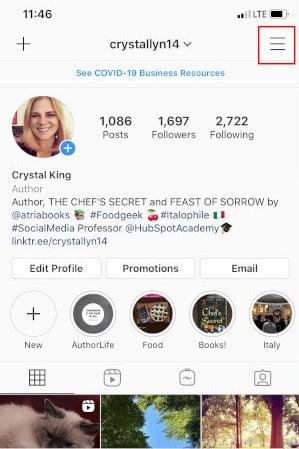
Step One: Navigate to your profile and tap the hamburger icon in the top-right corner.

Convert Instagram to Business Profile: Tap Hamburger Menu

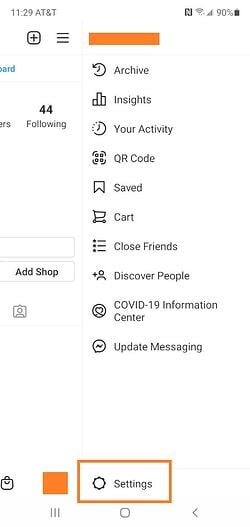
Step Two: Tap the gearshift wheel icon to access your Settings.

Convert Instagram to Business Profile: Gearshift Wheel Icon for Settings

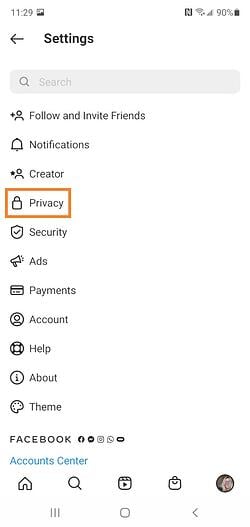
Step Three: Select “Privacy.”

Convert Instagram to Business Profile: Privacy in Settings Menu

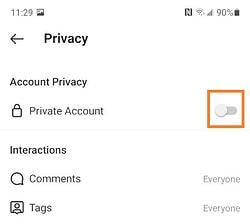
Step Four: Flip the toggle next to “Private Account” on.

Convert Instagram to Business Profile: Instagram Private Account Toggle

Your Instagram profile is now public.

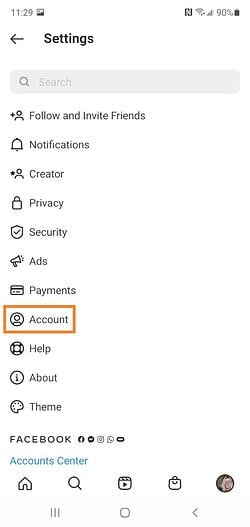
3. Return to your Settings page and tap “Account.”

Return to your Settings page by clicking the hamburger icon and tapping the gearshift wheel icon. Alternatively, you can use the back button on your phone to get there.

Tap Account in the Settings menu.

Convert Instagram to Business Profile: Account in the Settings Menu

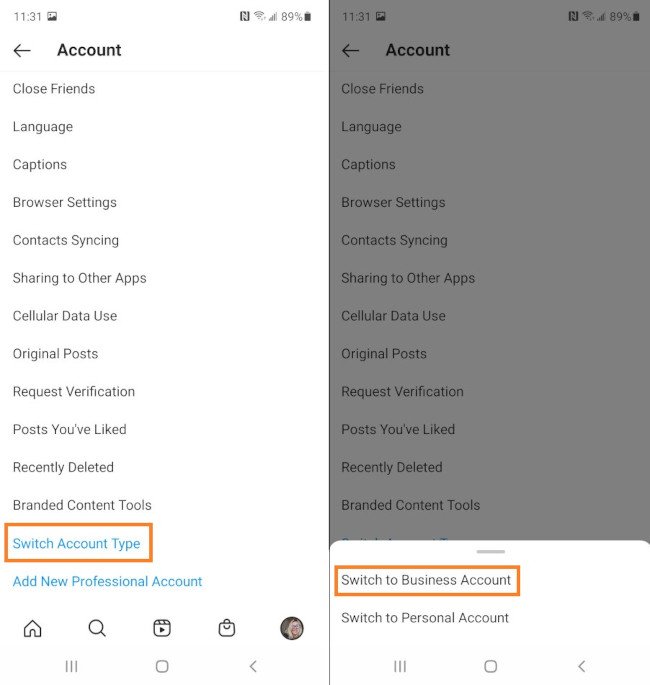
4. Select “Switch Account Type” and choose “Switch to Business Account.”

Convert Instagram to Business Profile: Switch to Business AccountBy choosing Switch to Business Account, you’re effectively converting your Instagram Profile into an Instagram Business Profile.

5. Follow Instagram’s prompts to set up your business profile.

You will be asked to review and change details about your business including business category, contact information, and more. You’ll also be prompted to select the Facebook Page you want to be associated with your profile (from Step 1).

6. Tap “Done.”

Once your set up as a Business Account, you can begin to use Instagram Insights. Here’s how to get started.

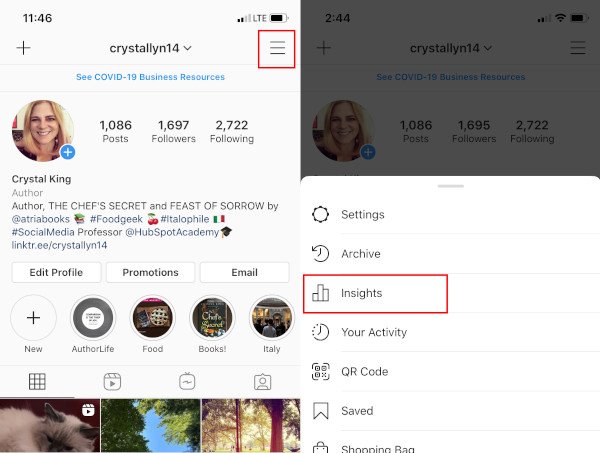
1. Open the hamburger menu and click “Insights.”

To view insights into your overall Instagram account, start by visiting your profile. Then, at the top, click the hamburger icon and select Insights from the menu.

View Instagram Insights: Navigating to Insights from the Instagram Menu

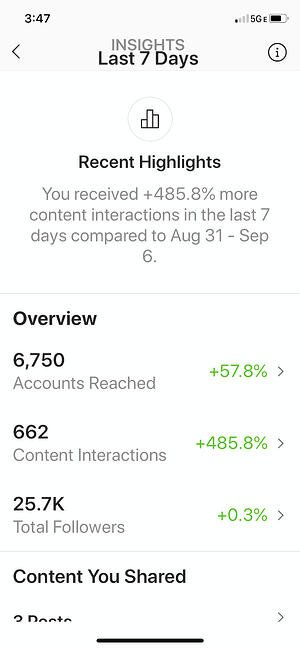
From there, you’ll reach the Recent Highlights page where you’ll see some general information about how people are engaging with your profile, like how many followers you gained or lost in the past week.

View Instagram Insights: Recent Highlights Page on Instagram

Next, we’ll get into the more specific profile insights you can explore.

2. Measure reach.

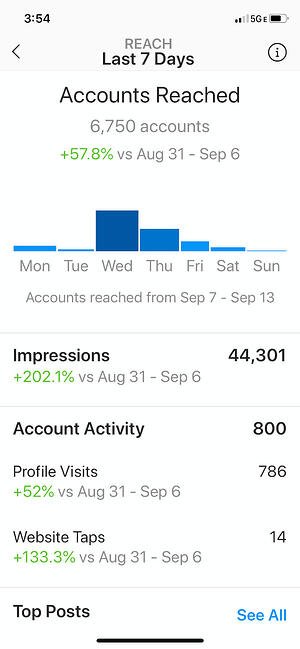
Click the Accounts Reached section. Reach reflects the number of unique users that have seen any of your Instagram posts.

View Instagram Insights: Accounts Reached Page on Instagram

Within this category, you’ll see insights for:

  • Impressions – How many times your posts were seen.
  • Account Activity – Profile visits, website taps, and other activity.
  • Top Posts – The posts that generated the most reach and engagement.
  • Top Stories – The Instagram Stories posts that generated the most reach and engagement.
  • Top IGTV Videos – The IGTV videos that generated the most reach and engagement.

Some of these insights can be expanded for more insights.

3. Track profile visits and followers.

On the Accounts Reached page under Account Activity, you’ll be able to see Profile Visits.

Profile Visits reflects the number of times your profile has been viewed.

4. Determine website clicks.

Website Taps can also be found under the Account Activity section. This insight reflects the number of times any links you’ve included in your business profile have been clicked.

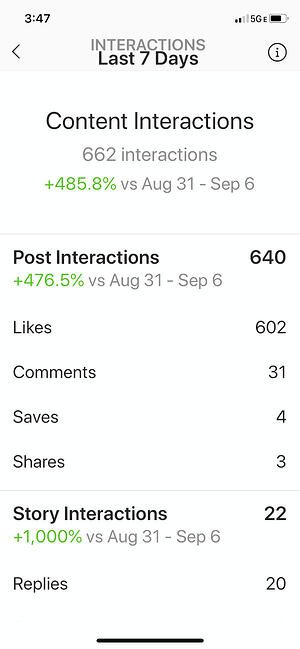
5. Track content interactions.

Navigate back to Recent Highlights and tap Content Interactions. This will bring up a page that shows how your content is performing in terms of engagement, breaking down the metrics by content type.

View Instagram Insights: Content Interactions Page on Instagram

Likes speaks for itself, reflecting the number of users who liked your post. As with likes, Comments reflects the number of comments left on your post. Saves highlights the number of unique users or accounts who saved your post or clicked the bookmark-like icon that appeared below it in their feeds.

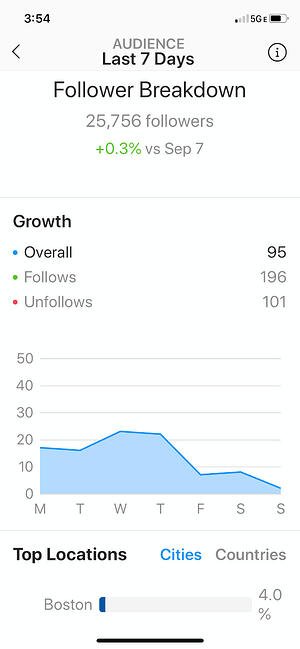
6. Track your followers.

Navigate back to Recent Highlights and click Total Followers. You’ll then reach the Follower Breakdown page.

View Instagram Insights: Follower Breakdown page on Instagram

This page reflects how many followers you’ve gained or lost over the past week, as well as the average times of day when your followers are using Instagram — data that can be highly beneficial when planning posts.

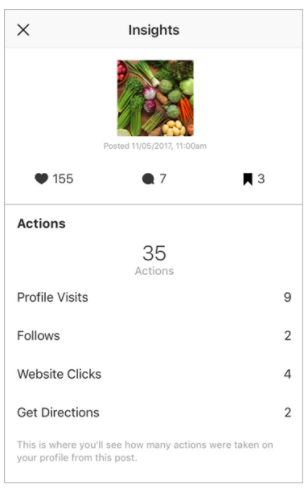
7. Learn which actions were taken on your post.

To view insights for a specific Instagram post, start by visiting your profile. Tap on the post you’d like to look into, then click View Insights below the image.

These insights indicate the number of actions that users took on your profile as a result of seeing your post — things like visiting your profile, then taking an action like clicking on your website link or following you.

View Instagram Insights: Instagram Insights Actions Feature

Source: Instagram

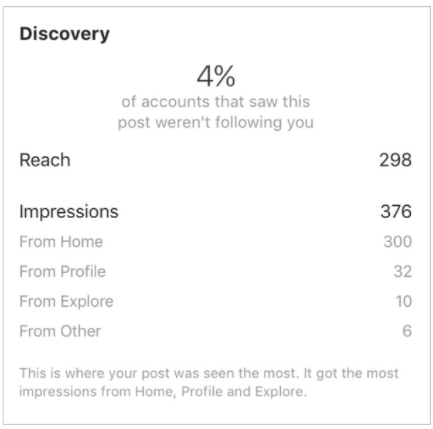
8. Use “Discovery” to see where your post showed up in feeds.

As the name might suggest, these insights indicate where your post was seen — or discovered — the most, including how many accounts weren’t already following you when they first saw the post.

This section includes metrics on Impressions, which reflect the number of times your post was discovered from a particular place within Instagram, like the user’s home feed, a search, your profile, a location tag, or a hashtag.

View Instagram Insights: Instagram Insights Discovery Feature

Source: Instagram

Discovery insights also include data on a post’s reach — which reflects the number of unique accounts that saw your post.

9. View Story insights.

Finally, Instagram users with a business profile are able to view insights into their ephemeral Stories.

To view your Story insights, navigate back to Insights and scroll down to Content You Shared section on the Recent Highlights page.

Scroll down to the Stories section, and you’ll be able to see insights for older stories, as well as any that have not yet expired.

Next, we’ll get into the more specific insights you can explore.

Impressions

This insight represents how many times your Story was seen.

When viewing these insights, keep in mind that you’re able to add multiple images or videos to your Story. When you do this, every piece of visual content in your Story is counted as a single photo or video in your post.

Let’s say you add six photos to your Story. Whether someone only views one or views all six, Instagram only counts your entire Story having received one impression.

The same goes for Story content that has been viewed by a single user more than once. Instagram still only counts that interaction as the entire Story having received one impression.

Reach

This insight reflects the number of unique users that have seen your Story.

Taps Forward

This insight reflects the number of times a user taps your Story photo or video to skip to the next piece of media.

Taps Back

This insight reflects the number of times a user taps your Story photo or video to go back to the previous piece of media.

Replies

This insight reflects the number of times users send messages through the Send Message text box on your Story.

Replies on Instagram Stories

Swipe Aways

This insight reflects the number of times users swipe to skip to the next account’s Story — not to be mistaken for “tap forward,” which reflects users skipping ahead to your next piece of Story media.

Exits

This insight reflects the number of times a user leaves the Stories section entirely to return to the home feed.

Measuring Your Effectiveness With Instagram Insights

Now that you know how to access data to inform your strategy with Instagram Insights, you can analyze that data and determine what’s working for your audience (and what’s not). From there, creating content that gets a ton of engagement will be a lot easier as you consider those benchmarks.

Editor’s Note: This post was originally published in January 2018 but has been updated for comprehensiveness.

hubspot marketing blog

Categories B2B

How to Use Pinterest to Promote Your Business or Blog [Free Templates]

When I was getting married, one of the main tools that helped me plan was Pinterest. In fact, that’s usually the number one place I go to when I’m planning a party.

However, Pinterest isn’t just used for event planning. You can use the social media platform as a way to market your business, drive traffic to your website, and increase sales.

I’m not the only one who goes to Pinterest when I need new ideas. In fact, more than 200 billion pins have been saved on Pinterest. And 90% of weekly Pinners make purchase decisions on Pinterest.

That’s why it’s important for businesses and marketers to be active on the platform. Read on to learn how you can use Pinterest to meet your business and marketing goals.

Free Resource: 12 Pinterest Templates for Business

Why Use Pinterest for Business?

As noted above, regular Pinterest users often leverage the platform to help inform their purchasing decisions. But that’s not the only reason to use Pinterest for Business.

Pinterest streamlines conversion.

Pinterest effectively operates as a massive, visual search engine filled with images tailored to specific user interests. As a result, if users are looking at your Pinterest page, chances are they’re already curious about what you’re selling — and are more likely to click through.

Pinterest boosts traffic.

Because each pin you make can contain a link back to your website, it’s easy for users to click through and boost your overall traffic, in turn raising your search engine rank.

The caveat? Great pin content is critical — if users aren’t inspired, they won’t click.

Pinterest engages users.

The core concept of Pinterest revolves around users creating and sharing pins of things they’re interested in with like-minded people — which means they’re already engaged when they log into the site. If your page aligns with their interests, they’re happy to visit your site, share your posts, and help boost your brand’s reach.

How to Set Up Your Pinterest for Business Account

If you’re new to Pinterest, then you’ll need to create a business account to get started. Don’t worry, this is a simple process as outlined below.

  1. Head to pinterest.com/business/create.
  2. Add your business name and website.
  3. Customize your profile.
  4. Claim your other accounts.

Let’s break down each step in more detail.

1. Head to pinterest.com/business/create.

Enter your email and a password and then select “Create Account” to get started. If you already have a personal Pinterest account, make sure you’re logged out.

Pinterest log in

2. Add your business name and website.

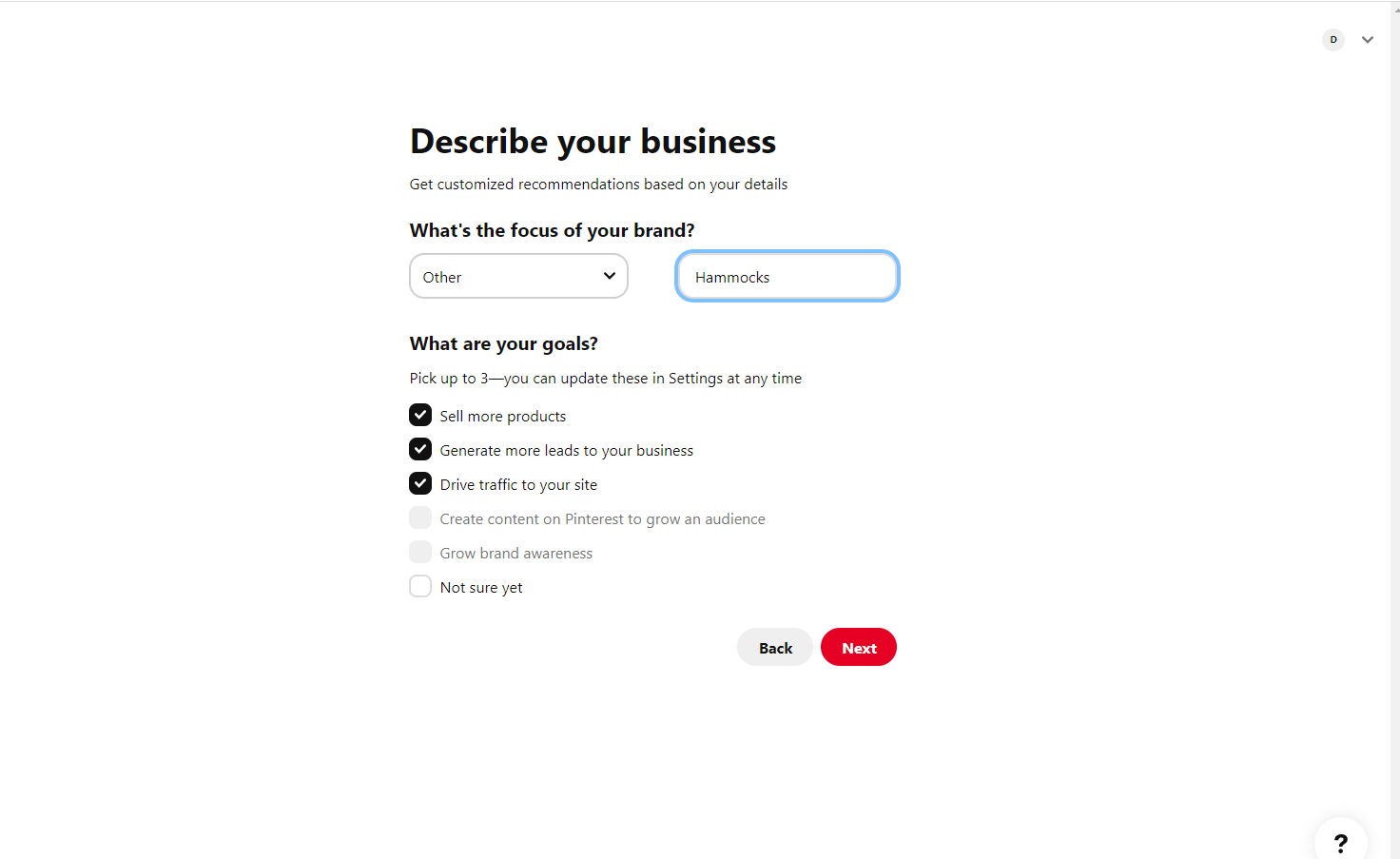
Next, Pinterest will ask for your business name, business type, and your website details. If your brand doesn’t fit into a listed category, don’t worry — just select “I’m not sure.”

Create an account pinterest

3. Customize your profile.

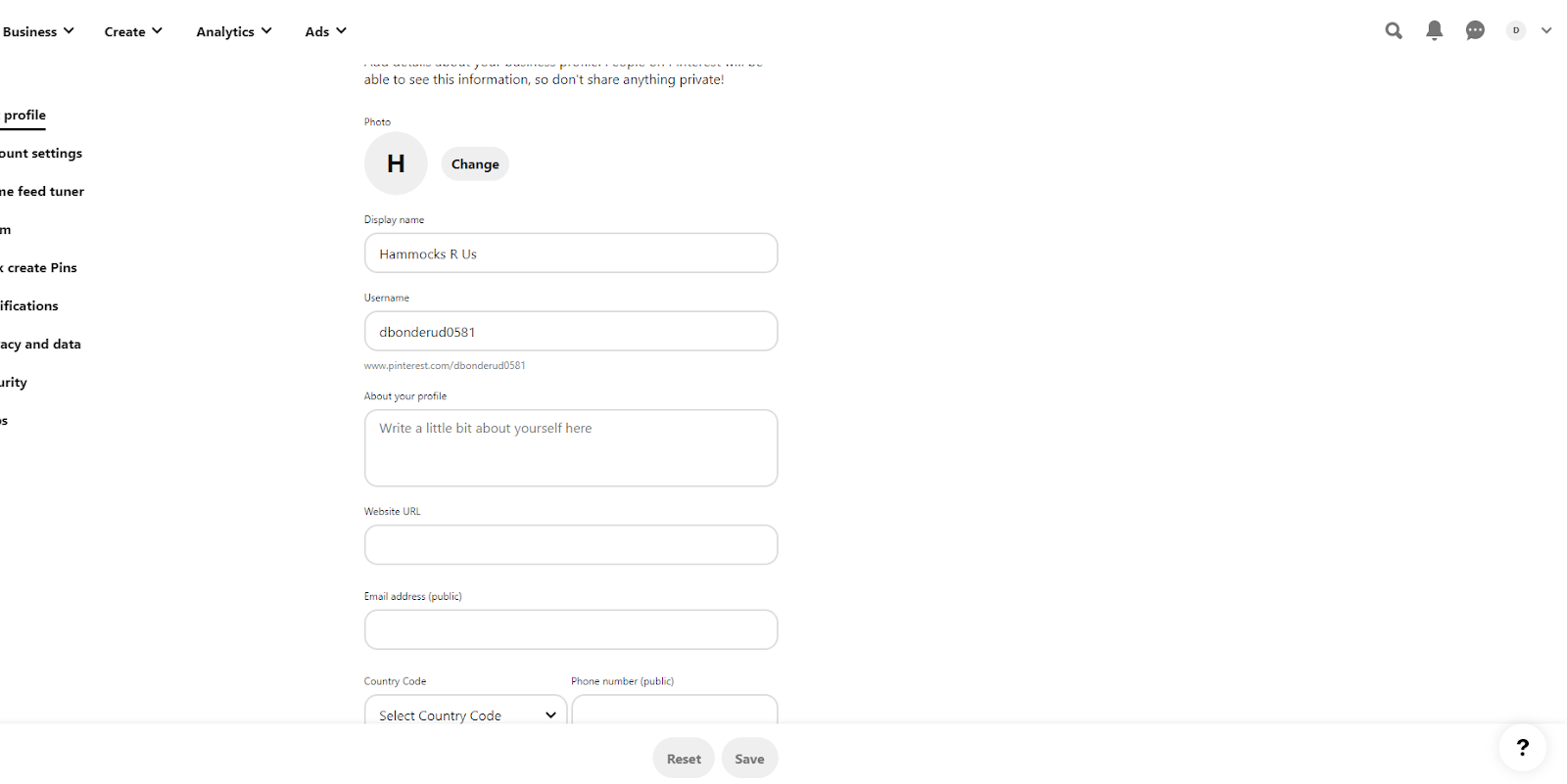
Next up is customizing your profile. Here you can add a profile picture, display name, user name, and information about your brand that will help Pinterest users find your board.

Pinterest customize profile

4. Claim your other accounts.

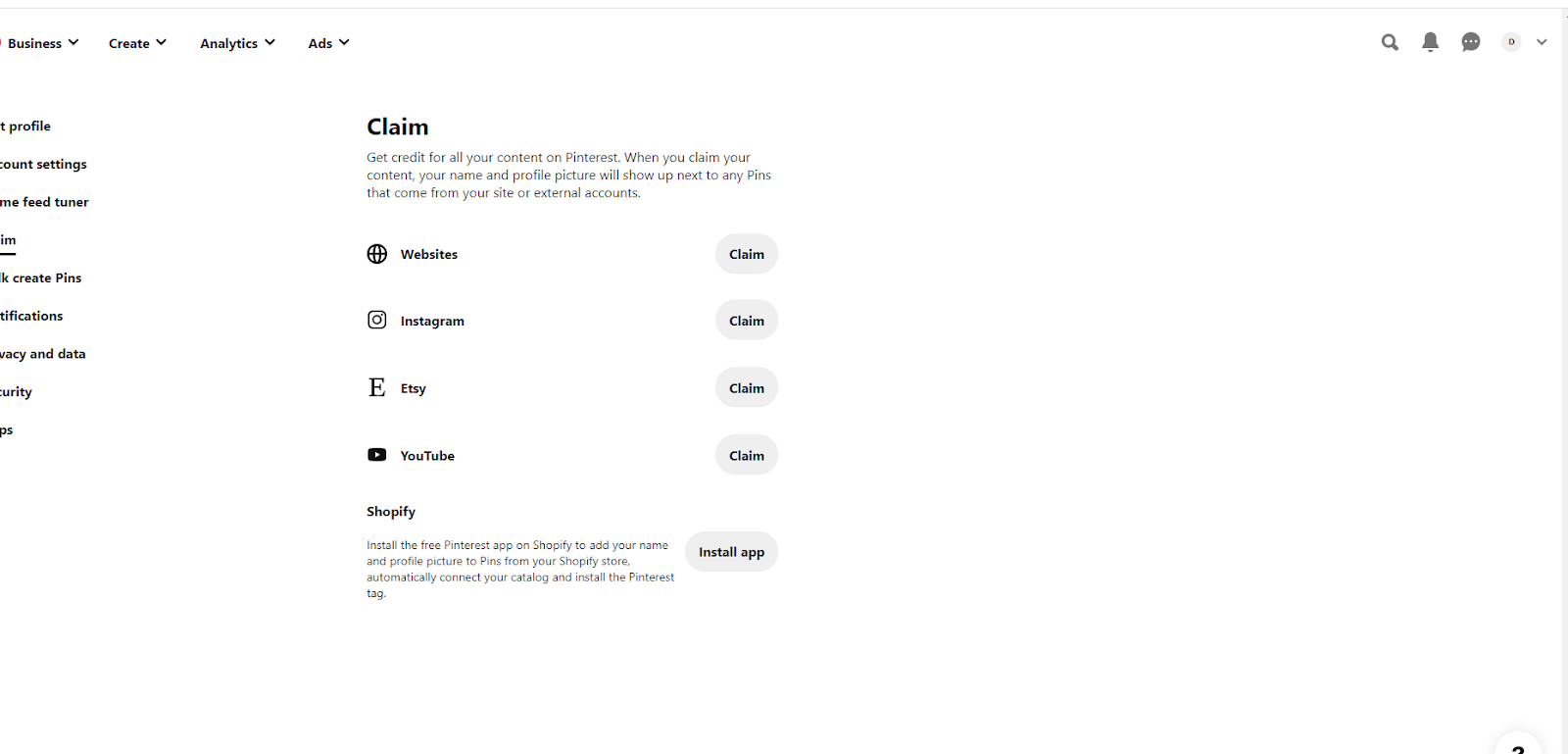
Last but not least? Claim your website name and any other accounts to ensure you get attribution and analytics for all of your content on Pinterest, even if you posted it before creating a Pinterest for Business account.

claim your account pinterest

Once your business account is set up, it’s time to start diving into the strategy of how you’re going to use your page to grow your business.

Is Pinterest for Business free?

Pinterest for Business is free, and it’s worth taking the time to make an account, since it allows you to directly link your brand with your Pinterest page to drive increased traffic and conversion.

With your business account set up, you’re ready to get started using Pinterest for Business. Here are six best practices to keep in mind:

1. Determine the type of content you want to post.

As with any social media site, it’s important to understand your target audience. What type of content do they want to see on Pinterest?

More importantly, think about the type of content that they’ll engage with. Is it infographics, tips and tricks, or perhaps blog posts? To find this out, do some research into the type of content they currently pin on their pages.

Additionally, make sure that you don’t sell yourself with every pin. You should share relevant and helpful information on your page as well. When you have a good idea of what your audience wants or needs to see, creating pins will be easier.

2. Consider your design.

Now that you know what you want to post, it’s important to consider what your images look like. Your designs should be pleasing to the eye and stand out in a sea of images on your audience’s page.

Additionally, your images need to follow your brand guidelines. If you don’t have a designer on hand, you can utilize tools like Canva to get started.

3. Optimize your pins.

When you’re ready to start posting on Pinterest, remember to optimize your pins. You might be wondering, “How do I optimize my pins?”

Use the following checklist to get started:

  • Include a URL (could be a link to a blog post)
  • Use keywords in titles, descriptions, and image file names
  • Create boards that are aligned with your keywords
  • Arrange your boards and choose a board cover image
  • Use hashtags
  • Add a call to action
  • Add a Pinterest widget to your site
  • Respond to follower comments
  • Follow popular boards and comment
  • Create a board dedicated to your blog posts

These tactics will help you grow your business with Pinterest and help your posts be discovered.

4. Learn about categories.

On Pinterest, you can assign each board to one of 36 categories. These categories help your pins become discovered.

For example, since I was interested in finding wedding ideas when I was engaged, most of the pins that showed up on my feed were pins that were tagged in the wedding category.

You can scroll through the categories and see which ones are related to your business. This could even help you come up with board ideas.

5. Use rich Pins.

Rich Pins offer a way to provide more information about pinned images. For example, the Product Pins subset of rich Pins lets you add pricing information, product details, and other data to help engage users and drive conversion.

6. Leverage Pinterest Lens.

Pinterest Lens is available as part of the platform’s mobile app on both Apple and Android devices. It allows users to take a picture of any object and discover similar items on Pinterest. For businesses, Pinterest offers a way to improve contextual marketing: Take a picture of your product, see what Pinterest returns and then leverage similar tags to help capture user interest.

Once you’ve thought about this strategy, it’s time to create your boards. If you blog, think about blog topics and create boards surrounding those topics.

Let’s dive a little deeper into how to use Pinterest for your blog.

1. Create infographics.

A great way to use Pinterest to promote your blog is through infographics. If you have blog posts centered around an infographic, post it on Pinterest.

Additionally, you can repurpose old blog posts into infographics. Pinterest is a great place to repurpose content and reach a new audience that might not have read your post.

2. Choose the best blogs to post.

You don’t need to promote every single blog post on your Pinterest. Instead, just choose the ones that make the most sense for the platform. For example, choose blogs that have engaging images, great downloadable offers, or have an infographic.

Additionally, think about your board topics. You should promote blogs that relate to your boards.

3. Customize your images.

When you create a pin, it’s important to use engaging, custom images. To promote a blog, you can use your featured image and include customized text.

For instance, many pins that promote blog posts include the title of the blog on the custom image. The title is a great way to draw people in and get them interested in your blog post.

4. Write an optimized pin description.

When you write the description for a pin promoting a blog post, it’s important to tell people what to expect in the post.

While you want to leave some mystery and pique their interest without giving away too much, they need to know what it’s about.

5. Engage with Pinners.

Pinterest is all about engagement and interest driven by images. To maximize your brand’s impact, you need to regularly engage with Pinners who follow your board.

This means regularly pinning new content, re-pinning great content from your followers, and taking the time to directly answer any questions asked on your blog by Pinterest users.

6. Use a sound SEO strategy.

As noted above, Pinterest is effectively a visual search engine — but just like a text-based search engine, keywords are critical. To ensure your pins get noticed, use solid SEO practices. Make your blog title the same as your board title, include relevant keywords for all of your blog posts and images descriptions, and make sure you’re also using keywords in any image “alt” tags.

Pinterest for Business Examples

So what makes a great Pinterest for Business board? Here are six standout examples.

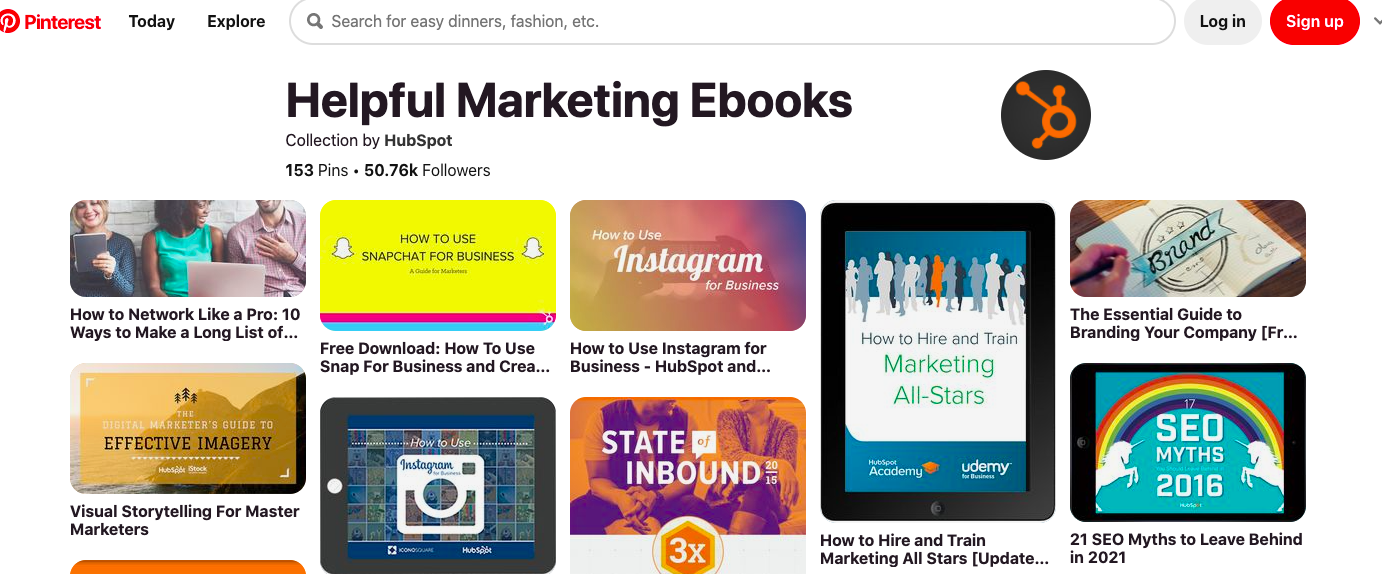
1. HubSpot

HubSpot Pinterest board

HubSpot’s Pinterest page generates more than 4.5 million views per month and offers a host of great content to Pinners including infographic templates, content creation tips, and even career advice. It’s a one-stop shop for all things marketing.

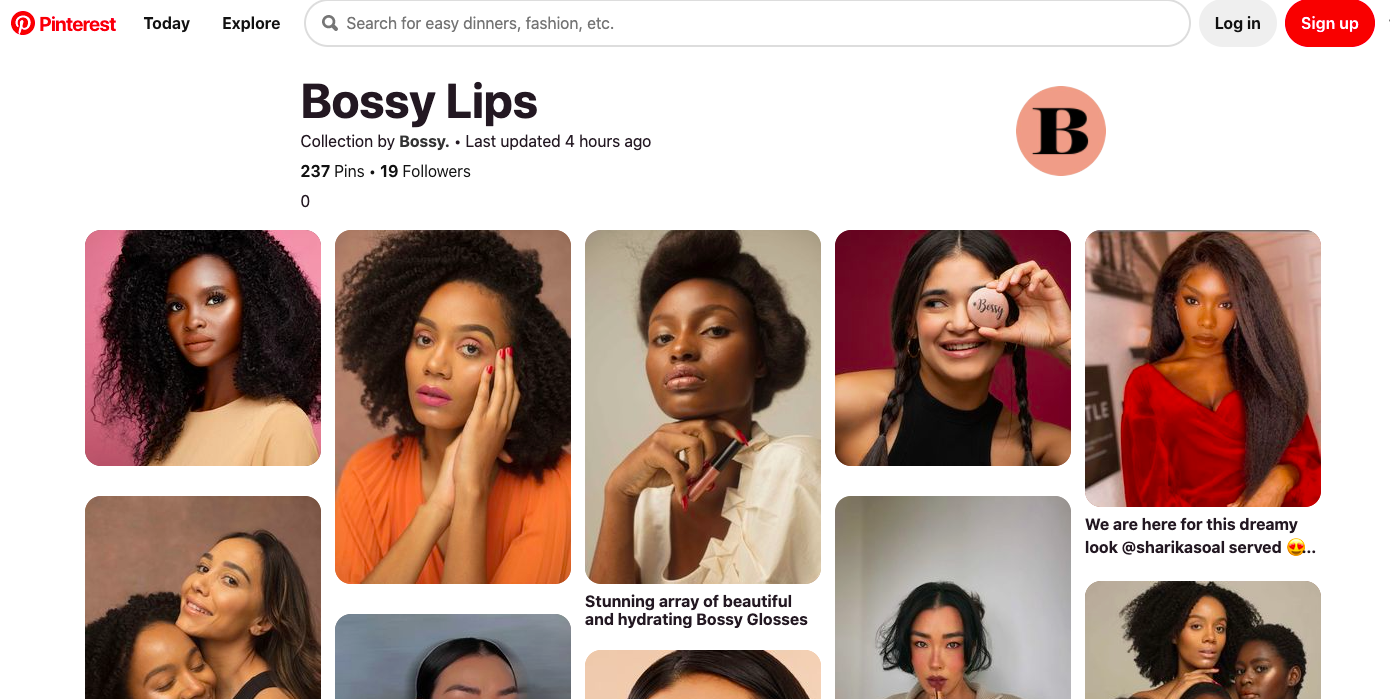
2. Bossy

Bossy Pinterest Board

Bossy is a growing, female-founded beauty brand with a focus on attention-capturing, long-lasting lipsticks and a Pinterest page that showcases its commitment to diversity.

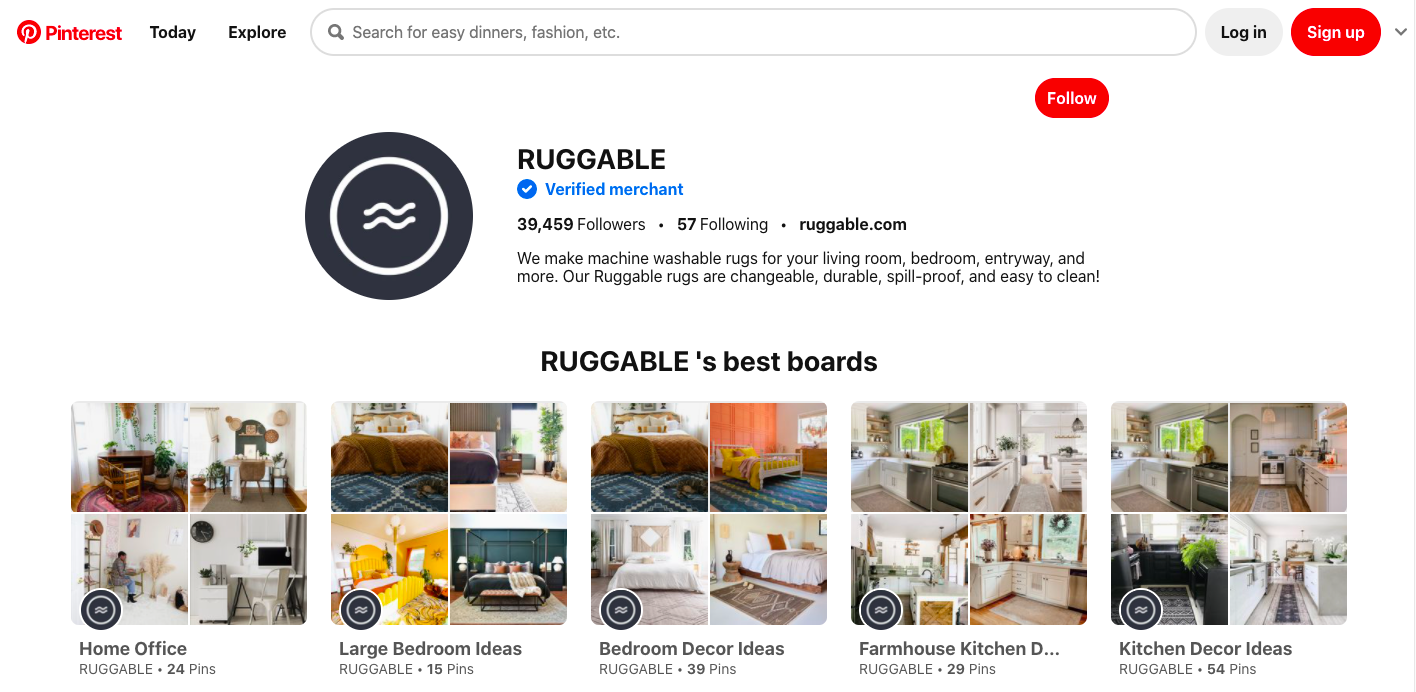
3. Ruggable

Ruggable Pinterest Board

Ruggable’s value proposition is simple: Washable rugs for any space. These rugs are changeable, durable, spill-proof, and easy to clean — so it’s no surprise that its Pinterest page generates more than 10 million views per month.

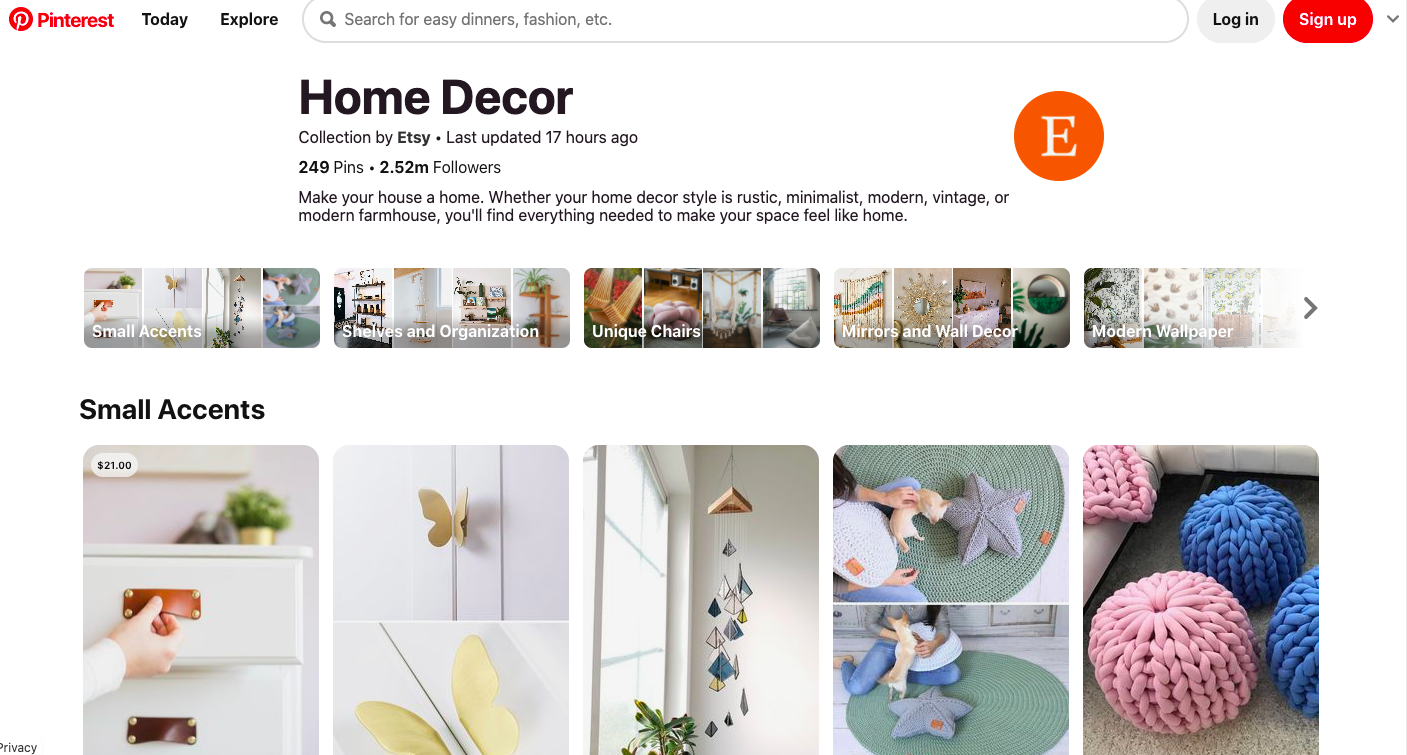
4. Etsy

Home Decor Pinterest Board

This custom-made market store has made significant market inroads and is now using Pinterest to showcase some of its most popular items. Looking for something unique? Something that makes a statement? Chances are you’ll find it on Etsy — and see it on Pinterest.

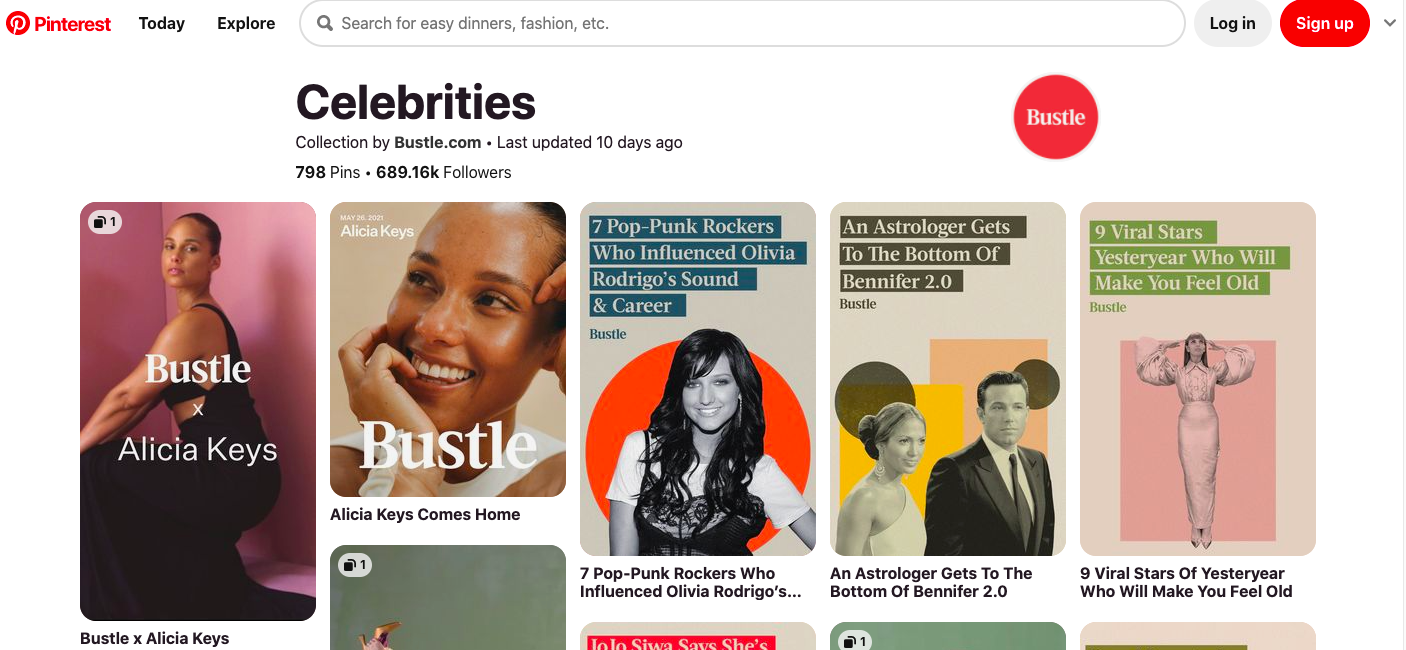
5. Bustle

Bustle Pinterest board

Bustle is on the leading edge of social zeitgeist, and has a Pinterest page to match. With a mix of celebrity content, human interest stories, recipes, and fashion advice, Bustle captures user attention immediately.

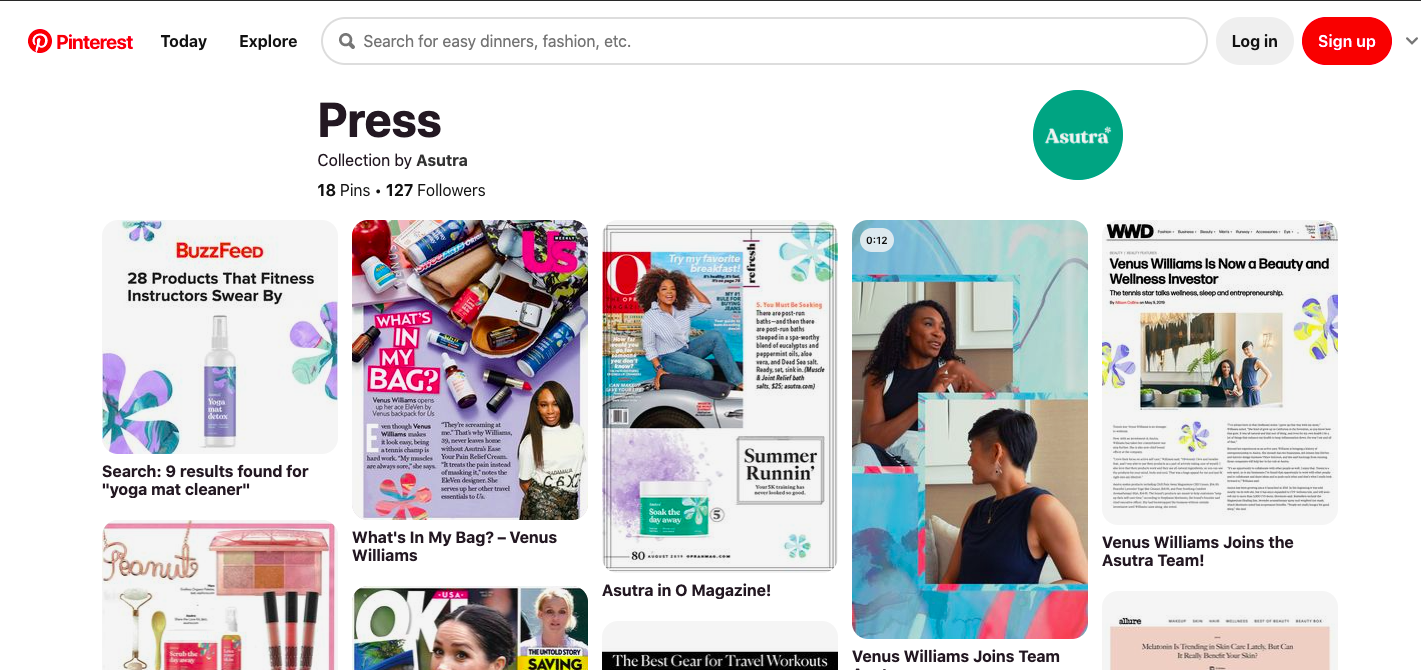
6. Asutra

Austra Pinterest Board

Committed to creating clean, accessibly-priced, wellness products, this women-owned and led brand has made the move to Pinterest and is already seeing almost 200,000 views per month.

Pin It to Win It

When it comes to marketing your business, Pinterest for Business offers a way for your brand to win market share and generate organic customer interest. The picture-driven nature of the site can help shift the conversion away from simple to conversion and instead inspire your audience to use your products and services in their lives — or just inspire them in general.

With a practical, step-by-step approach, it can be your products and services that users are pinning – and purchasing.

Pinterest Templates

Categories B2B

The 4 Most Important Pages on Your Website (& How to Optimize Them)

When you’re knee-deep into the design of your website, it’s hard to admit this fact: Some of the pages on your website are more important than others.

Okay, many of you probably find that fairly obvious — but I’m surprised how rarely content managers and web designers actually apply this knowledge to their websites to improve conversions.

I’m all about low-hanging fruit and taking on the easiest tasks that will have the biggest results. What I’m about to describe in this article has the potential to improve your site dramatically with just a few, critical changes.

Free Resource: Website Optimization Checklist [Download Now]

In this post, I’ll explain how to optimize each one of these pages. And if your most-visited pages are different from the ones listed above, you’ll still learn a framework for optimizing any of the important pages on your website.

What is website optimization?

You’ve probably heard the word “optimize” most commonly used in phrases like “search engine optimization” (SEO) and “conversion rate optimization” (CRO). I’m actually referring to something broader here, but the advice that I’m delivering will help to enhance both of those.

The optimization I’m going to explain will create user optimized pages. In the pursuit of SEO and CRO, it’s easy to overlook the broader, big-picture idea. First and foremost, a site must be optimized for the user. The best place to see big results quickly is to start optimizing the most visited pages of your site.

Let’s get right into it. Every website is different, but generally speaking, here are the four most important (and often most-visited) pages on a website:

Home Page

The home page is the first impression of your business to potential customers. And although your time limit on making an amazing impression is several times longer online than it is in real life (62 seconds on average is spent by people viewing a website) you’ll want to make every second count.

It’s tempting to put every remotely relevant fact about the business on the home page, but resist the urge. Remember, your home page is the first step of the journey — not the final destination. The copy, design, and visuals should guide the visitor to their next step, or the call-to-action.

About Page

Customers, investors, candidates for hire, and even competitors might all use your about page to learn more information about your company. An about page typically includes a brief company history, mission or vision statement, executive leadership bios, and a few impactful client testimonials.

Blog Page

It’s no secret that blogging is a tried-and-true method to optimize a website for keywords related to a business. Rather than loading up several product pages for each individual keyword you want to rank for, a blog can serve as a more efficient way to weave storytelling, product mentions, and sign up links together in order to answer potential customer inquiries, solve problems, and pose your product or service as the preferred solution.

Contact Us Page

For many small businesses and freelancers, the contact us page serves as the lead-driver of a website. This is usually their bread-and-butter and how these businesses make money. Whether your business includes a contact form, a calendar scheduler, an appointment booking app, a phone number, or an email address, this is where future customers make the decision to get a hold of a representative of the business to learn more about the products and services.

How to Optimize A Web Page

The broad framework for optimizing your site for conversions is the same across your home page, About page, blog, and Contact Us page. There are two simple goals for every page, and the specifics of optimizing those pages will flow from these goals.

The first goal is all about the user, and the second is all about you. Here we go:

Provide information the user is looking for.

Remember, we’re focusing on the user. Why are they on the page to begin with? To answer this question effectively, let’s dive deeper into some facts we’ll want to know first:

  • Where did they come from? The idea here is to understand how the user got to your site, so you can deliver relevant content.
    • Did they come from a search engine? (If so, what did they search to find you?)
    • An email? (What kind of email? Who sent it?)
    • A referral on another website? (What site was it? How long has it been referring to your URL?)
  • What do they need to know? A single page can deliver a limited amount of information, so you need to determine what that information is going to be. You want them to know something so that they will do something (which is addressed in the next question). Remember: Less is more on a web page. The more information you load up on your main pages, the less likely the user is to remember any of it. Give them less, and they’re more likely to remember — and do — what you want them to.

Pro Tip: Use visuals such as explainer videos, diagrams, hero shots, and so on to help condense a lot of information to a single page. To get the most out of your visuals, make sure you correctly optimize your images and videos.

Once you answer the question of what the user’s looking for, you’re halfway there. That brings us to question two.

Identify a goal for the user once they find the information.

Now, you need to ask the user to do something. This is where most pages fall short. One of the critical components of a web page is its call-to-action (CTA), and many website owners don’t realize that every single page of a website should contain at least one CTA.

The point of a home page or product page isn’t for the user to visit and leave. The point of content marketing isn’t for user intake, but rather, for user marketing. If you retain only one thing from this article, let it be that every web page needs a CTA.

Why am I so insistent on this? Because every bit of knowledge you share on your website demands some response. So, what is it that you want the user to do? Visit another page on your site? Watch a video? Complete a form? Sign up for a free trial? Any or all of these can become your goal for the user, just make sure to give them one or two options per page that are clearly and starkly defined.

Web Page Optimization Examples

Example of an Optimized Website Home Page

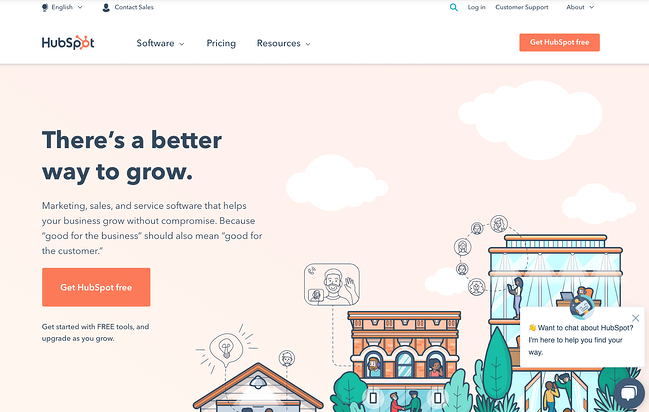
HubSpot’s home page is well laid out and hosts a clear CTA, front and center. A user is on the HubSpot home page for a reason, and perhaps that reason is to grow their business. The headline speaks to the question “what am I looking for?” and the CTA buttons tell me, the user, what I’m supposed to do next.

HubSpot homepage optimized for conversions with a clear CTA

Now, let’s see what HubSpot has going on on the About page.

Example of an Optimized Website About Page

A user might click on the About page for a variety of reasons. A few might be:

  • They want to figure out what exactly the business does.
  • They want to work for the business.
  • They want to make sure the business is legitimate.
  • They want to see if the business serves a specific niche or location.
  • They want to analyze the business’s success.

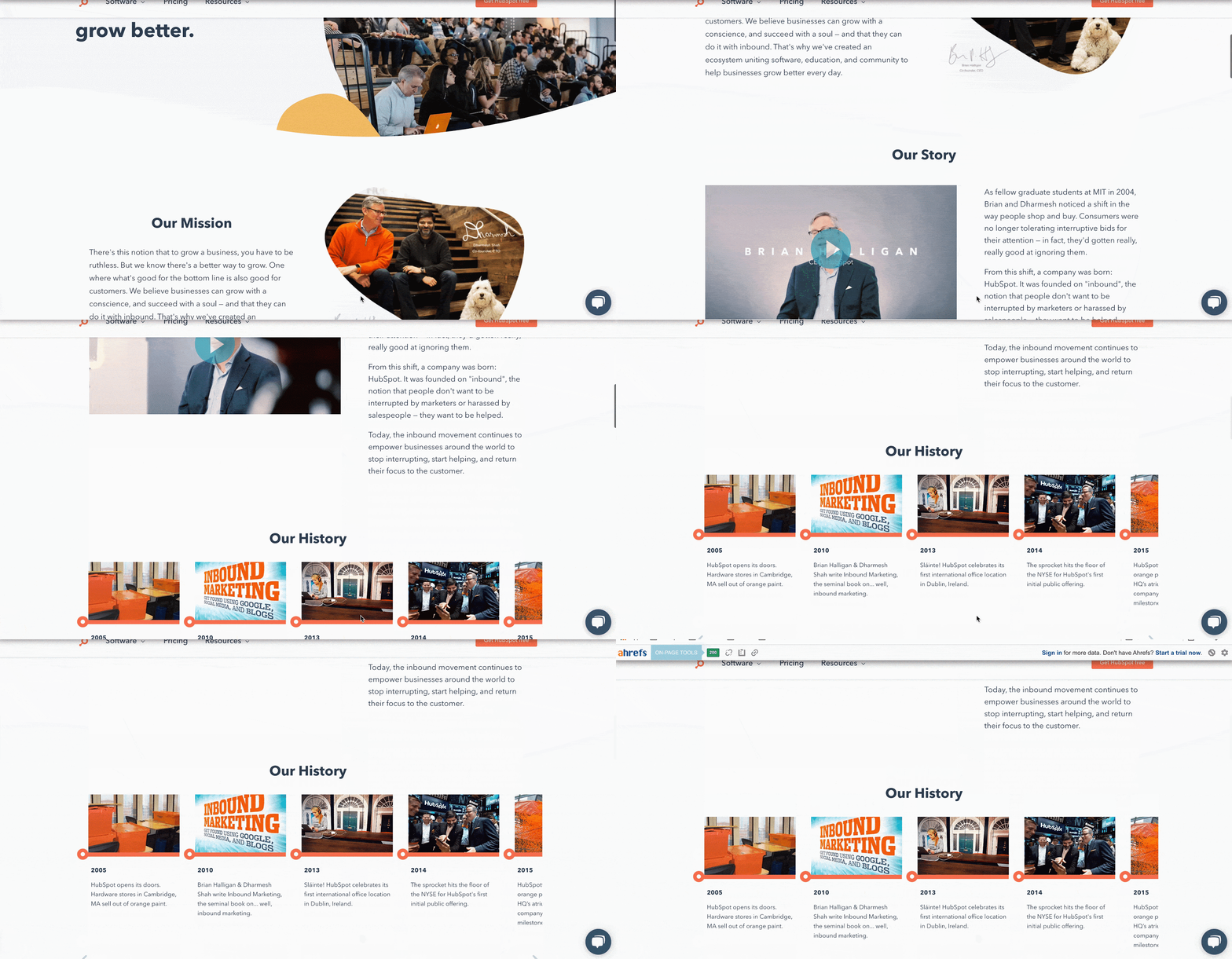
I could go on and on. There are a ton of reasons that could bring a user here, but they all boil down to the desire for information. Let’s see what HubSpot does. Here is the company’s About page:

The user likely wants to know the information about the company, and in response, they can scroll the page to learn more about the mission, history, and products.

Along the way, the user will want more detailed information which means the CTAs will need to become more specific to help guide them to that info. The more granular and detailed the information, the more correspondingly detailed the CTA becomes. Halfway down the page, I see a video about the HubSpot story featuring CEO Brian Halligan.

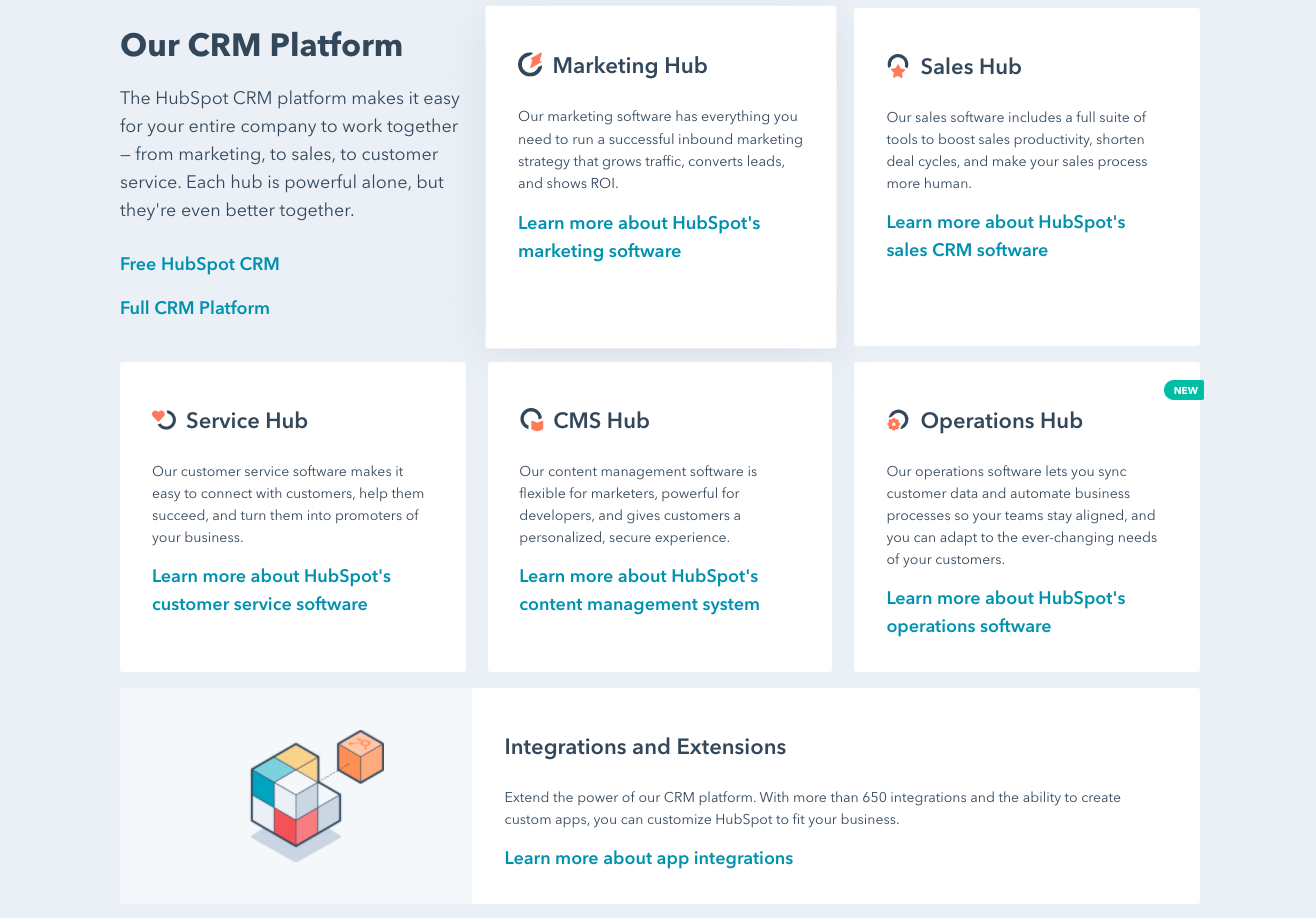
There’s more. There’s a block of content about each HubSpot product including the CRM, each Hub, and integrations. I can click any of these to learn more about the ones that can help grow my business.

HubSpot About page continues featuring products and links to each one.

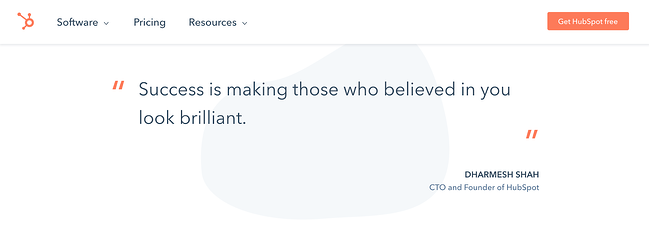
Finally, no matter how far I scroll down the page, the sticky header menu includes an orange CTA for me to Get HubSpot for free.

HubSpot about oage featuring a sticky header with a bold CTA

This is an example of an About page optimized to drive engagement, increase conversions, and enhance the brand. The page is as much about the user as it is about the company itself because along the way, the user is receiving value.

Example of an Optimized Website Blog Page

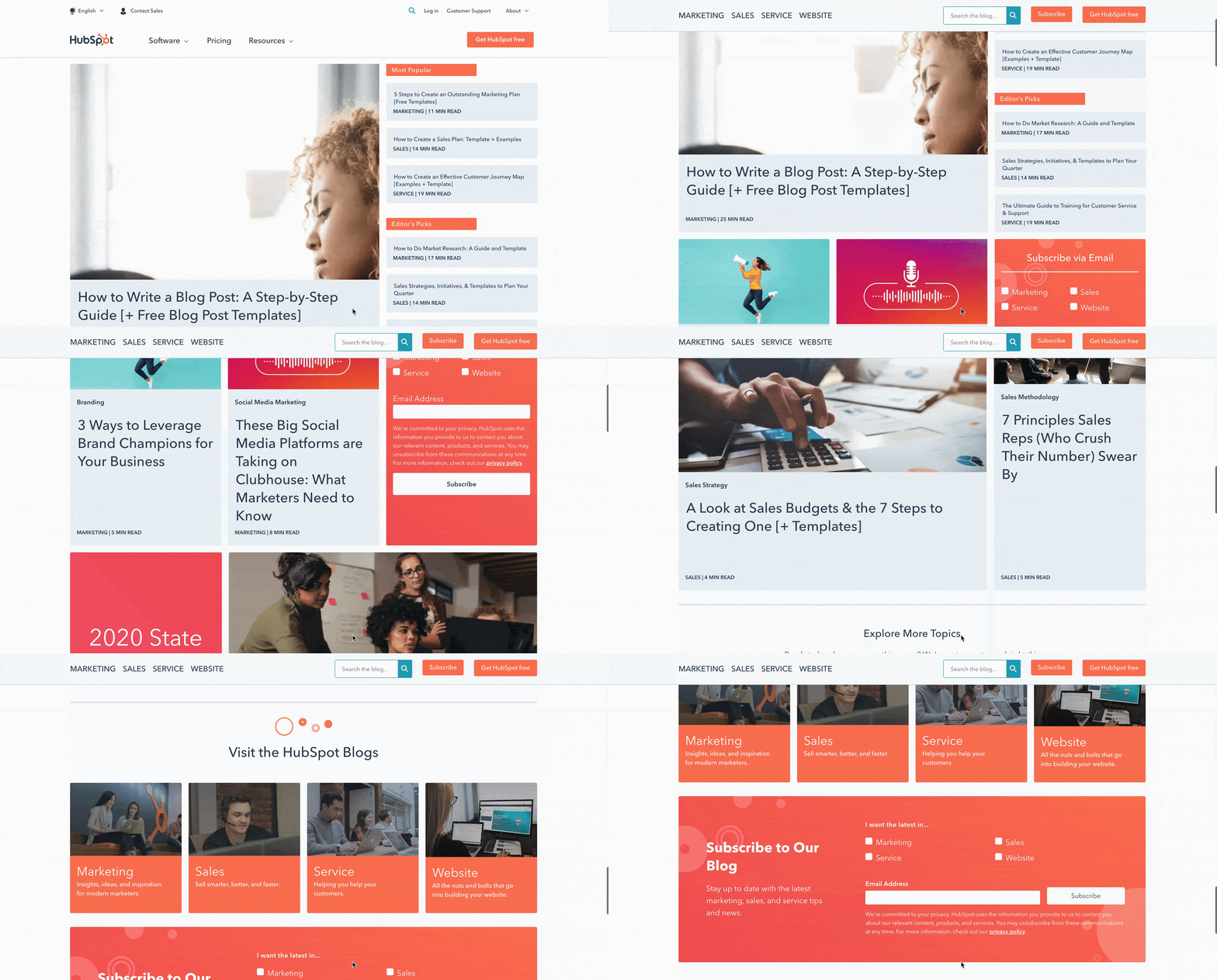
Even though the HubSpot blog is one of the most popular digital publications, there are still some practical applications you can use to optimize your own blog page if you have a smaller following. Although there are several articles a visitor can choose from across a variety of topics, you’ll notice specific CTAs that invite users to sign up for the blog newsletter, download a report, explore more topics, and finally, subscribe to their blog of interest.

HubSpot Blog page optimized for subscription and newsletter sign up conversions

Sprinkle the CTAs throughout your blog home page for a more natural approach. As readers scroll, you don’t want them to be bombarded with next steps, but you don’t want to leave them wondering what they should do next. Balance the user experience on your blog with a sticky header CTA and one or two primary CTAs.

Example of an Optimized Website Contact Us Page

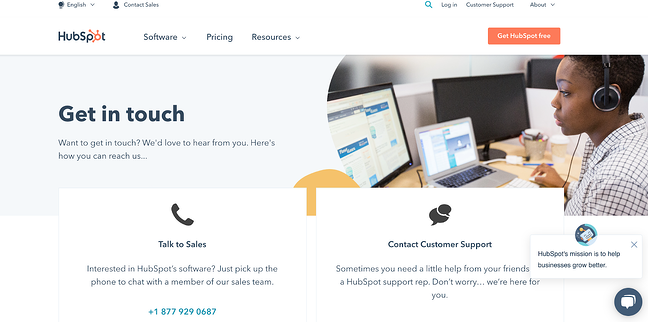
Granted, HubSpot uses its contact page a bit differently than you might use yours. Whereas a contact page might be the end goal you want for your visitors, HubSpot optimizes product and landing pages to draw in leads and sign-ups for specific products it offers.

There’s still an opportunity for a potential customer to get into the sales pipeline from the contact page though. HubSpot includes a sales line, customer support, and a chatbot to get users to the best point of contact.

HubSpot website contact us page that is optimized for conversions using CTAs

For customers, new employees, or candidates interviewing with the company, they can find the addresses and phone numbers of the global offices. Similar to the other three pages, the stick header menu includes a CTA to sign up for HubSpot for free.

Tips for Optimizing Each Page

Now that you have a framework for optimizing your pages and a couple of examples, here are a few, more specific tips to help you optimize each of the four most important pages.

1. Home Page

  • Use a big headline and place the most important information front and center. A home page may allow for several different CTAs — make it easy for the user to choose by making CTA buttons large and easy to click.
  • Provide flow. Make it obvious where the user is supposed to go and what they are supposed to do next.
  • Make the Navigation Menu Clear. Oftentimes, a visitor uses the home page as a way of finding where on the site she wants to go. For this reason, you should make the navigation menu very clear.

2. About Page

  • Deliver the most important and relevant information above the fold. The user is on your About page for a reason — answer their question(s) without making them scroll.
  • Include at least one CTA. Remember, most people aren’t just looking for more information, they’re seeking a deeper level of engagement.

3. Blog

  • Organize information on your blog clearly, and make sure that information satisfies the reasons users might be on your blog. Most users will want to read the most recent articles, so provide these. You may also want to organize categories on the blog home page, such as “most recent,” “most popular,” or other forms of categorization.
  • Include CTAs that make it easy for the user to subscribe to the blog, download a free resource, and so on. Even though the user came to get information, you want them to get engaged and connected. (Click here for 8 types of CTAs you can try on your blog.)
  • Provide CTAs in the core design of your blog so they appear on each individual blog post. In my experience, most blog visitors land on individual blog articles through organic search, instead of landing on your blog’s “home” page. To get these users engaged, put CTAs on the sidebars, in the footer, and in other places. (Learn how to pick the perfect CTA for each blog post here.)

4. Contact Us Page

  • Put the information the user is looking for above the fold — an email address, phone number, contact form, map, mailing address, and so on. Of all four of these web pages, the Contact Us page implies the most detailed level of intent on the part of the user.
  • Use CTAs that allow the user to contact you easily (since, presumably, that’s why they came to your Contact Us page). Make the CTA really obvious, and engage them by gratifying their intent instantly, using CTA copy like ”Chat now” or “Email now”.

Ask the User to Act On Your Content

As a website owner, you’re in the business of not just disseminating information, but soliciting a response, too. To engage your visitors and boost conversions on your site, here’s how to optimize pages like a pro: Look at your most visited pages, understand the reason users are there, provide valuable information, and ask them for an action in return. Regardless of your most-visited pages or even the nature of your website, you can create more engaged users with this optimization framework. Try it out — use the checklist below to get started.

Editor’s note: This post was originally published in December 2014 and has been updated for comprehensiveness.
New Call-to-action

Categories B2B

YouTube vs. Vimeo: Which Video Platform is Best for Your Business? [Data]

By 2022, online video content is predicted to command more than 82% of all web traffic (15 times higher than it was in 2017). If you haven’t started thinking about how video fits into your long-term marketing strategy, now’s the time to start taking it seriously.

Before you dive into creating videos, it’s important to figure out where you’re going to host them. YouTube is obviously the largest video hosting platform on the web, but it might not be the best choice for every business.

To help you find the best fit for your company’s unique needs, we compared YouTube directly against the smaller, more niche platform Vimeo across a number of factors. Read on to see the results, and decide for yourself.

→ Free Templates: How to Use YouTube for Business [Download Now]

Number of Users

Winner: YouTube

There’s no real competition here. YouTube commands an audience of over two billion monthly users — almost half of the entire internet-using population. Vimeo’s 240 million monthly viewers and 90 million registered users seem insignificant in contrast. For maximum reach, choose YouTube.

Search Optimization

Winner: YouTube

YouTube leaves Vimeo in the dust here. YouTube is the second largest search engine on the internet, right after parent company Google. If you’re planning to create a video tailored to a specific search query, (e.g., how to pick a font for your website), your video belongs on YouTube. Not only will it appear in search results directly on YouTube, but Google also seems to favor videos from YouTube over those posted on other platforms.

Mobile

Winner: YouTube

70% of all YouTube views come from mobile, and the YouTube mobile app is absolutely dominating the mobile streaming space — outranking even formidable competitors like Netflix, Hulu, and Twitch.

Videos uploaded to Vimeo and YouTube are both optimized automatically for mobile, but YouTube offers more opportunities for mobile discovery and reach.

Cost

Winner: YouTube

YouTube is free — even for businesses. But you might be wondering if Vimeo is as well.

Is Vimeo free to use?

Vimeo operates on a tiered pricing model, ranging from a free basic plan to a $50/month package aimed at businesses.

Vimeo Pro vs YouTube

While Vimeo does have a free basic plan, it limits you to 500MB maximum storage per week.

If you’re okay with paying some money, you can get a Vimeo Pro plan. In Vimeo Pro, you’ll have access to support, advanced analytics, and professional privacy.

On the other hand, you can have unlimited storage for free on YouTube.

Support

Winner: Vimeo

With their paid packages, Vimeo offers several levels of technical support that could be a game-changer for businesses without much video expertise. YouTube offers plenty of free help documentation and access to a (rather crowded) support community, but if you’re seeking higher-touch, personalized support on-demand, a paid Vimeo account is the better option.

Storage

Winner: YouTube

YouTube offers unlimited, free storage for all accounts, while Vimeo charges for storage on a tiered basis. The basic, free Vimeo account option gives you 500MB of storage per week. With their highest level, $50/month package, you can store 5TB total with no weekly limits.

No Pre-Roll Ads

Winner: Vimeo

If you upload your videos to YouTube, there’s a good chance a pre-roll ad will play before it, which has the potential to deter some viewers from sticking around. Vimeo currently doesn’t allow ads, and it doesn’t look like they’ll be changing this policy anytime soon.

Running Ad Campaigns

Winner: YouTube

If you’re thinking of running your own ads on a video platform, you can’t beat YouTube (You also can’t purchase ad space on Vimeo, even if you wanted to, because they don’t allow it.)

YouTube offers an advanced, user-friendly ads platform, as well as personalized support from a “YouTube Advertising Expert” when you spend $10 a day on ads.

Community

Winner: Vimeo

User numbers don’t tell the entire story. With such a massive audience on YouTube, the environment is naturally more competitive. It’s easier for your video to get drowned out by thousands of others if you aren’t planning to feature it somewhere off YouTube. Vimeo’s smaller, more community-driven platform might be a better option if you’re hoping to tap into an existing creative niche, or get featured on their hand-curated staff picks page.

Advanced Privacy Options

Winner: Vimeo

Both YouTube and Vimeo give you the option to set videos to private or public (the default setting on YouTube is public), but Vimeo offers a handful of more nuanced, specific privacy options if that serves your interests. You can add a password protection option to videos, share a video only with people who follow your account, or even hide it from the Vimeo community — which could be useful if you plan on embedding the video on your website and want it to be viewable in only one place.

Customizable Player

Winner: Vimeo

Vimeo’s sleek embedded player offers a number of useful customization options that YouTube can’t match, including hex color customization and the ability to include a custom player logo (on Business and PRO accounts). Plus, when you change the default customization options on your account, all previously embedded videos will update to reflect the changes automatically, with no need to go back and tinker with any code.

Analytics

Winner: YouTube

YouTube takes the win here because all their analytics — ranging from basic statistics like views to more advanced options — are completely free. Vimeo does also offer powerful analytics tools to evaluate performance, but you’ll have to pay to access everything but basic stats.

Video Quality

Winner: Vimeo

When it comes to video quality, Vimeo beats out YouTube. In a test done by Medium, Vimeo’s video quality was crisp, clean, and easier to read. On the other hand, the same video on YouTube was blurry, making it much harder to follow.

Audio Quality

Winner: Vimeo

Again, when it comes to quality, Vimeo comes out on top. Sound quality is higher on Vimeo because the platform supports 320Kbps. However, to enjoy higher-quality videos and audio, you’ll need to be subscribed to one of the paid plans.

Live Streaming

Winner: YouTube

Both Vimeo and YouTube have live streaming options, however, YouTube is the clear winner here because it’s free. Vimeo offers live streaming with a paid plan. However, with Vimeo, you can upload new versions of the video and keep on using the same URL and upload higher quality recorded versions of a live stream, which you can edit before posting.

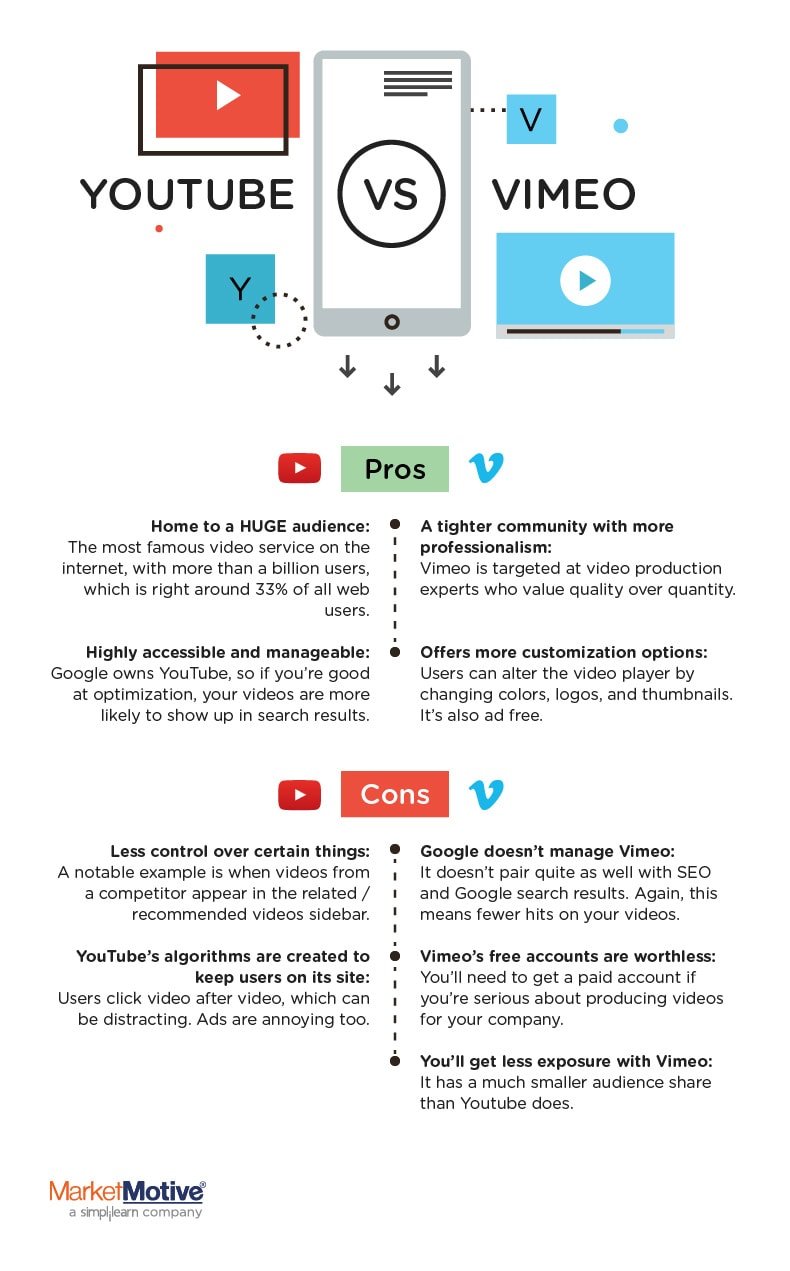
YouTube vs. Vimeo infographicImage Source

So which one should you choose?

It depends largely on what exactly you want to accomplish with your videos. If you’re looking for a creative community where you can connect with other video creators and gain some exposure in a specific niche, Vimeo is a better place to start sharing your content. If you have business goals that revolve heavily around search optimization and ads, YouTube is your best bet.

New call-to-action

Categories B2B

What Netflix Bingeing Taught Me About Digital Experience

Next time you open Netflix, I want you to try something.

When you see your tailored suggestions, as the platform starts the video right where you left off on your iPad, stop and take note of that experience.

How do these experiences actually make you feel?

Does the device handoff give you a rush of excitement and gratitude?

Probably not.

Start over. Imagine opening Netflix again.

Your recommendations are gone, replaced with an unfiltered list of content. The list feels random, but then you’d expect at least a couple of shows to be of random interest. They’re not. That episode you’re halfway through on your iPad? You’ll have to scroll back and forth to find your place. Ultimately, you’ll probably just rewatch parts of the episode “just to be safe”.  

Download Now: Digital Experience Audit [Free Workbook]

If you’re like me (my apologies if you are), you’ll react more to this moment of friction than the moment of seamless performance. The seamless experience is largely invisible — it’s unfelt — while the bad experience is impossible to ignore. Based on how bad it is, it’ll haunt you and sometimes make you question your life choices.

It may even push you toward Hulu or Disney +, or another platform that you trust more.

The same dynamic is at play for the digital experiences you deliver to customers.

2020 and 2021 accelerated digital transformation across industries, creating a new set of expectations in your customers’ personal and professional lives.

For them, being delighted isn’t a capstone to their experience as your customer; it’s the cornerstone your relationship is built on. Today’s buyers have more options, and disruptors are acquiring — and retaining — new business through the experience they provide their customers.

These new expectations present huge opportunities for those who are willing to rethink their digital experiences and a huge risk for those who are not.

So, why are so many businesses failing to meet these expectations?

Is it because they just don’t care about the customers’ experience? Sometimes — but not usually. A vast majority of businesses would love to deliver a delightful experience.

The reason they don’t is mostly because cobbled-together point solutions can’t deliver a clear view of the customer.

After all, scaling companies are in a constant state of adaptation. As new needs and opportunities arise, companies introduce a network of individual solutions that solve discrete problems: a CRM to manage customer data, a CMS to build their website, and marketing automation to scale their efforts.

Over time, as you add more solutions, your company’s tech stack grows so unwieldy it becomes a barrier between you and your customers instead of a bridge. It keeps you from the agile reporting you need and makes automation way more complicated than it should be. It makes personalization unreliable and messaging fragmented.

Since the dawn of the digital age, the status quo has been to rely on a separate CRM, CMS and automation tool. It’s what many marketing leaders have accepted as a necessary evil — despite the friction it causes for customers.

So, how do today’s companies win?

By delivering a best-in-class, unified digital experience that exceeds customer expectations. Doing this requires two foundational elements.

1. Information

Any marketing based on assumptions is doomed to failure. To get the digital experience right for every individual customer at scale requires reliable, organized and actionable data.

Not just ‘who are your customers?’ but ‘who is this customer?’ How and where have they interacted with you digitally? What do they need from you right now, and more importantly, what will they need from you next?

At HubSpot, we built the Customer Code with this philosophy in mind: Use the data you have access to, don’t abuse it. But in order to leverage the data you gather to create better digital experiences, all of your customer-facing teams need a single source of truth for that data — a key ingredient that’s beyond the reach of companies that still use cobbled-together solutions. That’s where centralization comes in.

2. Centralization

Providing a seamless experience across touchpoints is really a matter of shifting from ad hoc point solutions to a crafted, unified platform that provides a single view of the customer. When a CMS sits alongside key sales, services, and marketing tools in a centralized system, every customer-facing team knows how customers are interacting with their business and — more importantly — how they can help.

And this is the key: if you want your marketing, sales and service teams to deliver a great experience, you have to give them a fighting chance. You do this by having the systems and data they use aligned and unified.

For example, consider a repeat visitor to your pricing page. If both marketing and sales can see this activity, the marketing team can send a discount code or helpful resources that contextualize your pricing while sales can reach out to offer guidance or a product demo.

With this centralized platform and toolset, you can see and anticipate customer needs and take action immediately. You can tailor digital experiences on an individual level, across touchpoints, using the most up-to-date insights on customer needs, questions or interests — just like they expect you to.

The CRM for Today’s Customer Expectations

The answer to these business challenges isn’t just to use a CRM. You probably already have one of those. If you’re really unlucky, maybe even two. It probably doesn’t allow you to easily do any of what I just described, and it likely can’t deliver the seamless experiences your customers expect.

Instead, you need a CRM platform that has been designed specifically to meet today’s sky-high customer expectations; one that you can adapt to changing customer expectations, align your teams around, and adopt without an uphill change management battle. (And no, there are no change management battles that are downhill).

To pull off this digital experience at scale, you need to rethink the underlying components of the experience itself.

The customer-facing pieces — your website, email content, advertising, member portals — are front and center. But only touchpoints that are powered by a modern, purpose-built CRM provide the personalization and timeliness that distinguish an average digital interaction from an elite one.

And whether it’s Netflix, HubSpot or your corner cafe, delivering elite customer experiences is the key to navigating uncertain times, thriving in the digital-first era, and ultimately, growing better.

digital experience

Categories B2B

The Ultimate Guide to Starting a Minority-Owned Business [+ Expert Tips]

COVID-19 presented more challenges than one for businesses, and the pandemic took an even more tremendous toll on minority business owners.

With minority business owners experiencing a cash crunch, not many could secure loans to keep their doors open.

In 2020, 400,000 small businesses decided to permanently close due to the effects of the pandemic — many of which were in underserved communities. Whether you’re in the idea phase or already established, this guide will help you get your minority-owned business off the ground.

Before you dive into this guide, check out this blog on how to start a business if you’re still in the idea phase.

When you finish reading this piece, you’ll have everything you need (and more) to thrive as a minority business owner — from how to get certified as a minority-owned business, to funding options and growth resources.

Learn More About HubSpot's Community to Amplify Black Professionals

Get Certified as a Minority-Owned Business

After you’ve nailed down your business idea, plan, and registered your company, it’s time to get certified as a minority-owned business. This certification isn’t required, but it will help inform consumers and potential partners about your company’s leadership.

You may also need this certification may also if you want to apply for government-funded minority business grants and loans, or other programs.

Illinois, Ohio, California, and New York have local agencies to get certified as a minority-owned business on a state level. There are various ways to get certified from local state and business agencies, so it might be best to consult them directly based on where your business is registered.

Here are a few other high-level agencies to consider getting a minority-owned business certification from:

  • The National Minority Supplier Development Council (NMSDC): Headquartered in New York, NMSDC manages 22 regional affiliate councils around the U.S. NMSDC offers minority-owned business certifications and business development programs. The council has a network of more than 1,750 corporate members and has matched more than 12,000 minority-owned businesses with these member corporations. The certification process includes an online application, fee, interview, and site visit upon approval.
  • The Small Business Administration’s 8(a) Business Development program: The federal government committed to awarding five percent of all federal contracting dollars to small disadvantaged businesses with an 8(a) designation each year. This is an SBA-specific minority-owned business certification needed if your company plans to compete better for federal government contracts.

These same organizations and agencies may offer women-owned and LGBTQ-owned business certifications, as well.

Apply for Minority Business Grants

Minority founders often start bootstrapped, launch crowdfunding campaigns, or even try and raise initial funding through family and friends.

You can take various routes to fund your startup, but if you’re on your own when it comes to financing, seeking grant funding is a great start. Grants.gov distributes more than 1,000 small business grants for an open search, and this is where all federal government agencies post their grant opportunities.

Here are a few business grant opportunities for minority founders:

  • The Coalition to Back Black Businesses Fund: This initiative was created to aid small Black businesses struggling through the pandemic. The coalition is awarding 300 grants amounting to $5,000 each.
  • The U.S. Department of Agriculture (USDA): This agency runs the Rural Business Development Grant Program for businesses operating in rural areas, with a population under 50,000 residents. The program offers grants to minority small businesses ranging from $10,000 to $50,000.
  • Rebuild the Block (RTB): As part of its Small Business Relief Fund, RTB award 15 grants monthly to Black business owners affected by the pandemic. There isn’t a specific monetary value on each grant, and freelancers and other creatives are encouraged to apply.
  • First Nations Development Institute (FNDI): Deadlines and opportunities vary, but this nonprofit provides financial and technical support to Native American organizations. FNDI has provided 2,150 grants totaling $43 million to Native projects across 40 stages and regions.
  • The National Black MBA Association: Since 2017, the association has been hosting the Scale-Up Pitch Competition, which awards grants ranging from $1,000 to $50,000 to Black business owners. Someone from the company must be a member of the association to apply for this opportunity.
  • Asian Women Giving Circle (AWGC): This grant is exclusive for Asian American women-owned businesses. AWGC awarded 11 grants ranging from $2,500 to $10,000 each in 2020, and this year, the maximum grant amount is $15,000.
  • SoGal Foundation: This rolling program awards $5,000 and $10,000 to Black women founders and Black nonbinary entrepreneurs.
  • FedEx: Each year, FedEx hosts a nationwide Small Business Grant Contest, and while it’s not exclusively for minority small businesses, many of the past winners have been minority founders. Winners receive grants ranging from $15,000 to $50,000, plus funds for FedEx printing services.

If you’re looking for more opportunities, Please Assist Me Co-founder and CEO Stephanie Cummings suggests subscribing to newsletters distributed by 1863 Ventures and Backstage Capital.

Each organization sends out a monthly newsletter loaded with updated grant and funding opportunities specifically for minority founders.

Apply for Minority Business Loans

Another financing option could be applying for loans. Historically, minority founders have struggled to secure business loans due to credit inequality and discrimination, but there are still reasonable loan options out there.

Here are a few business loan opportunities for minority founders:

  • Accompany Capital: Looking to support immigrants, refugees, and women entrepreneurs specifically, Accompany Capital offers microloans of $500 to $50,000 with repayment terms ranging from six months to three years.
  • U.S. Small Business Administration (SBA): SBA manages a few loan opportunities, including its Microloan Program and Community Advantage Loan Program. Open to all small businesses, the Microloan Program offers loans up to $50,000 with loans averaging $13,000 each. For the Community Advantage Loan Program, SBA encourages community lenders, mainly nonprofit financial entities, to make loans up to $250,000 to minorities, women, veterans, and other underserved founders.
  • Business Consortium Fund: Offered to NMSDC certified businesses, the fund offers loans and lines of credit ranging from $250,000 to $750,000 with repayments terms of up to five years.
  • USDA: As part of its Business and Industry Loan Guarantee Program, USDA offers up to $1 billion in loan guarantees to local banks and direct lenders operating in rural areas with a population under 50,000 residents. Minority businesses can also directly apply for a USDA loan, ranging from $200,000 to $5 million with a maximum cap of $10 million.

Tap into Additional Minority Programs and Resources

Even if you may think you have it all figured out, a little extra guidance wouldn’t hurt.

Here are ten accelerators, startup programs, and other resources for minority founders:

  • The Visible Hands fellowship runs a 14-week virtual program to provide company-building services and investments up to $200,000 to underrepresented entrepreneurs. The inaugural cohort will welcome more than 30 fellows.
  • Dedicated to diversity in tech, Black Founders provides programs and hosts events for Black tech entrepreneurs.
  • Operation HOPE runs an eight-week entrepreneurial training program designed to help entrepreneurs in low-income communities.
  • SBA’s Business Development program helps minority business owners better qualify for SBA loans. Your company must be registered as a small business with SBA to participate.
  • The Minority Business Development Agency, an agency within the U.S.Department of Commerce, was created to provide greater access to capital and resources to minority founders. The agency manages business centers across the nation and hosts business development programs.
  • 1863 Ventures–a business development organization working to promote people of color, women, immigrants, LGBTQ people, veterans, and physically disabled business owners–runs two accelerator programs. Its Pipeline program is for pre-growth stage companies, and its Acceler8 program is for growth to scale stage businesses.  
  • Y Combinator’s Startup Library includes a wealth of resources spanning 15 years.
  • The National Minority Business Council provides minority business owners with educational opportunities, entrepreneurial boot camps, seminars, business assistance, and more. Membership is encouraged.
  • The U.S. Minority Chamber of Congress is a nonprofit advocating for small business rights. The organization has chapters across the U.S. that host networking events and offer local entrepreneurial resources.
  • Founder Institute put together the Black American Startup Resource List filled with 742 resources for idea-stage entrepreneurs. If you’re looking for accelerators, investors, or even events, this list is a great place to start.

Indulge in Motivational Tips from Other Minority Founders

Starting a business from scratch is hard, but doing so as a minority may pose more challenges.

Many disparities get in the way for minority business owners, but hopefully, these opportunities and resources will ease some hassles. While starting a minority-owned business may be the same as starting any other company, there are a few extra things you can do — like getting certified — to tap into some unique opportunities made just for minorities.

I reached out to some minority business owners who have done the hard work and are still striving to grow their ventures. Here are some tips if you’re feeling discouraged:

  • “Understand that starting a busy is hard, and it’s 10X harder for minority founders. If you are committed to your dream, work hard, dig in and let your work speak for itself.” — Stephanie Cummings, co-founder and CEO of Please Assist Me.
  • “Just do it — one of my favorite slogans. As minorities, we often don’t see similar faces on the cover of Forbes or elsewhere. This is slowly changing. But that doesn’t mean you can’t do it. What matters at the end of the day is if your business is actually helping others.”  — Nhon Ma, co-founder and CEO of Numerade.
  • “Don’t get too attached to ideas. Spend your time getting attached to your values, and know what you stand for as a person — your values will be your guiding light, not the ideas.” — Ronnie Kwesi Coleman, co-founder and CEO of Meaningful Gigs.
  • “Leverage your networks to build brand awareness organically, but don’t forget who helped you get there once you get some momentum.” — Leela Bhatia-Newman and Mariana Magala, co-founders of DistrictlyLocal.

black at inbound

Categories B2B

Why People Visit YouTube & How to Engage Them [New Data]

YouTube is the second largest website globally with over 2 billion global users.

Still, despite its huge audience, it can be challenging to gain engagement on your videos.

Ultimately, to gain views, likes, shares, and even subscribers, your content will have to engage at least part of YouTube’s huge audience while fulfilling their needs.

But, if you’re just starting on YouTube, or struggling to grow your strategy, you might not know what the platform’s audience wants just yet.

To help marketers learn more about YouTube’s huge user pool, and their interests, I asked nearly 300 consumers: “Why do you most commonly visit YouTube?”

Here’s what they said.

→ Free Templates: How to Use YouTube for Business [Download Now]

Why Do People Visit YouTube?

Before we dive into what people picked as the most common reason they visit YouTube, it’s worth mention one thing you won’t see on the list below: product discovery.

Just a measly 3% of respondents visit YouTube primarily to “learn about products.”

A chart explainingg that most people visit youtube to be entertained

Data Source

However, you shouldn’t panic just yet. Keep in mind that we just polled a small group of general consumers about their most common reason for visiting YouTube. Had we asked them for their top three reasons, polled a larger group, or polled a specific demographic, the results could have been different.

It’s also worth noting that many demographics search out product videos when they’re researching a prospective purchase.

In fact, in a 2020 recent survey, 94% of people said they watch explainer videos to learn about products. While many YouTube users might not go to the YouTube platform just for product videos all the time, they probably still watch them when they’re relevant to their buyer’s journey.

However, knowing what YouTube audiences are looking for on YouTube will help you make a video related to your brand or product that still mixes in elements that can engage them and fulfill their viewing needs.

So, why do people visit YouTube? Let’s dive into the three most popular motives.

1. To watch videos that entertain me.

When we asked consumers why they visited the world’s second-largest platform, a whopping 65% of them said they did so for pure entertainment.

This stat might be terrifying for marketers, especially if you sell a product that might not be considered super flashy or attention-grabbing.

But, the stat above shouldn’t have you panicking just yet. Keep in mind that this is just one small survey. Had we asked people of certain age groups or industries this specific question, the results could have swayed in another direction.

However, it is very important to keep in mind that people on YouTube want to be entertained or at least intrigued by the content they’re watching. So, whether you’re planning to launch YouTube video ads or standard videos, you’ll want to add a touch of entertainment, action, or interesting information to them.

Here’s a great video, created by Headspace and LOL Network, that features actor Kevin Hart struggling to meditate and using the Headspace app to help him relax while jogging.

Even if you can’t work with a big-name celebrity, this video is still a great example of content that tells an entertaining story about how a product solves common problems. While Hart’s fame might pull people in, watching him worry about relatable, everyday things as he jogs could be relatable and funny to audiences.

2. To learn how to do something.

We’ve all had a moment in life where we couldn’t figure out how to do something and scoured the internet for a video that could help. That’s why it’s not surprising that 13% of respondents primarily visit YouTube to “learn how to do something.”

As a marketer, you can leverage the YouTube audience’s need for advice and guidance with videos on how to do things related to your brand, industry, or even your product.

On top of zoning in on the how-to format, you could also mix in entertaining elements, such as an influencer or entertaining video host, to fulfill a viewer’s need for interesting content

Here’s an example of a how-to video from B Simone Beauty, a cosmetics brand named after its founder B Simone. In the video, Simone, also known for her work as a stand-up comedian, offers a step-by-step tutorial on how to give yourself a glamorous makeover.

While the video highlights B Simone Beauty products, it focuses on makeup tutorial tips. Not only does this help audience members who have purchased cosmetics from the brand, but it also gives prospects helpful tips. By watching this video, you not only see what using B Simone products is like in real life, but you also learn how knowledgeable Simone is about makeup. Both of these elements could enable viewers to trust the company and product quality.

3. To learn about something, such as a hobby, interest, or industry.

While some people use YouTube to find step-by-step guides on how to do something, some just watch videos to soak up as much valuable information as possible. In our poll, 13% of respondents said they visit YouTube to “Learn about something related to a hobby, interest, or industry.”

As a marketer, you can also leverage this YouTube user need in your videos or in-stream ads. Here are just a few ways to weave valuable information into your next video.

  • Leading the video with a surprising or interesting stat.
  • Featuring expert tips or insight-filled interviews from your company leaders or industry experts.
  • Recording an explainer video with fun graphics, charts, and interesting information about a topic related to your industry or brand.

Here’s an example of a video HubSpot posted that discusses how TikTok’s audience has begun to mature by discussing stats and facts about the platform.

Although HubSpot isn’t a TikTok tool, it has a large marketing audience that the company is engaging with this video that educates viewers on a highly trendy topic.

By creating informative or educational videos related to your industry, you enable the viewers with similar interests to learn something new while also developing trust for your company. So, even if you aren’t explicitly mentioning your product, viewers could remember your brand and your expertise next time they’re shopping in your immediate space. Similarly, if someone does do product research and comes across your YouTube channel, they might trust that a brand with solid knowledge around an industry will create high-quality products.

Other Answers

Aside from the top three responses, 3% of people said they go to YouTube primarily to watch videos of their “favorite celebrities or influencers” while another 3% primarily use the platform to find videos related to “news and trends.”

While these responses don’t need to inform your strategy, they align well with the themes that people are looking for entertainment and interesting information.

Catering to YouTube’s Giant Audience

Ultimately, it’s unlikely that every single YouTube viewer will love your content or search out the types of videos you make. However, since the audience is so broad, there’s at least a large segment of it that could engage with your marketing strategy. As you develop or fine-tune your tactics, keep these tips in mind:

  • Know your audience: Learn the ins and outs of who uses the platform, identify the best demographics or targets to go after, and look at what types of videos they engage with most.
  • Mix education with entertainment: While many people visit the platform for entertainment or escape from their daily lives, others crave valuable or helpful information. So, try to create content that intrigues viewers, while also giving valuable information related to your brand or industry.
  • Don’t limit yourself to product videos: While you can certainly post a few demos, interesting customer stories, and mention your product in a few videos, keep in mind that YouTube visitors might not be looking for commercial-like content. Try to add variation with explainers, expert interviews, or other interesting, but on-brand, video formats.

Need more help with developing or expanding your YouTube strategy? We’ve got you covered.

Check out this data on why people click out of YouTube videos, this Ultimate Guide to YouTube Marketing, or download the free resource below.

New call-to-action

Categories B2B

How 3 New Facebook & Instagram Shopping Features Could Help Marketers Boost Sales

For years, millions of brands have flocked to Instagram and Facebook to spread awareness to millennials, Gen Z, and members of other generations on the app.

And, at this point, marketing on these platforms has proven to be a smart tactic. On Instagram alone, 90% of its 1 billion-plus users follows a Business page on the platform.

Now, with Facebook’s launches of Facebook Shops, Instagram Checkout, and Live Shopping in the last 12 months, many of the tiny remaining friction points between discovering and buying products on social media platforms have been eliminated.

In this blog post, I’ll highlight the newest free features that brands can use to make sales directly from Instagram’s or Facebook’s platform, as well as any brand requirements for using them.

Click here to access a month's worth of Instagram tips & free templates.

3 New Instagram Shopping Tools to Know About

1. Facebook Shops

Technically, this tool was launched by Facebook, which owns Instagram. However, your Instagram followers won’t need a Facebook account to make purchases with this feature.

Facebook Shops, launched in May, enables brands to create online stores that link directly to a brand’s Instagram, WhatsApp, Messenger, or Facebook Business Page.

When creating a free Shop, brands can upload bulk or individual product listings with photos, prices, and descriptions; change the store’s button colors and text to make it consistent with their brand; and choose to have visitors buy products directly from the shop or through an integration with an ecommerce website they already use.

Facebook Shops can be created on Facebook Commerce Manager. To get started, you’ll need admin privileges to the Instagram Business or Facebook Business account you’ll be linking the Shop to — as well as admin privileges for your brand’s Facebook catalog.

Once a Shop is created, it can be linked directly to your Instagram Business profile. When this is done, an icon that says “View shop” will appear on your mobile profile under your bio. At this point, you can access Facebook Shops on desktop from Facebook Business profiles, but not from Instagram or WhatsApp desktop sites.

Here’s what the Shop experience looks like when an Instagram app user visits the account of Ink Meets Paper, a printing company which offers a Facebook Shop:

Ink meets paper facebook shop link on instagrqam bioink meets paper facebook and instagram shop

Facebook Shops, which is free to all businesses that fulfill the business page requirements noted above, could be a great option for small or medium-sized businesses that are interested in ecommerce but don’t have the time or bandwidth to create and promote a full ecommerce site around their brand.

To learn more about how Facebook Shops works and the background of why Facebook launched it, check out this post.

2. Instagram Checkout

For brands that want to sell a few select products on Instagram, or don’t have time to create a Facebook Business Page or catalog to open a Shop, Instagram also now offers an in-app Checkout experience that links to Instagram Shoppable posts.

Before 2020, several brands were already using Shoppable posts. These posts, which often highlighted an image of a product or experience, allowed users to tap the content to view it in an online catalog outside of the platform.

Instagram shoppable post

But, in March, Instagram launched a Checkout feature that allowed Shoppable purchases to happen directly in the app.

In an announcement, Instagram explained that it launched in-app Checkout to keep users on the platform when they were inspired to make a purchase.

Instagram also adds, “Businesses can truly leverage the full ecosystem of Instagram Shopping features to build experiences that drive awareness and transactions all in one place.

Currently, Checkout is free to brands through until at least 2021. However, there might be selling fees for businesses after that.

“We also want to help reduce the cost of doing business during this tough economic time, so we’re waiving selling fees for businesses that use Checkout on Instagram through the end of the year,” Instagram’s post said.

Now, when users click on a Shoppable post that links to the Checkout feature for the first time, they’ll be asked to give their name, billing information, and shipping address and can then click “Place Order” directly on Instagram. To further eliminate friction, users can set the app to remember purchasing information so they don’t need to submit it each time they place orders.

Instagram shopping post and store

Image Source

At this point, you might be wondering, “How is this different from Facebook Shops?”

Both tools similarly allow consumers to make purchases directly on Instagram. However, a Shop is a mini-online store where you can purchase one of many products listed by one brand. Meanwhile, Checkout allows consumers to buy a product they happen to see on an Instagram Shoppable post within their feed or a brand’s profile page.

Additionally, to use the Checkout feature, you’ll need to fulfill the same requirements as Facebook Shops, plus approval for Instagram Shopping.

Checkout might be a good option for your brand if you want to dabble in internet sales but don’t want to monitor how multiple products are selling in a wider shop. With Checkout, you can choose to sell one or two products within a few posts, and monitor your content for engagements and sales metrics.

3. Instagram and Facebook Live Shopping

While the features above integrate with Instagram and Facebook to allow audiences to buy products from posts or pre-published stories, Facebook has also unveiled live shopping features for both of its platforms.

Instagram Live Shopping

Aside from adding Checkout to posts within a feed, Instagram Live Shopping, the first live shopping feature launched by a Facebook-owned brand, brings a similar purchasing experience to live content streamed on the app.

Essentially, Instagram Live Shopping lets brands or Instagram influencers present a small CTA for a product at the bottom of an Instagram Live stream. Below is an example where an influencer discusses a product live as its Checkout CTA is highlighted at the bottom of the screen:

Instagram live shopping content

Image Source

When an Instagram Live viewer sees the Checkout CTA and clicks “Add to Bag,” they can either save the order for later if they want to continue watching the stream, or they can purchase the product immediately via Checkout.

If a user places a product in their Instagram Bag, they can find it by going to the app’s Explore tab and tapping “Shop” in the top navigation. Fram the  Shop page, they can then tap the bag icon in the upper right corner to see carted products:

Instagram shopping tab of app

Because users who purchase items via Instagram Live Shopping will be directed to Instagram Checkout to finalize the purchase, brands will need to gain access to Instagram Checkout before using Live Shopping.

Facebook Live Shopping

If your audience is primarily on Facebook, you can also leverage Facebook’s new live shopping feature — which was unveiled in spring of 2021. 

Facebook Live Shopping feature

Image Source

Like Instagram Live Shopping, this feature allows audiences viewing Facebook Live streams to see related products pop up. From there, the user can click the pop-up to buy those products while still watching Facebook Live videos. 

The process of promoting your products during a Facebook Live stream is similar to promoting in Instagram:

  • First, you’ll need to start a Facebook Shop for audiences to buy seamlessly through Facebook Live. 
  • Once your shop is all set, go to create a Live video for your Facebook account and click the Live Shopping tab, and toggle on “Enable Live Shopping.”
  • Once you’re live with shopping enabled, you can click or tap a button that says “Products from Shop” and select the products you’d like to feature as you’re recording. 

For those getting used to Facebook or Instagram Live Shopping, Facebook offers a helpful list of best practices for streaming on its website. These tips include rehearsing with a private live event, repeating key information about the products, saving the live feed to your timeline, and following up with people who shared comments on your feed after you’ve recorded.

What to Keep in Mind When Selling Products on Instagram

At this point, you might be ready to sell your brand’s products using Instagram’s in-app shopping features. However, as you would with any new marketing or selling technique, you’ll want to keep a few key things in mind:

Your content strategy is still key.

While it might sound tempting to blast your followers with posts filled with product shots or basic promotional messaging, and hope that users click the Checkout button immediately, some audiences might not respond well to content that feels like a basic advertisement.

Remember, social media users see ads with product shots and bland descriptions daily. If your content doesn’t stand out above all the other promotional posts out there, your audiences might disengage from you, even if they like your brand.

Rather than posting basic images or videos of products linked to Checkout, consider going a step further. For example, you could air a live stream tutorial where an influencer discusses your product, or publish user-generated content such as customer testimonials. These types of content will show audiences more valuable details than a basic product shot, while also presenting how real people benefit your product. This could persuade them to click and buy your items much faster.

You’ll want to pick the right feature for your company.

While Shops will allow customers to buy a bunch of different products from you all at once, Checkout and Instagram Live Shopping allow you to zone in on specific items or services through your content. While Facebook Shops might be great for brands that can deliver multiple products at once and handle potential high demand, Checkout and Live Shopping could be beneficial for smaller businesses that are more comfortable highlighting one standalone product at a time.

Additionally, if you have a killer supply chain, tons of products to sell, and no time to make content, a Facebook Shop could help you move your inventory. Meanwhile, if you have a great content team, but only have a few key products to sell, you might want to create solid product marketing content paired with Instagram Checkout.

You’ll want to monitor your metrics, including revenue.

Although brands don’t need to pay for Facebook Shops, Checkout, or Live Shopping, time and effort will still go into creating and maintaining a Shop or content that highlights items sold in Checkout. Because of this, you’ll want to monitor the money and engagement-related metrics of each strategy you take on. While these metrics can help you learn what to do, and what not to do, they can also help you determine if these features are worth your team’s time.

If you’re considering an ecommerce strategy on Instagram or another online platform and don’t know where to start in your planning, bookmark our Ultimate Guide to Ecommerce. If you’re interested in learning how other brands shifted to ecommerce in 2020, check out this piece.

Editor’s Note: This blog post was originally published December 2020, but was updated in June 2021 to add new information about Facebook and Instagram features.

30 days of instagram

Categories B2B

13 of the Most (& Least) Successful Brand Extensions to Inspire Your Own

I was in awe of Hailee Steinfeld’s performance after watching her in The Edge of Seventeen. Her performance was so good that it earned her a Golden Globe nomination for Best Actress.

But what amazes me about Steinfeld isn’t her acting prowess. It’s that she’s also just as accomplished as a singer. Steinfeld has collaborated with some of the most famous musicians like Zedd, Florida Georgia Line, and Alesso to produce three hit songs that have all reached the Billboard Hot 100 record chart.

Although Steinfeld is mainly known for her acting chops, her singing abilities bolster her esteem as a performer and stretch her brand to more audiences and fans. And just like her venture into music, companies often extend their brand to develop new products in industries where they don’t have any market share.

These initiatives are called brand extensions, and they allow companies to leverage their brand awareness and equity to create more revenue streams.

In this article, you’ll learn more about what a brand extension is and see examples of extension ideas that could inspire you.

Download Now: Free Brand Building Guide

What is a brand extension?

Brand extension is a marketing strategy that involves a company using its well-established brand name or image to introduce a new product or product categories to its customer base.

This strategy works best when the new product category is related to its parent category and is something consumers and customers want.

Many companies use brand extensions because it allows them to leverage their parent brand’s brand awareness and authority to reach new demographics and open up new sales channels.

One company that does brand extensions well is Apple.

Although Apple started as a technology company that makes only computers (Macs), it soon extended its product line to include music players (iPods), mobile devices (iPhones), and tech accessories (Apple Watch and Earpods). Even though all these new products are different, the extension works because Apple didn’t drift too far from its parent product category. Instead, it leveraged its brand name to make penetrating the market a success.

What are the types of brand extensions?

Depending on the type of customers you have and what you want to achieve as a brand, you need to decide which brand extension strategy is right for your company.

Here are five different extension strategies that could work for you.

Line Extension

A line extension is when a parent brand launches a new product line in a category already familiar with its customers. With a line extension, brands don’t have to create new categories.

An excellent example of a line extension is when soft drink companies introduce new flavors to their existing drink lineup. Other examples could include introducing new scents, sizes, and colors to a product line.

Complementary Product Extension

Another way an established brand can extend itself is by creating complementary products for its main products.

For example, Nike, a sports brand, creates various equipment, wears, and other sport-related products that complement each other. We’ve also seen toothpaste companies use this type of extension for their original brand by adding toothbrushes and other oral care products as new categories.

Customer Base Extension

A company can create a branding extension for itself by launching different product categories for a single demographic.

Procter & Gamble (P&G), for example, does this well with the Pampers brand. Although P&G specializes in various products, the Pampers line focuses on making products like diapers and wipes for babies.

Company Authority Extension

Companies with high levels of authority in their sector can leverage this authority to create new products.

For instance, Samsung has a huge brand name in the technology space that allows them to launch different products in related categories with a measure of success. And because of its brand image, most consumers wouldn’t mind using a new product, whether it’s an air conditioner or a mobile phone.

Brand Lifestyle Extension

Who would have thought a tequila line from an energy company would sell out within a few hours? Well, Tesla did it. And it was primarily due to the personality and lifestyle of its CEO, Elon Musk.

However, Elon and Tesla are not the only ones to use a celebrity’s lifestyle to extend an existing brand. Other instances include Adidas/Kanye West’s Yeezy lineup and Fenty (a brand under LVMH) with Rihanna.

What separates the best brand extensions from the worst?

Historically, the most successful brand extensions are the ones that closely tie to the company’s core brand or flagship product, like Gerber’s baby clothes and Dole’s frozen fruit bars. By entering tangential markets that can preserve their brand’s unique associations and perceived quality, companies can launch new products that consumers intuitively understand the benefits of, even though they’ve never seen them on a shelf.

On the flip side, a company can also exploit its brand and, in turn, ruin it.

Developing a new product in a market that isn’t closely tied to your flagship product or core brand, like what Zippo did with its women’s perfume, could cause some problems.

It could result in undesirable associations to your brand and weaken its existing associations and hurt your established products’ perceived quality.

So whether you’re a SaaS company or a consumer brand thinking about extending your product line, check out our list of the most and least successful brand extensions to help inspire your own.

Examples of Good Brand Extensions

1. Reese’s Puffs Cereal

Reese's Brand Extension -- Cereal

Image Source

Reese’s Puffs was my favorite cereal growing up, so I might be a little biased here. But with all the chocolate-flavored cereal around in the mid-90s, Reese’s Peanut Butter Cup’s entrance into the cereal market was smart and natural.

Today, with some ad campaigns highlighting how kids can eat their favorite candy for breakfast, Reese’s Puffs has helped General Mills, its conglomerate, capture the second-biggest slice of the cold cereal market share.

2. Food Network’s Kitchen Items

Food Network Kitchen Items Brand Extension

Image Source

With an audience of over 13 million people, Food Network remains one of the world’s biggest TV channels.

Considering that many people were interested in what it does, Food Network saw an opportunity to extend its brand by partnering with Kohl’s Corporation to launch its kitchen and cookware products.

The partnership was a success because Food Network served a specific audience with what they needed.

3.Gillette’s Razors & Shaving Supplies

Gilletes Razors BRand ExtensionImage Source

Gillette’s extension into making shaving products alongside its safety razor blades was a smart move. Why? It’s hard to imagine someone shaving without using shaving cream, foam, or gel?

It was almost a necessity for Gillette to produce this complementary good for its flagship product.

4. Star Wars Action Figures

Star Wars Action Figure Brand ExtensionImage Source

Although Star Wars was popular among adults when the movie was first released in 1977, many children didn’t like it as much.

So how did the franchise become popular today? The Star Wars brand extended into the toy market. With action figures from characters in the movies, Star Wars was able to attract a new audience, build brand awareness and make a ton of sales in the process.

5. Colgate’s Toothbrush

Colgate Brand ExtensionImage Source

Just like Gillette’s razors and shaving products, Colgate’s toothpaste and toothbrush are complementary goods. But unlike the former example, you literally need a toothbrush to use toothpaste. Otherwise, you can’t brush your teeth.

In my opinion, Colgate’s decision to enter the toothbrush market was a necessity and one of its best moves, helping it secure the third-largest slice of the oral care market.

6. Honda’s Lawn Mowers

Honda Lawn Mower Image Source

Honda’s line of lawnmowers might not elicit the most enjoyable memories of my childhood. Still, its entrance and success in a saturated market speak volumes for a company primarily known for selling cars.

By leveraging its expertise in small motors to enter the lawn mower market in 1978, it now boasts the seventh-largest slice of market share in the global lawn mower industry.

7. Sunkist’s Vitamin C Tablets

Sunkist Brand Extension

Image Source

Featuring orange juice as its flagship product, Sunkist’s brand has associations with oranges, health, and energy. Sunkist produced vitamin C tablets that spawned an entire arm of business dedicated to vitamins and supplements to both bolster and leverage this association simultaneously.

Examples of Unsuccessful Brand Extensions

Not every brand extension can be a hit. Here are a few examples of brands that have made brand extension mistakes — and the lessons you can learn from them.

8. Cadbury’s Instant Mashed Potatoes

Cadbury Brand ExtensionImage Source

Cadbury is known for making high-end chocolate and candy. When it started producing low-end food products, like instant mashed potatoes, it’s not surprising to learn that its association with the finest chocolates weakened.

Smash, its instant mashed potato brand, actually reached mainstream success, but it was at the expense of lowering its flagship product’s perceived quality. Cadbury eventually sold Smash in 1986, over 20 years after introducing its instant mashed potatoes to the world.

9. Levi’s Tailored Classics

Levis Brand ExtensionImage Source

When Levi’s introduced Tailored Classics in the early 1980s, it already owned a large share of its target market, so it wanted to enter some new markets to sustain its high growth rate.

One of these markets was men’s suits, but since its brand was heavily associated with a casual, rugged, and outdoorsy lifestyle, Levi’s new product line conflicted with its core identity and failed to catch on.

Consumers trusted Levi’s to produce durable clothing that could endure the wrath of mother nature, but, for that very reason, they didn’t trust them to deliver high-end tailored suits.

10. Pillsbury’s Frozen Microwave Popcorn

PillsBury Brand ExtensionImage Source

Even though Pillsbury is known for producing foodstuffs, its frozen microwave popcorn couldn’t compete with Orville Redenbacher or General Mills’ Pop Secret because its product positioning of being “frozen for freshness” didn’t offer enough value. Sure, sticking your popcorn in the freezer is convenient (I guess), but that benefit pales in comparison to enjoying a better-tasting popcorn.

11. Samsonite’s Outerwear

Samsonite Brand Extension

Image Source

While Samsonite’s outwear is more fashionable than Levi’s Tailored Classics, it still suffers from the same problem as Levi’s failed product line the brand extension doesn’t align with Samsonite’s core identity.

Samsonite is known for making high-end luggage, suitcases, and business bags. So unless it thinks its flagship product’s elegant traits can transfer to a completely unrelated product line, its venture into the clothing industry could diminish its brand equity. This is most likely the reason Samsonite doesn’t list outerwear on its website anymore.

12. Arm & Hammer’s Underarm Deodorant Spray

Arm n Hammer Brand Extension

Image Source

Arm & Hammer has successfully extended its brand from an odor-neutralizing baking soda to laundry detergent, carpet deodorizer, and even cat litter. But one product line that isn’t the best fit for its brand is an underarm deodorant spray. Applying a product that shares an ingredient with heavy-duty cleaning supplies to such a sensitive part of the body doesn’t jive well with consumers.

13. Colgate Kitchen Entrees

Colgate Brand Extension

Image Source

Although Colgate did well by extending its brand and creating different oral care products, it failed to enter the food space.

This brand extension was a failure mainly because selling frozen food was in sharp contrast with Colgate’s brand identity. Since its audience already associated the brand name with dental care, it was hard for them to see the company differently.

Grow Your Brand

While a brand extension has its benefits, you also need to know that extending your brand into unchartered waters would also come with challenges.

So before you implement any extension strategy for your business, ensure it’s in line with what your ideal consumer wants.

Does it make any logical sense to start marketing a new product to my customers? What benefit would a consumer derive from this new brand or product? Have I done enough research to know how a brand extension would affect my original brand?

Once you answer those questions, then you can start thinking about effective ways to grow your brand.

New Call-to-action