Categories B2B

How Many Visitors Should Your Website Get? [Data from 400+ Web Traffic Analysts]

If you run a website, then you’ve likely spent time creating and optimizing a marketing strategy to drive traffic to your website. But how many visitors should you aim for your website to get?

To answer that question, you will need to complete the following steps: 

In this post, we’ll walk through how to complete each of these steps. Feel free to jump on one of the links above to skip to that step. Otherwise, let’s get started. 

→ Download Now: SEO Starter Pack [Free Kit]

How many visitors does a website typically get?

It depends. With over 1.9 billion websites on the internet today, it is impossible to provide one number, or even a range, to accurately answer this question. Fortunately, there is data as well as tools and other resources to help you make an educated guess for websites in your industry.

To this end, the HubSpot Blog surveyed over 400 web traffic analysts in the U.S. to gather data on various metrics including their monthly traffic, bounce rate, click-through rate, and the strategies they use to rank on search engine results pages. The majority tracked analytics for B2C websites, while the rest tracked for B2B sites. Thanks to this survey, we can provide some answers for how many visitors a website typically gets and where these visitors come from. 

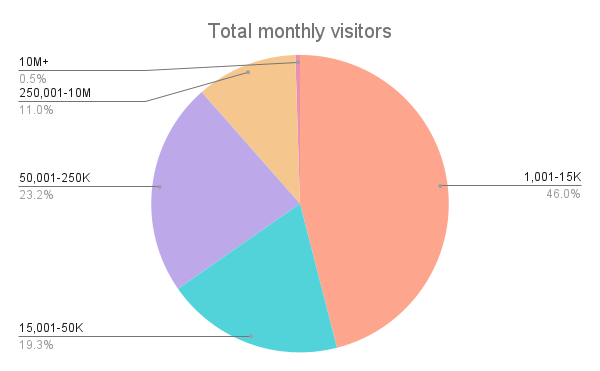
When asked how many total visitors the website they tracked analytics for got per month, the majority answered between 1,001 and 15K. Here’s the breakdown:

  • 1,001-15K (46%)
  • 15,001-50K (19.3%)
  • 50,001-250K  (23.2%)
  • 250,001-10M (11%)
  • 10M+ (0.5%)

Total monthly visitors

These percentages change when you consider other factors, like the size and age of the website. Let’s look at those breakdowns below. 

Visitors by Website Size

Since website size might refer to the company size (ie. the number of employees) or to the amount of content on the website, we looked at both factors and how that affected total monthly visitors. 

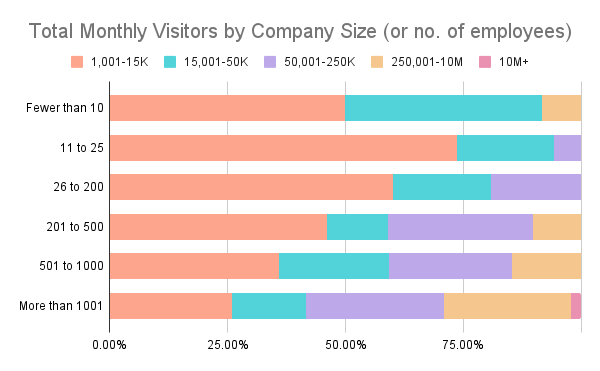
According to the HubSpot survey of over 400 web traffic analysts, the number of employees correlates to the number of monthly visitors — but more employees doesn’t always mean more visitors. Sites with over 1000 employees did make up the majority that get between 50,001-250K and 250,001-10M total monthly visitors. They were also the only sites that get over 10 million total monthly visitors.

However, approximately 8% of companies with fewer than 10 employees get between 250,001-10M total monthly visitors whereas 0% of companies with 11 to 200 employees do. Also, approximately 31% of companies with 201 to 500 employees get between 50,001-250K and 250,001-10M total monthly visitors, which is higher than the percentages of companies with 5001 to 1000 employees and companies with more than 1000.

Total Monthly Visitors by Company Size (or no. of employees)

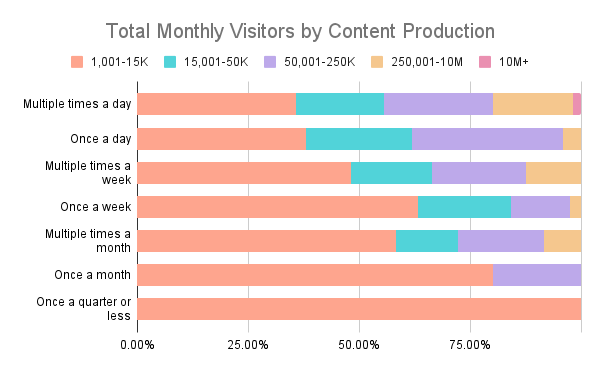
According to the data, the less frequently you publish, the less visitors you get per month and vice versa. For example, 36% of sites that publish multiple times a day get between 1,000 and 15K monthly visitors whereas 100% of websites that publish once a quarter or less do. Also, only sites that publish multiple times a day get over 10 million total monthly visitors.

Total Monthly Visitors by Content Production

Visitors by Website Age

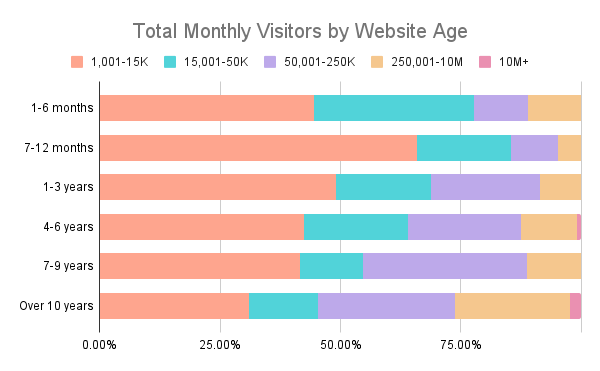
According to HubSpot data, the age of a website correlates to the number of monthly visitors. Sites that have existed for over 10 years did make up the majority that get between 250,001-10M and over 10 million total monthly visitors, and the minority that get between 1,001-15K.

However, older doesn’t always mean more visitors. For example, approximately 34% of sites that have existed for 7-9 years get between 50,001-250K total monthly visitors whereas only 29% of websites that have existed for over 10 years do.

Total Monthly Visitors by Website Age

Where do visitors come from?

Knowing how many total monthly visitors websites get on average is important — but it’s also important to know where these visitors are coming from. It can help you determine whether you should invest more in email or social media, for example, or in ensuring your site is mobile-friendly. Let’s take a look at the results of the HubSpot survey below. 

Visitors from Traffic Sources

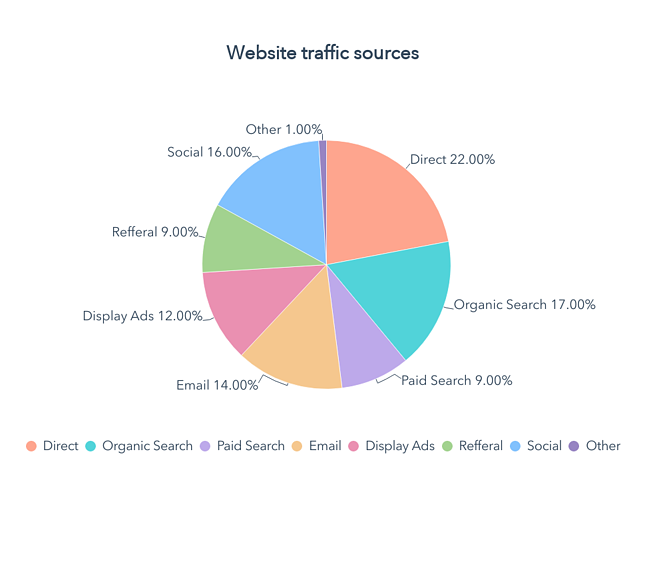
According to HubSpot data, the distribution of website traffic by source is:

  • Direct (22%)
  • Organic Search (17%)
  • Social (16%)
  • Email (14%)
  • Display ads (12%)
  • Referral (9%)
  • Paid Search (9%)
  • Other (1%)

Web Traffic Sources Pie Chart

As you analyze other companies and industries, you can assume that direct traffic, organic search, and social are the top web traffic sources.

Visitors from Device Types

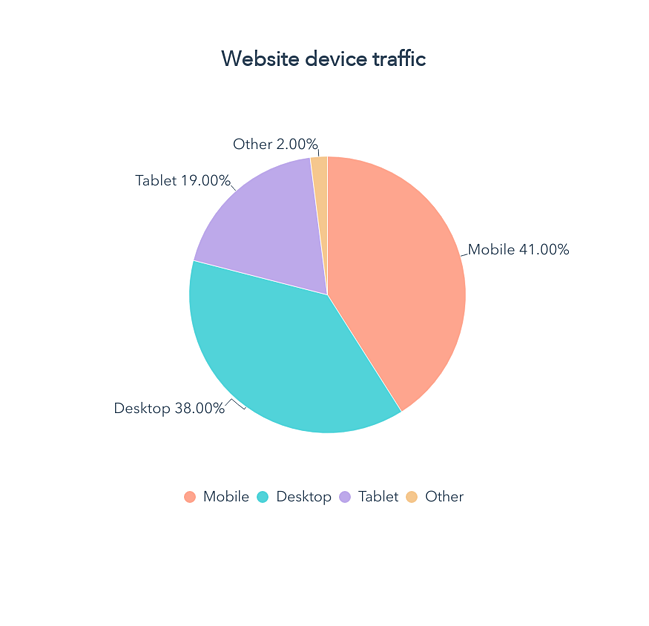
According to this HubSpot data, the distribution of website traffic by device type is:

  • Mobile (41%)
  • Desktop (38%)
  • Tablet (19%)
  • Other (2%)

Device Traffic Sources Pie Chart-2Other data suggests that mobile makes up an even greater percentage of website traffic worldwide. In fact, mobile has accounted for approximately half of web traffic worldwide since 2017 according to data from Statista.

How do you scale this information to your business? There are a series of factors to consider when determining how many visitors your site should get and setting a “good” number — or benchmark — as your goal. Let’s take a look.

How many unique visitors per month is good?

The answer to this question depends on a few factors. First, are you evaluating a B2B, B2C, or hybrid company? B2B companies have a target audience of other businesses and organizations. B2C companies target direct consumers.

One can infer that the potential for more unique monthly visitors for B2C companies is greater than that of B2B companies simply because their target audience is exponentially larger. B2B companies use niche marketing to sell particular products or services to a specific group of businesses while B2C companies focus their strategy on the needs, interests, and challenges of people in their everyday lives.

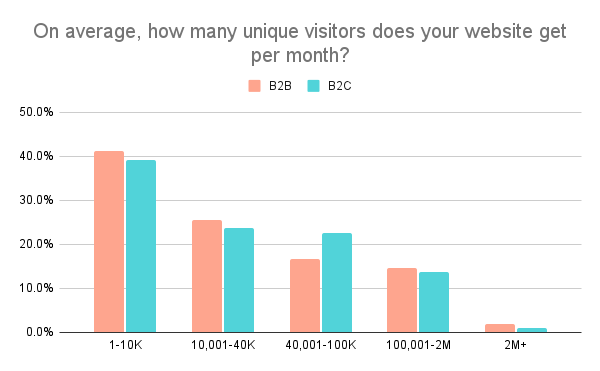
Data from the HubSpot survey of over 400 web traffic analysts provides mixed results however. While 22.5% of B2C sites get between 40,001-100K unique monthly visitors, only 16.7% of B2B websites get that amount. However, 16.7% of B2B sites get over 100K unique monthly visitors and only 14.7% of B2C sites do. 

In the table below, you’ll see a breakdown of how many unique visitors that all websites included in the survey get, and a breakdown by B2B and B2C sites. 

Unique Monthly Visitors

Total

B2B

B2C

1-10K

39.6%

41.2%

39.1%

10,001-40K

24.2%

25.5%

23.8%

40,001-100K

21.0%

16.7%

22.5%

100,001-2M

13.9%

14.7%

13.7%

2M+

1.2%

2.0%

1.0%

On average, how many unique visitors does your website get per month_-1

Taking note of the data above, determining how many monthly unique visitors is “good” for your company depends on your answers to the following questions.

What is the standard in your industry?

To make an accurate guess of where your company should be, determine the industry standard. To do this, evaluate your competition. Using tools like the previously mentioned SimilarWeb and SEMRush, you can create a general overview of your competitors, and use these statistics to establish an average for your industry.

How much content do you produce?

The more content you have available on your site, the more opportunities you create for visitors to find it. How much new content are you producing? One? Three? Five or more? The size of your team will affect the amount of content you’re able to create. If you find that you’re unable to produce new content, consider expanding the size of your team to meet your needs.

How well is your content strategy working?

To fix something, you need to know if it’s broken. Evaluate whether your content strategy is working. Are you ranking for your keywords? Have you seen an increase in views over the last few months? Where is the bulk of your traffic coming from? Once you can determine how your site is currently performing, you can take active steps to create an effective content strategy.

What is the search volume for your targeted topics?

Search volume for your targeted topics is directly related to the demand for that information, product, or service. High search volume can mean more visitors; however, this is directly affected by the competitiveness of your keywords.

How competitive are your target keywords?

A combination of these factors affects your website’s unique visitors per month, but it boils down to competition. The more competitive your target keywords, the harder it is to rank on the first page of a SERP. The more competitive the industry, the greater the chances of having potential website visitors split among the competition.

For example, in the HubSpot survey, 29.4% of B2C websites described the competitiveness of their target keywords as above average, or highly competitive, whereas only 25.4% of B2B sites did.

Is your website secure?

Establishing a safe and secure website with an SSL certificate can boost your reputation and relationship with future consumers. Not only does it mean less time worrying about potential security incidents, but it allows your visitors to insert their information into your systems with confidence.

Is your website accessible?

Fifteen percent of the world’s population are persons with disabilities. Many still use the web, and businesses must ensure that their content is accessible. Accessibility is not a feature, and making your website convenient to all visitors is not a bonus but a necessity.

Is your website mobile-friendly?

If your site isn’t mobile-friendly for cell phone users, you’re cutting off a large portion of potential visitors. According to data from Statista, the number of unique mobile internet users stood at 4.66 billion in 2021, indicating that over 92 percent of the global internet population use a mobile device to go online.

Optimizing your website for mobile is therefore essential. Over 50% of the web traffic analysts surveyed by HubSpot said that it was one of the SEO strategies they leverage. 

Is your website optimized for the user experience?

Click-through rate and bounce rate are metrics that help determine the user experience on your website. You should evaluate them together. 

Click-through rate is the percentage of people who visit your page after it comes up in a search. Bounce rate is the percentage of people who arrive and leave your web page quickly after landing on it. While a high click-through rate is positive, a high bounce rate is negative. A high bounce rate sends search engines a signal that your content isn’t relevant to the users and negatively affects your rank.

In the HubSpot survey of over 400 web traffic analysts, the average click-through rate and bounce rate ranged widely. However, most of the websites (67%) had a click-through rate between 10-39%, while the majority (43.8%) had a bounce rate between 21-40%. These are good benchmarks to use for your site. 

Once you can evaluate your industry, website, and content strategy, the next step is to set goals and execute them.

Setting Reasonable Goals For Website Traffic

Focus on the word “reasonable.” A goal to reach 10,000 monthly visitors next month might not be a stretch if you garnered 9,000 visitors this month. However, if your website receives an average of 2,500 monthly visitors, this goal is less probable. Setting a realistic and attainable goal is the key to creating the proper marketing strategy for your business.

Step 1: Define your goal.

First, define your goal. To do so, analyze your current metrics and that of your competitors.

Platforms such as Google Analytics, HubSpotSimilarWeb, SEMRush, and Ahrefs will enable you to analyze the traffic of websites in your industry. Using a combination of these tools is common. For example, in the HubSpot survey, about 82% of the web traffic analysts used Google Analytics and 25% used HubSpot’s web analytics. The next three most popular tools were Mint, Spring Metrics, and SimilarWeb.

Let’s use HelloFresh and other meal kit delivery services as an example. The company’s direct competitors include Every Plate, Home Chef, and Blue Apron. The ranking for their monthly total visitors, according to SimilarWeb and Sitechecker, is as follows for February 2022:

  • HelloFresh: 12M
  • Every Plate: 2.9M
  • Home Chef: 2.7M
  • Blue Apron: 1.9M

Note that the same website may differ in traffic estimates provided by different tools. While you can’t assume which platform is more accurate than the other, you can use a combination of information from different sources to find an average. This will provide a snapshot of how many visitors a website typically gets. 

For example, if you’re a new meal kit delivery service looking at the total monthly visitors for these companies, you’d get an average of 4.9 million monthly views. Now, this can be a goal for future growth, with incremental benchmarks. 

A monthly goal for a small business receiving 5,000 total monthly visitors could be 10% or 500 visitors, for example. Set goals with a content plan in mind. With this goal in place, you can use it to determine the success of your content strategy.

Step 2: Build a content plan around MSV.

Monthly search volume (MSV) is the number of times a specific keyword is entered into a search engine each month. MSV allows you to anticipate the amount of traffic available for a particular keyword term. Armed with this knowledge, you’ll be able to gauge which keywords are worth targeting for your content strategy. You’ll also be able to assess the needs of potential clients and customers and cater your content to them.

An effective content plan won’t only target keywords with the highest MSV. In the HubSpot survey, only 15% of the web traffic analysts described the MSV for their target keywords as “very high.” The majority (60%) described it as “somewhat high.”

Some free online keyword tools that help calculate MSV include Google Keyword Planner, Ahrefs Keyword Generator, and Answer the Public.

Step 3: Determine a publishing cadence.

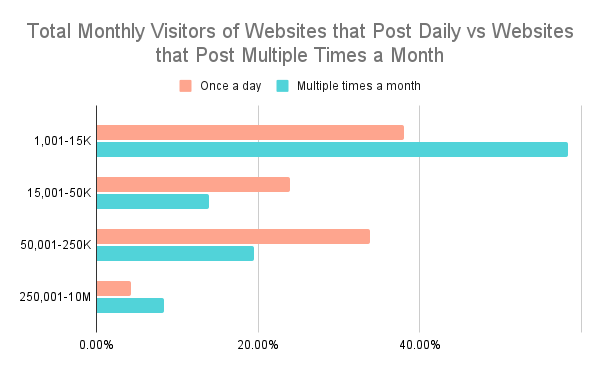
In conjunction with creating your content strategy, lay out a schedule. How often you update your website is key to attracting more visitors because you increase the number of opportunities to land on your page. According to the data from the HubSpot survey shared above, you want to post new content to your website multiple times a month at least. Ideally, you should post new content once a day. Websites that post daily are more likely to get between 15,001 and 250K visitors per month, and less likely to get between 1,0001 and 15K visitors than websites that post monthly.

Total Monthly Visitors of Websites that Post Daily vs Websites that Post Multiple Times a Month-1The amount of content is, of course, dependent on the size of your team and audience. The more resources you have, the more content you can create. The larger your audience, the more content you should create.

While determining a publishing cadence is necessary, it is equally important to stick to it and remain consistent.

Step 4: Assess your performance.

The first step to assessing your goals is having a data reporting software set up. Once you do, it’s time to look at a range of metrics. Of the web traffic analysts surveyed, total monthly visitors, unique monthly visitors, and bounce rate were the most common metrics used to assess website performance. Others included search traffic and industry-wide trends.

To start, check if your unique monthly visitors increased. Whether or not you met your goal, ask yourself the following questions to review your progress:

  • Did your unique monthly visitors increase or decrease? By what percent?
  • Are you ranking for targeted keywords?
  • Was there a trend (increase or decrease) in visitors across your industry?

An increase or decrease in your unique monthly visitors isn’t enough to gauge the complete success of your goal or content strategy. Are you ranking for your targeted keywords? If yes, your content strategy is working, and your location in SERPs can lead to further increases in the future. If not, reassess and adopt new SEO methods for growth.

When assessing your performance, it might also be necessary to measure factors out of your control, for example, industry trends. Was there a mutual dip in unique monthly views among you and your competitors? It is possible that your keyword MSV wasn’t as high as in previous months. A decrease in MSV for your keywords is out of your control. However, it is your responsibility to pivot and discover what your target audience is searching for.

How many visitors should your site get?

In content strategy and marketing, consistency is key. How many visitors should your site get? Ultimately, it comes down to how consistent you are in the tips featured above. Do you keep up with industry best practices to guide your knowledge on MSV? Do you periodically evaluate your content to boost your SEO? Are you updating your information to guide your goals?

There is no magic number when it comes to monthly website visitors. Evaluate your website and use your current metrics to determine where you want to be in one, six, or 12 months from now. Changes rarely happen overnight. Set reasonable goals with realistic timelines, and you’ll eventually see growth.

Editor’s note: This post was originally published in September 2009 and has been updated for comprehensiveness.

marketing

Categories B2B

How to Write a Great Value Proposition [5 Top Examples + Template]

Your company’s value proposition is the core of your competitive advantage. It clearly articulates why someone would want to buy from your company instead of a competitor.

So how do you actually write a value proposition statement that’s strong enough to lift conversion rates and sales? In this article, you’ll learn the definition of a value proposition, what a value prop isn’t, examples of some of the best value props we’ve seen, and tactics to create amazing value props.

→ Download Now: 15 Free Value Proposition Templates
We’ll cover:

Ready to dive in?

Value propositions are one of the most important conversion factors. A great value proposition could be the difference between losing a sale — and closing it.

For that reason, it’s important to create one that accurately represents your products and services and makes it clear why you’re the best choice. However, writing it from scratch is hard. Download our templates below so you can follow along with the rest of the post.

Your value proposition is a unique identifier for your business. Without it, buyers won’t have a reason to purchase what you sell. They may even choose a competitor simply because that business communicates its value proposition clearly in its marketing campaigns and sales process.

That said, you might think: Isn’t my value prop interchangeable with, say, my slogan?

Nope. It’s easy to confuse your value proposition with other similar brand assets, such as your mission statement, slogan, or tagline. We break down the differences below.

Value Proposition vs Mission Statement

Your value proposition details what you offer customers and why they should choose you, while a mission statement details your objective as an organization. While the two can have points in common, a value prop is more product- and service-oriented while a mission statement is more goal-oriented.

Here are two examples for HubSpot and our CRM platform:

Value Proposition: “An easy-to-use CRM.”

Mission Statement: “To help businesses grow better.”

Value Proposition vs Slogan

A slogan is a short, catchy statement that brands use in marketing campaigns to sell a specific product. While your value proposition wouldn’t necessarily go in an ad (at least, not usually), a slogan would. The most important thing to note is that a company can have different slogans for different campaigns or products.

Here are two examples from De Beers Group:

Value Proposition: “Exquisite diamonds, world-class designs, breathtaking jewelry.”

Slogan: “A diamond is forever.”

Value Proposition vs Tagline

A tagline is a short statement that embodies a certain aspect of your brand or business. While a value proposition is more concrete, a tagline can represent a concept or idea that your business stands for. Most businesses have only one tagline that is instantly recognizable and connected to their brand.

Here’s an example from Apple:

Value Proposition: “The best experiences. Only on Apple.”

Tagline: “Think Different.”

Value Proposition vs Mission Statement vs Slogan vs Tagline

Now, let’s look at an example of a business that has all four: Nike. Remember that slogans can differ depending on the campaign.

Value Proposition: “Customizable performance or lifestyle sneakers with unique colorways and materials.”

Mission Statement: “To bring inspiration and innovation to every athlete in the world.”

Slogan: “Twice the guts. Double the glory.”

Tagline: “Just do it.”

TLDR; While your value prop should help differentiate you from the rest of the industry, keep in mind it’s not a slogan, tagline, or mission statement. Those types of copy are important accessories to your brand, but your potential customers and employees don’t choose one business over the other solely based on these elements.

Your value proposition goes deep into the problems you want to solve for buyers, and what makes your product or service the perfect solution.

Now, before you write the statement itself, it’s important to create a value proposition canvas.

Taking these three elements into consideration, you’ll be able to make your own after you build a value proposition canvas.

Value Proposition Canvas Visual

The value proposition canvas is made up of two major components: the customer profile and the value map.

Here’s how to make one:

Step 1: Create a customer profile to represent your target buyer.

The customer profile makes up the first half of the value proposition canvas. When performing this exercise, you’ll want to start with this section first so that their wants and needs can influence the overall value proposition canvas.

The customer profile consists of three areas:

Customer Jobs

What is the task your customer needs to complete or the problem they’re trying to solve with your product or service? The answer to this question sums up the “customer job” or the purpose of your product or service in the eyes of the customer.

Customer Expectations

“Expectations” are also referred to as “gains” — in other words, what your customer is hoping to gain from doing business with you. No matter what you sell, your ideal customer will have an expectation of what that product or service will do for them. In this section, you’ll use research to explain what your customers expect from you in order to purchase your product.

Customer Pain Points

As your customer completes their “customer job,” what pains do they experience? Do they take any risks while they do the customer’s job? Do they experience any negative emotions? These pain points should be considered so that you include the most helpful products and services on the value map side of the value proposition canvas.

Step 2: Create a value map for your products and services.

In this section of the value proposition canvas, three specific sectors help describe what the business offers to the customer.

Gain Creators

These are features your products or services have that make the customer happy. Think creatively about the elements of happiness your customers experience. Consider their financial and social goals as well as their psychographics.

Pain Relievers

In the section above, we discussed customer pains. This section will define exactly how your business will help them overcome those pain points.

Products & Services

While this section won’t list every single product or service your company offers, it should include the ones that will create the most gain and alleviate the most pains for your customers.

Step 3: Determine value proposition-customer fit.

Once you’ve completed the value proposition canvas exercise, the next step will be to determine how your value proposition fits within the customer profile. To do this, you’ll use a ranking process that prioritizes products and services based on how well they address the customer profile.

All together, your value proposition canvas should look like this:
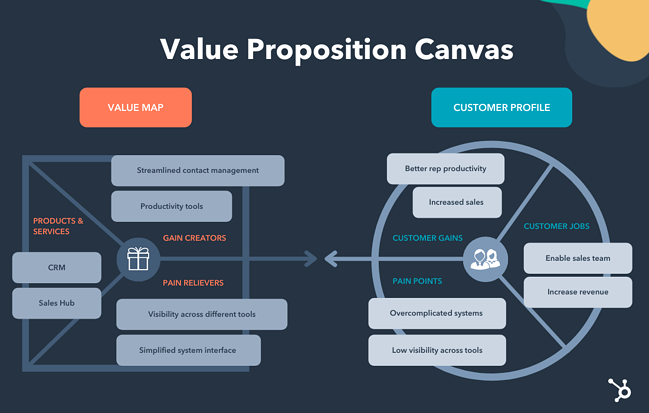
value proposition canvas example

Next up, let’s go over the elements you should include in your value proposition when you’re creating it and publishing it on your website.

Elements of a Value Proposition

Your value proposition will most often appear on your website. While you can include it on marketing campaigns and brochures, the most visible place is your home page and, if you’d like, your product pages.

There are three main elements of a value proposition: the headline, the subheadline, and a visual element.

The elements of a value proposition

Headline

The headline of your value proposition describes the benefit the customer will receive as a result of making a purchase from your business. The headline can be creative and catchy, but it should be clear and concise, first and foremost.

Subheadline or Paragraph

The subheadline or paragraph should explain in detail what your company offers, who it serves, and why. In this section, you can elaborate on the information in the headline.

Visual Element

In some cases, a video, infographic, or image may convey your value proposition better than words alone can. Enhance your message with these visual elements to capture your audience’s attention.

To better visualize these tools, here are a couple templates to follow when formatting a value proposition.

Value Proposition Templates

hubspot 15 free value proposition templatesDownload for Free

We’ve crafted 15 templates to help you create an amazing value proposition for your brand — and pairing each of them with an example of how they may look for a real business. Click here to download these free value proposition templates for your business.

Now that we’ve reviewed the elements, visual tools, and templates — let’s look at some brand examples that effectively identify and satisfy its customer needs.

Because value propositions are typically internal information and rarely stated publicly, finding a value proposition example to model yours after can be difficult. We’ve taken the liberty of using the value proposition canvas and applying it to some successful companies that have been recognized by the American Customer Satisfaction Index (ASCI).

In these examples, you’ll see real-world instances of customer gains and pains aligned with well-known products and services offered by these companies.

1. HubSpot: “An easy-to-use CRM.”

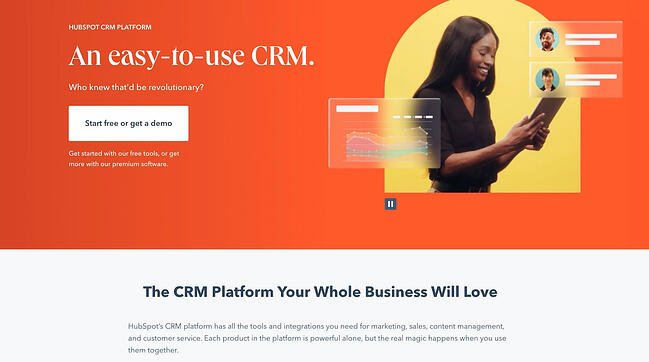
Headline: “An easy-to-use CRM.” 

Subheadline/Paragraph: “HubSpot’s CRM platform has all the tools and integrations you need for marketing, sales, content management, and customer service.”

Visual Element:
value proposition example: hubspot

Most companies can benefit from using a CRM — even freelance businesses and small family-owned firms. The problem is that most systems are over-complicated and cobbled together, not to mention expensive.

HubSpot’s value proposition aims to target active CRM users who are tired of handling over-complicated systems, and beginners who are intimidated by legacy options. To that end, the product’s value proposition emphasizes its ease-of-use and ability to synchronize different teams across the business. The brand includes an image of a smiling woman to show what it would be like to use the product in your team (hint: it’s so easy, it’ll make you smile).

HubSpot Value Proposition Canvas

value proposition canvas example: hubspot

Customer Profile
  • Customer Jobs: HubSpot customers need to effectively enable their sales teams to do their best work while avoiding complicated workflows.
  • Gains: Customers want to increase their sales rep productivity levels and boost sales.
  • Pains: There are plenty of CRM options, but they’re often overcomplicated and create silos.
Value Map
  • Gain Creators: The HubSpot CRM platform offers streamlined contact management software and productivity tools that will help sales teams do their best work.
  • Pain Relievers: The user-friendly interface and unified platform offers ease-of-use and high visibility across systems.
  • Products & Services: The HubSpot CRM platform includes Sales Hub, an enterprise-level sales software that’s simple yet powerful enough to cater to the needs of businesses small and large.

2. FedEx: “Manage your Home Deliveries”

Headline: “Manage Your Home Deliveries”

Subheadline/Paragraph: Sending and receiving packages is convenient and safe for individuals who want to ship ideas and innovations across the globe.

Visual Element:

value proposition examples: FedEx

Image Source

If you own a business, shipping and packaging prpoducts is likely a significant part of your operations, but it can be a time-consuming, labor-intensive, and plain inconvenient process. If you’re a consumer, you’ve likely experienced driving to a shipping office to get your package after a missed delivery. Both of these are significant pain points for FedEx’s target customers.

FedEx’s value proposition makes it clear that it will make managing your deliveries much, much easier — whether you’re a business or a consumer.

FedEx Value Proposition Canvas
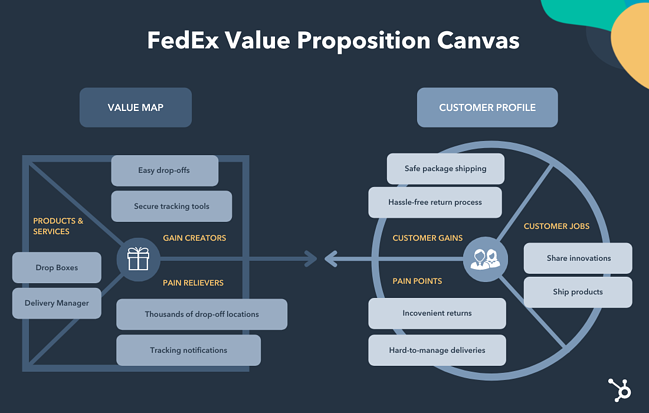
value proposition canvas example: fedex

Customer Profile
  • Customer Jobs: FedEx customers want to share ideas and innovations with other individuals by shipping goods around the world.
  • Gains: Customers want a hassle-free way to return online orders and are looking for a safe and secure way to receive their packages.
  • Pains: Returning a package at a FedEx shipping center can be inconvenient, and managing home deliveries can be a hassle.
Value Map
  • Gain Creators: Customers can drop off their FedEx packages at places they shop most like Walgreens or Dollar General, and have peace of mind knowing where their package is at all times.
  • Pain Relievers: Thousands of FedEx drop-off locations across the country, receive notifications when a package is en route and inform the driver where to leave the package.
  • Products & Services: FedEx Drop Box locations make returning packages convenient, and the FedEx Delivery Manager reroutes or reschedules deliveries to work with the customer’s schedule.

3. LG: “State-of-the-art Living Experience”

Headline: “State-of-the-art Living Experience”

Subheadline/Paragraph: LG SIGNATURE delivers an innovative product design that creates an exceptional living experience for people who want to achieve a state-of-the-art living experience.

Visual Element:

value proposition examples: LG Signature

Image Source

The right home appliances can make your at-home experience easy and hassle-free — or it can quickly create headaches with low power efficiency and outdated features. In its value proposition, LG targets customers who are willing to spend just a little more on the right appliance in exchange for a comfortable, hassle-free, and luxurious experience.

Even the imagery helps you imagine what your life would be like after purchasing an LG appliance.

LG Value Proposition Canvas
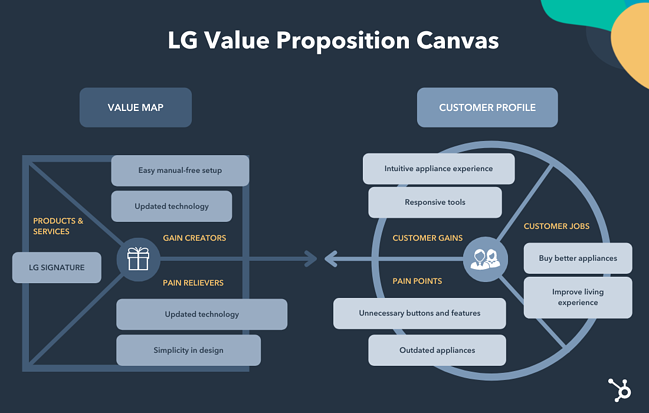
value proposition canvas example: lg

Customer Profile
  • Customer Jobs: LG customers want simple, yet innovative technology that helps them achieve a state-of-the-art living experience.
  • Gains: Customers have an intuitive and responsive experience with each appliance they interact with inside their homes.
  • Pains: There are too many unnecessary buttons and features on appliances that get in the way of a simple living experience
Value Map
  • Gain Creators: Customers can use technology to enhance their home experience without needing to read a manual.
  • Pain Relievers: LG offers a simple design that focuses on the user and their lifestyle.
  • Products & Services: LG SIGNATURE delivers an innovative product design that creates an exceptional living experience.

4. Subaru: “The most adventurous, most reliable, safest, best Subaru Outback ever.”

Headline: “The most adventurous, most reliable, safest, best Subaru Outback ever.”

Subheadline/paragraph: The 2022 Subaru Outback takes drivers to the most adventurous places in style with the most advanced safety technology.

Visual element:

value proposition examples: Subaru

Image Source

Subaru knows that its target audience uses its Outback SUVs for outdoor adventures. So in its value proposition, it makes it clear that the Outback will help its drivers go off the road safely and in style. Even more, it states as much right in the headline.

If I were a potential Subaru customer, I’d know exactly what I’m getting from that headline alone. That’s why it’s so important to think about your wording, because it’s likely the first thing potential buyers will see.

Subaru Value Proposition Canvas
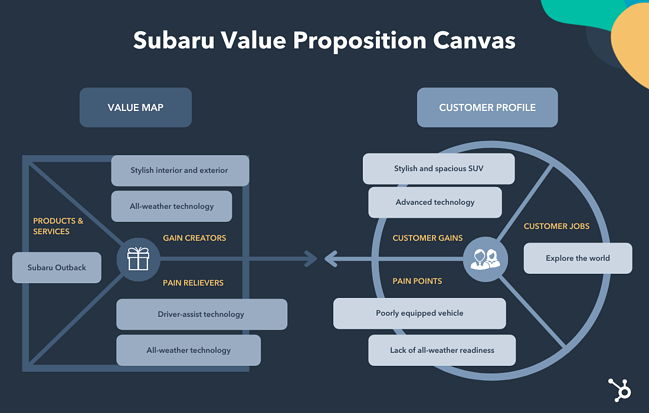
value proposition canvas example: subaru

Customer Profile
  • Customer Jobs: Subaru customers want to explore the world’s most adventurous places in a reliable and safe vehicle
  • Gains: Customers want to explore the land in a stylish and spacious SUV and look for advanced technological elements in their vehicles that enhance performance and safety
  • Pains: The safest vehicles are not the most visually appealing, and some SUVs aren’t equipped for all-weather or all-terrain environments
Value Map
  • Gain Creators: Subarus have a stylish exterior and interior with ample ground clearance that protects the vehicle against damage from the environment and advanced technology to reduce crashes and make long road trips safer.
  • Pain Relievers: Subarus have a rugged blacked-out trim for style and protection, 9.5-inch ground clearance for better stability and performance, and driver-assist technology that helps drivers see better, prevent crashes, manage cruise control, and brake automatically in emergency situations.
  • Products & Services: The 2022 Subaru Outback with standard eyesight assist technology, automatic pre-collision braking, adaptive cruise control, and lane-centering.

5. Samsung: “Get Ready to Unfold Your World”

Headline: “Get Ready to Unfold Your World”

Subheadline/paragraph: This is everything you’d want in a premium, durable, 5G smartphone. Then we made it unfold — revealing a massive screen so you can watch, work and play like never before.

Visual element:

value proposition examples: Samsung Galaxy

Image Source

In its value proposition, Samsung effectively targets its most tech-savvy segment by front-lining its most innovative design to date: a foldable phone that can double as a mini-tablet. Even more, it solves a common pain point for some customers: owning both a tablet and a mobile device can feel unnecessary, so why not get the best of both worlds?

Samsung’s value proposition for its foldable mobile device is smart, well-targeted, and visually stunning.

Samsung Value Proposition Canvas
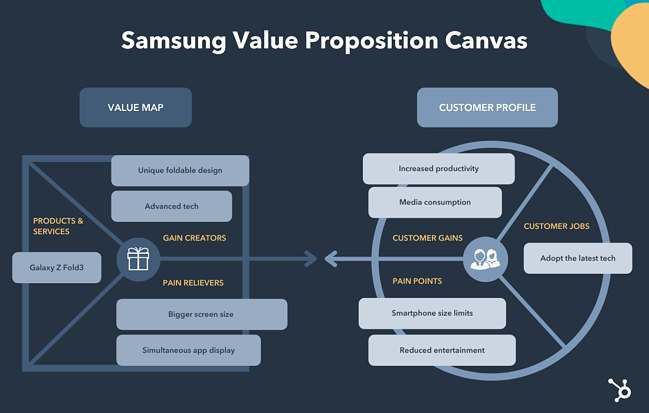
value proposition canvas example: samsung

Customer Profile
  • Customer Jobs: Samsung customers are tech-savvy and follow the latest trends, driven by efficiency and aspirational lifestyles.
  • Gains: Customers want an all-in-one way to enjoy media, work productively, and have a fun experience all in the palm of their hands.
  • Pains: Common smartphones have size limitations that strain entertainment viewing, gameplay, and work capabilities.
Value Map
  • Gain Creators: Samsung offers a unique and expansive design with capabilities beyond that of an average smartphone, offering the most advanced technology to help customers perform tasks to fulfill work and play.
  • Pain Relievers: Samsung provides a smartphone that displays content in tablet-like viewing and displays up to three apps simultaneously.
  • Products & Services:The Galaxy Z Fold3 5G folding 6.2-inch smartphone with dynamic AMOLED 2X screens, ultra-thin glass with S Penfold edition, and super-strong lightweight armor aluminum frame.

You’ve seen some brilliant value proposition examples, now let’s break down how to make your own.

Step 1: Identify your customer’s main problem.

While this will require some upfront research, you can get a head start on this aspect of the value proposition by speaking with different members of your team. Customer service reps, marketing specialists, and salespeople can fill in the gaps about what problems your customers are looking to solve by using your product or service.

For example, let’s say your business sells tax software on a subscription basis and automated templates are included in the software package. Your ideal customer is looking for an affordable and user-friendly way to access complicated tax documents for their business. In this example, your business’s offerings could be the solution they need.

Step 2: Identify all the benefits your products offer.

This step can be as simple as listing out every product you sell and describing its primary benefit. The benefit should be concise and focused on a single customer need.

In our tax software example, you’d list each tax template, explain the benefit it provides, and why a customer would need it.

Step 3: Describe what makes these benefits valuable.

Next, add another sentence that explains why this benefit matters to the customer.

Using the same example above, the value would be that customers have affordable tax documentation at their fingertips — something that would normally cost them thousands of dollars.

Step 4: Connect this value to your buyer’s problem.

Next, pair the buyer’s problem to the elements that make your product or service valuable. Do they align? If so, you’re ready to refine your value proposition to differentiate your offerings from the competition. If they don’t align, repeat the steps above until you find a valid buyer need and a viable solution your business offers to meet that need.

There’re three templates we think do an excellent job of connecting value to buyer pain points:

Step 5: Differentiate yourself as the preferred provider of this value.

Finally, polish your value proposition to make it unique. Is there a specific customer service offering your business provides that others don’t? Do you offer any additional services that other companies charge for? These elements can help differentiate your value proposition from competitors while keeping the focus on the buyer’s needs.

Once you understand these steps, you can easily implement them into value proposition templates as follows.

Value Proposition Templates

  • Steve Blank Method

Instead of focusing on the features themselves, Blank saw the need to emphasize the benefits derived from the features in a simple sentence. By following this formula you’ll connect the target market and their pain points to the solution:

“We help (X) do (Y) by doing (Z)”

  • Geoff Moore Method

Moore provides a template that’s more specific in identifying the industry categories alongside the benefits customers value. This makes a more clear value proposition formula as follows:

“For [target customer] who [needs or wants X], our [product/service] is [category of industry] that [benefits]”

  • Harvard Business School Method

According to HBS a value proposition is executed best when it answers the following questions:

What is my brand offering?

What job does the customer hire my brand to do?

What companies and products compete with my brand to do this job for the customer?

What sets my brand apart from competitors?

Now that we’ve gone through steps and templates to follow, there’s some tactics we think you should keep in mind.

1. Conduct research to determine the value proposition of your competitors.

Because your value proposition is the differentiating factor between your business and the competition, it’s important to research the propositions of your closest competitors. You can use the value proposition canvas in this post to determine how each company meets the needs of your buyer persona.

Be honest here — it’s tempting to focus on the areas in which your competition doesn’t excel, but you’ll have a better idea of where your product or service fits within the market if you key in on your competitors’ strengths.

2. Explain the value of your products and services.

You’re probably familiar with outlining the features and benefits of your product and service offerings. This tactic takes that concept a step further. By matching the benefits of your offerings to specific values that your customers have, you’ll be able to align what your business provides with what your customers need.

3. Describe the benefits your ideal customer will experience when they choose your product or service over the competition.

When crafting this part of your value proposition, include details about how your product or service will benefit the customer and use examples where you can. Videos, photos, and live demonstrations are all effective ways to illustrate your value proposition because they show the customer exactly what they can expect from your business.

4. Develop a unique value proposition for each buyer persona you serve.

Ideally, you’ll be focusing your marketing efforts on a specific target audience. You’ll also find that this audience will have different needs based on their buying behaviors. Buyer personas can help you segment your larger audience into groups of customers with similar desires, goals, pain points, and buying behaviors. As a result, you’ll need a unique value proposition for each persona. Different products and services you offer may solve certain customer pain points better than others, so developing a value proposition for each persona will better serve each one.

5. Test your value proposition with your audience using various marketing channels.

Each of these tactics will likely be developed internally by your team which means you’ll want to validate your work with your target audience. Your value proposition will be communicated through various marketing channels like your website, social media accounts, video, audio, and in person. Test your proposition with members of your audience (both existing customers and non-customers) using each of these channels. Tools like UserTesting can help you streamline this feedback process so that you can implement changes quickly to finalize your value proposition.

We know the makings of a value proposition, so how can you make it a good one? Here’s the last three tips we have for you.

What makes a good value proposition?

Clear Language

Your value proposition should aim to address a primary customer need. This limited focus helps keep your value proposition clear and easy to understand. With just one main idea to comprehend, your audience will be able to quickly decide whether or not your product or service will be the best solution for them.

Specific Outcomes

Next, you’ll want to communicate the specific outcomes your customer can expect to receive from your product or service. Will they save time? Demonstrate how. Will their workflow become more manageable? Show a before and after workflow diagram. The specific outcomes will be critical components of your value proposition as they’ll exemplify exactly how your customers will use your solution to solve their problems.

Points of Differentiation

Not only are your potential customers evaluating your business’s offerings based on their own needs, but they’re also comparing what you offer against competitors. As a result, your value proposition will need to include detailed points of differentiation. These key points will help customers understand exactly what sets your company apart.

Compose a Remarkable Value Proposition

The factors that influence a potential customer to become a loyal customer are limited. Whether your industry has a lot of opportunities to differentiate (like retail) or virtually no unique identifiers (like dairy), you’ll find that a value proposition will help you understand your ideal customer and position your business as the best solution for their needs. Use the tactics, tips, framework, and examples in this post to craft your unique value proposition.

Editor’s note: This post was originally published in June 2018 and has been updated for comprehensiveness.
value-proposition-templates


Categories B2B

How-To: Conditional Formatting Based on Another Cell in Google Sheets

Conditional formatting is a feature in Google Sheets in which a cell is formatted in a particular way when certain conditions are met. The formatting can include highlighting, bolding, italicizing – just about any visual changes to the cell.

Just as it can be done for the cell you’re currently in, conditional formatting can also be set based on conditions met in another cell.

→ Access Now: Google Sheets Templates [Free Kit]

Let’s dive into how to create this condition based on multiple criteria.

How Conditional Formatting Works

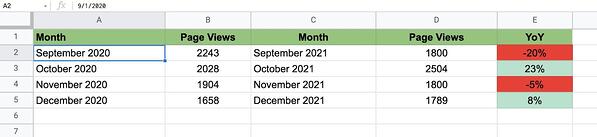
To learn how to set conditional formatting, let’s use this workbook as an example.

example of a google sheets workbook to show how conditional formatting works

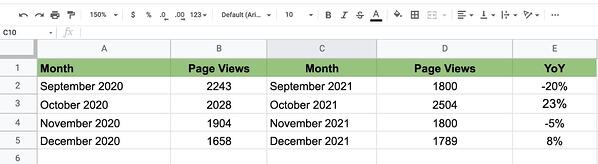
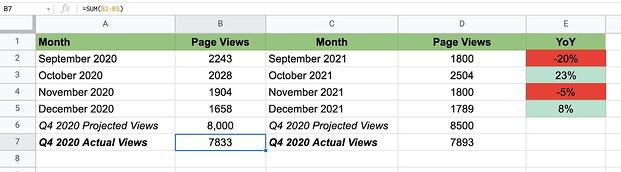
It’s a workbook showing website traffic year over year from Q4 2020 to Q4 2021, with the page views along with the year-over-year percentage change.

Here’s what we want to accomplish here: When the percentage change is positive YoY, the cell turns green. When it’s negative, the cell turns red. This makes it easy to get a quick performance overview before diving into the details.

Here are the steps to set the conditional formatting.

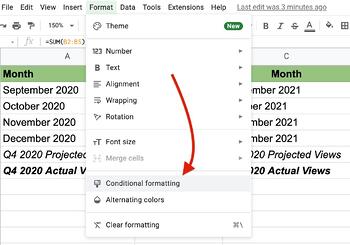
1. Select the cell you want to format, click on “Format” from the navigation bar, then click on “Conditional Formatting.”

how to set the conditional formatting step 1

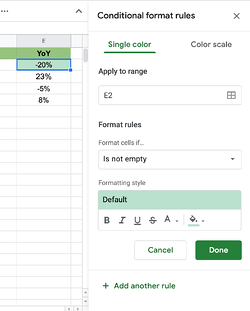
2. While staying in the “Single color” tab, double-check that the cell under “Apply to range” is the cell you want to format. how to set the conditional formatting step 2

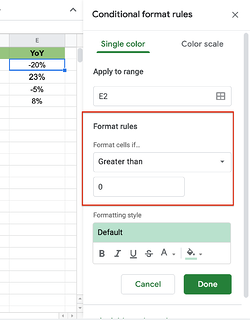
3. Set your format rules.

how to set the conditional formatting step 3

It may automatically default to a standard conditional formatting formula. In this case, open the dropdown menu under “Format cells if…” to select your rules. Options will look as follows:

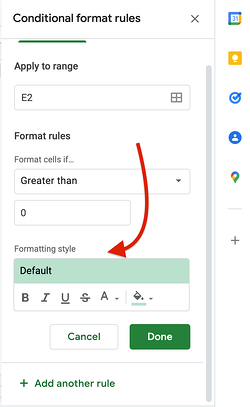
4. Choose your formatting style, then click “Done.”how to set the conditional formatting step 4

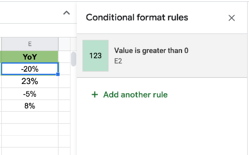
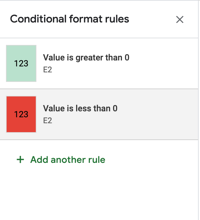
5. Confirm the rule was applied under “Conditional Formatting Rules.”

conditional formatting step 5

6. Add another rule if needed.

conditional formatting step 6

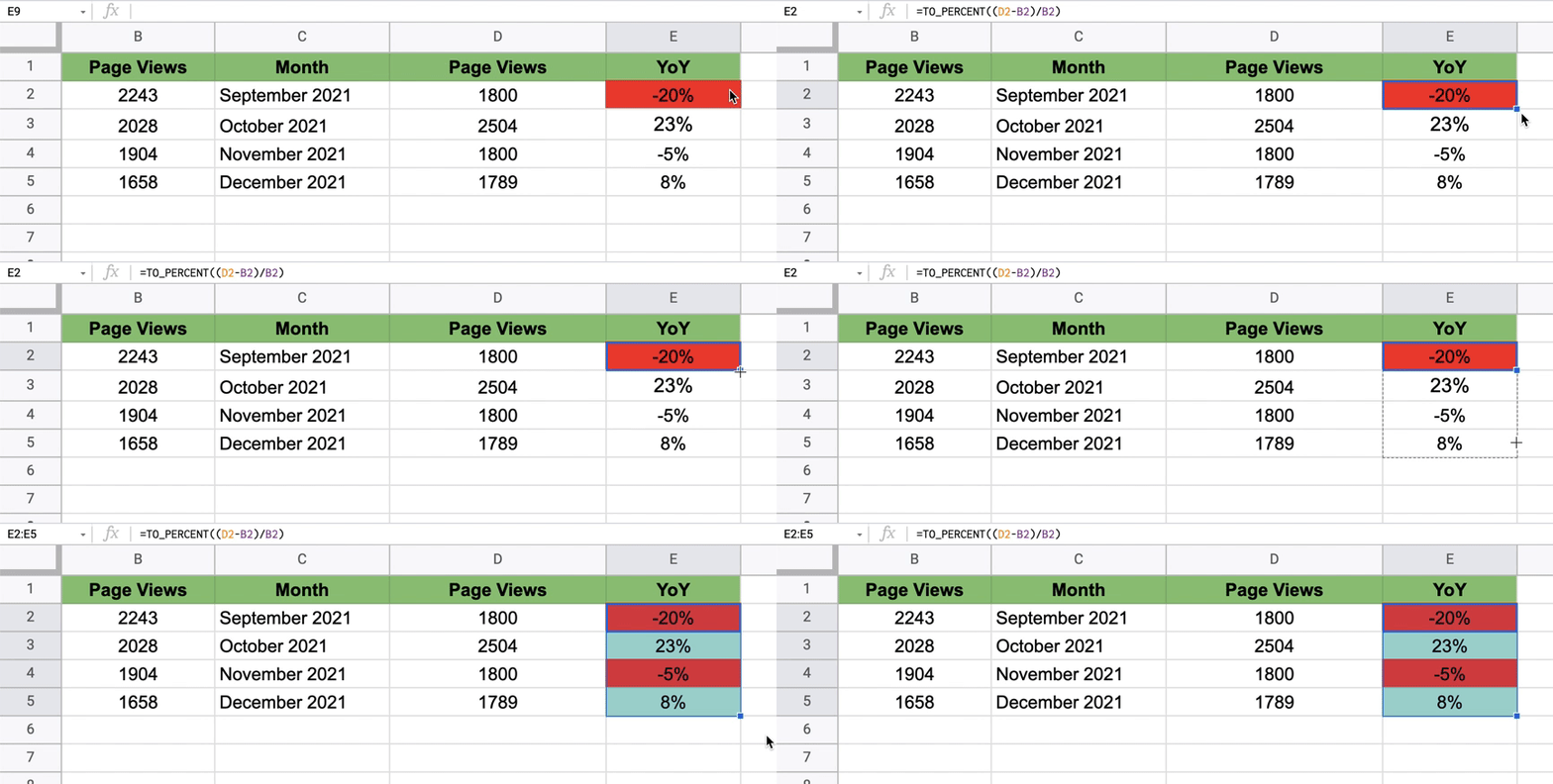
7. Return to cell to view formatting, then drag the cursor to apply to other cells, if needed.

how to set the conditional formatting step 7

Now that you understand the basics, let’s cover how to use conditional formatting based on other cells.

Conditional Formatting Based on Another Cell Value

1. Select the cell you want to format.

conditional formatting based on another cell value step 1

2. Click on “Format” in the navigation bar, then select “Conditional Formatting.”

conditional formatting based on another cell value step 2

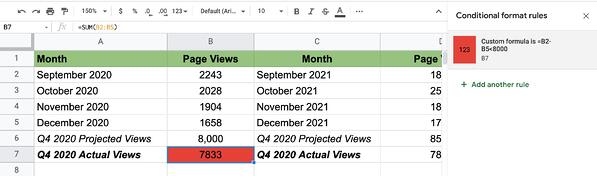
3. Under “Format Rules,” select “Custom formula is.”

conditional formatting based on another cell value step 3

4. Write your formula, then click “Done.”

conditional formatting based on another cell value step 4

5. Confirm your rule has been applied and check the cell.

conditional formatting based on another cell value step 5

Conditional Formatting Based on Another Cell Range

To format based on another cell range, you follow many of the same steps you would for a cell value. What changes is the formula you write.

1. Select the cell you want to format.

conditional formatting based on another cell range step 1

2. Click on “Format” in the navigation bar, then select “Conditional Formatting.”

conditional formatting based on another cell range step 2

3. Under “Format Rules,” select “Custom formula is.”

conditional formatting based on another cell range step 3

4. Write your formula using the following format: =value range < [value], select your formatting style, then click “Done.”

conditional formatting based on another cell range step 4

5. Confirm your rule has been applied and check the cell.

conditional formatting based on another cell range step 5

Google Sheets Conditional Formatting Based on Another Cell Color

Currently, Google Sheets does not offer a way to use conditional formatting based on the color of another cell. You can only use it based on:

  • Values – higher than, greater than, equal to, in between
  • Text – contains, starts with, ends with, matches
  • Dates – is before, is after, is exactly
  • Emptiness – is empty, is not empty

To achieve your goal, you’d have to use the condition of the cell to format the other.

Let’s use an example.

Google Sheets Conditional Formatting Based on Another Cell Color

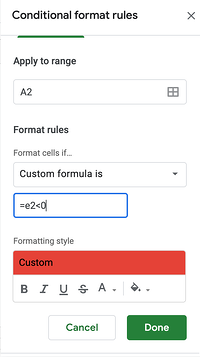
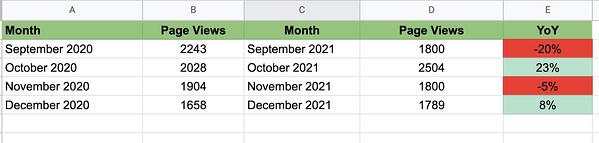
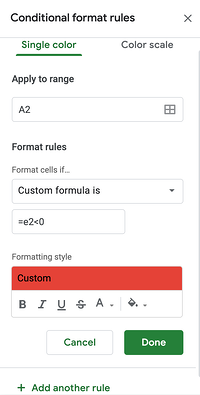
Say you want to format cell A2 (September 2020) to be red and match the color of cell E2 (-20%). There’s no formula that allows you to create a condition based on color. However, you can create a custom formula based on E2’s values.

You can say that if cell E2’s values are less than 0, cell A2 turns red. The formula is as follows: = [The other cell] < [value]. In this case, the formula would be =e2<0, as it signifies that cell A2 should turn red if E2’s value is less than 0.

google sheets conditional formatting based on another cell's values

With so many functions to play with, Google Sheets can seem daunting. By following these simple steps, you can easily format your cells for quick scanning.

business google sheets templates

Categories B2B

What is Content Governance? 4 Easy Steps to Create a Model in 2022

Without a content governance model in place, your content marketing efforts can seem scattered and chaotic, opening the opportunity for your audience to replace you with a competitor.

Content governance keeps your relationship with your customers thriving, and allows you and your team to more effectively focus on your content goals.

Free Resource: Content Marketing Planning Template

In this post, we’ll cover the topic of content governance — what it is, why it’s important, and how you can create a model for your business.

The goal of a content strategy is for your company to create meaningful and engaging content that aligns with your business objectives and drives consumers to a particular action. Content governance ensures that you have a definitive way for this content to reach them. Who creates the content? On what platform is it published? How will it be updated in the future? While these questions and their answers help shape content governance, its framework involves more.

Content governance is more than consumer-facing content. It requires preliminary and behind-the-scenes work seen in an asset like an editorial content calendar. Consumers don’t have access to your company’s content calendar; however, this is an irreplaceable tool to keep your company on track with its strategy. Style guides and content audits are other tools that assist with content governance but are unseen by consumers.

Content governance encompasses content sent to consumers and content that waits for them. It is not only reserved for social media posts that land on their feed or emails sent to their inbox. It includes banner ads or frequently asked questions on your website. It’s your Instagram bio or the answering message you have for phone calls. In a business, content is everywhere, and content governance allows your business to manage all of its avenues.

Why is content governance important?

To illustrate the importance of content governance, let’s look at an analogy.

Content marketing is like a first date. You wine and dine with visuals and information and hope it builds a budding relationship. If it does, how do you move forward and keep building?

After that initial interaction, you publish two emails, one blog post, and four social media posts during week one. You drop the ball in week two. The amount of content decreases to one email and two social media posts. Week three is worse, but during week four, you’re able to publish three emails, two blog posts, and five social media posts. While the increase in content seems remarkable, your potential long-term customer has unsubscribed from your content after a month. Why?

Content needs to be governed by procedures and systems. Procedures mean consistency, and consistency is key to the success of any business. It shows effort and demonstrates to customers that you care.

Content works as a cycle. Although the number of steps might differ for each organization, content life cycles typically follow this process:

  • Develop a strategy.
  • Create the content.
  • Store the content.
  • Edit.
  • Publish.
  • Analyze.
  • Update or repurpose content.

The content cycle never ends. There is always work to do. Use the steps above. If you finish strategizing, focus on content creation. If you’re not creating, your company can work on storing, editing, publishing, and more.

Content governance is important because it ensures that your company maintains an efficient process in its continuous content cycle. It can prevent delays, inconsistent messaging, or even legal issues. Content governance helps:

  • Provide structure
  • Establish clear roles and responsibilities
  • Create detailed processes and workflows
  • Outline company standards and policies

A comprehensive content governance model creates a standard for effective, consistent content, resulting in continued success.

The online world is fast-paced, and to keep up, businesses need to make sure that they’re covering all avenues. It used to mean website and email content; however, the growth of social media has expanded the number of channels businesses need to account for. Companies have had to shift gears and adjust their content strategies to accommodate social platforms like Facebook, Instagram, and LinkedIn.

While content grows and changes, its governance models help companies scale, sustain, and recreate their content.

Creating a Content Governance Model

content governance model components

You’re ready to create your content governance model. While each step might require extensive work, the process isn’t complicated. Building your content governance model requires four steps.

  • Establish and define the roles and responsibilities of the content team.
  • Design content workflows.
  • Create policies, standards, and procedures for content.
  • Document guidelines and ensure company-wide compliance.

Let’s go over these one-by-one.

1. Establish and define the roles and responsibilities of the content team.

Good content doesn’t exist without people. While you could argue that the most vital person in the content experience is the consumer, you could also contend that content would not exist without the team.

To create a content governance model, decide on the roles and responsibilities of those within the company. Content roles include strategists, writers, editors, and analysts. When defining the obligations of the people in these roles, think about their function. Team members typically have a strategic, operational, or specialist function.

A strategic function, usually seen in roles like a content strategist, is for those who plan long-term strategy. Staff, who are operational, implement the content strategy daily. This work is carried out by writers, editors, photographers, and more. Lastly, members of the specialist function provide expert data to other team members. This could be an SEO specialist providing analytical information to strategists or writers that shape how they fulfill their role.

When establishing the roles and responsibilities for your team, you might find it necessary to create an overlap in function. For example, it could be beneficial to have your content writers specialize in SEO. As long as there is a clear distinction in role and responsibility, there should be no issue in team management.

2. Design content workflows.

How does your content go from Point A to Point B? Point A is an idea while Point B is publication. Consumers cannot see this process, but multiple steps are necessary to reach publication.

Content workflows follow these stages:

While the list is short, the process isn’t. Content takes time. Once you’re aware of what it takes to create your content, use this to shape your policies, standards, and procedures.

3. Create policies, standards, and procedures for content.

Once you have the proper people in place, it is time to focus on your policies, standards, and procedures. Content policies are the values and goals of a company. Standards are targets used to make sure that a company upholds its policies. Procedures are a step-by-step breakdown of who is involved and what steps are needed to achieve the ultimate goal.

Consider this example. An online company has the policy to be a leading source of global news. The company enforces this policy by setting a standard for publishing at least 10 daily articles. Members of the content team, like the writers, editors, and publishers, have procedures to guide them through the content process and ensure that 10 articles are shared with the public every day.

Once your company creates policies, standards, and procedures for content, finish the process with documentation and compliance.

4. Document guidelines and ensure company-wide compliance.

There is no use in creating a content governance model if no one knows about it. The most significant element of content governance is ensuring that the entire company has access to it and complies with it.

Create documents for your company policies, standards, and procedures, and put them in a central location. Hold a meeting to walk through content processes and workflows. And lastly, regularly review and update your content governance models.

Content never ends.

Content lives on a lifecycle. You might think a blog post is complete after it is published and distributed, but its cycle continues with updates and redistribution. Managing one blog post without a system is most likely doable, but imagine an additional 20 content assets in one week. Scary, right?

Without any checks and balances, creating and managing your content can become chaotic. Content governance prevents this. With a content governance model in place, your company will have the framework and processes in place to successfully execute your content strategy.

Blog - Content Mapping Template

Categories B2B

Does Your Company Need An Employee Referral Program? [Examples + Best Practices]

Finding qualified candidates to fill your open positions can be challenging. Job posting sites claim to make the process easy by connecting you with hundreds if not thousands of potential employees. But having such a large pool of candidates can be overwhelming.

Just thinking about the sheer volume of work involved in reviewing applications, narrowing them down to good fits, and then vetting those potential candidates is enough to make anyone’s head explode.

Download Now: Free Company Culture Code Template 

You work with or run a solid organization with wonderful employees. How do you make sure that you don’t get a bevy of potential candidates, but rather the right candidate?

Look at this like finding the perfect place to take your significant other on a special occasion. Sure, you could do a Google search for random restaurants in your neighborhood. You could even check a review site for recommendations.

However, you don’t know any of those people, so how much weight does their opinion really carry? Instead of taking a risk on a very special evening, why not reach out to the people you trust? Asking friends and family for a recommendation is a much safer avenue to finding the perfect date night experience.

What if we applied this type of thinking to your search for the perfect employee? Rather than leave it up to a random internet search, ask the people you already know, like, and trust… your employees.

What is an employee referral program?

An employee referral program is a structured system by which you ask existing employees to recommend people they know for open positions within your organization. Employees often receive some sort of incentive for their assistance.

An employee referral program leverages the power of your employees’ networks and can save you time, money, and a huge headache when it comes to hiring the best talent for your business.

Benefits of an Employee Referral Program

There are many benefits to utilizing an employee referral program as part of your hiring strategy. These include:

1. High Quality Hires

Good employees know what skills are necessary to excel in a position and understand the workplace culture. When they recommend someone for the job, there’s a good chance they have the qualifications necessary to successfully perform in the role.

2. Decreased Turnover Rates

With employee turnover rates on the rise, you’ll want to keep it front of mind when you’re making hiring decisions. According to ERIN, 45% of referred employees stay with a company longer compared to 22% from job boards and 33% from career sites.

3. Less Time and Lower Cost Per Hire

According to LinkedIn, employees hired through referrals take an average of 29 days to hire and onboard, whereas job boards can take 39 days and a career site can take upwards of 55 days. The less time it takes to hire and onboard means less revenue lost, fewer employees stressed because they are handling multiple jobs, and more productivity from your new hire.

Using a headhunter? According to Jobvite, you can expect to pay between 15% and 25% of the gross annual salary of the candidate. If you’re hiring an employee at $100k per year, that’s $15k to $25k in headhunting fees. The cost to reward an employee for an amazing referral? Around $2,000.

4. Increase Employee Satisfaction and Loyalty

Doesn’t it feel nice when you have a hand in the decision-making process? Employees that refer candidates feel like they’ve contributed to the company, making them more engaged and more likely to stay.

Employee Referral Program Ideas

Now that you see the benefit to you as the employer or hiring manager, how do you create an employee referral program that encourages your existing employees to introduce you to their quality contacts? There are a number of ways to do this and best practices that you can adopt to get the most out of your program.

Make it Clear What You’re Looking For

In a mid-sized to a large company, one department may have no idea what another one is working on. In order for employees to make connections, they need to know what your expectations are for the new position. When you reach out to employees looking for suggestions, provide them with all the details you can. This should include:

Make it Easy for Employees to Refer

Consider the referral experience from your employees’ point of view. Is there a simple form for them to submit when they recommend someone, or do they have to jump through a variety of complicated hoops to pass along their referrals? Some companies even host recruitment happy hours where existing employees can invite friends who might be a good fit.

The easier you make it for your employees to refer their contacts, the more quality candidates will be presented to you.

Keep Your Employees Updated on Referral Status

It’s frustrating to make a suggestion or an introduction and not know if it’s been acted upon. When your employee recommends a colleague, keep them updated as to the steps of the hiring process. Some times to check-in include:

  • When you receive an application
  • When you make contact
  • When an interview is scheduled
  • When a position has been offered to their contact
  • When the position has been given to someone else (after the candidate has been contacted)

Provide a Juicy Incentive

Surprisingly, this may not always be a monetary reward. While money is always appreciated, you can offer a combination of “cash” and experiences, time off, gifts, etc. For some, these may be even more desired than a financial incentive. One great option is to give your employees the choice. That way, you know they’ll be motivated to help. A few employee referral incentive ideas to get your creative juices flowing:

  • Cash bonuses
  • Gift certificates to their favorite restaurants and local establishments
  • Weekend getaways or week-long excursions for frequent referrers
  • VIP parking
  • Show tickets
  • Physical gifts (it’s important to let them choose so they don’t end up with something they can’t use)
  • Perks like a gym membership or massage

The sky’s the limit when it comes to thanking your employees for their referrals. You can also consider using a platform like XoxoDay to make distributing employee referral perks as easy and streamlined as possible.

Show Appreciation for “Frequent Referrers”

If you’ve got employees that consistently send you quality employee candidates, acknowledge them publicly. This shows your amazing team members that they are appreciated and motivates other employees to step up their referral game.

Employee Referral Program Examples

Looking for real-world examples of these programs in action? We’ve compiled a few employee referral program samples to introduce you to some of the possibilities.

  1. Inmobi, a mobile advertising company offers referring employees the choice of a bike or a trip to Bali. They park the vehicles in front of the company headquarters to motivate employees to participate.
  2. Accenture, a consulting and IT company encourages philanthropy and community involvement by letting their employees donate a part of their referral bonus to a charity of their choice.
  3. Distillery, an American software development company gifts their employees new tech gadgets for every referral they make.
  4. Atlassian software company encourages employees to “Refer-a-Mate” and offers them $2,000 in cash bonuses.
  5. Intel tech company takes financial incentives one step further by doubling their employee referral reward for women, minorities, and veterans that are referred to the company.

If you’d like to tap into a pool of qualified, trustworthy, easy-to-hire (and onboard) candidates, an employee referral program can help. Instituting this type of hiring process in your organization can save you money, time, headaches, and the pain of having to repeatedly hire for the same position when your first employee doesn’t work out well. In addition, you’ll improve your workplace culture and enhance your brand.

An employee referral program is the best thing you can do to improve the quality of your incoming employees. Choose your incentives wisely and then watch the quality candidates roll on in.

company culture template

Categories B2B

The 7 Best Leadpages Alternatives in 2022

It doesn’t matter how awesome your e-book is if no one can download it.

And you might have the perfect agenda for your webinar, but if your customers can’t sign up, it’ll all be for nothing.

Learn More About HubSpot's Free Landing Page BuilderThat’s why you need an effective landing page. They’re simple pages — often with just a few lines of text and a form — to drive conversions and turn visitors into leads.

When done correctly, a landing page can help you generate leads and pass off those qualified leads to your sales team.

Here, we’ll break down seven landing page builders and outline their costs, benefits, and drawbacks.

What is Leadpages?

One of the most popular tools for creating landing pages is Leadpages.

Leadpages offers a variety of tools that can help you create compelling landing pages — including pop-ups, a drag-and-drop page editor with a seemingly endless list of pre-made templates, and more.

But Leadpages doesn’t have a free version to help you get started, and doesn’t offer many marketing tools beyond landing pages.

If you’re looking for an alternative to Leadpages, there are a number of different tools that you can explore.

Let’s take a look at the seven best Leadpages alternatives.

1. HubSpot’s Landing Page Builder

HubSpot’s landing page builder helps you build beautiful landing pages that fit seamlessly into your marketing campaigns.

The drag-and-drop page editor is easy to use, and comes with a variety of templates for a number of different content offer types.

It includes all of the modules you’d expect, like a rich text module and a forms module, but it also has a video module and a meetings module, so your prospects can book meetings with your sales team directly on your landing pages.

Price: Free

Pros: HubSpot’s landing page builder is available for free and comes with the HubSpot CRM.

With the CRM, you can track every interaction your prospects have with your brand, allowing you to create marketing campaigns that focus on the end-to-end customer experience. And with HubSpot Academy, you’ll be able to learn how to effectively run a marketing campaign and easily apply those learnings to the next campaign you run.

As you grow your business, HubSpot’s landing page builder grows with you. You’ll be able to run machine-learning powered tests on your landing pages to ensure you’re constantly optimizing your pages for conversions, and revenue attribution reporting shows you exactly which offers are impacting your bottom line.

Cons: If you’re looking for more advanced features to help scale your marketing operations, you may need to upgrade to HubSpot’s Starter, Professional, and Enterprise plans of Marketing Hub.

2. Unbounce

Unbounce is one of the most popular landing page builders on the market today.

They provide landing pages and pop-ups geared at turning traffic into revenue for your business. Unbounce comes with over 100 templates that you can easily customize in their drag-and-drop editor. All their templates also work with WordPress.

unbounce

Image Source

Price: $90/month

Pros: With Unbounce, you never start from a blank page. Powered by AI, its Smart Builder pulls data from over 1.5 billion conversions — helping you to predict which layouts and headlines will work best for your target audience.

Cons: Although powerful, Unbounce charges you based on the number of conversions you receive on your pages. For growing companies, this can add up quickly as you generate more leads from your content offers.

3. Instapage

Like the other landing page builders on this list, Instapage offers an easy-to-use content editor, and a number of templates to create your pages.

Instapage also includes a feature called AdMap. With AdMap, you’ll be able to visualize how your ads match your landing pages, and report on the effectiveness of your ad campaigns personalization.

Their landing page solution also lets you leave comments on different elements of a landing page and @mention team members of yours, making it easy to collaborate on your marketing campaigns.

instapage

Image Source

Price: $199/month

Pros: Instapages is one of the few landing page builders with built-in collaboration. We also like its 500+ layouts and near-instant page loads — with or without AMP.

Cons: Instapages limits the number of pages you can create, how many users you have, and the number of unique visitors to your pages.

4. Mailchimp

Mailchimp now does so much more than email.

They’ve built out a full suite of marketing tools that helps small businesses get up and running with their digital marketing efforts. Their landing page builder works alongside their ads, email, and social media tools.

instapages

Image Source

Price: Free — to a point. Paid plans start at $11/month

Pros: Their drag-and-drop editor is easy to use and lets you create beautiful on-brand landing pages in minutes.

Cons: You may need to upgrade to their paid tier to start collaborating with your teammates, get access to more templates, or start optimizing your campaigns.

5. Clickfunnels

Clickfunnels is a landing page builder and marketing automation tool focused on the sales audience.

Clickfunnels believes that your content should produce results just like your best sales reps would, and it’s a solution aimed at moving prospects through a sales funnel into becoming customers.

Clickfunnels has a number of templates to choose from based on intent — such as up-sell or webinar event pages. To edit these templates, you can use their drag-and-drop page editor to create a page that works for you and your business.

clickfunnels

Image Source

Price: $97/month

Pros: They have pre-built “funnels” that you can use to visualize your customer’s journey with your brand — including follow-up funnels that will help you cultivate relationships with users who’ve converted on your content.

Cons: An important limitation to Clickfunnels is its lack of email marketing capabilities. Of course, you can integrate Clickfunnels with an email marketing tool, but this requires an additional fee on top of the $97/month starter plan.

6. Sendinblue

Sendinblue is a simple marketing automation tool that features a number of different tools that SMBs need.

From email marketing, SMS, Facebook Messenger, and a CRM, you get a suite of tools that can help you communicate effectively with your customers.

sendinblue-1

Price: $65/month

Pros: Their suite of tools includes an intuitive and straightforward landing page builder with pre-built templates you can choose from.

Cons: Although intuitive, their landing page builder is not included in their free product offering. However, other free offerings like their email marketing and SMS features are a great way to see if Sendinblue is right for you.

7. GetResponse

Like other landing page builders on this list, GetResponse comes with a variety of tools that can help you build amazing marketing campaigns.

With email marketing and pre-built sales funnels, you can quickly begin marketing to the leads that you generate on your landing pages. You can create your own design or choose from over 200 templates.

They also include a mobile-first editor in case you want to enhance your mobile-visitors experience.

Image Source

Price: Create one landing page for free, then $12/month

Pros: What sets GetResponse apart are its features they provide to help you design your pages. For instance, they have built-in integrations with Shutterstock and Giphy to help you add compelling visuals to your landing pages.

Additionally, its drag-and-drop builder is incredibly flexible, allowing you to place content blocks wherever you want on the landing page (rather than designated placeholders). 

Cons: GetResponse is primarily an email marketing tool, not a landing page builder. So if you’re looking to get advanced with your landing pages, it’s a good idea to test it out first. 

Choosing the Best LeadPages Alternative

Ultimately, deciding what landing page builder you go with will depend on your business’ needs.

For instance, if you’re looking for a point solution, tools like Unbounce or Instapage will be great for you — alternatively, if you’re looking for a platform that you can use across all your marketing efforts, other tools like Mailchimp or GetResponse will be better suited for your needs.

And, for growing teams looking to align their marketing efforts around the customer experience, HubSpot’s landing page builder is a powerful choice for you. You can get started for free, and track your customers’ journey with your brand through the HubSpot CRM.

Plus, as you grow, you not only avoid having to rip out other tools, but you gain access to more advanced solutions that will help you unlock even more insights into your customers’ experience.

New Call-to-action

Categories B2B

Which Instagram Story Formats Really Engage Viewers [New Research]

In 2021, Instagram reported over 500 million users viewed Stories. 

Since launching in 2016, the Stories feature alone has made Instagram more popular than other Story and mobile video platform competitors including Snapchat, TikTok, and its owner’s own platform: Facebook Stories.

Access Now: 22 Free Business Instagram Templates


Even if you’ve already published a handful of branded Stories, you still might want to up your game by making them even more engaging. After all, Stories can provide great benefits related to audience engagement, brand awareness, and even purchase-related conversions.

Despite the growing number of benefits that Instagram Stories offers brands, crafting good content still takes time, energy, and brainstorming. Even when you put your best efforts into creating a Story, you might still find that it falls flat, sees a high drop-off, or shows other signs of low engagement.

As you build your social media content strategy for 2022, you might be asking yourself, “What type of Instagram Story format do people actually engage with?”

In this post, I’ll highlight what consumers said about their favorite Instagram Story formats, the trends marketers are noticing, and show you examples along the way.

Which Formats Marketers Are Leveraging [HubSpot Blog Data]

The HubSpot Blog surveyed over 1,000 marketers to learn more about their marketing strategies in 2022. According to this survey, 78% of marketers leverage Instagram Stories in their roles. Of those who use Instagram Stories, 43% post on behalf of their brand multiple times per week. The marketers in this survey note audience viewership of Instagram Stories declines after four to six Instagram Story pages. 

According to the marketers we surveyed, here are the most common Instagram Story types subjects that result in the greatest ROI.

Content That Reflects Brand Values

Per the HubSpot Blog survey, 18% of marketers indicated Instagram Story content that reflected their brand’s values produced the greatest ROI. Considering 71% of consumers want to buy from brands that align with their personal values, this piece of data isn’t surprising. 

When companies are upfront about their core values related to topics such as diversity, inclusion, sustainability, and human rights, buyers are able to quickly determine a brand’s stance on a particular topic. 

Similarly, it’s important that consumers know why your brand exists, and how you can serve them. Regularly incorporating your company’s mission and vision into your content can also help your audience feel more connected to your brand.

Product-Focused Content

Consumers want to see your product in action! Whether it is through regular demonstrations by your team, user-generated content from other happy customers, or positive reviews, product-related content can deliver positive results. When crafting Instagram Stories, find creative ways to present your products that appeal to your audience. 

Interactive Content

On Instagram Stories, interactive frames have a specific call-to-action or way viewers can get involved from within the app. This often includes using Instagram’s Poll or Quiz sticker, inviting users to share a specific piece of content themselves, or a game. Here’s an example from @fentybeauty, who used Instagram’s slide feature to poll their audience.

Instagram Story Format: an example of an interactive Instagram Story

Trendy Content

Trend-related content entails coverage of a recent cultural moment or news story. This type of content can range from informative (breaking news) to humorous (posting a meme related to a recent event). Trendy content is well-suited for Instagram Stories because of it is best consumed quickly and while relevant. Unlike a feed post that can take days to reach an audience, the 24-hour period an Instagram Story is live can be a great place to share content that is only relevant for a short period of time. 

Now that we know what content marketers are prioritizing in Instagram Stories, let’s look at what formats consumers prefer and engage with most often.

Which Format Consumers Are Actually Watching

While some brands and users post Stories focused purely on interactive features, others might post visual storytelling content such as short narratives or longer video stories that feel more like documentaries.

But, which one of the many Instagram Story formats is most intriguing to people? To get to the bottom of which Story style is most engaging, I surveyed 350 people using Lucid software to learn more about their favorite Story formats, sound preferences, and ideal Story length.

I asked consumers, “Which Instagram Story are you most likely to tap all the way through until the end?”

At this point, you may have your own predictions of how people might have voted. While research says that interactive stickers, such as Quizzes, Polls, or Questions are highly engaging, you might also be thinking about the times you’ve tapped through an influencer or brand’s behind-the-scenes videos via their Story. So which, ultimately did people choose?

Stories centered around Quiz or Poll stickers were one of the most popular formats with 15% of the votes. However, 35% of consumers actually prefer short narratives with a mix of photos, text, and videos.

Which types of Instagram Stories do you tap all the way through?

Data Source: Lucid Software

Short Narrative Stories

Short narratives are basically articles translated for a more visual audience. They rely on brief paragraphs and bullet points of text, accompanied by related visuals, to tell a story in a few cohesive short slides. Here’s a great example of a short story that swipes up to a longer piece of web content from Harvard Business Review:

Harvard Business Review Instagram Story

This strategy is a great way to get more eyes on your blog content without asking people to leave the Instagram app.

Aside from informing your audience of a topic related to your industry, you can also take a note from HBR and other publishers by using Stories as a traffic generator. In the example above, HBR — which has a verified account — has adapted a long-form article into a short Story and included the full post at the end as a swipe-up link.

With this tactic, the Instagram Story serves as a teaser as viewers who are very interested in the topic can swipe up to read more about it on HBR.org.

Quiz or Poll-Centered Stories

Another strong Story format uses Quiz or Poll stickers. Essentially, these Stories feel like they are just created to quiz the viewer by including the Quiz sticker on most pages, or brands can leverage Stories with polls primarily on each page to get their audience’s insights on a topic.

These Stories are intriguing and entertaining to viewers because it allows them to test themselves and learn about a new topic interactively, or vote in a poll and see what other audiences think about a certain topic or theme. Here’s an example of an interactive Story from HubSpot which centered around a Poll-styled quiz and revealed the answers at the end.

HubSpot Poll Instagram Story

While you can also use an actual Quiz sticker, which will immediately tell viewers quiz questions, HubSpot’s strategy also works as it allows viewers to get a glimpse at what others guessed and see a rundown of the actual answers at the end. This might keep viewers engaged, entertained, and in the Story for longer if they know that there will be a payoff on the last page.

While fewer people voted for Stories centered around Question stickers, this feature could still be a great feature to experiment with as it can help you interact with and learn more about your audience in a more open-ended way that Polls.

Here’s an example of a Question sticker in a HubSpot Story. After this page, the Story went on to share the answers that viewers submitted.

HubSpot Questions INstagram Story

Although open-ended questions seem like a great way to learn about and interact with your audience, keep in mind that viewers will need to take time to fill out answers rather than simply tapping on a Poll or Quiz sticker. This means that if your audience isn’t as interested in the topic or question, you might run into issues getting responses.

If you’d like to learn more about how to use and leverage the Instagram Questions sticker in your Stories, check out this helpful guide which includes examples of brands that used the feature successfully.

Demos and Tutorials

Brands can also leverage tutorials and demos, which was the fifth most popular Story style. This tactic might be especially helpful if you’re interested in ecommerce or purchase-related conversions as a growing number of people prefer to learn more about products via video. Here’s an example of a tutorial from Kylie Cosmetics, where CEO Kylie Jenner puts on a new lip liner from the brand.

Kylie Cosmetics Instagram Story Tutorial

Story formats that include demos or tutorials can be advantageous to brands because it allows them to show off how their products work. Additionally, if you have over 10,000 followers or are a verified user, you can link these Stories to your ecommerce site or a purchasing page for the products shown. This way, if a viewer is impressed by a tutorial or demo, they can simply swipe up to learn more about or purchase the product.

A Mix of Content

Because many people don’t have a preference or prefer a mix of multiple elements in Instagram Stories, be sure to add a bit of variation to your content strategy. For example, brainstorm ways to add interactive features, such as Quiz or Poll stickers to narratives, tutorials, or other types of Story content. This will add an extra layer of engaging content to a Story that might already be interesting to viewers.

Here’s an example of a Story from Starbucks that mixes in storytelling and interactive stickers to announce the return of a popular seasonal beverage:

Starbucks Instagram Story

Other Instagram Story Formats

When it came to the Story styles with lower rankings, consumers were actually less interested in behind-the-scenes content, mini-documentaries, and Stories that center around customer testimonials.

This might hint that marketers on these platforms might want to be thinking more creatively when launching content on Instagram Stories. Rather than just focusing on your product or customer testimonials, you might want to test out creating informative short narratives or interactive Stories that relate strongly to your brand. While this will engage Instagram audiences, it might also show off your company’s expertise in its industry.

While this poll deemed a few Story formats less engaging, I still encourage you to mix things up and experiment with some of these styles just in case they work for you. Here are a few to try.

Customer Testimonials

Although customer testimonials aren’t as interesting to consumers, this doesn’t mean that you should scratch them entirely. In fact, they’re still a commonly used tactic in many brands and industries, despite consumer preferences. For example, a number of companies, like Planet Fitness, have built their strategy around testimonials. Here’s an example:

Planet Fitness Instagram Story

In the above scenario, the customer testimonial strategy works for Planet Fitness because it helps gym prospects feel less intimidated and more motivated to take on physical fitness after seeing a customer’s success story.

Behind-the-Scenes Stories

No, behind-the-scenes Stories don’t necessarily talk about your product front and center, but they can give prospects an idea of what your company is like, the inner workings of your industry, and a look at the staff that customers could work with.

Behind-the-scenes videos allow you to show off how hardworking or relatable your business might be, which might make viewers feel more comfortable working with you.

One example of a brand that uses this technique is the NBA. The basketball league regularly shares videos of professional basketball players behind the scenes at games or celebrations. In the image below, they shared an Instagram Story video of basketball players taking a photo with the rapper Drake:

NBA Instagram Story

Mini-Documentaries

Like narrative-style Instagram content, mini-documentaries tell journalistic stories that are slightly more complex and primarily centered on video — like a documentary that you tap through.

These are often higher-quality and incredibly informative, so they are more prominently used by publishers such as National Geographic. Here’s just the beginning of a long documentary-styled Story where NatGeo visits NASA’s offices to uncover facts about the first moon landing:

NASA Instagram Story

If you’re a small to medium-sized business that’s just ramping up your Instagram strategy, you might want to stick to a short narrative Story, like the ones noted at the beginning of this post. These will allow you to similarly show a combination of videos, photos, and text without as much production time and effort. However, if you’re a content creator or feel like covering an event or newsworthy topic in your industry might boost brand awareness, you might want to experiment with this longer-form, in-depth visual storytelling style.

Ideal Story Length

For years, social media managers have been trying to determine how long the perfect Instagram Story should be. This has been such a major question that marketing blogs and publications have done further research on the matter.

If you’re a small to medium-sized business marketer, Story length is a valid thing to consider, especially if you have low time or resources. While you ideally want to engage people with low dropoff throughout your entire Story, you might not want to spend time making incredibly long pieces of content with multiple pages if you know people in your industry usually only tap through a small number of pages.

So, what exactly is a good Story length? To get some added insight on this, I surveyed the 350 consumers and asked them, “On average, how many pages of an Instagram Story will you tap through before swiping out?”

Before looking at the results, you might think “The ideal Story should be as short as possible,” simply because it’s content on a fast-paced social media platform. But, then, you might also remember that a number of publications, like Harvard Business Publishing and The Washington Post have leveraged Stories as a way to share long-form content.

So, which approach is right and which is wrong?’

It seems that there are solid themes in ideal Story length, however, there still might not be an ideal number of pages in this type of content.

According to the poll, 63% of consumers will tap through six pages or less, with 34% saying they tap through four to six pages on average. This data aligns with the feedback we got from marketers through our HubSpot Blog survey. However, more than one-third of consumers will tap through stories with more than seven pages, with 20% saying they’ll tap through 10 or more.

How long should an Instagram Story be?

Data Source: Lucid Software

The results above are similar to research published by Buffer which noted that Stories made up of seven or fewer pages are the most engaging. However, the fact that a large chunk of Lucid respondents will watch beyond seven pages hints that you might not need to shrink down your content to ensure that it’s seen.

When determining the best Story length for your audience, we encourage you to consider the age group of your audience, the type of topics they engage with, and how fast-paced their lifestyles might be. If you have an idea for a great topic that your audience will love and is compatible with interactive Story features, you might be able to get away with a longer Story.

If you have a topic that you worry might feel dry or too complex to explain on Stories, you might want to format this as a smaller Story with a sticker linked to longer-form content

As you start posting regular Instagram Stories, you should also experiment with both long and short Stories. Then, look at the drop-off rate of each Story. If many people seem to drop out of one long story but not another, this might be due to the topic or the writing rather than the length. However, if people regularly drop out of your longer-form Stories around a certain page number, you might want to limit your Story content to that number of pages.

Telling an Engaging Visual Story

Regardless of what topic you’re publishing a Story about, or which format you decide on using, make sure it informs the audience about something they care about, provides entertainment value, and highlights your brand’s credibility in your industry.

If you’re unsure about how you can leverage Instagram Stories to better market your brand, it can be helpful to look at examples from similar companies in your industry. 

New Call-to-action

Categories B2B

YouTube vs. Vimeo: Which Video Platform is Best for Your Business? [New Data]

While YouTube is obviously the largest video hosting platform on the web, it might not be the best choice for every business.

→ Free Templates: How to Use YouTube for Business [Download Now]

There are other factors to consider when choosing a home for your video marketing — such as cost, tech support, and video and audio quality — to name a few. 

To help you find the best fit for your company’s unique needs, we compared YouTube directly against the smaller, more niche platform Vimeo across a number of factors. Read on to see the results, and decide for yourself.

Number of Users

Winner: YouTube

There’s no real competition here. YouTube commands an audience of over two billion monthly users — almost half of the entire internet-using population. Vimeo’s 230 million monthly viewers and 1.9 million paid subscribers seem insignificant in contrast. For maximum reach, choose YouTube.

Search Optimization

Winner: YouTube

YouTube leaves Vimeo in the dust here. YouTube is the second largest search engine on the internet, right after parent company Google. If you’re planning to create a video tailored to a specific search query, (e.g., how to pick a font for your website), your video belongs on YouTube. Not only will it appear in search results directly on YouTube, but Google also seems to favor videos from YouTube over those posted on other platforms.

Mobile

Winner: YouTube

70% of all YouTube views come from mobile, and the YouTube mobile app is absolutely dominating the mobile streaming space — outranking even formidable competitors like Netflix, Hulu, and Twitch.

Videos uploaded to Vimeo and YouTube are both optimized automatically for mobile, but YouTube offers more opportunities for mobile discovery and reach.

Cost

Winner: YouTube

YouTube is free — even for businesses. But you might be wondering if Vimeo is as well.

Is Vimeo free to use?

Vimeo operates on a tiered pricing model, ranging from a free basic plan to a $75/month package that includes unlimited live streaming.

Vimeo Pro vs YouTube

While Vimeo does have a free basic plan, it limits you to 500MB maximum storage per week.

If you’re okay with paying some money, you can get a Vimeo Pro plan. With Vimeo Pro, you’ll have access to support, advanced analytics, and professional privacy.

On the other hand, you can have unlimited storage for free on YouTube.

Support

Winner: Vimeo

With their paid packages, Vimeo offers several levels of technical support that could be a game-changer for businesses with little video expertise. YouTube offers plenty of free help documentation and access to a (rather crowded) support community. Still, if you’re seeking higher-touch, personalized support on-demand, a paid Vimeo account is the better option.

Storage

Winner: YouTube

YouTube offers unlimited, free storage for all accounts, while Vimeo charges for storage on a tiered basis. The basic, free Vimeo account option gives you 500MB of storage per week. With their highest level, $75/month package, you can store 7TB total with no weekly limits.

No Pre-Roll Ads

Winner: Vimeo

If you upload your videos to YouTube, there’s a good chance a pre-roll ad will play before it, which has the potential to deter some viewers from sticking around. Vimeo currently doesn’t allow ads, and it doesn’t look like they’ll be changing this policy anytime soon.

Running Ad Campaigns

Winner: YouTube

If you’re thinking of running your own ads on a video platform, you can’t beat YouTube (You also can’t purchase ad space on Vimeo, even if you wanted to, because they don’t allow it.)

YouTube offers an advanced, user-friendly ads platform, as well as personalized support from a “YouTube Advertising Expert” when you spend $10 a day on ads.

Community

Winner: Vimeo

User numbers don’t tell the entire story. With such a massive audience on YouTube, the environment is naturally more competitive. It’s easier for your video to get drowned out by thousands of others if you aren’t planning to feature it somewhere off YouTube. Vimeo’s smaller, more community-driven platform might be a better option if you’re hoping to tap into an existing creative niche, or get featured on their hand-curated staff picks page.

Advanced Privacy Options

Winner: Vimeo

Both YouTube and Vimeo give you the option to set videos to private or public (the default setting on YouTube is public), but Vimeo offers a handful of more nuanced, specific privacy options if that serves your interests. You can add a password protection option to videos, share a video only with people who follow your account, or even hide it from the Vimeo community — which could be useful if you plan on embedding the video on your website and want it to be viewable in only one place.

Customizable Player

Winner: Vimeo

Vimeo’s sleek embedded player offers a number of useful customization options that YouTube can’t match, including hex color customization and the ability to include a custom player logo (on Business and PRO accounts). Plus, when you change the default customization options on your account, all previously embedded videos will update to reflect the changes automatically, with no need to go back and tinker with any code.

Analytics

Winner: YouTube

YouTube takes the win here because all their analytics — ranging from basic statistics like views to more advanced options — are completely free. Vimeo also offers powerful analytics tools to evaluate performance, but you’ll have to pay to access everything but basic stats.

Video Quality

Winner: Vimeo

When it comes to video quality, Vimeo beats out YouTube. In a test done by Medium, Vimeo’s video quality was crisp, clean, and easier to read. On the other hand, the same video on YouTube was blurry, making it much harder to follow.

Audio Quality

Winner: Vimeo

Again, when it comes to quality, Vimeo comes out on top. Sound quality is higher on Vimeo because the platform supports 320Kbps. However, to enjoy higher-quality videos and audio, you’ll need to be subscribed to one of the paid plans.

Live Streaming

Winner: YouTube

Both Vimeo and YouTube have live streaming options, however, YouTube is the clear winner here because it’s free. Vimeo offers live streaming with a paid plan. However, with Vimeo, you can upload new versions of the video and keep on using the same URL and upload higher quality recorded versions of a live stream, which you can edit before posting.

YouTube vs. Vimeo infographicImage Source

So which one should you choose?

It depends on what exactly you want to accomplish with your videos. If you’re looking for a creative community where you can connect with other video creators and gain some exposure in a specific niche, Vimeo is a better place to start sharing your content. If you have business goals that revolve heavily around search optimization and ads, YouTube is your best bet.

New call-to-action

Categories B2B

15 of the Best Women@INBOUND Quotes to Inspire You Today

INBOUND is a key milestone for professionals in industries spanning across marketing, sales, customer success, revenue operations, and more.

For Women’s History Month, the INBOUND team is excited to highlight some of the most impactful quotes from the incredibly talented women who have graced our stages over the past 10 years.

Providing opportunities that go beyond having a seat at the table to actually having a voice is how we will continue to transform the future of business.

Let’s dive in. 

Sign Up to Speak at INBOUND 2022

15 Inspirational Quotes from Past INBOUND Women Speakers

1. “Fail is the F word for business. If failure is not an option, neither is success.” — Beth Comstock, Advisor & Author

2. “It is human emotion that drives all of our decision making. It’s what drives us to be our best selves.” — Bozoma St. John, Chief Marketing Officer, Netflix

3. “Vulnerability is the birthplace of innovation, creativity, and change.” — Brené Brown, Professor, Author, Podcast Host

4. “Maybe it’s not about getting the part. It’s about forging your own path through the wilderness. You chart a different course.” — Brit Marling, Actress

5. “I define talent in a particular way, I don’t look for polish as much as I look for promise.” — Chimamanda Ngozi Adichie, Writer

chimamanda quote

6. “Ignorance, at this point, can only be willful.” — Emily Chang, Executive Producer, Bloomberg Technology 

7. “It is the quality of our relationships that determines the quality of our lives.”— Esther Perel, Psychotherapist

8. “Your best mentors are your peers, because you will rise together.” — Joanna Coles, Former Chief Content Officer, Hearst Magazines

9. “Nothing great has ever come out of a lot of easy days.” — Leila Janah, CEO of Samasource

10. “Don’t ask if your dream is crazy, ask if it’s crazy enough.” — Lena Waithe, Actress

11. “Time is the most important thing we have. Every minute of your life should be spent doing what you want to.” — Payal Kadakia, Entrepreneur 

payal quote

12. “What’s the point of being a woman in power if you can’t help women in power?” — Shonda Rhimes, Television Producer, Screenwriter, Author

13. “You don’t have to lower your standards. There are people who share your values and have the skills to do the job well, you just need to take the time to look for them.” — Tarana Burke, American Activist 

14. “If I were to give one piece of business advice to my younger self it would be respect your workers and fight for change.” — Judith Heumann, American Disability Rights Activist 

15. “Start before you’re ready. No idea is ever going to be 100% perfect, the timing is never going to be 100% right, I’m a big believer that if you jump in and get started, you’ll find your way and if you start today, imagine where you could be in just one year.” — Sarah Paiji Yoo, Founder/CEO of Blueland

New Call-to-action

Categories B2B

TikTok Trends B2B and B2C Marketers Should Watch in 2022

According to Hubspot Blog Research, 44% of marketers currently leverage TikTok.

As the short-form video platform continues to grow, some brands are struggling to figure out where they fit in. In fact, a 2022 report by InVideo shows that around 50% of brands like Google and IKEA still aren’t leveraging the platform.

In this article, we’ll cover the top TikTok trends at a brand marketing level, how to find trends on the platform, and tips for joining them.

Free Ebook: The Marketer's Guide to TikTok for Business [Download Now]

Top TikTok Trends

1. More businesses are exploring the platform.

According to HubSpot Blog Research, TikTok is the number one platform marketers are increasing their investments in for 2022.

For a long time, businesses didn’t take TikTok seriously. They saw it as a platform for Gen-Z to make short, funny videos.

However, when its popularity (and user growth) peaked in 2020, businesses gave it a second look.

Today, marketers say it’s the fourth most effective social media platform behind Instagram, FB, and YouTube. That puts it ahead of established platforms like Twitter and Pinterest.

What makes TikTok special is its ability to build community. In fact, 78% of users agree that the best brands on TikTok are ones that work together with users, according to TikTok’s 2021 “What’s Next” report.

The report also found 67% of users feel inspired to shop even when they weren’t originally planning to.

Brands are starting to realize that while users may first go on the platform for funny videos, they stay for the authenticity and community building – which are great pillars for brand loyalty.

2. TikTok users are consuming less of other content.

What would you do with your audience’s undivided attention?

According to Kantar research, 46% of users engage with content on the platform without any other distractions.

More specifically, 41% of Gen Z TikTok users say they listen to fewer podcasts after joining TikTok and 33% say they watch less TV.

This is an incredible opportunity for social media marketers to capitalize on this attention to reel in their audience and drive more engagement.

3. Sounds are more important than hashtags.

On no other social media platform does sound play such a pivotal role.

88% of people on TikTok report that the sound on the platform is central to the overall app experience, according to TikTok’s “What’s Next” report.

The report also revealed that sounds saw 47% higher video view rates on 2021 from the “For You” page when compared to hashtags.

Furthermore, Invideo’s TikTok Brand Marketing Report found that 80% of the top videos had music, with upbeat songs being the most popular TikTok music choice by far.

With this in mind, brands should prioritize the use of sounds when posting on the platform. While hashtags are effective in helping you reach your target audience, choosing the right sound will likely be more effective.

How to Find TikTok Trends

1. The “Discover” Tab

One of the best ways to find trends on Tiktok is through the “Discover” tab.

tiktok discover tab to find trends

On this tab, you can scroll through popular sounds, hashtags, and topics along with a preview of the top videos within the category.

tiktok discover tab to find trends

You can also see how many videos fall within that category, which gives you an insight into which trends are rising and which ones have already blown up.

2. The “For You” Page

TikTok’s “For You” page is like Instagram’s Explore page. It looks different for every user based on the content they engage with the most.

With that said, it’s also where trending topics make their rounds.

tiktok for you page to find trends

If a video has hundreds of thousands of likes or views, it’s worth digging a bit to see if it’s related to a particular trend. Your first step should be checking the sound, located on the bottom left corner of the video.

tiktok for you page

Once you click on it, you’ll see the name of the song, the number of videos that use it, and scroll to see the videos that feature it. With all this information, you’ll know how popular a sound is and how other users are leveraging it.

3. The “Search” Tab

TikTok’s search tab is another great way to discover new trends.

Before you start typing in the search bar, TikTok auto-populates suggested searches based on trending topics.

tiktok search bar to find trends

All you have to do is then click on relevant searches and see what videos have been created surrounding these topics.

4. The #TrendAlert Hashtag

Now, let’s say you leverage all the strategies mentioned above and you’re still struggling to identify trends.

Well, there are a ton of users on TikTok who are already on top of it. All you have to do is follow them or the hashtag #TrendAlert.

@strategisewithcare
#socialmediamanageruk
#trendalert
#contentcreatortips
#smallbusinesstips_
#trendpredictions
#trendingnow
#tiktoktips
#trendalert2022
#contentideas
♬ original sound – Betelgeusethestar

As shown in the video, you can leverage this hashtag to discover new trends and how to use them.

How to Do TikTok Trends

1. Jump in early.

The thing about trends is that they come and go very quickly. If you don’t jump in early, you might miss the boat altogether.

So, as soon as you identify a TikTok trend you want to participate in, start brainstorming some ideas.

Keep in mind that you don’t need fancy videography to succeed on the platform. Often, all it takes is some creative thinking, good lighting, some lip-syncing skills, and a phone.

Authenticity is essential on a platform like TikTok. If you keep that at the forefront, your odds of success are that much higher.

2. Find a relatable angle.

On TikTok, you only have up to three minutes to make an impression but a good chunk of videos that go viral are 30 seconds or less.

This means you have a short ramp-up period to get viewers to stop and watch your video. One way to do this? Create relatable content.

@thelipbar I mean… it’s hard to resist our
#fastface makeup system 😍
#thelipbar
#easymakeup
#vegan
#vegancosmetics
#fyp
#foryou
♬ original sound – Makayla

Think about the challenges your audience faces on a day-to-day. That’s a great place to get inspiration from.

You can also get inspired by your competitors and the content they’re creating.

3. Know when to bow out.

Every day, there’s a new TikTok trend.

With this in mind, not every trend is worth joining in. This could be because it doesn’t align with your brand voice and values, or because you missed the boat.

Whatever the reason, avoid joining trends long after they’ve peaked. At that point, users may be over the trend and actively avoid it. It can also make your brand seem out of touch.

TikTok trends are always evolving. If you leverage the tools mentioned here, you can join the trends as they happen and reach an ever-growing audience.

Blog - Content Mapping Template