Categories B2B

What Is Brand Essence? 5 Examples

If you had to describe yourself in less than five words, what would you say? For people, these words are the foundation of a personality. But for companies, they refer to the brand essence.

All successful businesses have a core spirit that makes up the soul of the brand. At Dyson, it’s efficiency. At Disney, it’s magic.

Defining brand essence is essential for building a cohesive brand identity, creating impactful marketing campaigns, and connecting with customers. Considering that over 75% of consumers buy from brands that share the same values, it’s important for companies to signal what matters most to them.

Brand essence is just one part of creating a strong, memorable brand, but it sets the stage for every other aspect of your identity. So before you design a logo or craft company values, you have to understand what brand essence is and how to shape a strong essence statement. (Don’t worry, there are plenty of examples along the way to inspire your brainstorming). Let’s get started.

What is brand essence?

Brand essence is the soul of a brand and acts as a foundation so the brand appears consistent and authentic. It defines what a brand stands for, shapes the overall identity, and aims to invoke a particular thought, feeling, or emotion in consumers. Typically, it’s expressed in two to three words.

Like people, brand essence can’t be fake. Consumers can tell when a brand isn’t being true to itself, which can hurt sales and long-term customer loyalty. That’s why companies use brand essence as a guidepost for all future branding efforts, from designing a logo to choosing images for a social media campaign.

Consider the brand essence statements of well-known companies:

  • Airbnb – Belong Anywhere
  • Patagonia – Responsible and Sustainable
  • Starbucks – Rewarding Everyday Moments
  • McDonald’s – Consistency
  • BMW – Driving Pleasure
  • Nike – Authentic Athletic Performance
  • The Nature Conservancy – Saving Great Places

All great brands have a distinct essence that keeps customers coming back. Brand expert and author Kevin Keller refers to this as a “brand mantra” and says its purpose is to “define the category of business for the brand and set brand boundaries. It should also clarify what is unique about the brand. It should be memorable…it should be short, crisp, and vivid in meaning.”

If you create a brand essence that’s unique and leaves a lasting impression on customers, you’re sure to see a number of benefits.

Importance of Brand Essence

Most marketers know that strong branding can bring in customers and build life-long loyalty. But its essence is what makes people fall in love with a brand and continually choose it over competitors. Beyond driving sales, here’s how brand essence can elevate your business.

  • Inform brand decisions: It’s much easier to create values, define a mission statement, write taglines, design new products, and build marketing assets when your brand has a north star guiding every decision. Without a clear brand essence, your company can take more time than necessary to make key decisions. This can cause frustration for your team and confusion for customers as everyone struggles to understand what your brand truly values.
  • Define your competitive advantage: Your brand can’t be everything to everyone, but a brand essence helps you figure out what target audience to focus on. For BMW, this means attracting buyers who want a great driving experience. But for Volvo, it’s finding customers who prioritize safety. Knowing your competitive advantage hones your efforts and makes it easier to show customers what sets your brand apart.
  • Build trust: A study by Edelman found that 81% of consumers need to trust a brand before making a purchase. A brand essence can help build trust by highlighting the emotive and human elements of your brand. For instance, consumers trust Apple to “Think Different” because of its consistent branding and innovative product track record. When choosing your essence, consider words that reflect the brand and embody the human characteristics of your target audience.

Now that you understand how brand essence influences your company’s efforts and customers’ perceptions, let’s go through a few examples to inspire your brainstorming.

5 Brand Essence Examples

It’s easy to think of a favorite brand’s tagline or logo, but the brand essence isn’t always so obvious. As you look through the brand essence statement examples, see if you can connect the company’s spirit to its marketing campaigns, visual identity, or product offerings.

1. Dyson: “Efficiency”

Efficiency is the crux of Dyson’s DNA. The company that gave us the first bagless vacuum makes brand essence clear through its line of vacuums, hand dryers, hair care, lighting, and air cleaners. All of the products are designed to make customers’ lives more efficient by getting rid of cords and bags and combining multiple products into one.

2. Arc’teryx: “Unrivaled Performance”

Arc’tryx is a Canadian outdoor gear company that’s known for its high prices and high-quality products. The brand essence revolves around unrivaled performance, which translates into an innovative product design process that combines science, engineering, and craftsmanship. Not surprisingly, the brand is named after the first reptile to develop the feather for flight, furthering its core as a company that’s constantly evolving.

3. Trader Joe’s: “Outstanding Value”

Everything about this grocery store centers around providing customers with value — from the products offered in stores to the way it bargains with suppliers. Trader Joe’s takes value to heart, which is why it doesn’t offer coupons, loyalty programs, or membership cards. Instead, the brand outlines the steps it takes to keep costs low and shoppers happy.

Brand essence: Trader Joe's example

Image Source

4. Ralph Lauren: “Success and the American Dream”

What you wear matters to Ralph Lauren customers — it signals status and a commitment to the American Dream. The brand captures this feeling in its brand essence statement by focusing on the Lauren family story and creating ad campaigns that feel like snapshots into the life of America’s elite.

Brand Essence: Ralph Lauren Example

Image Source

5. Adobe: “Creativity for All”

Adobe caters to a wide variety of customers, but creativity is at the core of every product and campaign. This brand essence has helped Adobe become one of the top choices for creatives, from product and web designers to artists. It’s easy to see how creativity unites the brand’s identity and attracts anyone looking for design software.

Brand essence: adobe example

Image Source

While a strong brand essence is essential, it takes work to create one. You can get started by following the guidelines below.

Brand Essence Framework

To come up with a brand essence that fits your company and resonates with customers, you want to make sure it includes several elements. As you work through each guideline, try to find a balance between being authentic and aspirational to build trust and evoke an emotional connection.

  • Make it relevant – Brand essence is a feeling or attitude that customers desire. For instance, Apple used the rise of personal computers to introduce its “Think Different” attitude and compete against Microsoft by targeting young contrarians.
  • Make it timeless – An essence should be relevant today and consider how the brand may expand in the future. You don’t want to change your brand essence often (or ever) since it’s the core of your company’s identity. If Jeep suddenly changed its essence from “Adventurous” to “Luxury,” buyers would be scratching their heads when comparing the off-road SUV to a plush Lexus.
  • Make it memorable – People remember short, succinct, and punchy messaging, like Nike’s “Just do it.” While that’s the company’s tagline, it highlights the importance of keeping your brand essence statement two to three words. Branding experts Al and Laura Ries put it best when they said “a brand becomes stronger when you narrow its focus.”
  • Make it distinct – A brand’s uniqueness highlights how it’s different from competitors. Travelers who look for unique stays on Airbnb are usually not the same people who get elite status through the Hilton Honors program.
  • Make it believable – Your brand essence must be authentic for customers to believe in it and hand over their hard-earned dollars. If every experience with Disney wasn’t full of wonder, people would doubt the brand’s “magical” essence. You can earn people’s trust by keeping all brand touchpoints consistent so the essence is always there and always clear.

Shaping a strong brand essence is no simple task, but it’s worth the effort to build a reputable brand. Once you distill your company’s core down to its most basic essence elements, you’ll be able to define your brand identity, make quick brand decisions, and build customers’ trust.

brand consistency

Categories B2B

Everything Brands Need to Know About the Metaverse

Throughout the COVID-19 pandemic, the internet and social media helped us connect with our coworkers, friends, and loved ones during times of extreme isolation.

But, our web-based lifestyle wasn’t perfect. While you could see and talk to people, interactions still felt distant and impersonal. And, despite having every delivery app at our fingertips, we still missed going outside, exploring the world, and experiencing life to its fullest.

And, for a small — but growing — group of people, that’s where the metaverse came in.

Although metaverses are nothing new, we started hearing more buzz than ever about futuristic virtual reality worlds that could allegedly supplement or expand on our own. As more people began to dive deeper into online gaming, social media, and purchasing VR headsets and accessories, the opportunities of the metaverse gained even more intrigue.

Then, in late of 2021, Mark Zuckerberg shocked the world when he announced the change of his company’s name from Facebook to Meta, adding that it would represent a new evolution of the company’s offerings.

Soon after, Meta’s first metaverse, Horizon Worlds was opened up to anyone with an Oculus or Meta headset. Almost immediately, fans began to refer to this as “the metaverse.”

But, there’s more to the story of the metaverse, and a lot of things you’ll need to know before even asking yourself, “Is investing in a trendy VR world right for my brand?”

In this post, I’ll walk you through what “the metaverse” really is, how you can access all sorts of virtual worlds, and where the brand potential lies in this emerging space.

Click Here to Subscribe to HubSpot's Marketing Blog

Does Meta own the Metaverse?

Because Facebook changed its name to Meta, and has a thriving virtual reality platform, you might think the company owns “the metaverse.” In reality –- and virtual reality –- Meta owns one of many metaverses. While Meta’s VR universe is called Meta Horizon Worlds, and is accessed through the company’s Meta VR headsets (formally titled Oculus), there are many other metaverses that early adopters have been using for years.

What happens in the Metaverse?

To explain what happens in the metaverse, we’ll dive into a few types of metaverses and explain what you or your brand can do in each. But, before we dive deeper, here are some definitions you’ll want to remember (and links to more context, courtesy of the HubSpot Blogs and our partners at The Hustle):

Metaverse Terms to Know

  • NFT: The much-buzzed-about non-fungible token is a finite or unique digital token, such as digital art, avatar clothing, or VR-based objects, that you can purchase ownership of or stake in. Deep in its blockchain-based coding, there’s a certificate saying that you own or have ownership in the item. (And, yes. There’s much more complexity here than a quick definition can explain.)
  • NFT Real-Estate: A non-fungible digital house or piece of land in the metaverse that can be invested in, sold, or even rented out. Buyers get a digital deed or certificate saying they own the real estate.
  • Blockchain: A digital ledger of transactions, certificates, and contracts.
  • Cryptocurrency: Digital money that you can invest in, sell, or use to purchase products online or in a metaverse. Each type of digital coinage has different values. Popular examples include Bitcoin, Ether, and Dogecoin.
  • Open-source: Open to all users for editing and not usually controlled by a brand or single entity. Open-source metaverses can be founded by developers who market and do maintenance on the world, but might not have an obvious company owning them – or customer service when something goes wrong. However, they often allow much more freedom to the users.

Now that you have those quick definitions, let’s take a look at some of the most discussed metaverses out there.

3 Popular Metaverses (And What You Can Do in Each)

While there are many metaverses out there, and we’d love to talk about them all, I’ve focused this post around the three metaverses that are most buzzed about today.

And, because many metaverses have a lot of similar opportunities for brands, I’ll break down brand opportunities (and show you examples of them) in the following section.

Meta Horizon Worlds

Meta’s universe can be accessed by Meta headsets sold by the company (which were previously called Oculus headsets). While this universe can only be accessed by headsets at the moment, Mark Zuckerberg has already discussed trying to expand the experience to contact lenses and even holographic experiences in the far term. Although this metaverse is potentially the most well-known to late adopters and marketers, it is one of the newest major metaverses.

Once you enter Horizon Worlds, you can do almost anything that all earlier metaverses allowed users to do, including:

  • Creating your avatar or virtual likeness.
  • Talking to other people in the Meta Horizons world.
  • Playing games with other Meta Horizons users.
  • Asking a Meta support rep (also in the metaverse) questions.
  • Teleporting to different locations and experiences within the universe.
  • Purchase digital products, such as virtual clothing, from the Horizons Marketplace.

Two key things that make Horizon Worlds different from other major metaverses we’ll discuss below are:

  1. That it’s centralized, which means it has a known owner who regulates and manages the platform. When you’re in Horizon Worlds, you agree to terms of use and must follow rules or you can be ejected. Meanwhile, other decentralized metaverses have minimal rules, management, and regulations since they usually have initial creators or developers, but no current or obvious owners. In fact, to ensure that users are behaving and learning how to use the Horizon Worlds space, virtual Meta staffers are usually present in each public space:
  2. You can’t buy land or monetize your brand in Horizon Worlds just yet. While Horizon Worlds does offer a general marketplace, there are no other clear ways to generate revenue on the platform. Meanwhile, on other metaverses that we’ll discuss below, one major goal of users is to buy, sell, or monetize virtual real-estate.

The Sandbox

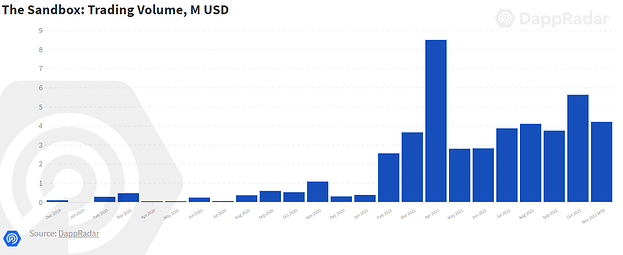
The Sandbox is one of the oldest decentralized gaming metaverses. Created by gamers around the globe, the platform has gained interest from VR and NFT investors. Once you enter this metaverse, your character can buy and build on land with crypto called MANA. From there, you can sell your land, rent it out, meet people, make connections, and even get paid and buy more land via Sandbox jobs – like architect or landlord. Sandbox, which reminds me of an extreme LEGO universe, is pretty easy to access and create an account on when visiting its website.

Because of its age and credibility in the VR world space, Sandbox is home to many affluent early adopters who already own real estate there, including major gaming companies like Attari and the rapper Snoop Dogg. Additionally, because land plots and the number of SAND tokes that will be created in the game are considered “finite,” the price of the real estate and tokens in this metaverse have skyrocketed in recent years.

Image Source

Decentraland

One of the most popular metaverses that early adopters have explored and invested in is Decentraland. Created in Argentina by developers Ari Meilich and Esteban Ordano, has been notable for its vast cities and millions of dollars in virtual land and NFT real estate. In fact, a simple Google search reveals that there are already a number of virtual real-estate agencies that specialize in selling NFT land in Decentraland and other metaverses.

As its title would hint, Decentraland is also decentralized, meaning that it has no specific owner or manager and anyone can create in this virtual open platform. Unlike Horizon Worlds, it can only be accessed by personal computers.

A lot of information to consider and unsure where to start? Below is a comparison chart to help. 

Metaverse Comparison Chart

Name

Meta Horizon Worlds

Decetraland

Sandbox

Years Active

Last than 1 year

5 years

10 years

Estimated Number Users

300K reported users (unknown daily users)

300K reported users (18,000 reported daily users)

1 million reported users (16,000 reported landowners)

Owner

Meta

Decentralized (no known owner)

Decentralized (no known owner)

Availability

US and Canada for 18+ users only

Unknown but likely global

Unknown but likely global

Equipment Needed to Access

A Meta or Oculus VR headset

Various VR Headsets or a personal computer

Various VR Headsets or a personal computer

Cost to Access

Accessed with an Oculus or Meta headset (prices vary)

Free to access, but users need a digital wallet with tokens called MANA and LAND to access most experiences.

Free to access, but users  need a digital wallet with tokens called SAND to access most experiences.

How to Get Around

Teleportation

You must purchase a virtual car or teleportation device

You must purchase a virtual car or teleportation device

Gaming Opportunities

Various free team and individual games

Users can play and create games that other users can play.

Users can play and create games that other users can play.

Social interactions with other users

Yes

Yes

Yes

NFT Art/Product Shopping

Not yet.

Yes

Yes

NFT Real Estate

Not yet.

Yes

Yes

Virtual Events

Yes

Yes

Yes

Virtual customer service available?

Yes

No

No

Crypto-currency and USD conversion (as of March 2022)

You can’t make purchases in Horizon Worlds.

MANA (1 MANA = $2.69 USD)

SAND (1 SAND = $3.14 USD)

Price of Land

You cannot purchase real estate in Horizon Worlds.

By the end of 2021, 1 plot of land cost over 4,000 MANA or $15,000 USD 

By the end of 2021, 1 plot of land cost more than 3,150 SAND or $9900 USD

5 Early Opportunities for Brands in the Metaverse [+Examples]

While each virtual world has slightly different experiences, environments, and audience targets associated with it, many of them host a handful of opportunities for brands that want to embrace emerging marketing strategies. Here are just a few ways brands can leverage some of the metaverses that exist today:

1. Inbound Sales and Networking

Today, many marketers and sales reps alike find ourselves messaging, zooming, and emailing prospects to tell them about our product or service. And, rarely, we might go to a networking event or meeting where we talk to prospects face to face.

Now, imagine doing all of this – but digitally with avatars. In almost all metaverses, you can explore a place and talk to other users for free. This means that if you sell or market a B2C product, you could casually discuss the product in conversation, as you would with anyone else you’re networking with, and then tell users where they can learn more. While you still might not be able to send them to a branded experience, virtual shop, or have them click a link to your website just yet, you can still spread the word to multiple people on a more personal level than an email without leaving your seat.

If you work in the VR or metaverse space, you could also leverage sales in a more extreme way by selling NFT items, like art, real estate, or virtual cars. While it seems many virtual salespeople don’t record transactions and post them for the world to see, here’s a video of someone buying a car from a dealership salesman in a metaverse.

If you’re wondering, “Where could I go to ensure I’m talking to the right people?”, one opportunity is attending virtual events, which I’ll discuss next.

2. Virtual Events

While virtual events are still being developed for general businesses on Horizon Worlds, Decentraland, Sandbox, and other virtual worlds host many landowners that are will to rent out their virtual space for events or virtual parties. Similarly, some companies and entrepreneurs have also built their own lands with the goal of using them for events like NFT art shows, conferences, or meetups.

If you can afford to run, host, or even sponsor part of an event, you can gain crypto revenue or awareness from users who are interested in the topic, while also gaining awareness for your product or service.

For example, here’s a video of a TikTok user who attended an Afro Tech conference in a metaverse.

While INBOUND and HubSpot haven’t hosted a conference in a metaverse just yet, we too are embracing the possibility of virtual events by building out a similar platform for INBOUND 2022‘s hybrid attendees. If you’d like to get a virtual conference experience without committing to a metaverses digital currency or platform, consider registering for our event.

If you don’t have the budget for creating virtual events just yet, you can still consider attending, buying a ticket for one, or even speaking at one. While there, you can use it as a networking opportunity to get to know others in your industry or potential prospects who might even buy your product outside of VR.

3. Influencer and Community Marketing

In any metaverse, you could potentially talk to a handful of people at once, while casually mentioning your product or even wearing NFT clothes with your logo. You could also pay people who are familiar with their metaverse or selling in the metaverse to continue to spread the word about your brand or services for you.

But, influencer and community marketing might not just stop there. If you find that your metaverse has an audience of users that are interested in your product, service, or industry, you can work to bring them together – even if you can’t afford or figure out how to schedule a virtual event.

For example, you could host a meetup on your brand’s virtual land or in a free-to-access metaverse space for those who want to chat about topics rated to your industry or product. And, while you’re there, you could just open the door to casual conversation. Or, you could all join a fun game and bond, then get to know each other in a less active space.

Not only will you network, show credibility, and spread the word about your product, but you’ll build a group of people that are interested in your industry, similar topics, or your brand.

4. Owning Branded Locations, Games, Avatar Fashion, and/or Shops

In many metaverses, including Decentraland and the Sandbox, brands with a solid budget can buy and brand real estate, such as art galleries or stores where you can purchase NFT products. While Meta Horizon Worlds doesn’t allow this opportunity yet, it will no doubt be an expanded feature eventually, but might be more structured than decentralized worlds that have no owners or rules.

One example that a brand that embraced the metaverse, VR, and NFTs to drive both awareness and crypto revenue was Gucci who sponsored a “Gucci Garden” on the platform Roblox. When entering the Gucci Garden, a VR avatar could walk up to a wall of Gucci products, select clothing, accessories, or bags they wanted to buy, and purchase them as an NFT.

Although Roblox falls more into a gaming category rather than a full metaverse, something similar could be done in Decentraland, Sandbox, or even Horizon Worlds (if brands gain more advertorial opportunities in the future.)

Another more experiential example is the prospect of Welmart stores in Meta Horizon Worlds. In 2021, Walmart released a demonstration of how they envisioned a metaverse store that helps people in VR order physical Walmart products that would then be shipped to their actual home addresses:

Although Horizon Worlds is just exploring how to monetize experiences for businesses, Decentraland and Sandbox, among other metaverses, have had digital shops (primarily for buying NFTs), car and teleportation device dealerships, art galleries, and paid brand experience locations for years.

5. Advertising on or Sponsoring Metaverse Content

While this might be more challenging and a tad riskier in decentralized metaverses, brands can provide money to creators, events, games, experiences, shops, and galleries to get their products, logos, or NFTs featured or mentioned.

One way to get started could be by researching NFT land owners with a history of advertising, which can be done on the web, as well as in VR. One business I came across while doing research for this piece was NFT Plazas. The brand claims to own NFT real-estate and plazas where many avatars spend time and will project ads, QR codes, or special digital experiences on their buildings or plaza signs.

Here’s a reel that highlights some of its work in Decentraland:

While this is a great way to spread the word about your brand if you don’t have the means to build your own virtual land, you’ll ideally want to make sure you know who the creators are in the real, non-virtual world, ensure you trust them, look out for scams, and use easy-to-understand paper trails or contracts whenever you can.

Remember, when you’re in a decentralized world, there won’t always be a customer service rep or legal entity to reach out to if you provide coinage to avatars that can’t be found later.

Should you invest in the metaverse?

Today, metaverse audiences are still growing, there’s still a learning curve for users, and some brands and audiences won’t be able to afford virtual world investments in the near future.

But, it’s important to remember that the metaverse is getting both the same hype and skepticism as social media did when MySpace and Facebook began to launch. In a world where technology is quickly evolving and improving, what’s not accessible to all today will be used by most people in the future.

If you’re an enterprise brand that can afford to take risks and explore emerging virtual worlds, it might be worth considering some of the marketing strategies above, or even creating a task force to determine if the metaverse is a worthy investment for you.

For other brands, it might be a while before you really need to start considering metaverse opportunities. But, that doesn’t mean you should wipe it from your emerging trend radar completely. In the coming year, a few things could really change the game for brands in the VR space, including:

  • New Meta Horizon Worlds Features. Everytime Meta has launched or purchased a platform, its next major step has been figuring out how to monetize the content and build brand tools for it. Horizon Worlds could be no different. And, because Meta platforms have been a trusted source for ad revenue and brands for years, expect to see brands flocking here when and if monetization tools are launched.
  • Metaverse competition: Like social media platforms, there are also new metaverses popping up all the time, and their creators (even if we don’t know them) all want them to be superior to pull in more users. This could create metaverse competition and these worlds could see new features aimed to pull in more users and more monetization opportunities for all sorts of brands. Similarly, large companies that specialize in VR might opt out of using decentralized worlds and might follow-suit of Meta by developing their own worlds.
  • More accessible technology: Currently, VR users must have an incredibly strong internet connection and a computer, while Horizon Worlds users must have an Oculus or Meta headset (starting at $300). While most people around the globe can access the internet, millions still struggle to access high speeds that would allow for VR. But, as VR gains more interest and we see the launch of technology like 5G and Web3 in many global regions, these experiences could require less machinery and lower finances to access.

Ultimately, the metaverse is vast, complex, and growing. And although we’ll do our best to keep you up to date, you’ll need to do some digging and understand your persona to know if investing time, money, or crypto in it is right for your brand.

To keep up with the latest emerging trends and tips, subscribe to daily emails from the HubSpot Blog for industry-specific advice, or The Hustle for general news and trends.

hubspot marketing blog

Categories B2B

Is Internal Recruitment Good for Business?

During my days as a journalist, I saw many different forms of recruitment take place. It was common to see reporters and photographers recruited from all over the country to work with the team.

Download Now: Free Company Culture Code Template 

It was also common to see employees move to different positions internally. A reporter could go from reporting outside to producing a show in-house. Associate producers could rise in rank and become executive producers.

This type of internal recruitment isn’t common only in newsrooms. Many companies recruit from their current roster of employers rather than recruit externally. Internal recruitment is often faster and less time consuming. On average, the cost to hire someone is about $4,000, according to SmartRecruiters, but hiring internally can cost much less.

With that in mind, you may wonder if internal recruitment is the right move for your business. Here’s everything you need to know:

The internal hire might be from a different department within the company or have a different job title on the same team. This new role could be a promotion in which there is more responsibility and a higher salary. If not a promotion, the change could be a lateral move in which the employee maintains the same level of seniority but may not see a change in compensation.

A company may choose to open job postings only to internal applicants or it may do so before opening the posting to external candidates. This can save time and money — and also ensures folks within your organization have a shot at the upward mobility they desire.

In other cases, internal candidates can apply for the open position, but recruitment efforts may focus on external candidates. This may be because of a lack of interest in the posting among current employees or because the desired skill set doesn’t exist internally.

4 Internal Recruitment Methods

1. Promotions

As mentioned before, a promotion entails moving an employee into a higher position of seniority in which they’re given more responsibility and a higher salary. For example, when the lead news director at my newsroom took a job elsewhere, the assistant news director was recruited internally to take over the role.

2. Transfer

A transfer is when an employee remains within the company but moves to another location. For example, the station I once worked for was owned by a company called TEGNA. TEGNA owned multiple televisions across the country, and it was common for journalists from my station to transfer to other TEGNA stations in a different city or state while still maintaining their same role.

Transfers are often the result of a change in business needs or the employee’s desire to make a change, such as working closer to family or living in their desired climate.

3. Reorganization

It’s normal for businesses to grow, shift priorities, or merge with other entities. In these cases, reorganization might occur. It can take the form of employees being shifted to other teams or leadership taking on less administrative duties and working directly with employees to keep up with increased demands.

An example of reorganization happened back in 2017 when Dow Jones announced that its flagship publication, The Wall Street Journal, would be reorganized to shift its focus away from print and into a digital strategy. New jobs were created and employees were re-allocated into new roles that were focused on the publications digital presence and goals.

4. Role Change

Usually, a role change is not a promotion. In this case, an employee may be recruited laterally, meaning they maintain the same level of authority but are operating in a different role.

This is a great solution if an employee is showing skills and interests outside of their current role. An example of this occurred when a television producer at my former TV station showed immense talent for creating content for the station’s website and social media. When a digital producing role opened up, that television producer was selected and a lateral move was made from television producer to digital producer.

Legal Implications

Regardless of the method of internal recruitment used, employers must create a policy that is fair and equitable for internal applicants, according to the Society of Human Resource Management.

In this policy, clear expectations must be established for employees who wish to apply. These expectations must be implemented consistently and communicated effectively throughout the company.

It’s also important to remember that federal laws prohibit employment discrimination based on:

  • Age
  • Citizenship
  • Disability
  • Family and/or medical leave use
  • Genetic information
  • Military service
  • National origin
  • Pregnancy
  • Race
  • Religion
  • Sex, gender identity, and/or sexual orientation

3 Advantages of Internal Recruitment

1. Talent Retention

Hiring within your company can send a message to your employees that there are clear opportunities for advancement. This can motivate your best employees to stay long term because their hard work will pay off.

2. Cost Effectiveness

Often, the benefits of hiring externally cannot outweigh those of hiring from your current pool of employees. That’s because internal recruitment eliminates costly job board fees, time-consuming rounds of interviews, and pricey background checks.

3. Shorter Learning Curve

Chances are that whoever you hire internally will already have a solid understanding of the company’s culture, practices, and processes, thus lessening the time it would take to get acclimated to a new role.

3 Disadvantages of Internal Recruitment

1. Workforce Gap

When a position is filled internally, you’re moving an employee from one role to another. This effectively closes one gap but creates another that needs to be filled.

2. Stagnation

One of the perks of recruiting externally is that employees from outside the company can bring unique perspectives and innovative processes to propel the company forward.

This can be the opposite for internal hires who are likely to work using the same processes and ideas they’ve been using throughout their time in the company. Lack of fresh approaches and ideas can create stagnation in the workplace and can put the business behind competitors.

3. Lack of Skills

With internal recruitment, there is a chance your current roster of employees may not have the right set of skills for the position you’re looking to fill. And while internal hires typically require less training than external hires, you may run the risk of spending more time and money training the internal hire if they don’t possess all the qualities to succeed in their new role.

In those cases, it would be better to recruit externally to find a candidate who already has the necessary skills from previous experience.

So, is internal recruitment right for your business?

Ultimately, there are many factors that determine whether internal recruitment is the right choice over external recruitment. If your company has a position to be filled and you have one or more employees who could be successful candidates, then recruiting internally could be a timely and cost effective choice. However, if your employees do not currently seem to be the right fit, or you’re concerned about limiting your candidate pool, then it wouldn’t hurt to expand to external recruiting.

company culture template

Categories B2B

The Top 7 Marketing Challenges Faced Globally in 2022 [HubSpot Data + Expert Tips]

Every marketer faces different challenges. And, ever since 2020, the ways we’ve had to pivot, adjust campaigns, and address challenges has been unlike anything many of us have had to do before.

And, even if you’ve somehow navigated the past two years without any surprising or tough marketing challenges, there’s likely at least one task, tactic, or strategy you’ve always wanted to improve upon. 

Today, marketing is so fast-paced that it can be difficult to identify which areas you’ll want to develop to facilitate stronger growth in 2022 and beyond. For that reason, it’s important to pause for a moment and reflect on the biggest challenges marketers feel they’re facing this year.

Below, let’s review the current global marketing issues impacting the industry, according to data from HubSpot’s 2022 Marketing Industry Trends Report and marketing experts.

Download Now: HubSpot's Annual State of Marketing  [Free Data Report]

1. Training Marketing Talent

While you might expect the top challenge to involve one of the many KPIs marketers are goaled around, our research shows the top barrier facing marketing teams today is actually much more fundamental than quantifiable goals or simply hiring top-tier talent who will easily hit them.

In fact, according to our survey of over 500+ marketing professionals, the top overall challenge marketing departments are facing is team training.

Why? When you hire someone or get hired by your dream company, your the work needed to grow doesn’t just stop at the offer letter.

If you’re a manager or marketing leader, you’ll need to take time to teach that employee how your company works. This could include voice and messaging training, helping them understand buyer personas, or getting them acclimated to the tech stack or processes you use. 

Meanwhile, regardless of whether you’re a seasoned marketing team employee or new hire, you might wish your company had more opportunities for training, onboarding, or professional development that could allow you to excel and learn while also hitting your KPIs.

Why It’s a Challenge

Unfortunately, in the fast-paced world of marketing, it can be challenging for leaders to find the time to train while employees might not have the time or money to access professional development outside of their day to day tasks. 

That’s why it’s not shocking that 30% of marketers say that team training was the biggest challenge of 2021 and 21% say it will continue to be athe top challenge for marketing departments in 2022. 

What Can You Do?

The first step to solving this problem, regardless of whether you’re an individual contributor or manager, is reframing what “training” means to you. Remember that even the most top-tier, ROI-generating unicorn marketer will need time to get used to how your company works and grow as an employee and potential leader.

Ultimately, businesses should think of training and professional development offerings as indirect ROI-generators. Ultimately, even the most top-tier, unicorn talent will need time to get used to how your company works.

On one end of the spectrum, companies and leadders can retain employees and save money on talent searches because of their offerings. Meanwhile, their talent will learn more, grow more, become even more competitive, and — most importantly — feel more fulfilled and supported in their role. Additionally, you don’t always have to hire instructors or take time out of your day to train. For example, you can:

  • Encourage project managers or individual contributors looking for visibility to present experiments, strategies, or learnings at events, weekly meetings, or annual team conferences.
  • Book an annual professional development day during a slow season where all employees are asked to take a free online course of their choosing and report back on how it went.
  • Consider hosting quarterly or bi-annual new employee or new manager training days where newer hires and new managers can plan to go to in order to train with minimal impact on their quarterly projects. 
  • Create evergreen training videos, internal quizzes, or other resources that you can send to new or newly promoted employees on their first day.
  • Have managers develop 100-Day Plans for new hires or those that transfer to their team which includes training assignments, resources to read through, and a contact list of people to meet or schedule training with.  

On the other hand, if you’re an individual contributor, participating in your company’s professional development training and/or taking free or affordable courses online could help you negotiate a stronger role and salaries for yourself at your company or elsewhere. 

If your company doesn’t offer training or reimbursement for it, check out this list of free courses

2. Generating Traffic and Leads

While you might have been surprised by the top challenge, you probably aren’t surprised by No. 2. As you might expect, generating traffic and leads is always top of mind with marketers. And, even if teams are doing well with these metrics, they’ll always want to improve them. 

In our survey, 27% of marketers across industries believe generating traffic and leads will be their top challenge in 2022. 

Why It’s a Challenge

John Lee, Head of Evangelism at Microsoft Advertising, believes that generating leads will be a particularly big challenge for marketers. He told me, “Getting quality traffic isn’t a challenge today, and likely won’t be tomorrow. There has been growth in search and content marketing in 2021. New channels continue to surface and show promise, too (TikTok or audio chat rooms anyone?).”

Lee adds, “‘Sea change’ is the phrase that comes to mind for the state of digital marketing today. Change in the realm of privacy, identity, and changes to cookies. Change in the form of lost data clarity (will cookie-based conversion tracking continue to work, GA4, access to search queries, etc.). And all of this sits within the context of change to how and where we work and economies in flux as the world continues to move through the pandemic.”

Fortunately, privacy changes don’t mean the end of generating leads — it simply means learning how to re-think strategy.

As Lee told me, “To weather this storm of change, marketers need to be vigilant in monitoring and understanding industry-wide acceptance of privacy protocols and updates to search, social, and display/native platforms (consumer-side and marketing/advertising-side). And last, but not least — lean into the power of peer support and networking for sharing best practices and learning.”

Additionally, marketers are struggling with producing enough demand for their content. And as the year’s progress and competition stiffens, this will only become truer. With so many options of platforms for marketers to publish their content and even more ways to promote it, it’s hard to know where to focus your efforts.

What Can You Do?

When it comes to creating content that produces enough traffic and leads, marketers should ask themselves two questions: Are you truly creating high-quality content — the type of content people would pay for? And, do you know the type of content your audience actually wants?

For instance, when asked how they’d most like to learn about a product or service, 69% said they’d prefer to watch a short video over a text-based article, infographic, or ebook. This means, if most of your product-related content is in ebook format, you could be missing out on the majority of consumers who prefer video.

Additionally, the length of videos produced by businesses has increased (albeit more slowly than the increased creation rate of short video). While short-form video is still King/Queen, the number of videos in the 30-60 minute category grew 140% in 2021, compared to 2019 — suggesting that long-form video content is still a viable option for companies.

To ensure you’re creating content that resonates best with your audience, you’ll want to refer to analytics often. Use effective tools to properly track the types of content that perform best with your audience to generate more leads in 2022.

Additionally, once you know you’re creating the type of content your audience wants, the focus shifts to promoting it in a way that makes your audience take notice.

More than ever before, people are being flooded with content. Consumers don’t have to use a search engine to find answers. Instead, articles fill their news feed or buzz in their pocket via mobile notifications. To keep up, consider exploring alternate distribution methods — like social media or podcasting — to increase brand awareness.

Lastly, if you have the budget for online advertising, one example of a helpful distribution method is by promoting your content with HubSpot’s LinkedIn Ads Integration. Learn more about it here.

3. Demonstrating ROI of Marketing Activities

Measuring the ROI (return on investment) of your marketing activities has remained a top marketing challenge globally year-over-year.

In our survey. 28% of marketers saw it as their top challenge in 2021 while 21% of marketers expect to see this continue to be their biggest issue in 2022. 

Measuring and gaining ROI continues to be a vital way for marketers to understand the effectiveness of each particular marketing campaign or piece of content. It also can be what decision-makers at your company rely on when determining if they’ll invest more in your project, deparment, or team headcount in the future. 

Ultimately, proving ROI often goes hand-in-hand with making an argument to increase budget: No ROI tracking, no demonstrable ROI. No ROI, no budget.

Why It’s a Challenge

Although return on investment is a crucial stat that shows your campaigns success or progress, tracking the ROI of every single marketing activity isn’t always easy, especially if you don’t have two-way communication between your marketing activities and sales reports.

What Can You Do?

Providing ROI often comes down to using effective analytics measurement tools. For instance, Beautiful.ai Director of Marketing Kim Giroux told me, “Marketers are constantly challenged to illustrate the ROI of their efforts and [this year] is no exception. Proving ROI doesn’t always have to mean extra work or effort though. In fact, certain technologies bake ROI into existing work processes.”

Giroux adds, “Take presentation software, for instance. Savvy marketers today can create and use pitch decks with built-in presentation analytics that offer real-time data — such as how much time was spent viewing individual slides. Armed with these insights, marketers can better gauge stakeholder interest, inform their strategies, and adjust their campaigns.”

Christina Mautz, CMO of Moz, believes measuring ROI comes down to redefining the marketing process as a whole. She told me, “My biggest challenge, and one all marketers face in providing ROI, is the prospect of meeting traditional KPIs in the modern workspace.”

Mautz says, “Instead of leads and trade show success, marketing wins are now largely digital: engaging prospects and generating more clicks, downloads, and page visits.”

CMO of Moz Christina Mautz says, “To better measure marketing progress, we have to redefine the marketing process, encouraging collaboration with sales and reaching KPIs together.”

“For example, statistics such as page visits per sale or rising higher in the search engine results page (SERP) give marketers and SEOs tangible evidence as to how their work is meeting their ROI. New buying patterns and a customer-centric world require a divergence from the old, but measuring ROI will look far different than it did before and some leaders may not understand how or why.”

When it comes to providing ROI, there’s a strong case to be made for dedicating time and resources to establishing links between marketing activities and sales results.

This means using both marketing software (like HubSpot) and a CRM solution (like HubSpot’s free CRM) and then tying them together to close the loop between your marketing and sales efforts with a service-level agreement (SLA). That way, you can directly see how many leads and customers are generated through your marketing activities.

4. Justifying Your Budget

How can you create a winning marketing campaign without a budget? The truth is, it’s pretty hard. But, even when you have a great, revenue-generating idea, you still usually need to get your budget approved by a higher-up.

As the global pandemic began, some companies didn’t have the means to increase marketing budgets or shifted budgets to other key priorities like paying staff or operations teams.

But, in 2022, marketers are running into a good problem to have. With the importance of marketing, online content, and digital media being proven time and time again for businesses during the pandemic, marketers actually began to see budget increases.

In 2021, more than 80% of marketers’ budgets increased or stayed the same as in 2021 (with over 40% saying budgets increased). Moving into 2022, 48% of marketers expected their budget to increase in 2022. 

While this is great news for marketers, it poses a new set of unique challenges that they might not have dealt with before. 

Why It’s a Challenge

Securing a budget has always been a pressing challenge for marketing globally. And, while marketers seem to be getting what they need for budget in 2022, companies could be eager to shift back to pre-panddemic strategies of placing money into sales, facilities, and other departments in the future. 

Now that marketers have their budget, they’ll need to fight to keep it and grow it even more. 

And often, getting and keeping more budget is easier said than done — especially for smaller organizations that aren’t working with sizable or flexible marketing spend.

But the key to securing more money for your team might not be that complex. Here’s what you can do.

What Can You Do?

The key to unlocking budget lies in being able to prove the ROI of your marketing efforts (as we’ve noted above). Use your whole budget to demonstrate need, but also ensure you’re spending money on things that will provide high performance, like high-traffic, lead-gen, or revenue-generating projects or headcount.

According to our research, organizations that can calculate ROI are more likely to receive higher budgets.

Again, success with inbound marketing also plays a large role in driving higher budgets. Effective strategies obviously produce results and make a strong case for increasing your budget. But remember, inbound marketing is a long game. If you get off to a slow start, you shouldn’t back off — in fact, you might consider doubling down.

To learn more about how to understand and leverage marketing ROI, check out this simple guide.

5. Managing Your Website

In 2021, 64% of companies said they were investing in website upgrades. Meanwhile, 27% of survey participants said that managing their website was the top challenge in that year, with a chunk more saying they will continue to rise to this challenge in 2022. 

And, honestly, this isn’t surprising. If you have an online presence for your business, your website serves as a key place that consumers will go to when researching your brand. And, there, they might find company information, marketing content, and other resources that nurture them into becoming a lead or buying your product. On the marketing end, your site can also be a tool that can help you drive search result and social media awareness when it is optimized and shared around the web. 

Although managing a website is consistently a challenge to marketers, it seems to be growing less threatening. While website management was the third-biggest challenge facing marketers in 2021, it didn’t even make the Top Five Challenge list for 2022. 

However, we’re still placing this challenge in the fourth slot because — more than ever — businesses need to continue growing, improving, and optimizing web experiences, especially on their website. 

Why It’s Still a Challenge

Chances are, your website’s performance is high on your list of priorities — particularly since website speed and performance plays a major role in your website’s SEO ranking. It’s an asset that works around the clock to draw in visitors, convert them, and help you hit your goals.

Issues with website management include a variety of different factors, from writing and optimizing the content to designing beautiful webpages. Here are a few things marketers can do to deal with this challenge.

What Can You Do?

First, try HubSpot’s free website grader to determine how your website stacks up on key metrics including SEO, mobile, and security performance — and how you can improve it. 

If your primary challenge with managing a website has to do with the skills and resources you have available, you aren’t alone. This is especially true for small companies who don’t have all the talent in-house required to cover content, optimization, design, and back-end website management.

One solution? Hire freelancers and agency partners. To find freelancers, we recommend:

  • Tapping into your personal and professional network by posting on LinkedIn, Facebook, and other social networks with a description of what you’re looking for.
  • Browsing freelance writers and designers based on their portfolios and areas of interest. 
  • Browsing HubSpot’s Services Marketplace, which lists a wide variety of designers from partner companies and agencies we’ve deemed credible.

Overall, you can make website management easier on your team by hosting your website on a platform that integrates all your marketing channels like HubSpot’s COS.

Finally, for the projects you want to keep in-house, here is a list of ebooks and guides that might be helpful to your team:

6. Reaching Global Audiences

Targeting is a key component of all aspects of marketing.

With 65% of marketers currently marketing internationally, it’s important to have an international strategy.

But, international marketers face a whole bunch of challenges that can make it difficult for your brand to gain awareness globally. And, even if you aren’t on an international marketing team, knowing this data can still help you help them. 

That’s why we asked international marketers specifically about their biggest challenges. The top three they pointed out were:

  • Cultural differences (44%): Creating content and marketing campaigns can be different from country to country, or require different strategies entirely due to cultural differences, trends in different regions, and even regulations in different areas. 
  • Exchange rates (43%): Creating, tracking, and updating pricing for products, services, or resources can be tricky when exchange rates change nearly all the time. 
  • Localization (43%): Along with taking cultural differences and geographical trends into account when creating content, brands going global need to have a localization strategy to ensure their content is readable, searchable, and discoverable in different languages, which can cost a great deal of time and money. 

Why It’s a Challenge

Building or maintaining an international marketing strategy can be a big challenge not only when figuring out the best ways to target and market to different regions, but it can also be hard to organize and optimize your site so it can be easily navigated in different countries.

What Can You Do?

Download our free ebook, The Global Marketing Playbook. There are some really helpful tips in there that’ll help give you some direction on global marketing, including how to identify your top three growth markets, how to explore local trends, and tips on choosing the best localization providers.

Additionally, when marketing to a new region, the most common tactic marketers use is to shift their product offering.

Remember, your website visitors might speak a plethora of different languages and live in totally different time zones.

To make your content appealing to a wide audience, you’ll need to keep your global visitors top-of-mind when creating all your content. This means being aware of seasonal references, translating units of measure and monetary references, and giving translators the tools and permissions to customize and adapt content for a specific audience when they need to.

When in doubt, solve for local or cultural challenges by hiring locally. With a newly hybrid workforce, physical location is no longer a limit to who you can hire. 

Finally, be sure you’re optimizing your website for international visitors, too. For more SEO-related tips and resources on global marketing expansion, take a look at How SEO is Different Around the World, According to HubSpot Content Strategists.

7. Hiring Top Talent

As we mentioned above, 21% of marketers expect hiring top talent to be their biggest challenge in 2022. And, we’re not too surprised. Hiring talent with a great track record takes time, effort, and money — which many marketing teams do not have. 

While hiring is a challenge marketing teams have faced throughout the past five years or so, concerns are continuing to grow even more with news of worker shortage and recruiters competing for applicants that have chosen to shift roles following the global pandemic. 

Why It’s a Challenge

Many companies are shifting more resources to inbound marketing, which means higher and higher demand for top marketing talent. But supply simply isn’t keeping up. From sourcing the right candidates to evaluating for the right skills, finding the perfect person could take months … or more.

What’s more, the type of marketing talent companies are looking for is changing, too. According to a report from LinkedIn, employers are seeking marketers with soft creative skill sets as well as hard technical skills. And the quick rate at which the demand for these jobs are rising has caused a marketing skills gap, “making it difficult to find candidates with the technical, creative, and business proficiencies needed to succeed in digital marketing.”

What Can You Do?

Stefanie Grieser, co-founder of Shine Bootcamp, a professional speaker accelerator for women, understands the challenge of hiring top talent.

She told me, “When I talk to high-growth companies or marketing agencies (and the marketers running those teams), I’ve found that hiring not only top talent, but diverse top talent is extremely challenging. In fact, I was just having a conversation with an agency owner who hires SEO and paid marketers, and he told me, ‘Hiring is still the biggest challenge we face.'”

In 2022, hiring talent can be incredibly difficult — particularly as more companies become competitive with 4-day work weeks, transparent salaries on job descriptions, and the adoption of remote work, which enables companies to hire anywhere.

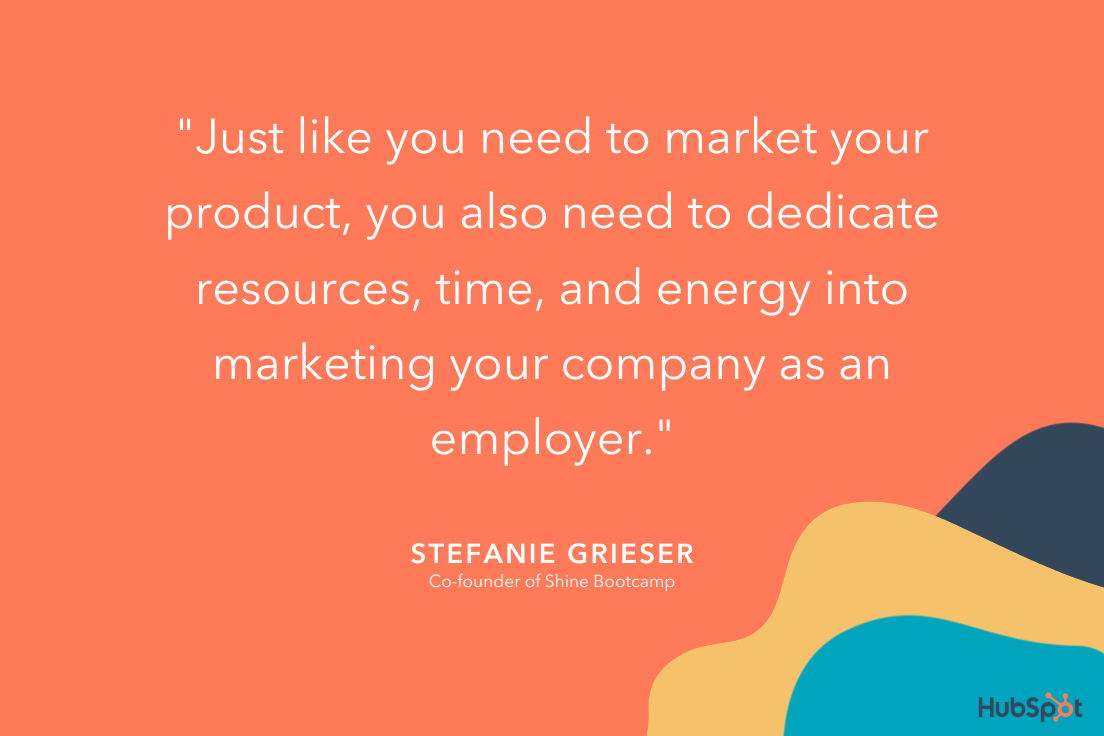
Fortunately, Grieser provided me with a few tips for employers to stand out from the crowd. She told me, “My suggestion here is for marketers to invest heavily in their employer brand for the long-term. Just like you need to market your product, you also need to dedicate resources, time and energy into marketing your company as an employer.”

biggest marketing challenges 2021 is hiring top talentGrieser adds, “I would suggest Diversity Tech Co, Tech Ladies, and Girlboss as go-to resources to post jobs. These organizations are run by incredible individuals who really care about diversity, equity, inclusion and intersectionality. I’m also seeing niche communities and job boards pop up. For marketers specifically, I would post your open roles here: Dave Gerhardt Marketing Group, Hey Marketers, and Superpath (which is focused on content marketers specifically).”

While it might seem random to discuss employer branding in a post about marketing challenges, it isn’t — since it’s often the marketing team that cultivates a strong employer brand.

As Grieser points out, “Airbnb has an Engineering and Data Science blog, Intercom has an Instagram dedicated to their design team, and Dooly posts short, LinkedIn posts (see an example here) interviewing their fun team with a few fun hashtags #doolydreamteam and #meetadooligan.”

“Guess who leads this initiative? The marketing team. Think about how you and your team can showcase your work and your team’s work. I won’t try to assume that employer brand falls solely in your court, but as a marketer, you have natural skills that will lend themselves to marketing the company as whole.”

LinkedIn data shows that the number one reason candidates will consider or accept a job is career growth. This means that job listings and a company culture that offers employees a plan for growth will see the most interest from talent.

Other Common Challenges

While our survey identified the biggest challenges in marketing, teams are still facing dozens of other challenges that are worth mentioning, but weren’t ranked as a top concern. Here are just a few:

Content Marketing Challenges

The content marketing world is vast and full of different strategies. And, each major tactic comes with its own challenge. 

For example, if you’re a blogger or video creator, SEO and ranking on Google will likely be one of the biggest hurtles and opportunities your team will face because both blogs and videos are always competing for the covered first-page of search results on Google.

Meanwhile, if you focus on multimedia, such as videos, podcasts, or design, views, view-time, and shareability could be key to nurturing a lead. And, as many marketers struggle with demonstrating ROI — your efforts will be no different. While bloggers could include a form, purchasing link, or landding page URL in their posts which are easier to track, you won’t always be able to easily determine the ROI of content that doesn’t allow URL embedding in it. 

As a content marketer, it’s important to determine which goals are most important to your team and company’s growth and focus first on the challenges that will hinder reaching them. 

Email Marketing Challenges

Over the last year, email marketers have run into all sorts of challenges, such as pandemic-related low engagement and Apple iOS 15‘s privacy protection policy impacting open tracking and open-rate based strategies. 

But, by far, the biggest challenge email marketers will probably always face is gaining and retaining subscribers. In fact, our research found that 19% of marketers see email and social media list growth being a top challenge throughout the year. 

If you identify with our participants, check out this post with more data on why consumers subscribe and unsubscribe from email. 

Affiliate Marketing Challenges

Sometimes, spreading the word requires the help of partners (or affiliates). These could including other companies willing to feature your brand on their site, thought leaders or influencers who will share links to your products and even happy customers who will spread the word in order to get a reward. This is why affiliate marketing has grown much more popular over the years. 

However, despite its popularity, affiliate marketing takes work. To launch a campaign, you’ll need a clear message, process, a commission budget for your partners, and — oh yeah — affiliates who will help you reach your goals. To learn more about how to execute successful and effective affiliate marketing, read this guide

Some of these challenges aren’t new.

If you’re a marketer who sees the same challenge year-over-year, it might be a barrier worth putting on your radar. However, some challenges can be industry-wide. Year-over-year challenges across the industry are incredibly important to note, regardless of whether they impact you or not.

Why? These challenges might not just be something you’re facing, but could also be faced by your competitors. If you can figure out how to navigate a reoccurring industry challenge effectively, you could have a leg up against the competition. 

With that said, let’s look back at some of the data we gained las year, 

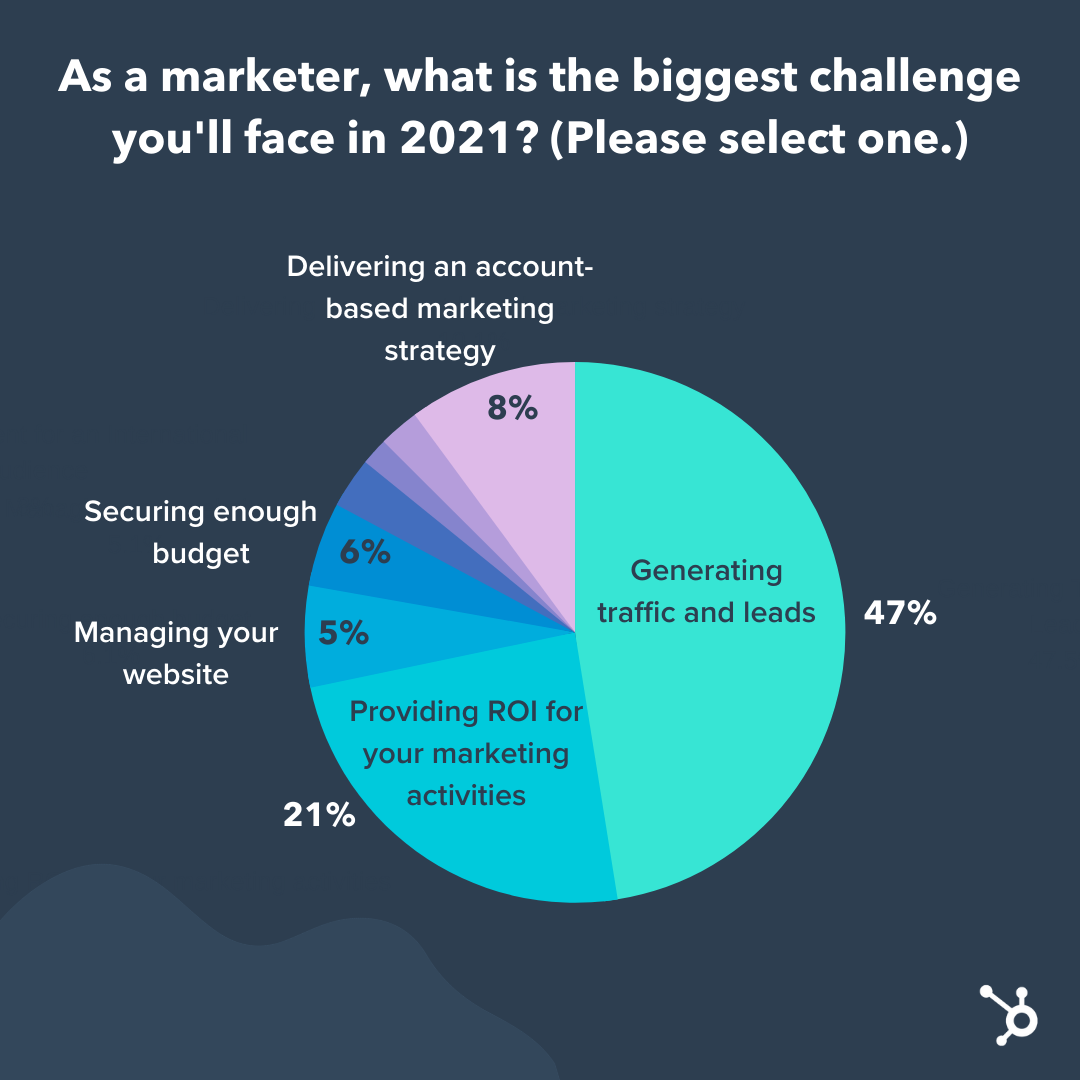
In 2021, I surveyed over 120 marketers on our HubSpot Marketing Blog subscriber list to gauge the biggest challenges affecting the industry. Here’s a quick graph highlighting what they said. 

biggest challenges for marketers 2021By far, “Generating traffic and leads” was marked by nearly half as the biggest challenge marketers are facing this year. 

This challenge was followed by 21% who said “providing ROI for your marketing activities” was their biggest challenge. 

“Delivering an account-based marketing strategy” (8%), “securing enough budget” (6%), and “managing your website” (5%) were the other three notable challenges marketers feel they’re facing in 2021. 

It’s important to note, a few other marketers marked “targeting content for an international audience”, “training your team”, and “hiring top talent” as their top challenge … but these three challenges were marked by less than 3% of the respondent pool, so they’re less statistically significant. 

Identifying Your Marketing Challenges

A thorough analysis of your marketing strategy and its current performance will help you discover where your biggest marketing opportunity lies. This will allow you to focus on improving the areas that need the most attention, so you can start making your marketing far more effective.

Editor’s Note: This post was originally published in November 2012 and has been updated annually to include new, exclusive HubSpot data and expert insights. 

state of marketing

Categories B2B

How Nonprofits Can Use TikTok for Growth [Case Study + Examples]

TikTok has shaken up the digital landscape — and its explosive growth over the past year suggests that it’s here to stay.

Although it’s an entertainment-first platform, TikTok is more than just Gen Z dance challenges.

We’re seeing more and more social impact and non-profit clients use TikTok to inform, educate, engage, advertise, and raise funds and awareness.

Here, let’s explore tips and best practices for nonprofits looking to leverage TikTok for growth.

Download Now: Nonprofit Marketing & Fundraising  Trends for 2022 [Free Report]

Is TikTok right for your nonprofit?

Building a presence on a new social media platform can be a big undertaking. As with any platform, it’s essential to assess whether it’s a good fit for your organization, and whether it will help you meet your goals.

Before diving in, it’s important to ensure that your efforts go into spaces and platforms that your audience already uses.

First, make sure TikTok helps reach your organization’s target audience. Remember: over 50% of the apps’ users are under 32 years old, and over 41% of TikTok users are between the ages of 16 and 24, according to Qgiv.

You’ll also want to assess whether your organization can manage a TikTok channel. If you’re considering whether your organization has the capacity to build a TikTok presence, the first step is to ask — and trust — the person or team who manages your social media.

Another thing to consider is the way TikTok prioritizes raw, real, unedited, and people-first videos. On this platform, link posts or polished graphics and copy won’t cut it. Think about whether you have employees willing to make videos for the account, or if you have the budget to hire creators and influencers to build your presence.

Having an employee kick off your TikTok account is a great starting point, but it’s not the only way. TikTok’s creator marketplace is the platform’s official collaboration center that connects brands and creators to execute paid and reward-based campaigns. This is a great starting point for nonprofit’s that are new to TikTok.

8 Tips + Best Practices for Nonprofits on TikTok [+ Examples]

Once you’ve determined TikTok will help you reach your goals and target audience, and you’ve ensured you have the resources to manage the platform, it’s time to get into some tips that can help nonprofits move missions forward with quality TikTok content.

1. Creative is the primary factor for success.

Your content is everything on this platform. As noted above, polished photos and videos won’t cut it. You need a real person (whether that be an employee or creator from TikTok’s Creator Marketplace) to commit to making videos that have high-performing elements.

2. Use the principle of “entertainment-first”.

Remember that TikTok is an entertainment platform first and foremost.

The American Kennel Club (AKC) uses Facebook to share tips and articles about dog care — like this post featuring the best dog raincoats — to establish its place as an expert in dog welfare.

AKC’s TikTok, however, has a different goal: to engage audiences with cute dog videos. This TikTok post succeeded not by educating about dog care, but by showing off the incredibly cute Pekingese breed at a dog show.

3. Leverage talent to bring your videos to life.

More than one in three viral videos featured a person speaking within the first three seconds, according to a recent analysis of over 600 viral TikTok videos by SemRush. Featuring actual people in your video content is essential, and it gives your organization the chance to spotlight and uplift a diverse group of voices.

There are a few key places you can source talent from — for instance, consider inviting folks from different departments of your organization to create or star in content, or tap into the platform’s vast supply of creators.

The It Gets Better Project taps into a network of creators that they have established relationships with — like this video featuring Zoe Stoller — to create fun, informative content for their page.

@itgetsbetter It’s important when they’re NOT in the room, too! 🚪 @zoestoller
#itgetsbetter
#lgbtq
#lgbtqally
#ally
#pronounsmatter
♬ I Just Wanna Know – Luke Reeves


4. Stay ahead of trends and find inspiring creations from the Discover page.

Trends are constantly circulating on TikTok, and the best way to know which content, audio, hashtags, or concepts are going viral on the platform is to engage with the Discover page. Think of this page as the hub for the most popular content on the app. This space also includes featured placement for paid media.

On the Discover page, you’ll see a series of trending hashtags that you can click through. The set of videos that appear under each hashtag are videos that either started the trend or popular videos that are relevant to the trending hashtag.

It’s a good idea to use these examples as inspiration when developing new videos, but a TikTok strategy should not focus solely on reacting to viral trends.

5. Approach TikTok like a regular human — not a brand.

Establishing your organization’s identity or persona is critical when building a content strategy because this is the first step in attracting an engaged audience.

As noted earlier, Gen Z — a primary audience on this app — favors authenticity more than their millennial counterparts. Instead of trying to appeal to a massive audience, lean into your organization’s unique knowledge base and informative storytelling.

If you aren’t sure how to build a TikTok persona for your organization, start with your mission statement! From there, you can narrow down which content buckets you would like to focus on, and ultimately the type of videos you want to make.

AKC posted this video of a dog competing in an agility contest — and despite being filmed on a smartphone, the TikTok earned over 2 million views. Expensive equipment is not necessary to produce highly engaging content.

6. Use a story arc.

Videos should have a concise beginning, middle, and end. Consider mapping out key story fundamentals such as a hook, introduction, interesting turn, and final pay-off before executing a TikTok. Storyboarding can help to streamline the filming process, and it provides guidelines for those who are new at creating this sort of content.

In preparation for It Gets Better Project’s organic TikTok campaign promoting the “50 States. 50 Grants. 5000 Voices.” grant program, the Media Cause team developed a narrative structure and sample script to correspond with the campaign’s branded hashtag.

Mapping out a sample narrative arc and example script was important to illustrate how the overarching campaign would function on the platform. It also served as a useful tool to share with talent who would eventually participate in the creating content for the TikTok campaign.

Media Cause partnered with the TikTok team to gain feedback on the narrative arc and branded hashtag — and, as a result, It Gets Better Project’s campaign was featured on the TikTok Explore page.

7. Keep it concise (15-30 seconds), and get to the point.

Be sure to show your followers the lesson or purpose of the video within the first three seconds … That’s all the time you get before the average user swipes.

You can easily achieve a captivating introduction by using text on the screen, narration, or front-loading the video with the most salient information.

Consider, for instance, this Natural Resource Defense Council (NRDC) TikTok video, which educates viewers on the infrastructure package in a mere 30 seconds: 

@nrdc.org
#stitch with @washingtonpost Andrew and his paper money can’t take historic climate action, but Congress can!
#roborockrun
#bonesday
#climateaction
#fyp
♬ original sound – NRDC

8. Inspire co-creation.

When crafting a content strategy, you don’t need to start from scratch. Leverage in-app tools to promote conversation and engagement with existing audiences that overlap with your own — this can be through TikTok’s duet, react, reply with video, and stitch features.

Inspire your audience to have a dialogue with your organization through the use of polls or Q&As. Also, community management is key on TikTok, so be sure to answer any questions you receive in your comments (or in the comment section of other viral TikToks).

Ultimately, TikTok is here to stay, and it provides the opportunity to connect with an audience you may not otherwise reach. As with any platform, it’s essential to assess whether it’s a good fit for your organization and goals.

Once you’ve determined whether a TikTok strategy will help your organization reach its desired audience and goals, embrace these tips to ensure success. Remember: Experimentation and creativity are key! The time and energy you invest in this platform to gain brand awareness could lead to audience loyalty and high-quality conversions.

Media Cause’s Patricia Camerota (Social Media Strategist) and Janine Guarino (Associate Social Director) contributed to this post. 

nonprofit trends

Categories B2B

Consumer Behavior Statistics You Should Know in 2022 [New Data]

How consumers make purchasing decisions has changed greatly in just a few months. For instance, the pandemic has shifted some buyers more online.

Download Now: Ecommerce Marketing Plan Template

In recent years, there has also been a push for more transparent and sustainable practices in brands. But what else is there? Well, that’s what we’re covering here.

In this article, you’ll learn some interesting statistics regarding consumer behavior that you should know in 2022 and what that means for your marketing strategy.

1. Consumers buy more online.

According to a 2022 GWI Commerce Report, there has been a 36% increase in the number of Americans doing most of their household or grocery shopping online.

During the 2021 holiday season, 46% of consumers shopped exclusively online according to a Jungle Scout report.

Why? The top reasons are lower prices, low-cost shipping, and convenience.

Back in 2020, NRF’s Winter 2020 Consumer View reported that 83% of shoppers say convenience while shopping is more important compared to five years ago. That was before the pandemic, so that percentage has likely increased.

online shopping statistic: A stackla report found that 67% of consumers say their online purchasing has increased since the start of the pandemic

Image Source

This shift has forced some brick-and-mortar stores to consider how to implement an ecommerce strategy, whether it’s launching their own online stores or partnering with third-party platforms.

There’s also a bigger need for a robust online presence. While this was always recommended for brands, nowadays, it’s vital for their long-term growth.

2. Reviews and user-generated content are more influential than ever.

Today, it seems like everyone is talking about influencer marketing.

When we surveyed over 1,000 global marketers in 2021, 61% of B2C marketers said they planned to increase their investment in influencer marketing, compared to only 44% in UGC.

However, some studies suggest that the opposite strategy may be more effective.

consumer behavior statistic from 2021 Stackla report

According to a 2021 Stackla report, UGC is 8.7 times more impactful than influencer content and 6.6 times more than branded content.

In fact, when it comes to sourcing gift ideas on social media, the Jungle Scout revealed that 56% of consumers are influenced by posts shared by friends and family – more than branded content and ads.

From a marketing perspective, this is a signal to brands that consumers want to hear more from other buyers. Consider implementing this into your social strategy by sharing customer reviews and promoting UGC through giveaways and other promotional tactics.

While it’s a great brand discovery tool, it also works well to reel in consumers at the consideration stage of the buyer’s journey.

3. Consumers seek personalization.

According to the Stackla report, 70 percent of consumers say it’s important for brands to offer a personalized experience – up from 67 percent in 2019.

HubSpot Blog Research from 2021 revealed that 53% of marketers leverage message personalization in their email marketing strategy. Of that percentage, 72% say it’s been one of the most effective tactics, more than subscriber segmentation, email automation, and dynamic content.

However, there are many more ways to personalize a user’s experience beyond personalization tokens – from product recommendations and usage recaps (think Spotify’s annual “UnWrapped” campaign) to smart content and 360 customer views.

With so many channels to reach audiences, marketers have a wealth of options when it comes to personalization. It’s just a matter of narrowing down the ones that offer the best ROI.

4. Gen Z leads the charge in social buying.

In May 2021, eMarketer found that Gen Zers are more likely to engage in social commerce than older generations.

Their report revealed that roughly 56% of consumers between 18 and 24 years old and 47.5% of 14- to 17-year olds have made at least one purchase on a social platform.

These figures are considerably higher than other generations, with only a third of consumers between 45 to 65 years of age making at least one purchase on social media in the year.

Which platforms is Gen Z mostly on? TikTok and Instagram.

A 2022 GWI Gen Z report found that 46% of Gen Zers use TikTok to find information about products and brands while 69% use Instagram.

This is likely because Instagram has slowly transitioned to an ecommerce platform with advanced shopping tools while TikTok has kept its focus as a short-form video platform.

So, what are Gen Z buyers looking for? On social media, the GWI report found that most are looking for content that’s:

  • Lighthearted and funny
  • Inspirational
  • Informational and helpful

As for their purchasing journey, the number one way Gen Z discovers and researches products is through vlogs (video blogs), according to the GWI report. Once they’ve made a purchase, they become most loyal to brands that offer access to exclusive content or services.

So, if your target audience includes Gen Z, your social media presence will be more important than ever.

5. Brands can benefit from an omnichannel approach.

In a March 2020 eMarketer study of how U.S. adults preferred that brands communicate with them, email came out on top alongside TV advertising. Social media posts came in third and text messages next.​​consumer behavior statistic from emarketer

Image Source

What this data suggests is that a single-channel strategy is not enough to attract and retain consumers.

Their attention is being pulled in many different directions and if your brand isn’t present, you may quickly be forgotten.

Now, this isn’t to say that every brand should be utilizing every single channel out there. Because after all, not every channel will offer a positive return on investment. What we are suggesting is consistently leveraging a mix of one to three channels while staying updated on how your audience is responding.

Some channels may work well during specific stages in the buyer’s journey and some may work only for a time. Listening to your data is the best way to know which channels are worth your time and effort.

6. Shoppers expect BNPL options.

Buy-now-pay-later is a payment service that allows customers to spread out their purchase payments into interest-free installments.

The topic started rising in popularity around mid-year in 2020 but peaked in September 2021, according to Google Trends.

In 2020, Paypal launched its own payment installment plan and during the 2021 Black Friday, they had a nearly 400% increase in BNPL transactions year-over-year.

Although one CNBC report found that only 7% of shoppers planned to use BNPL this past holiday season, experts expect that figure to double or triple in 2022.

It’s particularly popular with Gen Z – a population that is only now starting to join the workforce. The 2022 GWI report found that one in five Gen Z shoppers in the Asia-Pacific region used a BNPL service in the last month.

Payment is often not something marketers think about when advertising a brand’s products and/or services. However, this data suggests it may be helpful to highlight this as it’s becoming a stronger purchasing consideration for consumers.

7. There’s more demand for sustainable brands.

In 2019, the Harvard Business Review reported that sustainable products are five times more successful in average sales growth compared to brands that aren’t marketed as such. Today, that trend continues to grow.

consumer behavior statistic from 2021 global sustainability study

A Global Sustainability Study 2021 report found that one third of consumers are willing to pay a premium for sustainable products.

In fact, 61% of Gen Z say they pay more for eco-friendly products than those that aren’t, according to the GWI report. Specifically, online shoppers are looking for:

  • The use of natural, organic materials
  • Recycled or recyclable items
  • Brands in which part of the proceeds go to eco-friendly causes
  • No harmful chemicals
  • Durability

Many brands may offer one or more of these but fail to advertise them. However, this is what can help set you apart from the competition, as sustainability becomes a growing purchasing factor for consumers.

Now that you know what’s influencing consumer behavior, you can begin to craft a marketing strategy that appeals to your audience’s most pressing needs.

ecommerce planning template

Categories B2B

10 Digital Style Guide Examples from Famous Companies such as Apple, Google & Starbucks

If you’ve ever wondered how designers at Apple defined every little element in iOS as they were building it, then you’re in the right place.

As technology is constantly evolving, web design continues to become more formalized. Web designers and developers need to create code that can translate seamlessly from PC to mobile devices, make easy to understand site navigation, and innovate other site capabilities — these are all elements that companies standardize in digital style guides.

Digital style guides have become more useful to a brand’s overall image and memorability on the web because they set the expectations and standards for company web display. They’re especially important for websites and products that need to produce top-notch user experiences.

In this post, we’ll dive into what digital style guides are in detail and show you some impressive examples from famous companies that have done them well.

Learn how to redesign your website with this free guide.

This type of style guide is to be treated as a manual that sets design standards for a company’s digital presence. Its key purpose is to create a universal design style for the brand and ensure consistency across all channels and mediums, where you establish your logo, color palette, typography, imagery guidelines, and so on.

Unlike brand style guides that encapsulate a company’s logo, mission statement, buyer personas and tone of voice, web design style guides are centered on digital presentation like UX/UI.

But, as a UX designer myself, I’ve always been curious, what can you find in the digital style guides of influential companies like Apple, Google, and Starbucks?

Believe it or not, a lot of companies make this information publicly available — they just don’t make it very easy to find. So, every time that I stumble across one, I bookmark it. Here are some of the best ones that I’ve found so far.

Examples of Awesome Digital Style Guides

1. Apple iOS

Apple’s style guide is especially interesting because it details how to design an entire operating system. Monterey, one of the latest versions of Apple’s OS X, has a more simplified user interface than its predecessor, Yosemite. Apple demonstrates this subtle-yet-palpable distinction with really nice graphical comparisons and then goes on to talk about the rationale behind every single aspect of the operating system’s design. It gives you a window into the minds of the designers.

web style guide examples: Apple iOS

2. Google: Material Design

Google pioneered a design style called Material Design, which exists as a hybrid between Skeuomorphic Design (gradients, textures, light elements) and Flat Design (simple, colorful, geometrical.) In doing this, they combined the benefits associated with each design style, while avoiding the drawbacks.

Because Google has been practicing Material Design for a few years now, you’ve probably already interacted with it on a daily basis — Google Calendar app, anyone? This style guide details exactly what Material Design is and how Google uses it. And I have to say that it is, by far, one of the best style guides that I’ve ever come across.

web style guide examples: Google Material Design

3. Starbucks

This is one of the most minimalistic style guides that I’ve seen — and yet, it houses a ton of useful information. It places a heavy emphasis on code and you can tell that it was built by developers, for developers. It lacks brand-related elements, so it walks the line between a website style guide and code library.

web style guide examples: starbucks

4. Atlassian

The product suite that Atlassian designs for is gigantic — so, naturally, they have a gigantic style guide. From foundational elements (like color palette and typography) to components (like tables and tooltips) to a full-blown pattern library, this guide has just about everything that you would expect from a product of this size.

Perhaps best of all, the rationale behind the entire style guide is summed up in three deceptively simple terms on the home page.

web style guide examples: atlassian

5. Mozilla

This digital style guide is primarily concerned with branding and communications. But with Mozilla taking a “privacy and open web” approach lately, it’s cool to see how they reflect this in their design.

Mozilla’s homepage also does a great job of outlining how its UX/UI is supposed to be accessible to people with visual impairments or disabilities — something inclusive and necessary as technology becomes more innovative.

web style guide examples: mozilla

6. Buffer

Buffer’s style guide is small and concise, going from grid through modals all in one place. It’s a friendly reminder that your digital style guide doesn’t have to be flashy if it communicates all the right points. Companies looking for somewhere to begin can take notes from Buffer’s simplistic style guide components and build their own from there.

web style guide examples: buffer

7. Yelp

If you’re looking for a solid example of a website style guide, Yelp’s got that covered. Not only is it thorough, but it explains its Atomic Design system as a cookbook, and divides site elements as ingredients contributing to a dish.

This thing has it all: typography, layout, forms, containers, navigation, and code snippets for each piece. They do a great job of explaining what each element is, where it should be used, and how it should be implemented.

web style guide examples: yelp

8. GOV.UK

England’s government services website has been widely heralded as a prime example of high-quality UX. Why? Because it boasts a simple and easy-to-use design that accommodates excessive amounts of information.

If you’re interested in what makes up a truly clean and effective design (hint: it usually starts with strong color usage, typography, and spacing), then GOV.UK’s style guide is worth taking a close look at. Much like the site, it’s very simple but very informative.

web style guide examples: gov.uk

9. DeviantArt

The new DeviantArt style guide is unique because it’s more than just a guide — it’s an experience. It tells a story and leverages bold, full-width visuals to immerse the user in the emotional experience of the DeviantArt brand. That being said, it’s strictly a branding style guide, so only items like color and typography are covered.

web style guide examples: DeviantArt

10. Disqus

Color, icons, typography, and logo … Disqus keeps it short and sweet with this guide. But it’s all presented in a very nice, organized manner. This guide could be used as a great example for “where to start” when creating a style guide of your own, as it hits all of the fundamentals.

web style guide examples: disqus

Feeling Inspired to Make Your Own Guide?

Now it’s your turn. By leveraging a digital style guide in your company, you can communicate your brand’s design language to internal designers, agencies, advertising partners, and even customers.

Start with the basic foundational elements (color, typography, logo, imagery), add some usage guidelines (“do and don’t”), and even incorporate some web components if you need to (modules, templates, code snippets. Use examples from other companies to learn from the best. Your team will be cranking out consistent designs in no time.

examples of brilliant homepage, blog, and landing page design

Categories B2B

An Introductory SQL Tutorial: How to Write Simple Queries

Ever heard of SQL? You may have heard about it in the context of data analysis, but never thought it would apply to you as a marketer. Or, you may have thought, “That’s for the advanced data users. I could never do that.”

Well, you couldn’t be more wrong! The most successful marketers are data-driven, and one of the most important parts of being data-driven is collecting data from databases quickly. SQL is the most popular tool out there for doing just that.

If your company already stores data in a database, you may need to learn SQL to access the data. But not to worry — you’re in the right place to get started. Let’s jump right in.

Download 10 Excel Templates for Marketers [Free Kit]

Why Use SQL?

SQL (often pronounced like “sequel”) stands for Structured Query Language, and it’s used when companies have a ton of data that they want to manipulate. The beauty of SQL is that anyone working at a company that stores data in a relational database can use it. (And chances are, yours does.)

For example, if you work for a software company and want to pull usage data on your customers, you can do that with SQL. If you’re helping develop a website for an ecommerce company that has data about customer purchases, you can use SQL to find out which customers are purchasing which products. Of course, these are just a few of many possible applications.

Think about it this way: Have you ever opened a very large data set in Excel, only for your computer to freeze or even shut down? SQL allows you to access only certain parts of your data at a time so you don’t have to download all the data into a CSV, manipulate it, and possibly overload Excel. In other words, SQL takes care of the data analysis that you may be used to doing in Excel.

How to Write Simple SQL Queries

Before we begin, make sure you have a database management application that will allow you to pull data from your database. Some options include MySQL or Sequel Pro.

Start by downloading one of these options, then talk to your company’s IT department about how to connect to your database. The option you choose will depend on your product’s back end, so check with your product team to make sure you select the correct one.

Understand the hierarchy of your database

Next, it’s important to become accustomed to your database and its hierarchy. If you have multiple databases of data, you’ll need to hone in on the location of the data you want to work with.

For example, let’s pretend we’re working with multiple databases about people in the United States. Enter the query “SHOW DATABASES;”. The results may show that you have a couple of databases for different locations, including one for New England.

Within your database, you’ll have different tables containing the data you want to work with. Using the same example above, let’s say we want to find out which information is contained in one of the databases. If we use the query “SHOW TABLES in NewEngland;”, we’ll find that we have tables for each state in New England: people_connecticut, people_maine, people_massachusetts, people_newhampshire, people_rhodeisland, and people_vermont.

Finally, you need to find out which fields are in the tables. Fields are the specific pieces of data that you can pull from your database. For example, if you want to pull someone’s address, the field name may not just be “address” — it may be separated into address_city, address_state, address_zip. In order to figure this out, use the query “Describe people_massachusetts;”. This provides a list of all of the data that you can pull using SQL.

Let’s do a quick review of the hierarchy using our New England example:

  • Our database is: NewEngland.
  • Our tables within that database are: people_connecticut, people_maine, people_massachusetts, people_newhampshire, people_rhodeisland, and people_vermont.
  • Our fields within the people_massachusetts table include: address_city, address_state, address_zip, hair_color, age, first_name, and last_name.

Now, let’s write some simple SQL queries to pull data from our NewEngland database.

Basic SQL Queries

To learn how to write a SQL query, let’s use the following example:

Who are the people who have red hair in Massachusetts and were born in 2003 organized in alphabetical order?

SELECT

SELECT chooses the fields that you want displayed in your chart. This is the specific piece of information that you want to pull from your database. In the example above, we want to find the people who fit the rest of the criteria.

Here is our SQL query:

SELECT

     first_name,

     last_name

;

FROM

FROM pinpoints the table that you want to pull the data from. In the earlier section, we learned that there were six tables for each of the six states in New England: people_connecticut, people_maine, people_massachusetts, people_newhampshire, people_rhodeisland, and people_vermont. Because we’re looking for people in Massachusetts specifically, we’ll pull data from that specific table.

Here is our SQL query:

SELECT

     first_name,

     last_name

FROM

     people_massachusetts

;

WHERE

WHERE allows you to filter a query to be more specific. In our example, we want to filter our query to include only people with red hair who were born in 2003. Let’s start with the red hair filter.

Here is our SQL query:

SELECT

     first_name,

     last_name

FROM

     people_massachusetts

WHERE

     hair_color = ‘red’

;

hair_color could have been part of your initial SELECT statement if you’d wanted to look at all of the people in Massachusetts along with their hair color. But if you want to filter to see only people with red hair, you can do so with a WHERE statement.

BETWEEN

Besides equals (=), BETWEEN is another operator you can use for conditional queries. A BETWEEN statement is true for values that fall between the specified minimum and maximum values.

In our case, we can use BETWEEN to pull records from a specific year, like 2003. Here’s the query:

SELECT

     first_name,

     last_name

FROM

     people_massachusetts

WHERE

     birth_date BETWEEN ‘2003-01-01’ AND ‘2003-12-31’

;

AND

AND allows you to add additional criteria to your WHERE statement. Remember, we want to filter by people who had red hair in addition to people who were born in 2003. Since our WHERE statement is taken up by the red hair criteria, how can we filter by a specific year of birth as well?

That’s where the AND statement comes in. In this case, the AND statement is a date property — but it doesn’t necessarily have to be. (Note: Check the format of your dates with your product team to make sure they are in the correct format.)

Here is our SQL query:

SELECT

     first_name,

     last_name

FROM

     people_massachusetts

WHERE

     hair_color = ‘red’

AND

     birth_date BETWEEN ‘2003-01-01’ AND ‘2003-12-31’

;

OR

OR can also be used with a WHERE statement. With AND, both conditions must be true to appear in results (e.g., hair color must be red and must be born in 2003). With OR, either condition must be true to appear in results (e.g., hair color must be red or must be born in 2003).

Here’s what an OR statement looks like in action:

SELECT

     first_name,

     last_name

FROM

     people_massachusetts

WHERE

     hair_color = ‘red’

OR

     birth_date BETWEEN ‘2003-01-01’ AND ‘2003-12-31’

;

NOT

NOT is used in a WHERE statement to display values in which the specified condition is untrue. If we wanted to pull up all Massachusetts residents without red hair, we can use the following query:

SELECT

     first_name,

     last_name

FROM

     people_massachusetts

WHERE NOT

     hair_color = ‘red’

;

ORDER BY

Calculations and organization also can be done within a query. That’s where the ORDER BY and GROUP BY functions come in. First, we’ll look at our SQL queries with the ORDER BY and then GROUP BY functions. Then, we’ll take a brief look at the difference between the two.

An ORDER BY clause allows you to sort by any of the fields that you have specified in the SELECT statement. In this case, let’s order by last name.

Here is our SQL query:

SELECT

     first_name,

     last_name

FROM

     people_massachusetts

WHERE

     hair_color = ‘red’

AND

     birth_date BETWEEN ‘2003-01-01’ AND ‘2003-12-31’

ORDER BY

     last_name

;

GROUP BY

GROUP BY is similar to ORDER BY, but aggregates data that has similarities. For example, if you have any duplicates in your data, you can use GROUP BY to count the number of duplicates in your fields.

Here is your SQL query:

SELECT

     first_name,

     last_name

FROM

     people_massachusetts

WHERE

     hair_color = ‘red’

AND

     birth_date BETWEEN ‘2003-01-01’ AND ‘2003-12-31’

GROUP BY

     last_name

;

ORDER BY VS. GROUP BY

To show the difference between an ORDER BY statement and a GROUP BY statement, let’s step outside our Massachusetts example briefly to look at a very simple dataset. Below is a list of four employees’ ID numbers and names.

a table of four names and IDs as a result of sql queries

If we were to use an ORDER BY statement on this list, the names of the employees would get sorted in alphabetical order. The result would look like this:

a table of four names and IDs as a result of sql queries with the name Peter appearing twice at the bottom

If we were to use a GROUP BY statement instead, the employees would be counted based on the number of times they appeared in the initial table. Note that Peter appeared twice in the initial table, so the result would look like this:

sql query examples: a table of three names and IDs

With me so far? Okay, let’s return to the SQL query we’ve been creating about red-haired people in Massachusetts who were born in 2003.

LIMIT

Depending on the amount of data you have in your database, it may take a long time to run your queries. This can be frustrating, especially if you’ve made an error in your query and now need to wait before continuing. If you want to test a query, the LIMIT function lets you limit the number of results you get.

For example, if we suspect there are thousands of people who have red hair in Massachusetts, we may want to test out our query using LIMIT before we run it in full to make sure we’re getting the information we want. Let’s say, for instance, we only want to see the first 100 people in our result.

Here is our SQL query:

SELECT

     first_name,

     last_name

FROM

     people_massachusetts

WHERE

     hair_color = ‘red’

AND

     birth_date BETWEEN ‘2003-01-01’ AND ‘2003-12-31’

ORDER BY

     last_name

LIMIT

     100

;

INSERT INTO

In addition to retrieving information from a relational database, SQL can also be used to modify the contents of a database. Of course, you’ll need permissions to make changes to your company’s data. But, in case you’re ever in charge of managing the contents of a database, we’ll share some queries you should know.

First is the INSERT INTO statement, which is for putting new values into your database. If we want to add a new person to the Massachusetts table, we can do so by first providing the name of the table we want to modify, and the fields within the table we want to add to. Next, we write VALUE with each respective value we want to add.

Here’s what that query could look like:

INSERT INTO

  people_massachusetts (address_city, address_state, address_zip, hair_color, age, first_name, last_name)

VALUES

  (Cambridge, Massachusetts, 02139, blonde, 32, Jane, Doe)

;

Alternatively, if you are adding a value to every field in the table, you don’t need to specify fields. The values will be added to columns in the order that they are listed in the query.

INSERT INTO

  people_massachusetts

VALUES

  (Cambridge, Massachusetts, 02139, blonde, 32, Jane, Doe)

;

If you only want to add values to specific fields, you must specify these fields. Say we only want to insert a record with first_name, last_name, and address_state — we can use the following query:

INSERT INTO

  people_massachusetts (first_name, last_name, address_state)

VALUES

  (Jane, Doe, Massachusetts)

;

UPDATE

If you want to replace existing values in your database with different values, you can use UPDATE. What if, for example, someone is recorded in the database as having red hair when they actually have brown hair? We can update this record with UPDATE and WHERE statements:

UPDATE

  people_massachusetts

SET

  hair_color = ‘brown’

WHERE

  first_name = ‘Jane’

AND

  last_name = ‘Doe’

;

Or, say there’s a problem in your table where some values for “address_state” appear as “Massachusetts” and others appear as “MA”. To change all instances of “MA” to “Massachusetts” we can use a simple query and update multiple records at once:

UPDATE

  people_massachusetts

SET

  address_state = ‘Massachusetts’

WHERE

   address_state = MA

;

Be careful when using UPDATE. If you don’t specify which records to change with a WHERE statement, you’ll change all values in the table.

DELETE

DELETE removes records from your table. Like with UPDATE, be sure to include a WHERE statement, so you don’t accidentally delete your entire table.

Or, if we happened to find several records in our people_massachusetts table who actually lived in Maine, we can delete these entries quickly by targeting the address_state field, like so:

DELETE FROM

  people_massachusetts

WHERE

  address_state = ‘maine’

;

Bonus: Advanced SQL Tips

Now that you’ve learned how to create a simple SQL query, let’s discuss some other tricks that you can use to take your queries up a notch, starting with the asterisk.

* (asterisk)

When you add an asterisk character to your SQL query, it tells the query that you want to include all the columns of data in your results.

In the Massachusetts example we’ve been using, we’ve only had two column names: first_name and last_name. But let’s say we had 15 columns of data that we want to see in our results — it would be a pain to type all 15 column names in the SELECT statement. Instead, if you replace the names of those columns with an asterisk, the query will know to pull all of the columns into the results.

Here’s what the SQL query would look like:

SELECT

     *

FROM

     people_massachusetts

WHERE

     hair_color = ‘red’

AND

     birth_date BETWEEN ‘2003-01-01’ AND ‘2003-12-31’

ORDER BY

     last_name

LIMIT

     100

;

% (percent symbol)

The percent symbol is a wildcard character, meaning it can represent one or more characters in a database value. Wildcard characters are helpful for locating records that share common characters. They are typically used with the LIKE operator to find a pattern in the data.

For instance, if we wanted to get the names of every person in our table whose zip code begins with “02”, we can write this query:

SELECT

     first_name,

     last_name

WHERE

  address_zip LIKE ‘02%’

;

Here, “%” stands in for any group of digits that follow “02”, so this query turns up any record with a value for address_zip that begins with “02”.

LAST 30 DAYS

Once I started using SQL regularly, I found that one of my go-to queries involved trying to find which people took an action or fulfilled a certain set of criteria within the last 30 days.

Let’s pretend today is December 1, 2021. You could create these parameters by making the birth_date span between November 1, 2021 and November 30, 2021. That SQL query would look like this:

SELECT

     first_name,

     last_name

FROM

     people_massachusetts

WHERE

     hair_color = ‘red’

AND

     birth_date BETWEEN ‘2021-11-01’ AND ‘2021-11-30’

ORDER BY

     last_name

LIMIT

     100

;

But, that would require thinking about which dates cover the last 30 days, and you’d have to update this query constantly.

Instead, to make the dates automatically span the last 30 days no matter which day it is, you can type this under AND: birth_date >= (DATE_SUB(CURDATE(),INTERVAL 30))

(Note: You’ll want to double-check this syntax with your product team because it may differ based on the software you use to pull your SQL queries.)

Your full SQL query would therefore look like this:

SELECT

     first_name,

     last_name

FROM

     people_massachusetts

WHERE

     hair_color = ‘red’

AND

     birth_date >= (DATE_SUB(CURDATE(),INTERVAL 30))

ORDER BY

     last_name

LIMIT

     100

;

COUNT

In some cases, you may want to count the number of times that a criterion of a field appears. For example, let’s say you want to count the number of times the different hair colors appear for the people you are tallying up from Massachusetts. In this case, COUNT will come in handy so you don’t have to manually add up the number of people who have different hair colors or export that information to Excel.

Here’s what that SQL query would look like:

SELECT

     hair_color,

     COUNT(hair_color)

FROM

     people_massachusetts

AND

     birth_date BETWEEN ‘2003-01-01’ AND ‘2003-12-31’

GROUP BY

     hair_color

;

AVG

AVG calculates the average of an attribute in the results of your query, excluding NULL values (empty). In our example, we could use AVG to calculate the average age of Massachusetts residents in our query.

Here’s what our SQL query could look like:

SELECT

  AVG(age)

FROM

  people_massachusetts

;

SUM

SUM is another simple calculation you can do in SQL. It calculates the total value of all attributes from your query. So, if we wanted to add up all the ages of Massachusetts residents, we can use this query:

SELECT

  SUM(age)

FROM

  people_massachusetts

;

MIN and MAX

MIN and MAX are two SQL functions that give you the smallest and largest values of a given field. We can use it to identify the oldest and youngest members of our Massachusetts table:

This query will give us the record of the oldest:

SELECT

  MIN(age)

FROM

  people_massachusetts

;

And this query gives us the oldest:

SELECT

  MAX(age)

FROM

  people_massachusetts

;

JOIN

There may be a time when you need to access information from two different tables in one SQL query. In SQL, you can use a JOIN clause to do this.

(For those familiar with Excel formulas, this is similar to using the VLOOKUP formula when you need to combine information from two different sheets in Excel.)

Let’s say we have one table that has data of all Massachusetts residents’ user IDs and their birthdates. In addition, we have an entirely separate table containing all Massachusetts residents’ user IDs and their hair color.

If we want to figure out the hair color of Massachusetts residents born in the year 2003, we’d need to access information from both tables and combine them. This works because both tables share a matching column: user IDs.

Because we’re calling out fields from two different tables, our SELECT statement is also going to change slightly. Instead of just listing out the fields we want to include in our results, we’ll need to specify which table they’re coming from. (Note: The asterisk function may come in handy here so your query includes both tables in your results.)

To specify a field from a specific table, all we have to do is combine the name of the table with the name of the field. For example, our SELECT statement would say “table.field” — with the period separating the table name and the field name.

We’re also assuming a few things in this case:

  1. The Massachusetts birthdate table includes the following fields: first_name, last_name, user_id, birthdate
  2. The Massachusetts hair color table includes the following fields: user_id, hair_color

Your SQL query would therefore look like:

SELECT

     birthdate_massachusetts.first_name,

     birthdate_massachusetts.last_name

FROM

     birthdate_massachusetts JOIN haircolor_massachusetts USING (user_id)

WHERE

     hair_color = ‘red’

AND

     birth_date BETWEEN ‘2003-01-01’ AND ‘2003-12-31’

ORDER BY

     last_name

;

This query would join the two tables using the field “user_id” which appears in both the birthdate_massachusetts table and the haircolor_massachusetts table. You’re then able to see a table of people born in 2003 who have red hair.

CASE

Use a CASE statement when you want to return different results to your query based on which condition is met. Conditions are evaluated in order. Once a condition is met, the corresponding result is returned and all following conditions are skipped over.

You can include an ELSE condition at the end in case no conditions are met. Without an ELSE, the query will return NULL if no conditions are met.

Here’s an example of using CASE to return a string based on the query:

SELECT

     first_name,

     last_name

FROM

     people_massachusetts

CASE

  WHEN hair_color = ‘brown’ THEN ‘This person has brown hair.’

  WHEN hair_color = ‘blonde’ THEN ‘This person has blonde hair.’

  WHEN hair_color = ‘red’ THEN ‘This person has red hair.’

  ELSE ‘Hair color not known.’

END

;

Basic SQL Queries Marketers Should Know

Congratulations. you’re ready to run your own SQL queries! While there’s a lot more you can do with SQL, I hope you found this overview of the basics helpful so you can get your hands dirty. With a strong foundation of the basics, you’ll be able to navigate SQL better and work toward some of the more complex examples.

Editor’s note: This post was originally published in March 2015 and has been updated for comprehensiveness.

excel marketing templates

Categories B2B

What it Takes to Become an ABM Leader: ITSMA’s 2021 ABM Benchmark Study

Search volume for Account-Based Marketing, better known as ABM, has essentially doubled in the past 5 years.

One of the primary reasons interest in ABM has skyrocketed (which we shared last year) is simple: ABM delivers results. 

But what kind of results are Marketers actually seeing? What’s the true impact they’re experiencing? Where should others expect to see ABM’s impact on their business?

In Embedding ABM: Next Steps for Market Leadership—ITSMA and the ABM Leadership Alliance’s fifth annual ABM benchmark study—you’ll learn about the current state of ABM and the five ways that ABM leaders stand apart to generate more substantial results.

Let’s dive into their findings.

The Growing Influence of ABM 

ABM is increasingly becoming “business as usual” within B2B Marketing. 

This statement isn’t merely an educated guess, either, as 70% of respondents agreed that the principles of ABM are influencing the way that Marketing is currently conducted.

Beyond the way Marketing is managed, ABM is also changing the way businesses treat their customers. 23% of all respondents (49% total) stated that ABM is playing a major role in making their entire company more customer-centric—an augmentation that is bound to benefit all parties.

As one respondent shared, their company’s entire focus now is to become as account-based as they possibly can. “Our CEO and CMO believe that the more personalized we can get with our customers, the better,” they said. “With our long history and legacy customers, there’s still so much opportunity to expand.” 

How ABM Compares to Other Types of Marketing

In conducting the study, authors Rob Leavitt (Senior Vice President, Consulting) and Julie Schwartz, (Senior Vice President, Research and Thought Leadership) found that 72% of companies said that ABM delivers greater ROI than any other form of Marketing. 

Considering that 76% of respondents in last year’s study reported that ABM’s ROI was Somewhat Higher (with 26% saying Significantly higher) than traditional Marketing initiatives, this is a slight drop from the previous year. While it’s a key indicator of performance, ROI isn’t always the best measure of success for any initiative, however. 

65% of Marketers reported improved revenue from their ABM programs, a full 10% increase YOY. Rounding out the Three R’s of Business Impact, Marketers reported a 3% gain in Relationships (73%) and a 6% gain in Reputation/Brand (40%). 

Whichever way you choose to slice it, ABM programs are clearly paying off for B2B Marketers. 

Mature ABM Programs Drive Better Results

What’s also clear is how much better mature ABM programs are at driving results.

With the increased interest in ABM in the past five years or so, it’s not surprising we’re reaching a stage in the greater B2B Marketing landscape where ABM programs have become fully integrated. 

As the study reports, nearly half of all respondents (45%) reported their ABM efforts are maturing quite nicely. Programs in the Expanding category increased 12% YOY, while those in the Exploring category dropped 18%. (Essentially, programs in the Expanding and Embedded categories are the more mature approaches, while Exploring and Experimenting represent those just beginning their ABM journeys.) 

But simply saying that your program is maturing doesn’t mean much. The proof is in the pudding, and boy is that pudding delicious. Those in the Expanding and Embedded categories shared that they’d seen a 53% bump in pipeline growth and a 43% improvement in revenue. 

Clearly, there is a correlation between program age and program success. But simply existing for a number of years doesn’t pre-qualify you for better outcomes. So what does?

The 5 Things Leading ABM Programs Do Differently

In 2021, 33% of ABM leaders saw a significant improvement in their overall business results, buoyed by a remarkable 84% improvement in measurable business revenue.

In order to help more ABM programs reach these heights, ITSMA uncovered five distinct areas where leading ABM programs stand apart from the rest.

Leading ABM programs are more likely to:

Be Strategically Aligned

  • These programs featured more inclusive, diverse, senior leaders in ABM strategy and governance

Better Collaborate with Sales

  • Those working more closely with sales at every stage of program management and customer relationship development yielded better outcomes

Better Develop Staff

  • These programs were far more likely to employ professionals with a wide range of ABM competencies with a high degree of proficiency

Excel in Process 

  • Programs that have invested more in strengthening and solidifying essential tools, templates, and processes have seen greater results

Leverage Technology and Data

  • Those programs which take advantage of the capabilities of their existing tech stack and use them to their fullest potential saw terrific results

Conversely, what leading ABM programs don’t do is just as interesting as what they are doing. 

ABM leaders do not:

  • Spend more money on ABM
  • Use different types of ABM
  • Use different Marketing tactics
  • Use a different approach to staffing

By focusing on all of the details, they’re squeezing everything possible out of each individual insight, thus enabling them to achieve a greater yield from every account. Basically, ABM leaders aren’t using major ad dollars, swarms of employees, or revolutionary techniques to surpass their peers. Instead, they’re using everything at their (and likely your) disposal to outperform the competition. 

Why Stakeholder Support is Key to Success

Each of the five elements above is critical to evolving any ABM program. But having strategic support from the top is almost equally important, specifically within the C-Suite.

“We have two ABM executive sponsors,” one respondent said, “our chief Marketing officer and our chief revenue officer. The sales, service, and customer success organizations report to the chief revenue officer. It also helps that both customer Marketing and account-based Marketing are huge priorities for the CEO. That’s why we get the support and resources we need.”

As the study shares, ABM programs need stability in the form of guaranteed, upfront budgets. While other Marketing tactics can take an ad hoc approach, ABM requires immediate funding in order to feed the necessary relationship-building it requires. Knowing this makes it clear why a champion in the C-Suite is needed. Without it, any ABM program won’t be able to flourish. 

Learn How to Make Your ABM Program Stand Out from the Pack

This is just a taste of everything that’s been packed into this terrific report.

Beyond the findings we’ve highlighted in this blog, there are more than two dozen additional insights that will help you fuel your ABM program. 

As a member of the ABMLA, we sincerely hope you enjoy it and find some truly impactful and actionable data. Here’s to even greater ABM success in 2022!

Download your copy of Embedding ABM today.

Categories B2B

70 Fun (Not Cheesy) Ice Breaker Games & Activities Your Employees Will Enjoy in 2022

Asking “How is everyone?” at the beginning of every meeting isn’t always the best way to encourage team bonding. Sometimes, having a fun ice breaker can aid in that connection.

The best ice breakers have the power to strengthen coworker bonds, stimulate better brainstorming sessions, and create an atmosphere of inclusivity. To get the most value out of your team bonding moments, we’ve compiled a list of the best ice breaker activities and games for the workplace.

Next time you get together with your team, use one of these games instead of asking “How is everyone,” and you’re sure to hear some better, more insightful responses than “I’m good.”

Download Now: Free Company Culture Code Template 

Zoom Icebreakers

1. Paint a Picture, Build a Story

In this ice breaker, playoff your teammates’ artistry and create a scenario of their masterpieces. Gartic Phone gives you a short time frame to sketch photos based on other players’ prompts — and can result in some hilarious artwork.

The more nonsensical the prompt, the funnier the drawings become. You’ll also get brownie points if you save and share some of the funniest drawings and share them with the team on Slack afterward.

2. Guess That Drawing

Drawasaurus is one of my favorite online drawing games to play with colleagues. Players get to choose from three random prompts to quickly interpret and draw their vision. Other players can score more points for identifying the word the fastest and take turns going until the timer goes out.

3. Alphabet Brainstorm

Thinking off the top of your head is a lot harder said than done in Scattergories. The host of the game can choose from topics as broad as foods and countries or as weird as “Things Granny would say.”

Each round the game will highlight a random letter of the alphabet and let players come up with any noun or phrase that starts with said letter. The best part — players can dispute answers amongst each other to take the win. A perfect icebreaker for your overly competitive colleagues.

4. Show and Tell

A rather straightforward ice breaker, team members can share an object they love over Zoom. Whether it’s a prized-collectible or an item that sparks nostalgia, there’s plenty of stories waiting to be told.

5. Bucket List

Outside of the workplace, your teammates are people with aspirations and goals you wouldn’t know about from the average coffee chat. Have team members share some bucket list items they want to achieve in the future.

Not only can these be inspirational, but they also open the floor for team members to encourage one another to pursue their dreams, too. It’s a particularly uplifting team-bonding activity that will bring your team even closer together.

6. Share the Love

While dispersed teams may not have the chance to share a handshake or hug, you can still share the love amongst each other in this icebreaker. Say something lovely with another team member, and it could be anything you want as long as it’s respectful and in good judgment.

For each person that receives a kind message, they will be the next one to share a message to a member of the group who hasn’t received one — ensuring everyone gets an equal amount of praise. Shout them out for their helpfulness in a project, for the energy they bring to the team, or for their lovely smile.

7. Arts and Crafts

Making something with your team can be a great opportunity to learn something new and keep decorative mementos in your space to remind you of your team. Have everyone follow the same instructions to make a craft like simple origami, a drawing, or painting by a designated instructor in the Zoom call or YouTube tutorial.

8. What Do We Have in Common?

This icebreaker is best suited for new hires who may feel more reserved as they virtually meet the team.

Find common ground and get the conversation going with your team members. Have a manager or team leader start the conversation by sharing something they have an interest in, like popular TV, music, foods, or whatever they love to get everyone thinking. Popcorn it over to the most enthusiastic team member with that same interest and have them share a new one.

Typical icebreaker questions can get people to say a sentence or two about the subject, but if you’re passionate about it, you’ll see more personality come out from the most unexpected colleagues in the call.

9. Name That Tune

Music brings people together, and you’d be surprised to learn how many of your coworkers are raving about the top trending song on TikTok or Spotify.

Take turns whistling, tapping, or even playing an instrument (if you gave one) to the tune of a popular song and have your teammates guess the name. Figure out who’s a fan of the classics by clapping and stomping to the tune of “We Will Rock You” by Queen, or do whatever it takes to help your colleagues recognize your favorite tunes.

10. Themed Meetings

Hosting themed meetings is the best icebreaker for the holiday season. Share a laugh and snap photos of you and your colleagues dressed up as elves with Zoom backgrounds at the North Pole, or in your spookiest costumes for Halloween.

Make sure your theme is chosen in good judgment as some holidays have cultural ties, keep this icebreaker for more commercial holidays.

12. Guess the Childhood Photo

In need of a wholesome icebreaker? In your next Zoom meeting, tell everyone to send the leader a cute (or hilarious) photo from their childhood and randomly throw them all into one slideshow.

When it’s complete, the leader will then share their screen and have the group guess which team member is in each photo. Try not to blush too hard when they get to yours.

13. Zoom Photo Ops

In this icebreaker, you’ll first want to ask everyone involved if they’re comfortable having their photos taken before the meeting begins (I know I’d like a heads up in case I was wearing an old band shirt instead of my usual business casual outfits.)

You can try to get everyone to make silly or scary faces, or even try to mimic the Brady Bunch title sequence. There are plenty of poses or facial expressions to capture, especially if you’ve got a kooky team to work with.

14. Hobby Webinar

During weekly video chats, you can designate one coworker to teach the team how to engage in a hobby they’re good at — something you don’t need to be in-person to do.

This could range from showing how to do quick origami, do a magic trick, or even giving a pointer or two on couponing from your coworker who always keeps an eye out for the latest deals.

Ice Breakers for Meetings

15. One Word

The One Word ice breaker allows you to provide initial context into a meeting’s topic, and get everyone in the right mindset for discussion.

To play, you’ll want to divide meeting participants into smaller groups. Then, tell them to think for a minute or two, and then share with their group one word that describes X.

For instance, let’s say you’re leading a meeting on culture. Tell the groups to describe work culture, or your office culture in particular, in one word. Once they’ve shared with their groups, you can invite them to share their word with the entire room.

This game encourages everyone to think about a certain topic in smaller groups ahead of time, which could increase participation during the meeting.

16. Pop Quiz

To successfully loosen everyone up and get them in the right mindset for a meeting, you might consider putting a short Pop Quiz on the board.

If your goal is simply to encourage team bonding, your quiz can be more fun — like, “Match the lyrics with this 80’s song.” However, you might also use the Pop Quiz as an opportunity to introduce participants to the meeting’s theme.

If you’re discussing company changes, for instance, maybe you’ll start by quizzing team members on company history facts (e.g. “What year was this company founded?”).

17. Birth Map

Place a map and a set of pins at the front of a large conference room before a big meeting. As people walk in, ask them to place a pin where they were born or raised.

As the map fills up with pins, people will learn about how diverse their teammates might be. Allow some time at the end of the meeting for your colleagues to walk up and look more closely at the map.

18. Movie Pitch

Perfect for larger groups and movie fanatics, this icebreaker is as crazy as you make it. Divide players into quads and give them 10 minutes to devise the plot of the next award-winning film. You can give them constraints by designating genres like horror, action, comedy, thriller, and more.

If your organization is meeting to brainstorm ideas for specific projects, go ahead and incorporate the topic into their movie pitch prompts to get the creative juices flowing.

19. Stretch Break

Maybe the week has been busy for you and your team, or it’s going on your fourth meeting of the day. If this is the case, have everyone take a breather and stretch before the next big meeting begins.

Someone can either lead by example showcasing some arm and back stretches, or just let everyone freestyle. You’d be surprised how a little movement can wake up and help people get work done.

20. Rose, Thorn, Bud

In meetings, it can be hard to communicate or understand everyone’s perspective on a project unless everyone has the floor to say what’s on their mind. With the Rose, Thorn, Bud icebreaker, team members can quickly convey what’s on their mind by sharing three bits of information:

  • Rose: A recent positive happening like a personal highlight or win
  • Thorn: A challenge or roadblock they need support on
  • Bud: An idea for the future they’d like to share, or excitement for events in motion

21. Frivolous Debate

There’s nothing like some lighthearted banter to get everyone warmed up before a meeting.

For this icebreaker, everyone will debate a silly topic and have chime in with an equally silly answer and reasoning. Make a statement like, “Cats better than dogs,” and, “Summer is better than winter,” or let chaos ensue by declaring that pineapple belongs on pizza (because it does.)

Quick Ice Breakers

22. Would You Rather

A classic game played at summer camps everywhere, “Would You Rather” is an excellent, quick ice breaker for the workplace. Next time you’re settling into a meeting or team bonding outing, take turns going around the table and asking each person a “Would You Rather” question.

Here are a few “Would You Rather” questions to get you started:

  • Would you rather only have summer or winter for the rest of your life?
  • Would you rather go on a hike or see a movie?
  • Would you rather never use social media sites and apps again or never watch another movie or TV show?
  • Would you rather have a horrible short-term memory or a horrible long-term memory?

23. 18 & Under

18 & Under is an engaging and unique way to encourage team members to share fun or interesting stories with one another. Before a meeting, simply go around the room, and ask each person to share one accomplishment they had before they turned 18.

Undoubtedly you’ll get some of lesser importance, like “I bought a skateboard,” but you never know what hidden skills you might discover in your colleagues.

24. Two Truths and a Lie

One of the more classic ice breakers in the list, Two Truths and a Lie can be used anywhere from family parties to company events. To play, you simply ask each person to brainstorm three “facts” about themselves — two of the facts will be true, and one will be a lie.

For instance, I might say, “I once auditioned for the TV show Zoom. I have three brothers. I ziplined in Switzerland once.” Coworkers can take turns guessing which is the lie. (FYI, I have two brothers, not three, so that’s the lie. Unfortunately, I auditioned for Zoom.)

Two Truths and a Lie is a fun and engaging game, and more importantly, it can help your team learn facts about one another, so they can begin forming deeper bonds.

25. The Handshake

One of the first ways you get to greet somebody in the workplace is with a handshake.

This ice breaker lets individuals ease up and have a little fun without a hassle. It’s simple — divide the group into pairs of two and have them make the most creative handshake they can in a couple of minutes.

If you have more time on your hands, have the pairs split up after showing off their super cool shake and make even more creative ones with new partners. It’s hard to play these games without sharing a laugh, something we all could use in the workday.

26. Bad Joke Contest

This icebreaker won’t take your team time at all to complete if you give them a heads up to prepare. In the Bad Joke Contest, you’ll have everyone recite the corniest joke they can muster and have everyone vote on who was the most cringeworthy.

Beware, some coworkers have impressively bad dad jokes saved up for these moments, so the competition will be fierce.

Fun Ice Breaker Games

27. Tall Tales

This icebreaker game will have everyone thinking on their feet. In Tall Tales, each player will make up three sentences to add to a running story. The third sentence has to have a plot twist starting with, “Suddenly…” before rotating to the next.

Every player will have a chance to put their own spin on the budding story, and can even try to throw the next participant for a loop with a crazy situation.

28. Say Your Name Backwards

This game is pretty straightforward, or straight backward.

Every player will write their name on a slip of paper backward, fold it, and place it into a bowl. Once all the slips are collected, someone will draw one out of the bowl and read to the rest of the players what’s on the slip. Whoever can guess their coworker’s name correctly gains a point, and whoever has the most points at the end wins.

29. Jenga

Jenga is considered a classic game for a reason, and because it’s easy to play and put away. Have your team take turns pulling woodblocks out of your Jenga tower and share a laugh when it all comes toppling down.

30. Frown King or Queen

Make it a competition to see which of your team members has the gnarliest frown, and bestow upon them the title of Frown King or Queen. Bonus points if you actually go out of your way to make a paper crown.

You’d be surprised how hard it is to maintain a frown when surrounded by your favorite colleagues, not to mention how funny they’ll look during the game.

31. The Envelope Please!

In this icebreaker game, have everyone write 10 facts about themselves on paper and place them each into their own envelopes. The envelopes are to be shuffled and chosen once at a time by the leader to read aloud to the rest of the group.

The rest of the players will then guess the identity of the envelope in hand — but they must be confident in their answer as each player only has one chance to guess per envelope.

32. Random Talent Show

A talent show is one thing, but a random talent show is another. Have your coworkers take turns showing their cool party (or office) tricks. And let’s face it, you’ve been trying to find the right opportunity to show someone you could lick your elbow for a while now.

33. Celebrity Impressions

For this icebreaker game, the leader will tape a label to each player’s back with a celebrity or household name. Once that’s complete, every player will then ask each other yes or no questions about the traits, recent news, or talents of their celebrity label.

If a player can identify their own celebrity correctly, they can remove the label from their backs and continue mingling if they wish.

34. Quick Portrait Gallery

You don’t have to be Picasso to have take part in this icebreaker. The instructions are simple, every group member will be randomly assigned a different person to draw in a couple minutes. It’s a fun way to bond and share a giggle here and there over everyone’s work of art.

35. Sound Ball

Sound Ball is an imaginative icebreaker that gives everyone a chance to get moving and energized.

In this icebreaker, the leader holds an imaginary ball in their hand and “throws” it to other players, making whatever sound they think it would with that gesture. Whoever “catches” the ball next must repeat the sound made, then throw the ball to another person making their own unique sound. It sounds crazy, but it’s easy to get into the flow of it.

36. Beatboxing

This is probably one of the silliest icebreakers in this list, but it’s definitely worth trying for the fun of it all. Have one team member start making a noise you’d hear in a song like percussion and have others gradually add to the beat.

Who knows, if the beat sounds good enough you all could consider making an acapella group.

Large Team Ice Breakers

37. Charades

Charades is a game fit for large teams, both in-person and remote.

In this icebreaker, players need to communicate with team members to identify a noun of a certain category. Have everyone divide into two teams, and have one player at a time pantomime (act out) the subject for their own respective teammates. Whichever team gets the most points, wins.

38. Red Light, Green Light

I bet anyone who watched Squid Games in 2021 is familiar with this game, and if you haven’t, the rules are simple (and the stakes are much, much lower.)

The players in this icebreaker game will line up on one side of a room and a designated leader will be instructed to say either, “Red Light,” or, “Green Light”. Players in line are to try and walk to the other side of the room when the leader says, “Green Light”, but once the leader says, “Red Light”, everyone must freeze or be kicked out of the game.

39. Guess Who

Similar to Charades, Guess Who is a great icebreaker where you can mimic famous people — or even your coworkers.

Have someone write down well-known names on sheets of paper and then hand them off one at a time to a team member. They’ll have to act out the behaviors, facial expressions, or even the iconicI’m flying” scene from Titanic.

40. Icebreaker Bingo

Icebreaker Bingo is a great way to bond with large teams because it can include as many people as you want.

You can use a free icebreaker bingo generator and personalize each of the squares on a subject you’re all discussing for the day, or for anything everyone can feel included.

41. Hot Take

For this icebreaker, everyone can take turns in sharing their hot takes and either bond with their coworkers who agree or debate their naysayers.

Of course, you want the topics to be fun and lighthearted, so keep them to topics that aren’t controversial and opt for statements like, “Cheese isn’t all that great.” if you’re a madman.

42. “Most Likely To ___”

Remember those high school superlatives? This is like that but a little less embarrassing. Have coworkers read through a list of “Most likely To” titles and assign them to one another. During the game, everyone can chime in or give reasons as to why someone deserves the title, and the group consensus will be the final decision.

It’s important to note that no two people will have more than one tile to ensure everyone is included.

43. Whisper Down the Lane

Whisper Down the Lane is an icebreaker game where team members form a larger circle and share a random message whispered into the ear of someone to their left. This game can get funny pretty quickly, as a whisper down the lane can get misinterpreted over and over again.

44. Simon Says

Simon Says is a game as old as time, but it never stops being fun. The leader of the group will instruct players to do an action beginning with the words, “Simon says…” like, “Simon says touch your knees,” or, “Simon says grab your elbow.” Whoever doesn’t do the actions proclaimed will be booted out of the game.

The real trick is for the leader to confuse players by giving fast Simon Says commands, then giving them a command without saying the keywords. This could work like, “Simon says touch your hips, Simon says hop on one foot, Simon says touch your nose — touch your ears!” Whoever does the action (like touching your ears) will be booted out of the game because it wasn’t a Simon says action.

45. Things in Common

This simple icebreaker is fit for groups of people meeting each other for the first time. All that has to be done is mingle with one another to find some things you have in common, and try to form groups based on those attributes. Bonus points if you can learn the names of those who you relate to, and brownie points if you can relay all their names when asked.

46. Team Jigsaw Puzzle Competition

For this game, you’ll need to prepare by purchasing two identical jigsaw puzzles. Divide your large group into teams of two and set a timer to see which group can work together to make the most progress on their respective puzzles.

47. Clump

Have team members walk around and mingle amongst themselves in a large, open space. The leader of the icebreaker will then yell out a random number under 10. Every person mingling will then have to quickly form a group in the size of the number called.

Gradually people will be made to exit the mingling space or find a seat until the last person standing wins.

Ice Breaker Games for Small Groups

48. Fun Questions

Asking fun questions is an easy and effective ice breaker game. To play, simply go around the room and have each person provide an answer to a fun question. The questions are up to you, but if you’re stuck, here are a few ideas:

  • If you’re stranded on a desert island and have the option of bringing three items with you, what three items would they be?
  • If you could be any animal, what would you be and why?
  • What was the first concert you ever went to?
  • If you could have any celebrity over for dinner, who would it be and why?

These questions serve two purposes — first, they allow your coworkers to get into a sillier, more creative mindset. Second, they encourage conversation on topics typically reserved for outside the office, which enables members of your team to get to know one another on a deeper level.

Meg Prater, Sr. Marketing Manager of the HubSpot blog, says “When I first started including ice-breaker questions in our weekly team stand-up meetings, the experience was … cringeworthy. It felt like exactly what it was: organized fun. But we kept at it. I listened to feedback and tried to incorporate it into better ice breakers.”

She continued, “For example, some folks on our team don’t watch a lot of T.V. and felt a little excluded when we’d fall down a rabbit hole of shows we were binging. Keeping the ice breakers inclusive keeps everyone engaged. Now, our ice-breakers can take 15+ minutes to get through and yield some of our biggest laughs and revelations of the week.”

49. Personality Quiz

This ice breaker can promote team bonding, and it’s one of the easier options on the list. Simply choose a brief personality quiz on your phone or computer (if you’re stuck, here’s a list), and pull it up on a projector or send the link to everyone.

Once everyone has completed the personality assessment, have each colleague mention one thing they agree or disagree with from their results. This game allows your team members to gain a new perspective on their peers, and it’s also a fun and easy way to get an interesting conversation started.

50. Who is it?

Have everyone write a unique, strange, or unexpected fact about them on a piece of paper. Then, put the pieces of paper into a hat and mix them around. Pull from the hat and read each fact.

Allow the team to try and guess who wrote it. After they guess, ask the employee who wrote the fact to identify themselves and give any further context if necessary. This could be a great way to get to know surprising new things about your teammates.

51. Marshmallow Challenge

Tom Wujec, a business visualization expert, initially presented his Marshmallow Challenge at TED. To play, you simply divide your team into groups of four and give each group 20 sticks of spaghetti, one yard of tape, one yard of string, and a marshmallow. Whichever team can build the tallest structure, wins — the trick is, the marshmallow must be on top.

There are a few reasons this game works as both a great ice breaker and a team-building exercise. First, the most successful teams are the groups of people who don’t spend time competing for power.

The game forces your colleagues to work collaboratively when brainstorming potential solutions. Second, the Marshmallow Challenge encourages people to think quickly and offer alternative solutions when their initial idea fails.

With the Marshmallow Challenge, you can strengthen your team’s brainstorming and problem-solving skills, and your team can also have some fun. A win, win.

52. Scavenger Hunt

At HubSpot, we conduct a scavenger hunt for new hires on the first day of their training. It’s fun and encourages collaboration, but additionally, it can help employees learn their way around the office.

Fortunately, you can conduct a scavenger hunt for your team even if they’ve worked at your office for years.

Simply split up your team into groups, and give each group a shortlist of items to find — if you work in a smaller space, maybe you can hide some funny items around the office ahead of time. You might even provide an incentive for the winning team, like a $50 Amazon gift card.

A scavenger hunt is also an exceptional opportunity for cross-department interaction. Consider reaching out to managers from other departments and creating groups of employees who don’t often get to work together.

53. No Smiling

This game is simple and meant to energize your team. Get your colleagues in a circle and ask one volunteer to sit or stand in the middle. Tell the volunteer that they can not laugh or smile, regardless of what happens. Then have each other colleagues take turns telling the volunteer a work-appropriate joke.

The goal of the volunteer is to hear a joke from every colleague around the circle, while the goal of the other team members is to make the volunteer laugh.

This icebreaker can be helpful in new-employee or management training to lighten the pressure of starting a new job. It can also be helpful as a way of lightening the mood on teams that regularly deal with stressful projects or situations.

54. This is Better Than That

Aside from being a fun team activity, this might be a great energizer for sales employees or others that regularly pitch, market, and sell products.

Ask your team to find four to seven items around the office and bring them to one room. These items could be something they use daily, like a pen or a chair. However, you should encourage them to find items that are more odd or unique. This will make the game more challenging.

Line the items up and split the group into sub-teams. Task each team with picking an item they would use to survive if stranded on a desert island.

Tell team members that they cannot pick more than one and must assume it is the only item they will have on that island. Allow the teams time to deliberate and then ask them to present the item they chose and why.

Virtual Icebreakers for Dispersed Teams

55. Choose Your Favorite

For this icebreaker, all you have to do is answer the question about your favorite things. You’ll ask your team to choose their favorite movie, song, T.V. show, etc. The question can change every week.

This icebreaker helps your team get to know each other even when they work remotely and can spark conversation on what everyone likes or dislikes.

56. Trivia Game

If you’re looking for a remote icebreaker that’s more of a game, and less discussion-based, you can host a trivia game.

Kahoot is a trivia platform you can use for free (hosts up to 10 people). To get started, all you’ll need to do is sign up for a free Kahoot account.

Then, you can choose a featured trivia game to play. To run this remotely, you’ll want to share your screen with your team. Everyone will need to have a separate device to use so they can enter the game and submit their answers.

57. Share an Embarrassing Photo

This is one of my favorite icebreakers because it’s a fun way to get to know your team. For this game, have everyone bring in an embarrassing photo and tell the story behind it.

Have your team members share their screen or send a file to the team leader to share with everyone.

To make this more interesting, you can have people guess whose photo it is before your team member shares their story. Doing this icebreaker is a great way to build connections remotely.

58. One Word Pulse Check

For this icebreaker, have everyone on your team go around and share a word or phrase that represents how they feel that day.

Sr. Manager, Christina Perricone, says this is her favorite icebreaker.

“The person sharing gets to decide whether or not to elaborate, and everyone listens without response. The purpose of the exercise is to give people a chance to release and/or reveal emotional setbacks, obstacles, wins, highlights, or anything else that might be impacting how they show up to work that day. It provides a space for participants to bring their entire self to work and it gives the team context for how to support that team member that day,” Perricone adds.

59. Meet my Pet

Nothing fills a meeting with smiles like photos of colleagues’ furry friends. Take turns showing off the cutest pictures and videos of your pet.

For those who don’t have any, they can either make a joke pet (the infamous pet rock) or share a dream pet they would have.

60. Let’s Make a Mixtape

This icebreaker works by asking your coworkers to choose one of their favorite songs from a certain genre. Once everyone has their song in mind, have someone compile either a Youtube or Spotify playlist of everyone’s choices, and share the link with everyone in the group afterward.

Not only is it fun at the moment, but then everyone has the chance to discover new artists and tunes they haven’t heard of before.

61. Emoji Mood Guesser

With this icebreaker, you’d ask everyone in your team to drop the most accurate emojis of their current mood or state of mind in a chat box (assuming they’re using Zoom, Microsoft Teams, etc.) Everyone can guess what adjective someone is trying to convey, and can even share why if they want to.

Would You Rather Ice Breakers

62. Food Would You Rather Questions

You’d be surprised how passionate some of your coworkers can get over food. When asking “Would You Rather” questions, ask about various savory or sweet food staples and which they would prefer to eat forever.

Example: “Would you rather eat only cake forever or eat pasta forever?”

63. Travel Would You Rather Questions

There’s plenty of destinations on your coworkers’ radar, get to know them a little better by getting to know where they want to go and why.

Example: “Would you rather travel to only island destinations or mountainous destinations?”

64. Talent Would You Rather Questions

Explore more uncommon talents and see which your coworkers would like to have in this type of questionnaire.

Example: “Would you rather your special talent be opera singing or in playing the banjo?”

65. Super Hero Would You Rather Questions

There are hundreds of superheroes from Marvel and DC, and chances are your coworkers are familiar with them, too. Ask which hero they would like to be and why based on their stories or abilities.

Example: “Would you rather be Ironman or Captain America?”

66. Super Power Would You Rather Questions

On a similar note to heroes, find out what powers your coworkers would rather have and why. Bonus points if you ask them whether they’d label themselves as a hero or villain.

Example: “Would you rather have super speed or super strength?”

67. Sport Would You Rather Questions

Your coworkers may be involved in sports outside of work, and maybe they’re fans of different leagues and teams. Ask which sports they’d rather play and see which they’d prefer and why.

Example: “Would you rather play basketball for the rest of your life or football?”

68. Fashion Would You Rather Questions

Even if your coworkers aren’t tuned into NYFW, they’re sure to recognize some of the most popular clothing brands. Ask them which they’d prefer to dress in and why.

Example: “Would you rather wear only Louis Vuitton or Gucci?”

69. TV Would You Rather Questions

With tons of streaming services to choose from, your coworkers are bound to have some favorite TV shows. Ask questions like which shows they’d rather watch, or be a part of.

Example: “Would you rather be a cast member in Euphoria or Ozark?”

70. Movie Would You Rather Questions

Movie fanatics across any team or department will enjoy questions about them. Ask coworkers which genres they’d rather watch, or which they’d want to be in.

Example: “Would you rather be cast in a comedy movie or action movie?”

Break the Ice and Get to Business

Icebreaker activities can seem cringeworthy but are actually a great way to build trust within your team. We hope you found some good ice breakers to incorporate in your future meetings with our list of favorites. And even if you work remotely, team bonding is an important part of running a productive, effective team.

Editor’s note: This post was originally published in September 2018 and has been updated for comprehensiveness.

company culture template