Categories B2B

10 Great Examples of Welcome Emails for New Customers & Employees

We’ve all heard this maxim, “First impressions last”, so we are aware how important it is to strike a good impression.

Showed up late for a job interview? That’s a bad first impression. Eat a clove of garlic and forget to brush your teeth before a first date? Also a bad first impression.
→ Download Now: 8 Free Customer Onboarding Templates [Free Kit]

It turns out that the “make a good first impression” principle holds true not only in face-to-face encounters but in email interactions as well. The outcome of giving a good impression in emails goes a long way to connect with potential business contacts or customer

When you send a welcome email to a new blog reader, newsletter subscriber, or customer, you’re making a first impression on behalf of your brand. To help ensure you’re making the best first impression possible, we’ve rounded up some examples of standout welcome emails from brands big and small.

Pro Tip: Use HubSpot’s free email marketing software to easily create a high-quality welcome email sequence like the ones featured below.

free welcome Email Template to send to customers

Each example below showcases different tactics and strategies for engaging new email subscribers. Let’s dive in.

The Components of an Impressive Welcome Email

One factor that really impacts the customer onboarding process is the welcome email. While there’s no one-size-fits-all format, there are several key components that can help your email stand out from the crowd and connect with your intended audience. These include:

1. Compelling Subject Lines

Making sure recipients actually open your emails is the first step in making a good impression. Subject lines are critical, so opt for short and straight to the point subjects that state clearly what you’re sending, who it’s from, and why it matters to potential customers.

2. Content Recommendations

While the main purpose of welcome emails is to introduce your brand, it’s also critical to add value by providing the next steps for interested customers. A good place to start is by offering links to the great content on your website that will give your customers more context if they’re curious about what you do and how you do it.

3. Custom Offers

Personalization can help your welcome emails stand out from the pack. By providing customized introductory, offers on products consumers may be wanted. By basing it on the information they’ve provided or data available to the public via social platforms, welcome emails can help drive ongoing interest.

4. Clear Opt-Out Options

It’s also important to provide a clear way out if users aren’t interested. Make sure all your welcome emails contain “unsubscribe” options that allow customers to select how much (or how little) contact they want from you going forward. If there’s one thing that sours a budding business relationship, it’s the incessant emails that aren’t easy to stop. Always give customers a way to opt-out.

10 Examples of Standout Welcome Emails

So what does a great welcome email look like? We’ve collected some standout welcome message series examples that include getting started messages, thank you emails, and offer templates to help you with your customer onboarding process from start to finish — and make a great impression along the way.

1. Virgin America

Type of welcome: Get Started

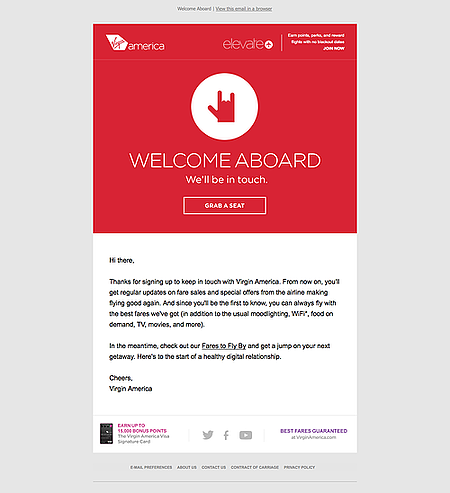
welcome email example: Virgin America welcome email with a red CTA to get started

A welcome email is a perfect medium for introducing folks to the characteristics (and eccentricities) that make your brand unique.

For Virgin America, that means putting the “I love you” hand symbol front and center. This small gesture signals to the recipient that the folks at Virgin America care about their customers. The playful accompanying copy, “Welcome aboard,” and casual call-to-action, “Grab a seat,” also helps to position Virgin America as a hip, fun-loving brand right off the bat.

2. Food52

Type of welcome: Get Started

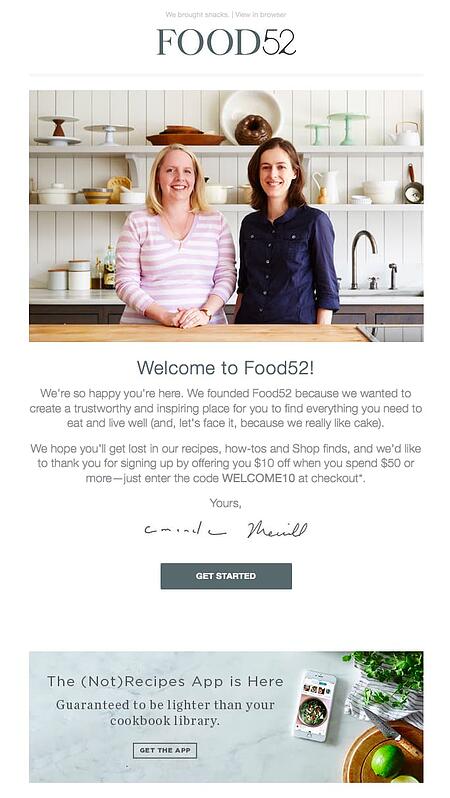
Food52 welcome email with a gray CTA to get started

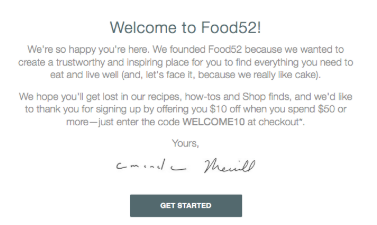
Sometimes the tiniest of elements in a welcome email can speak volumes about a brand. And when it comes to Food52’s welcome email, their preview text at the top of the email, “We brought snacks,” definitely accomplishes this.

Also known as a pre-header or snippet text, the preview text is the copy that gets pulled in from the body of an email and displayed next to (or beneath) the subject line in someone’s inbox. So when you see Food52’s welcome email in your inbox, you get a taste of their brand’s personality before you even open it.

Welcome email example: Food52 preview text

Food52’s welcome email also does a good job of building trust by putting a face (make that two faces) to their name. As soon as you open the email, you see a photograph and message from the company’s founders.

3. Monday.com

Type of welcome: Video

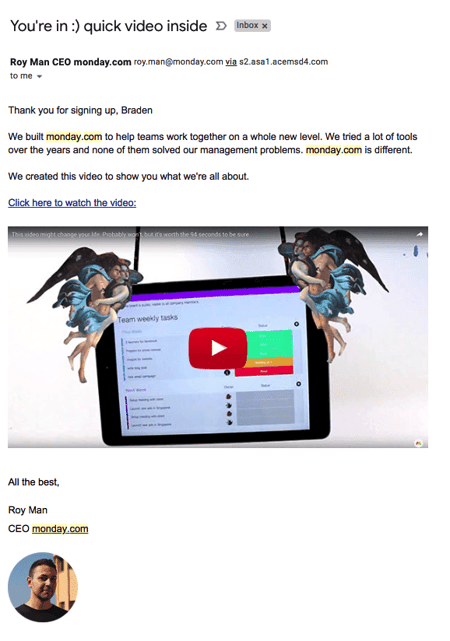
Monday.com welcome email example with a link to watch a video by CEO Roy Man

From the subject line, down to the conversational tone in the email body, the image of a welcome email above keeps it friendly and simple, so the focus stays on the introductory video inside.

Monday.com is a task management tool for teams and businesses, and the welcome email you get when you sign up makes you feel like a CEO, because Roy Man is speaking directly to you. The email even personalizes the opening greeting by using the recipient’s first name, and this is well known for increasing email click-through rates (especially if the name is in the subject line).

The more you can make your email sound like a one-on-one conversation between you and your subscriber, the better. If you have just so many details that you need to inform your new customer about, follow Monday.com’s lead and embed them on a video, rather than spelling them all out on the email itself.

4. Kate Spade

Type of welcome: Thank You

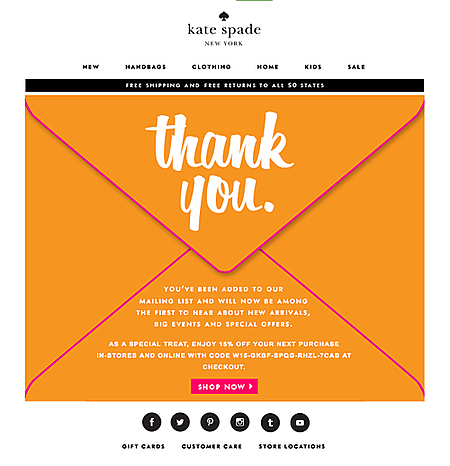
Kate Spade welcome email example with orange envelope graphic saying thank you

Let’s face it, the internet-using public like us are constantly bombarded with prompts to sign up for and subscribe to all sorts of email communications. So as a brand, when someone takes the time to sift through all the chaos in order to intentionally sign up for your email communications, it’s a big deal.

To acknowledge how grateful they are to the folks who actually take their time to subscribe, Kate Spade uses a simple but effective tactic with their welcome emails. They say “Thank You” in big, bold lettering. y placing that “Thank You” note on an envelope, Kate Spade recreates the feeling of receiving an actual thank you letter via mail. (The 15% off discount code doesn’t hurt either.)

5. Lyft

Type of welcome: Get Started

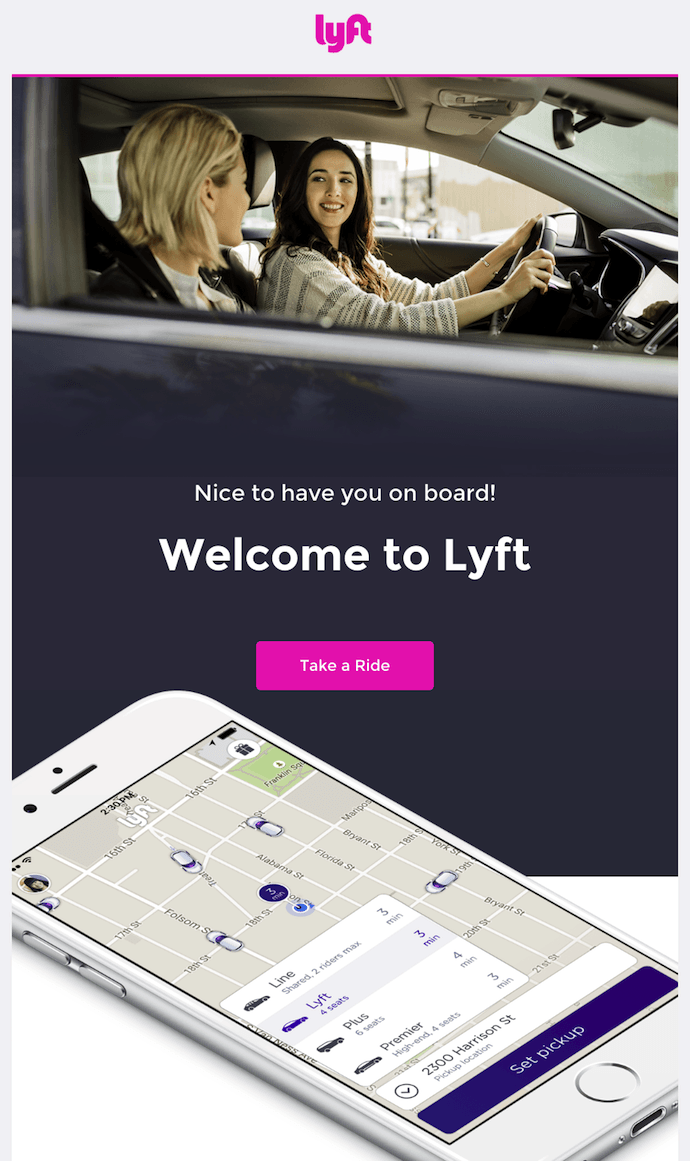
Lyft welcome email example with pink CTA to get started

If there’s an ideal “attitude” that welcome emails should give off, Lyft has it. The company’s simple but vibrant welcome email focuses entirely on the look and feel of the app, delivering a design that’s as warm and smooth as the lifts that Lyft wants to give you. At the same time, the email’s branded pink call-to-action draws your eyes toward the center of the page to “Take a Ride”, an inviting language that doesn’t make you feel pressured as a new user.

6. Munk Pank

Type of welcome: Our Story

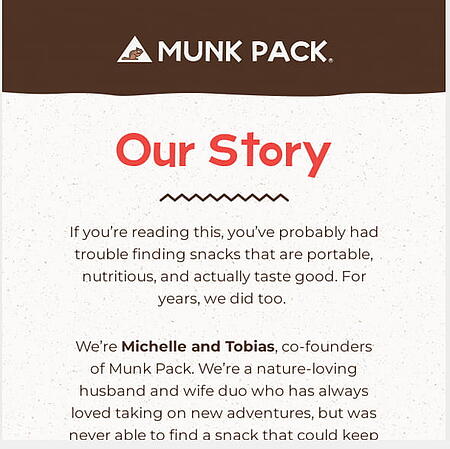
Munk Pank welcome email example

The Munk Pank’s welcome email is the story of why the company was founded. This is a healthy snack store founded by a husband and wife. In their welcome email, they mention that they started the company because they never seemed to find nutritious snacks to keep them energized and on the go.

This is an excellent version of a welcome email because they let their customers know they can relate to the problems they’re facing and they’ve been there. This helps in building trust and relatability; it also gives customers a peek into what they should expect from their products.

The email ends by sharing the company’s mission to help them live a healthy lifestyle. This welcome email lets subscribers know that they’re joining a tribe that is concerned about their healthy eating and lifestyle; a mission that goes beyond snacks.

7. Who Gives a Crap

Type of welcome: Why Us

who gives a crap welcome email example

Who Gives a Crap is an organization that sells organic toilet paper, and they’re very passionate about it. Their welcome email is equally fun and informative. They state all the reasons why you should opt for organic and eco-friendly products. Then, they sweeten the pot (pun intended) by noting that they donate 50% of their profits to global sanitation projects.

The email reminds the buyer that they still get the toilet paper at the same price they do in the supermarket. They also have a compelling call to action in their welcome email that offers 10% of their products for people who subscribe to their email list. The company added their “Shop Now” button for convenience, so if readers are convinced to buy, they can do so in one click.

8. SAXX Underwear

Type of welcome: Offer

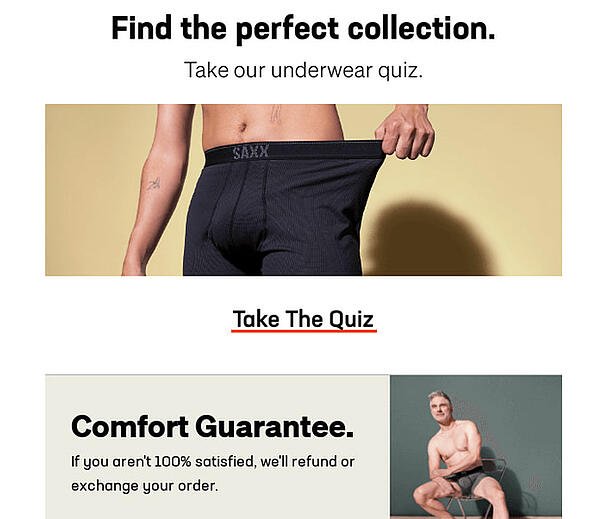
saxx welcome email example

SAXX Underwear specializes in men’s underwear, and their welcome email is very catchy and creative. Their subject line “welcome to you and your balls” is just a taste of how they use a humorous and relatable tone to connect with their audience.

Their welcome email is very visual, too. They demonstrate their comfort guarantee with images of models wearing their boxers.

The welcome email also gives a 10% off code for their first-time buyers and directs them to their store. Besides the offer, they present their refund policy boldly to provide reassurance for prospects who may be unsure. These gestures help to build trust with their new subscribers and encourage them to buy from them.

What really stands out in the SAXX Underwear welcome email is the tone of the copy and the careful yet bold and catchy choice of words.

9. InVision

Type of welcome: Video

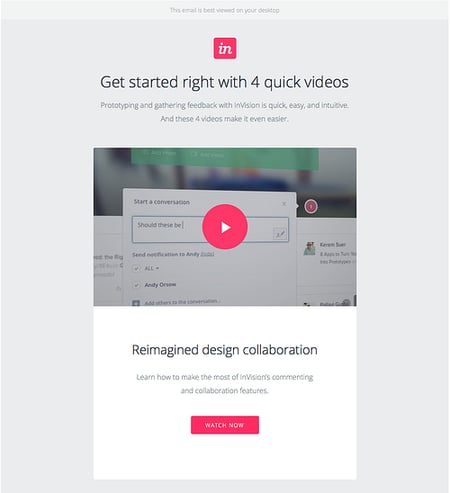
InVision welcome email with link to watch video

When you sign up for InVision’s free prototyping app, the welcome email makes it very clear what your next step should be.

To guide people on how to use InVision’s app, the company’s welcome email doesn’t simply list out what you need to do to get started. Instead, it shows you what you need to do with a series of quick videos. Given the visual, interactive nature of the product, this makes a lot of sense.

10. Drift

Type of welcome: Get Started

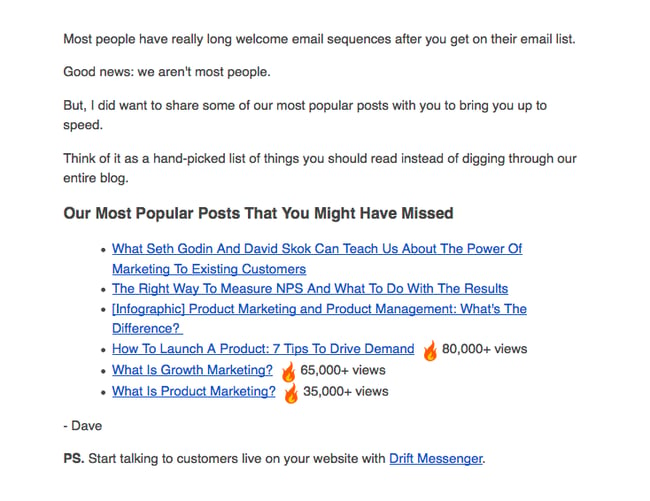
Drift welcome email with link to get started

No fancy design work. No videos. No photos. The welcome email Drift sends out after signing up for their newsletter is a lesson in minimalism.

The email opens with a bit of candid commentary on the email itself. “Most people have really long welcome email sequences after you get on their email list,” Dave from Drift writes, before continuing: “Good news: we aren’t most people.” What follows is simply a bulleted list of the company’s most popular blog posts. And the only mention of the product comes in a brief postscript at the very end.

If you’re trying to craft a welcome email that’s non-interruptive, and laser-focused on adding value instead of fluff, this is a great example to follow.

Bonus Example: HubSpot’s Welcome Email Templates

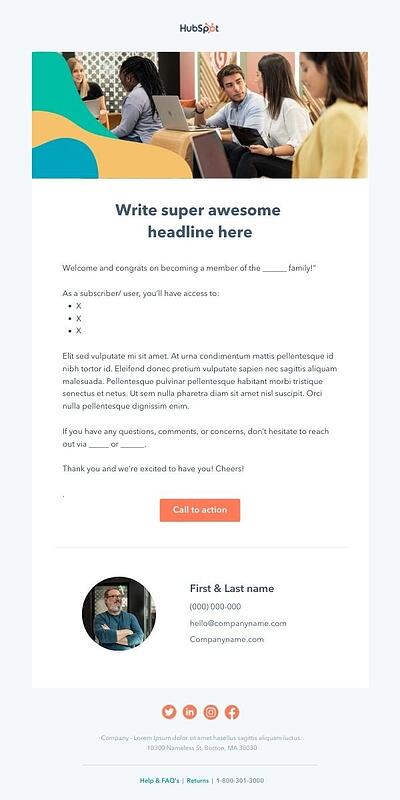
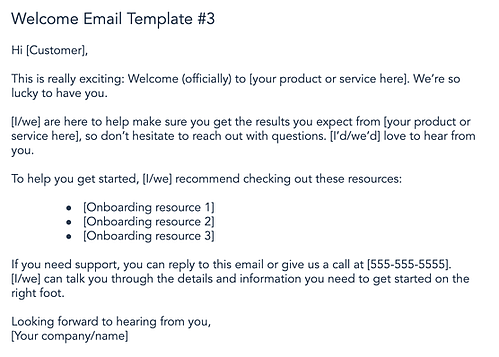
Need a little help in getting your welcome email efforts off the ground? We’ve got you covered with welcome message templates to streamline the connection process. The example below is one of four templates offered in our free kit (which also includes 40+ customer email templates) and showcases a straightforward example of a great welcome email.

Simply fill in the details, tweak the text to reflect your brand voice, and start sending.

customer welcome email template

Now that you’ve seen some great examples of welcome emails, let’s dig into the process of writing a great email and catching customer attention.

1. Write a catchy subject line.

Research shows that while more than 90% of welcome emails are opened, just 23% of them are actually read. That means if your welcome email doesn’t catch the eye of your new customer, they may not know you sent it at all.

The best tool you can leverage to increase email open rates is the subject line. A catchy and actionable subject line can draw customers in and make them curious about your content.

When writing subject lines, be sure to include what your email is promoting and how it will benefit your customer. Remember to be concise, because the reader can only see a sentence or two in the preview. A good rule of thumb is that your subject line should provide enough information to peak the reader’s interest, but not enough so that they need to open your email for the full details.

2. Restate your value proposition.

Although this may seem like an unnecessary step to take, it can actually provide some significant benefits.

The most obvious benefit is that it provides the customer with some reassurance that they made the right decision signing up. It’s never a bad thing to remind customers why they created an account with you, and it clarifies exactly what they can expect to achieve with your product or service.

This also gives you the opportunity to clearly explain any ancillary services or features that you offer that could create more stickiness with your business. This is especially true if you have a complex solution with unique features that customers might not know about.

3. Show the next onboarding steps.

Now that you’ve reminded them why they signed up, get them fully set up with your product or service. Usually, there are steps that users must take after signing up to get the most out of the platform. Examples include:

  • Completing their profile information
  • Setting preferences
  • Uploading necessary information (e.g. contacts into a CRM, profile picture for a social media profile, etc.)
  • Upgrading their account or completing an order

4. Generate the “A-ha” moment.

This is one of the most important steps to take in a welcome email, and there’s a substantial and data-driven reason behind that. Former Facebook head of growth, Chamath Palihapitiya, discovered that if you can get a user to acquire seven friends within 10 days, they were much more likely to see Facebook’s “core value” and become a returning active user. This is known as an “a-ha moment,” in which the customer understands how they benefit from using your product or service.

The goal is to get the user to this aha moment as quickly as possible so your product sticks and the customer achieves success as soon as possible. This will produce a better overall customer experience and ultimately help your business grow.

To get this done, first identify your business’s “core value” and the obstacles or prerequisites customers must complete to receive this value. Then you can use your welcome email to guide new customers through these tasks.

5. Add helpful resources.

As mentioned in the previous step, you want the user to see the value immediately. But, customer success doesn’t stop there. Depending on the nature and complexity of your product, customers may need additional help. For example, customers might require guidance on troubleshooting, utilizing advanced features, or getting the most value out of your core features.

It’s likely that you’ve already created help content addressing common questions from customers. Whether it’s tutorial videos, an FAQ page, or helpful blog posts containing best practices, this help content is essential to customer success. Why not include it in your welcome email? This gives them the tools they need upfront without forcing them to search for the information after a problem arises.

6. Provide customer service contact information.

The final step to setting your customers up for success is making sure that they know how to contact you. You can spend all the time in the world creating excellent help content, but you can’t foresee every possible problem that will arise for your customers.

Even if you could, customers are only human, and not all of them will be willing to pore through your help resources to find the answer to their questions. So it’s best to be forthright with customers on how they can get in touch with you for additional help.

Adding this contact information to your welcome email is a great way to lay the foundation of trust needed for building a relationship. It drives customer loyalty and reassures readers that you are available if they need you. Avoid sending customers on a treasure hunt just to find a way to ask you a simple question. This will lead to frustration and send them into the arms of your competitors.

7. Conclude with a call-to-action.

You should wrap up your welcome email with a call-to-action that entices customers to begin the onboarding process. After you’ve demonstrated your company’s values and explained how you’re going to help them achieve their goals, customers will be eager to get started. So, make things easier for them by providing a button at the end of the email that triggers the first step in the onboarding process.

Here’s one example of what this could look like.

Food52 welcome email example with CTA

How to Write an Employee Onboarding Welcome Email

The onboarding process has a huge impact on how the new employees feel about your company, so it’s important to give it the time and energy it deserves. One of the important parts of this process is the onboarding welcome email. It has to match the company’s tone and outline all the expectations you have for the new employee. If this is your first time writing an onboarding email, you’ll find the following steps helpful.

Here are the steps to follow when writing an onboarding email.

1. Decide on the content of your onboarding email.

Before you start, it’s important that you are aware of the content of an onboarding welcome email.

The contents are going to vary based on the conditions. For example, an email onboarding remote employees is completely different from an onboarding email for an employee who will work onsite.

For an onsite employee, the onboarding email should include:

  • Welcome events
  • First-day schedule
  • Arrival instructions
  • How to access their workstation
  • Break room details (where to warm lunch, get coffee, etc.)
  • Dress code
  • What they’re required to bring (passport, ID, social security work, or any other paperwork)
  • Parking information
  • Contact information

For a remote employee, the content may include:

  • First-day schedule
  • Contact information
  • Sign up details for collaboration tools
  • Welcome video conference meeting (time to be held)

Again, you can change the content based on your company’s needs.

2. Decide on the tone you want to use in your email.

The next thing you need to decide on is the tone you want to use in your onboarding email. Do you consider your company friendly, casual, or super formal? Whatever your answer is, it should reflect on the tone of the onboarding email. This gives the employee an idea of the kind of workplace environment they should expect. It also sets the tone for how your new employee is expected to use when representing your brand.

3. Draft your onboarding email.

The next step is to draft your onboarding email. While the tone of your email might change to fit your needs, here is an example of a template you can use.

Dear [Employee’s name],

We are very excited to welcome you to [company name]. Please remember to carry your ID to get easy access to our premises. We expect you to be in the office by [time], and our dress code is [formal/super casual].

At [company name], we pride ourselves on creating the best environment for our employees. As you’ll see, our team has already prepared your workstation for you and set up your software to make your first day easy. You’ll also be given access to your designated parking spot, a customized company bag, t-shirt, and mugs, among other goodies.

Our team has also planned all the details for your first week to ensure you settle easily. You’ll receive a document with your schedule and agendas for your first week from HR when you arrive. Human Resources will also help you fill in the required paperwork and answer all your questions. After the meeting with HR, you’ll be assigned a mentor who will show you the ropes in our company and how we get things done.

Our team is excited to meet you during the [planned event].

If you need any clarity prior to arrival, please reach out to me by phone [phone number] or email. I’ll be more than happy to help.

Welcome to the [company name], [employee name]. We are looking forward to working with you and watching you grow and soar to greater heights!

Warm Regards,

[your name]

[your signature]

4. Edit your email.

After writing your email, make sure you edit it to ensure you include all the necessary details. You can also use tools like Grammarly for any grammatical errors. You can also have a colleague double-check the email. Remember to attach any necessary documents, links, or images as supplemental information.

5. Send or schedule the email.

Lastly, send the email or schedule it to ensure it is received in a timely manner. For example, you want to avoid sending an onboarding welcome email on Sunday evening, which may give the wrong impression.

This will allow the new Employee to be psychologically prepared and find the necessary documents.

Make a Great First Impression

Bottom line? Whether it’s in-person, over the phone, or by email, first impressions matter. Your welcome email is often the first chance a prospective customer or contact has to see what your brand is all about and if you don’t stick the landing, they’ll likely go somewhere else.

Luckily, writing a great welcome email is simple. It’s not necessarily easy, but if you focus on what matters such as compelling subject lines, great content, personalized offers, and always, always a way to opt-out, your first impression can help lay the groundwork for long-term relationships.

Editor’s note: This post was originally published in April 2016 and has been updated for comprehensiveness.

customer onboarding templates

Categories B2B

The Ultimate Guide to Google Ads [Examples]

If you’re considering spending any amount of money on ads to reach your target audience, you’d better spend it in the right place.

That is, somewhere with over 2.9 billion unique monthly visitors and 5 billion daily interactions.

Somewhere like Google.

Google Ads was launched just two years after what has become the most popular website in the world: Google.com. The advertising platform came on the scene in October 2000 as Google Adwords, but after some rebranding in 2018, it was renamed Google Ads.

Free Guide, Template & Planner: How to Use Google Ads for Business

Given Google’s expansive reach, chances are you’ve seen (and probably clicked on) a Google ad, and so have your potential customers.

It’s no secret that these days, the stronger and more focused your paid campaigns are, the more clicks you generate — leading to a greater probability of obtaining new customers.

Little wonder then that Google Ads has become increasingly popular among businesses across all industries.

In this guide, you’ll discover how to begin advertising on Google. We’ll cover features specific to the platform and teach you how to optimize your campaigns to achieve the best results with your ads.

What is Google Ads?

Google Ads is a paid advertising platform that falls under a marketing channel known as pay-per-click (PPC), where you (the advertiser) pay per click or impression (CPM) on an ad.

Google Ads is an effective way to drive qualified traffic, or good-fit customers, to your business who’re searching for products and services like the ones you offer. With Google Ads, you can boost your website traffic, receive more phone calls, and increase in-store visits.

Google Ads allows you to create and share well-timed ads (via both mobile and desktop) among your target audience. As a result, your business will show up on the search engine results page (SERP) at the moment your ideal customers are looking for products and services like yours via Google Search or Google Maps.

This way, you reach your target audience when it makes sense for them to come across your ad.

Note: Ads from the platform can span across other channels, too, including YouTube, Blogger, and Google Display Network.

Over time, Google Ads will also help you analyze and improve those ads to reach more people so your business can hit all of your paid campaign goals.

Discover how HubSpot can help you better manage your Google Ads.

Additionally, no matter the size of your business or your available resources, you can tailor your ads to suit your budget. The Google Ads tool allows you to stay within your monthly cap and even pause or stop your ad spending at any point in time.

Now, onto another critical question: Is Google Ads really effective? To answer this, let’s consider a few statistics:

  • Google Ads has a click-through rate of nearly 2%.
  • Display ads yield 180 million impressions each month.
  • For users ready to buy, paid ads on Google get 65% of the clicks.
  • 43% of customers buy something they’ve seen on a YouTube ad.

Why advertise on Google?

Google is the most used search engine, receiving over 5 billion search queries daily. Not to mention, the Google Ads platform has been around for nearly two decades, giving it some seniority and authority in paid advertising.

Google is a resource used by people worldwide to ask questions answered with a combination of paid advertisements and organic results.

Need another reason? Your competitors are using Google Ads (and they might even be bidding on your branded terms).

Hundreds of thousands of companies use Google Ads to promote their businesses, which means that even if you’re ranking organically for a search term, your results are being pushed down the page beneath your competitors.

If you’re using PPC to advertise your product or services, Google Ads should be a part of your paid strategy — there’s no way around it (except maybe Facebook Ads, but that’s another article).

Google Ads Best Practices

If you’ve tried unsuccessfully to advertise on Google, don’t give up. There are many reasons why your Google Ads could be underperforming. But, first, let’s cover some standard Google Ads best practices.
1. Use a PPC planning template.

google ads ppc planning template from hubspot

Download this Template for Free

Using a planner keeps your PPC projects organized. With Google and HubSpot’s PPC Planning Template, you can view how your ads will appear online, see your character counts, and manage your campaigns all in one place.

2. Avoid broad keyword terms.

You really need to nail it for your keywords, which is why testing and tweaking should be a part of your strategy. If your keywords are too broad, Google will be placing your ad in front of the wrong audience, which means fewer clicks and a higher ad spend.

Review what’s working (i.e., which keywords generate clicks) and adjust them to best match your ads with your target audience. You likely won’t get the mix right the first time, but you should keep adding, removing, and tweaking keywords until you do.

Tip: Review the keyword strategies that we cover below.

3. Don’t run irrelevant ads.

If your ad doesn’t match the searcher’s intent, you won’t get enough clicks to justify your ad spend. Your headline and ad copy need to match the keywords you’re bidding on, and the solution your ad is marketing needs to solve whatever pain point that searcher is experiencing.

It’s a combination that will yield the results you’re looking for, and it may just be a few tweaks away. You have the option to create multiple ads per campaign — use this feature to split test which ads work best. Or, better yet, use Google’s Responsive Search Ads feature.

Tip: Read our best practices for ad copy.

4. Improve your Quality Score (QS).

Your Quality Score (QS) is how Google determines how your ad should rank.

The higher your QS, the better your rank and placements on the Search Engine Results Page (SERP). If your quality score is low, you’ll have fewer eyeballs on your ad and fewer chances to convert.

Although Google lets you know your Quality Score, it’s your responsibility to improve it.

Tip: Keep reading to learn how to improve your QS.

5. Optimize your ad landing page.

Your efforts shouldn’t stop with your ad — the user experience after a click is equally essential.

What does your user see once they click your ad? Is your landing page optimized for conversions? Does the page solve your user’s pain point or answer their question? Your user should experience a seamless transition through the conversion process.

Tip: Review landing page best practices and implement them to increase your conversion rate.

These common terms will help you set up, manage, and optimize your Google Ads. Some of these are specific to Google Ads, while others are generally related to PPC. Either way, you’ll need to know these to run an effective ad campaign.

1. AdRank

Your AdRank determines your ad placement. The higher the value, the better you’ll rank, the more eyes will fall on your ad, and the higher the probability of users clicking your ad. Your AdRank is determined by your maximum bid multiplied by your Quality Score.

2. Bidding

Google Ads is based on a bidding system, where you, as the advertiser, select a maximum bid amount you’re willing to pay for a click on your ad. The higher your bid, the better your placement. You have three options for bidding: CPC, CPM, or CPE.

  • CPC, or cost-per-click, is the amount you pay for each click on your ad.
  • CPM, or cost per mille, is the amount you pay for one thousand ad impressions; that is when your ad is shown to a thousand people.
  • CPE, or cost per engagement, is the amount you pay when someone takes a predetermined action with your ad.

And, yes, we’ll review bidding strategies below.

3. Campaign Type

Before you begin a paid campaign on Google Ads, you’ll select between seven campaign types: search, display, video, shopping, app, smart, or performance max.

  • Search ads are text ads that are displayed among search results on a Google results page.
  • Display ads are typically image-based and are shown on web pages within the Google Display Network.
  • Video ads are between six and 15 seconds and appear on YouTube.
  • Shopping campaigns appear on search results and the Google shopping tab.
  • App campaigns use information from your app to optimize ads across websites.
  • Smart campaigns have Google finding the best targeting to get you the most bang for your buck.
  • Performance Max is a new campaign type that lets advertisers access all Google Ads inventory from a single campaign.

4. Click-Through Rate (CTR)

Your CTR is the number of clicks you get on your ad as a proportion of the number of views your ad gets. A higher CTR indicates a quality ad matching search intent and targeting relevant keywords.

5. Conversion Rate (CVR)

CVR is a measure of form submissions as a proportion of total visits to your landing page. Simplistically speaking, a high CVR means that your landing page presents a seamless user experience that matches the ad’s promise.

6. Display Network

Google ads can be displayed on either search results pages or a web page within Google’s Display Network (GDN). GDN is a network of websites that allow space on their web pages for Google Ads — these ads can be text- or image-based and are displayed alongside content relevant to your target keywords. The most popular Display Ad options are Google Shopping and app campaigns.

7. Extensions

Ad Extensions allow you to supplement your ad with additional information at no extra cost. These extensions fall under one of five categories: Sitelink, Call, Location, Offer, or App; we’ll cover each of these ad extensions below.

8. Keywords

When a Google user types a query into the search field, Google returns a range of results that match the searcher’s intent. Keywords are words or phrases that align with what a searcher wants and will satisfy their query. You select keywords based on which queries you want to display your ad alongside. For example, a searcher that types “how to clean gum off shoes” will see results for advertisers that targeted keywords like “gum on shoes” and “clean shoes.”

Negative keywords are a list of keyword terms that you do not want to rank for. Google will pull you from the bid on these keywords. Typically, these are semi-related to your intended search terms but fall outside of the realm of what you offer or want to rank for.

9. PPC

Pay-per-click, or PPC, is a type of advertising where the advertiser pays per click on an ad. PPC is not specific to Google Ads, but it is the most common type of paid campaign. It’s important to understand the ins and outs of PPC before launching your first Google Ads campaign.

10. Quality Score (QS)

Your Quality Score measures the quality of your ad by your click-through rate (CTR), the relevance of your keywords, the quality of your landing page, and your past performance on the SERPs. QS is a determining factor in your AdRank.

Click to get our free guide on how to use Google Ads.

How does Google Ads work?

Google Ads displays your ad to potential leads or customers who are interested in your product or service. Advertisers bid on search terms, or keywords, and the winners of that bid are placed at the top of search results pages, on YouTube videos, or on relevant websites, depending on the type of ad campaign selected.

Many factors impact your ability to create effective and high-performing Google Ads. Let’s cover them below, plus some Google Ads examples.

AdRank and Quality Score

AdRank determines the placement of your ads, and Quality Score is one of the two factors (the other being bid amount) that determines your AdRank. Remember, your Quality Score is based on the quality and relevance of your ad, and Google measures that by how many people click on your ad when it’s displayed — i.e., your CTR. Your CTR depends on how well your ad matches searcher intent, which you can deduce from three areas:

  1. The relevance of your keywords
  2. If your ad copy and CTA deliver what the searcher expects based on their search
  3. The user experience of your landing page

Your QS is where you should focus most of your attention when you first set up your Google Ad campaign — even before you increase your bid amount. The higher your QS, the lower your acquisition costs will be and the better placement you’ll get.

Location

When you first set up your Google Ad, you’ll select a geographical area where your ad will be shown. If you have a storefront, this should be within a reasonable radius around your physical location. If you have an ecommerce store and a physical product, your location should be set in the places where you ship. If you provide a service or product that is accessible worldwide, then the sky’s the limit.

Your location settings will play a role in placement. For instance, if you own a yoga studio in San Francisco, someone in New York that enters “yoga studio” will not see your result, no matter your AdRank. That’s because Google’s main objective is to display the most relevant results to searchers, even when you’re paying.

Keywords

Keyword research is just as important for paid ads as it is for organic search. Your keywords need to match searcher intent as much as possible. That’s because Google matches your ad with search queries based on the keywords you selected.

Each ad group that you create within your campaign will target a small set of keywords (one to five keywords is optimal), and Google will display your ad based on those selections.

Match Types

Match Types give you a little wiggle room when it comes to your keyword selections — they tell Google whether you want to match a search query exactly or if your ad should be shown to anyone with a search query that’s semi-related. There are four match types to choose from:

  • Broad Match is the default setting that uses any word within your keyword phrase in any order. For example, “goat yoga in Oakland” will match “goat yoga” or “yoga Oakland.”
  • Modified Broad Match allows you to lock in certain words within a keyword phrase by denoting them with a “+” sign. Your matches will include that locked-in word at the very least. For example, “+goats yoga in Oakland” could yield “goats,” “goats like food,” or “goats and yoga.”
  • Phrase Match will match with queries that include your keyword phrase in the exact order but may include additional words before or after it. For example, “goat yoga” can yield “spotted goat yoga” or “goat yoga with puppies.”
  • Exact Match maintains your keyword phrase as it is written in the exact order. For example, “goat yoga” will not show up if someone types “goats yoga” or “goat yoga class.”

If you’re just starting out and don’t know precisely how your persona will be searching, move from a broad match to a more narrow approach so you can test which queries yield the best results. However, since your ad will be ranking for many queries (some unrelated), you should keep a close eye on your ads and modify them as you can gain new information.

Headline and Description

Your ad copy can be the difference between a click on your ad and a click on your competitor’s ad. Therefore, it’s important that your ad copy matches the searcher’s intent, is aligned with your target keywords, and addresses the persona’s pain point with a clear solution.

To illustrate what we mean, let’s review an example.

google ads copy and headline

A search for “baby swim lessons” yielded this result. The copy is concise and uses limited space wisely to convey its message and connect with its target audience.

The Swim Revolution knew to put the keyword in their headline, so we instantly know that this ad matches what we’re looking for. Furthermore, the description tells us why this is the best option for swim lessons because it addresses the concerns of their persona — a parent looking to enroll their baby in a swim class.

They use words like “skills,” “fun,” “confidence,” and “comfort in the water” to ease our nerves about putting a baby in a pool and to prove to us that we will get what we want out of this class — an infant that can swim.

This kind of ad copy will get you clicks, but conversions will result from carrying this level of intention into your landing page copy.

Ad Extensions

If you’re running Google Ads, you should be using Ad Extensions for two reasons: they’re free, and they give users additional information and another reason to interact with your ad. These extensions fall within one of these five categories:

  • Sitelink Extensions extend your ad — helping you stand out — and provide additional links to your site that offer users more enticing reasons to click.
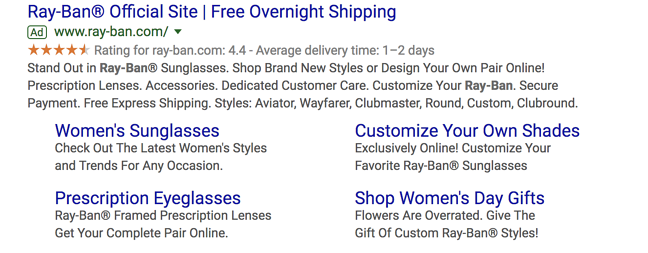
google ads sitelink extensions

  • Call Extensions allow you to incorporate your phone number in your ad, so users have an additional (and instant) way to reach out to you. If you have a customer service team that is ready to engage and convert your audience, then include your phone number.

google ads call extensions

  • Location Extensions include your location and phone number within your ad so Google can offer searchers a map to find you easily. This option is great for businesses with a storefront, and it works well for the search query “…near me.”

google ads location extensions

  • Offer Extensions work if you’re running a current promotion. It can entice users to click your ad over others if they see that your options are discounted compared to your competitors.
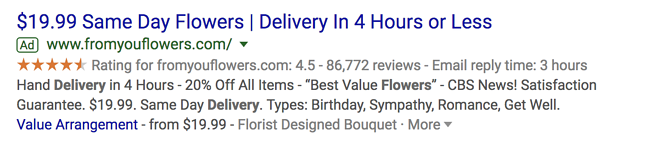
google ads offer extensions

  • App Extensions provide a link to an app download for mobile users. This reduces the friction of performing a new search to find and download the app in an AppStore.
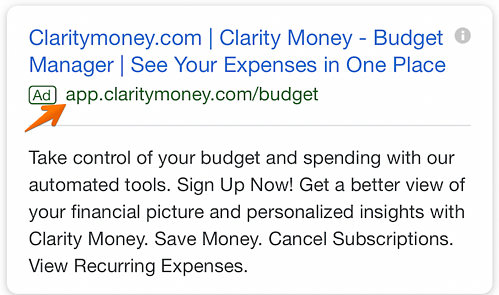
google ads app extensions

Google Ads Retargeting

Retargeting (or remarketing) in Google Ads is a way to advertise to users who have previously interacted with you online but have not yet converted. Tracking cookies will follow users around the web and target these users with your ads. Remarketing is effective since most prospects need to see your marketing multiple times before becoming a customer.

You can select from one of five campaign types on Google Ads. Let’s cover the optimal uses for each and why you might choose one over the other.

1. Search Ad Campaigns

Search ads are text ads that are displayed on Google results pages. As an example, a search for “pocket squares” returns sponsored results:
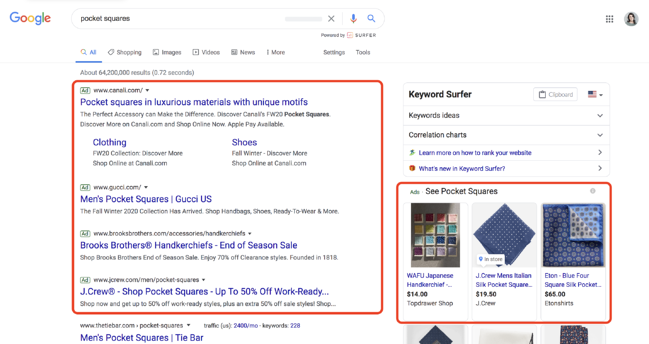
types of google ads search ads campaigns

The benefit of search ads is that you’re displaying your ad in the place where most searchers look for information first — on Google. And Google shows your ad in the same format as other results (except for denoting it as an “Ad”), so users are accustomed to seeing and clicking on results.

Responsive Search Ads

Responsive search ads allow you to enter multiple versions of headlines and ad copy (15 and four variations, respectively) for Google to select the best performers to display to users. With traditional ads, you create one static version of your ad, using the same headline and description each time.

Responsive ads allow for a dynamic ad that is auto-tested until you arrive at the version that is best suited for your target audience — for Google, that means until you get the most clicks.

2. Display Ad Campaigns

Google has a network of websites in various industries and with an array of audiences that opt in to display Google Ads, known as the Google Display Network. The benefit to the website owner is that they’re paid per click or impression on the ads. The benefit to advertisers is that they can get their content in front of audiences that are aligned with their personas.

These are typically image ads that draw users’ attention away from the content on the webpage:

google ads display ad

Image Source

3. Video Ad Campaigns

videos. Remember, YouTube is a search engine, too. So the right keywords will place you in front of a video, disrupting the user’s behavior just enough to grab their attention.

Here’s a video advertisement that pops up in the middle of another video on how to tie a tie:

youtube-trueview-in-stream-ads

Image Source

4. App Ad Campaigns

Google App Campaigns promote your mobile application through an ad displayed on Google Search Network, YouTube, Google Play, Google Display Network, and more.

You can run ads that encourage your audience to install your app or, if they already use it, to take a certain action within your app.

Unlike other ad types, you don’t design an App ad campaign. Instead, provide Google with your app’s information and audience, and place a bid. Google does the rest to get your app in front of the right eyes:
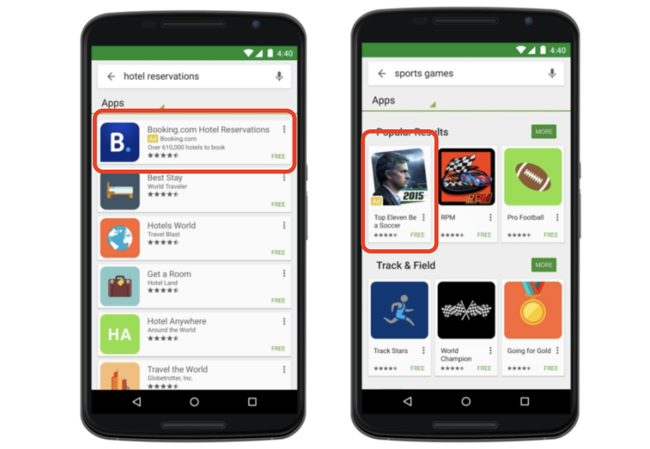
types of google ads app ads campaigns

Image Source

5. Shopping Ad Campaigns

Another type of Google Ad is Google Shopping Ad Campaigns. Shopping campaigns, like these other types of ads, are displayed on SERPs and include detailed product information such as price and product imagery. You can run a Shopping campaign through Google Merchant Center, where you input specific product information that Google pulls from to create your shopping ads.

Instead of marketing your brand as a whole, Shopping Ads allow you to promote specific products and product lines. That’s why, when you search for a particular product on Google, you’ll see ads for different brands pop up along the top and/or side. This is what I see when I search “running shoes.” The ads at the top are Google Search ads, but the specific products advertised on the side are Shopping ads optimized for the keyword “running shoes”:
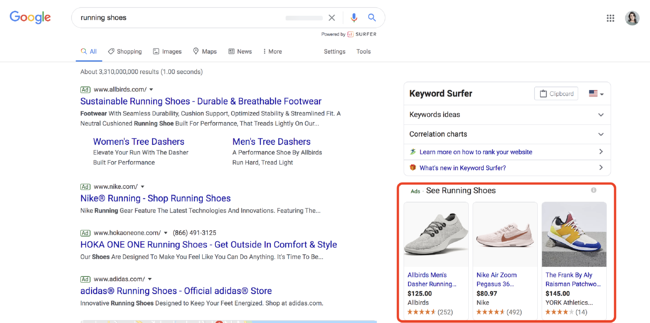
types of google ads google shopping ads

How to Use Google Ads

Convinced that you should start using Google Ads? Good. Getting started is simple, but requires a few steps. Here’s a step-by-step guide for setting up your first campaign on Google Ads.

1. Set up your Google Ads account.

First, go to the Google Ads homepage. On the top right-hand corner, click on ‘Start Now.’

how to use google ads: set up account

You’ll be directed to sign in with a Google account or set up a new one.

2. Choose your business name and website. 

After signing in, you’ll be taken to a page where you’ll provide your business name and website. The URL you provide is where anyone who clicks on your ad will be taken.
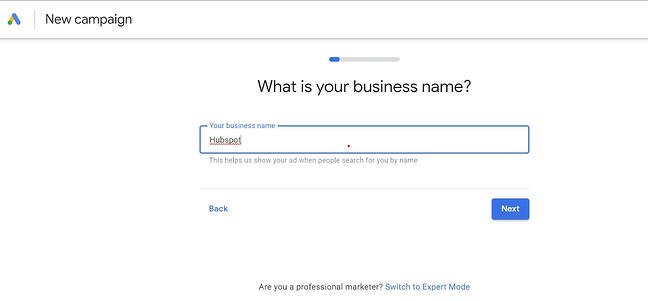
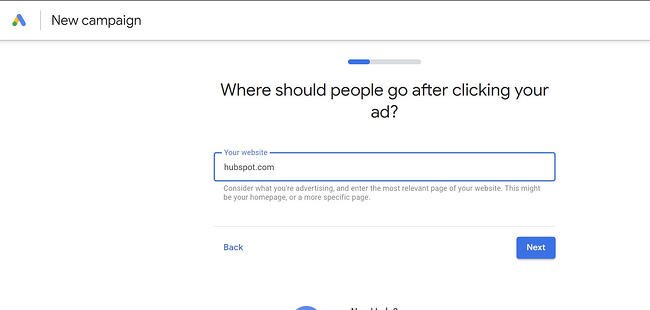
how to use google ads: choose business name

how to use google ads: landing page url

3. Select your advertising goal.

Next, select your main advertising goal. You have four options: Get more calls, get more website sales or sign-ups, get more visits to your physical location, and get more views and engagement on YouTube.
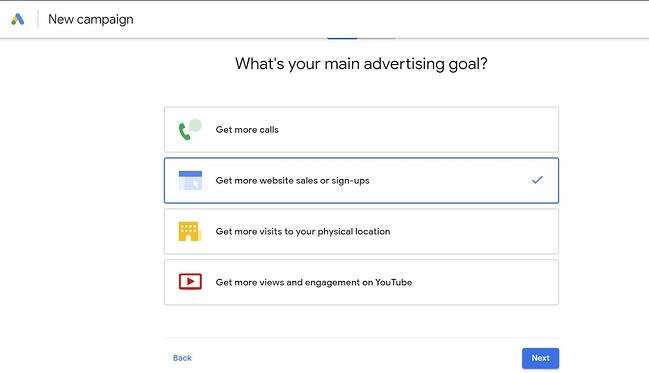
how to use google ads: advertising goal

4. Craft your ad.

The next step is to create your ad. This requires creativity and can be a bit challenging.

Thankfully, Google gives you tips on what to write. But, of course, the most important thing is to write an ad that’ll attract and convert your audience.
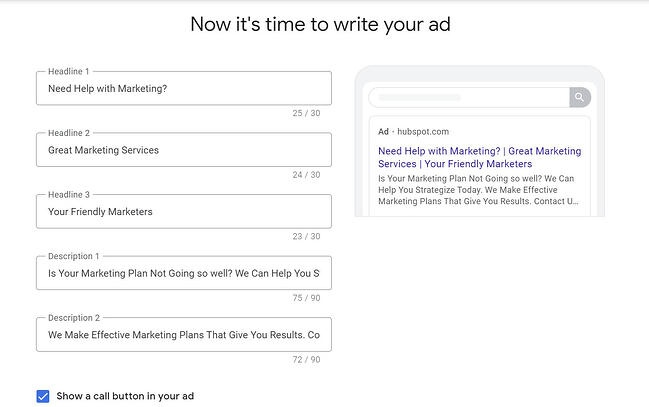
how to use google ads: write ad copy

5. Add keyword themes.

On the next page, you can choose keywords that match your brand. Google will suggest a few for you; if you’re not familiar with keyword research, we suggest selecting the ones Google has suggested to start. After selecting the right keywords, click ‘Next.’
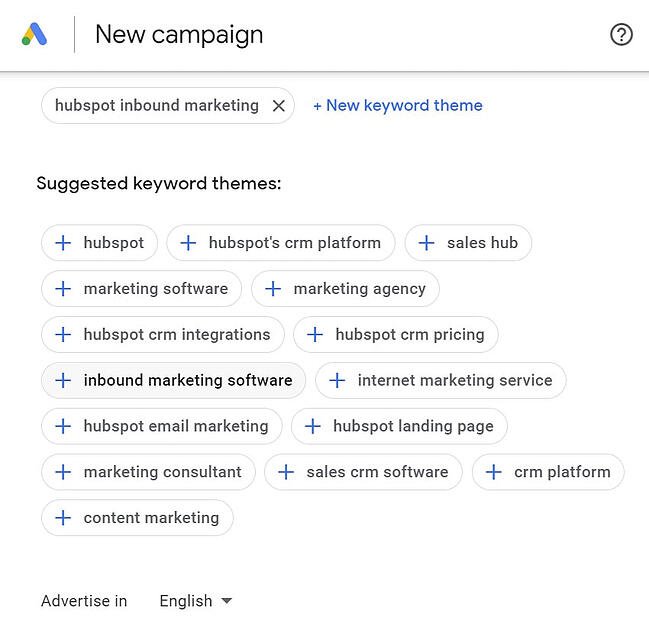
how to use google ads: keyword themes

6. Set your ad location.

The next page lets you choose the location or locations where you want your ad to appear. It can be near your physical address or anywhere else.
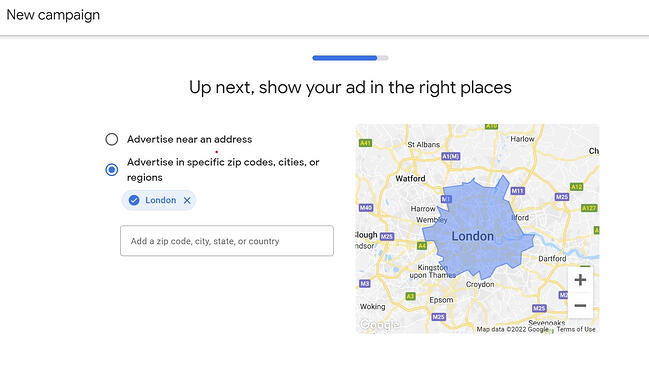
how to use google ads: ad location

7. Set your budget.

Here, you’ll either use the budget options offered by Google or enter a specific budget.
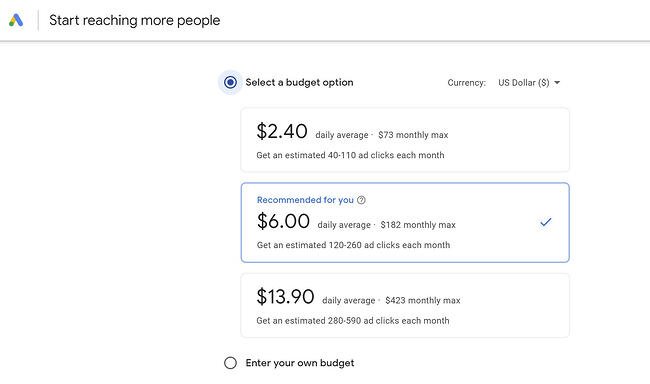
how to use google ads: budget

8. Confirm payment.

Lastly, provide your billing information.
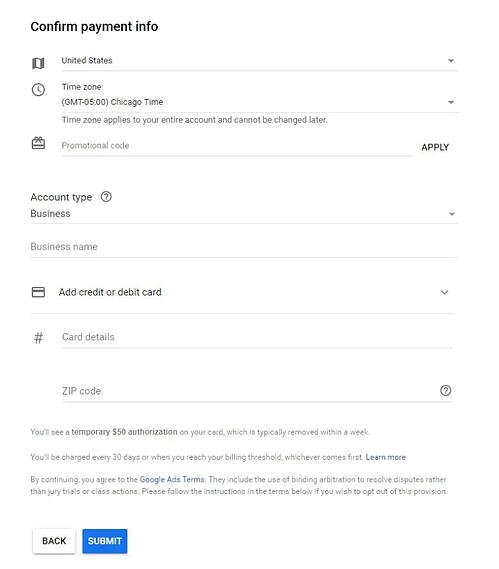
how to use google ads: billing information

And that’s how easy it is to create your first Google ad!

As you can see, setting up your paid campaigns on Google is relatively easy (and quick), mostly because the platform takes you through the setup and provides helpful hints along the way. If you have your ad copy and/or images created, the setup should take you no more than 10 minutes.

What may be less obvious are all the additional things you need to do to make sure your ads are optimally set up and easily trackable. Let’s cover these together. These are the steps you’ll take once your ads are submitted for review.

9. Link your Google Analytics account.

You likely have Google Analytics set up on your website (if not, here’s how to do it on WordPress) so you can track traffic, conversions, goals, and any unique metrics. You also need to link your Analytics account to Google Ads. Linking these accounts will make tracking, analyzing, and reporting between channels and campaigns much easier because you can view these events in one place.
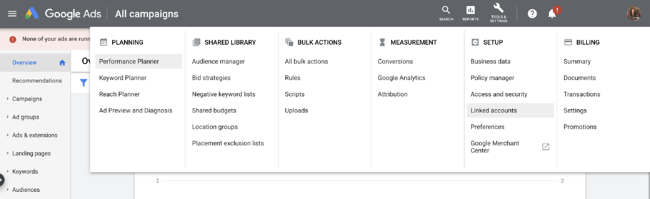
google ads link google analytics

10. Add UTM codes.

Urchin Tracking Module (UTM) codes are used by Google to track any activity associated with a specific link. You’ve probably seen them before — it’s the part of a URL that follows a question mark (“?”). UTM codes will tell you which offer or ad led to a conversion so you can track the most effective parts of your campaign. UTM codes make it easier to optimize your Google Ads since you know exactly what’s working.

The trick, though, is to add your UTM codes at the campaign level when you set up your Google Ads, so you don’t have to do so manually for each ad URL. Otherwise, you can add them manually with Google’s UTM builder.
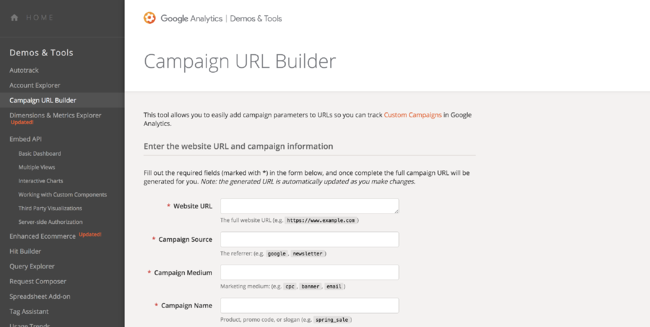
google ads set up utm codes google campaign url builder

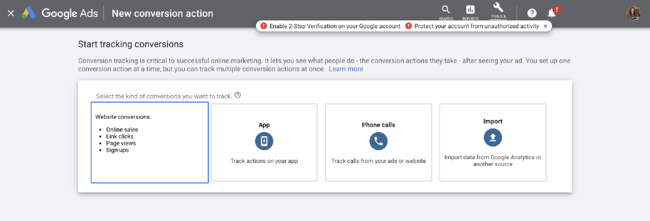
11. Set up conversion tracking.

Conversion tracking tells you exactly how many customers or leads you’ve acquired from your ad campaigns. It’s not mandatory to set up, but, without it, you’ll be guessing the ROI of your ads. Conversion tracking allows you to track sales (or other activities) on your website, app installs, or calls from your ads.
google ads conversion tracking

Manage and organize your ads with our free Google Ads Kit and Templates.

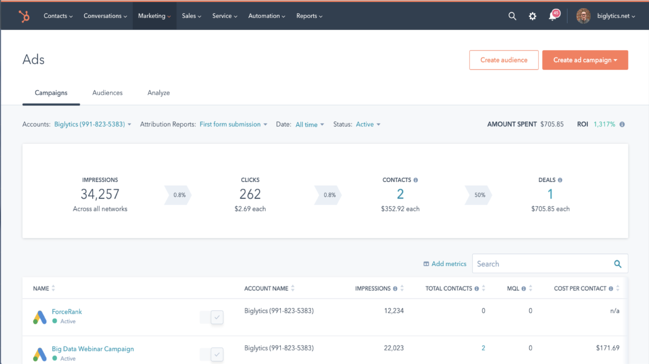
12. Integrate your Google Ads with your CRM.

There is something to be said about keeping all of your data in one place where you can track, analyze, and report on it. You already use your CRM to track contact data and lead flows. Integrating Google Ads with your CRM gives you the ability to track which ad campaigns are working for your audience so you can continue marketing to them with offers that are relevant.
google ads integration hubspot crm

Source

Google Ads Bidding Strategies

Once you’ve set up your ad campaigns and have tracking in place, it’s time to start bidding. Remember, your ability to rank in Google Ads depends on how you bid. While your bid amount will depend on your budget and goals, there are a few strategies and bid settings you should be aware of when launching your paid campaign.

Automated vs. Manual Bidding

You have two options when it comes to bidding on your keywords — automated and manual. Here’s how they work:

  • Automated Bidding puts Google in the driver’s seat and allows the platform to adjust your bid based on your competitors. You can still set a maximum budget, and Google will work within a range to give you the best chance at winning the bid within those constraints.
  • Manual Bidding lets you set the bid amounts for your ad groups and keywords, giving you the chance to reduce spending on low-performing ads.

Bidding on Branded Search Terms

Branded terms are those with your company or unique product name in them, like “HubSpot CRM.” There is much debate on whether to bid on your branded terms or not. On one side of the debate, bidding on terms that will likely yield organic results could be seen as a waste of money.

On the other side, bidding on these terms gives you domain over these search results pages and helps you convert prospects that are further along the flywheel. For instance, if I’ve been researching live chat tools and am heavily considering HubSpot’s Live Chat, then a simple search for “HubSpot live chat software” will yield precisely the result I’m looking for without the effort of scrolling.

The other argument in favor of bidding on your branded terms is that competitors may bid on them if you don’t, thereby taking up valuable real estate that should belong to you.

Cost Per Acquisition (CPA)

If the idea of spending money to convert prospects into leads makes you uneasy, then you can set a CPA instead and only pay when a user converts into a customer. While this bidding strategy could cost more, you can take comfort in knowing that you only pay when you acquire a paying customer. This strategy makes it easy to track and justify your ad spend.

Additional Resources to Optimize Your Google Ads

Your ad copy and headline is not the only component that will make your paid campaign successful. Getting a user to click is only the beginning … they should arrive on a landing page that’s optimized for conversion and then be taken to a Thank You page that tells them what to do next.

If you want your Google Ads to produce qualified leads and customers, then check out these additional resources and use them as guidelines as you set up your Google Ads campaign.

Google Ads Tips

Now that you know how to use and set up a Google Ad campaign, here are a few short tips or best practices to follow to help you create successful campaigns.

We’ve covered these at length throughout this post, but their importance can’t be overstated. Use this as a checklist you can refer to again and again.

1. Have a clear goal.

It’s vital to define your objectives before you create your ad, instead of creating an ad first and then tweaking it to fit your objectives. Sit down with your marketing team to prepare an advertising plan and create SMART goals for your Google Ads campaigns.

2. Create a relevant landing page.

When prompted to add your URL when creating your ad, ensure that the URL you provide leads to a relevant landing page. If your ad is interesting enough to get clicked, you could undo all that great work if it directs them to a poor landing page.

Therefore, optimize your landing pages so that your ad will help convert a curious visitor into a paying customer. Check out our landing page guide so you know exactly how to create great landing pages.

3. Use the right keywords.

Keywords are super important, so it’s only right that you choose the best ones for your ad.

Long-tail keywords are some of the best types of keywords because they are very specific and can target one business.

For example, say you run a cat clinic. A generic keyword like ‘cat clinic’ won’t target people in your area, but something like ‘cat clinic in belvedere’ is more likely to attract the right audience.

4. Automate the process.

You can maximize conversions by optimizing the bidding process. Tools like Smart Bidding can increase or reduce bids for you, depending on the chance of success.

Therefore, you’ll spend money only when there’s a higher chance of success.

5. Use Ad Extensions.

Extensions can take your ad performance up a notch. These extensions allow you to specify your locations, services, goods, or sales promotions.

For example, you could include a telephone number in your ad so people can call you to inquire about your services right away.

6. Use negative keywords.

Google Ads allows you to include negative keywords. Using these keywords indicates what your product or service is not, thus preventing you from showing up in irrelevant SERPs.

Using the cat clinic example, you might only cater to cats and not dogs or other pets. In this case, you can exclude terms like ‘dogs’ and other qualifiers.

7. Measure and improve upon your strategy.

When you integrate your ads with Google Analytics, you can track important metrics like page popularity, the keywords that drive the most traffic, and more.

Collecting and analyzing these and other metrics will help you improve the quality of your ads, boost your conversions, and increase revenue over time.

Start Your Google Ads Campaign

Given its reach and authority, Google Ads should be a part of your paid strategy. Use the tips we covered to get started, and remember to refine and iterate as you go.

There’s no such thing as a Google Ads campaign that doesn’t work — there are only ones that need a bit more work. Using the strategy and information provided above, you have what you need to create a successful Google Ad campaign that drives clicks and converts leads.

Editor’s note: This post was originally published in November 2015 and has been updated for comprehensiveness.
New Call-to-action

Categories B2B

Twitter Power Users: What They Are & How to Become One

Twitter has more than 192 million daily active users — a number that is projected to continue growing over the coming years. However, that the platform has millions of users doesn’t guarantee that you’ll become a Twitter power user or that you’ll get thousands of followers, even if you tweet regularly.

Gaining followers and engagement on Twitter is easier said than done. Despite your best efforts, it can seem like you’re screaming into a void. Nevertheless, the good news is that it’s possible to grow a following and become a power user on Twitter.

In this article, we’ll consider what differentiates Twitter power users from the rest and how you can become a power user too.

Download Now: How to Use Twitter for Business [Free Kit]

The term also refers to people who spend plenty of time using a system, app, or tool. And their near-obsession with the device, app, or system gives them a higher mastery over it than casual users.

According to research by the Pew Research Center, 10% of Twitter users are Power users, and this small number of users are responsible for about 80% of tweets on Twitter.

They are also known as SuperTweeters. Power users aren’t limited to just a few tweets. Instead, their Tweet count runs into tens of thousands or even more.

This number isn’t astounding, considering that most of them have accounts that date back to the early days of Twitter. Since they’ve been around for a long time and have been super-active, it only makes sense that they have loads of tweets.

For example, Twitter power user Naval has more than 200,000 tweets.

twitter power user account: naval

While they might appear similar, most celebrities aren’t power users.

For instance, although popstar Taylor Swift has over 90 million followers, she has made around 700 tweets since 2008. So she certainly doesn’t count as a power user account.

On the other hand, power users might not be famous people or brands right from the go, but their power usage of Twitter has grown their accounts to incredible numbers over the years.

What are the Characteristics of a Twitter Power User?

So, what makes Twitter power users different from casual users? Here are five characteristics that set them apart from other users.

1. They tweet multiple times a day.

The power user isn’t a casual observer on Twitter. Instead of sitting back to read tweets from others, they are active users of the app, which is reflected in the number of tweets they post every day and over time. In addition, most of their tweets see impressive engagement numbers, such as numerous retweets and replies.

2. They have a high follower count.

Another characteristic of power users is that they have many followers. We’re talking about accounts with hundreds of thousands of followers, and some of them even have followings that run into millions.

3. They have a niche.

Rarely do you find Twitter power users talking about various subjects. In most cases, they only talk about a niche topic, such as marketing, politics, tech, or business.

4. They are likely to have a blog or website.

Power users are often quite popular because they exist in other spheres. Several of them usually have a blog or website where they expand on their thoughts and tweets.

5. They have access to unique features.

Since the release of
Twitter Blue, one of the characteristics of many power users is that they have access to unique features like folders for bookmarks, customized icons, and more.

Twitter Power Users Examples

Here are some popular Twitter power users:

1. Elon Musk (@elonmusk)

twitter power user account: elon musk

Is there a more powerful business person on the planet than Elon Musk at the moment? We don’t think so. While some people can like him and others can dislike him, his tweets move markets and spark conversation. For that reason, he’s undoubtedly a power user.

2. SlimJim (@SlimJim)

twitter power user account: slimjim

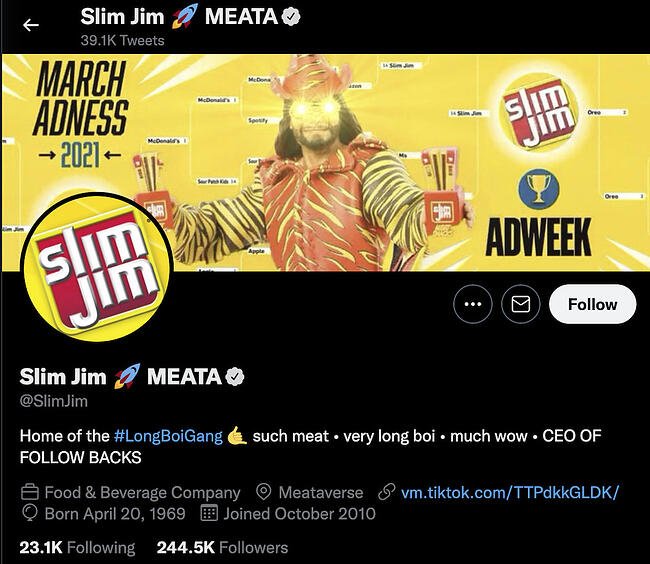
The official Twitter handle of the American snack brand is a power user.

Although a brand account, it has a personal touch and is self-branded as “the ceo of follow backs.” You don’t have to look far to find a Slim Jim tweet turned into a meme — such as this one.

3. Robert Scoble (@scobleizer)

twitter power user account: robert scoble

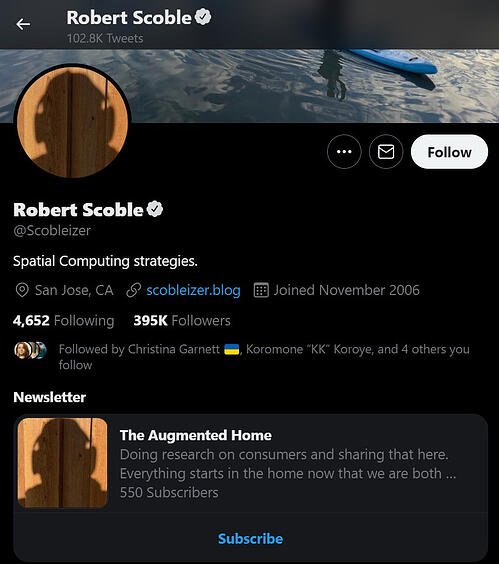
This is one of the most recognized power users on the app. He often tweets about technology, and his account uses some of the latest and premium Twitter features.

4. Guy Kawaski (@GuyKawaski)

twitter power user account: guy kawasaki

Guy Kawaski is another power user. He’s the author of several best-selling books and shares valuable content on topics related to economics, technology, and business.

5. Fabrizio Romano (@FabrizioRomano)

twitter power user account: fabrizio romano

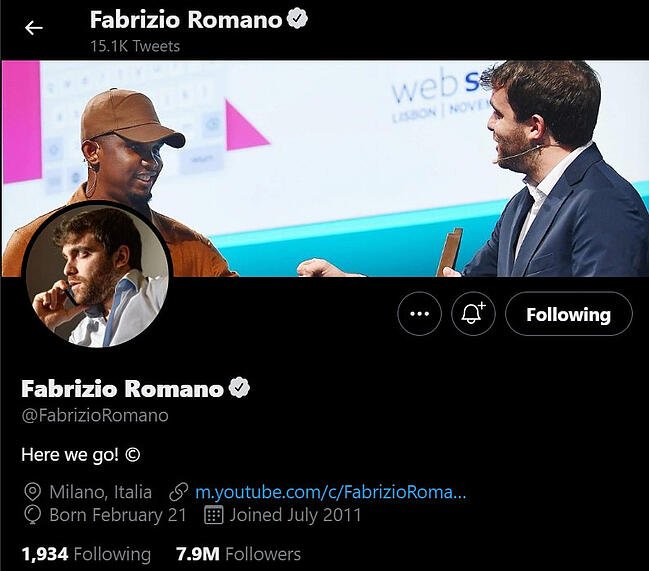
Fabrizio is one of the most popular football journalists on the planet and certainly qualifies as a Twitter power user. He tweets multiple times in one hour and earns thousands of likes and retweets within minutes of posting.

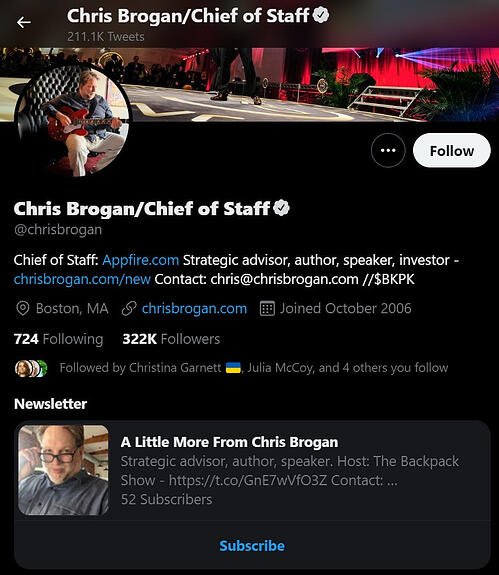
6. Chris Brogan (@chrisbrogan)

twitter power user account: chris brogan

Chris shares plenty of insights on social media daily and is one of the most popular social media experts. Like other Twitter power users on this list, he tweets multiple times a day, sharing information that either amuses or informs his followers.

How to Become a Twitter User

You can become a Twitter power user too. While you might not grow a following that runs into the millions, you can significantly improve your reach and engagement.

Here are some of the tips that can help you.

1. Tweet at the right time.

Tweeting at the right time is one of the cornerstones of becoming a Twitter power user. Nearly every post on improving your Twitter presence lists this tip — and for a good reason.

Therefore, you need to find the best time when your audience will be free enough to engage with your tweets. Each audience has different peak hours, so it’s up to you to determine the peak time for your audience.

Twitter analytics tools can help you find out what this time is by tracking when your followers engage with your posts.

2. Focus on mobile users.

When it comes to Twitter, mobile is king. Most people use the app on their mobile phones, so you must focus on appealing to this demographic. Twitter does an excellent job of optimizing your tweets for mobile, but if you want to become a power user, you must go beyond what Twitter provides to give the best experience to your audience.

One thing you could do is use images that are clear on mobile. Also, if you’re linking to your website or blog, ensure that the site is optimized for mobile users.

3. Ask for users to engage — don’t wait for it to happen.

Ask, and you shall receive, which proves true in Twitter’s case. So if you want people to like, retweet, or reply to your tweets, simply ask them to.

Adding a ‘please retweet,’ ‘like this,’ or ‘reply to this,’ is more likely to shoot up your engagement than tweets that lack the pleas.

However, you should be careful to offer something valuable in return. This doesn’t mean starting a like-for-like or retweet-for-retweet chain. Instead, it’s vital to offer valuable content or information that people will want to share and retweet.

4. Use action words.

People are more likely to do something if you ask them to do it, so it is recommended to use action words in your tweets.

Including subtle or even direct requests makes people notice your tweets and can encourage them to take the desired action. Remember that this method works best if you’re providing value to your followers.

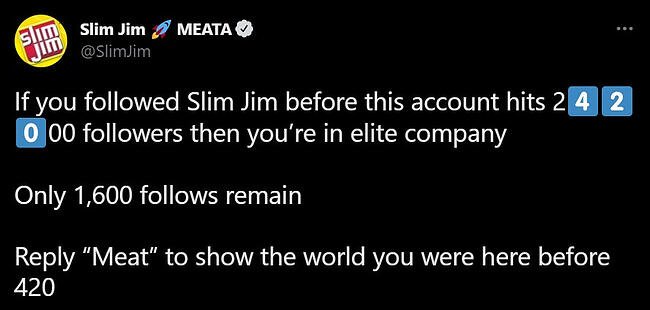
Slim Jim is an excellent example of a power user that uses this technique. See how it asks followers to reply to this tweet? You can do so too.

twitter power user account: slim jim

Pros of Becoming a Twitter Power User

1. It helps build your brand.

If you’re running a business, the increased exposure that becoming a power user gives you can immensely help your Twitter marketing strategy.

2. It will drive traffic to your website.

Being a Twitter power user can direct referral traffic to your website. For example, you can include your website link in your bio or tweets. You can find more ways to direct traffic to your website from Twitter here.

3. You might get verified.

As a power user, you can apply for Twitter verification. If you use Twitter, you’ll know that getting verified confers a feeling of power and authority to your account. At the very least, it indicates that your handle is an authentic account.

4. It helps you stay on top of trends and news.

Twitter is a significant source of news and trends. By being a power user, you’ll always stay in the loop.

Cons of Becoming a Twitter Power User

1. You have to constantly publish tweets.

If you’re just starting, one of the most challenging things, and certainly a disadvantage of being a power user, is how often you’ll need to push out content. We’re talking multiple times a day and even multiple times an hour.

2. There’s a risk of addiction.

Being a Twitter power user means you’ll likely have to be online most of the time. As a result, there’s a risk of becoming addicted to Twitter, which can be harmful if not kept in check. Therefore, a balanced and conscious effort to prevent addiction is essential.

3. You have to work around the character limit.

Since Twitter has a 280-character limit, it can be challenging to express thoughts coherently, even if you create a thread.

4. Your Tweets can get lost in the noise.

Millions of tweets are sent out daily, and with new tweets published every second, your tweets can get buried quickly. You can mitigate this by offering highly valuable content and using Twitter hashtags.

Your Path to Becoming a Twitter Power User Starts Here

We hope this is an excellent starting point for anyone thinking of becoming a Twitter power user. Although there’s so much more to Twitter than these tips we’ve provided, adhering to these guidelines will help you increase engagement on your Twitter account. Remember, the goal isn’t to reach a million followers. The goal is to provide valuable content that other users can’t help but retweet, putting you on the path to becoming a power user.

Editor’s note: This post was originally published in March 2009 and has been updated for comprehensiveness.

New Call-to-action

Categories B2B

9 Things Our Trends Team Will be Following in the Next 6 Months & Beyond

“Your next business idea, delivered weekly.” That’s our job over at Trends.

And, when we say “business ideas,” we’re not just talking about businesses you can start. We’re also talking about the next idea that’s going to help business operators, including insights on emerging consumer trends they can leverage in their marketing strategies.

While you’ve likely learned about some of the latest consumer trends to watch in the State of Consumer Trends Report, we wanted to dive even deeper into the future business trends we plan to follow in the coming months.

Take a look at the following nine trends that we think will pop over the next six months, including NFT subscription services, virtual pop-up stores, direct mail marketing, and more.

9 Trends We’re Watching in the Coming Months

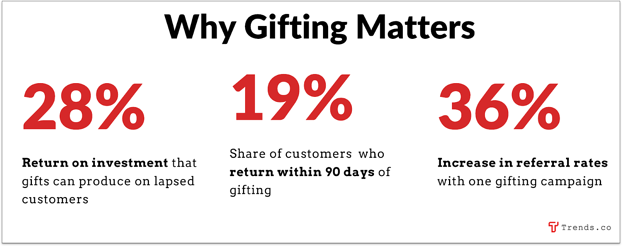
1. Gifting

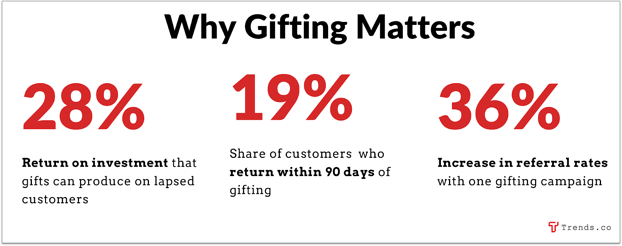
Forget loyalty points — gifting is the new customer retention strategy. As remote everything continues to rise, keeping connected to clients and loved ones will be key.

why gifting matters

Source: &Open

Gifting powerhouse 1-800-FLOWERS had a record-breaking year in 2020, and venture capital is flowing into startups like &Open ($7.2m last May) and Gracia (~$14m since its 2017 launch).

Another new player, Goody, sent 10,000 gifts in its first two months and has raised $32m since its 2020 launch. Co-founder Edward Lando told TechCrunch that the app serves as an additional acquisition channel for early D2C brands and a “giant shopping mall” for Gen Z consumers.

Companies will also use gifting to target employees, since worker retention is at an all-time low, and the average cost of replacing an employee is about seven months of their salary.

Wellbox, for example, is a platform for businesses to send gifts to their workers that made $4m+ in revenue in its first year.  

2. Direct Mail Marketing

Seth Greene, the bestselling author of seven marketing books, told Trends.co that “with all the changes in online media platforms like Google and Facebook, direct mail delivers better results than ever, with fewer restrictions.”

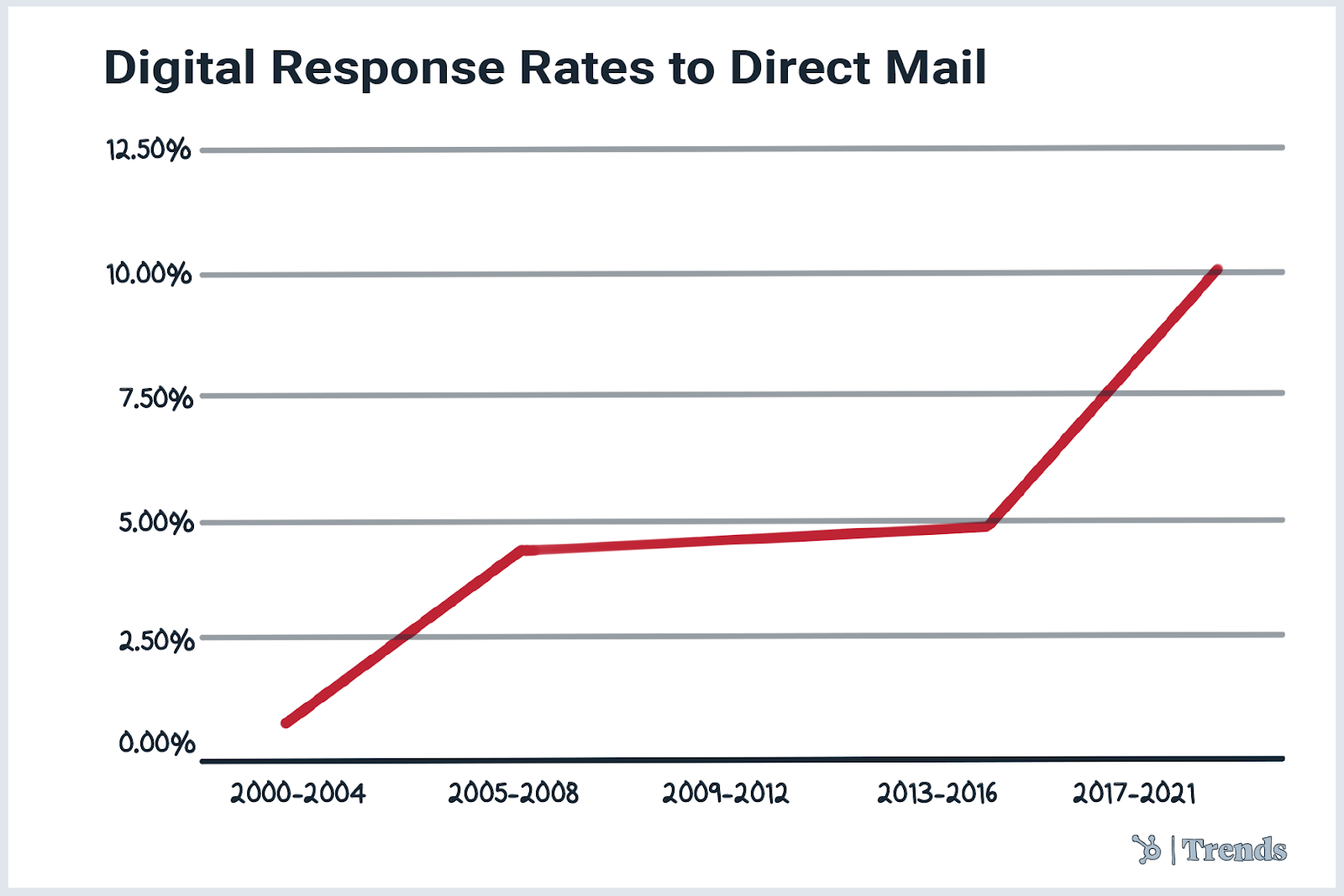
Our research backs this up, particularly when it comes to “digital interactive” — physical mail used to drive readers online — where response rates are ~9%-10%, roughly double what they were five years ago.

digital response rates of ddirect mail

Source: 25 Direct Mail Trends for 2021

Some niches we expect will emerge in this space include:

  • Voice-activated calls to action: Integrating smart-speaker apps into direct mail campaigns so readers can take action with an Alexa command
  • VR integrations: Physical mail that pairs with a VR headset to provide deep, interactive experiences
  • Old-school postcards: Direct mail marketing companies focusing on postcards, like PostcardMania, which reportedly made ~$84m in revenue last year

3. Return of Retro

The resurgence of direct mail is just the tip of the iceberg when it comes to the bigger trend of all things retro.

Subscribers to the r/Retro subreddit have doubled to 10k+ since 2020, and r/80sDesign has hit 86k+ subscribers.

Retro search terms are also going wild on Amazon. For example, weekly searches for “retro home decor” have increased 290% in the US in the last year, according to Jungle Scout.

Here’s how we expect to see the trend manifest over the next 6 months:

  • Shutter-Lovin’: Film, old-school cameras, and darkrooms
  • Experiences: Roller rinks and arcades
  • Gaming: Old-school games and accessories
  • Advertising: Brands leveraging the ’80s aesthetic in their ads

examples of advertisingCan you tell which are from the 1980s vs. the 2020s? Only the top right one is original ’80s (Source: Eye on Design)

4. Audio SEO

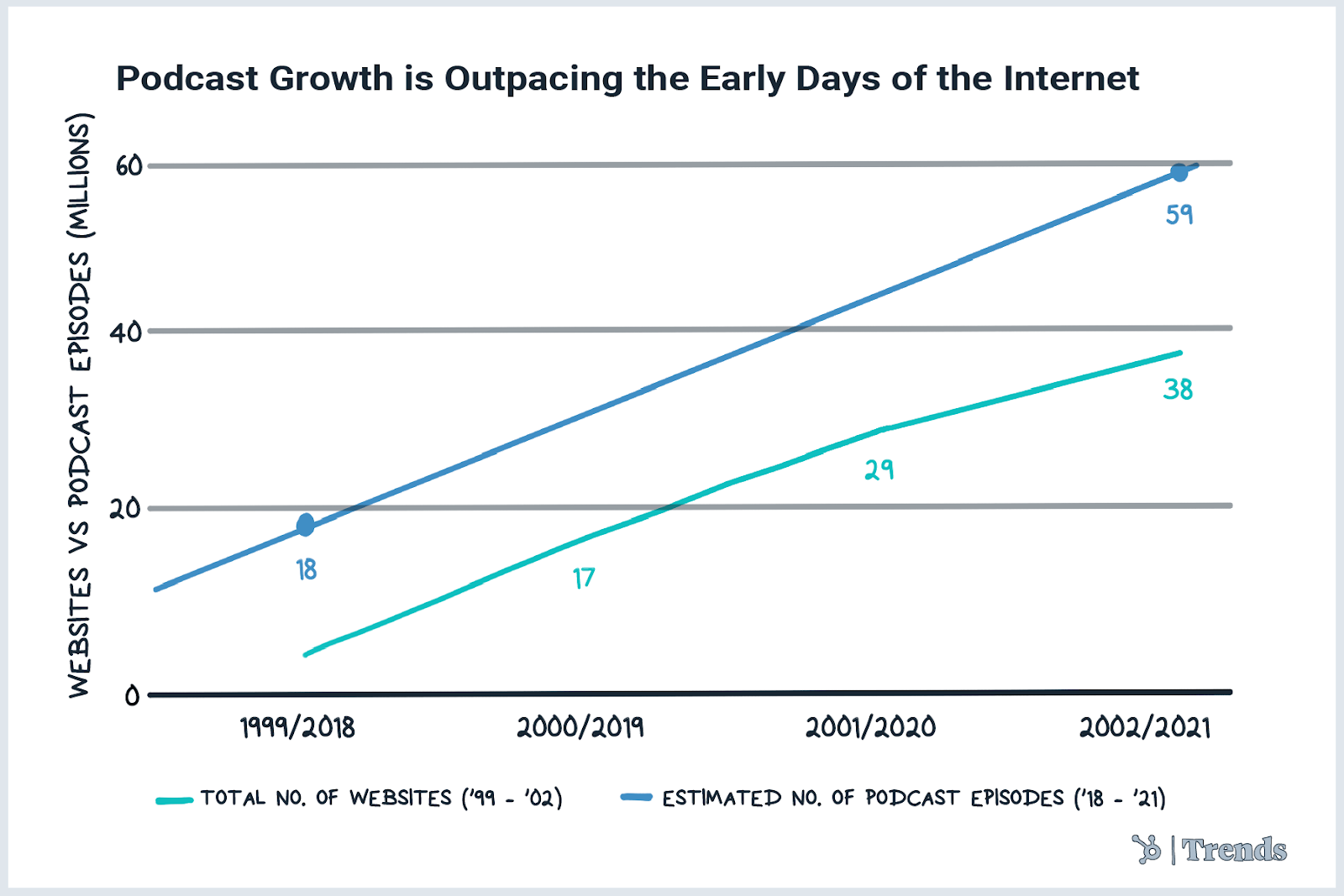
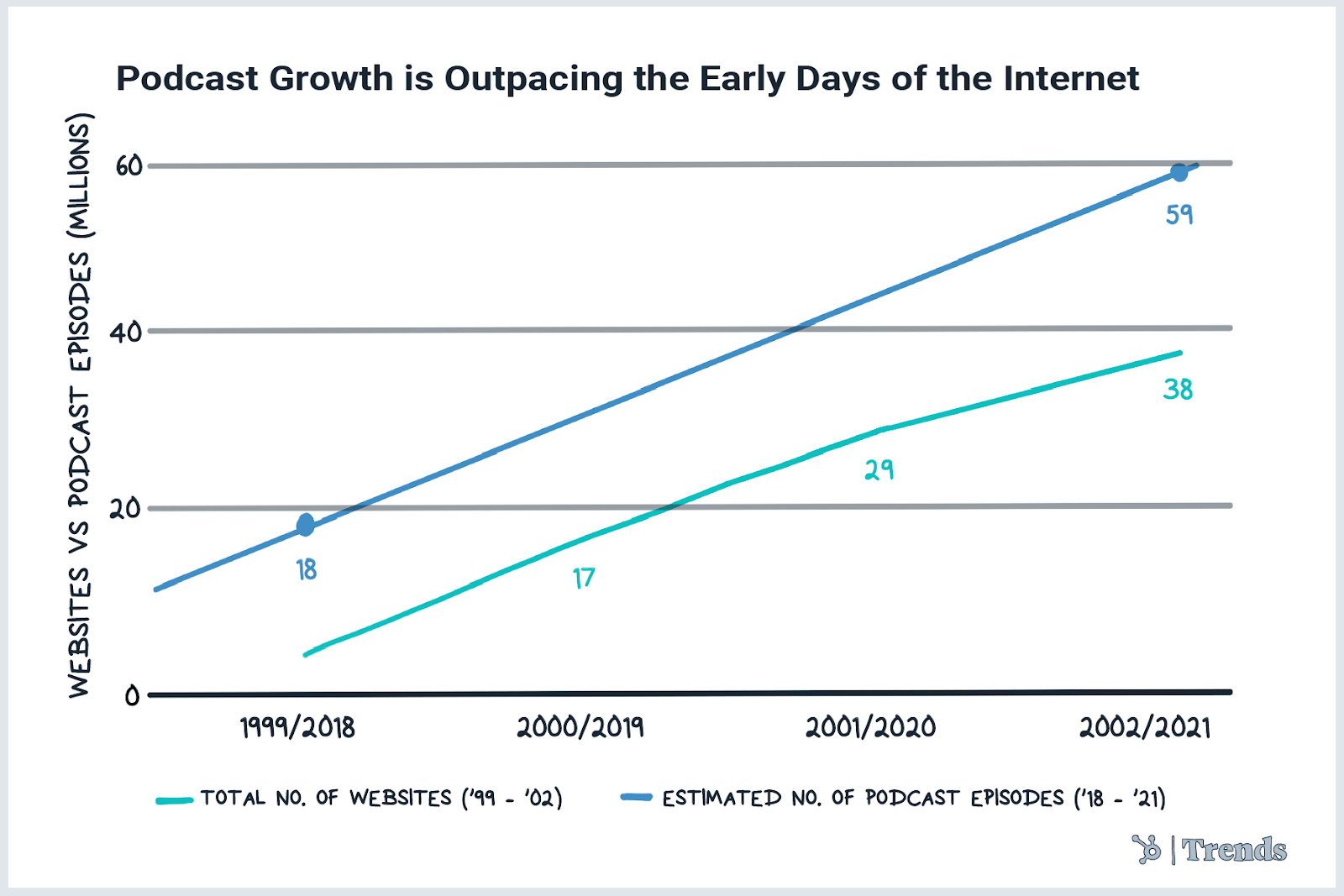
The world of podcasts is growing faster than the entire internet did back in the early 2000s. Spotify alone now hosts 3m+ shows (that’s ~43x the number of titles on Netflix, Disney+, and Apple TV+, combined).

podcast growth

Source: Internet Live Stats and The Podcast Host

But the tools that help listeners discover new content haven’t kept up.

Sixty-five percent of people who’ve never listened to a podcast say the reason is that they don’t know where to start. Meanwhile, great new shows struggle to get recognition, and audiences tire of seeing the same old suggestions.

Audio search is due for an overhaul. Some solutions we may see emerge in the coming months include:

  • Audio search engines, like Fathom, which recently raised $15m for their AI-driven podcast player and audio search engine
  • Tools that let podcasters turn audio into snackable visual content for platforms like TikTok, similar to Audiogram
  • Audio SEO tools, like the Ahrefs or Keywords Everywhere equivalent for audio
  • Interactive/immersive podcast apps, like Entale and Adori, which allow podcasters to include relevant links, images, polls, and offer codes so that they appear on the listener’s screen at the right moment

5. NFT-Powered Subscription Services

The Bored Ape Yacht Club (BAYC) is one of the most popular digital art collections in the world. BAYC NFT owners have exclusive licensing and commercial rights to their apes, leveraging many token holders to build their own startups.

One such startup is the Bored Breakfast Club. It’s a coffee subscription service and NFT collection that uses NFTs to establish an exclusive online community of coffee enthusiasts.

In their subscription model, anyone who owns one of the 5k Bored Breakfast Club NFTs is entitled to receive free shipments of exclusive coffee blends.

The NFTs also unlock access to an online community, live events, content, and discounts on additional bags of coffee.

bored breakfast club's vision

Source: Bored Breakfast Club Website

Many big brands like Cameo, Wrangler, and Time magazine are already experimenting with NFTs for exclusive community access, but the Bored Breakfast Club is one of the first to tag on a subscription component.

It’s still early days, but should the model prove successful, it will open up a whole new world of potential NFT subscription products, way beyond coffee.

6. B2B Influencers

The B2B influencer space is currently underdeveloped and largely unmonetized. While the overall influencer marketing industry was pegged at ~$9.7B in 2020, the bulk of that was focused on B2C campaigns.

But that is set to change, as ~80% of B2B brands surveyed in 2020 say they plan to either maintain or increase their influencer spend.

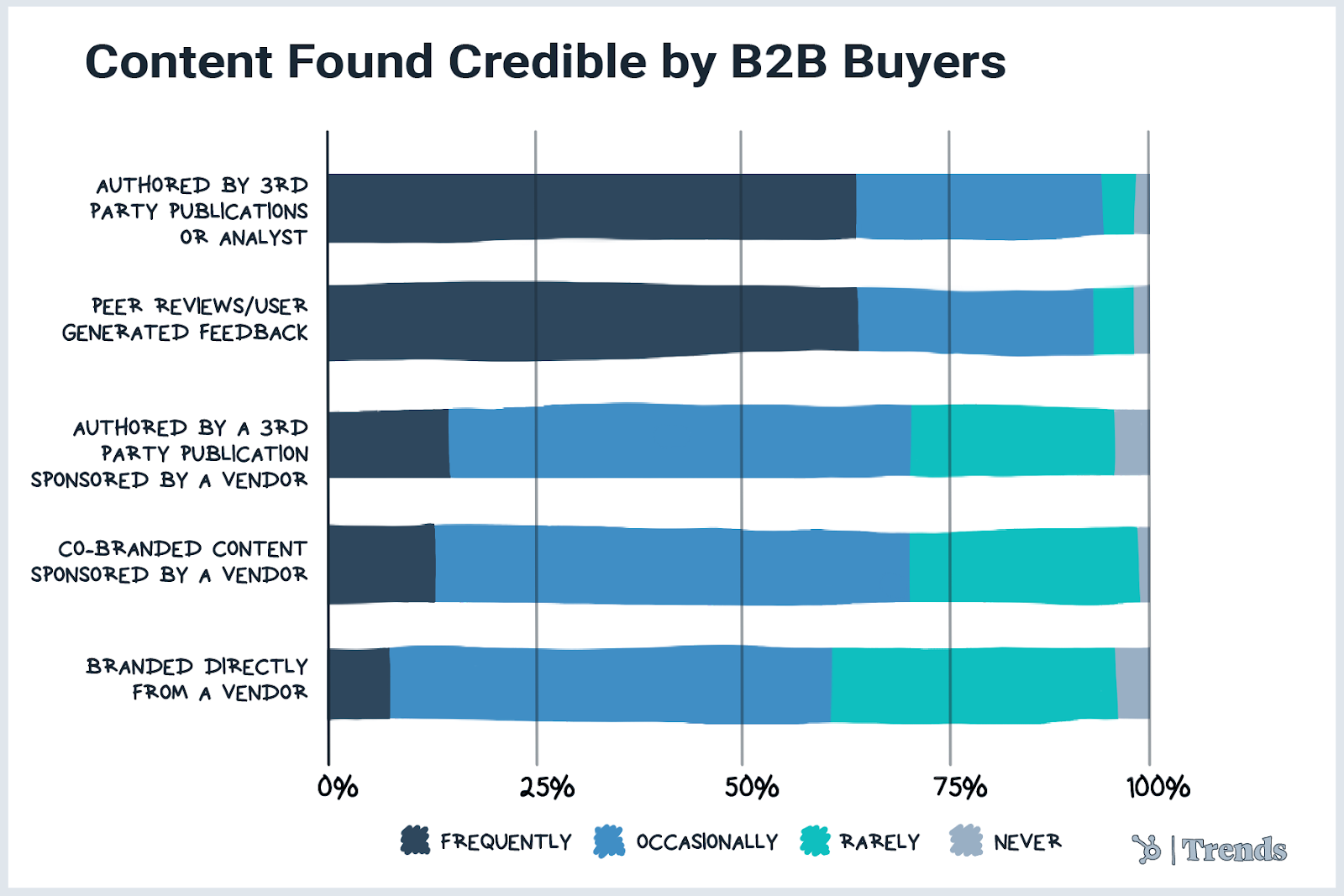
Not surprising, since research from Demand Gen shows that B2B clients consider sponsored third-party or co-branded content more trustworthy than content straight from a vendor.

credible content for b2b

Source: Oktopost

We expect to see a number of tools and services emerge to help brands identify and manage influencers and document their influencer strategy.

This could take place in B2B industries where subscription spending is highest, such as engineering, sales, HR, and customer service.

Influencer marketing more generally might grow stronger with each new generation. While 26% of social media users ages 25-34 have purchased a product marketed by an influencer in the past three months, 33% of social media users in the 18-24 age range have done the same.

7. Virtual Pop-Up Shops

Pop-up shops in the metaverse are a thing now.

Italian fashion brand Hogan recently took part in Decentraland’s Fashion Week with a virtual pop-up store, and jewelry label Pandora teamed up with Animal Planet to launch an in-game virtual pop-up called “Pandora Island.”

The new metaverse shopping industry could continue to grow with consumer interest. In a HubSpot survey of more than 1k consumers, 30% of participants said more brands should consider virtual stores in the metaverse.

While we’ll definitely see more of these, brands won’t necessarily need to dive headfirst into the metaverse in order to participate in the trend.

A virtual pop-up shop is essentially anything that creates a unique online shopping experience for your customers, separate from your existing website. This could be an event or even a landing page dedicated to a new product line.

They first gained popularity as an alternative to the real deal during national lockdowns, and, despite a dip in 2021, interest is picking up again.

Some big bands that have already experimented with this format include Lancôme, Hoover, and Dunkin’.

dunkin website examples

Source: Dunkin’Shop

8. Luxe Eco-Friendly Products and Packaging

Conscious consumption is in vogue. Younger generations in particular are driving up demand for products like this 0.56-oz. container made from recycled plastic ($14) and this chair manufactured from old fishing nets ($375).

They are also demanding more from brands, and are willing to pay to save the planet.

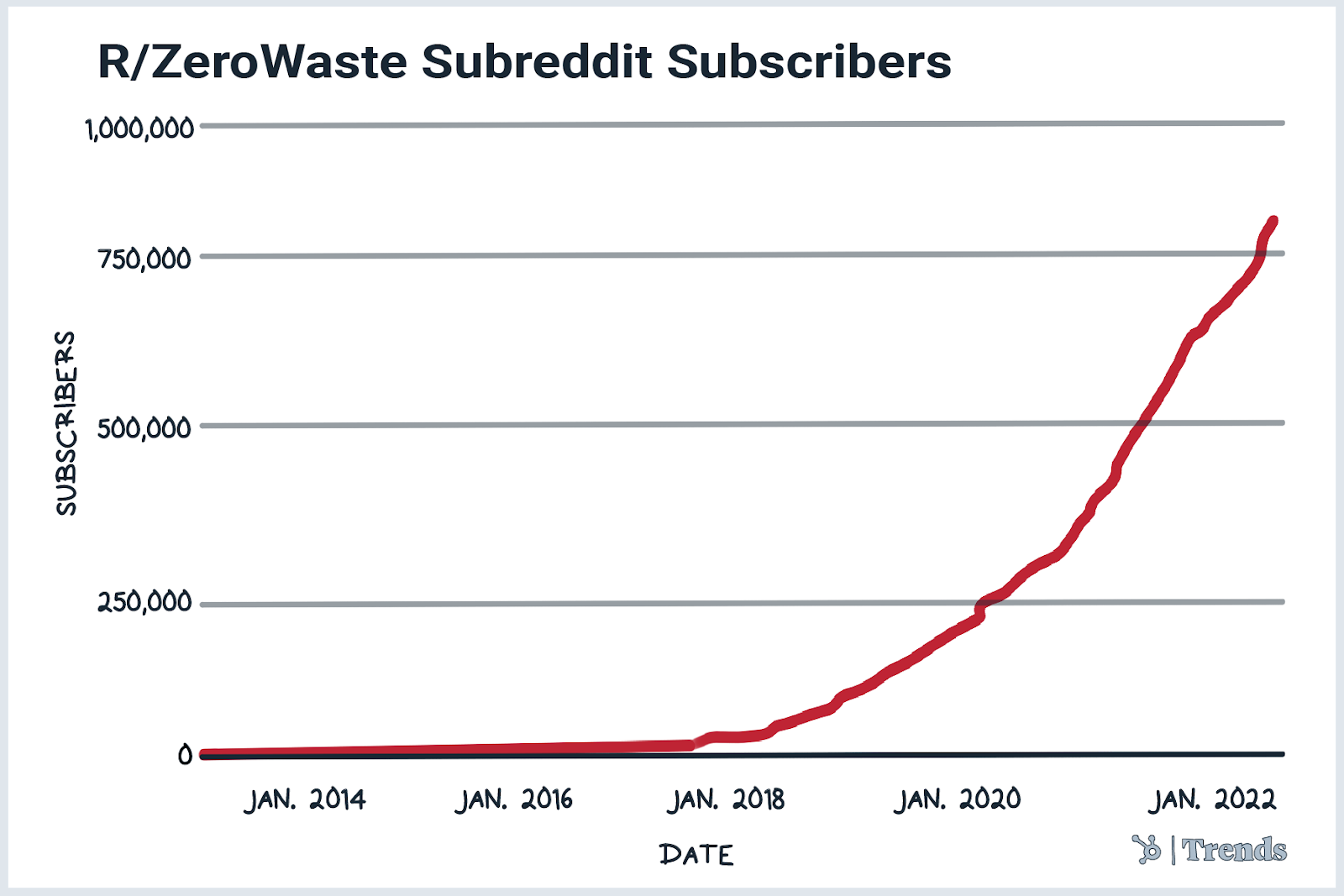
While eco-friendly shampoo bars tend to be more cost-effective than traditional shampoo, consumers are happily splashing out for the high-end options: A single Viori bar costs $16, ~3x the price of a comparable amount (20 oz.) of Dove shampoo.

zero waste subreddit data

Source: Subreddit Stats

We expect that eco-friendly packaging will also boom as the rapid rise in ecommerce continues to drive demand for sustainable packaging.

Solutions could include compostable packaging from leftover bamboo and sugarcane pulp, like those made by Ecoinno, which recently raised $6m in funding.

9. Gamified NFT Marketing

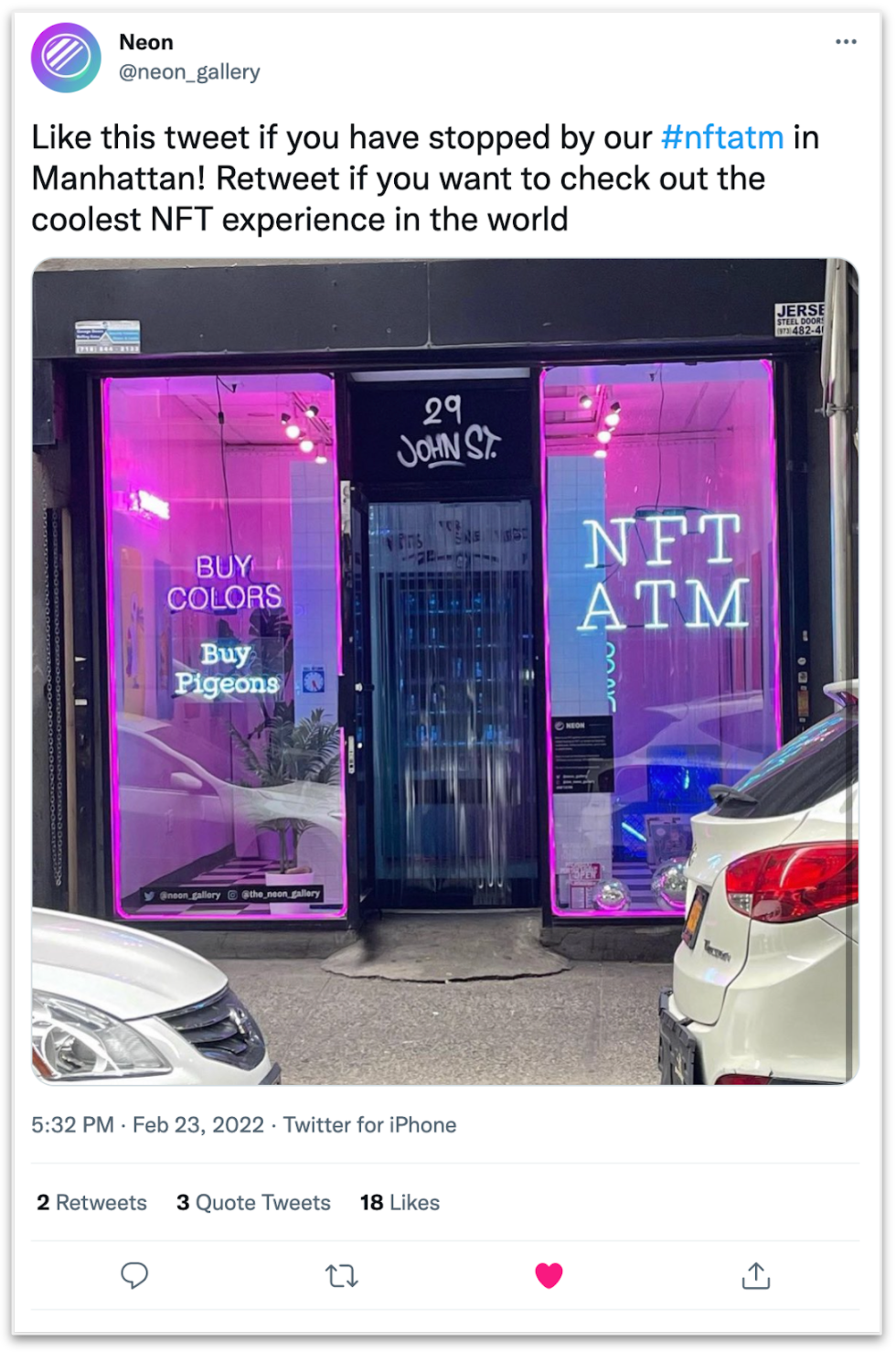
NFT platform Neon launched the world’s first NFT vending machine back in February.

The machine accepts fiat currency, making it possible for people to invest in NFTs using their credit card — without the need to convert to crypto first.

We expect to see similar NFT marketing initiatives like arcade machines or mobile games that allow players to collect NFTs as they play.

Louis Vuitton has already released a “Louis the Game” mobile app, which includes 30 embedded NFTs that could only be collected by playing the game.

GAP is another big name brand that has incorporated a gaming component into their NFT collection to encourage continued customer engagement.

Source: Twitter

How to Stay Up to Date

Staying up to date on today’s trends and data can be crucial to building marketing or business strategies that meet your audiences where they are. But with trends always moving quickly, the idea of tracking them can be overwhelming. Here are a few handy resources that can help your brand in its quest to stay fresh, relevant and up to date. 

  • HubSpot’s State of Consumer Trends Series: This month, HubSpot will be publishing a series of blog posts, like this one, and a brand new data-driven PDF all about the latest consumer behaviors, preferences, shopping habits, and trends marketers and brands need to know about in the coming month. Click here to see our State of Consumer Trends Report, where you’ll find links to the content in our series and a handy, free PDF.
  • Subscribe to Trends.co: Want to learn about trends that impact all areas of business and step up your game even more? Check out and subscribe Trends.co today to learn all about the business ideas, innovations and — well — the trends that are changing the game in your industry. 

Categories B2B

Workflow Automation Explained & 6 Best Workflow Software for 2022

Manual data entry might be one of the most tedious and inefficient tasks in the corporate world. Not only does it put you to sleep, but it also wastes precious time and resources, slashing your productivity to bits.

According to Zapier, 94% of workers perform time-consuming, repetitive tasks. Fortunately, there’s technology that can automate these mind-numbing tasks, eliminating human error and letting you focus on the work that actually matters — workflow automation.

Get Started with HubSpot's Marketing Software for Free

By leveraging self-operating processes that run manual tasks, workflow automation can help your business save time and money, diminish errors, and boost productivity.

Table of Contents

How does workflow automation work?

Workflow automation typically relies on a series of if/then statements to trigger another task. It then branches off depending on the action that was taken by a lead, employee, or another stakeholder.

Let’s walk through an example workflow for turning a form submission into a deal opportunity.

  • A website visitor submits a form.
  • The action automatically enrolls the visitor in a drip campaign. It creates a new deal and sets the status to “New.”
  • The first email of the drip campaign is sent to the lead, requesting to schedule a meeting.
  • The lead clicks through to the meeting scheduler and creates an appointment.
  • A thank you email is sent to the lead, confirming the date and time.
  • The CRM creates a new task and assigns it to a sales rep.
  • The sales rep then reaches out personally, ending the automated workflow.

Here’s what a workflow can look like from start to finish.

Workflow automation example in HubSpotImage Source

Almost every department in your business can benefit from workflow automation. Whether it’s marketing, human resources, or finance, the technology can help you work smarter, not harder.

Below, we’ll cover some of the most popular workflow automation examples.

Workflow automation can be used in virtually any team and in any business scenario. While it’s mostly related to marketing and sales, it can also be used in customer service, operations, human resources, and finance.

Marketing Workflow Automation

Marketing workflow automation example in HubSpot

Image Source

Some of the most repetitive tasks in marketing, such as sending emails and posting social media updates, can be automated with workflow automation. With marketing automation software, you can schedule your entire social media calendar and set up workflows that nurture certain types of prospects with email offers.

Automated workflows in marketing include:

  • Subscribing a user to a drip campaign when they download a resource from your website
  • Welcoming a user to your company after they purchase a product
  • Reminding a user to check out after they’ve added various items to their cart
  • Scheduling social media posts across multiple platforms
  • Distributing marketing tasks across team members

Additional Reading

Sales Workflow Automation

Sales workflow automation example in HubSpot

Image Source

Sales workflow automation streamlines tedious lead and prospect management tasks, so that reps can focus on selling, not entering data. Aside from taking leads automatically through the pipeline based on their actions, an automated sales workflow can enroll prospects in drip campaigns and update deal stages as the deal moves forward.

Automated tasks in sales include:

  • Placing each lead at a different stage of the pipeline when they take a certain action
  • Moving a lead out of the pipeline if they’ve stopped responding to emails
  • Sending an introduction email from a sales rep to a lead after they download an ebook
  • Updating the deal stage once the lead has scheduled an appointment or meeting
  • Creating tasks for sales reps once a lead has scheduled a meeting

Additional Reading

Customer Service Workflow Automation

Customer service workflow automation example in HubSpot

Image Source

Workflow automation is incredibly useful in customer service. Aside from launching surveys, workflow automation can take care of tickets, cases, and common questions by sending a series of emails or creating tasks.

Automated tasks in customer service include:

  • Creating a new ticket in the system when someone reaches out through social media or email
  • Onboarding customers with a series of helpful emails
  • Sending NPS® surveys and enrolling them into different email campaigns depending on their rating
  • Assigning tickets a priority label depending on the tone of the message or email
  • Resolving and archiving tickets once a resolution has been reached

Additional Reading

Operations Workflow Automation

Operations workflow automation example in HubSpot

Image Source

Operations is the lifeblood of any organization, and it, too, can be automated to reduce instances of manual data entry.

Automated tasks in operations include:

  • Deleting duplicates once they have been detected or merging two properties if they’re the same
  • Managing team permissions for new team members
  • Establishing priorities for different businesses processes
  • Automatically compiling reports at the end of every quarter
  • Creating tasks in third-party tools such as Asana, Slack, or Zoom

Additional Reading

Human Resources Workflow Automation

Instead of having to manually enter all your new hires’ personal information — like addresses, social security numbers, and other employee information into payroll, expense, and insurance systems — HR automation software can do it for you in minutes.

Automated tasks in human resources include:

  • Removing candidates from the database if they’ve been inactive for a period of time
  • Sending emails to candidates that haven’t made it to the final round
  • Filtering candidates with certain keywords in their job history
  • Sending W2s to current employees
  • Collecting employees’ feedback after they’ve been at the company for a period of time

Finance Workflow Automation

Finance workflow automation exampleImage Source

By allowing you to build forms, design workflows, and track processes, finance process automation software can streamline all of your travel requests, reimbursements, and budget approvals.

Automated tasks in finance include:

  • Taking an expense approval process from start to finish
  • Managing vendor and contract approvals
  • Assigning priorities to ACH and wire requests
  • Managing travel expense requests depending on location and activity
  • Approving budgets based on a predetermined set of parameters

Now that you know everything about using automated workflows, let’s take a look at the top tools you can use.

Best Workflow Automation Software in 2022

1. HubSpot: Best All-in-One Workflow Automation Software

Workflow automation software: HubSpot

Image Source

HubSpot’s marketing, sales, service, and operations software operates on a single platform, making it one of the best choices for all-in-one workflow automation. Everything is linked together, allowing you to align all of your teams’ processes and reducing friction from task to task.

You can easily hand leads from marketing to sales, connect a service ticket with an existing contact record, and clean up customer data — all in one user-friendly platform.

Best for: HubSpot is highly recommended for growing businesses that have yet to try workflow automation and for enterprise businesses with established processes. You can begin with a Starter subscription, then upgrade as you require more functionalities. Especially recommended for marketing, sales, service, and operations departments.

Pricing for Marketing Hub: Free; $50/month (Starter); $890/month (Professional); $3,200/month (Enterprise)

Pricing for Sales Hub: Free; $50/month (Starter); $500/month (Professional); $1,200/month (Enterprise)

Pricing for Service Hub: Free; $50/month (Starter); $400/month (Professional); $1,200/month (Enterprise)

Pricing for Operations Hub: Free; $50/month (Starter); $800/month (Professional)

2. Nintex: Best Enterprise Workflow Automation Software

Workflow automation software: NintexWith over 3 million workflow applications operating on their platform right now, Nintex helps more than 8,000 enterprise customers manage, automate, and optimize their business processes, with no coding experience required.

By offering a multitude of workflow automation tools — like process mapping, advanced workflows, and process intelligence — your business is able to map out each of your processes, execute them, and monitor their performance.

Best for: Nintex is highly recommended for enterprise businesses with established processes. It’s a robust software that pairs a user-friendly workflow design tool with powerful integrations that will connect every single one of your apps. Especially recommended for IT, law, HR, and finance departments.

Pricing: $910/month (Standard); $1,400/month (Enterprise)

3. Kissflow: Best Beginner-Friendly Workflow Automation Software

Workflow automation software: Kissflow

Trusted by over 10,000 companies, including Domino’s, Michelin, and Pepsi, Kissflow offers an all-in-one workflow automation software that lets your business create workflows that automate tasks in your human resources, sales, finance, administration, marketing, and purchase departments.

With over 50 pre-installed business process management apps — such as expensing and sales orders, conditions and triggers, and reporting dashboards for your workflows — Kissflow can streamline almost all your business processes.

Best for: Kissflow is highly recommended for small companies that are just now starting to try workflow automation. The tool’s simplicity and user friendliness will make it easier to begin automating processes. Especially recommended for procurement, HR, and finance departments.

Pricing: $200/month (Basic); $495/month (Advanced); $1,900/month (Fully Loaded)

4. Integrify: Best Everyday Administration Workflow Automation Software

Workflow automation software: Integrify

Integrify is a workflow automation software that lets you build workflows in a drag-and-drop builder and run parallel or sequential flows. By being able to collaborate on tasks and requests, test your processes, and set up reminders, you can easily streamline your business processes and automate manual tasks.

Integrify also offers workflow examples and a user knowledge base, a rest-based open API that allows you to integrate with external databases, and the ability to import and export data from Excel and even PDFs.

Best for: Integrify is highly recommended for small-to-medium businesses that are looking to automate everyday tasks. Its drag-and-drop “Process Builder” makes it simple and easy to take a process from start to completion. Especially recommended for administration departments.

Pricing: Pricing available upon request

5. Zapier: Best Workflow Automation Software for Connecting Apps

Workflow automation software: Zapier

With the ability to connect to and share data with over 1,000 web apps, like Facebook, QuickBooks, and Google Drive, Zapier can automate almost any type of business process. All you have to do is build a workflow in their editor, pick the apps you want to include in your workflow, and design it.

For example, if you want to be able to save all your attachments in Dropbox, you can design a workflow that automatically copies any attachment from your Gmail inbox to Dropbox and then sends you a Slack message about the download.

Best for: Zapier is highly recommended for freelancers and small-to-medium businesses that use a wide variety of tools that aren’t talking with each other. For instance, if you’re using MailChimp to send emails and Typeform to collect leads, you could connect those two tools using Zapier. Especially recommended for marketing and service departments.

Pricing: Free; $19.99/month (Starter); $49/month (Professional)

6. Flokzu: Best Project Management Workflow Automation Software

Workflow automation software: Flokzu

Without writing any code, Flokzu allows you to create tasks, deadlines, business rules, and notifications. Their software also sends pending tasks to each of your project’s assignees’ inboxes, and as each stage of a workflow is complete, it’ll automatically assign each new task to a user or role.

Additionally, Flozku offers a reporting dashboard that displays your business processes’

performance and metrics, like the amount of currently delayed tasks there are, tasks assigned to each user and role, tasks completed, and the time each task took, which will give you the necessary data to refine and optimize your future workflows.

Best for: Flokzu is highly recommended for individual teams that want to optimize their time management and task workflow. A key feature of this tool is that users will receive pending tasks in their inbox, making it an excellent project management tool. Recommended for any team.

Pricing: Free; $19.99/month (Starter); $49/month (Professional)

Workflow Automation Will Help You Grow Better

Workflow automation is critical for businesses that want to scale and grow without letting anything fall through the cracks. By letting technology complete manual tasks, you can effectively grow your business without any growing pains.

Editor’s note: This post was originally published in January 2019 and has been updated for comprehensiveness.

Free Resource: How to Reach & Engage Your Audience on Facebook

Categories B2B

15 Excel Formulas, Keyboard Shortcuts & Tricks That’ll Save You Lots of Time

For most marketers, trying to organize and analyze spreadsheets in Microsoft Excel can feel like walking into a brick wall repeatedly if you’e unfamiliar with Excel formulas. You’re manually replicating columns and scribbling down long-form math on a scrap of paper, all while thinking to yourself, “There has to be a better way to do this.”

Truth be told, there is — you just don’t know it yet.

Excel can be tricky that way. On the one hand, it’s an exceptionally powerful tool for reporting and analyzing marketing data. It can even help you visualize data with charts and pivot tables. On the other, without the proper training, it’s easy to feel like it’s working against you. For starters, there are more than a dozen critical formulas Excel can automatically run for you so you’re not combing through hundreds of cells with a calculator on your desk.Download 10 Excel Templates for Marketers [Free Kit]

What are excel formulas?

Excel formulas help you identify relationships between values in the cells of your spreadsheet, perform mathematical calculations using those values, and return the resulting value in the cell of your choice. Formulas you can automatically perform include sum, subtraction, percentage, division, average, and even dates/times.

We’ll go over all of these, and many more, in this blog post.

How to Insert Formulas in Excel

You might wonder what the “Formulas” tab on the top navigation toolbar in Excel means. In more recent versions of Excel, this horizontal menu — shown below — allows you to find and insert Excel formulas into specific cells of your spreadsheet. 

formulas-toolbar-excel

The more you use various formulas in Excel, the easier it’ll be to remember them and perform them manually. Nonetheless, the suite of icons above is a handy catalog of formulas you can browse and refer back to as you hone your spreadsheet skills.

Excel formulas are also called “functions.” To insert one into your spreadsheet, highlight a cell in which you want to run a formula, then click the far-left icon, “Insert Function,” to browse popular formulas and what they do. That browsing window will look like this:

insert-function-menuWant a more sorted browsing experience? Use any of the icons we’ve highlighted (inside the long red rectangle in the first screenshot above) to find formulas related to a variety of common subjects — such as finance, logic, and more. Once you’ve found the formula that suits your needs, click “Insert Function,” as shown in the window above.

Now, let’s do a deeper dive into some of the most crucial Excel formulas and how to perform each one in typical situations.

To help you use Excel more effectively (and save a ton of time), we’ve compiled a list of essential formulas, keyboard shortcuts, and other small tricks and functions you should know.

NOTE: The following formulas apply to the latest version of Excel. If you’re using a slightly older version of Excel, the location of each feature mentioned below might be slightly different.

1. SUM  

All Excel formulas begin with the equals sign, =, followed by a specific text tag denoting the formula you’d like Excel to perform. 

The SUM formula in Excel is one of the most basic formulas you can enter into a spreadsheet, allowing you to find the sum (or total) of two or more values. To perform the SUM formula, enter the values you’d like to add together using the format, =SUM(value 1, value 2, etc).

The values you enter into the SUM formula can either be actual numbers or equal to the number in a specific cell of your spreadsheet. 

  • To find the SUM of 30 and 80, for example, type the following formula into a cell of your spreadsheet: =SUM(30, 80). Press “Enter,” and the cell will produce the total of both numbers: 110. 
  • To find the SUM of the values in cells B2 and B11, for example, type the following formula into a cell of your spreadsheet: =SUM(B2, B11). Press “Enter,” and the cell will produce the total of the numbers currently filled in cells B2 and B11. If there are no numbers in either cell, the formula will return 0. 

Keep in mind you can also find the total value of a list of numbers in Excel. To find the SUM of the values in cells B2 through B11, type the following formula into a cell of your spreadsheet: =SUM(B2:B11). Note the colon between both cells, rather than a comma. See how this might look in an Excel spreadsheet for a content marketer, below:

sum-formula-excel

2. IF

The IF formula in Excel is denoted =IF(logical_test, value_if_true, value_if_false). This allows you to enter a text value into the cell “if” something else in your spreadsheet is true or false. For example, =IF(D2=”Gryffindor”,”10″,”0″) would award 10 points to cell D2 if that cell contained the word “Gryffindor.”

There are times when we want to know how many times a value appears in our spreadsheets. But there are also those times when we want to find the cells that contain those values, and input specific data next to it.

We’ll go back to Sprung’s example for this one. If we want to award 10 points to everyone who belongs in the Gryffindor house, instead of manually typing in 10’s next to each Gryffindor student’s name, we’ll use the IF-THEN formula to say: If the student is in Gryffindor, then he or she should get ten points.

  • The formula: IF(logical_test, value_if_true, value_if_false)
    • Logical_Test: The logical test is the “IF” part of the statement. In this case, the logic is D2=”Gryffindor.” Make sure your Logical_Test value is in quotation marks.
    • Value_if_True: If the value is true — that is, if the student lives in Gryffindor — this value is the one that we want to be displayed. In this case, we want it to be the number 10, to indicate that the student was awarded the 10 points. Note: Only use quotation marks if you want the result to be text instead of a number.
    • Value_if_False: If the value is false — and the student does not live in Gryffindor — we want the cell to show “0,” for 0 points.
  • Formula in below example: =IF(D2=”Gryffindor”,”10″,”0″)

Excel formulas and keyboard shortcuts: IF THEN

3. Percentage

To perform the percentage formula in Excel, enter the cells you’re finding a percentage for in the format, =A1/B1. To convert the resulting decimal value to a percentage, highlight the cell, click the Home tab, and select “Percentage” from the numbers dropdown.

There isn’t an Excel “formula” for percentages per se, but Excel makes it easy to convert the value of any cell into a percentage so you’re not stuck calculating and reentering the numbers yourself.

The basic setting to convert a cell’s value into a percentage is under Excel’s Home tab. Select this tab, highlight the cell(s) you’d like to convert to a percentage, and click into the dropdown menu next to Conditional Formatting (this menu button might say “General” at first). Then, select “Percentage” from the list of options that appears. This will convert the value of each cell you’ve highlighted into a percentage. See this feature below.

percentage-formula-in-excel

Keep in mind if you’re using other formulas, such as the division formula (denoted =A1/B1), to return new values, your values might show up as decimals by default. Simply highlight your cells before or after you perform this formula, and set these cells’ format to “Percentage” from the Home tab — as shown above.

4. Subtraction

To perform the subtraction formula in Excel, enter the cells you’re subtracting in the format, =SUM(A1, -B1). This will subtract a cell using the SUM formula by adding a negative sign before the cell you’re subtracting. For example, if A1 was 10 and B1 was 6, =SUM(A1, -B1) would perform 10 + -6, returning a value of 4.

Like percentages, subtracting doesn’t have its own formula in Excel either, but that doesn’t mean it can’t be done. You can subtract any values (or those values inside cells) two different ways.

Subtraction formula in Excel

  • Using the =SUM formula. To subtract multiple values from one another, enter the cells you’d like to subtract in the format =SUM(A1, -B1), with a negative sign (denoted with a hyphen) before the cell whose value you’re subtracting. Press enter to return the difference between both cells included in the parentheses. See how this looks in the screenshot above.
  • Using the format, =A1-B1. To subtract multiple values from one another, simply type an equals sign followed by your first value or cell, a hyphen, and the value or cell you’re subtracting. Press Enter to return the difference between both values.

5. Multiplication

To perform the multiplication formula in Excel, enter the cells you’re multiplying in the format, =A1*B1. This formula uses an asterisk to multiply cell A1 by cell B1. For example, if A1 was 10 and B1 was 6, =A1*B1 would return a value of 60.

You might think multiplying values in Excel has its own formula or uses the “x” character to denote multiplication between multiple values. Actually, it’s as easy as an asterisk — *.

multiplication-formula-in-excel

To multiply two or more values in an Excel spreadsheet, highlight an empty cell. Then, enter the values or cells you want to multiply together in the format, =A1*B1*C1 … etc. The asterisk will effectively multiply each value included in the formula.

Press Enter to return your desired product. See how this looks in the screenshot above.

6. Division

To perform the division formula in Excel, enter the cells you’re dividing in the format, =A1/B1. This formula uses a forward slash, “/,” to divide cell A1 by cell B1. For example, if A1 was 5 and B1 was 10, =A1/B1 would return a decimal value of 0.5.

Division in Excel is one of the simplest functions you can perform. To do so, highlight an empty cell, enter an equals sign, “=,” and follow it up with the two (or more) values you’d like to divide with a forward slash, “/,” in between. The result should be in the following format: =B2/A2, as shown in the screenshot below.

excel-division-formula

Hit Enter, and your desired quotient should appear in the cell you initially highlighted.

7. DATE

The Excel DATE formula is denoted =DATE(year, month, day). This formula will return a date that corresponds to the values entered in the parentheses — even values referred from other cells. For example, if A1 was 2018, B1 was 7, and C1 was 11, =DATE(A1,B1,C1) would return 7/11/2018.

Creating dates in the cells of an Excel spreadsheet can be a fickle task every now and then. Luckily, there’s a handy formula to make formatting your dates easy. There are two ways to use this formula:

  • Create dates from a series of cell values. To do this, highlight an empty cell, enter “=DATE,” and in parentheses, enter the cells whose values create your desired date — starting with the year, then the month number, then the day. The final format should look like this: =DATE(year, month, day). See how this looks in the screenshot below.
  • Automatically set today’s date. To do this, highlight an empty cell and enter the following string of text: =DATE(YEAR(TODAY()), MONTH(TODAY()), DAY(TODAY())). Pressing enter will return the current date you’re working in your Excel spreadsheet.

excel date formula

In either usage of Excel’s date formula, your returned date should be in the form of “mm/dd/yy” — unless your Excel program is formatted differently.

8. Array

An array formula in Excel surrounds a simple formula in brace characters using the format, {=(Start Value 1:End Value 1)*(Start Value 2:End Value 2)}. By pressing ctrl+shift+center, this will calculate and return value from multiple ranges, rather than just individual cells added to or multiplied by one another.

Calculating the sum, product, or quotient of individual cells is easy — just use the =SUM formula and enter the cells, values, or range of cells you want to perform that arithmetic on. But what about multiple ranges? How do you find the combined value of a large group of cells?

Numerical arrays are a useful way to perform more than one formula at the same time in a single cell so you can see one final sum, difference, product, or quotient. If you’re looking to find total sales revenue from several sold units, for example, the array formula in Excel is perfect for you. Here’s how you’d do it:

  1. To start using the array formula, type “=SUM,” and in parentheses, enter the first of two (or three, or four) ranges of cells you’d like to multiply together. Here’s what your progress might look like: =SUM(C2:C5
  2. Next, add an asterisk after the last cell of the first range you included in your formula. This stands for multiplication. Following this asterisk, enter your second range of cells. You’ll be multiplying this second range of cells by the first. Your progress in this formula should now look like this: =SUM(C2:C5*D2:D5)
  3. Ready to press Enter? Not so fast … Because this formula is so complicated, Excel reserves a different keyboard command for arrays. Once you’ve closed the parentheses on your array formula, press Ctrl+Shift+Enter. This will recognize your formula as an array, wrapping your formula in brace characters and successfully returning your product of both ranges combined.

Excel array formula

In revenue calculations, this can cut down on your time and effort significantly. See the final formula in the screenshot above.

9. COUNT

The COUNT formula in Excel is denoted =COUNT(Start Cell:End Cell). This formula will return a value that is equal to the number of entries found within your desired range of cells. For example, if there are eight cells with entered values between A1 and A10, =COUNT(A1:A10) will return a value of 8.

The COUNT formula in Excel is particularly useful for large spreadsheets, wherein you want to see how many cells contain actual entries. Don’t be fooled: This formula won’t do any math on the values of the cells themselves. This formula is simply to find out how many cells in a selected range are occupied with something.

Using the formula in bold above, you can easily run a count of active cells in your spreadsheet. The result will look a little something like this:

count-formula-in-excel

10. AVERAGE

To perform the average formula in Excel, enter the values, cells, or range of cells of which you’re calculating the average in the format, =AVERAGE(number1, number2, etc.) or =AVERAGE(Start Value:End Value). This will calculate the average of all the values or range of cells included in the parentheses.

Finding the average of a range of cells in Excel keeps you from having to find individual sums and then performing a separate division equation on your total. Using =AVERAGE as your initial text entry, you can let Excel do all the work for you.

For reference, the average of a group of numbers is equal to the sum of those numbers, divided by the number of items in that group.

11. SUMIF

The SUMIF formula in Excel is denoted =SUMIF(range, criteria, [sum range]). This will return the sum of the values within a desired range of cells that all meet one criterion. For example, =SUMIF(C3:C12,”>70,000″) would return the sum of values between cells C3 and C12 from only the cells that are greater than 70,000.

Let’s say you want to determine the profit you generated from a list of leads who are associated with specific area codes, or calculate the sum of certain employees’ salaries — but only if they fall above a particular amount. Doing that manually sounds a bit time-consuming, to say the least.

With the SUMIF function, it doesn’t have to be — you can easily add up the sum of cells that meet certain criteria, like in the salary example above.

  • The formula: =SUMIF(range, criteria, [sum_range])
    • Range: The range that is being tested using your criteria.
    • Criteria: The criteria that determine which cells in Criteria_range1 will be added together
    • [Sum_range]: An optional range of cells you’re going to add up in addition to the first Range entered. This field may be omitted.

In the example below, we wanted to calculate the sum of the salaries that were greater than $70,000. The SUMIF function added up the dollar amounts that exceeded that number in the cells C3 through C12, with the formula =SUMIF(C3:C12,”>70,000″).

SUMIF formula in Excel

12. TRIM

The TRIM formula in Excel is denoted =TRIM(text). This formula will remove any spaces entered before and after the text entered in the cell. For example, if A2 includes the name ” Steve Peterson” with unwanted spaces before the first name, =TRIM(A2) would return “Steve Peterson” with no spaces in a new cell.

Email and file sharing are wonderful tools in today’s workplace. That is, until one of your colleagues sends you a worksheet with some really funky spacing. Not only can those rogue spaces make it difficult to search for data, but they also affect the results when you try to add up columns of numbers.

Rather than painstakingly removing and adding spaces as needed, you can clean up any irregular spacing using the TRIM function, which is used to remove extra spaces from data (except for single spaces between words).

  • The formula: =TRIM(text).
    • Text: The text or cell from which you want to remove spaces.

Here’s an example of how we used the TRIM function to remove extra spaces before a list of names. To do so, we entered =TRIM(“A2”) into the Formula Bar, and replicated this for each name below it in a new column next to the column with unwanted spaces.

trim-formula-in-excel

Below are some other Excel formulas you might find useful as your data management needs grow.

13. LEFT, MID, and RIGHT

Let’s say you have a line of text within a cell that you want to break down into a few different segments. Rather than manually retyping each piece of the code into its respective column, users can leverage a series of string functions to deconstruct the sequence as needed: LEFT, MID, or RIGHT.

LEFT

  • Purpose: Used to extract the first X numbers or characters in a cell.
  • The formula: =LEFT(text, number_of_characters)
    • Text: The string that you wish to extract from.
    • Number_of_characters: The number of characters that you wish to extract starting from the left-most character.

In the example below, we entered =LEFT(A2,4) into cell B2, and copied it into B3:B6. That allowed us to extract the first 4 characters of the code.

LEFT formula in Excel

MID

  • Purpose: Used to extract characters or numbers in the middle based on position.
  • The formula: =MID(text, start_position, number_of_characters)
    • Text: The string that you wish to extract from.
    • Start_position: The position in the string that you want to begin extracting from. For example, the first position in the string is 1.
    • Number_of_characters: The number of characters that you wish to extract.

In this example, we entered =MID(A2,5,2) into cell B2, and copied it into B3:B6. That allowed us to extract the two numbers starting in the fifth position of the code.

MID formula in Excel

RIGHT

  • Purpose: Used to extract the last X numbers or characters in a cell.
  • The formula: =RIGHT(text, number_of_characters)
    • Text: The string that you wish to extract from.
    • Number_of_characters: The number of characters that you want to extract starting from the right-most character.

For the sake of this example, we entered =RIGHT(A2,2) into cell B2, and copied it into B3:B6. That allowed us to extract the last two numbers of the code.

RIGHT formula in EXCEL

14. VLOOKUP

This one is an oldie, but a goodie — and it’s a bit more in depth than some of the other formulas we’ve listed here. But it’s especially helpful for those times when you have two sets of data on two different spreadsheets, and want to combine them into a single spreadsheet.

My colleague, Rachel Sprung — whose “How to Use Excel” tutorial is a must-read for anyone who wants to learn — uses a list of names, email addresses, and companies as an example. If you have a list of people’s names next to their email addresses in one spreadsheet, and a list of those same people’s email addresses next to their company names in the other, but you want the names, email addresses, and company names of those people to appear in one place — that’s where VLOOKUP comes in.

Note: When using this formula, you must be certain that at least one column appears identically in both spreadsheets. Scour your data sets to make sure the column of data you’re using to combine your information is exactly the same, including no extra spaces.

  • The formula: VLOOKUP(lookup value, table array, column number, [range lookup])
    • Lookup Value: The identical value you have in both spreadsheets. Choose the first value in your first spreadsheet. In Sprung’s example that follows, this means the first email address on the list, or cell 2 (C2).
    • Table Array: The range of columns on Sheet 2 you’re going to pull your data from, including the column of data identical to your lookup value (in our example, email addresses) in Sheet 1 as well as the column of data you’re trying to copy to Sheet 1. In our example, this is “Sheet2!A:B.” “A” means Column A in Sheet 2, which is the column in Sheet 2 where the data identical to our lookup value (email) in Sheet 1 is listed. The “B” means Column B, which contains the information that’s only available in Sheet 2 that you want to translate to Sheet 1.
    • Column Number: The table array tells Excel where (which column) the new data you want to copy to Sheet 1 is located. In our example, this would be the “House” column, the second one in our table array, making it column number 2.
    • Range Lookup: Use FALSE to ensure you pull in only exact value matches.
  • The formula with variables from Sprung’s example below: =VLOOKUP(C2,Sheet2!A:B,2,FALSE)

In this example, Sheet 1 and Sheet 2 contain lists describing different information about the same people, and the common thread between the two is their email addresses. Let’s say we want to combine both datasets so that all the house information from Sheet 2 translates over to Sheet 1. Here’s how that would work:

Excel formulas and shortcuts: VLOOKUP

15. RANDOMIZE

There’s a great article that likens Excel’s RANDOMIZE formula to shuffling a deck of cards. The entire deck is a column, and each card — 52 in a deck — is a row. “To shuffle the deck,” writes Steve McDonnell, “you can compute a new column of data, populate each cell in the column with a random number, and sort the workbook based on the random number field.”

In marketing, you might use this feature when you want to assign a random number to a list of contacts — like if you wanted to experiment with a new email campaign and had to use blind criteria to select who would receive it. By assigning numbers to said contacts, you could apply the rule, “Any contact with a figure of 6 or above will be added to the new campaign.”

  • The formula: RAND()
    • Start with a single column of contacts. Then, in the column adjacent to it, type “RAND()” — without the quotation marks — starting with the top contact’s row.
    • RANDBETWEEN allows you to dictate the range of numbers that you want to be assigned. In the case of this example, I wanted to use one through 10.
    • bottom: The lowest number in the range.
    • top: The highest number in the range,For the example below: RANDBETWEEN(bottom,top)
    • Formula in below example: =RANDBETWEEN(1,10)


excel formulas and keyboard shortcuts example: Randomize
Helpful stuff, right? Now for the icing on the cake: Once you’ve mastered the Excel formula you need, you’ll want to replicate it for other cells without rewriting the formula. And luckily, there’s an Excel function for that, too. Check it out below.

Sometimes, you might want to run the same formula across an entire row or column of your spreadsheet. Let’s say, for example, you have a list of numbers in columns A and B of a spreadsheet and want to enter individual totals of each row into column C.

Obviously, it would be too tedious to adjust the values of the formula for each cell so you’re finding the total of each row’s respective numbers. Luckily, Excel allows you to automatically complete the column; all you have to do is enter the formula in the first row. Check out the following steps: 

  1. Type your formula into an empty cell and press “Enter” to run the formula.SUM formula entered in column C of Excel spreadsheet to find the sum of cells B2 and C2.
  2. Hover your cursor over the bottom-right corner of the cell containing the formula. You’ll see a small, bold “+” symbol appear.
  3. While you can double-click this symbol to automatically fill the entire column with your formula, you can also click and drag your cursor down manually to fill only a specific length of the column.insert-formula-in-excel-for-entire-columnOnce you’ve reached the last cell in the column you’d like to enter your formula, release your mouse to copy the formula. Then, simply check each new value to ensure it corresponds to the correct cells.

Excel Keyboard Shortcuts

1. Quickly select rows, columns, or the whole spreadsheet.

Perhaps you’re crunched for time. I mean, who isn’t? No time, no problem. You can select your entire spreadsheet in just one click. All you have to do is simply click the tab in the top-left corner of your sheet to highlight everything all at once.

Quickly select rows, columns, or the whole Excel spreadsheet

Just want to select everything in a particular column or row? That’s just as easy with these shortcuts:

For Mac:

  • Select Column = Command + Shift + Down/Up
  • Select Row = Command + Shift + Right/Left

For PC:

  • Select Column = Control + Shift + Down/Up
  • Select Row = Control + Shift + Right/Left

This shortcut is especially helpful when you’re working with larger data sets, but only need to select a specific piece of it.

2. Quickly open, close, or create a workbook.

Need to open, close, or create a workbook on the fly? The following keyboard shortcuts will enable you to complete any of the above actions in less than a minute’s time.

Quickly open, close, or create an Excel workbook

For Mac:

  • Open = Command + O
  • Close = Command + W
  • Create New = Command + N

For PC:

  • Open = Control + O
  • Close = Control + F4
  • Create New = Control + N

3. Format numbers into currency.

Have raw data that you want to turn into currency? Whether it be salary figures, marketing budgets, or ticket sales for an event, the solution is simple. Just highlight the cells you wish to reformat, and select Control + Shift + $.

Format numbers into currency in Excel

The numbers will automatically translate into dollar amounts — complete with dollar signs, commas, and decimal points.

Note: This shortcut also works with percentages. If you want to label a column of numerical values as “percent” figures, replace “$” with “%”.

4. Insert current date and time into a cell.

Whether you’re logging social media posts, or keeping track of tasks you’re checking off your to-do list, you might want to add a date and time stamp to your worksheet. Start by selecting the cell to which you want to add this information.

Then, depending on what you want to insert, do one of the following:

  • Insert current date = Control + ; (semi-colon)
  • Insert current time = Control + Shift + ; (semi-colon)
  • Insert current date and time = Control + ; (semi-colon), SPACE, and then Control + Shift + ; (semi-colon).

Insert a current date and time into a cell in Excel

Other Excel Tricks

1. Customize the color of your tabs.

If you’ve got a ton of different sheets in one workbook — which happens to the best of us — make it easier to identify where you need to go by color-coding the tabs. For example, you might label last month’s marketing reports with red, and this month’s with orange.

Simply right click a tab and select “Tab Color.” A popup will appear that allows you to choose a color from an existing theme, or customize one to meet your needs.

Customize the color of your tabs in Excel

2. Add a comment to a cell.

When you want to make a note or add a comment to a specific cell within a worksheet, simply right-click the cell you want to comment on, then click Insert Comment. Type your comment into the text box, and click outside the comment box to save it.

Cells that contain comments display a small, red triangle in the corner. To view the comment, hover over it.

Add a comment to a cell in Excel

3. Copy and duplicate formatting.

If you’ve ever spent some time formatting a sheet to your liking, you probably agree that it’s not exactly the most enjoyable activity. In fact, it’s pretty tedious.

For that reason, it’s likely that you don’t want to repeat the process next time — nor do you have to. Thanks to Excel’s Format Painter, you can easily copy the formatting from one area of a worksheet to another.

Select what you’d like to replicate, then select the Format Painter option — the paintbrush icon — from the dashboard. The pointer will then display a paintbrush, prompting you to select the cell, text, or entire worksheet to which you want to apply that formatting, as shown below:

Excel formulas and keyboard shortcuts example: Copy and Duplicate Formatting in Excel

4. Identify duplicate values.

In many instances, duplicate values — like duplicate content when managing SEO — can be troublesome if gone uncorrected. In some cases, though, you simply need to be aware of it.

Whatever the situation may be, it’s easy to surface any existing duplicate values within your worksheet in just a few quick steps. To do so, click into the Conditional Formatting option, and select Highlight Cell Rules > Duplicate Values

Identify duplicate values in Excel

Using the popup, create the desired formatting rule to specify which type of duplicate content you wish to bring forward.

In the example above, we were looking to identify any duplicate salaries within the selected range, and formatted the duplicate cells in yellow.

Excel Shortcuts Save You Time

In marketing, the use of Excel is pretty inevitable — but with these tricks, it doesn’t have to be so daunting. As they say, practice makes perfect. The more you use these formulas, shortcuts, and tricks, the more they’ll become second nature.

Editor’s note: This post was originally published in January 2019 and has been updated for comprehensiveness.
excel marketing templates

Categories B2B

How to Create a Link to Jump to a Specific Part of a Page [Quick Tip]

When most people think of hyperlinks, they think of connecting two different web pages — such as a blog and landing page — together. But that’s not all hyperlinks can do, they can link to jump to a specific part of a page as well.

So remember that really exhaustive glossary you put together on industry terms your audience should know? Now, when you refer to something you said elsewhere in that article, you can actually link to it — making it much easier for your audience to figure out what the heck you’re talking about. Want to see what I mean? Just click here.

→ Download Now: SEO Starter Pack [Free Kit]

Pretty cool, right? The best part about it all is that it’s super easy to do yourself, even if you don’t have extensive HTML knowledge. If the HTML-speak feels confusing, just follow along with the real-world examples below.

Note: If you are a HubSpot customer, follow these instructions.

How to Link to a Specific Part of a Page

Allowing people to effectively “jump” to a certain part of a webpage can help your business grow better and make your content more convenient for visitors to your site — but you have to make sure you do everything just right. Here’s how to add jump links to your content, step-by-step.

1. Name the object or text you want to link to.

In a normal linking scenario, whatever you need to link to has a URL of its own. However, in this scenario, you’re not linking to a new page with its own URL — so you have to make up a name for the link’s destination.

I’d recommend using a word or phrase that describes the link’s destination. If you use a phrase, use underscores between each word instead of spaces, otherwise the code won’t work.

Example

Let’s say we wanted to link to an example of a company using Facebook ads in a post. Here’s what I’d use as my object’s name:

facebook_ads_example

Now, onto the next step.

2. Take the name you’ve chosen, and insert it into an opening HTML anchor link tag.

In other words, replace the red section of the tag below with the name you chose in the previous step:

<a id=”INSERT_YOUR_OBJECT_NAME_HERE“>

Example

3. Place that complete opening <a> tag from above before the text or object you want to link to, and add a closing </a> tag after.

Doing this sets the location of the link. This is what your code should look like now:

<a id=”INSERT_YOUR_OBJECT_NAME_HERE”>The object you want to link to.</a>

Example

4. Create the hyperlink that’ll take you to that text or object.

Now, go to the part of the post you’d like to have the hyperlink in. You’ll need to add a typical hyperlink HTML markup, but in the part where you’d typically include a URL, you’ll include the pound symbol (#) then the name of the object you’re linking to. Here’s what it looks like:

<a href=”#INSERT_YOUR_OBJECT_NAME_HERE“>Click here to see the content below.</a>

Example

And then you’re all set — you have a functioning hyperlink between two pieces of content on the same page. Simple as that.

(Hey there, curious folks from the introduction! Click here to go back to where you left off.)

marketing

 
Click here to get everything you need to get your website ranking in search.

Categories B2B

3 Easy Steps to Create Your Facebook Vanity URL [+ Tips]

With over 1 billion monthly active users, Facebook is a powerful network to tap into to expand the online footprint of your business.

Free Resource: How to Reach & Engage Your Audience on Facebook

Once you have your Page, the first step of Facebook marketing is to get a username, which will create your vanity URL. Discover how to create one and the benefits of having a customized URL.

Choosing a username is totally optional, but it adds an extra level of professionalism and gives you a shorter, more memorable web address for your business page.

How to Create Your Facebook Vanity URL

1. Visit Facebook.com and head to your business page. Once on the page, click on Create Page.

How to create your facebook vanity URL step 1

2. Write your username and check that it’s available.

How to create your facebook vanity URL step 2

3. Once you see the green check mark, click on Create username to finalize it.

How to create your facebook vanity URL step 3

How to Change Your Facebook Vanity URL

1. Visit Facebook.com and head to your business page. Once on the page, click on Edit Page.

How to change your facebook vanity URL step 1

2. Select Page Header.

How to change your facebook vanity URL step 2

3. Click on your username.

How to change your facebook vanity URL step 3

4. Write your new username and see if it’s available. Once the green check mark appears, click on Create Username.

How to change your facebook vanity URL step 4

Facebook Vanity URL Tips

As you’re deciding on your username, consider the following requirements from Facebook:

  • Usernames can only include alphanumeric characters (A-Z, 0-9) or a period (.).
  • You can only have one username per page.
  • Your page must have at least 25 fans to establish a vanity URL. This is to prevent name squatting.
  • Usernames are not transferrable or editable (so think carefully about your username choice!).
  • Some generic words (such as “flowers” or “pizza”) are not available.

If your trademarked name has already been taken, you can notify Facebook of this intellectual property infringement.

A vanity URL is a small step you can take in personalizing your Facebook Page to ensure it’s easy to find. If you already have a URL in mind, don’t hesitate– you’ll want to make sure you can secure your business name before someone else snags it.

Editor’s Note: This post was originally published in Dec. 2012 and has been updated for comprehensiveness. 

generate leads with facebook

Categories B2B

Instagram Takeover: How to Host One in 7 Easy Steps

Influencer marketing is a trendy topic these days, but it doesn’t require a lot of work or a ton of money to harness the power of influencers on your brand’s social media channels — and hosting something called an Instagram takeover is one of the lowest-effort, most organic ways to do just that.

Not sure what we’re talking about? Instagram takeovers involve a person or brand posting on your Instagram channel to give followers a peek at new and unique content from another perspective. Here’s an example of our friends at WeWork taking over our Instagram account:


In this post, we’ll dive into how to host your own Instagram takeover to drive engagement, brand awareness, and positive outcomes for your brand.

Access Now: 22 Free Business Instagram Templates

But there are several different approaches to Instagram takeovers that can be beneficial to your brand.

Other types of Instagram takeovers can include:

  • Employee takeovers
  • Customer or community member takeovers
  • Event takeovers
  • Product or offer promotions

Instagram takeovers are mutually beneficial for the guest Instagrammer and the host account. The host can bring valuable new content to their followers without having to create it themselves, and the guest is able to reach an entirely new audience by posting on another account.

Plus, Instagram takeovers help cultivate good-faith relationships between influencers that can create inroads for future collaboration and cross-promotion.

Now, let’s dive into how to get started with your Instagram takeover.

How to Host an Instagram Takeover

1. Choose what you want to accomplish.

Before choosing a guest to host your brand’s Instagram, you have to determine what you want to achieve with the takeover. Ideally, your Instagram takeover will achieve multiple positive results — but choosing a primary goal of the campaign will help determine which type of guest to invite.

Instagram takeover goals could include:

  • Increasing brand awareness. This can be measured by the number of new followers the Instagram account gains as a result of the takeover.
  • Promoting a product, event, or offer. This can be measured by the number of event registrations, offer redemptions, or lead form submissions as a result of the takeover.
  • Driving engagement within the Instagram community. This can be measured by the number of likes, comments, video and story views, and link clicks as a result of the takeover.

2. Pick your guest Instagrammer.

Now that you know your goal, you’ll have an easier time finding a guest who can make it happen.

For example, the team behind the award-winning musical Hamilton wanted to familiarize fans with the plays revolving cast members.

To do this, Hamilton started #SwingSaturday on Instagram in which a cast member who is prepared to play multiple roles (known as a swing) takes over the official Hamilton Instagram.

HamiltonI Image source

There are a few types of guest Instagrammers you can invite to create content for your takeover:

  • Influencers within your industry
  • Employees at your company
  • Community members or customers

While it’s certainly possible for Instagram takeover guests to accomplish multiple goals, we recommend choosing your guest with the most effective strategy in mind.

  • Influencers will draw their followers to your Instagram with their endorsement of your brand, so they’re the best fit if your primary goal is to increase brand awareness by growing followers.
  • Employees will attract interest from their friends and colleagues who want a behind-the-scenes look at what they do at work every day. They’re the best fit if your primary goal is to drive engagement on Instagram.
  • Community members and customers will post enthusiastically about your brand and show the value of your product. They’re the best fit if your primary goal is to promote a product, event, offer, sign-up, or download.

Again, these goals aren’t mutually exclusive. Ideally, the content your guest creates will be highly engaging, shareable, and compelling to the viewer.

3. Decide on the content format and takeover logistics.

Once you’ve figured out what you want to accomplish and who will host your takeover, it’s time to nail down the specifics of how the takeover will run. Below are our suggestions of questions to answer when you meet with your takeover host:

  • When are you hosting the Instagram takeover, and how long will it last?
  • Who will manage the account? Will the guest get access to your Instagram credentials, or will they send you content and captions to post on their behalf?
  • How many times per day will the host post takeover content? If you have an optimal publishing schedule in mind, what times per day will the host need to post?
  • What hashtags will be used? Will you create a custom hashtag to promote the takeover? Is there a maximum amount of hashtags you want the guest to use in any given caption?
  • Which types of content will be shared during the takeover? Will the guest post photos, videos, Instagram Stories, or live videos? Will they post a combination of these formats?
  • How will both the guest and the host promote the takeover on Instagram? Will you agree to promotion on Instagram or other channels leading up to the event?
  • Are there any guardrails? Is there anything the guest shouldn’t record or mention over the course of the takeover?

Once the details of the takeover are finalized, decide how you’ll measure success over the course of the event.

4. Determine metrics to track during the takeover.

Depending on the goals of your Instagram takeover, some of these metrics will be more important than others. Below are the metrics we recommend tracking over the course of your takeover:

  • # of new followers
  • # of likes
  • # of comments
  • # of mentions
  • # of direct messages
  • # of Instagram Story views
  • # of live video viewers
  • # of Instagram Story clicks
  • # of offer redemptions/app downloads (if you promote a landing page)
  • # of attendees or sign-ups (if you promote an event)
  • Total social referral traffic to your website

Qualitative metrics to keep track of could also include positive comments on Instagram.

5. Promote the takeover across multiple platforms.

Once you’ve figured out the details of your Instagram takeover, it’s time to start getting people excited about it.

A day or two before the event, start promoting your upcoming Instagram takeover. If there are any contests, giveaways, or other incentives for people to follow along, make those clear in your promotions.

Of course, you need to promote the upcoming takeover on Instagram — especially if the takeover is happening within Instagram Stories or Instagram Live and you want to drive visitors to view those spots within the app.

However, you also need to promote the takeover on other social media channels to attract as many people to your campaign as possible. This is especially necessary if your brand’s Instagram account isn’t as developed or engaged as other channels.

The host and the guest should promote the takeover on a few of their channels leading up to the event to get both audiences as engaged and excited as possible.

6. Launch the takeover.

On the day of the takeover, it’s all systems go.

Make sure you have one team member monitoring comments and one team member uploading content to Instagram (if applicable). Remember, users can now upload content from desktop computers in addition to the mobile app, which can make the process easier from the office.

Throughout the day, cross-promote content that the guest is posting on their channels to help draw new people to your own Instagram takeover event.

Make sure to communicate when the takeover is starting and ending. Note in captions when the first and last posts are happening so viewers aren’t confused or abruptly left in the lurch, wondering if there’s more content forthcoming.

7. Analyze the results.

Once the takeover is over, it’s time to analyze its performance. Use the performance data from the takeover to determine how (or if) you’ll do your next takeover differently. Here are some questions to ask in your post-takeover analysis:

  • Did we achieve our goal? Did you earn more Instagram followers, achieve high levels of engagement, or get visitors to sign up for your offer?
  • Did we achieve secondary goals? Did the takeover result in other net benefits for your brand and your business?
  • Was the takeover worthwhile? Did it save you time and energy creating your own content, or did it create extra work? Did it drive a push of traffic and engagement, or did numbers remain mostly the same?

Even if the takeover doesn’t drive hard numbers for your business’s bottom line, takeovers are authentic and real. They also provide an inside look at an aspect of your brand or community followers don’t normally see.

And just because a takeover didn’t achieve your desired results on the first launch it doesn’t mean you shouldn’t give it another try later. That’s why you need to track its progress and results so that you can do better next time.

Social media is about being social, so pay attention to qualitative feedback, too. If commenters respond positively to the takeover, take their feedback and use it for ideating future Instagram campaigns.

Instagram Takeover Examples

Here are examples of some excellent Instagram takeovers:

1. Broadway Plus

To promote its brand to Broadway fans, Broadways Plus had Hadestown actress Kimberly Marable takeover the company’s Instagram stories. The takeover was promoted the day before by sharing a clip of Kimberly and the rest of the cast singing during an NPR Tiny Desk concert.

During the takeover, Marable shared exclusive behind-the-scenes footage of the Hadestown tour and gave followers of the account a glimpse into the day in the life of a Broadway performer. This worked in Marable’s favor as well because doing so promoted the Hadestown tour to more Broadway fans.

What I Like About This Instagram Takeover

This takeover provided timely and relevant content to fans of Broadway by having a prominent star give an exclusive look into a current tour. Marable was able to share content that only she would have access to, making the takeover that much more valuable.

2. Fenty Beauty

Celebrity makeup artist Nina Ubhi took over cosmetics brand Fenty Beauty’s Instagram account stories in 2020. The goal was to show how makeup lovers can use brand’s products to achieve the perfect spring look.

During the takeover, Ubhi gave quick makeup tutorials using Fenty Beauty products while also showcasing her skills as a makeup artist.

What I Like About This Instagram Takeover

This takeover brings value to both current and potential Fenty Beauty customers. Not only did Ubhi promote the brand’s products, but followers of the account learned how to apply the makeup and create new looks.

3. Billboard

As we mentioned before, an Instagram takeover can be just as beneficial for the guest as it is for the host. For example, the boy band Why Don’t We promoted their music and tour by taking over Billboard magazine’s Instagram account. During the takeover, the band shared behind-the-scenes tour footage and live-streamed portions of their concerts.

What I Like About This Instagram Takeover

The takeover was a treat for general music fans as well as fans of the band thanks to the exclusive content and concert performances. The live-streamed concerts from the band’s performances especially created an immersive experience for Billboard followers.

4. MS Association of America

To raise awareness for multiple sclerosis, the MS Association of America had actress Selma Blair take over the association’s Instagram to share her experience with the disease. During the takeover, Blair read an excerpt from her autobiography “Mean Baby: A Memoir of Growing Up” that details how MS has impacted her life.

What I Like About This Instagram Takeover

Having a celebrity living with MS be the guest for the takeover was a great way to raise awareness of the disease. The videos of Blair reading excerpts from her book gave a personal touch that provided insight and stirred emotions from followers.

5. ASOS

Online clothing store ASOS teamed up with Neom Organics by having the organic beauty line company takeover the ASOS Instagram account. This showed ASOS customers that Neom is available at the online retailer and it introduced Neom Organics to a new audience.

What I Like About This Takeover

This is another great example of mutually beneficial takeover for both the guest and host. ASOS showed its range as an online retailer but showing that it sells more than just clothes and accessories — customers can also turn to the company for skincare needs as well.

At the same time, Neom Organics used the opportunity to promote its products, reach new potential leads, and provide information on where its products can be found — at ASOS.

And there you have it — a helpful checklist to launch a successful Instagram takeover and five examples to inspire you. For more ideas on how to drive results for your brand, follow us on Instagram, and download our guide to Instagram for business here.

Has your brand ever hosted an Instagram takeover? Share with us in the comments below.

New Call-to-action

 
New Call-to-action

Categories B2B

16 Common Logical Fallacies and How to Spot Them

Logical fallacies — those logical gaps that invalidate arguments — aren’t always easy to spot.

While some come in the form of loud, glaring inconsistencies, others can easily fly under the radar, sneaking into everyday meetings and conversations undetected.Click here to download our free introductory ebook on marketing psychology.

Our guide on logical fallacies will help you build better arguments and identify logical missteps.

Jump to:

What is a logical fallacy?

Logical fallacies are deceptive or false arguments that may seem stronger than they actually are due to psychological persuasion, but are proven wrong with reasoning and further examination.

These mistakes in reasoning typically consist of an argument and a premise that does not support the conclusion. There are two types of fallacies: formal and informal.

  • Formal: Formal fallacies are arguments that have invalid structure, form, or context errors.
  • Informal: Informal fallacies are arguments that have irrelevant or incorrect premises.

Having an understanding of basic logical fallacies can help you more confidently parse the arguments and claims you participate in and witness on a daily basis — separating fact from sharply dressed fiction.

15 Common Logical Fallacies

1. The Straw Man Fallacy

This fallacy occurs when your opponent over-simplifies or misrepresents your argument (i.e., setting up a “straw man”) to make it easier to attack or refute. Instead of fully addressing your actual argument, speakers relying on this fallacy present a superficially similar — but ultimately not equal — version of your real stance, helping them create the illusion of easily defeating you.

Example:

John: I think we should hire someone to redesign our website.

Lola: You’re saying we should throw our money away on external resources instead of building up our in-house design team? That’s going to hurt our company in the long run.

2. The Bandwagon Fallacy

Just because a significant population of people believe a proposition is true, doesn’t automatically make it true. Popularity alone is not enough to validate an argument, though it’s often used as a standalone justification of validity. Arguments in this style don’t take into account whether or not the population validating the argument is actually qualified to do so, or if contrary evidence exists.

While most of us expect to see bandwagon arguments in advertising (e.g., “three out of four people think X brand toothpaste cleans teeth best”), this fallacy can easily sneak its way into everyday meetings and conversations.

Example:

The majority of people believe advertisers should spend more money on billboards, so billboards are objectively the best form of advertisement.

3. The Appeal to Authority Fallacy

While appeals to authority are by no means always fallacious, they can quickly become dangerous when you rely too heavily on the opinion of a single person — especially if that person is attempting to validate something outside of their expertise.

Getting an authority figure to back your proposition can be a powerful addition to an existing argument, but it can’t be the pillar your entire argument rests on. Just because someone in a position of power believes something to be true, doesn’t make it true.

Example:

Despite the fact that our Q4 numbers are much lower than usual, we should push forward using the same strategy because our CEO Barbara says this is the best approach.

4. The False Dilemma Fallacy

This common fallacy misleads by presenting complex issues in terms of two inherently opposed sides. Instead of acknowledging that most (if not all) issues can be thought of on a spectrum of possibilities and stances, the false dilemma fallacy asserts that there are only two mutually exclusive outcomes.

This fallacy is particularly problematic because it can lend false credence to extreme stances, ignoring opportunities for compromise or chances to re-frame the issue in a new way.

Example:

We can either agree with Barbara’s plan, or just let the project fail. There is no other option.

5. The Hasty Generalization Fallacy

This fallacy occurs when someone draws expansive conclusions based on inadequate or insufficient evidence. In other words, they jump to conclusions about the validity of a proposition with some — but not enough — evidence to back it up, and overlook potential counterarguments.

Example:

Two members of my team have become more engaged employees after taking public speaking classes. That proves we should have mandatory public speaking classes for the whole company to improve employee engagement.

6. The Slothful Induction Fallacy

Slothful induction is the exact inverse of the hasty generalization fallacy above. This fallacy occurs when sufficient logical evidence strongly indicates a particular conclusion is true, but someone fails to acknowledge it, instead attributing the outcome to coincidence or something unrelated entirely.

Example:

Even though every project Brad has managed in the last two years has run way behind schedule, I still think we can chalk it up to unfortunate circumstances, not his project management skills.

7. The Correlation/Causation Fallacy

If two things appear to be correlated, this doesn’t necessarily indicate that one of those things irrefutably caused the other thing. This might seem like an obvious fallacy to spot, but it can be challenging to catch in practice — particularly when you really want to find a correlation between two points of data to prove your point.

Example:

Our blog views were down in April. We also changed the color of our blog header in April. This means that changing the color of the blog header led to fewer views in April.

8. The Anecdotal Evidence Fallacy

In place of logical evidence, this fallacy substitutes examples from someone’s personal experience. Arguments that rely heavily on anecdotal evidence tend to overlook the fact that one (possibly isolated) example can’t stand alone as definitive proof of a greater premise.

Example:

One of our clients doubled their conversions after changing all their landing page text to bright red. Therefore, changing all text to red is a proven way to double conversions.

9. The Texas Sharpshooter Fallacy

This fallacy gets its colorful name from an anecdote about a Texan who fires his gun at a barn wall, and then proceeds to paint a target around the closest cluster of bullet holes. He then points at the bullet-riddled target as evidence of his expert marksmanship.

Speakers who rely on the Texas sharpshooter fallacy tend to cherry-pick data clusters based on a predetermined conclusion. Instead of letting a full spectrum of evidence lead them to a logical conclusion, they find patterns and correlations in support of their goals, and ignore evidence that contradicts them or suggests the clusters weren’t actually statistically significant.

Example:

Lisa sold her first startup to an influential tech company, so she must be a successful entrepreneur. (She ignores the fact that four of her startups have failed since then.)

10. The Middle Ground Fallacy

This fallacy assumes that a compromise between two extreme conflicting points is always true. Arguments of this style ignore the possibility that one or both of the extremes could be completely true or false — rendering any form of compromise between the two invalid as well.

Example:

Lola thinks the best way to improve conversions is to redesign the entire company website, but John is firmly against making any changes to the website. Therefore, the best approach is to redesign some portions of the website.

11. The Burden of Proof Fallacy

If a person claims that X is true, it is their responsibility to provide evidence in support of that assertion. It is invalid to claim that X is true until someone else can prove that X is not true. Similarly, it is also invalid to claim that X is true because it’s impossible to prove that X is false.

In other words, just because there is no evidence presented against something, that doesn’t automatically make that thing true.

Example:

Barbara believes the marketing agency’s office is haunted, since no one has ever proven that it isn’t haunted.

12. The Personal Incredulity Fallacy

If you have difficulty understanding how or why something is true, that doesn’t automatically mean the thing in question is false. A personal or collective lack of understanding isn’t enough to render a claim invalid.

Example:

I don’t understand how redesigning our website resulted in more conversions, so there must have been another factor at play.

13. The “No True Scotsman” Fallacy

Often used to protect assertions that rely on universal generalizations (like “all Marketers love pie”) this fallacy inaccurately deflects counterexamples to a claim by changing the positioning or conditions of the original claim to exclude the counterexample.

In other words, instead of acknowledging that a counterexample to their original claim exists, the speaker amends the terms of the claim. In the example below, when Barabara presents a valid counterexample to John’s claim, John changes the terms of his claim to exclude Barbara’s counterexample.

Example:

John: No marketer would ever put two call-to-actions on a single landing page.

Barbara: Lola, a marketer, actually found great success putting two call-to-actions on a single landing page for our last campaign.

John: Well, no true marketer would put two call-to-actions on a single landing page, so Lola must not be a true marketer.

14. The Ad Hominem Fallacy

An ad hominem fallacy occurs when you attack someone personally rather than using logic to refute their argument. Instead they’ll attack physical appearance, personal traits, or other irrelevant characteristics to criticize the other’s point of view. These attacks can also be leveled at institutions or groups.

logical fallacy examples: Ad Hominem Fallacy

Example:

Barbara: We should review these data sets again just to be sure they’re accurate.

Tim: I figured you would suggest that since you’re a bit slow when it comes to math.

15. The Tu Quoque Fallacy

The tu quoque fallacy (Latin for “you also”) is an invalid attempt to discredit an opponent by answering criticism with criticism — but never actually presenting a counterargument to the original disputed claim.

In the example below, Lola makes a claim. Instead of presenting evidence against Lola’s claim, John levels a claim against Lola. This attack doesn’t actually help John succeed in proving Lola wrong, since he doesn’t address her original claim in any capacity.

Example:

Lola: I don’t think John would be a good fit to manage this project, because he doesn’t have a lot of experience with project management.

John: But you don’t have a lot of experience in project management either!

16. The Fallacy Fallacy

Here’s something vital to keep in mind when sniffing out fallacies: just because someone’s argument relies on a fallacy doesn’t necessarily mean that their claim is inherently untrue.

Making a fallacy-riddled claim doesn’t automatically invalidate the premise of the argument — it just means the argument doesn’t actually validate their premise. In other words, their argument sucks, but they aren’t necessarily wrong.

Example:

John’s argument in favor of redesigning the company website clearly relied heavily on cherry-picked statistics in support of his claim, so Lola decided that redesigning the website must not be a good decision.

Recognize Logical Fallacies

Recognizing logical fallacies when they occur and learning how to combat them will prove useful for navigating disputes in both personal and professional settings. We hope the guide above will help you avoid some of the most common argument pitfals and utilize logic instead.

This article was published in July 2018 and has been updated for comprehensiveness.

Click here to download our free introductory ebook on marketing psychology.