Categories B2B

18 Core Company Values That Will Shape Your Culture & Inspire Your Employees

Having core company values can help you ensure each of your employees, from top leadership to entry-level, are working towards the same common goal, and share a bigger purpose.

Take a look at one of Google’s values — “Focus on the user and all else will follow.”

Any Google search will show you they stand by their purpose to serve the user. Undoubtedly, you find most answers to your common questions on page one of Google, and more recently, it’s likely separated in its own featured snippet, as well.

In this post we’ll explore why company values are important, how you can create your own, and serve up some industry favorites for inspiration.

Download Now: 50 Examples of Company Core Values

What are company values?

Company values (sometimes called core values) are the beliefs and principles that drive your business. They help your team work better together and distinguish your brand from the competition.

Keeping these common values top of mind will help you make business decisions that are in line with your core principles and stay true to the company vision.

Why are company values important?

Core company values give employees purpose. Purpose is undeniably critical for employee satisfaction. In fact, a McKinsey & Company survey of employees found 70% of employees said their sense of purpose was largely defined by work. However that number drops significantly to 15% when non executive participants were asked if they are living their purpose at work. This is why it’s important your core values are embraced at every level, not just by the executive team. Purpose doesn’t just improve employee satisfaction — it also increases your bottom line and builds trust with customers.

Professor and author Ranjay Gulati explains in his book Deep Purpose that “To get purpose right, leaders must fundamentally change not only how they execute it but also how they conceive of and relate to it.” Gulati calls this process deep purpose, which furthers an organization’s reason for being in a more intense, thoughtful, and comprehensive way.

Ultimately, core values are critical if you want to create a long-lasting, successful, and motivating place to work.

Whether you work for a new company in need of core-value inspiration, or an older company in need of a value revamp, you’re in luck — below, we’ve cultivated a list of some of the best company values. Additionally, we’ll examine how some companies truly honor their values.

Examples of Companies with Inspiring Core Values

1. Gravity Payments

  • Creative Leadership: We inspire growth and innovation through learning and bold action
  • Passion for Progress: We have an uncompromising focus on impact and excellence.
  • Responsibility: We act with honesty, integrity, and thoughtfulness.

For Gravity Payments, core values aren’t just a few feel-good statements to put on the company “About Us” page. Spearheaded by their outspoken CEO Dan Price, Gravity Payments is widely known for introducing a $70k minimum salary for all employees. The move created a media firestorm, especially when outlets learned he had cut his own salary to fund it.

This bold act guided by Price’s sense of responsibility to his employees and ethics is also reflected in the company’s core values above. Price admits staying true to the company’s values puts them at a competitive disadvantage, but it’s worth the sacrifice.

“Staying true to our values gives us purpose. It brings clarity to difficult decisions, and it attracts a strong community of individuals who value authenticity, rather than deceit,” states Price. What values would you uphold even if they put you at a competitive disadvantage? Follow those values, embrace the obstacles they cause, and watch your company thrive.”

Gravity Payments’ core values go against the industry grain but the company has thrived despite the naysayers.

2. Google

  • Focus on the user and all else will follow.
  • It’s best to do one thing really, really well.
  • Fast is better than slow.
  • Democracy on the web works.
  • You don’t need to be at your desk to need an answer.
  • You can make money without doing evil.
  • There’s always more information out there.
  • The need for information crosses all borders.
  • You can be serious without a suit.
  • Great just isn’t good enough.

On Google’s philosophy page, they don’t just list their core values — they also provide examples.

For instance, consider their value, “You can make money without doing evil.” While many companies likely tout the benefits of integrity, Google references strategic efforts it has made to avoid “evil” business, including — “We don’t allow ads to be displayed on our results pages unless they are relevant where they are shown … We don’t accept pop–up advertising, which interferes with your ability to see the content you’ve requested … [and] Advertising on Google is always clearly identified as a ‘Sponsored Link,’ so it does not compromise the integrity of our search results.”

Ultimately, a core value doesn’t have much power if your company can’t list intentional, calculated decisions it’s made to put values ahead of profit.

3. Coca Cola

  • Leadership: The courage to shape a better future.
  • Collaboration: Leverage collective genius.
  • Integrity: Be real.
  • Accountability: If it is to be, it’s up to me.
  • Passion: Committed in heart and mind.
  • Diversity: As inclusive as our brands.
  • Quality: What we do, we do well.

Coca Cola demonstrates its diversity core value with its public Global Diversity Mission page, which lists the company’s diversity-related efforts, such as, “[collecting employee] feedback through formal surveys and informally through their participation in our business resource groups, various diversity education programs and our Resolution Resources Program, where associates can work to resolve issues they face in our Company.”

Additionally, Coca Cola’s Global Diversity Mission page exemplifies their commitment to accountability, as well — they’ve publicly included pie charts with statistics regarding their global employee gender and race ratios. By acknowledging both their efforts and their shortcomings, Coca Cola is able to show its desire to live up to their values, while taking responsibility for any mismatch between its ideals and reality.

4. Whole Foods

  • We Satisfy And Delight Our Customers — Our customers are the lifeblood of our business and our most important stakeholder. We strive to meet or exceed their expectations on every shopping experience.
  • We Promote Team Member Growth And Happiness — Our success is dependent upon the collective energy, intelligence, and contributions of all of our Team Members.
  • We Care About Our Communities And The Environment — We serve and support a local experience. The unique character of each store is a direct reflection of a community’s people, culture, and cuisine.
  • We Practice Win-Win Partnerships With Our Suppliers — We view our trade partners as allies in serving our stakeholders. We treat them with respect, fairness and integrity – expecting the same in return.

Underneath each of its values on its core value page, Whole Foods provides a link, such as, “Learn more about how we care about our communities and the environment.”

Ultimately, their page demonstrates their ability to walk the walk. For instance, to exemplify their commitment to local communities, Whole Foods created a Local Producer Loan Program, which provides up to $25 million in low-interest loans to independent local farmers and food artisans.

Additionally, Whole Foods provides a list of environmentally-friendly efforts they’ve practiced since 1980, including “Printing and packaging using recycled paper and water- or vegetable-based, composting to decrease landfill waste, and no single-use plastic bags at checkout since 2008”.

If you’ve ever been to Whole Foods, you know they’re serious about their efforts to reduce waste and help the local community. In fact, it’s part of the reason so many customers are brand loyalists — because they support those efforts, too.

5. American Express

  • Customer Commitment: We develop relationships that make a positive difference in our customers’ lives.
  • Quality: We provide outstanding products and unsurpassed service that, together, deliver premium value to our customers.
  • Integrity: We uphold the highest standards of integrity in all of our actions.
  • Teamwork: We work together, across boundaries, to meet the needs of our customers and to help our Company win.
  • Respect for People: We value our people, encourage their development and reward their performance.
  • Good Citizenship: We are good citizens in the communities in which we live and work.
  • A Will to Win: We exhibit a strong will to win in the marketplace and in every aspect of our business.
  • Personal Accountability: We are personally accountable for delivering on our commitments.

American Express doesn’t just hit the bare minimum when it comes to polite, helpful customer service — they go above-and-beyond to solve for their customers, even when there’s no protocol in place.

For instance, Raymond Joabar, the Executive Vice President at American Express, recently told this story in a Forbes interview: “One time, a hotel café manager [an Amex merchant] alerted my team that he had accidentally sold a display cake with harmful chemicals and needed to find the customers before they ate it. Obviously, there’s no procedure for that, but our team took ownership of the problem. They gathered all the information they could from the record of charge, identified 21 Card Members who used their cards at the café during that time frame, reviewed the accounts to find the right match, and then called the Card Member in time before they served the cake at an anniversary party.”

“The important point here,” Joabar noted, “other than that everybody ended up safe and sound — is that there isn’t a script for every situation, so we empower our care professionals to do what’s right for the customer. And we recognize what they do with this empowerment as well. We give awards to employees who go above and beyond to help customers and we share their stories across the company.”

This anecdote exemplifies American Express employees’ commitment to their customers even when it’s not easy, and demonstrates the company’s dedication to living by its values.

6. REI

REI’s core purpose is to inspire, educate and outfit for a lifetime of outdoor adventure and stewardship…We believe that it’s in the wild, untamed and natural places that we find our best selves, so our purpose is to awaken a lifelong love of the outdoors, for all.

Recreational equipment co-op REI has remained true to its values since its founding in 1938. The co-op model allows them to invest a significant portion of profits back into their employees and community through employee profit sharing and donations to nonprofits dedicated to the outdoors.

Since 2015, all REI stores close on Black Friday — perhaps the biggest shopping day of the year — so employees can enjoy time outdoors with friends and family.

The company states “We give all our employees a day off to #OptOutside with family and friends on the busiest retail day of the year. We continue this tradition because we believe in putting purpose before profits.”

Staying true to their core beliefs has made REI not only a great place to work, but has also made them a favorite brand of both new and experienced outdoor enthusiasts.

How to Implement Core Values

Now that you’ve seen what core values look like at other companies, you may be wondering how to create and implement your own. While defining your core values may be a hefty task, there are a few simple steps that will help you develop and iterate your own.

1. Check in with your team.

A quick way to get started is to consult your founders or executive team. They’ll often already have a vision for the company, its values and how they would ideally like everyone to work together. Once you have that framework, you can work on fleshing out your organization’s core values.

2. Solicit feedback.

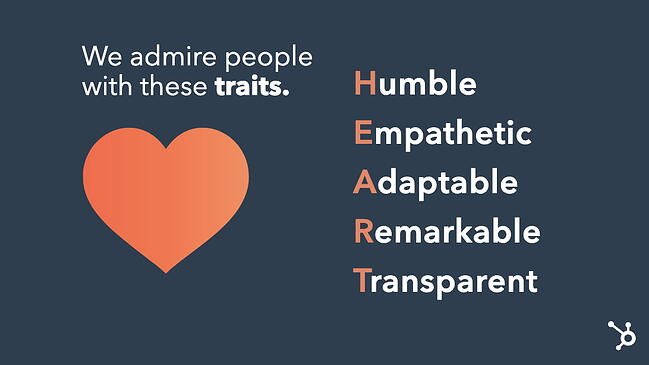
HubSpot’s core employee values were initially outlined in the acronym HEART:

Humble

Effective

Adaptable

Remarkable

Transparent

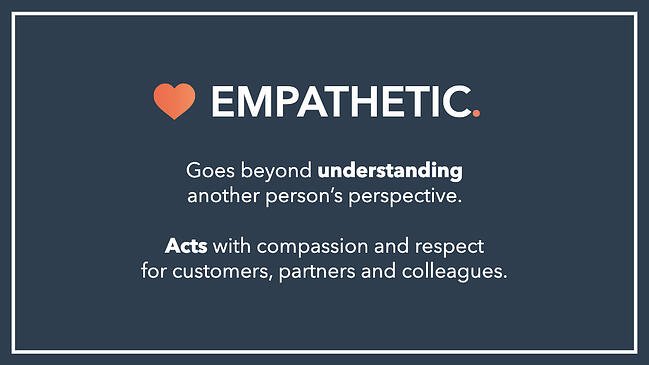
While getting feedback for HubSpot’s culture code update, co-founder Dharmesh Shah realized that something was a bit off. He found that the acronym was missing one integral part of how HubSpot does business: empathy.

In response Shah proposed replacing “Effective” with “Empathy” and encouraged employees to submit feedback via an internal wiki page.

3. Implement feedback.

HubSpot company values Once you’ve solicited feedback from your team and stakeholders, it’s time to implement what you’ve learned. In HubSpot’s case, our culture code was updated and the HEART acronym changed to Humble, Empathetic, Adaptable, Remarkable, and Transparent.

4. Make your core values unique to your brand.

HubSpot company value: Empathetic definitionIt’s easy to hop on trends or use certain generic buzzwords, but it’s important that your company values are specific to your brand. For example, if you choose integrity as one of your values, define what that looks like for your company. How will you demonstrate it to customers? How does it inform your business practices?

5. Continue to evolve when necessary.

Don’t be afraid to adjust your values as your company grows. What you originally created in the early days of your brand may no longer work for your current business. Enlist the help of your employees to reevaluate your values and guide any changes you decide to make.

Strong Company Values are Good for Business

Ultimately, good core values can help an audience identify with, and stay loyal to, your brand, rather than flipping between you and competitors. To ensure long-term success and long-termemployee retention, it’s critical you create — and live by — certain non-negotiable company values.

Editor’s Note: This article was originally published in November 2020 and has been updated for comprehensiveness.

New call-to-action

Categories B2B

How to Gain Your First (or Next) 1,000 Instagram Followers – 26 Tips

It’s no secret that business opportunities are continuing to grow on Instagram. Approximately 90% of Instagram’s 1 billion active monthly users follow a business account on the platform, and there are more than 200 million business accounts.

New Data: Instagram Engagement Report [2022 Version]

But here’s the deal: Unless you’re famous, it’s really hard to amass a huge following on Instagram without some hard work.

Luckily, you can do a few things right away to collect at least 1,000 quality followers for your personal or professional Instagram account. It’s all about knowing where to invest your time and effort. In this post, we’ll discuss a few strategies to help you gain those followers, from creating a follow-worthy Instagram profile to using contests and staying true to your brand.

1. Make your account into a business profile and optimize the description.

First thing’s first: Customize your Instagram profile to make it look good. Tell your potential followers who you are, and give them a reason to follow you.

How? Start by making sure your username is recognizable and easily searchable – like your business name.
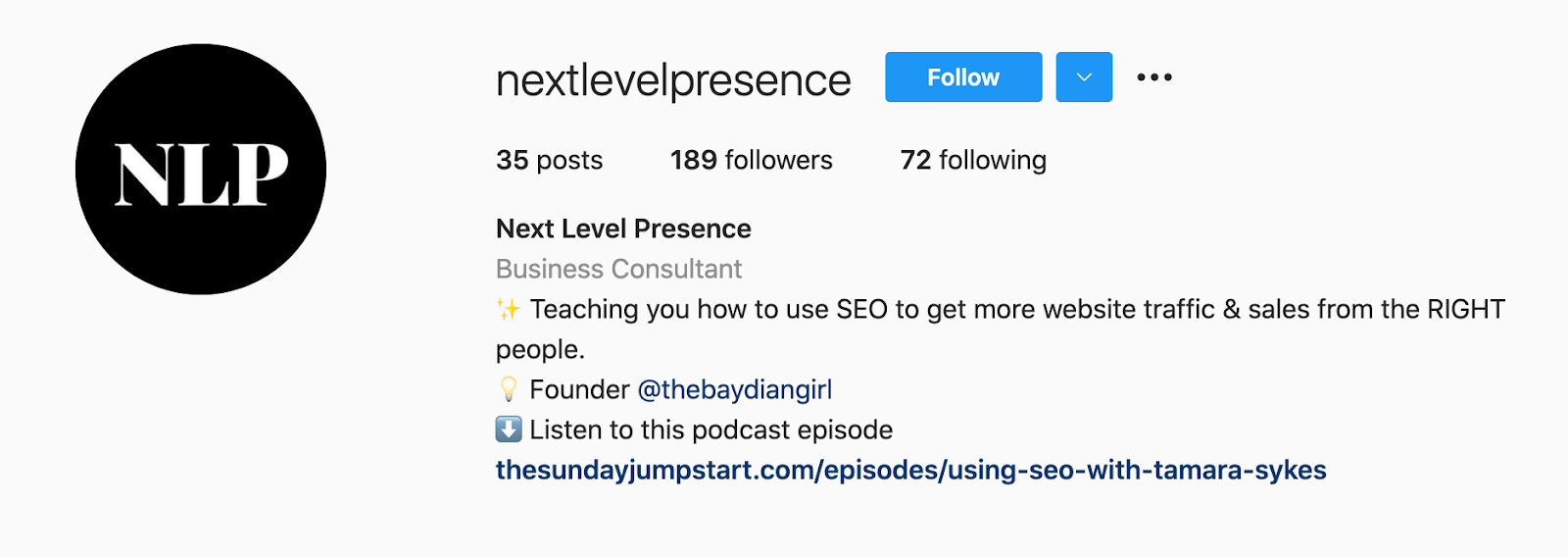
how to get more followers: make a business account and optimize your profile description

Image Source

If your business name is already taken, try keeping your business name as the first part of your username so that people searching for your business are more likely to come across you. For example, the Australian activewear line Lorna Jane uses the username Lornajaneactive.

Setting Up Your Account

Step 1. Add your full business name to the “Name” field in the “Options” section. To find “Options,” tap the three lines in the top right corner of the iOS app, followed by “Settings” which will appear at the bottom of the screen next to a gear. If you’re on Android, tap the three dots in the corner. Your business or name will appear under your profile picture and your username in search.

Step 2. Make your profile public. To make your profile public, open Instagram, open “Options,” and make sure “Private Account” is turned off.
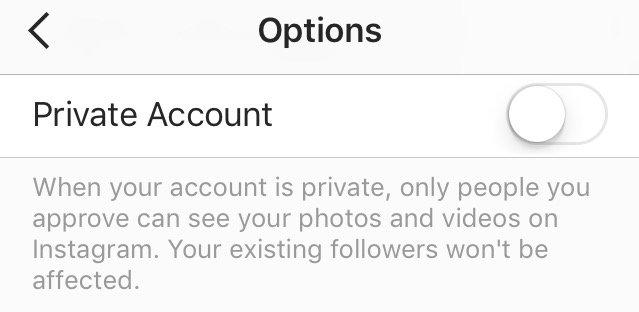
setting up your instagram account to gain followers step to make your account public

Step 3. Choose a profile picture that’s on-brand with your other social networks, like your company logo.

Step 4. Fill your bio with delightful, actionable, and informative information about your brand. Information like this lets people know what you’re about and gives them a reason to follow you. Include who you are and what you do, and be sure to add a hint of personality.

Here are a few examples for inspiration:

  • Cheekbonebeauty: “Less waste. Ethical and safe ingredients.”
  • Oreo: “Playful moments from your favorite cookie.”
  • Mrsbrittanyhennessy: “Helping Influencers go beyond #sponcon and create sustainable businesses.”
  • CalifiaFarms: “Something different, something better. Let us show you what plants can do.”
  • Coragedolls: “Elevating, educating, & encouraging girls of color to be unstoppable with dolls that finally look like her.”

Step 5. Add a link tree to your bio to make it easy for people to go straight from Instagram to your other platforms if they want to. The space allotted for URLs is precious real estate. When you receive 10,000 followers, you can add links to your Instagram Stories.

Until then, your bio is the only place within Instagram where you can place clickable links, so use it wisely. We recommend using a shortened, customized Bitly link to make it more clickable.

Step 6. Enable notifications so you can see when people share or comment on your photos. This’ll let you engage with them more quickly – just like a lot of companies do on Twitter. To enable notifications, go to “Options” and then “Push Notification Settings.” Select “From Everyone” for every category.

A word to the wise: We don’t recommend you link your Instagram account to Twitter and Facebook (or other social media platforms) for automatic posts. Because every platform caters to a different audience and requires different types of posts.

2. Designate an experienced content creator.

Just like there should be one (maybe two) people managing your other social media accounts, there should only be one or two people managing your Instagram account.

If possible, choose someone with experience on the platform who will “get” it — and be sure they stay updated on all new features Instagram has to offer from Reels to IGTV.

If you work for a large organization, you might find that a lot of people want a say in what’s posted. That’s when an organized request or guidelines document comes in handy.

This document should inform people how to request a post on your Instagram account, when, the value of the post, and why.

3. Follow photography and editing best practices.

On Instagram, post quality matters. A lot. Your Twitter followers might forgive a few bad tweets, but a bad photo on Instagram is a big no-no.

Fortunately, you don’t have to take a photography course to be a good Instagram poster — nor do you have to practice for weeks before you start. But you should get familiar with basic photography tips and photo editing apps.

Photography Best Practices

Since Instagram is a mobile app, chances are, some content you post to Instagram will be taken on your mobile device. That’s expected.

If your budget allows, consider investing in professional photography for your Instagram photos, as that will elevate your profile. Otherwise, a smartphone and a few editing apps will do.

  • Focus on one subject at a time.
  • Embrace negative space.
  • Find interesting perspectives.
  • Look for symmetry.
  • Capture small details.
  • Make your followers laugh.

Edit photos before you post.

Instagram has some basic editing capabilities, but oftentimes, they aren’t adequate to make visuals really great.

Most of your photos should go through at least one or two photo editing apps on your mobile phone before you open them on Instagram.

Additionally, consider creating a cohesive Instagram theme across your feed, so anyone visiting your account for the first time can get a sense of your brand.
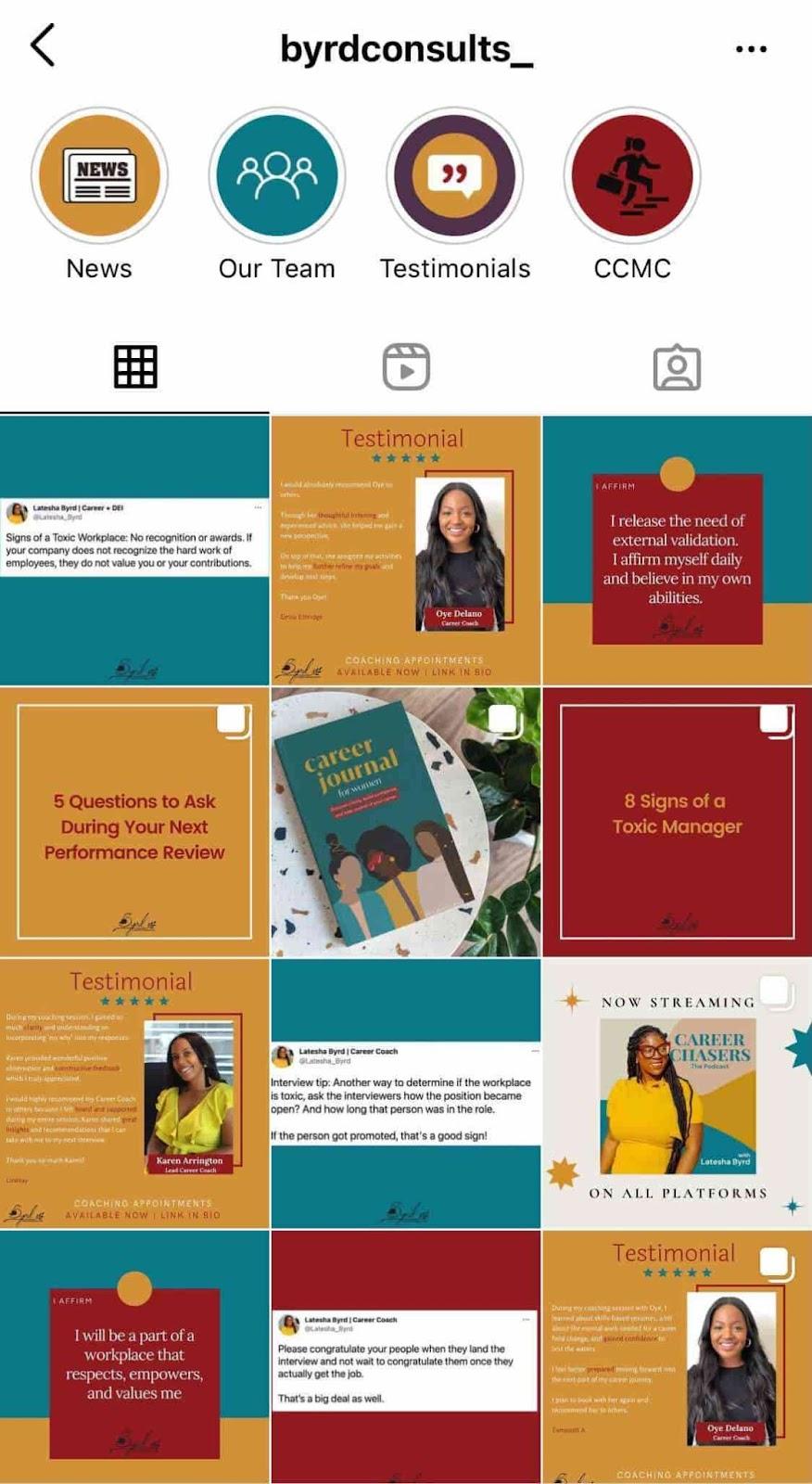
example of consistent instagram profile theme from byrdconsults instagram that helps to gain 1000 instagram followers

Image Source

4. Adhere to a regular posting schedule.

Once you’ve created and optimized your profile, have someone managing it, and have your creative assets ready, it’s time to start posting.

It’s a good idea to have a solid number of great posts up – maybe 15 or so – before you start engaging people and working down this list. That way, when people visit your profile, they’ll see a full screen of photos and will know you’ll post great content regularly.

To start posting on Instagram, download this social media content calendar template first and plan out your posts. It’s best to build a backlog of content ready a few days or weeks ahead of the publishing date.

This will ensure you always have content during holidays, vacations, and even creative blocks.

Keep your target persona in mind as you plan out your posting schedule, as that can drastically impact your posting timing and frequency – especially if you’re targeting an audience in a different time zone. (Download this free template for creating buyer personas if you don’t have a few already.)

Optimizing your schedule for your specific audience might take time and experimentation.
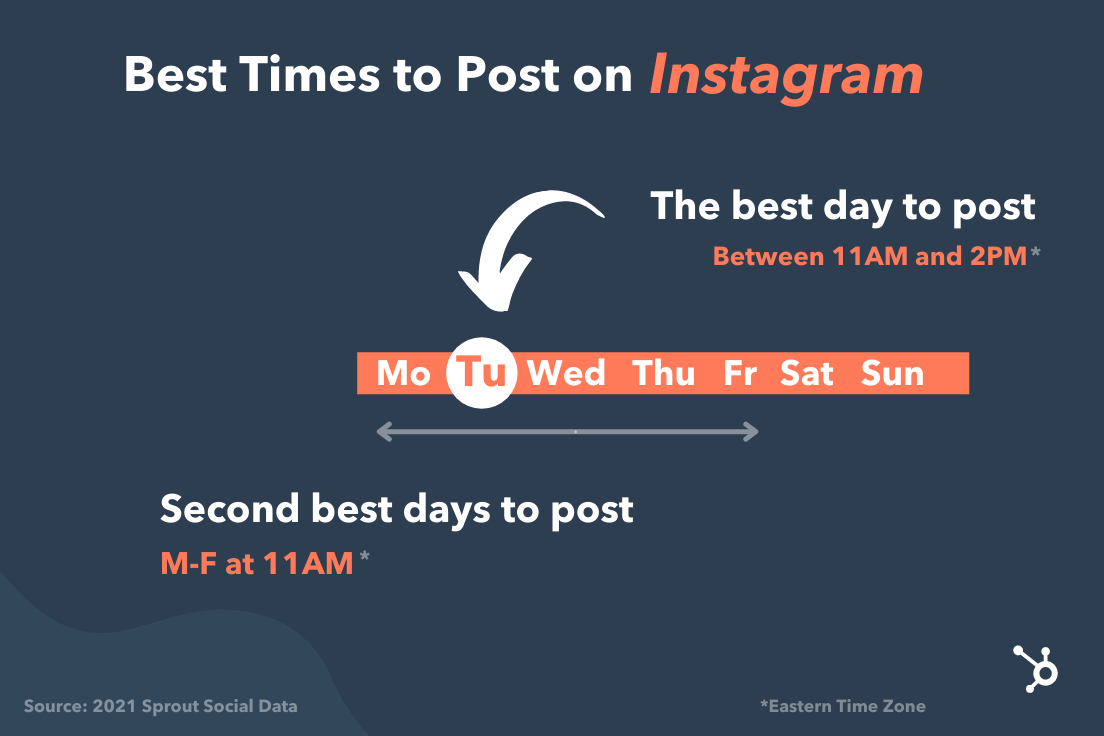
Experiment with these times and days to see what works with your audience. You may find that your target users are most active and engaged at different times.

5. Allow outside contributors to curate your content.

Although it’s best to have only one or two people manning your account, one or two people can’t be everywhere at once taking photos. What about that fun sushi night the engineers had last night? Or the event your head of sales spoke at earlier this week?

There’s a whole breadth of content you’ll want to post to Instagram, and more often than not, one person won’t be able to keep track of it all.

One solution? Create a system where you can curate photos and content from members of your team.

There are a few ways to do this. The first option is to create a specific email address for employees to send their photos, short videos, memes, hyper-lapses, and so on.

Encourage people to add a descriptive subject line so you can easily sort through the content they’re sending. While this doesn’t seem like the smoothest way to curate photos, it’s actually the easiest for the people sending you photos — and the easier you can make it for them to send content, the more content you’ll get.

If your team shares a Box or Dropbox account, you could also create a shared folder where people can automatically drop their photos and videos.

6. Use a consistent, platform-specific brand voice.

Photos and videos might be the most important part of your Instagram posts, but captions, comments, and other text should never be an afterthought. If you’re managing a channel for a brand or have more than one Instagram manager, consider developing a consistent voice that humanizes your brand.

This shows potential followers that you are credible and relatable, rather than formal or intimidating.

When developing a voice, you should keep the platform and your audience in mind.

For example, many influencers and prominent accounts on Instagram have a very casual voice and style but remain professional and on-brand. Once you’ve got your voice down, make sure it stays consistent and natural in your captions, comments, messages, and your bio.

7. Write engaging, shareable captions.

Captions are an essential part of your post — the icing on the cake if you will. Consistently great captions can do wonders for humanizing your brand, winning over followers, and making your content more shareable — thereby giving you more exposure.

Here are a few things you might see in a winning Instagram caption:

  • Clever or witty comments
  • Calls to action
  • Relevant emojis
  • Hashtags

Clever or Witty Comments

Some brands and influencers have used clever or witty captions, or even audience-appropriate jokes to further humanize themselves on Instagram.

My colleague Kelly Hendrickson, HubSpot’s social media team manager, says that she loves Netflix’s account and sub-accounts, particularly because of the post captions.

“They have such a clear brand voice, and you laugh along with them. They’re in on the joke, just like one of your friends,” she says.

example of instagram business account like netflix using clever or witty comments to gain followers on instagram

Netflix’s voice is casual, trendy, and humorous while still staying on brand.

In the post above, the caption is funny, authentic, and relatable. Who hasn’t flipped through a friend’s Instagram Story with the hope that you’ll be featured?

Calls to Action

Another way to increase the shareability of your caption and engage your followers is to ask questions or have some sort of call-to-action in the captions of your photos.

For example, you might write, “Double-tap if you find this funny,” or “share your story in the comments.”

In the example below, we asked followers of the HubSpot Instagram account to leave a comment with a book that’s had a positive impact on their work, along with tagging the author:
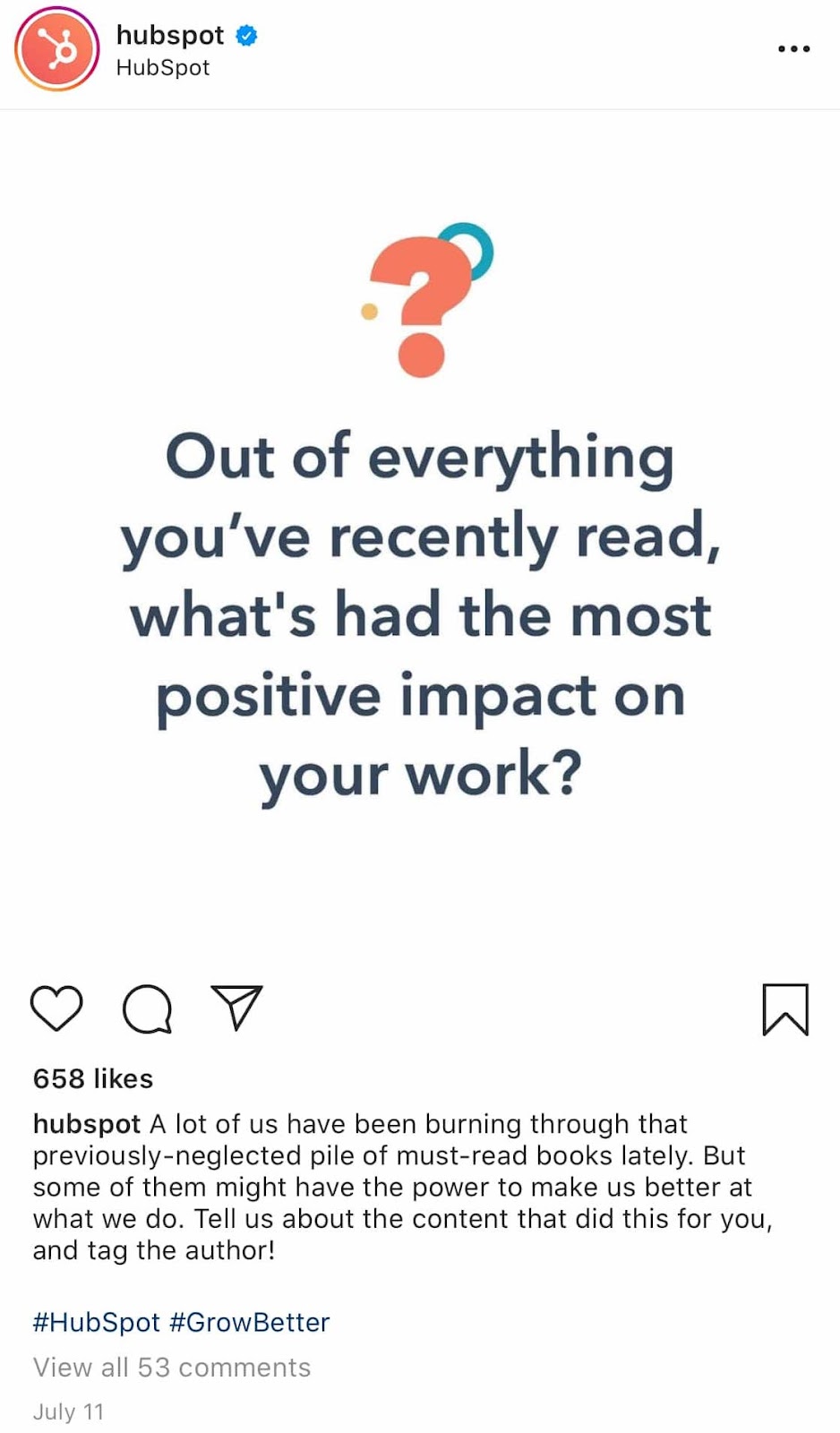
example of an instagram call to action cta on hubspot instagram account to increase engagement and gain instagram followers

Relevant Emojis

Adding just a few relevant emojis can add even more personality to your posts. It could also make them even more noticeable on an Instagram feed. In the post below, Danielle Gray, a beauty expert with over 50K followers, includes witty text with relevant emojis to make the post pop.

example of instagram user stylenbeautydoc using emojis to help gain instagram followers

Image Source

Along with the three items listed above, you’ll also want to include hashtags.

8. Optimize posts with relevant hashtags.

On Instagram, a hashtag ties conversations from different users who wouldn’t already be connected into a single stream. If you use relevant hashtags, your posts will gain exposure to a wider audience and help you become discoverable to potential customers.

The key to using hashtags effectively is to be selective and use them sparingly. Try to limit the number of hashtags per caption to around three. Similarly, don’t use “like for like” hashtags, like #like4like or #like4likes.

This is a shortcut tactic that’ll only leave you with low-quality followers.

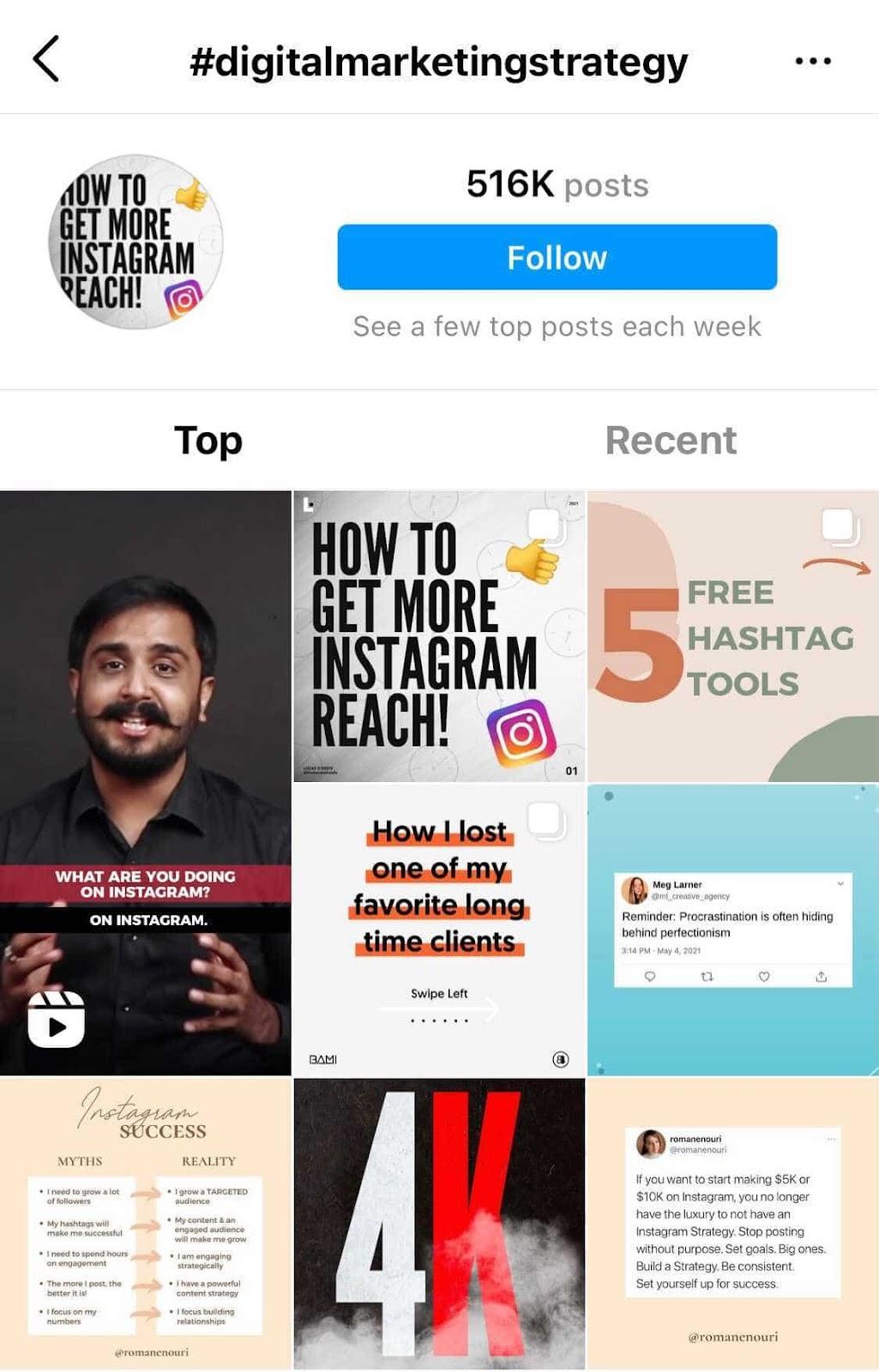
To find the hashtags your audience might be using, do a little research on relevant hashtags in your niche or industry. The easiest way to do this research is in the Instagram app itself, in the Explore tab (i.e., the magnifying glass icon).

When you search for one hashtag, it’ll show you a list of related hashtags at the top of your screen.

For example, when I search for #digitalmarketingstrategy on Instagram, it shows me relevant hashtags like #digitalmarketingexpert, #digitalmarketing, and so on.
gain instagram followers by optimizing using relevant hashtags

To help relate to your followers on a personal level, you might consider hopping on hashtag trends like #tbt (“Throwback Thursday”), #MotivationMonday, #TransformationTuesday, or other trending hashtags. Here’s a post from Fanmdjanm, a headwrap collection and lifestyle brand with over 150K followers on its Instagram account, using the #HappyMothersDay hashtag:

Once you build up a bit of a following, you can try creating your own hashtags — like your company name or a slogan that applies to your content. This is a great way to build up your brand on the platform and build a more cohesive presence.

9. Lean into trending content formats.

With the arrival of TikTok on the social media scene, short-form videos have become one of the most effective content formats on social media.

In fact, according to a HubSpot Blog survey, 85% of marketers who use short-form videos find them to be the most effective content format. And 95% of marketers who leverage short-form videos plan to increase their investment or continue investing the same amount in 2022.

That’s why it’s important to lean into trending content formats. After TikTok, Instagram came out with IG Reels, and this feature is a great way to post funny, relatable content.

When Instagram comes out with new tools, like IG Reels, don’t be afraid to use those features because they can help you gain Instagram followers.

10. Post content your followers want to see.

To gain your first 1,000 followers on Instagram, it’s important to know who your audience is. Once you’ve created your Instagram account, you should take note of which posts perform best.

Is it interactive content, behind-the-scenes stories, funny and relatable posts, or something else? When you have a general idea of what performs best, continue to create that type of content.

Additionally, Instagram has many tools and features you can use: IGTV, IG Reels, Instagram Stories, Instagram Live, Highlights, etc. Begin by posting several types of content formats and see which one does best. Then, come up with a strategy and master that one tool. Doing so will help you create content your followers want to see and gain new followers.

11. Promote your Instagram.

Like the old adage about a tree falling in a forest, if you start an Instagram account without promoting it, is the account even real yet? Well, yes. But, you’ll have fewer followers.

One of the best ways to gain followers on Instagram is to promote your account. Embed posts in your blogs (like you see a few on this post), post on your other social media platforms, and share social links in your email newsletters. A great way to gain followers on one platform is to ask current followers on other platforms if they want to follow you somewhere else as well.

Additionally, to promote your Instagram, it’s important to get started with Instagram promotions and ads. This will help you reach a wider audience. I know it might seem like ads are only effective for selling certain products, but I’ve followed several business accounts because of a sponsored post I saw.

12. Engage with users through follows, likes, and comments.

Instagram is very much a community, and one great way to get involved in that community is to find people who post pictures that interest you, follow their accounts and interact with their content. It’s the most natural way to draw attention to your own Instagram account.

This accomplishes two things: for one, when they get the notification that you’ve followed them, there’s a good chance they’ll check out your profile. This goes back to the importance of having great content on your account before you start reaching out to others.

Secondly, it means you’ll be seeing their recent posts in your feed, so you can Like and interact with them if you choose to.

As you build a following, celebrate your followers by responding to and pinning their comments, and even reposting their posts for user-generated content.

13. Cross-promote with influencers and brands with similar audiences.

Once you build rapport with the folks behind accounts with similar audiences to your own, consider collaborating with them.

Partnering with influencers and brands helps with discoverability, reach, and social proof.
how to gain instagram followers by cross promoting with influencers like sweetlikeoyin

Image Source

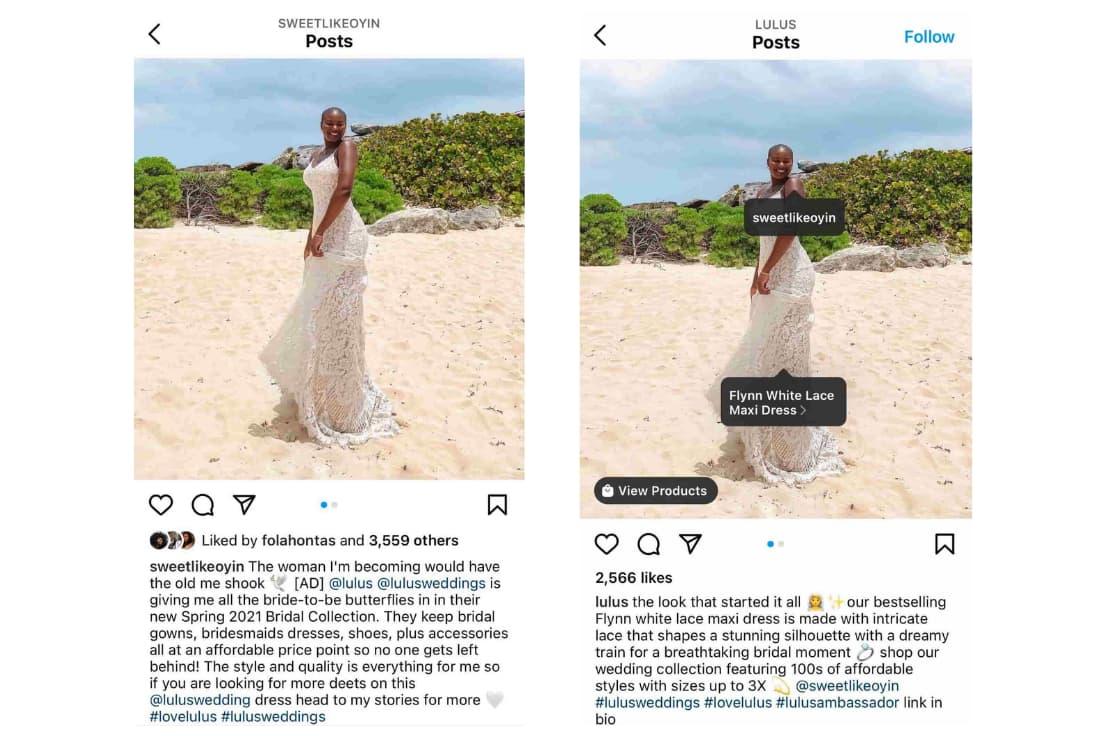
For instance, influencer Sweetlikeoyin who has around 60K followers, posted a sponsored image of herself on the beach wearing a dress from Lulu’s. The clothing brand then published the same image.

With this partnership, both accounts can expand their reach and gain new followers. It’s a win-win. However, be sure to create content that seems natural and makes sense for your brands and collective audience.

14. Run Instagram contests to encourage engagement.

Another great way to expand your reach while increasing engagement with your photos is to run a contest or giveaway. As part of your contest, you can ask users to follow your account, like, and/or comment on the post to be eligible to win.

I mean, come on. Who doesn’t love winning free stuff?

You can also add a user-generated content (UGC) element to the contest, too, where people post a photo of their own and use a specific hashtag.

Here’s an example from PlayaBowlsNortheastern, where followers were asked to follow Playa Bowls as well as their brand partner, Scoop and Sushi, and tag a friend in the comments. In exchange, followers had the chance to win a free bowl:

15. Explore Instagram Stories’ interactive features.

Instagram has always given brands the platform to share beautiful, curated photos to represent their companies.

However, with the introduction of ephemeral Instagram Stories, brands can also share on-the-fly, behind-the-scenes looks for 24 hours that may not be as polished as a published photo, but give your brand more personality on the platform.

Just look at how Snapchat exploded a few years ago. Once platforms like Instagram and Facebook introduced similar features, it made those apps more valuable and interesting in the eyes of users. Although Snapchat pioneered this feature, Instagram Stories now has over 500 million daily users.

Along with sharing video clips and static images through Instagram Stories, users can also use polls, event reminders, and the “Ask a Question,” tool to gain more engagement and learn more about their audiences.

Once a user is verified or has over 10,000 followers, they can even include a link to a webpage within a story.

How Brands Can Use Instagram Stories

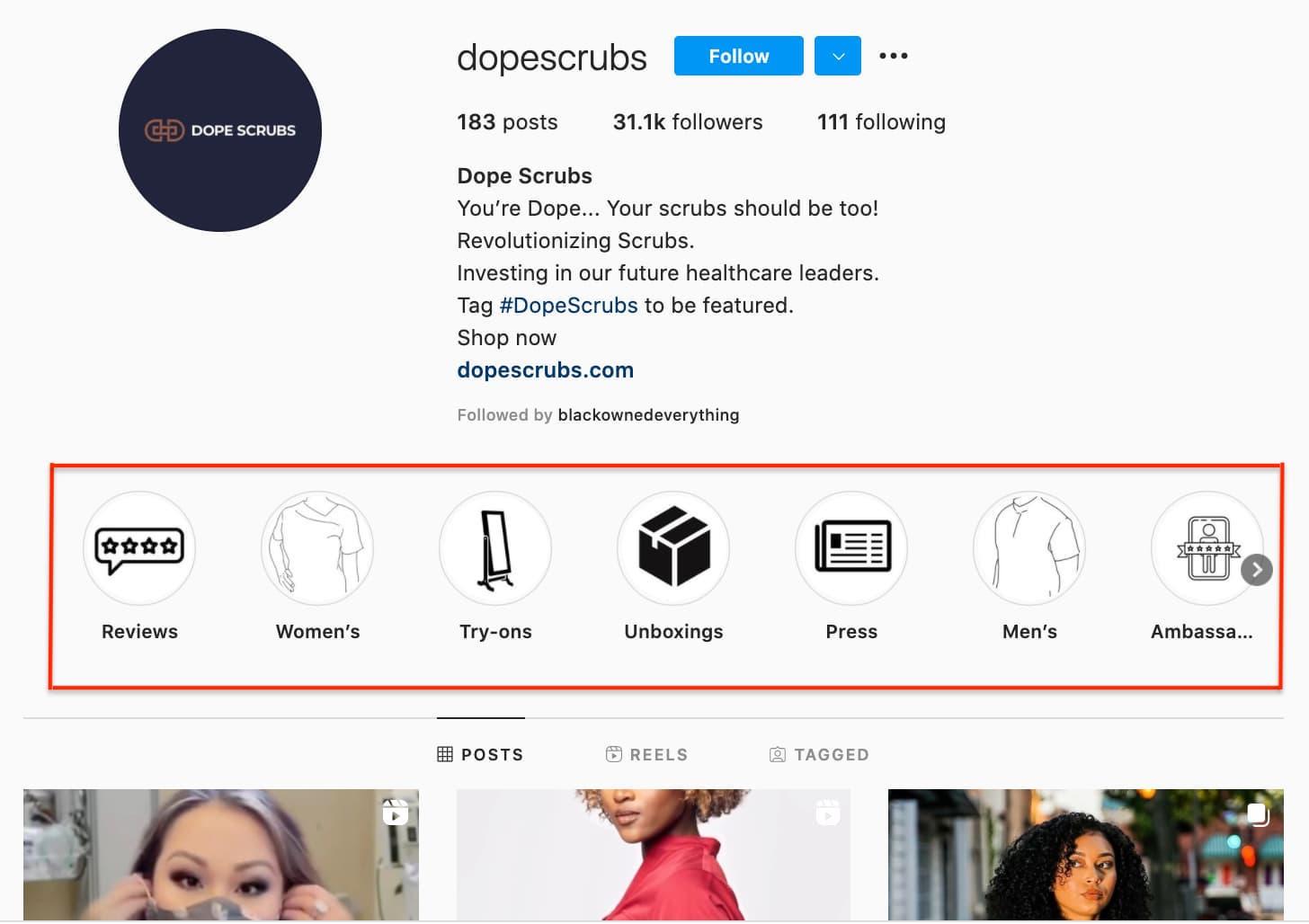
Instagram Stories disappear after 24 hours unless they are marked as a “Story Highlight.”

Highlighted stories will show up at the top of your profile between the photo feed and your bio.
dope scrubs using instagram stories to help gain more instagram followers in story highlights

Image Source

Here are a few other brands we recommend following to see what they’re sharing:

Dana Shultz (Minimalistbaker) publishes easy vegan and gluten-free recipes on her blog. Her Stories feature neat how-to videos of her making breakfast and testing out new recipes in her kitchen. The behind-the-scenes aspect of her Stories provides a lot of human context for her blog’s brand, and everybody loves a good how-to video.

Casper publishes quirky Instagram content to advertise their mattresses – without overtly doing so. The main theme of their content? Staying in is better than going out (because you can stay in and lay on a comfy Casper mattress, naturally).

They’ve even created a gallery for followers to use as backdrops for their Snapchat and Instagram stories to make it look like they’re out at a party when in reality, they’re laying in bed.

One of their latest Instagram Stories featured someone watching “The Sopranos” in bed, with the caption: “Who needs plans when you have five more seasons?”

This video supports Casper’s campaign to stay in bed with a very real look at what millions of people do when they’re hanging out at home.

Here are our tips for using Instagram Stories for your brand:

  • Whether it’s funny, sad, or unique, be authentic. Your photo gallery is where content can be perfect and polished. Instagram Stories are for the raw, unscripted, and unretouched. Use Stories to share the other side of your brand that followers might not be able to see elsewhere. Do you have a dog-friendly office? Is your team trying out the latest challenge? Start filming to showcase the more human side of your brand.
  • Go behind the scenes. These are by far our favorite types of content for ephemeral video sharing. Show followers what goes into the planning of an event or the launching of a product, and make it fun. Your followers want to feel included and in the know. You could also use Stories to cultivate a brand loyalty program that only rewards people who check out your content.

16. Use the Instagram Live feature.

Instagram also lets users record and share Live videos, another content format that’s proven to be hugely popular on other social networks. What’s unique about Live videos on Instagram? They disappear when users stop filming.

This authentic, bi-directional experience lets brands share unscripted, raw moments with their audience to incorporate human elements into a social media platform that’s highly edited and polished in its traditional use.

Since the Live feature launched, Instagram has added even more features that may enable further engagement or interactions from viewers, such as:

  • Request feature to go live with the live account
  • Pinned comment
  • Q&A box
  • Up to four accounts on Live at a time
  • Filters

Live video is a growing trend across a variety of social media platforms, so if something interesting is happening, start rolling. Whether it’s an event, a team birthday party, or behind-the-scenes footage, your devoted followers want to see what you’re up to.

And if you want to make it even more interesting, you could collaborate with an influencer or another brand to host a Live. With people that your audience is interested in, you can promote this Live event, and then host it on your profile.

Promoting this type of event will help you tap into someone else’s audience while interacting and engaging with your followers by answering their questions and talking to them during the Live.

17. Share your profile link on your website and social media channels.

Have a website? Newsletter? YouTube channel? Make sure you include a link to your Instagram on every single platform.

The first place you’ll want to make sure to add an Instagram badge is your website, specifically your footer and “About Us” page.

Here’s what the badge could look like:

example of instagram user linking to other business accounts to help gain 1000 instagram followers

If your brand has brick-and-mortar locations, put out a good ol’ print call-to-action letting people know you have an Instagram account and encouraging them to follow you. You can also place them on your business cards. You might even offer a discount code for doing so.

Also, be sure to promote your Instagram account on your other digital platforms. Chances are, the folks who already follow you on Facebook and Twitter will also follow you on Instagram without much prodding.

Let those followers know you’re on Instagram and encourage them to follow you there.

how to gain instagram followers tip like linking to your social media profiles as shown by the McBride Sisters wine business example

Image Source

In this example, wine company The McBride Sisters encouraged their email subscribers to follow them on Instagram with a simple CTA: “Join the community.”

18. Post user-generated content.

Similar to cross-promotion, brands can publish user-generated content to show appreciation for existing customers and generate social proof at the same time.

If I see a regular person endorsing a product on Instagram, I’m more likely to believe they really like the product.

The same is true for most consumers. That’s why sites like Yelp are so popular.

Ultimately, user-generated content can be an excellent strategy when trying to increase brand awareness and trust in your products or services.

For instance, Bevel reposted a video from blogger Rickey Scott using and recommending their products to their 600+ followers.

Posting Scott using Bevel is a smart move.

Firstly, the product is designed with black men in mind. Having Scott, who is part of the brand’s target demographic, recommend the product serves as the social proof the brand wants.

Furthermore, part of Scott’s audience will likely fall within Bevel’s target audience. Simply put, the two brands have similar audiences and brands that align well, which is why it’s a good opportunity for Bevel to promote Scott’s content.

19. Diversify your audience to resonate with different types of users.

As your followers grow, it can be tricky to identify what content types will resonate with them. With this in mind, divide your audience into sub-groups and target your content to various demographics.

For instance, if you have 200K followers, those followers probably come from different regions of the world, have different interests and hobbies, and likely have different careers. Rather than post all-encompassing content that will satisfy all your followers at once, conduct some analytics research to separate them into smaller sub-groups.

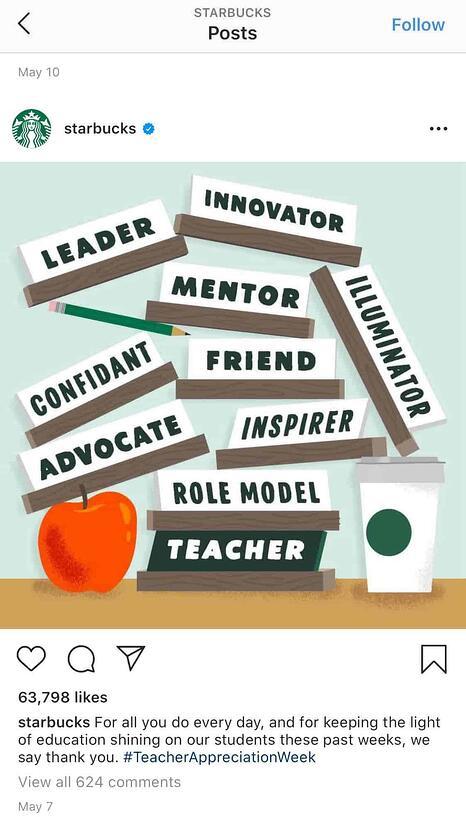
Take Starbucks as a good example of this. Starbucks has close to 18 million followers. There’s no way the global coffee brand can post content to satisfy 18 million people at once — and it doesn’t try to.

Instead, Starbucks regularly posts more exclusive content geared towards particular groups, such as this post they published celebrating #TeacherAppreciationWeek:
how to gain more instagram followers tip to diversify your audience like Starbucks appealing to teachers, students, and other groups of people

Image Source

This post won’t appeal to the majority of Starbucks followers who aren’t teachers, but that’s OK.

You don’t always need to post content to please everyone. Instead, demonstrate your company’s ability to connect and engage with sub-groups and post what aligns with your own brand’s values.

Education is something that matters to Starbucks, so by posting about teachers, they’re doing more to demonstrate their values than they are appealing to everyone. Which is kind of the point, isn’t it?

20. Apply for a verification badge.

When an account on Instagram is verified, it has a blue dot, called a badge, next to the username. When another user comes across this profile or finds the verified username in search, the blue dot confirms to them that the account is the business, individual, or brand that it’s claiming to be.
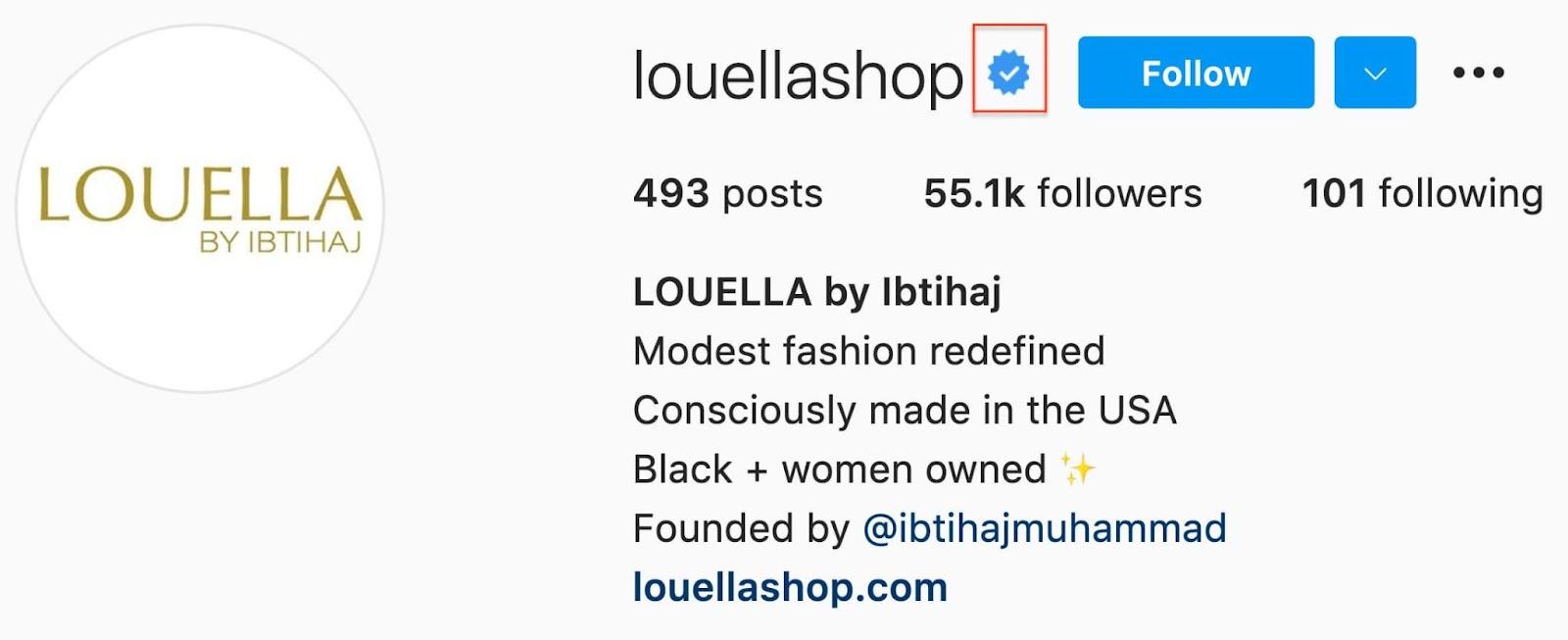
how to gain followers on instagram tip apply for blue check verification badge for authenticity

Image Source

While Instagram has a list of eligibility requirements for the badge, the platform does allow users to apply for one. You can learn more about that process on Instagram’s Help Center.

21. Create your own filters and badges.

When it’s time to promote a new product or feature, creating your own filters, stickers, or badges can help you reach a new audience. You can learn how to create your own filter or sticker to jazz up your Instagram Stories.

The best way to do this is to use these on highly shareable posts that followers will want to add to their own Stories. This way, you’ll reach their audiences and your users will promote your page for you.

22. Tag relevant users.

Another way to gain more followers on Instagram is to tag relevant users in your posts. Your posts will then show up in that person’s tagged posts, and anyone who looks through there will find your page (and hopefully, follow).

However, it’s important that you only tag people who are in the photo, or relevant to the photo. For example, many times, influencers tag the clothing or makeup brands they wore in a photo.

23. Post content that’s meant to be re-shared.

Each post on your Instagram should have a purpose. It could be to generate likes, comments, engagement, shares, etc. However, you can’t expect followers to re-share content just for the heck of it. There needs to be a reason.

Because of this, reverse engineer your Instagram posts. Think, “What type of content would my audience re-share?” Then, create that content. It could be a quote, a meme, an infographic, statistics, etc.

To gain new followers, you should post content that’s meant to be re-shared, so that when others do re-share it on their own Instagram Stories and tag you, their audience will find you and follow you.

24. Get on the Instagram Explore page.

Getting on the Instagram Explore page is easier said than done. We get that. However, creating posts that are aimed at getting on the Explore page means you’ll be creating easily shareable and trendy content.

Think about viral trends and create a video that your audience might engage with. Additionally, use hashtags and tag other users and brands in those posts.

Instagram’s Explore Page algorithm also seems to grab content that has more engagement, especially if said engagement happens in the first few hours of posting. In Instagram’s case, quality is better than quantity, and getting interaction from influential users (i.e. having a higher follower count) is one of the best ways to do it.

25. Share educational content with Instagram slides.

Similar to creating content that’s meant to be re-shared, you can also create educational content in the form of Instagram slides. Instagram slides have become a popular way to educate audiences on an idea or topic.

Think about what you can educate your audience on and then create a simple Instagram slide post with an engaging title that entices users to click on the post.

With this type of content, you can share the post on your Stories, and then hopefully other users will be compelled by the content to share on their Stories as well.

26. Host an Instagram account takeover.

When you’re collaborating with influencers and other brands, think about hosting an Instagram account takeover. You can have an influencer take over your Stories for the day, and promote this on their own Stories.

Then, you’ll get their followers to follow along with the Stories and hopefully follow your account.

Additionally, you can ask an influencer or brand if you can take over their Stories, and interact with their audience as a way to promote your own account.

Quality Over Quantity Still Matters

Ultimately, it’s important to focus less on the number of followers you have, and more on the quality of content you create. Your audience will grow naturally if you put effort and time into creating engaging, informative, or inspirational content without worrying about “quick fixes” for boosts in followers.

You want to play the long game on Instagram, and that starts with focusing on what you can control: the quality of the content you produce, the messages you promote, and the brand you build.

Editor’s note: This post was originally published in February 2016 and has been updated for comprehensiveness.
Improve your website with effective technical SEO. Start by conducting this  audit.  

Categories B2B

Top 7 Ecommerce Podcasts You Should Listen to in 2022

Are you thinking of launching an ecommerce business? Before you start, learn everything you need about ecommerce with these 8 podcasts.

Download Now: Ecommerce Marketing Plan Template

This list of ecommerce podcasts offers it all – education, inspiration, and entertainment. Check them out below.

Shopify Masters

ecommerce podcast: shopify masters

If you’re getting into ecommerce, what better way to learn than from one of the biggest ecommerce platforms?

On Shopify Masters, the hosts invite successful entrepreneurs and ecommerce experts to discuss the tools needed to build a thriving online business. This includes everything from ads and crowdfunding to market research and ambassador programs.

Standout episodes:

  • The One Data Insight That Doubled This Brand’s Sales
  • How This Menswear Company Worked Past Major Breaking Points to Scale
  • How to Grow Your DTC Business on a Budget

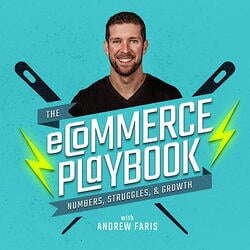
Ecommerce Playbook

ecommerce playbook ecommerce podcast

If you’re a beginner in the ecommerce space and looking for straightforward, tactical advice, this podcast is for you.

Host Andrew Faris, former CEO of an ecommerce aggregator and now the VP of Growth for an ecommerce growth agency, shares his journey with listeners, from recent wins to big failures. He also brings in entrepreneurs to talk about their ecommerce journey.

Standout episodes:

  • How Much Should I Spend on Ads?
  • 21 AntiFragile Ecommerce Tactics
  • Know Your Numbers (No, Your Real Numbers)

DTC Pod

ecommerce podcast: DTC pod

Are you launching a direct-to-consumer ecommerce business? If so, listen to this podcast.

It was specifically created with this audience in mind to help them with all aspects of running a successful DTC business, such as website conversion, paid media, brand awareness, influencer marketing, ads, and more.

Standout episodes:

  • Marketing Fyre Festival, The Viral Campaign of The Decade
  • Kevin Wong, Lunar: Breaking into Big Box Retailers with Hard Seltzer CPG
  • Shaun Brandt, Oddit: Conversion as a Service, Optimize DTC like a PM

The 6 Figure Product Business Podcast

the 6 figure product business podcast ecommerce podcast

Using a workshop-style approach, this podcast does deep dives on all aspects of running a successful ecommerce business.

Its host, Kerrie A. Fitzgerald, is an ecommerce business coach and digital marketing expert who build her own six-figure business and now wants to help listeners replicate it for themselves.

Standout episodes:

  • Why Free Facebook Groups May Be Hurting Your Ecommerce Business
  • How to Create a Cult-Like Following for Your E-Commerce Brand
  • Key Elements for a Strong Ecommerce Brand with Duo Collective

​​Female Startup Club

ecommerce podcast: female startup club

As their name suggests, The Female Startup Club was created with women in mind – specifically female entrepreneurs.

One thing this podcast does well is balancing its educational content with inspirational content. One episode might focus on the tactical steps to organic marketing while another may focus on a founder’s journey to $100 million in revenue.

While ecommerce isn’t the focus, it is something they discuss a lot with founders and experts.

Standout episodes:

  • 3 Lessons That Turned This Failing Fashion Entrepreneur into an 8-Figure Founder
  • 7 Women Pioneers Changing The Future of Feminine Health
  • My 7 Worst Business Mistakes That Cost Me Thousands of Dollars

My First Million

my first million ecommerce podcast

Ever wish you could be in a room with successful entrepreneurs and venture capitalists while they brainstorm business ideas? This podcast allows you to do just that.

On the My First Million podcast, co-hosts Sam Parr and Shaan Puri discuss current trends in the market and the growth opportunities they identify. They also interview other successful business owners about their success.

While this podcast doesn’t focus solely on ecommerce, it can serve as inspiration for listeners looking to launch their business soon.

Standout episodes:

  • Billion Dollar Business Philosophies with HubSpot Co-Founder Dharmesh Shah
  • How to Reverse Engineer Any Business
  • How to Recruit A-Players to Small Companies

The Glossy Podcast

the glossy podcast ecommerce podcast

If you’re a DTC ecommerce fashion brand and want to stay on top of industry trends and news, listen to The Glossy Podcast.

This podcast explores the impact of technology on the fashion and luxury industries. However, they also cover topics like greenwashing, executive team changes, and the metaverse.

Standout episodes:

  • LVMH’s Earnings, Lulumenon’s New Resale Program, Paris’ NFT Day
  • Google Shopping’s Stephanie Horton: ‘Servicing the customer at every point of the journey is the goal’
  • The Yes Founder Julie Bornstein on Building an ‘Industry-Changing’ Retail Platform

ecommerce planning template

Categories B2B

2022 Email Marketing Benchmarks [HubSpot Data]

Email marketing is an important strategy for marketers looking to reach new leads, stay top-of-mind with existing customers, and keep them aware of new products and services — but the practice isn’t always straightforward. Technology and consumers change, and keeping up can be challenging. However, the challenge is worth it.

47.5% of marketers said their email marketing strategy was very effective toward reaching their business goals, while 47.2% said it was only somewhat effective. Only 2.7% said it was somewhat ineffective, and less than 1% said it was very ineffective.

Now that you know a sound email marketing strategy can help you reach your broader marketing goals, how exactly can you strengthen your marketing tactics to see the best results? To improve your email marketing metrics, here are some useful email marketing benchmarks we gathered from a survey we conducted among hundreds of marketers.

→ Download Now: The Beginner's Guide to Email Marketing [Free Ebook]

Most Important Metrics for Effective Email Marketing

When we asked marketers which metrics were the most important in measuring the effectiveness of an email campaign, the majority included click-through rate, open rate, and conversion rate in their answers.

Click-Through Rate

In email marketing, click-through rate (CTR) is calculated by the number of subscribers that have clicked on at least one link in the email campaign. And 35.9% of the marketers we surveyed said improving it is one of the biggest challenges they face with their email marketing efforts.

If you’re struggling to boost your CTR, the following email marketing benchmarks will help refine your strategy:

30.7% of marketers said emails featuring new product/feature announcements have the highest CTR. Another 30.7% said the same about emails with special offers or promotions. This likely means consumers are more prone to click on emails that hold valuable information about what exactly your company can do for them — whether it’s providing in-demand offerings or enticing deals that could save them money.

Speaking of value, we also found 38.2% of marketers said providing value through their marketing emails is one the most effective strategies for increasing CTR. Other popular answers include:

  • Crafting effective subject lines (36.5%)
  • Optimizing emails for mobile (29.6%)
  • Including clear calls to action (28.6%)

Our data also suggests consumers respond to a more personalized approach to email marketing, particularly segmented emails. Our survey found 52.9% of marketers reported segmented emails have a better CTR than unsegmented, while only 23.8% said the opposite is true.

And as we mentioned before, changes in technology can also impact your email marketing metrics, including CTR. 39.9% of the marketers we surveyed said the Apple IOS 15’s privacy protection feature reduced CTR —and 34.7% of marketers said the EU General Data Protection Regulation (GDPR) has reduced CTR as well.

Fortunately, there are ways to adjust your email marketing strategy to account for these privacy changes. 62% of marketers surveyed included prioritizing different KPIs to measure effectiveness in their method of adapting their strategy.

51.9% included leveraging user data from sources that are not affected by data privacy changes, like non-Apple users. And 36% included leveraging channels other than email marketing, like text message marketing.

Open Rate

In our survey, 32.9% of marketers included low open rates among the biggest challenges they face in email marketing. If open rates are a challenge for your company, the following statistics can help you make the right adjustments to your strategy.

About 31% of marketers said emails with special offers and promotions have the highest open rates, and 30% said the same about emails announcing new products and features.

You also need to consider subject lines when sending your marketing emails. About 65% of marketers said subject lines have the greatest impact on open rates.

More than half of the marketers we surveyed said subject lines that engage curiosity are the most effective in boosting open rates. About 36% said the same about emails with promotion offers, and 27.9% said expressing urgency in subject lines are most effective.

Similar to CTR, 65% of marketers say segmented emails have a better open rate than unsegmented —while 17.9% say unsegmented is better, and 17.1% say it’s about the same.

Privacy protection advancements also impact open rates, according to 34.1% of marketers who said Apple IOS 15’s privacy protection feature reduced their ability to see open rates. And 24.3% said it reduced open rates altogether. GDPR also impacts open rate. About 21% of marketers said the policy reduced their open rate, and about 34% said it reduced their ability to see open rates.

Conversion Rates

A little over 30% of marketers said low conversion rates are among the biggest challenges facing their email marketing strategy, according to our survey. However, if you refine your email marketing strategy to boost open rates and CTR, then you’ll likely see boosts in conversions as well.

Another method that can potentially lead to better conversion rates is to optimize your emails to be readable and engaging on the devices most used to read them. We found that 41% of email views come from mobile devices. The second most popular device is desktop with 39%. Coming in third place are tablets, where 19% of email views come from.

The right email marketing strategy will keep you consumers in the know about your company’s exciting new products and services, and will keep your brand in their mind when they’re in between purchases.

Now that you know what kind of email tactics will make your audience open and click through your emails to become new leads, you’re ready to craft the best email marketing strategy for your organization.

New Call-to-action

Categories B2B

Why HubSpot Sees More Representation Than Ever in 2022, According to HubSpot Employees

As of January 2022, HubSpot has 5,900 global employees.

Such a large employee base equals a workforce of people with different identities, backgrounds, and cultures that are important to them.

Download Now: Free Company Culture Code Template

HubSpot recognizes this and doesn’t want what makes every employee unique to be checked at the door before work begins. Instead, it champions differences and works to make sure that everyone feels represented, safe, welcome, and able to be themselves at work.

Let’s discuss how HubSpot does this.

Key Insights from HubSpot’s 2022 DI&B Report

HubSpot releases a yearly DI&B report to share progress on DI&B commitments. Here are some key insights about HubSpot employees from the most recent report:

  • The population of employees who identify as women or non-binary is 46.9%
  • 13.7% of employees identify as Asian, 8.8% as Black or African American, 7.5% as Hispanic or Latino, .1% as Native Hawaiian or Pacific Islander, and .1% as American Indian or Alaska Native.
  • 13.3% of employees are members of the LGBTQ+ community.
  • 9.8% of employees are persons with disabilities.
  • 44.9% of employees are first-generation.
  • Retention of Black, Indigenous, and People of Color employees in the U.S. is 2.2% lower than HubSpot’s overall U.S. employee retention rate.

Let’s go over how HubSpot can achieve these numbers.

1. Representation in leadership.

Representation at work looks like historically marginalized groups of people seeing people like themselves in their work community, whether in similar positions or higher-level positions like management and C-Suite.

In 2021, HubSpot became a company led by Yamini Rangan, a woman of color. In addition, the Company Executive Leadership Team (CELT) is made up of four women, and more than 50% of HubSpot leaders are women.

HubSpotters who share identities with Yamini and the other HubSpot leaders see themselves represented at work in higher-level positions, creating a sense of familiarity, community, and belonging in their day-to-day lives.

2. Active employee resource groups (ERGs).

Employee Resource Groups (ERGs) are communities where employees can join and interact with coworkers, talk about their experiences, and develop support networks. People of Color at HubSpot, PoCaH, is an ERG, and Harry Chiu is on its leadership council.

Chiu, a Senior Customer Onboarding Specialist, says, “In terms of representation at HubSpot, I think one of the biggest reasons is because we have so many internal resources to make everyone feel welcome…For myself, immediately after joining, I felt a connection with PoCaH — the programs they run, the people that are part of the ERG, and just what they stood for.”

Chiu says he attended a predominantly white Irish Catholic school for college. While he didn’t have trouble blending in, he still found himself hanging with people of color in campus organizations and took on roles to help create spaces that helped everyone feel comfortable.

He says, “I find that PoCaH does just that — bringing folks together, learning about one another’s cultures, building more empathy, and just helping everyone be more open-minded…As this group continues to grow and help facilitate inclusion in our organization, I find that it all goes back to the fact that HubSpot really cares about inclusion because, HubSpotters themselves, like me, care so much about it.”

3. Prioritizing employees’ mental health and safety.

Mental Health and safety are a big deal at HubSpot, as the goal is for everyone to perform to the best of their abilities while simultaneously maintaining a work-life balance and not experiencing burnout.

HubSpot has created various initiatives with this in mind for the sole purpose of helping employees relax, have fun, and prioritize their mental health, like cultural programming events, a global Week of Rest, and No Internal Meeting Fridays.

4. Opportunities for career growth and development.

HubSpot offers career growth and development opportunities for employees to flourish and develop their skills. Many of the programs are for communities that wouldn’t have access to the same experiences in different organizations.

The Charted Path is specifically for Black employees. In it, participants engage in 1:1 coaching sessions with a mentor that helps with skill-building and defining career paths, as well as larger group conversations with other participants to discuss and receive peer feedback.

Basha Coleman, a Historical Optimization Writer on the Blog Team, took part in the program and says, “The Charted Path program helped me build confidence as a professional and visualize my future self through each stage of my career. I love the focus that the facilitator put on the challenges women, especially Black women, can face in the workplace and held space for us to encourage each other to reach our career aspirations.”

5. Investing in social causes beyond HubSpot’s doors.

HubSpot cares about diversity, inclusion, and belonging beyond the screens of employees’ work computers. As such, it has committed to investments in social causes outside of HubSpot.

For example, its partnership with Howard University, a historically Black university, and the creation of the Center for Digital Business, where students participate in educational programming, collaborate with students and faculty and hone their business skills.

HubSpot has also committed to offsetting its historical environmental emissions through renewable energy carbon offset projects like the Blue Creek Salmon Conservation Project, and HubSpot Helps supports non-profit organizations across the globe where employees can get involved with local organizations and participate in different programs.

6. A commitment to follow-through.

Chester Pearce, a former member of PoCaH’s leadership council and current Team Lead on the Learning & Development team, says that HubSpot’s commitment to DI&B makes an impact through follow-through; or walking the walk.

He says, “HubSpot has focused on walking the walk. From establishing and building up Employee Resource Groups such as BlackHub and PoCaH, to establishing learning around understanding the cultural environment that surrounds us all. We have followed through on a Black Lives Matter action plan and have focused on recruiting diverse talent.”

He says that commitment to these programs helps HubSpotters see themselves truly represented in the community around them, in leadership to their team members, which helps people bring their whole selves to work.

Over To You

HubSpot’s commitment to diversity, inclusion, and belonging directly contributes to its diverse workforce, as it simply recognizes employees for who they are, independent of their jobs.

It doesn’t — and shouldn’t — end at just that, though, and Pearce agrees — “The progress we’ve made is just the start. HubSpot isn’t focused on just hiring diverse talent, the organization is focused on driving the success of diverse talent on a global level. This means having more conversations, developing our leaders, and continuing to provide opportunities for growth for all HubSpotters.”

company culture template

Categories B2B

6 Nonprofit Marketing Trends that All Marketers Should Know About [HubSpot Data]

Marketing your nonprofit can be challenging.

Thankfully, learning from others that have already engaged with nonprofit marketing, leveraged trends, and found success can be helpful when it comes to developing your own strategy.

In this post, discover expert insight and tips from HubSpot’s Nonprofit Marketing Trends Report for 2022 that will help you build the brand awareness you’re looking for.

Download Now: Nonprofit Marketing & Fundraising  Trends for 2022 [Free Report]

Nonprofit Trends to Watch in 2022

1. Collect donations on social media platforms with native donation features.

TikTok has grown in popularity for nonprofits in reaching audiences and collecting donations. In fact, almost 75,000 donations were made within the app in support of various organizations and causes in 2021.

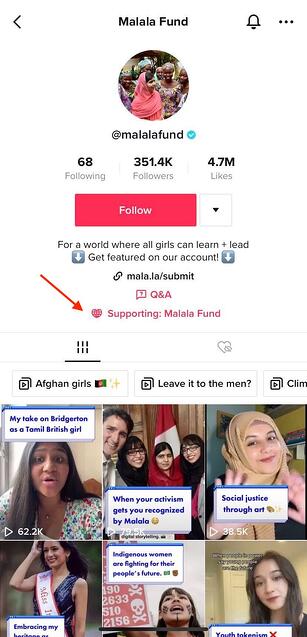
Its donation feature is a native TikTok tool, so it’s valuable for nonprofits looking to use it as you can reach your target audiences on the platforms they already use rather than directing them down a donation path off the app. The image below displays the donation CTA on the Malala Fund’s TikTok profile.

tiktok-1

Image Source

Other platforms like Instagram and Facebook have charitable donation tools, and Twitter recently launched a profile tipping option that nonprofits can leverage to connect donations on a profile.

2. Championing user-generated content.

User-generated content is content created by your audiences that relates to your business. So, for example, someone posting a picture on Twitter where they’re wearing athletic wear from a company.

According to HubSpot’s recent report, user-generated content is valuable for nonprofits and is a must-have for 2022. When leveraging this trend, a best practice is to share user-generated content from the groups you support. Doing this is beneficial because sharing a direct story from those impacted by what you do demonstrates the results of your efforts and can inspire those you reach out to to contribute because they’ll know you’re actively making a difference.

3. Personalized and segmented campaigns to generate donations.

Segmentation is essential for all businesses because consumers expect to see content related to their interests. When it comes to nonprofit marketing, this can dictate the strategies you use to fundraise for your business.

HubSpot’s Nonprofit Marketing Trends report calls attention to the following statistics when it comes to reaching your audiences:

Putting the statistics above into practice can look like sending text message donation campaigns to Gen X audiences and creating a social media donation challenge on TikTok to reach your audiences between 18-29. You can also segment CTAs on your website based on user age and past donation behaviors or send different email newsletters depending on recipients’ interaction with your business.

4. Partnering with other businesses.

HubSpot’s report says that, in 2021, nonprofits partnered with tech companies, local restaurants, influencers, and other nonprofits to leverage the power of community to build brand awareness and support for the causes they champion.

A key takeaway for nonprofits is to develop partnerships with businesses relevant to the causes you support. For example, Bed-Stuy Strong is a mutual aid network of neighborhood residents that support other residents. It hosted a free winter market for community members and partnered with Brooklyn Packers and Tamales of Hope to distribute food to those who attended.

Image Source

It’s important to note that your partnerships don’t need to be with other nonprofit organizations, though. If you can develop a relationship with a relevant local business that can further your cause, you can still generate awareness and spread your message.

6. Experimenting with NFTs.

Non-Fungible Tokens are one-of-a-kind digital pieces of content that cannot be replicated and belong exclusively to the person that has purchased them.


It’s an emerging channel for nonprofits, but if you’re looking to get in on it, you can partner with artists who can create NFTs relevant to your business and host virtual auction events where you can sell them to people and use profits to support your cause.

NFT4GOOD was a collection of 88 influential Asian-American and Pacific Islanders NFT cards. Each NFT purchase gave the buyer exclusive ownership rights to one of the cards, and all of the proceeds were given to the NFT4Good Community Fund to support Asian American organizations. The NFTs generated $80,000.

nft

Image Source

Over To You

When creating your strategy, consider the strategies and trends on this list that other nonprofits are already leveraging. If you choose to use them, you’ll find yourself engaging in conversations with your target audiences, driving donations, and creating an impact for the communities you support.

nonprofit trends

Categories B2B

9 Marketing Automation Mistakes You Can’t Afford to Make

According to a 2021 HubSpot Blog Marketing Trends Report, 69% of marketers surveyed say they use automation in their marketing role.

Whether automation is a new or standard practice in your company, we want to help you avoid common traps marketers often fall into.

Get Started with HubSpot's Marketing Software for Free

In this post, we’ll discuss them and alternatives that solve these challenges.

1. You have dirty data.

In a 2021 state of marketing automation report, 58% of B2B professionals say the number one tactic that most amplifies the success of their marketing automation tool is quality data.

Dirty data can cost brands not only money but also time, as they take actions based on inaccurate information.

This can be anything from duplicate records and naming inconsistencies to outdated contact information and incorrect attribution.

A simple example of dirty data is an email list that’s never been cleaned. Your list likely has disengaged users, spam addresses, and duplicate emails that threaten the integrity of your data.

This will lead to low engagement numbers, damage to your IP reputation, high email marketing costs, and a loss of leads.

For your automation to function properly, it’s essential that you work with clean data to ensure your work will be worth the effort you’re putting in.

2. You picked the wrong automation tool.

A HubSpot Blog research report on media and content planning revealed that finding the right tool is a roadblock for many marketers.

In fact, 45.9% of those surveyed who don’t rely on marketing automation say the biggest obstacle they face is that they can’t find platforms with the capabilities they need.

In addition, 59% of B2B professionals say they don’t feel they’re utilizing their marketing automation tools to their fullest potential, according to the state of marketing automation report.

So, not only are marketers struggling with picking tools, they also struggle to use them.

Picking the right marketing automation tool is essential, as it will determine how successful your strategy is. Here are the top features to look for in marketing automation software:

  • User-friendly, intuitive interface
  • Advanced analytics and reporting
  • Knowledge base and customer support tools
  • Integrations
  • Scalable options

Check out this article on the top marketing automation tools available on the market.

3. Your marketing and sales teams aren’t aligned.

The worst thing you can do with marketing automation is operating in a silo. At the end of the day, marketing is a function designed to support sales, products, and other business sectors.

As such, it’s imperative that your marketing team bring in all necessary stakeholders to build workflows that align with teams beyond your own.

This is particularly important with marketing and sales teams who work hand-in-hand to turn leads into marketing-qualified leads (MQLs) then sales-qualified leads (SQLs) and finally customers.

Have you thought about what processes would benefit your sales team? This could look like an automated email from a sales rep once a lead has completed a high-intent behavior.

Of course, to define what that behavior is, you have to define that with the sales team.

Marketing automation software can enable sales reps to focus on converting leads instead of tedious tasks.

4. You don’t train your team.

According to the state of marketing automation report, 31% of B2B professionals say the most significant barrier to using marketing automation tools is lack of training, the most popular answer after lack of resources.

Automation tools are powerful but worthless if your team doesn’t know how to use them.

Holding training sessions will ensure that key stakeholders know your tool’s capabilities, are aware of current workflows and understand the processes to create new ones.

Here are a few tips for training your team:

  • Curate your training to the team – Information overload is a very real thing. To prevent this from happening and keep your sessions productive, only teach what’s relevant to that team.
  • Invite service provider reps to participate – No one will know the software better than its reps. Reach out to your provider and see if they provide training sessions.
  • Hold a multi-step training process – One session likely won’t be enough to efficiently train your team. Make sure you hold multiple sessions, using a combination of various learning strategies to promote learning.

5. You set and forget.

Although automation does suggest a set-and-forget approach, the reality is it’s very hands-on.

The difference is that your attention is going to something else. Instead of focusing on output, you can direct your attention to assessing performance and optimizing.

6. You only leverage only one type of automation strategy.

Too often, marketers start using marketing automation, get familiar with one set of tasks, then focus on that. Never expanding beyond what they already use.

This is how you miss out on opportunities to improve your brand. Take advantage of all of the features your software offers to maximize efficiency.

There are probably a lot of little tasks over the course of your work day that don’t seem time-consuming individually. However, if you add up all of the time you spend posting on social media, updating contact information, and other tasks, you end up with a large chunk of your day spent on things that can probably be automated.

Poke around your marketing automation to see which processes you can make more efficient. For example, in the HubSpot software, users can bulk update lead contact information instead of clicking into each record and changing details there.

The more processes you automate, the more time you’ll have each day to strategize with your team about content, lead generation, and lead nurturing tactics to keep attracting quality leads to your site.

Here are automation strategies you can leverage:

  • Chatbots
  • Task management
  • Lead scoring
  • Lead nurturing
  • Contract/quote automation
  • Lead rotation
  • Drip campaigns

7. Your automation software doesn’t integrate with your CRM.

A marketing automation system is supposed to make marketing easier. A CRM system is supposed to make managing leads and customers easier.

If your automation software and CRM don’t talk to each other, then you are making a lot more work for yourself.

Before deciding on marketing automation and CRM platforms, make sure they can integrate with one another, and make sure you have the budget to make it happen.

8. You don’t have a goal.

Take advantage of the ease of use marketing automation software provides and invest time and efforts into determining your goals first. Once you have them, you’ll want to assign these goals to each automated effort – social media, email workflows, and so on – to ensure it’s easy to track progress.

After all, marketers need a way to measure success when it comes to marketing automation, and one means of doing so is by evaluating goal attainment. For example, here at HubSpot, the Visual Workflows tool lets you set a specific goal for each automated workflow.

A goal might be a new lead transitioning into a marketing-qualified lead based on certain behaviors, such as downloading a specific number of content offers.

HubSpot Visual Workflows also allows you to track the percentage of contacts in each workflow that achieve the goal, which is another great way to measure the success and ROI of your marketing automation.

9. You don’t segment your email list.

You have a database full of qualified leads, but you’re using marketing automation software to blast out tons of emails that aren’t customized at all. As a result, your leads are churning because your emails aren’t useful to them.

The solution? Develop a lead nurturing strategy that includes email list segmentation so you’re sending specific emails to specific people that they’re more likely to open.

With the right marketing automation software, it’s easy to execute an email list segmentation strategy that delivers strong results. For example, HubSpot customers can use the Visual Workflows App to target their emails based on dozens of criteria, both demographic and behavioral.

Marketing automation is a powerful tool for any company – the trick is knowing how to optimize it and which pitfalls to avoid. By keeping these in mind, you’ll ensure your automation is working at its maximum potential.

Editor’s Note: This post was originally published in Nov. 2016 and has been updated for comprehensiveness

Free Resource: How to Reach & Engage Your Audience on Facebook

Categories B2B

4 Personalization Trends in Marketing [2022 Data]

A 2021 Mckinsey & Company report found that 78% of consumers are more likely to make repeat purchases from brands that personalize. Nearly 80% are also more likely to refer their family and friends to these companies.

Learn how to run more impactful, measurable marketing campaigns.

As we know, personalization is the name of the game in customer experience nowadays. In this post, we’ll dive into key personalization trends you should know in 2022.

Demand for personalization is increasing.

According to Twilio’s 2022 State of Personalization Report, 62% of consumers say a brand will lose their loyalty if they deliver an un-personalized experience, up nearly 20% from 2021.

Another report by Zendesk suggests that customer experience is more important to consumers now than it was before.

personalization trends in marketing: Zendesk report shows that half of consumers say customer experience is more important to them than it was a year ago

Image Source

This uptick in a need for personalization didn’t just start recently, it grew in part due to the pandemic in 2020. This was a time of uncertainty that forced most consumers indoors and online for an extended period of time.

The Mckinsey & Company report reported that 75% of consumers tried a new shopping behavior during the pandemic. Consumers are seeking more valuable experiences from the brands they engage with.

In fact, the same study revealed that over 70% of consumers now expect personalization and are frustrated when they don’t find it – making personalization a must-have for today’s brands.

Online personalization is prioritized.

According to a 2021 Zendesk report, 65% of customers want to buy from companies that offer quick and easy online transactions.

The report also found that online companies are outperforming, with ecommerce brands leading in consumer engagement.

Here’s why: Online offers many more opportunities for personalization than in-person. You can target users to see your ad then follow them through their journey, as they discover your products and consider purchases.

personalization trends in marketing: a visual display of online vs. offline personalization during each stage of the buyer's journey

Image Source

In-person, customers typically see generic displays followed by generic store experiences. Meanwhile, brands are unable to collect any data regarding items customers viewed and considered unless there was a purchase.

With these obstacles, many brands find it easier to personalize their marketing efforts online.

Omnichannel is the main way forward.

Only 35% of companies feel they are successfully achieving omnichannel personalization, up 13% from 2021 – according to Twilio’s 2022 State of Personalization report.

With consumers now actively engaging across multiple channels, effective personalization depends on an omnichannel approach that meets consumers where they are, not where brands expect them to be.

One 2021 report by Vonage revealed that 26% of consumers are very likely to stop buying from a business if they can’t switch between communication channels.

However, McKinsey & Company notes some roadblocks to a seamless omnichannel strategy. Here are the two main ones:

  • Traditionally, digital and customer-facing channels work independently so changing requires interlinking software and hardware.
  • It involves changing the customer journey flow, which involves retraining staff and updating the process.

While these aren’t minor challenges, they can be addressed with the right team and resources.

Companies will prioritize first-party data as privacy concerns mount.

With the end of third-party cookies and the recent data privacy laws, brands have had to pivot their approach to collecting data. This shift has caused a domino effect, impacting personalization strategies.

According to Twilio’s 2022 State of Personalization Report, 37% of brands exclusively use first-party data to personalize customer experiences, a six percentage point increase compared to 2021.

Why? The first reason is higher quality data, according to 54% of respondents. The report shows that accurate data is a particular challenge for brands, keeping them from fully implementing personalization strategies.

Other reasons include better privacy and easier management.

Collecting first-party data enables companies to make better decisions more quickly and integrate their systems more easily for a seamless experience – for both marketers and consumers.

Key Tips About Personalization

  1. Customization is not personalization. Customization is explicit, while personalization is implicit.
  2. You can achieve intent-driven personalization by understanding what people engage with on your site.
  3. Never forget that no matter how much technology changes, the key to great marketing is having an in-depth understanding of users.
  4. The future of marketing is in making websites, products, or experiences personal in a deeply meaningful way.
  5. The personalization of search results offers an opportunity to increase your visibility for really relevant searches.
  6. The potential to engage customers contextually based on a need and serve that in real-time will drive mobile devices as they become payment vehicles.
  7. Personalization has moved beyond segmentation to algorithmically-driven content.
  8. Personalization is about leveraging what you can from individuals when they come to your inbound customer touch-points.
  9. Don’t think about the different groups you want to market to. Think about the power of one and how to reach that person in the most customized and creative way.
  10. The three-step approach to personalization is: listen, educate, and engage.
  11. Think in terms of customer-centric recommendation engines rather than company-centric selling engines.
  12. Personalization is about creating a natural conversation between companies and customers.
  13. The three keys to balancing personalization and privacy are company transparency, consumer choice, and accountability.
  14. With personalized ads, the goal is to reach the highest point of relevance at the lowest sense of intrusion.
  15. Instead of thinking of data privacy as a limitation, consider that what needs work might be the value proposition.
  16. Marketers can get too focused on the details and forget to focus on the most important aspect: relevancy.
  17. Personalized marketing is not just for customers and prospects – it can affect change within an organization.
  18. We’ve moved from opt-in, permission-based, and customized address fields in personalization to online relevant conversations that engage and excite.

Editor’s Note: This post was originally published in Dec. 2021 and has been updated for comprehensiveness.

New Call-to-action

Categories B2B

The State of Consumer Trends [Data from 1000+ Consumers]

As the world constantly changes, it can be hard to stay up to date with ever evolving consumer behaviors, preferences, and trends.

But, as marketers, knowing your buyer persona — and what motivates them — is absolutely vital.

To help both marketers and business professionals alike, we surveyed over 1,000 consumers across the U.S., talked with industry experts, and did a deep dive into generation-by-generation data to learn:

  • What trends they’re following.
  • Which online platforms they use.
  • How and where they prefer to shop.
  • What they think about returning to the office.
  • and much, much more.

Download Now: 2022 State of U.S. Consumer Trends Report

With this look into the minds, interests, and purchasing motives of today’s consumers, we hope we can better help you meet your target audiences where they are.

Without further adieu, let’s dive into the biggest consumer trends you’ll need to know about in 2022 — and beyond.

The State of Consumer Trends in 2022 [Top Findings You Need to Know About]

1. More and More, Gen Z Differentiates Themselves From All Other Age Groups

One of the most fascinating things to dig into when looking at survey results were the vast differences between Gen Z and other age groups — including their closest predecessor, Millennials. 

When taking a deeper dive into our generation-by-generation data, we found that Gen Z:

  • When it comes to shopping, generations are highly influenced by price, quality, and product reviews. Gen Z especially values brands that have active communities around them.
  • TikTok and Instagram are the most used social media apps among Gen Z women, while men spend much more time on YouTube.
  • Gen Z is all about YouTube, Instagram, and TikTok. Not only for social networking and entertainment but also for discovering (and buying) products.

percentage of each generation that bought a product from a social media app in the past three months

The findings above weren’t the only interesting points to call out. Our lead researcher and analyst, Maxwell Iskiev explores the differences between how all age groups shop and discover products with this follow-up guide:

how different generations shop different quote from Maxwell iskiev

How Each Generation Shops in 2022 [New Data from Our State of Consumer Trends Report]

2. People trust recommendations from influencers more than their loved ones.

For decades, word of mouth has proven to be a solid source for product referrals or recommendations.

But now, word of mouth from friends or family is seeing competition from a somewhat surprising source: online influencers

And in 2022, 30% of consumers now report influencer recommendations are one of the most important factors in their purchasing decisions, compared to 27% for recommendations from friends or family.

Caroline Forsey influencer trend impact

The Shopping Trends of 2022 & Beyond [State of Consumer Trends Data]

Why do people prefer to get recommendations from perfect strangers instead of friends or family?

To them, a great influencer might not feel like a perfect stranger. In fact, a great influencer might feel like a down-to-earth, but well-trusted expert or thought leader in an industry they’ve zoned in on. 

 Think about it this way, would you rather take a makeup recommendation from a friend who knows less about the beauty industry, or an influencer who’s gained a following by doing countless makeup tutorials and reviews on TikTok on Instagram?

In this post, Sr. Content Strategist Caroline Forsey dives even deeper into the shopping trend above and a handful of others you should keep in mind this year and beyond.

3. While social media channels are fun and emerging, search is the most valuable tool.

While age groups like millennials and Gen Z are quick to dive into new and emerging channels, especially those in the social media realm, they still turn to online searches, TV, and other utility channels to learn about everything from trends to products.

When asked where and how they discover new products, most consumers — regardless of age group — pointed to web searches.

where consumers find productsTo learn more about the other top channels consumers discover products or brands on, as well as the content they love to see when they’re there, check out Maxwell Iskiev’s post: The Top Channels Consumers Use to Learn About Products [New Data] or our FREE and downloadable State of Consumer Trends Report PDF.

4. If you don’t have a mobile-friendly strategy — you could fall behind.

It’s no secret that each new generation gets more and more mobile and digitally connected. And, as the years go by, technology, websites, and social media networks are getting more and more mobile.

But, today Gen Z and Millennials aren’t the only ones finding themselves surfing the web on mobile devices. Now, most consumers regularly use mobile devices for everything from search, to social media, to even online shopping.

devices used most often to serch the webThese findings aren’t surprising to us. In our 2022 Web Strategy Report, web managers we polled described mobile optimization to be an incredibly effective strategy for marketing and site growth. 

5. Some consumers are stepping into Web3, but most don’t even know what it is.

While some consumers, especially those in younger generations like Gen Z and millennials, are ready to throw their whole wallet into the metaverse and cryptocurrency, most are still getting their first taste of the Web3 world.

In fact, 51% of our survey participants say they don’t even understand what Web3 even is yet.

While Web3 experts believe this technology will continue to grow in the coming years, businesses don’t need to pivot their whole strategy to get ahead of it right this second.

However, as the technology gets more prominent and accessible, it’s still helpful to learn about the potential opportunities and risks of the Web3 space. 

That’s why Caroline Forsey interviewed a handful of Web3 experts to learn more about how it could impact how consumers use the world wide web in the future.

Here is a quick, overarching summary of what Web3 could mean for future internet usage from Anna Seacat, VP of Marketing and Web3 Community at Proxy. anna seacat quote on web3

While Web3 might be a new concept to many, expect to hear more about it as the technology becomes more accessible to consumers and businesses in the coming years. For more expert predictions around this, hear what our CMO Kipp Bodnar and Kieran Flanagan, our SVP of Marketing, have to say about it in this episode of Marketing Against the Grain.


For more insights, check out these guides:

6. Consumers crave video, and effective brands are taking notice.

By now, you know that video has played a powerful role in the lives of consumers. Not only do consumers stream more video than ever, but year-over-year, HubSpot researchers find that most brands consider it to be their most effective type of marketing content

But, not just any video will result in a conversion, purchase, or view. While you don’t need a huge budget to woo your audiences, you will need to create content they’ll actually enjoy, keep their attention on, and be persuaded by.

This video interview and post from Wistia CEO, Chris Savage goes into great detail on his tips for leveraging video to humanize your brand.

For more on how marketers are benefiting from video in 2022, also check out our 2022 Video Marketing Report.

7. Stores and online retailers aren’t going away, But social commerce is growing.

A few short months ago, it seemed like social commerce features on Facebook and Instagram were just launching and gaining visibility. And although consumers still prefer to shop at stores and on the sites of online retailers they know and trust, some have started to make purchases via their favorite social platforms. 

When we asked consumers to select the top three ways they prefer to buy products, a whopping 73% still prefer to shop in-store, while an unsurprising 53% said they like to buy from online retailers.

Despite how new social commerce is, one-tenth of consumers or 12% like to buy products directly from social media. And, with this trendd starting to grow, we’re already seeing some brands thrive on social commerce channels.

Take Pink Tag Boutique for example. The Kentucky-based clothing and accessories business saw immense growth on the Facebook Shops. They attribute $44,448 in incremental sales from the tool, and have seen 66% greater average order value from social commerce buyers compared to those who bought directly from the company site.

Pink Tag Boutique Facebook Shops Case Study

For more examples of brands that are already excelling in social commerce, check out this post.

You can also find more shopping trend data in this follow-up report from Caroline Forsey: The Shopping Trends of 2022 & Beyond [State of Consumer Trends Dataa]

8. Back to the office? Consumers would rather quit.

For the last two years, consumers — for the most part — have been stuck working at home. And, while many initially found it to be a tough new transition, a lot of us have learned to love it. 

Now, as offices turn the lights back on, and managers expect their teammates to come running back in, some currently remote or hybrid employees are saying, “Not so fast.”

While there still is a large chunk of consumers who would return to the office if asked to (roughly 46%), most survey participants (54%) would rather quit.

would you quit instead of going back to the office.

Even in times of financial uncertainty, it seems that consumers care more than ever about job flexibility — even in a time when job security is of larger concern.

It’s likely that some of the key things consumers and employees are craving at work are flexibility and work-life balance.

After all, countless studies show that it’s not healthy to make your job your entire life.

So, if you’re managing a team or planning an office re-entry strategy, keep your employees’ needs in mind. Below are just a few of the other workplace factors that could keep employees from looking elsewhere. 

reasons consumers stay at their job.For more on this, stay tuned for our upcoming coverage on workforce trends.

9. Many consumers consider themselves “creators.”

When looking at our survey results for the question, “Would you consider yourself a creator?”, we found that 30% of 18-24-year-olds and 40% of 25-34-year-olds call themselves content creators.

What’s great for brands here? Your very own audiences might jump at the chance to create content for you, which could in turn help them build online influence.

But, what exactly IS a “creator”? Check out this deep dive by Caroline Forsey to learn more: If Everyone’s a Content Creator, Is Anyone?

10. Consumers care about their privacy. Brands should too.

Throughout the last two years, marketers have been pivoting due to privacy changes like Apple IOS 15’s email privacy rollout and the looming phaseout of third-party cookies. But, they might not want to stop there when it comes to considering consumer privacy.

Across generations, our data found that consumers are more likely to trust, interact with, and purchase products from brands that they trust with their data.

And, while lots of data is certainly helpful for brands when learning about audiences, consumer trust is the best way to earn loyalty.

In fact, in his post about fostering a privacy-first world, HubSpot CMO Kipp Bodnar gives tips on how marketers can create strategies that feel personalized, but use data in an ethical, trustworthy, and transparent way.

As a marketer, it’s important to identify which data points you really need and don’t need from your consumers and transparently explain how data like cookies or contact information is used when consumers are asked to give it out.

Download Now: 2022 State of U.S. Consumer Trends Report

What’s Next for Consumers, According to Trend Analysts

Now that you’ve read through the biggest findings of our Consumer Trends Report, you might also be asking, “What trends and themes could come in the next six months — or beyond?”

To give you a taste of just a few trends to keep on your radar, we reached out to Julia Janks of Trends.co to learn what she and her team of trend analysts will be focusing on. Here are three of the nine trends they’re keeping on their radar.

1. Gifting strategies could catch the eyes of consumers.

Forget loyalty points — gifting is the new customer retention strategy. As remote everything continues to rise, keeping connected to clients and loved ones will be key.

why gifting matters

Source: &Open

Gifting powerhouse 1-800-FLOWERS had a record-breaking year in 2020, and venture capital is flowing into startups like &Open ($7.2m last May) and Gracia (~$14m since its 2017 launch).

Companies will also use gifting to target employees, since worker retention is at an all-time low, and the average cost of replacing an employee is about seven months of their salary.

2. Voice search and audio SEO opportunities will grow.

The world of podcasts is growing faster than the entire internet did back in the early 2000s. Spotify alone now hosts 3m+ shows (that’s ~43x the number of titles on Netflix, Disney+, and Apple TV+, combined).

podcast growth vs. internet development

3. Consumers will visit pop-up shops — in the metaverse.

Pop-up shops in the metaverse are a thing now. And, brands like Hogan are already testing them out.

We could see the metaverse shopping industry continue to grow with consumer interest, as 30% of consumers HubSpot surveyed think more brands should consider virtual stores.

For the Julia’s full list of trends to watch, check out 9 Things Trends.co Analysts Will be Watching in The Next 6 Months & Beyond — and don’t forget to check out Trends.co for more business news, innovative ideas, and industry trend coverage.

Dive Deeper into Consumer Trends

In the post above, we gave just a few highlights of our State of Consumer Trends Survey, as well as our predictions for what’s to come. To learn more interesting themes, check out these follow-up posts:

Want all the data in one place? Click below to download the full findings of the survey in our State of Consumer Trends Report

New Call-to-action

Consumer Trends Post Authors

state of consumer trends post contributors

Categories B2B

The 5 Best Ebook Formats for Marketers [Free Templates]

You may just be getting started with ebook creation as a marketing tool or reconsidering the role of ebooks in your existing content strategy.

Regardless of where you are in the process, you’re likely asking yourself an important question: What are the best ebook formats for your marketing library? This is a valid question because the ebook format you choose will determine the success of your efforts.

Click here to download our collection of customizable ebook templates.

Here, we’ll cover all ebook formats and how to choose the best one for your project. We’ll also explain how HubSpot’s ebook templates can help you achieve your marketing team’s lead generation goals.

Ebook Formatting Templates

First up, download our kit of ebook templates so you can get an idea of the ebook formats that are available to you.

Featured Resource: 36 Free Ebook Formatting & Creation Templates

ebook format templates from hubspotDownload Your Free Ebook Templates

Our collection of 36 free ebook templates will help you create and format your ebook content for an incredible reader experience in Microsoft PowerPoint, Adobe InDesign, and Google Slides. You can format your ebooks to best suit the needs of your marketing team and the preferences of your content readers.

Best Ebook Formats for Content Creation

If you’re a content creator, here are the ebook formats you should consider first.

1. Adobe InDesign

ebook formats for content creation: adobe indesign

Adobe’s advanced design software gives content creators a myriad of options for creating and formatting their ebooks.

These advanced features do come at a price, but experienced marketing designers rely on Adobe InDesign because of those features.

Click Here to Download 6 Adobe InDesign Ebook Templates.

Pros

Adobe is known for being feature-rich. As a result, you can expect your ebooks to look their best when made with InDesign, as you’ll be able to create and incorporate original design elements right into your document.

Cons

For an inexperienced designer or the marketer who just needs to release a serviceable ebook, the bells and whistles that InDesign offers might not be necessary. InDesign’s interface and usability aren’t the most straightforward and could require you to put in more effort than is needed for your final deliverable.

2. Google Slides

ebook formats for creation: google slides

Google Slides is a simpler tool for making an ebook compared to InDesign. The fact that the ebook lives online means you can collaborate in real-time with your team members to make a fantastic deliverable. Oh — and it’s free, which is helpful if you have a limited marketing budget.

Click Here to Download 6 Google Slides Ebook Templates.

Pros

Google Slides is a great tool for marketers who need to make a good ebook quickly, especially if you’re working alongside team members and sourcing feedback from them. Google Slides’ interface is arguably more straightforward than InDesign’s, meaning you can move and edit creative elements faster if you’re new to both tools.

Cons

Because Google Slides is primarily a presentation tool rather than an ebook creation tool, you may miss out on some necessary features that would help make your ebooks attractive enough to warrant your leads’ attention.

Conversely, you might need to make design elements elsewhere, such as an Adobe software tool or Canva, and later import these creative elements into your Google Slides deck. This could create an inconsistent creation experience if you need to track down design elements after you’ve created them.

3. Microsoft PowerPoint

best ebook formats for creation: powerpoint

A slightly more advanced option than Google Slides — but not quite as advanced as Adobe software — PowerPoint is another presentation-making platform that can be used to design an ebook.

Pros

PowerPoint has some features that Google Slides doesn’t, such as better effects for designing. PowerPoint is also an offline software, meaning you can build your ebooks without Wi-Fi.

Cons

PowerPoint is a paid software instead of a free tool available in Google Workspace. You also won’t be in sync with your team if you’re collaborating with them on edits and additions. Lastly, while it has better creative features than Google Slides, it doesn’t come close to the advanced features of InDesign.

Click Here to Download 6 Microsoft PowerPoint Ebook Templates.

Best Ebook Formats for Consumption

The ebook formats in this section are best for content consumption as you can embed links, mimic a real book, and spice up your content. The formats include:

1. Interactive PDF

best ebook format for consumption: pdf

The best ebook format for ebook consumption is an interactive Portable Document Format (PDF).

PDFs are the go-to option for content marketing ebooks for many reasons. Among them are the consistency of their design and readability on different devices.

We at HubSpot use PDFs for our ebooks because we can embed links to relevant pages and sources in them. We can also upload them right into our content library and trust that the design will appear as intended, even if our leads open the ebook in Chrome, Safari, or Preview. The document will also appear the same if they open it on their phones or on a desktop device.

The interactive nature also means we can include an open text box for readers to complete an activity in the book (like in our Content Marketing Workbook). Another plus? Readers can complete the activity in whatever application they’re consuming the content.

2. EPUB

EPUB, short for electronic publication and saved with a “.epub” file extension, is another way for you to save your ebooks.

EPUBs rose in popularity after becoming a prominent ebook format for e-readers. But, given its accessibility on Apple macOS and iOS products via Apple Books, the format is also a viable — though somewhat limiting — option for content marketing ebooks.

One unique feature of the .epub file format is its scroll ability. To mimic the reading of an actual book, readers can view one page at a time and must scroll or swipe horizontally. That’s in contrast to vertical scrolling with PDFs. The epub format gives your readers the feeling of reading a book as opposed to interacting with website content. However, this also means readers might have to do more work navigating the content and finding the information they need.

Additionally, video and audio files can be embedded in the .epub format, unlike PDFs, which means your readers can consume more interactive content without leaving the ebook.

If you’re tired of the PDF option and want to spruce up your content format, you can save your InDesign ebooks as a .epub file. Just be prepared for some readers being unable to read your content, which is something you likely don’t want to be the case. This is because the format is limited. For example, Amazon Kindle devices can’t read .epub files. Readers will have to convert your ebook into another format if they want to read it on their Kindles.

How to Choose the Right Ebook Format

The ebook format you choose directly affects how your ebook performs after publication. Here are a few tips to help you choose the correct one for your project for best results.

1. Consider your target audience.

Who are your consumers? This is the first question you need to answer before choosing an ebook format. Your content needs to be accessible to your readers. For example, if you’re targeting a huge audience, you’ll need to consider an ebook format compatible with several digital devices.

2. Decide how you’ll market your ebook.

How you plan to market your ebook is also a significant factor when choosing a format. When it comes to selling an ebook, you’ll be self-publishing because you need to quicken up the process. You can do so either on your own site, or on a platform such as Amazon.

Self-publishing means you get to use your resources to market your ebook. Therefore, you’ll need a way to reach a huge audience, which may mean using an ebook format like AZW that’s compatible with different platforms. This will give you the highest level of flexibility in terms of the number of platforms that your audience can comfortably read your book.

3. Consider the nature of your ebook.

Another factor you need to consider when deciding on the best ebook format is its nature. Is it mostly words, or will there be graphics and images? Will you be adding helpful practical digital products like Google Sheets that readers will need to download? All of this will determine the best ebook format for your project. If possible, come up with a list of all the different types of content that your ebook will contain to ensure the ebook format you choose supports all of them.

If you’re selling an ebook containing digital images and illustrations with sound or video, you’ll need a format that supports these features. For example, the EPUB format supports videos, color images, and other interactive elements, while MOBI doesn’t.

Avoid the temptation of assuming what an ebook format will look like once you’re done. Sometimes, the end product can be very far from what you expect it to be, and correcting it will be expensive. Inquire and do thorough research on all features before settling for any format.

4. Consider the security or privacy of your ebook.

Writing an ebook from start to finish takes a lot of time and energy, so the last thing you want is everyone editing it once it’s released. This can have several implications for your brand. For example, your audience may end up receiving false information about your project, and the false content may give undesired results. If they’re editable materials in your ebook, ensure there is a way for the reader to create a separate document first to avoid editing the entire document. This also protects your readers’ privacy by preventing them from unknowingly filling in their personal information on a public document.

You also want to ensure the security of your ebook by preventing illegal sharing, printing, and copy-pasting. This is especially crucial for high-ticket ebooks, as it limits readers from sharing your content for free. If limiting sharing is important to you, it’s advisable to use a format like EPUB that’s protected by Digital Rights Management (DRM). The latter locks files in a particular platform and protects them from illegal sharing.

5. Think about the budget.

If you have two or more ebook formats that work well with your project, the best way to break the tie is to consider the cost. How much will it cost you to launch your ebook using each format? Is it feasible? In addition, consider how much it would cost if you wanted to expand. The best ebook format is cost-friendly at the beginning and in the long run. If it’s cheap initially but limits your growth, it’s not worth it. A good ebook format should not only make launching your product easier, but it should also be cost-friendly when you decide to expand.

Choose the right ebook format and get started.

There are several ebook formats in the market that are popular for publishing ebooks. However, like everything else in business, what works for one publisher might not be the best option for another. Take your time and research the features every format offers and see which one best fits your project.

In addition, consider the cost, the kind of content your ebook has, and most importantly, the delivery method that works best for your audience.

Editor’s note: This post was originally published in December 2020 and has been updated for comprehensiveness.

New Call-to-action