Categories B2B

What is “Quiet Quitting”? And Why It’s Trending on Social Media

Ever had a job where you clocked in, kept your head down for 8 hours, and clocked out? No staying extra hours to finish out a project or volunteering for tasks beyond your assignment workload.

Download Now: Free Company Culture Code Template

This is what Millennials and Gen Z are calling quiet quitting. Learn why it’s trending on social media and how companies should address it.

What’s quiet quitting?

Quiet quitting is a term that took off on TikTok in a video by content creator Zaiad Khan.

@zaidleppelin On quiet quitting
#workreform
♬ original sound – ruby

In the video, which currently has 3.5 million views, the Tiktoker explains what quiet quitting is: A rejection of hustle culture and a reclaiming of work-life balance.

Shortly after, other TikTok users shared their thoughts and experiences with quiet quitting – the hashtag now gaining 97.6 million total video views.

quiet quitting tiktok hashtag

So while the term includes the word “quitting,” it actually has nothing to do with it.

Confusing, I know. When I thought of quiet quitting, I pictured employees slowly backing away from their desks and sneaking out of the building Homer Simpson style, never to be seen again.

Instead, quiet quitting involves completing your work responsibilities without going above and beyond. This looks like logging out at 5 p.m., not seeking additional tasks or projects, and taking regular time off.

According to a Gallup survey, around half of the U.S. workforce is already quiet quitting, with work engagement dropping in the second quarter of 2022.

A recent article by the Washington Post dove into the trend and examines how women and people of color are already at a disadvantage in the workplace.

They face harsher punishments for mistakes, they have higher burnout rates, and they’re less likely to be promoted. As a result, quiet quitting could hold them back further. So, for many people of color, it’s something they can’t afford to do.

For others, it’s a form of rebellion. And for some, it’s an odd term to describe something they’ve done for decades.

How Companies Should Address Quiet Quitting

In an NPR article, critics of this term say that quiet quitting is a misnomer for setting boundaries at work and having a healthy work-life balance.

They also argue that this term highlights how many companies exploit employees and set an expectation of overperformance without adequate compensation.

This conversation comes following the Great Resignation, an economic trend in which employees quit their jobs in masses in 2021.

This was reportedly driven by low or stagnant wages, high cost of living, health concerns relating to the COVID-19 pandemic, and a desire for remote work. Not to mention burnout.

With this in mind, instead of seeing quiet quitting as a trend that’s harming the workplace, employers should see it as an opportunity to improve their workplace culture.

The fact is: Employees are only “quiet quitting” as a result of a poor workplace environment – and there’s data to support this.

A workplace study by HBR states that quiet quitting is a reflection of “bad bosses” rather than employees’ unwillingness to go the extra mile.

Their researchers found that managers who ranked highest in balancing business needs with employees’ needs had the highest percentage of employees willing to go the extra mile – 62% to be exact with only 3% quiet quitting.

This is a stark contrast to the managers who ranked the lowest in the category only having 20% of their employees willing to go the extra mile and 14% quiet quitting.

An employee who receives adequate support from their manager, is given growth opportunities, and is rewarded for their work will be motivated to perform at the highest level.

It’s up to employers to create the environment in which that happens. It starts with setting boundaries surrounding work hours – this can look like a no-contact policy around out-of-office times.

Management training is also important as that will likely have the strongest impact on the employee. Training on growth coaching, skill development, and pay transparency will help toward building trust with employees and promoting a positive work life.

In addition, set quarterly career chats between managers and their direct reports to discuss areas of interest and focus, current or expected challenges, and more. The more engagement managers build with their teams, the lower the likelihood of quiet quitting.

What to Do if You’re Managing a Quiet Quitter

If you realize you have a quiet quitter on your team, the first thing you should do is realize it’s likely due to a lack of trust between you and your employee.

Where do you go from there? Work on your relationship.

One of the best ways to do this is by having regular 1-on-1s in which you build your relationship. Find common ground, listen actively, pay attention to their interests, and share resources to support them in their growth.

In addition, set quarterly career chats to discuss their current trajectory. Here are key areas to discuss:

  • Interests and values
  • Strengths and gaps
  • Job satisfaction
  • Career goals

Once you have a clear understanding of what they’re working toward and what’s missing in their role, create an action plan together on how to meet their goals.

From there, set up a check-in schedule in which you’ll discuss progress, obstacles, and opportunities.

Next, be consistent and reliable. Think about it from a personal note – would you keep a friend who didn’t keep their word and on whom you couldn’t rely? Probably not. So, why should employer-employee relationships be any different? If anything, these traits are even more important as they influence your career.

Lastly, treat your employees like people. Being an engaged employee doesn’t (and shouldn’t) mean giving your all. Work-life balance is a key part of job satisfaction and if that’s not a current priority for your team, you’ll end up with a long list of quiet quitters.

In most cases, a quiet quitter is simply an employee who doesn’t have the right support. Once you offer what they need, you’ll have an engaged performer on your hands.

company culture template

Categories B2B

How Much Do Content Creators Make? [Average Salary in 2022]

The creator economy is bustling — so much so, a LinkedIn report found job postings for creators have nearly tripled since 2021.

While the demand is there, one important question remains: is the salary keeping pace?

Here, we’ll cover the average salary of content creators, what influences the number, and strategies to increase your salary.

Download Now: 150+ Content Creation Templates [Free Kit]

Table of Contents

Content Creator Salary in 2022

What influences the salary of content creators?

How to Increase Your Salary as a Content Creator

Finding a Job as a Content Creator

Content Creator Salary in 2022

The average salary for content creators in 2022 is $44,192 per year. That works out to be just over $22 an hour, or $3,680 per month.

The salary range is $36,000 to $58,500, with top earners generating up to $74,500 annually across the United States.

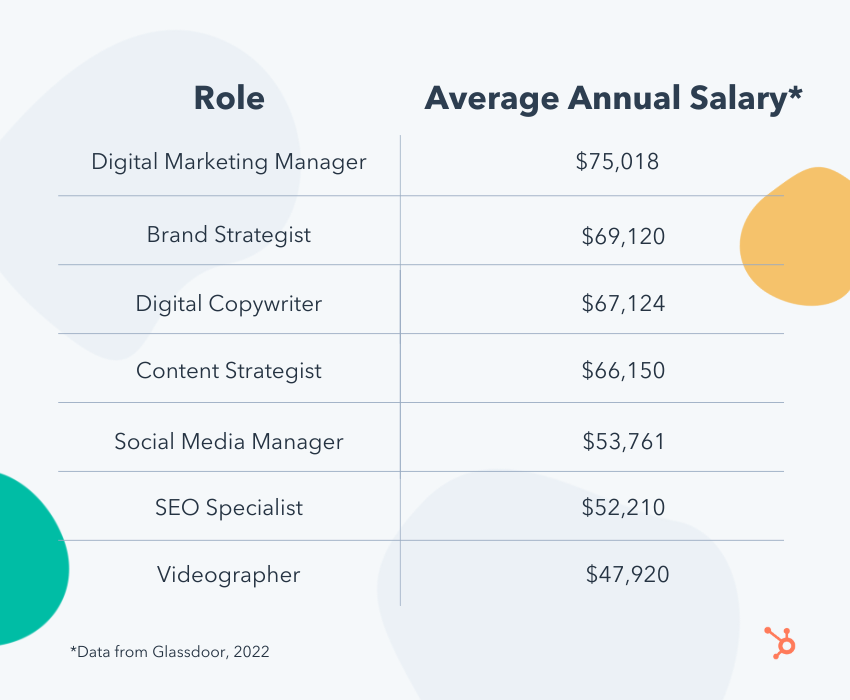
For comparison, here’s a roundup of similar jobs and their average annual salary:

social media content creator salary

Now let’s explore the different factors that influence the salary of creators in this field.

What influences the salary of content creators?

The term “content creator” is an umbrella term that includes everything from blog writing to videography. Because of this discrepancy, the salary for one role may be vastly different from another, even though the job titles are similar.

Let’s explore some additional factors that influence salary:

Location.

Not surprisingly, location can impact your base salary. For instance, while the national average salary for a content creator is $44,192 per year, this number jumps to $58,186 in New York City.

In fact, California, New York, and Massachusetts pay above the national average for this role. Take a look at the highest paying cities in the US for content creators:

city average annual salary
Sunnyvale, CA $63,681
Santa Rosa, CA $61,708
Cambridge, MA $59,792
Vacaville, CA $58,557
New York City, NY $58,186

Years of experience.

Experience also plays a large part in how much you can earn. Ultimately, your level of experience indicates to employers whether you’re capable of doing the job. The more years you have working as a content creator, the more you can expect to earn.

For example, the average salary of a junior video editor is $48,962 per year. On average, a senior video editor will make almost $20,000 more per year.

In-demand skills.

Content creators who posses certain skills are in great position to earn more than their counterparts. For example, a multilingual copywriter — or a marketing manager who specializes in automation— may earn more for these additional skills.

How to Increase Your Salary as a Content Creator

Here are a few strategies to land on the higher end of the salary range as a content creator:

1. Find your expertise.

While content creation is a multi-faceted job, it can be helpful to specialize in a certain area, such as web analytics, social media, search engine optimization, or content creation. This is especially crucial for freelance content creators who want to set themselves apart from the crowd.

2. Grow your skillset.

The field of content creation is always changing. For example, if you’re an SEO writer, you should always stay ahead of new algorithm updates and changes.

Set aside time to learn new skills, complete certifications, and read about new techniques and trends. In doing so, you can remain competitive and advocate for yourself.

Besides beefing up your technical skills, you can also benefit from developing your soft skills. After all, besides doing the technical scope of work, you’re also responsible for everything that goes into the business aspect, such as looking for clients, negotiating deals, or deciding your rates.

3. Create your own brand.

Branding isn’t just for businesses. Maintaining an online portfolio, blog, podcast, or social media account is an effective way to showcase your expertise, share your work, build authority, and network with new clients. Simply updating your LinkedIn profile and posting updates can boost awareness around your work.

Finding a Job as a Content Creator

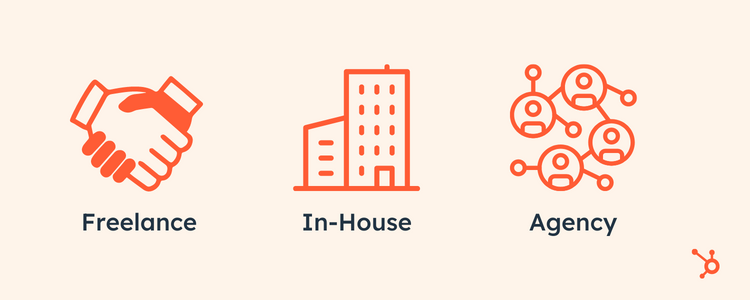
Most content creators pursue one of the following career paths: freelance, in-house, or agency. If you want to find a job as a content creator, you may be wondering which avenue you should take.

content creator career pathsLet’s take a closer look at these options:

  • Freelance — this is a solid path for creators who value flexibility. Freelancers set their own rates and have the freedom to work on multiple projects without committing to one employer — although you may have reoccurring clients. The downside? Freelancing is unpredictable, and work is never a guarantee.
  • In-house — this involves working for anything from a scrappy start-up to a large corporation. Perhaps the biggest perk is income stability. You also have more opportunities to collaborate with team members. That said, the work may lack variety which may get monotonous.
  • Agency — at an agency, you work with a team of experts to complete projects. Agency life is fast-paced, so expect to encounter a variety of industries and grow your portfolio at record speed. Like working in-house, you can expect consistent pay and work. However, with projects constantly crossing your desk, it’s easy to burnout in this environment.

As a content creator, you have the luxury of working in different environments. If you’re looking for the best fit, start by assessing your lifestyle, compensation requirements, work preferences, skill level, and comfortability working solo versus on a team.

Back To You

Content creation is an exciting area, but it’s important to be fairly compensated. Remember to stay consistent with your quality of work, and never forget the value you bring to the table.

content templates

Categories B2B

5 Ways to Figure Out What to Sell on Amazon

With over 300 million active customers on Amazon, it’s no wonder you want to sell a product on the internet’s most visited ecommerce website. Fortunately, choosing what to sell on Amazon, and how to sell it, isn’t as hard as you might think. In fact, most of your research can be done for free on the site itself.

To ensure you choose a low-risk, high-return product to sell on Amazon, we’ve created this guide. Keep reading to learn about top-selling items, what you should sell, and how to conduct research to ensure whatever you’re selling is a safe bet on the ecommerce giant.Download Now: Ecommerce Conversion Rate Calculator

Top Selling Items on Amazon

First, for inspiration, let’s take a look at some of the top-selling products on Amazon.

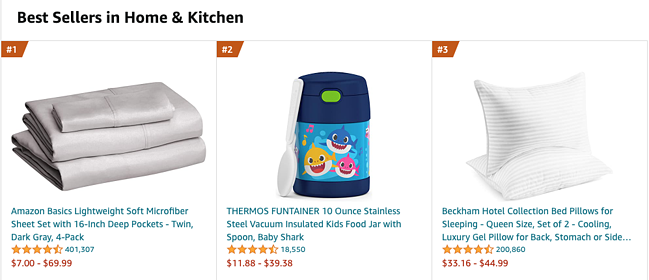
Amazon itself curates a list of current best-sellers, ranging from toys to books to video games —and the list is updated hourly. Here are some of the top product categories:

1. Home & Kitchen

what to sell on amazon example: home and kitchen products

Given the wide range of products that fall within Home & Kitchen — appliances, furniture, décor, and more — it’s no wonder that 32% of sellers on Amazon opt to sell in this category. Plus, it’s a pretty booming industry with global retail sales of home and household appliances amounting to $448 billion dollars in 2021.

It’s important to note that because Home & Kitchen is so popular it may be more difficult for new sellers to find success in this category. So, if you’re considering breaking into this market, make sure you have a product that is high quality and serves a specific niche.

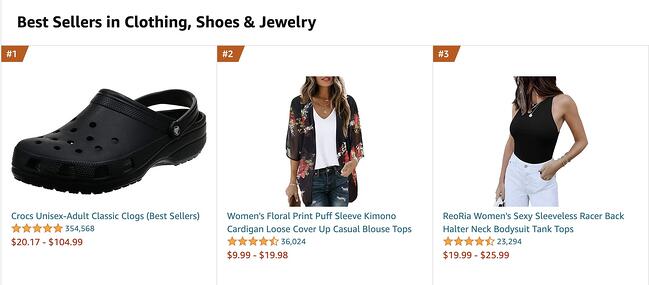
2. Clothing, Shoes & Jewelry

what to sell on amazon example: clothes, shoes, and jewelry products

It should be no surprise that Clothing, Shoes, & Jewelry is one of Amazon’s top product categories. After all, the ecommerce platform holds a nearly 35% share of all apparel sold online, making it one of the best-selling online fashion retailers. Specifically, Amazon shoppers prefer casual clothing over luxury apparel, with their top brands being Hanes and Amazon Essentials.

It’s important to note that this category can get a bit oversaturated, so it’s critical you ensure you’re able to offer something unique. People don’t turn to Amazon for expensive brand items — instead, they look for discounts. So, if you’re thinking of selling clothes, shoes, and jewelry, make sure your product is high quality and low price.

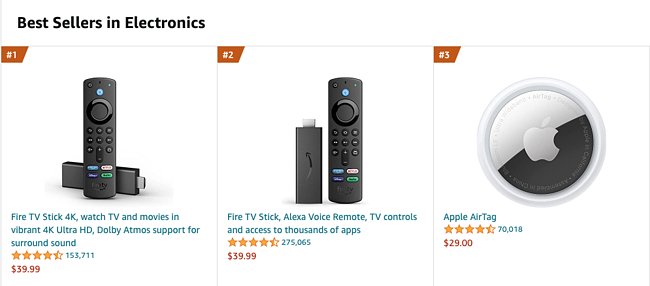
3. Electronics

what to sell on amazon example: electronics

From computers and TVs to surveillance systems and wearable technology, consumers are always looking for the latest in tech — especially when they are online shopping. In fact, almost half of all computer and electronics sales occur online.

Amazon consistently displays impressive prices on some of the world’s most popular electronics, so it makes sense that consumers often buy from the platform. This could be a promising category to consider as a third-party seller if you’re able to buy electronics in bulk.

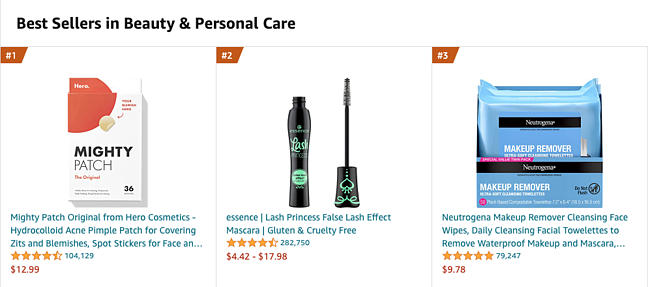
4. Beauty & Personal Care

what to sell on amazon: beauty and personal care products

Though the Beauty & Personal Care industry experienced a 15% decrease in global sales in 2020, don’t underestimate its significance and resilience. The market bounced back with a revenue increase of nearly $3 billion in 2021 and is expected to continue to grow.

The Beauty & Personal Care category includes everything from makeup and skincare to fragrances and hair products. Even though there is quite a bit of competition in this market with 23% of third-party sellers listing items, those who specialize in creating handmade cosmetics may really excel in this category.

Of course, like anything, the more popular the product category, the more intense the competition. It’s important you find your niche to ensure you’re not competing with the 300,000 other search results for “white t-shirt.”

Before we get to what to sell on Amazon, let’s discuss how much it costs.

You’ll want to do your research on shipping costs and Amazon seller fees, so you know how much you’ll need to spend depending on your item. This information can help you narrow your decision — for instance, a two-to-three pound item will be lightweight and easy to ship, which can help lower your shipping fees.

Along with weight, you’ll want to consider products that aren’t easily breakable when you’re transporting them.

Additionally, most products on Amazon vary between $10 and $50, so you’ll want to choose items you can sell for relatively cheap while still making a profit.

How to Know What to Sell on Amazon

Once you’ve determined you’re willing to pay shipping costs — and that your product likely falls within a fair price range — it’s time to figure out what you want to sell. Here are five methods that can help you narrow down your search:

1. Manually conduct research on Amazon.com.

To manually research popular products on Amazon, you’ll want to start with Amazon’s best-selling items in a certain category. From there, you’ll start exploring that category’s sub-categories and narrow down on a niche.

When you check out Amazon’s best-sellers list, you might also look at the “Customers also bought” section to get ideas for similar products.

Once you make a list of items, check Google keyword planner to see whether those products have search volume, which indicates a level of demand. Alternatively, you could use Sellerapp’s product intelligence tool specifically for Amazon. Sellerapp offers a seven-day free trial, which allows you to begin investigating popular products on Amazon via keywords to further narrow your list.

2. Use a chrome extension to research products in a niche market.

There are two popular chrome extensions to help you conduct keyword research on Amazon: Jungle Scout and Unicorn Smasher.

Jungle Scout shows you monthly sales volumes on products and displays products with low competition. It allows you to save products to track them over time. Undoubtedly, Jungle Scout’s analytics can help you quickly and efficiently narrow down on a product or an industry in which you could excel. However, Jungle Scout is relatively pricey, particularly if you’re just starting out.

Unicorn Smasher is Jungle Scout’s free alternative. While the data isn’t as accurate as Jungle Scout, and it lacks some of Jungle Scout’s sophisticated features, it’s nonetheless a helpful free option to gather estimated monthly sales and estimated monthly sales revenue for Amazon products.

Some other popular product research extensions include:

3. Find a gap in the market.

You can find gaps by using one of the previously mentioned chrome extensions to research products with high monthly sales volume and low competition. However, you might also come across a gap on Amazon through a simple organic search.

For instance, when I search “perfume” there are over 30,000 results, but when I search “natural vegan amber perfume” there are only 247.

This is a simplified example, but sometimes you need to narrow down your product search to find a place to make an impact on Amazon. Plenty of people are already selling perfume, but there might be a certain scent, style, or feature that is missing on the site.

amazon search example for perfume

amazon search example for natural vegan amber perfume

Alternatively, you can find a gap in the market by reading customer reviews in your product market niche. Even if there are plenty of products similar to yours already, you might find that customers are unsatisfied with the current brands and want something you can provide.

4. Find products that don’t have too much competition.

If you’re trying to sell a product that currently has 100,000 search results, it’s likely going to be very difficult to stand out against the competition and achieve the sales you want. Fortunately, it’s relatively easy to find a niche within a larger market that has less competition, which ensures your product is more easily found by searchers. Best of all, those searchers are likely more willing to buy your product, since they needed to search for a more specific keyword.

For instance, let’s say you want to sell cookbooks. The search term “Cookbooks” has over 70,000 results.

Alternatively, the search term “Cookbooks for instant pot cooking” has only 3,000 results. Not only is your product more likely to become a best-seller in this category, but it’s a more targeted keyword. If someone searches “Cookbooks” they could mean anything from “Kids cookbooks” to “Holiday cookbooks.” If someone searches “Cookbooks for instant pot cooking,” however, they’re more likely to be satisfied with your product.

5. Search for categories with at least three results with Best Sellers Rank (BSR).

Amazon’s Best Sellers Rank (BSR) reflects both recent and historical sales of an item. A high BSR indicates that the product is in-demand, which is critical to know as a seller.

If you find just one product in a category with a high BSR, and none of the other items are best-sellers, it could be an indication that a single product is dominating the market. Instead, you want to target product categories that feature multiple items with a high BSR because it signifies demand in that area and allows room for your product to succeed.

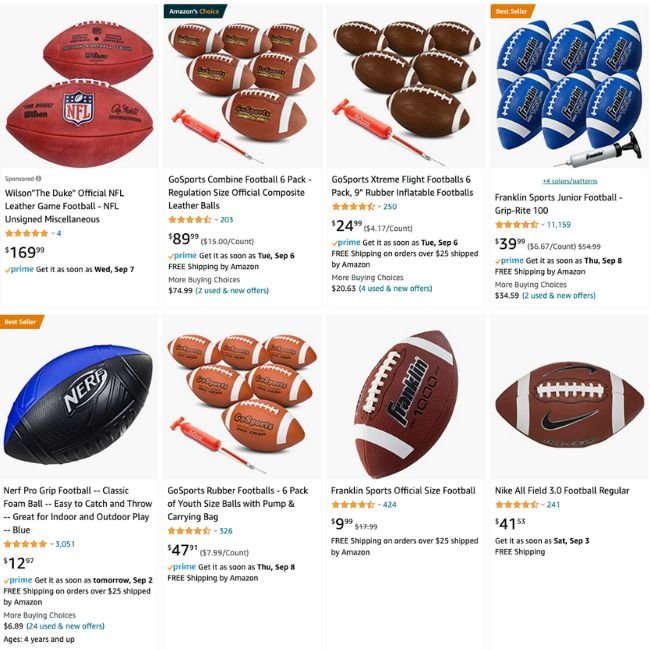
For instance, let’s say you want to sell sports products, but you find “basketball” has only one item with a high BSR. However, upon further research, you find “football” as a category has multiple best-selling products on the first page.

As a new seller, I would prioritize selling footballs over basketballs since this research demonstrates a user’s willingness to peruse different footballs before purchasing one.

best selling footballs on amazon

What to Sell on Amazon

Undoubtedly, you can obtain an impressive profit from selling products on Amazon, but it’s critical you’re able to offer unique, budget-friendly products with minimal competition to truly succeed on the site.

Over-saturation on the platform proves it’s more difficult than ever to stand out, so it’s not smart to sell on Amazon for the sake of selling on Amazon. Instead, you want to ensure you’re truly able to offer something of value.

If you have a product in mind, follow the tips above to refine your strategy and find a niche segment within a larger demographic. If you don’t have a product in mind, start with the basics: what are the most-searched keywords on Amazon, and which products are most successful?

Once you have a list based on keyword research, consider similar products the user might find more compelling or useful than the ones currently listed on Amazon.

Editor’s note: This post was originally published in March 2019 and has been updated for comprehensiveness.
New Call-to-action

Categories B2B

If Gen Z Changed the Game for Marketers, What Will Gen Alpha Be Like?

Right now, Gen Z is the main target audience for brands trying to stay relevant and attract new consumers. Gen Z’s love for platforms like TikTok and Twitch caused many companies to switch up their marketing tactics —turning to strategies like influencer and social media marketing. However, there’s a new generation that is expected to change the marketing landscape even more: Gen Alpha.

This generation is the first to be born entirely in the 21st century — in a fully digital world. Alpha is also expected to be the largest generation in history with over 2 billion people by 2025. With those numbers, this generation will have a lot of buying power, so companies need to prepare their marketing strategies. Here’s what brands and companies need to know about this next generation of consumers.

Download Now: 2022 State of U.S. Consumer Trends Report

Who is Gen Alpha?

Generation Alpha is the demographic that comes after Generation Z and is made up of anyone born during or after 2010. Right now, Gen Alpha is composed of children under the age of 12, so the oldest in this demographic will become teenagers in 2023. The cut-off year to be considered born into Gen Alpha is 2025.

Gen Alpha kids are also sometimes called “mini millennials” because they are the children of Millennials, are believed to have a really close relationship with their parents, and are likely to have similar consumer habits.

What is Gen Alpha Like?

According to Heather Dretsch, assistant professor of marketing at North Carolina State University, Gen Alpha children will likely mimic their parents when it comes to the kinds of products they consume as they get older. That’s because millennial parents are extremely conscious of the products they use.

“As health-conscious caretakers, millennial parents seek out a lot of information about the products they buy and expose their kids to,” Dretsch said. “From toys and food to clothing and personal care products, they love to be in the know about the best brands for their children, and they choose only the safest, cleanest, highest-quality ones.”

Since Millennials are deciding what brands are to be trusted in their homes, Gen Alpha will likely choose those same brands and products for themselves because they’ll be all they know. With that in mind, Dretsch says Gen Alpha kids are already aware of cheap knockoffs and competitors — and they already have a strong preference for higher-quality products and industry-leading brands.

Gen Alpha is also more connected than ever due to growing up in the age of social media. In a 2022 survey by market research company GWI, it was found that 38% of children said they spend most of their time on social media after school. GWI said the number increases by 43% on the weekends.

That same survey shows that 43% of children preferred to speak to their friends online over the weekend instead of seeing them in person.

Not only are Gen Alpha kids connected to their peers via social media, they are also socially aware and keep a pulse on global concerns like climate change.

For example, Shopify writer Dayna Winter spoke to three young children and asked them what is the one invention they would create if they could. Ten-year-old Zy said she’d invent a device that would make getting vaccines easier and “less scary.” Eleven-year-olds Fia and Mylo both worried about climate change. Fia would invent a machine that picks up trash from the ocean, and Mylo described climate change as a “snowball” that’s getting bigger as time passes but is small enough to stop before it’s too late.

All three children are part of an online program called Upstander Academy where they learn about social justice and regularly interact with guest speakers that include politicians, activists, and entrepreneurs. The program was started by World-Changing Kids founder Lindsey Barr. Barr, who is also a mother, told Winter she started the program because she noticed children have already developed an interest in social justice.

“They want to talk about social issues,” Barr said. “They care about homelessness, they care about refugees.”

Gen Alpha’s interest in world issues has a lot to do with constantly being in front of a screen and having a lot of access to the internet via tablets and smartphones. That screen time has only increased during the pandemic, which caused children to spend a lot of time at home with their devices.

The way Gen Alpha interacts with the digital world also differs from previous generations. Thanks to platforms like TikTok, YouTube, Minecraft, and Roblox, Gen Alpha children are accustomed to content that gives opportunities to contribute and not just consume.

For example, Fia told Winter she enjoys playing in Roblox Studio because it’s where users can learn code and create games for Roblox.

How Future Marketers Can Prepare for Gen Alpha

So what does all of the above information have to do with marketing to Gen Alpha? Well, now we know the following about that demographic:

  • They have refined taste when it comes to the products they consume.
  • They are deeply concerned about issues like social justice and climate change.
  • They enjoy technology and content that keeps them informed, connected, and creates opportunities to contribute instead of just consume.

With that in mind, here’s what marketers need to do to reach Gen Alpha:

Be authentic and transparent.

Again, Gen Alpha is incredibly socially aware, which means they are also aware of how certain products, services, and industries have long-term impacts on the environment and society. With that in mind, brands will need to be transparent about their mission, impact, and what they’re doing to provide solutions.

For example, fashion brands shouldn’t shy away from discussing the negative impacts fast fashion has had on the environment. Instead, these brands should invest in creating products that are environmentally friendly and of long-lasting quality. Brands should make it clear to Gen Alpha consumers that the company is doing the work to lessen its impact on the environment.

Being transparent also means acknowledging the role your company may have played in issues like social justice and climate change — be it good or bad.

For example, let’s say your fashion brand has a history of generating large carbon emissions through its manufacturing process. A great way to gain the attention (and trust) of Gen Alpha is through marketing materials proving the company is actively combatting the issue by changing manufacturing practices and partnering with organizations fighting climate change.

This shows honesty and social responsibility, and it provides a solution.

Create experiences and not just products.

Gen Alpha kids are growing up during a huge content creator boom where everyone is given the chance to lend their creativity to platforms like TikTok. Knowing this, it’s important that brands and companies figure out ways to give people in this generation opportunities to contribute and not just buy.

One way to do this is to leverage interactive marketing tactics like user-generated content that allow audiences to be a part of the experience. For example, the England-based band Glass Animals has a website that allows fans to create their own art, memes, and music to be used for the band’s future projects.

Gen Alpha also loves to learn, especially regarding the latest technology. So if you’re a tech-based company or brand, holding interactive workshops that showcase your products’ different features can also pique their interest.

Create meaningful content that connects with Gen Alpha wherever they are.

Social media and virtual communities play a huge role in the lives of Gen Alph —, so in the future, brands will need to leverage interactive social media campaigns that meet Gen Alpha where they are. A great example of this is Pringles’ #PlayWithPringles campaign.

The campaign was started after the company noticed consumers were already on TikTok making content involving Pringles cans. So Pringles decided to join in the fun by starting its own challenge as a brand campaign. The company partnered with TikTok creators and influencers to challenge users to make creative videos using Pringles cans. After five months, the campaign generated over one billion views and more than 278 million videos.

Gen Alpha is expected to be the most socially aware and digitally savvy generation thus far, so brands will need to be smart about how they connect with them. While there is still so little information about this young generation, the information above can help your brand prepare to delight them in the future.

New Call-to-action

Categories B2B

19 Black Influencers To Follow and Learn From

Welcome to Breaking the Blueprint — a blog series that dives into the unique business challenges and opportunities of underrepresented business owners and entrepreneurs. Learn how they’ve grown or scaled their businesses, explored entrepreneurial ventures within their companies, or created side hustles, and how their stories can inspire and inform your own success.

Zippia found that 67.5% of all content creators and influencers are white.

As people look to influencers to find someone like them to take inspiration from, the overwhelming amount of White content creators means that Black consumers likely have a hard time finding what they’re looking for.  

In this post, we’ve compiled a list of Black influencers from various industries with authentic perspectives and advice that are worth following.

Download Our Guide to Influencer Marketing Essentials

Black Influencers to Follow on TikTok

1. Marquees Brownlee — Technology Youtuber

Niche: Technology and software

Marquees Brownlee is a tech influencer known for his reviews and instructional videos. He has over 3M views on his YouTube channel, and, as an influencer in a predominantly and overwhelmingly white industry, he is a great representation and inspiration for those looking to make waves in their own communities.

On TikTok, he reviews mobile gadgets, digital tech, and software developments to help his audiences make informed decisions about their purchases.

@mkbhd

RIP. The last iPod has been officially discontinued.

♬ original sound – Marques Brownlee


2. Tabitha Brown — Actress and Influencer

Niche: Food and lifestyle

Tabitha Brown is a food and lifestyle influencer well-known for her calm demeanor and comedic cooking videos. She shares recipes and inspirational content on TikTok and shows audiences what plant-based living looks like. She also gives actionable advice to those looking to follow in her footsteps, helping aspiring entrepreneurs searching for inspiration.

@iamtabithabrown “YOU” season is not the same as “YOUR”  they can be uncomfortable as you get back to YOU, but lean into the discomfort ❤️. You deserve YOU!! Love you!
#spreadlove
#tabithabrown
♬ original sound – Tabitha Brown


3. Dayna Bolden — Creative Director of Bolden Creative Media

Niche: Lifestyle and entrepreneurship

Dayna Bolden is the Creative Director of Bolden Creative Media and a lifestyle and entrepreneurship influencer and blogger. On TikTok, she shares lifestyle content like morning routines and travel advice, and she’s a worthwhile follow for entrepreneurs looking to learn about maximizing their potential and achieving success.

Black Influencers to Follow on Twitter

4. Shana Minei Spence, MS, RDN, CDN — Registered nutritionist

Niche: Lifestyle and wellness

Shana Minei Spence, a Registered Dietitian Nutritionist, created a platform for open discussion on nutrition and wellness to dispel misinformation in the lifestyle and wellness industry.

She shares content on Twitter about finding balance, food education, and recipes she enjoys making, giving her audience access to high-quality and accurate information. She’s an excellent inspiration for entrepreneurs looking to learn how to engage with audiences, build a following, and make an impact in their niche.

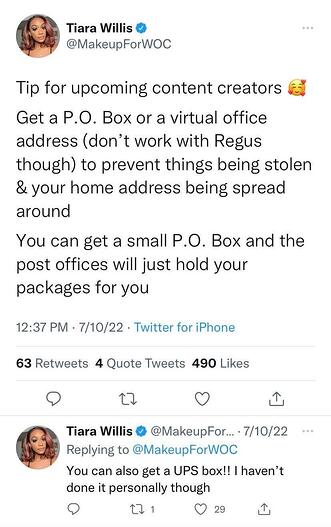
5. Tiara Willis — Licensed esthetician

Niche: Beauty, skincare, and lifestyle

Tiara Willis, licensed esthetician, has built a community for women of color, who are often left out of beauty, makeup, and skincare discussions.  

Willis shares tips, insight, and information with her followers to help them make informed decisions about the products they use and how they relate to people’s skin complexions.

She’s a worthwhile follow for people looking to learn more about skincare and for entrepreneurs looking to learn how to interact with audiences, build community, and share information (she was the first person to sell out a ticketed Twitter Spaces event about content monetization).

tiara-willis

Image Source

Black Influencers to Follow on Instagram

6. Donye Taylor – Director of Creative Initiatives at Fohr

Niche: Marketing and advertising

Donye Taylor is Director of Creative Initiatives at Fohr, an ambassador marketing company, and a marketing and advertising expert that helps brands develop marketing content that stands out and shares their unique brand personality.

On Instagram, she shares marketing tips, tricks, and advice that her followers can learn from and apply to their practices to up their marketing game. Taylor also runs a fun and relevant series where she explains how she would market musical artists’ projects. Most recently, she created a sample campaign for rapper Jack Harlow.


7. Shontay Lundy – Creator and Founder of Black Girl Sunscreen

Niche: Entrepreneurship and beauty

Shontay Lundy is the creator and founder of Black Girl Sunscreen (a sunscreen for Black people) and disruptor of an industry that historically underserved and excluded Black people from conversations about sun care and sun safety.

Lundy grew the brand into a million-dollar business that you can find on the shelves of popular stores like Target, Ulta, and CVS Health. On her Instagram, Lundy shares inspirational content for entrepreneurs and founders embarking on their own ventures.

8. John Henry — Founder and CEO of Loop

Niche: Business and finance

John Henry is the founder and CEO of Loop, AI-powered car insurance, and an entrepreneur and influencer in business and finance. He is well recognized for his impact and was named in Forbes 30 under 30, Inc. 30 under 30, and Ebony Power 100.

He shares must-know information on Instagram about the bias and privilege in insurance that excludes people in lower-income communities, which ties directly to his company’s mission of making care insurance more equitable for people of color.

As an influencer, he also shares advice for entrepreneurs on their own ventures that may be facing roadblocks and looking for inspiration.


9. Cinneah E – Project Manager at PayPal, Creator of Flynanced

Niche: Finance, travel, and business

Cinneah E is an influencer in many different niches.  Most significantly, she shares tips and actionable advice for people in the workforce, like how to continue to live the lifestyle you want while maintaining a 9-5, how to have an effective job search, and how to continue to develop skill sets through continued education opportunities.

More Black Influencers to Follow

Categories B2B

The Ultimate Guide to Starting A Podcast [Checklist]

Want to launch your own podcast (or a podcast for your company) but don’t know where to start? I’ve got you – starting a podcast is simpler than it seems.

➝ Free Guide: How to Start a Podcast

I was an avid podcast listener for years before deciding to start my own show in 2018. I took my podcast from idea to launch in 10 days with no audio experience — and if I can do it, you can too. In fact, starting a podcast is easier than ever as the medium has increased in popularity and profitability.

Podcasting is a fast-growing medium with 62% of people aged 12 and over listening. Having a podcast is a great way to get in front of your audience to build connections, and grow your business.

Here’s the ultimate checklist to help you start a successful podcast.

1. Determine your niche.

First, you’ll want to decide which genre your podcast falls under. This is important so platforms like Apple Podcasts and Spotify can properly categorize your podcast, and it helps those who are interested in the topics you’re covering find your show.

According to Edison Research, the top 10 podcast genres with the most weekly listeners in 2022 are:

  1. Comedy
  2. News
  3. Society & Culture
  4. True Crime
  5. Sports
  6. TV & Film
  7. Business
  8. Arts
  9. Religion & Spirituality
  10. Education

Determine which genre best describes the podcast you’d like to create or the industry you’re in, and keep this topic in mind as you plan out your content and prepare for launch.

2. Identify your ideal listener.

Now that you know what your podcast is going to be about, you’ll want to identify who your ideal listener is. Much like creating a buyer persona, take time to get clear on who you want to reach with your show.

Here are some characteristics to consider when identifying your ideal listener:

  • Age
  • Occupation
  • Education Level
  • Income
  • Interests
  • Hobbies
  • Geographic Location

As you craft your ideal listener persona consider the following questions: What is this listener interested in? If you were having a conversation with this listener, what questions would they ask? What other podcasts is this person listening to, and what does that tell you about what they want to hear? How often do they listen to podcasts? Where do they learn about new podcasts?

The answers to these questions can help you create content your potential audience is looking for. You may want to survey a small group of people to get their feedback on your podcast idea and to learn more about their media consumption habits.

3. Name your podcast and determine the launch date.

At this point, you know what your podcast is about and you’ve identified your ideal listener – now it’s time to choose a name. Whether your podcast name is related to your business or is something entirely new, perform an extensive search to make sure the name you want is available and is not associated with any other podcasts, brands, or registered trademarks.

This would also be a great time to determine your launch date. Aim to give yourself plenty of time to launch, factoring in the time it takes to get approved by podcasting platforms (more on this below).

4. Decide which format and publishing schedule you’d like to follow.

Next, you’ll want to determine the format you’ll follow for your podcast. Will it be an interview podcast? A scripted show? Documentary-style? Or will the host(s) be speaking on their own?

At this point, you should consider the publishing cadence you’d like to follow. The most common podcast publishing schedules are weekly, bi-weekly, and monthly. When it comes to podcasting, consistency is more important than frequency, so aim to choose a schedule you’ll be able to maintain.

5. Select a podcast hosting service.

Now it’s time to get this show off the ground! To create a podcast you’ll need to sign up for a podcast hosting service. This is an online service that stores your audio files in an RSS feeds and distributes the audio to platforms such as Apple Podcasts, Spotify, and Stitcher.

Some of the most popular platforms are Anchor, Libsyn, Buzzsprout, and Podbean. Many platforms offer free hosting with paid upgrades depending on what your needs are.

If you know you’ll want to eventually monetize your podcast with advertisements, consider using a platform that offers monetization options.

6. Create podcast artwork.

Your podcast artwork gives listeners a first impression of your show before they press play, so you want it to be good. You can outsource the creation of your artwork to a graphic designer or you can use a tool such as Canva to create your own.

Go through your podcast directory of choice to check out what elements the top-rated shows in your niche have to inspire your artwork, and make sure it’s true to your brand.

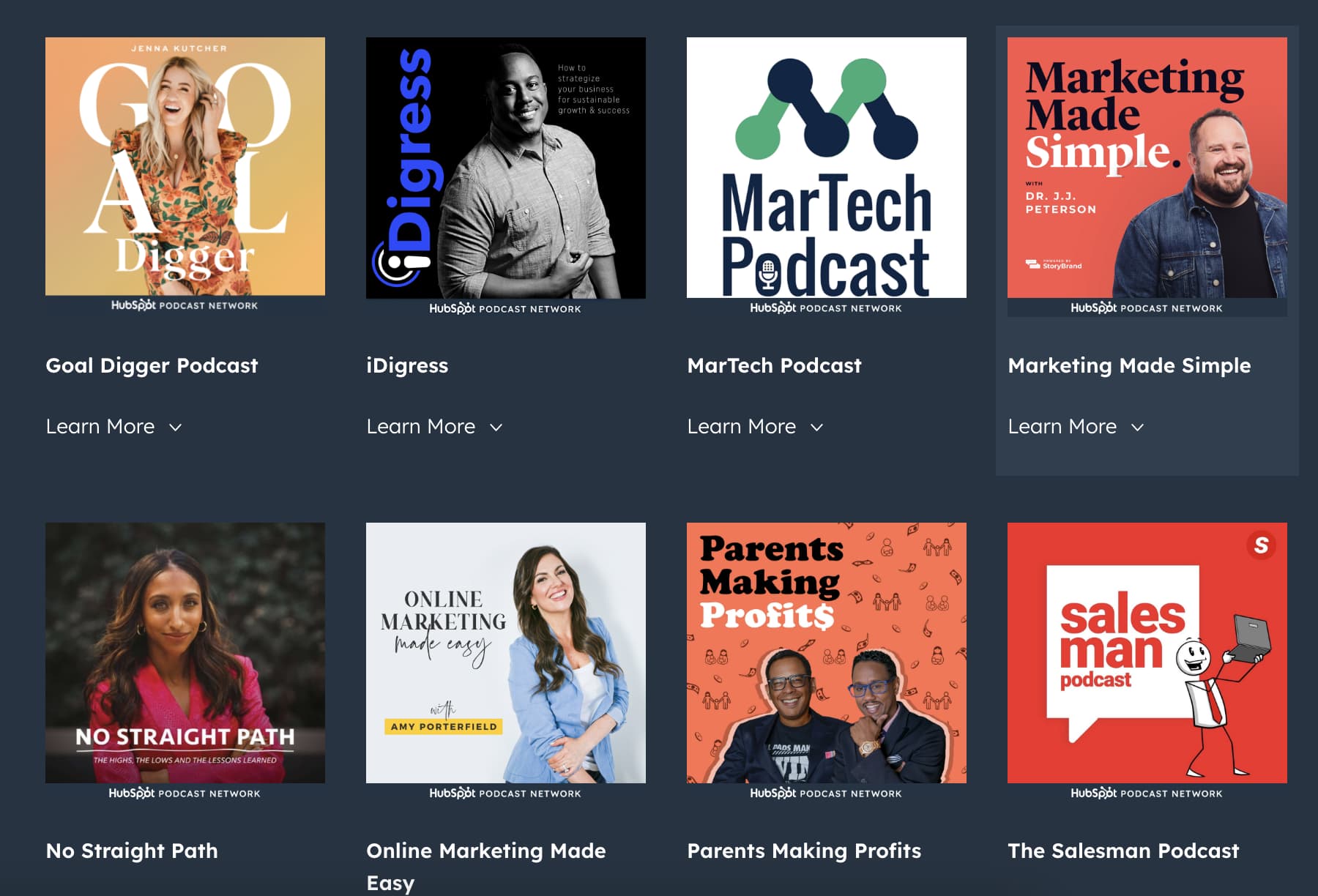
Starting a podcast checklist: podcast artwork from the HubSpot podcast networkWhen creating your artwork, make sure it:

  • Is a clear image that doesn’t appear blurry
  • Doesn’t contain any copyrighted images or logos of non-affiliated companies
  • Is easy to read in smaller sizes
  • Is consistent with your branding

It’s also imperative that your podcast artwork is the correct size. Apple suggests using a 3000×3000 pixel image. Incorrect sizing can impact your podcast’s ability to publish and display in directories correctly, so you’ll want to make sure your artwork is the right size.

When your artwork is complete, you’ll upload it to your podcast hosting service to ensure it shows up correctly across platforms.

7. Get your podcasting equipment.

Your podcast recording setup can be as complex or as simple as you’d like. If you’re opting to record at a local studio, this would be the perfect point in the process to research options near you and book time to record.

If you plan to record at home and are looking for a straightforward setup, all you’ll need is:

You can check out the full list of podcast tools we recommend here. Once you have what you need, find a quiet place at home to get set up and you’re ready to record.

8. Create your podcast trailer.

A trailer is a short audio clip that introduces your podcast to new listeners and gets them excited to tune in. In your podcast trailer you’ll want to include:

  • An introduction to your podcast and what it’s about
  • A teaser of what’s to come, or highlights so the audience knows what to expect
  • When listeners can expect new episodes
  • A call-to-action inviting the listener to come back

Most podcast trailers are around one to two minutes in length. Once your trailer is ready, you can upload it to your podcast hosting service.

9. Submit your podcast to online podcast directories.

In step five you set up your podcast in your podcast hosting service. Your platform will provide an RSS feed you can submit to podcast directories so listeners can tune in to your show. Here are the top two platforms you’ll want to submit your podcast:

Streaming your podcast to other platforms such as Stitcher, Castbox, Pandora, and Amazon Music can be managed within your podcast host settings.

10. Prepare your first three episodes.

When you launch your podcast to your audience, you’ll want to have a few episodes available so they can get as much value from your show as possible and feel more inclined to listen in the future.

Launching with a few episodes also gives your show a chance to earn more downloads, ratings, and reviews in a shorter period of time, which can be helpful for discoverability and ranking on the charts. When you launch, aim to have your trailer and first three episodes available.

I like to create a script for each podcast episode outlining the points I want to make if recording solo, or the questions I’d like to ask the guest I’m interviewing. Creating a solid script or outline is especially helpful when you’re a new podcaster getting used to the medium. Read through and edit the script, and practice reading it out loud to hear how it sounds.

Once your scripts are ready, record your launch episodes in your recording software of choice. From there you can edit them yourself or hire an editor to edit them for you. When editing, be mindful of any background noise and filler words that could distract the listener.

11. Write the show notes for your launch episodes.

Now that your first few episodes are recorded, it’s time to write the show notes. Show notes are essentially short blog posts that accompany each podcast episode. The show notes are a great place to put a general description of the episode along with links to any resources mentioned, or products you’d like to bring attention to.

While it can be tempting to gloss over show notes, it’s worth putting in a bit of effort. Not only are podcast show notes helpful for SEO which can bring new listeners to your show, but they can keep your audience engaged and ready to follow your content on other platforms.

12. Secure your podcast social media handles.

If you haven’t already, make sure you’ve saved the social media handles related to your podcast. Some podcasters create social media accounts dedicated to their podcasts, while others use their existing personal or business accounts to promote their shows.

Whichever you decide, you’ll still want to make sure you own the name and identity of your show across socials and online, so make sure you’ve saved related social media handles and web domains.

13. Upload and schedule your launch episodes.

Once your episodes are edited and your show notes are written, you’re ready to publish. Upload your audio files and show notes to your podcast host and schedule your episodes to publish on your desired launch date. Your launch date should fall on the day of the week you plan to publish moving forward.

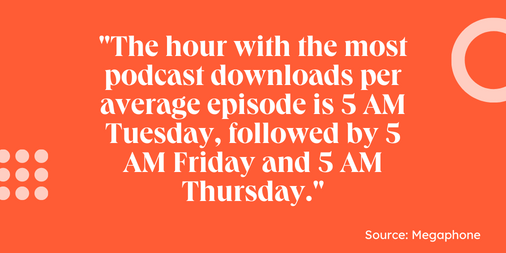
starting a podcast checklist: when to publish your podcast according to research

Research by Megaphone found podcast episodes published on Tuesdays, Wednesdays, and Thursdays around 5 am EST resulted in higher downloads than those published at other dates and times.

14. Market your podcast and celebrate your launch.

Congratulations, you just launched your first podcast! Now it’s time to get the word out by marketing your show to your ideal listeners and celebrating your hard work. In 2022, short-form video has become a popular medium for promoting podcasts, with podcasters sharing short videos or audiograms of each episode on platforms such as Reels, TikTok, and YouTube.

Starting a podcast can be a rewarding creative endeavor that allows you to serve your audience in a new way. Bookmark this post to serve as your checklist as you navigate your launch.

New Call-to-action

Categories B2B

33 Emerging Technology Stats to Know in 2022

Many major emerging technologies in artificial and virtual reality are becoming more accessible, but are they worth investing in? 

In this post, I’ve gathered TK stats related to emerging technologies and the impacts and potential impacts they can have on marketing and marketers in the near future. 

Download Now: HubSpot's Annual State of Marketing Report

Augmented and Virtual Reality

For years, researchers have said that virtual reality, which gives viewers an immersive and interactive 360-degree virtual experience, will hold the best opportunities for gaming, entertainment, and academic industries.

Experts have also thought that augmented reality, a partially immersive but still interactive experience, will thrive in the world of branding and marketing.

We have already seen some of these predictions come true, but both still have significant potential. Here are 16 stats that demonstrate the growth and opportunities of AR and VR.

  • Consumer and enterprise virtual reality market revenue is expected to reach $6.71 billion by the end of 2022 and $12.9 billion by 2024. (Statista)
  • Augmented reality, virtual reality, and mixed reality market size worldwide is expected to jump by more than 220 billion USD between 2021 and 2028. (Statista)
  • 101.6 million people in the US will use AR in 2022. (eMarketer)
  • 39% of media planners who use NFTs say they have the best ROI of any channel in their media mix. (HubSpot Blog)
  • In a recent study, 33% of survey respondents understand the concept of the metaverse, 37% have heard of it but aren’t sure what it means, and 30% aren’t sure at all. (GlobalWebIndex)
  • Over half of consumers are interested in participating in the metaverse, and 1 in 3 who haven’t heard of it still say they want to be involved.(GlobalWebIndex)
  • It’s estimated that, by the end of 2022, virtual reality hardware and software sales will generate more than 6.4 billion USD in revenue. (Statista)
  • 54% of people visit the metaverse to play games, 46% visit to virtually hang out with online friends, and 43% visit to virtually hang out with in-person friends. (HubSpot Blog)
  • 36% of consumers interested in participating in the metaverse worry about how companies will use their personal data online. (GlobalWebIndex)
  • Over the next five years, Gartner predicts that one in four people will spend at least one hour per day in the metaverse. (Gartner)
  • Over the next five years, 30% of businesses will have some sort of product or service available in the metaverse. (Gartner)
  • Over 1 in 5 people aged 24-54 are invested in crypto. (HubSpot Blog)
  • People ages 18-24 are likely to buy NFTs to join a community. (HubSpot Blog)
  • Deloitte’s 2021 Global Blockchain Survey found that 80% of participants say their industries will see new revenue streams from blockchain, digital assets, and/or cryptocurrency solutions. (Deloitte)
  • Over 250 million Snapchatters use an AR feature on the app every single day. (Modern Retail)
  • Creators on Snapchat have built over 2.5 million AR Lenses. (Modern Retail)

Artificial Intelligence

Artificial intelligence is so prevalent in 2022 that many of us don’t even notice all the ways we interact with iton a given day. If you’re less familiar with AI, here are eight stats to keep in mind:

  • Gartner forecasts that the worldwide artificial intelligence software market will reach $62 billion by the end of 2022. (Gartner)
  • The business value of AI will reach $5.1 billion by 2025. (Gartner)
  • 52% of marketers prioritize implementing marketing automation platforms to enhance their marketing efforts. (Demand Gen Report)
  • 17% of marketers currently use automation or artificial intelligence as part of their marketing strategy. (HubSpot Blog)
  • 1 in 5 consumers uses live chat or in-app chat daily. (Vonage)
  • 71% of consumers say they would be happy to use a chatbot if it meant an improved customer experience. (Conversocial)
  • A Drift survey reported that 54.8% of B2B professionals across various industries say they receive a greater volume of high-quality leads with chatbot tools. (Drift)
  • 61% of people globally believe that automation could put people’s jobs at risk. (PWC)

Voice Assistants and Smart Speakers

While voice assistants are technically a segment of AI, they’ve become so prominent in the emerging media world that they deserve their own section of stats.

  • Statista predicts that the number of digital voice assistants will reach 8.4 billion units by 2024, which is higher than the world’s total population. (Statista)
  • The total number of Amazon Echo users is more than double that of Google Home. (eMarketer)
  • 123.5 million adults in the US will use voice assistants at least once per month. (eMarketer)
  • Almost all voice assistant users use the technology on a smartphone. (eMarketer)
  • By 2023, digital voice ecommerce is expected to triple to an $80 billion industry. (Juniper Research)

Smart Devices and Appliances

Smart appliances and devices have significant potential to impact marketing. Although the space is still young, it’s providing interesting opportunities to bigger brands. 

As you can imagine, devices like smart TVs could provide great potential for content marketing and branded media. However, a more unique example of an appliance that could provide brand potential is a smart refrigerator.

“I’m excited to see how a smart fridge that can tell me when my avocados are about to spoil can be leveraged by a brand to give me information that might serve me in that particular information, says Amanda Zantal-Wiener, a senior content strategist who creates content for HubSpot that covers news and trends.

But, Zantal-Weiner’s excitement doesn’t end at smart-home appliances — she’s also fascinated by the world of smart cars.

“Until we start to see self-driving cars on the road, the idea of connected cars can also be used to help me do more than mindlessly scroll through my phone when I’m using a ride-hailing service, by serving as a distribution channel for real-time, relevant information during that trip. Everything is connected, and I’m excited to see which brands are able to adapt to that earlier on in a way that actually helps customers,” Zantal-Wiener explains.

Here are four key stats that highlight why you should keep these technologies on your radar.

  • Smart home appliance user growth will more than double between 2020 and 2025, from 30.6 million to 64 million. (eMarketer)
  • Smart TVs are the most popular smart home devices. (Statista)
  • The average cost of a smart-home device is expected to drop by 52% by 2023 (Juniper Research)
  • The percentage of US internet users using a smart appliance will increase to 21% by 2025. (eMarketer)

Navigating the Future of Marketing

Yes, creating voice assistant skills, leveraging AI, and building branded AR/VR experiences might be pretty inaccessible and costly to your company right now.

But, if you want to continue to innovate your brand or be a competitive marketer in the far future, you’ll want to keep up with how technology and marketing possibilities are evolving — you’ll be more prepared to adopt new technologies when they are accessible in the future.

New Call-to-action

Categories B2B

The 15 Best Marketing Automation Tools Available to You

A majority of businesses use marketing automation tools nowadays — in fact, studies cite around 56% of businesses currently use the technology, and that number continues to grow.

Learn More About HubSpot's Enterprise Marketing SoftwareWhile marketing automation software can help companies increase efficiency by streamlining their workflows, there are so many options to choose from, full of different solutions with various features and use cases.

In this article, we’ll cover:

What are marketing automation tools?

Marketing automation tools use software to automate repetitive marketing tasks. Some platforms only offer email actions, drip sequences, and CRM updates. Others may help with lead scoring, sales lead rotation, SMS, and more.

Automating your marketing tasks can benefit your business by increasing overall efficiency and allowing you more time to work on high-level projects. For example, you can use marketing automation tools to collect valuable data that can be used to create more personalized marketing campaigns and increase conversion rates.

How to Choose the Best Marketing Automation Software

A more niche marketing automation product may be better for SMB and B2C environments, but B2B and enterprise companies may need a platform with wider capability. Here are some key areas to consider as you evaluate marketing automation software products to choose the one that’s right for you:

1. Determine Your Budget and Business Needs

If automation’s benefit can be summed up with one statement, it’s this: It will make you more efficient so you can focus on the tasks you enjoy and that have the highest return. With that in mind, you’ll want to evaluate price as you consider capability.

For SMBs and B2C organizations focusing primarily on email, a scaled-down system might be sufficient. However, with more advanced needs, enterprise (and thus higher ticket) software is more cost-efficient in the long run.

Be sure to choose a provider that’s reasonably priced but can also grow with you as your needs change. After all, reducing bloated operations is critical to scaling effectively.

2. Evaluate the Software’s Ease of Use

Automation isn’t a simple thing to implement, so make sure the interface of the software will work with you, not against you. See if you can find screenshots of the UX so you can determine if it looks simple and easy to navigate.

Automation can be technical, so look for providers that have robust knowledge bases, tutorials, and other customer support options.

3. Explore Analytics and Reporting Options

You’ll want to be able to measure the success of any drip campaigns you have running, so make sure your automation software will keep track of the metrics that matter most to you.

In B2B and enterprise environments with many stakeholders, you may also need advanced reporting abilities such as personalized dashboards or automatic reporting via email.

4. Research Integrations

How well does the marketing automation software play with your existing stack? Integrations allow you to manage data and get more from your tools.

5. Consider Potential Limitations

Some automation software platforms may limit the number of actions in a month or the database size you’re allowed.

Going into any evaluation, know how many contacts you have, how many emails you send on average, and what you want the software to accomplish. This will prevent you from underestimating the cost of your automation software.

6. Request a Demo

Before making a final decision, consider reaching out to each provider’s sales team to request a demo or sign up for free trial offers. Trying out a marketing automation tool before you buy it can help you determine which features best serve your needs.

Here, we’ve cultivated a list of marketing automation tools examples to help you sort through your options and feel confident choosing the best solution for you and your team.

1. HubSpot Marketing Automation

hubspot marketing automation software interface

HubSpot’s marketing automation functionality is one of the most powerful tools on this list in terms of features. It’s also one of the most popular in terms of customer sentiment, according to the G2 Grid for Marketing Automation.

Of course, HubSpot has a full growth suite that includes sales software, marketing software, and support software, which all integrate automatically with HubSpot’s CRM. The combined effect of having all of your data and growth activity in one place can unleash tons of creative automation possibilities that would be difficult or impossible if you use separate tools.

As a standalone, HubSpot’s marketing automation functionality includes an easy-to-use visual board where you can craft simple or highly sophisticated conditional workflows.

It can take time to master the tool (you’ll scale up more quickly with the help of HubSpot Academy), but once you get a grasp on it, the creative possibilities are endless. You can set up simple email list autoresponders, or build a smart and complex network of rules designed to target specific users with the exact right email, live chat, website experience, and more.

Basically, HubSpot’s automation tools go far beyond email, so you can scale your growth and spend less time on repetitive tasks.

Price: HubSpot’s email and form marketing automation tools are free. Increased access and features are available in paid versions of Marketing Hub, which start at $45 per month.

2. ManyChat

Marketing Automation Tool Example: ManyChatImage Source

Marketing automation isn’t just about email. Imagine automating some of the most repetitive conversations you have with customers on other platforms. ManyChat functions as a chatbot that can do just that on Facebook Messenger, Instagram Direct Messages, WhatsApp, and SMS.

A bot can be built in minutes with ManyChat’s templates and easy-to-use interface. In addition, the information you learn about your users can be synced to your CRM and other tools.

Price: ManyChat offers a free monthly plan that allows engagement with up to 1,000 contacts via Instagram Direct Messages, Facebook Messenger, and WhatsApp. Additional access and features are available through ManyChat’s paid plans, which start at $15 per month.

3. Moosend

Marketing Automation Tool Example: MoosendImage Source

Moosend is an email marketing automation platform that caters to various industries, including ecommerce and SaaS.

The automation feature uses advanced website tracking and triggers that allow you to send the right email campaign to those in your contacts who are interested in a specific product or service. For example, you can set up a cart abandonment series to target potential customers who left their shopping carts without making a purchase.

Collecting and managing customer data can also come in handy as you can use them to craft product recommendation campaigns based on product views. This data also allows you to create detailed reports of the campaign’s progress and the users’ activity so you can optimize the effectiveness of your promotional messages

Price: Moosend offers a 30-day free trial so you can try before you buy. After that, Pro plans start at $9 per month.

4. Omnisend

Example of marketing automation trigger in OmnisendImage Source

Omnisend is an omnichannel marketing automation platform built for ecommerce. Offering powerful automation workflows, you can get started quickly with pre-built templates that keep online merchants in mind.

With Omnisend, you can add several channels within the same automation workflow: email, SMS, Facebook Messenger, push notifications, and more. Omnisend also uses a user-friendly visual builder and templates which make creating workflows, forms, landing pages, pop ups, and emails quick and easy.

Price:Omnisend offers a free plan with basic email marketing automation that is best suited for small businesses just starting out. Medium to larger-sized businesses will most likely benefit from Omnisend’s paid plans, which start at $16 per month.

5. EngageBay

Marketing Automation Tool Example: EngageBayImage Source

EngageBay is another marketing automation platform designed specifically for small to medium-sized businesses.

This software comes with a wide range of features including email marketing, social media management, and website chat.

Other commendable features include drag-and-drop builders for landing pages and emails, A/B testing, SMS marketing, push notifications, abandoned cart retrieval and reminders, autoresponders, canned responses, and more.

Price: EngageBay offers a free plan for small businesses, as well as three advanced paid plans that scale with your business needs, starting at $10.39 per user per month.

6. Ontraport

Marketing Automation Tool Example: OntraportImage Source

Unlike other marketing automation tools, Ontraport is a business automation software specifically designed for entrepreneurs, solopreneurs, and small businesses.

While it has a CRM and marketing automation functionality, it also has several other features to run and grow a small business, including but not limited to email marketing, landing pages, reporting, and ecommerce.

One of the most valuable things Ontraport offers is its focus on reporting and insights. While some tools can be a bit of a black box, Ontraport gives you a clear look at the performance of your campaigns.

Price: Though Ontraport does not have a free plan, it does offer a free 14-day trial with each of its four paid plans. Pricing for Ontraport’s basic plan starts at $29 per month, which includes unlimited email sending and drag-and-drop marketing automation.

7. SendinBlue

Example of marketing automation workflow in SendinBlueImage Source

SendinBlue is a digital marketing platform that features well-liked automation software suited for both beginner and advanced marketers.

With SendinBlue, you can design mobile-friendly email campaigns either from scratch or through customizable templates. You can also run SMS campaigns from SendInBlue. Advanced features include reporting and lead scoring.

Price: SendinBlue offers a pretty impressive free plan, which includes basic marketing automation functionality, unlimited contacts, and up to 300 emails per day. Paid plans start at $25 per month.

8. ActiveCampaign

Marketing Automation Tool Example: ActiveCampaignImage Source

ActiveCampaign is an integrated email marketing, marketing automation, and small business CRM.

The strongest point of ActiveCampaign is its powerful and flexible marketing automation functionality. It’s one of the most comprehensive solutions on the market. Its deliverability is rated as one of the best in the market, as well.

This probably isn’t a good tool for beginners or those with low technical capabilities. It takes a bit more time and effort to learn — but when you do learn the platform, it’s pretty powerful.

Price: Though ActiveCampaign does not have a free plan or trial, it does offer a variety of paid plans that can be suited for B2B, B2C, or ecommerce businesses starting at $29 per month.

9. Salesforce Marketing Cloud Account Engagement

Marketing Automation Tool Example: Salesforce Marketing Cloud Account EngagementImage Source

Formerly known as Pardot, Salesforce Marketing Cloud Account Engagement is a cloud automation solution that mostly serves enterprise clients that have the technical resources and time to learn the platform.

It has a ton of features that automate communication to existing contacts, from CRM integration to email marketing, lead nurturing, and an ROI reporting functionality to make sure your campaigns are working.

You can track all interactions on your website and build predictive lead scoring based on the parameters you set. All of this helps improve marketing efficiency and remove wasted time and effort from your sales team.

It’s important to note that while it is incredibly powerful, this software may not be as accessible or affordable for smaller businesses or entrepreneurs as there is not a free plan or trial.

Price: Plans for Marketing Cloud Account Engagement start at $1,250 per month.

10. Keap

Example of Keap's marketing automation workflowImage Source

Keap (formerly known as Infusionsoft) has been around since 2001 and has helped thousands of marketers deliver on leads, revenue, and customer acquisition targets.

Keap really flourishes in the small business and solopreneur crowd, and in my experience, I’ve noticed it has a pretty sophisticated user base.

You can set up relatively complex decision trees depending on which lead magnet someone signs up for, how many (and which) emails they open and click, or other contact property data.

As Keap’s features continue to evolve, long-time customers may prefer Keap’s Max Classic plan since it is most similar to Infusionsoft’s original platform.

Price: Keap offers a free 14-day trial and three different paid plans based on customer needs, starting as low as $129 per month.

11. Ortto

Marketing automation tool example: OrttoImage Source

Originally known as Autopilot, Ortto is one of the most visually appealing marketing automation solutions on the market.

Ortto’s automation software allows you to create emails with its easy-to-use, visual campaign builder. Other features include audience segmentation, comprehensive data analytics, and activity tracking.

Of course, this platform is typically used for more sophisticated messaging and targeting, but you can also create a simple autoresponder based on a time sequence.

Price: Ortto offers a free plan for those who are new to marketing automation. It also offers free 14-day trials for all of its paid plans, which start at $29 per month.

12. Marketo

Marketing automation tool example: MarketoImage Source

Marketo was founded in 2006 as a marketing automation software company. It was later acquired by Adobe and incorporated into its enterprise marketing cloud.

The Adobe integration means that, if you use Adobe Analytics for data measurement and Adobe Target for experimentation and personalization, you’ll have a powerful enterprise marketing automation and optimization suite.

The tool is typically geared toward enterprise customers — it’s a bit out of range for most small business owners.

Price: Adobe does not offer a free trial or plan for Marketo. Since Marketo’s plan prices are determined by your database size, you will need to reach out to the sales department for a quote.

13. GetResponse

Marketing automation tool example: GetResponseImage Source

GetResponse is a marketing automation software that has many different layers and features. Its affordable Email Marketing plan includes basic autoresponders, templates, and a list size of 1,000 contacts.

GetReponse’s more premium plans include powerful features like drip campaigns, contact scoring, event-based automation, ecommerce tracking, and more.

In general, this software is easy-to-use. You’ll typically find good results from the tool, although it works best with the simpler features, like email newsletters. It can become trickier to work with the platform if you plan on implementing complicated conditional logic and marketing automation.

Price: GetResponse offers a free plan that’s great for sending out newsletters. However, GetResponse’s marketing automation features are only included in its paid plans, which start at $13.30 per month.

14. Drip

Marketing automation tool example: DripImage Source

Drip is one of the few marketing automation tools in this list that is primarily focused on ecommerce marketing automation. It provides one of the more “open” platforms, claiming that it plays well with “pretty much any marketing strategy you want to put in motion.”

Additionally, email is one of its strengths. Some email marketing and automation features include unlimited email sends, pre-built workflows, and multi-channel marketing.

It also excels in personalization and analytics. Overall, Drip is a powerful tool for ecommerce marketing automation.

Price: Though Drip does not have a free plan, it does offer a free 14-day trial. Paid plans are based on your number of email contacts and start at $39 per month.

15. Mautic

Marketing automation tool example: MauticImage Source

Mautic is the only open-source marketing automation platform on this list. It’s also a relatively new player, only founded in 2014. Mautic has grown quickly, though, and is seemingly picking up steam with high tech companies.

Currently, over 200,000 organizations use Mautic and it is available in over 35 languages.

Price: Free.

Getting Started with Marketing Automation

There are tons of options for marketing automation software. It’s all about choosing the right one for your business purposes, budget, and technical expertise.

Want something incredibly powerful and limitless? It may end up costing more and taking time and effort to learn. The cheaper options, by comparison, might have too limited a scale. Ultimately, it’s a trade-off.

enterprise marketing software

Editor’s note: This post was originally published in April 2019 and has been updated for comprehensiveness.

Categories B2B

What is a Flash Sale in Ecommerce? 6 of Our Favorite Examples

Ecommerce stores use flash sales to boost revenue, generate brand awareness, take advantage of consumers’ “fear of missing out,” and compel shoppers to make impulse purchases.

Sound manipulative? Shoppers enjoy the benefit of getting a product they want at an irresitible price. Countless ecommerce retailers use this promotional pricing strategy to generate sales with plenty of success.

In this post, you’ll learn everything you need to know about creating profitable flash sales and see examples from real ecommerce brands.

Download Now: Ecommerce Planning Templates + Kit

To illustrate the effect of a flash sale, let’s take a look at one example. Let’s say an artist who you only slightly like is playing in your city this weekend. Even though you only like that one song, you feel compelled to get dressed up and head over to the venue because your 10th favorite band is in town.

Or perhaps Trivia Night has rolled around once again, and even though you would rather stay home, you go out anyway because all your friends will be there and you don’t want to feel left out. What do these scenarios have in common? FOMO. The fear of missing out.

Flash sales capitalize on this psychological phenomenon to capture qualified leads and drive impulse buying decisions.

The best-known flash sale event of the year is Black Friday (and the following Cyber Monday). In 2021, Black Friday/Cyber Monday sales topped $14.04 Billion and $10.7 Billion respectively. For most businesses, this Mother-of-All-Flash-Sales is the highest grossing sales period of the entire year.

Flash sales aren’t just limited to Black Friday and Cyber Monday, though. An effectively implemented flash sale will massively boost sales, help clear out inventory, and bring additional customers to your site who may purchase non-sale items as well. To help you launch a successful flash sale, we’ve created a list of easy steps (and examples, too) to inspire your strategy.

How to Do a Flash Sale

1. Determine the goal of your sale.

A flash sale can accomplish many things besides just boosting sales and revenue. Do you want to clear out inventory to make room for next season’s products? Or perhaps you want to increase overall traffic to your site and generate hype over a new item? Understanding the goal of your flash sale is important when crafting your strategy, especially regarding the type of promotion or discount you want to offer.

2. Choose the right product for your ideal market.

When choosing the product(s) for your flash sale, you want to make sure your selection is aligned with your target audience and your goals. Although it might be tempting to run a flash sale on any old item you want to get rid of, it is important to make sure your offer provides value to the customer and encourages your target audience to join in on the sale.

3. Promote the sale ahead of time.

Launching a flash sale is like dropping a new song. You want to generate hype amongst your customer base ahead of time and get them rushing to your site as soon as the sale goes live. Consider using social media and email marketing to give your shoppers a heads up that a sweet deal is coming their way soon.

4. Optimize your wording.

Your discount needs to stand out in your customers’ feeds and inboxes, and choosing the right language for your offer can make or break your flash sale. For items under $100, a percent-off discount is more appealing to customers than money off. However, for items priced over $100, a set dollar-off amount tends to catch the eye.

$5 off a $50 shirt doesn’t sound quite as appealing as 10% off. Meanwhile, $50 off a $500 cookware set sounds a bit sweeter than 10% off. Both offers are the same, but how you say it matters. When planning your flash sale, consider the price and variety of your items when choosing the copy for your subject lines and captions.

5. Keep the time frame short.

The “limited-time” aspect of a flash sale is what really lights the fire in customers to hit that buy button. Missing out on a great deal can cause frustration and pain; we’ve all been there. The drive to avoid that pain is often enough to fill up carts. This is called anticipatory regret, and setting an urgent expiration date on your flash sale will trigger those feelings and boost sales. A 24h time frame is typically enough to drive purchases.

6. Check your inventory.

An effective flash sale requires effective preparation. You want to make sure you have the stock numbers to fulfill your expected amount of orders. Selling out of a product too early in your flash sale can leave customers with a negative experience with your brand. It’s important to make sure you have the merchandise on hand to send enough customers home happy while maintaining an air of exclusivity.

7. Prepare for shipping and delivery.

Online shoppers expect their items to ship as soon as possible — on the next day or even same day if possible. When designing your flash sale, make sure you are prepared ahead of time to fulfill and ship all your expected orders in a timely manner.

Customers are also far more likely to complete a purchase if free shipping is included, and may even increase their order to meet a minimum for a free shipping offer. If you can afford it, consider throwing in free shipping as part of your flash sale deal. Even if you need to dial back the discount or implement a cart minimum to trigger it, free shipping can influence your customers’ purchase decision.

Examples of Great Flash Sales

1. Abercrombie & Fitchflash sale example: abercrombie and fitch

This is a textbook flash sale example that checks all the boxes. Abercrombie & Fitch is offering a double whammy of a discount: 50% off of items that are already on sale. That deal is sure to get customers excited, and the limited time frame pushes shoppers to check out now and avoid any future regret of missing out on such a deal.

2. Starbucksflash sale example: starbucks

Your flash sale doesn’t just have to be a direct monetary discount. Starbucks is offering a creative deal where customers get twice the stars by purchasing through their loyalty program for one day only. As opposed to a targeted flash sale on a specific product, this one is aimed at driving traffic and sales across the board. If you have a loyalty or rewards program for your customers, consider offering an alternative type of flash sale using points and rewards as the incentive.

3. Fenderflash sale example: fender

As we mentioned earlier, the wording of your flash sale matters. Fender takes advantage of the fact that a dollar amount discount is most appealing for items over $100 by offering $50 off of guitars, as opposed to a percentage. Just like any good flash sale, it’s a limited-time-only deal.

4. Oculusflash sale example: meta quest oculus

Meta’s Oculus flash sale creates a sense of urgency by letting the customer know the discount is about to expire. This goes one step above simply stating the time frame of the deal, and in a personalized manner tells the customer that the time is now to take advantage of this discount. I don’t know about you, but I don’t want to regret letting this deal slide by!

5. DoorDashflash sale example: doordash

DoorDash’s DashMart is offering a classic flash sale: a percentage discount with an expiration date. What makes this flash sale stand out is the clean and concise design. The expiration date of the deal is front and center, paired with the offer and a simple, attractive image. This flash sale is also focused on a specific DashMart offering, not just all orders. If you have a new product or service, you might want to consider running a flash sale on that one offering to raise awareness and drive traffic.

6. Nordstrom Rackflash sale example: nordstrom rack

Not only can flash sales boost sales, but they can help clear out inventory as well. Nordstrom Rack is strategically using a flash sale to make more space at the warehouse, and you can too. Nordstrom is offering a percentage off of already-on-sale clearance items, which is doubly exciting for customers. It’s wise of them to quantify this double discount as up to 75% off to drive the deal home. The bold red color of their banners, coupled with the limited time nature of the deal, maximizes the FOMO customers might feel if they fail to make a purchase.

Flash Sales Provide Value & Boost Revenue

Along with increased revenue, flash sales can help your ecommerce business get rid of excess inventory and stabilize your existing inventory. Most importantly, flash sales often drive a large audience to your site and incentivize viewers to purchase non-sale products, too. Use flash sales periodically, and both your revenue and customer base will grow to unprecedented numbers.

Editor’s note: This post was originally published in April 2018 and has been updated for comprehensiveness.    

ecommerce plan

Categories B2B

The Best Story Framework for More Engaging Storytelling [Example]

Even if you’re not a professional storyteller, you can use storytelling frameworks to share more engaging narratives in your content marketing copy. You’ll not only be able to tell your company’s story more effectively to stakeholders, but you’ll be able to write more effective, readable material that converts users into loyal customers.

Whether you’re writing for your website, blog, social media profiles, presentations, or online offers, the framework discussed below will help you gain confidence in storytelling and start telling better stories in business and in life. Let’s get started.

Free Download: Marketing Editorial Calendar Template

Why use a storytelling framework?

As content strategists, we should spend a lot of time thinking about the importance of storytelling in marketing, but we don’t — mainly because it’s so intimidating. The pressure-filled process of creating a framework and telling a story can keep a lot of people from even making an attempt. When the subject comes up, we understandably get nervous.

The thing is: storytelling is part of what makes us human. We don’t have to be Ernest Hemingway to be good at it. We can use a storytelling framework to guide us in the writing process.

Storytelling frameworks make our copy and content feel familiar to readers, while providing us with an easy “formula” to follow. The good news is that your content will never feel formulaic, because you can (and should) diversify how you write individual pages or posts. However, the bare bones stay the same.

Storytelling Template: The Hero’s Journey

The Hero’s Journey is a storytelling template from author Joseph Campbell, and it’s everywhere. It’s one of the most relatable storylines because it basically mirrors the journeys of our own lives. Understanding The Hero’s Journey can give you insight into how to frame your own stories, whether it’s the true story about your company or a fictional story that stirs your imagination.

The following diagram breaks down this Hero’s Journey template, step by step.

storytelling template: the heros journey

Typically broken down into three acts, the Hero’s Journey goes as follows:

Act 1:

  • Ordinary World: A character (either you or your customer) is living a regular life.
  • Call to Adventure: The character becomes aware of a problem or a task that must be completed.
  • Refusal (of call): The character initially shows refusal — think of a customer who refuses to switch from their current provider despite their pain points.
  • Meeting with the Mentor: The character meets a person who’ll guide them in the process of completing the task — think of a sales person guiding a lead toward conversion.

Act 2:

  • Crossing the Threshold (into new life/experiences): The character officially starts their journey of solving the task, like a customer who’s just made a new purchase.
  • Tests, Allies, Enemies: The character faces different trials in the process of completing the task.
  • Approach to Innermost Cave: The character approaches the final battle — think of a professional who must now get their entire team to adopt a solution.
  • Ordeal: The character goes through a battle or showdown — like in-team disagreements or discussions with stakeholders.
  • Reward: The character emerges triumphant.

Act 3:

  • The Road Back: Typically, the challenge isn’t over, and the character must deal with “blowback” from their previous battle.
  • Resurrection: The character emerges with a new power, internal lesson, or external change.
  • Return with Elixir: The character returns home or moves forward into a new adventure.

This is the Hero’s Journey, which—modified in various ways—we see repeated in stories throughout history. We have an ordinary person (what is), and we have adventure that lies ahead (what could be). The transference from one to the other is the journey.

Another great story template comes from comedy writing. It starts similarly: A character is in a zone of comfort. But they want something, so they enter into an unfamiliar situation. They adapt, and eventually get what they’re looking for, but end up paying a heavy price for it. In the end, they return to their old situation, having changed.

The Hero’s Journey: Fiction Example

The greatest story ever told…

Yes, we’re talking about Star Wars. Let’s step through a crude synopsis to see how well it matches Campbell’s pattern:

  • Ordinary World: In the first Star Wars film, we begin with the rather ordinary Luke Skywalker. He lives on a farm on a desert planet.
  • Call to Adventure: One day, he meets some robots who need help. They need to find a local hermit named Obi-Wan Kenobi. Luke takes the robots to Obi-Wan, who basically says, “Luke, you need to go out and help save the universe.”
  • Refusal of Call, Meeting with Mentor, & Crossing the Threshold: Luke initially says, “No, I have all this stuff going on,” but Kenobi, who becomes Luke’s mentor, convinces Luke that he should go. Kenobi trains him how to use a lightsaber, and Luke goes on an epic space adventure.
  • Test, Allies, Enemies: On the journey, Luke meets the villain, Darth Vader. He battles evil stormtroopers. He makes friends: Han Solo, Chewbacca, Princess Leia.
  • Approach to the Innermost Cave: Luke then has to help defeat the super-weapon, the Death Star.
  • Ordeal: Nearly everything goes wrong, but in the end, Luke succeeds in blowing up the Death Star.
  • Reward: The last scene of the movie is of Luke getting a metal put over his neck by the princess, who kisses him on the cheek.
  • The Road Back, Resurrection, & Elixir: Now he is in his new home, a changed man, emboldened by the great power of the Force, which he can use on future adventures.

The Hero’s Journey: Business Example

In business, the Hero’s Journey can most apply to case studies. (Most of them are a little less entertaining stories than Star Wars, unfortunately.)

A case study is the story of where a customer was, where they wanted to be, and how they overcame that gap.

If you listen to podcasts, you’ll hear this story told in almost every ad. You’ll also see it in “About us” pages. For example, check out Harry’s:

“Our founders, Jeff and Andy, created Harry’s because they were tired of overpaying for overdesigned razors. Instead, they wanted simple, high-quality products that felt good to use, all at a fair price. When they asked around, they learned lots of guys were upset about the situation too, so they decided to do something about it.”

storytelling framework example: harrys

The problem with most brands’ stories is that they don’t walk us through enough of the steps of the Hero’s Journey to capture our attention.

That’s why these frameworks are so useful. They’re a really easy way to ensure that we’re more creative when we’re coming up with stories or trying to convey information. This framework helps you focus your creativity.

Need more? Check out The Storytelling Edge: How to Transform Your Business, Stop Screaming into the Void, and Make People Love You for more detail on using the Hero’s Journey in your business writing. 

How to Bolster Your Storytelling Framework with the Benjamin Franklin Method

As you continue using storytelling templates, you can use Benjamin Franklin’s writing method to strengthen your skills and create better business stories.

What is Benjamin Franklin’s method, you ask?

Benjamin Franklin devised a system for mastering writing. He collected issues of a publication that contained some of the best writing of his day, and reverse engineered the prose. He took notes at a sentence level, sat on them for a while, and tried to recreate the sentences from his own head, without looking at the originals.

Upon comparison, Benjamin found that his vocabulary was lacking, and his prose was light on variety. Despite that, he did it over and over. Unlike the more passive method most writers use to improve their work (reading a lot), this exercise forced Franklin to pay attention to the tiny details that made the difference between decent writing and great writing.

Here’s how you can use this method to bolster your storytelling template.

Step 1: Reverse engineer your competitors’ copy.

Take a piece of copy that you particularly admire from your competitor’s website. It can be a webpage, a case study, a white paper, or an article. Read it while noting what’s particularly effective about it, then set it aside and rewrite it in the best way you know how. Be sure to use your notes to guide your rewrite, and try to identify the storytelling template your competitor is using.

Note: Don’t publish this material, as it can be flagged as plagiarism! But you’re welcome to keep it in a private doc.

Step 2: Compare your reworked version to the original.

Set the two versions side by side. How does yours compare? What is it missing? What did your competitor do well? How did you do well? Note your findings in a separate document. Do this again and again with your competitors and even your own copy. Once you have enough insight and experience, you can begin applying your findings to your new copy and even use it to rewrite your old copy.

A Storytelling Framework is Essential for Great Copy

By using storytelling frameworks, you’ll learn to write stronger business stories in no time. The Hero’s Journey is a best-in-class example for writing case studies, advertisements, articles, and even tutorials. Remember: People don’t remember brands. They remember stories. Use this to your advantage.

Note: This post contains excerpts from The Storytelling Edge: How to Transform Your Business, Stop Screaming Into the Void, and Make People Love You by Joe Lazauskas and Shane Snow.

Editor’s note: This post was originally published in January 2018 and has been updated for comprehensiveness.

Click here to download our free introductory ebook on marketing psychology.