Categories B2B

How 10 Brands Use Pinterest Idea Pins for Marketing

Back in 2021, Pinterest introduced a new feature called Idea Pins. Pinterest’s Idea Pins consist of videos or photos grouped together in a format similar to Instagram Stories. These pins appear in the Watch feed of the Pinterest app, almost like the For Your Page on TikTok. Idea Pins are also displayed in the Create section of a brand’s Pinterest profile.

In a press release, Pinterest said Idea Pins make publishing “high-quality, long-lasting, and savable content” simple for content creators.

“With these updates, we’re highlighting the people behind the content and encouraging Pinners to follow creators and engage with the ideas they find,” the press release said.

As you’ll see with the brands below, Idea Pins can be used to tell a story, promote products, give tutorials, and engage with users. Here’s how these 10 brands are using Idea Pins.

Free Resource: 12 Pinterest Templates for Business

10 Brands Using Pinterest Idea Pins

1. Fenty Beauty

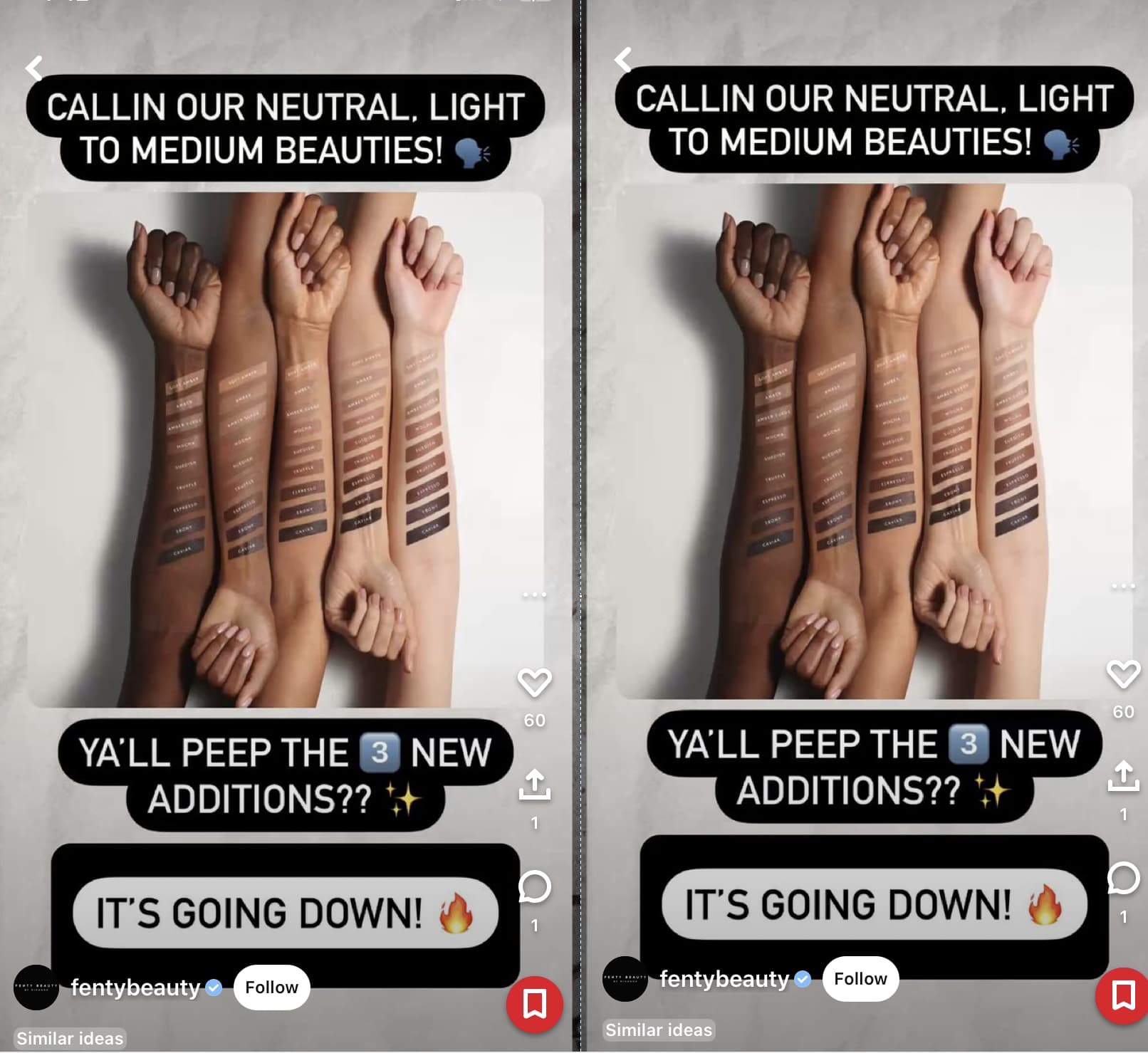
Cosmetics brand Fenty Beauty uses Idea Pins to promote the brand’s products and showcase the brand’s inclusivity. The company does this by showing photos of the products and how they look on different skin tones. Fenty also includes videos on its pins of people of color applying makeup and creating different looks.

Fenty Beauty uses Pinterest Idea Pins for marketingImage source

One of the biggest concerns facing the cosmetics industry is a lack of inclusivity. Many people of color with darker complexions often struggle to find makeup that matches or complements their skin tone. By using Idea Pins to show variety and how POC look in Fenty products, the company sets itself apart from other cosmetic companies and presents itself as a solution.

2. Oh Joy

Lifestyle brand and design company Oh Joy is the most followed account on Pinterest with 15.2 million followers. Its founder, Joy Cho, uses Idea Pins as a way to speak directly to the company’s audience and give advice on fashion and home decor. For example, in one pin Cho promotes jewelry from Jared. She speaks directly into the camera and tells her audience how she was able to coordinate the jewelry with her outfit.

Joy Cho uses Pinterest Idea Pins for MarketingImage source

Cho then encourages the audience to click through her pins to see more of her favorite Jared pieces and the outfits she matched them with. In other Idea Pins, Cho gives her audience a tour of her home and explains the thought process behind her decor. This is a great way to build audience engagement and to form a bond with viewers.

cho2Image source

3. Food My Muse

Food My Muse is a foodie account that posts recipes and restaurant reviews. The account is run by former restaurant owner Nadia Aidi. While Aidi posts a variety of food-related content, she uses Idea Pins specifically to post videos with step-by-step instructions for different recipes.

Food My Muse uses Pinterest Idea Pins for marketingImage source

She also includes the full recipe in the description of each pin. This kind of content is great for visual learners and it shows off her expertise as a chef — establishing her credibility as an expert foodie.

4. Mejuri Jewelry

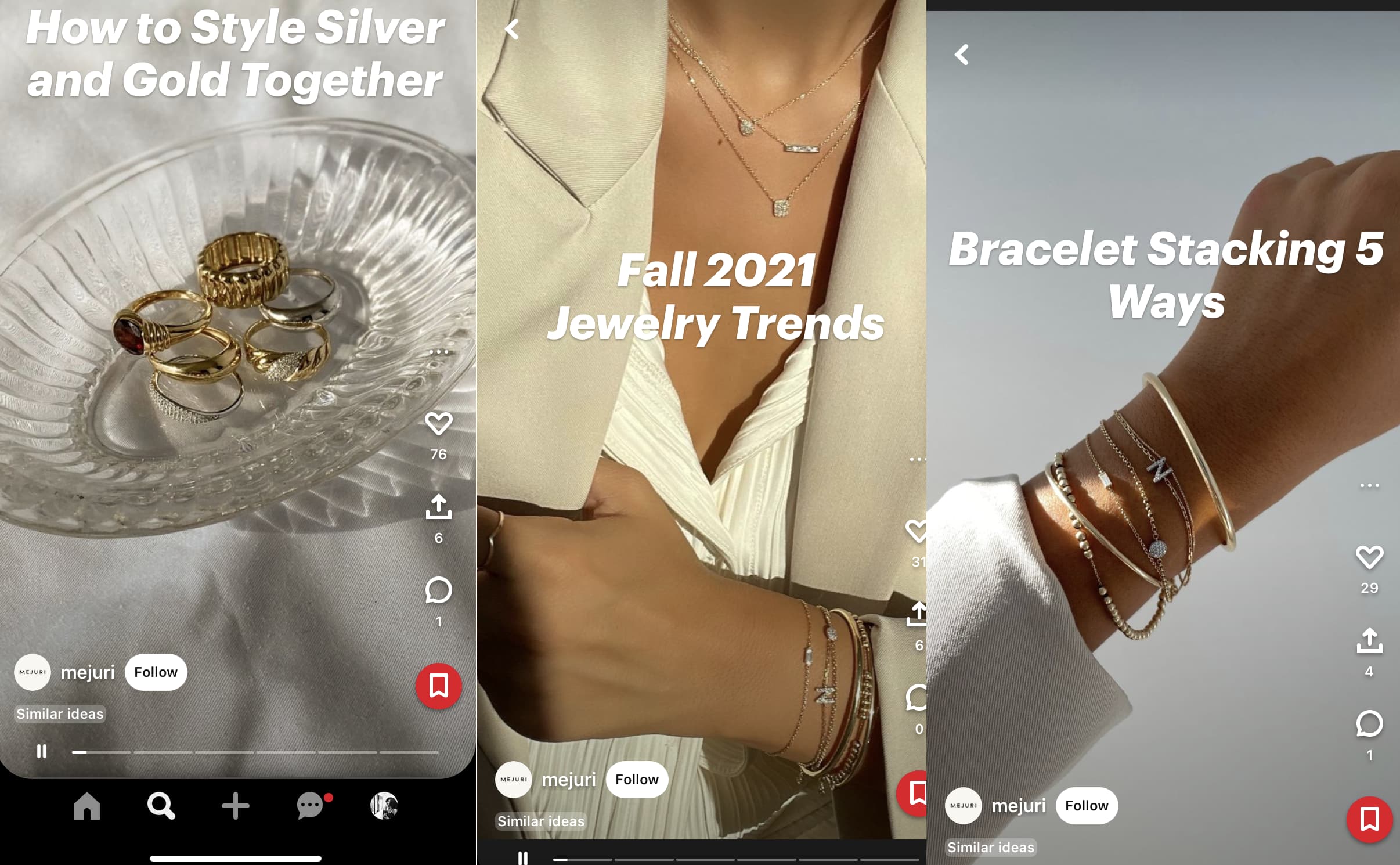
Mejuri Jewelry uses Idea Pins to post photos of its jewelry pieces and categorize its content by theme. In a way, Mejuri uses Idea Pins to create different lookbooks. In one Idea Pin, for instance, Mejuri creates a lookbook showing Pinterest users the different ways they can stack bracelets. Another lookbook consists of Fall 2021 trends, and another Idea Pin uses photos to show how gold and silver jewelry can be styled together.

This method of using pins shows the jewelry Mejuri offers and gives potential buyers practical information about how to style them for any occasion.

Mejuri uses Pinterest Idea Pins for marketingImage source

5. Etsy

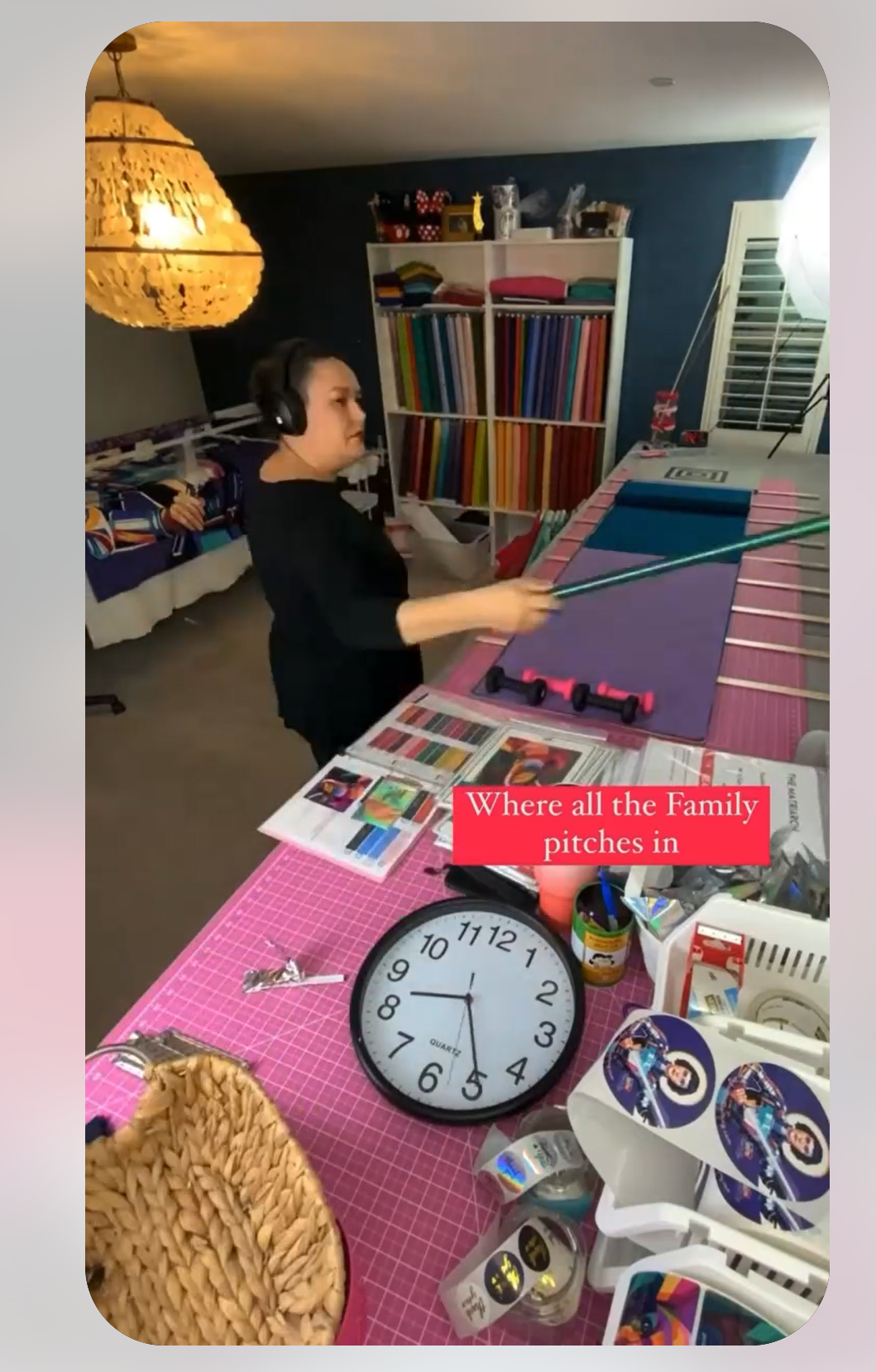
For its Idea Pins. Etsy leans heavily into video content that gives a behind-the-scenes look into small businesses on Etsy’s website. One Idea Pin includes a sequence of clips showing how one Etsy seller named Tori Lynn paints and glazes a ceramic mug. Another pin is a time-lapse video of another seller named Veruschka converting parts of their home into a workspace where they handmake and ship out their products.

Etsy uses Pinterest Idea Pins for marketingImage source

This type of content doesn’t just promote the products found on Etsy, it also highlights the many businesses and artists selling their wares on the site. In doing so, Etsy attracts both potential buyers and business owners looking for a platform.

Etsy uses Pinterest Idea Pins for marketingImage source

6. Vogue Magazine

Vogue Magazine uses Idea Pins to promote its magazine cover stars via candid videos from the photoshoots. The magazine’s latest Idea Pin, for example, features photos and footage of Serena Williams and her daughter, posing for the magazine’s cover and playing on a beach. Other pins feature celebrities like Rihanna showing her baby bump as well as photos from the Met Gala.

Vogue uses Pinterest Idea Pins for marketingImage source

Vogue’s Idea Pins appeal to its audience’s love of celebrities and fashion, and the pins establish Vogue as being at the center of pop culture.

Vogue uses Pinterest Idea Pins for marketingImage source

7. Bustle

Most of Bustle’s Idea Pins consist of repurposed content from other platforms like YouTube, Instagram, and TikTok. This method is helpful because it gives older content a second life on Pinterest. TikToks of celebrity interviews and short anecdotes from YouTube are frequently uploaded as Idea Pins, showing off Bustle’s variety of pop-culture content.

Bustle uses Pinterest Idea Pins for marketingImage source

8. Free People

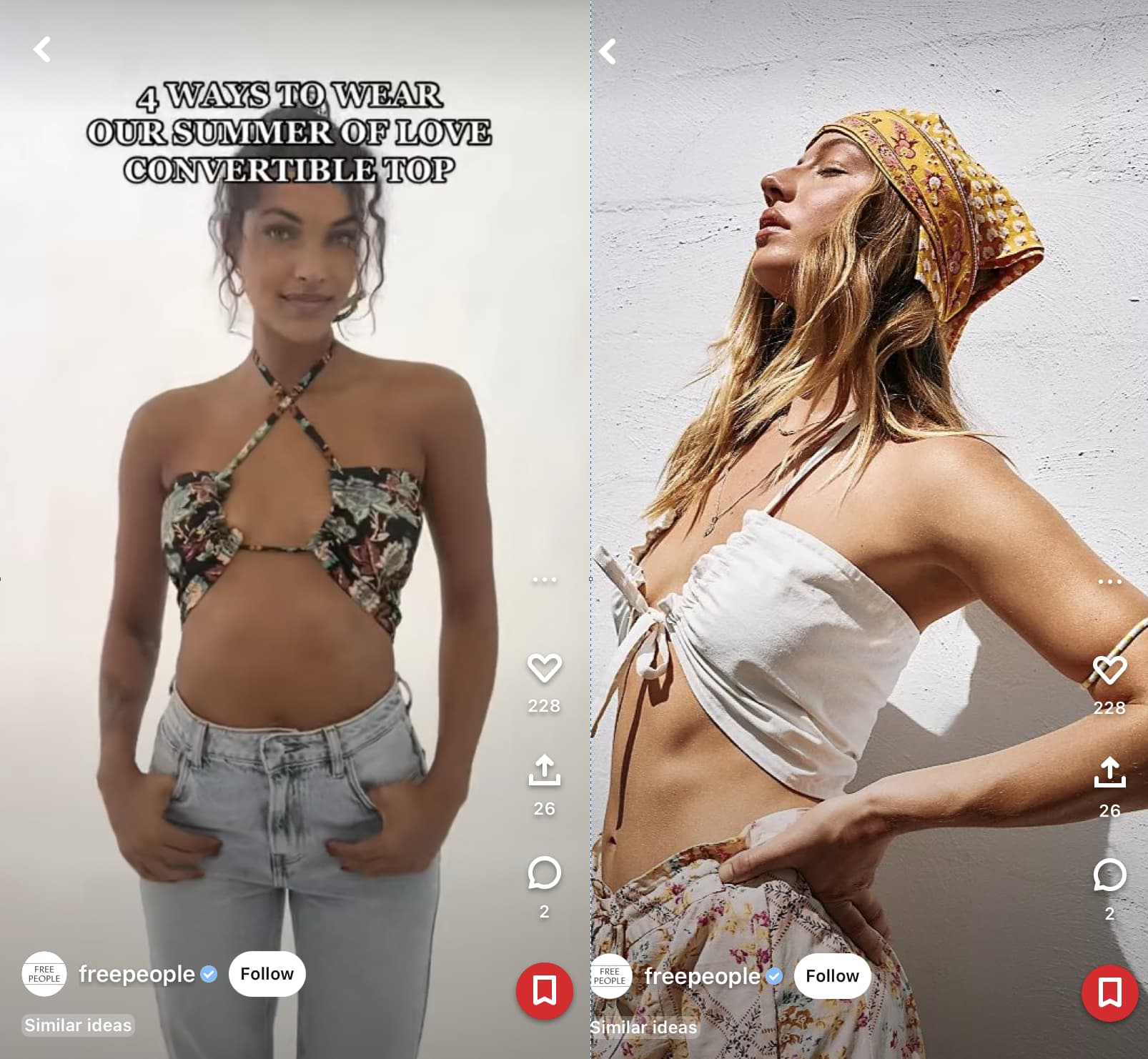
Most of Free People’s pins start with a video of a model wearing the fashion retailer’s clothes and demonstrating the different ways the clothing items can be styled. The video is then followed by photos of the products in different colors and in different outfits. This method makes all the Idea Pins similar and uniform, so followers know what to expect.

Similar to Mejuri Jewelry, Free People also organizes its pins by style and creates a digital lookbook that showcases its clothing and accessories.

Free People uses Pinterest Idea Pins for marketingImage source

9. The Little Bazaar

The Little Bazaar is an online store selling boho-style clothing. Like most fashion accounts on Pinterest, all of The Little Bazaar’s Idea Pins consist of photos of models wearing their clothes. However, some models are also customers who submitted photos and videos of them wearing the products.

This form of user-generated content is great because it shows Pinterest users how the clothes look on real people and it would encourage people to submit their own content as well.

The Little Bazaar uses Pinterest Idea Pins for marketingImage source

10. Lulu’s

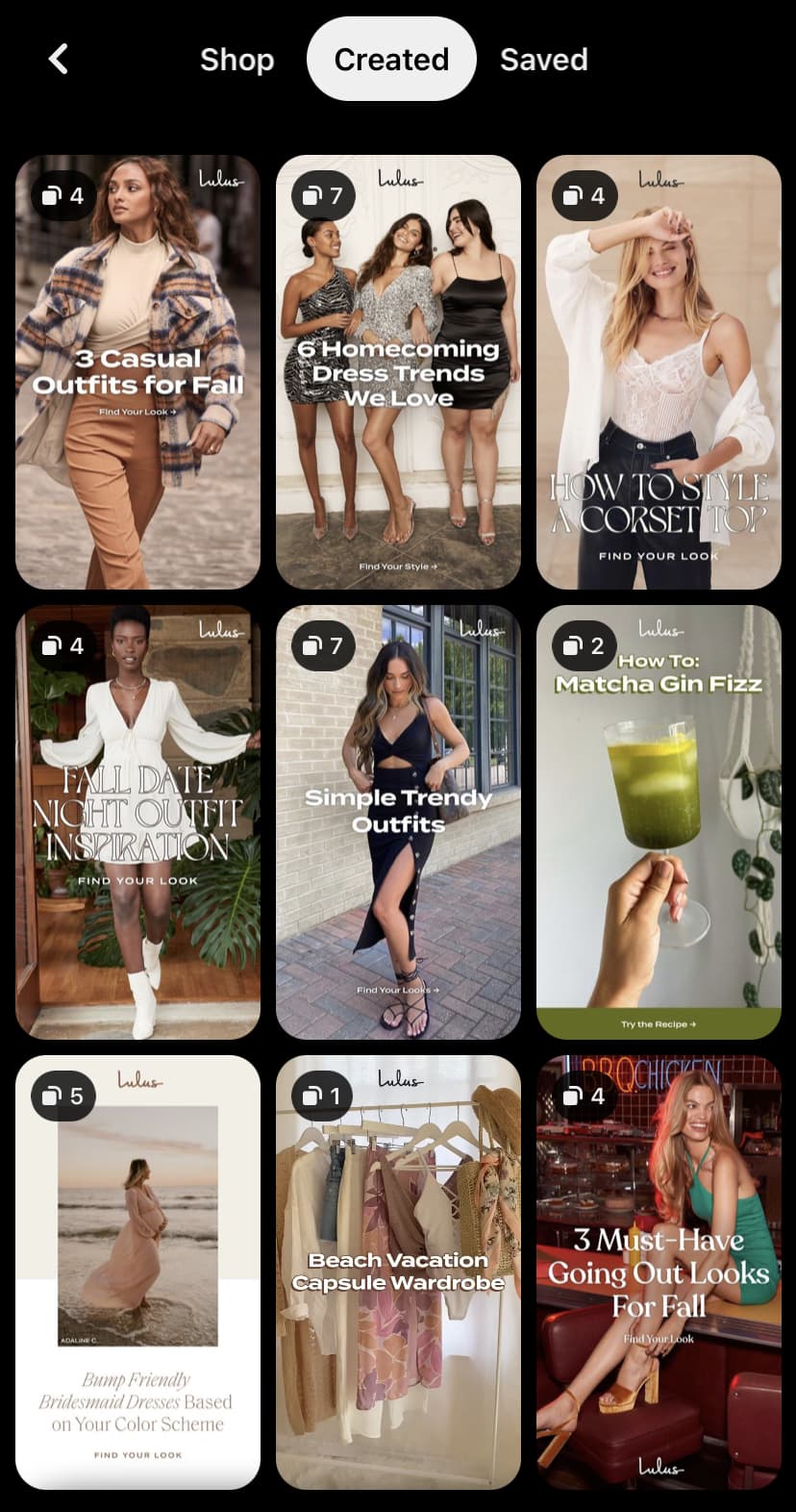
Almost all of Lulu’s Idea Pins consist of fashion and lifestyle how-to’s, such as “How to Style a Corset Top” and “How To: Macha Gin Fizz.” However, what I enjoy most about Lulu’s Idea Pins is the cover images. Each cover image includes Lulu’s logo as well as large texts giving a quick explanation of what the pin is about.

This use of Idea Pins is aesthetically pleasing, organized, and helps Pinterest users navigate to the kind of content they’re looking for.

Lulu's uses Pinterest Idea Pins for marketingImage source

Idea Pins present more opportunities for brands to get their content on Pinterest users’ feeds, expanding brand awareness. However, brands should also see these pins as a chance to create engaging content that tells a story and provides value.

How-to’s, lookbooks, behind-the-scenes footage, and user-generated content are just a few examples of the many ways you can incorporate Idea Pins into your marketing strategy.

Pinterest Templates

Categories B2B

Best Personal Websites: 35+ Examples to Blow Your Mind

A personal website is your chance to showcase your personality and credentials in an engaging format. But without strong personal website examples to guide you, you may not know how to get started or what will work best for your personal branding.

→ Download Now: 80 Professional Bio Examples [Free Templates]In this post, we’ll cover the best examples of personal websites we’ve seen — including resume websites, portfolios, blogs, and demo websites.

Why create a personal website?

Here’s the thing about resumes and cover letters: No matter how unique you try to make your own, for the most part, they tend to read dry. And there’s a good reason for it: It’s supposed to be a single, no-frills page that documents your work experience. And while being concise is good, there’s very little opportunity to convey your uniqueness, or for your personality to shine through at all for that matter.

While a resume is a sole, largely unchanging document, a personal website can be customized and updated according to what you’re working on, or what you want to emphasize. It’s both fluid and current.

In addition, 80% of businesses say a personal website is important when evaluating job candidates. Recruiters are looking you up online, and a personal website that tells the story you want to tell can make all the difference between you and a competing candidate.

If you’re thinking about creating a personal website of your very own, check out the examples below that hit the nail on the head. Inspired by a particular type of website?

Click one of the following links to jump to that section of this article:

Personal Resume Websites

Whether you create a single-page site or a larger portfolio, the web resume serves as a more personalized option for sharing information and demonstrating your technological skills — and it can be used by all types of jobseekers.

Even if you have very little work experience, you can leverage a website to build a better picture of your capabilities and yourself as a candidate, while leaning on your traditional resume to provide the basic background information.

1. Gary Sheng

Personal Website Examples: Gary Sheng

Unlike a standard resume document, Sheng’s website makes it easy for him to include logos and clickable links that allow his software engineering and web development skills to shine.
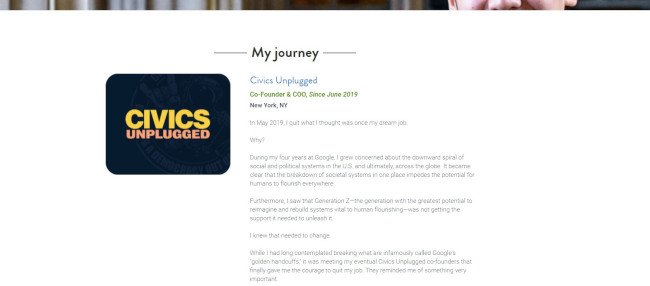
Gary Sheng's Clickable Links

We love that visitors can choose to scroll down his page to view all of the website’s categories (“About Me,” “My Passion,” etc.), or jump to a specific page using the top navigation.

The “My System” section reads like a company mission statement, and this personal touch helps humanize his work and make him more memorable.

2. Brandon Johnson

best personal websites: brandon johnson

Johnson’s incredible resume must be seen to be believed. Beautiful images of planets help to complement his planetary science background, and animations make his resume more of an experience than a document.

In terms of design, the textured, multi-layered background adds greater depth to the two-dimensional page in a way that evokes feelings of space and the planetary systems, which Johnson’s work focuses on.
3. Quinton Harris

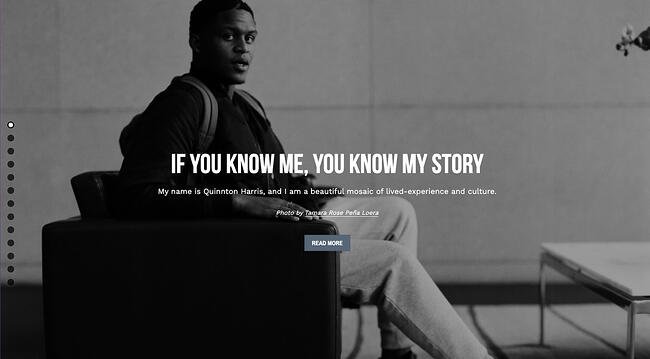
best personal websites: quinnton harrisHarris’ resume uses photos to tell his personal story — and it reads kind of like a cool, digital scrapbook. It covers all the bases of a resume — and then some — by discussing his educational background, work experience, and skills in a highly visual way.

Not to mention, the copy is fantastic. It’s clear that Harris took the time to carefully choose the right words to describe each step of his personal and professional journey.
4. Rubens Cantuni

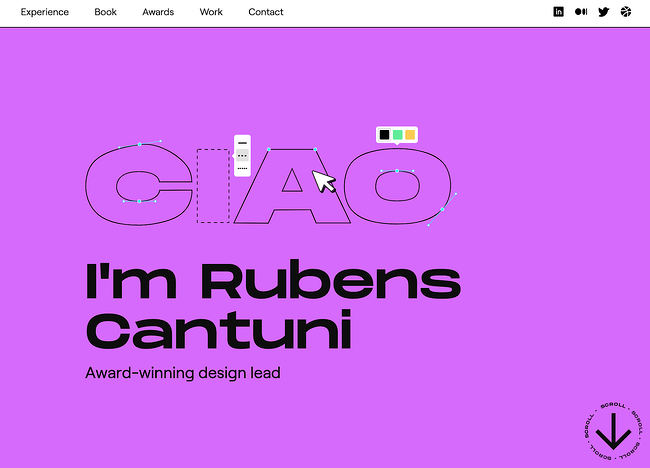
best personal websites: rubens cantuniRubens Cantuni’s resume website hits all the right notes: First, it showcases what he does with a playful GIF showing the word “CIAO” getting edited point-by-point, just as it would in a design tool. Second, it summarizes Cantuni’s key strengths in a personable summary. Third, it lists his experience in a user-friendly collapsible format, so if you want to read more, you can click each individual role. He then leads into his book and portfolio.

At every step, you get to appreciate Cantuni’s strong sense of design, user-first thinking, and sharp business acumen. The designer ends with a call-to-action for visitors to reach out to him. He also prompts recruiters to inquire about his work by mentioning that he can only share certain pieces of his work privately. On your own site, you can leverage projects with non-disclosure agreements as “gated content.”
5. Martine Myrup

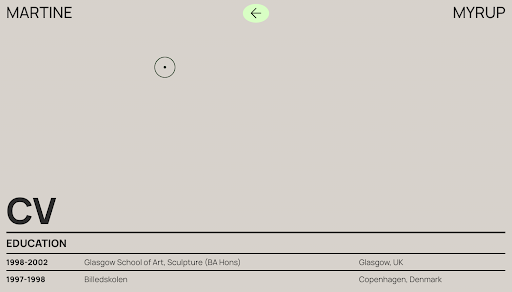
best personal website examples: martine myrup cvMartine Myrup’s website comes up twice on this list — first, as one of the best resume websites, and second, as one of the best portfolio websites we’ve ever seen. As a practicing artist, Myrup must emphasize visuals in her website’s design. But she also includes an HTML curriculum vitae for potential employers and other interested parties to see her degrees, exhibitions, awards, and publications.

The CV is formatted in a way that is clear and easy-to-scan, with bold headings separating each section and dates on the left-hand side. While artists’ CVs are formatted differently than professional CVs, Myrup’s formatting would work in virtually any field with some adjustments.

6. Taylor Vowell

best personal website examples: taylor vowellTaylor Vowell’s resume website is an excellent example of how to introduce yourself in a personable way while highlighting your professional experience. He begins with a summary about his personal life: “I am a father of 3, an avid comic and sports card collector, and a huge Avs and Broncos fan.” That draws readers in immediately and gives them a way to break the ice when they reach out to Vowell.

Later down the page, he includes his experience in a carousel with cards for each of his employers. If you’re interested in seeing more of his experience, you can click to the next card, or you can keep scrolling to see his skills in marketing, product design, and technology, as well his strengths and recommendations. This is a strong resume website that ends with a compelling, eye-catching call-to-action.
7. Johannes Schüchner

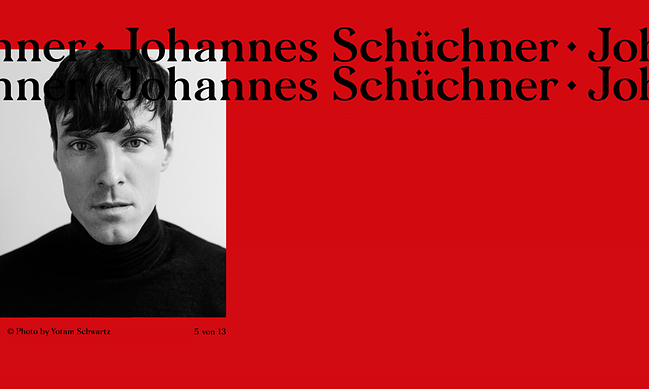
best personal website examples: johaness schuchnerJohannes Schüchner’s film resume website is an example that demonstrates how to showcase your creativity and personality while still highlighting your most important professional achievements. While the resume is in German, you can still get an understanding of the actor’s key strengths.

At the bottom, casting directors have an option to download a PDF version of Schüchner’s film credits and theater work. This website shows that you can tastefully break the rules on your own site, so long as you remain mindful of your target audience.
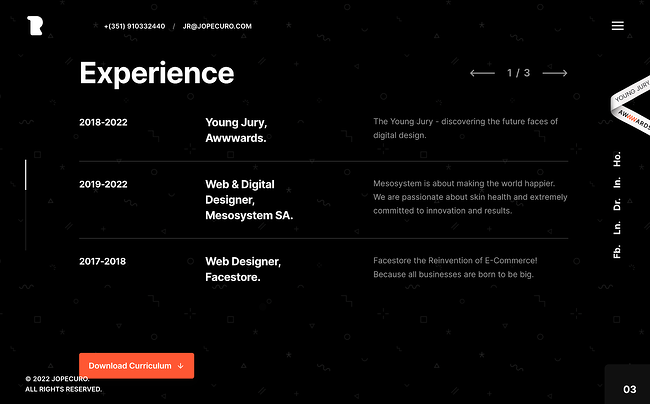
8. José Rocha

best personal website examples: jose rochaJosé Rocha is a designer who uses delightful parallax effects on his site to engage viewers and visitors. He introduces himself as a full-stack designer, covers his key strength areas, and then invites readers to scroll through his experience in a concise, interactive section.

At the top is a transparent navigation bar with his contact information, allowing website visitors to get in contact with him promptly if they want to. At the bottom is a formal form where people can submit an inquiry.
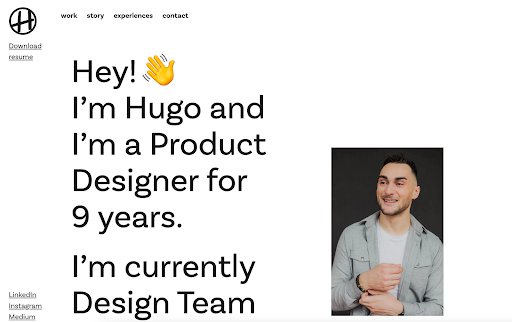
9. Hugo Bazin

best personal website examples: hugo bazinHugo Bazin is a product designer whose resume website combines friendliness with engaging user design. On the top left-hand corner, he includes a sticky button to download his resume in PDF format, but if you’re interested in getting an overview, you can scroll down to the “Experience” section, where you can see his current and previous employers.

Throughout the copy, Bazin uses emojis to showcase his personality, but he’s selective. He keeps emojis out of the “Experience” section of the webpage, where it’s essential to maintain a serious, professional tone.

10. Christian Kaisermann

best personal website examples: christian kaisermannChristian Kaisermann’s resume website employs unique visuals to keep viewers on the page and showcase his strong coding skills. On the upper right-hand side, you have the option to switch from channel to channel, like you would on an old TV. He also only includes two paragraphs of copy on the homepage, showing that remaining brief is key if you want visitors to focus on your website’s design.

On the bottom left-hand corner, users can access Kaisermann’s crawlable HTML resume, email, Twitter, and LinkedIn. You can also activate “Space Mode,” which brings up a remote control to change the channels — very cool!

Best Practices for Resume Websites

  • Code your resume so it can be crawled by search engines.
  • Offer a button to download your resume in PDF so the hiring manager can add it to your file.
  • Keep branding consistent between the website and document versions: Use similar fonts, colors, and images so you’re easy to recognize.
  • Be creative and authentic to yourself. Think about the colors, images, and media you want to be a part of your story that you couldn’t include in a document resume.

Personal Portfolios

Building an online portfolio is a highly useful personal branding and marketing tool if your work experience and skill set call for content creation. In fact, photographers, graphic designers, illustrators, writers, and content marketers can all use web portfolios to show off their skills in a more user-friendly way than a resume or hard copy portfolio.
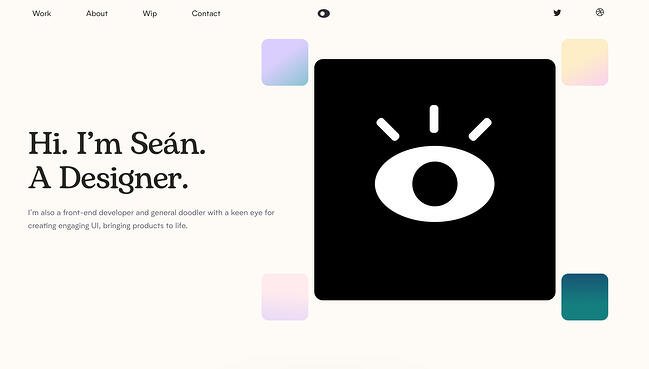
11. Seán Halpin

best personal website examples: sean halpinHalpin’s portfolio is short, sweet, and to the point, which is authentic to his voice and personal branding outlined on the site. Instead of a lot of copy, Halpin presents large thumbnail cards so that his projects speak for themselves and allow the user to delve deeper if one catches their eye.

12. Tony D’Orio

Personal Website Examples: Tony D'Orio

It’s important to keep the design of your visual portfolio simple to let images capture visitors’ attention, and D’Orio accomplishes this by featuring bold photographs front-and-center on his website. His logo and navigation menu are clear and don’t distract from his work. And he makes it easy for potential customers to download his work free of charge.

Want to give it a try? Click on the hamburger menu in the top left corner, then select + Create a PDF to select as many images as you’d like to download.

Once you open the PDF, you’ll notice that it comes fully equipped with D’Orio’s business card as the cover … just in case you need it.
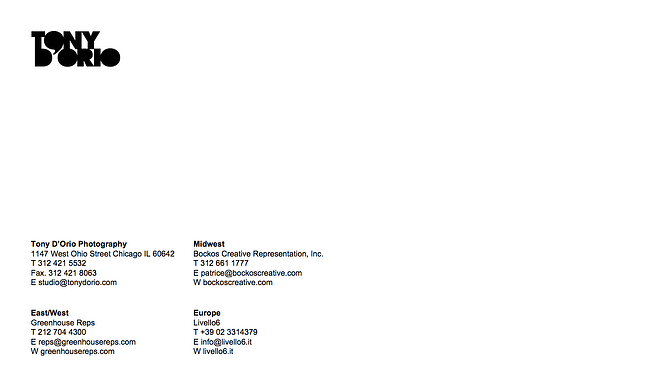
Tony D'Orio Business Card PDF

13. Verena Michelitsch

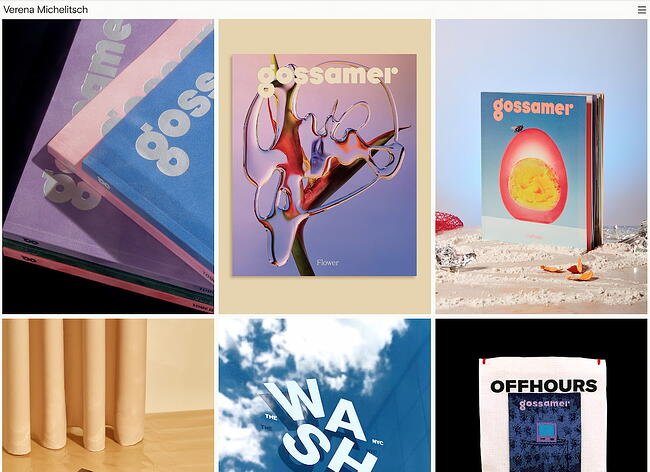
best personal website examples: verena michelitschWhen you’re a designer, not one pixel on your personal website should go unused. Verena Michelitsch’s portfolio, shown above, is covered end to end in artwork. From her extensive library of work, she chose to exhibit multiple colors, styles, and dimensions so visitors can see just how much range she has as a designer. It’s a perfect example of the classic adage, “show, don’t tell.”
14. Gari Cruze

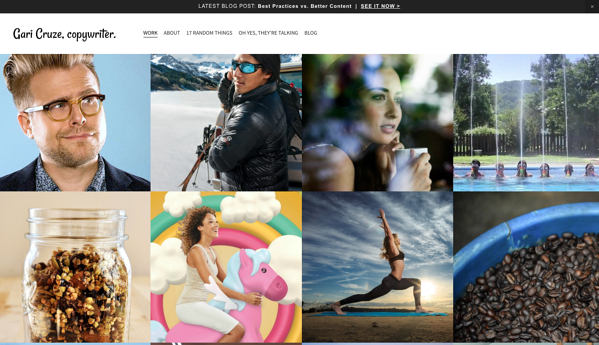
Personal Website Examples: Gari Cruze

Cruze is a copywriter. But by turning his website into a portfolio featuring images from different campaigns he’s worked on, he makes visitors want to keep clicking to learn more about him. Also, there’s a great CTA at the top of the page that leads visitors to his latest blog post.

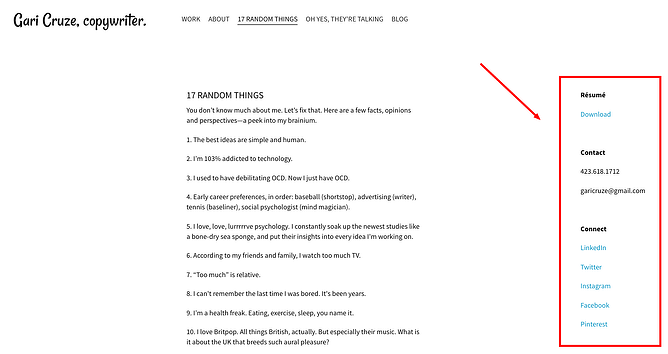
His site’s humorous copy — specifically in the “17 Random Things” and “Oh Yes, They’re Talking” sections — serves to show off his skills, while making himself more memorable as well. These pages also include his contact information on the right-hand side, making it easy to reach out and connect at any point:
Personal Websites Examples: Gari Cruze

15. Melanie Daveid

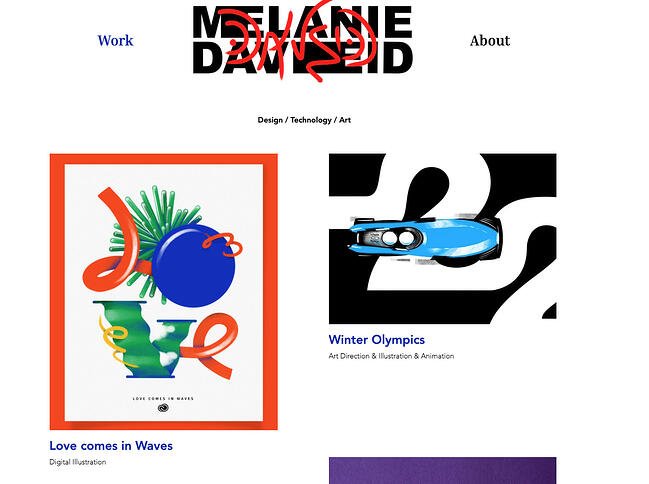
best personal website examples: melanie daveidDaveid’s website is a great example of “less is more.”

This developer’s portfolio features clear, well-branded imagery of campaigns and apps that Daveid worked on, and she shows off her coding skills when you click through to see the specifics of her work.

While it might seem overly minimal to only include just a few examples of her work, Daveid did her portfolio a service by including her best, most noteworthy campaigns. At the end of the day, it’s better to have fewer examples of excellence in your portfolio than many examples of mediocrity.
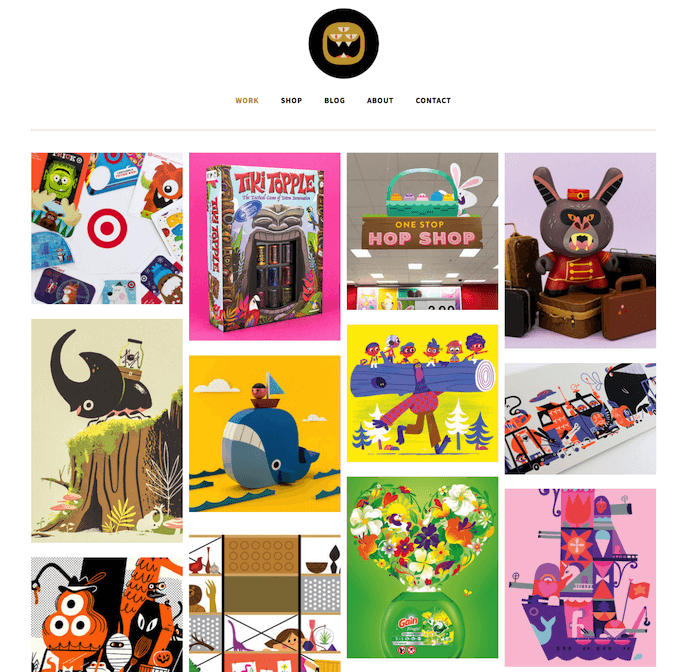
16. The Beast Is Back

Personal Website Examples: Christopher Lee: The Beast Is Back

Christopher Lee’s portfolio is busy and colorful in a way that works. When you read more about Lee on his easily navigable site, you realize that such a fun and vibrant homepage is perfect for an illustrator and toy designer.

Known by his brand name, “The Beast Is Back,” Lee’s web portfolio highlights eye-catching designs with recognizable brands, such as Target and Mario, along with links to purchase his work. This is another gallery-style portfolio with pops of color that make it fun and give it personality, thus making it more memorable.

17. Daniel Grindrod

Personal Website Examples: Daniel GrindrodThis freelance videographer is another example of a simple but sleek portfolio, allowing his potential clients to browse deeper into his “Work” and “Stills” sections. The opening video on the homepage — as shown on the still image above — also ensures his site visitors know that he’s actively creating beautiful work.
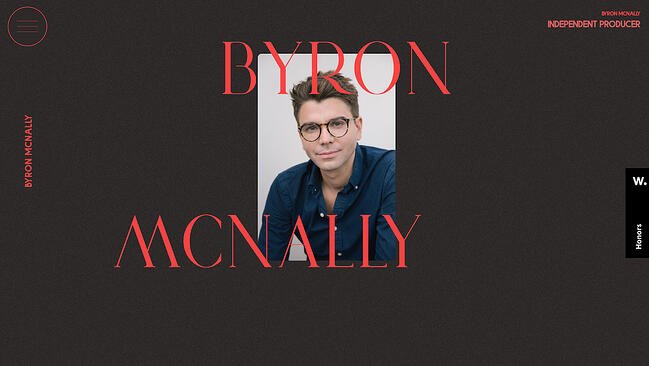
18. Byron McNally

best personal website examples: byron mcnallyIn his portfolio, Byron McNally doesn’t immediately include his work but rather a photo of himself, which immediately fosters a connection between him and website visitors. This minimal website design also invites users to continue engaging with the website’s content and see some of his recent film, commercial, and music productions.
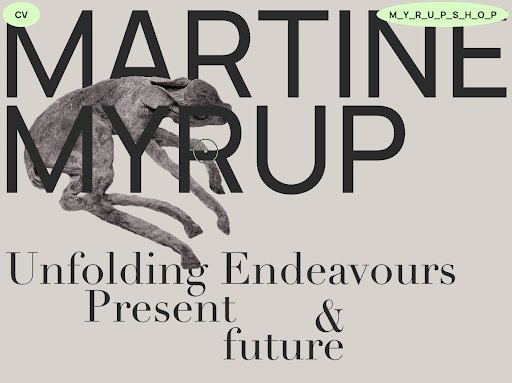
19. Martine Myrup

best personal website examples: martine myrup portfolioMartine Myrup was also in our list of best resume websites, but her portfolio is worth a mention, too. With its muted colors and creative use of typography, it immediately conveys her artistic vision and aesthetic. The page also includes a sticky bright green button prompting you to check out her CV. As you scroll down the page, you can see a preview of her work and click on the one that most interests you, then get in contact with her using the email at the bottom.
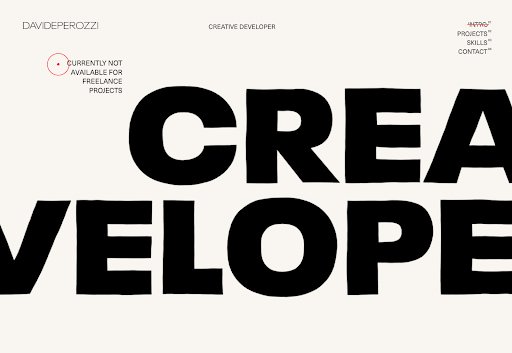
20. Davide Perozzi

best personal website examples: david perozziDavide Perozzi uses his website to showcase his strong design skills and creative typography, as well as his previous work. When you hover over each item in his portfolio, an image preview pops up, giving you the opportunity to check out more. The website uses scrolling effects and bold text to keep viewers engaged.

Best Practices for Portfolio Websites

  • Use mainly visuals. Even if you’re showcasing your written work, using logos or other branding is more eye-catching for your visitors.
  • Don’t be afraid to be yourself. Your personality, style, and sense of humor could be what sets you apart from other sites!
  • Organization is key. If your portfolio is full of photos, logos, and other images, make sure it’s easy for visitors to navigate to where they can contact you.
  • Brand yourself. Choose a logo or icon to make your information easily identifiable.

Personal Blogs

Consistently publishing on a blog is a great way to attract attention on social media and search engines — and drive traffic to your site. Blogging is a smart way to give your work a personality, chronicle your experiences, and stretch your writing muscles. You might write a personal blog if you’re a writer by trade, but virtually anyone can benefit from adding a blog to their site and providing useful content for their audience.
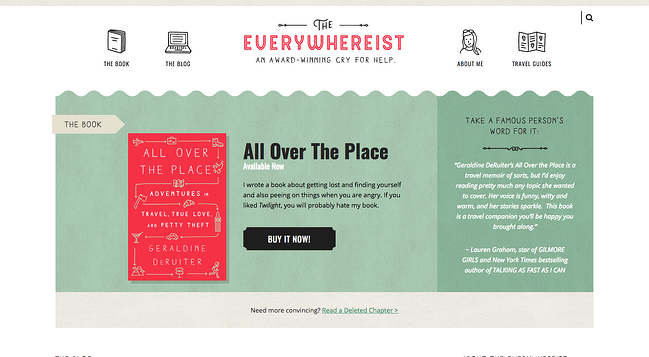
21. The Everywhereist

Personal Website Examples: The Everywhereist

This blog looks a bit busier, but its consistent branding helps visitors easily navigate the site. The travel blog uses globe iconography to move visitors around the site, making it easy to explore sections beyond the blog.

Owned by writer Geraldine DeRuiter, this blog also features a “Best Of” section that allows new visitors to learn about what the blog covers to get acclimated. The color scheme is warm, neutral, and free of excess clutter that could distract from the content.
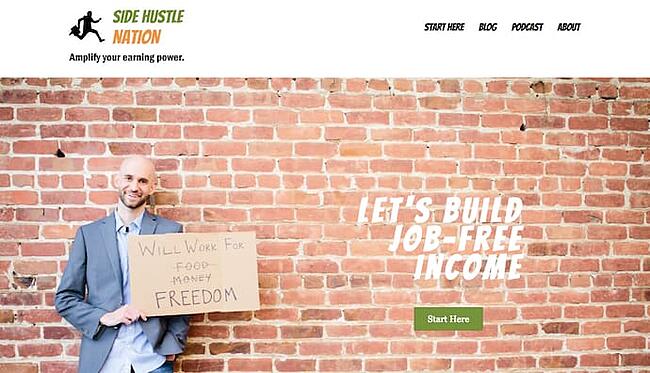
22. Side Hustle Nation

Personal Website Examples: Nick Loper: Side Hustle Nation

Side Hustle Nation is the business blog of Nick Loper, an advisor whose website offers tons of valuable financial advice for individual business owners. His homepage, shown above, sets a lighthearted yet passionate tone for his readers. It suggests you’ll get friendly content all committed to a single goal: financial freedom. The green call to action, “Start Here,” helps first-time visitors know exactly how to navigate his website.

On Nick’s blog page, you’ll see content that shows readers how Nick, himself, creates content that helps his business grow. These content types give people a peek behind the curtain of your operation, showing them you practice what you preach and that your insight is tried and true.
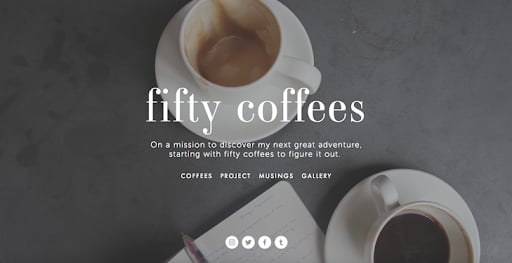
23. fifty coffees

best personal website examples: fifty coffeesThe website fifty coffees chronicles the author’s series of coffee meetings in search of her next job opportunity, and it does a great job of using photography and visuals to assist in the telling of her lengthy stories.

The best part? Each post ends with numbered takeaways from her meetings for ease of reading comprehension. The high-quality photography used to complement the stories is like icing on the cake.
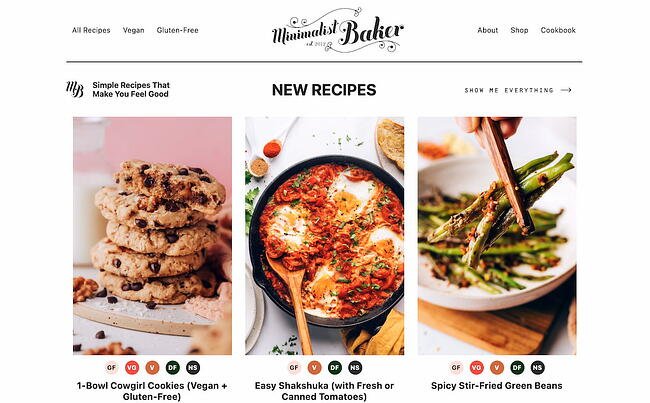
24. Minimalist Baker

best personal website examples: minimalist bakerI’m not highlighting Dana’s food blog just because the food looks delicious and I’m hungry. Her blog uses a simple white background to let her food photography pop, unique branding to make her memorable, and mini-bio to personalize her website.
25. Mr. Money Mustache

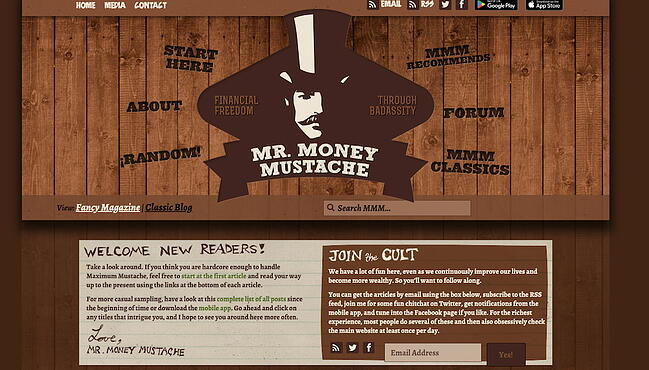
best personal website examples: mr money mustacheMr. Money Mustache might take on an old-school, Gangs of New York-style facade, but his blog design — and the advice the blog offers — couldn’t be more fresh (he also doesn’t really look like that).

This financial blog is a funny, browsable website that offers sound insight into money management for the layperson. While his personal stories help support the legitimacy of his advice, the navigation links surrounding his logo make it easy to jump right into his content without any prior context around his brand.
26. Marco Feng

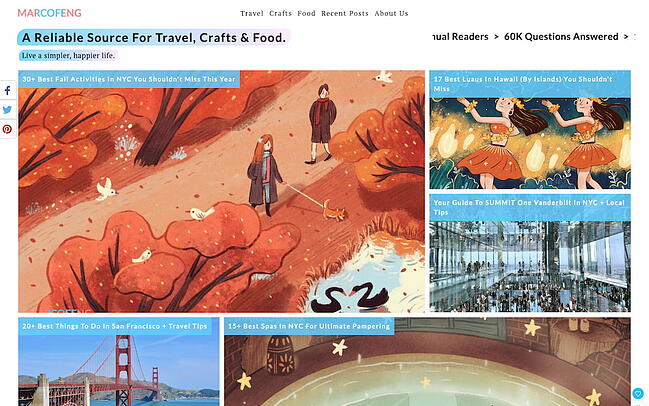
best personal website examples: marco fengMarco Feng’s travel blog is colorful, unique, and informative. When you arrive at the site, you can immediately jump in to the blog post that draws your attention the most, or explore by destination. Our favorite part of the site is the scrolling banner at the top that provides social proof: As a reader, you’d be joining 3 million others. Leveraging your audience size will help you look more authoritative and establish your site as a go-to.

27. Miramono

best personal website examples: miramonoMiramono is a unique photography blog created by Fernando Puente, where he curates a “selection of photographers he deeeeply loves.” In it, he includes interviews, essays, and photo selections. At the bottom is an eye-catching graphic prompting viewers to subscribe. We love the simplicity of the website’s design, as well as its unique value proposition.
28. Beamaker

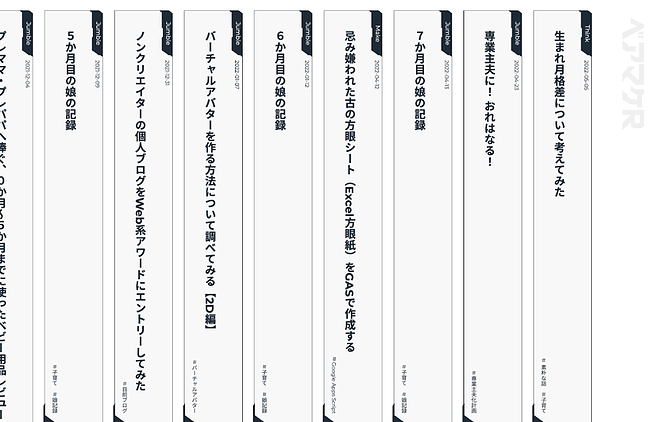
best personal website examples: beamakerThis blog combines engaging visual design with user-friendliness. Since Japanese is written vertically, the home page includes a series of vertical cards, each for a different blog post. You can then click on each card to expand a specific post. The writer divides his musings into three categories: Make, Think, and Jumble. He discusses his personal life at home as well as his life at work, epitomizing what a personal blog should contain.
29. Salt in Our Hair

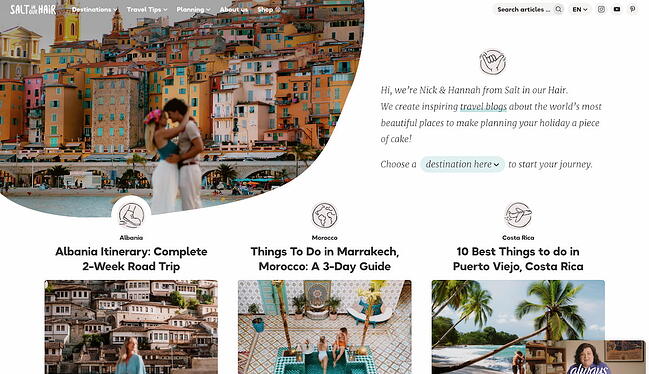
best personal website examples: salt in our hairSalt in Our Hair is a travel blog with exceptional user design. The bloggers, Nick and Hannah, introduce themselves on the welcome screen. Users then have the option of choosing a specific destination to read about or finding a specific topic using the menu up top.
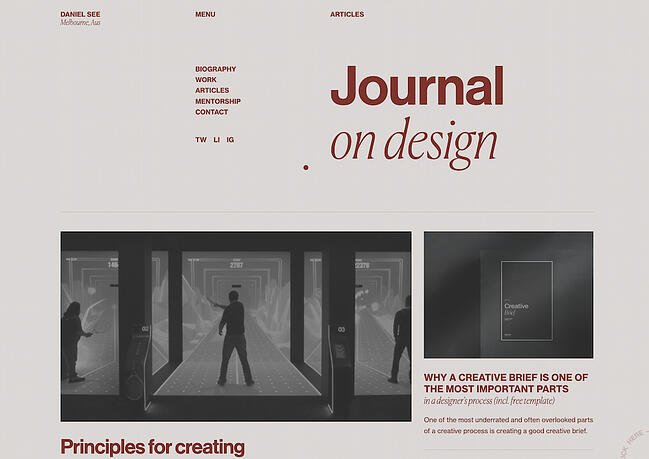
30. Daniel See

best personal website examples: daniel seeDaniel See uses the blog section of his website to share his thoughts on design. As a designer, he uses his subject-matter expertise to write blog posts about creative processes. He also prompts readers to submit their feedback and ideas by including a button to “let him know your thoughts.”

Best Practices for Blogs

  • Keep your site simple and clutter-free to avoid additional distractions beyond blog posts.
  • Publish often. Those who prioritize marketing efforts are 13x more likely to see positive ROI.
  • Experiment with different blog styles, such as lists, interviews, graphics, and bullets.
  • Employ visuals to break up text and add context to your discussion.

Personal Demo Websites

Another cool way to promote yourself and your skills is to create a personal website that doubles as a demonstration of your coding, design, illustration, or developer skills. These sites can be interactive and animated in a way that provides information about you and also shows hiring managers why they should work with you. This is a great website option for technical and artistic content creators such as developers, animators, UX designers, website content managers, and illustrators.

31. Albino Tonnina

best personal website examples: albino tonninaTonnina is showcasing advanced and complicated web development skills, but the images and storytelling methods he uses are simple and easy to understand. In the process, you get a demo of the depth of his animation and coding experience.
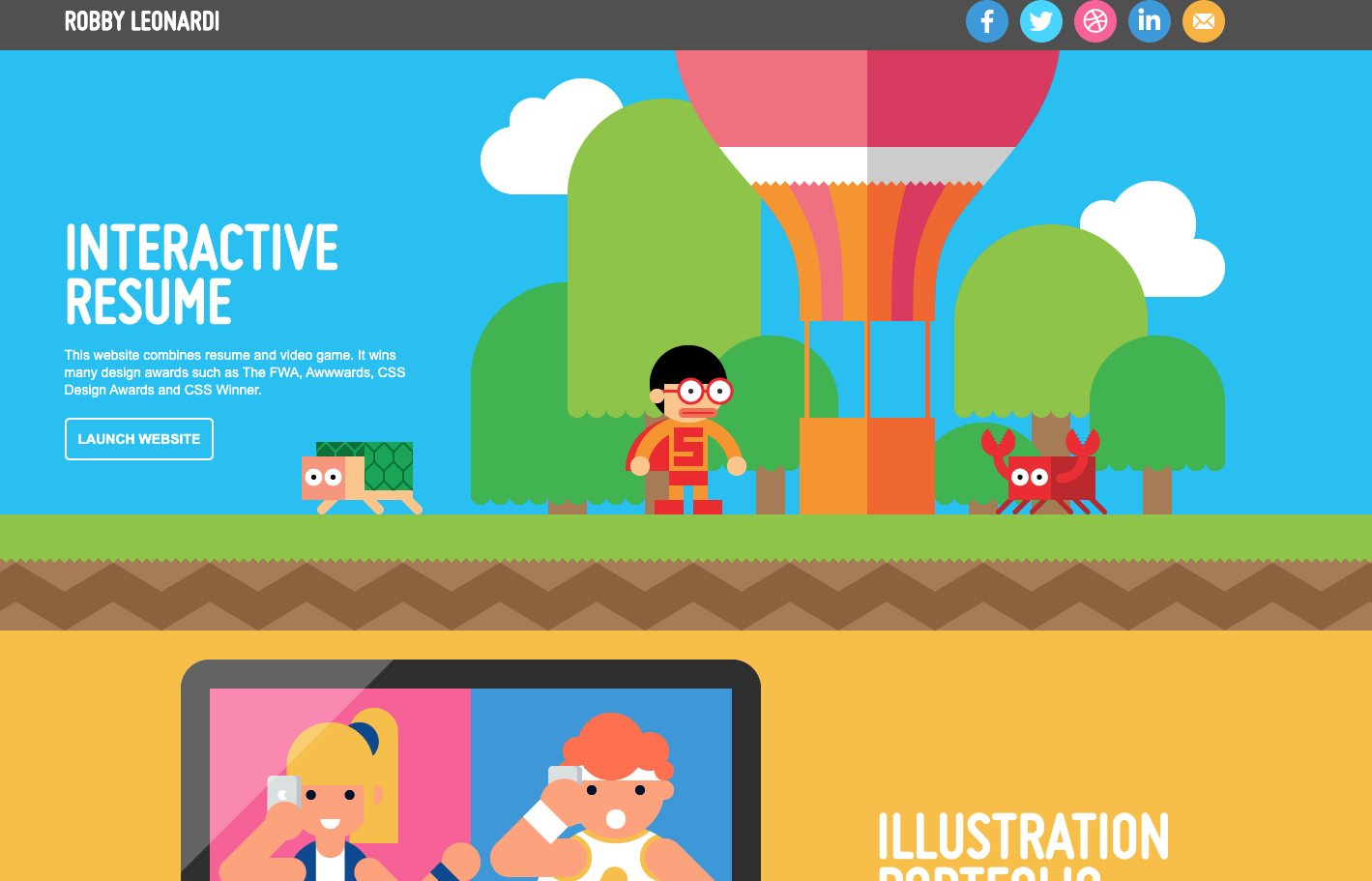
32. Robby Leonardi

best personal website examples: robby leonardiLeonardi’s incredible demo website uses animation and web development skills to turn his portfolio and resume into a video game for site visitors. The whimsical branding and unique way of sharing information ensure that his site is memorable to visitors.

33. Samuel Reed

best personal website examples: samuel reedReed uses his page as a start-to-finish demo of how to code a website. His website starts as a blank white page and ends as a fully interactive site that visitors can watch him code themselves. The cool factor makes this website memorable, and it makes his skills extremely marketable.

34. Renaud Rohlinger

best personal website examples: renaud rohlingerRenaud Rohlinger’s demo site does a great job of showing his 3D design chops, and it takes it a step further by telling visitors all about him and his passions. It’s the perfect balance of a demo and a mini-portfolio.

Plus, we love the video he includes as the background, as well as the parallax effects that activate as you scroll down the page.
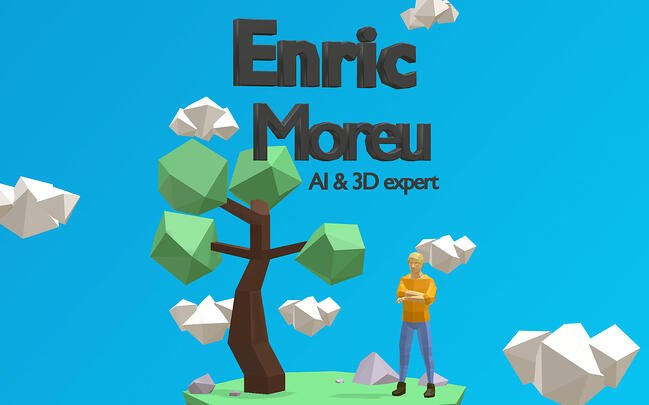
35. Enric Moreu

best personal website examples: enric moreuEnric Moreu showcases his 3D design skills by creating an interactive 3D resume. As users scroll, the page smoothly takes them through Moreu’s spoken languages, coding languages, skills, and work experiences. It’s engaging, light on text, and visually striking.
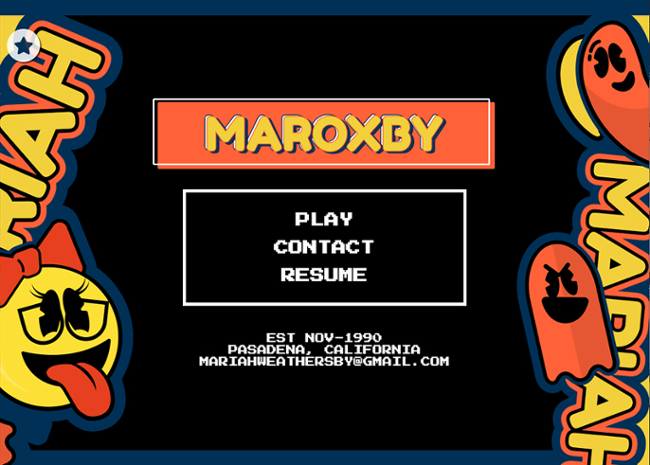
36. Mariah Weathersby

best personal website examples: mariah weathersbyMariah Weathersby has coded a striking “playable” resume that pays homage to old-school games and showcases her strong design skills. If you love experiencing nostalgia, this demo website will reel you in. If you only want the resume, you have the option of downloading a text-based version — a win-win.

37. Isaac Fayemi

best personal website examples: isaac fayemiIsaac Fayemi’s demo website is subtle and striking at the same time. Rather than loading the page with excessive graphics, he has created a 3D version of his head that follows your cursor as you move around. You have two options: To find out more about him or check out more of his work. This demo website is a stellar example of how to keep it simple while still delighting the senses.

Best Practices for Demo Websites

  • Brand yourself and use consistent logos and colors to identify your name and your skills amongst the bevy of visuals.
  • Don’t overwhelm your visitors with too many visuals at once — especially if your demo is animated. Be sure to keep imagery easy to understand so visitors aren’t bombarded when they visit your site.

Developing a Personal Website

Regardless of the type of personal website you’re building, there’s plenty of inspiration above on how to convey personality while connecting with your audience. Keeping the above tips in mind, remember to design for your audience’s experience, and most importantly, have fun.

Editor’s note: This post was originally published in April 2019 and has been updated for comprehensiveness.
New Call-to-action

Categories B2B

How Businesses Are Using Gamification to Spice Up Their Marketing

You win!

It’s a short, simple phrase, but a powerful one — and it’s the basis for gamification in marketing.

By incorporating game elements into marketing efforts such as brand awareness, reward programs, or new product promotions, businesses can turn basic campaigns into connective efforts that keep customers coming back for more.

Download Now: Free State of Marketing Report [Updated for 2022]

The challenge? While it’s easy to find anecdotal evidence of gamification making marketing efforts better, it’s more difficult to track down a gamification guide that helps marketers make this approach work for them. In this piece, we’ll walk you through gamification basics, common strategies, and real-life examples to help your campaign take the lead.

Put simply, it’s the process of turning any process into a game. For marketing teams, it could be turning your inbound marketing into a game in order to achieve a specific outcome. Your audience (customers, leads, fans, followers, readers, whoever) engages in a game that offers the chance to win something, and in return, you get a marketing boost.

It’s sort of like when we host a webinar and say whoever tweets the webinar’s hashtag the most gets a free ticket to our next marketing conference — it taps into people’s competitive spirit and drive to win, and gets our content more exposure on Twitter. Again, a win-win scenario, and one that’s more creative than just asking someone, “Hey, can you tweet this link?”

Some common gamification strategies for marketing teams include:

Website Games

Website games take many forms. They can be simple, “spin the wheel” pages that pop up when customers click through to products or when they arrive on your site, or they might be virtual scratch cards that let buyers earn a discount on their favorite products.

No matter the type, the key to website games working is keeping them simple and relatively unobtrusive. Make it easy for users to play, always let them win something, and let them quickly close out games if they’re not interested.

Loyalty Programs

Loyalty programs are also a great way to gamify the customer experience. By offering customers points, stars, or other currency after they make a purchase and tying these currencies to discounts or special offers, brands can keep their target audience coming back.

Completion Meters

Another way to engage customer interest is through completion meters. This is an especially useful tactic for brands looking to keep customers interested in their mobile applications. By giving users a goal to reach or another level to earn — along with commensurate benefits — companies can drive ongoing engagement.

Virtual Badges

Virtual badges or rewards for specific actions can help keep customers coming back and encourage them to earn the next digital award, especially if it’s tied to a discount or other benefit.

It’s one thing to know the basics — it’s another to implement gamification efforts that directly benefit your business. Here’s a look at 10 real-life examples for your brand to try.

KFC: Mobile gaming

KFC Japan decided the best way to engage users was with a mobile “advergame” called Shrimp Attack. The premise was simple: Users swiped away at virtual shrimp falling from a cartoon sky and encouraged them to try the restaurant’s new line of battered shrimp with reward vouchers.

According to Gamify, the company that created the game, 22% of people who played the game redeemed their vouchers and the company had to adjust campaign timing to account for increased demand.

Under Armour: Trivia

Under Armour engaged with users through its “Steph IQ” quiz application, which asked questions about point guard Steph Curry whenever he sank his first three-pointer of a regular season game. The app was set up elimination-style to test users’ knowledge of Curry while also engaging them with the Under Armour brand.

M&M’s: Digital puzzles

In 2010, popular and delicious candy brand M&M’s launched a chocolate-coated pretzel flavor. While the new treat did well, the company wanted to boost user engagement. The solution? A digital puzzle that tasked users with finding a pretzel image hidden in a field of M&M’s.

The effort worked: M&M’s saw 25,000 new likes for the company and the game was shared over 6,00 times.

Starbucks: Rewards app

Want a coffee? Why not get some rewards to go with it? This is the idea behind the Starbucks Rewards app, which gives customers the ability to earn “stars” for every purchase which can be redeemed for drinks or food.

The star-based solution has seen significant success: According to QSR Magazine, the app-based membership program accounted for 52% of all US store sales in 2021.

Nike: Fitness competition

NikeFuel is a fitness app that pairs with Nike wearable devices and encourages users to share their fitness goals and accomplishments. Not only does this help promote social recognition of the brand but also helps Nike integrate their brand into the everyday lives of users.

Duolingo: Gamified education

Oh, that owl. If you’re familiar with this language-learning app, you know that the company’s owl mascot appears regularly to remind users that they haven’t done their session for the day.

More importantly, however, is the use of minigames to help users learn a new language. With multiple short games that include selecting the right word to complete a sentence, listening to a phrase and then translating it, or speaking into your device’s microphone to see if you have the pronunciation right, Duolingo is doing gamification right.

They’re doing so well, in fact, that research has been published on their methods.

Wordle: Streak counter

If you haven’t heard of Wordle, where have you been? This get-it-in-six tries word guessing app was recently purchased by the New York Times, and while the company hasn’t heavily monetized it yet, there’s certainly potential to head in that direction.

One key element of the game beyond the game itself is the streak counter, which shows users their completion rate over all the puzzles they’ve done. Miss a day, and your counter starts over.

eBay: Emotional investment

While eBay doesn’t get the kind of traction it used to thanks to the rise of sites like Amazon and Etsy, it still generated almost $2.5 billion worth of sales in Q1 2022.

Part of the appeal is the game-like structure of the sales process. Users bid on items they want, and if they’re lucky can score a great deal — if they’re not outbid. EBay allows users to both set a maximum bid and get notifications if they’re outbid, allowing them to continually engage with the purchase process.

The US Army: First-person gaming

To help capture the interest of new recruits, the US Army created its own FPS game called America’s Army: Proving Grounds. This allows gamers to try out small-group tactics that prioritize working together with squad mates and is available on popular app stores such as Steam.

Headspace: Social sharing

Meditation app Headspace encourages users to complete their first medication within three minutes of opening the app. If they do, they receive an achievement they can share with others. All achievements are sharable, allowing Headspace users to continually connect.

Time to Level Up

Gamification in marketing can help your campaigns go from forgettable to fun, both engaging users and driving increased sales.

Best bet? Start simply. Select one approach to gamification and implement it on your website, mobile application, or email campaigns. Then, see how users react and make changes to improve the experience.

With a little time and effort, your brand can level up gamification marketing and create reciprocal interaction with customers that both drives initial conversion and creates sustained interest.

Editor’s note: This post was originally published in September 2012 and has been updated for comprehensiveness.

New Call-to-action

Categories B2B

30 Proven Tips to Improve SEO Performance

The easier it is for customers to find your webpage, the better your chances of engaging new visitors and driving new conversions.

In practice, however, this means more than having great content — it means taking steps to improve SEO performance so that search engine algorithms will be more likely to return your page as a top result.

Learn More About HubSpot's SEO & Content Strategy Tool

We’ve created this blog to help you make the most of your SEO efforts — here’s a list of 30 tactical search engine tips.

30 Tips to Help Improve Your SEO

To streamline the navigation of our SEO tips, we’ve divided them into broad categories. Click on any category for a quick jump to that section.

Improve page speed

Publish relevant and trustworthy content

Regularly evaluate current keywords and trends

Manage your metrics

Optimize on page-components

Improve page speed

Search giant Google uses page speed as part of its algorithm for returning results. While it’s not the only factor that influences your site rankings, it is a key piece of the puzzle. Google puts it simply: “Speeding up websites is important — not just to site owners, but to all Internet users.”

As a result, faster-loading pages get a boost in search rankings, while slower-loading pages (even if they have similar content) end up lower on the list. Here are six tips to help boost page speed:

1. Use a content delivery network (CDN)

A CDN helps manage and route website traffic more efficiently by using multiple delivery pipelines, in turn reducing site slowdowns.

2. Reduce image size

The less your site needs to load, the faster it will be for visitors. By scaling down image sizes or saving them as smaller image formats, you can save space and time.

3. Remove junk code

If your site has seen consistent or significant updates, chances are you have a fair bit of junk code. Tools such as WP Optimize can help find and eliminate junk code to speed up your site.

4. Use compression

Compression tools are a great way to reduce the size of CSS, HTML, and JavaScript files, which in turn speeds up the loading process of your site.

5. Minimize page redirects

The more page redirects, the slower your site. For example, if you redirect from an old webpage address to a new one — and do this multiple times over multiple page iterations — your site will slow down.

6. Cache content

Finally, you can make use of browser caching to store data on user browsers (with permission) so they don’t have to load your entire site every time they visit.

Publish relevant and trustworthy content

Just getting your site on the first page isn’t enough — you need content that grabs user attention even in brief meta descriptions and snippets in search results. Try these six tips to publish more trustworthy and relevant content:

7. Use the right keywords

The right content keywords make a huge difference in SEO. For example, multi-word keywords or those that are too specific can hurt your SEO efforts — instead, use tools like Google AdWords to pinpoint popular search terms.

8. Balance topical and evergreen content

Topical content is relevant right now, while evergreen content remains applicable over a long period of time. Balance both to achieve consistent SEO.

9. Consider keyword placement

It’s not just about what keywords you choose, but where you place them. Keywords should be included in your content, in any social posts, and in titles and meta descriptions wherever possible.

10. Regularly evaluate content

Create a schedule to evaluate your content and make changes as necessary. This is critical for topical content, which quickly loses value over time.

11. Keep it simple

Don’t get too complicated with your content. Keep it simple, clear and to the point — both visitors and search engine algorithms prefer this approach.

12. Take feedback into account

If users leave comments on your content, listen to them — especially if you see consistent trends. Using this data lets you tailor content to the preferences of your target audience.

Regularly evaluate current keywords and trends

Keywords and trends keep your content timely and relevant and focused on your target audience. Make use of these six tips to measure current keywords and trends:

13. Use analytics tools

Tools such as Google Trends and Google Adwords and HubSpot’s SEO solutions can help you pinpoint keywords that are both relevant and trending for your brand.

14. Look at the competition

Do a search for your primary keyword and see what comes up. If it’s you, great! If it’s a competitor, take a look at their website to see what they’re doing and why it’s working.

15. Run A/B testing

A/B testing is the process of testing two approaches or ideas to see which one performs better. You can also do this with keywords — write two pages with different primary keywords and see which one ranks higher.

16. Track key trends

Seasonal and event-driven trends can impact SEO. As a result, it’s worth tracking key purchase and customer expectation trends to align keywords with user preferences.

17. Account for the user experience

User experience indicators, such as the amount of time users spend on specific pages and how long they stay on your site, can act as a bellwether for your SEO. If these metrics are moving the wrong way, your keyword optimization and content layout may need updating.

18. Find relevant questions

One of the best ways to understand what’s trending is to search for your site’s primary keyword and see what questions pop up. These top-rated queries can help your team ensure they’re creating content that aligns with what users want to learn.

Manage your metrics

Successful SEO is all about data. What are users doing? For how long? Why? The more you know, the better equipped you are to keep customers interested. Effectively manage your SEO metrics with these six tips:

19. See where you rank

Start by searching your site and see where you rank. Are you in the top three? The top five? On the first page? With 75% of users never going beyond the first page, your ranking gives you a great place to start SEO efforts.

20. Find out where visitors are coming from

Leverage tools that let you see where traffic is coming from. Is your primary traffic source organic search results? Social media posts? Sponsored ads? The more you know, the better.

21. Measure organic traffic

Organic traffic is traffic to your site from a search engine that isn’t driven by paid content. As a result, it’s incredibly valuable to your site and it’s worth regular measurements to ensure steady (or increasing) organic traffic.

22. Check your click-through rate (CTR)

How many people are clicking through after seeing your search results? If you discover that high volumes of potential visitors are looking at your page results but not making the jump, your SEO needs work.

23. Test your readability

The more readable your content, the better, especially since search engines often pull up relevant parts of your content when users search. If your language or sentence structure is too complicated or convoluted, users will often choose another site.

24. Keep track of bounce rate

Bounce happens when users get to your page but don’t take action. They don’t click on links, they don’t interact with any elements — they just leave. Measure your bounce rate to make sure your website elements are capitalizing on the second part of SEO: Compelling action.

Optimize on-page components

Your site isn’t static. To make sure it delivers on SEO potential, it’s worth regular evaluation to ensure key components are working as intended.

These six tips can help you optimize on-page components:

25. Make use of metadata

Make sure that you fill in all relevant sources of metadata including title, description, keyword, and alt text to provide as much context as possible for users.

26. Optimize images

Optimize images on your site by reducing their total size, ensuring they’re high-quality, and making sure they load quickly to keep users engaged.

27. Create a compelling title

Great content doesn’t have the same impact without a great title. Take the time to find titles that include one of your primary keywords and that grab users’ attention.

28. Streamline site structure

When it comes to websites, think simply. Ask for feedback on your site from both staff and users to discover where it’s easy to navigate and where it needs work.

29. Deliver human-focused content

While improving SEO performance can help get users to your site, they won’t stay if all you have is optimized images and keyword-laden content that loads quickly. Remember that you’re creating content for humans, and they need to find it interesting to stick around.

30. Key your keyword density

Keyword stuffing is no longer an effective way to improve SEO, but can still happen over time as pages change and evolve. Take the time to regularly evaluate your keyword density and keep it in balance.

Taking Your SEO to the Next Level

Effective SEO doesn’t happen automatically. Getting search engines to notice your content and return your site as a top search result takes time, effort, and regular evaluation of current processes and their commensurate results.

Best bet? Find where your site is struggling, then leverage our targeted tips to improve SEO performance and get noticed when it matters.

Editor’s note: This post was originally published in April 2010 and has been updated for comprehensiveness.

seo strategy

Categories B2B

Topical Content vs. Evergreen Content: How Both can Boost Traffic

The more traffic your blog or site receives, the better. But drive-bys aren’t enough to drive user engagement and ultimately boost sales — instead, you need to convince potential customers that it’s worth sticking around. Topical content and its counterpart, evergreen content, can help you achieve this goal.Consider that 38% of people will leave your site if the content or layout is unattractive. In other words, if they don’t find anything of value ASAP, they won’t stay.

Download Now: Content Promotion Templates + KitOf course, this raises an important question: When it comes to topical content vs. evergreen content, which delivers the best bang for your virtual buck? Which type drives more visitors to stay? Here’s what you need to know about boosting traffic with these common content types.

Topical content focuses on current events or information to deliver targeted and relevant content to visitors. For example, a local roofing company might use the event of a large storm rolling through the city or county as a jumping-off point for a blog post about handling hail or wind damage. This type of topical content is relevant to their target audience in the moment, offers actionable advice, and may help drive conversions.

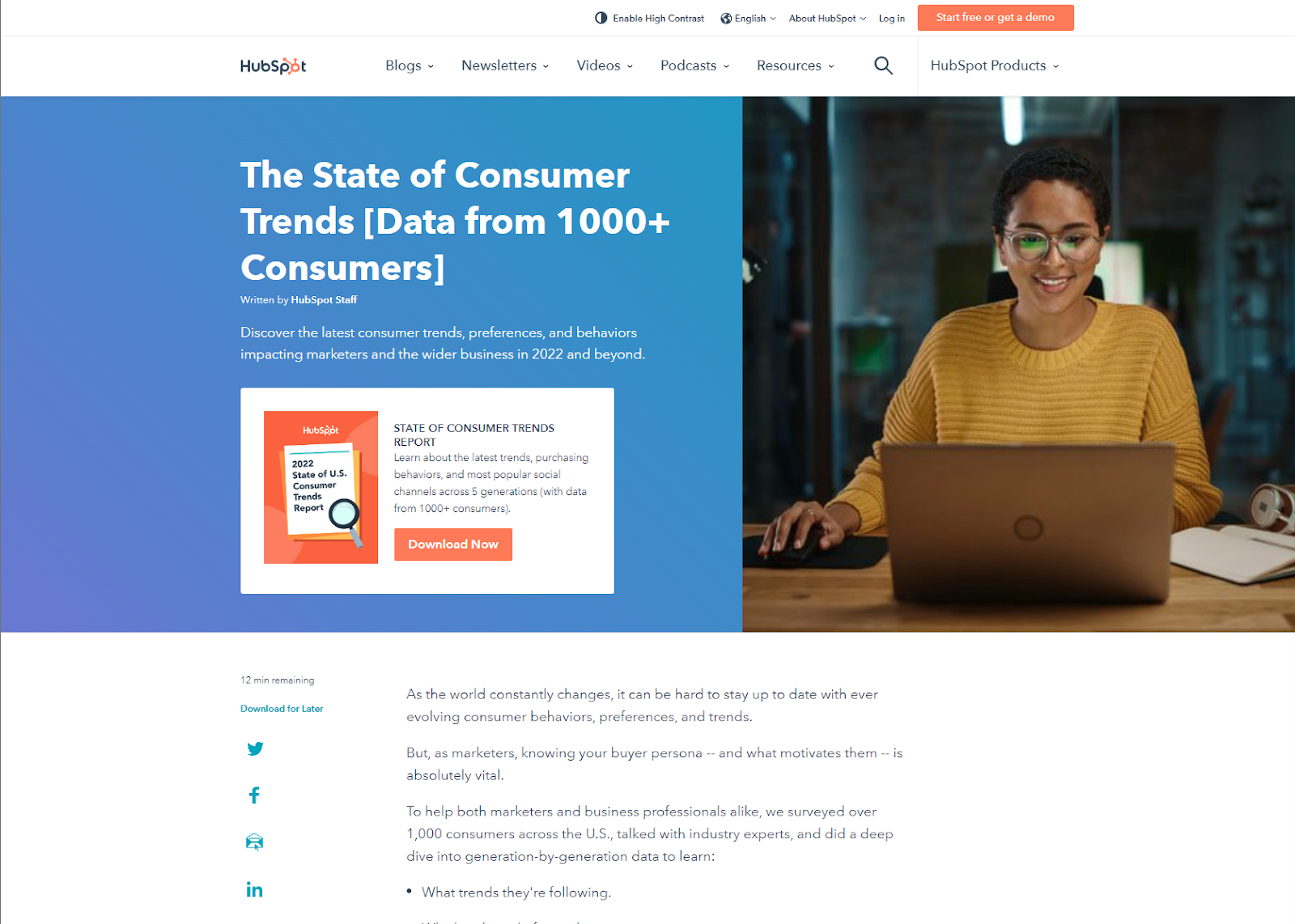
HubSpot’s recent State of Consumer Trends blog is a good example of topical content. The statistics provided are timely, relevant, and actionable in the near future.

HubSpot's State of Consumer Trends

Like the evergreen tree, this type of content is always around and relevant. Unlike the time-based nature of topical content that requires regular updating to stay compelling, evergreen content has a longer-term appeal that lets you post it and (mostly) forget about it.

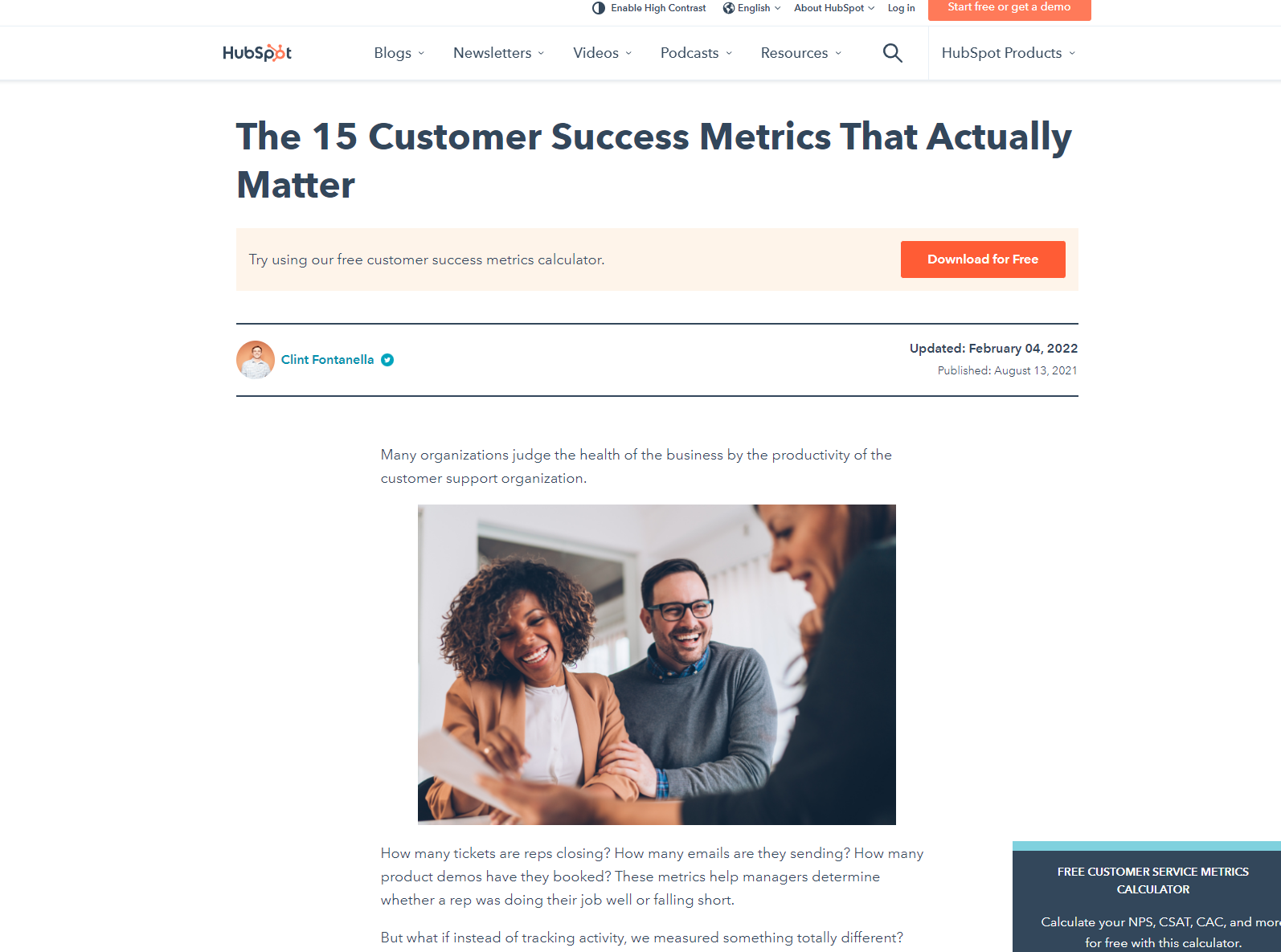
Common types of evergreen content include how-to articles, tips, or listicles that are broadly applicable. HubSpot’s list of 15 Customer Success Metrics That Actually Matter is a great example of actionable evergreen content.

Topical Content Example

Topical Content Pros and Cons

Considering using topical content on your site? Here are two pros and two cons to this approach.

Pro #1: Less legwork

Topical content is there for the taking. A quick review of relevant industry websites or digital news outlets can provide inspiration for your next post, meaning your team can cut down the amount of time required to find your next content focus.

Pro #2: Multiple traffic opportunities

Relevant stories can gain traction across multiple points of content. In practice, this means you can drive traffic from social media sites, emails, and web searches simultaneously to your site.

Con #1: It’s Not Just You

Interesting content is interesting to everyone. This means that other sites are also posting their own take on topical content, making it harder to stand out from the crowd.

Con #2: Trust is Built, not Posted

Just because you make a great post and get traffic to your site, it doesn’t mean that visitors automatically become buyers. Instead, it takes time to build up trust, meaning you’ll need more than just topical content to drive conversion.

Evergreen Content Pros and Cons

Thinking of an evergreen effort on your website? Here are some common pros and cons.

Pro #1: Stays Fresher, Longer

Evergreen content naturally stays fresher for longer, in turn driving steady traffic to your site. You can also update rather than replace this content as needed to keep users coming back.

Pro #2: Ideal for Entry-Level Content

How-to’s and listicles that cater to beginners learning a new skill or understanding a topic are great choices for evergreen content, since there’s always someone looking to learn.

Con #1: Brainstorms can Run Dry

The more evergreen content you post, the harder it can be to think of new topics. This creates a situation where your team may spend more time work-shopping posts rather than creating evergreen content.

Con #2: Success is a Slow Process

Where topical content posts can drive big spikes in traffic over short time periods, evergreen content is more slow and steady. While this is great for long-term growth, it won’t help if you’re looking to capitalize on seasonal or event-driven demand.

Ideally, topical and evergreen content work in concert to help boost your website traffic. Not sure what that looks like in practice? Here are six tips to get you started.

1. Use content planning templates for your topical and evergreen content

When it comes to getting the most from topical and evergreen content, planning templates are a great place to start, since they provide a solid foundation for your long-term traffic strategy.

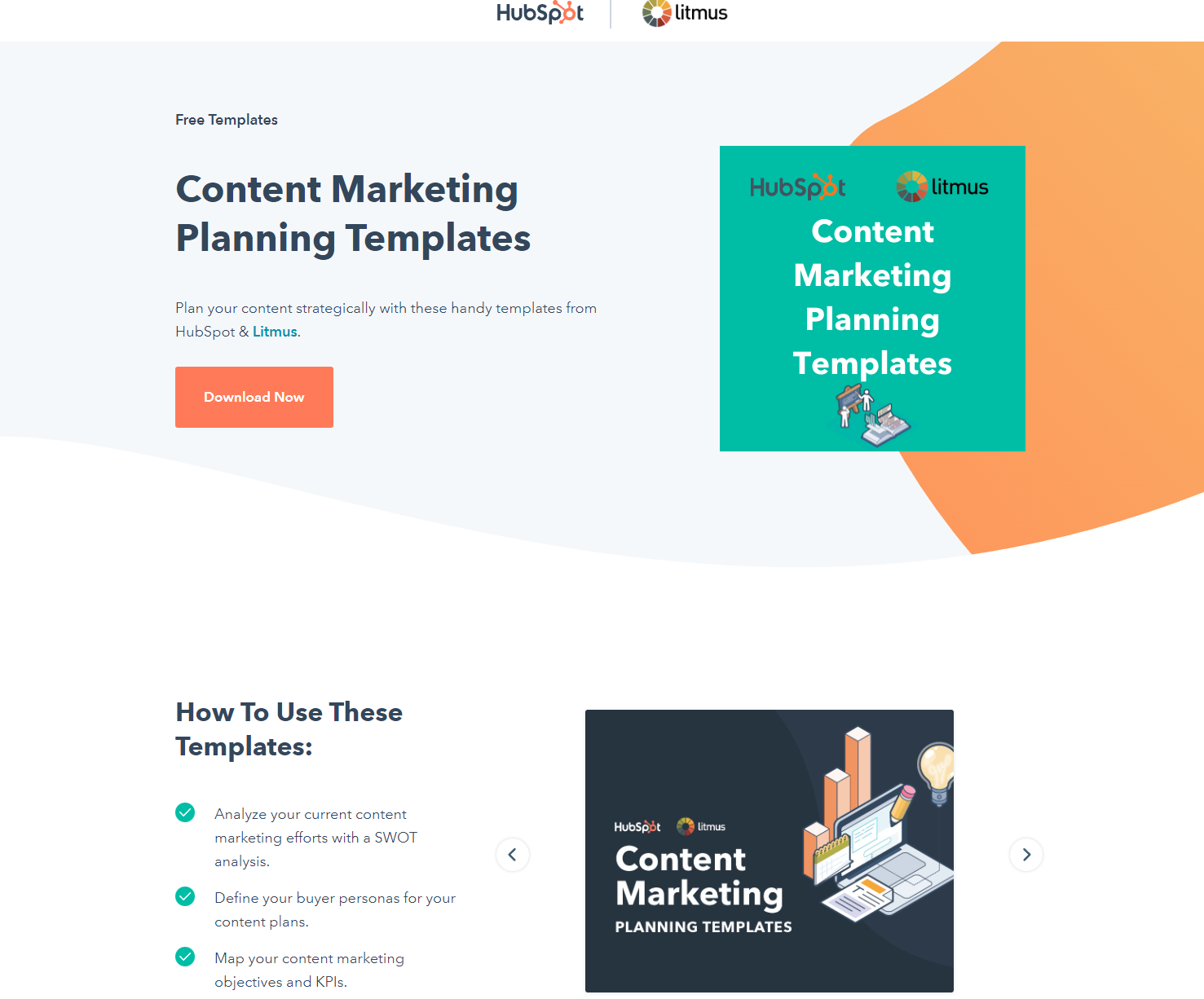
Check out HubSpot’s free Content Marketing Planning Template to get your content creation campaign off the ground.

HubSpot's free content planning templates

2. Set a schedule for regular topical refreshes

To keep topical content relevant, schedule regular refreshes. The length of time between refreshes depends on the type of content — for social media posts, any more than a week can start to get stale. For blog posts, two weeks to a month at most.

3. Get the right tools

Before creating your content, make sure you’re on the right SEO track. Tools like Google AdWords and Google Trends can help you find keywords that are on the way up or have sustained search volume to inform your content strategy.

4. Topical content: Don’t hold back

Swing for the fences when it comes to topical content. Given the number of other sites doing the same thing, it’s worth going all-in with content that’s relevant to your target audience. Even if it doesn’t land as intended, it’s ephemeral enough that you can recover quickly.

5. Evergreen content: Think about the long-term

For evergreen content, think about long-term traffic potential. Is the content useful to your current user base? Can it be updated as the market changes to remain relevant?

6. Find a content balance

Finally, find a balance between topical and evergreen. While a totally topical approach can produce quick-win results, it won’t provide sustained success. Evergreen efforts, meanwhile, offer steady progress but aren’t enough to jump-start customer interest or capitalize on market trends.

Directing Traffic: The Double Benefit of Evergreen and Topical Content

Put simply? Both topical and evergreen content offer benefits for your site. Where evergreen efforts can help boost SEO and deliver steady visitor numbers, topical content helps your site get noticed when relevant and timely events have customers looking for answers.

In other words, it’s not about topical vs evergreen content: It’s about finding a way to balance both that gets visitors interested and keeps them coming back.

Editor’s note: This post was originally published in April 2010 and has been updated for comprehensiveness.

promoting content

Categories B2B

What Consumers Think About the Metaverse & What Brands Need to Know [New Data]

The term “metaverse” may have been coined back in 1992, but it could hold new and adventurous opportunities for both consumers and even brands that engage with them.

The only problem is many of us aren’t too sure what the metaverse actually is. Who is using it? Why do they use it? Which of the seemingly infinite metaverses are worth including in your marketing strategy? And how can the metaverse help marketers navigate data privacy regulations?

To get some clarity, we surveyed over 1,000 consumers in the U.S. to learn about their takes, preferences, and behaviors around today’s biggest trends.

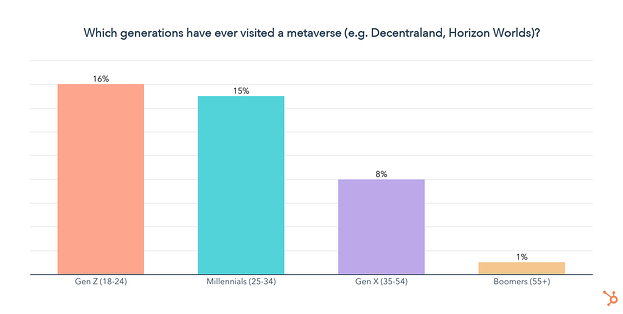
In that survey, 8% of participants said they’d ever visited a metaverse. But that’s not the full story. Keep reading to learn why the metaverse might not be a passing trend.

Download Now: 2022 State of U.S. Consumer Trends Report

What Consumers Think About the Metaverse [New Data]

The Metaverse is New to Many — but Still Growing

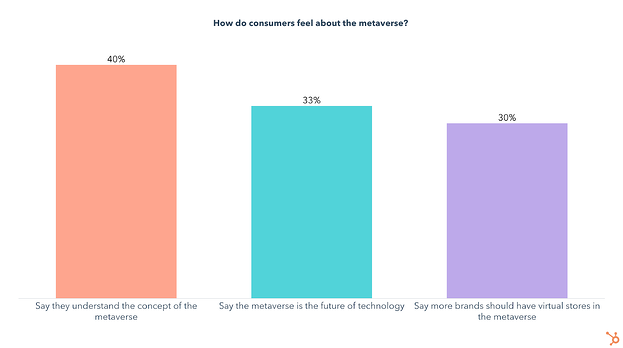
Today 33%, or one-third, of our total survey-takers don’t quite get the concept of the metaverse. Still, 40% understand it and 30% think more brands should leverage it.

how consumers feel about the metaverse

While only a small percentage of people have stepped into the metaverse, half of those that have did so in the past three months.

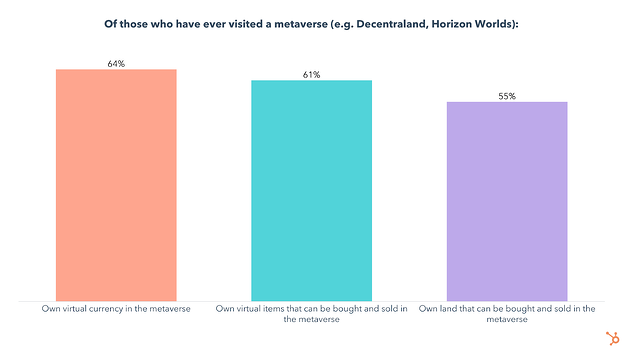
On top of that, these early adopters aren’t just popping in once to check it out – they’re actually invested in these virtual worlds. Of those who have ever used the metaverse:

  • 64% own virtual currency in the metaverse
  • 61% own virtual items that can be bought and sold in the metaverse
  • 55% own land that can be bought and sold in the metaverse

what people do in the metaverse - chart

How the Metaverse Intersects With Consumers’ Real Lives

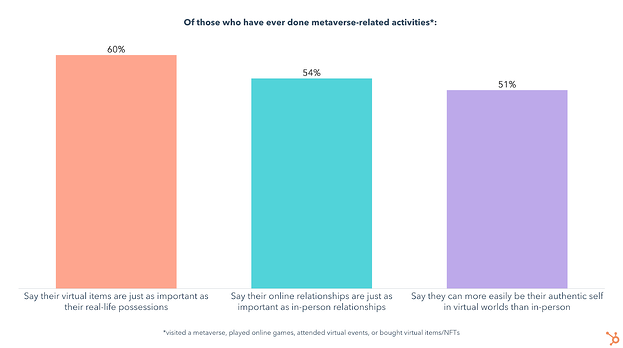
We also asked those who have ever done metaverse-related activities (visited a metaverse, played online games, attended virtual events, or bought virtual items/NFTs) about how these intersect with their “real” lives, which produced some surprising results:

  • 60% say their virtual items are just as important as their real-life possessions
  • 54% say their online relationships are just as important as in-person relationships
  • 51% say they can more easily be their authentic self in virtual worlds than in-person
  • 40% say they understand the concept of the metaverse
  • 33% say the metaverse is the future of technology

virtual life vs. real life of metaverse visitors

Who’s using the Metaverse?

Our research shows that opinions on the metaverse differ sharply by age group.

At the moment, Gen Z and Millennials are the most excited about exploring the metaverse, with around 15% of them having visited a metaverse at some point.

which generations have visited the metaverse

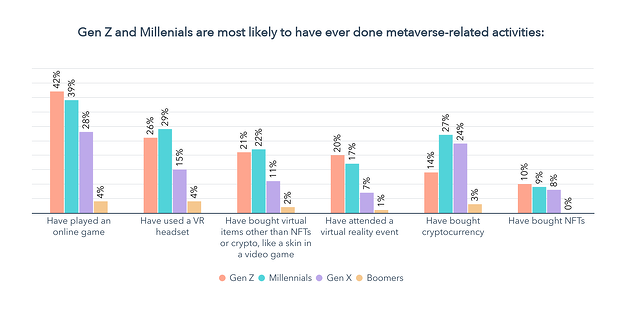
Gen Z and Millennials are also more likely than any other generation to have done metaverse-related activities, other than buying crypto (likely due to Gen Z having less disposable income):

  • 40% of Gen Z/Millennials have played an online game
  • 28% of Gen Z/Millennials have used a VR headset
  • 22% of Gen Z/Millennials have bought virtual items other than NFTs or crypto, like a skin in a video game
  • 18% of Gen Z/Millennials have attended a virtual reality event
  • 23% of Gen Z/Millennials have bought cryptocurrency

Gen Z and millennials are most likely to visit the metaverse - bar chart

So now that we know Gen Z and Millennials are the primary users of the metaverse and related technology, let’s take a look at why people go to the metaverse in the first place.

What Do People Do In the Metaverse?

Why People Visit the Metaverse

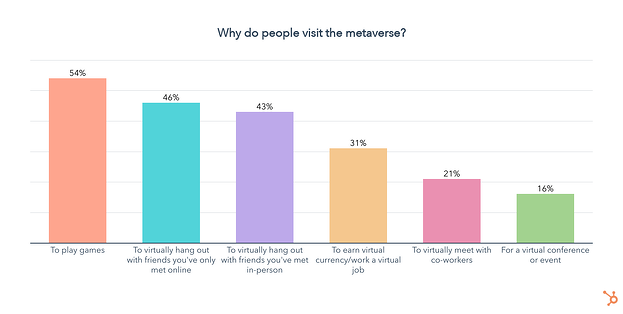
The most popular reasons for visiting the metaverse are to play games, hang out with friends, work a virtual job, and for virtual meetings and events.

why people visit the metaverse

Keep in mind the metaverse is all about empowering users to create their own experiences. As people continue innovating in virtual worlds, the number of activities and use cases will likely grow.

What motivates metaverse regulars?

Because the metaverse itself is loosely defined, to some extent it’s up to the users to shape its future. And those users are invested, with over 50% owning virtual currency, land, and items that can be bought and sold in the metaverse.

Additionally, with 31% of metaverse users saying they log on to earn virtual currency or work a virtual job, it’s important to touch on another selling point of the metaverse – users can earn currency by playing games or working virtual jobs.

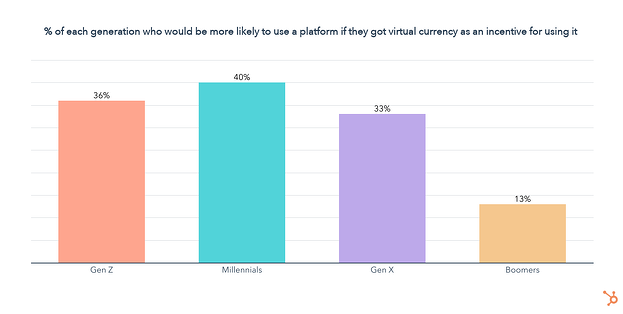
We asked the general population whether they would be more likely to use a platform if they got virtual currency as an incentive, and 27% say they would. This number jumps up to 36% for Gen Z and 40% for Millennials.

which generation is motivated by virtual currency

On top of that, 60% of those who have ever used the metaverse say they would be more likely to use a platform if they got paid in virtual currency.

Offering incentives for using a platform can also help address a problem many marketers are currently struggling with – gathering consumer data in a way that provides value to both parties.

The Most Visited Metaverses

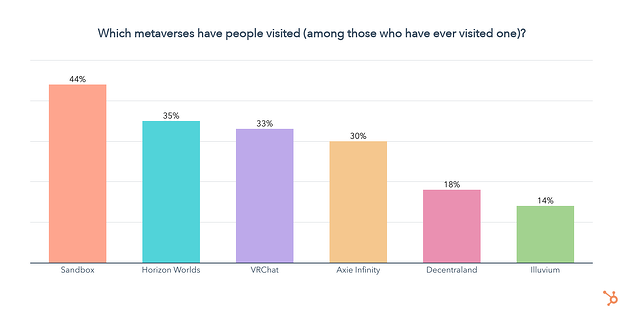
The Sandbox, Meta’s Horizon Worlds, and VRChat are the most visited, followed by Axie Infinity, Decentraland, and Illuvium. Keep in mind that many of these worlds are in early development, and some aren’t even accessible to the public yet. which metaverses have people visited

Data Privacy and the Metaverse

Currently, many platforms like social media track, analyze, and sell personal data, but the user gets nothing in return. In response to this, privacy protections are being developed by governments and corporations alike to give consumers more power over their data.

This means offering incentives for people to not only spend time on your platform but also share their data will become more important in the future.

So let’s take a closer look at how consumers currently think of data privacy, and whether they think the metaverse has the potential to tip the scales in their favor.

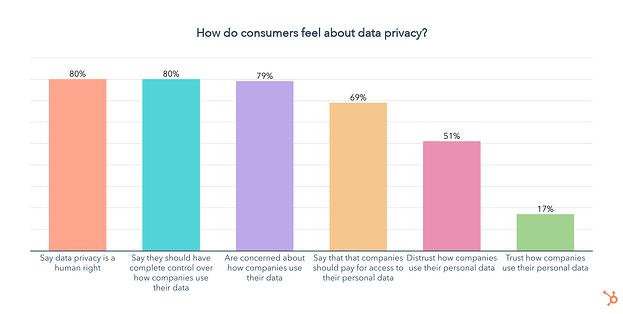
Consumers are unified in their demands for ownership over their personal information. Our survey found that:

  • 80% of consumers agree that data privacy is a human right
  • 80% of consumers agree that they should have complete control over how companies use their data
  • 79% of consumers say they are concerned about how companies use their data

how consumers feel about data privacy

On the other hand, when it comes to the metaverse, 53% of those who have ever used it say they trust how data on their activities in virtual worlds will be stored and used, while 29% distrust it. This is quite fascinating as many metaverses are decentralized, built on relatively emerging blockchain technology, and still a mystery to many — even when they’ve visited them a few times.

What’s Next for the Metaverse?

So you might be wondering what to expect next for the metaverse, and in all honesty, nobody knows.

We’ll keep running our Consumer Trends Survey regularly, to stay up to date on all the latest trends, from the metaverse to social media, workplace trends, and much more.

In the meantime, check out our State of Consumer Trends Report which includes the full results of our survey, as well as the downloadable PDF below. 

New Call-to-action

Categories B2B

20+ Fun and Engaging Instagram Story Ideas for 2022

Are you struggling with what to post on Instagram? In this post, we’ll cover the best Instagram Story ideas to keep your audience engaged and entertained.

Access Now: 22 Free Business Instagram Templates

We’ve broken them down by content type:

20 Best Instagram Story Ideas for 2022

Cool Instagram Story Ideas for Follower Engagement

1. Conduct a poll.

Running a poll on your Story is a great way to engage your audience and learn more about them.

Instagram story idea: conduct a poll

The great thing about a poll is it can be about anything. Say you’re a home decor brand, you can poll your audience on their interior design styles, purchasing considerations, and their favorite decor trends.

On another day, you can ask for specific feedback on their experience with your brand’s products or services. The possibilities are endless, making this a great Story idea.

Conducting polls also serves as a way to get more content ideas based on interactions with your audience. Say the social media marketer from the home decor brand discovers that its audience doesn’t know how to choose a rug size for a room. That could serve as a future feed post or inspire a new blog post.

2. Host a Q&A.

A Q&A allows your audience to get to know your team, company, and its products/services better.

There are several benefits to answering follower questions on your Story:

  • You can quickly and directly connect with your audience, in a low-effort way.
  • You will discover information gaps between you and your audience.
  • Based on the questions you get, you can create a “Frequently Asked Questions” highlight that will live on your Instagram profile. This can also translate to your website.
  • Start a hashtag and encourage your followers to use it when using your products or services.
  • Search relevant hashtags to find posts that feature your brand but aren’t tagged.

3. Spotlight your customers.

Highlighting your customers kills two birds with one stone: You continue building a relationship with them while attracting new ones.

instagram story idea customer spotlight.

By showcasing customers who are enjoying your products/services, you’re leveraging social proof. In turn, this will add to your credibility and serve as a testimonial for your brand.

4. Quiz your followers.

In 2014, Buzzfeed has all Millennials in a chokehold with its quizzes. It didn’t matter what the quiz was – from movie trivia to 90’s outfits, I took them all. Why?

It was a fun way to feel connected to others and maybe learn something about myself.

Instagram story idea quiz

Instagram quizzes can help you accomplish the same with your audience and maybe gain some interesting insights.

5. Repost user-generated content.

If you’re struggling with Story content ideas, reposting UGC is the easiest way to get over this hurdle.

Instagram story idea UGC

In this case, your audience has done the hard work for you, all you have to do is find it and repost it.

Here are a few ways to set yourself up for success:

  • Start a hashtag and encourage your followers to use it when using your products or services.
  • Search relevant hashtags to find posts that feature your brand but aren’t tagged. 

6. Host a giveaway.

If you want to increase your reach, hosting a giveaway is a great way to do this. It incentivizes your followers to share your brand with their networks while strengthening their loyalty.

Instagram story idea giveaway

When hosting your giveaway, you’ll want to create an in-feed post with the details of the giveaway – this way, users can access it at any time. However, when it comes time to promote this giveaway, do so on your Story.

Don’t be afraid to post about the giveaway multiple times during its run to remind users to participate.

7. Start a challenge.

On social media, challenges take off like wildfire. If you can be the brand that starts a viral challenge, that can greatly increase your visibility.

One of Instagram’s most recent Story features is the “Add Yours” sticker, which allows users to add a Story connected to a specific thread.

For a home decor brand, this could be “Add your favorite room in your home,” or “Add your favorite home purchase.”

It’s engaging and fun for everyone involved.

Creative Instagram Story Ideas for your Team/Company Spotlights

8. Introduce your team.

In today’s social media space, consumers are no longer content with brands without a face. They want transparency in all areas, including who is behind their favorite products and services.

Introducing your team will help your audience connect with your brand and help foster a sense of community. This is particularly true for small brands that are just entering the market and have to find fresh ways to differentiate themselves from the competition.

In a small company, introductions can include the CEO, the social media manager, the fulfillment manager, and any other relevant role. For larger teams, this may be limited to a specific department, such as the social media team.

Extra points if you add the “Full House” or “Family Matters” theme song in the background.

9. Share behind-the-scenes footage.

Sharing BTS content is another way to bridge the gap between you and your audience, pulling back the curtain and bringing them into the fold.

Instagram story idea BTS

While BTS isn’t exactly exclusive, it does feel intimate. It indicates trust between you and your viewers, which can translate to stronger brand loyalty.

What should you share? It should vary depending on what’s going on in your company and your current goals. Have a pop-up event coming up? Show a sneak peek of the location. Launching a new product? Share a video snippet of the product photography.

Over time, you’ll notice what kind of BTS footage your audience enjoys the most and from there, you can focus on that type of content.

10. Celebrate milestones.

When building a community, taking the time to celebrate together is important. As a brand on social media, you have the unique opportunity to share company milestones with your online community.

Did your brand recently reach 1,000 followers? One year in business? $500K in revenue? Whatever it is, it’s worth celebrating with your audience.

This is also a great opportunity to tie in a giveaway, discount, or special that your customers can benefit from.

11. Do a takeover.

Takeover can take away the monotony of posting Stories and give your page an instant boost.

Instagram story idea takeover

A takeover involves someone managing your Instagram account for a designated amount of time (usually 24 hours) and posting from their POV.

This is popular among influencers, brand ambassadors, and even brand employees.

For instance, over at @Hubspotlife, current employees will take over for the day, sharing details about their roles, their daily tasks, their remote life routines, and more.

12. Share company updates.

Company updates aren’t just for internal stakeholders, they can also be valuable for your audience.

For instance, say you’ve hired a new DI&B director or you’re opening up a new store in another city, those are interesting facts your online community would like to know.

As your company grows and evolves, keep your audience updated – it will do wonders toward strengthening your relationship.

Cool Instagram Story Ideas for Products/Services

13. Share testimonials and reviews.

Customers write reviews just about everywhere: Yelp, Google my Business, and social media (namely Facebook and Twitter).

Instagram story idea customer reviews

When you find a favorable review, turn it into a creative, aesthetically pleasing Story.

Pro-tip: Create a Story template specifically for this and use it every time you’re sharing a customer testimonial or review.

14. Highlight products and/or services.

Although Instagram has a dedicated tab for shopping, once in a while, you’ll likely want to promote your products in Stories.

For instance, say you have a sale going on – using the shopping sticker within Story is a great way to drive traffic to that product and generate sales.

Instagram story idea sale

If you have an upcoming product launch, you can also tease that product in your Story, creating some buzz surrounding the release.

15. Announce discounts and specials.

Everyone loves a discount. So, when you have one, you want to make sure it reaches as many potential customers as possible.

If there’s a big sale season coming up – think the holidays – start working on creative assets to share on your Instagram Story.

Instagram story idea discounts

In addition to sharing deals, you should also include link stickers leading to your sales page.

This will create a seamless shopping experience, as users will find what they need quickly, increasing your chances of making sales.

Cool Instagram Story Ideas for Educational Content

16. Share industry news.

Sharing educational content is one of the best ways to add value to your audience on social media.

Every once in a while, there will be a trend or news that will make its rounds within an industry. In marketing, that was recently the end of third-party cookies.

Whenever this comes around for your brand, consider sharing the news with your audience in a Story and potentially sharing your thoughts on it. There are three key things to do when doing so:

  • Provide the context for the news or update.
  • Share what it is quickly and concisely.
  • Reveal its potential impact.

Being a reliable source of information will build trust with your audience and sharing your opinion could help you become a thought leader in the space.

17. Post quick tutorials.

Another way to add value to your audience is by creating short, valuable tutorials.

For this to work successfully, your tutorial has to be to the point and include strong visuals that will capture your audience’s attention as they swipe right.

Instagram story idea post quick tutorials

If you’re a home decor company, you could create a quick one-story graphic on selecting the perfect rug size for your bedroom.

Something as simple as this is not only helpful to your audience but is also bite-size and shareable.

Cool Instagram Story Ideas for Miscellaneous Content

18. Direct traffic to other sources.

Instagram is where many consumers discover brands but it shouldn’t be where it ends.

If you have a website, additional social media platforms, or content on other mediums, you should use your Story to drive traffic to these sources.

Instagram story idea direct to other sources

For instance, say your home decor brand wants to increase its newsletter subscriber count. Using Stories to promote its newsletter and driving traffic to the newsletter landing page is a great way to go.

This is particularly valuable because Instagram limits where and how creators and brands can place links. Currently, Stories is one of the few places to direct users outside of the platform – so, take advantage.

19. Start a countdown.

If you have an event coming up and want to create buzz around a product launch, you need to use Instagram’s countdown sticker.

Instagram story idea countdown

It allows you to set up a timer countdown via Stories in which users can set up reminders so that they are notified once the event starts. It’s a low-effort way to promote exciting events for your brand.

20. Promote new posts.

With Instagram’s ever-changing algorithm, brands are no longer sure that their posts are getting in front of their desired audience.

Instagram story idea new post

One way to drive traffic to your post is by posting about it and using the “New Post” sticker.

Pro-tip: Place the sticker directly on the clickable post, shielding it from view, to entice users to click on it.

There you have it – a comprehensive list of Instagram Story ideas to make sure you never run out of content.

Improve your website with effective technical SEO. Start by conducting this  audit.  

Categories B2B

How To Be a Good Interviewer

Having a good conversation with a candidate helps you understand who they are, their skill set, and what they’d bring to your team.

So, being a good interviewer goes hand-in-hand with hiring successful talent that can contribute to meeting your business goals.

Read on to learn everything you need to know about becoming an effective interviewer.

Download Now: 100 Marketing Interview Questions [Free Access]

Why is it important to be a good interviewer?

Being a good interviewer is essential because it helps you hire the right people for the job. Therefore, the skill is key for any employer that wants to hire the right candidates who are motivated, able to do the job, and are a good cultural fit for the company.

Being a good interviewer also shows respect for the interviewee. It demonstrates that you value their time and insights and are willing to invest the effort to get to know them better.

How to Be an Effective Interviewer

The best interviewers make interviews feel like conversations instead of interrogations, and they work to develop rapport with candidates to help them feel comfortable opening up and sharing information about themselves.

Let’s go over how to do this.

1. Start the conversation on a lighter note.

Candidates may be nervous at the beginning of the interview, so it can always be helpful to make small talk and begin the conversation on a lighter note before the actual interview starts. However, make sure you don’t spend so much time on small talk that you need to cut the interview short later on.

2. Do your research.

Re-review the candidate’s application, resume, and cover letter before the interview, so you know their qualifications and why they’re interested in the role.

This gives you a refresher on their background and helps you generate focused questions about what they’ve already shared that will help you dig deeper into their interest in and relationship to the role.

3. Ask open-ended questions.

Open-ended questions encourage candidates to elaborate on their answers and give you more information to work with. When you do this, ensure that you give the interviewee time to answer the question entirely.

This also means avoiding yes or no questions when not entirely necessary. For example, you can confirm with someone that they spent three years working at their last company, but asking a yes or no question about their role at said company doesn’t give you the information you’re looking for.

3. Listen more than you talk.

Aim to do more listening so you can gather as much information as possible. This is a quick tip because it leads directly to the next tip: practicing active listening.

4. Practice active listening.

Active listening is a communication style that involves focusing entirely on the person who is speaking so you can take in what they’re saying and participate in the conversation in a meaningful way.

It’s important during interviewers because it helps you learn more about the candidates and ask relevant follow-up questions when they have said something you want to learn more about.

Active listening is also an important part of being a good interviewer because it shows respect for the candidate. They can likely tell if you’re not fully immersed in what they’re saying, and if they feel you’re not interested, they may feel less confident in sharing information about themselves. Instead, active listening shows them that they have your full attention and you’re genuinely interested in learning more about them.

5. Take notes.

Taking notes goes hand in hand with active listening because it shows that you’re actively listening to what the candidate is saying. It is also a way for you to note something a candidate says that you want to ask them about later instead of interrupting their train of thought.

Taking notes also gives you a refresher on your conversations with candidates when you’re making final hiring decisions in the future.

6. Be aware of your body language.

Body language that shows attention and respect for the candidate can help them feel more comfortable opening up and sharing information about themselves. As a result, your body language during an interview makes a big difference in being a good or bad interviewer.

So, aim to make eye contact, smile, and avoid crossing your arms or fidgeting. A lack of these things can make an interviewee feel like you don’t want to be there, making them feel anxious and that you care about what they have to say.

8. Eliminate distractions.

Eliminating distractions is helpful for you and the candidate because anything that shifts focus away from the conversation can affect how well the interview goes. For example, an alarm that goes off can cause someone to lose their train of thought on a valuable piece of information.

9. Be prepared to answer questions.

Most candidates will have questions for you, such as what a day-to-day looks like for the role they’ve applied for, what company culture is like, and what your team is like, and you should be prepared to answer them.

Candidates are also interviewing you and your business, so answering their questions and giving them the information they need helps them ensure they are a good fit.

For example, if a candidate realizes that they might not be a good fit for your company, they save you the stress that can come from someone accepting an offer and promptly leaving the company if they come to that realization after they’ve begun the job.

Being a good interviewer helps your team meet your goals.

Someone who can put candidates at ease and help them feel comfortable talking about their experience and sharing their skills is a great interviewer because the more you learn about the candidate, the easier it is to make an informed decision about their fit for the role.

Next time you have an interview, leverage the tips mentioned above, and you’ll likely find yourself having valuable conversations and hiring impressive candidates that can help you meet your business goals.

marketing questions

Categories B2B

Which Social Media Channels are Gaining and Losing Steam? [New Consumer and Platform Data]

These days, it feels like everyone is on social media. But make no mistake, not everyone is on every channel.

As marketers, it’s important to know your audience’s favorite social channels. For instance, if you’re selling retirement homes, it’s safe to forgo Snapchat, where only 3.7% of users are over 50.

HubSpot surveyed over 1,000 consumers across the U.S to find out which social media channels are gaining steam — and which are falling behind. Read on to discover which platforms are most popular with consumers in 2022.

Download Now: 2022 State of U.S. Consumer Trends Report

Social Media Channels Gaining Steam in 2022

Facebook

Facebook currently attracts 2.89 billion monthly users, more than any other social platform. A high concentration of its audience belongs to Millennials, Gen X-ers, and Baby Boomers.

In the last three months, a whopping 91% of Baby Boomers, 88% of Millennials, and 83% of Gen X-ers have visited Facebook.

On top of that, Gen X and Baby Boomers rank Facebook as their favorite social media app and their most visited app. If you’re looking to target older demographics with social media marketing, Facebook is your best bet.

consumers favorite social channels: facebook

That said, engagement drops significantly for Gen Z audiences. Just 12% of Gen Z-ers say they use Facebook more than any other platform, and only 55% have visited Facebook in the past three months.

TikTok

TikTok is known as the platform for Gen Z — and the data confirms it. In fact, over half of Gen Z consumers are on TikTok. Plus, Gen Z-ers say TikTok is the platform they use most, pulling ahead of Instagram, Snapchat, and YouTube.

It doesn’t stop there: TikTok is also picking up steam with other demographics. 36% of TikTok users in 2021 were between 35 and 54 years old, a 10% increase from the year before. That said, usage amongst Baby Boomers is still low, with only 7% visiting the app in the last three months.

It’s also worth mentioning that TikTok has the highest engagement rate out of any other social platform, averaging 10.85 minutes per session. In short, TikTok’s snackable content is addictive for a variety of age groups.

YouTube

YouTube has a user base of 2 billion+ people and receives over 34 billion monthly visits, according to data we pulled from SimilarWeb.

consumers favorite social channels: YouTubeYouTube is popular with Gen Z, Millennial, and Gen X audiences, almost in equal measure. In the last three months, 83% of Millennials have visited YouTube, followed by 81% of Gen Z, and 79% of Gen X. For Baby Boomers, YouTube is their second favorite social media app, just behind Facebook.

YouTube is also a top favorite amongst video marketers. In fact, more than a quarter of video marketers plan to invest in YouTube than any other platform in 2022, according to HubSpot’s Video Marketing Report. In addition, video marketers ranked YouTube as the second-best platform for ROI.

Instagram

According to SimilarWeb, the Instagram app has over 78 million monthly active users, making it one of the most popular apps today.

Although Gen Z visits TikTok the most, they rank Instagram as their favorite social media app — as do Millennials.

consumers favorite social channels: InstagramInstagram is also holding steady with older audiences. In the last three months, 55% of Gen X-ers have visited Instagram, followed by more than a quarter (27%) of Baby Boomers. However, if you’re looking to target these audiences specifically, Facebook or YouTube could be a better option.

On the marketing side, more than half of video marketers rank Instagram as the best platform for ROI, engagement, and lead generation. If you’re looking to dive more into video marketing, Instagram is an attractive option.

Social Media Channels Losing Steam in 2022

Tumblr

After numerous acquisitions and near-revivals, Tumblr has yet to recreate its early- to mid-2000s popularity. According to our report, Tumblr is most popular with Millennials, but only 11% have visited the platform in the past three months.

Tumblr 2022Surprisingly, Gen Z has visited Tumblr at nearly the same rate (10%). In fact, a report by Quartz found that 61% of new Tumblr users in 2022 were under the age of 24. This begs an important question: is another revival around the corner?

While it’s still too early to call, we recommend focusing on platforms that pull stronger numbers for the audience you want to target.

Twitch

Although Twitch is top dog in the live-streaming space, all major streaming platforms — including Twitch, Facebook Gaming, and YouTube Live — are seeing a drop in total hours watched this year.

In the last three months, only 15% of Millennials have visited Twitch, followed by 13% of Gen Z, and 11% of Gen X.

Decreased viewership isn’t the only concern for Twitch — people are also streaming less. Year-over-year, hours streamed on the platform declined 16% from 2021 to 2022.

According to HubSpot’s Video Marketing Report, video marketers report low engagement and ROI on the platform, and only 10% of marketers plan to leverage Twitch for the first time in 2022.

Back to You

One question remains: what channels are best for your social media marketing? Should you stick to mature platforms, like Facebook and YouTube, or test the waters with new platforms, like TikTok?

Ultimately, your decision should hinge on one crucial factor: your target audience. Putting your audience at the center of your social media strategy means prioritizing the platforms that will reach them most effectively.

And remember, social media marketing is all about experimenting. There’s no need to commit to one platform for the rest of time — in fact, it may be useful to run side experiments on different platforms to see what results you get.

New Call-to-action

Categories B2B

3 Challenges Brands Face with Podcast Marketing & How to Navigate Them

According to our 2022 Marketing Trends Survey report, 34% of marketers plan to stop leveraging podcasts or other audio content in 2022.

➝ Free Guide: How to Start a Podcast

It’s likely because of the major roadblocks that marketers still face in the podcast marketing space. Two podcast experts weigh in on the biggest challenges and strategies to tackle them.

Organic Discoverability

Currently, there are two main ways to discover podcasts: Search through top-ranking podcasts in various genres or get recommendations based on what you’re already listening to.

This makes it very hard for lesser-known shows to get discovered organically.

“It’s really hard for podcasters who are creating amazing content and are great creators to figure out ways to get in front of their audience,” says Alanah Joseph, head of creator partnerships on the HubSpot Podcast team.

At HubSpot, Joseph says our podcast network addresses this by leaning into our cross-promotion strategy – this means placing ads across various shows across our network while ensuring audience alignment.

“Instead of going out and trying to find new audiences, we are leveraging the audiences that we already have and sharing those audiences in a way that helps boost discoverability for the podcasts,” she says. “And then, also because we have a community, we can leverage that ad inventory.”

However, not every brand can go this route. Businesses with access to a large ad budget opt for paid advertising, as that ensures you will gain more exposure and reach your desired audience.

“Short-term [discoverability] strategies will most often be paid media, like promoting on a podcast player or running Facebook ads,” says Principal Podcast Producer at HubSpot Darren Clarke, as a way to tackle discoverability. “These plays usually give great results, but won’t necessarily be ‘sticky.’”

Other tactics include cross-posting on multiple channels and growing your social media presence. Many podcasters post the video version of their content on YouTube to broaden their reach and get an SEO boost.

On social media, discovery is much easier. You can build a community there, market your podcast, and direct traffic to your series.

“These types of organic growth strategies take a long time to register any significant results, but over time, if done well, will essentially give you much more control over your distribution,” he says.

Growing a community is another key way to help with discoverability. Things like attending podcasting events and reaching out to fellow podcasters will help you build a network of people who can share their audiences with you.

For instance, being a guest on another podcast whose audience aligns with yours can be incredibly valuable for brands with limited resources.

“The audience gets to meet you, gets to learn about you, get to understand your values, [and] why you have a podcast,” Joseph says. “All of those things are important for not only driving traffic but also building retention and loyalty.”

Clarke echoes this sentiment, saying that when you guest host, having a compelling message and an inviting call to action is necessary for it to serve as a growth lever.

He further cautions that promotion, marketing, audience building, and community development are all growth mechanisms that require different approaches. As such, they’ll require a different set of expectations and ROI.

Data Insights

As marketers, data is our lifeline. It tells us who our audience is, what they’re responding to, and much more. Joseph says with podcasts, data insights are limited.

“With tracking and reporting, the biggest issue in the podcast industry is as a listener, you are not able to accept cookies,” she says.

This means that podcast marketers are restricted in the information they’re able to gather on their audience, particularly tracking how they’re behaving after listening to an episode.

What you typically get is the following:

  • Geolocation
  • Listens (unique listens, average listening time, etc)
  • Subscriber count and trends
  • Downloads (total downloads, average downloads, etc)

And often, Joseph says, you have to compile data from several sources which is not always accurate or reliable.

One key piece of data that’s missing is listener demographics, such as gender, age, and education. As a result, building out a strong social media presence becomes even more important in understanding your audience.

From LinkedIn, for instance, you can discover a person’s title, identify where they are in their career, and why they’re tuning into your podcast.

Despite these roadblocks, Joseph believes that tech is finally catching up with the world of podcasting.

“There’s a lot of innovation right now and a lot of people are developing cool technology to support this large group of creators,” she says. “So, I feel optimistic that some of these things will be solved.”

Diversity in Voices

While this challenge isn’t specific to podcast marketing, it does affect the industry as a whole.

Joseph mentions that there’s still a lot of work to be done regarding the diversity of voices in podcasting.

“In the beginning [of building the HubSpot Podcast Network], more so than now, that was the big challenge that I faced,” she says, “How do I create a network that’s reflective of the American workforce?”

This is especially true in the business genre, where top-ranking shows are not led by BIPOC creators. As a network, you want to have a list of strong shows but you also want to make sure it’s balanced in representation.

“I’d love to see more women and more people of color rise to the charts in our genre specifically,” she says. “That’s something that we’re actively trying to work through and have been for a while.”

There’s no doubt that there are still a lot of challenges within podcast marketing, as platforms and search engines catch up to this thriving industry. However, there are still many workarounds that brands can leverage to reach their target listeners and grow their subscriber base.

New Call-to-action