Categories B2B

How Nissan Created A 4-Hour Ad Viewers Don’t Want to Skip

Welcome to HubSpot Marketing News! Tap in for campaign deep dives, the latest marketing industry news, and tried-and-true insights from HubSpot’s media team. 

Many YouTube viewers click “skip ad” as soon as possible, but Nissan figured out how to keep viewers engaged for four hours without reaching for the “skip” button. Keep reading to learn how.

The automotive industry is ripe for marketing innovation. Traditionally, outside of the occasional car commercial featuring vehicles driving through various terrains and excursions, most of the marketing happened at car dealerships.

Until the pandemic.

Between travel restrictions, high interest rates, and supply chain issues that caused manufacturing disruptions, the automotive industry has had major growth challenges over the past few years, and relying on dealerships alone to push sales isn’t cutting it.

With more customers looking to facilitate the car buying process online, car manufacturers’ ability to embrace digital marketing tactics is more important than ever for making sales.

Earlier this year, Nissan launched a new ad that is refreshingly different from traditional marketing tactics associated with car companies.

The manufacturer posted a four-hour-long video to its YouTube channel featuring a custom Lofi playlist that serves as the soundtrack to an animated character’s road trip. The animated character happens to be driving a Nissan ARIYA and passes several Nissan billboards on their drive.

Since launching in February, the video has racked up over 17 million views and 3,500 overwhelmingly positive comments. Here’s what viewers had to say:

  • I’ve been letting this ad run for 20 minutes.  I’ve sent it to friends, saved it in my favorites, and hadn’t ever considered a Nissan before – but who knows now?  I genuinely want to shake the hand of whoever greenlit this in the advertising department.  It’s a very normal chill hop reel, but that’s what’s so uncommon and endearing about it. Amazing job & sincere kudos for having your finger on the pulse on this one!”
  • “At first, I was like? ‘Is this really a 4-hour ad?’ Then I was like, ‘Damn, this beat is fire.’”
  • “This might be the first-ever ad (and longest) that I didn’t want to skip.”

In addition to having the video listed on its own channel, Nissan also runs the ad on other Lofi YouTube channels. The spot blends right in with the Lofi playlists audiences are looking for, and doesn’t tempt Lofi fans to click “skip ad.”

Why is the Nissan ARIYA Lofi ad so captivating?

Well, the music, for starters. Lofi stands for low fidelity, a genre that combines elements of jazz, hip-hop, and pop to create dreamy, laid-back music tracks.

Originating in the early 2000s, Lofi music has become a popular genre, particularly on YouTube, that people often listen to while working, studying, or trying to relax.

Many commenters on Nissan’s video complimented how good the music was, and noted it was a playlist they would want to come back and listen to again and again.

Inspired by Lofi Girl

The ad takes clear inspiration from Lofi Girl, a popular YouTube channel that streams Lofi music 24/7 and has racked up billions of views (yes billions, with a B) since 2017.

Recently, the Lofi Girl YouTube channel made headlines for unlocking a new character.

Fans of Lofi Girl were in for a surprise when a mysterious countdown timer popped up on the channel and the familiar Jane the Lofi Girl character temporarily disappeared. The countdown eventually introduced a new live stream called Synthwave from the point of view of a new Lofi Boy character.

Nissan’s ad relies heavily on subliminal marketing, creating an association between Lofi music and driving a Nissan. While it’s ultimately a long-game play, Nissan hit it out of the park reaching a new audience with this innovative effort.

Elsewhere in Marketing

The latest marketing news and strategy insights.

Snapchat is releasing its“My AI” chatbot to all users on the platform for free.

Podcasts are here to stay: according to Pew Research, nearly half of American adults regularly listen to podcasts for news and education. 

Meta is now allowing teens as young as 13 to use its virtual reality app Horizon Worlds. The app was previously only available to users over the age of 17.

LinkedIn marketing: here’s how to generate leads on LinkedIn in 2023.

New call-to-action

Categories B2B

25 SEO Trends to Leverage in 2023 [+Data]

Keeping track of SEO trends is like hitting a moving target. From algorithm updates to evolving innovation, it can feel like the goalpost is always moving.

And while the goal of SEO remains the same — to boost your presence in relevant search results — the tactics for getting there look different from year to year.

Here, we’ll cover the top SEO challenges facing marketers in 2023 and the 25 biggest trends to watch this year.

→ Download Now: SEO Starter Pack [Free Kit]

SEO Challenges in 2023

25 SEO Trends to Leverage in 2023


SEO Challenges in 2023

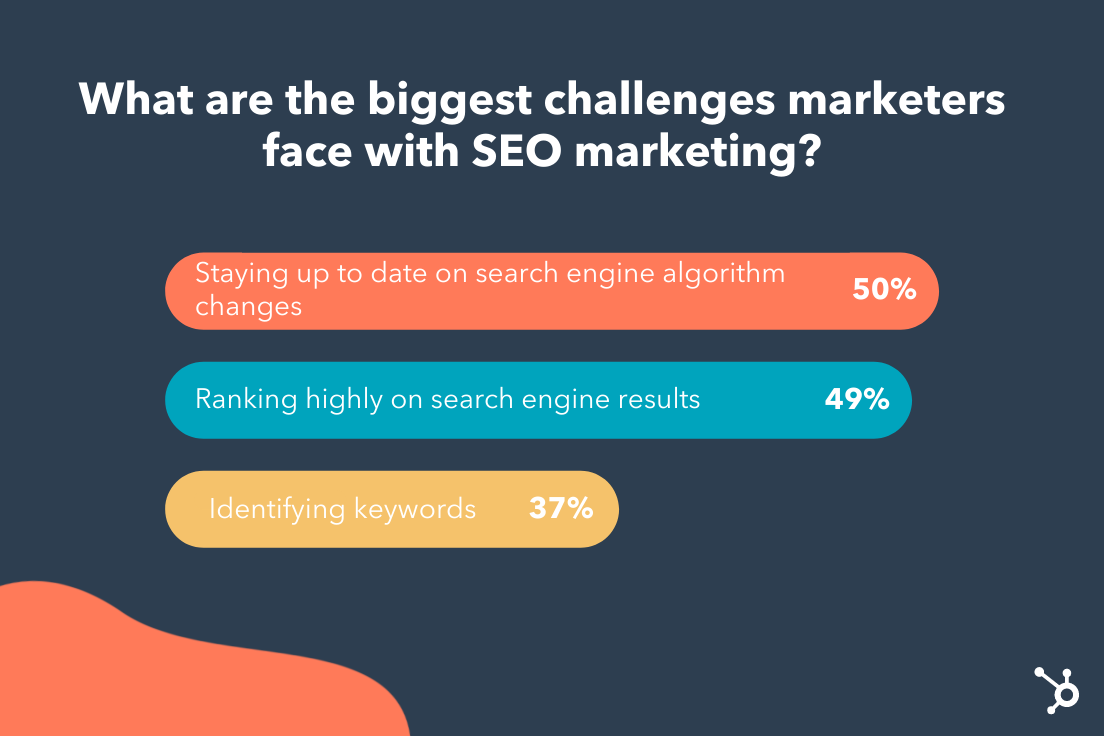
A HubSpot Blogs survey identified the top three challenges of SEO marketing:

Image Source

1. Algorithm Changes

The number one challenge for marketers is keeping up with algorithm changes. That’s unsurprising. In 2021 alone, Google ran more than 800,000 experiments that led to 4,000+ changes to search.

If you’re like most marketers, this stat can feel pretty overwhelming. After all, how can you succeed when Google keeps rerouting the path to success?

The key is to respond to these changes strategically. For one, this means staying on top of industry news. If there’s a significant algorithm change, the SEO industry will likely comment on it.

The second strategy may sound counterintuitive: Wait until the dust has settled after an update. Why? In some cases, Google discovers a change has not panned out as expected, and they revert back.

2. Not Ranking

SEO is a long-term game. Unlike paid search, organic results take time to show results. It’s usually a culmination of small efforts.

To use a metaphor, SEO is like a mutual fund slowly building over time. It’s not the stock market, where you see gains and losses in real time. This can be helpful to mention when clients expect quick results.

Some “solutions” to fix a low ranking include technical SEO and content marketing. However, developing a long-term strategy that focuses on three to four initiatives at a time is even more important.

3. Keyword Research

Keywords are the foundation of SEO. But today, rather than scanning for just a keyword, Google takes a high-level look at your website to get an overall sense of its tone, scope, and relevancy.

This means that keyword stuffing is out. Instead, the goal is to understand user intent, or the deeper problem your users hope to solve. With this understanding, you can perform better keyword research and write content based on this insight.

Check out this helpful article on how to add user intent to your keyword strategy.

25 SEO Trends to Leverage in 2023

1. Voice and Mobile Search

Hey Google, what’s a good substitute for heavy cream?

This was a question I asked my Google Assistant last week while baking a cake, hands covered in flour. It looks like I’m not the only one using voice search. By 2026, more than half of internet users in the US will use a voice assistant.

There’s no denying that voice search is becoming a part of our daily lives. But how can we optimize our content for people searching with their ears — not their eyes?

The answer is clear: Optimize your site for mobile. Since most voice searches occur on mobile and smart devices, it makes sense that Google prefers mobile-friendly sites with fast speeds.

Another strategy is reworking your content to include common questions users may ask. For example, identify long-tail question keywords and include them in your H2 or H3 headers.

2. Tightened Page Headers

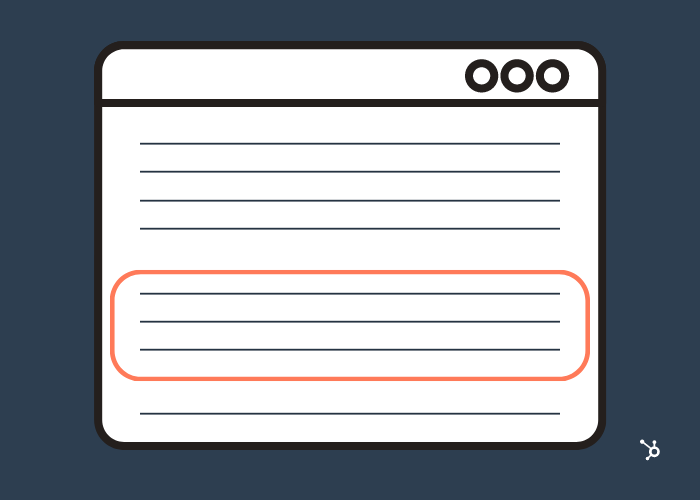
In 2021, Google rolled out a new search ranking feature called Passages. This feature lets Google rank specific sections of a page (or “a passage”) semi-independently from the page itself.

In other words, instead of ranking an entire page on relevancy, Google will now score for relevance in specific sections of a page.

Image Source

This change is no cause for alarm — assuming your pages are organized.

If not, it’s a good idea to tighten your page headers to provide more context for different sections, enabling Google to understand your content regardless of the markup.

Keep in mind that other page-ranking factors still apply. Don’t skimp on backlinks, SEO-optimized copywriting, and other ranking strategies.

3. Emotionally-Charged Headlines

Have you ever clicked on a headline that was too compelling to resist? Turns out, a lot of research has gone into identifying a formula for clickable titles.

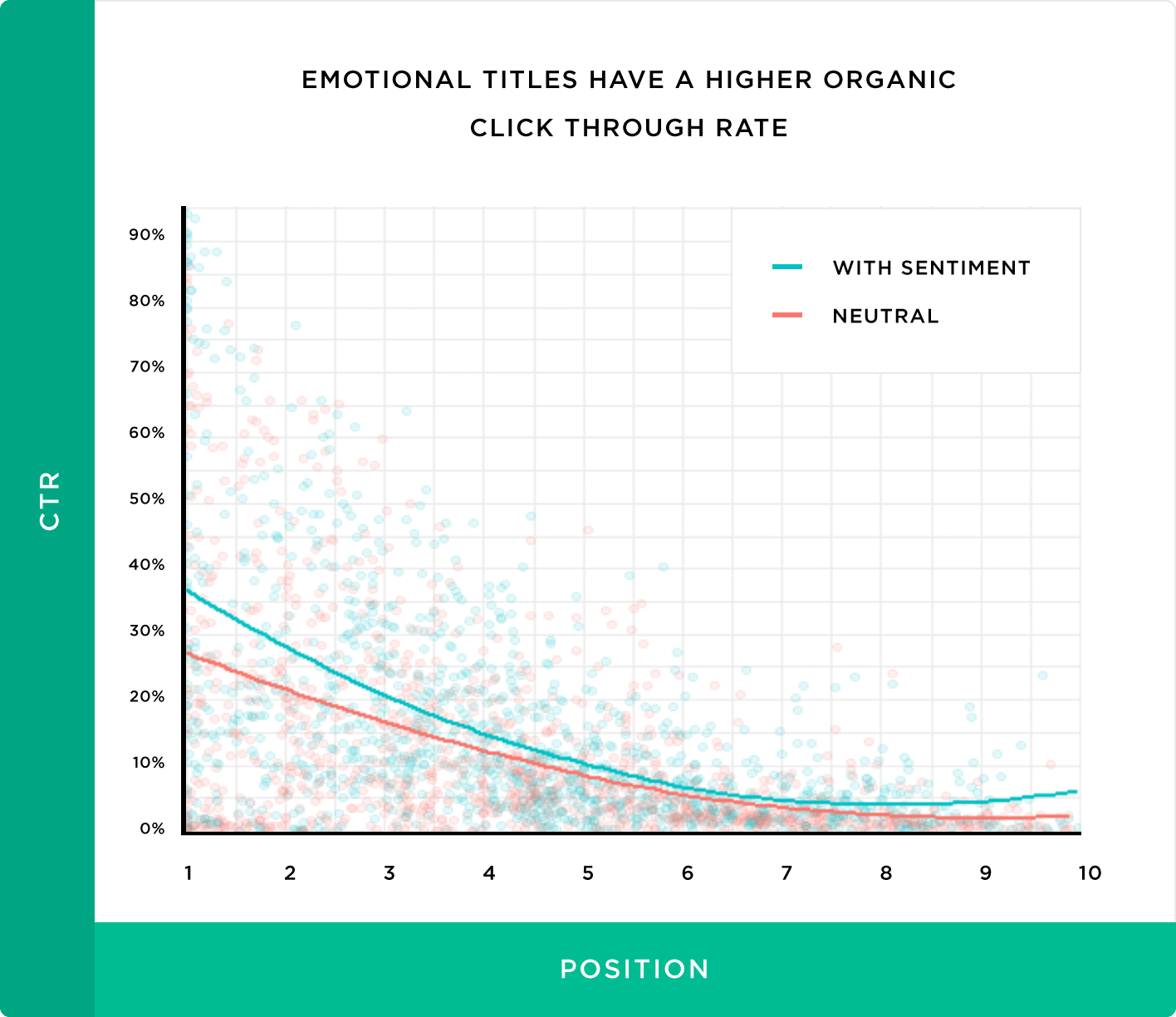
According to one recent study that analyzed 5 million headlines, emotional titles — either positive or negative — had a higher click-through rate than neutral titles.

Titles with a positive sentiment had a 7.4% higher CTR, while those with a negative sentiment had a 7.2% higher CTR.

Image Source

That said, emotionally-charged titles can drive clicks only to a point. Go any further, and you quickly enter clickbait-land.

For instance, the same study found that “power words” — or words specifically designed to grab attention — can negatively affect CTR.

Power words include terms like unbelievable, insane, and crazy. While these may work on social media, they can hurt your organic CTR. Use them sparingly, if at all.

4. Video in Search Results

You’ve likely come across a YouTube video in a Featured Snippet. These tend to appear for “how-to” searches where the reader is looking for step-by-step instructions.

For instance, imagine you’re stuck on the side of the road with a flat tire. One Google search for “How to fix a flat tire” will lead you to the following video:

Image Source

Video Snippets are just the beginning. We predict Google will continue to incorporate video into search results. With that in mind, optimizing your videos for search is essential.

Here are a few ways to get there.

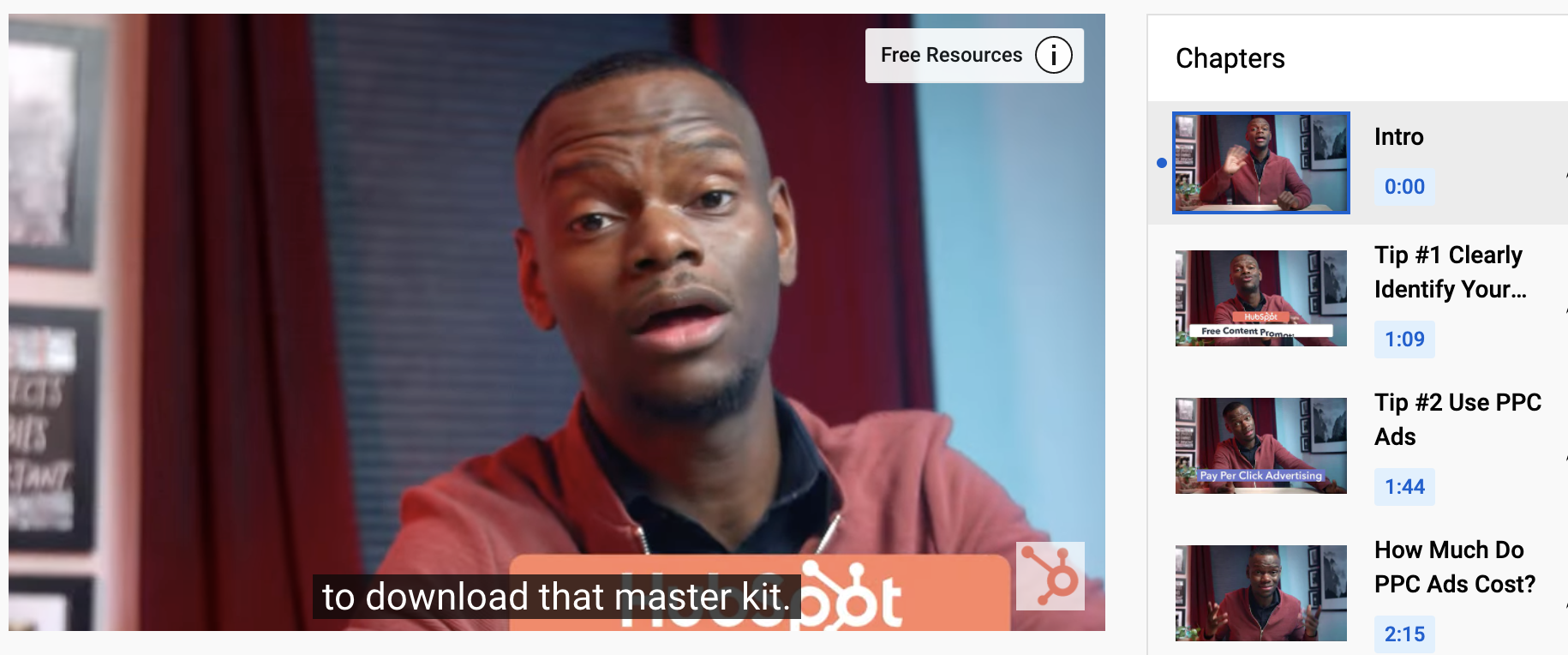
  • Add chapters to your YouTube videos. Chapters break up your video into sections, usually by topic. This layer of context allows viewers (and Google!) to understand the contents of a video. 

It also makes it easy for Google to use different clips from your video for Featured Snippets.

Image Source

  • Include closed captions (CC). Closed captions help YouTube and Google understand every word in your video. While YouTube can automatically generate captions, these aren’t always accurate, so adding your own manually is better.
  • Optimize your title, tags, and description. Videos are like webpages — they have titles, descriptions (like meta descriptions), and tags (like meta tags). Optimize these using SEO best practices.

Lastly, it doesn’t hurt to embed videos into your website and blog posts, which can improve bounce rates.

5. Tweaking Content for “People Also Ask”

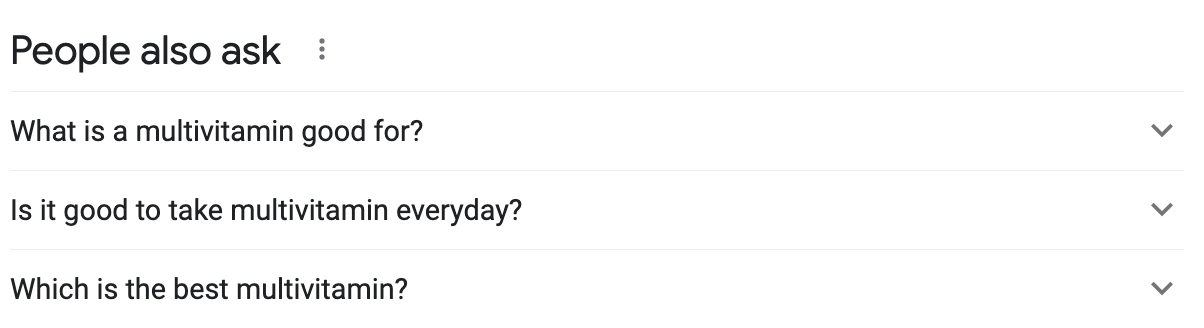
While browsing Google, you may have noticed something new: People Also Ask (PAA). In fact, 43% of search queries now include a PAA box.

Image Source

With a prominent position at the top of the SERP, everyone wants to rank in this highly-coveted feature. Luckily, you can increase your chances by making some minor tweaks to your content.

Since the majority of PAA boxes start with question words, like “what,” “why,” and “when,” it’s a good idea to incorporate questions and answers into your content.

You can use a keyword research tool to identify long-tail question keywords, then include these questions in your page headers.

Or, consider adding a FAQ section at the bottom of your web pages. Not only does this summarize key points for the reader, but it also has useful SEO benefits.

6. AI-Generated Content

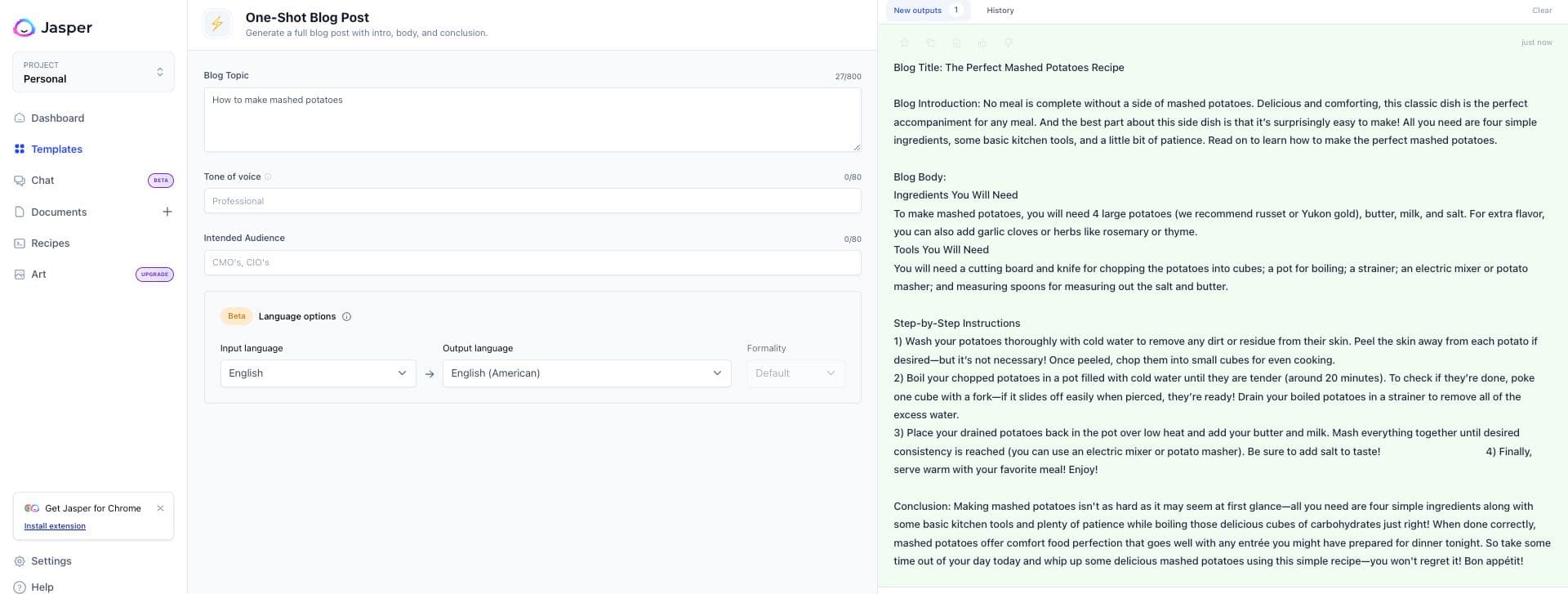
AI content writing tools like Jasper and Copy.AI already gained traction last year, but none blew up the way ChatGPT did.

SEO trends, AI content writing tool - Jasper example.

Now the fastest-growing consumer app in history, ChatGPT can help you create copy that reads almost as if a real person wrote it. In February 2023, Google countered with its own AI chatbot — Bard.

However, Google still attempts to squash AI content with its helpful content update. This update rewards content that gives users a satisfying experience, leading to the question: To what extent should you use AI?

Simple: Speed up your process, don’t replace it.

Thin long-form content entirely generated by AI will be difficult to pass. Instead, use AI to create short-form content like FAQs. Use it to create general content and infuse the gaps with your insights.

Incorporate AI into different stages of your content production process, such as research. AI is also useful in summarizing existing content. Take an existing piece of content and repurpose it for different channels.

And don’t completely rely on AI to create your copy. Supplement the production process with an experienced human writer who can edit and add valuable insights.

7. Digital Accessibility

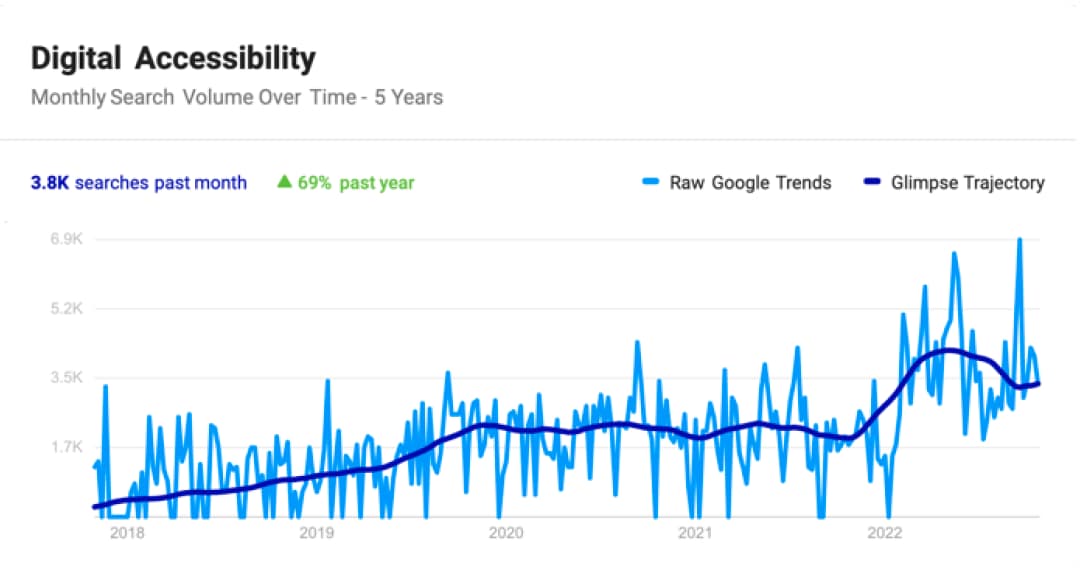
Only 3% of the internet is currently accessible to people with disabilities. Accessibility isn’t yet a direct ranking factor for Google, but that doesn’t mean it might not be in the future.

Google Search Trends and Glimpse Trajectory highlighted how, in 2022, there was an increase in search demand for “digital accessibility” by +69% and “SEO accessibility” by +124%.

seo-trends-accessibilityImage source

Accessible websites aren’t just good for SEO, they also help build reputational trust with users, generate more business, and improve customer experience.

Web accessibility is extensive. Use a checklist to identify any areas you may have missed. Review examples of other accessible content, and check the Web Content Accessibility Guidelines (WCAG).

Here are five ways you can improve the experience for all visitors:

  • Include image alt-text that describes the image’s content.
  • Optimize video content with closed captions and transcripts.
  • Create headers and structure elements with HTML, not images.
  • Add zoom and magnification capabilities.
  • Test your website with an automated accessibility testing tool, such as Wave or DYNO Mapper.

And lastly, involve accessibility experts and users who can provide feedback on your design and content.

8. Featured Snippets and Zero-Click Results

“How to cure a fever.”

That’s what I Googled when I was down last week and didn’t know what to do.

My answer? A featured snippet from Mayo Clinic with no clicks necessary.

SEO trends, zero-click results - example from Mayo Clinic.

Of search queries, 12.29% have featured snippets in their search results. Additionally, two-thirds of Google searches end without a click, and the race for zero-click search domination is on.

Featured snippets and zero-click results will rule the SERPs. Users also have a higher chance of clicking content above the fold since they can see a preview of the answer.

Five tips to grab the featured snippet spot.

  • Use relevant keywords. You want to include your primary keyword but also search for related keywords. Refer to content optimization tools for their suggestions, but also follow your own judgment.
  • Add headers. Break your content into sections with H2 and H3 tags. These tags make it easier for search engines to crawl your content and identify points of interest.
  • Keep it short. Limit content to 40 to 60 words. It might also help to include a “what is” header.
  • Include a list. Featured snippets love lists. Include steps, recipes, or other relevant info in a numbered list.
  • Format your content. The more your content looks like a featured snippet, the more likely it is to become one. Use tables and images when possible.

9. Topical Authority

Are you going to trust the website that talks about 50 vastly different topics or the one that focuses on just a few?

The answer is obvious — and that’s exactly why topical authority is crucial.

Topical authority signals to search engines the depth and quality of your content. When you focus your content around a specific topic, Google understands the expertise and trustworthiness of your website.

This expertise is especially crucial considering Google’s helpful content update. Topical authority tells the algorithm which content provides value and which it should rank higher.

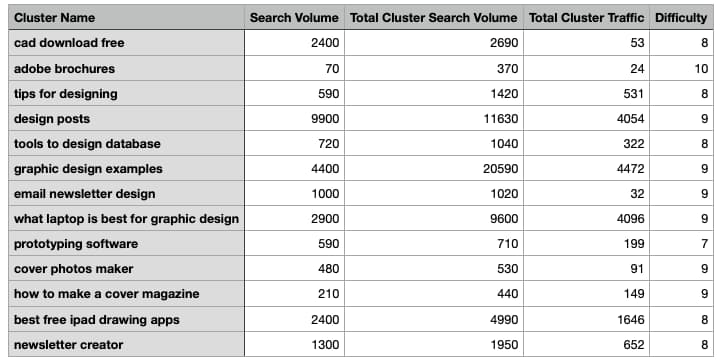
Focus on topic clusters to build authority. Identify the topics you want to focus on, research related terms and phrases, and create content for each cluster.

Also, target multiple keywords at the same time to build online authority. Create content around a certain topic, link internally to other related pages, and cross-link between clusters.

In the example below, if you want to rank for the keyword “design software,” consider creating content around the clusters such as “design posts,” “graphic design examples,” “what laptop is best for graphic design,” or “tips for designing.”

Building topical authority is a time-intensive process that’s well worth the effort.

SEO trends, topical authority - example chart of cluster topics for a design company blog.

10. Firsthand Experience

Have you ever read an article and thought, “This person really doesn’t know what they’re talking about”?

That’s because the content didn’t come from firsthand experience, and Google’s ready to change that.

In December 2022, Google rolled out an update to its E-A-T (Expertise, Authority, Trust) algorithm and added another E for Experience.

The new E-E-A-T algorithm will now consider the author or creator’s experience when evaluating content quality.

With this additional ‘E,’ we’ll see content creators investing more effort to access practitioners or subject matter experts when creating search content.

Unique insights will become more critical. Whether in the form of original data, contrarian takes, content driven by subject matter expertise, or even content written from other perspectives, such as consumer reviews.

Such insights are challenging to replicate and will, in turn, result in greater returns in 2023.

When everyone has access to the same AI writing and keyword research, it’s the “hard” path of including unique insights that will become the most successful.

11. Content Optimization Tools

Ranking for SEO isn’t about stuffing your primary keyword a couple of times and calling it a day.

It’s about creating semantically rich content that explores a topic in-depth and provides value to the reader.

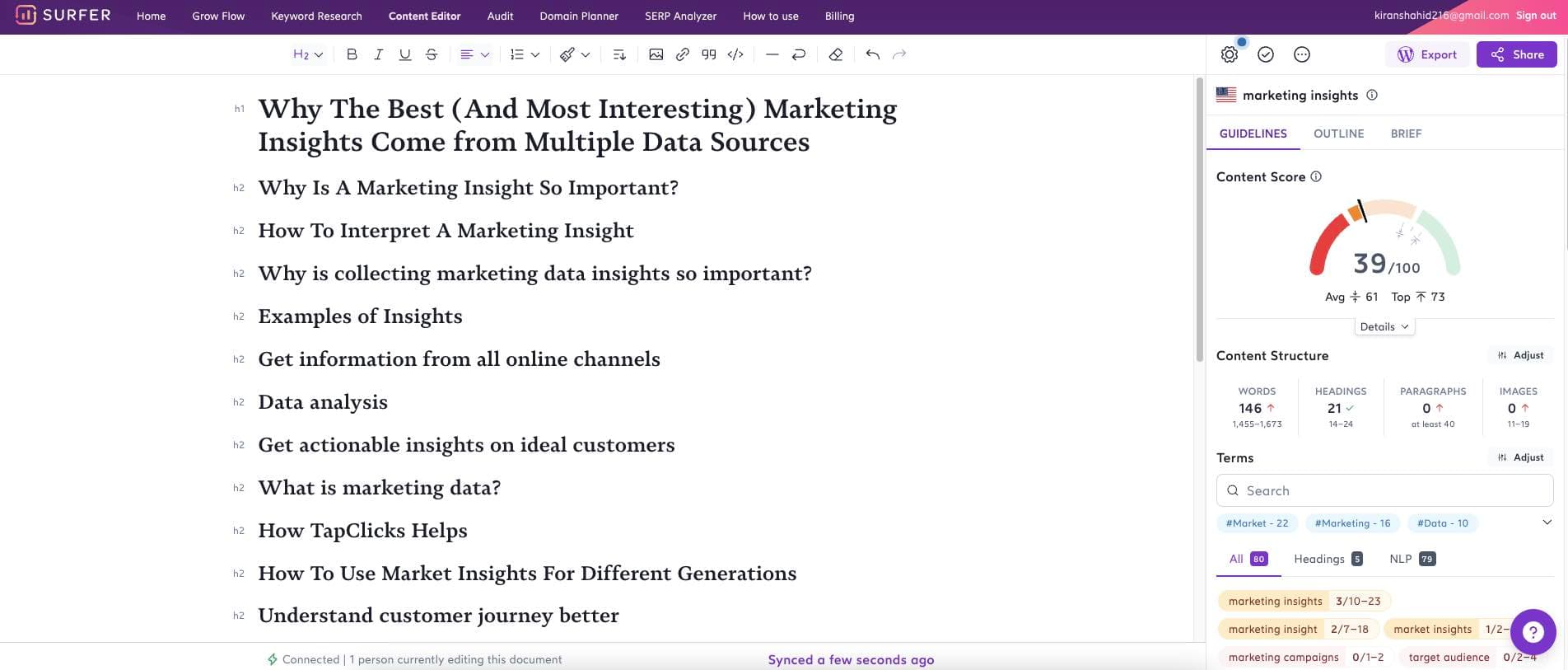
That’s where content optimization tools such as Frase, Clearscope, and SurferSEO come in.

These tools use Natural Language Processing (NLP) to analyze your content and offer suggestions on keywords, common phrases, subtopics, and frequently asked questions.

The suggestions they offer help search engine bots understand the context of your content and rank it higher.

Featured snippets, first-page rankings, and high visibility are all outcomes of optimizing your content. Here’s an example of how Surfer SEO’s Content Editor suggests optimizing content for the keyword “marketing insights.”

SEO trends, content optimization tools - example from Surfer SEO.

12. Multiple Content Formats on Multiple Channels

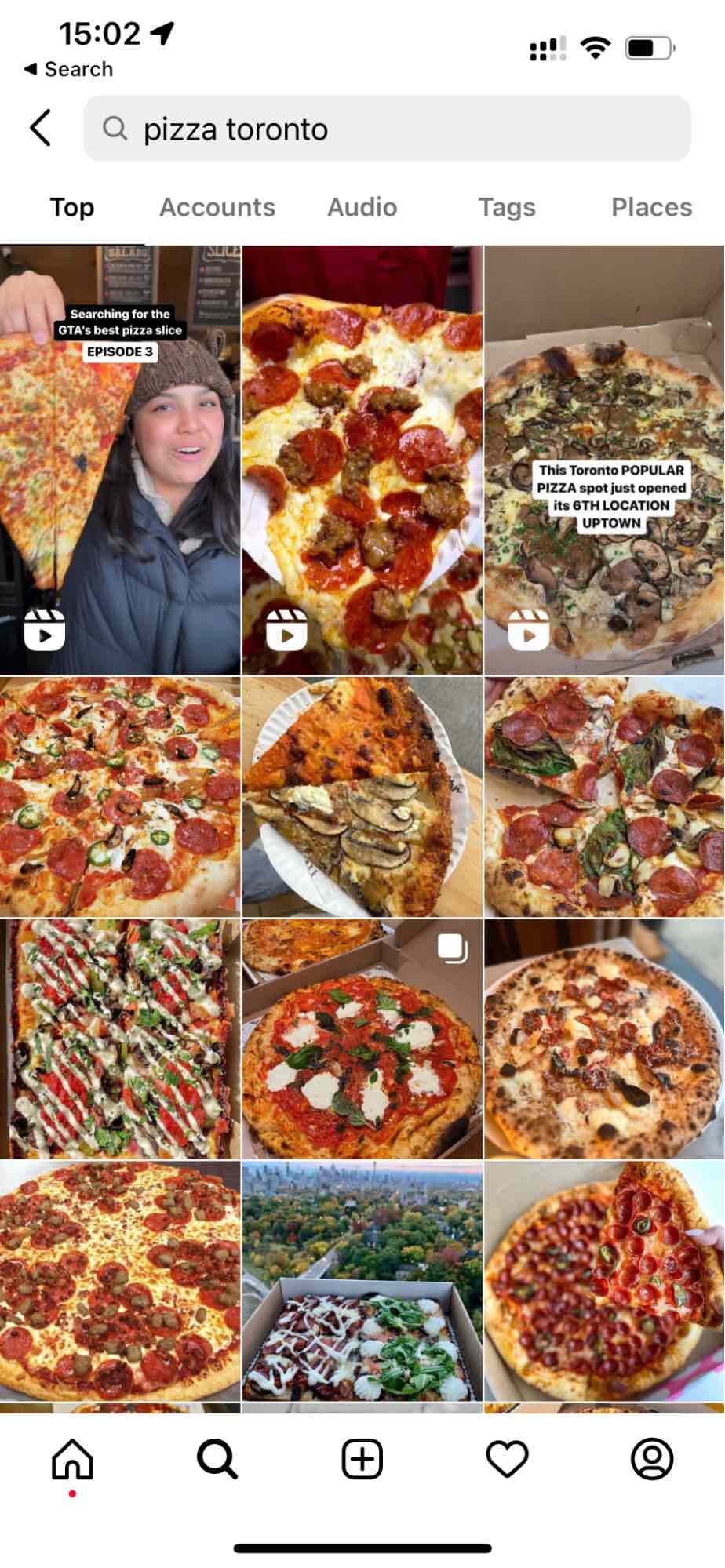
You’re looking for a new pizza place to try. You turn to Google to find the best places in your area. That seems like the only route to take, right?

Well, Gen Z is taking a different approach.

SEO trends, multiple content formats on multiple channels - example of pizza in Toronto.

Of Gen Z, 40% prefer TikTok and Instagram to search over Google. While Google remains the world’s largest search engine, we’re seeing a shift.

Digital search is expanding as different discovery tools emerge. NLP algorithms have never been better, and users have more options to find the information they’re looking for.

Your target audience is everywhere, and you need to meet them at multiple touchpoints.

Create content for different platforms and target multiple channels and audiences simultaneously. Have one long-form blog post? Break it into two videos, five social posts, and two podcasts.

You’re investing a lot of time, effort, and money into your content assets. Repurpose content for multiple channels and squeeze the most out of it.

Set benchmarks and determine how your audience consumes content. Do younger people scroll less? Do older people watch more videos?

Optimize your content for different platforms and devices to reach the right audience. Ensure you’re not missing an opportunity to engage users across various channels.

13. User Experience

Even a one-second delay in mobile load times can reduce conversion rates by up to 20%.

Slow, laggy websites frustrate visitors and might prevent Google from crawling your pages.

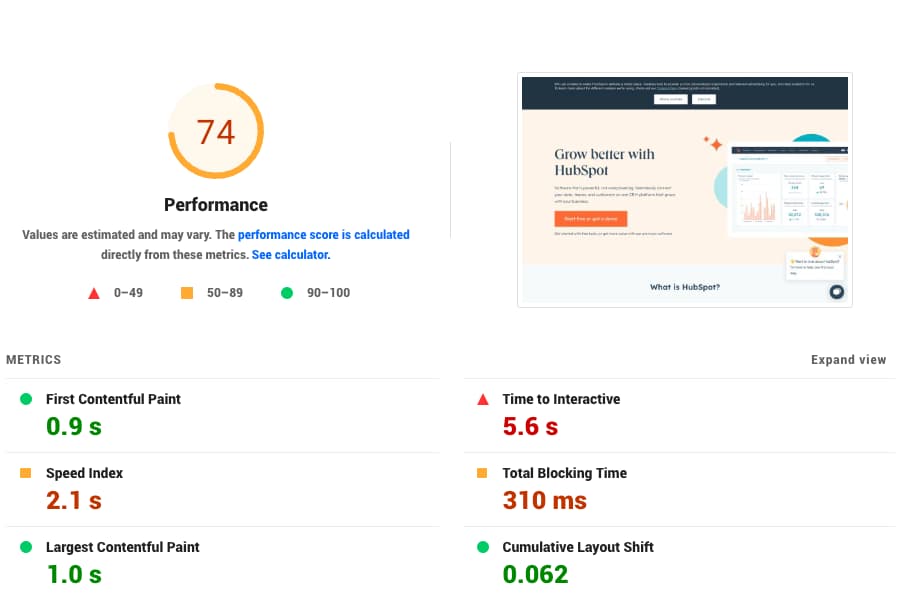
Google’s Core Web Vitals is still crucial to check whether your website meets the speed and responsiveness requirements.

SEO trends, user experience - Google’s Core Web Vitals performance calculator example of HubSpot website.

Reducing server response time, improving site navigation, eliminating render-blocking resources, and compressing images all play a role in improving your website load times.

Content quality and technical SEO go hand in hand. Optimize website performance on desktop and mobile to improve the experience for visitors and make it easy for Google to index your pages.

14. Author Authority

Adding another E to its E-A-T acronym hasn’t just increased the demand for unique insights. It’s also increased the demand for authoritative creators and writers.

AI content has never been this popular, and Google’s on a mission to ensure whoever’s behind the content is a qualified, experienced, and real person.

For starters, ensure experienced creators churn out the content. Have them write about their own experience and research instead of relying on AI-generated or outsourced content.

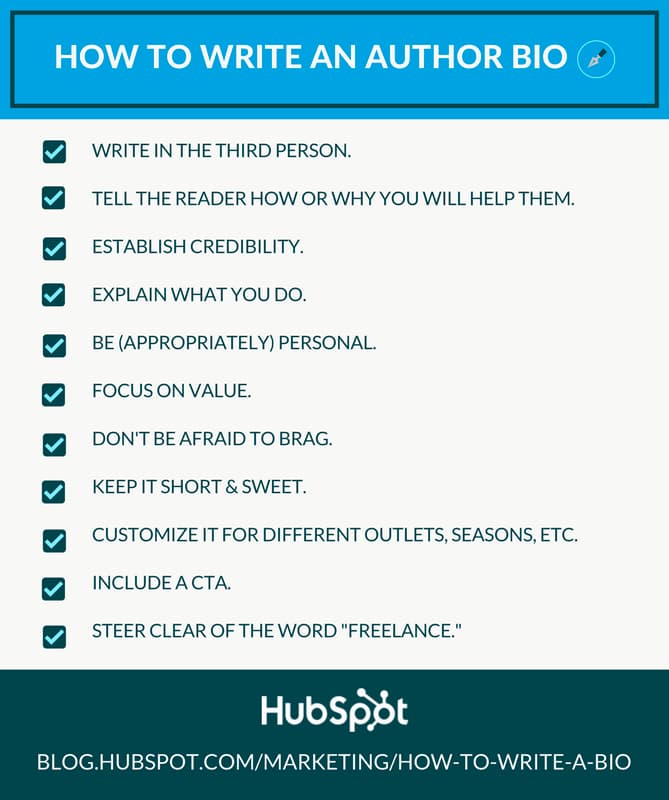
Then, build their profiles further with author bios. Here are a few aspects to focus on:

SEO trends, author authority - HubSpot checklist for writing an author bio. List items: Write in third person, tell the reader how or why you will help them, establish credibility, explain what you do, be (appropriately) personal, focus on value, don’t be afraid to brag, keep it short and sweet, customize it for different outlets, seasons, etc., include a CTA, and steer clear of the word “freelance.”Image source

After creating a bio, create an author page that compiles all of their work on your website. Link the author’s social media accounts and personal website so Google understands the creator is a real, authoritative person.

15. SEO Automation

Two threats loom over businesses in 2023: Google’s rapid algorithm updates and the recession.

Sustainable SEO growth strategies that allow you to respond to these changes and spend fewer resources on manual processes are key this year. Long-tail keywords that compete for lower search volumes are your friend.

Opt for automation tools like SEMRush to monitor and improve SERP rankings, analyze competitors, identify internal link opportunities, and monitor social media.

AI-driven technologies can help you supplement your SEO efforts and increase efficiencies by suggesting relevant keywords, content ideas, and backlinks.

These algorithms learn from experience and detect opportunities for optimization more quickly than manual processes.

Invest in automation to speed up SEO tasks and fill those time gaps with strategic decisions that help you navigate challenging times.

16. Local SEO

Ranking for general keywords is tempting. Why shouldn’t you go after keywords everyone is looking for?

That’s because it’s harder and harder to compete with global brands — unless you specialize in local SEO.

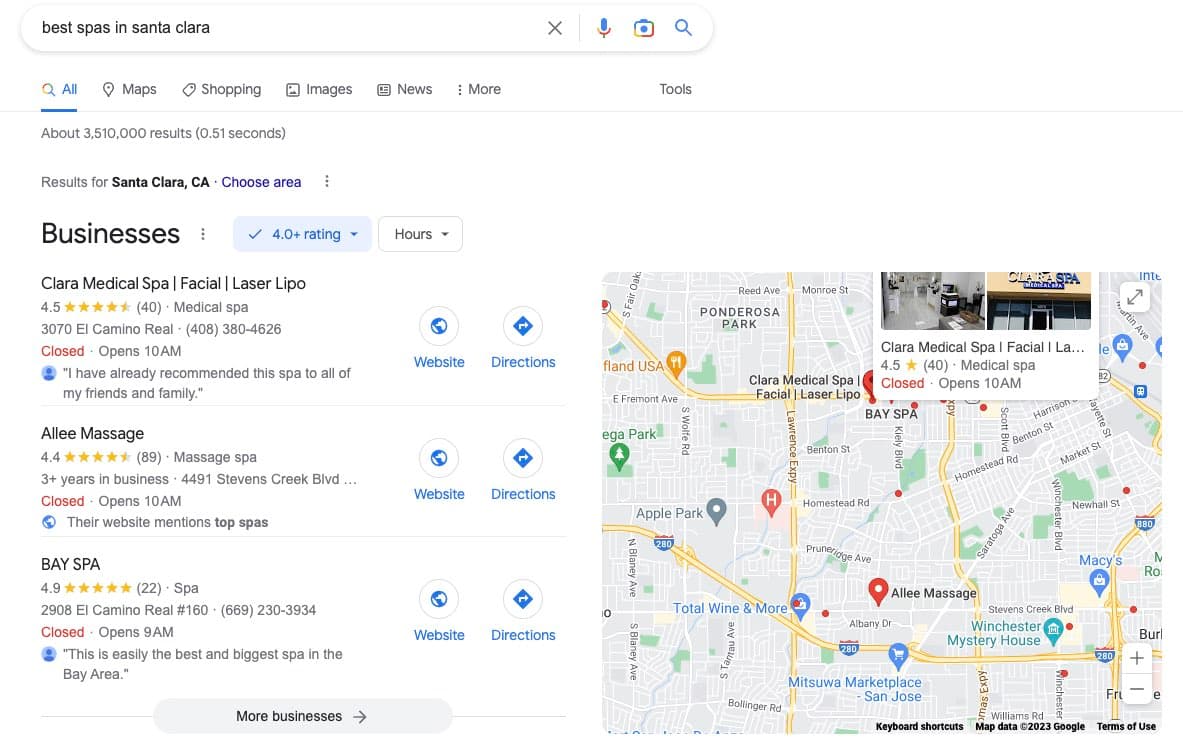
First, conduct a local SEO audit. Then, optimize your website for local, long-tail keywords, update your Google My Business and other local listings, add photos, and create content focused on topics related to city-specific or regional needs.

SEO trends, local SEO - example of Google SERP for spas in Santa Clara.

Of Millennials, 42% who perform a local search will visit the business most of the time. As customers become more frugal in 2023, they’ll value in-person visits even more to evaluate the quality of your product.

Online reviews are also one of the most critical factors that affect organic search results. In fact, 63.6% of consumers say they are likely to check reviews on Google before they visit a location.

Encourage customers to leave reviews on your website or through Google My Business.

And don’t forget mobile — 57% of local search queries are submitted using a mobile device or tablet. People want solutions, and they want them quickly. Mobile-friendly content directs users to your business when they need it the most.

17. Historical Optimization

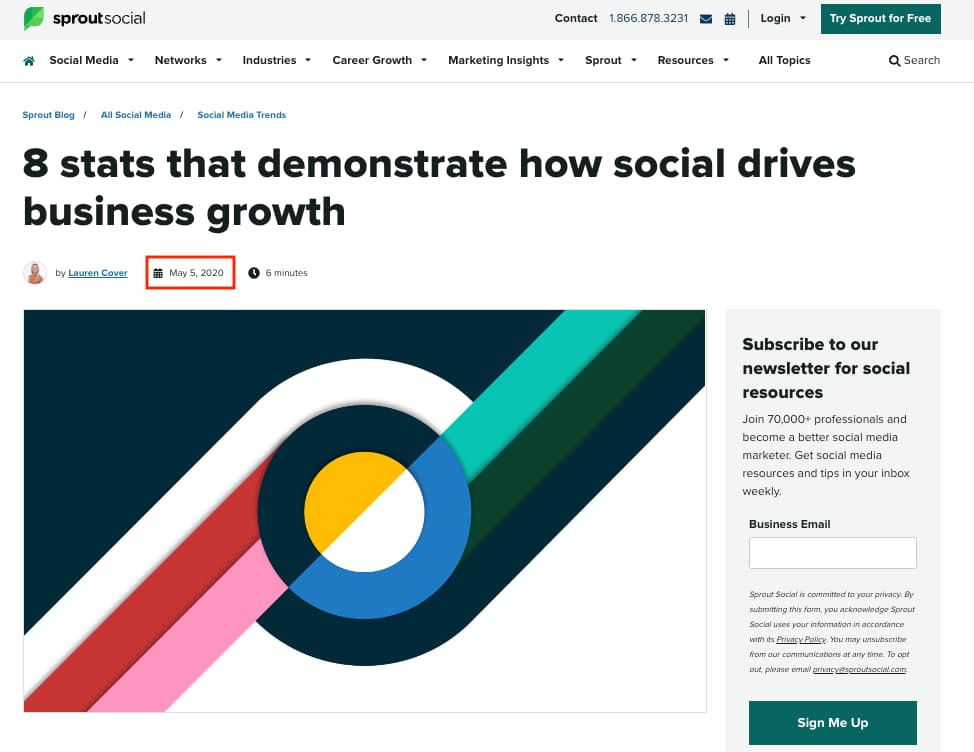
Have you ever found an interesting article only to see it was published and updated three years ago?

That’s a missed opportunity.

SEO trends, historical optimization - example from sproutsocial.

Not updating your old blogs is like forgetting to water your plants. You’re missing out on tons of potential growth.

Historical optimization is the process of going back and updating your old blog posts. To start, you can conduct a content audit to identify old posts that need a revamp.

Focus on articles with declining traffic, high bounce rates, or ones that need fresh insights. Analyze content based on Google’s helpful content and see if you can add anything to make it more comprehensive and up-to-date.

Five aspects you can focus on:

  • Stats. Add recent and relevant stats that support your claims and make your content more credible.
  • Links. Remove broken links and identify internal and external links you can use to add value.
  • Images. Replace outdated images or graphics with new ones that fit current design trends.
  • Keywords. Look for missing high-intent keywords and use them naturally in your content.
  • Expert insights. Identify content gaps that could benefit from quotes from subject matter experts.

18. Search Intent

The best content isn’t created for search engine crawlers. It’s created for your audience.

Search intent focuses on why people search and what they’re looking for when they type a query into the search engine.

What pain points were they trying to solve when they decided to type in a keyword?

Are they looking for product reviews, educational content, or simply curious about something specific?

Creating content that meets user search intent means creating content that answers their questions. It’s as simple as that.

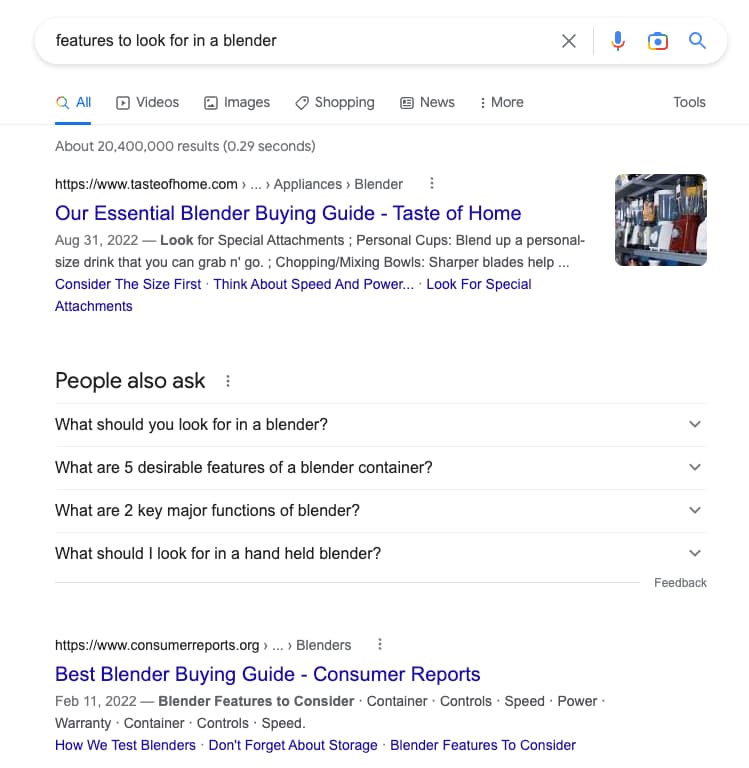
SEO trends, search intent - Google SERP for “features to look for in a blender.”

There are four types of search intent:

  • Navigational. When users are looking for a specific website or page. For example, when they type “Walmart” into the search engine.
  • Informational. When users are looking for more information on a topic, like when they type in “features to look for in a blender.”
  • Transactional. When users are ready to buy something or take an action, like when they type in “order Black and Decker blender online.”
  • Commercial. When users compare products or services before making a purchase, like when they type in “best blender under $100.”

Focus on content that matches users’ queries and expectations rather than just optimizing your content with the right keywords.

19. Link Building

Google’s December 2022 link spam update detects spammy links and penalizes websites with an unnatural link profile.

Its AI-powered SpamBrain will now “detect both buying and selling links and sites used for the purpose of passing outgoing links.”

What does this mean for SEO?

While link building can be a great way to improve your organic search visibility, focusing on quality rather than quantity is essential.

As Google gets better at detecting manipulative links using AI, link farms will become less effective. From Google’s perspective, neutralizing links algorithmically across the web is much more efficient than issuing manual actions.

Focus on white-hat, link-building tactics and avoid quick-fix solutions. Earn links by responding to media calls and position yourself as an industry expert.

SEO trends, link building - webpage entitled “Connecting B2B writers with top-quality sources.”

Websites, such as HARO, Help a B2B Writer, and Terkel, have new opportunities daily. Give quotes drawn from firsthand experience that journalists can use straight away without further research.

20. Reverse Outreach

Link building can be tricky. Building backlinks without sending countless outreach emails that most people ignore is challenging.

That’s where reverse outreach comes in.

Reverse outreach is a content marketing technique invented by Brian Dean of Backlinko, who built 5,660 backlinks in 30 days. The technique involves creating buzzworthy content designed to be linked or shared.

Think listicles of stats, research, creative infographics, and helpful guides.

SEO trends, reverse outreach - example of a HubSpot blog post.

The key is to find a “journalistic keyword” other websites or blogs use to cover stories similar to yours. Then, create a narrative around that keyword, collect data, create the content, optimize it, and publish it.

Once you’ve published the content, the domino effect kicks in. High-authority sites link back to your site, boosting your domain authority and increasing organic website traffic.

21. Product SEO

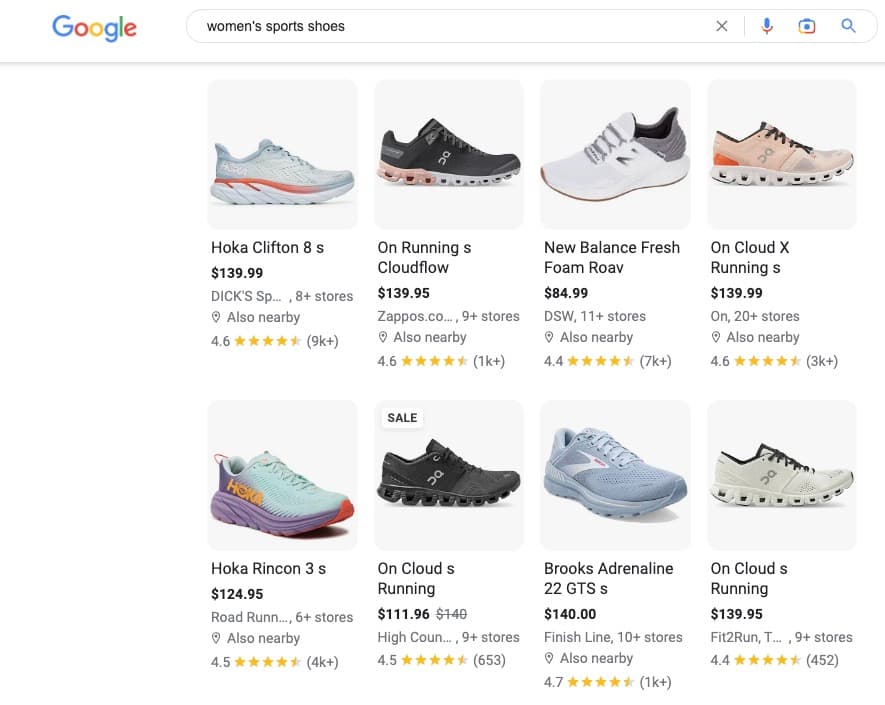
SEO trends, product SEO - Amazon page for “women’s sports shoes” search.Today, 61% of US consumers begin their product hunt on Amazon. Google knows how fiercely it competes with Amazon in the ecommerce space, and it’s taking steps to ensure it doesn’t lose out.

In 2022, Google made several changes to product search results, including adding Pros and Cons to product review snippets and expanding eligibility for Merchant Listing Experiences with Product Structured Data.

Add structured data to product pages to help Google Images and Lens detect and display your product information. Include other information, such as FAQs and drop-down menus, to make your product page richer.

Instead of optimizing for SEO alone, think of other helpful information that improves customer experience. Include product specifications, high-quality images, and 3D modeling to make it easier for customers to make decisions.

Lastly, focus on customer reviews. They’re extremely powerful in influencing purchase decisions.

Product reviews linking to multiple sellers may also boost rankings over reviews linking to one. When you’re giving customers the option to purchase from different vendors, you’re being helpful, and that’s what Google rewards.

22. Zero Volume Keywords

Search volume has traditionally been a key factor for deciding which keywords to target. But what if your target keyword has no search volume?

Zero search volume (ZSV) keywords are exactly that — they’re specific long-tail search queries that barely anyone searches for or tools don’t pick up on.

But because these keywords have a hyper-focus, they can help you attract more qualified leads and achieve higher conversion rates, especially at the bottom-of-the-funnel (BoFU) stage.

Keyword tools like Surfer and Ahrefs might not display the volume accurately. Here are a few checks that can help you identify whether a ZSV might generate traffic:

  • Forum activity. Does the search for the ZSV keyword draw up forum or UGC activity? Are the results relevant? If yes, then people are interested.
  • Incognito mode. Start typing the keyword on Google. Does Google autosuggest the remaining phrase? If yes, then people have searched for this.
  • Related searches. Does Google display related searches on the results page? If so, the topic generates enough interest for Google to pull in related queries.

ZSV keywords provide small businesses, especially with little-to-no competition for search engine exposure. Less competition, a targeted approach, and the chance to build awareness in your niche can help you build traffic and rankings.

23. Image SEO

Image SEO has always been important, and for some niches, it can make or break a visitor’s decision to stay on your site.

Think about it: Would you trust a recipe blog where all the images are blurry and grainy? Would you be comfortable booking a hotel without photos of its amenities?

The answer is probably no.

Images make up 62.6% of all Google searches. Google understands how crucial visual results are to a user’s experience, and search results now feature image carousels and visual results more.

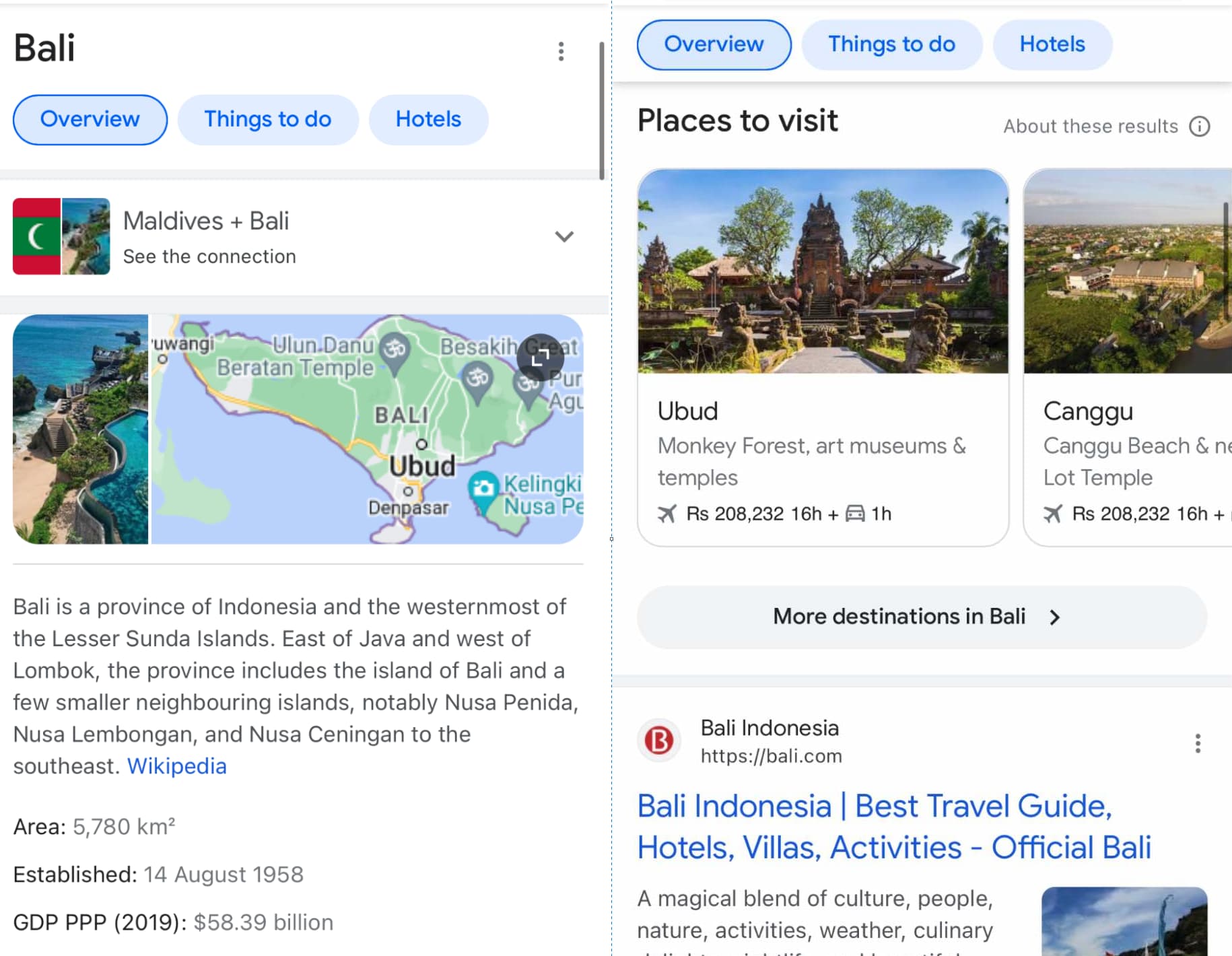
For example, a simple search for Bali on Google draws images of its map, pictures of different places to visit, and previews of hotels.

SEO trends, image SEO - images on SERP search for “Bali.”Google loves accessibility and sites optimized for visuals. To make sure your images are SEO-friendly, here are six tips:
  • Give each image a descriptive filename.
  • Compress the file size to improve loading times.
  • Add alt-text and descriptions to make them accessible.
  • Use captions and titles in addition to the alt-text.
  • Create an image sitemap to help Google crawl and index images.
  • Include semantic keywords to help Google understand their context.

24. Structured Data Markup

The more organized your content is, the easier it is for search engines to read and evaluate it — which is why structured data markup remains important in 2023.

Structured data markup tags are added to web pages to provide additional context about the page’s content.

These tags help search engines understand the page better, which helps them display it for the right queries and provide the most helpful information to users.

Structured data also helps generate rich results, and these results stand out from regular search results and can help you get more clicks.

Rotten Tomatoes, for instance, added structured data to 100,000 unique pages and measured a 25% higher click-through rate (CTR) than those without. Nestle also measured an 82% higher CTR for rich results than regular search results.

Add relevant schema markups, such as recipes, videos, or Q&As, to help Google’s crawlers understand the context of your content. Here’s how you can ensure you’ve marked up your content correctly:

  • Use schema.org vocabulary when creating tags.
  • Test structured data using Google’s Rich Results test tool.
  • Monitor errors with Google Search Console.

25. Interactive Content

You’ve probably come across boring, monotonous web pages filled with endless text. Most users won’t spend more than a few seconds reading them before they leave the page.

That’s why interactive content is so important. In simple terms, interactive content engages users and encourages them to interact with it.

Interactive content elevates an otherwise static page to draw more engagement, time on site, and potentially conversions.

According to 88% of marketers, interactive content helps brands differentiate themselves.

And why not?

Content such as quizzes, polls, games, surveys, or virtual reality is memorable for users. It captures your target audience’s attention and conveys valuable information in a fun, entertaining way.

Back to You

The only constant in the SEO world is changing. While it may feel like these changes are out of our control, so much is in our control — namely, how we react.

Start by watching trends and following the best practices in this article to help you navigate the changing landscape.

SEO Starter Pack

Categories B2B

YouTube Demographics & Data to Know in 2023 [+ Generational Patterns]

Chances are, you’ve probably spent an afternoon falling down a rabbit hole of YouTube videos.

While it’s a great source of entertainment, the platform is also valuable for marketers using YouTube to find their target audience. With a global user base of more than 2.5 billion people, it’s also safe to assume that your audience is on the platform.

→ Free Templates: How to Use YouTube for Business [Download Now]

In this post, we’ll go over key YouTube statistics you need to know this year to help you succeed in your marketing efforts.

2023 YouTube Demographics

Below, we’ll go over the most critical YouTube statistics that show marketers how global audiences are using the platform.

General YouTube User Demographics

Copy of Facebook Shared Link - 1200x628 - Percentage + Copy - Dark (2)

  • YouTube has 2.5 billion users, making up almost one-third of the entire internet. (Statista)
  • 70% of viewers bought from a brand after seeing content on YouTube. (Google Ads)
  • India has the most YouTube users in 2023 at about 467 million (Statista)
  • YouTube’s global advertising revenues amounted to about 29.24 billion U.S. dollars in 2022. (Statista)
  • YouTube is the top video streaming app, and the average user spends 23.2 hours per month watching content. (App Annie)
  • The most popular YouTube video is Baby Shark Dance with 12.3 billion views. (Statista)
  • Videos are most likely to go viral on YouTube (27%), TikTok (24%), Instagram (18%), and Facebook (14%). (HubSpot Video Marketing Report)

YouTube Age Demographics

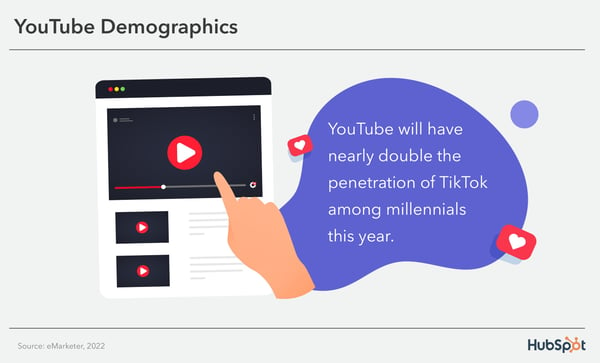
YouTube demographics: YouTube will nearly double the penetration of Tiktok among millennials this year.

  • Millennials trust YouTube more than any other generation. (HubSpot Blog Research)
  • 56% of Gen Z, 54% of Millennials, 48% of Gen X, and 26% of Boomers say they discover new products most often on YouTube. (HubSpot Blog Research)
  • About 377 million adults between ages 18-24 use YouTube — about 15% of YouTube’s audience. (DataReportal
  • As of 2022, 20.2% of YouTube’s advertising audience is between 25 and 34 – the largest group – and 15.5% is between 35 and 44. (Hootsuite)
  • 85% of children ages 2-12 say they watch YouTube. (TVTech)
  • 84% of parents who use YouTube or YouTube Kids agree that YouTube makes learning more fun for their children. (Oxford Economics)

YouTube Gender Demographics

Please note that audience data for individuals who do not identify within the binary are not reported.

  • As of January 2023, 48.6% of YouTube users in the United States are male. (Statista)
  • 51.4% of YouTube users in the United States are female. (Statista)
  • 11.9% of YouTube’s global audience consists of males between the ages 25-34. (Statista)
  • 8.8% of YouTube’s global audience consists of women between the ages of 25-34. (Statista)

YouTube Geography Demographics

  • The United States has the second-highest number of YouTube users, at 246 million. (Global Media Insight).
  • Brazil has the third-highest number of users, at 142 million. (Global Media Insights)
  • YouTube has launched local versions of the platform in more than 100 countries. (YouTube Blog)
  • 74% of U.S. adults living in rural areas, 81% of those living in suburban areas, and 84% living in urban areas report using YouTube. (Pew Research)

What Different Generations Watch on YouTube

What Gen Z Watches on YouTube

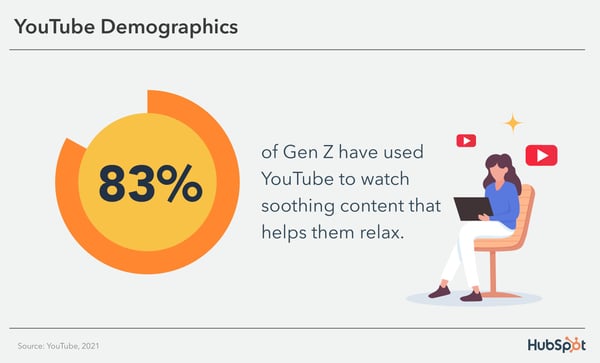
youtube demographics: 83% of Gen Z have used YouTube to watch soothing content that helps them relax.

  • As of May 2022, 96% of Gen Z users (born between 1997 and 2012) have a YouTube account. (Statista)
  • 56.66% of YouTube’s audience are millennials or Gen Z. (SimilarWeb)
  • To break it down further, 30.19% are the ages of 25-34, and 26.47% are the ages 18-24. (SimilarWeb)
  • 82% of Gen Z say they’ve used YouTube to watch content that will make them feel nostalgic. (YouTube)
  • 83% of Gen Z have used YouTube to watch soothing content that helps them relax. (YouTube)

Takeaways for Video Marketers

Based on the research, Gen Z turns to YouTube when they want to relax or revisit positive memories from their past. If you’re targeting Gen Z, entertaining content will reign supreme.

What Millennials Watch on YouTube

youtube demographics: Millennials trust YouTube more than any other generation

  • YouTube reaches more millennials than all the TV networks combined. (The Shelf)
  • A 2022 report found that YouTube will have nearly double the penetration of TikTok among millennials this year. (eMarketer)
  • Millennials prefer watching:
    • News and human interest stories to keep up to date
    • Unboxing and product review videos to influence spending
    • Quick and fun entertainment content (The Shelf)

Takeaways for Video Marketers

Millennials go to YouTube when they want to learn something or be entertained. Additionally, they go to the platform to be inspired, watch TV, and catch up on the news. If you’re targeting millennials, news stories, product reviews, entertaining content, and inspiring content will win out.

How to Target the Right Demographic on YouTube

While each generation might watch fairly similar content, it’s important to remember that the goal is different. For Gen X it might be to reminisce, while for Boomers it’s to save time, and for Millennials and Gen Z, it could be to learn something new.

To properly target the right demographic on YouTube, pay attention to the most popular categories and types of videos they watch on the platform.

Just as it is for all social networks, building a presence on YouTube requires understanding which segments of your audience are already there and what they’re watching.

Use these statistics to create a YouTube marketing strategy that speaks to your audience’s interests, drives revenue, and increases conversions.

Having that information makes it easier to create content that speaks to their interests, maximize ROI, and achieve general marketing success.

Editor’s note: This post was originally published in April 2019 and has been updated for comprehensiveness.

Featured Resource, YouTube for Business Kit: 18 Free YouTube Templates, 18 design, planning, and video description templates for YouTube. Download for Free


Categories B2B

How To Stay Calm Under Pressure at Work (According to Professionals)

The business world can feel like a place of constant pressure and complexity. We hate stress a lot (because it sucks) but, at work, it can sometimes feel like addressing and dealing with stress can get in the way of meeting deadlines and producing results.

Stress should always be addressed, though, because not dealing with it can lead to burnout — a legitimate health condition.

In this post, learn why remaining calm under pressure at work is important and strategies to stay level-headed.

Download Now: 5 Free Skill Development Templates

Why is it important to stay calm under pressure at work?

Justin Menkes, the author of Better Under Pressure, says that pressure itself isn’t bad, but pressure that becomes panic is. “There’s a lot of research that shows that a moderate amount of pressure is critical for human satisfaction and gratification, otherwise we get very restless. We like challenge; we have to have challenge. It’s just that, if you overload and flood us, panic is what many people are talking about when they say ‘unhealthy pressure.’”

The key is handling pressure without panic, and here are tips and expert advice for doing so.

How to Stay Calm Under Pressure At Work

1. Organize your priorities.

Staying organized at work is a great way to stay calm under pressure. Creating to-do lists to uncover the most pressing tasks and devising an organized way to tackle your responsibilities so you don’t get overwhelmed.

For example, in the face of an upcoming deadline, you can list tasks and their dependencies, organize them by importance, and create a structure to follow to help you meet your deadline.

Alison Elworthy, EVP of Revenue Operations at HubSpot, says, “For me, it’s all about staying organized and being methodical to get through stressful situations. I approach it like any other large project I might be tackling at work and will even create a project plan to get through it, as nerdy as that sounds.”

2. Think about the satisfaction of future results.

Thinking about the benefits of the future can help you build a more positive attitude about your now if you remember that good things are to come.

For example, maybe you’re racing to finalize a marketing campaign for a new product, but you’re caught up in your remaining tasks. Launching the campaign and seeing ROI can be incredibly satisfying and a valuable motivator, so taking time to think about the outcome of your tasks can be helpful.

3. Break down larger tasks.

Dharmesh Shah, HubSpot Founder and CTO, says, “Usually, I feel the most pressure when there is a seemingly overwhelming large problem at hand. My tactic to deal with this is to ‘deconstruct’ the large problem at hand into smaller, bite-sized chunks. Each of the individual, smaller things seem surmountable on their own, and it calms me to know that if I conquered all of those small things, I’ve essentially conquered the big thing.”

Breaking down large tasks might help you realize that your responsibilities are entirely manageable and that you have what you need to get them done.

4. Reach out to people on your team.

Your coworkers and managers are there to support and help you at work. They can offer fresh perspectives, act as a sounding board for your thoughts, and offer advice about your processes.

Therefore, reaching out to people on your team can be a grounding and helpful strategy if you’re experiencing a bit of stress on-the-job.

5. Take breaks.

Taking breaks can remove you from the stress that’s impacting your work, and taking a step away to focus on something else and letting your thoughts wander can help you clear your head.

Everyone decompresses in different ways, but some kinds of breaks to consider are:

  • Walking around the office or stepping outside to get a change of scenery.
  • Socializing and catching up with coworkers.
  • Having a snack.
  • Picking up another task or starting a new one.

6. Focus on the now.

Ruminating on the future is easy to do when you feel stressed, whether you’re worried about an upcoming presentation or meeting a deadline. This thinking can take up a lot of time and can actually make you more stressed.

While easier said than done, focusing on your present day can be grounding because the job currently in front of you has to get done, and, in some cases, getting it done now can make you better prepared for what’s to come.

Mike Volpe, former CMO of HubSpot, says “You almost need to have tunnel vision in order to ignore all the outside noise that is creating the stressful situation.” Focusing on the things you need to get done today can distract you from your overall stressors.

7. Build your ideal work environment.

Having a work environment that you’re comfortable in and is conducive to your productivity can help you combat stress and pressure at work. Being around things that you enjoy can be grounding, and a space you’re excited about can make you excited about work.

Maybe having plans and greenery at your desk makes you feel motivated and uplifted, or maybe it’s more personalized touches like pictures of loved ones. Whatever you include in your space, it should help you feel comfortable.

8. Prioritize a work-life balance.

A work-life balance is important to many working professionals, as it ensures stressors of work are checked at the door and are replaced with personal hobbies and activities that bring joy uninterrupted by the demands of a job.

When it comes to staying calm under pressure, stepping away and enjoying things outside of work can help you feel relaxed and level-headed, and keeps stress from creeping into all aspects of your life.

Mark Roberge, former CRO at HubSpot, says “”My key to staying calm in high-pressure roles is disciplined prioritization and maintaining a balance across my personal and professional lives…I always prioritize activities that keep my stress in check.”

Roberge says he runs, meditates, plays guitar, and avoids weekend work to not compromise time with his family. “Squeezing in one more meeting or one more email at the expense of these balancing activities quickly leads to burn out,” and burnout is never worth it.

New Call-to-action

Categories B2B

How to Fit AI Into Your Content Marketing Strategy [+ Its Biggest Pitfalls], According to Jasper’s Head of Enterprise Marketing

In a new commercial for Mint Mobile, co-founder Ryan Reynolds reads from a script written entirely by ChatGPT.

His prompt was simple enough: include a joke, a curse word, and let people know about the company’s holiday promotion – all in the voice of Ryan Reynolds.

The results, in his own words, were “compelling” but also “mildly terrifying.”

Admittedly, the Mint Mobile ad is a little stunty. However, it’s a prime example of marketers using AI to streamline the creative process.

That said, AI is still in its early stages, and marketers need to know how to use these tools correctly. Here, I spoke with Samyutha Reddy, Head of Enterprise Marketing at Jasper, to learn how to fit generative AI into your content marketing strategy — and the pitfalls to avoid.

Free Guide: How to Use AI in Content Marketing [Download Now]

How Generative AI Can Fit Into Your Content Strategy, According to Jasper’s Head of Enterprise Marketing

1. AI for content ideation.

As a writer, there’s nothing worse than staring at a blank document. But these days, you don’t have to wait for inspiration to strike. Instead, you can leverage AI to get the ball rolling.

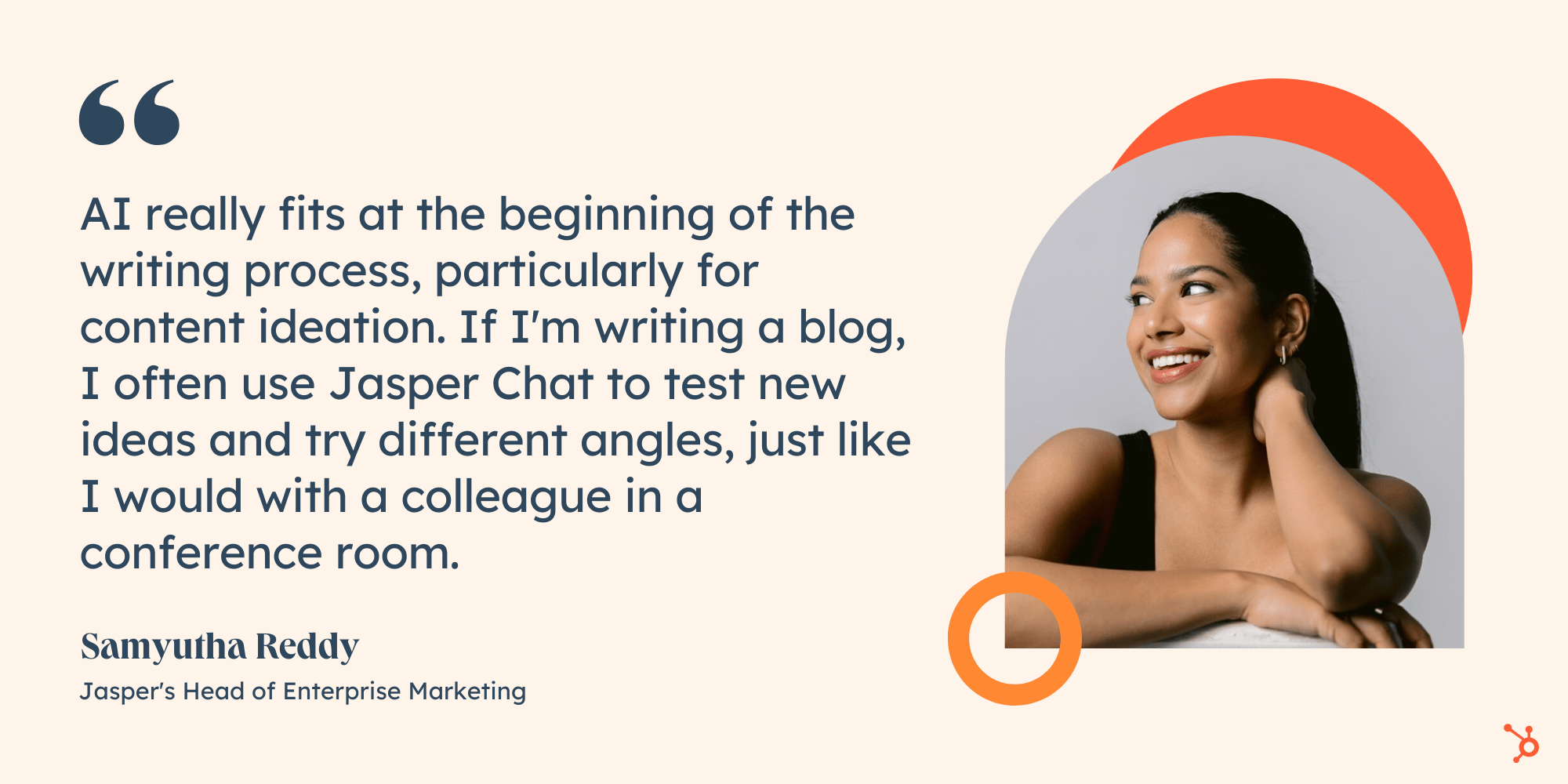
Samyutha told me, “AI really fits at the beginning of the writing process, particularly for content ideation. If I’m writing a blog, I often use Jasper Chat to test new ideas and try different angles, just like I would with a colleague in a conference room.”

Reddy Quote V1

Samyutha points out that AI tools are especially beneficial for remote marketers who don’t have the physical space to spitball ideas with others.

“It’s valuable during a time when people are working remotely and teams are distributed. We can get a lot accomplished in virtual meetings, but they’re not often used to just brainstorm or connect. In that way, AI can be really helpful,” she observes.

2. AI for content research.

A lot of effort goes into writing a piece of content before a writer can even put pen to paper. 

For most creators, the bulk of the work happens on the front-end — namely, researching and sifting through information. Samyutha believes this is the next big area for which AI can help.

She says, “Being able to take super lengthy pieces of content, feed them into Jasper’s Content Synthesizer, and have a summary of different viewpoints and pieces of data can help creators form an opinion or perspective that much quicker.”

For example, suppose a marketer needs to convert a multi-page e-book into a blog post. To speed up the process, she pastes the e-book into an AI chatbot and prompts it to list the biggest takeaways.

The AI chatbot analyzes the e-book to identify its key themes, topics, and ideas. After, the marketer uses its output as a rough draft for her blog, making sure to add her own voice and perspective. In the end, she has a new piece of content that took a fraction of the time to create.

Click here to set a Google Calendar Reminder for The State of Generative AI & How It Will Revolutionize Marketing [New Data + Expert Insights], coming May 17, 2023.

3. AI for scaling marketing campaigns.

In an ideal world, there would be a single channel to meet, engage, and convert customers. In reality, marketers need a multi-channel strategy to reach their audience.

Of course, scaling marketing campaigns is no easy feat. As Samyutha puts it, “We often burn all our energy on creating one beautiful, optimized piece of content. But then our distribution falls.”

However, marketers can use AI to build entire marketing campaigns from one piece of content, which they can adapt to different formats and lengths.

For instance, if a marketer creates a YouTube video that she wants to scale into an entire campaign, she can leverage AI to convert the video script into different formats, like a LinkedIn post, Facebook ad, or e-newsletter copy.

Now, she’s able to build a multi-channel strategy instead of relying on a single platform or format. On top of that, it enables her to ramp up her marketing strategically.

Samyutha underlines this point, telling me, “It enables me to truly be a project manager and a strategist, versus someone who is waiting on other people to deliver their end of the bargain.”

4. AI for SEO optimization.

As content creators, we want our work to be seen by as many people as possible. One way to get there is by optimizing for SEO.

However, not everyone is an expert in technical SEO. For Samyutha, this is where AI can really shine.

She says, “I’m not someone that grew up in the discipline of content marketing, and I never had a tool to help me with the technical aspect of SEO. That’s where Jasper comes into play. It can help content marketers optimize their articles by automating a lot of SEO tasks.”

For instance, an AI chatbot can write content around certain keywords, as well as suggest the best headers, meta tags, and descriptions to improve click-through rates.

But AI doesn’t end at optimization — it can also work as an editor during the final stages of writing. Tools like Jasper and Grammarly can detect wordiness, offer alternative phrases, and improve readability. The result? SEO-optimized content that people enjoy reading.

The Pitfalls to Avoid When Implementing Generative AI Into Your Processes

1. Removing creators from the creation process.

“When incorporating generative AI, the worst thing you can do is remove someone with a strong creative or editorial eye,” cautions Samyutha.

At first glance, AI-written content may look perfect. Yet, many human elements — like humor, empathy, perspective, and cultural context — could be missing. On top of that, generative AI operates with limited data, so the information it collects could be irrelevant, outdated, or even biased.

Ultimately, marketers should use AI for the first draft — not the last. AI can lay the groundwork, but you still need to elevate this content with your unique personality or perspective.

2. Recreating the wheel.

Every marketing team has a different strategy for creating content. As a result, your approach to AI — and how you choose to implement it — is unique to your team.

While AI is exciting and new, Samyutha recommends the “less is more” approach when adding it to your workflow.

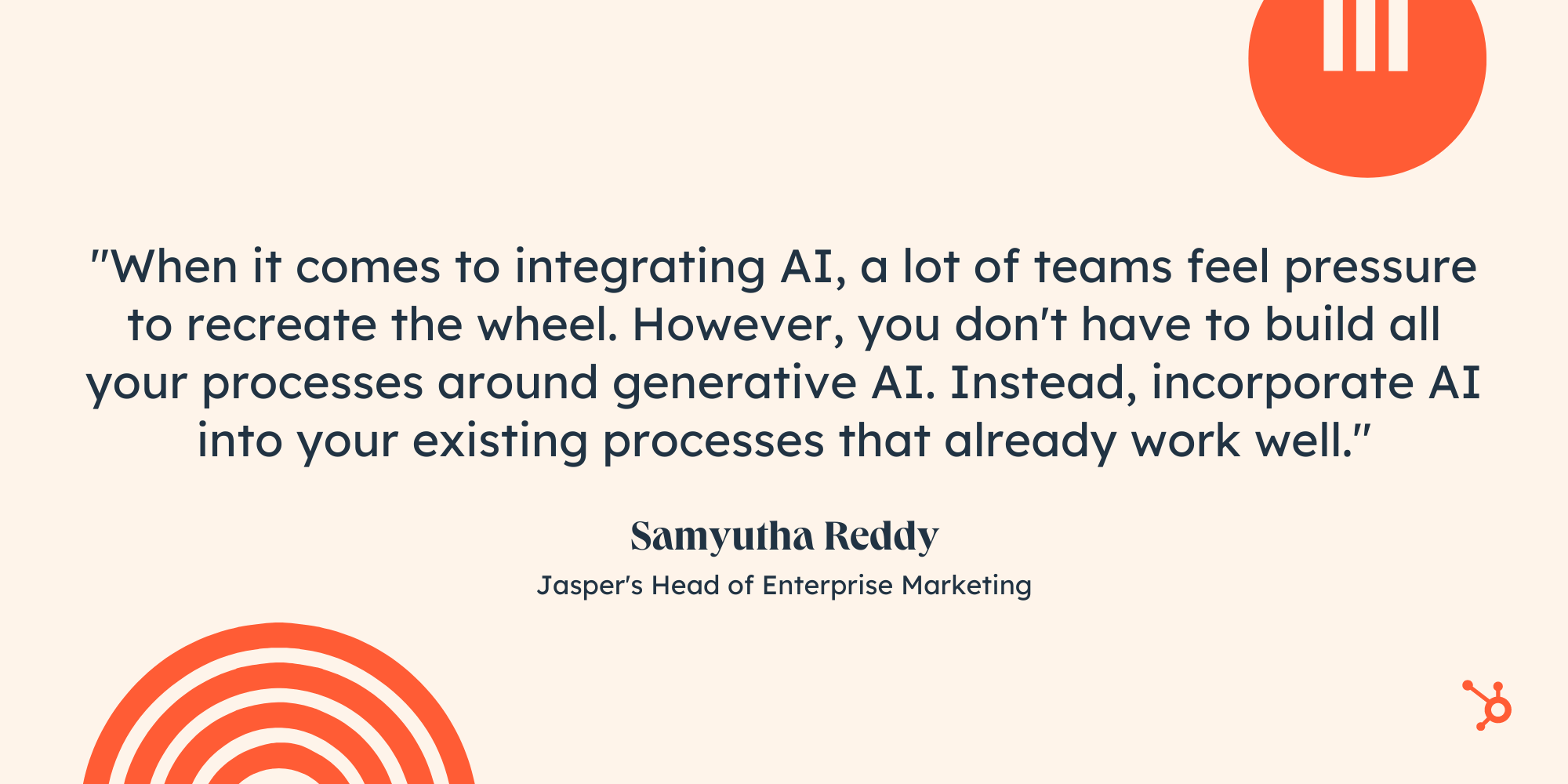
She tells me, “When it comes to integrating AI, a lot of teams feel pressure to recreate the wheel. However, you don’t have to build all your processes around generative AI. Instead, incorporate AI into your existing processes that already work well.”

Reddy Quote 3

For example, a marketing team may have an effective content distribution process, but it could be improved by automating some tasks with AI — like scheduling social media posts and reformatting content for different channels.

With this approach, your marketing strategy isn’t dependent on AI. Instead, it’s improved by it.

3. Raising content demands too quickly.

As AI continues to speed up the creation process, it’s important to have guardrails in place to maintain quality.

Samyutha says, “We have multiple processes built to check our work, and that doesn’t go away because Jasper’s in the picture. If anything, that chain link of feedback is strengthened so we can catch things like inaccuracies or mistakes.”

She continues, “It’s not about creating content as quickly as you can. It’s about effectively incorporating another piece of technology into your existing workflow.”

As marketers, we’re always seeking ways to stay ahead of the curve and embrace new technology to help us do our jobs more effectively. AI could be the next big opportunity to uplevel our work. But, as Samyutha points out, it’s important to be realistic with this technology.

Ultimately, it’s about knowing when to push this technology into your workflow — and when to pull back. With this approach, marketers can effectively incorporate AI into their strategies for maximum impact.

New Call-to-action

Categories B2B

Top Shopping Trends of 2023 & How They’ve Changed [New Data]

Shopping trends have drastically changed over the past few years. While most of us previously browsed retail stores on a Saturday to find great deals, we now turn to Instagram to find discounts offered by influencers.

And rather than watching TV ads to find out about new products, nowadays, most of us stumble across ads in between YouTube videos.

Download Now: The State of U.S. Consumer Trends [Free Report]

Here, we’ll explore the shopping trends of 2023, as discovered in our State of Consumer Trends Survey, to ensure you’re able to meet customers where and when they’d prefer to shop. Let’s dive in. 

Table of Contents

How Shopping Trends Changed in the Past 6 Months

The Top Shopping Trends of 2023

The Shopping Trends to Expect in 2023

How Shopping Trends Changed in the Past 6 Months

1. Consumers prefer flexibility over subscription models.

These days, consumers have a lot of flexibility in how they purchase products. They can make a one-time purchase or join a subscription service. They can also pay full-price or via installments thanks to popular platforms like Afterpay and Klarna.

However, this flexibility may not be necessary. While 32% of consumers have purchased a subscription over the past three months, a staggering 69% of consumers still prefer purchasing products whenever the need arises. 

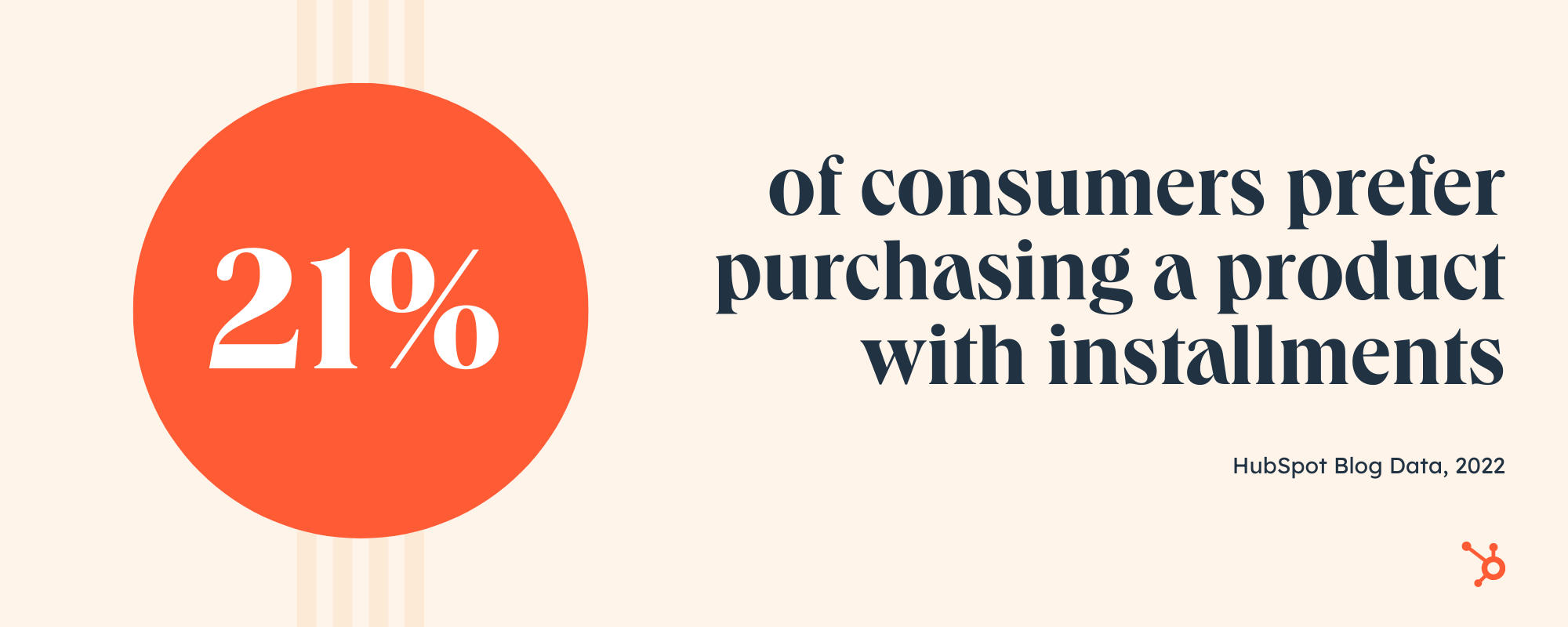
On top of that, consumers prefer to purchase products at full price. Only 21% of consumers prefer purchasing a product with installments.

Shopping trends: only 21% of consumers prefer to pay via installments

2. Baby Boomers are skeptical about shopping via social media, but they’re coming around.

According to our report, a slim 6% of Baby Boomers feel comfortable making purchases directly on social media. What’s more, only 5% trust social media platforms with their credit card information.

In short, Baby Boomers are skeptical about shopping via social media. However, things could be turning around.

24% of Baby Boomers have discovered a new product on social media in the past 3 months — up 41% from May 2022. On top of that, 6% of boomers have bought a product on social media in the past three months, a 50% jump from May 2022.

While these stats are promising, it’s important to meet your consumers where they are right now. So, if you’re audience skews older, you might get more traction with other channels like TV ads and search.

3. Millennials and Gen Z’ers may hinge their purchasing decisions on a company’s stance on social issues.

Increasingly, consumers want to support companies that share their values. For example, 66% of consumers want companies to reduce their environmental impact.

This isn’t just talk: corporate responsibility is influencing consumers’ purchasing decisions. Take a look at these stats:

  • 39% of consumers are more likely to buy a product based on the brand’s commitment to diversity and inclusion, up 8% from May 2022.
  • 61% of consumers believe companies should donate a portion of their profits to charity, up 9% from May 2022. Plus, 46% of consumers are more likely to purchase from a company that actively donates to charity.
  • 75% of consumers believe companies should try to improve the well-being of their employees, up 4% from May 2022.

At the same time, consumers are skeptical of companies that use social issues as a marketing ploy without actually taking meaningful action. But when a company takes a genuine stand, it can be an effective way to build trust and credibility with consumers.

The Top Shopping Trends of 2023

1. Influencer recommendations matter more than recommendations from friends and family.

Influencer marketing has proven an incredibly effective strategy for brands over the past few years — in fact, as of 2021, almost 60% of marketers said influencer marketing was the most effective marketing trend, ahead of SEO, experiential marketing, and short-form video content.

And in 2022, 30% of consumers now report influencer recommendations are one of the most important factors in their purchasing decisions, compared to 27% for recommendations from friends or family.

In many ways, this makes sense: Influencers are traditionally considered experts in their niche. If I follow a makeup influencer, it’s safe to assume he or she knows more about makeup than most of my friends.

For e-commerce businesses, this is powerful news: It means you no longer need to rely on word-of-mouth alone. Instead, it’s wise to focus your efforts on influencer marketing, since influencers have demonstrated a level of influence over their audiences that surpasses even that of friends and family.

2. Gen Zers prefer to discover new products via social media — but they still like to make purchases in-store.

Our State of Consumer Trends Survey found Gen Zers (ages 18-24) most often discover new products on social media (71%), followed by YouTube ads (56%), ads on music streaming services (55%), and internet searches (50%).

If your e-commerce business is targeting Gen Zers, then, it’s vital you focus your efforts on social media rather than paid ads when it comes to attracting new leads to your products and educating those leads on your products.

Additionally, when asked which content formats Gen Zers prefer for learning about a product and its features on social media, roughly 50% said they’d like to learn about a product through a story post. This is followed by short-form video (42%), and then a feed post (42%).

However, 73% of people (and 55% of Gen Zers in particular) say they’d still prefer to purchase a product in-store. This is an important call-out: While you’ll want to focus on social media for your lead generation efforts, it’s still vital to have a strong, effective in-store shopping option for those who would like to make the final sale in person.

shopping trends: a pie graph representing how consumers prefer to purchase products

3. When it comes to millennials and Gen X, retail stores and searching the internet are two popular options for discovering new products.

Similar to Gen Zers, the most popular method among millennial buyers for discovering new products is social media (51%).

However, in a close second for millennials is searching the internet (50%) — which means, if you’re targeting a millennial demographic, you might want to consider leveraging paid ads and a strong SEO strategy for getting your products in front of your target audience.

And if your target audience is Gen X (35-54 year olds), retail stores are the most popular option for discovering new products, so you’ll want to invest time and resources in partnerships with brick-and-mortar retailers to ensure your products are at plenty of physical locations.

Plus, similar to millennials, 39% of Gen X buyers also search the internet for new products, so SEO is another good option here.

4. Millennials and Gen Xers prefer to discover new products on social media through ads or sponsored content — while Gen Zers prefer discovering new products on social media through short-form videos.

Depending on your target demographic, you’ll want to vary the type of content you create for social media when it comes to attracting new audiences to your products.

For instance, if you’re aiming to attract Gen Zers, you’ll want to consider short-form video like TikTok or Instagram Reels, since 41% report short-form video as their preferred medium for discovering new products.

If you’re instead looking to reach millennials or Gen Xers, you’ll want to think about leveraging ads or sponsored content, since 44% mark that option as their favorite.

5. Mobile phones are the most popular device for online shopping.

When shopping online, roughly 75% of consumers prefer using their mobile devices, compared to 15% that prefer desktop and 6% that prefer tablet.

This means as an e-commerce business it’s critical your website is mobile-optimized, and you have mobile-responsive product pages.

If I’m scrolling a company’s products and I find it’s too difficult or cumbersome on my phone, I typically ditch the website – and don’t return. So it’s vital you ensure you’re following mobile best practices (including large text, lots of white space, responsive templates, and mobile-friendly calls-to-action).

6. Price matters most to when it comes to making a purchasing decision — but other factors might surprise you.

Across the board, price is a major factor when it comes to purchasing decisions. 78% of Gen Z, 74% of millennials, 74% of Gen X, and 73% of Boomers report price as one of the most important factors when it comes to deciding whether or not they’re going to buy a product.

The quality of a product is important, as well, with 65% of Gen Z, 78% of millennials, 82% of Gen X, and 72% of Boomers marking it as another top factor when it comes to purchasing decisions.

But beyond having a reasonably-priced and high-quality product, there are a few other distinguishing factors you’ll want to keep in mind when marketing your brand.

For instance, 57% of Gen Zers will consider purchasing a product if a percentage of the proceeds from the purchase will be donated to charity. And 55% of millennials prefer buying a product that has strong reviews. 62% of Gen Xers appreciate whether a brand has an active community around it, and 55% of Boomers look for a product’s features and functionality when considering a purchase.

shopping trends: a bar graph representing the most important factors that go into a purchase decision

7. Short-form video offers huge advertising opportunities.

Short-form video is the most popular video length on social media. As a result, TikTok — and other short-form video platforms — are becoming viable advertising channels. In fact, 36% of consumers want to learn about products through short-form videos like TikToks or Reels.

On top of that, 52% of U.S TikTok users say the advertisements they see on the platform are fun and engaging — which are two ingredients for effective ads.

The Shopping Trends to Expect in 2023

Here are a few trends you’ll continue to see: 

  • Mobile usage for shopping will continue to dominate the e-commerce industry. In 2018, it encompassed 63.5% of total e-commerce sales, and in 2020, that number jumped to 70.4% (Source). As mentioned above, we found roughly 75% of consumers preferring their mobile devices in 2022, which suggests mobile sales will continue to dominate the e-commerce landscape. 
  • The Influencer industry will continue to grow and remain one of the most popular avenues for brands looking to connect with their audiences. Influencer marketing has grown rapidly over the past few years — from $1.7 billion in 2016 to $9.7 billion in 2020, and $13.8 billion in 2021. Nowadays, Gen Zers and millennials aren’t looking to celebrities for inspiration when it comes to purchasing products or services, and they’re not turning to friends, either — they’re looking to these influencers. 
  • We’ll see a rise in people who use the metaverse or buy virtual currency. HubSpot’s Consumer Trends Survey found over half of those who have ever used the metaverse or bought virtual currency/items have done so within the past three months — including 56% who’ve visited the metaverse, 56% who’ve bought cryptocurrency, and 75% who’ve bought NFTs for the first time. 

When creating an effective e-commerce strategy, it’s vital you take the time to understand how shoppers want to shop today — and into the future. Shopping behaviors change over time. The more your business can meet the evolving needs of your consumers, the more likely you are to continue to succeed well into the future.

New Call-to-action

Categories B2B

How to Generate Leads on LinkedIn in 2023, According to LinkedIn’s VP of Marketing

LinkedIn is an incredibly powerful platform for growing both recognition and revenue as a B2B business. 

In fact, audiences exposed to brand messages on LinkedIn are 6X more likely to convert, according to data from the social company. 

But without a clear strategy in mind, the task of lead generation on LinkedIn can feel challenging. Which is why I sat down with Jim Habig, VP of Marketing at LinkedIn, to learn some of his key insights, as well as additional tips on how to use LinkedIn for lead generation in 2023 and beyond. 

Skip to: 

Free Guide: How to Use LinkedIn for Business, Marketing, and Networking  [Download Now]

LinkedIn Lead Generation Strategy

As a refresher, lead generation refers to all of the activities and strategies you use to attract potential customers. Generating leads is important because, with nurturing, potential customers can become paying customers that use your products and drive revenue. 

LinkedIn’s typical audience comprises professional decision-makers with purchasing power, helping you speak directly to the potential customers that can become paying customers. Below, we’ll discuss how you can use LinkedIn for lead generation.

1. Make sure your executives have a strong LinkedIn presence.

When you’re first getting started on LinkedIn, it can be tricky to know how to dedicate your initial efforts. Should you create a compelling LinkedIn Page and immediately begin posting content to your business’s feed? Or should you start by posting all your job openings to attract new talent?

Habig agrees that it’s critical to optimize your company Page to make a strong first impression. He encourages marketers to ensure their Page is complete and up-to-date with relevant information like a business description, logo, website URL, and industry.

However, an often overlooked opportunity to generate leads falls on individual employees’ pages. 

As Habig puts it, “You’ll want to encourage your leadership teams and employees to have well-crafted personal profiles with professional headshots, descriptive headlines, and detailed job experiences.

He adds, “A consistent brand presence builds credibility, attracts the right audience and fosters trust among potential leads.”

Consider the leaders at your company and their current LinkedIn presence. Could they contribute more thoughtfully to LinkedIn groups within your industry or post more often to their feeds? More likely than not, your executives could be doing more to grow their LinkedIn following.

For instance, let’s take a look at HubSpot CEO Yamini Rangan’s recent LinkedIn post: 

Rangan uses LinkedIn wisely, leveraging the platform to share helpful, relevant content geared towards business leaders. Rangan uses LinkedIn to build a personal brand and help her followers find valuable content related to business growth. Ideally, your executives should be doing the same.

2. Create a powerful LinkedIn Page for your business.

Once you’ve ensured your own executives have a strong LinkedIn presence, it’s time to cultivate an impressive Page for your business.

You’ll want to ensure your page is active, with thought-provoking content and contributions to conversations already happening on LinkedIn.

LinkedIn Pages is a free product that can help your company build visibility on the platform. It’s also a key Page to house your brand’s thought leadership content, such as videos, commentary from executives, and curated information from other sources. 

Take a look at LinkedIn Company Pages: The Ultimate Guide [+ 12 Best Practices] to learn more. 

3. Post relevant content and engage with your audience. 

To ensure your LinkedIn page and profile are strong, consider posting various content types, including video. Featuring this industry-relevant content can help you position yourself as a knowledgeable source and establish relevance and credibility with potential customers. 

As Habig puts it, “Creating and sharing high-quality content tailored to your target audience’s interests is key to driving engagement and generating leads. Share a mix of content types — like blog posts, infographics, case studies, and videos to keep your audience engaged.”

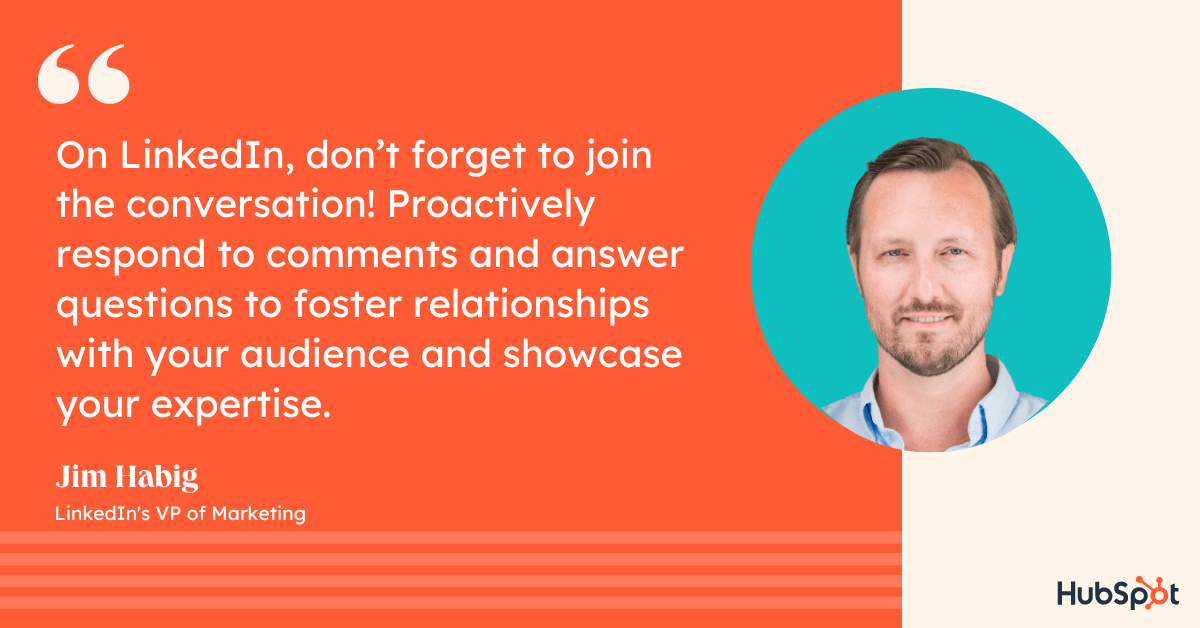
He continues, “And don’t forget to join the conversation! Proactively respond to comments and answer questions to foster relationships with your audience and showcase your expertise.”

When you’re recognized as an insightful, valuable source, you’ll begin to develop connections with like-minded professionals that fit your ideal customer profile. If you post often, you’ll become a regular on their feed, and familiarity makes it easier to initiate further conversations.

Jim Habig discusses the importance of engaging with leads on LinkedIn

If you assume that the connections you have on LinkedIn are professionals within your industry, they can expose you to new audiences with the content you post. When your connections click ‘Like’ on a post you’ve made, it may show up on the feed of a new lead. This lead will see that your shared connection has liked your post, vouching for your credibility and authority, and possibly prompting them to send a request to connect.

To ensure that you’re creating content that people want to see, follow your page analytics to figure out what resonates with them the most and create accordingly.

4. Join LinkedIn groups your clients and customers are in. 

LinkedIn, at its core, is a social platform like any other. Just as you can on Facebook, users can create groups centered around industry-relevant interests, and you should join these groups and have conversations with other professionals.

You can post content and updates to encourage discussions about relevant topics or simply talk about the services you offer. If you’ve joined groups wisely, your potential customers can see what you say and begin to recognize you as a source of valuable information. 

You can also use groups to learn more about your audience. If members are active, learn from what they say and discover common industry pain points and how leads want these issues addressed. Use this information to your advantage, and create hyper-targeted value propositions when you reach out that speak directly to your customer’s needs. 

5. Use LinkedIn Ads and Sponsored Content to ensure your content reaches your intended audience.

Businesses with small marketing budgets may be wary of putting money behind paid campaigns on LinkedIn. They often ask — We have a small marketing budget, and we want to use it wisely. Where should we spend it? Given that LinkedIn is the top paid and organic channel for B2B businesses, spending your money on the platform would be worth your while. 

Habig suggests, “Consider using LinkedIn’s advertising and sponsored content solutions to reach the right audience based on factors like job title, industry and company size.”

He adds, “You’ll want to utilize sponsored content to promote your top-performing posts or lead generation forms to capture valuable lead information. Try testing various ad formats like sponsored InMail, carousel ads, and lead gen forms to identify which works best for your target audience.”

In particular, Habig believes the LinkedIn Lead Gen Forms is one of the platform’s most powerful offerings for lead generation.

He told me, “LinkedIn Lead Gen Forms streamline lead generation by auto-populating users’ LinkedIn profile information when they click on your ad. This simplifies the process for users, allowing them to submit their information with ease and boosting lead generation efficiency. Furthermore, the collected data can be effortlessly synchronized with your CRM system.”

Additionally, it’s important to note other native content features — such as articles and polls — can help you increase engagement with your audience. 

While LinkedIn has a native ads management service, you can also use HubSpot’s ads management tool to create, organize, and execute advertising campaigns on LinkedIn. You’ll also get access to high-quality reports that explain ad performance, helping you optimize a strategy to meet your customers’ needs. 

6. Ensure you have strong sales and marketing alignment.

You’re likely all too familiar with the recent shift in consumer buying behavior. Nowadays, customers are researching online ahead of time and typically use marketing content to inform their purchasing decisions before even reaching out to a sales rep.

With savvier consumers, it is now critical that marketers meet the needs of consumers who are further along the buyer’s journey and then seamlessly hand them off to sales so sales has the context on which stage of the buyer’s journey the consumer is at. 

Additionally, many salespeople know the target customer better than anyone, so leveraging sales reps’ knowledge when creating marketing materials is vital. 

All of which is to say — it’s critical you align your sales and marketing teams since they play equally valuable parts in finding prospects and closing deals, and they overlap more heavily now than ever before.

To figure out strategies for better aligning your sales and marketing departments, take a look at this Ultimate Guide to Sales and Marketing.

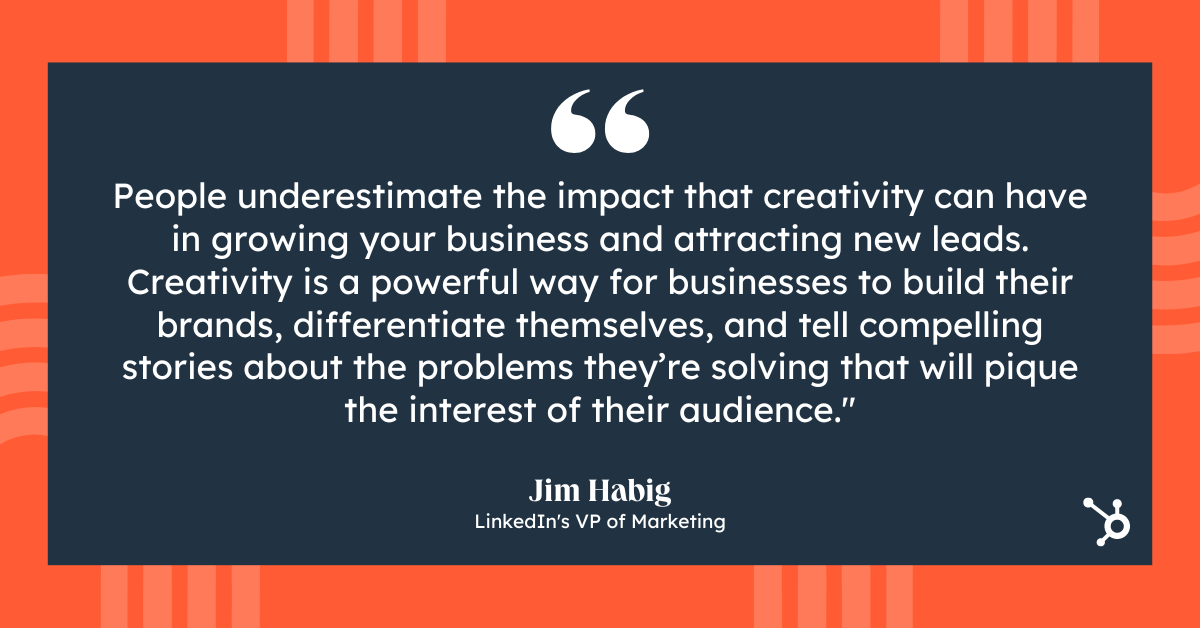
Jim Habig emphasizes importance of using creativity on LinkedIn

7. Leverage connections with current customers and clients. 

LinkedIn’s main draw is networking, and you should use this feature to your advantage for lead generation. 

Connect with current customers and clients on LinkedIn and learn from who their industry connections are, as they may be relevant to you as well. If you have relationships with existing clients you connect with, ask for referrals, references, or simply learn how to get in contact with a connection they have that matches your customer profile.

As LinkedIn is a professional network, such requests are less pushy, spammy, and salesesque than cold calling someone after finding their number online. Leads can receive your request to connect, browse your profile, and see your shared connection as a guarantee of trust. 

In addition, when you connect with new leads, you’re using warm outreach. This means that you already know a bit about them and can immediately make propositions that relate to their interests, providing value to them off the bat.

8. Maintain a consistent presence on the platform. 

Just like all of your other social media sites, LinkedIn requires consistency. If you post an article once a week and then log out, you’re not establishing yourself as a consistent presence with your connections. You also want to communicate consistently with your leads. Disappearing in the middle of a conversation is not a good look and does the opposite of furthering their interest in doing business with you. 

Additionally, to ensure you’re reaching the right audiences, consider leveraging LinkedIn Matched Audiences to retarget website visitors. 

Habig says, “LinkedIn offers advanced targeting capabilities to help you connect with your ideal audience. With LinkedIn Matched Audiences, you can retarget website visitors, create contact-based audiences using email lists or CRM data, or build account-based audiences by targeting specific companies. This feature enables you to engage people who have already shown interest in your business or are more likely to be interested.”

He adds, “For newcomers to LinkedIn or those seeking guidance on setting up targeting, consider using LinkedIn’s pre-built audience templates. These templates simplify the process and cater to various audiences, such as doctors, recent college graduates, millennials and more.”

As mentioned above, use platform analytics to learn about your audience’s interests, when your posts get the most traction, and create a strategy that will keep you consistently present and visible on LinkedIn. 

The Most Effective Content for Generating Leads on LinkedIn, According to LinkedIn’s VP of Marketing 

When asked which content Habig believes performs best on LinkedIn when it comes to generating leads, Habig told me two major types of content typically win out: educational, and thought leadership. 

As he puts it, “There’s a delicate balance between offering what I’ll call practical content geared towards the practitioners and presenting forward-thinking thought leadership. Both are essential for capturing the attention of your prospects and customers.”

Habig continues, “Providing educational content — such as how-to guides, case studies, whitepapers and e-books — positions your brand as a ‘helpful teammate’ that your audience can rely on for support and expertise.”

On the flip side, you don’t want to ignore the potential power of thought leadership, either. 

Habig says, “It’s crucial to incorporate thought leadership, demonstrating that you’re in tune with the industry’s trajectory. According to recent research conducted in collaboration with Edelman, 50% of C-suite executives say that high quality thought leadership has ,more impact on their purchase decision-making during economic downturns than when times are good.”

Of course, you’ll want to assess your own content analytics to determine what performs best with your own audience. But consider testing these new formats — if you haven’t already — and see how they do. 

What Marketers Get Wrong When It Comes to LinkedIn for Lead Gen 

Finally, I had to ask: What is the biggest mistake marketers make when it comes to LinkedIn lead gen strategies? 

Habig had a straightforward answer: “People underestimate the impact that creativity can have in growing your business and attracting new leads. In a recent report, we found that 69% of people said B2B purchasing is just as emotionally driven as B2C. Creativity is a powerful way for businesses to build their brands, differentiate themselves, and tell compelling stories about the problems they’re solving that will pique the interest of their audience.”

Which is good news for most marketers — who likely got into marketing for the storytelling in the first place. 

New Call-to-action


Categories B2B

4 Types of Arificial Intelligence & What Marketers Are Using Most (Research)

You’ve likely heard how artificial intelligence can revolutionize the way marketers work. In fact, you may be using AI-powered tools right now.

But if you’re like me, you haven’t “pulled back the curtain” to see how this technology works — until now.

Here, we’ll cover the four main types of artificial intelligence — reaction machines, limited memory, theory of mind, and self awareness — and how each type can power your marketing.

Free Guide: How to Use AI in Content Marketing [Download Now]

How many types of AI are there?

There are four main types of AI: reactive machines, limited memory, theory-of-mind, and self-aware.

However, since AI can be categorized by function (the types listed above) and capabilities, you add three more to the mix: narrow intelligence (ANI), general intelligence (AGI), and superintelligence (SGI).

Below we’ll explain each type.

4 Types of Artificial Intelligence

4 types of AI: reactive machines, limited memory, theory of mind and self aware

Reactive Machines

As the name suggests, reactive machines react and respond to different prompts. It does this without the use of memory or a broader understanding of the context.

For example, this type of AI is commonly used in game design to create opponents. The opponent will respond to your actions, movements, or attacks in real time but is unaware of the game’s overall objective. On top of that, it stores no memories, so it doesn’t learn from past experiences and adjust its gameplay.

Reactive AI powers a lot of marketing tools. A notable example is chatbots. These programs use reactive AI to respond to messages (or inputs) with the right information.

chatbot-Apr-06-2023-06-49-13-0147-PM(Image Source)

Chatbots are a popular tool in customer service, but they can also boost the productivity of marketers. For instance, HubSpot’s ChatSpot is a handy AI-powered assistant that can pull reports, create contacts, and send follow-up emails based on certain commands.

Beyond chatbots, reactive AI can analyze customer behavior, campaign performance, and market trends. With these insights, marketers can optimize their campaigns on the fly, improving their effectiveness and ROI.

Limited Memory

Limited memory AI is able to learn from a limited amount of data or feedback. However, it doesn’t “bank” any memories for extended periods of time.

A great example of the ‘limited’ aspect of this AI is ChatGPT. It has a limit of 4000 tokens (forms of text like words) and can’t recall anything from a current conversation after that limit. So, if a conversation is 4097 tokens, ChatGPT responds based on the latest 97 tokens.

This technology can be found in self-driving cars. It can detect lanes and map out the road ahead. It can also adjust the car’s speed and break in real time based on traffic patterns and road conditions.

In marketing, limited memory AI can be used to analyze large amounts of data, helping marketers make smarter decisions about their strategies and tactics. It can also make predictions and recommendations based on this data.

While limited memory algorithms are effective, they aren’t foolproof. They can make mistakes or provide inaccurate predictions, especially when working with outdated data. In other words, the output is only as good as your input. So, it’s important to train these algorithms with accurate, relevant, and up-to-date information.

Reactive machines and limited memory AI are the most common types today. They’re both a form of narrow intelligence (which we’ll discuss further below) because it can’t perform beyond programmed capabilities.

Theory of Mind

Theory of mind exists only as a concept. It represents an advanced class of technology that can understand the mental states of humans.

For instance, if you yell at Google Maps because you missed a turn, it doesn’t get offended or offer emotional support. Instead, it responds by finding another route.

The idea behind theory of mind is to create machines that can interact with humans more effectively because they understand their needs, goals, and motivations. If an AI system can understand the frustrations of a disgruntled customer, for example, it can respond more tactfully.

In the long term, theory of mind AI could have significant implications for marketing. However, it’s still in its early stages, making it difficult to predict when it will become a reality.

Self Aware

Self-aware AI is seen as the next phase in the evolution of theory of mind, where machines are able to understand human emotions and have their own emotions, needs, and beliefs. Currently, this type of AI only exists hypothetically.

M3gan, the robot from the movie of the same name, is an example of self-aware AI. She’s sentient and knows who she is and experiences emotions, and can understand the emotions of those around her. She’s awkward like we’d expect from a robot, but she has social interactions.

The Stages of AI

Artificial intelligence has three stages, largely defined by its ability to replicate human capabilities:

  1. Narrow Intelligence (ANI): Narrow AI represents most AI systems that exist today. At this stage, AI is designed to perform a specific task or set of tasks. It doesn’t have the ability to learn or adapt beyond their programming. Examples include chatbots and virtual assistants (like Siri), and recommendation algorithms.
  2. General Intelligence (AGI): This is the next evolution of AI. These systems are designed to have human-like intelligence, allowing them to learn and adapt to new situations, think abstractly, reason, and solve problems. At this moment, AGI is still largely theoretical.
  3. Superintelligence (ASI): ASI is an advanced form of AI that surpasses human intelligence, enabling it to solve complex problems, create new technology, and make decisions beyond the scope of human understanding. ASI is a hot topic of debate, and its potential benefits and risks are highly speculative.

While these stages are widely accepted, there is ongoing debate about what defines each stage and when we might achieve them — or if we should evolve AI at all.

Top Types of AI in Marketing

As mentioned, reactive and limited memory AI (both are narrow AI) are all that exist today. This means the AI tools marketers use are strictly reactive, or reactive + limited memory.

We surveyed 1350+ marketers in the U.S. to learn more about their use of AI and automation and the tools they use in their roles. Here are some key takeaways.

First, when asked about the generative AI tools used in their marketing roles, most marketers use AI use chatbots (66%).

Chatbots can be both reactive and limited memory AI. For example, a rule-based chatbot following an if/then model and is programmed with canned responses could be called reactive AI because it follows a set structure and can’t deviate from the structure.

Machine learning chatbots, like conversational chatbots, are limited memory AI because they leverage data and past conversations to respond to customers. They become more effective over time, but their memory is limited.

Marketers also said they commonly use visual AI tools (57%) and text generation tools (56%). Regardless of the tool they use, all generative AI is limited memory AI because the tools can create new content based on the data it’s trained on.

All AI/automation users that responded to our survey say that AI and automation tools save an average of 2 hours and 24 minutes per day.

Back to You

From reactive machines to limited memory AI, theory of mind, and self-awareness, each type of AI has its strengths and limitations. Knowing these differences is key to choosing the right tools, leveraging them effectively, and staying ahead of the curve.

New Call-to-action

Categories B2B

The Content Aggregator Guide for 2023

Those who know me, know that I have a healthy obsession with travel, and so, I often pour through travel blogs looking for the best way to plan a trip and the best activities to do in a given place. One tool that will always help me find what I need is content aggregation.

Download Now: 150+ Content Creation Templates [Free Kit]

Since they’re not solely for travel sites, content aggregator sites can be a useful strategy. Marketers can reach new audiences, and consumers can find relevant resources.

In this post, you’ll learn what content aggregation is and discover high-quality sites.

Table of Contents

Essentially, content aggregator sites collect and repost content so viewers can see articles from various sources all in one place. Usually, these sites are set up to aggregate content through RSS feeds automatically.

So, now that we know more about content aggregation, see how you can get started.

How Content Aggregators can Help Marketers

Content aggregation can help marketers distribute content on multiple platforms, making it easier for people to find you.

The more platforms you’re on, the more exposure you have to a variety of audiences. Given this, content aggregation is a tactic you could include in a brand awareness strategy.

Additionally, using content aggregators to distribute your business content can help you become involved in your community, especially if you encourage interaction. For example, people can leave comments, have discussions, and also have conversations with you.

Before you get started, it’s essential to understand how to pick a content aggregation site.

How to Pick the Right Aggregator Service

When it comes to picking the right aggregator service for your business, the most critical question is the type of content you’re hoping to share on it.

For example, there are specific sites for news stories, others for blogs, and others focused entirely on social media content — you want to pick the one that aligns most with your needs (our list below will help).

In addition, some aggregators cost money. If you have a strict budget, you’ll want to visit the pricing pages of services to see if there are any fees.

However, many services are free of cost and are curated by editors or algorithms, so your choice depends on your business needs.

Aggregation vs. Creation vs. Curation

There are a variety of ways you can provide valuable content to your audience. It’s important to understand which approach (or combination of approaches) best suits your business’ goals and your audience’s interests.

Content creation is the process of developing topic ideas and content for your target audience through written and visual products. This information is made available through blogs, videos, infographics, and other digital formats.

Content curation is a bit closer to content aggregation in that it is not original content. Instead, it is content that is curated and presented to the target audience.

The content is manually collected, organized, and annotated, so it often includes commentary and/or context.

Finally, as previously explained, content aggregation is different from both content creation and curation in that it’s automatic and collects information based on keywords.

The content is gathered from different sources online and put together in one easy-to-find place.

This tool allows your audience to derive a lot of value from your distribution and aggregation with minimal and efficient effort on your end.

Each of these methods can offer a way to expand your marketing strategy and are worth your consideration. However, here we are just focusing on digital content aggregators.

Content Aggregation Tools

Now, let’s go over some different high-quality content aggregation tools that can be valuable to you.

Blog Aggregators

As implied in the name, blog aggregator sites focus on blog websites. They can contain general blog posts or more niche-focused aggregators, such as a travel blog aggregator that’s focused on travel blogging content.

1. Travel Blogger Community

Travel Blogger Community is a content aggregation site that I use when searching for travel blog content. You can request to have your content featured, and it is curated by editors.

Travel blogger community travel blog aggregator site

Image Source

Pro tip: Travel Blogger Community is a great example of a niche site that may also exist within your industry, so be sure to do some research if you’re going to implement a content aggregation strategy.

2. Flipboard

Flipboard is a popular blog aggregator that allows users to create a custom feed based on their interests.

What we like: Personalization allows you to create a profile, submit an RSS feed, and share your content. You can also create a personal storyboard with content related to your business and link to it on your website via social buttons.

flipboard blog content aggregator site

Image Source

3. The Web List

The Web List is a single-page content aggregator with original content from a variety of sources. It highlights the most popular items of the day at the top, then organizes other articles by source.

The Web List blog content aggregator site

Image Source

News Aggregators

News aggregator sites compile content from various high-quality news sources. These sites can be for general news, location-specific news, or industry happenings.

4. Google News

Google News displays the top news stories for the day, saving users a trip to their search engine.

You can’t submit your content to the site as it is curated based on search history and location, but if your site gains traction, you increase your chances of being featured.

Best for: Customization. Users can customize their feed by “following” specific topics, sources, or searches.

Google news aggregator site

Image Source

5. AllTop

AllTop aggregates content from various topics and sources, such as top news sites and social media forums.

Users can search for topics of interest and get the top stories or just browse through the homepage.

Pro tip: AllTop sometimes accepts site submissions, so be sure to check back periodically if you want to feature your content.

AllTop news aggregator site

Image Source

6. Pocket

Pocket is an aggregation site that features a wide variety of content that users can customize to meet their interests by clicking a “Follow” button. You can also bookmark content to read on the go on your mobile devices — hence Pocket.

Best for: Anyone! There is a wide range of categories from tech through finance to travel.

Pocket news aggregator site

Image Source

7. WP News Desk

WP News Desk is a unique aggregator site that focuses on content related to the WordPress community.

You can’t submit your own content to be featured, but if you run a high-quality WordPress blog that is informative for users, you may find your site featured on the aggregator.

WP News Desk news aggregator site

Image Source

8. Feedly

Feedly is a content aggregation site that’s focused on helping users create their own feed, so they aren’t overwhelmed with information overload.

Pro tip: The site has both free and paid plans, so users can aggregate content from as many sources as they want and across any niche.

Feedly news aggregator site

Image Source

9. Techmeme

Techeme is a niche news aggregator site that provides readers with the top news stories about technology-related topics, curated by editors.

In addition to the homepage, which features the day’s top stories, you can also choose the River view to see live updates or the Leaderboard view to find articles by topic.

Pro Tip: You can pay to have your content, event, or job listing posted on Techmeme, so if you’re in the tech business, this may be a great resource to tap into.

Techmeme news aggregator site

Image Source

Information Aggregator Websites

Information aggregator websites contain exactly that — information. This can include blog posts, news stories, links to social media content, and any information that users can benefit from.

10. Upstract

Upstract is a popular information aggregator. It allows users to choose the platforms they want information from to create a custom feed.

What we like: The crazy variety — it pulls from Reddit, Huffington Post, The Verge, Google News, Wired, and even TikTok, setting them all side-by-side.

While you can’t submit your site to be included in this aggregator, it’s nevertheless a powerful platform to be aware of if you’re going to start using content aggregation.

Upstract information aggregator site

Image Source

11. Panda

Panda offers both a website and Chrome extension specifically curated for developers, designers, or just anyone who identifies as an entrepreneur.

It allows you to stay up to date with industry news from sources such as Hacker News, TechCrunch, and Github.

What we like: It is presented in an easy-to-use and aesthetically pleasing manner, making it the perfect content aggregator for anyone in the industry.

However, keep in mind that Panda doesn’t allow user submissions. Therefore, your feature may just come about if your content rises to the top of any of these notable news sites.

12. Reddit

Reddit is a household name, and if it isn’t in your home, then you must be living under a rock. However, it is also one of the most popular information aggregator sites.

It features trending topics from all different areas of interest while also providing a forum where people can comment and discuss the latest news.

Pro tip: As I’m sure you know, members of the site can submit content such as text posts, images, and links. Therefore, it’s a great tool for marketers to spread their word further.

Reddit information aggregator site

Image Source

Social Media Aggregators

Social media aggregators compile high-quality content from sources such as Instagram, Facebook, YouTube, and TikTok. Most social media aggregators help markets find user-generated content to share with their audience to build brand trust.

13. TaggBox

TaggBox is a social media aggregator focused on helping marketers develop brand trust and engagement through user-generated content.

You create an account, select the tags that are relevant to your business, and you’re shown posts across different social media platforms that your audience has made about you.

Pro tip: You also have the option to create a social feed of user-generated content to display on your own website, helping site visitors see your content in action and generate trust from other consumers.

TaggBox social media aggregator site

Image Source

14. Tagembed

Tagembed collects and curates engaging social media content related to your business that you can then display on your website.

What we like: You can generate a social feed from multiple sites and share the custom content within your site for all users to see.

Tagembed social media aggregator site

Image Source

15. Curator

You can draw posts from the most popular social media sites to create and share your own feed on your business’ website.

You can choose whether the posts automatically appear on your site or whether you manually approve each first. Curator offers free and paid plans.

Best for: Building brand trust by sharing customer posts with prospects and site visitors.

Curator social media aggregator site

Image Source

While it may not make up the core of your marketing plan, content aggregators are a unique and exciting tool for marketers to use to share their content and gain exposure, while simultaneously becoming involved with your community.

content templates

Categories B2B

The 12 Best Social Media Analytics Tools for Marketers in 2023

These days, businesses across every industry are investing in social media marketing. But no matter how great your social media content is or how many people follow your accounts, you won’t be able to grow your audience, reach, and presence if you don’t understand the data behind it all.

In-depth knowledge about the status and success of your social media marketing will offer actionable insight into things like which strategies should remain in place and what you should change or experiment with in order to grow. Social media analytics tools are able to help you with just that.

In this post, we cover the following:

Download Now: Free State of Marketing Report

Social Media Analytics

In this blog post, we’ll review the importance of social media analytics and some great options to help you measure your social media marketing success.

Get certified in social media strategy with this free course.

What is social media analytics?

Social media analytics is the process of gathering, analyzing, and applying data, information, and reports related to the content shared on your social profiles and the social profiles themselves.

Why use social media analytics?

With social media analytics, you can:

  • Understand the metrics that matter most to your team and business such as engagement, reposts, shares, clicks, impressions, and sessions.
  • Identify effective ways to boost brand awareness and reach.
  • Resonate with your audience.
  • Boost traffic to your other content and website.
  • Increase conversions.
  • Improve customer loyalty.

How to Track Social Media Analytics

Here are the steps involved in tracking social media analytics

  1. Identify which social media platforms you’ll be measuring impact on (e.g. LinkedIn, Facebook, Instagram).
  2. Determine which metrics you’re doing to track (e.g. clicks, impressions, likes, shares).
  3. Choose a time period to analyze (e.g. last quarter, last month, last week, duration of your campaign).
  4. Determine which tools you’ll use to track and measure success (we’ll cover your options in the next section).
  5. Review and analyze your data (depending on your tool of choice, there may be internal features to help you understand and analyze your data — such as this one with HubSpot).
  6. Apply your findings and conclusions to improve growth in the future.

1. HubSpot Social Media Software

HubSpot social media analytics dashboard

Get started with HubSpot Social Media Analytics 

HubSpot provides a deep look into the way social media impacts your bottom line and gives you the ability to report on social media ROI. View and compare performance across different platforms, campaigns, and publishing times — all from a single tool.

Monitor your brand on social to understand how your target audience perceives your business and content. Additionally, YouTube Reports provide insight into how your audience and buyer personas engage with your videos. Lastly, effectively reach certain audiences by using data and context from the Contacts in your CRM (which this social tool integrates seamlessly with).

Feature highlights: Social campaign publisher, social mentions monitoring, social reports

Get certified in social media strategy with this free course.

2. Sprout Social

Sprout Social engagement report social media analytics tool

Source

Sprout Social is a social media planning service with expansive analytics and reports that help you understand the performance of all of your social accounts.

Configure and customize reports and metrics to help you scale your business’s presence on social. And if you’re a HubSpot customer, integrate your CRM with Sprout Social to collect and view accurate reports all in one place.

Feature highlights: Competitor comparison tool, integrated publishing and engagement tools, social listening

3. Brandwatch

Brandwatch

Source

Brandwatch is a consumer intelligence tool and social media management solution with analytics capabilities.

Social insights like social listening and competitor benchmarking can inform your content creation. You can gain a better understanding of the audiences engaging with your social content with audience profile cards. View key data in one place with customizable dashboards.

Feature highlights: Audience profile cards, customizable dashboards

4. Mailchimp

mailchimp reports and analytics software

Source

Mailchimp is a full-service marketing platform that offers analytics for social media ads. It’s easy to use for small marketing teams and requires little time to pour over the accompanying analytics.

With Mailchimp, you’ll have an audience dashboard, which is a page dedicated to understanding audience behavior. Additionally, the software offers tools to look into smart targeting and mobile integrations. These tools can diversify a social strategy and deliver higher engagement numbers by helping you create content that specific audiences will respond to.

Feature highlights: Content optimizer with AI-assisted suggestions, content studio for managing digital assets

5. Social Status

social-status-analytics (2)

Social Status is a dedicated social media analytics tool with robust reporting features. The platform comprehensively covers Facebook, Instagram, TikTok, YouTube, LinkedIn, and Twitter.

Social Status reports can be completely customized and white-labeled making them perfect for agencies and brands with complex requirements. Reports can be exported to PDF, PowerPoint, and Google Slides. The tool also covers paid and organic performance, competitor benchmarking, and influencer campaign tracking all in one powerful social analytics tool.

Feature highlights: Social media reports across multiple channels, influencer campaign tracking

6. Databox

databox social media analytics tool

Source

Databox is an expansive analytics platform that lets you set and track social media campaign goals. It’s a good choice for businesses that have many contacts, social accounts, campaign goals, and target audiences.

Customize metrics that matter most to your campaign or social channels for your reports. Any integration you have, such as HubSpot, will be visible from your dashboard as well.

Feature highlights: Dashboard designer, custom metric builder

7. Grow

grow social media analytics software

Source

Grow users gain full visibility into engagement on all of the social accounts. The tool integrates with HubSpot, Salesforce, Google Ads, Facebook, Marketo, and Microsoft Office so you can view all data in one place.

Grow breaks down complex data into graphs and visuals, and your social reports are easily sharable which is helpful if multiple people are working on the same project. Grow’s reports are built with metrics chosen by the user — meaning, you can customize reports in a way that works for your needs.

Feature highlights: Data modeling, dashboards

8. ActiveCampaign

ActiveCampaign social media analytics tool

Source

ActiveCampaign is an email marketing software with social media features including reporting. You can connect Facebook, Twitter, Digg, and other platforms to gather insights related to performance.

Since you’ll have both social media and email metrics in one place, this is a good option for businesses with a heavy email marketing focus. Additionally, ActiveCampaign’s reports track what contacts do after they click through to your site. Further, if you’re a HubSpot customer, the software integrates with your CRM.

Feature highlights: Site tracking, landing pages, reports 

9. CoSchedule

CoSchedule engagement report example

Source

CoSchedule gathers social network, campaign, and engagement data for your profiles and compiles that real-time data into reports.

On your dashboard, compare multiple campaigns to determine the evolving ecosystem of audiences. You’ll also be able to see the top fans of your social accounts, making it easier to create targeted content for them (and followers like them).

Feature highlights: Content organizer, dashboard

9. Hootsuite

Hootsuite Publishing tool

Source

Hootsuite is a social media calendar and planner with analytics capabilities. In one streamlined place, you can measure and analyze performance across different social media platforms.

Reports inform the best times to post based on when your audience is the most active and identify top-performing posts. Pre-built templates make reports customizable and easy to digest. 

Feature highlights: Customizable report templates, recommended posting times

10. Bazaarvoice

Bazaarvoice


Source

If you’re a brand, social media is a valuable tool for e-commerce. According to HubSpot’s Social Media Report, 50% of survey respondents said social shopping is very important to their overall social media marketing strategy.

Bazaarvoice helps make your content shoppable with their link in bio solution called Like2Buy. You’ll be able to retarget shoppers who clicked the link by creating lookalike audiences and segmenting social campaigns. Tools like Showroom turns your content into a storefront. Bazaarvoice also helps measure ROI from your social commerce efforts.

Feature highlights: Link in bio solution, pop-up shop

11. Buffer

Buffer analytics dashboard

Source

Buffer measures and analyzes how your content performs across different social channels. With Buffer, you’ll be able to gain insight into how your organic content compares to boosted posts, measure engagement for individual posts and stories, and figure out your audience demographics.

You can also extract data to help you determine the best time to post and the optimal posting frequency.

Feature highlights: Custom reports, daily updates

12. BuzzSumo

BuzzSumo

Source

BuzzSumo helps with social content creation with tools like the Content Analyzer — by using the Content Analyzer, you will be able to figure out what topics receive the greatest engagement, broken down by platform.

BuzzSumo can also analyze the social engagement your content receives. This way, you will be able to see the number of shares from each platform and use these insights to determine which pieces of content to focus on in the future.

Feature highlights: Keyword tool, real-time view of trends, Content Analyzer

Choose a Social Media Analytics Tool

Ultimately, choosing the right social media analytics tools for your business shouldn’t be a stressful process. The tools should align with your business goals and deliver the metrics you need to be successful. So review the options above and choose the right one for your business.

Editor’s note: This post was originally published in March 2020 and has been updated for comprehensiveness.

New Call-to-action