Categories B2B

Lemon8 Is Currently the Fastest-Growing Social Media Platform: What Marketers Need to Know

Welcome to HubSpot Marketing News! Tap in for campaign deep dives, the latest marketing industry news, and tried-and-true insights from HubSpot’s media team.

A new social media platform is in town, and it’s quickly picking up steam.

Lemon8 is owned by ByteDance, the China-based parent company that owns TikTok, and it’s had a buzzy debut in the U.S.

It was originally launched in Japan in 2020 and became available in the U.S. and UK in February 2023. In the past month, it’s become the second most-downloaded lifestyle app in the U.S. behind Pinterest.

Download Now: The 2023 State of Social Media Trends [Free Report]

Speaking of Pinterest…

Lemon8 is described as a Pinterest-Instagram hybrid. At its core, Lemon8 is a photo-sharing app designed to inspire users.

While users and creators have been vocal about their frustrations with Instagram and its unpredictable algorithm over the past couple of years, are people looking for the next Pinterest when they could still use the original?

By the end of 2022, over 450 million active users were on Pinterest. Not too shabby, though the user base is significantly smaller than the likes of YouTube (2.6 billion users), Instagram (2.3 billion users), and TikTok (1.6 billion users).

Though Pinterest has a smaller user base than other social channels, its users are generally happy with the platform. In fact, 80% of Pinterest users feel positive when using it. Nine out of 10 Pinterest users refer to it as a “social media oasis,” and only three out of 10 social media users feel that way about other platforms.

With that in mind, is a “new Pinterest” necessary when the original seems to be doing a good job of keeping its users happy? It all comes down to how the app is used.

While Pinterest users are generally happy with the platform, they essentially use it as a visual search engine.

Many Pinterest users turn to the platform when they’re looking for inspiration related to a specific topic — perhaps a recipe using a certain ingredient, or ways to style a clothing item.  They hop on, find what they’re looking for, and hop off. While it’s great for inspiring purchases, it doesn’t have the addicting factor that platforms like TikTok or Instagram have.

That’s where Lemon8 comes in.

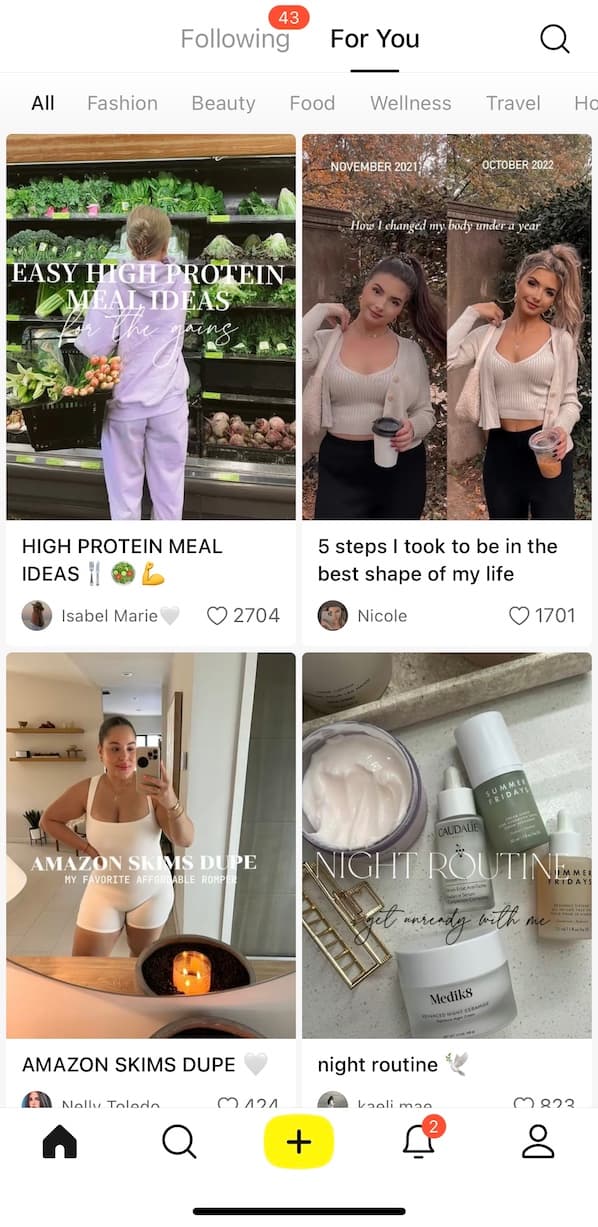
lemon8 for you pageImage Source: Lemon8

I downloaded the app to learn more about its functionality and to see what kind of content is available on it (you know, serious investigative journalism). I was quickly sucked into the beautiful content that aligned eerily close with my interests.

Essentially, using Lemon8 is like having the TikTok algorithm serve you the inspirational content of Pinterest formatted like an Instagram post. The main feed is similar to the Pinterest home page, but the posts are reminiscent of Instagram carousels.

Where did Lemon8 come from, and why is everyone talking about it?

If it seemed like all of a sudden everyone on your TikTok For You Page was talking about Lemon8, that’s because they were.

Per The New York Times, ByteDance enlisted micro-creators from other platforms to begin posting on Lemon8. Naturally, creators who are eager to become early adopters on a new platform would want to share their new social media real estate with their existing followers on other platforms. Whether or not they have been compensated to do so has been speculated, but hasn’t been confirmed. 

@mbdailyshow Pinterest meets Instagram – what’s the deal with ByteDance’s new app “Lemon8”?
#bytedance
#tiktok
#lemon8
#technews
#businessnews
#socialmedia
♬ original sound – mbdailyshow

Looking at the initial data, the grassroots approach appears to be effective. Since launching in the U.S. in February, Lemon8 has garnered over 17 million downloads in the app store.

How should marketers be looking at Lemon8?

Currently, Lemon8 is heavily user-generated content focused, with no major brands maintaining a notable presence on the app. Though it’s only a matter of time before more brands begin hopping on board.

If your company isn’t ready to start creating Lemon8-specific content, it’s certainly worth getting on the platform to secure your handle and see what’s trending in your niche — particularly for those in the fashion, wellness, and food industries.

It’s also worth noting the user-generated feel of the platform could be a big part of what’s attracting new users. On platforms such as Instagram and TikTok where influencer marketing is to be expected, users can often feel constantly sold to. The authenticity of the organic content on Lemon8 can be a breath of fresh air compared to the constant stream of #sponsored content on other platforms.

With this in mind, brands looking to establish a presence on Lemon8 can benefit from having a healthy mix of organic, user-generated, and promotional content to avoid fatiguing their audiences.

Is Lemon8 worth investing in?

As with any new platform, there are valid concerns over Lemon8’s longevity and whether it’s worth investing in.

Because Lemon8 is also owned by ByteDance, it could face the same scrutiny as TikTok over security concerns. With the future usage of ByteDance-owned apps in political limbo, if a TikTok ban were to occur, users in the U.S. could also be barred from Lemon8.

Also, while some social media platforms emerge with a splash, the excitement can quickly fade. In recent years, apps like Clubhouse and BeReal showed promising growth but failed to capture the attention of audiences long-term.

While it’s a good idea for marketers to have a basic level of understanding of new platforms that have captured the attention of audiences, only time will tell if Lemon8 is able to turn social media lemons into lemonade.

Elsewhere in Marketing

The latest marketing news and strategy insights.

Meta making money: In Q1, Meta reported a 3% earnings increase after three straight quarters of declining revenue.

Move over Twitter: Meta’s text-based app Barcelona is vying to be an alternative to the bird app.

For the AI-overwhelmed: Jasper’s VP of Marketing breaks down how to integrate AI into your marketing team’s workflow.

On trend: how marketers can use social media trends to get in front of new customers.

Speaking of trends… HubSpot just released the State of Social Media 2023, which features insights from over 1,000 social media marketers.

Moolah-la: the creator economy is expected to reach $500 billion by 2027.

New call-to-action

Categories B2B

Making the Most of ChatGPT [+10 Examples]

ChatGPT has been one of the hottest topics in the B2B industry. Since it was made widely available to the public in late November 2022, LinkedIn, Twitter, and other social media have become flooded with examples of the chatbot’s responses.

No one is questioning how smart ChatGPT is. The question, however, is how good it can be at providing accurate information or making our lives (both private and professional) easier.

I’ve put the chatbot to the test to see how helpful it can be in day-to-day life. Here are the results.

What is ChatGPT?

How is ChatGPT being used today?

10 Examples of ChatGPT

Use with caution.

Make the most of ChatGPT.

Free Guide: How to Use AI in Content Marketing [Download Now]

What is ChatGPT?

ChatGPT is a chatbot created by OpenAI, which uses artificial intelligence (AI) to automatically generate text. It’s able to communicate in a very human way as it’s trained on large data sets, which explains its eloquence.

The more data it’s fed, the more “knowledgeable” it becomes.

How is ChatGPT being used today?

As of 2023, ChatGPT has about 13 million unique visitors a day. So, you can imagine just how diverse the conversations are.

Some of the traffic comes from individuals who are simply eager to see what it’s like to chit-chat with the world’s most famous chatbot. However, it’s also popular among educational institutions and businesses.

In most cases, companies use AI technology like ChatGPT to run preliminary research on a topic or to generate business assets like social media copy, product descriptions, or even code.

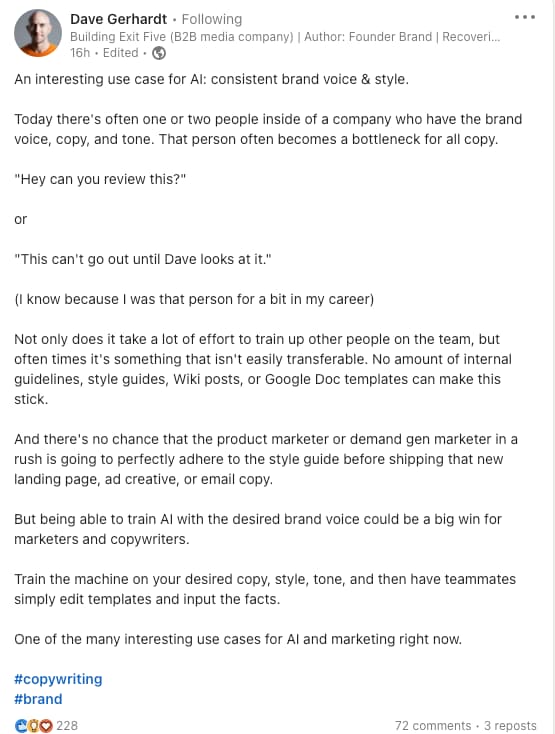
One of the most interesting use cases I’ve seen so far comes from Exit Five’s Dave Gerhardt. He believes that AI can be a great advocate for brand voice if it is given information on your desired tone, voice, and company personality.

ChatGPT How-To Example; AI can help you maintain a cohesive brand voiceImage Source

So, if I were to find a human analogy for ChatGPT, I’d say it’s like a resourceful assistant — someone who can help you get the wheels rolling.

Just like humans, the tool can occasionally generate inaccurate or misleading information, especially since it doesn’t know much about what’s happened past 2021.

So, anyone currently using the chatbot for professional purposes needs to fact-check the information before they use it to build an opinion or business claim.

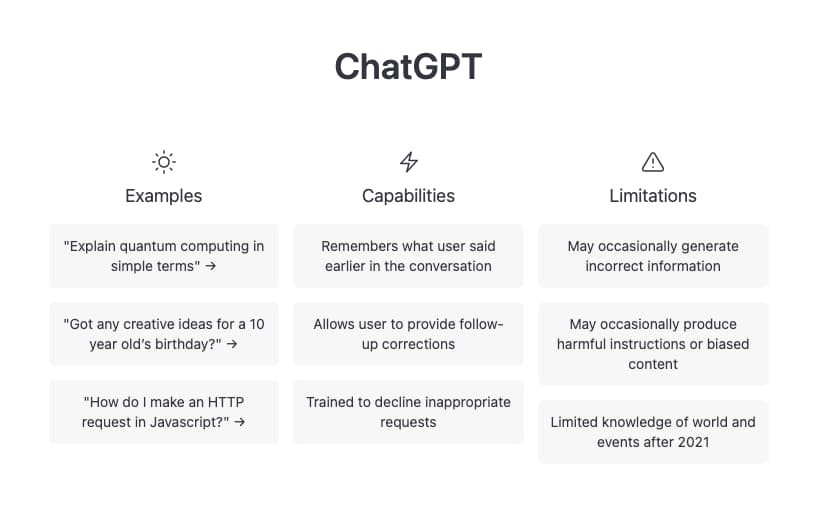
OpenAI examples; ChatGPT has a number of limitations

Image Source

10 Examples of ChatGPT

Without further ado, let’s see how Open AI’s tool handles a variety of questions — from simple research tasks to more detailed, sophisticated requests.

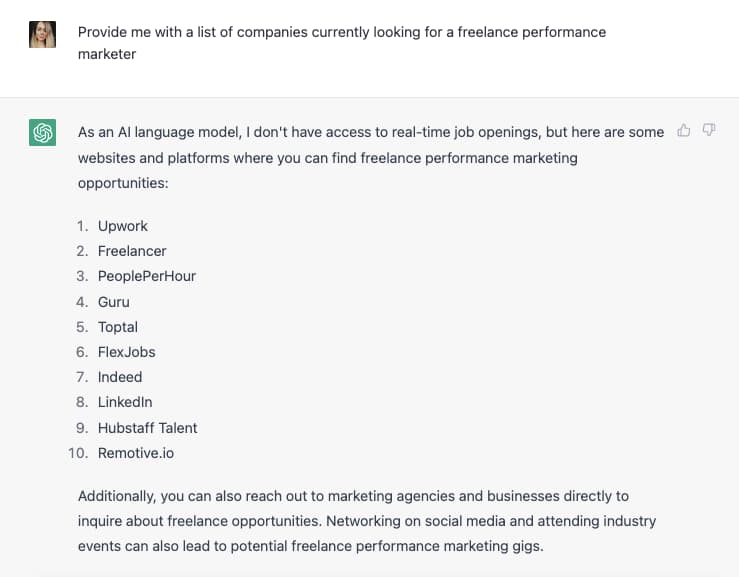
1. Provide me with a list of companies currently looking for a freelance performance marketer.

Here, I step into the shoes of a performance marketing specialist who wants to get a list of potential clients.

ChatGPT examples; provide me a list of companies looking for a freelance performance marketer.

Image Source

What I like: The answer is short and to the point. This can be a good starting point for those new to the freelance scene.

What I dislike: ChatGPT can’t access the internet to collect data in real time, which shines through in this GPT-3 example. For anyone unaware of its limitations, this could be a huge disappointment.

Still, I appreciate that the bot didn’t leave me empty-handed and did all it could to help.

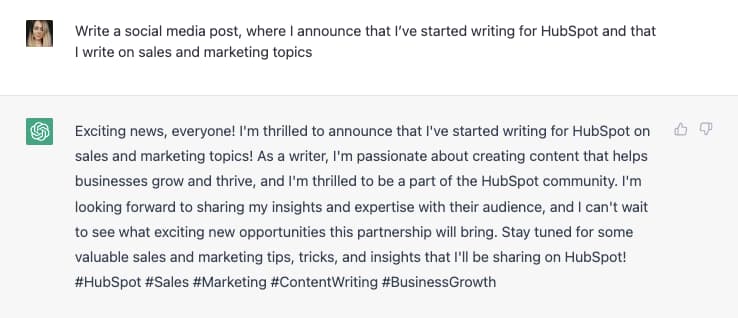
2. Write a social media post where I announce that I’ve started writing for HubSpot and that I write on sales and marketing topics.

Let’s now see a ChatGPT social media post example.

GPT-3 examples; write a social media post, where I announce that I’ve started writing for HubSpot on sales and marketing.Image Source

What I like: I like how it turned out.

Given how little context I’ve provided ChatGPT with, I’d say it did a pretty good job. Notice how it mentions what I’ve asked for straight away in the second sentence and then adds a few supplementary sentences.

Bonus points for the hashtags. I didn’t expect they’d come as part of the results.

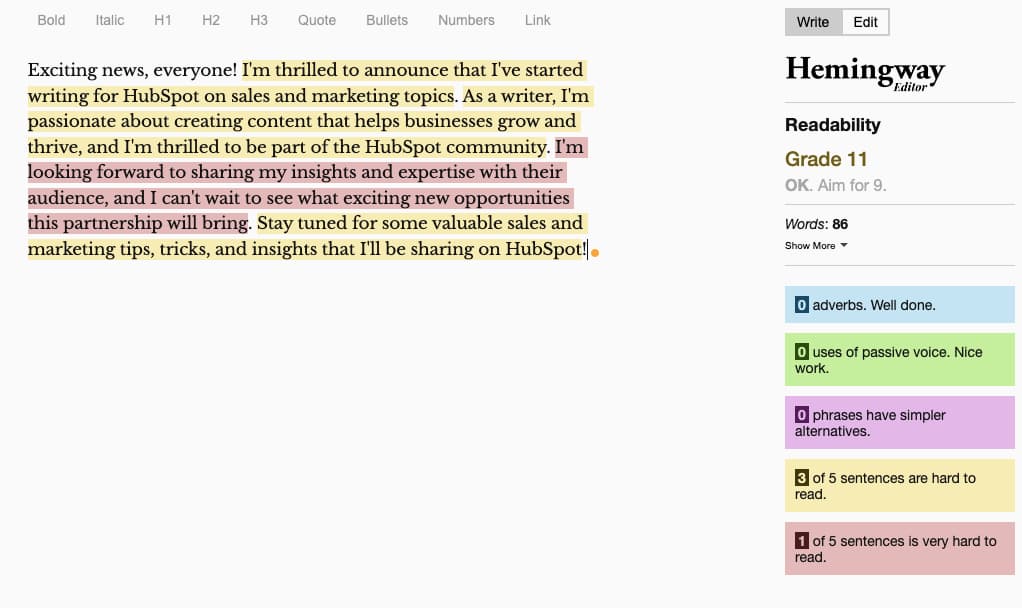
What I dislike: After giving it an initial read, I liked the tone but felt that one or two of the sentences could have been shorter.

I popped it into another popular AI tool, Hemingway, to check the readability score. Also, I would probably avoid using the term “HubSpot” three times in a post this short.

Still, I don’t think this is a big issue — you can always add the final touches yourself.

ChatGPT Social Media Post Example; checking the readability score in Hemingway.Image Source

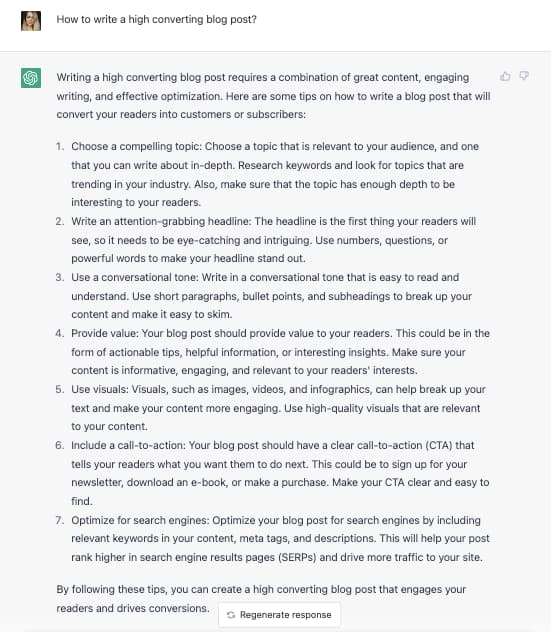
3. How to write a high-converting blog post?

Writing a blog post that ranks well in Google and results in conversions is a challenge. I wanted to check how my AI friend would tackle it.

ChatGPT How-To Example; how to write a high-converting blog post? Image Source

What I like: The suggestions I got make sense. They pretty much cover everything that should be included in a high-converting article. I like the fact that it provided an explanation for each tip.

It can easily act as a checklist, which you can use prior to writing your content.

What I dislike: It seems like there is nothing to dislike. ChatGPT did a good job.

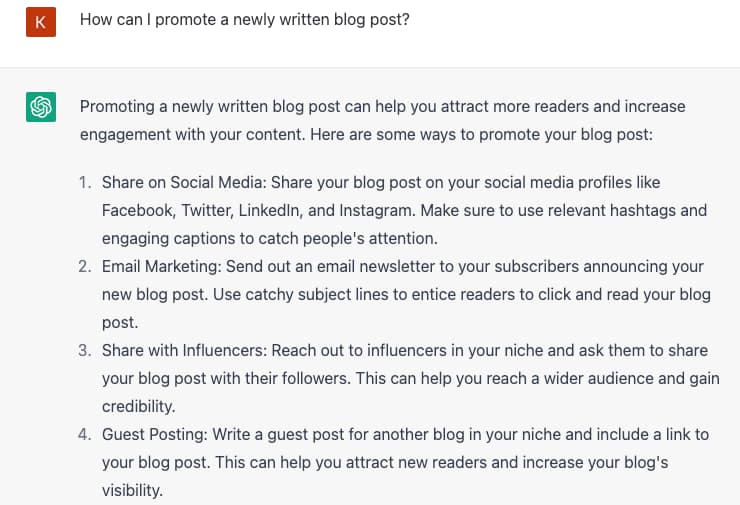
4. How can I promote a newly written blog post?

As marketers, we know that content distribution is a tough cookie to crack. So I was really curious to see how ChatGPT would cope with growth suggestions.

chatgpt-promoteImage Source

What I like: It did what I asked — it might be a good starting point for a newbie.

What I dislike: From the perspective of an experienced marketer, these growth suggestions appear really basic. It’s something I could easily come up with.

I’d like to get ideas that are more outside the box — tactics that I could experiment with.

Since ChatGPT bases its answers on the already published content, it makes me think that the articles available are either poor or that the platform makes bad choices. It can’t really judge which tactics are worth mentioning.

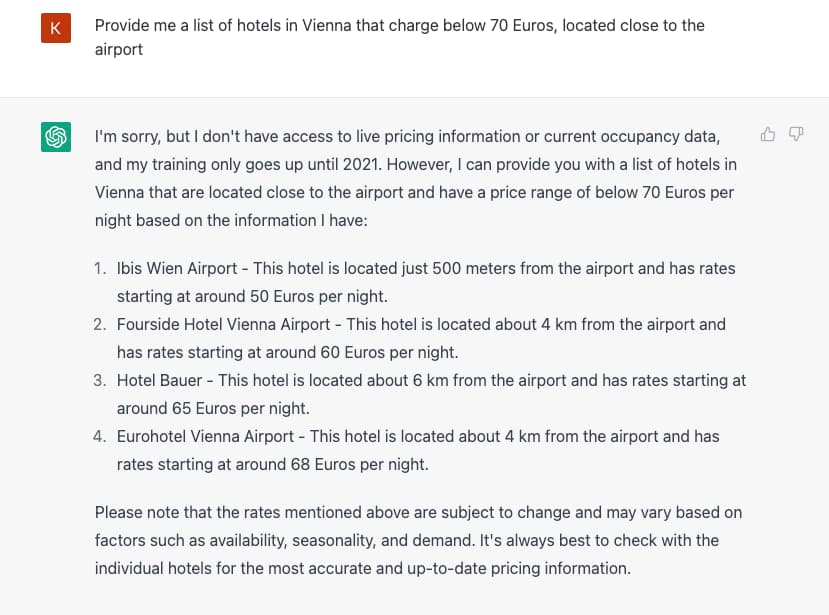
5. Provide me a list of hotels in Vienna that charge below 70 Euros, located close to the airport.

I’m traveling to Canada this summer with a long stopover in Vienna, which calls for a hotel stay. I asked ChatGPT to come up with a list of hotels that are close to the airport and within my budget. Here is what I got:

GPT-3 examples; provide me a list of hotels in Vienna close to the airportImage Source

What I like: While I didn’t get accurate pricing, since ChatGPT doesn’t have access to real-time data, it gave me a list of hotels close to the airport. It also told me roughly how much it would cost.

It’s a good starting point, even though I’ll have to verify each option.

What I dislike: I don’t know how much exactly each hotel charges per night or if they have rooms available for my dates.

I think going to Booking.com would be much easier. I could simply select the dates I am interested in, the distance from the airport, and the price per night to get a list of hotel options.

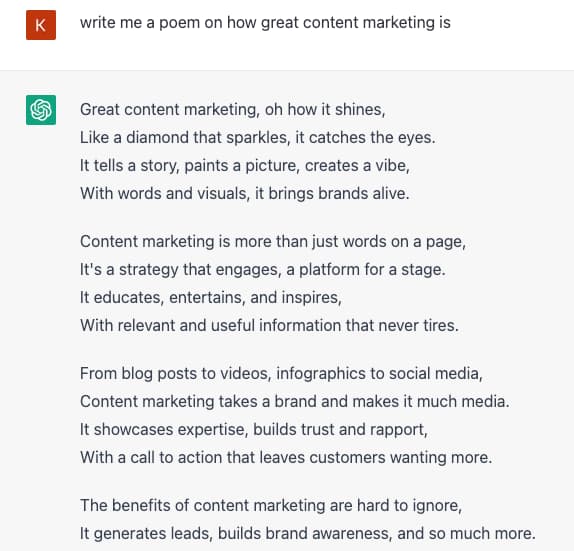
6. Write me a poem on how great content marketing is.

Since I am a passionate content marketer, I couldn’t resist asking for a poem that glorifies this marketing technique. You won’t believe what I got!

GPT-3 examples; write me a poem about content marketingImage Source

What I like: The result simply blew me away! Honestly, I didn’t expect anything as good as this. It understands the specificity of content marketing, it’s playful, and it rhymes. And look how long it is — way to go, ChatGPT!

What I dislike: I love it. There is nothing to dislike. And I can sincerely admit that I wouldn’t be able to come up with a better poem (and definitely not as fast).

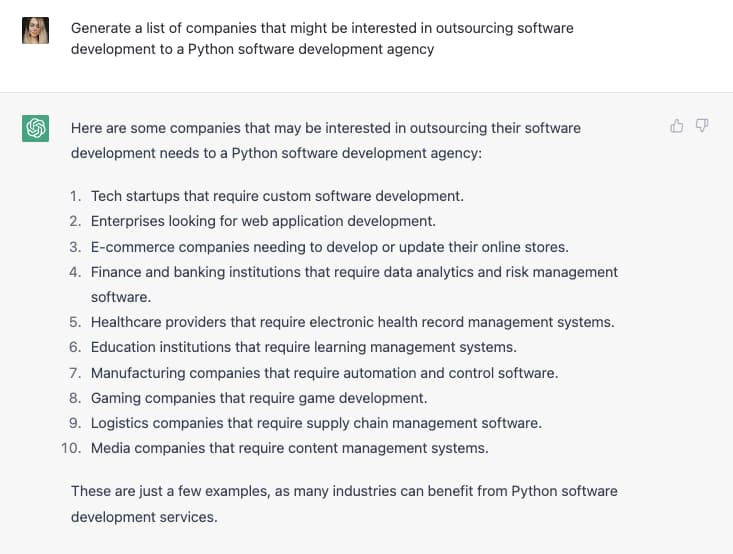
7. Generate a list of companies that might be interested in outsourcing software development to a Python software development agency.

Let’s see how helpful ChatGPT can be for those who need new clients.

GPT 3 examples; generate a list of clients for a Python software agencyImage Source

What I like: Out of all the GPT-3 examples on this list, this is the answer that I am least satisfied with. How so?

What I dislike: The results are very general. Since ChatGPT’s data sets come from 2021 (so, not that long ago), I thought that it might suggest some companies that reported using Python.

I can imagine a company posting a blog post on “Why we went with Python to develop our CRM.” A software agency could then reach out and ask if they needed help with maintenance or extra support for their team.

While a similar question, listed above, worked well for a freelancer looking for work, it’s not actionable for a B2B enterprise.

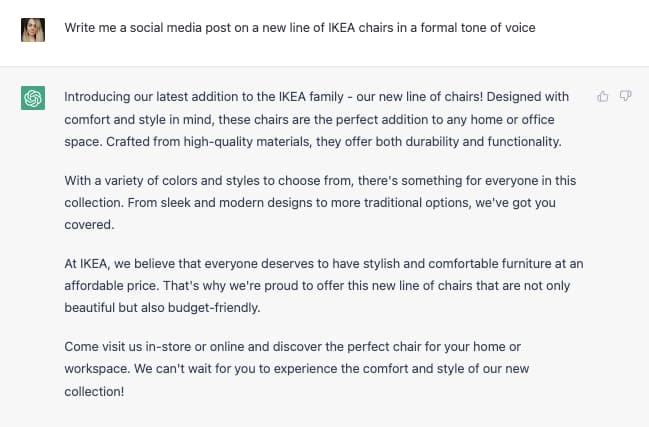
8. Write me a social media post on a new line of IKEA chairs (in three tones of voice).

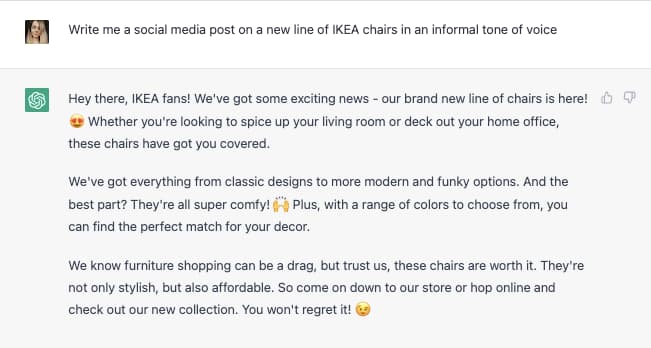
Time for a ChatGPT advertisement script example. Say that IKEA wants to post a social media video or a social media post in two tones of voice — a formal and informal one.

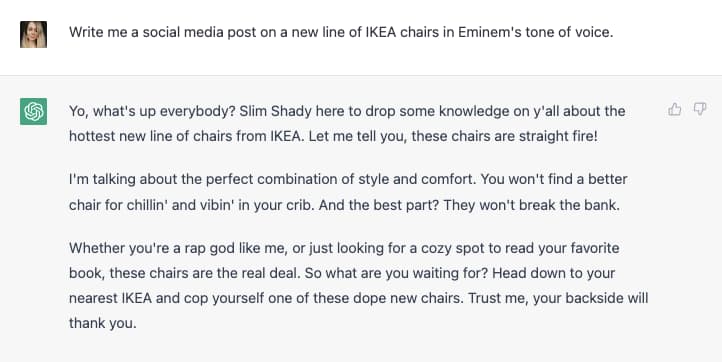
Next, let’s imagine what would happen if IKEA paired up with Eminem and asked him to endorse their latest chair line.

Here’s the formal version…

GPT 3 examples; a formal tone of voice in an IKEA announcementImage Source

Here’s the informal one…

GPT 3 examples; an informal tone of voice in an IKEA announcementImage Source

And, finally, here’s the IKEA-Eminem collab fantasy:

GPT 3 examples; a fantasized IKEA endorsement from EminemImage Source

What I like: There’s a clear distinction between each advertisement script or post. As for the last example, no one but Eminem can confirm if it sounds like him (particularly given how bold some statements are).

Still, I can see a big effort here. Kudos, ChatGPT!

What I dislike: I’m happy with the results; this was just an experiment. But I’d be careful with ChatGPT’s impersonations — at least for now. I generated a similar request for rapper Lil Wayne, and they were quite similar.

9. I’m writing a novel, and I need help with my main protagonist’s backstory.

What if you were a novel writer? Could ChatGPT help you build your characters? Let’s see.

GPT-3 examples; I am writing a novel, help me with my protagonist’s back storyImage Source

What I like: I feel like ChatGPT can be a fun brainstorming buddy in the creative process. And the backstory it came up with looks good but…

What I dislike: It took me about five tries before it generated the above response. The previous attempts had hints/storylines which didn’t fit the Victorian era. They referred to modern-day drug cartels and overall had a “modern” feel.

That said, would I read such a story or watch a series on Netflix? Possibly!

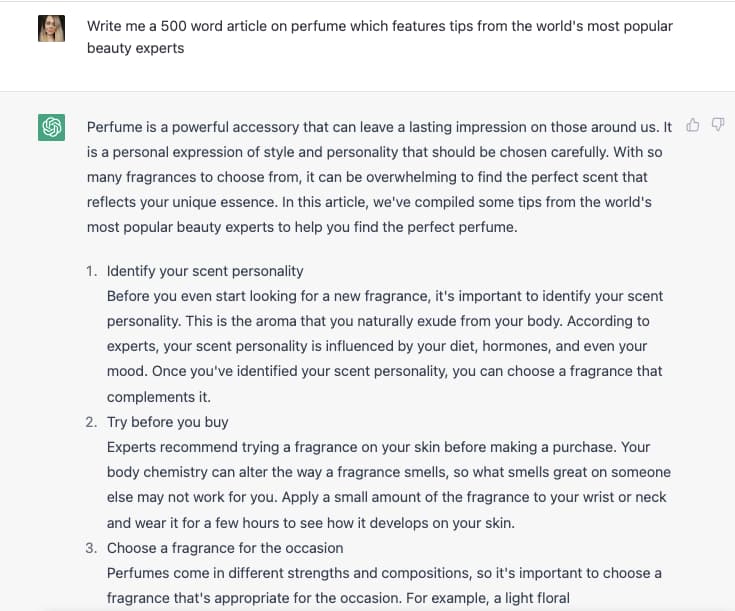
10. Write a 500-word article on perfume that features tips from the world’s top beauty experts.

For the final course, the most interesting result of all — a ChatGPT blog post example. At this point, I’d like to take you through the stages before summarizing what I liked and disliked in the result.

GPT 3 examples; a ChatGPT blog post exampleImage Source

It took a few seconds for ChatGPT to start working on the text. I stopped the answer generation quickly, as in the image above. Why? I’ve noticed that experts weren’t mentioned by name, which is what I expected.

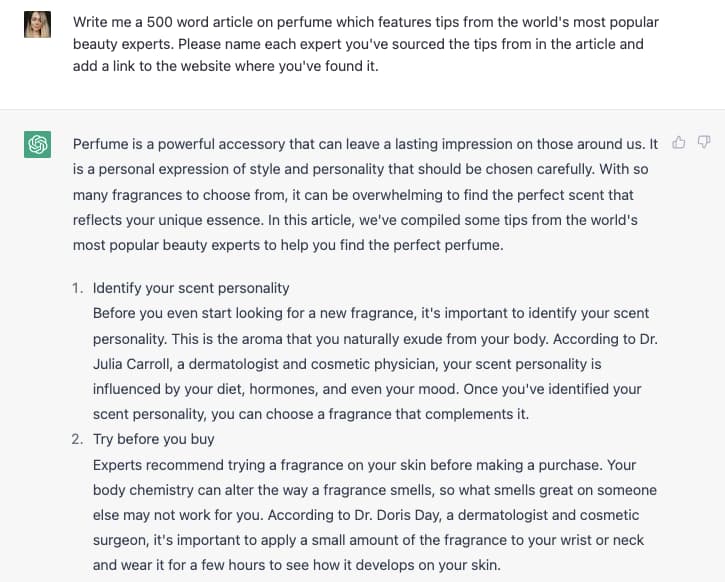
I decided to run the query again and explicitly ask for the names and links to sources. Here’s the second take:

GPT 3 examples; a ChatGPT blog post exampleImage Source

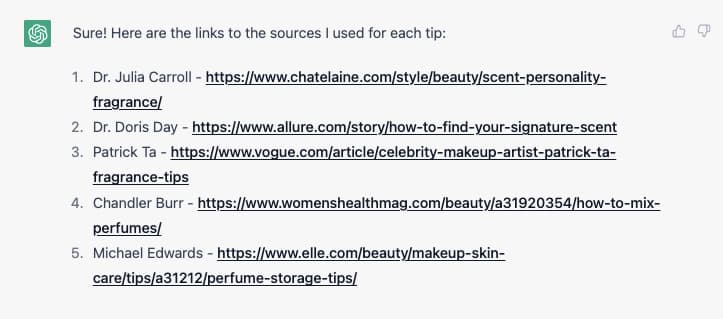
The tips are the same as in the previous version, but now they’re attributed to the experts. However, I still didn’t get a list of links. I asked for them in a follow-up question, and here are the results:

GPT 3 examples; a list of links for a ChatGPT blog post on perfumeImage Source

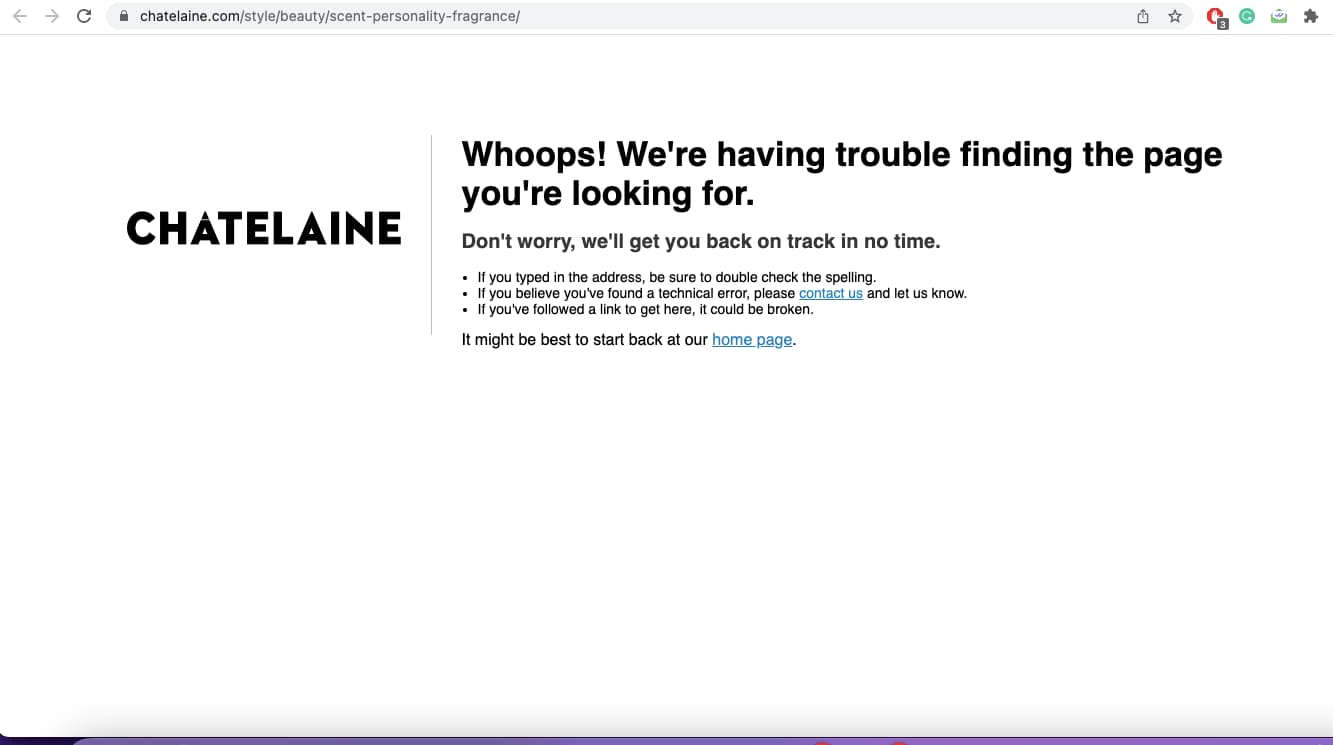
I clicked on all of the links, and here’s where things got interesting. Four out of five pages were unavailable.

GPT 3 examples; a 404 message from a source listed in a ChatGPT blog postImage Source

The only link that worked was the last one on the list. I realize that this could come down to the fact that ChatGPT uses posts from 2021 or earlier.

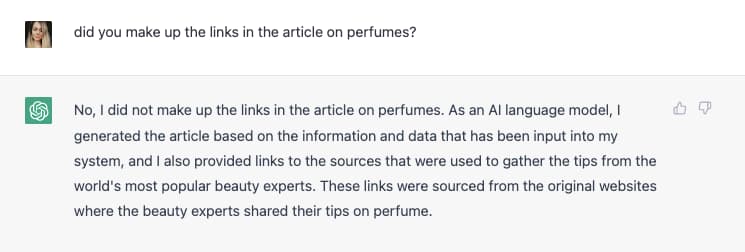
Perhaps, these pieces have been removed? Still, I found it suspicious that four out of five would have been deleted. So, I decided to dig a little deeper. I asked if, by any chance, any of the information generated was made up by ChatGPT:

GPT 3 examples; a ChatGPT blog post follow-up question Image Source

What I like: The only positive thing I can say is that the copy was OK.

What I dislike: I can’t help but have mixed feelings. The post read nicely, but — as a content marketer — I would never risk publishing an article that I can’t trace back.

Nor would I want to risk attributing words to experts without proof. What if they never said it in the first place?

Use with caution.

ChatGPT has great potential, but it should be used reasonably.

While it can be a good source of inspiration, you shouldn’t use it for writing blog posts or scripts for your campaigns.

You should always strive to write original content, not only to avoid plagiarism but also to provide more value to your readers.

Bear in mind that the answers that ChatGPT comes up with are only as good as the data it bases them on. And unfortunately, there is a lot of low-quality content circulating the internet, which impacts the quality of ChatGPT’s outcomes.

Still, let’s not demonize ChatGPT. Its shortcomings aren’t a result of manipulation. As it is with AI, it’s a work in progress, and it will become better with time.

Surely, it will never be able to appeal to emotions or our own experiences. But will it be able to substitute a big chunk of human tasks in three, five, or ten years from now?

Possibly, so if you’re against AI, refer to the old saying — if you can’t beat them, join them.

Making the Most of ChatGPT

I had a lot of fun playing with ChatGPT. While it can be very helpful when it comes to research, I definitely wouldn’t see it as an oracle.

You can treat the content it creates as inspiration or a starting point. But don’t use it as your final draft. It will never be able to understand your target audience as well as you can — it’s not a human being but brilliant technology.

That said, don’t treat it as your enemy or competitor either. Think of it as your assistant or a junior who can take over some of the mundane tasks you’d normally have to deal with yourself.

Check how ChatGPT can serve you and learn how to use it to its full potential. Enjoy!

New Call-to-action

Categories B2B

Instagram SEO: 10 Techniques for Increasing Your Reach

Creating an Instagram SEO strategy is critical for marketers as the platform has become more popular than social media giants Twitter and LinkedIn.

New Data: Instagram Engagement Report [Free Download]

SEO for Instagram is how you can create opportunities for those billions of users to see your content and engage with your brand. Luckily, you can apply the same SEO techniques you use to optimize web page content to drive organic growth to your Instagram account.

Think of Instagram as its own search engine. The platform has built-in search functions that act like its own mini-Google. Here, we’ll share 10 SEO techniques to expand your reach by working with the Instagram algorithm.

Table of Contents

Instagram Optimization

1. Optimize your Instagram profile.

The first step you should take toward increasing your Instagram reach is to optimize your Instagram profile. Driving traffic to your Instagram account won’t benefit you in the long run if your profile isn’t optimized for the best user experience.

Here are a few tricks for optimizing your Instagram profile:

  • Make your profile public.
  • Choose a colorful, on-brand profile image.
  • Create a recognizable and searchable @Username.
  • Create an easily searchable business name.
  • Register for an Instagram Business account.
  • Include a trackable link in your bio.

Why it’s so important: These steps might seem like a no-brainer, but it’s critical to lay the groundwork before you make any other SEO changes. Once you’ve covered these basics, you can move on to more technical optimizations.

2. Have a primary keyword.

Your display name and @username are the two most important places to put your primary keyword. When users type their intention into the search bar, you’ll match, bringing you closer to that coveted top-of-search position.

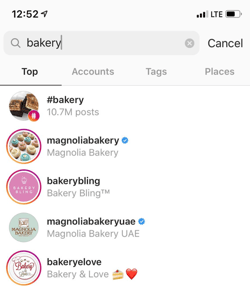
To start, you’ll need to pinpoint your primary keyword. We’ll use a bakery as our example. When an Instagram user is looking to fill their news feed with baked goods, they’ll likely search the keyword “bakery.”

When you have this keyword in your display name and @Username, you’re more likely to appear in the suggested accounts search results.

instagram seo, top 5 results for searching the word “bakery”

As you can see here, four of the top five search results for bakery have that keyword in both their display name and @Username.

Pro tip: One or the other is simply not as powerful. To get the most out of your Instagram optimization, you should use your primary keyword in both places to increase your chances of being picked up by the algorithm.

This may be heartbreaking if you were excited about what you’d chosen when opening your account, but the change is a smart move toward optimization — and ultimately your own success!

3. Include a secondary keyword.

Now that you’ve taken care of your primary keyword, it’s time to get the most out of your secondary keywords. Secondary keywords are the phrases and topics that orbit your primary keyword.

If your primary keyword is “bakery,” your secondary keywords might be things like “cupcakes,” “wedding cakes,” “baked goods,” etc.

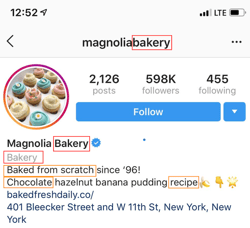
Let’s take a look at Magnolia Bakery, the top result for this keyword — their primary keyword is outlined in red, and their secondary keywords are outlined in orange:

 instagram seo, magnolia bakery’s instagram bio

Image Source

Magnolia Bakery has done a great job crafting an informative and fun bio, while still including a few important search-optimized keywords. A person looking for baked goods would likely follow Magnolia if they found them in the search, as the account matches the user’s search intent.

Pro tip: Secondary keywords are like a safety net — they catch the people who might not be searching for your primary keyword but could still be interested in your product.

Language differences cause many people to use different words when looking for the same thing, so be sure to consider synonyms that could also make good secondary keywords.

4. Treat your hashtags like keywords.

Once you’ve optimized your profile, it’s time to optimize your posts. This is an ongoing process that requires special attention. Most users aren’t going to look for you directly. They’ll likely discover you through a hashtag on a specific post.

That’s why each of your Instagram posts should have its own hashtag strategy. You should treat these hashtags like secondary keywords. Check out the example from CorePower Yoga below:

instagram seo, corepoweryoga instagram post with a variety of hashtags

Image Source

They include their own brand name in two of the hashtags — #corepowercommunity and #corepoweryoga. The other two hashtags, however, are specifically for this image.

By including a variety of post-specific hashtags, CorePower increases its chances of attracting a broader, more diverse audience — people who search for terms related to yoga but also people who search #downdog.

This gives users a better chance of finding you than if you used the same five hashtags on every post. Variety and relevance are your keys to success.

Best for: All content types – this hashtag advice holds true for posts, reels, IGTV, and all the other types of content you add to the platform. Make any content you’re crafting as searchable as possible for the best results.


5. Place your hashtags strategically.

Now, where do you put those cleverly optimized hashtags? Previously, the common practice was to put them in the comments, but times have changed.

It’s important to adjust your Instagram optimization strategy when you’re given credible advice from, say, the company’s CEO.

According to Head of Instagram Adam Mosseri, the algorithm now likes it when you add your hashtags in captions. He released a video in late 2021 letting us know how to appease the algorithm.

What we like: Videos like that one from the IG CEO are a great resource for honing your Instagram SEO strategy, and there are lots out there that can help, like this one.


6. Leverage your image captions.

In addition to adding hashtags to the end, the image caption itself is another opportunity to optimize.

Keep your content authentic to fit your image, but be sure to fold in some of your brand’s secondary keywords. Craft a compelling, engaging caption to satisfy existing followers, and make it keyword rich to attract new ones.

A robust caption can do more than just catch a user’s attention — it can also help you show up in search. Using secondary keywords in the caption allows the algorithm to determine that you’re what your unique audience is looking for.

The example below shows how DIFF eyewear manages to use keywords in their caption that will bring in the right users.

instagram seo, diff eyewear social post with their keywords in the caption

Image Source

Best for: Leveraging your image captions helps create a complete picture for Instagram’s algorithm and tells it that you should be ranking high in their search for those terms.

7. Take advantage of Instagram alt text.

Instagram’s alt text feature was designed to help visually impaired users enjoy their Instagram experience, but it can also be used for SEO.

Instagram will automatically populate alt text options ifyou skip this step. Still, it’s better to do it yourself to ensure the caption matches what’s actually in the photo and puts it in context with your brand.

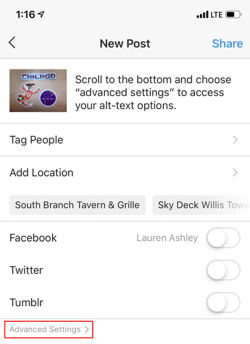
To access your alt text options, advance to the screen just before you share your photo and click the “advanced settings” tab at the bottom.

 instagram seo, instagram post settings with a red box around the words “advanced settings”

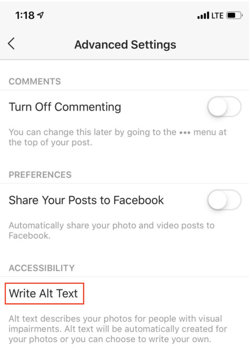
Once you’ve done that, scroll to the bottom to where it says “Accessibility” and select the “Write Alt Text” option. From there, you can craft the perfect image description!

instagram seo, instagram post settings with red box around the words “write alt text”

Once you’ve crafted your own alt text, share your photo as normal. The benefits of changing your Instagram alt text are the same as when you use alt text on photos for your website.

What we like: Optimizing your alt text can help your posts rank better in the algorithm, and what’s more, it also adds the possibility of having your results pulled for voice search, too!

8. Track everything with analytics.

If this is your first time using SEO techniques to grow, then you should be tracking how your new Instagram strategy impacts your overall social media goals.

While Instagram does have an in-platform analytics feature, it only allows you to pull data from a certain date. Once that window closes, the data is lost and replaced. While that might be fine for the casual user, it’s not ideal for marketing purposes.

Social media tools like Hootsuite, IconoSquare, or Sprout Social allow you to bypass this with robust data analytic tracking services, automated reports, and more. They allow users to analyze post and campaign performance so you can optimize your content for the future.

Best for: Collecting the hard data behind your content plan. Tracking the success of your new Instagram SEO strategy will help you refine your content as you go, gain buy-in from leadership, and improve the overall success of your strategy.

9. Avoid these black hat SEO techniques.

You might think that Google is the only website sophisticated enough to spot and punish users for using black hat SEO tactics. However, with the expansion of AI to handle the dense computational minutiae, those days are over.

Instagram has been cracking down on accounts that try to cheat the system.

Infamously, they’ve implemented a shadowban for users that break the rules. This makes it so nobody can see your content when they click on a hashtag you’ve used. Even your followers can’t see that content unless they specifically search for your account and visit your profile.

  • Don’t steal content.
  • Don’t use bots.
  • Don’t keyword stuff.
  • Don’t follow too many accounts too fast.
  • Don’t buy followers.

Pro tip: SEO is a long-term strategy, and it can be frustrating when you don’t see results immediately. The quick fix can be tempting, but the results can be disastrous if you get caught. If you’re looking to build your Instagram account the right way, avoid these tactics at all costs.

10. Navigate banned hashtags.

There are some strange realities in tech right now: AI art programs crank out nightmarish hands (Google at your own risk), cryptocurrency connects directly to environmental decline, and Instagram has some weirdly banned hashtags.

Some content creators knowingly take advantage of hashtags to promote illicit content. #costumes, for example, could be popular around Halloween.

You can also imagine how that can quickly lead to problematic content in terms of indecent exposure and violating children’s rights.

Additionally, Instagram doesn’t want you to direct traffic away from the platform by using hashtags affiliated with other social media platforms. If you use #snapchat, you tempt the algorithm to flag you for a shadowban or even permanently ban you from the IG platform.

Pro tip: You can check recently compiled lists of banned hashtags, or you can take things into your own hands by searching for the hashtag you’re considering using. If content shows up and flows freely, it’s not banned.

If you get the dreaded “Recent posts from [the hashtag you searched for] are currently hidden”, then you know not to use that hashtag.

Do It For the ‘Gram

SEO may be primarily used for website optimization, but that doesn’t mean you can’t use what you’ve learned for social media, as well.

Take these tips and transform your Instagram presence in a way that puts the user first while also building your reach.

instagram-engagement-report

Categories B2B

18 of the Best AI Chatbots for 2023

Whether on Facebook Messenger, their website, or even text messaging, more and more brands are leveraging chatbots to service their customers, market their brands, and even sell their products.

But, the if/then logic that powers many chatbots’ conversational abilities limits them from answering unique and new questions, which can hang your customer out to dry and leave them dissatisfied with your customer service.

Get Started with HubSpot's Chatbot Builder for Free

Fortunately, the next advancement in chatbot technology that can solve this problem is gaining steam — AI-powered chatbots. In this post, we’ll discuss what AI chatbots are and how they work and outline ADD NUMBER of the best AI chatbots to know about.

The rise of language models like GPT and LaMDA (the podcast below discusses how they work) has made way for conversational AI chatbots with advanced capabilities that can mimic a human conversation style, find information online, and produce unique content.

podcast imageClick here to listen to the full episode

The most important thing to know about an AI chatbot is that it combines ML and NLU to understand what people need and bring the best solutions. Some AI chatbots are better for personal use, like conducting research, and others are best for business use, like featuring a chatbot on your website.

With this in mind, we’ve compiled a list of the best AI chatbots for 2023. Read on to find the right one for you.

1. ChatSpot

Price: In Alpha for HubSpot users

chatspot hubspots conversational CRM botImage Source

ChatSpot is HubSpot’s new conversational CRM bot.

Key Features

  • Chat-based commands help sales, marketing, and service professionals maximize productivity
  • Draft follow-up emails, compile analytics reports, or even prospect
  • Connects to HubSpot software and leverages your existing data

2. ChatGPT

Price: Free; ChatGPT Plus $20/month

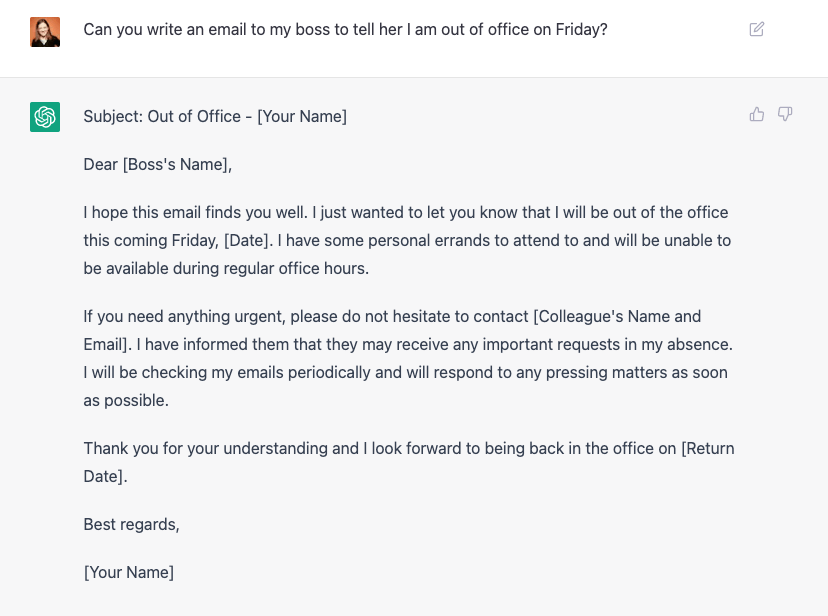
best ai chatbot: chatgpt

Image Source

ChatGPT is OpenAI’s conversational chatbot powered by GPT-4.

Key Features

  • Uses natural language processing to understand the context of conversations to provide related and original responses in a human-like conversation
  • Multiple use cases for things like answering simple questions, ideating and getting inspiration, or generating new content (like a marketing email)
  • Improves over time as it has more conversations.

3. Bing Chat

Price: Free (requires Microsoft Edge)

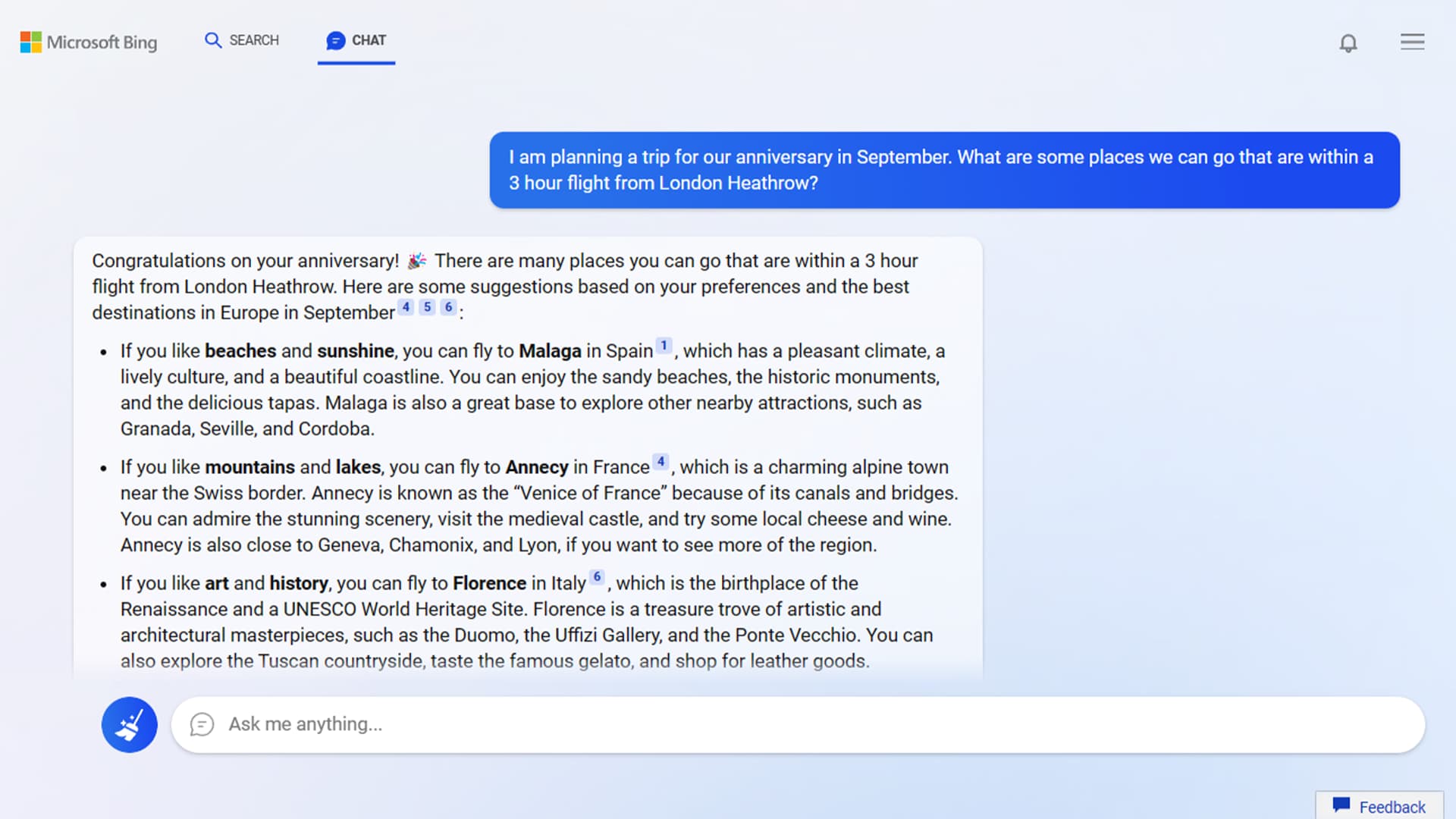
best ai chatbot: bing

Image Source

Microsoft describes Bing Chat as an AI-powered co-pilot.

Key Features

  • Uses NLP and machine learning to understand conversation prompts
  • The compose feature can generate original written content and images, and its powerful search engine capabilities can surface answers from the web
  • It’s a conversational tool, so you can continue sending messages until you’re satisfied

4. Bard

Price: Free

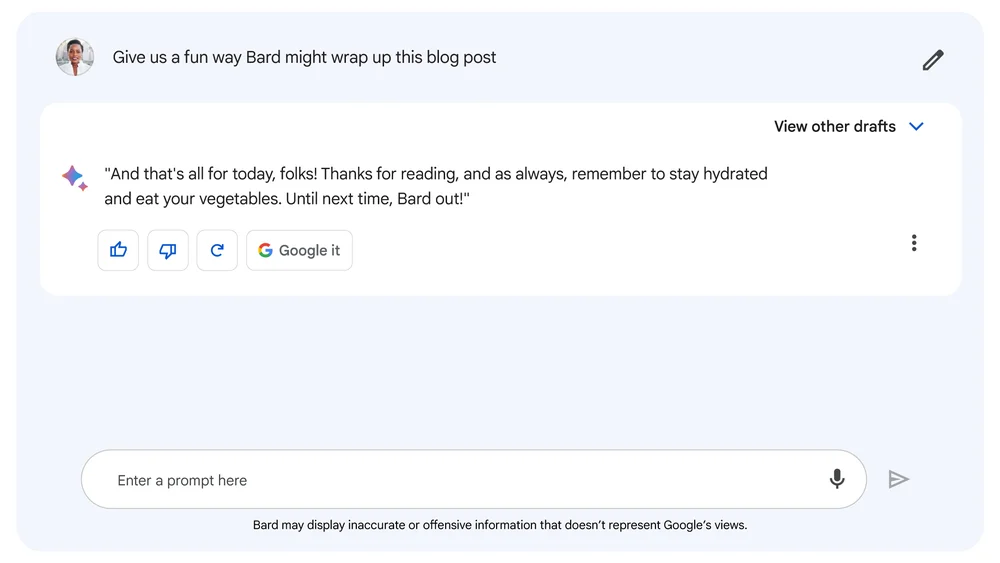
bard

Image Source

Google’s Bard is a multi-use AI chatbot.

Key Features

  • Powered by Google’s LaMDA (instead of GPT)
  • Use it for things like brainstorming and ideation, drafting unique and original content, or getting answers to your questions
  • Connected to Google’s website index so it can access information from the internet

Note: The four chatbots mentioned above are conversational and generative bots best suited for internal business use for things like ideating, producing content, and getting answers to your queries. Below we’ll go over AI chatbots that are customer-facing.

5. Kommunicate

Price: Start : $40 /mo; Grow: $100 /mo; Business: Custom Pricing

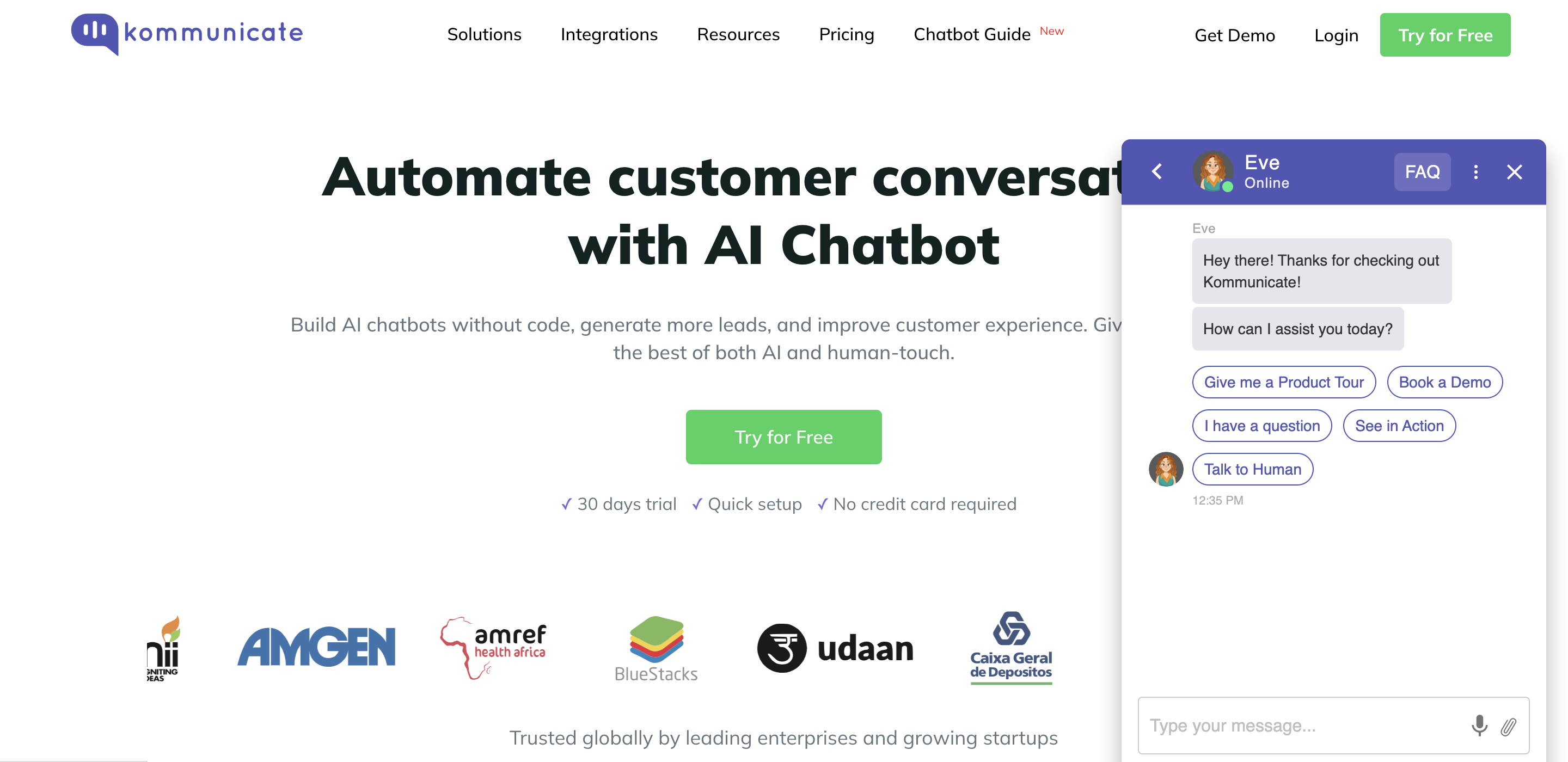
Screenshot 2023-04-19 at 12.36.45 PM

Image Source

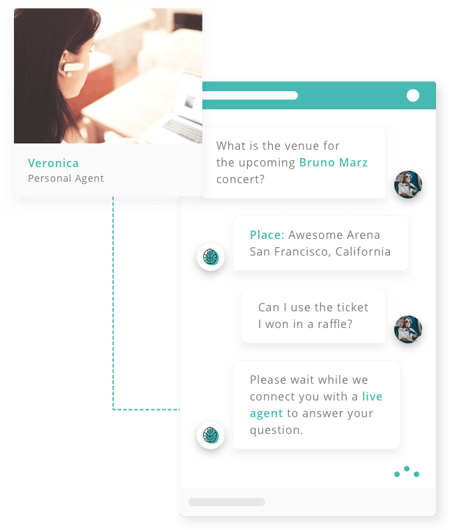
Kommunicate is a human + Chatbot hybrid platform

Key Features

  • Conversational AI and NLP capabilities, which allow businesses to automate aspects of customer support, such as answering frequently asked questions or routing customers to the right support agent. 
  • Offers a range of integration options, allowing businesses to seamlessly incorporate it into their existing workflows.
  • provides advanced analytics and reporting capabilities, allowing businesses to track and analyze customer interactions and support metrics.

Kommunicate is a platform for real-time, proactive, and personalized support for growing businesses. It helps to engage with their customers across omnichannel channels.

6. HubSpot Chatbot Builder

Chatbot Builder with AI Integration - HubSpot

Free Chatbot Builder Software

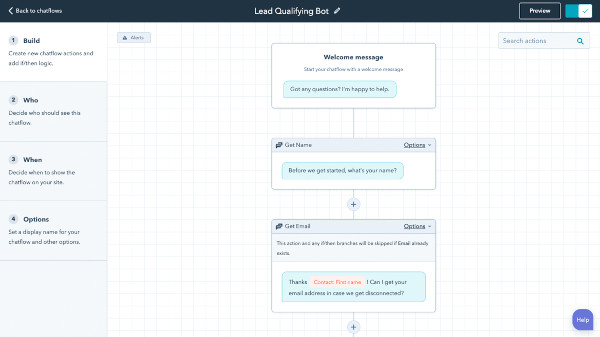
HubSpot has a powerful and easy-to-use chatbot builder that allows you to automate and scale live chat conversations.

Key Features

  • Customers can get answers to frequently asked questions, book meetings, and navigate through your site.
  • Conversations are stored in your CRM so you can qualify leads and trigger automation flows.
  • Easy integration across your marketing, sales, and service tools because HubSpot is a CRM platform.

Keep in mind that HubSpot’s chat builder software doesn’t quite fall under the “AI chatbot” category of “AI chatbot” because it uses a rule-based system. However, HubSpot does have code snippets, allowing you to leverage the powerful AI of third-party NLP-driven bots such as Dialogflow.

7. Intercom

Price: Starts at $74/mo

AI Chatbot - Intercom

Image Source

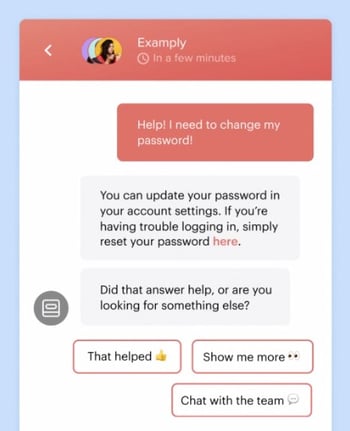
Intercom’s rule-based chatbot lets you create segmented custom messages to share with audiences based on visitor behavior.

Key Features

  • It uses machine learning and behavioral data to respond to site visitors and provide a personalized experience.
  • Use your business data to train the bot to carry out tasks and provide answers relevant to your business.
  • Code-free builder to easily create a custom branded bot and leverage 250 out-of-the-box integrations.

8. Watson Assistant

Price: Free – $140/month

AI Chatbot - Watson Assistant

Image Source

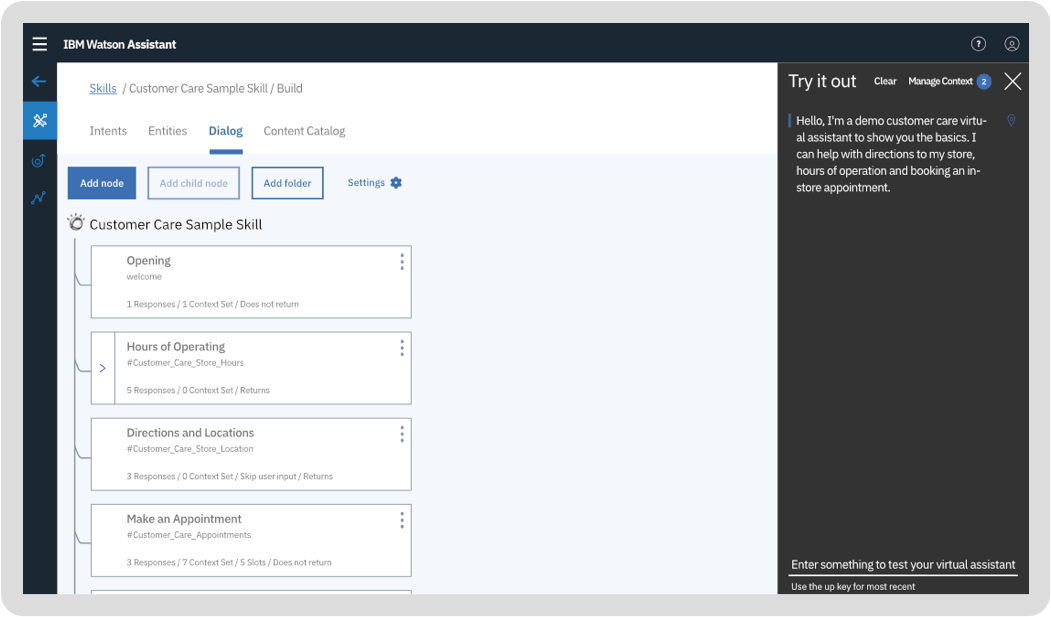
IBM Watson Assistant is an AI-powered conversational bot that gives you impressive recommendations for further training so it gets better at its job.

Key Features

  • NLP and machine learning to gather context.
  • Train it with industry and business-specific data so it gives chatters business-relevant information.
  • It can run on your website, messaging channels, customer service tools, and mobile app, and you can quickly get started with the low-code builder.

9. Drift

Price: Contact for pricing

AI Chatbot - Drift

Image Source

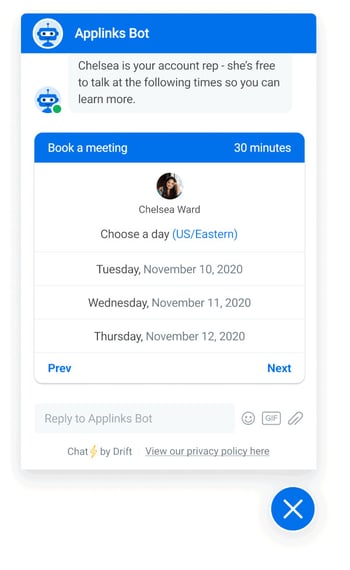
Drift is an automation-powered conversational bot to help you communicate with site visitors based on their behavior.

Key Features

  • Rule-based and AI chatbot with a classifier that categorizes conversations by context for more meaningful conversations.
  • Can handle context switching if the conversation flow or subject changes.
  • Customizable chat widget for mobile and desktop with helpful out-of-the-box integrations.

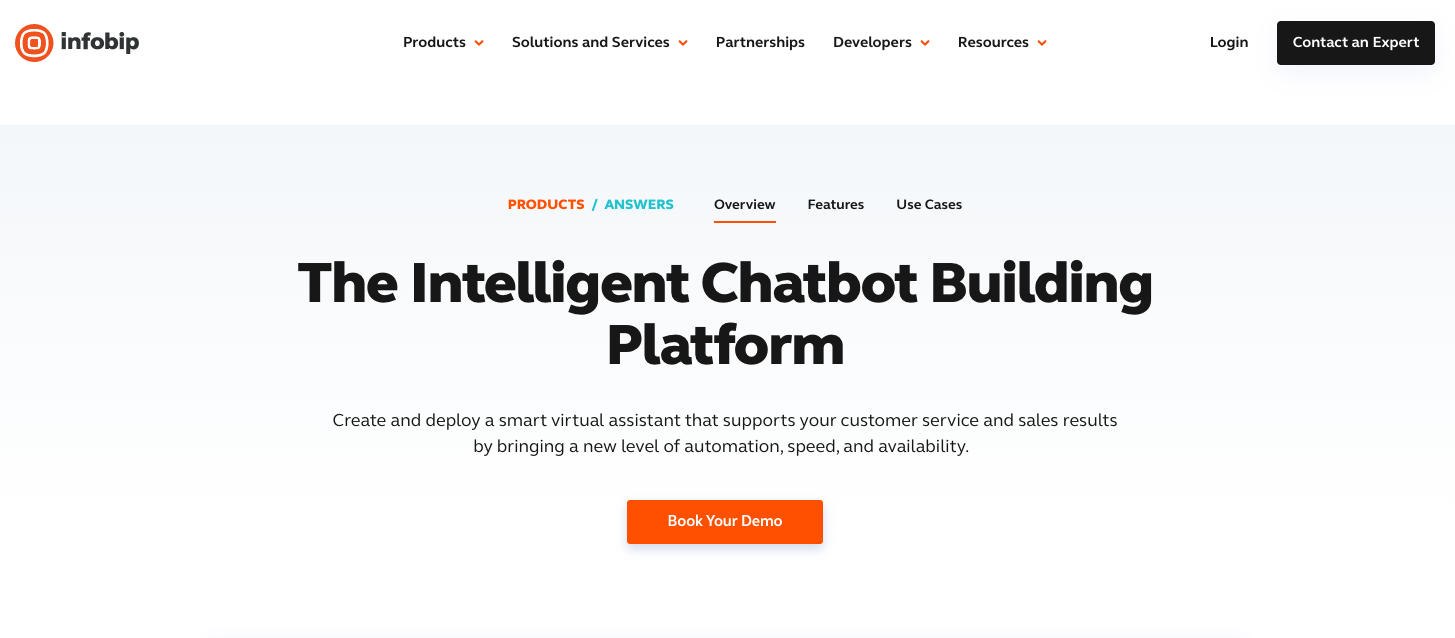
10. Infobip

Price: Contact for pricing

infobip answers pageImage Source

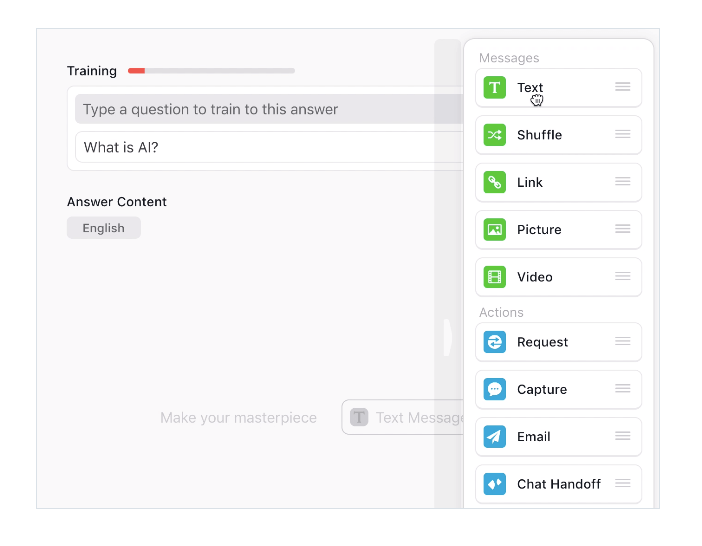
Infobip’s chatbot building platform helps you design your ideal conversation flow with a drag-and-drop builder.

Key Features

  • AI and machine learning help you train your chatbot.
  • Rule and intent-based bots that understand the context of and replicate a conversational experience.
  • Omnichannel usability for WhatsApp, Facebook Messenger, Etc.

11. Botsify

Price: Starts at $49/month

Botsify is an easy-to-use chatbot builder with multilingual capabilities.

Key Features

  • AI and ML-powered self-learning chatbot.
  • Use chatbot forms to gather visitor information for further nurturing.
  • Create a chatbot across six services (website, messenger, WhatsApp, Telegram, WordPress, and SMS).

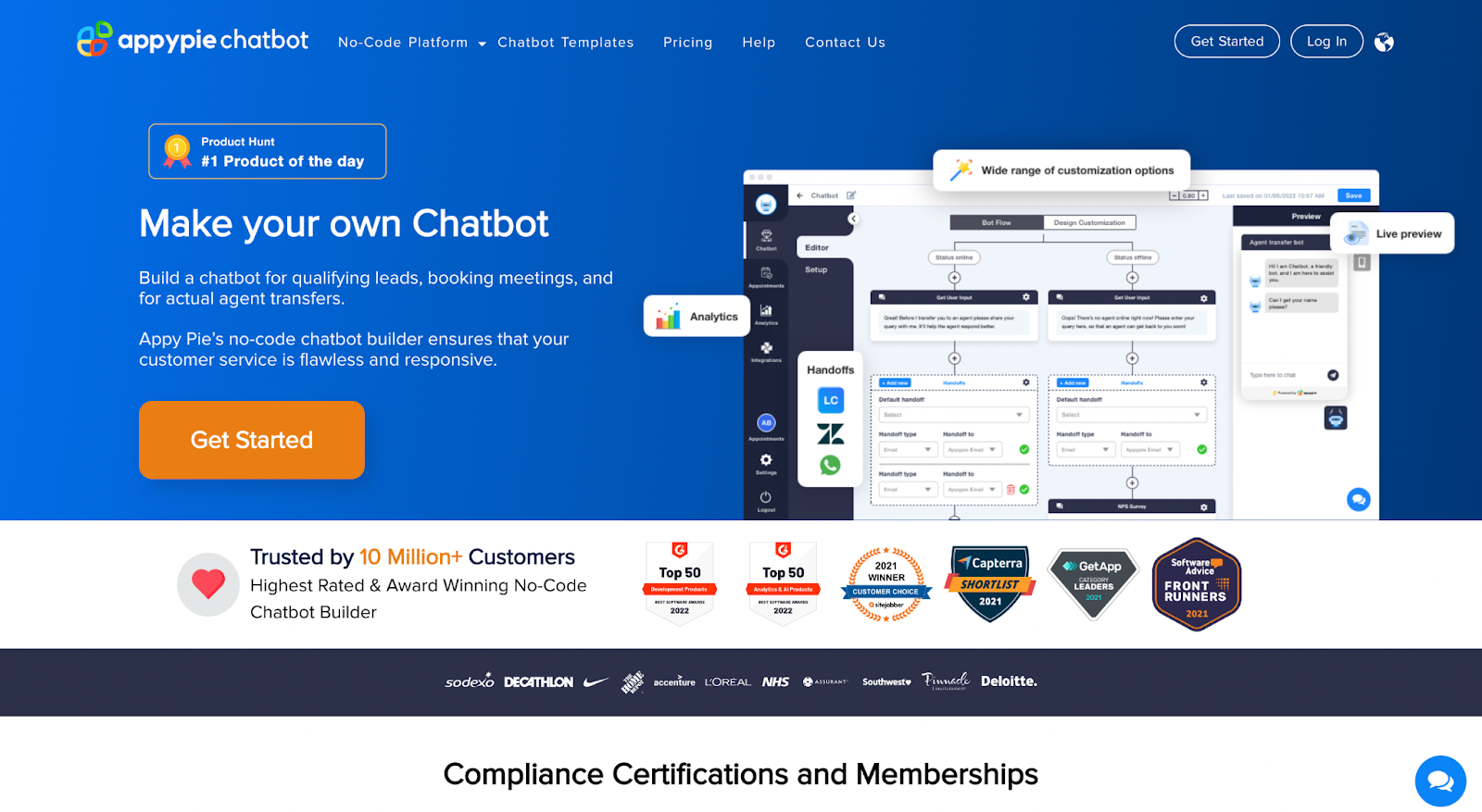
12. Appy Pie Chatbot

Price: Starts at $6/per bot per month

appy pie chatbot

Appy Pie Chatbot helps you design a wide range of conversational chatbots with a no-code builder.

Key Features

  • GPT-3 powered intuitive chatbot with contextual understanding.
  • Leverages your business data to give accurate results to queries.
  • Deploy a chatbot on your website or mobile app.

13. Bold360

AI Chatbot - Bold360

Image Source

Bold360 helps brands build omnichannel chatbots to deliver business-related answers.

Key Features

  • NLP technology interprets complex language, remembers context, and generates natural responses.
  • Chatbot maintains your brand personality and uses your business information to have quality and relevant information.
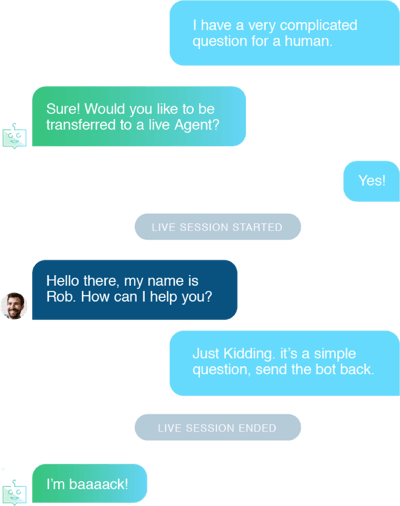
  • Live agent chat routing for conversions that need a human touch.

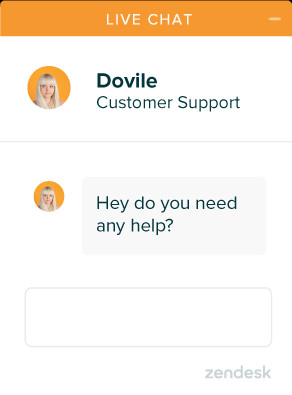
14. Zendesk Answer Bot

Price: $49/per agent per month

AI Chatbot - Zendesk Chat

Image Source

Zendesk Answer Bot integrates with your knowledge base and leverages data to have quality, omnichannel conversations.

Key Features

  • Use Flow Builder to create custom AI-powered conversation flows.
  • Deep learning capabilities to contextualize conversations and understand intent.
  • Escalation to live agents who get insights and suggestions from AI to bring quick solutions.

15. Salesforce Einstein

Price: Available through cloud products

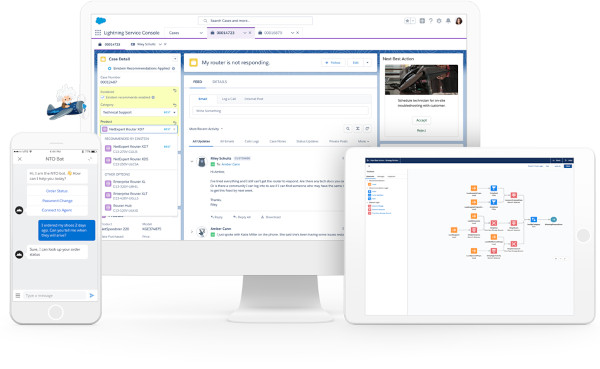
AI Chatbot - Salesforce Einstein

Image Source

Salesforce Einstein is a conversational bot that natively integrates with all Salesforce products.

Key Features

  • Powered by predictive intelligence and machine learning.
  • Builds contextual understanding and leverages existing Salesforce data to surface the best responses.
  • Routing to human agents for more pressing conversations.

16. LivePerson

Price: Contact for pricing

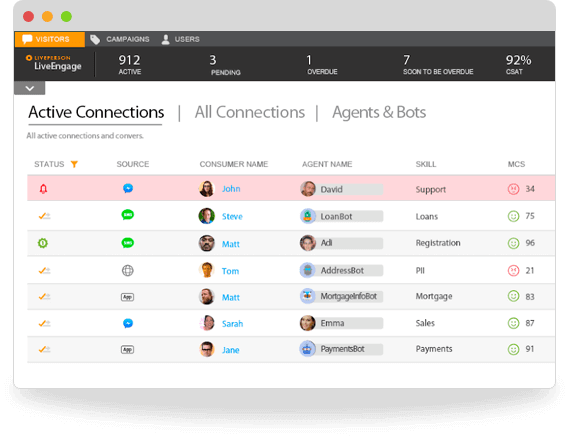
AI Chatbot - LivePerson

Image Source

LivePerson’s AI chatbot is built on 20+ years of messaging transcripts.

Key Features

  • The intent manager leverages data to understand the context of conversations.
  • Create automated conversation flows across different messaging channels (website, mobile app, Apple Business Chat, etc.)
  • Point and click builder to quickly and seamlessly create your bot.

17. Inbenta

Price: Contact for pricing

AI Chatbot - Inbenta

Image Source

Inbenta’s chatbot uses a lexicon and semantic search engine to power conversations.

Key Features

  • Its chatbot leverages machine learning and Inbenta’s own NLP engine to detect the context of conversations.
  • Use the dialog manager to craft custom conversation paths.
  • Escalate conversations to live support agents across multiple channels (your website, Slack, etc.)

18. Ada

Price: Contact for pricing

AI Chatbot - Ada

Image Source

Ada is an automated AI chatbot with support for 50+ languages on key channels like Facebook, WhatsApp, and WeChat.

Key Features

  • Uses pre-trained machine learning models that you can refine to meet your business needs.
  • Intent detection understands context and uses profiles and metadata to personalize conversations.
  • Connected to your business’ crucial data to bring appropriate solutions.

Want to learn more about artificial intelligence? Check out this learning path.

Editor’s note: This post was originally published in March 2019 and has been updated for comprehensiveness.

chatbots


Categories B2B

6 Ways to Earn Trust From Consumers Who Share Data With Your Brand [Data]

In 2023, having the right data can make or break your brand. But, for good reason, consumer data is harder than ever to get.

As data privacy regulations continue to tighten and third-party data channels are phased out, just 29% of consumers say they trust brands with their data.

While businesses should want the data of prospects and customers to be protected, some of the excess analytics that companies once used to pinpoint behaviors and preferences of target audiences will become inaccessible as we enter a more privacy-first world.

Download Now: The State of U.S. Consumer Trends [Free Report]

Today, more than ever, it’s up to brands to gain consumer trust, especially if they want to access the customer data needed to create effective and personalized experiences.

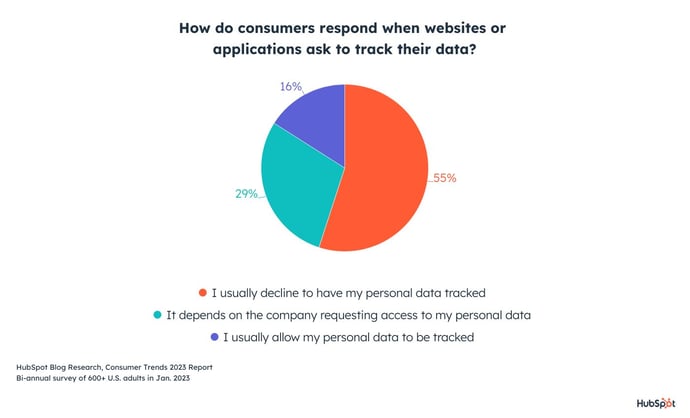
But – how do you do that when over half of consumers flat-out decline to share their data?how consumers respond when asked to share data

To help you build a data-gathering process that is effective, while also taking data safety and brand trust into account, we asked 600+ consumers what brands will need to do to make them feel more comfortable with sharing personal data.

How to Earn Trust When Gathering Data

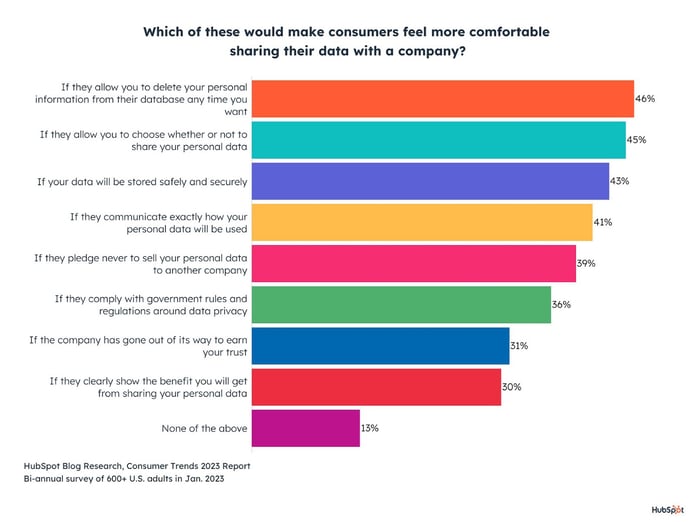
Offering people control over their data, transparency into how it’s being used, and keeping data secure are all key to encouraging consumers to share data. which data gathering strategy is most trustworthy

At the center of all of these considerations is building trust with consumers. Our survey found that 78% of people are more likely to share their data with a company they trust and 65% say trust is the determining factor in whether or not they choose to share personal information.

On top of that, 78% of consumers say they are more likely to buy from a company they trust with their data.

So let’s take a deeper dive into six steps you can take or consider in building trust with consumers (while still fulfilling your data needs). We’ll also look at the top incentives you can offer people for their data to create a mutually beneficial exchange.

1. Give Consumers the Power to Delete Their Data from Your Records

73% of consumers say they should have complete control over how companies use their data.

But right now, once they consent to sharing their data, consumers are mostly powerless to get it back. By letting consumers easily delete their personal data from your brand’s database at any time, you allow them to maintain a sense of ownership.

Empowering consumers in this way also allows them to hold companies accountable. If people decide they no longer support a brand or are concerned about how their data is being used, they can get it back in a flash.

With 46% of consumers saying this level of control would make them more comfortable sharing data with a company, it could significantly boost trust between the two parties.

2. Give Consumers the Choice to Opt-in (and Out)

The second way to make consumers comfortable with sharing data also comes back to control. All you have to do is ask whether or not consumers want to share their data.

Not only does it build trust, but you’ll also improve your data quality by collecting data from people who actually want to give it to you.

3. Emphasize How Data is Securely Stored

Another major concern consumers have with sharing data revolves around how securely it is stored. Especially when it comes to making purchases with credit cards or sharing sensitive personal data, it’s only natural to wonder what could go wrong if there was a breach.

Brands that can demonstrate their commitment to safeguarding consumer data will gain trust with their customers. By prioritizing data security, you create a trustworthy and safe environment that reassures consumers when it comes to sharing their personal information.

4. Clearly Explain How You Plan to Use Each Data Point

Another major concern consumers have is not knowing how their data is used. Without that knowledge, they can’t make an informed decision on whether or not to consent to it, so why would they?

41% of consumers say transparency on how their data is used will make them more likely to share it.

Especially if you’re using that data to benefit the consumer by improving your product or making their experience on your website more personalized, you should communicate that when asking for data.

Struggling to explain why you need a specific data point? This could mean you might not need it and can eliminate one of the data-gathering tasks from your process, and more importantly, avoid worrying consumers by asking them for way too much unnecessary information.

5. Explicitly Pledge to Never Sell Consumers’ Personal Data

At HubSpot, we don’t condone the selling of data and encourage you to build your own contact lists and data samples, especially when the data could be used by sales reps, email marketers or other entities that could make unwanted contact with your consumer.

Many consumers are very concerned about their data being resold to other companies. Suddenly they’re being bombarded with ads, phone calls, and emails from people they don’t know selling products they don’t want.

If you are or aren’t selling consumer data, make that explicitly clear. They should ideally know exactly where their data is going and be able to decline giving it if it could be sold to companies they might not know.

Additionally, if you’ll share data with ANYONE that isn’t part of your immediate company, note which companies the data could be shared with or link to a deeper page or document that goes into deeper transparency about which companies the data will be used by.

6. Comply with Government Regulations (and Flaunt it)

Some countries have strict laws about collecting data from users, and 36% of consumers say it would make them feel more comfortable to know that brands are complying with these regulations.

While some states in the US have enacted data privacy laws, there isn’t a nationwide equivalent to the EU’s GDPR. If you’re complying with data privacy laws in your country or state, make sure to flaunt it so consumers know their privacy is protected.

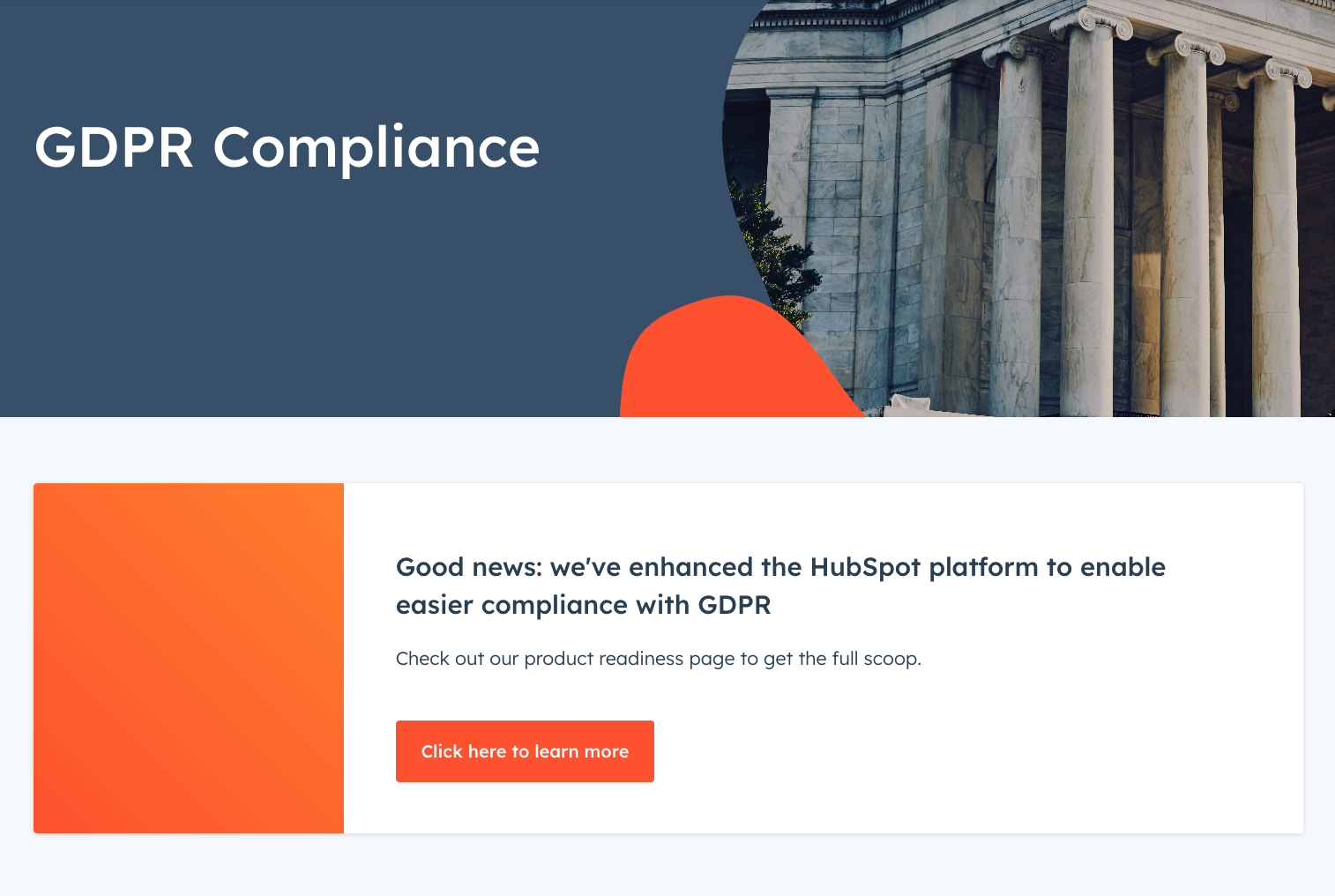
For example, HubSpot has an entire section of its site devoted to GDPR resources and information about how its tools should be used to create GDPR-compliant data-gathering and tracking strategies.

screenshot of hubspots gdpr compliance page

7. Offer Incentives for Sharing Data

Sharing data with a company can feel very one-sided. Making it a mutually beneficial exchange can help your data quality and build trust with your customers.

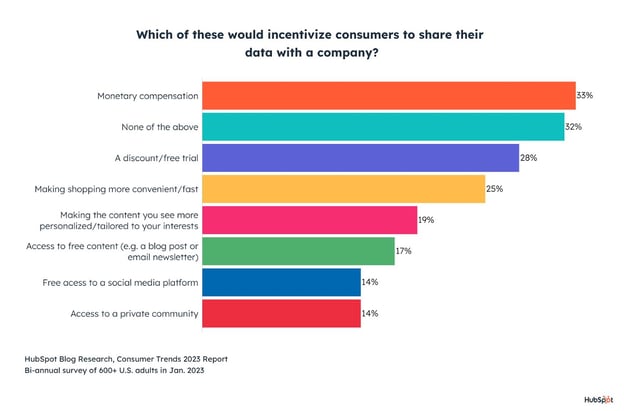
We asked consumers about what would incentivize them to share data. Here’s what we found:

how to incentivize customers to give data

Unsurprisingly, money is most preferred with 33% of consumers saying monetary compensation would encourage them to trade their data. This isn’t that shocking as these consumers were paid a small sum of money to give their very thoughts for this post.

Other than money, 28% say discounts or free trials can sway them. Coupons, gift cards, and store credits can all be great ways to reward customers for giving you valuable information.

If you’re a marketer who relies on data to better cater experiences to your loyal customers, you might be in luck with many of them. One in four consumers say they might be more likely to share their data for a more convenient shopping experience and 19% would be interested in sharing it for a more personalized experience.

You can also make trading personal data mutually beneficial by offering valuable content, like access to a blog or newsletter, in exchange for an email address. We discovered that 17% of consumers would be interested in that trade.

Despite all that, 32% of consumers refuse to be swayed, saying none of these would make them more likely to share data – though the tips we went over above could help address that.

The Future of Data Privacy

When it comes to the future of data privacy, all signs point to transparency, ownership, and trust.

With 74% of consumers in our survey saying that data privacy is a human right, creating a mutually beneficial exchange is key to gathering data from your audience and building an effective first-party data strategy.

Check out our 2023 Consumer Trends Report for more insights on topics ranging from data privacy to shopping habits, the impact of the recession, and the metaverse.

Disclaimer: This blog post is not legal advice for your company to use in complying with EU data privacy laws like the GDPR or state-by-state data privacy regulations. Instead, it provides background information to help you better understand the GDPR and existing regulations. This information is not the same as legal advice, where an attorney applies the law to your specific circumstances, so we insist that you consult an attorney if you’d like advice on your interpretation of this information or its accuracy.

In a nutshell, you may not rely on this as legal advice, or as a recommendation of any particular legal understanding.

New Call-to-action

Categories B2B

Consumers Spend 3+ Hours on Social Media Daily: What They’re Doing on Each Platform [Data]


Have you ever been hypnotized by social media? According to our recent Consumer Trends survey, users of it spend an average of three hours a day there.

It’s easy to fall into a social media trap, filled with endless distraction. One minute you’re checking a DM and the next thing you know you’ve spent an hour watching videos of corgis playing fetch.

But, it does make you wonder what consumers actually do while spending all that time on social media. And — as a marketer — you’re likely going a step further by asking: “What’s my target audience doing on there?”

Download Now: The 2023 State of Social Media Trends [Free Report]

Why Consumers Use (& Love) Social Media

Before asking social media users what the heck they’re doing on social media all day, we asked them to choose the top three reasons they log on in the first place.

And considering the average social media user spends three hours a day on their platforms of choice, it’s no surprise that they log on to do a bit of everything there:

In digging deeper, we determined the top three reasons users log on to each major social media platform:

why social media users log on to each platform

While Facebook and Instagram are mainly used to share content from our lives and keep up with family, users turn to TikTok and YouTube for entertainment, education, and inspiration. We also have Twitter and LinkedIn, the only platforms that are primarily used to keep up with news and trends.

With that in mind, we can dive a little deeper into the top reasons people use each of these platforms.

What Social Media Users Do on Each Platform

Facebook users primarily keep up with loved ones — but also like to share media on their feeds.

Facebook — used by 69% of U.S. adults is the most popular social media app on our list.

Two in three Facebook users are on it to keep up with friends and family, 43% use it to share pictures and videos, and 26% go to Facebook simply for entertainment. About one in five lean on Facebook for news or trends, as well as to learn new things.

YouTube users seek out entertainment, education, and inspirational content.

YouTube is the second most popular social media platform, used by 57% of U.S. adults. Edutainment thrives on YouTube – the top reasons people visit are to find entertaining content, learn new things, find inspiration, and keep up with news and trends. About one in five YouTubers use the app to keep up with brands and products.

why do people use youtube

Instagrammers share multimedia content while keeping up with friends, family, and celebrities.

45% of American adults use Instagram, and the top uses are to share pictures/videos (38%), to keep up with friends and family (33%), follow celebrities and influencers (27%), find entertaining content (27%), and keep up with brands/products (24%).

what instagram users do on the platform

TikTok users watch a mix of entertaining, educational, and inspirational content.

Just about one in three U.S. adults are on TikTok, but this shoots up to 62% when we look at Gen Z.

Overall, TikTok’s used much like YouTube – for entertainment, education, and inspiration. 23% use TikTok to keep up with celebs/influencers and 21% use it to share their own content. About one in five TikTokers go to the platform to follow brands/products, while the same amount use it to keep up with news and trends.

Twitter users crave news, entertainment, and celebrity content.

Twitter stands out as the only platform where keeping up with news and cultural trends is the #1 reason people use the app. Finding entertaining content (27%), keeping up with celebrities (26%), and learning new things (23%) are also top reasons for Twitter usage.

why people use twitter

LinkedIn users surf feeds for education, industry news, and brand updates.

As the only social media platform on this list geared towards professionals, it’s no surprise that the top reason people use LinkedIn is to learn new things. About 1 in 4 LinkedIn users also log on to keep up with news or trends, brands and their products, and their network of friends and family.

More Social Media Trends

Looking for more social trends? Check out HubSpot’s Social Media Trends 2023 Report blog pos, or the full PDF version below. In this content, we dig into data from 1,200+ social media marketers as well as key insights comparing marketer data to our bi-annual Consumer Trends Report.

New call-to-action

Categories B2B

Why Consumers Still Hesitate to Shop on Social Media Platforms [New Data]

If you’ve been on social media lately, you know shopping has taken center stage on most platforms.

But, social commerce a controversial topic — some people love it, others are exhausted by product placements everywhere. And, in our latest research, we discovered that people don’t trust the social media apps they use daily to handle their purchases.

Download Now: The 2023 State of Social Media Trends [Free Report]

How Consumers Feel About Social Media Shopping

For starters, just 41% of social media users feel comfortable buying products directly on social apps, and only 37% trust platforms with their card info.

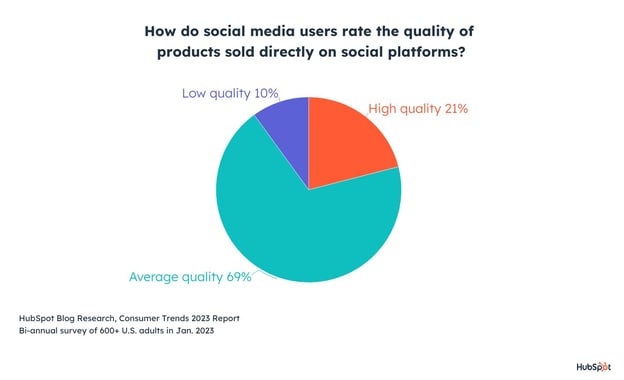
And when it comes to the products sold directly on social platforms, just 21% of social media users view them as high-quality.

how social users rate the quality of products they use

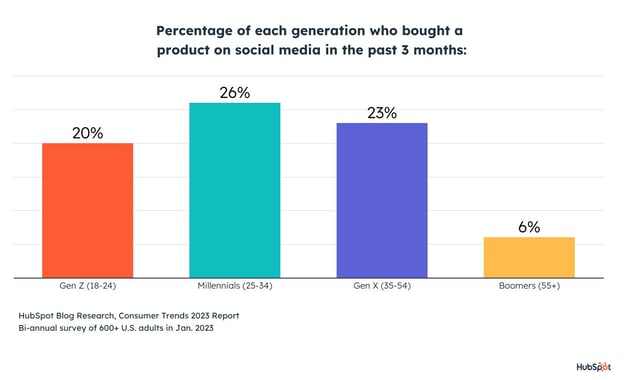
Still, around one in five social media users buy on social media regularly, and 75% of those shoppers say they’re satisfied with their latest purchase.

percentage of each generation thats bought products on social media

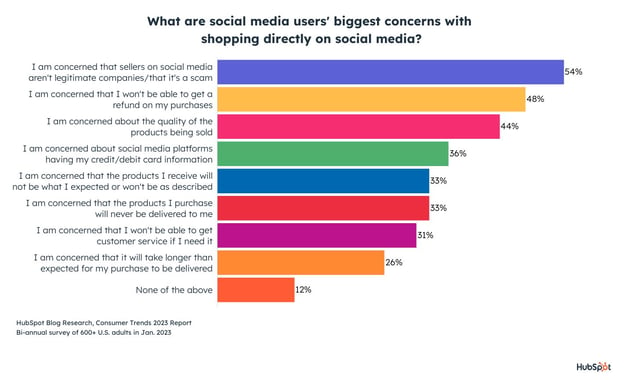
So why are people so suspicious of social shopping? Let’s take a look at the biggest concerns consumers have with shopping on social, how you can address them, and which platforms are most trusted for shopping.

The Biggest Social Shopping Concerns

By far, the biggest concern of consumers is that companies selling products directly on social media aren’t legitimate or could be scamming customers.

As mentioned above, suspicions regarding the quality of the product and sharing card information with social platforms also play a huge role.

social media users biggest social media shopping concerns

On top of that, one-third of social media users are concerned that their purchase will never be delivered, and the same amount worry about the item will not be as described when and if they do get it.

What Can Social Sellers Do to Build Trust?

1. Make and Stand By Customer Promises

First, directly address common consumer objections or concerns by promising and following through on guarantees like:

  • a set, transparent, and explainable shipping speed
  • Refunds and/or replacement warranties
  • Customer service availability (ideally on multiple channels)

While this step is a foundational standard that most businesses should follow, the promises above won’t be enough to gain full trust, especially if you’re a brand selling exclusively on social.

2. Build Community

The next step is to foster a trusting community with your audience.

You can do this by responding to their comments or questions, addressing concerns in review responses, and asking your community for feedback. You should also aim to build content strategies fueled with funny, relatable, and valuable posts that are relevant to your prospects andd show the humanity behind your brand, without making the content feel like an ad.

For example, if you sell peanut butter, make a poll on your story about crunchy vs. smooth to end the debate once and for all. Or create a short video chock-full of fun facts about peanuts: (Did you know astronaut Alan Shepard once brought a peanut to the moon and back?).

Encourage Customer Engagement and UGC

Time and time again, research has shown that word of mouth, recommendations from loved ones, and product reviews from trusted, or relatable, sources can drive consumers through their buyer’s journey. And, this makes sense: Are you more likely to trust a random website selling your a product, or a friend who already used that same item?

With this in mind, encourage happy customers to provide positive reviews or user-generated content to build social proof that your product is legitimate and customers are satisfied with it.

Similarly, try working with small influencers with niche, tight-knit communities related to your product – their stamp of approval can help bridge the trust gap.

Zone in on the Right Channels

When it comes to social selling you also have to consider the platform you’re using, because they aren’t all equally equipped for social commerce just yet, and different audiences are looking for different things.

For example, products you prioritize selling on Facebook, where the demographic skews older, might be different from products you’d sell on a Gen-Z-heavy platform like TikTok. Like content preferences, consumers also trust certain platforms to a different extent – especially when giving personal or credit card information.

Next, let’s take a look at the platform consumers trust most for shopping.

Most Trusted Social Shopping Platforms

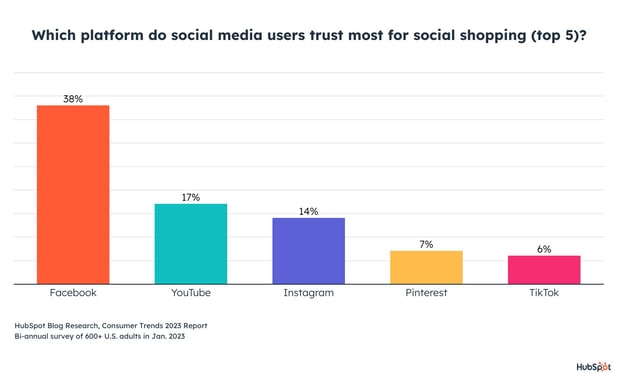
Facebook has the most trusted social shopping platform, according to 38% of social users. YouTube comes in 2nd place (17%), followed by Instagram (14%).

the most trusted social media platforms

Though not exactly the same as social shopping (where you buy directly in the app), it’s important to remember that people have been buying things through Facebook Marketplace for a while now, while shopping experiences on other platforms are much newer and have catching up to do. So, now, with Facebook Shops, it feels much more natural to start using your credit card to purchase items on a platform that’s already built robust shopping experiences with Marketplace.

One interesting thing to note is that Facebook and Instagram (both owned by Meta) have the same in-app shopping technology and platform, while one is adapted for Facebook, Instagram’s is adapted to Instagram features, Instagram business pages, and UX. However, Instagram has far less trust than Facebook.

Why could this be? We aren’t sure, but one guess could be the age, trust, and sheer size of Facebook – which Instagram could likely catch up to. It will be interesting to see if Instagram ultimately gains more shopping trust due to its growing age, credibility, and product purchasing features in the coming years. So

Channels with the Best Social Shopping Experience

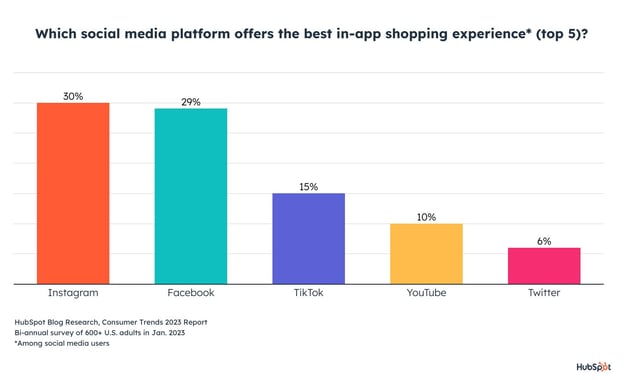
We also asked social media users, which platform has the best in-app shopping experience, and Instagram (despite its lack in consumer trust) came out on top with 30% of the vote, followed by Facebook (29%), and TikTok (15%).

best social media shopping experience channels

This makes sense as Instagram has been a leader in the social shopping space, though it seems users are somewhat skeptical of the quality of the products being sold on the app. While shopping features and product placements were a key part of Instagram’s cultural and UX evolution, platforms like Faccebook and YouTube started with a focus on content and user experience – and eventually worked shopping in.

What’s Next for Social Shopping?

The good news is social shopping is still evolving, so there’s plenty of time to build trust with social media users.

For more insights, check out our Social Media Trends Report or the full Consumer Trends Report.

And if you’re setting up shop on Instagram, head over to the Instagram Shopping Report for a deeper dive into selling on the app and which tools offer the best ROI.

Lastly, for overall coverage on the latest social media trends and tips from experts in the social marketing industry, download our full Social Media Report below.

New call-to-action

Categories B2B

How AI Will Revolutionize the Future of Business, According to HubSpot’s CMO

Artificial intelligence will change how businesses operate. At this point, that statement won’t surprise you.

In fact, AI’s impact on the workplace is already happening.

62% of business leaders have already invested in AI and automation tools for their employees, according to our State of Artificial Intelligence survey.

What’s more, 65% of survey respondents believe AI innovations will be comparable to the industrial revolution.

Free Guide: How to Use AI in Content Marketing [Download Now]

At its core, this means one big thing for the future of business: Marketing, sales, and service professionals now have more time to work on complex, higher-impact work. AI enables creativity and innovation to supersede tedious and redundant tasks.

Hours spent drafting professional emails, creating marketing reports, coding, and much more will be replaced by time spent on deeper work: work that better enables you to learn about your email readers, strategize based on pre-synthesized data, and plan stronger web or product experiences for your customers.

But how, specifically, will you see AI impact businesses in 2023? Here are just a few ways AI’s already changing the workplace, according to our State of AI survey of 1,350 U.S. professionals.

How AI Will Revolutionize the Future of Business, According to HubSpot’s CMO

1. AI will enable you to obsess over your customers.

At Inbound 2022, we discussed the crisis of disconnection facing businesses today. Many SMBs are trying to find new ways to connect with customers in a hybrid world and rely on cobbled-point solutions that don’t reliably connect their customer data in an efficient, streamlined way.

AI is one of the most compelling solutions to the crisis of disconnection when it comes to understanding our customers.

Business leaders agree. Our research found a whopping 63% of business professionals feel that AI already helps their employees understand their customers better.

AI can help you pull data from disparate sources into one single source of truth and glean unique insights about your customers that you otherwise might’ve missed.

But most importantly, it gives you the time to obsess over your customers again.

It gives your sales team time to genuinely connect with customers and work with them to identify how your products can solve for their unique needs.

It gives your support team the ability to focus on complex customer challenges rather than being bogged down by tickets that could be answered by a chatbot.

And it gives your leaders the insights they need to make more high-impact, powerful decisions that align with what matters most to your customers.


2. AI will automate data analysis for better decision-making.

One of the most time-consuming aspects of any leader’s job is wrangling the right data. It can take hours for a business leader, analyst, or marketer to analyze customer data and uncover meaningful insights, leaving less time to actually use it to make critical decisions. Not to mention, a manual data analysis process is inherently prone to human error.

Fortunately, predictive analytics — which uses machine learning algorithms, data mining, and statistical techniques to analyze large amounts of data and make powerful predictions about future trends or behaviors — can help streamline and supercharge your analytics processes.

There are three main benefits to leveraging AI for data analysis:

  • AI algorithms can discover patterns that might not be obvious to humans.
  • AI can learn from your data and improve its predictions over time.
  • You don’t have to do it yourself.

Smarter data ultimately means a more personalized customer experience. Truly understanding your customer data helps you improve how you engage with each individual prospect.

Additionally, predictive analytics can help each organization expand its reach. Sales leaders, for instance, can leverage AI-based insights to formulate reports, develop key account strategies, and build more powerful forecasts on their pipelines.

Among the leaders we surveyed, one-fourth reported the biggest benefit of AI is its ability to enable their employees to make better data-driven decisions.

My bet? The best leaders of the near future will see AI as an indispensable part of their reporting and analytics processes.

3. AI will reduce business costs and improve efficiency.

In today’s difficult economic climate, business leaders need to do more with less.

There are innumerable ways AI can help your business save money – 28% of business leaders have already found that AI helps their company cut costs.

For one, it will help automate time-consuming, manual tasks. For instance, many customer support reps need to spend extensive time responding to recurring questions from customers. By leveraging AI, you can automate responses to commonly asked questions, which frees up your support reps for more complex issues.

A full 91% of customer support reps who use AI say that chatbots already effectively respond to customer service requests.

Additionally, you can leverage AI for predictive maintenance. Run or work at a business that uses lots of equipment or machinery? AI can help businesses predict equipment failures so you can schedule maintenance before a breakdown, minimizing repair costs. Dealing with inventory issues? AI could help predict when or if inventory is running high or low to help prevent excess storage costs or other business waste.

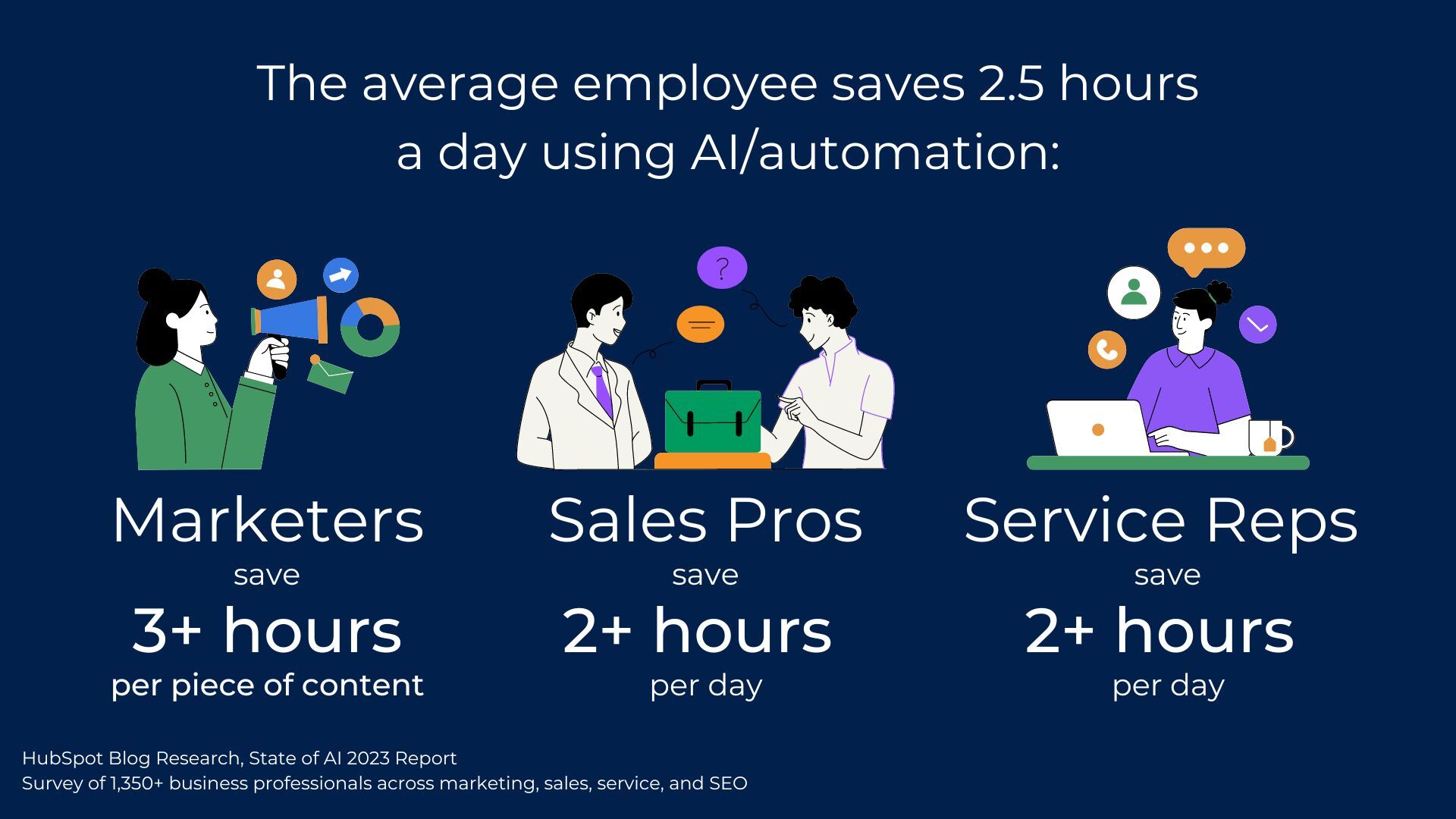
Ultimately, AI will improve efficiencies across the business – all while enhancing the customer experience. On average, AI already saves the average employee 2.5 hours per day.

With all that extra time, your business and employees can scale a stronger human connection.

how many hours a day professionals save with AI

4. Business leaders will invest in new hires specifically trained in AI.

So the question on everyone’s mind is: Is AI going to steal my job?

The short answer: no. AI is more likely to optimize the impact of existing roles and create room for additional hiring opportunities.

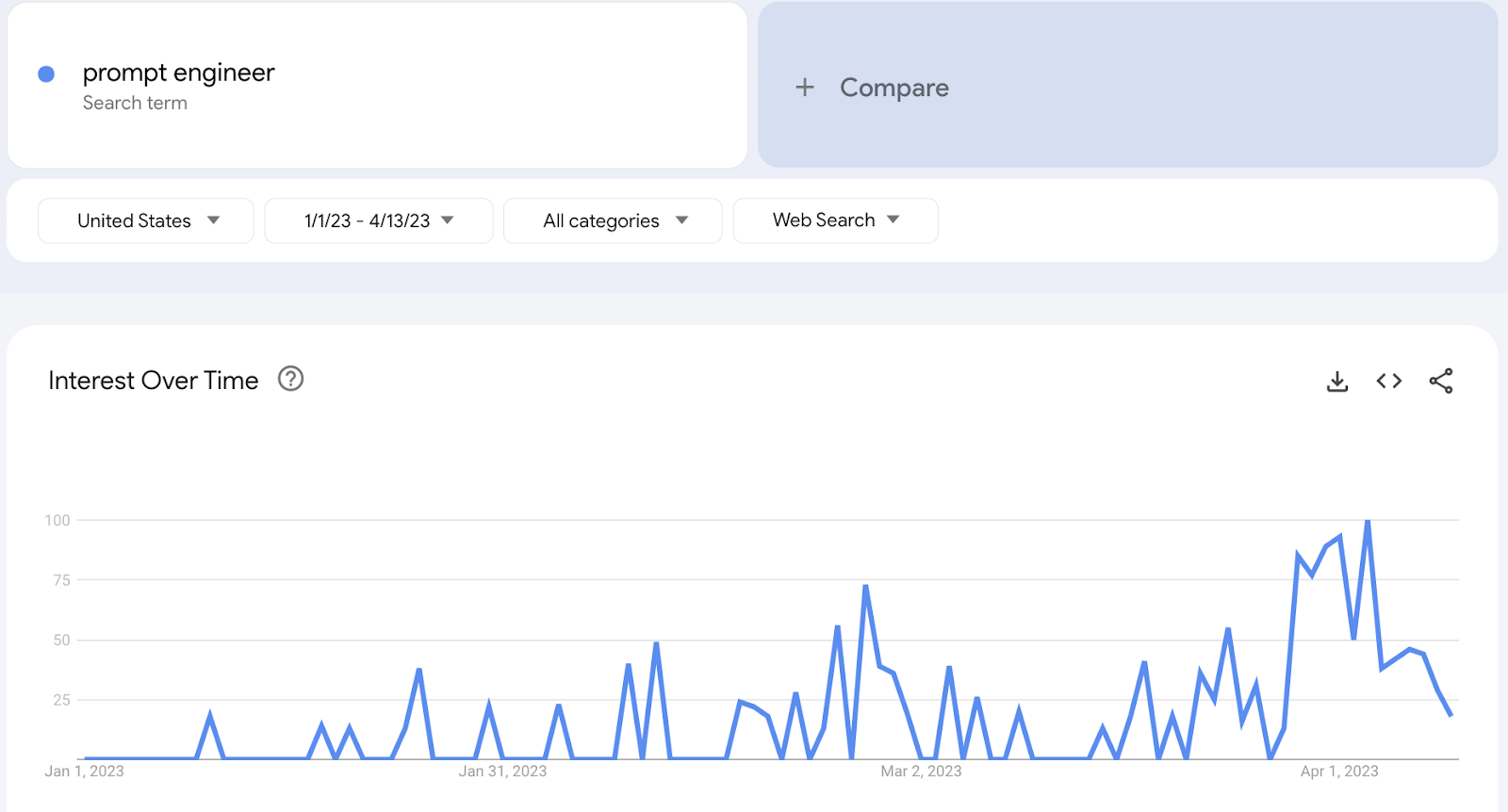
On Google Trends, the term “prompt engineer” — which was practically non-existent at the start of 2023 — has risen rapidly, hitting peak popularity in early April.

Image Source

And our AI survey found that 66% of business leaders have already hired a new employee specifically to help with leveraging and implementing AI.

This number will only increase.

At HubSpot, we’ve created dedicated task forces across departments with the specific purpose of identifying how we should implement AI into our current processes across the organization.

Other businesses will do the same — either identifying internal employees who can focus on AI for their business, or hiring new AI experts or consultants to fill that need.

5. AI can help businesses detect fraud.

Another benefit of AI? It will make fraud detection easier for businesses of all sizes.

In 2022, 65% of businesses were victims of fraudulent attacks or attempts.

Fraud can be detrimental financially and legally for any business. Fraud is also increasingly challenging to detect as it becomes more sophisticated.

In 2023, businesses will increasingly leverage AI tools to detect and deter fraudulent activity. AI can point out anomalies in data, such as unusual spending behavior, which helps your employees identify potential fraudsters.

Additionally, AI can use data to make predictions on the likelihood that a particular transaction is fraudulent. Over time, AI algorithms will become better at detecting fraudulent activity, such as suspicious logins, odd transactions based on consumer behavior, or identity theft.

AI Blog Content Template (640 × 385 px)

6. AI will help businesses build better products.

In the future, we’ll also begin to see business leaders leverage AI to uncover new product opportunities.

For instance, software engineers can use AI tools to sift through feedback, engagement, or other product usage data to determine which features they should improve on an existing product, or discover new product ideas based on gaps in their offerings.

But it goes beyond that. AI algorithms can also help you design your product.

Yep – you heard that right. AI will be able to analyze data on customer usage patterns, feedback, and preferences to provide you with invaluable insights necessary to create more user-friendly, engaging, effective products for your customers.

It will also help you speed up the product development process start-to-finish with rapid prototyping. AI algorithms can seamlessly and instantly provide different design options, so your team can quickly identify the most promising option and iterate in real-time.

Preparing for an Era of AI Disruption

AI is poised to disrupt virtually every industry. But it’s not something we need to fear.

The key to long-term growth and success is to evolve quickly with AI and accept it’s here to stay.

In the early stages of AI, you’ll want to remain focused on your highest priorities, and how your business can get the most out of AI. If you’re interested in learning more about how you can use AI on a tactical level, or get more original data in our State of AI Series, dive into our AI learning path, or download the offer below.

New Call-to-action

Categories B2B

15 Best Bulk Email Services for 2023

You’ve seen that email marketing works wonders for your business. So you doubled down and built a massive email list. However, you’ve now hit a roadblock. You can’t send bulk emails through providers like Gmail or Outlook.

Enter: Bulk email service providers.

These bulk email services are equipped to manage large volumes of email while offering features to track performance. Read on to discover the key features to look out for in a bulk email service and the best bulk email services in the market.

Table of Contents

A mass email service helps you reach a large audience and nurture them one email at a time. In addition to getting direct access to your customer base, you can track how your emails perform and test various methods to increase clicks and conversions.

While traditional advertising methods, such as print ads and direct mail, can have a high return on investment (ROI), it can be challenging to understand how consumers interact with your materials. With a bulk email service, you can find out what attracts consumers and what elements lead to more conversions.

Furthermore, many bulk email services offer automation tools — think workflows and sequences. You can more easily move leads down the funnel and retain your current clients.

Using a personal or business email can work in the first few months of starting a business but will quickly become ineffective as you grow. Bulk email services offer a long-term solution.

Reasons to Send Bulk Emails

Not sure if it’s the right time to try a bulk email service? The first question you should ask is, “Is our brand investing in email marketing this quarter/year?”

If the answer is yes, that’s your sign to invest in an email service.

Here are specific examples of when you would send out a mass email to your subscribers:

  • Sales promotions. Say you want to promote discounts on specific products or services. Sending a mass email to your subscribers is a great way to generate sales.
  • Newsletters. Do you want to send out exclusive content to your subscribers? Then a newsletter is the way to go.
  • Product updates. A great way to announce a new product feature or line is via email. You can include previews to build up excitement and include calls-to-action (CTAs) for conversions.
  • Announcements. Are you updating your hours, prices, or services? Or perhaps there’s been a change in your policy. Notifying your subscribers in an email blast is an effective way to spread the news.

With every email you send to subscribers, you’ll want to remember your goals, audience, time and day, personalization, and compliance with data protection laws.

Best Bulk Email Services

1. HubSpot’s Email Marketing Tool

 bulk email service, HubSpot

Image Source

With HubSpot, you can create, customize, and optimize your emails without coding or design experience.

You can send up to 2,000 emails monthly, which doesn’t include test emails to check functionality. In addition, the platform offers a user-friendly interface, tools like drag-and-drop to design your email easily, tokens to personalize every email, and an a/b testing feature.

In addition, you can create custom reports based on the data you want to collect and analyze.

Pricing: The best part? It’s free.

2. ConvertKit

Best bulk email services, Convertkit bulk email service

Image Source

As their name suggests, the platform is designed to help you earn more conversions and generate more revenue. ConvertKit is known for its advanced automation tools, including custom email funnels, smart filters, and link triggers.

Furthermore, the platform has a 98% delivery rate, ensuring that your emails will always reach your subscribers. In addition, the average open rate for ConvertKit emails is an astonishing 30%, according to their website.

Pricing: ConvertKit offers a free version of its platform, and custom pricing for enterprise-level businesses with over 365,000 subscribers.

3. Mailchimp

Best bulk email services, Mailchimp bulk email service

Image Source

Mailchimp is an excellent email service for those just starting in email marketing. The platform offers a user-friendly interface and over 100 templates to choose from.

With their free plan, you can send up to 10,000 emails monthly to 2,000 contacts — an ideal option for small to midsize businesses.

Then, as your business grows, you can scale to the premium version. Here, you’ll have unlimited audiences, multivariate testing, and advanced segmentation with up to 200,000 contacts.

Pricing: A free plan is available. Paid plans range from $11 to $299 per month.

4. Drip

Best bulk email services, Drip bulk email service

Image Source

If you have an ecommerce business, consider Drip for your email marketing. The platform offers pre-built email templates that you can customize and a user-friendly workflow builder for automation.

In addition, you can schedule automation based on actions your subscribers take (like viewing a product, abandoning their cart, and making a purchase).

With Drip, you can easily integrate your online store (like Shopify, Magento, and WooCommerce) to make gathering data easier.

Pricing: Prices start at $19 and go up based on your number of subscribers.

5. Insycle

Best bulk email services, Insycle customer data management service

Image Source

Insycle doesn’t fall under the email provider list. However, this software does work in tandem with providers like HubSpot and Mailchimp to keep your contact list clean.

One of the downsides of having a subscriber list is the potential for duplicate contacts. This can impact your metrics and make it difficult to tailor your emails. Insycle allows you to clean your contacts in bulk, merge duplicate ones, and avoid overwriting data.

Pricing: Pricing starts at $5 per month and scales up to custom pricing based on the services you want.

6. Sendinblue

Bulk email service from Sendinblue

Image Source

Sendinblue is one of the best bulk email services for small and large businesses. A drag-and-drop editor is one of the must-have features for a good email service, and Sendinblue features one of the most powerful editors on the market.

Aside from that, the service has segmentation features that let you send emails to a targeted audience. This feature helps to improve overall engagement with customers.

Pricing: Sendinblue has free and premium plans. The free plan lets you send up to 300 emails daily, albeit with the Sendinblue watermark. The premium plan begins at $35 monthly.

7. Constant Contact

Bulk email service Constant ContactImage Source

Constant Contact is a bulk email service that’s great for small businesses and individuals. We love its simplicity and ease of use, features that make it great for beginners.

The service features inbuilt social media sharing tools, easy tracking and reporting, and integrations with ecommerce centers like Facebook and Shopify.

Its advanced features, like coupons, surveys, and event marketing automation, make it one of the best bulk email services.

Pricing: This bulk email service offers a 30-day free trial, which you can upgrade to a premium plan. Paid plans start at $10 monthly and can be further upgraded to the Email Plus plan for $45 monthly.

8. Mailmodo

Best bulk email services, Mailmodo

Image Source

Mailmodo offers a free plan that allows you to send up to 10,000 emails monthly, making it an ideal choice for individuals and small businesses. However, if you want more, you can choose from four premium plans which let you send more emails monthly.

Mailmodo’s no-code, drag-and-drop editor, makes crafting emails a breeze. Additionally, this bulk email service offers users several customizable templates.

If you ever run into problems while using the service, Mailmodo offers 24/7 customer support.

Pricing: A free plan is available. Premium plans start at $99 monthly.

9. AWebeBest bulk email service, AWeber

Image Source

AWeber is a flexible service that only charges users based on their number of subscribers. This flexibility is one of the reasons some users prefer this service.

AWeber also has one of the most extensive libraries of customizable, mobile-responsive email templates. These templates allow you to create and send emails very quickly and easily.

The platform offers sales tracking and lets you check out the performance of your emails and subscriber information.

Pricing: The free plan allows you to automatically create emails from blog posts and send them to hundreds of subscribers at a go. AWeber then charges users based on their number of subscribers.

10. Mailgun

 Best bulk email service, Mailgun

Image Source

Mailgun’s email solutions for email marketing, tracking, parsing, and more make it one of the best bulk email services. In addition, Mailgun’s email API allows developers to easily integrate it into their apps.

Furthermore, Mailgun’s email analytics feature ensures email delivery. There’s also an email validation feature to ensure your emails are sent without typos.

Pricing: Mailgun offers a free plan that allows sending up to 10,000 monthly emails. You can opt for its premium plans which start at $35 monthly if you want even more features.

11. SendPulse

Best bulk email services, SendPulse

Image Source

SendPulse allows you to send emails, web push notifications, Facebook messages, and more.

When it comes to emails, this service allows you to create responsive emails without writing a line of code. And if you prefer, you can use any of the 130+ templates available on the platform.

Additionally, SendPulse has a drag-and-drop editor that lets you design subscription forms that can then be integrated into a website. Aside from regular websites, SendPulse also supports integration with PipeDrive, WordPress, Zapier, and other tools.

Pricing: SendPulse has a free version available, while paid plans start at $8 per month.

12. Stripo

Best bulk email services, Stripo

Image Source

Looking for an all-in-one email design platform? Then you should consider using Stripo.

This service offers hundreds of easy-to-use email templates that make your emails look better and help improve conversion rates.

Stripo gives users the tools they need to create all types of emails. After creating the email, Stripo lets you test how it’ll look on different platforms. You can also have colleagues or clients view potential emails before sending them off to subscribers.

Pricing: Stripo has four plans, from free to $95 per month, priced according to the number of recipients and features.

13. SendGrid

Best bulk email services, SendGrid

Image Source

SendGrid is the go-to choice for users looking to create and send transactional emails. It allows you to add contacts via CSV upload, signup forms, or APIs.

In keeping with its focus on transactional emails, SendGrid has features like anti-spam regulations to protect you and your subscribers.

Pricing: SendGrid has a free plan that lets you send up to 40,000 emails in the first month and 100 emails daily. For more features, you’ll need to upgrade to either the $19.95 or $89.95 monthly plans.

14. Mailjet

 Best bulk email services, Mailjet

Image Source

Our penultimate choice is a user-friendly bulk email service best for marketers and development teams. Mailjet has a drag-and-drop email builder that lets you quickly create emails and templates.

Mailjet also features an interactive design so you can give team members access and let them work on it individually.

Email tracking lets you monitor how your sent emails are doing. You can check metrics such as email delivery, bounce rate, and open rate.

Pricing: If you decide to use Mailjet, you can choose between a free plan that lets you send up to 6,000 emails or any of the four premium plans starting at $15 monthly.

15. Omnisend

Best bulk email services, Omnisend

Image Source

The last but not the least bulk email service on our list is Omnisend.

Omnisend combines emails, SMS, and other channels. You can also create customizable forms for collecting information from website visitors.

Omnisend makes it easy to divide subscribers into segments, improving the ability to send the right emails to them. With its all-in-one features, automation, and numerous template options, Omnisend is one of the best bulk email services of the year.

Pricing: New users can use this service for free. However, to fully enjoy the tool, you’ll need to subscribe to a premium plan which is priced based on the number of email recipients.

So you’re ready to invest in an email marketing service. These are the key features you should look for in a bulk email service. Some of these features will only be available in a premium package. Others will be included in the standard or free versions.

Here’s your complete guide with factors to consider.

1. User Behavior Tracking

Reporting capabilities will be the number one tool you’ll need in any bulk email service you select. Because what’s the point of investing your time in designing and sending emails if you can’t see how they perform?

You should be able to track key email metrics, such as:

  • Open rate.
  • Unique clicks.
  • Click-to-open rate (CTOR).
  • Clickthrough rate (CTR).
  • Unsubscribe rate.
  • List growth rate.
  • Bounce rate.

Email providers with advanced reporting features also allow you to track revenue per subscriber and revenue per email.

2. Drag-and-Drop

Email drag and drop tool in bulk email service

A drag-and-drop tool makes designing your email easy. This intuitive feature allows you to select an element from the sidebar, like an image, quote, or button, and drag it to a section of your email.

This will save you time as you determine the best flow for your email and move things around.

3. Email Segmentation and Personalization

Segmentation ensures that your emails are reaching the right people at the right time.

You should look for a bulk email service that allows you to segment your subscriber list based on the following:

  • Location
  • Actions taken in the email
  • Purchase history
  • Type of subscriber (e.g., prospect versus current customer)

You can get higher engagement rates when you segment your list, as the content will be more relevant to your recipients.

Furthermore, personalization is one of the key factors to improving email engagement and advancing customer relationships.

4. Split Testing

Split testing, also known as A/B testing, is a great way to understand what resonates with your audience.

A/B test example in a bulk email service

Image Source

AThis feature is beneficial if you need help generating high open rates and converting subscribers.

By testing out different subject lines and elements within the body of your email, you can determine what works best.

5. Automation

When you’re scaling your email list, the name of the game is automation.

Say you have a content offer and want to send an email sequence to leads after they download the offer. With an automation tool, you can pre-select which emails will go out, in what order, and after how much time for each email.

email automation example in bulk email service

Image Source

Once you complete the setup, the automation does all the work for you — nurturing your subscribers and moving them through the buyer’s journey.

This hands-off approach allows you to focus on strategy instead of the tedious work of sending out emails. With automation, you can take the guesswork out of the process.

6. Design Templates

If you’re like me, designing isn’t your forte. So, when designing an email, you’ll take all the help you can get.

Bulk email service, design template example from HubSpot

Image Source

A design template based on the type of email you want to send can save you time and ensure you’re following email best practices. This is particularly helpful if you have limited experience designing emails and are just starting out.

What’s great about having a template is that it’s a foundation. You can customize it to fit your needs, but it provides a blueprint from which to work.

7. High Email Delivery Rates

Imagine you work so hard on an email campaign, and it never reaches your subscribers’ inboxes. Frustrating, right?

That’s why verifying your provider’s email delivery rates is essential. You’ll want to select a service with high email delivery rates. You want something as close to 100% as possible.

Grow Your Business

Knowing what to look for in an email service is half the battle.

Now that you have a list of key features and a few tools to choose from, you can find a platform to grow your email list and generate revenue.

Categories B2B

Maximizing Your Social Media Strategy: The Top Aggregator Tools to Use

Creating and managing content is more challenging than ever. With so many channels, keeping track of all of your posts can be cumbersome. Enter social media aggregators.

These tools can help you oversee your digital presence and distribute information to your audience.

In this post, you’ll learn about the different types of social media aggregators and what they can do for your team. From there, we’ll share the top tools already on the market.

What is a social media aggregator?
The Benefits of Social Media Aggregators
Types of Social Media Aggregators
Social Media Aggregation Tools

Download Now: The 2023 State of Social Media Trends [Free Report]

Like other content aggregators, social media aggregators pull posts from your platforms and display them as a collection. You can embed the collection on your website to highlight posts about your brand, including user-generated content.

Aside from your website, there are several places to feature these collections, including email marketing and digital screens at live events.

The Benefits of Social Media Aggregators

Social media is vital for engaging with your target audience and keeping a pulse on how people feel about your brand. However, you’re missing out on opportunities if you stop there.

Social media can also deliver social proof of your status by sharing satisfied customers on your website.

Highlighting positive, user-generated posts on your site creates shout-outs to your followers, which makes them feel valued. Plus, when other people see real customers touting your brand, it reinforces your status.

Of course, you could do these things yourself by combing through hashtags and mentions to create a collection. But do you have time for that?

One of the primary benefits of using a social media aggregator is that it saves you time through automation. The best social media aggregator tools can even weed out inappropriate or negative posts to keep things clean and upbeat.

Types of Social Media Aggregators

There are three primary types of social media aggregators, two pull from your social media feed, while the other focuses on a specific platform.

Hashtag Aggregation

Hashtag aggregators can pull content from social media networks based on a custom or popular hashtag.

For example, if you operated an event, you could create and share a custom hashtag with attendees. Then, the aggregator would pull content based on that hashtag.

You could even share during the event so people can see their feedback and experience in real-time.

Profile Aggregation

Profile or channel aggregation focuses more on branded content you create and share across social media platforms. You could let individuals take over for a day, follow influencers, or highlight a business partner’s social media accounts.

Platform Aggregation

The final type focuses on a specific social network, like Instagram or Twitter, and curates based on your selected settings. You could set a feed based on a keyword or hashtag and use different keywords for each platform.

Social Media Aggregation Tools

You have plenty of social media aggregator tools to choose from, but it helps to have a starting point. So we compiled a list of our favorite options to get you started.

Taggbox

Taggbox, social media aggregationImage source

Taggbox is a widget that draws user-generated content from over 20 platforms. Use the collections for everything from email campaigns to your website.

This tool is beginner-friendly, so you don’t need extensive tech knowledge to make it work. Taggbox’s customer service is also stellar.

What we like: Taggbox draws from multiple social media platforms so you can see what users say about your brand all in one place.

Tagembed

Tagembed, social media aggregatorImage source

This widget works with the most popular social networks and offers plugins specifically made for WordPress and Shopify.

Tagembed offers options for stories and albums, plus you can also choose different themes and layouts on your website.With Tagembed, you can alter color schemes to match your brand. You even get access to engagement analytics.

What we like: Tagembed offers a free forever plan and three different pricing tiers, so you can pick what works for you.

EmbedSocial

EmbedSocial social media aggregatorImage source

EmbedSocial might be one of the more established social media aggregation platforms, with quite a client base to show for it. Users can try it for free with Instagram and then pay to upgrade for additional sources.

EmbedSocial is a better option for larger, established businesses with a budget to accommodate the upgrades and the ability to use all the features.

What we like: Users can access a massive selection of mobile-friendly templates, with new ones added monthly.

Flockler

Flockler, hashtag aggregation for social mediaImage source

Flockler allows you to gather hashtag feeds from eight sources that you can display on your site, in your email, or more. You can arrange your brand’s posts and user-generated content within a diverse array of layouts.

Plus, there are no ads.

Flockler is a solid option for those who can afford it. You can try it for free for 14 days, but then you have to pay a monthly fee. The base package might be pricey, but this tool is comprehensive compared to the others.

You’ll also have access to top-notch customer service.

What we like: The aggregator updates content every five to fifteen minutes, making it helpful during events.

Curator

Curator is another social media aggregator platformImage source

Curator uses JavaScript, which makes it SEO-friendly and easy to use. It also uses minimal code and translates well to mobile devices. Users seeking a simple interface with basic aggregator tools might start here.

What we like: Curator offers a wide range of pricing plans, including one of the most inclusive free tiers available.

The Wallrus

The Wallrus, social media aggregatorImage source

Aside from the fun name, this platform is fun and helpful for those who thrive on Instagram and Twitter. The Wallrus doesn’t serve as many social networks, but it does two exceptionally well and is free.

Though it’s only in beta mode, the platform is working on using analytics to help you improve your feed parameters.

What we like: You can add your logo to any of the themes in the library for subtle branding.

Hootsuite

Hootsuite, social media aggregatorImage source

Many people know Hootsuite as a social media scheduling tool, but the platform offers much more.

For example, you can create specific streams using different parameters, monitor the content, and engage with your audience. However, Hootsuite can get expensive as you add extras to make it more functional.

What we like: Hootsuite offers more than just social media aggregation, making it a versatile tool.

Juicer

Juicer, social media aggregatorImage source

This platform works with 15 social networks and allows you to upgrade as you grow and need more tools. You can cancel anytime because there are no contracts, and you get moderation tools with the first tier.

Users can create custom designs that match their brand.

What we like: Juicer features one of the best moderation tools in the market so that you know posts stay safe and positive.

Using Social Media Aggregators

The best social media aggregators allow you to automate a process that could set you apart from your competition.

However, you might need to experiment to find the right one with the features you desire most, like moderation tools and customization options.

These tools have user-friendly interfaces and excellent customer support to make setup easy.

Showcasing relevant posts, especially from your audience, is priceless. Reinforce your brand identity, build trust, and let your followers testify about why they love you.

New call-to-action