Categories B2B

6 brands that brilliantly differentiated from the competition, and how you can, too

There has never been a bigger moment in history when brand differentiation was more important. The channels we relied on for growth are saturated and increasingly less effective. And with AI changing how people search and make buying decisions, the race to stand out has never been more brutal.

Free Kit: How to Build a Brand [Download Now]

The brands at the top of the food chain are those we associate with a specific problem. For example, if I want running shoes, I go to Hoka. For skincare, I’m a Byoma girlie, and if I’m craving apple juice, Innocent cures my thirst.

But how do these brands differentiate in a crowded market space? What makes them so memorable?

In this article, I’ll share my favorite examples of companies smashing brand differentiation and give you actionable tips on how to stand out from the crowd.

Table of Contents

What is brand differentiation?

Brand differentiation is how you carve out mental real estate in a market where everyone‘s screaming for attention. It’s not just your logo, your tagline, or your mission statement. It’s the specific reason someone chooses you over a competitor when both products could technically solve their problem.

Brand Differentiation Examples: 6 Powerful Ways to Differentiate Your Brand

1. Revolut: Build a product people can’t shut up about.

Differentiator: Product-led growth that turns customers into advocates

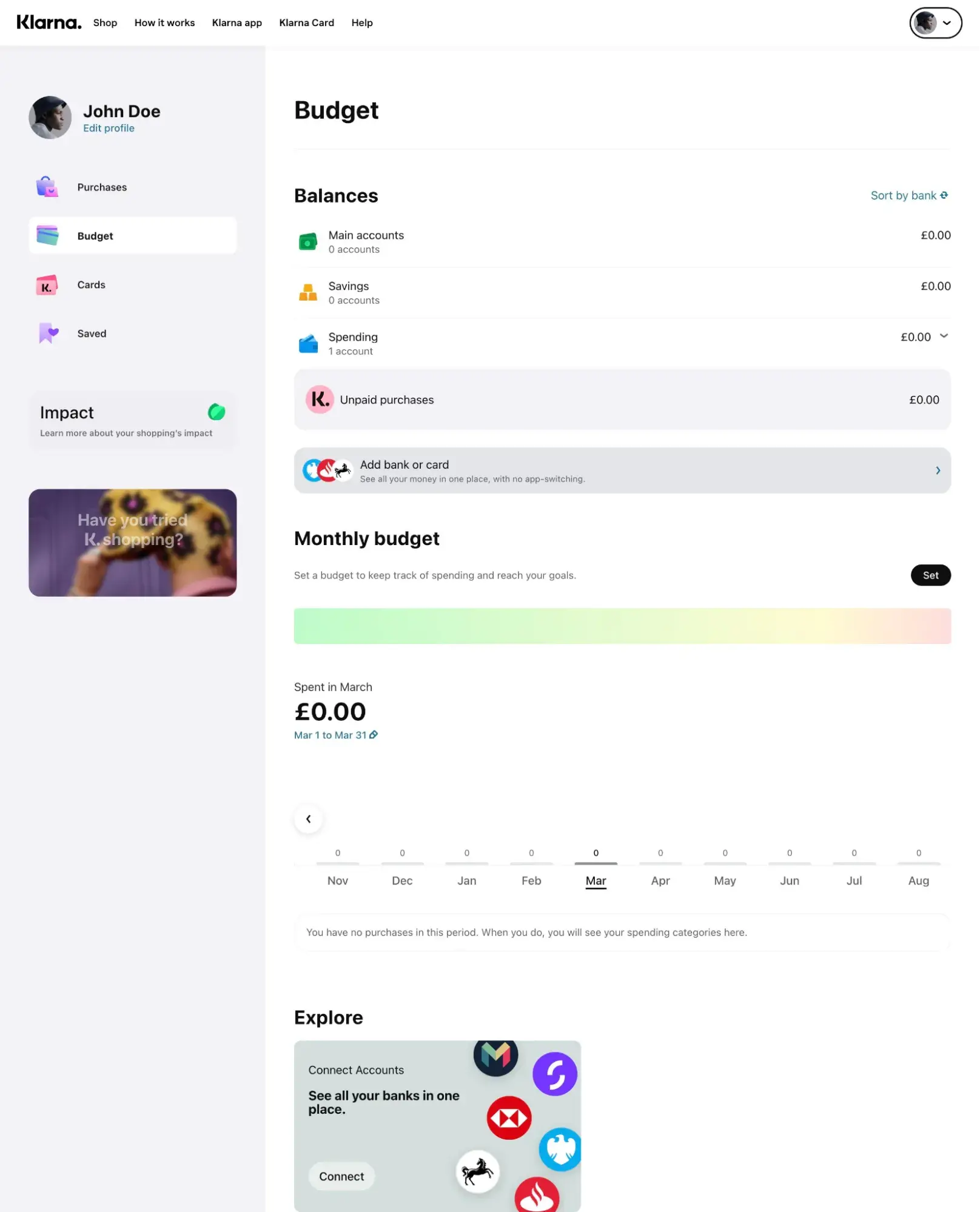
In a previous Moz Whiteboard Friday, I said the most important way to build brand authority is to have a great product. There’s no workaround for this. A great product keeps people in-app and coming back. That’s why I love Revolut.

branding differentiation, revolut

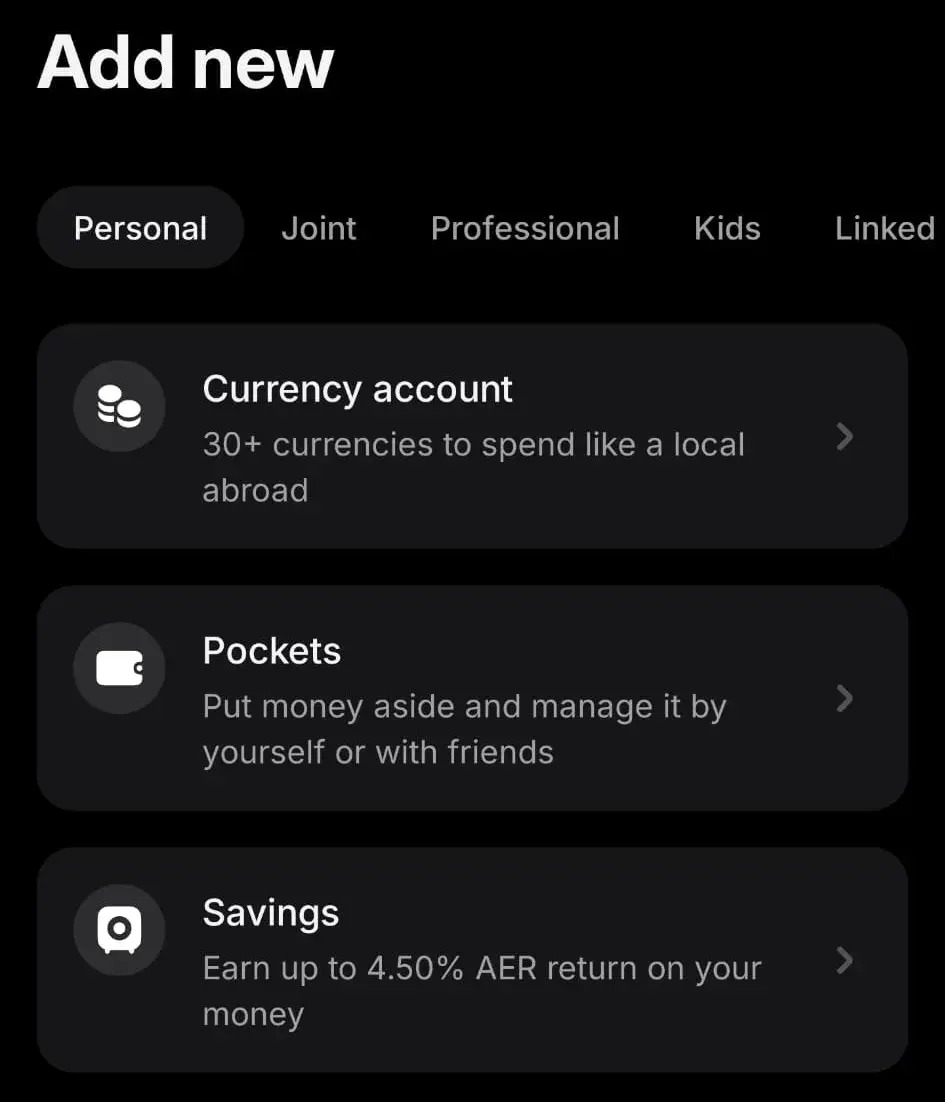
When I moved to the UK in 2022 and needed a banking solution, all my friends pointed me to the app. Revolut offered multicurrency accounts backed by frictionless banking, and I’d never seen anything like it.

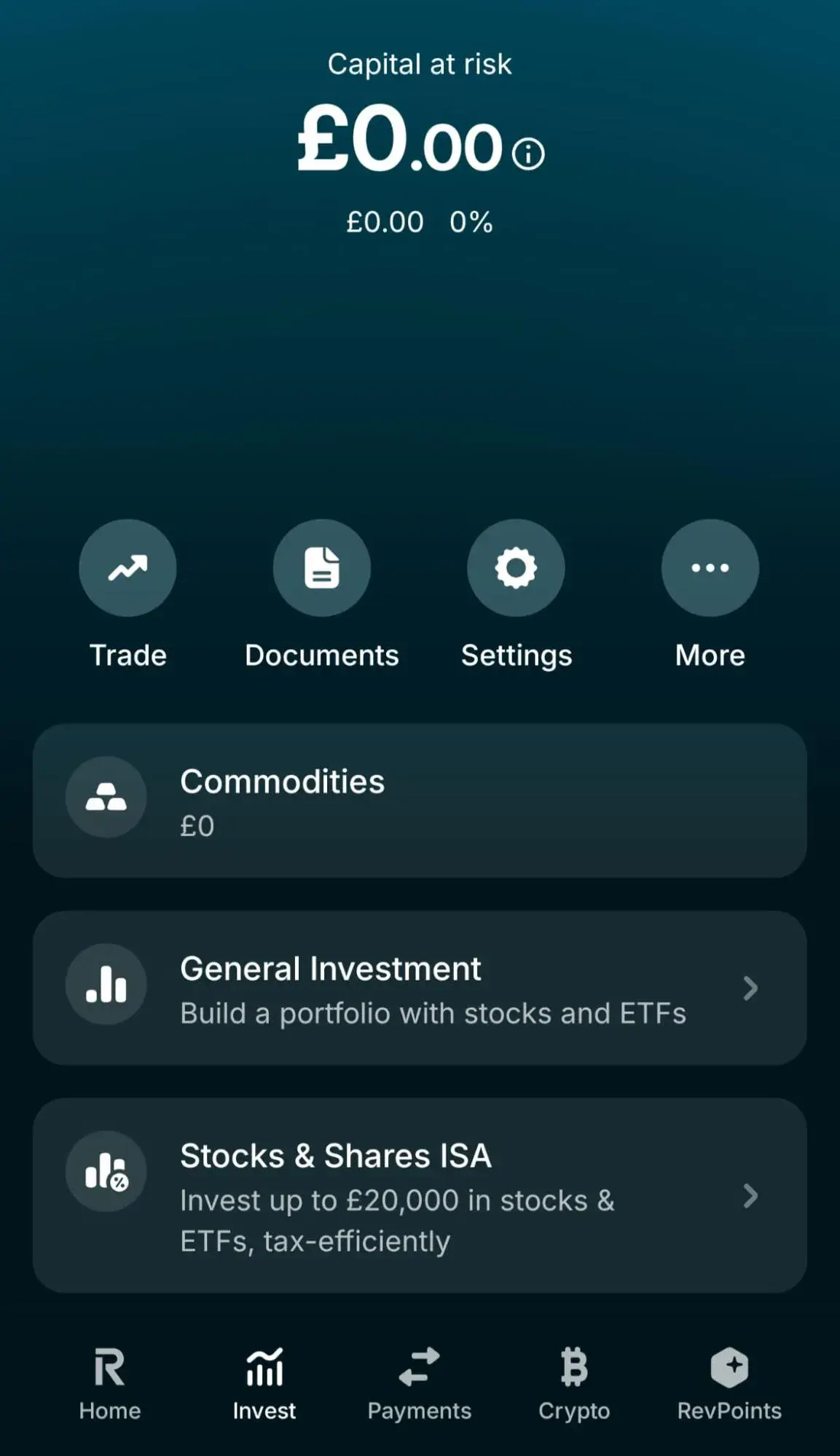
It feels like an everyday app that combines banking, investment, and features you’d only get on a typical credit card.

branding differentiation, revolut

A great product feels two steps ahead of you. It anticipates your needs, offers features before you ask, and gets you from A to Z with ease.

Here’s how Revolut differentiates from other neobanks:

  • Frictionless UX.
  • Intuitive budgeting tools.
  • Multicurrency accounts.
  • A plethora of investment options you’d usually find on BlackRock or Vanguard.
  • Cashback offers and purchase protection similar to a credit card.
  • All-in-one wealth management app disrupting traditional banking and investment sectors.

The Branding Differentiation Lesson

No amount of advertising or marketing spend can save a bad product. Invest in your core experience. Build features that meet the standard, and go further with future-forward innovation that keeps people in the app.

2. Better Trail: Win with unforgettable content.

Differentiator: A unique blend of education, design, and storytelling

I first heard about Better Trail’s content in the TOFU community when David Broderick used them as an example of intuitive content. So, I took a look, and I was thoroughly impressed.

Google is starting to surface longer answers through AI Overviews and AI Mode, cannibalizing traffic that would usually go to websites. Better Trail, a review site that depends on traffic and commissions for survival, is doing something different to attract and keep users.

Here’s how Better Trail differentiates from other review sites:

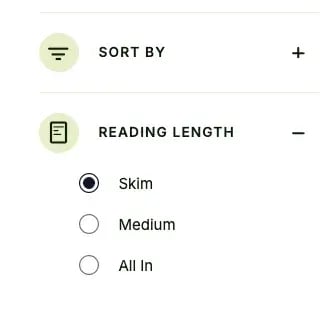
The UX is amazing, and I love how it makes the content look more like a magazine than a blog post. If you want to quickly scan the recommendations, they’ve got you with skim.

branding differentiation, better trail

Source

Need a little bit more detail? Choose medium. And if you have time to read the entire thing, they’ve got a 14,000-word banger for you.

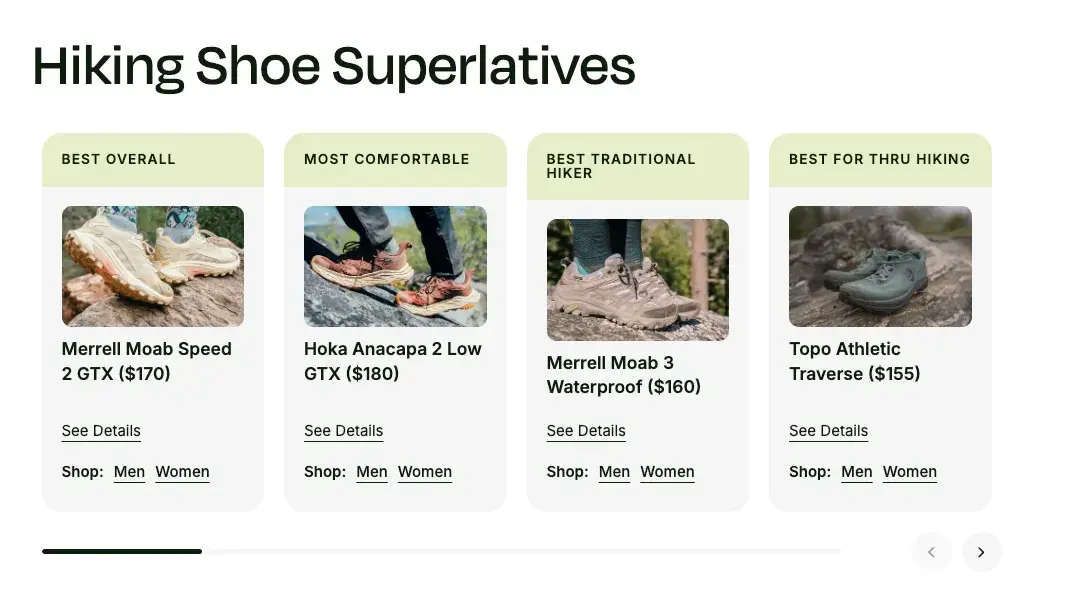
Better Trail skips all the unnecessary SEO optimization of “what is” and “how to.” The site instead goes straight to an overview of hiking shoe superlatives, so you can quickly make a choice.

branding differentiation, better trail hiking shoe superlatives

Source

When buying a hiking shoe, you look for specific features, like comfort, foot protection, and durability. Better Trail uses a scoring system to rate each feature, making it easy to choose based on what’s important to you.

branding differentiation, better trail hiking shoe superlatives merrell moab

Source

Basically, they’ve provided the information people look for when buying a product and removed barriers that prevent a sale, all in one go.

The Branding Differentiation Lesson

You’re not going to capture and hold attention if your content looks like everyone else’s. You need a format that feels fresh and unique.

Anticipate the decisions people are trying to make and give them answers before they even know what to ask. Finally, structure your content so it works for scanners, researchers, and power users alike.

3. Gong: Humanize your brand with internal experts.

Differentiator: Turning internal SMEs into multi-channel influencers

Revenue Intelligence is a heavily saturated niche with many competitors providing similar feature sets. Gong sits within that niche as one of the most expensive options. So, the brand differentiates and captures market share by prioritizing relationships and human-led conversations, not just pricing or features.

branding differentiation, gong udi ledergor

Source

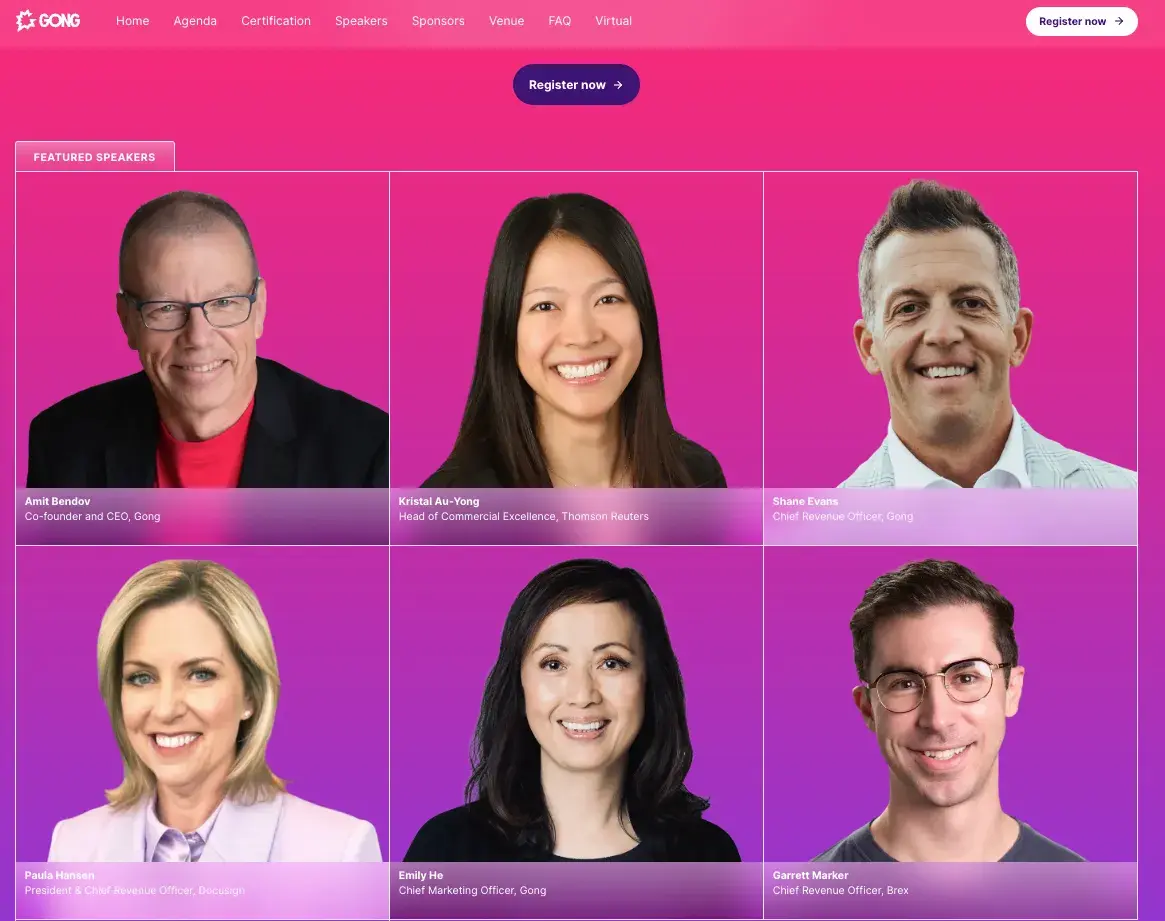
I haven’t seen another brand lean into LinkedIn the way Gong has with its internal SMEs. The first time I heard about Gong was through Udi Ledergor’s LinkedIn content. He was so engaging that I had to check out his profile.

Since then, I’ve seen other internal SMEs, like Brian LaManna (104k), JC Pollard (48k), and others post thoughtful, relevant content.

Their target audience (sales leaders) spends a lot of time on LinkedIn, so it makes sense for Gong’s AEs and marketing leaders to build a presence there.

branding differentiation, gong leaders

Source

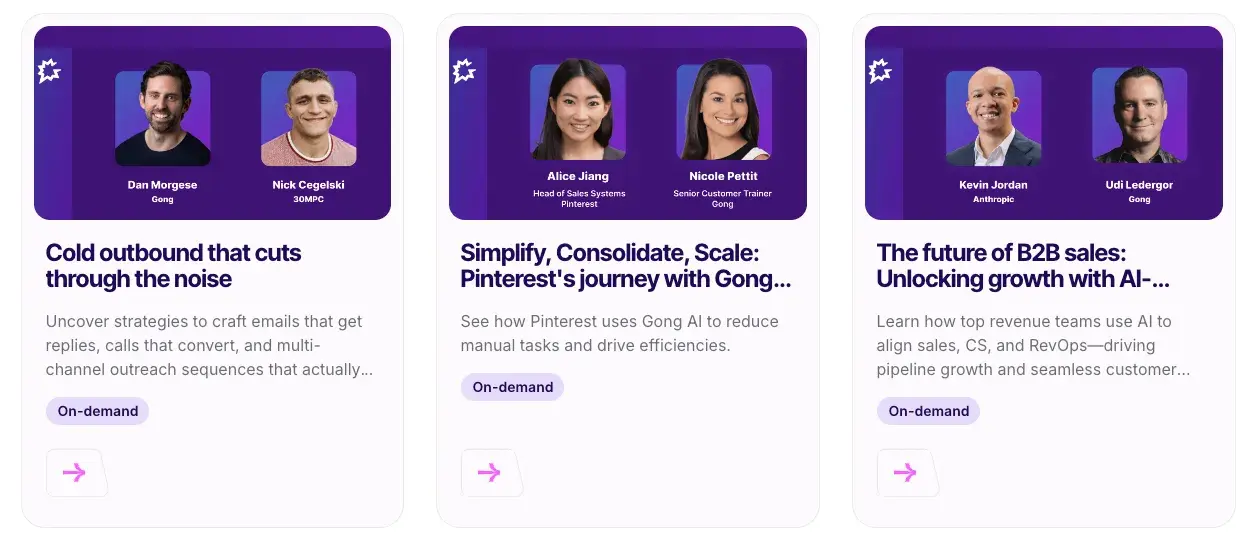
They also show up through activation events like the Celebrate Conference, which platforms Gong’s leadership team alongside external experts.

branding differentiation, gong webinars

Source

In addition, there are ongoing webinars. These digital gatherings are usually co-hosted by one Gong SME and a known industry voice. The brand also hosts smaller in-person events that create space to interact with its audience.

It’s brilliant, really. People trust people, and Gong empowers their internal experts to build thought leadership and stay top of mind.

The Branding Differentiation Lesson

Identify experts within your company who want to grow their personal profiles and leverage them to strengthen the overall brand image.

Allow them to speak in their own voice, and don’t try to censor their content. Create a program that helps them spread their influence externally through podcasts, webinars, and even public speaking.

If they show up in the places your audience is already hanging out, that’s a win for your brand.

4. Fenty: Stand for something bigger than yourself.

Differentiator: Inclusive products and campaigns that ensure holistic representation

Before Fenty, beauty brands got away with exclusion for decades. Deeper foundation shades were an afterthought and rarely existed. Even worse, the people creating products for BIPOC women weren’t part of our communities, and it showed in the existing range.

Rihanna saw the gap and built Fenty to close it.

branding differentiation, fenty

Source

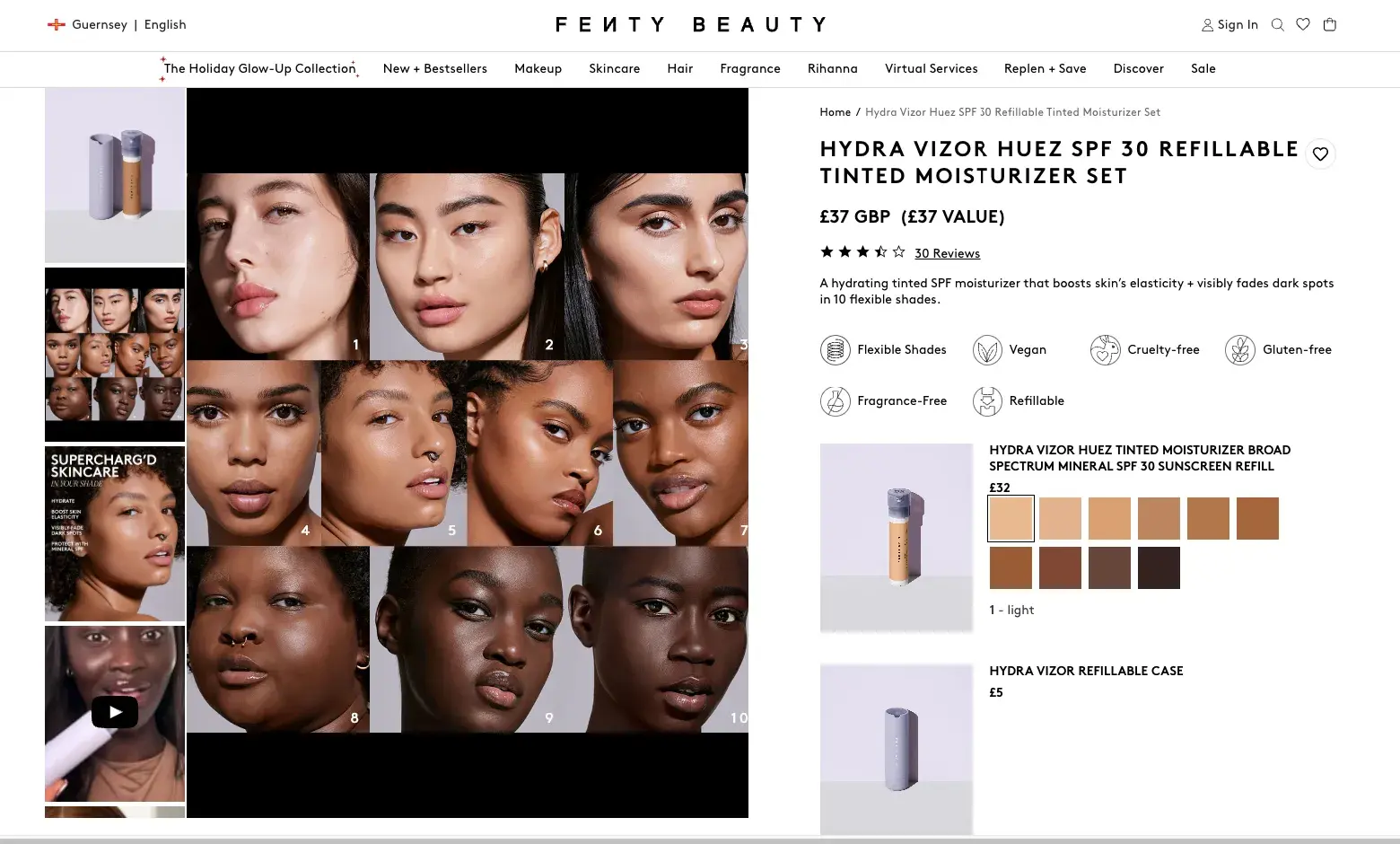
She launched Fenty Beauty in 2017 with 40 foundation shades on day one because she knew what it felt like not to find your shade of makeup in the store.

Personally, I was excited! She was a disruptor, making inclusive products that customers had been begging for, but no one had created. And suddenly, brands that had never prioritized inclusivity scrambled to expand their shade ranges.

branding differentiation, fenty shades

Source

It’s a smart move because Fenty wasn’t trying to compete with the big names. They focused on creating products for BIPOC women with shades you couldn’t find elsewhere, which allowed them to carve a niche for themselves.

Within 40 days of launching, Fenty had $100,000,000 in revenue, proof that there is a market for diverse beauty products.

But, it’s not just inclusive shades. Fenty has consistently featured plus-size models, disabled models, and talent from across the gender spectrum.

branding differentiation, fenty lingiere

Source

Everyone gets to see themselves in Fenty because the brand is intentional about representation.

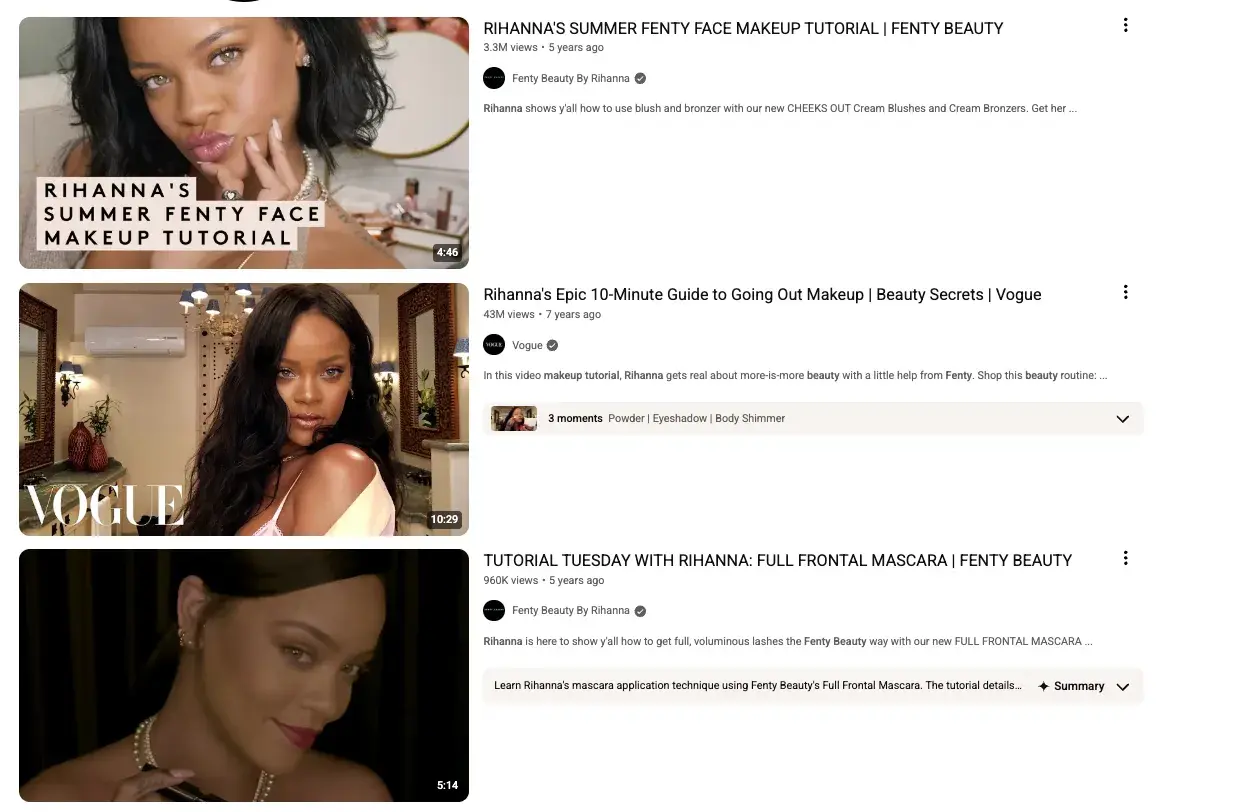
It also helps that Rihanna uses her personal brand to maximize visibility for Fenty. She makes tutorials showing people how to use the products, which builds a sense of ownership and community around every launch.

branding differentiation, fenty youtube

Source

However, this only worked because the product is fantastic.

Fenty also gives back through the Clara Lionel Foundation to fund climate resilience, health initiatives, and education for marginalized communities.

The Branding Differentiation Lesson

You can’t just add a value or mission statement to your website and call it an inclusive brand. You need to start at the product level and ensure that your target audience is represented in the internal teams.

Representation and trust go hand in hand. When done right, they build a movement that turns customers into brand evangelists.

5. OpenAI: Become a habit, not just a product.

Differentiator: A tool that’s seamlessly embedded in everyday workflows

There’s a YouTube video from 2018 where Sam Altman, CEO of OpenAI, talks about what makes a great product. He says, “If a product is so good that people spontaneously tell their friends about it, you’ve already done 80% of the work.”

Friends, I’ve been on the train, in the air, and on the beach, and at each of these locations, someone was talking about ChatGPT.

There’s a pattern I’m seeing as I write this article, where the best brand differentiators are disruptors that innovate with a product so good, it turns the industry on its head.

OpenAI has done that with every product they’ve launched, including:

  • ChatGPT
  • Sora
  • DALL·E
  • Whisper
  • Codex
  • The API
  • AI Agents

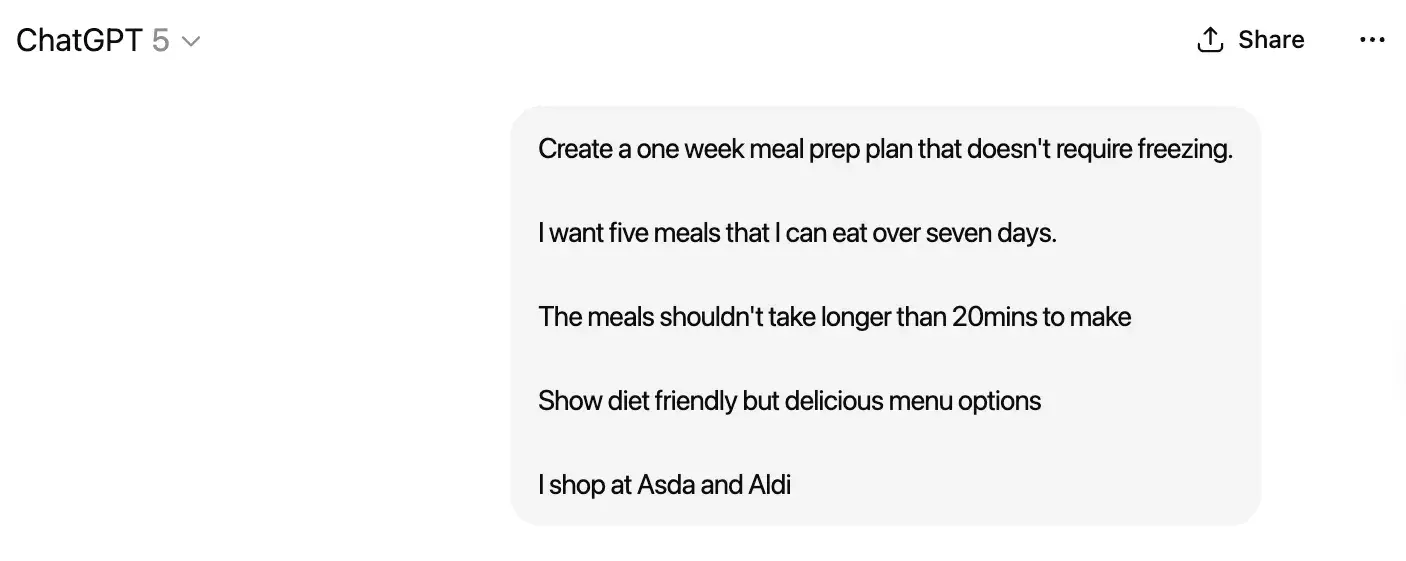
Specifically, ChatGPT has become an everyday app. For example, I use it to find healthy recipes, troubleshoot issues with my washing machine, automate content workflows, and even help with fundraising for my nonprofit, The FCDC.

branding differentiation, openai

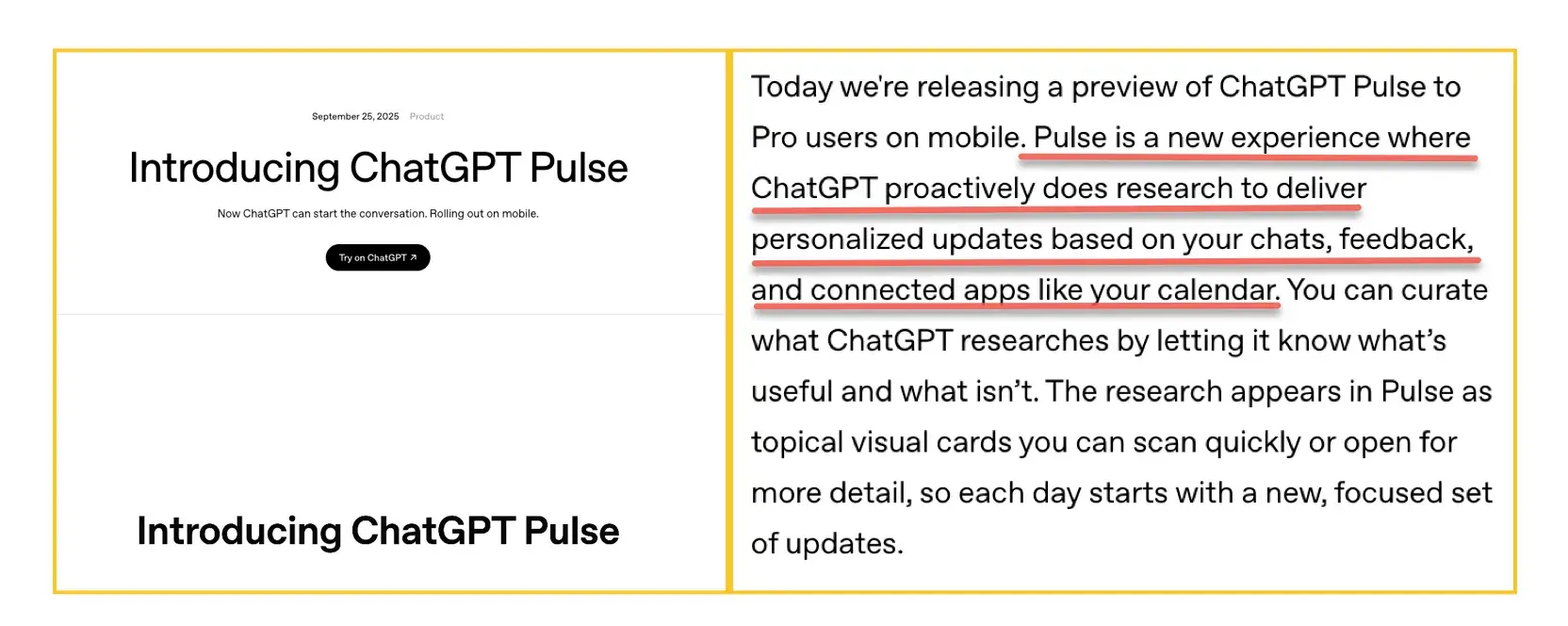
OpenAI recently released ChatGPT Pulse. Pulse will deliver personalized updates based on the user’s behavior. In my opinion, this new feature increases app usage and further embeds ChatGPT as part of people’s daily routine.

branding differentiation, chatgpt pulse

Source

Brands that differentiate are those whose products become habits. Habit is how you rank in the user’s mind before they start a search. You want to be the first name out of their mouth when a friend asks for a recommendation.

The Branding Differentiation Lesson

The most powerful form of differentiation is when your users do the marketing for you. Focus on building a product so good, people evangelize without incentive.

6. Liquid Death: Make FUN your strategy

Differentiator: Punk rock branding for canned water

Water is essential to life. It’s something we’re all told to drink more of, yet not everyone enjoys it. A poll by CivicScience revealed that nearly half of U.S. adults consume far below the recommended amount of eight glasses per day.

branding differentiation, tweet about liquid death

Source

The core problem is that many people don’t see water as something they want but as a routine they’re supposed to do.

Liquid Death set out to break the mold when they launched in 2019. In a U.S. market flooded with nearly 3,000 bottled water brands, the brand found white space by making water fun.

Every time I hear the word “liquid death,” I imagine myself swinging a solid-body electric guitar and playing with Brian May. That’s the brand image that Liquid Death has built.

Instead of clean, serene packaging, they gave us tallboys with flaming skulls and taglines like “Murder your thirst.”

branding differentiation, liquid death on spotify

Source

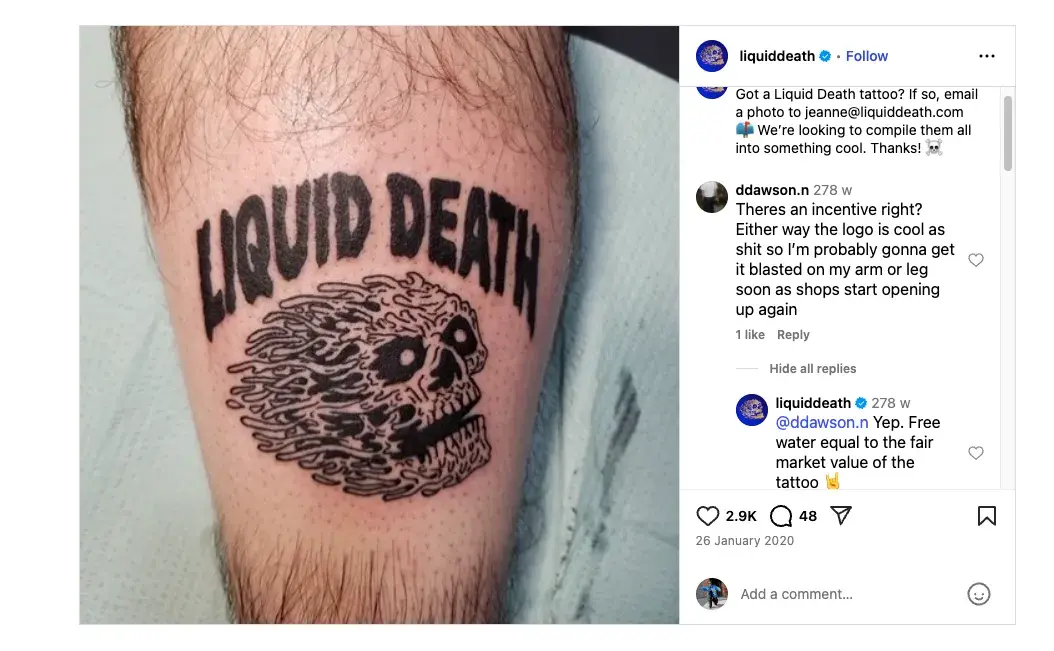
Their content is ridiculous, in the best way. They’ve dropped a metal album about hydration, launched a kids’ cartoon called “Murderverse,” and even paid people to get Liquid Death tattoos.

branding differentiation, liquid death tattoo

Source

And, it works. Liquid Death now has over 14 million followers on Instagram and TikTok. In 2024, they pulled in over $333 million in retail sales, up 26% from $263 million the year before.

While most CPG brands are still trying to figure out how to connect with Gen Z and Millennials, Liquid Death has already built a cult following. The brand shows that an anti-corporate tone can work.

The Branding Differentiation Lesson

One reason people don’t connect with branded content is because it’s not engaging. Often, interactions feel faceless and boring.

Make your brand fun. Liquid Death’s content works because it’s true to their brand and carries over into their product, marketing, and brand identity. Even water can become a habit when it’s marketed in an engaging way.

The 8 Steps to Brand Differentiation

These steps are based on principles from “The Difference Engine”. This is a model of differentiation best practices founded by HubSpot Diamond Solutions partner, Articulate Marketing.

To start, let’s view the eight steps from a high level. Then, we’ll dive into the details, along with examples you can use to inspire your own efforts.

1. Your Mission

Google’s mission is to organize the world’s information and make it universally accessible and useful. This Google example showcases a few key elements to help you define your mission:

  • Recognizability: You read this, you know it’s Google’s mission.
  • Ambition: “The world’s information”.
  • Actions and outcomes: “Organize” “accessible”, “useful”.
  • Context: Industry position (in this case, the tech sector).
  • Short is best: A dozen words.
  • Clarity: It’s easy to read and understand.

Your mission should be a central goal. From here, you can position your products and services, build out yearly goals, quarterly objectives and metrics for success, and develop your strategies. This is the first step. You’ll want to use this structure to define your ambitions.

Once you’ve identified your mission, everyone in your business will be singing from the same song sheet. Your collective voice will carry. Stations play your tune on the radio, the album goes platinum, you become the next Adele of … HealthTech.

It’s all within reach if you make it your mission to get there.

2. Talent and Culture

There are two sides to any brand. The first is the brand identity as it relates to customers.

The second is how your brand is positioned within your community, as an employer, and as a global citizen. In other words, the culture of your company.

Too many organizations pay lip service to culture. They offer basic benefits and post a “values” chart on the wall. It’s not enough. Talented employees will go elsewhere. But employees that enjoy a great company culture are 3.8 times more likely to be engaged. And engaged and talented people make for an exceptional business.

In fact, clients are starting to pay attention to workplace culture, too, because they want to work with happy, supported, and empowered teams — while also having business partners who are committed to shared values. It’s no longer just about cost and results, but about the types of companies people want to partner with for the long-term.

Recommendation: Consider third-party certifications, as provided by the likes of Investors in People and B Corp. Their evaluations leave nowhere to hide, so they keep you honest. Such certifications are the evidence that you really do business differently.

3. The Toolkit

The best businesses use the best tools.

Take Ecologi’s story as an example. Ecologi has established a fantastic brand differentiation strategy. They offer unparalleled transparency around carbon offsetting and tree planting with technology that showcases the great work they do. Their climate-positive mission is timely and well-targeted. What they offer is in-demand given the current environmental crisis. So they began experiencing rapid growth. Businesses want to do their part to achieve net zero. Ecologi provides the means to get there.

Although they had experienced success with HubSpot Sales Hub, they relied on multiple systems for marketing. This meant valuable data was falling through the cracks. They had limited marketing intelligence and patchy lead capture compliance. Any changes relied on dev support.

Once they were successfully brought onto HubSpot’s Marketing Hub, however, their team found they could track lead sources as well as align their marketing and sales processes. By making the most of the tools, they saw accelerated results.

Now, they can personalize campaigns to target sectors, extend their reach, and grow their reputation as a brand.

That example is just one way that tools empower a brand to stand head-and-shoulders above the rest. So, step three: audit your toolkit.

4. Strategic Blueprints

You want to have a strategic blueprint for all elements of your content and communications. These are the core guides for your positioning.

A strategic blueprint is an up-to-date document that everyone in your organization can access.

It’s up to you what you need a blueprint for. Most businesses will have these:

  • Personas: A representation of your ideal customers
  • Messaging: The key messages you want to get across to your audience
  • Tone of voice: The attitude of your business; how you talk on all platforms
  • Writing style: The words and grammar you use
  • Buyer journey: The steps from first touchpoint to paying customer

Consistency is integral to differentiation. If you have a consistent brand, then it’s going to be easier to recognize, whether your audience is reading a Tweet or watching a video.

These strategic blueprints should be applied with such regularity and enthusiasm that an outsider could guess their contents.

Let’s put that idea into practice. Try this exercise. Take one of these strong brands that you’re familiar with and sketch out a persona and the journey they go on to buy, three key messages, five attitude words and a couple of notable styles, such as the use of formal/informal words:

  1. Innocent Drinks
  2. Old Spice
  3. Apple

Once you’ve done that, try to do the same for your business.

5. Brand Architecture

Step five is all about establishing your visual brand. This is a huge topic, but let’s ask ourselves some key questions.

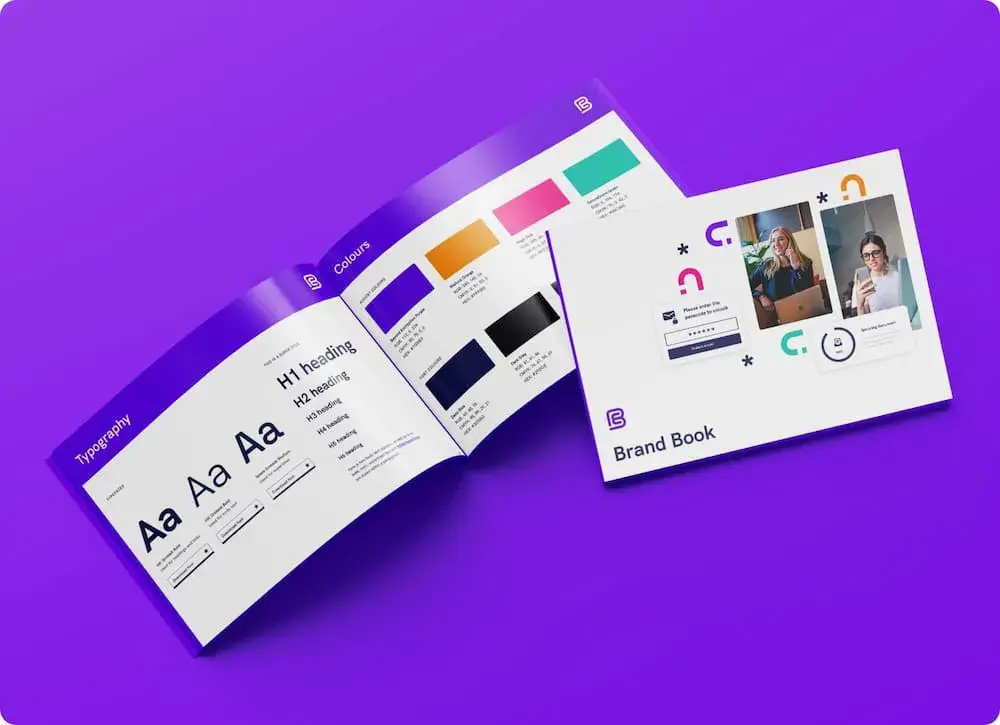
When did you last update your logo? Is it simple, modern, and legible? Do you have a well-defined visual style throughout your website and other channels? Are things like your fonts and color palette defined in a brand book?

Has your website been updated in the last couple of years? Does it accurately reflect your services and your story? Is it fast loading and easy to navigate?

Like with strategic blueprints, consistency is vital. If you have a consistent visual brand, then it’s more likely to become familiar with your audience. Therefore, they will remember who you are.

Beyond Encryption brand book example

Source

Beyond Encryption, a secure communications provider, took their visual branding a step further than most companies. Rather than having one logo and one colorway, they chose to develop a whole brand family.

Each of their product lines has its own logo and design profile; they are harmonious, yet distinct. They all flow from the same brand methodology, with the main site brand and logo as the “parent.”

Beyond Encryption uses this brand family to target segmented audiences while maintaining a clear, differentiated brand.

6. Thought Leadership

Thought leadership is a tactic content marketers use to build credibility for themselves or leaders in their company.

Essentially, thought leadership is brand positioning based on expertise.

The good thing about expertise is, unlike positioning based on price, it’s something you can leverage in a unique and thought-provoking way. It’s the route to long-term positioning that you build over time, rather than a quick and dirty race to the bottom.

Real experts have knowledge and opinions that other people are interested in learning about. Businesses with in-house experts can differentiate themselves by creating thought leadership content, like blogs and white papers, leveraging their expertise. This helps you establish credibility with your audience.

What we don’t suggest, however, is positioning based on the concept of expertise (“I’m an expert, so trust me”). Thought leaders demonstrate their expertise in tangible ways. They have certifications, and are evidence-based. They don’t just say they are experts. They show it.

The other mistake people sometimes make is to confuse expertise with complexity. This means filling your content with obscure jargon about your services. That’s not going to work, either. As Einstein put it, “If you can‘t explain it simply, you don’t understand it well enough.”

7. Lead Generation

Once you’ve got your thought leadership content out into the world, you can expect to see a growing audience coming to your website. From there, you want to capture contact details, such as people’s names and email addresses.

Here is another opportunity to differentiate yourself. The lead generation and nurturing process is where you start to see real engagement with your brand. It’s your chance to build a relationship with prospects.

So many businesses drop the ball here. They miss opportunities to get leads. Or they dive right into pushy sales tactics once they do get them. Here’s an alternative approach:

  • Inform: Provide answers to questions without asking anything in return. Offer resources like eBooks or calculators. Be helpful.
  • Connect: Target content that addresses your lead’s needs, implement personalization and make it easy to get to know your personality and your people a little better.
  • Inspire: Give prospects a means to benchmark their business against competitors. Offer examples of success stories. Suggest a path to the ideal outcome.

8. Iterative Optimization

Lastly, let’s talk optimization.

Sir David Brailsford leads Britain’s first ever professional cycling team. At the 2008 Olympics, his team won the majority of gold medals in track cycling and did the same at the next Olympics.

Sir David Brailsford told Harvard Business Review, “It struck me that we should think small, not big, and adopt a philosophy of continuous improvement through the aggregation of marginal gains. Forget about perfection; focus on progression, and compound the improvements.”

You don’t necessarily need to shake up your whole brand to differentiate your business. You can simply make small improvements that, over time, make a big difference.

In marketing, this means observing what works, tracking and measuring the data, testing variants, and implementing the better option, every time. That’s how you go for gold.

These eight steps to brand differentiation are definitely not for the risk averse. But they are for ambitious companies and leaders who have a growth mindset.

The difference between you and every other business out there is that you’re willing to take the first step.

Differentiation only works when it’s disruptive at the core.

You have to bake your differentiating element into your brand from day one. It can’t be an afterthought. The brands winning today built products that form habits, tell stories worth sharing, and live their mission like a second skin.

Editor’s note: This post was originally published in September 2025 and has been updated for comprehensiveness.


Categories B2B

12 great examples of welcome emails for new customers [templates]

I’m going to say something that might ruffle a few feathers, but here it is: I’m still disappointed by most welcome emails I receive. Not because I expect every brand to knock it out of the park, but because this moment, this exact moment, is such a rare opportunity. 

A person was interested enough to raise their hand and say, “Yes, I want to hear from you.” And instead of leaning into that curiosity, most marketers squander it with a bland “Thanks for signing up” and a promise of more emails sometime in the future.

→ Download Now: 8 Free Customer Onboarding Templates [Free Kit]

That moment right after sign-up? That’s the subscriber honeymoon period. It’s short, it’s powerful, and it’s when your new subscriber is paying attention. They’re curious. They’re open. They’re literally waiting to see what you’ll say next. And your welcome message, your first impression, can either reward that attention or quietly shut the door on it.

The same idea applies when welcoming a new employee. They’ve said “yes” to your organization, likely after weeks (or months) of interviews, decisions, and excitement. That first onboarding message isn’t just logistics. It’s emotional real estate. It’s your opportunity to affirm their choice, ease their nerves, and set the tone for what working with you will feel like.

Whether you’re writing to a new subscriber or a new team member, the welcome email is more than a formality. It’s a moment. And you only get one shot at it.

Table of Contents

What is a welcome email?

A welcome email is the first message a subscriber gets after signing up — your digital handshake. It confirms their subscription, sets expectations, and gives them a quick intro to your brand’s vibe and value. It’s not just polite; it’s prime real estate for making a strong first impression and setting the stage for engagement.

Pro tip: Use HubSpot’s free email marketing software to easily create a high-quality welcome email sequence like the ones featured below.

The Components of an Impressive Welcome Email
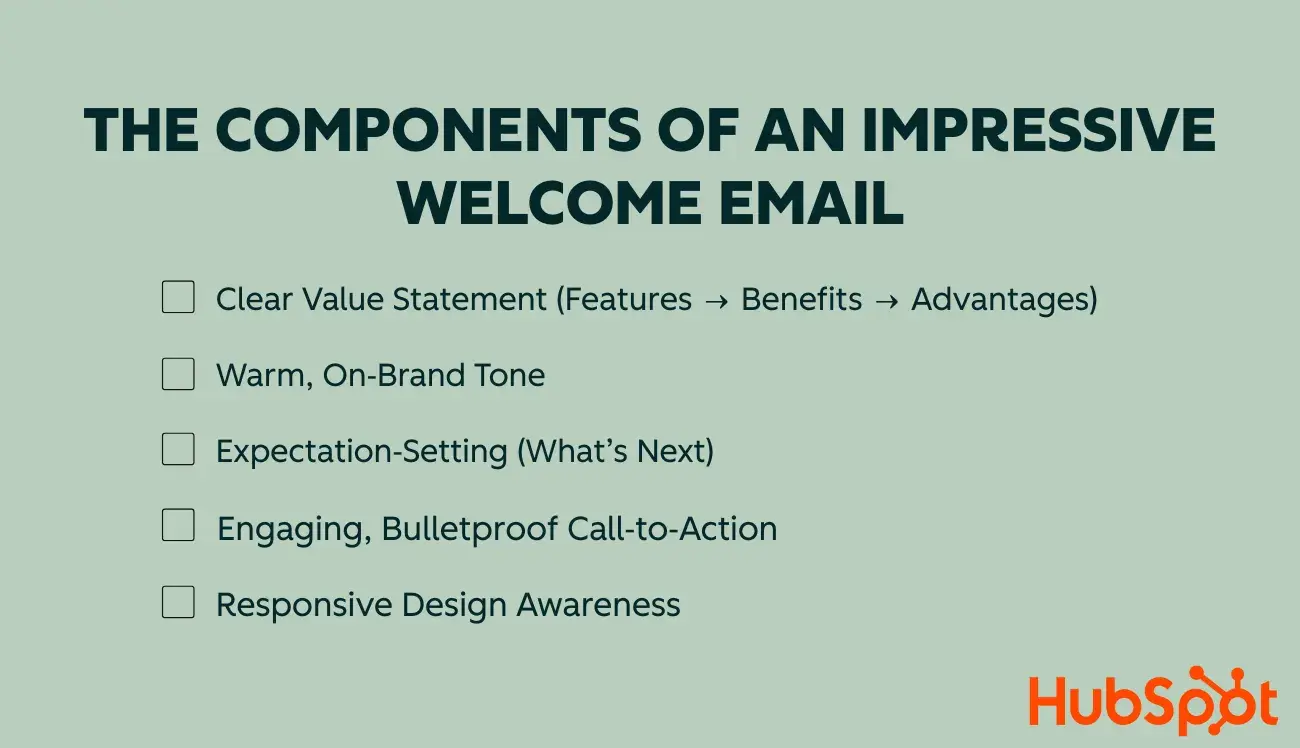
checklist featuring the components of an impressive welcome email

1. Clear Value Statement (Features → Benefits → Advantages)

If you’ve ever clicked unsubscribe after a bland “Thanks for joining” message, you already know the pain of a wasted welcome email. Your first message should do more than wave hello; it should prove your value.

Start with the feature (what they get), follow with the benefit (why it matters), and end with the advantage (why it’s better than other options). This structure isn’t just tidy, it’s persuasive. The goal? Make subscribers feel like they’ve just made a smart decision by joining your list. Because they did.

Pro tip: Use real user language from surveys or reviews when describing the benefit. It keeps things grounded and customer-centered — plus, it’s more likely to resonate.

2. Warm, On‑Brand Tone

No one wants to feel like they just got an automated shrug from a robot. Your welcome email should sound like you: warm, real, and human. Even if your brand skews corporate, this is the time to relax your tie and let your personality peek through. A touch of humor? Yes. A short anecdote or “here’s what drives us”? Even better. The tone should feel like your best salesperson just slid into the inbox with a smile, not a pitch.

Pro tip: Read it out loud before sending. If it sounds like something you’d never say in real life, rewrite it. The inbox has zero tolerance for blandness.

3. Expectation‑Setting (What’s Next)

This is where you get ahead of the “Wait, why am I getting this?” moment. Be explicit: How often will they receive email from you? What kind of content will you send them? When can they expect the next one?

Setting expectations upfront builds trust and reduces unsubscribes, not to mention that it saves you from the wrath of subscribers who feel spammed after two perfectly normal messages. The more transparent you are, the more control the reader feels they have. That’s a good thing.

Pro tip: Use a short bulleted list or a bolded section header like “Here’s what to expect” so even scanners catch it.

4. Engaging, Bulletproof Call‑to‑Action

If your welcome email doesn’t include a clear next step, you’re leaving engagement on the table. Whether it’s reading a blog post, filling out a preference center, or grabbing a freebie, every welcome email should include a single, strong call-to-action (CTA).

Make it prominent, persuasive, and — here’s the kicker — bulletproof. Meaning: Don’t rely on images. Use HTML-styled buttons that still display if images are blocked (which, by the way, they often are).

Pro tip: Treat your CTA like a headline. Make it benefit-driven (“Get your first wellness tip”) instead of directive (“Click here”).

5. Responsive Design Awareness

Your subscribers are reading emails on phones, tablets, and desktops. That welcome email has to look good everywhere. Use fluid layouts, mobile-first coding practices, and test your design on multiple screen sizes. At the very least, make sure fonts are legible and buttons are tappable. Because nothing kills a first impression like a pinched-zoom scroll-fest.

Pro tip: Run your email through a mobile preview tool or test in multiple email clients before sending. What looks great in Gmail might look broken in Outlook (sigh).

Examples of Standout Welcome Emails

So, what does a great welcome email look like?

I’ve collected some standout welcome message examples that include confirmation messages, thank you emails, and offer templates to help you with your customer onboarding process from start to finish — and make a great impression along the way.

1. PepTalkHer

Type of Welcome: Confirmation

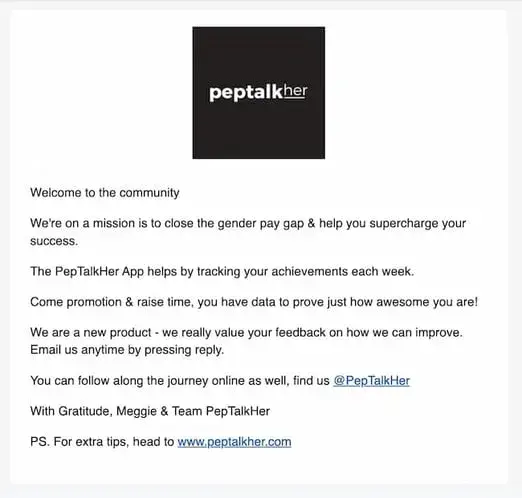
welcome email example from peptalkher

While many subscribers click submit to solve a problem, positivity is key in a welcome email. This org supports women on their path to wage equality.

It could be tempting for this email to start with emotionally charged language or statistics that show how big a problem the gender pay gap is.

Instead, PepTalkHer shows its understanding of its target audience. This email centers on the support, value, and overall awesomeness of the community.

It also adds useful links to social media and website channels. This helps jump-start each signup’s journey.

What I like: I think it’s amazing that this email’s priority is placed on the benefits it brings to the reader. This creates a sense of belonging and encourages long-term engagement.

2. Swipe Files

Type of Welcome: New Customers

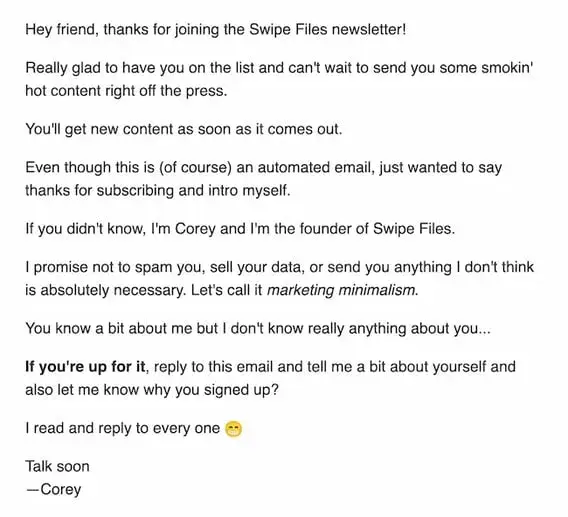
welcome email example from swipe files

There’s nothing quite like a personal welcome email to make an impression on new subscribers. I believe that good writing is good thinking, and this welcome email is a great example of that idea.

This message reads authentic, kind, and curious. It uses direct language, easy-to-read paragraphs, and simple CTAs. This shows every subscriber what they’re getting into with their subscription and leaves them excited for more.

What I like: This email is more of a personal letter from the founder and less of a welcome email. That’s what makes it stand out and appealing to the reader.

3. Oui the People

Type of Welcome: Discount Code

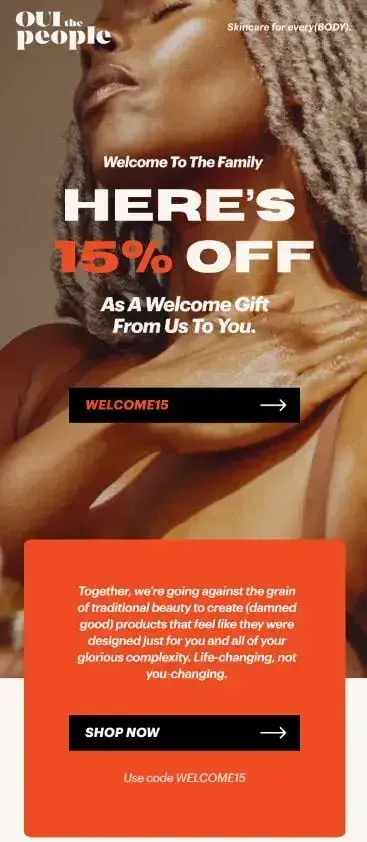
welcome email example from oui the people

I think powerful graphics are a great way to make a strong first impression.

After signing up for skincare brand Oui the People’s mailing list, the welcome email that hits your inbox makes a gorgeous visual statement that shows the brand’s vision and personality. Then, it uses bold type to make a compelling offer.

The copy that follows not only matches but amplifies the vibe of the opening image.

“Together, we’re going against the grain of traditional beauty to create (damned good) products that feel like they were designed just for you and all of your glorious complexity. Life-changing, not you-changing.”

The one-two punch of graphics, CTA, and copy makes this welcome email difficult not to engage with.

What I like: I love how the powerful and poetic copy perfectly complements the email’s visuals, reinforcing the brand’s unique vision and values.

4. Monday.com

Type of Welcome: Video

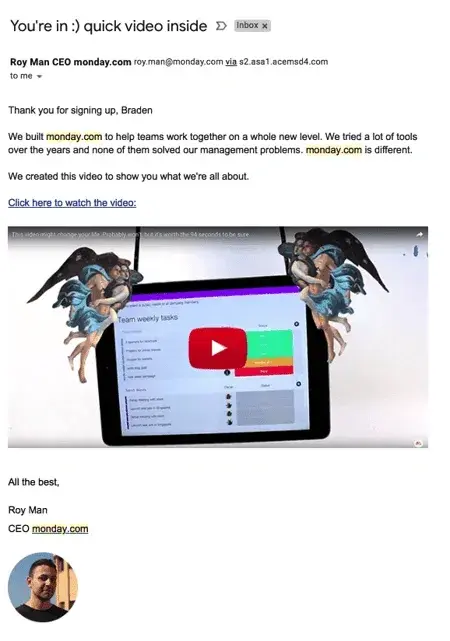
welcome email example from monday.com

From the subject line down to the conversational tone in the email body, the welcome email above keeps it friendly and simple, so the focus stays on the introductory video inside.

Monday.com is a task management tool for teams and businesses. The welcome email you receive when you sign up makes you feel like a CEO because Roy Man is speaking directly to you.

What I like: I love how the email even personalizes the opening greeting by using the recipient’s first name, which is well known for increasing email click-through rates (especially if the name is in the subject line).

In my experience, the more you can make your email sound like a one-on-one conversation between you and your subscriber, the better.

If you have just so many details that you need to inform your new customer about, follow Monday.com’s lead and embed a video rather than spelling them all out in the email itself.

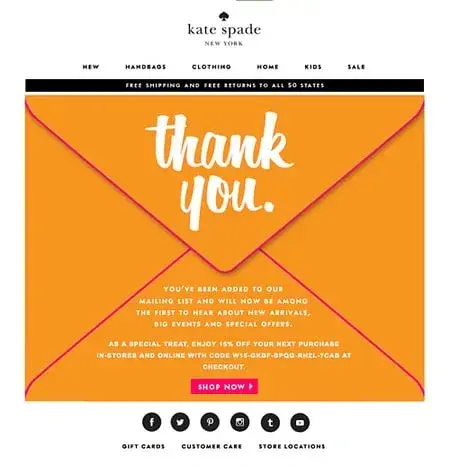
5. Kate Spade

Type of Welcome: Thank You

kate spade welcome email

Let’s face it: The internet-using public is constantly bombarded with prompts to sign up for and subscribe to all sorts of email communications.

So, as a brand, when someone takes the time to sift through all the chaos to intentionally sign up for your email communications, it’s a big deal.

To acknowledge how grateful they are to the folks who actually take their time to subscribe, Kate Spade uses a simple but effective tactic with their welcome emails. They say “Thank You” in big, bold lettering.

What I like: To be honest, I am a big fan of what this email looks like. The envelope graphic — which virtually simulates the joy of receiving a physical thank you note — is a nifty and visually appealing way to draw attention to the email.

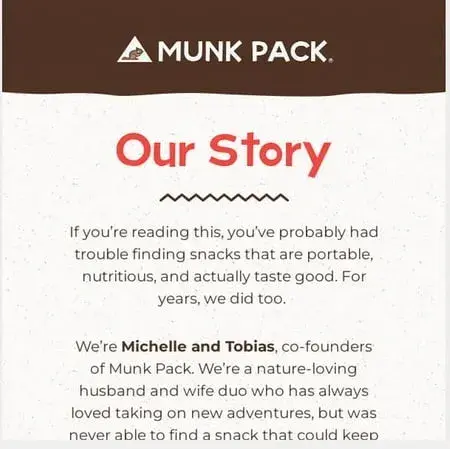
6. Munk Pank

Type of Welcome: About Us

welcome email example from munk pank

Munk Pank’s welcome email is the story of why the company was founded. This is a healthy snack store founded by a husband and wife.

In their welcome email, they mention that they started the company because they never seemed to find nutritious snacks to keep them energized and on the go.

In my opinion, this is an excellent version of a welcome email. The brand lets its customers know they can relate to the problems they’re facing and that they’ve been there. This helps in building trust and relatability.

It also gives customers a peek into what they should expect from their products.

The email ends by sharing the company’s mission to help them live a healthy lifestyle.

I also like how this welcome email lets subscribers know that they’re joining a tribe that is concerned about their healthy eating and lifestyle, a mission that goes beyond snacks.

What I like: A personal message from the founder gives the product a face and acknowledges the brand’s dedication to making people’s lives healthier.

7. Who Gives a Crap

Type of Welcome: Product Story

welcome email example from who gives a crap

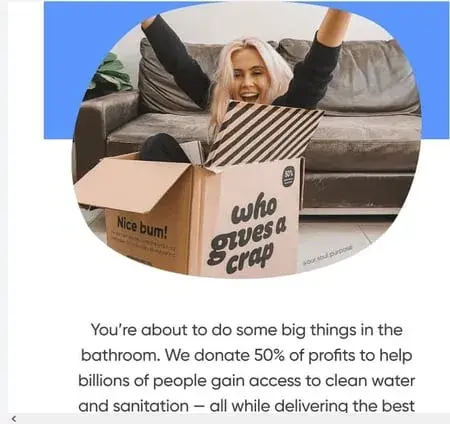
Who Gives a Crap is an organization that sells organic toilet paper, and they’re passionate about it. I found their welcome email to be equally fun and informative.

They state all the reasons why you should opt for organic and eco-friendly products. Then, they sweeten the pot (pun intended) by noting that they donate 50% of their profits to global sanitation projects.

The email reminds the buyer that they still get the toilet paper at the same price they do in the supermarket. It also has a compelling CTA in its welcome email: 10% off its products for people who subscribe to its email list.

The company added its “Shop Now” button for convenience, so if readers are convinced to buy, they can do so in one click.

What I like: I like that the email is written entirely in a playful tone while the message is extremely clear about the company’s nature-friendly principle and donation policy.

This creates a message that is both fun and informative, and it becomes something that someone will remember for a long time if it is their first experience with the business.

8. SAXX Underwear

Type of Welcome: Free Gift or Offer

welcome email example from saxx

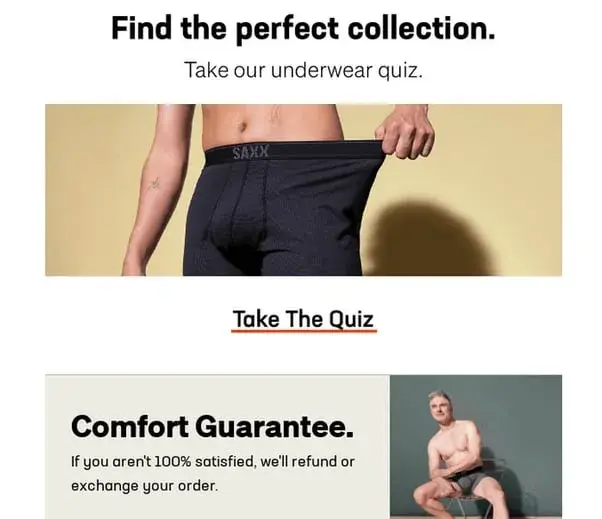
SAXX Underwear specializes in men’s underwear, and its welcome email is very catchy and creative.

The subject line, “Welcome to you and your balls,” is just a taste of how the company uses a humorous and relatable tone to connect with its audience.

Their welcome email is visual, too. It demonstrates their comfort guarantee with images of models wearing their boxers. The welcome email also gives a 10% off code for first-time buyers and directs them to their store.

To me, what really stands out in the SAXX Underwear welcome email is the tone of the copy and the careful yet bold and catchy choice of words.

What I like: I’m impressed by the sincerity of the brand in the first email when it presents the refund policy.

Knowing that they can return the product very easily if they are not fully satisfied with the brand’s items makes the customers who are choosing a product for the first time feel more confident, and as a result, they might try the products.

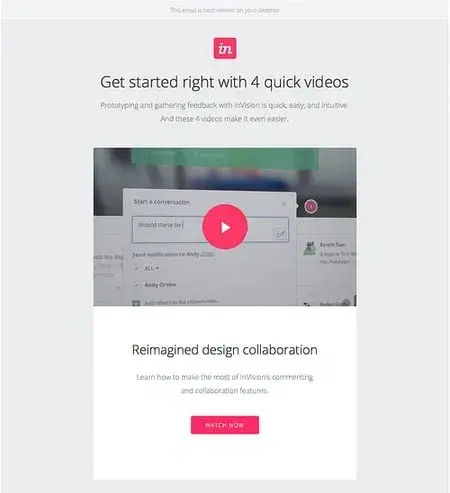
9. InVision

Type of Welcome: Product Demo

welcome email example from invision

When you sign up for InVision’s free prototyping app, the welcome email makes your next step very clear.

To guide people on how to use InVision’s app, the company’s welcome email doesn’t simply list out what you need to do to get started. Instead, it shows you what you need to do with a series of quick videos.

Given the visual, interactive nature of the product, this makes a lot of sense.

What I like: I find this welcome email particularly helpful. In fact, it offers a step-by-step guide to further interactions. This highlights the user-friendliness that the company provides, along with the smooth onboarding process.

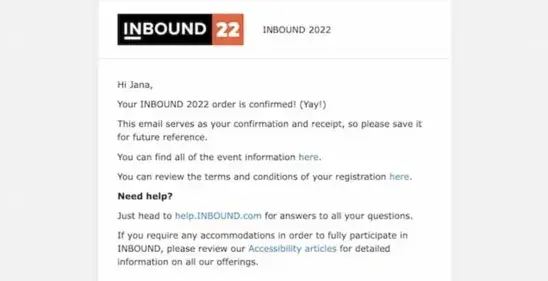
10. Inbound

Type of Welcome: Event Signup

welcome email example from inbound

Inbound attracts business professionals from all over the world. I believe that is the reason why its event confirmation email is simple and easy to follow, with useful links for event information, help, and accessibility.

Keep scrolling, and you’ll see even more useful additions, like:

  • Links to add the event to your calendar.
  • Social media sharing buttons.
  • Directions through Google Maps.

What I like: I like how this all-in-one approach of the welcome email ensures that even if people who wish to attend only see one email, it will include everything they need.

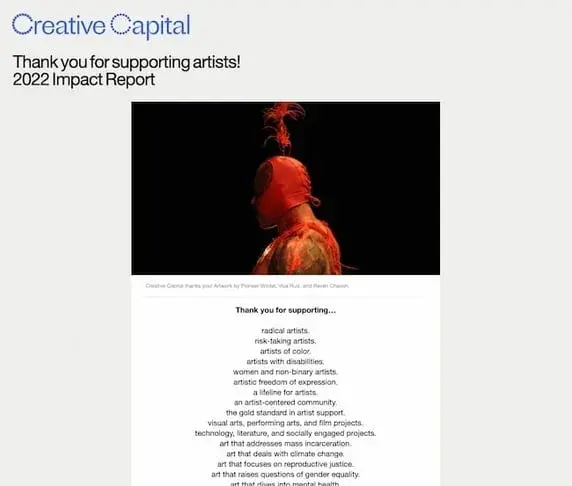
11. Creative Capital

Type of Welcome: New Donor

welcome email example from creative capital

Nonprofit marketing can be a challenge, but this email sheds light on endless possibilities. In this welcome email, donors to Creative Capital get a healthy dose of inspiration.

The email begins with a striking GIF that combines the work of supported artists with bright thank-you messages. It continues with a poetic message about the types of artists the org supports.

This is a chance to inspire every donor. It reminds them who their donation is supporting and why that action has massive value.

What I like: I really like how the animated GIF at the email’s beginning does all that to catch the attention and set the tone for the rest of the message.

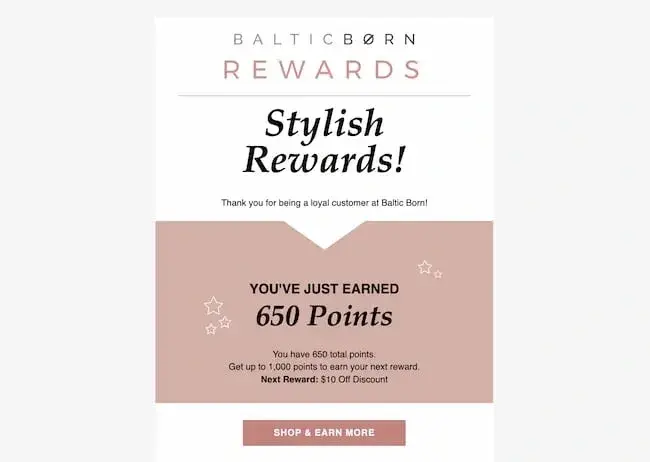
12. Baltic Born

Type of Welcome: Customer Loyalty

welcome email example from baltic born

Frequent shoppers can end up in more loyalty programs than they can count, so it’s important for these welcome emails to stand out and show off a big offer.

From the start, this email focuses on concrete rewards. Then, it gives a clear explanation of Baltic Born’s reward system. It continues with a button that compels the recipient to get more points.

And, the monochromatic design is attractive but not distracting or overwhelming, making it easy to read on mobile devices.

What I like: The effective part of the email is that it tells everything about the loyalty program in a straightforward way and gives easy guidelines on how to get the points.

This makes it easy for me to engage with the brand and feel rewarded for my loyalty.

Welcome Email Templates

Need help getting your welcome email efforts off the ground? I’ve got you covered with free welcome message templates that streamline the connection process.

Each template shows a different way you can welcome your customers. These examples make it simple to send a welcome email to meet your customers’ needs at their current spot in the customer journey.

1. About Us

An About Us welcome email introduces new subscribers to your company with a firsthand story. It gives you a chance to share who you are, what you do, and what you stand for.

This helps you develop a relationship with your subscribers, which can help them feel more invested in your brand.

I strongly believe that this is also a chance to set the right expectations about the content or benefits you offer to your subscribers.

Hey [First name],

Welcome to [Brand name]. We’re thrilled to have you join us on our mission to [insert company mission or vision].

We started [Brand name] to solve [insert the problem your product or service solves] because [creation story for your founder(s)]. We want to inspire people to [insert big-picture product impact].

We are constantly refining our product to live up to our vision.

We believe that [our product] will make a difference for you too, and we can’t wait to hear your story. Please feel free to reply to this email and tell us about you and what you hope to achieve.

Thank you for joining us on this journey. We look forward to hearing your story.

Looking forward to hearing more,

[Signature]

2. Product Story

Product story emails showcase your product or service and give you a chance to educate and inspire with your welcome. A product story welcome email doesn’t just have to be about how you created your product. It can tell stories about:

  • The problem your product or service solves.
  • Product benefits.
  • The materials you use to make your product.
  • Key product features.

This welcome email can help you expand brand awareness as well as improve customer engagement and conversions.

3. Video

Video welcomes are a quick and powerful way to connect with new customers, subscribers, or employees. You can feature the people, culture, or messaging that represent your brand in your video. Videos are also a great way to share:

  • Product features and benefits.
  • Tutorials.
  • Promotions.

Video welcome emails can help your business stand out from companies sending text-only email communication. They’re also a quick way to grab attention as you begin your relationship with a new contact.

Welcome to [Brand name], [first name of your subscriber].

We’re excited to share this video message [insert link to the video]. It will tell you a little bit about [content of your video].

Watching this quick video is just the first step toward reaching your goal of [desired outcomes for contact]. Our team is always here to offer you the guidance and resources you need.

Thank you for being a part of the [Brand name] community.

[Signature]

4. Free Gift or Offer

Free gifts and welcome offers give new subscribers and customers a tempting reason to engage with your brand. I think they can be very useful for creating urgency.

These welcome emails are also a great way to highlight personalized offers for the latest addition to your email list.

A free offer or exclusive gift can improve customer retention and loyalty, as well as build anticipation for future offers.

Hey [First name] —

Welcome to [Brand name]!

As the latest (and greatest) addition to our community, we’d like to give you a free [insert gift item]. It’s our way of saying thank you for choosing us for your [product type] needs.

To claim your [offer], just add the promo code FREEGIFT at checkout, and your gift will be on the way to you soon.

If you have any questions or feedback before then, please get in touch at [contact information]. We’re always here to help.

All best,

[Signature or Brand name]

5. Event Signup

An event signup welcome email is key to the event registration process. This one piece of communication:

  • Confirms successful event registration.
  • Offers important event logistics.
  • Highlights speakers and other event details.
  • Prepares attendees for the event.

This type of welcome email is also a first step to connecting with a customer. It builds trust and shows how they can benefit from further engagement.

Hi [Attendee name],

Thank you for registering for [Event name]. We can’t wait for you to join us during this important event.

This email includes your registration confirmation, event location, date, and more.

  • [Registration Confirmation Details]
  • [Attendee name]
  • [Attendee email]
  • [Registration type (such as VIP, General Admission, etc.)]
  • [Number of tickets]
  • [Confirmation code]
  • [Event name]
  • [Event location]
  • [Date and time]

This session will include [featured panels, speakers, sessions]. We’ve also organized [meeting rooms, mixers] for networking opportunities and connecting with your peers.

You’ll also have the chance to see [special events, attendee-only exclusives].

Note: You’ll need your confirmation code or badge to enter the event, and we’ve attached a PDF with other helpful tips.

If you have any questions about your registration, contact [Event organizer] or respond to this email.

Thank you again for registering for [Event name]. We can’t wait to see you there!

Best regards,

[Signature]

6. Confirmation

Confirmation emails can sometimes feel cold or impersonal, so this is another email where it’s vital to add some welcome. A confirmation email assures your subscriber or buyer that they’ve successfully completed the signup.

It’s also a chance to share useful information to make them feel more comfortable about what comes next.

For example, you might want to add order details, shipping, or the day of the week your newsletter comes out.

Based on my understanding of customer experience, personalizing this welcome email can go a long way toward building trust with your subscribers.

Hi [First name],

Thank you for your [subscription] to [Newsletter or Brand name]!

There’s just one more step to complete the process and join [Brand name’s] community of [term that describes your customers, such as business owners, rock stars, nature lovers]. Click the link below to confirm your subscription.

With that one click, you’ll be the first to know the latest updates, products, and resources from us. You’ll also have access to quality content and support.

Thank you again for subscribing. We can’t wait to share and learn with you.

[Signature]

7. Free Trial

Your welcome email for a free trial is important because it sets the tone for your relationship with each customer. I feel this is a chance for you to say thank you, offer extra help, and set expectations for your product.

This first email is also a chance to show users how to make the most of your product and point out features and benefits they might miss on their own.

This welcome email has a specific goal — to turn that free trial into a paying customer. With that in mind, it’s important to strike a balance. This email should point out tips, features, and details but not overwhelm with too much information.

Hi [First name]!

Thank you for signing up for your free trial of [product or Company name]. We can’t wait for you to try out our [product].

With your free trial, you’ll have access to [popular features] so you can test what works for you. To make the most of your free trial, [outline the first step], then [list two or three potential use cases].

If you’re looking for support or instructions, check out [links to support, help, and social media resources]. You can also take a quick look at the product video below for a quick walk-through.

We’ll be in touch with next steps for your trial soon. Until then, thank you again for choosing [product or brand name]!

Hoping this is helpful,

[Signature]

8. Thank You

Thank you welcome emails lead with gratitude to your subscribers and customers. Whether they’re signing up for your newsletter, RSVPing for an event, or making a purchase, this welcome email leads with the positive.

Hi [First name],

Thank you for choosing [Brand name]. We’re so happy you decided to [join, subscribe, complete a purchase].

Giving you a great experience is our top priority — and on that note, we want to make sure you know that our [Customer loyalty team, customer support team, social media community] is here with news, offers, and more just for you.

Again, thank you for choosing [Brand name]. We look forward to offering you quality products and winning service for many years to come.

All best,

[Signature]

9. Welcome Email Template for New Customers

Your new customer welcome email often marks the beginning of the customer relationship. This email usually contains a lot of information. It might include order confirmation, product information, helpful tips, or a review request.

At the same time, I believe it needs to set a tone that emphasizes the character and value of your brand and products. So, it needs to be welcoming, engaging, and encouraging.

Hi [Customer],

This is really exciting: Welcome (officially) to [your product or service here]. We’re so lucky to have you.

[I/we] are here to help make sure you get the results you expect from [your product or service], so don’t hesitate to reach out with questions. [I’d/we’d] love to hear from you.

To help you get started, [I/we] recommend checking out these resources:

  • [Resource 1]
  • [Resource 2]
  • [Resource 3]

If you need support, you can reply to this email or give us a call at [555-555-5555]. [I/we] can talk you through the details and information you need to get started.

Looking forward to hearing from you,

[Your company/name]

10. Discount Code

In my experience, discount codes always make great welcome emails. This is because they lead with something your subscriber wants.

It encourages a purchase, but this email is also a chance to show appreciation, develop brand awareness, or boost new products.

To make the most of these emails, I always try to add limited-time or occasion-specific offers. This adds urgency and gives you a chance to quickly boost your customer relationship.

[First name],

You don’t have to wait to experience [popular products]. As a welcome to our community, we’re offering you a special discount.

To use your discount, just enter the code WELCOME10 when you check out. You can use this code to purchase [specific products or special promotion].

One more thing: Be sure to take advantage of this offer before [expiration date].

If you need any help or guidance using your discount code, just get in touch with [support team information.]

Thank you!

[Signature]

11. Customer Loyalty

Some customers will get more than one welcome email from you, so it’s important to make your welcome email specific.

One example is your customer loyalty program. When someone signs up to be an affiliate or joins an incentive program for your brand, they need a different kind of welcome.

As you draft this email, focus on personalized connection. Whether you’re offering thanks for their support, sharing sneak peeks, or giving exclusive offers, each customer needs to feel special.

Use surveys, interactive features, and integrations to collect feedback from current customers. Then, once your subscribers become loyal customers, you can use these tools to make your loyalty welcome email super personal.

Hey [First name],

Welcome to [Brand loyalty program]! You’ve joined an exclusive group of customers who make our brand and products better, and we are so excited you’re here.

Customer loyalty at [Brand name] means [outline top loyalty program benefits]. It’s a personal thank you for choosing our products.

Your membership also includes these perks:

  • [Benefit 1]
  • [Benefit 2]
  • [Benefit 3]

To make the most of your benefits, [share first steps to activate membership].

We also want to hear from you! Contact us with any questions or feedback — our team is always here to help.

Your first purchase, [name of first product purchase], set you on the path to becoming one of our most loyal customers. We can’t wait to see what you’ll do as part of our [Loyalty program] community.

Kind regards,

[Signature]

12. New Donor

Each new donor has a major impact on your business’s future. So, the way that you welcome each donor is a key part of their experience.

This welcome email is a chance to offer thanks, review your company’s mission and vision, or ask for continued or deeper engagement. The donor welcome email is also a time to:

  • Share inspirational stories.
  • Highlight the problems your organization is working to solve.
  • Offer recent data on the status of your work.

Dear [Donor name],

I’m writing to personally welcome you to [Nonprofit Organization name]. Thank you again for your generous donation.

Your contribution is making an immediate impact on our work to [revisit your mission and/or vision].

With your support, our team will continue to [outline important services and impact]. With continued work together, we can make a lasting difference.

We will stay in touch with updates and events at [Nonprofit Organization name]. We’ll also share critical updates on how your contribution is improving [share recent data and statistics toward critical goals].

Thank you again for your donation and for choosing to be a part of [Nonprofit Organization name]’s vision.

Best regards,

[Signature]

Now that you’ve seen some great examples of welcome emails and templates, let’s dig into the process of writing a great email and catching customer attention.

How to Write a Welcome Email: Step-by-Step

1. Make the “From Name” recognizable and personal.

Who your email is from might matter more than what it says. If your subscriber doesn’t recognize the name in their inbox, they’re more likely to ignore it — or worse, mark it as spam. Keep it familiar and human. If you’re a solopreneur, your first name might be enough. If you’re a brand, consider a hybrid. “Jeanne Jennings, Email Optimization Shop” strikes the balance between personal and professional.

Pro tip: Whatever you choose, be consistent. The inbox is no place for identity crises.

2. Craft an engaging subject line + preheader text.

The welcome email begins before your subscriber opens it. Your subject line and preheader text are the red carpet moment — and you want to give them a reason to not just open but click.

Avoid sounding like a robot (“Welcome to Our Newsletter”) or an apology (“Thanks, I guess”). Instead, try something a little more human: “You’re in. Let’s make email magic.” Pair that with a preheader like “What to expect — and one quick thing to do next.”

Example:

Subject line: “Glad you’re here, let’s get started.”

Preheader: “Peek at what’s coming (and how to make the most of it).”

3. Write a warm, on‑brand greeting.

Now’s not the time for “Dear Valued Subscriber.” Use their first name if you have it, and speak like a person. If your brand voice is upbeat and chatty, lead with enthusiasm. If it’s calm and informative, keep it warm but grounded. And skip the “on behalf of the team” stuff. Just talk to the reader, one-to-one.

Example:

“Hi Kyle,

I’m so glad you’re here. You just joined a smart group of folks who want to get more strategic (and frankly, more fun) with their email marketing. Let’s get started.”

4. Express gratitude and remind them why they signed up.

Gratitude goes a long way. A simple “thanks for joining” creates a positive tone, but go one step further by reminding them why they’re here. Reaffirm their decision. If they signed up for a checklist, mention it. If they subscribed out of curiosity, give them a preview of what’s to come.

Anchor the moment in their motivation, not your brand agenda.

Example:

“Thanks for signing up to get smarter about your email program. Whether you’re here for strategy, inspiration, or the occasional subject line rant, I’ve got you covered.”

5. Deliver immediate value.

The inbox is a competitive place, especially for a newcomer. Your welcome email should offer a clear win right away. That could be a resource (“Download Your Welcome Series Planner”), a recommendation (“Here are 3 popular posts to start with”), or even a surprising tip. This shows your emails aren’t just filler. They’re useful, timely, and worth their spot in the inbox.

Example:

“Here’s a subscriber-only worksheet to map your next three campaigns. Grab it here.”

6. Set expectations for what’s next.

Let your subscriber know what kind of content you’ll send, how often, and when. Setting expectations up front not only builds trust, it also keeps your list clean by deterring folks who might otherwise be surprised and unsubscribe at the first campaign. This can be a quick bullet list or a sentence or two.

Example:

“You’ll hear from me about once a week, usually on Tuesdays. Expect strategy tips, campaign breakdowns, and occasional deep dives into subject lines that should have stayed in draft.”

7. Include one clear, bulletproof CTA.

Don’t bury your ask in a pile of links. Decide what the next best action is for your reader, then build your email around that. And make sure your button is bulletproof: styled with HTML, not dependent on images, and clear even if the pictures don’t load.

Your CTA should answer this question: What should I do next?

Example:

“Download Your Campaign Planner”

“Browse Our Favorite Resources”

“Tell Me Your Email Goals”

8. Add a touch of social proof or storytelling.

People trust people. A short testimonial, a sentence about your brand’s origin, or a quote from a happy customer can humanize your message and reinforce credibility. This isn’t about overselling; it’s about showing that your email list is a trusted place to be.

Example:

“This list includes everyone from solo entrepreneurs to email directors at Fortune 500s, folks who want better results without gimmicks. You’re in good company.”

9. Sign off like a human (and invite them to stay connected).

Don’t ghost at the end. Wrap up with a warm sign-off and leave the door open for conversation or connection. If appropriate, invite them to follow you on social or reply with a question. This reinforces that this isn’t a one-way blast — it’s the beginning of a relationship.

Example:

“Glad to have you here. If you want to say hi, or tell me what you’re working on, just hit reply. I read every one. Be safe, stay well, Jeanne.”

How to Write an Employee Onboarding Welcome Email: Step-by-Step

Welcome emails aren’t just for customers. The onboarding process has a huge impact on how new employees feel about your company, so it’s important to give it the time and energy it deserves.

One of the important parts of this process is the onboarding welcome email. It has to match the company’s tone and outline all the expectations you have for the new employee.

Here are the steps that I follow when writing an onboarding email.

1. Start with a warm, human subject line.

This isn’t just an announcement — it’s a personal moment. Your subject line should reflect that. Skip the sterile stuff (“Welcome to the Company”) and try something a little more you.

Think:

“We’re so glad you’re here!”

“Welcome to Team [Company Name], Jamie!”

“Big day. Big welcome. Let’s do this.”

This is one of those rare cases where exclamation points are completely acceptable.

2. Make the “From Name” friendly and recognizable.

The email should come from someone the new hire will actually interact with, like their manager, team lead, or even the CEO if the org is small enough. “HR Department” sounds like paperwork. “Natalie from Marketing” sounds like a person who’s excited to meet them. Bonus points if their manager or buddy also sends a follow-up note later that day.

3. Open with enthusiasm and personalization.

A welcome email should sound like a welcome message, not a copy-paste. Use their name. Reference their role. Show that you know who they are, not just what position they’re filling. If possible, include a line about why they’re a great fit or what the team’s looking forward to.

Example:

“Hi Alex —

We’re so excited you’re officially part of the team! Your experience with user-centered design is going to make a huge impact here, and I know the product team can’t wait to dive in with you.”

4. Reinforce culture and values early.

The welcome email is a prime opportunity to introduce (or reinforce) your company culture. Not with a five-paragraph mission statement, but with a short, genuine expression of what matters around here.

Are you big on collaboration? Do you celebrate learning? This is your moment to set that tone.

Example:

“Around here, we value curiosity, collaboration, and GIFs in Slack. You’ll see what we mean soon.”

5. Outline what happens next (without overwhelming them).

Let them know what to expect on Day 1 or Week 1. You don’t need to attach the whole onboarding manual (please don’t), but a simple bullet list or short paragraph helps reduce anxiety and sets clear expectations.

Example:

“Here’s what your first day will look like:

  • Quick check-in with your manager at 9:30.
  • Team welcome coffee (virtual or IRL) at 10:15.
  • IT will help get your setup finalized by noon.

We’ll walk you through everything, so no pressure to memorize this.”

6. Link to useful resources or prep materials.

If there’s anything they need to read, fill out, or review ahead of time, make it easy to find. Avoid dumping six links with zero context. Instead, frame it as “Here’s what’s most helpful to look at before Day 1.” And please, no passive-aggressive all-caps PDFs like “MANDATORY POLICY 2021_FINAL_FINAL2.”

Example:

“If you want a head start, here are two quick reads:

  • Our Culture Deck (fun, I promise).
  • Your onboarding checklist (we’ll review this together Monday).”

7. Invite questions (and actually mean it).

Starting a new job can be nerve-wracking, even in the best orgs. Let them know who they can reach out to and that no question is too small. Make it clear you want them to ask now, not suffer silently later.

Example:

“If anything’s unclear, or even if you’re wondering what to wear Monday, reply here. There are no wrong questions. We’ve all been the new kid.”

8. Close with excitement and real people energy.

Wrap it up with warmth. Sign off like a person, not a department. Even if this is the first in a series of onboarding messages, this one should feel personal and upbeat.

Example:

“Can’t wait to see all you’ll do here. Enjoy the weekend. Monday’s going to be a great start.

— Casey (and all of Team Design)”

Make a great first impression.

So here’s my challenge to you: Don’t waste the welcome. Don’t treat it like just another transactional message or onboarding task to check off. Whether you’re speaking to someone who just joined your email list or someone about to walk into your office (or Slack channel), that first email matters more than you think.

Write it like you mean it. Lead with real value, not a sales pitch or a policy doc. Be clear about what’s coming next. And most importantly, let your human voice come through. You’ve already earned their initial trust: that click, that signature, that “yes.” Now’s your chance to build on it.

You only get one “first email.” Make it count.

Editor’s note: This post was originally published in August 2024 and has been updated for comprehensiveness.


Categories B2B

HubSpot’s 2025 State of Newsletters Report [data from 400+ newsletter pros]

The inbox is having her moment again. Newsletters have made a full-blown comeback, and the rules of play have gotten a little more … complicated.

Download Now: The Future of Newsletters [Free Report]

The concept of newsletters has evolved from just sending emails to a sophisticated ecosystem of automated platforms, personalization strategies, and monetization models.

To help break down the latest trends, we surveyed 400+ newsletter professionals to understand exactly how today’s creators are growing subscribers, generating revenue, and preparing for an AI-driven future.

Here’s what you need to know from HubSpot’s 2025 State of Newsletters Report.

Table of Contents

Want to take a closer look? Download the full report here:

Fast Facts about the State of Newsletters

  • AI is changing the game: 28% of creators are using AI for brainstorming and 25% for content creation, with early adopters saving one to three hours per week.
  • LinkedIn and Facebook lead distribution: 52% and 50% of creators, respectively, use these platforms to share newsletter content, outpacing traditional email (42%).
  • Personality influences performance: Newsletters featuring personal opinions and hot takes generate the highest open rates, click rates, and conversion rates.
  • Word of mouth is driving new subs: 42% rank direct recommendations from current subscribers as the most effective growth strategy.
  • Personalization pays off (literally): 7% of respondents who don’t use any personalization based on subscriber demographics are among those bringing in lower revenue.
  • Revenue growth is real but vulnerable: 25% saw substantial profit growth last year, yet 55% believe earning newsletter revenue will become significantly harder by 2030.

Top Newsletter Strategies

Newsletters are H-O-T right now, and there’s a lot to keep in mind when building out a good strategy. Here are the topics that the pros are regularly following to inform their approach:

  • 45% said news or trends related to the newsletter platform or channel, like Substack or LinkedIn Newsletters.
  • 30% said generative AI/automation trends in the newsletter space.
  • 27% said news about email or subscriber data privacy shifts, like GDPR and Gmail Privacy Updates.

Basically, keeping a pulse on industry trends helps them decide which platforms and new features are available, and stay current on the most recent developments in AI and data privacy.

Content Focus Areas

In the spirit of staying in the know, we found that the majority of our respondents (30%) are using their industry-related personal opinions, tips, or hot takes to anchor their content strategy. News and trends, along with original data and research, are tied for second.

30% of newsletter pros leverage their opinions, tips, or hot takes on their industry or topic of interest the most, data from hubspot’s 2025 state of newsletters report

As far as topic coverage goes, 42% of newsletter pros are all in on content related to their industry, professional field, or similar career paths. Content mixing is also popular, with 25% of respondents covering a blend of content related to their career, hobbies, and/or entertainment.

Popular Tools & Channels

To distribute said content, the following channels surfaced as the three most popular for publishing:

  • LinkedIn (52%)
  • Facebook (50%)
  • Traditional email (42%)

the three most popular channels for publishing newsletter content are linkedin (52%), facebook (50%), and traditional email (42%), data from hubspot’s 2025 state of newsletters report

And when it comes to content consumption, subscribers are overwhelmingly using Gmail over other email inboxes to read your newsletters. Our survey revealed a 120% jump in usage by comparison.

Despite this revelation, the majority of our respondents still agree that web-based platforms (like Substack and Beehiiv) are the way forward. 62% said that newsletter creators who leverage these platforms will get ahead of those who are focused solely on the inbox.

Outside of email hosting platforms, newsletter pros told us they’re getting the most ROI out of the following tools:

  • 34% said customer, contact, or subscriber relationship platforms that allow newsletter creators to track and learn more about subscribers.
  • 30% said lead-generation or revenue attribution tools to measure financial performance.
  • 22% said social listening tools or other trend-based dashboards to follow the latest trends in their newsletter industry.
  • 21% said editorial tools to help write and edit compelling content.

Just a few things to consider for your newsletter tech stack if you haven’t already.

Subscribers, Preferences, Personalization

Now, let’s get personal. Because personalization is the name of the newsletter game these days. We found that 90% of newsletter creators actively tailor their strategy to their most prominent subscriber demographics.

And 67% of respondents agree that subscribers will expect newsletters to have a much higher level of personalization in 2030 than they do today.

90% of newsletter creators actively tailor their strategy to their most prominent subscriber demographics, and 67% agree that subscribers will expect newsletters to have a much higher level of personalization in 2030, data from hubspot’s 2025 state of newsletters report

Based on our survey, the most popular strategies for catering newsletters to the most prominent subscriber demographics are:

  • Formatting newsletters or experimenting with newsletter formats that align with how core demographics prefer to consume content.
  • Aligning topics with the biggest demographics that subscribe to newsletters.
  • Scheduling newsletters to publish at a time, day, or cadence when core demographics are most active.

Despite these strategies, newsletter pros are still facing challenges with subscriber growth, especially as the newsletter industry becomes more saturated.

To increase subscribers, 42% of respondents ranked direct recommendations, via word of mouth or online, from current subscribers as the most effective strategy, followed by brands or co-marketing partners sharing the newsletter on their own channels.

The Cost & Revenue Breakdown

Before we move on from the subject of personalization, we decided to do some digging into the revenue differences between newsletter creators who cater to their subscribers’ preferences and those who don’t.

For respondents who don’t use any personalization, we found that they are among those generating lower revenue — 23% report making $0 per month, and 43% report earning between $1 and $100 per month.

In other words, it literally pays to personalize.

7% of respondents who don’t use any personalization based on subscriber demographics are among those bringing in lower revenue, data from hubspot’s 2025 state of newsletters report

Here are some other revenue trends to note:

  • The primary way that respondents’ newsletters earn money is through the sale of products, services, or memberships marketed within their newsletters.
  • One-fourth of respondents experienced substantial profit growth from their newsletters over the past year, and 45% also expect their newsletter profits to increase significantly over the next 12 months.
  • However, 55% also agree that earning newsletter revenue will become substantially more difficult by 2030.

For those who are dabbling with newsletter ads and wondering if they’re on the right track, I have some good news. 46% of respondents agree that newsletters generate ad revenue more quickly than podcasts, videos, or websites.

How the Pros Are Tracking Performance

Shifting gears to performance, surveyed newsletter pros said the metrics they most often track are views (58%), followed by clicks or click rate (35%) and engagement metrics (30%).

Here are the average reported rates for key newsletter performance metrics:

average rates for key newsletter performance metrics, data from hubspot’s 2025 state of newsletters report

We also found that newsletters featuring industry-related personal opinions, tips, or hot takes drive the highest open rates, click rates, and conversion rates — so, it’s no surprise that creators are leveraging this content strategy the most.

Mixed-media newsletter content (i.e., text combined with video or imagery) is also driving the highest performance among the newsletter pros surveyed.

Where AI Comes Into the Fold

Congrats! You made it to the AI section of this article because there’s no way I wouldn’t mention our favorite industry disruptor.

We asked newsletter pros how, if at all, they’re using AI in their newsletter processes. Here’s what they said:

  • 28% said they use AI brainstorming and planning — coming up with ideas for their newsletter, creating outlines, or making suggestions.
  • 25% said they use AI for content creation — writing newsletter copy, creating images, or developing promotional content.
  • 23% said they do not yet use AI in their newsletter strategy but plan to do so within the next 12 months.

the majority of newsletter pros (28%) use ai for brainstorming and planning followed by 25% for content creation, data from hubspot’s 2025 state of newsletters report

Plus, 42% of newsletter pros who use AI said it saves them between one and three hours a week on average.

Only a small percentage of respondents (4%) said they don’t use AI in any way, shape, or form, and don’t plan to. However, 64% of respondents do in fact agree that newsletters will be AI-generated by 2030.

What’s Next for Newsletters

The newsletter industry is moving fast. Our pros predict that the main factors driving the evolution of newsletters over the next year will be AI integration, personalization and customization, increased competition and saturation, and a growing demand for valuable and authentic content in the era of AI.

As for the state of newsletters, I can’t lie. It’s a little … chaotic (but in a good way). As long as you continue to show up consistently and deliver genuine relevance to your audience, you’ll always be well-equipped to ride the next industry wave.

Categories B2B

10 best email marketing tools for financial service businesses in 2025

Running a financial-services business is about far more than moving money in and out of accounts — it’s about managing client trust, regulatory complexity, personalized advice, ongoing service relationships, and layered compliance. The challenge? CRM needs in the financial services industry are uniquely demanding. Firms must track high-value clients, nurture relationships over long horizons, monitor referrals and regulatory touches, segment based on asset classes or risk profiles, deliver timely compliance-safe email communication, and do all of this while maintaining a polished, secure, and scalable marketing system.

Boost Opens & CTRs with HubSpot’s Free Email Marketing Software

That’s where a thoughtful email marketing tool (or CRM with strong email capabilities) becomes a solution. When properly configured, a CRM becomes your operational backbone, enabling you to centralize client data, automate compliant email follow-ups, segment clients by product or asset class, trigger campaigns when life events or portfolio thresholds change, and maintain the audit trail and data governance necessary for financial services.

In this article, you’ll get:

  • A comparison table of the top 10 email marketing tools (or CRM-email hybrids) suited to financial service businesses in 2025
  • Feature breakdowns (for each tool, what it offers for automation, segmentation, compliance/record-keeping, reporting, integrations with financial systems, and mobile access)
  • Real-world pros and cons, especially for companies in financial services (what works, what doesn’t, and what to watch out for)
  • A step-by-step how-to guide for setting up email automations tailored to financial services (i.e., how to map workflows, design compliant templates, segment by client type and asset class, and measure performance)
  • Tips for migration, measurement, and scaling (how financial services firms can move from spreadsheets or generic tools to a best-in-class email/CRM setup, how to measure ROI, and how to scale the system for growth or acquisitions)

It’s also worth noting that real financial services companies already use HubSpot. In the following sections, we’ll examine how other tools compare to HubSpot (and each other) and identify which ones offer the best fit for financial services marketers and operations teams in 2025.

Table of Contents

What is email marketing for financial service businesses?

Email marketing for financial service businesses is the practice of using targeted, permission-based email communication to build trust, educate clients, and nurture long-term relationships in a regulated industry. Unlike retail or eCommerce campaigns that focus on quick conversions, email marketing in financial services emphasizes credibility, compliance, and consistency.

Advisors, lenders, and wealth managers use email to deliver timely market insights, policy updates, product announcements, and personalized advice — all while maintaining strict data privacy and communication standards. The goal isn’t just to sell a service; it’s to position your firm as a trusted advisor who provides ongoing value and transparency.

When done right, email marketing becomes a scalable way to:

  • Strengthen client relationships through personalized, compliant communication
  • Automate onboarding, reminders, and follow-ups
  • Keep clients informed about financial trends, products, and milestones
  • Convert leads into loyal, long-term customers

In short, email marketing for financial service businesses bridges the gap between relationship-driven trust and digital efficiency, helping firms deliver the right message to the right client at the right time.

Best Email Marketing Tools for Financial Service Businesses at a Glance

CRM

Best For

Key Features

Pricing

Free Trial

HubSpot (Marketing Hub)

Complete financial services marketing automation with enterprise-grade compliance

Advanced email segmentation for client portfolios

Built-in compliance tracking and audit trails

AI-powered send time optimization

Automated lead scoring for high-value prospects

GDPR/CCPA compliance tools

Breeze AI for content personalization

Multi-touch attribution reporting

Native integration with financial data platforms

Free: $0/month/seat

Starter: $9/month/seat

Professional: $800/month/seat

Enterprise: $3,600/month/seat

Yes, 14 days

Salesforce Financial Services Cloud

Large financial institutions needing industry-specific CRM

Pre-built financial data models

Household relationship mapping

Compliance documentation workflows

Einstein AI for predictive analytics

Wealth management dashboards

Insurance policy tracking

Financial Services Cloud (Sales): $325/user/month

Financial Services Cloud (Service): $325/user/month

Financial Services Cloud (Sales and Service): $350/user/month

Financial Services Cloud Agentforce 1 (Sales): $750/user/month

Financial Services Cloud Agentforce 1 (Service): $750/user/month

Yes, 30 days

Zoho CRM (Finance)

Small to mid-sized financial advisory firms

Pre-built financial data models

Household relationship mapping

Compliance documentation workflows

Einstein AI for predictive analytics

Wealth management dashboards

Insurance policy tracking

Standard: $14/month

Professional: $23/month

Enterprise: $40/month

Ultimate: $52/month

No, demo only

Pipedrive

Sales-focused financial advisors and brokers

Visual sales pipeline

Activity-based selling

Revenue forecasting

Email tracking and templates

Smart contact data enrichment

Workflow automation builder

Custom pricing only (see here)

Yes, 14 days

Microsoft Dynamics 365 (Business Central)

Enterprise financial services with existing Microsoft infrastructure

Unified customer profiles

Regulatory compliance management

Power BI integration

Customer insights AI

Outlook and Teams integration

Financial services accelerators

Free: $0/user/month

Dynamics 365 Business Central Essentials: $70/user/month

Dynamics 365 Business Central Premium: $100/user/month

Dynamics 365 Business Central Team Members: $8.00/user/month

Yes, 30 days

Wealthbox

Independent financial advisors and RIAs

SEC/FINRA compliance features

Task workflow automation

Email archiving

Client meeting scheduler

Investment account linking

Mobile-first design

Basic: $59/user/month

Pro: $75/user/month

Premier: $99/user/month

Enterprise: Custom pricing only (see here)


Redtail

Wealth management and financial planning firms

Integrated compliance archive

Client portal with document vault

Seminar management tools

Commission tracking

Custodian integrations

Workflow automation

Launch: $45/month

Growth: $65/month

Enterprise: Custom pricing only (see here)

Yes, 30 days

Keap

Small financial service businesses focused on automation

Appointment scheduling

Pipeline automation

Smart forms and landing pages

Text messaging

Quote and invoice management

Lead capture tools

*Note: Pricing varies based on the number of subscribers, the pricing plans below are based on a 1,500-subscriber amount

2 users/1500 contacts: $299/month

Yes, 14 days

ActiveCampaign

Financial marketers needing sophisticated email automation

Predictive sending

Split testing automation

Site tracking

Attribution reporting

Lead scoring

SMS marketing

Custom reporting dashboards

Starter: $15/month

Plus: $49/month

Pro: $79/month

Enterprise: $145/month

Yes, 14 days

CopperCRM

Financial teams using Google Workspace

Native Gmail integration

Automatic contact enrichment

Pipeline management

Project tracking

Document management

Workflow automation

Chrome extension

Starter: $12/month

Basic: $29/month

Professional: $69/month

Business: $134/month

Yes, 14 days

Best Email Marketing Software for Financial Service Businesses

1. HubSpot

a screenshot of hubspot’s email marketing user interface

Source

Best For: Financial service businesses needing comprehensive marketing automation with built-in compliance tools.

Key HubSpot Features:

  • HubSpot’s AI-powered email segmentation: Financial advisors can automatically segment clients by portfolio size, risk tolerance, and life stage, ensuring personalized communication.
  • HubSpot’s automated compliance workflows: Built directly into the email creation process, HubSpot’s compliance tracking integrations capture approval chains and maintain audit trails required for SEC and FINRA regulations.
  • HubSpot’s Breeze AI integration with financial data platforms: Seamlessly connects with platforms like Creditsafe and Causal, allowing Breeze AI to generate personalized market insights and automatically trigger relevant email campaigns based on market movements.

HubSpot Pricing:

  • Free: $0/month/seat
  • Starter: $9/month/seat
  • Professional: $800/month/seat
  • Enterprise: $3,600/month/seat

2. Salesforce Financial Services Cloud

a screenshot of salesforce financial service cloud’s email marketing software user interface

Source

Best For: Large banks and insurance companies requiring enterprise-scale relationship management with regulatory compliance.

Key Salesforce Financial Services Cloud Features:

  • Household relationship mapping: Critical for wealth managers who need to view entire family financial ecosystems, tracking multiple accounts, beneficiaries, and trust relationships.
  • Einstein AI predictive analytics: Automatically scores leads based on likelihood to convert for specific financial products, helping advisors prioritize outreach to prospects most likely to need retirement planning or investment services.
  • Pre-built compliance documentation workflows: Integrates with DocuSign and Adobe Sign to automate KYC (Know Your Customer) processes, reducing onboarding time from days to hours while maintaining regulatory standards.

Salesforce Financial Services Cloud Pricing:

  • Financial Services Cloud (Sales): $325/user/month
  • Financial Services Cloud (Service): $325/user/month
  • Financial Services Cloud (Sales and Service): $350/user/month
  • Financial Services Cloud Agentforce 1 (Sales): $750/user/month
  • Financial Services Cloud Agentforce 1 (Service): $750/user/month

3. Zoho CRM for Finance

a screenshot of zoho CRM for finance’s email marketing user interface

Source

Best For: Small financial advisory firms needing affordable CRM with document management capabilities.

Key Zoho CRM Features:

  • Built-in commission tracking: Automatically calculates advisor commissions based on product sales and AUM changes, essential for RIAs managing multiple fee structures and revenue streams.
  • Client portal with e-signatures: Streamlines account opening workflows by allowing clients to review, sign, and submit documents digitally.
  • Financial calculator integrations: Native connection to mortgage, retirement, and investment calculators that auto-populate CRM fields, enabling advisors to run scenarios during client meetings and save results directly to contact records.

Zoho CRM Pricing:

  • Standard: $14/month
  • Professional: $23/month
  • Enterprise: $40/month
  • Ultimate: $52/month

4. Pipedrive

a screenshot of pipedrive’s email marketing user interface

Source

Best For: Independent insurance brokers and financial sales teams focused on pipeline velocity

Key Pipedrive Features:

  • Visual sales pipeline for policy tracking: Insurance agents can drag-and-drop policies through underwriting stages, instantly seeing bottlenecks.
  • Smart contact data enrichment: Automatically pulls financial data from public sources and LinkedIn, giving advisors instant context about prospect employment changes or company IPOs that signal investment opportunities.
  • Activity-based selling automation: Triggers follow-up sequences based on prospect actions (like downloading retirement guides or attending webinars).

Pipedrive Pricing:

  • Custom pricing only (see here)

5. Microsoft Dynamics 365

a screenshot of microsoft dynamics 365 email marketing user interface

Source

Best For: Enterprise financial institutions already invested in Microsoft’s ecosystem, requiring seamless Office integration.

Key Microsoft Dynamics 365 Features:

  • Power BI integration for portfolio analytics: Financial advisors can embed real-time portfolio performance dashboards directly in client records.
  • Regulatory compliance management module: Specifically designed for financial services, tracking MiFID II, GDPR, and Dodd-Frank requirements with automated alerts for compliance deadlines and documentation requirements.
  • Teams integration for client collaboration: Enables secure video consultations with screen sharing for portfolio reviews, with automatic meeting notes and action items synced to the CRM record.

Microsoft Dynamics 365 Pricing:

  • Free: $0/user/month
  • Dynamics 365 Business Central Essentials: $70/user/month
  • Dynamics 365 Business Central Premium: $100/user/month
  • Dynamics 365 Business Central Team Members: $8.00/user/month

6. Wealthbox

a screenshot of wealthbox email marketing software user interface

Source

Best For: Registered Investment Advisors (RIAs) needing purpose-built wealth management tools with mobility.

Key Wealthbox Features:

  • SEC/FINRA-compliant email archiving: Every client email is automatically archived and indexed for regulatory reviews.
  • Investment account aggregation: Pulls real-time balances from custodians like Schwab and Fidelity, allowing advisors to see total AUM per client and trigger rebalancing workflows when allocations drift.
  • Mobile-first task management: Advisors can update client meetings, log calls, and assign tasks from their phone between appointments, with offline sync ensuring no data loss in areas with poor connectivity.

Wealthbox Pricing:

  • Basic: $59/user/month
  • Pro: $75/user/month
  • Premier: $99/user/month
  • Enterprise: Custom pricing only (see here)

7. Redtail

a screenshot of redtail email marketing user interface

Source

Best For: Traditional wealth management firms requiring deep custodian integrations and seminar management.

Key Redtail Features:

  • Integrated compliance archive with keyword search: Critical for firms facing SEC audits, allowing instant retrieval of specific client communications using compliance keywords like “guarantee” or “performance.”
  • Seminar management workflow: Automates the entire educational event process from invitation emails to RSVP tracking, attendance check-in, and post-event drip campaigns for retirement planning workshops.
  • Direct custodian integrations: Bi-directional sync with TD Ameritrade, Pershing, and LPL Financial eliminates duplicate data entry and ensures account values update nightly for accurate reporting.

Redtail Pricing:

  • Launch: $45/month
  • Growth: $65/month
  • Enterprise: Custom pricing only (see here)

8. Keap

a screenshot of keap’s email marketing user interface

Source

Best For: Solo financial advisors and small teams automating repetitive marketing tasks.

Key Keap Features:

  • Appointment scheduling with buffer time: Essential for financial consultations that often run long, automatically blocking calendar time for prep and follow-up notes while sending reminder texts to reduce no-shows.
  • Smart forms with conditional logic: Pre-qualification forms adapt based on responses, asking relevant questions about retirement goals or insurance needs, routing hot leads directly to calendars while nurturing others.
  • Quote and invoice automation: Integrates with QuickBooks to generate fee proposals based on AUM tiers, automatically sending invoices for quarterly advisory fees and tracking payment status.

Keap Pricing:

*Note: Pricing varies based on the number of subscribers; the pricing plans below are based on a 1,500-subscriber amount

  • 2 users/1500 contacts: $299/month

9. ActiveCampaign

a screenshot of activecampaign’s email marketing user interface

Source

Best For: Financial marketers running sophisticated multi-channel campaigns with attribution tracking.

Key ActiveCampaign Features:

  • Predictive sending for market updates: AI determines optimal send times for market commentary emails, crucial for when financial advisors need to reach clients before market open with timely insights.
  • Multi-touch attribution reporting: Tracks which content pieces drive AUM growth, showing if clients who read retirement guides are more likely to rollover 401(k)s, justifying content marketing spend.
  • Site tracking with lead scoring: Monitors which financial calculators and resources prospects use on your website.

ActiveCampaign Pricing:

  • Starter: $15/month
  • Plus: $49/month
  • Pro: $79/month
  • Enterprise: $145/month

10. Copper

a screenshot of copper’s email marketing user interface

Source

Best For: Financial teams using Google Workspace seeking zero-friction Gmail integration.

Key Copper Features:

  • Native Gmail integration for compliance: Automatically logs every client email without plugins or BCC addresses, essential for advisory firms needing complete communication records for regulatory compliance.
  • Automatic contact enrichment from Google: Pulls LinkedIn profiles and company data directly into contact records, helping advisors identify high-net-worth prospects based on job titles and company exits.
  • Project tracking for client onboarding: Creates templated workflows for account opening, moving each new client through KYC verification, investment policy creation, and initial deposit tracking with deadline automation.

Copper CRM Pricing:

  • Starter: $12/month
  • Basic: $29/month
  • Professional: $69/month
  • Business: $134/month

Benefits of Email Marketing Software for Financial Service Businesses

Automated compliance documentation eliminates regulatory risk.

Financial service businesses face constant scrutiny from SEC, FINRA, and state regulators who require detailed documentation of all client communications. Manual tracking of email approvals, archiving conversations, and maintaining audit trails consumes hours of administrative time while leaving firms vulnerable to compliance violations that can result in hefty fines.

Plus, HubSpot’s compliance integrations can:

  • Capture email interactions
  • Log approval chains
  • Maintain searchable archives that satisfy regulatory requirements

When advisors create emails in HubSpot, its compliance tracking features flag potentially problematic language, route content through designated compliance officers for pre-approval, and timestamp all modifications.

AI-powered personalization increases client engagement and AUM growth.

Financial advisors struggle to maintain personalized communication with hundreds of clients while managing portfolios, attending meetings, and staying current on market conditions.

Breeze AI analyzes client data including:

  • Portfolio composition
  • Life stage
  • Past interactions to generate hyper-personalized email content that resonates with individual financial goals

For instance, HubSpot’s Breeze-generated subject lines can increase open rates by crafting messages like “John, your tech holdings outperformed the S&P by 12%” rather than generic “Q3 Market Update” subject lines.

Pro tip: HubSpot’s smart content rules dynamically adjust email sections based on client segmentsc (i.e., ensuring young professionals receive 401(k) maximization tips while retirees see RMD reminders).

Mobile CRM access enables real-time client service.

Financial advisors spend significant time outside the office meeting clients at their homes, attending networking events, or traveling between appointments, yet critical client information often remains trapped on desktop systems. This disconnect leads to missed opportunities when advisors can’t access portfolio details during impromptu client encounters or update meeting notes before details fade from memory.

HubSpot’s mobile CRM app provides complete access to client records, email history, and portfolio data from any device, allowing advisors to pull up account information during meetings or log touchpoints immediately after leaving a client’s office.

Integrated analytics prove marketing ROI and drive strategic decisions.

Financial marketing teams struggle to demonstrate how their email campaigns translate into actual AUM growth or new client acquisition, often relying on vanity metrics like open rates that don’t connect to revenue. Without clear attribution between marketing efforts and business outcomes, firms continue investing in ineffective strategies while missing opportunities to scale successful campaigns. Luckily, HubSpot’s multi-touch attribution reporting tracks the complete client journey, revealing exactly which content drives conversions.

For example, HubSpot’s revenue attribution dashboard can show that clients who engaged with retirement calculator emails subsequently rolled over an average of $450,000 in 401(k) assets, while those receiving only market commentary averaged $125,000 — providing clear direction for content strategy and budget allocation.

Workflow automation reduces administrative burden.

Financial service teams waste countless hours on repetitive tasks like sending appointment reminders, following up on incomplete applications, and manually segmenting clients for quarterly review outreach. This administrative overhead prevents advisors from focusing on high-value activities like financial planning and relationship building.

HubSpot’s workflow automation builder creates sophisticated trigger-based sequences that handle routine communications without human intervention, which automatically:

  • Sends onboarding emails when prospects schedule consultations
  • Triggers document reminders for unsigned forms
  • Initiates birthday greetings with personalized portfolio milestone updates

Lastly, HubSpot’s customizable email templates maintains brand consistency while allowing quick personalization.

5 Important Features for Financial Planning Email Marketing Software

  1. Regulatory Compliance Management and Audit Trail Documentation: Financial planners must maintain meticulous records of all client communications to satisfy SEC, FINRA, and state regulatory requirements, with the ability to produce complete email histories during surprise audits. HubSpot’s embedded security frameworks automatically archives every email interaction with tamper-proof timestamps, creates approval workflows that route marketing content through compliance officers before sending, and maintains searchable audit trails that can be exported in regulator-friendly formats.
  2. Mobile CRM Access with Offline Functionality: Financial planners frequently meet clients outside traditional office settings — at their homes for estate planning discussions, restaurants for prospecting lunches, or conference venues for educational seminars — requiring instant access to portfolio data and planning tools. Plus, HubSpot’s mobile CRM app provides complete functionality on iOS and Android devices, allowing planners to access client net worth statements, update meeting notes with voice-to-text transcription, and trigger follow-up email sequences directly from their phones.
  3. Advanced Pipeline Customization for Complex Financial Products: Financial planning involves multiple parallel pipelines — from 401(k) rollovers and life insurance applications to estate planning and college savings accounts — each requiring unique stages, timelines, and documentation. HubSpot’s customizable pipeline builder allows firms to create separate tracks for each financial product with industry-specific stages like “Risk Assessment,” “Underwriting,” “Carrier Selection,” and “Policy Delivery,” ensuring nothing falls through the cracks during lengthy sales cycles. HubSpot’s pipeline automation features automatically move opportunities through pipeline stages based on triggers like document submission or approval notifications, while the platform’s probability weighting helps planners forecast commission income based on historical conversion rates for each product type.
  4. Sophisticated Email Automation with Behavioral Triggers: Financial planning requires nurturing prospects over extended periods — sometimes years — as they approach major life transitions like retirement, inheritance receipt, or business exits that trigger planning needs. HubSpot’s workflow automation processes create complex, multi-year drip campaigns that adapt based on prospect behavior, such as automatically intensifying communication frequency when someone downloads a free guide or resource. Plus, HubSpot’s behavioral scoring tracks engagement across email opens, link clicks, and website visits to identify when prospects transition from education mode to active decision-making, triggering alerts for planners to initiate personal outreach at optimal moments.
  5. Native Integrations with Financial Planning Ecosystem: Financial planners rely on specialized software for portfolio management, insurance quoting, and, of course, financial tools that must seamlessly exchange data with their CRM. HubSpot’s extensive integration marketplace includes pre-built connectors to major financial platforms, automatically syncing account values, investment performance, and planning projections to trigger relevant email campaigns. The bi-directional sync capabilities in HubSpot ensure that updates made in financial planning software — like revised retirement dates or beneficiary changes — automatically update CRM records and trigger appropriate email workflows, eliminating duplicate data entry while maintaining information consistency across all systems.

How to Choose an Email Marketing Tool for Financial Service Businesses (Step-by-Step)

Step 1: Map your workflows.

Start by documenting your financial service firm’s unique processes across client acquisition, onboarding, and retention cycles. Financial planners typically manage multiple parallel workflows, including:

  • Initial consultation scheduling
  • Risk assessment questionnaires
  • Account opening documentation
  • Quarterly portfolio reviews
  • Annual planning meetings

Then, map out your current manual processes, identifying where emails are triggered (like after a prospect downloads a retirement guide), what approvals are needed (compliance review for market commentary), and which team members are involved at each stage. Consider the complexity of financial product sales cycles that can span months, requiring sophisticated nurture sequences that adapt based on life events like job changes, inheritance receipt, or approaching retirement dates.

Pro tip: Document integration points where your email marketing must connect with portfolio management systems, custodian platforms, and financial planning software to maintain data consistency.

Step 2: Identify must-have features.

Financial service businesses require specialized capabilities beyond standard email marketing, with regulatory compliance topping the list of non-negotiable features. Your platform must include:

  • Automated email archiving with timestamps
  • Pre-send compliance workflows that route content through designated officers
  • Searchable audit trails that satisfy SEC and FINRA requirements during examinations

Look for behavioral tracking that identifies when prospects transition from research to decision mode — such as multiple retirement calculator uses or repeated visits to rollover guides — triggering timely advisor alerts. Additionally, mobile access is essential for advisors meeting clients outside the office, while advanced segmentation capabilities must handle complex criteria like asset levels, risk tolerance, age brackets, and product ownership. Ensure the platform offers dynamic content blocks that automatically adjust messaging based on client life stage.

Step 3: Compare ease of use and team fit.

Next, evaluate how quickly your team can become proficient with each platform, considering that financial advisors often have limited technical expertise and even less time for extensive training. Request hands-on trials where your actual team members (not just IT staff) create email campaigns, set up automation workflows, and generate compliance reports to assess real-world usability. Additionally, don’t forget to consider the learning curve for different user roles:

  • Advisors need intuitive mobile interfaces for logging client interactions
  • Marketing teams require drag-and-drop email builders with compliant templates
  • Compliance officers need straightforward approval workflows with clear audit trails

Assess vendor support quality by testing response times with financial industry-specific questions about regulatory features, checking whether they offer dedicated onboarding specialists who understand financial services, and evaluating the depth of their knowledge base for self-service troubleshooting. Platform adoption succeeds when the interface feels familiar to users accustomed to financial software, with terminology that matches industry conventions like “AUM” instead of “deal size” and “client households” rather than “companies.”

Step 4: Check cost at scale.

Calculate the true cost of ownership beyond initial license fees, factoring in how pricing scales as your firm grows AUM, adds advisors, and expands client databases.

Many platforms charge per contact or email send, which can exponentially increase costs for financial firms maintaining large prospect databases for long-term nurturing, especially when considering that financial planning prospects may take years to convert. Evaluate whether the platform includes essential financial features in base pricing or requires expensive add-ons for compliance archiving, advanced automation, or CRM functionality that are non-negotiable for your operations.

Heavily consider hidden costs like:

  • Implementation fees
  • Data migration charges
  • Training requirements
  • Ongoing consulting needs

Compare pricing models carefully — per-user pricing may seem expensive initially but often provides better value than per-contact models for financial firms with small teams managing large client bases.

Step 5: Choose a flexible platform — like HubSpot.

Select a platform that can evolve with your financial service business from solo advisory practice to multi-advisor firm without requiring a complete system migration. Look for solutions offering modular upgrades where you can start with basic email marketing then add advanced automation, compliance management, or multi-touch attribution as your AUM grows. HubSpot exemplifies this scalability — financial planning firms can begin with free CRM tools then progressively adopt Starter, Professional, or Enterprise tiers while maintaining consistent client records and regulatory documentation.

Franchise Brokers Association, a membership organization supporting entrepreneurs, achieved a 216% increase in lead generation, 60% increase in deal closures, and unified their fragmented data systems, all by using HubSpot’s Marketing Hub. Marketing Hub’s flexibility enabled automated member onboarding workflows, boosted content production organization-wide, and consolidated reporting for leadership decision-making.

Franchise Brokers Association’s success proves that an investment in HubSpot means growth without limitations (or frustration), allowing financial advisors to create custom objects for investment products and insurance policies, build specialized workflows for different client segments, and, most importantly, achieve measurable AUM growth that justifies marketing spend to compliance officers and firm partners.

How to Create Email Marketing Campaigns for Financial Service Businesses

Step 1: Define your campaign goals and compliance requirements.

Before creating any email content, establish clear objectives aligned with measurable financial outcomes like:

  • AUM growth
  • Client retention rates
  • New account openings

Then, document your compliance requirements including SEC and FINRA regulations for client communications, required disclosures for investment products, and approval workflows for market commentary or performance discussions.

Pro tip: Set up HubSpot’s compliance tracking features to route all campaigns through designated compliance officers for pre-send approval, ensuring every email meets regulatory standards without slowing down your marketing velocity.

Step 2: Segment your audience by life stage and financial goals.

Move beyond basic demographic segmentation to create sophisticated audience groups based on:

  • Life stages
  • Risk tolerance
  • Portfolio composition
  • Upcoming financial milestones (like retirement or college funding needs)

Additionally, HubSpot’s lead scoring tools automatically identifies prospects transitioning from research to decision mode by tracking engagement patterns like multiple retirement calculator uses or repeated downloads of estate planning guides. Then, build dynamic sequences in HubSpot that update automatically as clients’ situations change — moving them from “young professional” segments to “growing family” campaigns when they add beneficiaries or open 529 accounts.

Step 3: Create personalized email content with AI-powered tools.

Leverage HubSpot’s Breeze AI to generate compelling subject lines and email copy that resonates with specific financial planning needs while maintaining compliance standards.

Next, use HubSpot’s drag-and-drop email designer with pre-built financial services templates that include compliant disclaimers, dynamic content sequences that adjust based on client segments, and mobile-responsive layouts optimized for advisors reviewing emails between client meetings.

Step 4: Set up automated workflows and behavioral triggers.

Build sophisticated multi-touch campaigns using HubSpot’s custom report builder that nurtures prospects through lengthy financial planning sales cycles with perfectly timed touchpoints.

Afterwards, create branching workflows in HubSpot’s automation engine that adapt based on prospect actions, sending different sequences for term life insurance inquiries versus whole life interest, while maintaining personalized follow-up cadences that respect the longer decision timelines in financial services.

Step 5: Implement A/B testing for continuous optimization.

Test every element of your financial services emails using HubSpot’s built-in A/B testing tools that automatically determine statistical significance and declare winners based on your chosen success metrics.

Run split tests on subject lines comparing urgency-based messaging (“Only 3 days left for 2024 IRA contributions”) versus benefit-focused approaches (“Maximize your tax deduction with IRA contributions”) to identify what motivates your specific client base.

Pro tip: Use HubSpot’s Complete A/B Testing Kit to elevate your email marketing tactics.

Step 6: Launch campaigns with mobile preview and compliance checks.

Preview every email across devices using HubSpot’s mobile optimization tools, ensuring critical CTAs remain visible and clickable for advisors and clients checking emails on smartphones during commutes or between meetings.

Run final compliance checks through HubSpot’s approval workflow system that logs reviewer comments, tracks version changes, and maintains an audit trail showing exactly who approved each campaign element before sending.

Pro tip: Activate HubSpot’s send time optimization feature that analyzes historical engagement data to deliver emails when individual recipients are most likely to open them — crucial for time-sensitive market updates or deadline-driven communications about contribution limits.

Step 7: Monitor performance and attribution analytics.

Track campaign performance using HubSpot’s real-time analytics dashboard that goes beyond vanity metrics to show actual business impact like influenced revenue, new AUM acquired, and client lifetime value changes.

Lastly, configure custom reports in HubSpot that connect email engagement to downstream activities like appointment bookings, account openings, and portfolio transfers, proving marketing’s contribution to firm growth.

Frequently Asked Questions (FAQ)

What is the best email marketing tool for financial service companies?

HubSpot stands out as the most comprehensive email marketing solution for financial service companies, combining robust compliance features with sophisticated automation capabilities that address the industry’s unique requirements. As previously mentioned, HubSpot’s built-in compliance software automatically archive all client communications with timestamps, route content through designated compliance officers for pre-approval, and maintain searchable audit trails that satisfy SEC and FINRA examination requirements.

Unlike generic email platforms that require costly add-ons or custom development for financial services functionality, HubSpot includes native features like:

What features should I look for in email marketing tools for financial planning companies?

Financial planning companies should prioritize five critical features when evaluating email marketing platforms:

  • Regulatory compliance management with automated archiving and audit trails
  • Mobile CRM access with offline functionality for advisor meetings outside the office
  • Advanced pipeline customization for complex financial products (like insurance and retirement accounts)
  • Trigger automation that identifies when prospects transition from research to decision mode, and native integrations with financial planning software (like Datarails, Creditsafe, and Acterys Analytics & Planning)

Furthermore, the platform must handle sophisticated segmentation based on:

  • Asset levels
  • Rsk tolerance
  • Life stages

Pro tip: Look for platforms that offer pre-built compliance templates flagging problematic language like “guaranteed returns,” role-based permissions ensuring only authorized team members approve client communications, and multi-touch attribution reporting that connects email campaigns directly to AUM growth and client acquisition metrics.

Is HubSpot good for financial servicing?

HubSpot excels in financial services environments by providing purpose-built features that address strict regulatory requirements while enabling sophisticated client engagement strategies that drive AUM growth.

Plus, HubSpot’s Breeze AI analyzes:

  • Client portfolios
  • Life stages
  • Interaction history to generate hyper-personalized content

Financial firms using HubSpot’s Marketing Hub report 58% more deals closed, allowing advisors to focus on high-value activities like financial planning rather than manual email management.

How much does email marketing software for financial servicing cost?

Email marketing software for financial services typically ranges from $20/month for basic platforms to $3,600+/month for enterprise solutions, with pricing models varying between per-user, per-contact, and flat-rate structures.

When calculating total cost of ownership, financial firms must consider hidden expenses including implementation fees ($5,000 to $50,000), data migration charges, training requirements, and ongoing consulting needs, plus the opportunity cost of advisors spending hours on manual tasks that proper automation eliminates. Per-contact pricing models can become prohibitively expensive for financial firms maintaining large prospect databases for long-term nurturing — a firm with 10,000 contacts might pay $500 to $2,000 monthly on platforms like ActiveCampaign or Mailchimp, while HubSpot’s user-based model provides better value for small teams managing extensive client bases.

Pro tip: HubSpot offers transparent tiered pricing starting at $9/month for Starter, $800/month for Professional, and $3,600/month for Enterprise, including essential compliance features in base packages rather than requiring expensive add-ons like many competitors.

How can email marketing software help with regulatory compliance in financial services?

Email marketing software designed for financial services automates the complex compliance requirements that can otherwise consume hours of manual documentation and expose firms to regulatory penalties ranging from $10,000 to millions in fines. Platforms like HubSpot include:

  • Pre-sending compliance workflows that automatically route marketing content through designated compliance officers
  • Flagging potentially problematic language such as “guaranteed returns” or “risk-free investments”
  • Maintaining email archives with complete audit trails searchable by keyword, date range, or client name

Additionally, a CRM software’s role-based permissions ensure only authorized personnel can approve external communications, while automated retention policies preserve emails for the required timeframes (typically 3 to 7 years depending on communication type) and securely purge outdated records according to regulatory guidelines.

Pro tip: During SEC or FINRA examinations, firms using compliant email marketing platforms can instantly produce required documentation showing approval chains, modification histories, and complete client communication records.

Meet HubSpot, the Top Email Marketing Choice for Financial Service Companies

HubSpot stands out as the premier email marketing solution for financial service companies, offering enterprise-level compliance and automation capabilities at a price point that scales with firm growth. Unlike traditional financial CRM systems that charge per asset under management or require expensive custom compliance modules, HubSpot’s CRM provides built-in regulatory features starting at just $9/month, making sophisticated email marketing accessible to solo advisors and billion-dollar RIAs alike.

Key HubSpot Features for Financial Services

  • Automated Compliance Management: Built-in SEC/FINRA-compliant email archiving with pre-send approval workflows and searchable audit trails that satisfy regulatory examinations without expensive add-ons or manual documentation.
  • AI-Powered Client Personalization: HubSpot’s Breeze AI analyzes portfolio data, life stages, and behavioral patterns to generate hyper-personalized email content that increases engagement while maintaining compliance standards through automated language screening.
  • Integrated Financial Ecosystem: Native connections with financial operations software like Maxio and SaasGrid ensure seamless data flow that triggers timely rebalancing reminders and opportunity alerts.

Proven Real-World Impact with HubSpot

HubSpot transformed NQM Funding’s high-touch broker relationships by unifying their fragmented communication systems into one scalable platform that could grow with their expanding network of specific broker segments. Over the course of their implementation period, the organization achieved a remarkable 900% increase in contact growth by leveraging HubSpot’s Marketing Hub.

All-in-all, HubSpot’s true power for financial services lies in its comprehensive approach — combining regulatory compliance, sophisticated automation, and measurable ROI tracking in one platform.

Ready to see how HubSpot can transform your financial firm’s client relationships while maintaining regulatory compliance, all through the power of email marketing? Get started with HubSpot’s email marketing tools today.

Categories B2B

1.3 Million and Counting: What’s Driving AI Content Engagement in 2025

AI-related content continues to command serious attention across NetLine’s platform. 

Through October 24, 2025, AI-related registrations surpassed 1.26 million—meaning that this year’s registrations have surpassed 2024’s by 6.1%. And that demand is being met with a matching supply of fresh content tailored to help professionals keep pace with the evolving technology landscape.

AI-related registrations through October 24, 2025, exceeded 1.26 million, surpassing 2024’s total by 6.1%.

This article highlights how professionals are engaging with AI content across the NetLine platform, which topics resonate most, and how marketers can navigate this wave with confidence and clarity.

Job-Level Trends: Decision-Makers Move In

One of the most striking trends from 2025 is that engagement from senior job levels is increasing, while interest from individual contributors is declining. 

It’s striking because each time we have published our annual State of B2B Content Consumption and Demand Report, registrations from individual contributors have only ever increased.

Job Level 2024 Registrations 2025 Registrations YOY Delta
Individual Contributor 390,439 379,948 -3%
C-Level 153,232 176,411 +15%
Director 122,864 155,003 +26%
Manager 130,235 141,491 +9%
Senior Employee 109,935 107,026 -3%

This shift reflects a clear evolution: as AI initiatives mature, buying committees are moving upstream.

Recent reports indicate that companies are struggling to see a direct return from implementing artificial intelligence. However, consumption is increasingly driven by leaders who are shaping long-term business strategies, rather than focusing solely on near-term execution.

That means more VPs, directors, and execs are engaging with content that helps shape 2026.

Key Takeaways

Photo by Darran Shen on Unsplash

Directors Lead the Pack (+26%)
Directors are increasingly responsible for evaluating solutions and launching AI initiatives. Their surge suggests that AI has moved beyond curiosity and into the strategic planning phase.

C-Level Executives Show Growing Interest (+15%)
C-suites are consuming more AI content, especially thought leadership and ROI-focused material. AI is officially a boardroom conversation.

Managers (+9%) Are Gearing Up for Execution
With a solid increase, managers are actively preparing for AI implementation, searching for enablement content that helps operationalize strategy.

Practitioners See Slight Decline (-3%)
Interest from ICs and senior employees may be leveling off, possibly due to earlier saturation or awaiting direction from leadership.

How This Impacts You

Job level is a strong proxy for intent. These shifts show:

  • Buying committees are forming and becoming more senior.
  • Content targeting must now support both enablement and executive strategy.

Format Trends: The Rise of Visual, Digestible Content

While eBooks remain a massive volume driver (661k AI-associated registrations in 2025 so far), they’re down 15% YoY. Just like we observed with the decline in registrations from individual contributors, this is notable because historically, this format has only ever increased.

The rising stars? Formats that promise even quicker wins, deeper interaction, or strategic insight:

Format 2024 Registrations 2025 Registrations YOY Delta
eBook 779,643 661,161 -15%
Cheat Sheet 149,173 265,507 +78%
Guide 10,058 43,534 +333%
White Paper 32,884 40,977 +25%
Infographic 4,169 31,783 +662%

Format Takeaways

Explosive Growth in Infographics (+662%) and Cheat Sheets (+78%)
Audiences are signaling a need for quick, accessible insights at the top of the funnel—formats that summarize complexity without demanding deep commitment.

Guides Have Surged 333%
Guides bridge early-stage awareness and deeper evaluation, suggesting that users are ready to go deeper. The format’s structured, strategic content offers a step-by-step logic that may be missing from eBooks and even White papers.

White Papers Maintain Momentum
While guides may be more popular, a 25% increase proves that decision-makers still value white papers as sources of technical depth and thought leadership when evaluating vendors or framing transformation strategies.

Decline in eBooks
What could a 15% drop in registrations be signaling: potential format fatigue? Oversaturation? Languishing title appeal? Regardless, long-form content must now deliver exclusive value to justify time investment.

How This Impacts You

Photo by Patrick Tomasso on Unsplash

NetLine’s historical research highlights that format choice aligns closely with funnel stage and intent. The 2025 trends suggest:

  • An influx of early-stage buyers.
  • Growing preference for high-velocity insights.
  • Increasing non-technical and executive-level interest in AI topics.

It doesn’t always work so linearly, but pairing fast, tactical formats like cheat sheets and infographics with buying-stage assets like webinars and playbooks can be a great way to move prospects through the funnel. 

In this case, demonstrating how your AI solutions and/or tactics will be instrumental in driving any prospect activity.

Industry Engagement Trends: Emerging Hotspots in AI Content

Industry-level AI content analysis offers additional nuance to the 2025 trends. Key verticals saw varied levels of growth in AI-related registrations:

Industry 2024 Registrations 2025 Registrations YOY Delta
Legal & Compliance 22,379 29,169 +30%
Education 37,760 46,080 +22%
Financial Services 106,739 121,131 +13%
Healthcare 52,834 64,276 +22%
High Tech 139,493 140,277 +1%

Key Takeaways

Regulated industries are catching up—and want trusted guidance. Vertical-specific campaigns should reflect industry language, compliance concerns, and business models.

Legal, Education, and Healthcare Are Surging
Industries traditionally slower to adopt new tech are now embracing AI rapidly—especially in contexts of risk management, automation, and personalization. (Here’s to hoping that our peers in the healthcare space are able to leverage AI for all the good it could possibly offer.)

Financial Services Maintains Strong Momentum
Already a leader in AI experimentation, this vertical continues to rise, particularly in areas like fraud prevention, forecasting, and automated customer service.

High Tech Levels Off
With just +1% YOY growth, High Tech appears saturated in terms of top-of-funnel AI interest. This cohort may be deeper in implementation and ROI realization.

Smaller Totals, Big Interest

Photo by Timelab on Unsplash

Certain sectors are coming online in a big way as 2025 winds down. Among job areas with a strong 2024 baseline (≥5,000 registrations), here’s who’s on the rise:

  • Finance/Accounting: +32.2%
  • Manufacturing/Operations: +27.6%
  • Sales: +24.1%
  • Customer Support: +22.6%
  • Logistics/Transportation: +20.0%

These gains mirror broader market behaviors: strategic budget holders and ops leads are planning for efficiency, automation, and scalable growth.

AI Content Isn’t Slowing Down

Content uploads spiked dramatically in Q4.

For example, AI content uploads spiked in October 2025, rising 317% from October 2024 

The sharp rise in upload volume suggests that more marketers are actively developing and distributing AI-focused content to meet the demands of a business audience hungry for implementation strategies and practical guidance.

It also points to a seemingly obvious fact: AI is no longer just a trending topic, but a standard category. 

And the titles that converted best? Forward-looking, application-driven themes like:

  • “Business Writing with AI”
  • “Prompt Engineering Fundamentals”
  • “Mastering AI Agents”

The common thread here is that these assets blend 2026 readiness with tangible value.

What Titles Reveal About Buyer Intent

One of the more telling developments in 2025 is the evolution of AI-related asset titles. 

Compared to previous years (when titles often emphasized general awareness or curiosity), this year’s top performers reflect a marked shift toward specificity and application.

Terms like “Prompt Engineering,” “AI Agents,” and “Copilot” speak to how buyers are thinking: not about what AI is, but how to use it. 

This reflects a rising bar for content utility. B2B professionals aren’t satisfied with generic guidance. These professionals are looking for resources that help them implement, experiment, and lead with AI in practical, business-relevant ways.

It’s no different than the advice Andy Crestodina shared in a webinar earlier this year with NetLine. Using a title like “AI for RevOps Managers in Fintech” isn’t too niche. Granularity breaks through. “Buyers don’t want to read about the future of AI,” he said. “They want to know what AI means for next Tuesday.

For marketers, this shift underscores the importance of moving beyond trend pieces and providing assets rooted in enablement. Titles that center on skills, frameworks, and future-state readiness are resonating.

And when it comes to cutting through noise in an AI-saturated market, specificity wins.

Final Thoughts

AI content consumption across NetLine in 2025 tells a clear story: buyers aren’t just casually browsing—they’re actively seeking tactical, applied insights to drive their next steps. 

With more than 1.26 million AI-related registrations and a sharp rise in focused, utility-driven content uploads, it’s clear that the B2B audience is hungry for enablement—not fluff.

The implication for marketers is equally clear: stay active, stay targeted, and stay practical. Whether it’s through smarter titles, advanced frameworks, or deeper delivery formats, your content should mirror the maturity of your audience’s AI curiosity. 

By leading with clarity and substance, you won’t just earn their attention; you’ll shape their roadmap.

Categories B2B

10 best email marketing tools for event planning businesses in 2025

Planning events is about more than venue bookings and catering — it’s about orchestrating countless moving pieces, building relationships, delivering memorable experiences, and sustaining them over time. The challenge? CRM needs in the event-planning industry are uniquely demanding. Event-planning businesses must juggle multiple stakeholders (clients, vendors, attendees, and sponsors), shifting timelines, varied event formats (virtual, hybrid, and live), and the need to both scale and personalize communications — all at once.

Boost Opens & CTRs with HubSpot’s Free Email Marketing Software

Generic CRMs often struggle to meet these demands: they don’t always support multi-channel attendee journeys, complex registration flows, sponsor and vendor tracking, or the seamless follow-up needed to turn one-off attendees into repeat event advocates. That’s where a CRM built (or configured) for the event industry becomes a solution.

A properly chosen CRM becomes your operational backbone: it lets you centralize attendee, client and vendor data; automate email sequences for invitations, reminders, and post-event follow-ups; segment contacts by event type or role (vendor versus sponsor versus attendee); integrate registration and ticketing systems; and track engagement and ROI across your event lifecycle.

In this article, you’ll get:

  • A comparison table of the top 6 email-marketing/CRM tools suited to event-planning businesses in 2025
  • Feature breakdowns of what each tool offers (automation, segmentation, mobile access, event-specific workflows, integrations, email flows, etc.)
  • Real-world pros and cons, especially for event planners navigating attendees, sponsors, vendors, and multiple formats
  • A step-by-step how-to guide for setting up email automations tailored to event-planning workflows (e.g., initial invite → reminder → follow-up → referral nurturing)
  • Tips for migration, measurement, and scaling your system as your business grows and your event types diversify

And just so you know: HubSpot is already used by real event-planning companies — for example, event organizations report saving thousands of hours annually after switching to HubSpot’s event-centric workflows.

So, if you’re ready to cut through the chaos, streamline your attendee/vendor/client communications, and bring real ROI to your events business in 2025, read on.

Table of Contents:

What is email marketing for event planning businesses?

Email marketing for event planning businesses is the strategic use of email to promote events, manage attendee relationships, and drive engagement before, during, and after an event.

In this industry, email isn’t just about announcements — it’s about creating a seamless attendee journey. From the first save-the-date invitation to post-event thank-you messages, email marketing helps event professionals nurture relationships with clients, sponsors, vendors, and guests at every stage of the planning process.

Effective email marketing lets event planners:

  • Build anticipation through personalized invitations and countdown campaigns
  • Boost attendance with targeted reminders and RSVP follow-ups
  • Enhance the attendee experience by sharing updates, agendas, and logistical details
  • Drive long-term growth by collecting feedback, sharing highlights, and promoting future events

In short, email marketing acts as the connective tissue of an event-planning business — turning one-time guests into repeat clients and loyal brand advocates through timely, relevant, and automated communication.

Best Email Marketing Tools for Event Planning Businesses at a Glance

CRM

Best For

Key Features

Pricing

Free Trial

HubSpot (Marketing Hub)

All-in-one event marketing automation with robust CRM integration

Event registration forms

Automated email workflows

Smart segmentation

RSVP tracking

Post-event surveys

Breeze AI for subject line optimization

Landing page builder

Social media integration

Free: $0/month/seat

Starter: $9/month/seat

Professional: $800/month/seat

Enterprise: $3,600/month/seat

Yes, 14 days

Mailchimp

Small to mid-sized event planning businesses seeking ease of use

Drag-and-drop email builder

Event announcement templates

Audience segmentation

Basic automation

Social media ads

Calendar integration

Free: $0/month

Essentials: $13/month

Standard: $20/month

Premium: $350/month

Yes, 14 days

Constant Contact

Event planners needing built-in event management tools

Event marketing suite

Online ticketing

Registration management

Automated event reminders

Attendance tracking

Custom event pages

Lite: $12/month

Standard: $35/month

Premium: $80/month

Yes, 30 days

Eventbrite

Event-first businesses prioritizing ticketing with email marketing

Native ticketing platform

Automated confirmation emails

Waitlist management

Attendee messaging

Check-in tools

Promotional email campaigns

Free: $0/month/seat

Additional tiers: Custom pricing only (see here)

No, but free version available

ActiveCampaign

B2B event planners requiring advanced automation

Predictive sending

Event attribution tracking

Multi-step automation

CRM with deal tracking

SMS marketing

Dynamic content

Starter: $15/month

Plus: $49/month

Pro: $79/month

Enterprise: $145/month

Yes, 14 days

Brevo

Budget-conscious planners needing transactional emails

Unlimited contacts on all plans

Transactional email API

SMS campaigns

Event invitation templates

WhatsApp campaigns

Signup forms

Starter: $8.08/month

Standard: $16.17/month

Professional: $449.08

Enterprise: Custom pricing only (see here)

No, demo request only

GetResponse

Webinar and virtual event organizers

Built-in webinar hosting (up to 500 attendees)

Landing pages

Conversion funnels

Automated webinar reminders

Registration forms

Email automation

Starter: $19/month

Marketer: $59/month

Creator: $69/month

Enterprise: Custom pricing only (see here)

Yes, 14 days

Kit

Creator-led events and workshops

Visual automation builder

Subscriber tagging

Content upgrades

Workshop registration forms

Creator network

Deliverability focus

*Note: Pricing varies based on the number of subscribers, the pricing plans below are based on a 1,000-subscriber amount

Newsletter: $0/month

Creator: $39/month

Creator Pro: $79/month

Yes, 14 days

Moosend

Small event businesses wanting affordability

Event countdown timers

RSVP tracking forms

Weather-based sending

Advanced segmentation

Landing pages

Automation templates

*Note: Pricing varies based on the number of subscribers, the pricing plans below are based on a 1,000-subscriber amount

Pro: $16/month

Moosend+: Custom pricing only (see here)

Enterprise: Custom pricing only (see here)

Yes, 30 days

Klaviyo

Event planners in e-commerce or retail spaces

Revenue attribution

Predictive analytics

CDP capabilities

SMS & email coordination

Abandoned cart recovery for event tickets

Dynamic segmentation

*Note: Pricing varies based on the number of subscribers, the pricing plans below are based on a 1,000-subscriber amount and 250 messages-per-month limit

Free: $0/month

Email + mobile messages: $60/month

Email: $45/month

No, demo request only

Best Email Marketing Software for Event Planning Businesses

1. HubSpot

a screenshot of hubspot’s email marketing for event planning user interface

Source

Best For: Event planning businesses need comprehensive marketing automation that centralizes attendee management and campaign orchestration.

Key HubSpot Features:

  • HubSpot’s Breeze AI-powered email personalization: Event planners can leverage Breeze AI to automatically optimize subject lines and send times based on attendee engagement patterns.
  • HubSpot’s automated event workflow builder: Create multi-touch campaigns that trigger based on registration status, with HubSpot’s workflows automatically sending confirmation emails.
  • HubSpot’s native CRM integration with smart lists: Segment attendees by event history, ticket type, or engagement level using HubSpot’s unified database, then automatically sync with Eventbrite, Zoom Events, or Cvent through HubSpot’s app marketplace.

HubSpot Pricing:

  • Free: $0/month/seat
  • Starter: $9/month/seat
  • Professional: $800/month/seat
  • Enterprise: $3,600/month/seat

2. Mailchimp

a screenshot of mailchimp email marketing for event planning user interface

Source

Best For: Small event planning businesses managing under 50 events annually.

Key Mailchimp Features:

  • Pre-built event invitation templates: Access professionally designed event templates optimized for mobile devices.
  • Audience journey mapping: Visualize the attendee experience from first touchpoint to post-event feedback, automatically moving contacts through different segments based on their RSVP status and engagement.
  • Social media retargeting integration: Connect Facebook and Instagram ads to automatically retarget email subscribers who opened but didn’t register.

Mailchimp Pricing:

  • Free: $0/month
  • Essentials: $13/month
  • Standard: $20/month
  • Premium: $350/month

3. Constant Contact

a screenshot of constant contact’s email marketing for event planning user interface

Source

Best For: Traditional event planners coordinating in-person conferences and trade shows that require integrated registration management.

Key Constant Contact Features:

  • Built-in event registration system: Eliminate third-party ticketing fees by managing registrations directly.
  • Automated reminder sequences: Schedule a series of touchpoints, including “save the date” (60 days out), early bird deadlines (30 days), and day-of logistics automatically based on event date.
  • Real-time attendance tracking integration: Sync with check-in apps to trigger automated emails to no-shows or send immediate thank you messages to attendees.

Constant Contact Pricing:

  • Lite: $12/month
  • Standard: $35/month
  • Premium: $80/month

4. Eventbrite

a screenshot of eventbrite’s email marketing for event planning user interface

Source

Best For: Ticketed event organizers who prioritize seamless payment processing with integrated promotional email campaigns.

Key Eventbrite Features:

  • Native ticketing with email automation: Automatically trigger different email sequences based on ticket type (VIP, early bird, general admission).
  • Waitlist management workflows: When events sell out, automatically add interested attendees to waitlists and send instant notifications when spots open up.
  • Organizer app integration: Send real-time updates directly from the Eventbrite Organizer mobile app during events.

Eventbrite Pricing:

  • Free: $0/month/seat
  • Additional tiers: Custom pricing only (see here)

5. ActiveCampaign

a screenshot of activecampaign’s email marketing for event planning user interface

Source

Best For: B2B event coordinators managing multi-day conferences with complex speaker and sponsor communications.

Key ActiveCampaign Features:

  • Predictive content personalization: AI analyzes past event behavior to customize email content blocks automatically.
  • Multi-channel automation sequences: Coordinate email with SMS reminders for time-sensitive updates.
  • CRM deal tracking for sponsors: Track sponsor engagement from initial outreach through post-event ROI reports.

ActiveCampaign Pricing:

  • Starter: $15/month
  • Plus: $49/month
  • Pro: $79/month
  • Enterprise: $145/month

6. Brevo

a screenshot of brevo’s email marketing for event planning user interface

Source

Best For: Budget-conscious event startups managing community workshops and local meetups with under 500 attendees.

Key Brevo Features:

  • Unlimited contacts storage: Store your entire event database without per-contact fees.
  • Transactional email API: Ensure critical emails like ticket confirmations and password resets achieve successful delivery rates.
  • WhatsApp Business integration: Reach international attendees through their preferred messaging app.

Brevo Pricing:

  • Starter: $8.08/month
  • Standard: $16.17/month
  • Professional: $449.08
  • Enterprise: Custom pricing only (see here)

7. GetResponse

a screenshot of getresponse’s email marketing for event planning user interface

Source

Best For: Virtual event hosts combining webinars with email marketing for online summits and digital conferences.

Key GetResponse Features:

  • Integrated webinar hosting platform: Host events for up to 500 attendees directly within the platform.
  • Automated webinar funnel templates: Deploy proven registration-to-attendance sequences that typically increase show rates.
  • Post-webinar engagement automation: Automatically segment attendees vs. no-shows, sending replay links to non-attendees, and special offers to engaged participants.

GetResponse Pricing:

  • Starter: $19/month
  • Marketer: $59/month
  • Creator: $69/month
  • Enterprise: Custom pricing only (see here)

8. Kit

a screenshot of kit’s email marketing for event planning user interface

Source

Best For: Workshop facilitators and course creators hosting educational events with content delivery requirements.

Key Kit Features:

  • Visual automation builder with tagging: Create branching paths based on workshop attendance.
  • Digital product delivery system: Automatically send workshop materials, recordings, or certificates upon registration or completion.
  • Creator network cross-promotion: Tap into Kit’s creator community for speaker recommendations and cross-promotional opportunities.

Kit Pricing:

*Note: Pricing varies based on the number of subscribers. The pricing plans below are based on a 1,000-subscriber amount

  • Newsletter: $0/month
  • Creator: $39/month
  • Creator Pro: $79/month

9. Moosend

a screenshot of moosend’s email marketing for event planning user interface

Source

Best For: Seasonal event organizers managing holiday parties and outdoor festivals with weather-dependent logistics.

Key Moosend Features:

  • Weather-based sending optimization: Automatically adjust email send times based on local weather forecasts.
  • Countdown timer emails: Embed dynamic countdown clocks that update in real-time.
  • Recurring event automation: Set up template campaigns for monthly or annual events that automatically clone and adjust dates.

Moosend Pricing:

*Note: Pricing varies based on the number of subscribers. The pricing plans below are based on a 1,000-subscriber amount

  • Pro: $16/month
  • Moosend+: Custom pricing only (see here)
  • Enterprise: Custom pricing only (see here)

10. Klaviyo

a screenshot of klaviyo’s email marketing for event planning user interface

Source

Best For: Event planners selling merchandise or running festivals with e-commerce components requiring revenue attribution.

Key Klaviyo Features:

  • Revenue per recipient tracking: Monitor exactly how much revenue each email campaign generates in ticket sales, helping justify marketing spend with ROI metrics.
  • Abandoned cart recovery for registrations: Automatically remind prospects who started but didn’t complete registration.
  • Dynamic VIP segmentation: Automatically identify and segment high-value attendees based on lifetime event spend.

Klaviyo Pricing:

*Note: Pricing varies based on the number of subscribers. The pricing plans below are based on a 1,000-subscriber amount and a 250-messages-per-month limit

  • Free: $0/month
  • Email + mobile messages: $60/month
  • Email: $45/month

Benefits of Email Marketing Software for Event Planning Companies

Automate time-consuming registration and follow-up workflows.

Event planners typically spend countless hours manually sending confirmation emails, reminders, and post-event surveys — time that could be spent securing sponsors or improving attendee experiences. Email marketing software eliminates this administrative burden through intelligent automation that handles the entire attendee journey.

HubSpot’s workflow automation builder enables event teams to create multi-step campaigns that trigger based on registration actions. These campaigns automatically send personalized confirmations within seconds of sign-up, provide parking instructions 24 hours prior to the event, and include feedback surveys after the event concludes.

Plus, by implementing HubSpot’s pre-built event workflow templates, planning teams can significantly reduce manual email tasks while ensuring no attendee falls through the cracks, whether managing a 50-person workshop or a 5,000-attendee conference.

Maximize attendance rates through data-driven optimization.

The industry-wide challenge of no-shows costs event planners money in wasted catering, materials, and venue capacity; however, email marketing platforms provide the analytics to help improve these numbers.

Modern email software tracks open rates, click patterns, and engagement timing to identify which messages actually drive attendance versus those ignored in crowded inboxes. HubSpot’s Breeze AI analyzes historical event data to automatically optimize subject lines and send times for each segment, helping event planners to improve their attendance rates when utilizing HubSpot’s predictive sending features.

Additionally, HubSpot’s A/B testing tools allow teams to experiment with different reminder frequencies and messaging styles, providing precise data on whether attendees respond better to “last chance” urgency or exclusive “VIP preview” framing.

Centralize attendee data across multiple events and touchpoints.

Event planning companies juggling multiple simultaneous events often struggle with scattered attendee information across spreadsheets, registration platforms, and email lists, leading to duplicate communications or missed VIP recognitions.

Email marketing CRMs create a single source of truth that tracks every attendee interaction from initial interest through post-event engagement. HubSpot’s unified contact database automatically syncs with popular event platforms, such as Eventbrite and Zoom Events, while maintaining complete histories of which events each contact attended, their ticket types, and engagement levels.

This centralization through HubSpot’s Marketing Hub means planners can instantly identify that a registrant attended three previous conferences as a VIP, automatically triggering premium treatment and early-access offers without manual research or risk of overlooking loyal attendees.

Scale personalization without expanding team size.

Growing event companies face the paradox of needing more personalized communication as their attendee base expands, yet lacking the resources to write individual emails to hundreds or thousands of registrants. Email marketing software enables mass personalization that maintains the boutique touch attendees expect from premium events.

HubSpot’s smart content dynamically adjusts email sections based on attendee attributes, displaying different agenda highlights to speakers versus sponsors, or customizing meal options according to previously indicated dietary preferences. Additionally, with HubSpot’s personalization tokens and Breeze AI, a single team member can:

  • Create emails that address each recipient by name
  • Reference their company
  • Recommend relevant breakout sessions based on past attendance

Measure ROI and justify marketing investments.

Event planning companies often struggle to prove the value of their marketing efforts to stakeholders, relying on basic metrics like registration numbers that don’t tell the complete story of campaign effectiveness.

Comprehensive email marketing platforms provide attribution reporting that connects specific campaigns to:

  • Revenue
  • Sponsor acquisitions
  • Long-term attendee value

HubSpot’s attribution reporting dashboard tracks the complete journey from first email open to ticket purchase, showing exactly which campaigns drive the highest-value registrations and which messages convert free attendees to paid tickets. By leveraging HubSpot’s custom reporting builder, event teams can demonstrate clear ROI from their email campaigns, whether that’s ticket sales from early-bird promotions or new sponsorships generated through HubSpot’s sequences tool, providing concrete data that secures continued marketing investment.

5 Important Features for Event Planning Email Marketing Software

  1. Event Registration Forms with Smart Field Mapping: The ability to create customizable registration forms that automatically populate your CRM is essential for capturing attendee information without manual data entry. HubSpot’s drag-and-drop form builder allows event planners to design registration pages with conditional logic, showing different questions based on ticket type or displaying meal preferences only for in-person attendees. Most importantly, HubSpot’s forms integrate directly with the CRM, automatically creating or updating contact records, assigning lead scores based on ticket value, and triggering appropriate nurture workflows based on registration type.
  2. Multi-Channel Campaign Automation with Timeline Visualization: Event promotion requires coordinated outreach across email, SMS, and social media on precise schedules leading up to event day. HubSpot’s visual workflow editor lets event teams map entire promotional campaigns on a timeline, setting automatic triggers for early-bird announcements, deadline reminders, and day-of logistics. Within HubSpot’s automation suite, planners can create branching logic that sends different messages based on a user’s registration status. HubSpot’s Marketing Hub also enables cross-channel coordination, allowing teams to pause email campaigns if an attendee registers through a social media ad, preventing redundant messaging while maintaining consistent communication across all touchpoints.
  3. Mobile CRM Access for On-Site Event Management: Event planners require real-time access to attendee information as they navigate between venue spaces, manage vendor relationships, and address last-minute changes. HubSpot’s mobile app provides full CRM functionality from any smartphone or tablet, enabling planners to check attendee lists, update contact records, and even send targeted emails while walking the event floor. During registration, staff can use HubSpot’s mobile app to manually check in attendees, add notes about dietary restrictions or special requests, and immediately trigger welcome emails with WiFi passwords and agenda updates.
  4. Native Integration Ecosystem with Event-Specific Platforms: Modern event planning requires seamless data flow between ticketing platforms, virtual event software, payment processors, and marketing tools. HubSpot’s App Marketplace offers pre-built integrations with essential event platforms, including Eventbrite for ticketing, Zoom Events for virtual components, Calendly for speaker scheduling, and Stripe for payment processing. These native HubSpot integrations eliminate the need for manual CSV exports or custom API development, automatically syncing registration data, attendance records, and payment status in real-time.
  5. Advanced Analytics with Attribution Reporting: Understanding which marketing efforts drive ticket sales and sponsor conversions is crucial for optimizing event promotion budgets and demonstrating ROI. HubSpot’s attribution reporting tools track the complete journey from first touchpoint to ticket purchase, showing whether attendees converted from organic search, email campaigns, or social media ads. Event planners can leverage HubSpot’s custom report builder to create dashboards showing registration pace compared to previous events, geographic distribution of attendees, and revenue by ticket type.

How to Choose an Email Marketing Tool for Event Planning Companies (Step-by-Step)

Step 1: Map your event marketing workflows.

Before evaluating any email marketing platform, document your complete event lifecycle from initial promotion through post-event follow-up. Start by outlining each touchpoint in your attendee journey, including:

  • Awareness campaigns
  • Early-bird promotions
  • Registration confirmations
  • Reminder sequences
  • Day-of logistics
  • Feedback surveys

Identify which communications are currently manual versus automated, noting pain points like sending individual sponsor updates or coordinating speaker confirmations. Then, consider the complexity of your events — do you manage single-day workshops or multi-track conferences with VIP tiers? Map how data flows between your registration platform, payment processor, and communication tools.

This workflow visualization reveals whether you need basic email broadcasting or sophisticated automation with branching logic based on attendee behavior, helping narrow your platform requirements before entering the evaluation phase.

Step 2: Identify must-have features for event success.

Create a prioritized list distinguishing between essential capabilities and nice-to-have features based on your mapped workflows. Essential features for event planners typically include:

  • Registration form builders with conditional logic
  • Automated confirmation and reminder sequences
  • Mobile access for on-site management
  • Integration with ticketing platforms like Eventbrite or Cvent

Next, consider your team’s technical expertise — do you need drag-and-drop simplicity or are you comfortable with HTML customization? Evaluate whether you require advanced capabilities like dynamic content personalization for different attendee segments, attribution reporting to prove event ROI, or multi-channel coordination across email and SMS.

Pro tip: Don’t forget operational necessities like list segmentation for speakers versus sponsors, GDPR compliance tools for international events, and the ability to quickly send urgent updates about schedule changes or weather delays.

Step 3: Compare ease of use and team fit.

Request trials of your top platforms and have your actual event team test core functions they’ll use daily. Evaluate how quickly team members can create and send a basic event invitation without technical support (if it takes more than 30 minutes, consider the productivity impact across dozens of annual events).

Test the learning curve for advanced features: can your coordinators build automated workflows independently, or will you need ongoing IT involvement? Assess the quality of customer support, particularly during critical pre-event periods when you can’t afford delays.

Once you’ve done all of this, review the vendor’s training resources, looking for:

  • Event-specific templates
  • Best practice guides
  • Dedicated onboarding for event planning companies (versus generic setup assistance)

Step 4: Check cost at scale.

Calculate total cost of ownership beyond base subscription fees, factoring in your expected growth over the next 2 to 3 years. Most platforms price by contact volume, so project costs if your database grows from 5,000 to 15,000 contacts as you add events. Include hidden expenses like overage charges for:

  • Exceeding email send limits during peak registration periods
  • Fees for additional user seats as your team expands
  • Costs for premium features like custom reporting or dedicated IP addresses

Lastly, compare pricing models — some platforms charge per email sent while others offer unlimited sending to your contact limit. Factor in potential savings from consolidated tools; replacing separate email, survey, and landing page services with an all-in-one platform might justify higher upfront costs.

Pro tip: Request custom quotes if you’re managing over 10,000 contacts or 50+ events annually, as enterprise pricing often includes negotiable discounts and additional support resources.

Step 5: Choose a flexible platform — like HubSpot.

Select a platform that can evolve with your event business from intimate workshops to large-scale conferences without requiring a complete system migration. Look for solutions offering modular upgrades where you can start with basic email marketing then add advanced automation, CRM capabilities, or reporting tools as needs develop. HubSpot exemplifies this scalability — event planning companies can begin with free email marketing tools then progressively adopt Starter, Professional, or Enterprise tiers while maintaining consistent workflows and historical data.

Clearwing, a high-end audio, lighting, video, and staging systems company, managed 500+ campaign assets for AVL Expo, an audio, video, and lighting technology conference, generated 250+ leads, and delivered 4,200% ROI, all by using Marketing Hub. Marketing Hub’s flexibility lead to faster campaign launches, stronger event attendance, and more engaged, loyal prospects.

Clearwing’s success proves that an investment in HubSpot means scalable growth without limitations, allowing event planners to create custom objects for venues and speakers, build specialized workflows for different event types, and, most importantly, achieve measurable ROI that justifies marketing spend to big decision-makers.

Frequently Asked Questions (FAQ)

What is the best email marketing tool for event planning companies?

The best email marketing tool for event planning companies depends on your specific event types, audience size, and automation needs.

HubSpot’s Marketing Hub consistently ranks as a top choice because it combines robust email marketing with integrated CRM capabilities, event-specific workflows, and comprehensive analytics in one platform.

For small event businesses just starting out, HubSpot’s free tools provide email marketing for up to 2,000 sends per month, while growing companies can scale into paid tiers that include advanced features like Breeze AI for subject line optimization and multi-touch attribution reporting.

What features should I look for in email marketing tools for event planning companies?

Essential features for event planning email marketing include:

  • Automated workflow builders (for registration confirmations and reminder sequences)
  • Customizable registration forms with conditional logic
  • Mobile accessibility for on-site event management

Additionally, look for platforms offering:

  • Segmentation capabilities to differentiate between attendees, speakers, sponsors, and prospects
  • Integration options with ticketing platforms (like Eventbrite or Cvent)
  • Dynamic content personalization that adjusts messaging based on ticket type or past attendance history
  • Attribution reporting to track which campaigns drive ticket sales
  • Multi-channel coordination for combining email with SMS updates

The platform should also provide responsive templates optimized for mobile devices, since many attendees check event emails on smartphones, and real-time analytics to monitor registration pace and adjust promotional strategies accordingly.

Is HubSpot good for event planning?

Yes, HubSpot excels for event planning companies due to its all-in-one approach that eliminates the need for multiple disconnected tools.

HubSpot’s Marketing Hub provides event planners with pre-built workflow templates for common event sequences, smart lists that automatically segment attendees based on behavior and attributes, and the ability to create custom objects for tracking venues, speakers, and sponsors beyond standard contact records.

Lastly, as previously mentioned, event planning companies like Clearwing have achieved 4,200% ROI using HubSpot’s Marketing Hub for conference promotion, demonstrating the platform’s ability to handle complex, multi-faceted event campaigns while providing clear attribution data that proves marketing impact.

How much does email marketing software for event planning cost?

Email marketing software for event planning typically ranges from free for basic tools to $3,000+ monthly for enterprise solutions.

HubSpot offers a free tier with basic email marketing, with paid plans starting at $9/month per seat for Starter and scaling to $800/month for Professional (includes 3 seats). Costs typically increase based on:

Event planners should budget for 20 to 30% annual price increases as their contact databases grow and factor in potential savings from consolidating multiple tools into one platform.

Can email marketing software integrate with my existing event ticketing platform?

Most modern email marketing platforms offer native integrations or API connections with popular event ticketing systems, enabling automatic data synchronization between platforms.

As mentioned before, HubSpot’s App Marketplace includes pre-built integrations with Eventbrite, Zoom Events, Cvent, and other major ticketing platforms, automatically syncing:

  • Registration data
  • Attendance status
  • Tticket types

These integrations enable powerful automation possibilities — for example, when someone purchases a VIP ticket through Eventbrite, HubSpot can automatically trigger a premium welcome sequence with exclusive content and special venue access instructions.

Pro tip: If your ticketing platform doesn’t have a native integration, look for email marketing tools with Zapier connectivity or open APIs that allow custom connections, though these may require technical setup and ongoing maintenance compared to out-of-the-box integrations.

Meet HubSpot, the Top Email Marketing Choice for Event Planning Companies

HubSpot stands out as the premier email marketing solution for event planning companies by offering enterprise-level automation capabilities at a price point that works for businesses of any size. Unlike traditional event management software that charges per registration or requires expensive custom implementations, HubSpot provides a robust free tier supporting email marketing up to 2,000 sends monthly, making it accessible to solo planners and growing agencies alike.

Key HubSpot Features for Event Planners

  • Free Forever Foundation: Start with comprehensive attendee management, email automation, and registration forms at no cost, then scale features as your event portfolio grows without migrating platforms or losing historical data.
  • Integrated Event Workflows: Process registrations through native Eventbrite and payment integrations while automatically triggering personalized confirmation sequences, reminder emails, and post-event surveys based on ticket type and attendee history.
  • 360-Degree Attendee View: Track every touchpoint from initial email open through event check-in and post-event feedback in one timeline, ensuring any team member can provide informed support to attendees, speakers, or sponsors.

Proven Real-World Impact with HubSpot

INBOUND, HubSpot’s flagship industry event, achieved 40% conversion rate (CVR) from event page visits to registrations by leveraging LinkedIn ads through HubSpot’s Marketing Hub.

All-in-all, HubSpot’s true power lies in its scalability — start free, pay only for what you need, and never outgrow your system as you expand from local workshops to international conferences. With built-in tools for sponsor management, speaker coordination, and attendance analytics, HubSpot eliminates the need for multiple disconnected tools that complicate your workflows and inflate your technology costs.

Ready to see how HubSpot can transform your event planning business? Get started with HubSpot’s free email marketing tools today and join thousands of event professionals who’ve streamlined their marketing while boosting attendance rates.

Categories B2B

6 best email marketing tools for cleaning companies in 2025

Running a cleaning company is about more than mops and elbow grease — it’s about managing relationships, schedules, recurring contracts, field teams, and customer retention. The challenge? CRM needs in the cleaning industry are uniquely demanding. Cleaning businesses juggle high-volume recurring work, on-the-move teams, location-based services, spot‐jobs, and varying customer preferences, all while trying to deliver consistent quality and timely communication.

Boost Opens & CTRs with HubSpot’s Free Email Marketing Software

Generic CRMs often struggle to meet these demands: they lack effective route optimization, mobile crew updates, recurring job automation, and field-to-office synchronization capabilities. That’s where industry-aware CRMs become a solution.

A properly configured CRM becomes your operational backbone. It lets you centralize all client touchpoints, automate email reminders and follow-ups, sync field data in real time, track job frequency, and segment communication based on property type or service history. In effect, it turns a cleaning company’s scattered workflows into a streamlined, scalable system.

In this article, you’ll get:

  • A comparison table of the top 6 email/CRM tools suited to cleaning businesses
  • Feature breakdowns that highlight what each tool offers (automation, mobile access, segmentation, email flows, integrations, etc.)
  • Real-world pros and cons, especially from companies in the cleaning space
  • A step-by-step how-to guide for setting up email automations tailored to cleaners
  • Pro tips for migration, measurement, and scaling

Before we dive in, it’s worth noting that HubSpot is already used by real cleaning companies to unify their marketing, service, and operations on one platform. Throughout this post, you’ll get clarity on how tools like HubSpot stack up and which options offer the best fit for cleaning business owners in 2025.

Table of Contents

What is email marketing for cleaning companies?

Email marketing for cleaning businesses is the strategic practice of using automated and personalized email communications to acquire new clients, retain existing customers, and maximize the lifetime value of both residential and commercial cleaning contracts.

Unlike general email marketing, cleaning company email strategies focus on:

  • Service-specific touchpoints like appointment reminders
  • Seasonal cleaning promotions
  • Review requests after service completion
  • Recurring contract renewals (that align with the unique customer journey of property maintenance services)

HubSpot’s Marketing Hub enables cleaning businesses to centralize their email marketing with CRM data and service scheduling workflows. Additionally, by connecting email campaigns directly to customer service histories and booking patterns, HubSpot’s Email Marketing Software transforms routine operational messages into revenue-generating touchpoints. This integration means cleaning companies can automatically trigger personalized campaigns based on specific customer behaviors.

In the next section, I’ll provide a brief overview of the best email marketing tools for cleaning companies, including pricing for each tool and the features available.

Best Email Marketing Tools for Cleaning Companies at a Glance

CRM

Best For

Key Features

Pricing

Free Trial

HubSpot (Marketing Hub)

Growing cleaning companies that are seeking all-in-one marketing automation with AI-powered optimization

Breeze AI for predictive engagement scoring and send time optimization

Marketing Hub integration with scheduling and invoicing tools

Intelligent segmentation for residential vs. commercial clients

Automated review request campaigns

Revenue attribution tracking for cleaning services

Mobile-optimized booking forms

Content Hub for SEO-optimized service pages

Free: $0/month/seat

Starter: $9/month/seat

Professional: $800/month/seat

Enterprise: $3,600/month/seat

Yes, 14 days

Jobber

Field service businesses that need integrated scheduling with email marketing

Built-in client management for cleaning routes

Automated appointment reminders

Quote and invoice email automation

Service history tracking

Two-way calendar sync

Customer portal access

Individual Plans:

Core: $39/month

Connect: $89/month

Grow: $149/month

Team Plans:

Connect: $129/month

Grow: $249/month

Plus: $449/month

Yes, 14 days

ServiceTitan

Large commercial cleaning operations requiring enterprise-level automation

Advanced dispatch integration

Membership and recurring service campaigns

Equipment maintenance reminders

Multi-location management

Performance analytics dashboard

Custom workflow automation

Custom pricing only (see here)

Yes, 14 days

Housecall Pro

Residential cleaning services that prioritize ease of use

Pre-built cleaning industry templates

Instant booking links

Before/after photo sharing

Automated review invitations

Text and email combo campaigns

Quick estimate builders

Basic: $79/month

Essentials: $189/month

Max: $329/month

Yes, 14 days

Mailchimp

Budget-conscious cleaning startups focusing on email design

Drag-and-drop email builder

Basic automation journeys

Social media integration

Landing page creator

A/B testing tools

Mobile app management

Free: $0/month

Essentials: $13/month

Standard: $20/month

Premium: $350/month

Yes, 14 days

Constant Contact

Cleaning franchises needing multi-account management

Industry-specific templates

Event management for open houses

SMS marketing add-on

List segmentation by service type

Social media scheduling

Real-time reporting

Lite: $12/month

Standard: $35/month

Premium: $80/month

Yes, 30 days

Best Email Marketing Software for Cleaning Companies

1. HubSpot

a screenshot of hubspot’s email marketing software user interface

Source

Best For: Growing cleaning companies that need comprehensive marketing automation with AI-powered customer engagement.

Key HubSpot Features:

  • HubSpot’s Breeze AI predictive engagement scoring: HubSpot’s Breeze AI analyzes which residential and commercial cleaning clients are most likely to book recurring services, helping cleaning businesses prioritize outreach to high-value prospects and reduce churn by identifying at-risk customers before they cancel.
  • HubSpot’s automated review request workflows: HubSpot’s Marketing Hub triggers personalized review invitations 24 hours after service completion, automatically segmenting satisfied customers (based on NPS scores) into advocacy campaigns while routing dissatisfied clients to service recovery sequences.
  • HubSpot’s Content Hub integration for service area pages: HubSpot’s unified platform connects email campaigns with SEO-optimized location pages, enabling cleaning businesses to automatically personalize email content based on service areas while tracking which geographic segments generate the highest lifetime value through HubSpot’s revenue attribution models.

HubSpot Pricing:

  • Free: $0/month/seat
  • Starter: $9/month/seat
  • Professional: $800/month/seat
  • Enterprise: $3,600/month/seat

2. Jobber

a screenshot of jobber’s email marketing software user interface

Source

Best For: Field service cleaning teams with 5-50 employees managing recurring residential routes.

Key Jobber Features:

  • Two-way calendar sync with route optimization: Automatically sends confirmation emails when cleaners are assigned to jobs.
  • Quote-to-cash email automation: Follows the typical cleaning business workflow from estimate request through approval, automatically converting approved quotes to scheduled jobs.
  • QuickBooks and Stripe integration: Syncs payment status with email campaigns, enabling automated thank-you messages after payment processing.

Jobber Pricing:

Individual Plans:

  • Core: $39/month
  • Connect: $89/month
  • Grow: $149/month

Team Plans:

  • Connect: $129/month
  • Grow: $249/month
  • Plus: $449/month

3. ServiceTitan

a screenshot of servicetitan’s email marketing software user interface

Source

Best For: Commercial cleaning enterprises managing technicians across multiple locations.

Key ServiceTitan Features:

  • Multi-location dispatch integration: Matters for large cleaning operations managing different service territories, automatically routing email communications to the appropriate branch manager while maintaining centralized campaign oversight.
  • Membership renewal automation: Handles the complex workflow of recurring commercial contracts, sending escalating renewal reminders 90, 60, and 30 days before expiration.
  • Salesforce and NetSuite ERP integration: Enables enterprise cleaning companies to sync customer data across platforms, triggering targeted upsell campaigns based on facility square footage and service frequency patterns.

ServiceTitan Pricing:

  • Custom pricing only (see here)

4. Housecall Pro

a screenshot of housecall pro’s email marketing software user interface

Source

Best For: Solo cleaners and small residential teams prioritizing mobile-first operations

Key Housecall Pro Features:

  • Before/after photo sharing automation: Critical for building trust in residential cleaning, automatically embeds service photos in follow-up emails to showcase work quality and justify premium pricing.
  • Instant booking links with real-time availability: Streamlines the booking workflow by embedding calendar availability directly in emails.
  • Google My Business and Facebook integration: Automatically triggers review requests through preferred platforms, while syncing positive reviews to email signatures and marketing campaigns for social proof.

Housecall Pro Pricing:

  • Basic: $79/month
  • Essentials: $189/month
  • Max: $329/month

5. Mailchimp

a screenshot of mailchimp’s email marketing software user interface

Source

Best For: New cleaning startups testing email marketing with limited budgets.

Key Mailchimp Features:

  • Pre-built cleaning service templates: Saves time on email design with industry-specific templates for seasonal promotions, move-in specials, and spring cleaning campaigns.
  • Customer journey builder for service packages: Maps the standard cleaning customer lifecycle from initial inquiry through recurring service setup, with branching logic based on residential versus commercial segments.
  • WooCommerce and Shopify integration: Enables cleaning businesses selling supplies or gift certificates to sync purchase data with email campaigns.

Mailchimp Pricing:

  • Free: $0/month
  • Essentials: $13/month
  • Standard: $20/month
  • Premium: $350/month

6. Constant Contact

 a screenshot of mailchimp’s email marketing software user interface

Source

Best For: Cleaning franchises managing brand consistency across 10+ locations.

Key Constant Contact Features:

  • Multi-account management dashboard: Essential for franchise operations to maintain brand standards while allowing individual locations to customize local offers and service area messaging.
  • Event marketing for open houses: Supports the common franchise workflow of hosting community events and property manager meetups, with RSVP tracking and automated reminder sequences.
  • SMS add-on with email coordination: Integrates text messaging for urgent communications like arrival notifications while maintaining longer-form email nurturing for contract renewals and seasonal promotions.

Constant Contact Pricing:

  • Lite: $12/month
  • Standard: $35/month
  • Premium: $80/month

Benefits of Email Marketing Software for Cleaning Companies

Automated appointment management reduces no-shows and cancellations.

Cleaning businesses, like most service-/client-based companies, often face revenue loss from last-minute cancellations and no-shows, particularly during peak seasons when rebooking slots becomes challenging.

Email marketing software addresses this costly problem through automated reminder sequences that trigger at optimal intervals before scheduled services. HubSpot’s Marketing Hub workflow automation allows cleaning companies to set up multi-touch reminder campaigns that:

  • Send initial confirmations immediately after booking
  • Deliver follow-up reminders 48 hours before service
  • Dispatch day-of notifications with cleaner arrival times

Additionally, HubSpot’s mobile CRM access enables field teams to update appointment status in real-time, automatically triggering rescheduling options for affected customers.

AI-powered personalization increases booking rates for seasonal services.

Most cleaning companies struggle to promote seasonal services like spring deep-cleaning or holiday prep packages because manually segmenting customers and crafting targeted messages requires hours of administrative work.

Modern email marketing platforms solve this challenge by leveraging artificial intelligence to personalize campaigns at scale. HubSpot’s Breeze AI generates customized subject lines and email copy based on individual customer preferences and past service history, while HubSpot’s predictive engagement scoring identifies which clients are most likely to book seasonal add-ons, enabling cleaning businesses to focus promotional efforts on high-conversion segments.

Centralized customer communication improves team coordination.

Cleaning companies often face communication breakdowns when customer interactions are scattered across phone calls, texts, and various email accounts, leading to mishaps like:

  • Duplicate bookings
  • Missed follow-ups
  • Inconsistent service delivery

Email marketing CRMs create a single source of truth for all customer communications. HubSpot’s unified inbox consolidates emails from multiple service areas and team members into one dashboard; its customizable email templates ensure consistent brand messaging, whether communications come from sales, scheduling, or field teams.

Additionally, HubSpot’s conversation intelligence tracks all interactions automatically, giving managers complete visibility into customer service quality without manual logging.

Revenue attribution tracking identifies most profitable customer segments.

Without proper tracking, cleaning businesses can’t determine which marketing efforts drive the most valuable contracts, often wasting budget on channels that attract one-time customers rather than recurring commercial accounts.

Email marketing software provides detailed analytics that connect marketing activities directly to revenue outcomes. Plus, HubSpot’s revenue attribution models track the complete customer journey from initial email open through contract signing and renewal, while HubSpot’s custom reporting dashboards visualize which email campaigns generate the highest customer lifetime value.

This enables cleaning companies to identify that, for instance, commercial property managers acquired through targeted LinkedIn integration campaigns deliver 5x more revenue than residential customers from general promotions.

Automated review management builds online reputation without extra staff.

Cleaning businesses know that online reviews drive a large chunk of new customer decisions, yet most struggle to consistently request feedback because manual follow-up requires dedicated staff time they can’t afford.

Email marketing automation transforms review collection into a systematic process that runs without intervention. HubSpot’s automated review request workflows trigger personalized emails 24 hours after service completion when satisfaction is highest, while HubSpot’s smart content features dynamically insert the customer’s specific service details and cleaner’s name for a personal touch.

Additionally, when integrated with HubSpot’s Service Hub, the system automatically routes four to five star reviewers to public review platforms while directing dissatisfied customers to internal feedback forms, protecting online reputation while capturing valuable service improvement insights.

5 Important Features for a Cleaning Company Email Marketing Software

  1. Mobile-First CRM Access for Field Teams: Cleaning businesses need email marketing platforms that work seamlessly on mobile devices. HubSpot’s mobile app enables cleaning crews to access customer communication history, update job statuses, and trigger automated email sequences directly from job sites. For instance, when a cleaner marks a service as complete in HubSpot’s mobile CRM, it automatically initiates the review request email sequence and schedules the next recurring appointment reminder. HubSpot’s offline sync functionality ensures that field updates made without an internet connection automatically update once reconnected, preventing communication gaps when teams work in buildings with poor connectivity.
  2. Service-Based Pipeline Customization: Standard sales pipelines often fail to match the unique workflow of the cleaning industry, which spans from quote request to recurring service management, necessitating extensive customization capabilities. HubSpot’s custom pipeline builder allows cleaning companies to create separate tracks for residential one-time services, recurring maintenance contracts, and commercial RFP processes — with HubSpot’s deal stage automation triggering specific email sequences at each phase. For example, HubSpot’s pipeline automation can send immediate quote follow-ups when prospects enter the “Estimate Sent” stage, deliver onboarding packets when deals move to “Contract Signed,” and queue renewal campaigns 60 days before commercial contracts expire in the “Renewal Pending” stage.
  3. Scheduling and Route Management Integrations: Email marketing effectiveness for cleaning companies depends on seamless connection with operational tools that manage scheduling, routing, and dispatching. Plus, when integrated with route optimization tools, HubSpot’s workflow automation can send arrival window notifications based on real-time traffic data.
  4. Dynamic Quoting and Proposal Tools: Cleaning businesses lose prospects during the lengthy quote-to-approval process, necessitating email marketing software with built-in proposal capabilities that accelerate decision-making. HubSpot’s quote builder creates professional, mobile-responsive proposals that embed directly in emails with e-signature functionality. Additionally, HubSpot’s smart content personalizes pricing based on property size, service frequency, and customer segment, all of which are pulled from the CRM.
  5. Multi-Channel Automation Workflows: Modern cleaning customers expect communication through their preferred channels, requiring email marketing platforms that coordinate messages across multiple touchpoints, including email, SMS, and social media. HubSpot’s workflow builder creates sophisticated multi-channel sequences that adapt based on customer preferences and behaviors. For instance, sending booking confirmations via email while delivering day-of-arrival notifications through SMS. HubSpot’s branch logic enables different communication paths for residential versus commercial clients, while its re-engagement automation identifies inactive customers and initiates win-back campaigns across channels. Most importantly, HubSpot’s conversation intelligence prevents redundant messaging by tracking all interactions in a unified timeline, ensuring customers don’t receive duplicate appointment reminders through different channels.

How to Choose an Email Marketing Tool for Cleaning Companies (Step-by-Step)

Step 1: Map your workflows.

Start by documenting your cleaning company’s entire customer journey from initial inquiry through service delivery and retention.

Then, identify every touchpoint where email communication occurs, including:

  • Quote requests
  • Booking confirmations
  • Appointment reminders
  • Rescheduling notifications
  • Payment processing
  • Review requests
  • Contract renewals

Next, map out which team members handle each communication type and note where manual processes create bottlenecks. For residential cleaning services, this might include a 5-step flow from online booking to post-service review request, while commercial cleaning contracts might require a 12-step process, including RFP responses, site visits, and quarterly business reviews.

Document how long each step currently takes and where customers typically drop off to identify automation opportunities.

Step 2: Identify must-have features.

Based on your workflow mapping, create a prioritized list of non-negotiable features your email marketing tool must provide. For cleaning businesses, essential features typically include:

Consider operational necessities like:

  • Multi-location management if you service different territories
  • SMS integration for day-of notifications
  • Route optimization connections to update arrival times automatically

Rank these features by impact on your daily operations. For instance, if 60% of your revenue comes from recurring commercial contracts, automated renewal reminders should top your list.

Step 3: Compare ease of use and team fit.

Evaluate how quickly your team can adopt each platform by requesting demos and free trials focused on your specific use cases. Then, test critical workflows with actual team members who’ll use the system daily (i.e., have schedulers create appointment confirmations, field supervisors update job statuses from mobile devices, and office managers run basic reports).

Pro tip: Pay attention to training requirements and ongoing support availability, especially during evenings and weekends when cleaning businesses often operate; be sure to consider whether the platform requires dedicated administrators or if team members can self-serve for routine tasks (like updating email templates or pulling performance reports).

Step 4: Check cost at scale.

Calculate the total cost of ownership beyond initial pricing by projecting expenses as your cleaning business grows. Factor in:

  • Costs per contact as your database expands
  • Additional user licenses when you hire more cleaners
  • Premium features you’ll need as operations become more complex
  • Potential integration costs with your existing scheduling or accounting software

Also, remember to include hidden expenses (i.e., implementation consultants, ongoing admin support, and time lost to manual workarounds) if the platform lacks critical features. Then, compare this against potential revenue gains from improved customer retention, increased booking rates from automated follow-ups, and time savings from eliminating manual communication tasks.

Step 5: Choose a flexible platform — like HubSpot.

Select an email marketing platform that can grow and adapt with your cleaning business rather than forcing you to switch systems every few years. Look for comprehensive solutions that combine email marketing with CRM, scheduling, and reporting capabilities to avoid the “Frankenstein tech stack” problem many growing businesses face. HubSpot’s extensive platform exemplifies a solution-oriented, unified approach, helping Botkeeper save $100,000 annually.

Prior to onboarding its employees onto HubSpot’s CRM, Botkeeper struggled to maintain a plethora of disconnected tools, leaving the business with a more-than-fragmented stack of tools. But with the help of HubSpot’s diverse CRM system (including Marketing Hub, Sales Hub, and Service Hub), Botkeeper was able to migrate 300+ people, including 60+ sales users, as well as deploy three full-time employees (FTE) to do more important, less time-consuming tasks.

Botkeeper’s success with HubSpot’s tools proves that an investment in HubSpot isn’t another expense. It’s a revenue multiplier, growth accelerator, and efficiency engine for companies of all sizes.

How to Create Email Marketing Campaigns for Cleaning Companies

Step 1: Define your campaign goals and target segments.

Start by establishing clear objectives for each email campaign based on your cleaning business’s growth priorities.

Your goals might include:

  • Increasing recurring residential bookings by 25%
  • Winning back dormant commercial clients
  • Promoting seasonal deep-cleaning packages during peak periods

Segment your contact database into actionable groups:

  • Residential one-time customers: Target for recurring service conversion
  • Commercial property managers: Focus on contract renewals and upsells
  • Inactive customers (90+ days): Design win-back campaigns with special offers
  • High-value recurring clients: Prioritize retention and referral requests
  • Geographic service areas: Customize messaging for different neighborhoods

Pro tip: HubSpot’s Marketing Hub enables cleaning businesses to set measurable campaign goals with built-in tracking for conversion rates and revenue attribution.

Step 2: Build your email list with permission-based tactics.

Grow your subscriber base through ethical collection methods that comply with CAN-SPAM regulations while attracting qualified cleaning prospects.

Check out some effective list-building strategies for cleaning businesses below:

  • Place email signup forms on high-traffic pages (like pricing calculators and service area maps)
  • Offer downloadable cleaning checklists or seasonal maintenance guides (in exchange for email addresses)
  • Include opt-in checkboxes on quote request and booking forms
  • Collect emails during in-person estimates with tablet-based forms
  • Add QR codes to service vehicles linking to special offer landing pages

BTW: HubSpot’s form builder creates mobile-responsive intake forms that cleaning companies embed on service pages, quote requests, and booking confirmations.

Step 3: Choose campaign types based on customer journey stages.

Select email campaign formats that align with where customers are in their relationship with your cleaning service, such as:

  • Welcome series (new subscribers): Thank you message with service overview, introduction to your cleaning team and values, first-time customer discount or incentive, and service area confirmation and availability
  • Booking confirmation and reminder sequences: Immediate confirmation with service details, 48-hour reminder with preparation checklist, day-of notification with cleaner details and arrival window, and post-service feedback requests
  • Seasonal promotion campaigns: Spring deep-cleaning packages (March – April), holiday prep services (November – December), move-in/move-out specials (May – September), and commercial facility maintenance (quarterly)

Remember: Different touchpoints require different messaging strategies to maximize engagement and conversion.

Step 4: Design mobile-responsive email templates.

Create professional email designs that display correctly across devices. HubSpot’s drag-and-drop email editor provides cleaning businesses with industry-specific templates that automatically adjust for smartphone, tablet, and desktop viewing.

If you were wondering what your email template should include, here’s a list quick-hit list of design elements that you should use for any (and all) cleaning company emails:

  • Clear company branding: Logo, brand colors, and consistent fonts
  • Prominent call-to-action buttons: “Book Now,” “Get Quote,” “Schedule Service”
  • Before/after service photos: Visual proof of cleaning quality
  • Trust signals: Insurance badges, certifications, review ratings
  • Contact information: Phone, email, and service area details in every footer

Step 5: Write compelling subject lines and preview text.

Craft attention-grabbing subject lines that achieve 25 to 35% open rates typical for service businesses while avoiding spam triggers.

Here are a few high-performing subject line formulas to get you started:

  • Urgency-based: “Last-minute opening tomorrow in [Neighborhood]”
  • Benefit-focused: “Get your weekends back with recurring cleaning”
  • Seasonal: “Spring cleaning special: 20% off deep clean services”
  • Personalized: “[Name], your next cleaning is scheduled for Tuesday”
  • Question-based: “Ready for a cleaner office environment?”

Pro tip: HubSpot’s Breeze AI suggests optimized variations based on cleaning industry benchmarks and recipient behavior patterns.

Step 6: Set up automated workflow triggers.

Configure smart automation rules that send the right message at the optimal moment based on customer actions and timing. HubSpot’s workflow builder connects email campaigns with CRM data, ensuring cleaning businesses deliver personalized communications without manual intervention.

The following key automation workflows for cleaning companies:

  • Quote follow-up sequence: Triggers 24, 72, and 168 hours after estimate delivery
  • Service anniversary campaigns: Celebrates one-year milestones with loyalty rewards
  • Weather-based promotions: Sends gutter cleaning offers before storm seasons
  • Re-engagement series: Activates after 60 days of inactivity with win-back offers
  • Contract renewal reminders: Initiates 90, 60, and 30 days before expiration

Step 7: Test and optimize campaign performance.

Implement A/B testing to continuously improve email performance based on data-driven insights rather than assumptions. If you’re new to A/B email testing, start with HubSpot’s testing tools to measure multiple campaign variables simultaneously.

To help you start A/B testing smoothly, these are elements to test for your cleaning company emails:

  • Send times: Morning (7 to 9 AM) vs. evening (5 to 7 PM) for residential clients
  • Discount amounts: 15% off vs. $50 off for first-time customers
  • Image styles: Before/after photos vs. team member introductions
  • CTA placement: Top of email vs. multiple throughout content
  • Email length: Brief 3-sentence messages vs. detailed service explanations

Step 8: Analyze results and scale successful campaigns.

Review campaign analytics to identify top-performing emails that drive bookings and revenue growth.

These are the critical metrics for cleaning company email campaigns:

  • Open rate: Target 25-35% for service businesses
  • Click-through rate: Aim for 3-5% on booking links
  • Conversion rate: Track quote requests and completed bookings
  • Revenue per email: Calculate average value generated per send
  • List growth rate: Monitor monthly subscriber increases
  • Unsubscribe rate: Keep below 0.5% to maintain list health

Once you’ve identified campaigns that exceed these benchmarks (for at least three consecutive sends), document:

  • Winning campaign templates
  • Subject lines
  • Automation workflows that consistently generate results

Then, replicate these proven formulas across different customer segments and service offerings to maximize your email marketing ROI.

Pro tip: HubSpot’s reporting dashboard visualizes key metrics that cleaning businesses need to track ROI and optimize future campaigns.

Frequently Asked Questions (FAQ)

What is the best email marketing tool for cleaning companies?

The best email marketing tool for cleaning companies depends on your business size, budget, and specific operational needs.

For growing cleaning businesses seeking comprehensive automation, HubSpot’s Email Marketing Software offers the most complete solution with integrated CRM, scheduling workflows, and AI-powered optimization.

Pro tip: When choosing your next email marketing tool, select a platform that can automate your unique workflow while providing mobile access for field teams and integration with your existing scheduling tools.

What features should I look for in email marketing tools for cleaning companies?

Essential features for cleaning company email marketing tools include:

  • Mobile CRM access for field teams to update job status in real-time
  • Automated appointment reminder sequences to reduce no-shows
  • Integration with scheduling and routing software
  • Customizable quote and invoice templates
  • Review request automation
  • Customer segmentation for residential versus commercial accounts

These other features are also must-haves:

  • Multi-channel communication (email plus SMS)
  • Territory-based personalization for different service areas
  • Revenue attribution reporting to track which campaigns drive recurring contracts

Additionally, advanced features like predictive engagement scoring and dynamic content personalization can significantly improve conversion rates as your cleaning business scales.

Is HubSpot good for cleaning companies?

Yes, HubSpot is particularly well-suited for cleaning companies due to its comprehensive feature set that addresses industry-specific challenges.

HubSpot’s Marketing Hub enables cleaning businesses to automate the entire customer lifecycle while maintaining personalized communication at scale.

As previously mentioned, the platform’s mobile app allows field teams to access customer information and trigger follow-up sequences from job sites, while Breeze AI helps optimize send times and subject lines for maximum engagement. Plus, the free tier makes it accessible for startups, while enterprise features support multi-location operations with thousands of recurring clients.

How much does email marketing software for cleaning companies cost?

Email marketing software for cleaning companies ranges from free to $500+ per month depending on features and contact volume. HubSpot’s paid tiers range from $9/month for Starter to $3,600/month for Enterprise-level features.

When calculating costs, factor in hidden expenses like:

  • Implementation fees
  • Training time
  • Integration costs with existing tools
  • Potential admin support needs

Can email marketing software integrate with my existing cleaning business tools?

Yes, modern email marketing platforms offer extensive integration capabilities with cleaning-specific software for scheduling, routing, invoicing, and customer management.

While HubSpot’s integration ecosystem doesn’t presently connect with popular field service tools like Jobber, ServiceTitan, and Housecall Pro, it does have direct linkages with accounting software including QuickBooks and Xero. Plus, through Zapier or other native APIs, you can connect email campaigns with route optimization tools, payment processors, review management platforms, and even smart home access systems for keyless entry coordination.

The right integrations eliminate manual data entry, prevent double-bookings, and ensure consistent communication across all customer touchpoints.

Meet HubSpot, the Top Email Marketing Choice for Cleaning Companies

HubSpot stands out as the premier email marketing solution for cleaning businesses by offering enterprise-level automation capabilities at price points that work for companies at every growth stage.

Unlike traditional field service software that charges per technician or requires costly custom implementations, HubSpot provides a robust free tier, making professional email marketing accessible to solo cleaners and multi-location operations alike.

Key HubSpot Features for Cleaning Companies

  • Free Forever Foundation: Start with comprehensive email automation, and booking forms at no cost, then scale features as your client base grows without switching platforms or losing historical data.
  • Integrated Service Workflows: Connect scheduling, dispatching, and invoicing tools while automatically triggering appointment reminders, review requests, and renewal campaigns based on service history and customer segments.
  • 360-Degree Customer View: Track every touchpoint from initial quote request through recurring contract renewal in one timeline, ensuring any team member can see complete service history and communication logs.

Proven Real-World Impact with HubSpot

Before adopting HubSpot, SANDOW Design Group, a Florida-based media agency, struggled immensely with navigating a complex tech stack — too many processes, not enough results, and a lack of collaboration and understanding between sales and marketing teams.

However, with the help of Marketing Hub, SANDOW Design Group was able to develop a more agile, user-friendly email design experience, resulting in better email marketing communications and 30% growth in B2B subscribers. Moreover, they were also able to reduce email campaign build time by 97% by implementing HubSpot’s drag-and-drop email builder and workflow automation.

All-in-all, HubSpot’s true power lies in its scalability — start free with basic email automation, add Marketing Hub as you grow, and integrate Service Hub when you’re ready for advanced customer support features. With built-in tools for route optimization, review management, and revenue attribution reporting, HubSpot eliminates the need for multiple disconnected tools that drain your budget and complicate your operations.

Ready to see how HubSpot can transform your cleaning company’s customer communications? Get started with HubSpot’s free email marketing tools today.

Categories B2B

Loop Marketing vs Inbound Marketing: How they work together

  • TL;DR: Loop marketing enhances inbound marketing for the AI era by adding four continuous stages (Express, Tailor, Amplify, Evolve) that use AI and unified data to personalize, distribute, and optimize content, without replacing inbound’s customer-first foundation.
  • Layer loop onto your existing inbound assets with AI-powered personalization, multi-channel distribution, and real-time testing, starting with whichever stage addresses your biggest bottleneck.

If you’ve heard about loop marketing and wondered whether it replaces the inbound methodology you‘ve spent years mastering, I have good news: it doesn’t. Loop marketing builds on inbound‘s foundation, bringing it into the AI era with personalization, multi-channel amplification, and real-time optimization that simply wasn’t possible before.

Download Now: Free Loop Marketing Prompt Library

The question isn‘t “loop or inbound?” It’s “how do I layer loop onto my existing inbound strategy?”

This guide will show you exactly how these frameworks complement each other, how to map loop stages to your current funnel, and how to start implementing loop marketing without throwing away what’s already working.

Table of Contents

What is loop marketing?

Loop marketing is HubSpot’s framework for growth in the AI era. Unlike traditional linear funnels, loop marketing operates as a continuous cycle with four stages:

  • Express – Define your unique brand identity and style guide based on deep audience understanding, establishing what makes you different before bringing AI into the mix.
  • Tailor – Use unified customer data and AI to create genuinely personal experiences that feel individually crafted, not just mail-merged.
  • Amplify – Diversify content distribution across channels where your buyers actually are—from Answer Engine Optimization (AEO) to creator partnerships to community spaces.
  • Evolve – Optimize continuously with AI-powered insights, running rapid experiments and applying learnings in real time rather than waiting for quarterly reviews.

The loop functions as an ongoing system rather than a single campaign. Each cycle contributes to the next, increasing your growth speed over time.

Want the full framework? Check out HubSpot’s complete Loop Marketing guide.

Loop Marketing vs Inbound Marketing

Here’s the core difference: inbound marketing focuses on attracting, converting, closing, and delighting customers through valuable content. Loop marketing focuses on expressing, tailoring, amplifying, and evolving that content using unified data and AI.

Inbound gave us the playbook for content-first growth when search engines changed how people buy. Loop adapts that playbook for a world where 60% of Google searches now end without a click, where buyers research in ChatGPT before visiting your site, and where traditional lead generation is fundamentally disrupted.

Key Comparison

Aspect

Inbound Marketing

Loop Marketing

Core Structure

Linear funnel (Attract → Convert → Close → Delight)

Continuous loop (Express → Tailor → Amplify → Evolve)

Primary Focus

Creating valuable content to attract customers

Personalizing and optimizing content with AI in real-time

Distribution

Blog-centric, SEO-driven

Multi-channel (SEO, AEO, video, communities, creators)

Personalization

Basic segmentation (e.g., first-name tokens)

AI-powered 1:1 personalization using unified CRM data

Optimization

Post-campaign analysis

Real-time iteration and continuous learning

Relationship

Foundation

Evolution that builds on inbound principles

What stays the same:

  • Customer-first content creation
  • Building trust through education
  • Creating genuine value before asking for a sale
  • Long-term relationship building

What changes:

  • Distribution includes AI engines, communities, and trusted creators, not just your website.
  • Personalization becomes truly individual, not just segment-based
  • Optimization happens in real time, not quarterly
  • Measurement focuses on velocity and continuous learning

Loop doesn’t replace inbound — it modernizes it. Consider inbound as your foundation and loop as the engine for success in an AI-driven world.

How Loop Marketing Builds on Your Inbound Foundation

You don’t need to tear down your inbound infrastructure to adopt loop marketing. Your existing blogs, lead magnets, emails, and landing pages remain valuable. Loop simply wraps AI-enabled personalization, multi-channel distribution, and continuous optimization around these assets.

Here’s what you need before you start:

  • Brand voice and style guide: Document your unique perspective, tone, and positioning. This becomes the foundation for all AI-generated content, ensuring outputs sound like you, not generic spam.
  • Unified customer data: Consolidate behavioral signals, firmographics, and engagement history in one place. HubSpot’s Smart CRM gives you this unified view automatically.
  • Priority segments: Identify 2-3 high-value customer segments based on fit and intent. Start here rather than trying to personalize everything at once.
  • Measurement plan: Define what success looks like at each loop stage. More on metrics below.

Once these prerequisites are in place, you can start applying loop principles to your existing inbound assets. Take that evergreen blog post and use AI to create personalized versions for different industries. Repurpose your webinar into short-form video clips optimized for social platforms. Set up real-time engagement monitoring instead of waiting for monthly reports.

Tools like Breeze AI and Marketing Hub make this layering process substantially easier by giving you AI assistance that already knows your business context.

How Loop Maps to the Inbound Flywheel

Loop marketing’s four stages align naturally with inbound’s customer journey, creating clear entry points for implementation:

Express → Attract

Your Express stage defines the authentic brand voice and audience insights that power your Attract efforts.

  • Use Content Hub to codify your brand voice and create comprehensive pillar pages that answer buyer questions
  • Build your brand style guide with audience insights from CRM data analysis
  • Create foundational content that expresses your unique perspective, not just generic industry advice
  • Develop thought leadership that positions you as the trusted source in your space

Tailor → Convert/Close

Tailor takes your expressed brand identity and makes it personal to each prospect. This maps directly to converting visitors and closing deals.

  • Deploy AI-powered email personalization that goes beyond “Hi [First Name]”
  • Use dynamic landing page content that adapts based on visitor behavior and firmographics
  • Implement Smart CRM enrichment to understand buyer intent signals
  • Create personalized nurture sequences triggered by specific actions, not just time delays
  • Set up individualized CTAs that speak to each visitor’s specific needs

Amplify → Attract/Engage across channels

Amplify extends your reach beyond traditional inbound channels while maintaining authentic connection.

  • Optimize existing content for Answer Engine Optimization using the AEO Grader to understand how AI sees your content
  • Repurpose long-form content into short videos, social posts, and community contributions
  • Build partnerships with trusted creators and influencers in your space
  • Activate conversational experiences on high-intent pages using AI-powered chatbots
  • Diversify beyond blog traffic into YouTube, newsletters, podcasts, and community forums

Evolve → Delight/Optimize

Evolve transforms the traditional “delight” stage into continuous optimization across the entire customer journey.

  • Monitor campaign performance in real time using Marketing Analytics rather than waiting for quarterly reviews
  • Run rapid A/B tests on messaging, channels, and formats
  • Use AI to predict which recipients will engage before sending campaigns
  • Apply learnings immediately to the next loop iteration
  • Track learning velocity as a key performance indicator

The beauty of this mapping is that you can start with one stage based on your current bottleneck. Struggling with generic content? Focus on Express. Low conversion rates? Start with Tailor. Traffic declining? Prioritize Amplify. Can’t move fast enough? Begin with Evolve.

Inbound vs Loop Metrics

Traditional inbound metrics still matter, but loop marketing introduces new measurements that reflect AI-era growth:

Metric Category

Inbound Marketing

Loop Marketing

Key Difference

Traffic & Awareness

Website traffic, blog visits, organic search rankings

Multi-channel traffic (blog, YouTube, podcast, Reddit), AI visibility, brand mentions in LLM responses

Loop diversifies beyond owned channels and measures AI engine presence

Conversion

Visitor-to-lead rate, form fills, content downloads

Conversion rate by channel and segment, personalized engagement rate, AI-referred conversion

Loop tracks personalization effectiveness and segment-specific performance

Lead Quality

MQL/SQL counts, lead scoring

Intent-based segmentation, behavioral signals, AI-enriched lead data

Loop uses real-time signals and AI enrichment for deeper qualification

Content Performance

Page views, time on page, bounce rate, social shares

Content velocity (time to publish), cost per asset, AEO citations, repurpose rate

Loop measures creation efficiency and cross-channel amplification

Optimization

A/B test results (post-campaign), campaign ROI

Experiments per month, loop velocity, real-time performance alerts, learning rate

Loop emphasizes continuous testing speed over post-mortem analysis

Customer Journey

Funnel stage conversion rates, days to close

Path analysis across touchpoints, drop-off identification, journey optimization rate

Loop maps non-linear journeys and identifies real-time friction points

Business Impact

Cost per lead, CAC, marketing-influenced revenue

CAC by channel, AI-referred customer value, compound loop improvement

Loop attributes value to new channels and measures velocity gains

The shift here is from static reporting to dynamic optimization. You‘re not just measuring what happened — you’re measuring how fast you’re learning and adapting.

According to research from Semrush, AI-referred traffic converts 4.4x better than traditional search traffic because these visitors arrive with higher intent. That makes AI visibility metrics particularly valuable for understanding where your growth will come from next.

Common Pitfalls When Shifting From the Flywheel to Loop

Even experienced inbound marketers hit obstacles when adopting loop marketing. Here are the most common traps and how to avoid them:

Treating Loop as a Campaign Instead of a System

Fix: Start with one loop cycle focused on a specific challenge (like email conversion), then expand. Loop is a operating system, not a one-time project.

Over-automating Without Brand Guardrails

Fix: Document your brand style guide first. Never let AI generate content without human review until you’ve validated output quality consistently over multiple cycles.

Skipping Data Hygiene

Fix: Clean up duplicate contacts, standardize field values, and consolidate your tech stack before scaling personalization. Bad data creates bad experiences no matter how sophisticated your AI.

Measuring Only Top-funnel Activity

Fix: Track metrics at every loop stage. Amplify without Evolve means you‘re distributing content without learning from it. Express without Tailor means you’ve defined your brand but haven’t made it personal.

Siloed Ownership

Fix: Loop requires cross-functional collaboration. Content, demand gen, marketing ops, and sales must work together. Appoint a “loop owner” who coordinates across teams rather than letting each function optimize their piece in isolation.

Abandoning SEO Entirely for AEO

Fix: Answer Engine Optimization complements SEO, it doesn’t replace it. Use the AI Search Grader to understand how you’re performing in both traditional and AI search, then optimize for both.

Expecting Immediate Results

Fix: Loop marketing compounds over time. Your first cycle might feel awkward. By cycle three, you‘ll start seeing velocity. By cycle ten, you’ll have a compounding advantage competitors can’t match.

The teams that succeed with loop marketing treat it as a long-term capability build, not a quick win. They invest in foundations (unified data, brand documentation, measurement frameworks) before scaling tactics.

Frequently Asked Questions About Loop Marketing vs Inbound

Does loop marketing replace inbound marketing?

No. Loop marketing modernizes inbound for the AI era while preserving its customer-first principles. Inbound taught us to attract with valuable content, convert with trust, close with alignment, and delight with exceptional experiences. Loop keeps all of that and adds AI-powered personalization, multi-channel amplification, and continuous optimization. Think of inbound as your foundation and loop as the engine that makes it work when buyers research in ChatGPT, discover brands on TikTok, and expect every interaction to feel personally relevant.

How do I map loop to my current funnel stages?

Start by identifying your current bottleneck—is it traffic, conversion, or retention? Then pilot the corresponding loop stage:

  • Low traffic → Begin with Express (define brand voice) and Amplify (diversify channels)
  • Low conversion → Start with Tailor (AI personalization) and optimize high-intent pages
  • Low retention → Focus on Evolve (continuous testing and journey optimization)

Map your existing inbound assets to loop stages: blogs and SEO content support Express and Amplify; lead magnets and landing pages fit Tailor; analytics and A/B testing live in Evolve. Layer new loop capabilities onto these existing assets rather than rebuilding from scratch.

What should I measure first if I’m new to loop?

Start with loop velocity; how many experiments or iterations you complete per month. This single metric captures whether you’re truly embracing continuous improvement or just rebranding traditional campaigns as “loop marketing.”

Add one metric per stage as you mature:

  • Express: Time from concept to published content
  • Tailor: Email or landing page conversion rate improvement
  • Amplify: Percentage of traffic from non-blog channels
  • Evolve: Number of active A/B tests running simultaneously

These metrics give you early signals of loop adoption without overwhelming your analytics infrastructure.

Where should I start if my data is messy?

Begin with a lightweight cleanse focused on your highest-value segments. Consolidate duplicate contacts, standardize critical fields (industry, company size, lifecycle stage), and ensure your CRM connects to your email, website, and advertising platforms.

You don’t need perfect data to start; you need good enough data on your best customers.

Use Smart CRM to enrich contact records as people engage with your content automatically. Then pilot personalization on one high-impact page or email sequence. Measure the lift. Use that proof point to justify deeper data investment. 

Do I need HubSpot to implement loop marketing?

The loop marketing framework is platform-agnostic. You can apply Express, Tailor, Amplify, and Evolve principles with any marketing stack. However, HubSpot‘s unified platform makes implementation substantially easier because your CRM, content creation, email marketing, advertising, and analytics already work together. Breeze AI knows your business context automatically. Personalization doesn’t require custom development. AEO optimization tools are built in. You spend time on strategy and execution instead of duct-taping systems together.

If you’re evaluating whether to implement loop with your current stack or migrate to HubSpot’s Marketing Hub, ask yourself: how much time does my team spend on integration maintenance versus strategic work? Loop is possible anywhere, but it’s dramatically faster on a unified platform.

Ensure your strategy is up to speed — and in the Loop.

Loop marketing doesn‘t ask you to abandon what’s working. It asks you to evolve. Take the inbound foundation you’ve built and layer on AI-powered personalization, multi-channel amplification, and real-time optimization.

Start with one loop cycle. Pick your biggest bottleneck and apply the framework there. Measure the lift. Then expand.

The teams winning in the AI era aren‘t the ones with the most sophisticated technology. They’re the ones cycling through Express, Tailor, Amplify, and Evolve faster than their competitors can plan a quarterly campaign.

Ready to get started? Check out the Loop Marketing Playbook for step-by-step implementation guidance, or explore how Breeze AI can accelerate your first loop cycle.

Categories B2B

Marketing is removing barriers: Lessons from a destination marketing expert

If you think balancing your content calendar and your Monday meetings is too much, imagine if you also had to factor in superstition, literal witch trials, and being a magical mecca for millions.

But it’s not all black cats and broomsticks. Today’s master oversees year-round tourism marketing for one of the US’s oldest and most history-rich towns — and also one of the largest Halloween destinations in the world.

Click Here to Subscribe to Masters in Marketing


Ashley Judge, a smiling woman with glasses

Ashley Judge

Executive director, Destination Salem

  • Fun fact: Ashley lives on the same street as the iconic Ropes Mansion (aka Allison’s house in Hocus Pocus) and gives away 1,500 pieces of candy every Halloween!
  • Claim to fame: Before Destination Salem, she bootstrapped an ecommerce gift shop called Always Fits to $10m in annual sales.


Lesson 1: Nobody’s offended by “Remember us?”

As things start to look spoOoOoky in SEO and social marketing, Ashley Judge is finding scary good success with owned media.

“Which doesn’t feel sexy in 2025, but it is,” Judge says. (Note to self: Sexy Marketing Channel costume?) “Algorithms change, but emails let us tell our stories and connect to our people.”

The key, she says, is finding the right mindset. “It’s not a hard sell pitch. It’s just, ‘Hi! Remember us?’”

To illustrate her point, imagine being on the email list for a local arcade. If your inbox is constantly full of ads, you’re gonna send them straight to spam hell. But if they just send a little hello and maybe some free tokens…

“If it’s on a day when you don’t want to go to an arcade, you just won’t go to an arcade. But you’re not likely to be offended by a ‘Hi! Remember us?’ campaign.

“And then, one day, it’s a Tuesday and you’re bored and you get an email from the arcade, so you go in. But that can’t happen if you’re not emailing them.”

To find that mindset, Judge recommends imagining you’re sending the message to a friend.

“What would the accompanying text be if I screenshot this and sent it to one of my friends? It would be very weird if they got a text from Ashley that said ‘THIS JUST IN!’ But my friends aren’t going to block me if I say ‘Wouldn’t this be fun?’”

Lesson 2: Marketing is removing barriers.

What would you do if you were expecting over 1 million visitors, but only had 3,000 parking spots available?

Personally, I’d curl into a ball and cry. But Judge had a better idea: Convince them to take the train. So she scooped up a dozen of Salem’s many colorful street performers and whipped up a campaign around riding Salem’s public transportation.

In every facet of marketing, there’s always an opportunity to remove barriers. We’re answering business and customer service challenges.

salem-train-mim

Photo credit: Jessica Shada

Analyzing the problems that exist along your customer journey is a great way to inspire useful marketing content and boost your metrics.

When you have millions of eyeballs, any small barrier to conversion could be the loss of thousands of orders. A really small example: a pamphlet that’s been distributed to motor coaches for years, that was meant to be a trifold, that got uploaded as a PDF. Who wants to read an upside-down PDF?”

If you’re not sure what haunts your audience, I bet your Sales and CS teams have a clue. And you’ll be their new best friend if you ask them.

Lesson 3: Let your audience tell you who they are.

“When I worked in ecommerce, we focused on personas like ‘The Bestie,’ or ‘The Bird Lover,’ or ‘The Sweary Friend.’ These hyper-specific profiles made our marketing feel like you were talking to one person at a time.’”

Now, specific personas as a concept may not be new, but Destination Salem raises it to an artform. Faced with the challenge of a very broad audience with very diverse interests, Judge and her team needed a way to very quickly talk to many different people.

So they magicked up a ’90s Cosmo-style quiz that sorts you into personas like Cultural Connoisseur or Epicurean Explorer.

“Our biggest group, for example, is what we call ‘Muggles Seeking Magic.’ They’re not part of modern witch culture, nor are they history buffs, but they’re seeking tarot, aura photos, and spell shops.”

The quiz then offers viewers personalized suggestions and the chance to create a custom itinerary. But it also doubles as a data collection tool, which allows Judge to better understand who is visiting Salem and why.

“It’s about starting with the broadest umbrella, and then pointing them to the places that are best for them.”

And, if you’re burning with curiosity, I’m an Atlas Obscura Enthusiast.

Lingering Questions

Today’s Question

Every leader must justify marketing and brand investment with hard numbers. How do you functionally bridge the gap between creative, intangible brand value and tangible financial outcomes, and how do you justify that brand investment to key stakeholders? — Katie Miserany, Chief Communications Officer and SVP of Marketing, SurveyMonkey

Today’s Answer

Judge says: In destination marketing, our work sits between numbers and imagination. We’re here to drive economic value for residents and small businesses, so we measure everything: visitation, spending, seasonality, excise tax.

But the way we get there is by creating a bit of fantasy. People don’t visit because of data; they visit because they’ve been pulled into a story about a place. Our creative work builds that story, and when it works, you can see it in the numbers that follow.

Next Week’s Question

Judge asks: What’s something your team does purely out of love for the user — not metrics, not growth, just because it feels right?

Click Here to Subscribe to Masters in Marketing

Categories B2B

4 best email marketing tools for nonprofit businesses in 2025

Nonprofit organizations face limited staff and budgets, but they still need to personalize donor communications at scale, segment audiences based on giving behavior, maintain engagement between campaigns, and track the full donor journey from first contact to recurring supporter. Email marketing software addresses these challenges by automating donor segmentation, personalizing communications without manual effort, tracking engagement across the donor lifecycle, and centralizing donor data in one platform.

Boost Opens & CTRs with HubSpot’s Free Email Marketing Software

This article compares the best email marketing tools for nonprofit organizations in 2025. You’ll find a comparison table of top platforms, detailed feature breakdowns for each tool, guidance on selecting the right software for your organization, step-by-step instructions for creating effective nonprofit email campaigns, and answers to frequently asked questions about nonprofit email marketing. To bring you this comprehensive guide, we used AI for research and drafting, and a HubSpot staff writer reviewed and revised the article before publication.

The median email open rate for nonprofits in 2024 was 53.21% — much higher than the median across all industries of 42.35% (data from MailerLite).

Organizations like Greater Good Charities use HubSpot Marketing Hub to increase email open rates and decrease bounce rates while scaling personalized engagement to reach supporters with tailored messages across channels.

Table of Contents

What is email marketing for nonprofits?

Email marketing for nonprofits is the practice of using email communications to build relationships with donors, volunteers, and supporters while driving fundraising and mission engagement. Nonprofits use email marketing to share impact stories, send donation appeals, recruit volunteers, promote events, and maintain ongoing supporter relationships. Effective nonprofit email marketing segments audiences based on giving history and engagement levels to deliver personalized messages that inspire action and build long-term loyalty. HubSpot Marketing Hub enables nonprofits to scale personalized email engagement and reach each supporter with the right message at the right time.

Comparison Table: Email Marketing Software for Nonprofits

Email Marketing Tool

Best For

Key Features

Pricing

HubSpot Marketing Hub

Nonprofits needing CRM-integrated email alongside their donor database

Integrated CRM and email tools, workflow automation, third-party donation platform connections

40% nonprofit discount available. Free plan available. Paid plans start at $15/mo/seat billed monthly for up to 1,000 marketing contacts.

Sender

Budget-conscious nonprofits sending moderate email volumes monthly

1,100+ email templates, drag-and-drop email editor, integrations

Free plan. Paid plans start at $10/mo billed monthly for up to 12,000 emails per month.

Brevo (formerly Sendinblue)

Nonprofits with extensive contact lists sending periodic multi-channel campaigns

Advanced segmentation, multi-channel messaging, transactional email included

Free plan available. Paid plans start at $9/mo billed monthly for up to 100,000 monthly email sends.

SendGrid

Nonprofits prioritizing email deliverability and inbox placement rates

Deliverability optimization tools, automation workflows, CRM and donation platform integrations

Free trial for 60 days. Paid plans start at $15/mo for up to 300,000 emails per month.

Best Email Marketing Software for Nonprofits

The following platforms offer email marketing features suited to nonprofit organizations. Each tool includes pricing details, key features relevant to donor communication and fundraising workflows, and differentiated strengths to help you identify the best fit for your organization’s needs.

1. HubSpot Marketing Hub

email marketing for nonprofits: hubspot

Source

Best For: Nonprofits needing CRM-integrated email alongside their donor database

Key HubSpot Marketing Hub Features:

HubSpot Marketing Hub Pricing:

HubSpot offers a nonprofit discount of 40% off its regular pricing. HubSpot Marketing Hub is regularly priced as follows:

  • Free plan available for up to two users, no credit card required.
  • Marketing Hub Starter: $15/mo/seat billed monthly for up to 1,000 marketing contacts.
  • Marketing Hub Professional: $890/mo billed monthly. Includes three core seats and up to 2,000 marketing contacts.
  • Marketing Hub Enterprise: $3,600/mo (annual billing only). Includes five core seats and up to 10,000 marketing contacts

2. Sender

email marketing for nonprofits: sender

Source

Best For: Budget-conscious nonprofits sending moderate email volumes monthly

Key Sender Features:

  • 1,100+ email templates – Take advantage of onboarding, educational, and targeting templates to save time on your emails.
  • Drag-and-drop email editor – Use the visual email builder with pre-designed templates that require no coding knowledge.
  • Integrations – This tool integrates with Pipedream, ZohoFlow, and Zapier, allowing you to extend the capabilities of your email marketing.

Sender Pricing:

Contact Sender to inquire about nonprofit discounts. Below is Sender’s pricing:

  • Free plan. Includes one seat for up to 2,500 subscribers.
  • Standard. $10/mo billed monthly for three role-based seats and up to 12,000 emails per month.
  • Professional. $20/mo billed monthly for 10 role-based seats and up to 24,000 emails per month.
  • Enterprise. Contact for pricing. Includes unlimited emails.

3. Brevo (formerly Sendinblue)

email marketing for nonprofits: brevo

Source

Best For: Nonprofits with extensive contact lists sending periodic multi-channel campaigns

Key Brevo Features:

  • Advanced segmentation – Group contacts by purchase history, demographics, and subscriber activity.
  • Multi-channel messaging – Send email, SMS, and WhatsApp messages from one platform with a CRM.
  • Transactional email included – Marketing plans allow you to send transactional emails, too.

Brevo Pricing:

Contact Brevo to inquire about nonprofit pricing. Below are Brevo’s pricing plans:

  • Free plan. Includes one user and up to 300 email sends per day per month.
  • Starter. $9/mo billed monthly for one user and up to 100,000 monthly email sends.
  • Standard. $18/mo billed monthly for up to three users and up to 1 million monthly email sends.
  • Professional. $499/mo billed monthly for 10 users and up to 10 million monthly email sends.
  • Enterprise. Contact for pricing. Includes unlimited users.

4. SendGrid

email marketing for nonprofits: sendgrid

Source

Best For: Nonprofits prioritizing email deliverability and inbox placement rates

Key SendGrid Features:

  • Deliverability optimization tools – Built-in spam testing, email rendering previews, and authentication protocols (SPF, DKIM) to improve inbox placement rates.
  • Automation workflows – Build automated email sequences, including welcome series and drip campaigns triggered when contacts join lists or meet specific criteria.
  • CRM and donation platform integrations – Integrates with CRMs like Salesforce and donation platforms like Donately to sync donor data and trigger automated email responses based on contribution activity.

SendGrid Pricing:

Contact SendGrid to inquire about nonprofit pricing. Below are SendGrid’s Marketing Campaigns pricing plans:

  • Free trial for 60 days. Includes up to 100 contacts and up to 100 emails per day.
  • Basic. Starts at $15/mo for up to 100,000 contacts and up to 300,000 emails per month.
  • Advanced. Starts at $60/mo for up to 200,000 contacts and up to 1 million emails per month.
  • Custom. Contact SendGrid for custom pricing.

Benefits of Email Marketing Software for Nonprofits

Automates Repetitive Donor Communications

Email marketing software automates welcome messages and re-engagement campaigns that would otherwise require manual sending. Nonprofits with limited staff can maintain consistent supporter communication without dedicating hours to individual email sends.

Enables Audience Segmentation Without Manual List Management

Using software, you can group supporters based on donation history, engagement level, or custom criteria. Organizations can send targeted appeals to major donors, first-time givers, or lapsed supporters without manually sorting contact lists before each campaign.

Provides Campaign Performance Data in One Location

Platforms track open rates, click-through rates, and donation conversions for each email sent. Nonprofits can identify which subject lines, content types, and send times generate the most engagement without compiling data from multiple sources.

Reduces Communication Costs Compared to Direct Mail

Email campaigns eliminate printing, postage, and fulfillment expenses associated with physical mailings. Organizations sending monthly updates can reach thousands of supporters for a fraction of direct mail costs while maintaining regular communication frequency.

Centralizes Donor Contact Data and Email History

Email marketing platforms can store supporter contact information, communication preferences, and engagement history in one system. Teams can access complete donor communication records without searching through multiple spreadsheets or email accounts.

5 Important Features for Nonprofit Email Marketing Software

  1. Automated workflow capabilities. Nonprofits need software that triggers email sequences based on donor actions like first-time donations, recurring gift cancellations, or event registrations without manual intervention.
  2. Donor segmentation tools. Platforms should segment contacts based on giving history, engagement level, volunteer status, and custom fields to send personalized appeals to different supporter groups.
  3. Donation platform integrations. Your email marketing software should integrate with fundraising tools like Donately or Fundraise Up — and event platforms such as Eventbrite — so donor and attendee data sync automatically and trigger timely follow-up emails.
  4. Campaign performance analytics. Nonprofits need access to open rates, click-through rates, unsubscribe rates, and donation conversion tracking to measure campaign effectiveness and optimize future appeals.
  5. Contact management and list building. Software should store high volumes of contacts, import data from spreadsheets, and provide signup forms to grow email lists without technical barriers.

How to Choose an Email Marketing Tool for Nonprofits (Step-by-Step)

Step 1: Map your donor communication workflows.

Document your current email sending patterns, including donation acknowledgments, monthly newsletters, fundraising appeals, event invitations, and volunteer recruitment messages. Identify which communications are one-time sends versus automated sequences triggered by supporter actions.

Step 2: Identify must-have features for your organization.

Determine which features are essential versus nice-to-have based on your workflows. Nonprofits typically require automation capabilities, donor segmentation, donation platform integrations, and campaign analytics at minimum. Organizations with technical staff may prioritize API access while smaller teams need intuitive visual editors.

Step 3: Compare ease of use and team capacity.

Evaluate whether your team has dedicated marketing staff or relies on volunteers and part-time employees. Platforms with drag-and-drop editors, pre-built templates, and simple automation builders reduce the technical expertise required. Test free trials to assess whether your team can execute campaigns without extensive training.

Step 4: Check pricing as your contact list grows.

Calculate costs based on your current contact list size and projected growth over 12 to 24 months. Some platforms charge per contact while others charge per email sent. Factor in nonprofit discounts. HubSpot offers 40% off for qualifying nonprofit organizations.

Step 5: Choose a platform that connects email with donor data.

Select software that integrates with your existing donation platform and CRM to maintain unified supporter records. Greater Good Charities uses HubSpot Marketing Hub to increase email open rates and decrease bounce rates while scaling personalized engagement across its donor base.

How to Create Email Marketing Campaigns for Nonprofits

Step 1: Write an eye-catching subject line.

Subject lines can be tricky. You’re looking for a short phrase that communicates your intent while retaining your non-profit’s unique voice. An interesting subject line should include the following elements.

  • Urgency. You want recipients to feel the urgency to both open emails from your NPO and take action.
  • Specificity. If you have an interesting statistic or data point to share, be sure to put it in the subject line.
  • Upcoming events. To increase engagement, your newsletter should let people know what upcoming events they can attend or volunteer at.
  • Name recognition. Pique your audience’s interest by including their name in the subject line (when appropriate).
  • Relevancy. If current events or politics influence your nonprofit’s goal(s), referencing those events can make your newsletter more relevant and timely.

Step 2: Give compelling updates.

An amazing nonprofit newsletter should include the latest and greatest from your organization. Inform your recipients of recent goals reached, heartwarming stories of those you help, life updates of staff and volunteers, and anything else of note.

Pro tip: To make your emails visually interesting, take pictures during events to include in your newsletters. With permission, include the names of the volunteers pictured and describe what activities took place.

Step 3: Have an attitude of gratitude.

Your cause is near and dear to those who subscribe to your newsletter. Their time spent volunteering and money donated should always be received with a spirit of gratitude.

Let email recipients know the immediate impact of their donations with interesting data points. For example, “Your donation helped x number of families” or “Your volunteer efforts fed x number of children.”

Pro tip: Some of your newsletter recipients will be more involved than others. Consider opening the line of communication with these donors by sending a personalized, non-automated email that references their specific efforts to the cause.

Step 4: Include a call-to-action.

A call-to-action (CTA) is an invitation to your audience to do something. In an email or newsletter, your CTA should be a button that links to the action you want recipients to take next.

Examples of CTAs for your nonprofit email could be “Subscribe to the newsletter,” “Donate now,” “Refer a friend,” or more. Don’t be afraid to get creative with your CTAs, and be sure to measure your conversion rate.

Pro tip: There are lots of CTA tools you can use to make linking to the next step easier. Explore common options here.

Frequently Asked Questions

What is the best email marketing tool for nonprofits?

The best email marketing tool can be somewhat subjective, but here’s an objective fact: HubSpot Marketing Hub works well for nonprofits needing integrated CRM and email tools with fundraising platform connections. Sender suits budget-conscious organizations with its unlimited triggers and automation steps on the free plan. SendGrid serves organizations prioritizing email deliverability with built-in authentication tools.

What features should I look for in email marketing tools for nonprofits?

Nonprofits should prioritize automation capabilities for donor nurturing sequences, segmentation tools to target different supporter groups, donation platform integrations to sync contribution data, mobile-responsive templates for emails that display correctly on all devices, and campaign analytics to track open rates and donation conversions. Additional useful features include signup forms for list growth, drag-and-drop email editors for teams without coding experience, and contact management systems that handle large supporter databases.

Is HubSpot good for nonprofits?

HubSpot works well for nonprofits needing integrated CRM and email marketing tools. HubSpot offers a 40% nonprofit discount on Professional and Enterprise plans and includes features like workflow automation, contact segmentation, and integrations with donation platforms, including GoFundMe Pro and Fundraise Up.

How much does email marketing software for nonprofits cost?

Email marketing software costs vary by platform and contact list size. Free plans exist for small nonprofits: HubSpot offers a free plan. Additionally, Sender has a free plan for 2,500 subscribers max, Brevo provides 300 emails daily, and SendGrid includes 6,000 monthly emails. Paid plans typically range from $9-$15 monthly for basic tiers. Many platforms offer nonprofit discounts, such as HubSpot, which provides 40% off.

Meet HubSpot, the Top Email Marketing Choice for Nonprofits

HubSpot Marketing Hub provides nonprofits with integrated tools to scale donor engagement while maintaining personalized communication across growing supporter bases.

Key features for nonprofit email marketing:

  • CRM-integrated email campaigns – Email tools access donor history, engagement data, and custom properties stored in HubSpot’s CRM, eliminating the need to toggle between separate systems for contact data and campaign execution.
  • Behavior-triggered automation workflows – Automated email sequences trigger based on things like contact properties and form submissions, allowing small teams to maintain consistent supporter communication without manual sending.
  • Fundraising platform integrations – Native connections with GoFundMe Pro and Fundraise Up help you power your campaigns with donation data.

British Red Cross Training boosted revenue 66% with Marketing Hub. Nonprofit FIRST used HubSpot to send nearly 5 million emails in one year while maintaining an open rate above 38%.

Ready to transform your nonprofit email marketing with HubSpot? Get started with HubSpot for Nonprofits today and ask about the 40% nonprofit discount on Professional and Enterprise plans.

Editor’s note: This post was originally published in February 2016 and has been updated for comprehensiveness.