Categories B2B

How Web3 Technology Will Impact the Future of Consumer Trends [Expert Insights]

Many years ago, I waited hours in line after a concert to get a coveted Selena Gomez autograph.

After she signed my poster, I hung it up in my bedroom, where it felt like my most prized possession. Because, although plenty of other people had Selena’s autograph — no one had this specific one.

It was one-of-a-kind. And worth every penny I paid to attend the meet-and-greet.

And, although it may not seem like it at first, web3 technology — and how it will ultimately impact consumers — is actually very similar to my experience at the Selena Gomez concert.

Here, I spoke with three web3 experts to learn more about how web3 will impact the future of consumer trends.

But first … what is web3, anyway?

Download Now: Free State of Marketing Report

What is Web3?

If you’re unsure what web3 is, you’re not alone. HubSpot’s Blog Research recently found 51% of consumers don’t understand the concept of web3.

Before writing this post, I didn’t either.

We cover what web3 is in-depth in this post, but for a brief recap: web3, or the third-generation of the internet, is a vision of a more decentralized web that places the power in the hands of users instead of large tech companies like Google, Apple, and Netflix.

Web3 is built on blockchains using existing infrastructure with the goal of making the internet more accessible, private, and secure for users.

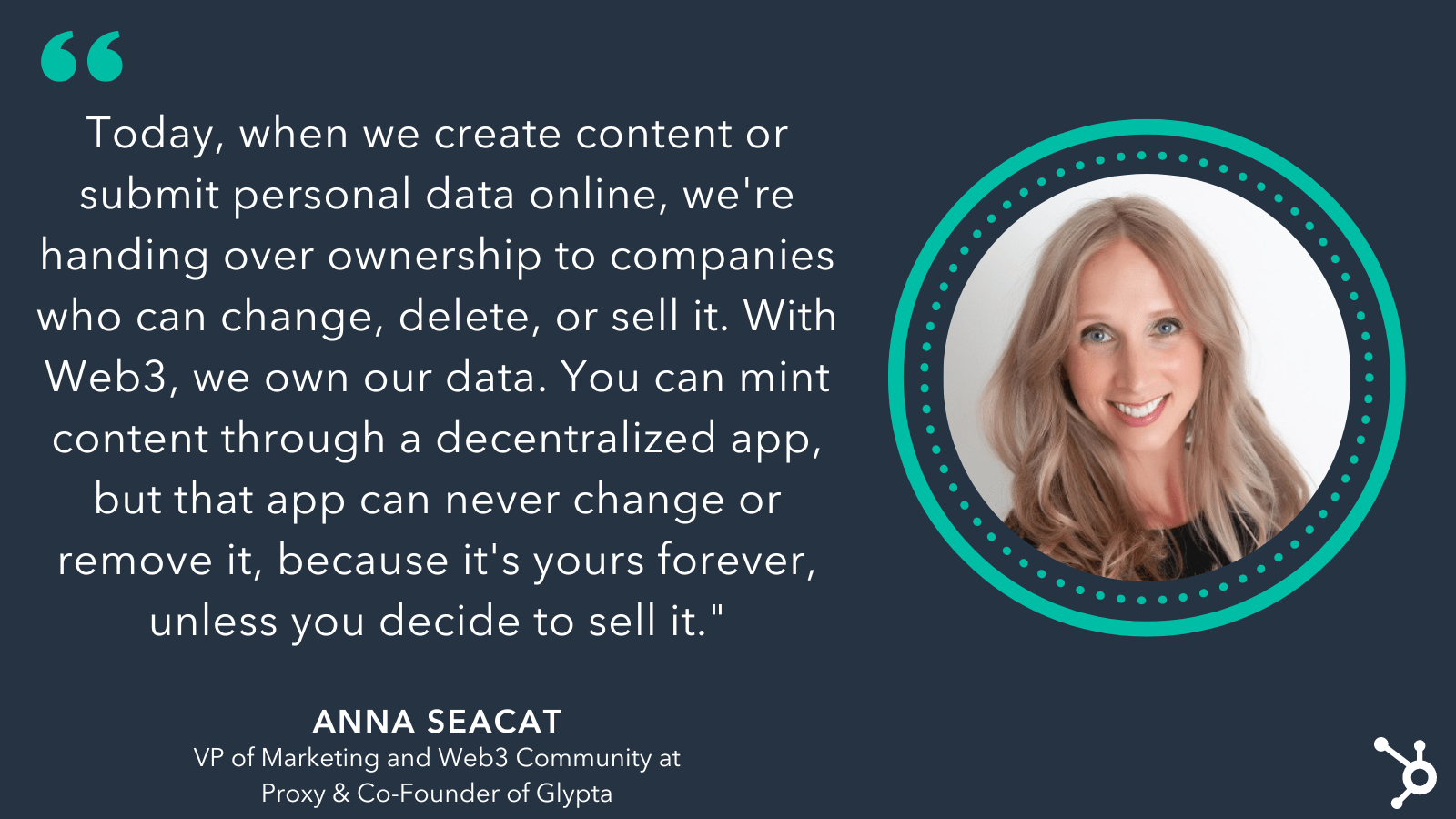
Anna Seacat, VP of Marketing and web3 Community at Proxy and Co-Founder of Glypta.org, says a major benefit of web3 is ownership over data.

As Seacat puts it, “Today, when we create content or submit personal data online, we’re handing over ownership to companies who can change, delete, or sell it. With web3, we own our data. You can mint content through a decentralized app, but that app can never change or remove it, because it’s yours forever, unless you decide to sell it.”

anna seacat quote on web3

Essentially, it’s an evolution of the internet that will be supported by blockchain and hosted on servers owned by individuals and many organizations rather than a handful of corporations. This gives users the ability to vote over the web’s rules and regulations, rather than putting all power into the hands of those who own the servers (think: Democracy versus Monarchy).

At least, that’s the idea — although it’s still in early days of development, so it’s unknown whether reality will live up to these ideals.

But how does web3 relate, specifically, to consumers and e-commerce brands? Let’s explore that next.

How does web3 relate to consumers?

Web3 Will Provide a Foundation for Decentralized Finance

So … How does web3 relate to consumers? Well, in many ways, web3 is opening up new opportunities for how people will ultimately spend and sell.

In essence, web3 could become a strong foundation for a secure, protected digital economy.

For instance, one critical component of web3 is decentralized finance.

Decentralized finance, which uses the same blockchain technology used by cryptocurrencies, has a similar goal as web3 itself: Give people the power to control their own money through a digital wallet, rather than relying on major financial institutions and banks. (Similar to how web3 aims to give people the power to control their data, rather than relying on major tech corporations.)

Many brands already accept digital currencies from consumers. Microsoft, for instance, allows consumers to purchase products from the Windows Store with bitcoin; AT&T accepts cryptocurrency for bill payments; and even retailers like Overstock.com accepts bitcoin on its online site.

So decentralized finance could be the next leap towards encouraging more digital transactions by providing incentives for consumers to store their finances digitally.

Cryptocurrency, bitcoin, and a decentralized financial system are three components that could flourish on web3. But all three exist in much the same way the dollar does: as a fungible token. In other words, you can trade one dollar of bitcoin for another identical dollar of bitcoin. They are interchangeable.  

But there’s another major element of web3 that many brands are seeing value in, and it’s likely something you’ve already heard something about: NFTs.

More Consumers Will Begin Purchasing NFTs 

NFTs — or non-fungible tokens — are part of the Ethereum blockchain, and have exploded in growth over the past few years. In fact, investment bank Jefferies forecasts that NFTs will reach more than $35 billion in market value in 2022, and over $80 billion by 2025.

Many of us have seen the wild west of NFTs first-hand. A few examples come to mind, including a Tweet that sold for $2 million, a meme that sold for $590,000, and a bundle of monkey drawings that sold for over $24 million.  

But what does ‘buying’ any of these digital assets actually mean? Essentially, it means you purchase the digital certificate which verifies you’re the sole owner of the original. Consider it synonymous with owning the original Mona Lisa, versus purchasing a copy.

NFTs aren’t limited to digital artwork, however. NFTs can be a digital asset from any industry, including gaming, fashion, and even music.

The potential ramifications of NFTs are enormous. As consumers shift towards NFTs, major corporations like Google or Meta could see a decline in how many consumers use their shopping tools.

As Seacat puts it, “If NFTs are any indication of how marketing, shopping, and selling online will change, we’re in for true disruption. For instance, Google is not used for NFT shopping. Instead, consumers rely on gated apps and decentralized marketplaces — neither of which show up in traditional search engine results.”

Web3 Will Lead to More Trust Between Buyers and Sellers, and Reduced Prices

As previously mentioned, web3 will offer more security and control over personal data — which will directly impact a consumer’s sense of trust when making purchasing decisions. 

Jeremy Merrell Williams, CEO at Vyudu Inc and web3 and Blockchain Analyst, says web3 will greatly impact how consumer shop in the future. 

“For instance,” Williams says, “with blockchain technology, shoppers can directly connect with producers and retailers without having to go through intermediaries. This could lead to more trust between buyers and sellers, as well as lower prices due to reduced fees.”

He adds, “Web3-based marketplaces could also make it easier for consumers to find the best deals on products and services.”

Ultimately, with web3, you don’t need to put your trust — and data — into the hands of a third-party corporation. Given that 76% of consumers feel they don’t know what companies are doing with their data, this could ultimately lead to a renewed sense of trust between consumers and brands.

Some Consumers Will be Wary of Web3 Because of The Volatility of Crypto

Before we dive into how brands can leverage web3, let’s take a look at some consumer concerns when it comes to web3.

One major concern? The purchasing process is too confusing.

Seacat says, “Web3 doesn’t currently support the average consumer’s purchasing process. You have to take big gambles and go into what’s called a ‘rabbit hole’ to get education and onboarding.”

For this reason alone, Seacat and a team of women started a nonprofit, Glypta.org, to make web3 safer for women, especially those who are just getting started in the space. Seacat adds, “We shouldn’t have to risk thousands of dollars in a rabbit hole to be a part of web3.”

Additionally, digital currencies like cryptocurrencies have proven to be volatile, which dissuades many from investing in the first place. And since you can’t use U.S. dollars on web3, those who don’t feel confident purchasing cryptocurrencies are excluded from purchasing on web3.

Finally, there are some steep fees on web3, particularly when buying NFTs.

As Holly Shannon, producer of Culture Factor, a high-ranking NFT and emerging technologies podcast, told me, “The fees incurred when buying an NFT on the blockchain are high. They are referred to as ‘gas fees’. The use of crypto and the gas fees relative to a purchase are a major drawback at this time.”

Shannon adds, “The exercise to get a wallet that is unique to this framework is also cumbersome and full of friction. There are hot, warm, and cold wallets. There are secret codes and layers of authentication.”

Ultimately, we’re a long ways away from making web3 feel mainstream for consumers. But it’s still useful to consider: When consumers do begin joining web3, how can brands meet them there?

How Brands Can Leverage Web3

Brands Can Leverage NFTs to Build Direct-to-Consumer Relationships

In recent years, major brands have begun seeing the value in NFTs. Nike, for instance, has begun selling branded sneakers on Roblox, a virtual world, for fans’ avatars to wear as they play sports virtually. Those virtual sneakers, which won’t exist in real life, are an example of NFTs.

Meanwhile, in the fashion industry, Dolce & Gabbana set a record of nearly $6 million for a nine-piece collection of digital NFTs, including a “Glass Suit” that the auction winner’s avatar can wear in a metaverse.

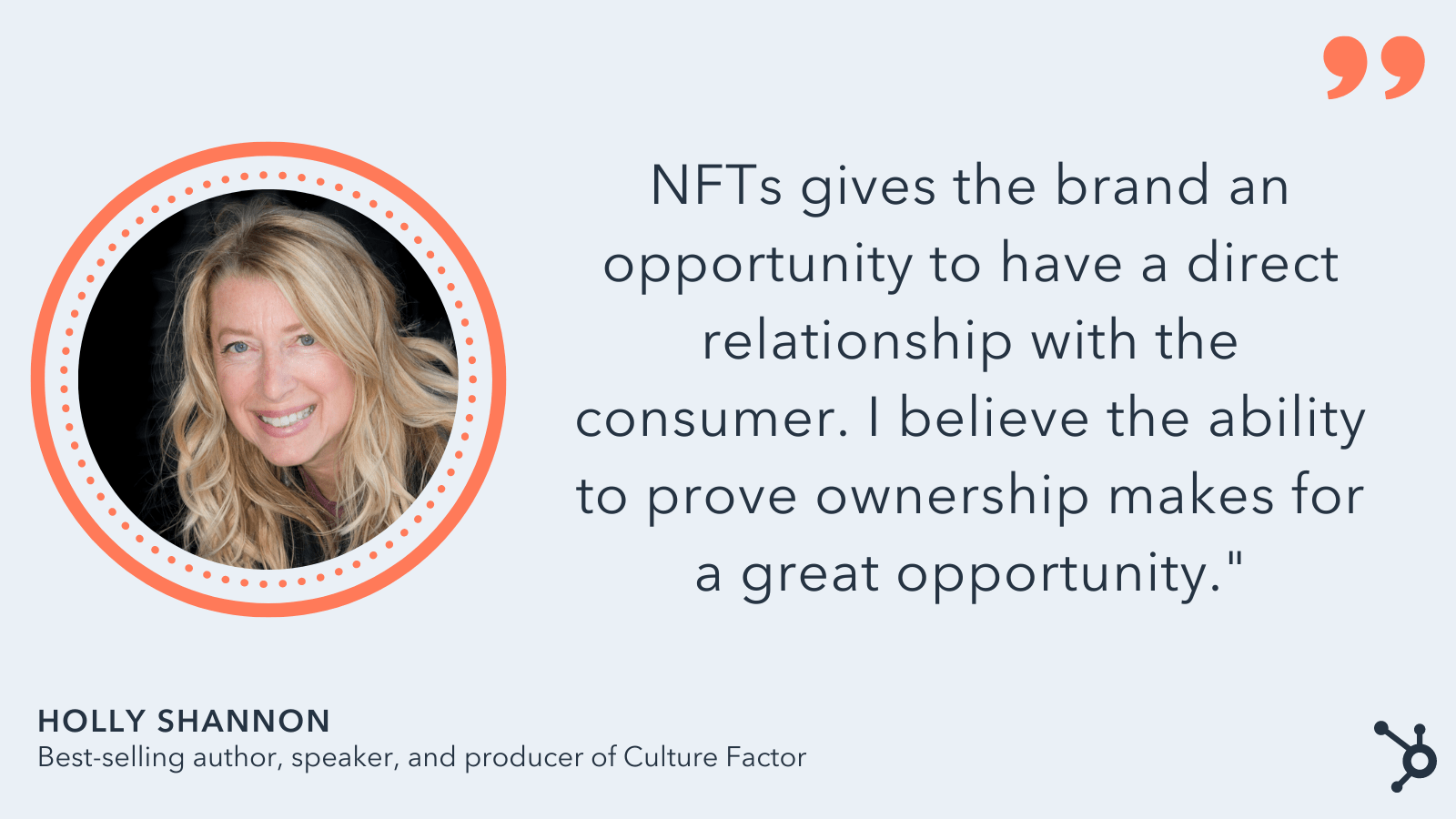
Shannon says: “I believe the ability to prove ownership makes for a great opportunity. Let’s say you purchase a Hermés bag. By using an NFT that establishes the purchase on a blockchain, it creates a permanent record of that sale.”

holly shannon quote on web3

Shannon adds, “Think of that NFT as a ticket or token that represents an asset — or your Hermés handbag. It authenticates your purchase as the original. Which, as an aside, makes a good case for reducing counterfeit sales. Additionally, it gives the brand an opportunity to have a direct relationship with the consumer.”

Ultimately, Shannon believes the power of NFTs for brands lies in this concept: Direct-to-consumer.

For instance, Shannon notes, Hermés could use NFTs to delight their customers with unlockable experiences.

Shannon posits, “Hermés could invite consumers to a fashion show, or send them a gift using NFTs. Alternatively, maybe a sports team uses NFTs to give fans a chance to meet their favorite players, or send SWAG directly to them. This merely scratches the surface of experiential marketing, but hopefully you can see the magic, too.”

Which leads me to my next, and hopefully last, Matrix-sounding buzzword: Metaverse.

Brands Can Engage with Consumers in the Metaverse

The metaverse is essentially a 3-D virtual reality (check out this post with a full run-down of the metaverse if you need a refresher), and it’s where many consumers will purchase and wear the digital items we’ve listed so far.

I’m willing to bet you’re thinking NFTs and the metaverse seem a little far-fetched for most consumers. (I’m not in the financial position to purchase a $2 million Tweet myself, anyway.)

But HubSpot’s Blog Research found it does, in fact, impact many consumers today. A few quick stats:

  • Over half of those who have ever bought virtual currency/items have done so within the past three months. (Including 75% who bought cryptocurrency; 62% who bought virtual items like Fortnite skin; and 60% who bought NFTs.)
  • 30% say more brands should have virtual stores in the metaverse.
  • 34% of cryptocurrency owners have used crypto to make a purchase (other than using it to buy other crypto).
  • 27% say they would be more likely to use a platform if they received virtual currency for using it.

As it turns out, consumers are interested in purchasing virtual products and services; and they’re interested in using virtual currencies to do so.

In many ways, this makes sense: Much of what we do nowadays exists online. We meet our partners online using dating apps; we make new friends via social communities like Facebook; and some of us even work entirely online, leveraging remote tools like Zoom to communicate with colleagues.

Web3 is an iteration that could, ideally, meet more consumers needs when it comes to data privacy, convenience, socialization, and entertainment.

And if your consumers are on web3, why wouldn’t you want to meet them there?

New Call-to-action

Categories B2B

The Top Video Marketing Tactics Brands are Investing In [+Which Are Losing Steam]

Video marketing is becoming more and more integral to a brand’s success. If you’re a marketer trying to craft the best video marketing strategy for your brand, it helps to know the top video marketing tactics brands are investing their time and money in.

Fortunately, the HubSpot Blog recently surveyed over 500 marketers across the globe about their video marketing tactics, what seems to be working, and which tactics are worth reconsidering.

→ Access Now: Video Marketing Starter Pack [Free Kit]

Most Used Video Marketing Tactics

Here is a breakdown of the kinds of videos and platforms marketers are continuing to leverage and why:

Short-Form Video

In our survey, we found short-form video leads in usage with it being leveraged by 58% of marketers. Short-form videos also lead on ROI, engagement, and lead generation. Nearly half (46%) of marketers will plan to use short-form videos for the first time in 2022 and 36% will invest in short-form videos more than any other format.

These numbers aren’t surprising when you consider short-form videos are more likely to go viral, according to 47% of video marketers.

Statistic showing 58% of marketers leverage short-form videos.

Long-Form Video

Long-form videos come in second when it comes to usage with 37% of marketers leveraging the format. This format also places second in terms of ROI, lead generation, and engagement. According to our survey, 36% of marketers plan to leverage long-form videos for the first time in 2022, and 18% will invest in the format more than any other kind of video.

The optimal length of a long-form video is between three to six minutes, according to 36% of marketers. Even platforms like TikTok are starting to embrace long-form videos, in fact, the app is now allowing 10-minute videos. This could be because long-form videos still receive significant engagement.

In our survey, we found 38% of long-form marketing videos have an average watch percentage between 41% and 60%. We also found 25% of long-form videos have an average watch time between 61% and 80%. Finally, 22% have an average watch time between 21% and 40%.

Statistic showing 37% of marketers leverage long-form videos.

Video Marketing on Social Media

Social media is the top channel used to share marketing video, with it being used by 76% of marketers in our survey. It also has the biggest ROI by far, according to 67% of marketers who use it. Our survey revealed 66% of marketers also say it’s the most effective for generating leads. We also found 63% of marketers will use social media for the first time in 2022, and 61% will invest more in sharing videos on social media than any other channel.

Regarding specific social media platforms, Instagram is the top platform for ROI, lead generation, and engagement. According to our survey, 42% of marketers who don’t use Instagram for sharing videos will do so for the first time in 2022, and 24% will invest more into sharing videos on the platform than any other.

Facebook is also a common tool for marketers with 60% of those in our survey sharing videos on the platform. However, Facebook also comes in fourth place for ROI, engagement, and lead generation. We found 35% of marketers will invest in videos on Facebook for the first time in 2022.

Coming in second place in terms of engagement is TikTok, however, only 35% marketers share videos on the platform and 20% plan on doing so for the first time in 2022.

Statistic showing 76% of marketers use social media to share marketing videos.

Video Marketing on YouTube

YouTube has the highest usage among marketers with 70% leveraging the platform. It will also see the most investment from video marketers in 2022. Over half the marketers who do not use YouTube will do so for the first time in 2022, according to our survey.

No matter which tactic you choose to leverage for your brand, it’s important to remember the most important factors when creating effective video content, according the marketers we surveyed are:

  • Adequately promoting your video
  • Capturing viewers’ attention in the first few seconds
  • Keeping your videos short/concise

Statistic showing 70% of marketers leverage YouTube.

Least Used Video Marketing Tactics

Here are the platforms, formats, and concepts that seem to be losing steam among marketers.

Reddit, Tumblr, Twitch, Snapchat, and Pinterest

While social media plays a vital role in video marketing, not every platform ensures success. Marketers told us Reddit, Tumblr, Twitch, Snapchat, and Pinterest have not provided favorable ROI or engagement when it comes to marketing videos, therefore these platforms will likely see the least investment from video marketers in 2022.

Nostalgic Content and UGC

Despite the resurgence of TV shows, films, and music trends rooted in nostalgia, marketers say nostalgic content consistently underperforms in terms of engagement, ROI, and lead generation.

We found similar findings when we asked marketers about user-generated content (UGC). Our survey found just 19% of video marketers will leverage nostalgic content in 2022 for the first time and only 3% will use UGC.

Screen-Capture video

Screen-capture videos have the lowest ROI when compared to other video styles like live action and animation. They are also much less effective in generating leads and engagement, according to our survey. With that said, 52% of video marketers plan on leveraging screen-capture video for the first time in 2022, and 21% plan to invest in this video style more than any other.

Video content is continuing to gain importance as more and more platforms prioritize video sharing. Now that you know what investments are working for marketers—and which aren’t—you can begin brainstorming the best video marketing campaign that will ensure success for your brand.

Discover videos, templates, tips, and other resources dedicated to helping you  launch an effective video marketing strategy. 

Categories B2B

The Ultimate List of Email Marketing Stats for 2022

Webinars, video campaigns, and social media posts are relatively new channels for marketers to reach their customers. But, your contemporary communication methods shouldn’t distract you from one of the oldest, yet most effective, strategies — email marketing. In fact, email ROI is an impressive $36 for every $1 spent

If you’re still hesitant, keep reading — we’ve cultivated a list of email marketing statistics for HubSpot to demonstrate just how powerful email can be. Here, you’ll find: 

Download Now: Free State of Marketing Report

General Email Marketing Statistics and Best Practices

  • Email marketing is used by 1 in 2 media planners. It will continue to grow this year with 22% planning to leverage it for the first time.(HubSpot Blog Research, 2021)
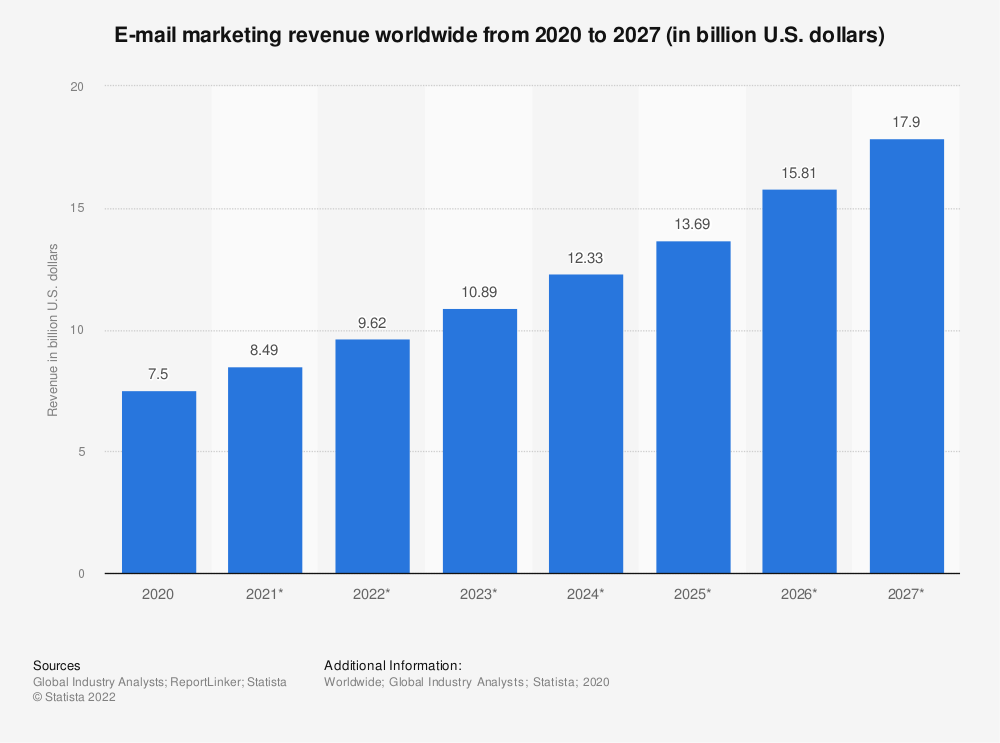
  • Email marketing revenue is estimated to reach almost 11 billion by the end of 2023. (Statista, 2021)

email marketing stats: graph displaying email marketing revenue through 2027

Image Source

  • There are 4 billion daily email users. This number is expected to climb to 4.6 billion by 2025. (Statista, 2021)
  • More than 306 billion emails are sent and received each day. (Statista, 2021)
  • 64% of small businesses use email marketing to reach customers. (Campaign Monitor, 2021)
  • 37% of brands are increasing their email budget, and just 1.3% are making cuts. (Litmus, 2021)
  • The most effective strategies for email marketing campaigns are subscriber segmentation (78%), message personalization (72%), and email automation campaigns (71%). (HubSpot Blog Research, 2021)
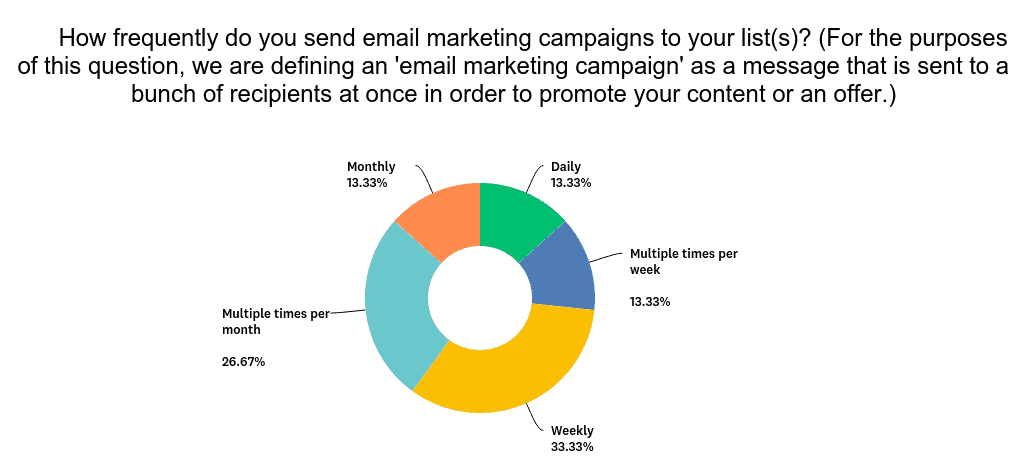
  • 33% of marketers send weekly emails and 26% send emails multiple times per month. (Databox, 2022)

email marketing stats: graph displaying email send frequencyImage Source

  • 63% of businesses reduce the frequency of emails send to subscribers based on their levels of engagement.  (Databox, 2022)
  • 41.5% of brands say that email marketing is very critical to business success, compared to 78% in 2020. (Litmus, 2021)
  • 77% of marketers have seen an increase in email engagement over the last 12 months. (Not Another State of Marketing, 2021)
  • Globally, Fridays see the highest email open rates (nearly 19%), compared to the lowest open rates (17%) on Saturdays. (Campaign Monitor, 2021)
  • 43% of marketers are changing how they measure email performance because of Apple’s Mail Privacy Protection, and 24% aren’t making any changes for now. (Litmus, 2021)
  • The most significant way that email marketers adapted to recent data privacy changes was by prioritizing different KPIs. (HubSpot Blog Research, 2021)
  • The most effective email subject lines engage curiosity, include promotional offers, and are personalized to each recipient’s interests. (HubSpot Blog Research, 2021)
  • QA, A/B, and spam testing your emails leads to higher ROI. Enjoy up to a 28% higher return when you put testing to work for your email program. (Litmus, 2022)

B2B Email Marketing Statistics

  • 81% of B2B marketers say their most used form of content marketing is email newsletters. (Content Marketing Institute, 2020)
  • 64% of B2B marketers say their email marketing strategy was effective for meeting business goals in 2021. (HubSpot Blog Research, 2021)

  • 15.8% of all emails go missing or have been caught by popular spam filters. (Email Tool Tester, 2022)
  • B2B marketers say that new product and feature announcement marketing emails have the highest click-through rate. (HubSpot Blog Research, 2021)
  • Automation is primarily used in email marketing to send triggered emails, for drip or nurture campaigns, and segmentation. (Litmus, 2021)

Mobile Marketing Statistics

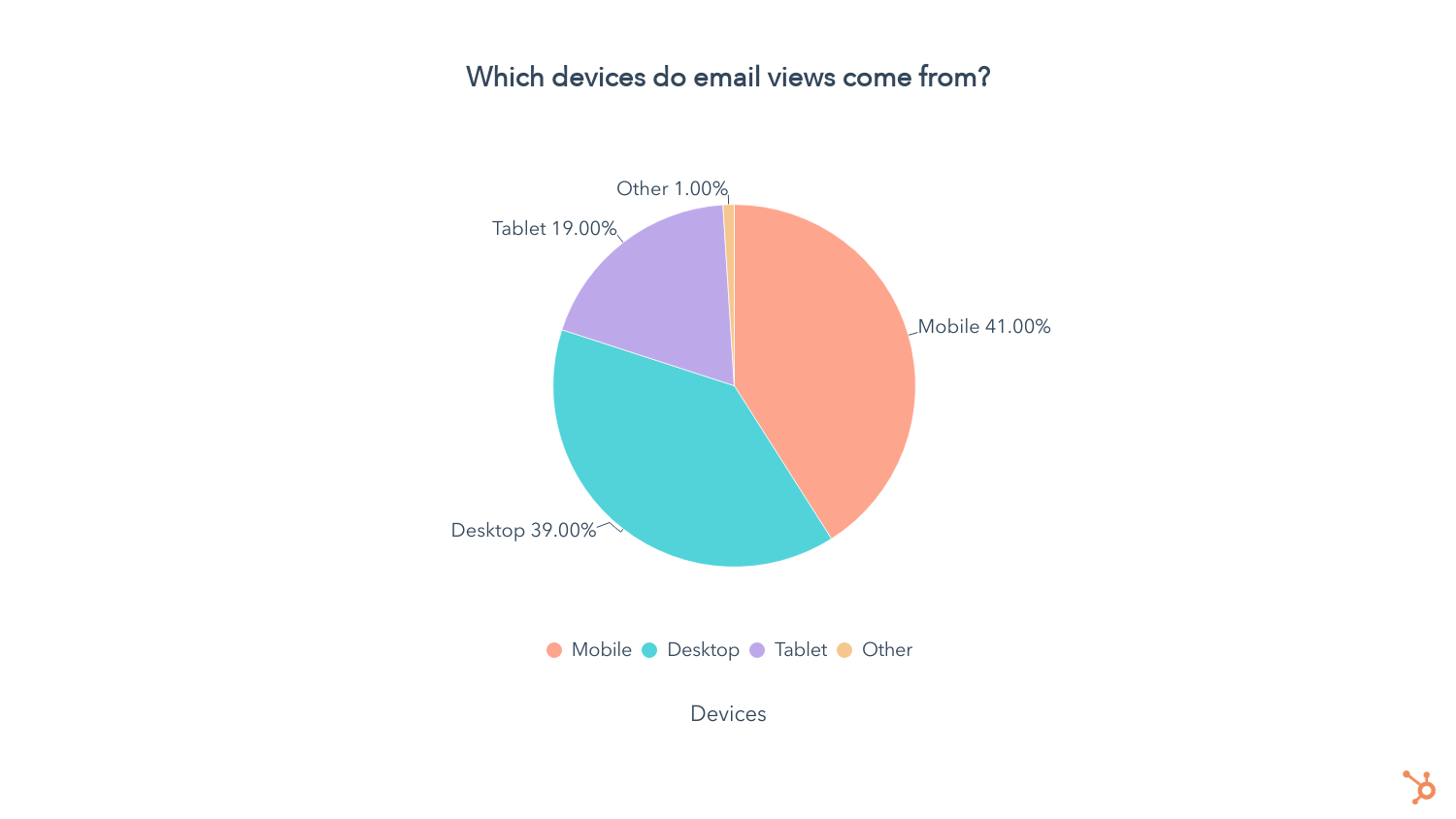
  • A majority of email views come from mobile devices (41%), followed by desktop (39%). (HubSpot Blog Research, 2021)

email marketing statistics: email views by device type

  • Nearly 55% of global website traffic is generated from mobile devices, excluding tablets. (Statista, 2022)
  • 46% of smartphone users prefer to receive communications from businesses via email. (Statista, 2021)
  • Apple iPhone’s native email app has the highest market share, followed by Gmail. (Litmus Labs, 2022)
  • Nearly 1 in 5 email campaigns is not optimized for mobile devices. (SuperOffice, 2020)
  • Launching a mobile-responsive email design can increase unique mobile clicks by 15%. (MailChimp, 2021)
  • 56% of marketers leverage mobile-friendly emails in their email marketing strategy. (HubSpot Blog Research, 2021)

B2C Email Marketing Statistics

  • 87% of B2C marketers leverage automation as part of their email marketing strategy. (HubSpot Blog Research, 2021)
  • 50% of people buy from marketing emails at least once per month. (Salecycle, 2022)

  • Your audience will reward you with higher open and click rates if you don’t send more than five newsletters a week. (GetResponse, 2020)
  • 60% of retail, e-commerce, and consumer goods and services companies are personalizing emails based on past purchases, versus 38% in 2019. (Litmus, 2020)
  • More than 8 out of 10 people will open a welcome email, generating 4x as many opens and 10x as many clicks as other email types. (GetResponse, 2020)
  • The single message autoresponder email had an astonishing 98% open rate and a 37% click-through rate. (GetResponse, 2020)
  • Nearly 22% of all email campaigns are opened within the first hour of sending. (GetResponse, 2020)
  • 15.8% of all emails go missing or have been caught by popular spam filters.  (Email Tool Tester, 2022)
  • 59% of respondents say that marketing emails have influenced their purchases. (Salecycle, 2022)
  • 64% of B2C marketers consider accessibility when creating their emails. (Pathwire, 2021)

Email Marketing Demographics 2021

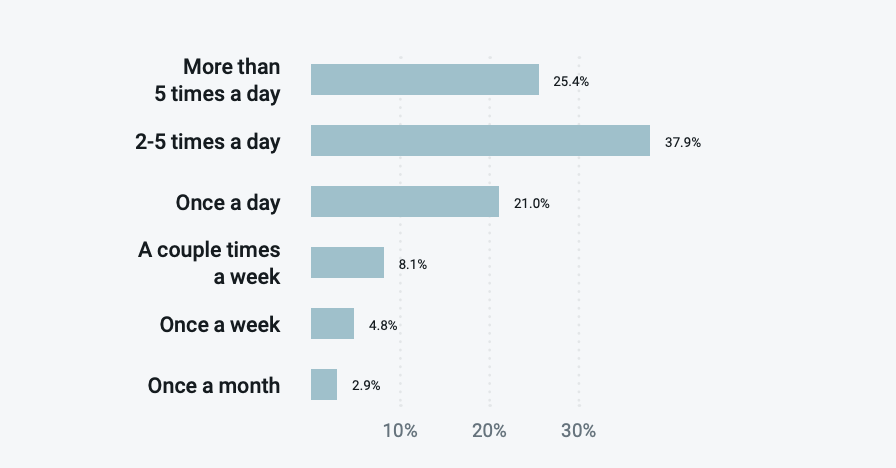
  • 99% of email users check their inbox every day, with some checking 20 times a day. Of those people, 58% of consumers check their email first thing in the morning. (OptinMonster, 2020) 84.3% of consumers say they check their emails at least once a day. (Pathwire, 2021)

email marketing stats: how often consumers check emailImage Source

  • 35% of survey respondents in the U.S. have two email addresses and 28% have over four.  (Statista, 2021)
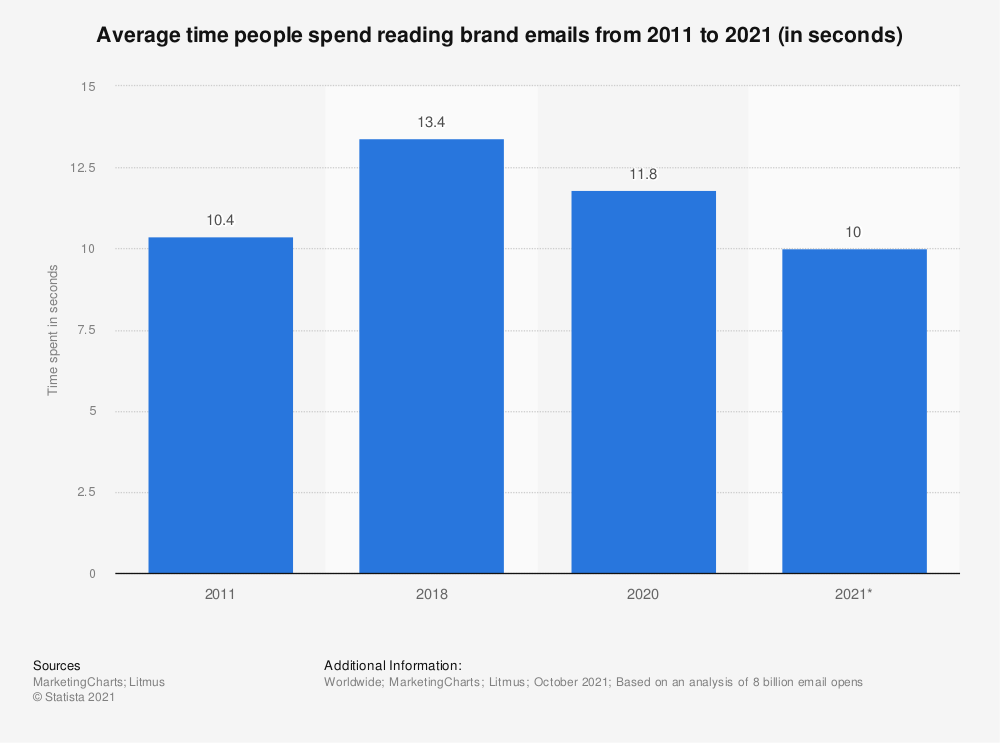
  • Consumers spend an average of 10 seconds reading brand emails. (Statista, 2021)

time spent reading email

Image Source

  • 40% of consumers say they have at least 50 unread emails in their inbox. (HubSpot, 2020)
  • Email is the leading way consumers in the U.S. discover coupons from brands.  (Statista, 2021)
  • Recognizing a sender is the most important factor in deciding to open an email, followed by actually having the time to read an email.  (Pathwire, 2021)
  • The average bounce rate across all industries is 9.96%. 
    (Constant Contact, 2022)
  • 59% of Millennials primarily use their smartphone to check email, while 67% of Generation Z scans their inbox on mobile. (Bluecore, 2021)
  • 74% of Baby Boomers think email is the most personal channel to receive communications from brands, followed by 72% of Gen X, 64% of Millennials, and 60% of Gen Z. (Bluecore, 2021)
  • The most significant steps marketers take to champion accessibility when creating their emails is writing short, descriptive subject lines, making links and buttons easy to see, and keeping paragraphs short and simple. (Pathwire, 2021)

Apply Your Email Knowledge

Many of the data points will help you make the case for investing more time and money into your email marketing strategy. While you can refer back to this post at any time, you can also start applying them to your next campaign.

Editor’s Note: This blog post was originally published in March 2019, but was updated for comprehensiveness and freshness.

New Call-to-action

Categories B2B

Why Your Nonprofit Should Invest in Search Engine Optimization

Every company needs a strong marketing strategy — even nonprofits.

However, most nonprofits haven’t considered investing in search engine optimization (SEO), even though it can have one of the highest returns on investment.

SEO, specifically for nonprofits, is the process of optimizing your website to increase organic visibility when people search for topics like education, fundraising opportunities, volunteer opportunities, or other aspects that promote your mission.

Let’s dive into what SEO is, how it works, and SEO best practices for nonprofits.

Download Now: Nonprofit Marketing & Fundraising  Trends for 2022 [Free Report]

What is SEO?

SEO, which stands for search engine optimization, is the process of driving users to your site from search engines organically. This means you aren’t paying for ads, using social media, or placing sponsored content to attract new users.

The goal of SEO is to help your site rank as high as possible for target keywords and phrases relevant to your website and mission.

For example, if your nonprofit is geared towards wildlife conservation, you would want to rank high organically for terms related to wildlife conservation. The higher your website or pages rank in the search engine result pages (SERPs), the more likely users will see it and click on it. Studies have shown that the higher you rank, the higher the average click-through-rate (CTR) is.

If you’d like a full rundown on SEO, take a look at The Ultimate Guide to SEO in 2022.

How does SEO work?

There are hundreds of factors that Google and other search engines take into account when ranking your site or content. These factors come from the three different pillars of SEO which are the following:

  • Technical optimization
  • On-page optimization
  • Off-page optimization

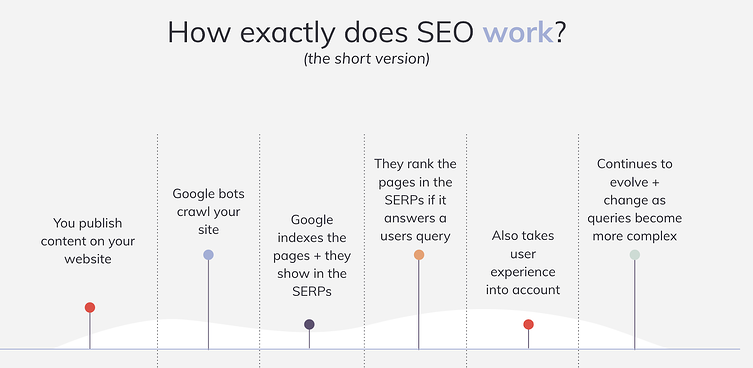
Search engines are powered by people when they have a query and search for answers. Search engines use algorithms that decide what content and websites best fit the answer for the query. There are three steps that search engines take when assessing a site: crawling the site, indexing the site, and lastly, ranking the site.

Crawling, also known as the discovery stage, occurs first, then search engines decide if the pages should be indexed or shared on the search engine result pages and available for users to see and find. Lastly, the algorithm ranks the content in the search results, which is how users find your website or web page.

SEO for Nonprofits

So why should nonprofits invest in SEO? Well, SEO is just as important for nonprofits as it is for other companies. It is an affordable and effective long-term marketing strategy.

Investments you make in SEO today may take a while to pay-off, but they will continue to do so for years to come. SEO can take awhile to see the results due several factors, such as keyword difficulty, competition, domain age, and to trust of search engines and users. In general, it can take four to six months to see some movement in rankings and site health.

Increasing organic visibility of your nonprofit also increases the visibility of the mission you stand for while growing your brand awareness. Using SEO will help your pages move up in search engine rankings, creating a higher click-through-rate, more impressions, and overall, more traffic.

How to Measure SEO Success

Depending on your goals and what you want to accomplish, there may be multiple aspects you’d like to measure and evaluate for success, such as:

  • Keywords
  • Organic traffic
  • Market share compared to competitors
  • Conversions
  • Backlinks
  • Page rankings

Some goals for your nonprofit might include having more priority keywords move into the top 10 positions, increasing organic traffic on specific pages, or increasing organic conversions.

SEO Best Practices for Nonprofits

If you’re confused or intimidated by the idea of becoming discoverable online and creating a successful SEO strategy, we’ve got you covered.

Here are the five best SEO practices to focus on for your nonprofit this year.

1. Keyword research should create your content strategy.

It’s important to know what your prospective and ideal customers are searching for and what their journey is. Search engine rankings are determined by algorithms that use quite a few factors to decide how well a webpage answers a query.

Unfortunately, it’s not as easy as throwing keywords into your content, so here are a few things to consider.

Search Intent

A query or keyword can have multiple meanings depending on the person or where they are in the user journey. They might be looking for more information, directions, or to make a purchase or donation, and each of those actions would need a different query. It’s important to make sure that the right keyword goes with the right piece of content.

Relevant Keywords

If you’re a nonprofit that works with homeless communities, a long-tail keyword you might want to focus on could be “how to help homeless communities”. Knowing this, you can create content and resources that will drive users to your site. You should avoid keywords that don’t truly represent your brand or what you offer.

Long-tail keywords are keywords or phrases that are more specific, and usually longer than common keywords. An example of a long-tail keyword might be “light blue beach hat” and a short-tail keyword would be “hat” or “beach hat”. Shorter-tailed keywords are usually harder to rank for, but have more traffic. Longer-tailed keywords have less traffic but a higher conversion rate, which is ideal for most nonprofits.

Additional thoughts:

  • It can often be easier to target long-tail keywords (a phrase vs. a one-word term), which drive more qualified traffic
  • There are different keywords targeting users at each part of the sales funnel
  • Keyword research takes time and evolves as well

Google offers a great free keyword research tool that can also be used for SEO. If you’re looking for a more SEO specific platform, MOZ and SEMRush are two great platforms that both offer nonprofit pricing.

2. Create high-quality content.

Content will always be one of the most important ranking factors. Not only is it essential to have SEO-optimized content, but the quality is important, as well. Google wants to ensure that you’re publishing content that follows their E-A-T standards.

The concept of E-A-T, which stands for expertise, authoritativeness, and trustworthiness, is considered an SEO best practice when creating content. These factors help Google avoid sharing and feeding inaccurate or misleading information. You can follow these factors from Google by:

  • Updating old content to make sure it’s relevant
  • Ensuring the content is accurate
  • Allowing experts or other writers to create content for you

Along with E-A-T, make sure that your content follows the best on-page practices. This includes focusing on a primary keyword, adding metadata, using proper headings, adding alternative text (ALT text) to your image, and using internal linking, to name a few.

3. Make sure your site is mobile-friendly.

A majority of users across all industries use their phones instead of desktop computers as of 2022.

Additionally, Google crawls sites using a Google phone bot to make sure your site is mobile-friendly. This means your site is able to shrink down and fit on any screen while still allowing users to access your content as easily as on a desktop.

Mobile-friendliness is a ranking signal in both Google and Bing’s algorithms when a user is searching on a mobile device. If your website is mobile-friendly, it generally will outrank non-mobile-friendly sites.

There are several tools available to test you website’s mobile-friendliness:

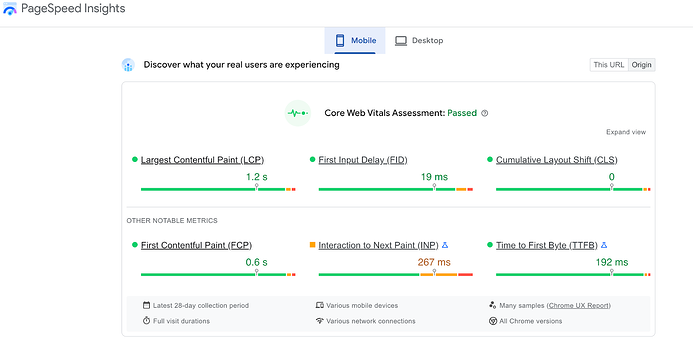
Google’s results via Page Speed Insights

4. Link-building is crucial to create brand awareness.

Nonprofits can struggle with getting donations due to lack of overall brand awareness and organic visibility. Link-building relies on creating authoritative content that other sites will want to link share with and link back to. A great example of this is allowing your annual reports to be sharable for others to see.

One strategy to consider would be to reach out to partners or sponsors and see if they will link back to you on their site and in their content. This is especially important for pages you want to drive traffic to.

5. Local SEO is very relative for most nonprofits.

Local SEO is very beneficial for nonprofits because it can help bring people to a fundraising event or even attract volunteers. For example, if you search “food drive near me” on Google, local listings will pop up. This is because they have focused on a local SEO strategy by utilizing their Google Business Profile.

Google Business Profile allows you to gather reviews, add images and videos, and ensure that your information is up to date for users. You can also add FAQs with answers for users to see as well. All of this helps organizations land on the top of Google listings for this query.

Nonprofit SEO Case Study

Finally, let’s explore how two nonprofits — diaTribe and CreakyJoints — excelled using SEO.

First, diaTribe, a diabetes organization that aims at providing education and resources for those living with diabetes, leveraged an SEO strategy to reach new audiences during the pandemic.

The nonprofit focused on keywords that had low competition, and we helped the organization capitalize on highly-relevant topics based on keyword research data.

As a result, the organization hit all their website traffic and subscriber goals — helping grow their email list by 28% and their website traffic 15% year-over-year.

Next, Media Cause started working with CreakyJoints, a leading support, education, advocacy, and research organization for people living with arthritis and rheumatic disease, in August 2018 to increase organic search traffic.

 By monitoring and resolving SEO-related issues, optimizing existing pages for Google search crawlers, and providing content recommendations based on keyword research, we helped CreakyJoints quadruple their monthly search traffic after just five months.

Today, CreakyJoints’ content is reaching 4x the number of people it used to. That means more people living with arthritis and chronic pain are learning how to navigate their patient journey better, including learning about the long-term effects of their medications, safe and effective ways to manage their symptoms, and how to lead healthy and empowered lives thanks to CreakyJoints.

Investing in an SEO strategy and working on it over time will pay off immensely for your nonprofit in the long run, and it’s cost-effective. While it may take up to six months, you’ll see an increase in your organic and qualified traffic that will help increase visibility for your mission and create better engagement.

By implementing the tips above or working with an agency that is dedicated to promoting your mission, you’ll convert users and help drive them to you.

nonprofit trends

Categories B2B

6 Internet of Things Marketing Examples You Should Know About

IoT is everywhere nowadays – from the smart devices in our homes to the QR codes we see in commercials nowadays.

Unlock tips, systems & recommended resources to stay ahead of the tech curve.

However, there is still so much untouched terrain with IoT marketing. Here are six IoT marketing examples to inspire you to investigate all the ways you can leverage this technology in your strategy.

How does IoT work in marketing?

The Internet of Things is the connection of everyday products like cars, alarm clocks, and lights to computing devices via the internet. It allows them to exchange data with each other, providing marketers with more context about their customers’ product usage.

This, in turn, enables marketers to deliver more relevant messages and leads to greater customer engagement.

For example, if you run out of milk or it spoils, a refrigerator connected to the internet could recognize your need and display a message on its screen or on your phone about the best milk deals in town. You could even order a carton through one of those devices if the refrigerator company partnered with a grocery store.

Since IoT technology connects the internet with objects that are ubiquitous in our daily lives, marketers in almost every industry will be able to engage consumers throughout every phase of the customer journey.

Internet of Things Marketing Examples

1. Coinbase’s Superbowl Ad

Every year, brands spend millions of dollars for a 15- to 60-second ad slot during the Superbowl.

When Coinbase, a cryptocurrency exchange platform, shared its commercial during the 2022 Superbowl, some viewers were confused while others were mesmerized.

Their one-minute ad featured a QR code bouncing around a black screen, reminescent of the “DVD” logo on older TVs – with eerie background music.

When viewers used placed their smartphone’s camera to the QR code, they were directed to the platform’s websites where they were offered $15 for signing up and downloading the app.

QR codes are considered gateways to IoT devices, and allow brands to find creative but affordable ways to market their products and services.

The commercial was so successful that the website crashed.

IoT marketing example: Coinbase's superbowl QR code

Image Source

2. Heineken’s The Closer

In June 2022, beer company Heineken launched a campaign inspired by employees working from home following the pandemic and struggling to disconnect from work.

The company announced that on June 8, they would hold a giveaway sending consumers a Bluetooth-connected bottle opener that would shut down work apps when used.

Using IoT technology, the “Closer” would use an accelerometer to detect the opening of the bottle, communicate with the user’s device via Bluetooth, and shut down selected work apps.

In a press release, the brand’s global head of brand, Bram Westenbrink, shared that this device was created to address work-life imbalance.

“With the once-rigid boundaries between work and personal time rapidly deteriorating following the COVID-19 pandemic, we want to spark a much-needed conversation about the importance of resisting the societal pressures to be in a constant state of busy work and encourage workers around the world to reprioritize social and leisure time with the people who matter most.”

The giveaway only lasted one day and the second half of this campaign involved an online “Calendar Closer,” in which users schedule a meeting with up to three friends to receive $5 to spend on beer and an entry in another giveaway.

iot marketing example: heineken calendar closer

Image Source

This multi-layered campaign shows just how creative brands can get in IoT marketing.

3. Walgreens’ IoT Ad Displays

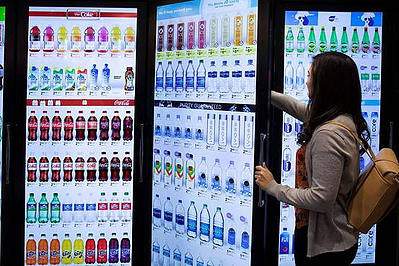
In 2019, Walgreens started testing digital cooler doors that would target store goers with ads and partnered with brands like MillerCoors and Nestlé that were willing to test their products.

IoT marketing example: walgreens cooler ad displays

Image Source

Here’s how it worked: Sensors and cameras located inside of the coolers would pair with face-detection technology to determine what to promote to shoppers, based on age, gender, weather, and more.

For instance, a young adult could be shown sodas while an older person could be shown beer. For beer company MillerCoors, this test seemed promising.

In a statement, a senior marketing manager at MillerCoors said that one of the biggest barriers they face is that shoppers don’t know they can purchase beers in drugstores. Having targeted ads like this could dramatically increase sales and provide more insight into consumer behavior.

This marketing strategy offered a unique opportunity to market to consumers right at the point of purchase, which is unheard of in an offline environment.

4. Diageo

In 2015, Diageo, a leader in the beverage alcohol industry and in IoT marketing, announced the launch of a smart bottle.

Here’s how it works: With every purchase of a Johnnie Walker Blue Label bottle, users would receive personalized messages to consumers who read the printed sensor tags using their smartphones.

IoT marketing example: Diageo's smart bottle

Image Source

The brand said the goal was to enhance the consumer experience and make it easy to send targeted and timely marketing messages.

This is a fantastic example of how to elevate the relationship with a consumer after they’ve made the purchase. Often, brands focus their resources so much on gaining customers that they don’t consider post-purchase marketing strategies.

5. Allen Solly

It’s not unusual for brands to ask customers to tweet something, but the request is not often met with much excitement or vigor unless the customer feels he’s receiving something in return.

Using IoT, connecting social media hashtags and product giveaways might be easier than ever – and a lot more fun.

Allen Solly, a clothing brand, created an interactive shirt billboard in Bangalore, India.

As users tweeted #RainingSolly, the computer linked to the billboard would choose a solenoid (the coil wound behind a shirt) to push a shirt off the billboard for a random consumer to win.

Allen Solly found a unique way to encourage consumers to share their brand on social media, while enabling people to engage as a community in person, as well.

6. Nivea

Print advertisements and IoT technology probably feel like two different ends of the marketing spectrum – the past, and the future. But they might not be.

Nivea Sun Kids created a campaign that combines both, by offering bracelet strips in a Brazil magazine print advertisement that parents could peel off and put on their children’s wrists.

The bracelets had built-in locators, which, when paired with Nivea’s mobile app, allowed parents to set a maximum distance their children could wander. If the child wandered beyond the maximum distance, the app notified the parent. The radar also showed if the child was moving closer or further away.

Nivea’s creative campaign likely encouraged word-of-mouth advertising between parents in Brazil, and it also showcased the brand as being thoughtful and innovative.

We’ve only scratched the surface when it comes to IoT marketing. While some tactics require more resources than others, there are a lot of affordable and creative methods brands can use to incorporate IoT into their marketing strategy.

Editor’s Note: This post was originally published in July 2018 and has been updated for comprehensiveness.

Stay Current on Emerging Tech

Categories B2B

How to Write an Ecommerce Business Plan [Examples & Template]

If you have a promising idea for an online ecommerce business, it’s important to create an ecommerce business plan to ensure your vision has enough stock to be profitable.

Having a business plan for your online store will help you define your target market, establish your monthly and quarterly sales goals, and increase the likelihood of long-term ecommerce success.

In this post, we’ll go over what an online store business plan is and how you can create one for your ecommerce startup. Let’s get started.

→ Download Now: Free Business Plan Template

Whether a company operates as a startup or has years of operations and growth under its belt, an ecommerce business plan is essential for evaluating a business and determining areas of improvement.

An ecommerce business plan is especially important, with an increasing number of shoppers conducting business online. It’s estimated this number has reached over 2 billion. Having an ecommerce business plan keeps you organized and is useful when seeking investors who need to understand your company.

So, let’s dive into some examples of ecommerce business plans and what goes into writing one using our free template.

Ecommerce Business Plan Template

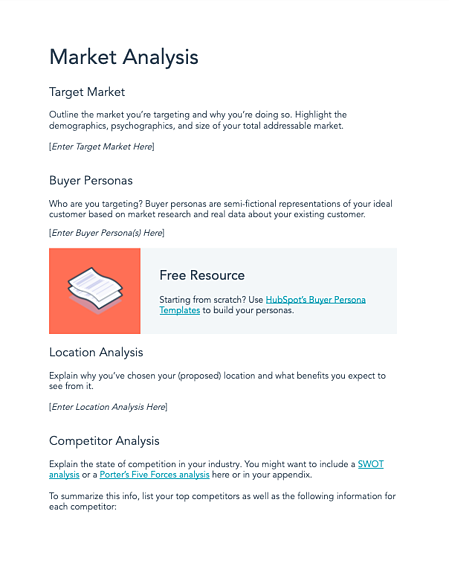
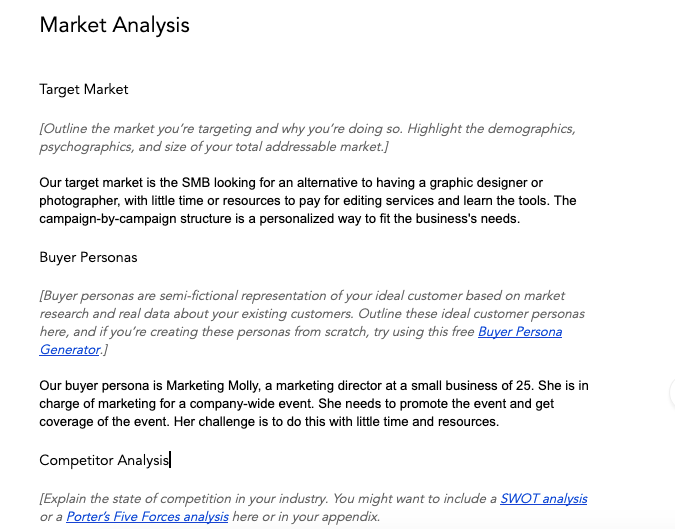
ecommerce business plan template: market analysis

Download Your Free Template Here

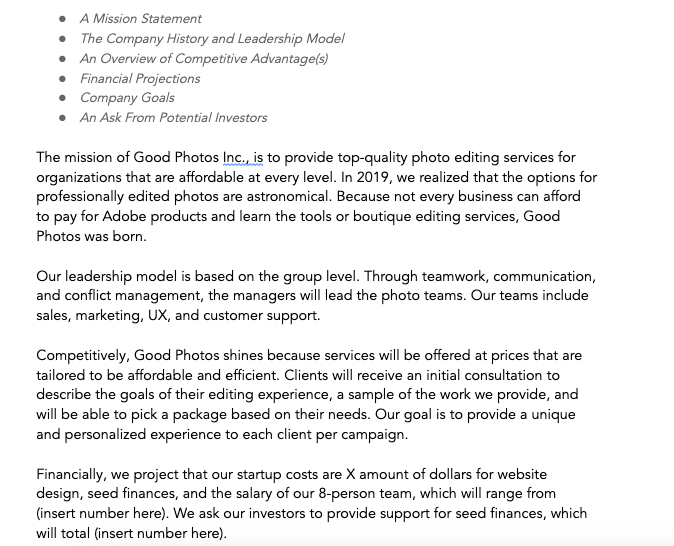
HubSpot’s template provides clear steps to structuring one for your ecommerce business. Throughout this section, I’ll use the example of a photography company specializing in online photo editing.

1. Give an executive summary.

An executive summary is a one-to-two page overview of your business. The purpose of an executive summary is to let stakeholders know what the business plan will contain. HubSpot’s free template offers some tips on how to write one, as I’ve done below:

It’s important to provide an executive summary so that an investor or executive, who doesn’t have the time to read your full plan, can quickly see the most important highlights of your business.

2. List and describe your business.

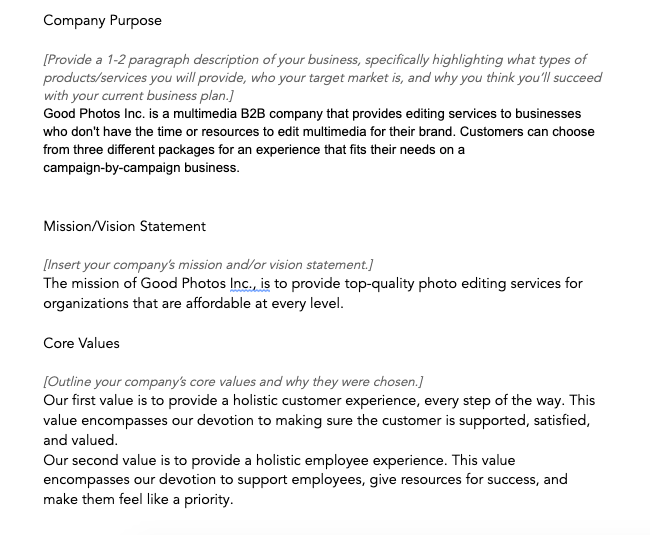
This is the section that needs the most detail because it highlights what you’re selling. To begin, provide an overview of your product or service. For instance, a photography company would probably list their photo packages arranged by price and services, as I did below:

HubSpot’s template also provides direction on how to describe your company’s purpose and break down values. It also advises businesses to include team structure, if applicable. Below that, you should go into detail about your product and service lines.

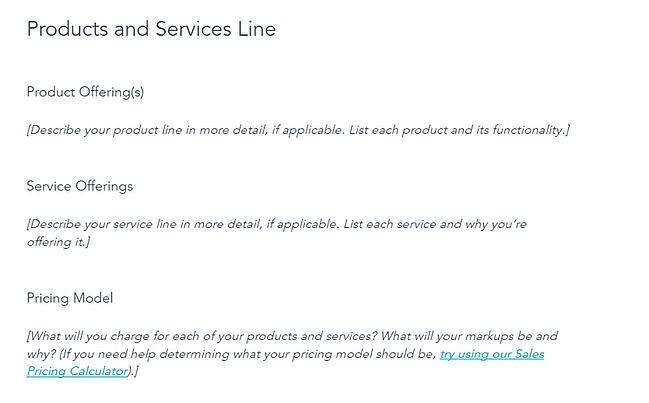
3. Detail your products and services.

Once you have described your business and its purpose, you’re ready to dive deeper into your plan. What products and services do you or will you offer? This is an opportunity to list each item and its purpose, allowing you to answer the question ‘why?’ Why are you choosing to offer these specific products and services?

After detailing your products and services, outline your pricing model. What is the cost associated with each service? Determining price, especially as a startup, can be challenging. However, sales pricing calculators help determine the best pricing strategy.

how to write an ecommerce business plan: products and services

Download This Template

4. Conduct a market analysis.

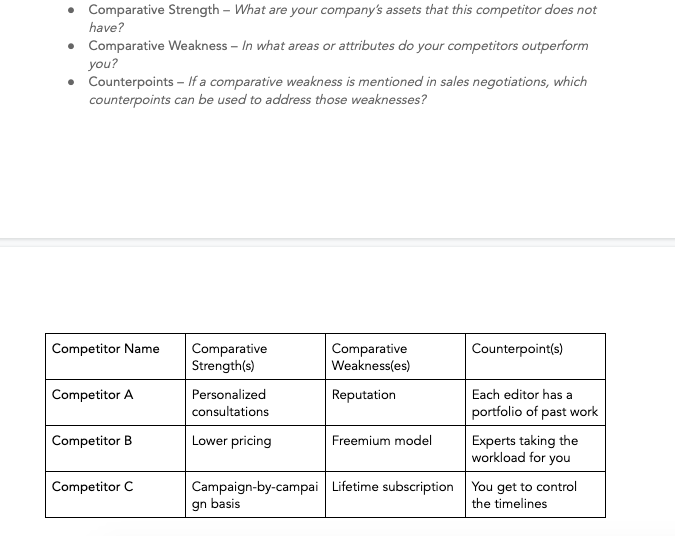
For the market analysis, provide the operational climate of the industry you’re in. To illustrate, at this step, the photography company would need to analyze its position in a world of rival companies like Adobe or online services like Canva. Below, I’ve done a quick competitor analysis, available in the template:

Competitor analysis example

Download This Template

Using directions in the template as a guide, I was able to come up with more selling points of the company and how it stands out from competitors.

Filling out the market analysis section of the business plan assists with providing the framework for future campaigns. You’re able to define your target market and ideal customer. Refer to my example below for how to structure this analysis in your ecommerce plan.

Market analysis example

Download This Template

Good market analysis includes your target audience, projections of your company’s goals, and a breakdown of the competition’s goals and weaknesses. This is a counterpoint of how your business improves upon those weaknesses.

For a complete guide on how to create a market analysis, we have one here.

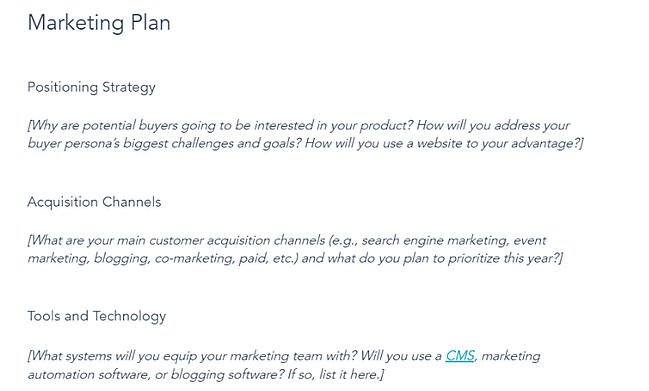
5. Strategize your marketing plan.

For any business, the marketing plan is crucial. It serves as a roadmap for how your company will build brand awareness, reach your target audience, and boost sales and revenue. As seen in this template, your marketing plan will focus on positioning strategy, acquisition channels, and tools and technology.

Positioning strategy fixates on how you will position yourself to your audience. How will you address their challenges and goals? How will you use the tools at your disposal to accomplish this?

The marketing plan will also require you to focus on where your customers come from. Are they finding your business through search engine marketing? Do they discover your business from your blog or social media accounts? Identifying your acquisition channels allows you to identify which ones to prioritize.

Lastly, your marketing plan should lay out the tools and technology your marketing team will need and use. Will you use a content management system (CMS) like CMS Hub? List all the software and programs your company will use to execute its marketing plan.

how to write an ecommerce business plan: marketing plan

Download This Template

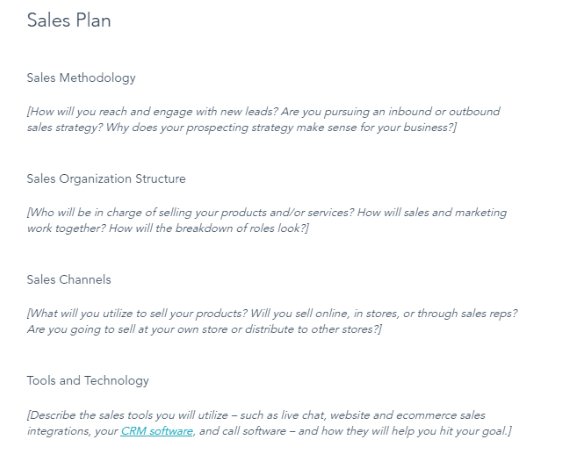
6. Create a sales plan.

When creating your sales plan, describe your methodology, organization structure, sales channels, and tools and technology. For example, when discussing methodology, will you focus on an inbound strategy where you attract customers to your business through your content or an outbound strategy where you initiate contact with your prospects? This part of your ecommerce business plan will also require you to outline the people in charge of selling your products and services, as well as what channels they’ll use to sell your products.

Similar to creating your marketing plan, the sales plan will also require a brief on what tools you plan to use. While your marketing plan might need a CMS, your sales plan might need a customer retention management (CRM) software like HubSpot to manage your relationships with current and potential customers.

how to write an ecommerce business plan: sales plan

Download This Template

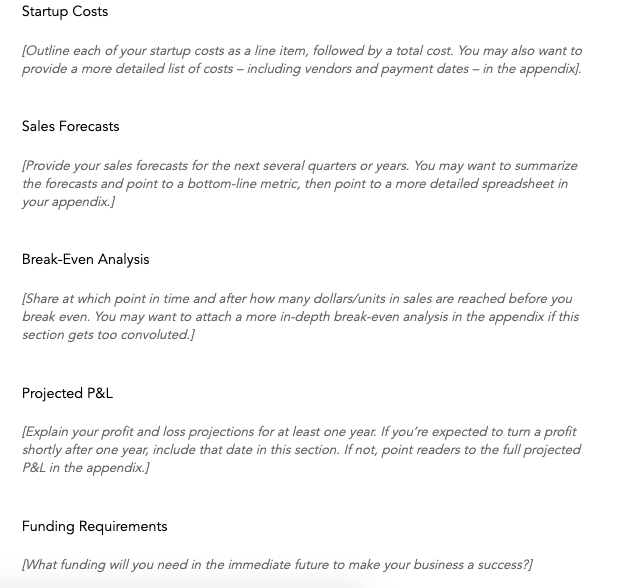
7. Outline legal notes and financial considerations.

In the following two sections of your business plan, describe the legal and financial structures. The photography company should provide detail on the legal considerations like online safety rules, ecommerce regulations, and the company’s costs.

Listing legality and every cost needed to start ecommerce is crucial information for investors and stakeholders. In this section, it’s important to be honest and thorough to give partners a realistic idea of how to contribute.

Ecommerce Business Plan Examples

1. Maple Ecommerce Plan

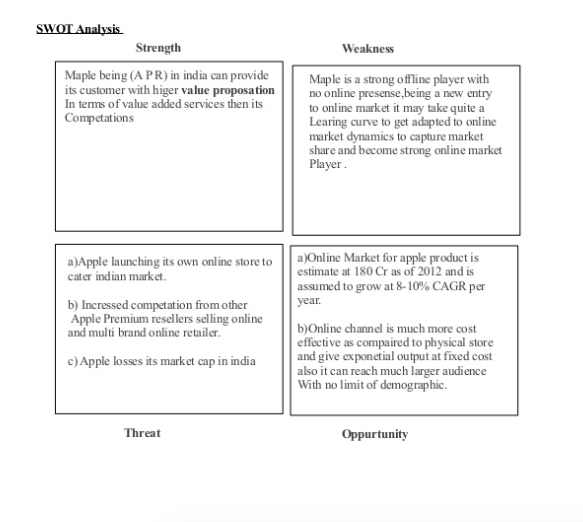
This sample plan, provided on LinkedIn, is for a fictional company called Maple, an online store that sells exclusive Apple products. Maple’s sample plan is great because it provides easy-to-follow charts and graphics while highlighting the most important information. For example, their market analysis included a SWOT plan for the business.

SWOT analysis in an ecommerce plan

Image Source

Outlining the strengths, weaknesses, threats, and opportunities of Maple in this format is easy for potential investors to follow. Notating each value with a letter keeps the format consistent, which is carried throughout the plan. For businesses that find their information is best presented in graphics, Maple is a good plan to follow.

2. Nature’s Candy Ecommerce Plan

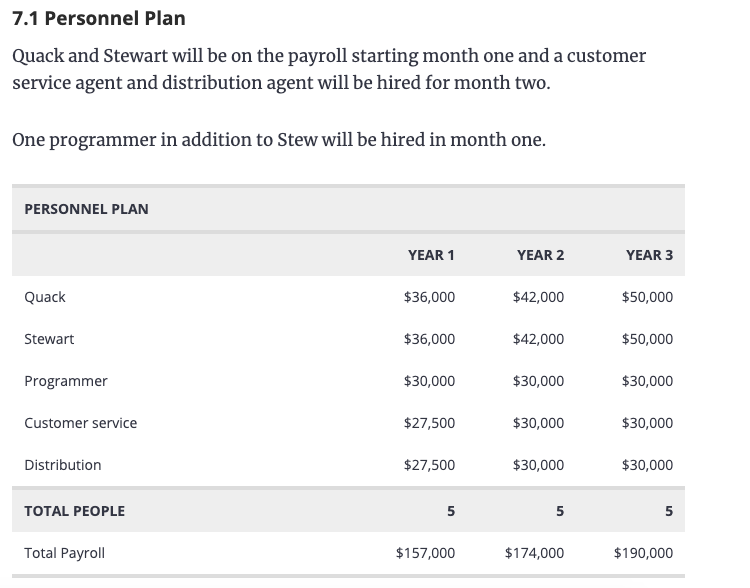
Nature’s Candy is an online retailer that provides nutritional supplements. Its business plan is available online and is helpful in seeing how businesses go from planning to execution. Below is a preview of its plan in the financial forecasting section.

Ecommerce business plan example

Image Source

This example shows who will be on payroll yearly, giving investors an idea of how their investment will work in the long term. Planning ahead also shows stakeholders’ dedication to starting up your business.

3. NoHassleReturn Ecommerce Plan

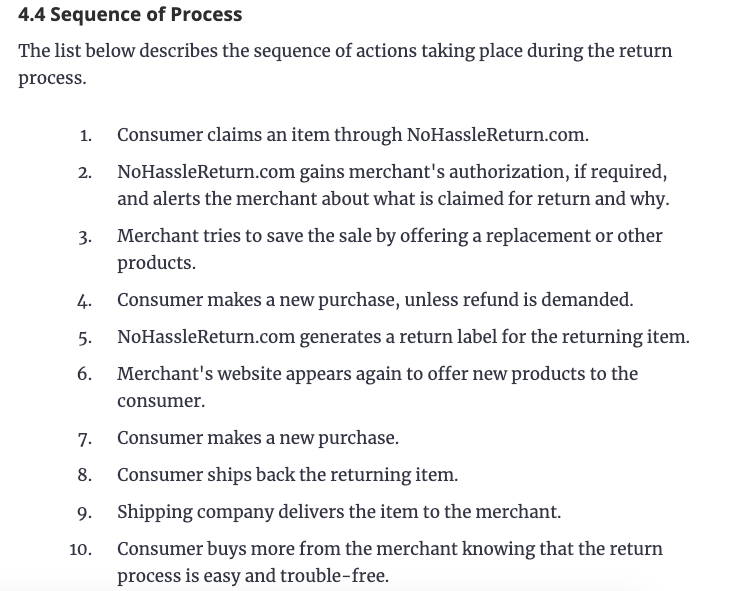
Fictional company NoHassleReturn’s sample ecommerce plan is an expansive, detailed version of how ecommerce would translate to a completely online store. The company itself is structured to offer a way to make returning items bought from an online store a simple process, and the steps to take are featured below.

NoHassleIsReturn example

Image Source

Having a sequence of processes like this is useful if your company is a niche idea. Investors and stakeholders need to know how your business will be new and unique for the market.

Even though writing out a business plan seems like a painstaking process, we have a step-by-step guide to help. This will keep you organized and keep you on track when structuring your business.

4. OGS Capital Ecommerce Plan

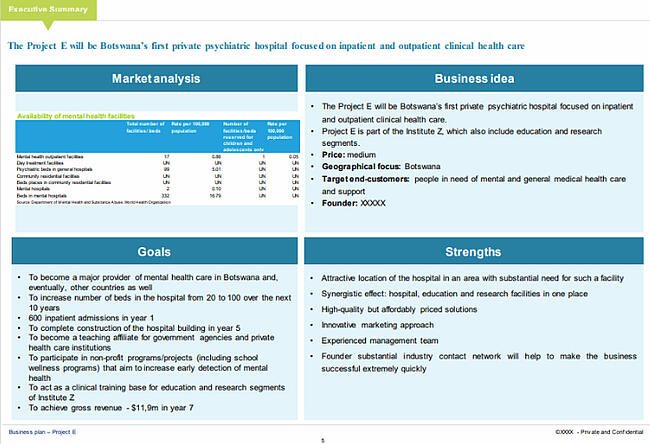
This sample ecommerce business plan comes from OGS Capital, where they created a test business plan for Botswana’s first private psychiatric hospital focused on inpatient and outpatient clinical health care. It features detailed sections for the business model, marketing plan, financial projects, and more. This level of detail is demonstrated below in their executive summary section.

ecommerce business plan example: ogs capital

Image Source

While some ecommerce business plans will explain the executive summary through a series of paragraphs, the layout in this sample makes the information more digestible. The project is separated into sections that detail the business idea, as well as its goals and strengths. The business idea includes price projects, geographical focus, and target customers. Goals for this project are created for 10 years with specific, individual goals built at one-, five-, and seven-year time markers. Lastly, this executive summary highlights the strengths of this business plan to solidify this project and its importance.

5. Egrocery Ecommerce Plan

For centuries, people have left their homes to buy groceries from stores, supermarkets, farmer’s markets, and more. At-home grocery delivery has grown in popularity and is reflected in this sample ecommerce plan for a fictional business named eGrocery. This sample plan establishes the company as an online grocery retail business with plans for connecting customers to distributors for fast, convenient at-home deliveries.

ecommerce business plan example: egrocery

Image Source

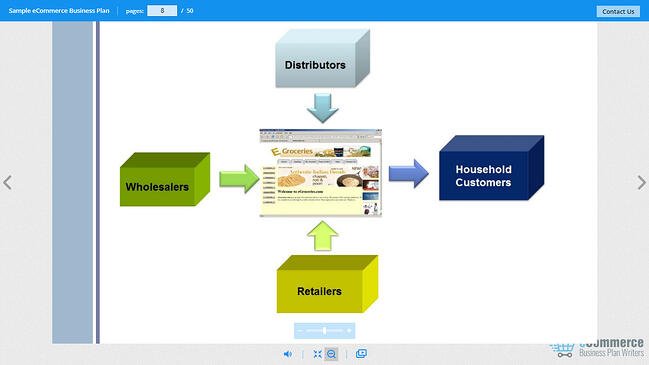
In its business model section, eGrocery outlines how it will implement both a business-to-business (B2B) and business-to-consumer (B2C) model to get products from distributors, retailers, and wholesalers to its household customers. This section provides an effective demonstration of the company’s overall function.

6. Shannon & Shavonne Inc. Ecommerce Plan

Shannon & Shavonne Inc. is a fictional United States-based online retailer that offers its customers an abundance of products in fashion, home appliances, electronics, and more. The depth seen in this plan is particularly helpful, especially with the detail seen in outlining the business structure and each job’s roles and responsibilities.

ecommerce business plan example: shannon and shavonne

Image Source

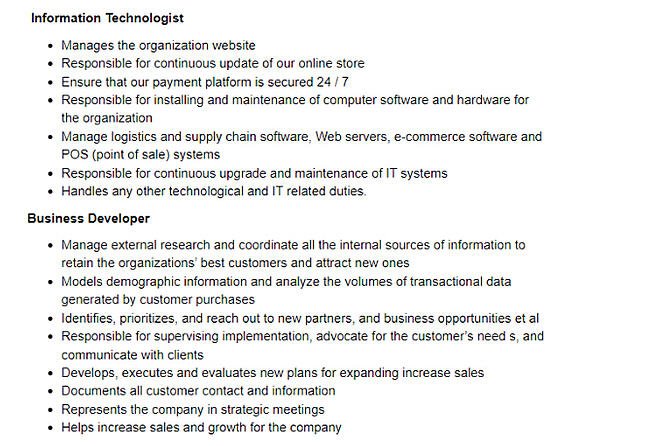
The plan first lists all the necessary roles, from the chief executive officer (CEO) to a call center agent. It then describes the responsibilities of each role. As displayed in the image above, an information technologist (IT) would be tasked with managing the organization’s website, updating the online store, and ensuring the security of the company’s payment platform. The clear distinction of roles helps manage employee expectations and accountability.

7. Firstcry.com Ecommerce Plan

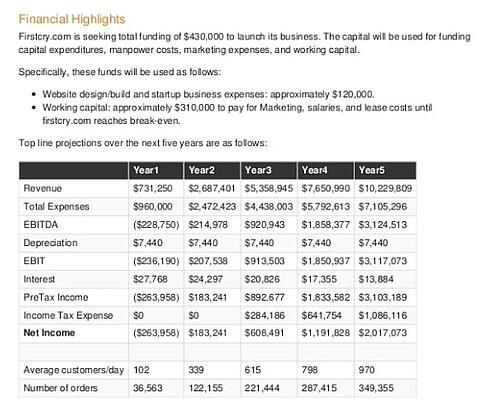
In this sample, we have Firstcry.com — a fictional ecommerce site that creates eco-friendly baby and feminine hygiene products. Because the company is looking for funding to launch the business, its plan focuses on its financial highlights and projections, which is crucial information for investors.

ecommerce business plan example: firstcry.com

Image Source

While disclosing what the startup funds will be used for, this plan also estimates its top-line projections over the next five years. As seen in the chart above, they include revenue, expenses, interest, and net income. The plan even breaks down how many customers per day and annual orders will be needed to reach this goal.

When it comes to building an ecommerce business plan, you’ll likely find that the more detail you include, the better.

Planning is the first step.

When starting a business, planning is always a crucial first step. If you find that you’ve launched a company without a concrete plan, it’s never too late. Successful businesses require strategy, and that’s what an ecommerce business plan gives you. It allows you to strategize what your business does, how it operates, and why it’s essential. Not only does it help you pinpoint who the key players of your company are, but it helps you identify who your target audience should be.

With the steps listed in this article and the examples to take inspiration from, you’re one step closer to building an ecommerce business plan for success.

Editor’s note: This post was originally published in November 2019 and has been updated for comprehensiveness.

Business Plan Template

Categories B2B

Business Strategy: What It Is & How to Build an Effective One

In the business world, professionals are obsessed with tactics because they can help them meet their short-term goals. But if all you do is focus on the short-term, you won’t spend enough time or energy figuring out how you can succeed in the long-term.

→ Download Now: Free Business Plan Template

Fortunately, building a strategy can help you achieve both your short-term and long-term goals. Strategy focuses on principles, which help you think, instead of tactics, which help you execute, so it allows you to concentrate on why your business does certain activities, not just how you do them or what you do. Read on to learn exactly what a business strategy is and how you can build an effective one today.

Your business strategy should be based on your overall vision for the company. For some brands it will be global market expansion. For others it may be more important to double down investing in existing markets they are already successful in. Regardless of your end goals, creating an effective business strategy will require thorough research beforehand.

1. Identify your business’ aspirations and values.

In business, traditional goal setting lets you measure what you do, but it doesn’t lend itself to gauging how you do it or why. And if you only focus on the results, it can sometimes incentivize you to take a course of action that prioritizes your organization’s needs over your customers’ needs.

To help you focus more on your purpose and process instead of just your results, consider setting and anchoring to an aspiration, or your vision for your business in the future when building your business strategy — it’ll inspire you to do work that better serves your customers. Once you set an anchor to an aspiration, you can add your goal to the equation, which will help you simultaneously produce customer-centric work and hit your numbers.

Developing a Business Strategy Infographic

2. Conduct a self-assessment.

Once you’ve figured out your business aspirations and values, it’s time to conduct a self assessment to help you evaluate the best avenues for business growth and success.

You can do this by conducting a SWOT analysis to identify strengths, weaknesses, opportunities and threats to your business. What do you do well and how can you capitalize on that? What can be improved and how?

3. Pinpoint which segments of your market you want to capture.

Your product or service most likely isn’t the best fit for your entire market, so it’s crucial to pinpoint the segment or segments of your market that benefit the most from your product or service.

Customers who genuinely need and want your product or service are also the customers who retain the longest and are least likely to churn, boosting your customer lifetime value and lowering your customer acquisition costs.

4. Determine how you’ll beat your competition.

Ricky Bobby’s legendary saying that “If you ain’t first, you’re last” doesn’t necessarily apply to the business world, but it does have some bearing on it. Your customers won’t buy two of the same products or services, so if you want to capture as much of your segment of the market as possible, you need to place first in the majority of your target customers’ minds.

Some of the best ways to stay top-of-mind are crafting a creatively refreshing brand, differentiating your product or service from the rest of the crowd, and pricing your product relative to its perceived value.

5. Set clear goals.

Now that you’ve completed your research and established a vision for your business, it’s time to set some goals.

Think about what you want to accomplish and work backward to figure out the steps to get there. Setting business goals will help inform your strategy and how each department collaborates to achieve your objective. To start, you can come up with:

  • Business goals: These are high level objectives you’d like the organization as a whole to accomplish.
  • Department or team goals: These are key objectives delegated at the department level to help the organization achieve their overall goals.
  • Employee-specific goals: Using departmental goals, establish goals for individual employees to contribute to reaching business goals.

These cascading goals will make sure that all stakeholders involved in executing your business strategy are on the same page and properly aligned.

6. Make a plan.

With your business goals defined, it’s time to make a plan to accomplish them. This plan should include actionable tasks your team can take and should outline the steps needed to achieve your mission or objective.

This plan can be rolled out as either a short-term or long-term plan or a combination of the two. Additionally you’ll want to check in with your plan often to make sure everything is still on track, and make adjustments as the business requires them.

7. Figure out which competencies are needed to beat your competition and sustain your business’ success.

Unfortunately, passion isn’t enough to beat your competition and rocket to the top of your industry. Talent and skill are just as crucial. Depending on your aspirations, goals, and market, you need to figure out which types of teams and employees you need to develop and recruit to not only beat your competition, but to also sustain your success.

For example you may need to recruit more engineering staff or hire a data science team with experience in your niche to achieve your goals.

8. Decide which management systems are needed to hone these competencies.

If your business is a team, then your managers are the coaches. They’re responsible for developing, supporting, and inspiring your employees to do their best work possible.

Establish check-ins with your team to ensure both employees and managers have what they need to succeed. Invest in technology that enables your team to work together more efficiently and propels your business goals forward. Because no matter how much raw talent your employees have,they’ll never reach their potential and, in turn, help the business reach its potential if they don’t refine the skills and discipline necessary to compete and succeed.

9. Measure your results.

It’s not enough to simply set goals and hope things work out. You’ll need to actively monitor your progress if you want to achieve greatness. As mentioned previously, you should be checking your plan monthly to make sure things are running as they should.

Evaluate your metrics to ensure your team is meeting key performance indicators (KPIs). If they are not meeting them, find out why and come up with a solution to get things back on track.

10. Be flexible and willing to adapt.

Along with measuring your results, it’s also a good to examine where your strategy is falling short and make changes.

Are their changes in the industry or external factors that impact your current strategy? This may be an opportunity for you to adjust your approach. Your plan is your roadmap, but it should also be flexible enough to pivot along with your business.

11. Consider hiring a business strategy consultant.

If all of the steps above seem overwhelming and you have the resources, consider hiring outside help. Business consultants can provide guidance and training to help you achieve your business goals.

Pros

  • Expertise: Consultants often have a narrow area of focus — meaning when you hire one, you’re getting an expert in your selected field. They can help you build a framework or structure that aligns with your goals. They can also add a different perspective to tackling issues your team has tried and failed to resolve on their own.
  • Unbiased: Since a consultant is not an employee of your company, they are not hindered by existing viewpoints or tradition and can look at your company with fresh eyes. This makes it easier for them to hone in on your goals and the best strategy to achieve them.

Cons

  • Expensive: Hiring a consultant is definitely an added expense and will most likely cost more than paying an existing employee.
  • No guarantees: Although consultants are experts, they don’t come with guarantees of success. Their is no guarantee of reaching a certain performance metric or number of sales. However, you can always vet consultants by asking for recommendations, looking at references and examining their work history.

Hiring a business strategy consultant is a great option if your team has been struggling with the steps above without success. A third party may pick up on business insights you may have missed. 

Principles Over Tactics

We live in a day and age where the internet is overloaded with advice. You have access to countless amounts of tips and tricks that could potentially help you build a successful business. But without the ability to think critically about whether these tips and tricks actually apply to your specific situation, you’ll never reach long-term success.

That’s why strategy is so important. It grounds your business in principles that can apply to almost any situation and, in turn, help your business achieve both its short-term and long-term goals.

This article was originally published in May 2019 and has been updated for comprehensiveness.

Business Plan Template

Categories B2B

How Local Business Schema Can Boost Your Company’s Visibility Online

You’ve started a website for your local business, but with so much competition out there, you may be struggling to make your website more visible online. That lack of visibility could hinder potential customers from finding your company. To improve your visibility in search engine results, local business schema could be the tool you need.

By including local business schema in the code of your website, search engines like Google, Bing, and Yahoo will be able to better understand your business and rank it higher in search results. But before you can start implementing local business schema, you need to first learn what it is and how it works.

→ Download Now: SEO Starter Pack [Free Kit]

What is local business schema?

Local business schema is a kind of structured data markup code that can be added to your business’ website to make it easier for search engines to identify what type of organization you are and the products or services you provide.

Schema markup was created by search engines to better understand and display data using common groups of tags. Your business can benefit from schema markup because it can help you better optimize your website for local SEO — one of the deciding factors in how your content is ranked in SERPs.

How to Add Local Business Schema

To add local business schema to your website, first visit schema.org/LocalBusiness then follow the steps below:

Step 1: Determine the category for your company.

Identify the niche category you are optimizing your website for, and be as specific as possible. For example, if you own a burger restaurant, use the “FoodEstablishment” code. If your burger spot is considered fast food, you can further optimize by choosing the “FastFoodRestaurant Code.”

FoodEstablishment is selected for local business schema

Image source

If you can’t find a category that fits your business, simply use a generic business schema like Local Business or Organization, then use the “sameAs” property to add a Wikipedia or Wikidata entry that is more specific to your type of business.

Step 2: Create or update your About page.

Your About page should be filled with information about your business and include a unique “AboutPage” schema item. Make sure the content is easily readable to visitors of your site, and add as many — or as few — related schema properties to better inform search engines about your organization.

Step 3: Test your code using Google’s Rich Results Test or the Schema Markup Validator.

You can enter your code into the Rich Results Test to see which Google rich results are generated by the structured data on your page. You can also use the tool to preview how rich results will look in Google search.

Rich Results Test is used in local business schema

Image source

To test your structured data without Google feature-specific warnings, enter your code into the Schema Markup Validator.

Schema Markup Validator is used in local business schema

Image source

Step 4: Add and Publish your local business schema to your website.

You can add your schema directly within your HTML code or use a managed user interface, schema app, or plugin.

Step 5: Crawl and test your local business schema markup using Google’s Search Console.

Enter your domain or URL prefix to measure your website’s search traffic performance to see if there are any issues or improvements to be made.

Going forward, monitor the results of your schema and make adjustments as needed. You will likely have to repeat this process again in the future as Google changes its approach to schema and if anything in your business listing changes.

Google Search Console is used in local business schema

Image source

Local Business Schema Examples

Below is an example of a local business schema taken from schema.org/LocalBusiness. The example is in reference to a restaurant called GreatFood.

GreatFood Local Business Schema Example Without Markup

Example of local business schema code without markup

Image source

In the above HTML code, you can clearly see the name of the restaurant (GreatFood), the address, phone number, and hours of operation. In the example below from the same restaurant, you can see this information represented in the schema code. This format is the standard schema microdata format, the most common format that is the easiest to implement.

Example of standard local business schema microdata format

Image source

Below is the format you would use for JSON-LD format, which would be used for JavaScript.

Example of a local business schema code in JSON-LD format, which would be used for JavaScript.

Image source

Finally, the below example is the RDFa format, which works in a variety of documents — including XML, HTML 4, SVG, and more.

Incorporating local business schema can seem complicated. However, if you know the category your business falls into and include important information such as the name, address, phone number, and hours of operation, you can easily use local business schema to boost your website in search engine results.

marketing

Categories B2B

What is Interactive Marketing [+ 15 Inventive Examples]

The content formats we rely on today have an uncanny resemblance to the content formats we relied on yesterday — our blog posts look like print articles, our offers look like books, and our slide decks look like presentations. While these formats are fine for the most part, marketers can take their content from “fine” to “exceptional” by using interactive marketing. 

Interactive marketing gives marketers a huge opportunity to engage audiences at record levels. Its early adopters have proven that if marketers want to cut through the noise, they can’t just do what they’ve always been doing. They need to refresh their work.

But obviously, you can’t properly use interactive marketing if you don’t know what it is — so here’s everything you need to know about interactive marketing broken down into easy-to-navigate sections:

What is interactive marketing?

Common Types of Interactive Marketing Strategies

Benefits of Interactive Marketing

Interactive Marketing Examples

Applying Interactive Marketing to Your Campaigns

Download Now: 150+ Content Creation Templates [Free Kit]

Common Types of Interactive Marketing Strategies

  • Interactive videos: Using video is a great way to explain a topic or entertain viewers. Savvy marketers have found new ways to engage viewers by adding CTAs in videos prompting them to subscribe or participate in the conversation in real time. Some videos allow viewers to answer questions by clicking a set of multiple choice answers right on the screen. Other formats immerse the viewer in beautiful landscapes — a technique that’s becoming more popular as the use of 360-degree video becomes more prevalent.
  • Quizzes, surveys, and polls: Quizzes and polls are a fun way to get visitors to interact with your site — and you can create them for just about any topic. Buzzfeed has excelled in this area, but it’s not uncommon to see them used for travel, home search, and interior design sites. They are popular tools for social media marketing as well.
  • Personalized content: From addressing customers by name in email to curating specific ads targeted at their individual needs, adding a personal touch gives the impression that you are speaking directly to them. Ever abandoned an item in your cart and received an email reminder about it later? That’s personalized marketing at work.
  • Interactive storytelling: Keeping readers engaged with a long-form article can be difficult — that’s why interactive storytelling can be a powerful resource for marketers. Uses infographics, gifs, video, clickable maps, charts, and other visual aids to help break up text and keep readers from getting burnt-out or bored.
  • Calculators: While calculators don’t sound super interesting, they are incredibly useful for organizations that want to showcase data. Looking for a home? You’ve probably used a mortgage calculator to get a ballpark estimate of your monthly payment.

Benefits of Interactive Marketing

Interactive marketing offers several advantages, including:

Boosted Conversion Rates 

Interactive marketing gives potential customers the chance to make a purchase immediately. For example, including a call-to-action at points of purchases is a common, effective interactive marketing tactic. I’m sure you’ve seen buttons during digital ads that say “purchase now” or different points on a website that include an “add to cart” button. 

Increased Audience Engagement

Delighting your audience is the key to engaging it — that’s why tactics like online quizzes, personalized content, and interactive videos are so helpful. It gives audiences a unique experience that makes interacting with your business fun. If your audience is having fun, they’re more likely to stay loyal to and potentially evangelize your company. 

Instant Feedback

You can easily and quickly gauge how your audience feels about your company through tactics like quizzes and polls. Is your website easily navigable? Do your products meet expectations? Are there any areas that need improvement? With interactive marketing, you can better connect to your audience and allow their voices to be heard so you can see what works and what doesn’t. 

Interactive Marketing Examples

Capturing attention sounds great in theory, but you may be unsure of how to incorporate interactive marketing into your strategy. To get some great ideas, learn from some of these great examples of interactive marketing:

1. User-Generated Content | Glass Animals 

Why we like it: 

  • The band’s website gives fans the opportunity to create music and art that the band will use for future projects, such as music videos, social media campaigns, and more. 
  • The website also includes an informal message from its lead singer explaining how the landing page is made to resemble his own desktop — giving fans a little insight into the mind of the singer and fostering a more personal connection.

England-based band Glass Animals took a fresh approach to its website’s landing page by making it appear like a computer desktop from the 90s/early 2000s. The website’s appearance entices visitors to click on different icons. 

The band’s singer, Dave Bailey, also left a message to fans saying to “Dig around. Use the sounds, use the artwork … ” and to email the band anything they’ve made so it can be used in a special project. Clicking on the folder that says “Cherry stems” reveals sound files visitors can use to create their own music or projects. 

There’s even an icon that says “MEME-IT” that allows users to generate their own memes of the band. The website provides a fun experience for visitors and gets fans involved in the band’s creative process. The website’s landing page almost feels like a game, and who doesn’t love games?

Glass AnimalsImage Source

2. Augmented Reality Shopping | Lancome 

Why we like it: 

  • The feature allows visitors to Lancome’s Instagram page to virtually “try on” some of the brand’s products before purchasing, giving them the opportunity to purchase with more confidence. 
  • The feature is easy to use and visitors can simply swipe through different shades the same way they would swipe through different filters on the app. 

Online shopping is popular among many consumers and has only gotten more popular since the start of the pandemic. However, one of the downsides of online shopping is that customers aren’t always able to try on a purchase before buying. 

Makeup company Lancome addresses this issue on its Instagram page by providing filters of different makeup shades users can access through their phone’s cameras. This allows customers to see how a shade would look on their face before deciding to buy.

IMG_7949Image Source

3. Interactive Series | Sweet Digs by Eko and Refinery29

Why we like it:

  • This series gets viewers directly involved with the show by having them choose furniture or answer questions in real time.
  • Additionally, it builds on Refinery29’s already successful content

If you’ve ever watched a house hunting or interior design show and either found yourself talking to the TV or gawking at the owner’s decor choices, Refinery29’s Sweet Digs is for you. It partnered with Eko, a platform known for creating interactive shows, to bring viewers inside the coolest and quirkiest homes — with a twist.

Instead of merely being a voyeur, viewers are prompted to interact with homeowners and renters. From recommending how they should redecorate to guessing how much certain furniture items cost, viewers can get in on the action. Even more satisfying, you’ll get to see if they chose the items you suggested at the end. It’s HGTV on steroids.

The best part is Refinery29 didn’t need to create a new marketing idea from scratch. Instead, it took a concept that already did well and improved upon it, using Eko’s interactive tools. This new content gives viewers a sense of agency over the content they’re consuming while also leveling up engagement.

4. Vimeo Virtual Courses That Get You Moving | Y7

Why we like it:

    • Adding details like a studio playlist helped Y7 patrons create the studio atmosphere at home.
    • Creating an online community not only helped the studio stay afloat, it provided patrons a sense of normalcy in uncertain times.
  • The experience is user-friendly and easy to navigate thanks to small details like a video QR code.

Pandemic restrictions shuttered many businesses that required in-person interaction, like gyms and fitness studios. Those that survived adapted their offerings for the virtual market. But let’s face it — working out at home just isn’t the same as getting a boutique fitness experience.

Trendy Yoga studio Y7, rose to the occasion. Using Vimeo OTT, the brand known for its candlelit classes and trap soundtrack moved instruction for all 15 studios online. It then kicked the online experience up a notch by helping its students create the studio vibe at home, complete with an in video QR code to access the class playlist.

All the little details paid off. These improvements in virtual teaching kept students coming back for more, enabling Y7 to stay in business and retain its loyal fanbase.

5. The Structure of Stand-Up Comedy | The Pudding

Interactive Slide Show | The Structure of Stand-Up Comedy

Why we like it:

    • The visuals and diagrams dissecting Wong’s routine are like taking a class on performance and creative writing at the same time.
    • It leaves the audience with a deeper understanding of not only how Wong crafts her routine, but also allows them to connect with her in an empathetic way.
  • The diagram is easy-to-understand and gives fans a better understanding of the artistry behind comedy. 

Stand-up comedians might seem like the lucky wisecrackers who are blessed with the talent to improvise some of the funniest jokes and bits you’ve ever heard, but in reality, they polish their performance with painstaking precision.

To crack their audiences up as much as possible, they make sure their routines’ stories seamlessly flow from one to the other. However, some comedians like Ali Wong take their stand-up preparation to an entirely different level.

In its interactive slideshow about how Ali Wong structured her Netflix special Baby Cobra, The Pudding, a digital publication that crafts visual essays about culture and entertainment, describes how she sculpts her routine into a narrative instead of just telling a bunch of separate jokes.

By visually outlining her entire routine, The Pudding reveals how Ali Wong weaved all her bits into a story, building her world and perception of life in a way that her audience can truly understand, which left them with a deeper feeling of empathy, meaning, and ultimately humor.

6. Conversational Marketing | HubSpot

Conversational Marketing Chat Bot | HubSpot

Why we like it:

    • The chatbot’s prompts allow users to customize their own experience on the site, ensuring that they quickly get the information they are looking for.
    • Since the user is dictating their experience on the site, it eliminates any sales pressure, providing a better overall user experience.
  • Most people are already familiar with chats, text messages, and direct messaging in their daily life, so the chatbot feature is easy for visitors to adapt to. 

We rely on messaging apps to interact with friends and family, so it only makes sense that brands should incorporate them for communication to reduce friction in the buying journey. Despite this, marketers have been sluggish to adopt conversational marketing — using chatbots, live chat, Facebook Messenger, and other chat features — into their inbound marketing strategies. 

In fact, according to Business 2 Community, only 36% of companies have adopted these tactics. At HubSpot, we hope to change that by offering new messaging tools that can integrate with your entire marketing suite and database.

We double down on this idea by using our own conversational marketing software on our homepage. Website visitors are asked a question and given several choices of potential answers. This allows the prospect to engage in website content almost like a “choose your own adventure” story. This improves the overall site experience and ensures that the site is serving up the content (or actions) that will benefit them the most… without any sales pressure.

7. A Personal Thank You with Vidyard | Amnesty International Canada

Amnesty International personal interactive ad

Why we like it:

  • Giving donors a visual representation of how their donation aided Amnesty International’s various causes builds trust and establishes a personal connection.
  • Donors will most-likely share the video with friends and family, which could lead to an increase in donations.

In social settings, getting too personal too quickly is intrusive. However, when it comes to marketing, getting a little personal can go a long way in building brand loyalty.

Take this carefully crafted thank you video created by Amnesty International Canada using Vidyard’s platform. Personalized videos like the one above were sent to all of the organization’s donors. After reviewing their metrics, the organization reported higher donor satisfaction and retention from the use of these videos.

Sending a thank you card or email is nice, but adding a personal touch in the form of a video really won their donors over. When customers are happy with your product or service, they will inevitably share it with their network, providing you with valuable word of mouth promotion and credibility.

8. Interactive Infographic | Family Fun in Scottsdale by Marriott

Interactive Infographic | Marriott

Why we like it:

  • This interactive ad is a fun take on vacation planning.
  • The clickable flowchart acts as a tool to help viewers customize their vacation activities to the parameters they set (e.g., interests, age)

Marriott Hotels manages to make vacation planning even more fun while positioning their brand in front of potential customers with an interactive infographic. Vacationers who are headed to Scottsdale are able to take a customized path through the flowchart to receive destination advice. Just a little bit of animation goes a long way, and it adds a touch of personalization that normal infographics don’t.

The beauty of this is that infographics are a great visual tool that have a ton of utility. By using lemonly.com, Marriott pushes the envelope just a step further, which provides unexpected delight.

9. Interactive Virtual Events | Built to Last by Wistia

Wistia interactive marketing audio conference

Why we like it:

  • By having an audio conference instead of a traditional virtual one, Wistia freed up their audience to attend whenever was convenient for them (while running errands, at the gym, etc).
  • Visitors could attend any session in whatever order they liked instead of being forced into a rigid schedule, making the event more accessible.

By now we’re all used to virtual events, but meeting and video fatigue is real. How do you keep guests engaged? By mixing it up. That’s what Buffer and Wistia set out to do when they created the first ever audio conference for brand builders.

That’s right, no staring at the screen or being stuck at a desk. The audio format allowed listeners to join in from wherever they were, be it during their commute or while taking an afternoon stroll by connecting to a podcast player.

Each session ranged in length from roughly 25-35 minutes, and gave listeners the option to “choose their own adventure” by simply selecting the sessions they wanted to attend. This reduced friction as listeners were free to attend only the sessions relevant to their interests instead of committing several hours of their time.

10. Interactive Slide Show | The New Media Message by Velocity Partners

Interactive Slide Show | The New Media Message by Velocity Partners

Why we like it:

  • This slideshow beautifully illustrates the importance of showing rather than telling audiences why they should care about a particular topic.
  • The build-up from the basic slides walks us through the progression of how using more interactive and attention grabbing graphics changes the audience’s experience in real time.

In its interactive slideshow, which honestly looks like it belongs in Tron, Velocity Partners, a B2B marketing agency, explains why innovative marketers need to leverage new content formats in order to tell more refreshing stories.

Velocity Partners shows, not tells, how their interactive slideshow can captivate an audience. This is in stark contrast to how marketers have churned out so many blog posts, ebooks, and SlideShares that they’ve become dull and predictable. The end result of this message hammers home the point that the most engaging and surprising mediums are the best at delivering the most engaging and surprising stories.

11. Interactive Article | The Big Gronkowski by Ceros

Interactive Article | The Big Gronkowski by Ceros

Why we like it:

  • Ceros’ take on a visual representation of the article instead of traditional text is fresh, and immediately draws readers in.
  • Bucking the norms of article structure, readers can quickly toggle to the information they want to know first, rather than having it dictated to them.

When Rob Gronkowski temporarily retired in 2019, Ceros, an experiential content creation platform, decided to create an interactive article that spotlights the two things Gronk will always be remembered for — his athletic prowess and goofy attitude.

When you visit the interactive article, you can toggle between Gronk’s “Warrior” and “Goofball” side, clicking on hotspots that reveal his impressive achievements, his laundry list of injuries, and some of the funniest things he’s ever done. Once you finish interacting with the article, you’ll truly understand how Rob Gronkowski is just as athletic as he is goofy.

12. Immersive Video | Scotland From the Sky by BBC Scotland

Immersive Video | Scotland from the Sky

Why we like it:

    • This 360-degree video nails the art of showing rather than telling.
    • Using Scotland’s immersive landscapes as the backdrop, the viewer is made to feel like they are exploring Glen Coe with the filmmaker.
  • The video’s like this are so visually stunning that they can encourage visitors to share the link with others, boosting engagement.

In 2019, Rough Guides, a renowned travel guidebook, named Scotland the most beautiful country in the world.

And a big reason why it’s such a spectacle is that Glen Coe, a Scottish valley that cuts through the ruins of an ancient supervolcano, is one of the most striking landscapes in the world.

With their immersive, 360-degree video of Glen Coe, BBC Scotland can grip viewers because they’re able to experience the landscape from an intimate point of view at every possible angle, making them feel like they’re actually there.

13. Playable Video Game Ad | Narcos: Cartel Wars

Playable Video Game Ad | Narcos: Cartel Wars

Why we like it:

  • The ability for people to go from just viewing the game to participating in it is a great way to draw them in.
  • Allowing potential customers to play the game before buying eliminates sales pressure and puts the customer in control of their experience.

In the past, video game apps had to use video or gif demos to advertise gameplay in hopes to attract new players and increase app downloads. The thing about watching videos, though, is that it’s a passive activity. The visuals of the game may be enough to attract prospective players’ attention, but it may fall short of giving them enough inertia to actually engage and play.

FTX Games found their way around this by partnering with Glispa for their game Narcos: Cartel Wars. Prospects are immediately drawn into the action of the game with the ability to try it before buying it. Rockets and explosions abound for a few rounds before the demo prompts the player to install the app and continue their game.

The good news is that this type of functionality is about to become much more mainstream with Facebook offering playable video ads on their platform. Much like the Cartel Wars example, these playable ads are composed of:

  • A short video preview
  • A playable demo to get people hooked on the gameplay
  • A call-to-action to get the users to take the next step

14. Interactive Voice Ad on Pandora | Doritos

Interactive Sound Ad on Pandora | Doritos

Why we like it:

  • Doritos found a creative way to take the audience from passive to active listeners, complete with crunching chip sounds to get folks salivating.
  • The ad serves up questions to the audience and then uses AI to tailor their experience based on their answers.

Pandora for Brands has recently begun testing a new interactive ad functionality on their platform that allows users to verbally engage with the ad. Doritos is one of the first brands utilizing this new interactive format on Pandora.

The audio uses the distinctive Doritos crunch and then prompts the user to answer a yes or no question. Using artificial intelligence, the ad can then serve up a personalized experience based on how the listener answered.

This is exciting for the same reason as the playable video game ads are: They disrupt passive listening in an attempt to get the listener to engage and actually process the information being conveyed to them. Plus, by being able to respond hands-free, there is less friction in order to learn more.

15. Interactive Idea Generation | Outgrow

outgrow generator

Why we like it:

  • The idea generator allows any marketer to input their industry and business website and automatically get ideas for different types of interactive content.
  • The results page shows personalized content and tools for specific industries, audiences, and positions in the conversion funnel.

In the past, idea generation required more generic statements or long calls because we could not easily personalize ideas and use cases for each customer at scale. The advantage of an idea generator is that it shows any marketer personalized sets of ideas for how they can use and better leverage your product or service immediately after they input a few data points.

Depending on the industry, audience, and position in the funnel, Outgrow will create a list of tools and content to help convert and attract website visitors. Depending on the need, it will suggest different quizzes, calculators, and chatbots to help engage traffic and provide more lead generation.

Applying Interactive Marketing to Your Campaigns

The campaigns in this article should give you a few takeaways to apply to your own marketing. As you create great content, you should also be thinking about:

  • How to disrupt expectation to earn attention, engagement, and interest
  • How to best personalize the experience for each individual prospect
  • How to reduce friction as much as possible to increase momentum

By putting concepts like these in action, you’ll be in a position to generate buzz, make your content stickier, enhance the experience, and fuel your flywheel.

This article was originally posted April 3, 2020 and has been updated for comprehensiveness.

content templates

Categories B2B

The 24 Best Websites to Cure Your Boredom in 2022

There’s a lot of content out there about productivity – everything from hacks to shortcuts to tips and tricks for how to get more done in less time.

Download Now: How to Be More Productive at Work [Free Guide + Templates]

But what about those times when you’re bored? Well, there is no shortage of websites to cure your boredom.

Here’s a shortlist of the most wonderfully entertaining places to waste time on the internet outside of email and social media.

1. Wordle

In early 2022, people’s timelines on social media – particularly Twitter – started filling with green, yellow, and black squares.

It seemed like everyone was playing a game called Wordle – a game where you have six chances to guess the five-letter word of the day.

website to cure boredom: wordle

It’s the same word for all players, making it a fun way to connect with people around the world. In addition, you can only play it once a day, which builds anticipation and excitement for what’s to come.

What’s more, the game tracks players by device. As such, you can keep track of your streak every day and share it on social media to show others how many tries it took to make the right guess.

2. Heardle

If you love the concept of Wordle but wish there was a musical version, you’re in luck.

website to cure boredom: heardleHeardle emerged shortly after Wordle blew up for music lovers and connoisseurs alike. It works by playing a short snippet of a song and giving you six tries to guess the right song.

It’s another great game to play when you have some extra time on your hands.

3. GeoGuesser

Ever wish you could take a trip around the world in a day or less? With GeoGuesser, you can.

This fun game tests your geography by showing you a randomized place around the world and having you guess where it is.

website to cure boredom: geoguesser

It’s not only a great way to test your knowledge but also discover new places to add to your travel bucket list.

Most of these locations are in tourist attractions, allowing you to get a 360-peek at these places before you even visit.

4. Know Your Meme

Memes go viral every day and it can be hard to track down where they originate from.

Know Your Meme answers that question by digging into every viral meme and finding out who is in the original image, who first posted it, and what it’s about.

website to cure boredom: know your meme

You’ll find viral memes, trending memes, and likely memes you’ve never seen before. It’s a fun deep dive that at best, will arm you with a few fun memes to share on social media.

5. The Oatmeal

the oatmeal website to cure boredom

The Oatmeal is another one of my absolute favorite places to spend time online. It’s a huge library of awesome content – specifically graphics. Even if you’ve read everything already, it’s the kind of stuff you can read over and over again.

Some of my favorite posts include:

6. Supercook

If you want to surf the internet in a semi-productive way – but not so productive that you actually have to leave the house – then check out Supercook.

supercook website to cure boredom

Here’s how it works: You tell it which ingredients you have in stock in your home, and it’ll give you a big list of recipes you can make using just those ingredients.

It’s a fun way to stay thrifty, clean out the fridge, and make sure food doesn’t go to waste.

7. OCEARCH Shark Tracker

Tracking sharks as they swim around the ocean may not be the most conventional way to waste time on the internet but it might be the coolest.website to cure boredom: ocean shark tracker

The Track Sharker tool by Marine Research Group OCEARCH lets you track tagged sharks – who all have names by the way – as they travel all over the world.

You can even zoom in on a specific location to see which sharks are hanging out there and where they’ve been swimming and traveling for the past year. Go, Rocket, go!

8. Apartment Therapy

Apartment Therapy website header

If you’re even a little bit of a fan of home decor or DIY projects, this is a website you might find yourself spending hours and hours on. There’s a ton of awesome visual and written content on here.

My favorites include their “before and after” series, their “small spaces” series, and the tours of people’s actual apartments and homes.

Plus, they have a whole lot of helpful articles giving tips on everything from how to redo your stairs to ideas for using that awkward space above your fridge. There’s no shortage of useful and fun information on here, making it prime for endless browsing.

One of our own was recently featured on ApartmentTherapy too — check out INBOUND Elijah‘s adorable spot here.

9. Gravity Points

Website header for Gravity Points, one of the best websites for wasting time on the internet

Gravity Points is a digital “pen” created by Akimitsu Hamamuro, and it is quite mesmerizing. The website simulates the effect of gravity by allowing you to plot small gravity centers across your screen. Then, even smaller floating objects will flock to these gravity centers and orbit them.

The more gravity centers you plot, the more these forces will start to compete, making your screen all the more chaotic. And yes, your gravity points can absorb one another to create a black hole.

It’s outer space right there on your computer screen.

10. Pottermore

As a marketer, you might dive so deep into branding your business, you have no time to brand yourself. Even if you’re not a massive Harry Potter fan, Pottermore can scratch that itch for you.

Pottermore is widely recognized as the official website for finding your Patronus, your wand type, the Hogwarts House you belong to (of course), and much more.

The quizzes you take to earn these identities are just obscure enough to hold your excitement for the result, and might even encourage you to read (or reread) the famous Harry Potter books — something you should definitely do to balance out your time-wasting website sessions.

11. The Toast

The Toast website header

If you’re into great (and hilarious) fiction writing, then you’ll definitely want to bookmark this site. Every day, writers Nicole Cliffe and Mallory Ortberg publish a post on “everything from literary characters that never were to female pickpockets of Gold Rush-era San Francisco,” reads their About page.

To get an idea of whether it’s up your alley, start with their post, “A Day in the Life of Seth MacFarlane, Human Male (Definitely Not a Swarm of Hyper-Alert Bees and a Metal Jaw.)

It’s just so good.

12. The Onion

the onion website to cure boredom

If you haven’t spent some quality time reading the online satirical newspaper The Onion, then you’re seriously missing out on a good laugh.

The publication started in 1988 and they’ve managed to successfully maintain a high standard for humor and writing ever since.

Their headlines are laugh-out-loud funny in and of themselves — from “Free-Thinking Cat Sh**s Outside the Box” to “Archaeological Dig Uncovers Ancient Race of Skeleton People” to “Buyer Of $450 Million Da Vinci Painting Sort Of Assumed It Would Come With Frame.”

This awesome episode of NPR’s This American Life gives you a really cool peek into The Onion‘s editorial process.

13. Cracked

cracked-magazine

Similar to The Onion, Cracked is a pseudo magazine for your everyday life —and yes, it will crack you up.

While The Onion gives you a satirical take on a real news trend, Cracked makes snarky pop-culture observations that are ironic or just ridiculous by design. Sometimes the writers will say the one thing everyone’s thinking, but is afraid to say out loud. That’s Cracked for you.

You might just be passing time on this online magazine, but with respect to some of its most popular articles and pictures, it’s time well spent. Here are a few ridiculous think pieces from Cracked to whet your appetite:

14. Mental Floss

mental floss website to cure boredom

Mental Floss is a super addicting online magazine with articles covering a really wide range of topics. Their articles are really well written and researched, and usually on topics that don’t get a lot of airtime.

For example, in their “Big Questions” section, they tackle weirdly intriguing questions like why shells sound like the ocean and why yawns are contagious. Readers can even submit their own big questions.

15. HowStuffWorks

(Image)

This website is dedicated entirely to —you guessed it — how things work. And by “things,” they mean everything: from airbags to regenerative medicine to velocipede carousels.

They’ve covered so much on this website, it’ll be hard to run out of things to read about.

Plus, they have a whole bunch of really cool podcasts that have branched off the main site over the years and are worth checking out.

My favorites are “Stuff You Should Know,” “BrainStuff,” and “Stuff Mom Never Told You.”

16. Lifehacker

Lifehacker is a hub of productivity tips, tricks, and downloads. It’s basically an archive of all the information it would be incredibly useful to know, but nobody ever really teaches you.

lifehacker website to cure boredom

Aside from productivity, they also cover topics such as money-saving tips, clever uses for household items, and so on.

For example, did you know there are four lengths of naps that’ll benefit you in different, very specific ways? Along with the fun articles, they have some pretty awesome, in-depth articles, like this one on how to plant ideas in someone’s mind, as well as helpful listicles like the top ten obscure Google Search tricks.

There’s so much content on there that it can be hard to find posts on specific topics. Use the Lifehacker Index for an introduction to their top-performing posts and tips on how to find posts on any topic on the website.

17. Mix

Website banner for Mix, formerly StumbleUpon

Sometimes you want to surf the internet, but don’t want to do all the paddling. For that, there’s Mix.

You might know the above website by its former name, StumbleUpon, a site (and an add-on to your internet browser) that allowed you to select topics that interested you and then served you various news and information that fit those interests. Today, it’s called Mix, and it puts a new spin on StumbleUpon’s popular content randomizer.

Mix lets you set your reader profile and then share the articles, photos, and videos you discover from your own personal “mix.” It’s a convenient way to entertain yourself and learn new things by simply telling the web to surprise you.

18. Space.com

Space.com website banner

As long as your head is in the clouds, raise it above Earth’s horizon and head on over to Space.com.

This website reports on astronomy news and trends through friendly, easy-to-digest content that, sometimes, just serves to quench your thirst for a cool nebulous shot of our solar system. Who knows? Maybe you’ll tap your inner space enthusiast.

Whether you want to see an object burn up in our atmosphere or get real into the weeds of how a black hole forms, Space.com has something for everyone. Get your fix today with this amazing picture of a green aurora seen from the International Space Station, part of Space.com’s “Image of the Day” series.

19. Imgur

imgur.png

Imgur collects the most viral images of the week and collects them all in one place for your mindless scrolling and enjoyment.

What I like about Imgur is it’s usually more timely than Twitter or Instagram — more popular sharing networks where funny pictures and memes might appear a week or two later.

Use Imgur to waste time and introduce your friends to the funniest stuff on the internet first.

20. Zillow

Zillow website banner

It’s fun to check out real estate in areas you might want to live — and it’s just as fun to check it out in places you’ll probably never live, but would love to in a dream world.

Go ahead and explore what’s out there.

You can set up saved searches (some more realistic than others) to relive your discoveries later.

21. Wikipedia

Wikipedia logo

You didn’t think I’d write a post on where to waste time on the internet without including Wikipedia, did you? Of course not.

You’ve gotta love spiraling into the proverbial Wikipedia black hole: Look up one thing, and then check out something that’s interlinked to it.

Before you know it, you’ll have charted the entire Russian Revolution. (Read: This is an actual glimpse into my colleague Corey‘s Sunday morning.)

22. Giphy

giphy website to cure boredom

When you need to find the perfect GIF, you can’t just stop at the first result you get for “dancing” or “awkward” or “animals being jerks.”

I could spend (… and have spent) hours on Giphy looking for juuust the right GIF.

23. Wayback Machine

wayback machine website to cure boredom

Feeling nostalgic? Check out what websites have looked like over the years via Internet Archive’s famous Wayback Machine. It lets you pick a date and see exactly what any website looked like at that time. (For a real trip, compare how Facebook looked back in the 2000s to today. Remember the wall-to-wall?)

If you just want to take a quick peek, check out this roundup of what nine famous websites used to look like.

All the images in that post were taken from the Wayback Machine.

24. The Oregon Trail

The Oregon Trail website preview for online game

Here’s a little gift for those of you who made it to the end of this post: Internet Archive — yes, the same one responsible for the Wayback Machine — made it possible for people to play “Oregon Trail,” a game beloved by many Millennials.

If “Oregon Trail” isn’t your cup of tea, the other games made available by Internet Archive include “Duke Nukem,” “Street Fighter,” “Burger Blaster,” “Indiana Jones and the Last Crusade,” “The Lion King,” and “Chuck Yeager’s Advanced Flight Trainer.” Check out the full library here.

Editor’s note: This post was originally published in August 2018 and has been updated for comprehensiveness.

New Call-to-Action