Categories B2B

A Nonprofits Guide To Using LinkedIn

Your nonprofit likely takes up a lot of your time, and you might not have a huge staff to delegate responsibilities to. So, taking the time to use online platforms might not seem like the best use of your time.

However, platforms like LinkedIn can be great for nonprofits, especially for connecting with people interested in your cause, inspiring them to take action, and even hiring new employees.

You’ll have to dedicate a bit of time to use it, but it’ll pay off in the end. Read on to use this piece as a guide for creating a LinkedIn page for your nonprofit.

Free Guide: How to Use LinkedIn for Business, Marketing, and Networking  [Download Now]

Table of Contents:

How to Create a LinkedIn Page for a Nonprofit Organization

Creating a LinkedIn Page for your nonprofit helps people interested in your cause discover you, learn about your mission, and interact with you on the platform. It can also help you attract new employees if you post job openings.

Let’s go over how you can create one.

1. Navigate to LinkedIn Pages or LinkedIn.com

LinkedIn Pages is the platform’s native tool for creating a page. If you start from this site, click “Create your Page” on the Pages page.

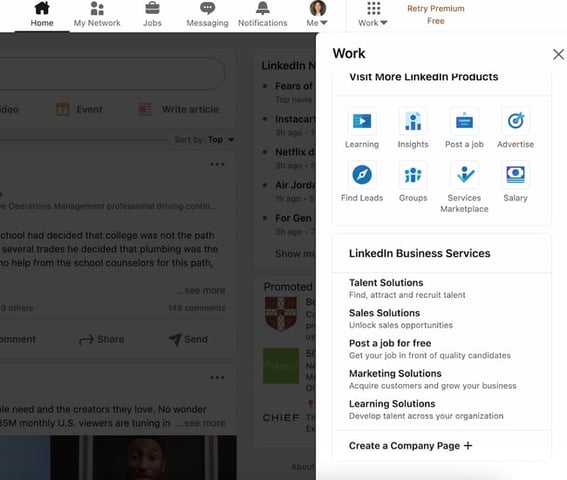
You can also start from LinkedIn.com, which is a great option if you already have a LinkedIn Profile. To do this within your profile, tap the “Work” button in the navigation header and click “Create a Company Page+” at the bottom.

how to create a linkedin page for nonprofit: click create a company page +

2. Select your page type.

As a nonprofit, a best practice is to select “Company.”

3. Describe your page.

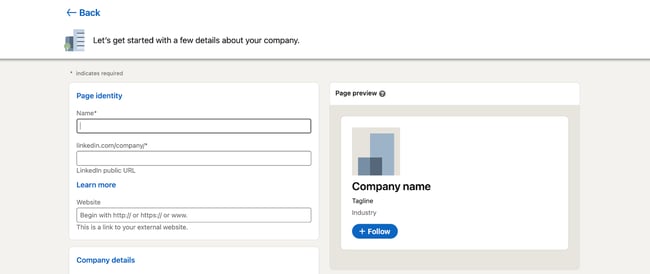
The next step is to input identifying information. This includes your nonprofit’s name and an optional link to your website (sharing one can help people find you on other platforms).

You also have to create a unique URL; if it’s available, aim to make it your org name. For example, if you’re Save The Environment, your URL could be savetheenvironment.

image for 3

4. Add identifying company details.

In the company details section, input your industry, company size, and company type, which is where you’ll note that the page is for a nonprofit.

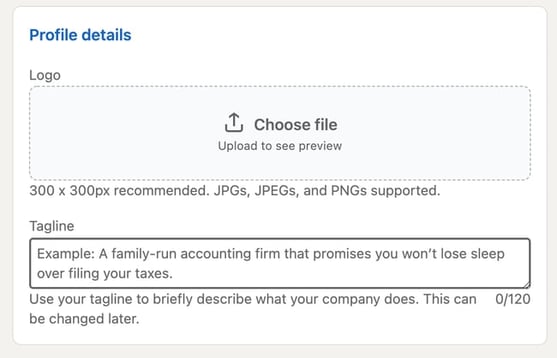
You can also add unique identifying elements to your pages, like your logo and a brief tagline to describe your mission.

image for 4

5. Preview and launch your page.

Once you’ve added all your info, preview your page to ensure you’re happy with how it looks, and make any changes if you aren’t.

When you’re satisfied, click “Create Page,” and note that you’ll be asked to verify that you’re an authorized representative of the nonprofit before the page goes live.

6. Share your nonprofit story.

After you’ve created your page, you can add more information about your story to inspire engagement and help people learn more about you.

You can add an “About Us” section, go more in-depth into your story and how you came to be, and even include a CTA to activate readers and inspire them to take action with your cause.

It’s also important to add your location, so people know where you are if they’re interested in volunteering. A unique cover photo can capture attention.

Now that you’ve created your page let’s go over how you can use it.

How to Use LinkedIn for Nonprofits

1. Share interesting content.

A great way for nonprofits to generate engagement and interaction is to share content. It will help people learn more about your operations, upcoming events, and volunteer opportunities.

LinkedIn says that pages that post daily get  2x the engagement. If you’re a smaller nonprofit, 2x daily might not be in your bandwidth, so aim to be as active as possible.

Some content ideas to share on LinkedIn are:

  • Images and videos of events, like fundraisers, to show how events have gone and inspire others to participate in the future.
  • Links to fundraisers or other donation opportunities.
  • Information about upcoming events and programming, like volunteer opportunities.
  • Educational content about your nonprofit niche to help people learn more about your cause, why it’s important, and why they need to get involved.
  • Content that shows your impact, like the results of a beach cleanup.
  • Employee spotlights so people can learn more about who runs your operations.
  • Job opportunities so those interested in investing more time in your cause can do so.

A bonus to sharing content is that it is available for anyone to see on your page when they land there.

2. Create a LinkedIn Group

A LinkedIn Group is a valuable way to engage with people interested in your mission.

You can share content and members can make their own posts, share their niche expertise, or even talk about their positive experiences with your nonprofit. When people interact in your group, you can build relationships and deepen connections with those interested in supporting and elevating your mission.

3. Share job opportunities.

LinkedIn is, first and foremost, a professional networking and employment platform. As a result, it’s a great way for you to share job opportunities at your nonprofits with professionals looking for new roles that are already interested in you and your mission.

4. Invite your staff to talk about you.

You can invite your staff to talk about your nonprofit on their page to generate interest with their connections that don’t know about you yet. This can apply to volunteers to paid staff alike.

For example, if an employee shares a post on their profile about an upcoming event, their connections might come across it and become inspired to attend the event to learn more about your organization.

Encouraging others to post about you in a genuine way also helps you build credibility.

5. Bonus: Use LinkedIn Ads

Some nonprofits might not have the budget to pay for LinkedIn ads, but those that do can benefit from them and use them to build awareness and attract new interested people.

All LinkedIn ads have a specific objective, awareness, consideration, or conversions, so you can pick one that best meets your needs. You can also select specific targeting criteria, a specific ad format, and a budget that best suits your needs.

This piece is a helpful guide to creating advertisements on LinkedIn.

Best Nonprofit LinkedIn Profiles

A great way to optimize your LinkedIn presence is to learn from other nonprofits on the platform. Below we’ll go over some great examples to use as inspiration.

1. The Surfrider Foundation

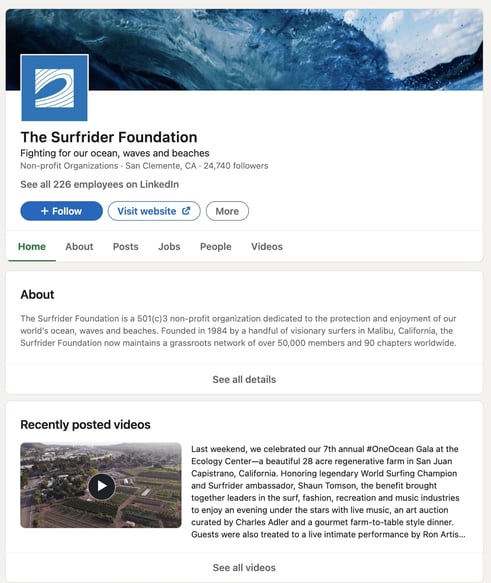
The Surfrider Foundation is dedicated to preserving the world’s oceans.

best nonprofit linkedin profiles: the surfrider foundation

What we like:

  • A clear tagline quickly summarizes The Surfrider Foundations’ mission so anyone browsing can immediately learn what it does.

best nonprofit linkedin profiles: the surfrider company tagline tagline

  • Its About Us page features critical information, including a longer description of its mission and a link to an external company website for people to learn more.
  • Sharing engaging images shows the impact of its events and programming.

best nonprofit linkedin profiles: the surfrider foundation engaging impace posts

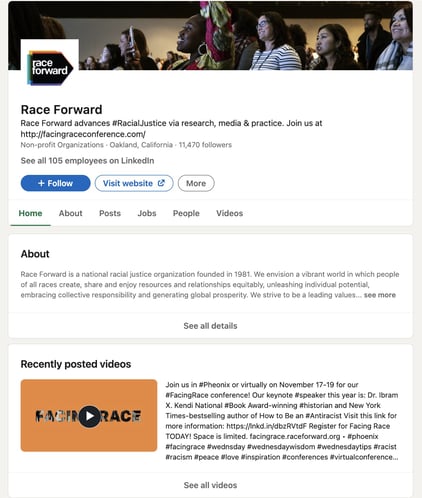
2. Race Forward

Race Forward is dedicated to racial justice and solving complex racial issues. 

best nonprofit linkedin profiles: race forward linkedin profile home page

What we like:

  • It shares videos advertising events to generate excitement for upcoming programming.

best nonprofit linkedin profiles: race forward sharing information about upcoming events

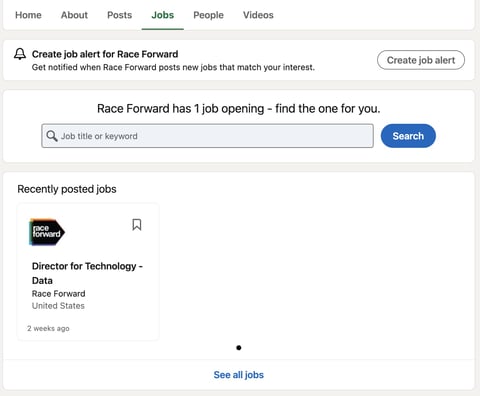
  • Posting job opportunities helps Race Forward attract talent on the platform to let people know that they can support the cause and further their impact with employment.

best nonprofit linkedin profiles: raceforward sharing job opportunities on its profile

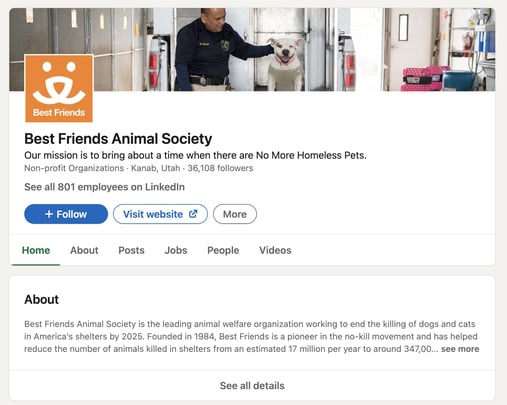
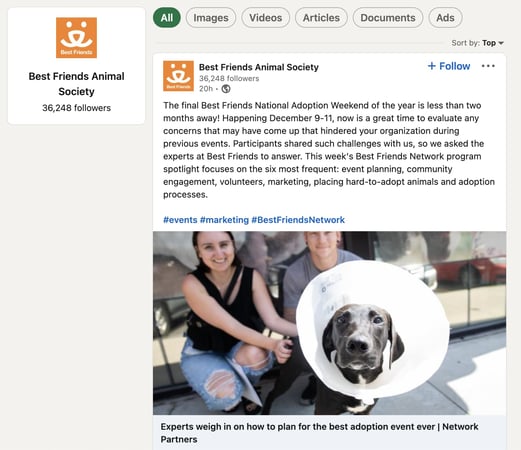
3. Best Friends Animal Society

Best Friends Animal Society is dedicated to reducing the number of homeless pets.

best nonprofit linkedin profiles: best friends animal society home page

What we like:

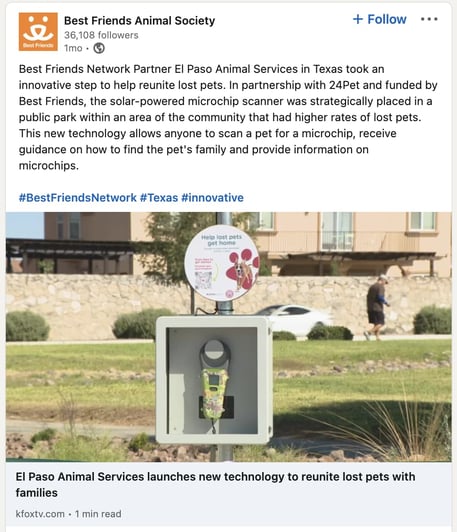
  • Sharing content to demonstrate the impact of its work helps Best Friends Animal Society inspire others to participate and make a difference as well.

best nonprofit linkedin profiles: best friends animal society sharing educational content

  • It shares educational content related to its niche that helps others learn more about its mission and ways to elevate the cause.

best nonprofile linkedin profiles: best friends animal society sharing the impact of its work

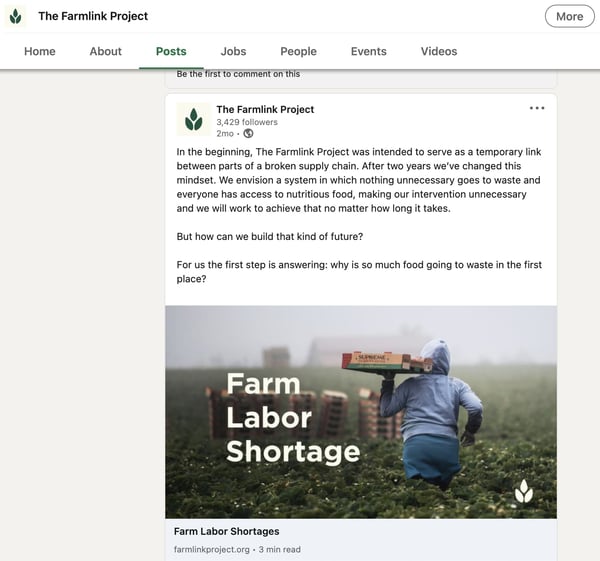
4. The Farmlink Project

The Farmlink Project connects farmers to food banks to deliver farm fresh produce to those in need while eliminating food waste.

best nonprofit linkedin pages: the farmlink project linkedin profile

What we like:

  • Educational content helps The Farmlink Project inform its audience about the background of its mission and why it’s important.

farmlink educational content

  • Sneak peeks into day-to-day operations give its supporters a preview into operations and lets them know it’s still up and running.

farmlink day to day

  • The Farmlink Project engages with the community in comment sections to develop and deepen relationships with people supporting its cause.

farmlink engaging with community

Over to You

LinkedIn is a valuable platform for nonprofits to use, especially when it comes to finding active individuals who are interested in making a difference for the causes they believe in.

New Call-to-action

Categories B2B

TikTok SEO: How to Increase Your Discoverability on TikTok

According to Google, 40% of Gen Zers prefer to use TikTok over traditional search engines.

Free Ebook: The Marketer's Guide to TikTok for Business [Download Now]

Gen Z would rather do a quick search on the app and see a visual representation of user-generated content (UGC) in the form of reviews, recommendations, and tips from everyday consumers than read about it.

So, if you’re ready to boost your discoverability, now is the time to level up your TikTok SEO strategy.

So, when someone searches for something in TikTok through a keyword or hashtag, you would want your video to appear near the top of the list so that you can increase your content’s reach and engagement.

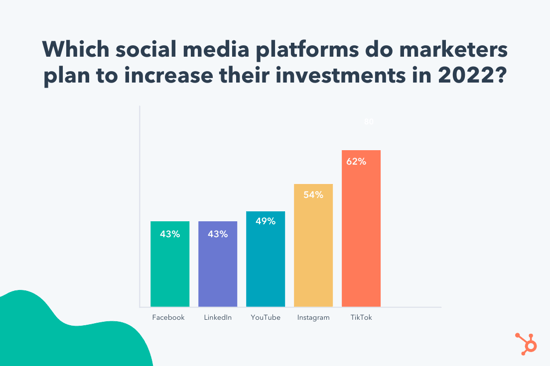
62% of marketers surveyed in 2022 plan to increase their investment in Tiktok, more than any other social platform

Marketers have planned to increase their investments in the app by running TikTok ads, improving video production, using a TikTok management tool, and collaborating with UGC creators.

Brushing up on your TikTok SEO skills will make your content more search-friendly and well-loved by the algorithm.

Why is TikTok SEO important?

TikTok has been adding more features to support increasing video discoverability on the platform.

Recently, they announced a massive expansion of their video description field from 300 characters to 2,200 — this increases the space available to add text about your clip by 730%.

The key focus is on improving the searchable element of videos and connecting it with interested users. TikTok’s algorithm gathers video information to determine what the post is about and who might find it interesting.

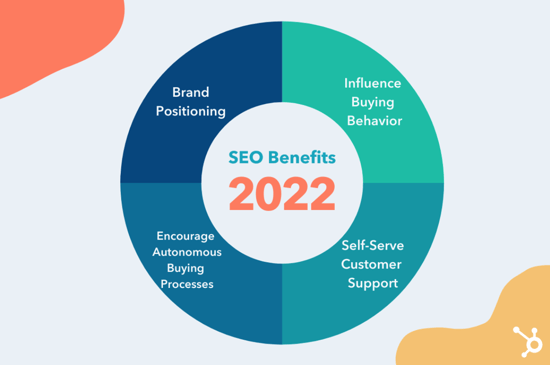
Tiktok SEO benefits in 2022: brand positioning, influence buying behavior, self-serve customer support, encourage autonomous buying processes

So, with a strong TikTok SEO strategy, you can increase your discoverability on the app (i.e., appear on more For You pages) and boost engagement.

It’s the ultimate tactic for reaching interested audiences and giving your videos the visibility they deserve.

TikTok SEO Ranking Factors

TikTok’s algorithm uses many complex ranking signals to serve users content on the platform’s homepage — the For You page (FYP).

The algorithm considers video information such as accounts you follow or have interacted with, device settings like location and language, and a ton of other ranking signals like audio and hashtags.

Although numerous details can influence the algorithm, these 3 ranking signals are the main contributors:

1. Video Information

TikTok’s algorithm wants to show you content that they think you’d be the most interested in, so video information is an important factor when it comes to potential reach on the app.

TikTok determines video information by:

  • Caption keywords
  • Sounds
  • Hashtags
  • Effects
  • Content (i.e video transcripts)

2. User Interaction

Interactions and views on a video are a key ranking signal; it basically tells the algorithm, “we want to see more of this.” So, content that gets a ton of engagement will be shown to larger audiences. Key user interactions include:

  • Likes
  • Comments
  • Shares
  • Completions and re-watches
  • Account follows

3. Device Setting

You wouldn’t want to see a bunch of videos from accounts in a different language you don’t understand, so the algorithm will take into account your device settings (i.e., language and location). Here are some device settings that are considered:

  • Posting location
  • Language preferences
  • Type of mobile device

3 TikTok SEO Strategies to Increase Your Discoverability

As consumer behavior changes and social networks become used as more of a search engine, it’s time to rethink your SEO strategy and merge it with social media platforms.

Understanding how to use TikTok SEO strategies to your advantage can skyrocket your visibility on the app.

From keywords to UGC creators, we’re explaining how to take an SEO approach in your TikTok strategy to grow your following and build a strong TikTok community.

1. Perform TikTok keyword research.

TikTok wants to connect search keywords with content that best matches that term.

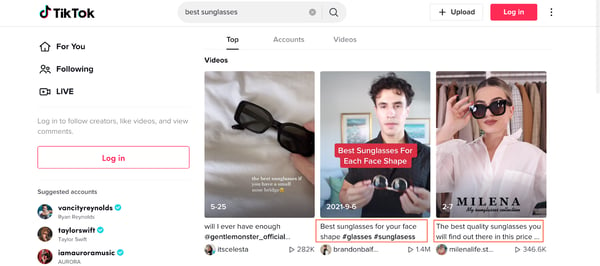
So, for example, if you search “best sunglasses” on TikTok, the videos that rank at the top have the keyword text “best sunglasses” added to the screen — proving how powerful in-video text is to the algorithm.

TikTok SEO Strategies to Increase Your Discoverability: perform keyword research

Next, you’ll notice that the top videos also have that keyword in the caption (i.e., video description).

TikTok SEO Strategies to Increase Your Discoverability: Include your keywords in your caption

So, if you can find which keyword best matches your video and add it to your in-video text and caption — it’s a surefire way to increase your visibility.

How to Find Relevant Keywords for TikTok

1. Categorize your content.

Put together 5-10 topic categories (i.e., niches) you want your content to appear under. Try to come up with 3-5 broad terms and then another 3-5 more specific terms.

For example, if you’re a beauty brand, your broad terms would be summarizing what is your overall offering. Broad terms could be beauty products, beauty hacks, and beauty tips.

More specific terms focus on different product categories: foundation recommendation, foundation hacks, and foundation for dry skin.

2. Use TikTok’s Trend Discovery tool.

TikTok’s Trend Discovery Tool can help marketers uncover what’s trending by location, hashtag, creator, audio, and more.

This can help with keyword research to see what’s going viral on TikTok in real-time — and see what keywords are being used in those videos.

3. Look at other creators’ content.

Type in a keyword that is relevant to your content in the search. Take note of which videos appear first — do they have that keyword on the in-video text? Is that keyword in the caption?

Uncover what other TikTok hashtags they’ve added to the video description or look at comments to see what people are asking to find relevant keywords that you may want to use.

2. Tap into user-generated content creators.

Gen-Z consumers are savvy shoppers — they basically merge the awareness and consideration phases of the sales funnel by discovering brands through content in the form of reviews, tips, and advice.

Now, influencer marketing on Tiktok isn’t necessarily a new strategy but collaborating with a UGC creator is.

It’s a new strategy that is quickly gaining a ton of traction; on TikTok, the hashtag #ugccreator has 147.1M views and growing.

TikTok hashtag page

For brands, it’s simple, search on TikTok for creators within your niche or accounts that may have already included your product or service (or your competitors) in a video for a collab.

If you’re new to working with creators, partner up with a top-rated influencer marketing agency to support you through the process.

3. Create a hashtag strategy.

There is great debate on if “hashtags are dead,” but TikTok uses hashtags to categorize content on the app.

Obviously, throwing in a bunch of random hashtags won’t work in boosting engagement and can come across as spammy.

But, adding relevant TikTok hashtags (think of them as keywords) that explain the topics covered in your video can help the algorithm better understand your video’s content.

A social media hashtag tool can make hashtag suggestions based on trending keywords and help you organize your hashtags into groups, so you can easily add them to your captions for a seamless workflow.

Pro Tip: If you’re jumping on a trending challenge or dance routine, be sure to add the trending hashtag to your post.

Wrapping Up

As consumer behavior changes and more people search for brands on social media, taking on an SEO approach can increase your discoverability on TikTok.

Focus on keywords and UGC creators that are relevant to your product or service, and schedule your TikTok posts to maintain a sense of consistency with the algorithm.

With the right TikTok SEO strategy, you’ll start reaping the benefits in no time.

Categories B2B

The Business of Creators in 2022: What Marketers Need to Know

Content creators and the creator economy are becoming more integral to the success of marketing campaigns. Our 2022 State of Inbound Marketing Trends Report found that 88% of brands have a dedicated budget for working with influencers and creators. We also found community will be a top priority for marketing strategy in 2023.

To gain more insight into the world of content creators, HubSpot partnered with Tilt to survey more than 300 marketing and business-specific content creators. Here’s a bit of what we found that marketers need to know. To access the full report, check our Business of Creators Report.

Free Report: The State of the Creator Economy in 2022

5 Things Marketers Should Know About Content Creators

Here are five things marketers need to know about content creators and how to leverage them.

1. Most creators want to grow their businesses.

Growth is at the forefront for many content creators. In our survey, more than 50% of content creators want to grow their businesses to support a small or large team. Almost 40% say they want to grow as a solopreneur. Only 7% report wanting to keep content creation as a hobby.

With growth being the main objective for more content creators, brands should offer mutually beneficial partnerships that help creators meet their goals.

“One of the things [HubSpot’s] started to do is invest in independent creators to help them do what they do well,” said HubSpot’s Director of New Media Kyle Denhoff. “We’re investing in podcasters right now. We’re providing them financial value, distributing their show across our brand channels — we’re cross-promoting their show across our podcast network.”

Mutually beneficial deals are great for creators but also provide excellent opportunities for brands.

“By partnering with creators, we can provide them stability financially and through the support of HubSpot’s channels, but then we can also start to reach their audiences,” Denhoff said. “I think marketers just have to think through how they can partner with creators, how they can provide more value to creators to have a true partnership …”

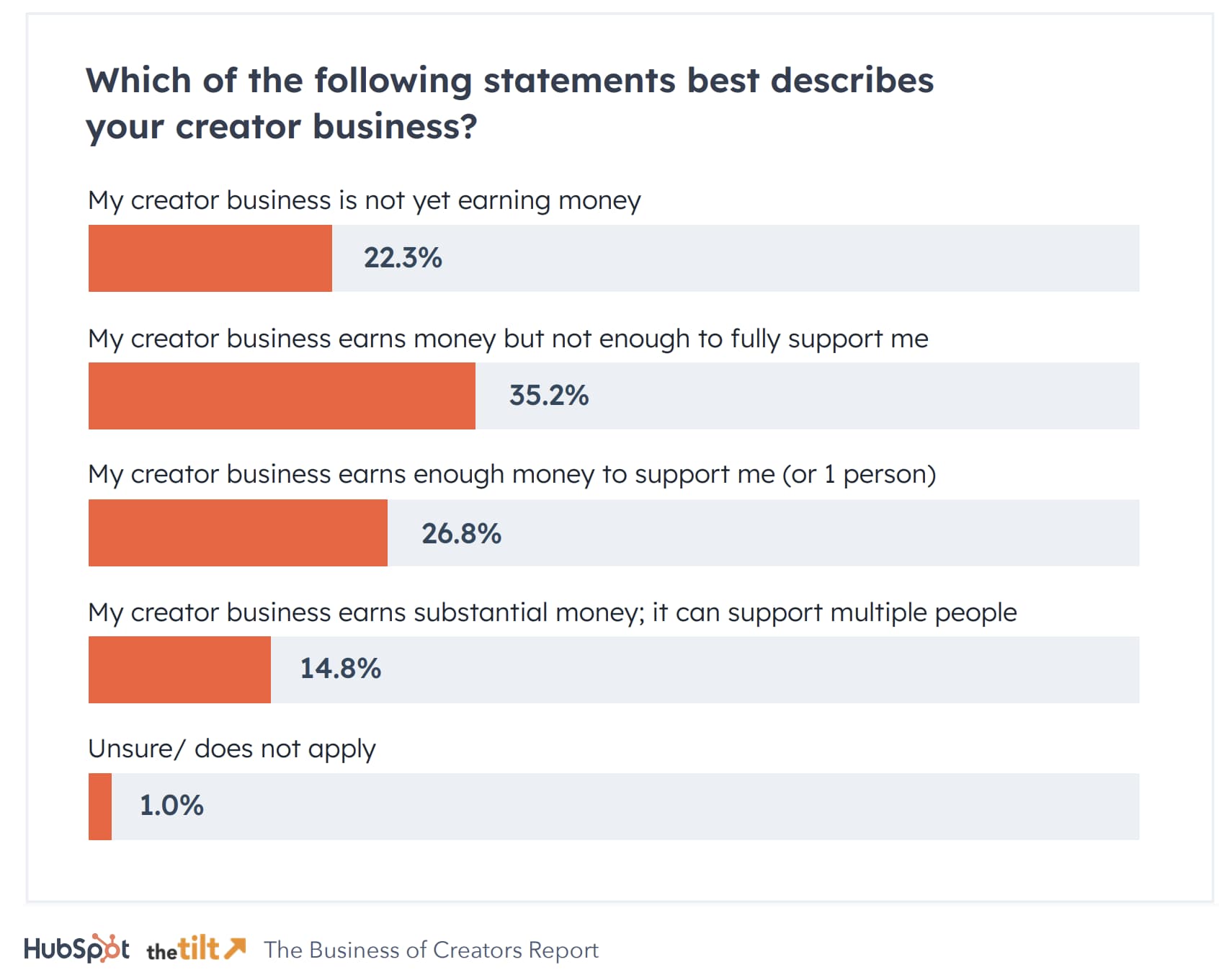
Financial stability is a hurdle for many content creators. According to our survey, more than half of creators don’t earn enough money to sustain themselves or their businesses. So, if you’re offering a partnership that will bring them closer to their financial and business goals, creators are more likely to want to work with you.

Graph of responses to our Creator Economy Report.

2. Content creators value independence.

Our survey found that most content creators (32.4%) get into the profession because they seek independence and want to “be their own boss.” As a result, creators won’t compromise their happiness for anything they disagree with. They want to have control over their work.

With that in mind, marketers should avoid treating creators like employees and treat them with the same respect as any other business. Marketers should also avoid micromanaging creators during collaborations and instead consult creators on strategic planning.

And, of course, pay your creators on time.

3. Creators are reaching new audiences.

Content creators have a knack for tapping into audiences in spaces where businesses and brands struggle. For example, platforms like Twitch and TikTok are challenging for companies to navigate because users rely on those spaces for community and entertainment.

However, content creators like Drew Afualo and Ninja have cultivated strong relationships with their followers on TikTok and Twitch, respectively, prompting various brands to partner with them to reach their audiences.

To find your audience — and the right creators to partner with — consider your organization’s goals and research where your audience lives online. You should experiment with a multiplatform project to start so you can later analyze which channel was the most effective in connecting with your audience.

From there, you can decide which initiative will become the main audience-driving platform to leverage, and you’ll be able to find creators whose work and vision align with your goals.

4. Micro and nano influencers make for excellent partnerships.

Speaking of partnerships, brands should form relationships with micro and nano influencers who align with their goals, audience, and brand mission. Micro and nano influencers typically have under 1,000 followers, while mega influencers tend to have around 1 million followers.

While you may be more inclined to partner with mega influencers because of their massive following, you may benefit more from micro and nano influencers. Creators with smaller followings often have a higher engagement rate than those with large followings. And in most cases, a higher follower count usually means a higher campaign price. So, creators with a smaller following can be more aligned with your budget.

5. Gen Z is becoming a growing generation within the creator economy.

Most content creators are Millennials and Gen X; however, more Gen Zers are starting to take root in the creator economy. In addition to working with micro and nano influencers, companies should partner with Gen Z creators due to their ability to connect with Gen Z consumers.

Graph from our Business of Creators Report shows Millennials and Gen X make up the majority of content creators but Gen Z is a growing demographic.

Remember I mentioned TikTok has a platform where businesses often struggle to connect with their audience? Gen Z uses TikTok as a search engine more than Google, and social media is becoming the next generation’s go-to place for education and growth. Brands should look for opportunities to collaborate with Gen Z creators if they want to reach new audiences on platforms like TikTok and Twitch.

Now that you know more about content creators and their motivations, you have the information you need to create a successful and mutually beneficial partnership with creators who align with your brand’s goals.

Download the 2022 Business of Creators Report.

Categories B2B

The Top Marketing Trends of 2023 & How They’ve Changed Since 2022 [Data from 1000+ Global Marketers]

The marketing world moves at the speed of light.

As a marketer at any experience level, keeping up with these changes isn’t always easy. But, to succeed in the fast-paced marketing world — and maintain a sense of relevance with your audience — it’s vital to stay ahead of them.

To help businesses build cutting-edge and competitive marketing strategies in 2023, the HubSpot Blog surveyed more than 1,000 global marketing professionals  — and talked to a handful of industry experts — to create this bookmarkable guide of marketing trends to watch in the next year.

Download Now: Free State of Marketing Report [Updated for 2022]

1. Influencer marketing will evolve into a common marketing tactic.

Influencer marketing really picked up steam in 2022, and we predict this trend will keep pace in 2023. Why? 89% of marketers who currently engage with influencer marketing will increase or maintain their investment next year.

On top of that, 17% of marketers are planning to invest in it for the first time next year.

When marketers collaborate with influencers and industry thought leaders in their industry, they can expand brand awareness and gain fans from the influencer’s own audience. 

Can’t afford to hire a celebrity influencer with millions of followers? That’s okay. In fact, more than 56% of marketers who invest in influencer marketing work with micro-influencers.

Micro-influencers are social media promoters with a smaller following (typically, thousands to tens of thousands of followers). Although they have fewer followers, their posts often pack more punch due to their higher level of engagement.

These influencers have found a niche in their industry, too — which is why they’ve started to play a bigger role in converting leads, connecting with audiences, and boosting brand awareness.

Because micro-influencers are still considered “everyday” people (unlike hard-to-reach celebrities), their audiences are actually more likely to trust their opinions and recommendations.

For example, Rosie, who’s known as The Londoner, is a popular travel and lifestyle influencer with over 330k loyal followers who interact and engage with her posts. The below image of a post on profile shows that with almost 36,000 likes, Rosie is garnering almost 11% engagement.

social media marketing trend micro influencer

Image Source

Although it’s tempting to only look at just follower count when determining if an influencer is right for your brand, remember that true influence lives in engagement rates (clicks, subscribes, and purchases).

Featured Resources

2. Video marketers will keep content short.

Short-form video has taken the marketing world by storm, and we predict it will carry over in 2023. A staggering 90% of marketers using short-form video will increase or maintain their investment next year, and 1 in 5 marketers plan to leverage short-form video for the first time in 2023.

Marketing Trends 2023

While long-form videos can offer depth and large amounts of information about a product, brand, or services to audiences, both B2C and B2B marketers have learned that getting to the point with short-form videos can actually be much more effective. 

Not only does it take less bandwidth to create a short-form video, but this type of format aligns well with the fast-paced attention spans of online audiences in a variety of demographics. This is likely why platforms like TikTok, Reels, and — in previous years — Snapchat have gained quick growth and marketing interest. 

Still not convinced that short-form videos can be effective in your marketing strategy? Check out this great example of a TikTok video from Canva that informs viewers of just how easy it is to make professional-looking graphics with the website. 

@canva_ph

Tara, design with us!✨ ##CanvaPH

♬ 아무노래 – ZICO

Featured Resources

3. Social media will become a customer service tool.

Leveraging social media as a customer service tool is relatively new, but this trend is quickly gaining steam. So much so, more than a quarter of marketers use direct messages (DM’s) to offer customer support, and 15% of marketers plan to try it for the first time in 2023.

It’s no coincidence that this trend is emerging at a time when many social media platforms — namely Instagram and Facebook — are expanding its e-commerce capabilities. For this reason, providing customer service on these platforms will become even more crucial.

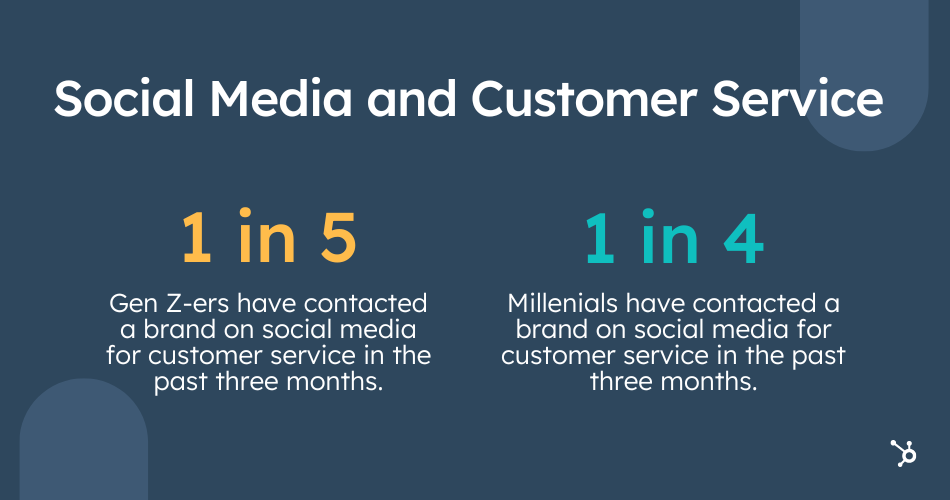
It’s also worth noting that consumers want to communicate with brands via DM’s — especially the Millennial and Gen Z crowd. HubSpot’s 2022 Consumer Trends Survey found that 20% of Gen Z-ers and nearly 25% of Millennials have contacted a brand on social media for customer service in the past three months.

marketing trends 2023

4. More businesses will leverage SEO to concur search traffic.

As marketers, we must ensure that our websites and content are as discoverable as possible — especially on Google — which can provide both long-term and short-term traffic returns. And, while SEO is not new, it’s strategies are becoming even more ingrained within modern day marketing strategies. 

When it comes to the trend marketers will invest the most money in for 2023, SEO ranks third behind short-form video and influencer marketing. Further, 88% of marketers who have an SEO strategy will increase or maintain their investment in 2023, which is a slight uptick from the year before (84%). 

As the interest and need for SEO strategies grow, so do all search optimization opportunities. As Google algorithms have evolved, SEO has become about much more than churning out basic posts that answer simple search queries. Now, brands are investing in SEO experts who can help them with everything from search insights reports, to multimedia optimization. 

5. Mobile optimization will be even more important. 

Consumers are spending more and more time on mobile devices. In fact, more than half of annual online website traffic comes from mobile devices, including tablets.  

As millennials and Gen Z audiences continue to grow buying power, mobile-optimized digital experiences will be even more vital to consider as a business owner who markets to these fast-paced, highly connected generations. 

Above are just some of the reasons why:

  • 33% of global marketers invest in mobile web design,
  • 64% of SEO marketers call mobile optimization an effective investment

And, mobile experiences aren’t just important on brand websites, they’re also important in other key marketing strategies. For example, 56% of marketers who work with email are focused on delivering mobile email experiences to subscribers. 

Featured Resource

6. More companies will prioritize social responsibility.

89% of marketers who create social responsibility content plan to increase or maintain their investment in 2023, which is almost double from the year before.

Social Responsibility trend report

The trend is clear: social responsibility, ethics, and transparency matter to the modern consumer.

For instance, 50% Gen Z-ers and 40% of Millennials want companies to take a stance on social issues, specifically racial justice, LGBTQ+ rights, gender inequality, and climate change. When companies advocate for these issues, it has a strong impact on their purchase decisions

With all of this in mind, companies have begun to pivot social media strategies to focus more on inclusive initiatives, promotions, and offerings, while highlighting causes or missions they support. Although this might not sell products immediately, showing a sense of social responsibility is still both thoughtful and effective.

Senior Lecturer in Leadership and Innovation, Hal Gregersen, shares his perspective on the subject:

“If there can be a perfect storm of opportunity for strengthening D&I [diversity and inclusion] in organizations, I believe it is happening now.,” Gregersen says. “With the pandemic, traditional ways of doing business and of working were upended, and now, barriers to the idea of change are dissolving.”

7. Aligned marketing and sales teams will win.

As we inch closer to 2023, it’s becoming increasingly crucial for sales and marketing teams to work together. When these teams are aligned, marketers can get a more complete picture of their customers, including their interests, hobbies, and demographics.

But when this doesn’t happen, it creates a flurry of problems for everyone involved. Most notably, it’s more challenging to share and access data across teams — which 1 in 5 marketers currently struggle with. 

Worryingly, only 31% of marketers say their sales and marketing teams are strongly aligned. It’s no surprise that almost half of marketers are shifting their goals in 2023 towards sales and marketing alignment.

8. Experiential marketing could make a comeback.

Experiential marketing campaigns enable audiences to step into an immersive experience that is often in a physical place or via an AR/VR platform. 

One example of an experiential campaign you might have seen in the past was M&M’s Flavor Room pop-up.

M&Ms immersive pop-up in NYC

Image Source

The experience included orb-shaped “rooms,” which were each complete with decor and fragrances unique to a certain candy flavor. The pop-up, which was based in NYC back in 2018, also included snack and drink lounges with M&M-themed cocktails — which, I’m willing to bet, we’re great opportunities for M&M to appear on different attendees’ social pages. 

Although immersive experiences like these were fun, effective, and highly shareable on social media, they ran into barriers in 2020 and 2021 as businesses, public venues, and entire countries were forced to shut down public operations in the global pandemic.

And, because producing a branded AR/VR experience is a high-budget bet that can also rely on audiences to have tools like AR/VR headsets or the latest smartphone technology to access the content — fewer small brands have invested in digital experiential marketing.

But, now, as digitally immersive platforms continue to get more accessible to larger audiences, the possibility of experiential marketing back on the table again for 2023. 

9. Inbound marketing will remain a best practice for growing brands.

In a time of digital transformation, embracing inbound marketing is an incredibly smart move. 

Throughout the last two years, the world’s dealt with unprecedented change, and outbound marketing tactics have become even less effective in reaching prospects and leads.

The shift from in-person to hybrid work from home (WFH) business practices have made inbound marketing come to the forefront of effective tactics. For example, there’s been a significant rise in virtual events due to COVID-19 forcing marketers to get creative to catch the attention of customers.

John Hazard, the founder and content strategist at digital marketing agency Lighthouse Creative Group, sees this as a place of opportunity to generate interest despite their typical formulaic production. “Screen fatigue is a big issue for brands.”

Hazard adds, “As virtual events have exploded as a replacement for in-person engagement, every business has tried to roll out events, webinars, and virtual conferences. But most are just PowerPoint presentations or an executive talking with their kitchen in the background. That’s not interesting … So, the race is on in 2021 for polish and production value — graphics, directors, professional hosts, equipment, and no kitchen backdrops.”

Inbound marketing can be a valuable asset to create brand awareness and build trust digitally through refocusing strategy to drive customers to seek out your content.

The process of inbound marketing requires you to produce quality, valuable content tailored towards your target audience and buyer personas and their needs.

Why Brands Are Adopting the Flywheel

The marketing funnel is old news. Today, the flywheel — and a subsequent focus on service — have replaced the one-way direction of the funnel and lives at the center of many inbound marketing strategies.

Funnel vs FlywheelIn the world of the marketing funnel, customers were an afterthought. Once they became a paying customer, businesses considered them obsolete — until, of course, it was time re-sign that contract.

The flywheel, on the other hand, places the customer in the center. Since word-of-mouth marketing is one of the most powerful marketing tactics, it’s wise to not only serve your customers but also equip them to become advocates for and promoters of your brand. The flywheel illustrates this process: excellent service as its own marketing strategy.

By keeping the flywheel at the center of your marketing efforts, you’ll delight and empower your customers. It’s worthwhile to place a heavy emphasis on customer service and train your team to handle requests and issues.

This will lead to customers who can market for you — they can promote and advocate for your business via their networks both online and in-person.

Featured Resource

10. Virtual reality (VR) and augmented reality (AR) will experience slow adoption in the marketing sphere.

We initially had high hopes for VR and AR in the marketing space. Back in 2021, 35% of marketers were leveraging AR or VR in their strategies, and of those marketers, almost half planned to increase their investment in 2022.

But in 2023, it could fall lower on the list as less marketers plan to invest in it. More than a quarter (27%) of marketers are planning to stop using VR and AR next year.

Generally speaking, this is a trend marketers have been slower to adopt due to pricey equipment and bulky headsets. But, as VR glasses and AR apps become more accessible, this could turn around.

11. More brands will test out native ads.

This year, almost a quarter (23%) of marketers planned to leverage native ads for the first time, and we predict this number will continue to grow in 2023.

Why the growing interest in this strategy? Well, it works. Of the marketers who use native ads, more than 36% say it’s effective, while nearly 50% say it’s their top ROI-generating tactic.

When your brand pays to feature content on a third-party website, you’re investing in native advertising. Unlike traditional advertising, which is designed to interrupt and stand out, native advertising is designed to blend in and promote your brand to a new audience who might otherwise never learn about you.

Because native ads don’t “feel” like traditional ads, consumers are more likely to consume them — in fact, consumers view native ads over 50% more than banner ads.

Examples of native advertising can be found on social media, through search engine results, content recommendation platforms (those links to various other content you can click at the bottom of the page to read more on or related to the topic), or in campaigns.

For example, Instagram is a popular social media network that routinely partners with brands for native advertising. By taking advantage of the Instagram Story or Shop features, brands are able to share posts that look similar to the average user’s followers posting style, while subtly advertising a product.

Content Marketing Trends

At least 47% of buyers view three to five pieces of content prior to engaging with a sales rep, and the majority of them expect brands to create content to gain their interest. That’s why brands all around the world have only grown their investments in content marketing.

But what content strategies are brands investing in? Below are just a few trends you’ll want to follow in 2022. 

Featured Resources

12. Video will remain the top marketing content format.

Video dominated the marketing space in 2022 – and we predict 2023 will be no different. Why? Because marketers plan to invest in short-form video more than any other trend next year. What’s more, a whopping 90% of marketers who currently leverage short-form video will increase or maintain their investment in 2023.

“Video creates a deeper connection with your potential customer base and it is easy for brands to repurpose video content into podcasts and text-based content,” Neil Patel CMO and Co-Founder of NP Digital, says.

In the past, video creation and marketing strategies were limited due to costly resources and production. Today, it’s much more accessible. With a lower-cost barrier, video has become less intimidating to incorporate into your marketing efforts.

“Our company, Jotform, has been ramping up our video efforts on YouTube. We have over 16,000 subscribers and have seen a huge increase in site traffic and signups from investing in video on this platform,” says Aytekin Tank, Founder & CEO of Jotform.

You don’t have to hire a production team or marketing agency; all you need is a smartphone, such as an iPhone, and affordable editing software. Don’t believe us? This post highlights how our own video marketers created video content from home at the beginning of the COVID-19 pandemic.

13. Blogging isn’t going anywhere.

Blogging has been a commonly used marketing strategy since brands started building their own websites. But, the age of this tactic shouldn’t be a sign that it’s out-of-date. In fact, blogging has been used for so long simply because it works. So much so, one in three marketers leverage their own blog or website

On top of that, our research suggested that most consumers read blogs multiple times per week and have purchased something from a brand after reading the company’s blog

Aside from providing consumer engagement and potentially conversion, blogs also provide a major key benefit to your website or online pages: search discoverability.

Ultimately, sites with robust blogs have more search potential and can implement SEO strategies much easier than sites that don’t.

Think about it this way. If a prospective client wants to hire a virtual accountant, and your firm’s site has a blog post that highlights tax tips or strategies your accountants use, this person might find your post or website via Google search, read your post and explore your website, and then decide that they want to contact you for a consultation or accounting assistance. 

If you haven’t considered a blog by this point, but are intrigued by this data, check out these resources to help you build out your own strategy: 

14. Case studies will continue to drive leads and brand credibility.

Longer-form case studies offer prospects an incredibly deep and exclusive look into how people or brands benefit from a product, service, or strategy. While some businesses place them publicly on their web pages to persuade a potential buyer as quickly as possible. others might gate them as free PDFs that require a lead conversion to be downloaded.

Although many marketers, such as those in B2C industries, don’t leverage case studies, those that do find them effective. Additionally, case study usage in content marketing is only growing: 37% of marketers planned to use case studies in their marketing strategy for the first time this year.

15. Marketers will embrace data with infographics.

If a picture paints a thousand words, infographics could paint at least double.

Infographics not only have the shareability and visual appeal of a nice photo — but they’re also packed with helpful data and informative information. This makes them incredibly engaging to web visitors and social media audiences alike.

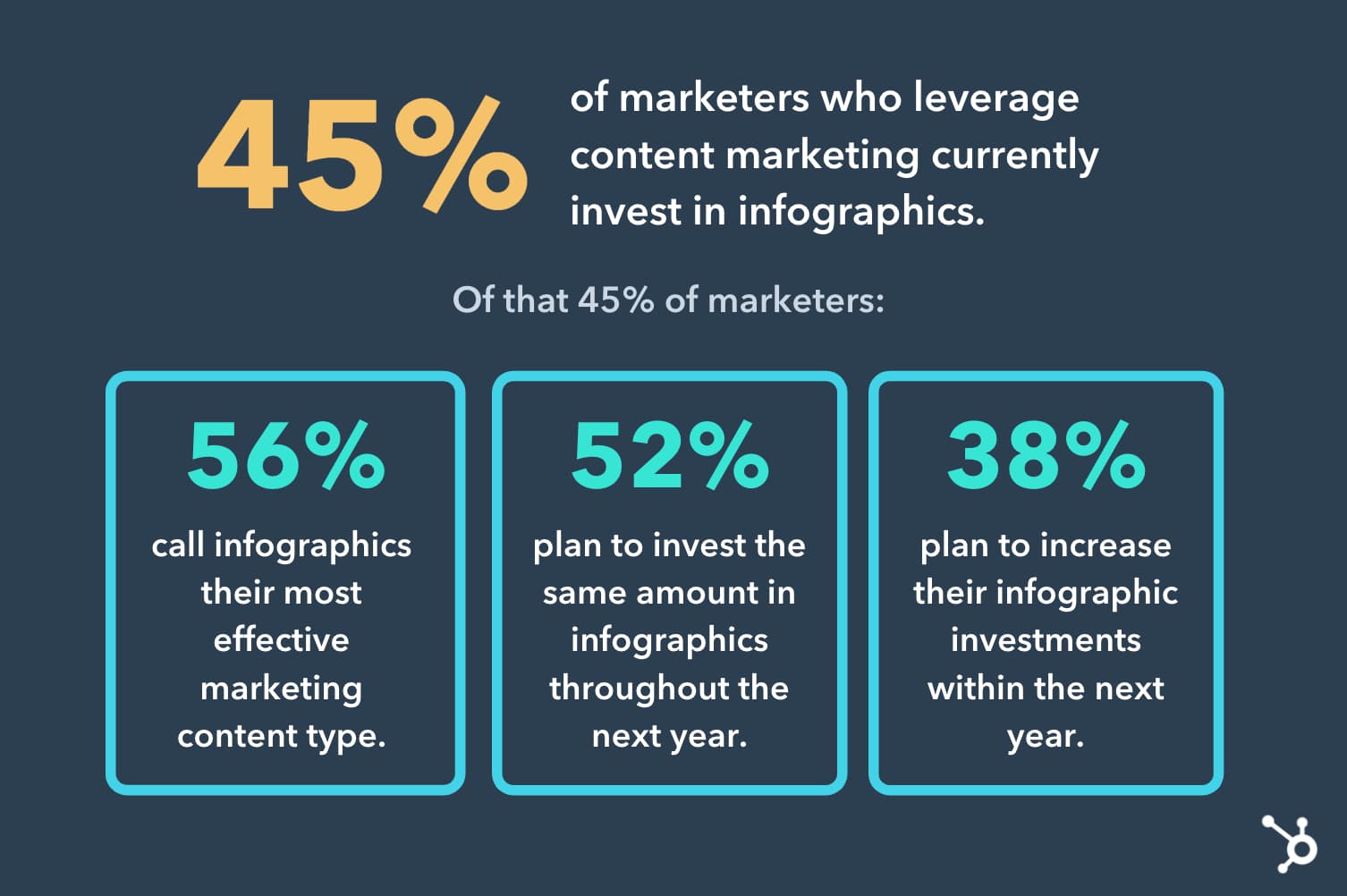
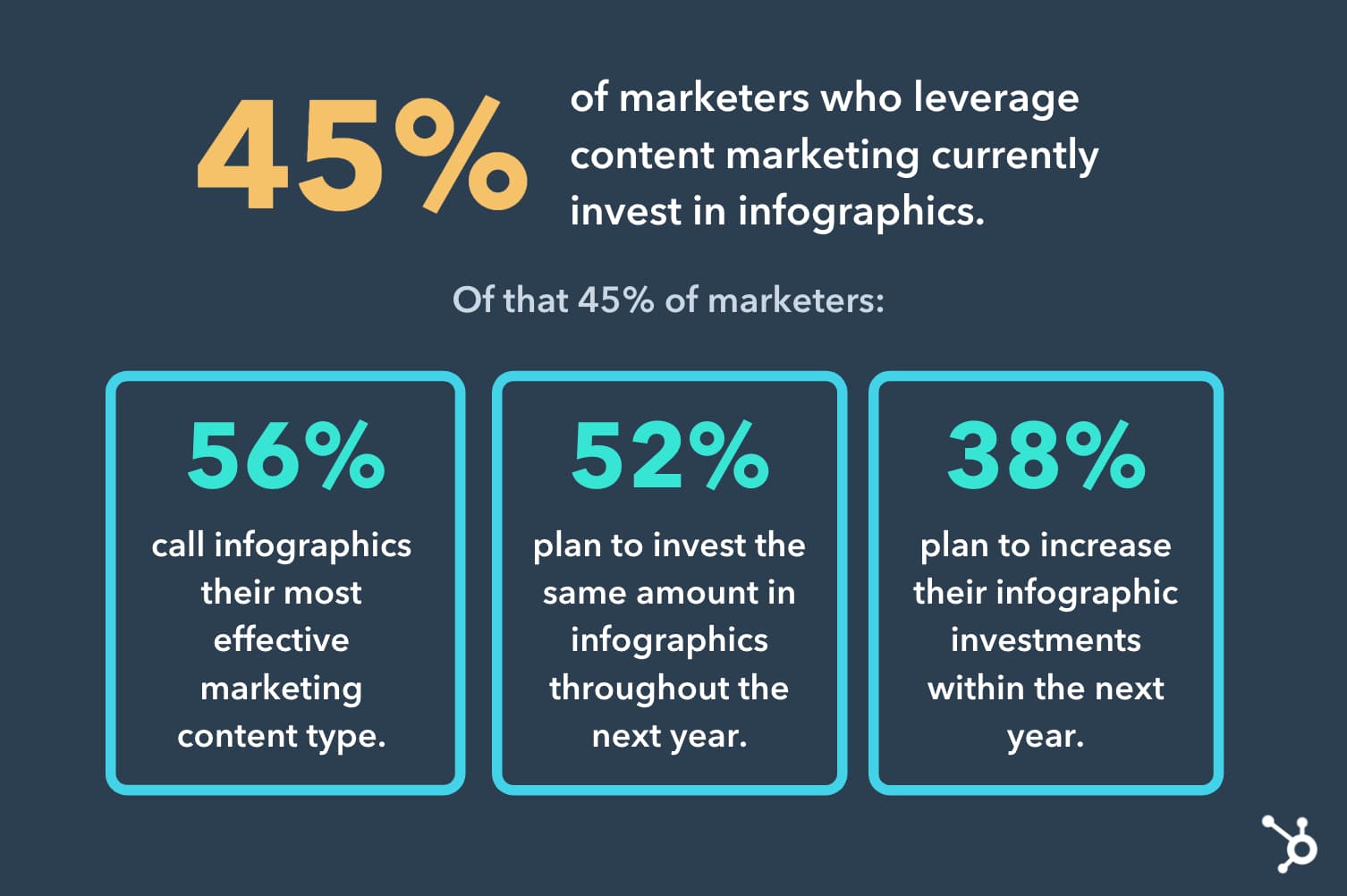
Of the marketers who regularly use infographics in their content strategy, 56% say they are their most effective content type. 

an infographic which highlights infographic marketing trends stats

Download image

Ultimately, credible data can help marketers, bloggers, and content creators tell compelling and persuasive stories. Why else do you think we surveyed hundreds of marketing professionals to create this content?

Featured Resources

Social Media Marketing Trends

In the U.S. alone, 79% of people have some type of social media account — and globally, there are over 3.7 billion social media users.

This is why social media marketing is a popular channel that’s become a part of almost every business’s greater marketing strategy. Social media marketing allows you to authentically connect with your audience on a personal level, humanizing your brand.

16. Selling on social media. 

Many social media platforms are vying to become the next go-to shopping destination. Instagram has Instagram Shopping; Facebook has Facebook Shops; and TikTok is testing new e-commerce and partnership features.

This shift is already having an impact on consumer shopping habits For instance, 71% of Gen Z-ers prefer to discover new products on social media. The same is true for 51% of Millennials.

If this trend continues to grow, you may want consider focusing on social media for your lead generation efforts.

17. TikTok will continue to gain brand interest.

TikTok will experience even more growth in 2023, as 56% of marketers who currently leverage the platform are planning to increase their investment in 2023, the highest of any social media app.

Brands have been trying to tap into the true power of TikTok since it first began to go viral three years ago. Now, with well-over 1 billion global users, TikTok has positioned itself as an app for a wide variety of audiences and marketers.

Of course, if you think TikTok is just for younger demographics, think again. 50% of Millennials report visiting TikTok in the last three months along with 38% of Gen X-ers, according to HubSpot’s 2022 Consumers Trends Report. We predict these numbers will continue to rise as TikTok becomes more mainstream.

18. Most marketers will focus on just three to five social media platforms.

On average, marketers leverage four social media platforms in their roles. Facebook is the most used social media platform, used by 64% of marketers, followed by Instagram (58%), YouTube (57%), Twitter (43%), and TikTok (42%).

Managing three to five platforms is realistic. This range allows brands of all sizes to expand their reach to different audiences while also giving social media marketers a realistic list of platforms to master without stretching their bandwidth during the work week. 

Here are a few questions that can help you determine how many platforms you should really be on:

  • How many social media marketers are on your team?
  • Which social media platforms have audiences that best align with your targets?
  • How much time will it take to master a strategy on each of the platforms you’re targeting?
  • Are there any platforms that won’t benefit your overall marketing strategy right now?
  • Are there any platforms you can easily repurpose engaging content between? (such as TikTok and YouTube Shorts)

By asking yourself some of the questions above, you can determine how much time your social team and brand will need to build an effective and engaging strategy on each platform, and prioritize which platforms you should really focus on. 

Featured Resources

Search Engine Optimization Marketing Trends

61% of marketers say improving search engine optimization (SEO) to grow their organic presence online is their top inbound marketing priority.

Are you one of these marketers? If so, have you figured out how exactly you plan to improve your SEO and organic presence? When you optimize for specific types of consumer behavior, you’ll help your business become more discoverable online.

19. Keyword optimization will be a key priority.

By far, one of the HubSpot Blog’s most vital tactics is our Search Insights Report. This report highlights all the keywords we would like to leverage and all the blog posts we’ll need to create or update to rank for those keywords on Google. 

But, we’re no longer one of the only blogs using a SIR anymore. In fact, 47% of marketing professionals who leverage SEO say their companies use search insights reports in their strategy.

For example, you can use tools like Ahrefs or SEMRush to do some quick SEO keyword research related to your business, products, or upcoming content to learn where you can boost your content with keyword-optimized titles, subheads, body text, or descriptions. 

20. Web teams won’t forget about video and image SEO.

SEO doesn’t just involve changing the text on a page. It can also involve choosing and optimizing the right videos or images for a page to help it rank in Google images or search engine video carousels. 

While optimizing images could involve compressing files to increase page speed and adding keyword optimized alt text to an image, video optimization strategies could involve embedding an video with a similar topic or keyword into a blog post. 

Currently, 53% of marketers who leverage SEO have a strategy for optimizing videos and images. Of those marketers, 49% say image and video optimization is their most effective SEO tactic. 

21. Link-building will help brands grow authority — and search rankings. 

When sites with solid rankings begin to link to yours, Google’s crawlers note that your site might be credible and also have solid authority in your space. This can then tricker your Google ranking to go up. This, ultimately, is the goal of link-building — or getting other sites to link to yours. 

Although writing highly shareable content, reaching out to share it with other websites, or ensuring that your post gets links can be time-consuming and challenging, research shows that this time and effort pays off. Of the 48% of SEO marketers that use backlinking and link building, 63% say its their brand’s most effective SEO tactic, 

22. Historical optimization will help old web pages get new traffic.

Instead of coming up with new ideas, marketers are going to be taking what’s worked in the past and optimizing it for the present.

In SEO, keeping your content up to date and full of rich, engaging content will outweigh older work that is lacking in keyword relevancy with old statistics and links. Not only that, but taking existing content and repurposing it for a new podcast, webinar, or blog post can be an efficient way to keep it relevant in search engines.

While one in four SEO marketers leverage historical optimization in their strategy, 29% say of those marketers say it’s an effective SEO strategy. 

23. Voice search optimization is less of a priority

Back in 2021, 41% of marketers planned to increase their investments in voice search optimization in the coming year. However, it seems this trend is less of a priority for marketers these days.

More than a quarter (28%) of marketers say they will stop leveraging voice search optimization in 2023. 

While that may seem bleak, there is a portion of marketers who plan to explore this trend for the first time in 2023 (13% of marketers, to be exact). How will they do this? By framing their content around questions.

Think about it: these digital assistants answer short, informational queries such as “Who is the actor in Mission: Impossible?” or, “What’s the weather in Boston today?”, but they’ve also started to process more local, conversational, and customized searches. These may sound like, “Where’s a nearby coffee shop I can work from today?”, “How late is it open?”, and “Do they serve iced coffee?

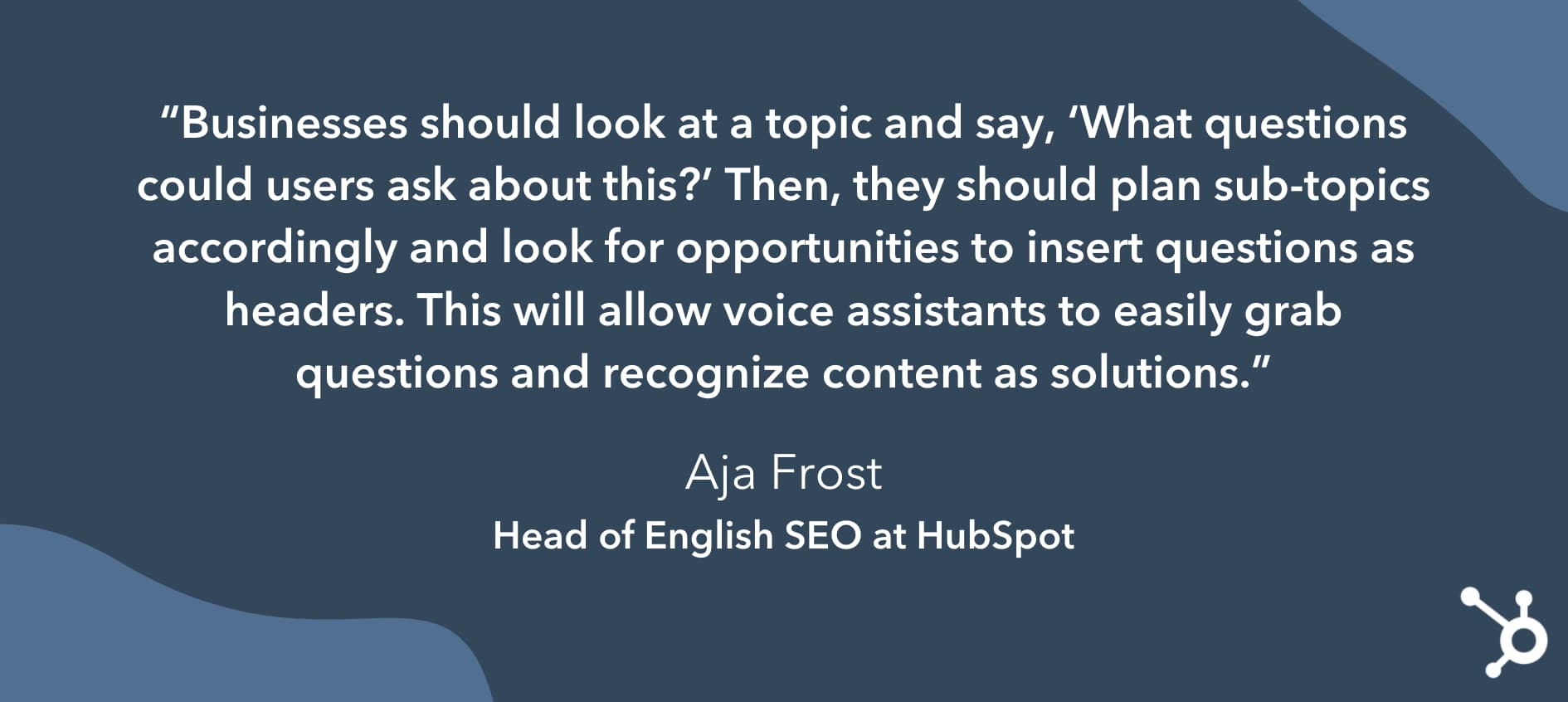
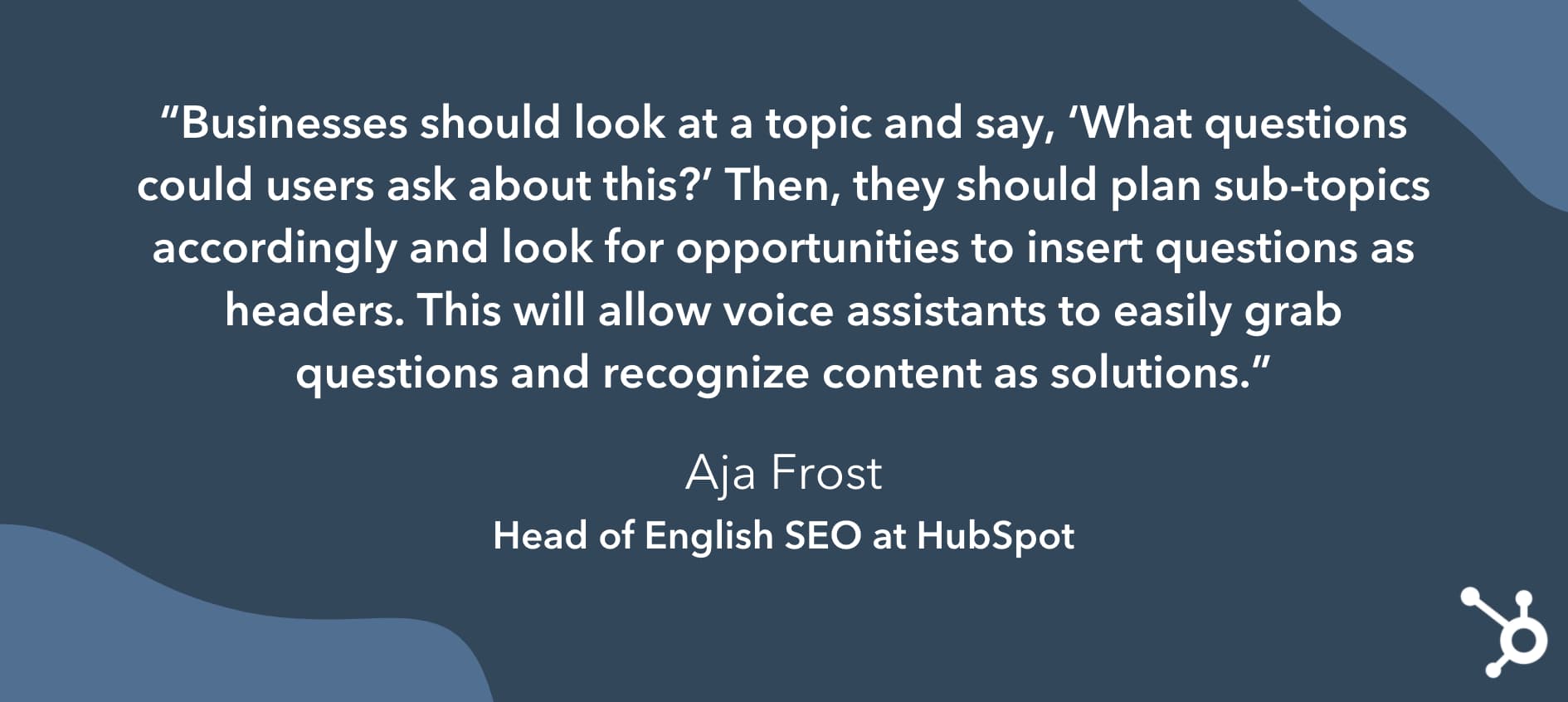
Aja Frost, Head of English SEO at HubSpot, says: “Businesses should look at a topic and say, ‘What questions could users ask about this?’ Then, they should plan sub-topics accordingly and look for opportunities to insert questions as headers. This will allow voice assistants to easily grab questions and recognize content as solutions.”

Quote from Aja Frost saying that businesses should predict what questions search audiences will ask about topics in their industryDownload image

Featured Resource

24. Chatbots will continue to streamline conversational marketing. 

Did you know that more than half of consumers expect a response within 10 minutes to any marketing, sales, or customer service inquiry? How can this be humanly possible?

It’s not… for humans, anyway. This is probably why 40% of marketers who use automation leverage chatbots.

Bots are powered by a computer program that automates certain tasks, typically by chatting with a user through a conversational interface. Bots are made possible by artificial intelligence which helps it understand complex requests, personalize responses, and improve interactions over time.

Bots provide the perception and dedication of a 1:1 service experience while working with hundreds of customers — something that no customer service representative or team would ever be able to do.

To the consumers who hate repeating themselves to multiple sales or service representatives (33%, to be exact), listen up — chatbots are and will continue making your lives much easier. If used correctly, they manage conversations at scale and aggregate data from multiple sources of data, from calendars to knowledge bases to blog posts and videos.

Jon Dick, SVP of Marketing at HubSpot, says: “It’s on you to make things as easy as possible.”

“Do your buyers want to use live chat? You should give it to them. They’ve had the same problem three times in the last month? You should already know, and have a plan to fix it,” Dick concludes.

Featured Resource

Privacy Marketing Trends

25. Brands will need to give customers more control over their data.

In the marketing world, data is highly valuable — and not just valuable to you, as a marketer or business owner. Whether it’s an email address, credit card information, or smartphone location, consumers also view their data as precious and privileged — and it’s your responsibility to take care of it.

Whether a software company, bank, government agency, or lemonade stand, every business operates using data. It’s the lifeblood of all things marketing, sales, service, and more.

But, when precious information is misused or siphoned into the wrong hands, it leads to a strong distrust in businesses and potentially exploited consumers

That’s why the General Data Protection Regulation (GDPR) was enacted.

GDPR is an effort by the EU to give greater control to consumers over their data. Under the GDPR, organizations must ensure that their data is collected legally and safely and that those who collect and manage said data will protect it and respect consumers’ rights.

Following the GDPR guidelines might seem like a burden, but being fined for non-compliance will feel much heavier; fines range from 10 million euros to 4% of a company’s annual global revenue.

And — GDPR isn’t the only entity enforcing privacy mandates in 2022. In fact, companies like Google and Apple are now taking stands for user data as well. 

In 2021, an Apple IOS launch enabled IPhone and IPad users to determine which apps could track their third-party data, which is often used for hyper-targeted ads.

In 2022, Apple will finish rolling out another IOS update with additional email privacy protections features for Apple Mail users. Meanwhile, Google will be discontinuing the use of third-party cookies on Chrome, while encouraging advertisers to leverage its Privacy Sandbox instead.

Ultimately, brands and governing bodies are increasingly aiming to give users more choice when it comes to releasing their data. And, while it is great for the consumer, businesses who leverage personal data to run campaigns will need to create alternative strategies and pivot plans incase they lose access to crucial datapoint. 

Use Marketing Trends to Grow Better

You’re up to speed… for now. And, as long as you’re keeping a thumb on the pulse of marketing trends — and always remain open to change — your business won’t fall behind.

But, if you’re feeling overwhelmed by the idea of keeping up with all these insights, don’t worry. The HubSpot Blog will be publishing regular Marketing Strategy research pieces with data from hundreds of marketing professionals in the coming months and will continue to update this post as new trends emerge. 

Editor’s note: This post was originally published in August 2019 and was updated in November 2021 with updated HubSpot Blog trends data.

New Call-to-action

Categories B2B

HubSpot to Continue Delivering the Promise of Connection

Platform solutions have always been known as a one-stop shop for all of a marketer’s needs.

At their core, platforms are meant to help marketers, whether that’s understanding their customers’ journeys, optimizing the path to purchase, or quantifying the revenue that a campaign produces.

And, as I discussed last year, HubSpot delivered on the promise of platform through our world-class solution that doesn’t sacrifice power for ease of use.

Last year we focused on what it meant to be a valuable platform for our customers. Since then, we’ve made a number of product enhancements to double down on this promise.

Here at HubSpot, we’ve intentionally built our platform to meet the needs of organizations regardless of where they are in their journey. Our customers have always taken comfort in our easy-to-use tools and freedom to scale when they’re ready to.

That said, a lot has changed in the last few years and as a result, our customers’ needs are shifting. Although platform solutions are still the answer, customers need more than just the promise of strong technology.

They need connection.

Facing the Crisis of Disconnection

We’re living in a disconnected world – disconnected from one another, from the people we work with, or in this case, from the companies we do business with. In a time when connection matters now more than ever – this is a huge problem.

At INBOUND 2022, our CEO Yamini Rangan introduced this concept, that we’re suffering from a crisis of disconnection – disconnected data and systems, disconnected customers, and disconnected people.

As a result of that, our customers are interacting with products and businesses differently – they’re cautious and slow to trust brands.

They’re not only taking back ownership of their personal data, but they’re placing more trust in one another and expecting more flexibility and value from the companies they do business with. And it’s our job to fix that, keep them connected, and continue to trust our brand. But how?

If you ask our Chief Customer Officer, Rob Giglio, he would say that in order for your customers to feel valued, they need tools to evolve as they do. Empowering our customers to grow better by building deep and lasting connections with their customers is a top priority for HubSpot.

Give them those tools and they’ll naturally orchestrate stronger, more efficient processes.

United teams working on united systems translate into connected and consistent experiences for customers. Creating this is what translates to trust, and ultimately loyal customers.

Entering the Age of the Connected Customer

Creating connection matters. Customers want to feel known and valued, with the power, ease, and support to help them scale.

Our customers are facing difficult financial headwinds and are finding themselves needing to do more with less.

This is why the value that marketers are able to receive from their technology investment is more important than ever – whether that’s consolidated views into campaigns, sharper analytical tracking, or more powerful targeted ad capabilities, all while respecting customer privacy.

More on that here.

Marketing Hub gives marketers access to their customer data and tools in real-time, so they can create personalized experiences that attract, engage and delight customers in a more connected way.

HubSpot has always put the customer first, and we’re doubling down on that commitment by prioritizing genuine connection and continuing to build products that meet the ever-changing needs of growing businesses.

Built on our commerce-powered CRM and supported by a robust support network, partner ecosystem, and integration marketplace, Marketing Hub unifies our customers’ data right out of the box and gives them flexibility to grow within the platform as the business grows.

Continuing to Provide Connection

Creating a trustworthy environment with your customers is more important than ever. When making a purchase decision, customers need to trust that they can adopt our brand for not only ease of use, but also that we are here to support their needs.

Customer feedback will always be an important indicator of our performance. From our perspective, true magic happens when the market and industry experts also recognize that success.

This is why I’m extremely proud that, for the second year in a row, HubSpot has been named a Leader in the Gartner® Magic Quadrant™ for B2B Marketing Automation Platforms with Marketing Hub being evaluated.

We feel that being recognized as a Leader in B2B marketing automation by Gartner® is another point of validation that we’re doing what’s right for our customers, and a true testament to our continued commitment to delivering the best possible product, and trustworthy user experience, for our customers.

Source: Gartner, Magic Quadrant for B2B Marketing Automation Platforms, Rick Lafond, Julian Poulter, Matthew Wakeman, Jeffrey Cohen, Jeff Goldberg, 20 September 2022.

GARTNER and MAGIC QUADRANT are registered trademarks and service marks of Gartner, Inc. and/or its affiliates in the U.S. and internationally and are used herein with permission. All rights reserved.

Gartner does not endorse any vendor, product, or service depicted in its research publications, and does not advise technology users to select only those vendors with the highest ratings or designation. Gartner research publications consist of the opinions of Gartner’s research organization and should not be construed as statements of fact. Gartner disclaims all warranties, expressed or implied, with respect to this research, including any warranties of merchantability or fitness for a particular purpose.

Categories B2B

Benefits of Influencer Marketing [Data + Expert Insight]

The creator economy is built around influencers and their audiences.

As audiences put a significant amount of trust in their favorite influencers, it makes sense that marketers would want to pay more attention to influencer marketing than before.

This post will go over the data-backed benefits of using influencer marketing, along with insight from a HubSpot social media expert.

Download Our Guide to Influencer Marketing Essentials


7 Benefits of Influencer Marketing

1. Influencer marketing has high ROI.

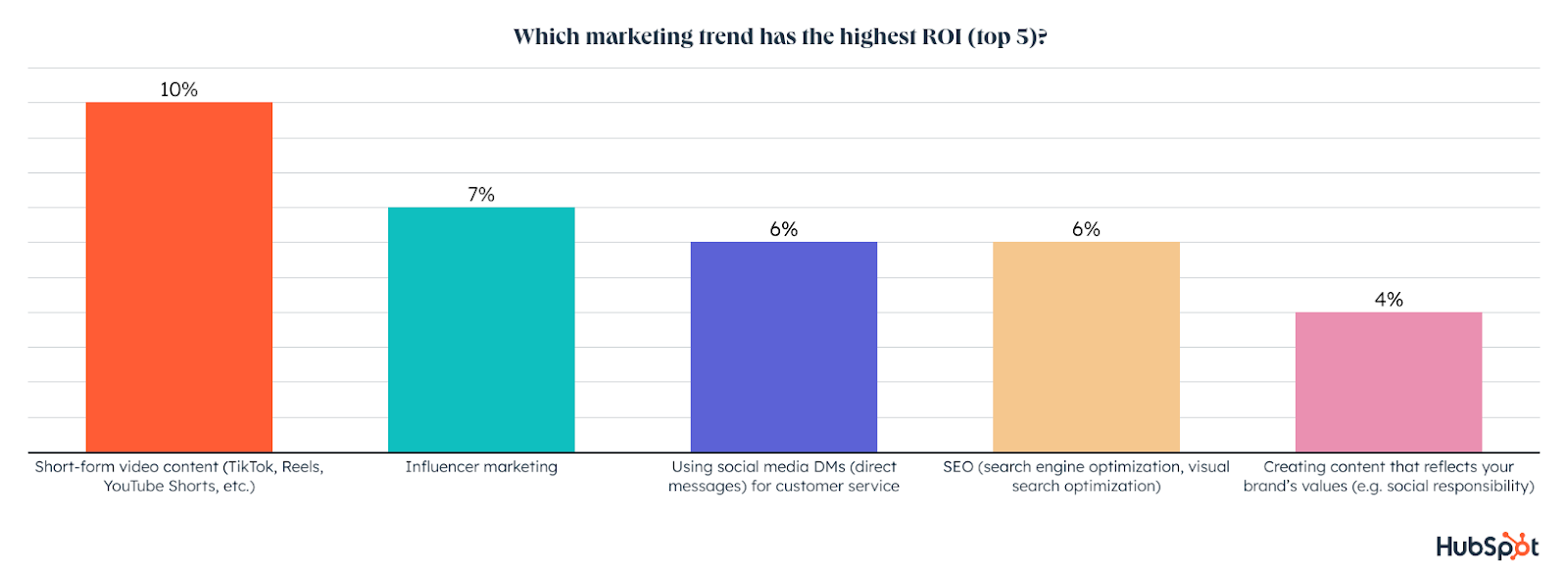
1 in 4 marketers that currently leverage influencer marketing report that it offers the second highest ROI of any marketing trend, so your investments in influencer marketing won’t go to waste.

influencer roi

Image Source

2. Influencers help you save money.

We’ve mentioned above that influencer marketing has a high ROI, so your marketing budgets are worth something.

You also have the potential to optimize your campaign budgets and see high ROI, especially when partnering with smaller micro-influencers (those with under 100k followers/subscribers). In fact, of marketers that work with both large and small influencers, 44% say that the biggest benefit of working with small influencers is that it is less expensive.

3. Influencers are more trusted than friends and family for Gen Zers.

Gen Zers say that influencer recommendations are more important and impactful than those from friends and family. This means that the weight of influencer recommendations is much more powerful than before, as past trends have shown friends, family, or reviews from other consumers being the most impactful when making purchases.

Annabelle Nyst, Senior Content Manager, Brand Social, says about influencers, “Their followers pay attention to their guidance just as they would that from friends or family. That is far more powerful than some advertising copy.”

4. Influencers help you establish social proof and build awareness.

According to HubSpot’s 2022 Marketing Industry Trends Report, influencer marketing is the most popular and effective trend (with the highest ROI) in generating authentic content for your business, establishing social proof, and building brand awareness.

Nyst says, “Influencer marketing can be a really impactful tool for building brand awareness for your company and trust for your products or services. The power of influencer marketing lies in word-of-mouth marketing.”

They add, “Think of it this way: on the one hand, you have a brand telling you how cool it is and how its product is far superior to anything else on the market. On the other hand, you [audiences] have an individual who you’re already familiar with and whose opinions you trust and respect, telling you they love this brand’s product. Which are you more likely to trust?”

5. Influencers inspire purchases.

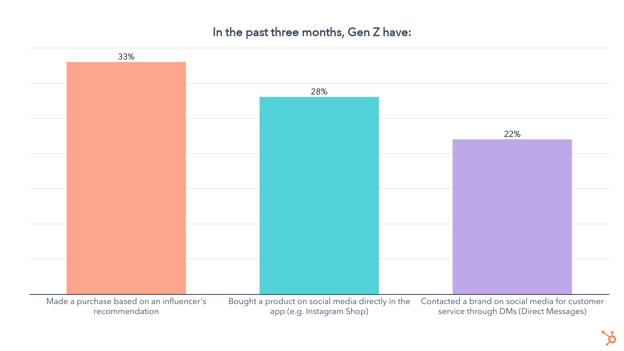
33% of Gen Zers have bought a product based on an influencer’s recommendation in the past three months, so influencers have the unique ability to drive purchases for your business, especially among your younger audiences.

genz

Image Source

6. You can establish long-term relationships.

Marketers say that a benefit to partnering with smaller influencers and creators is being able to develop long-term partnerships.

Long-term relationships are beneficial because they increase credibility with an influencer audience when their followers see that they continue to work with you, use your products and services, and trust that what they use serves them well.

7. Influencers help you share authentic content in a human way.

Nyst says, “Influencer marketing doesn’t just get you in front of the audience you’re trying to reach — it gets you there in a way that feels authentic and human.” They add that influencer messaging comes through as a recommendation or mention from a real person who has built a dedicated community based on trust.

As consumers have moved away from sales to drive leads-type ads and more humanized content, a recommendation from a trusted influencer helps you inspire sales by building upon a pre-existing relationship.

Over to You

As the creator economy grows, influencer marketing will only become more popular and necessary. The stats and insight in this post show that investing in it will help your business.

Improve your website with effective technical SEO. Start by conducting this  audit.  

Categories B2B

41 Mind-Blowing Creator Economy Stats That Marketers Can Learn From

Having found success on TikTok, Thomas Petrou co-founded The Hype House, a collaborative content house where TikTokers lived together, created videos, and grew their following with Petrou’s guidance and support.

He is one of the many content creators making a name for themselves in the creator economy — a relatively new concept but, as anyone can become a content creator, the potential for significant growth is clear.

In this post, we’ll explain exactly what the creator economy is, and go over key stats that marketers should know.

What is the creator economy?

The creator economy is where creators, from YouTubers to bloggers, share content with audiences and generate revenue from monetization opportunities. It also includes the businesses that creators launch to further grow their content.

Businesses have a place in the creator economy as well; specifically those that create tools for creators to build their impact, reach, and audience. For example, Patreon helps creators launch premium membership programs and Virtual Dining Concept helps creators launch restaurants in ghost kitchens. Creators will also continue to look to businesses to offer the tools they need to meet their goals, requiring businesses to be on top of the trends.

Marketers are also impacted by the creator economy, as social media users put more trust in their favorite influencers and creators than the brands they follow. As a result, creating an impactful ad for social media can require partnering with influencers that have an engaged audience that trusts their recommendations.

The creator economy is only set to grow. Given this, it’s important to stay on top of the current state of the creator economy — below we’ve compiled a list of stats that demonstrate this.

Creator Economy Stats For Marketers To Know

General Creator Economy Stats

  • 30% of 18-24 year olds and 40% of 25-35 year olds call themselves content creators. (HubSpot Blog)
  • Creators are most likely to be young (63% Gen Z) and female (48%). (Global Web Index)
  • 46.7% of creators are full-time creators. (ConvertKit)
  • The top types of creators are educational creators, bloggers, coaches, writers, and artists. (ConvertKit)
  • 37% of niche creators have engaged in a brand collab at least once. (Linktree)
  • Full time creators use an average of 3.4 channels for audience engagement. (ConvertKit)
  • The average amount of time spent creating content each week is 1 – 5 hours. (Linktree)
  • Content creators say their top challenge is getting their content found. (The Tilt)
  • 61% of content creators say they post content for fun, 34% post because they’re passionate about the content they share, and 31% post content to explore a new potential hobby. (Global Web Index)
  • The most common creator launchpad in 2021 was Instagram. (ConvertKit)
  • 58% of creators produce 2-4 types of content. (Linktree)
  • Most often, full-time creators create social media posts, emails/newsletters, and articles/blog posts. (ConvertKit)
  • 52% of marketers lean on creators to strengthen their social community, and 41% say they want to work with content creators to promote their brand values. (Sprout Social)
  • The most common types of content marketers hire creators to make are educational content, unboxing or reveals, and testimonials. (Sprout Social)
  • The top earning types of creators are educational creators, coaches, podcasters, influencers, and marketers. (ConvertKit)
  • A majority of content creators share between 0 and 10 sponsored posts per year. (Influencer Marketing Hub)

Creator Economy Revenue Stats

  • The creator economy currently consists of over 300 startups. (Influencers Club)
  • The creator economy market size is currently estimated at $104.2 billion. (Influencers Club)
  • The total valuation of creator economy startups was $5 billion in 2021. (Influencers Club)
  • A majority of content creators say their highest earning revenue source is brand deals. (Influencer Marketing Hub)
  • It takes content creators an average of six and a half months to earn their first dollar. (The Tilt)
  • Content creators prefer to monetize their content on Instagram and TikTok. (Influencer Marketing Hub)
  • Full time creators leverage 2.7 income streams on average. (ConvertKit)
  • 59% of beginning creators haven’t monetized their content yet. (Linktree)

Download the 2022 Business of Creators Report.

Categories B2B

What is Twitter Spaces? [+Why Marketers Should Care]

Following months of beta testing, Twitter made its new audio feature, Twitter Spaces, permanent.

Today, the highly-discussed feature is finally available to all users.

Spaces, which allows Twitter users to listen to and participate in public audio conversations, entered its beta test shortly after the launch and $100-million valuation of the app Clubhouse – which similarly offers an audio chat room experience.

Download Now: Social Media Trends in 2022 [Free Report]

Now that it’s here to stay, many brands with solid Twitter followings are also beginning to pay more attention to the marketing opportunities of Spaces.

Why Marketers Are Watching Twitter Spaces

Looking for a way to determine whether Twitter Spaces or Clubhouse is a better fit for your business? Check out our video guide comparing the pros and cons of the two social audio spaces below.

1. Twitter has major audience reach.

Twitter has well over 200 million daily active users. That user base includes audiences that fit into many different demographics all over the world. Because of this, brands can reach target audiences from all sorts of industries and backgrounds.

While Clubhouse’s user base quickly grew, it doesn’t offer comparable reach to Twitter due to its somewhat exclusive nature.

The audio social app was initially designed to be invite-only and started with a small user list of “elite” industry thought leaders, celebrities, and influencers. Only recently did every-day users start to get invited and expand its app to Android users.

2. Twitter Spaces could provide a shorter learning curve.

Learning how to use and experiment with a completely new social media app – like Clubhouse – can be time-consuming. Not only do you need to learn how to navigate it, but you also have to study its top users, brands, and trends to learn how to reach audiences there.

With learning curves in mind, marketers who are experienced Twitter users might turn to Spaces over Clubhouse simply because they already have a following on Twitter and only need to learn how to use one additional feature, rather than an entirely new platform.

3. Twitter Spaces could be more inviting to brands.

While Clubhouse’s live audio platform has pulled in users looking for authentic interpersonal conversation rather than brand information, Twitter’s audience is accustomed to seeing content from brands, such as ads, marketing videos, and promotional Fleets.

Because brand promotion feels more natural and common to Twitter users, these audiences might be more likely to accept or engage with brand-owned Space.

4. Twitter Spaces is visually interactive.

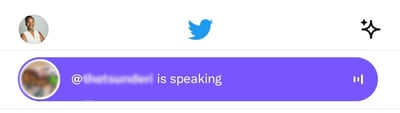
Twitter spaces emojis

Twitter offers a number of features to make Spaces more visually appealing.

For example, Spaces listeners can use emojis to react to speaker comments. They can also share the Space while it’s live or recorded version to their newsfeed – allowing others to keep up with them.

“[The reaction feature]’s great because I see it as the perfect balance of being accessible for introverts and extroverts. If you’re not comfortable speaking, use an emoji,” said Krystal Wu, former HubSpot social media community manager, and Spaces beta tester.

5. Spaces provides a more casual environment than other streaming platforms.

Because of Spaces’ casual nature, marketers and audiences might not have to feel as intimidated when speaking in or launching Spaces, which could lead to engaging conversations between brands and their followers.

“The pressure is off when joining a Space. In all the discussions I’ve been part of, people are much more laid back no matter how casual or important the topic is that’s being discussed,” Wu explained. “I enjoy this because it removes the feeling of being ‘on,’ like most of us have been on Zoom during this pandemic.”

To learn how to use this feature and others within Spaces, keep reading for a quick how-to guide.

How to Use Twitter Spaces

How to Make a Space on Twitter

1. Start from the homepage or the Spaces tab.

There are two ways to start a Space:

  • From the homepage – Click on the + icon to start a post then tap the purple Spaces icon.
  • From the Spaces tab – Click on the purple Spaces icon on the bottom right of this tab to start a space.

how to make a space on twitter

From there, you’ll have to:

  • Give your event a title, ideally related to the topic you’ll be discussing.
  • Add up to 3 related topics to help relevant users find your event.
  • Decide if you’ll record the Space.
  • Start it immediately or schedule a date and time up to 30 days out.

Then, you can share your event with others in your feed to invite them to join.

2. Start your Space event.

As a host, you’ll be tasked with a few things:

  • Designating speakers and/or moderators
  • Accepting participation requests
  • Sharing relevant Tweets during the conversation.

Read more about Twitter Spaces etiquette here.

3. Look for speaker requests.

When you first start a Space, the default setting will be to limit speakers to the ones you designate. However, you can change it to people you follow or anyone who joins.

Note that you can only designate up to 10 speakers at a time and have one co-host.

When someone requests to speak, you’ll get a notification and can choose to give them speaking privileges or ignore the request. If you unmute the listener, be sure to introduce them to the audience.

4. Remove or change speakers.

If you have more than 10 guests that would like to speak, you can tap one of your current speakers to remove their privileges.

This will allow you to minimize the potential speakers or add more speakers. This can be especially helpful if you’re holding a longer chat and want multiple listeners to contribute to the discussion.

inviting someone to speak on Twitter spaces

Image Source

Additionally, if the conversation goes awry or someone says something unexpected, Twitter allows Space creators to report or block speakers if they say or do something inappropriate.

This can help moderators create a safe and respectful environment for all listeners and participants.

5. End the Space.

A Twitter Space can only be ended by the person who launched it. To end a Space you created, all you have to do is tap the End icon.

Your Twitter Space description box explaining the goal of your audio room

Image Source

6, Download your Space’s data.

According to Twitter, the social media platform retains data about the Space including recordings and transcriptions for up to 30 days after the event for review in case of policy violations.

twitter spaces

Image Source

Space creators can only access and download that data within 30 days of hosting, while speakers can download audio transcriptions. Spaces are ephemeral to non-speakers and conversations will disappear from the app as soon as they end.

How to Join Spaces on Twitter

7. Attend a Space.

When someone you follow is in a Space, you’ll see a purple circle around their profile picture on your timeline. A Twitter Space can also appear as a banner on the top of your feed.

When you tap on it, you’ll be given more details about who is in the Space and see a “Start listening” button. If the Space creator allows anyone who joins to speak, you’ll be asked if you want to enter the Space.

8. Attempt to speak.

Every Space you join is different. Some will allow any user to speak while others require attendees to request the ability to speak in the Space.

Lower navigation buttons of the twitter space

You’ll know by looking at your microphone icon. It’ll either say “Request” or “Speak.”

Once you’ve submitted your request, the host will be notified and will either approve or deny it. Once it’s your turn to speak, you’ll be notified.

9. Share the Space.

From the bottom navigation of each Space, you can tap the icon showing two people to invite specific followers to join, or the share button to Tweet a link to the Space you’re in.

Share and invite friend icons of the Twitter space

10. React to the conversation.

If you want to respond to something a speaker says in a Space, but don’t want to speak, you can tap the heart-shaped icon in the Space’s lower navigation to see a list of emojis that you can tap to show a visual reaction.

Reaction emojis that appear on Twitter spaces when you want to react to something and tap an emoji icon.

Image Source

11. Share Tweet-based conversation starters.

Wu says one of her favorite things about Spaces is that attendees can share public tweets directly in a Space.

“Any [speaker] in the Space can share a tweet, which will appear at the top of the Space,” Wu explains. “We can use it as reference points while chatting so that people can be more interactive in the discussions.”

Below is a look at Twitter’s own “Space’s” space. During the chat, which enables Twitter users to give feedback on the Space feature, a speaker shared a tweet from someone about how Spaces prioritizes attendees in its visual format.

A twitter space where a tweet is shared and discussed

To share tweets in a space, Wu says you just need to minimize the space you’re in, find a public tweet, tap the Share button, and tap the Spaces option. From there, the tweet will appear at the top of your space until the space host removes it or another tweet is shared.

12. Leave or minimize a Space.

Not interested in a discussion you’re listening to? All you need to do to exit is tap the “Leave” button in the upper-right corner of the screen.

If you’d like to go back to your Twitter feed, but want to keep listening to the Space conversation, you can tap the down arrow in the upper-left corner to shrink it into a small player that allows you to see tweets without leaving the Space.

Navigating Audio Social Media

If you’re a community-centric marketer, Twitter Spaces or Clubhouse could be worth experimenting and a great way to reach your audience on a more conversational level.

While you’ll certainly want to consider testing out Twitter Spaces, you should also continue to

Ultimately, if you decide audio social media is right for your brand, you’ll want to look at each platform’s pros, cons, and audience to determine which fits your target best.

To learn more about Clubhouse, which started the audio social media phenomenon, check out this post on the app’s growth. You can also check out this detailed how-to guide to see how Clubhouse’s features compare to Twitter Spaces.

More interested in growing your overall Twitter following and strategy? Click below to download a helpful free resource.

Editor’s Note: This post was originally published in May 2021 and has been updated for comprehensiveness.

New call-to-action

Categories B2B

Why Integrated Productivity Tools Matter for the Future of Work, According to HubSpot’s CMO [+ Announcing an Exciting Partnership]

As marketers, we know first-hand the importance of using effective software.

Powerful tools enable marketing teams to increase the quality and timeliness of their marketing efforts. Consider, for instance, how project management software can help you coordinate cross-functionally and ensure all team members have visibility into the tasks required to get a campaign off the ground.

Leveraging the right tools also enables you to determine whether your marketing efforts are working. A CRM that integrates with a project management tool can empower each team member to become a better, more data-driven marketer.

Best of all, the right integrations help to ensure your organization isn’t duplicating work and wasting time. In challenging economic times, it’s never been more critical for business leaders to avoid costly duplication efforts. In 2022, one out of every five businesses reported they pivoted from their established plan due to the potential recession. Supportive, integrated tools can ensure your team is remaining efficient even when you need to shift course.

Effective tools matter greatly for your business’ bottom line. And as businesses approach the new world of hybrid or remote-first working, it’s never been more essential for your teams to use powerful technology to remain connected, in-sync, and effective.

Today, we’re announcing an exciting new partnership between HubSpot and ClickUp, a cloud-based collaborative work platform. Let’s explore why this partnership is valuable, and how I believe it can help our customers scale their businesses more efficiently.

Already a HubSpot Customer? Click here to integrate ClickUp and use both tools to deliver customer value faster, streamline operations, and be more productive.

Why HubSpot is Partnering with ClickUp

HubSpot’s mission is simple: To help businesses grow.

And there are a few major deterrents to all businesses’ success, including inefficient processes, lack of internal communication, and a slow and messy onboarding process for new customers.

These challenges have only grown in recent years as the workforce has become increasingly distributed.

Which is why we’re partnering with ClickUp. To solve for that.

To explore the value of the HubSpot and ClickUp integration, I’ll start with an example. Let’s imagine your sales rep has just closed a major deal. The closed deal automatically triggered a new project in ClickUp, your workplace productivity and collaboration software.

Your sales rep immediately assigns items to the right account managers to begin onboarding the customer. Less downtime means less unhappy customers.

Your account management team is then able to look at your customer directory to see whose working with which customers, and how the project is progressing. This helps them ensure nothing has fallen behind for your customers.

With the extra time saved, your sales team is able to sell more and manage more customers better. Your entire company is able to scale more quickly.

Simply put: This tight integration enables your team to go from closed-won deals to account management and project kick-off in one seamless workflow, saving you time by allowing for better productivity.

And, with data passed seamlessly between ClickUp and HubSpot, your sales teams and account management teams will stay strongly aligned.

But the integration helps more than just your sales team. ClickUp is a platform made up of 12 product lines that integrate various productivity tools — including project management, dashboards, calendars, documents, chat, time keeping, resource planning, and custom embedded views.

This means that, while your account managers and sales reps are using ClickUp to onboard and support new customers, your marketing team is leveraging ClickUp’s project management tools to create more effective marketing campaigns and drive higher-qualified leads down the pipeline to sales.

Meanwhile, your accounting team is using ClickUp for more accurate and efficient budgeting. And your Support team is able to organize tickets in one centralized location and work together to manage each task and simplify complex requests with subtasks.

HubSpot has long been a company that prides itself on its commitment to helping businesses grow better. Which is why we believe our customers will find immense value in this integration — because ClickUp is on a bold path to reimagine productivity software and help companies of all sizes work better together. Now imagine the power of combining the two.

How One Business Has Leveraged the Power of HubSpot and ClickUp

ZenPilot, a consulting business that aims to help agencies streamline their operations, currently leverages both ClickUp and HubSpot.

Andrew Dymski, ZenPilot’s co-founder, told me, “ClickUp and HubSpot joining forces is a game changer! We were early adopters on both platforms — HubSpot in 2013 and ClickUp in 2017. Both companies have succeeded where few others have by changing the way people think about their work.”

Dymski adds, “This integration and partnership is like cake and ice cream … good on their own, but so much better together. Thousands of companies will be able to benefit from this new connection.”

One more thing …

We believe so wholeheartedly in ClickUp’s mission that HubSpot has decided to invest in ClickUp. ClickUp is on a mission to create more powerful, yet simple, tools to better align teams. ClickUp is on a mission to create more powerful, yet simple, tools to better align teams, saving people time by making the world more productive.

I have no doubt our customers will find immense value in ClickUp. Replacing disparate systems and mismatched tools in favor of one seamless, integrated workplace experience is critical for scaling businesses. For that reason, HubSpot has chosen to invest in ClickUp.

If you’re already a ClickUp customer, I have some good news — as a ClickUp customer you’re eligible for 20% off select HubSpot plans. HubSpot customers—there’s something for you too: Start with ClickUp for 20% off.

Whether you use ClickUp and HubSpot or something else, it’s never been more important to have supportive technology. Integrated productivity tools can help you streamline your processes even with a widely distributed workforce; they can help connect you with the right customers, no matter where they are; and they can foster new levels of connection and collaboration as we progress into the future of work.

And leveraging supportive tools means your customers are happier. Which is what really matters, anyway.

New Call-to-action

Categories B2B

20 Essential Instagram Marketing Tools You’ll Need in 2022

With thousands of Instagram marketing tools to choose from, how do you know which ones you need?

The key to building an Instagram marketing tech stack is to ensure that you have tools that perform these core functions: research, creation, execution, measurement, and optimization.

New Data: Instagram Engagement Report [2022 Version]

This list gathers Instagram tools with this principle in mind. Each recommendation has been assigned a “best for” category to help you easily identify what core function it performs. Let’s get started.

Table of Contents

instagram marketing tools, Hubspot Social Media Management Software

Inside HubSpot’s Social Media Management Software

HubSpot’s social media management software is a powerful all-in-one tool. With HubSpot, you can run social media campaigns, measure performance, and optimize your strategy from one central platform.

While this platform provides tons of features that cover all aspects of running a successful Instagram marketing campaign, here are three core functionalities that make this tool a social media powerhouse.

1. Social Monitoring

Hubspot’s social media management software allows you to create “streams.” These are dedicated pages for monitoring conversations on a specific social media platform.

Streams can be set up to track and trigger alerts for brand mentions, relevant keywords, and even your competitors.

For example, a competitor stream can be set up to track the performance of a competitor’s Instagram content and campaigns. This means that within your dashboard you will have a dedicated “stream” that tracks your competitors’ top posts.

You can use this dashboard to analyze what’s working for your competitors based on engagement. To provide even more insight, Hubspot will flag posts that a competitor has likely paid to spread beyond their organic social following as “Likely Boosted.”

2. Content Sharing

Hubspot’s social software allows you to publish content directly from your dashboard in three ways: immediately, at a set time, or on a default schedule that you can customize down to the minute.

Alternatively, you can use Hubspot’s “publish like a human feature” which can automatically vary the times your posts.

Let’s say you don’t want to go into your dashboard at all, Hubspot also offers a “social Chrome extension.” With this feature, you can schedule and publish social content right from your browser.

3. Attribution

Hubspot allows you to tag your social content as marketing assets and associate them with relevant marketing campaigns. This means that you can then directly attribute social posts to user actions on your website. Measuring the impact of your Instagram campaigns on lead generation becomes easy.

For example, a dashboard called the “New Contacts Report” shows you the number of new contacts created in HubSpot as a result of social-media-driven web sessions.

Best for: Content and campaign management

Pricing: Included in the professional plan of the Marketing Hub, which starts at $45/month.

What Users Say

“HubSpot makes all aspects of my job easier. The tools and systems they have constructed are easy to use, implement, and utilize. … I can swiftly schedule posts to go out at any time of day and the data they collect is immensely helpful in analyzing the performance of our campaigns,” Laura D on G2.

“I’m not particularly tech-savvy, but I find their layout processes easy and there are lots of handy guides for when I get stuck. It’s a time saver … and their analytics pages make reporting data extremely easy,” Marielle J. on G2.

The Best Instagram Marketing Tools

1. Later

Later Instagram Marketing Dashboard

Image Source

Later is a “visual-first” social media management platform and link in bio tool.

Later’s core Instagram marketing offering is an Instagram planning app called the “Instagram scheduler.” Some features of this tool include:

  • A drag-and-drop visual planner that allows you to edit posts inside the tool. You can also plan your content calendar, schedule posts based on when your followers are most engaged, and preview your Instagram feed before sharing.
  • An analytics dashboard that gives you access to data such as profile growth, engagement metrics, “Instagram Story-specific” analytics, and even attributable website visits.
  • A hashtag tool that allows you to find, save, and organize hashtags. This tool also gives you insight into a hashtag’s performance such as reach and engagement.

Later also offers a Shopify integration which allows you to directly attribute Instagram posts to sales.

Best for: Content management.

Pricing: Starts at $18/month. Later also offers a free plan, but this plan is very restrictive.

What Users Say

“It can be difficult to find a social media management tool that works well with Instagram (especially with Instagram Stories), so Later really shines in that aspect. … A tool like Later helps us be more efficient, as we can schedule out a week or month’s worth of posts and then just let it do its thing!” Stephanie H. on G2.

2. Smartly

Smartly Dashboard

Image Source

Smartly is a social media advertising platform that helps you automate and optimize your ad campaigns. This platform offers three core features.

Creative Assets

This feature allows users to leverage automation to scale the creation of visual ad assets.

Users can access a design studio within the platform and build creative material from scratch or based on dynamic templates. Customizations can then be automated by pulling data from external sources.

Media Management

This feature allows users to launch and manage campaigns from a single dashboard. Campaign management also leverages automation through workflows, predictive algorithms, and triggers.

Campaign Performance

Smartly’s campaign intelligence feature allows users to track performance based on pre-defined KPIs. Aside from this, users can also enable “performance-related” alerts which notify them once certain predefined instances occur. For example, conversions below a set threshold.

Best for: Social media advertising.

Pricing: Available upon inquiry.

What Users Say

“The reporting is superb and the creative features are amazing. Also, the ability to connect Google Analytics to your campaign reporting for last-click performance is a huge quality of life improvement for anyone working in performance marketing,” Burton M. for G2.

3. Awario

Awario Dashboard

Image Source

Awario is a social listening tool that helps users monitor conversations around specific keywords in real time. In Awario, you can track growth, reach, and sentiment around chosen keywords.

Additionally, users can dive deeper into this data to uncover the sentiments around a keyword, locations where conversations around the keywords are happening most, and so much more. Then, you can generate this insight into PDF or HTML reports.

These features make Awario a great tool for:

  1. Ensuring you’re aware of relevant trends and conversations.
  2. Tracking the conversations and sentiments surrounding your brand.

Best for: Brand monitoring.

Pricing: Starts at $24/month.

What Users Say

“I enjoy the visuals the most about Awario… I loved seeing where our followers, influencers, and users are, all over the world!” Katy F. for G2.

“Awario compliments our working day and does not consume it. It allows us to keep our fingers on the pulse and not feel overwhelmed that we may have missed an important opportunity,” Martha H. for G2.

4. Gleam

Gleam Dashboard

Image Source

Gleam offers two tools helpful for Instagram marketers:

  • Competitions. This tool allows you to run online giveaways, contests, and sweepstakes. Some of the features include competition templates, landing pages, and a referral link generator.
  • Rewards. With this feature, you can reward participants for completing an action or a set of actions, such as downloading a piece of content or following a social media profile.

Both of these tools can be used to grow your Instagram account.

Best for: Contests, sweepstakes, and giveaways.

Pricing: Starts at $10 per month for individual apps and $97 per month for the full package.

What Users Say

“I have yet to find a better solution for giveaways. It is an easy-to-use, inexpensive platform that gets the job done,” Carissa F. for G2.

5. ShortStack

ShortStack Dashboard

Image Source

ShortStack is another platform that allows you to run social media contests — from comment-to-enter events and user-generated content contests.

ShortStack assists with every step of the contest process. You can create entry forms to also lead data, create a refer-a-friend feature for virality, and automatically pull data from social media profiles to select winners.

Best for: Contests and giveaways.

Pricing: Starts at $99 per month.

What Users Say

“After 6 years of using custom-built tools that were expensive and needed a lot of maintenance we decided to switch to Shortstack. So easy to use, affordable, and we’ve have never had any issues,” Melanie H. on G2.

6. Prequel

Prequel photo editing app

Image Source

Prequel is a mobile image editor that provides presets, edits, and templates. Some core features of the platform include:

  • Over 800 filters including 3D photo effects, AR objects, and presets.
  • Retouching.
  • Artificial intelligence which allows you to turn your selfies into comic book characters.
  • Templates that come with pre-populated intros, outros, and background music.

Best for: Photo and video editing.

Pricing: $4.99/week. Prequel also offers a free plan, but this plan blocks off access to many editing features.

7. Lightroom

Image Source

Adobe Lightroom is a powerful image editing software available on both mobile and desktop.

This platform was designed to be able to handle a professional photographer’s workflow. So, if what you’re looking for is advanced photo editing capabilities, this may be the best option for you.

This is also a great tool for image management because it allows you to organize your images into albums and catalogs. You can also rate, flag, and color-label your images for further organization.

Best for: Photo editing.

Pricing: $9.99 per month.

What Users Say

“The software is easy to use and handle and even a beginner can use it to get cutting-edge results,” Parth C. on G2.

8. Iconosquare

Iconosquare dashboard

Image Source

Iconosquare is a social media management platform that offers three key features — publishing, analytics, and monitoring.

The analytics solution uses graphs to display performance metrics and engagement insights. Users can also access additional features such as community analytics, profile analysis, and comparative analysis based on industry benchmarks.

Best for: Social media management.

Pricing: Starts at $49 per month.

What Users Say

“I first started using Iconosquare some time back in 2016. … I’m able to see the benchmark for my market and also compare what my competitors are doing. This gives me fantastic data points to make strategic decisions for my social media,” Lyndel J. on G2.

9. Keyhole

Keyhole Dashboard

Image Source

Keyhole is a platform that automates the process of social media reporting. This tool aims to help marketers replace spreadsheets with thoughtfully designed, shareable PDFs.

Keyhole’s core features include:

  • Influencer tracking and analytics. This feature helps users identify influencers around certain keywords, brands, and topics. You can also track the ROI generated from individual influencers during campaigns.
  • Profile and competitive analysis. This feature provides insights into how a brand is performing compared to competitors.

Keyhole also offers follower insight and data-backed optimization suggestions.

Best for: Social media reporting.

Pricing: Available upon request.

What Users Say

“The dashboard encapsulates a detailed overview of your entire campaign and mentions all details and KPIs that you need. The metrics given on Keyhole are unmatched and help us in setting KPIs and measuring results accordingly,” Fatima M. on G2.

10. Mention

Mention Dashboard

Image Source

Mention is a web and social media monitoring tool. Its “listen” feature allows users to leverage insights from millions of social media conversations to analyze trends. You can also monitor audience sentiments towards topics and the brand itself.

In addition, Mention offers features to help users stay updated without having to constantly visit the platform. For example, daily recaps and “spike emails” are sent out when there is an unusual level of interest in an important keyword.

Best for: Social media monitoring.

Pricing: Starts at $29/month. Mention also offers a free plan which allows users to create 1 alert.

What Users Say

“My company’s marketing department uses Mention regularly since it is pretty good at finding places where our brand is referenced and discussed on various social networks and everywhere else on the internet. Everything is made simpler by its user interface because it is so simple to grasp and utilize,” Yurii T. on G2.

The Best Free Instagram Marketing Tools

11. Buffer

Buffer Dashboard

Image Source

Buffer is a social media management platform that allows users to plan campaigns, schedule content, respond to comments, and access analytics. However, most of these features are restricted on Buffer’s free plan, which is why it is categorized as a “scheduling tool.”

This plan allows you to connect up to 3 social media platforms and schedule a maximum of 10 posts at a time.

Although this isn’t an especially large number, it should be enough to schedule content for a few days or even a week at a time depending on how often you post.

Best for: Content Scheduling.

What Users Say

“Buffer is SIMPLE. It’s user-friendly and easy to understand. I love being able to show my boss the quick layout to approve posts. The updates to design in the app that I’ve seen through the years have only made it better, and I plan to use it for a long time in the future,” Jen L. on G2.

12. SparkToro

Sparktoro Dashboard

Image Source

SparkToro is an audience intelligence platform that takes a different approach from typical audience research tools.

SparkToro allows you to enter a keyword into the search box based on the following queries.

  • My audience frequently talks about “insert keyword.”
  • My audience uses this word in their profile “insert keyword.”
  • My audience follows the social account “insert keyword.”
  • My audience uses the hashtag “insert keyword.”
  • My audience visits the website “insert keyword.”

The tool then generates insights on that audience such as demographics, who they watch, who they listen to, etc.

This kind of insight can help you identify areas of interest to inform your content strategy. This platform also helps you discover which influencers you might want to collaborate with to expand your reach.

Best for: Audience intelligence.

What Users Say

“SparkToro takes a time-consuming and onerous audience interest and engagement research process and turns it into an easy and quick process, allowing me to go deeper with my user persona development,” Erika H. on G2.

13. Analisa

Analisa Dashboard

Image Source

Analisa is an AI-powered Instagram and TikTok analytics platform. Here, you can use reporting to glean Instagram performance and follower insights.

Here’s what you get with the free plan:

  • Unlimited searches.
  • Access to profile analytics.
  • Engagement stats for posts.

Although this is limited, Analisa should provide some insight into your profile and audience, as well as the strategy, content, and performance of other profiles on the platform.

Best for: Social analytics.

What Users Say

“Good for competitor analysis! The depth of the data for each IG account is pretty nice. It is much easier to understand what specific IG accounts are doing to obtain the results they are getting,” Jagten S. on G2.

14. Woobox

Woobox Dashboard

Image Source

Woobox is a campaign management platform that allows users to host and run contests and giveaways.

For Instagram giveaways specifically, this platform allows you to run contests using hashtags and comments as entry methods. You can also accept Instagram videos and photos as submission types.

Best for: Giveaways.

What Users Say

“I have primarily used Woobox for social media campaigns for my organization and it has cut down on my and my staff’s time and simplified these processes for us,” Erika H. on G2.

“Woobox makes it really easy to include adequate legal terms. Easy user interface. Works seamlessly across all social media outlets,” Jessica B. on G2.

15. Canva

Canva Dashboard

Image Source

Canva makes graphic design easy. For Instagram specifically, Canva has several templates (and tutorials) to help you build stories and create posts.

Even the free version gives you access to a wide variety of design features including templates, texts, and backgrounds.

Best for: Graphic design.

What Users Say

“The one thing I like about Canva the most is the user-friendly and intuitive interface it has. It is very easy to navigate through and it also provides a lot of features under the free tier, while the premium feature has one of the best features like automatic background remover, and image high resolution. … It also supports great integrations to social media platforms, you can upload a design you made in Canva to any social media platform without breaking any sweat,” Surbhi G. on G2.

16. Mojo

Mojo video creation app

Image Source

Mojo is a social video app that helps you create animated visuals. For Instagram users specifically, this is a great tool for creating reels and stories.

The Mojo app allows you to pick from a selection of hundreds of templates with unique animations and transitions. It also gives you the option to edit elements of these templates, such as timing and colors.

Additionally, Mojo gives users access to a library of royalty-free music that can be inserted into their content.

Best for: Content creation.

17. LinkTree

Linktree link in bio page

Image Source

Linktree is a link-in-bio tool that allows users to share landing pages from their social media bio.

This tool is especially important for Instagram, as the platform doesn’t allow users to add links anywhere other than their bio. Bios themselves only allow for one link.

Linktree provides a way around this restriction by making your profile bio link a landing page link. There you can promote any projects, websites, or products.

Best for: External linking

What Users Say

“We have many programs going on simultaneously, and it was impossible to keep up with changing the Instagram bio to match the program features we were posting. Linktree has made it so easy to update the links within our unique Linktree link so that every program has a live link,” Shannon P. on G2.

18. Display Purposes

Display Purposes hashtag generator home page

Image Source

The way this website works is pretty straightforward. You type into the search bar and it generates related hashtags. Display Purposes also assigns relevance and popularity scores to each hashtag.

You can also toggle between manual and auto tag selection when exporting the results of your search.

Best for: Hashtag research.

19. Instagram Professional Dashboard

Instagram Account Insights Dashboard

Image Source

The Instagram professional dashboard is a completely free-to-use toolkit available for all professional and business Instagram users.

“Account Insights” is this free tool’s most powerful feature. Here you can track three metrics: followers, engagement, and reach.

For example, users can learn who makes up their follower base, how much their audience is engaging with their content, and how much exposure each piece of content gets across the platform.

Although the professional dashboard is completely free it holds a wealth of information that can inform or transform your Instagram marketing strategy.

Best for: Performance tracking and analytics.

Building Your Instagram Marketing Toolkit

Whether you’re a solopreneur, small business owner, or corporation — there’s at least one tool on this list that will upgrade your business’ marketing.

Plus, you can start a free trial which makes experimenting virtually risk-free.

So, there’s absolutely nothing stopping you. Start building your toolkit and optimizing your Instagram marketing strategy.

Improve your website with effective technical SEO. Start by conducting this  audit.