Categories B2B

11 Twitter Alternatives Marketers Can Consider [Data + Expert Insights]

Twitter has been going through many changes over the last few months, prompting some brands and marketers to wonder if they would consider leveraging other platforms.

Here are some alternatives if you want a backup in case Twitter changes too much or is no longer the place for your brand. Keep in mind that by including this list of alternatives, we aren’t suggesting that marketers should abandon or majorly pivot a Twitter strategy that works for them. We are merely providing similar platform options for those preparing for potential future pivots.

Download Now: Social Media Trends in 2022 [Free Report]

Top 3 Best Twitter Alternatives

These alternative social media have similar features to Twitter.

1. Mastodon

Launched in March 2016, Mastodon has about 2.5 million monthly users. Like Twitter, the platform allows users to post and follow their favorite people and organizations and like and repost content. However, there is one major difference between Twitter and Mastodon. While Twitter is a single platform, Mastodon is a “federation” comprised of interconnected, independently operated servers.

These interconnected servers are called the “fediverse,” and each server has its own rules. As a user, you can interact with users from other serves outside your own, but the rules of the server you’re assigned determine what you can do. If you don’t like your server, you can switch to a different one, but then you have to abide by the rules of your new server. However, you can keep the relationships and connections you made in your original server as you move to a new one.

Mastodon emphasizes community, therefore marketers may have a difficult time finding their footing for their business in fediverse.

Pro Tip: If you’re interested in pivoting, I’d suggest investing in influencer marketing to connect with your target audience on Mastodon.

2. Hive Social

Hive Social was launched in 2019 and has about 2 million users. The mobile-only app looks similar to Twitter, allowing users to scroll through the platform and “heart” and repost content. Users can also use hashtags to find desired content or audiences. But that’s about where the similarities stop.

Unlike Twitter, Hive boasts a much simpler chronological feed — rather than one that is algorithm-based. It also doesn’t have a character limit, allowing much longer posts that resemble Tumblr posts.

And finally, Hive Social is much more customizable than Twitter. Users can choose background colors for their profile, and add their pronouns and astrological signs. One unique customization feature that stands out is the ability to sync your Apple Music or Spotify account and play a song or two for users visiting your profile.

For now, Hive Social doesn’t have a “verify” feature like Twitter, which can pose a problem for brands and content creators concerned about users impersonating them.

Pro Tip: Should you decide to pivot to Hive Social, you should be aware that the app is only run by three people who are still working out different bugs as more people flock to the app. One bug is the app’s tendency to crash since the massive influx of users.

3. Cohost

According to its website, cohost is a web-only social media platform with over 111,000 users. The platform was launched in February 2022 and is invite-only for now.

Like Twitter, Cohost allows users to follow other users and share, like, and post comments under posts. However, users cannot publicly see a post’s likes or see who or how many people follow another user.

The platform also doesn’t allow ads, doesn’t have a character limit, and it doesn’t have a recommendation algorithm — so posts appear in chronological order and can be pretty lengthy.

Pro Tip: Cohost also stands out because multiple people can co-own a single page — a great feature for brands and content creators doing collaborative projects.

Twitter Alternatives for Building Community

If you’re looking for a social media platform that allows you to build a community around your brand, the following platforms are worth looking into.

4. Reddit

The longest-running app featured in this blog, Reddit was founded in 2005 and has 430 million monthly active users. Reddit is a social sharing site split into thousands of smaller communities called “subreddits.” Each subreddit is dedicated to a particular topic. Most subreddits have their own set of community rules users are expected to follow.

Users can submit links, pictures, videos, questions, and information for other users to vote on. The more likes a post gets, the more visible it becomes. The more downvotes a post gets, the less visible it becomes.

Marketers can host Q&A forums called Reddit AMA’s (Ask Me Anything) to engage with their audience and answer questions about a product or service. Marketers can also be active in subreddits that correspond with the niche.

Pro Tip: Reddit also has Reddit Ads feature that marketers can use to stand out on the website, measure the success of their content, and connect with their target audience.

5. Discord

Discord is a voice and chat platform launched in May 2015, and it now has over 150 million monthly users. Users are able to start and join different servers within the platform to discuss niche topics or connect with their favorite creators.

Pro Tip: The platform doesn’t have any native advertising tools, but it’s a great avenue for brands to discuss with their audience about shared topics of interest in real time.

6. Tumblr

Microblogging website Tumblr was launched back in February 2007 and now boasts 135 million monthly active users. Tumblr allows users to share texts, photos, videos, quotes, music, and more in an infinitely scrolling blog format. The platform seems to be experiencing a resurgence in popularity. In fact, between October 4, 2022, and November 17, 2022, there were over 1 million tweets about Tumblr.

However, if marketers are interested in leveraging the platform, it’s important to note the platform appeals to younger and more alternative crowds. About 2 out of 5 users on Tumblr are between the ages of 18-25 and most media on the platform appeals to millennials and Gen Z.

Pro Tip: Fandom content as well as niche products and clothing lines typically do well on the platform.

Twitter Alternatives for Audio Content

One of Twitter’s most popular features is Twitter Spaces, which allows users to host and participate in live audio conversations. Here are some social media platforms that have similar features.

7. Clubhouse

Launched in April 2020, Clubhouse skyrocketed in popularity at the start of the pandemic when many people were stuck at home and looking for community. The audio-chat app attracted notable public figures and creatives like Kevin Hart, Tiffany Haddish, Mark Zuckerburg, Ashton Kutcher, and Malcolm Gladwell. They would use the platform to connect with fans and promote their work.

While the app has since waned in popularity as other platforms dabble into audio chats, Clubhouse still boasts 10 million weekly users as of mid-2022 — meaning there is still a sizable audience to tap into on the app.

Pro Tip: Marketers can use Clubhouse to have live conversations, Q&As, and panel discussions with their followers.

Twitter Alternatives for Short-Form Content

Twitter is mostly a micro-blogging and text-based platform, but it’s common for marketers, brands, and content creators to post short-form video content. Here are some alternative platforms that prioritize short-form video content.

8. IG Reels

Instagram has 2 billion monthly active users, all of whom interact with IG Reels. Instagram Reels was launched in August 2020 to compete with TikTok. Videos on IG Reels can be up to 90 seconds long, and users can add music, viral sounds, and various special effects and filters to their videos.

Pro Tip: Users can earn money from Reels via the Instagram Reels Play Bonus program. This program is invite-only and allows creators to earn money based on the reel’s performance, the number of reels produced, and the creation of themed reels.

9. YouTube Shorts

Launched in September 2020 to compete with TikTok, YouTube Shorts is the short-form video section of YouTube that boasts vertical videos that are 60 seconds long or less. As of June 2022, YouTube Shorts has amassed 1.5 billion monthly active users and over 30 billion daily views from global users.

Another incentive to pivot toward YouTube Shorts is its future monetization program that will launch in 2023. Starting in early 2023, creators can apply to the YouTube Partner Program by meeting a threshold of 1,000 subscribers and 10 million Shorts views over 90s days. Both current and future YouTube Partner Members will also be eligible for revenue sharing on Shorts, according to YouTube.

Pro Tip: Marketers can tease long-form content like longer videos and podcasts by condensing compelling snippets into YouTube Shorts.

10. IG Reels

Instagram has 2 billion monthly active users, all of whom interact with IG Reels. Instagram Reels was launched in August 2020 to compete with TikTok. Videos on IG Reels can be up to 90 seconds long, and users can add music, viral sounds, and various special effects and filters to their videos.

Pro Tip: Users can earn money from Reels via the Instagram Reels Play Bonus program. This program is invite-only and allows creators to earn money based on the reel’s performance, the number of reels produced, and the creation of themed reels.

11. TikTok

With 1 billion monthly active users, TikTok was launched in 2016 and propelled short-form videos into mainstream popularity at the start of the pandemic. Though there are several ways to monetize content on TikTok and paid ads are available, brands and marketers often have to leverage influencer marketing on the platform to connect with their target audience.

The reason is that many of TikTok’s users are younger and fall into the Gen Z demographic, and Gen Z is less keen on content from brands and more interested in content from people.

Pro Tip: TikTok videos can also be repurposed into Instagram Reels and YouTube Shorts to give them a second life in front of a wider audience.

If your current Twitter strategy has remained successful throughout all the platform’s changes, you likely won’t need to look into any alternatives. However, if you’re looking for a new platform to pivot to in the event Twitter changes too much for your brand, you now have 11 new platforms to check out.

New call-to-action

Categories B2B

What Marketing Leaders Think About Quiet Quitting [Executive Leadership Data]

Back in September, we covered quiet quitting: Specifically, what it is, how the term got popular, and ways to address it.

→ Free Report: The Executive Marketing Leadership Survey [Download Now] 

Now, we’re hearing directly from marketing leaders and getting their thoughts on the phenomenon, courtesy of our Executive Leadership survey of 500+ leaders.

In this article, you’ll find out what they think about quiet quitters (Spoiler alert: It’s not pretty), why they think it’s happening and how they plan to address it.

What Marketing Leaders Know about Quiet Quitting

To start things off, most of the marketing leaders we surveyed (73%) say they’re familiar with the term “quiet quitting.”’ In fact, 57% agree that quiet quitting is happening to some degree within their organization.

To what extent? Well, marketing leaders think only 17% of their employees are quiet quitting. However, our consumer trends data suggests otherwise.

In our survey, 33% of full-time employees reported that they are quiet quitting their current job. Since this data is self-reported, this figure is likely higher.

Yet, 80% of leaders surveyed say they would know if an employee on their team was quiet quitting.

This suggests that two things could be happening: Employees are great at hiding the fact that they’re quiet quitting or leaders are a bit out of touch with their employees.

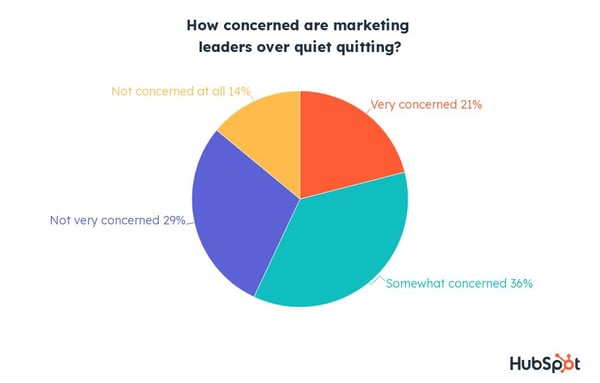
Regardless of where the true number lies, 57% of marketing leaders are concerned about this phenomenon and 66% have explicitly discussed how to address it with their leadership team.

when asked, "how concerned are you about quiet quitting" 14% said not concerned at all, 29% said not very concerned, 36% said somewhat concerned and 21% said very concerned

What Marketing Leaders Think about Quiet Quitters

It’s fair to say that marketers leaders aren’t fond of quiet quitting – 77% of those surveyed say it’s “unacceptable.”

Despite studies suggesting that quiet quitting is a reaction to bad management, that’s now how most marketing leaders see it.

64% of those surveyed believe quiet quitting is a reflection of poor work ethic, while one-third of respondents view it as setting healthy boundaries.

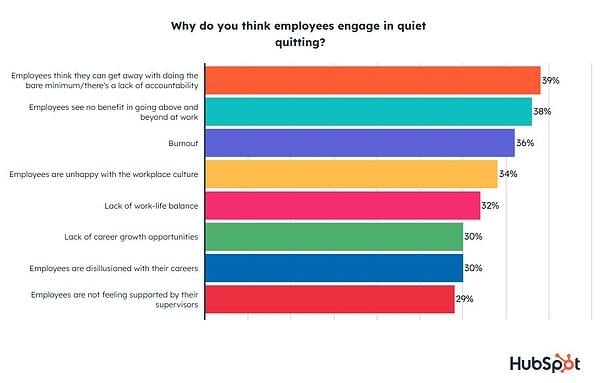
Graphic displaying survey answers to the question "why do you think employees engage in quiet quitting?"

When asked why they believe employees engage in quiet quitting, 39% of respondents placed the blame on employees and say it’s due to a lack of accountability.

  • 38% said employees see no benefit in going above and beyond at work.
  • 36% said burnout.
  • 34% said employees are unhappy with the workplace culture.
  • 32% said lack of work-life balance.

Our Consumer Trends survey does suggest that burnout and workplace culture play a major role in job satisfaction.

The report found that of the 29% of consumers who are considering leaving their current job, 25% say the reason is burnout and 20% say they’re not happy with the workplace culture.

Now that we know how marketers leaders view both quiet quitting and those who engage in it, let’s cover what they plan to do about it.

How Marketing Leaders Plan to Address Quiet Quitting

Although most marketing leaders believe quiet quitting is a reflection of the employee rather than the employer, 77% admit that it’s their responsibility to prevent it.

Where do you start? Well, 73% believe the determining factor in an employee’s desire to quiet quit is their relationship with their supervisor.

This theory was supported by a Harvard Business Review workplace study, which found that managers who were successful in managing employee and business needs had the highest percentage of employees willing to go the extra mile for the company.

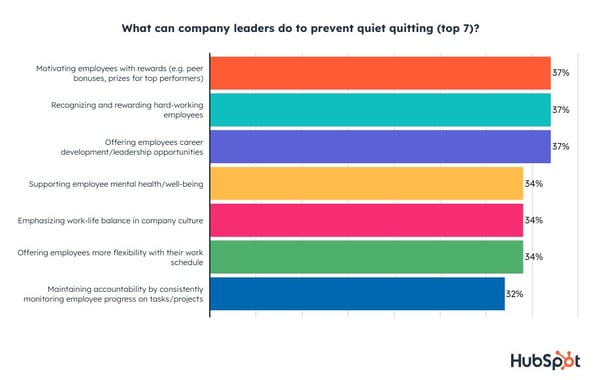
In addition, 37% of company leaders believe motivating employees with rewards is a way to prevent quiet quitting.

Other measures included:

  • Employee recognition
  • Work-life balance
  • Mental health and wellness support
  • Accountability
  • Work culture improvement
  • Career growth opportunity
  • Remote work
  • Management training

Based on responses from both employees and leaders, it’s clear there’s a disconnect regarding who’s to blame for quiet quitting along with how common it is.

Leaders are looking at employees and vice versa. The one area there is some overlap is when it comes to addressing it.

Marketing leaders agree that they should take an active role in preventing it and their solutions seem to align with what employees are looking for.

It’s unclear how this phenomenon will evolve but one thing’s for sure: Leaders will have to take accountability if they want to prevent this issue they deem so unacceptable.

New Call-to-action

Categories B2B

How Recession News has Impacted Consumer Spending [Data]

If you’ve watched the news recently, it seems that the possibility of a recession has captured everyone’s attention.

Americans have already seen signs like the inflation of rent, gas prices, groceries, and other necessities that pre-existing wages can’t meet. But, still, some experts say that we could still avert a recession – and if we don’t – a recession might not last as long as 2008’s.

With all these changes and news bites in mind, business decision-makers might wonder how their potential customers are reacting. And, if their spending habits could be changing in the near future as a result?

Download Now: 2022 State of U.S. Consumer Trends Report

While we don’t know if we’ll head into a recession, this post aims to help brands and marketers prepare to continue to meet consumers where they are – even in uncertain times.

To give readers insight on how spending behaviors are or could be shifting, we surveyed more than 200 U.S. consumers across all age groups once in the summer of 2022 and again the following winter.

Before we dive in, we’ll briefly explain the concept of a recession:

Recessions are a normal part of the business cycle and can be induced by global economic shocks, changes in consumer confidence, and other large-scale economic changes.

But this year, in particular, there are a select few factors that have spurred concern about a potential recession, although one still hasn’t been declared or confirmed.

For more on the cause of recessions and why some are concerned about them happening in the near future, check out this helpful post from our partners at The Hustle.

Are We in a Recession?

According to multiple sources, including Forbes, we are not currently in a recession.

“The current economic indicators of a recession have yet to appear,” one Forbes article said.

Forbes went on to say there is still concern that a recession is expected in 2023. While we may not be in a recession right now, many consumers are considering changing their spending habits just in case.

How Consumer Spending Habits Could be Changing Today [Data]

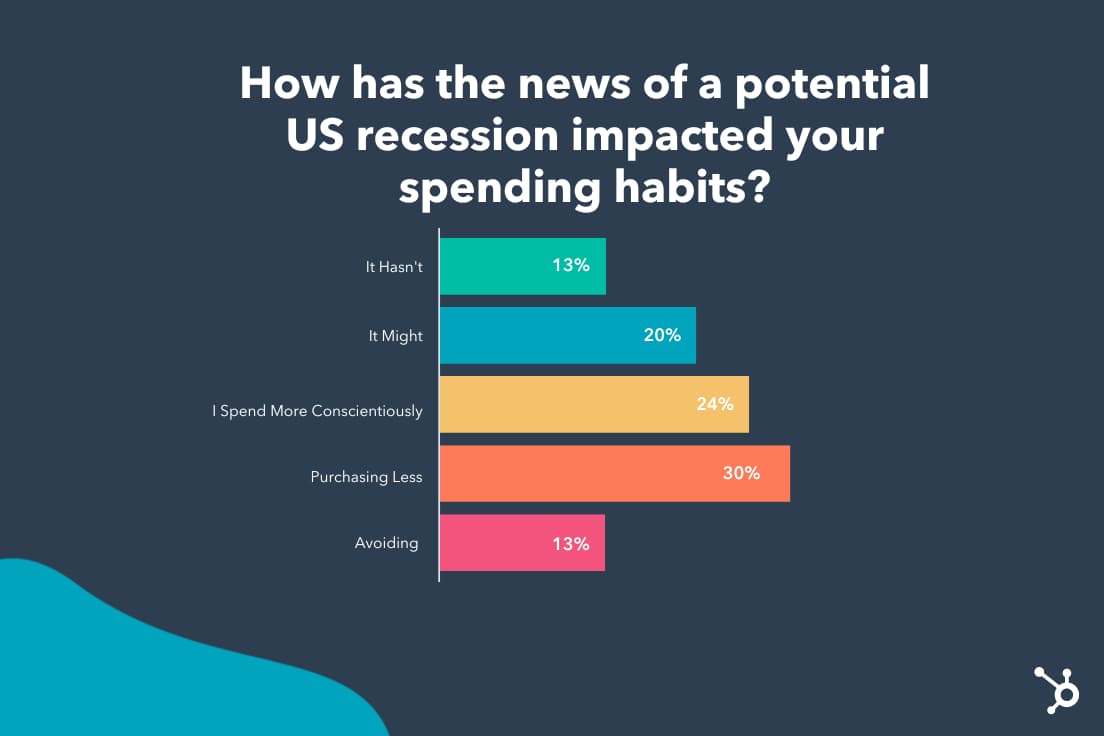
1. How has the news of a potential US recession impacted your spending habits?

When we asked this question in the summer of 2022, we found that most respondents (30%) were purchasing less and spending money more concisely than they were in previous months (28%).

how how has the potential us recession impacted your spending habits new survey data: majority spending less

When we posed the same question again the following winter, we found that 30% of respondents said they were making very few purchases because of the potential recession, and 24% said they are spending money more conscientiously than they have in previous months.

We also noticed that the number of respondents who said news of a potential recession might impact their spending rose from 13% to 20% between summer and winter. The number of respondents who said the new hasn’t impacted their spending also dropped from 17% to 13%.

Copy of LinkedIn - Graph - 1104 x 736 (7)

Rising costs of goods and services often cause consumers to become more cautious in frivolous spending, and we’re sure Americans are feeling the effects arise quickly.

As a marketer or brand leader, now might be a good time to consider discounts, sales, deals, or freemium marketing. While people are potentially tightening their wallets, they still might purchase items, services, or experiences that are affordable or provide bang for their buck.

How Spending Could Change In a Recession

When thinking about consumer spending behavior, it’s often contingent on outside factors, and news of immense changes in the economy is worth looking into. Below is the distribution of varying consumer decisions and how they’d respond to financial uncertainty or a potential recession in the future.

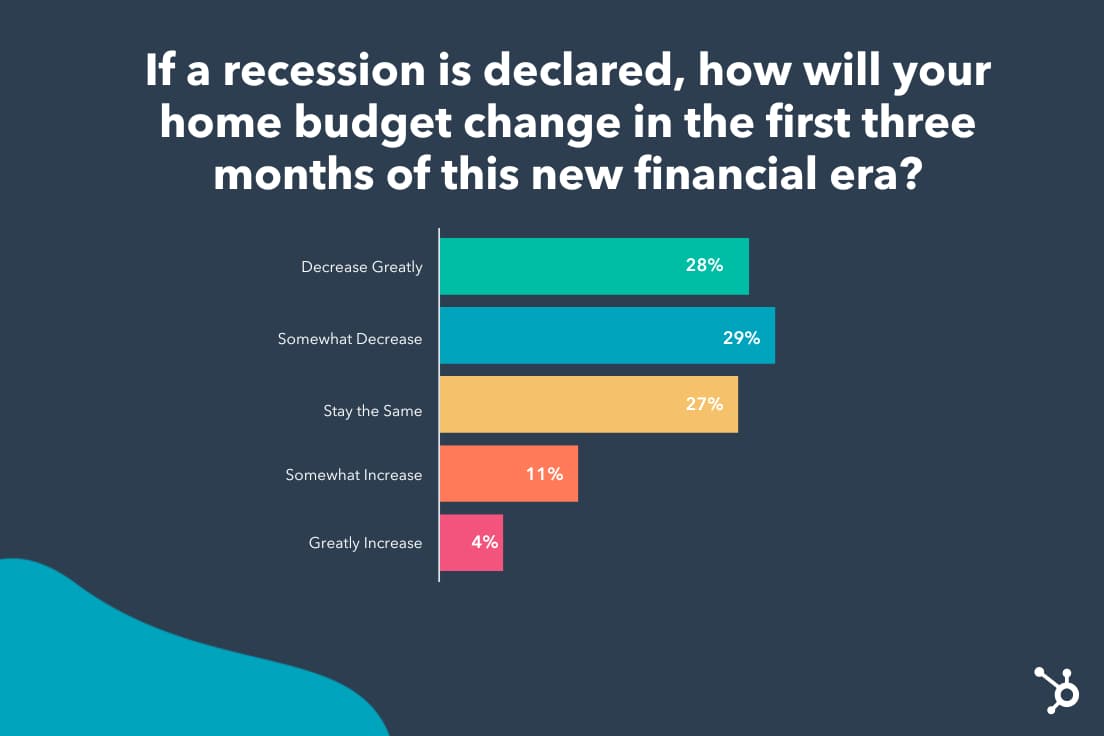
2. If a recession is declared, how will your home budget change in the first three months of this new financial era?

Unsurprisingly, most consumers polled in the summer (64%) said they’d decrease or continue to decrease their home budget if a recession was declared.

how could spending change due to recession: majority will somewhat decrease their home budget

By winter, that percentage dropped to 57%; however, only 27% said their budget would stay the same and only 15% said it would increase at all.

Copy of LinkedIn - Graph - 1104 x 736 (8)

As of November 2022, inflation hit 7.1%, but, wages aren’t moving to match these changes. Naturally, the public is already looking for ways to avoid breaking the bank — by reducing their budgets.

If you market B2C brands or products that would be used specifically in the home, this is important to keep in mind if financial uncertainty continues. While you shouldn’t panic and change your whole marketing strategy over just one small survey, you might want to consider strategies like marketing your most affordable, discounted, or essential products over higher-priced or luxury items.

3. During uncertain financial times, what did you spend the most money on?

We also asked consumers to reflect on their purchasing behavior in previous economic eras with the question, “During uncertain financial times (such as past recessions or during the COVID-19 pandemic), what did you spend the most money on?”

during uncertain financial times survey polling indicates that consumers spend money on basic necessities and less on pleasure

When surveyed in both the summer and winter, the most prominent goods consumers have bought in uncertain times are typically considered basic necessities.

  • Essential Groceries and Food
  • Rent, Mortgage, Housing Bills
  • Essential Personal Care Products
  • Medication and Healthcare

The data reflects a shift to self-preservation and less on shopping for pleasure or taking on risks comes as no surprise. By eliminating costs for leisure or entertainment, people can ensure their families are taken care of before taking their dollar to do things like start a business, take a stroll to the movies, or invest in an unpredictable market.

The good news? This doesn’t necessarily mean a complete pause in retail, entertainment, or other non-essential services. Almost 10% still plan to invest in digital or online entertainment, around 9% would still invest in restaurants and bar outings – as well as education and academics, and over 16% would invest in clothing and apparel, So, unlike the pandemic, we probably won’t see entire economies close up completely for months at a time.

How an Upcoming Recession Could Differ from 2008

There are key differences between this recession and 2008, mainly in the factors that caused it and its projected duration.

According to Morgan Stanley, the possible recession would be largely pandemic-induced and credit-driven.

COVID-related fiscal and monetary stimulus contributed to inflation and drove speculation in financial assets. This is very different from the Great Recession of 2008.

The 2008 recession was due to debt-related excesses built up in housing infrastructure, which took the economy nearly a decade to absorb. By contrast, excess liquidity, not debt, is the most likely catalyst for a recession today.

Due to the difference in causes, experts at IMF predict a new recession could be short and shallow.

With that said, 58% of respondents said their spending habits would be the same as they were during previous uncertain times such as COVID-19, the 2008 recession, or times of person financial uncertainty.

Key Takeaways for Businesses in 2022

As marketers, we’re not experts in financial markets and shouldn’t be seen as a source for investment, HR, and legal advice. And no one ever knows for certain if or when there will be a recession.

It’s also to keep in mind that while the results above can certainly help you navigate how to market your brand, they’re just a portion of one small survey and a brief look into the eyes of consumers. Before making any major decisions about your marketing department, spend, or business, you absolutely should do your research, analyze multiple data points, and consult experts in your industry.

While your decisions should be based on a deep dive of data, the survey results above do show that marketers should be cautious about how their efforts might need to pivot with changing consumer needs or trends.

Here are a few takeaways to keep in mind.

  • A recession today might not be the same as 2008. While consumers likely will tighten budgets and look for products that offer the most value or necessity for their dollar, they might not be in detrimental financial conditions. They could still be persuaded to buy a great product that’s marketed to them in the coming months.
  • Market your product’s affordability, value, and/or necessity: As consumers and businesses tighten their budgets, making sales, retaining customers, and persuading people to buy non-essential products will be more difficult. Make sure you are marketing that your product has added value or importance, other than being flashy, trendy, or cool.
  • Marketers might want to explore more cost-effective strategies. (Think reducing excess ad spend and focusing on organic social, SEO, or email marketing instead.)

Remember, financial uncertainties – and even recessions – are common. And while it might become more challenging to win customers in the coming months, business and consumers will still keep moving (and making purchases) even as we wait for the cycle to run its course.

New Call-to-action

Categories B2B

10+ Ways to Increase Your Productivity At Work & At Home

When you’re trying to meet personal and/or professional goals, one of the first things you evaluate is your productivity.

Download our complete productivity guide here for more tips on improving your  productivity at work.

Are you managing your time well? Are you checking off items on your to-do list? Or do you find yourself falling behind? If so, this article’s for you.

Discover low-effort ways to boost your productivity – whether you’re working from home or heading to the office.

  • How to Increase Productivity at Work
    • Figure out your productivity patterns.
    • Don’t multitask.
    • Be accountable.
    • Break up large tasks.
    • Block off your calendar.
    • Use productivity apps.
  • Ways to Increase Productivity at Home
    • Limit distractions.
    • Stick to a routine.
    • Prioritize breaks.
    • Set up your environment.
    • Have a designated workspace.

How to Increase Productivity at Work

1. Figure out your productivity patterns.

Just because the average work day is between 8 a.m. and 5 p.m. doesn’t mean those are the hours in which you do your best work.

Some of us focus best in the early morning before the sun is even up and some of us are night owls.

The first thing you should do when working on your productivity is first to observe yourself – specifically when you get the most or least done. Because some days are naturally more hectic than others, do this over a period of a week.

Identifying these ‘sweet spot’ days and hours will enable you to plan your day better and perform tasks faster without compromising on quality or accuracy.

For instance, I’ve designed my Mondays to include low-effort tasks because I tend to be in and out of meetings. This makes it hard to get anything done that requires intense focus. As a result, I schedule tasks that are short and quick.

Tuesdays, on the other hand, are very quiet and I do my best work between 10 a.m. and 1 p.m. With that in mind, I get my heavier tasks done like research and writing.

Once you’re aware of which hours you work most efficiently, you can allocate projects accordingly and use that time for difficult tasks.

Many of us think we’re lazy or unproductive when the truth is, we’re not listening to our bodies. Identifying which parts of the day bring out the best in you is likely the key to increased motivation and effectiveness on the job.

Once you do that, all that’s left to do is adjust your schedule accordingly.

2. Don’t multitask.

It seems like we all got a memo as young adults that multitasking was peak productivity. Turns out, it’s not. In fact, recent studies suggest that attempting to multitask will actually hinder your productivity.

Although switching back and forth between multiple tasks may seem quicker, it ends up taking longer because the mind can only focus on one activity at a time. As such, your brain ends up doing double the work to refocus on each task.

Ever have a conversation with a friend but then get realize you didn’t register something they said because you got distracted? With multitasking, you may not realize it and end up making mistakes.

Your best bet is to focus your energy and attention on one task at a time. You’ll clear out distractions and allow your mind to be more present.

You will find that giving yourself enough that space leads to much faster completion times and higher quality work overall.

3. Be accountable.

Accountability can be a major productivity driver for both personal and professional goals. They often remind you of your “why” and serve as motivation to keep going.

At work, that accountability will have to be self-imposed, unless you have a co-worker or a team you can depend on for this.

Being accountable looks like this:

  • Blocking out times on your calendar to get specific tasks done.
  • Putting a 1-hour timer on to complete a task.
  • Scheduling a reminder.
  • Setting deadlines, even if your task or project doesn’t require it.

If you work from home, having an accountability partner can be especially helpful. Maybe your team gets together on Mondays for an hour to work together via Zoom, even if it’s in silence.

Or you could meet with your co-worker once a week to give each other progress reports on upcoming projects.

Whether it’s personal or shared, accountability can significantly increase your productivity.

4. Break up large tasks.

Imagine you have a high-impact project due in a few weeks. Every time you think about it, you picture the project as a whole and how far away you are from completion. That’s a recipe for disaster.

To remain productive, it’s essential that you break up your tasks into bite-size, actionable chunks. This will decrease (or remove) the anxiety often associated with the work itself and enable you to stay motivated as you reach important milestones.

5. Block off your calendar.

There’s nothing more frustrating than attempting to get in the zone but being interrupted by a last-minute meeting or a Teams notification.

One way to protect your time is by blocking out your calendar during set times to tackle your to-do list. This will create necessary boundaries to avoid interruptions while also setting expectations for your colleagues on when you’ll be available.

If they ping you during this time, don’t feel obligated to respond immediately.

Better yet, turn on the “Do Not Disturb” feature on your group messaging application to indicate you’re unavailable.

Most of the strategies for increased productivity require you to take a proactive approach, rather than a reactive one. And this is one where the benefits are immediately clear.

6. Use productivity apps.

If all other techniques fail, there’s likely an app to help you increase your productivity.

Productivity apps will range in purpose and function. Some focus on time management while others zero in on the organization. Here are a few top options:

  • Toggl – A timer to use when using the Pomodoro focus method and when tracking how much time each task takes to complete.
  • Notion – A digital workspace to store your documents, to-do lists, and more.
  • Mindfulness – An app to use during your breaks to recalibrate.

Ways to Increase Productivity at Home

1. Limit distractions.

Distractions can be a major obstacle to productivity at work, which is why it’s so important to limit them as much as possible.

When you read this, you might be thinking about things like social media and the TV. Those are bad too but there are some unsuspecting distractions to consider.

The first is roommates – whether they’re talking directly to you or in the background, they’re hard to ignore. If you can, make sure you isolate yourself during your most productive hours to ensure you can get your work done.

Pro-tip: If separation is not possible, put on headphones to block out the noise.

Next is your pet(s). Sure, they’re fluffy and adorable but when they’re having zoomies or begging for attention, that can quickly become disruptive.

Lastly, your cellphone. It’s likely what you’re reaching for any time you look away from your computer but it’s also what will keep you from going back.

One way to avoid this is by placing your phone outside of your workspace. If you’re worried about missing calls, put on your loud ringer to ensure you hear your calls.

Keeping distractions to a minimum can do wonders for your productivity, as they’re little time sucks you often don’t account for.

2. Stick to a routine.

When I operate outside of my normal routine, that’s when my productivity is at its lowest.

That’s because the mind loves what’s familiar. From the time you get up to the music you listen to at your desk, every step in your routine serves as cues for your behavior.

So, when you fail to maintain a consistent routine, it can be difficult to focus and be productive.

A routine can look like this:

  • Starting and ending work at the same time every day.
  • Having a designated work space.
  • Taking breaks every two hours.
  • Associating each work day with a set of tasks. E.g. Mondays for meetings, Tuesdays for writing, and Wednesdays for analytics.
  • Listening to music when completing certain tasks.

3. Prioritize breaks.

To keep productivity levels high at home, taking regular breaks is key.

In an office, breaks are embedded into the environment. You might stop to chat with co-workers or get up to grab snacks or coffee. At home, you have to structure your breaks or you run the risk of burning yourself out.

Stepping away from your desk – even for just five minutes – serves as a reset, a brain refresher that will actually help you stay focused throughout the day.

In addition, a break doesn’t have to look like a food break. It can be:

  • Taking a walk
  • Sitting outside
  • Doing breathing exercises
  • Working out
  • Stretching
  • Journaling

Unlike doom scrolling, these activities are considered energy boosters that will help you stay productive during work hours.

4. Set up your environment.

Just as your routine serves as a cue for your productivity, so will your environment. As such, it’s important that you set yourself up for success in this area.

Start by organizing your desk to keep it neat. Though it will likely get messy throughout the day, make sure you end each work day by tidying up for the next day. Think of it as a small investment into the future you.

Music can also be a great cue to start your work day. My personal favorite is my Cafe con Leche Spotify playlist. It’s soothing but upbeat and indicates that it’s heads-down work time.

Whether it’s jazz or Dembow, music can be a huge productivity booster if you use it wisely.

5. Have a designated workspace.

Working from home has become a long-term reality for many, but the change of scenery can be difficult if you don’t take the time to establish an effective workspace.

Having a designated area set up specifically for work will help keep you focused and organized. It will also provide a physical and mental barrier between home life and business – which is essential when trying to remain productive.

Being able to switch into ‘work mode’ as soon as you sit down at your desk or table can enable you to get into the right mindset for achieving your goals.

Once in place, having a designated workplace is sure to make it easier to stay focused on your work while still enjoying the benefits of taking it on remotely.

Follow these tips and you’ll be on your way to becoming a productivity powerhouse.

Take me to Projects

Categories B2B

Employer Branding: What It Is and How To Build It for Your Business

A company’s reputation matters more than ever during a job seeker’s search, as 86% of workers would not apply for, or continue to work for, a company with a bad reputation with former employees or the general public.

Ultimately, you spend plenty of time creating a compelling brand story surrounding your products or services, but how do you build a strong employer brand that attracts top talent? Here, we’ll explore what employer branding means, examples of good employer branding, and how you can implement your employer branding strategy today.

Table of Contents: 

Download Now: Free Company Culture Code Template

What Is Employer Branding?

Employer branding is the reputation you have as an employer among your employees and the workforce. It’s also how you market your company to job seekers and internal employees. 

The better you are at employer branding, the more likely you are to retain and attract your top talent, as 69% of surveyed employees think it’s extremely/very important that their employer has a brand they’re proud to support.

Let’s say you’ve done a phenomenal job building up a strong brand with your products or services. Unfortunately, that alone won’t convince someone to work at, or stay at, your company. You need to implement the same branding strategy when communicating your company’s leadership, values, and culture.

If a job seeker asks an employee at your company, “What’s it like to work there?” the employee isn’t going to say, “We’ve built some awesome merchandise.” Instead, he’s going to lay into the day-to-day of people management, company values, and workplace culture. To ensure a good employer brand, you need to tell a compelling story.

Employer branding goes deeper than storytelling — you also need to walk the walk. Telling your employees and the general public that having a ping-pong table makes you a great place to work isn’t going to cut it. 

Why Is Employer Branding Important?

At this point, you might be wondering, does this really matter to me and my company? 

Yes — employer branding is critical to your bottom-line. It can reduce turnover rates and cut your costs per hire in half, helping you save money. Additionally, active job seekers are more likely to apply for a job if the employer actively manages its employer brand

You have an employer brand whether you’ve put effort behind it or not — so why not put effort in to ensure it’s a brand you can be proud of?

Next, let’s explore how you can implement an employer brand strategy today.

A good employer branding strategy can help you attract better talent, cut down on hiring costs, and reduce employee turnover.

1. Know your company’s unique value proposition.

A powerful employer brand begins by focusing on your company’s mission statement, values, vision, and culture. It can be helpful to identify what your business needs are and work backward to understand the type of talent you need to fulfill those objectives. 

For instance, consider Teach for America’s mission statement — “One day, all children in this nation will have the opportunity to attain an excellent education.”

With this statement, Teach for America can tell a compelling brand employer story on their Values page, where they promise employees the chance for continuous learning, stating, “We operate with curiosity and embrace new ideas to innovate and constantly improve. We take informed risks and learn from successes, setbacks, and each other.”

In this way, they’ve aligned their values, and their employer brand, with their business goal.

2. Conduct an employer brand audit.

You might not be fully aware of your company’s reputation among job seekers, or even your employees. 

Conduct a brand audit and send out internal surveys, conduct social media searches, monitor career sites for reviews, or hire a firm that monitors reputations. Your research should help you uncover your employee’s favorite aspects of your company culture that you can focus on highlighting and any areas for improvement to ensure a strong employer brand. 

Glassdoor found that brands with above-average or leading employer brands devote time to monitoring employee engagement, take action on employee feedback, and keep an eye on brand health, more than average or below-average employer brands. 

3. Write an employer value proposition.

Once you’ve researched, cultivated a list of business values, and learned about your existing perceptions, you’ll want to create an employer value proposition. 

An employer value proposition is a marketing message and a promise, so say things that are factually true about your business that your employees would agree with. You can use this value proposition on your website, recruitment materials, or LinkedIn Company Page, and recruiters and HR teams can discuss it with potential candidates. 

It’s important to note that your value proposition should have nothing to do with compensation. Instead, you want it to evoke passion in employees and potential candidates by expressing your company’s deeper purpose and positive impact on the world. People want to feel their work is meaningful, often even at the expense of a bigger paycheck

For instance, Accenture’s employer value proposition is prominently displayed on its Careers page:  “Every day our People of Change are doing incredible things by working together to pursue our shared purpose–to deliver on the promise of technology and human ingenuity. Come be part of our team–bring your ideas, ingenuity and determination to make a difference, and we’ll solve some of the world’s biggest challenges.”

4. Leverage current employees.

Job seekers that want to learn more about your employer brand want to hear from and see real employees at your company. In fact, your employees are three times more credible than CEOs when talking about the working conditions at your company. So, your employees are some of your best advocates for building your employer brand. 

Leverage their sentiment towards your business however you can, like sharing reviews and testimonials on your hiring pages or creating short interview videos for your social media channels. 90% of companies with leading and above-average employer brands agree that their employee experience is a big part of their brand, meaning that what they say can significantly impact perception.

5. Cultivate a strong onboarding process.

Onboarding is a new hire’s first experience, and a negative impression can have big consequences. In fact, people who have a negative onboarding experience are twice as likely to seek a different opportunity.

Ultimately, instilling a positive company brand image starts with a good onboarding process. Getting employees engaged and excited about their roles and their teams is important from the start. You’re ensuring a smooth transition, lower turnover rates, and more productive teams by arming your new employees with the instructions and tools to excel in their roles.

6. Offer learning and development opportunities.

A large reason why people quit and leave their jobs is that they’re bored and need a new challenge. Ultimately, this should be a relatively easy fix. 

Giving employees the opportunity to pursue learning opportunities and become proficient in new skills shows your commitment to on-the-job learning and professional development. And by challenging your employees, you’re ensuring they won’t get bored in their roles — which could lead to higher retention rates. 

Plus, as they develop new skills, they become more valuable employees for your company. A win, win.

7. Use videos, blog posts, photos, and slideshows to tell your company story.

When implementing a strategy to improve the market’s perception of your brand, use multiple channels. Share videos, photos, slideshows, blogs, and other forms of messaging to ensure you reach a large group of audiences on the platforms they already use. 

Similarly, it’s critical you use high-quality videos, photos, and text to tell your company story. You might consider putting employee interviews on your job page or a slideshare created by your CEO on your About Us page.

8. Create a strong diversity and inclusion initiative.

A pillar of a strong employer brand is a continuous commitment to building diverse and inclusive teams. 

There are plenty of benefits to this, most significantly being that all your employees will feel like they belong and are safe at work. People who feel seen, recognized, and respected among their colleagues are more likely to bring their best selves to work and commit to their day-to-day tasks. Plus, a McKinsey study found that companies that are more diverse and inclusive are more profitable. 

A commitment to DI&B ensures you’re extending your brand’s reach to everyone, especially considering that 3 out of 4 candidates say a diverse workforce is an essential factor when evaluating companies and job offers. If someone can see themselves in the people who already work at your company, they might be more inclined to apply.

9. Be transparent, honest, and genuine. 

One of the most important factors in developing an employer brand is honesty, transparency, and being genuine. 

Don’t ask for employee feedback because you want to hear the positives to share on your career pages. Negative feedback can also help you learn about areas for improvement, and making changes can help you meet more of your employees’ needs. In turn, satisfied employees have higher retention rates and are more likely to promote your business and boast about the culture they’re happy to be part of. 

The same goes for job seekers and the general public. Making false statements and promises about your values, culture, and happenings will come back to haunt you if your conditions are too good to be true, like if prospects accept job offers based on promises you don’t fulfill. 

Be genuine and honest in your efforts, and commit to building a culture exactly as it seems — doing the opposite can cause more harm than good.

1. Starbucks

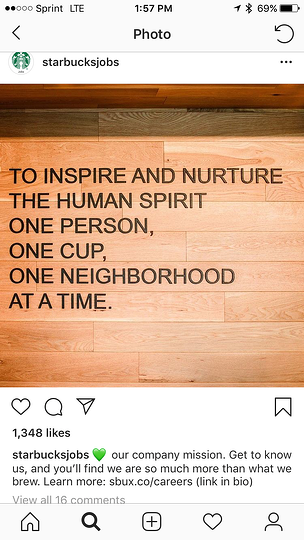
Starbucks works to cultivate a strong community among its employees. For instance, it refers to current employees as partners, instilling a sense of pride, and has Instagram and Twitter accounts (@StarbucksJobs) to promote its employer brand and interact with job seekers.

By creating social media accounts to demonstrate appreciation for current employees and evoke passion in potential candidates, Starbucks shows its commitment to being more than just a product. The company also uses the platforms to demonstrate its commitment to diversity and inclusion.


Photo of Starbucks employer brand on InstagramPhoto of Starbucks employer brand on Instagram

2. HubSpot

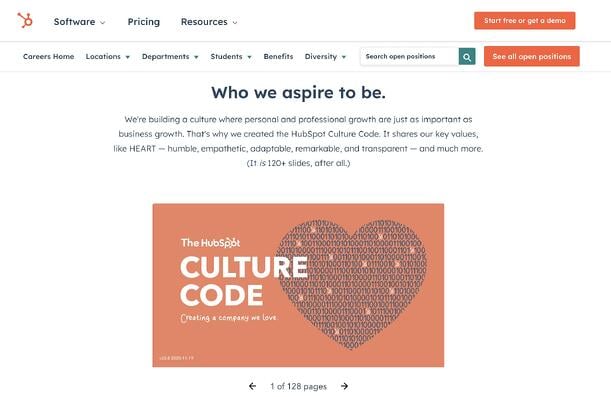
HubSpot’s Culture Page features something called the Culture Code, which publicly shares every vision and value HubSpot hopes to promote and instill in employees, candidates, and customers. 

employer branding examples: hubspot

Further down the page, you’ll learn more about opportunities for learning and development, HubSpot’s commitment to diversity and inclusion, and insight and reviews from real employees. The language also consistently focuses on the job seeker: “Picture yourself at HubSpot.” 

3. Wistia

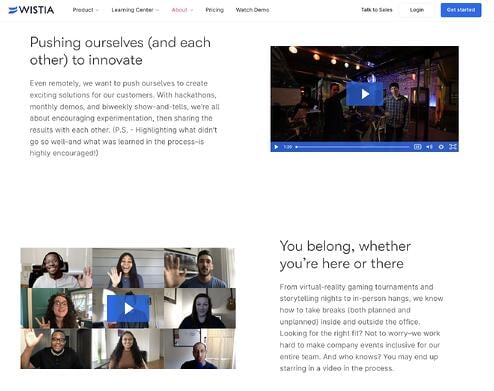
For consumers, Wistia brands itself as a video marketing software that helps grow audiences and build brands. It only makes sense that it would be brand-conscious and use its software to underscore the ideas they want to convey to job seekers. 

Rather than brag about how great a workplace they are, the first message on its Careers page encourages job candidates: “We’ve got big plans — and they include you!” They continue to underscore that idea with multiple videos about the people who make up the company and the culture they instill.

employer branding examples: wistia

4. SoulCycle

SoulCycle aims to transform traditional corporate culture by offering benefits that evoke a sense of purpose and belonging to each employee. 

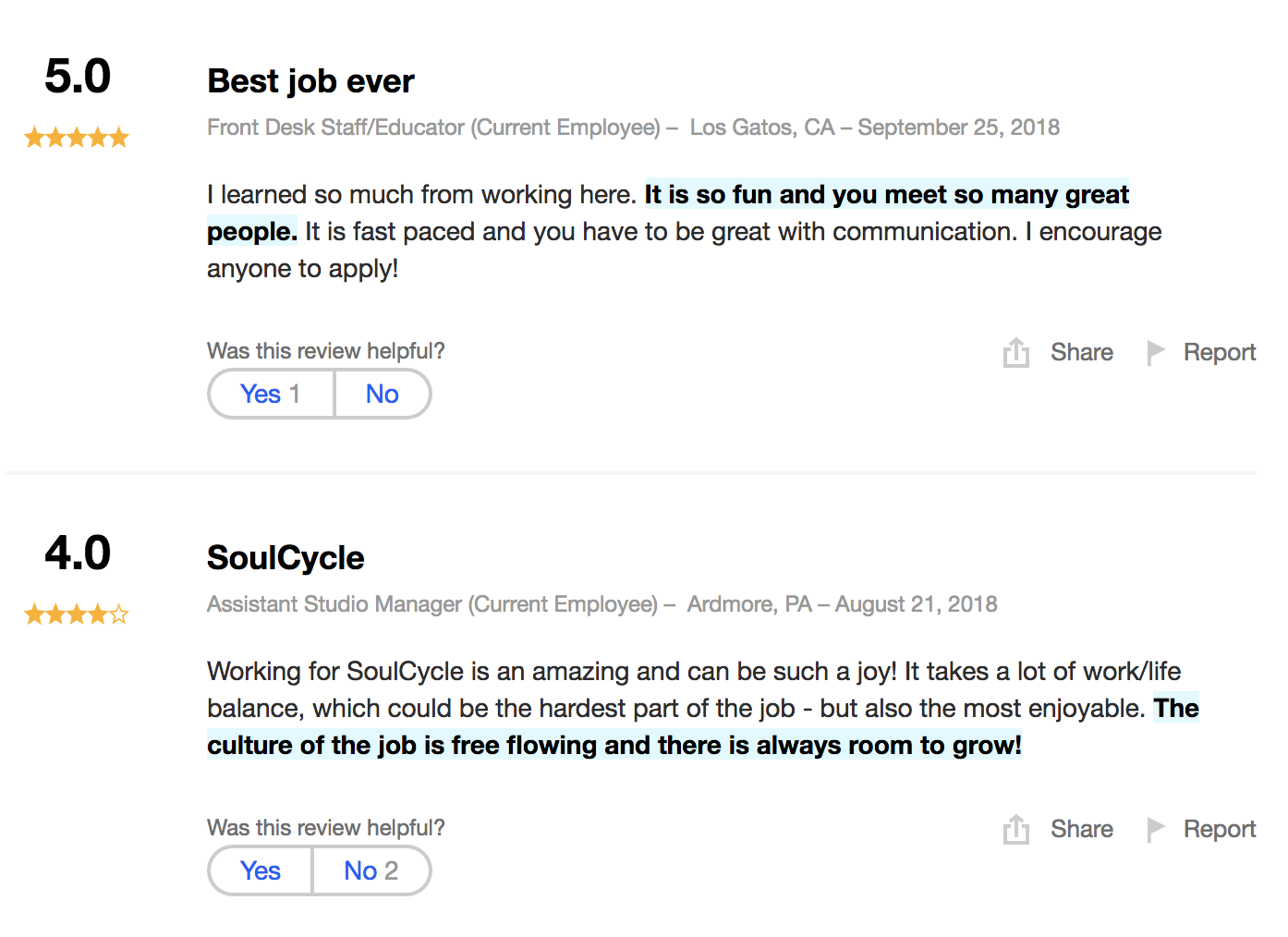
For instance, Soul gives its employees two paid business days off per year to volunteer at a charity of their choice with the hope that the charity days will help employees feel happy and more fulfilled. Additionally, employees can take classes for free at any time that suits their schedule. This displays Soul’s deeper commitment to making fitness fun and using exercise to de-stress and connect with the community.

With high ratings on Indeed, SoulCycle has undoubtedly cultivated a strong employer brand.SoulCycle testimonials showing happy employees who enjoy the brand

5. Canva

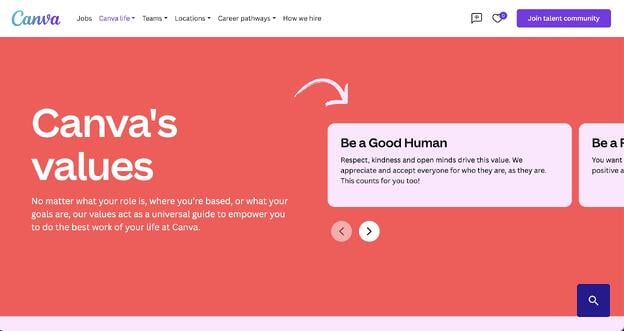
Canva’s employer brand stands out because of its commitment to its mission. Its Careers page highlights its values for job seekers in an interactive carousel and pairs each value with key facts, underscoring the idea that design can be a force for good. 

employer branding examples: canva

Canva also doubles down on this idea on its social media channels, which are full of inspirational content and ideas furthered by design.

6. Eventbrite

To demonstrate its commitment to recruiting high-quality talent, Eventbrite created a web page to introduce job seekers to its recruitment team. The bios are funny and relatable with fun facts about each recruiter.

Additionally, the Eventbrite recruitment team page states, “Interviewing shouldn’t be nerve-wracking —– it should be exciting. It should spark great conversation. We believe in respect, transparency, and timely responses (we don’t leave anyone in the dreaded recruiting black hole).”

Its language reflects their values, likely inspiring job seekers to apply.

Image of Eventbrite's Careers page showcasing team

7. Jet

The ecommerce site Jet created this inspirational, employee-focused video to spread awareness for its fun, engaging, motivational workplace. The video is especially powerful because it uses real employee interviews, giving the job seeker a sense for Jet’s work culture and values.

Additionally, the video is likely empowering and pride-evoking for current employees, who can see their company’s clear commitment to carrying out its mission statement through videos of its workers.

8. Shopify

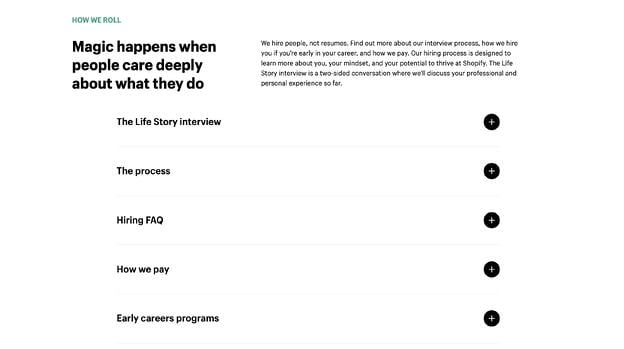
It can be challenging to find qualified applications to fill tech jobs. For many companies, their leverage is having an incredible employer brand and great perks to attract top talent. Companies can take a cue from Shopify, where it recognizes this and tell job seekers that it’s its turn to apply to you.

This acknowledgment is one step toward earning rapport with a potential candidate, and they continue to empathize with the reader by stating that finding the right job and fit is hard work.  The rest of its careers page provides all the information someone would need to take a chance and apply to Shopify. 

employer branding examples: shopify

Each one of the examples on this list has in some way shown their empathy, a human element, and a slice of their culture to begin attracting great employees. Human capital is your biggest investment and asset, but remember that your candidates are also investing in you.

company culture template

Categories B2B

How to be a Great Coworker: 16 Tips and Tricks from HubSpot Insiders

If you work 40 hours a week, 52 weeks a year, that’s over 2,000 hours a year spent with the same coworkers (give or take a vacation or two, of course). Therefore, if it isn’t already your top priority, being a great coworker definitely should be.

→ Click here to download leadership lessons from HubSpot founder, Dharmesh  Shah [Free Guide].

Strong relationships are the foundation of a positive work environment and set the tone for nearly your entire work life. Even if you hate how Jim blows his nose at his desk, or you cringe every time Stacy brings up her cats, these people greatly influence your work day-to-day.

The bottom line is that collaboration and connection will get you much farther than you may think. (Trust us! Hubspot has been named #1 for happiest employees and #2 for best place to work.) For our exclusive insider tips, keep reading.

1. Appreciate and acknowledge.

When people feel unappreciated in the workplace, it becomes increasingly difficult for them to see the benefit of going that extra mile. With no recognition, there’s little motivation to continue.

That’s where you come in. Whether you’re a manager or just a grateful peer, make an effort to give credit.

Taking time in a meeting to give kudos, writing an email, or sending a Slack message takes minutes. However, this gesture can make someone’s entire day.

“As an intern, I assumed I would mostly go unnoticed and fly under the radar in my day-to-day work. However, this summer, I never felt so uplifted and praised for the hard work I was contributing to my team,” says one incoming HubSpot marketing associate and summer 2022 marketing intern. “Even my out-of-office accomplishments were recognized!”

2. Respond to emails or calls promptly.

Everyone has a job to do. And if your approval or feedback is required for one of your coworkers to move the needle on a project, don’t make them wait.

Bottlenecking a project is not only frustrating, but it can also have a significant impact on a person’s ability to reach team or company-wide goals.

Pro tip: If you’re unsure whether or not you’re guilty of this, ask your teammates to specify a time frame within the body of their emails to help you keep track of priorities.

If you don’t have time to respond immediately, one HubSpotter suggests shooting them a quick ‘I’m held up right now, but I’ll look this over this afternoon or tomorrow’ message.”

3. Be reliable.

Outside of prompt email responses, being reliable overall will go a long way. Your coworkers want to know they can trust you to complete assignments, offer support, and provide assistance during tough times.

Reliability not only improves your relationships. You’ll also play an important role in pushing projects across the finish line.

“To me, a great coworker is a reliable coworker, someone I know will get things done one time and with great execution,” says Jamie Juviler, a marketing manager at HubSpot. “That’s especially important in projects with many stakeholders and moving parts. If everyone stays on track, things get done.”

4. Be humble.

Being humble doesn’t mean selling yourself short. Instead, humility actually shows that you have a clear perspective, and you’re self-aware. In fact, this attitude is one of HubSpot’s core values.

In an office setting, this ability to recognize your own limitations can make it easier for you to build meaningful relationships with your coworkers. You’ll also be able to ask for help when needed, which improves the quality of your work.

Pro tip: Ask your colleagues for assistance when needed. This signals to them that you’re open to other ideas. They’ll also feel comfortable reaching out to you for your expertise in the future. Sounds like a win-win!

5. Create clear documentation.

You may be great at your job, but your impact will be minimized if no one knows what you do.

Take the time to clearly document your role, how you complete these tasks, and which processes you own. A few written documents (or even bullet points) can help people understand how to work best with you.

“Whether you’re in a small or large team, taking the time for proper process, project, or training documentation will make you the ultimate team player — all while saving you some time in the long run,” says Bianca D’Agostino, a senior marketing manager and SEO strategist at HubSpot.

Documentation becomes even more important if you are at a global company with employees in different time zones.

“My teammates and I take extra time and care noting down what we know, what we’re asking of each other, and being super transparent about our timelines/goals,” D’Agostino adds. “Since our team is global and scattered across a few different time zones, this skill has made our team so much stronger!”

6. Reach out to new teammates.

New job nerves are the pits. You toss and turn the night before your big first day, worrying about everything from what shirt will look best to whether or not your fun facts actually are some semblance of fun.

Experienced workers, do your part to help new team members feel at ease. Make an effort to help them get situated during their first few days or weeks on the job.

“It’s always awkward being the ‘noob’ walking into a room of unfamiliar people, so sit next to them at their first meeting. It’s a small gesture that will make them feel all the more welcome,” suggests Anum Hussain, a former team manager at HubSpot. Today, Anum is the head of content marketing and audience growth at Reforge.

Pro tip: Ask your new teammates welcoming questions, or invite them to join you for lunch (either in-person or virtually).

7. Steer clear of gossip.

Ah, the office water cooler. Whether in an office or on a Zoom call, we all can fall victim to slipping in a cheeky comment or two.

It’s easy to get caught up in complaining about Steve’s work ethic or to gush about a suspicious relationship between two interns. However, engaging in office gossip is both risky and unprofessional. Plus, gossip can result in some pretty sticky situations.

Pro tip: Keep lines of communication open. The more transparent and honest you and your team are with one another, the less room there is for speculation.

(Want more on this? Check out this post on how to deal with office politics).

8. Avoid annoying office habits (remote or in person).

We all have quirks and idiosyncrasies. Even so, self-awareness matters, as does keeping tabs on behaviors that rub colleagues the wrong way.

So which office habits are considered annoying? In 2022, Quality Logo Products surveyed over 1,900 workers to find out. Interrupting (48%), taking credit for someone else’s work (47%), and oversharing (45%) ranked among the most annoying behaviors.
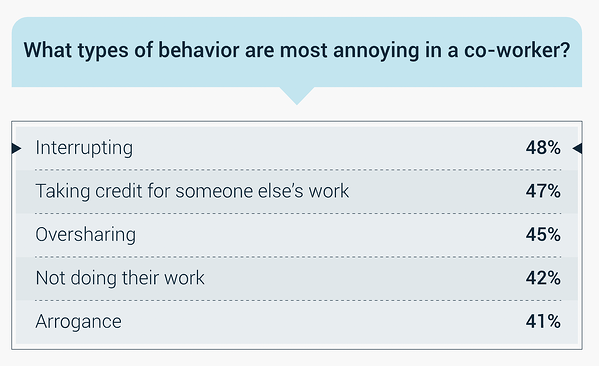
good coworker, what types of behavior are the most annoying in a co-worker? Interrupting 48%, taking credit for someone else’s work 47%, oversharing 45%, not doing their work 42%, arrogance 41%.

Image Source

Working remotely doesn’t automatically solve the problem. Quality Logo Products found that remote workers face a different set of challenges.

Slow responses to emails or instant messages ranked as the most annoying behavior in remote colleagues at 48%. Background noise during calls (47%) and eating on camera (43%) were also at the top of the list.
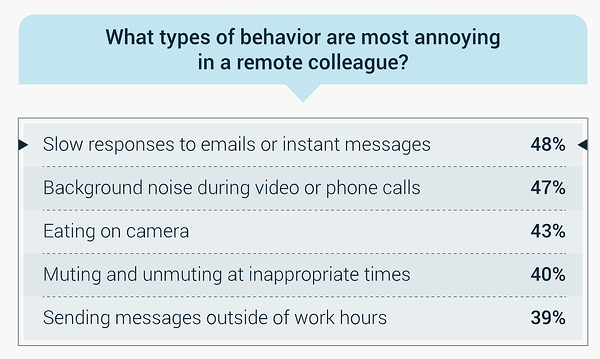
what types of behavior are most annoying in a remote colleague? Slow responses to emails or ims 48%, background noise during video or phone calls 47%, muting and unmuting at inappropriate times 40%, sending messages outside of work hours 39%

Image Source

The lesson: Be considerate of others and how you are in each space. If you share a common space such as a meeting room, be sure to clean up after yourself. If you’re on a Zoom call, be aware of your settings. These are simple tasks that truly go a long way for everyone around you.

“It took me a few weeks into my first job out of college to realize just how loud my chewing was in the roomful of quiet, concentrating people. Were my coworkers wearing headphones because they liked listening to music, or because I’d been chowing down on carrots for the last 20 minutes?” jokes Lindsay Kolowich Cox, a former marketer at HubSpot.

For more tips on how to be more considerate in the office, check out Lindsay’s article on breaking annoying office habits.

9. Share your resources.

Take a look at the people you work closely with. They’ve all been hired for a reason, right? Maybe Nathan is really great at problem-solving, while Sue can negotiate like no other. There’s something you can learn from everyone.

Regardless of our unique strengths and specific titles, sharing helpful resources can benefit your whole team.

“Find something particularly inspiring or thought-provoking? Whether it’s a blog post or intriguing design, it could be just what your neighbor needs to kickstart their big project,” insists one HubSpotter.

10. Gather feedback.

Competition hurts collaboration. Make sure your team has a psychologically safe environment where they feel encouraged to share ideas. That can include offering suggestions or pitching something entirely new.

“One of the biggest, and sometimes hardest, things you can do as a teammate is giving space to other coworkers to pitch their ideas and suggestions (even if you disagree with them),” says Pamela Bump, the manager of HubSpot’s Growth Team.

“When you work with or manage a team, it’s easy to hog the keys to the car. Because many workplaces can feel competitive, this is an instinct we all struggle to shove off.”

If you struggle with creating the space for contribution, remember that more voices can unlock new perspectives. A colleague can help you solve that problem you’ve been struggling with for months.

“Especially when building something from scratch, more voices can lead to more success,” Bump says. “By building a time or space for people to share their thoughts … you can get those great perspectives without getting overwhelmed by too much feedback.”

Pro tip: Consider building a feedback session into your meetings, holding a dedicated brainstorming workshop, or creating a collaborative Google Doc to gather ideas.

11. Be respectful of people’s time.

It’s no secret that we are all busy. Often, we wish there were more than 24 hours in a day.

While you can’t resolve these problems with the wave of a wand, you can take small steps by respecting your coworkers’ time. Be aware that 5 minutes here and 20 minutes there can add up during the day. Make an effort to show up on time and come prepared.

“If a meeting ends early, don’t try to fill the time. If a meeting doesn’t need to happen anymore, cancel it. Being respectful of people’s time is appreciated,” urges a HubSpotter.

12. Find ways to connect online.

If you work in a hybrid or remote environment, you’ll need to try a bit harder to form close connections with coworkers. Instead of being able to peer over your cubicle to say hi to neighbors, you now have to schedule in time for those casual catch-ups.

Pro tip: Set up weekly Zoom lunches, monthly team show-and-tells, or just ping a friend living across the country to grab a virtual coffee. These simple conversations go a long way, especially when it’s so easy to get caught up in heads-down work at home.

Aside from being a great excuse to socialize during the day, they provide a shared experience to look forward to while strengthening your company’s identity and culture.

13. Make valuable introductions.

Heard one of your coworkers is looking for a freelancer for the project they’re working on? If you know just the person, make a connection.

“Two networks are always better than one,” insists Eric Peters, a product lead at HubSpot.

Help your coworkers achieve their goals by making introductions between folks who would benefit from knowing each other.

Maybe you recommend a potential candidate for an open position or connect a new hire with a tenured employee to provide them with some guidance. These intros show that you’re a team player.

14. Get coworker buy-in.

If you’re running a project or initiative, make sure your coworkers feel connected toward their work. A common mission improves the culture of your team and strengthens colleague relationships.

“When you include people, try their ideas, or even just take the time to hear them out, they feel included — even if you respectfully disagree with one or two suggestions,” suggests Bump. “Involving your team will motivate them around a joint project which will be good for you and them in the long run.”

Buy-in creates a better work experience and establishes you as a trusting, empathetic colleague.

“Many will even want to work with you more often,” Bump says, “all because YOU gave them a platform to speak when others would have just micromanaged.”

15. Lighten the OOO workload.

Anytime you miss a couple of hours or days in the office — whether for personal reasons, a vacation, or an illness — it’s easy to get overwhelmed.

With this feeling in mind, act accordingly: Help your coworkers avoid this vicious cycle by stepping in to lend a helping hand when and where you can.

“Offer to help take over some of their work so they don’t come back to a pile of it and won’t worry about getting stuff done when they need to be away,” suggests Corey Wainwright, HubSpot’s former director of content.

Even if you can’t add more to your plate, remember to act with empathy and remind your colleague that they should take whatever time they need to catch up. There’s no need to make up all of the work in one day.

16. Listen.

Often, the most helpful thing you can do for a coworker is to give them a chance to talk through something. Whether it’s regarding their strategy to approach a complicated task or solely to share how much is going on in their personal lives and how they feel overwhelmed.

Active listening is a skill that will help you empathize with what your coworker is going through, even if you can’t put yourself in their shoes directly.

“I appreciate a teammate who is an active listener. I like to feel like I’m being understood and listened to during conversations, and I hope my coworkers also feel that from me,” says Flori Needle, a marketing manager at HubSpot. “I let people know that I’m listening by asking follow-up questions and being engaged during conversations, and I appreciate the same from my coworkers.”

Pro tip: Sometimes, people don’t need you to propose a solution. Instead, they just need to hear their thoughts out loud. Lending that ear can go a lot farther than you may assume.

Furthermore, these small acts of kindness help establish trust and comradery, feelings that bolster a productive and effective work environment.

This post was originally published in 2016 and has been updated for comprehensiveness.

New Call-to-action

Categories B2B

Equinox Champions the Anti-Resolution

Welcome to HubSpot Marketing News! Tap in for campaign deep dives, the latest marketing industry news, and tried-and-true insights from HubSpot’s media team. 

The beginning of January is like the Superbowl for fitness and wellness brands.

Year after year consumers set goals to form healthier habits in the new year and 2023 is no exception. According to Statista’s Top New Year’s Resolutions Survey, 52% of American adults want to exercise more, 50% hope to eat healthier, and 40% are looking to lose weight this year. 

You would think fitness brands would be going all-in to capitalize on this momentum, right? Well, upscale fitness chain Equinox had other plans.

On January 1, Equinox updated the company website and shared controversial social posts claiming the company “Doesn’t Speak January” and isn’t allowing new members to join during the month to prioritize those who are dedicated to fitness year-round.

The statement has been controversial, with some consumers criticizing the brand for shaming those at the beginning of their wellness journey and being exclusionary.

Reading through the tweet replies left me wondering: do we truly expect a company that charges upwards of $330 per month for membership dues to be the poster child for inclusivity?

New Year’s resolutions, especially those geared towards fitness, have a bad reputation because so few people achieve them. Many believe those who don’t achieve their resolutions fail because they aren’t motivated enough to stick with it when in reality it’s often because people don’t have the tools, resources, and support they need to make lasting changes.

As a consumer, frequent year-round gym-goer, and former fitness professional, I couldn’t help but roll my eyes and disagree with Equinox discouraging new members from joining in January.

As a marketer, I could see the messaging from Equinox did exactly what it intended to do — create a viral moment that got people talking (we know the brand is no stranger to controversy).

If the goal of a brand is to help people live healthier lives, forming the habit of exercise should be encouraged year-round especially when people feel motivated and excited to do so. But I would argue that isn’t the primary goal of Equinox.

Instead, the goal is to sell a lifestyle that prioritizes upscale experiences and social status, not accessible wellness solutions.

When exclusivity is part of a brand’s ethos, exclusive messaging may be disappointing but is ultimately on-brand. 

Marketing Snippets

The latest marketing news and strategy insights.

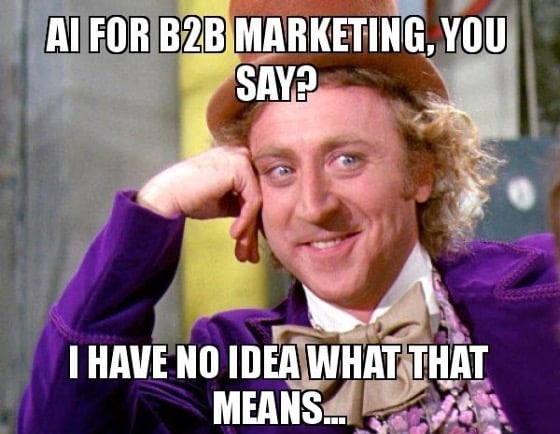
AI for B2B marketing meme
Image Source

How TikTok trends gave insight into the economic landscape of 2022.

Curious about ChatGPT? Here are five ways marketers can use AI to improve SEO.

TikTok rolls out a new feature to help users understand why they see certain videos on their For You Page.

Instagram Reels have become incredibly lucrative for some creators

Measure the effectiveness of your social media strategy using 2023 benchmarks.

Hiring trends for marketers: 15 essential stats from marketing leaders.

Twitter eases restrictions on cause-based and political advertisements.

New call-to-action

Categories B2B

How to Write an Effective Communications Plan [+ Template]

Remember the “Tide Pod Challenge?” That horrendous time at the beginning of 2018 when adolescents filmed themselves ingesting laundry detergent?

While it was a funny (albeit dangerous) start to the new year, this small boost of infamy was a PR mess for the detergent brand in question, Tide, whose crisis communication team had to figure out how to respond to America’s teens swallowing their toxic product. Tide’s parent company, Procter & Gamble, was swift in their response, thanks in large part to their communication plan.

In this post, you’ll learn how to create an effective communication plan that prepares you and your company for any situation.

Free Download: Crisis Management Plan & Communication Templates

Communication plans can help you clarify the purpose of a product launch or new initiative and officially determine the messages you want to deliver to your intended audience(s).

Additionally, a communication plan can help your business during a time of crisis if a previous marketing message or business decision damages your reputation with internal stakeholders or customers.

If companies don’t have a communication plan, they’ll be unprepared when disaster strikes. It may be unlikely that your company will find teenagers eating your product for internet fame, but not so unlikely that you’ll never find yourself needing a procedure to effectively handle difficult situations.

Need a free, easy-to-use communication plan template? HubSpot has 12. Check out this toolkit for everything you need to build your own.

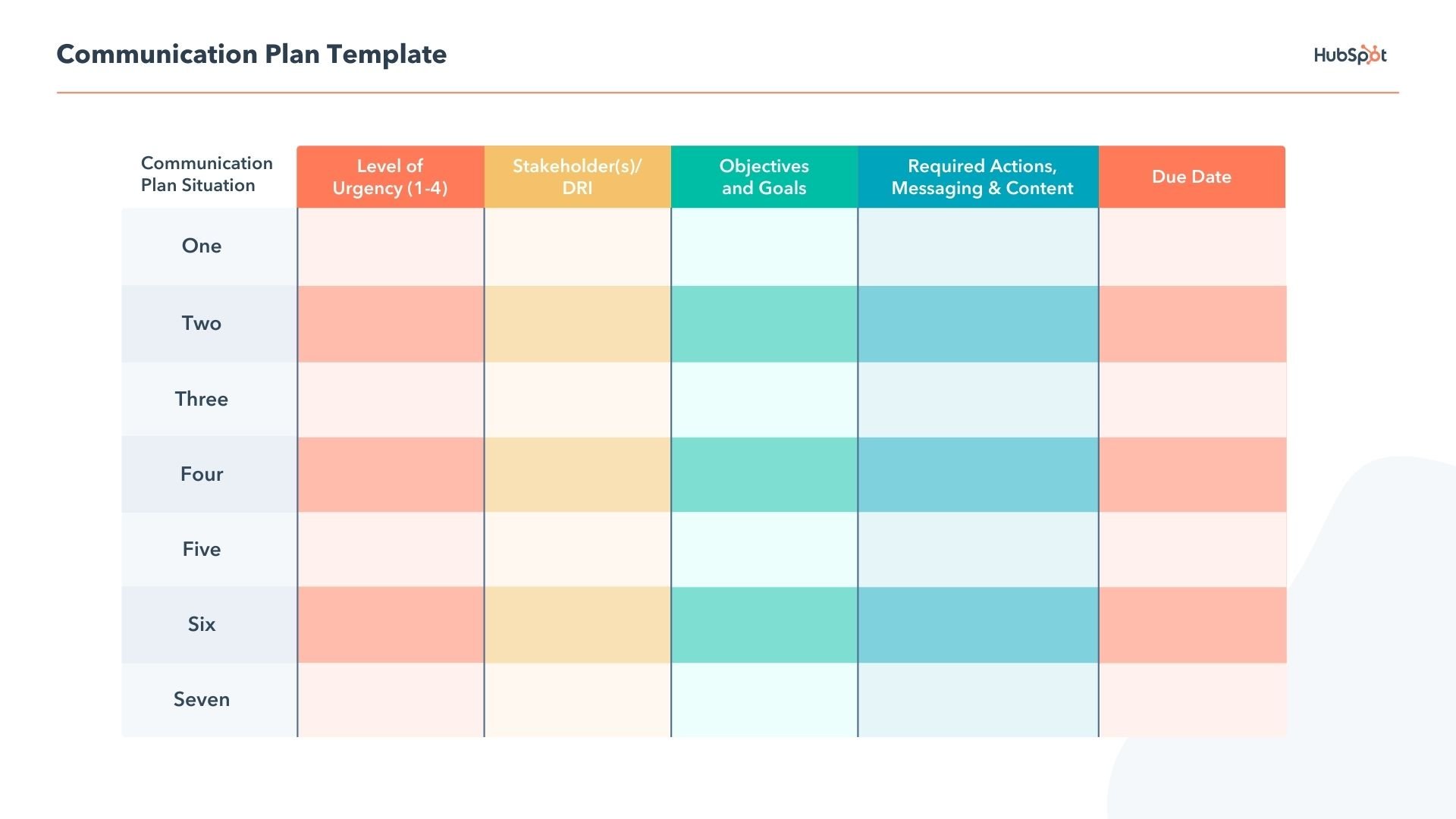
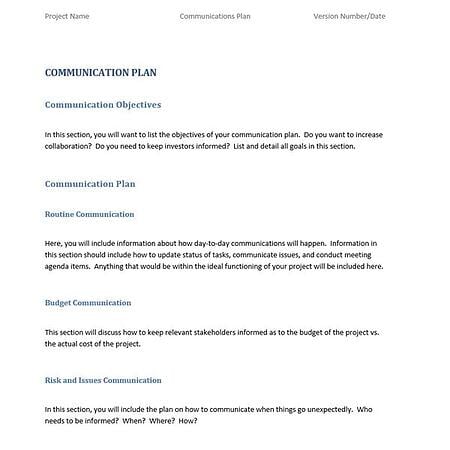
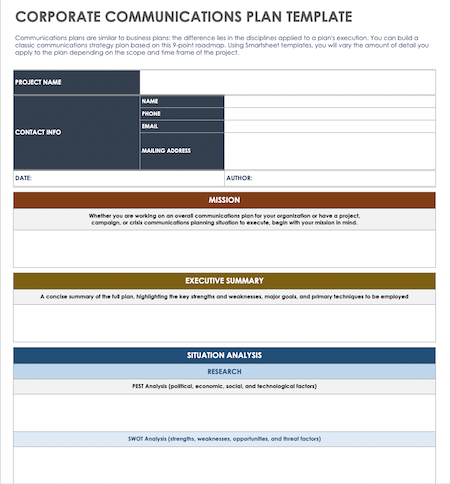
This is part of a template offered in the toolkit. For this particular template, the organization is separated into phases, a description of that phase, and who needs to complete that action.

free editable Communication Plan Template

Download These Templates for Free

Now that we’ve gone over how a communication plan can be helpful, let’s learn how to write one that will be effective.

1. Conduct an audit of your current communications materials.

Before sitting down to get rollin’ on your plan, you need to first decide where it’ll fit into your business. So it’s important you complete a “state of the union,” or an audit of the current climate of communications within your company. This can help you identify any problem areas.

For instance, let’s say you need to create a communications plan for a new product launch. To create your plan, you’ll first need to perform an audit to identify gaps in your current marketing approach.

After performing the audit, you might find there is a major gap in your marketing materials in which you rarely discuss a topic that aligns well with your new product. You’ll want to ensure this topic makes it into your communications plan.

To conduct an audit, you’ll need to carefully gather and interpret data on your current marketing plan performance and build a path forward based on those results. Additionally, you might consider hosting focus groups or sending surveys to your audience to find gaps in your current communications materials.

Of course, you’ll want to have the goal of your communications plan in-mind when conducting an audit. In the example above, noticing you’re lacking material on a certain subject only matters if your goal is to drive leads and conversions to a product that aligns with that subject.

For instance, if you’re launching a new email marketing tool and you notice you’re lacking content on Google Ads, this might not be relevant information for your communications plan. However, if you’re missing content on email marketing best practices, that’s important information you can use to tailor your communications plan appropriately.

2. Set SMART goals for your communications plan based on the results from your audit.

After your audit, you’ll want to lay out a few goals based on the data from the results. What do you want to achieve with this plan?

When in doubt, remember that your goals should be SMART: Specific, Measurable, Attainable, Relevant, and Time-based.

For instance, if a small agency is writing a communications plan for its client, they might write a goal along these lines: “We plan to increase employment applications for our client by 25% over the course of one quarter.”

Alternatively, perhaps your HR team needs to write a communications plan to pitch designing a new growth matrix for individual contributors who don’t want to become managers.

If that’s the case, your HR team will need to identify specific goals they hope to achieve as a result of their plan, even if the results are less quantifiable — for instance, their goal might be to “increase employee retention rates by 10% over the next year” or even “increase employee satisfaction, as indicated by their next NPS scores.” They’ll need to pitch these goals to stakeholders to get leadership on-board.

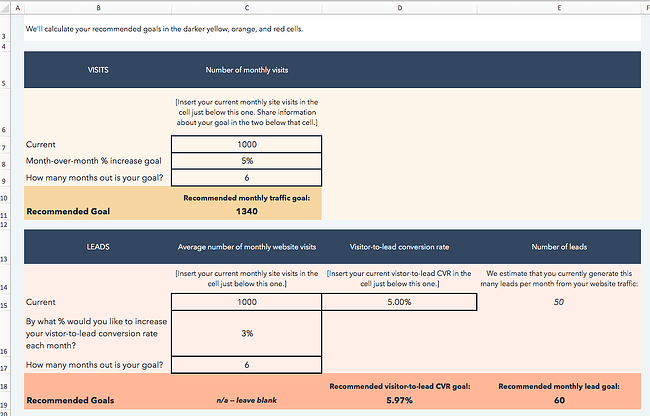
SMART goals calculator

Download Your Free SMART Goal Template

3. Identify the audience to whom you plan to deliver your communications plan.

Good communication starts with knowing and understanding your listener. In this case, if a crisis communication plan is for stakeholders, which one(s) are you writing for? Stakeholder examples include employees, investors, customers, local government officials, or media outlets.

If you’re writing for media outlets, a press release detailing your goals is a good idea for that audience. There should be a process for who will speak to the media outlets, an outline of what they will say, and an action plan put in place moving forward.

Alternatively, if your audience is your employees, you might want to create an up-to-date internal document for employees to refer to, as well as the contact information for the internal DRI if they have follow-up questions.

4. Outline and write your plan, keeping your audiences in-mind.

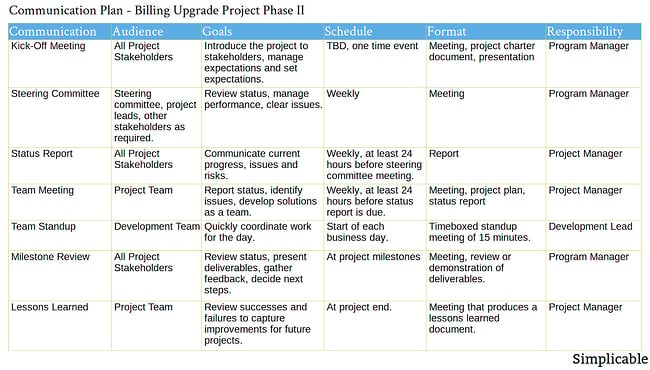
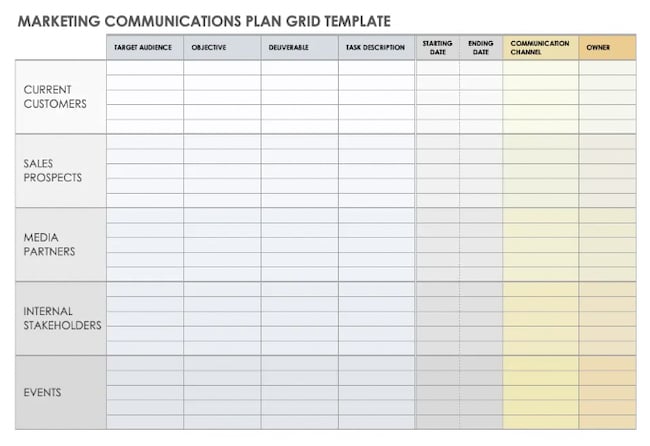
When you’re ready to outline and write your plan, it’s likely easiest if you start with a table or chart to identify the messages you need to promote, to whom you’re targeting those messages, and on which channel(s).

Once you’ve created a general outline, here’s how you’ll want to structure your communications plan (feel free to copy these sections into a Table of Contents for your own plan):

  • Purpose (what is this communications plan for)
  • Escalation Framework (including ‘first line of defense’ and ‘greater response team’)
  • Roles and responsibilities of each employee
  • Do’s and Don’ts
  • How to maintain an effective response plan

(If you need help writing a communications plan, download our free, ready-to-use communications plan templates.)

When writing your communication plan, work with groups or representatives from your stakeholders to improve accuracy. Strategies should solve for goals or potential risks.

For instance, if you work for an agency aiming to promote a client’s product, a risk might be spending money on paid ads without a guaranteed ROI. To solve for that risk, the agency should detail different steps to ensure the ads are effective before going public.

5. Determine the channel(s) on which you need to deliver your messages.

The channels you choose to communicate with your audience depends on your message, and to whom you want to deliver that message. For instance, if you’re creating a communications plan for internal employees, you might send out your communications plan in a company-wide email, or use in-person team meetings to deliver your message.

Alternatively, if you’re communicating with customers, you might determine it’s best to communicate via an email newsletter, or via a press release.

Of course, the channel(s) you choose will depend on your goals, but it’s important as you’re writing your communication plan that you keep your distribution methods in-mind.

6. Decide which team members are responsible for delivering the message.

Once you determine your audience and channel(s) on which you’ll deliver your communications plan, figure out the DRI for delivering the message.

For instance, if your HR team is pitching a new growth matrix to leadership, you might ask your Director of HR to deliver the initial pitch in the first meeting. Once leadership is on-board, you might ask each HR representative to deliver one training session for each internal team to ensure every employee understands what’s changing internally, and why.

7. Estimate a timeline for how long each step should take.

You should have a ballpark estimate of how much time each step in executing your strategy will take. For instance, if your plan needs to go from the higher-ups down to the employees, it’s good to take into account how long going through the chain of command will take. It’s also smart to infer how long a media cycle will last.

For instance, for a minor slip-up on an ad campaign, the advertising agency might estimate the cycle for controlling the issue will take a month — including meeting with the client, stakeholders, and employees to discuss steps moving forward.

8. Measure the results of your plan after presenting to stakeholders, and determine successes and areas for improvement.

There’s always room for improvement. Measure the results of the plan after presenting it to stakeholders, and determine aspects that went well, and areas for improvement next time.

For instance, the ad agency might not have met its goal of increasing prospective applications by 25% within a quarter. They might rework their goals to give themselves more time or pivot their quarterly focus to fit those goals.

Alternatively, if you notice certain language in your communications plan evokes a level of stress or fear with internal stakeholders, consider how you can re-word next time to ensure your communications plan feels helpful, beneficial, and positive.

Some aspects of building a communication plan can be a “choose your own adventure” journey. The key is choosing aspects that best reflect what your business needs in times when effective communication is key. What do your stakeholders need to know, and how are you going to best communicate that?

Communication plans can get tricky, but writing an effective one will prove itself with its longevity. The following communication plans include analysis for stakeholders you’d respond to and the procedures for what to include in those communications.

1. Strategic Communication Plan

Bright Hub Project Management’s communication plan explains how, when, and why communication happens within its organization.

This example is great because it details how communication managers write crisis plans and acknowledges that sometimes the busy marketer or project manager takes on this responsibility.

Strategic Communications Plan

Image Source

2. Project Communication Plan

Here’s an example of a Billing Upgrade Project from Simplicable. This communication plan maps out all the important meetings and documents needed for the project. As you can see, it also includes necessary sections including audience, goals, format, and DRI.

project communication plan example

Image Source

3. Marketing Communication Plan

A marketing communication plan is essential for communicating to your target market, especially when launching new products or initiatives. This example from Smartsheet allows you to plan marketing communications strategies for customers, sales prospects, media partners, internal stakeholders, and events.

marketing communication plan example

Image Source

4. Corporate Communication Plan

Corporate communication plans outline how organizations communicate internally and externally. This example from Smartsheet is a nine-step roadmap that includes space for a mission statement, executive summary, situation analysis, key messages, and more.

corporate communication plan example

Image Source

5. Crisis Communication Plan

This communication checklist below, by Prezly, gives a great overview of the details of a crisis plan from beginning to end. It can be used as an effective guide when drafting a crisis management strategy.

crisis communication plan example

Image Source

Communication Planning Tips

Communication planning can be tricky, so here are some extra tips to keep in mind to help your plan shine: when describing procedures for handling crises, include who the situation involves. This lets stakeholders envision decision-making processes.

Additionally, if you’re part of a larger company with a broad stakeholder list, it’s okay to split up target audiences for your plan.

For instance, maybe your audience is more than just “consumers.” Split stakeholder groups for easier comprehension and more distinct solutions.

Ultimately, your communications plan needs to clearly and succinctly provide necessary information to everyone involved in the business decision, product launch, or PR crises. Use the strategy mentioned above, as well as our communication plan templates, to ensure yours is as effective as possible.

Editor’s note: This post was originally published in September, 2019 and has been updated for comprehensiveness.

crisis communication

Categories B2B

70 Fun (Not Cheesy) Ice Breaker Games & Activities Your Team Will Enjoy in 2023

Asking “How is everyone?” at the beginning of every meeting isn’t always the best ice breaker to encourage team bonding. Sometimes, having a fun ice breaker game or activity can aid in that connection.

Download Now: Free Company Culture Code Template

The best ice breakers have the power to strengthen coworker bonds, stimulate better brainstorming sessions, and create an atmosphere of inclusivity. To get the most value out of your team bonding moments, we’ve compiled a list of the best ice breaker activities and games for the workplace.

Next time you get together with your team, use one of these games instead of asking “How is everyone,” and you’re sure to hear some better, more insightful responses than “I’m good.”

Looking for a specific type of ice breaker? Jump to:

Zoom Icebreakers

1. Paint a Picture, Build a Story

ice breaker games: garctic phone

Image Source

Best For: Virtual Fun

In this ice breaker, playoff your teammates’ artistry and create a scenario of their masterpieces. Gartic Phone gives you a short time frame to sketch photos based on other players’ prompts — and can result in some hilarious artwork.

The more nonsensical the prompt, the funnier the drawings become. You’ll also get brownie points if you save and share some of the funniest drawings and share them with the team on Slack afterward.

Instructions

  • Go to https://garticphone.com.
  • Enter a nickname and choose a character avatar.
  • Click Start.
  • Click the Invite button and share the link with your colleagues.
  • When the game starts, everyone will be prompted to write a fun sentence.
  • Everyone will receive someone else’s sentence and have the opportunity to draw it.
  • Everyone will receive someone else’s drawing and then guess what the original sentence was.
  • Enjoy the hilarious results!

2. Guess That Drawing

Best For: Virtual Fun

Drawasaurus is one of my favorite online drawing games to play with colleagues. Players get to choose from three random prompts to quickly interpret and draw their vision. Other players can score more points for identifying the word the fastest and take turns going until the timer goes out.

Instructions

  • Go to https://www.drawasaurus.org.
  • Enter a nickname (don’t worry; this won’t automatically start a game).
  • Click + Create a Room.
  • Set the room as Private, choose a room name, set a simple password, and choose the number of max players.
  • Share the link from the URL bar with your colleagues.
  • The game will start once everyone designates themselves as Ready to Play.
  • One by one, everyone will choose one word to draw, and the others will get to guess the word.
  • The person who guesses correctly the quickest earns the most points. Enjoy!

3. Alphabet Brainstorm

ice breaker games: scattergories

Best For: Virtual Fun

Thinking off the top of your head is a lot harder said than done in Scattergories. The host of the game can choose from topics as broad as foods and countries or as weird as “Things Granny would say.”

Each round, the game will highlight a random letter of the alphabet and let players come up with any noun or phrase that starts with said letter. The best part — players can dispute answers amongst each other to take the win. This is a perfect icebreaker for your overly competitive colleagues.

Instructions

  • Go to https://scattergoriesonline.net/new-game.xhtml.
  • Choose the categories you’d like for the game, such as “Animals,” “Long words”, and “Things with tails.”
  • Click Create new game.
  • Choose the game letters (most will be pre-chosen), the number of players, and the number of rounds.
  • Choose when a round ends (we recommend giving everyone 30 to 60 seconds).
  • Under “Who can join,” click Invited friends.
  • Click Create new game.
  • Copy the link and share it with your colleagues.
  • Everyone will have an allotted time to fill out several categories with words that start with a single letter.
  • Play all the rounds and see which one of your colleagues has the most expanded vocabulary!

4. Show and Tell

Best For: Team Bonding

A rather straightforward ice breaker, team members can share an object they love over Zoom. Whether it’s a prized-collectible or an item that sparks nostalgia, there’s plenty of stories waiting to be told.

Instructions

  • Let your team know ahead of time that you’ll be doing a show and tell.
  • At the start of the meeting, give everyone 5 minutes to find the item that they’d like to show (Option: Have them turn their camera off).
  • Start with a random team member or yourself.
  • Have everyone popcorn to someone after they show their item, or go alphabetically.
  • Enjoy seeing the eclectic items in your team members’ homes!

5. Bucket List

Best For: Team Bonding

Outside of the workplace, your teammates are people with aspirations and goals you wouldn’t know about from the average coffee chat. Have team members share some bucket list items they want to achieve in the future.

Not only can these be inspirational, but they also open the floor for team members to encourage one another to pursue their dreams, too. It’s a particularly uplifting team-bonding activity that will bring your team even closer together.

Instructions

  • Start with a random team member or yourself.
  • You or your teammate will share one bucket list item.
  • Have everyone popcorn to someone after their turn, or go alphabetically.
  • Enjoy!

6. Share the Love

Best For: Team Building

While dispersed teams may not have the chance to share a handshake or hug, you can still share the love amongst each other in this icebreaker. Say something lovely with another team member, and it could be anything you want as long as it’s respectful and in good judgment.

For each person that receives a kind message, they will be the next one to share a message to a member of the group who hasn’t received one — ensuring everyone gets an equal amount of praise. Shout them out for their helpfulness in a project, for the energy they bring to the team, or for their lovely smile.

Instructions

  • Let your team know ahead of time that you’ll be doing this activity.
  • We recommend pre-pairing teammates in a spreadsheet so everyone can come prepared with something to say.
  • Start with a random team member or yourself.
  • Have everyone popcorn to someone else after their turn, or go alphabetically.
  • Enjoy!

7. Arts and Crafts

ice breaker games: arts and crafts class

Image Source

Best For: Virtual Fun

Making something with your team can be a great opportunity to learn something new and keep decorative mementos in your space. Have everyone follow the same instructions to make a craft like simple origami, a drawing, or painting by a designated instructor in the Zoom call or YouTube tutorial.

Instructions

  • Have everyone fill out an interest form for the event.
  • Set a date and have folks RSVP so that you can more accurately calculate the price per person in the next step.
  • Hire a Zoom arts and craft instructor from a business such as The Art Studio NY or KraftyLab. Alternatively, have a team member volunteer to teach, or find a YouTube video, which will be free.
  • We recommend taking 30-60 minutes to complete this activity.
  • At the end, have everyone show their work.
  • Have fun!

8. What Do We Have in Common?

Best For: Team Bonding

This icebreaker is best suited for new hires who may feel more reserved as they virtually meet the team.

Find common ground and get the conversation going with your team members. Have a manager or team leader start the conversation by sharing something they have an interest in, like popular TV, music, foods, or whatever they love to get everyone thinking. Popcorn it over to the most enthusiastic team member with that same interest and have them share a new one.

Typical icebreaker questions can get people to say a sentence or two about the subject, but if you’re passionate about it, you’ll see more personality come out from the most unexpected colleagues in the call.

Instructions

  • Start with a random team member or yourself.
  • You or your teammate will share an interest, such as a TV show or hobby.
  • Someone with that same interest should either drop a note in the chat or raise their hand.
  • Their turn will begin, and they will share a new interest.
  • Enjoy!

9. Name That Tune

Best For: Virtual Fun

Music brings people together, and you’d be surprised to learn how many of your coworkers are raving about the top trending song on TikTok or Spotify.

Take turns whistling, tapping, or even playing an instrument (if you gave one) to the tune of a popular song and have your teammates guess the name. Figure out who’s a fan of the classics by clapping and stomping to the rhythm of “We Will Rock You” by Queen, or do whatever it takes to help your colleagues recognize your favorite tunes.

Instructions

  • Start with a random team member or yourself.
  • You or your teammate will hum, whistle, sing, or tap the rhythm of your favorite song.
  • Team members should drop their guess in the chat.
  • The correct guesser gets the turn. If no one guesses correctly, popcorn your turn to someone else.
  • Enjoy!

10. Themed Meetings

ice breaker games: costumes and holidays on zoom

Image Source

Best For: Virtual Fun

Hosting themed meetings is the best icebreaker for the holiday season. Share a laugh and snap photos of you and your colleagues dressed up as elves with Zoom backgrounds at the North Pole, or in your spookiest costumes for Halloween.

Make sure your theme is chosen in good judgment. As some holidays have cultural ties, keep this icebreaker for more commercial holidays.

Instructions

  • Let your team know ahead of time that you’ll be doing this activity.
  • Share either what costume you’re wearing or something special about your ensemble (such as, “I’ve had this ugly sweater since 1999”).
  • Have everyone popcorn to someone after their turn, or go alphabetically.
  • Enjoy!

12. Guess the Childhood Photo

Best For: Team Bonding

In need of a wholesome icebreaker? In your next Zoom meeting, tell everyone to send the leader a cute (or hilarious) photo from their childhood and randomly throw them all into one slideshow.

When it’s complete, the leader will then share their screen and have the group guess which team member is in each photo. Try not to blush too hard when they get to yours.

Instructions

  • Let your team know ahead of time that you’ll be doing this activity.
  • Share the presentation a week prior to the meeting so team members can add their childhood photos.
  • At the start of the meeting, share your screen.
  • Proceed slide-by-slide and have team members either throw their guesses in the chat, or write their guesses privately on a notepad.
  • At the end, have everyone share which slide belonged to them.
  • Enjoy!

13. Zoom Photo Ops

Best For: Team Building

In this icebreaker, you’ll first want to ask everyone involved if they’re comfortable having their photos taken before the meeting begins (I know I’d like a heads up in case I was wearing an old band shirt instead of my usual business casual outfits.)

You can try to get everyone to make silly or scary faces, or even try to mimic the Brady Bunch title sequence. There are plenty of poses or facial expressions to capture, especially if you’ve got a kooky team to work with.

Instructions

  • Let your team know ahead of time that you’ll be doing this activity.
  • At the start of the meeting, give instructions for the pose team members should take (Silly? Spooky? There are many options!).
  • Take a screenshot of the Zoom window.
  • Share the photo via your team messaging app and pin it for posterity.
  • Enjoy the memories!

14. Hobby Webinar

Best For: Virtual Fun

During weekly video chats, you can designate one coworker to teach the team how to engage in a hobby they’re good at — something you don’t need to be in-person to do.

This could range from showing how to do quick origami, do a magic trick, or even giving a pointer or two on couponing from your coworker who always keeps an eye out for the latest deals.

Instructions

  • Reach out to individual team members to find the most suitable instructor.
  • Alternatively, create a running spreadsheet with team members’ names and their hobbies.
  • Manually choose an instructor for the upcoming meeting, or pick a name randomly using a tool like this one.
  • If supplies are needed, let your team know ahead of time.
  • Have the instructor lead the meeting from the start, ideally with a time limit on the activity.
  • Enjoy!

Ice Breakers for Meetings

15. One Word

Best For: In-Person Team Building

The One Word ice breaker allows you to provide initial context into a meeting’s topic, and get everyone in the right mindset for discussion.

For instance, let’s say you’re leading a meeting on culture. Tell the groups to describe work culture, or your office culture in particular, in one word. Once they’ve shared with their groups, you can invite them to share their word with the entire room.

This game encourages everyone to think about a certain topic in smaller groups ahead of time, which could increase participation during the meeting.

Instructions

  • Divide meeting participants into smaller groups.
  • Tell them to think for a minute or two on the meeting’s topic.
  • Have every one share with their group one word that describes the topic, then allow them to popcorn their turn.
  • Enjoy the diverse responses!

16. Pop Quiz

Best For: Team Building

To successfully loosen everyone up and get them in the right mindset for a meeting, you might consider putting a short Pop Quiz on the board.

If your goal is simply to encourage team bonding, your quiz can be more fun — like, “Match the lyrics with this 80’s song.” However, you might also use the Pop Quiz as an opportunity to introduce participants to the meeting’s theme.

If you’re discussing company changes, for instance, maybe you’ll start by quizzing team members on company history facts (e.g. “What year was this company founded?”).

Instructions

  • We recommend not letting your team members know about this activity ahead of time.
  • If you’re on Zoom, post the question on the chat or share it via your screen. If the meeting is in-person, write it on the board.
  • Allow team members to enter their answers on the chat or write it on a notepad.
  • Whoever gets it right may get a small prize or bragging rights.
  • Have fun!

17. Birth Map

ice breaker games: birth map

Image Source

Best For: In-Person Team Bonding

This activity is short, but delightfully telling — you’ll find out where your team members were born without needing to ask and having everyone take a turn. You’ll create a physical map where your teammates can place a pin on their birthplace. As the map fills up with pins, people will learn about how diverse their teammates might be.

Instructions

  • Place a map and a set of pins at the front of a large conference room before a big meeting.
  • As people walk in, ask them to place a pin where they were born or raised.
  • Allow some time at the end of the meeting for your colleagues to walk up and look more closely at the map.
  • Save the map or take a picture.
  • Enjoy the team keepsake!

18. Movie Pitch

Best For: In-Person or Virtual Fun

Perfect for larger groups and movie fanatics, this icebreaker is as crazy as you make it. Divide players into quads and give them 10 minutes to devise the plot of the next award-winning film. You can give them constraints by designating genres like horror, action, comedy, thriller, and more.

If your organization is meeting to brainstorm ideas for specific projects, go ahead and incorporate the topic into their movie pitch prompts to get the creative juices flowing.

Instructions

  • Divide team members into groups.
  • Have every group come up with a plot for the next blockbuster.
  • Each group should get a turn to share, and they might even act out parts of the plot.
  • Have fun!

19. Stretch Break

Best For: Team Wellness

Maybe the week has been busy for you and your team, or it’s going on your fourth meeting of the day. If this is the case, have everyone take a breather and stretch before the next big meeting begins.

Someone can either lead by example, showcasing some arm and back stretches, or just let everyone freestyle. You’d be surprised how a little movement can wake up and help people get work done.

Instructions

  • Designate a team member ahead of time to lead the stretches (or lead them yourself).
  • Take 5-10 minutes to go through a round of stretches.
  • Enjoy the much-needed break!

20. Rose, Thorn, Bud

Best For: Team Building

In meetings, it can be hard to communicate or understand everyone’s perspective on a project unless everyone has the floor to say what’s on their mind. With the Rose, Thorn, Bud icebreaker, team members can quickly convey what’s on their mind by sharing three bits of information:

Rose: A recent positive happening like a personal highlight or win

Thorn: A challenge or roadblock they need support on

Bud: An idea for the future they’d like to share, or excitement for events in motion

Instructions

  • Ensure you have the right team size for this activity. Less than 10 people would work best.
  • Start with a random team member or yourself.
  • Have everyone popcorn to someone else after their turn, or go alphabetically.
  • Enjoy!

21. Frivolous Debate

Best For: In-Person or Virtual Fun

There’s nothing like some lighthearted banter to get everyone warmed up before a meeting.

For this icebreaker, everyone will debate a silly topic and chime in with an equally silly answer and reasoning. Make a statement like, “Cats are better than dogs,” and, “Summer is better than winter,” or let chaos ensue by declaring that pineapple belongs on pizza (because it does).

Instructions

  • Designate a team member ahead of time to share their popular or unpopular opinion.
  • Have everyone chime in one-by-one on whether they agree or disagree.
  • Every team member should popcorn their turn, or you can go alphabetically.
  • Have fun finding out who agrees with you (and who does not)!

Quick Ice Breakers

22. Would You Rather

Best For: Team Bonding

A classic game played at summer camps everywhere, “Would You Rather” is an excellent, quick ice breaker for the workplace. Next time you’re settling into a meeting or team bonding outing, take turns going around the table and asking each person a “Would You Rather” question.

Here are a few “Would You Rather” questions to get you started:

  • Would you rather only have summer or winter for the rest of your life?
  • Would you rather go on a hike or see a movie?
  • Would you rather never use social media sites and apps again or never watch another movie or TV show?
  • Would you rather have a horrible short-term memory or a horrible long-term memory?

Instructions

  • Designate a team member ahead of time to share their “Would You Rather” question.
  • Have everyone chime in one-by-one with their answer.
  • Every team member should popcorn their turn, or you can proceed alphabetically.
  • Enjoy!

23. Accomplishments Before 18

Best For: Team Bonding

Accomplishments Before 18 is an engaging and unique way to encourage team members to share fun or interesting stories with one another. Before a meeting, simply go around the room, and ask each person to share one accomplishment they had before they turned 18.

Undoubtedly you’ll get some of lesser importance, like “I bought a skateboard,” but you never know what hidden skills you might discover in your colleagues.

Instructions

  • Start with a random team member or yourself.
  • Have everyone chime in one-by-one with their answer.
  • Every team member should popcorn their turn, or you can proceed alphabetically.
  • Enjoy!

24. Two Truths and a Lie

Best For: Team Bonding

One of the more classic ice breakers in the list, Two Truths and a Lie can be used anywhere from family parties to company events.

For instance, I might say, “I once auditioned for the TV show Zoom. I have three brothers. I ziplined in Switzerland once.” Coworkers can take turns guessing which is the lie. (FYI, I have two brothers, not three, so that’s the lie. Unfortunately, I auditioned for Zoom.)

Two Truths and a Lie is a fun and engaging game, and more importantly, it can help your team learn facts about one another, so they can begin forming deeper bonds.

Instructions

  • Ask each person to brainstorm three “facts” about themselves — two of the facts will be true, and one will be a lie.
  • Have team members guess which is the lie.
  • Whoever guesses correctly gets bragging rights.
  • Enjoy!

25. The Handshake

Best For: In-Person Fun

One of the first ways you get to greet somebody in the workplace is with a handshake.

This ice breaker lets individuals ease up and have a little fun without a hassle. It’s simple — everyone will create a fun, creative handshake.

If you have more time on your hands, have the pairs split up after showing off their super cool shake and make even more creative ones with new partners. It’s hard to play these games without sharing a laugh, which is something we all could use in the workday.

Instructions

  • Divide the group into pairs of two.
  • Have them make the most creative handshake they can in a couple of minutes.
  • If desired, have everyone rotate partners.
  • Have fun!

26. Bad Joke Contest

Best For: In-Person or Virtual Fun

This icebreaker won’t take your team time at all to complete if you give them a heads up to prepare. In the Bad Joke Contest, you’ll have everyone recite the corniest joke they can muster and have everyone vote on who was the most cringeworthy.

Beware, some coworkers have impressively bad dad jokes saved up for these moments, so the competition will be fierce.

Instructions

  • Let your team know ahead of time that you’ll be doing this activity.
  • Start with a random team member or yourself.
  • Have everyone popcorn to someone after they tell their joke, or go alphabetically.
  • Have everyone vote on the corniest joke either via Zoom poll or by keeping tabs on a notepad.
  • Don’t forget to laugh — or cringe!

The list continues below — read on to find fun icebreaker games, ice breakers for large teams, and more.

27. Tall Tales

This icebreaker game will have everyone thinking on their feet. In Tall Tales, each player will make up three sentences to add to a running story. The third sentence has to have a plot twist starting with, “Suddenly…” before rotating to the next.

Every player will have a chance to put their own spin on the budding story, and can even try to throw the next participant for a loop with a crazy situation.

28. Say Your Name Backwards

This game is pretty straightforward, or straight backward.

Every player will write their name on a slip of paper backward, fold it, and place it into a bowl. Once all the slips are collected, someone will draw one out of the bowl and read to the rest of the players what’s on the slip. Whoever can guess their coworker’s name correctly gains a point, and whoever has the most points at the end wins.

29. Jenga

Jenga is considered a classic game for a reason, and because it’s easy to play and put away. Have your team take turns pulling woodblocks out of your Jenga tower and share a laugh when it all comes toppling down.

30. Frown King or Queen

Make it a competition to see which of your team members has the gnarliest frown, and bestow upon them the title of Frown King or Queen. Bonus points if you actually go out of your way to make a paper crown.

You’d be surprised how hard it is to maintain a frown when surrounded by your favorite colleagues, not to mention how funny they’ll look during the game.

31. The Envelope Please!

In this icebreaker game, have everyone write 10 facts about themselves on paper and place them each into their own envelopes. The envelopes are to be shuffled and chosen once at a time by the leader to read aloud to the rest of the group.

The rest of the players will then guess the identity of the envelope in hand — but they must be confident in their answer as each player only has one chance to guess per envelope.

32. Random Talent Show

A talent show is one thing, but a random talent show is another. Have your coworkers take turns showing their cool party (or office) tricks. And let’s face it, you’ve been trying to find the right opportunity to show someone you could lick your elbow for a while now.

33. Celebrity Impressions

For this icebreaker game, the leader will tape a label to each player’s back with a celebrity or household name. Once that’s complete, every player will then ask each other yes or no questions about the traits, recent news, or talents of their celebrity label.

If a player can identify their own celebrity correctly, they can remove the label from their backs and continue mingling if they wish.

34. Quick Portrait Gallery

You don’t have to be Picasso to have take part in this icebreaker. The instructions are simple, every group member will be randomly assigned a different person to draw in a couple minutes. It’s a fun way to bond and share a giggle here and there over everyone’s work of art.

35. Sound Ball

Sound Ball is an imaginative icebreaker that gives everyone a chance to get moving and energized.

In this icebreaker, the leader holds an imaginary ball in their hand and “throws” it to other players, making whatever sound they think it would with that gesture. Whoever “catches” the ball next must repeat the sound made, then throw the ball to another person making their own unique sound. It sounds crazy, but it’s easy to get into the flow of it.

36. Beatboxing

This is probably one of the silliest icebreakers in this list, but it’s definitely worth trying for the fun of it all. Have one team member start making a noise you’d hear in a song like percussion and have others gradually add to the beat.

Who knows, if the beat sounds good enough you all could consider making an acapella group.

Large Team Ice Breakers

37. Charades

Charades is a game fit for large teams, both in-person and remote.

In this icebreaker, players need to communicate with team members to identify a noun of a certain category. Have everyone divide into two teams, and have one player at a time pantomime (act out) the subject for their own respective teammates. Whichever team gets the most points, wins.

38. Red Light, Green Light

I bet anyone who watched Squid Games in 2021 is familiar with this game, and if you haven’t, the rules are simple (and the stakes are much, much lower.)

The players in this icebreaker game will line up on one side of a room and a designated leader will be instructed to say either, “Red Light,” or, “Green Light”. Players in line are to try and walk to the other side of the room when the leader says, “Green Light”, but once the leader says, “Red Light”, everyone must freeze or be kicked out of the game.

39. Guess Who

Similar to Charades, Guess Who is a great icebreaker where you can mimic famous people — or even your coworkers.

Have someone write down well-known names on sheets of paper and then hand them off one at a time to a team member. They’ll have to act out the behaviors, facial expressions, or even the iconicI’m flying” scene from Titanic.

40. Icebreaker Bingo

Icebreaker Bingo is a great way to bond with large teams because it can include as many people as you want.

You can use a free icebreaker bingo generator and personalize each of the squares on a subject you’re all discussing for the day, or for anything everyone can feel included.

41. Hot Take

For this icebreaker, everyone can take turns in sharing their hot takes and either bond with their coworkers who agree or debate their naysayers.

Of course, you want the topics to be fun and lighthearted, so keep them to topics that aren’t controversial and opt for statements like, “Cheese isn’t all that great.” if you’re a madman.

42. “Most Likely To ___”

Remember those high school superlatives? This is like that but a little less embarrassing. Have coworkers read through a list of “Most likely To” titles and assign them to one another. During the game, everyone can chime in or give reasons as to why someone deserves the title, and the group consensus will be the final decision.

It’s important to note that no two people will have more than one tile to ensure everyone is included.

43. Whisper Down the Lane

Whisper Down the Lane is an icebreaker game where team members form a larger circle and share a random message whispered into the ear of someone to their left. This game can get funny pretty quickly, as a whisper down the lane can get misinterpreted over and over again.

44. Simon Says

Simon Says is a game as old as time, but it never stops being fun. The leader of the group will instruct players to do an action beginning with the words, “Simon says…” like, “Simon says touch your knees,” or, “Simon says grab your elbow.” Whoever doesn’t do the actions proclaimed will be booted out of the game.

The real trick is for the leader to confuse players by giving fast Simon Says commands, then giving them a command without saying the keywords. This could work like, “Simon says touch your hips, Simon says hop on one foot, Simon says touch your nose — touch your ears!” Whoever does the action (like touching your ears) will be booted out of the game because it wasn’t a Simon says action.

45. Things in Common

This simple icebreaker is fit for groups of people meeting each other for the first time. All that has to be done is mingle with one another to find some things you have in common, and try to form groups based on those attributes. Bonus points if you can learn the names of those who you relate to, and brownie points if you can relay all their names when asked.

46. Team Jigsaw Puzzle Competition

For this game, you’ll need to prepare by purchasing two identical jigsaw puzzles. Divide your large group into teams of two and set a timer to see which group can work together to make the most progress on their respective puzzles.

47. Clump

Have team members walk around and mingle amongst themselves in a large, open space. The leader of the icebreaker will then yell out a random number under 10. Every person mingling will then have to quickly form a group in the size of the number called.

Gradually people will be made to exit the mingling space or find a seat until the last person standing wins.

Ice Breaker Games for Small Groups

48. Fun Questions

Asking fun questions is an easy and effective ice breaker game. To play, simply go around the room and have each person provide an answer to a fun question. The questions are up to you, but if you’re stuck, here are a few ideas:

  • If you’re stranded on a desert island and have the option of bringing three items with you, what three items would they be?
  • If you could be any animal, what would you be and why?
  • What was the first concert you ever went to?
  • If you could have any celebrity over for dinner, who would it be and why?

These questions serve two purposes — first, they allow your coworkers to get into a sillier, more creative mindset. Second, they encourage conversation on topics typically reserved for outside the office, which enables members of your team to get to know one another on a deeper level.

Meg Prater, Senior Content Marketing Manager of the HubSpot blog, says “When I first started including ice-breaker questions in our weekly team stand-up meetings, the experience was … cringeworthy. It felt like exactly what it was: organized fun. But we kept at it. I listened to feedback and tried to incorporate it into better ice breakers.”

She continued, “For example, some folks on our team don’t watch a lot of T.V. and felt a little excluded when we’d fall down a rabbit hole of shows we were binging. Keeping the ice breakers inclusive keeps everyone engaged. Now, our ice-breakers can take 15+ minutes to get through and yield some of our biggest laughs and revelations of the week.”

49. Personality Quiz

This ice breaker can promote team bonding, and it’s one of the easier options on the list. Simply choose a brief personality quiz on your phone or computer (if you’re stuck, here’s a list), and pull it up on a projector or send the link to everyone.

Once everyone has completed the personality assessment, have each colleague mention one thing they agree or disagree with from their results. This game allows your team members to gain a new perspective on their peers, and it’s also a fun and easy way to get an interesting conversation started.

50. Who is it?

Have everyone write a unique, strange, or unexpected fact about them on a piece of paper. Then, put the pieces of paper into a hat and mix them around. Pull from the hat and read each fact.

Allow the team to try and guess who wrote it. After they guess, ask the employee who wrote the fact to identify themselves and give any further context if necessary. This could be a great way to get to know surprising new things about your teammates.

51. Marshmallow Challenge

Tom Wujec, a business visualization expert, initially presented his Marshmallow Challenge at TED. To play, you simply divide your team into groups of four and give each group 20 sticks of spaghetti, one yard of tape, one yard of string, and a marshmallow. Whichever team can build the tallest structure, wins — the trick is, the marshmallow must be on top.

There are a few reasons this game works as both a great ice breaker and a team-building exercise. First, the most successful teams are the groups of people who don’t spend time competing for power.

The game forces your colleagues to work collaboratively when brainstorming potential solutions. Second, the Marshmallow Challenge encourages people to think quickly and offer alternative solutions when their initial idea fails.

With the Marshmallow Challenge, you can strengthen your team’s brainstorming and problem-solving skills, and your team can also have some fun. A win, win.

52. Scavenger Hunt

At HubSpot, we conduct a scavenger hunt for new hires on the first day of their training. It’s fun and encourages collaboration, but additionally, it can help employees learn their way around the office.

Fortunately, you can conduct a scavenger hunt for your team even if they’ve worked at your office for years.

Simply split up your team into groups, and give each group a shortlist of items to find — if you work in a smaller space, maybe you can hide some funny items around the office ahead of time. You might even provide an incentive for the winning team, like a $50 Amazon gift card.

A scavenger hunt is also an exceptional opportunity for cross-department interaction. Consider reaching out to managers from other departments and creating groups of employees who don’t often get to work together.

53. No Smiling

This game is simple and meant to energize your team. Get your colleagues in a circle and ask one volunteer to sit or stand in the middle. Tell the volunteer that they can not laugh or smile, regardless of what happens. Then have each other colleagues take turns telling the volunteer a work-appropriate joke.

The goal of the volunteer is to hear a joke from every colleague around the circle, while the goal of the other team members is to make the volunteer laugh.

This icebreaker can be helpful in new-employee or management training to lighten the pressure of starting a new job. It can also be helpful as a way of lightening the mood on teams that regularly deal with stressful projects or situations.

54. This is Better Than That

Aside from being a fun team activity, this might be a great energizer for sales employees or others that regularly pitch, market, and sell products.

Ask your team to find four to seven items around the office and bring them to one room. These items could be something they use daily, like a pen or a chair. However, you should encourage them to find items that are more odd or unique. This will make the game more challenging.

Line the items up and split the group into sub-teams. Task each team with picking an item they would use to survive if stranded on a desert island.

Tell team members that they cannot pick more than one and must assume it is the only item they will have on that island. Allow the teams time to deliberate and then ask them to present the item they chose and why.

Virtual Icebreakers for Dispersed Teams

55. Choose Your Favorite

For this icebreaker, all you have to do is answer the question about your favorite things. You’ll ask your team to choose their favorite movie, song, T.V. show, etc. The question can change every week.

This icebreaker helps your team get to know each other even when they work remotely and can spark conversation on what everyone likes or dislikes.

56. Trivia Game

If you’re looking for a remote icebreaker that’s more of a game, and less discussion-based, you can host a trivia game.

Kahoot is a trivia platform you can use for free (hosts up to 10 people). To get started, all you’ll need to do is sign up for a free Kahoot account.

Then, you can choose a featured trivia game to play. To run this remotely, you’ll want to share your screen with your team. Everyone will need to have a separate device to use so they can enter the game and submit their answers.

57. Share an Embarrassing Photo

This is one of my favorite icebreakers because it’s a fun way to get to know your team. For this game, have everyone bring in an embarrassing photo and tell the story behind it.

Have your team members share their screen or send a file to the team leader to share with everyone.

To make this more interesting, you can have people guess whose photo it is before your team member shares their story. Doing this icebreaker is a great way to build connections remotely.

58. One Word Pulse Check

For this icebreaker, have everyone on your team go around and share a word or phrase that represents how they feel that day.

Christina Perricone, former Senior Content Marketing Manager on the HubSpot blog, says this is her favorite icebreaker.

“The person sharing gets to decide whether or not to elaborate, and everyone listens without response. The purpose of the exercise is to give people a chance to release and/or reveal emotional setbacks, obstacles, wins, highlights, or anything else that might be impacting how they show up to work that day. It provides a space for participants to bring their entire self to work and it gives the team context for how to support that team member that day,” Perricone adds.

59. Meet my Pet

Nothing fills a meeting with smiles like photos of colleagues’ furry friends. Take turns showing off the cutest pictures and videos of your pet.

For those who don’t have any, they can either make a joke pet (the infamous pet rock) or share a dream pet they would have.

60. Let’s Make a Mixtape

This icebreaker works by asking your coworkers to choose one of their favorite songs from a certain genre. Once everyone has their song in mind, have someone compile either a Youtube or Spotify playlist of everyone’s choices, and share the link with everyone in the group afterward.

Not only is it fun at the moment, but then everyone has the chance to discover new artists and tunes they haven’t heard of before.

61. Emoji Mood Guesser

With this icebreaker, you’d ask everyone in your team to drop the most accurate emojis of their current mood or state of mind in a chat box (assuming they’re using Zoom, Microsoft Teams, etc.) Everyone can guess what adjective someone is trying to convey, and can even share why if they want to.

Would You Rather Ice Breakers

62. Food Would You Rather Questions

You’d be surprised how passionate some of your coworkers can get over food. When asking “Would You Rather” questions, ask about various savory or sweet food staples and which they would prefer to eat forever.

Example: “Would you rather eat only cake forever or eat pasta forever?”

63. Travel Would You Rather Questions

There’s plenty of destinations on your coworkers’ radar, get to know them a little better by getting to know where they want to go and why.

Example: “Would you rather travel to only island destinations or mountainous destinations?”

64. Talent Would You Rather Questions

Explore more uncommon talents and see which your coworkers would like to have in this type of questionnaire.

Example: “Would you rather your special talent be opera singing or in playing the banjo?”

65. Super Hero Would You Rather Questions

There are hundreds of superheroes from Marvel and DC, and chances are your coworkers are familiar with them, too. Ask which hero they would like to be and why based on their stories or abilities.

Example: “Would you rather be Ironman or Captain America?”

66. Super Power Would You Rather Questions

On a similar note to heroes, find out what powers your coworkers would rather have and why. Bonus points if you ask them whether they’d label themselves as a hero or villain.

Example: “Would you rather have super speed or super strength?”

67. Sport Would You Rather Questions

Your coworkers may be involved in sports outside of work, and maybe they’re fans of different leagues and teams. Ask which sports they’d rather play and see which they’d prefer and why.

Example: “Would you rather play basketball for the rest of your life or football?”

68. Fashion Would You Rather Questions

Even if your coworkers aren’t tuned into NYFW, they’re sure to recognize some of the most popular clothing brands. Ask them which they’d prefer to dress in and why.

Example: “Would you rather wear only Louis Vuitton or Gucci?”

69. TV Would You Rather Questions

With tons of streaming services to choose from, your coworkers are bound to have some favorite TV shows. Ask questions like which shows they’d rather watch, or be a part of.

Example: “Would you rather be a cast member in Euphoria or Ozark?”

70. Movie Would You Rather Questions

Movie fanatics across any team or department will enjoy questions about them. Ask coworkers which genres they’d rather watch, or which they’d want to be in.

Example: “Would you rather be cast in a comedy movie or action movie?”

Break the Ice and Get to Business

Icebreaker activities can seem cringeworthy but are actually a great way to build trust within your team. We hope you found some good ice breakers to incorporate in your future meetings with our list of favorites. And even if you work remotely, team bonding is an important part of running a productive, effective team.

Editor’s note: This post was originally published in September 2018 and has been updated for comprehensiveness.

company culture template


Categories B2B

30 Brilliant Marketing Email Campaign Examples [+ Template]

On any given day, most of our email inboxes are flooded with a barrage of automated email newsletters that do little else besides giving us another task to do on our commutes to work — namely, marking them all as unread without reading or unsubscribing altogether.

Download Now: Email Marketing Planning Template 

It may not seem like a good idea to add to all the noise. However, according to Constant Contact, the average ROI for email marketing is $42 for every $1 spent. Needless to say, email is an important component of a marketing strategy, and its success relies largely on how well you craft your email campaigns.

In this post, we’ll explore:

Let’s get started.

Email campaigns are an important part of inbound marketing, an ongoing process and philosophy coined by HubSpot where marketers meet buyers in whatever stage of the journey they’re in.

Inbound marketing acknowledges that not everyone is ready to buy from you at this exact moment. That’s why email is such an important channel.

Through email, you’re able to stay top-of-mind by providing communication to their personal inbox, and you can do it at scale with marketing automation software. It’s important that an email campaign’s recipients have opted in to receive this content and that each piece offers something valuable.

Effective Email Marketing Campaigns

An email marketing campaign is as effective as its ultimate goal. Here are some examples of different purposes your email campaign may set out to accomplish:

1. Traffic Generation Email Marketing Campaigns

effective email marketing campaigns: traffic generation

One of the biggest benefits of email marketing? Getting click-throughs to pages on your website. Not only does this boost your referral traffic, but it also drives visitors who’ve already shown an interest in your business, making it more likely that they’ll act once they get to your site.

Overall, email is an effective promotion channel for the high-value content you create on your website. It can help you drive qualified traffic to your product pages, blog posts, and web pages, consequently boosting conversions.

2. Awareness Email Marketing Campaigns

effective email marketing campaigns: awareness

Not everyone who opts into your email list is ready to make a purchasing decision. You can use email marketing to stay top of mind while providing the educational content that is most relevant to them.

Indeed, brand awareness email campaigns help you solve for your readers and also establish yourself as a leader in your industry. If subscribers hear more from you than they do from your competitors, they’re more likely to rely on you when they need more information on a topic — or when they need a certain product.

3. Lead Nurturing Email Marketing Campaigns

effective email marketing campaigns: lead nurturing

As you stay top of mind, you may also consider ways to identify the leads with the highest purchase intent and provide conversion-focused content that “nurtures” them toward a sale (or at least toward becoming sales-ready).

In these emails, you can be more up-front about wanting recipients to buy. You can include shopping-centric calls-to-action, such as “Shop now,” “Buy now,” and “Add to cart.” However, it’s essential for recipients to have shown strong purchase intent. Adding items to their cart or having a purchase history are both strong indicators.

(Tip: You can find out behavioral and purchasing data using your ecommerce tool, CRM, or CMS.)

If you target these emails to casual visitors or first-time subscribers, you may be rushing them and inadvertently discouraging them from buying from you.

4. Revenue Generation Email Marketing Campaigns

effective email marketing campaigns: revenue gen

You can create email marketing campaigns for your existing customers to promote upsell and cross-sell opportunities. You can also create campaigns to capture a sales conversion from leads who are close to a purchasing decision.

One example might be creating “abandon cart” campaigns for recovering lost sales conversions; or, like in the example above, promoting a flash sale to get users to upgrade. These types of campaigns are best reserved for subscribers at the bottom of the conversion funnel. In other words, they have shown unquestionable purchase intent by either visiting a checkout page or booking a call with your sales team.

Effective email marketing campaigns need to be cleverly written to attract attention in busy inboxes, but the options are endless. Check out these 10 email marketing tips in 60 seconds:

Now that you know the most effective campaigns you can create, grab some inspiration from the masterful email marketing campaigns below.

Best Email Marketing Campaign Examples

If you’re reading this, you probably have an email address (or two, or three …). In fact, you’ve probably been sending and receiving emails for years, and you’ve definitely received some questionable deliveries in your inbox.

Whether they were unexpected, uninformative, or had a subject line tHaT wAs fOrmAtTeD liKe tHiS, we bet you didn’t hesitate to direct them towards the trash, right?

While email has managed to stand the test of time, many marketers have failed to update their strategies since its inception. So to ensure you’re sending modern emails that warrant some of your recipients’ precious time and attention, we’ve compiled a list of effective email examples to inspire your next campaign.

1. AutoTrader

best email marketing campaign examples: autotrader

Marketing Campaign: Email Preferences

Great companies are always evolving, and your customers expect to experience change. What they don’t expect (because too many companies haven’t lived up to this end of the bargain) is to be told about those changes.

That said, this email from AutoTrader serves as a refreshing change of pace. If you’re going to change the way you communicate with a lead or customer, give them clear, fair warning so, if they aren’t on board, they can make the necessary adjustments to keep their inbox clean.

Why It Works

It sets expectations for communication moving forward so that the buyer persona can choose what’s best for them. We also love the clear headline, clean design, and eye-catching call-to-action (“Stay subscribed”).

2. Netflix

email marketing examples: netflix

Image Source

Marketing Campaign: Engagement

More than half of US households subscribe to multiple streaming channels. With several platforms vying for our attention, brands like Netflix have gotten more targeted with its emails.

This email from Netflix provides a curated list of new shows the customer may be interested in based on their watch history. It’s skimmable with plenty of visuals supporting the new releases and provides a CTA that prompts you to watch the trailer. It aso uses Netflix’s familiar black-and-red design, so that the recipient feels like they’re scrolling through Netflix, demonstrating the importance of keeping branding consistent across all your messaging channels.

Why It Works

The CTAs in this email entice the user to stop what they’re doing and head over to Netflix to check out the new content. It also includes a “Top Picks for You” section that shows personalized recommendations for the user.

3. Lita Lewis Fitness

email marketing campaigns example: Lita Lewis fitness

Marketing Campaign: Update

Have a new product or project in the works? It’s a good idea to let your subscribers know prior to the launch, especially if you’ve been away for a while.

Fitness expert and trainer Lita Lewis did just that in this email, where she reconnects with her subscribers and informs them about her upcoming app.

Why It Works

This email is personable and reads like you’re catching up with an old friend. Additionally, the “Join Now” CTA makes it easy for readers to sign up for the app and other updates.

4. Starbucks

email marketing examples: starbucks

Marketing Campaign: Promotion

Did you see that? Did you see it move? Pretty cool, right? This small bit of animation helps to separate this email from Starbucks from all of the immobile emails in its recipients’ inboxes. It also leverages exclusivity by framing the promotion as a benefit of having a Starbucks membership. Oftentimes, this type of positioning makes the recipient feel like they’re specially chosen, which encourages them to take advantage of the special opportunity they’ve been presented with.

At the bottom, the terms read, “This offer is exclusive to you and this Starbucks Rewards account and cannot be reproduced, transferred or used by anyone else.” What feels more exclusive than that? We love it.

Why It Works

Emails can get static, boring, and impersonal. This email subverts those expectations without going overboard. Its focus on exclusivity makes it an specially excellent addition to any inbox.

5. Venmo

best email marketing campaign examples: venmo

Image Source

Marketing Campaign: Re-Engagement Campaign

Venmo makes an effort to reengage lost users with this friendly, informational email. By highlighting their app’s most recent changes and benefits, the copy works to entice recipients to give the app another chance. It also discusses benefits that the recipient may not know about since the last time they used the service.

The email is brief, but packs enough information for the recipient to make an informed decision.

Why It Works

Small inclusions like the “Explore Venmo” CTA and the benefit-focused copy makes the content feel welcoming and less aggressive. We also love the branded imagery and engaging graphics.

6. Litmus

Email Marketing Campaign Example: Litmus - "Tried in vain to see how that responsive design works under the hood?"

Marketing Campaign: Promotion

Here’s another great example of animation being used to create a more interesting email marketing design. Unlike static text, the swipe motion used to provide recipients with a look “under the hood” of their email tool is eye-catching and encourages you to take a deeper dive into the rest of the content. Not to mention the header does an excellent job of explicitly stating what this email is about.

Why It Works

The animation is subtle, and it’s executed in a way that serves to enhance the email’s body copy. Even better, it works well with the design of the email, creating a matching but contrasting focal point before the reader dives into the rest of the copy below.

7. Loft

Email Marketing Campaign Example: Loft - "Happy Inbox, Happy Life"

Marketing Campaign: Email Preferences

This email from Loft aims to demonstrate their understanding of your crazy, mixed-value inbox. In an effort to provide you with emails that you actually want to open, Loft asks that their recipients update their preferences to help them deliver a more personalized experience. This customer-focused email is super effective in making the recipient feel like their likes, dislikes, and opinions actually matter.

Why It Works

It centers the recipient’s needs with the slogan “Happy Inbox, Happy Life.” Paired with a low-friction CTA, the copy is simple and effective.

8. UncommonGoods

best email marketing campaign examples: uncommon goods

Image Source

Marketing Campaign: Promotion

You’ve heard it a million times (and a few thousand of those times may have been from us): You should create a sense of urgency with your calls-to-action. That’s what makes a lead take action, right? Well, this email from UncommonGoods succeeds in creating a sense of urgency by focusing on the value of acting now.

Why It Works

Instead of saying, “Order your holiday gifts NOW!”, this email says, “Now’s your chance to grab this year’s gifts before they’re gone for good.” Why, don’t mind if I do. Thank you for reminding me before it’s too late — I don’t want to be in the dog house because my gift arrived after the holidays.

9. DAVIDsTEA

best email marketing campaign examples: davidstea

Image Source

Marketing Campaign: Customer Delight

Confession: We have a serious email marketing crush on DAVIDsTEA. And they continue to deliver their lovable marketing in this cheeky email campaign that aims to humorously reengage customers. Every element from the header, to the image of the chipmunks, to the friendly copy work together to create a campaign that’s promotional without being pushy.

It’s also highly personalized, containing information about the recipient’s first day as a customer, most frequent tea purchases, and personalized tea profile (spoiler: this recipient would be a super zen herbal tea). This email is just as delightful as drinking the real thing.

Why It Works

This copy is bursting with friendly personality and tea jokes. The email is relatable and reads as though it comes from a friend, which helps earn a positive reaction.

10. Harpoon Brewery

Email Marketing Campaign Example: Harpoon Brewery - "Happy Birthday Carly!"

Marketing Campaign: Customer Delight

My friends at Harpoon are so thoughtful, aren’t they? This simple, timely email really does feel like it’s coming from a friend, which is why it’s so effective. In an age of email automation, it’s easy for email campaigns to feel a little robotic. And while I’m certain that this email was, in fact, automated, it feels really human.

If you’re looking to strengthen the relationship you have with your existing customers, consider taking the time to set up a quick email like this to let them know you’re thinking of them.

Why It Works

Personalization: From the timing of the email (birthday) to the personalized salutation, this email was sent to the right person at the right time. I also love the image of the team, making this email feel even more personable.

11. Buoy

best email marketing campaign examples: buoy

Image Source

Marketing Campaign: Promotion

“We need your help.”

That’s quite powerful, wouldn’t you agree? Buoy, a company that creates water infusion products, combines urgency and our psychological need to be part of something to create an email headline that jumps off the page. This positioning is designed to lead people to act on their altruistic values, align their philanthropic goals with the company’s mission, and take action in a way that benefits them, the company, and the community the company aims to serve.

Why It Works

At the end of the day, people want to be part of something that’s bigger than themselves, and this email aims to motivate them to do so by watching a documentary and taking further action.

12. J.Crew Factory

Email Marketing Campaign Example: J.Crew Factory - "If your wrapping looks like this, you may want to get them a giftcard"

Marketing Campaign: Promotion

For many of us, when it comes to wrapping gifts, the struggle is real. J.Crew Factory recognized this problem and then created this email to serve as a solution for those incapable of pulling off a Pinterest-esque wrap job: gift cards. The email offers up two different ways to pick up a gift card — in store or online — in an effort to avoid excluding anyone.

They’ve also included a map of the nearest store location at the end of the email to lower the purchasing barrier even further.

Why It Works

It combines humor with a low-stress, low-friction solution. We also love the image of a shoddily-wrapped gift, signaling how much easier it is to buy a gift card — no wrapping required. Plus, the green color of the background emphasizes that gift cards are a more environmentally friendly option.

13. charity: water

Email Marketing Campaign Example: charity.water - "Progress Update"

Marketing Campaign: Engagement

When people talk about email marketing, lots of them forget to mention transactional emails. These are the automated emails you get in your inbox after taking a certain action on a website. This could be anything from filling out a form to purchasing a product to updating you on the progress of your order. Often, these are plain text emails that marketers set and forget.

Well, charity: water took an alternate route. Once someone donates to a charity: water project, her money takes a long journey. Most charities don’t tell you about that journey at all, but charity: water uses automated emails to show donors how their money is making an impact over time. With the project timeline and accompanying table, you don’t even really need to read the email — you know immediately where you are in the whole process so you can move onto other things in your inbox.

Why It Works

It keeps the audience engaged and shows the impact that their actions have made on the organization in the effort of staying top-of-mind and increasing future participation.

14. Uber

best email marketing campaign examples: uber

Image Source

Marketing Campaign: Engagement

The beauty of Uber’s emails is in their simplicity. Email subscribers are alerted to deals and promotions with emails like this one. We love how brief the initial description is, paired with a very clear CTA — perfect for subscribers who are quickly skimming the email.

For the people who want to learn more, the header is followed by a more detailed (but still pleasingly simple) list of benefits about booking an airport ride in advance.

We also love how consistent the design of Uber’s emails is with its brand. Like its app, website, social media photos, and other parts of the visual branding, the emails are represented by its black-and-white palette and custom font.

Why It Works

All communications and marketing assets tell a brand’s story — and brand consistency is one tactic Uber has nailed in order to gain brand loyalty. This email demonstrates the usual Uber colors and imagery, while making the value proposition clear.

15. TheSkimm

best email marketing campaign examples: theskimm

Image Source

Marketing Campaign: Customer Delight

We love TheSkimm’s daily newsletter — especially its clean design and its short, punchy paragraphs. But newsletters aren’t TheSkimm’s only strength when it comes to email.

This subscriber engagement email rewards one of its subscribers for being subscribed for several years. It includes the date the recipient signed up, the number of mornings spent together, and even the number of minutes the user has spent reading the newsletter. Talk about a high level of personalization!

Emails triggered by milestones, like anniversaries and birthdays, are fun to get — who doesn’t like to celebrate a special occasion? The beauty of anniversary emails, in particular, is that they don’t require subscribers to input any extra data, and they can work for a variety of senders. Plus, the timeframe can be modified based on the business model.

Why It Works

The folks at TheSkimm took it a step further by presenting an offer to the recipient: They can have the chance to earn $1,000 if they refer other people to TheSkimm. The call-to-action has arrows pointing to it so that there’s no chance of missing it.

16. Mom and Dad Money

Email Marketing Campaign Example: Mom and Dad Money - "can you help me real quick?"

Marketing Campaign: Questionnaire

Think you know all about the people who are reading your marketing emails? How much of what you “know” about them is based on assumptions? The strongest buyer personas are based on insights you gather from your actual readership, through surveys, interviews, and so on — in addition to market research.

That’s exactly what Matt Becker of Mom and Dad Money does — and he does it very, very well.

Here’s an example of an email I once received from this brand. Design-wise, it’s nothing special — but that’s the point. It reads just like an email from a friend or colleague asking for a quick favor.

Why It Works

Not only was this initial email great, but his response to my answers was even better: Within a few days of responding to the questionnaire, I received a long and detailed personal email from Matt thanking me for filling out the questionnaire and offering a ton of helpful advice and links to resources specifically catered to my answers. I was very impressed by his business acumen, communication skills, and obvious dedication to his readers.

17. Birchbox

Email Marketing Campaign Example: Birchbox - "Oops!"

Marketing Campaign: Promotion

The subject line of this email from beauty product subscription service Birchbox got my colleague Pam Vaughan clicking. It read: “We Forgot Something in Your February Box!” Of course, if you read the email copy below, Birchbox didn’t actually forget to put that discount code in her box — but it was certainly a clever way to get her attention.

As it turned out, the discount code was actually a bonus promo for Rent the Runway, a dress rental company that likely fits the interest profile of most Birchbox customers — which certainly didn’t disappoint. That’s a great co-marketing partnership right there.

Why It Works

It gained her attention and delivered some unexpected delight. We also love how frills-free it is — the message is mostly text, making it feel like an email one would receive from a friend.

18. Postmates

Email Campaign Example: Animated Nachos Gif

Email Campaign Example: Postmates - "What do you call a tortilla chip that works out? A macho nacho."

Marketing Campaign: Promotion

I have to say, I’m a sucker for GIFs. They’re easy to consume, they catch your eye, and they have an emotional impact — like the fun GIF in one of Postmates’ emails that’s not only delightful to watch, but also makes you crave some delicious Chipotle.

You, too, can use animated GIFs in your marketing to show a fun header, draw people’s eyes to a certain part of the email, or display your products and services in action.

Why It Works

It centers the product in a fun, attractive way. Not only that, but it effectively catches the eye of the recipient, differentiating the message from others in their inbox.

19. Dropbox

best email marketing campaign examples: dropbox

Image Source

Marketing Campaign: Re-Engagement

You might think it’d be hard to love an email from a company whose product you haven’t been using. But Dropbox found a way to make its “Try out one of our products!” email professional, polite, and actionable, thanks to an impossible-to-miss call-to-action and immediate links to template libraries.

Plus, the email remains short and sweet, to emphasize the message that Dropox didn’t want to intrude — it just wants to remind the recipient that Dropbox Paper exists, and why it could be helpful. When sending these types of emails, you might include an incentive for recipients to try out one of your specific products, like a limited-time coupon or a free trial.

Why It Works

It uses a grid layout that’s simple and user-friendly to demonstrate their product as a diverse solution. In this email, the recipient gets a glimpse of what they’re missing by not using Dropbox Paper — templates and documents they could begin customizing immediately.

20. Inside Design by InVision

best email marketing campaign examples: invision

Image Source

Marketing Campaign: Newsletter

Every week, the folks at InVision send a roundup of their best blog content, their favorite design links from the week, and a new opportunity to win a free t-shirt. (Seriously. They give away a new design every week.) They also sometimes have fun survey questions where they crowdsource for their blog. For example, one week, they asked subscribers what they would do if the internet didn’t exist.

Why It Works

Not only is InVision’s newsletter a great mix of content, but I also love the nice balance between images and text, making it really easy to read and mobile-friendly — which is especially important, because its newsletters are so long. We like the clever copy on the call-to-action buttons, too.

21. Mob Kitchen

best email marketing campaign examples: mob kitchen

Image Source

Marketing Campaign: Newsletter

I’ve been a huge fan of Mob Kitchen’s “Weekly Mob” newsletter for a while. The company sends a yummy recipe to my inbox every week. But I didn’t just include it because of its delicious recipes — I’m truly a fan of its emails.

I especially love the layout of Mob Kitchen’s emails. Each message features three distinct sections: one for the ingredients, one for the instructions, and one for additional recipes. That means you don’t have to go hunting to find the most interesting part of its blog posts — you know exactly where to look after an email or two.

In addition, it contains an attractive image of the recipe and a quote from one of Mob Kitchen’s staff members. I also love the “Tell Us What You Think” CTA at the bottom of the email.

Why It Works

The eye-catching imagery and user-friendly design make Mob Kitchen’s newsletter a winner, but we especially love the prompt to provide feedback about the content itself. Sometimes, the most valuable source of information isn’t an A/B test, but your own pool of subscribers.

22. Cuisinart

best email marketing campaign examples: cuisinart

Image Source

Marketing Campaign: Email Preferences

“Pssst…we have a question for you.” That was the subject line of this automated unsubscribe email from Cuisinart. We love the simple, guilt-free messaging here, from the endearing egg images to the great CTA button copy.

Not only is the design and copy here top-notch, but we applaud the folks at Cuisinart for sending automated unsubscribe emails in the first place. It’s smart to purge your subscriber lists of folks who aren’t opening your email lists, because low open rates can seriously hurt email deliverability.

Why It Works

The button copy is a pattern interrupt that will prompt the recipient to pause and think about which action they want to take: Customize their preferences or completely unsubscribe. Giving your subscribers this choice creates a delightful experience for those who’d like to opt in and those who’d like to opt out.

23. Paperless Post

best email marketing campaign examples: paperless post

Image Source

Marketing Campaign: Promotion

When you think of “holiday email marketing,” your mind might jump straight to Christmas, but there are other holidays sprinkled throughout the rest of the year that you can create campaigns around. (Download these email marketing planning templates to keep yourself organized throughout the year.)

Take this email from Paperless Post, for example. I love the header: “Stop and smell the rosé” (in honor of National Rosé Day). Then, the subheader prompts the recipient to use Paperless Post to invite friends and colleagues for a drink.

Below this copy, the simple grid design is both easy to scan and quite visually appealing. Each button is a CTA in and of itself — click on any one of them, and you’ll be taken to a purchase page.

Why It Works

It earns a positive sentiment by prompting the recipient to do something they may have forgotten: Inviting colleagues out to enjoy a drink on a holiday that’s not too often celebrated. This provides a solution and allows the recipient to build camaraderie with their coworkers.

24. Luminary

best email marketing campaign examples: luminary

Image Source

Marketing Campaign: Engagement

I love on-demand podcast app Luminary’s “Find Your New Favorite” emails. I tend to listen to episodes from the same podcast instead of branching out to new ones. But Luminary wants me to discover (and subscribe to) all the other awesome content it has — and I probably wouldn’t without this encouragement.

I think this email also makes quite a brilliant use of responsive design. The colors are bright, and it’s not too hard to scroll and click — notice how each podcast row is large enough for me to hit with my thumbs. Also, the mobile email has features that make sense for recipients who are on their mobile device. Check out the CTA at the bottom of the email, for example: The “Browse Originals” button prompts the app to open on your phone.

Why It Works

As humans, we tend to crave personalized experiences. So when emails appear to be created especially for you, you feel special — you’re not just getting what everyone else is getting. You might even feel like the company sending you the email knows you in some way, and that it cares about your preferences and making you happy.

25. RCN

Email Marketing Example: RCN - "RCN is preparing for winter storm Quinn"

Marketing Campaign: Update

Internet providers and bad weather are natural enemies. You’d think telecommunications companies wouldn’t want to call attention to storm-induced power outages — the one thing that sets off customers’ impatience. Then, there’s RCN.

RCN, a cable and wireless internet service, turned this email marketing campaign into a weather forecast just for its customers. This “storm update” got the company out ahead of an event that threatened its service, while allowing its users to get the weather updates they need right from their Wi-Fi provider.

As you can see below, the email even advises personal safety — a nice touch of care to go with the promise of responsive service. At the bottom of the email, RCN also took the opportunity to highlight its social media channels, which the company appropriately uses to keep users informed of network outages.

Why It Works

It simply offers an update. No promoting, no selling. The recipient’s best interests are in mind, and they’re setting expectations for something that they may imminently care about.

26. Athletic Greens

best email marketing campaign examples: athletic greens

Image Source

Marketing Campaign: Newsletter

I’m a huge advocate of thought leadership. To me, some of the best companies gain customer loyalty by becoming the go-to source for expertise on a given topic. Athletic Greens — a company that sells green juice in a powder form — is that expert in the health and nutrition biz. How do I know? Just read their emails.

“Take it from the expert…” That’s what the subject line of this email campaign reads before citing interesting answers about the benefits of the product. It answers any questions a potential customer may have about why Athletic Greens works — and whether it’s worth adding to one’s  routine. At the end, it includes a direct quote from Athletic Green’s nutritionist.

Why It Works

This email uses a professional’s expertise to sell the product, all while answering critical questions potential buyers may have before making a purchase.  

27. Her First $100K

marketing email campaigns: Her First $100k

Marketing Campaign: Promotion

This email marketing campaign crushes it, and for so many reasons.

While it is quite long, the list format works wonderfully in this email from financial education brand Her First $100K. First you’re drawn in with the testimonial at the top, then you’re presented with a list of reasons why you should join their Business Bootcamp — emphasizing the course is now 50% off.

Further down in the email, the details of the course are laid out, giving potential students a breakdown of what they can expect to learn. The language is friendly, succinct, and persuasive.

Why It Works

The email uses a friendly tone and a sense of urgency to entice customers to purchase the course. It harnesses the power of social proof to give an added layer of credibility.

28. Brooks Sports

best email marketing campaign examples: brooks sports

Marketing Campaign: Engagement

When Desiree Linden won the Boston Marathon, she became the first American woman to win the race in more than 30 years. To her shoe and apparel sponsor, Brooks Sports, it was an opportunity to celebrate their long partnership together. The resulting email campaign focuses almost entirely on the Olympic marathoner’s amazing accomplishment.

Email campaigns like this one allow companies to demonstrate their loyalties and add value to the products their best users have chosen. Not pictured is a blue CTA button at the bottom of the email that reads, “See Desiree’s go-to gear.” What better products to call attention to than the stuff worn by one of America’s legends?

Why It Works

After Desiree’s victory, everyone knew her name. Brooks Sports struck while the iron was hot with a proud email that was sure to be opened and forwarded.

29. Etsy

best email marketing campaign examples: etsy

Image Source

Marketing Campaign: Promotion

We love this email from Etsy. Not only is the design super eye-catching — without looking cluttered — but the home items are user-made. Etsy sells merchandise featuring designs from artists all over the world. This presents a golden opportunity to feature popular products across the Etsy community.

This example showcases creations by several Etsy shops. When those makers see Etsy featuring their content, they’ll be more likely to forward the email to friends and colleagues.

In addition to linking to different Etsy shops’ products, the email campaign includes a time-bound call-to-action (“Shop the final hours”) and multiple eye-catching discounts. For that reason, Etsy’s customers are likely to splurge — and open other emails in this campaign to find more ways to “Save on top faves.”

Why It Works

The email lets the items speak for themselves, showcasing them as art rather than products. We also love the cohesive aesthetic of the showcased Etsy shops.

30. Spotify

best email marketing campaign examples: spotify

Image Source

Spotify is the king of personalization (Spotify Wrapped, anyone?), and this email is no exception. The subject line — “Olivia Rodrigo made you something special” — already entices clicks, because only fans of the artist received this email. The offer, which is to buy a cassette of the album, harkens to the nostalgic feelings highlighted by Olivia Rodrigo in her songs and by recent trends on TikTok and Instagram.

Why It Works

From the imagery to the call-to-action, this email is well-poised to generate purchases. We also love the color palette, which diverges from the Spotify branding only to highlight the colors from the album. That way, it feels like you’re receiving an email from Olivio Rodrigo’s team, not a third party.

These are just some of our favorite emails. Don’t just follow best practices when it comes to your marketing emails. Every email you send from your work email address also can be optimized to convert with a little planning.

Want a quick refresher on how to master marketing email? Check out this helpful video:


Now that we’ve reviewed great examples, let’s get into how to create an effective email marketing campaign of your own.

1. Use an email planning template.

Email Planning Template in Excel

Download This Planning Template

It’s imperative to make a plan before you start emailing your entire customer database. That’s why HubSpot created this free email planning template to help you iron out who you’re emailing, who you’re suppressing from your contact list, and what the email’s message is. Download the template now to get your email campaign planning organized.

2. Identify your goal for the campaign.

Figure out the outcome that you want:

  • Is it to clean up your list?
  • Promote a new product?
  • Follow-up from an abandoned cart event?
  • Stay top of mind with your audience?

Different email campaigns will have different outcomes, requiring different tactics to get there. Once you determine the purpose of your campaign, you can then create the targets you want to hit. Include specific metrics in your goal so that you can determine if your campaign was a success based on quantitative data.

3. Understand who you’re emailing.

Have you ever heard the saying from Meredith Hill, “When you speak to everyone, you speak to no one”? What Hill is getting at here is that if you’re watering down your message to apply to your entire audience, you’re leaving opportunity on the table — opportunity for creating high-value, specific, relevant content that speaks directly to the recipient.

With this in mind, the key to a great email marketing campaign is identifying your audience and using email segmentation to ensure you’re delivering to the right people at the right time. If you can accomplish this and build it into your strategy, you can get more creative and specific with your messaging.

4. Put yourself in the shoes of the buyer persona.

After you’ve identified the outcome and the goals you want to hit, you now need to strategize how to provide value to your buyer persona so that they convert, engage, or take the action you want them to take. Some things to ask yourself might include:

  • How did they subscribe in the first place?
  • What matters to them?
  • What can I provide that will engage and delight them?

5. Build a targeted list and define enrollment criteria.

You know who you’re targeting and what you want them to do. From there, you must build the segment. Thinking about your buyer persona, what properties do they all have in common? How does your CRM describe those properties?

Your software is smart, but it’s not smart enough to automatically know which recipients you’re sending to. Will the recipients receive the emails at the same time, or is there certain criteria they have to meet before they are enrolled in the sequence or campaign?

6. Determine the timeline you want the campaign to run.

You may be running a seasonal campaign that only requires one or two emails, or you might be building a long-term top-of-mind nurturing campaign. Tailor the length of your email sequence to the length of the buying cycle and stage the persona is at in the buyer’s journey. In other words, deliver the right message at the right time.

7. Plan your emails and follow-ups.

Once you know who you’re emailing and why, it’s time to strategize how to move them from A (where they are) to B (where you want them to be, the goal of the campaign).

Over the course of the campaign’s timeline, you may want multiple touchpoints. You may also even consider follow-ups based on the actions that each recipient takes. Plan these emails out, outlining the core message and take-away for each email.

Keep in mind that you can’t expect a single email to do everything. Your email campaign can be made up of multiple emails, so consider taking your email recipients on a journey with each email serving a single purpose. This will increase the odds of each email being successful in its role toward reaching your goal.

For example, if you’re doing a lead nurturing campaign, you might have a few educational emails to take them from the awareness stage to the consideration stage before providing more conversion-focused content.

The longer the buying process and sales cycle, the more emails you’ll need.

8. Write click-worthy subject lines.

The subject line is the gatekeeper of the rest of your email. Your buyer persona will not be exposed to your content unless they first click the subject line. With that in mind, use this precious real estate for copy that compels them to read further. You can do that by:

  • Piquing their interest
  • Promising value
  • Opening a loop (that will be closed in the body of the email)
  • Using your unique voice to start the conversation
  • Using personalization

9. Write copy that’s suited for them.

Once you know the purpose of each email you’re sending and you have the subject lines, you can write the copy that will engage your list. Consider where your audience is in their buying journey and provide the type of content that they’ll find useful. For example, it doesn’t make sense to promote products if you’re emailing a segment of subscribers who are largely in the awareness stage of the buying journey.

10. Create your brand assets.

Few people want to read an email that simply gives them a wall of text. Visuals help your recipients quickly understand the point of the email. In fact, intentional and well-placed imagery can increase click-through rates, so put thought into not just what you want to say but how you want to say it, using visuals to support your message.

11. Put it all together with a comprehensive email builder.

Once you’ve written the copy for your emails, you’ll want to build them out in the email software client you’re intending to use.

There are several options depending on your needs, including HubSpot, MailChimp, Pabbly Email Marketing, and Constant Contact.

With a comprehensive email builder, you can create, optimize, and personalize your own email campaigns without needing any technical or graphic design experience.

12. Include clear calls to action.

Remember, if you’re taking up your audience’s time — and inbox space — with another email, your message must have a point to it. Consider what you want your email recipients to take away from the email.

In most cases, you’ll want to add a call-to-action (CTA) for them to take further action.

Don’t confuse your email contacts by providing too many options. For each email you send, there should be a single action that you want the reader to take. Then, instruct them to take that action and set expectations for what will happen when they do.

Your goal behind the CTA may vary depending on the audience’s buyer’s journey stage and what you want to accomplish with your email campaign. For example, you may simply want to engage them further with another piece of content, or you might want to get them to make a purchase.

Regardless of what it is, you should follow CTA best practices such as making the ask with clear language and emphasizing it with contrasting design elements.

13. Include personalization elements.

Consider the experience. Do your email recipients want to feel like one among hundreds of other people in your database? Or do they want a personalized experience as though you’re talking directly with them?

Automation helps save time, but it should never be at the cost of the experience. Marketing emails need to be personalized to the reader and contain information that is relevant to them.

At the very least, swap out the “Dear Sir/Madam” in favor of their name using personalization tokens.

14. Always provide a way for them to opt out.

People who don’t want to read your emails don’t belong on your list. Keeping them only skews your open rates down and increases the number of people marketing your emails as spam. Besides, according to CAN-SPAM guidelines, you should always provide a way for them to opt out of email if they no longer want to receive communications from you. Typically, this opt-out link lives in the footer of each email you send.

15. Test your emails and make sure they work on all devices.

Once your emails are built out, check them over before hitting the send button. Effective email marketing campaigns are designed for all devices on which users can read their emails — desktop, tablet, and mobile. Consider sending them as a test to a colleague and checking them across multiple devices and email clients.

16. Monitor your metrics.

As the campaign runs, take notes. Are your open rates and click rates what you expected? What went well vs. not well? Are you on track to hitting your goals with the campaign?

The more you pay attention to the data, the more you can understand what’s working and what’s not for your audience, leading to more effective campaigns in the future.

Your Turn to Create Effective Email Marketing Campaigns

Email marketing is a fantastic way to nurture leads, engage subscribers, and retain customers. The examples we shared above will help you brainstorm winning campaigns that drive sales and offer a high ROI. But to make the most out of your efforts, you should use a planning template to organize all of your campaigns in one place.

Editor’s note: This post was originally published in October 2013 and has been updated for comprehensiveness.

New Call-to-action