Categories B2B

International PPC: The Complete Guide

When you want to reach a global audience, turn to international PPC.

PPC, or pay-per-click, campaigns have long been an effective way to get in front of your target buyer and drive traffic to your site. When it comes time to expand into a new market or reach customers on the other side of the world, that’s when you need to employ an international PPC strategy.

Free Guide, Template & Planner: How to Use Google Ads for Business

Below, let’s go over everything marketers need to know about international PPC campaigns: how they’re different from domestic, how to create them, and some best practices and examples to give you actionable inspiration before your next campaign.

Table of Contents:

Advertisers can target these keywords and use their ads to direct people to their website or landing page. PPC means advertisers will pay a fee whenever someone clicks on their ad.

International PPC is an effective way to reach customers around the world, whether you’re expanding into new markets or your primary customer is in a different country.

Because these ads are usually seen in search engine results on Google or Bing, advertisers create these campaigns on Google Ads or Microsoft Ads. You can also create PPC ads for social platforms like Meta or ecommerce sites like Amazon.

How International PPC Campaigns Differ From Domestic

If you’re familiar with PPC, you likely understand how to create ad campaigns for a local or domestic market. However, international PPC campaigns are different when it comes to preparation, ad creation, and distribution.
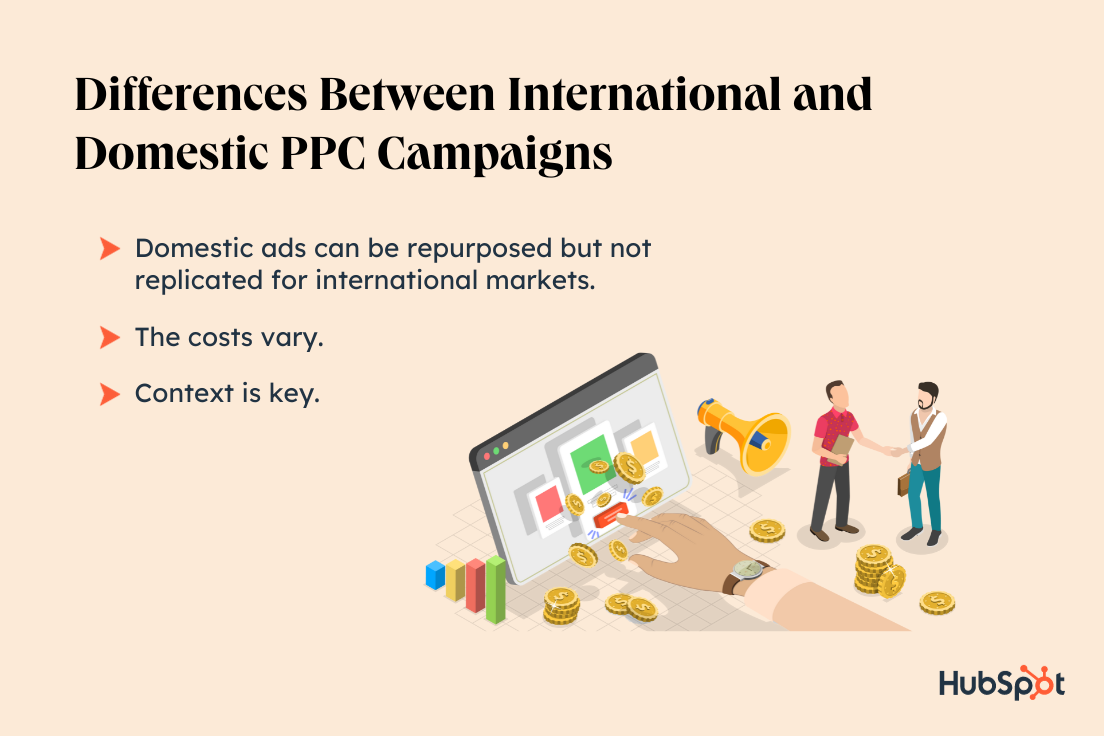
How International PPC Campaigns Differ From Domestic

Here are the main differences between international and domestic ad campaigns and what you can do to bridge the gap for your audience, according to international PPC experts.

Domestic ads can be repurposed but not replicated for international markets.

It can be tempting to take a successful domestic PPC ad campaign and distribute it to all of the new markets you want to target. But simply replicating your ads won’t yield the results you’re looking for.

“One-size-fits-all templates don’t work,” says Flavio Rodrigues, an SEM consultant who runs the consultancy, Digital Sardine. “There are differences in languages and dialects, currencies, user behaviors, and even payment methods,” he adds.

“US companies sometimes underestimate the diversity and differences among European countries, as they may be used to dealing with one large territory, one language, one currency, and one approach.”

If you want to build international PPC ads, it’s best to start from scratch in terms of strategy. “That’s not to say that you need to rebuild all of your ads and landing pages,” says Brent Stirling, a performance marketing consultant who formerly ran paid social ads at Shopify.

“But if you‘ve got screenshots of a SaaS product that are all in English and you drop those into the Vietnamese market with some machine learning translated copy, it’s not going to go as well as you hope.”

The costs vary.

Another significant distinction between running international and domestic ads is the cost per click (CPC), “which is typically lower outside the US due to the high competitiveness of the US PPC market,” Rodrigues points out.

As you’re creating your domestic ad spend budget, keep in mind what your average CPC is for your current campaigns so you have a baseline to compare with.

In addition to your ad spending, you may also see differences in how your international customers spend.

“Credit card penetration rate in Germany is far lower than the US, for example,” according to Stirling. “If people can only pay for your product with a credit card, you’ll see an inflated customer acquisition cost and not understand why.”

Context is key.

When creating for international markets, be aware of the differences in language, currencies, purchasing habits, and behaviors compared to the market you’re already familiar with.

“Context is one of the hardest things to figure out,” says Stirling. “It’s not just about the ads you run and how they look and feel, but how different countries operate too.”

While context is critical, it’s also something that’s hard to pinpoint until you’re deep in the process. If you’re new to a certain market, see how others are running ads in those countries before you set off to create your own.

“Figure out if there‘s any difference in how people advertise in different countries or how people use the platform you’re running ads on,” suggests Stirling.

He recommends using searchable database tools like Meta Ad Library and Google Ads Transparency Center to get a sense of what your competitors are doing in the markets you want to run ads in.

international PPC, Google Ads Transparency Center

Image Source

Ready to launch your campaign in an international market? Follow this step-by-step guide to create your next international PPC ad.
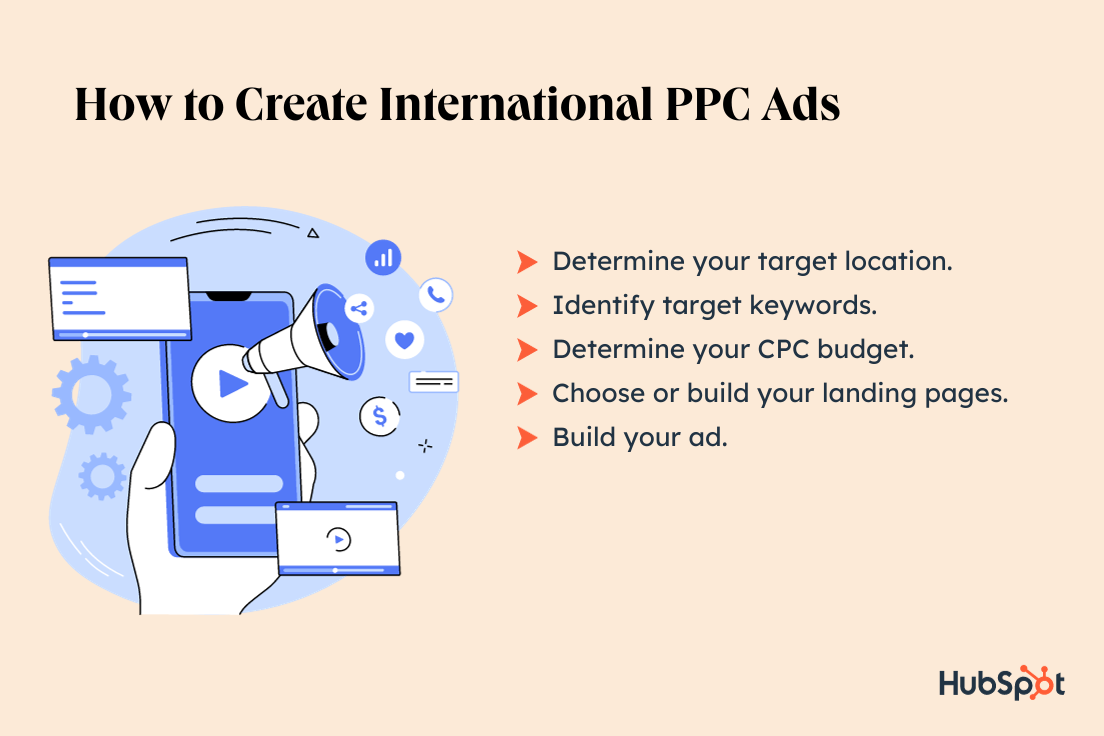
how to create international PPC ads

1. Determine your target location.

Geographic targeting is key to any PPC campaign, but it’s especially important for an international ad.

Use your PPC management tool to decide exactly where your target location is. You may know that you want to target customers in the UK, for example. But do you want to reach people in bustling London or the English countryside?

Every region within a country is different so identify exactly who your target customer is when determining your target location.

While localization is important, it’s crucial to do your research into cultural context and audience behaviors so you can understand what actually resonates with your customer — and what doesn’t.

“To run ads in France, you don’t need to have someone in a beret with a baguette,” notes Stirling.

“In some cases, I’ve actually seen full localization of every aspect of a customer journey, from ad to landing page, go really poorly in places like China, Japan, India, France, Germany, and Italy, especially in the SaaS space.”

2. Identify target keywords.

Use Google Keyword Planner or a tool like SEMRush to identify the keywords you want to target in your international PPC ads.

When identifying your target keywords, remember that certain keywords may not directly translate into the international target market language. To avoid saying something offensive or just plain wrong, invest in translation services.

If you don’t have the resources for a translation service, at the very least, run your keywords through Google Translate. Keep in mind that direct translations don’t always work, so if possible, it’s better to work with a person or service to get context behind the keywords and language of the market you’re targeting.

3. Determine your CPC budget.

As we mentioned earlier, depending on where you’re running your campaigns, the cost will likely be different from what you’re used to.

For example, English-speaking markets are typically the most expensive to advertise in, so you may want to adjust the budget if you’re targeting a different market. You can always modify your budget and reallocate spending once you get started and have a better idea of what your CPC and acquisition costs are.

4. Choose or build your landing pages.

Next, decide where to direct people who click on your ad. Search ads are designed to drive traffic to your website, whether that’s your homepage or a specific landing page — it depends on your goals.

You can either optimize an existing page on your website to match the ad or build a new landing page from scratch.

The key is to make sure everything on the landing page aligns with the ad campaign you’re running.

If your ad headline promises a quick and easy way to book a flight, the last thing someone wants is to click through multiple steps to find the booking page.

Make sure your ad and landing page are aligned when it comes to messaging, content, and calls to action.

5. Build your ad.

While you want to be mindful of the markets you’re running your ads in, consider using more general visuals and weaving localization in where it matters, like in the ad copy and currencies.

Figure out what your ad copy and landing page creative will be and how it all speaks to your international audience. “Making sure every element is localized, or at least palpable, for an international market is key,” says Stirling.

As you build you ad, refer to other international ad campaigns you noted during your research. Keeping the standard PPC ad structure in mind — headline, display text, URL — weave in the localization elements for the new market you’re targeting.

PPC Landing Page Examples

To get a better idea of what an effective PPC landing page looks like, let’s take a look at a few international PPC search ads and how their landing pages match up.

Hotels.com

It should come as no surprise that the travel industry excels in running international PPC campaigns.

When you have a global brand that reaches customers around the world, you need to be skilled at localization and running multiple campaigns at once.

One example from the travel industry comes from Hotels.com. The hotel booking site uses search ads to promote its easy reservations process, top-rated hotels, and positive customer reviews to travelers from around the world.

This particular ad targeted the French market. Not only did it use French language for the ad copy, but it specifically highlighted hotels in different French cities, from Lyon to Marseille.

PPC Landing Page Examples, hotels.com

If you click the ad, you land directly on the Hotels.com booking page. The landing page is in French which is in line with what you’d expect when clicking on the French search ad.

Everything about this international ad is clearly optimized and localized.

PPC Landing Page Examples, hotels.com

Image Source

Bluepillow

Another travel industry example comes from Bluepillow, a global vacation rental search engine.

The Milan-based company uses international PPC ads to target global customers who either want to book a short-term rental or list their home for rent.

Below is a PPC ad from Bluepillow that’s written in French and promotes savings and deals for rentals in Paris.

PPC Landing Page Examples, bluepillow
The search ad leads directly to the landing page below which is the booking page for rentals and hotels in Paris. The prices are automatically displayed in the country’s currency, the euro.

PPC Landing Page Examples, bluepillow

Image Source

Shopify

Shopify is a leading ecommerce tool used by millions of businesses around the world. This means they need a strong international PPC strategy to reach global customers.

Below is an example of one of Shopify’s search ads promoting its global ecommerce solutions.

PPC Landing Page Examples, shopify
The search ad directs users to this landing page. The messaging of the landing page aligns with what someone would expect after seeing the ad from the search results.

It describes what someone who’s conducting international ecommerce needs out of their website, and all of the globally-minded solutions that Shopify offers.

PPC Landing Page Examples, shopify

Image Source

Amazon

Global online retailer, Amazon is also a major player in international PPC.

An example of their strategy can be seen in the two PPC ads, below. Both ads are created to promote Coca-Cola listings on Amazon but they target different markets. The first one is designed to target the US market.

The ad’s headline displays the official Coca-Cola page on Amazon, which it directs to when you click it.

The rest of the ad copy reminds shoppers that Amazon has kitchen and dining supplies from hundreds of popular brands, assuming that the person seeing this ad may need more groceries or supplies in addition to the beverage.

PPC Landing Page Examples, Amazon

Here is the second search ad which targets the Mexico market. The ad is written in Spanish and directs to a listing for the beverage on Amazon Mexico. What’s different about this ad compared to the US version is the messaging.

Instead of mentioning any other Amazon products or categories, this ad focuses solely on a limited-edition beverage from the brand. Why, you may wonder?

Coca-Cola is the most consumed beverage in Mexico, so one can assume that a limited edition product would pique the interest (and increase the click-through rate) of some of Coca-Cola’s biggest fans.

PPC Landing Page Examples, Amazon

PPC Tools

HubSpot’s PPC Campaign Management Template
ppc tools, HubSpot’s PPC Campaign Management Template

This free template from HubSpot acts as a checklist to ensure you don’t miss any key elements for a successful ad campaign.

Following this template can be especially useful if you’re new to creating PPC ads as it provides a descriptive breakdown of what your ad copy should look like.

For example, it outlines how many characters are needed for each ad headline or display URL and includes a chart for you to track key campaign metrics such as impressions, cost-per-click (CPC), and conversions.

Simply plug in your ad campaign information and track relevant metrics to measure your results.

Best for: If you’re a beginner, use this free template to plan and track a full-funnel international PPC campaign from start to finish.

Google Ads Editor
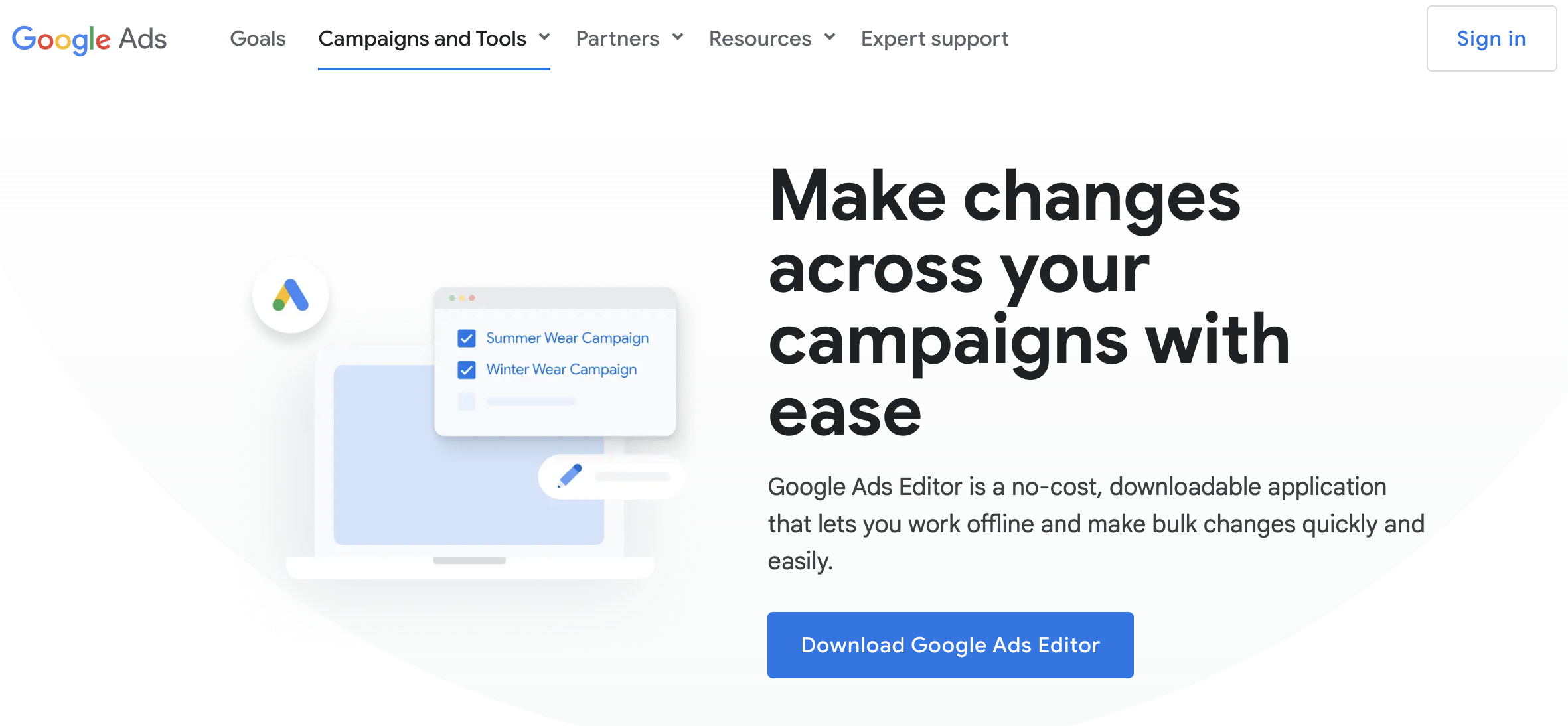
ppc tools, Google Ads Editor

Google Ads Editor is a free tool to manage and edit your Google Ads Campaigns wherever you are. You can modify your campaigns, make bulk changes, and even work offline so you can adjust your ads as quickly as needed.

Best for: This free tool is an essential part of PPC campaign management.

SEMRush
ppc tools, SEMRush

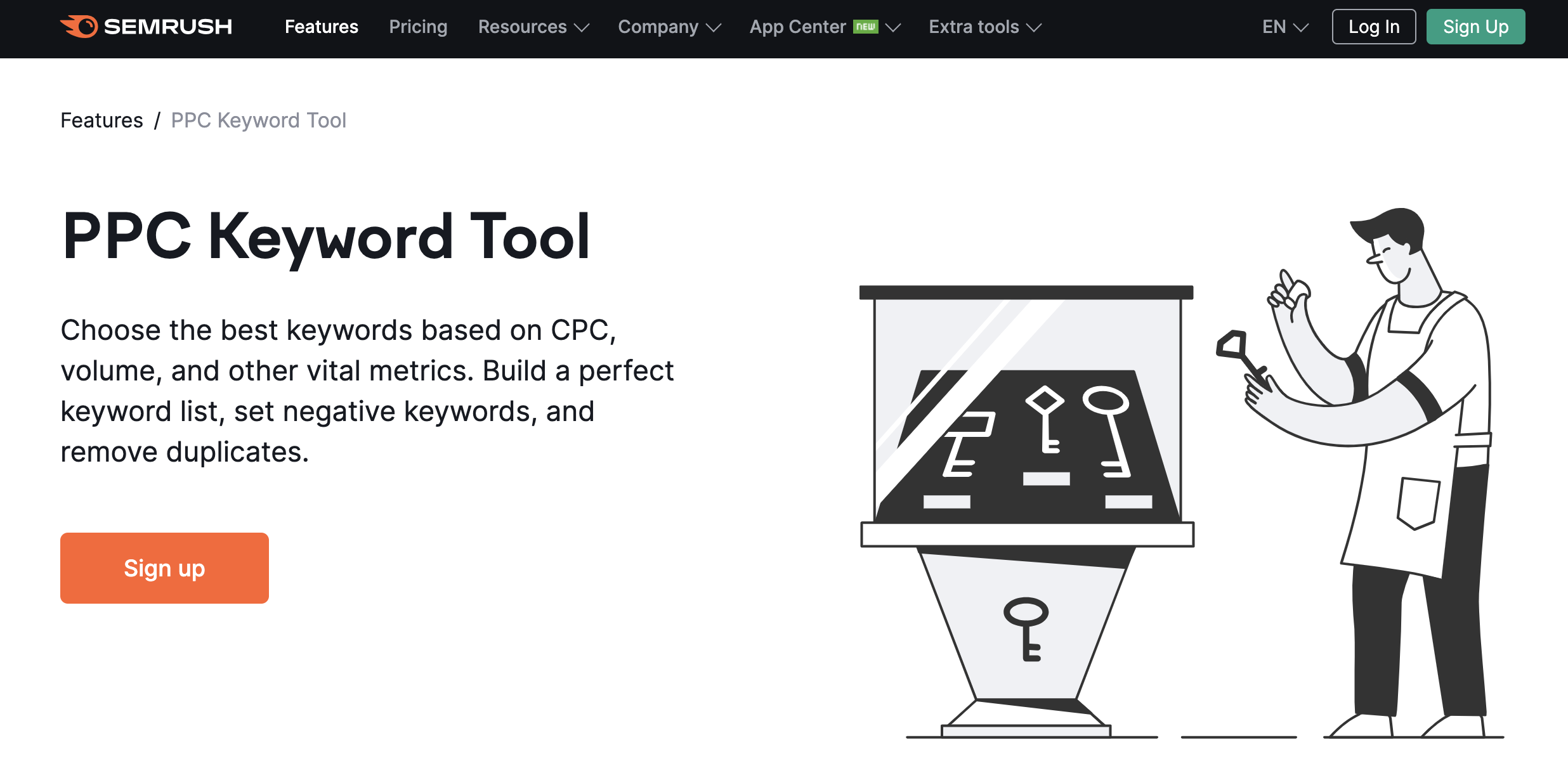
Keywords are the most important element of any PPC campaign, but you need to make sure you’re targeting the right ones to see results.

Use SEMRush to identify and collect target keywords for your campaigns.

You can also manage those lists of keywords (because we all know how challenging it can be to keep track of those keywords when you have multiple campaigns going!) to remove duplicates and set negative keywords.

What we like: You can use SEMRush to identify, track, and manage both organic and paid keywords.

Wordstream’s PPC Software
ppc tools, Wordstream’s PPC Software

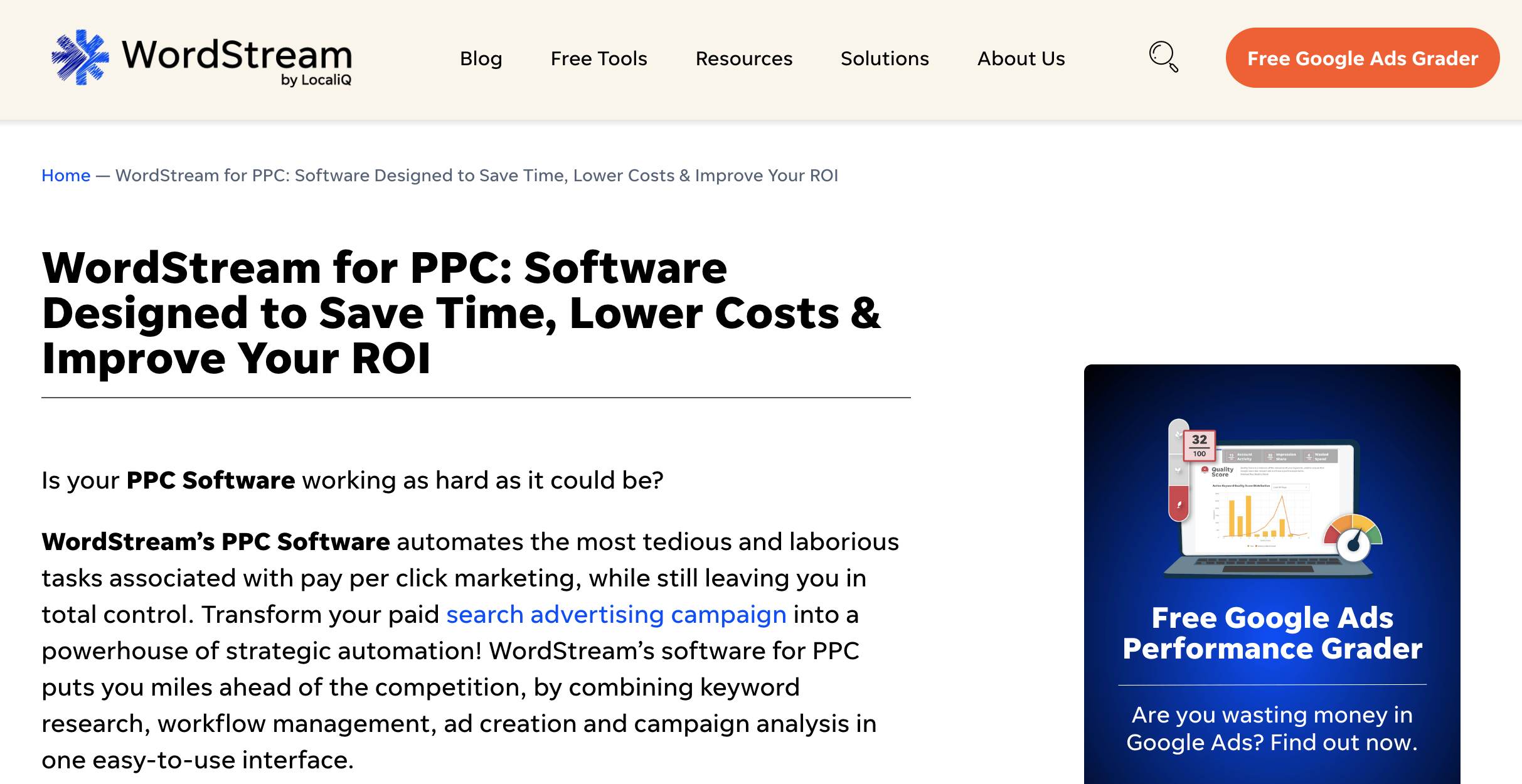
Wordstream makes it easy to manage every aspect of your PPC campaigns using automation.

Using this PPC software, you can conduct keyword research, improve workflow management, create ads, and analyze your campaigns in one easy-to-use interface.

Plus, Wordstream offers a seven-day free trial, making it ideal for small businesses with limited resources (or time) to waste.

Best for: Small businesses that want to make sure they’re getting the most out of their PPC strategy. Wordstream also offers a free GoogleAds Performance Grader so you can get an overview of how your campaigns are performing, especially in relation to your competitors.

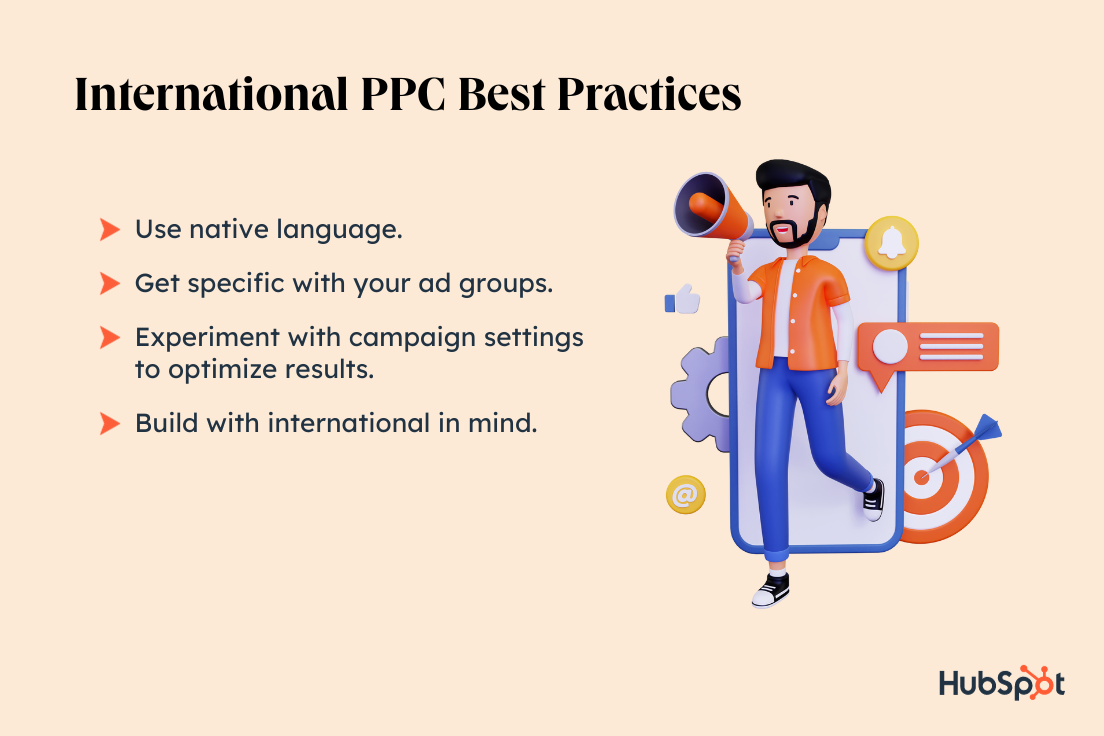
To create effective paid campaigns for an international audience, follow these four best practices recommended by PPC experts.
international PPC best practices

1. Use native language.

The number one thing to remember when creating global ad campaigns is to use the native language of your target market.

While this may sound like a no-brainer, it can be easy to overlook details if you don’t keep international in mind throughout the entire campaign process.

Make sure that not only does your ad copy use native language, but that your landing page is a fully connected user experience.

This means the landing page should use the same language as the ad and the product experience should match your target audience, from their behaviors to currencies.

Another best practice to keep in mind when it comes to using native language is to avoid using direct translations. “Ads and the experience that follows are a creative endeavor,” says Stirling. “Your brilliant English copy, if translated poorly, is going to result in less than stellar results.”

To avoid confusing messaging and increase the chance that your ad will convert to a new market, Stirling recommends transcreation.

“Having access to a solid transcreation team or service that can take your English copy and not directly translate it, but transcreate it so it makes sense in the context of another language gives you a huge leg up,” he says.

Another way to create effective copy for international campaigns is to be proactive with the language barriers.

If you already know which international markets you want to target, you can prepare by working with native-speaking copywriters in those regions *before* you distribute your ad.

This can be a great way to understand the market and the audience you’ll be speaking to and get more context behind the message.

2. Get specific with your ad groups.

Effective PPC campaigns should have a series of ads within the campaign. Think of these as a way to A/B test everything from the headline to the landing page.

For international PPC ads, consider getting even more specific within your ad groups. Rodrigues recommends structuring campaigns with consideration for both locals in their home countries and locals living abroad.

“Consider factors like language and currency preferences for users in a specific location,” says Rodrigues. “If you target only English-speaking users in the UK, you may miss out on millions of expats, so consider targeting users in French, Spanish, German, and other languages.”

3. Experiment with campaign settings to optimize results.

All successful PPC campaigns require continuous testing and optimizing, and international ads are no different. Always test and refine your ad creative, copy, targeting, and bidding strategies.

As you learn more about the international market you‘re targeting, you’ll pick up on things that may be working and what’s not. Take what you learn, apply it to your campaign settings, and track the results.

4. Build with international in mind.

If you’ve already found success when creating domestic PPC ads, then you’re halfway there. You already know how to structure, create, and budget for ads that convert. Now take that knowledge and build for a broader audience.

“The tried and true method for me is to build with international in mind, using product screenshots that are language agnostic, then test those ads in English-speaking markets with English copy where you’re already advertising,” says Stirling.

“These are typically the most expensive places to advertise, so if you can win there, you can win everywhere. Take your winners, transcreate your copy and landing pages, and launch internationally.”

Build Your Own International PPC Strategy

If you’re marketing to customers around the world or in a specific global region, having an international PPC strategy is essential for your marketing team.

By using these international ad best practices and tools, you’re setting up your team for global success.
New Call-to-action

Categories B2B

The Ultimate List of Email Marketing Stats for 2023

Webinars, video campaigns, and social media posts are relatively new channels for marketers to reach their customers. Still, I don’t think that more contemporary methods should distract you from one of the oldest, most effective strategies  — email marketing. In fact, email ROI is an impressive $36 for every $1 spent

Download Now: Free State of Marketing Report

If you’re still hesitant, keep reading — we’ve cultivated a list of email marketing statistics for HubSpot to demonstrate just how powerful email can be. Here, you’ll find: 

General Email Marketing Statistics and Best Practices

  • Email marketing is used by 31% of marketers. (HubSpot Blog Research, 2023)
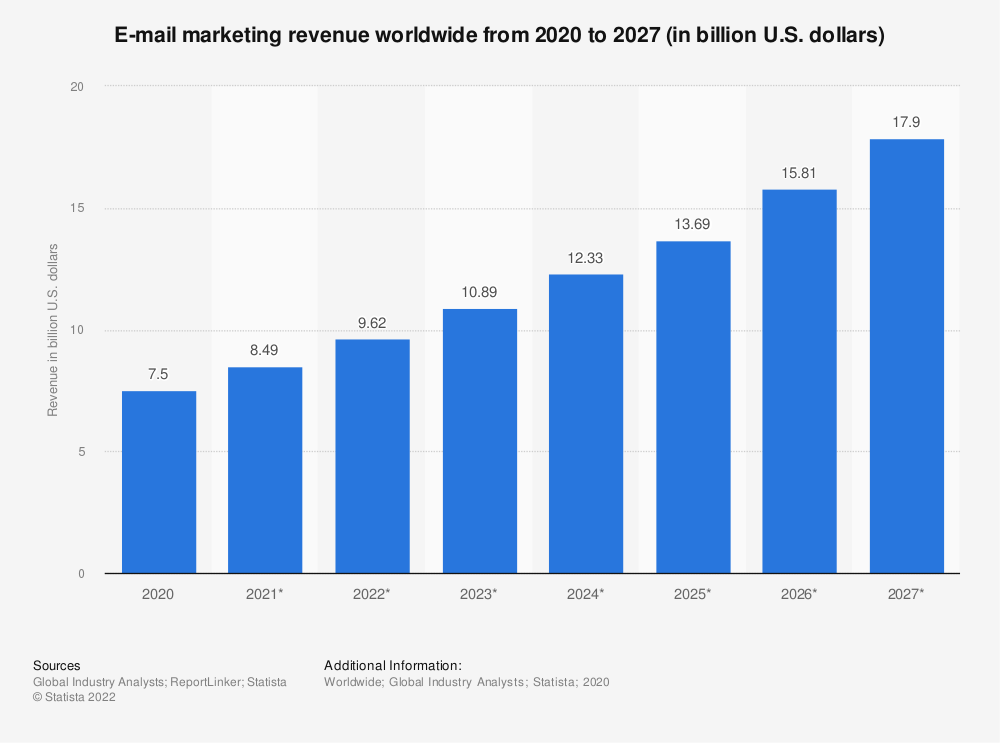
  • Email marketing revenue is estimated to reach almost 11 billion by the end of 2023. (Statista, 2021)

email marketing stats: graph displaying email marketing revenue through 2027

Image Source

  • There are 4 billion daily email users. This number is expected to climb to 4.6 billion by 2025. (Statista, 2021)
  • More than 347 billion emails are sent and received each day. (Statista, 2022)
  • 64% of small businesses use email marketing to reach customers. (Campaign Monitor, 2021)
  • 38% of brands are increasing their email budget, and just 10% are making cuts. (HubSpot Blog Research, 2023)
  • The most effective strategies for email marketing campaigns are subscriber segmentation (78%), message personalization (72%), and email automation campaigns (71%). (HubSpot Blog Research, 2021)
  • Emails with multimedia elements or formats with images and/or videos have the highest performance. (HubSpot Blog Research, 2023)
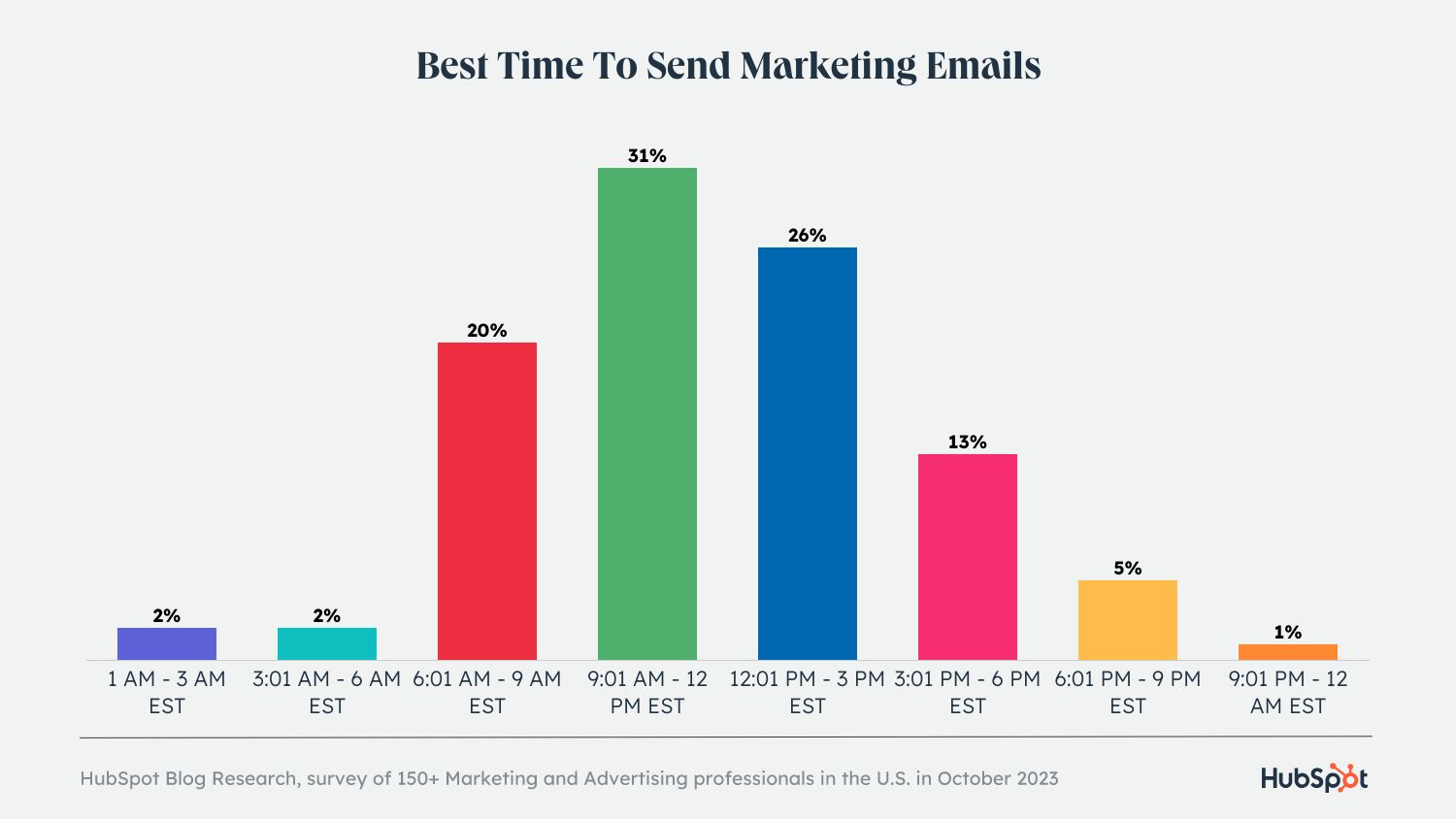
  • The best time to send a marketing email is 9:00 AM – 12 PM EST, then 12:01 PM – 3 PM EST. The worst is 1 AM – 3 AM EST.  (HubSpot Blog Research, 2023)

graph displaying the best time to send a marketing email

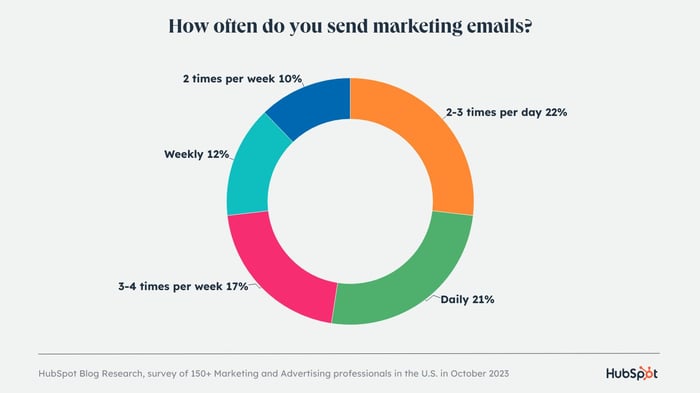
  • 22% of marketers (or the companies they work for) send marketing emails 2-3 per day, and 21% send daily emails. 12% send a weekly email. (HubSpot Blog Research, 2022)

pie chart displaying how often marketers send marketing emails

  • Most marketers determine the frequency of their email send based on past email engagement data. (HubSpot Blog Research, 2023)
  • 87% of brands say that email marketing is very critical to business success. (Litmus, 2023)
  • 77% of marketers have seen an increase in email engagement over the last 12 months. (Not Another State of Marketing, 2021)
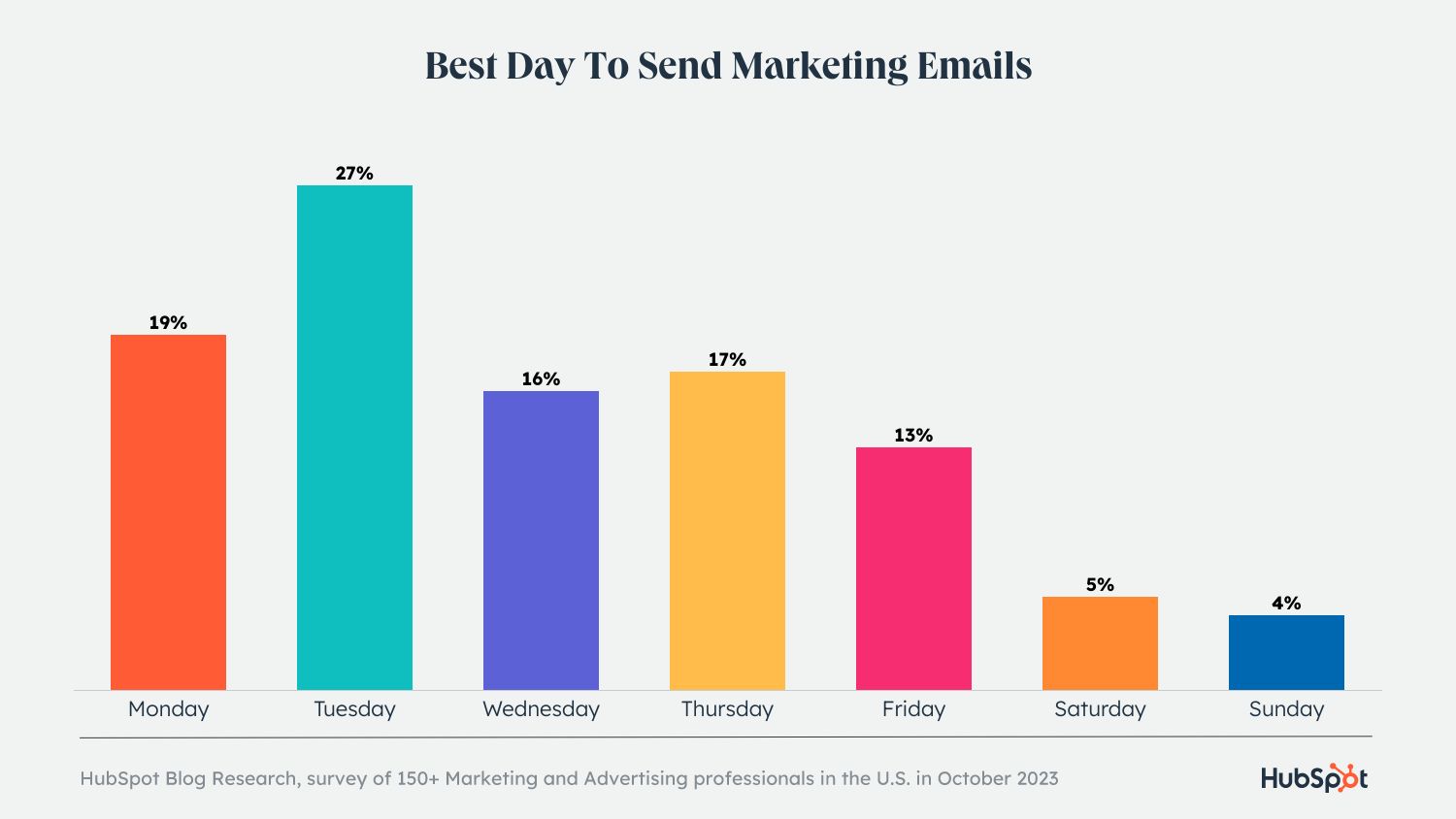
  • Tuesdays are the best days to send an email for the highest performance, Sundays are the worst. (HubSpot Blog Research, 2023)

    bar graph displaying the best days to send marketing emails

  • Most marketers say Apple’s Privacy Protection feature has not impacted the accuracy of the email marketing metrics they track. Those that have reported changes say it’s had the most impact on reporting accuracy for overall email traffic. (HubSpot Blog Research, 2023)
  • Personalization using dynamic content is the top personalization tactic used by email marketing teams. It’s also the best way to improve email performance. (Litmus, 2023)
  • The most effective email subject lines engage curiosity, include promotional offers, and are personalized to each recipient’s interests. (HubSpot Blog Research, 2021)
  • QA, A/B, and spam testing your emails leads to higher ROI. Enjoy up to a 28% higher return when you put testing to work for your email program. (Litmus, 2022)

  • 85% of eCommerce marketers say their primary objective with email is increasing brand awareness. (HubSpot Blog, 2023)

Email Marketing Metric Statistics

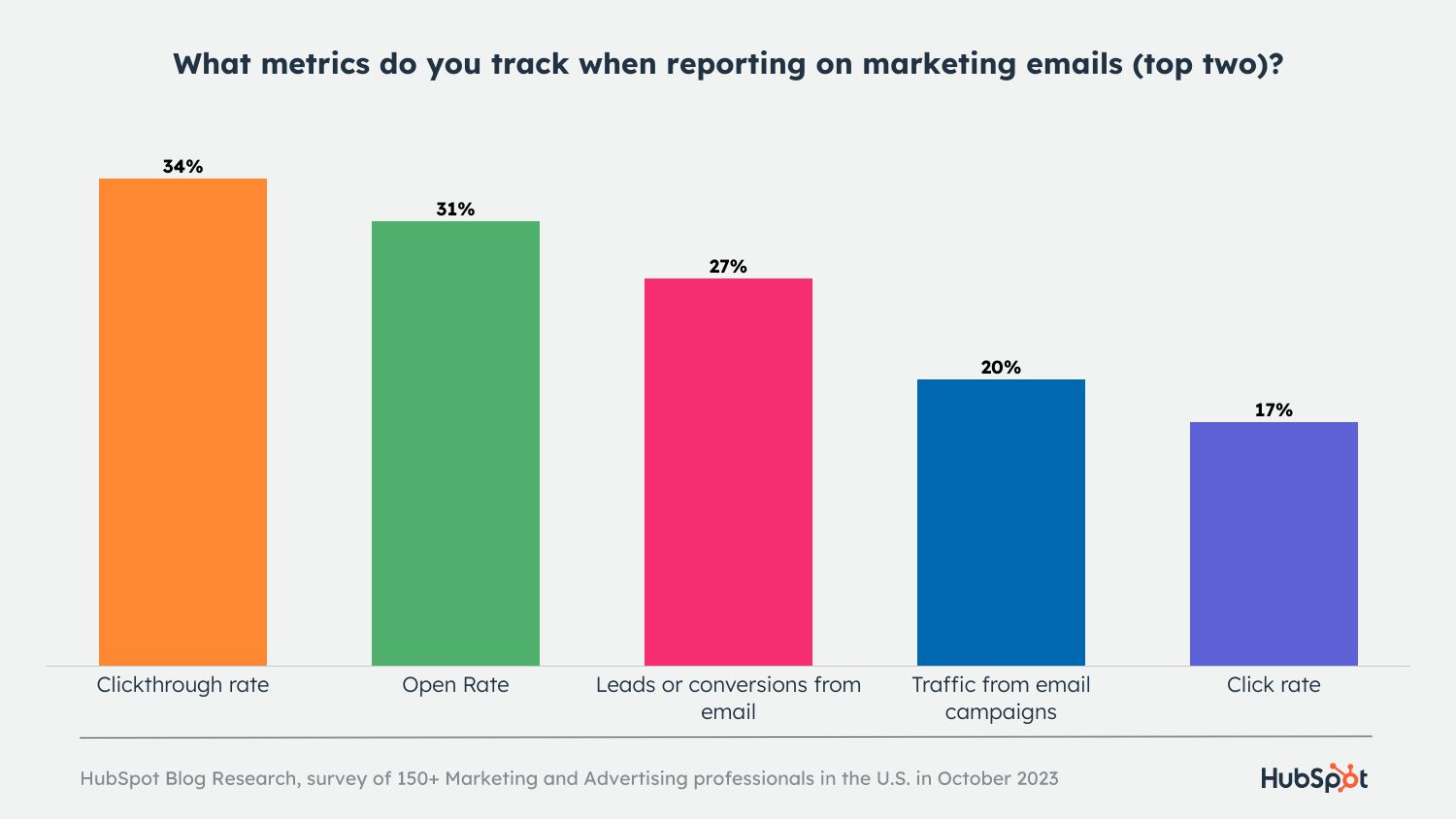
  • The top two metrics marketers track for the emails they send are clickthrough rate (34%) and open rate (31%). (HubSpot Blog Research, 2023)

metricks tracked

  • Most marketers report an average email open rate of 46-50%. (HubSpot Blog Research, 2023)
  • The average email clickthrough rate is 2.6-3%. (HubSpot Blog Research, 2023)
  • The average email click rate is 7-9%. (HubSpot Blog Research, 2023)
  • Emails with images offer an almost 10% boost in open rates.(GetResponse, 2022)
  • The average email delivery rate is 85.7% (Emai Tool Tester, 2023)
  • The average email delivery rate for Google is 95%, 91% for Microsoft, 81% for Yahoo, and 76% for AOL. (Email Tool Tester, 2023)

AI Email Marketing Statistics

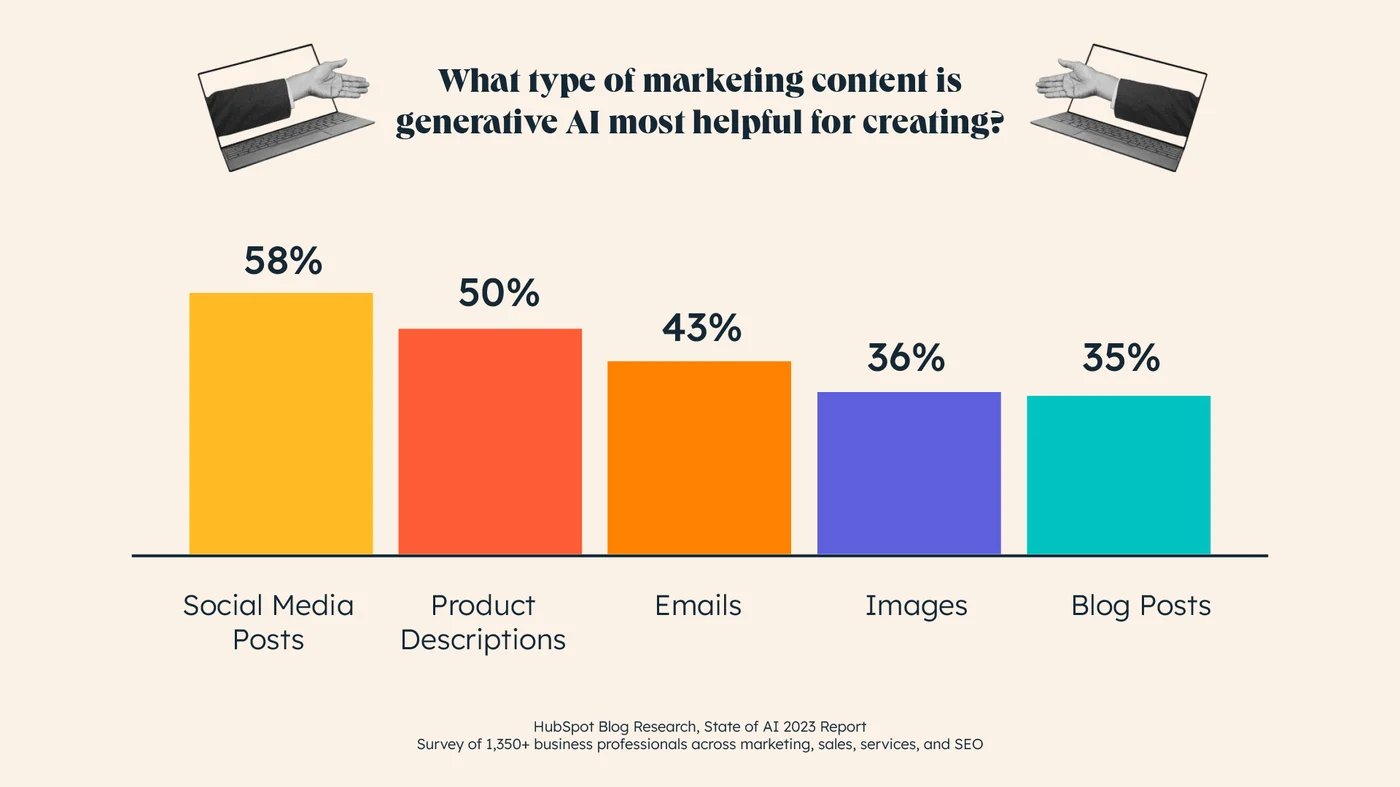
gen AI effectiveImage Source

  • 38% of marketers who use AI use it to write emails. (HubSpot’s State of Generative AI, 2023)
  • 21% of Sales Professionals who use AI in their role say that it’s most useful for writing messages to prospects. 32% say it’s most useful for re-purposing messages by adapting them to a different audience. (HubSpot’s State of Generative AI, 2023)

Pro tip: Want to give AI a test drive for your marketing emails? Check out Campaign Assistant, HubSpot’s generative AI tool that creates customized emails in seconds.

B2B Email Marketing Statistics

  • Email is the third-highest owned media platform B2B marketers used to distribute content in the past 12 months. (Content Marketing Institute, 2022)
  • 81% of B2B marketers say their most used form of content marketing is email newsletters. (Content Marketing Institute, 2020)
  • 14.3% of all emails go missing or have been caught by popular spam filters. (Email Tool Tester, 2023)
  • B2B marketers say that new product and feature announcement marketing emails have the highest click-through rate. (HubSpot Blog Research, 2021)
  • Automation is primarily used in email marketing to send triggered emails, for drip or nurture campaigns, and segmentation. (Litmus, 2021)
  • B2B buyers and consumers feel overwhelmed by the volume of emails and 67% set up a junk email account to dodge unwanted emails. (Gartner, 2022)
  • The biggest blockers marketers face during email production are building (41%), designing (40%), and testing (39%). (Litmus, 2023)

Mobile Marketing Statistics

  • 55% of emails are opened on mobile devices. (eMarketer, 2023)
  • Nearly 55% of global website traffic is generated from mobile devices, excluding tablets. (Statista, 2022)
  • 46% of smartphone users prefer to receive communications from businesses via email. (Statista, 2021)
  • Apple iPhone’s native email app has the highest market share, followed by Gmail. (Litmus Labs, 2022)
  • 35% of email marketers say they use a mobile-first or mobile responsive design process. (Litmus, 2023)
  • Launching a mobile-responsive email design can increase unique mobile clicks by 15%. (MailChimp, 2021)
  • 56% of marketers leverage mobile-friendly emails in their email marketing strategy. (HubSpot Blog Research, 2021)

B2C Email Marketing Statistics

  • 87% of B2C marketers leverage automation as part of their email marketing strategy. (HubSpot Blog Research, 2021)
  • 50% of people buy from marketing emails at least once per month. (Salecycle, 2022)

  • Your audience will reward you with higher open and click rates if you don’t send more than five newsletters a week. (GetResponse, 2020)
  • 60% of retail, e-commerce, and consumer goods and services companies are personalizing emails based on past purchases, versus 38% in 2019. (Litmus, 2020)
  • More than 8 out of 10 people will open a welcome email, generating 4x as many opens and 10x as many clicks as other email types. (GetResponse, 2020)
  • 4 out of 5 marketers personalize emails with profile data and 64% personalize them by segment. (Constant Contact, 2023)
  • More than 8 out of 10 people will open a welcome email, generating 4x as many opens and 10x as many clicks as other email types. (GetResponse, 2020)
  • Abandoned cart emails convert 3x more than other automated emails. (Email Tool Tester, 2023)
  • Nearly 21% of all email campaigns are opened within the first hour of sending. (GetResponse, 2023)
  • 60% of respondents say that marketing emails have influenced their purchases. (Constant Contact, 2023)
  • 64% of B2C marketers consider accessibility when creating their emails. (Pathwire, 2021)

Email Marketing Demographics

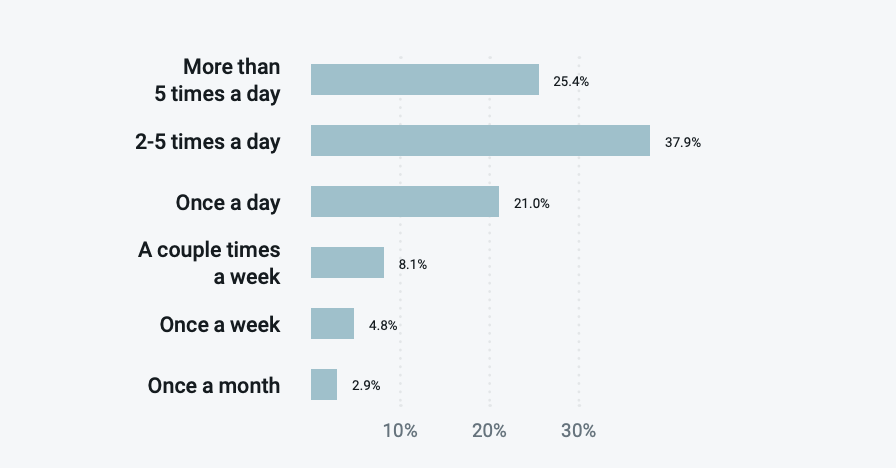
  • 99% of email users check their inbox every day, with some checking 20 times a day. Of those people, 58% of consumers check their email first thing in the morning. (OptinMonster, 2020) 84.3% of consumers say they check their emails at least once a day. (Pathwire, 2021)

email marketing stats: how often consumers check emailImage Source

  • 37% of survey respondents in the U.S. have two email addresses and 28% have over four.  (Statista, 2022)
  • Consumers spend an average of 9 seconds reading brand emails. (Statista, 2022)
  • A majority of Americans say the emails they receive are not useful (59%). (Edisonmail, 2023)
  • Too many emails is the number one trigger for consumers to unsubscribe. (Gartner, 2022)
  • Consumers prefer to receive emails from their favorite brands just a few times per month. (Gartner, 2022)
  • When it comes to data security, 32% of consumers are distrustful when it comes to giving companies their email. (HubSpot, 2023)
  • Email is the leading way consumers in the U.S. discover coupons from brands.  (Statista, 2021)
  • Consumers say they’re most likely to open emails about available promotions/discounts.  (Digital Commerce 360, 2022)
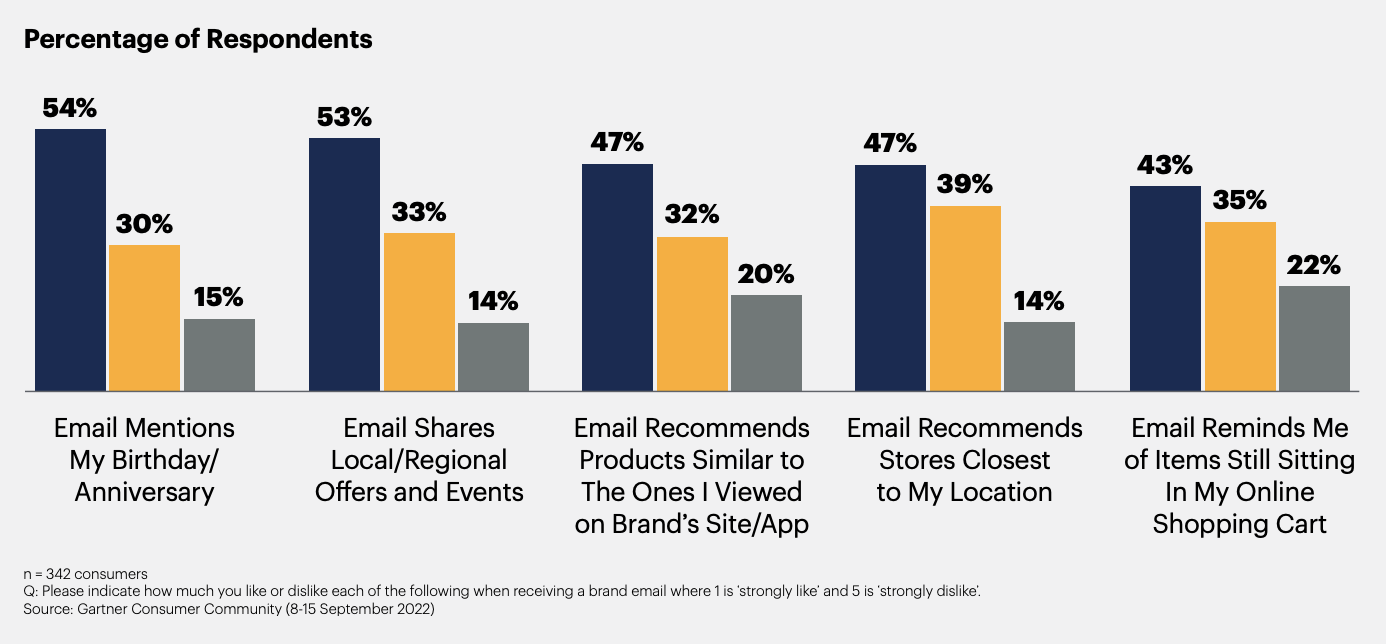
  • Consumers also like emails that mention a birthday or anniversary (54%) and share local/regional events and offers (53%). (Gartner, 2022)

gartner image

  • 59% of Millennials primarily use their smartphone to check email, while 67% of Generation Z scans their inbox on mobile. (Bluecore, 2021)
  • Gen Z, Millennials, and Gen X most often use email for online shopping. Boomers use email for correspondence with friends and family. (Edisonmail, 2023)
  • The most significant steps marketers take to champion accessibility when creating their emails is writing short, descriptive subject lines, making links and buttons easy to see, and keeping paragraphs short and simple. (Pathwire, 2021)

Apply Your Email Knowledge

Many of the data points will help you make the case for investing more time and money into your email marketing strategy. While you can refer back to this post at any time, you can also start applying them to your next campaign.

Editor’s Note: This blog post was originally published in March 2019, but was updated for comprehensiveness and freshness.

state-of-marketing-2023


Categories B2B

The HubSpot Culture Code: Creating a Company We Love

Several years ago, we published a public beta of the HubSpot Culture Code slide deck. This deck started out as an internal document, and as a company who values transparency, we decided to share it with the world.

Like HubSpot, the Culture Code is a perpetual “work in progress,” so we’ll update it periodically. To date, we’ve updated it more than 25 times, and what you see below is our latest version. The presentation has been very well received, with more than 5 million views so far. (Thank you!)

HubSpot is growing. We have about 73,400 customers and more than 3,800 employees in the company now. We have more than $674 million in annual revenue. We are grateful to our customers and to the inbound community for the success we’ve had so far.

Download Now: Free Company Culture Code Template

And we’re grateful to those of you who have hopped on for the ride. We thought it could be interesting and possibly even useful to offer up this inside look at HubSpot and the people behind it. What do we believe? What makes us tick?

The HubSpot Culture Code

The answers to those questions (and more!) are in the mega-slide-deck included above. The document has evolved and expanded over several years into this latest version. We hope you like it and will share it.

HubSpot Culture Code Highlights

  • Culture is to recruiting as product is to marketing.  
  • Whether you like it or not, you’re going to have a culture. Why not make it one you love?
  • Solve For The Customer — not just their happiness, but also their success.
  • Power is now gained by sharing knowledge, not hoarding it.
  • “Sunlight is the best disinfectant.” -Louis Brandeis
  • HubSpot has a no-door policy, where everyone has access to anyone in the company.
  • You shouldn’t penalize the many for the mistakes of the few.
  • Results should matter more than when or where they are produced.
  • Influence should be independent of hierarchy.
  • Great people want direction on where they’re going — not directions on how to get there.
  • “Better a diamond with a flaw than a pebble without.”
  • We’d rather be failing frequently than never trying.

We hope you found the deck useful. If you’d like to reach out or provide feedback, you can do so in the comments below.  Or, you can find me on twitter @dharmesh.

Categories B2B

2024 Creator Economy Predictions

Content makes the world go ’round (at least for marketers), but it can’t create itself. This week we’re exploring the top creator economy predictions for 2024 that marketers need to know.

Chances are, your brand has worked with creators in the past and likely will again.

Currently valued at $250B, the creator economy is expected to reach $480B by 2028. This growth is fueled by increased cash flow from brands and higher demand for content.

Per a recent study by IAB:

  • 44% of advertisers plan to increase spend with content creators in 2024
  • Brands anticipate increasing creator content budgets by 25% in 2024
  • 39% of consumers watch more content now than the year prior

Creator content is no longer just a top-of-funnel play. In 2024, a well-rounded marketing strategy has content embedded throughout, and strong relationships with creators are essential to making these strategies work. Here are the top predictions of how the creator economy will evolve in 2024.

2024 Creator Economy Predictions

The Growth of YouTube Shorts

YouTube launched Shorts, its short-form video feature, worldwide in 2021. Two years later, Shorts continues to grow. In February it crossed 50B daily views and rolled out a revenue share program for creators who share videos on Shorts.

While Shorts haven’t yet matched Reels which garner 200B views daily across Instagram and Facebook, the feature still has a lot of untapped potential for marketers.

YouTube is a powerful search engine with a large global user base. Pew just released research stating Gen Z now spends more time on YouTube than TikTok each day. With this in mind, the potential to get in front of a large audience by creating SEO-rich short-form videos is high.

Additionally, as creators look to diversify their presence on platforms, many will likely repurpose their content on Shorts to get in front of new audiences. This could generate additional engagement on Shorts that is appealing to marketers.

B2B Brands Embracing Creators

A majority of creator’s work has been centered around getting their audiences to opt into B2C products.

B2B companies have been a bit slower to get on board with creators and have relied on more traditional sales and marketing channels, but we could see that change in 2024 as more B2B brands embrace working with creators.

Micro-creator Renaissance

Beyoncé isn’t the only person having a renaissance. In 2024, micro-creators (those who have followings between 10K and 100K) will be in high demand for brand partnerships.

As mentioned above, many brands are looking to increase their spend with creators in 2024. From a brand perspective, micro-creators typically offer the most value. The average micro-creator has an engagement rate of 9%, which is far higher than the average engagement rate of macro-creators and celebrities at just 2%.

In addition to having an audience that is more likely to engage with and trust their content, micro-creators tend to have lower rates, making them more affordable to work with and often delivering better campaign results.

Creators who have niche, hyper-focused communities are uniquely positioned to establish mutually beneficial working relationships with brands that want to reach their audiences.

The Rise of Creator-Led Media Companies

The media industry has had a turbulent year with companies like Vice, CBC, Jezebel, and Starz undergoing recent layoffs. As the industry recalibrates, creator-led media companies have the potential to pave new roads to success.

Unwell founded by podcaster Alex Cooper, and Hello Sunshine created by Reese Witherspoon are examples of lifestyle brands turned media companies founded by creators. Creator-led media companies have the agility to innovate in ways legacy media companies don’t and could have a lasting impression on the space.

Companies Recruiting In-House Creators

While contracting work with creators will continue, we will likely see more and more brands fostering in-house content creator talent.

Working with independent creators to get in front of their audience is a strong play, and having a team of skilled creators in-house to create high-quality content your company owns, distributes, and has more control over is incredibly valuable.

This has been our norm for some time here at HubSpot, where our media team creates content to distribute among our newsletters, blogs, podcasts, and YouTube channels generating valuable impressions for our business.

In 2024 and beyond, more companies will follow suit, hiring in-house content creators and personalities to round out their owned channels.

More Creators Will Become Founders

Over the past few years, there has been a rise in popular creators becoming successful brand founders in their own right, and this trend has the potential to continue.

From Emma Chamberlain’s Chamberlain Coffee to Marianna Hewitt’s Summer Fridays, creators are expanding their influence to create stand-alone products and build their empires.

Though not every creator may be in a position to fully develop their own product lines, we will likely see an influx of co-branded products between brands and creators to expand working relationships beyond sponsored content. Creators may also be inclined to white-label product lines as a way to directly sell to their audience instead of constantly promoting other brands.

If your brand intends to work with creators in 2024, it will be prime time to think beyond the transactional brand-creator partnership of the past and find new ways to establish innovative, mutually beneficial collaborations.

New call-to-action

Categories B2B

Email Marketing for Hotels — How to Get It Right

The hospitality industry faces a number of obstacles and opportunities in regard to marketing, with one of the greatest puzzles being email marketing.

Email marketing for hotels is a unique challenge: there can be varying customer acquisition periods, low retention rates, and the difficulty of convincing someone to purchase a once-in-a-lifetime experience more than once.

From budget accommodations offering a port in a storm to luxury hotels offering bucket-list experiences, hotels have a lot to gain by leveraging email marketing successfully.

→ Download Now: The Beginner's Guide to Email Marketing [Free Ebook]

As a digital nomad, I have a greater appreciation for quality hotel email marketing than the average person. As a marketer and a full-time traveler who lives out of hotels and Airbnbs around the world, I encounter these marketing techniques on a regular basis as I navigate my travels. Here’s how to get it right.

Table of Contents:

How Email Marketing Benefits Hotels

While most hotels send pre-arrival emails to hotel guests like a confirmation email and a reminder for an upcoming reservation, email marketing has powerful potential to engage potential customers.

While some travelers will book last minute, Think With Google reported a trend that consumers are researching and planning ahead more for their travels. For hotels, this means an extended nurture period where hotels have the opportunity to boost bookings through the use of email campaigns.

Challenges

Direct business-to-consumer (B2C) sales are difficult in the hospitality industry. Many consumers turn to websites like Booking.com, Tripadvisor, or Hotels.com to secure their hotel stays, which makes the top of the sales funnel extremely competitive.

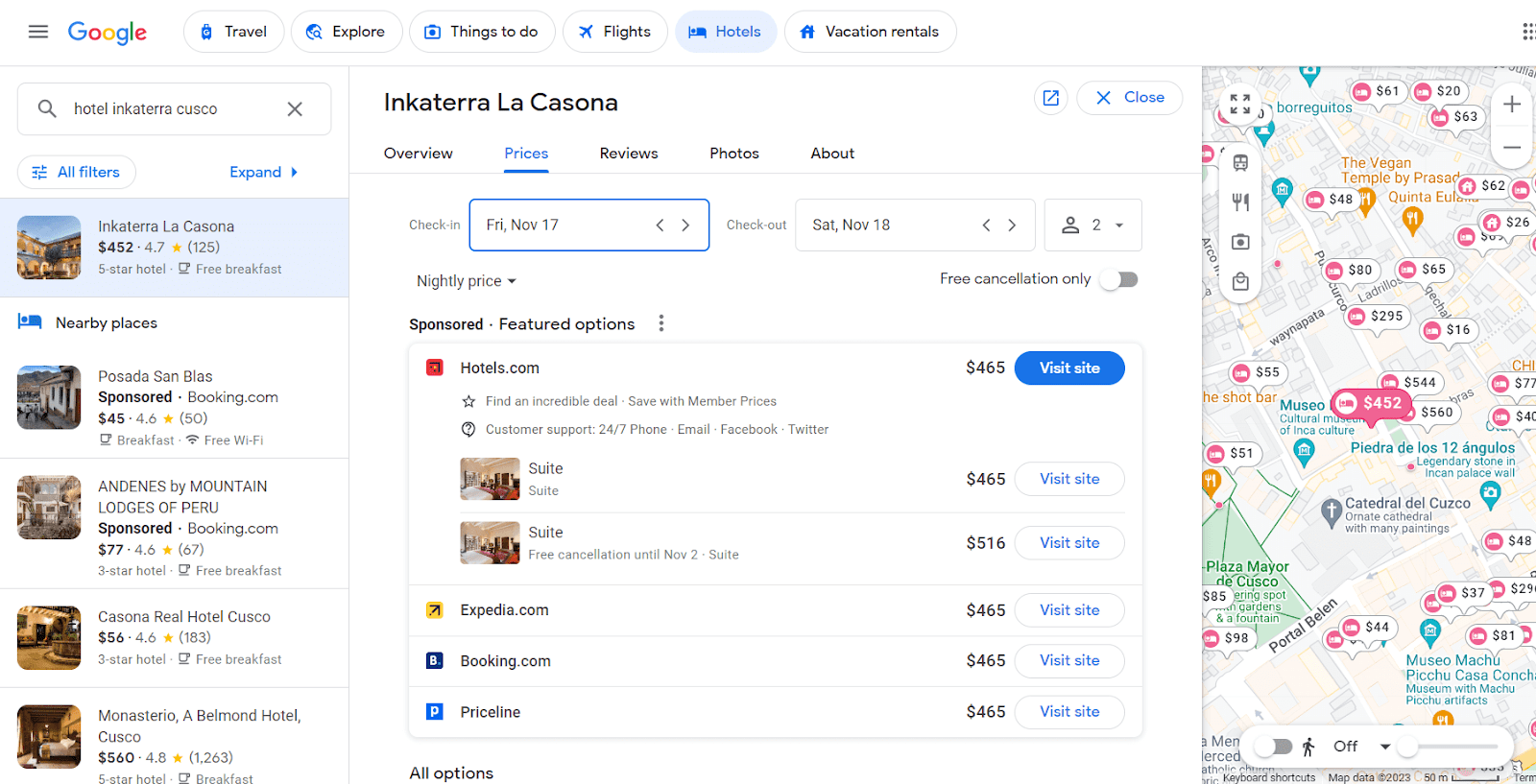
When I searched for a hotel in Cusco, Peru, you can see that there are paid ads from Hotels.com, Expedia, Booking.com, and Priceline all vying for customers to purchase through their website instead of booking directly with the hotel itself.

Image Source

The nature of the travel industry also presents challenges to the hotel business. The average consumer will take a vacation once or twice a year, often visiting a new destination each time.

Customers become expensive to acquire and difficult to retain through email marketing. However, there are still clear benefits of email marketing for hotels.

Opportunities

B2C sales might be a challenge for the hotel industry, but business-to-business (B2B) presents an opportunity. If you build relationships with business travelers, traditional travel agents, and online travel agencies (OTAs), you can build repeat business and nurture relationships through your email marketing efforts.

Hotel owners who own multiple properties can use email marketing to sell different experiences once a guest has had one successful stay with them. Any hotel that lends itself to repeat customers should use email to stay top of mind.

Less than 10% of travelers report that they “always” know which brand they’re going to purchase prior to researching. While the nurture period may be long, customers are still up for grabs and ready to be wowed by your marketing efforts.

Need a refresher on email marketing? Read our email marketing guide or watch our training:

How to Build an Email Marketing Strategy for Hotels

Follow these eight steps and best practices to build a hotel email marketing strategy for yourself. As we walk through each step, I’m going to use the Cusco, Peru hotel Inkaterra La Casona as an example.

1. Create content.

Email marketing is just another form of content marketing for hotels. Finding the best email marketing software and feverishly a-b testing subject lines won‘t get results if you don’t start with great content.

“You can‘t use email as a channel unless you’ve got content to feed it,” shared Matthew Barker, co-founder of Horizon Guides. Matthew suggested creating mid-funnel content that’s specific to the region where the hotel is located, such as:

  • Activity + area — e.g., Penguins in South Africa
  • Activity + time — e.g., Northern Lights in January
  • How-to + area — e.g., How to see the monarch butterflies in Mexico

This content can be articles that are search engine optimized (SEO), social media copy, or paid ads.

Pro tip: Content that is optimized for search will have the longest lifespan.

Some articles that Inkaterra La Casona could write are:

  • Celebrating Inti Raymi in Cusco
  • Machu Picchu in winter
  • How to visit the Ollantaytambo ruins

2. Turn content into a lead magnet.

In order for viewers on social media or your hotel website to convert to email subscribers, you need to offer them a free gift.

This is called a lead magnet or email freebie. Your lead magnet needs to be high-quality enough to build trust and justify someone joining your email list.

An email lead magnet for a hotel email marketing strategy can take almost any form:

  • An in-depth guide broken up into small bite-size pieces
  • Suggested itineraries for different trip lengths
  • Extensive list of local attractions
  • In-depth guides
  • E-books

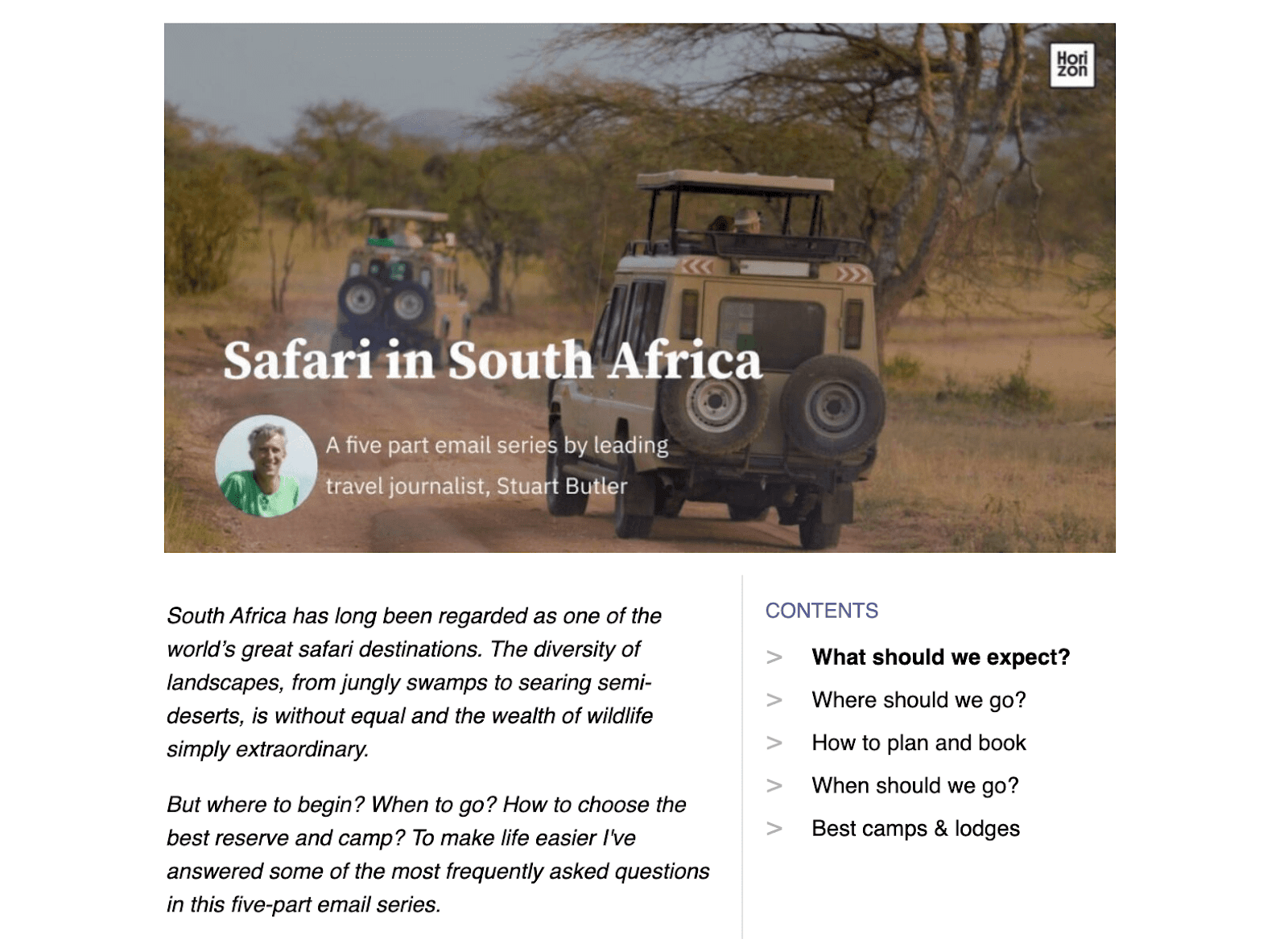
What‘s the easiest lead magnet for hotels? According to Matthew Barker, it’s offering a digested version of a larger guide.

“Inside your long guides on your website, ask readers if they want a bite-sized version of that guide delivered to their inbox,” he shared. “Then create a drip sequence that breaks the article up into small pieces.”

Image Source

Whatever you do, make sure it packs value or it’ll fall completely flat at building trust. As a full-time traveler who looks at a lot of free content online, I unsubscribe immediately if an email lead magnet is disappointing. The lead magnet needs to be valuable in order to succeed at building trust.

Some email opt-ins that Inkaterra La Casona could create are:

  • An e-book of day trips within reach of the hotel
  • Guide to minimizing altitude sickness upon arrival
  • Downloadable Spanish and Quechua phrasebook

3. Set up a landing page, sign-up form, or pop-up.

Email marketing for hotels hinges on compelling visitors to join their email list, and this usually happens in one of three places:

  • Embedded sign-up form: Website visitors see an embedded form within a webpage on your website advertising your freebie.
  • Pop-up sign-up form: A pop-up appears on your website as viewers are reading blog posts, reviewing your packages, or considering booking.
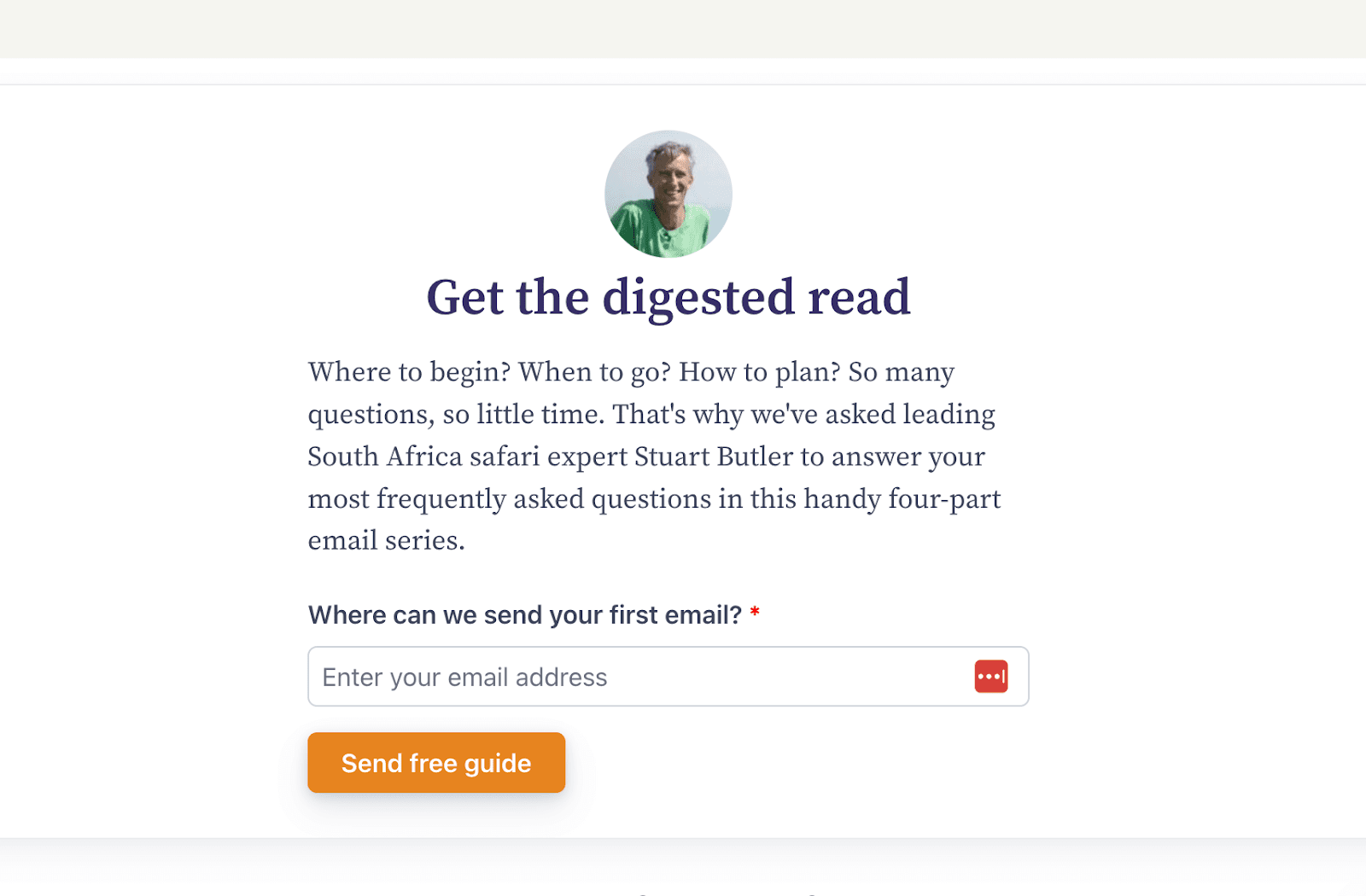
  • Landing page: Viewers on social media are directed to an entire web page dedicated to gathering email subscribers.

Image Source

Landing pages are a great way to convert viewers on social media into email subscribers. Send them from social to a landing page that’s designed to convert. Embedded sign-up forms are a great way to engage readers who are on your blog already.

This is the nuts-and-bolts way of growing your email list, but there are many advanced strategies that you can explore as shown in the video below.

Inkaterra La Casona could gather email addresses using these strategies:

  • Sign-up form embedded 30% of the way through every blog post
  • Timed pop-up that invites readers to sign up after being on the website for 60 seconds
  • Form embedded in the hotel website footer on every page

4. Choose email marketing software.

Your hotel email marketing campaigns all need to be sent through an email service provider. While the step of choosing email marketing software can be intimidating (and the options are endless), this step can be simple and low-cost.

You can use our free email marketing tool: HubSpot email marketing. Our email marketing tools can help you organize your email subscribers, send your hotel marketing emails, and grow your list.

5. Write a “welcome” email sequence.

After an email subscriber joins your list, what happens? They need to get their free gift and then be sent through an automated welcome email sequence.

Every successful email strategy needs to start right away otherwise guests will forget that they signed up to your list and the odds of conversion decrease.

This sequence should cover some basic information:

  1. Your address and a clear unsubscribe button (required by law)
  2. How often you’ll communicate with them
  3. What value emails have for readers

Welcome email campaigns are arguably the most important emails you‘ll ever send to guests. If they don’t feel compelled to open emails 24 hours after joining your list, the odds of them suddenly engaging are slim.

Thankfully, welcome sequences are a form of marketing automation that are set up once for every opt-in and left to run on autopilot.

A three-part email sequence that Inkaterra La Casona could schedule is:

  • Day 1: A welcome email with the lead magnet
  • Day 2: Answering FAQs and sharing valuable tips
  • Day 3: Shared benefits of booking early

6. Send consistent emails.

After the welcome sequence, regular emails kick in. Whatever frequency you choose, make sure that you only send high-quality email campaigns.

A great way to have potential guests unsubscribe is by sending thin email campaigns with minimum value.

“Having traveled to 70+ countries over the last decade and stayed in hundreds of hotels, frequent emails from hotels can be very useful, and exciting even.

However, this is not always the case,” shared James Hammond, travel expert and host of the Winging It Travel Podcast.

James warns, “emails need to have value-packed information providing guests with useful details of local experiences and not always trying to push a sale for the extra dollar.”

The lesson for hotel marketers: Don’t send emails that are light on value for the sake of emailing more frequently. Choose a frequency that you know you can deliver value on.

The email frequency for Inkaterra La Casona could be one email per month.

While these emails are more about being remembered than making sales, always end with a call to action that encourages readers to book. Then as you approach peak booking windows, push hard for sales.

7. Push for sales in key booking windows.

When are customers most likely to book travel? That’s when you should be sending your most persuasive sales emails.

More travel is booked at the beginning of the year than at any other time. Hotels should reference their sales data to see all of their peak booking periods during the year, and then should push for sales in those windows.

Image Source

For Inkaterra La Casona‘s email marketing strategy, this could mean sending sales-focused emails during the booking peaks of each quarter of the year.

8. Consider a loyalty program.

A warm, friendly tone goes a long way in the hospitality industry and this should be reflected in the language that you use. Instead of encouraging readers to become email subscribers to get promotional emails, invite them to join your membership or loyalty program.

While not all hotels are in a position to offer discounts, loyalty programs are a standard practice among chains and they’re a great way to retain

“Loyalty programs don’t need to be complex, just factor your customer acquisition cost (CAC) and your lifetime value (LTV) into pricing promotions,” shared Matthew Barker.

“You know how much it costs to acquire a new customer via direct marketing or an intermediary, and you know how much lifetime value you can drive from repeat business. This should give you healthy room for a compelling promotion for repeat, direct bookings.”

A loyalty program for Inkaterra La Casona could include a 5% discount for members.

7 Tips for Building Your Email Marketing Strategy

Are you inspired to launch your hotel email marketing strategy today? Follow these easy tips and hotel industry best practices to help get the best return on your investment.

1. Send helpful emails.

There’s more to hotel email marketing than just marketing emails.

Promotional emails have the goal of getting new guests to book or past guests to book again, but in order to compel guests to revisit your hotel, they need to first become satisfied hotel guests.

You can send four types of emails to existing guests to help improve their experience with your hotel:

  • Confirmation emails: Sent right after booking. Send an automated email to guests once they’ve booked, with all important information about their stay.
  • Pre-arrival emails: Sent right before the reservation. Anticipate your guests’ questions and provide answers to FAQs like check-in time, directions, parking, etc.
  • Welcome emails: Sent at the start of the reservation. Details about check-out times, hotel amenities, important things to know about the area, local events guests may be interested in. Welcome emails can be promotional if they include details about room upgrades or other upsell offers, but the focus should be customer experience.
  • Post-stay emails: Send after the reservation. Follow-up emails. Share details about your membership or loyalty program if you have one.

Most of these emails can be automated, with the exception of the welcome message which would need to be updated in order to include relevant information about current local events.

To improve your email open rate, make sure that your email subject lines make it clear that these emails pertain to their reservation and aren’t general marketing emails.

My experience receiving countless marketing emails from hotels has taught me that many hotels ignore the actual guest experience in their emails.

So many emails are sent trying to get viewers to make a reservation and then come back again in the future, but value-packed communication during guests’ visits will improve the odds of them becoming loyal customers.

2. Embrace storytelling.

Don’t just tell potential guests about your hotel, paint them a picture using storytelling.

“Hotels aren’t just selling rooms; they’re selling experiences,” shared Amanda Sexton, founder of FocusWorks. “Whether it’s the breathtaking view from a suite, the rich history of the building, or the gourmet dishes at the in-house restaurant, every hotel has a story to tell.”

Email is a personal marketing medium; far more personal than social media, paid ads, or traditional media. It‘s your opportunity to use a guest’s first name, and help them envision themselves in your space.

Paint a picture that guests’ are dying to see themselves in.

Image Source

3. Maximize email segmentation.

Make sure to segment your email list to maximize your efforts. You achieve this by gathering data about guests when they opt into your email list.

A few simple questions can reveal a lot of important data that can be leveraged for your hotel email marketing strategy:

  • Individual traveler or an online travel agency
  • Budget or luxury
  • Traveling alone, as a couple, with friends, or as a family
  • When the trip is planned

Then, you can segment your email list to appeal to specific groups of people.

“By segmenting your email list into smaller groups based on preferences, interests, or behaviors, you can craft emails that are more tailored to each of your customer’s individual needs,” shared Jaden Oh, chief of marketing at Traffv.

“This will not only help your hotel to increase engagement with your emails, but also allow you to send content that is more relevant to each customer.”

Audience segmentation will also help you gather data on your customers, which will help you personalize your hotel email marketing campaigns.

4. Personalize when possible.

Once you’ve harnessed customer data, you can use it to personalize your hotel email marketing campaigns to travelers. This can help you send offers that are more appealing to guests, improving your open rate and email conversion.

“Targeted marketing makes a recipient feel seen,” shared Yulia Saf, founder of Miss Tourist. “Simply including guest history and preferences can be a game-changer. For example, sending special offers on family-friendly activities to past guests who have booked family rooms.”

As a traveler, I‘ve found that the personalization of emails can make me feel more excited for a trip when it’s done correctly, and even less excited when it’s done badly. As soon as emails from a hotel start coming into my inbox advertising lots of child and family-oriented hotel services, I wonder if I booked the wrong hotel.

I worry that this hotel will be swarming with screaming children and shouting parents instead of being the calm experience I was hoping to book. A simple question about whether or not travelers are coming alone, as couples, or as families can mitigate this risk.

5. Leverage customer reviews.

Past guests can provide your most compelling marketing material in the form of reviews.

“It’s impactful if a hotel email marketing campaign can highlight a good variety of customer reviews and ratings,” shared Rachel Escio, content specialist at Thrive Internet Marketing Agency.

“This is a huge asset that immediately presents the quality of stay that guests can expect, as well as your online reputation as a property and the credibility of the team that runs both front and back-of-the-house.”

6. Include a clear call to action.

Successful email marketing email isn‘t complete without a strong call to action (CTA). All email campaigns need to leave the reader knowing what they’re supposed to do.

These CTAs will be different based on where the customer is at in the customer journey:

  • Haven’t booked yet: Book now, answer FAQs to help make the decision, etc.
  • Pre-arrival emails: How to check in, consider luxury packages like a spa treatment, etc.
  • During stay: How to get the most out of their visit, information about local events, etc.
  • After stay: Benefits of joining your loyalty program, encouragement to book again, etc.

Having a clear CTA makes viewers understand the value and purpose of each email, and will in turn help improve click-through rate.

7. Tie it to your larger hotel marketing strategy.

Email marketing shouldn‘t be a standalone pillar of a hotel’s marketing strategy; it should complement the larger content marketing plan.

“Always make sure the email content compliments the content on social media, on your website, etc.,” shared Kiara Pajon, account executive at Soto Agency.

“Essentially, the content should match — the same messaging on social media, your website, and email campaigns.”

This makes email marketing for hotels less work in the long run because hotel owners can repurpose content from the website copy, social media, and blog posts into automated emails.

Conclusion

As a traveler, I’ve personally experienced the good, the bad, and the ugly (or rather the actually helpful, completely useless, and overly promotional) of hotel email marketing.

While many hotels put in minimal effort just the check the email marketing box, the hotel business and hospitality industry have a lot of value to contribute through their email marketing.

It’s easy to get caught up in the different email automation software options, email service providers, click-through rates, and more, but successful email marketing for hotels boils down to a few marketing fundamentals.

Remember the customer journey and use these best practices to serve your guest with every reservation confirmation, pre-arrival email, and promotional message.

New Call-to-action

Categories B2B

Influencer-Founded Food and Beverage Brands: Are They Good Business?

I’m writing this while sipping coffee made by Emma Chamberlain’s French press. The 22-year-old YouTuber is not only Gen Z’s favorite influencer, but also a big-time entrepreneur.

Her coffee brand, launched in 2020, took off among young coffee lovers (and even tempted me, a not-so-young coffee lover).

It got me thinking: Has food and beverage become the new playground for creators and influencers?

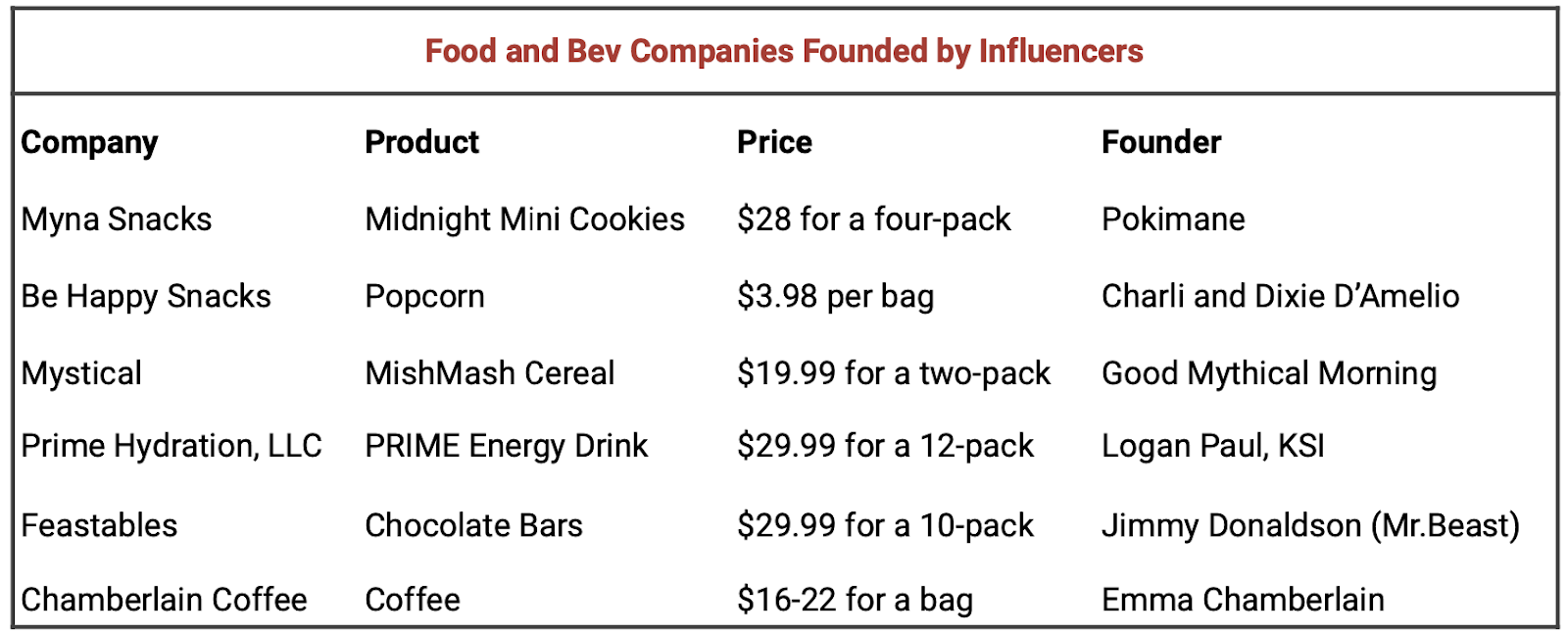
So I looked into a few players:

Table of influencer-founded food and bev companies

Source: Company websites

Turns out they’re doing pretty well – some even minting billions.

  • Prime, Logan Paul’s energy drink, is primed to exceed $1.2B in annual sales
  • Feastables raked in $10m in chocolate bar sales within a few months
  • Chamberlain Coffee makes ~$6m annually, and recently raised $7m 
  • The D’Amelio family raised $5m to foray into snacks

Download Now: Free Influencer Marketing Guide + Templates

Why Influencers Flock to the Food and Beverage Industry

For starters, it’s lucrative. Food and beverage accounts for over 30% of the $2T consumer packaged goods industry. Plus, the entry barrier is relatively low.

And creators and influencers are well positioned to take a slice of the pie:

💰They’re already the winning formula for CPG brand marketing. These brands spend ~$40B per year in ads, a big chunk of which goes to creator partnerships.

❤️ Their content often fits well with daily refreshments like snacks and coffee, and their relatable nature inspires trust among young consumers.

📉 Loyalty for legacy brands is waning, and there’s space for influencers to get in. With a built-in brand and audience, it’s easier to gain traction for their products – especially if they play up the health angle.

They’re Not Doing It Alone

Since these entrepreneurs aren’t usually experts in the goods they sell, white-labeling is a popular way to get a product to market.

Influencers partner with third-party manufacturers and add on their own branding and marketing. This way, they quickly gain market share without high upfront investments:

And, to add a trusted edge, food industry veterans are often chosen to helm these companies, like Feastable’s Jim Murray and Myna Snack’s Darcey Macken.

Hardly A Candyland

Not every influencer-founded refreshment can magically make it. As more products flock to the space – and with A-list celebrities in the mix – it’ll be even harder to stand out.

Plus, it’s easy for influencers to lose favor with consumers: Pokimane got into a beef with her fans over pricing for her cookies; Prime drinks are getting pulled from shelves with pending FDA probe; and Chamberlain’s latest RTD collection is being dubbed “farts in a can.” 💨

Improve your website with effective technical SEO. Start by conducting this  audit.  

Categories B2B

40 Interests That Deserve a Place on Your Resume

Early in my career, my boyfriend (now fiancé) was helping me write my resume. I asked to see his and noticed he included personal interests. He’s an engineer, so seeing hobbies like basketball and video games stood out to me.

I asked him why he chose to include these, and he said, “I wanted a little more personalization to my resume and want [recruiters] to know me as a person beyond a piece of paper.”

And apparently, he’s not alone. According to a study by Standout CV, one in four people include hobbies and interests on their resumes.

Suppose you’re curious about what interests to put on your resume — and why — this is the article for you. We’ll also review the different interests and hobbies that will help you stand out in the job market.

Why You Should Include Interests on Your Resume

40 Interests for Your Resume

Why You Should Include Interests on Your Resume

While not always applicable, there are a few scenarios when mentioning your interests and hobbies on your resume makes sense.

Sarah Johnston, founder and CEO of executive resume writing firm Briefcase Coach, says if you choose to include interests on your resume, focus on customization. “We always consider the audience and the relevancy of the additional fun fact to the audience,” she suggests.

Here are a few reasons why you should add your interests to your resume.

1. You can showcase your personality.

The most compelling reason to include interests on your resume is to showcase your personality. Recruiters and hiring managers review countless resumes for every job role. They’re likely reading the same skills and similar experiences over and over. What better way to stand out than to give them a sense of your personality right off the bat?

In my experience, having interests on my resume has led to fun conversations with recruiters and hiring managers. Talking about hobbies was a great way to break the ice (and calm my nerves) before diving into the interview questions.

2. Interests help with culture fit.

If the company you’re applying to values uniqueness or specific personality traits, interests could help communicate how you’d be a good culture fit.

For example, here’s a job opening for a Senior Merchandising Manager at Tecovas, a direct-to-consumer western brand based in Austin. As a Western brand selling boots and apparel, Tecovas emphasizes its mission of “welcoming first-time boot buyers and Western enthusiasts alike.”

Interests on resume: A job listing for Senior Merchandising Manager, Mens Footwear at Tecovas.

Image Source

If you consider yourself a Western enthusiast and enjoy activities such as horseback riding, it would be worth mentioning that on your resume to show that your interests and experiences align with the company.

3. You can match niche industries or roles.

Some companies operate in niche industries and may seek candidates with specific skills or interests. For example, if you’re applying for a marketing manager role at an art museum, the hiring manager would likely expect you to be interested in art or art history.

I did a quick search for this type of role to test this theory, and I found an old job posting for a social media coordinator at the MoMA. One of the job requirements was an interest in the art and non-profit worlds.

A job description for a social media role at MoMa that requires specific interests on resume.

4. You’ll boost your resume if you have limited experience.

We all have to start somewhere. If you’re a new graduate or making a career change, you likely won’t have many relevant experiences to include yet. Listing your interests or hobbies on your resume can help an employer get to know you if you have limited work experience.

The key is to connect the dots between your interests and the job you’re applying for so recruiters understand how it can help professionally. Study the job descriptions and the company to get a sense of their culture and job requirements, figure out how your interests and hobbies relate, and showcase your strengths.

For example, sports can demonstrate your strength in team activities, while painting can showcase your creativity.

40 Interests for Your Resume

It’s been a while since I’ve interviewed for a full-time position, but occasionally, I share my resume for freelance work. And when I do, I want to make sure it’s tailored to the role and company to increase my chances of standing out.

I put together a recent resume using one of HubSpot’s resume templates.

Interests on resume examples: A preview of my resume that includes hobbies and interests.

I added an interests section that reflects my current work and is relevant to the types of companies I want to work with. Here are the hobbies and interests I included.

1. Pilates

I attend Pilates classes at least twice a week (it helps that my sister is an instructor!), and it’s always the best part of my day. As a writer, I’m sitting in front of my laptop screen for hours, so Pilates helps me get a break from my desk.

Why it works: Committing to a regular exercise routine — whether yoga, running, or even walking — showcases a healthy work-life balance.

2. Home Renovations

If you know my fiancé and me, then you know we love tackling home renovation projects. We aren’t shy about taking a sledgehammer to our cabinets or reconfiguring our house layout to create something totally our own.

Why it works: In my experience, this is usually a great conversation starter during interviews. People are interested in hearing about the process, mainly because we do the work ourselves to save money (for better or worse).

3. Vintage Collecting

On any given weekend, you can find me at a thrift store or an estate sale. I love searching for unique items and hidden gems and giving them a second life.

Why it works: I’ve found that this topic is another icebreaker. If I’m talking to someone who also enjoys vintage shopping, we usually swap stories about the types of items we collect and where to find them.

4. Book Clubs

Several years ago, I started my own book club here in Austin. We read nonfiction books on business, creativity, and entrepreneurship, such as Elizabeth Gilbert’s Big Magic and Essentialism by Greg McKeown. Once a month, we’d meet up at a local business to share what we learned from the book.

Why it works: This hobby demonstrates my interest in continuing education and my eagerness to organize events (on a small scale) since I created the group and planned everything myself.

5. Small Businesses

I used to write for a local magazine covering lifestyle topics, such as where to shop and eat around town. The best part was interviewing small business owners, getting to know their day-to-day routines and motivations, and sharing their stories.

Why it works: This interest works for my resume because I now write for companies whose audience includes small business owners. I can use my enthusiasm and knowledge of small businesses to inform my writing.

These interests are specific to my experience and relevant to the types of roles I’d be interested in pursuing in the future.

If these aren’t a fit for you, here are some other interests to consider adding to your resume.

6. Sports

As I mentioned, my fiancé enjoys playing sports like basketball and golf. He’s regularly part of leagues with both colleagues and non-work groups alike. Including this on his resume demonstrates his enthusiasm for team activities and camaraderie.

What we like: If you’re an active sports team or community league member, add it to the interests section on your resume to showcase your teamwork outside of work.

7. Photography

I was scrolling through X (formerly Twitter) when I saw that senior product manager Diego Granados shared the resume he used to land a job at Microsoft in 2019.

In the interests section, he included iPhone photography, video games and playing musical instruments like saxophone and guitar.

 Interests on resume examples: A snippet of a product manager’s resume includes an interests section.

What we like: Photography is a hobby that demonstrates an interest in the world around you. You can even get specific and list the type of photography you’re interested in, like iPhone, film, or product photography.

8. Community Service

Early in my career, as I was building my resume, I relied on my previous volunteer experiences to demonstrate my different skills and interests. I was an active member of a volunteer organization in college and even did some volunteer social media work for nonprofits after graduating.

What we like: Adding volunteer work to your interests section on your resume can demonstrate your passion for specific causes. This is especially helpful if the cause is relevant to the company or job you’re applying to.

9. Painting

Hobbies like painting or drawing are a great way to exercise creativity and demonstrate your creative skills.

What we like: Whether you’re applying to a creative job or not, creative hobbies can help improve your creativity at work.

10. Baking

My friend Micah Peterson, a web designer and developer, was a baker in a previous life and includes “baker by hobby, developer by trade” on his resume.

He explains that including this interest on his resume has helped form lasting impressions during interviews.

“Once, when I was being interviewed, [my baking interest] led to a conversation about the interviewer’s son, who was also a baker,” he said. “The interviewer admired that about his son, so I think it left a lasting impression on him.”

What we like: If you’ve ever had a career pivot, embrace it by including it in the interests section on your resume. It is an interesting conversation starter, but if you can connect your experience to the role you’re applying for, that’s even better.

11. Reading

Maybe you’re in a book club like I was or enjoy reading challenges. Or perhaps you’re active on #BookTok, the massive subcommunity on TikTok dedicated to sharing and reviewing books.

Why it works: One example of a role where this interest could intersect with a job you’re interviewing for is a social media position. Mentioning your interest in reading, and specifically #BookTok, demonstrates your knowledge of current social media communities.

12. Video Games

I’ve seen several people include video games as a hobby on their resume, including my fiancé and Diego Granados, whose resume I shared above.

What we like: Video games can demonstrate interest and knowledge in several elements, from the technical aspects of the gaming system to the visual aspects found in the graphics to the strategy that goes into the game.

13. Writing

Do you enjoy writing in your free time? Whether you prefer writing fiction, poetry, or blogs, those skills will likely translate to whatever role you’re applying for.

According to GMAC’s 2023 Corporate Recruiters Survey, communication and writing skills are among the most in-demand skills employers look for when hiring.

What we like: Writing will always be an essential skill in the workplace, so this is a timeless interest to include on your resume.

14. Graphic design

According to Upwork, graphic design is one of the most in-demand skills for freelancers. Even if you’re not pursuing freelance work, this data proves the need for this skill among companies of all sizes.

What we like: If you have graphic design skills, even if this isn’t the focus of your role, it can boost your resume.

15. Animals

Yes, the furry friends in your life can be included as an interest on your resume. Whether you volunteer at a local animal shelter or are a proud pet owner, there are ways to mention this while keeping your resume professional.

Johnston, who works with some of the world’s top leaders at her executive resume writing firm, remembers when she’s seen pets successfully mentioned as an interest.

“I know a job seeker who applied for a role with Purina Corporate,” she recalls. “They listed at the bottom of their resume that they are a ‘proud dog dad to two golden retrievers,’ and the recruiter apparently loved this!”

Pro tip: This interest works well when the company you’re interviewing for is in the pet or animal industry.

16. Nonprofits

Like community service, an interest in nonprofits demonstrates your dedication to specific causes or communities.

Pro tip: Only include this as an interest if you’re genuinely involved in specific nonprofits or volunteer work.

17. Entrepreneurship

Do you want to start your own business someday? Are you a go-getter with a growth mindset? Entrepreneurship probably comes naturally to you, which makes it worth including as an interest on your resume.

What we like: Having an entrepreneurial mindset can be the key to success as a salesperson or at a startup.

18. Music

Applying to a position in the music industry? It makes sense to showcase your taste in music, whether you’re applying to a festival production company, a recording studio, or a streaming platform like Spotify.

If you’re perpetually online like I am, you may remember seeing this creative resume make its rounds on LinkedIn and Twitter (now X) back in 2021:

Interests on resume examples: A Spotify-themed resume from product manager Emily Vu that highlights music interests at the bottom of the resume.

The Spotify-themed resume was created by product manager Emily Vu, who eventually landed a job at the music streaming platform thanks to her creativity.

What we like: As if the Spotify-branded design layout wasn’t creative enough, Vu added an interests section that called out her music interests. This further demonstrated her enthusiasm and knowledge of the industry.

19. Art History

Whether you went to school for art history or you have a strong interest and knowledge of the subject, including this on your resume can demonstrate that you’re well-rounded.

Why this works: If you work in a creative field, especially if you’re applying for a job in the art world, mentioning your interest in the arts is a good idea.

20. Camping

Anyone who’s been camping knows how much preparation and work is involved. From setting up your tent to preparing your food to connecting with your natural surroundings, camping demonstrates an adventurous personality.

What we like: If you’ve been camping before, chances are you have a funny story about the experience, which can make for a good icebreaker.

21. Teaching

If you teach classes related to your job role, it could be a good idea to list that on your resume.

For instance, do you teach coding classes during evenings and weekends? This can demonstrate your deep understanding of the role and dedication to furthering the industry.

What we like: An interest in teaching can set you up for a training or teaching role within your company. If you’re interested in pursuing this in the future, don’t hesitate to include your teaching experience on your resume.

22. Travel

An interest in travel can be especially relevant if you work at a distributed company that values journey and encourages its employees to see the world.

Marketing consultant Anna Crowe created an “About Me” section on her digital resume to mention her interest in traveling to national parks.

Interests on resume examples: Marketing consultant Anna Crowe lists hobbies and interests on her resume.

What we like: Travel demonstrates openness to learning about different cultures and an adventurous personality.

23. Hiking

Like camping, hiking can demonstrate a sense of adventure. You don’t have to check Mount Kilimanjaro off your list to consider yourself a hiker.

What we like: If hiking is your hobby, this can be a great conversation starter during an interview. You can mention any significant hikes you’ve completed, which can lead to exciting stories between you and your interviewer.

24. Running

Almost 50 million people in the U.S. consider themselves runners and 115 million are walkers, according to Statista. Translation? These popular activities are relatable interests to include on your resume.

What we like: Being a consistent runner speaks to your commitment and training regimen.

25. Continuing Education

There are so many online learning opportunities available today. Whether you want to learn a new language, how to draw, or how to master SEO, there’s an online course for it.

Not to mention, 62% of companies offer professional development as part of their benefits package, according to the GMAC Corporate Recruiters Survey. If continuing education is essential to you, it’s worth mentioning if you’re interviewing with a company that offers this as part of the job.

Interests on resume: A graph from the Corporate Recruiters Survey that shows the use of different benefit offerings among global employers.

Why this works: An interest in continuing education shows dedication to learning new skills and subjects.

26. Interior Design

If you have an eye for interior design, don’t hesitate to mention it on your resume. You could even showcase your skills over a video interview by displaying your perfectly designed setup in the background.

What we like: Having design skills can translate across many roles.

27. Digital Organization

Do you use project management apps to manage everything from work tasks to grocery shopping? A passion for planning and dedication to organizing can go a long way in any role.

What we like: Bonus points if you create and share organization templates like this Notion creator does.

28. Real Estate

Aside from the obvious industries like real estate or mortgage lending, there are other roles that an interest in real estate could benefit from.

For example, if you are applying for a job in the personal finance industry, your interest in real estate could demonstrate an intimate knowledge of one of the biggest purchases the average buyer will make in their lifetime.

What we like: Some interests, like real estate, demonstrate your cross-industry knowledge, which can be beneficial if you apply to jobs in business, marketing, or sales.

29. Cooking

Do you have a food blog? Participate in cooking competitions? If cooking is a significant hobby of yours, there’s a place for it on your resume.

What we like: Like baking, cooking can demonstrate patience and creativity.

30. AI and machine learning

Interests don’t always have to be hobbies. Interests include subjects you’re interested in learning more about or are expanding your knowledge on, like AI.

Having an interest in technology like machine learning can also put you in a better position for future roles. These are the skills employers believe are the most important for the future, according to the GMAC Corporate Recruiters Survey.

Interests on resume: A bar graph that shows employers’ rankings of technology skills with future importance.

What we like: Showing an interest in certain technologies demonstrates adaptiveness and a commitment to learning.

31. Personal Finance

I know a few people who have accomplished major financial achievements — like paying off their student loan debt within a year or saving up to buy a house — who now share their tips with others online.

What we like: If you’ve done something similar and regularly share your thoughts and tips on social media or through a blog, this can be an excellent interest to add to your resume to demonstrate your thought leadership.

32. Remote Work

If you consider yourself a digital nomad or are passionate about remote work, you can add that as an interest to your resume. This can also showcase your desire to work remotely and help connect you to the right employers.

While remote work may be more common than in years past, some people and companies have advocated for the digital nomad lifestyle for a long time. For example, Buffer has been a fully remote and distributed team since 2013.

Interests on resume: A paragraph from Buffer’s website that describes their remote work company.

Why this works: This interest doubles as a job preference for your resume.

33. Learning Languages

Learning a new language can be a challenge. However, a commitment to studying and practicing a foreign language is worth mentioning on your resume.

It showcases your interests. Plus, depending on your skill level, understanding several languages can also be an asset to any team.

What we like: Learning languages shows dedication to learning and an openness to different cultures.

34. Podcasting

It’s estimated that there will be over three million active podcasts in 2023. If you host one of them, consider mentioning it on your resume.

You might not want to include your podcast’s exact name or genre, depending on what your podcast is about. But if it’s something relevant to your industry, add it.

What we like: A lot of creativity, technology, and marketing goes into creating your own podcast. These skills can help boost your resume if you work in marketing or communications, for instance.

35. Web Design

According to Upwork, web design and development are both in-demand skills for independent professionals. If you’ve been exploring web design in your free time, consider including it as a hobby on your resume, even if you aren’t planning on pursuing freelance work.

What we like: This interest can double as a skill if you have a lot of knowledge and expertise on the subject.

36. Attending Conferences

If you enjoy networking events and attending industry conferences, this counts as an interest to include on your resume.

Why this works: If you’re applying for a sales position, your potential employer will likely be impressed that you enjoy networking in your free time.

37. Standup Comedy

Most of us love to watch comedy shows, but pursuing standup comedy as a hobby is a totally different story — one that’s much more interesting. If you practice comedy, this can demonstrate creativity, courage, and the ability not to take yourself too seriously.

What we like: Including standup comedy as an interest will lead to interesting (and funny) conversations during an interview.

38. Content Creation

Do you love creating cooking videos to share on TikTok? Or maybe you often post UGC (user-generated content) on Instagram to showcase brands you love.

Content creators have skills in photography, marketing, and social media, which can all be appealing skills in the eyes of an interviewer or recruiter.

What we like: Being a content creator can boost your resume if you’re looking for marketing and social media jobs.

39. Gardening

There’s something peaceful about getting your hands dirty, planting seeds, and watering flowers. Gardening is a relaxing pastime and is a great weekend activity to partake in.

What we like: Gardening can demonstrate patience and humbleness.

40. DIY Projects

Similar to my interest in home renovations, I also enjoy any type of DIY project. I usually find inspiration for a home decor DIY on Pinterest or Instagram and spend a weekend putting my own spin on it.

What we like: An interest in DIY projects showcases creativity, commitment, and a sense of individualism.

Showcasing your interests on your resume is a creative way to give recruiters and interviewers a better sense of who you are.

Not only do interests let people know what you enjoy outside of work, but they also give employers an idea of how those interests translate into your work.

Categories B2B

Navigating the AI Revolution: 7 Essential Insights for Marketers in 2024 [Expert Opinions]

From weekly stand-ups to spammy emails, chatter about artificial intelligence (AI) has saturated the marketing space over the last year.

With all the information out there, it can be difficult to even know how to understand and implement AI.

In my role on the AI Marketing Solutions (AIMS) team at HubSpot, I’ve seen first-hand how integrating AI can directly improve campaign metrics. My proudest moment so far was when I launched an AI-personalized email writing workflow that saw a 38% lift in overall CTR (click-through-rate) compared to our traditional campaigns.

Free Report: The State of Artificial Intelligence in 2023

Now, you might be wondering, how can you get similar results, or better?

Here’s the seven must-know AI tips you need to start off 2024 strong, with resources, examples, and advice from experts.

7 Essential AI Insights for Marketers in 2024

1. Become a prompt master.

“With where AI is currently at, knowing how to craft winning prompts that get the results you need is really valuable,” says Matt Wolfe, an AI reporter and analyst whose YouTube channel has nearly half-a-million subscribers.

Let me give you a concrete illustration of what Wolfe means and how to apply it. Here’s how to upgrade your AI prompts:

  • Be specific and goal-oriented: Define your intentions clearly.
  • Consider your context and persona: How should the AI model approach the problem? As an experienced email marketer or a creative copywriter?
  • Let’s talk output: Envision what the end result should look like.

So now you can transform a generic prompt — “Write a blog post about five common marketing mistakes in the IT industry” — into an AI-ready masterpiece:

Act as a seasoned marketing blogger. Produce outputs a seasoned marketing blogger would produce. Craft an engaging, conversational post detailing five major marketing pitfalls specifically for IT companies, explaining their negative ramifications, aiming for 450 words.

2. Develop a workflow.

Once you’ve gotten prompting down, then the real fun begins. Let’s break this down in a “day in the life” of an AI-enabled marketer.

  • 8:30 AM: Review performance metrics from previous campaigns; ChatGPT generates a summary of the data, highlighting metrics and making reporting a breeze.
  • 9:15 AM: Dive into creative mode. Direct AI to generate and refine email subject lines, and then shortlist the high-potential hitters for A/B testing.
  • 11:00 AM: Use ChatGPT to organize a messy pile of customer feedback, categorizing comments for easy team review and response strategies.
  • 1:00 PM: Ask ChatGPT about blog topic ideas, considering previous content we’ve made and don’t want to replicate.
  • 2:30 PM: Work with AI to develop blog post titles and outlines, tapping into SEO insights, specifying keywords, and integrating current trends to maximize reach.
  • 3:45 PM: Direct AI to mockup some social media posts, later refining the copy to inject brand voice and personality before scheduling.
  • 4:30 PM: Conclude the day by having AI clean up and format a client presentation, ensuring clarity and professional polish.

You might be wondering, how do I tactically turn AI-learnings into marketing performance?

Here’s how I transformed our emails: I used a mix of AI-driven audience segmentation and RAG (retrieval augmented generation) techniques to write the most meaningful emails possible, capturing the 38% improvement in CTR that I mentioned earlier.

This bump is more than a number, though: It’s really about driving value. My A/B test didn’t just crown a winner; it reassured me that meaningfully knowing and addressing my audience leads to groundbreaking engagement. It’s proof that with personalization, precision pays off.

But here’s the quiet part: for AI-driven personalization to work, it needs to merge seamlessly with tried-and-true marketing strategies. AI isn’t something you can just plug in and supercharge your marketing. You have to be intentional, and even then, sometimes AI might not make a huge lift. Part of being an early adopter is being okay with failure.

3. Test all the tools.

According to HubSpot’s AI Marketing Report, 35% of marketers are already using AI and automation in their role, up from 17% last year, and this number is definitely growing.

HubSpot’s CTO, Dharmesh Shah, couldn’t put it better:

“Marketers need to recognize how far A.I. has come — and how fast it is moving,” says Shah.

“Before deciding that AI cannot help with a given task, try it. It’s possible it couldn’t be done a few months ago, but now it can.”

2-Dec-12-2023-12-26-52-6938-AM

AI breakthroughs are accelerating. Think about a feature as simple as web-browsing. In the early days of ChatGPT, it was a well-known limit for AI. Now, you can ask ChatGPT almost any question and instruct the model to browse, and off it’ll go (as long as you have a Plus account).

In an episode of Marketing Against the Grain, Matt Wolfe shares some of his favorite AI tools.

He mentions the company Conveyor, which is working to narrow the latency time between when you ask a chatbot a question and when it responds. Latency is so important in chatbots because it dictates the entire user experience. It’s now possible to deliver nearly seamless, real-time, personal engagement.

Wolfe also speaks on image generation tools Leonardo and Kaiber, which he experiments with for YouTube creative assets.

Across the marketing world, there’s an AI tool with your brand’s name on it, waiting to tackle your specific challenges. Whether you’re managing customer communications, seeking insight from market data, or crafting visuals that capture and convert, AI could be the ace up your sleeve.

4. Use AI as your partner, not your replacement.

AI has already proven to be a strong contributor across marketing workflows.  

Within the HubSpot platform, the AI-powered content assistant streamlines your creative process, generating blog ideas, drafting emails, and shaping outlines efficiently.

Ramon Berrios, host of DTC Pod, has integrated AI into most of his company’s marketing. He uses his tool, castmagic.io, to produce their weekly industry newsletter, automate podcast production work, run social media, and record conversations with thought leaders.

Keep in mind, AI tools are here to back you up, not take over. With AI churning out endless streams of text, we might see a real flood of low-quality, spammy, AI-generated content.

As marketers, we know that high-quality content will always be the key to marketing success, and this is truer yet in the age of AI. Some might try to play the system, but the truth is that engaging and captivating content will always win in the long run.

Some of my tips to identify AI-generated content are as follows:

  • Originality: Does the content offer unique perspectives not seen elsewhere?
  • Insightfulness: Is it educated by in-depth knowledge, providing value that exceeds mere information regurgitation?
  • Brand Alignment: does the content have a distinct brand voice? A distinct tone? Or does it sound like that ‘generic’ ChatGPT tone that’s becoming all too common?

As AI evolves, we’re going to have to figure out which marketing tasks are enhanced by AI and which ones definitely require a human touch. But along the way, we’re going to learn a ton, see some massive breakthroughs in what’s possible, and discover how to drive even more value for customers.

5. Look out for your brand.

Brand safety takes precedence in this new era. At HubSpot, we’ve ingrained checks to avoid any inappropriate or unintended interactions.

“Data importing can be a concern and a security breach for any organization. Make sure to really understand the terms and conditions of an AI platform before you upload any company-sensitive information and data,” says Berrios.

Additionally, make sure the use of AI is communicated transparently and effectively across your organization. Berrios emphasizes the importance of brand and tone alignment, especially when team members are using different AI platforms whose models don’t learn from each other.

6. Integrate intentionally.

While it might be tempting to go full-speed ahead in AI, there are inherent risks.

Here are my five AI no-go’s:

  1. Data Gathering Without Consent — Don’t be a privacy pirate.
  2. Misleading Big Data Expectations — AI isn’t your crystal ball.
  3. AI Tools Without Clean Data — Garbage in, garbage out.
  4. Ignoring AI Source Verification — Fact-check or face the music.
  5. Neglecting Ethics in AI Use — Skirt morals, invite scandals.

There’s a prevalent yet flawed notion that AI can handle vast and unfocused datasets to drive insightful conclusions. However, the reality is that AI excels when led with specificity and purpose. It demands data hygiene and ethical data use — these are cornerstones of HubSpot’s AI strategy.

Make sure you have a transparent privacy policy, obtain user consent when you collect first-party data, and only collect essential information.

A handy privacy policy checklist could be the following:

  • Transparency in Data Collection: Clearly itemize the types of personal information your company collects, spanning from the obvious — names, email addresses — to the less considered, like browsing behavior or device information. Leave no stone or data point unturned.
  • User Consent and Control: Spell out how users can give, manage, and revoke consent for data use. Include how to access, correct, or delete their personal information.
  • Data Security and Sharing: Articulate how you keep user data under lock and digital key. Be clear on who’s in your data-sharing circle and why.

During your creative process, beware of misleading information, as well as copyright infringement. Use tools that train their models on clean data. Double-check and diversify your sources to avoid misinformation.

This video on AI Ethics is a great place to find common AI pitfalls and solutions.

7. Stay human.

AI may not be human (yet), but luckily, you are. As we move into 2024, the goal is to further discover the potential and limitations of AI in marketing, making sure that our applications remain powerful, meaningful, and value-driven.

1-Dec-12-2023-12-26-54-5837-AM

“When a machine can build any product in the world, the product that’s going to win is going to have a real point of view, and the people marketing it…are going to have a real point of view. [Central to everything], is believing deeply in something,” says Kipp Bodnar, CMO at HubSpot.

AI is a work in progress, which means it is still disproportionately biased against minorities, and may offer perspectives that aren’t informed by empathy and critical thinking. Ironically, in the age of machines, your humanity is what will truly make the difference.

The key to winning at AI is to be strategic, intentional, and vigilant. AI is a tool to be wielded wisely — to amplify our potential, not to overshadow it. It’s about enriching brand experiences, while still reflecting the warmth, sincerity, and value-focused care of our human marketers.

New Call-to-action

Categories B2B

The Surprising Metric that Matters Most for SERP Rankings in 2023 (Hint: It’s Not Authoritativeness)

Google uses 200+ ranking factors when determining the search results. How do you ensure that your website gets more visibility and, thus, higher SERP positions?

What is the ultimate metric that can make or break the rankings? Is it the domain authority, content quality, page speed, or mobile readiness?

Download Now: Free State of Marketing Report [Updated for 2023]

While many SEOs will argue that authoritativeness is the main factor for higher rankings, surprisingly, it’s not.

Table of Contents

What Factors Affect SERP Rankings

SERP is an acronym that stands for “Search Engine Result Pages.” When a user types a query, Google provides a list of websites and other resources, such as videos, documents, and images, that match the user’s search intent.

Based on our recent study, 43% of the surveyed individuals perceive achieving a position within the top 10 as simple, whereas 39% regard it as challenging.

To get your site into the top 10, act on the most important factors that affect the SERP rankings.

Content Relevance

Search engines aim to provide the best results to their users. Thus, the quality of content is non-negotiable. Moreover, after Google’s Panda, Fred, and helpful content algorithm updates, bad content can kill the chances of higher rankings.

Your content needs to answer the search intent and provide practical information, covering all the questions that the user might have.

In practice, it means that your content has to offer an explicit answer to a search query and surface relevant questions. For example, if I had to write an article on “interactive walkthrough examples,” I’d cover critical points people Google about.

  1. What is it?
  2. How to make it?
  3. Dozens of real examples
  4. Tools to create those walkthroughs

Why these headings? Because it’s what users ask search engines and the intent of the query. Explore the ‘People Also Ask’ section to create killer content.

Image Source

“In competitive industries, most players nail the right keywords and craft compelling copy with spot-on search intent.

But ask yourself: Why should Google prioritize your article over countless others in the SERP? What unique value does your content offer to outrank competitors?

The key lies in the information gap. That missing puzzle piece in the existing narrative. To recognize it, ask your internal experts about missing information in those copies.

At Belkins, we bridge this gap by connecting freelance writers and our in-house experts through interviews and questionnaires.” — Eugene Zatiychuk, SEO at Belkins Agency

Number of Backlinks

While the old days of getting numerous spammy backlinks are gone, the impact of backlinks is still unquestionable.

The joint research performed by Ahrefs and Backlinko found that the 1st result in Google has an average of 3.8x more backlinks than positions 2-10.

Image Source

Google pays attention to authoritativeness. Having more high-quality backlinks from trustworthy websites indicates that your content is so well-crafted that other sources vouch for you.

Domain Authority

Domain authority (DA) is another critical ranking component.

Developed by Moz, it’s a search engine ranking score that indicates your competence on a particular topic and predicts how likely your website is to rank in SERPs.

The score is ranked between 1 and 100. The higher your domain authority, the more likely you’ll rank on Google.

The Backlinko and Ahrefs’ study proves this theory — a website’s overall link authority correlates to higher first-page Google rankings.

Image Source

User Experience

Great user experience (UX) is one of the ranking factors.

Easy navigating websites that have clear CTAs and intuitive designs provide a seamless browsing experience and encourage repeat visits. This leads to longer dwell time and lower bounce rates.

Analyzing these metrics, Google knows your site has valuable content, and it prompts the site higher in rankings.

Keep in mind that the industry benchmark for average dwell time is between 2–4 minutes.

Page Speed

Page speed is an essential ranking factor.

Recent research shows the average page speed is 1.65 seconds on the first page of SERP. The same report indicates that 1 in 4 visitors will leave the website if it takes more than 4 seconds to load.

That being said, having a fast website is not a preference but a necessity.

While we’ve discussed the 5 pillars without which your site will never secure high rankings, let’s unveil the most important metric for great SEO performance.

The Metric that Matters Most: Trustworthiness

We surveyed 405 SEO professionals who constantly track their websites and analyze rankings. We also asked them about the most important metrics that are “responsible” for rankings. The result?

To our surprise, 39% of the survey participants consider trustworthiness as the primary determinant for achieving a high Google ranking in 2023.

Let’s discuss this metric in more detail and understand why it matters.

What is trustworthiness in SEO?

Trustworthiness is one of the pillars of Google’s E-E-A-T (Expertise, Authoritativeness, and Trustworthiness) framework. By saying “trust,” we consider the extent to which the page is accurate, honest, safe, and reliable.

Image Source

The level and extent of trust required vary based on the specific web page’s nature.

For example, e-commerce websites should have a secure payment system, and product reviews should be honest and authentic.

On the other hand, informational pages on clear YMYL (Your Money or Your Life) topics must be accurate to avoid any potential harm to individuals and the community.

Why does trustworthiness matter?

According to Google’s Quality Rating Guidelines:

“Trust is the most important member of the E-E-A-T family because untrustworthy pages have low E-E-A-T no matter how Experienced, Expert, or Authoritative they may seem. For example, a financial scam is untrustworthy, even if the content creator is a highly experienced and expert scammer who is considered the go-to for running scams!”

Providing information that is accurate, not misleading, or harmful makes you trustworthy, thus increasing the chances of climbing to the top of SERP.

How can you measure trustworthiness?

Trustworthiness is measured by taking into account different factors. It’s an ongoing evaluation and relies on various elements, such as:

  • Author information
  • Citations
  • Backlinks
  • Reviews
  • Website security
  • Content quality
  • User engagement and many more

You should analyze these factors collectively and get a better understanding of “Trustworthiness” within the EEAT framework.

How to Improve Trustworthiness

To improve the trustworthiness of your website, you can follow these four actionable strategies:

1. Create original and valuable content.

One of the most effective ways to increase your trustworthiness is to add originality nuggets to your content.

This can be defined as little bits of originality that make a piece of content unique from others and thus worthy of being shared or linked to.

For example, you can add originality by adopting an opposing viewpoint to what anyone else is discussing.

In the example below, the ranking articles in the SERP are all about tips for hiring a marketer. If you look closely at the highlighted part, the title is quite different from what others write. It’s intriguing and encourages readers to click on the link and read the article.

This is an originality nugget.

Image Source

By providing well-crafted content, you’ll attract more traffic, backlinks, and shares. These are crystal-clear indicators of trustworthiness and authority.

2. Build your online reputation with user-generated content.

Obtain positive reviews and testimonials from happy customers to increase your online reputation and showcase trustworthiness.

Users trust fellow users, and leveraging social proof builds confidence among customers. However, be sure to gather only genuine feedback and avoid fake reviews by all means.

Image Source

3. Display author bio to add credibility.

Clearly display author credentials such as name, bio, experience, and qualifications to establish their expertise and credibility.

This is important not only for SEO purposes but also to help users identify authors as subject matter experts.

You can even list multiple authors to differentiate the expert from the author, as in the example below.

Image Source

Listing authors is particularly important in the health and finance fields, often called YMYL (Your Money or Your Life), as even a little misinformation can have serious consequences.

Don’t forget to allow author bio pages to be indexed by Google. This enables users to search for authors, read their other articles, or subscribe to their newsletters if interested. Also, when users know the real people behind the content, it forges trust in the company and the author alike.

For example, if you Google me, you’ll see companies’ pages that feature my articles.

Image Source

4. Update and maintain your website regularly.

Google prioritizes up-to-date content. Make sure to regularly update your articles and add new material. Keeping your content fresh demonstrates that you really care about your users and want to provide them with value and quality.

Additionally, outdated and irrelevant content can decrease your trustworthiness and significantly harm your rankings.

Here is your step-by-step strategy to update old content.

  1. Prioritize pages that already rank in the #5-10 positions, as it’ll be easier to go from positions #5-10 to #1 than from zero to first.
  2. Once you select the pages to update, follow this straightforward process: check old statistics, facts, and quotes and update them. Remove fluff, instead add more paragraphs if the content lacks depth.
  3. Use content optimization tools like Clearscope and SurferSEO to identify and add missing relevant keywords, discover weak points, etc.
  4. Update examples to make sure you’re up-to-date with current trends in your industry.
  5. Add internal links and backlinks to improve authority and give an additional boost to the pages.

“SEO takes 6-12 months (or does it?). It can. But it can also be overnight for some sites. The screenshot is for a client who was sitting on outdated content. Within 24 hours of hitting the update, traffic spiked. Here’s what we did.

We updated the publication date and title, made sure the content was still matching search intent, added content to improve and hit search intent, and added optimized images, and pointed internal links.

Updating the right content is one of my favorite SEO quick wins.” — Bill Gaule, SEO strategist at ContentGrowth.

4 Tips for Improving Your Ranking

“Backlinks make up only 7% of tactics for improving rankings,” said 405 SEO pros in our research. So, here are four better tips to boost your site’s visibility in SERPs.

Tip 1: Optimize your on-page content around your target keywords and LSI keywords.

LSI (Latent Semantic Indexing) keywords are words and phrases used by Google to grasp the context and meaning of a piece of content and to improve the relevance of search results. Let’s bring an example.

Consider “Digital marketing” as your target keyword. In this scenario, your LSI keywords would be “Online Advertising,” “Social Media Marketing,” “Search Engine Optimization,” etc.

As LSI keywords are related terms and synonyms that help search engines determine the context of the content more precisely, this signals to Google that your content covers a broad range of topics within the realm of digital marketing.

However, you should place LSI keywords naturally and steer clear of keyword stuffing.

Pro tip: Use SurferSEO’s suggestions to write even thought-leadership content for search engines and humans. The AI-powered tool offers LSI keywords to embed in your article for better rankings.

Tip 2: Optimize images for SEO.

Images are not merely for decoration. They play a crucial role in visualizing your content and engaging your visitors.

Articles with 6-7 images gather the most unique pageviews, backlinks, and shares, according to Semrush research.

Image Source

But including images isn’t enough to see the high impact. You have to SEO optimize them. Follow these best practices to do so.

  • Compress images to reduce the file size and ensure faster loading. Tools like TinyPNG and CompressJPEG prove effective.
  • Give images descriptive names, ideally including the target keyword.
  • Add alt text to briefly describe the image if it can’t be displayed.
  • Implement lazy loading to reduce initial page load times.
  • Host images on your own domain rather than third-party image hosting websites to retain control over image accessibility.

Image Source

Tip 3: Leverage visual content to increase dwell time.

Visual content — images, videos, and infographics keep users engaged for longer periods, ultimately increasing the dwell time.

According to the “State of Content Marketing 2023” report by Semrush, 33% of the respondents leverage visuals to boost blog post rankings.

The same study reveals that articles with at least one video generate 70% more organic traffic than those without. Surprisingly, only 8% of all blog posts that were analyzed had a video.

Image Source

Furthermore, compelling visuals help users better comprehend your message. They also break up long texts and make the content more readable. This, in turn, encourages users to linger on pages and explore more.

Tip 4: Optimize your website for mobile.

Over 50% of searches on Google originate from mobile devices, with mobile-friendly sites showing up higher in search results.

In this mobile-first era, it’s vital to prepare your website for mobile devices to attract users and increase conversion rates.

However, our recent research found that only 20% of industry professionals consider mobile optimization to be the most effective strategy for improved rankings.

Here’s how you can optimize your website for mobile to achieve higher rankings:

  • Implement a responsive design that automatically adjusts your website’s layout and content to fit various screen sizes and devices.
  • Simplify the navigation menu with hamburger icons, dropdowns, etc.
  • Compress images
  • Avoid intrusive pop-ups that hinder user experience
  • Ensure that clickable elements are large enough
  • Use Google PageSpeed insights to determine areas for improvement and optimize your mobile page speed.

In turn, here is an interesting case study proving the great impact of mobile optimization.

Irina Maltseva, a Growth Lead at Aura, noticed that desktop traffic started regularly dropping while mobile traffic grew, especially in B2C.

Here are three things they implemented to get the most of the mobile traffic:

  • Make sure the mobile page speed is as high as possible.
  • Since the attention span is lower on mobile than desktop devices, start to create shorter, more actionable articles with zero boring intros.
  • Make CTAs more aggressive and place them at the beginning or in the middle. Many long articles are not read from mobile till the very end.

“As an SEO specialist, you must consider mobile as your primary traffic source. Mobile is the future. If you start building a new website page, consider how it will look and convert on mobile. And only after optimizing it for desktop” Irina Maltseva, Growth Lead at Aura.

Improve trustworthiness to rank higher on search engines.

Trustworthiness is a pivotal factor for high rankings. No matter how great content you provide, how fast your web page loads, or how many backlinks you have, lacking trustworthiness can block your ascent in the SERP.

state-of-marketing-2023

Categories B2B

21 Royalty-Free Music Sites to Help You Make the Perfect Video Soundtrack

In video marketing, choosing the right soundtrack can be the difference between a video that grips your audience from start to finish and one that they can barely get halfway through.

Not just any music will do, and knowing where to find the best royalty-free music sites is helpful.

Play a fitting soundtrack or jingle in your video to grab your audience’s attention and evoke the specific emotions and feelings you want them to associate with your brand.

Neglect the musical aspect of your video, and people will think less of your brand.

Fortunately, we found 21 royalty-free music sites that provide high-quality music and can help you make the perfect soundtrack for your next video.

→ Access Now: Video Marketing Starter Pack [Free Kit]

21 Royalty-Free Background Music Websites for Videos

1. PremiumBeat

where to find royalty free music, PremiumBeat

Owned by Shutterstock, PremiumBeat offers one of the most diverse and sizable collections of royalty-free music online.

With the help of their music industry experts, they’ve curated over 10,000 tracks that you can segment by genre, mood, artists, instruments, beats per minute, and duration.

Their music experts also curate an Editor’s Pick playlist with 857 of PremiumBeat’s best tracks to help you make the best possible soundtrack for your videos.

What we like: Only some videos need a fast-beat song. Sometimes, a slow tempo works just fine. PremiumBeat’s filters make searching for music easy.

Best for: Video creators who know the style of music they want for their project.

Pricing: $64.95 a month

2. Epidemic Sound

where to find royalty free music, Epidemic Sound

By collaborating with some of the most talented musicians in the industry, Epidemic Sound’s tracks are featured on YouTube and Facebook videos that rack up over 20 billion views each month.

Epidemic Sound has curated over 725 albums of royalty-free music, spanning from genres like “Corporate” to “First Snow,” allowing you to create diverse and high-quality soundtracks.

What we like: Epidemic Sound offers a wide range of music and sound effects, making it the perfect one-stop shop for all your projects.

Best for: Creators who wish to monetize their platforms.

Pricing: Personal plans cost $15 a month. Commercial plans cost $49 a month. Enterprise has custom pricing.

3. Artlist

where to find royalty free music, Artlist

Artlist partners with some of the best Indie artists to create original tracks, helping companies like National Geographic, Microsoft, and Toyota make video soundtracks.

You can filter thousands of tracks by mood, theme, genre, instrument, tempo, and duration. Artlist also curates themed collections of their partner artists’ tracks and spotlights their albums.

What we like: Artlist drops new music monthly, meaning many choices exist.

Best for: YouTube creators who are looking to monetize their platforms.

Pricing: Prices range from $9.99 to $39.99 per month billed annually, plus custom pricing for enterprises.

4. Music Vine

where to find royalty free music, Music Vine

Music Vine collaborates with over 160 independent musicians to produce over 2,500 tracks you can segment by style, mood, energy, vocals, and duration. They also curate collections for particular themes in filmmaking and video production.

You can filter them by vibe, theme, genre, and environment. Additionally, Music Vine dedicates a section of its website to its artists, letting people follow them and explore their music.

What we like: Music Vine classifies its music into three distinct categories: promotional, storytelling, and creative. This time-saving feature is helpful!

Best for: Creators with a budget who are looking for a subscription music service.

Pricing: Pro Lite plans cost $19.99 a month. Pro Standard plans start at $35.99 a month.

5. Soundstripe

where to find royalty free music, Soundstripe

Soundstripe partners with over 80 artists to produce songs you can filter by mood, genre, pace, instruments, key, vocals, duration, and beats per minute. They’ve also curated over 50 playlists from genres like action & sport to weddings.

On Soundstripe, you can also create an account, follow artists, build playlists, like songs, and create your playlists. If you need sound effects for your video, Soundstripe offers 29 sound effects categories, from construction to sci-fi.

What we like: Soundstripe is free to sign up and use. However, there are limits. Soundstripe’s subscription plans are affordable and offer extra perks.

Best for: Filmmakers and podcasters looking to add a bit of curated flair to their work.

Pricing: Creator plans cost $9.99 a month, billed annually. Pro plans cost $19.99 a month, billed annually. Enterprise plans have custom pricing.

6. Filmstro

where to find royalty free music, Filmstro

Filmstro offers royalty-free music that spans over 65 different categories, like mood, film & video genre, music genre, and instrumental palette. Plus, it also lets you customize each track by its momentum, depth, and power.

This gives you infinite creative possibilities to choose from when you create your video’s soundtrack.

What we like: Filmstro offers a free, full-access trial of their service. This free trial allows users to learn the platform’s features before upgrading their service.

Best for: Video creators who want more leeway and creative license with their sounds and songs.

Pricing: YouTuber plans cost $8.25 a month, billed annually. Pro plans cost $20.75 a month, billed annually. Pro Plus plans cost $41.50 a month, billed annually.

7. Pond5

where to find royalty free music, Pond5

Pond5 offers one of the largest royalty-free music libraries in the world. With over 500,000 tracks in 36 genres spanning from Hawaiian to action, you can make music tracks for almost any video project.

What we like: Pond5 knows video creators need more than just sound. We appreciate that they offer other forms of multimedia on their platform.

Best for: Creators who want to pay per item instead of subscribing to a subscription-based plan.

Pricing: Pay per track based on what you purchase.

8. ccMixter

where to find royalty free music, ccMixter

ccMixter has one of the most thorough processes for creating free music from any royalty-free music website.

They collaborate with musicians who upload original samples of their instrumentals, singers who upload original acapella recordings, and producers and DJs who mix the music together to create free tracks for their videos.

With over 120 original tracks for film & video, commercial projects, and video games, ccMixter can help you make a truly creative video soundtrack.

What we like: ccMixter is a collaborative community with various artists contributing to the website. That means you have a variety and plenty of songs and sounds to choose from.

Best for: Creators with a limited budget.

Pricing: There’s a one-time fee for each track or project.

9. Bensound

where to find royalty free music, Bensuond

With over 300 tracks in the genres of acoustic, folk, cinematic, corporate, pop, electronica, urban, groove, jazz, rock, world, and more, Bensound provides plenty of musical options for your video’s soundtrack.

What we like: Bensound offers two pricing structures. Platform users can pay for a monthly subscription to the service or choose to pay per track.

Best for: Creators who want free music (with the credit to the artist) and paid music.

Pricing: Standard plans cost €9.99 a month, billed annually. Extended plans cost €19.99 a month, billed annually. Premium plans cost €39.99 a month, billed annually. You can also pay-per-track.

10. Storyblocks

where to find royalty free music, Storyblocks

Storyblocks, in partnership with professional musicians, is a royalty-free website that has thought of it all. Whether you’re looking for happy music, dark music, inspiring music, or anything in between, Storyblocks has it in their library.

Plus, they also offer footage users can add to their projects.

What we like: Storybooks require a monthly subscription to use the service. At just $15 per month, anyone can quickly create an account and add music to their projects.

Best for: With the addition of HD and 4K footage, Storybooks is best for YouTube creators.

Pricing: Starter plans cost $15 a month, billed annually. Unlimited plans cost $30 a month, billed annually. Pro plans cost $35 a month, billed annually. Enterprise plans have custom pricing.

11. Amazon

Best royalty free music, Amazon

If Amazon doesn’t have what you’re looking for, do you really need it? Luckily, Amazon is also a great place to search for royalty-free music.

Searching for music is simple. Just type “royalty-free music” in the search bar and browse the over 30,000 search results.

What we like: Most of the royalty-free music available on Amazon can be downloaded as an MP3 file, making it easy to add to your project.

Best for: Creators with access to an Amazon account.

Pricing: Here, you pay per track.

12. YouTube Audio Library

Best royalty free music, YouTube Audio Library

If you’re a YouTube Creator, you can already access lots of music and sounds in the YouTube Studio. Using the filter, you can search for music or sounds depending on the mood you’re going for or the genre you’d like.

What we like: Adding music to a YouTube Short or video is easy with the YouTube audio library. Users can “star” their favorite sounds to save for later use. This is especially helpful if you’re creating a branded intro for your videos.

Best for: YouTube Audio is best for YouTube creators.

Pricing: Creating an account is free, but you need to invest to make a channel.

13. TeknoAxe

Best royalty free music, TeknoAxe

If you already know the kind of vibe you’re going for, TeknoAxe is for you. Compared to other royalty-free websites, TeknoAxe seems simplistic.

But don’t let the simple look fool you. TeknoAxe features a variety of royalty-free music in a wide range of genres.

What we like: We appreciate that the music and sounds on TeknoAxe are free to download through Creative Commons. Users are to support the website through donations only.

Best for: Creators with a solid idea of the type of sound they would like to add to their project.

Pricing: Cost depends on your track or project.

14. Audio Jungle

Best royalty free music, Audio Jungle

Audio Jungle is one of the best and most cost-efficient websites to search for royalty-free music. The cost of music or sound starts at an affordable one dollar and varies in price, depending on what you’re looking for.

Searching for a whole music bundle? Audio Jungle has you covered!

What we like: We appreciate Audio Jungle bundling sounds into a media or music pack. This makes it helpful for creators who want varied but related sounds for their projects.

Best for: Anyone creating a project that needs to add sound or music.

Pricing: Audio Jungle is pay per track.

15. Purple Planet

Best royalty free music, Purple Planet

Purple Planet, owned and operated by a three-person musical team, boasts a vast collection of royalty-free music from real instruments, such as guitars and percussion instruments.

Purple Planet offers free music (with credit to the creators) and commercial licenses.

What we like: We appreciate Purple Planet creating music and sound with real instruments. Real instruments can create a mood that other music, such as music made by AI, cannot.

Best for: Purple Planet jives with any content creator — those who want a full commercial license and those who are okay with sharing credit.

Pricing: There are free downloads with credit. A standard license costs $8. A broadcast license costs $40.

16. AKM Music

Best royalty free music, AKM Music

AKM Music is one of the largest royalty-free music producers in the United Kingdom. AKM Music knows that sometimes you need to shop for music based on the mood or feeling you want to give your project.

This is why they’ve categorized their sound collection based on the genre and mood. You’ll save time searching and spend more time creating.

What we like: Purchasing a song from AKM Music is done in a snap. You simply pay for the song and the license one time, and you can use it or play it forever.

Best for: Creators looking for sounds that want to avoid paying for a subscription-based service.

Pricing: With AKM Music, you pay per track.

17. Jamendo

Best royalty free music, Jamendo

Want to know Jamendo’s biggest flex? Their catalog has over 500,000 songs from over 40,000 artists in over 150 countries. That’s a lot of music and guarantees you’ll find the best musical match for your project.

Not only does Jamendo offer you a wide selection of music, but it also helps artists create commercial licenses to gain monetary recognition for their work.

What we like: Although small, we appreciate that Jamendo continues to play the song you’re listening to, even when flipping through other pages on their website. You’ll never lose your sound by accidentally clicking elsewhere with Jamendo.

Best for: Jamendo is best for creators on a budget and those who don’t mind spending a little money for the perfect sound.

Pricing: Standard licenses cost $19. Large licenses cost $49. Enterprise licenses require a quote.

18. Marmoset

Best royalty free music, Marmoset

Marmoset’s portfolio of users is impressive — think of creators like Netflix, Apple, and Google. With these big names, you know the quality of royalty-free music on their website is legit.

Marmoset is a full-service music agency that offers music to meet any mood or energy.

What we like: Marmoset’s impressive catalog features music from every genre. There is no shortage of unique sounds to choose from on this website.

Best for: Creators working with a budget for their sound options.

Pricing: Individual plans cost $12 a month, billed annually. Business plans cost $39 a month, billed annually. Enterprise plans have custom pricing.

19. Envato Elements

 Best royalty free music, Envato Elements

Envato Elements is a solid choice when choosing a royalty-free music service. For just $16.50 a month, you’ll receive unlimited downloads from their over 15,000 selection of music and sounds.

Envato Elements offers a wide range of music for your project and other types of media, such as graphics and video templates, to elevate your project to the next level.

What we like: Evato Elements is a subscription-based service, and they recognize that you might not always need their services. With that in mind, you can cancel your subscription at any time.

Best for: Creators with a budget to spend on their projects.

Pricing: Starts at $16.50 a month.

20. Free Stock Music

Best royalty free music, Free Stock Music

If you don’t want to spend money on sound or music and are happy to share the credit with the creator, consider Free Stock Music. (For the record, you can also purchase a commercial license for the song!)

This music platform classifies sounds by category, mood, and tempo, so you can be sure you’ll find exactly what you’re looking for.

What we like: The simplicity of the website makes it easy to find the right sound you’re looking to use for your project. We appreciate the tempo filter, too.

Best for: YouTube creators without a budget who don’t mind sharing credit.

Pricing: Free and pay-per-track options are available.

21. FoxiMusic

Best royalty free music, FoxiMusic

Foximusic has set out to solve the problem of finding royalty-free music. The team behind this music service is a group of musicians with decades of experience — meaning they make their own music in-house.

They’ve also simplified the purchasing process. Instead of signing up for a subscription, you can purchase one song or a music bundle, depending on your needs.

What we like: While subscription services are excellent, they’re not for everyone. The choice to bundle songs makes it easier for creators on a budget.

Best for: Creators who are recording both video and podcasts.

Pricing: You can pay per track or project.

AI Services for Royalty-Free Music

1. AVIA

Best AI royalty free music, AVIA

If you’re more creative and want to compose your sounds or music based solely on emotion, consider using AIVA. AIVA is an AI-based music service that allows you complete control of the sounds you create.

With a pro annual subscription plan, you own the copyrights to the music you make.

What we like: AIVA is a subscription-based platform. Although there are paid versions of the service, you can use the free plan with up to three monthly downloads if you’re on a budget.

Best for: Creators who consider themselves picky and want to create their own music instead of choosing something else.

Pricing: Free plans are available. Standard annual plans cost €11 a month. Pro annual plans cost €33 a month.

2. Soundraw

Best AI royalty free music, Soundraw

Nothing is more frustrating than having an epic scene in your video, only for the music to not match the action. Soundraw takes the frustration out of selecting music that perfectly fits your project.

With Soundraw, simply tell the AI-based service what kind of music you want, and it will generate several variations within a few seconds. After that, choose the best song or start over again.

What we like: It can take a lot of work to choose the perfect song for your project. Soundraw removes the frustration by creating multiple variations with a similar sound and feel.

Best for: Creators who know precisely what they want but don’t want to spend hours looking for it.

Pricing: Free plans are available. Creator plans cost $16.99 a month. Artist plans cost $29.99 a month.

3. Soundful

Best AI royalty free music, Soundful

If you can’t find a song that matches your head’s melody, try Soundful. Soundful, an AI-based music generator, allows users the creative space to create their own music and sounds.

Not only do users have complete creative freedom, but with specific pricing plans, users own the copyright licenses to the sounds they create.

What we like: Soundful is a subscription-based service. However, there is a free plan for users who want to learn the program before spending money or for those who need just one or two songs.

Best for: Creators looking for a distinct sound for their project.

Pricing: Free plans are available. Content creator plans cost $59.99 a year. Music Creator Plus plans cost $119.99 annually.

Discover videos, templates, tips, and other resources dedicated to helping you  launch an effective video marketing strategy.