Categories B2B

What’s Holding AI Adoption Back in Marketing? [New Data]

Adoption of any new technology can take time, and this is especially true when the technology is complex. The rapid explosion of artificial intelligence tools has already changed how most marketing teams operate — but there are still some factors that are holding marketers back from fully embracing AI.

In our 2023 State of AI Report, we dove deep to understand how marketers are already using AI, and what barriers are causing hesitation for marketers who have been reticent to adopt this advanced technology.

Free Report: The State of Artificial Intelligence in 2023

We’ll review statistics and predictions for the future of AI in the marketing sector.

AI Use Today: By the Numbers

Across all industries, the AI revolution is set to continue expanding and growing, with experts predicting that nearly 100% of all organizations will use AI to some degree by the year 2025 — less than two years away.

Meanwhile, the market impact of AI software is, according to some predictions, on track to reach between $13 and $150 trillion by the same year.

That’s a staggering figure that reveals just how pervasive AI technology will soon become. With far-reaching impacts across every industry, one of the key sectors affected by AI is the field of marketing.

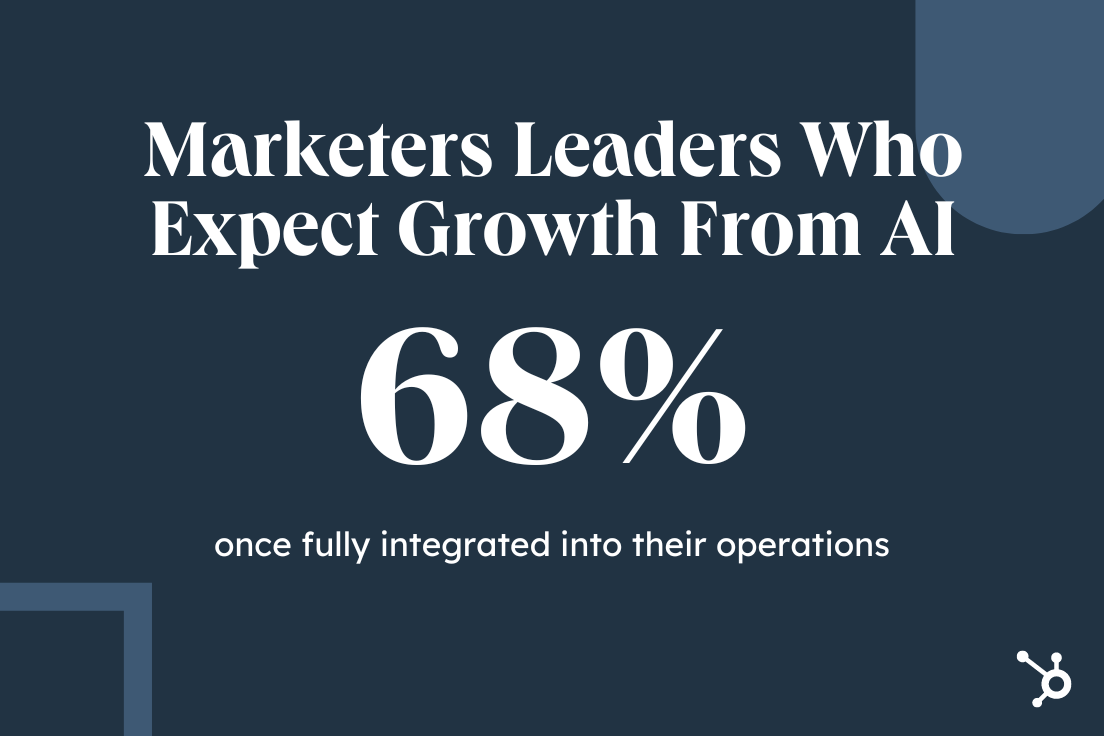
According to our recent survey data, 68% of leaders in the marketing field predict that their business will experience astounding levels of growth once AI and automation tools are completely integrated into their operations.

Over half of marketing leaders (62% of those surveyed), confirm that their company has already invested in AI.

The majority of these cases involve AI tools for marketing employees to use, with 72% of these company leaders reporting that AI makes their employees more efficient and productive, and 71% of these marketing leaders reporting positive returns on their investment in AI tools and technology.

How Marketers are Already Using AI

Since the majority of marketing agencies already rely on AI and automation to varying degrees, let’s investigate the top ways marketers today use artificial intelligence tools and technology.

Content Creation

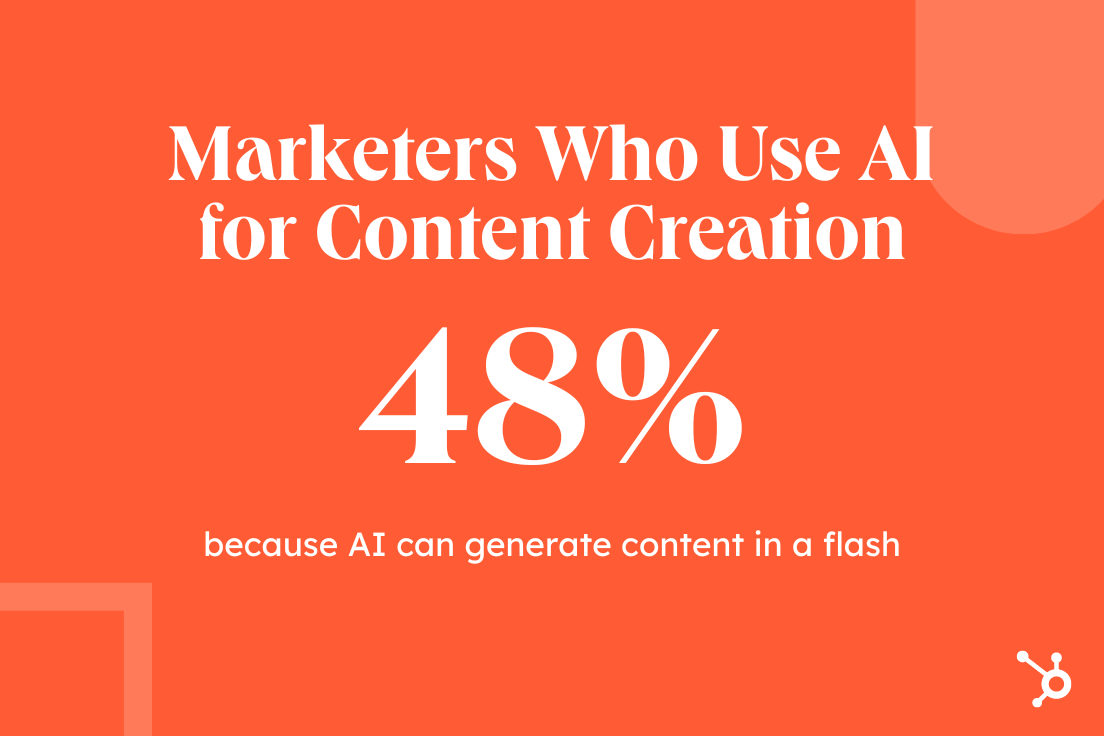
Of the marketing companies surveyed, 48% report using AI for content creation. This makes content creation one of the most popular AI use cases right now.

Over half of marketers use AI to generate new written content, making small edits by hand before publishing it.

This can include blog articles and website content, but also social media copy, landing page CTAs, or even product descriptions.

Marketers who use AI tools to craft new content can save an average of three hours per piece of content—three hours that can instead be applied to researching, outreach, strategy planning, and creative brainstorming.

AI content creation tools like HubSpot’s content assistant, ChatSpot, or OpenAI’s ChatGPT can respond to prompts, almost instantaneously generating new images and/or written content to answer the marketer’s specific needs, honing results to create the right tone and messaging.

Data Analysis and Reporting

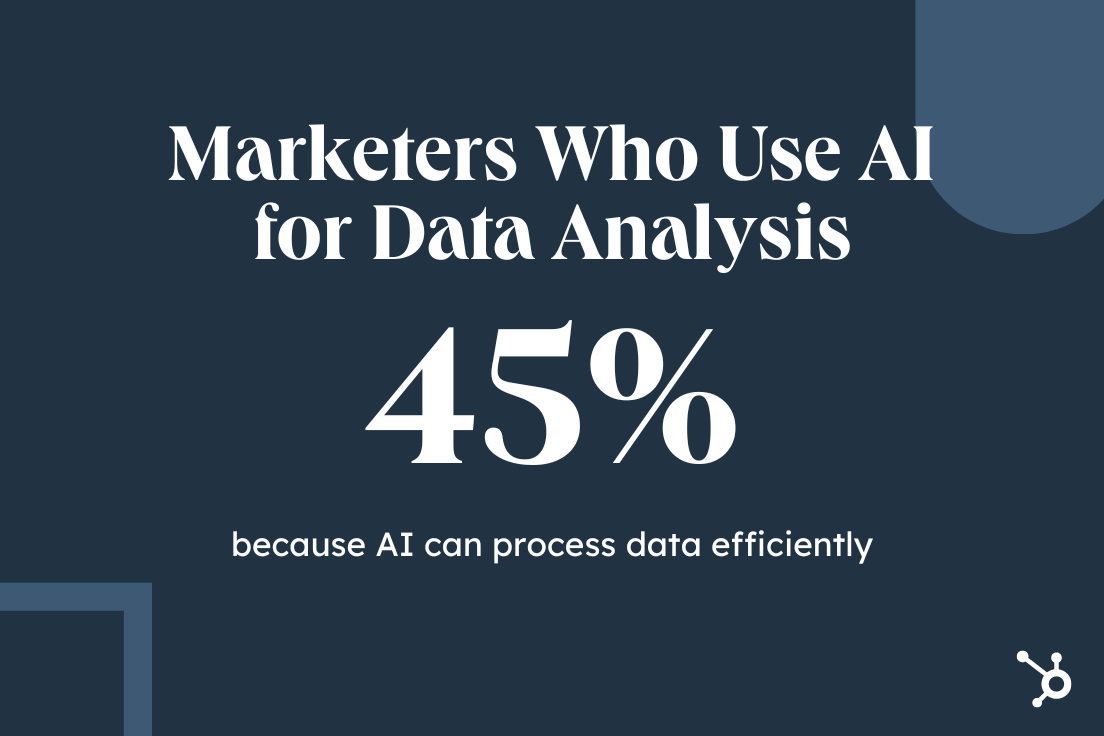
From assessing competitors in the same industry to identifying and analyzing niche target audiences, AI tools provide invaluable data analysis support for marketers, 45% of whom use AI tools for data analysis and reporting.

Since AI has the capacity to process monumental amounts of data extremely quickly, it can identify patterns of customer behavior and analyze trends across the marketplace.

Conducting Research

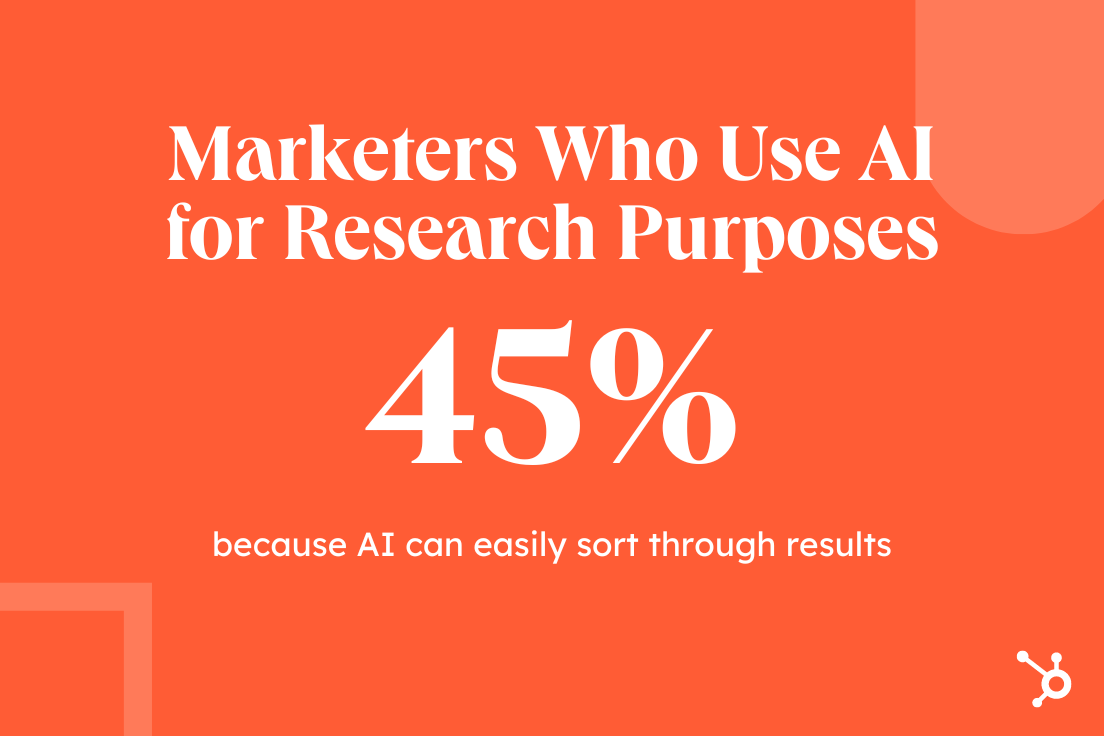
Research can take time, and results are not always easy to acquire. This might be why 45% of marketing professionals utilize AI for research purposes.

AI can sort through the irrelevant results to provide answers to very specific inquiries, thus saving immense amounts of time.

AI tools can also sort responses into categories, emphasizing results that provide the most insight on different facets of a complex issue. This ability can amplify the research process, providing much more in-depth coverage for employees. But AI-powered research extends beyond simply market research.

In addition to utilizing market research capabilities from AI, 32% of marketing employees use AI to learn and develop skills. In fact, AI may be revolutionizing the field of education, prompting students of all ages to engage in a more personalized and responsive form of skills acquisition.

AI can provide customized feedback and help employees track their learning journeys with progress charts and analyses, providing concrete interactive examples to help employees learn skills better and faster.

Why Some Marketers Haven’t Invested in AI Yet

A recent Gartner study showed that 63% of leaders in marketing had either already invested in AI or were planning to do so within the next 24 months. So that leaves just 37% of marketers who have not yet invested in AI.

With so many powerful capabilities for improving communications and increasing efficiency, why have these marketers chosen not to adopt AI tools yet?

According to the same study, the main causes for hesitancy have to do with uncertainty about the accuracy of the results that AI tools provide, potential intrinsic biases exhibited by AI software, and relying too heavily on AI technology.

Even our own survey supports this position, with a whopping 76% of respondents saying that we should use AI/automation in marketing, but not to a point where we’re dependent on it.

Although skepticism is always warranted during the early stages of a new product or service, it’s worth taking a closer look at each of these three reasons why marketers haven’t adopted AI.

1. They fear faulty results and inaccurate information.

The main cause for concern that marketers identify when it comes to AI is that they fear AI tools may come up with inaccurate information.

his concern about accuracy is reasonably well-founded- our data shows that nearly 50% of marketers who already use generative AI tools report having received results from AI tools that have contained information the marketers knew to be inaccurate.

Our further research has shown that only 27% of marketers who are already using AI feel extremely confident that they would be able to identify faulty results produced by AI tools.

Since AI technologies are still evolving, there is a reasonable chance that some of the results AI tools produce will be variable, and developers are working to tighten these outcomes.

2. They worry about the inherent bias of AI tools.

Some of the most attention-grabbing news headlines surrounding early results from the public release of AI tools highlighted the troubling biases these AI tools displayed.

Machine learning or AI bias comes about as a result of the biases that its developers may have, whether they are conscious of them or not.

Since AI developers and engineers are programming the algorithms that power AI tools, they are essentially teaching AI machines what to look for and how to identify different types of data.

When that developer has a bias they are not aware of, the AI may become infused with that slant, assumption, or even prejudice.

A study by the United States Department of Commerce, for example, revealed that facial recognition tools in AI frequently misidentify people of color, which can lead to wrongful arrests and further consequences. And new AI tools, like automated headshot generators, are still riddled with bias.

3. Marketers are concerned about becoming AI-dependent.

Some marketing professionals cite concerns over becoming too reliant on AI and automation tools.

The fear is that the more we come to rely on AI skills for content creation, strategy planning, research, and more, the less capable we will become at completing those tasks ourselves.

Luckily, AI does not fully substitute for the creativity and capability of a human employee. Instead, AI offers tools and abilities to help make routine tasks and content creation more efficient and productive.

Like the ultimate administrative and research assistant, it frees up time for marketers to focus on honing their irreplaceable skills.

Getting Started with AI

If you haven’t jumped on the bandwagon, or are still unsure how your content can benefit from these innovations, try these approaches to using generative AI:

  • Turn to AI for keyword suggestions and demographics analysis, honing the profiles of your target audiences for marketing campaigns.
  • Use AI to create or repurpose content, with tools such as HubSpot’s Campaign Assistant and Paragraph Rewriter.
  • Allow AI to help identify competitors in the field and provide actionable insights on how to surpass them.
  • Let AI find content gaps and faults in your existing content.

These are some simple (and helpful) ways to incorporate AI into your workflow if you’re interested but hesitant to take the plunge.

New Call-to-action

Categories B2B

How to Plan a Seasonal Marketing Campaign: A 5-Step Guide

Every year has built-in opportunities to boost sales, increase brand recognition, and bolster customer relationships. Seasonal marketing is the key to aligning your outreach with special times of the year, like holidays and events, to capitalize on increased consumer enthusiasm.

A well-executed seasonal marketing campaign will increase sales and strengthen the emotional connection between your brand and your audience, which is a recipe for dedicated, lifelong customers.

Download Now: Free State of Marketing Report [Updated for 2023]

Pulling off a standout seasonal marketing campaign requires hard work, creativity, and a little know-how — but don’t fret, I’m here to help. Read on to learn all about seasonal marketing, check out our step-by-step campaign guide, and get inspired with top-tier seasonal marketing examples.

Table of Contents


The holidays are associated with strong emotions such as joy, love, and hope. Businesses can create a more meaningful and memorable connection with their customers by marketing products and services that appeal to these emotions.

Seasonal marketing isn’t just about holidays, though. Special events like the Super Bowl and seasonal opportunities like Back-to-School shopping and Black Friday are further examples of chances to flex the seasonal marketing muscle.

Seasonal marketing aims to drive sales and foster an emotional connection with your target audience. Read on for a step-by-step guide to jumpstart your next seasonal campaign.

Here’s are five key steps for planning your own seasonal marketing campaign.

1. Choose a seasonal opportunity.

Choosing the seasonal opportunity to capitalize on is the first step to a successful campaign.

Major seasonal events like Black Friday are always a safe bet to campaign around. However, you should research your target audience to find seasonal opportunities that resonate with your customers and their values.

Audit existing seasonal campaigns.

Once you have decided on a seasonal event to utilize for a campaign, it’s time to do some homework on similar, successful campaigns — Ahrefs and BuzzSumo are great places to begin your research.

Consider how each piece approached content format, distribution, messaging, and emotion when evaluating previous campaigns.

When validating a campaign, ask yourself the following questions:

  • How has this piece used multiple content types and distribution platforms?
  • Is the messaging clear, and if so, what is it?
  • What emotion does this campaign evoke in the user?

Gather insights via external outreach.

Consider gathering outside opinions from journalists and digital publications in your space.

Seek out platforms that have covered campaigns you admire and ask for feedback on what makes a seasonal campaign compelling from their point of view.

2. Plan for marketing-friendly holidays.

Lucky for us marketers, every year comes packed with advantageous marketing opportunities in the form of holidays.

But what is it about holidays that makes them so great for marketing campaigns?

It’s the built-in positive sentiment.

Holidays are generally positive times that beget warm feelings like joy, nostalgia, and gratitude.

Marketing is all about evoking positive emotions in your audience and aligning your campaigns with marketing-friendly holidays allows you to ride the wave of seasonal good vibes and make customers feel good about buying your product.

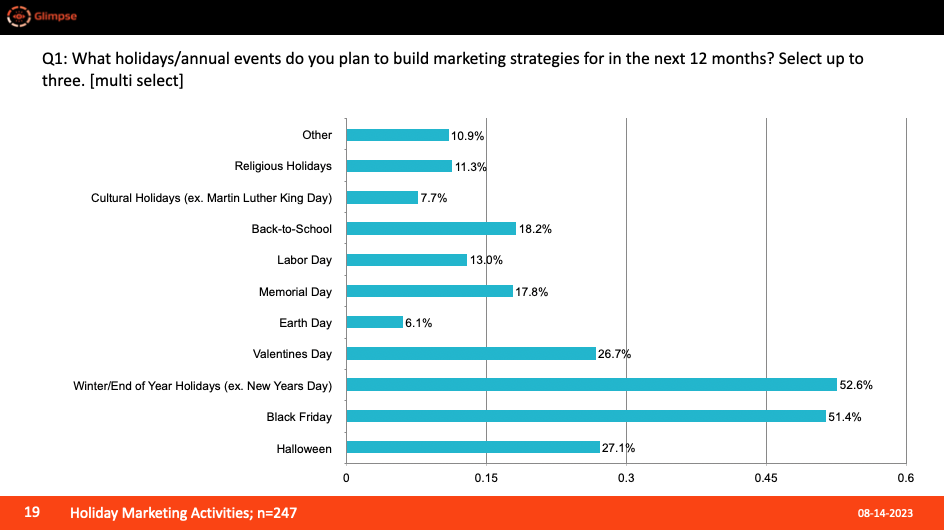
According to a 2022 HubSpot survey of 247 marketers, Black Friday and Winter/End-of-Year Holidays were the most popular seasonal marketing events for future campaign planning.

51.4% and 52.6% of respondents indicated plans to build marketing strategies around those holidays.

While Black Friday and Winter holidays evoke different feelings, the marketing strategy of riding those times’ excitement and positive sentiment remains the same.

Of course, there are many other holidays to consider, and choosing the right one depends on your brand values and goals.

3. Establish a schedule.

With seasonal campaigns, timing is of the essence.

Your planning should begin well before your selected seasonal event, and you must create a schedule to execute each campaign step.

Generally, your content should be prepared, built, planned, and ready for press releases at least two months before the big event.

Consider using a marketing calendar to streamline your processes and get your team on the same page.

When creating a schedule for your campaign, don’t forget about your audience. When is the best time to contact them? When will they be most willing to share the content or engage with the campaign?

5. Organize your assets.

Your seasonal marketing campaign should touch all major platforms, including social media, email, blogs, and out-of-home advertisements (if that’s your thing).

A wide-reaching campaign requires meticulously organized assets. You should brief your creative team on the assets needed for each channel and the necessary resolutions and dimensions.

Pro Tip: A practical, up-to-date campaign plan document is essential during this process. It will enable you to better organize the timing and frequency of content releases and keep your messaging consistent by serving as a home for all your campaign assets and communications.

Check out these content marketing planning templates to get started.

5. Report and remain agile.

Remaining agile means prioritizing speed, collaboration, flexibility, and testing.

Reporting and reviewing your campaign’s performance as you go is necessary for maintaining the ability to adjust the campaign as it unfolds.

Where is the majority of traffic coming from? Which pages have the best bounce rate? Which ones are converting the best? These are some examples of metrics that can inform your strategy moving forward.

Don’t be afraid to make alterations to the original plans. If the changes you will make will ultimately improve the campaign’s success, why wouldn’t you make them?

Check out the video below for helpful information on running seasonal marketing campaigns. The video discusses promoting digital products like online courses, but the advice is broadly applicable.

Seasonal Marketing Examples

Back-to-School Shopping

Company: Walmart

Image Source

As much as we wish it weren’t the case, summer comes to an end every year. With summer’s end comes back-to-school shopping season, which can bring about excitement or dread, depending on who you are.

Still, the back-to-school season presents a tangible seasonal marketing opportunity, and Walmart seized it.

What makes it great: Walmart cleverly combines the urgency of back-to-school shopping with an exciting deal. Walmart offered customers last year’s prices on this year’s school supplies, which is an exciting way to frame their low prices, especially for inflation-conscious consumers.

Pro Tip: Don’t be afraid to get a jump start on things. Walmart announced their 2023 back-to-school campaign on July 6th (too soon if you’re a student, but just right if you’re a marketer), and planning occurred many months beforehand.

Back-to-school spending is expected to reach record highs of $41.5 billion, up from $36.9 billion last year and the previous high of $37.1 billion in 2021. So, don’t miss out on the opportunity to ride that wave if your products fit the bill.

Winter Holidays

Company: Starbucks

Image Source

Starbucks’ holiday cups are almost as ubiquitous as the winter holidays themselves.

Every year, as the colder months approach, Starbucks releases a festive holiday cup to kick off the season. Starbucks has been taking advantage of this seasonal marketing opportunity since 1995, and brand loyalty increases as the tradition cements yearly.

What makes it great: Starbucks gives customers something fun to look forward to every holiday season with fresh, festive design. They have piggybacked off the warm and inviting feelings of the holiday season so consistently and effectively that their seasonal marketing campaign has become a mainstay of the holidays.

Pro Tip: Consistency is key. If you can devise a seasonal marketing campaign that you can execute every year (while still keeping things fresh), your customers will look forward to it and open their wallets accordingly.

Summer Fun

Company: Target

Image Source

Target appeals to summer fun in their #TargetDrop seasonal marketing campaign.

Tik-Tok creator Hungry-Fam surprises his family with a pool party featuring Target’s summertime products like ice pops, swimsuits, and pool toys, all peddled from a rolling ice cream-themed mystery box.

Target’s campaign evokes the seasonal excitement of summer from a wholesome, family-friendly angle.

What We Like: Target takes advantage of a growing influencer marketing industry (up to $21.1B from $16.4B in 2022) and carves out a broad seasonal niche that doesn’t rely on a specific holiday.

Pro Tip: Don’t be afraid to think big picture when crafting a seasonal campaign. It doesn’t always need to be a specific holiday you highlight in advertising. A broader seasonal campaign can resonate with a more significant number of people.

Spring Cleaning

Company: OXO

Image Source

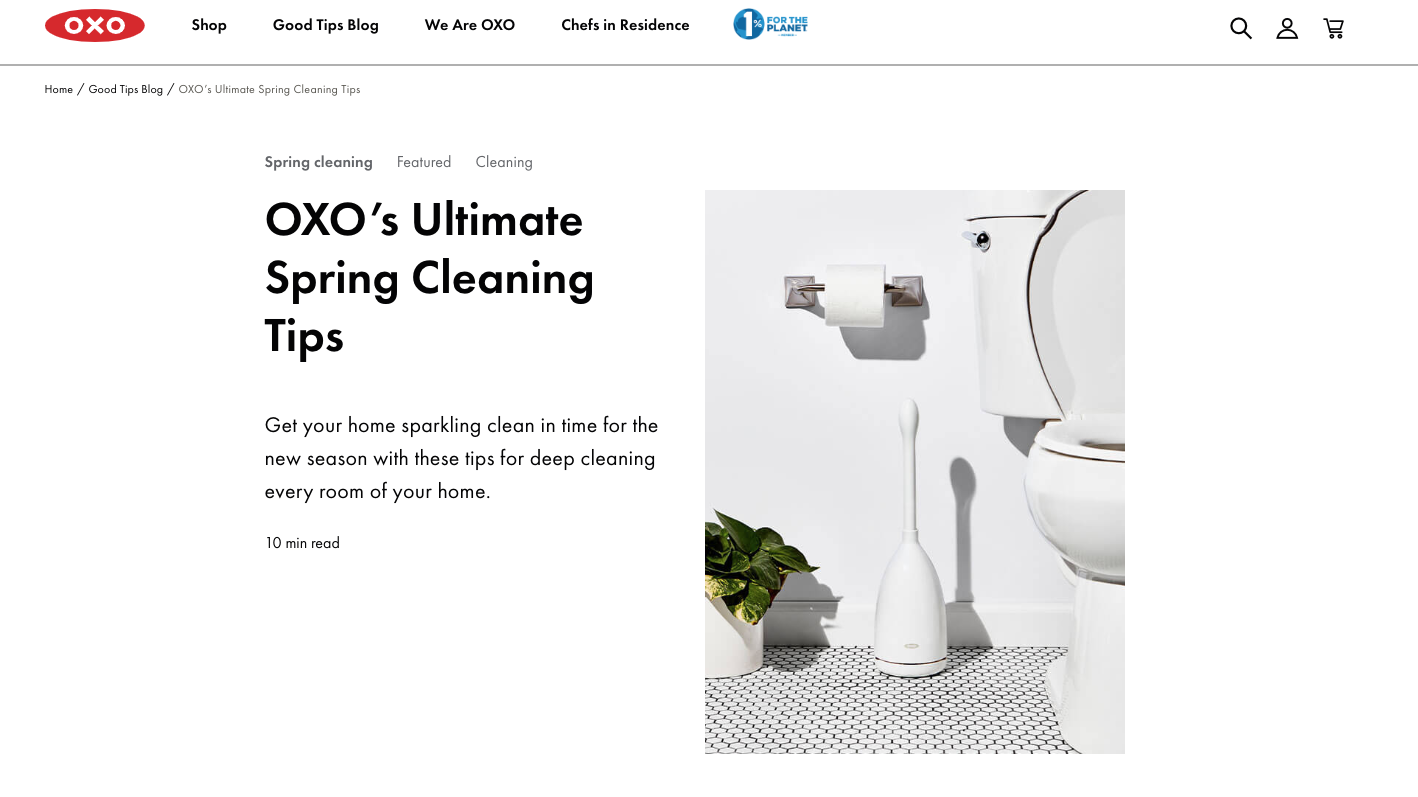
As winter fades into spring, a feeling of freshness washes over us, and the urge to tidy our spaces resurfaces.

OXO supports that sentiment with helpful content to motivate peoples’ Spring Cleaning journeys. OXO’s contribution to this list shows how to approach seasonality from a content marketing perspective meant to delight and inform.

What We Like: OXO’s Spring Cleaning content perfectly matches seasonal opportunity and brand values.

Pro Tip: Formatting your written content as a list (when appropriate) makes it easier for readers to skim, increasing page views.

Halloween


Company: Reese’s

Image Source

Reese’s set out to cement their position as a top-tier Halloween candy with their Candy Converter vending machine.

Reese’s seasonal marketing pop-up installation was a vending machine that let people exchange unwanted Halloween candy (like store-brand lollipops and Almond Joys) for their coveted peanut butter cups.

What Makes It Great: Reese’s Candy Converter was a creative, attention-grabbing stunt that bolstered positive brand sentiment with seasonal excitement. Running a seasonal marketing campaign around Halloween was a no-brainer for a candy brand, and the exciting pop-up stunt garnered significant press.

Pro Tip: Physical pop-up installations can be a great way to get eyes on your brand and garner press. However, pulling off can be difficult and costly and requires a high degree of creativity.

‘Tis the Season for Marketing

Use the power of seasonal marketing to your advantage. With the right recipe of relevancy, creativity, and timing, you can capitalize on big events — and ultimately, boost sales.

state-of-marketing-2023

Categories B2B

How to Leverage Intent Data to Drive More Business

Intent data is a collection of behavioral data points that help identify prospects at the account- or buyer-level with a high propensity to convert based on their level of interest in a product or service.

Buyer-level intent data, specifically, is sourced from dozens of intent signals that are gathered from multiple touch points throughout the customer journey, from the content prospects consume to the conferences they attend.

This data enables sales teams to focus marketing spend on prospects who are actively ready to buy.

To properly leverage intent data and efficiently drive more business, here’s what you need to know.

How to leverage intent data in 8 steps

Gone are the days when banner ads on a popular review website could funnel hundreds of leads to your business. On the contrary, today’s buyers are so inundated with paid advertisements and email blasts that they’ve turned a blind eye. 

Today, it takes a real-time, insider view into what prospects are truly interested in to properly drive leads. Fortunately, intent data has become a mainstay among business analytics to do just that. 

Follow these eight steps to gather, analyze, and apply buyer intent data that accelerates your sales cycle.  

1. Identify data sources

As with most business analytics that power a marketing campaign or sales pipeline, intent data can stem from multiple sources, including first-party, second-party, and third-party intent data. 

  • First-party intent data refers to information directly gathered from potential buyers, such as the data users input into subscription sign-up forms and questionnaires. First-party data like behavior and interest data can also be derived from a customer relationship management (CRM) system.
  • Second-party intent data refers to first-party data that’s been sold by the entity that collected it. Second-party data typically consists of various first-party actions taken through the original entity, such as inputted user email addresses and phone numbers gleaned through business partnerships.
  • Third-party intent data refers to data points that have been collected from various outside sources and stitched together by a separate entity, such as a data broker or marketplace. Third-party data is reflective of previous activity, search queries, and content consumption across multiple sources.

Potential data sources for buyer intent signals may include but are not limited to:

  • Filling out a sign-up form 
  • Webinars, workshops, and masterclasses 
  • Educational blog posts and buying guides
  • Vendor product, features, and pricing pages
  • Popular review websites, such as G2 or Capterra 
  • Engagement with paid advertisements
  • Attending industry- or product-specific conferences or events

2. Collect data

As you can see, intent data is gathered from numerous sources, some of which an organization may own and others of which an organization can pay to access. The majority of intent data is defined through cookies, IP addresses, and other means of identifying web users with unique credentials.

On their own, the various data sets that form buyer intent data can make little sense—after all, what does it matter if one employee in a company of hundreds performed a bit of casual research? 

However, when you collect these data points across an entire company, the purpose of buyer-level intent data quickly becomes more clear. When multiple employees in one company are all conducting similar queries, there’s a greater chance the organization is actively willing to make a purchase.

So, it’s vital to not only identify the various sources of intent data but also implement the necessary processes to collect and analyze it. Methods to gather user behavioral and interest data include: 

  • Website analytics tools like Hotjar, Crazy Egg, Google Analytics, and Matomo
  • Social listening tools like Mention, BuzzSumo, Sprout Social, and Hootsuite 
  • Customer relationship management (CRM) systems like HubSpot, Salesforce, ActiveCampaign, and monday.com
  • Buyer-level intent platforms, like NetLine’s INTENTIVE

3. Analyze and segment data

Of course, insights alone cannot power an effective sales pipeline or marketing campaign. Once you’ve gathered an assortment of buyer-level intent data, it’s time to analyze and segment those metrics into something more actionable. 

It’s wise to begin with your ideal customer profile (ICP). As the name might suggest, an ICP goes beyond basic demographics to thoroughly define the attributes of accounts that are anticipated to become valuable customers. For instance, most B2B ICPs include firmographic attributes, like the size, geographic area, and industry of an organization.

This data is used to segment prospects into meaningful categories. More importantly, it also enables sales and marketing teams to identify prospects who are most likely to convert in-market rather than through marketing campaigns and cold outreach, which simplifies the current sales pipeline.

Techniques to transform intent data into actionable insights range often include: 

  • Defining your ICP’s particular goals, challenges, and pain points 
  • Identifying roadblocks in the customer journey based on bounce rates during user sessions 
  • Learning the types of content that drive conversions

From here, you can further segment your prospects based on their stage in the sales funnel. Leads in the early stages of their customer journey will land at the top of the funnel, whereas those who are both problem and solution-aware can be fast-tracked to the bottom of the funnel. 

4. Personalize your marketing efforts based on data intent

Having numerous prospects in your sales funnel doesn’t mean that they’re all at the same stage of their customer journey. This is why both the sales funnel and the customer journey are broken into multiple stages—they require targeted messaging at each point. 

Fortunately, intent data allows for personalized marketing efforts that are adapted to each stage.

For instance, when leads reach the bottom of the funnel, intent data can highlight more specific needs that encourage them to convert. This data can be used for personalized sales outreach, such as product demos that have been tailored to a prospect’s specific pain point or challenge. 

5. Split-test your messaging

Now that you’ve personalized your marketing efforts, you can fine-tune your sales approach by split-testing your messaging. Split-testing, also referred to as A/B testing, is the process of comparing two versions of a marketing message to determine which performs better. 

Split-testing is an integral component of any sales and marketing campaign, but it’s especially beneficial for teams leveraging intent data to enhance conversions. It stacks the original message (known as the control) against a variant with one difference to gauge the change in performance. 

One way to employ split-testing with your intent data is to test different headlines on landing pages, like “Best Accounting Software for Small Businesses” versus “Accounting Software to Scale Small Businesses,” based on the consumption behaviors from prospects who’ve registered for Webinars comparing software solutions.

6. Retargeting

Buyer intent data and behavioral retargeting go hand-in-hand. Behavioral retargeting utilizes the previous online activity of a prospect who has interacted with your marketing efforts, but has not yet converted, to inform hyper-specific marketing messages that ultimately encourage a conversion.

You can retarget based on first-party data that you already have (like their email address and name) as well as third-party data (like retargeting pixels). 

With robust intent data, specifically buyer-level intent data, sales and marketing teams can construct personalized marketing messages for users who have expressed interest in a particular product or service. Data points like user budget, previously considered contenders, and investment timeline can enable smarter product positioning.   

7. Measure your results from data intent campaigns

Intent data reveals the topics your prospects are searching for, the touchpoints they access to learn more about your brand, and how inclined they are to purchase from you. With so much data to analyze and assess, it’s vital to measure the results of your data intent campaigns. 

To understand how intent data moves the needle for your sales and marketing efforts, establish benchmarks for your current performance. By establishing benchmarks now, you can easily identify how— and when— your data intent campaigns improve performance and drive more business. 

First, implement benchmarks for the leads captured and nurtured without intent data. Then, begin documenting the results of your data intent campaign. You should be able to compare the performance of your sales cycle throughout the campaign duration through metrics like: 

  • Prospects to marketing qualified leads (MQLs)— How many prospects turn into MQLs? 
  • MQLs to sales qualified leads (SQLs)— How quickly do nurtured leads convert into SQLs?

8. Iterate

In the simplest sense, iteration means repeating the data intent campaign process to generate a sequence of outcomes. 

So, while your initial benchmarks are crucial to gauge general performance, they’re not the end-all, be-all of campaign metrics. On the contrary, you’ll want to compare the first iteration of prospects to MQLs or MQLs to SALs with the second iteration to properly determine your progress over time.

Why you need to prioritize leveraging intent data

Intent data is an actionable indicator of interest. Intent not only describes how willing a prospect may be to convert but also the specific touchpoints they have along their customer journey that can help to guarantee a conversion. 

Leveraging intent data enables you to reach the right customer at the right time with the right message. Here are five specific benefits:

Identify problem-specific solutions

Numerous aspects of buyer intent data, such as common search queries and other behavioral patterns, indicate a specific problem that requires a solution. 

This data helps sales and marketing teams craft need-specific messages that cater to prospects’ and customers’ needs. Plus, this intent data can be applied to retention efforts to better cater to specific consumer pain points. 

Accelerate qualified prospects in your sales pipeline 

In the simplest sense, intent data helps sales and marketing teams to identify the lowest-hanging fruit in terms of qualified leads. 

Leads who demonstrate clear interest in a brand, product, or service, based on online activity can be segmented for bottom-of-funnel targeting, like through dedicated product demos. Intent data helps to build a pipeline of qualified leads faster with the assurance they’re a good fit.

Streamline the sales process 

A major benefit of accelerating your pipeline of qualified leads is streamlining your overall sales process. 

While top-of-funnel campaigns are integral to brand awareness and introducing your products and services to a new audience, leaner and more targeted middle and bottom-of-funnel campaigns dedicate your team’s attention to good-fit prospects that save both time and resources.

Create more relevant content

Buyer intent data like the frequency of site visits and types of content consumed reveal what’s most important to your audience. By prioritizing this information, you can create more relevant content that positions your brand ahead of competitors. 

Take comparison pages, for example. Intent data can identify the competitors that prospects also consider, so you can utilize competitive take-out messaging to highlight your brand’s key differentiators—such as more robust features, accessible price points, and user experience. 

Improve the timing of marketing messages

Beyond content relevance, intent data can also help marketing and sales teams improve the timing of marketing messages. 

As mentioned, just because prospects are in your sales funnel, doesn’t mean that they’re all at the same stage of their customer journey. Intent data provides insights into where prospects are in the customer journey to offer a free trial, demo, or other incentive at the right time. 

Remember: As a general rule of thumb, NetLine research has shown that unless a user has explicitly requested to hear from you, it’s best to give your prospects 48 hours before reaching out so they can actually consume the content they’ve requested. Nothing worse than spoiling a strong intent signal because you were overeager. 

10 tips to leverage intent data the right way

As you sift through the numerous behavioral data points, consider these tips to leverage intent data correctly. 

1. Set clear objectives

Because the types of data you can collect through intent data campaigns are so robust, it’s crucial to set clear objectives for your marketing and sales initiatives. It’s often helpful to return to the classic SMART goals here—goals that are Specific, Measurable, Achievable, Relevant, and Timely. 

For instance, you might want to improve the number of SQLs generated from MQLs by 10% in 4 months.

2. Identify relevant intent signals

Intent signals are the indicators that identify the prospects who are actively researching your brand—they do not pertain to the people who simply land on your website. 

Remember that intent signals should refer to users who demonstrate interest in your product or service. Traffic to generic blog posts, such as, “Top Accounting Tips,” should not be considered a relevant sign of purchase intent. 

3. Segment your audience and create tailored messages

You’ll find numerous types of prospects in the sales funnel. Some have just begun researching a newfound problem and stumbled on a helpful piece of content you published. Others have been knee-deep in the consideration phase for weeks, researching potential solutions. Segment your audience based on their current stage in the sales funnel to create hyper-tailored messages. 

4. Create content personalization strategies

Aside from a prospect’s stage in the sales funnel, intent data can reveal several other data points that can be used to create content personalization strategies.

  • Have a few prospects who are actively comparing your brand to another? Create competitor comparison pages. 
  • Have another group that’s unsure of the size of the solution they need? Create an informative webinar as a lead magnet.

5. Leverage automation

Being that intent data is spread across first, second, and third-party sources, it’s smart to leverage automation to streamline the process. 

Take retargeting, for instance. The ability to sync your retargeting campaigns with your CRM tool via automation helps automatically populate buyer profiles with the latest online behavior in real time. 

6. Comply with GDPR

The General Data Protection Regulation, most commonly referred to as the GDPR, is a European Union (EU) law that governs how organizations can use, process, and store personal data, including personally identifiable information (PII) like email addresses. To comply with GDPR, you must:

  • Have a readily accessible privacy policy on your website
  • Verify the ages of all users who opt-in to data processing
  • Be transparent about how data is collected and processed
  • Evaluate the sensitivity of data through a Privacy Impact Assessment (PIA) and a Data Protection Impact Assessment (DPIA
  • Create a comprehensive record of how you will maintain compliance

A handy set of compliance checklists can be found in 4 Checklists Your Brand Needs to Understand Data Compliance.

7. Comply with HIPAA

HIPAA, short for the Health Insurance Portability and Accountability Act, is another regulatory compliance standard that involves consumer PII as well as patient health information (PHI). 

In the US, HIPAA implemented a set of standards to protect sensitive PII and PHI, including: 

  • Create privacy and security policies for your organization
  • Designate a Privacy Compliance Officer to oversee policy creation 
  • Implement an information access management system
  • Obtain “satisfactory assurances” from business associates who handle consumer data
  • Conduct risk assessments and adopt audit logs 

8. Respect people’s privacy

While it might sound like an advantage to track prospects across the internet, most people aren’t too fond of the idea of a business monitoring their online behavior—especially for marketing purposes. As you experiment with intent data, remember to remain mindful of consumer privacy. 

NetLine’s INTENTIVE, for example, never discloses PII and never will. INTENTIVE’s delivers buyer-level intent insights from B2B buyers without sharing any of their personal details.

9. Track your results

Remember the benchmarks you established above? Those metrics will be useless without another batch of data to compare them to—and you’ll never be able to gauge headway on your objectives without results. So, it’s critical to track the results of your intent data campaigns over time. 

10. Iterate based on what you discover

Like any marketing or sales initiative, your intent data campaigns will require improvements over time. The more you gather important metrics and other key performance indicators (KPIs), the more you can identify methods to refine and enhance your intent data campaigns to drive business.

How NetLine can help you to understand and leverage intent data

NetLine INTENTIVE is the first and only B2B buyer-level intent platform designed to provide real-time first-party data insights that you can use to accelerate sales conversations. 

Get real-time data, insights, and notifications about your buyers that you can use to fuel your sales and marketing campaigns. Schedule a demo today.

Categories B2B

How to Make the Perfect PPC Landing Page (+ Examples)

PPC landing pages are the newest incarnation of an age-old sales problem: How do you keep warm bodies in their seats long enough to hear your message?

In the digital age, the key is to craft effective PPC landing pages that entice customers to stay, read, and follow the path you’ve carved — a customer journey from curiosity to conversion.

Free Guide, Template & Planner: How to Use Google Ads for Business

Stick with us as I explain and explore PPC landing pages and the elements that make them work. I’ll then share some great PPC landing pages, examples, and tools you can use to plan, execute, and analyze your PPC campaigns.

Table of Contents

5 Elements of a Great PPC Landing Page

While there’s so much more to know about landing pages in general, there are five must-have elements in any great PPC landing page, specifically.

Each of these critical elements has an important job to do, and they build on each other to convince the customer to act.

1. Include strong and relevant visuals to grab their attention.

Eyes lead, so you’ll need strong visuals that are directly relevant to:

  • Whatever you are selling.
  • The wording of the ad you created that led your customer to the landing page.
  • Ideally, the wording of your call to action (CTA) as well.

When your audience arrives at your PPC landing page, they should see thematic echoes of the ad they clicked. Strong and relevant images give them confidence that they are in the right place and weren’t swindled into clicking some wayward, spammy link.

Place your hero image near the top of your landing page so it draws attention immediately. If you can, tie the images you choose to your CTA messaging as well.

It’s an added layer of complexity, but when done well it creates a sense of cohesiveness. That way, it feels like every single detail leads to the CTA and contributes to the momentum you are building.

2. Use both a headline and a subheader.

Visitors are soaking in your visuals as they engage your first line of content, so your headline is important and should accomplish the following:

  • The headline and hero image must be relevant to one another.
  • The words and/or numbers you use in the headline should echo the wording and/or numbers from your advertisement, tying the ad to the landing page in order to start building trust.
  • Your headline should include your top keyword, if possible, and work together with the subheadline and visual imagery to establish the style of content to come.

The subheader has three important jobs:

  • Transitions content from ad language to CTA language.
  • Contains important keywords that may not fit into your headline.
  • Establishes the journey of the eyes, leading them downward to the next piece of content.

3. Sell it strategically and with your whole heart.

Your visitor has now transitioned and is ready for more information. Your details should be clear, specific, and really celebrate your product or service.

Organize the valuable aspects of your product into easily digestible chunks that lead from one to the next down the page.

Remember that no matter what you are promoting, it’s about meeting the customers’ needs or giving them a desired experience.

Let them step into the shoes you’re selling, so to speak, by couching the advantages you are offering into contexts your target personas will understand and naturally experience in their lives.

As you wrap up an informational section, write from the perspective of a thoroughly convinced and excited expert. This will lead into the next critical accelerant for your momentum: harnessing the customer perspective.

4. Provide social proof for outside confirmation.

This is the part of your stage show where you’ve done the main ‘song and dance’ and you now tell your audience, “Don’t just take my word for it! Let’s hear from these satisfied customers.”

Inviting feedback from your customers is part of a larger strategy that helps you improve your products, reputation, and marketing strategies.

This is one of the reasons why we collect written reviews, perform surveys, take ratings, etc. You get to use that information to provide social proof of your product’s value and your brand’s trustworthiness.

Testimonials from previous clients are the gold standard, and while written ones are the easiest to get, it’s worth the time and effort to get video testimonials, too.

If you have a lot of good ones to choose from, only put a few of your very best. More than a handful becomes overwhelming, and you can always provide a link to more testimonials to follow if visitors want to see more of them.

5. Create one CTA and repeat it like a mantra.

You want your CTA to be the heartbeat of your page. Your customer only needs to make one decision, and you need to draw their attention to that.

Reduce friction wherever you can so your visitors can ride the wave of your momentum and have good reason to slam that CTA button.

You want to keep your visitor laser focused on that one thing they need to do next. It’s that one ask you are making of them, even if you word it a little differently to entice more than one target persona.

Many landing pages even include a small CTA near the top for those who are already convinced and don’t want to spend a bunch of time on the landing page.

Why? Because customers differ, and that’s okay.

PPC Landing Page Examples

I tracked down some solid examples that make use of all five elements and pointed out where they’ve done an exceptional job.

Corpo Kinetic

Image Source

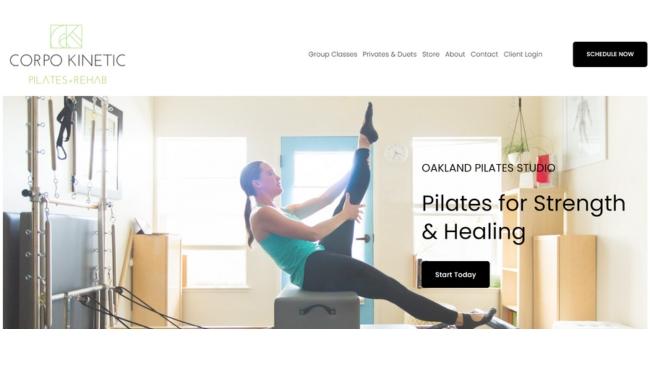
This landing page is a great example of choosing one CTA and letting it be the heartbeat of the page.

What I like about this: Corpo Kinetic uses the same black button over and over, and it stands out on the light background. It’s worded a little differently each time to entice more than one persona, but that button is the beat of the page.

We also see the words Schedule, Start, Join, Learn — and all roads lead to the Booking page, because that is the one action they want to call their customers to.

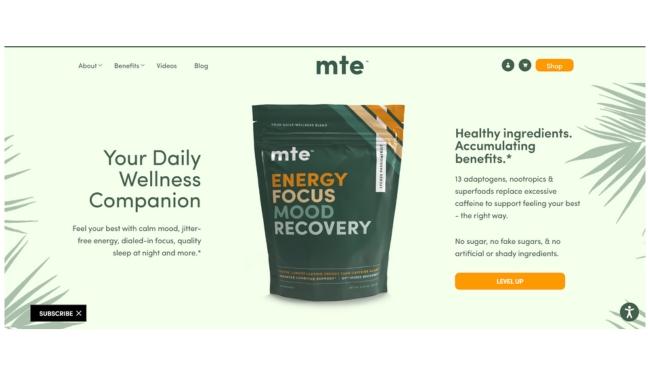
MTE

Image Source

The headline and subheadings taken to the next level.

MTE’s PPC landing page guides the eyes down to the CTA button like reading a book from the top left to the bottom right.

What I like about this: This approach takes advantage of how our eyes were originally trained in childhood when reading. Clever. What else is clever? It creates, in essence, two instances of headline and subheader to get more of their keywords in without looking cluttered.

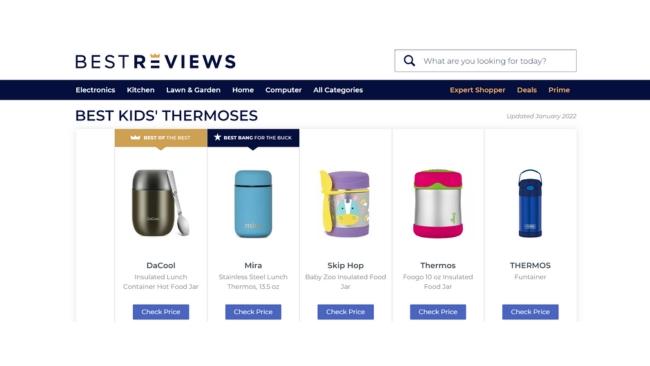
BestReviews.com

Image Source

It is hard to articulate how little time and money most parents have, and how refreshing it is to have a landing page take you to the exact information you searched for with no preamble to scroll through.

This landing page is not fancy, but really nailed the visual elements that resonate with their target audience.

What I like about this: The strong visual is front and center, clearly showing what they’ve determined to be the best thermos overall and then the best budget thermos. Then they put a CTA button under each one to check the price and buy it. Boom — done — every busy parent’s dream internet shopping experience.

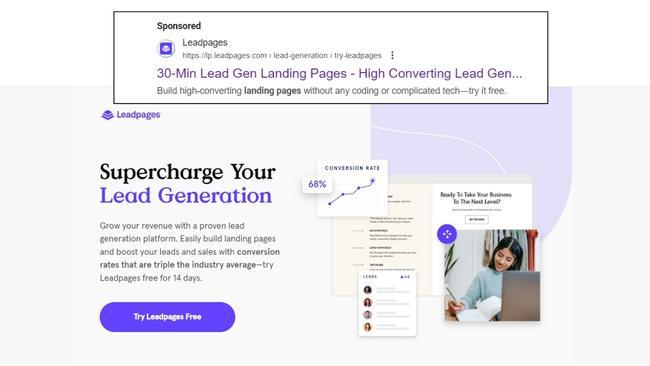
LeadPages

Image Source

Leadpages does a great overall job with this PPC landing page. The initial ad focuses on conversion, ease, and trying it for free. The landing page subheader hits all three ideas as well to let the visitor know they’re in the right place.

What I like about this: The headline uses an important keyword for them: lead generation. The Try it Free CTA starts in the initial advertisement and continues down the page like a heartbeat to each button.

They include social proof and have eye-grabbing styled images throughout. A landing page creator that practices what it sells — nice work.

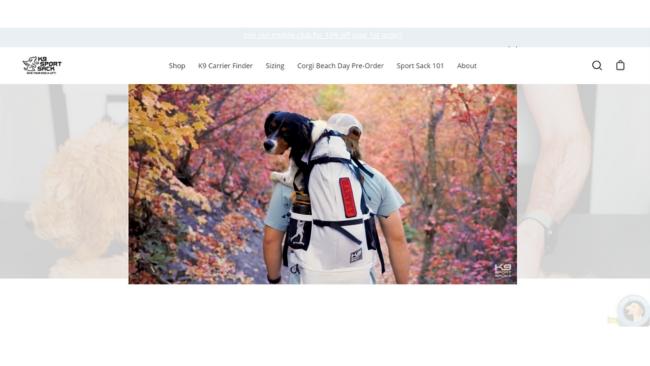
Canine Sport Sack

Image Source

These people know that good-looking dogs can sell just about anything. Canine Sport Sack’s website has clear and colorful visual assets that catch your eye and guide you to an incredibly informative video of how to size the carrier.

What I like about this: It’s clear they start you here because down below they have their products broken down by size. Their sporty orange buttons change color with roll-over, and I’m still thinking about the adorable footer. Sold.

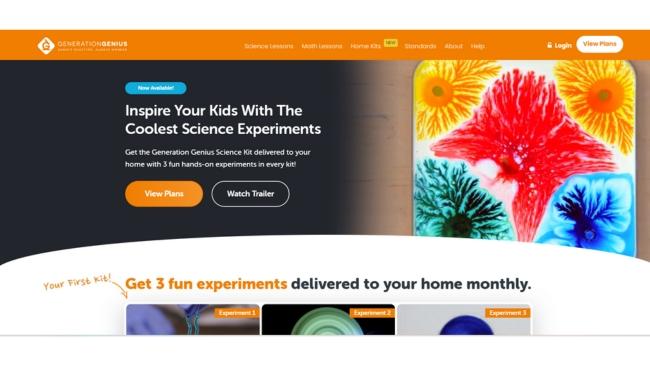
Generation Genius

Image Source

This landing page is a great example in many ways, but in particular of everything outlined in Element 3 (sell strategically and with your whole heart).

They provide photos and videos that let you step into the experiences they are selling before ordering. Valuable aspects of the product are organized in easily digestible chunks that lead from one to the next down the page.

What I like about this: They are really celebrating their product and selling it with their whole heart. Dr. Jeff gives his input as a thoroughly convinced and excited expert, then it rolls right into social proof. Absolutely nailed it.

Havenly

Image Source

This PPC landing page does a good job of echoing the ad with the the ideas of Get Matched and Get Started, which end up being the heartbeat of buttons down the page. Even the button that doesn’t match — Find Your Style — echoes the advertisement’s Based on Your Style to let you know you’re in the right place.

What I like about this: They matched the images in the top slider not just to the service but also chose images that coordinate in both color and cleanliness to the style and content of the page to come.

They also opted to put linked keywords at the bottom of the ad that could scoop up interior design adjacent traffic because they offer related content like Living Room Inspiration.

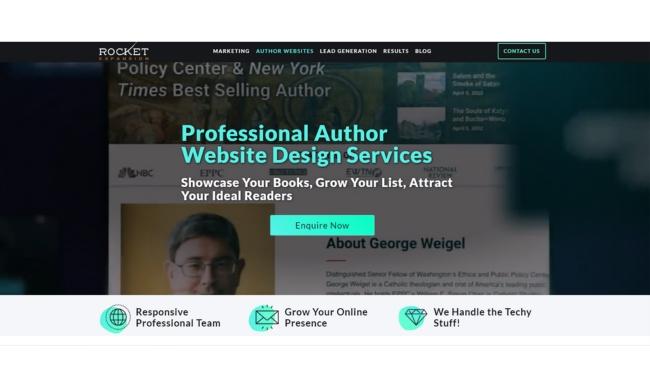
Rocket Expansion

Image Source

It’s pretty great how Rocket Expansion chose their CTA to sound more literary than normal. What a fun way to entice the persona of authors who want a website. The CTA buttons stand out nicely and repeat Enquire Now all the way down the page.

What I like about this: They start with relevant hero imagery in a background video, demonstrating a service they actually offer. Social proof is there, and examples of their work for both web and mobile look strong and enticing.

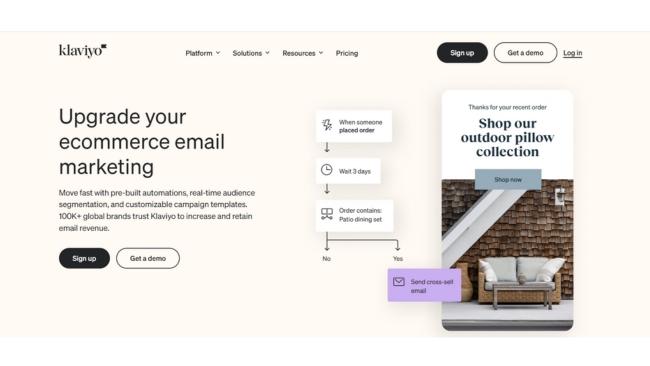
Klaviyo

Image Source

Klaviyo put together an on-trend, minimalist landing page that hits the marks. Clearly a good landing page, yet not the norm — that’s kind of their thing.

One of Klaviyo’s big strategies is actively using social media, which is not that typical of B2B. The phone-shaped images they’ve chosen reflect that and act as an indicator of their style and content to come.

What I like about this: They’ve chosen two CTAs to repeat like a heartbeat together, which isn’t typical, but they both lead to sign ups.

It’s not that different from how Corpo Kinetics’ buttons function, it’s just a different configuration. It makes you wonder what their analytics look like, and if they’re learning anything from it.

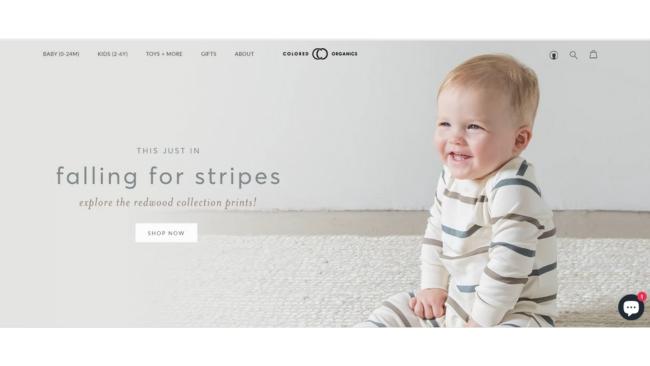
Colored Organics

Image Source

This is a more simplistic PPC landing page than many others on the list, but that’s definitely part of its charm. There’s a surprisingly large selection of baby products tucked behind its Shop CTAs.

What I like about this: Instead of using bold colors and videos to catch your eye at the top, Colored Organics knows that their target audience is going to be enthralled by a smiling baby in a clean space with a cute jumper that visitors will assume is organic, safe, and healthy.

Banana Republic

Image Source

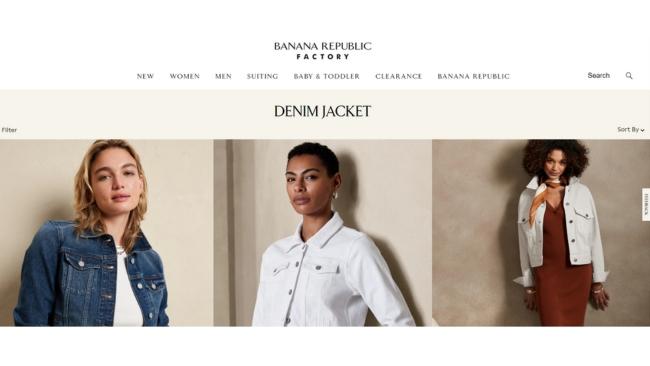
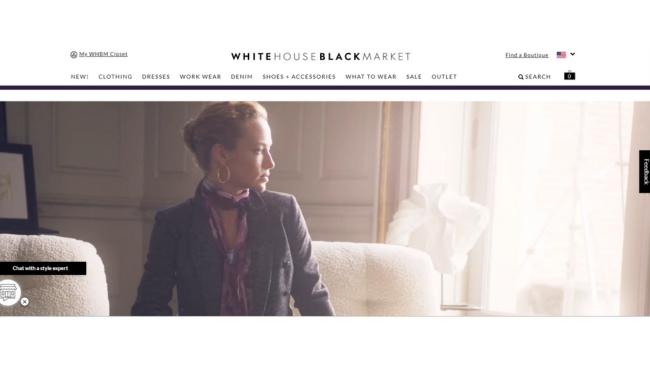
Banana Republic and White House Black Market below deserve kudos for their PPC landing pages. If you’ve ever clicked on retail clothing or department store ads, you can typically expect to be inundated with words and pictures, items, drop menus, and a million chances to leave where you just landed.

What I like about this: Banana Republic leads to the PPC landing page shown above after an original search for denim jacket. That’s a pretty classy place to land compared to companies you might expect to be competing for denim jacket traffic.

They do have drop menus but they are small and unobtrusive — the eye-catching images remain the stars that entice you to scroll down to see more. There you find clean and clear CTA buttons to sign up, sign in, and join.

White House Black Market

Image Source

Like Banana Republic, White House Black Market takes its PPC landing pages seriously and makes it clear what to expect from their style and content to come.

WHBM’s ad lands on an enticingly moody video that makes a hero of the idea of light and dark together.

What I like about this: We hear the heartbeat from the buttons down the page that read Shop New Arrivals, Shop Sweaters, and Shop Icons. They want you to get in there and take a look, but won’t be brash or gaudy about it. They’re elevating it and standing apart from the fray.

Home Chef

Image Source

Here’s a good example of hitting the marks while keeping it tight and concise. Home Chef focuses on meals in the ad, in the subheader, and the CTAs.

What I like about this: They’ve chosen punchy, yummy imagery of food that is relevant, flavorful, and health-conscious. Their info sections are small but present and lead you down the page like they should.

Volvo’s Electric Vehicle

Image Source

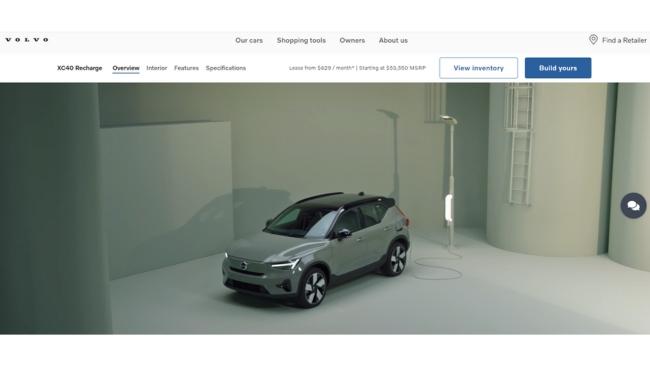
There is some hot PPC ad competition between Toyota, Tesla, Nissan, and Volvo right now on a search for electric vehicles. Toyota wins for selling with their whole heart and invoking a healthier planet.

However, Volvo is selling the heck out of their designs and features on their landing page. Did you see those wheels? They look like wind turbines — what a fun idea.

What I like about this: Volvo’s landing page does a solid job of focusing their style and content on futurism. You see cleanliness, technology, efficiency. Their information sections are cleanly batched down the page. CTA buttons read Build Yours to make it personal, and there’s something pretty special at the bottom.

They actually ask visitors what they think of the landing page. Perhaps they’re getting insights that help them edge out the competitors by simply asking.

Litter Robot by Whisker (Kind of)

Image Source

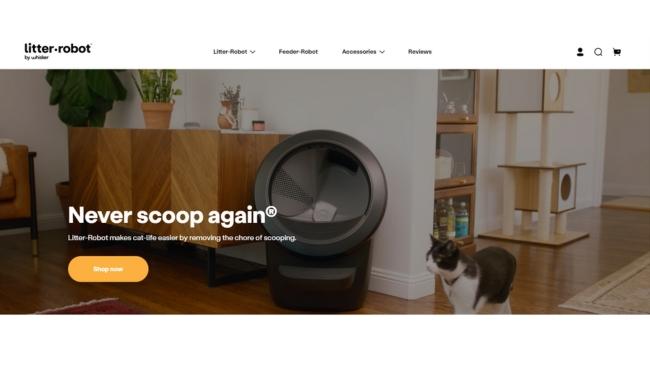
So close, Litter Robot! This one deserved to make the list. Their PPC ad led to a product page that makes sense if you know what the product is already, but isn’t in line with PPC landing page practices.

However, if it linked to something like their homepage instead — pictured above — it’d be knocking best practices out of the park. They could even keep the same PPC ad because it already mentions never scooping again.

What I like about this: It’s beautiful and ticks every box:

  • Relevant and eye-catching images including an opening video
  • Headline that echoes the PPC ad and an enticing subheader that leads toward the CTA
  • They sell with their whole heart, are clearly excited about their product, and sections of information are neatly contained in boxes that lead down the page to…
  • Social proof in the forms of videos, readable content, and big-name endorsements
  • Obvious CTA buttons down the page — a heartbeat that repeats Shop Now

Tools to Analyze PPC Landing Pages

Once you’ve put in the work to create a PPC landing page, next you’ll want to do some analysis.

There are a number of tools available to learn how your landing page data stacks up against competitors, A/B test your design, see what’s working and what can be improved, etc.

Here are four I recommend:

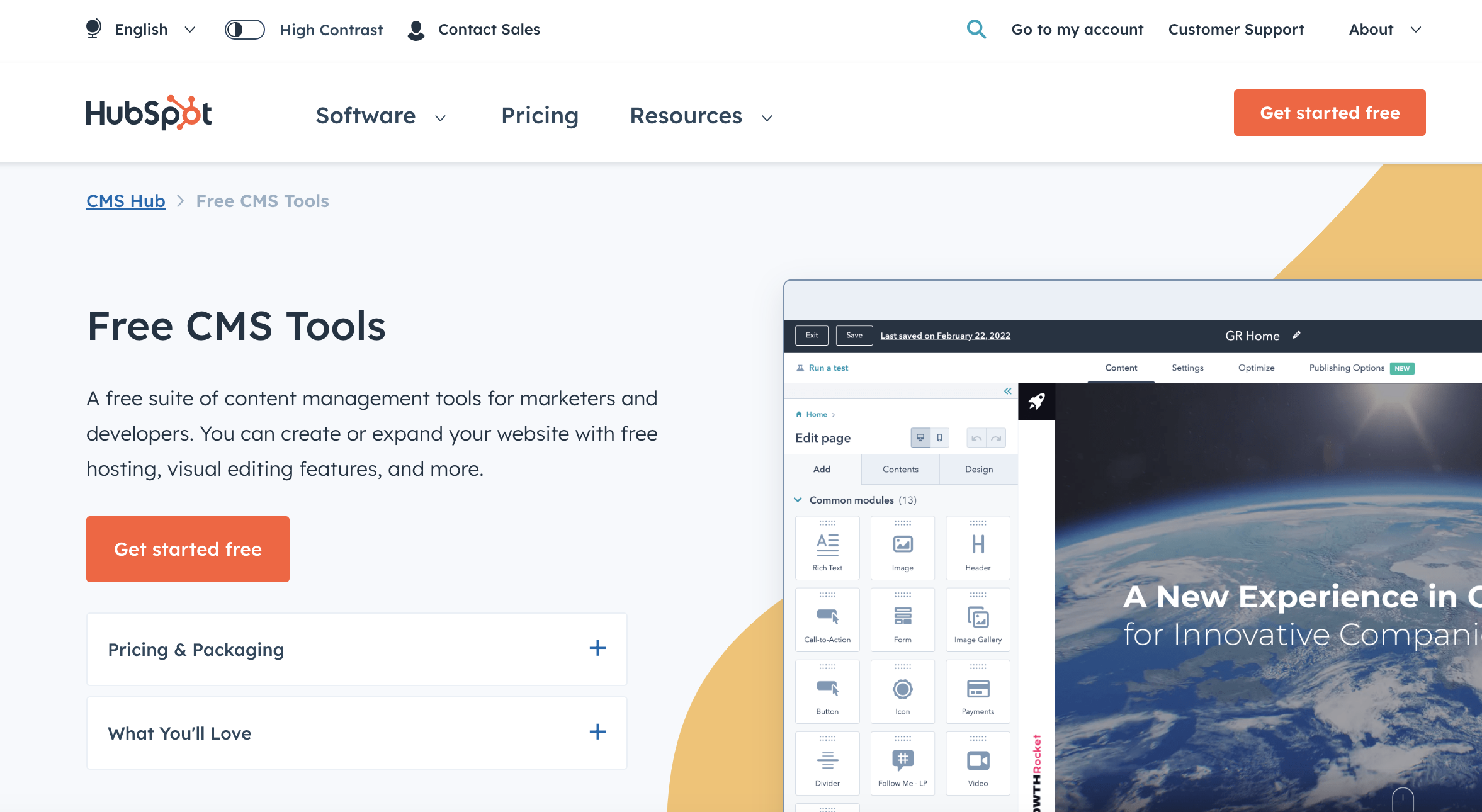
1. HubSpot

Pricing: Free

Additional pricing options:

  • Starts as low as $20/mo. for CMS Hub Starter
  • Free 14 day trial then as low as $360/mo. for CMS Hub Professional
  • Free 14 day trial then $1,200/mo. for CMS Hub Enterprise

Features

  • Collaborates with Google Ads and Facebook Ads
  • Video analytics to understand how visitors interact with video testimonials
  • An optimization tab that gives suggestions on how to improve your search engine performance

What I like: All-in-one solutions. HubSpot offers a free CMS and a diverse suite of tools that have been designed to integrate seamlessly. Analytics are available for all products and plans.

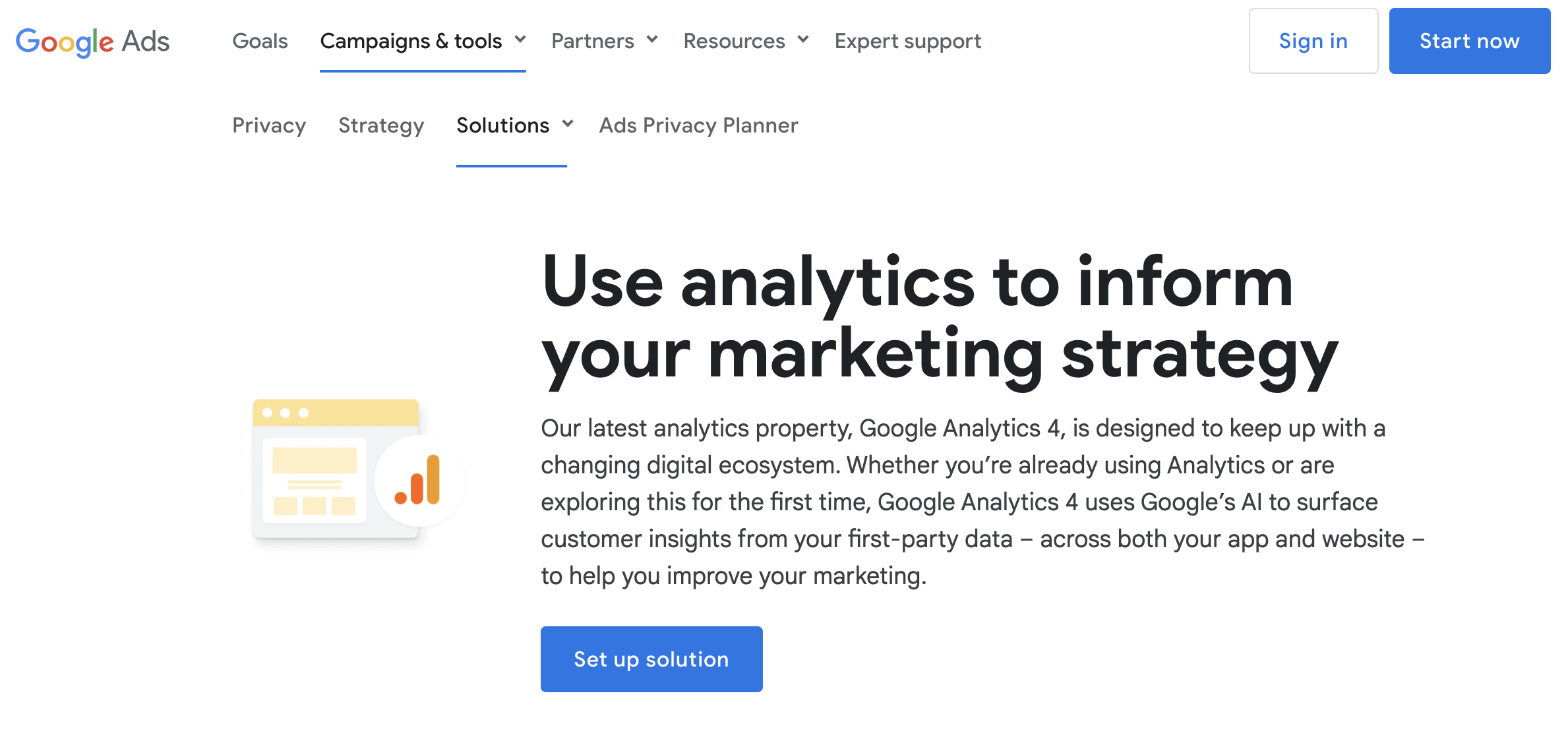
2. Google Analytics 4 for Google Ads

Pricing: Free

Features

  • Collects both website and app data for analysis
  • Uses machine learning to identify and report changes and trends in your data
  • Offers direct integrations with several media platforms

Pro Tip: If you have a CMS-hosted website (whether that’s HubSpot, WordPress, Drupal, Shopify, etc.) and are comfortably settled in with your build, you can simply sign up for a free Google Analytics 4 property and connect it via the CMS.

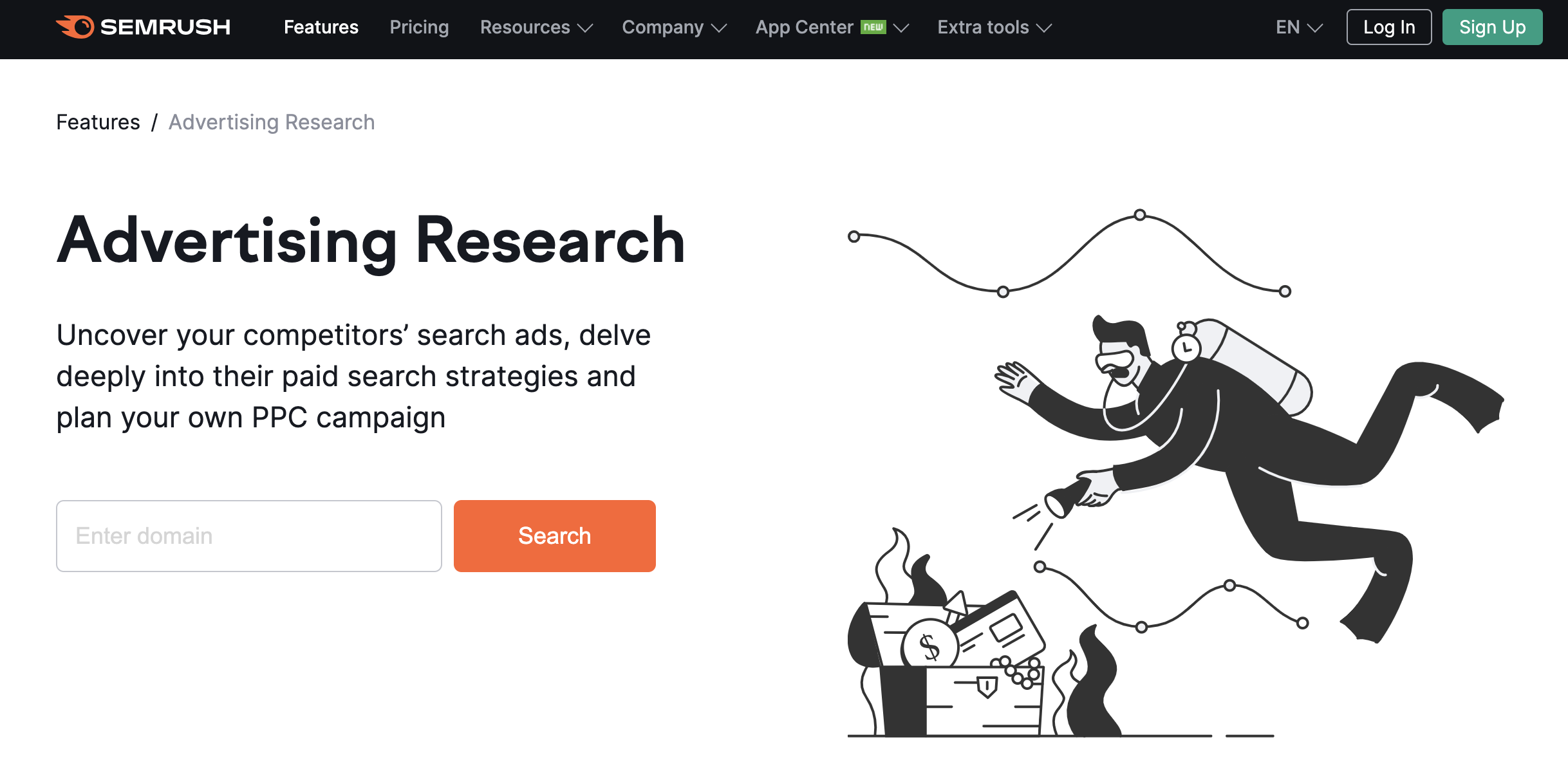
3. Semrush Advertising Research

Pricing

  • Pro: $129.95/mo comes with free trial
  • Guru: $249.95/mo comes with free trial
  • Business: $499.95
  • Custom Plans Available: Contact Semrush for details

Features

  • Categorizes keywords based on search intent to improve your accuracy
  • Shows examples of your competitors’ live ads locally and/or internationally
  • Details the emotional triggers used in competitor’s ad copy
  • Lists which keywords your competitors are bidding on

Best for: Charts and graphs aficionados. Semrush has a knack for presenting information graphically/visually, enabling users to better understand and act on their analyses.

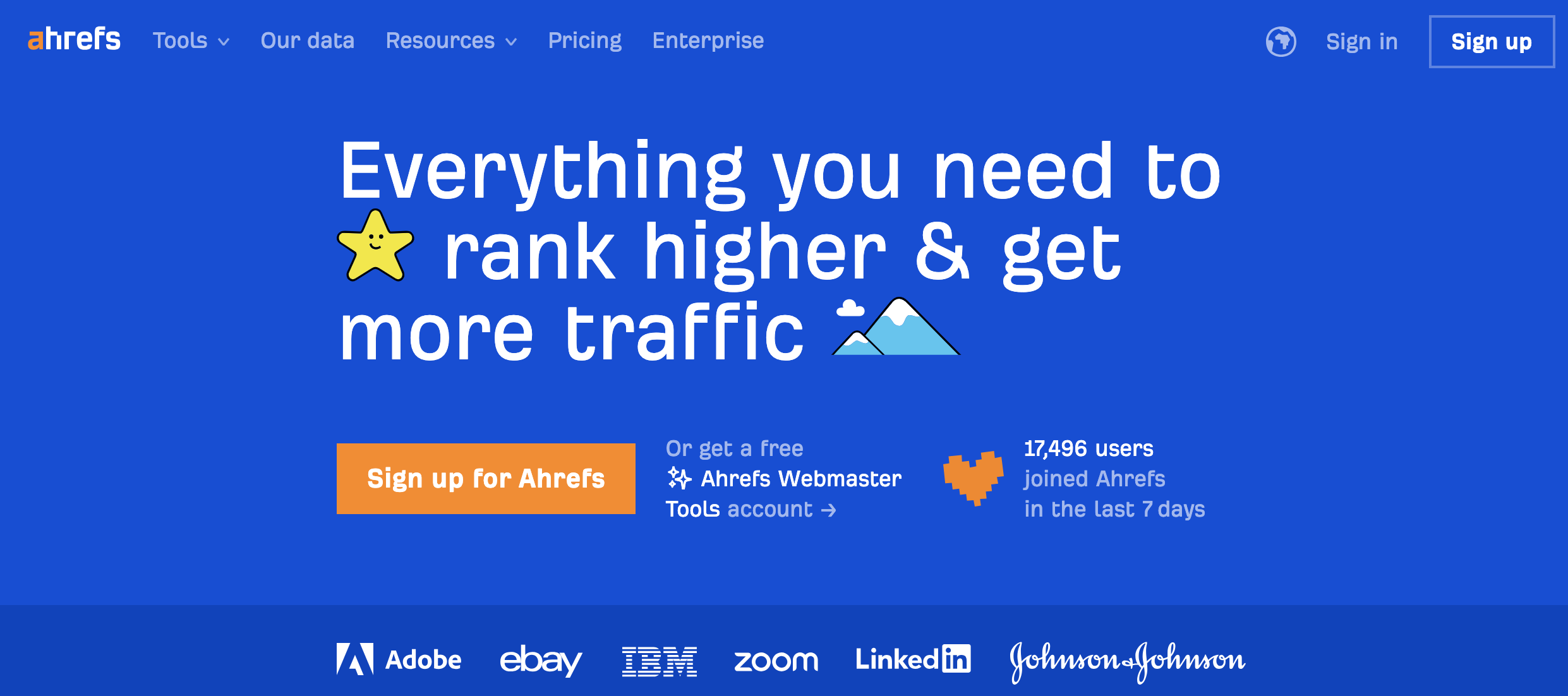
4. Ahrefs

Pricing: Note: All plans below benefit from 2 months free if paid annually.

  • Lite $99/mo.
  • Standard $199/mo.
  • Advanced $399/mo.
  • Enterprise $900/mo.

Features

  • New Keyword Clustering function in all plans
  • Standard and higher plans include a new portfolio feature that creates an aggregate report to compare your pre-selected targets (domains, subfolders, or URLs)
  • Displays broken links and broken backlinks for easier identification and update

Pro Tip: Ahrefs has a lot to offer, and is best used by people who are already familiar with analytics. Meaningfully navigating, interpreting, and making use of the advanced features takes some time, practice, and experience.

Get Started

I’ve covered the what, why, and how — let’s chat about now. Right now you have the foundational information you need to get started.

Create an enticing advertisement that links to a PPC landing page. Create the landing page content using the advice above. Choose and connect a PPC analysis tool to your landing page.

Then, you can iterate the advertisement and/or the PPC landing page and track the results. If your changes work, you’ll see better results. If not, reiterate to find what works best for your product or brand.

New Call-to-action

Categories B2B

Portfolios vs. Resumes — The Complete Guide

In today’s competitive job market, your income and career rely on knowing how to communicate your skills and experiences. To do so, you can choose one of two primary vehicles: a resume or a portfolio.

As a freelance writer and author, a portfolio is my greatest asset (and one I’ve been building since my first article was published at 19). Yet, when job searching over the years, a resume has been required by many positions.

Both a portfolio and resume display a person‘s professional skills and experiences, but what are the differences and unique opportunities that each presents?

Let’s look at the key differences between the two to help you pick the best tool for the job (search) at hand.

Portfolios vs. Resumes

Portfolios — What are they?

Resume — What are they?

Making the Right Choice

→ Download Now: 12 Resume Templates [Free Download]

Portfolios vs. Resumes

A portfolio and resume help job seekers land work, but they have key differences in visibility, convention, and the review process.

Visibility

A resume is tailored for specific job applications. It’s most commonly updated and used when applying for jobs. Further, resumes should be tailored to each specific job application.

A portfolio, on the other hand, is a collection of a person’s professional skills and abilities available online 24/7. It may be viewed by a broader audience beyond just potential clients. Portfolios aren’t necessarily tailored to a specific job.

Convention

Resumes come with a very clear convention. These documents are one or two pages maximum, with experience listed in reverse chronological order. Resumes display your relevant qualifications while being as concise as possible.

A portfolio can be an interactive, creative, and extensive display of a person’s work. You can crumple up the concise document approach and share in-depth information.

That includes real-life samples, exercising any number of portfolio tactics, and creative ideas.

Review Process

A resume isn‘t only reviewed by potential employers; it’s first uploaded to a resume reader and scanned by artificial intelligence (AI).

As a result, following a strict format is often to your advantage, as it makes the document more scannable.

A portfolio is a collection of work samples that can only be reviewed by a real person. Creativity is your friend, as it’s another way to showcase your skills and abilities.

Portfolios — What are they?

A portfolio is a collection of work samples that demonstrate a person’s skills and experience. Portfolios used to be reserved for creative fields.

However, the modern job market has seen an influx of professional portfolios thanks to the gig economy.

Career culture has shifted away from single-job careers. While there may be a unicorn worker in your office who was hired at your company straight out of school, it’s a rarity.

Not only do workers change jobs regularly, but they also change careers more often.

Author and Harvard Business School faculty member Christina Wallace describes pouring yourself into one single job as “the riskiest move you can make” in her book The Portfolio Life. It’s estimated that 29% of workers have changed careers since graduating college.

This has fueled the need for professional portfolios. These repositories are a way of showing your work that focuses on displaying skills rather than summarizing experience. Careers that operate this way are on the rise.

Nicknamed a portfolio career, this is encouraged by the gig economy, where workers have traded a single full-time salary for contract-based roles. Economic uncertainty, such as pandemics and recessions, fuels this.

A portfolio includes details like the type of work that you do and your experience. This can also include any multimedia that displays your skills and experience, such as:

  • Photos.
  • Videos.
  • Audio files.
  • Video testimonials.
  • Philosophy statement
  • Written endorsements and reviews

Advantages of Portfolios

When does a portfolio outshine a resume? Let‘s look at the major perks of using this tool to display an individual’s qualifications.

You can persuasively display skills.

A resume is a brief description of your experience, while a portfolio is an entire collection of a person‘s skills. It doesn’t require you to take complex projects and boil them down to a brief paragraph.

There’s no need to condense an entire career enough to fit on one or two pages.

A portfolio shows all of your skills, experience, and past success in one simple package.

“In today’s rapidly evolving professional landscape, the lines between portfolios and resumes are becoming increasingly blurred,” shared attorney Ahn Min Hwan.

“A lot of professionals opt for online portfolios or personal websites where they sum up their resumes and also display samples of their work, certifications, and testimonials,” he says.

Visuals show instead of tell.

While portfolios have historically been used by web designers, writers, and others in creative industries, they’ve become more of a norm with the rise of portfolio careers. This used to be the key difference between a portfolio and a resume.

Portfolios are powerful and persuasive, especially when it comes to displaying creative talents.

“As humans, we are emotional decision-makers, and often we act on what we find visually appealing,” shared Gabe Marusca, founder of Digital Finest.

Gabe is an experienced web designer who creates websites and landing pages for coaches and consultants.

“In the creative space, having a visually pleasing portfolio not only makes you stand out against the competitors, but it speaks louder than words,” Gabe says.

You can demonstrate capability.

In a world where more than half of Americans have admitted to lying on their resume, portfolios slice through the noise. They show potential clients and employers the money.

“While the resume tells me the history, a portfolio shows me the capability,” shared Amanda Sexton, the founder of FocusWorks. “A portfolio is crucial if you’re in a field where your work can be visualized, demonstrated, or interacted with—like design, content creation, or web development. It offers tangible proof of your skills and achievements.

Portfolio Examples

Resumes are limited to just one or two pages and follow a strict format, but a digital portfolio can take almost any form to showcase your skills. Let these examples inspire you to start designing right away.

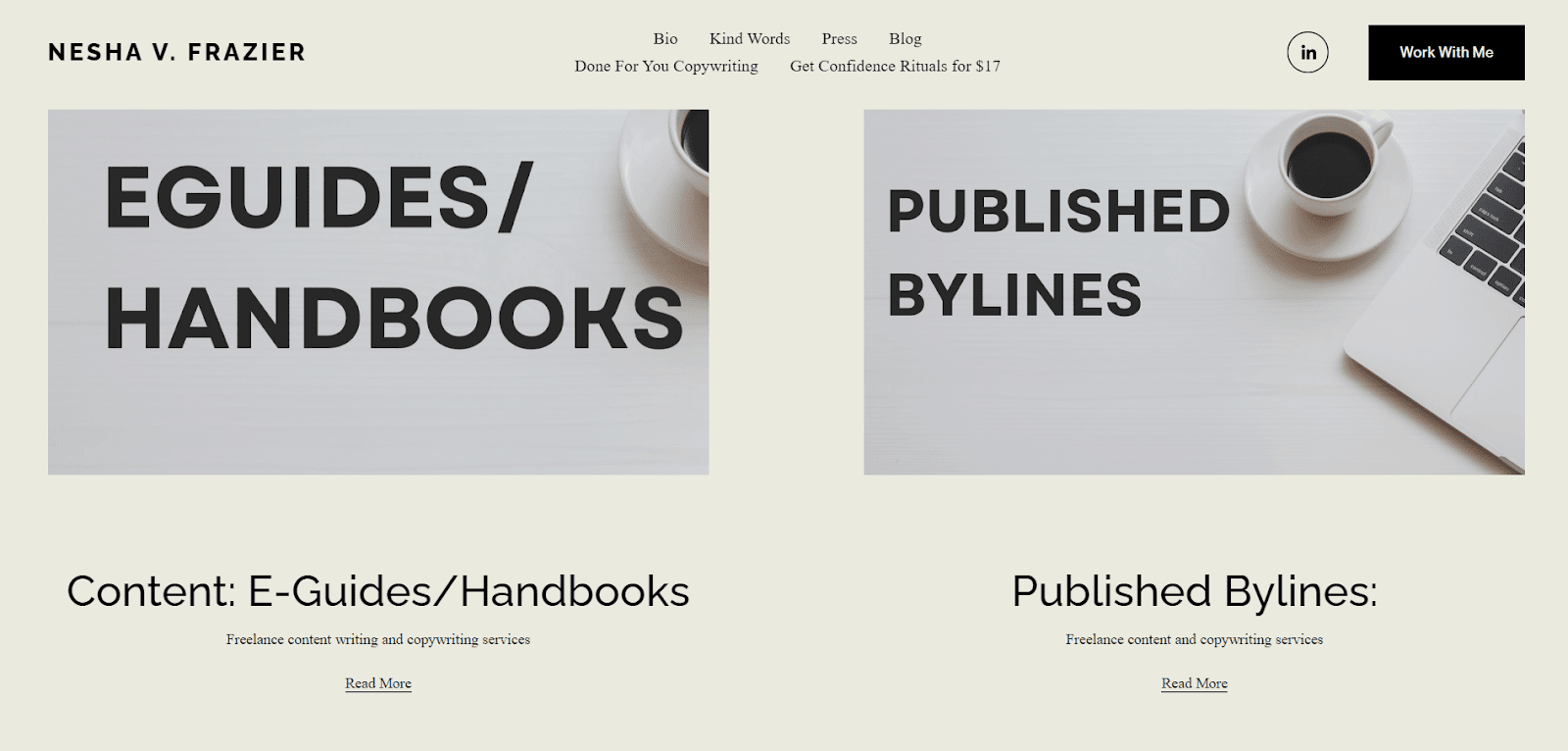
This portfolio example from Nesha V. Frazier spans multiple web pages and shows various types of writing work.

What we like: This portfolio example shows writing samples broken up by category. It spans multiple pages, which is easily done on a portfolio thanks to the medium’s flexibility.

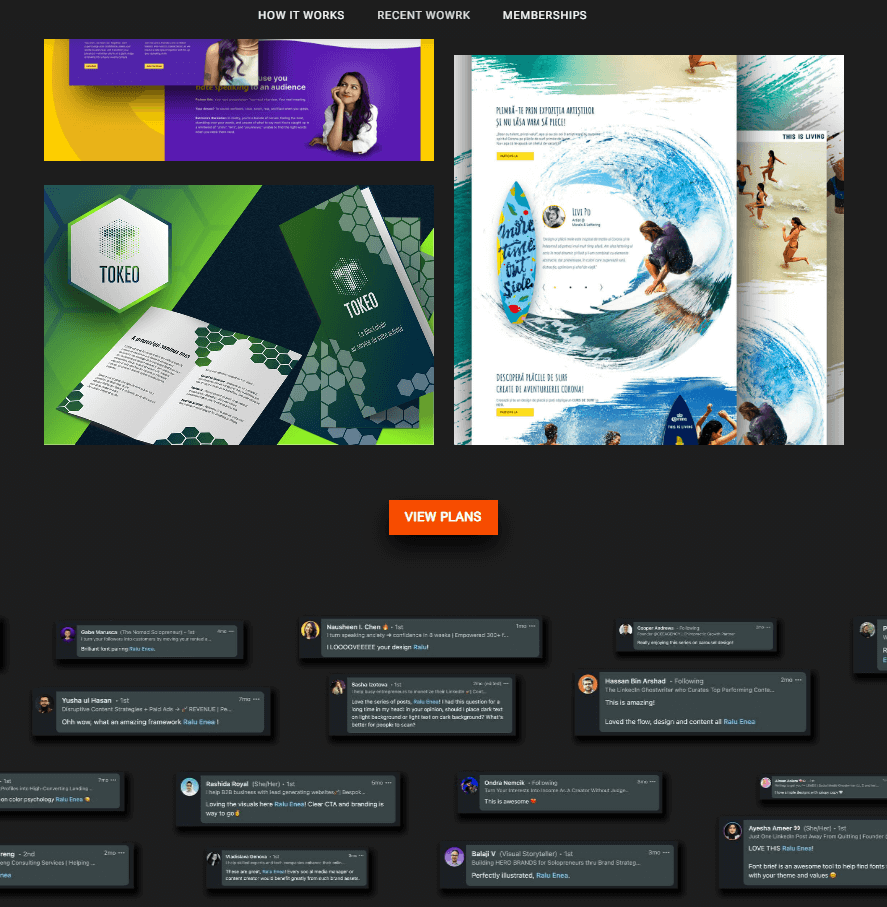
The next digital portfolio example is from Ralu Enea and showcases her skills as a web designer, highlighting her high volume of positive feedback.

What we like: The screenshots showing happy clients make this portfolio feel incredibly authentic and persuasive.

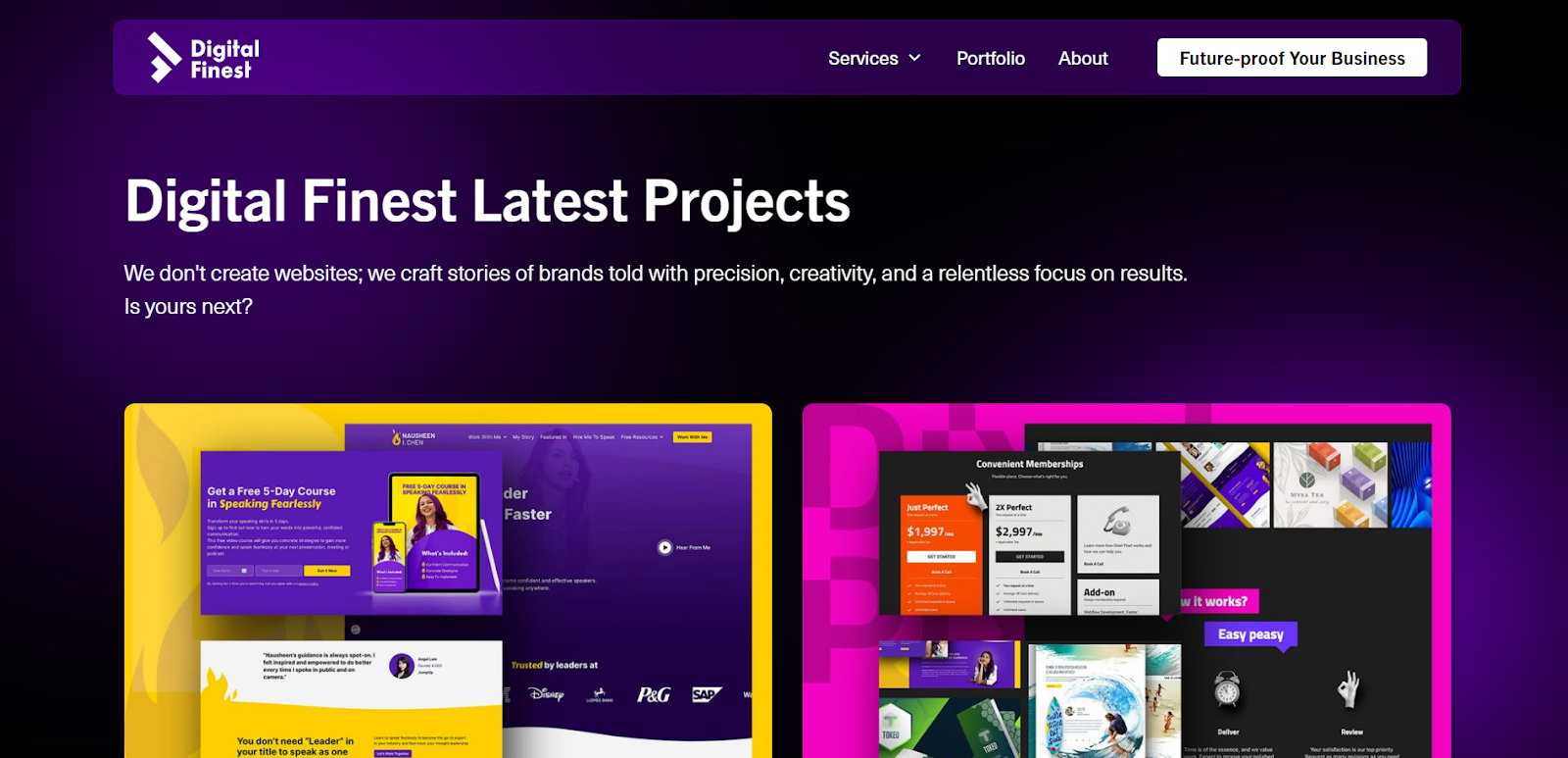
This final digital portfolio example from Gabe Marusca showcases his web design work.

What we like: This digital portfolio takes huge project samples and makes them viewable at a glance. It presents work in a really digestible format instead of leaving the viewer feeling overwhelmed.

Expert Tips for Portfolios

The most noticeable difference between a portfolio and resume design is that a portfolio can take almost any shape or form. Instead of that feeling overwhelming, let it feel empowering with these expert tips on how to get it right.

Use a tagline.

While a portfolio is a collection of your work, it can (and should) still have a sense of organization and structure. That’s where a tagline can help serve as a brief objective or summary statement.

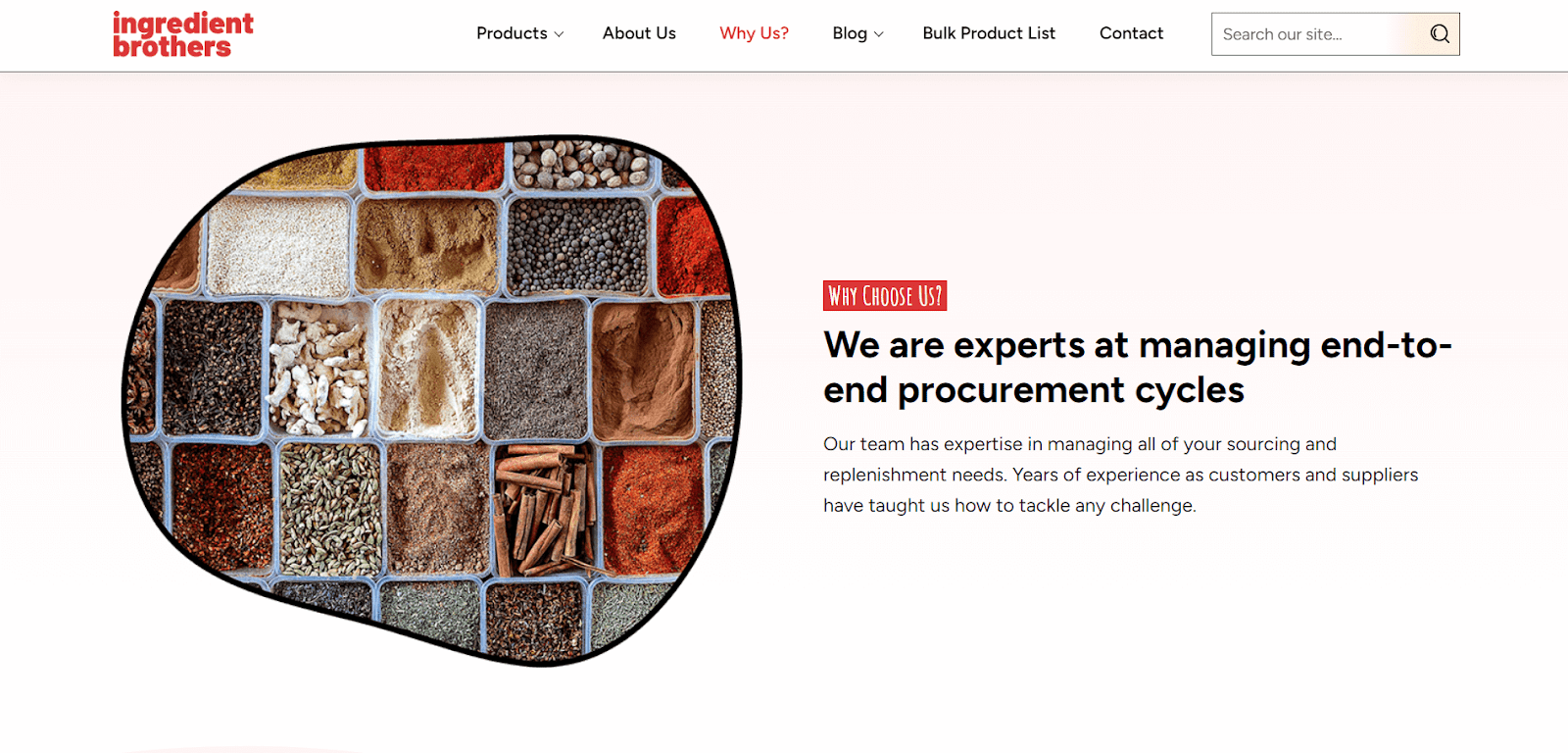
“An attention-grabbing tagline is a terrific approach to bringing individuality into your portfolio while offering companies a broad view of what you can offer them,” shared Eran Mizrahi, the CEO of Ingredient Brothers.

“Bring some zing to the proceedings by capping them off with an unforgettable statement or slogan.” Ingredient Brothers summarizes its product with a memorable tagline on its website:

Keep your portfolio focused.

A portfolio doesn’t need to be a conclusive career summary.

While you may have work samples spanning many years, projects, and industries, a focused portfolio helps a hiring manager or client feel more excited about the potential than a broad portfolio.

“To create a great portfolio, I recommend showcasing only your best projects that highlight your ideal clients,” shared Gabe Marusca. “Ideally, your portfolio visuals should be in high resolution and focused on grabbing viewer attention.”

Resumes — What are they?

A resume is a document that summarizes your work experience as it applies to a specific job.

Often one or two pages long and accompanied by a cover letter, a resume displays relevant experience in reverse chronological order and is customized for individual job applications.

The concept of a resume hasn‘t changed much in your lifetime; in fact, it’s one of the only parts of the hiring process that hasn’t changed.

A well-crafted resume will display relevant skills in a quick and easy format. Broadly speaking, a resume should include any relevant achievements that demonstrate a person’s qualifications for a job.

Some standard features of a resume include:

  • Soft skills.
  • Contact details.
  • Work experience.
  • Relevant skills and life experiences.
  • Academic and professional qualifications.
  • Related volunteer jobs that you’ve worked.
  • A professional summary statement (sometimes called a career summary statement).

Even though resumes themselves haven’t evolved much, the way hiring managers review them has. It’s estimated that resumes are reviewed for less than 10 seconds by a potential employer.

Job seekers can still improve their resume writing and see better results. Here are some of the advantages of using a resume over a portfolio.

Advantages of Resumes

How does a humble one or two-page document stack up against a portfolio? Here are the advantages of using a resume in your job applications.

It’s a universal tool.

While designing a creative portfolio may take days or weeks, a resume is a straightforward and universal tool that doesn‘t need to keep up with the trends (no matter where you’re applying for work).

“Nearly every professional across the globe needs a polished resume or CV when actively searching for work,” shared Amanda Augustine, certified professional career coach, certified professional resume writer, and career expert for ZipJob.

“The moment you decide to start looking for a new job, you instantly become a marketer, and your resume is a key component of your personal marketing toolkit,” Augustine says. “Additionally, your resume often serves as your first point of contact with a prospective employer and will shape that hiring professional’s first impression of your candidacy.”

You’ll create a straightforward snapshot.

While a portfolio has a sense of endlessness to it, a resume is a comforting bite-size look at your professional qualifications.

Arriving at a great resume is far less time-consuming, thanks to its concise and predictable nature. Plus, not being forced to reinvent the wheel saves you a tremendous amount of time.

“A resume really serves as a career snapshot for employers,” shared certified career counselor Brad W. Minton, founder of Mint To Be Career. “If composed well, it provides an overview of your ‘greatest hits’ that are relevant for future target roles so that employers can get a quick indication of your value add.”

Resume Examples

Let’s look at resume examples provided by professional resume writers and career experts. These resumes focus on different roles, fields, and levels of experience.

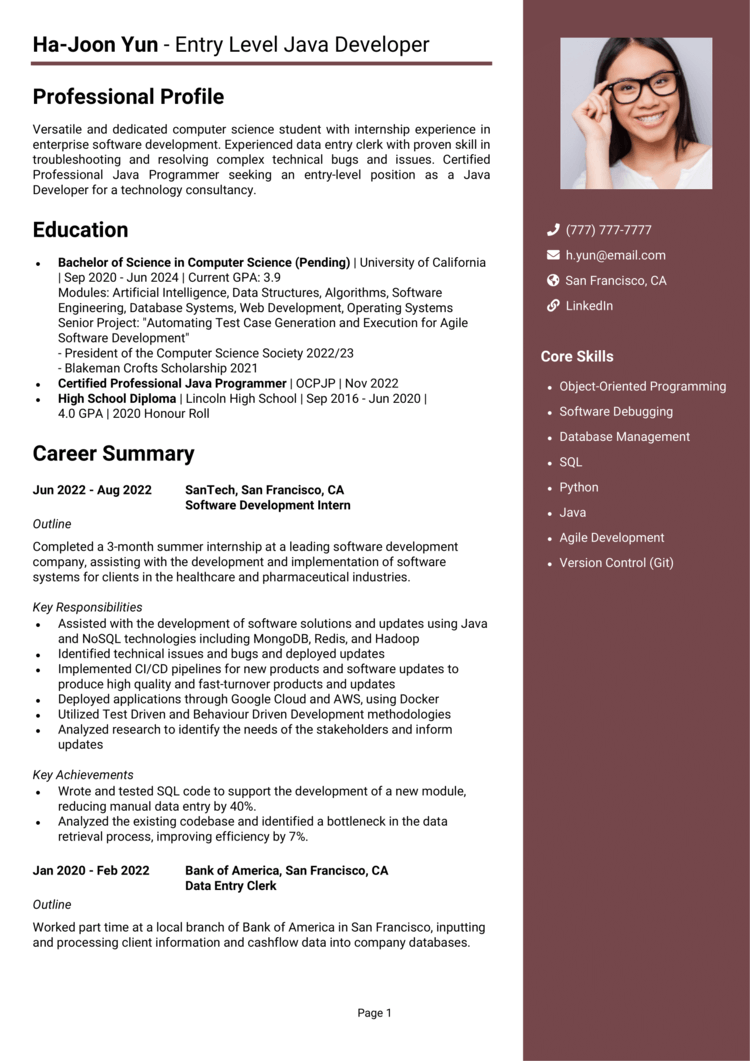
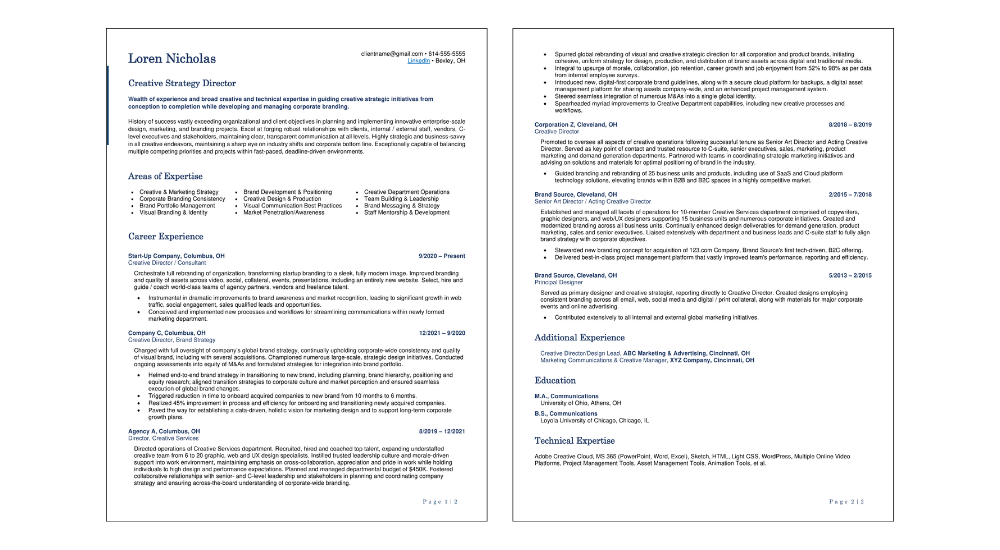
This first resume example was provided by Andrew Fennell, director of StandOutCV. It’s an example of an entry-level position with a focus on academic achievements:

What we like: The format of this resume leverages color and design while maintaining its readability.

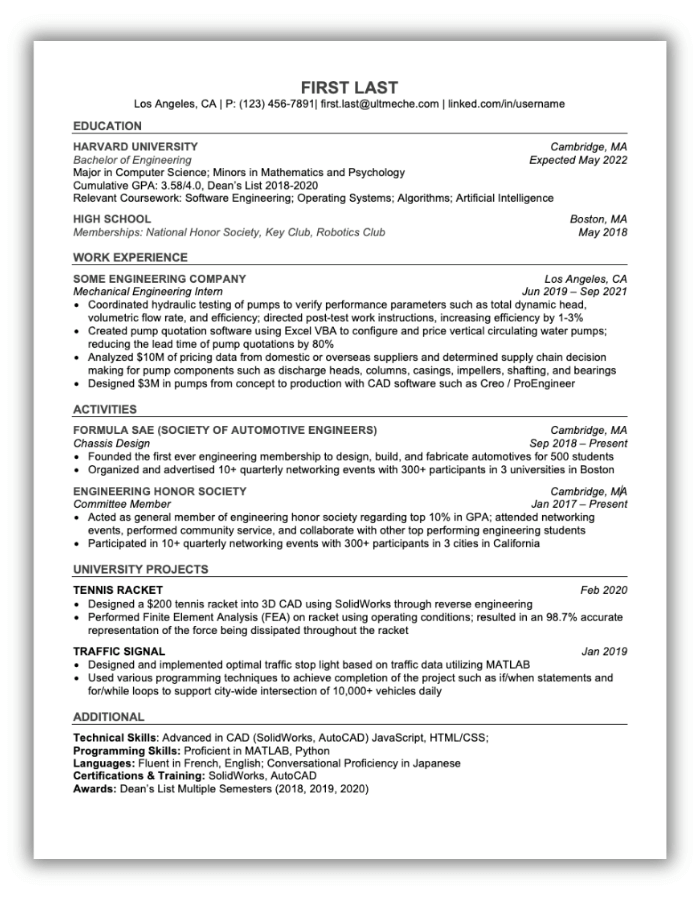
The next resume example was provided by Sylvia Glynn, executive resume writer for Ultmeche. It’s based on the well-known Harvard resume template:

What we like: This no-frills approach to resume design is primed for AI readability while still showcasing all the relevant skills and experiences that hiring managers need to see.

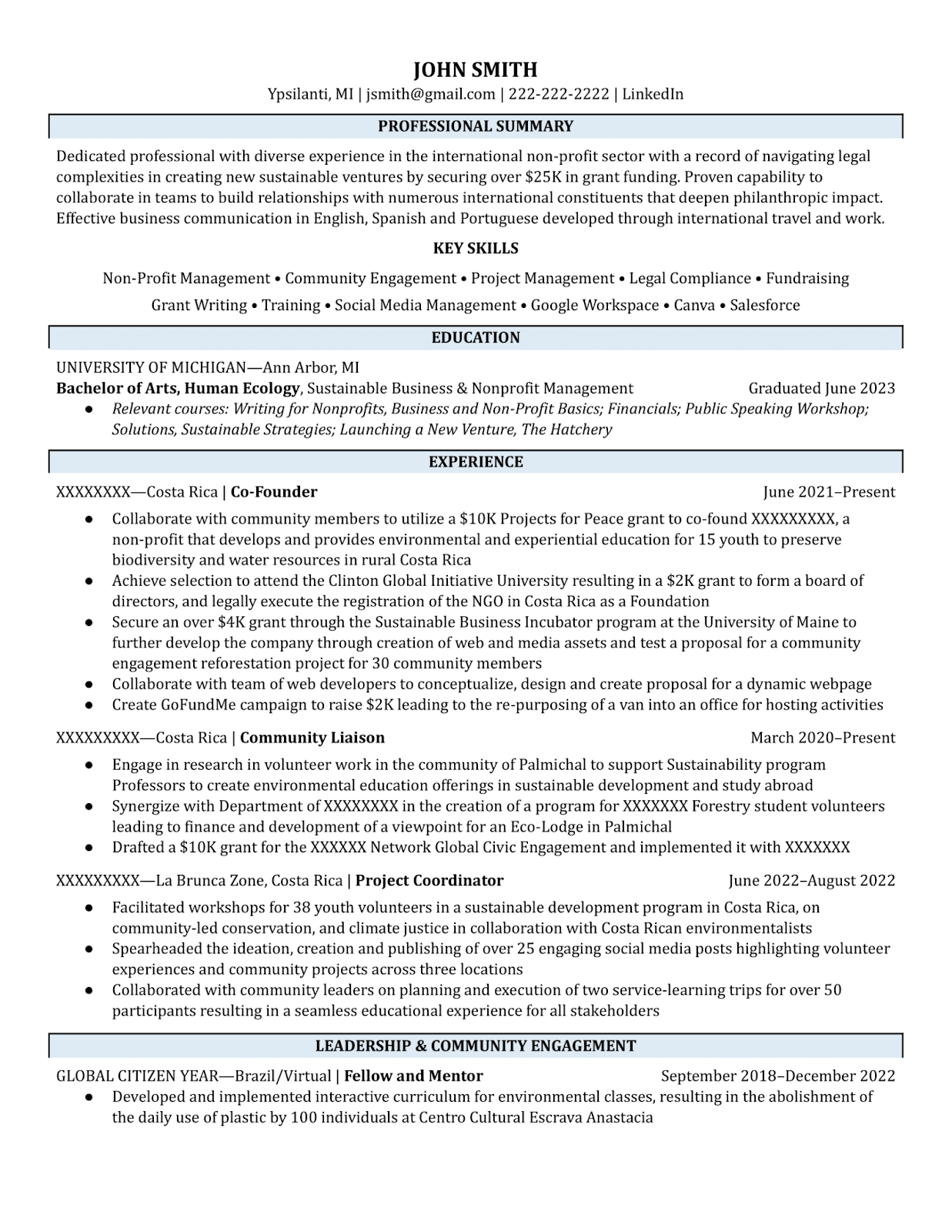
This resume example was provided by Brad W. Minton, certified professional resume writer and founder of Mint To Be Career.

What we like: This resume has a straightforward design that will pass through AI scans, but it still includes some subtle design choices that will show personality to hiring managers.

Is your resume ready to be scanned by AI? Use the free tool Jobscan to see if your resume is helping or hurting you at this phase of the hiring process.

This final resume example was provided by Amanda Augustine, a certified professional career coach, resume writer, and career expert for ZipJob.

What we like: This is a great example of a two-page resume that uses space well by adding columns to break up dense sections. The indentation on this resume also improves readability and makes for smooth and pleasing formatting.

Expert Tips for Resumes

Is a resume right for your job search? Then, it needs to be well-designed, up-to-date, and ready to knock hiring managers’ socks off. Use these tips from expert resume writers to make it happen.

Translate experience, skills, and talent to desired role.

A generic resume that‘s submitted to dozens of companies won’t get the same result as a resume that details your skills and experiences as they directly relate to your desired role.

“A strong resume really boils down to how well you translate what you’ve done into what you can do for the next role,“ shared Brad W. Minton. ”How you do that is by researching the position and company and showcasing how your past experience developed relevant skills for the role you’re seeking now, as well as creating qualitative and quantitative impact.”

[video: https://www.youtube.com/watch?v=0oG8lP_T1Q4&ab_channel=HubSpotMarketing]

Design resumes for functionality.

Designers, writers, and other creatives will be tempted to make their resumes unique and memorable, but that flair is best saved for your portfolio. Overly creative designs stuffed onto one or two pages lead to confusion and sacrifice functionality.

“When formatting and structuring your resume, you need to think about its function rather than just making it look nice. It has to be easy for recruiters to read and pick out the info they are looking for,” shared Andrew Fennell, director of StandOutCV.

Fennell recommends that sections be clearly defined with bold heading and white space. The text should be broken up into bullet points, and the color scheme and font need to make the text crystal clear to readers.

“Photos, icons, and other graphic features are nice to have, but focus on the important stuff first,” Fennell says.

Update and include your LinkedIn account.

A portfolio and resume are actually not stand-alone resources, as resumes can include clickable website links to other resources. Hiring managers will often reach for another snapshot of your skills and abilities: your LinkedIn account.

“My top resume tip is simple, but we often see it overlooked as recruiters. Include a clickable link to your LinkedIn profile just below your name on your resume,” shared Mike Basso, founder and CEO of Sales Talent Command.

“Because of its predictable format, many recruiters and hiring managers like to review a candidate’s LinkedIn profile for additional information,” Mike says.

If you need to be convinced of the power of LinkedIn for job seekers, find someone who’s active on the platform and look at the work experience section of their account.

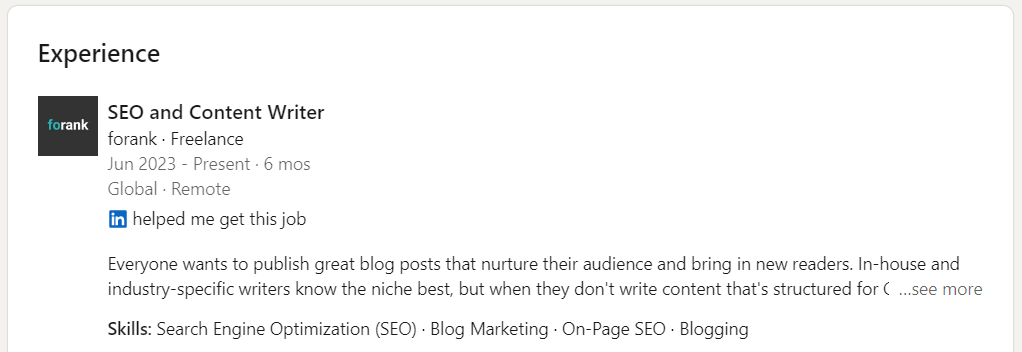
You may see a blurb that says, “LinkedIn helped me get this job,” which you can see on my account for a position with the SEO company forank:

“Your LinkedIn profile can do a great job of differentiating you from other candidates if well-optimized. So, make it easy for those considering you for opportunities to find your impressive LinkedIn profile,” said Mike Basso.

Update your account and then initiate a LinkedIn strategy to help your account be more attractive to potential employers.

Making the right choice

When making the choice between a portfolio and a resume, see if the decision has already been made for you. The first question to ask is, what is the hiring manager or potential client asking to see?

Your portfolio vs resume debate ends if the hiring process is clearly outlined for you already. When the hiring process is less defined, consider how your experience and skills are best demonstrated and weigh these factors.

  • What are the other candidates for this position or contract submitting to demonstrate their skills?
  • Does your work require in-depth information to be explained, or can it fit on one or two pages?
  • How can you prove your success in past roles?
  • Do you have visual examples of your work?

As you’re packaging all the proof of your skills, you need to consider whether a portfolio or resume can showcase your skills and experience best.

If work samples and examples of your work would help you stand out to a hiring manager, aim for a portfolio.

Designers, writers, and anyone who works with multimedia will be able to showcase their skills better with a portfolio than a resume.

However, the majority of open work positions will ask for a resume so that it can be scanned using AI and sent through the standard hiring pipeline. Sometimes, there’s a case for both tools to be used.

When to Use Both

When choosing which tool can help demonstrate your professional capabilities, the answer might be both. While they do have their differences, a portfolio and resume can work in tandem instead of being pitted against each other.

When leveraged properly, it works to your benefit.

“In some cases, using both a portfolio and resume can be highly beneficial,” shared Nate Djeric, founder and career counselor at CareerBoost.io.

“For example, if you’re applying for a marketing role that requires both strategic thinking (resume) and creative execution (portfolio), presenting both can give you an edge,” Nate says.

Consider adding a link to a digital portfolio directly on your resume and also using your portfolio as an excuse to follow up with hiring managers and provide additional information.

Getting Started

Creating an effective portfolio or resume is an imperative task when you‘re putting yourself out there to potential employers and clients.

With these examples, best practices, and expert tips, you’re prepared to package your talent and impress every hiring manager.

New Call-to-Action

Categories B2B

Should Marketers Optimize for Bing? [Data + Expert Tips]

When you think about search engine optimization (SEO), one major search engine probably comes to mind: Google. But what about Bing SEO?

With more than a billion monthly users, Bing is the second most popular search engine globally.

Moreover, since Microsoft’s acquisition of OpenAI earlier this year, Bing has begun integrating AI technology into its search engine, and its traffic has increased by more than 15%.

With its growing popularity, Bing SERPs (Search Engine Results Pages) should be on the radar for marketers crafting their search engine optimization strategy.

In this comprehensive Bing SEO guide, I’ll help you explore why Bing is still relevant for marketers, offer data-driven, expert-approved Bing SEO tips, and give you the tools you’ll need to optimize your online presence for this increasingly popular search engine.

Download Now: Free State of Marketing Report [Updated for 2023]

Should you optimize for Bing?

Why Bing SEO Matters

Bing vs. Google: Similarities and Differences

Building the Right Foundation for Bing SEO

Tips to Improve Your Bing Ranking

1. Prioritize Exact Keyword Matches

2. Don’t Forget About Meta-Tags

3. Invest in Quality Backlinks

4. Build Strong Domain Authority

5. Ensure Mobile Friendliness

6. Cultivate a Social Media Following

7. Incorporate Images — But Don’t Overdo It

8. Craft Quality Content

Maximize Your Online Visibility with Bing

Should you optimize for Bing?

Is it worth optimizing for Bing? That’s only a question that your team can answer. I’d encourage you to look at it this way: If you’re just starting out on your SEO journey, focusing on Google may make sense.

Plus, you may not have the resources to allocate to both search engines. But as you grow, it’s definitely worth optimizing your online content for Bing, too.

While Bing still has a smaller market share than Google, it remains an important piece of the search engine pie, and it can serve as an important channel for your marketing efforts.

To capitalize on this potential, invest in Bing SEO. That means understanding why Bing SEO matters, the ways in which Bing and Google differ, and what it takes to build a solid foundation for Bing SEO and boost your rankings on this platform.

Why Bing SEO Matters

So, why does Bing SEO matter? That’s a great question. Before diving into the specific strategies that drive success on Bing, it’s helpful to explore why Bing SEO matters for today’s marketers.

There are four key factors underlying Bing’s ongoing relevance:

Substantial User Base

Bing might not have the same search volume as Google, but it still boasts a substantial user base. With over a billion monthly users, Bing captures a noteworthy share of the search market.

If you ignore this audience, you risk missing out on potential customers who are actively seeking information, products, or services related to your business.

Investing in Bing SEO will help you tap into a diverse pool of users and increase your online visibility.

Less Competition

Because most SEO efforts are primarily focused on Google, competition for rankings on its results pages can be fierce. Bing, on the other hand, offers a less crowded landscape.

With fewer websites optimizing for Bing, there’s a greater opportunity to achieve higher rankings and gain visibility in search results. This can be particularly advantageous for businesses operating in highly competitive niches.

AI-Powered Search

Thanks to its acquisition of OpenAI, Microsoft has been able to infuse advanced AI technology into Bing’s search engine.

This has enabled Bing to develop enhanced functionalities, smarter recommendations, and an improved user experience, all of which have been contributing to an increase in user engagement and site visits.

In light of these trends, optimizing your online presence for Bing means aligning your strategy with cutting-edge, rapidly growing technology, ultimately setting your organization up for success in the long term.

Risk Diversification

Finally, relying on Google alone for all of your organic search traffic can be risky.

Unexpected changes to the algorithm or shifts in user behavior can suddenly impact your website’s visibility, leaving you with little recourse to recoup the losses.

Diversifying your SEO efforts by including Bing in your strategy can provide a safety net, helping to mitigate this risk and reduce the potential impact of fluctuations in search engine performance.

Bing vs. Google: Similarities and Differences

Image Source

Good news! If you’ve already optimized your website content for Google, you’re off to a solid start for Bing as well.

Many SEO techniques are effective on both platforms, as both search engines reward content that’s relevant, trustworthy, and high-quality.

However, there are also several important differences that marketers should keep in mind when optimizing for Bing. First, Bing is generally more open about its search algorithms than Google is.

This means that marketers can, in many cases, make more informed decisions about exactly how to craft Bing-optimized content.

Another key difference: Google explicitly ignores meta keyword tags, but Bing still uses these tags in its search algorithm. Therefore, with Bing, it’s worth continuing to make sure your web pages have useful, accurate keyword tags.

In general, Google looks more for higher-level topic relevance, while on Bing, specific keywords that exactly match the search terms you’re targeting are more likely to be effective in improving your SERP rankings.

Another important difference is the relative weight of social. Google has stated that social media engagement is not a factor in its search rankings, but on Bing, social plays an important role in determining what content will rank.

As such, driving high-quality social media engagement should be part of your Bing SEO strategy.

Below, I’ll dive into how you can leverage these key differences to build an SEO strategy that considers Bing alongside Google.

Building the Right Foundation for Bing SEO

Any Bing SEO guide would be incomplete without an overview of how teams can build a strong foundation for Bing SEO. There are several important steps to consider, and I’ll walk you through them now.

Leverage HubSpot’s SEO Marketing Tools

Whether you’re just getting started with SEO or looking to take your optimization strategy to the next level, you can’t go wrong with HubSpot’s SEO marketing tools.

These tools are an excellent way to build a strong foundation for your SEO efforts.

The HubSpot platform can help you plan out your SEO strategy, optimize your content for search, and measure ROI, ensuring your Bing SEO strategy is data-driven and aligned with your broader marketing goals.

​​

Image Source

Sign Up for Bing’s Webmaster Tools

Next, if you’re looking to optimize for Bing specifically, it’s definitely worth signing up for access to Bing’s webmaster tools.

This suite of tools can help you identify the keywords you already rank for on Bing, gain visibility into the backlinks that Bing has indexed for your website, and subscribe to alerts to make sure you stay on top of any changes.

Creating an account with Bing also gives you access to a comprehensive dashboard with key metrics related to site activity and click rates.

You can even run your website through a range of diagnostic tools, including Bing’s SEO Site Analyzer, keyword research tools, and mobile friendliness audit.

Image Source

Submit a Sitemap to Bing

In addition, once you’ve signed up for an account with Bing’s webmaster tools, you can submit a sitemap for your website directly to Bing.

Submitting a sitemap will help boost your Bing SEO by improving how the search engine crawls, indexes, and ranks your website.

Before Bing accepts the sitemap, you’ll be asked to verify your website by placing an XML file on your web server, copying a short meta tag into your website, or adding a CNAME record to your DNS.

Once you’ve verified your website, Bing can use your sitemap to better understand the information and content on your website, ultimately enabling the search engine to provide better, more useful results to users.

Invest in Schema Markup

Schema markup is another important way you can help Bing understand your content and thus improve the quality of the results it provides.

In a nutshell, effective schema markup enables search engines to parse website information and interpret what it means.

This ensures that when your business comes up in Bing’s search results, key data points like your company’s location, a blog post’s author, or an event’s time and date, are clearly and prominently displayed.

Claim Your Business on Bing Places

Finally, if your company has a physical location, claiming your business on Bing Places is critical to ensure users are seeing accurate, up-to-date information about your organization.

Remember: Even if you don’t use Bing yourself or haven’t yet proactively invested in Bing SEO, Bing already lists publicly-available information businesses like hours, location, and more.

However, this information isn’t always accurate, so claiming your business on Bing Places helps ensure everything is up-to-date.

Plus, unclaimed businesses are generally listed below those that have been claimed and verified, so if you needed one more reason to take the extra step, that’s it.

Image Source

As such, both to boost your rankings and to confirm that the information shown to customers is consistent and correct, it’s worth taking a few minutes to claim your listing.

To do so, simply find your business on Bing and click “Claim Business.”

You’ll be asked to verify that you’re a business owner or authorized representative.

Once verification is complete, you’ll be able to add photos and videos of your products and services, updated hours of operation, services offered, contact methods, and more.

It’s simple.

Tips to Improve Your Bing Ranking

Once you’ve set up a solid foundation for Bing SEO, it’s time to get into the nitty-gritty details. Below, I’ve listed eight tips to help you improve your Bing rankings.

1. Prioritize exact keyword matches

This is one of the main differences between Google and Bing SEO strategy. While Google’s algorithm has grown fairly complex, Bing’s still relies heavily on exact matches between search terms and on-page content.

Rather than considering factors like word usage, context, and semantics, Bing is seeking exact keyword matches.

That means that it’s beneficial to include exact keyword matches in the content on your site.

For example, if you want to rank highly for the phrase “marketing automation software” on Bing, don’t just write content about software tools that can help automate marketing.

Instead, make sure to include the exact phrase “marketing automation software” in the H1 or H2 headings in your content.

2. Don’t forget about meta tags

SEO isn’t just about the content that users see — it’s also about behind-the-scenes content that helps search engines understand what your website is all about.

While both Google and Bing consider the content in your meta tags, Bing is particularly interested in exact matches between keywords and meta descriptions.

As such, make sure that your target keywords are reflected not only on the page, but also in the meta tags that Bing will be looking at.

3. Invest in quality backlinks

Another critical factor in Bing’s ranking algorithm is the quality of your backlinks: That is, the websites across the internet that link back to your site. Importantly, this is an area in which quality is much more important than quantity.

Bing is looking to see whether reputable, relevant, well-established websites are linking to your website, as this can serve as an indication that your website is also trustworthy.

In particular, Bing tends to prioritize links from websites with .edu, .org, or .gov domains, since these sites tend to be associated with official, verified institutions.

Bing also tends to give considerable weight to domain age, with backlinks from older websites having a stronger positive effect on website rankings.

Finally, if spammy, low-quality websites are linking to your site, that can substantially harm your rankings.

So if you’re aware of any of these harmful backlinks, consider either reaching out to the webmaster of the website in question and requesting that they remove the link or using Bing’s webmaster tools to formally disavow the backlink.

4. Build strong domain authority

Of course, domain authority doesn’t just apply to your backlinks — Bing also considers several factors related to the authority of your own URL.

Some of these factors may be outside your control, but it’s still important to keep your domain authority in mind when making key SEO decisions.

The main levers you can pull when it comes to Bing’s assessment of your website’s domain authority are age and keywords.

Bing rewards websites that have been around for a long time, so think carefully before creating a brand new website if you already have one.

In addition, Bing’s focus on exact keyword matches applies not just to on-page content and meta tags but to URLs as well. For instance, Bing is more likely to rank pages highly if the URL includes an exact match to the search terms.

5. Ensure mobile friendliness

As Marketing Consultant Anna Crowe explains, “Even though Bing has said there are no plans to introduce mobile-first indexing on its platform, you still want to make sure your site is mobile friendly.”

When determining mobile friendliness, Bing considers factors such as:

  • If the content on your pages fits within the narrower screen width of a mobile device
  • Whether or not the text is still readable on mobile
  • If your links and buttons are still easy to use on a mobile interface.

If you’re not sure whether your webpage is sufficiently mobile responsive, you can use Bing’s mobile friendliness test tool to quickly gain insight into your site’s current status. Then, improve any areas that don’t earn high marks as necessary.

Image Source

6. Cultivate a social media following

While Google has largely removed social media engagement from its search algorithm, Bing still places substantial weight on the social following associated with a website’s domain.

To be sure, that does not mean that you should start paying for followers. Shady tactics that help you rapidly gain a large number of fake followers will be easily detected, and Bing penalizes such behavior.

However, making a genuine investment into building a real, loyal social media following can pay off when it comes to your rankings on Bing.

If Bing sees that your web pages are being shared widely on social media, it’s likely to take that as a good sign about the authority and relevance of your content, and improve your SERP rankings accordingly.

7. Incorporate images — but don’t overdo it

Well-placed images with clear, concise alt text can go a long way to boosting your Bing SEO.

Indeed, while Google is known for largely prioritizing text and html, Bing’s algorithm may reward content with more multimedia components, such as images and video clips.

That said, when it comes to media elements, it’s equally important to avoid overdoing it. Drowning your website in a sea of imagery can often backfire, especially if images or videos make it harder to see the key information on your site.

In addition, excessively intrusive advertisements that block your actual content or interfere with the user experience are also likely to harm your search rankings. For example, here’s a web page layout in which the imagery is intrusive, not helpful:

Image Source

8. Craft quality content

There are countless tips and tricks that can help boost your position on Bing’s SERPs. But at the end of the day, just as with SEO on any other platform, your success on Bing comes down to your ability to craft quality content.

That means developing web pages that are relevant, informative, and credible, and free of spammy or misleading content.

A focus on quality is especially important as generative AI creates new possibilities for machine-generated content.

Indeed, in a recent survey of more than 400 marketers, we found that more than half were already incorporating generative AI into their SEO and content development workflows.

Clearly, AI tools can add a lot of value — but it’s important to avoid publishing content that reads like it was written by a robot.

After all, if Bing’s algorithm detects content that appears to be solely designed to boost SERP rankings (rather than to add real value to the user), it’s likely to classify that content as malicious and penalize rankings accordingly.

At the same time, as AI tools are increasingly incorporated into search engines, marketers may benefit from rethinking their approach to content.

In the same survey, marketers predicted that if generative AI is integrated into search engines, “How to” and “Question/Answer” type content will perform the best, perhaps because this format is most likely to correspond to the questions users may ask of an AI-assisted search engine.

As AI evolves, so will the type of content Bing deems as high-quality. But as long as marketers ensure that the intent behind their web content remains to help their users (not to trick the algorithms), they’re likely to be rewarded.

Maximize Your Online Visibility with Bing

While there’s no doubt that Google remains the industry leader for search, factoring in Bing is an increasingly important part of an effective SEO strategy in today’s market.

In particular, Bing’s growing user base, reduced competition, and ongoing investment into cutting-edge AI technologies make the platform an important way to diversify your strategy and maximize your online visibility.

Of course, there’s no one-size-fits-all solution to SEO.

Especially as new technologies continue to emerge and disrupt industry standards, it’s critical to take a dynamic, agile approach to crafting (and re-crafting) your marketing strategy.

But if you build a strong foundation and follow the Bing SEO tips listed above, you’ll set yourself up for success and maximize your chances of capitalizing on the unique advantages Bing has to offer.

state-of-marketing-2023

Categories B2B

A Guide to Integrating AI Tools in Your Marketing Processes [New Data + Expert Tips]

As I sit here wrapping up this blog post, I’ve gotten stuck trying to come up with a snazzy, but concise, title. 

So I turned to HubSpot’s AI Blog Writer for suggestions, prompting it with the command to generate headline ideas for a blog post about integrating AI tools into marketing processes.

HubSpot AI Blog Writer

This is just one way to leverage AI tools into your day-to-day workflow as a blog writer. Outside of blogging, AI plays a sizable role in marketing, from product management to SEO.

In this blog post, we’ll go over:

Get Started with HubSpot's AI Campaign Assistant

How Marketers are Using AI

Understanding Complex Topics

Marketers, such as Martina Bretous, editor of our Next in AI Blog, use AI to better understand complex topics.

“I will often go to ChatGPT and ask, ‘Explain X to me in layman’s terms,’ or ‘as if I were 5 years old.’ Usually when you read something online, you can’t always reach out to the author and get clarity. ChatGPT’s like my friend who helps me make sense of information in a language I can understand,” she said.

Tools like ChatGPT can provide explanations in simple terms, supporting marketers in comprehending information.

Automating Tasks

HubSpot State of AI 2023 Report

AI has the potential to streamline the way marketers work by automating tedious tasks, allowing them to focus on strategy and action. The automation of these tasks will be crucial in saving time and boosting efficiency. 

Our State of AI Report finds that marketers save more than three hours per piece of content using AI automation.

“The main benefits of incorporating AI into streamlining processes are time savings, automation of mundane tasks, and increased efficiency,” said Irina Nica, product marketing manager at HubSpot.

“By leveraging AI, we can offload repetitive or time-consuming tasks to technology, allowing us to focus on more valuable and strategic work. This not only boosts productivity but also frees up our time to tackle projects that require human expertise and creativity.”

For example, Nica uses AI to transform meeting notes into actionable tasks or next steps. 

“While this may seem like a small task, having an AI assistant by my side helps me complete it faster, allowing me to focus on the more exciting aspects of my job, such as developing GTM strategies and crafting positioning and messaging frameworks,” Nica explains.

Indeed, her sentiments are echoed in our State of AI Report that shows 95% of AI-using professionals say AI helps them spend less time on manual tasks and more time on the most important parts of their role (88%), the parts of their job they enjoy most (85%), and on the creative aspects of their role (83%).

Writing Better Copy

In order to be a good marketer, you need to be good at writing. 

As a product marketing manager, Nica also leverages generative AI to assist with writing.

“I rely on generative AI to assist me with writing to help improve my productivity. Writing is a big part of my job, whether it’s creating documentation, cross-functional communication, blog posts, or social media content. AI has become my trusty companion in handling some of the routine writing tasks,” Nica says. 

Content Creation

Marketers use generative AI for an array of content creation purposes, from generating ideas for blog posts to drafting social media copy. 

HubSpot State of AI 2023 Report

The image below shows just one example of how AI tools like HubSpot’s Content Writer can generate copy for blog posts, emails, social media posts, and web pages.

HubSpot AI Content Writer

Get started with HubSpot’s Free AI Content Writer

Aligning Web Content with Search Intent

HubSpot State of AI 2023 Report

Every blogger needs to understand SEO if they want to create content that drives page views and engagement. In fact, one of the reasons I’m writing this post is because it relates to topics and questions our readers frequently search on Google.

By analyzing search trends and patterns, AI algorithms can identify popular search queries and relevant keywords related to a particular topic. This helps bloggers understand what users are searching for and enables them to choose the right keywords to target in their content. 

Moreover, AI-powered tools can evaluate existing content and provide suggestions for improving its relevance to search intent. 

By analyzing the context, structure, and language of a blog post, these tools can identify areas for improvement and suggest modifications to optimize the content for search engines. This could include adding additional keywords, reorganizing paragraphs, or enhancing the overall readability.

A Step-by-Step Guide to Implementing AI in Your Marketing Processes

1. Identify potential use cases for AI.

Start by brainstorming with your team to identify potential use cases where AI can add value in streamlining your marketing processes. Consider tasks that are repetitive or time-consuming, such as content creation, email drafting, social media posting, or lead generation. 

“This should be a collaborative effort, so involve your team members to gather their ideas as well. From that list, select a maximum of three high-impact use cases to begin with,” suggests Nica. 

“For example, you might consider using AI for content creation on your blog, creating a GTP to convert meeting notes into tasks, drafting sales outreach emails, answering customer queries, generating blog images, or even creating social media posts for launch campaigns,” she adds.

Pro tip: Check out HubSpot’s library of content creation tools.

2. Evaluate the benefits of AI.

Consider the benefits of incorporating AI into your marketing processes. The main advantages are time savings, automation of mundane tasks, and increased efficiency. By leveraging AI, you can offload repetitive tasks and focus on more valuable and strategic work.

According to Bretous, AI can help you make more time to strategize and take action, and spend less time on tedious tasks. 

“I recommend looking at your own to-do list and seeing what tasks could be assisted by AI. It’s a low-stakes way to get comfortable using the technology and it might end up shifting the way you work. You’d be surprised how many AI tools are out there that can help with everyday, tedious tasks,” she explains.

3. Explore AI tools.

Exploring different AI tools can help you better understand how to incorporate them into your workflow.

For example, Campaign Assistant can help streamline the process for executing campaigns by generating copy for your assets. 

Recently, I used Campaign Assistant to write an email promoting a winter holiday sale for my shop selling art prints and shirts.

Campaign Assistant

To help the AI generate effective copy, I specified what my campaign was about, key points to focus on, the call-to-action, and writing style.

Campaign Assistant

Within seconds, I received ready-to-use copy for my email campaign. I might make some tweaks, but the basic structure is there.

By understanding the unique capabilities of each AI tool, you can leverage them to streamline specific tasks and processes in your marketing strategy, ultimately saving time and improving efficiency.

4. Start with low-stakes tasks.

If you’re new to AI or unsure where to start, this approach allows you to get comfortable using AI technology without high stakes. 

Begin by identifying tasks on your to-do list that are repetitive or time-consuming. These tasks could include social media scheduling, blog post editing, or lead generation research.

Research and select cheap or free AI tools that specialize in automating these specific tasks. By starting with low-stakes tasks, you can get comfortable with AI technology and experience the benefits firsthand without risking major campaign elements. This approach allows you to gradually build trust in AI and expand its usage to more critical marketing processes over time.

5. Implement AI for high-impact use cases.

Once you’ve identified the use cases and tasks that can be streamlined using AI, dig test out the highest impact AI solutions first. 

Once you’ve implemented an AI solution, you’ll also want to measure the results within one to three months of implementation to determine the tool’s effectiveness for your team.

6. Monitor and optimize AI performance.

Continuously monitor the performance of your AI implementations and make necessary optimizations. 

“Whatever use case you pick, measure the results, learn from the experience, identify what worked best, and then move on to the next use case,” Nica recommends. “The key is not to overwhelm yourself with endless possibilities, but to be strategic in your AI investments.” 

Keep track of metrics such as time saved, increased efficiency, and the impact on your marketing efforts. To do this, regularly gather feedback from your team and end-users to ensure that AI is delivering the expected benefits and addressing the pain points effectively.

7. Expand AI implementation.

As you gain confidence and success with AI in streamlining your marketing processes, consider expanding the implementation to other use cases. Keep exploring new AI tools and technologies that can improve your marketing efficiency and effectiveness.

Stay up to date with the advancements in AI for marketing to ensure you’re leveraging the latest innovations to drive results.

Get Started With AI Tools

Ultimately, AI tools add value by saving time and streamlining marketing processes. They can help you break down complicated topics, automate mundane tasks, and generate content. 

Get started with HubSpot’s AI tools.

campaign-assistant

Categories B2B

SEO For Plumbers — How to Show Up in Google Results

Did you know that roughly 800,000+ people search “plumbers near me” on Google a month? That’s a lot of demand for plumbing services.

If you don’t target the correct keywords for SEO (Search Engine Optimization), you may miss out on a lot of business.

Starting a business website is never easy, especially if you are a one-man-band. You’re likely an expert on fixing water heaters or replacing broken pipes.

However, you might not know how to market your business so customers can find you correctly.

When I started a website for my small business, I was overwhelmed by the sheer amount of information surrounding SEO.

Here is the strategy I implemented for my business and top tips for improving your SEO in an easy and approachable way. Let’s dive in.

→ Download Now: SEO Starter Pack [Free Kit]

How SEO Benefits Plumbing Businesses

SEO is the process of optimizing your website. Hence, it’s easy for search engines to read, trustworthy enough for them to recommend you, and a great way to grow your business without paying for advertising.

So essentially, SEO can help your plumbing business by ensuring your website is shared with potential customers who wouldn’t know about you otherwise.

Local SEO Strategy

Local SEO strategy is likely the best way for a plumbing company to get customers who can actually hire them.

For example, when you’re a small to medium business, you don’t really need people in other countries to find your plumbing business when searching Google. You can’t physically go to their homes and help them.

Remember, most people search for “plumbers near me” to get local recommendations.

If you’re a larger business with locations across the country, you may need to try another strategy that’s more dependent on brand recognition to cast a wider net.

How to Build an SEO Strategy for Your Plumbing Business

No matter the size of your business, there are a couple of key steps you can take to start ranking for your plumbing services. The first task is creating a business page on Google and other search engines so you can be identified.

Register Your Business with Google (Eight Steps)

Creating a business profile on Google is free and easy. Here’s a step-by-step guide for this process.

1. First, go to this link and click “manage now.”

seo for plumbers, manage now

Image Source

From there, you will choose your business type. If you’re making a business for your plumbing services, you will want to click “service business.”

seo for plumbers, service

Image Source

2. Google will then ask what type of business you are; you will want to specify that you are a licensed plumbing contractor and ensure this is the case before registering as one.

seo for plumbers, business category

Image Source

3. You can then enter which cities/counties/states you are willing to serve customers in. Consider the cost of gas if you have to travel very far.

seo for plumbers, business category

Image Source

4. Next, enter your business phone number, preferably different from your personal phone number. You can also add a business line to your phone number by contacting your provider.

On this page, you will also want to put in the domain name of your business website.

Image Source

5. Enter your mailing address (which will remain private) so Google can verify you’re a real person. Fear not; you don’t have to have a business address if you run your plumbing business out of your house.

If you do have a business address, I highly recommend you put that information in so locals can see what city you’re based out of.

seo for plumbers, mailing address

Image Source

6. The next step is putting in what services you offer. Google will prompt you with the standard services most plumbers provide.

seo for plumbers, add services

Image Source

You can then add store hours, which should be straightforward.

seo for plumbers, add hours

Image Source

7. From there, you can put in a business description, which you will want to include your SEO research and the specific keywords you’re targeting.

Image Source

For example, if you’d rather not do installations, you would want to leave that keyword out of your description and focus on the services you do want to provide.

8. Finally, you can add pictures of your work, a great way to showcase your plumbing specialties. The platform will offer you a $500 credit towards Google ads, which you can opt out of.

seo for plumbers, add photos

Image Source

Once you’ve finished all these steps, Google will verify that your business is real, and you will be live!

Keyword Research

You don’t need to be an SEO expert to do some basic keyword research.

Of course, if you’d rather not go through the entire process alone, there are keyword tools such as Hubspot’s SEO marketing software. SEMrush offers a basic keyword research function for free.

You must pay a monthly fee if you’d like more in-depth info.

seo for plummers

Image Source

Google also offers a keyword planner for those paying for their ads, which may work out great if you accept their free $500 credit during the business registration process.

Choose keywords based on both the work you like to do and the work that’s most needed in your area at that time.

For example, pipes often burst in the winter in cold areas, so if you’re a plumbing business opening in January, you may want to target keywords such as “pipe burst fix” or longtail keywords like “what to do if my pipes burst.”

Content Creation

Blogs, social media posts, white papers, YouTube instructional videos, and more are all examples of content you can create to get organic (free) traffic to your website.

Content creation can seem overwhelming, but it’s pretty straightforward when you’re an expert in your field.

When thinking of ideas about the content you want to write or film, consider the most asked questions you get from customers.

For example, this could be weighing the pros and cons of different types of water heaters. Create a blog that gives valuable information on different water heater types and associated costs, and you’ll have valuable content.

People know when content is actually helpful or when it’s just sales material, so you will want to create content that offers a lot of value to your reader.

Reviews

Past clients or your friends and family you’ve helped can be valuable resources for building your business.

Have them write reviews and testimonials for your business on Google or other domains so you can start to be recognized as an authority.

If they have pictures of your work, have them add them because this can get more traction for those reading your reviews.

Advertising

There are lots of ways to advertise these days. Online advertising can be purchased on every social media platform and by domains.

However, traditional advertising methods such as mail ads, billboards, and TV/radio are still nothing to sneer at.

You’ll want to think about your typical customer before paying for a type of ad. Is your customer elderly? They may still choose their providers based on mailed coupons or radio ads.

Is your customer a newly married couple? Social media might be the way to go.

If you’re unsure where to begin, you might spend your advertising money across multiple platforms to determine the best ROI (return on investment) for the first month.

Monitoring Results

One of the most important steps to create an SEO strategy is to set aside time to review your results at least monthly (preferably weekly).

Google Analytics and Google Search Console both have valuable data on how you’re ranking for keywords and how much opportunity your advertisements have brought you. Check out this blog on Google Analytics to get started.

Five Tips for Building Your SEO Strategy

1. Choose your business name wisely.

If you haven’t created your brand/business name, consider incorporating local SEO into your name.

For example, if you are located out of Chicago, you could call your plumbing business “Hyde Park Plumbing” or “The Windy City Plumbers.” By referencing your location in your business name, you can get bonus local SEO points that don’t require content creation.

This type of business name is also easier for customers to remember if they see an advertisement or your branded plumbing truck rolling around town.

2. Buy or create a logo.

Creating a logo is easier than ever with platforms like Canva or Smashing Logo offering free logo creation tools. You can also hire a graphic designer on LinkedIn or Fiverr to create a unique logo for you. If you have a Hubspot account, uploading logos to your website and favicons using these instructions is easy.

seo for plumbers, make a logo on canva

Image Source

Your logo is essential for brand recognition and SEO, so be sure to choose colors, shapes, etc., wisely. Remember this quote by Sol Sender, “The strongest logos tell simple stories.”

3. Build backlinks.

A backlink is when another website links to your business’ website.

Essentially, “for people to discover your website, you need to build pathways and big, flashing signs that lead them there. In digital marketing terms, this means you need links, links, and more links,” says Luisito Batongbakal, a content strategist at FilipiKow.

Backlinks are an excellent way to gain authority with Google and move content pieces onto the first page of search results.

However, they can also be a lot of work, so the best strategy for building backlinks is to slowly but consistently reach out to other company’s blogs and offer a quid-pro-quo approach to backlinking.

Social media is also an excellent way to get linked without reaching out. If you post valuable content like a video on how to perform a plumbing repair, other companies may link to your video.

4. Answer customers’ questions before they ask.

In his marketing book, “They Ask, You Answer,” Marcus Sheridan shares that answering customer questions is “a business philosophy. It’s an approach to communication, company culture, and how we sell as a business.

seo for plumbers, make an faq

Image Source

It starts with an obsession: “What is my customer thinking?” And when I say “obsession,” I really mean that.

It extends past “What are they thinking?” to “What are they searching, asking, feeling, and fearing?” Some companies think they understand these questions, but most do not.”

Including an FAQ section on your website can ensure your customers get the information they need quickly to choose who they want for their plumbing needs. The most important question you can answer is pricing.

The more transparent you are about how much a service costs, the more your customers will trust you, and the more your business will grow.

FAQ sections have the bonus of sometimes being chosen by Google for their “Quick Answers.” Check out this blog on FAQ pages and how to optimize yours.

5. Monitor SEO trends.

My final tip for creating a solid SEO strategy is vigilantly following SEO trends.

One of the ways I’ve discovered is by following important content creators and SEO experts on LinkedIn. These experts will frequently post the latest SEO trends with data to back up their claims on your LinkedIn feed.

The founder of Flow SEO, Viola Eva, describes this as “the reality of SEO is the reality of any successful endeavor: It will take strategic, consistent, and sufficient efforts to rank well.”

Consistently working on your SEO month after month can have a much more significant impact than trying to get it all right at once.

Another way to stay ahead of trends is to subscribe to the Hubspot Blog, which frequently shares articles focusing on what SEO trends are popular now.

You can also specify the type of content you want to receive in your inbox, letting you opt-in for SEO tips.

Create a Strategy that Works For You

The best SEO strategy is one that you have the time and energy to implement now and consistently work at. Don’t be afraid to start small, especially as you work on getting your plumbing business off the ground.

SEO Starter Pack

Categories B2B

International PPC: The Complete Guide

When you want to reach a global audience, turn to international PPC.

PPC, or pay-per-click, campaigns have long been an effective way to get in front of your target buyer and drive traffic to your site. When it comes time to expand into a new market or reach customers on the other side of the world, that’s when you need to employ an international PPC strategy.

Free Guide, Template & Planner: How to Use Google Ads for Business

Below, let’s go over everything marketers need to know about international PPC campaigns: how they’re different from domestic, how to create them, and some best practices and examples to give you actionable inspiration before your next campaign.

Table of Contents:

Advertisers can target these keywords and use their ads to direct people to their website or landing page. PPC means advertisers will pay a fee whenever someone clicks on their ad.

International PPC is an effective way to reach customers around the world, whether you’re expanding into new markets or your primary customer is in a different country.

Because these ads are usually seen in search engine results on Google or Bing, advertisers create these campaigns on Google Ads or Microsoft Ads. You can also create PPC ads for social platforms like Meta or ecommerce sites like Amazon.

How International PPC Campaigns Differ From Domestic

If you’re familiar with PPC, you likely understand how to create ad campaigns for a local or domestic market. However, international PPC campaigns are different when it comes to preparation, ad creation, and distribution.

How International PPC Campaigns Differ From Domestic

Here are the main differences between international and domestic ad campaigns and what you can do to bridge the gap for your audience, according to international PPC experts.

Domestic ads can be repurposed but not replicated for international markets.

It can be tempting to take a successful domestic PPC ad campaign and distribute it to all of the new markets you want to target. But simply replicating your ads won’t yield the results you’re looking for.

“One-size-fits-all templates don’t work,” says Flavio Rodrigues, an SEM consultant who runs the consultancy, Digital Sardine. “There are differences in languages and dialects, currencies, user behaviors, and even payment methods,” he adds.

“US companies sometimes underestimate the diversity and differences among European countries, as they may be used to dealing with one large territory, one language, one currency, and one approach.”

If you want to build international PPC ads, it’s best to start from scratch in terms of strategy. “That’s not to say that you need to rebuild all of your ads and landing pages,” says Brent Stirling, a performance marketing consultant who formerly ran paid social ads at Shopify.

“But if you‘ve got screenshots of a SaaS product that are all in English and you drop those into the Vietnamese market with some machine learning translated copy, it’s not going to go as well as you hope.”

The costs vary.

Another significant distinction between running international and domestic ads is the cost per click (CPC), “which is typically lower outside the US due to the high competitiveness of the US PPC market,” Rodrigues points out.

As you’re creating your domestic ad spend budget, keep in mind what your average CPC is for your current campaigns so you have a baseline to compare with.

In addition to your ad spending, you may also see differences in how your international customers spend.

“Credit card penetration rate in Germany is far lower than the US, for example,” according to Stirling. “If people can only pay for your product with a credit card, you’ll see an inflated customer acquisition cost and not understand why.”

Context is key.

When creating for international markets, be aware of the differences in language, currencies, purchasing habits, and behaviors compared to the market you’re already familiar with.

“Context is one of the hardest things to figure out,” says Stirling. “It’s not just about the ads you run and how they look and feel, but how different countries operate too.”

While context is critical, it’s also something that’s hard to pinpoint until you’re deep in the process. If you’re new to a certain market, see how others are running ads in those countries before you set off to create your own.

“Figure out if there‘s any difference in how people advertise in different countries or how people use the platform you’re running ads on,” suggests Stirling.

He recommends using searchable database tools like Meta Ad Library and Google Ads Transparency Center to get a sense of what your competitors are doing in the markets you want to run ads in.

international PPC, Google Ads Transparency Center

Image Source

Ready to launch your campaign in an international market? Follow this step-by-step guide to create your next international PPC ad.

how to create international PPC ads

1. Determine your target location.

Geographic targeting is key to any PPC campaign, but it’s especially important for an international ad.

Use your PPC management tool to decide exactly where your target location is. You may know that you want to target customers in the UK, for example. But do you want to reach people in bustling London or the English countryside?

Every region within a country is different so identify exactly who your target customer is when determining your target location.

While localization is important, it’s crucial to do your research into cultural context and audience behaviors so you can understand what actually resonates with your customer — and what doesn’t.

“To run ads in France, you don’t need to have someone in a beret with a baguette,” notes Stirling.

“In some cases, I’ve actually seen full localization of every aspect of a customer journey, from ad to landing page, go really poorly in places like China, Japan, India, France, Germany, and Italy, especially in the SaaS space.”

2. Identify target keywords.

Use Google Keyword Planner or a tool like SEMRush to identify the keywords you want to target in your international PPC ads.

When identifying your target keywords, remember that certain keywords may not directly translate into the international target market language. To avoid saying something offensive or just plain wrong, invest in translation services.

If you don’t have the resources for a translation service, at the very least, run your keywords through Google Translate. Keep in mind that direct translations don’t always work, so if possible, it’s better to work with a person or service to get context behind the keywords and language of the market you’re targeting.

3. Determine your CPC budget.

As we mentioned earlier, depending on where you’re running your campaigns, the cost will likely be different from what you’re used to.

For example, English-speaking markets are typically the most expensive to advertise in, so you may want to adjust the budget if you’re targeting a different market. You can always modify your budget and reallocate spending once you get started and have a better idea of what your CPC and acquisition costs are.

4. Choose or build your landing pages.

Next, decide where to direct people who click on your ad. Search ads are designed to drive traffic to your website, whether that’s your homepage or a specific landing page — it depends on your goals.

You can either optimize an existing page on your website to match the ad or build a new landing page from scratch.

The key is to make sure everything on the landing page aligns with the ad campaign you’re running.

If your ad headline promises a quick and easy way to book a flight, the last thing someone wants is to click through multiple steps to find the booking page.

Make sure your ad and landing page are aligned when it comes to messaging, content, and calls to action.

5. Build your ad.

While you want to be mindful of the markets you’re running your ads in, consider using more general visuals and weaving localization in where it matters, like in the ad copy and currencies.

Figure out what your ad copy and landing page creative will be and how it all speaks to your international audience. “Making sure every element is localized, or at least palpable, for an international market is key,” says Stirling.

As you build you ad, refer to other international ad campaigns you noted during your research. Keeping the standard PPC ad structure in mind — headline, display text, URL — weave in the localization elements for the new market you’re targeting.

PPC Landing Page Examples

To get a better idea of what an effective PPC landing page looks like, let’s take a look at a few international PPC search ads and how their landing pages match up.

Hotels.com

It should come as no surprise that the travel industry excels in running international PPC campaigns.

When you have a global brand that reaches customers around the world, you need to be skilled at localization and running multiple campaigns at once.

One example from the travel industry comes from Hotels.com. The hotel booking site uses search ads to promote its easy reservations process, top-rated hotels, and positive customer reviews to travelers from around the world.

This particular ad targeted the French market. Not only did it use French language for the ad copy, but it specifically highlighted hotels in different French cities, from Lyon to Marseille.

PPC Landing Page Examples, hotels.com

If you click the ad, you land directly on the Hotels.com booking page. The landing page is in French which is in line with what you’d expect when clicking on the French search ad.

Everything about this international ad is clearly optimized and localized.

PPC Landing Page Examples, hotels.com

Image Source

Bluepillow

Another travel industry example comes from Bluepillow, a global vacation rental search engine.

The Milan-based company uses international PPC ads to target global customers who either want to book a short-term rental or list their home for rent.

Below is a PPC ad from Bluepillow that’s written in French and promotes savings and deals for rentals in Paris.

PPC Landing Page Examples, bluepillow
The search ad leads directly to the landing page below which is the booking page for rentals and hotels in Paris. The prices are automatically displayed in the country’s currency, the euro.

PPC Landing Page Examples, bluepillow

Image Source

Shopify

Shopify is a leading ecommerce tool used by millions of businesses around the world. This means they need a strong international PPC strategy to reach global customers.

Below is an example of one of Shopify’s search ads promoting its global ecommerce solutions.

PPC Landing Page Examples, shopify
The search ad directs users to this landing page. The messaging of the landing page aligns with what someone would expect after seeing the ad from the search results.

It describes what someone who’s conducting international ecommerce needs out of their website, and all of the globally-minded solutions that Shopify offers.

PPC Landing Page Examples, shopify

Image Source

Amazon

Global online retailer, Amazon is also a major player in international PPC.

An example of their strategy can be seen in the two PPC ads, below. Both ads are created to promote Coca-Cola listings on Amazon but they target different markets. The first one is designed to target the US market.

The ad’s headline displays the official Coca-Cola page on Amazon, which it directs to when you click it.

The rest of the ad copy reminds shoppers that Amazon has kitchen and dining supplies from hundreds of popular brands, assuming that the person seeing this ad may need more groceries or supplies in addition to the beverage.

PPC Landing Page Examples, Amazon

Here is the second search ad which targets the Mexico market. The ad is written in Spanish and directs to a listing for the beverage on Amazon Mexico. What’s different about this ad compared to the US version is the messaging.

Instead of mentioning any other Amazon products or categories, this ad focuses solely on a limited-edition beverage from the brand. Why, you may wonder?

Coca-Cola is the most consumed beverage in Mexico, so one can assume that a limited edition product would pique the interest (and increase the click-through rate) of some of Coca-Cola’s biggest fans.

PPC Landing Page Examples, Amazon

PPC Tools

HubSpot’s PPC Campaign Management Template

ppc tools, HubSpot’s PPC Campaign Management Template

This free template from HubSpot acts as a checklist to ensure you don’t miss any key elements for a successful ad campaign.

Following this template can be especially useful if you’re new to creating PPC ads as it provides a descriptive breakdown of what your ad copy should look like.

For example, it outlines how many characters are needed for each ad headline or display URL and includes a chart for you to track key campaign metrics such as impressions, cost-per-click (CPC), and conversions.

Simply plug in your ad campaign information and track relevant metrics to measure your results.

Best for: If you’re a beginner, use this free template to plan and track a full-funnel international PPC campaign from start to finish.

Google Ads Editor

ppc tools, Google Ads Editor

Google Ads Editor is a free tool to manage and edit your Google Ads Campaigns wherever you are. You can modify your campaigns, make bulk changes, and even work offline so you can adjust your ads as quickly as needed.

Best for: This free tool is an essential part of PPC campaign management.

SEMRush

ppc tools, SEMRush

Keywords are the most important element of any PPC campaign, but you need to make sure you’re targeting the right ones to see results.

Use SEMRush to identify and collect target keywords for your campaigns.

You can also manage those lists of keywords (because we all know how challenging it can be to keep track of those keywords when you have multiple campaigns going!) to remove duplicates and set negative keywords.

What we like: You can use SEMRush to identify, track, and manage both organic and paid keywords.

Wordstream’s PPC Software

ppc tools, Wordstream’s PPC Software

Wordstream makes it easy to manage every aspect of your PPC campaigns using automation.

Using this PPC software, you can conduct keyword research, improve workflow management, create ads, and analyze your campaigns in one easy-to-use interface.

Plus, Wordstream offers a seven-day free trial, making it ideal for small businesses with limited resources (or time) to waste.

Best for: Small businesses that want to make sure they’re getting the most out of their PPC strategy. Wordstream also offers a free GoogleAds Performance Grader so you can get an overview of how your campaigns are performing, especially in relation to your competitors.

To create effective paid campaigns for an international audience, follow these four best practices recommended by PPC experts.

international PPC best practices

1. Use native language.

The number one thing to remember when creating global ad campaigns is to use the native language of your target market.

While this may sound like a no-brainer, it can be easy to overlook details if you don’t keep international in mind throughout the entire campaign process.

Make sure that not only does your ad copy use native language, but that your landing page is a fully connected user experience.

This means the landing page should use the same language as the ad and the product experience should match your target audience, from their behaviors to currencies.

Another best practice to keep in mind when it comes to using native language is to avoid using direct translations. “Ads and the experience that follows are a creative endeavor,” says Stirling. “Your brilliant English copy, if translated poorly, is going to result in less than stellar results.”

To avoid confusing messaging and increase the chance that your ad will convert to a new market, Stirling recommends transcreation.

“Having access to a solid transcreation team or service that can take your English copy and not directly translate it, but transcreate it so it makes sense in the context of another language gives you a huge leg up,” he says.

Another way to create effective copy for international campaigns is to be proactive with the language barriers.

If you already know which international markets you want to target, you can prepare by working with native-speaking copywriters in those regions *before* you distribute your ad.

This can be a great way to understand the market and the audience you’ll be speaking to and get more context behind the message.

2. Get specific with your ad groups.

Effective PPC campaigns should have a series of ads within the campaign. Think of these as a way to A/B test everything from the headline to the landing page.

For international PPC ads, consider getting even more specific within your ad groups. Rodrigues recommends structuring campaigns with consideration for both locals in their home countries and locals living abroad.

“Consider factors like language and currency preferences for users in a specific location,” says Rodrigues. “If you target only English-speaking users in the UK, you may miss out on millions of expats, so consider targeting users in French, Spanish, German, and other languages.”

3. Experiment with campaign settings to optimize results.

All successful PPC campaigns require continuous testing and optimizing, and international ads are no different. Always test and refine your ad creative, copy, targeting, and bidding strategies.

As you learn more about the international market you‘re targeting, you’ll pick up on things that may be working and what’s not. Take what you learn, apply it to your campaign settings, and track the results.

4. Build with international in mind.

If you’ve already found success when creating domestic PPC ads, then you’re halfway there. You already know how to structure, create, and budget for ads that convert. Now take that knowledge and build for a broader audience.

“The tried and true method for me is to build with international in mind, using product screenshots that are language agnostic, then test those ads in English-speaking markets with English copy where you’re already advertising,” says Stirling.

“These are typically the most expensive places to advertise, so if you can win there, you can win everywhere. Take your winners, transcreate your copy and landing pages, and launch internationally.”

Build Your Own International PPC Strategy

If you’re marketing to customers around the world or in a specific global region, having an international PPC strategy is essential for your marketing team.

By using these international ad best practices and tools, you’re setting up your team for global success.

New Call-to-action

Categories B2B

The Ultimate List of Email Marketing Stats for 2023

Webinars, video campaigns, and social media posts are relatively new channels for marketers to reach their customers. Still, I don’t think that more contemporary methods should distract you from one of the oldest, most effective strategies  — email marketing. In fact, email ROI is an impressive $36 for every $1 spent

Download Now: Free State of Marketing Report

If you’re still hesitant, keep reading — we’ve cultivated a list of email marketing statistics for HubSpot to demonstrate just how powerful email can be. Here, you’ll find: 

General Email Marketing Statistics and Best Practices

  • Email marketing is used by 31% of marketers. (HubSpot Blog Research, 2023)
  • Email marketing revenue is estimated to reach almost 11 billion by the end of 2023. (Statista, 2021)

email marketing stats: graph displaying email marketing revenue through 2027

Image Source

  • There are 4 billion daily email users. This number is expected to climb to 4.6 billion by 2025. (Statista, 2021)
  • More than 347 billion emails are sent and received each day. (Statista, 2022)
  • 64% of small businesses use email marketing to reach customers. (Campaign Monitor, 2021)
  • 38% of brands are increasing their email budget, and just 10% are making cuts. (HubSpot Blog Research, 2023)
  • The most effective strategies for email marketing campaigns are subscriber segmentation (78%), message personalization (72%), and email automation campaigns (71%). (HubSpot Blog Research, 2021)
  • Emails with multimedia elements or formats with images and/or videos have the highest performance. (HubSpot Blog Research, 2023)
  • The best time to send a marketing email is 9:00 AM – 12 PM EST, then 12:01 PM – 3 PM EST. The worst is 1 AM – 3 AM EST.  (HubSpot Blog Research, 2023)

graph displaying the best time to send a marketing email

  • 22% of marketers (or the companies they work for) send marketing emails 2-3 per day, and 21% send daily emails. 12% send a weekly email. (HubSpot Blog Research, 2022)

pie chart displaying how often marketers send marketing emails

  • Most marketers determine the frequency of their email send based on past email engagement data. (HubSpot Blog Research, 2023)
  • 87% of brands say that email marketing is very critical to business success. (Litmus, 2023)
  • 77% of marketers have seen an increase in email engagement over the last 12 months. (Not Another State of Marketing, 2021)
  • Tuesdays are the best days to send an email for the highest performance, Sundays are the worst. (HubSpot Blog Research, 2023)

    bar graph displaying the best days to send marketing emails

  • Most marketers say Apple’s Privacy Protection feature has not impacted the accuracy of the email marketing metrics they track. Those that have reported changes say it’s had the most impact on reporting accuracy for overall email traffic. (HubSpot Blog Research, 2023)
  • Personalization using dynamic content is the top personalization tactic used by email marketing teams. It’s also the best way to improve email performance. (Litmus, 2023)
  • The most effective email subject lines engage curiosity, include promotional offers, and are personalized to each recipient’s interests. (HubSpot Blog Research, 2021)
  • QA, A/B, and spam testing your emails leads to higher ROI. Enjoy up to a 28% higher return when you put testing to work for your email program. (Litmus, 2022)

  • 85% of eCommerce marketers say their primary objective with email is increasing brand awareness. (HubSpot Blog, 2023)

Email Marketing Metric Statistics

  • The top two metrics marketers track for the emails they send are clickthrough rate (34%) and open rate (31%). (HubSpot Blog Research, 2023)

metricks tracked

  • Most marketers report an average email open rate of 46-50%. (HubSpot Blog Research, 2023)
  • The average email clickthrough rate is 2.6-3%. (HubSpot Blog Research, 2023)
  • The average email click rate is 7-9%. (HubSpot Blog Research, 2023)
  • Emails with images offer an almost 10% boost in open rates.(GetResponse, 2022)
  • The average email delivery rate is 85.7% (Emai Tool Tester, 2023)
  • The average email delivery rate for Google is 95%, 91% for Microsoft, 81% for Yahoo, and 76% for AOL. (Email Tool Tester, 2023)

AI Email Marketing Statistics

gen AI effectiveImage Source

  • 38% of marketers who use AI use it to write emails. (HubSpot’s State of Generative AI, 2023)
  • 21% of Sales Professionals who use AI in their role say that it’s most useful for writing messages to prospects. 32% say it’s most useful for re-purposing messages by adapting them to a different audience. (HubSpot’s State of Generative AI, 2023)

Pro tip: Want to give AI a test drive for your marketing emails? Check out Campaign Assistant, HubSpot’s generative AI tool that creates customized emails in seconds.

B2B Email Marketing Statistics

  • Email is the third-highest owned media platform B2B marketers used to distribute content in the past 12 months. (Content Marketing Institute, 2022)
  • 81% of B2B marketers say their most used form of content marketing is email newsletters. (Content Marketing Institute, 2020)
  • 14.3% of all emails go missing or have been caught by popular spam filters. (Email Tool Tester, 2023)
  • B2B marketers say that new product and feature announcement marketing emails have the highest click-through rate. (HubSpot Blog Research, 2021)
  • Automation is primarily used in email marketing to send triggered emails, for drip or nurture campaigns, and segmentation. (Litmus, 2021)
  • B2B buyers and consumers feel overwhelmed by the volume of emails and 67% set up a junk email account to dodge unwanted emails. (Gartner, 2022)
  • The biggest blockers marketers face during email production are building (41%), designing (40%), and testing (39%). (Litmus, 2023)

Mobile Marketing Statistics

  • 55% of emails are opened on mobile devices. (eMarketer, 2023)
  • Nearly 55% of global website traffic is generated from mobile devices, excluding tablets. (Statista, 2022)
  • 46% of smartphone users prefer to receive communications from businesses via email. (Statista, 2021)
  • Apple iPhone’s native email app has the highest market share, followed by Gmail. (Litmus Labs, 2022)
  • 35% of email marketers say they use a mobile-first or mobile responsive design process. (Litmus, 2023)
  • Launching a mobile-responsive email design can increase unique mobile clicks by 15%. (MailChimp, 2021)
  • 56% of marketers leverage mobile-friendly emails in their email marketing strategy. (HubSpot Blog Research, 2021)

B2C Email Marketing Statistics

  • 87% of B2C marketers leverage automation as part of their email marketing strategy. (HubSpot Blog Research, 2021)
  • 50% of people buy from marketing emails at least once per month. (Salecycle, 2022)

  • Your audience will reward you with higher open and click rates if you don’t send more than five newsletters a week. (GetResponse, 2020)
  • 60% of retail, e-commerce, and consumer goods and services companies are personalizing emails based on past purchases, versus 38% in 2019. (Litmus, 2020)
  • More than 8 out of 10 people will open a welcome email, generating 4x as many opens and 10x as many clicks as other email types. (GetResponse, 2020)
  • 4 out of 5 marketers personalize emails with profile data and 64% personalize them by segment. (Constant Contact, 2023)
  • More than 8 out of 10 people will open a welcome email, generating 4x as many opens and 10x as many clicks as other email types. (GetResponse, 2020)
  • Abandoned cart emails convert 3x more than other automated emails. (Email Tool Tester, 2023)
  • Nearly 21% of all email campaigns are opened within the first hour of sending. (GetResponse, 2023)
  • 60% of respondents say that marketing emails have influenced their purchases. (Constant Contact, 2023)
  • 64% of B2C marketers consider accessibility when creating their emails. (Pathwire, 2021)

Email Marketing Demographics

  • 99% of email users check their inbox every day, with some checking 20 times a day. Of those people, 58% of consumers check their email first thing in the morning. (OptinMonster, 2020) 84.3% of consumers say they check their emails at least once a day. (Pathwire, 2021)

email marketing stats: how often consumers check emailImage Source

  • 37% of survey respondents in the U.S. have two email addresses and 28% have over four.  (Statista, 2022)
  • Consumers spend an average of 9 seconds reading brand emails. (Statista, 2022)
  • A majority of Americans say the emails they receive are not useful (59%). (Edisonmail, 2023)
  • Too many emails is the number one trigger for consumers to unsubscribe. (Gartner, 2022)
  • Consumers prefer to receive emails from their favorite brands just a few times per month. (Gartner, 2022)
  • When it comes to data security, 32% of consumers are distrustful when it comes to giving companies their email. (HubSpot, 2023)
  • Email is the leading way consumers in the U.S. discover coupons from brands.  (Statista, 2021)
  • Consumers say they’re most likely to open emails about available promotions/discounts.  (Digital Commerce 360, 2022)
  • Consumers also like emails that mention a birthday or anniversary (54%) and share local/regional events and offers (53%). (Gartner, 2022)

gartner image

  • 59% of Millennials primarily use their smartphone to check email, while 67% of Generation Z scans their inbox on mobile. (Bluecore, 2021)
  • Gen Z, Millennials, and Gen X most often use email for online shopping. Boomers use email for correspondence with friends and family. (Edisonmail, 2023)
  • The most significant steps marketers take to champion accessibility when creating their emails is writing short, descriptive subject lines, making links and buttons easy to see, and keeping paragraphs short and simple. (Pathwire, 2021)

Apply Your Email Knowledge

Many of the data points will help you make the case for investing more time and money into your email marketing strategy. While you can refer back to this post at any time, you can also start applying them to your next campaign.

Editor’s Note: This blog post was originally published in March 2019, but was updated for comprehensiveness and freshness.

state-of-marketing-2023