Categories B2B

The Sustainability Mandate: How Sustainable Marketing Drives Customer Loyalty & Other Proven Benefits

Consumers increasingly care about sustainability, and sustainable marketing practices are your vehicle for connection.

Consumers value sustainability so much they’re willing to pay 9.7% more for sustainable products. HubSpot’s State of Consumer Trends report also found that buyers take a company’s environmental impact, DEI commitment, and ethical production practices when purchasing from a company.

Download Now: The State of U.S. Consumer Trends [Free Report]

But here’s a critical point: sustainability and sustainable marketing are not about trying to make a quick buck. Brands must weave sustainability into their marketing transparently and avoid greenwashing. We’ll cover that and more below.

Table of Contents

To help cover the topic of sustainable marketing, I reached out to the most conscious, sustainable marketer I know: Megan Thudium.

In her words, Thudium aims to “transform marketing to be people and planet first, then profit.” She strives to “create a better world for humanity, to create a better future for everyone that has more breathable air, equal opportunities in prosperity, and time for things that you love the most.”

Thudium commits to sustainable practices in her personal life, opting for overland travel instead of short-haul flights. This includes 12-hour train journeys from London to Berlin for a sustainability conference. Thudium maximizes her travel by combining multiple events to get the most out of longer train travel.

Professionally, Thudium is all about honest and ethical communication. She received a certificate from The University of Cambridge: Institute for Sustainability Leadership for Sustainable Marketing, Media and Creative. This year, she launched her new business, Content for Good & Co., a brand evolution from her already sustainable marketing practices that is now living and breathing sustainability in every way possible.

Progressive brands are bringing sustainability to the forefront of their marketing practices. So, how does a brand leverage sustainable marketing to appeal to a growing, socially conscious audience? Well, with Thudium’s help, let’s dive in.

Green Marketing vs. Sustainable Marketing

While both terms are often used interchangeably, there is a difference between green marketing and sustainability marketing. Green marketing focuses on strategies that promote environmental awareness and protection. Sustainable marketing, on the other hand, is a little broader.

The definition of sustainable marketing, according to the University of Cambridge, is “a purpose-driven practice that works to orientate businesses, brands, and society towards a sustainable future.”

The university notes that this type of marketing involves influencing awareness, adoption, and action across “economic and sociocultural systems” by taking accountability for a company’s impact. The goal is “long-term well-being for all.”

According to Thudium, sustainable marketing is more comprehensive and addresses the social and environmental impact of marketing.

She continues, “It’s also more holistic about transforming the discipline of marketing into a force for good, for example, using marketing to encourage positive behavioral change, such as sustainable living habits, that benefits people and the planet. It also addresses reducing the carbon footprint of your marketing activities, such as events and websites.”

Sustainable marketing encompasses green marketing, but it also includes practices that go beyond the environment, such as social and economic issues.

Sustainable Marketing Principles

As you build sustainability into the DNA of your brand and marketing strategies, it’s important to know which approach to take.

Thudium says, “Sustainable marketing … argues that the industry must evolve from one that manipulates customer behaviors and champions endless growth without considering the social and environmental constraints of our planet and society.

Thudium notes that clever sustainable marketers are innovative and creative. They take on this challenge to use marketing as a force for good.

Familiarize yourself with these three core sustainable marketing principles, which I’ll explain below.

1. Customer-Value Marketing

You can earn customer loyalty by designing products, services, and marketing strategies that align with customer values. For sustainable marketing, this often means highlighting eco-friendly attributes, values like diversity and inclusion, or the long-term benefits of sustainable products.

2. Sustainable Pricing Strategies

This principle involves educating customers about the full life-cycle costs to create a sustainable product, including sourcing and downstream costs of re-use and recycling. The right education and messaging can convince customers that the benefits are worth paying more for.

3. Societal Benefit Marketing

Also called societal marketing, societal benefit marketing emphasizes the long-term benefits to society beyond a company’s profit or the immediate benefit to the consumer.

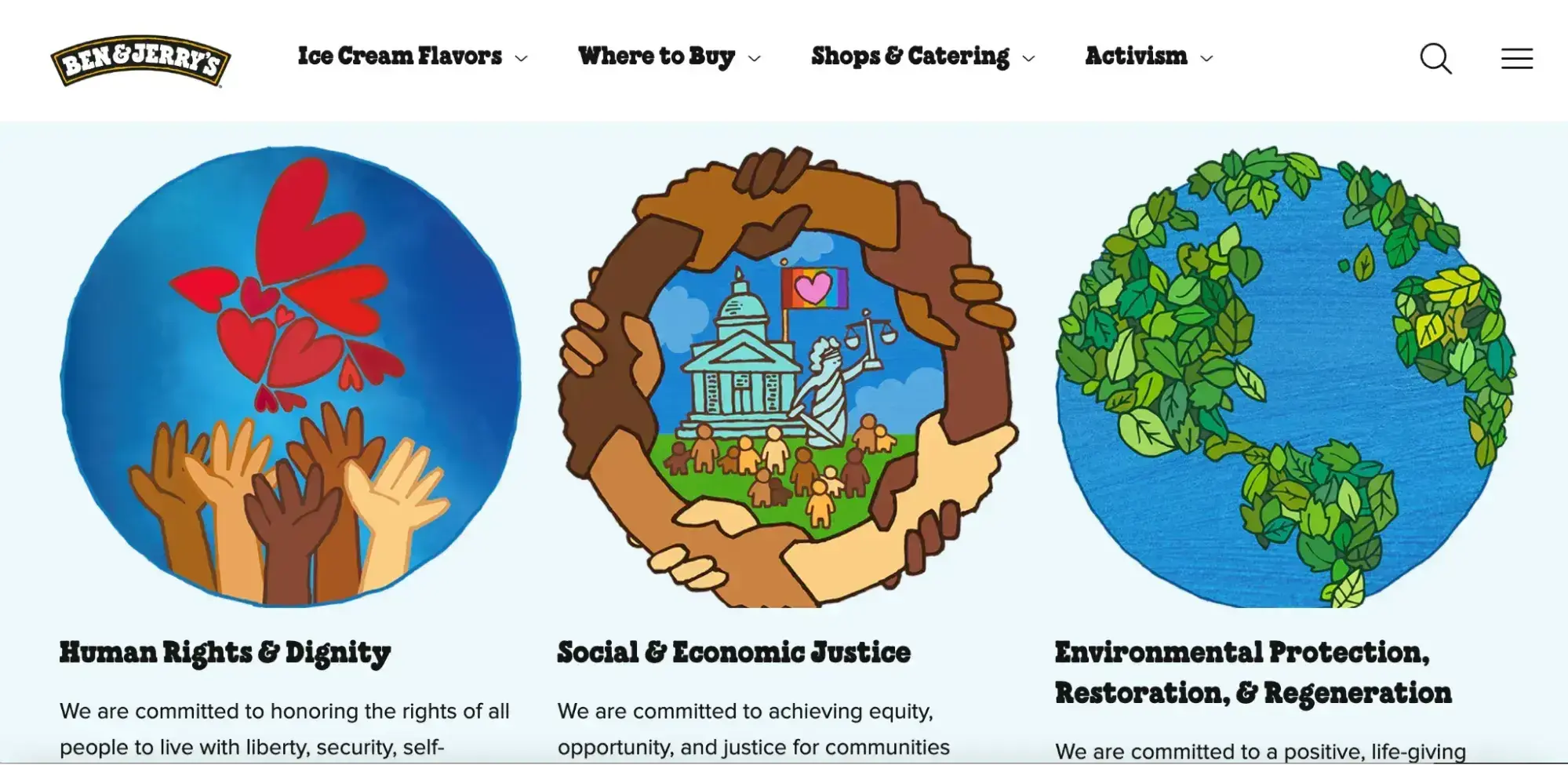
For instance, Ben & Jerry’s positions its marketing around its three core values: human rights and dignity, social and economic justice, and the environment. “We believe ice cream can change the world,” they state. Then, they back those principles up with action.

ben & jerry’s sustainability marketing is outlined on the website, as in the screenshot attached, and supported by evidence.

Source

Do customers care about sustainability? [New Data]

The importance of sustainability in marketing and business is rising.

Thudium says, “Consumers, government and regulation, and investors are demanding more sustainable and ethical business practices from companies.”

While once seen as a luxury or niche tactic, sustainability has gained traction as a mainstream, cross-generational preference. In a world where I can buy the same product from dozens of online sellers, I look for one that’s local, that supports fair trade, or that supports a cause or charity I like.

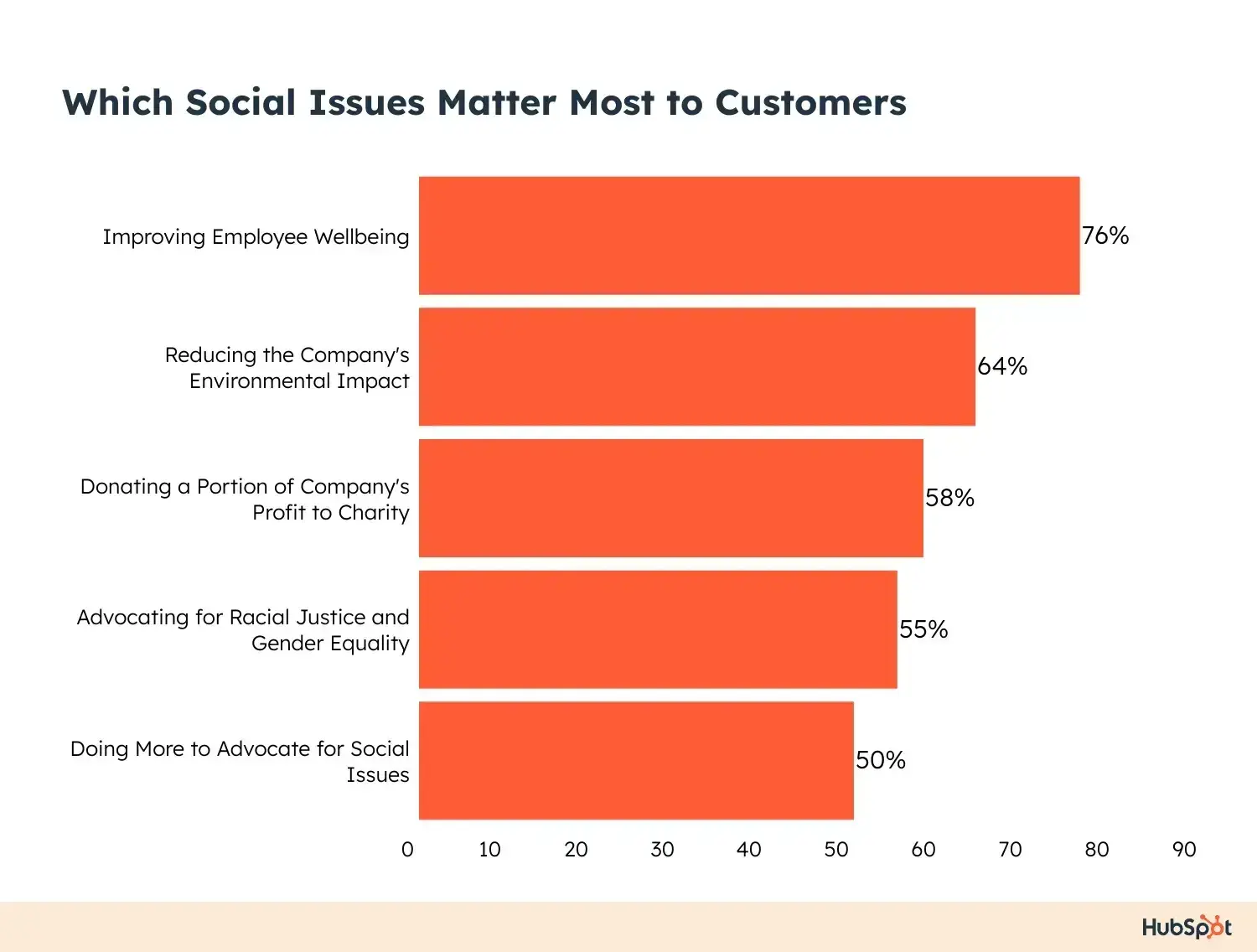
In 2024, HubSpot surveyed over 700 consumers to learn about their shopping habits. Here’s what was found:

  • 76% believe companies should try to improve the well-being of their employees.
  • 64% believe companies should actively reduce their environmental impact.
  • 58% believe companies should donate a portion of their profits to charity.
  • 55% believe companies should advocate for racial justice and gender equality.
  • 50% believe companies should do more to advocate for social issues, with the top issues being affordable healthcare (47%), climate change (35%), and income inequality (35%).

These values are reflected in consumers’ purchasing decisions, especially for younger generations. While only 5% of Boomers say a brand’s environmental impact is a top purchasing factor for them, that jumps to 16% for Gen Z.

The difference is even starker for a company’s charity support and employee well-being.

So, to answer the question posed at the beginning of this question: Yes, consumers of all ages care about sustainability. Even if your brand isn’t rooted in this mission, you will still find value in investing time and resources in sustainable practices and marketing to attract more customers.

Learn more about consumers in our latest State of Consumer Trends report.

1. Have a larger purpose.

Brands typically judge their success by the numbers. How much revenue they have or will generate in any given period is usually the biggest KPI.

Sustainability shifts this perspective by having brands evaluate themselves by something other than profit. Bcorps operates in this way.

To quote B Lab U.K., “Certified B Corporations, or B Corps, are companies verified by B Lab to meet high standards of social and environmental performance, transparency, and accountability.”

Thudium mentions the “triple bottom line: People, Planet, Profit. The movement that businesses need to take for future stability.”

As a brand, you have to promote something that’s bigger than your products and services and transcends any particular industry. “Do you have a clear social mission? If not, spend time discovering what that is and how your brand plays a role in furthering that mission,” Thudium says.

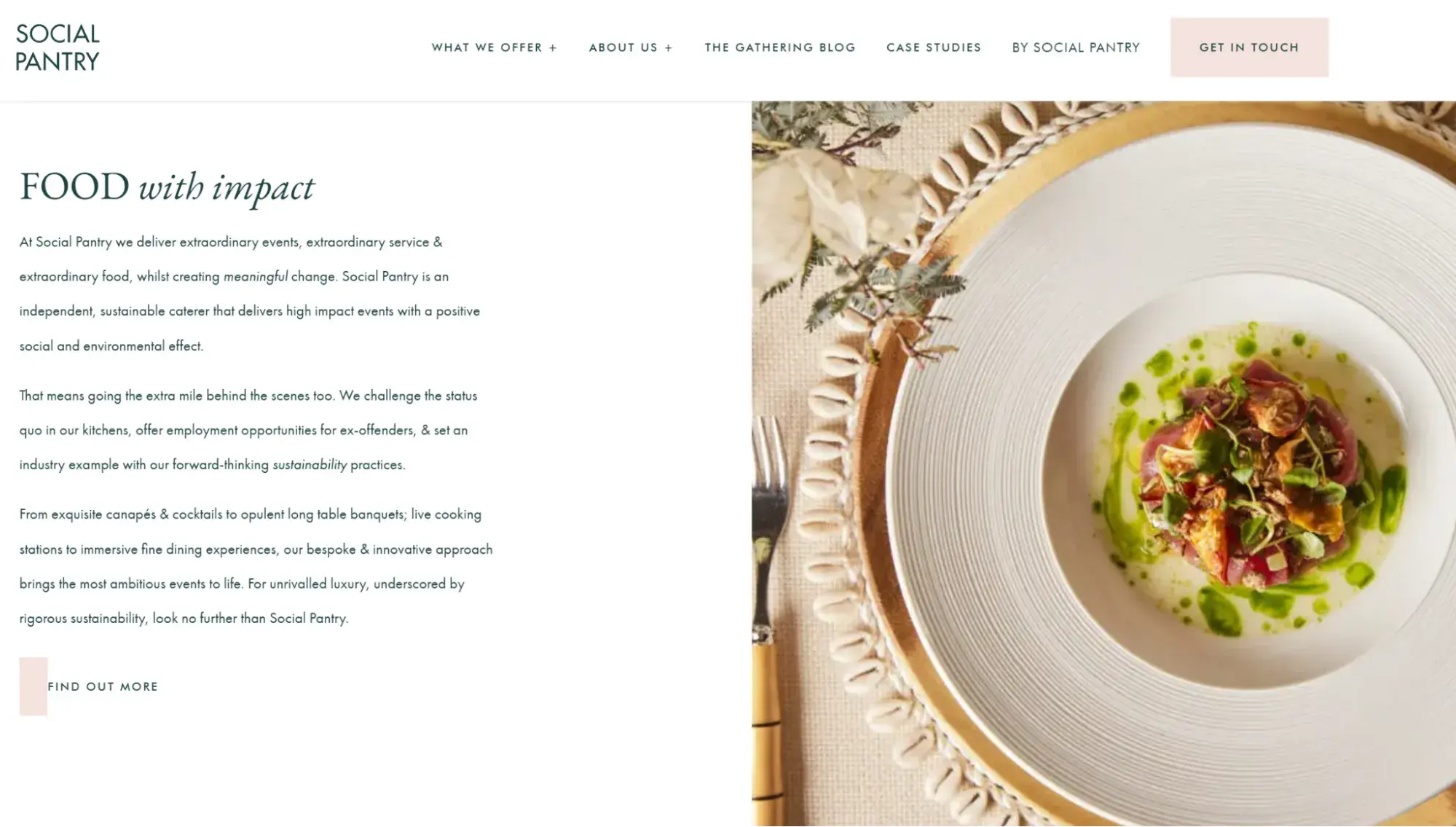
For example, Social Pantry, an independent and sustainable catering brand, makes sustainability part of everything they do.

The brand recently became B Corp Certified, and its commitment to sustainability goes beyond marketing messaging and into the operations and all that comes with running a sustainable business.

Social Pantry’s actions are guided by the change they want to see in the world

  • Investing in circular economies.
  • Developing sustainable business practices.
  • Committing to long-term initiatives that will positively impact future generations.

Alongside being an industry leader in prison leaver employment, they champion suppliers using regenerative farming practices, prioritize purchasing locally sourced food for their catering, and operate zero-to-landfill kitchens.

I spoke to Marketing Director Charlotte Lund-Morgan and asked how Social Pantry has adapted to become seamlessly rooted in sustainability.

Lund-Morgan says, “It’s always been important to us to act as a thought leader. For us, this means not just taking steps to tackle social and environmental issues but [also] ensuring that our brand mission is always clear and consistent so that we can inspire other businesses to do the same.”

screenshot from sustainable business and sustainability marketing leaders, social pantry, shows how marketing messaging is woven into the website.

Source

2. Think long term.

Sustainability marketing is all about building long-term value. Too often, brands focus on gaining immediate results.

For instance, many marketing tactics like running Google Ads and blogging are great lead generators. However, what happens once your lead has made a purchase and turned into a customer? Sustainable marketing looks at ways to nurture and educate consumers during the entire buyer’s journey.

Sustainability initiatives — like replacing styrofoam with paper or reducing your carbon footprint — can take years to implement. Releasing sustainability plans and updating customers on your progress go a long way in building trust, but they won’t yield immediate, attributable growth.

Education is one way to build loyalty with your audience early on, from the first point of discovery to post-purchase. For instance, a food brand could educate its audience on the importance of ethical farming on social media and continue this process post-purchase with package recycling tips.

This works well to build trust and loyalty in the long term. There is a strong correlation between consumer preference for sustainable practices and consumer preference for buying from brands they already know and trust.

Moreover, the data is nuanced. From their research, First Insight credits Gen Z as being a sustainable generation.

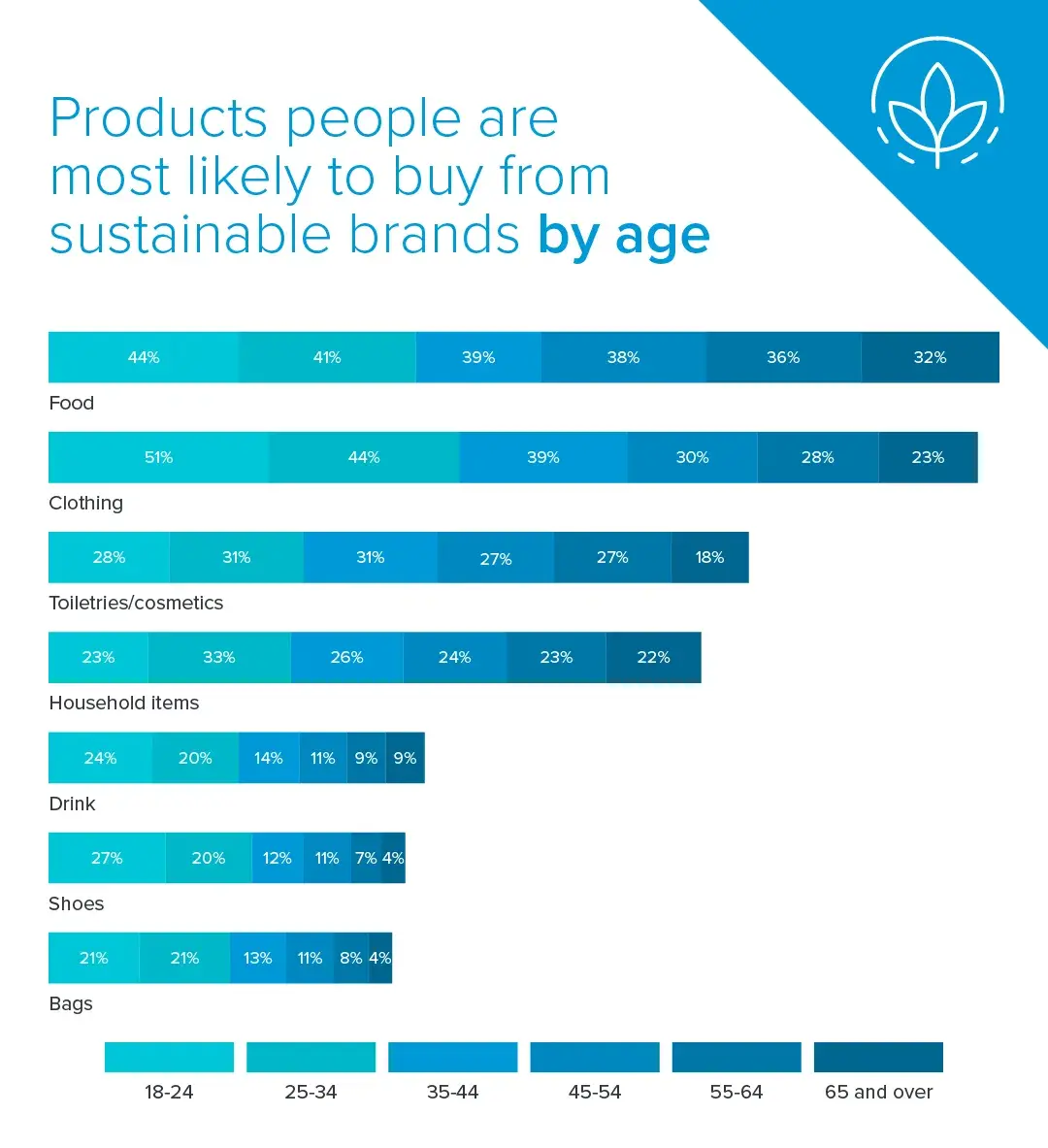
Some industries are more likely to inspire sustainable-driven purchases within different age ranges. For example, only 4% of people aged 65 and over will buy sustainable bags, compared to 21% of those age 21.

The food industry is where people are collectively most motivated to buy sustainably. For the younger generation, clothing is the top choice for sustainable purchases. Data is shown in the infographic below.

infographic shows products people are likely to buy from sustainable brands by age. this data should encourage sustainable marketing practices if sustainable values drive brands.

Source

Marketer Megan Thudium agrees that the shift to sustainability takes time. She says, “Sustainability is a journey and will take years to implement. There is no finish line but continued learning and growth to become a better company that aligns better with society‘s and the planet’s needs.”

3. Communicate

Communicating your sustainability commitments is a must. Thudium says, “Consumers, government, and regulation are demanding more sustainable and ethical business practices from companies. Investors are also demanding companies have a sustainability strategy to receive funding.”

That means there’s more pressure for businesses to reduce their emissions and become more sustainable, according to Thudium. However, it must be done authentically, honestly, and verifiable.

“Communicating your sustainability needs to move past being another differentiation factor. Yes, that is a benefit for business growth,” Thudium says.

“Yes, it’s the right thing to do — but more so, it reduces long-term risk for companies. It makes them more desirable to employees and talent. It keeps them regulatory compliant without fines.”

4. Be customer oriented.

You might be thinking, “Isn’t being consumer-oriented what all marketing is?” Ideally, yes, but not always.

In traditional marketing, a brand often tries to push a product or service to a customer. With consumer-oriented marketing, it’s more about understanding your customers’ needs and tailoring your marketing to that.

First, leverage user research to find out what’s important to your customers. For instance, say your audience is craving more transparency in your sourcing practices or wants you to be more vocal on social issues.

You could use that information for your next campaign or even pivot your business practices to differentiate yourselves from everyone else in your space.

Thudium adds, “You can also expect cost savings from sustainable practices, less cost in acquiring new customers.”

5. Back up your claims.

Thudium warns that sustainability marketing doesn’t work if it’s not “honest, authentic, and backed by verifiable evidence.”

Imagine finding out a business that claims to be sustainable has failed to implement any practices to promote its mission. Consumers would distrust that brand, and it would be difficult to earn it back.

Make sure your brand is looking at sustainability from a holistic lens.

Are you preaching about sustainability but using unsustainable resources to build your product? Are you collaborating with brands that conflict with your mission? Is your team representative of the future you want to promote?

These are the questions you should ask to determine if your brand reflects the mission you’ve set out to achieve. Identify the areas that need work and go to the drawing board to figure out strategies that align with your mission.

Audiences don’t expect perfection. They do, however, value transparency. It’s okay (and recommended) to share where you currently fall short and how you plan to remedy these issues.

Thudium is a huge advocate for backing up claims. She says, “Backing up your claims is all about honesty, transparency, and verifiable claims … If your claims aren‘t verifiable, then it’s greenwashing.”

Thudium notes that could have dire consequences, especially in countries where greenwashing is against the law.

6. Engage stakeholders.

Since sustainability requires real change instead of shallow value-signaling, it takes collaboration. Sustainability is a big effort, and it requires leadership outside of marketing. Engage internal teams, shareholders, supplies, and community partners in conversations and research around sustainability.

In some cases, your organizational structure may make sustainable practices difficult, like getting buy-in for a more expensive but more sustainable supplier when a company has a mandate to increase profit.

Smaller companies can consider re-organizing as a benefit corporation or achieving B Corp status to formalize their sustainability commitments.

7. Go against the grain and be brave.

In marketing, it can seem like everyone’s playing a game of copycat, using the same promotions and tactics over and over again. Posting on social media about Earth Day or International Women’s Day, for instance, is a good practice but won’t stand out against the thousands of other brand posts.

Thudium encourages everyone to “go against the grain and be brave.” She says, “Use sustainable marketing campaigns to change consumer behavior for good and promote sustainable practices in everyday life.”

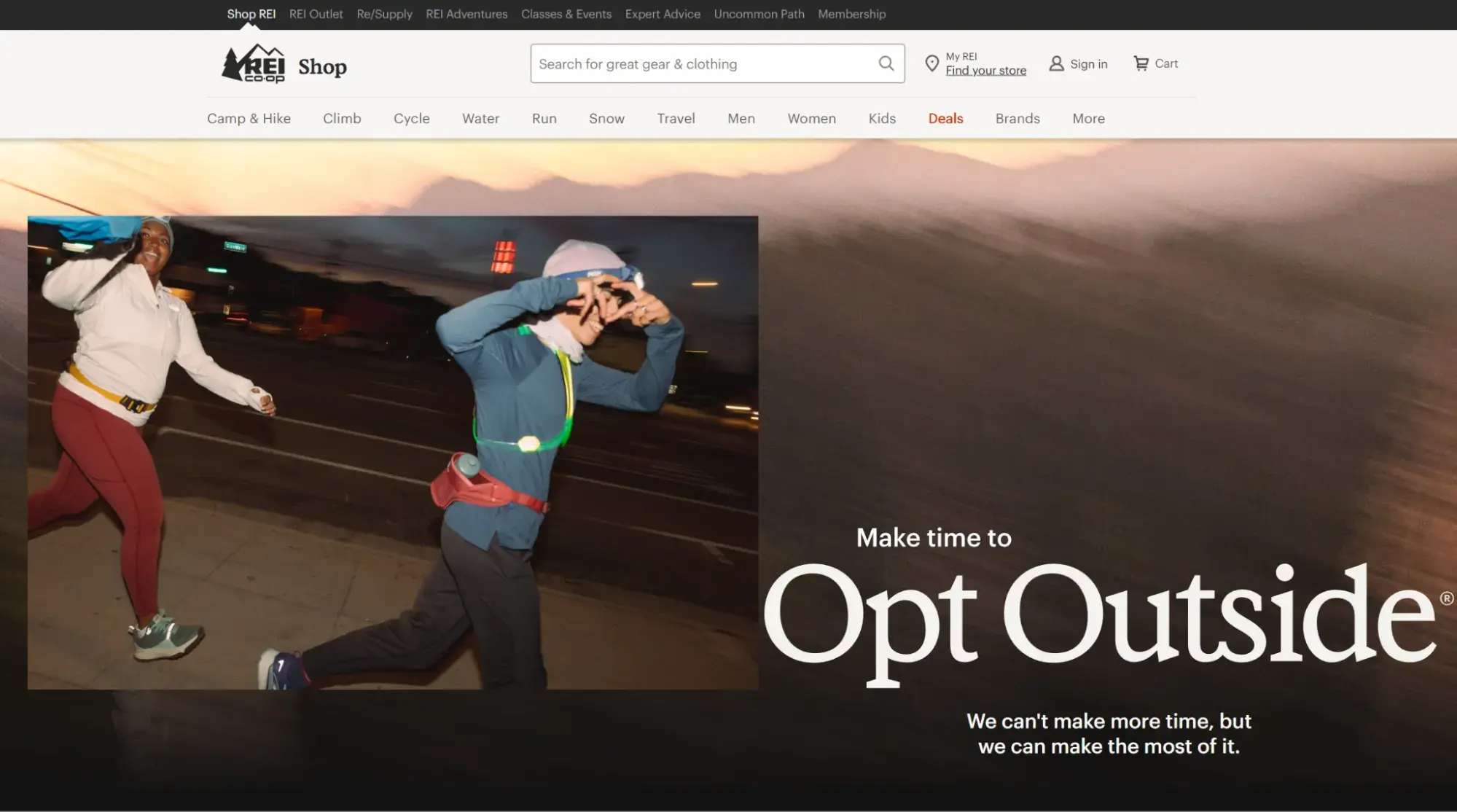
Breaking with your industry runs a risk of failure — but it could also pay off in a big way. Take the outdoor brand REI, for instance. When Black Friday sales reached a peak fever pitch, the brand shocked the public by closing its stores that day and instead encouraging people to #OptOutside.

While it loses in-store revenue each year on that day, it gains loyalty from its members and employees who would rather spend time outside than in a store.

Source

Sustainable Marketing Examples

Need some inspiration for how to market your sustainability practices? Learn from these six brands who belong in the sustainability hall of fame.

1. The Woolmark Company

A recent Woolmark company campaign aimed to encourage people to see the benefits of wool-based clothing and stop buying fast fashion.

Thudium describes why the campaign is important. She says, “Wool is healthier for your body, biodegradable, and can be ethically sourced.”

When asked why the campaign was effective, Thudium says the campaign has

  • Strong messaging about fashion waste.
  • Encourages the benefits of wool fibers.
  • Verifiable claims.

2. Thinx

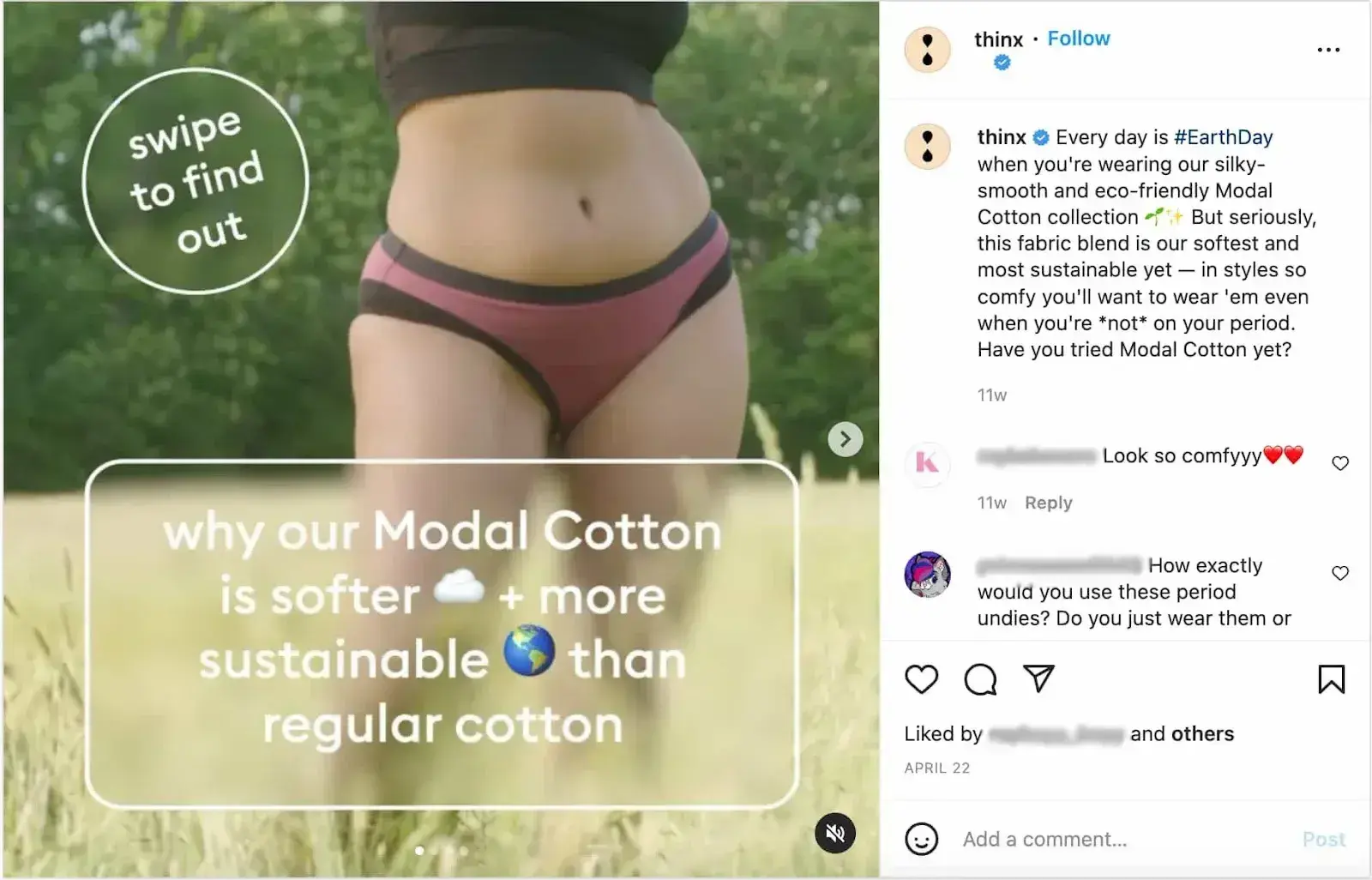
Thinx is an underwear brand whose mission is to provide sustainable solutions to menstruation and incontinence. Everything the brand puts out marketing-wise is centered around this core value.

Source

The brand’s social media pages feature a mix of product promotion, educational content, and mission-focused announcements.

The key to sustainable marketing is doing it in an authentic way that feels embedded in the brand, as opposed to an add-on that’s leveraged when convenient. Thinx is a great example of how to do it right.

Pro tip: You can manage your brand’s content with a tool like HubSpot’s Marketing Hub, which will help you measure and optimize all of your content efficiently.

3. Kind Socks

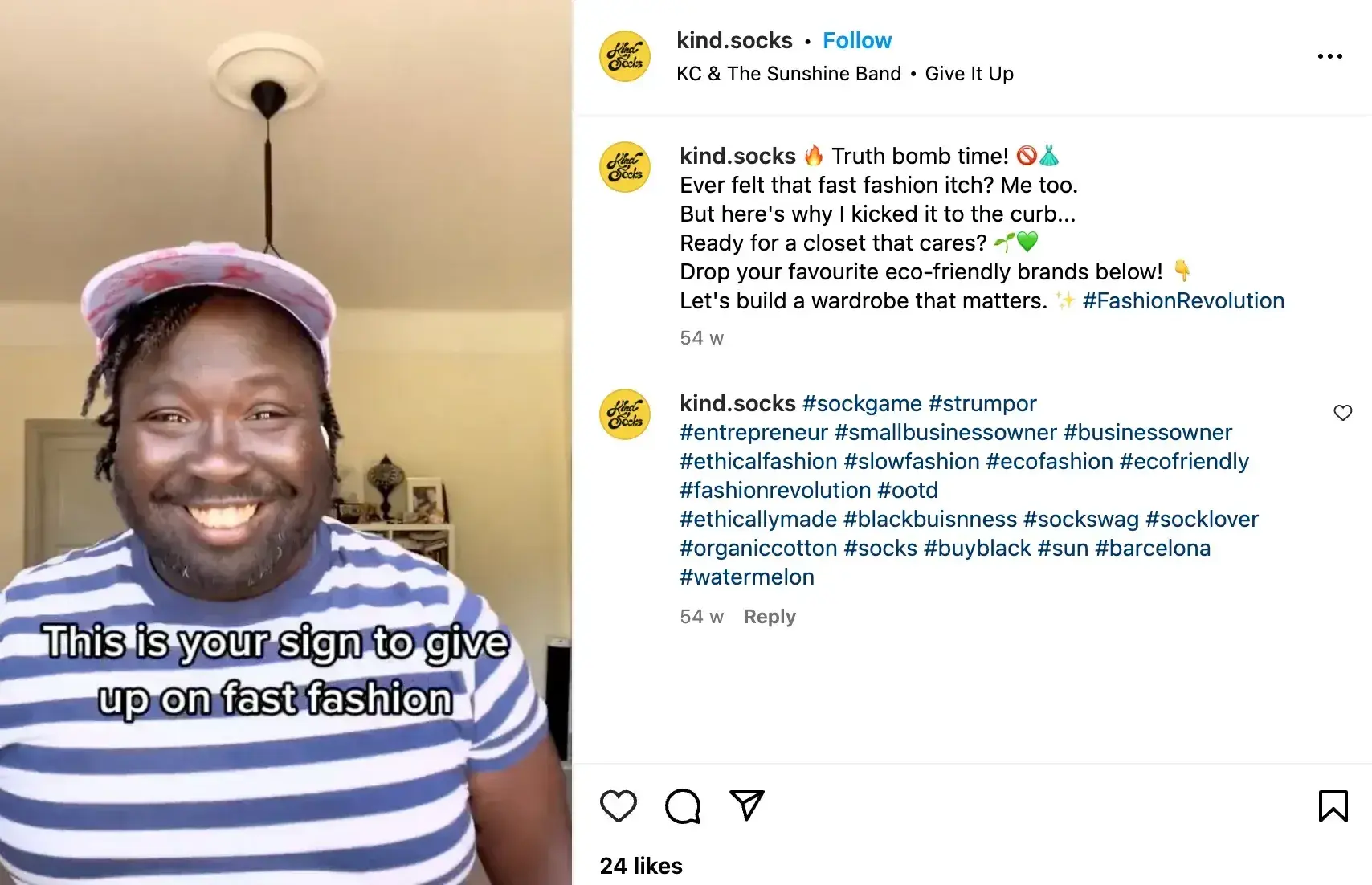
This clothing company was started based on the founder’s desire to find a socks company with a sustainable and ethical vision. While most brands focus on inviting their consumers to purchase, Kind Socks takes the exact opposite approach: Asking them to spend less and more thoughtfully.

Source

This strategy may seem counterintuitive to many companies, but emphasizing the brand’s mission can help build trust with its audience and increase brand loyalty.

4. Pangaia

Materials science company Pangaia wants to save the environment. Every piece of marketing the brand puts out is centered around this core mission, including this video campaign.

In it, the brand explains its mission to “reverse the cycle from the unnatural to natural, from plastic to plants […], from the new to the recycled.” What’s effective about this ad is that Pangaia describes the future it wants to see and outlines the strategies it will implement to get there.

Throughout the ad, you see Pangaia products, but they’re not the focus. This tells viewers the mission drives the products, not the other way around — and that’s sustainable marketing done right.

5. Nada Duele

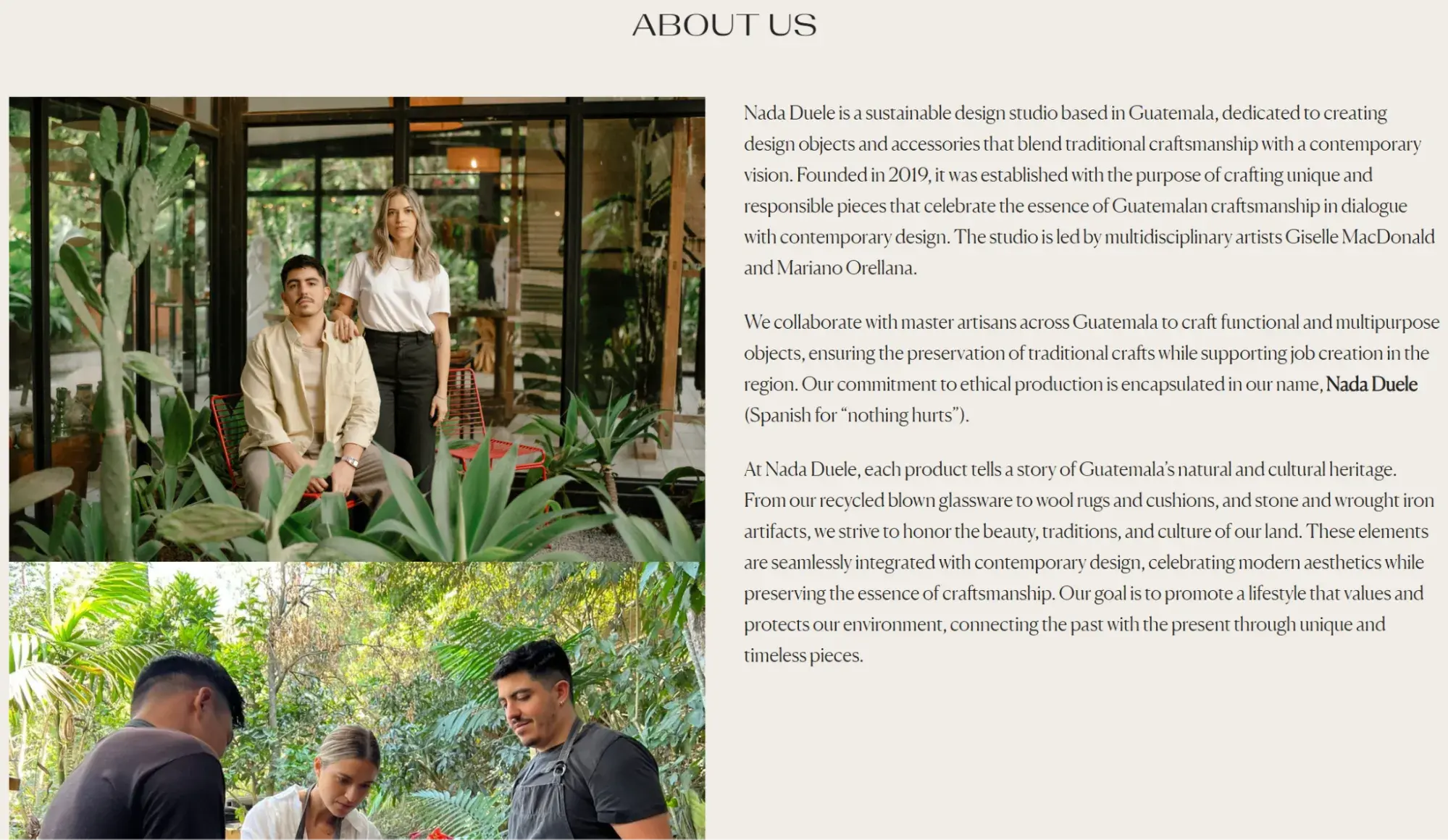
In the previous section, we discussed the importance of having a holistic approach to sustainability marketing. With Nada Duele, their mission is reflected in everything: from their name, which represents the idea that products should not cause harm, to the initiatives they take part in.

nada duele sustainable marketing example. they use their about page to market their sustainable values.

Source

When you visit their “How We Work” section, you learn about their collaboration with a Guatemalan institute dedicated to protecting the forestry sector.

Pro tip: It’s important that the partnerships your brand takes on align with your values. Otherwise, you risk losing credibility and trust.

6. Satya + Sage

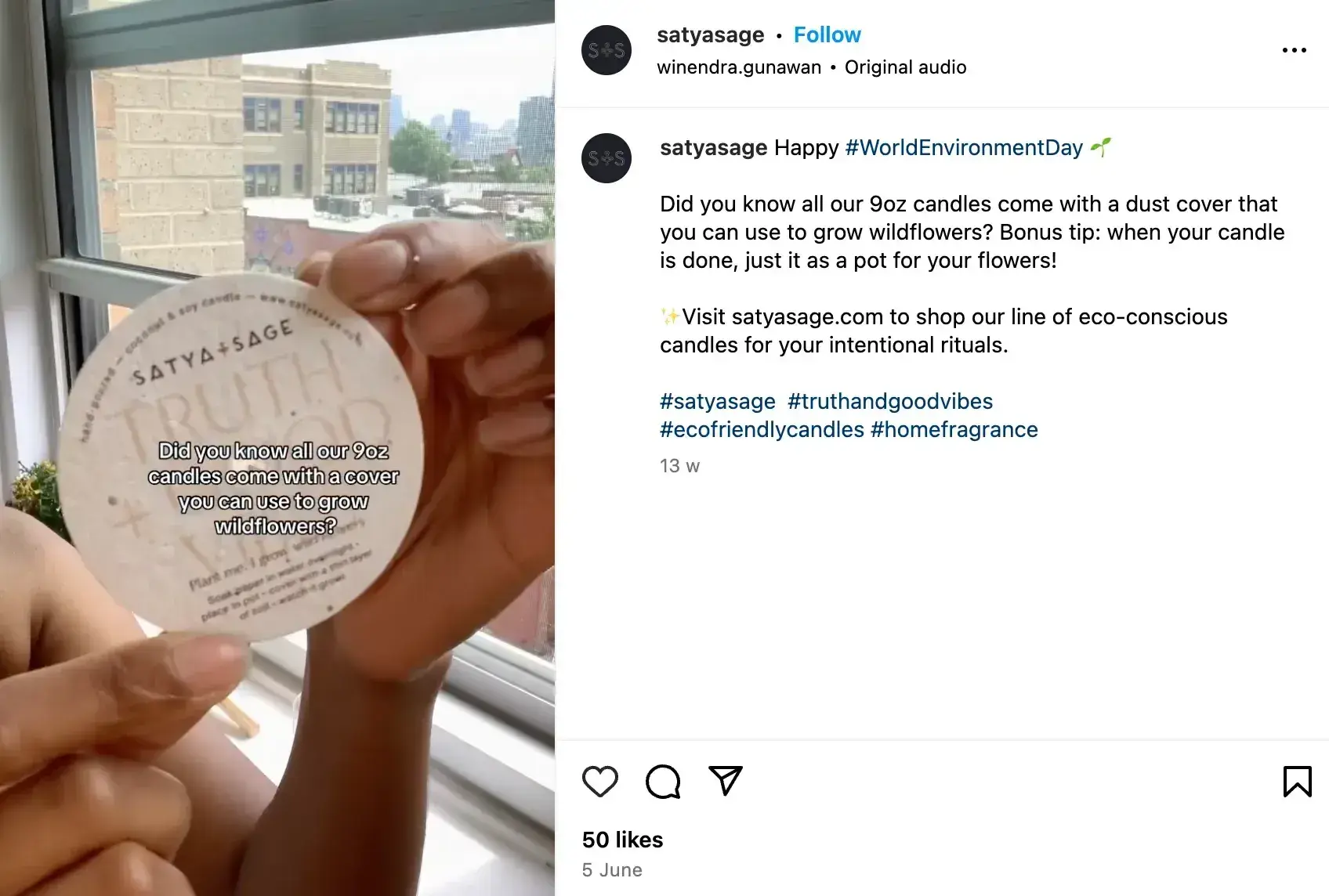
Social media is one of the best and easiest ways to implement a sustainable marketing strategy. You can share a range of content, from educating your followers on sustainable practices to sharing ways your brand is being sustainable.

In this example, the candle company Satya + Sage shares tips on how to use the seed paper that comes with every candle.

Source

Pro tip: On social media, in particular, pay attention to the questions your followers ask and the comments they make, as that can inform which marketing strategies you test in the future.

Sustainable Marketing and AI

As companies rush to explore how to integrate AI into every area of their business (including marketing!), it’s important to slow down and consider the holistic impacts. AI has the potential to reduce waste and the human footprint by performing tasks more efficiently, but the ripple effects are much wider.

Consider these facts and questions as you go about integrating AI:

  • Carbon footprint of AI. Training and running an AI system requires a huge amount of computing power and electricity, increasing CO2 emissions. According to an MIT report, the data center power requirement in North America nearly doubled from 2022 to 2023 — outpacing the demand of over 70% of countries.
  • Bias in AI systems. It’s well-documented that AI systems can replicate bias. For example, according to IBM, when asked to show images of doctors, the AI shows men; for nurses, it shows women. If you are integrating AI to interact with customers or creating marketing content with AI, consider the potential effects of bias.
  • Employee impacts. Our survey revealed that customers are paying attention to how companies treat their employees. As companies replace some functions like customer service with automation, think about your affected employees. Can you reskill them for new AI jobs or support them through a career transition?

While AI can have some negative impacts, it also has the potential to help you reach your sustainability goals.

For instance, you can build a model to analyze your systems and suggest ways to reduce your carbon footprint by optimizing your supply chain. You can also leverage an AI chatbot to educate customers on sustainable practices.

Is marketing with AI more sustainable?

I can’t give you a definite answer for whether leveraging AI is more sustainable for your brand. It really comes down to the sustainability priorities that you’ve identified and whether AI helps or hurts those.

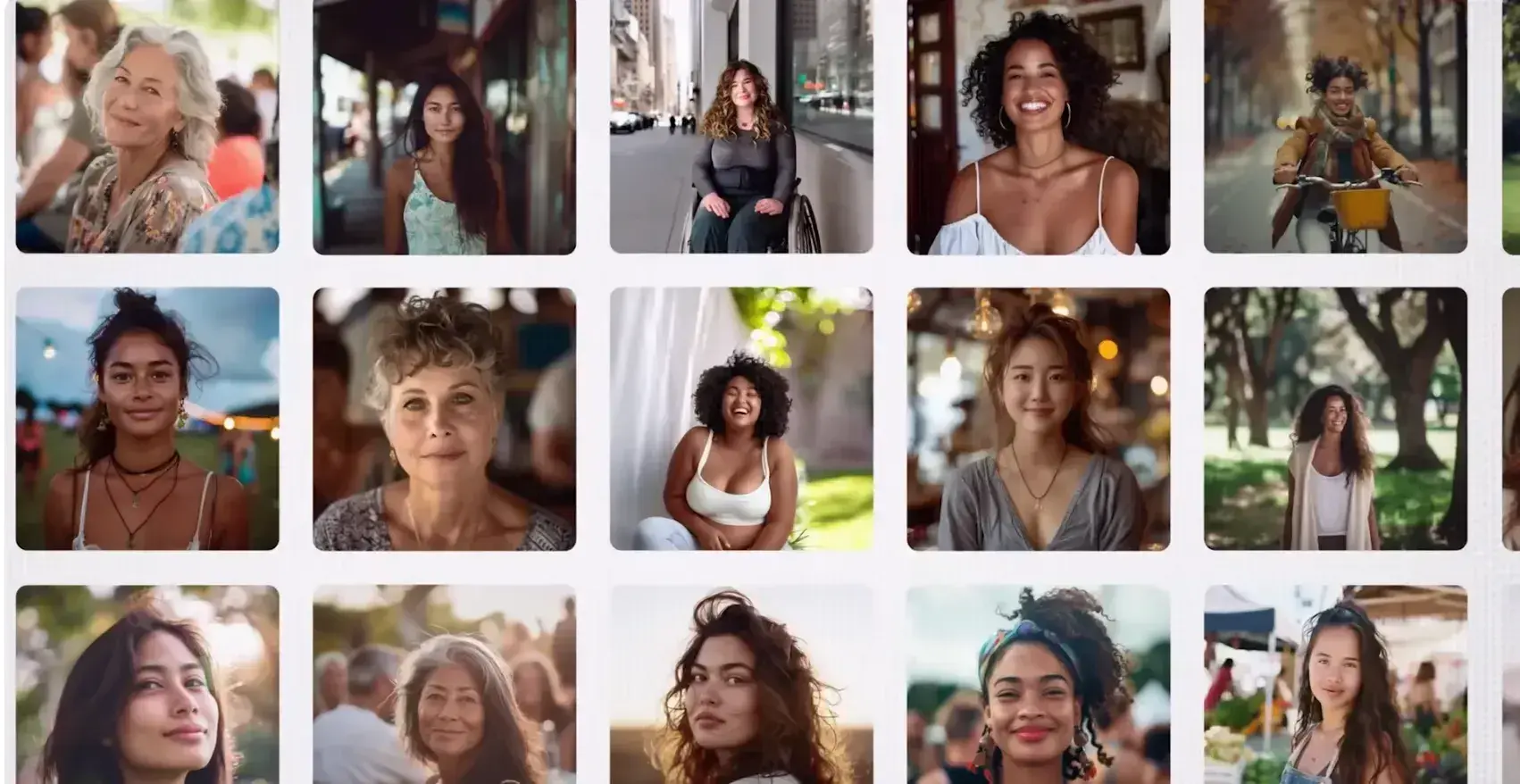
Take Dove’s beauty brand, for example. One of their longtime values has been recognizing real beauty and showing authentic women’s bodies.

In 2023, Dove released an ad campaign declaring that it would never use AI-generated women in ads because it would run counter to its values of elevating real beauty.

Source

While Dove may integrate AI in other ways internally, they realized it was important to state how they wouldn’t use it.

The truth is, AI hasn’t been around long enough for us to truly understand the sustainability implications (the good or the bad). I wanted to understand the reasons why AI is considered unsustainable and how marketers can make the best of it in the most sustainable way possible.

Here’s what I found.

Adam Zewe, writer at MIT News, shares some of the reasons why AI isn’t environmentally friendly. In his article, Explained: Generative AI’s environmental impact, Zewe. Amongst other reasons, he cites:

  • OpenAI’s GPT-4 demands a staggering amount of electricity.
  • Increased demand for hardware, which has indirect environmental impacts (manufacturing and transport, for example).
  • Increased demand for water to cool data centers, which can strain municipal water.

There’s more, but these three stood out to me.

It’s tricky for conscientious sustainable marketers who want to be all things sustainable, while keeping up to date with an ever-growing digital world which demands use of the latest technology.

For balance, I wanted to look into the ways in which GenAI can be used sustainably. Shengyuan Su, sustainability director at Zendesk, shares tips for sustainable AI usage.

My favorite tip: “Use existing models and trained datasets whenever possible: Developing, training, and deploying new models requires additional energy and risk contributing to carbon emissions.”

For me, this seemed like a solid tip. We can use AI that is already fit for purpose, instead of spending hours training new models all the time. If the AI dataset is there already, then using is reduces energy and carbon emissions.

Engage Customers with Sustainable Marketing

From DEI to environmental impact, it’s clear to me that customers are starting to care more about where their products come from and the people behind them.

My main takeaway for you is this: Sustainable marketing isn’t just a box to tick off, it’s a whole-company practice and a cultural shift. It’s a long-term strategy that wins trust, loyalty, and customers over time.

As you consider new factors like AI in marketing and climate change, stay close to your customers to hear what they want to see from your brand.

Above all, customers value transparency and want to hear about your journey, even if you haven’t reached your goals yet. So don’t be afraid to start small and bring your customers along with you on the journey.

Editor’s Note: This post was originally published in September 2021 and has been updated for comprehensiveness.

Categories B2B

What Is a Risk Assessment? My Tips and Best Practices [+ Free Template]

No matter what you do for a living, you deal with all kinds of risks daily — whether it’s operational hiccups, financial uncertainty, or potential reputation hits.

But it’s the unexpected curveballs you don’t see coming, like a sudden cybersecurity breach or equipment failure, that really shake things up.

Trust me; I’ve been there.

That’s where a risk assessment comes in.

Download Now: Free Risk Assessment Template

With it, I can spot, analyze, and prioritize risks before they turn into full-blown problems. I can get ahead of the game, so that when the unexpected strikes, I already have a plan in place to keep things under control.

In this guide, I’ll share tips for running a risk assessment in five easy steps. I’ll also feature a customizable template to help you sharpen your decision-making.

Table of Contents

What is a risk assessment?

A risk assessment is a step-by-step process used to identify, evaluate, and prioritize potential risks to a business’s operations, safety, or reputation.

It helps businesses understand the threats they face and determine how best to manage or reduce those risks.

The risk assessment process involves identifying hazards, assessing how likely they are to occur, and evaluating their potential impact.

With this information, businesses can allocate resources effectively and take proactive measures to avoid disruptions or accidents.

Purpose and Benefits of Risk Assessments

At its core, a risk assessment is all about identifying potential hazards and understanding the risks they pose to people — whether they’re employees, contractors, or even the public.

By doing a deep dive into these risks, I can take action to either get rid of them or minimize them, creating a much safer environment. And sure, there’s the legal side — many industries require it — but beyond that, it’s about proactively looking out for the health and safety of everyone involved.

It‘s important to note how crucial risk assessments are for staying compliant with regulations. Many industries require businesses to conduct and update these assessments regularly to meet health and safety standards.

But compliance is only one side of the coin. Risk assessments also show the company genuinely cares about its employees’ well-being.

Benefits of Risk Assessments

Think of a risk assessment template as your business’s trusty blueprint for spotting trouble before it strikes. Here’s how it helps.

Awareness

Risk assessments shine a light on the risks lurking in your organization, turning risk awareness into second nature for everyone. It’s like flipping a switch — suddenly, safety is a shared responsibility.

I’ve seen firsthand how, when people feel confident enough to call out risks, safety compliance just clicks into place. That’s when you know the whole team is looking out for each other.

Measurement

With a risk assessment, I can weigh the likelihood and impact of each hazard, so I’m not shooting in the dark. For instance, if I find that one task is particularly risky, I can change up procedures or workflows to bring that risk down.

Results

The real magic happens when you act on your findings. By catching risks early, I can prevent different types of crises like machine breakdowns or workplace accidents — things that can quickly spiral out of control.

Not only does this safeguard employees and minimize the fallout from those risks, but it also spares your organization from costly legal troubles or compensation claims.

When should you conduct a risk assessment?

Here are the most relevant scenarios for conducting a risk assessment.

Before Introducing New Processes or Products

If I’m launching a new product or service, I’d want to assess all the potential risks involved. This could include safety risks for employees, financial risks if the product doesn’t perform as expected, or even supply chain risks.

For example, as a manufacturer, you might evaluate the risks of new machinery affecting production lines​.

After Major Incidents

If something goes wrong, like a data breach or an equipment failure, a risk assessment again comes in handy. I can better understand what went wrong and how to prevent it from happening again.

For example, after a data breach, an IT risk assessment could reveal vulnerabilities​ and help bolster defenses​.

To Meet Regulatory Requirements

Staying compliant with industry regulations is another big motivator. In industries like healthcare or finance, this could mean avoiding hefty penalties or fines.

Compliance frameworks like HIPAA risk assessment in healthcare or OSHA for workplace safety make regular risk assessments a must​.

When Adopting New Technologies

Integrating new technologies, such as IT systems or machinery, can introduce new risks. I recommend conducting a risk assessment to identify any potential cybersecurity or operational risks.

Without this, your business could be exposed to new vulnerabilities​.

When Expanding Operations

Whenever expanding into new markets, it’s essential to assess potential risks, especially when dealing with different local regulations or supply chains.

Financial institutions, for example, assess credit and market risks when they expand internationally​.

Pro tip: Don’t wait for problems to arise — schedule regular risk assessments, either annually or bi-annually. This keeps you ahead of potential hazards and ensures you’re constantly improving safety measures.

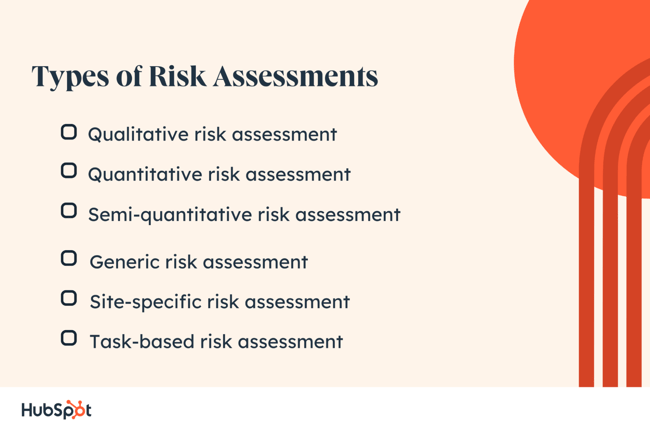
Types of Risk Assessments

The different types of risk assessments

When conducting a risk assessment, the method you choose depends on the task, environment, and the data you have on hand. Different situations call for different approaches.

Here are the top ones.

1. Qualitative Risk Assessment

This assessment is suitable when you need a quick judgment based on your observations.

No hard numbers here — just categorizing risks as “low,” “medium,” or “high.” It’s perfect for when you don’t have detailed data and need to make a call based on experience.

For example, when assessing an office environment, like noticing employees struggling with poor chair ergonomics, I should label that a “medium” risk. Sure, it impacts productivity, but it’s not life-threatening.

It’s a simple approach that works well for everyday scenarios.

2. Quantitative Risk Assessment

When you have access to solid data, like historical incident reports or failure rates, go for a quantitative risk assessment.

Here, you’ll assign numbers to both the likelihood of a risk and the potential damage it could cause. This makes the assessment a more precise way of evaluating risk, especially for industries like finance or large-scale projects.

Take, for instance, a machine that breaks down every 1,000 hours, costing $10,000 each time. With this assessment, I can calculate expected annual costs and decide if it’s smarter to invest in better maintenance or just get a new machine.

3. Semi-Quantitative Risk Assessment

This is a blend of the first two.

In this risk assessment method, you assign numerical values to risks but still categorize the outcome as “high” or “low.” It gives you a bit more accuracy without diving into full-blown data analysis.

At HubSpot, leadership used this when relocating an office. The team couldn’t exactly quantify the stress employees would feel.

By assigning scores (like 3/5 for impact and 2/5 for likelihood), leaders got a clearer picture of what to tackle first — like improving communication to ease the transition.

4. Generic Risk Assessment

A generic risk assessment addresses common hazards that apply across multiple environments.

It’s best for routine or low-risk tasks, such as manual handling or standard office work. As the risks are well-known and unlikely to change, you don’t have to start from scratch every time.

When dealing with manual handling tasks in an office, for example, the risks are pretty standard. But you must always stay flexible, ready to tweak your approach if something unexpected comes up.

5. Site-Specific Risk Assessment

A site-specific risk assessment focuses on hazards unique to a particular location or project.

For example, if you‘re evaluating a chemical plant, for instance, don’t just rely on generic templates. Instead, consider the specifics: the chemicals used, the ventilation, the layout — everything unique to that site.

By doing this, you can address unique hazards and often high-risk environments, like suggesting better spill containment measures or retraining employees on safety procedures.

6. Task-Based Risk Assessment

In a task-based risk assessment, focus on specific jobs and the risks that come with them. This is ideal for industries like construction or manufacturing, where different tasks (e.g., operating a crane vs. welding) come with varying risks.

As each task gets its own tailored assessment, don’t miss the unique dangers each one brings.

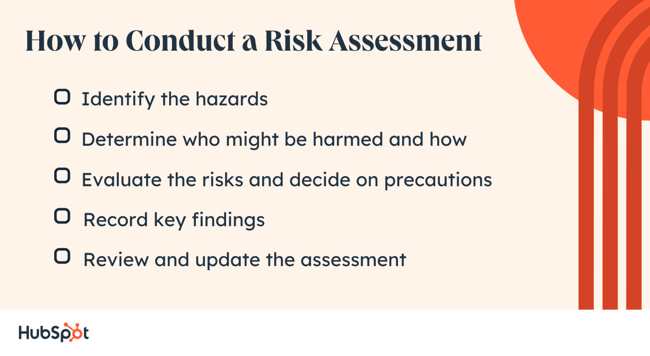
How to Conduct a Risk Assessment for Your Business

The key steps of conducting a risk assessment

When I need to run a risk assessment, I like to rely on a handy guide. Here’s a more comprehensive look at each step of the process.

1. Identify the hazards.

When identifying hazards, I try to get multiple perspectives so that I don’t miss any hidden risks.

Here’s how I go about it:

  • Talking to my team. Since my team is the one dealing with hazards daily, their insights are invaluable, especially for identifying risks that aren’t immediately obvious.
  • Checking past incidents. I review old accident logs or near-misses. Often, patterns emerge that highlight risks I may not have considered before.
  • Following industry standards. If you work in certain industries, OSHA guidelines or other relevant regulations provide a solid framework to help spot hazards you might otherwise overlook.
  • Considering remote and non-routine activities. I make sure to assess risks for remote workers or non-regular activities, like maintenance or repairs, which can introduce new hazards.

For example, during a system audit, I might identify obvious risks like unsecured servers or outdated software.

However, I must also consider hidden risks, such as unsecured Wi-Fi networks that remote employees might use, potentially exposing sensitive data.

Reviewing past incident reports, like past phishing attempts or data breaches, may reveal both technical and human-related vulnerabilities.

By taking all these factors into account, you can better protect your data and keep operations running smoothly.

2. Determine who might be harmed and how.

In this step, I widen my focus beyond just employees to include anyone who might interact with my daily operations. This includes:

  • Visitors, contractors, and the public. That includes anyone who interacts with operations, even indirectly, is considered. For instance, construction dust on-site could harm passersby or visitors.
  • Vulnerable groups. Certain people — like pregnant workers or those with medical conditions — might have heightened sensitivities to specific hazards.

Take the unsecured server example mentioned earlier. IT staff might be aware of the risks, but I also need to consider non-technical employees who might not recognize phishing emails.

3. Evaluate the risks and decide on precautions.

As I evaluate risks, I focus on two main factors: how likely something is to happen and how severe the impact could be.

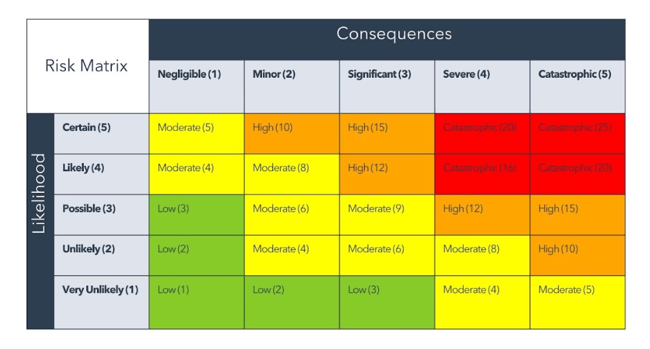
  • Use a risk matrix. The risk matrix isn’t just a tool to categorize risks but a strategic guide to help me decide which business risks need action now and which can wait. I focus first on high-probability, high-impact risks that need immediate action, and then work my way down to those that can wait.

A risk matrix that helps classify the likelihood of a risk occurring and the severity of its impact.

  • Determine the root causes. Next, I want to understand why a risk exists — whether it’s outdated software, lack of cybersecurity training, or weak password policies. This will help me address the issue at its core and create better solutions. Consider using a root cause analysis template to help you systematically capture details, prioritize issues, and develop targeted solutions.
  • Follow the control hierarchy. The hierarchy of controls provides a structured approach to managing hazards. My first priority is always to eliminate the risk, like disabling unused access points. If that’s not possible, I implement network segmentation, multi-factor authentication, or encryption before relying on user training as a last line of defense.

For example, when dealing with phishing risks, frequent incidents and inconsistent training were the main concerns. To mitigate them, I could start by providing more robust training and enforcing multi-factor authentication. I could implement email filtering tools to reduce phishing emails.

If that’s not an option, I can improve response protocols. Incident response plans would provide additional protection.

4. Record key findings.

At this stage, it’s time to document everything: the risks identified, who’s at risk, and the measures put in place to control them. This is especially crucial if you’re operating in a regulated industry where audits are a possibility.

Here’s how to lay out the documentation based on our earlier example.

  • Hazards identified: Phishing attempts, unsecured servers, data breach risks.
  • Who is at risk: Employees, customers, third-party vendors.
  • Precautions: Multi-factor authentication, email filters, encryption, regular cybersecurity training.

Pro tip: Digitize these records and include photos of the relevant areas and equipment. This will keep you compliant with regulations while also doubling as an excellent risk assessment training resource for new employees. Plus, it ensures everyone can access the information when needed.

5. Review and update the assessment.

Risk assessments aren’t a “set it and forget it” thing. That‘s why I recommend reviewing your assessment plan every six months — or whenever there’s a significant change.

Here’s how to approach it:

  • Trigger a review with changes. Whether it’s new equipment, new hires, or regulatory updates, any major shift calls for a reassessment. For example, after upgrading a cutting machine, I can immediately revisit the risks to address updated training needs and potential software issues.
  • Incorporate ongoing feedback. Employee input and regular audits play a huge role in keeping assessments up to date. By maintaining open communication, you can spot new risks early and ensure existing safety measures remain effective.

Free Risk Assessment Template

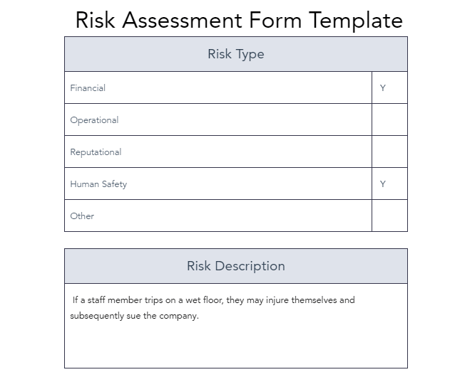
a risk assessment template filled to describe the risk types, along with their description.

Need a quick, easy way to evaluate different risks — like financial or safety risk? HubSpot’s got you covered with a free risk assessment template that helps you outline steps to reduce or eliminate those risks.

Here’s what our template offers:

  • Company name, person responsible, and assessment date.
  • Risk type (financial, operational, reputational, human safety, etc.).
  • Risk description and source.
  • Risk matrix with severity levels.
  • Actions to reduce risks.
  • Approving official.
  • Comments.

Grab this customizable template to assess potential risks, gauge their impact, and take proactive steps to minimize damage before it happens. Simple, effective, and to the point!

Take Control of Your Workplace

Effective risk assessment isn’t just about ticking a compliance box—it’s a proactive way to keep your business and employees safe from avoidable hazards.

Always start by identifying specific risks, whether they‘re tied to a particular site or task. Once you’ve got those, prioritize them using tools like a risk assessment matrix or a semi-quantitative assessment to make sure you’re tackling the most pressing issues first. And remember, it’s not a one-and-done thing—regular reviews and updates are crucial as your business evolves.

Plus, with HubSpot’s free risk assessment template on hand, you’ll always have a strong foundation to stay one step ahead of any potential risks.

Categories B2B

Professional Bio Examples: 29 Work Bios I Keep in My Back Pocket for Inspo [+ Templates]

As a marketer, my professional bio is the best way to, well, market myself.

From generalist to content strategist and agency to enterprise, my role has changed a lot over the last (almost) eight years. And my professional bio has to keep up. Even though I can admit I don’t always feel like rewriting it.

→ Download Now: 80 Professional Bio Examples [Free Templates]

But we all know we have to keep our professional bios refreshed to give people an accurate snapshot of who we are, why they should work with us, and why they should care about what we have to say.

For that reason alone (and because it’s my actual job), I’ll show you how to write a bio and share some of my favorite professional bio examples from years of reworking my own.

Table of Contents

What is a professional bio?

A professional bio or biography is a quick rundown of your background and experience. Your bio should include details about your professional expertise, skills, and achievements, but it’s also an opportunity to show off your personality and personal interests.

They can live just about anywhere — your personal or company website, speaker or contributor pages, LinkedIn profile, or other social media channels.

Purpose of Professional Bios

“Writing a professional bio is more than just listing academic degrees or job titles — it’s a strategic narrative about your professional journey,” says Rosario Maccarrone, Director & Head of Student Services at OPIT. It’s almost like an executive summary of your career.

When I look at my own professional bio, I want it to answer four simple questions:

  • Who is she?
  • What has she done?
  • What does she do?
  • What can she do?

I want someone to read it and think: “Wow, that was a great summary. I’d love to know more.”

Your professional bio is your opportunity to briefly introduce yourself (or your brand) and tell clients, customers, employers, and colleagues what you’re good at.

It’s not a laundry list of everything you’ve ever accomplished — you have a resume for that. The keyword here is snapshot. You want the reader to quickly identify what your areas of expertise, talents, and interests are.

They can then use that snapshot to decide if they want to move forward and make a connection.

purpose of professional bios, quote graphic, writing a professional bio is more than just listing academic degrees or job titles — it's a strategic narrative about your professional journey, rosario maccarrone, director & head of student services, opit

Why Good Bios Are Important for Professionals

But how many people actually read professional bios, anyway?

Well, I can tell you that I get a number of “Someone has viewed your profile” notifications on LinkedIn, so you’re probably getting more eyes on it than you think.

The reality is people will read your professional bio. Whether they remember it or it makes them care about you is a matter of how well you present yourself.

A good professional bio will reel them in. Then, you can really seal the deal by providing more depth IRL.

What should a professional bio say?

Remember those four simple questions I mentioned above? Here are the specific ingredients that I include in my own professional bio to help answer them.

  • Name and background: Always start your professional bio by introducing yourself and providing some context about who you are and your experience.
  • Professional roles and achievements: Highlight your previous roles, what you currently do for work, and an accomplishment or two. You know, brag a little.
  • Values and work approach: What do you care about? What drives the way you think about work? Include that here.
  • Passions and interests: Yes, you should absolutely save room to share your hobbies and talk a little bit about your personal life. This really helps the reader understand who you are beyond your professional achievements.
  • Call-to-action: Tell the reader what to do next. Now that they’ve met you in writing, what’s the ideal path forward for you (and for them)?

That was quick, I know. But don’t worry. I will break all of this down even further when we get into my nine steps for writing a professional bio.

How to Format Your Professional Bio

Depending on the platform and audience, you can use several formats for your work bios, but one consistent choice, regardless of these factors, is whether to write in a first-person or third-person tone. Let’s break down the two.

First-person bio vs. third-person bio? I talked to the experts, and here’s where they stand:

Team: First-Person Bios

Emily Neal, Marketing Manager at DSMN8, says she always makes sure to write a professional bio in first-person, even if she’s writing on behalf of someone else.

“Particularly on social media channels like LinkedIn, using first person comes across as more authentic and personable,” she adds.

David Magnani, Managing Partner at M&A Executive Search, also typically writes in the first person because it helps create a personal connection with the reader. “I believe using ‘I’ makes it feel more engaging and genuine. It allows me to share my experiences and values directly.”

Team: Third-Person Bios

On the flip side, Vivian Chen, Founder & CEO at Rise, says she always recommends writing professional bios in the third person, as “it lends a more professional and objective tone, especially when used in formal settings.”

And Arvind Rongala, CEO at Edstellar, agrees that writing in the third person “makes them sound more formal.”

My take? I do believe both approaches can work as long as you tell your story in a way that connects with your reader. So, I suggest picking one that works best for your audience and your medium.

First-person professional bios do tend to read more casually, so consider that style for channels like social media or your personal website.

If you’re writing for a business website or formal occasion, you may want to opt for a third-person professional bio.

(I’d pretend I don’t have a preference … but between you and me, I lean toward writing my professional bios in the first person. I like to write how I speak, and the easiest way to talk about myself is from my own POV.)

Regardless, I’ve got some tips to make either version great.

How to Write a First-Person Bio

  • Don’t start every sentence with “I.” Find other creative ways to stay within that POV. Like “Skilled writer. Average cook” instead of “I like to write.”
  • Remember, you know yourself better than anyone. Add a little back story to your bio to create context for the roles and successes you’re writing about.
  • Focus on valuable details. Include quick facts that are relevant to who you are and what you do. And if you ask me, hobbies and interests are equally as valuable to the right audience.

Example: Hi, my name is Alana Chinn. I’m a writer specializing in informational content for marketing professionals. One thing I’m really good at? Creating copy for a wide range of marketing and business topics including social media, email marketing, and career development.

How to Write a Third-Person Bio

  • Write from the perspective of someone you know and trust. It can be hard to write about yourself, so this can help you write from a position of authority without feeling self-conscious.
  • Show the reader why they should trust your opinion. A professional bio often reflects a specific industry or niche. With this in mind, your text should include relevant details that professionals in your industry know. Avoid jargon whenever you can.
  • Don’t forget that you’re telling a story. If you want a third-person bio, but you’re used to writing in first-person, it may help to write it the most comfortable way for you. Your professional bio is an essential piece of writing, so edit it carefully. Edit your writing from both points of view and see which works best for your target audience.

Example: Alana Chinn is a writer who specializes in informational content for marketing professionals. She has created copy for a wide range of marketing and business topic, including social media, email marketing, and career development.

Professional Bio Templates

I’m sharing these professional bio templates with you ahead of time so you can use them as a reference as I walk through my steps for writing a good professional bio. (Spoiler alert: That’s up next.)

These templates are great because they allow you to 1) stick to a predetermined format and 2) simply fill in the blanks with your information.

So … drum roll, please … Here are over 80 downloadable professional bio templates for both short- and long-form bios. Time to start building a bio that actually hits the mark.

And you can take my word for it. I knocked out the four templated bios you see in the image below in less than five minutes.

Free Resource: 80+ Professional Bio Templates & Examples

professional bio examples, HubSpot's free professional bio templates

Download free, editable short and long professional bio templates.

WAIT! Just kidding, it’s not that urgent. But make sure you’ve decided on a voice (first-person vs. third-person) and considered where your professional bio will live before you start writing.

Instagram, for example, allows only 150 characters of bio space, whereas you can write as much as you want on your website or Facebook Business page.

Oh, and one more thing. As you embark on this journey, I’d recommend checking out a tool like HubSpot’s free drag-and-drop website builder — a quick and simple way to showcase your professional bio online with ease and style.

Phew, now we can get into the how-to. Please enjoy this combination of tips from my own experience along with best practices from a few more experts.

1. Understand and write for your audience.

Dr. Kyle Elliott, Founder & Tech Career Coach at CaffeinatedKyle.com, says, “One of the biggest mistakes professionals make when writing their professional bio is failing to customize it based on the platform and target audience.”

And I agree — before you start writing, you have to know who you’re writing for. That’s marketing 101 (and now, it’s also professional bio writing 101).

how to write a professional bio, quote graphic, one of the biggest mistakes professionals make when writing their professional bio is failing to customize it, dr. kyle elliott, founder & tech career coach, caffeinatedkyle.com

Franklin Buchanan, Career Coach at Post Up Careers, agrees that the most important part of writing or updating your professional bio is understanding your audience and the message you want to convey to them.

Buchanan suggests, “Try to tell a story of yourself and think about who is going to be digesting the content.”

Note: For this walkthrough, I’ll be using my HubSpot Blog author bio as an example. To that end, I know that my audience is, well, you — and all of the other marketers who are looking for the latest marketing intel.

2. Start with a strong introduction and hook.

If your readers remember nothing else about your professional bio, you want them to remember the important stuff: who you are and what you do. The first couple sentences give you a chance to establish those facts and make yourself memorable.

John Cox, Online Marketing + Creative Services Consultant at Bonhomie Creative, says, “People form a first impression online in just seven seconds. That‘s all the time you have to hook someone’s attention — and that’s why, when writing or updating a professional bio, your bio needs to be sharp, authentic, and engaging from the first sentence.”

how to write a professional bio, quote graphic, people form a first impression online in just 7 seconds. that‘s all the time you have to hook someone’s attention, john cox, online marketing + creative services consultant, bonhomie creative

Cox continues, “The must-haves? First, a headline — something that tells people what you do in one line. For me, it‘s highlighting my 25 years in digital marketing, advertising, and graphic design.”

“Then, I make sure to include what I specialize in today — whether it’s leading a team in SEO, social media, or conversion optimization — because people want to know exactly how I can help them.”

Example: Alana Chinn is a marketer of all trades with over seven years of experience in brand management and communications. As an MBA, her expertise in business strategy shines through every aspect of her work.

3. Talk briefly about your work history and current position.

Next up, talk a little bit about your career. Whether you’ve authored a novel or work as a mid-level specialist, use this space to describe what you’ve done and what you do now.

At the bare minimum for this section, I’d recommend mentioning any previous (but relevant) roles followed by your current position. Once you’ve reeled them in with your kick-a** intro, this is an easy way to establish your credibility early on.

Example: She spent many of her early career years working as a strategy consultant across marketing and PR agencies. Since then, Alana has taken her talents to HubSpot where she exercises her captivating creativity and sharp editorial mind as Marketing Blog Editor.

4. Show off your skills and a professional accomplishment (or two).

Your professional bio is just the place to tout your successes and share what makes you great.

Rongala says, “I always talk about the skills or successes that make me stand out in my field.

Focusing on your unique strengths is important, whether it’s a skill set, an award, or a project that made a big difference. This not only builds trust — it also draws attention to what makes you special.”

how to write a professional bio, quote graphic, focusing on your unique strengths [...] not only builds trust — it also draws attention to what makes you special, arvind rongala, ceo, edstellar

Austin Benton, Marketing Consultant at Gotham Artists, says including results over responsibilities is a must. “Saying ‘I led a campaign’ is weak — talk about the impact it had,” he suggests.

My mindset for this section is: What am I the best at? And what have I done that makes me a valuable player in my industry? Then, I put it on paper.

Example: Her attention to detail, writing, and organization skills keep the Blog running like a well-oiled content engine. In fact, she drove months of consecutive organic and YOY blog growth, with a YOY high of 36%, in her first year as an editor.

5. Highlight your values and how you approach your work.

I believe shared values are one of the best ways to connect with someone. They say a lot about who you are and what you bring to the table.

Nicholas Robb, ‘Head Honcho’ at Design Hero, says, “I make sure to include the ‘why’ behind what I do — such as helping burned-out freelancers build their ideal life in just 90 days. This is what drives me, beyond just money. This helps convey my mission and the value I bring to my clients.”

Why do you do what you do? And what do you care about most as a professional?

From your commitment to innovation or dedication to ethical decision-making, explain what drives you — and be enthusiastic about it.

Example: Alana meets readers where they are with compelling messages that inspire career growth and spark great content ideas. Inclusivity is a must, and she actively finds opportunities in her writing to give marginalized voices a safe place to shine.

6. Share your passions and interests outside of work.

Transition from describing your values in work to defining who you are outside of work.

Rongala says, “Adding a skill or interest outside of work makes the bio more personal and easy to relate to. You can show that you’re more than just your job title by telling them about yourself in this way.”

The name of the game here is humanization — especially in this everything-is-written-by-AI era.

If I’m reading about you from a computer screen, that already creates distance. Try to close that gap by sharing a few nuggets from a more personal perspective.

Example: Based in the D.C. area, you’ll find Alana playing with her adorable French Bulldog (Howie), trying out new bagel recipes, or watching Friday Night Lights on repeat.

Sure, frenchies, bagels, and FNL have very little to do with my day job. But imagine the instant connection if another frenchie owner / bagel lover / FNL fan is reading it, amirite?

7. Tell your readers what you want them to do next.

You’ve grabbed someone’s attention and even gotten them to read your professional bio in its entirety. What’s next?

That’s up to you. What action do you want the reader to take after they learn a little bit about who you are and what you do?

Maybe you want them to read through your portfolio. Or reach out about a potential collaboration or work opportunity. Include a clear call to action so you can keep the conversation going.

Example: Take a look at Alana’s most recent blog articles below. Happy reading!

8. Tap AI for inspiration and a second pair of “eyes.”

Ah, AI. Should you use it to create your bio? Here’s my take. (And I promise I won’t be a biased blogger here.)

I say go for it, but I’d recommend leveraging AI for three specific use cases: outline inspiration, spelling and grammar checks, and tone adjustments.

HubSpot’s Free AI Content Writer is great for this. Tools like ChatGPT can also be useful here.

Here are a few prompts I’ve used for my bio before (that you can, too).

Outline inspiration: Outline a professional bio for a marketer with seven years of experience in marketing, content strategy, and communications. Include writing, organization, and attention to detail as key skills.

Here’s the result:

how to write a professional bio using ai, chatgpt example output for outline inspiration

Spelling and grammar checks: Run a spelling and grammar check for this professional bio based on AP style guidelines. [Include a copy of your bio.]

Here’s the result:

how to write a professional bio using ai, chatgpt example output for a spelling and grammar check

Tone adjustments: Update this bio to reflect a more formal, objective tone: [Include a copy of your bio.]

Here’s the result:

how to write a professional bio using ai, chatgpt example output for tone adjustments

Whether you use AI or not, just remember that your professional bio is a reflection of you, and AI can never replace your unique voice and personality.

Speaking of personality…

9. Let your personality do the talking.

If you leave with any of my tips, let it be this one: Your bio should always include a taste of your personality. Your quirks and sense of humor are what make you who you are.

As my colleague Erica Santiago says, “I want readers to know I‘m a real person with a story. Who knows, maybe our personalities will click. And if I have similar hobbies and interests as them, they may realize I’m just as invested in certain topics as they are.”

Marta Romaniak, Vice President of Global Branding at Avenga, also encourages you to add a little personality to it. “If you can crack a joke, why not come up with a fun opener for your bio? This is what it‘s for — to reflect who you are and catch the reader’s eye.”

how to write a professional bio, quote graphic, why not come up with a fun opener for your bio? this is what it's for — to reflect who you are and catch the reader's eye, marta romaniak, vice president of global branding, avenga

So don’t be afraid to tell a joke or use some of your favorite casual phrases. I’m officially giving you permission to go a little rogue with it.

And there you have it! When I put my professional bio all together following these steps, here’s what we get:

how to write a professional bio, alana chinn, blog author bio example

(P.S. Want to boost your professional brand? Take one of HubSpot Academy’s free certification courses. In just one weekend, you can add a line to your resume and bio that over 60,000 marketers covet.)

It’s the moment you’ve all been waiting for… here are 15 of my favorite professional bio examples that I refer back to at least once a year.

1. Tabitha Brown, Entrepreneur and Author

Bio Example: Personal Website

Category: Third Person

Tabitha Brown is an Emmy-award-winning host, actress, vegan food personality, author, and more, according to the bio below on Brown’s personal website.

professional bio examples, tabitha brown, entrepreneur and author, personal website bio

Source

Here’s what I like about this professional bio:

The picture immediately draws me in. Her smile is inviting, and it makes me feel like Brown is a friendly and relatable person — like someone I’d listen to or want to do business with.

She backs up her background and experience with recognition from reputable sources like Emmy Awards, New York Times, and NAACP.

Brown also includes a strong value statement at the end of the bio. After you read through her impressive achievements, she states the importance of “having faith, perseverance, paving our unique path to achieving dreams and being our authentic selves.”

Best for you if: You have a wide list of professional accolades to highlight.

2. Neil Patel, Marketing Strategist & Thought Leader

Bio Example: Business Website

Category: First Person

If you’re a marketer, you likely know Neil’s name (and face for the matter). Co-founder of Neil Patel Digital, Patel is a well-known marketing strategist whose website can be found on the first page of practically any major industry keyword.

screenshot of a professional bio example on neil patel’s website

Source

Here’s what I like about this professional bio:

What immediately stands out about Patel’s bio is that he offers a video version.

While this article is about writing a good professional bio, in today’s TikTok and YouTube world, supplementing with a video a great way to make an even deeper connection and also make your bio engaging to those who may not be readers.

From there, he leads with his accolades including praise from beloved business publications and even government organizations. His first-person and casual tone makes the information accessible to a wide audience and the detailed narrative of his journey helps humanize him to new audiences.

I also love how he uses formatting (bullets, lists, headlines) to make the lengthy bio easier to read and skim, includes visuals, and also includes drops of social proof in the form of links and company logos.

Best for you if: You want to humanize your brand.

3. Lestraundra Alfred, Podcast Host and Content Creator

Bio Example: Business Website

Category: First Person

Lestraundra Alfred is the creator and host of Balanced Black Girl, a top-rated wellness podcast and online community. The bio below lives on her business website.

professional bio examples, lestraundra alfred, podcast host, and content creator, business website bio

Source

Here’s what I like about this professional bio:

Alfred tells us a story about how Balanced Black Girl came to life and seamlessly connects it back to the podcast’s purpose.

She mentions that she was “frustrated by feeling isolated as a personal trainer and nutrition coach,” — and BBG is a community of “wellness-minded friends who create healthy habits that stick and invite joy to flow through our lives.”

Alfred also nicely quantifies the impact of her work by casually mentioning the fact that BBG has over 1,000 five-star reviews and millions of downloads. You know, nbd.

Best for you if: You want to promote both your personal story and your brand at the same time.

4. Daniel Murray, Founder and Marketer

Bio Example: Business Website

Category: First Person

If you know The Marketing Millennials, then you probably know Daniel Murray. He specializes in B2B LinkedIn growth and brand-building, and you can find his bio on The Marketing Millennials homepage.

professional bio examples, daniel murray, founder and marketer, website homepage bio

Source

Here’s what I like about this professional bio:

I, too, am a former D1 athlete, so he wins on relatability in my book. The personal details — from being a bearcat to living in Seattle with his wife — give the reader an opportunity to connect with him beyond just the professional stuff.

It’s also simple and to the point. We know who he is, what he does, a little bit about his personal life, and that he’s great at marketing ops. Boom.

Best for you if: You’re looking for a short, punchy bio with a personable tone.

5. Ryan Holiday, Writer & Media Strategist

Bio Example: Personal Website

Category: First Person

Ryan Holiday is a renowned writer so his professional bio has gotta be good, right? And it is.

screenshot of a professional bio example on ryan holiday’s website

Here’s what I like about this professional bio:

Holiday’s bio is written simply and relatably. While it’s easy to fall into the trap of self-indulgence when it comes to writing your bio, he maintains a great balance of sharing candid details about his motivation, successes, and demeanor and his credentials. He doesn’t overshare in either arena.

He also skillfully incorporates social proof via subscription numbers, publication names, and peet quotes without coming off as arrogant — a difficult thing to accomplish.

Best for you if: Show accomplishment, but humility.

6. Basha Coleman, Marketer and Content Strategist

Bio Example: LinkedIn

Category: First Person

Basha Coleman is one of my wonderful colleagues here at HubSpot. She specializes in audience development for the Blog. I pulled Coleman’s bio from her LinkedIn page.

professional bio examples, basha coleman, marketer and content strategist, blog about page bio

Source

Here’s what I like about this professional bio:

That intro? I mean, come on — are you not entertained?

Not only does she mention key skills like program management and content writing, she also includes a light joke about how she can’t whistle. It’s lighthearted and a great way to reel people in.

Coleman also does a nice job of weaving in personal anecdotes with her professional experience. She likes to cook AND she’s good at helping brands generate demand and revenue through SEO.

Plus, her call-to-action asking visitors to send her a private message based on a “least favorite food” icebreaker is a great way to make connections.

Best for you if: You want a bio that shows off your personality and helps you build a network.

7. Guy Kawasaki, Author, Evangelist, and Speaker

Bio Example: Personal Website

Category: Third Person

Guy Kawasaki is a well-respected voice in the business and tech world that is on a mission to “murder mediocreity” and his bio certainly does that.

screenshot of a professional bio example on guy kawasaki’s website

Here’s what I like about this professional bio:

Kawasaki’s personal website has both a long and short bio, but it’s the long one that caught my eye.

I like how he takes audiences on a narrative journey through his life, beginning with his humble upbringing in Honolulu. He doesn’t shy away from sharing his hurdles and discusses his accomplishments as experiences rather than bragging rights (though they certainly are).

Also a fan of how he plays around with the layout and formatting to draw attention to important information like his affiliations and companies he’s worked with. Playful language like “Guy’s Golden Touch” and personal photos are also a nice addition.

Best for you if: You want to emphasize your values more than your accolades.

8. Hailee Catalano, Food Blogger

Bio Example: Personal Blog

Category: First Person

Hailee Catalano is one of my favorite food bloggers on TikTok. She specializes in making fancy yet easy recipes for her followers. The bio below can be found on the About page of Catalano’s blog.

professional bio examples, hailee catalano, food blogger, blog about page bio

Source

Here’s what I like about this professional bio:

Catalano kicks things off with a personal story, and I like how she anchors her bio with a timeline.

She starts with culinary school and walks you into the now — her experience creating easy recipes and fun videos for Instagram and TikTok.

Catalano also identifies a need and tells me, the reader, how her work fills that gap. She said the “gap between the food being made and the people enjoying it” in the restaurant scene always bugged her. And her passion is to show that good food isn’t only for fancy restaurants.

Best for you if: Your personal interests align closely with your professional passions.

9. Tristen Taylor, Blog Editor and Marketer

Bio Example: Blog Author Page

Category: Third Person

Tristen Taylor is another wonderful colleague of mine. She’s the editor of our Service Blog, and this is the bio from her author page.

professional bio examples, tristen taylor, marketing manager and blog editor, blog author page bio

Source

Here’s what I like about this professional bio:

Taylor establishes her expertise right off the bat. You’ve contributed over 500 articles to the HubSpot Blog? I’m listening.

She also calls out key roles from her past with big names like GoCo.io and Southwest Airlines, and highlights recognition from other reputable organizations like Marketing Brew and BLACK@INBOUND.

And if you also live in Washington, DC or like anime or enjoy painting, you’re already feeling a connection to Taylor as a person.

Best for you if: You’re a writer and you need inspiration for your author bio.

10. Eliana Murillo, Entrepreneur, Designer, Community Builder

Bio Example: Personal Website

Category: Third Person

Eliana Murillo is an angel investor and former Googler who made her name as the Founder of Multicultural Marketing at the tech giant before becoming one of Forbes’ 30 Under 30.

screenshot of a professional bio example on eliana murillo’s website

Here’s what I like about this professional bio:

Right off the bat, I love that Murillo leans into her cultural background, greeting readers with “hola.”

This establishes that she is proud of her heritage and that it is an important part of not only her identity but also her career. She proudly represents her community and stands as a role model for others in it.

From here, she briefly summarizes her accolades before letting people click to read about them in even greater detail. She also does a great job of supplementing her bio with links, a video profile from Eater, testimonials, and partner logos.

Best for you if: You want to highlight your cultural background and its role in your work.

11. Erika Kullberg, Attorney and Personal Finance Expert

Bio Example: Personal Website

Category: First Person

If you’re also chronically online, you may know Erika Kullberg by her “I read the fine print, so you don’t have to” line. Kullberg is a lawyer turned content creator who helps make personal finance accessible to everyone. This bio is from her personal website.

professional bio examples, erika kullberg, attorney and personal finance expert, personal website bio

Source

Here’s what I like about this professional bio:

Kullberg does a great job establishing her authority by using words like “award-winning” and “expert” and by mentioning features in heavy hitters like Inc. Magazine, CNBC, the Today Show, and Business Insider.

I also like the way this professional bio is outlined:

  • Strong hook to establish credibility
  • Simple but effective mission statement
  • Professional overview with quantifiable accomplishments
  • Personal anecdote to explain the “why” behind her passion
  • Call to action to learn more

Best for you if: You want a clear, concise bio that hits all of the important elements.

12. Christina Garnett, Fractional CCO and Advisor

Bio Example: LinkedIn

Category: Third Person

Christina Garnett is a fractional CCO and advisor. She specializes in customer satisfaction and brand loyalty, and you can find the bio below on Garnett’s LinkedIn profile.

​​professional bio examples, christina garnett, fractional cco and advisor, linkedin bio

Source

Here’s what I like about this professional bio:

This is a great example of a professional bio that follows more of an objective style.

As an advisor, I think focusing on her expertise and specialty skills (like program optimization and problem-solving) make a lot of sense here. From features in Semrush to Forbes, Garnett also thoroughly established herself as a thought leader in the space.

Best for you if: You’re writing for a more formal audience or if you want to keep the focus on your professional achievements.

13. Dale Bertrand, CEO and AI/SEO Researcher

Bio Example: Personal Website

Category: Third Person

Dale Bertrand is a tech innovator and master marketer. He specializes in AI and SEO research, and his bio is on his personal website.

professional bio examples, dale bertrand, ceo and ai/seo researcher, personal website bio

Source

Here’s what I like about this professional bio:

Including data points at the top of the bio is a fantastic way for Bertrand to build authority — 25+ years of tech marketing experience, 1,000+ marketers trained, and 100+ conference presentations. Nice.

I also like how Bertrand uses a storytelling approach to introduce his specialty areas. He talks about where he started before his marketing career and how his background has allowed him to pivot and find success in the field today.

Best for you if: You have a non-traditional story or transferable skills that map to your career journey.

14. Joanna Goddard, Lifestyle Blogger and Editor

Bio Example: Personal Blog

Category: Third Person

As the founder and editor of Cup of Jo, Joanna Goddard turned a hobby into a whole lifestyle brand. Her bio, along with her teams’ bios, live on the About page of her blog.

professional bio examples, joanna goddard, lifestyle blogger and editor, blog about page bio

Source

Here’s what I like about this professional bio:

This is another bio that hits the mark. It’s clear, personable, and concise.

Goddard lightly introduces her educational background and driving passion — her “love of magazines.” And as a blogger, she name-drops in all the right ways by including Glamour and New York as two publications she’s contributed to in the past.

The rest tells a simple story of how she built her brand, how it’s grown since, and how you can reach her if you want to know more.

Best for you if: You want to keep things simple and relatable.

15. Marie Mikhail, Professional Recruiter

Bio Example: LinkedIn

Category: First Person

Marie Mikhail is a professional recruiter who likes getting people excited about the things she’s excited about (her words, straight from the bio below). You can find the full read on her LinkedIn profile.

professional bio examples, marie mikhail, professional recruiter, linkedin bio

Source

Here’s what I like about this professional bio:

Right away, Mikhail tells us a story. In the first few words, she expresses her “passion for recruiting” and uses this to hook profile visitors into a brief story about her background.

She does a great job differentiating herself in a crowded industry by using a strong value proposition to explain why she’s on the recruiting path.

Plus, I like how Mikhail concludes her bio with a smooth mix of professional skills (like her Spanish fluency) and personal interests (like barre and Star Wars).

Best for you if: You have a strong passion that drives your career path.

16. Lisa Quine, Creative Consultant

Bio Example: Portfolio Website

Category: Third Person

Lisa Quine is a creative with a focus on murals, illustration, lettering, branding, and graphic design. Quine introduces herself in the bio on her portfolio website.

professional bio examples, lisa quine, creative consultant, portfolio website bio

Source

Here’s what I like about this professional bio:

I love the balance Quine creates between her professional bio and her creative work.

She gets creative by mentioning the brands she’s worked with and highlighting some of her favorite projects. Quine also weaves in a brief timeline of her career to help paint the picture of who she is as a professional.

Written in the third person, this bio invites the reader behind a metaphorical door to meet Quine as a professional, traveler, learner, wife, and mother.

Best for you if: You work in a creative field and want to introduce yourself through your portfolio.

17. Trinity Mouzon, Wellness Brand Founder

Bio Example: Personal Website

Category: First Person

Trinity Mouzon is the co-founder of Golde, a wellness and superfoods brand focused on accessibility and inclusivity. Mouzon shares her bio here on her personal website.

professional bio examples, trinity mouzon, wellness brand founder, personal website bio

Source

Here’s what I like about this professional bio:

I completely gravitated toward Mouzon‘s bio from the first sentence: “I’m obsessed with leveling the playing field.”

Mouzon effectively grips the reader’s attention with this intro and then dives into some of her impressive accomplishments — including a brand now sold at Urban Outfitters, Goop, and Target.

Her voice also feels authentic, real, and honest. Love.

Best for you if: You have a great story to tell, and you want to lean into transparency.

18. Ann Handley, Writer and Marketer

Bio Example: Personal Website

Category: Third Person

If you‘re a marketer, you’ve likely heard of Ann Handley. She has tons of credentials as a writer. digital marketing pioneer, and best-selling author. You can check out the full bio below and on her personal website.

professional bio examples, ann handley, writer and marketer, personal website bio

Source

Here’s what I like about this professional bio:

Handley does a really nice job of listing out her accomplishments in an approachable way. She also focuses on her readers’ challenges and motivations — like escaping marketing mediocrity — rather than her own.

She also uses the last section of the bio to showcase her personal side by saying she “lives in Boston, where she is Mom to creatures two- and four-legged.”

Plus, having both a short and long bio is a nice touch.

Best for you if: You’re an expert in your niche, and you’re regularly called on for speaking engagements.

19. Alberto “Beto” Perez, Co-Founder of Zumba Fitness

Bio Example: LinkedIn

Category: Third Person

As an avid Zumba fan, I was excited to include this one. Perez styles his bio as a short story, and you can find it here on LinkedIn.

professional bio examples, alberto perez, co-founder of zumba fitness, linkedin bio

Source

Here’s what I like about this professional bio:

Perez’s bio tells the fun and fascinating origin story of Zumba. He introduces you to himself, an aerobics teacher in Florida who forgot his music for class one time and used a Latin music cassette tape instead … “And it was an instant hit!”

He goes on to say that his dream has now turned into “15 million people in more than 200,000 locations in 186 countries” taking Zumba classes every week. Incredible.

From a likable lead-in to proving his credibility, Perez tells the story of his business rather than just listing out his accomplishments. This makes him both relatable and inspirational.

Best for you if: You found your passion as a result of unexpected (or non-traditional) circumstances, and you want to use your story to motivate others.

Learn how to write your professional bio with more free tips, templates, and inspiring examples.

If you’re posting a professional bio on a social media account or sending a quick blurb to a client, here’s how I’d approach keeping things short and sweet.

1. Introduce yourself.

Your introduction is your first impression, so always begin by telling people who you are. I suggest starting with a greeting like, “Hi! I’m” or “Hello, my name is” to kick things off.

Example: Hey there! I’m Alana Chinn.

2. State what you do.

Next, give people an idea of what you do daily and where you work. As a blog editor who specializes in content for marketers, I’m always going to mention “Marketing Blog editor” somewhere.

Example: I have over seven years of experience as a writer and marketer, and I’m currently the Marketing Blog editor at HubSpot.

3. Add key skills or areas of expertise.

I’d also recommend highlighting your most valuable skills. I’m good at writing and keeping things organized, so I’ll be sure to include those details.

Example: My attention to detail, writing, and organization skills keep the Blog running like a well-oiled content engine.

4. Include a personal mission statement.

What do you hope to achieve through your work? Why do you do what you do? For shorter professional bios, I like to give a brief one-liner about what motivates me to do my best work.

Example: When I’m not playing with my frenchie, I like to meet readers where they are with compelling messages that inspire career growth and spark great content ideas.

5. Celebrate your wins.

Don’t forget to spotlight one to two major achievements — whether they’re awards you won, publications you featured in, or companies you worked with.

Example: In my first year as editor, I drove months of consecutive organic and YOY blog growth, with a YOY high of 36%.

6. Provide your contact information.

Your professional bio is the first step toward building a relationship. Keep the connection alive by including your contact information for follow ups. Your email address, website, phone number or any other professional profiles are a good fit here.

Example: Want to work together? Let’s connect on LinkedIn.

7. Make it fun.

“Professional” doesn’t have to mean plain, so don’t be afraid to add a splash of charisma to your short professional bio. Try making a joke, mentioning a hobby, sharing a fun fact, or throwing in some emojis.

Example: See “when I’m not playing with my frenchie“ above 😄

Here’s what it looks like when we put it all together:

Hey there! I’m Alana Chinn. I have over seven years of experience as a writer and marketer, and I’m currently the Marketing Blog editor at HubSpot. When I’m not playing with my frenchie, I like to meet readers where they are with compelling messages that inspire career growth and spark great content ideas. In my first year as editor, I drove months of consecutive organic and YOY blog growth, with a YOY high of 36%. Want to work together? Let’s connect on LinkedIn 👋🏽

Short Sample Bios

For added inspo, here are two short professional bio samples — one from the first-person POV and one using third-person language.

Friendly, First-Person Sample Bio

“Hey! My name is Ryan, and I’m a marketing specialist passionate about digital advertising. I have five years of experience managing various online campaigns and improving brand visibility for clients across multiple verticals. I love analyzing consumer behavior and leveraging data-driven strategies to maximize ROI. Outside work, I enjoy traveling, taking funny photos, and exploring new hiking trails.”

Authoritative, Third-Person Sample Bio

“Jennifer Patel is a versatile graphic designer known for her creative approach and attention to detail. With a background in visual arts and eight years of experience, Jennifer has worked on diverse projects ranging from logo designs to website layouts. Her ability to understand and translate client needs into visually striking designs sets her apart. Jennifer finds inspiration in nature, music, and pop culture.”

I’ll wrap us up with a few more short professional bio examples that may be more suitable for channels like social media.

1. Angela Rye, Journalist and Entrepreneur

Angela Rye is a political commentator and sports correspondent. Rye’s short bio is here on Instagram.

short professional bio examples, angela rye, journalist and entrepreneur, instagram bio

Source

Here’s what I like about this short bio: I like the creativity Rye uses to describe who she is — like #TruthBringer in Chief, for example. Rye also uses linktr.ee to drive people to her website for further communication. Great strategy.

2. Morgan Ingram, Founder and CEO

Morgan Ingram is a B2B influencer marketing expert. His short bio can be found here on X.

short professional bio examples, morgan ingram, founder and ceo, x bio

Source

Here’s what I like about this short bio: Ingram packs a lot into just a few words — his role, accomplishments, value prop, and personal interests. The link to additional resources (i.e., his newsletter) is also a nice touch.

3. Katie Hicks, Senior Reporter

Katie Hicks is a senior reporter for Marketing Brew. This short bio is featured on Hicks’ blog contributor page.

short professional bio examples, katie hicks, senior reporter, blog contributor bio

Source

Here’s what I like about this short bio: Most people who land on an author bio enjoyed the article they just read by said author. Kicks swiftly introduces herself and her coverage areas for those who want to learn more about her work.

4. Jane Hardy, Food and Travel Blogger

Jane Hardy is another one of my favorite foodies on social media, and her short bio lives on her Instagram page, @foodsofjane.

short professional bio examples, jane hardy, food and travel blogger, instagram bio

Source

Here’s what I like about this short bio: This bio is a nice combo of personal and professional. Hardy hints at the food and travel blog along with her kids’ names. The location and partnerships contact also makes it easy for potential collabs.

5. Nicole Weber, Graphic and Logo Designer

Nicole Weber is a logo and brand design expert, and you can find her short bio on TikTok @nicoleweberdesign.

short professional bio examples, nicole weber, graphic and logo designer, instagram bio

Source

Here’s what I like about this short bio: With a business name like Nicole Weber Design, it’s pretty obvious what she does, so a minimal bio like this works well here. I like the focus on the important details and the linking out for more information.

6. Lianna Patch: Copywriter

Lianna Patch is an author and copywriter. The short bio below is featured on Patch’s blog author page.

short professional bio examples, lianna patch, copywriter, blog author bio

Source

Here’s what I like about this short bio: Starting with her “greatest dream” and using that to tie in the work she does as a copywriter is such a great play. She also tells you exactly how and where to work with her for different types of projects.

7. Bea Dixon, Feminine Care Founder

Bea Dixon is the founder and CEO of The Honey Pot Company. You can find Dixon’s short bio here on Instagram.

short professional bio examples, bea dixon, feminine care founder, instagram bio

Source

Here’s what I like about this short bio: Big emoji fan here. Bea adds visual interest to her bio which allows her to use less words to describe herself. And at first glance, I’m immediately interested in Dixon as a person because I, too, am a pet parent and ramen connoisseur.

8. Precious Oboidhe, Content Strategist

Precious Oboidhe is a marketing and tech freelance writer. You can find Oboidhe’s short bio on his blog author page.

short professional bio examples, precious oboidhe, content strategist, blog author bio

Source

Here’s what I like about this short bio: In addition to his background, Oboide finds room to call out specific brands he’s worked with that he knows industry professionals will care about — like HubSpot (shameless plug) and CoSchedule.

9. Rebecca Bollwitt, Writer

Rebecca Bollwitt is an author and editor. Bollwitt’s short bio is here on Instagram.

short professional bio examples, rebecca bollwitt, writer, instagram bio

Source

Here’s what I like about this short bio: This is another solid example of using emojis and keywords to introduce yourself on social media. Bollwitt focuses on key aspects like her location and experience as a blogger, photographer, and board member.

10. Dharmesh Shah, Founder and CTO

Dharmesh Shah is the co-founder and CTO of yours truly, HubSpot. You can find Shah’s short bio on his X page.

short professional bio examples, dharmesh shah, founder and cto, x bio

Source

Here’s what I like about this short bio: Shah’s bio shows social proof by mentioning he’s the founder of a very popular, very cool software company (🧡). Plus, by mentioning a few of his favorite topics, he’s transparent about what his followers can expect from his content.

Can’t Wait to Meet You in Writing

In the words of Benton, “If you don‘t leave the reader with a mental hook in your professional bio — something useful, clever, or different — they’re scrolling past you.”

I encourage you to take stock of your accomplishments, career path, and hobbies, and use my strategies and examples to craft a bio that reflects your best professional self.

Editor’s Note: This post was originally published in November 2019 and has been updated for accuracy and comprehensiveness.

Categories B2B

How to Start a Blog: A Step-by-Step Guide [+ Free Blog Post Templates]

Industry experts and thought leaders use blogs to share their knowledge with interested parties like you. And, if the post was written well, chances are you came away with helpful insights and a positive opinion about that person and the brand they represent.

Even as multimedia content has taken over the internet, blogs keep playing an important role in sharing ideas, opinions, and business solutions.

→ Download Now: 30 Free Blog Post Templates

Blogs represent over one-third of all websites in the world, and over 77% of internet users still read blogs in 2024. Readers crave useful knowledge and advice — your blog can deliver that.

With a blog, you and your company can publish insights, thoughts, and stories about any topic. Well-crafted blog posts can boost brand awareness, credibility, conversions, and revenue. And, of course, drive traffic to your website.

I’ll cover how to start a blog for your company, offering advice and SEO-friendly templates along the way.

Table of Contents

How to Start a Blog

1. Understand your audience.

Before you type a word, define who you want to read your blog. How?

  • Ask yourself exploratory questions. Who are they? Are they like me, or do I know someone like them? What do they want to know about? Consider your audience’s age, background, goals, and challenges at this stage.
  • Carry out market research. Use market research tools to uncover or confirm more specific information about your audience. For instance, a blog about work-from-home hacks will likely appeal most to Gen Z and Millennials. But, confirm this hypothesis through research.
  • Create formal buyer personas. “Buyer personas can be a handy way to keep a human in mind while you’re writing. Coordinate your personas with your marketing and sales teams. Chances are that your existing customers are exactly the kind of people you want to attract with your writing in the first place,” says Curtis del Principe, user acquisition manager at HubSpot.

Let’s say your readers are Millennials looking to start a business. You probably don’t need to provide them with information about setting up social media — most of them already have that down.

However, you may want to advise them on adjusting their social media approach (e.g., from casual to more business-savvy). That kind of tweak delivers what your audience really wants and needs — and makes for more compelling content.

Don’t have buyer personas yet? Start here:

how to start a blog

2. Check out your competition.

Review popular blogs to understand how their strategy and execution led them to grow in credibility. You’re not trying to copy these elements but rather gain insight into what readers appreciate in a quality blog.

Keep these points in mind when reviewing a competitor’s blog:

  • Determine whether they’re actually a direct competitor. A blog’s audience, niche, and specific slant determine whether they’re your competitor. The most important of these is their audience. If they serve a different public than you, then they’re likely not a competitor.
  • Look at the blog’s branding, color palette, and theme. Colors and themes play a huge role in fitting into your niche. For example, a blog about eco-friendly products should likely use earthy tones instead of loud, unnatural colors.
  • Analyze the tone and writing style of the competition. Take note of your competition’s copywriting. Is it something you feel like you can successfully emulate? Does it ring true to the type of blog you’d like to create?

3. Determine what topics you’ll cover.

Before you write anything, pick a topic. Your first topic can be fairly general as you find your desired niche in blogging.

Stuck on picking a topic?

  • See which topics your competitors often cover. Review your competitors’ archive and category pages to uncover which topics they most often publish content about. From there, create a tentative list to explore further.
  • Choose topics you understand well. Make sure you know the topic well enough to write authoritatively. What has your professional experience been like so far? What are your hobbies? What did you study in college? These can all surface potential topics to cover.
  • Ensure the topics are relevant to your readership. Del Principe suggests checking with sales and service teams for ideas. “What kinds of things do they wish customers already knew? What kinds of questions do they get asked a thousand times?” If you’re not serving their needs, then you’re shouting into the void — or, worse, attracting the wrong readership.
  • Do preliminary keyword research. Search for topics using a keyword research tool and see if there’s search demand. Topics that sit between your expertise and your reader’s needs are gold — but it’s fool’s gold if people aren’t searching for those keywords.

Pro tip: If you need help brainstorming ideas or lack inspiration, use HubSpot’s AI-powered blog topic generator. You’ll get title ideas and outlines based on a brief description or a specific keyword.

4. Identify your unique angle.

Why should people listen to you over anybody else? Answering this question will set your blog’s trajectory.

Here’s how you can find your unique selling proposition in crowded blogging niches:

  • Write a professional and personal bio. Knowing your own history and experience is essential to determine your unique angle. What unique experience makes you a trusted expert or thought leader on the topic? Use this information to populate your “About me” page on your blog, too.
  • Determine the special problem you will solve for readers. Think about ways you can help your audience surmount challenges typically associated with your chosen topics. For instance, if you’re creating a blog about sustainability, then you might help readers learn to compost.
  • Choose an editorial approach. Your blog topics and the problems you’re helping your readers solve will inform the editorial approach you choose. For example, if your goal is to keep marketers up-to-date on the latest changes, then you’ll likely like a journalistic approach in your content.

5. Name your blog.

Get creative with a name that gives readers an idea of what to expect from your blog. Names can also be extremely frustrating. If you need a little help choosing your blog name, consider the following:

  • Keep your blog name easy to say and spell. A unique name is nice, but it also must be easy for readers to remember. It should also make for an easy URL (important for the next step).
  • Link your blog name to your brand message. The closer your blog’s name is to the topics you cover, the better. For example, DIY MFA covers writers pursuing the concepts of a Master of Fine Arts in writing program on their own. Your name should allude to your blog’s message, value proposition, and covered topics in one fell swoop.
  • Consider your target audience’s goals. Your blog name should tie directly to what your readers want to achieve, learn, or solve. DIY MFA is for writers who don’t have the money for graduate school but want to develop their writing skills.

Pro tip: If you’re extra stuck, a blog name generator or generative AI tool like ChatGPT can help. Check if your chosen name is taken already, as repeating it could lessen your visibility and confuse readers.

6. Create your blog domain.

Your blog’s domain will look like this: www.yourblog.com. The name between the two periods is up to you, as long as this domain name doesn’t yet exist on the internet.

Want to create a sub-domain for your blog?

Some content management systems (CMS) offer sub-domains as a free service, where your blog lives on the CMS instead of your business’s website. For example, it might look like this: yourblog.contentmanagementsystem.com.

You could also tie your blog to your primary domain. For instance, if you already own a cooking business at www.yourcompany.com, you might create a blog at: blog.yourcompany.com. This format can boost your blog’s SEO benefits.

However, you’ll need to register your sub-domain with a website host. Most website hosting services charge very little to host an original domain.

Pro tip: You can connect your custom domain to free hosting with HubSpot’s free CMS or in premium editions of Content Hub. This includes access to built-in security features and a content delivery network (CDN).

7. Choose a CMS and set up your blog.

A CMS is a software application to build and maintain your website without having to code from scratch.

HubSpot customers host web content via Content Hub. Another popular CMS option is a self-hosted WordPress website on a hosting site such as WP Engine.

Pro tip: You can get started for free with HubSpot’s free blog maker. Our free CMS offers everything you need to get started, including hosting, a visual editor, and hundreds of free and paid themes.

HubSpot's free blog making tool

Start using HubSpot’s Free Blog Making tool to publish blog posts.

8. Customize your blog’s appearance.

Customize the appearance of your blog to reflect the theme of your planned content and brand. For example, if you’re writing about sustainability and the environment, green is a good color choice.

If you already manage a website and are writing the first post for that existing website, ensure the article matches your website in appearance and subject matter. Pay special attention to:

  • Your logo. This can be your business’s name and logo. It will remind blog readers of who’s publishing the content.
  • Your “About” page. You might already have an “About” blurb describing yourself or your business. Your blog’s “About” section extends your About statement. Think of it as your blog’s mission statement, which serves to support your company’s goals.

9. Write your first blog post.

Your blog is set up — well done! Now you need content.

While the design and layout are fun and functionally necessary, the content is what draws in your readers and keeps them coming back.

I’ll go into detail on this point later.

What makes a good blog post?

A good blog post is interesting and educational. Blogs should answer questions and provide actionable steps to solving a challenge — and do so without putting someone to sleep.

For example, your introduction should hook the reader and make them want to continue reading your post. Then, use examples to keep your readers interested in your point of view.

Want to learn how to apply blogging and other forms of content marketing to your business? Check out HubSpot Academy’s free content marketing course.

You’ve solved the technical and practical tidbits of how to start a blog. Now it’s time to write your very first blog post.

1. Choose what type of blog post you’re writing.

Blog posts come in many shapes and sizes, each with different formats to follow.

Common formats include:

  • The List-Based Post
  • The “What Is” Post
  • The Pillar Page Post (“Ultimate Guide”)
  • The Newsjacking Post
  • The Infographic Post
  • The “How-To” Post

Save time and download blog post templates for free.

2. Choose a topic you and your audience both care about.

Your topic can be more general to start. If your company sells a CRM for small-to-enterprise businesses, your post might cover using a single software to align your marketing, sales, and service teams.

Pro tip: You may not want to jump into a “how-to” article for your first blog post. Why? You have no credibility yet. Before teaching others how to do something, you’ll first want to show you’re a leader in your field and know what you’re talking about.

For example, if you’re a plumber writing your first post, don’t start with, “How to Replace the Piping System in your Bathroom.” First, review modern faucet setups or tell a success story you had rescuing a faucet before it flooded a customer’s house.

Or, try these four other types of blog posts.

  • List (“Listicle”): 5 ways to fix a leaky faucet.
  • Curated Collection: 10 faucet and sink brands to consider today.
  • Slide Presentation: 5 types of faucets to replace your old one (with pictures).
  • News Piece: New study shows X% of people don’t replace their faucet frequently enough.

Struggling with topics? A good topic brainstorming session should help. In the post I’ve linked, my colleague walks you through turning one topic into many. If you’re still stuck, look at the image below for more first blog post idea examples.

first blog post ideas

Also remember to review what you know about your buyer personas and their interests while you’re coming up with a topic for your blog post.

3. Pull from your content strategy and/or brainstormed topics.

If you have a portfolio already, pull from those brainstormed post ideas or previous content strategy.

One thing that’s helped me is reviewing content performance data when I’m brainstorming ideas. Through this process, I’ve found which topics resonated better with my audience and created content around them.

By focusing on your core blog topics, or clusters, you establish yourself as a thought leader, gain your audience’s trust, rank better on search engines, and attract new readers.

4. Target a low-volume keyword for optimization.

Find a keyword with low searches in Google (I recommend sticking to about 10 to 150 monthly searches). These topics offer less competition, allowing your new blog post to rank more easily.

To find that keyword, begin by identifying your blog’s general topic. For instance, a plumber’s general topic might be “plumbing” (67K monthly searches).

Next, put this term into a keyword research tool like:

These tools will generate a list of related keywords. Scan the list and choose one with a lower search volume. For this example, we’ll use “under sink plumbing” (1.4K monthly searches).

Run that keyword in the keyword research tool again. Look at the related keywords. Find one with a lower search volume. Repeat until you find a keyword in the 10-150 monthly search range.

For this example, we’ll settle on “plumbing problems under kitchen sink” (10 monthly searches). That’s the topic for our first post.

TL;DR — Choose a low-volume, low-competition keyword that will ensure your first post ranks.

For more help on keyword research, try:

5. Google the term to understand your audience’s search intent.

If someone is looking for “plumbing problems under kitchen sink,” they might be looking for a tutorial, a diagram, an article, or a product that can fix the issue.

If they’re looking for the first three, you’re good — a blog post can cover it. A product, however, is different, and your blog post won’t rank.

How do you double-check search intent?

Google the term and look at the results. If other articles and blog posts rank for that term, you’re good. If you only find product pages or listicles from major publications, pick a different topic.

Consider the term “under sink plumbing bathroom” (30 monthly searches). It seemed like a perfect fit because it had low monthly searches.

Upon Googling the term, I found product carousels, product pages from Home Depot and Lowe’s, and guides written by major publications.

TL;DR — Before writing your first blog post about a low-volume topic, double-check the user intent by Googling the keyword. Also see who’s written about that topic so far. If you see a major brand, consider another topic.

6. Find questions, terms, and potential gaps related to that topic.

It’s time to flesh out your topic by covering related or adjacent topics. Use the following tools:

  • Answer the Public. Put in your keyword and receive a list of questions related to that term.
  • Google. Search for your term and look under “People also ask” and “People also search for.” Touch upon those topics in the post.

You should identify opportunities to fill in gaps within existing discourse on your topic. It’s good to meet a need not already covered in your topic cluster. Otherwise, you risk writing content for over-saturated topics.

To discover what’s missing within a topic, I conduct a competitive analysis to see what my competitors offer in their content and how I can make a better blog post. Look for:

  • Unanswered user queries
  • Content depth
  • Content freshness
  • Media richness
  • User experience

Competitors slacking in these areas means you benefit by focusing on them in your blog.

7. Generate 3-5 working titles and choose the best one.

Your blog title should tell readers what to expect yet leave them wanting to know more. This is why you should brainstorm three to five working titles instead of just one. Share your title ideas with coworkers and see which one they like.

Let’s take a real post as an example: “How to Choose a Solid Topic for Your Next Blog Post.”

Appropriate, right? The topic, in this case, was probably “blogging.” The working title may have been something like “The Process for Selecting a Blog Post Topic.” And the final title ended up being “How to Choose a Solid Topic for Your Next Blog Post.”

See that evolution from topic, to working title, to final title?

Pro tip: Ask ChatGPT to generate sample blog post titles with a prompt like, “Write a list of blog titles about [topic].” I’d caution you about copy/pasting what AI generates; instead, use it as inspiration for your own blog post title ideas.

8. Create an outline.

Sometimes, blog posts get information-dense and overwhelm the reader and writer. The trick is to organize the info in an outline to limit content length or density intimidation.

free blog post template

Download This Template for Free

When outlining, center your main ideas with keyword-rich headers (H2s) and subheaders (H3s). Google relies on your H2s and H3s when indexing and ranking content.

For example, let’s look at “How to Use Snapchat: A Detailed Look Into HubSpot’s Snapchat Strategy.”

There’s a lot of content in the piece, so it’s divided into a few sections using descriptive headers. The major sections are separated into subsections that go into more detail while letting readers easily review. You can see how an outline sets up the “scaffolding” to make it easier to fill in details.

Remember, your outline should serve as a guide to make writing your blog post easier. Include all the important points you want to discuss and organize them logically.

And to make things even easier, you can download and use our free blog post templates. Just fill in the blanks!

9. Write an intro (and make it captivating).

We’ve more specifically covered writing captivating introductions, but let’s review.

  • First, grab the reader’s attention. If the reader isn’t hooked in the first few paragraphs — or even sentences — they’ll stop reading. Keep their attention by telling a story or a joke, being empathetic, or grabbing them with an interesting fact or statistic.
  • Then, describe your post’s purpose. Explain how it will address a problem the reader may be experiencing. This gives them a reason to continue reading and shows them how the post will improve their work or lives.

10. Start writing your blog post.

Now that you have a detailed outline and solid intro, you’re ready to fill in the blanks. Use your outline as a guide and expand on all points as needed. Write about what you already know. Do more research if you need it.

Use examples and data to support your points while providing proper attribution. And always try to find accurate and compelling data for your post.

This is also where you show your personality. Blog posts don‘t have to be strictly informational. They can burst with interesting anecdotes and even humor if it serves a purpose in expressing your ideas. It also factors into creating and maintaining your blog’s brand voice.

And, if you’re struggling to string sentences together, you’re not alone. Finding your “flow” challenges most writers.

Luckily, tools exist to help you improve your writing:

  • HubSpot’s AI Blog Writer. This tool simplifies the process of creating SEO-friendly and engaging blog content, which is crucial for connecting with your audience and enjoying the benefits of blogging.
  • Power Thesaurus. Stuck on a word? Power Thesaurus is a crowdsourced tool that offers alternative word choices borne from a community of writers.
  • ZenPen. ZenPen creates a minimalist “writing zone” designed to help you get words down without fussing with formatting.
  • Cliché Finder. Does your writing feel cheesy? Identify instances where you can be more specific using this handy cliché tool.

Also refer to our complete list of tools for improving your writing skills.

And for even more direction, try:

11. Proofread your post.

Writing is great, but editing is where the magic happens. I tend to self-edit while I write, but always get a second pair of eyes on your post before publishing.

Consider applying The Ultimate Editing Checklist and ask a grammar-conscious coworker to copy-edit your post.

I also love free grammar checkers like Grammarly to proofread while I write.

More tips to practice your self-editing skills:

12. Add images and other media elements to support your ideas.

There’s much more to a good blog post than the copy. Consider adding these elements to support your ideas.

Featured Image

Choose a visually appealing and relevant image for your post. As social networks treat content with images more prominently, visuals drive a key part of successful blog content.

screenshot of hubspot blog post, social media calendar template: the 10 best for marketers

For help selecting a featured image, read “How to Select the Perfect Image for Your Next Blog Post” and pay close attention to the section about copyright law.

Visual Appearance

No one likes an unattractive blog post. And it’s not just pictures that make a post visually appealing — formatting and organization matter, too.

In a well-formatted and visually appealing blog post, you’ll notice that header and sub-headers break up large text blocks.

Here’s an example of what that looks like:

example of good visual appearance on a blog

Screenshots should always have a similar, defined border so they don’t appear as if they’re floating in space. That style should stay consistent from post to post.

Topics and Tags

Tags are specific, public-facing keywords describing a post. They also allow readers to browse for more content in the same category on your blog.

Refrain from adding a laundry list of tags to each post. Instead, spend time on a blog tagging strategy.

Think of tags as “topics” or “categories,” and choose 10-20 consistent tags that represent the main topics you want to cover on your blog.

13. Upload your post into your CMS.

You’ve filled out your blog post with all the optimized content you can. Now’s the time to publish it in your CMS.

I also use this step to double-check my post for errors I missed during the proofreading process. It’s also important to preview your post before publishing to check for formatting issues.

You can opt to post your content immediately, save it as a draft, or schedule when you want it to post in case you adhere to a posting schedule.

14. Determine a conversion path (what you want your audience to do next).

A conversion path is a process by which an anonymous website visitor becomes a known lead.

It sounds simple enough, but creating an effective conversion path requires a clear understanding of your target audience and their needs. And, when you share your content on the web, you should know what you want your audience to do next.

15. Add calls-to-action to guide your audience to take action.

Calls-to-action (CTA) are a part of a webpage, advertisement, or piece of content that encourages the audience to do something. Add them to your blog post to guide your reader with “next steps” on a conversion path.

CTAs could ask readers to:

  • Subscribe to your newsletter to see when you publish more content.
  • Join an online community in your blog domain.
  • Learn more about a topic with downloadable content.
  • Try something for free or discounted to convert readers to customers.

To make a CTA that readers want to click, check out our list of effective call-to-action examples.

16. Optimize for on-page SEO.

After you finish writing, go back and optimize your post’s on-page elements.

Don’t obsess over how many keywords to include. If there are opportunities to incorporate keywords you’re targeting, and it won’t impact reader experience, do it. If you can make your URL shorter and more keyword-friendly, go for it.

But don’t cram keywords or shoot for some arbitrary keyword density — Google’s smarter than that.

Here’s a little blog SEO reminder about what to review and optimize:

  • Write your meta description. Meta descriptions are short summaries below the post’s page title on Google’s search results pages. They are ideally between 150-160 characters and start with a verb, such as “Learn,” “Read,” or “Discover.”
  • Optimize your page title and headers. Most blogging software uses your post title as your page title — the most important on-page SEO element at your disposal. You should have a working title (65 characters or less) that will naturally include relevant keywords or phrases.
  • Consider anchor text best practices as you interlink other pages. Anchor text is the word or words that link to another page — either on your website or another website. Carefully select which keywords you want to link to other pages; search engines consider those links when ranking your page for keywords.
  • Write alt text for all of your images. Alt text conveys to Google the “why” of an image as it relates to your post’s content. By adding alt text correlating to your post’s topic clusters and keywords, Google can better direct users’ searches to you.
  • Check that all images are compressed for page speed. When Google crawls different websites, a page’s load speed holds weight in page ranking. Use apps like Squoosh to minimize image size without losing the quality.
  • Ensure your blog post is mobile-friendly. Having a website with a responsive design is critical. Optimizing for mobile will score your website much-needed SEO points.

17. Publish and promote your first post any way you can.

Share your post across all the marketing channels in your arsenal. The further the reach, the greater the chance readers will find it.

Start with a promotion strategy. This is your master plan for creating, posting, and engaging with social media content. One quick but effective way to build your online presence is by simply repurposing your blog posts.

You can turn a blog post into bite-sized snippets of engaging information to share on socials or into an audio file perfect for audio streaming services.

HubSpot’s content marketing tools let you do just that, as well as handle SEO and even record videos and podcasts.

Other channels to expand your blog post promotion strategy include:

Here are more blog post promotion resources:

18. Track your blog post’s performance over time.

The whole world can see your blog post. Make sure you can see if your blog post strategy supports your business goals by tracking post performance over time.

Keyword research, informative content, and having a promotion strategy in place won’t get you anywhere if you don’t know whether you’re doing it right. Analytics should play a key role in your overall content strategy.

Common blog KPIs I like to track are:

  • Total traffic per post
  • Average CTR
  • Average SERP position
  • Traffic source breakdown
  • Number of search queries per post
  • Average comments per post
  • Social shares per post
  • New blog leads
  • Conversion rate

There are many website traffic analysis tools you can use to better understand your audience’s behavior on your blog posts.

For example, you can track a page’s total views and average session duration with HubSpot’s marketing analytics software and gauge whether your target audience found the blog post engaging or informative.

how to write your first blog post

1. Include H2s to arrange ideas.

Divide your paragraphs into sections to make it easier for the reader to find what they need.

If you’re just starting out, then focus on the overarching H2s you want to discuss. You can branch off into sub-headers more naturally as you continue writing.

2. Center your images.

This simple practice helps your content look more professional with little effort. Centering your images keeps the reader’s attention drawn to the subject.

3. Add alt text.

Image alt text allows search engines to crawl and rank your blog post better than pages lacking the element. It also leads readers to your blog post if the keywords included match their searches.

Besides SERP features, image alt text provides more accessibility to readers. It allows people to better visualize images when they can’t see them. With assistive technology, it can be read aloud for people to enjoy.

4. Keep your sentences short and concise.

Don’t feel pressured to elongate your post with unnecessary details. Chances are that if you keep it concise, readers will derive more value from your work.

5. Use media with a purpose.

Your reader will enjoy visiting a blog page with images, videos, polls, audio, or slideshows as opposed to a page of black and white text.

It also makes for a more interactive blog and improves your on-page SEO.

Now, how about real examples of blog posts?

1. List-Based Post Example

list-based post example

Source

List-based posts are sometimes called “listicles,” a mix of “list” and “article.” A listicle uses sub-headers to break down the blog post into individual pieces, helping readers skim and digest your content.

As seen in the example from our blog, listicles can offer various tips and methods for solving a problem.

2. Thought Leadership Post

thought leadershoip blog post example

Source

Thought leadership posts let you share your expertise and firsthand knowledge on a particular subject matter with your readers.

These pieces — which can be written in the first person, like the post shown above — help you build trust with your audience so people take your blog seriously.

3. Curated Collection Post

curated collection post blog post example

Source

Curated collections are a special type of listicle blog post. Rather than sharing tips or methods for doing something, this type of blog post shares a list of real examples with something in common in order to prove a larger point.

4. Slide Presentation Post

slide presetation post blog post example

Source

HubSpot Slides is a presentation tool that helps publishers package a lot of information into easily shareable slides. Think of it like a PowerPoint but for the web. With this in mind, presentation-style blog posts help you promote your slides to generate a steady stream of visitors.

Slide decks usually rank poorly on search engines. They need a platform for getting their message out to interested users. By embedding and summarizing your slides on a blog post, you can share a great deal of information and give it a chance to rank on Google at the same time.

5. Newsjacking Post

newsjacking blog post example

Source

“Newsjacking” is a nickname for “hijacking” your blog to break important news related to your industry.

The newsjack post is a type of article whose sole purpose is to catch consumers’ attention and prove your blog is a trusted and timely resource for learning about big industry news and trends.

6. Infographic Post

infographic post example

Source

The infographic post serves a similar purpose as the slide presentation post, as it conveys information for which plain blog copy might not be the best format.

For example, when you want to share statistics without boring or confusing your readers, building this data into a well-designed and engaging infographic can help readers connect with your content. It also helps readers remember the information long after they leave your website.

7. How-to Post

For this example, look no further than this very blog post. How-to guides like this one help solve a problem for your readers.

They’re like a cookbook for your industry, walking your audience through a project step by step to improve their subject matter literacy. The more posts like this you create, the more equipped your readers will be to work with you and invest in the services you offer.

8. Guest Post

guest post example

Source

Guest posts are a way to include other voices on your blog. For example, if you want to get an outside expert’s opinion on a topic, a guest post is perfect.

Additionally, these posts give your blog variety in topic and viewpoint. If your customer has a problem you can’t solve, a guest post offers a great solution.

If you begin accepting guest posts, set up editorial guidelines to ensure they meet the same standards as your posts.

Quick Blog Writing Tips

If you’re feeling stuck as a new writer, don’t give up. It gets easier with practice.

Whether you’re struggling with writer’s block or want to add depth to your content, here are quick tips I compiled to help elevate your blog writing.

Tip #1: If you don’t know where to start, start by telling a story.

Start with what you know. Not only will sharing personal anecdotes help get ideas flowing, but it can also better engage your readers.

Stories can simplify complex concepts and make your content more relatable. Plus, they add a human touch and help set the tone for the rest of your blog post.

Tip #2: Include interesting quotes or facts that emphasize the subject.

When you back up your ideas with unique, expert quotes or share facts from reliable sources, it shows your blog post is well-researched and trustworthy.

If you’re unsure where to find quotes, think through the people you know and their expertise.

For example, I’m lucky enough to have incredibly knowledgeable coworkers at HubSpot that I can reach out to if I need a quote. I’ve also reached out to connections on LinkedIn to see if they can provide a quote or know someone who can.

Tip #3: Make your content skimmable with digestible chunks.

Most internet users have a short attention span and tend to skim through content rather than read every word. That’s why I recommend dividing your blog post into smaller chunks to make it more digestible. Use heading and sub-headings, bullet points, and short paragraphs.

Breaking up your content makes your blog post more visually appealing and helps readers quickly find the information they’re looking for without falling into a sea of text.

Tip #4: Each sentence should convey a single idea.

Keep it simple.

Don’t write overly complex sentences that confuse your readers (and yourself). Instead, convey your message in a simple and accessible manner.

I like to use the Hemingway App to make sure my writing doesn’t get too dense.

Tip #5: Use the active voice.

Although your writing should captivate the reader, avoid overwhelming them with fluff. The active voice can keep your writing clear, concise, and energetic while getting your point across.

For example, instead of saying something like “the product was loved by customers,” write “customers loved the product.”

Ready to blog?

Blogging can help you build brand awareness, become a thought leader, demonstrate expertise in your industry, attract qualified leads, and boost conversions.

Follow my steps and tips to start publishing and enhancing your blog today.

Editor’s note: This post was originally published in October 2013 and has been updated for comprehensiveness.

Categories B2B

Webinar Promotion Tips to Make Sure Nobody Misses Your Next One

Webinar promotion is a crucial part of the webinar process, but the webinar promotion tips in this article go beyond just getting attendees to join.

Effective webinar promotion can also increase audience engagement and settle the nerves of webinar hosts. Promotion allows you to fill your audience with the right people and get closer to them.

Download Now: Free Webinar Planning Kit

For example, before promoting any event, I like to engage with potential attendees and find out what they want to hear from me.

For this article, I connected with seasoned webinar hosts to learn how to promote a webinar so you can run a successful event. Because no matter how great the content of your webinar is, it doesn‘t mean much if there’s nobody there to hear it.

So, grab your free webinar planning kit, and let’s get started.

Table of Contents

The Benefits of Promoting Your Webinar

The benefits of promoting your webinar are plentiful. In fact, without any promotion, people won’t see it at all. Promoting your webinar can be as simple as telling your customers and setting up full marketing campaigns dedicated to driving webinar attendees.

the benefits of promoting your webinar

Improves Your Lead Pipeline

Everyone who attends your webinar is likely someone you should include in your lead pipeline. The webinar itself is a valuable asset, and if done well, your audience will be desperate to attend live or download it after the event.

Your webinar is often an exchange of access for an email. Once you’ve got the prospect email, you can nurture them through your lead pipeline.

You can encourage the email exchange by offering resources, supporting documentation, or just the recording emailed after the event.

Conversion Through Education

A webinar is generally educational. By educating your audience on a topic you’re passionate about, you can showcase your love of the subject and your knowledge and position yourself as the expert.

Through education, you raise awareness of a solution your audience needs. As a result, you will convert from your webinar, turning passive webinar viewers into active clients.

Conversion through webinars will not make you feel like you’re “being sales-y,” which is ideal for those who don’t like sales.

Boost Your Motivation

If you’re hosting a webinar, maybe for the first time, you might feel a bit nervous. I’ve joined live talks in the past, and my approach to webinar promotion is that if I can help get more people to attend the event, I will feel personally better, a little more accomplished, and more motivated.

During the promotion phase, I might ask people what relevant questions they have so I know to bring them up during the webinar. This is motivating because I can research more about the topic if I need to; I know what people want and that I will meet their needs.

Tips for Establishing the “Why” Behind Your Webinar

Your webinar likely aims to educate your audience on a particular topic. If you’re hosting a webinar, clarity on why you’re creating it, who it’s for, what you want them to get out of it, and what you want to get out of it will help you create the right messaging for webinar promotion.

Here are my top tips for the planning phase so you can nail how to market your webinar.

1. Choose a topic that straddles the line between broad and actionable.

It‘s really hard to get people to attend your webinar if your topic stinks. Try to select a topic that’s broad enough to attract a large audience yet targeted enough to provide actionable advice that attendees can implement the second they hop off your webinar.

For example, Unbounce ran a webinar with conversion rate optimization as the overarching theme (because what marketer doesn’t want to optimize?) but with a focus on landing page copy and design.

The topic (conversion rate optimization) is really broad, which means:

  • Everyone wants it.
  • It’s likely to be highly engaged.
  • It’s too much to cover in a webinar and could lead to overwhelm.

This is where the actionable topic and focus come in. Landing page copy and design as a focus is:

  • Targeted.
  • Highly desirable and important.
  • Actionable within one webinar without being overwhelming.

2. Ask your audience what they want from you.

One way to identify a topic is simply to ask! Even if you know what your audience wants, you can use this to drum up engagement before the event. You’ll likely learn more about what your audience wants, and the beauty of a webinar is that you can weave in ideas if you know what people want ahead of time.

I did an audio event, much like a webinar with Kendra Noel, and we promoted the event early on via social media. We wanted to hear exactly what our audience wanted so we could deliver it. Posts, much like the one pictured below, asked audiences to get in touch and ask questions in the comments.

Our posts collectively earned more than:

  • 40 comments on socials.
  • 28 shares.
  • Reach in the tens of thousands.

This event was the first-ever for Noel and me, yet we had over eighty people in attendance at any time. Those who took the time to comment on our social media posts were among the most engaged during the event.

pre-webinar promotion tip example showing how linkedin can be used to help determine the why behind your webinar.

Source

Why this tip is effective: In some ways, it’s evident that engaging your audience will lead to more registrations, but engaging the audience early on isn’t just about attendee lists for me. It’s more about getting some early conversation so I can prepare my webinar to be as useful as possible, solving real problems and queries that people have. I like how secure and confident this makes me feel when I deliver any webinar.

3. Think about other marketing tactics when creating your topic.

Awareness of other marketing tactics is extremely helpful when choosing a webinar topic. This leads to effective webinar promotion across marketing channels, such as social media, and also helps with post-webinar promotion.

Post-webinar promotion is where I see a lot of companies going wrong. What typically happens is they promote a webinar before the event, they host and record the webinar, there are follow-up emails shortly after, and then nothing.

The issue with this is that your webinar — providing it’s not extremely reactive to a timely event — is an asset you can use again, especially if you’ve considered your webinar a long-term asset from the beginning.

I ran a search on Google for “business intelligence webinar,” a keyword that has 90 searches per month. As pictured, BrightTALK and Kocho rank for this search term with webinars.

google serps shows how webinar promotion has helped webinars rank on google. this demonstrates how the webinar promotion tip to consider marketing channels effectively drives clicks and leads post-webinar.

This is no coincidence. It’s clear they’ve done their research and considered the long-term value of their webinars.

To get the most out of their webinar promotion, BrightTALK and Kocho have considered the:

  • Topic of the webinar.
  • Value added to Google.
  • Webinar title to include keywords.
  • SEO factors including title tags, meta descriptions, headings, URLs, and more.

Combining the above ensures that these websites can rank on Google with recorded webinars that earn clicks and likely leads after the event without additional work.

Why I like this: I’m an SEO consultant, so I will always appreciate it when companies consider SEO in their webinar promotion. Generally, this is a huge gap that many companies miss. Instead of getting the most out of their webinar after it’s done, they use it once and forget to market it later as a lead-generating asset.

Once you’ve got the page live, and the SEO portion done, you can get views to your webinar at no extra effort.

4. Establish your goals.

Having a goal will inspire you to hit it and help you measure success.

A great example of a webinar goal is HubSpot’s attempt to break the Guinness World Record for webinar attendees.

HubSpot knew they’d have to hit 10,899 attendees when planning this event.

World Records aside, there are many reasons why you should set a goal. In theory, you’re not putting on a webinar for the fun of it. You want it to contribute toward lead generation and brand awareness.

For this reason, consider what your marketing goals are and then decide how you want this webinar to contribute toward it.

Note: Just because people register for your webinar does not mean they will attend. This brings us to our next tip.

5. Set a registrant goal that will actually result in your desired number of attendees.

Webinars typically get 35% to 45% of pre-registrants to attend the live event. To determine how many registrants you need, think ahead to how many actual attendees you want.

Continuing with the Guinness World Record example in the previous tip, based on the typical figure of 35% to 45%, HubSpot knew they needed 10,899 attendees.

So, using some backward math, HubSpot needed to shoot for more than 31,140 registrants to meet the attendance goal.

You should track performance at least weekly to see whether your marketing efforts are moving the needle towards that registrant goal. That way, if you need to dial up your promotion due to low initial registration numbers, you’ll know how to fix it.

Why I like this: Numbers help qualify efforts, keep marketing on track, and bring data to the table. Without it, you’re really just hoping that your webinar is going to work out. I highly recommend having something measurable during the webinar promotion process so you can identify what’s working and what isn’t.

6. Remind your audience about the webinar.

You will see the word “remind” quite a bit in this post. That‘s because getting people to attend your webinar requires lots and lots (and lots) of registrant reminders. People often sign up for webinars weeks in advance, so it’s critical that you’re making an effort to keep your webinar top-of-mind during that time.

A key way to remind your audiences is through email.

Webinar Promotion Tips Using Email

Email deserves its own section because webinar promotion via email is crucial. According to GoTo, the majority of website registrations (57%) came from email.

If you’re going to refine one channel for webinar promotion, the stats suggest it should be email.

screenshot goto’s email stat relating to webinar promotion. the state reads 57% of webinar registrations come from email promotions. this stat validates the webinar promotion tip that email should be a focus.

Source

Let’s look at some email best practices for webinar promo.

7. Send a thank you email and registration confirmation.

Sending a thank you email isn‘t just good manners — it also gives you a chance to confirm your attendees’ registration (so they know that their form submission worked) and, you know, remind them about your webinar.

Some people will delete it. Some people will save the email in their inbox, serving as a periodic reminder of your webinar. Some people will take the details in the email and input it on their calendars. If any of your registrants fall into those last two groups of people, you‘re sittin’ pretty.

Top tip: Include a call-to-action “Add this webinar to your calendar” as the #1 CTA in your thank you and follow-up emails.

8. Send value-building reminder emails.

Send these two weeks in advance, and one week in advance of your webinar. They not only remind registrants about the webinar’s date and time but also rebuild the value you established with them on your registration landing page.

Many of your registrants may have forgotten not only that they registered for your webinar but also why they registered in the first place.

Are you ready for next week?

Hi [REGISTRANT NAME],

We‘re 7 days away from the [WEBINAR NAME], where you’ll learn to [GOAL/VALUE PROPOSITION OF EVENT].

Here’s a quick reminder of the details of this webinar:

[EVENT DETAILS IN BULLETS]

Before showing up, check out this resource [LINK] on [TOPIC], which will be informing our discussion. Attendees tend to get more out of the event with this knowledge in their back pocket.

Tweet us at [HASHTAG] if you have any questions.

We’re excited for you to join us on [DAY]!

Cheers,

[YOUR NAME]

Include relevant blog posts or previous ebooks or webinars that cover similar topics. You might frame this as content your team has recently updated, which they can learn more about in the webinar. Include the webinar’s hashtag and tell people to message you if they have any questions.

9. Send two final reminder emails.

People forget. Things come up. Last-minute reminder emails — specifically, one the day before and one the day of — give people enough time to find attendance around meetings and other items on their to-do list, but also not too much time for them to forget about the webinar. It’s only a day (or less!) away, after all.

Webinar planning is like any other event, with lots of things to do and stuff to organize. To ensure that you don’t forget this important aspect of promotion, marketing automation can come in handy. HubSpot’s Workflows tool includes a “Center on date property” that can help you build a drip sequence that leads up to the day of the webinar. This allows you to schedule all the emails at once and leave the worry behind once and for all.

Webinar Promotion Tips That Use Your Website

10. Create an informative landing page.

Be clear. Be honest. Set expectations. Take a look at the landing page created for HubSpot’s webinar with Rajan Kapoor of Dropbox:

hubspot webinar landing page

This landing page is effective because HubSpot has clearly outlined a few things:

  • Who? Introduce presenters on the landing page with brief bios that explain who they are and why they matter. (Well, why they matter for this webinar, at least.)
  • What? Include an explanation of what the webinar is about and some of the topics it will cover. Bullet points are best. Pick a dedicated hashtag for your webinar and include it, too.
  • When? Seemingly obvious, but ensure you provide a date and time so people can mark their calendars.
  • Where? Clearly explain when and how the webinar will be accessible. Typically, webinars are accessible via links and can be joined 30 minutes prior to the start time.
  • Why? Explain the value of your webinar. What will people be able to do after they leave your webinar that they weren’t able to prior to attending?

Another excellent landing page is Kocho’s page. As mentioned above, Kocho is using webinars as part of its SEO strategy. These recorded, done-and-dusted webinars serve as a lead-generation tactic with compounding gains from SEO.

Since Kocho knows people are still looking for this page and the webinar via Google, they’ve capitalized on it and included a call to action.

After all, Kocho knows precisely why someone has clicked their page, and they may be able to turn a webinar viewer into a paying customer.

screenshot from kocho’s webinar landing page shows how businesses can follow these webinar promotion tips to drive interest in a webinar after an event and then bring webinar viewers down the funnel into a discovery call.

Source

Top tip: When titling your webinar landing page, do some SEO research to see which keywords you want to rank for. Use that same title for subsequent blog posts and SlideShares, and you’ll end up with a slew of assets to back up that keyword ranking.

11. Blog about your webinar.

Leading nicely from the Kocho-inspired webinar promotion tip to use SEO, you should also use your blog (and other blogs if you have the relationships) to promote your webinar and the topic it covers.

Create a “launch blog post” for your webinar, indicating the excitement of the new content and data. The post should also provide links to the registration landing page and include a webinar-specific CTA at the end.

You can also get your audience warmed up to the webinar topic by creating blog content that discusses that topic at different angles. Include the webinar CTA in these posts as well, but be sure to swap it out with a different CTA once the webinar is over.

Robert Portillo, CEO and founder of 12 Adaptive Marketing, promotes webinars using various marketing tactics, including the blog.

Portillo says, “I managed a campaign for a law firm client. We created a mix of blog posts, social media snippets, and engaging video teasers weeks before the webinar. The content addressed specific legal challenges their audience faced, leading to a 40% increase in registrations.

Direct engagement is crucial, so I encourage my team to interact with commenters on social media, stimulating conversation and interest. Post-webinar, we maintain momentum by creating follow-up content that highlights key moments and insights, leading to additional sessions and solidifying our brand’s value.”

Bonus tip: If you start writing posts about the webinar topic far enough in advance, you can use the questions readers ask in the comments section to beef up your presentation.

12. Leverage your homepage.

Your homepage is likely one of the most visited pages on your website. So why wouldn’t you leverage your homepage real estate to promote upcoming webinars?

It’s a great way to show people that your entire company is behind the webinar and sees the value in it for site visitors. Don’t hide behind your webinars; get them out publicly and show people that your company believes in the initiative.

Webinar Promotion Tips for Marketing Channels

13. Give attendees something special.

Try to think of things that will get people excited and feel special, talk with colleagues, and remember their experience on your webinar in the future. Excited registrants turn into excited attendees.

HubSpot has given away event tickets, free marketing assessments, and ad-spend coupons on Facebook and LinkedIn. It has also inspired audiences by asking them to participate in something huge, like breaking a world record.

Matthew Goulart, founder of Ignite Digital, believes in the power of webinars that feel special.

He says, “I think webinars are effective when they’re seen as something worth attending, not something you just throw together.

“We’ve done pretty well with RSVP-only Facebook Events and LinkedIn groups for creating buzz. The strategy lets the webinar appear as a community event rather than a sales pitch.

“In a recent webinar, we featured industry veterans as live speakers and teased their participation in promotions. We doubled our social post engagement and saw a 30% increase in signups.”

With RSVP-only events, I can see how a webinar would feel more special, and community-led. It feels like a commitment from both sides (host and attendee) is being made.

Goulart also believes that personalization is impactful. He says, “I believe personalization also helps — sending emails with subject lines highlighting attendees’ specific struggles got better open and conversion rates.”

What I like about this: We all know that webinars are created for a reason — ultimately to sell something — but if you can make your audience feel more special, it will go a long way! It’s worth showing your audience that this isn’t just another sales pitch; it matters who shows up, and they’ll get something valuable out of it.

14. Run contests on social media that also promote the webinar.

You can run social media contests that help with webinar promotion, such as asking attendees to post something on social media related to the webinar a week in advance and picking the winner at the beginning of the webinar.

For example, HubSpot held a #WorkRemote hashtag challenge to support a webinar on working remotely effectively. They also built a landing page explaining the rules and how the winner would be chosen.

Note: Be sure to work with your legal team when planning any challenge or contest.

You could note in the promotional and reminder emails that “attendees are getting a special 25% discount on X,” and include that discount code in the final slide of your webinar.

To make things easy, consider using Rybbon, a system that can help gift rewards to webinar participants.

Hashtags are powerful for webinar promotion. Elmo Taddeo, CEO of Parachute, creates hashtags for webinar events. Taddeo says, “On social media, we post consistently across platforms like LinkedIn, Facebook, and Instagram, increasing frequency as the event nears. X works especially well for multiple reminders, and creating a unique hashtag helps foster engagement during and after the event.”

Why I liked this: This is a fun and friendly way to increase the visibility of your webinar. If it goes well and there is a lot of hype about it, you can reach a lot more people than you could without it. Plus, your audience will be marketing for you!

15. Market your webinar using social media.

You know what‘s awesome about social media? It’s much more difficult to oversaturate your social audience than your email audience.

And there’s a good chance much of your email audience is connected with you socially, too. That affords you the opportunity to use social media to remind your audience about your webinar.

If you’re using a social media publishing schedule, you can pepper in updates for every social channel reminding your audience that you have an upcoming webinar. Increase the number of reminder updates as the date approaches, particularly the day before and the day of.

Make sure you pick a dedicated hashtag for your webinar and include it on the landing page, in your emails, and everywhere else you promote it.

16. Don’t be afraid of paid media.

If you’re looking to drive more attendees to your webinar and have the budget, a little paid media to supplement your organic efforts can always help. For instance, you might run a pay-per-click (PPC) ad on Google for a search term that aligns with your webinar content in order to get the word out and drive attendance.

By bidding on a long-tail keyword such as “aligning sales and marketing,” you can also keep your PPC costs low, promoting your webinar cost-effectively.

Just make sure your paid media and organic teams are aligned so your company is organically publishing terms like “aligning sales and marketing” while you bid on the same term, resulting in total dominance in the SERPs for that keyword phrase.

Mushfiq Sarker, CEO of LaGrande Marketing, has some data-driven insights regarding the performance of paid webinar ads.

Sarker is a marketer who has promoted law firm webinars using various marketing channels, such as social media, emails, and ads. He says the best results came from retargeting ads, which allowed him to re-engage with website visitors who had shown interest but hadn’t registered yet.

When asked how to get the most out of ads, Sarker says, “The ads included a clear call to action and urgency, highlighting that seats were filling up quickly and encouraging immediate registration, paired with testimonials from past webinars.

“To keep the campaign cost-effective, we capped the frequency to avoid overwhelming users while still staying on their radar. About 30% of our total webinar registrations came from retargeting ads, and these leads participated actively during the webinar, asking questions and reaching out afterward for consultations.”

The results of Sarker’s webinar promotion tips are impressive. Sarker says:

“Compared to other methods like email campaigns or organic social media posts, retargeting gave us the highest conversion rate for the budget spent. Emails drove some registrations, but the open rates averaged around 25%, and click-through rates were closer to 2%. Organic posts, while good for initial awareness, didn’t directly bring in as many signups.”

Sarker believes that an ads strategy works because it “targets people who are warm leads, capitalizes on existing interest and pushes them to take action.”

Why I like this: Paid media such as PPC are perhaps one of the most reactive forms of marketing. It is highly measurable and as Sarker demonstrates, you can target granular audiences who are likely to sign up.

Webinar Promotion Tips Using Your Network

17. Market your webinar through your speakers.

Of course you’ll be promoting your webinar, but what about the presenters? You know, the ones with a different audience than yours right at their fingertips? Are they leveraging their personal connections, social accounts, and email lists to make sure they have a giant audience? If they‘re not, they sure-as-shootin’ should.

Tom Haberman, CEO and creative director of Studio4Motion, speaks to the value of cross-promotion for his webinars. In fact, cross-promotion helped garner a 40% increase in sign-ups.

It’s worth noting here that cross-promotion is not hard work for anyone because you can reuse assets; all the speaker has to do is share the asset.

Haberman says, “We often create a LinkedIn Event for our clients, which allows our network to easily RSVP and see updates. We share teaser graphics or short video clips featuring the webinar’s key points, and we encourage our guest speakers or collaborators to do the same.

“This cross-promotion can expand reach significantly. One of our latest clients saw a 40% increase in sign-ups by having a co-presenter share the event on their LinkedIn feed.”

Pro tip: Whenever I’ve appeared on a podcast, webinar, or audio event, the host has provided me with the assets I used to share across my socials. I do think this is effective. Although I will always share events I’m a guest on, I may not always find the time to create compelling imagery alongside it. Providing the assets is good practice since it removes friction and increases the chances of a share.

Generally, I’d advise giving the speaker or guest creative license to write whatever they’d like since you want the post to read authentically to their audience but you could write a draft if you wanted to remove more friction and save them time.

18. Use speaker headshots to promote your webinar.

Two webinar promotion pros came to me with the idea of using headshots to promote the webinar, and I loved it!

Headshots have always been used whenever I’ve appeared on webinars or within podcasts and blogs, and I can see how effective they are for webinar promotion. Your speakers are one of the major reasons why people attend webinars, so leading with them may capture the attention of the people who most like them.

Tomas Melian, SVP of marketing at MyHealthTeam said, “You really need the speaker to offer at least some headshots for invitations because it makes them far more relatable — it’s helped us pull far better conversion rates on signups.”

Here’s an example from a free HubSpot webinar where the thumbnail leads with a speaker’s image.

screenshot shows the webinar promotion tip of using a headshot in action. neil patel, a webinar speaker, is pictured in the webinar thumbnail.

Source

19. Partner up.

If you want more people to attend your webinar, you can always consider working with another brand. But while additional attendees are one benefit, it shouldn’t be the main focus of partnering up — relevancy, however, should be.

For example, HubSpot has partnered with numerous partners (see Neil Patel above). While this partnership has marketing purposes, the two are also well-aligned brands and have the power to be truly amazing together — much more amazing than they can be apart.

It‘s also helpful for your audience to hear another perspective once in a while, particularly when that perspective comes from a specialist’s point of view.

Best Practices to Get the Most Out of Your Webinar Promotion

20. Choose the right day of week.

Don‘t host your webinar during the weekend. Okay, you probably knew that one. But did you also know that it’s best to host your webinars on Tuesday, Wednesday, or Thursday?

The day (and time, but we’ll get onto that next) significantly impacts the success of your webinar and the promotion. Not even the best webinar promotion tips can save a webinar hosted at a time or date that doesn’t suit the audience.

screenshot supports the webinar promotion tip that you should choose the date you host the event carefully. the graph shows the best times to host a webinar are wednesday, thursday and friday.

Source

Monday and Friday always seem to get filled up with “catch-up” and “last-minute emergency” happenings around the office.

According to Influno, Wednesday and Thursday are the days people are most likely to attend webinars. Both Wednesday and Thursday attract 26% of attendees.

Tuesday comes in third at 24%, which validates the Monday/Friday hypothesis.

21. Choose the right time of day.

HubSpot typically runs webinars at 1 p.m. EST or 2 p.m. EST because it’s the most convenient time for the largest chunk of their audience. But if you have a massive audience in another part of the world, you’ll want to reevaluate your timing based on their time zones.

If you’re unsure what time works, a best practice tip would be to ask. Include a field on your registration form that asks attendees to confirm the best time slots for them and schedule your webinar based on that feedback.

Alternatively, there’s some evidence from Influno that 10:00 am and 11:00 am work best.

chart from influno validates the webinar promotion tip that you should choose the right time and day to host your webinar.

Source

Top tip: Like any variable in marketing, the best time (and day) will depend on your audience. Which time zone(s) do they live in? Do they work nine-to-five jobs, or are their daytime schedules more open? To maximize attendance, experiment with different days and times, compare attendance rates and conversion rates and tweak your timing accordingly.

22. Set calendar reminders.

Some uber-organized people will put your webinar on their calendar, but there are tools out there that let you take it a step further.

23. Use the best video conferencing tools to ensure a smooth video experience.

If an industry expert reveals the secret to success, but their technology isn’t good enough to record it, did they make an impact?

The content of your webinar might be unparalleled industry insight, but it isn‘t nearly as valuable if your attendees can’t easily access and listen to the event. Picking the right video conferencing tool puts your webinar on the platform it deserves, so people are encouraged to join in and listen to you.

Here are some reliable webinar hosting services to choose from.

Loom

Loom is a video recording software, compatible with Mac, Windows, and Chromebook computers. The tool offers a convenient desktop app and can record your screen activity in real time. Loom is particularly useful for pre-recorded webinars, slide presentations, and single-hosted experiences.

Zoom

Zoom is a cloud-based conferencing tool that offers live and on-demand video services. You can use a Zoom account to add a video chat option to group events listed on your online calendar.

GoToWebinar

GoToWebinar helps you create branded webinars with automated email invitations leading up to the event. It also makes it easy to follow up with attendees after the webinar, while reporting on who attended and who didn’t.

Customers buy from the companies they can trust, and broadcasting your industry expertise via webinar is one of the key ways of doing that.

Riverside.fm

I had to include Riverside.fm here because I’ve used it for podcasting. I’ve been a guest of two podcasts using this software, and it is easy to use and intuitive and helps with recording and sound quality.

24. Don’t be afraid to be yourself and be entertaining.

An authentic host delivers a great webinar.

Although webinars might be on business or industry trends, you can still be yourself and must be engaging and/or entertaining. This will help engage audiences, and without a layer of entertainment, your attendees might think of your webinar as a 40-minute opportunity to catch up on emails.

After all, that verbal component is what makes webinars so unique: There are few other mediums where you can deliver content that lets your personality shine through to such an extent.

It‘s really easy to create webinar content with only your end goals in mind — that point you want to get across or those things you want to talk about — but that won’t keep your audience engaged.

Think carefully about who your audience is while crafting your webinar content. At the end of the day, your webinar is about building connections and relationships with your audience so they trust you that much more.

When the webinar is over, you can clip the most engaging or entertaining sections and use them in post-webinar promotions.

25. Host mini Q&A sessions.

Matías Rodsevich, founder & CEO at PRLab, reports webinar promotion success from hosting mini Q&A sessions with speakers.

He says, “We host mini Q&A sessions or share short clips of our speakers discussing key topics. These sneak previews generate excitement without giving away the entire agenda. For one webinar, a live Instagram Q&A preview increased registrations by 30% within a week.”

26. Create clips and teaser content.

Peter Lewis, CMO at Strategic Pete, echoes Rodsevich’s words but expands on the value of clips and teaser content.

Lewis says, “We‘ve had great success starting with LinkedIn as the launchpad. It’s the ideal platform to create anticipation with value-added posts — create a series of posts leading up to the webinar, including teaser clips, polls on the topic, or even questions your audience wants answered.

“For example, instead of just announcing the webinar, we turned the topic into a conversation starter: ‘8 out of 10 prospects don’t trust your marketing.’ By framing the webinar around a problem most people experience and promising actionable solutions, like showing exactly how to use case studies to build trust, we doubled sign-ups with just this one post.”

In one post, Lewis reports:

  • 351 impressions.
  • 198 members reached.
  • 82 video views.
  • 61 unique viewers.
  • 140 minutes total watch time.

Lewis says, “Not bad for a single LinkedIn post focused on the problem rather than the event itself.

“After the live, we shift focus to on-demand access via our website. We make it free but add value by pairing the video with downloadable resources like templates, scripts, or workflows mentioned in the session. Don’t make it feel like “just another webinar.” Turn it into a resource that solves a real problem.”

27. Don’t gatekeep your most valuable webinar assets and points.

Webinars generally have an educational component, whether you’re educating your audience about a product, a service, a new piece of content, how to use a tool, and so on.

During the promotional phase, you might be tempted to keep the most valuable webinar points to the webinar itself, but sharing your points in the form of a hook is a great way to capture your audience’s attention during the promotion phase.

You want your audience to know what they’re getting from the webinar and to be motivated and excited to join, so don’t bury the best stuff!

Rodsevich (mentioned above) said it best when he said, “Offer value upfront. Let attendees feel they’re already learning before committing.”

Why I like this: It can be tempting to gatekeep information, but you should provide value upfront. Most of my marketing is organic and results in inbound leads because I provide value upfront. I’m not afraid to share the best of my knowledge. It works.

Start Promoting Your Webinar

I loved the insights from these seasoned webinar hosts and marketers sharing their best webinar promotion tips.

Undoubtedly, cross-network promotion worked best.

Marketers seem to use a range of platforms and have a plan throughout the webinar production timeline, from pre-production to the event itself and then post-production, to get the most out of the webinar as long-term assets that will continue to work for your business after the event.

Personalized marketing seems to be the way to go, and this wasn’t surprising to me as I’ve seen the value in personalizing content and using speaker headshots to generate engagement.

Editor’s note: This post was originally published in August 2012 and has been updated for comprehensiveness.

Categories B2B

How to Build a Marketing Funnel With AI [+Step-by-Step Guide]

Long before ChatGPT, I worked with clients who used AI and machine learning to speed up data analysis at scale. Their enthusiasm about AI’s ability to improve everything from business operations to AI marketing funnels piqued my interest.

So when ChatGPT took over the news cycle, after my initial skepticism, I haven’t looked back.

Download Now: The Annual State of Artificial Intelligence in 2024 [Free Report]

While it’s always important to take AI with a grain of salt, it provides companies of all sizes opportunities to personalize marketing, deepen customer intimacy, and improve the efficiency and effectiveness of marketing programs.

More importantly, it lowers the barrier to entry for sophisticated marketing efforts, improving the way we can interact with and build on customer relationships. So let’s get into how you can incorporate AI into your marketing funnel.

Table of Contents

AI and the Marketing Funnel

Before you and I have any conversation about how AI can improve the marketing funnel, let’s make sure we’re on the same page about what marketing funnels are and how they work.

Why?

I strongly feel that before you can automate something, you need a solid understanding of how it works so you know the expected outcomes.

Without that foundation, you can’t know if AI recommendations are any good, you can’t identify what’s working and what’s not, and it’s tough to find a solution that works.

So, at a high level, let’s agree that the entire purpose of a marketing funnel — or flywheel — is to map out each stage of the buyer journey and then improve the way customers move through it.

From there, we can look at the different ways that AI can improve aspects of the marketing funnel — including the buyer journey (and far beyond it).

Understanding The Buyer Journey

Here’s a quick recap of what the buyer journey typically looks like, the types of tasks that are associated with it, and the opportunities for AI marketing funnel optimization.

Understanding The Buyer Journey

Awareness Stage

During this phase, prospective buyers are aware of a problem but may not yet know the solution and search for information to understand their pain points.

Marketing Tasks & Challenges

Marketers working through awareness stage tactics spend time:

  • Identifying target audiences and key messages.
  • Understanding buyer pain points.
  • Creating and optimizing content that speaks to problems and solutions.

So, where are the challenges? Some of the struggles I see other marketers face — and have struggled with myself — include:

  • Analyzing whether or not we’re reaching the right audience.
  • Ensuring content speaks to different segments and pain points.
  • Generating leads — the holy grail!
AI Marketing Funnel Opportunities

I’ve seen AI make a significant difference when it comes to prospecting and lead scoring. I’m working with a client to develop some new programs, and we’ve found the “Likely to Engage” score in ZoomInfo helpful for identifying the best possible targets for initial contact.

Some of the other ways I’ve seen AI help in the awareness stage include:

  • Segmenting audiences. This makes it easier to target specific groups based on shared interests, demographics, or problems.
  • Personalizing content. AI can identify existing content, push it to the right audience at the right time, and identify opportunities to tailor it for those audiences based on data analysis.
  • Ad targeting. Ads can be targeted based on the likelihood of engagement and lookalike audiences.
  • Using predictive analytics. This helps determine which content, channels, and formats are most likely to pay off.

Pro tip: Use AI to identify where customers are and deliver the right message at the right time.

Adam Tishman, co-founder of Helix Sleep, says, “AI allows us to know which customers are in which marketing funnel stage by using historical data to categorize them based on their behavior.” He shares that this has led to a 32% increase in engagement.

Consideration Stage

At this stage, buyers are solution-aware. They know solutions to their problem exist and are actively evaluating their options but may not be familiar with your specific product or service yet.

Marketing Tasks & Challenges

If you’re a marketer tackling buyers in the consideration stage, you’re probably focused on:

  • Developing and distributing content that helps buyers evaluate options, such as product comparisons, case studies, and expert guides.
  • Tracking engagement across channels to gauge interest levels.
  • Nurturing leads with personalized email campaigns or retargeting ads.

Common obstacles that can make this stage challenging include:

  • Determining which leads are genuinely interested versus those who are just browsing.
  • Providing the right information at the right time without overwhelming leads.
  • Balancing personalization with scale, especially with a large volume of leads.
AI Marketing Funnel Opportunities

AI offers several advantages for optimizing the consideration stage, such as:

  • Lead scoring. This can help you prioritize high-potential prospects.
  • Content recommendations. AI can identify which content is most engaging and suggest the next best content to keep them moving through the funnel.
  • Automated email nurturing. AI can segment leads and deliver content based on specific triggers without requiring constant manual input.
  • Behavior analysis. Assesses buyer intent and helps you adjust messaging based on real time interest levels.

Pro tip: Don’t rely completely on AI — the personal touch still matters.

Roland Jakob of Blazekin.Media shares, “AI spots patterns and predicts actions, but it’s on us to craft messaging that resonates personally. In my early experiences with AI, I relied on it too much for customer interactions.

It’s tempting to automate everything, but I quickly realized that complicated conversations and decisions need a human touch.”

Decision Stage

By the decision stage, buyers understand their problem, know the potential solutions, and are evaluating providers. They’re comparing products, seeking validation through demos or testimonials, and are ready to make a final decision.

Marketing Tasks & Challenges

If you’re working on initiatives to help buyers make a final decision, you may have already handed the lead over to the sales team, who focuses on:

  • Offering product demos, trials, or consultations to build confidence.
  • Personalizing discounts or promotions to help close deals.
  • Addressing buyer objections and providing quick answers to final questions.

While marketing supports the decision stage with content, the biggest problems your company faces at this stage are usually sales-related:

  • Closing high-intent leads effectively without seeming overly aggressive.
  • Personalizing the buying experience while ensuring consistency.
  • Following up at appropriate intervals.
AI Marketing Funnel Opportunities

Because so much of the challenge here relies on timing and further building the relationship, some of the ways AI can help you streamline the decision-making process include:

  • Predictive conversions. Identify which leads are most likely to convert, allowing for more effective prioritization of high-potential customers.
  • Personalized offers. Identify interested prospects based on previous behaviors to increase the likelihood of conversion.
  • Automated follow-ups. Ensure high-intent leads get the right message at the right time.
  • Chatbot support. Handle common buyer questions and objections in real-time, supporting purchase decisions.

Pro tip: Use AI to fine-tune timing and personalization to improve conversions.

John Pennypacker, vice president of sales and marketing at Deep Cognition, explains how AI has transformed his team’s approach to conversions. “We use AI-powered lead scoring to prioritize high-potential leads and AI content optimization tools to fine-tune messaging,” he says.

By combining predictive insights with tailored offers, his team increased content engagement by 35% in just two months.

Onboarding, Engagement, and Retention

While not technically part of the buyer journey, onboarding your customers and keeping them engaged is an important part of marketing operations. People are more likely to stick around if they use and like your product.

What’s more, getting new customers costs significantly more than retaining existing ones, meaning customer experience is one of the most important places to invest marketing dollars.

In fact, B2B marketers devote more energy to deepening relationships with existing companies than nurturing new leads and serious opportunities.

Marketing Tasks & Challenges

As a marketer who often works with CX teams to improve retention and customer satisfaction, I’ve found that this stage often involves:

  • Following up with customers to ensure satisfaction and offer support.
  • Creating opportunities for upsells, cross-sells, and loyalty rewards.
  • Gathering feedback through surveys or reviews to improve the customer experience.

Some of the primary challenges include:

  • Keeping the engagement momentum building.
  • Identifying the right moments to suggest upsells or cross-sells.
  • Recognizing and addressing signs people aren’t engaged early.
AI Marketing Funnel Opportunities

In my opinion, while AI has tremendous potential during the buyer stages, some of its most important impact relates to post-purchase nurturing and retention. Some of the ways it can help include:

  • Automated personalized follow-ups. These will be based on purchase history, engagement, and likely behaviors.
  • Behavior monitoring. Doing so will help detect opportunities for upselling or cross-selling based on previous purchases and browsing patterns.
  • Churn prediction. Identify customers showing signs of disengagement or dissatisfaction and trigger actions to keep them engaged.
  • Personalized product and resource recommendations. These will Improve customer experience and increase lifetime value.

Pro tip: Use AI to help customers feel valued and understood.

Consultant Nora Sudduth points out, AI shines when used to segment audiences and deliver personalized experiences that allow the relationship to deepen.”

How to Build a Marketing Funnel With AI

With those insights in mind and a deeper understanding of the challenges marketers face at each stage of the marketing funnel, I want you to know that there’s no one right way to build or optimize your marketing funnel with AI.

I know that you’ve probably already got some marketing funnel components in place — most people aren’t starting at zero. And restarting from the ground up is a nuclear option that I rarely recommend unless your systems are fundamentally broken.

With that in mind, I’m sharing a toolkit below. You can pick and choose any of these elements to enhance what you’re already using.

How to Build a Marketing Funnel With AI

Step 1: Map and analyze your current funnel.

Why is this Step 1? The best place to start is by gaining a solid understanding of what you have now, what’s working, and where you have the biggest opportunities — or the low-hanging fruit.

By mapping out your funnel and every touchpoint, you can identify strengths, weaknesses, and opportunities to optimize. AI speeds this up, giving you something to react to so you can adapt and adjust as you go.

If you use HubSpot, Breeze is an incredible tool to help you gain insights into your entire funnel — including all aspects of the customer journey. Google Analytics and Search Console are other fantastic tools that can help identify which pages perform well and where you have opportunities to optimize.

Depending on which email marketing program you use, you can also get detailed reporting on open and conversion rates.

Pro tip: Map your customer journey with AI.

Arthur Favier, founder and CEO of Oppizi, shares, “You’ve got all these stages — Awareness, Consideration, Decision, Retention — and each one has its own set of challenges. AI steps in to spot where people are dropping off and why. Maybe your potential customers love the content you’re putting out, but they’re getting lost right before making a decision.”

Step 2: Identify, define, and segment your audience.

What I really love about using AI for this stage is that it can confirm your gut feeling about your audience. Once you define who your top clients or customers are, you can use AI tools like Breeze and Copy.ai to get insights into your target market segments, trends, purchase behavior, and content preferences.

I also love using generative AI like ChatGPT or Claude to analyze customer conversations and reviews to get deeper insights into how they talk about their problems.

Pro tip: Use AI to get precise audience segmentation and targeting.

Dominick Tomanelli, co-founder and CEO of Promobile Marketing, says, “One of the first things I do is look at how AI can help us segment our audience.”

Tomanelli notes these aren’t just generic groups, like “males 25-35” here. AI can break it down into the smallest details, like “males 25-35 who’ve shown interest in sustainable products and have visited our site more than three times in the last month.”

“This kind of precision lets us serve content that’s hyper-relevant, and that’s how we keep people engaged,” Tomanelli says.

Step 3: Identify and tailor your message.

Step 2 and Step 3 go hand-in-hand. Once you know your audience and how they think about their problems, you can start tailoring your messaging to speak directly to their needs.

Where Breeze and Copy.ai can help you ensure that you’re tailoring your message to their needs, other AI content tools like Jasper and ChatGPT can suggest message themes, helping to craft content that resonates with different audience segments.

Step 4: Catalog your content and identify opportunities for repurposing.

The best way to personalize content isn’t creating an entire library of new information — it starts with making the most out of the content you’re already creating.

While you can use generative AI here, in my opinion, Breeze offers a better solution because it’s designed to work with your audience insights to help you deliver consistent, targeted experiences.

Wondering what this looks like?

AI-driven content analysis can reveal that a popular blog post might perform well as a lead magnet or that a webinar could be repurposed as short-form videos or infographics for social media. Or, it might find that it performs well as a series of emails dripped out.

Step 5: Automate lead nurturing.

AI-driven lead nurturing takes carefully designed paths and puts them on steroids, delivering content based on each lead’s activity and engagement level.

AI-enabled tools like HubSpot’s Marketing Hub, Adobe Marketo, or ActiveCampaign can trigger follow-ups and content offers automatically.

AI tools can monitor engagement signals and send relevant follow-ups when leads are most likely to take action, increasing conversion chances.

Pro tip: Timing is everything.

Rafikuzzaman Khan, co-founder and COO of Microters, says, “I’ve been personally using AI to create funnels, and AI tools allow me to analyze data in real-time and develop customer personas almost instantly. We’ve seen conversion rates increase by up to 40% when we use AI to design funnels that speak directly to the customer’s needs.”

Step 6: Analyze and optimize.

Anyone who thinks marketing doesn’t change has their head in the sand — that’s a flag I’ll happily wave. The market is always changing, customer expectations are evolving, and technology is continually maturing and leaping.

That means that you can’t set and forget any of your marketing efforts and expect consistent performance. What worked five years ago isn’t working today — and what’s working today won’t cut it 3-5 years from now.

So what do you do? Continually analyze performance using any of the tools I’ve named here and use the resulting insights to find opportunities to fine-tune targeting, messaging, and content based on performance metrics.

Pro tip: Use GA4 purchase probability to identify customers likely to buy.

Victor Karpenko, founder and CEO of SEOProfy, says, “GA4 has some amazing AI features for predictive analysis. You can set up a few filters to get insights that’ll boost your repeat purchases and optimize your marketing spend. Try creating segments based on purchase probability and predicted revenue.”

Tips for Making the Most of AI in Your Marketing Funnel and MarTech Operations

AI is an incredible tool to have in your arsenal — but it’s just that — a tool that can make you a more effective marketer (or marketing department). Here’s some top advice on how to use AI in your marketing funnel based on expert advice.

Tips for Making the Most of AI in Your Marketing Funnel and MarTech Operations

Identify which tools you already have.

If you’re using a MarTech tool, there’s a good chance it now has some AI capabilities. And while I know how tempting it is to chase shiny objects because they’re so exciting, every new tool you add to your tech stack adds complexity to your operations and processes — and another line item to your budget.

To stave off tech bloat, before you add new tools into the mix, evaluate the AI capabilities you already have access to. And when you do need new tools, look first for tools that have native integrations with your existing platforms — or that can easily integrate through Zapier or open API.

Pro tip: Choose the right tools for the job.

Khan says, “The biggest mistake most brands make is implementing too many AI tools at once, which leads to disorganization and inefficiency.”

Personalize at every stage of the funnel.

I’ve seen so many people beat the personalization drum. However, until AI, very few companies did it well due to the sheer volume of content needed. AI is the great equalizer — AI-powered personalization increases engagement and builds stronger customer relationships.

Pro tip: Tailor content based on real-time engagement.

Villam Karasti of Pardott says doing so has led to a 25% increase in response rates.

“I use Breeze Copilot to analyze engagement data and trigger personalized workflows. When leads reach specific engagement thresholds, they’re automatically entered into tailored sequences. The platform’s lead scoring and buyer intent features help me focus on high-potential leads while automating repetitive tasks like follow-ups and email sequences,” Karasti says.

Get really good at writing prompts.

As generative AI grows increasingly sophisticated, you don’t need to engineer prompts quite the way you did when it was first introduced. However, it’s still important to understand how to best interact with platforms like ChatGPT.

One of the best courses I’ve taken to date was AI for Copywriters by The Copywriter Club — I learned so much about how generative AI works and some of its capabilities.

Pro tip: Use bite-sized prompts.

Lori Highby of Keystone Click notes that asking for an entire marketing plan produces results, but they’re not well-thought-out.

“For example, rather than asking AI to create an entire marketing funnel, start by asking AI to gather data on your target audience, their pain points, and their typical customer journey. This will help you determine the next steps related to creating content that resonates with that audience while nurturing and guiding them through their preferred customer journey,” Highby says.

Automate repetitive tasks.

If you’ve spent any amount of time diving into AI and marketing funnel optimization, then you already know that one of its best features is its ability to automate repetitive tasks. So if there’s something you do that takes a ton of time, there’s likely a way AI can streamline that part of your MarTech operations.

Looking for an example? I recently shared how I created an AI-enabled ticketing system for client projects, which streamlined the project planning and assignment process. It also included setting up documents in Google Drive in specific folders, which I found to be one of the most cumbersome aspects of the process.

Pro tip: The best part of AI doesn’t have to be the complicated stuff — it can be about simplifying the simple stuff.

Sudduth shares, “One of the best use cases for AI is doing the heavy lifting on simple, repetitive, otherwise time-consuming tasks. AI-driven automation workflows can send specific follow-up emails after a certain trigger, schedule out social media posts, push an email cadence to nurture a segment of your email list, and so much more.”

Know where AI stops and your brain starts.

I’ve seen a lot of fear out there that AI is out to get our jobs.

And like with any modernization project, some jobs will be automated, while even more will be created because AI is only a tool.

You and I have two things it never will — humanity and creativity, and that’s what’s needed to manage your marketing funnel.

Pro tip: Treat AI as an assistant, not a replacement.

Abraham Ernesto, co-founder of GiantFocal, shares, “No one can deny that AI is an incredible assistant in the marketing space. However, I don‘t think AI can replace the ‘creative mind’ that plans the entire marketing funnel, or at least no AI in the market today can. The strategic decisions that drive the funnel’s overall plan still rely on human creativity and intuition.”

AI is the future of marketing funnels.

Despite the fact that there’s no one best way to use AI in marketing funnels, there are a few areas to steer clear of. Strangely enough, they lie in the extremes: not using AI at all and using AI for everything.

The best practices lie in the middle, where we balance AI with human insight. Small adjustments are the best place to start — they allow you to get a sense of AI’s capabilities without overwhelming your processes or team.

At the end of the day, one thing is abundantly clear — anyone not willing to test and iterate with AI is going to be left behind. So here’s to the future of marketing, where AI is more than just a tool — it’s the key to creating more dynamic, responsive, and impactful marketing funnels.

Categories B2B

9 Advertising Trends to Watch in 2025 [New Data + Expert Insights]

Advertising is an ever-changing beast — with those on ad and marketing teams working hard to stay ahead of trends.

In 2024, we saw the expansion of AI in all forms of content, the rise of personalization, and continued use of short-form video. In 2025, advertisers will need to stay on top of trends, or their ad money won’t go as far.

Download Now: Free State of Marketing Report [Updated for 2025]

In this article, I’ll discuss upcoming advertising trends and how you can leverage these stats to increase engagement, value, and sales.

Table of Contents

Digital Advertising Trends in 2025

While ad spending is forecasted to slow in 2025, it’s still predicted to increase in all categories except print. Teams will likely carry more responsibility for ad performance as companies tighten their budgets in anticipation of a recession.

Knowing and using the latest trends to your advantage can help you get more value out of the money you spend on advertising this year.

digital advertising trends in 2025. artificial intelligence, social media advertising; visual storytelling; niche influencer marketing; value-driving marketing; experiential marketing; personalization; data-driven marketing; targeting generational audiences.

1. Artificial Intelligence

“One in four marketers plan to leverage using AI to turn text into multi-modal campaigns.”—HubSpot’s 2025 State of Marketing report

ai marketing trends in 2025. content creation 43.04%. learning skills like excel functions or debugging sql code 40.38%. data analysis/reporting 35.19%. market research, finding datasets, other research 34.18%. brainstorming content ideas 26.96%. leveraging ai to turn text into multi-modal campaigns 20.96%. leveraging ai agents to automate marketing 19.65%.

In 2024, the HubSpot State of Marketing report found that 40% of companies have hired dedicated AI experts to support their marketing teams. This year’s report indicates that we’re using AI more and more as marketers — for brainstorming, creating content, and researching.

Many business leaders believe we underestimate AI’s impact on companies, with 65% reporting that AI will rival the Industrial Revolution in its impact on productivity.

What does this mean for you?

In 2025, AI will continue to be one of the best ways businesses can scale their growth and increase the quality of their advertisements.

If you want to leverage AI more than you currently do, consider hiring an AI expert or consultant to help you integrate AI into your work processes and advertising efforts.

I may not have an AI expert on staff, but I definitely experiment with these new tools to see where they work best. I’m not alone. HubSpot program manager Kaitlin Milliken also takes the time to test AI solutions like ChatGPT.

“AI may not be the best at coming up with creative concepts or writing the copy itself, but I use AI to eliminate manual tasks and supplement my skills,” Milliken says. “I had to work with large sets of images for a project. I used ChatGPT to create a Python script that managed the files for me. That’s saved me hours.”

If you don’t have the budget to hire an AI expert right now, there’s no reason why you can’t start consulting AI programs like Gemini or ChatGPT during every stage of the advertising process.

I like to use AI during brainstorming, ideation, content writing, planning, and more. Check out our guide to AI in digital marketing for more information.

2. Social Media Advertising

“Successful brands in 2025 will be the ones that actively listen, adapt, and engage with their audiences in real time.”HubSpot’s 2025 State of Marketing report

where marketers will increase social media investment in 2025. youtube 29.58%. instagram 28.84%. tiktok 27.64%. linkedin 26.16%. facebook 25.93%.

I’ve found that where I choose to display my ads is just as important as the actual ads. If you’re not currently investing in a social media platform, there’s a good chance you’re missing out on potential leads.

The platform(s) you focus on may vary according to your audience. Gen Zers are more likely to spend time on TikTok, Instagram, and YouTube, and millennials are more likely to be found on YouTube, Facebook, and Instagram.

The U.S. government may still ban TikTok, which could, in turn, skyrocket the cost of advertising on remaining platforms and oversaturate those markets if you aren’t ahead of the curve.

How can you get a strong ROI from social media platforms?

In 2025, a deep understanding of social media buying is vital for getting a good ad ROI. Careful planning and organization will ensure you’re investing in the right platforms. Check out this free media buying template to get started.

Be sure to monitor your ads’ performance to identify which platform provides the best bang for your buck. If a certain platform is lagging, consider investing in organic content marketing on that website instead of paid ads.

Social Media Advertising Trends in 2025

Marketing leaders are prioritizing social media hires in 2025, and both B2B and B2C brands report that they’re still planning to invest in social media advertising.

While certain social media platforms have always favored video (Youtube, TikTok, etc.), platforms that haven’t always done so now do favor video (Instagram, Facebook, X). Here are some social media ad trends you need to know.

3. Visual Storytelling

“The content formats that marketers say deliver the highest ROI are short-form video (21%), images (19%), and livestreamed videos (16%), and marketers plan to invest more in these channels in 2025.”HubSpot’s 2025 State of Marketing report

content formats with the highest roi in 2025. short-form video 21.02%. images 19.46%. livestreaming video 15.53%. interviews 15.19%. blog posts 14.79%.

As marketers shift their focus to younger customers, they’re adjusting their content and social media strategies accordingly, and we’re seeing a significant shift toward visual storytelling.

Short-form video, images, and livestreaming video were among the most commonly used content formats in 2024. This is only accelerating in 2025 — all three formats are seeing increased investment by a higher proportion of marketers than all other formats.

It makes sense In 2024, all three formats were reported as some of the highest ROI formats. This shift is also being felt in social media strategy, with YouTube, Instagram, and TikTok seeing increased investment in 2025 at rates higher than other channels.

Why Visual Storytelling Works

Millennials and Gen Z — born between the early 1980s and early 2010s — form two generations of digital natives. That adds up to a lot of people watching short-form video. Plus, younger generations increasingly demand more authenticity and value alignment from brands, making visual storytelling a natural fit.

4. Niche Influencer Marketing

“In 2024, 24% of marketers reported using influencer marketing, and both B2B and B2C brands found the most success with micro influencers with 10K – 100K followers.”HubSpot’s 2025 State of Marketing report

biggest benefits of working with niche influencers. more trusted by their followers/subscribers 45.63%. access to more niche, tight-knit communities 40.18%. less expensive 38.66%. higher engagement with content 33.71%. more open to feedback 26.74%. easier to establish long-term partnerships 20.91%.

Influencer content was a major trend in 2024, and in 2025, look for niche influencers to emerge as a key marketing channel.

According to HubSpot research, more than 40% of marketers reported huge benefits to working with small influencers (under 100k followers). These niche influencers can often unlock a valuable, tight-knit community, and they’re commonly seen as more trustworthy by their subscribers and followers.

While most influencer-involved content has to be labeled as an advertisement, you move into the gray area of advertising by sending influencers Public Relationship (PR) boxes.

PR boxes are a way for influencers to try new products and give their honest review. However, there’s no guarantee that they will review your PR box, so be sure to do your homework and pay careful attention to personalization.

Check out our guide to influencer marketing in 2025 for more ideas.

Source

Influencer Content Example: How a Tarte trip to Bora Bora took over TikTok

Tarte, as a brand, has worked closely with influencers since 2015, with budgets for the trip getting larger over the years. The 2024 Tarte trip included flying around 30 influencers and their plus ones to a retreat in Bora Bora.

Source

CEO and founder of Tarte, Maureen Kelly, explains the strategy, stating, “The idea from the beginning was to invite innovative creators from all over the world to join us in an intimate setting where they can relax, and I can connect with them 1:1. This time together builds deeper relationships and strengthens the story behind the brand.”

Because so many famous TikTok influencers were on the Tarte trip, everyone’s “for you” feed was flooded with Tarte-sponsored content.

While the Tarte trip must have cost a pretty penny, in my opinion, they likely made this back tenfold with the brand and product awareness they got.

Other Emerging Advertising Trends in 2025

Other ad trends in 2025 include marketers’ preferred audiences, experiential marketing, and the importance of personalization. Keep reading to learn about other emerging trends in advertising.

5. Value-driven Marketing

“B2B brands are investing in more social responsibility content and sharing more boldly about their mission, vision, and core values.”HubSpot’s 2025 State of Marketing report

One of the most significant industry changes is in value-driven marketing, according to our respondents. Twenty-nine percent of them cited the importance of creating content that reflects your brand’s values, which is in keeping with younger audiences’ priorities and preferences.

How can you use value-driven marketing in 2025?

Consumers are looking for brands that share their values. Gen Z audiences in particular have cited social and environmental responsibility among their top concerns. So if your brand has ESG (environmental, social, and corporate governance) or other initiatives that appeal to younger audiences, now’s the time to let them know — authentically.

6. Experiential Marketing

Experiential marketing is the actual experience your audience has at events, trade shows, or during campaigns, and it remains a priority in 2025. About 18% of 2025 respondents named experiential marketing as one of their key focuses for the year.

The 2020 pandemic canceled most in-person events or forced marketers to make them virtual events, putting experiential marketing in the back seat.

However, now that restrictions have been lifted, experiential marketing is having a hay day, with 77% of marketers using it as a key part of their plan.

How can you use experiential marketing in 2025?

If you’re planning on attending any shows this year, make sure your booth is both eye-catching and memorable. If you’re marketing a new product this year, think outside the box and really consider your user experience.

Some past experiential campaigns have included branded filters on social media, fun pop-up shops, interactive content, giveaways, and more. You might also consider how virtual reality can improve your marketing.

7. Personalization

Personalization is an important aspect of marketing in 2025 because most industries are supersaturated with similar products, and it’s getting harder to stand out. According to our research, an incredible 80% of marketers say that personalization increases their sales either moderately or significantly.

While creating a personalized experience can be time-consuming, there are now several tools that can assist in the process.

For example, I was once contacted by a marketer from Reachdesk (a company that specializes in personal gifting), and the marketer sent me a watercolor set because my profile described my love of painting.

This attention to detail and personalization got my attention and my interest in their product. If you’re new to personalization and want to consult an expert, consider trying Hubspot’s Technical Consulting.

Here’s 14 more examples of great brand personalization.

What does personalization look like in 2025?

In 2025, personalization looks like full names in email subject lines, abandoned shopping cart emails/texts with discount codes, product recommendations based on search history, chatbots to customize web experiences, and more.

To ensure your customers are getting the best personalized experience, consider sending out surveys that ask customers how easily they can navigate your website and what features they’d like to see added.

8. Data-driven Marketing

“Underpinning every marketing effort in 2025 will be a need for data-driven strategy and a plan to attack data privacy.”HubSpot’s 2025 State of Marketing report

biggest challenges to understanding target audiences. consumers are less trusting with their personal data 20.73%. poor data quality 18.73%. increased data privacy regulations that reduce access to personal data 17.70%. rapid change in audiences’ lives 16.73%.

Data remains an essential component of marketing strategies — but we’re also seeing an uptick in concerns around data privacy. That means that brands need a comprehensive plan to collect and interpret data as well as plan to meet consumers’ privacy needs.

Marketers report that the top advantages of using data-informed strategies include reaching target audiences more effectively (35%), increasing the ROI of marketing efforts (34%), and planning media mixes more effectively (32%).

9. Targeting Generational Audiences

“Over 70% of marketers plan to target millennials in 2025, and interest in targeting Gen Zers is up year over year. Interest in marketing to Gen X and baby boomers is down more than 30% year over year.”—HubSpot’s 2025 State of Marketing report

Generations that grew up using the internet are increasingly the target of marketers. Seen as “digital natives,” millennials — and increasingly, Gen Z — are key decision-makers with purchasing power at organizations.

In my opinion, this trend is likely due to marketing largely taking place online versus traditional advertising means, which had more in-person meetings and physical advertisements.

How can you reach digital natives in 2025?

The best way to reach each generation is to understand what kind of advertising works for them. Millennials primarily engage with social media, apps, and brands that care about social issues.

Gen X prefers to discover products through search, TV ads, and specific social media platforms (Facebook, YouTube, and Instagram). These trends make social media an important investment for companies hoping to reach digital natives.

Only 4% of boomers have purchased a product through social media, while TV ads, internet searches, and retail stores work better for their generation. Read more about how each generation shops.

Understanding Ad Trends in 2025

Staying on top of trends is an important part of any marketer or advertiser’s job description. I’ve found it super helpful to subscribe to or follow the HubSpot Blog so I get the latest stats on which trends are working and which ones to avoid.

Some aspects of marketing will never change, such as solving customer problems and “making sure that the customer is representative of a large market” so you can “have a pretty good formula,” as Melanie Perkins advises.

As you solve customer problems and try the latest trends this next year, be sure to be consistent in your efforts, track your results, and stay open to new ideas.

Editor’s note: This post was originally published in April 2024 and has been updated for comprehensiveness.

Categories B2B

Everything You Need to Know About Landing Page Design

Once a visitor lands on your website, you only have about seven seconds to make a great first impression before the average user decides whether they’re going to stay or bounce.

So, how do you ensure that the first interaction with your target audience is a positive one?

Free Download: 77 Examples of Brilliant Web Design

The answer: Great landing page design.

Table of Contents

Landing Page Design

Landing page design is the process of creating an enticing site page for your target audience and website visitors. It should encourage them to convert from leads into subscribers or customers.

Effective landing page design is on-brand, includes your product or service and company information, and incorporates relevant offers and calls-to-action (CTAs).

Why is landing page design important?

In a world where pretty much every business has a website, and where most of us spend a little too much time online, you’re competing with a market that’s immense and a user who doesn’t have a lot of time or attention (or sleep, probably).

Landing page design can help meet user intent and it can drive your conversion rates — probably a lot more than you think. We ran an A/B test at HubSpot in 2024 that removed a single line of company logos — our social proof — from a product page.

That tiny tweak? 20% more conversions.

Of course, not every tiny change in landing page design will boost conversion rates by double digits, but our experiment underscores just how important design is — for your users and your bottom line.

Responsive Design

Responsive web design is a must. Smartphones account for around 60% of web page views worldwide — that’s traffic nobody can afford to lose.

A web page with responsive design is automatically viewable via any device. That is, web pages change to fit any screen or device, whether you’re on a desktop, laptop, tablet, or smartphone.

responsive web design, with the homepage for webnorth.com shown on a phone, a tablet, a desktop, and a laptop.

Source

Again, this is the first page every visitor interacts with and sees when they open your website, outstanding user experience (UX) is crucial and responsive web design is critical.

Web pages without responsive design can make for a frustrating visitor experience — images and text that won’t fit their screen, making them much more likely to abandon your site completely or visit a competitor’s site instead.

Note: Most landing page design software (we’ll cover some options shortly) includes responsive design, but it’s something to double-check.

In addition to having a responsive design, there are many other aspects of creating and designing a landing page that impact your ability to convert visitors into customers and enhance UX. So, let’s review some of the most important steps for you to consider while designing your landing page.

1. Identify your target audience and their needs.

No matter which part of your business you’re working on, you should think about who your target audience is and how you can resolve their pain points — and designing your landing page is no exception.

While planning your landing page design, think about what your target audience expects and needs when they open your site. Ask yourself the following questions to help you with this:

  • What questions does the landing page immediately need to answer for your audience?
  • How can you brand your landing page so your audience knows they’re in the correct place?
  • What attention-grabbing headline, relevant content, and CTA can you include on your landing page to efficiently and effectively meet the needs of your audience?
  • How can you ensure your landing page is unique in comparison to those of your competitors?
  • How can you prove the value that your company, products, and services provide to your audience?

If you need additional help defining your target audience, try creating buyer personas for your business.

2. Ensure the landing page has a specific purpose.

For your landing page design to be successful, it needs a clear purpose. When visitors come to your landing page, they should immediately know why the page exists.

For example, you can use landing page design to clearly define the purpose of your page in the following ways:

  • Increase conversions by sharing relevant CTAs
  • Enhance brand awareness by including an email newsletter sign-up form
  • Boost sales by displaying your top-selling product
  • Develop greater interest in your product or service by incorporating information about how they solve your visitors’ pain points

Without a defined landing page purpose, your visitors may feel confused about what to do once they’ve landed on the page or uncertain whether they’re in the right place. This may cause them to lose interest and abandon your page entirely. So, use your design to ensure your landing page has a clear purpose.

3. Choose a landing page design software.

There are dozens of software options to help you build and design a landing page. The key is finding one that works for you. Review the five software options we recommend below and the various features they each offer below.

4. Write enticing leading page headers.

The purpose of a header is to catch your visitors’ attention and/or make them want to do something — meaning, headers should be enticing, impactful, and action-oriented.

This is most likely one of the first (if not the first) things your website visitors will have read about your company. For this reason, your landing page headers should also complement the tone and copy everywhere else on your site (and your meta description).

When you use enticing and value-driven vocabulary in your landing page headers, you ensure your visitors know that converting and spending time on your site is worth their time and energy.

For example, look at HubSpot’s Buyer Persona Generator landing page. The headline says, “Make My Persona – Free Buyer Persona Template Generator (2025).” Visitors know where they are, what they’ll get out of visiting the landing page, and that it’s a tool that’s updated and maintained.

screencap of hubspot’s make my persona landing page.

Source

5. Make the landing page beautiful and helpful.

In addition to compelling headers and language, your page should also be beautiful and helpful. After all, it’s the first introduction to your brand for some visitors.

Make your landing page beautiful by:

  • Incorporating consistent, on-brand colors and fonts
  • Keeping your page organized
  • Remembering less is more while designing
  • Including aesthetically-pleasing visuals (images and/or videos)
  • Designing obvious and exciting CTAs

Make your landing page helpful by:

  • Incorporating content that pertains to your target audience’s needs and challenges
  • Designing CTAs that provide visitors with value
  • Including information that tells visitors why they should convert
  • Making sure visitors know how to convert
  • Ensuring visitors have easy access to your contact information

6. Publish and test your landing page design.

Once your design is set, it’s time to publish and test it among your audience members. After your landing page is published, you can A/B test different design elements (e.g., colors, CTA buttons, phrases, font, etc.) to see what leads to the most conversions.

This way, you can ensure your landing page meets your audience’s needs while guaranteeing you’re getting the best results that will impact your business’s bottom line.

In addition to keeping these landing page design steps in mind, consider these landing page best practices. You’ll notice some of these best practices are also directly tied to the specific steps we’ve just reviewed above.

While we review the following best practices, we’ll be referencing the following annotated image of HubSpot’s landing page:

annotated hubspot landing page, with arrows pointing to unique branding and visuals, ctas, compelling headline, social proof, contact, and ai chatbot.

Source

1. Remember your audience throughout the design process.

As we reviewed above, the first part of designing your landing page is identifying your target audience — remember to keep them in mind throughout the design process. This way, you’ll create a design and incorporate content that resonates with your audience. By doing so, you’re more likely to convert visitors.

2. Write a compelling and helpful headline.

Add a compelling headline to your landing page to immediately grab your visitors’ attention. A great landing page headline should be eye-catching, descriptive, and helpful.

For example, HubSpot’s landing page says, “Grow better with HubSpot.” This gets visitors in the HubSpot mindset and suggests that our software is something they need to improve and expand their business.

Additionally, “grow better” is a slogan that HubSpot uses throughout all marketing materials. It’s something the company works toward every day — to help other businesses grow better.

3. Include unique and engaging visuals.

Include engaging visual content on your landing page. Whether it’s a photo, video, or animation, you want your landing page design to pique your visitors’ interest.

The HubSpot landing page’s visual content is unique to the company, with a distinct design and color scheme that doesn’t take attention away from the written content.

4. Keep it simple.

Although you want to include a headline, written content, CTA, and visual content on your landing page, that doesn’t mean you want your design to be too busy. In fact, you want the opposite.

Remember: Less is more when it comes to the design of your landing page (and your entire website, for that matter). This keeps your site clean, organized, and simple to understand and navigate for your visitors.

As you can see on HubSpot’s landing page, although the visual takes up a lot of the page, the headline, written content, and CTA are organized in a simple and aesthetically pleasing way.

The navigation at the top of the page is minimalist and the live chat on the bottom right can collapse to make the landing page appear even cleaner for visitors.

5. Make sure it has a responsive design.

Remember, there’s a high chance that your website visitors, leads, and customers are on a mobile device or tablet. Ensure your landing page has a responsive design that automatically changes format based on the device it’s being viewed on.

For example, here’s what HubSpot’s landing page looks like via my iPhone. As you can see, all of the content is the same and it includes the same CTA and visuals, but it’s organized and formatted in a way that fits my screen.

screencap of hubspot landing page on an iphone.

Source

6. Keep it on-brand.

When a visitor comes to your landing page, they should immediately know it belongs to your business. Brand your landing page in a way that complements the rest of your marketing content, logo, and colors.

HubSpot’s landing page does this well and adheres to our brand guidelines. The HubSpot logo lives at the top of the landing page.

7. Optimize your landing page with CTAs.

Your landing page should include at least one relevant CTA, located above the fold (i.e., visitors can see it without scrolling), so visitors can come to your landing page and convert within seconds.

This CTA might be used to learn more about your product or service, purchase your product, sign up for a special offer, or subscribe to your email newsletter.

HubSpot’s CTA button is one of the most obvious features on the landing page. The CTA button clearly states what visitors get out of converting.

Since the CTA button has the word “free” in it, it becomes even more enticing … who doesn’t love free? Lastly, it’s located above the fold, so it’s visible to everyone the moment they open it.

8. Add your contact information.

Visitors may come directly to your site in search of your contact information or determine they want to contact you for assistance or support after spending some time on your page.

To avoid wasting their time and causing them any unnecessary frustration while trying to locate your contact information, place these details on your landing page. This keeps the process of contacting you as simple and straightforward as possible for your visitors.

HubSpot has contact information listed under the navigation bar at the top of the landing page. This is a great option if you’re looking to keep your landing page as minimalist as possible.

9. Include live chat on the landing page.

If possible, include a live chat or AI chatbot on your landing page. This way, visitors can get the immediate assistance they want and need from the moment they open your page.

HubSpot’s landing page has an AI chatbot for easy access to immediate support. The location of the collapsible chat box keeps the page looking organized.

Once you’ve designed your landing page, don’t feel locked in — this is an iterative process. For instance, test your designs with your target audience to determine which colors, CTA buttons, headlines, visuals, and written content resonate the best (and result in the most conversions).

To do this, you may conduct A/B or multivariate tests with different designs. After reviewing your results, you’ll know which design works best for your target audience and increases conversions.

Stick with that design until you have a new and improved design to share, your product line changes, or your branding is updated — then, start this process again.

Next, let’s take a look at the software options you have to get your landing page up and running so you can begin converting more visitors into customers.

Landing Page Design Software

There are many landing page design software options to choose from, all of which can help you design your entire website (not just your landing page). The following five options simplify the design process and don’t require you to have any previous web or design experience.

1. HubSpot Free Landing Page Builder

screencap of hubspot’s free landing page builder.

Source

HubSpot’s free landing page builder helps you create multiple landing page designs for free. The software includes a free built-in library of responsive landing page templates and an on-page editor for adding images and copy.

Plus, our AI-powered Campaign Assistant allows you to create effective and customized copy in just a few clicks.

When you upgrade to a paid plan, you can also create personalized CTAs, content, and forms for visitors to help you boost conversions. HubSpot also provides you with the ability to test and analyze the performance of your landing page design so you can make improvements.

2. Instapage

animated gif of instapage’s landing page builder.

Source

Instapage allows you to design and publish custom post-click landing pages with a variety of template options.

The page builder is easy to use and offers the ability to A/B test different designs to determine which works best for your audience.

The software also helps you optimize your landing page with dynamic text replacement so you can automate the opt-in content on your page.

3. Unbounce

animated gif of unbounce’s landing page builder.

Source

Unbounce has a landing page creator with over 100 templates to choose from so your design complements your brand and content. Templates are organized by business type and include options for SaaS companies, agencies, and ecommerce businesses. Unbounce landing pages are responsive and completely customizable.

4. Mailchimp

screencap of mailchimp’s landing page builder. https://mailchimp.com/features/landing-pages/

Mailchimp allows you to design your landing page in minutes, thanks to its drag-and-drop page builder. You can also set up your other website content to populate your landing page, further simplifying the design process.

Add custom CTAs to entice your target audience to convert or sign up. And, if you need help personalizing your landing page, review and reference the variety of tutorial videos Mailchimp provides users.

5. Leadpages

screencap of six leadpages templates.

Source

Leadpages is a landing page design software with a drag-and-drop builder that makes it easy to customize your landing page to suit your brand, and you can A/B test your designs with the software to efficiently determine which option converts the most visitors.

As you begin thinking about your landing page design and working through the details we’ve provided in this guide, you may feel as though you need additional design inspiration. If this is the case, check out our blog post on great landing page design.

Landing Page Designs to Inspire You

1. HubSpot

Hey, look, it’s us! This is a different landing page than the one I used in an earlier example, but it has the same elements.

screencap of a hubspot landing page.

You’ll notice that this landing page lacks something: a top nav bar. My colleague Curt del Principe wrote a fantastic post about how one small tweak led to 20% more conversions.

What we like: Removing the top nav bar reduces visual clutter, in keeping with the “less is more” mindset. Yet it still has the familiar branding and design that you see across all HubSpot products.

2. Shopify: Website themes

animated gif of shopify landing page for its website themes.

Shopify fits a lot of info above the fold by relying heavily on visuals. It’s probably thought a lot about visitor intent — if I were looking to build a new website or refresh an existing one, I’d want to see what my options were.

What we like: Shopify doesn’t gate its themes. You can browse all its themes with filters for free/paid, catalog size, industry, and other features. With younger consumers conducting 60% of their buyer journey before ever engaging with a sales rep, Shopify has given its target audience the ability to do deeper research on its product before converting.

3. Netflix

Netflix doesn’t beat around the bush: Its website is a landing page. It centers, literally and figuratively, a signup box and not much else.

screencap of netflix’s landing page.

The background, although it has a dark filter to keep you focused on handing over your email address, still gives a peek into the breadth and depth of Netflix’s offerings.

What we like: I admire how direct and to-the-point Netflix is. If you’re on its landing page, there’s a strong chance you’re thinking about subscribing, so all the visual focus above the fold is on the signup box. There aren’t hamburger menus or any visual clutter to distract you from typing in your email address.

4. Eufy: Robot Lawn Mower

Eufy goes bold with a full-bleed photo on the landing page for its robot lawn mower.

animated gif of eufy’s landing page for its new product, a robot lawn mower.

Source

As you scroll down, you’ll get more info and tech specs on the product, but even those are designed with lots of space, so visitors aren’t overwhelmed with a lot of technical information.

What we like: Eufy’s CTA is a little different from what I’d expect for a new product: it says “Enjoy Now.” “Enjoy” conveys a sense of luxury — I can sit back with a margarita and watch my little robo mower do all the work. “Now” conveys a sense of urgency, making me want to click that little blue button.

5. Trello

Atlassian, which makes Trello, has reliably good web design.

screencap of trello’s landing page.

Source

This is another great example of “less is more.” The design relies heavily on the bold, bright gradient background, a descriptive headline, and a few graphics. There’s an option to watch a video, but it’s not embedded, so it doesn’t take up any room.

What we like: I’m a big fan of that background — it’s so eye-catching, and because it’s so vibrant, Trello can use simple graphics that don’t distract from the CTA.

6. Adobe Illustrator

screencap of adobe’s landing page for illustrator.

Source

Adobe also uses bold colors, relying on two complementary shades to keep the design from getting overwhelming. That also makes the “Buy now” CTA button really stand out.

What we like: I love that there’s effectively a product demo the moment you open the page. It gives visitors the opportunity to see what benefits the product can offer them, and they don’t have to click to another page to do it. Here’s what happens when you click on “Generate”:

animated gif of adobe illustrator product demo.

Source

7. 6Sense AI Email Agents

6Sense has another good example of a “less is more” landing page:

screencap of 6sense’s landing page for its ai email agents.

Source

The annotated email is effective in part because it’s so simple — your eyes go straight to the product’s benefits.

What we like: 6Sense really wins with this color scheme, in my opinion. There’s really only two colors: the bright orange on the “Book a Demo” CTA button, and the bright turquoise on the annotated email. Everything else is neutral or black, so your attention immediately goes where 6Sense wants it to.

8. 1871 Innovation Labs

1871, a Chicago nonprofit digital startup incubator (it’s named for the year of the Great Chicago Fire), makes a bold choice on the landing page for its Innovation Labs: autoplay video with sound.

animated gif of 1871’s innovation labs landing page.

Source

This certainly isn’t for everyone — there’s a real risk of annoying your target user. But 1871 knows what questions its visitors will have, and it uses video and audio to answer them without the user having to click anything.

What we like: Instead of using a slick, highly produced video, 1871 uses footage from its events. The result feels less like you’re watching a commercial and more like you’re in the room with fellow entrepreneurs.

9. Dropbox

Here’s what the landing page looks like for Dropbox’s eponymous product:

dropbox landing page.

Source

It ticks all the boxes for good landing page design: simple but effective color scheme, bold CTA buttons, a contact button, a descriptive and grabby headline, and a simple visual of its signature product.

What we like: I like that two-thirds of the space on the landing page is dedicated to a product image. It keeps the overall design uncluttered while still giving visitors a lot of information about what Dropbox can do for them.

10. Canva

Canva, like many other SaaS companies, has multiple tiers for subscribers. Here’s the landing page for its free tier:

screencap of canva’s free product tier.

Source

The focus is on “easy and free,” which shows that Canva has put some thought into user intent. And since Canva is a graphic design tool, it uses half the landing page to show off its capabilities.

What we like: By creating separate landing pages for each of its subscription tiers, Canva can zero in on the user intent for each tier. Subscribers know what they’re signing up for, unlike some companies that are less transparent about what’s included at each level.

Begin Designing Your Landing Page

Your landing page is every visitor’s first impression of your website — maybe even their first impression of your business as a whole.

A great landing page has the power to help you generate more leads, close more deals, enhance your website’s user experience, impress visitors, and ensure your site has a professional, on-brand feel.

Work through these landing page design steps and best practices above to ensure your landing page accurately represents your business and makes your leads want to become customers.

Editor’s note: This post was originally published in August 2017 and has been updated for comprehensiveness.

Categories B2B

How to Nail B2B Marketing in 2025 [+ Pro Tips, Tactics, & New Data]

Effective B2B marketing is challenging to get right. Between creative demands, budget limits, and channel decisions, marketers have a lot to juggle when developing their marketing strategy.

However, the biggest determinant of effective marketing is your audience. That includes whether you understand your audience in the first place and how you communicate with them from there.

The crux?

If you’re not properly targeting your buyer persona, your promotions and advertisements will likely fall flat. In fact, you might as well not be marketing at all.

→ Download Now: Free Product Marketing Kit [Free Templates]

While similar in some respects, marketing to businesses is not the same as marketing to individual consumers. That’s why an entirely different marketing method — B2B marketing — exists, and that’s why I built this guide.

By the end of this article, you’ll better understand B2B marketing, the most effective B2B marketing strategies, and how you can tap into and convert your business audience.

And if you already know all that? I also share data-backed trends you can expect to see in the B2B space in 2024. For this section, I’ve spoken to some incredible B2B marketers who share their expert insights and tips.

Table of Contents

HubSpot is an example of a company that engages in B2B marketing. HubSpot’s customers are other businesses, not individual consumers. Therefore, you can classify all of our marketing efforts as B2B.

If you’re a new marketer in the B2B space or a small B2B business owner learning the ropes, B2B marketing can seem tricky at first.

But don’t worry — you’ll soon learn it’s not so different from typical consumer marketing, and I’ll go over everything you need to know so you can create an effective B2B marketing strategy.

B2B vs. B2C Marketing

B2B and B2C (business-to-consumer) marketing are very different.

B2B and B2C marketing differ in their respective strategies and applications, as well as in their audiences and how they communicate with them.

B2B marketing targets the needs, interests, and challenges of individuals who make purchases on behalf of, or for, their organization (rather than for themselves), thus making the organization the customer.

Here are a few examples of B2B companies:

  • A coworking space that leases office spaces to remote teams and freelancers (like Spaces).
  • An on-demand order fulfillment, warehousing, and screen printing service (like Printful).
  • A marketing software company that sells social media management tools, lead generation software, and other marketing tools to businesses and organizations (like HubSpot).

B2C marketing targets the needs, interests, and challenges of individual consumers who make purchases on behalf of, or for, themselves, thus making the individual the customer. Here are a few examples of B2C companies:

  • An ecommerce company that sells office supplies to remote or self-employed individuals (like Poppin).
  • A store that sells t-shirts and other clothing and accessories (like Target).
  • A music platform that sells streaming subscriptions (like Spotify).

For more context, let’s take a look at this chart comparing B2B and B2C customers.


For B2B marketing

For B2C marketing

Goal

Customers are focused on ROI, efficiency, and expertise.

Customers are seeking deals and entertainment (which means marketing needs to be more fun).

Purchase Motivation

Customers are driven by logic and financial incentives.

Customers are driven by emotion.

Drivers

Customers want to be educated (which is where B2B content marketing comes in).

Customers appreciate education but don’t always need it to make a purchase decision.

Purchase Process

Customers like (if not prefer) to work with account managers and salespeople.

Customers like to make purchases directly.

People Involved in Purchase

Customers often have to confer with decision-makers and other members of their chain of command before making a purchase decision.

Customers rarely need to confer with others before making a purchase decision.

Purchase Purpose

Customers make purchases for long-term solutions, resulting in a longer sales cycle, longer contracts, and longer relationships with companies.

Customers aren’t necessarily looking for long-term solutions or long-term relationships.

As much as they differ, B2B and B2C companies intersect in many ways. While Poppin sells office supplies to remote or self-employed individuals, they also design corporate office spaces and branded supplies.

On the flip side, Printful offers order fulfillment and warehousing to businesses. They also fill ecommerce printing orders for individuals.

Also, as distinct as the B2B and B2C marketing audiences can be, B2B marketers can always learn from B2C campaigns, too.

I can tell you from experience that there are nuances to consider. For example, logic and financial incentives may drive B2B purchase motivation.

However, anyone who understands sales — whether for B2B or B2C — knows there are typically at least some emotions at play behind any purchase.

In B2B, that could be fear (i.e., are we falling behind our competitors?) or frustration (i.e., our current systems and processes are slowing us down).

It could also be a feeling of hope (i.e., if we invest in this new software, we can become more efficient and stay ahead of our competitors).

B2B Marketing Strategies

b2b marketing, list of b2b marketing strategies

As I said above, marketing depends on its audience. While B2B and B2C marketing vary, not every piece of B2B marketing material is alike, either.

In this section, I’ll cover various B2B marketing strategies you can implement to reach your specific business audience.

Some of these strategies are preparatory, such as identifying your audience, while others are ready to be executed, such as creating a B2B website.

1. Understand the B2B buyer’s journey.

Before we dive into actual strategies you can implement, you need to understand the B2B buyer’s journey.

This information will help you create and implement marketing strategies that meet prospects at every stage of their purchase process.

Because of the higher price point of B2B products, B2B sales cycles tend to be a lot longer than B2C cycles.

Nurturing these prospects via marketing takes a similarly long time, too. That means you must use specific tactics at every stage to drive them toward a purchase decision or a demo request.

In other words: B2B marketing is not as easy as setting up ads on Instagram and hoping for clicks. (I wish! That can work, however, in conjunction with other strategies.)

b2b buyer journey

The B2B buyer’s journey is divided into three stages:

  • Awareness Stage. The prospect has become aware of a problem and begins educating themselves.
  • Consideration Stage. The prospect researches solutions for their new problem.
  • Decision Stage. The prospect is ready to make a purchase or formally begin a buying process.

After understanding the buyer’s journey, take this opportunity to create a customer journey map for your company — or, if you’re a new marketer at a B2B company, ask for one for reference.

A customer journey map is a customized version of the buyer’s journey that shows how your brand interacts with prospects during each phase.

With that information, you can understand which marketing strategies, such as content marketing, will be most effective at each stage.

Pro tip: If you’re working on strategies for marketing your B2B product, use our Ultimate Product Marketing Kit to build your comprehensive plan.

2. Identify your target market and target audience.

Now that you have a strong understanding of the buyer’s journey, it’s time to begin understanding who you’re marketing to specifically.

Who is taking the buyer’s journey and purchasing your products? You get to decide. But it all begins by identifying who they are.

First up, define your target market. For B2B companies, I recommend first identifying your target companies with firmographic data such as:

  • Company size (i.e., small, medium, or enterprise).
  • Company region or location (i.e., North America, South America, Africa, or specific countries and regions).
  • Company industry (i.e., healthcare, fintech, or SaaS).
  • Number of employees.
  • Revenue.

Then, define your target audience — that is, the specific human prospect who is looking for your brand’s products or services. Remember, you’re not marketing to other companies. You’re marketing to people who work at that company.

You can use demographic and psychographic data to identify individual prospects you’ll be marketing to. This may include their:

  • Age.
  • Location.
  • Gender.
  • Education level.
  • Job title.
  • Behaviors.
  • Habits.
  • Beliefs.

This information will help you create buyer personas and customer profiles, which in turn will help you understand how they make purchase decisions and which marketing channels they’re more likely to use.

For instance, if you’re targeting an entry-level employee, ages 22-26, at a small business in North America, you can likely use social media to reach them effectively.

Expert Insights

The above should be a starting point. It’s a wonderful starting point, don’t get me wrong! But to really understand your target audience — rather than making educated guesses — you need to speak directly to them.

So, where possible, I’d always recommend interviewing existing customers or collaborating with sales, customer service, or customer success teams (basically any colleague who speaks to customers directly).

That way, you can get accurate insights about motivations and pain points. (At a minimum, you can glean some of this from existing testimonials or reviews.)

I would also see your buyer personas and customer profiles as unfinished, flexible documentation. That means when you discover something noteworthy, you can update the documents to reflect your findings.

3. Choose your marketing mix (or the 4 Ps of marketing).

Now that you’re armed with your buyer’s firmographic, demographic, and psychographic information, it’s time to start building a B2B marketing strategy tailored specifically to them.

Start by defining your marketing mix, or the 4 Ps of marketing:

  • Product. What product you sell.
  • Price. How much the product costs.
  • Place. Where the product is sold.
  • Promotion. Where customers will find out about the product.

Defining your 4 Ps will help you create a more extensive marketing strategy. It marries all of the information you’ve recently found about your potential customers with the information you already know about your own product.

That will empower you to create a more effective strategy than if you jumped right into tactics and execution.

Featured Resource: Marketing Mix Templates

hubspot’s marketing mix template offer

Click here to download the templates for free.

4. Create a B2B marketing plan and a marketing strategy.

Once you’ve defined your marketing mix, you can dive in even more deeply by creating a marketing plan and a marketing strategy.

A marketing strategy marries market conditions with your company’s goals, and a marketing plan provides an actionable roadmap with specific channels and metrics.

What’s most important is outlining your own company’s summary and target markets, then deciding where you’ll promote your company.

Here’s the thing: It’s all too easy to choose specific strategies, like social media marketing and content marketing, without a strategic approach. That can easily lead to overspending in the wrong areas.

To create a marketing plan and strategy, I recommend starting with a template.

But, as with your buyer personas and customer profiles, you should see your marketing plan and strategy as something that can change. That means when you get more data, and it makes sense to do so, you can pivot your marketing plan and strategy.

Featured Resource: Free Marketing Plan Template

HubSpot's free marketing plan template

Click here to download HubSpot’s free Marketing Plan Template.

By using this template, you can compile all the information you need to choose the right B2B marketing channels for your company.

You’ll be able to lay out your:

  • Business summary and initiatives.
  • Target market.
  • Market strategy.
  • Budget.
  • Marketing channels.
  • Marketing technology.

In this list, we could have easily shared specific marketing tasks you can do, such as creating online content or publishing short videos.

And while these things will likely be a worthy use of your time, it’s more important to spend your time strategizing to minimize marketing costs and increase your ROI.

Strategizing is the core of your B2B marketing strategy — not implementing specific tactics such as blogging or SEO. Those will come later once you have defined the big picture.

5. Cover all of your B2B marketing bases, such as launching a website.

It’s time to dive into the more tactical aspects of your B2B marketing strategy.

That means covering all of your marketing bases. But we don’t want to dive too deeply yet; this is about nailing down the basics.

The “basics” will vary per industry. For instance, in a more traditional vertical, you might rely less on your website and more on industry events.

That said, you want to make your B2B company has covered most of the following things (click on each one for a checklist to run through):

No matter which B2B industry you’re in, and regardless of your audience type and age, these things will likely benefit you.

Later, we’ll cover specific types of B2B marketing that you can integrate under each of these strategies. But here’s a good introduction:

Expert Insights

I’ve outlined “B2B marketing bases” above, and as I said, it’s worth implementing each as a starting point. That said, you don’t have to — and arguably shouldn’t if you don’t have the resources/infrastructure — implement them all at once.

Instead, a staggered approach can help you avoid doing everything yet achieving nothing because you’re under-resourced and overwhelmed. It can also help you set up each marketing area as a pillar that supports, rather than hinders, the next.

In practice, this might look like launching your website first. That means you can get a steady stream of blog content in the hopper, and your blog content ops running like a well-oiled machine.

Then, you might introduce social media and focus on sharing a mix of new content and repurposing your existing blog content.

This is exactly what I did as a B2B marketing army of one. (Of course, if you have the resources and infrastructure to start everything at once, that’s a different story.)

It’s also worth noting that if you get up and running with one of these areas, stick at it for an extended period and use best practices while also experimenting.

But it still doesn’t prove fruitful. You don’t have to keep going just because you think you should.

If you don’t have an in-house specialist and you have the budget, it might be worth bringing in outside expertise. Even an hour consultation with a specialist might help you pinpoint how you can improve your approach.

You might also be better served reallocating your budget and resources to what’s working for you rather than what isn’t.

6. Run a competitive analysis.

To choose your specific marketing strategies even more strategically, conduct a competitive analysis.

Scope out the market and see which businesses are marketing to your target audience. Learn what they’re currently doing — do they have a website? A presence on a specific social media platform, such as LinkedIn?

Things to be on the lookout for when inspecting competitors are:

  • Competitor product offerings.
  • Competitor sales tactics and results.
  • Competitor marketing content and social media presence.

Featured Resource: 10 Competitive Analysis Templates

HubSpot's free competitive analysis templates

Download Now

Getting a general overview of these items can help you recognize your competitors’ strengths, weaknesses, opportunities, and threats — otherwise known as a SWOT analysis.

Once you understand where they stand, you can better compete with them and choose the best channels.

If none of your competitors are on Instagram, for instance, then Instagram marketing may not be a good strategy to pursue (or, at least, you should test it out first before investing too many resources in it).

Another thing you should be looking out for is what you can do better than your competitors. Consider how you can stand out, which leads us nicely to brand positioning.

7. Determine your brand positioning.

Next, define your brand positioning in the market.

This statement is the who, when, why, and how of your brand identity — or how your brand is perceived through the eyes of the customer.

This will help you cultivate a consistent brand image, regardless of the marketing channels and tactics you use.

Devise a brand positioning statement that your team and prospective customers can believe in, and you’ll be ready for the next step.

Featured Resource: Positioning Statement Templates

HubSpot's free positioning statement templates

Download for Free Now

8. Explore marketing channels to use.

By now, you’ve likely run across the different types of marketing channels your competitors use successfully and the channels they haven’t taken advantage of.

You’ve also likely gotten an idea of what you want to do based on your big-picture strategizing so far.

With the previous steps completed, you’re ready to diversify your B2B marketing portfolio and reach the businesses you need to.

Depending on your customer segments and competitor analysis, you can explore channels, strategies, and tools to optimize your leads and customer funnels.

To effectively measure and analyze the success of your marketing efforts across these channels, use HubSpot’s Marketing Analytics software. This powerful platform will help you track performance, identify trends, and make data-driven decisions to improve your marketing strategy and drive more sales.

Next up, let’s look at the types of B2B marketing you can implement now that you’ve created your overall strategy.

Types of B2B Marketing

The following categories are B2B marketing channels that can connect you to your target audience.

B2B Email Marketing

Email marketing is a tried and true method of reaching both individual consumers and business customers. Most B2B marketers use email — are you one of them?

You should be. Emails lead to engagement, which turns subscribers into leads and then customers.

Download our guide to optimizing email marketing for conversions and learn how to grow your email list, ensure deliverability, and increase engagement.

Unlike B2C customers who respond best to emotions and entertainment, B2B customers look for logic and positive ROI. Essentially, they’re asking themselves, How can your business help my business grow?

Because of this, your email marketing must consistently resonate with your business customers and focus on things that matter to them — like time, money, and resources.

(BUT, that doesn’t mean you shouldn’t also — tactfully, might I add — dig into the emotions that might drive their purchasing decisions.)

Email marketing is also a powerful vehicle for sharing your brand’s content.

Many B2B companies use email newsletters as part of their content marketing program, and the B2B marketers we’ve spoken to say these newsletters are most critical to their content marketing success.

With the constant barrage of emails flooding our inboxes today, it’s more important than ever to create and send out effective marketing emails.

To help you create emails that stand out, you can use HubSpot’s AI Email Writer.

B2B Email Marketing Best Practices

  • Write enticing subject lines. Think about your email subject lines as a Netflix trailer — if you can’t hook your audience with a two-minute clip (or, in this case, a few dozen characters), don’t expect them to open and watch (or read) the whole thing. We recommend spending almost as much time on your email subject lines as you do on the emails themselves. You can also run an A/B test on your subject lines to see what works best for your audience.
  • Stick to one call-to-action (CTA) per email. If you think the number of emails you receive is a lot, take a look at the CTAs in those emails. Some are packed with two, three, and sometimes up to 10 different CTAs. Don’t make this mistake, which can leave your recipients’ heads spinning, asking, “What should I click on first?” and ultimately clicking on nothing. With one CTA per email, you allow your audience to focus on your email content and, ultimately, one action. A welcome reprieve from today’s frequent decision-making and analysis paralysis.
  • Segment your email to reach the most relevant audience. Not every email you send will be appropriate for everyone on your list. Your subscribers may be at different stages of the buyer’s journey or be seeking different solutions. That’s where email list segmentation comes into play. Not only does this help you relate to your audience better, but it also gives your emails that personal feel that says, “Hey, I’m listening, and I know what you’d like to see.” Consumers prefer email quality over quantity anytime.
  • Make sure your email designs are responsive. Most email users access their inboxes on their phones, and emails that don’t show up correctly on mobile devices are often deleted. Ouch. Don’t let your email be one of those.
  • Don’t be afraid of the cold email. As uncomfortable as it is, the right email can convert new customers — like these cold sales email templates, which will help you get your leads’ attention.

Pro tip: You can’t send marketing emails without any recipients — these people make up your lists. There are plenty of easy ways to grow your email list. Begin with opt-in forms on your website homepage, About page, and blog. Check out HubSpot’s Free Form Builder tool to get started.

B2B Digital Marketing

Every business, whether B2B or B2C, should have a digital presence — which consists of paid ads, search engine optimization, a website, and any other place your B2B company is active online.

Let’s explore several tactics that can strengthen your B2B digital marketing strategy.

1. Define your target audience.

A strong B2B digital marketing strategy starts with defining your target audience or buyer persona. This demographic and psychographic information will inform almost every other marketing activity thereafter.

In short, it makes sure your content and digital material are absorbed by the right eyes and ears (and that no resources go to waste on your end).

2. Create your website.

Secondly, digital marketing can’t function without an informative, engaging website. Most buyers visit a website before making a purchase.

Moreover, the typical B2B sales cycle often involves many key players (such as gatekeepers, decision-makers, and other folks who have to buy into a purchase).

That’s why websites are easy, straightforward ways for influencers to share information about your product or service.

For inspiration on how the best B2B websites are built to impress, check out this video:

3. Optimize your digital presence.

Your website needs to be more than informative and engaging, though it must be discoverable.

You can do this with on-page SEO and technical SEO tactics. These include everything from image alt-text and meta descriptions (what your visitors can see) to structured data and site speed (what your visitors can’t see).

Off-page SEO is also at play here, which refers to external linking strategies and social sharing — SEO tactics that take place off your website.

4. Run PPC campaigns.

Finally, round out your digital presence with pay-per-click (PPC) advertising, which allows you to get your content and brand in front of new audiences via search engines and other advertising platforms.

I recommend maximizing your PPC investment by advertising more than your specific products or services — such as your brand personality, blog or social media content, or company tagline.

The best way to see an ROI from your paid ads is by 1) incorporating your buyer persona data and 2) boosting content that they can relate to.

For example, it’s highly unlikely a brand-new consumer who’s never heard of you is searching for your exact product.

They may be searching for a location-based solution or product feature. To reach the greatest number of potential customers, pay to target relevant categories within your brand versus promoting your product or services.

B2B Content Marketing

We’ve talked about how B2B customers are focused on expertise, driven by logic, and desire to be educated. What better marketing tool to satisfy these priorities than B2B content marketing?

Whereas a traditional PR marketing strategy interrupts a consumer’s day-to-day with promotional material, a content marketing strategy adds valuable information and informs the consumer — which is precisely what B2B customers are looking for.

Not to mention that content marketing supports SEO efforts, which involves anticipating what your audience is searching for, helping them discover your website and content … and potentially converting them to customers.

It‘s important to note that content marketing is most effective when you align your content to various stages of the buyer’s journey. As Jonathan Franchell, CEO and founder of Ironpaper, says, “Effective content in the awareness phase educates the buyer on their pain points.”

A frequent mistake B2B organizations make is educating the buyer on their own company, product, or service, Franchell notes. However, he says the buyer isn’t ready for that. They are just beginning to understand their problem.

Franchell adds, “Additionally, B2B companies should test content. Run a test on an incentive and vary the type of content – use a webinar, an ebook, or a video. Understand what format of content attracts the right types of buyers and measure it down to an individual human level.”

Business decision-makers prefer to get information from an article than an ad. Knowing this, I’d say you should be putting the same (if not more) resources into your content marketing than your traditional advertising strategy.

Because the B2B buyer’s journey is slightly different than the B2C buyer’s journey (which has shorter sales cycles and fewer decision-makers involved), the content you create for your B2B content marketing strategy may vary more than the content you’ve seen as a consumer yourself, as illustrated in the below graphic.

infographic of content for buyer’s journey suggesting content for each phase

Before you start creating content, though, I recommend creating a business blog. (Don’t worry; growing your blog readership is easier than you think.)

Your blog will house all the content you create and serve as a home base for readers to visit and subscribe to.

B2B Social Media Marketing

Believe it or not, B2B buyers and C-suite executives can and do use social media when making a purchase. That’s right — social media marketing isn’t just for brands targeting individual consumers.

Many B2B companies struggle with social media marketing, though.

It can be harder to use social media to connect with business customers, especially because (as we mentioned above) there’s typically a lengthier sales cycle and longer chain of command.

Honestly, B2B social media marketing might not be where you convert the greatest number of leads, and that’s OK. It likely comes into play near the beginning of your buyer’s journey.

Social media is a powerful tool for building brand awareness, giving your company an online personality, and humanizing your business — all very powerful factors when it comes to marketing and connecting with potential customers.

Like email marketing, social media is also a highly effective channel for sharing your content and enhancing your brand expertise, the latter of which we know B2B customers appreciate.

Overwhelmed by social media? Spend more time connecting with your followers with our time-saving suite of social tools.

While your social media accounts might not convert as frequently as your content or email marketing, they’re just as important. In this case, followers are just as valuable — you never know when they might convert to leads or customers.

Pro tip: Content shared by employee advocates can generate more engagement than content shared by brands. So, involve your employees in your B2B social media marketing strategy. Encourage them to create their own social media channels and share about life at your company.

Create a culture account (like our @HubSpotLife Instagram) to show what’s going on at work, not just what you’re selling. You never know — this might attract strong talent, too.

@hubspotlife instagram screenshot

B2B Marketing Trends to Watch in 2025 [New Data]

HubSpot’s Blog team conducted research and ran surveys to understand the challenges, opportunities, and initiatives that B2B marketers face in 2025.

From the 2025 State of Marketing Report, here’s what marketing teams can expect from this year and how they can adapt to make the most of these trends.

1. Marketers make a big shift toward reaching younger generations.

Reaching “the younger generations” has been in the marketing milieu for several years. Many thought leaders have posited the benefits of chasing Millennial and Gen Z buyers; it’s starting to feel a little redundant.

But, our data shows that we’ve reached a turning point heading into 2025.

Gen Z and Millennial customers remain stable targets — we’re not seeing a significant shift toward or away from them.

However, the number of marketers trying to reach Boomers and Gen X (basically, anyone born before 1981) has collapsed. Regardless of B2B or B2C marketing, it seems marketing teams are moving on from older generations.

b2b marketing, marketing by generation chart

Source

I think the decline in Gen X-focused marketing is particularly interesting. Gen X is oftentimes noted as a “lost generation,” especially when it comes to marketing.

Essentially, they’re a tough marketing nut to crack. Yet, Gen X holds roughly $37.8 trillion in U.S. wealth — roughly half of what Boomers have amassed but triple Millennials’ holdings.

While marketers pursue younger audiences more vigorously, abandoning efforts with Gen X feels premature. If this decrease in Gen X marketing continues, I might consider what strategic opportunities other marketers are surrendering — and how I could take advantage of that shift.

2. What’s old is new again: Brand-led marketing returns.

Buyers want a brand behind the product or service they’re purchasing. That’s proving equally true in B2B marketing as it is in B2C.

Over the past few years, it felt like brand took a back seat to other strategies — but no more. We were already seeing marketers put more emphasis on their brand, ensuring buyers get meaningful content and a unified experience across platforms. They’re doubling down on these efforts in 2025.

Specifically, brand awareness is a target of increased investment for B2B marketers. You want to get into the minds of your buyers and potential buyers.

There’s value in being “the name” in your space, and it’s proving worthwhile from a marketing perspective alongside investments in stalwart tactics like SEO, paid and organic social media content, and video marketing.

3. Brands wear their values on their content sleeves.

Younger generations get very attached to their brands. While that can certainly be a boon for a marketing team, it’s really a double-edged sword. More socially conscious customers seek brands that align with their values.

As these folks move into buying positions in companies, they’ll bring that value alignment goal to their buying processes.

As such, you should pay more attention to how your content clicks with your customers’ values. It was important in 2024, and it’ll continue being important in 2025. Start by defining what your brand’s values are, and then you can create content reflecting those values.

Expert Insights: Where Gen Z and Brand Values Collide

Andi Robinson, content strategist at Hijinx Marketing, shares more on why it’s worth showcasing your brand’s values.

“Millennials and Gen Z are two of the most brand-loyal generations,” she said.

“They find brands they love that align with their values, and they not only stick with them but promote them on social media and encourage their friends to purchase from those brands. Brands that target these groups quickly learn the power of that connection.”

There’s a risk to sharing brand values, as being vulnerable can potentially invite scrutiny upon your company and your marketing work. But, saying nothing is also a choice — and it’s one that younger generations simply won’t stand for.

4. Brand storytelling goes visual-first.

Younger customers crave visual marketing content.

They are heavily invested in pictures and video content: Instagram, YouTube, and TikTok are Gen Z’s favorite social media platforms by a significant margin. So, it makes sense that marketers would shift their media strategies to compensate.

These younger audiences are also still human and want to feel connected with what they buy and who they buy it from. That’s where visual storytelling comes into play. Short-form video, images, and live-streaming video content are becoming increasingly important in a healthy marketing mix. Our research found that marketing leaders are investing more in these channels, especially as they’ve shown higher ROI than more legacy content marketing options.

b2b marketing, content format chart comparison]

Source

Surveyed marketers share that they’re focused on those popular Gen Z channels for B2B content. They’re committing more resources to YouTube, Instagram, and TikTok to use visual storytelling as a means to appeal to business buyers.

Expert Insights: B2B Buyers Want Meaningful Stories

Kate Gahimer, marketing director at Five Four Partners, sees the influence that visual storytelling can have on B2B buyers.

“B2B marketing isn’t about selling — it’s about connecting through stories that matter,” she said.

“At FiveFour, we use customer-centric visuals — like infographics and case studies — to turn challenges into solutions and wins into trust. This is marketing that builds relationships, not just transactions.”

B2B marketing relies heavily on building meaningful relationships. When 90% of B2B buyers say online content has a moderate to major effect on purchasing decisions, lean on visual content to reinforce relationships online and connect with buyers.

While this isn’t necessarily B2B, I think of this Volvo ad when I think of powerful visual storytelling. It’s twice as long as best practices say it should be. In fact, the ad broke many advertising “rules.”

But it’s been one of Volvo’s most successful ads ever because it told a story worth telling. And it was one that people latched onto and loved.

When you’re told to think about “authentic” or “meaningful” storytelling, I’d point you to an ad like Volvo’s. How does your product or service touch the lives of others? What fascinating, rule-breaking angle can you take?

5. Niche influencers become a key B2B channel.

Influencers have felt like a B2C thing for a long time. We’re starting to see that change, albeit slowly. Research shows that 94% of marketers believe influencer marketing has a vital role in B2B marketing. But, only 24% of those marketers have invested in a real influencer strategy.

Our research shows that influencer marketing will become increasingly important heading into 2025. As companies return to brand-led strategies, marketers want to build and reinforce trust and loyalty with their buyers. The right influencers can deliver on that desire.

A creator’s size of influence is also important — but bigger isn’t better. In fact, influencers with fewer than 100,000 subscribers are more helpful for B2B influencer marketing than their larger counterparts.

b2b marketing, influencer, content creator, success by size chart

Source

Some of the benefits of smaller influencers were tied to lower costs of market entry. However, nearly half of marketers noted that smaller influencers seemed more trusted by followers and subscribers.

Smaller influencers also opened doors to more niche, tight-knit communities. This reflects a growing trend toward brand-led creator communities to reach smaller, more homogenous audiences.

I think this trend is worth watching, especially as larger social networks get more expensive and difficult to compete on.

6. Marketing teams are hiring for a content-rich future — especially on social media.

Marketers have said “content is king” since 1974, yet it feels even more true today. Brand-led strategies rely on high-quality content and expansive production and distribution models to reach and influence buyers. Marketing teams need team members well-versed in the nuances of content to meet that demand.

That’s what we’re seeing in our survey data. Even as marketing budgets remain in flux after a significant budget downturn in 2024, you can expect teams to find resources for content-related roles in 2025. Creators, coordinators, and strategists — especially on social media — all play key roles in content plans and are in high demand.

b2b marketing, marketing team hiring trends chart

Source

Contract or freelance talent will play an important role in this content-led future, too. Surveys from Robert Half found that 58% of marketing managers plan to increase their contract spends in 2025. Even if marketing leaders can’t afford full-time hires, the pressure to produce, distribute, and manage brand-led content will force compromises throughout marketing budgets.

7. AI is helping marketers keep pace with increasing content needs.

AI has been included in marketing tools for years — just typically under a different name, like “automation” or chatbots. But, AI surged to the forefront of marketing discussions when OpenAI launched ChatGPT for public consumption in November 2022.

As ChatGPT and its multiple competitors refined their models and sought deeper integrations into tech stacks, marketers noticed opportunities.

A brand-led marketing future that relies on content (and visual content, particularly) sounds like an incredible amount of work. And, despite more content hires in the coming months, teams still need to get that work done.

AI, and generative AI in particular, has ridden to the rescue. 2024 saw AI use among marketers rise at a staggering rate.

AI’s ability to produce or support written content made it increasingly important to marketers’ daily operations: over 43% of surveyed marketers say they’ve used AI to create content, the top AI use case.

pull quote on marketers using ai for content creation

In 2025, our research shows that marketers plan to leverage AI to turn text into multimodal campaigns. This content repurposing has you transform content from one form factor to another, like a blog into an AI-generated audio podcast or a script for a video.

Doing so manually is incredibly time-consuming and burns through a lot of team resources. Repurposing can also help marketing leaders meet one of their top goals: personalizing content at scale. AI is now well-positioned to conduct content repurposing, and marketers in general are ready to embrace it.

Automation will also reappear as “agentic AI” to autonomously operate some marketing functions and free up time for other activities. Rather than generate content based on user input, agentic AI can analyze data, devise strategies, and operate on its own to achieve goals. About 20% of our surveyed marketers say they plan to explore and deploy agentic AI in 2025.

pull quote on marketers using agentic ai

Despite AI’s promise, many questions still swirl about what an AI-driven marketing strategy looks like — and how to show it’s worth the money. Roughly 47% of surveyed marketers said they agree they have a clear understanding of AI’s role in their strategies and that they can measure AI’s impact accurately.

We’ll see how this pairs with an expected enterprise AI spend growth of 5.7% in 2025 despite flattening IT budgets. Marketers who speak the language of AI ROI could find a very interesting space for themselves and their teams.

B2B Marketing Examples

A B2B marketing approach that works for one business may not work for another, but that’s not to say we can’t learn something from the pros.

Here are some B2B marketing examples of businesses that do it right.

1. Social Media Marketing: Adobe

TikTok can seem like a difficult platform to stand out as a B2B brand, but some companies have managed to attract thousands — if not millions — of viewers to their videos through high-quality content and an understanding of the app.

Take software company Adobe, which has 262.3K followers and 2 million likes on its TikTok account.

When Adobe first joined the app, the company’s second video got over 2 million views. The video asked its audience, Who is a creative TikToker we should know about? This encouraged high audience engagement.

Adobe succeeds on the app because it creates engaging content specifically catered to TikTok‘s audience. All of Adobe’s videos are short, entertaining, and easily digestible.

Take the following example, which has over 370K views and highlights how user @emilesam used Adobe’s After Effects edit to create a fighting sequence against himself.

The brand does a good job highlighting its products in a fun, non-promotional way.

Both consumers and businesses can see a clear connection between using Adobe’s products and finding success on TikTok — which makes this a great example of B2B marketing.

2. Content Marketing: Shopify

Ecommerce company Shopify produces many different types of content resources, such as a blog, business courses, and community events.

But one content avenue that helps the brand stand out is its podcast, aptly titled “Shopify Masters: The ecommerce business and marketing podcast for ambitious entrepreneurs.”

The podcast focuses on inspirational stories from entrepreneurs and offers practical tips for starting an online business on Shopify.

Episode topics range from “Disrupting the Soda Industry with a Healthy Spin” to “How Masks For Dogs Landed a Deal on Shark Tank.”

Offering so much valuable, interesting content for free is a fantastic example of effective B2B marketing, which should always provide value before it tries to extract it.

3. Digital Marketing: Mailchimp

Mailchimp’s homepage is easy to navigate and focuses entirely on its customers’ pain points.

Consider, for instance, the first large text you see when you click on the page: “Turn Emails & SMS into Revenue.”

Below are four separate options that show how Mailchimp directly addresses a business’s needs. The language focuses on the customer and how Mailchimp can help the customer reach their goal: To grow their businesses.

Ultimately, the company demonstrates how much it values each customer by tailoring each piece of content toward its customers’ unique challenges.

mailchimp homepage

4. Client Testimonials: Venngage

Venngage took its positive client testimonials and sprinkled them throughout its website.

This social proof lets prospects know that you have a track record of reliability and have delighted previous customers beyond expectation.

Not only that, but sharing testimonials can also have a big impact on potential consumers in the consideration and decision stages.

client testimonial from venngage

Source

5. B2B SEO: TravelPerk, Google

A B2B buyer spends 27% of the time in the purchase journey independently researching online, potentially using at least one search engine during the online research.

It’s worth the time and money to invest in making sure other businesses can find you with ease.

TravelPerk displays a diverse range of paid search and SEO. An impressive SEO strategy is its use of topic clusters and sub-topics to reach its target audience.

TravelPerk ensures that search engine pages like “business travel expenses” have a paid ad leading to its website or high-ranking blog content providing information travelers are looking for.

6. Inside Influence Marketing: IBM, Influencer and Employee Advocacy Program

IBM Systems business group has seen the growing importance of employee voice and the rise of employee influencers as a strategy in B2B marketing.

In the words of Ryan Bares, global social programs lead, he states, “In the B2B marketing world, we’ve all come to understand that buyers trust individual voices more than formal marketing and advertising messages, so finding ways to optimize influence internally is becoming a key area of focus.”

influencer marketing from top rank marketing

Source

Leveraging employees in your company who have an affinity for the industry, as well as vast knowledge of trending topics and your brand, could be key to building new relationships in the industry.

7. B2B Referral Program: Blackbaud, Blackbaud Champions

Blackbaud offers an incredible B2B referral program that incentivizes current customers to become product advocates — Blackbaud Champions.

Champions are encouraged to share their insight into how the implementation process works, what it’s like to work with the team, and how Blackbaud solutions have helped you advance their mission.

When you share your experiences, the brand will reward you with benefits.

By providing your feedback and participating in case studies you’ll earn Reward Points in the Blackbaud Champions Hub, which you can redeem from the Champions Rewards.

These points are what Champions strive to redeem, as they include incentives like discounts, complimentary passes, gift cards, VIP experiences, and more.

blackbaud champions homepage

Source

Referral programs are a great way to kindle customer loyalty and have advocates spread the word about your business through the network.

Invest in B2B Marketing and Reach Your Business Customers

Marketing isn’t effective unless you keep your audience in mind, and no other audience is as fickle and critical as business customers.

Your marketing should communicate how your business can help theirs, and if it doesn’t, you can redirect your B2B marketing strategies to reach them.

Editor’s note: This post was originally published in July 2019 and has been updated for comprehensiveness.

Categories B2B

Funny, Clever, Cool: Best Instagram Captions for Life & Business

Like most millennials, I’m an Instagram (IG) native. I’ve used it both professionally and personally for what feels like a lifetime, so, of course, I’ve had to come up with thousands of Instagram captions.

Funny Instagram captions, Instagram captions for business — you name it, I’ve written it.

Download Now: Free Instagram for Business Kit + Templates

After testing out different approaches and trends over the years, I have a solid idea of what works and what doesn’t. But more importantly, I understand how difficult it is to write a caption from scratch — one that conveys exactly what you want and grabs your audience.

That‘s why I compiled some of the best Instagram captions I’ve seen for you to use for your business or personal accounts. Check out the list then we’ll dive into how you can write great Instagram captions of your own.

Table of Contents

Funny Instagram Captions

Laughter is a universal language. And if you’re going to show your sense of humor, it should be on social media.

Funny Instagram Captions for Business

Whether you’re promoting a sale or simply sharing a slice of life at the office, making your Instagram followers crack a smile is one of the easiest ways to win them over. (We’re big fans of this at HubSpot.)

Here are some of our favorite funny Instagram captions for business:

  • Here’s to fighting that case of the Mondays!
  • May your week be filled with success and not meetings that could have been emails.
  • Make like a boy band and buy, buy, buy.
  • Petition for every day to be a summer Friday. Hit “like” to sign.
  • Happy Friday eve! (For Thursdays)
  • Happy Friday Junior! (For Thursdays)
  • We’re kind of a big deal around here. (For photos of your team or executives.)
  • Not to brag, but weekdays are actually our strongest around here.
  • We’re not [enter the profession or job title]. We just play them on TV.
  • Spot the CEO. 😉
  • This was our Gen Z intern’s idea. 😅
  • We don‘t know what’s tighter: Our jeans or our company culture.
  • In de clerb, we all fam. (For team photos.)
  • “‘You miss 100 percent of the chances you don’t take. – Wayne Gretzky’ – Michael Scott

Pro tip: Remember humor is objective. So, know your audience. The last thing you want to do is offend anyone, let alone loyal customers or potential buyers.

Funny Instagram Captions for Personal Posts

Now, let’s dig into some funny Instagram captions you can use for your personal posts.

But let’s be real — even professional profiles are becoming more casual and human, so don’t be afraid to break these out for your business either if it will resonate with your audience.

  • Glitch in the matrix.
  • Sometimes being delulu is the solulu.
  • My favorite exercise is a cross between a lunge and a crunch … I call it lunch.
  • I need a six-month holiday twice a year.
  • We tried to be normal once. Worst two minutes of our lives!
  • There are 16-year-olds competing at the Olympics, and some of us (me) still push on “pull” doors.
  • That awkward moment when you‘re wearing Nike’s and you can’t do it.
  • I’m just a girl, standing in front of a salad, asking it to be a cupcake.
  • What if we told you … you can eat without posting it on Instagram?
  • I know the voices in my head aren’t real, but sometimes their ideas are just too good to ignore.
  • Friday…Our second-favorite F word.
  • We don‘t care what people think of us. Unless they’re our customers. We definitely care what customers think of us.
  • All you need is love … and investors. All you need is love and investors.
  • Hi, we’re [company name]. We build amazing apps and eat amazing apps.
  • They say, “Do what you love and money will come to you.” Let’s see what happens. I just ordered tamales.
  • My favorite subject in school was recess.
  • No thoughts, brain empty, just tacos and cats.
  • [Food item] so good it’s got me weak in the knees.
  • The best part about waking up is going to sleep eighteen hours later.
  • For legal reasons, this is not a joke.
  • The older you get, the better you get, unless you’re a banana.
  • Bring the alcohol! Because no great story started with someone eating a salad.
  • Don’t worry, if plan A fails. There are 25 more letters in the alphabet.
  • If you’re not supposed to eat at night, why is there a light bulb in the refrigerator?
  • First rule of Sundays: If you can’t reach it from your couch, you don’t need it.
  • If you fall, I will be there. Signed, Floor.
  • The first thing I do after coming to work is log off.
  • I used to think I was indecisive, but now I am not so sure.
  • Friends buy you lunch. Best friends eat your lunch.
  • Darn it, just accidentally had another thought again.
  • My goal this weekend is to move … just enough so people don’t think I’m dead.
  • You think nothing is impossible? Try getting me out of bed before 12 PM.
  • Looking at these pictures won‘t fix all your problems, but it’s a good start.
  • My sauce is too hot. That‘s why you’ll never ketchup.
  • Google Maps said it’s MY TURN.
  • I got my haters seasick, they see me and get sick.
  • If there would be an award for being lazy, I would send someone to pick it up for me.

Business Instagram Captions

Your Instagram business account is one of the best places to showcase your brand personality while still delivering valuable content and company news in an engaging way.

In my experience, captions humanize your business way more than your average paid ad. Make people laugh. Make them think. Make them engage.

You can use the captions below for most social media content ideas, not just Instagram, but feel free to customize them depending on your specific post.

Small Business Captions for Instagram

Running a small business? You can use a friendlier tone in your Instagram posts, emphasizing your products’ better quality and advertising the benefits of purchasing from local or small businesses.

I’ve found the best way to advertise for small businesses is by focusing on handmade or locally sourced products in particular.

  • Made with love and care in [city]. Order yours online.
  • Every order and customer means the world to us — thank you for your support!
  • The best things start small and simple. Learn about our process at the link in bio.
  • We put our heart and soul into every product we create, and we hope you can taste the difference.
  • Join our revolution — we promise it’s worth the buzz.
  • Shop small, save big.
  • Passion fuels our business; creativity drives our journey.
  • Small business, big heart.
  • From our small business to your doorstep, delivered with ♥.
  • Handcrafted perfection.
  • Shop small, support your local economy.
  • Shop local, feel good.
  • Quality > quantity.
  • Treat yourself with a [product/service] made just for you.
  • Create connections and spread joy. Come in today to experience the [business name] difference.

Need a little help with your small business Instagram strategy? Check out “Instagram Marketing for Small Businesses: The Complete Guide.”

Business Meeting Captions for Instagram

Feel like a business meeting isn’t Instagram-worthy? Think again. I find posting about my meetings a great opportunity to showcase HubSpot’s company culture. It can also show my followers just how hard I’m working to make better content for them.

Here are a few of my favorite business meeting captions that you can customize.

  • Today’s (core) value workout.
  • Work hard, play hard.
  • Generating our next big idea with the brightest minds we know. P.S. We’re hiring!
  • When we come together, we achieve great things.
  • Collaboration is the key to success.
  • The only way to do great work is to love what you do.
  • Meetings that matter for a purpose that counts.
  • In the right company, your ideas will flourish.
  • Everything is possible when you have the right people in the room.
  • There’s no substitute for hard work and determination.
  • When passion meets purpose, great things happen.
  • We believe there are no bad ideas. We love facing challenges head-on.
  • The best ideas come to life in a room full of great minds.
  • Surround yourself with positive people who lift you higher.
  • We may have different perspectives, but we’re working towards a common goal.
  • Even a ten-minute business meeting can be the key to unlocking limitless possibilities.

Catchy Instagram Captions for Business

A catchy caption can convey your brand ethos, your entrepreneurial spirit, or your company values. The below options can effectively be used for business updates or news.

  • We’re here to make a difference, not just a profit.
  • No matter how small, every success counts.
  • Good things come to those who hustle.
  • Expect the unexpected.
  • Small business, big heart.
  • Keeping it simple with our latest launch.
  • Service is not just a transaction, it’s an experience.
  • It’s never too late to start — just do it.
  • Believe in your dreams, and the rest will fall into place.
  • Make waves in your business, or get lost in the sea of competition.
  • Whatever you do, do it with all your heart.
  • Success is not final, failure is not fatal: it’s the courage to continue that counts.
  • Creating experiences, one [product] at a time.
  • Small things can make a big difference in a business.
  • Find your happy place here.
  • Good evening, [city]! We’re in town for [event] at Booth [#]. Stop by and say hi!
  • Our [#]-person squad completed the [road race name]! And we did it all for the post-run sneaker selfie. 👟
  • We got product in the pipeline … check back for an exciting announcement on [date]!
  • Diversity isn‘t a recruitment metric — it’s an ingredient for success. At [company], we thrive on the unique backgrounds, experiences, and perspectives of our people.
  • Keep going.
  • At [company name], our best asset is our people.
  • We had a great time with our customers at [meeting/event]! @[client/partner], you guys rock.
  • Thrilled to have [customer] at our office today! Come back any time. 😊
  • [Company name] is off for [holiday]! We hope you all have a safe long weekend.
  • Big things have small beginnings. [Company]’s HQ began right here.
  • How many [company name] employees does it take to spell “TEAM”?
  • Want to work with these awesome people, working on a lot of awesome things? We’re hiring! Click the link in our bio to see our current openings.
  • Check, check, one, two … is this thing on? [Company name] is now on Instagram! Follow us to learn about our culture, product, and (awesome) people.
  • Tired of [customer pain point]? We’ve got good news. Click the link in our bio to learn about [product]’s latest feature.
  • [Company] presents our latest product — made with love just for you. ❤️ Link in bio to learn more.
  • Stop wasting time with [customer pain point]. Our [product] will help you achieve [X] more efficiently — just ask our current customers. Check out our latest case study here: [Link]
  • Handmade in [location] and delivered to your door. That’s the [Company] promise.
  • When life gives you lemons, you make lemonade. When [company name] gives you [type of product], you make money.

Coming Soon Captions for Instagram

If you have something new coming down the line, why not generate some buzz with a series of Instagram posts?

Here are some captions to get the conversation going and increase anticipation for new products, releases, or business expansions.

  • Mark your calendars. Something amazing is coming your way on [date].
  • The countdown is on.
  • Stay tuned for something special.
  • Join us on our mission to make a difference starting from [date].
  • You won’t want to miss this. We partnered with [company] to bring you the latest in [industry].
  • Get ready to meet our latest creation.
  • The wait is almost over. Launching on [date].
  • We’ve got something incredible in the works, and we can’t wait to share more with you.
  • No need for binoculars. Something big is on the horizon.
  • We‘re brewing up something exciting, and we can’t wait for you to be a part of it.
  • Something special is in the works — can you guess what it is?
  • We’ve been keeping a little secret from you … Stay tuned.
  • A new adventure is about to begin. New [city] location opening on [date].
  • Keep your eyes peeled for our big announcement on [date].
  • Can’t wait to share our latest project with you. Sign up on our website for updates.

Quote Instagram Captions

When I can’t quite find the right words, there’s always a quote out there to help me convey that idea instead. Using quotes for your Instagram caption is a great way to evoke and share your emotions.

Quotes can propel people to think more open-mindedly and optimistically — or even motivate them to do something great. Below is a list of some of our favorites.

  • “The greatest glory in living lies not in never falling, but in rising every time we fall.” — Nelson Mandela
  • “If you‘re offered a seat on a rocket ship, don’t ask what seat. Just get on.” — Sheryl Sandberg, COO of Facebook
  • “It is better to fail in originality than to succeed in imitation.” — Herman Melville
  • “Always remember that you are absolutely unique. Just like everyone else.” — Margaret Mead
  • “You change the world by being yourself.” — Yoko Ono
  • “In the end, it‘s not the years in your life that count. It’s the life in your years.” — Abraham Lincoln
  • “What I know for sure is that speaking your truth is the most powerful tool we all have.” — Oprah Winfrey
  • “The purpose of our lives is to be happy.” — Dalai Lama
  • “You only live once, but if you do it right, once is enough.” — Mae West
  • “Live in the sunshine, swim the sea, drink the wild air.” — Ralph Waldo Emerson
  • “I would rather die of passion than of boredom.” — Vincent van Gogh
  • “Success isn’t about the end result, it’s about what you learn along the way.” — Vera Wang
  • “It does not matter how slowly you go as long as you do not stop.” — Confucius
  • “Everything you’ve ever wanted is on the other side of fear.” — George Addair
  • “You become what you believe.” — Oprah Winfrey
  • “Believe you can and you’re halfway there.” — Theodore Roosevelt
  • “The way to get started is to quit talking and begin doing.” — Walt Disney
  • “Love the life you live. Live the life you love.” — Bob Marley
  • “My mission in life is not merely to survive, but to thrive; and to do so with some passion, some compassion, some humor, and some style.” — Maya Angelou
  • “Embrace what makes you unique, even if it makes others uncomfortable.” — Janelle Monae
  • “Success is a collection of problems solved.” — I.M. Pei
  • “To be beautiful means to be yourself. You don’t need to be accepted by others. You need to accept yourself.” — Thich Nhat Hanh
  • “In a gentle way, you can shake the world.” — Gandhi
  • “I dream. Sometimes I think that’s the only right thing to do.” — Haruki Murakami
  • “We become what we think about.” — Earl Nightingale
  • “Success is not final, failure is not fatal: it is the courage to continue that counts.” — Winston Churchill
  • “You are never too old to set another goal or to dream a new dream.” — C.S. Lewis
  • “If you are depressed, you are living in the past. If you are anxious, you are living in the future. If you are at peace, you are living in the present.” — Lao Tzu
  • “Life is like riding a bicycle. To keep your balance, you must keep moving.” — Albert Einstein
  • “If you are working on something that you really care about, you don’t have to be pushed. The vision pulls you.” — Steve Jobs
  • “Security is mostly a superstition. Life is either a daring adventure or nothing.” — Helen Keller
  • “Stay true to yourself and never let what somebody else says distract you from your goals.” — Michelle Obama

Clever Instagram Captions

Trying to come up with some clever IG captions on your own can be a lot of work, so I’ve done it for you. Below, I’ve compiled a list of my favorite clever Instagram captions for all your witty caption needs.

  • Patience — what you have when there are too many witnesses.
  • Maybe she‘s born with it, maybe it’s the Clarendon filter.
  • “Life is short.” False — it’s the longest thing you do.
  • Happy Sunday! There may be no excuse for laziness, but I’m still looking.
  • Rejection is just redirection.
  • Better an “oops” than a “what if.”
  • Anyone looking for a heart? Selling mine for $2. (Used, good condition)
  • The world is changed by your example, not your opinion.
  • Seven billion smiles, and these are my favorite.
  • Stop working hard and start working smart.
  • I found your nose. It was in my business.
  • Imposter syndrome is just a byproduct of success.
  • Life is simple. It’s just not easy.
  • There’s a big difference between being alive and living.
  • The best times begin at the end of your comfort zone. So you can catch me on the opposite end of the end of my comfort zone.
  • When nothing goes right, go left.
  • “Success is making those who believed in you look brilliant.” — Dharmesh Shah
  • “If you can’t convince them, confuse them.” — Harry Truman
  • The world changes by your example, not your opinion. So get acting right.
  • It’s always a good idea to be on the right side of history.
  • When you learn, teach. When you get, give.
  • Don’t quit your daydream.
  • Legend has it that if you look hard enough you’ll see the weekend approaching!
  • It’s time to make new memories. But first, five tequila shots.
  • I’m on a seafood diet. I see food, I eat it.
  • Sorry I didn’t get back to your text. I was too busy converting oxygen into CO2.
  • Living on Earth is expensive, but it does include a free trip around the sun.
  • “Arguing with a fool proves there are two.” — Doris M. Smith
  • Well, enough about me. Let’s talk about you. What do you think about me?
  • We’re all one more minute closer to dying. What’s one more shot going to do?
  • There’s a pot of gold at the end of the rainbow. If you find it, let me know so I can get some.

Short Instagram Captions

A picture is already worth a thousand words — there’s no need to go on and on in your captions. I always make sure I’m choosing the best photo or video from a set so it can speak for itself. Take the captions below and change them to suit your exact post.

It may be enough to tag someone who’s in the photo, give credit if you’re reposting, or prompt people to check out your bio.

  • @[account]
  • Credit: @[account]
  • This week’s photo dump.
  • Photo dump sacrifice for the algorithm god.
  • Scroll →More info in bio.
  • Link in bio.
  • Sneak peek →
  • [Product] in production at our factories.
  • @[account] x @[account]. Coming soon.
  • Loading …
  • [The most dominant color in your post, i.e., “Red,” “Blue,” etc.]
  • [Hashtag relevant to your post]
  • [Emoji relevant to your post]
  • [Relevant word 1] + [Relevant word 2]
  • Happy [weekday]! [hashtag]
  • Happy [holiday of the day]!
  • [hashtag]Image Source
  • You can find me at [place you most often frequent].
  • In [place where the photo was taken].
  • An ode to [item in the image or video].
  • Thinking about [relevant word].
  • Weekend.
  • [Month].
  • 2:38 pm. [Or time when the photo was taken]
  • Time passing.
  • From the archives.
  • Mentally here.
  • Couldn’t pick one.
  • That’s all for now.
  • I can’t. I simply cannot. [Emoji]
  • Sunset.
  • Spring.
  • Summer.
  • Winter.
  • Fall.
  • Midnight.
  • Immediately yes.
  • Immediately no.
  • Say more.
  • Say less.
  • Mood.
  • My go-to.
  • My favorite hour.
  • Taking it slow.
  • Grateful.
  • Once upon a time …
  • We/I/You/@[account] know(s) what’s up.
  • The only thing stopping you is you.
  • Good food, good mood.
  • And the boredom award goes to …
  • My life, my rules. At least 62% of the time.
  • We’re all still healing.
  • Be the type of person you want to meet.
  • It starts with you.
  • Call it what you want.
  • I’ve never been a fan of change, but I’d follow you anywhere.

Creator Andrew Licout’s Instagram captions (along with his content) are always short and snappy:

Cute Instagram Captions

If there’s one thing people on the internet love to see — it’s anything and everything that falls into the category of cute.

Whether you’re posting your adorable pet, your significant other, or a picnic by the park, I’ve got all the cute Instagram captions that you need to complement them.

  • Don’t give up on your dreams. Keep sleeping.
  • My fav sound is you snoring next to me.
  • Here’s to a hundred more years with you.
  • Happiness is watching you do what you love 💗 Hopefully that’s me.
  • I like you more than [food]. And I looove [food].
  • Wearing a onesie to bed just in case my SO steals the covers again.
  • Cuddle time with the pup 💞
  • Just showing off my [item] a little. Be jealous.
  • Always wear cute pajamas to bed; you never know who you’ll meet in your dreams.
  • You got me like 🥴️
  • I’d move to [state] for you. And I hate [state].
  • 🥺️👉👈
  • I have no idea what I was doing before you came around. Sleeping, probably.
  • No one can touch my books or my tacos 😤
  • Not me standing there like🧍‍
  • Don’t mind me while I drink my tea 🍵
  • Did someone say [something you like]? 🏃💨
  • They say elephants have a perfect memory. So do I when it comes to you.
  • My pup is the salsa to my whole enchilada.
  • I hate it when I’m singing a song, and the artist gets the words wrong.
  • MY HEART
  • Being an adult is like folding a fitted sheet. No one really knows how.
  • Here’s a🥇for being the cutest human to walk this Earth.
  • Me before you:🌱 Me after you: 🌻
  • 🤟
  • Just got that Friday feeling.
  • Are you a timekeeper? ‘Cause time slows down when I’m with you.
  • I can’t see heaven being much better than this.
  • I‘m not lazy. I’m on energy-saving mode.
  • My pillow is my best friend (sorry, [best friend’s name])
  • A day doing [activity] is a day well-spent.
  • I don‘t know who’s cuter, me or my reflection?
  • Being a full-time angel is so exhausting.
  • With you, everything is twice the fun and half the trouble.
  • Sweeter than a cupcake.
  • Put me on your wishlist.

Pet & Dog Instagram Captions

  • My heart is full of paw prints.
  • Who needs a therapist when you have a dog?
  • Dogs are not our whole life, but they make our lives whole.
  • Life is too short to not have a dog.
  • #1 family member (sorry, mom).
  • I woof you more than words can express.
  • Every day is an adventure with my four-legged buddy.
  • The best kind of love.
  • Adopt, don’t shop.
  • Life is fluff.
  • Everything’s better with your little paws by my side.
  • My [pet] is the king/queen of my heart.
  • The only thing better than coming home after a long day is being greeted by you.
  • My dog is smarter than most politicians.
  • The best things in life are furry and have four legs.
  • I didn’t choose the dog life. The dog life chose me.
  • Just a little fluff love.

Baddie Instagram Captions

That OOTD or travel photo with beautiful lighting, impeccable attire, and je ne sais quoi makes a great addition to your Instagram feed. Here are some captions to convey “baddie” energy.

  • She who dares, wins.
  • Don’t let anyone dim your shine.
  • Stay focused, stay fierce.
  • I‘m not bossy. I’m the boss.
  • I‘m not always right, but I’m never wrong.
  • Chasing my dreams in Chanel.
  • Not afraid to break the rules.
  • Be the girl that decided to go for it.
  • I refuse to be anything less.
  • Confidence isn‘t walking into a room thinking you’re better than anyone. It’s just walking in and not having to compare yourself to anyone at all.
  • A perfect work in progress.
  • Improvement is a journey.
  • My standards are high because I know my worth.
  • Some girls are just born with glitter in their veins.
  • I am not a one in a million kind of girl. I am a once in a lifetime kind of woman.

Sassy Instagram Captions

Your Instagram posts are your way to express yourself, so if you’re bold, sassy, and not afraid to show it — let your caption do the talking.

  • For those that want to give their Instagram posts some more pizzazz, try throwing in one of these sassy captions.
  • Alexa, let them know I don’t give a —
  • What’s a queen without her king? Historically speaking, more powerful.
  • Be a little more you, and a lot less them.
  • We‘re an acquired taste. If you don’t like us, acquire some taste.
  • Well-behaved people don’t make it into history books.
  • Be sunshine mixed with a little hurricane.
  • We got 99 problems, but an awesome marketing team ain’t one.
  • Sometimes, you just need to do a thing called “what you want.”
  • You can’t do epic stuff with bad people. And we got the best in the biz.
  • It‘s not called being bossy. It’s called having leadership skills.
  • You did not wake up today to be mediocre.
  • You‘re italic. I’m in bold.
  • A bad attitude is like a flat tire. You can’t go anywhere until you change it.
  • We’re entrepreneurs. They call us dreamers, but we’re the ones who never sleep.
  • All of us have the capacity to light up a room. Some when they enter, others when they leave it.
  • Brains are awesome. I wish everybody would have one.
  • Common sense is like deodorant. The people who need it most never use it.
  • You see that? That’s my patience leaving.
  • I’ll have you know, I’ve completed plenty of marathons. [Show 1], [Show 2], and [Show 3], to name a few.
  • Everyone has that one annoying friend. If you don’t have one, then it’s probably you.
  • Above: A photo of me pretending to be listening.
  • Oh, you sent me an email? Expect a response in approximately never.
  • Everyone is entitled to be stupid, but some abuse the privilege.
  • If you like me, raise your hand. If not, then raise your standard.
  • If you don’t succeed the first time, then burn all the evidence you tried.
  • Underestimate me. That’ll be fun.
  • I like my coffee how I like myself: Dark, bitter, and too hot for you.
  • We move regardless.
  • People say I act like I don‘t care. It’s not an act.
  • They say good things take time … that‘s why I’m always late.
  • Focused. Intelligent. Motivated. Oh, and cute.
  • “The question isn’t who is going to let me: it’s who is going to stop me.” -Ayn Rand
  • It‘s okay if you don’t like me. Not everyone has good taste.
  • I’m a work of art, showing you the art or working.
  • I only show up wearing my best, and you shouldn’t expect less.
  • You couldn’t even outshine my shadow.
  • Please don‘t call me. I’m out of your range.
  • If you‘re sleeping on me, I hope you’re tossing and turning.

Selfie Instagram Captions

Selfies are a celebration of something unique, beautiful, and full of life — you! So, when you share your next selfie, complement it with one of our favorite selfie Instagram captions.

  • Golden hour.
  • Love yourself-ie!
  • In my [enter word] era.
  • Me, myself, and I.
  • Be yourself, there’s no one better.
  • It’s the happiness for me.
  • Smile! The happiness is right under your nose.
  • My favorite filter is reality.
  • Self-care selfie!
  • Conquer the world one smile at a time.
  • It’s a great day to have a great day.
  • The greatest gift you can give someone is a smile.
  • Self-love is the best love.
  • The only rose that blooms in winter.
  • “But she looked powerful. She wore the sun like a shiny pin on the side of her hair.” — Lilian Li
  • I don’t need a hairstylist. My pillow gives me a new hairstyle every morning.
  • All-natural.
  • No filter.
  • Morning hair, don’t care.
  • Quick #OOTD
  • Anything but basic.
  • Welcome [age]!
  • Hard to be down to earth when you look out of this world.
  • Looking like I don’t know how to lose.
  • Beautiful from halo to toe.
  • I’m ready for my close-up.

Couple Instagram Captions

If you’ve yet to tie the knot with your partner, you should still share all the love. Here are some of our favorite couple Instagram captions to pair with the perfect picture.

  • Through all seasons and through all time.
  • Forever and always.
  • 💞💞💞
  • Together we make the perfect team.
  • Two hearts. One tray of tacos.
  • I never want to stop making memories with you.
  • You stole my heart, but I’ll let you keep it.
  • You’re my favorite notification.
  • The good things in life are even better with you.
  • Billions of humans, and you’re my favorite.
  • Some things just get better with age. Like us.
  • It‘s not about finding the person you can live with, it’s about finding the person you can’t live without.
  • The exception to every rule.
  • After all these years, it’s still you.
  • I don‘t need a filter when I’m with you.
  • Tried and true.

Friends Instagram Captions

Posting a photo or reel with friends? Pair it with the perfect caption to express your love for your closest confidantes.

  • Birds of a feather. <3
  • Good friends, great memories.
  • Besties.
  • Friends who laugh together, stay together.
  • Friendship isn‘t a big thing. It’s a million little things.
  • In the cookie of life, friends are the chocolate chips.
  • My sunshine on a rainy day.
  • Friends are the family we choose for ourselves.
  • Laughter is the sound of friendship.
  • Together, we can conquer anything.
  • The three musketeers.
  • Sun? What sun? You guys make every day a little brighter.
  • You bring out the best in me. 💞
  • Making life a little sweeter with my girls.
  • Like we were never apart.
  • Inseparable.

Song Lyrics for Instagram Captions

People of all different backgrounds can relate to music. Beyond the different chords and melodies are lyrics that tell a story, echo a feeling, or inspire others.

To convey the message or emotion you want in your Instagram caption, use one of these iconic song lyrics.

  • “I‘m gonna live like tomorrow doesn’t exist.” — Sia, “Chandelier”
  • “I live for the nights that I can‘t remember, with the people that I won’t forget.” — Drake, “Show Me a Good Time”
  • “I hope you never lose your sense of wonder.” — Lee Ann Womack, “I Hope You Dance”
  • “You may say I‘m a dreamer, but I’m not the only one.” — John Lennon, “Imagine”
  • “If you give, you begin to live.” — Dave Matthews Band, “You Might Die Trying”
  • “Outlining my findings, using life as a stencil.” — Kero One, “In All the Wrong Places”
  • “Feeling good living better.” — Drake, “Over My Dead Body”
  • “Say oh, got this feeling that you can’t fight, like this city is on fire tonight.” — OneRepublic, “Good Life”
  • “Time makes you bolder.” — Fleetwood Mac, “Landslide”
  • “If I fail, if I succeed, at least I’ll live as I believe.” — Whitney Houston, “The Greatest Love of All”
  • “The rest of the world was in black and white, but we were in screaming color.” — Taylor Swift, “Out of the Woods”
  • “Lightning strikes every time she moves.” — Calvin Harris, “This Is What You Came For”
  • “We aren’t ever getting older.” — Chainsmokers, “Closer”
  • “Sing with me, sing for the years, sing for the laughter, sing for the tears.” — Aerosmith, “Dream On”
  • “Life is good.” — Future & Drake, “Life is Good”
  • “Life without dreaming is a life without meaning.” – Wale, “Aston Martin Music”
  • “But like the sun, know you know I find my way back ‘round.” — J. Cole, “Crooked Smile”
  • “I will overcome any hurdle or obstacle that’s in my path.” — OutKast, “Knowing”
  • “I’m way up, I feel blessed.” — Drake, “Blessings”
  • “Eat, sleep, and breathe it. Rehearse and repeat it.” — Dua Lipa, “New Rules”
  • “I‘d rather be dry but at least I’m alive. Rain on me.” — Lady Gaga, “Rain On Me”
  • “And I know that I gotta be above it now. And I know that I can’t let them bring me down.” — Tame Impala, “Be Above It”
  • “I‘m on the pursuit of happiness and I know everything that shine ain’t always gonna be gold, hey, I‘ll be fine once I get it, yeah, I’ll be good.” — Kid Cudi, “Pursuit of Happiness (Nightmare)”
  • “There’s much more to life than dyin’ over your past mistakes and people who threw dirt on your name.” — Lil Nas X, “Sun Goes Down”
  • “They say the loudest in the room is weak, that’s what they assume, but I disagree.” — Tyler the Creator, “911/Mr. Lonely”
  • “You don‘t have to be like everybody else, you don’t have to fit into the norm, you are not here to conform.” — Marina, “Ancient Dreams in a Modern Land”
  • “Throw me in the fire, baby, I’ll survive.” — BROCKHAMPTON, “RENTAL”
  • “When you being real, you ain‘t worried ’bout who fake.” — Megan Thee Stallion, “Money Good”
  • “We‘re so young, boy, we ain’t got nothin’ to lose.” — Doja Cat, “Kiss Me More”
  • “If someone talked to you the way you do to you, I’d put their teeth through. Love Yourself!” — IDLES, “Television”

Holiday Instagram Captions

Around the holidays, I want to post and share the memories I’ve made throughout the years. But sometimes, I want to do more than just say “happy [insert day here]!”

No matter which one you’re celebrating, take some inspiration from our favorite Instagram captions and spread some holiday cheer.

New Year’s Instagram Captions

  • “Always bear in mind that your own resolution to succeed is more important than any other.” — Abraham Lincoln
  • Didn’t make it to midnight.
  • Resolutions are made to be broken.
  • Ringing in the new year — like a bell.
  • “Tomorrow is the first blank page of a 365-page book. Write a good one.” — Brad Paisley
  • New year, same me.
  • Time to show off my bubbly personality.
  • Any excuse to wear glitter.
  • Starting off the year on the right foot.
  • There are 12 months ahead of us to make a difference.
  • Day 1 of 365
  • Sip, sip, hooray!
  • All you need is a fresh start.
  • Save water, drink champagne.
  • The best has yet to come.

Valentine’s Day Instagram Captions

  • Roses are red. Violets are blue. Consider this post my Valentine to you.
  • Don‘t tell me you love me. Tell me you’re outside with pizza.
  • All I need is you. (And maybe wine + chocolate too.)
  • Cupid called, he wants his arrow back.
  • 99% of my socks are single, and you don’t see them crying about it.
  • I will do anything for love. Except that. And that. Or that.
  • I followed my heart, and it led me to the fridge.
  • Look at us. Hey. Look at us. Who woulda thought? Not me!
  • In love with my best friend.
  • I’m better when I’m with you.

Halloween Instagram Captions

  • Creepin’ it real.
  • I brake for Reese’s Peanut Butter Cups.
  • Oh my gourd, Becky, look at her bat.
  • You’re just my (blood) type.
  • How to eat candy corn: don’t.
  • #squadghouls
  • Double, double toil and trouble; Fire burn and cauldron bubble.
  • Driving me batty.
  • “Scary hours.” — Drake
  • Resting Witch Face

Thanksgiving Instagram Captions

  • I’m wearing my elastic pants.
  • “For those of you who cannot be with family this Thanksgiving, please resist the urge to brag.” — Andy Borowitz
  • On a veggie diet this Thanksgiving: Carrot cake and pumpkin pie.
  • “Be thankful for what you have; you‘ll end up having more. If you concentrate on what you don’t have, you will never, ever have enough.” — Oprah Winfrey
  • I think, therefore I cran.
  • Bad day to be a turkey.
  • Need fuel for Black Friday.
  • “Okay, guys. I have exactly 28 minutes before I have to baste again.” — Monica
  • Grateful. Thankful. Blessed.
  • Who made the potato salad?
  • There’s always something to be thankful for.
  • To-do list: eat, drink, nap.
  • I only have pies for you.
  • Gobble ’til you wobble.
  • Love at first bite.

Christmas & Hanukkah Instagram Captions

  • You sleigh me.
  • Fa la la la llama.
  • “O Christmas tree, O Christmas tree, your ornaments are history.” — The Cat
  • “It‘s not what’s under the Christmas tree that matters. It‘s who’s around it.” — Charles M. Schulz
  • Dear Santa, let’s not talk about this.
  • Rebel Without a Claus
  • Doesn‘t Santa have anything better to do than watch us while we’re sleeping?
  • All I want for Christmas is you (and wine would be nice).
  • Say it ain’t snow.
  • Drop it like a top.
  • Wishing you a latke love this Hanukkah.
  • I want to eat eight latkes for the calories of one.
  • One little candle can light up an entire room.
  • Keep calm and spin that dreidel.
  • Deck the halls with matzo balls!
  • It’s Christmas time, and I’m the gift.
  • The best gift is to be present with the ones you love.
  • Baby, it’s cold outside.
  • Merry everything, and happy always.
  • Treat yo’ elf.

Event/Special Occasion Instagram Captions

Wedding Instagram Captions

If you’re getting married, congratulations! Now, it’s time to post your gorgeous wedding photos, but what do you put in the caption? Here are a few ideas to help you get started.

  • The start of forever.
  • Worth the wait.
  • Finally found my happily ever after.
  • You’re my best friend — here’s to many, many more years.
  • I never want to stop making memories with you.
  • I promise to love, honor, and cherish you forever.
  • I never knew true happiness until I met you.
  • Forever and always, I choose you.
  • Our beginning.
  • Life is an adventure, and I can’t wait to embark on this one with you.
  • And so the adventure begins …
  • Together is a wonderful place to be.
  • Today, I marry my soulmate, my partner in life, and my best friend.
  • From this moment on, everything changes.
  • All I need is you (and some cake). Here’s to forever.

Birthday Instagram Captions

  • Another year wiser.
  • A whole year older and still young at heart.
  • [Age].
  • Celebrating another spin around the sun.
  • A new year of life, a new chapter to write.
  • Growing old is mandatory, but growing up is optional.
  • Here’s to one more year of blessings and adventures.
  • Happy day of emergence to me.
  • Here’s to another year of making memories together.
  • Age is just a number. It’s the memories that count.
  • Another year to shine bright.
  • Celebrating a day filled with love, laughter, and of course, cake!
  • [Previous age], you were good to me. Now it’s time for another year of shenanigans.
  • Cheers to one more year on this planet called Earth.
  • Another year more grateful.

Prom Instagram Captions

  • A night to remember.
  • Dancing the night away with my favorite people.
  • Memories to last a lifetime.
  • Tonight, we’re young.
  • Ready to have the time of our lives.
  • Prom photo dump.
  • Prom [current year].
  • Let prom night begin!
  • The night is young, and so are we.
  • Feeling like a prince/princess tonight.
  • Started from the bottom, now we’re all fancy and stuff.
  • Prom ✨
  • Here’s to a night of memories we’ll cherish forever.
  • Who needs a limo?
  • Let the party begin!

Graduation Instagram Captions

  • The tassel was worth the hassle.
  • The beginning of a new adventure.
  • Today is the first day of the rest of our lives.
  • I feel like I was in ninth grade JUST yesterday?
  • Keeping it on 💯
  • Onward and upward.
  • Class of [year], can’t believe we did it!
  • It‘s not the end, it’s just the beginning.
  • [Class year] is the best class, no 🧢
  • Cheers to new beginnings, and to ending what we started.
  • The future belongs to those who believe.
  • The best is yet to come.
  • Ready to seize the world.
  • Look back on your accomplishments with pride, and look forward to the future with excitement.
  • We did it — it’s time to celebrate!

Seasonal Instagram Captions

As the seasons come and go, why not share your joy for the next one on your Instagram? Whether you love the sunshine in the summer or snowfall in the winter, you can share that excitement with others.

Ring in the new season with some of these witty, seasonal captions.

Spring Instagram Captions

  • Hello, spring!
  • “And I think to myself, what a wonderful world.” — Louis Armstrong
  • April showers bring May flowers.
  • I think I just experienced all the seasons in a single day.
  • I love allergy season, said no one ever.
  • Currently soaking up the sun and smelling the roses. Please leave a message after the beep.
  • I owe a lot to the inventor of flip-flops.
  • “Here comes the sun, and I say … It’s all right.” — The Beatles
  • “Warm winds in the springtime.” — SZA, “Warm Winds”
  • Springing into the new season.

Summer Instagram Captions

  • “Live in the sunshine. Swim in the sea. Drink in the wild air.” — Ralph Waldo Emerson
  • Life’s a beach.
  • School‘s out, sun’s out, guns out.
  • “A little bit of summer is what the whole year is all about.” — John Mayer
  • 90% happy, 10% burnt.
  • Girls just want to have sun.
  • “Summer lovin‘ had me a blast, summer lovin’ happened so fast.” — Grease
  • Happiness is a cold popsicle.
  • Life is better by the pool.
  • “Summertime and the livin’ is easy.” — Ella Fitzgerald, “Summertime”
  • “Here comes the sun, and I say … It’s all right.” — The Beatles, “Here Comes the Sun”
  • Tans, tans, tans across the board.

Fall Instagram Captions

  • My favorite color is October.
  • “Wild is the music of autumnal winds amongst the faded woods.” — William Wordsworth
  • My favorite kind of weather.
  • It’s never too early for pumpkin spice.
  • Meet me in the corn maze.
  • Crisp air. Apple cider. Flaming foliage.
  • Pumpkin spice and everything nice.
  • “Anyone who thinks fallen leaves are dead has never watched them dancing on a windy day.” — Shira Tamir
  • Leaves are falling, and autumn is calling.
  • “Days in the sun and nights in the rain. Summer is over, simple and plain.” — Drake & Majid Jordan, “Summer’s Over”
  • Falling never felt so good.
  • Painted in the colors of fall.
  • Sweater weather.
  • Even the leaves fall for you.
  • Channel the flannel.

Winter Instagram Captions

  • “In the depths of winter, I finally learned that within me there lay an invincible summer.” — Albert Camus
  • If it‘s snowing, I’m not going.
  • Cozy nights. Good books. Hot chocolate.
  • Do you want to build a snowman?
  • Running on caffeine and holiday cheer.
  • “Winter is not a season; it’s a celebration.” — Anamika Mishra
  • Merry and brrrrrrright.
  • Having snow much fun.
  • ‘Tis the season to be freezin’.
  • “Timb’ laces get tighter and parka hoods flip up.” — Drake, “Come Winter”

Food Instagram Captions

  • Good food, good life.
  • Eating may be a necessity, but cooking is an art.
  • Life is short. Eat dessert first.
  • Food is not just fuel. It’s information. It talks to your DNA and tells it what to do. So … you’d better bet I’m gonna eat.
  • Food is love made visible.
  • Good food with even better people.
  • Eating my favorite with my favorites.
  • The only thing better than talking about food is eating it.
  • @[restaurant]
  • A night of [food item]: the ultimate stress reliever.
  • Nothing more romantic than eating [food item] and [food item] in sweatpants with crumbs on our chests.
  • My favorite hole-in-the wall place.
  • Good food equals good mood.
  • A party without cake is just a meeting.
  • Let food be thy medicine and medicine be thy food. Anyway, who wants fries?

Travel & Vacation Instagram Captions

When you want to treat yourself, a vacation is always a great reward. It’s a chance to experience different cultures, food, music, and scenery. When I’m out exploring the world, I try to share some of my favorite travel moments with these awesome Instagram captions.

  • Majestic moments in [place].
  • A chance to get away from the everyday.
  • Hello [Enter location].
  • Work. Save. Travel. Repeat.
  • Staycation loading …
  • Collect the moments, not the materials.
  • Another destination off the bucket list.
  • An adventure to fill the soul.
  • The scenic route is always better.
  • I need a six-month vacation, twice a year.
  • Be back never.
  • Catch flights, not feelings.
  • Always take the scenic route.
  • I‘ve never met a vacation I didn’t like.
  • An adventure a day keeps the doctor away.
  • Travel is an investment in yourself.
  • Some call it vacation, I call it heaven.
  • “I hate traveling.” said no traveler ever.
  • If you need me, call me on my shell phone.
  • I can sea clearly now.
  • Happiness comes in waves.
  • A change in latitude helps my attitude.

Beach Instagram Captions

  • Enjoying the waves.
  • Sandy toes, sun-kissed nose.
  • Pure, sunburned happiness.
  • Life’s a 🏖️.
  • No worries. No thoughts.
  • There’s nothing more healing than the sound of the ocean.
  • My happy place.
  • Time at the beach is never wasted.
  • Live in the sunshine, swim in the sea, drink in the wild air.
  • See ya when I’m back on Earth. ✌️
  • The beach is always a good idea.
  • Paradise found.
  • Agenda today: Do nothing. Get sunburnt.
  • The beach: Where doing absolutely nothing, is doing everything.
  • Life is too short. Go on that beach vacation.

How to Write Good Instagram Captions

Want to write a caption from scratch? I totally get it. If you’re anything like me, you take about four minutes to choose a filter for your Instagram photo and about four hours to decide on a caption.

Worst of all, after much creative effort and advice from friends, I’m usually barely able to write a caption that goes beyond, “Had a fun day with friends!” And I’m a writer — go figure.

The point is that writing a good caption is hard. Whether you create one from scratch or choose a pre-written one, it should fulfill a few requirements.

Features of Good Instagram Captions

Your caption must be on brand.

Whether your Insta page is personal or for your business, your captions should be on brand, or reflect your personality and brand identity.

I think Lisa Vetrone, account director at Scenario Communications, a public relations and communications company, best describes the struggle when she says, “If someone was scrolling through their feed and saw this post without seeing the handle, would they know the caption was coming from YOUR brand?”

Your captions should encapsulate the nature of your Instagram’s branding and tone of voice. For example, if your page is based on self-love, you should use captions that are friendly in tone. Use inclusive language to make people feel good when they scroll through your Instagram profile.

Your caption should be simple.

Instagram captions can fit up to 2,200 characters, but you don‘t have to use all of them for your caption to be considered a good one. I also want to keep your audience’s attention enough to read it to finish.

Most of the time, I try to keep my captions clear, short, and simple for easy readability. I often have a few go-to emojis and phrases that will fit on any phone screen.

The exception to this is if you’re making posts that champion storytelling or other lengthy formats. Ultimately, it comes down to what your audience is looking for.

Your caption should be memorable.

While your Instagram caption doesn‘t have to be a profound piece of literature, it shouldn’t put your reader to sleep, either. Depending on the type of post you’re sharing, you can make it hilarious, thought-provoking, inspiring, or anything you want it to be.

Here’s one example from HubSpot with the caption “You can’t spell ‘CRM’ without ‘R’”:

I can’t stress enough how important a good caption is. They can help you generate more engagement and turn your followers into customers.

Want more inspiration? Check out our Instagram page to see how we incorporate fun, witty, and engaging captions into our social media content.

Tips for Good Instagram Captions

I’ve seen plenty of marketers struggle with their captions. In fact, out of the 697 marketers recently surveyed by HubSpot for our Instagram Engagement Report, 23% stated creating relevant and engaging captions was one of the biggest challenges for their brand.

With that in mind, I turned some of my takeaways from HubSpot’s survey into quick, actionable strategies you should keep in mind while creating captions in 2025.

Instagram captions can definitely be used strategically, and in many cases help personal or business pages to increase engagement on the platform — and here’s how.

Here’s the breakdown:

1. Evoke an emotional response.

Up to 58% of marketers agreed that emotional resonance enhances user engagement, and they even put it above technical aspects like visual editing and effective hashtag use.

A good way to put this to practice is creating unique posts with bright, appealing visuals and short, snappy captions that are unique, relatable, or funny to resonate emotionally with your audience.

I love how creator and entrepreneur Deepica Mutyala regularly shares her gratitude for her family and community on her Instagram account. In this caption, she invites her followers to share in the “feels” with her.

2. Play around with caption length.

HubSpot found captions between 1 and 20 characters were the most engaging. And although the engagement dropped the longer they got after that, the trend reversed the closer posts got to the character limit (2,200).

The takeaway? Either keep it brief and fun, or share what’s been sitting in the depths of your mind, and don’t hold back.

Mutyala is also a big fan of longer captions as well:

3. Capitalize on the content Instagram users want to see.

Marketers also agree that content showcasing brand products and services (37%), funny content (34%), and relatable content (28%) are the three top-performing content types in their Instagram marketing strategy.

The key to ensuring that’s the case is taking advantage of elements like captions to infuse your brand’s unique personality into the content. After all, there’s a reason why these are also the most memorable content types for consumers.

4. Use at least an average of 7 hashtags for your posts.

Hashtags are still important. Marketers surveyed by HubSpot believe that hashtags have a tangible impact on comments (51%), impressions (47%), likes (46%), and shares (32%).

But what’s the right number? Well, 11 or more hashtags perform best, followed closely by posts with four or fewer hashtags. Posts with 6–10 hashtags only performed slightly worse than the previous two, so anything in between is a good compromise if you’re having a hard time finding relevant hashtags for your posts.

5. Use emojis sparingly.

HubSpot found the sweet spot is 6–10 emojis. That said, posts with zero to five emojis performed similarly in terms of engagement. However, unless the goal of your post is coming across as spammy or chaotic, you want to be careful about your emoji usage.

I recommend erring on the side of caution. I might add an emoji to the occasional post when I believe it’ll make the caption more expressive, but I try not to let them overwhelm my captions.

6. Leverage image posts to engage users with your captions.

Image posts continue to be the best way to grab your audience’s attention. Marketers agree that when image posts connect, they get the most comments (29%) and a significant amount of likes (28%), which is why they devote up to 67% of their context mix to them.

And that makes sense — it’s one of the easier content types to produce, so I suggest using them frequently as part of your strategy. Just note that doesn’t mean you should ignore video or reels. Although, in most cases, the content in these formats does the talking, you can also enhance their impact with unique captions.

7. Ask your followers questions.

When I need to increase engagement from my followers, I simply ask them for their opinions, recommendations, or even personal stories to make my page more interactive.

For example, if I were running an Instagram page for fashion, I’d ask my followers to comment under my newest post about their favorite designers, collections, or trends buzzing in the industry.

Similarly, if I’m promoting a new product or feature, I’ll ask my followers to chime in on what they’d like to see, a problem they need solved or even ask for a product review.

8. Incorporate relevant hashtags.

I can use up to a maximum of hashtags on a typical Instagram post, which gives me a lot of possibilities to attract viewers based on my topic, location, industry, product, or service.

However, while you can likely find that many relevant hashtags for a post, I usually don’t use that many. I just choose the ones I find essential or even come up with my own personally branded one.

Take this example of a collab we did with farbsy. We’ve got six hashtags going, all of which help our audience understand the post better. That gives us a better chance at reaching an audience interested in #workfromhome content who might not be our typical followers.

9. Make it authentic.

People are tired of polished, perfect posts. Instead, I’ve found users responding to more natural captions that don’t try to gloss over the reality of the situation.

Take it from Cyrus Mohseni, vice president of strategy and growth at First Team Real Estate, who says, “Ultimately, Instagram is a platform for storytelling — personal journeys will not only grow your following but also build a community around your brand. Always shoot for captions that invite interaction, be it through questions, direct calls to action, or simply creating relatable content.”

For example, we started a series of behind-the-scenes “Life of a social media manager” posts in April. The credits roll, showing all the different roles a social media manager has to fill, from content writer to data analyst to customer service rep. But the joke’s on them — our manager has to fill all of those roles.

I love this post because we aren’t trying to pretend social media managers have an easy job — quite the opposite. You’ll need to try out a mixture of techniques, but ultimately, they should all align with your brand.

Pro tip: Lindsey Chastain, founder and CEO at the Writing Detective, recommends only “having a call to action for a purchase in 20% of captions or no more than once a week” to avoid making your followers feel like you’re only there to sell.

10. Let your pictures do the talking.

At the end of the day, my pictures are the real stars in my Instagram posts. I don’t want my captions to overshadow my images. Take Netflix, for example.

instagram-captions-1-20250124-2422399-1

Source

Netflix often posts about upcoming releases and popular shows on Instagram, but they let their images and videos cover most of the info. The above post manages to highlight six different movies, but their caption is simply “frfr 💔.”

11. Use AI to your advantage.


Source

I’ve been using AI to help me with my caption writing for a while now. It’s so easy to just type in a prompt, link your account, and watch the magic happen.

Whether writing comes naturally to you or not, you can use these tools to help you overcome writer’s block.

I really like how HubSpot’s AI caption generator lets you see a preview of your post first. Plus, it lets me make captions for Instagram, Facebook, LinkedIn, and X (formerly Twitter) simultaneously, meaning I can use one prompt for multiple platforms.

Their caption quickly expresses that these shows are great for anyone looking for a sad romantic movie to watch.

Capture the Feeling with an Instagram Caption

I completely agree with the old saying that an image is worth 1,000 words, but a well-written caption doesn’t hurt. Use this list and our tips to start leaving a mark with yours.