Categories B2B

7 Essential Landing Page Elements You Need to Have

Landing pages are one of the most important elements of lead generation. But they’re only effective if you know what to put on a landing page to begin with.

It’s common to put more attention and resources into your main website and product pages, but landing pages are the most direct way to convert a higher percentage of visitors into leads.

Free Guide: How to Build & Optimize Landing Pages

To get the most out of your lead generation strategy and increase your conversion rate, here’s what to put on a landing page.

Landing Page Elements

A great landing page turns your visitors into leads.

Sometimes referred to as a lead-capture page, landing pages contain a lead generation form that collects the visitors’ contact information in exchange for something of value, like an ebook, an offer, or a discount.

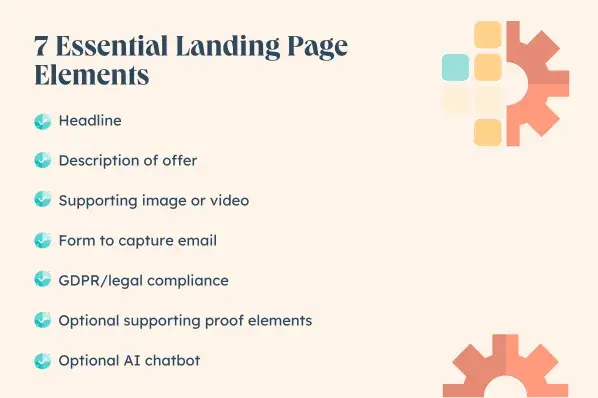
landing page elements. headline. description of offer. supporting image or video. form. gdpr compliance. optional supporting proof elements. optional ai chatbot.

The basic elements of a great landing page are:

  1. A headline and (optional) subheading
  2. A brief description of what’s being offered
  3. At least one supporting image or short video
  4. Most importantly, a form on the landing page itself to capture information. If, for some reason, you can’t include a form on the landing page, use a large CTA button to direct visitors to the next step.
  5. GDPR compliance and any other legal requirements
  6. It’s optional, but supporting proof elements like testimonials, customer logos, or security badges can build your credibility with new leads
  7. Optional AI chatbot

The difference between a landing page and your main website is that your website doesn’t have a single goal or call-to-action (CTA) for visitors to follow. The goal of a landing page is to tell your visitors exactly what you want them to do and why they should do it.

You can create as many landing pages as you want — one for every campaign or offer you launch, for example. According to a 2023 survey we conducted, over half of marketers have between five and 10 landing pages on their websites.

Homepages, while still an important element of a website, are typically less focused on a particular task because they serve the masses. They’re great for direct traffic, but when you can control how visitors arrive on your site, a landing page is the best place to send them.

When you have a specific product or campaign to promote, create a dedicated landing page for it. You can drive traffic to that page through email marketing, social media, and pay-per-click (PPC) advertising.

If your messaging and the rest of the landing page features are aligned with the visitor’s goals, you’ll have a greater chance of converting visitors into leads. In a 2023 HubSpot survey of 101 marketers, 10.9% say their landing pages have a 20% or higher conversion rate on average.

Wondering what it takes to get a stellar landing page conversion rate? Check out the tips below to learn what to put on a landing page to drive traffic and gain leads.

What to Put on a Landing Page: 10 Tips and Best Practices

1. Never use your homepage as a landing page.

It can be tempting to direct visitors to your website homepage simply because you’re unsure what to put on a landing page in the first place.

But if you’re running a campaign for a specific product or offer, you need a dedicated landing page.

As mentioned above, homepages typically have too much messaging, making visitors feel lost. I’d also recommend not using a main site product page either.

Even if your homepage and sub-pages are awesome, a dedicated landing page will perform better when it comes to converting visitors into leads because they are focused on one task.

Plus, you don’t need experienced design skills to create landing pages. You can use a landing page builder to seamlessly create a landing page that matches your website and offering.

In fact, our survey found that 43.6% of marketers use pre-made CMS themes and templates to create their landing pages.

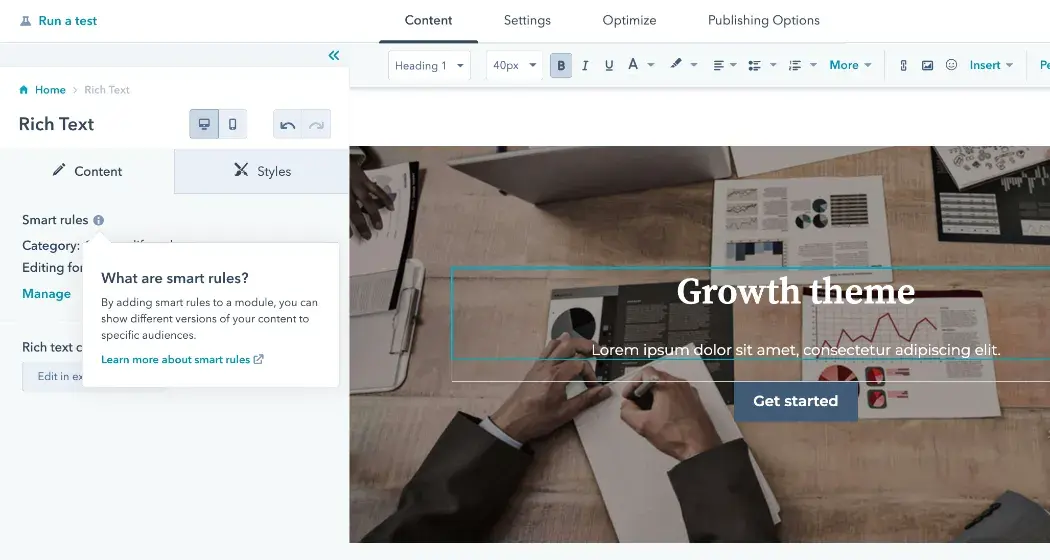
screencap of hubspot’s free landing page builder.

Get Started With HubSpot’s Free Landing Page Builder

2. Follow the standard structure.

Your headline should be benefit-focused to let people know right away what’s in it for them. Keep it brief while clearly communicating your offer. You can go into more detail with a brief description.

The description should emphasize the benefit in the headline and provide a few more reasons why visitors should convert. Writing compelling copy that engages users can be a challenge at times. But don’t let this part slow you down in the landing page process.

Instead, consider using an AI tool like HubSpot’s Campaign Assistant. The tool can help you generate copy for your landing page in seconds — all you have to do is refine it so it’s in your brand voice.

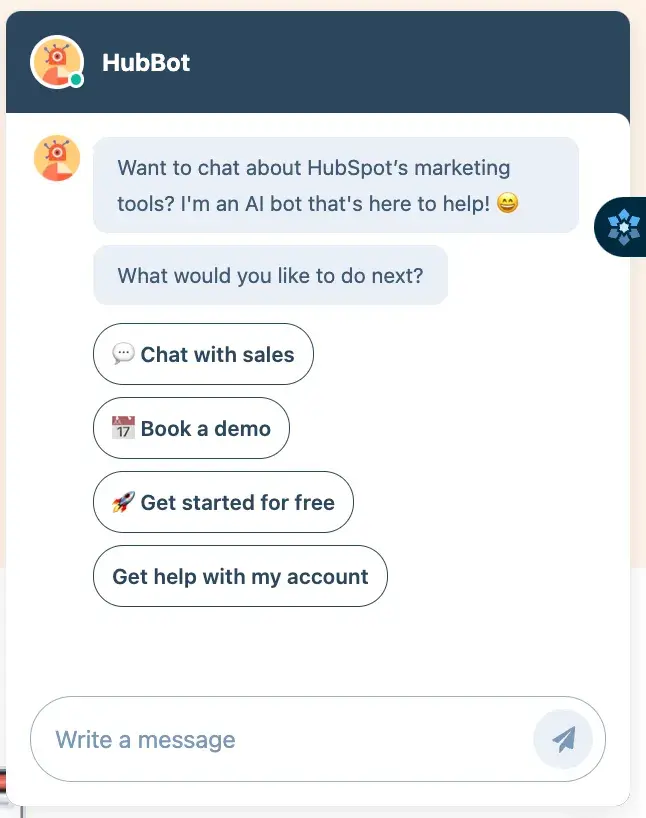
Speaking of AI: If you have an AI chatbot, consider using it on product landing pages. Here’s an example from HubSpot’s landing page for its landing page builder (say that 10 times fast):

screencap of hubspot’s ai chatbot.

Finally, don’t skip the visuals.

Of marketers surveyed, 38.6% say that video is the landing page element that most positively impacts conversion rate, while 35.6% say imagery or graphics do.

In either case, landing page visuals are clearly impactful, so take your time developing images and videos for your landing page campaigns.

3. Remove extra navigation.

A landing page is used for one purpose and one purpose alone — to encourage a visitor to take a specific action.

To keep visitors focused on your landing page’s content and message, remove the main site navigation from the page so they don’t move off the page.

We ran an A/B test for paid ad visitors and found that removing the main navigation boosted our CVR by 11%. Rebecca Hinton, a CRO strategist here at HubSpot, says, “If you send [paid ad visitors] to a website with full navigation, maybe they get distracted. Maybe they just [wanted the ebook].” HubSpotter Curt del Principe talked to Hinton and has the whole story, plus everything you need to run your own A/B test.

You should also be mindful of navigation as it relates to the lead generation on your landing page. If you have a form, keep your questions to a minimum. Of the marketers we surveyed, 30.7% suggest four is the ideal number of questions to put on a landing page.

Need to add a form to your landing page? You can easily put together a form using HubSpot’s free form builder tool.

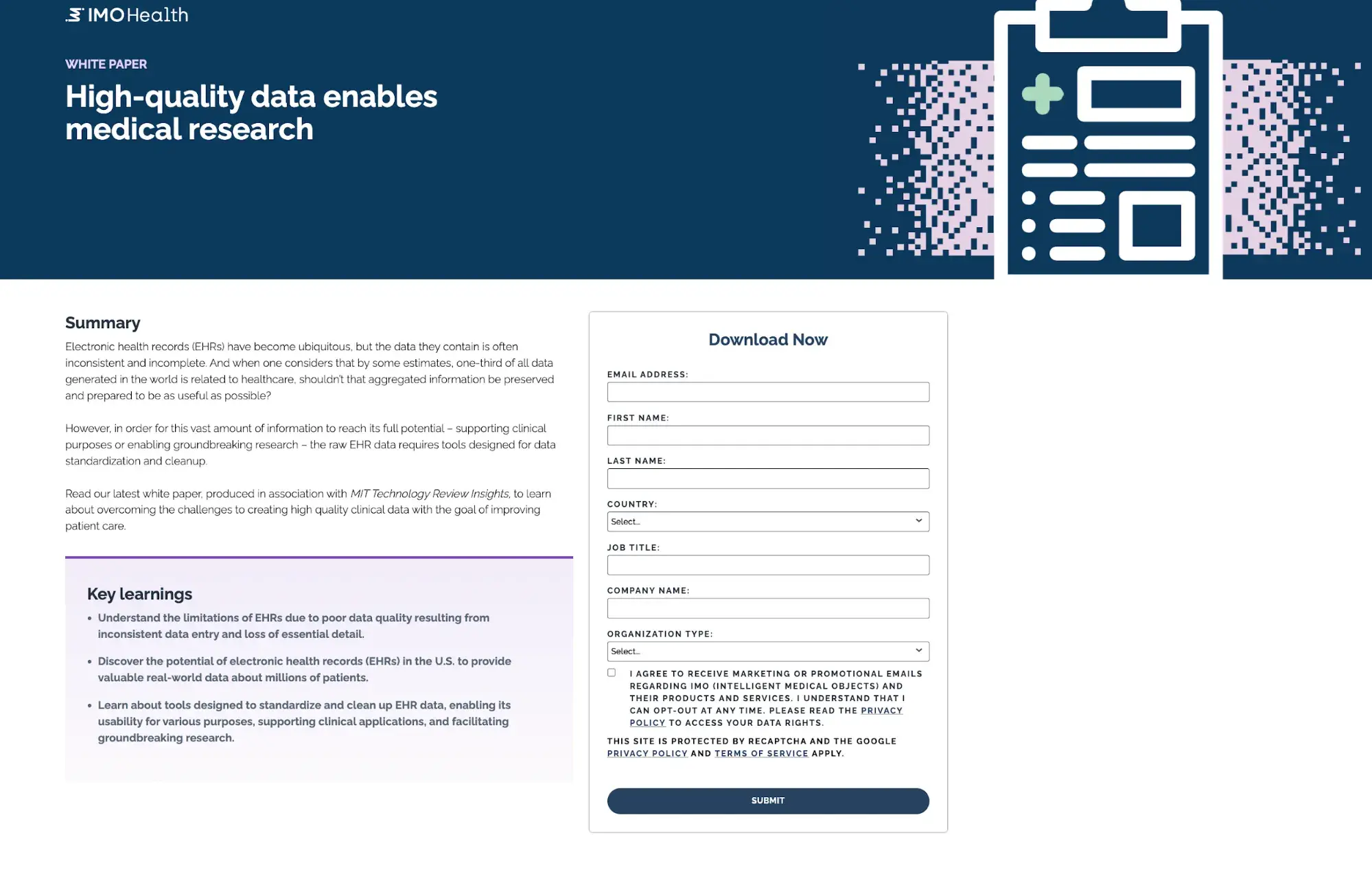
In the landing page example below from MIT Technology Review, the form includes seven fields to fill in, with one being optional.

The rest of the page is straightforward, offers clear navigation, and outlines exactly what you’ll get after submitting the form.

screen cap of a landing page from mit.

Source

4. Keep the objective simple and straightforward.

Don’t stuff too much information on your landing pages. Make it clear what the page is about and what you want the visitor to do.

Limit the amount of copy, images, media, and links to only what’s necessary, and organize your content in a proper structure so objects are in logical order. It’s especially important that the CTA is as crystal clear as possible for the visitor.

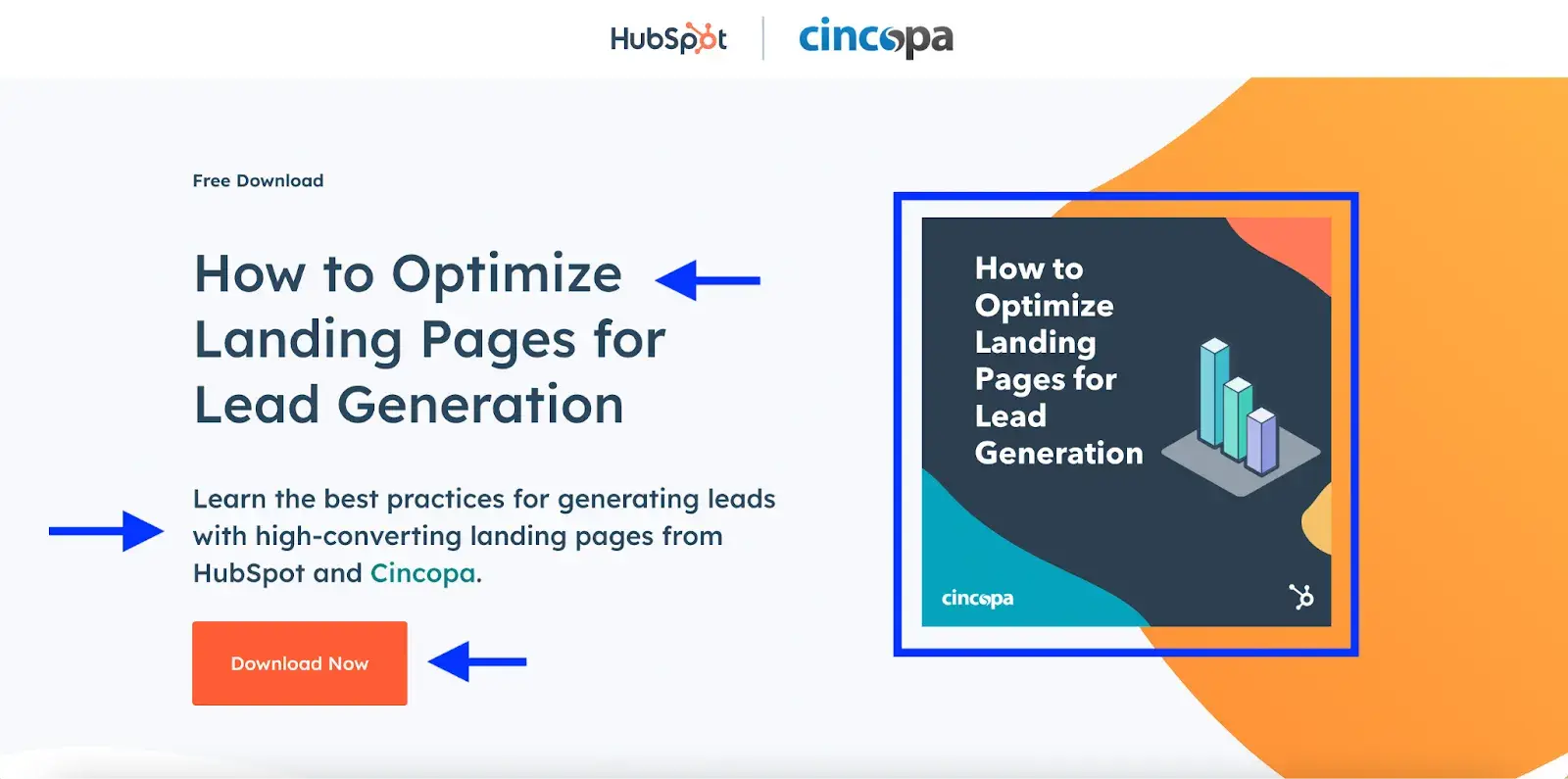
Let’s take a look at an example landing page from HubSpot. This landing page is designed to promote a free guide about optimizing landing pages for lead generation.

The design is simple — as soon as a visitor lands on the page, they’re greeted with the most essential elements:

  • A headline
  • Brief description
  • CTA button
  • Image or video

screencap of a hubspot landing page.

Source

The headline and description are clear and let visitors know exactly what the offer is and why they need it. The CTA button is also straightforward, which is another best practice for landing pages.

Looking for more inspiration for your landing page? Check out these stellar landing page examples.

When thinking about your CTA button, avoid using the word “Submit” — it’s vague and it doesn’t let the user know exactly what they’re submitting their information for. Always use language that indicates what they’re getting in return.

For example, “Download Now,” “Get your Free Evaluation,” or “Join our Mailing List.”

5. Match the content to a visitor’s previous source.

Whether a visitor comes from a PPC ad, email, or CTA from another source, ensure the messaging matches throughout the entire conversion path.

If your PPC ad says, “Download our Marketing Ebook,” your landing page should say the exact same thing — or be similar enough that users know they’re in the right place.

If there is a disconnect in your messaging, visitors will feel as if they are in the wrong place and will likely hit the “Back” button.

6. Reduce friction.

Friction is caused by objects (or missing objects) on a page that inhibit a visitor from taking action. This can include providing too much information (adding complexity), animation that is distracting, lack of customer proof or security, etc.

Make your visitors feel confident in their choice to provide their information. To reduce friction, keep the page simple.

Include your most important elements, like the main message, your offer, and the lead generation form, at the beginning of the page.

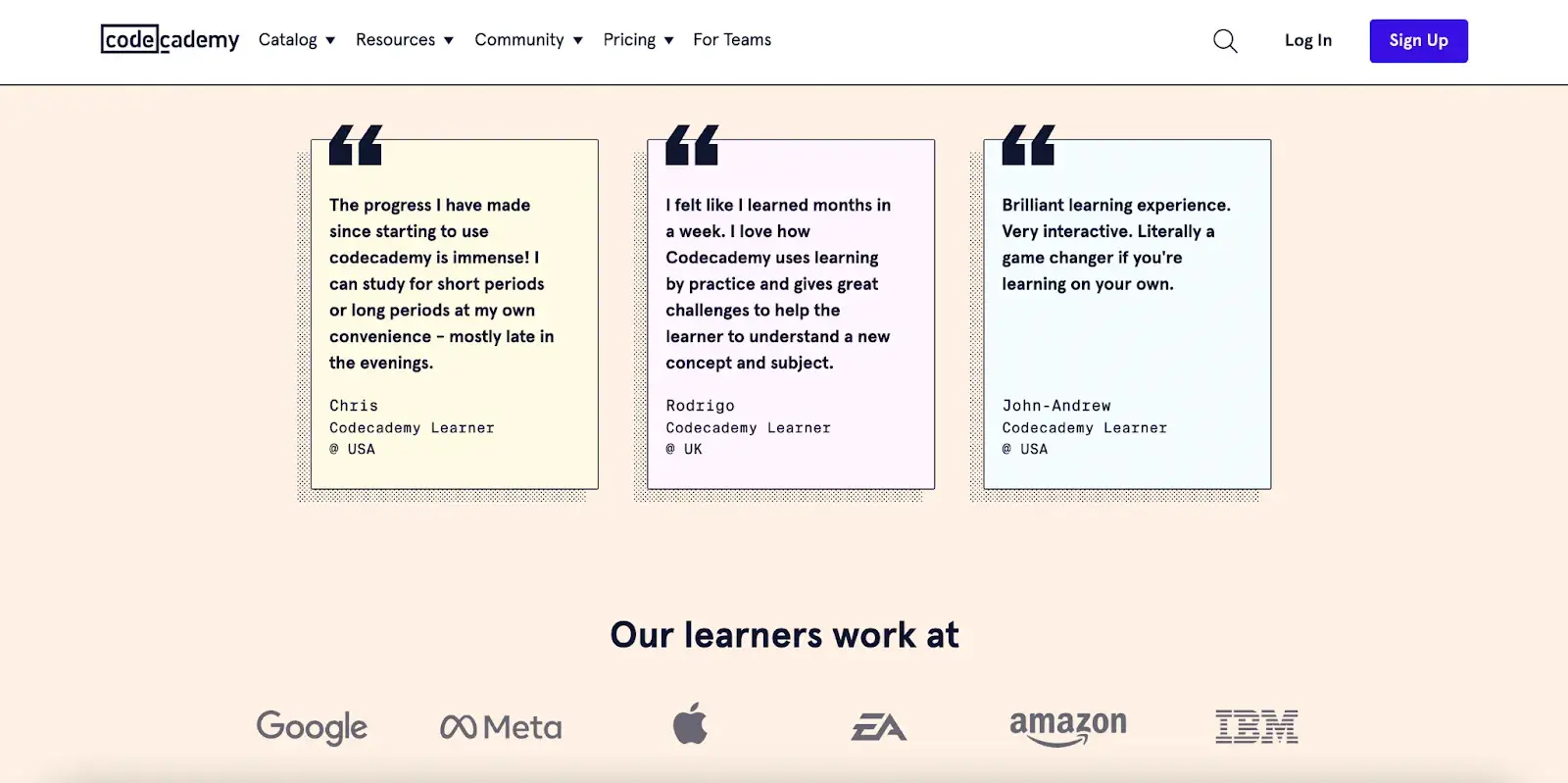
Save the more detailed description, testimonials, and FAQs for later in the page as the visitor scrolls down.

screencap of customer testimonials on codeacademy.com.

Source

Don’t require visitors to read too much, and don’t present internal links that will lead them away from the landing page.

Do include social proof elements such as customer testimonials, number of downloads or sales (to indicate acceptance from others), or security badges (if you’re dealing with sensitive data such as credit card information).

And, as mentioned above, make sure messaging matches throughout their conversion path.

7. Focus on value.

What you put on a landing page is just as important as what the landing page is for in the first place.

While landing page campaigns should be used often in your lead generation strategy, be intentional about what you’re offering.

The offer has to be valuable for leads to exchange for their information, and it has to be something they can’t get anywhere else.

Here are a few examples of what provides value and what doesn’t:

  • Don’t create a landing page to download a fact sheet (never put these behind a form).
  • Do create a landing page for a valuable whitepaper.
  • Don’t use a landing page for “Contact Us.”
  • Do use one for a valuable guide, free trial, demonstration, or evaluation. Offering something of value will enable you to generate more leads so you can nurture them over time until they are ready to buy.

8. Only ask for what you need.

When it comes to lead generation forms, there is no magic answer for the number of form fields that should be required.

But here is one simple rule of thumb: Only ask for what you or your sales team really needs. If you don’t need their hair color, don’t ask for it. Try to stay away from sensitive or confidential information, too.

As for contact information, depending on what you’re generating leads for, name and email address is usually enough. HubSpot’s forms (below) ask for information based on whether you’re already in our CRM — that way, you don’t have to input info we already have.

If you want to ask for more, 25.7% of marketers in our survey agree that a phone number is the next most important thing to request on a landing page form after name and email.

screencap of hubspot’s reduced field form.

9. Create a lot of landing pages.

Every new campaign or offer needs a landing page. The more landing pages you have, the more opportunities to convert traffic into leads.

And because these landing pages aren’t directly linked in your website’s navigation, you don’t need to worry about crowding your site or distracting visitors who are casually browsing your company page.

According to our 2023 survey, a majority of marketers (37.6%) have five or fewer landing pages on their websites. However, 6.9% of marketers have over 26 landing pages on their websites.

There is no magic number, but you can create as many landing pages as you have offers.

10. Make your landing pages shareable.

This is optional, but it’s another great way to drive more visitors to your landing pages.

Include social media sharing links or a social sharing widget on your landing pages so visitors can easily share that content with their own personal networks, and, in turn, drive more opportunities for converting leads.

If you partner with another company on an offer — let’s say an ebook — make a plan for both teams to distribute the landing page on their channels. The more coverage you can get, the higher the chance of visitors you’ll have.

Evaluate your landing pages, and use these best practices as a checklist for setting up the perfect page.

Effective landing pages are what will turn your website into a lead-generating machine. And don’t forget to test your landing pages to see which ones work best for you.

Create Great Landing Pages

There are really just a few essential elements that you should feature on your landing pages — this isn’t the time for maximalism. Use these tips to create landing pages for your products or offers, and watch your conversions grow.

Editor’s note: This post was originally published in March 2013 and has been updated for comprehensiveness.

Categories B2B

Why NetLine is Heading to Forrester’s 2025 B2B Summit to Master Buying Mayhem

Buying in 2025 is chaotic.

Today’s buyers are contending with economic uncertainties, decision-making complexities, and ever-growing buying committees (59% of which now involve four or more stakeholders). 

That’s what makes Forrester’s theme for its annual summit so poignant.

TL;DR: Why Should You Care?

NetLine is leading two sessions to help marketers navigate lead generation and intent data at Forrester’s 2025 North American Summit. Here’s what we’re talking about:

  • Session 1: Harnessing Intent Data to Drive Revenue 
      • See how Paycor leverages NetLine’s lead gen to expand reach, accelerate sales, and fuel pipeline growth with data-driven strategies.
  • Session 2: Right Buyer, Right Time, Right Now 
    • Discover how Programmatic Lead Generation enables B2B marketers to scale, capture high-quality first-party leads, and deliver verified prospects within minutes.

Bonus: The first 50 attendees of Harnessing Intent Data to Drive Revenue get a physical copy of NetLine’s Marketing Mastery Workbook!

Why Buying Mayhem Is the Perfect Theme for 2025

via GIPHY

A few weeks from now, NetLine will be in Phoenix, AZ, for Forrester’s North American Summit.

This annual gathering brings together the brightest minds in B2B marketing, sales, product, and customer engagement.

This year’s theme, Mastering Buying Mayhem, couldn’t be more relevant.

Data from NetLine’s 2024 and forthcoming 2025 State of B2B Content Consumption and Demand Reports makes it clear: marketers are navigating a perfect storm of evolving priorities, growing consumption gaps, and heightened demands for personalization.

Here’s what the findings reveal:

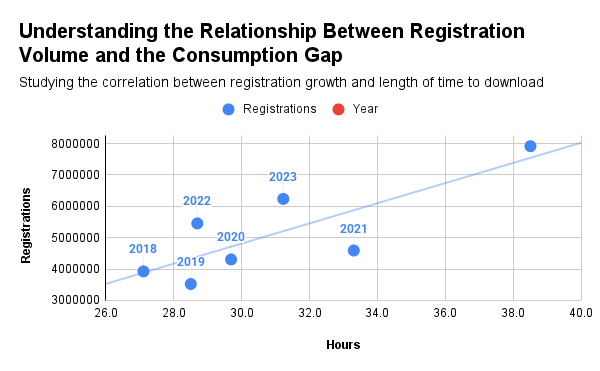
  • The Chasm Between Curiosity and Action: Between 2023 and 2024, the time between content request and consumption (NetLine calls this The Consumption Gap) increased by 7.3 hours, a 23.3% rise. This gap now stands at 38.5 hours. 

Source: NetLine’s 2025 State of B2B Content Consumption and Demand Report

For marketers, this means crafting full-scale nurture strategies that not only respect but capitalize on the delay is critical.

  • Intent Data is Transformational: Armed with the backing of NetLine’s audience intent data, marketers can pinpoint who their prospects are and when they’re most likely to act.

    For instance, Playbooks and Case Studies are each over 100% more likely to be associated with purchase intent within 12 months compared to other formats.
  • AI is Reshaping Content Preferences: One year after surging 5.5x, demand for AI-related content skyrocketed 186% YOY.

    Industries like Biotech, Legal, and IT led the charge, signaling a growing reliance on technology to navigate buying complexities.
  • C-Level Consumption is Soaring: Engaging high-level decision-makers with concise, actionable content is crucial. Registrations from executives have grown 26.5% YOY and now represent 12.7% of all demand.

Why NetLine is Excited to Join the Conversation

NetLine has always championed first-party data and shared buyer-level intent data‘s power in recent years.

At Forrester’s 2025 North American Summit, we’ll be leading two sessions designed to help marketers make sense of the chaos:

Session One: Harnessing Intent Data to Drive Revenue
Your buyers are everywhere—are you?

Our client, Paycor, is.

In this session, Paycor will show you how they use NetLine’s programmatic lead generation to expand reach, capture net-new leads, and accelerate sales at scale.

Learn how Paycor harnesses data-driven insights to engage the right buyers, test new strategies at speed, and drive pipeline growth with high-quality leads. Walk away with their best-kept demand gen secrets.

And if that’s not enough to get you to join us, the first 50 attendees will also receive a physical copy of NetLine’s Marketing Mastery Workbook!

Session Two: Right Buyer, Right Time, Right Now: Unlocking Scale, Speed, and Results with Programmatic Lead Gen
Traditional lead generation is too slow, inefficient, and plagued by low-quality leads. 

To win, marketers must reach the right buyers at the right time—at scale. 

NetLine is changing the game with Programmatic Lead Generation.

Learn how this approach to lead gen helps B2B marketers scale across 15K+ trusted B2B publishers, capture fully-permissioned, first-party leads, gain deep insights into buyer behavior and intent, and deliver verified leads within minutes so that sales can act fast.

What to Expect at Forrester’s 2025 B2B Summit

The theme underscores the necessity of aligning every aspect of an organization’s go-to-market strategy to create meaningful, memorable customer experiences.

As Forrester’s analysts have emphasized, achieving this mastery requires:

  • Resetting Routes-to-Market: Rethinking how we reach and engage buyers amidst shifting expectations.
  • Activating Buyer Insights: Leveraging tools like NetLine’s intent data to tailor messaging with pinpoint accuracy.
  • Harnessing Technology and Data: Streamlining operations with automation and analytics to stay ahead of the curve.

Dancing in the Desert

Phoenix in April promises to be an incredible convergence of ideas, insights, and innovations—a must-attend event for anyone invested in mastering the art and science of B2B marketing. 

Forrester’s 2025 B2B Summit North America will not only explore the intricacies of buying mayhem but provide attendees with the frameworks and tools needed to conquer it.

Whether you’re an experienced marketer looking to refine your strategies or a newcomer eager to make an impact, this event is your chance to learn, connect, and lead. 

Be sure to stop by our booth (#210!) and attend our sessions—we can’t wait to see you there.

Until then, let’s embrace the mayhem together.

Categories B2B

The Most Effective B2B SaaS Marketing Tactics — Everything I Know as a Marketer

When I worked in-house at a SaaS company, marketing felt like an endless challenge. We covered all the basics: paid campaigns, blog content, and email marketing. On paper, it looked like we were doing everything right. But users weren’t converting, and growth stalled.

Something was off. It wasn’t a lack of effort but a lack of alignment. We didn’t fully understand how customers found and engaged with our product. I needed better insights into their journey, so I met with the product team to dig into feature usage, trial behaviors, and key friction points.

Download Now: Free Marketing Plan Template [Get Your Copy]

This collaboration transformed our strategy. For example, many trial users hit a wall right after signing up. They struggled to get started, so we built educational content and onboarding flows designed to guide them. This simple change boosted activations and drove long-term conversions.

I’ll share the strategies and metrics that helped us turn things around in this post. Whether your goal is to grow trial users or win enterprise accounts, these tactics will help you build a scalable and sustainable SaaS marketing engine.

Table of Contents

What is B2B SaaS marketing?

B2B SaaS marketing builds strategies that drive brand awareness, user acquisition, and customer retention for cloud-based software products. Compared to other industries, B2B SaaS relies heavily on digital touchpoints to attract, educate, and convert customers across a longer buying process.

Your goal is to show potential customers how your product solves their business challenges. Effective SaaS marketing goes beyond generating leads. It involves collaboration between product, marketing, and sales teams to remove friction and improve the customer experience at every stage.

In my experience, three key factors shape successful SaaS marketing:

  • Customer pain points. What specific problems does your product address? Clear, targeted messaging is critical.
  • Buyer personas. Who are you targeting? Different personas, from end users to decision-makers, have varying priorities.
  • Sales cycles. Are you offering a freemium model, a trial-to-paid conversion, or a longer enterprise cycle? Your marketing tactics should reflect the customer journey.

Recurring revenue models, evolving user needs, and fierce competition create unique challenges for SaaS companies. Marketing must consistently provide value — through both product and communication — well beyond the initial sale.

Learn more about how to create an effective SaaS marketing plan here.

10 Effective B2B SaaS Marketing Strategies

The most effective SaaS marketing strategies connect your product’s strengths to your customers’ goals. Collaborating across teams is essential.

The product team offers insights into feature adoption and usage trends, while customer success can provide feedback on pain points and wins. Coordinating these efforts can help you design strategies that resonate with customers at different stages.

Below are key strategies I’ve found highly effective in B2B SaaS marketing.

1. Growth Loops

Growth loops generate compounding results by integrating referrals and virality directly into your product or marketing processes. Unlike a funnel, which ends with a conversion, a growth loop (or flywheel, as we like to call it at HubSpot) creates a feedback cycle where users generate new users.

For example, Slack promotes growth through team invites. A single user invites their entire team, creating multiple new accounts. Similarly, platforms like beehiiv incorporate a viral loop — emails sent through the platform display a “Publish on beehiiv” badge that leads recipients to the website.

Why it works: Organic growth through referrals builds a strong foundation for both acquisition and retention, reducing reliance on paid channels.

2. Website and Homepage Optimization

Your website — especially your homepage — often forms a potential customer’s first impression of your SaaS product. If visitors don’t find what they need quickly, they may leave.

In my experience, a strong homepage needs to address three core questions:

  • Desire. Does this product solve a problem that matters to me?
  • Role. Can I see how this product fits my needs and goals?
  • Belief. Is this product trusted and used by others like me?

I think Webflow’s homepage effectively speaks to user desire by showcasing how the platform empowers creativity.

b2b says marketing strategy: optimized homepage from webflow

Source

Notion builds trust with detailed customer studies and testimonials that highlight success stories.

Why it works: Clear messaging that anticipates user questions builds trust, reduces decision fatigue, and encourages next steps.

3. Content Marketing and SEO

In my experience, content marketing and SEO play a major role in building awareness and generating organic leads. When people have a problem, their instinct is often to search for answers. Your content needs to show up and provide those answers, which builds credibility and trust.

For SaaS businesses, this means focusing on three types of landing pages:

  • Feature pages. Explain your product’s core features.
  • Use case pages. Highlight real-world applications for different roles or industries.
  • Comparison pages. Show how your solution compares to competitors.

SEO has become more complex with AI-generated summaries and greater content competition. Even with these changes, I’ve found that the basics — relevant keywords, clear structure, and content that solves user problems — still matter.

Well-targeted blog content helps attract potential customers at the discovery phase, guiding them toward becoming leads.

Why it works: SEO content builds long-term visibility and attracts leads actively searching for solutions. A strong mix of targeted pages and supporting blog posts creates a steady pipeline of potential customers.

4. Community Marketing

Building a community can take your marketing to the next level. Whether it’s a Slack group, a webinar series, or a newsletter, a strong community offers value and builds loyalty over time.

For example, I like how Clearscope runs webinars with industry experts that attract marketers looking to level up their SEO skills. These webinars consistently attract marketers and build brand credibility.

b2b saas marketing example: webinars from clearscope

Why it works: People tend to trust and advocate for brands they feel connected to. Building a community helps create these relationships, leading to increased word-of-mouth referrals and long-term customer loyalty.

5. Email and Newsletter Marketing

Email marketing is more than transactional updates or onboarding messages. A well-structured newsletter can engage both leads and customers by consistently delivering valuable content.

Take the Animalz newsletter, for example. It provides real-world marketing insights based on internal experiments and feedback from its audience.

b2b saas marketing: animalz newsletter

Source

I love that they focus on giving readers helpful strategies instead of promoting their services. One feature allows readers to request pricing details for certain types of blog content, which leads to hundreds of new signups.

Why it works: Targeted, helpful emails keep readers engaged and guide them toward taking the next step with your product. Over time, these emails strengthen customer relationships and encourage deeper product adoption.

6. Launching an Affiliate Program

Affiliate programs offer a scalable way to grow your user base. Customers, influencers, and partners refer new users to your product in exchange for a commission. Unlike traditional ads, where you pay upfront, affiliates are compensated after conversions, which I find makes it easier to control costs.

Jasper AI is a great example of a SaaS company with a thriving affiliate program. They offer ongoing commissions that keep partners motivated to refer users. Tools like PartnerStack and Rewardful simplify affiliate management by automating payouts and tracking referrals.

Why it works: Word-of-mouth referrals carry more weight than ads. Affiliate programs capitalize on this trust while keeping acquisition costs under control, creating a reliable growth channel.

7. Micro-Influencer Sponsorships

Micro-influencers may not have the largest followings, but they build strong connections with their audiences. Many focus on niche topics, which makes them valuable partners for SaaS companies targeting specific industries. Their authentic engagement can help increase both awareness and conversions.

An excellent example is Sara Stella Lattanzio’s collaboration with Semrush. Through LinkedIn posts, she shares her experiences with Semrush’s tools, prompting her audience — many of whom were marketers and SEOs — to check out the product for themselves.

micro-influencer sara lattanzio does b2b saas marketing for semrush

I personally love her posts because they never feel like she’s selling something. She provides the what, why, and how to do something by using the product without ever pushing the sale.

Why it works: Niche influencers maintain high trust with their followers. Their endorsements often outperform traditional ads in converting leads within targeted markets.

8. Product Hunt Launch

Launching on Product Hunt can generate a spike in visibility and traffic for SaaS products, especially among early adopters and tech professionals. It’s a platform where users upvote and discuss new tools and innovations.

A successful launch can drive thousands of visitors to your site in just a few days. To maximize results, I find it helps to plan ahead:

  • Timing. Launch early in the day to maximize your product’s visibility on the homepage.
  • Community engagement. Encourage your network to support the launch with upvotes and comments.
  • Hunter partnerships. Collaborate with a well-known “Hunter” to help broaden your reach.

Why it works: Product Hunt attracts decision-makers and early adopters who are actively looking for new tools, making it a great platform to generate leads and momentum.

9. Manual Outreach via LinkedIn & Email

For SaaS products with longer sales cycles, reaching out directly to prospects through LinkedIn and email can open doors to high-value opportunities. This approach focuses on finding the right leads and crafting personalized messages that address their business challenges.

Tools like Hunter.io and LinkedIn Sales Navigator can help identify decision-makers and gather context on their needs. Personalization is key — sending generic mass messages often leads to poor engagement and hurts your reputation. A thoughtful message that offers immediate value stands out.

I once contacted a VP of Product after spotting a scaling issue their platform faced. I shared a few tailored suggestions in my email, which led to a demo and eventual conversion. In my experience, that level of personalization consistently delivered higher response rates than generic outreach.

Why it works: Thoughtful, personalized outreach helps establish trust and credibility with potential customers, leading to stronger relationships and higher conversion rates.

10. Paid advertising

Paid ads can help SaaS companies grow quickly, but scaling requires careful planning to manage costs and returns. In my opinion, choosing the right platforms is crucial to targeting the right audience. Common channels include:

  • Google Ads. Best for prospects searching for specific solutions.
  • LinkedIn Ads. Great for reaching professionals based on job title, company size, or industry.
  • TikTok & Facebook Ads. Better for brand awareness, especially for freemium or B2C models.

Tracking customer acquisition cost (CAC) and lifetime value (LTV) is essential to scaling ad campaigns sustainably.

Why it works: Paid advertising accelerates lead generation and boosts visibility. With the right targeting and budget management, ads can provide significant short-term growth.

6 B2B SaaS Marketing Benchmarks to Measure Success

Monitoring the right benchmarks helps SaaS companies track performance and refine their strategies. These metrics provide insights into how well your marketing efforts drive growth and profitability.

1. Customer Acquisition Cost (CAC)

CAC measures the total cost of acquiring a new customer. This includes expenses for marketing, sales, and lead generation activities.

High CAC can reduce profitability, so I recommend finding ways to lower costs without sacrificing conversions. As your business grows, optimizing CAC becomes crucial to scaling sustainably.

Why it matters: CAC highlights how effectively your marketing and sales strategies attract customers. Keeping CAC manageable is essential for long-term profitability.

2. Lifetime Value (LTV)

LTV calculates the total revenue a customer generates over the course of their relationship with your business. It helps determine how much you can afford to spend on acquiring new customers.

For example, SaaS companies often boost LTV through upsells, such as offering premium features or product add-ons at key points in the customer journey.

Why it matters: LTV sets a limit on how much you can invest in customer acquisition. A higher LTV allows for more flexibility in marketing budgets and helps improve overall profitability.

3. Conversion Rates

Conversion rates show how many visitors take a specific action, like signing up for a trial, requesting a demo, or making a purchase.

Monitoring conversion rates across your funnel stages helps pinpoint where prospects lose interest. This insight reveals where to focus improvements. For instance, I’ve found updating landing pages with stronger calls-to-action (CTAs) and customer testimonials can drive more demo signups.

Why it matters: A higher conversion rate signals that your messaging, design, and CTAs are effectively moving prospects through the funnel.

4. Retention Rate (Churn)

Retention rate tracks how many customers continue using your product over time, while churn measures cancellations. These two metrics go hand in hand with LTV — the longer customers stick around, the higher their value.

I suggest improving retention through better onboarding, product education, and proactive support. For example, personalized onboarding flows and timely updates keep customers engaged and reduce early churn.

Why it matters: Strong retention boosts LTV, lowers acquisition pressure, and supports long-term revenue growth.

5. Organic Traffic

Organic traffic refers to visitors who reach your site through search engines rather than paid channels. It plays a key role in driving scalable growth for SaaS businesses.

SEO and content marketing help attract high-intent leads actively searching for solutions. Over time, strong organic performance reduces reliance on paid acquisition, bringing down CAC.

Why it matters: Organic traffic builds brand visibility and delivers a steady stream of potential leads without the ongoing expense of paid ads.

6. Net promoter score (NPS)

NPS® measures how likely customers are to recommend your product. Customers rate this likelihood on a 0-to-10 scale, with higher scores reflecting greater satisfaction and loyalty.

Companies use NPS to spot areas for improving customer experience. I think an additional perk of this metric is that a strong score can also indicate that your customers are happy enough to refer others, driving organic growth through word of mouth.

Why it matters: NPS provides a snapshot of customer loyalty and can predict growth through referrals. High scores often lead to better retention and stronger advocacy.

Start Your Path to Sustainable B2B SaaS Growth

Writing this article reminded me that successful SaaS marketing is about balancing short-term wins and long-term investments. Paid ads or outreach can deliver quick growth, but lasting success comes from ongoing efforts in SEO, content, and customer retention.

Adaptability is key. Regularly track metrics like CAC, LTV, and retention to stay informed on what’s working. Keep experimenting and iterating based on the results you see.

It’s your turn now. Test these strategies, measure your progress, and build a B2B marketing engine that drives steady growth and customer loyalty.

Categories B2B

45 Video Marketing Statistics for 2025 [New Data]

Recent video marketing statistics show that visual storytelling wins. Video is an increasingly powerful way to communicate your brand story, explain your value proposition, and build relationships with your customers and prospects. I personally like the storytelling, relatability, and brevity of video content.

To help you leverage video in your marketing, I’ve gathered new video marketing statistics from HubSpot and third-party studies to highlight how marketers use video, its performance, and more.

Download Now: Free Video Marketing Trends Report

And if you’re looking to get started with your own video marketing, say, yesterday, check out Clip Creator — our free AI-powered video maker.

Table of Contents

General Video Marketing Statistics

1. 89% of businesses use video marketing. (Wyzowl Video Marketing Statistics 2025)

2. 13.99% of marketers say they’ll invest more in video marketing channels in 2025. (HubSpot 2025 State of Marketing)
video marketing statistic on 13.99% of marketers who say they’ll invest more in video marketing channels

3. 93% of marketers consider video a crucial part of their overall strategy. (Wistia 2024 State of Video Report)

4. 37% of marketers say they haven‘t adopted video marketing because they don’t know where to start. Other common reasons include lack of time (26%), uncertainty about video marketing ROI (16%), perceived high costs (11%), difficulty convincing decision-makers (5%), and not seeing the need for video (5%). (Wyzowl Video Marketing Statistics 2025)

reasons for not using videohttps://www.wyzowl.com/video-marketing-statistics/

5. 65% of marketers who don’t use video marketing say they plan to start in 2025. (Wyzowl Video Marketing Statistics 2025)

6. 18% of businesses leverage AI tools for their video content production. (Wistia 2024 State of Video Report)

7. Auto-generating captions and transcripts is the top AI use case (59%) for videos. (
Wistia 2024 State of Video Report)

top ai use cases for videoshttps://wistia.com/learn/marketing/video-marketing-statistics

8. 254% more businesses captioned their videos in 2023 than in 2022. (Wistia 2024 State of Video Report)

9. Tech marketers create videos to explain complex products (49%), improve brand awareness (39%), branding (31%), generate leads (29%), launch a product/service (27%), increase engagement (24%), and increase conversion rates (17%) (VidCo 2024 State of Video Marketing Report)

10. 55% of marketers produce videos in-house, 14% outsource to vendors, and 31% use both. (Wyzowl Video Marketing Statistics 2025)

11. Company websites are the number one platform businesses share their video (67%). Followed by email (49%), LinkedIn (43%), YouTube (40%), Instagram (22%), Facebook (19%), TikTok (7%), and X (4%). (Wistia 2024 State of Video Report)

12. Company video marketing budgets range from under $999 to over $20,000 monthly. (
VidCo 2024 State of Video Marketing Report)

video marketing budgetshttps://vidico.com/state-of-video-marketing/

13. When asked which content format they plan to invest more in for 2025, 17.13% of marketers chose short-form video, making it the top choice. 13.88% also said they’ll invest in live streaming.
(HubSpot 2025 State of Marketing)

video marketing statistics with content formarts seeing increased investment

14. 51% of marketers say they’ve used AI tools for video creation or editing, while 49% have not. (Wyzowl Video Marketing Statistics 2025)

15. In 2024, 36% of marketers invested in video ads, while 64% relied on organic reach. (Wyzowl Video Marketing Statistics 2025)

16. U.S. businesses spent more on digital video ads ($85 billion) than on traditional TV ads ($59 billion) (Statista)

17. When asked who makes videos for your company, 62% said individuals at the company, 46% said an in-house video producer or team, 21% said freelancers, and 16% said a video production agency. (Wistia 2024 State of Video Report)

Video Marketing Performance Stats

18. 93% of marketers report a strong ROI from video marketing. (Wyzowl Video Marketing Statistics 2025)

19. 21% of marketers say short-form videos deliver the highest ROI, while live-streaming video ranks third at 15.53%. (HubSpot 2025 State of Marketing)
video marketing statistics with content formats delivering the highest roi

20. Shorter videos drive higher engagement, but longer videos achieve more watch time. Videos under one minute average 16 seconds of watch time, while those 60+ minutes average 16 and 40 seconds. (Wistia 2024 State of Video Report)

21. The average engagement rate for 3-5 minute videos is 43%, but how-to videos of the same length see 74% engagement. (Wistia 2024 State of Video Report)

22. 74% of companies measure video ROI using engagement metrics like views, view rate, and average watch time. 48% use conversion rates. 48% use traffic and 33% use brand perception. (
VidCo 2024 State of Video Marketing Report)

how companies measure video marketing successhttps://vidico.com/state-of-video-marketing/

23. The top three video types companies aimed to create in 2024 are product videos (44%), educational, instructional, and online course videos (38%), webinars and live events (32%). (Wistia 2024 State of Video Report)

24. Marketers ranked YouTube as the top-performing video marketing channel in 2023. In decreasing order of performance, the other channels are website, Facebook, Instagram, TikTok, LinkedIn & email, and X & television. (VidCo 2024 State of Video Marketing Report)

how companies measure video marketing successhttps://vidico.com/state-of-video-marketing/

25. Companies A/B test videos by creating different versions of a video (31%), call-to-action (CTA) or email form (26%), two completely different videos (21%), custom thumbnail (18%), and player design or color. (4%) (Wistia 2024 State of Video Report)

Social Media Video Marketing Stats

26. In 2023, 35% of companies created social media videos and planned to do so in 2024, making it the fourth most common video type. (Wistia 2024 State of Video Report)

27. When asked which social formats they’ll invest more in 2025, the top three responses were YouTube (29.58%), Instagram (28.84%), and TikTok (27.64%). (HubSpot 2025 State of Marketing)
28. Short-form videos, like TikTok, Instagram Reels, and YouTube Shorts, are the most commonly used video formats among marketers, with 29.18% leveraging them in their roles. Additionally, 19.19% of marketers incorporate live streaming in their content mix. (
HubSpot 2025 State of Marketing)
video marketing statistics of content formats marketers use most

29. On TikTok, most top publishers uploaded videos shorter than 30 seconds. However, videos between 5 to 10 minutes got the highest average views (
Tubular 2024, State of Video)

video uploads per length vs total views per video lengthhttps://tubularlabs.com/research-guides/2024-state-of-video-social-media-playbook/

30. TikTok ad videos with captions get an extra 95% boost in brand affinity, a 58% increase in recall, and a 25% jump in uniqueness. (TikTok Creative Center)

31. 97% of LinkedIn videos are vertical. (The Reeder, 2025)

32. 78% of LinkedIn videos are shot with a smartphone, while 22% are shot using professional gadgets. (The Reeder, 2025)

33. 65% of LinkedIn in-feed videos don’t have a CTA. However, the most common CTAs are “Follow for more tips” (19%), “Check the link in my bio” (10%), and “Comment your thoughts” (6%). (The Reeder, 2025)

34. According to the
Wistia 2024 State of Video Report, the best times to post on social media are:

  • Instagram – Monday at 9 AM PST.
  • Facebook – Monday at 10 AM PST.
  • LinkedIn – Monday at 1 PM PST.
  • X – Friday at 9 AM PST.
  • YouTube – Saturday at 7 PM PST.

YouTube Shorts Marketing Stats

35. Alphabet Inc, YouTube’s parent company, reports that Shorts’ monetization rate relative to in-stream viewing has more than doubled in the past 12 months, indicating that advertisers are allocating more budget to Shorts. (Alphabet 2024 Q1 Earnings Call)

36. Shorts had an engagement rate of 5.91% in Q1 2024 — the highest of all short-form video platforms (Statista)

short-form video engagement rates from statista

Source

37. YouTube Shorts average over 70 billion daily views. (Alphabet Q3 Earnings Call)

38. Shorts had an average of 2 billion monthly viewers as of July 2023. (Statista)

39. 70% of YouTube channels that upload content each month post Shorts. (Alphabet Q3 Earnings Call)

40. The number of channels uploading Shorts grew 50% year-on-year in 2023. (Alphabet 2024 Q1 Earnings Call)

41. Since October 15, 2024, YouTube has allowed users to upload 3-minute long Shorts (Alphabet Q3 Earnings Call)

42. Advertisers (in up to 40 markets) can now book First Position on YouTube Shorts, meaning your ads get shown first when consumers scroll their Shorts feed. (Alphabet Q3 Earnings Call)

43. Most Shorts are 30-40 seconds long. However, 50-60 seconds Shorts get the most views. (
INFLOW Network)

youtube shorts duration vs viewshttps://inflownetwork.com/youtube-shorts-explained/

44. Videos with an average watch time of 50 seconds or more get 4.1 million views, whereas those with lower watch times tend to receive fewer views. (INFLOW Network)

45. GenZ consumers in the U.S. spent about 29.3% of their video time on YouTube in 2023. (Statista)

My Takeaways

The most important takeaway while working on this piece is the reminder that video marketing doesn’t have to be expensive. According to the VidCo 2024 State of Video Marketing Report, most companies have a budget of less than $5,000.

While content assets like customer case studies may require a professional touch, your in-house team can create other basic videos with their smartphones.

If you aren’t already using video marketing, create your strategy, pull out your phone, and start smiling for the camera. And if you already do video marketing, use the insights in this article to audit and improve your marketing strategy in 2025.

Editor’s note: This post was originally published in August 2015 and has been updated for comprehensiveness.

Categories B2B

How to Create a Stakeholder Map for Seamless Project Tracking

Six years ago, I led a website content overhaul that nearly derailed when the product team and sales department had completely different ideas about our messaging priorities.

Despite my experience with content strategies, I made a rookie mistake — I hadn’t created a stakeholder map. That experience pushed me to develop a systematic approach to stakeholder management.

Download Now: Free Project Management Template

Now, as a content strategist who’s guided content projects for over 30 SaaS companies, I’ve seen how the right stakeholder strategy can transform scattered feedback into a clear direction.

Table of Contents

What is a stakeholder map?

A stakeholder map is a visual document that plots out everyone who has influence over or is affected by your project. It shows who needs to be involved, how much influence they have, and how their priorities connect.

What makes it powerful is that it forces you to step back and see the whole picture. You document each stakeholder’s role, their level of influence, what they care about most, and how they prefer to communicate.

The map becomes your guide for managing expectations and preventing conflicts before they happen.

For example, when I create content strategies for SaaS companies, my stakeholder map typically includes product managers (who know the technical details), sales teams (who talk to customers daily), and executives (who hold the vision) — each bringing different needs to the table.

Stakeholder Map Example

Let me share a real stakeholder map I created for a recent SaaS website revamp project.

The map organized the different types of stakeholders into three key circles of influence:

circle of influence types of stakeholders

  Core Decision Makers

  • VP of Marketing: Final approval on messaging strategy and budget.
  • Content Director: Day-to-day decisions on content direction.
  • Product Marketing Manager: Product positioning and feature communication.

Key Influencers

  • Sales Director: Input on customer pain points and objections.
  • Product Manager: Technical accuracy and feature roadmap.
  • Customer Success Lead: User feedback and common customer questions.

Supporting Contributors

  • SEO Specialist: Keyword strategy and content optimization.
  • Brand Designer: Visual consistency and brand guidelines.
  • Legal Team: Compliance review and risk assessment.

For each person, I noted their primary concerns:

  • The VP of Marketing focused on market positioning and ROI metrics.
  • The Sales Director cared most about having strong customer case studies.
  • The Product Manager needed technical accuracy in feature descriptions.

This map helped me prioritize feedback and plan my communication strategy. When conflicting opinions arose about messaging priorities, I could refer back to each stakeholder’s core concerns to find common ground.

How to Create a Stakeholder Map

Understanding and identifying your key stakeholders is critical when launching new initiatives or making changes. It ensures smoother implementation and reduces resistance. Here are six steps to create a stakeholder map.

1. Identify and list all potential stakeholders.

Start with a comprehensive brain dump of everyone who might influence or be affected by your project.

As Menaka Gopinath, Chief Marketing Officer at Project Management Institute (PMI), explains:

“Critical is understanding who is going to be most impacted by the outcome, who is going to guide how you drive the outcome, and who you have to rely on to deliver the outcome.

“This helps guide where you can avoid unnecessary barriers — a lot of times, there is a cohort of people who just want to know what’s happening, even if they don’t play a critical role in delivering. Proactive communication at cadenced times can help avoid meddling that can take you off track.”

I include obvious stakeholders like direct supervisors and team members. But I also think broader and consider compliance teams who need to review deliverables, external partners who provide resources, and end users who will be impacted by the project outcomes.

Create a master list organized by department or function. For each stakeholder, note their role and potential contribution to the project. Look beyond formal titles — sometimes, a junior team member might have crucial institutional knowledge that makes them a key stakeholder.

Consider both direct and indirect stakeholders. Direct stakeholders actively participate in the project, while indirect stakeholders feel its effects without direct involvement.

For example, your IT team might not attend project meetings, but they’re crucial stakeholders if your project requires technical implementation.

2. Assess power and interest levels.

Once you’ve identified your stakeholders, evaluate each one based on two key factors: their power (ability to influence the project) and their interest (how much they care about the outcomes). This assessment helps you determine how to manage each relationship effectively.

Create a simple grid with power on the vertical axis and interest on the horizontal axis. This visualization helps you place each stakeholder into one of four categories:

stakeholder map graph with four quadrants categorizing stakeholders by power and interest

As Gopinath notes, “At PMI, there is a great deal of learning available to guide stakeholder management. The Stakeholder Salience Framework prioritizes stakeholder engagement based on three attributes — Power, Legitimacy, and Urgency. The more attributes a stakeholder possesses, the greater priority you would put to engaging this stakeholder.”

3. Define communication preferences and needs.

Understanding how each stakeholder prefers to receive information is just as important as knowing what to communicate. Some stakeholders want detailed weekly reports, while others need only high-level monthly updates.

Document these preferences in your stakeholder map, noting:

  • Communication channels (email, meetings, project management tools).
  • Frequency of updates (daily, weekly, monthly).
  • Level of detail (executive summaries versus full reports).
  • Format preferences (visual presentations versus written documentation).

Many teams successfully use project management or CRM systems to track and manage these communication preferences systematically. This approach ensures everyone on your team knows how to engage with different stakeholders effectively.

According to Iqbal Ahmad, Founder of the Britannia School of Academics, this systematic tracking is crucial:

“We make sure that we have a clearly defined Stakeholders Map on our CRM that every member of our management and leadership team can see. This helps us in ensuring that priorities are set accordingly for each and every stakeholder.

“Similarly, if we are launching a new project, we make sure to have a specific stakeholder map for that project so that directed and specific project-related efforts can be made to ensure maximum stakeholder engagement.”

Preferences might change throughout the project lifecycle. Check in periodically to ensure your communication approach still serves everyone’s needs.

4. Plot internal vs. external dependencies.

Every project operates within a web of internal and external relationships that need careful management. Start by creating two lists of dependencies that could impact your project’s success.

Internal Dependencies External Dependencies
  • Legal team for compliance review
  • Finance for budget approval
  • IT for technical implementation
  • Product team for technical accuracy
  • Brand team for visual consistency
  • Clients or customers
  • Regulatory bodies
  • Vendors or contractors
  • Industry partners
  • External subject matter experts

As Sidharth Ramsinghaney, Director of Strategy and Operations at Twilio, explains, “Though corporate functions like IT security and finance remain constant, their relative influence and engagement levels shift. Starting with a clean slate for stakeholder mapping, coupled with a robust RACI framework and clear executive sponsorship structure, has proven crucial for project success.”

I recommend mapping these relationships in terms of their sequencing — which approvals or inputs need to come first?

For example, you might need legal approval before external vendor engagement or customer feedback before internal development can proceed.

Remember that dependencies aren’t just about approvals. Consider knowledge dependencies too — who holds crucial information your project needs? Document these information flows to prevent bottlenecks later.

5. Build feedback loops.

Regular feedback from stakeholders shouldn’t feel like pulling teeth.

I’ve found creating systematic ways to gather input helps you spot potential issues before they become problems and keeps everyone aligned with your project’s direction.

Digital analytics provide a quiet but powerful feedback channel. Track how stakeholders interact with your shared documents, which sections they comment on most, and where confusion typically arises. These patterns reveal more than what people might say in meetings.

Set up multiple channels for feedback based on stakeholder preferences. Some might prefer quick voice messages, while others give their best input through collaborative documents. The key is making feedback feel natural rather than forced.

Iqbal Ahmad shares, “To gather stakeholder information beyond traditional interviews and surveys, we have implemented innovative techniques tailored to the unique business environment in which we operate.

“One effective approach is leveraging data analytics to track real-time behaviors, such as engagement, completion rates, and feedback patterns. Another technique is using sentiment analysis on communication platforms like emails and social media. This provided a clearer understanding of stakeholder concerns and preferences without requiring extensive feedback sessions.”

Create regular checkpoints where stakeholders can raise concerns or share wins. But remember — not every stakeholder needs to weigh in on every decision. Be strategic about whose feedback you seek and when.

6. Plan for conflict resolution.

Stakeholder conflicts are inevitable, especially when multiple departments have different priorities for the same project. The key is having a clear system for resolving them before they derail your timeline.

I suggest creating a decision matrix that weighs each stakeholder’s input based on their role in the project. When the sales team wants more product features highlighted but the design team pushes for a cleaner layout, you’ll have a framework for prioritizing these competing needs.

Document how previous conflicts were successfully resolved. This builds an internal playbook you can reference when similar situations arise. Often, past solutions can be adapted for current challenges.

Ahmad explains how a prioritization framework and using other factors helps with this:

“We rely on a prioritization framework that evaluates stakeholders beyond the two traditional factors of interest and influence — by attempting to devise tactical solutions that meet the varying and competing expectations of stakeholders across different groups.

“For example, when student feedback demanded more flexible learning while our awarding organizations emphasized stricter compliance checks, we prioritized addressing both by designing stricter assessment and quality assurance checks to meet the expectations of both.

“Transparency and communication are key to managing such conflicts. We actively involve stakeholders in the resolution process, often through feedback loops or collaborative meetings.”

When conflicts arise, I prefer to focus discussions on project objectives rather than individual preferences. I find this shifts conversations from personal opinions to measurable outcomes that benefit the project.

Stakeholder Map Template

Starting with a tested template saves you from building your stakeholder map from scratch — and helps ensure you don’t miss critical relationships that could impact your project’s success.

HubSpot offers a stakeholder map template that makes this process simpler.

stakeholder map template

Download HubSpot’s free stakeholder map template now.

Use it to:

  • Track both internal stakeholders (like product teams and subject matter experts) and external ones (like clients and industry partners).
  • Document each stakeholder’s potential impact on project timelines and outcomes.
  • Plan communication strategies for different stakeholder groups.

Classify stakeholders, understand their potential contributions or roadblocks, and improve communication with everyone from investors to interest groups involved in your projects.

Start Building Your Stakeholder Strategy

Creating a stakeholder map might seem like extra work when you’re eager to dive into your project. But I’ve learned that this upfront investment pays dividends throughout the project lifecycle.

Start small — map out your next content project using the template and guidelines above. Pay attention to how relationships evolve and which communication approaches work best. Your first map won’t be perfect, and that’s okay.

Also, stakeholder mapping isn’t a one-time exercise. Let your map grow as you gain new insights about your stakeholders’ needs and priorities.

Categories B2B

I Asked Experts About Improving Keyword Rankings — Here Are Their Tips

I’ve been in content marketing for over a decade, and let me say that it’s never been this hard to rank highly in search.

The reason is that there’s a lot of content out there — Google says that it indexes “hundreds of billions of webpages,” which take up over “100,000,000 gigabytes in size.”

Download Now: Keyword Research Template [Free Resource]

With these numbers, does it even make sense to publish new articles? Absolutely — you just have to change your approach to creating content to improve your keyword rankings.

Here’s how to find out what your current rankings are, along with 11 tips to help you boost your positions.

Table of Contents

What is a keyword ranking?

A keyword is a phrase you enter into a search engine to get an answer to your query. In an ideal scenario, you’ll get a list of results matching your intent. Keyword ranking refers to a web page’s position in those search results.

For example, if we Google “best content marketing tactics,” HubSpot ranks first for this phrase and Outbrain second.

keyword rankings; google search results for the term “best content marketing tactics”

Why are keyword rankings important?

Since I started my marketing career, brands have fought to secure a spot in the top three search results — and for good reason. The number one result has an average click-through rate of 27.6%, which is 10 times higher than a source ranked in the tenth position.

As the saying goes, the best place to hide a dead body is on page two of Google. Most people don’t want to go through hundreds of websites to find an answer. They focus on the first page, trusting that a high-ranking site means high-quality content.

How to Check Your Keyword Ranking

There are two types of tools for checking keyword rankings:

  • Admin panels like Google Search Console (GSC), which provide data directly from search engines.
  • External software designed for keyword and rank tracking.

Let’s say you’re starting from scratch and haven’t set up Google Search Console or Google Analytics yet. In this scenario, it’s easier (and faster) to run a quick ranking audit through an external tool. There are plenty to choose from on the market. Personally, I use Keysearch.

That said, you can’t rely solely on commercial solutions like these. Your owned rank tracking tools show you first-party information. You’ll see not only your keyword positions and traffic but also your website performance.

Rank tracking tools let you manage your site technicalities and alert you about any site performance issues — both of which could impact your SEO ranks. You also need them to set redirects between pages and to index your web pages faster.

To set these accounts up, you need to follow the instructions from search engines — here’s a step-by-step from Google.

In this section, I’m going to show you how to get an overview of your keyword rankings using external tools. Most ranking tracking tools work similarly. In this step-by-step, I’ll refer to Keysearch since that’s my go-to choice:

Step 1: Create an account.

You sign up by filling out your details. Some companies offer free basic keyword rank tracking tools (like Ahrefs does with their webmaster tools). Others give you a free trial or require upfront payment. In any case, setting up an account shouldn’t take more than a few minutes.

Step 2: Go to competitive analysis and select organic keywords.

Once you’re in, you can start checking your keyword ranks in search. Different tools can call this functionality differently. In Keysearch, you click on “Competitive Analysis” in the search bar, and then select “Organic keywords” from the drop-down list.

checking keyword rankings, a screenshot from keysearch

Source

Step 3: Enter your URL.

Enter your URL. If you’re using Keysearch like I am, you’ll have two drop-down lists to choose from before you run your keyword rankings analysis. To see the highest-ranking keywords for your website at the top, select the “by rank” option in the first drop-down list:

checking keyword rankings for hubspot by rank, a screenshot from keysearch

Next, you get to decide if you want to see results for the entire domain or maybe just for a specific page. Assuming you’ve never checked your rankings before, you’ll want a site-wide analysis, so you select “entire domain.”

checking keyword rankings for hubspot for the entire domain, a screenshot from keysearch

Next, click on “Search” and wait for the numbers to roll in.

Step 3: Analyze your results and use sorting for more context.

For this example, I decided to check HubSpot’s existing rankings. Here’s what I got. Notice that there are a lot of keywords that rank first in Google:

checking keyword rankings, a screenshot of hubspot’s keyword rankings in alphabetical order in keysearch

They’re listed in alphabetical order, so you can’t say how many high-volume keywords you have at top ranking yet. You also don’t know how much traffic your domain gets for these particular phrases.

To find the answers, click on the Volume and Traffic tabs. Here’s a sorted list of keywords by their search volumes:

checking keyword rankings, a screenshot of hubspot’s keyword rankings sorted according to search volumes in keysearch

And here’s a view of keywords sorted by the actual traffic your site gets:

keyword rankings, an image from keysearch showing keywords’ position, volume, and traffic

You can do the exact opposite and use sorting to see which keywords get little or zero traffic. You can correlate it to the keyword’s search volume and so-called difficulty score (i.e., a score that tells you how hard the competition is for each exact phrase from other publishers).

This is just the start of your SEO keyword rankings journey. Now that you have your current numbers, you can seek out opportunities for ranking for more phrases and, ultimately, getting more clicks.

Important note: If your website is new and doesn’t have many subpages or content, you’ll likely see few keywords in your results. In some cases, you might not be able to see any at all. Don’t worry. You’re just at the start of your SEO journey. The more content and the bigger your site becomes, the more phrases you’ll likely see in rank-tracking tools.

How to Improve Keyword Rankings

To help you put your best foot forward, I spoke to several content and SEO specialists, asking them for advice. I’ve also shared my own experiences from working on keyword rankings for clients. Here are 11 tips I recommend following.

Create topic clusters.

Content clusters are a tactic I can swear by as someone who’s implemented it across multiple projects.

If you haven’t heard of them before, it’s an approach popularized by HubSpot, which focuses on structuring content around core topics (pillar content) with related, interlinked supporting pieces. You can take a look at the image below to understand the structure:

keyword rankings; an image showing how content clusters are structured

Start by creating a list of keywords that revolve around the main topic. Then, create articles and a pillar guide around them. This lets search engines notice that you publish a lot of content around a topic, which positions you as a subject expert (and, ideally, boosts your content in results above other brands who don’t pay much attention to the area).

Parker Warren, founder and CEO of PWA Media, also found success with this tactic. He told me that his brand uses clusters to strengthen content relevance and interlinking.

“We identify the main keyword that is already ranked, and then we focus on developing supporting content for the closely related topics. From these closely related topics, we then link back to our main page, signaling Google about the well-structured content and completeness of the topic”, Warren shares.

PWA Media used this approach to help a healthcare client increase their primary keyword from position number #14 to number #3 in search in just three months. Warren says that this also increased organic traffic by 60%.

Work on your DA.

One factor that significantly impacts your keyword rankings is your Domain Authority (DA). The higher your DA, the better your chances of ranking in the top 10.

I am not saying that a lower DA makes it impossible to secure a good position. Exceptionally good content can sometimes outrank a brand with a higher DA. That said, a higher DA generally makes ranking easier.

The best way to improve your Domain Authority is by building backlinks. Focus on quality over quantity — a few backlinks from high-authority sites are far more valuable than dozens from low-authority ones. Also, it’s worth comparing your DA against your competitors.

For example, if you were a freelance writer, you’d have to compete with DAs as high as 80 and 90. An average DA for the phrase “freelance writing” is 56, and this is the score you should aim for (initially).

keyword rankings; a screenshot from keysearch showing serp analysis for the phrase “freelance writing”

Use semantic keywords.

A good tactic for boosting your keyword rankings is adding semantic phrases to your main keyword or topic.

Brendan Brown, SEO expert and content strategist at Global English Editing says he focuses on strengthening content through related terms and context. Instead of just targeting the same keyword repeatedly, he aims to improve its relevance by integrating similar terms that support the overall content.

Brown points to the article “The 120 Best Websites for Writers.”

“I didn’t just focus on the main keyword ]websites for writers.’ I also included related terms such as writing/planning tools, freelance writing, and online writing platforms in a natural, helpful way. This helped Google see the page as authoritative on the subject and boosted its rankings without keyword stuffing,” says Brown.

Use Schema markup.

Schema markup (also called structured data) is a type of code that you add to your website to help search engines understand what your content is about. By clearly communicating to Google the purpose of your content, you enable it to display the right pages to your target audience, which can improve your CTR and drive more organic traffic.

Jakob Kapus, chief marketing officer of Newsapi.AI, calls this strategy “Data-Driven Serpentine Storytelling.” It involves creating a seamless content journey using structured data to anticipate and answer follow-up queries a user might have after interacting with the main article.

“For instance, if an article focuses on ‘How AI revolutionizes journalism,’ we embed structured FAQ schemas that predictively address deeper questions like ‘What are the risks of AI in journalism?’ … The content flows like a story, with each section designed to capture long-tail keywords users might search for after their initial query,” says Kapus.

Such an approach not only satisfies user intent but signals relevance and depth to search engines, helping Newsapi.AI rank higher and retain traffic.

Look into user engagement metrics.

At first glance, it might seem like on-site user engagement and keywords are unrelated, but that’s not true. Looking at how long visitors stay on each of your landing pages and blog content can inspire plenty of keyword-related improvements.

Hanzel Talorete, content manager at Get Smart Series, told me that she analyzes several on-site behavior statistics.

“We analyze how readers interact with our content — what they click on, how long they stay, and what they share. We then use this data to adjust the content’s depth, clarity, and usefulness, tailoring it to meet user intent more effectively,” Talorete says.

These learnings can also inspire new keywords worth including in each blog post.

Talorete says that aligning content more closely to their readers’ values brinings two benefits. Firstly, it’s about meeting their audience’s needs. Secondly, about signaling to search engines that these valuable pieces are worth ranking higher.

Identify underperforming content and update or remove it.

It’s never enjoyable to see your content hidden way down in search results. The silver lining is that not all declining or plateauing keyword rankings are lost forever.

Chris Bajda, managing partner at Groomsday, recommends using tools like GSC and Ahrefs to analyze two types of keywords:

  • Those that your site currently ranks for between positions 8-20.
  • Those with declining clicks and impressions.

You should then reassess the intent behind each such keyword. “Has it shifted? Ensure your content aligns with current search intent (e.g., informational, transactional),” Bajda says.

Once you know this, you can enrich content with questions related to the topic using tools like People Also Ask or AnswerThePublic. He also recommends enriching the content

with updated statistics, multimedia (videos, infographics), and unique insights.

Bajda uses such an approach to improve keyword rankings at Groomsday.

“For example, our ‘Top Wedding Gifts’ article was slipping from page one, so we added fresh product recommendations, updated links, and integrated long-tail keywords. This not only revitalized the content but also increased user engagement, leading to a 20% boost in organic traffic and reclaiming our spot on the first page,” Bajda says.

How about content or pages that became obsolete and seem hard – if not impossible – to fix? Nathan Clark, CEO of Organix SEO Agency, says that it’s worth pulling the plug on some pages as they can harm your rankings. This is known as “content pruning”.

“It’s effective because when you get rid of weak pages, you ensure that only quality and useful pages are left, and enhance your site’s authority,” he says.

What about keywords lost in the content deletion process? You can repurpose them in new articles or copy/paste parts of the deleted content into other articles to create cornerstone content for your audience. This can improve rankings because you focus on providing real benefits to the users.

Use internal links.

When you create a new content piece, do you remember to add internal links? If you don’t then you should start immediately. Maurizio Petrone, founder and CEO at PressHERO says strategic internal linking is his favourite tactic for improving keyword rankings.

“By identifying high-authority pages on your website and linking them to the pages you want to boost, you can transfer link equity and improve their rankings,” says Petrone.

Here’s how he does it step by step:

  • Find a high-authority page (e.g., a comprehensive guide) that ranks well for relevant keywords.
  • Identify a target page you want to improve rankings for.
  • Add a contextual link from the high-authority page to the target page, using descriptive anchor text.
  • Monitor the target page’s rankings and organic traffic over time.

“I’ve used this tactic to improve rankings for key pages by 2-5 positions on average, resulting in a 20-30% increase in organic traffic,” adds Petrone.

Kacper Rafalski, a demand generation team leader at Netguru, follows a similar approach. He says that internal linking is often an overlooked strategy that, when done right, has a huge impact on rankings.

“I’ve seen results quickly — about a 15-20% boost in rankings for some of our lower-performing pages within a few weeks,” adds Rafalski.

Integrate long-tail keywords into your already high-performing content.

A lot of us marketers are guilty of focusing mainly on broad, high-volume keywords, hoping to attract more traffic. Unfortunately, they’re very competitive and as such hard to rank for. Also, as they’re more generic, they have a lower conversion potential. Does it mean you should ignore them completely? Absolutely not.

Rather than focusing solely on broad, highly competitive terms, pinpoint and incorporate specific, niche long-tail phrases that closely match the search intentions of your audience, says Dionne Jayne Ricafort, marketing manager at CSO Yemen.

Ricafort notes that refreshing top-performing pages with detailed phrases allows the team to boost visibility for more targeted queries. They can also increases user engagement by meeting the searcher’s needs.

“This approach has been particularly successful in moving our rankings from the top 10 to the top 3 for several key pages,” adds Ricafort.

Include expert insights.

If I were to give you just one piece of advice for your content, then this would be it. For each article you publish, try to include a few first-hand experiences or tips.

Depending on the subject you’re writing about, these could come from your own knowledge of the topic or from someone from your company. You can also enrich your content with insights from external experts (as you’ve probably noticed, this content is a perfect example of such an approach).

Google pays attention to the expertise, experience, authoritativeness, and trustworthiness of online content (known as EEAT). The more you can prove to readers – and search engines – that you’ve written a valuable piece, the higher your chances of taking a high spot for a phrase.

Focus on MOFU content.

Marketers love creating TOFU (top-of-funnel) content because it usually includes high-volume keywords. However, while this approach may drive more traffic, it often results in low conversion rates, as these keywords are too broad to attract the right audience. So, what should you do instead?

Alex Ugarte, operations manager at London Office Space, recommends shifting your focus toward mid-funnel content, targeting keywords and topics that align with the specific interests and needs of your buyer personas at this stage.

“It’s a strategic pivot that allows us to capture the attention of users who are further along in their decision-making process. By pre-emptively offering them the detailed information they’re seeking at this point in the customer journey, they’re less likely to seek it out elsewhere,” Ugarte says.

According to Ugarte, by concentrating on content that compares services with competitors, the company engaged more qualified leads and improved conversion rates.

Many Factors Contribute to Reaching High Keyword Rankings

Getting your web page or article to the first few results in Google comes down to a lot more than just shortlisting relevant phrases. Just because a keyword has a high search volume or a low difficulty score doesn’t necessarily mean you should target it.

Working on your organic search ranks requires strategic thinking about each keyword’s intent. What do people entering the term into Google want? Is that something you can offer?

Perhaps most importantly of all, make sure that the content you write always adds value. If you create relevant content, search engines will take note – and so will your audience.

Categories B2B

Lead Generation Strategies to Start Attracting Business Leads the Inbound Way

Lead generation is essential for growing any business, but I can’t stand those telemarketing calls that interrupt dinner. I cringe every time my phone rings mid-meal, and, let’s face it, those calls never seem to connect with real leads because I’m almost never interested in what they’re selling.

I prefer a more strategic, customer-friendly way to reach potential buyers — one that respects personal space and encourages genuine relationships. This is the best way to attract people who are already seeking the solutions you offer and want to learn more before making a decision.

Download Now: Lead Generation Best Practices Guide

In this guide, I’ll show you what lead generation is, why you need it for your business, how to generate qualified leads, and why inbound lead generation is much more effective than simply buying leads.

Table of Contents

What is a lead?

A lead is any person who indicates interest in a company’s product or service.

Leads typically hear from a business or organization after opening communication (by submitting personal information for an offer, trial, or subscription) instead of getting a random cold call from someone who purchased their contact information.

Let’s say I take an online survey to learn more about how to take care of my car. A day or so later, I receive an email from the auto company that created the survey. This process is far less intrusive than if they’d just called me out of the blue.

From a business perspective, the information the auto company collects about me from my survey responses helps them personalize that opening communication to address my existing problems.

Leads are part of the lifecycle of transitioning visitors to customers. Not all leads are the same. There are different types of leads based on how they are qualified and what lifecycle stage they’re in.

Marketing Qualified Lead (MQL)

Marketing-qualified leads are contacts who have engaged with your marketing team’s efforts but aren’t ready to receive a sales call. An example of an MQL is a contact who fills out a landing page form for an offer.

Sales Qualified Lead (SQL)

Sales-qualified leads are contacts who’ve taken actions that expressly indicate their interest in becoming paying customers. An example of an SQL is a contact who fills out a form to ask a question about your product or service.

Product Qualified Lead (PQL)

Product-qualified leads are contacts who’ve used your product and taken actions that indicate interest in becoming a paying customer. PQLs typically exist for companies who offer a product trial or a free or limited version of their product with options to upgrade.

An example of a PQL is a customer who uses your free version but asks about paid features.

Service Qualified Lead

Service-qualified leads are contacts or customers who’ve indicated to your service team that they’re interested in becoming paying customers.

For example, a customer could tell their customer service representative that they’d like to upgrade their product subscription. At this time, the customer service representative would up-level this customer to the appropriate sales team or representative.

These lead generators are just a few examples of lead generation strategies you can use to attract potential customers and guide them toward your offers.

Whenever someone outside the marketing world asks me what I do, I can’t simply say, “I create content for lead generation.” I’d get some really confused looks.

So, instead, I say, “I work on finding unique ways to attract people to my business. I want to provide them with enough goodies to get them interested in my company so they eventually warm up to the brand and want to hear from us!”

That usually resonates better, and that’s exactly what lead generation is: It’s a way of warming up potential customers to your business. This gets them on the path to eventually making a purchase.

Why do you need lead generation?

When someone shows an organic interest in your business, the transition from stranger to customer is much more natural. You enhance this transition through inbound marketing.

Inbound marketing is a methodology to attract loyal customers to your business by aligning with your target audience’s needs.

Creating tailored marketing experiences through valuable content is the core of an inbound marketing strategy that helps you drive customer engagement and growth.

Lead generation falls within the second stage of the inbound marketing methodology. It occurs after you’ve attracted an audience and are ready to convert those visitors into leads for your sales team.

As you can see in the diagram below, generating leads is a fundamental starting point in an individual’s journey to becoming a delighted customer.

lead generation process: attract, convert, close, delight

How Lead Generation Works

Lead generation ensures a steady flow of potential customers, which is essential for sustained growth and profitability.

Effective lead gen strategies also encourage long-term relationships, enhance brand reputation, and provide valuable insights into customer behavior and preferences. This results in a business that is better positioned to identify opportunities, respond to market demands, and achieve its strategic objectives.

The lead generation process involves several key stages: attracting, capturing, nurturing, qualifying, and converting leads.

1. Attracting Potential Leads

The first step in lead generation is attracting the right audience, and you typically achieve this by creating and distributing valuable and relevant content that resonates with your target market.

You can use various content marketing strategies, such as blog posts, social media updates, videos, webinars, and search engine optimization (SEO), to increase your online visibility and draw in potential customers.

For example, if you’re a tech company, publishing insightful articles on the latest industry trends or producing instructional videos showcasing your products is a great way to attract individuals (or other businesses) interested in those topics.

2. Capturing Lead Information

Once you start attracting potential leads, the next step is to capture their contact information. Back in the day, you just asked people to give you their email.

However, now that there are probably dozens of other companies (your competitors) hustling for that same contact information, you have to go the extra mile by offering them something of value in exchange for their details. This could be an ebook, a free trial, a discount on their first purchase, or access to a webinar.

For example, a marketing agency might offer a free downloadable guide on improving online presence, requiring visitors to enter their first name and email address to access the resource.

3. Nurturing Relationships

After capturing a lead’s information, nurturing the relationship is vital to move them through the sales funnel. This involves engaging with leads through personalized email marketing campaigns, targeted content, and follow-up communications over time.

For example, a real estate company may send regular updates on market trends, new property listings, and home-buying tips to keep potential buyers engaged and informed.

4. Qualifying Leads

Not all leads are ready to make a purchase immediately, which makes qualifying leads a critical step so you can focus your efforts on those with the highest potential. The lead qualification process involves assessing the lead’s readiness to buy, their budget, authority to make decisions, and specific needs.

Techniques like lead scoring (which we’ll discuss soon) help you identify the most promising prospects. For example, if you’re a B2B company, you might prioritize leads that have attended multiple webinars, downloaded several resources, and have a company size that matches your ideal customer profile.

5. Converting Leads to Paying Customers

The final stage of lead generation is converting qualified leads into paying customers. This involves presenting tailored offers, addressing any remaining objections, and facilitating a smooth transition from prospect to customer.

In this phase, you need to implement effective sales strategies and timely follow-ups, and have a clear understanding of the lead’s needs. For instance, if you’re an online course provider, you might offer a limited-time discount to leads who have shown high engagement, encouraging them to enroll in a program.

The Lead Generation Process in Action

Now that you understand the steps of the lead generation process, let’s see it in action.

  1. First, a visitor discovers your business through one of your marketing channels, such as your website, blog, or social media.
  2. That visitor then clicks on your call-to-action (CTA) — an image, button, or message that encourages website visitors to take some sort of action.
  3. That CTA takes your visitor to a landing page, which is a web page designed to capture lead information in exchange for an offer.
  4. Once on the landing page, your visitor fills out a form in exchange for the offer. Voila! You have a new lead. That is, as long as you follow lead-capture best practices.

See how everything fits together?

To sum it up: A visitor clicks a CTA that takes them to a landing page where they fill out a form to get an offer, at which point they become a lead.

By the way, you should check out our free lead generation tool. It helps you create lead capture forms directly on your website. Plus, it’s easy to set up.

Recommended: HubSpot’s Free Lead Generation Software

marketing dashboard for hubspot’s lead generation tool

Get Started Free

The Lead Generation Funnel

The lead generation funnel is a strategic framework that divides the customer journey into three distinct stages: top of the funnel (TOFU), middle of the funnel (MOFU), and bottom of the funnel (BOFU). Each stage has a unique purpose, tailored content, and specific tactics to engage prospects based on where they are in their buying journey.

Top of the Funnel (TOFU)

At the top of the funnel, the primary focus is on awareness. In this stage, potential customers are just beginning to recognize a problem or need, and they may not yet be aware of how to address it. The goal here is to create content that attracts a wide audience and generates interest.

This content includes:

  • Blog posts addressing common industry challenges.
  • Educational videos or infographics that explain basic concepts.
  • Social media posts aimed at sparking curiosity.
  • Ebooks or whitepapers providing a high-level overview of a topic.

Case in point:

Say I’m a small business owner researching ways to improve my digital marketing strategy. I come across a blog post that explains the fundamentals of SEO. This content sparks my interest and introduces me to the idea that effective online marketing requires targeted strategies — a realization that sets the stage for deeper engagement.

Middle of the Funnel (MOFU)

The middle of the funnel focuses on consideration and evaluation. By this point, potential customers have identified their needs and are comparing potential solutions. The objective is to educate and nurture these prospects while building trust and credibility.

Some kinds of content to create for this purpose include:

  • In-depth guides that compare different products or services.
  • Webinars and case studies that showcase successful product implementations.
  • Detailed how-to articles or FAQ sections that answer specific questions.
  • Email newsletters that provide targeted insights and industry trends.

Case in point:

As a marketing manager, I download a beginner’s guide on digital marketing from a marketing agency’s website. Over the next few weeks, I receive a series of informative emails that delve deeper into topics like lead generation strategies and best practices.

Additionally, I view a pre-recorded webinar featuring a case study from a similar company that successfully improved its online presence. With these resources, I evaluate how the solutions might fit my company’s needs and start considering a specific service provider.

Bottom of the Funnel (BOFU)

At the bottom of the funnel, the focus shifts from evaluation to conversion. Prospects in this stage are well-informed and have a clear understanding of their needs. They’re now evaluating final options and looking for compelling reasons to choose one solution over another.

In this case, here are some kinds of content that can tip them over to your camp:

  • Detailed product demonstrations or free trials that provide hands-on experience.
  • Customer testimonials and success stories that illustrate real-world benefits.
  • Personalized consultations or sales calls designed to address specific queries.
  • Limited-time offers, discounts, or comprehensive service comparisons.

Case in point:

I have now been actively researching digital marketing agencies for months. After participating in several webinars and reading multiple case studies, I narrow my choices down to two providers.

At this point, I schedule a live demo with one of the agencies, receive a personalized proposal, and read testimonials from current customers. This final step addresses lingering questions and directly paves the way toward making a purchase decision.

How to Generate Leads

Once you put all of these elements together, you can use your various promotional channels to drive traffic to your landing page and start generating leads.

But what channels should you use to promote your landing page? Let’s talk about the front end of lead generation — lead gen marketing.

If you’re wondering how to generate leads in digital marketing specifically, I think it’s time to analyze your existing online channels and identify opportunities for conversion. This can include everything from your website to your organic and paid social media presence.

There are even more channels you can use to get visitors to become leads. I’ll discuss the most impactful below.

1. Create compelling content.

Content — and its trusty companion, SEO — are often the go-to methods businesses use to generate leads. And for good reason, too!

Ryan Robinson, the founder and CEO of RightBlogger, explains that content marketing and SEO “allow you to attract leads who are already interested in what you offer, rather than interrupting people with disruptive ads and promotions.”

I find content is a great way to guide users to a landing page. Typically, you create content to provide visitors with useful, free information. You can include CTAs anywhere in your content — inline, at the bottom of the post, in the hero section, or even on the side panel.

Robinson shared an anecdote with me to illustrate just how powerful content and SEO can be for generating leads.

“I vividly remember one client who initially found us after reading a blog post … That post showed him how AI writing assistants could streamline his process while still allowing for human oversight and quality control. A few weeks later, he signed up for one of our AI writing packages,” Robinson recalls.

In other words, the more delighted visitors are with your content, the more likely they are to click your CTA and move onto your landing page.

Pro tip: HubSpot’s Blog Ideas Generator leverages search volume data from Semrush, giving you the insights necessary to identify content ideas that both search engines and website visitors will love.

Featured Resource: HubSpot Ebook Templates

2. Send regular emails.

Email is a great place to reach people who already know your brand, product, or service. It’s much easier to ask them to take action since they’ve previously subscribed to your list.

lead generation: send regular emails

Noel Griffith, the CMO at SupplyGem, knows all about using email marketing for lead generation. Griffith explains that within a few months of launching a new email newsletter, “it became the top source of new leads for our business.”

He says that “by consistently providing helpful information for free, we were able to build strong relationships… When the time came for them to make a purchase or renewal decision, we were the first ones they thought of.”

Pro tip: When writing emails, use CTAs with compelling copy and an eye-catching design to grab your subscriber’s attention.

Featured resource: The Beginner’s Guide to Email Marketing

3. Use social media.

Social media platforms like Facebook, Instagram, X (previously Twitter), and LinkedIn are powerful tools for reaching potential leads directly.

These platforms make it easy to guide your followers to take action, from the swipe-up option on Instagram stories to Facebook bio links to URLs on X.

lead generation through social media

Source

I love that you can also promote your offerings on social media and include a CTA in your caption. Learn more about social media campaigns in this post.

While you can organically build an audience on social media, these platforms also allow you to run paid ads that help you build brand awareness and generate leads in a shorter period of time.

Jason Hunt, the co-founder and CMO at Merged Media, shares that “the real power of social media advertising lies in its ability to segment audiences very precisely and test different messages to see which performs best. This approach ensures that the message is being seen by a highly relevant audience, increasing the chances of turning those individuals into leads.”

Pro tip: If you want people who see your ads to convert, be sure that your landing page and offer match exactly what is promised in the ad and that the action you want users to take is crystal clear.

If you need help with your email and ad campaigns, check out HubSpot’s Campaign Assistant, a free AI-powered tool that can help you create landing page copy, email copy, and paid ad copy for your marketing campaigns.

use hubspot’s campaign assistant to help with lead generation

4. Write informative blog posts.

I think the great thing about using your blog posts to promote an offer is that you can tailor the entire piece to the end goal.

Suppose your offer is an instructional video on setting up Google Search Console. In that case, you can write a blog post about selecting your marketing metrics, making your CTA highly relevant and easy to click.

For a quick overview, check out our video guide:

Not sure what to write about? Use HubSpot’s Blog Idea Generator to brainstorm blog post ideas, create a blog outline, write your first draft, and publish to your website.

blog ideas generator for lead generation

Featured resource: 6 Free Blog Post Templates

5. Offer product trials.

lead generation strategy: offer product trials

Source

You can break down many sales barriers by offering trials of your product or service. Once a prospect uses your product, you can entice them with additional offers or resources to encourage them to buy.

Another best practice is to include your branding in your free versions so you can capture other potential customers, too.

6. Ask for referrals.

lead generation, dropbox referral program

Source

Referral, or word-of-mouth marketing, is helpful for lead generation in a different way. It gets your brand in front of more people, increasing your chances of generating more leads.

According to Daniel Nyquist, the CMO at Crosslist, referral marketing is effective because you’re asking satisfied customers to refer you to their network.

Nyquist told me that once he implemented a referral program to reward existing clients, referrals accounted for over 40% of new business within six months. Nyquist says, “The key is building genuine relationships and delivering exceptional value so people are eager to tell others about you.”

Whatever channel you use to generate leads, you’ll want to guide users to your landing page. As long as you’ve built a landing page that converts, the rest will handle itself.

7. Organize industry events.

lead generation, hubspot inbound event

Source

Industry events are a great way to get face-to-face with members of your target audience. Through networking at events, you can nurture new contacts into qualified leads.

If you have the marketing budget, you can take this further and exhibit at events.

Exhibitions make qualifying new leads from your booth easier with a personalized demo or consultation.

8. Collaborate with other businesses and creators.

lead generation: collaborate with other businesses

Source

Business partnerships are often a source of huge untapped potential for lead generation. Your target audiences are usually closely aligned, even if your products and services differ.

Partner marketing can be as simple as a logo placement on your partner’s website. But you can take it further with joint content strategies, promotional materials, and more. This way, you both get your respective brands in front of each other’s customer bases in a mutually beneficial way.

Another way to explore this is through partnerships with influencers that align well with your brand and objectives. Mike Falahee, the owner of Marygrove Awnings, has experienced a lot of success by collaborating with micro-influencers.

He shares, “You can generate leads by working with micro-influencers whose followership is highly engaged and who fit your target demographic and brand values.”

9. Build a community.

build a community for lead generation

Source

I’ve found communities are ideal for turning visitors into leads. They’re also a great way to nurture and qualify existing leads.

For example, let’s say I’ve got a new free trial user. They have a question about the product, so they head to my knowledge hub only to find a forum of engaged promoters discussing my product and providing guidance on how to use it.

Seeing how others use my product and the extent of my existing customer base can make the difference between a user who chooses to upgrade and one who simply walks away.

Remember, stellar customer service experiences are key here — this is what drives most users to openly talk about your products. Using dedicated customer service software can elevate your customers’ experience, as it includes all the features necessary to improve the customer’s satisfaction. Some examples include omnichannel messaging, self-serve knowledge bases, and customer portals, as well as live chat and AI-powered chatbots.

Why not just buy leads?

Marketers and salespeople alike want to fill their sales funnel — and they want to fill it quickly. Enter: the temptation to buy leads.

Buying leads, as opposed to organically generating them, is much easier and takes far less time and effort, despite being more expensive. But you might be paying for advertising anyway, so why not just buy leads?

First and foremost, any leads you’ve purchased don’t know you. Typically, they’ve “opted in” at some other site when signing up for something and didn’t opt into receiving anything from your company.

The messages you send them are unwanted messages. In my opinion, sending unwanted messages is intrusive. If the prospect has never been to your website and indicated an interest in your products or services, then you’re interrupting them, plain and simple.

And if they never opted in to receive messages specifically from you, then there’s a high chance they could flag your messages as spam, which is dangerous.

Hear me out. Once enough people flag your messages as spam, your email address will be flagged and shared with other email providers. Once you get flagged, it’s really, really hard to become credible again. In addition, your email deliverability and IP reputation will likely be harmed.

It’s always better to generate leads organically rather than buy them. Learn how to grow an opt-in email list instead of buying one.

How to Qualify a Lead

As I covered in the first section, a lead is a person who has indicated interest in your company’s product or service. Now, let’s talk about how someone can actually show that interest.

Essentially, a sales lead is generated through information collection.

This could result from a job seeker applying for an open role, a shopper sharing contact information in exchange for a coupon, or a person filling out a form to download an educational piece of content.

Gauging a Lead’s Level of Interest

Below are a few ways you can qualify someone as a lead. I think each of these examples shows that the amount of collected information used to qualify a lead, as well as their level of interest, can vary.

Let’s assess each scenario:

  • Job Application. A candidate shares personal information because they want to be considered for a position. That application shows their interest in the job, qualifying the person as a lead for the company’s recruiting team — not marketing or sales.
  • Coupon. If a shopper finds a valuable coupon, they may be willing to provide their name and email address in exchange for a deal. Although it’s not a lot of information, it’s enough for a business to know that someone has an interest in their company.
  • Content. While the download of a coupon shows an individual has a direct interest in your product, content (like an ebook or webinar) does not. To understand the nature of the person’s interest, you’ll probably need to collect more information.

These three general examples highlight how lead generation differs from company to company and from person to person.

You’ll need to collect enough information to gauge whether someone has a genuine interest in your product or service — how much information is enough will vary depending on your business.

Here’s a great example of what to ask for in a lead gen form:

  • Full Name. This is the most fundamental information needed to personalize your communication with each lead.
  • Email. This serves as a unique identifier and is how you will contact your lead.
  • Company. This will allow you to research your lead’s industry and company and how the lead might benefit from your product or service (mainly for B2B).
  • Role. Understanding an individual’s role will help you understand how to communicate with them. Every brand stakeholder will have a different take and perspective on your offering (mainly for B2B).
  • Country. Location information can help you segment your contact by region and time zone and help you qualify the lead depending on your service.
  • State. The more detailed information you can obtain without sacrificing conversions, the better. Knowing your lead’s state can help you further qualify them.

If you’d like to learn more intermediate-level tips on information collection and what you should ask for on your lead gen forms, I suggest reading our post about it here.

Lead Scoring

Lead scoring is a way to qualify leads quantitatively. Using this technique, leads are assigned a numerical value (or score) to determine where they fall on the scale from “interested” to “ready for a sale.”

The criteria for these actions are up to you, but they must be uniform across your marketing and sales departments so that everyone works on the same scale.

A lead’s score can be based on actions they’ve taken, the information they’ve provided, their level of engagement, or other criteria that your sales team determines.

For instance, you may score someone higher if they regularly engage with you on social media.

Borrowing from the examples above, you might give a lead a higher score if they used one of your coupons — an action that would signify this person is interested in your product.

The higher a lead’s score, the closer they are to becoming a SQL, which is only a step away from becoming a customer.

You may need to tweak criteria until you find the formula that works, but once you do, you’ll transform your lead generation into customer generation.

Lead Generation Strategies

Online lead generation encompasses various tactics, campaigns, and strategies depending on the platform you use to capture leads.

Earlier, I talked about lead capture best practices once you have a visitor on your site, but how can you get them there in the first place?

lead generation funnel illustration

Source

Let’s dive into lead generation strategies for a few popular platforms.

SEO Lead Generation

Search engine optimization (SEO) is the practice of improving your website’s visibility on search engines, making it easier for potential leads to find your content organically. SEO is effective at helping you generate leads because it can drive a lot of visitors to your website organically.

There are three kinds of SEO: on-page SEO (to optimize the content on the website), off-page SEO (optimization techniques done outside the website), and technical SEO (optimizing the underpinnings of the website).

While these three branches work together to make a well-optimized website, I’ll be focused on on-page SEO — and I’ll touch on the most important steps to take:

1. Select keywords.

Identifying the right keywords is the cornerstone of any successful SEO strategy. These keywords represent the search queries your target audience uses to find information and solutions to their problems.

You can use a free tool like Google Keyword Planner (if you have a Google Ads account) or paid tools like Ahrefs and SEMrush to gather initial keyword ideas. The paid tools go further to give you information like search volume, keyword difficulty, traffic potential, and a SERP overview for each keyword.

lead generation keyword planner

When choosing keywords, I advise you take care to choose those with a good balance of high search volume and low-to-moderate competitiveness so you have a better chance of ranking. For instance, a keyword like “seo strategy” might have a high search volume but also high competition, often requiring numerous quality backlinks to rank in the top 10.

If you don’t have a website with many ranking pages, you’d do better to optimize for “seo lead gen strategy,” which has a decent search volume and low competition.

Also, ensure that your chosen keywords directly relate to your business or the problems your audience is facing. For example, if you offer a lead generation solution, look for keywords that indicate interest in lead generation strategies, tools, or best practices.

2. Create and optimize your content with your keywords.

Put those keywords to good use by developing relevant content (articles, blog posts, guides, videos) that provide helpful information, answer common questions, or solve problems related to your keywords.

If you’re unsure what to create, analyze the top-ranking pages for your chosen keywords to understand what type of content is performing well. Then, create content that offers more depth, better visuals, or updated insights.

As you write, naturally integrate your target keywords into the title, headings, meta descriptions, and throughout the body of your content. Also, link to related content on your website to help search engines discover and rank your new page more quickly.

Pro tip: While it’s technically off-page SEO, it’s also a good practice to obtain quality external backlinks that signal authority and trustworthiness to search engines. Also, ensure that your website loads quickly, is mobile-friendly, and provides a clear, intuitive layout that encourages visitors to explore further.

3. Create and offer lead magnets.

As I mentioned earlier, the best way to get people to give you their contact information is to give them something valuable in return, for free. That free item is known as a lead magnet. It could be an ebook, webinar, checklist, case study, template, or any resource that dives deeper into a topic of interest to your audience.

However, you can’t just create any lead magnet you want to. Your lead magnet should complement the content your visitor just consumed. For example, if you have a blog post about lead generation best practices (like this one), your lead magnet might be a detailed guide or toolkit on how to implement those practices.

After creating your lead magnet(s), ensure that the process to access it is simple. Use a short form to capture essential information (name, email, etc.) without overwhelming the visitor.

Pro tip: Before attaching the form for the lead magnet, communicate what the visitor will gain by providing their information. For instance, “Download our free toolkit to supercharge your lead generation efforts.”

Facebook Lead Generation

Facebook has been a method for lead generation since its inception. Originally, companies could use outbound links in their posts and information in their bios to attract strangers to their websites.

However, when Facebook Ads was launched in 2007, and its algorithm began to favor accounts that used paid advertising, there was a major shift in how businesses used the platform to capture leads.

Facebook created Lead Ads for this purpose. Facebook also has a feature that lets you put a simple CTA button at the top of your Facebook Page, helping you send Facebook followers directly to your website.

To run a Facebook Ads campaign, here are the steps you need to take:

1. Define your objectives and audience.

First, set clear goals to achieve with your campaign. Do you want to generate a specific number of leads, boost your email subscribers, or drive traffic to a landing page? Clear objectives will guide your campaign’s structure.

When your goals are set, use Facebook’s audience insights to create a detailed buyer persona. Consider factors like:

  • Age
  • Location
  • Interests
  • Behavior, etc.

Pro tip: Consider creating custom audiences based on existing data (like website visitors) and lookalike audiences to expand your reach.

2. Create a compelling offer and lead form.

Decide on an incentive that encourages prospects to submit their information, such as a free ebook, webinar registration, discount, or consultation. Once you’ve done that, design your lead form.

On the form, use a clear headline and a short description that explains what the lead will receive. Keep the form concise by asking only for essential information — typically name, email, and perhaps one or two qualifying questions (for lead segmentation purposes).

3. Choose the right campaign objective.

When you click Create to build a new Facebook ad campaign in Ads Manager, the first thing you have to do is choose a campaign objective. In this case, your objective would be Leads.

lead generation, facebook ads campaign

If you already have preset campaign optimizations you’d like to use, go ahead. If not, choose the manual option to build your campaign from scratch. If you choose manual, you’d have to:

  • Set your budget (daily or lifetime).
  • Specify your audience (from the information you gathered in Step 1).
  • Decide which ad placements you’ll use (Automatic Placements, which lets Facebook optimize delivery, or Manual Placements to select specific locations such as News Feed or Stories).
  • Set a start and end date or run the campaign continuously if you wish to gather long-term data.

4. Design engaging visuals and messaging.

You’ll need visuals and ad copy to run your Facebook Ads campaign. For the visuals, make sure you use high-quality images or short videos that capture attention, and include branding elements to build recognition and trust.

For the ad copy, craft a persuasive headline and clear CTA that highlights the benefit of your offer. Ensure the messaging is aligned with your target audience’s needs and pain points.

Pro tip: Consider creating A/B tests with different images, headlines, and CTAs to identify the best-performing combination.

5. Launch and monitor the campaign.

After uploading your visuals and copy, double-check all campaign settings, including targeting, budget, and ad creatives, to ensure they’re accurate. Then, launch your campaign.

As your ads run and leads start to trickle in, track metrics such as cost per lead, click-through rate, and conversion rate to understand how your audience is interacting with your ad and make adjustments as needed.

Get some lead generation tips for Facebook.

Featured Resource: 50 Facebook Ad Examples We Actually Clicked

X Lead Generation

X has X Lead Gen Cards, which let you generate leads directly within a tweet without leaving the site.

A user’s name, email address, and X username are automatically pulled into the card, and all they have to do is click “Submit” to become a lead.

Setting up an X lead gen card takes but a few minutes. Here are the steps to do it:

  • Log in to your X Ads account at business.x.com/en/advertising. If you don’t have an Ads account yet, click Launch a campaign, put in your location, and tap Create your first ad.
  • Once logged in, choose a campaign that fits your objective.

lead generation, x lead gen cards

  • Next, input your ad text and visuals to create a promoted-only post. Customize the messaging on your tweet to clearly explain the benefit of submitting their information. X will then start the verification process for your ad.
  • In the meantime, customize your delivery by specifying your audience demographics (age, gender, location), targeting features (keywords, operating systems, interests, language), budget (daily budget and date range), and payment method (including tax information).
  • Once X approves your ad, it will go live and start reaching your targeted audience. As it runs, keep an eye on your performance and make adjustments to targeting, creative elements, or bidding strategies if needed.

(Hint for HubSpot users: You can connect X Lead Gen Cards to your HubSpot Forms. Learn how to do that here.)

Featured Resource: How to Use X for Business (+ Follower Tracking Template)

LinkedIn Lead Generation

LinkedIn has been increasing its stake in advertising since its early days.

Regarding lead generation, LinkedIn created Lead Gen Forms, which auto-populate with a user’s profile data when they click a CTA, making it easy to capture information.

Here’s how to create a LinkedIn ad campaign:

  • Navigate to linkedin.com/campaignmanager to log in to your LinkedIn Ads account. If you don’t have one, set one up by specifying an account name and linking to an active LinkedIn Company Page, as this is required to run ads.
  • Once logged in, select your campaign objective. This will likely be Lead Generation.

lead generation, linkedin ads campaign

  • Select your campaign type (Classic or Accelerated) and an ad format (usually a single image). Then, specify your product name and product URL (your landing page or form).
  • Next, add the specifics: targeting settings, audience signals, ad details (introductory text, headline, visuals, CTA, form details, lead details, and custom questions), ad placements, budget and schedule, and payment details.
  • Once satisfied with all settings, click “Launch Campaign.” Your ads will enter a review process before going live.
  • Use LinkedIn’s analytics dashboard to monitor key metrics such as impressions, click-through rate (CTR), conversions, and cost per lead. Observe which ads perform best and analyze why they’re driving higher engagement.
  • Adjust targeting parameters, modify bids, or tweak ad copy and visuals based on performance data.

Get tips from our experience using LinkedIn ads.

PPC Lead Generation

When I say pay-per-click (PPC), I’m referring to ads on search engine result pages (SERPs). Google gets 8.5 billion searches a day, making it prime real estate for any ad campaign, especially lead gen.

The effectiveness of your PPC campaign relies heavily on a seamless user flow, as well as your budget, target keywords, and a few other factors.

To set up a PPC campaign on Google, here are the steps to take:

  • First, sign in or create an account at ads.google.com. Complete any necessary billing information and account setup.
  • From your dashboard, tap Create (the ‘+’ icon on the left side of the page) and tap Campaign.
  • Choose your campaign objective (which is Leads), select a campaign type (Search, Display, Demand Gen, Shopping, etc.), and select the ways you’d like to reach your goal (website visits or store visits).

lead generation, google ppc ads campaign

  • Input your website or store URL, then choose your lead conversion goal. You can either let leads enter their information right through your ad, or let them enter their information via a form on your website.
  • Name your campaign and set a target cost per action.
  • Next, specify the networks you’d like for ad distribution, the locations to target, the languages, audience segments, and broad match keywords. Also, check out Google’s headlines and keyword suggestions.
  • Create a lead form to go with your ads and add other links to take prospects to certain parts of our website (About Us, Services, etc.).
  • Double-check your settings, keywords, ad copy, and tracking parameters. Then, launch the campaign and monitor performance using Google Ads and Google Analytics.

Pro tip: Use a mix of high-intent and long-tail keywords to capture a range of search queries.

Learn more about how to set up successful PPC ads.

B2B Lead Generation

For B2B companies, generating leads involves strategies that differ from B2C tactics due to the often longer sales cycle and complex decision-making processes. A multi-channel approach is critical here.

Here’s how to approach B2B lead generation:

  • Understand your audience. B2B buyers are often decision-makers with complex considerations. Begin by researching your ideal customer profile (ICP) and developing detailed buyer personas that include industry roles, company size, challenges, and purchasing behavior. Understanding these factors lays the groundwork for targeted messaging and strategic outreach.
  • Develop a comprehensive content strategy. Content is central to engaging B2B prospects, so create a mix of educational resources that address common pain points and industry challenges, including whitepapers, ebooks, case studies, webinars, podcasts, and blog posts. These help you provide valuable information and in-depth analysis to your audience while positioning your company as an industry thought leader.
  • Leverage multi-channel approaches. B2B lead generation often requires using multiple channels to reach decision-makers effectively. So, combine effective channels like LinkedIn, email marketing, PPC & display advertising, and industry events (or webinars) to reach your ideal customers.
  • Implement Account-Based Marketing (ABM). ABM tailors your lead generation efforts to specific high-value companies. So, identify target accounts and create personalized campaigns that speak directly to the needs and challenges of these organizations. This may include custom content, direct outreach through LinkedIn or email, and even one-on-one demos.
  • Optimize the sales and marketing alignment. Seamless collaboration between the marketing and sales teams ensures that quality leads are efficiently nurtured throughout the sales funnel. By sharing insights and feedback, both teams can continuously refine targeting strategies, content messaging, and follow-up tactics to meet the needs of the buyer.
  • Follow-up and nurture relationships. The B2B buying cycle is often longer than B2C, which makes relationship-building essential. Once a lead is captured:
  • Use email sequences to educate and engage the prospect over time.
  • Sales teams should reach out with customized messages that address the specific needs of the prospect.
  • Use remarketing tactics to re-engage visitors who have shown interest but haven’t converted yet.
  • Measure, analyze, and optimize. Establish and monitor clear KPIs (Key Performance Indicators) such as cost per lead, conversion rates, and engagement levels. Try to identify what works and what doesn’t. If possible, A/B test different approaches in content, targeting, and messaging to continuously optimize your strategy.

Learn the B2B lead generation techniques for every channel.

Website Lead Generation

Your website is often the first point of contact between your business and potential leads. Optimizing it for lead capture is key to turning visitors into prospects. Here are some tips for website lead gen optimization:

  • Use clear headlines, engaging visuals, and persuasive copy that guides visitors toward your CTA.
  • Keep forms concise — ask only for essential information to reduce abandonment rates.
  • Ensure your website is fast, mobile-responsive, and easy to navigate.
  • Employ pop-ups or slide-ins that offer incentives like discounts or downloadable content in exchange for contact details.
  • Place CTAs strategically throughout your website, such as at the end of blog posts or in the header, to capture visitor interest promptly.
  • A/B test different CTA designs and placements to identify what resonates best with your audience.

Co-Marketing Lead Generation

Co-marketing involves partnering with other businesses or industry influencers to jointly create and promote content. This collaborative effort allows both parties to tap into new audiences and share resources.

If you choose to explore co-marketing, here are some tips:

  • Choose partners whose audiences align with your target demographic but who are not direct competitors.
  • Define clear roles, expectations, and benefits for both parties involved in the co-marketing initiative.
  • Develop co-branded resources such as ebooks, webinars, or research reports that provide value to both audiences.
  • Promote the content across all channels, including email, social media, and partner websites.
  • Use each other’s mailing lists and social media platforms to extend reach.
  • Organize co-hosted live events or Q&A sessions to engage directly with prospects from both companies.

Tips for Lead Generation Campaigns

In any given lead generation campaign, there can be many moving parts.

It can be challenging to tell which parts of your campaign are working and which need fine-tuning. Here are a few tips that can help when building lead gen campaigns.

1. Follow your data.

If you’re looking to build a lead generation engine, start with the bevy of data already at your fingertips. Begin by archiving which posts consistently rank well, bring in traffic, and have a clear connection to your product.

For instance, if you notice that a blog post about how startups can implement guerilla marketing consistently drives traffic, analyze its structure and topic focus to understand why visitors resonate with it.

Once you know what performs well, you can determine where to place CTAs.

“For these posts, ask yourself what the missing middle piece is between what someone is reading about and what you can offer them,” suggests AJ Beltis, a senior marketing manager focused on media conversion at HubSpot.

Beltis continues, “Perhaps it’s an actionable template, a more in-depth guide, or even a demo if the content is intended for those further along in the buying cycle.”

Remember, your CTA should not be a reach from the topic in the post. “Keep it straightforward and logical and the leads will come flowing in,” Beltis says.

Pro tip: Use analytics to set benchmarks for success and continuously adjust your CTAs based on audience engagement.

2. Use the right lead generation tools.

As you saw in our data, the most successful marketing teams use a formal system to organize and store their leads. That’s where lead generation tools and lead generation software come into play.

How much do you know about the people visiting your website? Do you know their names or their email addresses? How about which pages they visited, how they’re navigating around, and what they do before and after filling out a lead conversion form?

If you don’t know the answers to these questions, chances are you’re having difficulty connecting with the people visiting your site. These are questions you should be able to answer — and you can with the right lead generation tools.

There are a few different tools and templates out there that’ll help you create different lead gen assets to use on your site:

  • CTA Templates. Create clickable CTA buttons to use on your blog, landing pages, and elsewhere on your site.
  • Lead Generation Software Tools. This free tool from HubSpot includes lead capture insights features, which will scrape any pre-existing forms you have and add those contacts to your existing contact database. You can also create pop-ups, hello bars, or slide-ins — called “lead flows” — to help you immediately turn visitors into leads.

lead generation on the hubspot site

Source

  • Visitor Tracking. Hotjar’s virtual heatmap tool creates a color-coded representation of how a user navigates your site. You can then understand what users want and care about. For example, here’s a scroll map that shows that no one scrolls below the fold:

lead generation, hotjar heatmap tool

Source

In this case, if the CTA to generate leads is situated below the fold, people don’t see it. By seeing this scroll map, the site owner will be able to take measures to fix it, whether by changing the content below the fold or moving the CTA higher.

  • Live chat. Live chat and chatbots are excellent for establishing first contact with leads who are interested in your company. You can also use them to capture contact details and send leads more in-depth information about your products or services — or generate conversions right away.
  • Form-Scraping Tool. A form-scraping tool that collects submissions on your website’s existing forms helps you consolidate all your leads into your contact database.

3. Create offers for all different stages of the buying cycle.

Not all of your site visitors are ready to talk to your sales team or see a demo of your product.

Someone at the beginning of the buyer’s journey might be interested in an informational piece like an ebook or a guide.

In contrast, someone more familiar with your company and near the end of the journey might be more interested in a free trial or demo.

Make sure you’re creating offers for each phase and offering CTAs for these offers throughout your site.

Yes, it takes time to create valuable content that nurtures your leads down the funnel, but if you don’t offer anything for visitors who aren’t ready to buy, they may never return to your website.

Here are 20 ideas for lead generation content to get you started.

The good news, sales software significantly speeds up the process. You can organize leads across various stages of the buyer’s journey, then quickly set up and deploy personalized email campaigns for each specific segment — all without having to rely on separate platforms.

If you want to take personalization a step further, try using smart CTAs. Smart CTAs detect where a person is in the buyer’s journey, whether they’re a new visitor, a lead, or a customer, and display CTAs accordingly.

Personalized CTAs convert 202% better than basic ones.

4. Keep your messaging consistent and deliver on your promise.

The highest-converting lead gen campaigns are the ones that create a seamless transition from ad copy and design to the deliverable itself. For instance, if an advertisement promotes a free ebook on content marketing strategies, the landing page and the ebook should both reflect the same quality and focus. This consistency ensures that visitors feel confident their expectations will be met.

If your lead gen campaign doesn’t mirror everything else on your website, including your blog, and the product you will eventually try to sell, you’ll have difficulty getting your lead to the next lifecycle stage.

Pro tip: Conduct regular audits of your marketing materials to ensure all messaging across ads, landing pages, and content platforms remains aligned and reinforces your brand’s core promises.

5. Link your CTA to a dedicated landing page.

This may seem obvious to you, but you’d be surprised how many marketers don’t create dedicated landing pages for their offers. CTAs are meant to send visitors to a landing page where they can receive a specific offer.

So, instead of directing visitors to your homepage, where they might be met with a variety of content and choices, a dedicated landing page focuses solely on one offer — like a free trial or an exclusive report. This focus ensures visitors know exactly what to expect and how to proceed.

It’s bad practice to use CTAs to drive people to your homepage. Even if your CTA is about your brand or product, you should still send them to a targeted landing page that includes an opt-in form.

For instance, if you have a CTA promoting a “Free SEO Audit,” the connected landing page should immediately offer that audit through a simple and prominent form, rather than making users navigate through a general home interface.

If you want to learn more about building and promoting high-converting landing pages, download our ebook on optimizing landing pages for conversions.

6. Get your sales team involved.

Remember when I talked about lead scoring? Well, it isn’t exactly doable without your sales team’s input. How will you know what qualifies a lead for sales without knowing if your defined SQLs are successfully sold?

Your marketing and sales teams need to be aligned on the definitions and the process of moving a lead from MQL to SQL to opportunity before you even begin to capture leads.

Be open to evolving your relationship with sales and how you guide leads along your funnel. Your definitions will likely need to be refined over time — just make sure everyone involved is up-to-date. A Customer Relationship Management (CRM) platform is an excellent way to close the gap between your marketers and salespeople.

Marketers can get the tools needed to handle lead generation campaigns and add new leads to the database, while sales teams can take it from there to qualify, contact, and turn these leads into customers — all from the same place.

In any case, having sales teams actively involved in your lead generation strategy is what’s most important here. Their job is to determine what leads have high-conversion potential and nurture these leads until they turn into potential customers.

For example, a car dealership’s billboard might be enough to draw you into the lot, but it probably won’t convince you to buy a car just yet — that’s where a good salesman comes in.

7. Use social media strategically.

While marketers typically think of social media as top-of-the-funnel marketing, it can still be a helpful and low-cost source for lead generation, as shared in the lead gen strategies above.

Start by adding links directly to the landing pages of high-performing offers within your Facebook, X, LinkedIn, and other social media posts.

Tell visitors that you’re sending them to a landing page. That way, you’re setting expectations.

You can also do a lead generation analysis of your blog to determine which posts generate the most leads and then make a point of regularly linking social media posts to them.

Another way to generate leads from social media is to run a contest. Contests are fun and engaging for your followers and can also teach you a ton about your audience. It’s a win-win.

Read our step-by-step guide for growing your email list using social media contests, which covers everything from choosing a platform to picking a winner.

8. Leverage your partnerships.

When it comes to lead generation, co-marketing can be powerful. If your team works with partner companies, put your heads together and create some mutually beneficial offers.

“On the Content Offers team at HubSpot, we run campaigns with partner companies that have a similar target audience and brand values to create and promote gated content like ebooks, reports, and templates,” says Jasmine Fleming, a marketing manager at HubSpot.

Fleming says both HubSpot and our partners generate leads with the offer, and that “co-marketing offers have the potential to generate significantly more leads than a content piece created by one company alone.”

9. Remain flexible and constantly iterate.

Your lead generation strategy needs to be as dynamic as the people you’re targeting. Trends change, behaviors shift, opinions morph, and so should your lead gen marketing.

Use A/B split testing to see what CTAs perform best, which landing pages convert better, and which copy captures your target audience. Experiment with layout changes, design, UX, content, and advertising channels until you find what works.

Lead Generation Statistics

HubSpot surveyed over 1,700 global marketing professionals and compiled all the findings into the 2025 State of Marketing Report. Here are some lead generation and conversion statistics from this report:

  • Only 35% of U.S. marketers have a clear understanding of who their target audience is.
  • Approximately 41% of marketers describe their marketing strategy as effective.
  • 38.92% of marketers say the leads they get are high-quality, and 33.14% describe their leads as “very high quality.”
  • 71.29% of brands are trying to reach millennials aged 28-43 with their lead generation strategies, with 34.68% saying this group is also the most difficult to reach with marketing content.
  • Generating traffic, generating leads, and driving purchases are the top three challenges marketers faced in 2024.
  • 45% of marketers say that basic demographic information (name, age, gender, location, etc.) is the most helpful data to have on their target audience.
  • 34.49% of companies leverage email marketing, an effective lead generation channel, in their overall marketing strategy.
  • 69.56% of marketers use Facebook in their marketing strategy, followed by Instagram (60.31%) and YouTube (58.77%).

Lead Conversion Statistics

  • 23.31% of marketers say their website (or SEO) generated the most ROI for their businesses in 2024, closely followed by social media shopping tools, email marketing, and paid social media content.
  • Of all the media formats, 23.89% of marketers say short-form videos generated the most ROI for their businesses in 2024, and 20.12% of them plan to invest the most in this media format in 2025.
  • Sales, social engagements, and web traffic are the top three metrics marketers use to measure the effectiveness of their content marketing strategies.
  • 53.95% of marketers say that Facebook is the social media channel that generated the most ROI, followed by Instagram (42.77%).

Lead Generation Trends & Benchmarks

So you’re getting web traffic and generating leads. But how are you doing compared to other companies in your industry?

Read on to discover what other marketers are doing with lead generation in 2025, along with important stats to consider.

Content repurposing is in vogue.

HubSpot State of Marketing Report 2025 found that 45.66% of marketers usually repurpose the same marketing content across various social media channels. Repurposing content is a great way to reach your target audience on different platforms without having to spend time tailoring content to each one.

Micro-influencers yield better results than mega-influencers.

49.90% of marketers say their companies worked with social media content creators/influencers in 2024. Of all the categories of influencers, 45.16% say that micro-influencers (10,000–99,999 followers/subscribers) helped them achieve the most success in 2024.

While 52.51% of brands say working with smaller creators is less expensive, 43.24% of them say that they prefer smaller influencers because they give brands access to more niche, tight-knit communities.

Content marketing helps drive leads.

Marketers also report that content marketing has helped them successfully generate demand and leads over the past 12 months.

To get in on this trend, read this helpful blog post on creating content for different stages of the buyer’s journey.

Top Content Types that Generate the Most Leads or Conversion ROI

According to HubSpot’s 2025 State of Marketing Report, some top channels for conversion ROI include:

  • Website/blog/SEO (23.21%).
  • Social media shopping tools (22.74%).
  • Email marketing (22.35%).
  • Paid social media content (21.39%).
  • Content marketing (20.81%).

You can also explore more top channels for lead generation in this blog post.

Within these channels, there is also an opportunity to dig into short-form video, influencer marketing, and other trends that deliver ROI.

lead generation, effective marketing media formats

Grow Better With Lead Generation

Now that you know more about how to generate leads for your business, I recommend you try HubSpot’s free lead generation tool. Use it to add simple conversion assets to your site and see what content prompts visitors to convert.

The basics I’ve gone over in this blog post are just the beginning. Keep creating great offers, CTAs, landing pages, and forms — and promote them in multi-channel environments.

Be in close touch with your sales team to make sure you’re handing off high-quality leads on a regular basis.

Last but not least, never stop testing. The more you test every step of your inbound lead generation process, the more you’ll improve lead quality and increase revenue.

Editor’s note: This post was originally published in July 2013 and has been updated for comprehensiveness.

Categories B2B

Activate Your Marketing with Audience Insights—All for Free

NetLine has debuted a brand-new tool built to empower marketers and sellers: Audience Insights.

Audience Insights provides visibility into what your buyers are actually doing and delivers it directly to your inbox for free. 

Sounds great, right? That’s because it is.

What You Get with Audience Insights

Your buyers are everywhere, and you need data to help your team prioritize where to focus your GTM efforts.

Powered by NetLine’s 700K monthly first-party leads from a vast network of Tier 1 media properties, Audience Insights identifies the most relevant and engaged buyers in your ICP.

When you sign up for Audience Insights, you’ll receive:

  • Targeted insights based on your ideal customer profile (ICP)
  • Exclusive focus on prospects actively researching your business area
  • A weekly feed of data for 3 months—completely free!

How Audience Insights Works

In just three easy steps, you can begin your week with a snapshot of buyer activity delivered right to your inbox.

Let’s see just how easy it is.

1. Define Your ICP Filters

    • From the dropdown menu, select your key filtering criteria
      1. Job Area
      2. Job Level
      3. Employee Size
      4. Country
    • You can pick up to 5 options per filter. 
    • There is no limit on the Job Level and Employee Size filters.

2. Select Your Topics

    • Choose between 200+ topics and select your key business areas and terms relevant to your customers.
    • You can pick up to 5 topics.

3. Enter Your Email

    • You’re almost there! Now you just need to enter the following:
      1. Name Your Insight Feed
      2. Email Address
      3. First Name
      4. Last Name
      5. Title
      6. Company Name
      7. Phone Number
      8. Geographic Location
    • Hit Submit…and that’s it!

What’s Inside the Weekly Email?

Each week, Audience Insights users receive a concise, actionable summary of buyer engagement. This summary includes a snapshot of engaged accounts, top buyers, and their activities.

Below is an example of what users get within these emails.

  • Market Engagement Trends (Last 90 Days)
    • How many B2B professionals are actually interested in a specific topic or area? 
    • Audience Insights will tell you and help you gauge overall market activity and demand.
    • You’ll see the total number of engaged accounts, buyers, and buyer activities across the Informa portfolio including content interaction and events.
    • Additionally, you’ll see the Engaged Accounts in Your ICP
    • Listed out by companies with active buyers and key details:
      • Job Title: Who engaged (e.g., VP of Human Resources).
      • Activity Type: How they engaged (e.g., event session, report download).
      • Topic of Interest: What they researched (e.g., Leadership & Strategy).
      • Engagement Date: When they interacted with content.
  • Your Personalized Filters
    • Life happens. Who can remember what they entered into a form an entire week ago?
    • The Weekly Report provides context to the ICP criteria you selected, ensuring constant alignment with your GTM strategy.
  • Ready to Take the Next Step?
      • We’d love to help. You can book a strategy call directly from the Weekly Report to optimize how you use the data or even launch a lead gen campaign to connect with engaged buyers.

Why This Matters for B2B Marketers and Sellers

The ability to engage the right buyers at the right time is critical. Audience Insights empowers B2B marketers and sellers with a free, intuitive solution that transforms first-party data into actionable opportunities—without the guesswork.

  • Know who’s actively researching your industry in real time—Stay ahead of demand shifts and reach buyers when their intent is highest.
  • Prioritize highly-engaged prospects—Focus efforts on the leads most likely to convert, improving both efficiency and results.
  • No cost, no complexity—just valuable buyer intelligence, delivered weekly – Get instant access to the insights that matter, helping your team accelerate pipeline and close deals faster.

Stop waiting for buyers to come to you—start engaging them before your competitors do.

Enter your ICP into Audience Insights today.

Categories B2B

Inside the B2B Marketing Funnel — Everything I Know as a Marketer

If it feels like the “B2B marketing funnel” concept has been around forever, you’re not far off.

In 1898, advertising pioneer Elias St. Elmo Lewis created the AIDA model, laying the foundation for the funnel we marketers use every day. While the idea of selling something to someone is as old as humanity, the modern funnel framework helps standardize — and improve — a buyer’s experience.

Download Now: Free Marketing Plan Template [Get Your Copy]

What does it take to build a funnel? And how do you know it’s working? Let’s join other marketing experts and find out.

Table of Contents

What is the B2B marketing funnel?

The B2B marketing funnel is a framework that charts the journey a business-to-business buyer takes to purchase a product or service. It gives marketers a structure on how they understand their audiences’ needs and then position content and experiences to meet those needs.

Typically, selling to businesses usually takes much more time, requires more complexity, and involves more buyers and sellers than consumers require. You might see more of a funnel take shape with larger consumer purchases, like cars or housing. But, people aren’t often meeting in committees for weeks to buy paper towels or ground beef.

In a B2B selling process, you’re managing more user needs and touch points. That’s where the marketing funnel framework helps standardize a company’s approach.

It defines specific stages and the activities that nurture potential buyers at each stage. Over time, data and feedback help you optimize your funnel to deliver more compelling buying experiences — and help close more deals.

B2B Marketing Funnel Stats

  • The B2B buying committee grew to an average of 11 members in 2024 — with some as large as 20 buyers or more. (The Drum)
  • Over 43% of marketers noted that focusing on the customer and their experience with your brand became more important this past year. (HubSpot)
  • 34% of marketers say that Millennials (age 28-43) are the most difficult audience to reach with marketing content. Right behind them is Gen Z. (HubSpot)
  • Top marketing trends teams are currently exploring (HubSpot)
  • Using social media DMs (direct messages) for customer service.
  • Creating content that reflects your brand’s values (e.g., social responsibility)
  • User-generated content.
  • Brand content bylined by or featuring industry experts (e.g., blogs, videos, media with first-hand expertise from your brand).
  • 90% of marketers report their experiences are at least somewhat personalized, with moderate or serious increases in sales coming from personalization. (HubSpot)
  • Email marketing remains the highest-performing channel for 42% of B2B marketers, just behind in-person events and webinars. (Content Marketing Institute)
  • Email marketing reigns supreme, with 34% of marketers using it in their strategies. (HubSpot)
  • Website/blog/SEO (search engine optimization) is returning the biggest ROI for more marketers. (HubSpot)
  • 67% of B2B marketing teams say they make top-of-funnel content the most often. (Databox)
  • 65% of B2B buyers say short-form content like blog posts and infographics is the most engaging. (DemandGen Report)
  • 56% of marketers say their biggest hurdles in measuring content success are the difficulty attributing ROI to content efforts and accurately tracking customer journeys. (Content Marketing Institute)

B2B Marketing Funnel Stages

The stage names may be different, but the intent is the same: to lay out a path for a prospect to go from unknown to sold. Let’s see what’s happening each step of the way.

I’ve asked several marketers to weigh in here and share marketers’ most common pitfalls in funnel design and deployment.

Top of the Funnel (Awareness Stage)

You may see this stage called “top-of-funnel,” “TOFU,” or “awareness,” but it’s all the same thing. This stage marks the beginning of your prospect’s journey with your company’s marketing.

The goal of TOFU is to help the lead realize they have a problem and start looking into solving that problem.

For instance, managing content teams usually means managing a bunch of hyperlinks and floating deadlines. Perhaps you’ve used a spreadsheet or a super-long Google Doc to do that. Marketing content should show that this pain exists and explain why you can fix it for these stressed-out content teams.

Remember: In a B2B marketing funnel, you have several buyers working in concert within a company. You need a few different appeals to reach buyers, living the pain, managing the pain, and deciding on spending money to solve the pain.

Middle of the Funnel (Consideration Stage)

At the middle of the funnel (MOFU), leads are evaluating different vendors, comparing solutions, and seeking educational content. They want to know their options and figure out the best one for their business.

The goal of MOFU is to stand out from the competition as the best option for your buyer. That doesn’t mean just saying you’re “the best.” Rather, it’s about showing that you’re able, willing, and qualified to solve their problem.

Eugene Mischenko, President of the E-Commerce & Digital Marketing Association, feels that MOFU content often misses that problem-solving mark.

“One common mistake is failing to provide targeted, value-driven content that aligns with the prospect’s needs and decision-making criteria,” said Mischenko.

Mischenko notes that marketers either bombard prospects with overly promotional content or neglect them altogether, assuming the initial lead magnet or sales pitch is enough to push them down the funnel.

“This can create a disconnect and leave prospects without the information they need to make an informed decision,” Mischenko says.

It’s that balance between too much and too little that Mischenko cautions marketers to assess deeply.

“The key to addressing the challenges of the middle funnel is understanding that this stage requires education, trust-building, and alignment with the prospect’s needs,” he said. “Providing tailored, insightful content and maintaining consistent, non-intrusive communication are essential to moving prospects toward a confident purchasing decision.”

Sai Sathish, a B2B marketing leader at ConsaInsights, shares a similar sentiment.

“The key is understanding that B2B buyers need evidence-based reassurance and personalized support during evaluation. Success comes from mapping content and interactions to specific buyer concerns, maintaining consistent engagement without overwhelming prospects, and providing clear value demonstrations aligned with their business objectives.”

Sathish notes that making it an educational process leads to better outcomes: “By focusing on educational content that addresses specific pain points and offering tools that help prospects build internal business cases, marketers can transform the evaluation stage from a bottleneck into a powerful conversion driver.”

Bottom of the Funnel (Decision Stage)

At the bottom of the funnel (BOFU), leads are narrowing their options and are looking for proof they’re making the right choice. Your marketing content should provide them with satisfaction in their selection and help them make any final decisions internally.

Noel Griffith, CMO of SupplyGem, says that marketers can get ahead of themselves at this stage and to stay vigilant on prospects’ needs.

“Many marketers assume that once a lead reaches this point, the heavy lifting is done, and they focus solely on closing the sale. The mistake lies in neglecting to address lingering objections or failing to provide the final reassurance prospects need to commit,” said Griffith.

Griffith says the decision stage isn‘t just about pushing for the close — it’s about providing clarity and trust. “By addressing objections head-on and offering personalized support, you can turn hesitations into commitments and drive stronger results at the end of the funnel,” Griffith says.

Offering clarity helps you convert leads and equip sales to close the deal and turn prospects into customers.

Purchase and Retention

Sales usually handles closing deals and handling negotiations, contracts, and procurement. But, marketers can support this process and provide content to nurture the relationship once the deal is done through:

  • Onboarding materials to start the relationship on the right foot.
  • Quarterly best practices webinars to help customers optimize their usage.
  • Case studies on premium features to enable sales to upsell customers.

While customers might not go through the marketing funnel again, you can transform them into brand advocates who help champion your product to others.

How to Create a B2B Marketing Funnel

Ready to get your marketing funnel up and running? Let’s walk through the steps you need to get started.

Step 1: Learn about your buyer and their journey.

If you don’t know who wants to buy your product or service, how are you going to market to them? A well-constructed marketing funnel can attract all kinds of people, but if you’re grabbing the wrong crowd, you’re wasting time and money.

Start by defining your buyer persona. It’s different from a B2C persona, where you’re researching demographic data like age and income level or interests. But, understanding your buyer at the company level becomes key to making it work:

  • What industry are they in? And how much revenue are they generating?
  • What are their pain points? What’s hurting their business?
  • What challenges can you solve directly?
  • Who makes the final decision? And who informs that decision?

Chat with sales and customer support team members, too. Find out what common objections and questions pop up during the sales cycle. That information verifies your persona development.

Step 2: Create your funnel.

With a buying audience in hand, you then need to outline the process that buyer undergoes during their buying journey. The key stages in this process become the map to form your funnel.

Most often, you’ll find this journey breaks down into TOFU, MOFU, and BOFU. From there, define how you’ll know when a lead moves into each funnel segment. For example, a lead that downloads a research report and visits your pricing page is likely ready to move to BOFU and a sales conversation. These “marketing-qualified leads” (MQLs) are a big part of measuring funnel success.

Step 3: Make the right content.

The average B2B buyer engages with 3-7 pieces of marketing content before even talking to the sales team. You need to get these buyers the right information at the right time to make an impact.

What does that look like in the marketing funnel? Typically, content breaks down like:

  • TOFU — Blog posts, LinkedIn thought leadership, videos focused on awareness (who we are and what we do).
  • MOFU — Webinars, case studies, whitepapers, comparison guides, and emails.
  • BOFU — Pricing pages, testimonials, and interactive elements like ROI calculators.

Timing matters. If your buyer is just starting their journey, they probably won’t sit through an hour-long webinar on part of your solution. Be thoughtful about when you deliver these items; don’t overwhelm them, but don’t ghost them, either.

Pro tip: We call that process “defining your content cadence.” Check out our post on the content cadence to set up yours.

Step 4: Craft your distribution strategy.

You can have the best blog post ever. But, if it’s not front and center for your buyer, it’s useless. You need a strategy to distribute your content appropriately.

Part of this process is defining your marketing channels. Our recent research shows that short-form video channels like Reels and YouTube Shorts, influencer marketing, and SEO remain the top targeted channels. B2B marketers are also focused on their websites, blog channels, and email newsletters.

Also, assess your split between organic and paid opportunities. SEO drives organic search traffic, but with AI changing how Google and other search engines distribute content, it’s worth thinking about paid advertising — especially for TOFU content. Google Ads and LinkedIn Ads are two great spots for B2B marketers to start.

Step 5: Set up lead tracking and automation.

Will these strategies work? How will you know? Before you fire off your first content piece, prepare to monitor your funnel.

A customer relationship management (CRM) tool can help you track leads in your funnel and see where they might get stuck. Any tool should give you key metrics like traffic, lead conversion rates, and cost per acquisition (CPA).

Consider how you can use automation to help you do this more effectively. For example, you can schedule a sequence of emails to send to a prospect when they give you an email address. Don’t bombard them (I’ve seen sequences reach into the dozens of emails), but give them enough useful information to decide on moving to the next step.

Pro tip: HubSpot’s free lead management and tracking software helps you organize, prioritize, and engage prospects from one place.

Step 6: Align marketing and sales.

Hopefully, you had helpful conversations with sales on what pain points and objections buyers raise. But, alignment doesn’t end there — in fact, it’s only begun.

Marketing should deliver high-quality leads, and sales should close deals. Aligning each department’s goals, strategies, and tactics can lead to 24% faster growth rates and 27% faster profit growth while strengthening your teams. How do you align?

  • Collaborate on defining MQLs and sales-qualified leads (SQLs), so everyone agrees when a lead is warm and ready.
  • Share data using CRM dashboards where everyone can see lead interactions.
  • Check in every 2-4 weeks to refine your processes. Meet often earlier and scale back as your funnel takes hold.

Communicate on where the lead flow is getting stuck and think through options. For example, sales might get colder leads than expected. Marketing can create more MOFU content to share success stories and get prospects more engaged for sales.

Step 7: Optimize your funnel.

You’ll take the best first guess when you build your funnel. But, times change, buyers change, and assumptions will be wrong. You’ll need to iterate over time, using data and feedback to refine your stages, content, and distribution methods.

For instance, say your webinar series isn’t leading to enough product demo requests. Maybe your webinar isn’t compelling enough. Or, perhaps there’s not enough follow-up happening with attendees. Approach this process like a scientist: hypothesize, test, and iterate.

Pro tip: HubSpot can help you track this information and make informed decisions on optimizing. See our latest video on a common challenge: driving leads with blogs.

B2B Marketing Funnel Example

How about an example? In this case, we’ll use my content consulting business and the funnel I run to reach business buyers.

Primarily, I focus on content creation, professional writing services, and content team consulting, using a background in B2B tech. How do I reach people who need my services?

Audience

I work in B2B, so my target audience includes companies needing high-quality content. That’s not only writing long-form content but also supporting agencies offering content as a service.

Based on that, I researched different industries and verticals for market opportunities. Then, I establish which services they want and how I reach them:

b2b marketing funnel example: target audience for a content business

Let’s say we have a prospect: a B2B SaaS company looking to scale content production in-house. Note that a B2B SaaS company likely has a few decision-makers involved:

  • The person most responsible for content, like a Director of Marketing.
  • Their boss, like a VP of Marketing or a CMO.
  • And, potentially, their boss, the CEO.

How do they proceed through my marketing funnel?

Awareness Stage

I need to make all those decision-makers aware of my services and pique their interest. At the awareness stage, or TOFU, I’ll do that with content like:

  • An optimized blog post about content as a service.
  • A LinkedIn post highlighting my blog’s main points and expanding with extra research.
  • An episode of my short-form video series on the common mistakes people make when farming out content production.

I’m tracking website traffic and social media engagement to see who gets involved and how deeply they engage.

Consideration Stage

As prospects notice me, they want to know more. They also want to see if I know my stuff.

For our sample B2B SaaS prospect, content at this stage could be:

  • A case study reflecting how outsourced content saved another tech company money and time while getting better results.
  • A subscription to my biweekly email newsletter, where I share blog posts and content tips and tricks.
  • A live Q&A where I walk through common content pitfalls.

Sometimes, I see content overlap between the TOFU and MOFU stages. Prospects don’t always have clear awareness of their challenges, and it takes additional content, prodding, and time to help them see.

I’m also tracking metrics like email opens and clicks and meetings booked to see what’s clicking with people.

Decision Stage

Once I’ve grabbed their interest and shown them what I can do, I need to win them over. That can happen in several ways:

  • A free consultation session to review and improve a lackluster content piece.
  • A calculator to develop a custom pricing package.
  • Testimonials from other B2B SaaS buyers sharing how I help their business grow.

I’ll often start with one small project, like a set of blog posts, before expanding into larger services. Services on retainer also usually work well for my business.

Naturally, I’m (very carefully) watching conversion rates and proposal acceptances. I also like to see where pricing ends up, so I can adjust prices accordingly.

From there, it’s about closing deals and keeping clients happy with high-quality work. That sets me up for nurturing clients and expanding my services in time.

Mastering the B2B Marketing Funnel

I believe the funnel is here to stay, even as tactics and channels change. While you may run into different names or segmentation, the purpose stays the same. Your customer is walking their path. It’s your job to show up and guide them. Use the B2B marketing funnel model to serve as your guide to making that happen.

Categories B2B

CPG Design: A Look at Viral Trends + Real-World Examples & Strategies

Graza. Fishwife. Brightland. These brands represent some of my favorite CPG designs. Marked by bright colors, bold fonts, and creative illustrations, this style of packaging is now moving beyond specialty stores and into big retail aisles.

“If you walk into almost every major retail chain grocery store in the U.S., there would be at least one product that we designed, if not two,” says Mike McVicar, co-founder of Gander, a Brooklyn-based design studio.

Free Download: Award-Winning Ads Lookbook

To help you create catchy consumer packaged goods (CPG) designs, I’ve gathered insights from Mike that you won’t want to miss — as well as CPG design tips and real-life CPG branding examples to serve as inspiration.

Table of Contents

The CPG Design Pendulum

In the late 90s and early 2000s, good design wasn’t a priority for consumer packaged goods (CPG).

Packages with call-outs and stickers that scream “33% less fat” were the mainstream, a style that Mike endearingly described as “over the top, ugly, and kind of extra.”

When the 2010s rolled around, branding design went to the other extreme — the blanding trend.

Packages became too minimalistic and generic, often featuring sans serif fonts and pastel colors.

the cpg design pendulum

And now with the rise of social shopping, many brands are catering to the dopamine-charged, color-forward Instagram aesthetic.

It’s also a renaissance of the Y2K style, with bold colors and playful textures.

“The pendulum has swung toward ‘it can be fun again!’” Mike said.

Big brands love this trend, too.

From Jell-O to 7UP, they’re redesigning to dial up the dopamine and creating a visual identity that spreads fun and joy.

The Downside to a Trending Style

The problem with this trend?

It has led some companies to prioritize “doing it for the ‘gram” when they come to Gander.

“You find brands that just have very decorative design or only feel interesting aesthetically. It won’t pay off for them in the long run, or even in the short run,” Mike said.

It’s problematic for brands to emulate what everyone else is doing, or recreating a trend, because:

  • You’re assuming that someone else’s solution is your solution.
  • You’ll be easily replaceable.
  • You’re not focusing on communicating your own brand values and differentiation to customers.

He also doesn’t believe the current dopamine packaging trend will stay for that much longer.

It’s a pendulum, after all.

Differentiating CPG Brands Through Design

Back in 2015, Gander worked on the rebranding for Banza, a pasta made from chickpeas.

Contrary to the popular style on the pasta aisle back then (think Barilla’s simplistic blue packaging), Gander went for a bright and expressive style.

banza, a cpg product

Source

Banza was one of the early brands to make a bold statement with its CPG packaging, which impacted the food industry as a whole.

“Our ethos was to take an alternative food, and turn it into a CPG brand that has subverted what was expected for gluten-free pasta,” Mike said.

And it worked.

Banza went from anonymity to one of the top pasta brands in the U.S. It’s now in 25K retail locations nationally, including Target, Walmart, and Costco.

Since then, Gander’s helped many other CPG brands get on big retail shelves. Graza, whose design they helped build from scratch, hit $48M+ in revenue and can be found in 13+ locations.

graza cpg designs

Source

Looking back at their big wins, Mike gave three simple tips for any brand that wants to stand out through design:

  1. Start with your story and history as a brand instead of following trends blindly.
  2. Understand who your customers are, what kind of world they live in aesthetically, and what’s pleasing to them.
  3. Look at your competition and see what opportunities align with your product and company that others aren’t doing yet.

5 CPG Branding Examples

1. NotCo

notco cpg packaging design

Source

NotCo is a food company using its AI Giuseppe software to create plant-based alternatives to animal products like milk and yogurt. Their products such as NotMilk, NotBurgers, and NotIceCream are on the shelves of over 3,000 stores across the U.S., including Whole Foods, Sprouts, and Amazon.

What I like: NotCo uses vibrant colors and playful graphic illustrations to make plant-based alternatives fun and healthy. I also like the minimalist designs on their packaging which look easy to the eye and reflect their “less is more” ethos. They are also strongly committed to using sustainable packaging for their products, which appeals to eco-conscious consumers.

2. Olipop

olipop cpg packaging design

Source

Olipop is a U.S.-based beverage company that positions itself as a healthy alternative to soda. Its ingredients include plant fibers, prebiotics, and botanicals, which support a healthy gut. Olipop’s natural ingredients make them a favorite among health-conscious consumers, generating over $200 million in 2023.

What I like: There’s a lot to love about Olipop’s design. The bright color schemes and cheeky fruit illustrations are an attention-grabber. The product also highlights its prebiotic benefits and reduced sugar content to attract customers looking for tasty soda alternatives.

3. Chomps

chomps cpg packaging design

Source

Chomps is a snack brand that makes delicious, healthy meat sticks. They are famous for their Grass-Fed Beef and Turkey Jerky Sticks, which they make with sustainably sourced ingredients. Each stick has 10-12g of protein and zero grams of sugar, perfect for fitness enthusiasts. You can find Chomps in over 20,000 stores in the U.S.

What I like: Chomp’s eye-catching packaging has bold colors and fonts that pop at first glance. It communicates its unique selling points such as “100% Grass Fed & Finished,” “Non-GMO” and “Gluten-free” which resonate with healthy-conscious customers looking for a healthy snack.

4. Hiya Health

hiya cpg packaging design

Source

Hiya is a health and wellness company that specializes in daily children’s vitamins and supplements. It was founded in 2019 by two new dads who discovered other vitamins contained sugar, artificial ingredients, or other gummy additives. They use essential vitamins and a blend of fruit and veggies to make their products.

What I like: I love Hiya’s simple design, bright colors, and fun illustrations, which capture the attention of parents looking for healthy daily nutrition for their kids. The packaging also displays the product’s benefits and sustainably sourced ingredients, making it easy for parents to buy on the spot. Hiya generated $103 million in net sales in 2024.

5. Bobbie

bobbie cpg packaging design

Source

Bobbie is an infant formula company that sells organic and sustainable baby formulas. They make their formulas with milk from grass-fed cows and are the U.S.’s only mom-founded and mom-led baby formula company. The company was founded in 2019 and surpassed $100 million in revenue in 2022.

What I like: Bobbie’s choice of soft color schemes on its designs creates a soothing effect and conveys a sense of trust and reassurance for parents. Its unique selling proposition, “complete nutrition modeled after breast milk,” is prominent on the packaging which would surely resonate with parents seeking a more natural way to feed their babies.

7 CPG Design Tips for Creating Attractive Packaging

Taking Mike’s tips (above) and expanding on them with some best practices and strategies, here are seven tips to achieve next-level CPG branding.

Tip 1: Understand your target audience.

Doing this lets you tailor your CPG designs and messaging to resonate emotionally.

Think about who are you targeting. Where can you find them? What are their needs, interests, values, and concerns? For instance, Millennials might prefer eco-friendly packaging with minimalist designs and GenZ might want eco-friendly and clear nutritional information.

Real-world example: Unilever’s Dove is an example of a CPG brand that knows its audience well. In 2018, Unilever identified a growing demand for elevated sensory experience, moisturizing benefits, modern design, transparency in ingredients, and sustainability in its products. In response, Dove revamped its personal care packaging to emphasize these values.

The result? Dove recorded double-digit sales growth compared to the previous year. Also, 74% of customers preferred to buy the new design according to Design Analytics.

dove packaging design change, example of cpg branding

Source

Pro tip: Gather valuable insights about your audience using surveys, review platforms, online forums, and social media, and then use that to inform your design strategy.

Tip 2: Define your brand identity.

What do Nestle, Coca-Cola, and Nike have in common? A unique, recognizable brand identity that lets customers associate their products with trust, quality, and consistency. A strong brand identity makes your product stand out.

Whether your brand is playful, innovative, luxurious, or sustainable, your design elements — such as logo, colors, typography, imagery, and messaging — must consistently reinforce this identity. I believe this will help you build brand recognition and loyalty.

Real-world example: Take McDonald’s. Its golden arches and red and yellow color palette align with the brand’s image as a welcoming, family-friendly, and reliable choice, creating a sense of familiarity and trust with customers.

Pro tip: Develop brand guidelines to keep your design elements consistent across all branding materials.

Tip 3: Make the design functional.

While eye-catching package designs may capture attention, I’ve found that customers prioritize functionality when choosing a product — and for good reason.

Packages that are easy to open, reseal, transport, and store enhance the overall consumer experience and make your product more desirable. As such, people are more likely to become repeat customers and promote your product if it’s more convenient.

Real-world example: An excellent example is Ziploc bags, which I have used a lot. The brand became a household name thanks to its simple, innovative resealable bags, which keep food fresh, prevent spills, and are easy to reuse. In fact, it’s now a generic name for all reclosable plastic bags. (That’s when you know you’re made it!)

Pro tip: Balance aesthetics with function. Test your packaging to be sure it meets customer expectations.

7 cpg design tips for cpg branding

Tip 4: Tell a compelling story.

A good story always captures attention, evokes emotion, and builds a meaningful connection with your audience. And the first step to telling an interesting brand story is to know your why.

As Simon Sinek famously said, “People don’t buy what you do; they buy why you do it.” Your story could be about your founder’s vision, the unique origins of your ingredients, or your mission to create a better world.

Whatever it is, I’d advise you to use elements like handwritten fonts, founder stories, or imagery that reflect your journey and humanize your brand. This takes your product from just another item on the shelves into something that builds connection with your audience.

Real-world example: Consider Ben & Jerry’s ice cream. Its packaging includes a Vermont landscape (where it was founded), a forward-facing cow, and a scoop of ice cream. The designs also feature bright colors, handwritten fonts, cheeky illustrations, and pun-based names, which fit the playful brand identity.

ben and jerry packaging design

Source

Pro tip: When shaping your brand story, think about how you want your audience to feel when they use your product.

Tip 5: Incorporate minimalism.

By removing unnecessary clutter, your brand’s messaging and unique benefits become the main focus. From experience, using ample white space, subtle colors, clear typography, and high-quality images in your packaging gives your brand a modern, professional, and premium feel.

Real-world example: RXBAR is a great example of this kind of “less is more” design. They also take their minimalism to the next level by using it to communicate ingredient transparency as well.

rxbar cpg packaging designhttps://www.ebay.co.uk/itm/293668198755

Pro tip: Less is more, but don’t strip away too much. You can highlight essential information, like your product benefits, ingredients, instructions, or unique selling proposition, to convince customers on the spot.

Tip 6: Promote sustainability.

There’s a growing wave of environmental consciousness globally, especially with the younger generation. According to Flexcon, 70% of consumers choose products based on the sustainability of their packaging.

Using eco-friendly materials, reducing waste, optimizing resources, and promoting recycling or reuse are effective ways to showcase your brand’s commitment to a sustainable future. I also recommend you add clear eco-friendly labels to your packaging to connect with customers who value sustainability. This will enhance your brand reputation and position your product as a more responsible choice in the market.

Real-world example: Clif Bar & Company is an example of a CPG brand committed to sustainability by using eco-conscious packaging. One of its objectives is to ensure 100% of its plastic packaging will be reusable, recyclable, or compostable by 2025.

clif bar packaging design

Source

Pro tip: Consider offering a discount or incentive for customers who return or reuse packaging to demonstrate your brand’s dedication to sustainability.

Tip 7: Test, iterate, experiment.

Design is a continuous process. So let me remind you: don’t be afraid to experiment and try new things. Conduct market research, analyze data, and gather feedback from customers.

Testing different packaging materials, sizes, and designs helps discover what works best for your target audience. Refine your packaging based on feedback and market trends to ensure your products align with consumer preferences.

Real-world example: Check out Organic Valley’s redesign. The brand originally used real photos of animals, kids, and farmers on its packaging. However, research showed this didn’t resonate with their consumers as they hoped. So, they overhauled the design. The outcome? A 10% sales increase within six months of launch.

organic valley packaging design

Source

Additionally, customers appreciated the new packaging, praising its farm-scene illustrations and distinctive modern design.

customer praise for organic valley packaging designhttps://www.reddit.com/r/design/comments/16mu237/comment/k1cxehq/?utm_source=share&utm_medium=web3x&utm_name=web3xcss&utm_term=1&utm_content=share_button

Pro tip: A/B test your packaging designs and materials in real life to make data-driven decisions and to ensure your product drives sales.

Stand Out with CPG Designs that Boost Sales

The right packaging design can significantly increase product awareness, strengthen your brand presence, and drive growth. However, as I’ve illustrated in this post, there’s no one-size-fits-all approach to creating CPG designs.

I recommend you start by understanding your target audience and then fine-tuning your brand identity to develop designs that resonate. Strive to balance aesthetics and functionality (I care about this and trust others do as well) to create a product that customers enjoy.

Also, allow your brand story to shine through the product while embracing minimalism and sustainability to align with modern consumer values. Finally, experiment to learn the design that will generate the most sales. After all, that’s the ultimate goal.

Editor’s note: This post was originally published in July 2024 and has been updated for comprehensiveness.