Categories B2B

These Roadblocks Prevent AI Adoption — HubSpot’s Senior Director of Global Growth Shares How Champions Can Conquer the Challenge

Over the last year, I’ve seen AI tools like Claude and ChatGPT transform from cool tech novelties into total game-changers. These technologies are no longer nice-to-haves — they’re critical for any organization looking to stay competitive.

Of course, implementing new AI-powered tools is often easier said than done. In this article, I’ll share some common roadblocks, including a few I’ve encountered as HubSpot’s senior director of global growth. Then, I’ll share some tips and tricks for becoming an AI champion on your marketing team.

By the end of this post, you’ll have the tools you need to drive effective AI adoption across your organization. Let’s dive in.

Download Now: The 2025 HubSpot Ecosystem Report

Table of Contents

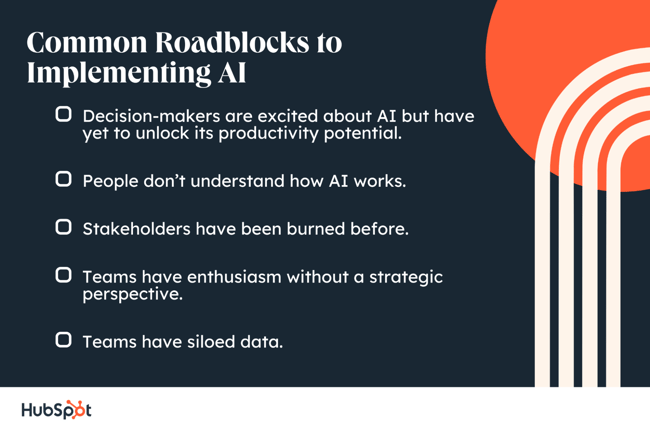
Common Roadblocks to Implementing AI

common roadblocks to implementing ai

In my experience, AI implementation requires buy-in at every level — from executives who need to sign off on tools to the individual contributors who actually use AI tools. So, to drive adoption, you need to address a wide range of concerns. Here are the most common I’ve heard.

Decision-makers are excited about AI but have yet to unlock its productivity potential.

Many people may see AI tools as fun new toys but struggle to recognize their potential as useful productivity tools. As a result, I’ve seen teams get excited to use AI on smaller projects but hesitant to invest in a larger-scale implementation.

For example, when I first started learning about AI, I appreciated how it could help me with discrete tasks, like putting together memos, coming up with ideas for experiments, and drafting copy. But, I didn’t truly understand just how powerful AI could be until I started using it for data analysis.

Specifically, after a lengthy homepage optimization project, I used Claude to understand exactly how the shift was impacting our top-of-funnel and down-funnel metrics. Then, I asked it to create two summaries: one for an executive-level audience and one for my team and our other stakeholders.

The entire process took less than two hours (including the time it took for me to fact-check Claude’s conclusions, which I always recommend doing). Without AI, it would’ve taken me days, as well as at least one (human) analyst.

When people see AI as just a fun novelty, they’re unlikely to invest their time and energy into implementation. So, to get people excited about AI’s true potential, it’s important to highlight the incredible, quantifiable impact it can have on your business. Communicate your wins in terms of hours and dollars saved.

People don’t understand how AI works.

Despite the increasing prevalence of AI across a wide range of applications, many people are still unfamiliar with how the technology underlying these tools works. This can make people understandably nervous to rely on AI-powered tools for important business needs.

I’ve noticed that reluctance and AI nerves are especially prevalent when stakeholders are less technologically savvy. Providing some basic AI education can help calm these fears.

Stakeholders have been burned before.

In other cases, I’ve seen teams hesitate to adopt a new AI solution because they’ve been burned in the past by a similar initiative that didn’t go well. Perhaps a product was advertised as a high-powered solution but ended up offering little to the team. Or, maybe, a previous solution was just poorly implemented.

Executives who have seen an AI solution fail before may hesitate to try another one. Champions will need to arm themselves with extra data and a compelling case for why results will be better this time.

Teams have enthusiasm without a strategic perspective.

Of course, resistance to AI isn’t the only factor that can hinder effective implementation. On the other end of the spectrum, I’ve run into managers and executives who are extremely eager to adopt AI. However, they may lack the strategic perspective to identify and move forward with the best approach.

These AI enthusiasts may jump to sign up for the latest, greatest AI tool without stopping to determine whether it’s really a good fit for their organization’s needs. Similarly, they may rush the implementation phase, skipping important planning or communication steps.

While experimenting and moving quickly can lead to AI wins, teams should take the time to build an AI strategy with clearly mapped objectives. Are you trying to save time and/or money? Improve quality? Getting clear on the strategy and “why” from the jump can help you choose the right tools, speed up implementation, and stay aligned with leadership.

Teams have siloed data.

Finally, the challenge I’ve encountered most often when implementing AI across an organization is siloed, disconnected data. After all, your AI recommendations can only be as smart as the data you feed into the system.

If you’re not able to access all the data that’s relevant to the task at hand, then you’ll struggle to get value out of AI tools. That’s also true when accessing that data requires hours of manual work across several inconsistent systems.

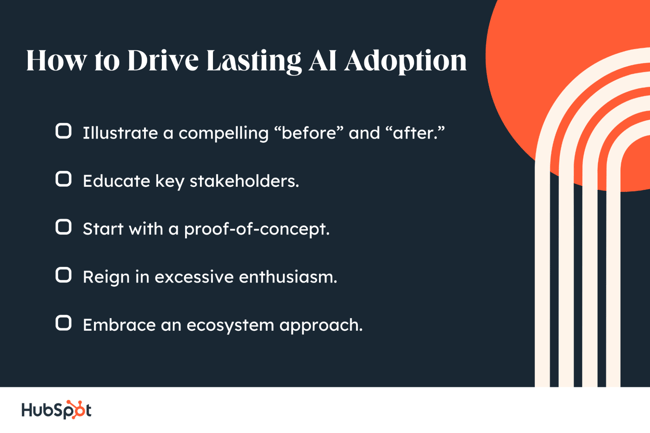
How to Drive Lasting AI Adoption

how to drive lasting ai adoption

When it comes to implementing AI, there are no one-size-fits-all solutions. Organizations will face different challenges and benefit from different approaches. That said, I’ve found the strategies below an effective route to overcoming the roadblocks.

The end result is lasting AI adoption that helps your marketing team grow.

Illustrate a compelling “before” and “after.”

To get buy-in from key decision-makers, it’s important to move past the theoretical benefits of AI and make the case for your specific project. To tell that story, illustrate a clear, compelling “before” and “after.”

For example, the first big AI initiative that I pitched to my team was for an AI-powered search grader. The project would use OpenAI’s API to tell prospects how well their brand was performing in AI answer engines like ChatGPT, Perplexity, and Gemini.

To get people on board, I didn’t just claim that the tool would be helpful. Instead, I explained how I was currently doing many hours of manual analysis each week to calculate how often HubSpot showed up — and how — in AI engine responses.

I also explained that our prospects and customers were going to face this challenge too (if they weren’t facing it already!). And it worked: Our leadership got it right away, and they quickly greenlit the project.

When it comes to AI, I’ve found that describing how the current system works now and how it could work with the new tool is usually successful. Be sure to outline the ROI and benefits of that future state clearly.

Educate key stakeholders.

AI champions are often educators. After all, people probably won’t get excited about AI if they don’t know how it works — and even if they do, they’re unlikely to be able to use it successfully without at least a basic understanding of the underpinning technology.

With this in mind, whenever I work with colleagues who are less familiar with AI, I’ll start by explaining how the system will work. In some cases, I’ll share the basics of these technologies, including what a large language model (LLM) is and the best practices for using it. Beyond these general explanations of the technology, I’ll also explain how our particular implementation will work.

When acting as an AI educator, be sure to provide the information needed to understand and adopt the idea without drowning people in details.

Start with a proof-of-concept.

Big ideas can be exciting, but I’ve found that starting with a rough proof-of-concept is often the best way to get buy-in and bring an idea to life. A low-risk, minimum viable product (MVP) can help illustrate the benefits of AI without requiring a large up-front investment.

By offering a smaller-scale proof-of-concept, you can help your executive team feel more comfortable greenlighting an AI project. You can also frame your investment as an experiment, rather than a long-term commitment.

Reign in excessive enthusiasm.

On the other hand, when stakeholders are so enthusiastic about AI that they may rush implementation or ignore critical issues, I try to reign them in. Instead of directly squashing their ideas, I ask lots of questions.

For example, I might ask, “Why are you thinking about the project this way?”, “What are we trying to accomplish with AI?”, and “Why is AI valuable for this work?” Ultimately, I usually say, “Now that I better understand what you’re trying to do, can I suggest an alternative?”

Approaching over-enthusiasm with genuine curiosity and a willingness to solve for their end goal can help you steer them in a better direction while preserving the relationship.

Embrace an ecosystem approach.

I’ve learned firsthand how vital it is for marketers to leverage data from across their platforms to drive growth. That means knocking down silos and embracing an ecosystem approach. Making this shift involves engaging internal teams across the organization and external partners.

What does that look like in practice? Let’s start with the internal team. Say that your sales and service teams use Gong to track customer calls. Gong gives you access to extensive call transcripts that are rich in prospect data, offering insights into how you can best position your product.

Marketers can use AI tools to analyze this information and identify potential risks or opportunities for growth. However, this is only possible if teams know what data they’re collecting and share that information freely.

Now, onto the external ecosystem. When you work with partners, not every AI-driven innovation needs to be built by your team. You can work with external partner organizations in your ecosystem that can build solutions for your company.

Let’s use HubSpot as an example. Our Solutions Partners provide services that complement HubSpot’s platform offerings — from implementations to AI-driven analytics to advanced custom integrations. Independent Software Vendor (ISV) Partners build and sell apps that enhance our software’s capabilities, including those featuring AI. The average HubSpot customer uses 9+ apps — leveraging custom tools that help them better serve users in their industries or verticals.

It’s a win-win. Our partners get access to HubSpot customers, an ecosystem that represents a $30 billion opportunity for app and service partners by 2028. Our platform gets enhanced capabilities that can better serve and attract customers — all without any investment dollars from our internal team.

By building out AI capabilities as part of a larger, integrated ecosystem, companies can better serve and grow their customer base. In my experience, that speaks to leadership and drives buy-in.

Become Your Team’s AI Champion

At the end of the day, AI is a tool like any other. For it to make an impact across an organization, it needs a champion to get everyone on board and drive lasting growth. By steering clear of common roadblocks and using the strategies I described above, you’ll be on your way to becoming the AI champion your marketing team needs.

Categories B2B

21 of My Favorite Sample Business Plans & Examples For Your Inspiration

I know firsthand that staring at a blank page is the hardest part of writing a business plan. Whether you’re launching a new venture or refining an existing one, having a roadmap is key. But, figuring out where to start? That’s another story.

To get over the hump, I recommend looking at real business plan examples. Seeing how other companies have structured their plans can spark ideas, give you a clear format to follow, and make the whole process feel way less overwhelming.

→ Download Now: Free Business Plan Template

So what does a good business plan look like? And how do you write one that’s both viable and convincing? In this post, I’ll share my favorite sample business plans and examples and walk you through the ideal business plan format.

Table of Contents

Business Plan Types

The format of your business plan will vary based on what offering you provide and who you’re targeting. So, I’ve added this quick review of different business plan types that can help you make the right decision. Check out this post to learn more.

1. Startups

Startup business plans are for proposing new ideas and getting them off the ground. In this type of business plan, you should focus on what makes your offering different from competitors — in fact, you’ll even need a whole section dedicated to market analysis. You’ll also describe how you plan to secure funding or a request for funding to keep your business afloat.

2. Internal Use

Not every business plan is meant for the public. In fact, internal business plans allow leaders to share goals, strategies, or performance updates with stakeholders who work at the company. In my opinion, internal business plans are useful for alignment and building support for ambitious goals. You can also share roadmaps you expect employees to follow.

4. Strategic Initiatives

Strategic business plans are also shared internally. This plan covers long-term business objectives that might not have been included in the startup business plan. Your strategic plan can be revisited based on your company’s maturity. You may also slot updates yearly, every few years, or based on major milestones.

5. Business Acquisition or Repositioning

When a business is moving forward with an acquisition or repositioning, it may need extra structure and support. This type of business plan expands on a company’s acquisition or repositioning strategy. Here leaders can explain why the acquisition occurred and how the company will restructure to incorporate the acquisition.

6. Growth

Growth can happen organically as a business becomes more established. However, most leaders find growth plans can be helpful gauge progress. Growth business plans create a structure with specific expansion targets. This type of business plan can help teams focus on short-term growth goals, and align resources with those goals.

Business Plan Format

So, now that you know the different types, what actually goes into a business plan? Below, I’ll create a startup business plan that’s detailed, research-backed, and compelling enough to convince investors to offer funding.

But first, let’s talk about the sections you actually need to include. In my experience, the most comprehensive and convincing business plans contain the following sections.

Executive Summary

Your executive summary is the most important section of the entire business plan. It is an overview of and introduction to your entire project. I’d recommend adding two main elements to your executive summary: your company description and your offerings.

Company Description

Highlight your company’s mission statement and goals, a brief overview of your history and leadership, and your top accomplishments as a business.

Tell potential investors who you are and why what you do matters. Naturally, they’re going to want to know who they’re getting into business with upfront. This is a great opportunity to showcase your impact.

Need some extra help firming up your business goals? I’d recommend HubSpot Academy’s free course to help you set meaningful goals that matter most for your business.

Products and Services

Incorporate an overview of your offerings. This doesn’t have to be extensive, it’s a chance to introduce your industry and overall purpose as a business. I recommend including snippets of information about your financial projections and competitive advantage here as well.

Keep in mind that you’ll cover many of these topics in more detail later on in the business plan. The executive summary should be clear and brief, only including the most important takeaways.

How to Get It Right

Remember, this is just the intro of your plan. You should focus on the most important highlights only while keeping the entire summary under one page. Busy executives often make initial judgments based on just these few paragraphs, so you need to make them count.

Market Opportunity

Here you’ll describe gaps in your industry’s market and how you plan to fill them. This section should be focused on the demand for your offering and the potential for growth. Ask and answer: Where is the gap in the current industry, and how will my product fill that gap?

To get a thorough understanding of the market opportunity, conduct a TAM, SAM, SOM analysis, a SWOT analysis, and perform market research on your industry to get insights for this section. More specifically, here’s what I’d include.

  • The size of the market.
  • Current or potential market share.
  • Trends in the industry and consumer behavior.
  • Where the gap is.
  • What caused the gap.
  • How you intend to fill it.

How to Get It Right

When writing this section, start with the unmet needs your business addresses, including why current solutions fall short. Then, quantify your target market with specific, verifiable data on market size, growth trends, and addressable segments.

Competitive Landscape Analysis

This section offers an overview of your competitors — including their strengths and weaknesses. The goal here is to differentiate your offerings in the industry.

Performing a competitive analysis can help you uncover the following:

  • Industry trends that other brands may not be utilizing.
  • Strengths in your competition that may be obstacles to handle.
  • Weaknesses in your competition that may help you develop selling points.
  • The unique proposition you bring to the market that may resonate with customers.

How to Get It Right

I recommend creating a detailed comparison matrix that evaluates your direct and indirect competitors in the market. You can note helpful factors that customers consider, like pricing, features, and market share. This formatting helps highlight where your business has distinct advantages.

Target Audience

This section describes your ideal customers, the problems that you can solve for them, and your customer acquisition strategy.

Use this section to describe who your customer segments are in detail. I’d recommend building a buyer persona to get in the mindset of your ideal customers and be clear about why you’re targeting them.

Here are some questions I’d ask myself:

  • What demographics will most likely need/buy your product or service?
  • What are the psychographics of this audience? (Desires, triggering events, etc.)
  • Why are your offerings valuable to them?

How to Get It Right

When describing your target audience, be specific. You should include behavioral, demographic, and psychographic characteristics so your readers have a better sense of your ideal persona. Be sure to include any market research you’ve conducted that can drive the point home.

Marketing Strategy

Here, you need to discuss how you’ll acquire new customers with your marketing strategy. I think it’s helpful to have a marketing plan built out in advance to make this part of your business plan easier. I’d also suggest including these details:

  • Your brand positioning vision and how you’ll cultivate it.
  • The goal targets you aim to achieve.
  • The metrics you’ll use to measure success.
  • The channels and distribution tactics you’ll use.

How to Get It Right

As a marketer, I recommend outlining a clear customer acquisition strategy. Be specific about channels, tactics, and messaging — including realistic cost projections and expected conversion rates. Any KPIs you establish here should be measurable.

Key Features and Benefits

At some point in your business plan, you have to review the key features and benefits of your products and/or services.

This can educate readers on how you’re positioning yourself in the market and the messaging you’re likely to use. It can even help potential investors gain better insight into your business model.

Use plain language to emphasize the value of your product/service, how it solves the problems of your target audience, and how you’ll scale up over time.

How to Get It Right

In this section, I recommend focusing on customer outcomes instead of technical specifications. Each feature should connect to a specific, tangible benefit for your customer. Emphasize unique selling points first, and support each benefit claim with evidence to build credibility.

Pricing and Revenue

In this section, discuss your cost structure and various revenue streams. Your pricing strategy must be solid enough to turn a profit, while staying competitive in the industry. For this reason, here’s what I’d outline in this section:

  • The specific pricing breakdowns per product or service.
  • Why your pricing is higher or lower than your competition’s.
  • (If higher) Why customers would still be willing to pay more.
  • (If lower) How you’re able to offer your products or services at a lower cost.
  • When you expect to break even, what margins do you expect, etc?

How to Get It Right

Present multiple revenue streams and any growth projections you might have. If working with investors, they’ll want to know the initial pricing model and how revenue will scale.

Financials

To me, this section is particularly informative for investors and leadership teams to figure out funding strategies, investment opportunities, and more. While some business plans might include more or less information, according to Forbes you’ll want to include three main details:

  • Profit/Loss Statement. This answers the question of whether your business is currently profitable.
  • Cash Flow Statement. This details exactly how much cash is incoming and outgoing to give insight into how much cash a business has on hand.
  • Balance Sheet. This outlines assets, liabilities, and equity, which gives insight into how much a business is worth.

How to Get It Right

This is a great spot to highlight the most compelling financial indicators that can attract investors, such as customer acquisition costs relative to lifetime value. These metrics signal a sustainable business model.

Sample Business Plan: Section by Section

Okay, now that we have a format established, I wanted to share a business plan I made. Below, I’ll dive deep into the world of gluten-free bagels for a fictional, startup bakery. This executive summary example was created with HubSpot’s business plan template.

1. Executive Summary Example

Our Mission

Maria’s Gluten Free Bagels offers gluten-free bagels, along with various toppings, other gluten-free breakfast sandwich items, and coffee. The facility is entirely gluten-free. Our team expects to catch the interest of gluten-free, celiac, or health-conscious community members who are seeking an enjoyable cafe to socialize. Due to a lack of gluten-free bagel products in the food industry currently, we expect mild competition and are confident we will be able to build a strong market position.

The Company and Management

Maria’s Gluten Free Bagels was founded in 2010 by Maria Jones, who first began selling her gluten-free bagels online from her home, using social media to spread the word. In 2012 she bought a retail location in Hamilton, MA, which now employs four full-time employees and six part-time employees. Prior to her bagel shop, Maria was a chef in New York and has extensive experience in the food industry.

Along with Maria Jones, Gluten Free Bagel Shop has a board of advisors. The advisors are:

  1. Jeni King, partner at Winding Communications, Ltd.
  2. Henry Wilson, president of Blue Robin, LLP.

Our Product

We offer gluten-free products ranging from bagels and cream cheese to blueberry muffins, coffee, and pastries. Our customers are health-conscious, community-oriented people who enjoy gluten-free products. We will create a welcoming, warm environment with opportunities for open mic nights, poetry readings, and other community functions. We will focus on creating an environment in which someone feels comfortable meeting a friend for lunch, or working remotely.

Our Competitive Advantages

While there are other coffee shops and cafes in the North Shore region, there are none that offer purely gluten-free options. This restricts those suffering from gluten-free illnesses or simply those with a gluten-free preference. This will be our primary selling point. Additionally, our market research [see Section 3] has shown a demand for a community-oriented coffee and bagel shop in the town of Hamilton, MA.

Financial Considerations

Our sales projections for the first year are $400,000. We project a 15% growth rate over the next two years. By year three, we project 61% gross margins.

We will have four full-time employees. The salary for each employee will be $50,000.

Start-up Financing Requirements

We are seeking to raise $125,000 in startup to finance year one. The owner has invested $50,000 to meet working capital requirements and will use a loan of $100,000 to supplement the rest.

Why This Example Works

The executive summary above succinctly shares the biggest takeaways from the business plan. A busy investor wouldn’t need to read every page or flip around for important details. The most important information is all here and easy to find.

You can also tell who this business plan is for: potential investors who can help finance year one. When writing an executive summary, you should customize the message to your audience. For example, this plan focuses on projected sales, growth, and financing needs.

Tips for Writing Your Executive Summary

  • Start with a strong introduction of your company, showcase your mission and impact, and then outline the offering you provide.
  • Clearly define a problem, explain how your product solves that problem, and show why the market needs your business.
  • Be sure to highlight your value proposition, market opportunity, and growth potential.
  • Keep it concise and support ideas with data.

Feel free to check out our tips for writing an effective executive summary.

2. Market Opportunity Example

The gluten-free food market has experienced explosive growth over the past decade, with a current global market valuation of $7.5 billion and projected annual growth of 9.2% through 2028. This growth is driven by three key factors:

  • Increasing celiac disease diagnoses (affecting approximately 1% of the population).
  • Rising non-celiac gluten sensitivity awareness (estimated at 6% of consumers).
  • And expanding consumer preferences (with 30% of consumers reporting they sometimes purchase gluten-free products).

Addressable Market Size

The total addressable market for Maria’s Gluten Free Bagels within the Hamilton and North Shore region includes:

  • Primary Market (5-mile radius): Approximately 35,000 residents, with an estimated 2,800 individuals following gluten-free diets either by necessity or choice.
  • Secondary Market (15-mile radius): An additional 120,000 residents, including communities with above-average household incomes and health-conscious populations.

Based on spending patterns for specialty food items and café services, we project the total addressable market value at $4.2 million annually, with Maria’s positioned to capture 12-15% market share within three years.

Why This Example Works

I like this example because it divides the market opportunity in two ways. First, the plan focuses on trends related to the population at large that make gluten-free shoppers a growing market segment. The second part of the plan takes these general trends and explores how they impact the local community.

Tips for Writing Your Market Opportunity Section

  • Focus on demand and potential for growth.
  • Use market research, surveys, and industry trend data to support your market forecast and projections.
  • Add a review of regulation shifts, tech advances, and consumer behavior changes.
  • Refer to reliable sources.
  • Showcase how your business can make the most of this opportunity.

3. Competitive Landscape Analysis Example

Maria’s Gluten Free Bagels operates at the intersection of three food service categories: specialty bakeries, gluten-free establishments, and community-oriented cafes. This unique positioning creates a competitive advantage while also requiring analysis of competitors across overlapping sectors.

Dedicated Gluten-Free Establishments

Competitor

Location

Primary Offering

Strengths

Weaknesses

Celia’s Safe Eatery

Boston, MA

Full-service restaurant with gluten-free menu

  • Wide menu variety
  • Strong brand recognition
  • High price point
  • Urban location only
  • Limited breakfast options

Pure Bread Bakery

Salem, MA

Gluten-free breads and pastries

  • Wholesale distribution
  • Certified gluten-free
  • Strong online presence
  • Limited cafe seating
  • No coffee program
  • Minimal community engagement

Free & Clear Sweets

Beverly, MA

Gluten-free desserts and treats

  • Appealing visual branding
  • Strong social media following
  • Multiple dietary accommodations
  • No savory options
  • Limited hours (Th-Sun only)
  • Small production capacity

While these competitors offer gluten-free products, none specifically focus on bagels as their signature item, and all are located at considerable distances from Hamilton, creating significant geographic advantage for Maria’s. Additionally, our comprehensive approach to breakfast items, coffee, and community engagement creates multiple differentiation points.

Local Cafés and Bakeries

Competitor

Location

Gluten-Free Options

Community Focus

Competitive Threat Level

Hamilton Coffee House

Hamilton, MA

Limited (2-3 items, cross-contamination risk)

High (events, workspace)

Medium

Baxter’s Bakery

Hamilton, MA

None

Low

Low

Morning Grind

Wenham, MA

Limited (pre-packaged items only)

Medium (local art)

Medium-Low

North Shore Bagel Shop

Beverly, MA

None

Low

Low

These competitors capture general café traffic but present minimal threat to our core gluten-free customer base due to their limited offerings and cross-contamination risks that exclude celiac and highly sensitive customers.

Why This Example Works

I like how the competitive landscape section of this business plan clearly outline top competitors. It also highlights specific industry knowledge and the importance of location. Tables make everything easy to skim, so I’m not wasting any time.

Tips for Writing Your Competitive Landscape

  • Complete in-depth research, then emphasize your most important findings.
  • Compare your unique selling proposition (USP) to your direct and indirect competitors.
  • Look for specific advantages and barriers in the competitive landscape. Then, highlight how that information could impact your business.
  • Outline growth opportunities from a competitive perspective.
  • Add customer feedback and insights to support your competitive analysis.

4. Target Audience

Maria’s Gluten Free Bagels serves three distinct customer segments, each with unique characteristics, needs, and purchasing behaviors:

1. Medical Necessity Customers (35% of Revenue)

Demographic Profile:

  • Adults aged 25-65 with diagnosed celiac disease or non-celiac gluten sensitivity
  • Slightly female-skewed (60% women, 40% men)
  • Higher education levels (70% college graduates)
  • Household income: $75,000+ annually
  • Health-conscious and informed consumers

Psychographic Characteristics:

  • Highly ingredient-conscious and label-readers
  • Risk-averse regarding food preparation
  • Willing to travel farther for safe food options

Behavioral Patterns:

  • Average visit frequency: 2-3 times weekly
  • Average transaction value: $14.50
  • Most likely to purchase breakfast items and take-home products

2. Health and Wellness Adopters (40% of Revenue)

Demographic Profile:

  • Adults aged 22-45
  • Gender balanced (55% women, 45% men)
  • Fitness-oriented and active lifestyles
  • Household income: $60,000+ annually

Psychographic Characteristics:

  • Health-trend aware
  • Quality and ingredient-focused rather than price-sensitive
  • Balance health goals with enjoyment and taste

Behavioral Patterns:

  • Average visit frequency: 1-2 times weekly
  • Average transaction value: $12.75
  • 40% use the space for remote work or meetings

3. Community and Convenience Customers (25% of Revenue)

Demographic Profile:

  • Local Hamilton residents within 5-mile radius
  • Multi-generational (18-75)
  • Mix of families, empty-nesters, and young professionals
  • Household income: Varied, $50,000-125,000 annually

Psychographic Characteristics:

  • Value local businesses and personal connections
  • Appreciate authentic, non-chain experiences

Behavioral Patterns:

  • Average visit frequency: 1-2 times weekly
  • Average transaction value: $11.25
  • Most likely to visit during weekend hours

Why This Example Works

This section include information about different types of shoppers organized by persona. The reader can clearly see the different motivations that drive each type of customer. The information above is specific, showing that the business knows their audience and has surveyed them.

Tips for Writing Your Target Audience Section

  • Include details on the size and growth potential of your target audience.
  • Figure out and refine the pain points for your target audience, then show why your product is a useful solution.
  • Describe your targeted customer acquisition strategy in detail.
  • Share anticipated challenges your business may face in acquiring customers and how you plan to address them.
  • Add case studies, testimonials, and other data to support your target audience ideas.
  • Remember to consider niche audiences and segments of your target audience in your business plan.

5. Marketing Strategy

Brand Positioning

Maria’s Gluten Free Bagels will position itself as the premier dedicated gluten-free café in the North Shore region, emphasizing three core brand pillars:

  • Safety & Trust: 100% gluten-free facility with rigorous protocols
  • Artisanal Quality: Handcrafted products that match or exceed conventional alternatives
  • Community Connection: A welcoming “third place” for gathering and connection

Multi-Channel Strategy

Website & SEO ($8,000 annually)

  • Optimize for local search terms (“gluten-free Hamilton,” “celiac safe dining”)
  • Mobile-first design with online ordering capability

Social Media Marketing ($12,000 annually)

  • Instagram: Daily content showcasing products, behind-the-scenes, and customer stories
  • Facebook: Community event promotion and targeted advertising to local audience
  • TikTok: Recipe demonstrations and gluten-free education content

Email Marketing ($4,000 annually)

  • Segmented campaigns for each customer persona
  • Weekly newsletters with promotions, events, and new products
  • Automated birthday and anniversary offers

Loyalty Program ($5,000 annually)

  • Tiered rewards program with personalized benefits
  • Digital loyalty app with ordering integration
  • Referral incentives for existing customers

Local Print & Media ($6,000 annually)

  • Targeted ads in local publications
  • Quarterly feature stories in regional food magazines
  • Community bulletin boards and local directories

Signage & Physical Presence ($7,000 annually)

  • Enhanced storefront visibility
  • Vehicle wrap for delivery van
  • Local event sponsorship banners

Marketing Calendar & Implementation

The marketing strategy will be implemented through a detailed quarterly calendar with:

  • Weekly social media content schedule
  • Monthly promotional themes
  • Seasonal product and event launches
  • Quarterly review and optimization cycles

Why This Example Works

Even though this strategy is brief, the section specifies how much the business plans to invest on each marketing channel and on what activities. The plan also specifies how the marketing team or business owner plans to promote the bagel shop by including calendar details.

Tips for Writing Your Marketing Strategy

  • Include a section about how you believe your brand vision will appeal to customers.
  • Add the budget and resources you’ll need to put your plan in place.
  • Outline strategies for specific marketing segments.
  • Explain how you plan to create marketing content.
  • Review how your marketing strategy will scale with the growth of your business.
  • Cover a range of channels and tactics to highlight your ability to adapt your plan in the face of change.

6. Key Features and Benefits

Maria’s Gluten Free Bagels serves consumers seeking a high-quality, gluten-free dining option. Our flagship offering is our artisanal gluten-free bagels, made with recipes developed decades. The texture and taste are the same as regular bagels — a big achievement when dietary restrictions limit customers to subpar alternatives. The dedicated gluten-free facility eliminates all cross-contamination risks, providing peace of mind to celiac and highly sensitive customers.

Beyond our signature bagels, we provide a full cafe experience with gluten-free breakfast sandwiches, pastries, and specialty coffee. This menu transforms what could be merely a bakery into a destination where customers can enjoy a full meal. Our community-centered approach features regular events. We can deliver value beyond food by creating a social hub where dietary restrictions don’t limit participation.

Why This Example Works

Because this example focuses on a bagel shop, this business plan section is short and sweet. I focused first on the flagship product, the bagels themselves, and describe what makes them standout. Then, I cover secondary benefits, like a full menu and community space.

Tips for Writing Your Key Features and Benefits

  • Emphasize why and how your product or service offers value to customers.
  • Talk about how your products and services have the potential to scale.
  • Focus on customer needs, and how the features and benefits you are sharing meet those needs.
  • Offer proof of concept for your ideas, like case studies or pilot program feedback.
  • Proofread this section carefully, and remove any jargon or complex language.

7. Pricing and Revenue

Core Product Pricing:

  • Plain Bagels: $3.25 each/$17.95 half-dozen (30% premium over conventional bagels)
  • Specialty Bagels (Everything, Sesame, etc.): $3.75 each/$20.95 half-dozen
  • Cream Cheese/Spreads: $1.95-$3.50 depending on variety
  • Breakfast Sandwiches: $6.95-$9.95
  • Coffee Beverages: $2.75-$5.50
  • Pastries and Baked Goods: $3.95-$5.50

This pricing structure has been validated through customer surveys, which revealed that 78% of our medical necessity customers and 65% of health-conscious customers consider our pricing “reasonable” or “very reasonable.”

Revenue Streams

  • In-Store Retail Sales (62% of revenue): Direct sales of food and beverages in our café location, with an average transaction value of $12.85 and approximately 220 transactions daily.
  • Online Orders and Delivery (30% of revenue): Direct-to-consumer sales through our website and third-party delivery platforms, with slightly higher pricing to offset fees.
  • Catering Services (6% of revenue): Custom orders for business meetings, events, and gatherings, with package pricing starting at $9.95 per person.
  • Merchandise and Packaged Products (2% of revenue): Branded merchandise, gluten-free mixes, and specialty items that extend our brand presence.

Why This Example Works

I like how this business plan example begins with product pricing and then shows what percent these items contribute to the shop’s revenue. By including customer survey results, investors know that the prices have been set with customers in mind.

Tips for Writing Your Pricing and Revenue Section

  • Get specific about your pricing strategy. Specifically, how you connect that strategy to customer needs and product value.
  • If you are asking a premium price, share unique features or innovations that justify that price point.
  • Show how you plan to communicate pricing to customers.
  • Create an overview of every revenue stream for your business and how each stream adds to your business model as a whole.
  • Share plans to develop new revenue streams in the future.
  • Show how and when pricing will vary by customer segment, and how pricing aligns with marketing strategies.
  • Restate your value proposition and explain how it aligns with your revenue model.

8. Financials

Three-Year Financial Summary

Financial Metric

Year 1

Year 2

Year 3

Total Revenue

$400,000

$460,000

$580,000

Gross Profit

$268,000

$314,900

$403,900

Gross Margin

67%

68.5%

69.6%

Operating Expenses

$208,000

$226,200

$263,800

EBITDA

$60,000

$88,700

$140,100

EBITDA Margin

15%

19.3%

24.2%

Net Income

$39,600

$63,020

$105,075

Net Profit Margin

9.9%

13.7%

18.1%

Cash Flow Projections

Cash Flow Item

Year 1

Year 2

Year 3

Beginning Cash

$33,000

$48,600

$92,620

Cash from Operations

$60,000

$88,700

$140,100

Debt Service

($24,000)

($24,000)

($24,000)

Capital Expenditures

($15,000)

($12,000)

($18,000)

Tax Payments

($5,400)

($8,680)

($15,225)

Ending Cash

$48,600

$92,620

$175,495

For the $50,000 owner investment and $25,000 additional funding requested:

  • Projected simple ROI: 40% annually by Year 3
  • Estimated payback period: 28 months
  • Internal Rate of Return (IRR): 32%

Why This Example Works

Not only are charts with financial information included, but the business plan also features an estimated timeline on when investors can expect a return on their investment. This can help the business secure funding and speak directly to potential investors.

Tips for Writing Your Financials Section

  • Growth potential is important in this section too. Use your data and create a forecast of financial performance for the next three to five years.
  • Include any data that supports your projections, to assure investors of the credibility of your proposal.
  • Add a break-even analysis to show that your business plan is financially practical. This information can also help you pivot quickly as your business grows.
  • Add a section that reviews potential risks and how sensitive your plan is to changes in the market.
  • Triple-check all financial information in your plan for accuracy.
  • Show how any proposed funding needs align with your plans for growth.

Sample Business Plan Templates

Now that you know how to format a business plan, let’s review some of my favorite templates that can make the process quick and easy.

1. HubSpot’s One-Page Business Plan

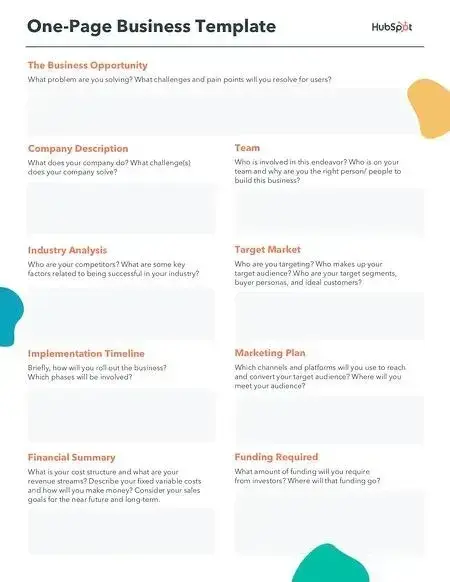
HubSpot's free business plan template

Download a free, editable one-page business plan template.

This business plan was created here at HubSpot and is perfect for businesses of any size — no matter how many strategies you still have to develop. I love how all important information is kept to one page, keeping information focused.

Fields such as Company Description, Required Funding, and Implementation Timeline give this business plan a framework for how to build your brand and what tasks to keep track of as you grow. Then, as the business matures, you can expand on your original business plan with a new iteration of the above document.

Why I Like This Business Plan

This one-page business plan is a fantastic choice for the new business owner who doesn’t have the time or resources to draft a full-blown business plan. It includes all the essential sections in an accessible, bullet-point-friendly format. That way, you can get the broad strokes down before honing in on the details.

2. HubSpot’s Downloadable Business Plan Template

Download a free, editable one-page business plan template.

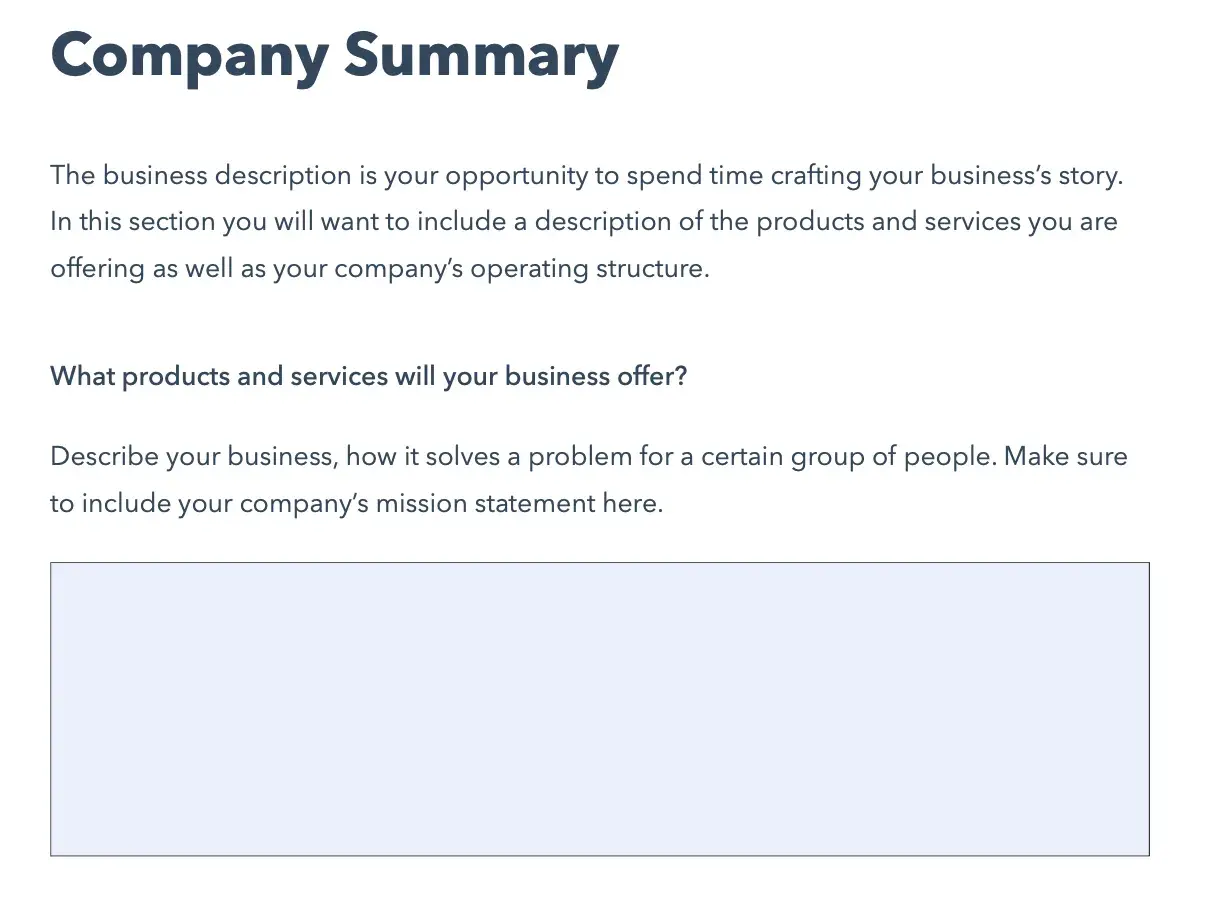
We also created a business plan template for entrepreneurs. The template is designed as a guide and checklist for starting your own business. You’ll learn what to include in each section of your business plan and how to do it. There’s also a list for you to check off when you finish each section of your business plan.

I appreciate that these templates are designed specifically for startups. You’re prompted with a description of what the section should include, then a box where you can fill in the information.

Why I Like This Business Plan

This business plan kit is essential for the budding entrepreneur who needs a more extensive document to share with investors and other stakeholders.

It not only includes sections for your executive summary, product line, market analysis, marketing plan, and sales plan, but it also offers hands-on guidance for filling out those sections.

3. LivePlan Business Plan Template

liveplan business plan template, sample business plans

Source

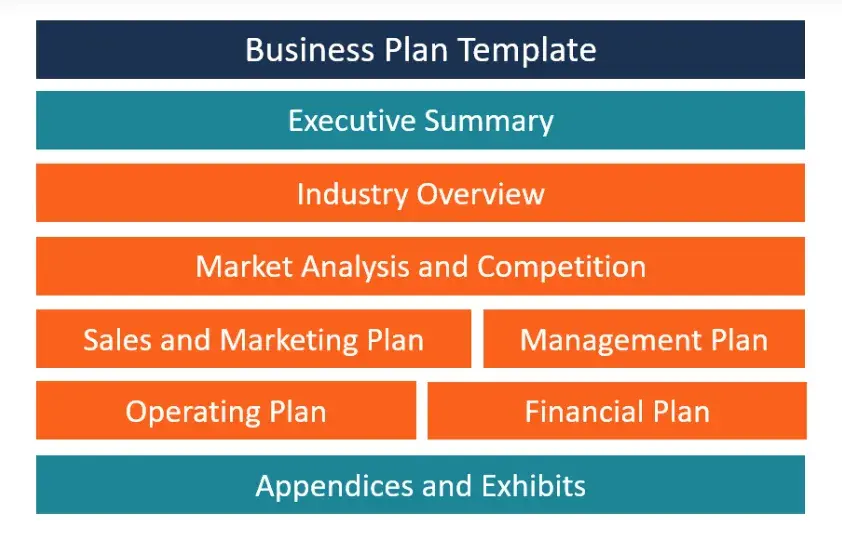
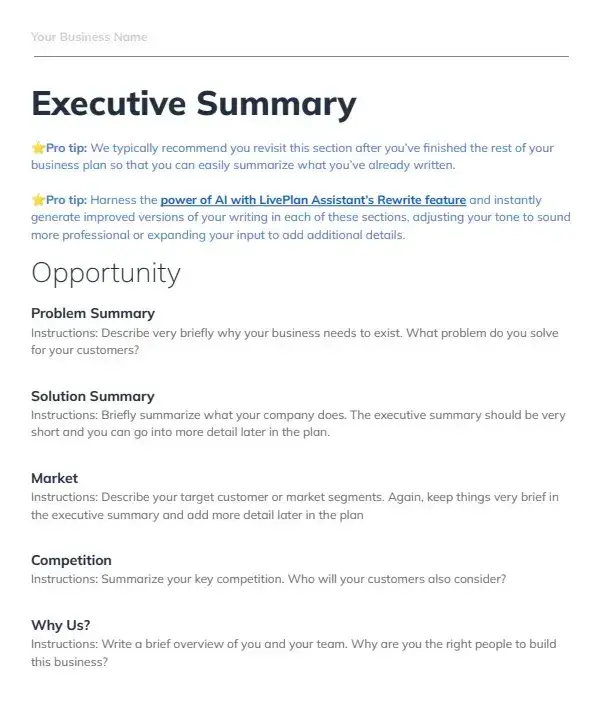
If you want to attract investors with your business plan, consider this free template from LivePlan. It’s a sample business plan template that’s structured in an SBA-lender-approved format and also designed to impress lenders and investors.

Each section includes detailed instructions and prompts to help you think through and communicate the uniqueness of your business.

Why I Like This Business Plan

With the help of this template, plus all the additional prompts, instructions and pro tips provided, creating an investor-friendly business plan becomes simple and straightforward,

4. CFI Business Plan Template

cfi business plan template, sample business plans

Source

This basic template from the Corporate Finance Institute (CFI) covers all the important sections needed to create a credible business plan to achieve your goals. The CFI template allows you to dive deep into operations. You can outline information related to management and finances that a standard plan just glosses over.

Why I Like This Business Plan

This template is a great option whether you want to pitch investors and financial institutions or create a business plan that serves as a road map for your business.

5. BPlan’s Free Business Plan Template

bplan free business plan template, sample business plans

Source

One of the more financially oriented sample business plans in this list, BPlan’s free business plan template dedicates many of its pages to your business’s financial plan and financial statements.

After filling this business plan out, your company will truly understand its financial health and the steps you need to take to improve it.

Why I Like This Business Plan

I absolutely love this business plan template because of its ease of use and hands-on instructions. If you feel overwhelmed by the thought of writing an entire business plan, consider using this template to help you with the process.

6. Growthink Business Plan Template

growthink business plan template, sample business plans

Source

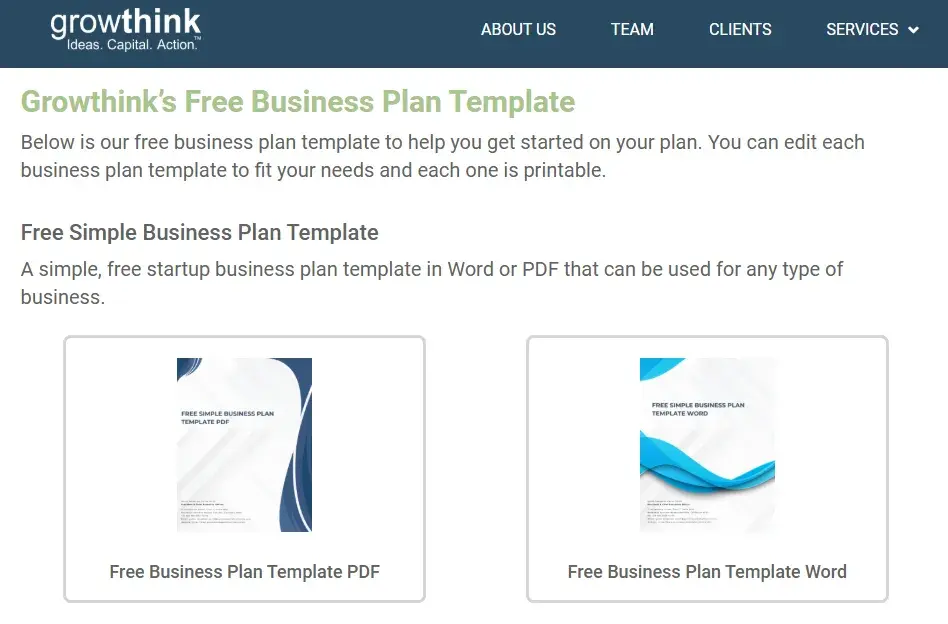
If you’re looking for a detailed free template that can guide you to identify your business goals, develop actionable strategies and create a winning business plan, Growthink has you covered.

This sample business plan can be used for any type of business and is available in both PDF and Word files.

Why I Like This Business Plan

This is a fantastic template for both new and existing businesses. If you want to improve the bottom line of your existing company or revitalize your strategy, this is an excellent template to use and follow.

7. HubSpot’s Complete Guide to Starting a Business

hubspot free business startup kit, sample business plans

Source

If you’re an entrepreneur, you know writing a business plan is one of the most challenging first steps to starting a business.

Fortunately, with HubSpot‘s comprehensive guide to starting a business, you’ll learn how to map out all the details by understanding what to include in your business plan and why it’s important to include them. This guide also fleshes out an entire sample business plan for you.

If you need further guidance on starting a business, HubSpot’s guide can teach you how to make your business legal, choose and register your business name, and fund your business. It will also give small business tax information and includes marketing, sales, and service tips.

Why I Like This Business Plan

This comprehensive guide will walk you through the process of starting a business — including writing your business plan — with a high level of exactitude and detail. It also offers other resources you might need, such as market analysis templates. So if you’re in the midst of starting your business, this is an excellent guide for you.

Since writing this article, there’s now an amazing suite of products available for new business builders called HubSpot Starter.

It’s essential for businesses trying to get their plan in motion, giving you all the tools you need to build your brand online. It can be a huge help in finding critical information to build out your business plan with realistic numbers — among many other benefits — and I highly recommend it.

8. Panda Doc’s Free Business Plan Template

panda doc free business plan template, sample business plans

Source

PandaDoc’s free business plan template is one of the more detailed and fleshed-out sample business plans on this list. It describes what you should include in each section, so you don’t have to come up with everything from scratch.

Once you fill it out, you’ll fully understand your business’ nitty-gritty details and how all of its moving parts should work together to contribute to its success.

Why I Like This Business Plan

This template has two things I love: comprehensiveness and in-depth instructions. Plus, it’s synced with PandaDoc’s e-signature software so that you and other stakeholders can sign it with ease. For that reason, I especially love it for those starting a business with a partner or with a board of directors.

9. Small Business Administration Free Business Plan Template

sba free business plan template, sample business plans

Source

The Small Business Administration (SBA) offers several free business plan templates that can be used to inspire your own plan.

Before you get started, you can decide what type of business plan you need — a traditional or lean start-up plan.

Then, you can review the format for both of those plans and view examples of what they might look like.

Why I Like This Business Plan

I love both of the SBA’s templates because of their versatility. You can choose between two options and use the existing content in the templates to flesh out your own plan. Plus, if needed, you can get a free business counselor to help you along the way.

Top Business Plan Examples

I’ve compiled some completed business plan samples to help you get an idea of how to customize a plan for your business. While some are extensive, others are fairly simple. Let’s take a look.

1. LiveFlow

liveflow business plan example, sample business plans

Source

One of the major business expenses is marketing. How you handle your marketing reflects your company’s revenue.

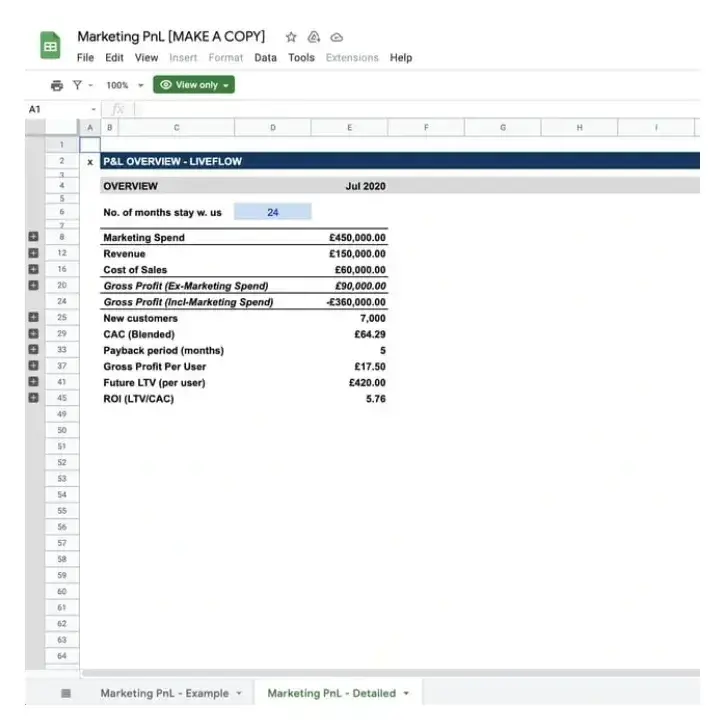
I included this business plan to show you how you can ensure your marketing team is aligned with your overall business plan to get results. The plan also shows you how to track even the smallest metrics of your campaigns, like ROI and payback periods instead of just focusing on big metrics like gross and revenue.

Fintech startup, LiveFlow, allows users to sync real-time data from its accounting services, payment platforms, and banks into custom reports. This eliminates the task of pulling reports together manually, saving teams time and helping automate workflows.

“Using this framework over a traditional marketing plan will help you set a profitable marketing strategy taking things like CAC, LTV, Payback period, and P&L into consideration,” explains LiveFlow co-founder, Lasse Kalkar.

Why I Like This Business Plan

When it came to including marketing strategy in its business plan, LiveFlow created a separate marketing profit and loss statement to track the company’s progress with its marketing initiatives.

This is a great approach, allowing businesses to focus on where their marketing dollars are making the most impact. Having this information handy will enable you to build out your business plan’s marketing section with confidence. LiveFlow has shared the template here. You can test it for yourself.

2. Core Strength Pilates Studio

pilates studio business plan example, sample business plans

Source

This sample business plan for a fitness studio is detailed and comprehensive. And guess what? It was created in minutes, using a free AI business plan generator.

In their operations plan, Core Strength also shared milestones they hope to achieve within a few months like securing a location, getting necessary permits and licenses, studio setup, hiring instructors, establishing an online presence, and more

If you’re seeking outside funding for your business, this is a great sample business plan to use and model your business plan after.

Why I Like It

This business plan example is well-prepared and I think it’s great for service-based businesses such as gyms, boxing classes, dancing studios, etc. I also love all the details and milestones shared in the operations plan and other sections.

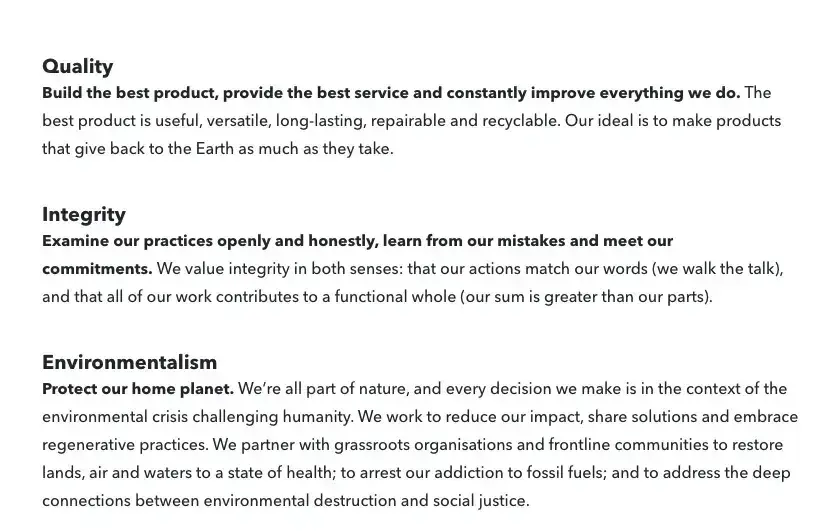
3. Patagonia

patagonia business plan example, sample business plans

Source

Sometimes, all you need is a solid mission statement and core values to guide you on how to go about everything. You do this by creating a business plan revolving around how to fulfill your statement best.

For example, Patagonia is an eco-friendly company, so their plan discusses how to make the best environmentally friendly products without causing harm.

A good mission statement should not only resonate with consumers but also serve as a core value compass for employees as well.

Why I Like This Business Plan

Patagonia has one of the most compelling mission statements I’ve seen:

“Together, let’s prioritize purpose over profit and protect this wondrous planet, our only home.”

It reels you in from the start, and the environmentally friendly theme continues throughout the rest of the statement.

This mission goes on to explain that they are out to “Build the best product, cause no unnecessary harm, and use business to protect nature.”

Their mission statement is compelling and detailed, with each section outlining how they will accomplish their goal.

4. Vesta Home Automation

vesta home automation business plan example, sample business plans

Source

This executive summary for a smart home device startup is part of a business plan created by students at Mount Royal University.

While it lacks some of the sleek visuals of the templates above, its executive summary does a great job of demonstrating how invested they are in the business. Right away, they mention they’ve invested $200,000 into the company already, which shows investors they have skin in the game and aren’t just looking for someone else to foot the bill.

Why I Like This Business Plan

This is the kind of business plan you need when applying for business funds. It clearly illustrates the company’s expected future and how it has been progressing over the years.

5. NALB Creative Center

nalb creative centre business plan example, sample business plans

Source

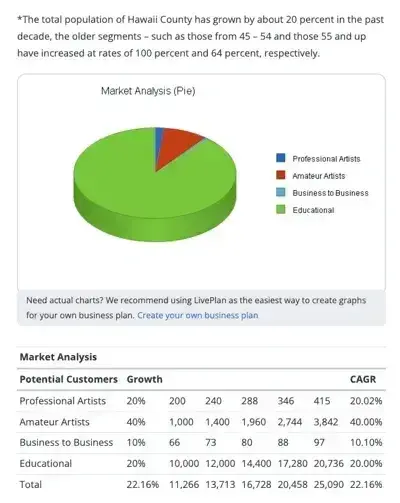
This fictional business plan for an art supply store includes everything one might need in a business plan. One of its most notable sections is its market analysis summary, which includes an overview of the population growth in the business’ target geographical area, as well as a breakdown of the types of potential customers they expect to welcome at the store.

This sort of granular insight is essential for understanding and communicating your business’s growth potential. Plus, it lays a strong foundation for creating relevant and useful buyer personas.

It’s essential to keep this information up-to-date as your market and target buyer changes. For that reason, you should carry out market research as often as possible to ensure that you’re targeting the correct audience and sharing accurate information with your investors.

Why I Like This Business Plan

Due to its comprehensiveness, it’s an excellent example to follow if you’re opening a brick-and-mortar store and need to get external funding to start your business.

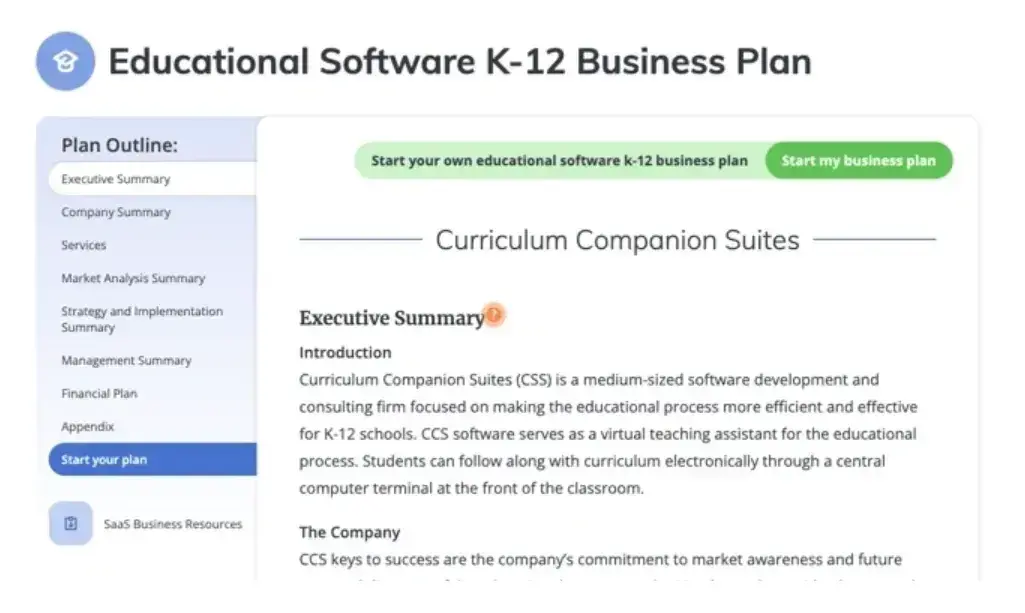
6. Curriculum Companion Suites (CCS)

ccs business plan example, sample business plans

Source

If you’re looking for a SaaS business plan example, look no further than this business plan for a fictional educational software company called Curriculum Companion Suites.

One of the most notable features of this business plan is the executive summary, which includes an overview of the product, market, and mission.

The first two are essential for software companies because the product offering is so often at the forefront of the company’s strategy. Without that information being immediately available to investors and executives, then you risk writing an unfocused business plan.

Why I Like This Business Plan

It’s essential to front-load your company’s mission if it explains your “Why?” and this example does just that. In other words, why do you do what you do, and why should stakeholders care? This is an important section to include if you feel that your mission will drive interest in the business and its offerings.

7. FreshField Market

grocery store business plan example, sample business plans

Source

This AI-generated sample business plan for a grocery store is an excellent example of how to outline your business plan and ensure it flows naturally, engages readers, and provides the critical information investors and stakeholders need.

Why I Like This Business Plan

You can use this template as a guide whenever you‘re gathering important information for your own business plan. As a result, get a better understanding of the data and research you need to create a winning business plan.

8. Plum Sample Business Plan

plum business plan example, sample business plans

Source

When creating your own business plan, make sure the pictures and design you use make sense for your branding. The images in this plan are cutting-edge, which makes sense for an innovative company like Plum.

Why I Like This Business Plan

This is one of my favorite sample business plans because you can see how implementing visuals can help tell your brand‘s story. Additionally, the financial charts included are an excellent guide if you’re not sure what financial information to include.

Startup Business Plan Examples

Because most startups are new companies just entering the market, it’s okay to keep your startup business plans short and concise with enough information.

Here are some startup business plan examples and templates I also discovered:

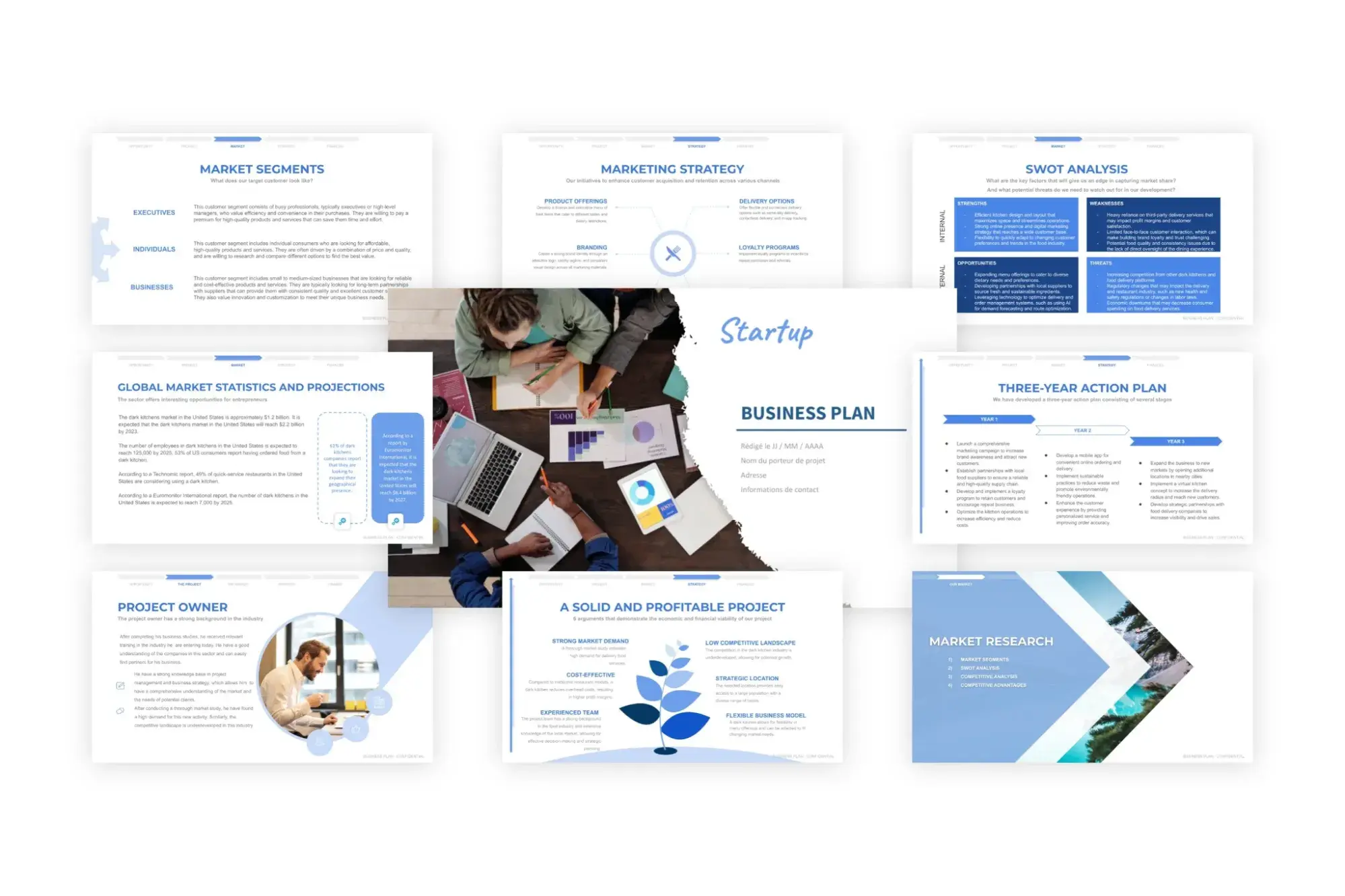
1. BusinessDojo Startup Business Plan

business dojo startup business plan, sample business plans

Source

If you want to launch a highly profitable startup business quickly and need a stress-free way to develop your business plan faster, this startup business plan from Business Dojo is a great option. It’s a complete business plan that’s fully customizable. With this business plan, you will get all the data about your market and industry trends.

Why I Like It

Once you buy this business plan, you’ll have free unrestricted access to a team of experts with over 12 years of experience writing business plans for entrepreneurs. They will be available to discuss with you, answer your questions, and ensure you get a business plan that’s customized for you and your business at no extra cost.

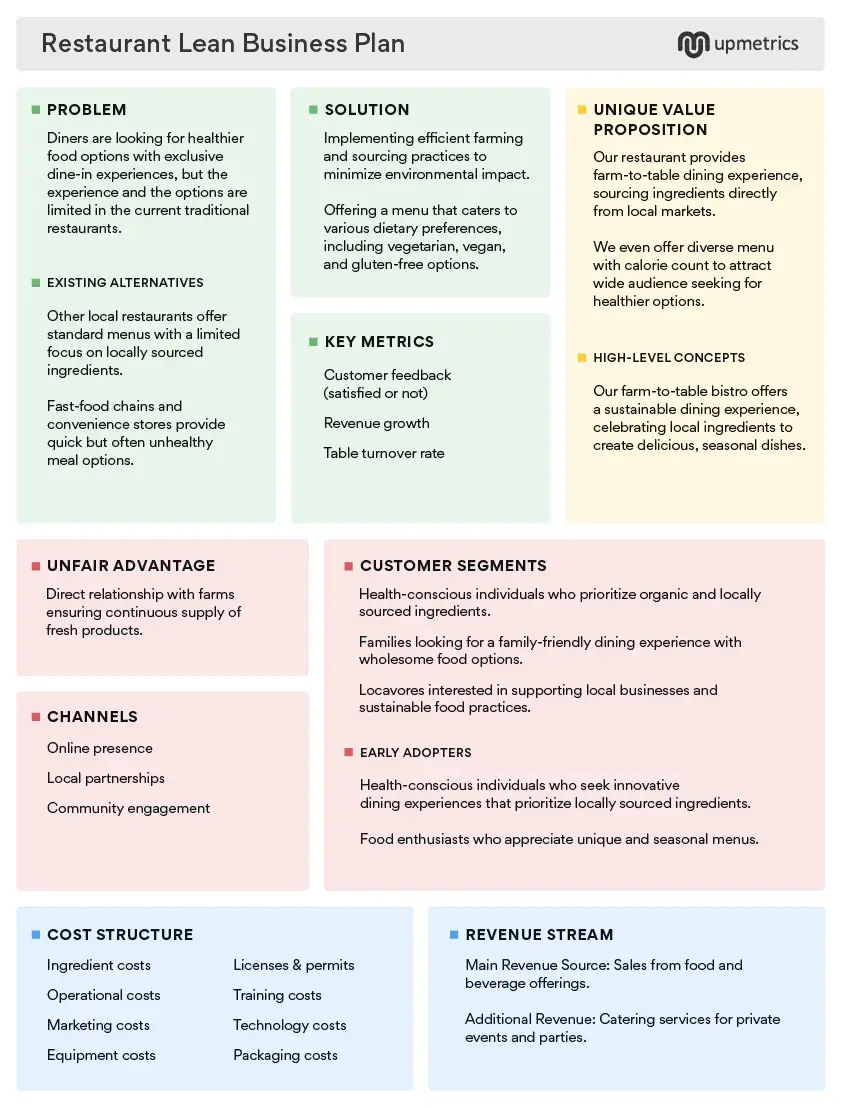
2. Restaurant Lean Business Plan

restaurant lean business plan example, sample business plans

Source

This lean business plan example for a restaurant is a fantastic option for an entrepreneur who wants to attract investors as quickly as possible. It’s a customer-centric business plan that’s condensed to a single page, focuses mainly on the major aspects of a business, and provides insights on key performance indicators and business metrics.

Why I Like It

I love how simple, clear and visually appealing this startup business plan is. You need less time and resources to create it, and people can quickly read and understand everything at a glance.

Get Started Writing Your Business Plan

Whether you’re writing a business plan for the first time or not, the entire process can appear daunting or overwhelming, and I get it. But it doesn’t have to be.

To help you avoid starting from scratch, I’ve shared my favorite templates and sample business plans above. Most of the templates are free and I’m excited because you can choose one, customize it for your business and hit the ground running.

In addition, feel free to read the sample business plans for more ideas and inspiration. And if you’re interested, AI tools are also available to help you write your business plan faster.

All in all, start by understanding the unique value your business provides, then communicate it effectively through a type of business plan that can help you achieve your goals.

Editor’s note: This post was originally published in November 2018 and has been updated for comprehensiveness. This article was written by a human, but our team uses AI in our editorial process. Check out our full disclosure to learn more about how we use AI.

Categories B2B

Digital Marketing: Everything You Need to Know to Get It Right

As a millennial marketer, I can tell you quite a bit about the internet — we practically grew up together.

Nowadays, the internet and marketing go hand in hand, so you need to know what digital marketing is and how to use it if you want to meet your audiences where they’re at — online.

→ Click here to download our free guide to digital marketing fundamentals  [Download Now].

In 2024, there were an estimated 5.5 billion internet users globally, underscoring the need for a strong digital presence. With that in mind, I’m here to discuss all things digital marketing, backed by data from our 2025 State of Marketing Report that surveyed 1700+ marketers. Keep reading to learn more.

Table of Contents

How does a business define digital marketing?

Digital marketing is vital for your business and brand awareness. It seems like every other brand has a website, and if they don’t, they at least have a social media presence or digital ad strategy.

Overall, digital marketing is defined as using numerous digital tactics and channels to connect with customers where they spend much of their time: online.

The best digital marketers have a clear picture of how each digital marketing campaign supports their overarching goals.

Depending on the goals of their marketing strategy, marketers can support a larger campaign through the free and paid channels they have available.

A content marketer, for example, could create a series of blog posts that generate leads from an ebook.

A social media marketer might help promote those blogs through paid and organic posts on the business’s social media accounts, and the email marketer could create an email campaign to send those who download the ebook more information on the company.

Our 2025 State of Marketing Report found that the top five marketing channels that resulted in the biggest ROI in 2024 involved digital marketing. They are:

  • Email marketing.
  • Paid social media content.
  • Social media shopping tools (e.g., Instagram shops).
  • Website/blog/SEO.
  • Content marketing.

There are a few major benefits of digital marketing:

1. You can focus your efforts on only the prospects most likely to purchase your product or service.

Digital marketing allows you to identify and target a highly specific audience with personalized and high-converting marketing messages.

For instance, you might use social media targeting to show ads to a certain audience based on variables like age, gender, location, interests, networks, or behaviors.

Alternatively, you might use PPC or SEO strategies to serve ads to users who’ve shown interest in or searched for specific keywords related to your product, service, or industry.

Ultimately, digital marketing helps you conduct the research necessary to identify your buyer personas and refine your strategy to ensure you’re reaching prospects most likely to buy.

2. It’s more cost-effective than outbound marketing methods.

Digital marketing helps you track campaign performance day to day, so you know which channels are performing well and which aren’t. This information helps you optimize your campaign budgets for high ROI.

A digital marketing strategy allows you to pivot continuously, ensuring you never waste money on channels that don’t perform well.

For instance, if you work for a small business with a limited budget, you might try investing in social media, blogging, or SEO — three strategies that can give you high ROI even with minimal spending.

3. Online marketing evens the playing field within your industry and allows you to compete with bigger brands.

If you work for a small business, it’s likely difficult for you to compete with the major brands in your industry, many of which have millions of dollars to invest in campaigns.

Fortunately, there are plenty of opportunities to outrank the big players through strategic digital marketing initiatives.

For instance, you might use long-tail keywords to create high-quality content that ranks on search engines. Search engines don’t care which brand is the biggest, but they do care about prioritizing content that resonates best with target audiences.

Adilo, an online video hosting platform competing against established brands in the space, understood the potential of focusing on search.

“We knew that trying to compete head-on with paid strategies like TV commercials, PPC, and print media would be a disaster, so we went all-in on content marketing … We also invested heavily in creating original and linkable articles to gain exposure and earned media,” says Felix Johnson, Senior SEO and Content Strategist at Adilo.

Today, Johnson notes that over 95% of new signups come from Google Search.

4. Digital marketing is measurable.

One of the biggest benefits of digital marketing is that it gives a start-to-finish view of all the metrics that matter to your company — including impressions, shares, views, clicks, and time on the page.

Unlike most offline marketing efforts, digital marketing allows marketers to see accurate results in real time.

If you‘ve ever put an advertisement in a newspaper, you’ll know how difficult it is to estimate how many people flipped to that page and paid attention to it. There’s no surefire way to know if that ad was responsible for any sales at all.

On the other hand, with digital marketing, you can measure the ROI of pretty much any aspect of your marketing efforts.

Here are some examples:

Website Traffic

With digital marketing, you can see the exact number of people who have viewed your website’s homepage in real time by using digital analytics software available in marketing platforms like HubSpot.

You can also see how many pages they visited, what device they were using, and where they came from, amongst other digital analytics data.

This intelligence helps you prioritize which marketing channels to spend more or less time on based on the number of people those channels drive to your website.

With digital marketing, you can identify trends and patterns in people‘s behavior before they’ve reached the final stage in their buyer’s journey, meaning you can make more informed decisions about how to attract them to your website right at the top of the marketing funnel.

Content Performance and Lead Generation

Imagine you‘ve created a product brochure and posted it through people’s letterboxes — that brochure is a form of offline content. Unfortunately, you have no idea how many people opened your brochure or threw it straight into the trash.

If you have that brochure on your website, you can measure how many people viewed the page it’s on, and you can use a form to collect the contact information of those who downloaded it.

It’s twofold: you measure how many people engage with your content and generate qualified leads when people download it.

Attribution Modeling

An effective digital marketing strategy combined with the right tools and technologies allows you to trace all of your sales back to a customer’s first digital touchpoint with your business.

We call this attribution modeling.

It allows you to identify trends in the way people research and buy your product, helping you to make more informed decisions about which parts of your marketing strategy deserve more attention and which parts of your sales cycle need refining.

5. It’s easier to adapt and change an online marketing strategy.

A great benefit of digital marketing is the ease with which you can change your strategy. Adapting a digital marketing strategy is much easier than other, more traditional forms of marketing, like mailers or billboard advertising.

For instance, if an online ad isn’t delivering as expected, you can quickly adjust it or pause it to yield better results.

6. Online marketing can improve your conversion rate and the quality of your leads.

As digital marketing makes it simpler to measure your marketing efforts, improving your conversion rate becomes simpler as well. Being able to measure the effectiveness of each tactic helps you develop better strategies.

Continuously refining your methods improves your conversion rate. Investing in online marketing ensures that everything is optimized for the highest amount of conversions.

Additionally, not all leads offer the same value for your business. Digital marketing allows you to target a specific audience, which will yield higher-quality leads that are more likely to become customers.

Connecting your business with the most valuable leads will directly improve your conversion rate.

7. You can engage audiences at every stage with digital marketing.

Engaging your audience as early as possible is essential. Making a connection at the first stage of the buyer’s journey helps push the lead through the customer funnel.

Using digital marketing allows you to accomplish that from start to finish and at every point in between.

Online channels allow you to follow your customers’ entire buying journey. Understanding and analyzing how customers operate is important for converting leads.

Digital marketing allows you to track them through that process. And, even if they don’t convert in the early stages, it at least helps ensure they have made a connection with your business.

Another way to connect with your customers is to ensure brand content resonates with customer values. Our survey revealed that 37.52% of marketers feel that one of the biggest ways the marketing industry changed in the past twelve months is focusing on the customer, and their experience with the brand became more important.

Additionally, one in five (21.19%) said that one of the top marketing trends they or their teammates are currently exploring is creating content that reflects brand values.

Richard White, content team lead at Omnisend, an ecommerce email marketing and SMS platform, says, “We’re absolutely aligning our content with our brand values because we believe that it’s the only way to make digital marketing work long-term.”

White says his team sticks stick to topics that actively help customers grow their businesses. Then, then listen for to see the response.

“Direct feedback, support conversations, social media — we track all of it to ensure we stay relevant and valuable to our customers,” White says.

Here’s a quick rundown of some of the most common digital marketing tactics and the channels involved in each one.

1. Search Engine Optimization (SEO)

This is the process of optimizing your website to “rank” higher in search engine results pages, thereby increasing the amount of organic (or free) traffic your website receives.

The channels that benefit from SEO include websites, blogs, and infographics.

There are a number of ways to approach SEO in order to generate qualified traffic to your website. These include the following.

On-Page SEO

This type of SEO focuses on all of the content that exists “on the page” when looking at a website. By researching keywords for their search volume and intent (or meaning), you can answer questions for readers and rank higher on the search engine results pages (SERPs) those questions produce.

Off-Page SEO

This type of SEO focuses on all of the activity that takes place “off the page” when looking to optimize your website. “What activity not on my own website could affect my ranking?” You might ask. The answer is inbound links, also known as backlinks.

The number of publishers that link to you, and the relative “authority” of those publishers, affects how highly you rank for the keywords you care about. By networking with other publishers, writing guest posts on these websites, and generating external attention, you can earn the backlinks you need to move your website up on all the right SERPs.

Technical SEO

This type of SEO focuses on the backend of your website, and how your pages are coded. Image compression, structured data, and CSS file optimization are all forms of technical SEO that can increase your website’s loading speed — an important ranking factor in the eyes of search engines like Google.

For a real-life example on how to successfully implement SEO into your digital marketing strategy, check out our case study on Canva here:

2. Content Marketing

This term denotes the creation and promotion of content assets for the purpose of generating brand awareness, traffic growth, lead generation, and customers.

Want to learn and apply content marketing to your business? Check out HubSpot Academy’s free content marketing training resource page.

The channels that can play a part in your content marketing strategy include:

  • Blog posts. Publishing articles on a company blog helps you demonstrate your industry expertise and generates organic search traffic for your business. This ultimately gives you more opportunities to convert website visitors into leads for your sales team.
  • Ebooks and whitepapers. Ebooks, whitepapers, and similar long-form content helps further educate website visitors. It also allows you to exchange content for a reader‘s contact information, generating leads for your company and moving people through the buyer’s journey.
  • Infographics. Sometimes, readers want you to show, not tell. Infographics are a form of visual content that helps website visitors visualize a concept you want to help them learn.
  • Audio or visual content. Television and radio are popular channels for digital marketing. Creating content that can be shared online as a video or heard on the radio by listeners can greatly broaden your potential audience.

Stumped? Download 150+ content creation templates by clicking below:

free content creation templates, digital marketing

Download These Templates

3. Social Media Marketing

This practice promotes your brand and your content on social media channels to increase brand awareness, drive traffic, and generate leads for your business.

If you’re new to social platforms, you can use tools like HubSpot to connect channels like LinkedIn and Facebook in one place.

This way, you can easily schedule content for multiple channels at once and monitor analytics from the platform as well.

On top of connecting social accounts for posting purposes, you can also integrate your social media inboxes into HubSpot, so you can get your direct messages in one place.

The channels you can use in social media marketing include:

  • Facebook
  • X
  • LinkedIn
  • Instagram
  • Snapchat
  • Pinterest

According to marketers, the social media channels that resulted in the biggest ROI in 2024 are Facebook followed by Instagram.

Another benefit of social media is the ability of a marketing campaign to go viral. Partnering with a popular content creator or participating in a trend that resonates with a wide audience is a viral marketing strategy.

The purpose is to create something share-worthy in the hopes that it will organically spread across a social media channel.

Don’t know how to get started with social media marketing? Download our free social media content calendar to get your social strategy up and running.

free social media content calendar, digital marketing

Download These Templates

4. Pay Per Click (PPC)

PPC drives traffic to your website by paying a publisher every time your ad is clicked.

One of the most common types of PPC is Google Ads, which allows you to pay for top slots on Google’s search engine results pages at a price “per click” of the links you place. Other channels where you can use PPC include:

  • Paid ads on Facebook: Here, users can pay to customize a video, image post, or slideshow, which Facebook will publish to the news feeds of people who match your business’s audience.
  • X Ads campaigns: Here, users can pay to place a series of posts or profile badges on the news feeds of a specific audience, all dedicated to accomplishing a specific goal for your business. This goal can be website traffic, more X followers, tweet engagement, or even app downloads.
  • Sponsored Messages on LinkedIn: Here, users can pay to send messages directly to specific LinkedIn users based on their industry and background.

PPC can be hard to grasp at first, so we’ve created a beginner-friendly guide to get you started. Download it below:

free guide on using google ads for your business, digital marketing

Download This Guide

5. Affiliate Marketing

This is a type of performance-based advertising where you receive a commission for promoting someone else’s products or services on your website. Affiliate marketing channels include:

  • Hosting video ads through the YouTube Partner Program.
  • Posting affiliate links from your social media accounts.
  • Including affiliate links on your blog or website.

6. Native Advertising

Native advertising refers to advertisements that are primarily content-led and featured on a platform alongside other, non-paid content.

BuzzFeed-sponsored posts are a good example, but many people also consider social media advertising to be “native” — Facebook advertising and Instagram advertising, for example.

7. Marketing Automation

Marketing automation refers to the software that automates your basic marketing operations. Many marketing departments can automate repetitive tasks they would otherwise do manually, such as:

  • Email newsletters. Email automation doesn’t just allow you to automatically send emails to your subscribers. It can also help you shrink and expand your contact list as needed, so your newsletters are only going to the people who want to see them in their inboxes.
  • Social media post scheduling. If you want to grow your organization’s presence on a social network, you need to post frequently. This makes manual posting a bit of an unruly process. Social media scheduling tools push your content to your social media channels so you can spend more time focusing on content strategy.
  • Lead-nurturing workflows. Generating leads, and converting those leads into customers, can be a long process.You can automate that process by sending leads specific emails and content once they fit certain criteria, such as when they download and open an ebook.
  • Campaign tracking and reporting. Marketing campaigns can include a ton of different people, emails, content, web pages, phone calls, and more. Marketing automation can help you sort everything you work on by the campaign it’s serving and then track the performance of that campaign based on the progress all of these components make over time.

8. Email Marketing

Companies use email marketing as a way of communicating with their audiences. Email is often used to promote content, discounts and events, as well as to direct people toward the business’s website.

The types of emails you might send in an email marketing campaign include:

  • Blog subscription newsletters.
  • Follow-up emails to website visitors who downloaded something.
  • Customer welcome emails.
  • Holiday promotions to loyalty program members.
  • Tips or similar series emails for customer nurturing.

Learn more about email marketing with our free guide:

free email marketing guide, digital marketing

Download This Guide

9. Online PR

Online PR is the practice of securing earned online coverage with digital publications, blogs, and other content-based websites. It’s much like traditional PR but in the online space.

The channels you can use to maximize your PR efforts include:

  • Reporter outreach via social media. Talking to journalists on X, for example, is a great way to develop a relationship with the press that produces earned media opportunities for your company.
  • Engaging online reviews of your company. When someone reviews your company online, whether that review is good or bad, your instinct might be not to touch it. On the contrary, engaging company reviews helps you humanize your brand and deliver powerful messaging that protects your reputation.
  • Engaging comments on your personal website or blog. Similar to how you’d respond to reviews of your company, responding to the people reading your content is the best way to generate productive conversation around your industry.

If you don‘t have a dedicated PR team, it can be hard to get started. Luckily, we’ve got you covered. Download our free PR kit below:

free inbound public relations guide, digital marketing

Download This Guide

10. Inbound Marketing

Inbound marketing refers to a marketing methodology wherein you attract, engage, and delight customers at every stage of the buyer’s journey.

You can use every digital marketing tactic listed above throughout an inbound marketing strategy to create a customer experience that works with the customer, not against them.

Here are some classic examples of inbound marketing versus traditional marketing:

  • Blogging vs. pop-up ads.
  • Video marketing vs. commercial advertising.
  • Email contact lists vs. email spam.

11. Sponsored Content

With sponsored content, you, as a brand, pay another company or entity to create and promote content that discusses your brand or service in some way.

One popular type of sponsored content is influencer marketing. Another type could be a blog post or article highlighting a topic, service, or brand.

12. Influencer Marketing

Influencer marketing falls under sponsored content, but with the exponential rise of content creators and influencers, I believe it deserves its own section.

Here, a brand sponsors an influencer in its industry to publish posts or videos related to the company on social media. According to marketers, Instagram and Facebook are the top two platforms delivering the highest ROI from influencers.

Another trend that appeared is the rise of the niche or small-scale influencer as a key channel. 44.88% of marketers say they saw the most success with micro influencers/content creators in 2024 i.e., those with 10,000-99,999 followers/subscribers.

The biggest benefits of working with influencers with a following count under 100k compared to those with higher? More trust with followers, access to niche and tight-knit communities, and lower costs.

Katerina Andreeva, head of talent relations at HypeFactory, a global influencer marketing agency, says, “While working with micro-influencers, we notice how perfectly imperfect and sincere the content they create is. They have the honesty that the modern audience is looking for among AI-generated content and deep fakes.”

She adds that micro-influencers cover niche topics that speak directly to often-overlooked audiences. This makes creators attractive to a narrow audience, creating a community of like-minded people around the influencer.

“Since the audience of micro-creators is engaged and loyal, the conversion rate of the brand’s advertising message increases,” Andreeva says.

Finding the right content creators can take your digital campaign to the next level. Download our free guide below:

free influencer marketing guide, digital marketing

Download This Guide

13. Search Engine Marketing (SEM)

When a potential lead is searching for a product or business related to yours, it’s a great opportunity for a promotion. Paid advertising and SEO are two great strategies for promoting your business and capitalizing on future leads.

Search engine marketing is another way to increase website traffic by placing paid ads on search engines. The two most popular SEM services are Bing Ads and Google Ads.

These paid ads fit seamlessly on the top of search engine results pages, giving instant visibility. This is also an example of effective native advertising.

14. Instant Messaging Marketing

Marketing your products through messaging platforms is a fast way to reach potential leads, even for those who haven’t offered up their cell phone number.

For example, you can send messages directly to a mobile phone via text or on platforms like Facebook Messenger or WhatsApp. It’s a simple way to let your audience know about flash sales, new products, or updates about their orders.

If your customers have questions or need more information, it’s also a convenient way for them to connect to customer service. You should also consider implementing live chat on your website here.

This way, first-time website visitors will have a quick and easy way to reach out in case they have any questions about your products or services, while you get to promptly offer the details necessary to solve the visitor’s query — details which may lead to an on-the-spot conversion.

The digital marketer focuses on each channel‘s key performance indicators (KPIs) to properly measure performance. For example, a digital marketer in charge of SEO might measure their website’s organic traffic.

At small companies, one person might own many digital channels and tactics described above, while larger companies typically have a specialist focused on one or two brand channels.

Here are some examples of these specialists:

SEO Manager

Main KPIs: Organic traffic

SEO managers work to rank a business on Google SERPs.

Using various SEO strategies, this person might work directly with content creators to ensure the content is high-quality and up to Google’s standards, even if the company also posts this content on social media.

Content Marketing Specialist

Main KPIs: Time on page, overall blog traffic, YouTube channel subscribers

Content marketing specialists are digital content creators. They might keep track of a blogging calendar or develop a content strategy that includes video.

They often work with people in other departments to ensure products and campaigns are supported by promotional content on all digital channels.

Social Media Manager

Main KPIs: Follows, Impressions, Shares

A social media manager’s role depends on each company and industry. Above all, social media managers manage social media by establishing a posting schedule for the company’s written and visual content.

They might also work with a content marketing specialist to develop a strategy for which content to share on social media.

(Note: Per the KPIs above, “impressions” refer to the number of times a business‘s posts appear on a user’s newsfeed.)

Interesting stat: Social media roles are sought after in marketing recruitment. The top three marketing roles expected tobe top priorities to hire in 2025 are content creator, social media coordinator, and social media strategist.

Marketing Automation Coordinator

Main KPIs: Email open rate, campaign click-through rate, lead-generation (conversion) rate

A marketing automation coordinator helps choose and manage the software a marketing team uses to understand customer behavior and measure business growth.

Many of the marketing operations described above might be executed separately, so it’s important for there to be someone who can group these activities into individual campaigns and track performance.

Inbound Marketing vs. Digital Marketing: Which Is It?

Inbound marketing is a methodology that uses digital marketing assets to attract, engage, and delight customers online.

Digital marketing, on the other hand, is simply an umbrella term to describe online marketing tactics of any kind, regardless of whether they’re considered inbound or outbound.

Digital marketing is often compared to inbound marketing, but it doesn’t differentiate between ‘inbound’ and ‘outbound’ methods.

It’s more of an umbrella term for all marketing that involves digital communication, while inbound marketing is more of a strategy.

Digital outbound tactics put a marketing message in front of as many people as possible online — regardless of whether it’s relevant or welcomed.

For example, the garish banner ads you see on websites that push a product or promotion to people who aren’t necessarily ready to receive it.

Marketers who employ digital inbound tactics use online content to attract their target customers by providing assets that are helpful to them.

One of the simplest yet most powerful inbound digital marketing assets is a blog, which allows your website to capitalize on the terms that your ideal customers are searching for.

Does online marketing work for all businesses?

Digital marketing can work for any business in any industry. Regardless of what your company sells, digital marketing still involves building buyer personas to identify your audience’s needs, and creating valuable online content.

However, that’s not to say all businesses should implement a digital marketing strategy in the same way.

B2B Digital Marketing

If your company is business-to-business (B2B), your digital marketing efforts are likely centered around online lead generation, with the end goal being for someone to speak to a salesperson.

The goal of your marketing strategy might be to attract and convert the highest quality leads for your salespeople via your website and to support digital channels.

Beyond your website, you’ll probably choose to focus your efforts on business-focused channels like LinkedIn, where your demographic is spending their time online.

B2C Digital Marketing

If your company is business-to-consumer (B2C), depending on the price point of your products, it’s likely that the goal of your digital marketing efforts is to attract people to your website and have them become customers without ever needing to speak to a salesperson.

You‘re probably less likely to focus on ‘leads’ in their traditional sense and more likely to build an accelerated buyer’s journey from when someone lands on your website to when they make a purchase.

This can mean that your product features are higher up in the marketing funnel than it might be for a B2B business, and you might need to use stronger calls-to-action to inspire purchases.

For B2C companies, channels like Instagram and Pinterest are often more valuable than business-focused platforms like LinkedIn.

What types of digital content should I create?

The kind of content you create depends on your audience‘s needs at different stages in the buyer’s journey.

You should start by creating buyer personas (use these free templates, or try makemypersona.com) to identify what your audience’s goals and challenges are in relation to your business.

On a basic level, your online content should aim to help them meet these goals and overcome their challenges.

Then, you‘ll need to consider when they’re most likely to be ready to consume this content in line with their stage in the buyer’s journey. We call this content mapping.

With content mapping, the goal is to target content according to:

  1. The characteristics of the person who will be consuming it (that’s where buyer personas come in).
  2. How close that person is to making a purchase (i.e., their lifecycle stage).

In terms of the format of your content, there are a lot of different things to try. Here are some options we‘d recommend using at each stage of the buyer’s journey:

Awareness Stage

  • Blog posts. Your blog is great for increasing your organic traffic when paired with a strong SEO and keyword strategy. (You can plug your search terms into our blog topic generator to get content ideas and generate readily optimized outlines.)
  • Infographics. These images are very shareable, meaning they increase your chances of being found via social media when others share your content. (Check out these free infographic templates to get you started.)
  • Short videos. Again, these are very shareable and can help your brand get found by new audiences by hosting them on platforms like Instagram, Tik Tok, and YouTube. Short-form video is also the top media format marketers plan to invest the most in 2025.

Consideration Stage

  • Ebooks. Great for lead generation as they’re generally more comprehensive than a blog post or infographic, meaning someone is more likely to exchange their contact information to receive it.
  • Research reports. Again, this high-value content type is great for lead generation. Research reports and new data for your industry can also work for the awareness stage, though, as they’re often picked up by the media or industry press.
  • Webinars. As they’re a more detailed, interactive form of video content, webinars are an effective consideration stage content format as they offer more comprehensive content than a blog post or short video.

Decision Stage

  • Case studies. Having detailed case studies on your website can be an effective form of content for those ready to make a purchasing decision, as it helps you positively influence their decision.
  • Testimonials. If case studies aren‘t a good fit for your business, having short testimonials around your website is a good alternative. For B2C brands, think of testimonials a little more loosely. If you’re a clothing brand, these might take the form of photos of how other people styled a shirt or dress, pulled from a branded hashtag where people can contribute.

Interesting stat: Visual storytelling as a medium is gaining popularity. Marketers said that the media formats that yielded the biggest ROI in 2024 were short-form video, images, and live-streaming video (in that order).

1. Define your goals.

When you get started with digital marketing, it’s critical to identify and define your goals since you’ll craft your strategy with them.

For instance, if your goal is to increase brand awareness, you might want to focus on reaching new audiences via social media.

Or maybe you want to increase sales on a specific product — if that‘s the case, it’s more important you focus on SEO and optimizing content to get potential buyers on your website in the first place.

Additionally, if sales are your goal, you might test out PPC campaigns to drive traffic through paid ads.

Whatever the case, it’s easiest to shape a digital marketing strategy after you‘ve determined your company’s biggest goals.

2. Identify your target audience.

We‘ve mentioned this before, but one of the biggest benefits of digital marketing is the opportunity to target specific audiences — however, you can’t take advantage of that benefit if you haven’t first identified your target audience.

Of course, it’s important to note your target audience might vary depending on the channel or goal(s) you have for a specific product or campaign.

For instance, perhaps you’ve noticed most of your Instagram audience is younger and prefers funny memes and quick videos. Meanwhile, your LinkedIn audience is older professionals looking for more tactical advice.

In any case, having a thorough understanding of how users react to your content across different marketing channels is a must. You’ll want to vary your content to appeal to each specific audience for maximized results.

This is where data becomes all the more important. You can use platforms like Google Analytics to monitor website visitor behavior or native social media analytics tools to see how your followers engage with your social posts, for example.

However, it’s best to access all this data within the same place — it helps spot any similarities or discrepancies between audiences and see how each strategy contributes to your overall marketing goals.

This is where dedicated marketing analytics platforms, like HubSpot, come in handy. These solutions offer the tools necessary to see what content works best for each channel, examine how users move from one marketing channel to the other, as well as compare your marketing strategies’ results side-by-side.

If you’re starting from scratch, however, feel free to take a look at How to Find Your Target Audience.

3. Establish a budget for each digital channel.

Your budget will depend on the elements of digital marketing you use.

If you‘re focusing on inbound techniques like SEO, social media, and content creation for a pre-existing website, the good news is you don’t need a big budget at all.

You can aim to create high-quality content your audience will want to consume, where the only investment you’ll need is your time.

You can get started by hosting a website and creating content using Content Hub.

For those on a tight budget, you can get started using WordPress hosted on WP Engine, using a simple theme from StudioPress, and building your site without code using the Elementor Website Builder for WordPress.

With outbound techniques like online advertising and purchasing email lists, there is undoubtedly some expense. What it costs comes down to what kind of visibility you want to receive as a result of the advertising.

For example, to implement PPC using Google AdWords, you‘ll bid against other companies in your industry to appear at the top of Google’s search results for keywords associated with your business.

Depending on the keyword‘s competitiveness, this can be reasonably affordable or extremely expensive, which is why it’s a good idea to focus on building your organic reach, too.

Interesting stat: 55.34% of marketers expect their marketing budget to stay the same in 2025, while 25.24% expect it to increase.

4. Strike a good balance between paid and free digital strategies.

A digital marketing strategy likely needs both paid and free aspects to truly be effective.

For instance, after spending time building comprehensive buyer personas to identify your audience’s needs and creating high-quality online content that converts them, you’ll likely see strong results despite minimal ad spend.

However, if paid advertising is part of your digital strategy, then the results might come even quicker.

Ultimately, aim to build your organic (or ‘free’) reach using content, SEO, and social media for more long-term, sustainable success.

Natalie Eagling, CEO of Madison Taylor Marketing, a full-service marketing agency, says, “Performance drives the balance between free and paid digital marketing strategies. Long gone are the days where half of our marketing dollars are wasted.”

According to Eagling, free strategies tend to build brand and community — two vital pillars of a successful strategy. While free tactics are “hard to see value from, the paid strategies are the fuel. They propel the free strategies,” she says.

Natalie adds that the agency uses brand lift studies or correlates data from paid campaigns that have also had free strategies running alongside them to show clients that combining both can yield more powerful results.

So, when in doubt, try both, and iterate on your process as you learn which channels — paid or free — perform best for your brand.

5. Create engaging content.

Once you know your audience and have a budget, it’s time to start creating content for the various channels you will use.

This content can be social media posts, blog posts, PPC ads, sponsored content, email marketing newsletters, and more.

To create conversion-focused content consider using content marketing software. With this software, you can utilize an AI-powered content writing tool, repurpose blog posts into content for other channels, and improve your content quality by optimizing it with built-in SEO recommendations.

6. Optimize your digital assets for mobile.

Another key component of digital marketing is mobile marketing.

In fact, smartphone usage as a whole accounts for 69% of time spent consuming digital media in the U.S., while desktop-based digital media consumption makes up less than half — and the U.S. still isn‘t mobile’s biggest fan compared to other countries.

This means optimizing your digital ads, web pages, social media images, and other digital assets for mobile devices is essential.

If your company has a mobile app that enables users to engage with your brand or shop for your products, your app falls under the digital marketing umbrella, too.

Those engaging with your company via mobile devices need to have the same positive experience as they would on a desktop. This means implementing a mobile-friendly or responsive website design with Content Hub to make browsing user-friendly on mobile devices.

It might also mean reducing the length of your lead generation forms to create a hassle-free experience for people downloading your content on the go.

As for your social media images, it’s important to always have a mobile user in mind when creating them, as image dimensions are smaller on mobile devices, and text can be cut off.

There are lots of ways you can optimize your digital marketing assets for mobile users, and when implementing any digital marketing strategy, it’s hugely important to consider how the experience will translate on mobile devices.

By ensuring this is always front-of-mind, you‘ll be creating digital experiences that work for your audience, and consequently achieve the results you’re hoping for.

7. Conduct keyword research.

Digital marketing is all about reaching targeted audiences through personalized content — all of which can’t happen without effective keyword research.

Conducting keyword research is critical for optimizing your website and content for SEO and ensuring people can find your business through search engines.

Additionally, social media keyword research can also help market your products or services on various social channels.

You‘ll still want to conduct keyword research even if you don’t have a full-time SEO strategist. Try creating a list of high-performing keywords related to your products or services, and consider long-tail variations for added opportunities.

8. Iterate based on the analytics you measure.

Finally, to create an effective digital marketing strategy for the long term, it’s vital your team learn how to pivot based on analytics.

For instance, perhaps after a couple of months, you find your audience isn’t as interested in your content on Instagram anymore — but they love what you’re creating on X.

Sure, this might be an opportunity to re-examine your Instagram strategy as a whole, but it might also be a sign that your audience prefers a different channel to consume branded content.

Alternatively, perhaps you find an older web page isn’t getting the traffic it used to. You might consider updating the page or getting rid of it entirely to ensure visitors are finding the freshest, most relevant content for their needs.

In any case, having access to all of this data in the same place through platforms like HubSpot analytics can be a godsend. You can track performance across multiple channels within easy-to-digest dashboards, compare their results side-by-side, and get all the data necessary to quickly spot new opportunities and adjust your strategy.

Interesting stat: According to marketers, a data-informed marketing strategy helps their team understand which marketing strategies are the most effective. This information also allows marketers to understand the ROI of their marketing efforts and reach their target audience most effectively. And 8 out of 10 (82%) say that having a single source of truth for their marketing data is beneficial to their organization.

However, data privacy changes such as GDPR and Google’s decision to phase out third-party cookies have left a mark. 88% of marketers say that data privacy changes impacted their marketing strategy over 2024.

Digital marketing provides businesses with incredibly flexible opportunities for continuous growth — but it’s up to you to take advantage of them.

I’m ready to try online marketing. Now what?

If you‘re already doing digital marketing, you’re likely reaching some segments of your audience online. No doubt you can think of some areas of your strategy that could use a little improvement, though.

That’s why we created a step-by-step guide to help you build a digital marketing strategy that‘s truly effective, whether you’re a complete beginner or have a little more experience.

Next, let’s look at some examples of digital marketing that will be sure to inspire you.

1. Dove’s “These Legs” – Video Marketing

As we continue to learn how body shaming affects young girls and teenagers in sports, Dove decided to send a message with the “These Legs” campaign.

The purpose is to increase awareness of how damaging words can be and how they can negatively impact self-esteem. Criticizing young girls for their body type can lead many of them to quit sports.

This is an excellent example of what marketing content can look like when you understand your audience intimately. By knowing its audience of real women, many of them parents, Dove brought light to this issue.

What I like: Dove’s campaign shows the importance of knowing your audience to create relatable, understandable, and compelling content.

2. #ShotoniPhone – User-Generated Content

This campaign by Apple has been in existence for around a decade now. Periodically, the company releases photography challenges inviting people to share their best images clicked using the iPhone — the winning photos come with perks.

Apart from this, Apple posts user-generated content created using the hashtag on its Instagram handle, such as the image below shot by @keltorrance.

The overall campaign has seen massive success — there are 31 million posts on Instagram using the hashtag.

What I like: The #ShotoniPhone challenge is a great example of a campaign that is engaging and simple enough for users to participate in on their own. When creating a challenge or trend to promote your brand, remember K.I.S.S. (Keep It Simple, Sweetheart).

3. Tide’s “Stains Happen to the Best of Us” – Video Marketing

The “Stains Happen to the Best of Us” campaign by Tide for the 2024 Paris Olympic Games creatively uses humor, relatability, and celebrity features in this ad.

Spills can happen at any place, at any time, and to anyone — elite Olympians included — and Tide is always there to lend a hand to restore your outfit to its original cleanliness. It’s also a great example of timely and relatable advertising tied to a current event.

4. Topicals – Email Marketing

Topicals, a skincare company, uses email marketing as part of a digital marketing strategy. The image below displays a marketing email that advertises a subscribe and save deal, where people get 20% off refills if they choose to subscribe.

marketing email from the skincare brand topicals, digital marketing

Source

Pro tip: Notice how Topicals uses bold letters and colors to emphasize their deals and CTA button. Make sure to do the same in your own emails.

5. Ashley White – Affiliate Marketing

Ashley White is an esthetician who uses affiliate marketing. In her X profile, she includes a link to a personal Linktree page where she shares referral codes and discounts for people who shop with her codes and links.

skin class hero linktree page, digital marketing

Source

What I like: As Ashley White markets herself as an ambassador for these companies, the businesses generate brand awareness. Someone visiting her Linktree might be inspired to try a new brand, and an influencer recommendation can make this inspiration even more powerful.

6. Samsonite – Search Engine Marketing

Search engine marketing is a great example of digital marketing, where brands bid on keywords and showcase ads for their products in SERPs when someone queries a related keyword.

The image below is an example from Samsonite, where a query for the word “luggage” surfaces various luggage options from known brands that have created ads to feature their products front and center in search results.

google ad for the searched term luggage, digital marketing

Source

7. Yes Williamsburg – Sponsored Ad

Yes Williamsburg uses native advertising within its Instagram feed to share a paid sponsorship with a local Brooklyn business.

The Reel is tagged as a paid partnership, but it appears organically in a user’s feed like a standard post. The ad is also in line with Yes Williamsbug’s usual content of sharing information about unique local businesses for people to try.

Pro tip: Today’s audiences (especially Gen-Z) do not like to be blatantly advertised to, so creating content that feels organic and natural is more helpful than content that feels like an advertisement.

8. HubSpot Blog – Content Offers

Content offers are a form of digital marketing where businesses share helpful content with site visitors that it knows will benefit them.

For example, the HubSpot Blog often features content offers and learning material for people to learn more about the blog topic.

In this blog post — Customer Journey Maps: How To Create Really Good Ones [Examples + Template] — readers can download free templates to help them get started on creating a customer journey map.

content offer for customer journey map templates on the hubspot blog, digital marketing

Source

9. For Keeps Bookstore – Local Business SEO

A search engine optimization strategy for many local businesses is an optimized Google My Business profile to appear in local search results when people look for products or services related to what you offer.

For Keeps Bookstore, a local bookstore in Atlanta, GA, has optimized its Google My Business profile for local SEO so it appears in queries for “atlanta bookstore.”

google local pack for the search term atlanta bookstore, digital marketing

Source

AI and Digital Marketing

In my opinion, artificial intelligence is here to stay — particularly in marketing. 1 in 2 marketers (50.17%) see AI working in conjunction with marketers, assisting them in performing most of their job duties.

And what are the various tasks AI can help with? Numerous. But the top four AI use cases are:

  • Content creation (using generative AI to write copy, create images, get ideas, etc.)
  • Learning how to do things (using generative AI to learn an Excel function, debug SQL code, etc.)
  • Data analysis/reporting (using generative AI to analyze or manipulate marketing data)
  • Research (using generative AI for market research, finding datasets, summarizing articles, etc.)

So, it’s not surprising that 71.27% of marketers say that AI has had a somewhat to very significant impact on their marketing role.

And while 47.18% have a clear understanding of how to use AI in their marketing strategy, there’s also a challenge. A little over half (51.80%) of the marketers surveyed feel overwhelmed by the prospect of implementing AI tools into their daily processes/workflows.

In the end, balance is key. It’s vital to look at AI as not a be-all and end-all solution but rather as a tool to simplify and quicken a digital marketer’s work.

Integrate Digital Marketing Into Your Strategy

Any opportunity where you can connect to your audience is an opportunity to convert a lead or acquire a customer.

I feel that digital marketing creates so many more of those opportunities by allowing you to reach prospective buyers through a wide variety of channels.

Whether it’s social media platforms, websites, text messages, or any online medium, it’s an invaluable way to promote your business, service, or product.

Editor’s note: This post was originally published in August 2016 and has been updated for comprehensiveness.

Categories B2B

Social Proof Backfire: The Marketing Mistake Costing You Conversions

Welcome to Creator Columns, where we bring expert HubSpot Creator voices to the Blogs that inspire and help you grow better.

In the early 2000s, communications professor Bob Hornik wanted to see if anti-drug ads worked.

At the time, most ads used shock and fear tactics to persuade kids.

Bob gathered data on thousands of teenagers. He tracked their exposure to anti-drug ads and their marijuana use over time.

The results?

The ads didn’t reduce drug use. They increased it. Teenagers who saw the ads were more likely to smoke marijuana.

Let’s discuss why this happened, and how you might be making a similar mistake.

Click here to download our free introductory ebook on marketing psychology.

The Mistake Most Marketers Make

These anti-drug ads backfired because the ads unintentionally reinforced the idea that drug use was common. Rather than making the unwanted behavior seem scarce, the ads made drug-taking seem popular.

This is called negative social proof.

People look to others to determine what’s normal. The more they hear about something, the more they assume it’s widespread. 

We follow the actions of others. For example, simply reframing a menu item as “most popular” can make it 20% more popular.

social proof

The anti-drug campaigns meant to deter use were hindered by the same effect. They showed that drug use was a big enough problem to require national ads.

And by making the behavior seem commonplace, they made kids more likely to try.

Most marketers make the exact same mistake. They popularize a problem — but only make the problem worse. 

All of us have seen these messages before. Wikipedia repeatedly publicizes how “fewer than 2% give”. This message is doomed to backfire. And we have the evidence to prove it.

Negative Social Proof Evidence 

1. To change behavior, highlight what people should do.

Don’t highlight that negative behavior is commonplace.

For instance, at Arizona’s Petrified Forest, a sign stating that many stole wood backfired — rather than reducing theft, the sign doubled the amount of theft.

A new sign urging preservation was far more effective, more than halving the theft.

negative social proof for petrified forest national park

2. The UK’s largest retail bank made the same mistake.

To encourage saving, Nationwide, the UK’s largest retail bank, advertised how “11.5 million Brits have less than £100 saved”.

Rather than persuading Britsh people to save more, this advertisement encouraged them to save less

Nationwide would have been more successful by highlighting how “15 million British adults save enough for retirement.”

nationwide negative social proof example

3. In the UK, the NHS faces a recurring issue: missed medical appointments.

To tackle missed medical appointments, some NHS managers displayed stats on no-shows. For example: “Every week, 4,520 appointments are missed.” 

This message seems rational, surely aiming to persuade patients to come in on time. 

But research found this backfires. Seeing high numbers normalizes behavior.

A simple shift solved it. New signs emphasized that “most patients arrive on time”. No-shows dropped significantly.

negative social proof for fewer patient no-shows

To persuade someone, don’t make the opposite action seem commonplace. To encourage a customer to buy, don’t say that most haven’t bought yet. To persuade an event attendee to show up, don’t say, “many of you haven’t registered.” To motivate a YouTube viewer to subscribe, never say only 2% of viewers subscribe. 

And, to make you share this blog with a friend, I shouldn’t tell you that only 1 in 1,000 readers share my blogs.

Instead, I’ll finish by letting you know that more readers than ever before are posting my work on socials, and I’m extremely grateful to all of them.

This blog is part of Phill Agnew’s Marketing Cheat Sheet series where he reveals scientifically proven tips to help you improve your marketing. To learn more, listen to his podcast, Nudge, a proud HubSpot Podcast Network member.

Categories B2B

My Go-To Copywriting Templates, As a Marketer With 20 Years of Experience

Whenever I ask any marketer or copywriting expert about their writing process, I find there’s no specific process they follow and few copywriting templates to guide them.

While this is partly due to natural variation in everyone’s creative process, copywriting best practices vary based on your audience, purpose, and format — not to mention year, as “what works” changes as algorithms and consumer expectations evolve.

Access Now: Free Copywriting Crash Course

Copywriting demands creativity, inspiration, and hard work, and it can be difficult to consistently find all three. That’s why I’ve compiled a list of my favorite copywriting templates for a variety of scenarios. Let’s get started.

Table of Contents

Copywriting Tips: How to Get Started

As a marketer for the last 20+ years, I’ve learned that having a framework is immensely helpful when it comes to writing copy. In my opinion, there’s nothing worse than a blank page with a blinking cursor. More than once, I’ve found myself writing things like “Heading About XYZ” or “words go here” just to get something on the page. It’s actually a strategy I’ve taught other copywriters to get them rolling.

In fact, I’ve often said, “It’s easier to have something to edit than to write from scratch.” That’s exactly what copywriting templates do — provide a framework for writing a first draft, no matter how messy or crappy. From there, it’s “just” about editing.

I put “just” in quotation marks because it’s never quite that simple, and you still have to know five things:

  1. Who is receiving your piece? It’s important to know your audience, so you can tailor your message to their needs.
  2. What should they know? You must identify the key takeaways you want them to walk away with before you start writing to ensure they flow in naturally.
  3. What action do you want them to take? Do you want them to click, call, email, buy? Understanding that makes it easier to guide them to the action you’re taking
  4. Where will they be reading it? Format matters. An email has a different engagement and structure than a social post or blog post.
  5. Why should they care? What’s in it for them? How does your content make them better, stronger, or faster? When you can tap into what stands up to make them take notice, your results will improve.

Once you can answer those questions and have chosen one of the templates below, you can start writing. (Or you can feed the information and templates into our AI Content Writer or your favorite AI copywriting tool to shorten the process and get to that editable first draft much faster.) I’ve considered the types of emails marketers and salespeople are likely to send repeatedly and crafted templates that can help eliminate that time.

With that in mind, let’s dive in.

6 Email Marketing Copywriting Templates

6 email marketing copywriting templates

Email marketing, how do I love thee, let me count the ways. Seriously. I didn’t set out to be an email copywriter or strategist, but that’s exactly what I have become.

I have clients who I work with on hundreds of emails every year and others who I set strategy for and sometimes implement. In fact, I’ve set up and managed an internal marketing agency for a client with a variety of different programs and audiences. I love it!

With that in mind, here are several email copywriting templates that I love.

1. Welcome Email

Best for: A simple email welcoming people to your list.

First impressions count. When you send that first email after someone has signed up for your email list, you want it to be warm, informative, and set expectations for further communication.

Here’s an example of a template you might use to welcome new subscribers to your newsletter:

Hi [First Name],

Thank you for signing up for [include what someone just signed up for, like a blog subscription, newsletter subscription, company services, etc.]

At [Company Name], we’re working to [list a few of your company’s core goals or include your mission statement]. We highly encourage you to check out [suggest a few recommendations so the reader can continue learning more about your company].

You can expect to hear from us [include reasonable expected frequency].

If you ever have any questions, please feel free to contact us at [Contact information].

Thank you,

[Company Name, or individual sender’s name]

Featured Resource: 15 Email Templates for Marketing and Sales

email templates for marketing and sales.

Download These Templates

2. Delivery Email

Best for: Delivering a lead magnet that your audience has requested.

Lead magnets have been one of the strongest, most effective strategies for building email lists for service-based businesses. While there are other great strategies out there, I feel strongly that lead magnets will continue to be a great solution for list growth.

Whether you’ve promised a PDF, video, or something entirely different, it’s important to actually send it. While similar in many ways to a welcome email, there are some distinct differences you’ll note in this copywriting template.

Here’s a sample of what you might say:

Hi [First Name],

Your [Lead Magnet Name] is here! I created it to help [audience information] like you solve [XYZ problem.]

[Give them a high-level overview of what’s included and any notes on how to use it.]

Download the [Name of Lead Magnet] (or Watch the video).

Now that you’ve got what you came here for, I wanted to introduce myself/my company. [Describe who you are and who you help].

If you have questions, don’t hesitate to reach out. And, if you’re wondering what to do after you [watch, read, listen] to [Lead Magnet Name], you can [list next action they can take — either free or paid].

Looking forward to connecting with you!

[Signature]

3. New Launch Announcement Emails

Best for: Building buzz about an upcoming change or new product.

Doing something different? Your audience won’t know about it if you don’t tell them! Announcement emails are one of the best ways to build a buzz and spread the news.

Whether you’ve got a new catalog, are offering a new product or service, or are even launching a rebrand or new website, you need to share the news.

You’re excited about it, sure — but to make your announcement email successful, you’ve got to show your audience why they should be excited about it.

This email should be dropped 1-2 weeks before the new thing to build buzz and to ensure that any changes don’t take them by surprise. If a new catalog, you may be able to simply drop that as soon as it’s available — but, if you’re discontinuing any items, an early heads-up gives your audience a chance to stock up.

Use this copywriting template as a starting point:

Hi [First Name],

Big news! [Explain what it is]

And here’s what that means for you — [Explain what it means in terms of benefits for them — focus on the positive here.]

You can [take advantage of | enroll in | experience | try out] the new [product/service name] as soon as [tentative launch date].

This is just a heads-up, and there is no need to take action just yet. [Or if you want to build a waiting list, say something like: “If you want to be first on the list to get access, click here or hit reply.”]

If you have any questions in the meantime, don’t hesitate to reach out.

Back to you soon!

[Signature]

4. Launch Is Here Emails

Best for: Following up on your launch announcement emails and getting audience buy-in.

If you followed my copywriting template for dropping a launch announcement email at the start of your launch runway, now it’s time to announce that your launch is here.

Here’s what that could look like for you:

Hi [First Name],

It’s here. The new [name/type of new thing].

[Describe what it is]

And here’s what you can expect moving forward: [If benefits to audience, list in bullets below. If not, just add a quick sentence about what that means for them.]

  • [Feature #1] so you can [benefit #1]
  • [Feature #2] so you can [benefit #2]
  • [Feature #3] so you can [benefit #3]

[If mandatory: Now that we’re live, your next step is to … (describe next step)]

[If optional: Ready to dive in? All you have to do is … (describe next step)]

Have questions? Reach out and ask!

I’ll/We’ll be in touch soon with the next update!

[Signature]

5. Emails Sharing Resources

Best for: Notifying your audience about new resources or timely ways to solve their problems.

I can’t tell you how many times I’ve seen it — people invest heavily in creating a resource before they make it available … and then they tell no one, so it languishes in a forgotten corner of the internet.

Whether we’re talking blogs, sales & marketing assets (check out the copywriting templates below), videos, or something else — a lot of time and energy goes into developing resources. To truly ensure they pay off — and just as importantly, help your audience solve their problems — you’ve got to market the resource.

And if it solves a cyclical problem, it means you have a seasonal opportunity to reshare it and tie it to sales goals.

Here’s a copywriting template you can use:

Hi [First Name],

One of the questions we hear most from [describe audience] like you is “How do we … [adapt question to your audience.]”

We get it. [Symptom of problem] can stop you in your tracks. But you’re not in this alone. We [wrote/recorded/created] something to help.

[Describe what it is]

Ready to dive in?

[Read/Watch/Listen] here. (link to resource)

Need help solving or troubleshooting? We’ve got your back. Whether you need help identifying the right product for your needs, guidance on your next steps, or technical support, we’re here. Just call [###-###-####] or hit reply to this email.

[Problem or symptom of problem] doesn’t have to be your problem anymore.

Warm Regards,

[Signature]

P.S. Want some additional resources? Check out [link name] to learn more.

6. Webinar Invite Emails

Best for: Spreading the news about a training and getting people to show up.

Events are one of the best ways to reach additional audiences. But there’s nothing worse than putting a ton of time and effort into creating your event, only for no one to show up. Been there, done that, got the t-shirt, don’t want to do it again.

There are several event marketing strategies out there, but my favorite is a simple email — it’s easy to write and send. And, you can continue to send additional emails out to people on your list who don’t register using the same copywriting template by changing the subject line and intro text.

Most importantly, make sure to show your audience what’s in it for them and why they should attend.

Here’s what that could look like:

Hi [First Name],

You’re invited …

We’re hosting a [free/paid] training to help you [describe the problem you’re solving].

[Explain why you created training – 1-2 sentences]

When you join us, you’ll walk away:

  • [Takeaway #1]
  • [Takeaway #2]
  • [Takeaway #3]

Sound like something that can help you? Here are the details

Event Name:

Date:

Time:

[Button:] Save Your Seat Here

[If the recording will be available: Can’t attend live? No problem. The recording will be available after the call.]

Truly hope to see you on [date].

Warm Regards,

[Signature]

what’s the difference between email marketing and cold emailing?

4 Cold Email Copywriting Templates

copywriting templates, cold email copywriting templates

No one likes cold pitching. Strike that — some people absolutely LOVE cold pitching. I, however, am not one of them. Personally, I’d rather start a conversation or a friendship and go from there — which is definitely the long game.

However, done right, cold emails can lead to those conversations and be extremely effective.

Just know that cold email has much lower open and conversion rates than email marketing campaigns do.

What’s more, there are some restrictions around who you can send cold emails to — some are legal in nature, others are driven by ESP (email service provider) terms of service. Make sure you know what you can (and can’t) do before you start sending cold emails — check out these best practices.

Before you start writing, keep a few rules in mind:

  • Emails should be short, sweet, and to the point — 100 words is a long, cold email.
  • Speak to their problem — show them what’s in it for them
  • Include a low-risk ask that’s easy to say yes to without requiring a significant commitment on their part

7. Cold Email to New Prospect

Best for: Introducing yourself to a new prospective client.

There’s an art to introducing yourself via cold email — you want to be warm and engaging without waxing overly poetic. Why? Cold emails are the equivalent of a door-to-door salesperson.

You have a few words to get a foot in the door and invite them to a later conversation. With that in mind, I caution you to use them wisely.

Hi [First Name],

I’m [Your Name] with [Company Name], and my team and I help [describe audience] solve [describe problem you help them solve]. [Describe your products or offerings, and why they’re beneficial to audience — one sentence only.]

[Ask the question — Can I send you a catalog or spec sheet? Would this be worth a quick call? Can you tell me more about how you use X products?]

Best, [Your Name]

8. Cold Email Follow Up

Best for: Following up on the last email.

Do not — and I repeat — do not send emails to your cold audience asking “Did ya get my last email?” There’s a good chance they did and they ignored it. And just because you’ve emailed them once, it does not make them a warm audience. They are still cold until they engage.

However, just because they didn’t respond, it doesn’t mean that you can’t follow up. I’ve discovered that this sales adage is true: “The fortune is in the follow up.”

It just means that you’ve got to follow up the smart way. So what’s that? Offer additional information or a new angle to look at what you’ve shared already. It’s totally fine to mention you reached out recently — just don’t bug them about it or waste valuable email inbox real estate harping on the fact that they haven’t responded yet.

I’d encourage you to use something like this copywriting template for your cold follow-up:

Hi [First Name],

Since I first reached out a few weeks ago about [what you reached out for], we’ve [released some new information or a new catalog, published a new blog or case study]. You might find it helpful/interesting, so I wanted to share it with you. Check it out here (link).

Would it be worth a short chat to discuss [how we can help/product name can help]?

Best,

[Your Name]

9. Cold Email Last Call

Best for: A last-ditch effort to get a response from someone you’ve been reaching out to.

You may have heard that a 9-word email is a great way to get a response. However, the 9-word email is dependent on some level of familiarity with the person. Usually, this copywriting template is used to breathe new life into cold leads.

The 9-word email usually is [First Name], [short, direct question]?

Here are a few examples of what this looks like:

  • Jane, are you still interested in learning self-defense?
  • Bob, did you hire a coach to scale your business?
  • Chris, are you still looking for a technical writer?

So how can you adapt the 9-word email to cold outreach? Short answer? You take out the implied background knowledge. If they’re a cold contact, you probably have no idea if they’re looking to do something in the first place, let alone if they’re “still” looking for it.

Give it a shot using this copywriting template. Note, I always use the word “Hi,” and I nearly always add in something to soften it. “I’ve got some ideas for you” plants the seed and if they’re interested, there’s a good chance they’ll be interested in learning more.

Hi [First Name], are you [interested in/looking for] a [solution/way/person] to [outcome]?

I’ve got some ideas for you.

—[Your Name]

10. Cold Email Meeting Request at an Event

Best for: Starting conversations with people likely to attend an event.

I know I just said cold emails should come with a low-friction ask. It’s one thing to ask “Would it be worth a call?” and another to ask them to buy a costly strategy session or spend an hour of their time on the phone with you.

Live events and conferences are about the only exception to that rule I can think of. Why? The whole point of attending is to meet people and learn new things.

So, if you have a list of people who are attending (or are likely to attend), the conference is the perfect “newsworthy” opportunity to invite them to talk to you. I say newsworthy because it’s a timely angle and reason to reach out, even if you’ve sent the Last Call copywriting template above.

Remember, unless people opt in, you can’t send email marketing messages — but you can do follow ups or invites 1:1 through cold tactics.

Here’s how I’d do this:

Hey [First Name],

Headed to [Event Name, Event Dates]? I’ll be there [at Booth # if you have a booth/the whole time/on specific dates]. If you’re going, I’d love to connect with you.

[List the things you’re doing, will have at the booth, are hoping to learn.]

Would you be up for a conversation while we’re there? If so, grab a time on my calendar here. [link to booking link]

If you’re not sure if you’re attending yet or your schedule is up in the air, I’d still love to chat with you. Just hit reply so I know to follow up and set up a time that works for both of us.

Best,

[Your Name]

4 Blog Copywriting Templates

copywriting templates, 4 blog copywriting templates

11. Product Review Blogs

Best for: Informational blogs and product reviews to educate your audience.

Blogs give copywriters a chance to dive deeper into topics in a way that isn’t captured through emails, ads, or social media posts. There are so many different types of blogs you might write, so be sure to develop your blog strategy to keep a close eye on what types of blog posts and topics perform best for your business.

Since blogs tend to be longer than other types of copy, you want to make sure you’re keeping your audience engaged. Consider what your readers may want from your post, and focus on answering the topic-related questions they’ll most likely ask.

This blog post template is an example of a product or service review.

Title

Introduction

[Introduce the product/service you’re reviewing and relevant background information about the company and the product/service. Clearly state what the reader will gain from reading the post.]

Subheading

[Write a brief using keywords. Use headings throughout the post to break up the key sections of your post]

Body

[A few paragraphs will cover the bulk of the review here. If there are multiple features to the product/service, section them separately as you review. Be detailed and answer the questions you think your audience may have about the product or service.]

  • How much did it cost?
  • What is the functionality?
  • How was the customer service?
  • Are you recommending the product/service?
  • Who would benefit from using the product/service?

Conclusion

[Wrap up your post with final thoughts and a CTA if you want readers to check out the product/service.]

Featured Resource: 30 Free Blog Post Templates

We’ve put together 30 essential blog post templates every marketer needs — from how-to posts to listicles.

blog post templates every marketer needs.

Download These Templates

12. Informational “How to” Blogs

Best for: Establishing expertise by solving a common problem and driving SEO traffic.

How-to blogs done right can be a labor of love, and I love them. Why? I love helping people and solving their problems — and that SEO traffic from people searching for “How to XYZ” is pretty sweet, too.

Using our AI Blog Writer tool can shorten the process, too, helping you truly share your knowledge and help your audience.

Title [Should be clear and actionable, speaking to what people will learn how to do.]

Introduction:

  • 1 sentence hook that draws the reader in, talking about why it’s timely or important.
  • Short overview that expands on the hook.
  • Share your expertise and what qualifies you to talk about this.
  • Offer a 1-2 sentence summary that states what people will walk away knowing how to do.

Subheadline outlining background information

  • Define any important terms.
  • Identify what people should know before reading on.

Subheadline: Step 1 – Describe Step

  • Offer an overview of what this step is and why it’s important.
  • Walk through how to do this step, piece-by-piece.
  • Offer best practices, screenshots, or any information that could help.

Subheadline: Step 2, 3, 4, 5 etc – Describe Step

  • Continue with this step and repeat for additional steps.

Subheadline: Common mistakes or pitfalls

  • What can go wrong and how to avoid it.

Subheadline: Actionable Conclusion

  • Clearly state the big takeaways.
  • Share their next action.
  • Offer final advice before people dig in.
  • Provide a CTA.

13. Listicle or Roundup Blogs

Best for: Sharing quick insights and overviews to help people see all their options and make a choice.

Listicle blogs are fun because they offer an overview of a variety of options that the reader can then use to create a short list of whatever the listicle is covering — recipes, SaaS products, strategies, and more.

Give this copywriting template a try:

Title [Should include a number and speak to what you’re covering or rounding up.]

Introduction

  • Grab attention with a surprising stat, bold claim, or relatable anecdote.
  • Expand on the hook with 1-2 more sentences.
  • Share an anecdote.

Subheadline: About [Topic you’re covering]

  • Define any key terms.
  • Share your expertise/experience.
  • Provide any necessary context to set up the roundup.

Subheadline: List Item #1: [Item Name]

  • Offer a short overview of why this matters.
  • Go into detail about this.
  • Offer links to relevant resources.
  • Share any best practices or lessons learned.

Subheadline: List Items #2, 3, 4 etc.: [Item Name]

  • Continue with similar format and points.

Subheadline: Bonus Tip!

  • Share unexpected details to surprise and delight the audience.

Subheadline: How to choose

  • Overview criteria for choosing and what to consider.

Subheadline: Actionable Conclusion

  • Share key takeaways, lessons learned, and next steps.
  • Don’t forget to include a CTA!

14. Show Notes Blogs Template Type

Best for: Podcasters or vloggers who want SEO-friendly show notes that drive traffic to their site and content.

The thing about YouTube and Apple Podcasts is that they’re great for getting eyes (or ears) on your stuff from their platforms. But you don’t have a lot of control over the format or information you include. There are a few options to customize, to be sure, but as someone who lives and breathes websites and content, I am a fan of using your own real estate to provide a better experience to your audience.

That’s where well-structured show notes come in. I’ve used this blog copywriting template a few times for show notes for my podcasts and live videos as well as guest appearances on other people’s shows. In addition to creating a catalog of your episodes and appearances on your site, there is great SEO value, and again, the opportunity to control your digital channels.

Try it out yourself:

Title [Should be clear and engaging, summarizing the key topic of the episode. (Example: “How to Build an Email List That Converts – [Podcast Name] Episode #25”)]

Introduction

  • Give the short marketing version of what the video or audio recording covers — this is usually what appears on the YouTube or podcast description.
  • List guest names and areas of expertise.
  • List what people will learn.

Subheadline: Listen to [Episode # and Name]

  • Embed audio or video.

Subheadline: Episode Highlights

  • Share your favorite parts of the podcast.
  • Offer a Timestamped breakdown of specific topics.

Subheadline: Top Takeaways

  • Summarize the most important takeaways from the episode.

Subheadline: Resources & Mentions

  • List any links, tools, books, or references mentioned in the episode.

Subheadline: What’s Next

  • Tease the next episode if relevant.
  • Share a CTA.

6 Social Media Copywriting Templates

copywriting templates, 6 social media copywriting templates

Writing copy for social media depends on the social platform. If you’re writing for X or BlueSky, you have a strict character count, so the copy has to be brief but still appealing enough to get the attention of someone scrolling.

Similar to X, Instagram is known for catchy captions. Character count isn’t as much of a concern on Instagram. However, since the social media powerhouse is visually oriented, you’ll want to write a caption that echoes the image or video in a post.

Overall, the primary goal when copywriting for social media is to thoroughly understand the key differences among the social media platforms.

15. LinkedIn Post

Best for: Business owners, marketers, and thought leaders who want engaging, high-impact LinkedIn posts that drive interaction and build authority.

I love LinkedIn. It’s my favorite platform, and I’ve built a community over there.

However, most people I talk to run into two problems:

  • First, lots of people treat LinkedIn like a resume board, only focusing on getting or posting jobs.
  • Second, in a bid to stand out, lots of people are busy trying to show up as experts, without actually engaging with others.

The real magic happens when you use it to start conversations. Like other platforms, you have to know how to play to the algorithm, which rewards engagement with more engagement or at least more eyes on your content.

Your posts should have a strong scroll-stopping hook, followed by 1-2 sentence paragraphs, a few bullets (arrows like this can be great →), and a CTA of sorts. Instead of being clinical, focus on something that people care about — a little controversy is okay, and go forth and write.

Here’s a LinkedIn copywriting template:

Start with a hook — a bold statement, question, or surprising fact to grab attention.

E.g., “What would you tell a college student interested in your career?”

Offer context by expanding on that hook.

E.g., “A friend recently invited me to speak to her class. So I started thinking about what I’d tell them.”

Share a few insights or takeaways, 3-5 is good.

“#1 – Takeaway + Description”

A CTA that encourages interaction and discussion.

E.g., “What about you? Anything you’d change or add?”

Featured Resource: Social Media Templates

ten social media copywriting templates

Download These Templates

16. Facebook Post

Best for: Building community and driving engagement with your audience.

Facebook is about connection and conversation. Unlike fast-moving platforms like X (Twitter) or TikTok, posts here have longer visibility — meaning strong storytelling, engagement hooks, and CTAs can keep the conversation going for days.

While many people I know are moving away from Facebook in an effort to be less connected, it’s still a great way to reach your people.

Here’s a copywriting template for Facebook:

Start with a hook — usually a bold statement or question:“Ever wonder why most people fail at [topic]?

Continue expanding on the hook, keeping it relatable and conversational: When I first started, I thought [X] was the key. Turns out, I was missing [Y]. Here’s what changed everything.

Share takeaways or lessons in bullet points.

Include a CTA: [Sign up here. Tag a friend who needs to see this.]

Looking for Facebook Ad Copy Templates? Check out our AI Facebook Ad Copy Generator.

17. Instagram Post

Best for: Brands and businesses who want to create written content that enhances their visuals for more engagement.

Instagram is all about those visuals. But the words matter too. While your Instagram strategy likely depends on who your audience is and your industry, a good caption goes a long way toward growing your engagement.

Start with a short, punchy line that makes people tap “more.” Feel free to use emojis.

“Most businesses get this wrong. Are you making the same mistake? 👀”

Keep your sentences short and casual. “I used to think [mistake]. But here’s what actually works ⬇️”

Share quick insights as bullets using emojis instead of arrows. “📌 Tip #1: [Quick insight]”

Share a CTA:

Engagement CTA: “Double tap if you agree! ❤️”

Comment CTA: “Tell me — have you experienced this too?”

Next Step CTA: “See link in bio to save your seat.”

18. X, Threads, or BlueSky Post

Best for: Short, engaging content that sparks conversation.

Twitter was never really my place — makes sense, since I’m not a short form kind of person. When it switched to X, I started looking for alternatives and jumped onto Threads as soon as it launched.

Then, when BlueSky started to become more popular, I dove in there, where I have approximately one post, which says something like, “I’m not caffeinated enough for a short, hot take.”

But, there are HUGE communities that have grown from these short-form content machines. Here is a copywriting template you can use to get started — just keep in mind that you have extremely limited character counts, and you’re going for max impact right off the bat.

And of course, if you need to expand, you can create threads.

Most people fail at [thing] because they ignore [thing].

I did too, until I figured out what finally worked.

#1 – Don’t [what to avoid].#2 – Do [what to focus on].#3 – Ignore [what to ignore].

What’s your take?

19. YouTube Video Captions

Best for: Video creators who want more eyes on their past videos and to keep subscribers engaged.

YouTube is for videos, so why are we talking words? Because, at its core, YouTube is also a search engine, and you can optimize it for SEO just like you’d optimize a blog post.

But that’s not your YouTube video description’s only job. You also have to compel people to watch, and that means that you need a bright, compelling video cover, too. Note: Your video cover doesn’t have to match your video title.

copywriting templates: youtube video covers don’t have to match the title.

Here’s a copywriting template you can use for your cover image, video title, and caption:

Video Cover [Should be bright with big, bold text, 5-8 words max.]

“STOP Doing This!! [one-word] Growth Hack!”

Video Title: Descriptive and focused on keywords. Here are a few options:

  • # + Powerful Descriptor + Keyword: “9 Underrated Strategies to Grow Your Business”
  • Big Promise: “3x Your ROAS with TikTok Lead Ads”
  • Curiosity: How to get 1,000 subscribers fast (no ads!)

Video Description:

  • Opening hook should summarize what the video is about and include your keywords: “Want to grow your YouTube channel fast? In this video, I break down the three strategies that helped me reach 100K subscribers in just six months!”
  • Share Timestamps to help your viewers jump to key moments and help them know what’s coming.
  • Links and Resources.
  • CTA: “Like, Comment, and Subscribe.”

20. TikTok Post Captions

Best for: Short-form content creators who want people to stop scrolling and watch.

On TikTok, your caption needs to work fast. Short, engaging, and curiosity-driven captions get more interactions. Plus, the right description helps your video get discovered.

Here’s a quick copywriting template you can use for your TikTok captions:

Stop doing this if you want to [goal].

You can avoid where most people screw up by [one sentence, two max]

4 Website Copywriting Templates

copywriting templates, 4 website copywriting templates

Copywriting for websites is about staying true to the business’s overall brand while making it easy for users to navigate the site. The copy that makes it to a site plays a huge role in setting the tone for a brand’s voice. When writing website copy, then, it’s critical you collaborate with key decision-makers for feedback to ensure your copy is on-brand.

There are so many different website components, so start with clarifying what type of page you’re writing for on the site. This may include, but is not limited to, the following:

  • Homepage
  • About Us page
  • Contact page
  • Product or Service category page(s)
  • FAQ page
  • Blog page

21. Homepage

Best for: Businesses looking to create a clear, engaging homepage that instantly communicates who they are, what they do, and why visitors should care.

Your homepage is your digital first impression — it needs to quickly capture attention, communicate your value, and guide visitors toward taking action. Clarity beats cleverness. Your visitors should immediately understand:

  • What you offer.
  • Who it’s for.
  • How it benefits them.
  • What to do next.

Use this website copywriting template to create a homepage that hooks visitors, builds trust, and drives conversions.

Headline: Clear, benefit-driven statement about what you do.

E.g., “Helping [Client Base] [What you help them do] with [How you do it].”

Subheadline: Expand on the headline with a sentence that reinforces your unique value.

E.g., “We [problem you solve] so you can [outcome you help them get].”

CTA: Primary action you want visitors to take

E.g., “Get Started,” “Book a Demo,” “Schedule a Call”

Social Proof: Logos of brands you’ve worked with.

Who We Are: Short three to five sentences about who you are as a company.

How We Help: List top three services or products and five-to-ten-word description

Social Proof: Testimonials or key stats.

Final CTA: Repeat the Call to Action from above.

22. About Page

Best for: Businesses wanting to create a compelling About page that builds trust.

Your About page is your chance to control the narrative and define what you want to be known for. That means using it to tell a story that builds trust and highlights your expertise.

Use this copywriting template to showcase your company story, mission, and values while highlighting what sets you apart.

[Company name] was founded in [Year] by [Founder’s name]. When [Founder’s name] began building [Company name] [he/she/they was/were] determined to [help, build, create] a company that offers [include the solution that the company problem solves for].

[Include as much or as little about the founders of your company. Sharing personable stories about how your company was founded is a great way to connect with readers and provide more insight into the people behind your brand.]

[Company name] helps people with [identified pain points of your buyer persona(s)]. To give our customers the best [product or service], we focus on [value proposition #1], [value proposition #2], and [value proposition #3].

[Company name] takes pride in working with people like you to provide quality [product/s or service/s] and exceptional customer service. We look forward to having you as a valued customer.

[Closing Signature]

Featured Resource: About Us Pages Guide + Lookbook

Get inspired by these awesome About Us page examples and learn how to make yours great, too.

about us pages guide and copywriting templates

Download These Templates

23. Contact Page

Best for: Businesses that want a clean, effective Contact page that makes it easy for visitors to get in touch (hint: this should be EVERY business).

Your Contact page should be frictionless — visitors should immediately know how to reach you, when to expect a response, and any other key info they need. This is also an opportunity to build trust by setting clear expectations.

Use this copywriting template to write a contact page that makes getting in touch with you smooth sailing.

Headline: “Get in touch with [company name].”

SubHead: “Have a question? Looking for support? Use the form below to drop us a line, and we’ll get in touch. Prefer to email? Reach out to [email protected]. “

Contact Form: First Name | Email Address | Message

Social Links

24. Product Page

Best for: Ecommerce and businesses selling physical or digital products that need a clear, high-converting product page.

A great product page goes beyond listing the features to show buyers what’s in it for them to buy. It shares the benefits, answers questions, removes doubts, and makes purchasing easy. So what’s the formula? Strong copy + compelling visuals + social proof = more sales.

Here’s a quick product page copywriting template to get you started:

Product Name

[1-2 sentences explaining why this product is worth buying]

Key Features & Benefits (Bulleted List Works Best):

  • Feature #1: [What it does + why it matters]
  • Feature #2: [What it does + why it matters]
  • Feature #3: [What it does + why it matters]

Pricing & Options: [Clearly list the price, variations (size, color, package options), and any discounts.]

Specs: [Highlight any important information they’ll want to know about size, weight, etc.]

CTA: “Add to Cart,” “Buy Now,” “Get Instant Access”

Social Proof & Reviews:

“Best [product type] I’ve ever used!” – [Customer Name]

25. Landing Page

Best for: Businesses creating high-converting landing pages for lead generation, promotions, or sales.

A landing page has ONE job — to get visitors to take action. That means no distractions, no unnecessary info, and a laser-focused message that drives conversions. Whether you’re collecting emails, promoting a webinar, or selling a product, clarity and urgency are key.

Use this landing page copywriting template to get your copy up and online so you can start reaping the rewards:

Headline:

“Get [big promise] with [what you’re offering on the landing page].”

Subheadline: [Explain what’s included in the offer in one sentence.]

CTA (Above the Fold!): “Download Now,” “Sign Up Free,” “Claim Your Spot”

What You’ll Walk Away With:

  • Benefit #1: [Why this offer is valuable]
  • Benefit #2: [Why this offer is valuable]
  • Benefit #3: [Why this offer is valuable]

Customer testimonials

Media mentions

“As featured in …” logos

Final CTA (Reinforce the Action!)

[Restate the value + CTA button.]

Want help figuring out what to say? Give our Landing Page content generator a try.

4 Sales Enablement & Informational Assets Copywriting Templates

copywriting templates, 4 sales enablement & informational assets copywriting templates

Creating compelling sales enablement and informational assets is key to educating prospects, building trust, and accelerating the buyer’s journey. But as I learned when I was starting out, it’s important to define what you want to cover ahead of time and what you want it to look like to minimize rounds of edits.

These assets provide valuable insights, answer common objections, and showcase real-world applications of your product or service — helping prospects make confident decisions. And I’ve pulled together a few copywriting templates for you to help you get started!

26. Ebooks

Best for: Businesses, marketers, and entrepreneurs looking to create high-value lead magnets that attract and nurture potential customers.

Ebooks are one of the most common types of content copywriters can create. Since they are meant to contain extensive information, it’s best to take the drafting process one section at a time.

Here’s an example of a general ebook template:

Cover/Title Page

[In addition to including the title of your ebook, you’ll also include your cover image. If this is a company resource, also add your company’s logo. If it’s a resource coming directly from an individual contributor, include the author’s name.]

Table of Contents

[The table of contents should clearly include a list of all the chapters or sections in the ebook, with the corresponding page numbers.]

Introduction

[Introduce the ebook topic with relevant background information and clearly state what the reader will gain from reading the ebook.]

Chapter/Section Pages

[This is the best part of your ebook because it’s where the core of your information will be for your readers. Break the writing into digestible paragraphs for better readability, and include relevant images to help break up the copy and fill excessive white space.]

Conclusion Page

[This is the closing of your ebook. The goal of your conclusion should emphasize what the reader has gained and any actionable steps they can use to put their new knowledge to good use.]

Optional pages may include:

About the Author Page

[This page helps readers learn more about the author. The background information can vary depending on the author’s level of comfort, but overall, the tone should be personable. This is also an opportunity to speak to the author’s credibility of the ebook topic.]

Interactive Pages

[Interactive pages can help keep your readers engaged. These pages may include quizzes, worksheets, checklists, etc. Including an interactive page in each chapter or section can help your reader feel they’re actively learning as they read.]

Resources Page

[You’ve most likely referenced tons of sources to help you get the final version of your ebook. Include the most important resources on this page for readers who may want to do further exploration on their own.]

Featured Resource: Ebook Templates

Let us take care of the design for you. We’ve created 36 free ebook design templates — available for PowerPoint, Google Slides, and InDesign.

free ebook copywriting templates.

Download These Templates

27. Case Studies

Best for: B2B and B2C businesses that want to showcase real-world success stories and build credibility.

Potential customers often turn to case studies when researching a product or service they’re interested in buying. Case studies provide evidence of how a product or service has helped customers by identifying a pain point and providing a solution. They’re great resources for copywriters to show off their interview skills and boast strong statistics.

The key components of a case study are listed in the following copywriting template:

Executive Summary

[Provide a mini headline to grab your reader’s attention. Then, underneath this headline, write two to four sentences (under 50 words) summarizing the whole story, making sure to include the most relevant points of the case study.]

About the Client

[Share a brief description of the company you’re featuring in the case study. This should include the company’s name, when the company was founded, what the company does, and any other relevant information you think would be helpful for readers.]

The Challenges

[Write two to three short paragraphs describing the pain points your client was experiencing before they bought from you, the challenges this presented, and/or the goals they were trying to achieve.]

The Solution

[Write two to three short paragraphs describing how your company worked with your customer to find a solution to their challenges and implement a winning strategy. Use this space to describe how they are now using your product or service to solve their challenges from the previous section.]

Results

[Write a two- to three-paragraph conclusion to prove that your product/service impacted the customer’s business and helped them achieve their goals, especially if they’ve been able to quantify or speak to the ROI of their investment.]

Call-to-Action

[Use your CTA to lead your prospect to a landing page or a contact form. This will give you more information on who’s reading your case study and who’s interested in your company.]

Featured Resource: Case Study Template

Need help getting your first case study off the ground? Look no further. We’ve put together a comprehensive guide, complete with templates, designed to make the process a whole lot easier.

the ultimate case study creation kit and copywriting templates

Download This Template

28. One-Pagers

Best for: Businesses that need a concise, high-impact asset to quickly communicate their unique value proposition.

A one-pager is a visually engaging, single-page document that highlights the key benefits, features, and differentiators of your product, service, or company. It serves as a quick reference guide for prospects, investors, or stakeholders who need a high-level overview without sifting through long-form content.

I always have fun creating them because I find it’s like putting together a puzzle and making it all fit. Usually, they’re one page front and back, so you have a bit more real estate to play with, but make sure you’re clear on what will work for you and your company before you get started with this copywriting template.

Headline focusing on the benefit to your audience:

“Helping [target audience] [what you help them do] with [how you help them]”

Section 1: Problem Statement

Clearly define the problem your audience faces, keeping it brief but relatable to your target market, and highlighting what’s at stake.

Section 2: Solution Overview

Introduce your product/service as the answer to the problem. If you need to describe what it is or the methodology, do so first, but illustrate with a graphic if possible. Then, use a short paragraph or 3-4 bullet points for clarity.

Section 3: Key Benefits

Highlight 3-5 major benefits that make your solution stand out, focusing primarily on outcomes or what people really want to feel or experience after they solve the problem.

Section 4: Social Proof

Include a testimonial, case study stat, or credibility marker.

“Companies using [Product Name] see a 40% increase in conversions in just 3 months.”

Section 5: Call-to-Action

Tell your reader exactly what to do next, and use a strong, action-driven CTA.

29. Checklists

Best for: Businesses and marketers looking to create actionable, easy-to-use resources for their audience.

I love a good checklist — in fact, I used one as my first lead magnet and still use a version of it today! Why are checklists so awesome? They’re usually easy to follow, actionable, and break down complex chunks of information into simple steps.

And, checklists are good for more than lead magnets. They’re also fantastic for onboarding materials, blog resources, sales enablement, and even internal processes and workflows.

Use this copywriting template to create your checklist.

Title: Describe what’s in it for the user:

“How to [do thing] in [X] easy steps.”

“The Only Guide You’ll Ever Need to [What it’s for]”

Introduction:

  • 1-2 sentences explaining why this checklist is useful.
  • 1-2 sentences introducing yourself and your company.
  • Before you dive in (what to do or know).
  • How to get in touch with questions or if you get stuck.

Your Checklist

Phase 1 (if needing to be grouped into phases, otherwise go right into the steps)

  • Step 1 [Task Title] – Description + What happens if you skip this (optional).
  • Step 2, 3, 4 [Task Title] — run through entire process.

Phase 2, 3, 4, etc. (continue until process is complete)

Wrap Up

  • Reinforce why the checklist matters.
  • Offer a next step and CTA.
  • Reiterate how to get in touch.

3 Copywriting Templates for Other Types of Communications

copywriting templates, 3 copywriting templates for other types of communications

Not all communication is about marketing — sometimes, clarity, precision, and tone are even more critical in high-stakes or internal messaging. Whether you’re handling a crisis, addressing customers, or sending internal memos, the right words can build trust, reduce confusion, and maintain professionalism.

I’ve compiled a list of some of the most important communications you’ll need, even if they’re not as common as the items listed above.

30. Crisis Communications

Best for: Businesses and organizations that need to respond swiftly and effectively during a crisis.

If you’ve been tasked with writing for a crisis, you’ll need to be especially attentive, as this type of content usually addresses serious or sensitive matters.

Developing clear messaging for crisis communications requires a special level of detail. You’ll want to convey an empathetic tone that appropriately addresses the crisis. It’s a good idea to collaborate with team members to ensure the overall message is properly aligned with your company’s brand.

You may end up creating several pieces of content for a crisis, including blog posts, social media posts, emails, an announcement from the CEO, a newsletter, etc. The following copywriting template is an overview of what to address:

An Overview of the Crisis

[Clearly identify the crisis and share detailed background information on what has occurred. If you’re addressing something that includes individuals, use discretion. Check with your company’s legal team to ensure all documents follow proper protocol.]

Plan of Action and Timeline

[Create a plan that includes a timeline of how the events have developed and how your team will be addressing the issue(s) at hand. Consider the types of questions media outlets could ask and write prepared statements the company, leadership, and general team members can use to respond.]

Contact Information

[Share the best contact information people can use to learn more about what’s happening and ask any additional questions. This could be your company’s PR team or agency or an internal customer service or support team.]

Featured Resource: Crisis Management and Communication Kit

The templates in this crisis communication kit will help your management team prepare for handling a crisis and responding to the media during a difficult time. Having clear lanes allows your team to operate effectively during times of crisis.

use these copywriting templates to manage and respond to a crisis.

Download These Templates

31. Customer Communications

Best for: Companies that need to update customers on important changes, policies, or service adjustments.

Customer service is an essential part of any business. Writing to better understand and communicate with your customers is necessary to foster stronger connections.

Creating buyer personas is one of the best ways to better understand your customers. Buyer personas are semi-fictional representations of your ideal customers based on data and research.

Use this copywriting template outline to begin developing your buyer personas.

Background

[Create a background for your persona that best exemplifies the types of customers you have. This can include their job title, career path, and family life.]

Demographics

[Include age, gender, salary range, location, and anything else that best represents your customer persona.]

Identifiers

[Identifiers can include your persona’s general demeanor or communication preferences. This type of information is vital because it helps businesses build a more curated approach for their customers.]

Featured Resource: 61 Templates to Help You Put the Customer First

To help you foster better relationships with delighted customers, we put together this collection of templates — buyer persona templates, email templates, and survey templates — that put the customer first.

customer communication copywriting templates.

Download These Templates

32. Memos

Best for: Internal teams and leadership who need to communicate important updates efficiently.

A memorandum, or memo, is used to address internal communications within an organization. Think about the type of message you want to communicate.

A memo is likely a good idea if you’re sharing minutes from a meeting, detailing new policies and procedures, or communicating anything people may need to reference.

Memos tend to be longer and more formal than emails (although you may attach a memo to an announcement email) and may be formatted according to your company’s style guidelines.

Use this general memo template to get started.

Memo: [Memo Title]

Date: [Date of sending]

Memo To: [Individual(s), Department(s), or Organization(s) the memo is being sent to]

From: [Your Name, or the Name of the Department on whose behalf the memo is being sent]

Subject: [Enter a brief, 5-to-10-word subject line to describe the memo’s purpose]

Introduction

[Provide an executive summary of this memo in one to two paragraphs, highlighting the change that’s happening, when it’s effective, and what the key takeaways are for the memo recipient.]

Background

[Explain the background for this organizational change in one to two paragraphs.] Some questions to answer in this section might be:

  • Why was this idea pursued in the first place?
  • What data, research, or background information informed this decision?
  • What are the intended results of this organizational change?

Overview and Timeline

[Describe the organizational change in clear, direct language.] Specify the following:

  • What will be changing?
  • Who will be responsible for driving the change?
  • When will the changes go into effect?

Closing

[Close things out with a final note on]:

  • Why employees should feel excited and motivated about this change.
  • Where and when employees should submit questions, comments, and/or concerns.

Featured Resource: 4 Free Memo Templates

We’ve drafted up four free memo templates for general, organizational, financial, and problem-solving updates. We’ve also included a best practices checklist for you to review before sending your memo out.

memo copywriting templates to help you communicate clearly to your teams

Download These Templates

Adding these templates to your marketing arsenal can help you save time during your drafting process. Copywriters are shifting gears from blogs to case studies to emails all the time.

28 Call to Action Copywriting Templates

A call-to-action (CTA) is an image or line of text that’s included in different types of content to encourage leads and customers to take action. In short, you want someone to click your CTA to carry out the desired action.

Add CTAs to blogs, emails, ebooks, and anywhere else you want a lead to complete a certain action to push them to the next stage of the buyer’s journey. Instead of listing out all the different types of CTAs here, I’ll do you one better — here’s a link to 28 of the best CTA copywriting templates:

Featured Resource: CTA Templates

These resources will empower you to create an impressive CTA strategy by helping you understand how they work across different mediums, while also providing you with the means to create them for your own website.

these ctas are the perfect addition to your new copywriting templates.

Download These Templates

Should you use copywriting templates?

If you’re a copywriter, your job isn’t just to write — it’s to find the most compelling way to present information. Whether it’s an email, a web page, or an ad headline, the challenge isn’t just what to say but also how to say it in a way that guides the reader to the next step.

Copywriting templates are controversial because some people in my circle say they make everything homogenous. I have a different take — I see copywriting templates as loose frameworks that are flexible and customizable as they give you a simple starting point to avoid that blank page and blinking cursor I mentioned above.

In fact, I’ve developed my own set of website copy templates to speed up client work, streamline my process, and eliminate guesswork. I teach them to other copywriters in my course — because my whole goal is to help you write quickly and take action, which is exactly where those templates come in handy.

Speaking of controversy, let’s talk about the elephant in the room — AI. It’s becoming less controversial to use as a brainstorming tool to generate ideas and help you develop that first draft much more quickly. There are a few downsides to relying on it exclusively:

  1. AI looks a lot like … AI. It’s like AI has taken what it perceives as fun conversational human language and turned it into rigid rules. I rewrite and reformat what AI makes so it sounds like me. And, of course, I ditch most of the emojis 🙂
  2. You need to define your input AND your output ahead of time. Start by answering the five questions I identified at the beginning of this article, and plug those into your AI tool along with the template you want. That will help you get the output you want … and you’ll be able to coach your AI on what you want it to create more of.

Best Copywriting Formulas for Your Templates

Imagine a slide. You’re sitting at the top, and once you push off, there’s no stopping. Now, I want you to assume every potential reader is sitting at the top of the slide, and it’s your job to get them down.

Every line of copy has one job — to get your reader to either read the next line or take action. How you do it depends on several factors, so I’ve pulled together four of the best copywriting formulas to use in your new templates.

BAB Formula

In copywriting, the BAB formula is a popular tool. The acronym stands for before-after-bridge. It’s a device used to appeal to the wants and needs of your audience. While this tactic is particularly effective in email marketing, it has its place in every avenue of copywriting.

To start, you want to focus on the before. This section is typically used to highlight problems or pain points for your audience. Your goal is to make them see themselves in the scenario. Immediately following this, you want to highlight the after. Use this section to craft what life will look and feel like once you resolve their issue.

Lastly, introduce the bridge. You’ve shown your audience a problem. You’ve demonstrated what it will look like when it’s fixed. Now, how will you get there? The bridge should merge your before and after. Typically, this is when a company would introduce its products or services. However, if you’re focused on creating a piece of content, you might use this section to propose an idea or advice.

AIDA Formula

Another popular formula used by copywriters and marketers is AIDA. The acronym is for Attention, Interest, Desire, Action.

First, you want to get your audience’s attention. This will typically be done with a headline. Make a compelling statement. “What Never to Eat on an Airplane” and “Why You’ll Never Be a Millionaire” are two examples.

Once you get their attention, you have to keep their interest. Goldfish are said to have an attention span of nine seconds — pretend you’re writing for a goldfish. In this section, you might start by describing an interesting story. As you build out the copy, make sure this section is easily digestible for the high percentage of readers who will scan the information instead of reading it word-for-word.

Next in the AIDA formula is desire. This section is all about the details. Focus on the pain points of your reader. Are they missing a product or service to make their lives easier? Are they missing the information they need? As you develop desire in your reader, include any features for a product or service. Mention benefits or a solution if you create a blog post or article. It would also be beneficial to add any testimonials if available. Your copy should emphasize how your reader’s life will positively change with this product or information.

Lastly, the AIDA formula wants to drive your reader to act. It calls for you to end your copy with a CTA. Common CTAs are “BUY NOW” or “SIGN UP HERE!” For a blog post, your CTA might direct them to comment on the post or share it with their peers.

PAS Formula

You’ve likely heard the quote, “When life hands you lemons, make lemonade.” Now, imagine the lemons bringing a swarm of fruit flies because you have nowhere to store them. After you learn, you can make lemonade. That’s what the PAS copywriting formula is.

PAS stands for Problem, Agitation, Solution. First, present the problem. During this step, you want to empathize with your reader. Put yourself in their position and present the issue as if you’re experiencing it yourself. Once they are aware of it, make it worse.

Step two of the PAS formula is to agitate the problem. Think of how your reader’s problem could worsen, and tell them. Make it so they want to solve the situation now before it gets worse.

The final step in this formula is to present the solution. Give them a way out. This is when you introduce your products, services, or advice.

The 4Ps Formula

In this approach, you’ll have to promise, picture, prove, and push. This method calls you to grab your reader’s attention by making them a promise. You could easily alienate your target audience by making false claims, so ensure your promise is accurate. It is a promise you will have to keep.

Once you give the promise, paint a picture. You might want to throw a million adjectives around, but descriptions have different meanings to different individuals. “Exceptional craftsmanship” might mean one thing to you and another to me. Instead, use specific details that demonstrate the craftsmanship. Using details and examples helps create a clearer image for your audience.

Now, it’s time to prove yourself. You made a promise and created an image in your reader’s head. How do they know it’s true? In this section of the 4Ps formula, present your evidence. When selling a product or service, show customer testimonials or before-and-after images. For other content types, include data and statistics to bolster your claim. Once you’ve painted the picture in your reader’s head, the proof will solidify it.

At this stage, you’re ready to introduce your reader to your CTA. Tell them exactly what you want them to do. Download this PDF. Sign up for a free trial. Once you have made a promise, painted a picture, and proved your claim, push your reader to act.

‘A’ plus ‘B’ equals copywriting.

Copywriting isn’t always easy. If you’re responsible for writing compelling copy across different formats, you know the challenge of finding fresh ways to say the same thing — over and over again.

In my opinion, that’s why copywriting templates and formulas are so popular — they speed up the process without sacrificing creativity. They give me a solid starting point, so I’m never stuck staring at a blank page.

And if you’re just starting out, templates do more than save time — they help you understand what good copy looks like, what elements matter, and how to structure your messaging effectively. They give you a place to start, so you can focus on communicating what you need to say.

When the words aren’t flowing, don’t force it. Use this as a resource to jumpstart your process, spark new ideas, and get back to what you do best — writing copy that works.

Editor’s note: This post was originally published in December 2020 and has been updated for comprehensiveness.

Categories B2B

How to Do Market Research & Better Understand Your Target Customers [Template]

A few months ago, I struggled with creating effective email copy, despite following best practices. But once I dove deep into market research, everything changed. Based on my findings, I used our customers’ own words and pain points in our messaging. This resonated deeply and led to increased reply rates and conversions.

That’s why market research is so powerful. It beats assumptions every time, removes the guesswork, and connects you directly with what your market actually wants.

→ Download Now: Market Research Templates [Free Kit]

In this guide, I’m going to walk you through how to do market research for a business plan, whether you’re an experienced researcher or a newbie, so you can understand your audience, competition, and opportunities.

Let’s dive in.

Table of Contents

What is market research?

Market research is the process of gathering information about your target market and customers. You can use this data to verify the success of a new product, help your team iterate on an existing product, or understand brand perception. The idea here is to make sure your team is effectively communicating your company’s value.

When I look at how market research has evolved, two realities stand out.

First, your competitors are talking to their customers, too. And they‘ve got smart people and solid data just like you do.

I’ve seen companies match each other move for move because they’re all drawing from the same small pool of insights. The real advantage comes from looking beyond the obvious — diving deeper than your competition is willing to go.

Second, your current customers are just one piece of the puzzle. They chose you for a reason, but what about the ones who didn‘t? That’s where the real growth opportunities hide.

Based on insights from over 3,000 researchers across the globe, the 2025 Qualtrics Market Research Trends Report reveals that there is a growing demand for extensive research. In fact:

  • 66% of research teams report increased requests in the last year.
  • 71% of research teams report that their organizations now rely more heavily on their insights than a year ago.
  • 67% of cutting-edge research teams saw their team’s budget increase in the last year.
  • 92% of market research professionals feel secure in their role.

And guess what? The market research industry grew from almost $130 billion in 2022 to $142 billion in 2023, according to ESOMAR’s Global Market Research 2024 report.

I’ve realized that smart companies aren’t just throwing money at research — they’re investing because they know gut feelings aren’t enough anymore. So, what makes market research so valuable that companies are pouring billions into it?

Why do market research?

I learned the hard way that best practice email copy doesn’t guarantee results. But when I switched to messaging built on real customer research, our conversion rates doubled. That’s the power of knowing what moves your buyers to action, instead of guessing.

Here’s what proper market research uncovers:

  • The hidden corners of the internet where your buyers are already searching for solutions (often not where you’d expect).
  • Which competitors are dominating the conversation — and more importantly, why your target audience trusts them.
  • Real-time shifts in your industry that your buyers care about (not just what industry publications claim is trending).
  • The true DNA of your market — who they are, what keeps them up at night, and what they’re really willing to pay for.
  • Purchase triggers that actually drive decisions.
  • Unfiltered attitudes about products like yours, including objections your sales team never hears
  • Validation (or warning signs) for your next big business initiative before you invest heavily.
  • Gaps in the market your competitors have missed that are often hiding in plain sight.
  • Price sensitivity insights that help you position your offering for maximum value.

I’ve seen how good research strips away internal biases and assumptions, replacing them with ground truth about what your buyers actually think, feel, and do.

The result? You stop guessing and start making decisions based on real market intelligence. That’s the difference between marketing that falls flat and marketing that drives real business growth.

How does market research work?

Think of market research like being a detective, but the stakes are your business growth. For me, the mystery was why our email campaigns had high open rates but low conversions.

Here’s how I cracked the case.

First, I identified the key question: What messaging would drive more conversions? Then, I mapped out my research plan:

  • Analyze customer support transcripts to uncover common pain points.
  • Conduct customer interviews to explore unexpected priorities.
  • Mine competitor reviews for unmet market needs.

Each source revealed different pieces of the puzzle.

  • Support transcripts highlighted recurring frustrations.
  • Interviews unearthed surprising insights about what customers value most.
  • Competitor reviews revealed opportunities we hadn’t considered.

I distinctly remember a breakthrough moment during this process. One customer interview revealed that they loved our service but were held back by binding agency contracts.

We had not addressed this in our messaging for leads who wanted to switch to our service. Addressing it immediately led to a measurable uptick in conversions.

When conducting research, I’ve learned to blend quantitative and qualitative methods. Early on, I relied too much on survey data and missed the emotional drivers behind customer decisions. Now, I know that talking to even five customers can uncover insights that hard numbers might miss.

When should you conduct market research?

Knowing when to conduct market research is just as important as how you do it. The short answer? Do it before any major business decision. Here are some specific scenarios.

  • Conversion rates drop: When campaigns perform below expectations (like my email campaign).
  • New product launches: To identify customer needs and market gaps.
  • Market expansion: When entering unfamiliar territory.
  • Rising customer acquisition costs: To optimize your funnel.
  • Competitive landscape shifts: To adapt to new players or trends.

For example, when my client was launching a new feature, we decided to conduct interviews to gauge interest and understand potential concerns.

Customers were excited but confused about how the feature worked. This insight allowed us to refine our messaging before the launch, saving us from what could have been a disappointing rollout.

Even a two-week research sprint can prevent months of costly mistakes. I’ve personally seen this in action — those two weeks of focused effort often pay dividends for months or even years.

Should you outsource market research?

This depends on your resources, expertise, and the scope of your research. Here’s a simple framework I’d recommend.

Do it in-house when:

  • You need ongoing, iterative research.
  • You have team members with research experience.
  • You’re working with sensitive customer data.
  • You have a limited budget.
  • You need quick turnaround times.

Outsource when:

  • You need specialized expertise (e.g., focus group moderation).
  • You require large-scale data collection.
  • You want to avoid internal biases.
  • You lack internal research capabilities.
  • Your budget allows for professional services.

Here’s a concrete example: At one point, my client needed to understand market trends for a new service they wanted to introduce. While we were equipped to handle basic customer surveys, this required expertise in analyzing broader data sets.

Outsourcing to a research firm provided us with insights we couldn’t have gathered on our own, like identifying demand trends that shaped our go-to-market strategy.

At the same time, I’ve found that keeping ongoing research in-house allows for quicker iterations.

For our email campaigns, we conducted the research ourselves, and it paid off — adjustments to the messaging were implemented in days, not weeks, which wouldn’t have been possible with an external firm.

Pro tip: A hybrid approach often works best. My client now keeps customer feedback and competitor analysis in-house but outsources complex projects that require specialized tools and expertise.

Primary vs. Secondary Research

In my experience, I’ve found the most powerful insights come from combining two distinct types of data: the stories your market tells (qualitative) and the patterns in their behavior (quantitative).

When I need to understand the “why” behind customer decisions, I dig into qualitative research. Again, it’s like being a detective — you’re gathering opinions, emotions, and detailed feedback about products in your market.

For instance, in my email campaign work, customer interviews revealed messaging pain points that no amount of data could have shown us.

Quantitative research, on the other hand, gives you the hard numbers to validate these insights. Think purchase patterns, engagement rates, and market trends backed by data. This is where you spot opportunities others miss.

I’ve learned to blend both approaches through two main research channels:

  • Primary research — first-hand information you gather yourself.
  • Secondary research — existing data you can leverage right now.

Let me show you how to use each one effectively.

Primary Research

Primary research is where the real magic happens. It’s your chance to gather first-hand information directly from your market, learn how to segment your audience, and establish your buyer personas.

But here‘s what I’ve learned: The goldmine of insights often starts right in your own backyard. Before you spend resources on external research, mine your internal data first.

Here’s my tried-and-tested internal research process.

Start with your existing audience’s voice. I dig through:

  • Customer interviews, surveys, and polls — not just for general feedback, but specifically hunting for their exact language about problems and desired outcomes.
  • Social media conversations across platforms. Reddit and LinkedIn have been particularly rich sources for uncovering raw, unfiltered customer language for me.
  • Past marketing campaign data — what messages actually drove conversions?

Then, analyze your offer through your customers’ eyes:

  • Map out every problem your product solves.
  • Review your existing customer personas (but don’t let them limit your thinking).
  • Examine all your marketing materials for promises made and proof points used.

The game-changer for me? Looking at the gaps between what‘s working and what isn’t:

  • Heat maps and session recordings that show where people actually engage.
  • A/B test results that reveal which messages resonate.
  • Marketing analytics data that exposes disconnects between traffic and conversion.

This foundation of internal research is what helped me transform that struggling email campaign I mentioned earlier.

By understanding where our existing message was missing the mark, we could craft a copy that actually spoke to our audience’s true concerns.

Secondary Research

Once you‘ve done your primary research, it’s time to zoom out and look at the bigger picture through secondary research.

Here‘s where I learned something crucial: your market’s truth often lies in the spaces between different data sources.

Let me share my process for secondary research, built from that email campaign turnaround I mentioned.

First, I go straight to the source — your market’s unfiltered voice:

  • Review mining is golden. I spend hours in G2 Crowd, Capterra, and similar sites, not just reading reviews but noting exact phrases customers use to describe their problems and desired outcomes.
  • Social listening across LinkedIn, Reddit, and industry forums reveals how people really talk about their challenges when they think no one’s selling to them.
  • Support and chat transcripts from competitors (often publicly available) show real pain points and feature requests.

Then, I layer in competitive intelligence to analyze your competitors:

  • Map out competitor promises and positioning — what claims are they making?
  • Track how the market responds to these claims in comments and discussions.
  • Note gaps between what competitors promise and what customers say they actually deliver.

Finally, I validate patterns with authoritative sources:

  • Industry reports from Pew, Gartner, or Forrester (yes, they’re expensive, but worth it for the trends they reveal).
  • Academic studies that dig into the “why” behind market behaviors.
  • Public data from government sources that provide market size and growth validation (e.g., from the U.S. Census Bureau).

Here’s the key insight I’ve gained: Secondary research is about connecting the dots, not just aimlessly collecting data.

When I revamped that struggling email campaign, it was the combination of customer language from review mining, and unaddressed pain points from competitor analysis, that led to our breakthrough messaging.

Building from my experience with both methods, I’m now going to break down where each type of research shines and where it can trip you up.

What I love about primary research:

  • You’re getting unfiltered, real-time insights about your specific market questions.
  • The data is yours exclusively. Your competitors don’t have access to these insights.
  • You can pivot your questions mid-research when you spot interesting patterns.
  • The findings are hyper-relevant to your specific offering.

Where I’ve hit roadblocks with primary research:

  • It’s resource-intensive since good research takes time and money.
  • Small sample sizes can skew your results.
  • Getting honest feedback can be tough since people often tell you what they think you want to hear.
  • You need solid research design skills to avoid biased results.

Why I turn to secondary research:

  • You can start gathering insights immediately.
  • The sample sizes are usually much larger.
  • The hard work of data collection is already done.
  • It’s often more cost-effective.
  • You get historical trends that help predict future patterns.

The challenges I’ve faced with secondary research:

  • The data isn’t tailored to your specific questions.
  • Information can be outdated.
  • You’re seeing the same data your competitors are.
  • Quality sources can be expensive (looking at you, Gartner reports).

Here’s what I’ve learned: the magic happens when you combine both.

For example, when I was working on that email campaign overhaul, secondary research helped me understand industry-wide pain points — but primary research revealed how those challenges specifically manifested for our audience.

That combination gave us the messaging precision we needed.

Types of Market Research

Now, here are the various types of market research I’ve discovered.

1. Interviews

When I switched from scripted interviews to more conversational ones, the quality of my insights skyrocketed. The power of interviews lies in their flexibility and depth — you can follow interesting threads and dig deeper when something surprising emerges.

The advantages are compelling because you:

  • Get nuanced insights.
  • Capture exact customer language.
  • Build genuine connections with your market.

I’ve found interviews particularly valuable for understanding complex decision processes and uncovering those unspoken pain points that never show up in surveys. However, interviews come with challenges:

  • They’re time-intensive — each quality conversation takes 30-45 minutes.
  • You need strong interviewer skills to avoid leading questions and keep the conversation flowing naturally.
  • You’re limited in how many you can conduct, which means a smaller sample size.

They’re best suited for understanding complex decision processes, exploring new market opportunities, and developing detailed buyer personas. That email campaign breakthrough I mentioned earlier came from noticing patterns across just eight in-depth customer interviews.

Pro tip: Record every interview (with permission). I create a simple message map before each interview to stay focused but allow for organic conversation.

Keep your questions open-ended, and always follow up with interesting responses like “Can you tell me more about that?” Resist the urge to fill every pause, as some of the best insights often come after a moment of silence.

2. Focus Groups

I think of focus groups as controlled chaos — in the best way possible. The magic happens when participants build on each other‘s ideas, creating insights that wouldn’t emerge in one-on-one conversations.

The real value comes from watching group dynamics unfold. You’ll see immediate reactions to concepts, witness how opinions form and shift, and gather multiple perspectives efficiently.

For product testing, nothing beats watching a room full of potential customers interact with your product. Yet focus groups have their pitfalls:

  • Dominant personalities can hijack the conversation
  • Groupthink can mask real opinions.
  • They’re not cheap — between facility rental, participant compensation, and professional moderation, costs add up quickly.

I’ve learned that they shine brightest for product concept testing, brand perception studies, and understanding group decision dynamics. I’ve seen entire product roadmaps shift based on a single powerful focus group session.

Pro tip: Keep groups small (6-8 people max) for better discussion flow. Have a strong moderator guide, but be ready to abandon it if the group surfaces unexpected gold.

Watch for nonverbal cues — sometimes, what people don’t say is more revealing than what they do. Always run multiple sessions with different groups to validate your findings.

3. Product/Service Use Research

I’ve learned that what people claim about their usage habits and what they actually do can be worlds apart. The beauty of this research lies in its raw honesty.

  • You’ll spot usability issues that users have learned to work around and never thought to mention.
  • It reveals the gap between your intended user experience and the real one.
  • It gives you concrete evidence to back up product development decisions.

However:

  • Testing environments can feel artificial, leading to slightly skewed behaviors.
  • The analysis takes time, so you need to watch for patterns across multiple sessions.
  • If your product has a long usage lifecycle, you might miss important long-term patterns.

I believe they’re most powerful for UX improvements, feature prioritization, and identifying friction points in your user journey. The insights often lead to those “aha” moments that transform your product experience.

Pro tip: Use screen recording tools for digital products to capture every click and hesitation. Create specific tasks, but don’t over-direct. Let users explore naturally. Have them think aloud during the process, but don’t interrupt their flow.

types of market research

4. Buyer Persona Research

This goes way beyond basic demographics to uncover the real story of who your buyers are and why they make the decisions they do. It‘s about building a rich, nuanced picture of your ideal customer’s world.

The strength of buyer persona research is its ability to align your entire organization around a shared understanding of your customer. It transforms abstract data into a compelling narrative that guides everything from product development to marketing campaigns.

The main challenge is avoiding stereotypes and surface-level insights. It’s easy to create personas that confirm rather than challenge your existing biases. Plus, personas can become outdated quickly in fast-moving markets.

I think this research excels at:

  • Informing strategic decisions.
  • Guiding content creation.
  • Helping teams make customer-centric choices.

When done right, it becomes the foundation for all your other marketing efforts.

Pro tip: Base personas on real data, not assumptions. Include direct quotes from customer interviews to bring the persona to life. Focus on buying triggers and barriers more than demographic details. Update your personas at least annually, and make sure they represent both existing and aspirational customers.

5. Market Segmentation Research

Market segmentation changed my entire approach to messaging. Instead of trying to speak to everyone, I learned how to identify and target specific groups with tailored value propositions that actually resonate.

The true power of segmentation is that it helps you stop wasting resources on poor-fit customers. You discover:

  • Which segments are most profitable.
  • Which are easiest to serve.
  • Which you should probably ignore entirely.

This clarity drives better decision-making across your entire business. The downside:

  • It‘s complex and often requires significant data analysis skills.
  • You might need to invest in specialized tools or expertise.
  • There’s always the risk of over-segmenting your market until the segments are too small to be profitable.

For me, this research is crucial for launching new products, expanding into new markets, or refining your positioning. It helps you find the sweet spot between a market opportunity and your capabilities.

Pro tip: Start with broad segments and get more granular only where it makes business sense. Validate segments with actual sales data, as theoretical segments mean nothing if they don’t match buying patterns.

6. Pricing Research

This is where art meets science. Good pricing research helps you find the sweet spot between what customers will pay and what you need to charge to be profitable. I’ve seen companies transform their revenue just by improving their pricing strategy.

The value of pricing research lies in its ability to prevent costly mistakes. It helps you avoid leaving money on the table or pricing yourself out of the market. Plus, it gives you solid data to back up pricing decisions when stakeholders push back.

But here’s the catch — people are notoriously bad at predicting what they’ll actually pay. You need to use indirect methods to uncover a true willingness to pay. And markets change quickly — pricing research has a shorter shelf life than other types of research.

I recommend using this research when you’re:

  • Launching new products.
  • Entering new markets.
  • Considering a significant price change.
  • Developing tiered pricing strategies.

Pro tip: Test different pricing frameworks (per user, per feature, etc.), not just different prices. Always segment your pricing research by buyer type — different segments often have vastly different price sensitivity.

7. Competitive Analysis

Competitive analysis reveals market gaps and opportunities others miss. Beyond tracking competitors’ features and pricing, it uncovers their strategic positioning and customer perception.

The key advantage is identifying your true differentiators. You’ll understand which battles to fight and which to ignore. Plus, you gain early warning of market shifts and emerging threats.

The challenge? Avoiding competitive obsession. Too many companies play follow-the-leader instead of focusing on customer needs. Also, public data can be misleading — you need multiple sources for accurate insights.

I believe this research is essential for positioning, product development, and pricing strategies. It can also help you find underserved niches and predict competitor moves.

Pro tip: Monitor competitors’ customer reviews closely — they reveal gaps between promises and delivery.

8. Customer Satisfaction and Loyalty Research

This research type prevents customer churn before it happens. It measures not only satisfaction but also loyalty and willingness to recommend you to others. The value is in predicting and preventing revenue loss:

  • You’ll identify at-risk customers early and understand what drives long-term loyalty.
  • You’ll find upsell opportunities among satisfied customers.

The main pitfall is survey fatigue. Over-surveying leads to low response rates and skewed data. Also, satisfaction scores alone don’t tell the whole story — you need context.

I suggest you use this research to:

  • Improve retention.
  • Develop loyalty programs.
  • Identify product improvements that matter most to existing customers.

Pro tip: Don’t just measure NPS — understand the “why” behind the scores. Use interaction-based triggers for surveys rather than arbitrary timing.

9. Brand Awareness Research

It reveals gaps between your intended brand image and actual market perception. Beyond brand awareness levels, you learn about brand associations, sentiment, and consideration rates. This helps align marketing investments with brand goals.

The challenge is measuring actual awareness versus claimed awareness. Brand metrics can be fuzzy and hard to tie to revenue.

Pro tip: Use unaided recall first in surveys before showing brand names. Track social mentions for authentic brand sentiment and compare awareness metrics across different market segments.

10. Campaign Research

Campaign research helps optimize marketing performance through pre-launch testing and post-campaign analysis. It prevents costly campaign mistakes and helps replicate successes. You’ll understand which messages resonate and why, improving future campaign ROI.

The risk is over-testing until you lose creative impact. Also, test results don’t always scale to full campaigns.

Pro tip: Use A/B testing for digital campaigns to validate research findings and always measure against specific campaign objectives, not just engagement metrics.

11. Competitive Intelligence Research

This ongoing research tracks market dynamics and competitor moves. Unlike basic competitive analysis, it focuses on predicting future market changes. Benefits include early warning of threats and opportunities. You’ll spot emerging trends before they become obvious.

The main challenge is separating signal from noise — not every competitor’s move matters.

Pro tip: Pay more attention to evolving customer needs than competitor strategies. Use valuable insights from your sales team, who are constantly exposed to competitive intelligence through daily interactions with leads.

1. Define your buyer persona.

You have to understand who your customers are and how customers in your industry make buying decisions. This is where your buyer personas come in handy. Buyer personas — sometimes referred to as marketing personas — are fictional, generalized representations of your ideal customers.

Some key characteristics you should be keen on including in your buyer persona are:

  • Age.
  • Gender.
  • Location.
  • Job title(s).
  • Family size.
  • Income.
  • Major challenges.

The idea is to use your persona(s) as a guideline for effectively reaching and learning about the real audience members in your industry. If possible, reinforce new personas with concrete data from your already existing audiences.

For example, I like to use marketing analytics tools to monitor website traffic and uncover key details, like my visitors’ location, the type of devices they use, the particular traffic sources through which they landed on my web pages, and more.

Free resource: Use HubSpot’s Make My Persona tool or check out these free templates to create a buyer persona that your entire company can use to market, sell, and serve better.

HubSpot's free make my persona tool

Try the Make My Persona Tool for Free

2. Identify a persona group to engage.

Now that you know who your buyer personas are, use that information to help you identify a group to engage. This should be a representative sample of your target customers so you can better understand their actual characteristics, challenges, and buying habits.

How to Identify the Right People to Engage for Market Research

When choosing who to engage for your market research, you should:

  • Aim for 10 participants per buyer persona. I recommend focusing on one persona at a time.
  • Select people who have recently interacted with you. Focus on behaviors within the past six months (or up to a year).
  • Gather a mix of participants. Recruit people who have purchased your product, purchased a competitor’s product, and decided not to purchase anything at all.
  • Provide an incentive. Motivate someone to spend 30-45 minutes on you and your study. On a tight budget? You can reward participants for free by giving them exclusive access to content.

3. Prepare research questions for your market research participants.

The best way to make sure you get the most out of your conversations is to be prepared.

You should always create a discussion guide to ensure you use your time wisely. Your discussion guide should be in outline format, with a time allotment and open-ended questions for each section.

Wait, are all open-ended questions?

Yes — this is a golden rule of market research. You never want to “lead the witness” by asking yes and no questions, as that puts you at risk of unintentionally swaying their thoughts by leading with your own hypothesis.

Asking open-ended questions also helps you avoid one-word answers (which aren’t very helpful).

Example Outline of a 30-Minute Survey

Here’s a general outline for a 30-minute survey for one B2B buyer. Want to make it a digital survey? Use HubSpot’s free online form builder.

Background Information (5 minutes)

Ask the buyer to give you a little background information (their title, how long they’ve been with the company, and so on). Then, ask a fun/easy question to warm things up (first concert attended, favorite restaurant in town, etc.).

Here are some key background questions to ask your target audience:

  • Describe how your team is structured.
  • Tell me about your personal job responsibilities.
  • What are the team’s goals, and how do you measure them?
  • What has been your biggest challenge in the past year?

Now, transition to acknowledging the specific purchase or interaction they made that led you to include them in the study. The next three stages of the buyer’s journey will focus specifically on that purchase.

Awareness (5 minutes)

Here, you want to understand how they first realized they had a problem that needed to be solved, without getting into whether or not they knew about your brand yet.

  • Think back to when you first realized you needed a [name the product/service category, but not yours specifically]. What challenges were you facing at the time?
  • How did you know that something in this category could help you?
  • How familiar were you with the different options on the market?

Consideration (10 minutes)

Now, you want to get very specific about how and where the buyer researched potential solutions. Plan to interject to ask for more details.

  • What was the first thing you did to research potential solutions? How helpful was this source?
  • Where did you go to find more information?

If they don’t come up organically, ask about search engines, websites visited, people consulted, and so on. Probe, as appropriate, with some of the following questions:

  • How did you find that source?
  • How did you use vendor websites?
  • What words specifically did you search for on Google?
  • How helpful was it? How could it be better?
  • Who provided the most (and least) helpful information? What did that look like?
  • Tell me about your experiences with the salespeople from each vendor.

Decision (10 minutes)

  • Which of the sources you described above was the most influential in driving your decision?
  • What, if any, criteria did you establish to compare the alternatives?
  • What vendors made it to the shortlist, and what were the pros/cons of each?
  • Who else was involved in the final decision? What role did each of these people play?
  • What factors ultimately influenced your final purchasing decision?

Closing

Here, you want to wrap up and understand what could have been better for the buyer.

  • Ask them what their ideal buying process would look like. How would it differ from what they experienced?
  • Allow time for further questions on their end.
  • Don’t forget to thank them for their time and confirm their address to send a thank-you note or incentive.

4. List your primary competitors.

List your primary competitors. Keep in mind that listing the competition isn’t always as simple as Company X versus Company Y.

Sometimes, a company‘s division might compete with your main product or service, even though that company’s brand might exert more effort in another area.

For example, Apple is known for its laptops and mobile devices, but Apple Music competes with Spotify over its music streaming service. From a content standpoint, you might compete with a blog, YouTube channel, or similar publication for inbound website visitors — even though their products don’t overlap with yours at all.

For example, a toothpaste company might compete with magazines like Health.com or Prevention on certain blog topics related to health and hygiene, even though the magazines don’t actually sell oral care products.

Identifying Industry Competitors

To identify competitors whose products or services overlap with yours, determine which industry or industries you’re pursuing.

Start high-level, using terms like education, construction, media and entertainment, food service, healthcare, retail, financial services, telecommunications, and agriculture. You can build your list in the following ways:

  • Review your industry quadrant on G2 Crowd. G2 Crowd aggregates user ratings and social data to create “quadrants,” where you can see companies plotted as contenders, leaders, niche, and high performers in their respective industries.
  • Download a market report. Companies like Forrester and Gartner offer both free and gated market forecasts every year on the vendors who are leading their industry.
  • Search using social media. Social networks make great company directories. On LinkedIn, for example, select the search bar and enter the name of the industry you’re pursuing. Then, under “More,” select “Companies” to narrow your results.

Identifying Content Competitors

Search engines are your best friends in this area of secondary market research.

To find the online publications with which you compete, take the overarching industry term you identified in the section above and come up with a handful of more specific industry terms your company identifies with.

A catering business, for example, might generally be a “food service” company but also consider itself a vendor in “event catering,” “cake catering,” or “baked goods.” Once you have this list, do the following:

  • Google it. Don’t underestimate the value of seeing which websites come up when you run a search on Google for the industry terms that describe your company. You might find a mix of product developers, blogs, magazines, and more.
  • Compare your search results against your buyer persona. If the content the website publishes seems like what your buyer persona would want to see, it’s a potential competitor and should be added to your list of competitors.

5. Summarize your findings.

Are you feeling overwhelmed by the notes you took? I suggest looking for common themes that will help you tell a story and creating a list of action items.

To make the process easier, try making a report using your favorite presentation software. This will make it easy to add quotes, diagrams, or call clips.

Feel free to add your own flair, but the following outline should help you craft a clear summary:

  • Background — your goals and why you conducted this study.
  • Participants — who you talked to. A table works well so you can break groups down by persona and customer/prospect.
  • Executive Summary. — What were the most interesting things you learned? What do you plan to do about it?
  • Awareness — Describe the common triggers that lead someone to enter into an evaluation. (Quotes can be very powerful.)
  • Consideration — Provide the main themes you uncovered, as well as the detailed sources buyers use when conducting their evaluation.
  • Decision Paint the picture of how a decision is really made by including the people at the center of influence and any product features or information that can make or break a deal.
  • Action Plan — Your analysis probably uncovered a few campaigns you could run to get your brand in front of buyers earlier and/or more effectively. Provide your list of priorities, a timeline, and the impact it will have on your business.

6. Consider AI market research tools.

Worried that doing market research can take a lot of time, effort, and resources? Well, you can use AI market research tools to achieve your goals a lot faster.

I learned that these tools use artificial intelligence to quickly collect data from different sources, analyze and interpret the data in real time, generate relevant insights, and spot different trends and patterns in a short period of time. They can also help you to:

  • Generate survey questions based on research goals
  • Track customer behavior and predict trends
  • Segment audiences and personalize marketing strategies
  • Create detailed reports

According to the 2025 Qualtrics Market Research Trends Report:

  • 89% of researchers are already using AI-powered tools regularly or experimenting with them
  • 83% of researchers plan to increase investment in AI in 2025

So, instead of thinking AI will replace you or steal your job, I suggest using AI research tools to achieve your research goals faster, increase productivity, improve efficiency, and save money. Here are some AI market research tools I recently discovered:

  • Breeze for smarter research and data analysis.
  • Crayon for tracking and analyzing competitor activity.
  • Poll The People for crowdsourced decision-making.
  • Gong for sales research and calls insights.
  • YouScan for social media analysis.

Free Reports & Trends to Start Market Research

Goal

Focus

Link

Plan a Market Research Strategy

Learn the fundamentals of market research and create a research plan

HubSpot Market Research Kit

Understand Buyer Behavior

Develop detailed buyer personas to align marketing and sales efforts

How to Create Detailed Buyer Personas

Identify Customer Pain Points

Conduct customer interviews, focus groups, and surveys

How to Run a Focus Group

Conduct Competitive Analysis

Research competitors and uncover market gaps

What Is a Competitive Analysis — and How Do You Conduct One?

Leverage Technology for Research

Explore AI tools to automate and enhance market research

7 Top AI Market Research Tools in 2024

Refine Messaging and Content

Align messaging with customer needs and feedback

28 Tools & Resources for Conducting Market Research

Explore New Market Opportunities

Assess and analyze market potential for expansion or new products

How to Conduct a Market Opportunity Analysis

Understand Consumer Trends

Stay updated on evolving consumer behavior and preferences

HubSpot Consumer Trends Report

Stay Updated on Marketing Trends

Understand the latest marketing research trends and methods

The 2024 State of Marketing & Trends Report

Analyze Nonprofit Industry Trends

Discover key trends and strategies for success in the nonprofit sector

Nonprofit Marketing + Fundraising Trends for 2025 [Download Now]

Stay Updated on Sales Trends

Learn about emerging trends in sales strategies and tools

HubSpot’s 2024 Sales Trends Report

Market Research Report Template

A market research kit contains several critical pieces of information for your business’s success. Let’s examine these elements.

After downloading HubSpot’s free Market Research Kit, you‘ll receive editable templates for each of the kit’s parts, instructions on how to use the kit, and a mock presentation that you can edit and customize.

HubSpot's free market research kit

Download HubSpot’s free, editable market research report template here.

1. Five Forces Analysis Template

porter’s five forces analysis company

Use Porter’s Five Forces Model to understand an industry by analyzing five different criteria and how high the power, threat, or rivalry in each area is — here are the five criteria:

  • Competitive rivalry.
  • Threat of new entrants.
  • Threat of substitution.
  • Buyer power.
  • Supplier power.

Free resource: Download an editable Five Forces Analysis template here.

2. SWOT Analysis Template

swot analysis

A SWOT (Strengths, Weaknesses, Opportunities, Threats) analysis looks at your internal strengths and weaknesses, and your external opportunities and threats within the market. A SWOT analysis highlights direct areas of opportunity your company can continue, build, focus on, and work to overcome.

Free resource: Download an editable SWOT Analysis template here.

3. Market Survey Template

market research survey

Market surveys help you uncover important information about your buyer personas, target audience, current customers, market, and competition. Surveys should contain a variety of question types, like multiple choice, rankings, and open-ended responses.

Here are some categories of questions you should ask via survey:

  • Demographic questions.
  • Business questions.
  • Competitor questions.
  • Industry questions.
  • Brand questions.
  • Product questions.

Free resource: Download an editable Market Survey template here.

4. Focus Group Template

focus group template

Focus groups are an opportunity to collect in-depth, qualitative data from your real customers or members of your target audience.

You should ask your focus group participants open-ended questions. While doing so, keep these tips top of mind:

  • Set a limit for the number of questions you‘re asking (after all, they’re open-ended).
  • Provide participants with a prototype or demonstration.
  • Ask participants how they feel about your price.
  • Ask participants about your competition.
  • Offer participants time at the end of the session for final comments, questions, or concerns.

Free resource: Download an editable Focus Group template here.

How to Integrate Your Market Research into Your Business Plan

Wondering how to integrate your market research into your business plan? Here are the steps I’d recommend:

Step 1. Analyze your market research data.

Once your market research is done, you‘ll have lots of data to analyze. Start by cleaning the data to remove duplicate entries, errors, irrelevant data and so on, that can negatively affect your data quality.

Then, consider your research goals and organize your data into relevant lists, tables, charts, and graphs. Or use spreadsheets and data visualization tools to sort your data into necessary categories or segments. You can also do a SWOT analysis or a Porter’s Five Forces analysis, if relevant.

At the end of the day, all these will make it easier for you to identify common trends and patterns so you can interpret your data.

Step 2. Interpret your data and extract insights.

After data analysis, it’s time to make sense of your findings, interpret the data, and extract key insights you need for different sections of your business plan. Depending on your research goals and type of business plan, these insights may include:

  • A clearer picture of your target market, target audience, and customers.
  • Your customer needs, pain points, buying behavior, preferences, dislikes, and so on.
  • Answers to questions you’ve always had about your competitors, their strategies, strengths, weaknesses, and so on.
  • Market and industry gaps you can take advantage of.
  • Consumer trends and patterns you didn’t know.

Step 3. Develop actionable strategies.

Armed with insights from your research, go ahead and create actionable strategies for relevant sections of your business plan. Of course, these strategies can vary from one type of business plan to another and may include:

  • Brand awareness strategy.
  • Product development strategy.
  • Marketing strategy.
  • Sales strategy.
  • Risk mitigation strategies.
  • Resource allocation strategies.
  • Pricing strategy.
  • Competitor monitoring strategy.
  • Funding and financial strategy.
  • Implementation timeline.

Step 4. Update your business plan.

Once your strategies are ready, add them to relevant sections of your business plan.

Don’t forget to include comprehensive details and supporting documents about your market research data, sources, methodologies, and so on. This can be in the appendix of your business plan. This way, you can provide additional information, if needed, to boost the credibility of your market research and business plan.

And that’s it! Now, you know how to integrate your market research into your business plan successfully.

Market Research Examples

1. TikTok uses in-app research surveys to better understand consumer viewing preferences and ad experiences.

If you’re a TikTok enthusiast (like me), then you’ve probably been served a survey or two while you scroll through your For You feed. TikTok has strategically started using in-app market research surveys to help improve the viewer experience.

I’ve received two different types of surveys so far.

The first type typically follows a video or an ad and asks how I felt about the video I just viewed. Options include “I don’t like this ad,” “I enjoyed watching this video,” or “This content is appropriate.”

The other type of survey I’ve gotten asks if I’ve recently seen a sponsored video or ad from a particular brand. For example, “Did you see any promotional content from the Dove Self Esteem Project in the past two days on TikTok?”

TikTok can then use this information to tweak my algorithm to match my preferences or to serve ads that are more in line with my buying behaviors.

2. Taco Bell tests new products in select markets before launching nationwide.

Taco Bell is known for its innovative, consumer-driven menu items. In fact, just last year, they gave Taco Bell rewards members exclusive access to vote on the newest round of hot sauce sayings.

This popular fast-food chain puts a lot of menu decisions in the hands of their target market. Taco Bell lovers ultimately determine which new menu items stay on the menu through voting and, ultimately, their purchase behaviors.

(Let’s all collectively agree that the Cheez-It Crunchwrap deserves a permanent spot.)

Often, this process of releasing a new item is done regionally before a nationwide launch. This is a form of market research — soft launching products in smaller markets to determine how well it sells before dedicating too many resources to it.

The way Taco Bell uses this information is pretty straightforward. If the product is not successful, it’s unlikely to be released on a national scale.

3. The Body Shop used social listening to determine how to reposition brand campaigns to respond to what customers cared most about.

The Body Shop has long been known for offering ethically sourced, natural products and proudly touts “sustainability” as a core value.

the body shop case study

To explore the sustainability subtopics that mattered most to their audiences, the team at The Body Shop tracked conversations and ultimately found that their audiences cared a lot about refills. This information helped the Body Shop team feel confident about relaunching their Refill Program across 400 stores globally in 2022.

Market research proved they were on the right track with their refill concept and demonstrated that increased efforts were needed to show Body Shop customers that the Body Shop cared about their customers’ values.

Conduct Market Research to Grow Better

After years of conducting market research, I‘ve learned that its value isn’t in collecting data. It’s in uncovering the stories that drive business decisions.

That struggling email campaign I mentioned at the start? It transformed once I stopped guessing and started listening to what the market was telling me.

To begin, I recommend starting small but strategically. Identify a significant question about your market that keeps you awake at night. It could be about low conversion rates or a competitor’s unexpected success. Use this question as your guiding principle.

Begin with quick wins:

  1. Mine your existing customer data and support conversations.
  2. Analyze competitor reviews (they’re gold mines of customer language).
  3. Conduct 3-5 customer interviews.

Each piece of research builds on the last. Those initial interviews might reveal surprising insights you can validate through surveys. Those survey results might highlight new market segments, leading to focused competitive analysis.

Start your research journey today. I’m sure your customers are already telling you what they want. You just need to listen.

Editor’s note: This post was originally published in March 2016 and has been updated for comprehensiveness.

Categories B2B

What is User-generated Content (UGC)? Essentials for a Soaring Strategy

My personal social media is full of four main things: family, friends, food, and UGC. And as I type this, I hear the former saying, “Uh, what is UGC?”

For over a decade, I’ve been creating social media content for brands, usually in exchange for complimentary products, ranging from skincare and makeup to spicy snacks and even water pitchers. This is an example of UGC or user-generated content, which can be an extremely valuable strategy for businesses of all kinds.

Download Now: The Ultimate Guide to User-Generated Content [Free Ebook]

Don’t believe me? In the 2025 State of Marketing, user-generated content was named one of the top three areas marketers plan on increasing their investment this year. Let’s dive into why and how you can use it to your advantage.

Table of Contents

What does UGC mean?

User-generated content (UGC) is content originally created by customers about a specific brand or product that is then used for marketing purposes.

This content can take any form (image, video, review, testimonial, etc.) and appear on a variety of platforms, though social media is the most common today. It’s usually not something brands pay for, but with the rise of content creators and influencers and the proven effectiveness of UGC, this isn’t always the case anymore.

Types of UGC in Marketing

Social Media

My guess is social media is the type of UGC you’re most familiar with, even if you didn’t call it that name.

It’s the aesthetic product photo on your Instagram feed, the TikTok about a new restaurant, the cooking video reviewing a kitchen appliance, the YouTube tutorial on a new design app, and the night routine Reel on your Explore tab.

It can be a video (like my restaurant highlight below), image (like my post for Eddy’s ice cream above), or even comments on a brand’s content.

Many consumers talk about products on social media simply because they want to, but brands can encourage it by asking their audiences to use specific hashtags or tag their brand, like Ulta Beauty.

screenshot of ulta beauty’s instagram bio, highlighting how they solicit ugc with a hashtag

Source

These days, a lot of brands will also collaborate with creators or influencers for “sponsored” or “gifted” user-generated content. I’ve created countless TikTok and Instagram posts for these types of campaigns.

Product Reviews

According to a study by BrightLocal, around 98% of consumers read reviews before making a purchase.

I mean, think about your Amazon shopping. If you’re anything like me, you always check those reviews before adding to cart. And let’s not forget websites like G2 (seen below), Yelp, Trustpilot, and TripAdvisor, just to name a few. Reviews are an extremely popular and powerful form of UGC.

screenshot of canva’s product review page on g2

Source

Like social media UGC, many consumers post product reviews unprompted because they want to spread the word about their experience (good or bad), but brands can also solicit them by offering incentives/compensation to recent buyers or other members of their audience.

I’ve also done these campaigns, writing product reviews on retail sites like Sephora and Ulta and some third-party product-discovery apps in exchange for complimentary products.

While product reviews can be great social proof, there’s no guarantee they’ll be positive. In my experience, brands ask you to “give your honest review,” and, personally, I don’t hold back, but not everyone does.

Consumer trust in the authenticity of reviews can be a major concern in UGC campaigns like these.

Testimonials

Testimonials, like product reviews, are a type of UGC where real people share their experience with your product or service. The difference here is that a testimonial is always a recommendation.

Testimonials are also usually found on a brand’s own website (like on HubSpot’s below), not third parties’ like most reviews. Some businesses share or distribute testimonials in emails or social media as part of their sales efforts, too.

screenshot of a customer testimonial highlighted on hubspot’s website

Source

Benefits of UGC

So why is UGC in marketing worth the hype? Three big reasons come to mind.

Free or Low Cost

Probably the most direct and appealing benefit of UGC is that brands don’t have to do much work. Today, everyone and anyone is creating content and is usually willing to do it for free or much less than it would cost brands to do it themselves.

Good content creation is labor-intensive, so getting someone else to do it with little to no lift or budget is a huge win.

Build Awareness

When real people post about you on their social media or third-party sites, it can expose new audiences to your brand or offering. In other words, it builds brand awareness.

Maybe some of your target audience ignore brand content or never check their explore feeds. If they see a friend or a creator they trust posting about a product on their own platforms, it may get their attention in a way content published directly from a brand never would.

Build Trust

In addition to being low effort, UGC is strong social proof, or evidence from fellow consumers, that what you say or show about your product is true.

It’s no secret that a lot of people don’t trust marketers and advertisers. They think we’ll say anything to make a sale, so it speaks volumes when real consumers vouch for the claims.

Why is content moderation important for user-generated campaigns?

Even with its big benefits, UGC isn’t easy or without its concerns.

When content is being created externally about your brand or offering, you don’t have control over the messaging or what the final product looks like. This can lead to issues like negative commentary, misinformation about your product, and even just inauthentic content — all of which can paint a bad picture of you to buyers.

Content moderation can help navigate and minimize these issues, but let’s unpack them a bit more.

Negative Commentary

When you create content for your brand internally, you won’t bash it, right? You’ll put your best foot forward and highlight its best qualities.

With UGC, especially if created organically, without collaboration with your team, there’s no guarantee that this will happen. Real people are free to talk about any shortcomings, problems, or issues they have with your product or service. And, honestly, that’s partially what your audience likes about it. It’s unfiltered and candid.

Of course, you want to believe everyone will love and have the best experience with you, but if they don’t, nothing stops people from including that in their videos, posts, reviews, etc.

Misinformation

With its unfiltered nature also comes the risk that creators could deliver inaccurate information.

No one knows your product or business better than you. When someone creates UGC, they speak from their perspective and could very well share something that is not true. I’m not saying this is done maliciously, but there’s a good chance they just didn’t know.

For example, if someone said the HubSpot can’t integrate with PandaDoc. A quick glance at our integration library will tell you that’s not true, but if someone posts a video without doing much research, they could misspeak.

Authenticity

Now, this issue is unique to sponsored UGC. As I mentioned, with organic user-generated content, you can’t control what people say or do, but when you sponsor or solicit the content, you may establish guidelines about what you want to be discussed.

This is great for you as a brand but censors the content and makes it a bit less trustworthy and authentic. If a piece is sponsored, how can your audience know for sure that the opinion shared is true? Modern consumers are becoming more aware of this, which can certainly impact how much they trust your brand.

UGC Strategy

How to Get UGC for Your Brand

Here are some tried and true tips you can use to collect user-generated content for your brand.

1. Create a hashtag.

Creating and promoting a “branded” hashtag is likely the most well-known way to encourage people to create UGC for your brand.

Plus, it’s easy and establishes a nice, central place where you and consumers can see all the content. People can search your hashtag and see what others like them have experienced or shared and also get their content found.

It creates a sense of community and gathers content to spread word of your brand. REI’s #OptOutside is a great example of this:

screenshot showing the #optoutside hashtag ugc highlights on rei’s website

Source

The outdoor retailer highlights UGC using its hashtag on its website and social media.

2. Add an incentive.

Again, many people post UGC without being asked, but if you’re not getting as much as you like, sweeten the deal with an incentive.

You may offer a discount or freebie for posting a review. Or maybe you’ll give people the chance to get reposted on your social media, like GoPro or iPhone.

Give your audience a reason other than “it would be nice” to post UGC, and they’ll be much more likely to do so.

3. Link it to a contest or giveaway.

Another smart and exciting way to promote UGC is linking it to a contest or giveaway.

We already know incentives work, but rather than consistently giving something small away, you can also consider hosting a giveaway or contest for a large, expensive prize, where users create content to enter.

National Geographic did this for a few years with its #WanderlustContest on Instagram. In the campaign, their audience submitted original photographs using the hashtag and were entered to win a National Geographic Photo Expedition to Yosemite National Park.

4. Automate “the ask.”

Thanks to AI and automation, asking your audiences to post content is easy.

After people make a purchase on your website, for example, you can send them an email asking them to post UGC or include the information in their order confirmation. If you have a physical product, include your hashtag and “ask” on the packing slip, like I do with my D2C brand.

You can also use tools like ManyChat to send users automated direct messages or social media responses with your request.

5. Get your team involved.

While not “users” or customers per se, members of your team can be some of your most effective content creators and brand advocates. In fact, this can be extremely valuable when it comes to hiring and attracting talent.

“Zappi employees are our brand’s biggest champions,” shares Roshni Patel, Director of Social Media at Zappi, calling investing in employee advocacy a no-brainer.

“We are launching an advocacy tool to make sharing content easy and fun — complete with ready-to-use visuals, contests to drive engagement or spread brand awareness, and celebrating wins along the way.”

“I’m also focused on educating and empowering our employees to build their personal brands while sharing their authentic experiences. Our goal is to foster a culture where employees feel confident using their voices to share their authentic experiences on social media.”

Employee advocacy is something we use at HubSpot, using our hashtag #hubspotlife and @hubspotlife handle on Instagram.

6. Collaborate with relevant influencers.

69% of consumers trust information from influencers and their family and friends over brands. That means teaming up with relevant influencers or creators in your space to produce UGC can do wonders for your reach and brand awareness.

But again, don’t pick any old influencer. Make sure they are relevant to your offering and can speak authentically to its value.

As we mentioned, consumers can be skeptical about sponsored or collaborative content. They can’t be sure if the praise shared is genuine, but working with the right influencers who are trusted voices in your industry can help combat this.

Learn more about your options for influencer marketing.

Pro tip: Lean into niche influencers. According to the State of Marketing 2025, smaller influencers can offer brands more trust with their followers, access to tight-knit communities, and more affordability.

graph showing the biggest benefits of small influencers reported by marketers

In fact, nearly 45% of marketers reported seeing the most success with micro-influencers, the largest of any group, followed by macro and nano-influencers. Mega-influencers (those with over a million) came in last.

7. Explore platforms other than social media.

Not all consumers are active or even comfortable using social media. Knowing this, give them options. Ask for content for your website like testimonials or reviews on third-party sites. Social media might be the flashiest type of user-generated content, but that doesn’t mean the others don’t have value.

8. Offer something uniquely share-worthy.

Above anything else, the best way to encourage UGC is to give your customers something special they want to share and talk about. Think restaurant plating that’s like artwork or one-of-a-kind personalized content like Spotify Wrapped.

highlights from spotify wrapped 2024

Source

When customers have a memorable experience or learn/see something interesting, they want to tell people about it. If your brand can create those, the UGC will come naturally.

Examples of UGC

Now that you know some savvy ways to generate user content, here are some examples of brands already doing it well. Check out even more here: 10 User-Generated Content Campaigns That Actually Worked [+Expert Insights]

1. Liquid Death: #MurderYourThirst

Liquid Death has to be one of the coolest water brands out there, and it’s not because the product is unique — I mean, it’s water, after all.

The brand gives its customers that unique, shareworthy experience and culture they want to share and, in turn, has banked on great UGC.

The company encourages its fan base to share content using #MurderYourThirst and #DeathToPlastic (as the product comes in recyclable aluminum cans) on Instagram and regularly reshares some to its feed.

It’s simple, but effective.

2. Dunkin: Charlie D’Melio Collaboration

In 2021, Dunkin Donuts collaborated with Charli D’amelio to increase app downloads and popularity among younger consumers.

D’amelio is a popular Gen Z influencer who is frequently seen drinking Dunkin’s iced coffee in her videos (aka creating UGC content without even being asked).

Taking note of this, the restaurant teamed up with D’amelio, launching a drink named after her that her 143 million TikTok followers were eager to try. The app’s download increased by 57% when Dunkin Donuts released the drink and inspired thousands of additional UGC posts on social media.

ugc results of the #charlidunkinremix hashtag on tiktok.

Source

3. Express: Product Reviews

Express does a great job generating and showcasing product reviews on its retail website. Every product has extensive reviews complete with a numerical rating, photos, as well as details on fit, quality, and comfort.

screenshot highlighting the product reviews on express’s product pages

How do they source these reviews? Express emails customers after their purchases, asking them to share their thoughts on the website. It also incentivizes reviewing for its “Insider” members, offering reward points and cash as a thank you.

screenshot showing how express incentivizes ugc product reviews in its insider loyalty program.

Turn your audience into advocates.

User-generated content isn‘t just a trend—it’s a powerful strategy that builds trust, amplifies brand awareness, and drives engagement at a fraction of the cost of traditional marketing. Whether through social media posts, product reviews, or testimonials, UGC allows real customers to become your most authentic brand advocates.

As UGC continues to shape marketing strategies in 2025 and beyond, one thing is clear: the most influential voices in your brand story aren’t necessarily your own — they’re your customers.

Categories B2B

Social Media Marketing Mastery: How to Turn Likes into Loyal Customers

I mourned a little the day Duo, Duolingo’s mascot, died. And, I rejoiced when the company brought him back, saying the neon-green owl faked his own death. That’s the power of social media marketing. Brands have the opportunity to tell stories in creative formats that can win our attention.

That’s a huge market. According to Statista, there were 5.24 billion social media users as at Feburary 2025, representing over 63.% of the entire world’s population. In 2024, people spent an average of 143 minutes daily on social media. But guess what? Sometimes, I spend three to four hours daily on social media and most likely, other people do too.

Download Now: The 2025 State of Social Media Trends [Free Report]

Whether you’re a marketer or business owner, your potential customers are active on social media platforms. In this guide, I’ll share everything I’ve learned about social media marketing, its benefits, and how to build a social media marketing strategy that delivers the results you want.

Table of Contents

While social media marketing is incredibly valuable and beneficial to your business growth, your strategy will differ based on which social media networks your audience spends their time on.

Benefits of Social Media Marketing

Trust me, there are many reasons why your company should use social media marketing.

According to marketers surveyed for a recent Social Media Marketing Industry Report, here are some of the top benefits of social media marketing:

  • 83% of marketers increased exposure for their business.
  • 73% of marketers increased traffic.
  • 65% of marketers generated leads.
  • 62% of marketers developed loyal fans.
  • 52% of marketers increased sales.

Here are a few other trends we found in our 2025 HubSpot Social Media Trends report:

  • Most marketers agree (69%) that more shopping will happen directly on social than on brand websites or third-party marketplaces.
  • Over 40% of Gen Z and millennials report buying a product directly on socials in the past three months.
  • 85% of social media marketers say building an active social media community is crucial for a successful social media strategy in 2025.
  • 89% of social media marketers say optimizing content for on-platform search is important to their overall social media marketing strategy.

Beyond data, here are a few benefits of building out your social media marketing strategy.

social media marketing benefits

1. Increase your brand awareness.

With so many people on social media, you have the opportunity to massively increase your brand awareness. In fact, social media is known to drive engagement through comments, likes, shares, reposts, and saves. Your digital presence also directs traffic straight to your site, allowing you links to offers in your profile, bio, and posts.

2. Generate leads and boost conversions.

Promoting and sharing your products on social media is a simple way to improve lead generation, boost conversions, and increase sales. Here are some examples I found on how to use social media to generate more leads.

  • Create contests for your visitors and followers on your social media profiles.
  • Include links to your website and offers in the bio sections of your profiles.
  • Host live videos to announce new products and provide updates or details about exciting news at your company.
  • Implement a social media marketing campaign on one of your channels.
  • Sell your products through your social profiles. For example, you can enable Facebook’s Shop Section or Instagram’s Shopping feature on your profiles. These features allow people to click on products you’ve shared and view price, material, and size information. Then, they can easily proceed to checkout and buy the product directly from you.

Pro tip: Want to learn how to create a Facebook page for your business? Check out this video:

3. Foster relationships with your customers.

Connecting and engaging with your social media followers can encourage them to build lasting relationships with your business. So, I strongly recommend you interact with them on your posts, respond to their questions and comments, and provide any help they may need.

You can also ask them questions about your products and services or their pain points. Beyond that, you can host giveaways for people who share their thoughts with your team. That can show how much you value customer input and support.

4. Learn from your competitors.

I’ve noticed that social media allows you to look at what is and isn’t working for your competition. You can watch how audiences respond to their social media tactics, the products they‘re promoting, or their level of interaction with followers. You can then decide what should or shouldn’t change regarding your company’s approach.

Looking for your example? Before the 2025 Super Bowl, probiotic soda brand Poppi sent 32 influencers vending machines for their gameday watch parties. The campaign sparked digital backlash for being out of touch.

Competitor Ollipop could then learn what not to do. Ollipop also posted “32 machines times $25K per machine yikes” on one of Poppi’s videos, feeding into the fire.

Learn how to conduct a competitive analysis to discover how you can beat the competition.

Although social media constantly evolves, there are foundational steps required to succeed. As a result, you can follow the same steps you would take to create a marketing strategy and narrow it to a specific channel.

To help you hit the ground running, here are the steps I recommend for creating a winning social media marketing strategy.

Step 1: Set clear goals.

The first step is to define your social media goals and ensure they align with your overall business objectives.

Ask yourself: What do you want to achieve through your social media marketing efforts? Maybe you want to increase brand awareness, drive website traffic, generate leads, boost customer engagement, or improve customer satisfaction.

Once you’ve set your high-level goals, I recommend you break them down into smaller, actionable steps. This will help you identify the specific actions and strategies needed to achieve your goals.

For example, if your goal is to increase website traffic through social media, actionable steps could be to increase posting frequency, optimize content for sharing, or run targeted ad campaigns.

Step 2: Research your buyer personas and audience.

Once you’ve established your goals, I suggest you determine who your buyer personas and audience are. You can then target their needs and interests appropriately.

Here’s another thing I’ve learned. If you don’t know your target audience and buyer personas, most likely you’ll share the wrong type of content and fail to get a response that can help you achieve your goal.

So, consider the people you’re trying to reach and how you would classify them as a group. For example, if your company sells trendy leggings and joggers, you might classify your target audience as millennials who like to wear stylish athletic apparel regularly.

By considering your buyer personas and target audience, you’ll find it easier to identify what content engages them successfully. Feel free to use our Buyer Persona Templates or the Make My Persona Tool to save time and hit the ground running.

Pro tip: I recommend gathering feedback from your followers to get insights into their preferences, pain points, and satisfaction levels. This data can help you identify areas for improvement and even refine your buyer personas.

Step 3: Determine which social platforms you’ll market on.

Here’s another thing I’ve also realized quickly. With lots of social media platforms out there and new ones showing up constantly, it’s important to identify which platforms you’ll use.

But remember, it‘s more about your target audience’s needs, where they spend their time, and the kind of content you want to create.

“It’s important to be where your audience of potential customers is today and where they might be tomorrow,” said Andrew Delaney, former social media marketing manager at HubSpot. “It’s better to be ahead of the curve than behind.”

For example, Gen Z is all about TikTok. If that’s your primary audience, I’d suggest you use that platform and meet them where they already are. But if you’re going for that target audience of athleisure-loving millennials, you may want to focus most of your social media efforts on Instagrammillennials are the largest user base on the platform.

Stephanie Morgan, founder and CEO of social media agency Social Lock, echoes this sentiment.

“Think about their behaviors and where they hang out online. If that’s Pinterest, use that platform for your brand. If that’s TikTok, use that platform for your brand,” Morgan adds. “Don’t waste time on a platform that your ideal client avatar is not very active on.”

When it comes to the content you want to create, consider what each platform specializes in. For example, if you want to share video-forward content, a platform like YouTube is your best bet.

All this to say, you aren’t restricted to best-fit channels. Having a presence on multiple platforms is important, and I always encourage experimentation on emerging platforms or those that don’t entirely align with your social media marketing needs. Not only does it diversify your strategy, but it also helps you interact with the unique audiences and requirements of each platform.

Pro tip: I only recommend this type of experimentation for businesses with established marketing strategies on platforms that work and deliver your desired results. Placing all of your stake in something new, if you’re just getting started, can do more harm than good.

Step 4: Establish your most important metrics and KPIs.

Your social media strategy should be data-driven, regardless of your goals or industry. That means focusing on data that aligns directly with your goals and social media metrics that matter.

Here are the most important metrics I recommend tracking:

  • Reach. Post reach is the number of unique users who saw your post. How much of your content actually reaches users’ feeds?
  • Clicks. This is the number of clicks on your content or account. Tracking clicks per campaign is essential to understand what drives curiosity or encourages people to buy.
  • Engagement — or the total number of social interactions divided by the number of impressions. Engagement shows how well your audience perceives you and their willingness to interact.
  • Hashtag performance. What were your most-used hashtags? Which hashtags were most associated with your brand? Having these answers can help shape the focus of your content going forward.
  • Organic and paid likes. Beyond a standard “Like” count, these interactions are attributed to paid or organic content. Given how much harder organic engagement is to gain, many brands turn to ads. Knowing these differences can help you budget your ad spend and the time you invest in different formats.
  • Sentiment. This measures how users react to your content, brand, or hashtag. Did customers find your recent campaign offensive? What type of sentiment do people associate with your campaign hashtag? It’s always better to dig deeper and discover how people talk or feel about your brand.

Step 5: Get to know your competition.

Whether you’re just starting with social media marketing or have years under your belt, I believe it’s important to always understand the current state of your industry. That’s especially true when it comes to your competitors.

That’s why I recommend carrying out a competitive analysis from time to time. It will allow you to understand who the competition is and what they’re doing well (and not so well). You’ll also get a sense of what’s expected in your industry, which will help you set your own social media targets. You can even spot opportunities.

Say, for example, my main competitor is dominant on Facebook but puts little effort into Twitter or Instagram. Rather than solely focusing on winning fans away from a dominant player, I can also look to networks where my audience is underserved. I’m not abandoning Facebook (because I know it works), but I’m diversifying my strategy and building a presence where an untapped audience is ready to hear from me.

Pro tip: I recommend monitoring your competitors’ customer reviews to gain insights into what their customers like and dislike about them. Pay attention to common complaints or recurring themes to understand their pain points, and aim to solve those pains in your own strategy.

Also, check out this post to learn how to monitor your competitors on social media within HubSpot.

Step 6: Create unique and engaging content.

With billions of social media users around the globe, I’m sure some of your followers — or the people browsing your profile — have also seen your competitor’s content.

This is why it’s so important to have an engaging social media presence that stands out and provides viewers with a reason to click that “Follow” button and interact with your brand. If your content keeps them engaged, social media algorithms will also work in your favor and prioritize showing them your content because they’ve demonstrated an interest in it.

I follow quite a few brands on Instagram, but I only see content from 3 or 4 regularly. That’s because they have the most engaging content that inspires me to interact. And the algorithm prioritizes their posts over others.

Not sure what’s considered engaging? Morgan has a recommendation.

“My number one tip to brands for creating engaging content on social media is to do market resarch first, because what will be engaging depends on the audience,” Morgan said. “When you know what your audience likes and needs to know, you can create content that engages those interests.”

Want some hard facts about what content to create?

Here are some insights directly from consumers, courtesy of my teammate Max Iskiev’s research into consumer trends:

  • Consumers spend the most time engaging with visual content, specifically images/photos/infographics (53%) and short-form video content (44%).
  • Millennials spend the most time engaging with short-form video content.
  • Gen Z, Millennials, and Gen X enjoy video content the most, and Boomers enjoy images/photos/infographics.
  • Relatable content is the most memorable content overall among consumers. For Gen Z and Millennials, funny content is the most memorable.

Another tip to help you get creative is to consider the content your competitors are sharing and how you can uniquely promote your products.

Also, take advantage of the features offered by the platforms you use. For example, you can create live videos on Facebook to share the latest details about a product launch or conduct a giveaway.

You can also use your current customers’ and promoters’ content (user-generated content) and re-post their content or encourage them to use a hashtag to share their experiences and pictures with your products.

Lastly, leverage trends. Social media trends are always coming up, especially on short-form video platforms like TikTok. Don’t be afraid to join in, but you still have to be intentional about how you do it.

“If the trend started happening three weeks ago, probably you’ve missed the boat,” Morgan said. “Catching the trends early is the best way to capitalize on it, without coming across as inauthentic, or like you’re trying too hard, or worse [as] ‘chuegy’ — see Gen Z for that one.”

Step 7: Organize a schedule for your posts.

Using a social media management solution is one of the easiest ways to ensure your content is shared as planned. These tools let you write captions, prepare pictures and videos, and schedule posts in advance. Some even automatically share your content on schedule and monitor post interactions and engagement.

I recently tested a few social media content calendar tools, and I can’t recommend them enough. They were all extremely easy to use, and the time-saving benefits are a worthwhile investment for any social media marketer looking to optimize their process and save time.

Here are some examples:

HubSpot

hubspot, social media marketing

HubSpot offers a social media tool — as part of the marketing software — to help you publish and monitor your content and create real connections with your followers. You can schedule and publish your content in advance and compare in-depth reports on your posts’ engagement to understand the performance of various platforms, types of content, and posting times.

You can also use HubSpot’s social media tool along with the platform’s Starter Customer Platform — a bundle that includes tools from all the other HubSpot products. This opens a lot more room as to what you can do on your social accounts. There are also chatbots to handle social customer service and invoice management for social ecommerce.

Sprout Social

sprout social, social media marketing

Source

Sprout Social is a social media marketing and management solution. Its dashboard is designed to help your team organize and plan content creation, manage campaigns, understand engagement, and review content reports and analysis.

Hootsuite

hootsuite, social media marketing

Source

Hootsuite is a social media management platform for finding, scheduling, managing, and reporting on your content. You can schedule posts in advance on all of your channels at once and measure your ROI with comprehensive content analysis.

How often should you post on social media?

As a rule of thumb, you should only post on social media when you have quality content to share (meaning that there’s a reason you’re posting it). This can help you strike the right balance when it comes to posting frequency.

Morgan says the top mistake she sees brands make regarding social media marketing is focusing on the quantity of content instead of the quality.

“They think they need to post every day, so they force themselves to create posts to fill up the calendar,” she said. “Odds are, every single one of those posts isn’t going to be very valuable to the ideal customer. I’ve coined this ‘clutter content.’”

Instead, she recommends downsizing in quantity and upping the quality.

“It’s better to post two or three times a week with super valuable content versus posting seven times a week with only one or two valuable posts,” said Morgan.

There are plenty of studies and resources available explaining social media post frequency standards by industry and platform for you to follow. Every business is different, so find what works for your audience.

Look at your analytics to see when you get the most engagement, and create a posting schedule that speaks to those times. Then, you can begin experimenting with more or fewer posts — as well as other factors such as the time of day you’re posting on social — to determine what provides the highest level of engagement.

You can use our Social Media Content Calendar Template to plan ahead and stay organized. But if you’re a startup, try our Social Media Content Calendar Template for Startups.

Pro tip: Here’s a cheat code for you. Iskiev, who I mentioned above, asked marketers how often they post on social media, and they most commonly said multiple times per week. This can be a guiding metric.

Step 8: Review and adjust your strategy.

Social media is always evolving, so I think it’s important to periodically check in and make sure your strategy is still effective. This could be monthly, quarterly, or annually, depending on your business needs and resources. Use these reviews to determine what’s working, what needs improvement, and what new opportunities to explore.

When conducting these reviews, take the time to assess whether you’re making progress toward your social media goals and objectives. Compare your actual performance against the benchmarks and KPIs you established. Then, identify any gaps or areas that need improvement.

I think it’s also important to keep up with the latest trends. Be sure to monitor changes in social media algorithms, user behavior, or new features, as well as emerging platforms and technologies.

how to create a social media marketing strategy

How to Analyze Your Social Media Marketing Impact and Results

One of the most important aspects of social media marketing is keeping track of your posts on every channel. You can do this by reviewing and managing your social media metrics, and at the end of the day, ensure all your efforts help you achieve your goals.

Social Media Metrics

Social media metrics are data related to the success ofyour posts, and your impact on your audience and customers on various platforms. These metrics may include data about levels of engagement, likes, follows, shares, and all other interactions on each platform.

Some metrics I think you should monitor and track include:

  1. Engagement. This includes clicks, comments, likes, and replies on your social media posts. There are also platform-specific types of engagement, such as “Saved“ posts on Instagram and ”Pinned” posts on Pinterest.
  2. Reach. The number of people who have seen any content associated with your page or profile is your reach.
  3. Followers. This is the number of people who have clicked your “Follow” button and regularly see your content in their feeds.
  4. Impressions. This is the number of times a post is seen, regardless of interaction. Impressions usually come from someone scrolling through their feed.
  5. Video views. On Facebook, YouTube, Instagram, or any other social channel with video capabilities, this is the number of views each gets.
  6. Profile visits. This is the number of people who have visited your profile.
  7. Mentions and tags. This is when someone mentions your brand, business, or profile in their own post. Someone might add your profile’s handle to a piece of their content with a direct tag, usually using the “@” symbol. For example, “loving these new shoes from @nike.”
  8. Reposts. This is when a member of your audience posts a piece of your content on their profile.
  9. Shares. This is the number of times people have shared content from your profile to their own or with their network.

I also learned that you can influence all of these metrics, increase your social following, and improve overall engagement on your profile by using the same tactics you use to generate leads and boost conversions.

Morgan adds that the metrics you focus on will depend on your business’ level of maturity:

  • If you’re new, focus on building an audience and creating awareness. Key metrics: reach, impressions, audience growth.
  • If you’re growing, focus on building trust. Key metrics: Likes, saves, comments, DMs.
  • If you’re established, focus on retaining and nurturing. Key metrics: Likes, saves, comments, DMs.
  • If you’re launching something, focus on selling. Key metrics: DMs and clickthrough rate

How to Measure Social Media Metrics

Here’s something else I also discovered. There are multiple ways to monitor your social media metrics. Some platforms even have built-in analytics tools for you to use, such as:

You might also choose to use an analytics and tracking tool such as Google Analytics. I view it as a great option if you want to track your social media and website metrics.

Meanwhile, HubSpot’s marketing analytics software is an excellent choice if you want to get a unified overview of all your campaigns. This helps you gauge how each specific channel contributes to your overall marketing goals.

For example, you can identify how many visitors a specific social advertising campaign drives to your website, then zoom in on the details to see how many of these visitors turned into qualified leads or made a purchase.

Lastly, remember that many social media scheduling solutions — as we reviewed earlier — also have built-in monitoring and analytics tools.

Any metrics tracking tool you use will give you a better understanding of what your followers and audience respond well to and what you should consider modifying to improve engagement.

Now that you have a good understanding of the benefits of social media marketing, how to build your strategy and analyze your impact and results, I’m going to share some popular social media marketing platforms next.

Social Media Marketing Platforms

Facebook

social media marketing, grammarly ad on facebook

Source

  • Users: Over 3 billion monthly active users worldwide
  • Audience: Cusp of Gen Z and Millennials (most users aged 24-35)
  • Industry impact: B2C
  • Best for: Brand awareness, advertising, community building

Facebook is the largest and most established social media platform. Since its launch in 2004, it has become an invaluable tool for B2C businesses, offering advanced advertising tools and organic opportunities.

TikTok

  • Users: Over 1.5 billion active monthly global users
  • Audience: Primarily Gen Z followed by Millennials
  • Industry impact: B2C, then B2B
  • Best for: Short-form, creative video content, user-generated content, building brand awareness

When you think of short-form video, you probably think of TikTok. The platform rose in popularity in 2020 and shows no signs of slowing down. It’s one of the best platforms for community building, with marketers ranking it in third place behind YouTube.

Check out this post to learn more about how the TikTok algorithm works

Instagram

social media marketing, hubspot on instagram

Source

Instagram launched 13 years ago and has taken the world by storm. When it comes to sharing visually compelling content, Instagram is where brands go. Another thing that sets the platform apart is its advanced eCommerce tools.

Today, users can discover brands, browse their products and/or services, and complete a purchase without leaving the app — making Instagram a hard platform to beat. In fact, consumers say Instagram offers the best in-app shopping experience, and Instagram Shops is the most popular social selling feature among social media marketers.

X (formerly Twitter)

social-media-marketing-9-20250401-2874324

Source

While Instagram focuses on visuals, X (formerly Twitter) focuses on words. Since the early days of 140-character tweets (the limit is now 280), the platform has now expanded to include an audio tool called X Spaces, a community-building tool for creators called Twitter Subscriptions, and Twitter Blue for those interested in an elevated Twitter experience.

LinkedIn

  • Users: 770 million active users worldwide
  • Audience: Older Gen Z (24+), Millennials (largest user base), and Gen X
  • Industry impact: B2B
  • Best for: B2B relationships, business development, and social selling

LinkedIn is Facebook‘s professional cousin. It’s perhaps the only platform where its audience is clearly defined: Working professionals looking to network and seek out new opportunities.

That makes it the ideal platform for B2B companies looking to identify key decision-makers, prospect and sell, and also build an industry-specific community.

YouTube

social media marketing, the hustle on youtube

Source

  • Users: Over 2.5 billion monthly active users worldwide
  • Audience: Primarily Millennials but has a strong audience across gender and age demographics
  • Industry impact: B2C and B2B
  • Best for: Brand awareness, long-form entertainment, how-to and explainer videos, SEO, advertising

YouTube is the second most visited website in the world. In addition, marketers name it the second-best platform to build community.

In addition to being an incredibly popular platform, its users tend to stay longer because it features mostly long-form content — making it an ideal platform to share educational content.

Snapchat

social media marketing, snapchat

Source

When Snapchat came out in 2011, it introduced content that you could share with your friends and would expire after 24 hours.

Many thought the brand would disappear once Instagram introduced Stories, the same feature with a different name, but it continues to be popular among young adults.

Pinterest

Think of Pinterest as a visual storyboard that allows users to get inspiration for everything from fashion to home decor.

96% of top searches on Pinterest are unbranded, showing that Pinners are open to new ideas. In addition, 80% of weekly Pinners say they feel inspired by the shopping experience on the platform. So, not only is it a great discovery tool, but it’s also a way for brands to build their narrative through visual stories.

WhatsApp

  • Users: Over 2.5 billion monthly global users
  • Audience: All age groups
  • Industry impact: B2C and B2B
  • Best for: Brand awareness, customer service, community building

WhatsApp is a popular global instant messaging app that people in over 180 countries use to send texts, pass voice messages to family and friends, share images, and also make calls through their phones.

In 2018, WhatsApp Business was introduced, making it easier for businesses of all sizes to quickly communicate with their customers globally, provide customer support when required, build a community, and constantly engage their target audience and prospects.

In the third quarter of 2024, WhatsApp Business had 966.5 million monthly active users.

Social Media Marketing Resources

To my surprise and excitement, I discovered a lot of social media marketing resources that can help you build a social strategy for your company. Here are my favorites.

Social Media Marketing Courses and Training

If you feel it’s necessary for your specific situation, here are two ways to earn an education in the field of social media marketing

1. Earn a certificate administered by a company.

HubSpot offers a free social media certification course that teaches you how to engage with your customers and improve conversions. You’ll also gain a better understanding of how to develop your strategy, extend your reach, and measure your social media ROI.

LinkedIn Learning is another platform where you can earn a certification and share it on your profile.

2. Leverage YouTube university.

YouTube is a goldmine of educational content. With a quick search, you‘ll find hundreds of long-form videos offering in-depth courses on social media marketing. Granted, you can’t connect with a live educator. However, it’s free and can be a great starting point before you dive into a paid course.

Social Media Marketing Books

Reading relevant content about social media marketing is another great way to learn more about the field. Here are some highly-regarded books I’d recommend.

1. Likable Social Media, Third Edition: How to Delight Your Customers, Create an Irresistible Brand, and Be Generally Amazing on All Social Networks That Matter by Dave Kerpen

This New York Times Bestseller explains why being likable and engaging with followers on social media is one of the most powerful ways to grow a customer base.

The book teaches you how to make impactful content for your followers to interact with and share with their networks. Author Dave Kerpen also describes why you need to ensure you’re consistently delighting your followers to avoid losing them at any point in time.

2. Jab, Jab, Jab, Right Hook: How to Tell Your Story in a Noisy Social World by Gary Vaynerchuk

According to author Gary Vaynerchuk, the key to social media marketing success isn‘t about pushing out a lot of content — it’s about posting specific content tailored toward your target audience and using the right platform to do so.

In his book, Vaynerchuk covers how to do this, as well as connect with your followers and customers on a deeper level through social media. You’ll learn how to create memorable and unique content that stands out in comparison to the competition.

3. The B2B Social Media Book: Become a Marketing Superstar by Generating Leads with Blogging, LinkedIn, Twitter, Facebook, Email, and More by Kipp Bodnar

HubSpot’s CMO, Kipp Bodnar, writes about the ways B2B businesses can generate more leads and conversions through social media marketing. You will learn actionable methods you can use to increase your base of followers and drive leads, as well as understand the ROI of various B2B social media marketing strategies.

Emerging Social Media Platforms

Recent HubSpot Blog Research found that marketers are constantly on the lookout for new or emerging platforms. That might be because these platforms can offer them a new avenue to reach their target audience in a more effective way.

Here are some emerging social media platforms I discovered while working on this piece:

Though it can take a while for platforms to take off, you’ll want to have a plan of action ready, once they do.

Start Marketing on Social Media

With billions of people active on social media, it makes sense for marketers and businesses to connect with their audience, engage their customers, and also promote their products and services through social media marketing.

That’s why I’ve shared everything you need to know, so you can understand how social media marketing works without feeling overwhelmed. I also included some free templates that can help you hit the ground running faster.

For best results, I wouldn’t recommend starting on multiple social media platforms at the same time. Instead, start on just one platform and master it. Then, you can move to the second one, master it, before moving to the next one, if necessary.

In essence, start working on your social media marketing strategy today, so you can create more awareness for your business, increase your followers, improve engagement, and boost conversions.

Editor’s note: This post was originally published in March 2019 and has been updated for comprehensiveness.

Categories B2B

How to Create a Lead Generation Website: 9 Simple Optimizations

A few years ago, I was working with a startup that had just launched their website. We were proud of it — it looked clean, had great product shots, and ticked all the branding boxes. But after the first month, we realized something was off: barely any leads were coming in. Traffic was decent, but conversions were almost nonexistent.

After digging in, I realized we were making it hard for people to take action. There was no clear call-to-action (CTA), no form above the fold, and definitely no follow-up once someone showed interest. We were so focused on how the site looked that we forgot what we actually needed it to do.

Free Resource: Website Optimization Checklist [Download Now]

That experience taught me something big: a beautiful website isn’t necessarily a lead-generating one. But with a few thoughtful tweaks, you can optimize your website and turn passive traffic into a steady stream of engaged leads.

Whether you’re starting from scratch or just need a few quick wins, there are simple things you can do today to make your website work harder for your business.

Let’s break it down step by step and go over some lead generation website best practices.

Table of Contents

How to Create a Lead Generation Website

Before jumping into how to optimize your website for leads, it’s important to understand how the lead generation process actually works.

What turns a casual website visitor into a lead?

The process typically follows these steps:

  • A visitor clicks on a CTA on your website — this could be anywhere, including a blog post, your homepage, or a product page.
  • That CTA takes them to a dedicated landing page where they’ll see some kind of offer (like an ebook, free trial, webinar registration, etc.) and a form to leave their contact details.
  • Once they submit the form, they’re taken to a “Thank You” page, where they’ll either get access to the offer or confirmation that it’s on the way. (We’ll talk more about this later).

Each of these steps plays an important part in turning visitors into leads, and optimizing them can make all the difference. Let’s take a closer look at each step, and I’ll show you a few simple tweaks you can make to start generating more leads today.

1. Start with a clear goal.

Every great lead generation website starts with a purpose. Sure, the end goal is to get more leads, but if you don’t know exactly what you want those leads to do, your strategy can feel all over the place.

I learned this the hard way. As I mentioned above, I worked on a website that had all the right elements, but we were trying to do too much at once. We were pushing free trials, offering downloadable guides, and trying to book demos — all at the same time. To fix it, we took a step back and clearly defined our primary goal.

Here’s what we changed: Instead of trying to capture every type of lead, we focused on one main action per page.

Free trial pages were optimized for sign-ups, while blog posts directed visitors toward relevant content offers. Once we did that, our conversion rates improved almost overnight.

pull quote on lead generation website best practice

So before rushing to set up your own lead generation website, I want you to dig deeper and think about what it is you actually want to accomplish.

  • Want to educate your audience? Offer a free ebook, guide, or any type of downloadable content that provides value in exchange for their contact information.
  • Hoping to increase product sign-ups? Make sure your landing pages and sign-up forms are simple, clear, and have strong CTAs.
  • Looking to book more demos or consultations? Use an easy scheduling tool that removes friction and gets people on your calendar faster.

Once you nail down your goal, everything on your website — from the CTA buttons to the landing pages — should guide visitors toward that action.

The clearer your goal, the easier it is to create a site that actually converts.

2. Choose the right CMS.

A good CMS tool for lead generation makes it easy to build, update, and optimize your site — without needing a developer for every little change. But what makes a good CMS? And more importantly, how do you know which CMS is right for you?

Here are a few features to look out for:

  • Built-in lead capture tools. Your CMS should make it easy to add forms, pop-ups, and CTA buttons without jumping through hoops.
  • Email marketing capabilities. Can you nurture leads right from your CMS? Look for built-in email tools and integrations to make your job easier.
  • Live chat or chatbot integrations. Visitors have questions, and they want answers fast. A CMS with support can help convert them before they leave.
  • SEO and analytics features. You need to know what’s working (and what’s not). A good CMS will help track traffic, conversions, and overall performance.
  • Intuitive user experience (UX). If you’re not a designer or developer with website development experience, a CMS with easy-to-use templates and no-code customization will save you time and headaches. Trust me, I’ve been there.

I’ve tested my fair share of CMS tools, and some are definitely better than others. Make sure you choose one that aligns with your lead generation goals and simplifies optimization.

Pro tip: HubSpot’s free marketing and lead generation software is a great place to start — it covers forms, landing pages, email, and more right out of the box.

3. Build a landing page.

Once your lead generation website is up and running, the next big step is creating a landing page that actually converts.

Your landing page is where visitors either say “yes” to your offer — or leave. So, you want to make a great first impression, be clear about what you’re offering, and make it easy for them to say yes.

pull quote on lead generation website best practice

The good news is, you don’t need a complicated design or pages of copy to make a great landing page. I used to think that the more information I crammed onto a landing page, the better it would perform. But after running tests on multiple pages, I realized that the best landing pages do one thing really well: they educate.

Instead of overwhelming visitors with long paragraphs and too many choices, I started focusing on clarity. I made sure the headline answered the biggest question on their mind, the description was short and to the point, and the CTA made it obvious what to do next.

The key is keeping it simple and focused while making it easy for visitors to take action.

Here’s my go-to checklist for what every high-converting landing page needs:

  • A compelling headline. Tell visitors exactly what they’re getting and why it matters — no fluff, just value.
  • A short, persuasive description. Keep it clear and engaging. People don’t have time (or attention spans) for text-heavy explanations.
  • Bullet points highlighting key benefits. Help visitors quickly scan and instantly understand why they should sign up.
  • A strong CTA button. Your call-to-action should pop off the page and leave no doubt about the next step.
  • An eye-catching product image or visual. Whether it’s a screenshot, mockup, or short video, visuals make your offer feel real.

The best landing pages feel effortless — they guide visitors naturally toward the next step without distractions. Less is more when it comes to design. Keep it clean, mobile-friendly, and straight to the point.

Next up, let’s talk about the key components of a successful lead generation website.

cms tool, hubspot

Source

Components of a Lead Generation Website

A high-performing lead generation website isn’t just about throwing up a sign-up form and hoping for the best. It’s about creating an experience that guides visitors toward taking action in a way that feels natural — not forced.

Throughout my marketing career, I’ve seen that the best lead generation websites all share a few key components.

1. A value proposition that’s clear.

People don’t have time to dig through your website trying to figure out what you do. The second they land on your site, they should know exactly what you offer and why it matters. If your messaging is vague or confusing, visitors will bounce before you even have a chance to capture their info.

Pro tip: One of my favorite quick tests is to ask a friend who knows nothing about my business to read my homepage for five seconds. Then, I ask them to tell me what we do. If they hesitate or get it wrong, I know it’s time to simplify my messaging.

2. Landing pages that work.

I just broke down what makes a landing page successful — clear, concise, and distraction-free. But even the best landing page won’t do much if the rest of your website isn’t working to support it.

To turn visitors into leads, you need a website that’s built with conversion in mind at every touchpoint.

3. Forms that don’t make visitors work too hard.

Nobody likes filling out long forms. The best lead capture forms are short, mobile-friendly, and easy to find. Stick to the essentials — name, email, maybe one or two extra fields if necessary. The simpler it is, the higher your chances of getting that conversion.

I learned this firsthand when I was struggling to get more sign-ups on a landing page. We thought we were making it easy—just a few fields asking for name, email, company, job title, and phone number. But conversions were low. People were clicking away before they finished filling it out.

Then, we made one small change: we removed the phone number field. Almost overnight, the number of completed forms shot up. Turns out, our audience didn’t want to share their phone number unless they absolutely had to. I mean, would you?

4. CTAs that actually get clicked.

A basic “Learn More” button isn’t going to cut it. Your CTA should tell visitors exactly what they’re getting and why they should care. Instead of using language like “Submit“ or ”Learn More,” try something more specific like “Get My Free Guide” or “Start My Free Trial.”

Make it stand out, make it clear, and make it something they actually want to click.

Pro tip: If you’re unsure what CTA works best, A/B test it. Try a version with “Learn More” versus “Get My Free Guide” and see which drives more clicks. The data will speak for itself.

5. Proof that you’re the real deal.

People trust other people more than they trust brands. Case studies, testimonials, and reviews show visitors that others have had success with your product or service.

Even small things — like logos of companies you’ve worked with or security badges — can make a big difference. It’s called social proof for a reason. People want to know they’re making the right choice, and seeing others succeed gives them that confidence.

When these elements come together, your website stops being just a digital brochure and starts actually generating leads — without you having to constantly babysit it. Once it’s set up right, it keeps working for you 24/7, turning visitors into leads while you focus on everything else.

How to Increase Leads on Your Website

Now that I’ve covered all the key pieces of a great lead generation website, it’s time to take things up a notch and start pulling in even more leads.

Fortunately for all of us, you don’t need a full website overhaul to make a difference. Small optimizations can add up in a big way.

Here are nine simple (but powerful) tweaks you can make to start seeing results.

1. Add forms to high-traffic pages.

Some pages on your website are already pulling their weight — you just might not realize it. Instead of letting those visitors browse and bounce, why not turn your highest-traffic pages into lead magnets?

Start by taking a look at your analytics. Analytics tools can show you exactly which pages are driving the most traffic and where those visitors are coming from. Are they clicking through from an email campaign? Finding you through social media? Landing on a blog post from search?

Here are a few common traffic sources:

  • Email marketing. Traffic from people who are already familiar with your brand — like subscribers clicking through from your newsletters or email campaigns.
  • Social media. Visitors discovering your website from posts or ads on LinkedIn, Instagram, X (formerly Twitter), or any other social platform.
  • Live chat. Visitors engaging with your team via live chat, often ready to ask specific questions or get quick support.
  • Blog posts. Organic traffic coming from readers who find your high-performing blog content through search engines or referrals.

Once you know which pages people are landing on and where they’re coming from, don’t just leave them hanging. Make sure there’s something there to capture their interest — and their contact information.

If a blog post is racking up views, try adding a content offer like a downloadable guide or checklist. If your homepage is a top entry point, double-check that there’s a clear, compelling CTA guiding visitors to the next step.

Here’s a quick example: I once noticed that one of our blog posts — an industry trends roundup — was getting a steady stream of traffic from Google search. But visitors were reading it and bouncing without taking any action.

So, I added a downloadable trends report right in the middle of the post with a short form and a clear CTA. It was a small, easy change, but almost immediately, we saw more visitors converting. Turns out, meeting people where they already are (and offering something valuable to them) makes a huge difference.

2. Track and improve your lead generators.

Once you‘ve got your forms, CTAs, and landing pages in place, it’s easy to assume the job‘s done. But if you really want to keep your pipeline healthy, it’s worth digging into the data to see what’s working — and more importantly, what’s not.

An easy place to start is by setting up regular check-ins to review your lead generation efforts. Try plugging your site into a tool like Website Grader to get an instant overview of how your pages, forms, and CTAs are performing — and where you can make improvements.

hubspot website grader homepage for lead generation website

Analytics tools give you a clear snapshot of how visitors interact with your site — what they’re clicking on, where they’re dropping off, and which pages or CTAs are actually turning visits into leads.

Heatmaps can show you visually where people are engaging, while basic conversion metrics reveal which pages are doing their job and which ones might need some extra attention.

Let’s break it down with an example.

Say you have two landing pages: Landing Page A and Landing Page B. Both pages get the same amount of traffic — 1,000 visitors each. But only 10 people fill out the form on Landing Page A, while 50 people fill out the form on Landing Page B. That’s a big difference — 1% conversion rate versus 5%.

Why is one page performing better? It could be something simple, like the headline on Page B is clearer, the form has fewer required fields, or the CTA is more enticing.

The easiest way to figure it out is to look at each element side by side and ask yourself:

  • Is one page easier to read?
  • Does one form ask for less information?
  • Is the CTA more specific or benefit-focused?

Once you spot the differences, test those changes on the lower-performing page and see if your conversions improve. I said it before and I’ll say it again: small tweaks = big results.

If you want to take it a step even further, set up A/B tests on key elements — like headlines, CTA copy, or form fields — to see what actually drives better results.

landing page analytics dashboard, hubspot

The best advice I can give you: Don’t be afraid to experiment! And don’t stop at just the landing pages either. Pull internal reports to check CTA clicks, form completions, thank you page shares, and even email engagement.

Once you know what’s performing best, double down. Build more content like it, adjust what isn’t working, and keep iterating. The answer’s in the data — you just have to listen to it.

3. Optimize each step of the lead generation process.

Having strong CTAs, great landing pages, and solid follow-up emails is a good start, but how well do they actually connect? If there’s even one disconnect or point of friction, potential leads will likely drop off before converting.

What’s worked best for me is zooming out and looking at the full journey, not just each individual piece.

Ask yourself:

  • Is the next step always clear? After someone clicks a CTA, does the landing page reflect exactly what they expected? Is there a clear incentive to keep going?
  • Are you reducing friction at every step? Maybe you’re asking for unnecessary info, or maybe the page isn’t optimized for mobile. Even a minor UX inconvenience can be enough to turn someone away.
  • Are you following up strategically? Use behavioral triggers — send a follow-up if someone abandons a form, or offer a related resource based on what they just downloaded.

Personally, I like to sit down and literally map out the path my best-converting visitors take. Where did they click? How many steps did it take before they submitted a form? Once I have that, I look for any roadblocks — places where others might be hesitating or dropping off — and think about how I can smooth it out.

When you do notice certain areas that can be improved, try not to fix everything all at once. Instead, test small improvements at each step of the journey — and keep a close eye on the results.

Here are four key areas in the lead gen process to pay attention to.

CTAs

Experiment with CTA copy, color, and placement. Swap out “Learn More” for something more specific, choose a higher-contrast color, or move the CTA higher up on the page.

If you want to test something quick and easy, a tool like Canva can help you design different CTA buttons for free. Here are some helpful CTA examples to help you get started.

Landing Pages

Test headlines, form length, and visuals. Are you keeping things clean, focused, and mobile-friendly?

According to HubSpot’s State of Marketing Report, companies that prioritize optimizing their landing pages see a 12% higher conversion rate on average than those who don’t. Check out this landing page blog for some inspiration.

Thank You Pages

Don’t stop the conversation after form submission. Use your thank you page to offer an additional resource, discount, or next step. According to a Hubspot report, businesses that optimize their post-conversion experience see up to 15% higher retention rates.

Kickback Emails

These are automated thank you emails sent right after a visitor fills out a form on your site. Think of them as the friendly confirmation that delivers whatever was promised — whether that’s a downloadable guide, event registration, or free trial access. But they’re more than just a receipt. Done well, they keep the conversation going.

In fact, according to HubSpot’s 2025 State of Marketing Report, automated thank you emails like these continue to deliver some of the highest engagement rates, with an average 45% open rate and 16% click-through rate — well above standard marketing emails.

Just remember, the smoother and more connected the experience feels overall, the easier it is to keep people moving forward. When every step feels like a natural continuation of the last, you won’t lose as many leads along the way.

4. Start with a simple CTA on your homepage.

Your homepage is usually the front door to your website, so you want to make sure you’re not leaving visitors standing awkwardly at the threshold, wondering what to do next.

In my experience, a homepage isn’t the place to push a hard sell. Most visitors are still figuring out if they want to stick around. So the goal here is simple: give them one clear, low-effort next step to take.

Here are a couple of CTAs I’ve seen work well.

“Subscribe”

Think newsletter signups, product news, or a monthly round-up of helpful resources. Oftentimes, visitors aren’t ready to make a purchase when they first find your website, so this is a great commitment-free way to keep them in the loop.

After someone subscribes, you’ll also have the opportunity to personally follow up when it makes sense. A quick note, a relevant resource, or even asking about their challenges can help deepen the connection and turn that casual subscriber into a qualified lead over time.

“Try for Free”

Free trials and demos are a growing company’s bread and butter. They allow you to generate demand in your business and create a contact list of leads who are actively trying out your product. In other words, it’s a chance to give visitors real value upfront while giving yourself a clear path to nurture them toward becoming paying customers.

If you offer a free trial, demo, or consultation, make sure it’s front and center — no digging required. Keep the form short and sweet. Most of the time, a name and email are all you need to get started.

Personally, whenever I’ve tested CTAs like these, the lighter the ask, the better the results. People don’t want to hand over too much information right away — they want to test the waters first.

And if you’re not sure which CTA will resonate best, run a simple A/B test. As I mentioned before, try variations on the wording, placement, or even button color. See what gets the most clicks, and keep doing that.

The goal isn’t necessarily to lock down a sale immediately — it’s to give visitors a low-pressure way to stay connected so you can nurture them toward something bigger later on.

5. Add downloadable content offers to high-traffic blog posts.

One of the easiest ways to turn casual blog readers into leads is to offer them something extra when they’re already engaged.

I’ve seen this strategy work time and time again. Someone’s reading your blog post, nodding along, thinking “Yeah, this is helpful…” and then you offer them a free ebook, checklist, or guide that digs deeper on the same topic and offers even more value. They’ll be naturally inclined to opt in.

Here’s how to do it well:

  • Start with SEO-driven blog content. Write blog posts around keywords and topics relevant to your industry. You want to attract readers who are already looking for answers.
  • Identify your top-performing posts. Check which blog posts are getting the most traffic, whether it’s from search engines, social media, or email.
  • Create a content offer. Whip up a related ebook, guide, template, or whitepaper that offers even more value on that same topic. Keep the barrier low — just ask for a name and email to download.
  • Place the offer naturally. Add a short CTA within the blog post, maybe after the intro or halfway down the page. It should feel like a logical next step, not a pop-up interruption.
  • Follow up. Once they download the content, send a follow-up email (That’s right, another kickback email!) that offers a related resource or next step. Keep the momentum going.

My advice? You don’t have to reinvent the wheel. Repurpose blog content you already have, bundle it together, and offer it as a downloadable guide.

In my experience, when you meet people where they are — reading your content — you’ll be surprised how willing they are to trade their contact info for a little extra value.

6. Add live chat to key pages.

Live chat tools aren’t just for customer support anymore—they’re a powerful (and often overlooked) way to generate leads. More and more buyers expect to be able to ask a question and get an instant answer, especially when they’re in research mode.

According to HubSpot’s 2024 State of Service report, AI chat and live chat are the two most popular service channels, highlighting just how important it is to offer real-time support when potential leads are exploring your site.

bar graph of ai chat and live chat usage for customer service

Here’s how I like to approach it:

  • Start with high-intent pages. Add live chat to pages where visitors are most likely to have questions — like pricing, product details, or your demo sign-up page.
  • Use chat to qualify leads in real time. You don’t need to pitch right away. Just answer questions, offer resources, and get a sense of what the visitor needs.
  • Automate the basics. Set up a chatbot to handle FAQs or guide people to the right page. You can always step in manually for more complex questions.

Even something as simple as asking “What brought you here today?” can spark a conversation that turns into a qualified lead. The goal isn’t to be pushy — it’s to be helpful and responsive in the moment.

As an added bonus, you can even integrate your customer service team. So once it’s set up, your chat tool will work around the clock — collecting contact info, qualifying visitors, and helping people when they’re most engaged.

7. Personalize your CTAs.

Personalization has moved from “nice to have” to “must-have” — and for good reason. When something feels tailored to you, it instantly feels more relevant. That same logic applies to your website.

Smart content, or dynamic content, lets you show different CTAs, visuals, or even messages depending on who’s visiting your site. A new visitor might see a general free sign-up message, while someone returning for the third time might see a “Get a Demo” banner.

Here’s an example of how the same page might look to different users on HubSpot.

Default content for new user:

default content example, hubspot

Smart content for returning user:

smart content example, hubspot

This isn’t just a nice UX touch — it actually works. Personalized calls-to-action perform 202% better than their generic counterparts, according to HubSpot data.

Let’s say a visitor recently read a few posts on email marketing. The next time they land on your homepage, your CTA could say: “Download Our Email Strategy Template.”

It’s helpful, timely, and shows you’re paying attention.

If you’re wondering how to set this up, you don’t need to start from scratch. Most CMS tools today (including Content Hub) offer smart content functionality. Just set the rules based on behavior, lifecycle stage, or source, and your site will do the rest.

It’s a small touch, but when someone feels like your site “gets them,” they’re more likely to stick around — and convert.

8. Test, test, test.

If there’s one thing I’ve learned the hard way, it’s that assumptions don’t always convert. What you think will perform well on your site might not resonate at all with your audience.

That’s where testing comes in.

A/B testing helps you take the guesswork out of your lead gen strategy. Instead of wondering whether a different CTA, form placement, or page layout would work better, you can just test it and find out.

One of the most surprising wins I’ve had came from something small like changing the wording on a CTA button.

Sometimes we assume bigger changes lead to bigger results, but often, it’s the smaller stuff — the headline, the button copy, the form layout — that makes the biggest impact.

Pro tip: I like to pick one thing at a time, run a test, and let the data decide. That way, you’re not changing everything at once — you’re slowly but surely improving the pieces that matter most.

While there are plenty of tools out there to help you A/B test, sometimes even just setting up two versions of a page and comparing the numbers is enough to make an informed decision. (This free ebook has fantastic tips for getting started with A/B testing.)

9. Nurture your leads.

No lead is going to magically convert into a customer overnight — if they did, you probably wouldn’t have read this far. Lead nurturing is how you keep the conversation going after someone’s shown interest.

Once a visitor fills out a form or downloads something from your site, make sure they’re added to a workflow that keeps them engaged. You want to deliver content that matches where they are in their journey — whether that’s product tips, a case study, or a “here’s what to expect next” kind of email.

I’ve found that the more relevant and useful the follow-up, the more likely people are to stick around. Don’t just blast the same generic newsletter to everyone — segment your leads and tailor your messaging.

Here’s an example of a lead nurturing email that offers the recipient some great content, guides them down the funnel, and gets to the point.

lead nurturing email example, hubspot

I remember once running a campaign offering a downloadable checklist. The landing page did well, and leads were rolling in — but the conversions kind of stalled there.

I didn’t have any follow-up in place beyond the initial “Thanks for downloading” email, so a week later, I sent a personal-feeling email that said, “Hey, curious if the checklist was helpful— here’s a short video that walks through it.”

The response rate was way higher than expected, and a few even replied asking for a demo. That’s when I realized how much a well-timed, genuinely useful follow-up can change the game.

So whether you’re using drip campaigns, retargeting, or just a well-timed check-in, remember this: people still want to hear from you after they’ve converted — especially if you’re offering something that actually helps them take the next step.

The more value you offer in your nurture flow, the more likely they are to become a customer when the time is right.

Go Forth and Capture Leads

If there‘s one thing I hope you take away from all of this, it’s that small changes really can make a big impact. You don’t need a massive redesign or a brand-new strategy to generate more leads — you just need to keep showing up, testing, and optimizing as you go.

I’ve seen firsthand how tiny tweaks to a form, a better follow-up email, or a more thoughtful CTA can completely change the way visitors interact with your site. Remember, once you put these things in place, they don’t just work once — they keep working.

So whether you’re starting from scratch or just looking to improve what you’ve already built, the opportunity is right in front of you.

Go on — make that first update. Launch the experiment. Send the follow-up email.

Your next best lead might be one click away.

Editor’s note: This post was originally written in April 2015 and has been updated for comprehensiveness.

Categories B2B

Be an Addition, Not a Substitution: Lessons from Tom Holland’s NA Beer Brand

When actor Tom Holland made the late-night rounds last October to talk about his new company, BERO Brewing, he said that he’d “find myself in these boardrooms” surrounded by experts spouting unfamiliar terms.

Click Here to Subscribe to Masters in Marketing

The once and future Spider-Man told Seth Meyers, “thank God I found acting,” because it took “every bit of acting chops I’ve got to convince them I know what I’m talking about.”

Today’s master of marketing is one of those boardroom experts, and her marketing wisdom will help you hone your Spidey senses — whether you’ve got a celebrity-founded brand or not.

Meet the Master

Jackie Widmann

Jackie Widmann

VP of marketing for BERO Brewing

  • Fun fact: Holland‘s self-deprecating humor isn’t entirely founded. Widmann has learned from him, too — “he knows his audience so well,” she says. “We take his lead on the best way to announce new things for the brand.”

Lesson 1: Don’t market to everybody.

Your product or service isn’t for everybody. And trying to market to everybody will dilute your message like a watered-down beer.

“We know that every person who likes a beer isn’t going to try a non-alcoholic one,” Widmann says. So “remembering that you can’t be everything for everyone is really important, and it’s something I’ve tried to bring into the ecosystem of what we’ve built at BERO.”

For instance, extensive consumer testing found that people — whether they’re sober, participating in Dry January, or just want a night off — are frustrated with the taste and look of other NA beers they’ve tried. Widmann says that rather than trying to persuade beer drinkers to pick up an NA can, BERO’s focus has been on elevating its products to address those grievances.

Don’t pour your resources into marketing to the wrong audience; you might as well be pouring a beer down the drain.

Lesson 2: Reframe your brand as an addition to the market, not a substitution.

Widmann says it’s been important from the beginning that BERO is “an additive to your drinking and social consumption behaviors” — not a substitute.

“One of the biggest things we’ve noticed about the non-alc space is that a lot of brands are speaking to non-alcoholic options as a substitute. We want to create a product that’s the gold standard.”

The more I thought about it, the more I realized: This is great advice, non-alcoholic beer or no. Chances are good that whatever you’re marketing, you’re not the only product or service in that space.

NA beer isn’t new, but good NA beer is another story. “People often say that the non-alc beer options they’ve tried feel like a lesser version of beer,” Widmann says. “It’s a little watered down. Maybe the carbonation is not quite at the level it needs to be.”

Plus, “a lesser version of beer” doesn’t exactly make for a great marketing slogan. So focus on what you can add to your customers’ lives and be the gold standard in your category.

Lesson 3: Celebrity doesn’t guarantee success — you still have to do the work.

Even though BERO has Tom Holland behind it — and, by all accounts, he’s very involved at every level — it’s still a new company trying to break through in a market where every Hollywood A-lister seemingly has their own beverage line.

Widmann is a veteran marketer in the beverage industry, and she says that having Holland behind the brand isn’t a shortcut.

Good marketing isn’t about slapping a celebrity face on a new product; Widmann tells me they’ve done extensive consumer testing and have tried different marketing plays to find what works best. For instance, when Holland writes something in his own words and tags BERO, the posts outperform any Tom Holland x BERO collaboration posts.

So on those days when you find yourself daydreaming about working for your favorite celeb, remember: You still gotta do the work.

LINGERING QUESTIONS

THIS WEEK’S QUESTION

What are your thoughts on the ongoing “attribution” controversy? And what’s the right amount of attribution without getting overly scientific/metrics-focused with your marketing strategy? Alex Lieberman, co-founder of Morning Brew

THIS WEEK’S ANSWER

Widmann: When you’re building a new brand from the ground-up, you don’t have historical data to look at as you evaluate performance.

We’re doing everything that we can to combine a mix of more tactical metrics (i.e., sales of our products across channels as we invest in various marketing tactics, how quickly we are growing our community and how engaged they are with the information we’re sharing with them, and of course monitoring sentiment around everything that we say and do).

The best thing brands can do right now is to operate with a connected strategy and look at every moment as an opportunity to be 360 – and truly analyze your results in the same way.

NEXT WEEK’S LINGERING QUESTION

Widmann asks: Right now, it feels like so many brands are investing in beautifully produced, curated, experiential moments that are intended to drive awareness and shareability (and are likely very expensive). How do you think new brands with limited budgets should approach this tactic and still manage to cut through the clutter?

Click Here to Subscribe to Masters in Marketing