Categories B2B

Everything You Need to Know About the Principles and Types of Design

A basic grasp of design principles is useful for any marketer — maybe you’re part of a scrappy DIY team and need to do your own design, or maybe you just want a better understanding of what your in-house design team is up to.

I’ve worked with many graphic design teams over the years, and in my experience, understanding some of these predefined tenets of design can improve cross-team communication, because you’ll have a better vocabulary to describe the problem(s) that need to be solved.

Download Now: 150+ Content Creation Templates [Free Kit]

And if you’re using a tool like Canva to tackle marketing design on your own, our expert designers have some tips for you as well.

Table of Contents

What is marketing design?

Marketing design is more than just — as the name suggests — designing for marketing. It’s a creative strategy that uses visual and even interactive elements to drive a brand’s marketing goals and messages. And it’s not even limited to two dimensions: Marketing design can also take the form of interactive experiences in brand activations.

Former HubSpot designer Amanda Chong puts it succinctly: “Design is about creating feasible, functional solutions to a variety of problems, and always happens with a particular goal in mind.”

Importance of Marketing Design

Good marketing design emphasizes the hierarchy of your message, enhances its clarity, and even makes it more welcoming to your target audience.

I asked Nichol DeRosier, a senior visual designer at HubSpot, why marketing design was so important. “At the end of the day,” she says, “we are visual communicators. And if [designers are] not communicating the message correctly to the user, we’re not doing our job.”

“at the end of the day, we are visual communicators. and if [designers are] not communicating the message correctly to the user, we’re not doing our job.”—nichol derosier, senior visual designer, hubspot

Even the greatest copywriters can’t overcome poor design — CTAs will get lost, customers will get confused, and your messaging won’t convert your audience.

Principles of Marketing Design

There are many additional terms related to these principles: movement rhythm, symmetry, and white space. These design concepts fall under and/or are based on the above tenets and therefore aren’t considered standalone principles.

Let’s break down each principle of design and their associated design concepts.

Balance

Balance is how objects in a composition are arranged and what visual weight they carry. Balance can be achieved using the following methods.

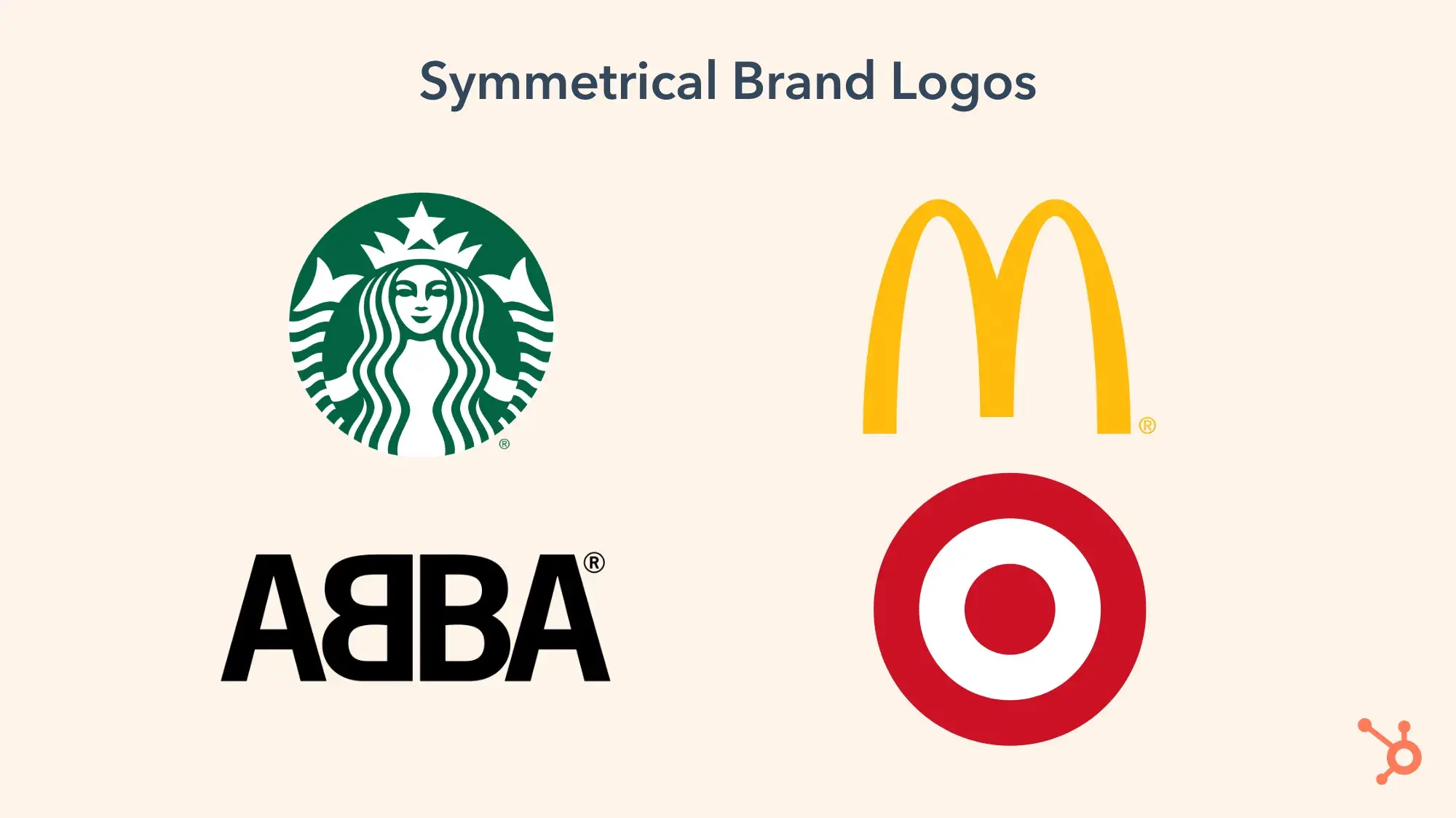
  • Symmetry (formal balance): When objects are arranged evenly around a vertical or horizontal axis. When objects are arranged around a central point (or a radius), it’s known as radial symmetry. The four logos below are all symmetrical:

symmetrical brand logos. clockwise, left to right: starbucks logo, mcdonald’s logo, target logo, abba logo.

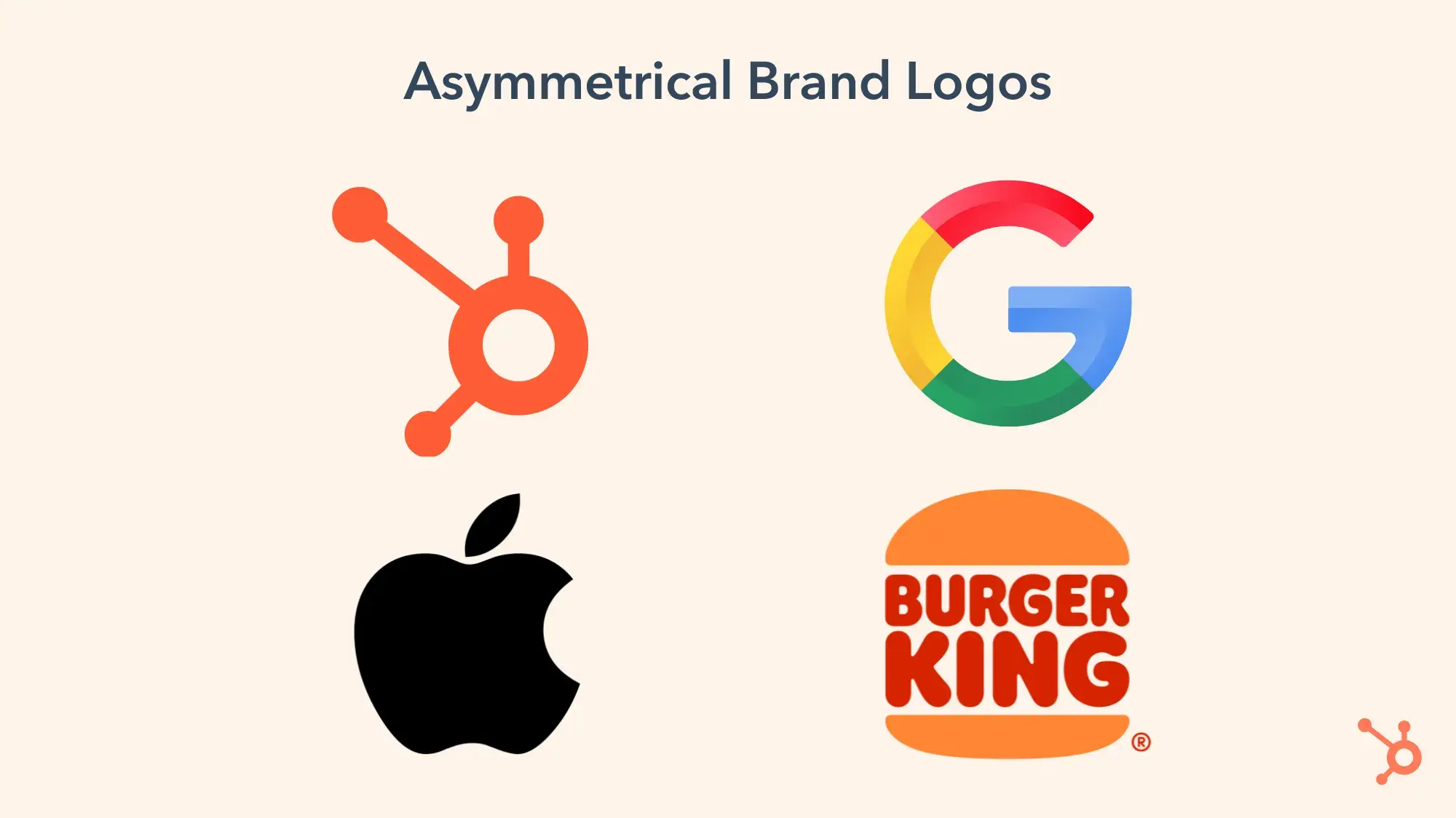
  • Asymmetry (informal balance): When objects are arranged unevenly around a vertical or horizontal axis. Typically, there’s one dominant side or element in an asymmetrical composition. These four logos are asymmetrical:

asymmetrical brand logos. clockwise, left to right: hubspot logo, google logo, burger king logo, apple logo.

Contrast

Contrast refers to how elements in a composition differ. This principle is often paired with the principle of similarity, which is how composition elements resemble each other. Contrast can be established using design elements like color, space, form, size, and texture.

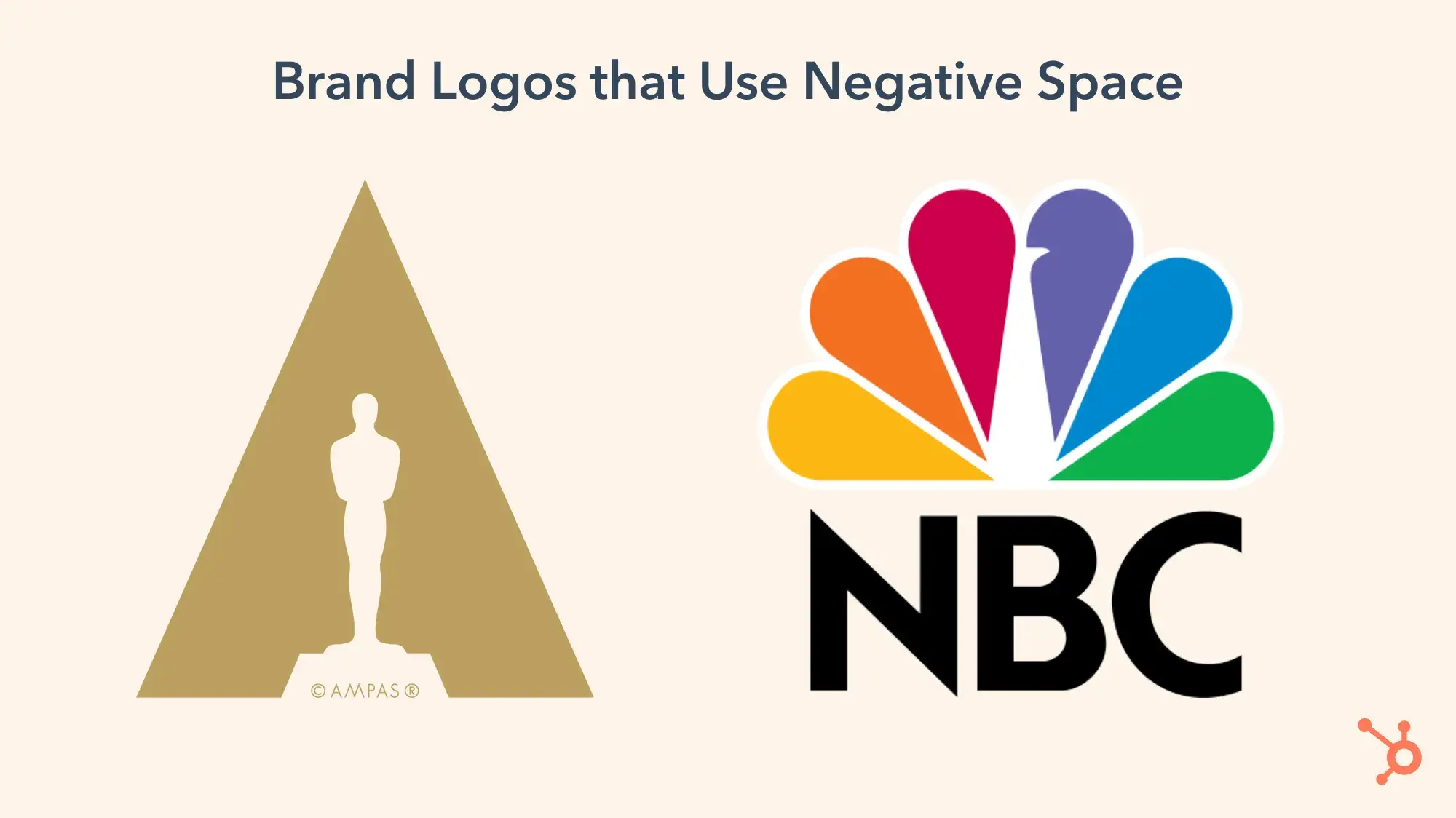
White space, or negative space, is also an important element of contrast. These empty spaces in a composition can help organize the elements in a composition and emphasize the most important ones. It also creates an aura of luxury and minimalism, like the Academy of Motion Picture Arts & Sciences logo (below left). NBC’s logo (below right) cleverly uses white space to create the silhouette of a peacock.

brand logos that use negative space. logo for the academy of motion pictures arts & sciences logo (left) and nbc’s logo (right).

Dominance or Hierarchy

Dominance, or hierarchy, refers to the varying degrees of emphasis within a composition. Elements like size, font choice, and contrasting color combinations can change the focus of a design. DeRosier explains hierarchy as “creating a clear visual pathway on how to digest information.”

There are three main stages of dominance in design:

  • Dominant: The object of primary emphasis. It’s given the most visual weight and is typically found in the foreground of a composition.
  • Sub-dominant: The object(s) of secondary emphasis, typically found in the middle ground.
  • Subordinate: The object(s) of tertiary emphasis, typically found in the background.

dominant, subdominant and subordinate emphasis. a large orange circle is surrounded by smaller squares in different shades of blue to illustrate where your eye goes when something is emphasized using color or size.

The visual center is where we naturally focus on a piece of visual design. It’s slightly above and to the right of the actual center of a composition and is often referred to as “museum height.”

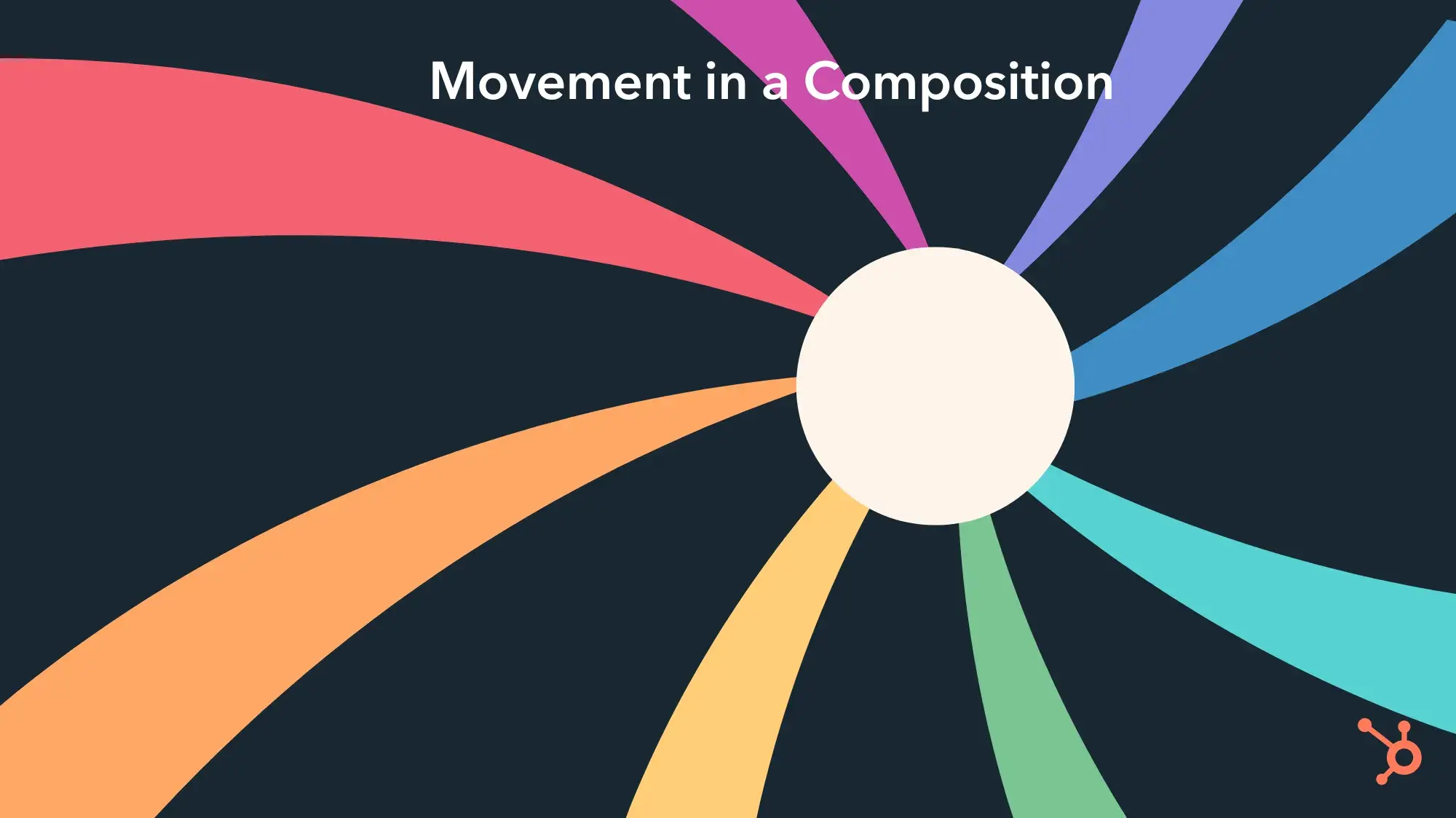
Movement

Movement is the visual path a viewer follows when viewing a composition. With proper movement, a composition can create a narrative and provide a high-quality user experience (UX). Movement can be established using design elements like lines, shapes, and colors.

movement in a composition. a white circle has wavy rainbow lines emanating from it to illustrate movement.

Proportion or Scale

Proportion refers to the visual weight and size of a composition’s elements and how they relate to each other. This principle is also known as scale.

The relative size of one object to another can help create a focal point or movement along the composition. Also, varying sizes of objects can help communicate the importance and dominance of one element over another.

In the graphic below, the orange circles are the same size — the one on the right just looks bigger because it’s surrounded by smaller contrasting circles.

proportion in a composition. on the right, an orange circle is surrounded by six larger blue circles. on the left, an orange circle is surrounded by eight smaller blue circles. the orange circles are the same size but appear to be different sizes because of the proportions.

Unity

Visual unity is the typically main goal of design, although that opinion differs among designers and certain design communities. Unity, or harmony, refers to the relationship between the individual parts and the whole of a composition. When a composition’s elements are in agreement, there’s unity; when the elements aren’t in agreement, a composition instead has variety.

The following design principles are associated with unity.

  • Alignment: When objects are lined up on a certain axis or cadence
  • Continuation: When a line or pattern extends
  • Perspective: When there’s a distance between elements
  • Proximity: When objects are placed close together
  • Repetition: When objects are copied multiple times
  • Rhythm: When objects recur with a slight change or interruption

While the principles of design are considered universal, they look a little different as applied to different design communities and practices. Below, we’ve reviewed the top seven types of design in marketing.

Types of Marketing Design

  • Graphic Design
  • Branding and Logo Design
  • UI and UX Design
  • Web (Front-End) Design
  • Multimedia Design
  • Environmental Design

Let’s break down each type of design and how they apply to the marketing industry.

Graphic Design

Graphic design is probably what you picture when you think of design in the marketing field: social media images, email marketing headers, infographics, postcards, and much more. This Canva template shows how an infographic might be designed:

canva template for a step-by-step infographic.

Since visual content is a highly valuable and engaging marketing medium, companies rely on graphic designers to create assets that represent their brand and communicate with their audience.

Branding and Logo Design

Branding and logo design is a subset of graphic design. It includes the visual elements of a brand and brand identity, such as logos, typography, color palettes, style guides, and more.

Branding and logo designers create assets that represent a brand, illustrate the brand’s mission, vision, and values, and promote brand awareness for the company.

If you’re not a designer, don’t worry — tools like HubSpot’s own brand kit generator can help with logos, color palettes, and more.

UI and UX Design

User interface (UI) and user experience (UX) design focus on improving how website, app, and software users interact with and experience a product.

While some roles combine UI and UX design, the two practices are quite different. UI designers are responsible for creating a visually pleasing, on-brand experience for users through web page design, app design, and theme design on sites like WordPress and Shopify.

UX designers, on the other hand, are responsible for making sure a product solves a problem through usability testing, user flows, and digital prototypes.

Web (Front-End) Design

Web design applies to the front-end (public-facing) side of a website. Front-end designers are like UI designers equipped with coding knowledge — they design static UI mockups for a website and then translate them into HTML, CSS, and JavaScript code. (But don’t confuse this practice with front-end web development.)

screenshot of hubspot.com

Web designers create assets that produce an attractive and fully functional website, such as splash pages, navigational elements, sitemaps and pages, scrolling and clicking features, and content management systems.

HubSpot’s free software includes a drag-and-drop website builder, if you’re looking to create or refresh your website but don’t have a web design background.

Multimedia Design

Multimedia (or motion graphic) design uses a variety of media, particularly video and animation. Because of its time and cost requirements, this type of design has historically been reserved for those in TV and film. But with advancements in technology and a recent rise in video content marketing, motion graphic design has become more accessible than ever.

Multimedia designers are responsible for creating moveable assets that communicate and delight with an audience, like animated logos, GIFs, animated videos, tutorial videos, and animated or interactive websites.

Environmental Design

Environmental design, also known as environmental graphic design or experiential design, is intended to improve a person’s experience by furthering the purpose of an environment, whether that’s to be memorable, exciting, informative, motivational, or easily navigable. The practice merges interior design, architecture, graphic design, landscape design software, and industrial design.

Environmental designers create assets that connect people to their environment, such as murals, office design and branding, store interiors, event space design, and signage and interactive advertising.

Marketing Design Tips

We’ve covered the basics of the most common types of design in marketing: graphic, branding, UI and UX, web, multimedia, and environmental. Now, we’re going to dive into some tips for the top four.

Note: Keep an eye out for the principles of design we discussed above … they’ll make an appearance in this section, too.

Graphic Design Tips

1. Start with the purpose.

What type of content are you designing — a social media ad, email template header, or ebook? These are three different pieces of content with three very different purposes and goals. Before you create your design, jot down its purpose. This will help keep your design and content goals aligned as you create your piece of art.

2. Apply your style guide.

When deciding on what design elements to include, consider your company’s branding style guide. (We’ll get into how and why to create a style guide next.) This guide will immediately show you what colors, fonts, and other design elements to use when designing your content. From there, you can make small tweaks depending on what type of content you’re creating.

3. Create order with lines and alignment.

Lines and alignment in your graphic design can create movement and order. Align the text in your graphic to guide your viewer as they read, or incorporate horizontal lines to section off your text and imagery. Similar to how you format long blog posts in small paragraphs, lines and alignment make pieces of graphic design easier to digest.

four types of alignment. center alignment, left alignment, right alignment, and justified alignment.

4. Pepper in some icons and illustrations.

Colors, text, and images make for gorgeous graphics, but don’t limit your elements to those three. Icons and illustrations can also spice up an otherwise text or image-heavy piece of content. Icons might also be able to illustrate concepts that photos can’t, and they serve as creative bullet points for long lists.

Here’s a Canva template by Lythcreative that uses simple illustrations to break up a cleaning list, making it more visually appealing:

canva template of a cleaning list with simple illustrations of a broom, dustpan, and sponge.

Branding and Logo Design Tips

1. Design the aesthetic of your personality.

How do you visually present the personality of your brand and company? If your brand was a person, what would they be like? Your branding design should reflect the answers to these questions.

Before starting your design, make a list of adjectives that describe your brand, company, and culture. This will help you choose color combinations, images, fonts, and other design elements and bring out the key points of your personality. Also, using your brand adjectives as guidance, build a collection of images, graphics, color samples, and similar logos that represent the “mood” of your brand — aka a mood board.

2. Get a little funky.

Your logo and brand assets don’t have to be a straightforward representation of what your company does.

HubSpot’s orange sprocket isn’t specifically about our software, but it was designed to represent marketing, sales, and service, which is what our software started with. DeRosier also notes that “it’s simple — you want a logo mark to be simple enough to be really small or really big.”

As you design your brand’s visual identity, don’t be afraid to get a little funky and incorporate some unique design aspects. Doing so may help your brand stand out from the rest.

3. Keep it simple.

Your branding should communicate your aesthetic in under a second. Impressions are made in the blink of an eye, and your logo and brand identity are no exception.

Consumers will form an opinion on your brand in a split second, so keep your design simple and to the point.

DeRosier says it’s tempting in design to “throw so many [design elements in a logo] that it gets overcomplicated.” Whether you’re designing a logo or another element, she says to make sure you’re not adding so many elements that the design dilutes or loses its meaning.

4. Prioritize consistency.

This is perhaps the most important tip when it comes to branding and logo design: Be consistent. You can spend hundreds of hours and thousands of dollars developing a gorgeous visual identity for your brand — but if it’s not reflected on every piece of print and digital content, your resources have gone to waste.

Consistency applies on a couple different axes — horizontally along your content elements, like fonts, spacing, and color combinations, and vertically across your content outlets, like your social media accounts, email, website, and print materials.

Create a style guide to encourage everyone to adhere to your new branding. Here’s HubSpot’s Style Guide as an example.

UI and UX Design Tips

Note: UI and UX are two different types of design, but because they’re so similar, we’ve collected a few tips that can apply to both practices.

1. Adapt a user’s perspective.

Whether you’re designing the interface or the experience of an app, website, or online tool, always adapt the perspective of a user. Why would someone use your site? What would they hope to achieve? What might their challenges be?

It’s important to research your user base and better understand how they’d approach your site or application. Consider doing first-hand user research through a focus group or by talking to current customers.

2. Anticipate mistakes.

Regardless of how much you talk to your audience, there will always be a few stumbles among users.

Anticipate these by incorporating fool-proof mechanisms, such as not letting someone submit a web form if they’ve skipped a box or having a user confirm they’d like to exit in case they accidentally clicked off the screen. These mechanisms can help prevent mistakes before they happen and let your users know you’ve got their backs.

3. Don’t neglect standards and trends.

Many designers love paving a new path and reinventing the wheel with their designs. While this can create something unique and memorable for the user, it may also create confusion.

Consider sticking with known design patterns, standards, and trends, such as a navigation bar in the top right corner or contact information along the bottom of the page. This can help your users already subconsciously know how to navigate your site without explanation.

4. Be mobile-friendly.

Responsive design is non-negotiable for websites and applications, but is your design also mobile-friendly?

Consider the spacing of your buttons, the size of the text, and any other navigational or organizational elements that might be inconvenient in a responsive design.

Also, look at how your site may change when viewed on a desktop, tablet, and various types of smartphones.

Web (Front-End) Design Tips

1. Consider the fold.

On a website, the fold is considered the bottom of the screen — where your page would “fold” if it were a physical item, like a newspaper. The most important information on a website should always be placed “above the fold” (like in newspapers) so a visitor doesn’t have to scroll down to see it.

2. Use white space to draw focus.

In the case of web design, less is often more.

With lots of information to share with visitors, it can be tempting to clutter it all above the fold, so folks see it right away. But less cluttered websites are easier to read, navigate, and digest.

Keep visitors on your website by adding plenty of white space around your content; it’ll be easier for them to focus.

3. Use color to guide action.

Color psychology plays a big role in marketing. Without us even knowing it, certain colors can encourage us to do certain things, such as click a button or continue on to the next page of a web form.

Use colors to guide the same types of action on your website. Make all of your CTAs a bold color to help them stand out.

4. Avoid generic stock images.

There are lots of ways to use images in your marketing, but the one method to avoid is using generic stock images, which can make a brand seem disengaged with its buyer persona.

The images on your website should represent your audience, and if you can’t capture your actual audience, you should work hard to find stock images that do.

Pro tip: One great way to collect audience images is by running a user-generated content (UGC) campaign.

Time to Design

Design comes in all shapes and sizes — literally. From websites to print graphics to office space design, design plays a major role in marketing our businesses and brands.

Even if you don’t consider yourself a designer, we encourage you to become more familiar with the elements and types of design. You never know when you may have to consult on a project or whip up a design of your own.

Editor’s note: This post was originally published in February 2019 and has been updated for comprehensiveness.

Categories B2B

Meet the Founder Who Raised $6.3M to Literally Make It Rain

While billionaires hoard water rights and investors play Monopoly with farmland, one 20-something founder is trying something completely different: creating water from thin air.

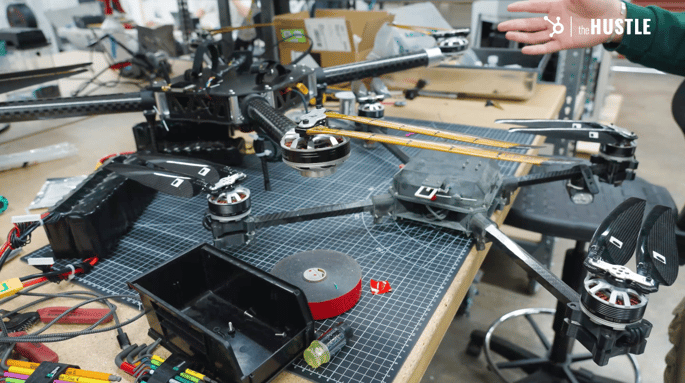
Meet Augustus Doricko, the CEO of Rainmaker — a Southern California startup using drone-based cloud seeding to artificially increase rainfall over drought-stricken farmland. If it sounds like science fiction, that’s because it kind of is. But it’s also very real, very funded, and potentially very important.

Here’s what you need to know.

Screenshot 2025-04-03 at 11.14.10 AM

Source: The Hustle YouTube

What Even Is Cloud Seeding? 

“Cloud seeding is just changing the amount of water that falls onto the ground,” Doricko said.

The science behind it is surprisingly straightforward. 

Doricko explained the process in simpler terms: They find clouds with water droplets that are too small to fall as rain, fly drones into them, and spray a mineral that helps those tiny droplets freeze together and become heavy enough to fall as rain or snow.

It’s basically tricking clouds into raining when they naturally wouldn’t.

From Zero to Seed Round

Augustus Doricko didn’t graduate college. He was one class away from a degree at UC Berkeley when he dropped out to run a water compliance startup in Texas.

That job led him to California — and to the realization that regulation alone wouldn’t solve the water crisis. So he started looking into ways to produce more water.

The result? A new company, a $6.3M seed round (with backers like Garry Tan), and a scrappy team working out of a warehouse in El Segundo, a former aerospace hub turned frontier tech hotspot​. 

His pitch to investors? Dead simple.

“It was pretty straightforward to say, ‘Hey, people need water. We can make it.’ That one was easy,” Doricko said. 

At one point, Rainmaker even picked up its entire team and moved to rural Oregon to get around drone regulations. That’s startup energy.

HubSpot Video

The Stakes Are Bigger Than California

According to Doricko, failing to solve the West’s water crisis could lead to:

  • Famine, as California’s Central Valley — which produces 25% of the US food supply — runs dry

  • Depopulation, in cities like Phoenix, Salt Lake, and Las Vegas

  • Permanent aquifer damage, from overpumping groundwater

“If Rainmaker doesn’t succeed,” he says, “we’ll look back on this time as the beginning of a long, dry decline”

But the impact goes beyond just water availability.

“People don’t think about the loaded costs. Like, if a banana or an orange costs a dollar versus $10, the downstream effects on everybody’s purchasing power is affected meaningfully as well,” Doricko said. 

Is It Safe to Mess With the Weather?

Yes, people ask about ethics. And Doricko’s ready with answers.

  • Pollution concerns? The seeding material is silver iodide, which is 10x less toxic than aspirin. Used in such tiny amounts it’s nearly undetectable.

  • Accidental floods or avalanches? Rainmaker’s programs include strict stop criteria based on soil saturation and avalanche risk.

  • Will seeding in one place steal rain from somewhere else? Studies say no. There’s no evidence of “downwind drought.” 

Still, he admits: the idea of controlling the weather raises big questions. But he argues the alternative — worsening drought and disaster — is even riskier.

Screenshot 2025-04-03 at 11.15.26 AM

Source: The Hustle YouTube

What’s Next for Rainmaker?

The team is testing their new radar and drone fleet in Tierra del Fuego, the southernmost tip of Argentina, to catch winter clouds year-round.

They’re also  building toward the largest weather modification program in the world (outside of China). 

If all goes well, Rainmaker could become the largest water utility in the American West within three years.

Eventually, Doricko wants to go even further: terraform deserts, green the Great Plains, and fully automate atmospheric water generation.

Screenshot 2025-04-03 at 11.16.09 AM

Source: The Hustle YouTube

A Different Solution to Water Scarcity

While billionaires hoard water rights like real estate, and firms flip groundwater access for millions, Rainmaker is asking a radically simple question:

What if we just made more water?

Whether drones can solve the West’s water crisis remains to be seen, but one thing’s clear: In a world where everyone’s fighting over the pie, Rainmaker is baking a new one.

Interested in more stories like this? Subscribe to The Hustle on YouTube, and watch the video about the billionaires who are causing the problem that Rainmaker is helping solve in the first place.

Categories B2B

Who Uses Reddit Anyway? A Deep Dive Into Reddit Users and What They Think of Marketing

The internet is full of opinions. But if you want to know what people really think — about products, brands, trends, or industries — Reddit is where you’ll find the unfiltered truth.

Since 2005, Reddit has been the place for honest, no-holds-barred recommendations — whether brands like it or not. As one of the most visited sites in the world, it holds thousands of communities — and the best answers to countless Google searches.

Download Now: The 2025 State of Social Media Trends [Free Report]

With other social platforms going through lots of upheaval, plenty of brands are making decisions about the future of social media. Reddit isn’t usually top-of-mind, and it’s not for everyone — it’s notoriously tough on brands. But, it’s an incredibly valuable space, as long as you follow the rules.

I’ll take you through the best ways to use Reddit for your brand and how to build genuine connections.

Table of Contents

Reddit User Demographics

If you’re wondering how to market to Reddit’s 100+ million DAUq, or Daily Active Uniques (its term for daily users), without getting downvoted into oblivion, the first step lies in understanding who is on the other end of the computer.

With that in mind, before I go any further, here are a few stats to help you understand who is using Reddit:

  • 101.7 million people use Reddit daily, and 379.4 million use it weekly. (Reddit)
  • The platform is growing rapidly, with 39% year-over-year growth reported in 2024. (Reddit)
  • 1.2 million posts and 9.7 million comments were created daily, on average in 2024. (Reddit)
  • 100,000 active subreddits, 500 of which have over 1 million subscribers. (Reddit)
  • 90% of posts are made in English, and over 1 billion have been translated into one or more languages. (Reddit)
  • 53% of visitors came from outside the U.S., a growth rate of 46% year over year. (Reddit)
  • Daily Reddit users spend an average of 20-30 minutes per day on the platform. (Reddit)
  • Reddit users skew younger, with Millennials and Gen Z making up the majority, at 43.3% and 29.6% respectively. (Business Insider)

Looking for the demographics of other social media platforms? Read this post.

What content resonates with Reddit users?

Demographics are absolutely important, because you have to know who is using a platform.

But in my experience, it’s not just who uses it, but how they use it. And because each subreddit is so different with its own set of rules and culture, you really have to explore each community to find out how things work in that space.

With that said, to help you better understand how Redditors use the platform, we surveyed 103 Reddit users about their favorite content — and here’s what we learned.

More people use Reddit for personal interests.

The people we surveyed most frequently engage with:

  • Product reviews and recommendations (46%).
  • News and current events (46%).
  • Memes and humor (37%).
  • Personal stories and discussions (35%).
  • Niche communities and hobbies (32%).

It comes as no surprise that subreddit categories people visit most often relate directly to the types of content. The top three categories are Entertainment & Pop Culture, Memes & Humor, and Technology.

The majority of people use Reddit for personal interests only, with 56.3% saying they never use it professionally. This could work in your favor if you’re a B2C brand.

Business users are still out there … and there are millions of them.

pie graph breaking down how many reddit users use reddit for business

However, if you’re in the B2B space, all is not lost: 11.7% of those we surveyed say they frequently engage in business or industry-related discussions, and another 32% say they do so occasionally.

The key for you will be finding the right subreddits for your brand.

Remember, even though only about 12% of Redditors are business users, that still represents millions of people.

And whatever industry you’re in, there’s probably a community for you. I was surprised by the career diversity of those we surveyed who use Reddit for business purposes. Though a relatively small sample size, the top three industries were Technology, Real Estate, and Healthcare & Life Sciences.

Wondering what other fields were represented? Ecommerce & Retail, Education, Marketing & Advertising, and Finance & Investing rounded out the top seven.

Redditors are okay with brand engagement … to a point.

pie graph of reddit users responding to the survey question “how do you feel about brands/companies engaging on reddit?”

If you’re a brand wondering if using Reddit to engage with people is a smart marketing move, there’s good news — most Redditors are okay with it. In fact, 46.6% welcome brand engagement if done authentically, and 31.1% don’t mind as long as it’s not intrusive.

However, with 14.6% feeling negatively about brand engagement, I’d advise you to tread carefully here. Be sure to check out the tips I’ve shared below.

Reddit users prefer positive ads.

Even though most of my focus here has been on engagement, since Reddit does allow ads, I also wanted to get a sense of how Reddit users feel about advertising content. A whopping 67% majority say that positive ads that evoke joy are most likely to catch their attention.

How to Market to Reddit Users

Amazingly, 40% of Internet users find a Reddit recommendation most influential to their decision to buy — more than reviews and influencers. However, not all product review content is created equal.

More importantly, the best reviews are organic and not overly promotional.

“Because Reddit is largely anonymous, there’s quite a bit of skepticism. Moderators play a big role in setting the tone for subreddits, but it’s the ability to upvote and downvote content that makes it easier to smoke out people who are shilling versus providing a valuable and helpful solution,” says Bryan Grover, a B2B marketing strategist who uses Reddit personally and professionally.

However, there are definitely opportunities to get your brand in front of new audiences — if you do it the right way.

What is the right way to do it, though?

Understand that authenticity matters more than anything.

All of the Redditors I spoke with feel strongly that brands should be transparent and authentic.

While that can mean different things to different people, those we surveyed overwhelmingly agree that it starts with transparency about being a brand (61%), with another 54% believing that providing valuable insights or expertise contributes to authenticity.

Additionally, 47% feel that brands engaging in discussions like regular users boost their credibility and trust factor.

Build trust by adding value.

One of the subreddits I looked at with Grover had a rule that said no shilling. That means that in that space, you can’t self-promote. However, you can add value to the discussion and share your knowledge — and people pay attention. If your profile is optimized, they can learn more about you and your brand and reach out to start a one-on-one conversation.

In fact, this is Martin Ceisel’s strategy on the subreddits he uses professionally. He is a freelance B2B tech writer who uses Reddit for both personal and professional interests.

“Engaging in organic natural conversation where I can add value or insight might not lead to immediate leads, but I can stand out as knowledgeable in these spaces,” Ceisel says.

If this sounds like a long game, it absolutely can be. That said, I’d argue that most content marketing is a long game, too. By consistently demonstrating you know your stuff, people in your target audience can see that you’ve got the chops to solve their problems with your product.

Know that “fake” or staged posts work against you.

reddit user brand preferences: don’t make fake “organic” posts that feel staged

If authenticity is the most important thing, then it makes total sense that posts that feel staged are the biggest turnoff for Reddit users.

Other no-nos?

  • Obvious or over-the-top self-promotion.
  • Irrelevant or generic content.
  • Lack of transparency.

All of this makes sense. When someone walks up to you and tells you how great they are or interrupts your conversation with something completely from left field, you’re going to politely excuse yourself.

The same goes on Reddit.

“I’m more likely to take recommendations from fellow Redditors seriously because they’re in the same boat as me. Conversely, if they are recommending a brand and didn’t disclose that they’re a rep, it would definitely reduce my trust,” shares Grace Fortune, a copywriter who primarily uses Reddit for personal interests and voice of customer research.

That leads me to the next point.

Reddit is a great resource for market research data.

What better place to get to know your audience and their pain points than to head straight to the source? For that matter, it’s also a great place to uncover competitive opportunities by finding out how people are talking about your product and the competition.

With that in mind, Reddit is a goldmine for anyone doing market research and voice of customer (VoC) research. If market research is about identifying opportunities, then VoC is about finding the right words to talk about the problem, solution, and dream state. It’s also about the overall sentiment.

I’ve found that the most effective copywriting uses the same words your audience does to talk about their problems. After all, it makes them feel like you’re speaking directly to them.

And I’m not alone.

“Every time I’m doing research for content, I add ‘Reddit’ to the search term. It’s one of the few places people are actually talking about issues like AI and automation, to name a few,” says Ceisel.

Fortune also uses Reddit for VoC, though she offers a word of caution: “There’s an issue with bots and automated responses on Reddit. If you’re using Reddit for market research, I encourage you to review the account profiles of any responses you’re considering using to ensure they’re legitimate.”

Tips for Engaging Reddit Users

Interestingly enough, both Grover and Ceisel refer to Reddit as the Wild West. The very level of anonymity means that every comment is up for debate and can — and will — be judged on its merit.

And due to the nature of the beast, if you will, there may be a lot of people who aren’t too thrilled that brands are engaging. Remember, 14.6% of those we surveyed said no way to brand engagement. While these folks may be a minority, they still represent about 15 million people. So, if you make them mad, it could turn into a PR nightmare.

That means you’ve got to play by the rules and use Reddit the smart way. Here are a few tips to help you get started on the right foot.

Find the right subreddit and check the rules.

Pick a few topics and search for subreddits to find communities that make sense for you to be in. Generally, you want to find a place where people are choosing to be because they care about the topic.

Grover recommends checking the age of the subreddit and whether or not it has a wiki with the rules and moderators. He also suggests poking around to learn more about the moderators and who they are. The more transparency in the details, and the more established the subreddit, the more trustworthy it is as a resource.

check the details on reddit to learn more about the subreddit.

All this information can be found at the top of the subreddit if you’re on desktop or by clicking “see more” on mobile.

Take the rules seriously.

Community members are there because they care about the topic and the community. They will defend the rules, so if the rules say clearly, “No shilling,” you’d better follow them. Otherwise, you will get dragged in the responses.

“Fundamentally, that’s how Reddit works — the community democratically chooses the course correction and lets people know what’s welcome and what’s not welcome,” says Ceisel.

Optimize your profile.

Ultimately, this is the best opportunity for you as a brand. If you regularly show up and engage meaningfully on subreddits, people will go to your profile to learn more about you. Make sure your profile talks about your brand, products, areas of expertise, and interests.

When they’re headed your way to learn more about you, you can be sure you’re sharing what you want people to know about you.

Listen before you speak.

As with lots of things, you’ve got to read the room on Reddit before you start posting. Spend some time getting to know the subreddit and reading up on the discussions. Also pay attention to what gets downvoted. By getting a sense of the vibe, you can engage in more meaningfully ways.

Add value to discussions.

When I talk about any type of marketing campaigns, I coach people to avoid “hit-and-run” or “ding-dong-ditch” moments. By that I mean, don’t just drop in when you have something to promote or sell.

Ceisel says, “My fundamental belief is that I’m not making noise to make noise. I want to contribute to the conversation.”

If you’re building a history — regularly showing up and delivering value, whether that means sharing helpful content, solving problems, or even participating in thought-provoking discussions — people will take notice. And because you’ve taken the time to build that history and trust, it’s far more likely that they’ll be open to your recommendations.

Answer a question (don’t just shill).

This goes hand in hand with adding value, but it’s slightly more nuanced.

Let’s say someone has a question about how to do something technical that you’ve actually published a step-by-step guide on your blog. They come to Reddit for advice — and this is your moment to shine.

But don’t just send them to your blog post.

Answer the question. Show them how to do it. Then, depending on the rules of the subreddit, it may or may not be appropriate to share the blog post.

And Fortune, Ceisel, and Grover all have slightly different takes on this.

Grover was much more resistant to seeing a brand share the link, whereas Ceisel and Fortune were more open to it.

“If this is exactly what you’re talking about, and I think it answers your question or offers some insight, I wouldn’t hesitate to drop the link,” Ceisel says.

Fortune agrees. After answering the question, “You could let me know you’ve got a post and drop the link — I can then decide what I want to do with that information.”

The caveat and common thread are that this should come across as informational, not promotional.

Watch for recommendation posts.

Posts asking for recommendations offer a number of opportunities for you as a marketer and a consumer. So keep an eye out for people asking for advice, recommendations, or solutions.

Notably, 23% of recommendation posts lead to people selecting a brand or product not already on their radar. It also gives you a platform to find out how people are talking about problems (back to VoC), and identify opportunities and demands for new products or offers.

Fortune shares, “It’s a great platform for ideation — people go on Reddit specifically for advice. It’s great to see what people want and how they talk about their problems and experiences.”

And of course, if your product or brand can solve a problem, don’t hesitate to mention it … just be sure to be transparent about your connection. That leads me to the next tip.

Be transparent about who you are.

Always disclose that you’re a brand or you represent a brand — in your profile and in any posts where you’re sharing brand content.

If you’re simply answering a question and highlighting your knowledge, you don’t have to start every post with “I’m Jane Doe from Acme Brand.” In fact, I’d argue that you probably shouldn’t do this as it will come out over the top.

But if you’re answering a question and referring people to your resource, be sure to disclose your connection to it.

Let go of the outcome.

If this sounds like strange advice to and from marketers, buckle up — it’s something I say often. At its core, Reddit is another networking platform — albeit very different from anything else out there. Because it’s about community, all of the best networking rules apply.

Even though yes, if we’re talking about marketing, you have some goals in mind, let go of the immediacy and focus on connecting and sharing value. It allows your authenticity to shine — not a sense of desperation. In turn, that means it’s easier to build trust with the people who may eventually become your buyers.

Doing Reddit Well Means Playing the Long Game

Reddit is a truly organic online community where content is driven largely — if not entirely — by user engagement. I found my conversations with Ceisel, Grover, and Fortune to be fascinating as I’m not a regular Redditor. By that I mean, I use it when I’m looking for answers to specific questions, but don’t regularly participate in any subreddits.

If you’re considering creating a Reddit strategy, know that Reddit isn’t a place for quick wins — but for brands who play by the rules, it can be a great opportunity. If you’re going to be successful as a brand on Reddit, don’t “market.” Show up, engage, and provide value — that’s how you’ll get an opportunity with some of the most skeptical audiences online.

So, instead of asking how to market on Reddit, consider asking, “How can I best contribute?”

Categories B2B

AI Agents Will Kill Marketing As We Know It — Here’s What the Future Actually Looks Like

Picture this: consumers no longer see ads, compare software options, or visit websites to research products. Instead, AI agents handle it all — silently evaluating options, filtering choices, and making purchases on their behalf.

This isn‘t science fiction. According to Perplexity founder Aravind Srinivas, this shift is already underway, gradually transforming marketing as we know it. His vision reveals a fundamental disruption that businesses can’t afford to ignore.

Download Now: Free AI Agents Guide

Think about it: If search disappears, how do companies stay visible? If AI agents filter choices based on data, does brand messaging still matter? And if humans aren’t making the decisions, who are we even marketing to?

In a recent episode of Marketing Against the Grain, I break down what AI agents are, how they’re disrupting marketing and advertising, and what brands should do to stay ahead. I’ll also share three key predictions about the future of AI agents — and what businesses need to do now to prepare. Let’s dive in.

What are AI agents, and why do they matter?

AI agents represent the next generation of advanced digital assistants — sophisticated systems that not only respond to queries but actively make decisions and execute tasks on behalf of users. Rather than spending hours manually searching, comparing options, or evaluating choices, consumers simply delegate these tasks to AI. As a result, humans are no longer the ones clicking ads, consuming content, or browsing brand websites.

Srinivas offers a compelling example to illustrate this shift: vacation planning. Instead of travelers browsing reviews or comparing prices, they might tell their AI agent, “Find me a two-night stay in a city with reliable public transport and a four-star hotel under $250.”

Behind the scenes, the AI agent scans available options, evaluates prices, and books the optimal match — all without the traveler seeing a single advertisement or visiting any travel websites.

Suddenly, marketing isn’t about persuading people. Instead, it’s about ensuring your brand is recognized, recommended, and selected by AI systems that increasingly act as gatekeepers to consumer attention.

3 Key Predications About How AI Agents Will Reshape Marketing and Advertising

As AI agents take over search, purchasing, and product discovery, marketers need to rethink how they reach customers. Here are three big ways I think AI agents are poised to transform the industry.

1. Traditional paid ads will lose their impact.

Today, paid advertising revolves around capturing human attention — whether through search, display, or social media ads. But as AI agents take over decision-making, brands will no longer be competing for clicks or impressions. Instead, they’ll need to appeal directly to AI systems, which will rank and filter results based on structured data rather than consumer behavior signals.

Srinivas aptly refers to this shift as the “spec list future,” where brands compete for an agent’s attention rather than a human’s. Instead of designing ads to influence consumer perception, businesses will need to optimize their structured data, APIs, and algorithmic real-time bidding models to ensure AI agents select them over competitors.

2. Emotional branding will take a backseat to data.

Marketing has always relied on emotional storytelling, using compelling messaging and branding to drive conversions and customer loyalty. But as AI agents take over decision-making, purchasing is expected to become less about perception and more about verifiable product data.

This doesn’t mean brand trust and reputation become irrelevant. Consumers will continue to value these qualities. But, it does introduce a critical new dynamic: AI agents will pre-filter options before a human ever sees them, creating an initial screening layer where emotional appeals hold little sway.

This forces businesses to strike a delicate balance between maintaining their qualitative brand identity for human audiences and simultaneously optimizing quantitative data signals that AI systems prioritize. That includes price competitiveness, feature compatibility, reliability metrics, and integration capabilities.

3. Websites will lose relevancy.

Brands have long depended on SEO and websites to capture traffic and drive conversions. However, as AI agents take over search and discovery, websites may no longer be the primary way people interact with brands.

During my analysis of this trend, I found myself asking a question that would have been unthinkable just a few years ago: “Do we even really need to use a website anymore?” But, that’s the direction we’re heading.

AI agents don’t need to navigate websites like humans do. Instead, they can directly access structured data through APIs, synthesize research from multiple sources simultaneously, and deliver comprehensive answers without a user ever seeing a traditional web page.

This means businesses must rethink their digital presence. Instead of obsessing over website rankings and organic traffic, forward-thinking brands will need to ensure their data is AI-readable, accessible through multiple channels, and verifiable — because that’s what agents will prioritize when making decisions.

How to Prepare for an AI Agent Future

Despite how disruptive AI agents may seem, they also present new opportunities. The brands that adapt first will be positioned to win. Here are six high-impact strategies to prepare.

How to Prepare for an AI Agent Future

1. Prioritize data quality.

AI agents thrive on accurate, well-structured information. Make sure your product specs, pricing, and availability are easy to parse — whether that means using detailed metadata on your website or ensuring your API documentation is robust. If your data is messy, agents might skip you in favor of a clearer alternative.

Not sure where to start? Check out Hubspot’s Guide to Data Management, which covers everything from data architecture and modeling to ETL pipelines and migration.

2. Simplify onboarding and usability.

Agents might eventually handle not just product selection but also basic setup. If your onboarding process is too complex or manual, the agent could deem you “incompatible” compared to a competitor’s frictionless onboarding flow. Streamline your UX and technical requirements to stay in the running.

3. Align with the agent’s “preferences.”

AI agents don’t have emotions. They evaluate products based on pre-set criteria, such as cost, reliability, or integrations. Make it easy for agents to match your offering with user preferences by clearly labeling key features in structured formats like product feeds and APIs.

4. Earn customer trust through social proof.

Reviews, testimonials, and objective social proof matter more than ever. Agents evaluate this data for signals that your offering stands up to its claims. Encourage and showcase consistent positive reviews across multiple platforms. It’s a direct line to improved agent-level visibility.

5. Adopt an AI-ready marketing funnel.

Your funnel may need a “direct line” to AI agents. Structured schemas, open APIs, or a well-documented knowledge base can help them gather relevant info quickly. If an agent can’t easily access your product details or specs, it may rank you lower — or ignore you altogether.

6. Blend brand and feature-driven messaging.

Brand identity still counts, especially when a human user steps in at the end to confirm decisions. But, marketing should balance brand storytelling with hard data. Make it clear why your offer is the best match for the agent’s criteria. That hard data often tips the scales in an agent-first selection process.

Your Next Move in an AI-Agent World

These changes won’t happen overnight, but we’re clearly moving toward an agent-centered marketing world. My advice? Start optimizing your data, processes, and messaging now. Even if you’re not yet seeing AI agents in your traffic logs, it pays to stay ahead of the curve.

To learn more about how AI agents are rewriting the rules of marketing, check out the full episode of Marketing Against the Grain below:

This blog series is in partnership with Marketing Against the Grain, the video podcast. It digs deeper into ideas shared by marketing leaders Kipp Bodnar (HubSpot’s CMO) and Kieran Flanagan (SVP, Marketing at HubSpot) as they unpack growth strategies and learn from standout founders and peers.

Jaida filled in a few gaps so we could make two podcast remix posts from one episode. I think it’s really great and cleared it. Sharing for additional context.

Categories B2B

30 Brand Style Guide Examples I Love (for Visual Inspiration)

Building a strong, recognizable brand starts with a well-crafted style guide. This essential playbook ensures that everyone — designers, marketers, web developers, community managers, and product packaging teams — presents a unified and consistent brand image.

The most memorable brands stick with us because they use the same logos, fonts, colors, and imagery repeatedly. Over time, this consistency makes them instantly recognizable. I’ve seen firsthand how a clear brand guide helps teams stay aligned, ensuring that every touchpoint reinforces the brand’s identity.

Free Download: How to Create a Style Guide [+ Free Templates]

So, what is a brand style guide? In this article, I’ll go over the elements of a style guide and share some amazing examples in action to help inspire your next branding project or website redesign (I recommend reading till the end to get some valuable insights from HubSpot’s creative team).

Table of Contents

What are brand guidelines?

Brand guidelines, also known as a brand style guide, govern the composition, design, and general look-and-feel of a company’s branding. Brand guidelines can dictate the content of a logo, blog, website, advertisement, and similar marketing collateral.

Picture the most recognizable brands you can think of.

Chances are, you’ve learned to recognize them due to one of the following reasons:

  • There’s a written or visual consistency across the messaging.
  • The same brand colors are reflected across every asset.
  • The language sounds familiar.
  • It’s all very organized, and while not rigid, it’s cohesive.

But before you sit down to create your branding guidelines, I’d recommend taking a step back and defining your brand’s mission statement and buyer personas. These strategic elements will help you dive into the tactical components of your brand style guide later.

Brand Guidelines Mission Statement

Your brand guidelines mission statement ensures that all your content is working toward the same goal and connecting with your audience. It can also guide your blog and paid content, ad copy, visual media, and slogan.

Brand Guidelines Buyer Persona

Your brand guidelines buyer persona guides your blog content, ad copy, and visual media, which can attract valuable leads and customers to your business. I suggest creating one quickly with our free persona tool.

The Elements of a Brand Style Guide

A brand style guide encompasses much more than just a logo (although that’s important, too). It visually encompasses everything your brand is about — down to your business’s purpose.

Here are some key elements that I believe make or break a brand style guide, with links to in-depth articles if you need more guidance or info:

  • Logo. Logos are a powerful way to determine how your brand is perceived. We’ve got a nine-step guide to walk you through it.
  • Color palette. Your brand color palette affects every aspect of your design, especially visual impact and user experience. We’ve got 50 unforgettable palettes to inspire you.
  • Typography. Typography plays a critical role on any website by ensuring we can comfortably read and process all its text-based content. If a website’s typography works, we won’t notice. If it fails, chances are we’ll bounce off the page.
  • Imagery and iconography. Ensure the best possible user experience with these icon best practices.
  • Brand voice. Build your best brand voice using our free brand-building guide.

1. City of Chicago

See the full City of Chicago brand guide.

What I like: Chicago’s brand guidelines rest on the beauty and simplicity of the city’s flag, both in terms of color and design.

brand guide examples - city of chicago

Source

I appreciate the level of detail in the branding guide, particularly how it explains the symbolic meaning behind the Chicago Municipal Seal. The guide also provides clear instructions on its proper usage and shows some incorrect examples.

brand guide examples - chicago municipal seal

Source

Plus, the tone of the guide is fun and casual — like its acknowledgement of how popular Chicago stars are in tattoo designs.

city of chicago brand typography, design and fonts

Source

The style guide ensures the city’s visual identity remains consistent across all contexts, as it should for any well-defined brand.

A fun detail: The custom font, Big Shoulders, comes from the Carl Sandburg poem “Chicago,” which gave the city its nickname “City of Big Shoulders.”

2. Olympic Games

See the full Olympic Games brand guide.

olympic games brand guide examples

Source

What I like: The Olympic Games still uses the logo and colors from 1913, but the brand was refreshed in 2022 by Ben Hulse. The brand guide is as thorough as any strong style guide should be. It begins with a clear explanation of its mission: to build a better world through sport.

olympic games brand guide examples

Source

The bold interpretation of the Olympic colors embodies the brand characteristics: hopeful, universal, inclusive, vibrant, and progressive.

brand style guide of the olympics: vibrant and progressive

I truly appreciate the structured design approach they’ve adopted, which also aligns with their ideation of being “open, inviting, and inspiring.” I also like how the medal colors are very well-defined.

olympics brand style guidelines on medal colors

The style guide not only explains the field of play and sporting lines but also provides detailed guidance on combining graphics, adapting them for various applications, incorporating photography, and even creating lockups.

brand guide example: olympics field of play

3. Major League Soccer

See the full Major League Soccer brand guide.

What I like: Major League Soccer’s style guide has to include color combinations for 20 teams. To ensure brand cohesiveness, MLS has a single logo mark, the crest, with no design variations. I love how MLS aptly describes it as “powerful, recognizable, and memorable.”

The guidelines show a nice flowchart of the brands associated with MLS and how they represent different branches of the business.

major league soccer brand guide examples

Source

It also includes specific guidance on applying color layers to images and how to “keep it moving” in communications related to MLS.

mls color style guide: photo of a soccer field

I feel that the style guide strikes a great balance between flexibility for individual teams and a cohesive league-wide aesthetic.

4. Sonic the Hedgehog

See the full Sonic the Hedgehog brand guide.

sonic the hedgehog brand guide examples

Source

What I like: Even cartoons need a style guide. Sonic the Hedgehog’s brand guide includes phrases for each character, which is a fun and novel way to ensure brand consistency.

The best part is that, just like the game itself, the branding is also done in a playful manner. The character size chart is a prime example of this:

sonic the hedgehog character size chart

Source

Even the color palette stays true to the game’s vibrant and energetic aesthetic, reinforcing the brand’s identity. It’s a perfect blend of structure and creativity, making sure Sonic and his world remain instantly recognizable across all formats.

5. OpenAI

See the full OpenAI brand guide.

What I like: Unlike other style guides, OpenAI has made use of a video to show their brand guidelines. View it here.

I like how OpenAI has put a lot of thought into the symbolism behind all its color choices. For instance, it uses a lot of black and white in its branding to signify that “OpenAI is an empty vessel that adapts to its content.”

Beyond just showcasing the logo, typography, and fonts, the video effectively communicates the brand’s motto and key message.

openai brand guide examples

Another distinctive feature I liked is that before users can download the logo files from the website, they are required to agree to the usage terms. This way brand usage and compliance is ensured.

Also, I love how the style guide document is continuously refined based on feedback from both internal and external stakeholders. In short, the style guide always remains effective, especially in an industry that is as fast-paced as AI.

6. Reporters San Frontières

See the full Reporters San Frontières brand guide.

What I like: One of RSF’s slogans, “Fight for facts,” is simple but powerful, which is reflected in RSF’s three colors: black, white, and a vibrant pinkish-red. The guide specifies how to use accent colors — red or black should only make up 20% of a design, with white using the other 80%. That reinforces RSF’s spare but muscular branding.

reporters san frontières brand guide examples

Source

This is one of the few style guides that provides a template for how to apply the brand to presentations.

reporters san frontières brand powerpoint template

Source

I also like how the guide includes sections on editorial and digital support, ensuring that the brand is applied consistently across both written content and online platforms.

The digital support section addresses how to adapt the brand identity for different digital formats. This way the visual and textual elements are seamlessly integrated into websites, mobile and social media.

7. Czech Railway

See the full Czech Railway brand guide.

A Prague-based studio recently gave government-run rail company SŽDC a new visual identity.

What I like: The Czech Railway’s beautiful color palette is centered around a dark blue and deep orange, and the logo mark evokes railway tracks.

czech railway brand guide examples

Source

I really love the extended, sans-serif typeface Styrene that has been used and how it enhances the actual look when used on the trains.

czech railway brand guide example on actual train

The style guide showcases how the branding would look on billboards. I think every style guide should give a complete picture of how the identity translates into the real world.

czech railway brand guidelines print communication

Source

I also appreciate the modern and functional aesthetic. The combination of the bold color palette, clean typography, and thoughtful design elements makes the new branding visually striking.

8. EPA (1977)

See excerpts from the EPA brand guide.

What I like: The U.S. Environmental Protection Agency’s 1977 brand guide is a favorite of graphic designers for good reason. Check out the patterns designated as program identifiers, like “toxic substances,” “noise,” and “radiation.”

brand style guidelines example from the epa

What I appreciate most about this style guide is its clarity in distinguishing the official seal for formal communications. By explicitly stating which seal is reserved for official use, it eliminates any confusion and ensures proper brand representation.

epa (1977) brand guide examples

Source

The EPA’s jewel-toned rainbow of brand colors includes a muddy green called “Pesticides Green,” “Radiation Red,” and even a color called, ahem, “Solid Waste Brown.”

color palette of epa style guide

9. Docusign

See the full Docusign brand guide.

What I like: Docusign includes a page of colored pie charts to demonstrate the correct color ratios.

docusign brand style guide example

People often misspell brand names, especially when it comes to capitalization. Docusign addresses this issue effectively by clearly specifying the correct spelling and capitalization in the introduction of its style guide.

docusign brand guide examples

Source

I feel that Docusign stands out with a zinger of an accent color — a bright coral that beautifully contrasts with the purples in the brand palette. Its brand palette stands out for its clarity and visual appeal.

docusign’s color palette for its brand style guide

10. Zagreb Airport

See the full Zagreb Airport brand guide.

What I like: Zagreb Airport in Croatia uses a simple triangle as a building block for complex iconography that references Croatian heritage and culture.

zagreb airport brand guide examples

Source

The triangle serves as a versatile design element, appearing in signage, wayfinding, and branding materials in a way that feels both modern and timeless. I love how this geometric approach creates a visually cohesive identity.

brand style guide example: zagreb airport

I also feel that the style guide thoughtfully balances simplicity across all touchpoints. For instance, safety is an important part of aviation, so the brand guide even shows protective clothing for airport staff.

protective clothes included in zagreb’s brand style guide

In short, I appreciate how the branding elements are seamlessly integrated into functional applications associated with the airport’s identity.

11. ClickUp

See the full ClickUp brand guide.

What I like: The addition of color combinations in the copy that align with the logo is a nice touch here. I’m one of those people who loves seeing multiple colors as I feel they bring life to any brand guide.

clickup brand guide examples

Source

Additionally, I like how they have given a different logo and branding to a product inside ClickUp. The logo files are downloadable (in .svg format) from their website for anyone who wants to use them.

clickup brand style guide examples

I used ClickUp before coming across its brand guidelines, and it made me appreciate just how much clear guidelines contribute to a seamless experience. It’s no surprise that well-structured brand rules make it easier for front-end developers to implement designs accurately.

I appreciate the clever use of “dealbreakers” to highlight incorrect logo usage. Presented as a carousel slider on the website, this interactive approach makes the guidelines engaging and easy to navigate.

clickup brand style guide: incorrect usage examples

When creating brand guidelines, the end goal should be consistency in the final product. The clearer the guidelines are, the easier it is for designers, developers, and marketers to maintain a cohesive brand identity across all touchpoints.

12. Qatar Airways

See the full Qatar Airways brand guide.

What I like: I commend the use of the pictograph in Qatar Airways’ logo. They have incorporated simple lines in the background that subtly evoke fluidity. The oryx symbol, a national emblem of Qatar, adds a unique cultural touch while maintaining a sleek, modern aesthetic.

brand style guide examples: qatar airways

Source

I also appreciate how the brand guidelines ensure the logo’s adaptability across different mediums, from aircraft liveries to digital assets, without losing its distinct identity. They have defined their minimum-size application really well (as shown below).

brand style guide examples: qatar airways specifying logo size

The guide includes specifications for integrating the Oneworld Alliance logo. The co-branding is seamless, as I feel that it maintains Qatar Airways’ strong visual presence. Overall, the entire brand guidelines reinforce the idea of travel and luxury — exactly what it’s supposed to do.

13. Team Canada

See excerpts from the Team Canada brand guide.

What I like: I have included this style guide because of its modern take that adds depth and dynamism. The emblem feels fresh and also does a good job in showcasing the national significance. I feel that to get behind your team and to demonstrate patriotism, you need to connect with symbols that evoke pride and unity — and the designers here have done a great job.

brand style guide examples: team canada

Canada’s red maple leaf could have been a tired symbol, but the designers reimagined it with complex geometric patterns and bold colors.

team canada brand guide examples

Source

The typeface is detailed and uses the “Winnipeg Falcons Hockey” as an example. Overall, the style guide blends tradition with contemporary design. It reinforced a strong national identity in me (even though I’m not a Canadian).

14. Brasil Governo Federal

See the full Brasil Governo Federal brand guide.

What I like: Brasil Governo Federal’s bold style and brash colors are eye-catching, to say the least. The style guide includes information on how to use the logo in video, which is a brand question that often goes unanswered, in my experience.

brasil governo federal brand style guide examples

Source

A unique thing I like about their brand guide is that they have included how the logo will be in different languages, so it remains consistent across diverse linguistic contexts. This attention to detail ensures that the brand maintains its visual identity regardless of the language in which it appears.

brand style guide examples: brasil governo federal logo in different langages

The guide also provides clear specifications on typography, spacing, and color usage, reinforcing a cohesive and recognizable brand presence. I like how they address elements that are often overlooked like application on unstable backgrounds. I think this is a strong example of a well-rounded and practical brand guide.

15. Ryanair

See the full Ryanair brand guidelines.

Ryanair has made itself a brand in recent years, so I decided to see how their brand guide contributes to their fame.

What I like: Ryanair drives customer engagement by relying on witty content. So, even their style guide is an example of it.

ryanair brand guide examples

Source

I appreciate their design principles and how they actually align with what they believe in. As Denise Lee puts it, “Professionally, I admire the brand. It’s probably one of the best examples of a lighthouse brand.”

ryan airlines brand principles

Point #5 aptly applies to them as they are actually transparent in their customer service. They never over promise, and they have established the brand as the “cheapest” airline, so customers’ expectations are set accordingly.

The last part is actually showcased in Ryanair’s marketing. Their marketing is bold, and they aren’t shy in expressing their personality.

16. British Rail

See the full British Rail style guide.

Great British Railways recently updated their brand guidelines to mark the 200 years of train travel since 1825.

british rail brand guide examples

Source

What I like: I like how they’ve used multiple core elements to showcase a distinctive look and feel. I like how the brand guidelines have provided the instructions to make use of a reduced-size logo (including a recommendation not to use the strapline “Years of Train Travel Since 1825” with it).

I appreciate how the brand guide has given an example of how to use clearspace and components that contribute to the aesthetic.

brand style guide clearspace instructions

For the typeface, they’ve made use of Rail Alphabet 2. I really appreciate how they’ve thought about designers and included an email to request the font files. The brand guide has also given instructions to designers on avoiding special effects such as underlining and shadows.

I love the fresh choice of colors in the secondary color palette: Vivid sky blue, Sunglow, and Emerald.

17. Elizabeth Line, Transport for London

See the full Elizabeth Line brand guide.

elizabeth line, transport for london brand guide examples

Source

What I like: TfL, London’s transport authority, created a brand guide for its newest addition, the Elizabeth Line.

The Elizabeth Line aims to deliver a high quality experience that’s delivered through consistency of ambience and environment, and I feel that the brand guidelines reflect that well.

It even includes a section on “design idiom flexibility,” which provides guidance on how much Elizabeth Line branding to use on a scale of “localness” to “Elizabeth Line-ness.”

elizabeth line brand guide

Source

The bold purple color of the newest addition stands out while maintaining a sense of familiarity with Transport for London’s existing network, including London Buses and the Underground. I also appreciate the thoughtful reasoning behind this choice.

Given that colors play a crucial role in distinguishing different transport modes, this careful approach helps prevent confusion and enhances the overall user experience. Here’s how Elizabeth Line stands out from the rest:

elizabeth line color scheme in comparison to other transport for london modes

Source

Another strong aspect of the design is the restrained use of core colors. By keeping them simple and intentional, the brand avoids visual clutter and ensures clarity for passengers.

18. Medium

See the full Medium brand guide.

What I like: Medium’s simple brand style guide emphasizes usage of its logo, wordmark, and symbol. The logo contains the wordmark or the name of the company. I think that including the name within the logo helps create instant recognition, making it easier for first-time audiences to remember the brand. Even if a company isn’t widely recognized, this approach is a smart branding strategy.

brand style guide examples: medium

Medium’s logo is the brand’s primary graphic element and was created to feel “confident, premium, timeless, and modern.”

medium brand guide examples

Source

I value the guide’s clean, minimalist approach. Clear guidelines on spacing, sizing, and color ensure consistent branding, while its simplicity makes application easy.

19. Asana

See the full Asana brand guide.

brand style guide examples: asana

Source

What I like: Asana’s simple style guide highlights its logo and color palette.

It also explains how to properly use the brand’s assets. I love the inclusion of visual examples that show the proper and improper application of the brand elements.

brand style guide examples: asana

Detailed branding information is present related to partnerships. Many brand guidelines don’t include specific instructions on how their logo should be positioned when paired with partner logos or examples featuring existing partners.

Asana stands out by clearly specifying that their logo should always appear on the left-hand side when used alongside partner logos.

brand style guide examples: asana

The goal for style guides is to be clear to ensure consistency in how the brand is presented in collaborative settings, and Asana does a great job at it.

20. Paris 2024

See the full Paris 2024 brand guide.

What I like: Paris 2024’s brand identity pays homage to the 1924 Olympic Games through Art Deco-inspired design. The thing I liked best is that designers have applied eco-branding methods to reduce the amount of ink and paper needed for physical materials as well as limit the power and data consumption on digital elements.

paris 2024 brand guide examples

Source

The branding details are just exceptional. It not only shows the iconic elements, such as the Eiffel Tower to represent Paris, boats for the ceremony on the Seine, and the flame that will arrive at Marseille on board the Belem.

brand style guide examples: paris 2024

I also really like the uniqueness of the Paralympic Games poster. I feel that the use of vibrant colors in this poster adds a sense of energy and excitement.

21. Urban Outfitters

See the full Urban Outfitters brand guide.

What I like: Photography, color, and even tone of voice appear in Urban Outfitters’ California-inspired brand guidelines. Plus, the company includes information about its ideal consumer and what the brand believes in.

urban outfitters brand guide examples

Source

The style guide aptly corresponds to Urban Outfitters’ target market. It defines the brand’s personality and how that translates into communication. Basically, it does a great job of showing that it’s made for a young audience.

brand style guide examples: urban outfitters

I also like how the guide embraces a slightly unconventional and artistic approach. The visuals and tone feel effortlessly cool, making the brand guidelines an extension of the lifestyle it promotes.

22. Love to Ride

See the full Love to Ride brand guide.

What I like: Love to Ride, a cycling company, is all about color variety in its visually pleasing style guide. The company’s brand guidelines include nine color codes and tons of detail about its secondary logos and imagery.

brand style guide examples: love to ride

Brand guides often emphasize visuals, but I believe compelling copy is just as essential. Love to Ride does this exceptionally well. I think the message resonates seamlessly with marketing efforts.

love to ride brand style guide

Source

Also, the supplementary assets, such as illustrations and icons, are all very well done. My take is that anything that contributes to a richer brand identity should be given just as much attention as the logo and color palette.

brand style guide examples: love to ride type styles

To anyone designing brand guidelines, my suggestion is to remember that when every element aligns with the brand’s personality and message, it creates a stronger connection with the audience.

23. Barbican

See the full Barbican brand guide.

What I like: Barbican, an art and learning center in the United Kingdom, sports a loud yet simple style guide focusing heavily on its logo and supporting typefaces.

brand style guide examples: barbican

The entire style guide is cohesive and engaging. The copy is brilliant.

barbican brand guide

Source

One thing I found interesting is that the guidelines can’t be viewed on mobile devices as the browser needs to be 798px wide. It’s clearly a strategic interesting design choice because it ensures the guidelines are viewed in their intended format without compromising layout or readability.

This brand style guide includes a convenient copy button at the end of each page, making it effortless for designers and users to replicate and apply the content seamlessly across various platforms.

Another standout feature is the bold use of typography, which perfectly aligns with Barbican’s modern and avant-garde identity. The clean yet striking design approach makes the brand instantly recognizable across different media.

24. I Love New York

See the full I Love New York brand guide.

brand style guide examples: i love new york

Source

What I like: Despite its famously simple T-shirts, I Love New York has a brand style guide. The company begins its guidelines with a thorough explanation of its mission, vision, story, target audience, and tone of voice. Only then does the style guide delve into its logo positioning on various merchandise.

Some brand guides tell the story behind the brand or the reasoning behind design choices, and I Love New York is one of them. The inclusion of a brand pyramid is very thoughtful and resonates with modern values.

i love new york style guide example

Source

My recommendation is to try to always connect the visual identity to the brand’s values. This way, you’ll end up building a superb style guide.

25. TikTok

See the full TikTok brand guide.

What I like: TikTok’s style guide isn’t just a guide — it’s an interactive brand book. First, it provides an in-depth look into how it brings its brand to life through design.

brand style guide examples: tiktok

Source

Then, it gives an overview of its logo, co-branding, color, and typography. The downloadable assets are a great touch. Everything you need is available directly within the guidelines, so there’s no need to search through separate folders or tools.

brand style guide examples: tiktok design concept

I love how an entire section is dedicated to creating content within the TikTok app. This makes it easy to understand how to design for the platform.

I also appreciate how they’ve included co-branding considerations, recognizing that many brands use TikTok for marketing. This shows a strong awareness of how the brand functions in real-world collaborations.

26. University of the Arts Helsinki

See the full University of the Arts Helsinki brand guide.

What I like: The University of the Arts Helsinki guide is divided into two parts: visual guidelines and a text style guide. For both parts, the focus is a lot on flexibility.

I like how the style guide gives a feeling that’s more of a creative branding album than a traditional marketing guide. It shows you dozens of contexts in which you’d see this school’s provocative logo, including animations.

university of the arts helsinki brand guide example

Source

The guide also gives tips on how to design visual identities using their symbols. Here’s an example:

brand style guide examples: university of the arts tips for designing individual identities

Also, I really love how the text guide focuses on minor details that hold a lot of value. An example is:

“Put the person first, not their specific quality: e.g., people with disabilities (not disabled people), people who are homeless (not homeless people).”

This shows a deep commitment to inclusive and respectful language. I am of the opinion that all style guides should use communication that is thoughtful and considerate.

27. Western Athletic Conference

See the full Western Athletic Conference brand guide.

What I like: The Western Athletic Conference’s brand style guide includes extensive information about its history, mission, and vision. It also highlights its member universities, athletic championships, and awards it is involved with.

western athletic conference brand guidelines example

Source

As I mentioned earlier, a brand guide is a powerful tool for communicating key messages effectively. The WAC brand guide does this exceptionally well by clearly outlining its target markets and core messaging. I think this is a reliable way to ensure consistency across all branding efforts.

brand style guide examples: wac target market and key messages

I like how the guide shows how the brand elements should be applied, illustrating their representation on uniforms and sports jerseys.

brand style guide examples: wac branding on jerseys

28. Discord

See the full Discord brand guide.

What I like: Discord’s brand style guide is as colorful and playful as the communities it serves. The brand’s motion elements are based on the dot, which represents the Discord user interacting with others in the communities it belongs to.

brand style guide examples: discord

I appreciate how Discord has come up with its very own names for colors. Blurple is a memorable name that adds personality to the brand while keeping the guidelines engaging.

discord brand guide example

I also like how the brand guidelines talk about symbol scalability — something that’s often overlooked but incredibly important.

brand style guide examples: discord logo scalability

Source

Also, they have included examples of incorrect symbol usage, making it easy to understand what to avoid. It’s a well-thought-out guide that ensures consistency while still allowing room for creativity.

29. NASA

See the full NASA brand guide.

What I like: NASA’s brand guidelines are one of the most comprehensive style guides I have come across. It describes countless logo placements, color uses, and supporting designs. The branding rules are quite varied. For instance, NASA’s space shuttles have their own branding rules.

The guide talks about supporting elements like typography, imagery, and even the specific proportions required for logo placement, ensuring every visual detail aligns with NASA’s identity. Their insignia has four variations, as shown below.

nasa brand guide example

Source

The details about what background colors to use are also well-defined.

brand style guide examples: nasa background colors

I appreciate how it covers different contexts, from digital applications to physical branding on spacecraft and uniforms.

brand style guideline: nasa logo on bus

I really admire the level of precision, as nothing is left to chance. Even historical elements, like the use of the iconic “worm” and “meatball” logos, are carefully outlined, preserving NASA’s legacy while maintaining a modern, cohesive brand presence.

30. New York City Transit Authority

See the full New York City Transit Authority brand guide.

What I like: Like NASA, the NYCTA has its own graphics standards manual, and it includes some fascinating typography rules for the numbers, arrows, and public transit symbols the average commuter takes for granted every day.

new york city transit authority brand guide example

Source

The guide ensures clarity and consistency in the smallest details. For instance, look at the combination of arrows and how it displays directional information.

brand style guide examples: nycta arrows

The brand guide preserves the visual identity of New York’s transit system while allowing for practical usability. Here’s a page that defines how the line map should be demonstrated.

brand guideline: nycta line map

It’s a perfect example of how thoughtful design can enhance everyday experiences without people even realizing it.

Branding Guidelines Tips

If you want to take your branding style guide to the next level, my suggestion would be to let HubSpot’s Brand Kit Generator do some of the heavy lifting for you.

I’d also recommend following the best practices below, which the HubSpot Creative team has used to disseminate branding information to the rest of the HubSpot Marketing team.

This has made my job as a blogger easier and allows our brand to feel well thought-out and cohesive.

1. Make your guidelines a branded document.

Whether you’re publishing your branding guidelines online or creating an internal presentation, consider making the guidelines themselves a branded document.

Ensure the published document follows your established brand voice, uses the symbols and imagery you’ve created, and employs the colors and typography that make your brand feel like you.

Insights from HubSpot’s Creative Team

When our Creative team rolled out a visual identity refresh for the HubSpot brand, we all received access to a branded playbook that summarized all the changes and described how we should represent HubSpot online moving forward.

Not only was I a huge fan of the refresh, but also of the way it was presented to our team in a branded document.

You can do the same, regardless of your budget. Our Creative team actually used a free tool, Google Slides — so it’s totally doable for a small or freelance brand!

2. Name your brand’s colors.

You’ve already chosen your color palette — why not go as far as naming the colors?

Giving your colors unique names (aside from “blue” or “orange”) can help you tie the tactical elements of your branding into an overall theme or ethos.

Not to mention that it’s awesome to be able to refer to company colors by a unique name. Imagine if we called Solaris, HubSpot’s primary brand color, “HubSpot Orange” — that simply doesn’t have the same ring.

Insights from HubSpot’s Creative Team

In our visual identity refresh, our Creative team brightened and intensified our color palette, then renamed the individual hues.

They wrote, “Every color, tint, and shade is based on central themes. […] Whether it’s a subway line in Paris or a flower-lined street in Japan, the secondary color names are a veritable tour of important cultural and geographical touchstones from HubSpotters all over the world.”

Think about what makes your brand unique and why you chose the colors that you did. For instance, if you work at a law firm that specializes in car accident cases, you might choose red as one of the brand colors and call it “Stop Light.”

3. Create easy-to-use branded templates.

Alongside your branding guidelines should be templates to empower your team to easily design branded assets, even if they’re not designers.

Insights from HubSpot’s Creative Team

At HubSpot, we keep all of our templates in our team’s Canva account. There, anyone (myself included) can edit pre-made designs for any number of use cases.

If you already have a HubSpot account, the good news is that HubSpot now directly integrates with Canva. If you don’t, well, I can say that you’re missing out on some real convenience!

For instance, as a writer on the HubSpot Blog, I have to create graphics to supplement the information I’m sharing. The branded templates made by our Creative team have made my work a great deal easier, and I can imagine that it’s the same for our Social Media team.

Not everyone is a designer, but with templates, you can ensure your brand looks professional no matter who creates an asset.

4. Ensure your branding is optimized for all channels.

Your branding guidelines should include different specifications for different channels.

Or, alternatively, you should have assets and designs that can be adjusted for various channels and media. Not only for sizing purposes, but for accessibility purposes, too.

hubspot brand web guidelines

Source

For instance, if you primarily market your brand over Instagram and on your website, then your branding should have web-accessible colors, as well as Instagram-friendly designs and sizes.

However, you don’t want to significantly change your branding from channel to channel. It should work relatively well, no matter where you’re marketing your brand.

Build a Memorable Style Guide of Your Own

Once you build your unique brand style guide, customers will recognize your brand and associate it with all the visual cues you want them to.

I hope this collection of standout brand style guides has provided valuable inspiration and insights. Remember that strong branding is not just about aesthetics. It’s about crafting a narrative that resonates. It’s also about building a cohesive identity that reflects your brand’s values, mission, and personality.

Best of luck in creating a timeless and impactful style guide for your brand!

Editor’s note: This post was originally published in January 2017 and has been updated for comprehensiveness.

Categories B2B

Content Demand Is Surging—Are You Too Impatient to Make It Work?

What do people want

What do people do?

These are the questions marketers have asked for millennia.

Understanding the answers to these questions helps people build companies and power pipelines and inspire more questions. 

Despite literal yottabytes of data constantly flying around us, many marketers feel they don’t really understand what their target audiences want or do.

Source: tes.com

And that’s troubling.

So how do we solve this?

Simply, to identify what our audiences wants, we must understand what they are already doing.

Enter NetLine’s 9th annual State of B2B Content Consumption and Demand Report—an in-depth, first-party analysis of how professionals interact with content and what their actions reveal about intent.

Introducing NetLine’s 2025 State of B2B Content Consumption and Demand Report

“The more things change, the more they stay the same.” – Jean-Baptiste Alphonse Karr

2024’s 7.9 million first-party registrations revealed that much remains the same in B2B.

[ Access the 2025 State of B2B Content Consumption and Demand Report.]

Yes, buyer behaviors are shifting, AI is reshaping our professional lives, and B2B professionals require more from their content than ever.

However, 2024 looks an awful lot like 2023. 

  • Content demand grew 26.9% year over year—a testament to the growing appetite for gated content and the treasure trove of intent signals it unlocks. 
  • There’s a Catch 22. The time it takes to consume content has widened. This is called The Consumption Gap, and its grown 23.3% over the last year.
  • Want to know who is most likely to make a purchase decision in the next 12 months? Produce a Playbook. Compared to other formats, users registering for this content are 115.1% more likely to make a purchase at this time.
  • eBooks continue to be a truly dominant format force across all Job Levels, Industries, and Roles. 

But just because what we’ve discovered is similar, it doesn’t mean the takeaways are the same.

What we discovered provides a roadmap for thriving in today’s intent-driven ecosystem. 

5 Game-Changing Insights from the 2025 State of B2B Content Consumption and Demand Report

Below, we’ll explore five key findings that will redefine how you think about content marketing in 2025.

1. Timing is… 

Everything.

Source: Stephen Covey

We began by asking what people want. 

Once we work our way through Maslow’s Hierarchy of Needs, what people crave is time.

Money, theoretically, is infinite. Time is finite. 

In 2024, the Consumption Gap—the delay between content registration and consumption—reached 38.5 hours, widening by 7.3 hours year over year.

So, while content consumption rates have never been higher, the speed at which content is consumed has never been slower.

This metric reflects more than hesitation; it reveals the competing priorities and overload that today’s buyers face.

2. The Tortoise and the Hare

So what do we do with this information? 

Many marketing teams still run follow-up sequences as if nothing has changed. And it’s costing you money.

Here’s an example:

Your marketing automation fires off a follow-up email within minutes of a lead hitting your CRM.
Your SDR calls within the hour.

But your prospect? They haven’t even opened your content yet.

From their perspective, they haven’t started the conversation. So when your email lands—or your sales rep dials—it feels off. 

The timing isn’t just wrong; it’s disruptive.

Actions like this result in:

  • Ignored emails
  • Unsubscribes
  • Lower conversion rates

Fast follow-ups used to work. (However, if they’ve specifically asked for contact, don’t wait!) 

But today, relevance without readiness just creates friction.

Marketing Aikido

What’s obvious is that our nurturing strategies must adapt. 

Instead of worrying about the lag in consumption, we should be taking advantage of this behavior. Provide timely summaries and follow-ups that respect and embrace the slowdown. 

Providing these tools to your sales colleagues will be extremely useful and, based on average B2B user behavior, will likely be appreciated by the recipient. 

For sellers,  apply both caution and context to any outreach. 

Before any outreach to your new registrant, review the content they’ve just requested and share whatever quick-hitting synopses and actionable takeaways you have available for their chosen asset. 

This allows you to accomplish the following:

  • Say hello without any aggressive demo/sales request
  • Establish a connection with a registrant
  • Add additional value

We must also recognize the role Format Intent plays for each registration. 

For example, a user registering for a Playbook should be engaged more swiftly than a user requesting an eBook. 

Why? Because for every Playbook request in 2024, there were 50 eBook requests—making the registration of a Playbook an exceptionally rare choice (and often with significant purchase intent).

[More on this in “The eBook Empire”.]

3. C-Level Engagement Surges by 26.5%

For the first time since 2022, C-Level professionals ranked as the second-largest audience, accounting for 12.7% of total registrations. 

For marketing departments, this growth should be celebrated. C-Level reach is something most campaigns hope to achieve. Not only are these professionals eager to consume, but they’re also looking to consume the same formats as their team members. 

C-Level professionals want access to easy-to-consume content. (There’s a reason why Executive Summaries exist.) Their time is limited and, therefore, must squeeze the most from any time investment.

So while we want to engage the C-Level because of their financial sway, remember that they are people with the same amount of time in their day as anyone else.

4. AI Content Demand Grew 186%

Artificial intelligence is now a cornerstone of professional curiosity and production.

In 2024, demand for AI-related content skyrocketed by 186%, led by interest in topics like generative AI (up 493%) and regulatory concerns among legal professionals. 

Specifically, this increase in overall demand signals a critical opportunity to craft AI-focused narratives tailored to diverse industries—from biotech’s fascination with NLP to finance’s embrace of automation.

Source: NetLine’s 2025 State of B2B Content Consumption and Demand Report for Marketers, P. 14


“Generative AI” content registrations grew 5x year-over-year with industries like Banking/Mortgage and Marketing driving this wave. Meanwhile, Journalism’s curiosity about tools like “ChatGPT” highlight how professionals are leveraging AI to unlock creativity and streamline workflows.

The takeaway for marketers is to meet your audience where they are (and where they are going).

Whether it’s speaking to Agriculture’s appetite for “Chatbot” solutions or showcasing the potential of “Robotics” to Executives, the key to success lies in tailoring your messaging to the specific needs of your target audience.

Marketers who align their strategies with these interests will not only grab attention but establish themselves as trusted voices in the AI craziness.

5. The eBook Empire

The 2025 State of B2B Content Consumption and Demand Report paints a compelling picture of the dominance of eBooks as the go-to format for B2B professionals.

Accounting for 53.3% of all demand in 2024, eBook registrations skyrocketed by 71.4% year-over-year, far outpacing any other content format. 

Compared to Guides, eBooks outperformed the second most popular format by registration volume by a staggering 572%

Moreover, the efficiency of eBooks is unmatched.

Each asset uploaded to the NetLine platform generates an average of 983 registrations, eclipsing White Papers’ 59.5 registrations per asset. 

These stats underscore eBooks’ unique ability to balance depth, accessibility, and user engagement.

eBooks’ dominance reveals a preference for comprehensive resources that blend rich insights with convenience, making them a cornerstone of top-of-funnel awareness campaigns. 

The caveat with this format is that its popularity does not match its intent signal. Compared to other formats like playbooks and case studies, eBooks were 11.8% less likely to drive buying decisions within a year. 

But that’s okay. 

Every format has a purpose. If your ICP is requesting eBooks, that’s a good thing. They are simply at the top of the funnel and just beginning their journey. Your job is to introduce your business’s expertise in these eBooks and educate throughout your nurture program.

To capitalize fully, marketers must strategically pair eBooks with high-intent formats in their content arsenal, ensuring their campaigns not only spark interest but also have the opportunity to drive conversion.

Why Building Intentional Content Experiences is Critical

We’ve highlighted five of the most interesting learnings from NetLine’s annual B2B content consumption report.

So what comes next?

What should everyone do with this information?

In (re)analyzing the entirety of the 2025 report, one massive thought comes to mind: 

B2B content marketers and teams must shift their focus from simply creating more content to orchestrating smarter, more intentional content experiences.

The insights are clear—buyers are overwhelmed. 

The widening Consumption Gap (38.5 hours!) is proof that audiences need time, space, and relevance to engage meaningfully. 

For marketers, we can’t afford to treat content as a volume game. Instead, we must craft assets that align with specific moments in the buyer’s journey—content that respects their timeline, answers their immediate questions, and gently guides them forward.

The dominance of eBooks and the rise of AI-related content show that while curiosity abounds, purchase intent often lies deeper in the funnel. 

Formats like Case Studies and Playbooks—which are strongly tied to purchase decisions—remind us of the importance of balancing top-of-funnel discovery with bottom-of-funnel precision.

In 2025, teams that thrive will prioritize:

  • Smarter Follow-Ups: Respect the time it takes to engage with the content they’ve requested. Want to follow up before the 48-hour window? Be absolutely sure you have contextually relevant messaging.
  • Format-Specific Strategies: eBooks need to be your loss-leader. They need to be the content that gets your ICP in the door. From there, use intent-rich formats like Playbooks when targeting buyers close to a decision, while feeding discovery and brand-building efforts.
  • Hyper-Personalization with Intent Data: This is the year of data-driven empathy. NetLine’s audience intent data offers a window into what your audience wants—leverage it to deliver personalized, human-first experiences. In an AI-world, this will separate good marketers from great ones.

Using NetLine’s Research to Fix the Broken Demand Generation Playbook

Buyers aren’t ignoring outreach because they aren’t interested; they’re ignoring it because they aren’t ready. 

Pushing too soon leads to lower response rates, more no-shows, and increased frustration for both buyers and sales teams. 

Remember: your timeline is not their timeline.

The most effective teams in 2025 won’t simply move faster; they’ll move smarter. Precision will win over speed, and the companies that adapt now will be the ones leading the charge into the future.

Be deliberate. 

Prioritize actual engagement behaviors, such as nurturing emails that deliver actionable takeaways and synopses and Sales tracking real intent signals instead of relying on outdated MQL definitions.

Different content types reflect different levels of interest—eBooks drive awareness, White Papers indicate deeper research, and Playbooks are strong buying signals. 

Every word, format, and interaction should contribute to a thoughtful, empathetic content strategy that prioritizes quality over quantity and impact over noise. 

This report isn’t just about trends—it’s a blueprint for connection in a world that desperately needs it. 

What Surprised You Most?

As you explore this year’s findings, we’d love to hear your thoughts. What surprised you most? How do you plan to adapt your strategy based on this data? Tag us on LinkedIn with your reflections and questions—we’re here to collaborate and learn together.

Ready to dive deeper? Access the full 2025 State of B2B Content Consumption and Demand Report.

Categories B2B

Reddit’s Growth Advisor on Finding Your Vertical-Specific SEO Strategy

Once upon a time, SEO was just SEO. (Cue Mr. Incredible meme.) Whether you were a billion-dollar national brand or a teen with a Spice Girls Tumblr, you played the same game: Trying to get your page in those ten blue links.

Now, two marketers might not even be playing the SEO game on the same field, let alone with the same rules. So how do they hope to win?

If you’re in SEO, today’s master needs no introduction. If you’re not, all you need to know is that he’s done SEO for more big brands than you have fingers to count them.

Click Here to Subscribe to Masters in Marketing

kevin-indig-mim-emailKevin Indig

Growth Advisor for Hims, Toast, Reddit, Dropbox & more

  • Claim to fame: Doubling organic traffic at G2, growing Shopify’s traffic by over 75% in 12 months, or standing up Ramp’s organic traffic. Of course, for any of those accomplishments, Kevin acknowledges he can’t take credit alone but gives it to a whole team of talented people.
  • Fun Fact: He used to be a club DJ in a former life and played gigs in front of thousands of people. He also competed in powerlifting and weightlifting competitions.

Lesson 1: Find your vertical-specific strategy.

These days, the type of search you perform can lead to a very different experience. A product search might bring you to Google Shopping, while an informational search brings up an AI Overview. That is, if you’re even searching on Google at all.

The result is that SEO can mean radically different things to otherwise similar marketers.

“Based on what vertical you play in, you might not work with the same tools,” Indig says. “You might not even optimize for the same platform.” And a vertical-specific strategy is the only way to stay ahead in the new search game.

He gives the example of a SaaS or B2B brand vying for real estate in Google’s AI Overviews.

“AI Overviews source a lot of citations from YouTube or LinkedIn,” he tells me. So a business that wants to show up in Google search results might… not focus on either their website or Google.

Meanwhile, marketing a B2C product “is much more about Google Merchant Center than Google Search Console. [It’s] a completely different playing field and [there’s] completely different ways to win.”

“The pattern here is fragmentation,” he says. “We cannot just talk about SEO. What form of SEO are we talking about?”

But no matter what vertical you find yourself in, “SEO should not just be on Google anymore.”

kevin-indig-mim-form

Lesson 2: Decide where you want to be.

Indig simply means that good SEO is bigger than just Google these days, but it raises the question about Google’s competitors. So I asked if marketers should even be focusing on Google in the first place?

In true SEO fashion, the answer is “it depends.” (It’s comforting to know some things never change, right?) And what it depends on is — again — your vertical.

So if you’re a small business with a physical presence?

When it comes to local search, I don’t see anybody getting close to Google in the next decade. [It still] has an absolute stronghold.

What about eComm?

“I would argue that Google never won. Amazon still holds that space.”

And our fictional SaaS looking to show up in the overviews? That’s where things get a little more gray.

When it comes to the informational space, I think there is a realistic chance that an LLM like ChatGPT can take significant market share.

(Now seems like an acceptable time to plug our AI Search Grader? #ShamelessPlug #ButItsActuallyRelevantSo…?)

But that doesn’t mean it’s time to jump ship on Google.

Indig suggests thinking about your digital presence the same way you might consider what kind of store your product belongs in: Where will your ideal customers be looking? And, in this metaphor, Google is a big ol’ shopping mall.

You might head to the mall “if you’re not sure what you need, or you just want to browse around.” But if you’re after [name a very specific thing], you might head [specific thing store].

kevin-indig-mim-experiment

Lesson 3: Get comfortable with experimenting.

All of these changes amount to one truth: SEO is not a plug-and-play strategy anymore. And, as challenging as that can be, it’s actually a good thing.

“It’s kind of cool, because it feels like the early days of SEO,” Indig says, waxing nostalgic. “There wasn’t an exact playbook — and there was a lot more experimentation.”

If you’ve been doing SEO for less than… let’s say 10-15 years… you might not remember there was a time when none of us knew what we were doing. There was no strategy to follow. Instead, there were simply people discovering tactics that worked (and then beating them to death. But that’s not the point.)

“And I think a lot of people new to SEO, they don’t know that world. And they’re entering that world right now. I think an important skill is to really understand how to experiment, how to learn, and then how to act based on your findings.

Lingering Questions

This Week’s Question

Right now, it feels like so many brands are investing in beautifully produced, curated, experiential moments that are intended to drive awareness and shareability (and likely very expensive).

How do you think new brands with limited budgets should approach this tactic and still manage to cut through the clutter? — Jackie Widmann, VP of Marketing, BERO Brewing

This Week’s Answer

Indig says: In my experience, the highly produced moments matter at certain moments, like when customers consider a purchase, but what often catches their attention is the highly authentic, unpolished moment.

That’s why influencer marketing works. So, as a brand with a limited budget, I’d focus my budget on a few well-produced marketing assets (like videos of product images) and the rest on authentic, raw moments that build trust and curiosity.

Next Week’s Question

Indig asks: What’s the most underrated marketing channel right now, and why do you think it deserves more attention?

Click Here to Subscribe to Masters in Marketing

Categories B2B

AI with Agency: How Autonomous Agents Solve Business Problems & Improve Customer Experience

When you hear the word agent, what do you think of? A real estate agent, an insurance agent, or even an FBI agent? Far beyond an assistant following rote instructions, an agent has the power and ability to make things happen on your behalf.

Wouldn’t it be great if we had technology that could carry out independent tasks and take work off your plate? Autonomous agents are rapidly becoming a reality, capable of completing tasks for humans ranging from mundane to complex.

Download Now: The Annual State of Artificial Intelligence in 2024 [Free Report]

In 2024, just 1% of software included autonomous agents, but by 2028, that number may rise to 33%. In this post, I explore what autonomous agents are, what they can do for you and your customers, and how to implement one at your organization.

Table of Contents

What is an autonomous agent?

An autonomous agent is an AI-powered system designed to complete tasks and make decisions independently to reach a goal. Autonomous agents are a subset of agentic AI, a type of artificial intelligence that learns from interactions and stimuli, makes decisions, and adapts to its environment with minimal or no human intervention.

“Do you need assistance? A Rozzum always completes its task!”

That’s the refrain of Roz, the goal-oriented robot who crash-landed on a remote island in “The Wild Robot” movie, one of my favorite animated film flics. Roz immediately begins adapting to her new environment and searching for a customer. When she finally finds one — caring for an orphaned gosling — she throws her energy into the survival of not only the gosling but the entire island.

Like Roz, autonomous agents operate independently of humans, adapt to their surroundings, and complete goal-directed behavior.

One differentiator that separates agentic AI from other types of AI is access to real-time data and environmental inputs. This differs from a foundation model like ChatGPT, which is pre-trained on large, static datasets and pulls from general knowledge only.

Foundation models rely heavily on human prompts to operate, unlike an autonomous agent, which makes a series of decisions based on its goal.

How can autonomous agents help?

Companies are starting to build autonomous agents for everything from marketing to sales to customer service. Gartner predicts that agentic AI will solve 80% of customer problems by 2029. But how does this look in everyday life?

Examples of autonomous agents include:

  • Self-driving cars.
  • Autonomous delivery drones and robots.
  • AI trading bots that analyze trends and buy or sell based on real-time market data.
  • AI cybersecurity agents who can take actions based on threats.
  • AI coders that can take high-level goals like “build me a website” or “fix this bug customers have reported” and write and debug code.
  • AI content agents that can build and run hyper-personalized campaigns based on a prospect’s behavior and data.

These autonomous agents and others can alleviate challenges in your business, like fraud, customer churn, and the high cost of operations.

When implemented correctly, autonomous agents can speed up processes, increase productivity, increase customer satisfaction, and cut operational costs by as much as 30%.

Autonomous Agents vs. AI Agents

If you’re like me, you were introduced to AI agents through early versions of website chatbots and voice assistants like Siri and Alexa.

While those tools can be incredibly helpful, they rely heavily on human prompting and can only perform tasks or answer questions based on predefined data sets. In other words, they aren’t autonomous.

“A chatbot is just very reactive based on the FAQs or the articles of knowledge that your organization has created. An autonomous agent, however, is going to look at you holistically as a customer,” says Zack Hamilton, Head of Growth Strategy and Enablement for parcelLab.

An autonomous agent is designed to take proactive action based on a goal, like customer retention or satisfaction.

“One of the first agents we built focused on packages that are trending late. If there’s an issue with the carrier or a warehouse delay, the agent monitors that data and proactively notifies customers,” shares Hamilton.

According to Hamilton, “We have retailers globally adopting this because it improves customer satisfaction and reduces call volume. We’ve seen ‘Where’s my order?’ calls decrease by 20 to 30%.”


Autonomous Agent/Agentic AI

AI Agent

Level of independence

Fully autonomous

Requires user input

Complexity

Can handle dynamic environments

Better for simpler, more structured tasks

End goal

Goal-driven problem-solving

Complete a task, following specific instructions

Learning and adaptability

Continuously learns and evolves

Static, rule-based

How Autonomous Agents Work

Autonomous agents function through a combination of machine learning, natural language processing (NLP), and reinforcement learning. Agentic AI uses a system of foundation models, tools, and architectures that enable an autonomous agent to operate. The key is that they’re flexible, with the ability to plan and adapt to challenges that arise.

Let’s take this example from The Wild Robot to see how autonomous agents function.

1. Perceive data from their environment.

Roz is searching for a customer and gets hit by a big wall of water.

2. Analyze the best course of action.

Roz sees another wave coming and determines that climbing a cliff to reach land is the best way to stay safe and find her customer.

3. Act without human intervention.

Roz attempts to climb the cliff but falls into the water again.

4. Learn and optimize their behavior.

Roz observes a crab climbing the cliff sideways and mimics its behavior to scale the cliff successfully.

Types of Autonomous Agents

types of autonomous agents

Interested in building your own autonomous agent? Each autonomous agent follows a different model, so consider these types as you plan.

Deliberate Agents

Deliberative agents are cognitive systems that make decisions based on symbolic reasoning, planning, and maintaining a model of the world.

Example: A chess-playing AI that evaluates future board states before making a move.

How they work: These agents use complex algorithms, like search and planning techniques, to evaluate possible outcomes and choose an optimal action.

Reflexive Agents

Simple reflex agents act on current sensor inputs, adjusting to environmental inputs in real time.

Reflexive agents are not typically agentic AI on their own but are an integral piece of agentic AI models.

Example: A simple thermostat adjusts its heating or cooling based on temperature readings.

How they work: Reflexive agents continuously monitor the environment through sensors or cameras, reacting based on inputs.

Hybrid Agents

Hybrid agents combine different AI architectures, such as reflexive and deliberative systems, to reach the best outcomes. Typically, a reactive component will handle real-time responses, while a deliberative system will plan ahead.

Example: A self-driving car uses deliberate reasoning to plan and follow a route, then uses reflexive reasoning to slam on its brakes when a pedestrian crosses its path.

How they work: They integrate reactive behavior (quick responses) with goal-oriented planning and utility-based optimization to carry out complex tasks.

Model-Based Agents

Model-based agents maintain an internal model of their environment to predict how actions will affect future states.

Example: Autonomous vacuums like Roomba, which maps a room and navigates obstacles with a model.

How they work: Model-based agents use mapping techniques and predictive algorithms to handle dynamic environments effectively.

Learning Agent

Learning agents improve performance over time by analyzing past experiences and modifying behavior based on feedback.

Example: A recommendation system like Netflix, which adapts to user preferences based on viewing history.

How they work: These systems use reinforcement learning or other machine learning techniques to refine their algorithms based on new data and feedback from previous actions.

Hierarchical Agents

I also learned that multi-agent systems are possible in agentic AI (mind blown!). Consider, for instance, a system where a high-level autonomous agent oversees lower-level agents that manage specialized functions like customer service, customer retention, and selling.

Example: Swarm by OpenAI, while still experimental, allows autonomous agents to work together or even create new autonomous agents to reach an overarching goal.

How they work: Each Hierarchical Autonomous Agent Swarm (HAAS) starts with a supreme oversight board (Tier 0), the top of the hierarchy, which oversees the mission and ethical framework. The board makes high-level decisions and can make Executive agents (Tier 1), similar to C-suite roles.

Executive agents can create lower-tier agents (Tier 2) to perform specified tasks like data analysis or customer support. Lower-level and executive agents cannot override the authority of the tier above them.

Goal-Based vs. Utility-Based Agents

While some autonomous agents are goal-based, others are utility-based. Goal-based agents follow a specific, pre-defined goal, like getting from point A to point B. Take, for instance, the Roomba example. Did you clean all accessible floor space? Then, check that your goal is accomplished. These are simpler to design and implement and work well with tasks with a clear objective.

A utility-based agent, on the other hand, makes decisions based on utility.

The agent doesn’t only care about goal completion. It wants to optimize an outcome, like efficiency or time to completion. One good example is Uber’s algorithm, which considers both wait time and trip cost when matching riders with drivers. Utility-based agents are highly adaptable and flexible, requiring more sophisticated modeling.

Autonomous Agent Example Use Cases

Ready to see autonomous agents in action? While agentic AI is still new and evolving, you can learn from these businesses putting autonomous agents to work.

Joy by VoiceCareAI

autonomous agent examples, joy by voicecareai

Source

While we aren’t quite ready for autonomous agents to make healthcare diagnoses and treatments, there are other viable uses for autonomous agents in healthcare.

Take, for example, administrative tasks like insurance verification, prior authorizations, and claims processing, which health systems say require 70,000 calls per month.

Joy, an autonomous agent from startup VoiceCareAI, is being piloted by the Mayo Clinic and others to call insurers to complete these functions. For example, Joy can call to check if there’s a prior authorization on file. If there’s not, request one, then follow up later for the number.

Since clinicians spend over 60% of their time on administrative work, this frees them up for patient care. Now, all we need is a consumer version to negotiate with our insurance companies for us.

Avride Delivery Robots

autonomous agent examples, avride delivery robot

Source

Get ready. Your next pizza or coffee may come via robot.

Fleets of robot couriers like Avride are rolling out on college campuses, delivering everything from hot food to groceries to shopping hauls.

Like self-driving cars, delivery robots need to make real-time decisions in a dynamic environment, navigating streets, pedestrians, and challenges like weather, construction, or animals. Avride boasts complete autonomy for its robots, which use an extensive array of sensors for environmental inputs so they can complete their goal.

LOXM by JPMorgan & Chase

autonomous agent examples, loxm by jpmorgan & chase

Source

The stock market is a complex venture, requiring traders to make hundreds of decisions a day based on factors like global news headlines, company performance, and stock market activity.

That’s why it made a great area for JPMorgan & Chase to build an autonomous AI trading agent. LOXM uses NLP and machine learning to understand the market in real-time and execute client orders based on optimal outcomes like trade prices and minimizing market impact.

JPMorgan & Chase reports that LOXM has improved order efficiency by 15% and is introducing agentic AI in other areas, including contract intelligence, recruiting, and employee productivity.

How to Implement Autonomous Agents For Your Team

how to implement autonomous agents for your team

So, how do you tap into the power of autonomous agents? I spoke to CX experts on the frontlines of this work about how to start building agentic AI at your company. Here’s what they said.

1. Identify pain points in your business.

First, examine the friction points in your business to uncover opportunities for growth and automation.

“Think about the overall customer experiences — what are your biggest frictions, and what‘s impacting your bottom line the most? That could be customer retention, customer lifetime value, or a high customer acquisition cost. There’s always that one business metric,” says Hamilton. “Then think, ‘Okay, how can I apply an agent to that?’”

2. Define objectives.

Next, choose the pain point that you want to solve and choose an objective. “Start small. It can be a very small use case,” advises Hamilton. Clearly outline the tasks and goals you want the agent to achieve and make them quantifiable when possible. Here are several examples:

  • Identify and qualify potential customers based on online behavior
  • Reduce fraudulent transactions
  • Identify and fix software bugs autonomously
  • Increase average order value

3. Choose the right tools.

Select the appropriate AI tools and platforms, such as Breeze AI by HubSpot, to support your agent’s development. You can build one in-house, using employees or contract labor, or license an existing one like parcelLab.

While many AI tools are built into or integrated with tools you already use, in some cases, AI tools are robust enough to replace some of your tools.

“Think about an agent as its own kind of tech stack, essentially. It will leverage the different tools we have, like communication tools, but we’ll no longer have to have 10 or 12 different pieces of tech to respond to customers — that’s exciting,” says Hamilton.

4. Develop and test.

As you begin to code and build your model, use machine learning algorithms to develop the agent and test its capabilities in real-world scenarios.

“The agents will be leveraging everyone’s data, and so all the teams cross-functionally are going to have to respond. So start small, A/B test, and learn. Make updates continuously,” recommends Hamilton.

5. Integrate with existing systems and data.

As you build and test your autonomous agent, it’s critical that your data is clean and your systems work together seamlessly. This will take strong leadership and cross-departmental collaboration to make sure that all systems are working together well.

“The agent will only be as efficient with your data as you are. So if you have challenges in your data and it’s not accurate, of course, the agent is only going to spit out what you feed it,” Hamilton warns.

6. Prepare and upskill your team.

Don’t underestimate the need to educate and empower your team for successful integration. When your employees first hear about agentic AI, their instinct might be fear. They may worry about losing their job to AI or having to learn a whole new skill set.

What you need is effective change management.

“There’s a healthy degree of skepticism of, ‘Will this work?’ ‘How will this work?’ and ‘How will our customers react to it?’” says Hamilton.

“What I would say to organizations is that how you lead with that skepticism will determine how your employees will respond. Focus on how the AI will free employees up from low-value tasks to let them work smarter and faster, rather than being replaced.”

It’s also smart to hire, train, and upskill your workers on AI skills and prompt engineering to build capacity for the workforce you’ll need five years from now.

7. Monitor and optimize.

As you roll out an autonomous agent, make sure to create a monitoring system that can document the actions and decisions taken by the agent. Audit the decisions early on so you can identify problems and make tweaks. Monitoring also allows you to measure your KPIs and the lagging impact of your autonomous agents, so you can measure the value and continue investment.

8. Scale up.

After you’ve run one successful AI pilot, you can use what you’ve learned to grow and scale.

“Once you feel confident as an organization, then maybe have that specific agent take on a bigger task, or introduce a second agent focused on a different objective,” recommends Hamilton.

Put Autonomous Agents to Work for You

From everything I’ve learned, I believe that autonomous agents aren’t just another AI trend— they’re the future of how we’ll interact with brands. Beyond basic AI assistants, autonomous agents can analyze data and learn from interactions to enhance customer experience and improve efficiency.

So, the question isn’t whether you should explore autonomous agents — it’s how soon you can start. Approach the challenge through the lens of change management, and you’ll emerge with a redefined stronger team.

Categories B2B

Did HubSpot Really Lose 80% of Blog Traffic? Here’s What Actually Happened — and What It Means for Marketers

Earlier this year, HubSpot went viral — and not exactly in a good way. A few companies posted data suggesting that we had lost 80% of our blog traffic. Overnight, the news was all over X and LinkedIn.

As marketers ourselves, we know better than anyone that hot takes drive clicks. But, what actually happened to our traffic? Have we really reached the end of SEO as we know it? And is this really the downfall of HubSpot’s core strategy?

As one of the people who built HubSpot’s SEO strategy from the ground up, I’d like to think I can offer a bit more of a nuanced perspective. And while I’d never begrudge our fellow content creators jumping aboard the latest hot take bandwagon, in this case, I’d argue that the reality is a bit more complex than social media might have you think.

That’s why I wrote this post: Not just to set the record straight (spoilers: no, the end of HubSpot is not nigh) but also to help marketers understand the very real challenges that today’s AI-powered search ecosystem poses. I’ll also share the steps marketers can take to meet those challenges and come out ahead.

Download Now: Free State of Marketing Report [Updated for 2025]

What Actually Happened to HubSpot’s Traffic

Let’s start with what actually happened. There are three important pieces to the traffic puzzle that the clickbait headlines and apocalyptic posts have (by and large) ignored.

1. Shifting from Information to Influence

None of us could have predicted the incredible impact that AI tools like ChatGPT have had over the last few years. However, we have been taking steps to keep HubSpot’s strategy relevant since long before the recent hype cycle.

Specifically, as far back as early 2020, we began to see that Google was demanding a new approach. While our original SEO strategy focused on providing concrete, informational content, over the last five years search engines have increasingly rewarded influence rather than just information — and we adapted our strategy accordingly.

We invested in channels like YouTube, podcasts, and social media. We built out HubSpot Academy, and, importantly, we acquired the founder-centric news site The Hustle. These platforms came together to transform our content from largely informational into an ever-present part of our target customers’ lives.

We never cared about vanity metrics like traffic, but especially in recent years, we became increasingly focused on cultivating influence rather than just providing information. You can see the results in posts like this one, where a HubSpot customer describes the literal years-long journey he took to discover our brand, fall under our influence, and, eventually, buy our product.

noah greenberg on hubspot’s “long-con marketing playbook”-1

Image Source

The point was never to maximize page views. We wanted to build influence so that when people eventually need a product that we sell, they come to us first.

Recent updates to Google’s algorithm added new urgency to this shift toward influence over information, but these changes were already in motion years before the recent media kerfuffle.

Today, Google is pushing people to dial into their core areas of expertise, and they’re rewarding sites that focus on content that’s relevant to those areas. That’s a bit of a departure from how it used to work, when search algorithms rewarded quantity alongside quality.

But, we had already been working to dial up the quality piece of our content equation, to focus in on the content that’s most relevant to our customers. This choice put us in a good position to get ahead of these changes when they emerged.

2. The Disruption (and Opportunity) of LLMs

The next major trend that everyone has been talking about is the so-called “death of blue links.” With the proliferation of AI assistants and automatically-generated summaries, a lot of questions that users used to click a link to answer can now be answered without ever leaving your ChatGPT window or Google AI Overview.

There’s no denying that these no-click searches have cannibalized a lot of traditional search traffic. At the same time, we’ve also seen that HubSpot content actually performs really well within AI-generated responses. Why is our traffic from LLMs increasing? Because of the diverse, influence-focused playbook we just described.

Today, we’re not just influencing humans — we’re influencing robots, too. We are marketing to both, and as LLMs become an increasingly relevant platform, that investment has begun paying off.

I saw this just the other day: I was in a Slack thread with a colleague, and they were using ChatGPT to do some research on the new AI model, DeepSeek. What did ChatGPT show them? A link to Kieren’s own video on DeepSeek.

By developing high-quality content on topics where we have real expertise, we’ve been able to cultivate influence among humans and algorithms alike. So, yes, we might be getting fewer clicks from search (just like everyone else is). But, we’re also getting new visibility for our most relevant content, as these LLMs recognize our content as high-quality and offer it as reference materials to their users.

3. The Strength of Transactional Search

The last trend worth noting is that while traffic has indeed fallen for many of our informational keywords, performance for transactional keywords is as strong as ever.

In fact, when it comes to keywords focused on specific products, actions, or problems that users need help with, our search volume has actually grown substantially. This is important because while our informational content strategy has shifted toward a more influence-focused approach, our transactional search volume remains an important driver of conversions.

Growing Search Traffic in an AI-Powered World

growing search traffic in an ai-powered world-1

So, what does this mean for your business? Of course, I can’t tell you exactly what to do, and I can’t predict the future. But here are three strategies that we’re pursuing — and that I think are likely to benefit other marketers.

1. Double down on depth, not breadth.

First, if you’re trying to build an SEO strategy, start by asking yourself: Do I have unique data? Unique insights? A unique customer base with a unique perspective?

If you do, you should be able to own that area of expertise and get some strong search traffic around it. But if you don’t, then a generic LLM could likely create the same content as you … which means you’re probably not going to get much traffic for it.

In today’s landscape, you have to be smart. You have to have a highly differentiated point of view, highly differentiated data, and a clear reason why you’re uniquely qualified to share your story. Without that, you’ll struggle to be successful long-term.

When SEO first emerged, a lot of effort was spent on developing broad coverage. But with AI, coverage is no longer the problem. Today, what people need is depth. They need high-quality, expert-backed takes on their questions. As long as that’s something you can deliver consistently, you’ll still have a good shot at sustained success.

2. Optimize for both humans and robots.

Step one is doubling down on the content that you’re uniquely qualified to create. Step two is figuring out how to get that content to appear in the AI-generated responses that are increasingly relevant for many markets.

Fortunately, we’ve found that the same strategy that works for humans works for robots, too: It’s all about influence. To succeed in an AI landscape, you need to think about your content not just with respect to the traffic and clicks it can generate in the near-term, but with respect to the influence it can foster over the long haul.

3. Continue with transactional SEO.

Finally, we’ve found that while recent advances in AI and search algorithms have dramatically transformed many aspects of the online content landscape, transactional search has remained relatively unchanged.

What does this look like in practice? Transactional search is when someone searches for a keyword that’s specific to your product or the problem they’re looking to solve.

A lot of SEO has traditionally focused on broader informational content. This content may be interesting to your customers, but that doesn’t solve an immediate problem. Instead, transactional search is also an important piece of the SEO equation … and we’ve been seeing that it’s still well worth the investment.

A New Era of SEO

SEO has always been about providing value to the customer. In the past, that meant information, but now, it’s about influence and highly differentiated expertise. In today’s landscape, success hinges on obsessing over what value humans can provide that AI can’t.

Here at HubSpot, we’re learning right along with you. We’ll make some missteps, to be sure. However, we’ve found that overall, our strategy still seems to be working — no matter what you might have heard online.

To learn more about lead-scoring tactics and marketing growth strategies, check out the full episode of Marketing Against the Grain below:

This blog series is in partnership with Marketing Against the Grain, the video podcast. It digs deeper into ideas shared by marketing leaders Kipp Bodnar (HubSpot’s CMO) and Kieran Flanagan (SVP, Marketing at HubSpot) as they unpack growth strategies and learn from standout founders and peers.

Categories B2B

Which Meta Channel’s Best for Social Media Marketing? 1000 Pros Compare Facebook, Instagram & Threads

Meta houses three huge social media platforms, each offering their own benefits and drawbacks.

When we surveyed marketers in 2025, we wanted to find out which one is best for social metrics like audience growth and site traffic and where they’re re-investing.

We’ll dive into that along with key differences among various segments, like B2B vs. B2C brands, company sizes, and industry.

Download Now: The 2025 State of Social Media Trends [Free Report]

Facebook, Instagram, or Threads: Where Marketers Spend Their Time in 2025

I won’t bury the lede – Instagram is by far the most popular and highest performing Meta platform among marketers we surveyed. In fact, it’s a top one across the board. 

Facebook isn’t far behind performance wise, though. Threads is, however, a different story.

Before we look at segmented data points, here are key data points on the ROI marketers report on Meta platforms, and the investments they’re making.

social media trends report 2025 graph: which of the following social media platforms does your company leverage?

Firstly, the 2025 State of AI report found that marketers are investing most in video-first platforms – 76% of respondents say their company uses Instagram.

Facebook comes in right behind at 61% as the third most used app.

Thread hasn’t picked up steam, as the least used app at 9%, behind Tumblr, Discord and Pinterest.

Performance-wise, marketers rank Instagram as the top performing platform for site traffic, engagement, audience growth, and influencer marketing.

And this isn’t just among Meta platforms, Instagram is the top performer across all social media platforms we surveyed marketers on.

Facebook lags behind by an average of 12%.

social media trends report 2025 graph: which social media platform should you use?

This sets the stage for where marketers are investing in 2025.

Instagram is among the top 3 platforms marketers are investing in this year.

Twenty three (23) percent of marketers plan to cut off their investment in Facebook this year, compared to only 9% for Instagram. In addition, six percent more marketers plan to invest in Instagram than Facebook.

Now that we’ve looked at each platform across the board, let’s dig into some insights within key segments.

B2B vs. B2C

When looking at how marketers reported ROI on Instagram and Facebook, there wasn’t more than a 5% difference between B2B and B2C businesses.

In terms of 2025 investments, B2B and B2C were in lockstep in their approach to Threads, with 27% increasing their investment, 25% maintaining the same investment amount, and 26% decreasing or cutting it entirely.

social media trends report 2025 graph: 46% of b2b businesses plan to decrease or cut their facebook investment in 2025, compared to 35% of b2c businesses.

We saw some variance in 4 areas:

  • Facebook investment – Forty six percent (46) of B2B businesses plan to decrease or cut their Facebook investment in 2025 compared to 35% of B2C businesses.
  • Instagram investment – Our report shows a 7% higher investment from B2C brands.
  • Brand safety – Twenty one (21) percent of B2B businesses are uncomfortable about their brand’s safety on Threads compared to only 10% of B2C. Marketers are showing a similar trend on Instagram, 11% of B2B are uncomfortable on it compared to only 3% of B2C.
  • Influencer marketing – B2C brands are 9% more likely than B2B to work with influencers most on Instagram. That said, B2C and B2C businesses report similar ROI on the platform.

Company Size

Midsize (201-2,000 employees) and large (2,000+ employees) companies are more likely than small (1-200) companies to build community on Facebook.

In addition, midsize companies also report better community building efforts on Instagram, compared to small and large companies.

social media trends report 2025 graph:threads is more popular among marketers at midsize companies

We also saw some interesting variance as it pertains to their approach to Threads and the ROI they report.

Threads is more popular among marketers working at midsize companies, with 13% reporting that they leverage it, compared to only 4% at small companies and 7% at large ones.

However, the data suggests smaller companies have a harder time finding success on Threads.

  • Companies with 1-200 employees were more likely to see low ROI from using Threads.
  • 31% of respondents from small companies reported low ROI from Threads, compared to only 18% from midsize ones and 16% from large ones.

This trend was also apparent for Instagram – 20% of respondents from small businesses reported low ROI from the platform, 11% more than for midsize companies and 12% for large companies.

Industry

Generally, marketers at nonprofit/government orgs report lower performance results compared to B2B and B2C brands.

social media trends report 2025 graph: 47% of b2c businesses report high roi on instagram.

Marketers at B2B and B2C companies are more likely to report high ROI on the Meta platforms than nonprofit and gov. orgs.

In addition, 40 to 48% of marketers for B2B and B2C brands report high ROI on Instagram, compared to only 20% for non-profit/government orgs.

That said, Meta platforms are not leveraged as much from nonprofit and government orgs. Only 56% of nonprofit and government orgs leverage Instagram, 14% less than B2B businesses and 21% less than B2C ones.

Social Pros Compare Benefits of Each Meta Platform

Brand Safety

social media trends report 2025 graph: marketers feel generally comfortable across platforms, especially on established platforms.

Marketers feel most comfortable on established platforms for brand safety.

81% of marketers surveyed reported they feel comfortable posting and advertising on Facebook. Seventy-five percent of marketers reported the same on Instagram.

As the newest platform from Meta, only 41% of marketers reported feeling comfortable on Threads.

grammarly facebook postSource

Community Building

We also see a similar trend for community building.

Established platforms, like Instagram and Facebook, are where social media marketers build community on the most.

social media trends report 2025 graph: which of the following social media platforms does your company build community on?

Forty percent of marketers say Instagram is most effective for building an active community on social media, earning the top spot across all platforms.

Facebook ranked third at 33%.

Influencer Marketing

Unsurprisingly, marketers report that Instagram provides the highest ROI of all three platforms.

Across all platforms, Instagram and Facebook are among the top 5 for ROI, with 45% reporting high ROI for Instagram and 38% for Facebook.

Twenty six (26) percent of marketers report wanting to work with influencers on Instagram the most, compared to 14% for Facebook.

Key Takeaways

Marketers are clear on one thing: Instagram is the clear winner among Meta platforms. It’s the platform that they see the best results from and plan to invest the most in.

Facebook, as the most established platform, is a close second – even when we expand beyond Meta.

Without short-form video features or a proven history of ROI, Threads lags way behind.