Categories B2B

How to Make Your Business More Flexible During Uncertainty

“The best laid schemes o’ mice an’ men / Gang aft a-gley,” wrote Scottish poet Robert Burns. Even the finest, most well-thought-out plans sometimes have to be set aside for reasons outside of your control.

During times of uncertainty, one of the most important traits for any business to have is flexibility.

With a willingness to adjust plans, divert from the original strategy, and make small or large pivots, your business can be more resilient during stormy weather.

If your business is facing uncertainty and the road ahead is unclear, here’s how to add more flexibility to your plans, projects, and strategy to help you get through it.

Download Now: How to Be More Productive at Work [Free Guide + Templates]

How to Make Your Business Flexible During Uncertainty

Accept what you need to postpone or change.

If the landscape your business exists in has suddenly changed, you will need to make changes inside your organization, too. That’s especially the case if you need to tighten budgets and make sure it’s spent in the places with the highest return.

Take a look at all of the projects in your pipeline and assess what really needs to be prioritized right now, what can be postponed, and what can be discarded.

Encourage each department in your business to ask:

  • Is now the best time for the projects we are focusing on?
  • Should we adjust our content and communications to deliver the most value to our audience?
  • Is our budget in the right place, or do we need to change allocations?
  • Would team members offer the most value working on different priorities?
  • What pivots should we be making?

If your business is experiencing higher levels of churn or lower profits, you may also need to reassess some goals during times of prosperity or at least adjust expectations.

Identify where your focus is most valuable.

After you have reassessed the projects that your business is working on, it’s time to look at your own to-do list.

Ask yourself: where can I add the most value with an hour, a day, a week, or a month of focus?

Even if you can’t forecast the future, you can think about what’s the most valuable way to spend your time right now. Make sure your agenda is aligned with the tasks that matter most instead of the busy work that’s landed on your desk.

Maintain transparency with your team.

When your business or industry is going through some turbulence, it’s more crucial than ever to maintain strong communication with your team.

To sustain the trust that’s essential for a focused and happy team, make sure that leadership is honest and transparent about where your business stands right now, key goals for the upcoming period, and what the current challenges are.

A transparent and engaged team is essential for a resilient business that can endure times of change.

Embrace different working styles.

Building a resilient and flexible business requires a willingness to do things differently than you have done before. You may need to embrace new ways of working instead of stubbornly saying “but this is how we’ve always done things.”

This can include adapting to different working styles, such as remote work — which might even be a necessity to a lot of businesses. To help your team adapt to remote work, think about team-wide policies you can introduce to encourage better focus, well-being, and productivity.

These can include:

  • Introducing remote-friendly apps for video calls
  • Adopting a company-wide communication tool such as Slack
  • Scheduling remote meetings to catch up with your team and share information
  • Encouraging team members to focus on their mental health and well-being

Reinforce the foundations.

If your business is less busy with new leads and projects, it’s a good time to focus on strengthening the foundations so you’re in the best position when things start to pick up again.

Look at the important tasks that are often overlooked, for example, improving contact management processes or introducing automated workflows to make your team more efficient.

You could also use this as a time to look at your tech stack and identify weaknesses and areas for improvement.

Some questions to help optimize your tech stack include:

  • Which apps are we paying for that don’t add value?
  • Could certain apps be replaced by free tools?
  • Do we have any overlapping tools?
  • Where are there opportunities to integrate data between apps to increase productivity?

Facing times of uncertainty is challenging for any business, but the right amount of flexibility and resilience can help your organization weather the storm.Take me to Projects

Categories B2B

7 of the Best Tools for Freelancers in 2021

You’ve decided to become a freelancer. You’re the boss of your own time, your business, and the projects you choose to work on. There’s a lot going on, from finding new clients to managing your workload. The truth is… you kind of have to do everything, especially when you’re just starting out.

To maximize your chances of success, one of your first decisions as a freelancer is how to manage your processes – especially your invoices, accounting, clients, and projects.

To find, retain, and receive glowing reviews from clients, you need an efficient and scalable way to stay on top of invoicing, accounting, time tracking, and client management. Otherwise, it’s all too easy to neglect the billable tasks that build your business and always be playing catch-up.

After a lot of testing, here’s our pick of the best freelancer apps to manage your business and prime your freelance career for max results.

Download our complete productivity guide here for more tips on improving your  productivity at work.

7 Best Apps for Freelancers in 2021

1. FreeAgent

FreeAgent is a popular, all-around accounting tool that tracks your time, manages projects, sends invoices, and preps your tax return. It’s especially powerful for freelancers and small businesses in the UK.

Although FreeAgent’s user experience is a bit more old-school than some of the other apps for freelancers in this post, it works remarkably well in a huge range of use cases.

If you’re paid in multiple currencies and use an app like TransferWise to receive and convert money, FreeAgent provides an easy way to streamline accounting. It’s simple to invoice clients in the right currency, then record payments in that currency and instantly convert to your home currency, too.

As FreeAgent connects to many popular banks, it’s easy to automatically add expenses made on a business card. Or, you can import a CSV of bulk expenses.

On the FreeAgent dashboard, there’s a quick overview of all of your freelance business’s key metrics at a glance:
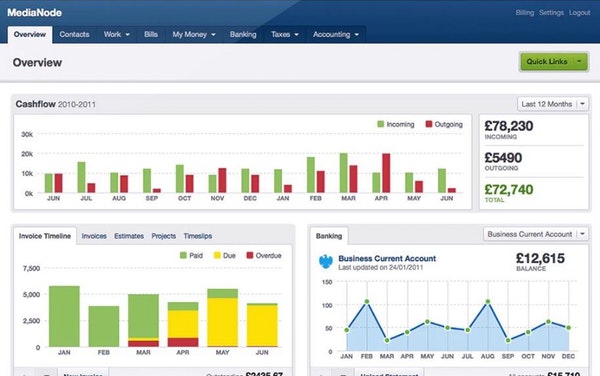
FreeAgent software for freelancers

FreeAgent has separate websites for the UK, the US, and the rest of the world to give you the most relevant information. For FreeAgent users in the UK, you can use the software to prepare your Self Assessment forms and view a handy timeline of your tax estimates at any time of year.

FreeAgent could be the best freelancer software for you if:

  • You’re based in the UK and want built-in Self Assessment and tax timelines
  • You get paid in several currencies

2. Xero

Xero is one of the most popular accounting systems on the market, offering freelancers a higher-end solution to manage their pipeline and accounts.

Along with QuickBooks, Xero is one of the most popular accounting tools on the market. It’s extremely user-friendly, beautifully designed, and is perfect for freelancers planning to scale up their business in the next few years. You can just switch to the next plan whenever you’re ready for more power from Xero.

Xero is laser-focused on saving you time as a freelancer – connecting directly to your bank, creating and following up with invoices at speed, and integrating with your favorite business apps. With Xero’s Hubdoc data capture and automatic entry tool, you can cut paperwork clutter and save even more time.

As a freelancer, you can choose between Xero’s three plans: Early ($9/month), Growing ($30/month), and Established ($60/month). However, we recommend the most expensive of those three tiers – the Established plan – as this is the only plan that includes multi-currency, time tracking, and project cost tracking features. 
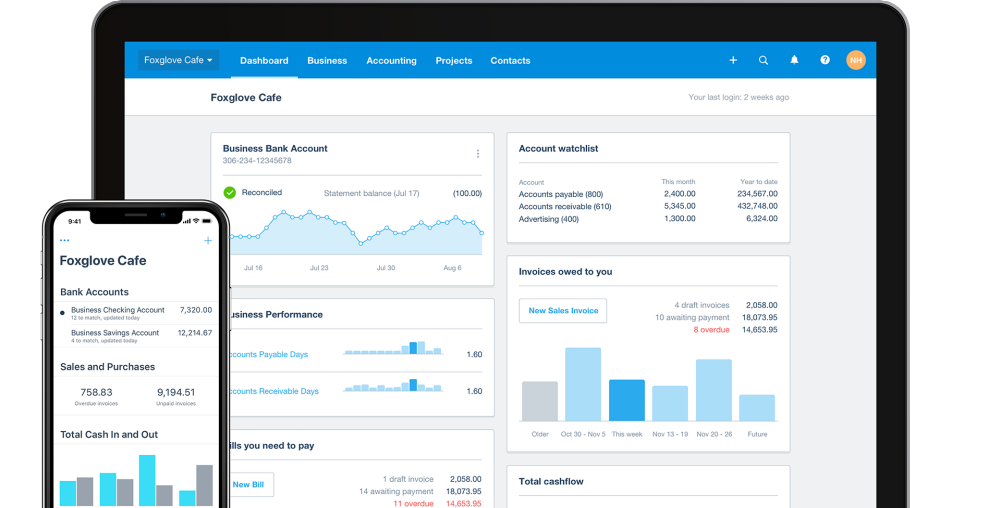
Xero for freelancers

Xero is also valuable for freelancers with a growing retail business. The accounting platform seamlessly connects with leading ecommerce apps for point of sale transactions (such as Square), inventory (such as CIN7), as well as payment systems like Stripe and PayPal.

Xero could be the best freelancer software for you if:

  • You want strong native integrations with your other favorite apps
  • You want instant bank reconciliation for transactions
  • You want retail app integrations
  • You have an accountant who is a Xero partner

3. QuickBooks Self-Employed

QuickBooks is the market leader in accounting software and a great fit for many small businesses, although freelancers can find it hard to find the perfect plan.

If I ask you to name an accounting software, there’s a high chance QuickBooks will spring to mind. With QuickBooks Self-Employed, freelancers can access a lighter plan than the most popular cloud-based product (QuickBooks Online) offers.

However, QuickBooks Self-Employed has its limitations. Although you can send and track simple invoices, track mileage, and separate business and personal expenses, there’s limited scope for customization and no time tracking functionality in this plan. For this, you’ll need to choose a QuickBooks Online plan for small businesses instead.
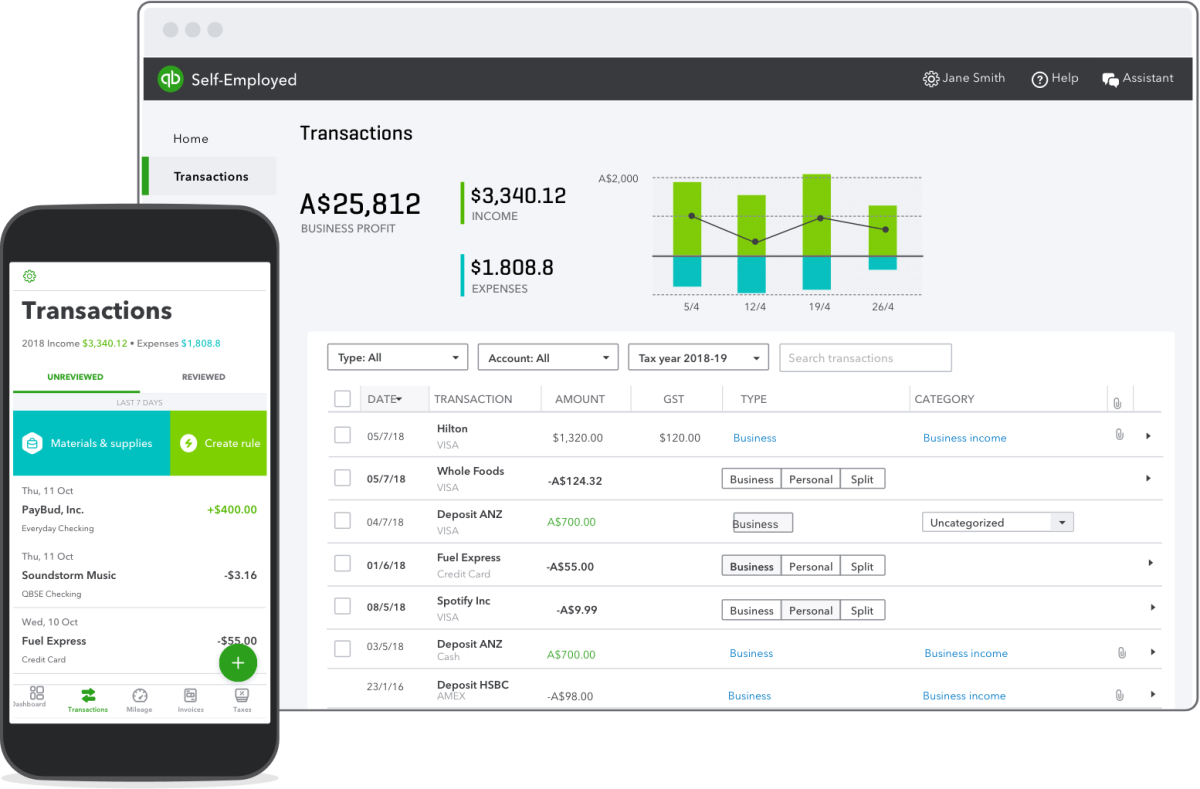
QuickBooks Self-Employed for freelancers

Once you choose a QuickBooks plan, your freelance business is in a great position to scale: you can switch plans and products as and when you need to.

QuickBooks is also one of your best choices if you want a wide range of integrations and a comprehensive feature set.

QuickBooks could be the best freelancer software for you if:

  • You’re planning on scaling your freelance business in the next few years or becoming an agency
  • You want strong native integrations with your other favorite apps
  • You want instant bank reconciliation
  • You have an accountant who is a QuickBooks partner

4. Cushion

Designed to give freelancers a clearer view of their workload and availability, Cushion improves cash flow while offering strong invoicing and time tracking features.

Cushion promises “Peace of mind for freelancers,” providing beautiful UX and unique features to help you avoid taking on too much work. It’s easy to visualize future workload, earnings, expenses, and invoices, so freelancers can anticipate their financial situation ahead of time.
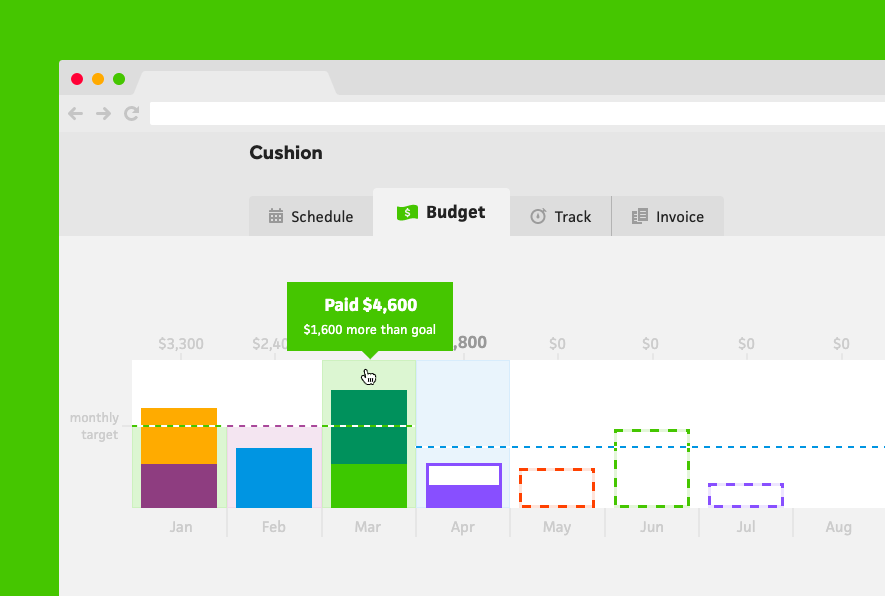
Cushion app for freelancers to track earnings forecast

Where Cushion shines is as an app for freelancers to stay on top of their workload, improve cash flow, and find valuable balance. It’s also easy to track time and invoice clients with the app.
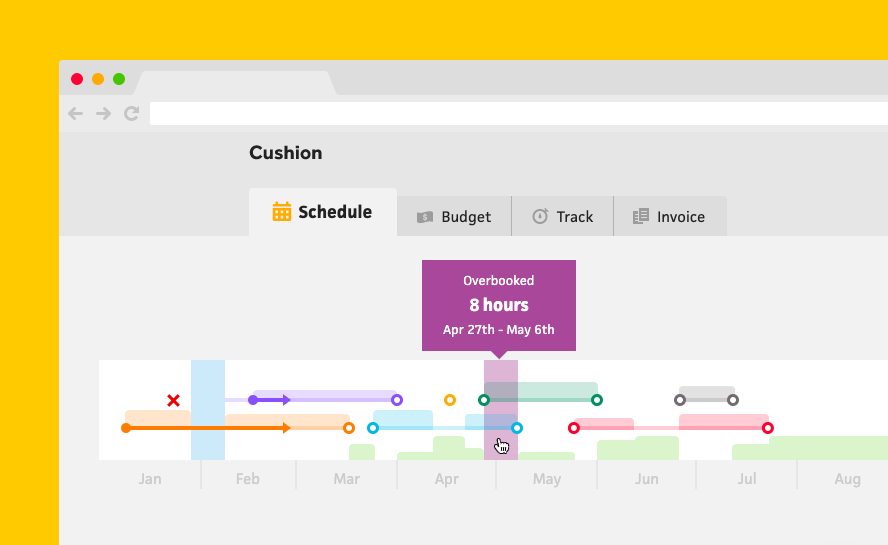
Cushion app for freelancers to avoid being overbooked

However, you’ll need to use another app to manage core accounting needs such as compiling expenses and income for the tax year. Cushion handily integrates with FreeAgent, FreshBooks, and Xero to enable this.

Cushion could be the best freelancer software for you if:

  • You don’t need comprehensive accounting software right now, or you have another system that syncs with Cushion (FreshBooks, FreeAgent, or Xero)
  • Your goal is to have a clearer view of your workload and avoid taking on too much work

5. FreshBooks

As a powerful all-in-one small solution for business accounting and invoicing, FreshBooks is a simple but mighty software choice for freelancers and entrepreneurs.

FreshBooks has a great all-around feature set while still being simple to use. For the $15/month Lite plan, you get unlimited customized invoices, expenses, time tracking, estimates, online card payments, and bank transfers. You also get insightful Tax Time reports.

With the Plus plan (from $25/month), you can add more automation to your freelance business, such as with scheduled late payment reminders, recurring invoices, and late fees. You can also access client retainers. The Premium plan is for growing businesses that need to manage up to 500 clients.

FreshBooks software for freelancers

FreshBooks could be the best freelancer software for you if:

  • You need time tracking functionality at a low price point
  • You want unlimited invoices, estimates and card payments
  • You prioritize simplicity and ease of use

6. AND.CO

AND.CO is a powerful all-in-one tool for freelancers to manage and grow their business. The platform was acquired by Fiverr in 2018.

AND.CO is an excellent fit for freelancers who are just getting started. Self-titled as “the one app to run your freelance business or studio,” over 300,000 businesses use AND.CO to send proposals, invoice clients, get paid, and manage their time, expenses, and tasks.

Once dubbed “free forever,” AND.CO changed tack and introduced paid plans after being acquired by Fiverr in 2018. You can still get started with its free plan, but this only supports one active client – which isn’t going to cut it for most freelance businesses.

For $18/month, you can manage unlimited clients, remove AND.CO branding, edit contracts, and pay 2.9% + 30 cents for online payments. You can also connect up to six bank accounts to keep track of when invoices have been paid.
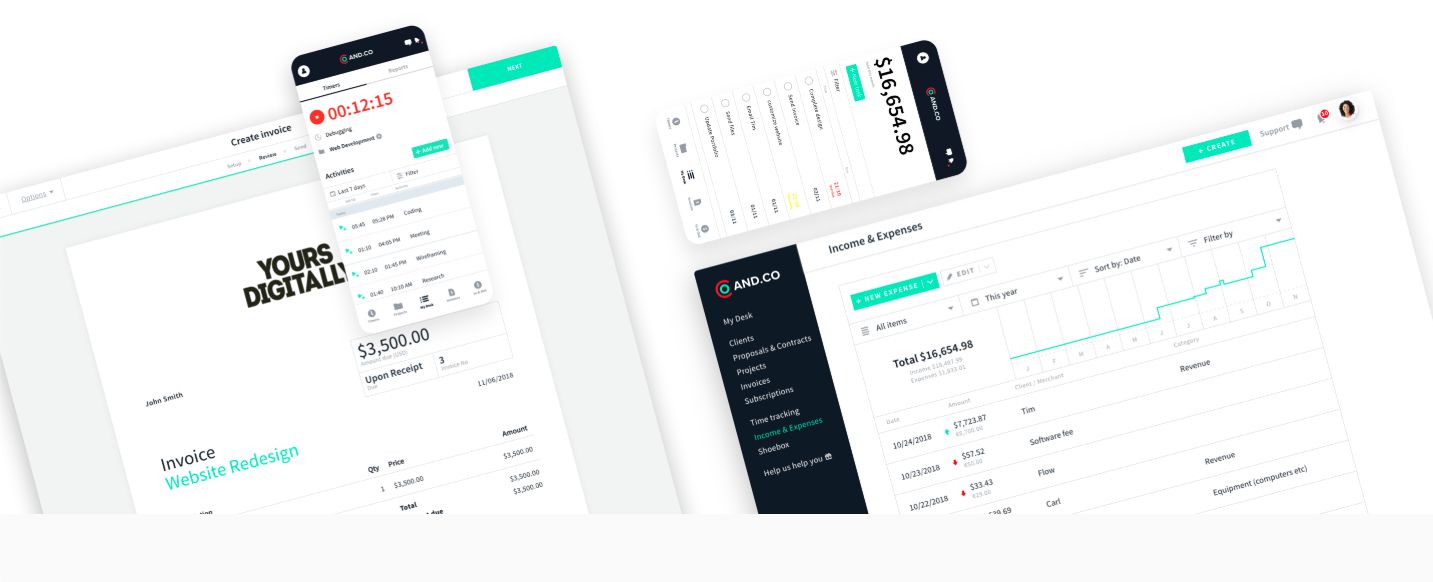
AND.CO software for freelancers

AND.CO neatly integrates with your other favorite freelance apps, including Mailchimp, Spotify, and Stripe.

Extra tip: For extra value from AND.CO whether you’re a customer or not, listen to The Six Figure Freelancer audio course for free. AND.CO opens up the mic to top professionals who share their formulas for success in starting, growing, and maintaining six-figure freelance careers.

AND.CO could be the best freelancer software for you if:

  • You want to manage unlimited clients
  • You don’t need advanced accounting features
  • You want a simple user-experience

7. Wave Accounting

Financial software that offers freelancers the most value at the lowest price point – you require exactly zero budget to get started.

Wave is a very popular tool for freelancers for good reason – it’s free. The financial software for entrepreneurs offers the core accounting, invoicing and receipt scanning features you need to make running your freelance business a breeze. You can pay-per-use for access to online payments if required.

Here’s a glimpse of the Wave integration with Stripe to track cash flow, profit and loss, and overdue invoices:

Wave Accounting integration with Stripe

Wave could be the best freelancer software for you if:

  • You have a limited budget and are looking for a free app to manage your freelance business
  • Your focus is on invoicing, basic accounting, and receipt scanning
  • You don’t need to track mileage, time, or inventory

Want to streamline your processes even more? A two-way data sync solution keeps data flowing freely to the right places in your small business, from your freelance management tool to your email marketing provider and CRM.

Take me to Projects

Categories B2B

4 Tips to Clean Up Your Customer Data

Old email addresses, duplicate contacts, misspelled names… these are the bane of your marketing and sales efforts.

After all, your CRM and marketing tools are only as strong as the data you’ve got in them. If you have poor-quality data in your databases, you’re setting up to fail in your sales and marketing initiatives. Your customer data is the most valuable asset your organization has, so it’s important to ensure it’s serving your business’ bottom line as much as possible.

A solid data quality strategy will not only save you hours of janitorial work, but it makes sure your data is trustworthy – which means that any insights you gain from this data are much more accurate and useful for your business.

So, to help you figure out how to have the best possible contact data in your business databases, we’ve put together four tips to clean up your data.Get HubSpot's Free CRM Now

How to Clean Up Your Company’s Data

1. Get rid of duplicate contacts.

Duplicates are usually caused by two things: inconsistent data entry and multiple channels that capture contact information. There are tools to help you remove duplicate data. For instance, if you work with Google Contacts, you can merge your contacts and detect duplicates for free.

If you’ve never done a de-duplication, you might have to manually scan and edit your contacts. This step will take some time, but if you implement company-wide data entry standards and make a commitment to quality data, you will only have to do this once.

Here are some tips that can help with de-duplication:

  • Use a de-duplicator such as Dedupley.
  • Use data validation tools that help you to determine the validity of your data, such as email verification tools. Experian Data Quality has some powerful validation programs that allow you to check emails, addresses, and telephone numbers in bulk.
  • To avoid having duplicate contacts across different applications, keep your core tools in sync to eliminate the need for entering the same data into different tools.

2. Verify new data.

Implement a company-wide system to make sure all new and updated data is correctly entered into the central database. For example, you can make sure that your team always fills in certain contact fields (such as name, phone number, and email) in your CRM using the same format. You can also make certain fields mandatory when creating a contact record so that the required information is always there.

You can also set up a contact sync between your CRM and other tools. If the data is only entered in your CRM and it’s automatically synced with your other tools, you can make sure all applications have the same information, thus reducing the likelihood of data entry errors.

3. Keep your data fresh.

All databases degrade – some estimate that 30% of CRM data becomes outdated each year. This is due to many factors, including people changing email addresses, getting new phone numbers, leaving organizations, changing job titles, and many others.

It’s best to keep your data fresh by implementing a few tactics. You can do this by using parsing tools, which scan all incoming emails and updates contact information as it comes to hand.

So, if a contact gets a job with a different company, for example, your central database will be instantly updated. It’s also a good idea to delete all email addresses that have bounced or opted out — this kind of information can most likely be found in your email marketing tool. Not only is this good practice for keeping your data fresh, but it also helps keep you out of spam folders.

4. Implement consistent data entry.

All these measures are pointless if you don’t get everyone on your team behind them. Ensure that all employees are aware of company-wide data entry standards. For instance, make sure they all know which information fields to fill in when creating a contact record, how to check for duplicates before creating a new contact, and that everyone is entering data on the correct apps.

By following these simple tactics, you can make sure you have a much cleaner and more organized contacts database. Don’t forget to bidirectionally sync the data between your key business applications: it minimizes manual data entry and ensures you’re always looking at the most up-to-date, accurate contact information in all your tools.crm software free

Categories B2B

7 Tips to Make Your Business More Organized

With the technological developments of the Fourth Industrial Revolution impacting how we all live, work, and relate to one another, a rapid pace of change is happening across all businesses.

This is doubly true in uncertain times, where organizations in every industry are faced with a sudden need to switch to working styles and make their business more resilient and flexible.

It’s a good time to ask how your business can organize its key processes to deliver the best experience for both your employees and your customers.

Download Now: Free Growth Strategy Template

With the optimal blend of people, processes, and technology, you can make your organization adaptable to change and in the best position to grow and thrive.

With that in mind, here are seven organization tips for businesses to help you continue on the right track. We’ve also included relevant goals for each tip, so you can measure your success over time.

7 Organization Tips for Growing Businesses

1. Cut the tech bloat.

Goal: Streamline your business tech stack to help your team get the job done most effectively.

Technology can boost your business’s organization, productivity, and collaboration. However, there is such a thing as too many tools – otherwise known as tech bloat.

When an organization uses far more apps and tools than it needs, it can quickly experience problems from excessive complexity, distractions, and security concerns.

If this sounds familiar, it’s time to assess, prune, and optimize your business’s tech stack.

To keep your technology ecosystem under control and reap the benefits that cloud apps can offer, establish a consistent set of processes using the apps and functions you need to get the job done.

Set the groundwork so employees don’t end up trying to juggle a hundred different things at once on too many apps.

2. Build a culture that rewards focus.

Goal: Instead of expecting constant communication and collaboration from every team member when they’re at their desk, carve out time for every employee to focus on where they deliver the most value.

Staying organized depends on your ability to avoid distractions – which isn’t always easy in organizations that have a culture of constant interruption disguised as collaboration.

Common daily time wasters include: using business tools that are too complex or a bad fit for the job; distractions on social media; and manual data entry on multiple different systems that don’t work well together.

Let’s also not forget about the so-called notification fatigue caused by being bombarded by irrelevant notifications and emails every day.

Here are some of the best ways to get rid of the time-wasters in your business:

  • Use carefully selected cloud-based tools that everyone in your company knows how to use.
  • Build an integrated technology ecosystem that maximizes efficiency.
  • Establish company-wide processes that minimize unnecessary business meetings.
  • Encourage team members to block out distractions for set periods of focused time.

The most organized businesses are those that realize that they don’t have to do things the way they always have.

What processes and assumptions can you rethink to make your business more organized and productive?

3. Migrate to the cloud.

Goal: Identify business practices that are still managed via outdated systems or tools, and plan out how you’ll replace them with cloud-based workflows and apps.

Almost every business is using some form of cloud technology, even if it’s nothing more than web-based email. But there’s a lot more to the cloud than many businesses realize.

Whether it’s customer relationship management (CRM), data storage, or business automation delivered through the web, almost any digital workload can be migrated to the cloud.

With SaaS tools – or cloud-based apps with a subscription model – your business can escape the physical limitations of desktop computers and enable employees to take their work with them wherever they are.

Continue to bring your business further into the cloud and minimize the back and forth that comes with outdated computing environments.

4. Embrace different work styles.

Goal: Create a plan to future-proof your business by embracing different working styles, such as remote working or flexible hours.

From agile startups to enterprises driven by digital transformation, many organizations are already embracing the advantages of different working styles — including enhanced productivity, reduced office costs, and access to more diverse talent.

But even if your organization is far from ready to enjoy all the benefits of remote work and flexible hours, making it a long-term priority will help you future-proof your business and make it easier to adapt.

If you’re looking to enable more remote working in your business, here are some tips to make the transition as seamless as possible:

  • Pivot your company policies to cater to remote work best practices.
  • Strengthen team communication and collaboration with cloud-based apps such as Slack.
  • Reduce your reliance on in-person meetings by introducing video call apps.
  • Adjust your tech stack to focus on cloud-based apps that your team can use anywhere.

5. Focus on smaller goals.

Goal: Look at company-wide, departmental, and individual-level goals to ensure that they are broken down into actionable steps.

It’s hard for your business to stay organized if you set lofty goals that are both intimidating and difficult to focus on.

In every department and job role, determine the most likely way that your team will reach your key targets before breaking them down into actionable next steps.

With smaller and easily measured milestones, your team will be in the best position to stay focused and avoid burnout and confusion.

6. Go paperless.

Goal: Identify what’s causing the piles of paper in your organization and create processes to minimize this.

Paper is a common source of disarray in many offices, but a largely avoidable one. If you don’t already have a digital filing system, then it’s time to build one.

Here are some of the best ways to help your business go paperless:

  • Attach notes and files to customer records digitally in your CRM.
  • Use team apps like Google Drive to collaborate on team projects.
  • Take document signing online with apps such as DocuSign.

The more you reduce your reliance on paper, the faster your business will modernize, and the easier it will become to organize your workflows.

Established businesses may have a harder time since they often have huge amounts of information in printed documents or on physical digital media.

Start by scanning and digitizing everything and uploading it to a document management system. That’s a lot more organized than having reams of documents and paper receipts piled up around the office!

7. Automate workflows.

Goal: Identify what’s needlessly consuming time in your organization and determine how you can use automated workflows to free up more time to focus on what matters.

If there’s one thing that kills productivity above all others, it’s cumbersome manual processes that eat up time and leave workflows open to human error.

Manually importing or exporting data between your email marketing software and CRM might not sound like a big deal at first, until you realize you have to do the same thing with lots of other apps and databases. Eventually, the challenges of scale make it practically impossible.

Sage advice holds that anything which can be automated should be automated. You could get started by automating:

  • Lead scoring for new contacts in your database
  • Sales nurturing email workflows
  • Backup and syncing routines between apps
  • Customer care processes, such as alerting account managers of support tickets or carrying out NPS surveys
  • Enriching data between apps with two-way integrations, such as between your CRM and email platform

The goal should be to unify your technology systems and processes into a cohesive environment in which everyone on your team has access to accurate and current information in real-time, no matter where they’re physically located.

With the right tools and data at hand, everyone on your team can stay organized without getting bogged down in repetitive manual tasks or spending hours trying to track down that one key document.

When there’s so much going on in your business, staying organized isn’t easy. But by streamlining your core processes and looking towards the future, you can meet the challenges of scale and put your business in the best position to thrive in the years ahead.

New call-to-action

Categories B2B

6 Contact Management Best Practices for Small Businesses

As a small business or startup, you’ve got a lot on your to-do list: increasing awareness of your brand, converting leads into customers, and supporting customers post-sale. And, of course, there’s all the admin behind the scenes.

A big part of that is contact management.

To enable your small business to grow successfully and sustainably, you need to have a strong contact management strategy in place. But what does this mean, and how can you get it right?Get HubSpot's Free CRM Now

What is contact management?

Contact management is how you look after all of the contact data in your business, including contacts’ details, communication preferences, sales history, and customer interactions with your company. It enables every team in your organization to have the information they need to stay productive and have the context they need to deliver personalized interactions.

Your contacts may include:

  • Leads (or people who are in your pipeline but haven’t bought from you yet)
  • Current and previous customers

A contact management strategy is implemented with CRM software that stores all of your small business’s contact data in one centralized place.

Although contact management is traditionally the realm of salespeople, CRM has evolved rapidly in recent years. Now many all-in-one CRM platforms offer advanced features for marketing and customer service teams to store and manage their own interactions, remove information silos and boost collaboration with sales.

An all-in-one CRM, or a CRM that’s strongly integrated with your other apps, is a particularly good solution for managing and streamlining the entire customer journey as you:

  • Attract and collect new marketing leads
  • Nurture those leads toward being sales-ready
  • Convert leads into paying customers
  • Carry out onboarding services and provide ongoing support
  • Offer upgrades and added value

Advantages of Strong Contact Management

Contact management impacts far more than sales. When you get it right, the benefits echo throughout your small business as every role has more data and insights at its fingertips. It also enriches every aspect of the customer journey.

With good contact management processes, you can:

  • Enrich your customer experiences with data-driven insights and automation
  • Spend less time on admin and free up time for what matters most
  • Maximize conversions by delivering the right messages at the right time

Contact management is something that your business will always do, but most small businesses have a lot of room for improvement to maximize their efficiency in this area.

Keep reading for our tips on getting the highest impact from contact management in your small business.

Six Contact Management Best Practices

Here’s our guide to using contact management strategies to drive growth and reduce the headaches for your business, both now and further down the line.

1. Keep your contact data clean.

Smooth contact management starts with clean data. You can’t deliver an excellent customer experience if you have incorrect or contradictory data about your customers, nor can you have smooth business operations and reporting inside your company.

Although you can reduce the amount of bad data that enters your database by adjusting your lead generation forms and introducing clear processes for your team to follow, you can’t avoid all of it. That’s why every business needs regular data clean-ups. You could schedule this every quarter, for example.

As part of a data clean up, take time to remove:

  • Duplicate contacts
  • Incorrect or outdated contact data, such as emails that have hard-bounced
  • Contacts that don’t want to hear from you anymore

Data clean-ups don’t have to be entirely manual. There’s a lot that you can automate. For instance, many CRMs and email marketing tools highlight duplicates so you can merge or delete them. 

Your email marketing software will also help you identify emails with hard bounces, alongside groups of unsubscribed contacts. Once you’re sure you can clean up this data, you can delete them from the app.

2. Choose the right CRM.

As part of a strong contact management strategy, your CRM should be at the heart of your business. It’s the software where you store all of your key contact data as well as interactions with every customer and lead.

This makes your CRM one of the most important apps to get right in your business. Take the time to research different CRMs and find the right fit for your industry, business size, sales and marketing strategy, and goals.

As your business grows, your CRM needs to grow with it. This might mean upgrading your plan, adjusting your strategy, or even switching tools as you scale.

3. Centralize your contact data.

The best contact management strategies include a centralized database that stores all contacts in one place. This will generally be your CRM, which is another reason why it’s important to follow step 2 and choose the right one!

By having a centralized contact database, you can:

  • Find all of the key insights you need in one app
  • Make it easy for other teams to find data, without needing to have login details and training for lots of tools they don’t need to use
  • Break down information silos between departments

To start centralizing your data, identify the main apps in your stack that are collecting contact data. You can then sync this data with your CRM.

4. Automatically sync contact data between your apps.

Remember: for the most effective contact management results in your small business, you can’t let the contact databases in your apps be isolated from one another.

Your CRM, marketing apps, sales stack, and all of the other tools in your business deliver the best results when they are connected as part of an integrated ecosystem. The best way to achieve this is with data syncing.

After creating a centralized contact database, your next step is to sync relevant data from it to your individual apps.

5. Collect data that enriches your insights.

By syncing contact data between your apps, you can automatically enrich the insights you have at your fingertips.

If you collect geographic or content consumption data in your CRM, you could sync this with your email marketing platform and use it to segment subscribers into more accurate mailing lists.

6. Use good judgment with your contact data.

All businesses big and small need to pay attention to data protection regulations. However, this goes beyond playing by the rules and ticking boxes.

Be a brand that your prospects and customers can trust with their data. Protect the information they give you and respect their privacy. This might not have an easily measurable ROI, but having customers that trust your brand will always have an impact.crm software free

Categories B2B

What to Do When You Can’t Trust Your Business Reporting Data

Despite huge investments in data, you might be surprised to learn that most executives don’t trust their company’s data. It might be that they’re skeptical of the data they’re using, or simply don’t know how to interpret the information at hand.

In fact, Havard Business Review reported that 90% of business leaders believe data literacy is crucial for company success. However, only 25% of employees feel confident when working with their organization’s data. 

The stats shout loud and clear that if you struggle to trust your business data, you’re absolutely not alone. However, this doesn’t make it any less important to fix it.

Untrustworthy data has repercussions across your entire organization. You run the risk of:

  • Pivoting strategies based on incorrect assumptions
  • Lacking a clear picture of business performance and ROI
  • Delivering poor customer experiences
  • Reducing job satisfaction for your team because of manual tasks and frustrations
  • Being hesitant to share important insights across the team

Instead, every business’s goal should be data integrity. Data integrity refers to the quality and reliability of your business data, including how precise, consistent, timely, and well-preserved that data is.

With high data integrity, your business can also benefit from the surge in opportunities that big data brings.

Here’s our guide to what to do when you can’t trust your reporting data. Learn how to turn things around long-term, so your data spend isn’t spoilt by leaky processes and frameworks.Get HubSpot's Free CRM Now

How to Make Your Data More Trustworthy

It might sound obvious, but if your business has been wrangling with unreliable data for some time, to create a different outcome you need to do things differently.

Fixing untrustworthy data requires changes to your organization’s:

  • Processes
  • Mindset
  • Skillset

Let’s explore the best ways to make your data more trustworthy so you can benefit from accurate and timely analytics that pave the way for informed decisions.

1. Go back to the basics.

To make your data more trustworthy, let’s go back to the very beginning. Imagine you’re starting your database entirely from scratch with a clean slate. Now answer these questions:

  • What data do you need to collect?
  • What format do you need to collect it in?
  • What data don’t you need?
  • What’s the clutter or noise you would like to avoid?
  • How do you need to integrate your apps?

You can use these valuable insights to inform:

  • New processes for data collection, management, and integration
  • What to clean up and prune from your database
  • How to educate your team and increase data literacy in your organization

Once you’re clear on what needs to happen, start creating an action plan to put it into place and make your data more trustworthy.

2. Follow the data trail back to the source.

Whenever you’re faced with unreliable data, follow the trail back to the source. Where did the inaccurate data originate?

This includes looking at form fields and checking for consistent and standardized data collection. It also means making sure that Google Analytics tags are set up correctly, or that your SQL scripts for your business intelligence platform are flawless.

If this stretches your tech knowledge, perhaps because the person who implemented your systems has left the company, consider bringing in a data specialist to help you out. You could also get their help simplifying your data processes so it’s more manageable in-house going forward.

3. Tick the boxes for data best practice

No matter the industry or company size, there are some best practices that every company should follow for trustworthy data. These include:

  • Consistency – Maintain the same format across systems by using consistent and standardized fields and collection processes. When you integrate your apps, use customizable field mapping to ensure that the right data is synced to the right places.
  • Completeness – For each piece of data, you need to know the full picture. A few examples are the source of your marketing leads, sales history for your customers, or conversion path for new deals. Is your data complete?

  • Centralized and enriched data – Rather than having fragmented and incomplete data spread across several systems, maintain one centralized database with the most up-to-date and trustworthy information. This can be your CRM for your customer data, and a system like Chartio or Supermetrics for your company performance data. Create two-way integrations between your centralized database and connected apps to enrich your data everywhere.

  • Access control – Set permissions and policies that ensure only the right people see certain data. This is about balancing accessibility and transparency with security.

  • Validation – 28% of customer and prospect data is suspected to be inaccurate in some way, according to Experian. For accurate data, you need a method for checking and validating it. This can include automated processes for checking for anomalies and missing fields, backed up by some manual checks.

  • Real-time updates – For the best results from your data, it needs to be up-to-date. Look for real-time updates when choosing a business intelligence system and a data integration solution.

  • Quality sources – Make sure you know where all of your data is coming from and that you can guarantee its integrity. Maintaining a neat and tidy database that you know you can trust beats having highly advanced data sets that you struggle to make sense of or control.

  • Cleanliness – Considering B2B data decays at a rate of 2% per year, your database needs frequent clean-ups. It’s important to freshen up your data by removing duplicates, inaccuracies, and other data that’s turned from value into clutter.

  • Security and protection – Maintaining high security is crucial for data protection regulations such as GDPR in Europe, but it’s also just a basic principle for being a trustworthy brand. It’s also absolutely crucial if you want valuable data at your fingertips (and only yours).

  • Integrations – Over 80% of business operations leaders say data integrations are important for day-to-day operations at their organization. Data integrations reduce data silos and make data more accessible to everyone at your company, so employees don’t have to track down other coworkers to find specific information stored in their department’s database.

4. Document processes.

One common trap that organizations fall into is relying on one person to set up and manage their data processes. When that person leaves the organization, chaos is often unleashed.

You can avoid this by creating clearly documented processes that are stored in your company wiki, Google Drive, or a tool like Notion. And remember: overly complicated processes might end up doing you more harm than good. The simpler your processes, the better.

5. Simplify everything.

Complexity is often the root of bad data you can’t trust. For complex data analytics to work successfully, you need the time, resources, and knowledge to back it up.

For most organizations, it’s more effective to keep your data and reporting as simple as possible instead.

Simplifying your data means:

  • Only collecting the data you need
  • Organizing data consistently and in standardized formats
  • Avoiding complicated workflows and systems
  • Reducing your reporting dashboards
  • Avoiding multiple systems for the same job
  • Creating documentation that’s clear and easy to understand
  • Amending processes so anyone can quickly understand them

To make your data the most trustworthy, ask yourself: where can you simplify your data collection, management, and integration processes?

6. Keep the sunk cost fallacy in mind.

You’ve invested a lot of money, you have complex systems in place… and you don’t want to throw that away. So instead of starting afresh, you build on top of what you have – and hope it will cover up what’s underneath.

Investopedia describes the sunk cost fallacy, or the sunk cost trap, as “a tendency for people to irrationally follow through on an activity that is not meeting their expectations. This is because of the time and/or money they have already invested.”

This is all too common when it comes to business data and analytics.

If you keep building on unsound foundations, it will come back to bite you. Begin by understanding exactly what you’re dealing with and the problems at hand. Bring in a second opinion here if you need it. Then, make as unbiased a decision as possible about what you need to do to increase data integrity.

Over the long term, it might be easiest to go back to the drawing board, create a much more straightforward and accurate strategy, and trash what you had in place before.

7. Communicate with stakeholders.

While concerns over untrustworthy data are often valid, sometimes you or your organization’s stakeholders still don’t trust your data when everything is sound.

If this is the case, clear communication is your way forward. Explain why your business analytics data is trustworthy and how it’s set up to ensure reliability. Answer questions to help stakeholders understand how data is collected, managed, and integrated between your apps. Also, encourage concerns to be voiced so that you can explore their validity or irrelevance together.

crm software free

Categories B2B

How to Create the Perfect Project Timeline [Template + Examples]

Piecing together a project timeline template usually involves a Google Doc and mediocre formatting skills. Then comes assigning tasks to teammates and promising to hit the agreed-upon delivery date. But a few weeks go by, and the timeline falls apart. Higher priorities pop up, and deadlines slip past without much progress.

Projects can fail for many reasons: a lack of support from leadership, unforeseen budget cuts, or overpromising outcomes. In fact, poor project management is more common than you think – only 55% of projects are completed on time.

But creating a timeline where everyone involved knows what they’re working on and when it’s due can help ensure your project doesn’t creep past its original deadline. It’s essential for keeping projects (and the people completing them) on track.

→ Access Now: 16 Timeline & Flowchart Templates [Free Tool]

To make sure your next project stays on schedule, we’ll cover how to set up a project timeline, the best templates to use, and a handful of examples to inspire your future scheduling.

Why Create a Project Timeline?

Time management is one of the top skills employers look for in candidates. Missed deadlines and rushed projects can set entire teams (and companies) behind schedule.

A structured project timeline offers more than brownie points from your boss. It can also:

  • Bring leadership and structure to a project
  • Outline what is being delivered, by when
  • Share who is responsible for each task and sets expectations for the scope, quality, and delivery of work
  • Show how the project outcome contributes to company goals
  • Decrease risk by accounting for any changes to the project scope, budget, deliverables, or deadlines.

Ultimately, a project timeline makes it easier and more efficient to manage a project. But it’s important to match the timeline structure to the project scope. Planning an editorial calendar for the quarter may take more time and effort than creating a marketing video for an upcoming product launch.

That’s where the right template comes in.

Project Timeline Example

Without the right project timeline template, organizing a project can be a lot of manual work — not to mention the formatting mess once multiple people get their hands on it.

The ideal timeline brings direction to a project, yet is easily adaptable when changes arise. Here’s a look at a project timeline for opening a new company office.

HubSpot Company Project Timeline Template

You can create a project timeline for any process that relies on a schedule (almost everything these days), like onboarding employees, handling a crisis, or planning social media campaigns. All you need to know is how to outline the steps of a project and the tasks required to complete each phase.

Let’s get into the details.

How to Create a Project Timeline

Crafting the perfect project timeline takes strategy, organizational skills, and a whole lot of collaboration. You need buy-in from supporters and clear directives for everyone involved.

To get started, follow this step-by-step guide to set up a structured timeline — no matter your job, industry, or management level.

1. Write a project brief.

A project brief communicates how you will approach a project. It includes details on the goals, deliverables, timeline, tasks, process, people involved, and resources needed to take a project from start to finish.

Asana outlined the steps to create a simple, yet effective, project brief. You can use this free project plan template to outline the project’s goals, roles and responsibilities, schedule, deliverables, budget, and more. It’s a great starting point for any planning process.

HubSpot Project plan template

Or if you need a more comprehensive overview that includes key messaging and distribution processes, a creative brief may be the right fit for your project.

2. List all tasks and action items.

Every task involved in achieving a project’s objectives needs to go into the project timeline. After creating the brief, make a list of these tasks. You can start with large tasks and break them down into smaller to-dos.

Let’s say you’re responsible for creating a marketing video to launch your company’s newest product. Your list may include the following:

  • Establish project leads from each department
  • Set project budget
  • Find a video production company
  • Layout the video storyboard
  • Choose main features for video
  • Write video script
  • Capture video content
  • Add in sound and background music
  • Add animations and graphics
  • Edit video
  • Write announcement copy
  • Craft marketing campaign
  • Create clips for social sharing
  • Get video and marketing assets approved

Once you have the major milestones down, break down each task into smaller pieces. For example, choosing a video production company involves:

  • Research video production companies
  • Curate a list of production companies
  • Get quotes from each production company
  • Compare quotes and narrow down options
  • Meet with the selected companies
  • Choose a production company
  • Finalize the contract

3. Connect dependencies.

In a project, certain tasks can’t be started until another is complete. These tasks are called dependencies. For example, a video can’t be filmed until the storyboard is finalized. And the storyboard can’t be finalized until the video theme is chosen.

Mapping out dependencies helps you solidify the order of each task and decide who’s responsible for what. Everyone will know what part of the project they’re working on, which tasks must be completed before their own, and who to contact for the deliverables they need.

Here’s a look at how dependencies can play out in a project timeline.

Project timeline example

Image Source

In the example, you can see that hiring a caterer has to happen before finalizing the lunch menu. But other tasks, like finding a DJ and deciding on an event theme, can happen at the same time. So as you map out each task, you’ll have to see which steps can overlap and which need to wait for others.

4. Estimate the time it will take to complete each task.

Once you figure out the sequence of tasks, you need to figure out how much time each will take. Estimate as best you can. That way, it’ll be easier to create the project roadmap and understand the project’s overall time frame.

As you go, make sure to consider the other projects and priorities your team has going on. A designer may be able to come up with a rough draft of video animations in one week, but if they’re wrapping up another project, they may not be able to start on yours for another two weeks.

Being mindful of your team’s time will make it easier to put together a reasonable, reliable timeline.

5. Create the project timeline.

Build your timeline by organizing your tasks from the first to the final step. Make any necessary adjustments to the task times, add milestones, and solidify the deadline. If your team works with project management software, organize the timeline and tasks so it’s ready to share after the project kickoff meeting.

You can save time during this step by using one of the project timeline templates below. It’s simple to customize each and avoid the extra work of creating your own from scratch.

6. Share the timeline with the project team.

Whew, your timeline is complete! Now, you have to share it with stakeholders. This includes everyone who is involved in the project. You’ve already listed these people out in your brief (during step one), so it’s time to share your clear path forward for the project with them.

It’s a good idea to hold a project kickoff meeting with both stakeholders and individual contributors so everyone starts on the same page. You can communicate the project goals, deliverables, roles, and deadlines — without going into an overwhelming amount of detail. From there, you’ll want to schedule time with the project’s immediate contributors to chat specifics and answer any questions before the work begins.

Need help visualizing the entire project? It can help to include a timeline graphic like the one below to give everyone a sense of the overall time frame. You can add or remove steps, depending on the complexity of your project.

Taskforce Project Timeline Example

Image Source

7. Adapt as you go.

Remember how just over half of projects are finished on time? Roadblocks and setbacks are inevitable in every project. So if your team runs into a delay, you’ll have to understand the impact and adjust the timeline if necessary.

While it’s possible to make up for delays without changing the final deadline, it’s your job as the project owner to update stakeholders on the project’s progress. Reporting a minor issue (like a coworker being out sick for a few days) isn’t always necessary to higher-ups. But if it’s a major roadblock that requires an extreme adjustment to the timeline (like a core contributor leaving the team), you have to communicate a new timeline to stakeholders.

Change is part of every company, so don’t panic if you have to adjust your timeline. It’s better to be transparent about the scope of work and timeline than keep people in the dark until the deadline hits. The earlier you adjust to change, the easier it will be to get back on track.

Project Timeline Examples

Visualizing a project makes it simple to understand what needs to happen from start to finish. Whether you need a template for a product launch or campaign meeting, these well-designed project timeline templates are perfect for your next planning session.

Employee Onboarding Timeline

Employee onboarding project timeline

Product Launch Timeline

Product launch project timeline

Crisis Response Project Timeline

Crisis response project timeline

Historical Timeline

Historical project timeline

Task Project Timeline

Task project timeline

Meeting Project Timeline

Meeting project timeline

Need as many templates as you can get? Download all of these project timelines (and more) for free. With the right timelines in hand, it’s easy to keep everyone up to date and informed. Now all you have to do is make sure your projects stay on schedule. Good luck!

New Call-to-action

Categories B2B

How to Understand & Calculate Statistical Significance [Example]

Have you ever presented results from a marketing campaign and been asked, “But are these results statistically significant?” As data-driven marketers, we’re not only asked to measure the results of our marketing campaigns but also to demonstrate the validity of the data — exactly what statistical significance is.

While there are several free tools out there to calculate statistical significance for you (HubSpot even has one here), it’s helpful to understand what they’re calculating and what it all means. Below, we’ll geek out on the numbers using a specific example of statistical significance to help you understand why it’s crucial for marketing success.

New Data: Instagram Engagement Report [2021 Version]

In marketing, you want your results to be statistically significant because it means that you’re not wasting money on campaigns that won’t bring desired results. Marketers often run statistical significance tests before launching campaigns to test if specific variables are more successful at bringing results than others.

Statistical Significance Example

Say you’re going to be running an ad campaign on Facebook, but you want to ensure you use an ad that’s most likely to bring desired results. So, you run an A/B test for 48 hours with ad A as the control variable, and B as the variation. These are the results I get:

Ad

Impressions

Conversions

Ad A

6,000

430

Ad B

5869

560

Even though we can see based on the numbers that ad B received more conversions, you want to be confident that the difference in conversions is significant, and not due to random chance. If I plug these numbers into a chi-squared test calculator (more on that later), my p-value is 0.0, meaning that my results are significant, and there is a difference in performance between ad A and ad B that is not due to chance.

When I run my actual campaign, I would want to use ad B.

If you’re anything like me, you need more explanation as to what p-value and 0.0 mean, so we’ll go through an in-depth example below.

1. Determine what you’d like to test.

First, decide what you’d like to test. This could be comparing conversion rates on two landing pages with different images, click-through rates on emails with different subject lines, or conversion rates on different call-to-action buttons at the end of a blog post. The choices are endless.

My advice would be to keep it simple; pick a piece of content that you want to create two different variations of and decide your goal — a better conversion rate or more views are good places to start.

You can certainly test additional variations or even create a multivariate test, but, for this example, we’ll stick to two variations of a landing page with the goal being increasing conversion rates. If you’d like to learn more about A/B testing and multivariate tests, check out “The Critical Difference Between A/B and Multivariate Tests.”

2. Determine your hypothesis.

Before I start collecting data, I find it helpful to state my hypothesis at the beginning of the test and determine the degree of confidence I want to test. Since I’m testing out a landing page and want to see if one performs better, I hypothesize that there is a relationship between the landing page the visitors receive and their conversion rate.

3. Start collecting your data.

Now that you’ve determined what you’d like to test, it’s time to start collecting your data. Since you’re likely running this test to determine what piece of content is best to use in the future, you’ll want to pull a sample size. For a landing page, that might mean picking a set amount of time to run your test (e.g., make your page live for three days).

For something like an email, you might pick a random sample of your list to randomly send variations of your emails to. Determining the right sample size can be tricky, and the right sample size will vary between each test. As a general rule of thumb, you want the expected value for each variation to be greater than 5. (We’ll cover expected values further down.)

4. Calculate Chi-Squared results.

There are several different statistical tests that you can run to measure the significance of your data, and picking one depends on what you’re trying to test and the type of data you’ll collect. In most cases, you’ll use a Chi-Squared test since the data is discrete.

Discrete is a fancy way of saying that your experiment can produce a finite number of results. For example, a visitor will either convert or not convert; there aren’t varying degrees of conversion for a single visitor.

You can test based on varying degrees of confidence (sometimes referred to as the alpha of the test). If you want the requirement for reaching statistical significance to be high, your alpha will be lower. You may have seen statistical significance reported in terms of confidence.

For example, “The results are statistically significant with 95% confidence.” In this scenario, the alpha was .05 (confidence is calculated as one minus the alpha), meaning there’s a one in 20 chance of making an error in the stated relationship.

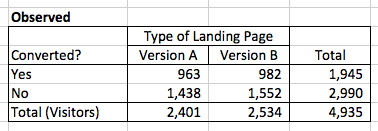
After I’ve collected the data, I put it in a chart to make it easy to organize. Since I’m testing out two different variations (A and B) and there are two possible outcomes (converted, did not convert), I’ll have a 2×2 chart. I’ll total each column and row so I can easily see the results in aggregate.

statistical significance example

Once I’ve created my chart, the next step is to run the equation using the chi-squared formula.

Statistical Significance Formula

The image below is the chi-squared formula for statistical significance:

chi-squared formula for statistical significance

In the equation,

  • Σ means sum,
  • O = observed, actual values,
  • E = expected values.

When running the equation, you calculate everything after the Σ for each pair of values and then sum (add) them all up.

5. Calculate your expected values.

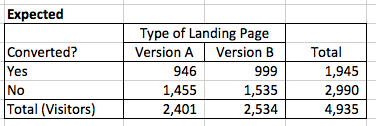
Now, I’ll calculate what the expected values are. If there were no relationship between what landing page visitors saw and their conversion rate in the example above, we would expect to see the same conversion rates with versions A and B. From the totals, we can see that 1,945 people converted out of the 4,935 total visitors, or roughly 39% of visitors.

To calculate the expected frequencies (E in the chi-squared formula) for each version of the landing page, we can multiply the row total for that cell by the column total and divide it by the total number of visitors. In this example, to find the expected value of conversion on version A, I would use the following equation:

(1945*2401)/4935 = 946

statistical significance chi-quared expected values table

6. See how your results differ from what you expected.

To calculate Chi-Square, I compare the observed frequencies (O in the chi-squared equation) to the expected frequencies (E in the chi-squared equation). This comparison is done by subtracting the observed from the expected value, squaring the result, and dividing it by the expected frequency value.

Essentially, I’m trying to see how different my actual results are from what we might expect. Squaring the difference amplifies the effects of the difference, and dividing by what’s expected normalizes the results. As a refresher, The equation looks like this: (observed – expected)*2)/expected

how to find statistical significance using chi-squared formula

7. Find your sum.

I then sum the four results to get my Chi-Square number. In this case, it’s .95. To see whether or not the conversion rates for my landing pages are different with statistical significance, I compare this with the value from a Chi-Squared distribution table based on my alpha (in this case, .05) and the degrees of freedom.

Degrees of freedom are based on how many variables you have. With a 2×2 table like in this example, the degree of freedom is 1.

In this case, the Chi-Square value would need to be equal to or exceed 3.84 for the results to be statistically significant. Since .95 is less than 3.84, my results are not statistically different. This means that there is no relationship between what version of landing page a visitor receives and the conversion rate with statistical significance.

8. Report on statistical significance to your teams.

After running your experiment, the next step is to report your results to your teams to ensure everyone is on the same page about next steps. So, continuing with the previous example, I would need to let my teams know that the type of landing page we use in our upcoming campaign will not impact our conversion rate because our test results were not significant.

If results were significant, I would inform my teams that landing page version A performed better than the others, and we should opt to use that one in our upcoming campaign.

Why Statistical Significance Is Significant

You may be asking yourself why this is important if you can just use a free tool to run the calculation. Understanding how statistical significance is calculated can help you determine how to best test results from your own experiments.

Many tools use a 95% confidence rate, but for your experiments, it might make sense to use a lower confidence rate if you don’t need the test to be as stringent.

Understanding the underlying calculations also helps you explain why your results might be significant to people who aren’t already familiar with statistics.

If you’d like to download the spreadsheet I used in this example so you can see the calculations on your own, click here.

Editor’s Note: This blog post was originally published in April 2013, but was updated in September 2021 for freshness and comprehensiveness.

instagram statistics

Categories B2B

The Ultimate List of 394 Email Spam Trigger Words to Avoid in 2021

After spending hours creating an email marketing campaign, the last thing you want to do is get blocked by your recipients’ spam filters. Luckily, by avoiding common email spam trigger words, you can successfully prevent your emails from getting routed to spam folders.

Click here to download our free beginner's guide to email marketing.

Let’s take a look at what spam trigger words are, what gets emails sent to spam, and which spam words you should avoid when creating your email campaigns.

Spam filters can be triggered for a variety of reasons, causing your email to skip recipients’ inboxes and land straight in their spam inbox. One of the easiest ways to avoid spam filters is by carefully choosing the words you use in your email’s subject line.

Trigger words are known to cause problems and increase the chances of your email getting caught in a spam trap. By avoiding these words in your email subject lines, you can dramatically increase your chances of getting beyond the filters.

Spam trigger words alone aren’t enough to send your email to spam. For instance, if you are offering a 3-for-1 discount sale, you can still advertise that in your emails and not get sent to spam. It’s important to understand all the factors that come into play when emails get identified as spam.

What causes emails to go to spam?

Email providers look for a number of factors when deciding whether to automatically send your emails to spam. If you’ve made it on an email blacklist, that means you’ve repeatedly sent emails to recipients who haven’t signed up for your email list.

Your emails can get sent to spam if you:

  • Don’t include an unsubscribe button in your email
  • Send poorly-designed emails with broken or glitchy code
  • Address your recipient by “my friend” or “dear” (or not by their name)
  • Buy email lists online and mass-send messages to email addresses that don’t exist (resulting in a high bounce rate)
  • Use all-caps text and extreme punctuation (!!!!! or ?????)
  • Include strangely formatted fonts (𝖑𝖎𝖐𝖊 𝖙𝖍𝖎𝖘)
  • Provide links to fraudulent websites

Email providers only want to deliver emails from high-reputation senders. To be a high-reputation sender, do the following:

  • Include an unsubscribe button
  • Design your emails with clean code using a tool such as Marketing Hub
  • Personalize your emails with the recipient’s first name
  • Only email those who’ve subscribed to your email list (if you don’t have any, you should learn to naturally increase your email list subscribers)
  • Keep your email deliverability high
  • Keep the text free of odd formatting and extraneous punctuation
  • Only link out to reputable websites

If you meet these criteria, you can get away with using “classic” email spam words in your subject line and your email. The text surrounding the spam phrase also matters, as does your history as an email sender. If email providers don’t have a reason to mistrust you, they simply won’t.

Email Spam Words to Avoid

When writing your email subject lines, you want to avoid:

  • Over-sensationalizing
  • Over-promising
  • Using strange formatting to “stand out” in the recipient’s inbox

Next time you sit down to write an email subject line, consult the exhaustive list below. In fact, you might want to bookmark this list so you can refer back to it every time you craft an email subject line.

Commerce

  1. As seen on
  2. Buy
  3. Buy direct
  4. Buying judgments
  5. Clearance
  6. Order
  7. Order status
  8. Orders shipped by shopper

Personal

  1. Dig up dirt on friends
  2. Meet singles
  3. Score with babes
  4. XXX
  5. Near you

Employment

  1. Additional income
  2. Be your own boss
  3. Compete for your business
  4. Double your
  5. Earn $
  6. Earn extra cash
  7. Earn per week
  8. Expect to earn
  9. Extra income
  10. Home based
  11. Home employment
  12. Homebased business
  13. Income from home
  14. Make $
  15. Make money
  16. Money making
  17. Online biz opportunity
  18. Online degree
  19. Opportunity
  20. Potential earnings
  21. University diplomas
  22. While you sleep
  23. Work at home
  24. Work from home

Financial – General

  1. $$$
  2. Affordable
  3. Bargain
  4. Beneficiary
  5. Best price
  6. Big bucks
  7. Cash
  8. Cash bonus
  9. Cashcashcash
  10. Cents on the dollar
  11. Cheap
  12. Check
  13. Claims
  14. Collect
  15. Compare rates
  16. Cost
  17. Credit
  18. Credit bureaus
  19. Discount
  20. Earn
  21. Easy terms
  22. F r e e
  23. Fast cash
  24. For just $XXX
  25. Hidden assets
  26. hidden charges
  27. Income
  28. Incredible deal
  29. Insurance
  30. Investment
  31. Loans
  32. Lowest price
  33. Million dollars
  34. Money
  35. Money back
  36. Mortgage
  37. Mortgage rates
  38. No cost
  39. No fees
  40. One hundred percent free
  41. Only $
  42. Pennies a day
  43. Price
  44. Profits
  45. Pure profit
  46. Quote
  47. Refinance
  48. Save $
  49. Save big money
  50. Save up to
  51. Serious cash
  52. Subject to credit
  53. They keep your money — no refund!
  54. Unsecured credit
  55. Unsecured debt
  56. US dollars
  57. Why pay more?

Financial – Business

  1. Accept credit cards
  2. Cards accepted
  3. Check or money order
  4. Credit card offers
  5. Explode your business
  6. Full refund
  7. Investment decision
  8. No credit check
  9. No hidden Costs
  10. No investment
  11. Requires initial investment
  12. Sent in compliance
  13. Stock alert
  14. Stock disclaimer statement
  15. Stock pick

Financial – Personal

  1. Avoice bankruptcy
  2. Calling creditors
  3. Collect child support
  4. Consolidate debt and credit
  5. Consolidate your debt
  6. Eliminate bad credit
  7. Eliminate debt
  8. Financially independent
  9. Get out of debt
  10. Get paid
  11. Lower interest rate
  12. Lower monthly payment
  13. Lower your mortgage rate
  14. Lowest insurance rates
  15. Pre-approved
  16. Refinance home
  17. Social security number
  18. Your income

General

  1. Acceptance
  2. Accordingly
  3. Avoid
  4. Chance
  5. Dormant
  6. Freedom
  7. Here
  8. Hidden
  9. Home
  10. Leave
  11. Lifetime
  12. Lose
  13. Maintained
  14. Medium
  15. Miracle
  16. Never
  17. Passwords
  18. Problem
  19. Remove
  20. Reverses
  21. Sample
  22. Satisfaction
  23. Solution
  24. Stop
  25. Success
  26. Teen
  27. Wife

Greetings

  1. Dear [email/friend/somebody]
  2. Friend
  3. Hello

Marketing

  1. Ad
  2. Auto email removal
  3. Bulk email
  4. Click
  5. Click below
  6. Click here
  7. Click to remove
  8. Direct email
  9. Direct marketing
  10. Email harvest
  11. Email marketing
  12. Form
  13. Increase sales
  14. Increase traffic
  15. Increase your sales
  16. Internet market
  17. Internet marketing
  18. Marketing
  19. Marketing solutions
  20. Mass email
  21. Member
  22. Month trial offer
  23. More Internet Traffic
  24. Multi level marketing
  25. Notspam
  26. One time mailing
  27. Online marketing
  28. Open
  29. Opt in
  30. Performance
  31. Removal instructions
  32. Sale
  33. Sales
  34. Search engine listings
  35. Search engines
  36. Subscribe
  37. The following form
  38. This isn’t junk
  39. This isn’t spam
  40. Undisclosed recipient
  41. Unsubscribe
  42. Visit our website
  43. We hate spam
  44. Web traffic
  45. Will not believe your eyes

Medical

  1. Cures baldness
  2. Diagnostic
  3. Fast Viagra delivery
  4. Human growth hormone
  5. Life insurance
  6. Lose weight
  7. Lose weight spam
  8. Medicine
  9. No medical exams
  10. Online pharmacy
  11. Removes wrinkles
  12. Reverses aging
  13. Stop snoring
  14. Valium
  15. Viagra
  16. Vicodin
  17. Weight loss
  18. Xanax

Numbers

  1. #1
  2. 100% free
  3. 100% satisfied
  4. 4U
  5. 50% off
  6. Billion
  7. Billion dollars
  8. Join millions
  9. Join millions of Americans
  10. Million
  11. One hundred percent guaranteed
  12. Thousands

Offers

  1. Being a member
  2. Billing address
  3. Call
  4. Cannot be combined with any other offer
  5. Confidentially on all orders
  6. Deal
  7. Financial freedom
  8. Gift certificate
  9. Giving away
  10. Guarantee
  11. Have you been turned down?
  12. If only it were that easy
  13. Important information regarding
  14. In accordance with laws
  15. Long distance phone offer
  16. Mail in order form
  17. Message contains
  18. Name brand
  19. Nigerian
  20. No age restrictions
  21. No catch
  22. No claim forms
  23. No disappointment
  24. No experience
  25. No gimmick
  26. No inventory
  27. No middleman
  28. No obligation
  29. No purchase necessary
  30. No questions asked
  31. No selling
  32. No strings attached
  33. No-obligation
  34. Not intended
  35. Obligation
  36. Off shore
  37. Offer
  38. Per day
  39. Per week
  40. Priority mail
  41. Prize
  42. Prizes
  43. Produced and sent out
  44. Reserves the right
  45. Shopping spree
  46. Stuff on sale
  47. Terms and conditions
  48. The best rates
  49. They’re just giving it away
  50. Trial
  51. Unlimited
  52. Unsolicited
  53. Vacation
  54. Vacation offers
  55. Warranty
  56. We honor all
  57. Weekend getaway
  58. What are you waiting for?
  59. Who really wins?
  60. Win
  61. Winner
  62. Winning
  63. Won
  64. You are a winner!
  65. You have been selected
  66. You’re a Winner!

Calls-to-Action

  1. Cancel at any time
  2. Compare
  3. Copy accurately
  4. Get
  5. Give it away
  6. Print form signature
  7. Print out and fax
  8. See for yourself
  9. Sign up free today

Free

  1. Free
  2. Free access
  3. Free cell phone
  4. Free consultation
  5. Free DVD
  6. Free gift
  7. Free grant money
  8. Free hosting
  9. Free installation
  10. Free Instant
  11. Free investment
  12. Free leads
  13. Free membership
  14. Free money
  15. Free offer
  16. Free preview
  17. Free priority mail
  18. Free quote
  19. Free sample
  20. Free trial
  21. Free website

Descriptions/Adjectives

  1. All natural
  2. All new
  3. Amazing
  4. Certified
  5. Congratulations
  6. Drastically reduced
  7. Fantastic deal
  8. For free
  9. Guaranteed
  10. It’s effective
  11. Outstanding values
  12. Promise you
  13. Real thing
  14. Risk free
  15. Satisfaction guaranteed

Sense of Urgency

  1. Access
  2. Act now!
  3. Apply now
  4. Apply online
  5. Call free
  6. Call now
  7. Can’t live without
  8. Do it today
  9. Don’t delete
  10. Don’t hesitate
  11. For instant access
  12. For Only
  13. For you
  14. Get it now
  15. Get started now
  16. Great offer
  17. Info you requested
  18. Information you requested
  19. Instant
  20. Limited time
  21. New customers only
  22. Now
  23. Now only
  24. Offer expires
  25. Once in lifetime
  26. One time
  27. Only
  28. Order now
  29. Order today
  30. Please read
  31. Special promotion
  32. Supplies are limited
  33. Take action now
  34. Time limited
  35. Urgent
  36. While supplies last

Nouns

  1. Addresses on CD
  2. Beverage
  3. Bonus
  4. Brand new pager
  5. Cable converter
  6. Casino
  7. Celebrity
  8. Copy DVDs
  9. Laser printer
  10. Legal
  11. Luxury car
  12. New domain extensions
  13. Phone
  14. Rolex
  15. Stainless steel

Use Spam Trigger Words Sparingly and Within Context

So long as you use email marketing best practices and use spam trigger words within context, you can bypass spam filters. Spam filters have become much more sophisticated in recent years. Using one or two phrases won’t hurt you, but make sure to only email customers who want to hear from you and to always personalize your emails. Doing so will optimize the results of your campaign and keep you out of spam folders.

Editor’s note: This post was originally published in March 2013 and has been updated for comprehensiveness.

New Call-to-action

Categories B2B

The Ultimate Guide to Succession Planning

At one of my first jobs out of college, my manager admitted that my professional growth “wasn’t a priority.” I knew I wasn’t in a leadership role that required succession planning, but the admission still stunned me. Without support for career development, I wound up leaving the company.

This situation may seem dramatic, but it points to the importance of having a succession plan in place. Of course, senior leadership roles take precedence because these can create a larger vacuum if the position is left unfilled. But succession planning can (and should) extend to all leaders across a company.

→ Click here to download leadership lessons from HubSpot founder, Dharmesh  Shah [Free Guide].

Developing a succession plan can set your company up for smooth transitions when leaders resign or accept a promotion. It can have a major impact on employee morale and can position your team to skillfully handle future business challenges.

But you don’t want to wait until you absolutely need a successor. At that point, you’re scrambling and may choose the wrong person. Let’s look at the ins and outs of succession planning so your team is prepared for any transition.

What is succession planning?

Succession planning is a strategic process for identifying high-potential employees and taking steps to prepare them for future leadership positions. It helps your business develop and retain the talent pipeline so you can quickly fill vacant leadership roles.

Some succession plans look ahead 12 to 36 months for when a leader retires, steps down, advances, or leaves. Others, including CEO succession plans, look years into the future to secure the next several generations of leaders. We’ll cover the specifics of C-suite transitions later on. But all succession planning has similar benefits for thinking ahead and identifying what you want in a successor.

Why is succession planning important?

In the Global Leadership Forecast 2021 report, 11% of surveyed organizations said they have a “strong” or “very strong” leadership bench — the lowest reported in the past decade.

The benefits of strong leadership are apparent. It improves employee turnover, ensures the execution of goals, and contributes to the company’s survival. So if a crucial leader leaves, a succession plan can help ensure the role is filled and your company continues to thrive. But that’s not the only upside.

Benefits Of Succession Planning

  • Finding and developing people for future leadership roles allows you to promote from within. These employees have organizational knowledge and internal relationships that outside hires lack.
  • Letting employees know that you’re investing in them is a huge morale boost. It can also increase motivation and loyalty to the company.
  • Training employees for leadership roles forces you to identify the skills, knowledge, practices, and relationships needed for each role in your succession plan. This can attract new talent, retain current employees, and keep you competitive.
  • Hiring for highly specialized roles isn’t easy. Succession planning helps you find people with unique competencies when it comes time to replace the current employees.

Currently, leaders looking to develop skills outside of their daily work want more coaching and development assignments, in addition to assessment and formal training. Succession planning is the perfect way to formalize training for both present and future leaders.

Succession Planning Best Practices

Succession planning isn’t simple. But if you consider these best practices as you choose successors, your company will be well-equipped to manage transitions and unexpected changes.

Formalize a Plan

The earlier you set a succession plan, the better. You don’t want to risk a leadership vacuum that leaves teams feeling unsupported. That can quickly waterfall into an entire team or department leaving, especially if the leader is particularly strong and has a close relationship with their direct reports. Once you have a succession plan, write it down. Then, make it clear there’s a plan in place for when the inevitable transitions happen.

Stay Dynamic

Volatility is common at every company. People move cities, find new jobs, and retire. Your succession plan should be able to adapt to change. Instead of creating a plan and only revisiting it when the time comes to fill a role, see the plan as an evolving process that needs to be constantly updated.

Evaluate Talent

Part of a fluid succession plan is taking the time to assess employees’ interests, skills, performance, and opportunities. This can be done through 360-degree feedback, weekly check-ins with managers, informal training, or tools like the nine-box grid. The goal is to get an idea of people’s strengths and weaknesses, career goals, and growth opportunities so you know who may be the right fit for leadership roles.

Communicate Openly

Communication builds trust, which makes it easier to set expectations and ensure everyone is on the same page. As you build a succession plan, have honest conversations with employees. Find out where people want to be, and tell them where they’re currently at. The whole point is to make your plan a reality, and successors will appreciate your openness when the time comes to offer them a role.

Make Diversity and Inclusion a Priority

Companies with women in leadership roles experience almost 50% higher profit and share performance. And since women, especially women of color, have been most affected by the pandemic, it’s wise to consider gender ratios in any succession plan — including the 2SLGBTQI+ communities.

Succession Planning Example

When asked, a whopping 61% of organizations said they didn’t have a direct report who could step into their CMO role tomorrow. That’s a bad sign for C-suite succession plans. Without a strategy to replace leaders, a company can quickly go downhill.

To avoid chaos, here are a few examples of how succession planning can play out:

McDonald’s Smooth CEO Succession

How does a multi-billion dollar company thrive after losing two CEOs in one year? They had a concentrated effort to develop high-potential employees and created a backup plan for their succession plan.

Coca-Cola’s Failed CEO Succession

The repercussions of a poor succession plan can affect a company for decades. See the implications of Doug Ivester’s term as CEO and the stakeholder concerns that caused his resignation after two years.

Succession Planning Steps


Succession planning example

Image Source

1. Make a plan for your plan.

This step is all about defining the goals of your succession plan and aligning with everyone involved. For some companies, this will mean meeting with your board to outline strategic priorities. For others, it will require meeting with senior leaders to define what you’re looking for in a successor.

You’ll be ready to move on to the next step once you:

  • Define the roles, skills, core competencies, and experience required for a successor.
  • Gather information and feedback on the above from your team or experts within your network.
  • Forecast your company’s needs. Consider turnover trends, retirement dates, compensation strategies, and management training.
  • Update your job descriptions and any leadership models to reflect the information you’ve gathered. You want to be clear about your expectations before looking for candidates.

2. Identify potential candidates.

Using the succession profiles and job descriptions you’ve created, you’re ready to seek out candidates. Make sure your approach is easy to repeat and introduces as little bias as possible. It can be helpful to get support from the HR team, who can share the tools needed to engage candidates and help facilitate the process.

To identify candidates, you can:

  • Look for leaders who develop others, follow through on projects, take action to support the company vision, and have strong leadership skills.
  • Get insight into each candidate’s goals, disposition, and potential by holding interviews, creating surveys, and setting up focus groups.
  • Ask people for ideas on how to improve succession and leadership to get buy-in and discover who’s engaged with the process.

3. Inform candidates.

There’s a great debate on whether or not companies should let employees know they’re succession candidates. But informing people of their potential will not only motivate them—it will prevent them from wondering about their future with the company. A great candidate may jump ship if they’re in the dark and think they can find a better opportunity elsewhere.

Instead, communicate your intentions about the positions, people, and planning. Just keep your expectations incredibly clear on the included roles and people involved.

4. Set up professional development efforts.

Your company likely has programs in place for onboarding and training employees. But development is about creating opportunities for people to get experience beyond their current role and skillset. This is especially important for team members who can get caught in a specialist silo.

Once you identify candidates who you want to develop, you’ll want to figure out the specific skills and knowledge they’ll need to move to the next level. This often involves an individual development plan, continuous feedback, mentoring or coaching, formal training, and open conversations between the employee and their manager.

5. Do a trial run.

As potential successors accelerate their growth, they’ll become true contenders for leadership roles. This is the ideal time to start trial runs to test their knowledge and expose them to various aspects of a position. Exposing candidates to real-world situations can highlight what effective leadership looks like and give them insight into overall company goals.

There are a variety of ways to get candidates involved, just choose the method that makes the most sense for the role.

  • Job shadow a senior leader to learn about their day-to-day tasks
  • Take on responsibilities when their manager is away
  • Invite them to sit in on higher-level meetings
  • Bring them into discussions on strategy, execution, or company forecasting
  • Involve them in the hiring process for junior candidates
  • Give them more responsibility on projects or involve them in cross-functional work

6. Adjust your hiring strategy.

Eventually, the time will come when you extend an offer to a potential candidate. And you’ll need someone else to fill their role. Luckily, the successor can use their new leadership skills to help interview or train the person filling their position. This can be an employee a few levels down or a new hire.

That’s why it’s important to adjust your hiring strategy to account for successor’s roles. Without them, your plan won’t go as smoothly and their team will likely be scrambling to fill the gap.

7. Implement the plan.

Succession planning is a complex process with multiple short- and long-term layers. But eventually, it will be time to make the transition. Make an announcement and celebrate the succession. This will show employees that your company prides itself on strong leadership and has a plan for everyone’s career development.

Sometimes, a more gradual transition is needed. Family businesses often struggle with smooth succession planning because of familial relationships, emotions, and intertwined histories. In this case, a clear succession plan based on business needs is exceptionally crucial to ensure the company’s continued success

CEO Succession Planning

Only one in three CEOs rank their company’s leadership quality as “very good” or “excellent.” That’s a low score for such a high-stakes business priority — especially considering the majority of CEO successors are internal hires.

Harvard Business Review (HBR) ranks CEO succession as “arguably the most important decision a board can make.” Replacing a CEO needs to involve a long-term, well-devised plan that’s linked to both short and long-term company priorities.

CEO succession planning can follow similar steps to employee succession planning, but there are specific considerations for this top-level role. HBR outlines the following tips for developing a CEO successor:

  • A candidate’s competencies, personal attributes, and experiences need to be connected to business priorities. A charismatic senior leader may seem like the top pick, but a company may need a successor with expert-level technical skills in addition to social skills.
  • Think several generations ahead instead of focusing on the immediate successor. Succession is a long game, so you want to position it as a continuous process to develop top talent.
  • Identify seven potential CEOs in your company across all generations. This can take the stress off of each CEO transition and help keep your talent pipeline top-notch.
  • Train CEO candidates through a combination of on-the-job experience, executive coaching, education, mentoring, and cross-functional training.

Developing talent to take on the CEO role will require time and effort from high-level stakeholders. But it’s absolutely worthwhile to prevent the vacuum this leadership role can leave if succession is poorly managed.

If a board is involved in the process, HBR recommends using board meetings to combine strategy sessions with talent development. That way, stakeholders can make sure strategy changes reflect the skills needed for potential successors.

Employee Succession Planning

Succession planning extends to employees in all roles across a company. Viewing it this way, rather than saving succession plans for senior leaders, helps you identify high-potential employees at all levels. You can then take steps to develop them into leaders who are able to take on additional responsibilities when a role opens up.

When looking for successors, keep an eye out for employees who are interested in learning new skills, are comfortable with change, can adapt to uncertainty and new leadership, and can manage various work environments. All potential successors should be motivated and engaged in the process because they have a chance to grow their knowledge and take on more challenging, rewarding roles.

When you see a path for an employee’s growth, they’ll see it too. So the next time a key leader steps down or a new director position is created, you’ll know just the right people to recruit for the role.

New Call-to-action