Categories B2B

The State of Consumer Trends in 2023 [New Data]

From the rise of AI to the growing popularity of shopping on social media, heightened data privacy concerns, and consumers tightening budgets due to recession fears, times are changing fast. 

To help marketers keep up and stay ahead of the curve, we’ve run biannual Consumer Trends Survey of 600+ US adults, to keep a pulse on:

  • What trends they’re following.
  • How they spend their time online.
  • How and where they prefer to shop.
  • What standards they’re holding their favorite brands to.

Download Now: The State of U.S. Consumer Trends [Free Report]


Top Consumer Trends of 2023 [Summer Update]

Digital and Online Trends

1. Consumers don’t trust AI, but one-third still use It.

AI is hands down the top trend of 2023, with one in three consumers already using chatbots and platforms like ChatGPT. 

But here’s the plot twist – only 26% of consumers actually trust content created with AI. 
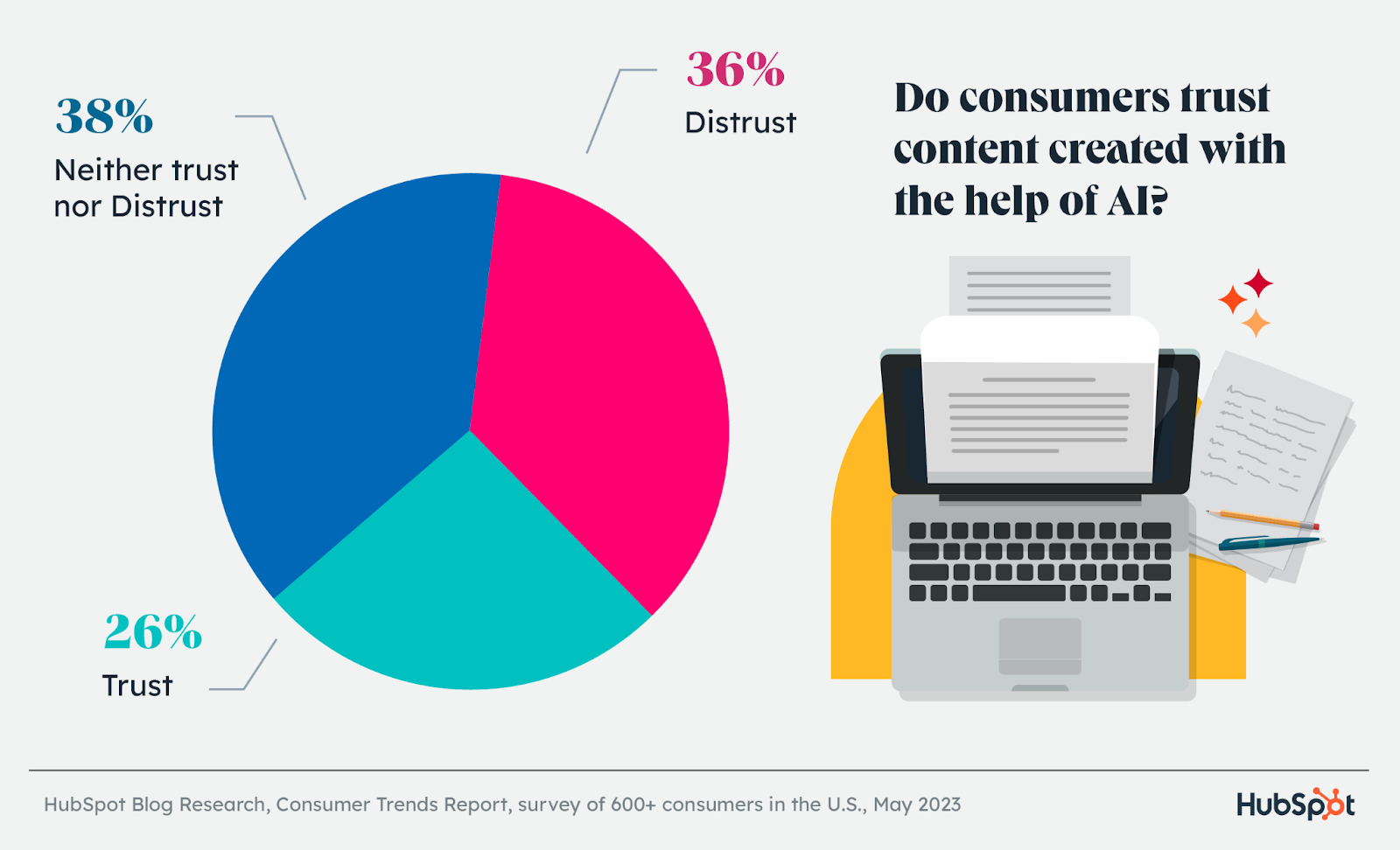
do consumers trust generative AI content

As businesses leverage AI, building trust and maintaining transparency are key to fostering consumer confidence in AI-driven experiences.

Regardless, 40% of full-time employees use AI at work, and 75% of them say it’s effective. The top use cases for AI chatbots at work revolve around assisting people in their work rather than doing their job for them — helping with tasks like getting ideas or inspiration, summarizing text, and learning new things.
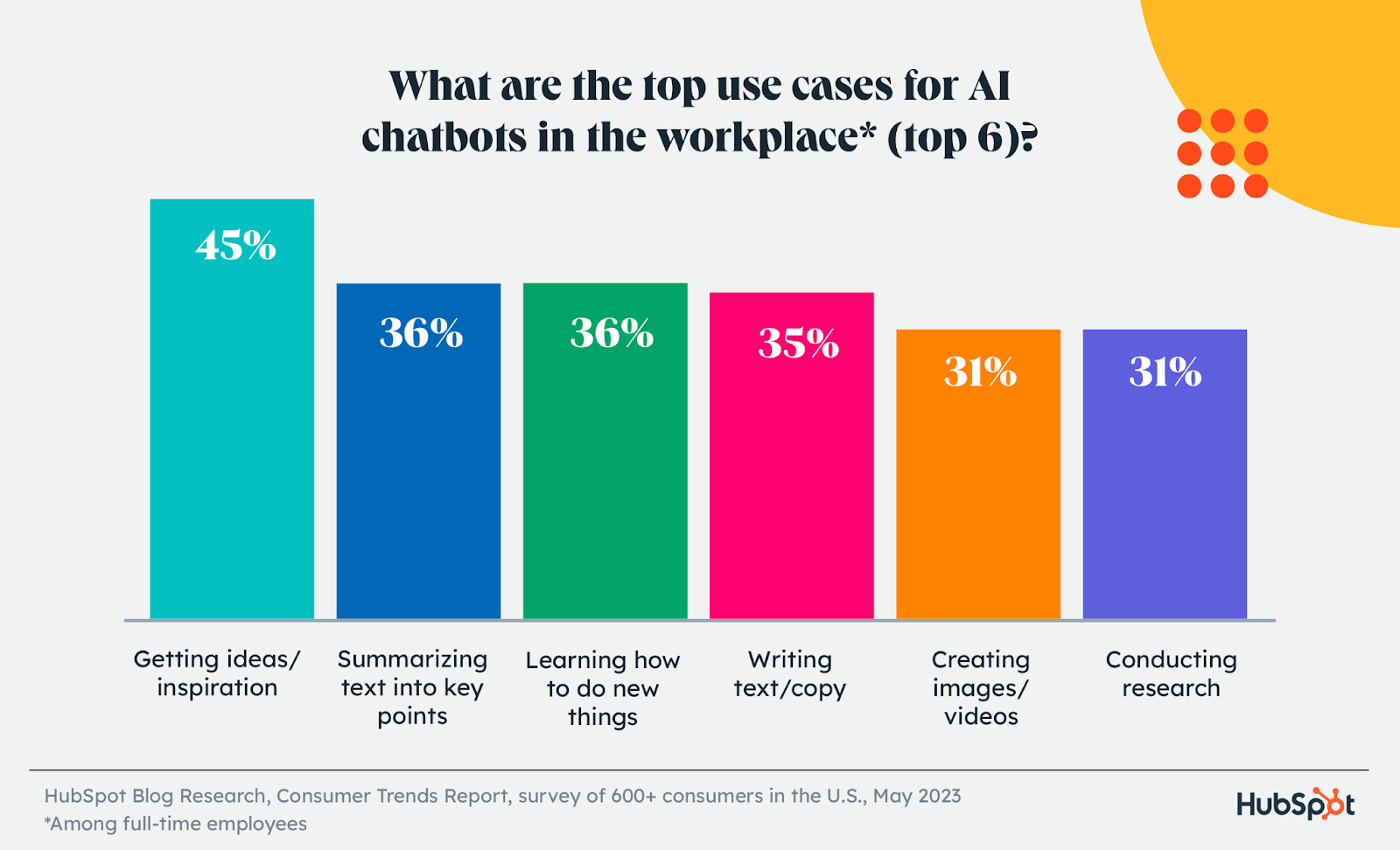
top use cases for AI chatbots

These are also among the most effective uses for AI in the workplace, with workers saying AI is most effective for analyzing and reporting data, learning new things, creating images/videos, getting ideas and inspiration, and conducting research. 
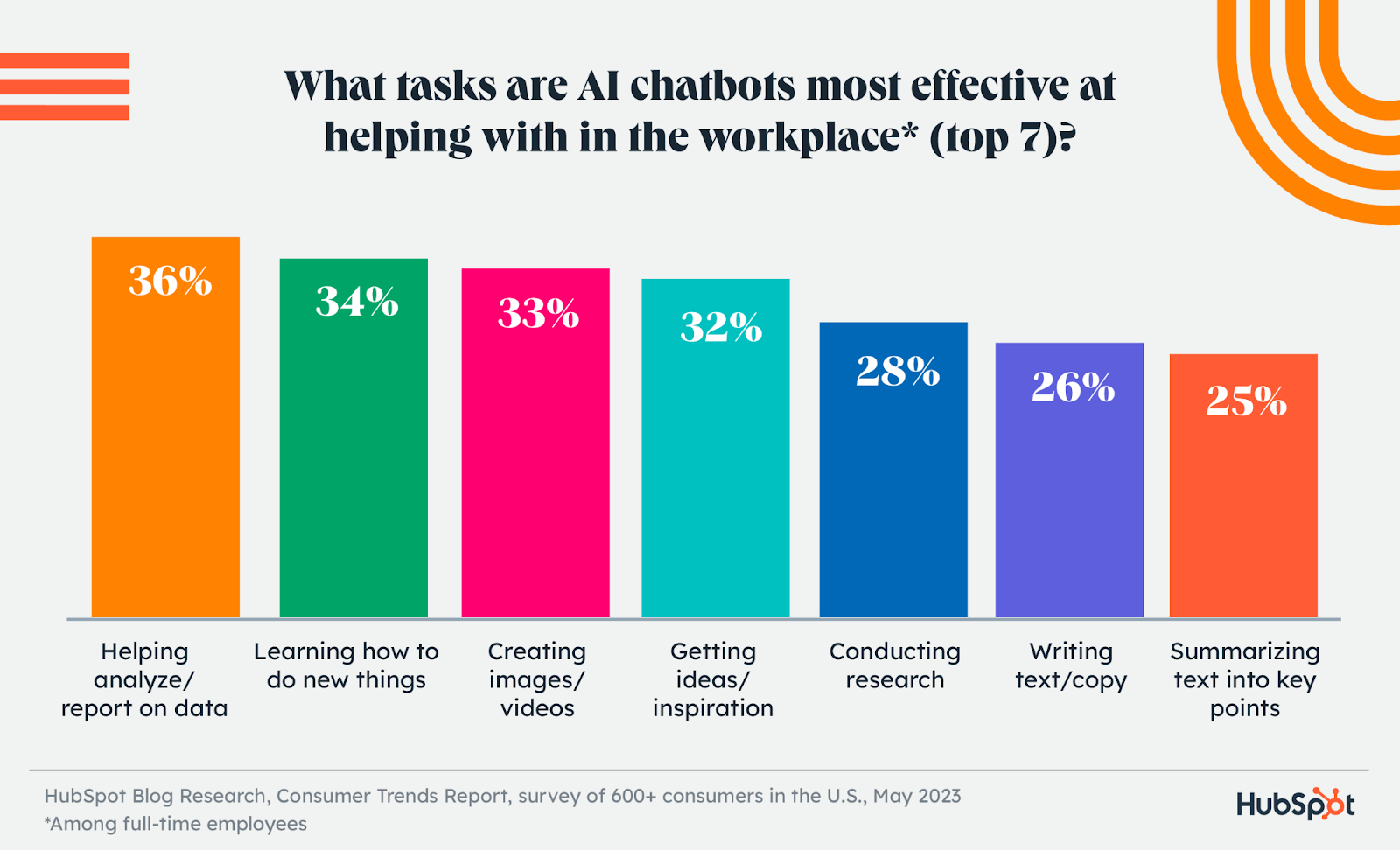
what ai chatbot tasks are most effeective

Lastly, we asked consumers which AI they plan on using in the future. 

Despite ChatGPT’s head start, over half of consumers see themselves primarily using Google Bard once it’s publicly available — followed by ChatGPT — with Bing in third place. 
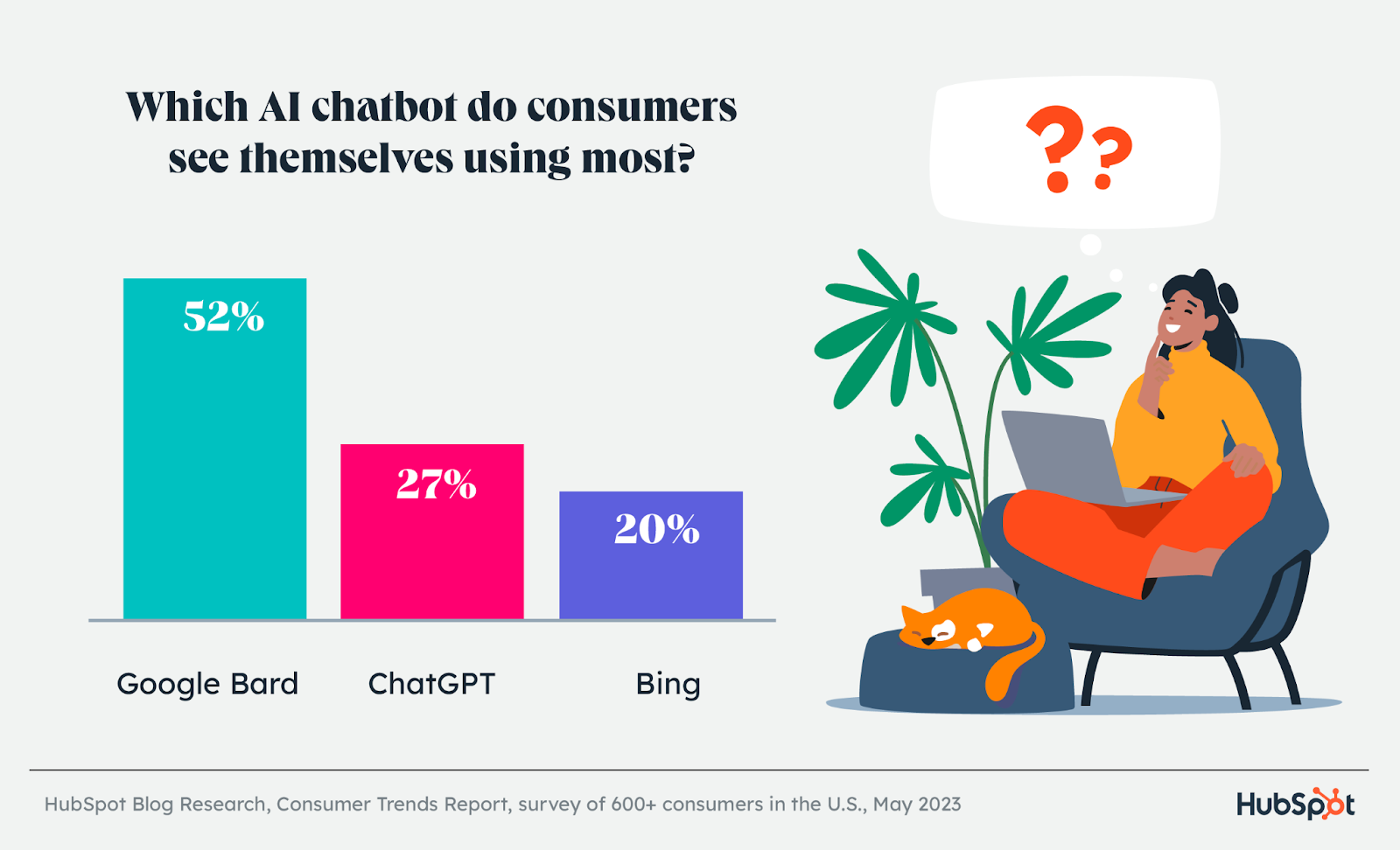
which AI chatbots do consumers prefer

2. Social media is the future of shopping.

Social media is quickly becoming the future of e-commerce, with social shopping growing in popularity across all age groups. Influencers are impacting more purchase decisions, while customers increasingly sliding into DMs for customer service.

Just in the past three months, 41% of consumers have discovered a product on social media. 

In fact, Gen Z, Millennials, and Gen X prefer finding products on social media over any other channel.
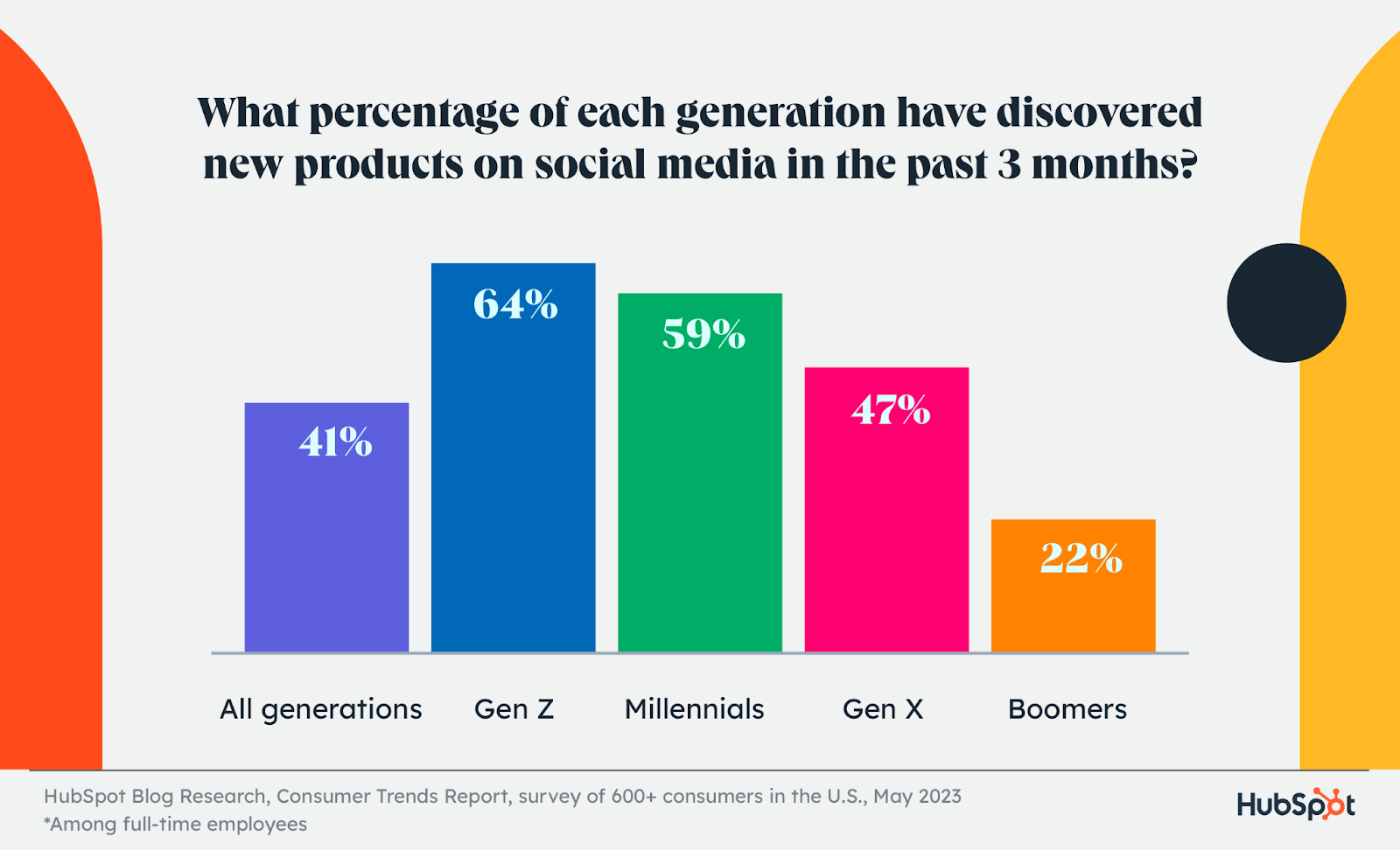
what % of each generation discovers products on social media

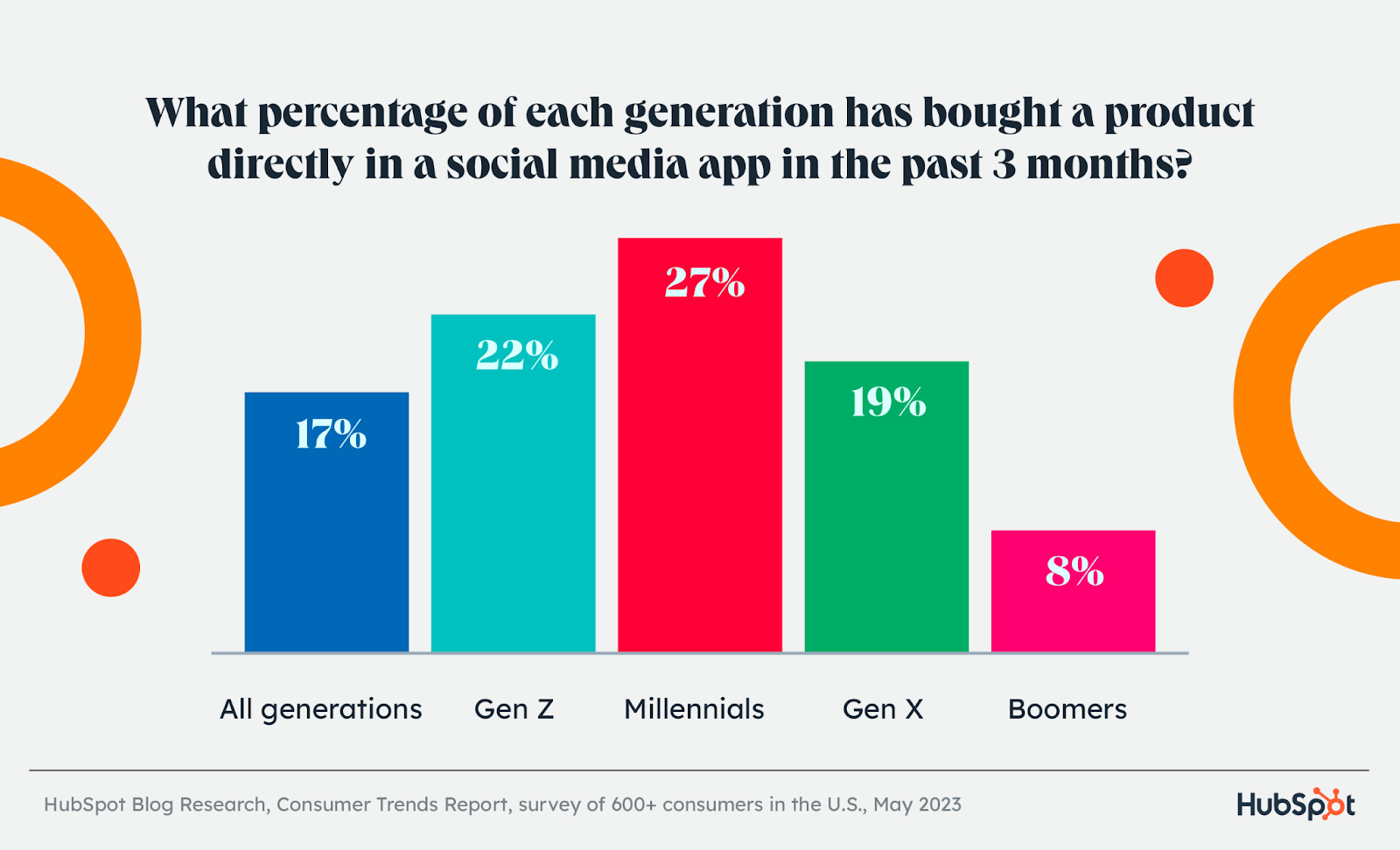
When it comes to actually purchasing these products. 17% of social media users have bought something directly on a social media platform in the past three months, rising to 22% of Gen Z and 27% of Millennials since our January update.
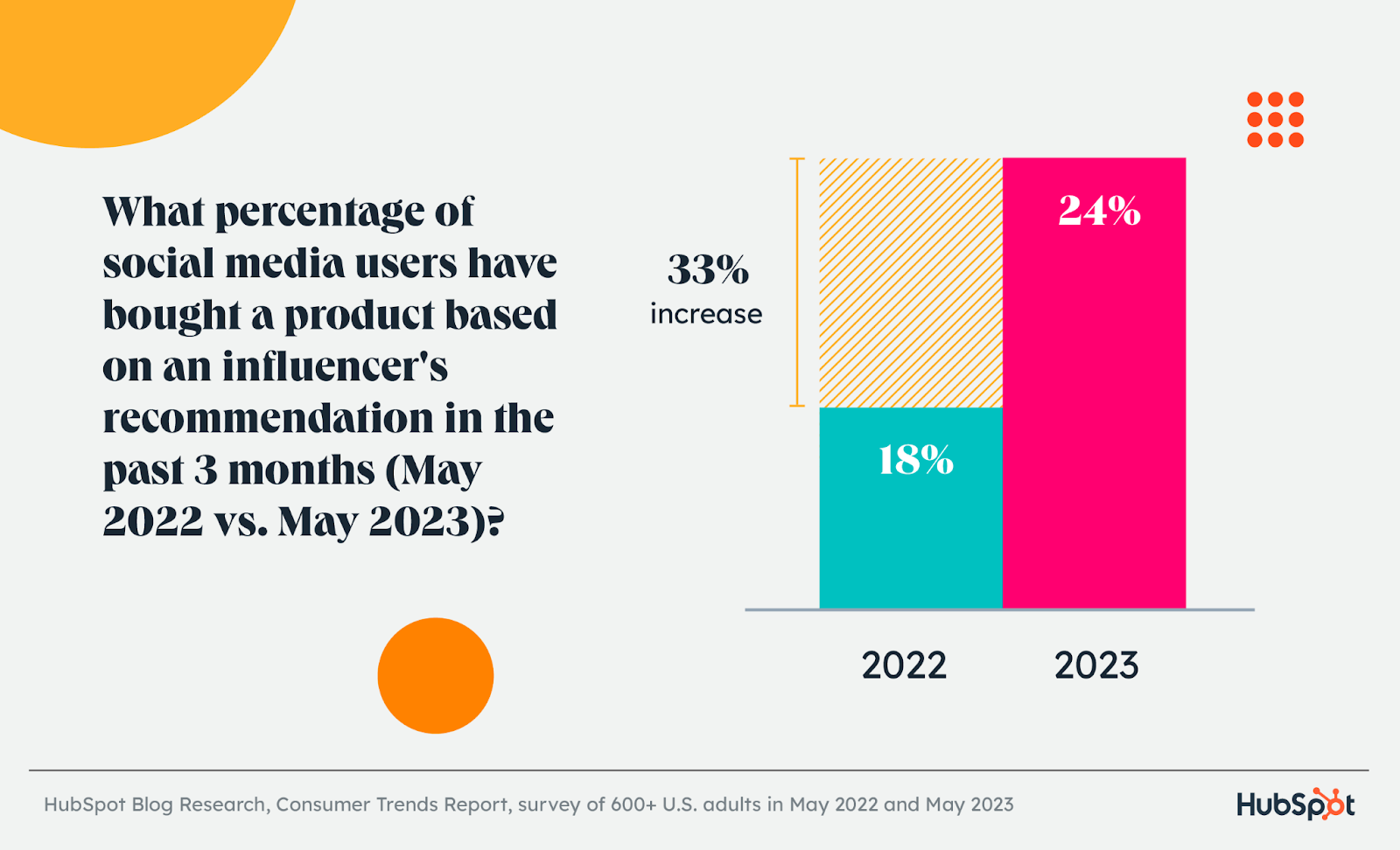
On top of that, 24% of social media users have bought a product based on an influencer’s recommendation in the past three months, a 33% increase from when we ran this survey last year. 
percentage of each generation thats bought products on social media

For Gen Z, 40% have bought a product thanks to an influencer in the past three months, and (similarly to our January update) they say recommendations from influencers are more impactful to their purchase decisions than recommendations from their friends or family.

19% of social media users have also sent DMs to get customer service in the past 3 months, up 45% from last year. Not only that, but 1 in 5 Gen Z, Millennials, and Gen X say DMs is how they prefer to get customer service from a company.
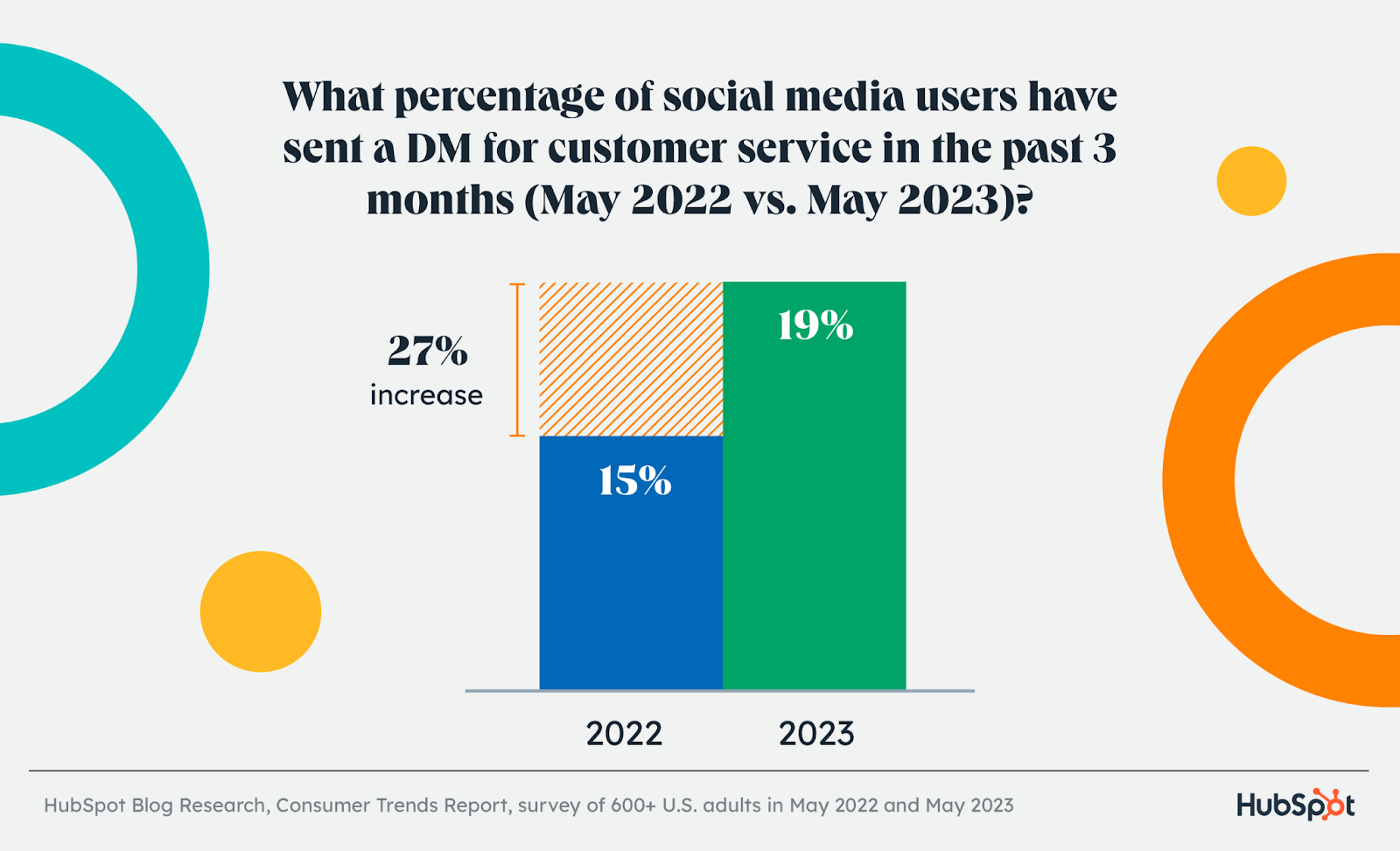
In past Consumer Trends pulse surveys, we continued to see that consumers don’t fully trust social shopping.

Today, they seem to be coming around. While just 47% of social media users feel comfortable buying through social apps and only 42% trust social media platforms with their card information, both of these are improvements over last year’s numbers. 

3. Younger social platforms gain steam as legacy apps stall.

Despite being the most used social media platforms, Facebook, YouTube, and Instagram saw the least growth in users in our survey group year-over-year. 

Facebook usage remained flat, Instagram usage dropped by 5%, and YouTube usage dropped by 2%. Meanwhile, BeReal grew 333%, Twitch grew (43%), and TikTok grew (21%). 

(Note: We ran this survey just before Threads launched and expect it to be a big discussion point in our next bi-annual survey.)

Still, Facebook is the most popular social media app, used by 68% of consumers, followed by YouTube (61%), Instagram (40%), TikTok (34%), and Twitter (30%).
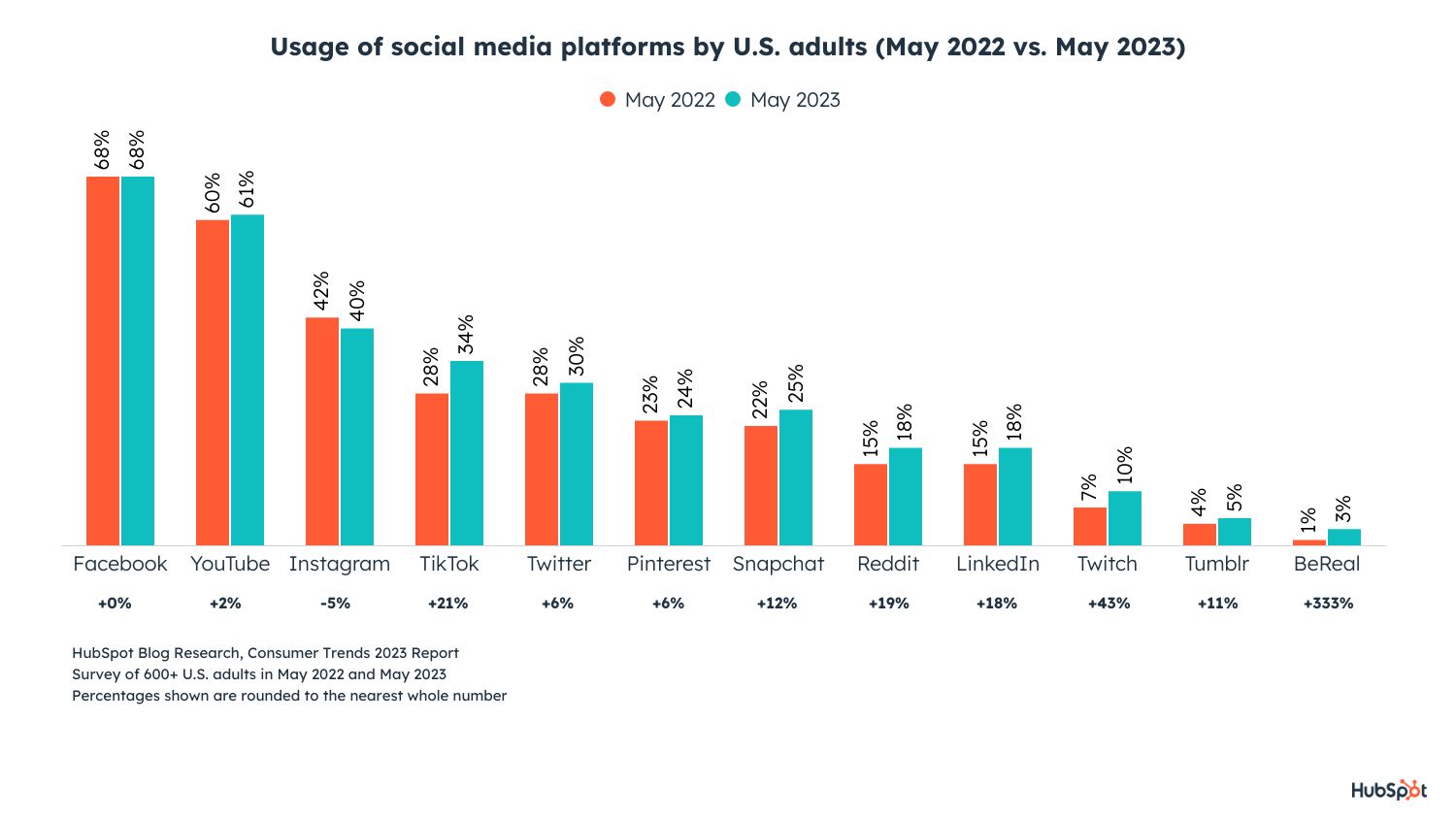
usage of social media platforms amongst adults infographic

Although LinkedIn is towards the bottom of the list, B2B marketers shouldn’t panic or count it out. Although it saw a slight decrease in users year over year, the usage on this platform can vary (and even might be seasonal in response to how workplaces hire or promote). For example, in our January 2023 update, we saw that LinkedIn had 20% more consumers who reported active usage.

Overall, this data aligns pretty closely with data we’ve seen from App Stores, platform analytics firms, and reports directly from the respective platforms.

4. Social search and generative AI are disrupting traditional search engines.

While there’s no denying search engines are still dominant, social search is growing in popularity, especially among Gen Z, Millennials, and Gen X.

Not only do 31% of consumers turn to social media to search for answers to their questions, but one-fourth of 18 to 54-year-olds prefer to search on social media over search engines. 
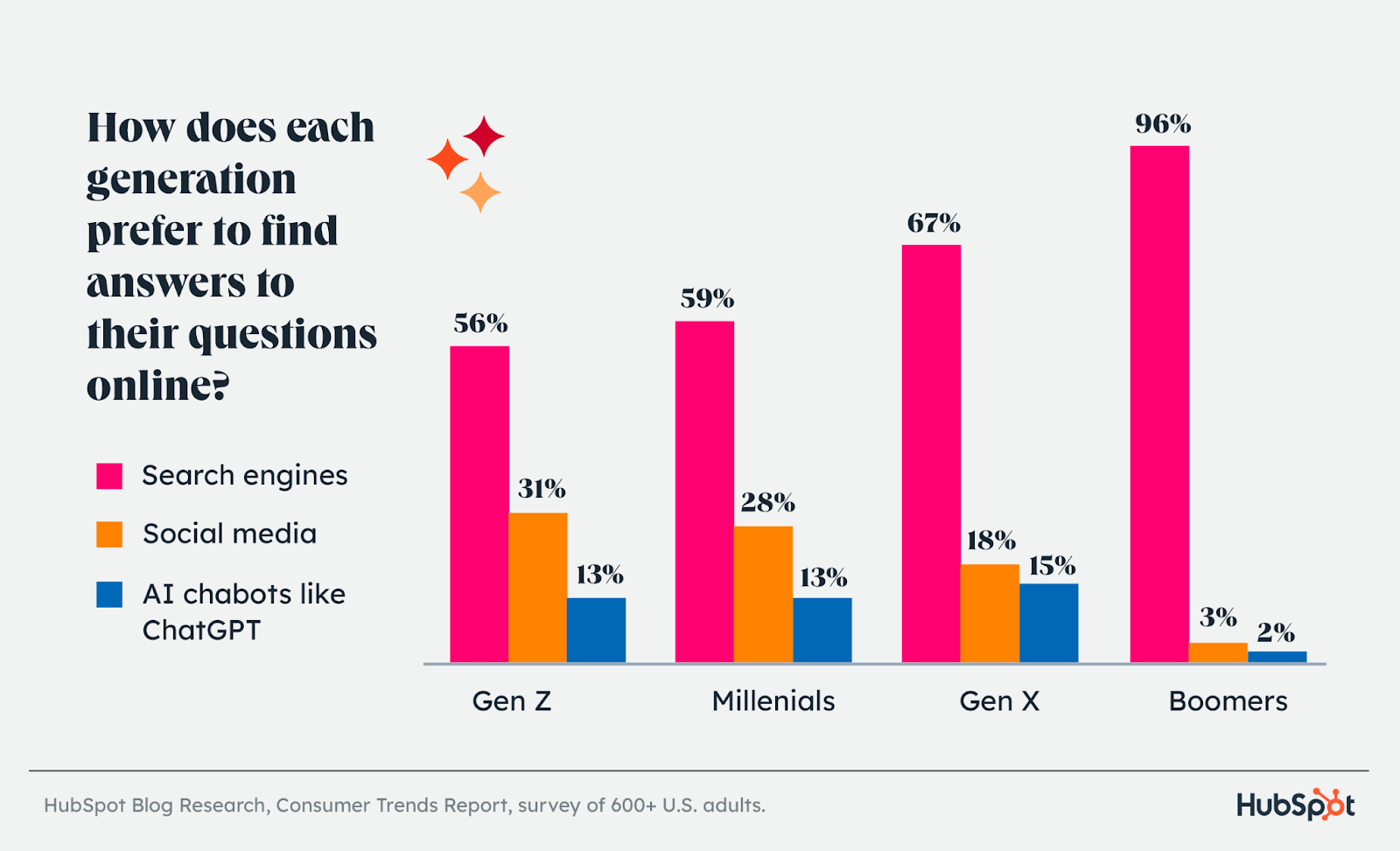
how different generations prefer to find information online


Another thing going for social search is the fact that 54% of consumers use their phones over any other device when looking something up on a search engine — jumping to 80% for Gen Z since our last survey.
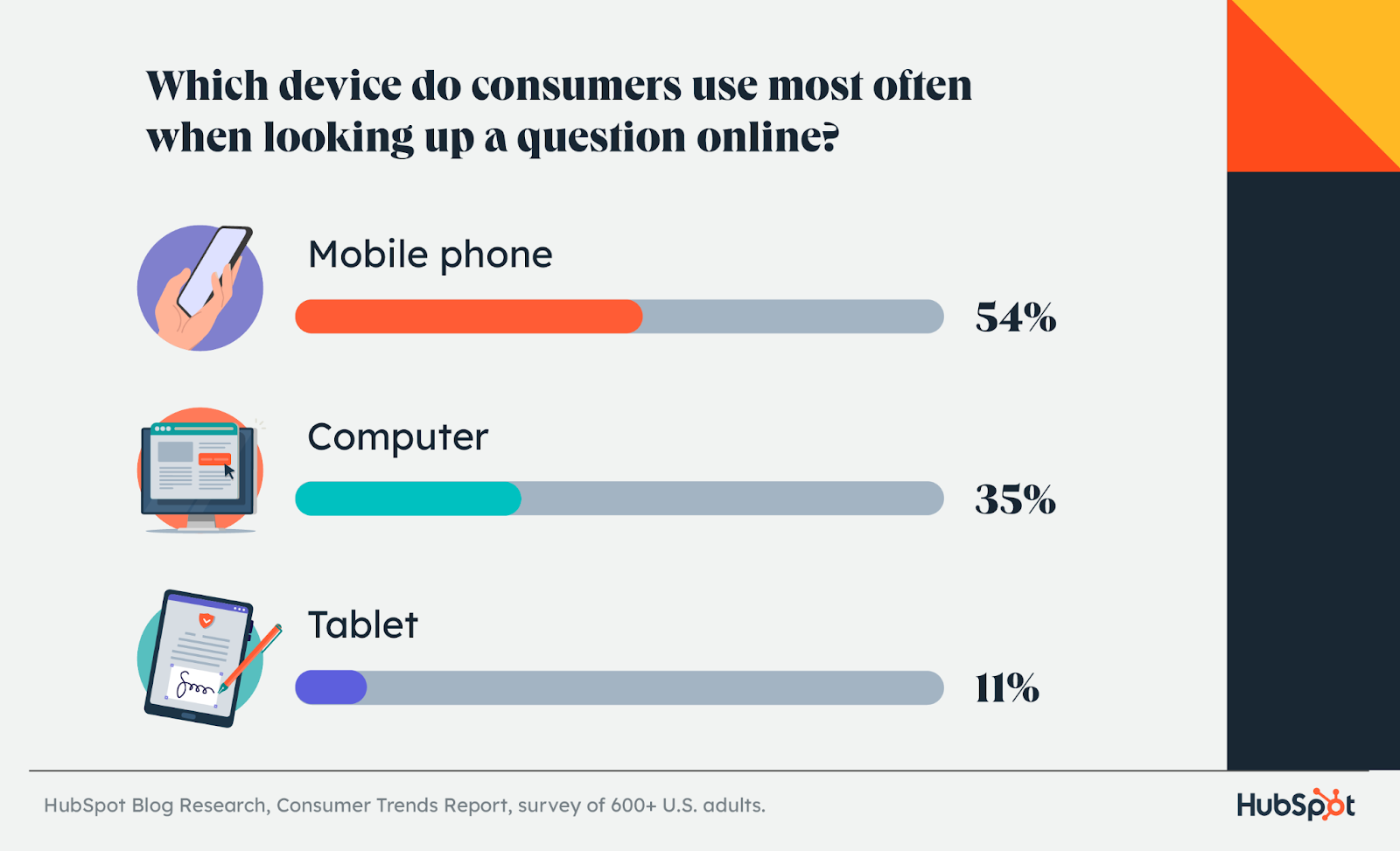
devices different generations use to find information

But between search engines, social search, and AI, consumers still say search engines are the most effective way to get their questions answered. 
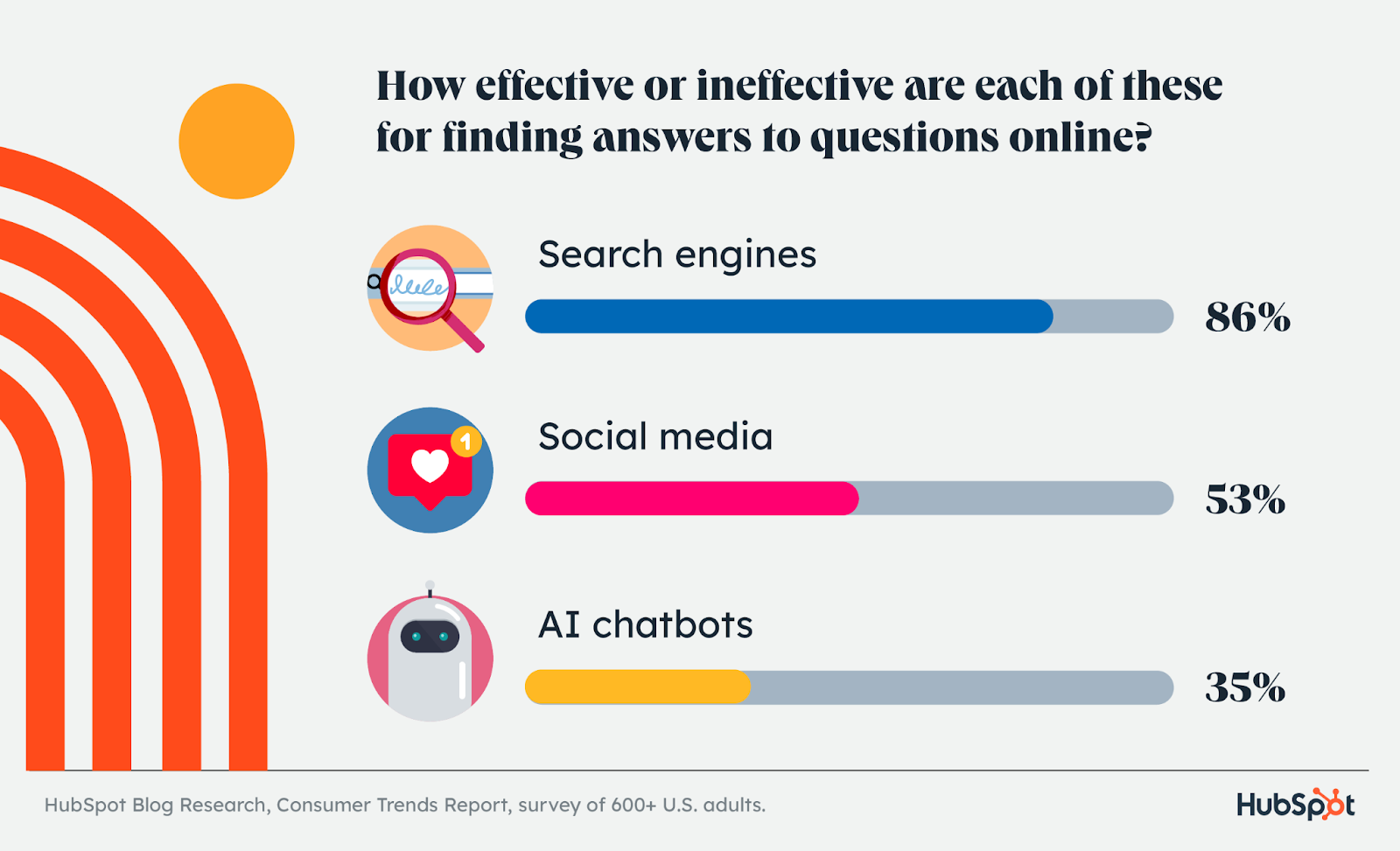
devices different generations use to search

Ultimately, while social search and generative AI becoming more popular, traditional search isn’t going anywhere just yet.

Workplace & Budgeting Trends

5.. Flexible workplaces are more vital than ever for retention.

The past few years have seen dramatic shifts in how we work, with hybrid and remote work becoming more common while being in the office full-time fell out of favor.
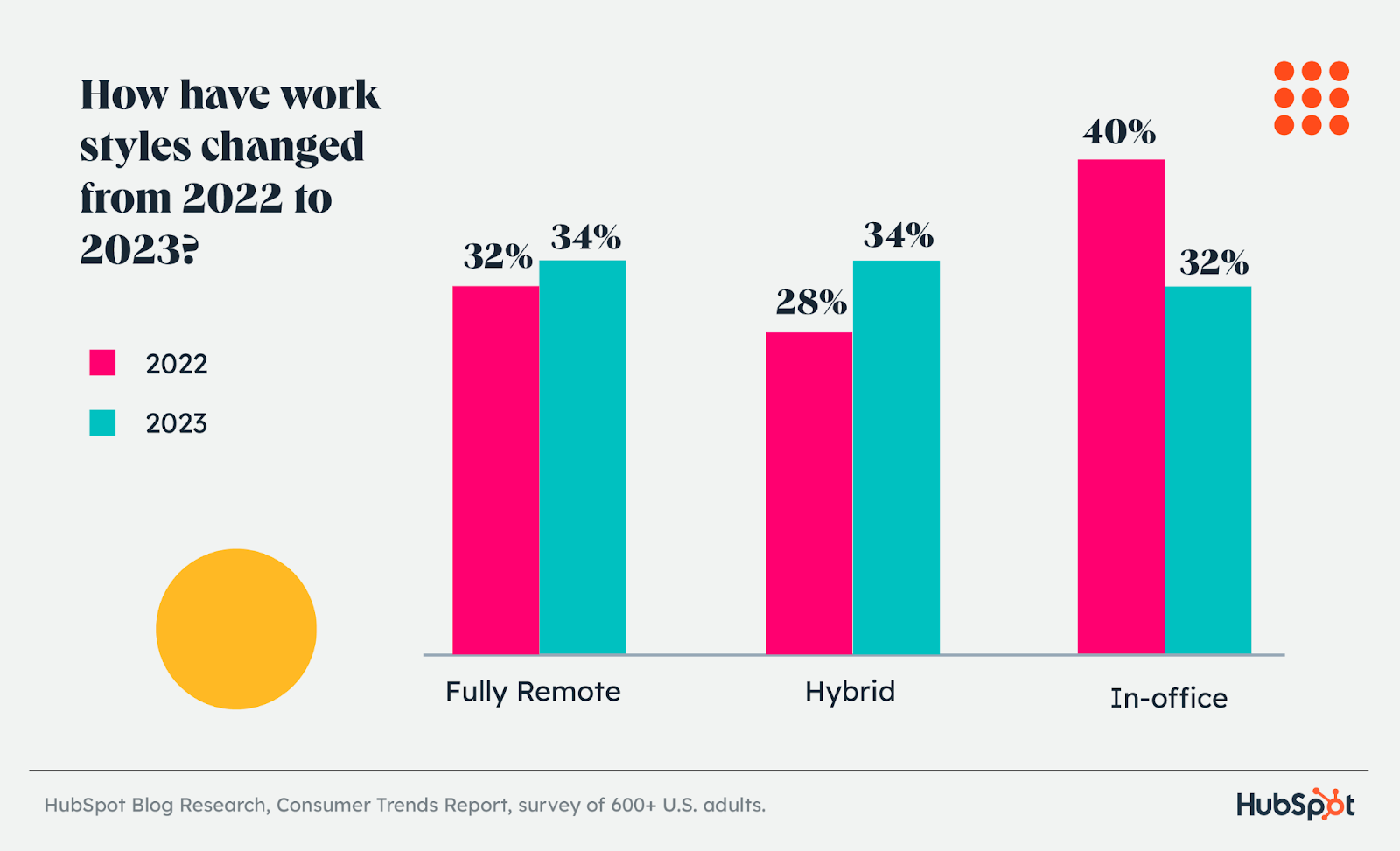
remote vs in office vs remote among consumer workers

Just 32% of full-time employees surveyed are in the office all week, down from 40% a year ago. 

Meanwhile, both fully remote work and hybrid work became more common, with 34% of workers saying they’re hybrid and another 34% saying they work remotely.

Not only that, but hybrid is the most popular work model (preferred by 41% of employees), followed by remote (32%), with in-person coming last (27%). 

What’s more, remote and hybrid employees aren’t interested in returning to the office full-time, with 47% saying they’d consider leaving if they had to come in five times a week. But, they’re more open to coming back than they were last year, when 54% said they’d rather quit.

The good news? Offering flexibility could result in great employee or team retention. The top reason people we surveyed want to stay in their job is to maintain their flexible work schedule, beating out competitive pay.

7. Company culture matters.

Not only do consumers need to see flexibility to stay loyal to employers, but they also need to see efforts made to build a positive and healthy company culture. 

A whopping 67% of employees say it’s important that the company they work for has a diverse and inclusive culture, up 20% from last year.

And it makes sense. As more people are asked to go back to the office — even part-time, they’re more heavily putting their work experiences into perspective. After all, why would you want to return to an office associated with negativity, unnecessary stress, uninclusive siloes, or psychological safety?

If poor culture, flexible work, or other negative things like overwork, lack of upward motion, or poor recognition of good performance aren’t handled, teams may run into a trend some leaders fear — quiet quitting.

At this point, one-third of employees surveyed are actively doing it — still on par with our research from the past year.

6. Consumers are tightening recession budgets.

64% of consumers think the US is currently in a recession and 63% are tightening their budgets in response. About half (49%) of US adults have taken steps to plan or prepare for a recession.

Additionally, with 42% of consumers expect the recession to for over a year. 
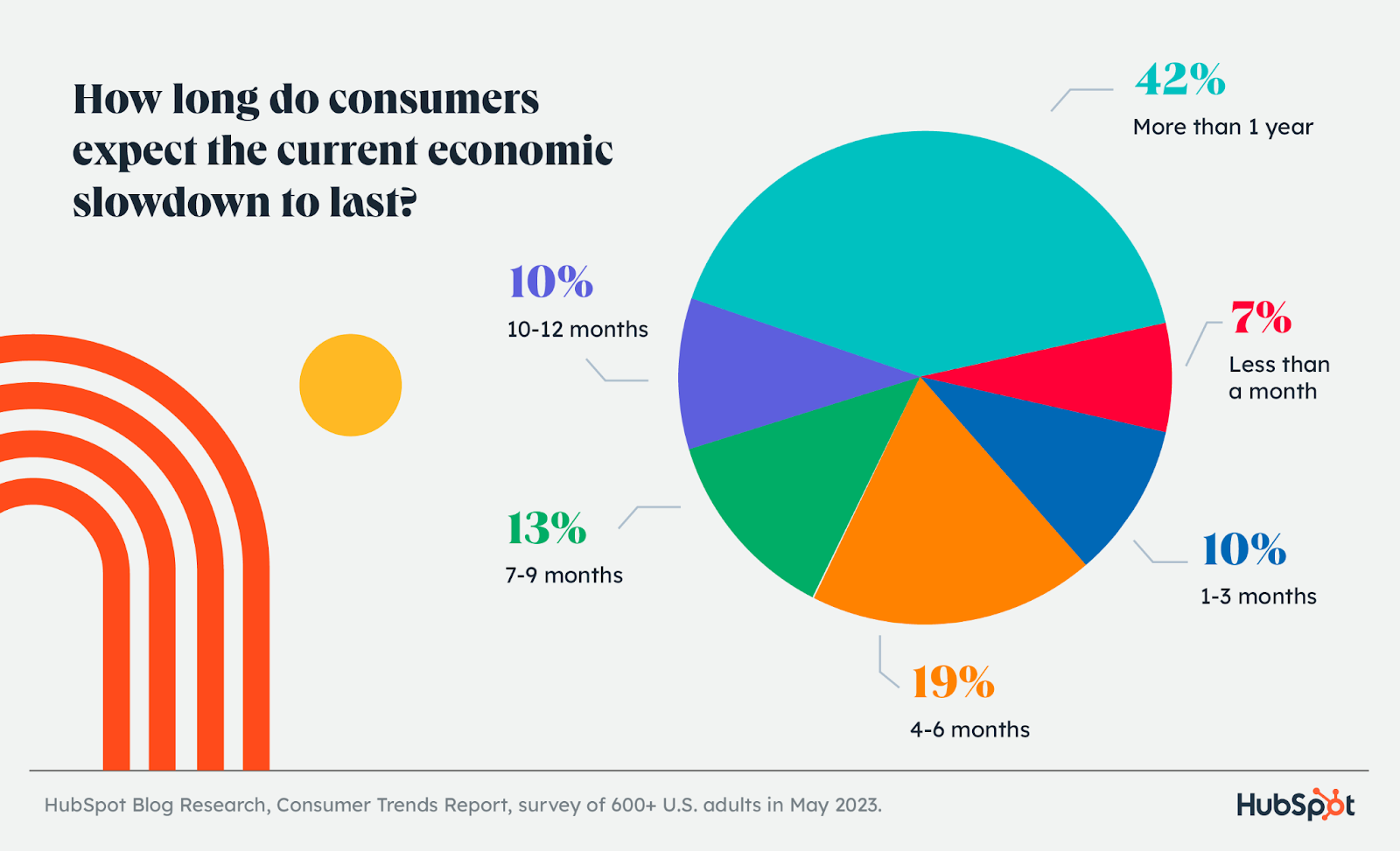
how long consumers expect the economic slowdown to last

7. Consumers continue to fear layoffs and recession impacts.

Although many companies will save thousands, or even millions, on reducing office space and facilities costs with hybrid and remote work, half of consumers are still rightly concerned about being laid off from their current job.

For marketers, earlier research from this year showed that their departments were already working with less resourcing, headcount, and budget than past years. As some industries are still seeing the brunt of economic trends, this has likely continued.

Many also worry that AI — the very tool that streamlines their busy work — could take over their work entirely.

At HubSpot, we think AI should be used as a tool to help employees cut out busy work and drive results, not as a means to save money by cutting staff.  And, heads of other AI platforms, like Jasper.AI, agree.
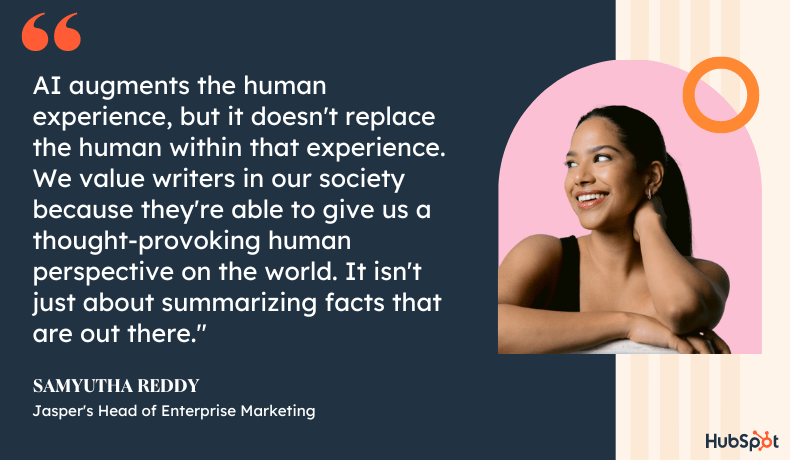
Samyutha Reddy on why AI wont replace marketers

Still, it’s understandable to worry how the combination of AI and economic could do to job security. After all, most employees we’ve surveyed compare AI to a modern-day Industrial Revolution

If you’re concerned about your role, zone in on skills AI can’t replace — like critical thinking. Meanwhile, use AI to give you and your team more time to earn a high-performance track record. This way, if your role does shift or dissolve, you’ll be able to pivot and adapt to change.

Privacy & Brand Perception Trends

8. Data privacy concerns are at an all-time high.

A whopping 84% of consumers say data privacy is a human right.

Not only are 81% of consumers worry how companies use their personal data, but 72% say they’re more likely to buy from companies they trust with it.
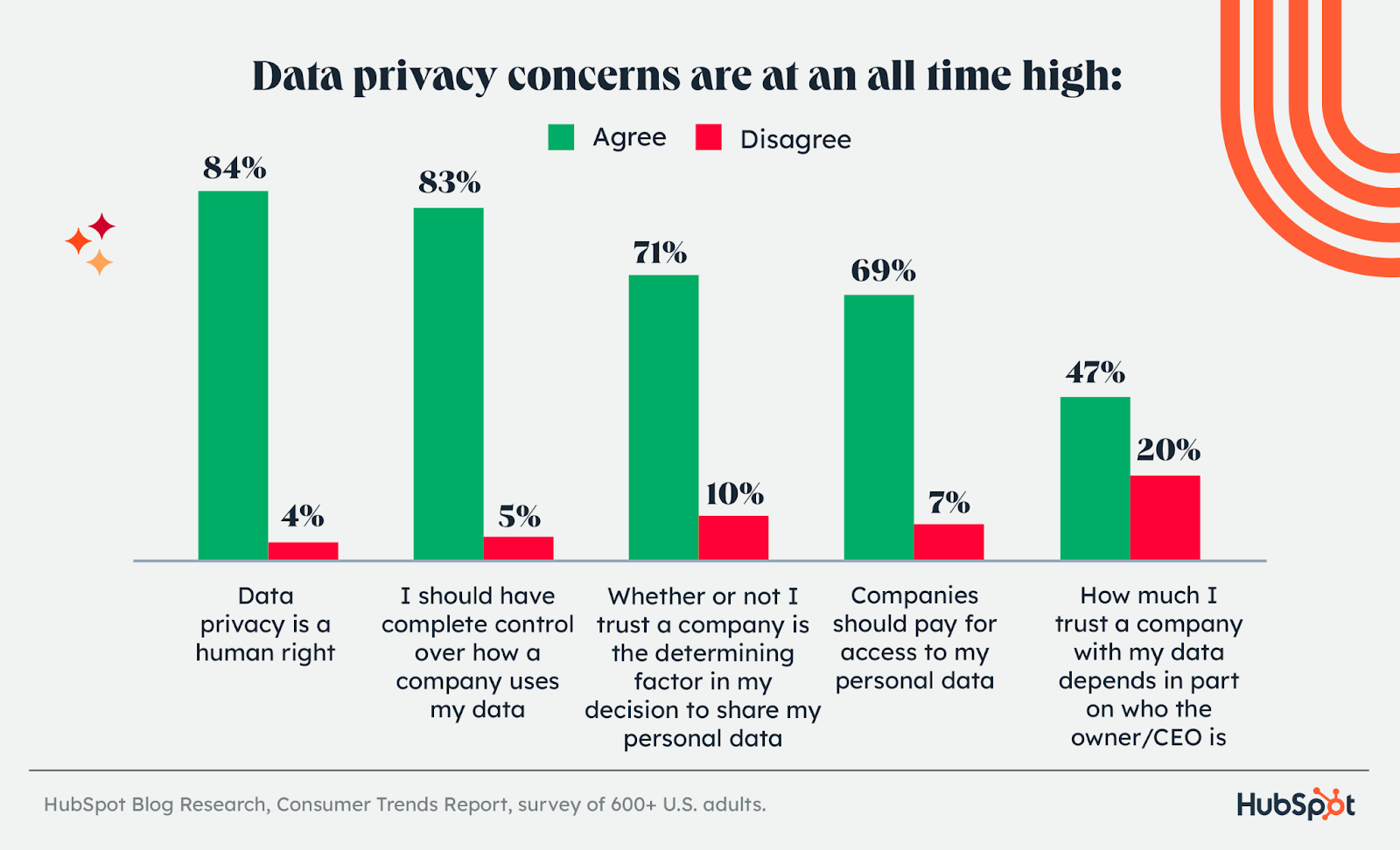
consumer fears around personal data usage by companies

So, how should marketers (or any other area of business) build that trust? 

We asked what would make consumers more comfortable sharing data with companies, and it comes down to transparency, security, and ownership. 

Consumers want to be given a choice in whether or not to share their personal data and be told exactly how their data will be used. 

Another important factor is knowing their data is stored securely and that it won’t wind up in the hands of third parties. 

Lastly, consumers want to maintain ownership of their data with the ability to remove it from your database if they so choose.
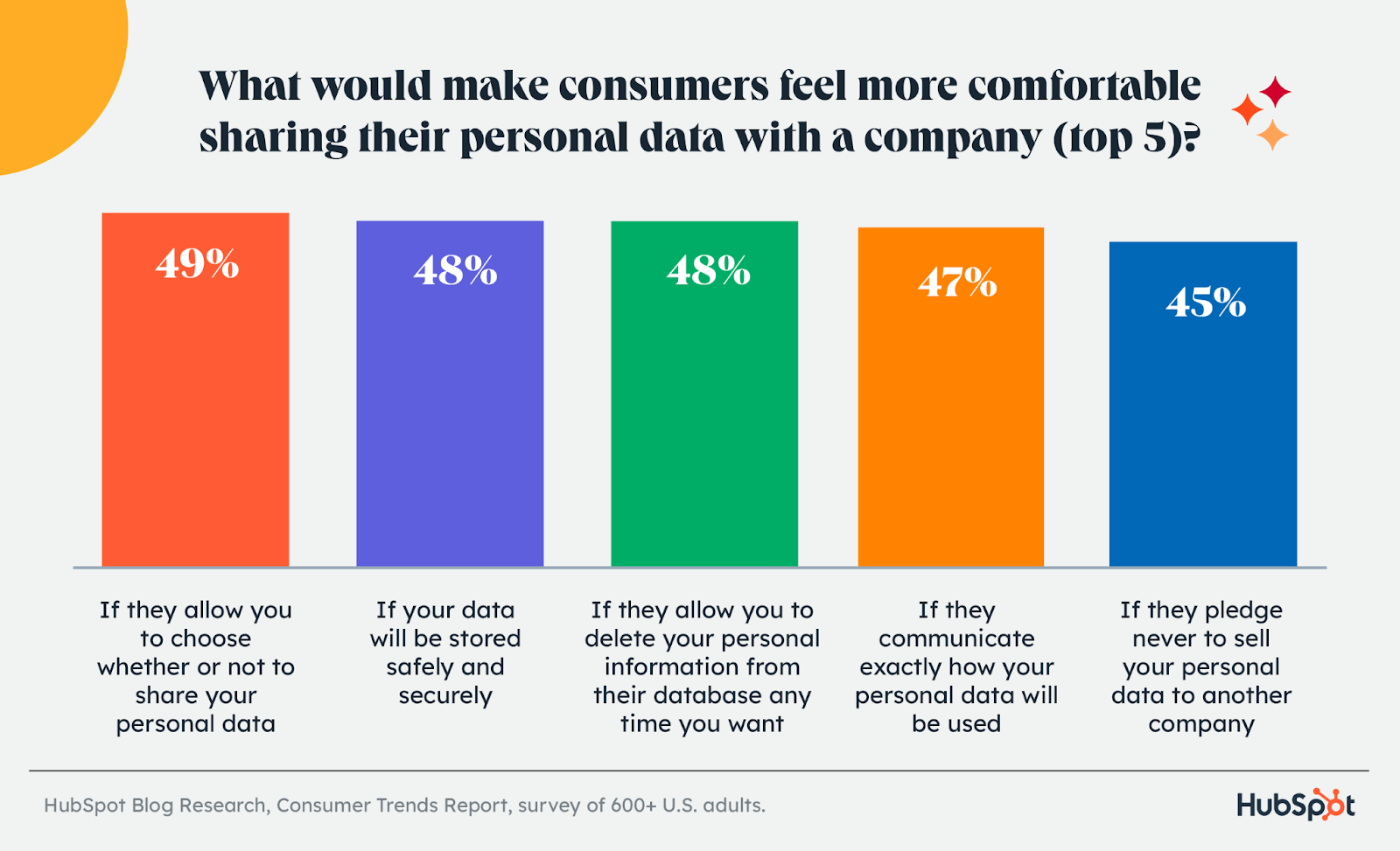
what makes consumers comfortable sharing data

Companies have a lot of work to do to build that trust, with over half (52%) of U.S. adults saying they usually decline to have their personal data tracked. 

Just 19% usually allow their data to be tracked, while 29% say it depends on the company.
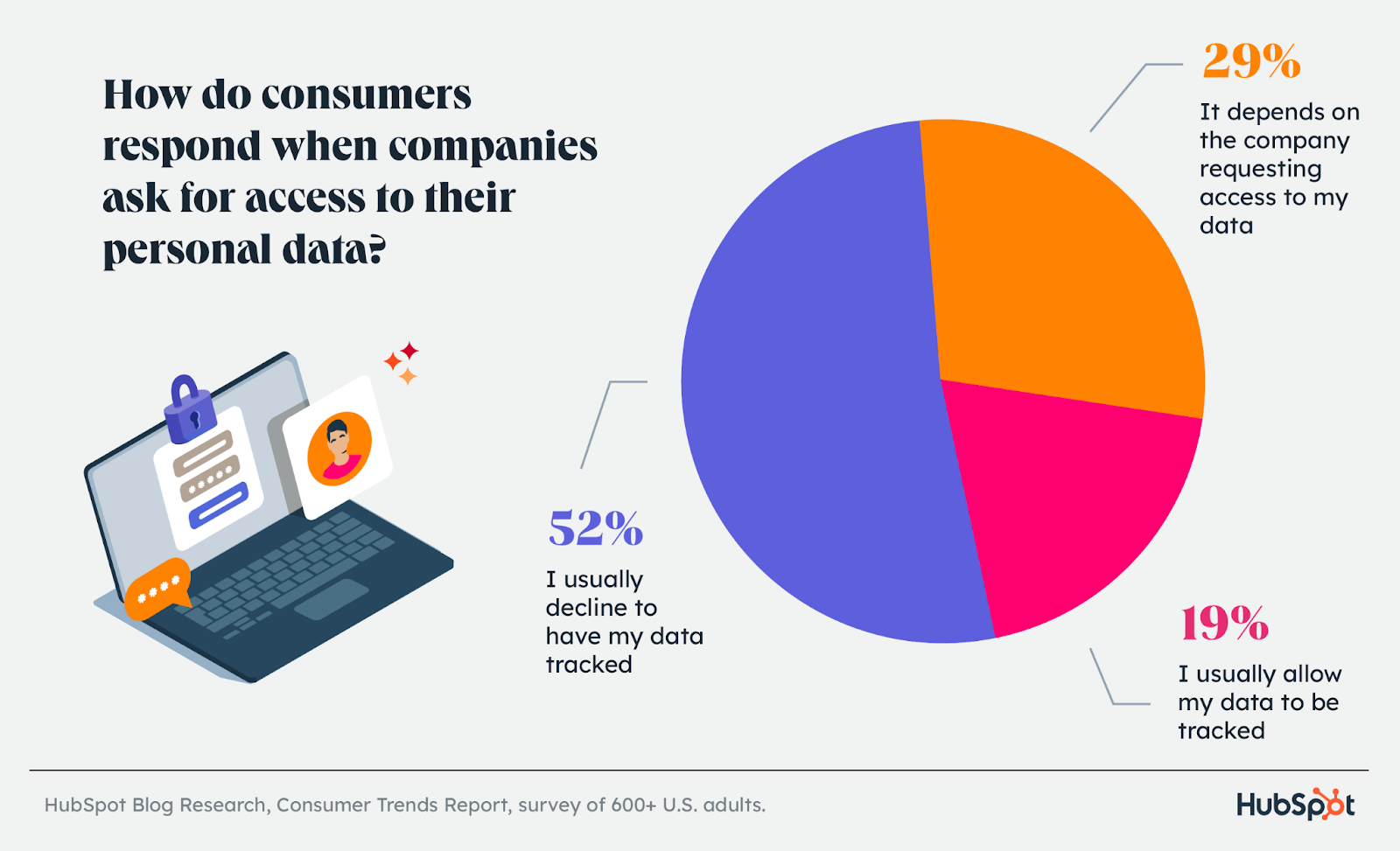
how consumers respond when asked for data

Ultimately, embracing today’s privacy-first world will be positive for your brand perception — and most importantly — customer trust and safety. In a recent post, our CMO, Kipp Bodnar, explains why data privacy is far from just a passing fad.
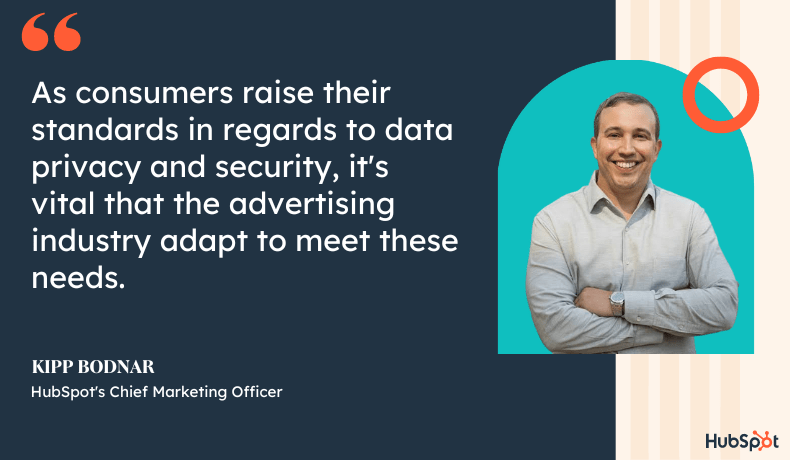
Kipp Bodnar's perspective on changing advertising standards in 2023

9. Consumers increasingly support brands committed to diversity and inclusion.

Companies taking a stance on social issues has grown more important and influential on consumers’ purchasing decisions, with 49% of U.S. adults saying brands should do more regarding social advocacy. 

Affordable healthcare, income inequality, climate change, and racial justice are the most important issues respondents want to see companies take a stance on. 
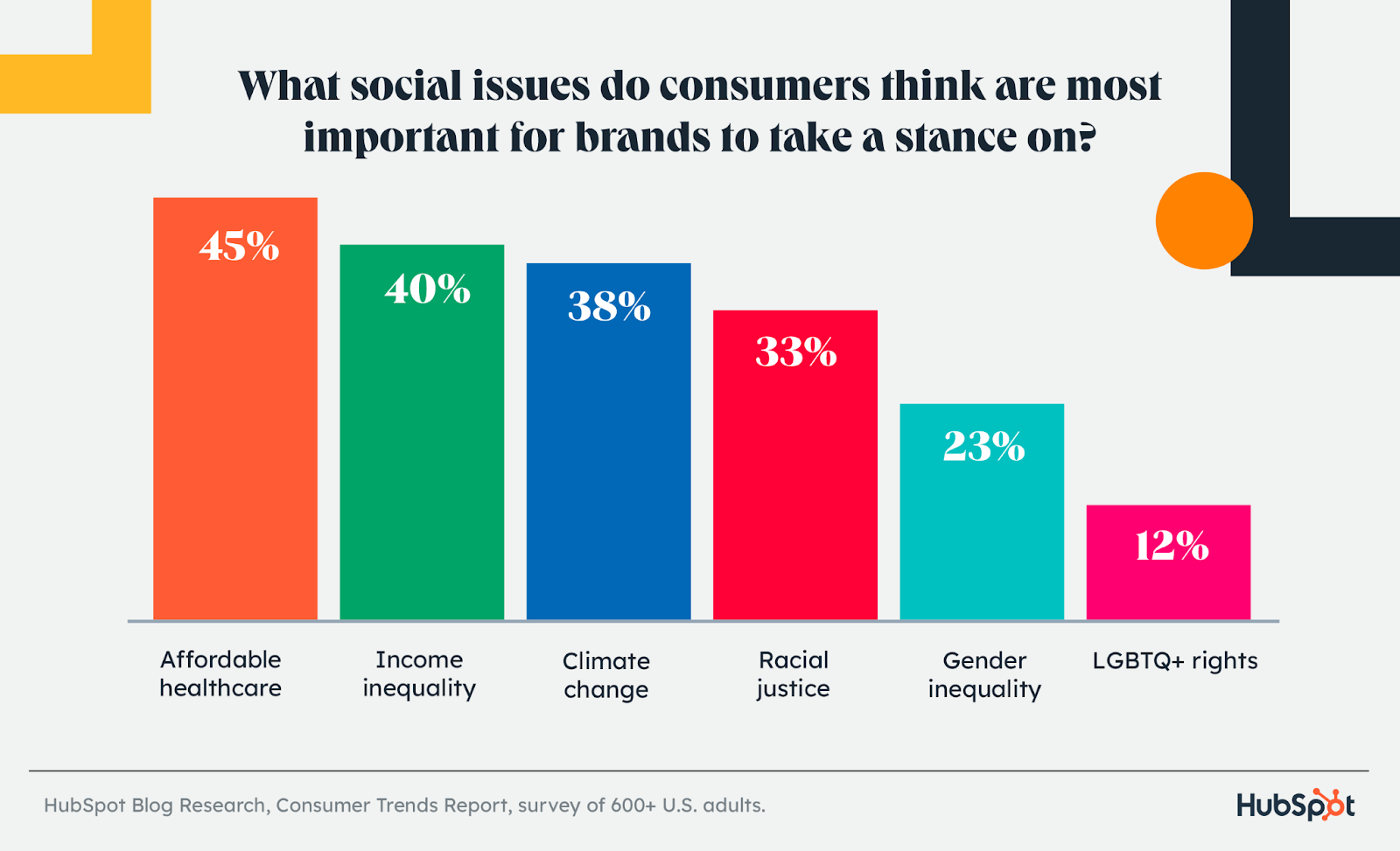
social issues consumers say companies should take a stance on

For Gen Z specifically, racial justice, LGBTQ+ rights, and climate change are the most important issues. On top of that, 20% of Gen Z say a brand’s commitment to diversity and inclusion is one of top five factors in their purchase decision.

Compared to last summer’s Consumer Trends results, respondents increasingly support brands committed to diversity and inclusion, as well as small businesses. 

42% of consumers say they’re more likely to buy a product based on the brand’s commitment to diversity and inclusion, up 17% from last year. 

Additionally, 37% chose a product based on the brand’s commitment to diversity and inclusion in the past three months, up 23% from last May.
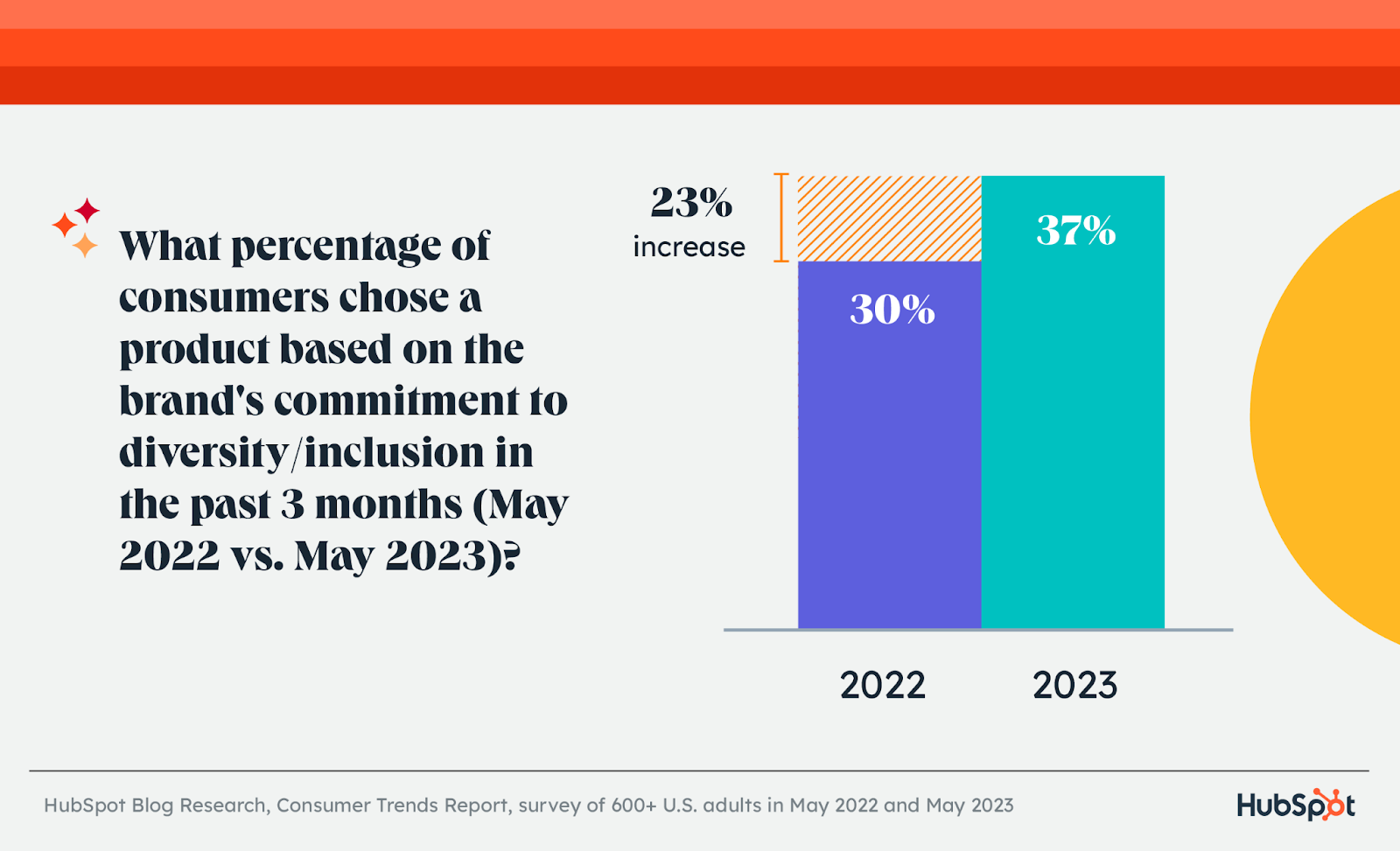
what percent of consumer choose to buy products from D&I friendly companies

10. More consumers support small businesses.

52% of consumers say a product being made by a small business makes them more likely to purchase, while 46% have chosen to buy a product because it was made by a small business (both up 18% from last year).
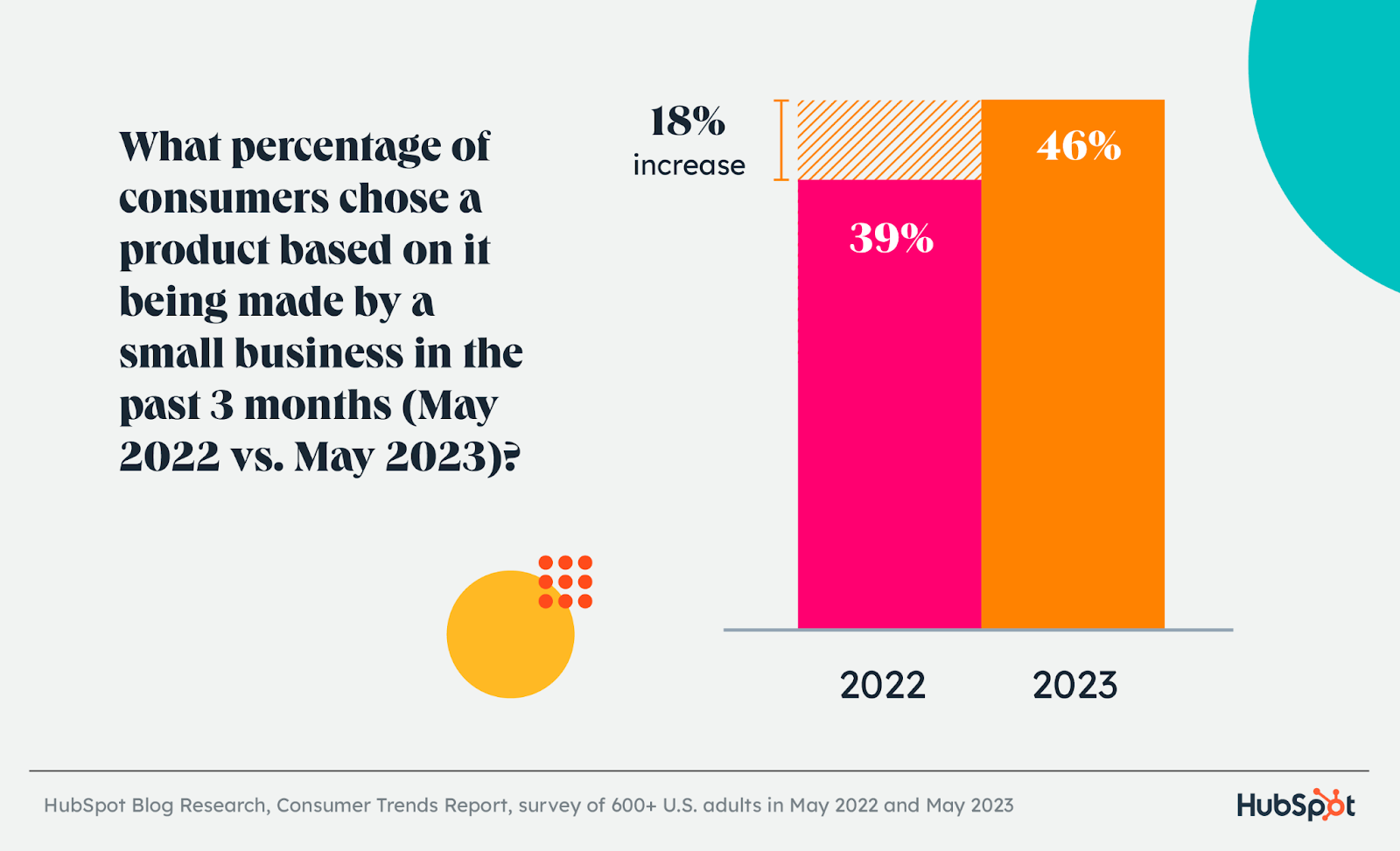
Trends Discovered in January 2023

While the list above reflects data from our most recent consumer pulse checks in mid-2023, below you’ll find highlights (which still could impact marketers) from an earlier survey six months prior.

1. Consumers are investing less money into virtual worlds, items, and currencies. 

Despite the waning hype around the metaverse, attitudes haven’t changed much over the past six months. Both May and January’s surveys found only 8% of U.S. adults have ever visited a metaverse.

Public opinion on the metaverse has improved slightly over the past nine months. 36% of consumers now say the metaverse is the future of technology — up 6% since May. And 33% say the metaverse is an extension of reality, up 18% since May. 

However, investments in virtual currencies have seen a decline. In fact, among those who’ve ever visited a metaverse, only 50% reported buying cryptocurrency in January — which is a 35% decrease since May. Additionally, 60% of metaverse visitors reported buying NFTs in January 2023 … 13% lower than May’s respondents. 

The decrease in purchasing virtual currencies might have to do with today’s economic landscape. If people are generally more conservative with their spending, this could trickle into the virtual atmosphere, as well. However, it’s important to take note of the decrease as a potential signifier that virtual currency isn’t as popular as it was in 2022. 

2. Gen X and Boomers are warming up to social media product discovery. 

In January, we found that 46% of Gen X and 24% of Boomers had discovered a new product on social media in the past three months — that’s a 10% and 41% increase since May 2022, respectively. 
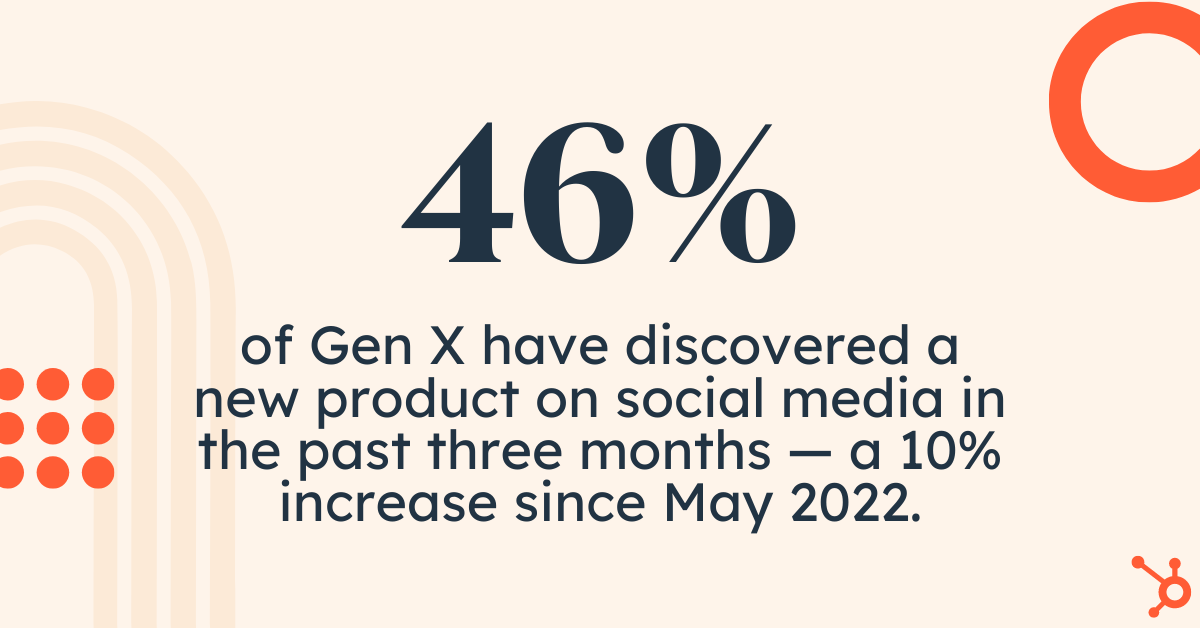
more Gen X are discovering products on social media

All of which is to say: continuing to invest in social media marketing as an opportunity for product discovery is a good idea as we near 2024. 

3. Gen Z increasingly differentiates itself from others.

One of the most fascinating things to dig into when looking at survey results were the vast differences between Gen Z and other age groups — including their closest predecessor, Millennials. 

When taking a deeper dive into our generation-by-generation data, we found that Gen Z:

  • When it comes to shopping, generations are highly influenced by price, quality, and product reviews. Gen Z especially values brands that have active communities around them.
  • TikTok and Instagram are the most used social media apps among Gen Z women, while men spend much more time on YouTube.
  • Gen Z is all about YouTube, Instagram, and TikTok. Not only for social networking and entertainment but also for discovering (and buying) products.
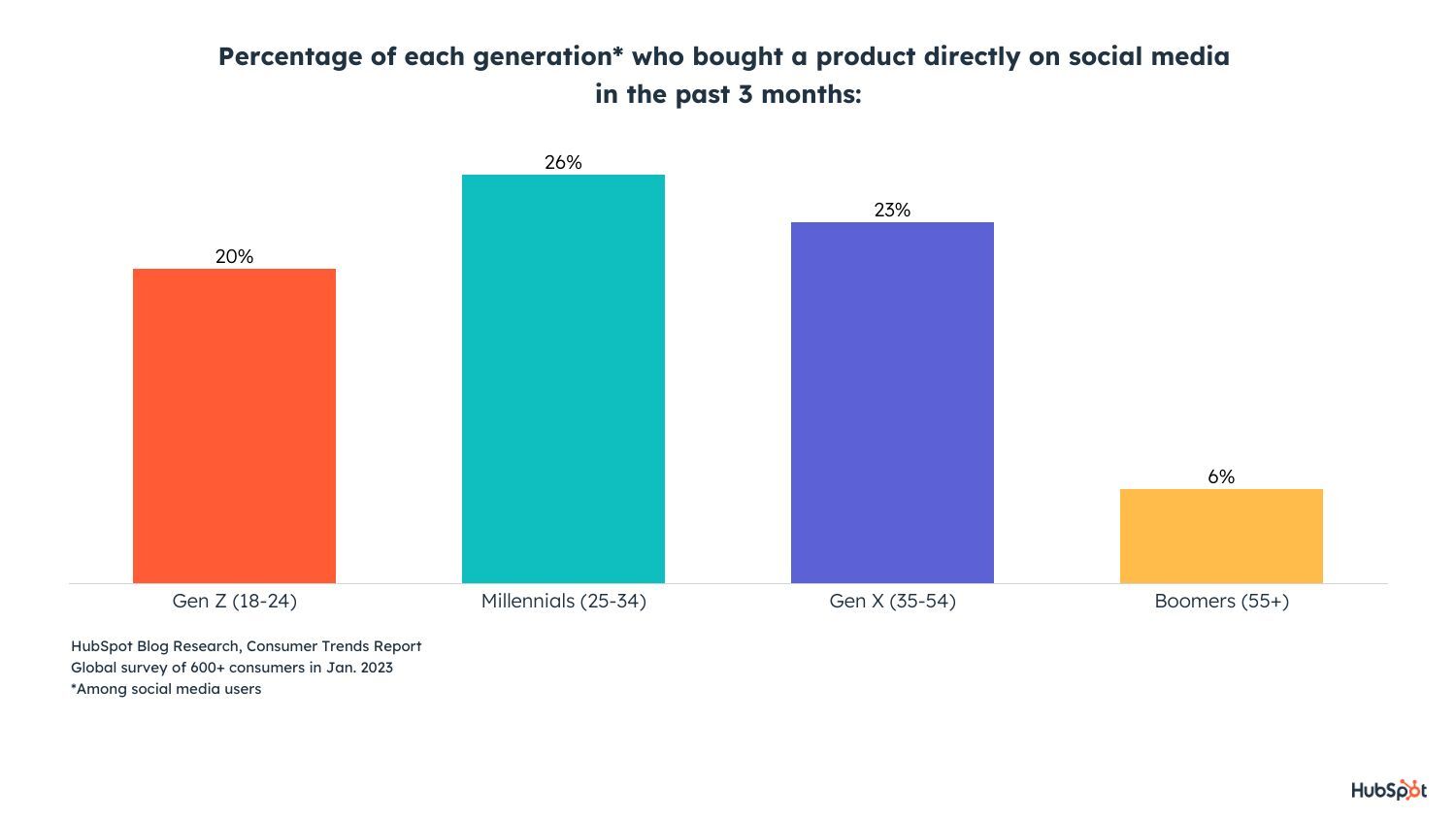
percentage of each generation who purchases on social media

The findings above weren’t the only interesting points to call out. Our lead researcher and analyst, Maxwell Iskiev explores the differences between how all age groups shop and discover products with this follow-up guide:
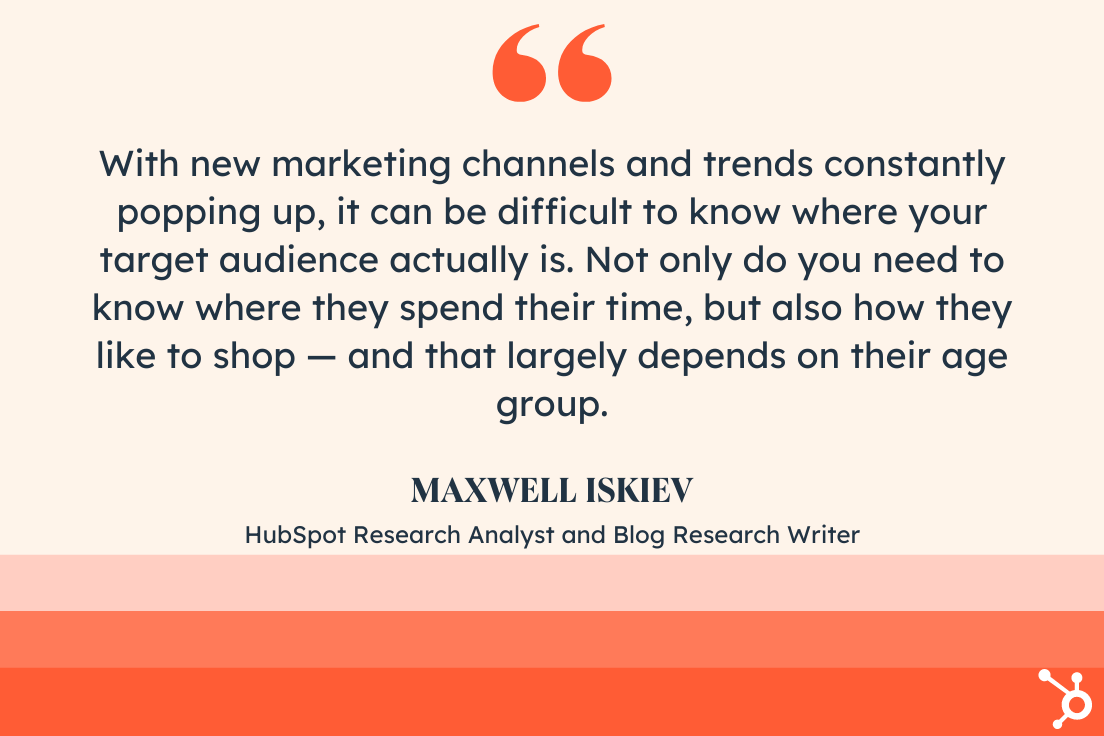
max iskiev discusses purchasing habits of consumers in 2023

How Each Generation Shops in 2023 [New Data from Our State of Consumer Trends Report]

4. Some consumers are stepping into Web3, but most don’t even know what it is.

While some consumers, especially those in younger generations like Gen Z and millennials, are ready to throw their whole wallet into the metaverse and cryptocurrency, most are still getting their first taste of the Web3 world.

In fact, 51% of our survey participants from the May 2022 survey say they don’t even understand what Web3 even is yet.

While Web3 experts believe this technology will continue to grow in the coming years, businesses don’t need to pivot their whole strategy to get ahead of it right this second.

However, as the technology gets more prominent and accessible, it’s still helpful to learn about the potential opportunities and risks of the Web3 space. 

That’s why Caroline Forsey interviewed a handful of Web3 experts to learn more about how it could impact how consumers use the world wide web in the future.

Here is a quick, overarching summary of what Web3 could mean for future internet usage from Anna Seacat, VP of Marketing and Web3 Community at Proxy. anna seacat quote on web3
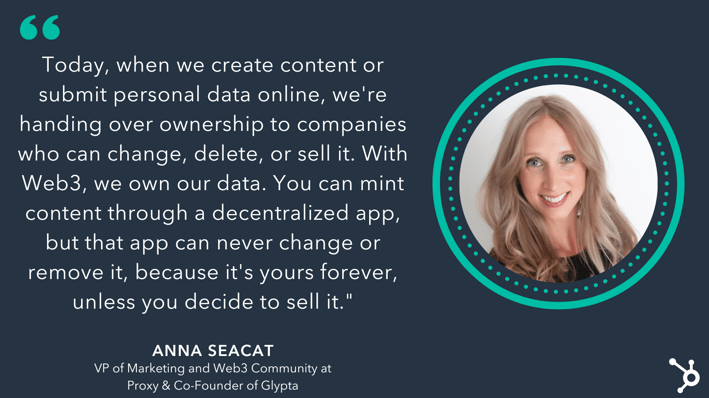
While Web3 might be a new concept to many, expect to hear more about it as the technology becomes more accessible to consumers and businesses in the coming years. For more expert predictions around this, hear what our CMO Kipp Bodnar and Kieran Flanagan, our SVP of Marketing, have to say about it in this episode of Marketing Against the Grain.

For more insights, check out these guides:

6. Consumers crave video, and effective brands are taking notice.

By now, you know that video has played a powerful role in the lives of consumers. Not only do consumers stream more video than ever, but year-over-year, HubSpot researchers find that most brands consider it to be their most effective type of marketing content

But, not just any video will result in a conversion, purchase, or view. While you don’t need a huge budget to woo your audiences, you will need to create content they’ll actually enjoy, keep their attention on, and be persuaded by.

In fact, 69% of our January 2023 respondents say it is more important that a marketing video be authentic and relatable than polished with high-quality video/audio.

This video interview and post from Wistia CEO, Chris Savage goes into great detail on his tips for leveraging video to humanize your brand.

For more on how marketers are benefiting from video in 2023, also check out our 2023 Video Marketing Report.

7. Stores and online retailers aren’t going away, despite the growth of social commerce.

In January 2023, 69% of consumers preferred to purchase a product in-store, while 52% preferred to purchase through an online retailer selling a variety of brands (e.g. Amazon.com).    
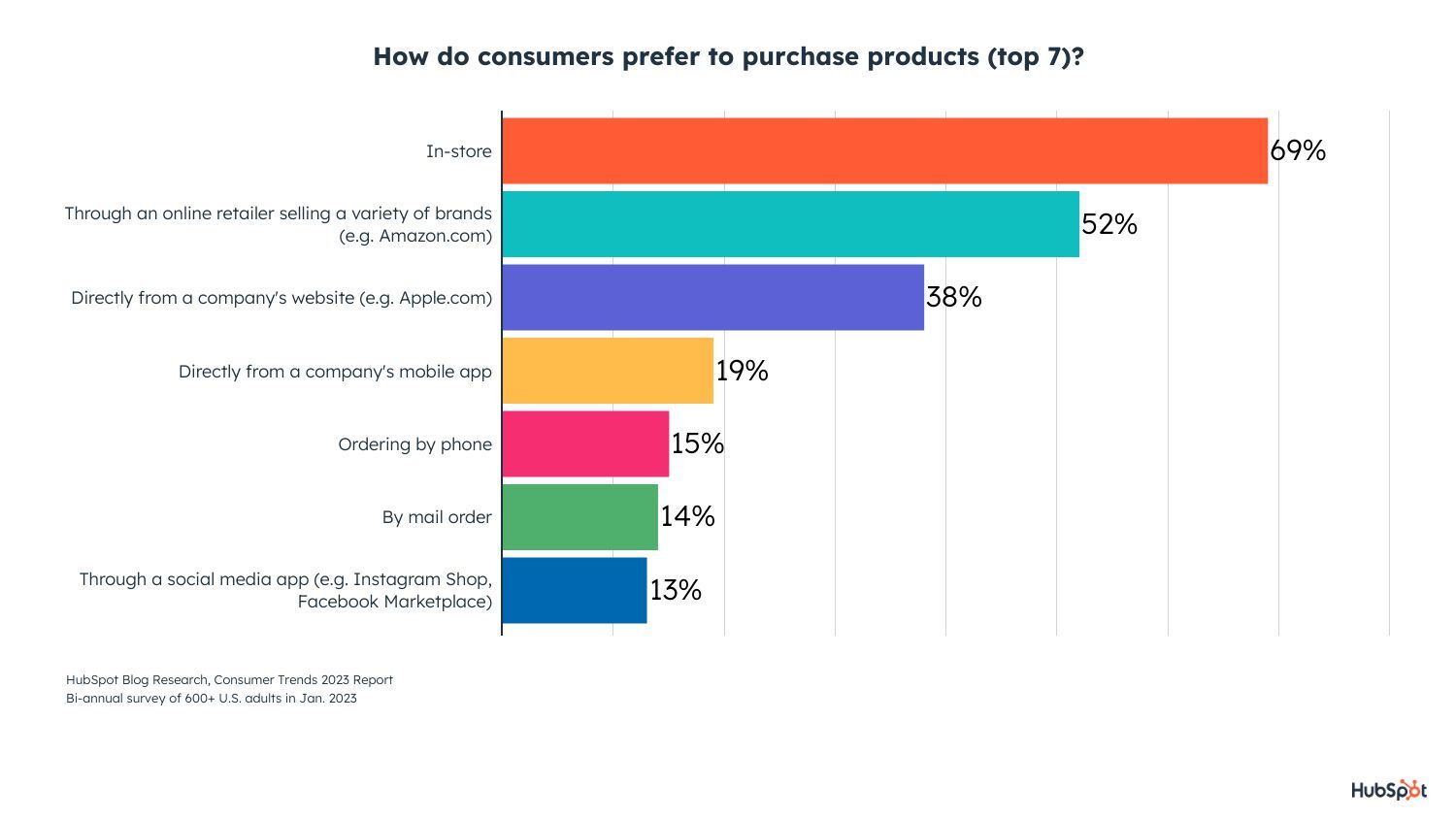
how consumers prefer to purchase products

Take Pink Tag Boutique for example. The Kentucky-based clothing and accessories business saw immense growth on the Facebook Shops. They attribute $44,448 in incremental sales from the tool, and have seen 66% greater average order value from social commerce buyers compared to those who bought directly from the company site.
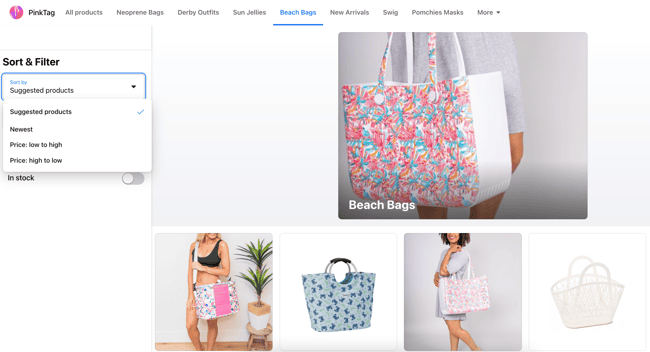
Pink Tag Boutique Facebook Shops Case Study

For more examples of brands that are already excelling in social commerce, check out this post.

You can also find more shopping trend data in this follow-up report from Caroline Forsey: The Shopping Trends of 2023 & Beyond [State of Consumer Trends Data]

8. Many consumers consider themselves “creators.”

When looking at our survey results for the question, “Would you consider yourself a creator?”, we found that 30% of 18-24-year-olds and 40% of 25-34-year-olds call themselves content creators.

What’s great for brands here? Your very own audiences might jump at the chance to create content for you, which could in turn help them build online influence.

But, what exactly IS a “creator”? Check out this deep dive by Caroline Forsey to learn more: If Everyone’s a Content Creator, Is Anyone?

What’s Next for Consumers, According to Trend Analysts

Now that you’ve read through the biggest findings of our Consumer Trends Report, you might also be asking, “What trends and themes could come in the next six months — or beyond?”

To give you a taste of just a few trends to keep on your radar, we reached out to Julia Janks of Trends.co to learn what she and her team of trend analysts will be focusing on. Here are three of the nine trends they’re keeping on their radar.

1. Gifting strategies could catch the eyes of consumers.

Forget loyalty points — gifting is the new customer retention strategy. As remote everything continues to rise, keeping connected to clients and loved ones will be key.
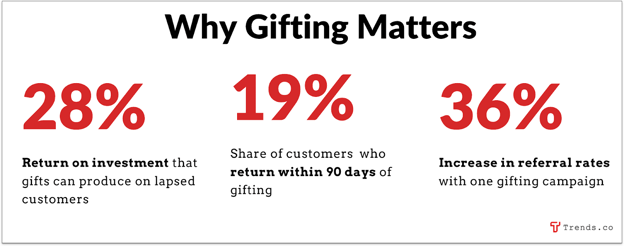
why gifting matters

Source: &Open

Gifting powerhouse 1-800-FLOWERS had a record-breaking year in 2020, and venture capital is flowing into startups like &Open ($7.2m last May) and Gracia (~$14m since its 2017 launch).

Companies will also use gifting to target employees, since worker retention is at an all-time low, and the average cost of replacing an employee is about seven months of their salary.

2. Voice search and audio SEO opportunities will grow.

The world of podcasts is growing faster than the entire internet did back in the early 2000s. Spotify alone now hosts 3m+ shows (that’s ~43x the number of titles on Netflix, Disney+, and Apple TV+, combined).
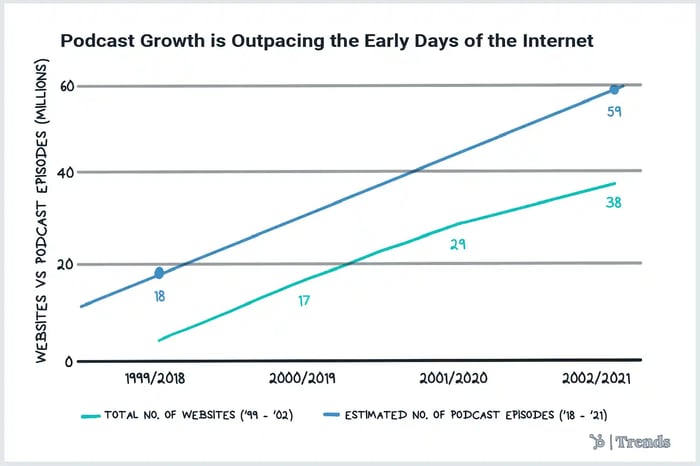
podcast growth vs. internet development

3. Consumers will visit pop-up shops — in the metaverse.

Pop-up shops in the metaverse are a thing now. And, brands like Hogan are already testing them out.

We could see the metaverse shopping industry continue to grow with consumer interest, as 30% of consumers HubSpot surveyed think more brands should consider virtual stores.

For the Julia’s full list of trends to watch, check out 9 Things Trends.co Analysts Will be Watching in The Next 6 Months & Beyond — and don’t forget to check out Trends.co for more business news, innovative ideas, and industry trend coverage.

Dive Deeper into Consumer Trends

In the post above, we gave just a few highlights of our State of Consumer Trends Survey, as well as our predictions for what’s to come. To learn more interesting themes, check out these follow-up posts:

Want to see how data’s changed since 2022? Click below to download the full findings of that survey in our State of Consumer Trends Report
New Call-to-action

Consumer Trends Post Authors
state of consumer trends post contributors

Categories B2B

13 Landing Page Types to Test & Pick for a Campaign (+New Data)

Whether you’re a blogger, social media marketer, or paid marketer — you have a healthy relationship with the landing page. Sometimes, you might go through rough patches where you wonder why landing pages exist. But they’re always there for you, increasing conversions, netting new leads, and driving traffic to the offers you’ve worked so hard to create.

But, to be honest, there are a lot of different types of landing pages, and not all of them serve the same purpose. Luckily for you, we’re not only going to break down each type of landing page, but we collected new data to help you pick the one that will make your next campaign successful.

Build landing pages that convert visitors for free.

We surveyed 101 marketing and advertising professionals to learn which landing page elements and strategies were most effective.

When asked, “What are you most commonly trying to generate with landing pages?” the top three responses were to gain:

  • Leads through prospective customer contact information (44%)
  • Customers or direct purchases (38%)
  • Email subscribers (10%)

Businesses want to connect to customers and gain the ability to either guide them directly to purchase or to add them to a subscription where interest can be gradually built. But it’s important to consider that a landing page by itself may not be enough to convert — the elements on the page contribute to that success.

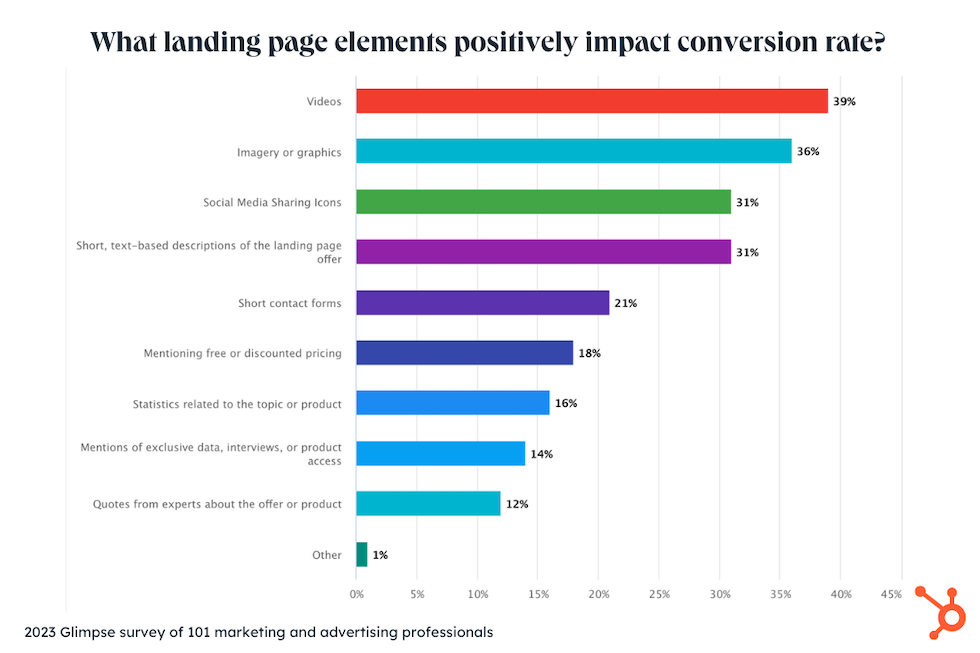
What landing page elements positively impact conversion rate

Surveyors also shared that multimedia elements like videos (39%), images or graphics (36%), and social media sharing icons (31%) positively impact conversion rates with present on a landing page. The more interactive or engaging that you make a website, the more likely visitors will want to spend more time on page and digest more of the information, product, or service you’re offering.

This survey not only showed the different results that marketing and advertising professionals could gain from a landing page, but that depending on your business need, you can include elements specific to your strategy if you use the right type of landing page to get there.

As we go through each type of landing page, remember this information to ensure you’re leveraging the right one for your next campaign.

While there are many fantastic landing page examples for you to check out, not all landing pages serve the same purpose, many of them achieve a variety of objectives.

1. Squeeze Page

A staggering 90% of B2B marketers say email marketing is either very effective or somewhat effective for reaching their goals, according to 2022 HubSpot Blogs report. So it’s not surprising that squeeze pages are one of the most important and effective landing pages out there.

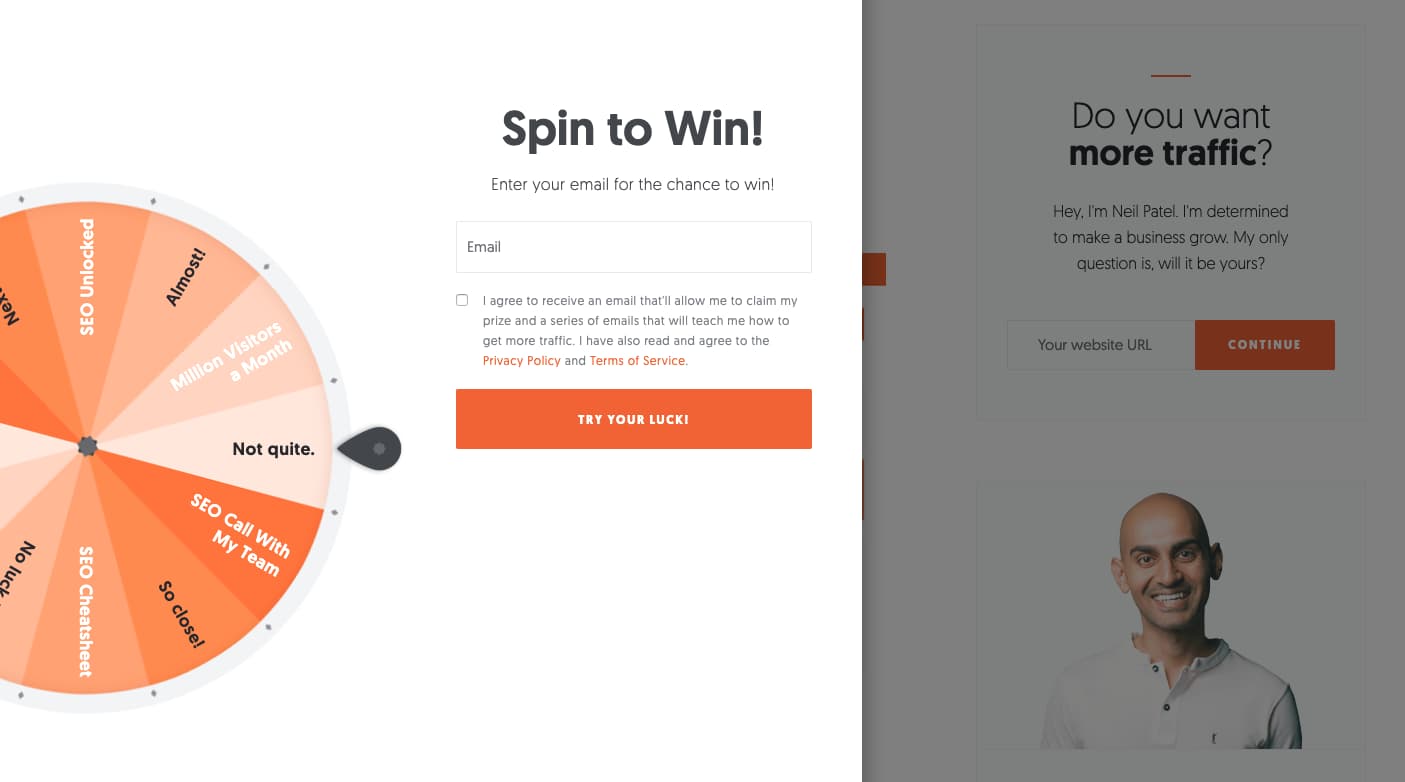
A squeeze page is one in which the goal is to capture the user’s email address. Once you have the address, you can begin to nurture that lead with relevant content and other offers.

The most common type of squeeze page is gated content or a prompt to enter your email address to receive a newsletter, ebook, whitepaper, or other content offer.

Make sure your squeeze page is simple, your CTA is tempting enough to get your user to give up their email address, and you make it easy for users to click out of the page and onto the content that brought them to your site.

types of landing pages: squeeze page

Image Source

2. Splash Page

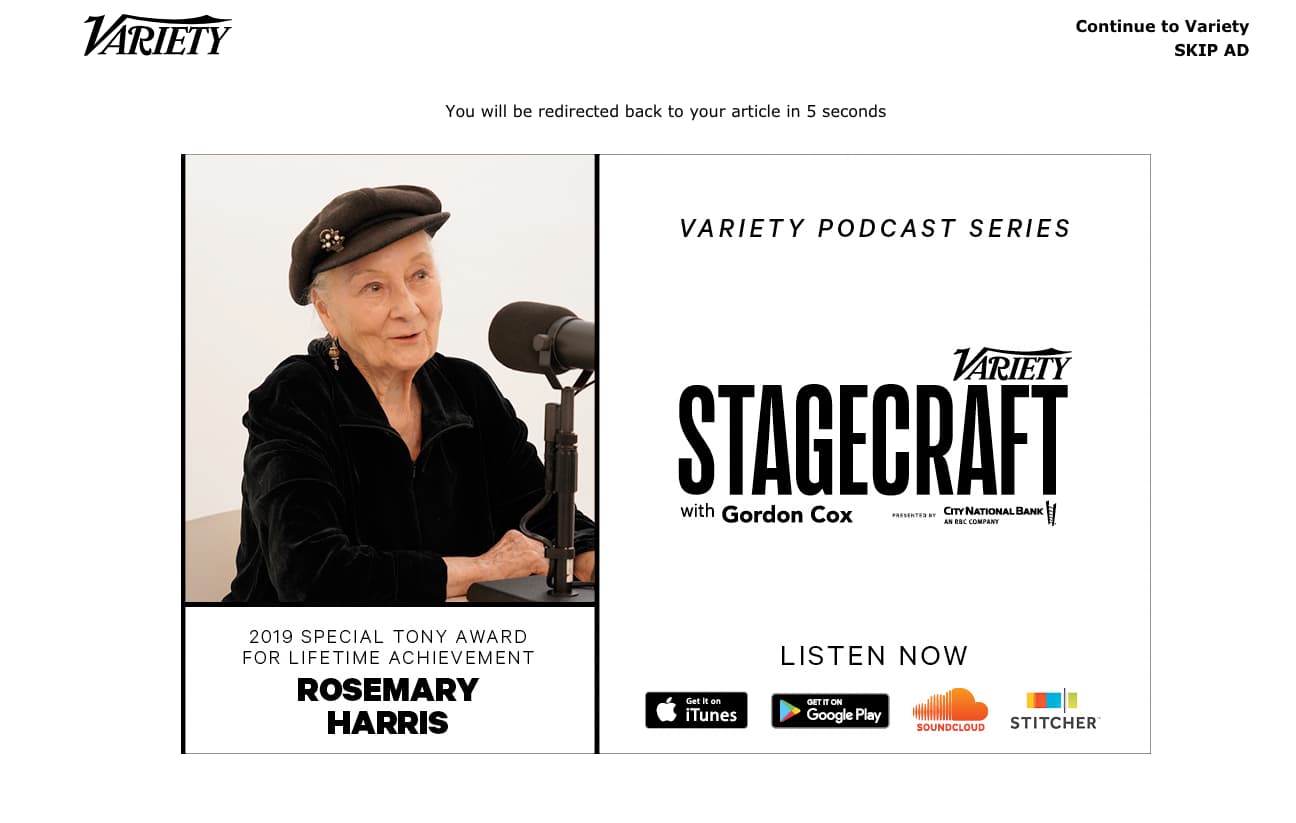
A splash landing page doesn’t always have lead capture as the main goal. These pages are often used when someone clicks a social media or content link. Instead of being sent directly to the article or social media destination, the user is sent to an intermediary page: the splash page.

This page might share an announcement with the user, such as “We’ve just unveiled new dates for our marketing conference!” It might also ask your user for a language preference or to enter their age. The splash page might also present an ad, which the publisher benefits from, if the user clicks on the ad.
types of landing pages: splash page

Image Source

The splash page above does two things really well: First, it offers a countdown to the end of the ad and the ability to easily click to the article once the ad is done. Second, it serves a clear purpose — to show the user an ad.

3. Lead Capture Page

A lead capture page is similar to a squeeze page, but generally sources more information. Name, business name, email address, job title, and industry are just a few things these landing pages seek to earn.

The information you request depends on the goals for the page and those of your sales and marketing teams, as well as where the customer is in the funnel. If your lead capture page is top of the funnel, step away from the eight-lined form, please.

If, however, your customer is landing on your lead capture page after demonstrating real interest in your product/service (i.e., they downloaded two case studies) you should be able to ask for more information to help qualify and direct them.

types of landing pages: lead capture page

Image Source

4. Click-Through Landing Page

Every marketer knows you must provide value to your customer before asking them for money. A click-through landing page provides that value without pummeling your customer with a “Buy Now” button before they’re ready.

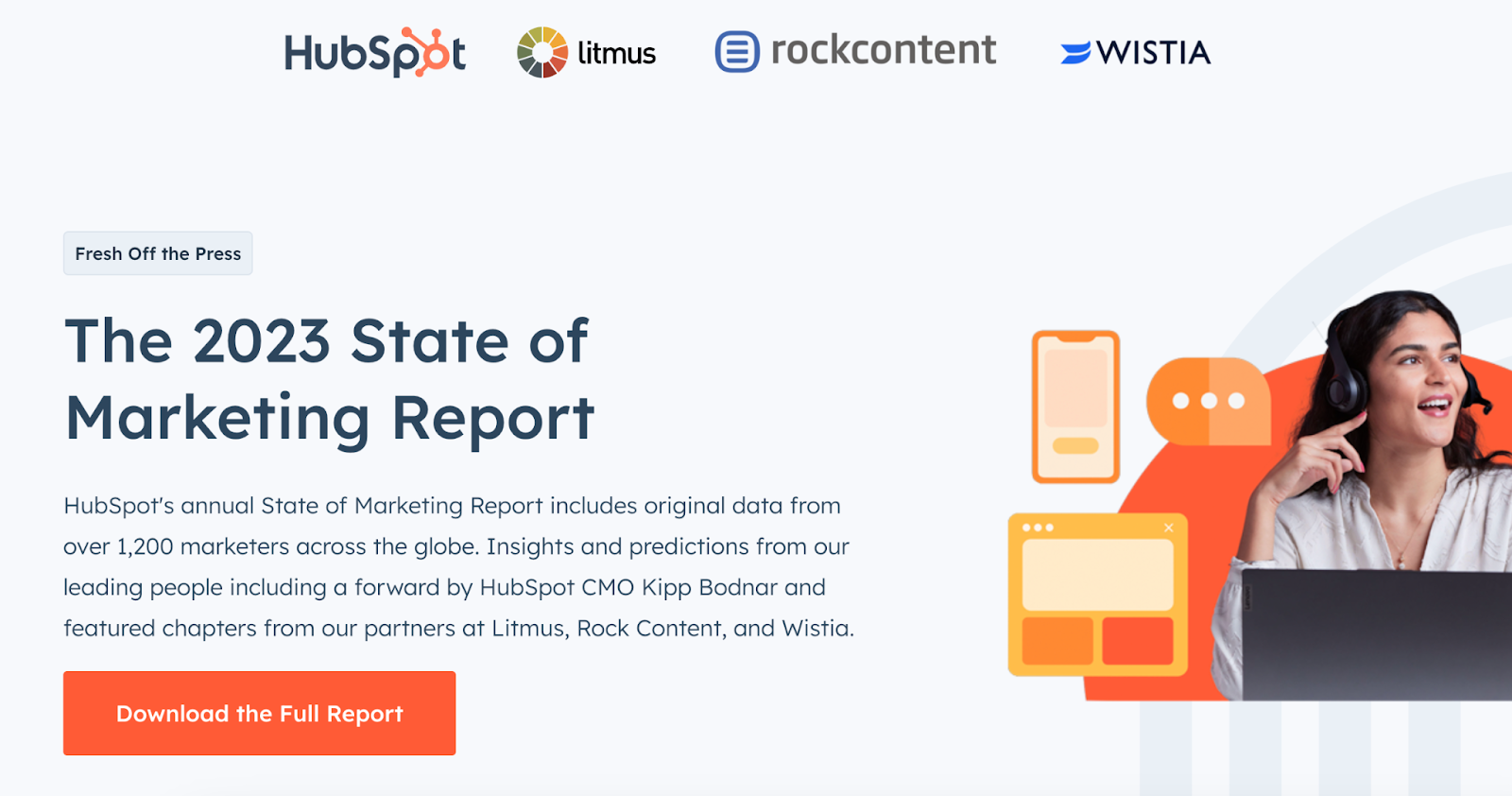
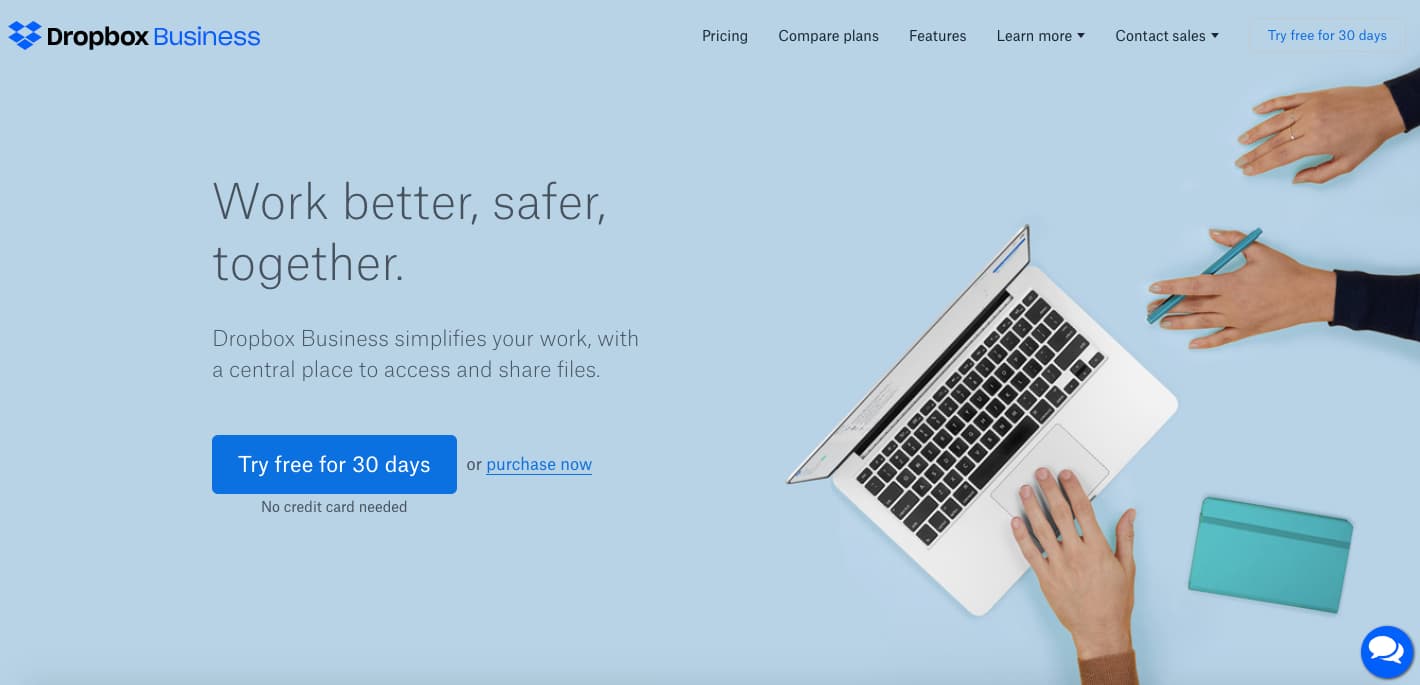
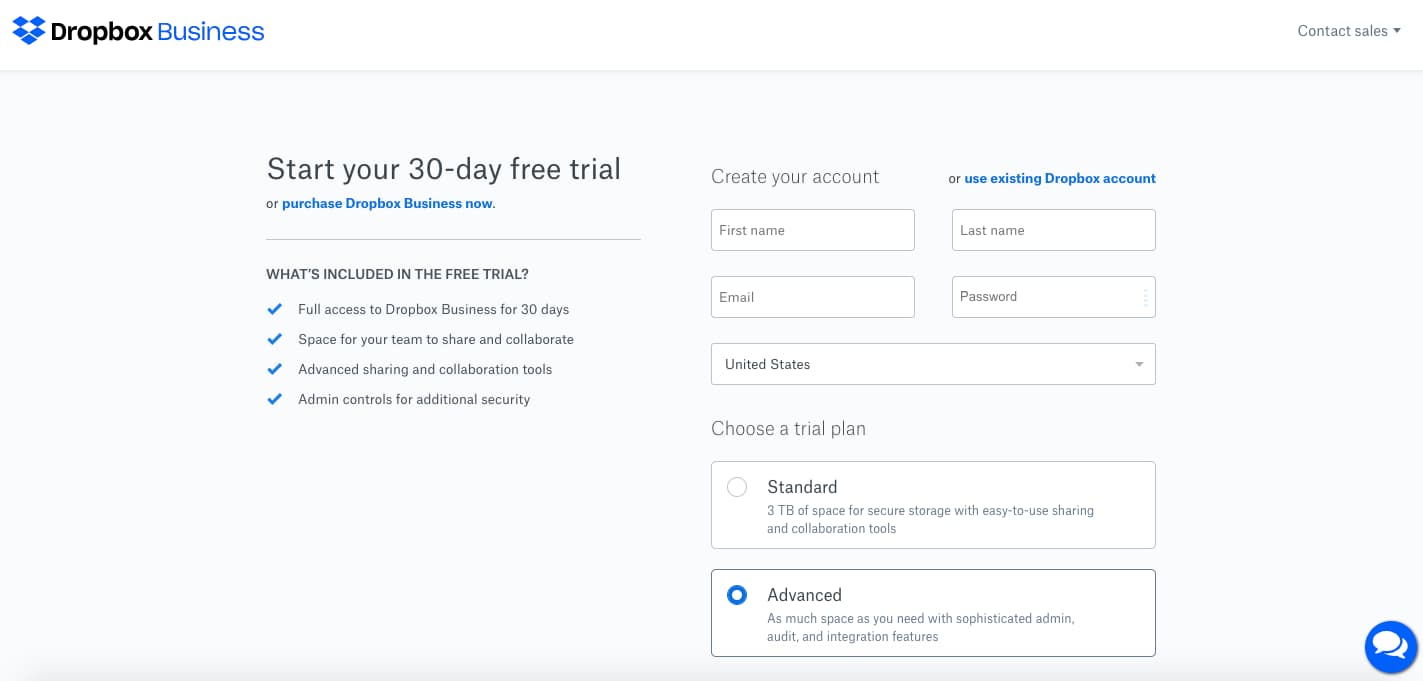
Often, this looks like a landing page that shares the benefits and features of your product/service with a CTA button encouraging your customer to try a free trial. Once they click on that button, they’re taken to another landing page which provides pricing details and requires payment information to begin the trial.

By the time your customer lands on this page, however, they’re primed and educated on why they should move forward with the trial. In the examples below, you see the click-through landing page, and then the payment landing page customers are sent to when they decide to embark on a free trial.types of landing pages: click-through landing page

click-through page example

Image Source

5. “Get Started” Landing Page

A “Get Started” landing page should lead with your offer above the fold. Take this page, from Mailchimp, which explains their overarching benefits: tools that turn audience data into insights that will guide campaigns.

Hooked already? Great, because a “Get Started” button awaits. Need more convincing? Well, the details follow as you scroll a feature- and benefit-laden landing page.

types of landing pages: get started landing page

Get started with HubSpot’s Campaign Assistant yourself

6. “Unsubscribe” Landing Page

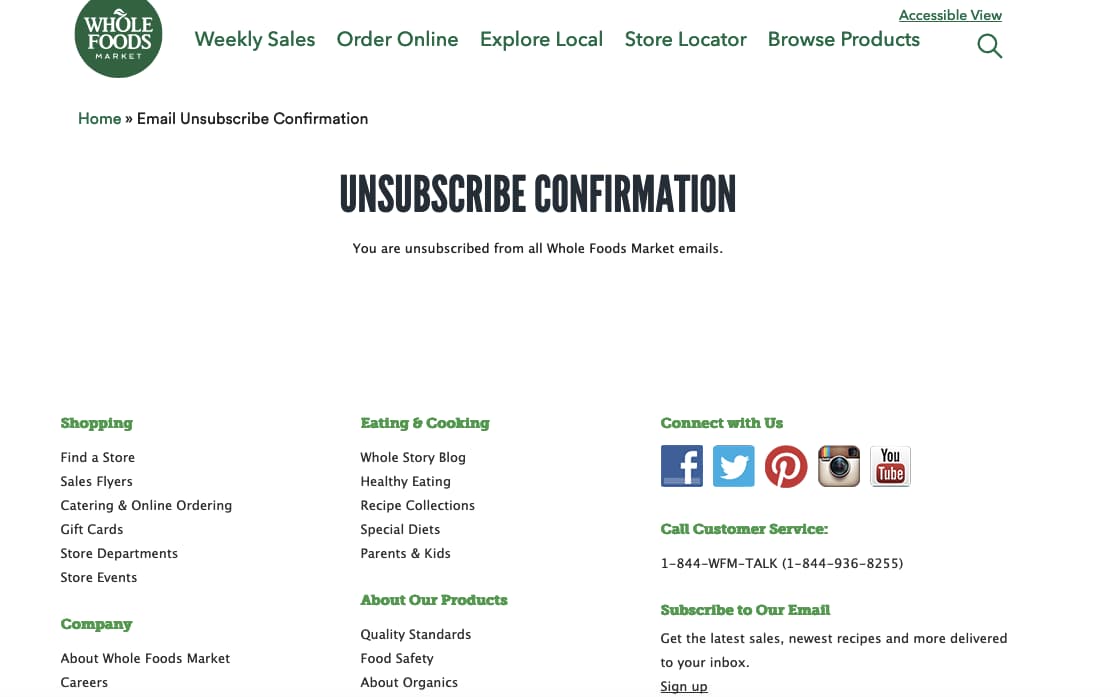
Obviously, you’re not going to build a campaign around your unsubscribe page, but it’s important not to neglect it. Make sure it successfully unsubscribes your users, offers them a chance to manage their preferences or adjust the cadence, and consider including links to other areas of your website, like this example from Whole Foods.

types of landing pages: unsubscribe landing page

Image Source

After all, just because they don’t want to receive your emails, doesn’t mean they might not want to browse your site. Consider adding a “second chance” button that prompts users to resubscribe in case they get cold feet.

7. Long-form Sales Landing Page

On a long-form sales landing page, brevity is not your friend. You want to think of every question your customer might have for you, every barrier to purchase they might face, and every benefit they’ll enjoy by making a purchase when they scroll to the bottom of the page.

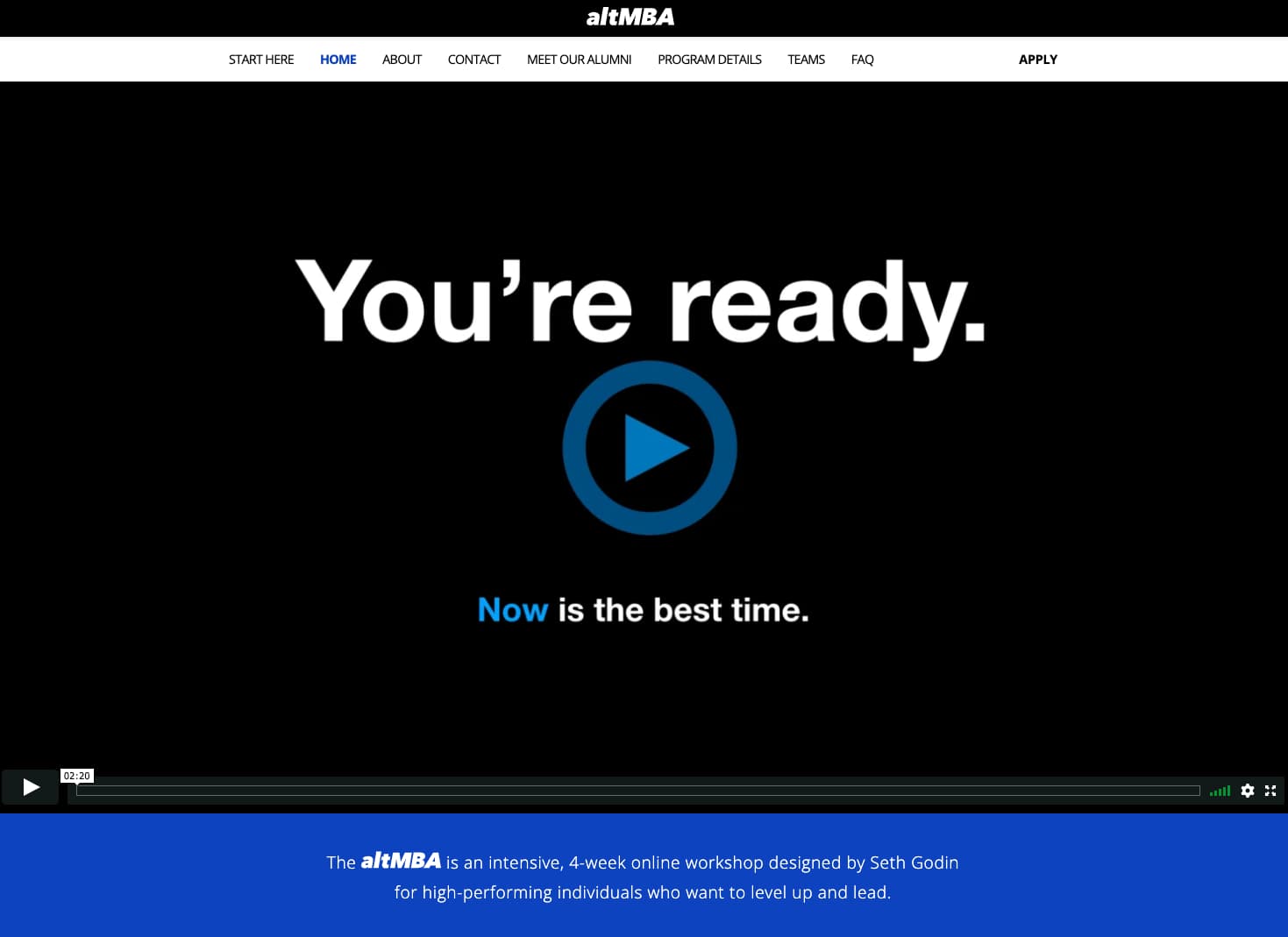
Take this example, from Seth Godin’s altMBA. types of landing pages: long-form sales landing page

Image Source

It starts with an informative video that tells you why now is the right time to apply. Then you see the names of companies and pictures of students who have benefited from the course.

Quotes follow, along with links to join mailing lists, learn more about the program, and read testimonials. Finally, at the bottom of the page is a CTA button for the application, and program dates that add a sense of urgency.

A sales landing page should be detailed and lack the minimalism of, say, a squeeze page, simply because your goal for the page is to close business.

8. Paid Advertising Landing Page

If you’re not sending customers who click on your paid ads to the right landing page, you’re throwing money away. Generally, you want to generate leads from these ads — not necessarily sales.

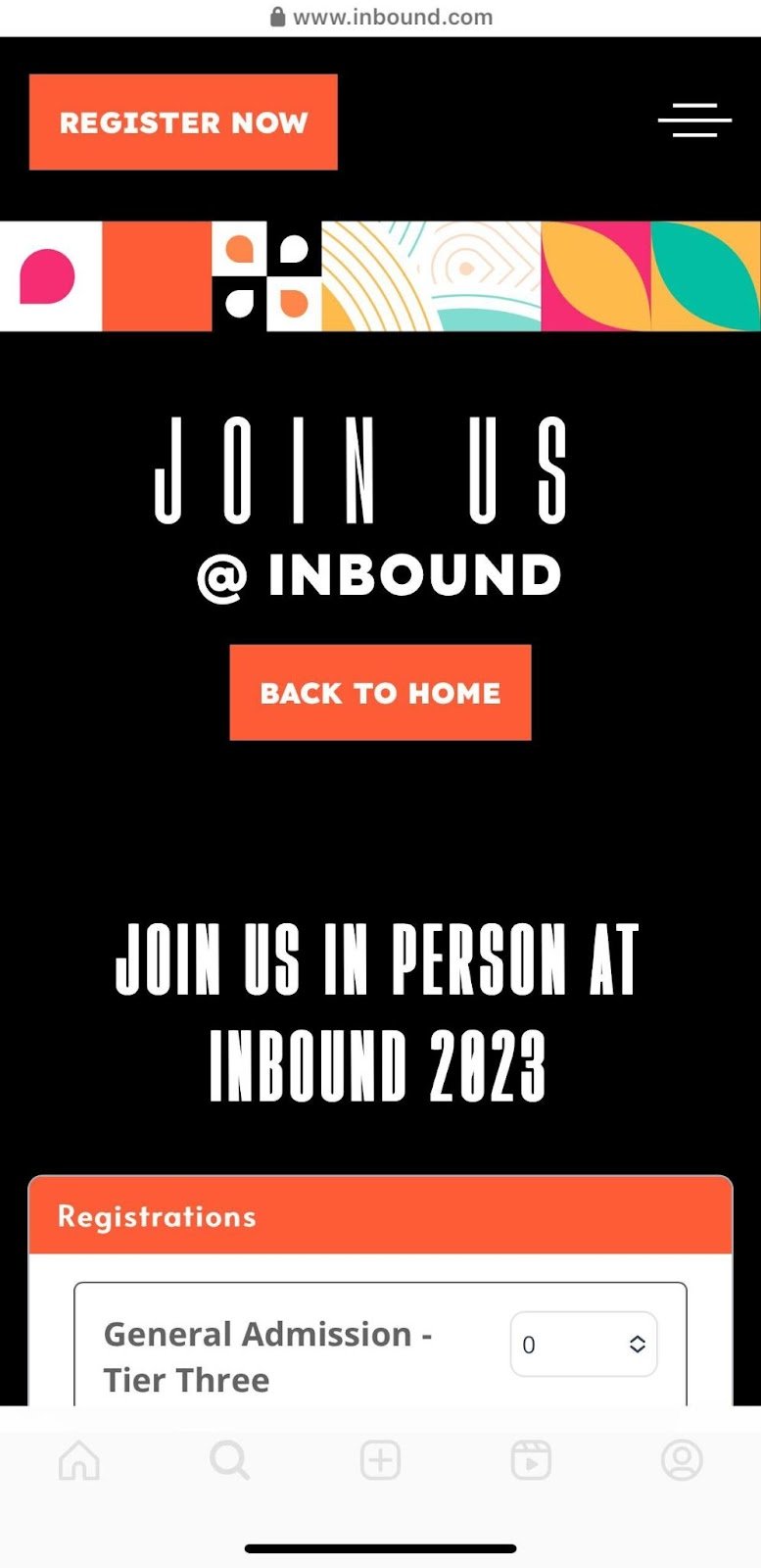
For example, while scrolling through Instagram, I clicked on this ad from HubSpot’s coming INBOUND convention.types of landing pages: paid advertising landing page

When I clicked on the ad, I was taken to this squeeze page:

types of landing pages: paid advertising landing page continued to squeeze

The ad didn’t take me to a page full of detail overload, it landed me strategically on a page that presented tickets.

It also featured a short description of the itinerary with visuals that instantly grab my attention and shows value rather than tells me why INBOUND is different and valuable.

9. 404 Landing Page

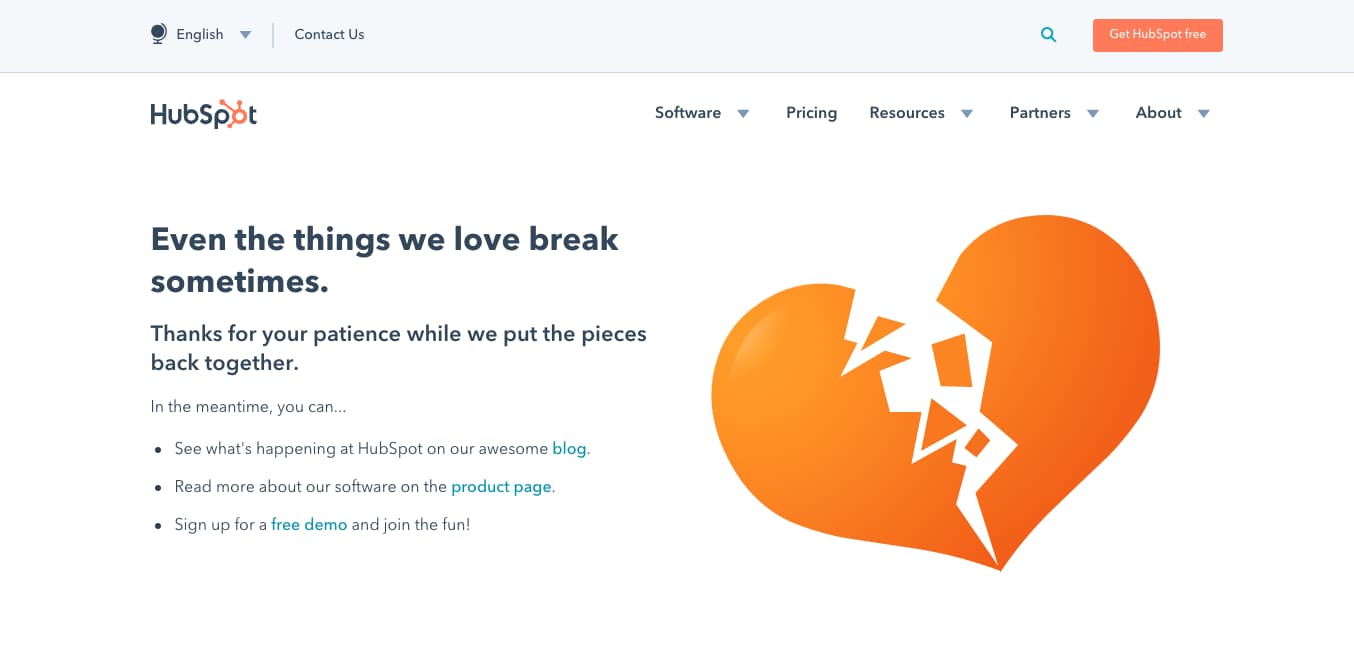
404s are never a good look, but it’s important you make them look as good as possible — and work for you a little as well. Get creative with 404s, use humor to offset the error, and always direct your audience to your homepage or other neutral landing page.

Then, put your 404 landing page to work as a lead generation tool. Take our own 404 page, here at HubSpot. We offer the user three options: visit our blog, learn more about our software, or sign up for a free demo.

types of landing pages: 404 landing age

Image Source

10. “About Us” Landing Page

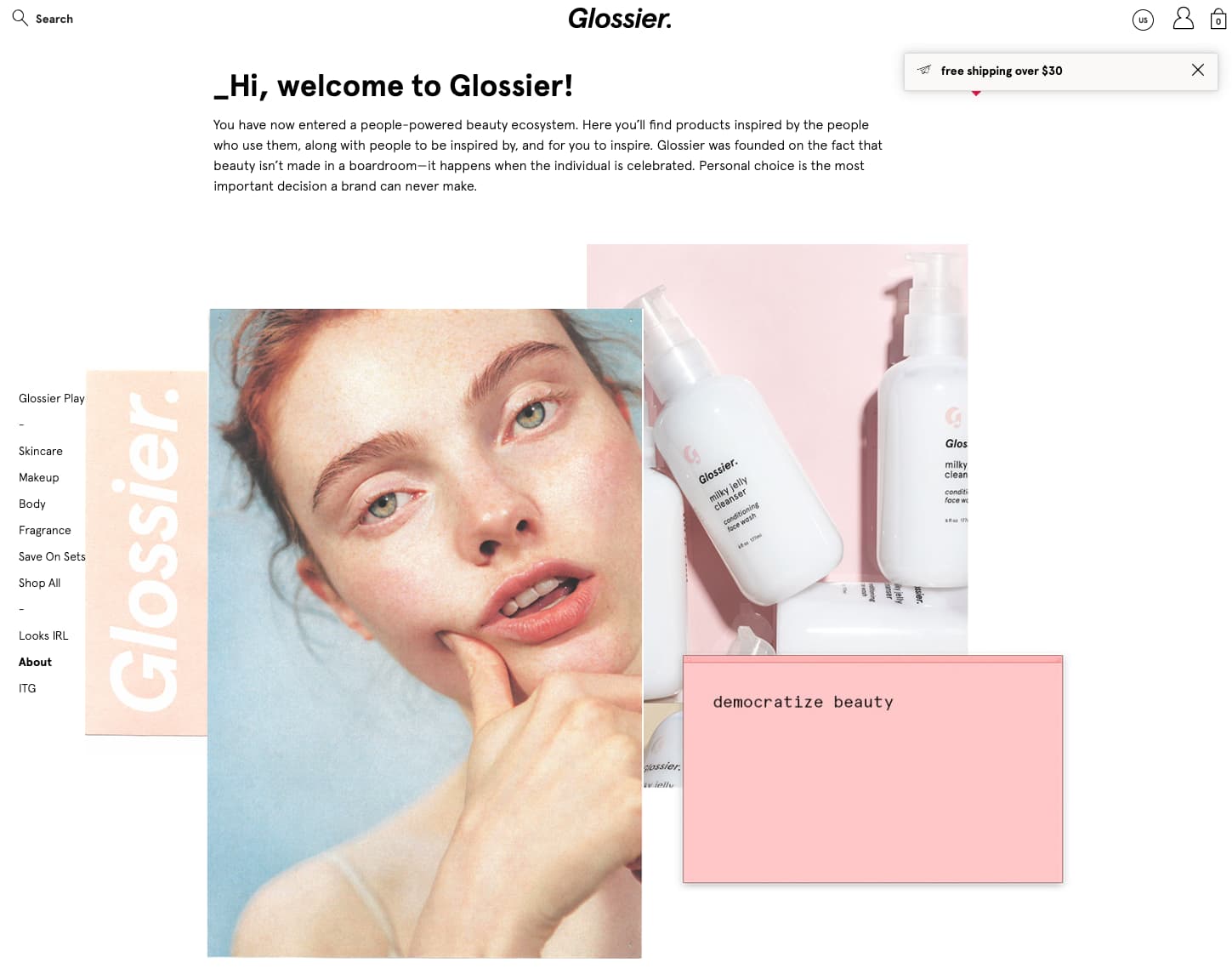
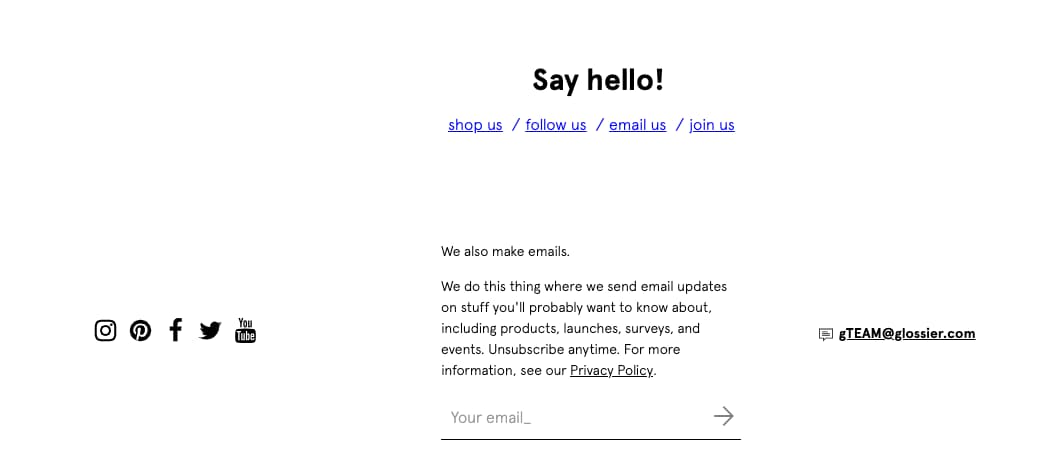
Your “About Us” page doesn’t have to be a dead end. Make this landing page a lead generation page as well. Take this example from makeup company, Glossier.

They pack their “About Us” page with plenty of history, vision, and mission, but they also let the reader know how to move forward. The bottom of the page offers a reminder (and links) to shop, follow, email, and join the company, and an email subscription offer captures emails.
types of landing pages: about us landing page

about us landing page glossierImage Source: Glossier

11. “Coming Soon” Page

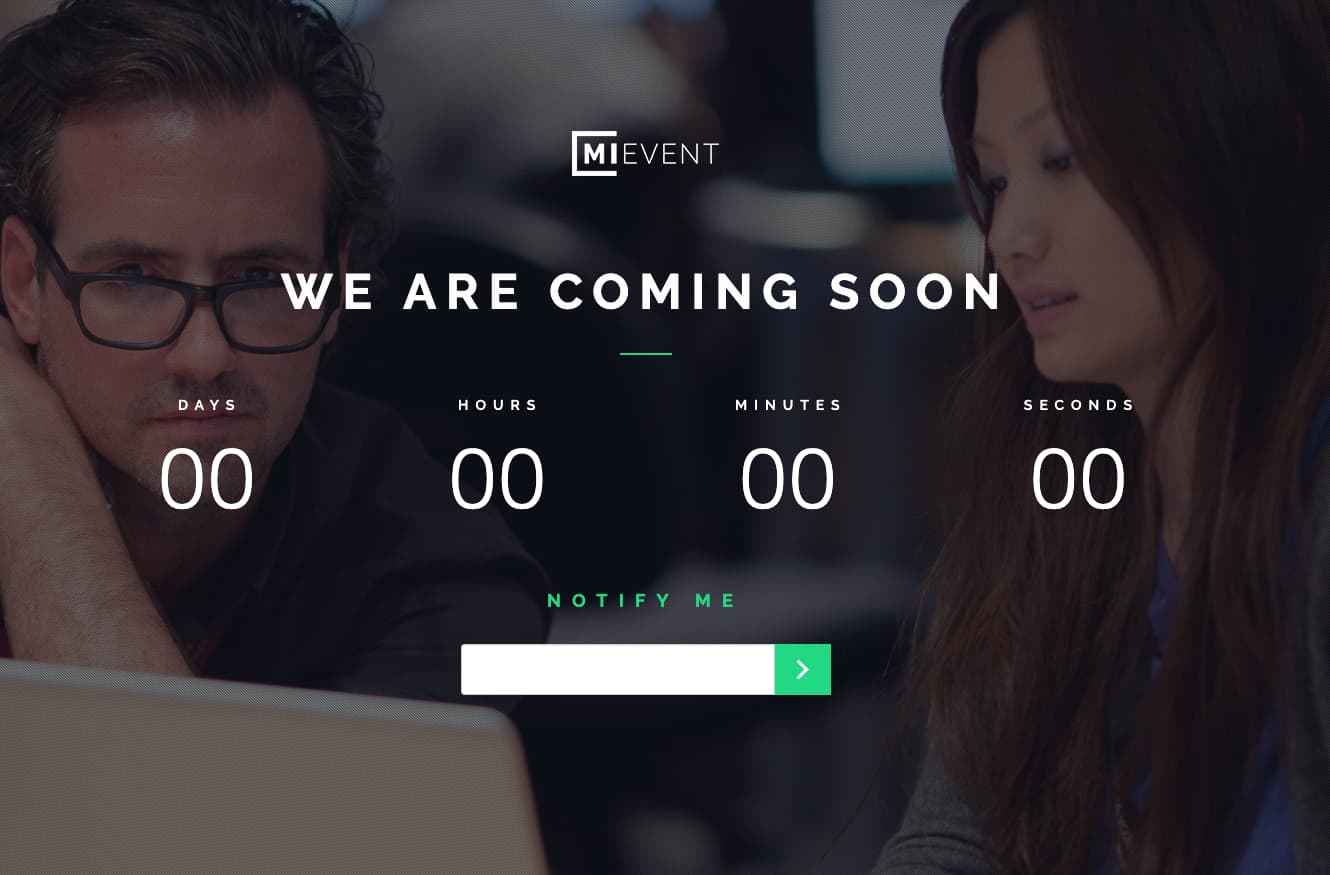
Launching an exciting new product soon but aren’t quite ready to reveal the full offer — or the incomplete landing page? Set up a simple “Coming Soon” landing page instead.

Tease your offer, provide a launch date if you have one, and add a CTA that asks them for their email address in exchange for an email notification when your product or service is live.

types of landing pages: coming soon landing pageImage Source: MiEvent

12. Pricing Page

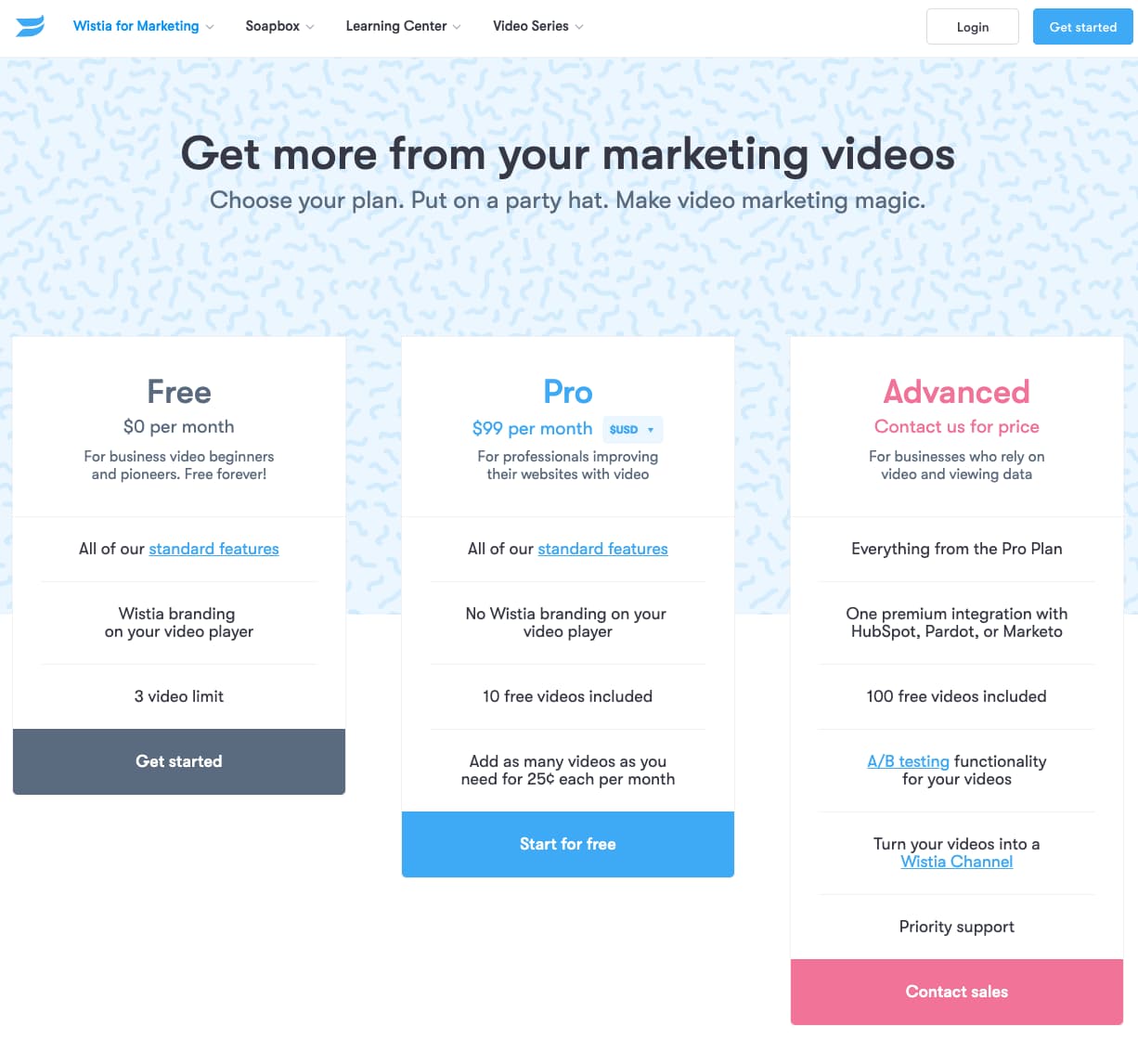
If you’re unveiling new pricing or product tiers, you might consider pushing customers to your pricing landing page. Regardless, your pricing page should be one of the most heavily optimized pages on your site. Take this one, from Wistia, which clearly outlines their three tiered packages, with links to more information or to get started.

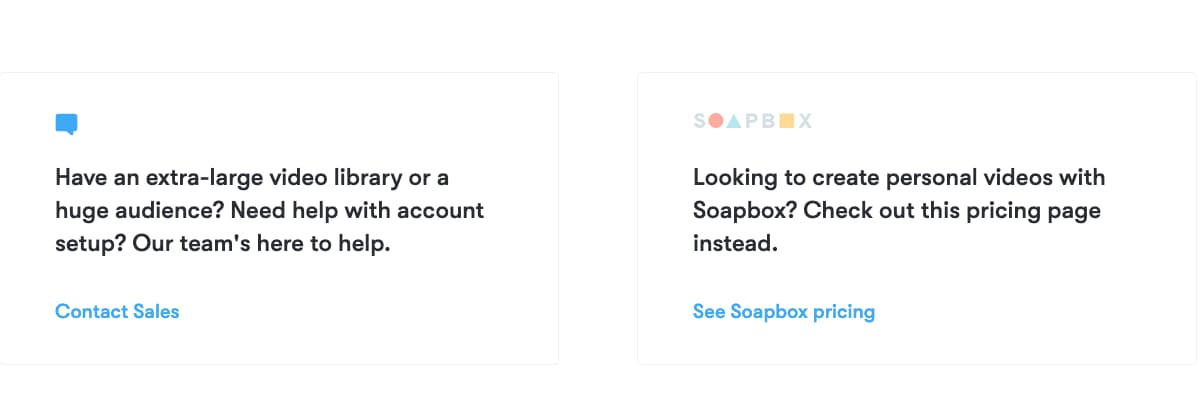
What I really love about their pricing page, however, are the two boxes right after a list of features and before a carousel of testimonials. They offer special callouts for interested parties who might not fall within the needs of one of the three boilerplate pricing templates.

And if even those additional CTAs don’t speak to your needs, scroll down to the bottom and find a CTA that offers customers the ability to “Choose your own adventure.”

types of landing pages: pricing landing page pricing-page-example-2

pricing-lp-example-3

Image Source

13. “Thank You” Landing Page

Too often, a “Thank You” page serves no real purpose. It tells you what you already know, “You’ve downloaded the greatest whitepaper in the world! Access it here.” Put your “Thank You” page to work by including additional offers or gifts.

You’ve been given an incredible opportunity to provide more value to a highly motivated, already-interested customer. Don’t waste it.

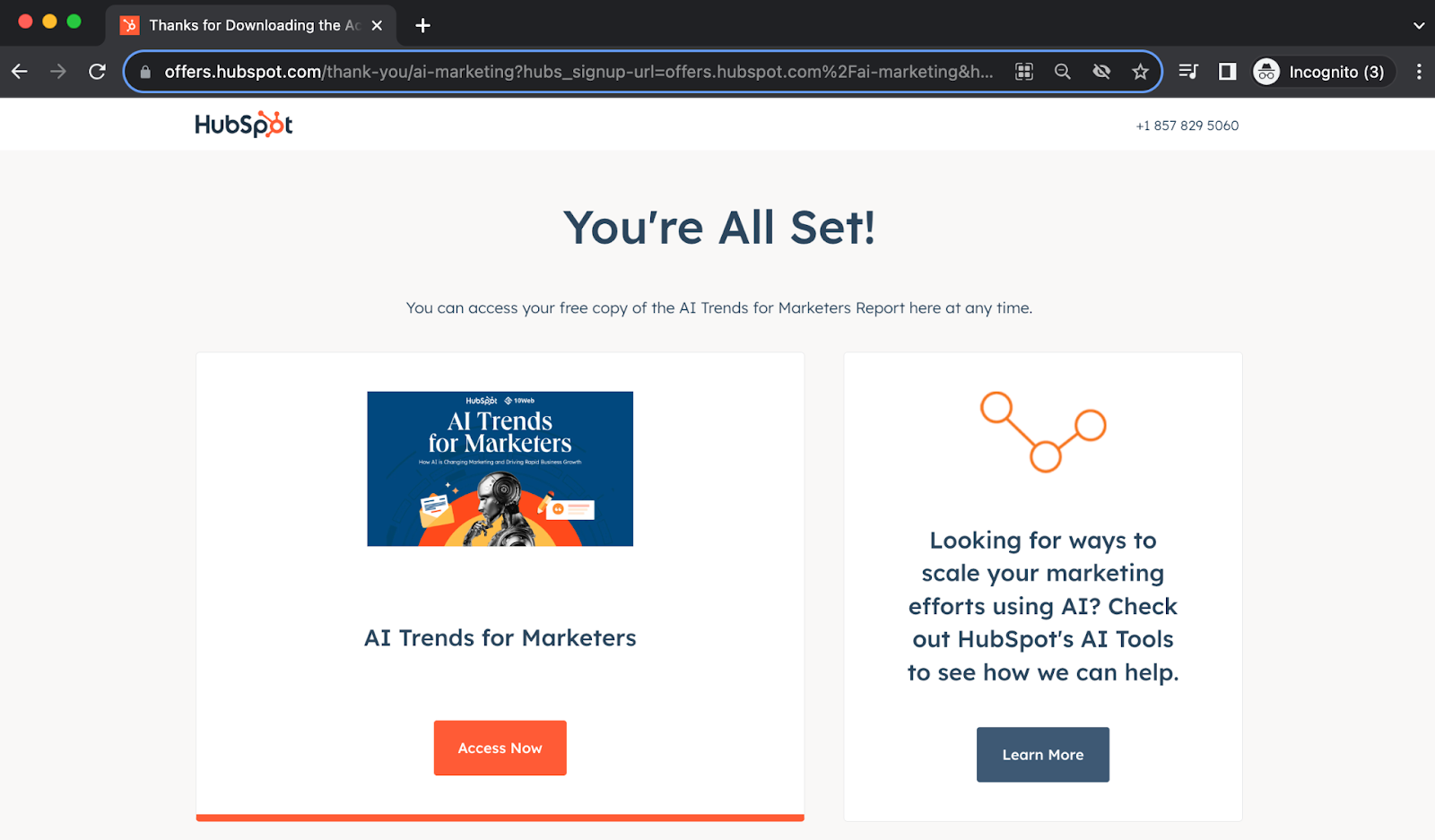
Take this example — another one from HubSpot. I downloaded the 2023 State of AI Report, and the “Thank You” page allowed me to check out HubSpot’s new AI tools to scale my marketing efforts.

The form I fill out to receive this advice asks for different, more detailed, information about my business needs, allowing HubSpot to better craft the next offer they send my way.

types of landing pages: thank you landing page

Image Source

How to Choose the Right Landing Page for Your Campaign

Now that you understand the most common types of landing pages, the question remains: What are some best practices for choosing the right LP for your next campaign?

Begin by asking yourself these questions:

  1. What are the business goals I’m trying to achieve with this landing page?
  2. How are my competitors achieving these goals?
  3. What are my audience’s goals when they land on this page?”
  4. How did my audience get to this page (i.e., what action or motivation brought them here)?
  5. What do I want my audience to do when they leave this page?

Once you understand the page’s goals, consider whether it should be a short- or long-form landing page.

Short-form landing pages lend themselves well to squeeze landing pages, “Thank You” landing pages, and “Unsubscribe” landing pages. These pages require a small ask or provide a small service to the customer.

Long-form landing pages are best reserved for sales landing pages, click-through landing pages, and pricing pages. If you have a big ask of your customer, you should probably design a long-form landing page.

So, what does this look like in practice? Let’s say I’m creating a brand-awareness campaign for my new startup that facilitates puppy snuggles for tired office workers (a girl can dream, right?). My business goals for this campaign are to capture new leads (email addresses) and drive impressions.

My competitors are running social media campaigns driving customers back to a sales landing page. But since impressions and leads are my goal (not purchases), I might choose to run social media ads featuring big images of snuggling puppies.

When customers click my ads, they’re wondering what these cute puppies are about, so I’ll take them to my “About Us” page to tell them more about SnugglePups Inc. Because I’m also hoping to drive email signups, I’ll include a link to our weekly newsletter, which promises a roundup of the best puppy pics available.

Choose the Right Landing Page for Your Next Campaign

So are you ready to put all of this knowledge to use? Not all landing pages are the same or serve the same purpose. It’s up to you to decide what you want customers to see and interact with, so make sure they land on a page that captures their attention, gets them in your pipeline, and keeps them wanting more.

Editor’s note: This article was originally published in June 2019 and has been updated for comprehensiveness.

New Call-to-action

Categories B2B

Email Marketing Best Practices That Actually Drive Results

While email marketing may not get the attention some newer marketing channels get, it’s still a terrific way to generate leads and convert more prospects for your business.

With that in mind, I want to share some email marketing best practices you can use to generate more leads for your business.

→ Download Now: The Beginner's Guide to Email Marketing [Free Ebook]

Email Marketing Best Practices

Email Formatting 

Email Marketing Automation 

Email Marketing Metrics and Testing

Below are different best practices to remember at various points of your email marketing campaign. 

Email Formatting Best Practices 

When formatting your emails, make sure to: 

Avoid using ‘No-Reply’ in the sender’s email address.

Have you heard of CAN-SPAM? This longstanding piece of legislation is a popular and important guideline for all email marketers in the U.S.

One major rule in CAN-SPAM is never to use the words “no reply,” or a similar phrase, as your email sender’s name (for example, “[email protected]”).

“No reply” in an email message prevents recipients from responding and even opting out of further emails, which CAN-SPAM protects their right to do so at any time.

Instead, have your automated emails come from a first name (for example, [email protected]).

Your customers are much more likely to open emails if they know they were written by a human being, and it keeps you compliant with email regulations.

Stick to fewer than three typefaces.

The less clutter you have in your email, the more conversions you’ll get. Don’t junk up your email with more than two fonts or typefaces, as that can distract readers and ruin your email’s visual appeal.

In addition, you want to use web-safe fonts with sizes between 10-point and 12-point. This ensures your email will be legible on all readers and devices.

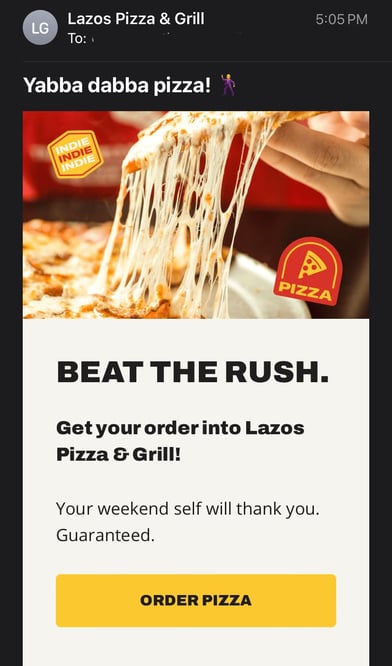
Check the email from Lazo’s Pizza as an example.

Screenshot of Lazo's Pizza promotional email, which uses two typefaces in its content.What We Like: Each typeface is distinct enough to guide your eye, but similar enough that it’s not jarring to readers.

Optimize the email’s preview text.

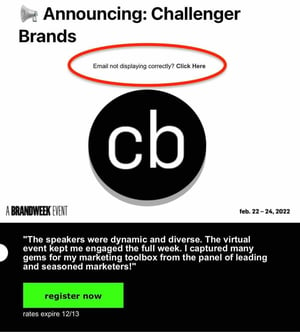
If you subscribe to a newsletter, you’ve likely seen a message like this at the top of your email: “Email not displaying correctly? Click here.”

email marketing best practices: optimize the email's preview text

While it’s a helpful warning, keeping it in the preview text of your email can drastically impact your email’s open rate.

One reason is that you’re telling recipients, “Hey, this email might not work.” Another reason is it doesn’t provide any insight into what the email is about.

Your preview text should supplement your subject line by adding details to capture your audience’s attention and encourage them to open.

By default, preview text pulls in the first several words of the email body and displays it next to the subject line before the person opens it.

The problem is that custom email templates often stick with conditional statements like “Can’t see images?” or “Not displaying correctly?” at the top banner, allowing it to slip right into the preview when it goes out.

As a rule of thumb, always write a custom preheader that teases what your email will offer.

Pro-tip: HubSpot users can fix this problem by customizing the preview text themselves in the backend of their email marketing newsletter.

Include an email signature.

Your newsletter is technically being sent to your contacts on behalf of the company, rather than an individual. However, the email should include the signature of a specific person.

Email signatures add a touch of personalization. People are naturally more inclined to read an email if they know it came from a human being, not just a collective marketing team. Your email signature is your ticket to their attention.

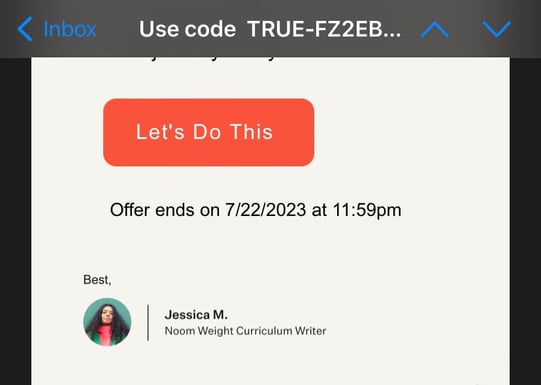
Notice the email signature from the weight loss app Noom. 

Screenshot of a marketing email sent by Noom, focusing on the email's signatureWhat We Like: The email signature includes the person’s first name, their role within the organization, and a photo for a more human touch.

Want a quick way to make a beautiful email signature? Use HubSpot’s Email Signature Generator. We also have an Out-of-Office Email Generator to make your response to incoming messages just as delightful.

Keep the main message and call-to-action above the fold.

Above the fold refers to the information that’s visible to the reader before they scroll down.

Even though recent research suggests that consumers scroll more than they used to – because of social media and vertical timelines – above-the-fold content still gets the most attention.

Place your message and CTA above the fold. It’s the first thing your recipients will see once they open your email, therefore increasing your conversion rate.

You can also run an A/B test first to validate the hypothesis and see if it works for your emails.

Personalize the email greeting.

How often do you read emails that begin, “Dear Member”?

You might segment your email audiences by the type of customer they are (member, subscriber, user, etc.), but it shouldn’t be the first thing recipients see in your company messages.

Personalization is a major key to successful email marketing. In fact, 47.2% of marketers in a recent HubSpot survey listed personalization as one of the most effective email marketing strategies for reach their goals. 

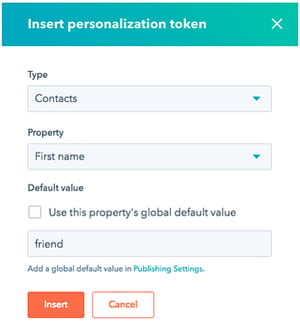
Copy of Facebook Shared Link - 1200x628 - Percentage + Copy - Dark (8)Personalizing the greeting of your emails with your contacts’ first names grabs the attention of each reader right away. For HubSpot users, this is called a personalization token, and creating one looks like this:
email marketing best practices: personalize the email token

Then, the address line of your email would automatically produce the contact’s first name by fetching this personalization token in the email’s HTML, like this: Hi, !

Don’t worry, personalizing an email’s greeting line with 50 recipients’ names doesn’t mean you’ll have to manually write and send 50 different emails from now on.

Many email marketing tools today allow you to configure the greeting of your email campaign so that it automatically sends with the name of the people on your contact list – so everyone is getting a personal version of the same message.

Keep your email around 500 to 650 pixels wide.

If your email template is wider than 650 pixels, your email won’t show up correctly and will require users to scroll horizontally to read the full email.

This is a pain, to say the least, and will likely affect your conversion.

Having your template fit within the standard format will make for easier readability, better conversions, and an overall better user experience.

Include your logo.

Logos are a must when it comes to emails.

They establish legitimacy and trust, meaning the recipient will know the email is from a real brand, not a scam. Plus, like email signatures, they boost brand recognition.

This is because the logo is one of the first things the audience sees when they open their email.

With this in mind, add your logo to your email design to ensure that it’s always included.

Name the offer in your subject line.

When you include an incentive in your subject line, you can drastically increase your open rates.

“Free shipping when you spend $25 or more” and “Receive a free iPod with a demo” are examples of good, incentive-focused subject lines.

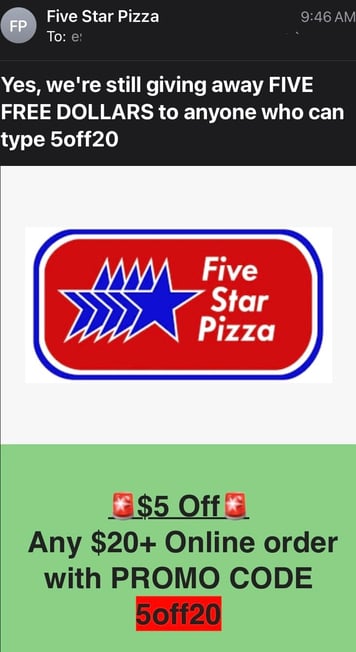
Another example comes from Five Star Pizza. The subject line for its email reads, “Yes, we’re still giving away FIVE FREE DOLLARS to anyone who can type 5off20.”

IMG_0975

Pro Tip: While this is an eye-catching example, try to keep your subject lines short to avoid them getting cut off when first viewed in the recipient’s inbox. Keep subject lines between 9 and 60 characters.

If you’re struggling with email subject lines, HubSpot’s Campaign Assistant is a neat tool that can craft excellent and succinct subject line copy to capture the recipient’s attention. 

Furthermore, we have many email marketing tools to help you ideate, design, and carry out a successful campaign. 

Remember, don’t overwhelm your readers with savings- or product-related emails.

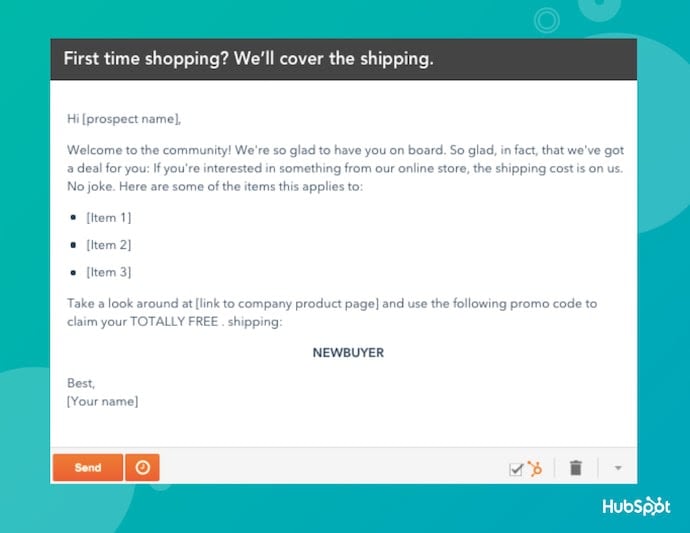
Customer loyalty starts with casual industry insights – only after nurturing should you start introducing offers. Here’s an example of an email with an enticing subject line and warm, welcoming body copy:

email marketing best practices: name the offer in your subject line

Write compelling (but concise) subject lines.

A good subject line should contain between 30 and 50 characters, including spaces. The reason why you do this is that email providers often cut off subject lines that go beyond this length.

Your email subject line should also create a sense of urgency while giving readers some indication of what to expect once they open the email.

Closely tie emails to landing pages.

Your landing page should match the email in terms of headline, copy, and content. The look and feel of your landing page should also match the email as consistency goes a long way toward a customer’s trust.

Just make sure you’re using tracking tools to see which emails and landing pages performed the best so you can keep sending what’s working.

Email Automation Best Practices

Be prepared for your readers to forget they opted in, so set up an auto-responder that reminds people they opted into your email database. The auto-responder should be sent out one day, five days, and 10 days after the person registers.

Each auto-responder email should also include additional content or bonus material to reward the reader for opting into the newsletter– or your readers might not feel they have enough incentive to actually opt-in.

Email Marketing Metrics and Testing 

If you can’t seem to increase your email’s open and click-through rates, a couple of things might be wrong: You’re not emailing the right people (are you buying your contact list? See the first tip at the top of this blog post), or the content needs to be improved.

To start, focus on the latter, and conduct an A/B test.

A/B tests can be used to improve almost any of your digital marketing content. In an email, this test splits your recipients into two groups: Group A receives the regular newsletter, while Group B receives the newsletter with a specific variation.

This variation tests to see if your audience would be more or less likely to take an action based on that element.

HubSpot Marketing Hub users can conduct email A/B tests on anything from the subject line to the call-to-action (CTA) inside it.

For example, you might change the color of your CTA from red to green to see if your email’s clickthrough rate increases. If it does, the test indicates that you should change your emails’ CTA color to green from now on.

Another best practice is to conduct a 5-second test.

Send a copy of the email to a friend or business associate. Can they quickly tell what your call-to-action is? If so, you’re golden. If not, keep working.

Many new tools are at a marketer’s disposal that are getting attention these days. But email marketing has stood the test of time regarding its influence on your users.

This old, reliable, and faithful tool can really ensure you get the most out of your marketing initiatives.

Now that you know email marketing best practices, you’re to craft your next successful email marketing campaign. 

Editor’s Note: This post was originally published in June 2019 and has been updated for comprehensiveness.

New Call-to-action


Categories B2B

Inside Podcasting’s Profitability Dilemma

Among listeners, podcasts are more popular than ever. But from a business standpoint, the industry has lost its way.

The golden age of podcasting spanned from 2015 to 2022. During this time, shows like Serial popularized the medium, and the COVID-19 pandemic led to a boom in podcast production and engagement. Media companies began putting a lot of money into the medium. For example:

  • Spotify invested over $1 billion into podcasting, acquiring Anchor and Gimlet, and inking multimillion-dollar partnerships with public figures including the Obamas, Joe Rogan, and Meghan Markle.
  • Amazon purchased Wondery, incorporating content from the podcast network into the Amazon Music platform.

Though 60% of adults in the U.S. identify as podcast listeners, the industry hasn’t demonstrated the same growth trend for profitability. Over the past year, we’ve seen investments in the podcast industry scale back. Markers of this include:

  • Spotify’s string of layoffs shuttered Gimlet media and the podcasts it produced. The company has also ended its partnerships with Archwell and Higher Ground Productions.
  • NPR’s layoffs led to the cancellation of four major shows.
  • SiriusXM shutting down the once-popular podcast player Stitcher.

What happened? Podcasting has yet to find a sustainable path to profitability.

➝ Free Guide: How to Start a Podcast

Podcast listenership is growing — who’s footing the bill?

Unlike other types of media such as radio and print, podcast production and distribution are pretty democratized. When you open your podcasting app or check out Apple’s New and Noteworthy section, you’ll see shows produced by individuals recording in their basements right alongside big-budget shows by media conglomerates like The New York Times.

Though how these shows are produced and their budgets may vary, the final product is roughly the same: it’s content that audiences expect to receive for free, minus having to listen to ads.

Sure, some shows have been able to successfully monetize their podcasts through crowd-sourced platforms like Patreon, but it’s worth noting the average Patreon creator makes between $315 to $1575 per month, which barely covers the production cost of a high-quality podcast (especially if including video, which is becoming a necessity).

Essentially, the most important end-users of the product (listeners) aren’t the ones paying to keep it afloat — corporations and advertisers are, and the market is in a state of correction.

Have podcasts been a good investment for companies?

The U.S. economy has been teetering on the edge of a recession for the past year. Typically when that happens, marketing and advertising budgets are among the first to go for companies that want to curb spending. The podcast industry has seen this in real-time and has been in its own recession since late 2022.

While companies are continuing to spend on podcast advertising (to the tune of $2.25 billion in 2023) what is considered a “good ROI” is changing.

Podcast advertising (along with other creator-focused mediums) is no longer about awareness or top-of-funnel exposure. Instead, companies are looking to invest in shows that can demonstrate an ability to convert listeners into customers — and quickly.

It’s also worth noting that advertising isn’t the only way companies have invested in podcasting. Exclusive deals with creators and the production of branded shows were also on the rise during the recent podcast boom. From 2018 through 2022, many companies were in experimentation mode as podcasting shifted from an emerging channel to a core medium.

So what’s next?

Podcasting is far from over, but the industry is in a period of transition where companies and creators should evaluate where their time and resources are most valuable.

If companies want to continue investing in the production of their own shows or funding creator-led shows, the path to ROI will need to be clear, swift, and able to provide more value than a high follower count.

It also means aspiring podcasters shouldn’t expect to be next in line for a blockbuster deal like Alex Cooper’s $60 million Spotify payday. However, exploring independent podcasting to connect with niche audiences can be a valuable channel for creators and entrepreneurs who are looking to expand and connect with their audiences and customers.

The podcast industry is primed for its next disruptor to help the business side be as democratized as distribution.

New call-to-action

Categories B2B

How to Create Gantt Charts in Excel

Microsoft Excel remains the go-to option for many businesses to perform data calculations and create charts based on the results.

The Gantt chart is a useful guide that isn’t naturally available in Excel. Great for project management and milestone tracking, Gantt charts can help companies better visualize operations and streamline current processes.

In this piece, we’ll dive into the basics of Gantt charts and explore their benefits, then provide a step-by-step guide to creating them in Excel, along with some useful examples. Before long, you’ll be able to use Excel like a pro.

What are Gantt charts?

The Benefits of Gantt Charts

How to Create Gantt Charts in Excel

Gantt Chart Examples

Download 10 Excel Templates for Marketers [Free Kit]

What are Gantt charts?

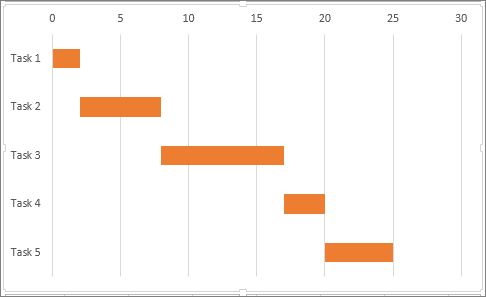
Gantt charts exampleOn the left-hand side, the Y-axis of the chart lists specific activities. At the top, the X-axis of the chart shows time.
There’s no fixed unit for time — it could be measured in weeks, days, hours, or minutes, depending on the tasks you’re tracking. In Excel, each task gets its own row.

As you can see in the example above from Microsoft, task 1 starts at time unit 0 and runs until just before task 2, which proceeds until task 3 begins.

It’s worth noting that tasks can overlap — the purpose of the Gantt chart isn’t to determine the order of tasks but to provide an easy way to see what’s happening, when, and how many processes are happening at once.

The Benefits of Gantt Charts

Gantt charts offer several benefits, including the following.

At-a-Glance Project Progression

Gantt charts let you see when projects began, how far along they are, if they’re reached specific milestones, and if they overlap with other projects.

This makes it possible to better understand how long processes will take and if concurrent processes may cause friction.

Actionable Insight

These charts also provide actionable insight for project management staff. Because teams can see project start dates and timelines at-a-glance, they can pinpoint potential bottlenecks and make changes.

In practice, teams might discover that three processes are due to start on the same day. By staggering start dates slightly, they can avoid possible performance issues.

Improved Time Management

Consider a Gantt chart showing multiple tasks with the same start date and team responsible for them. If left alone, this project framework could waste time, as one team is overworked, and others may not have enough on their plate.

A better understanding of what’s happening, when, and why can help companies improve their time management.

Reduced Risk of Resource Overload

Projects share a pool of finite resources. The more projects happening simultaneously, the bigger the resource drain and the greater the risk of resource overload.

Gantt charts offer a way to compare process resource needs and make adjustments that help keep projects on track.

While every Gantt chart differs, common features include task, taskbars, and milestones due dates. Charts may also include sub-task bars or use bar shading to indicate how far a task has progressed.

How to Create Gantt Charts in Excel

Despite their usefulness and ubiquity, Gantt charts don’t have a built-in template in Excel. As a result, users need to either download a pre-built Gantt chart or build their own.

Here’s a step-by-step guide to creating a Gantt chart in Excel.

1. Enter your project data.

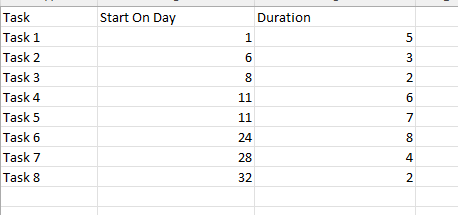
The first step in creating a Gantt chart is entering project data into a typical Excel spreadsheet. In our example, we will enter three data columns: Task Name, Start on Day, and Duration. The result should look something like this.

Gantt chart excel example

2. Make a stacked bar chart.

Next, we’re going to create a stacked bar chart. To do this, select the data in the Start on Day column (with the header). Then, under “Insert,” select “Bar Chart”, then “2-D Bar”, then “Stacked Bar” to get this.

Gantt chart excel example

3. Enter your duration data.

To enter duration data:

  • Start by right-clicking on the chart.
  • Choose “Select Data.” This will open a “Select data source” window containing the “Start on Day” series.
  • Click the “Add” Button under “Legend entries (series),” then name your new series Duration.

Now, click the icon next to where it says “Series values,” which will open a new “Edit series” window.

Select the data from your Duration column (without the header) and your Start On Day column, then click OK to close the window, and click OK again to add the series to your chart.

Gantt chart excel example


4. Add your task descriptions.

Now we’re going to add task descriptions. This starts the same way as the last step: Right-click on your chart to open the “Select data source” window, then select “Start On Day” in the left-hand “Series” list.

Next, select “Edit” on the right “Category” list. This will open an “Axis labels” window. Select the cells in your Task column, then click OK on the “Axis labels” window, then OK on the “Select data source” window.

Gantt chart excel example

4. Fix the Order

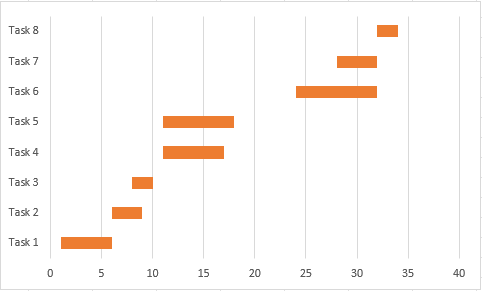
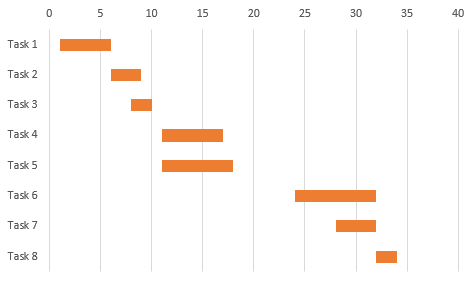
Finally, we’re going to fix the order of our tasks. To do this, right-click on the list of Tasks on the left side of the chart to open a menu, then click “Format Axis.” From this menu, under “Axis Position,” check the “categories in reverse order” box.

Gantt chart excel exampleAnd there you have it — a custom-built Gantt chart in Excel.
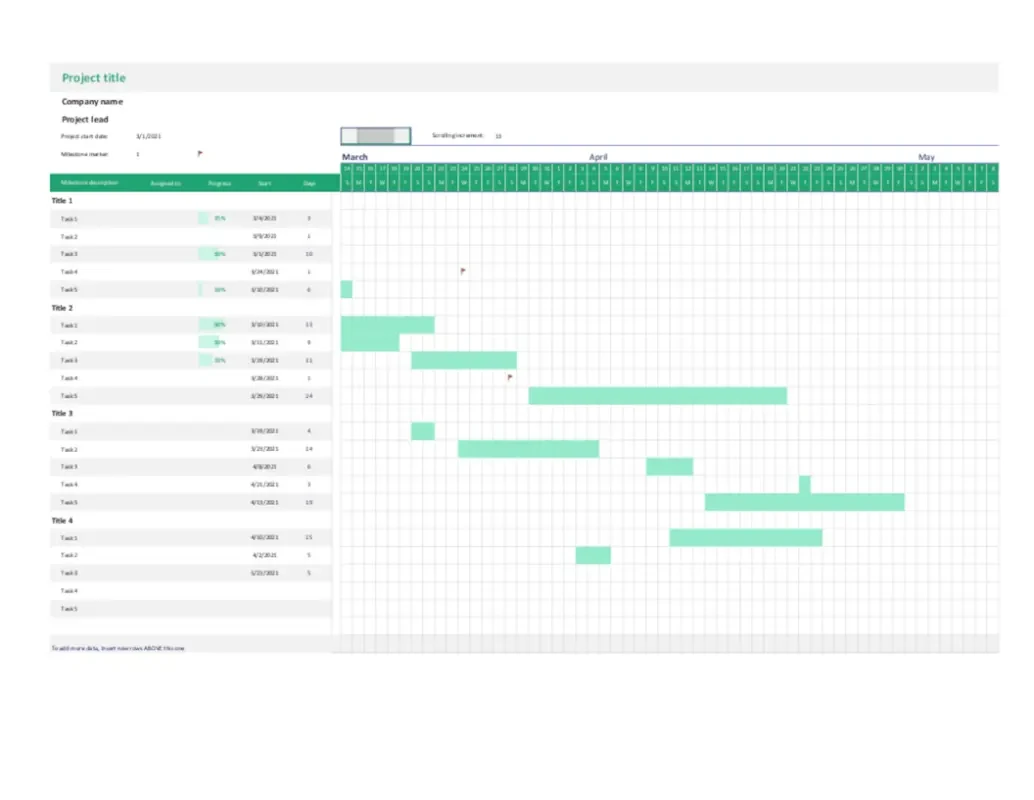
Gantt Chart Examples

If you prefer to download an existing template, there are multiple Gantt options in the Microsoft chart templates database. Some great Gantt examples include:

Date Tracking Gantt Chart

Gantt chart excel exampleThis Data Tracking Gantt chart template is completely customizable with your own images, titles, and text. It offers an easy way to track key tasks without having to build your Gantt chart from the ground up.
What we like: This Gantt chart is simple and streamlined. It has plenty of room for tasks, start dates, and durations to help you better manage tasks.

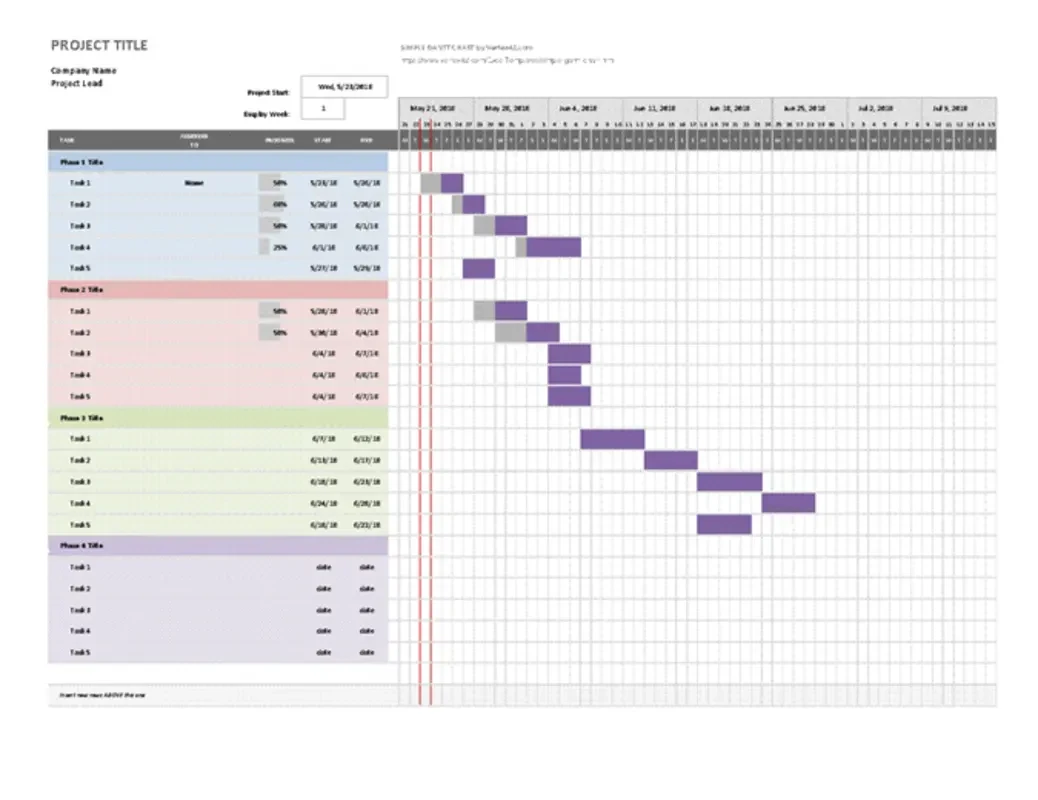
Simple Gantt ChartGantt chart excel exampleThis Simple Gantt chart is exactly that: Simple and easy to understand. It can also be tailored to different user groups, such as employees, managers, and stakeholders. You can include photos, graphics, or new fonts.
What we like: In addition to basic task information, this chart also adds the ability to break projects down by phases (denoted by the different-colored sections) and who is responsible for each task.

Agile Gantt Chart

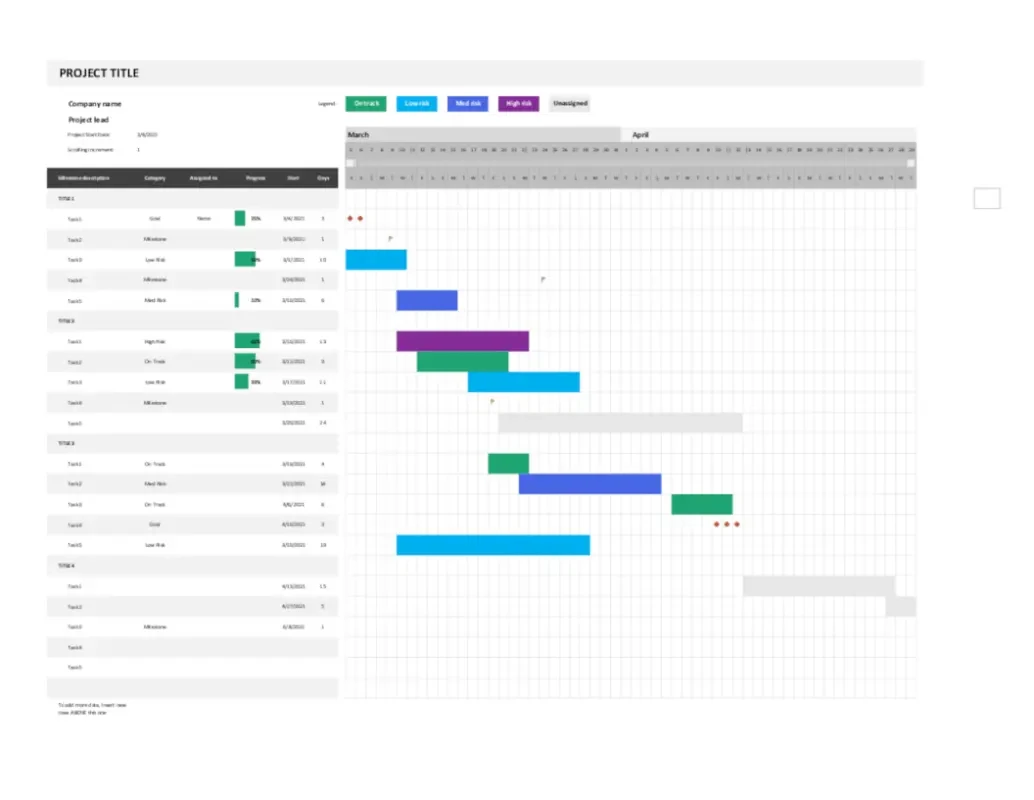
How to make a gantt chart in excelThis Agile Gantt chart example provides color-code task categories and visual reminders to help Agile teams meet deadlines.
Given the ongoing feedback loop that underpins Agile methodology, Gantt charts such as this are instrumental in task tracking.

What we like: The color-coded bars provide immediate visual feedback, while the ability to quickly publish and share this chart in Excel helps improve team collaboration.

Going the Distance with Gantt

Gantt charts are a great way to track project schedules and see at-a-glance where overlaps occur and where it may be necessary to make schedule changes.

While Microsoft Excel doesn’t come with a built-in Gantt generator, you can go the distance with Gantt charts by building your own from scratch with our step-by-step guide or downloading an Excel template that lets you customize data and headings on demand.

excel marketing templates

Categories B2B

Maximize Your Impact: 205 Action Verbs to Use on Your Resume

So you’re working on your resume. Maybe you haven’t submitted your updated resume anywhere yet, or maybe you have, and it doesn’t seem to get anyone’s attention. Either way, you might be missing one of the most important elements of any resume: Action verbs.

→ Download Now: 12 Resume Templates [Free Download]

If you’re unfamiliar with action verbs, you might wonder how they’re different from those on your resume. If that’s the case, this article has some critical information you don’t want to miss.

The best part? Even if your resume is 100% complete right now, adding action verbs is as simple as replacing existing verbs with them. Keep reading to learn more about the best action verbs for your resume and how much you might miss out on without them.

Table of Contents

How Action Verbs Help Your Resume

So what are action verbs? Well, they’re words that express and describe things that someone or something does. In the case of your resume, action verbs can help you illustrate all the hard work you’ve put into your career.

Wait, isn’t that what every word on your resume should do? To an extent, yes, but action verbs do more than describe your achievements.

They explain everything you’ve done and how you’ve done them. Actions speak louder than words — and action verbs speak louder than everyday words.

Now before we look at some of the most powerful action verbs and how to use them, let’s dig a little deeper into how action verbs can make your resume catch the eyes of your next interviewer.

The Benefits of Action Verbs

If we wanted to detail every benefit of action verbs, we’d be here all day. To save you some time (time you can spend crafting the perfect resume), here are four of the best reasons to use action verbs.

If even one of these benefits could add something to your resume, it might be time to revise it with some powerful action verbs.

Action verbs show what you do (not just who you are).

Let’s think about the phrase “action verbs.” Verbs are straightforward enough: They’re words that describe doing or being something. Action verbs are more specific. They describe doing something, not any state of being.

This might not sound like a huge difference, but let’s look at an example of a regular verb you might see in a resume:

  • “I was the general manager at a fine dining establishment.”

Let’s swap that boring “was” out for some exciting action verbs:

  • “I supervised and managed the operation of a fine dining establishment.”

It’s a small change, but that should give you an idea of how more impactful action verbs can be compared to verbs that describe your state of being.

Action verbs make your resume more eye-catching.

Have you ever sifted through a stack of resumes? If you have, you might know how tedious and sleep-inducing that process can be. If not, imagine reading a book full of passive verbs — you know, the opposite of action verbs.

“I had many responsibilities… I was a department head…”

You get the picture.

While these might be great accomplishments, anyone reading that resume will probably move on to the next one in no time.

The language itself won’t win any awards, but the real issue is its overuse. You’re not just competing against subpar language. You’re competing against every resume that uses the same language.

Action verbs help your chances with tracking systems.

Like so many things these days, applying for a job might involve artificial intelligence. Depending on your stance, that might be a good or bad thing. One thing is for sure, though: You should write your resume with that in mind.

See, applicant tracking systems (ATS) streamline the application process for employers. These systems use AI to scan resumes for certain words and phrases. Some of these words and phrases include — believe it or not — action verbs.

While you may not need to include any specific words to pass through ATS, you should focus on using action verbs.

Action verbs make your resume easier to scan and read.

How long do you spend on a website before leaving? Is your mind made up after the headline?

Do you scroll through the page and look at the headers? Or do you scan the page in an instant, looking for one specific thing to tell you whether the page is worth your time or not?

Chances are you do one or all of those things — but did you know the same applies to your resume? That’s right. You can expect every employer reading your resume to scan through your resume like you would a website.

That’s where action verbs come in. Imagine someone scanning through dozens of resumes a day. What do you think would get their attention? Yep, action verbs — and the more specific to your industry, the better.

If you can get their attention with the right action verbs, you’re one step closer to having your resume read.

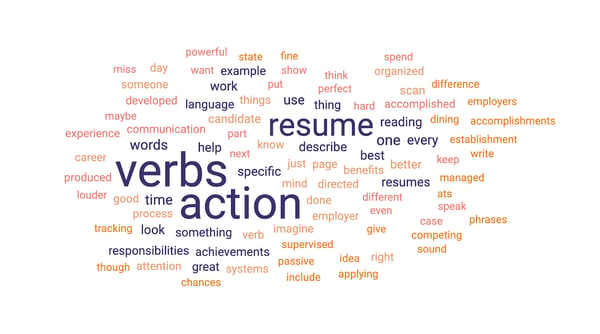
action verbs word cloud

Action Verbs at Work

Before we get into some specific examples of action verbs, let’s see how and why they work so well on resumes. Here’s a quick example to better understand how action verbs compare to other verbs.

For this example, imagine this sentence is part of a resume:

  • “I was in charge of multiple teams and had many responsibilities that changed daily.”

While it might sound impressive by itself, that type of language will get lost in a typical resume. Instead, let’s try the same sentiment with action verbs:

  • “I organized teams and directed combined efforts, ensuring we cleared every deadline and secured more clients in the process.”

See the difference? Put yourself in the shoes of someone reading resumes all day. Which example would instill more confidence in the candidate? Keep that in mind as you write or update your resume; you’ll have an edge over the competition.

Resume Action Verbs

Now we’re ready to look at some action verb specifics. While knowing individual action verbs is crucial, you should also familiarize yourself with verb categories. These are different from passive and action verbs, though.

Here, we’ll look at some action verbs for your resume by category. Some of these categories may overlap, so use them as you see fit.

Achievements

Every employer is interested in your achievements. After all, achievements serve as proof of how hard you’ve worked and how much time you’ve dedicated to your career.

These action verbs should prop you up as an accomplished person who can help a business reach milestones and goals.

action verbs relating to achievements

Accelerated

Decreased

Won

Pioneered

Accomplished

Delivered

Founded

Produced

Achieved

Demonstrated

Generated

Raised

Advanced

Drove

Grew

Reached

Amplified

Earned

Improved

Saved

Attained

Enacted

Lifted

Sharpened

Boosted

Endeavored

Managed

Showcased

Capitalized

Enhanced

Maximized

Sparked

Completed

Established

Outpaced

Spearheaded

Consolidated

Exceeded

Outperformed

Steered

Converted

Expanded

Overcame

Stimulated

Created

Expedited

Overhauled

Streamlined

Targeted

Surpassed

Succeeded

Strengthened

Best for: Demonstrating your most exceptional accomplishments, placing you far ahead of the pack of applicants.

Responsibilities

Do you wear many hats at work? Good, leverage that in your resume. Some positions require quick thinking and flexibility; action verbs can demonstrate that on your resume.

These action verbs should give a potential employer a good idea of what you can handle.

Action verbs relating to responsibilities

Forged

Coordinated

Handled

Organized

Accomplished

Created

Headed

Partnered

Achieved

Delivered

Implemented

Performed

Acquired

Developed

Improved

Prepared

Acted as

Executed

Increased

Produced

Analyzed

Expanded

Initiated

Reached

Assembled

Facilitated

Instituted

Secured

Built

Finalized

Made

Simplified

Charted

Finished

Navigated

Succeeded in

Completed

Accelerated

Negotiated

Undertook

Constructed

Guided

Operated

Volunteered

What we like: Focusing on responsibilities with action verbs can posture you as the perfect candidate for leadership and more specialized positions.

Communication

You’ve heard it many times before: Communication is key. That’s because it’s true — in personal life and business.

So what could be better than some action verbs that communicate how well you communicate?

action verbs relating to communication

Addressed

Consulted

Explained

Performed

Advocated

Conveyed

Fielded

Persuaded

Apprised

Convinced

Formulated

Presented

Arbitrated

Corresponded

Illustrated

Promoted

Arranged

Counseled

Influenced

Proposed

Attested

Critiqued

Informed

Publicized

Authored

Defined

Instructed

Queried

Briefed

Developed

Interpreted

Reconciled

Campaigned

Directed

Lectured

Recruited

Clarified

Documented

Lobbied

Reported

Co-authored

Drafted

Marketed

Reviewed

Collaborated

Edited

Mediated

Spoke

Communicated

Enlisted

Moderated

Summarized

Composed

Enlivened

Negotiated

Trained

Translated

Wrote


Best for: These action verbs have the potential to show what a great team player you are, so they’re great when applying for anything like a managerial role.

Experience

Not much can overshadow experience. It’s undeniable proof of your career until now, and you should use that to your advantage.

After all, your experience might be the one thing that gets you hired instead of a comparable candidate.

Action verbs relating to experience

Adapted

Coordinated

Guided

Recommended

Administered

Critiqued

Individualized

Reorganized

Advised

Delegated

Informed

Reviewed

Analyzed

Developed

Installed

Scheduled

Assigned

Directed

Instructed

Simulated

Chaired

Enabled

Motivated

Stimulated

Clarified

Encouraged

Organized

Supervised

Coached

Evaluated

Oversaw

Taught

Communicated

Executed

Persuaded

Tested

Conducted

Explained

Planned

Trained

Consolidated

Facilitated

Prioritized

Transmitted

Contracted

Focused

Produced

Tutored

What we like: Experience-oriented action verbs can position you as an all-around great candidate with a proven track record.

There’s No Better Time for Action

Whether your communication skills are unmatched, your management style is cutting-edge, or you’ve just been in the game for longer than your competition, action verbs can tell employers what you’ve done and what you do.

There are countless strong action verbs for your resume as well, so you have many choices regardless of what you do or want to do. So which action verbs will go in your resume? Are you a creative genius, a rocksteady leader, or a communications expert?

New Call-to-action

Categories B2B

How to A/B Test Your Pricing (And Why It Might Be a Bad Idea)

A/B testing the pricing for your product is a little bit like Goldilocks.

Too high, and you could alienate the majority of your potential customers. Too low, and you won’t have enough revenue to sustain your business.

So how do you get it just right?

Free Download: A/B Testing Guide and Kit

That‘s what we’re going to explore in this post. We’ll give you the ins and outs of A/B testing your pricing, plus some alternatives to A/B testing your pricing strategy.

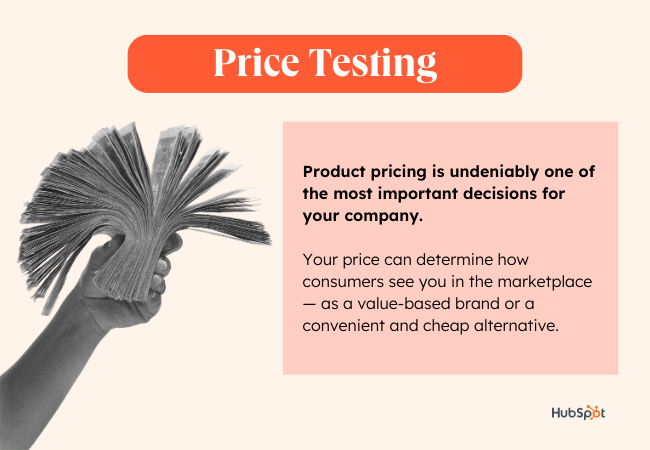
Product pricing is undeniably one of the most important decisions for your company.

Your price can determine how consumers see you in the marketplace— as a value-based brand or a convenient and cheap alternative.

Price Testing

There are a few other factors to consider when choosing a price, including what competitors are charging (competition-based pricing), or how much it will cost you to produce your product or service, plus how much you want to profit (cost-plus pricing).

To learn more about different pricing strategies, take a look at The Ultimate Guide to Pricing Strategies.

However, even once you’ve chosen a pricing strategy that works for your business, you might be unsure if the specific dollar price is going to return maximum revenue.

For instance, your pricing strategy might show a range of $50-$60 is best for your product. However, you need to find the “sweet spot” within that range. Charge it for $50, and you might be missing out on the revenue you could‘ve received if you’d charged it at $60.

Charge it for $60, alternatively, and you might limit the number of people willing to purchase your product — which could also decrease the amount of revenue you can receive.

This is where A/B testing comes into play. Let’s explore how to A/B test your pricing, next.

How to A/B Test Your Pricing

It’s important to note — many advise against A/B testing your pricing, for a few reasons.

There are a few major disadvantages or pitfalls associated with A/B testing a price. These include:

  • It introduces an element of unfairness to buyers. It doesn‘t seem fair that person A is able to purchase your product for less money than person B, which could cause harm to your brand’s reputation. Plus, it could ultimately dissuade a potential buyer from purchasing — for instance, if a prospect pitches a new software solution to her boss for $30/month, and then her boss logs onto the site and sees the product is $50/month, the confusion and frustration over the increase in price could prevent them from purchasing your product at all.
  • You‘ll have a group of customers paying an outdated price for your product. Let’s say you ultimately decide to go with the $30/month variant of your test — but you already have 40 customers who are paying $50/month. What do you do with them? You‘ll need to either migrate them to the $30/month plan and potentially deal with reimbursement requests, or keep them on an outdated model … which could cause frustration and high turnover rates when those customers learn they’re paying more than others.
  • It can be difficult to get statistical significance. You need a certain amount of people to purchase both price options for your test to be statistically significant, rather than pure chance. For many SaaS companies or companies that work with larger clients or more complex deals, you likely won’t have enough people to ensure your results are even useful.
  • It requires the development of multiple SKUs and other systems functionality, which can be a large (and potentially unrewarded) effort.

However, if you are going to A/B test your pricing, here‘s how you’ll want to do it.

1. Choose two different products (or plans) within the same category type.

To ensure you‘re being ethical and fair with your prospects, you don’t want to test two different prices on the same product. Consumers will eventually catch that you‘re charging different users varying prices, and it could permanently damage your brand’s reputation.

One alternative to this is testing two different products, or plans, within the same category type to see how much people are willing to pay for your product.

For instance, if you sell social media software, you might choose a Basic plan and charge people $50/month. Within this plan, consumers receive 10 social accounts and 1 user. Then, you might choose your Professional plan, and charge people $140/month, which includes 20 social accounts and 2 users.

By doing this, you‘re testing how much people are willing to pay for a social management tool, and whether there’s a cut-off. Technically, the Professional plan offers double the value of the Basic plan, but charges more than double each month ($140/month for 20 accounts and 2 users can be broken down to $70 for 10 accounts and 1 user — whereas a Basic plan is $50 for 10 accounts and 1 user).

Then, you’ll want to track if the conversion rates are higher or equal on both Basic and Professional. If there seems to be a drop-off of buyers for the Professional tool, you might want to lower your pricing on that product and see if it can positively impact revenue.

2. Figure out the price points you want to test.

You’ll want to determine the prices you want to test within a given range based on a variety of factors, including competitor pricing and operational costs.

You’re hoping to gauge price sensitivity, or the degree to which demand changes after a certain price point. For instance, you might find if you price your product at $100, the amount of people who will purchase your product drops dramatically.

Ultimately, you want to choose realistic price points to figure out the highest price you can go, while still maintaining the highest number of potential customers.

3. Measure revenue to determine price.

A small but important detail — measure revenue, not conversions, to determine which price wins out on your A/B test.

You‘ll likely have much higher conversion rates on lower-priced products, but that doesn’t mean you‘re able to hit your revenue goals. If you price a product too low, you might still struggle to meet revenue goals even with thousands of additional customers. This is why it’s important to measure revenue, not conversions.

4. Iterate on results and re-test two new price points, if need be.

If you’ve tested $30/month against $50/month and found $30/month equates to the most conversions and possible revenue, consider re-testing between $30 and $40, or $30 and $35.

Iterating on your results enables you to find a highly specific price point that will provide you with maximum revenue.

5. Choose the price that equates to maximum revenue.

Finally, choose the price point that suggests maximum revenue by determining the highest price that still converts enough customers to meet your business goals.

Alternatives to A/B Testing

If the potential risks associated with A/B testing pricing outweigh the benefits for your own business, there are plenty of alternative options to test a product’s pricing.

1. Only test the product page.

For one, you could try A/B testing the pricing page — including different layouts and CTAs — to figure out the best page for optimal conversions and monetization. Maybe your pricing isn’t the issue, but your landing page is.

2. Limit the go-to-market plan.

Alternatively, if you’re releasing a new product, consider launching the product in one market only to gauge market reaction and performance, before rolling the product out on a broader scale. This enables you to make tweaks to your pricing or product before releasing the product to the entire marketplace.

3. Survey your customers.

Finally, you might consider conducting a survey and simply asking prospective customers how much they’re willing to pay for a similar product in the industry.

For instance, if you‘re selling a website design tool, you might ask: “What features are most important to you in a website design tool?” and, “At what point would a website design tool be too expensive?” or “What is the maximum price you’re willing to pay for a website design tool?”

Ultimately, pricing is about determining your product or service‘s value, and how much consumers are willing to pay for that value. It’s an incredibly important factor to consider when running a business, but it’s not always something you can A/B test without potentially losing consumers or damaging your reputation when consumers find different prices every time they visit your site.

Price Testing Methods

If you’re set on A/B testing your pricing, there are other price testing methodologies that can be combined with A/B testing to better understand why the strategy is performing the way that it is. After using the A/B test methodology, add one of these to your research to get even better insights into what your customers want and expect from your business.

1. Van Westendorp Price Sensitivity Meter (PSM)

The Van Mestendorp PSM methodology uses a series of survey questions to determine price sensitivity by identifying price levels that are too low (“bargain”), too high (“expensive”), and acceptable (“too expensive” and “too cheap”).

Using this pricing method in action:

Let’s say a software company wants to launch a new subscription plan. They conduct a survey of their target customers, asking four questions:

  • At what price is the subscription too expensive?
  • At what price is it starting to seem expensive?
  • At what price is it starting to seem like a bargain?
  • At what price is it too cheap to be of high quality?

The company analyzes the responses and identifies the range of prices that the majority of customers find acceptable for the new plan.

2. Conjoint Analysis

This technique is used for assessing the value customers assign to different product features and price points. Creating various product profiles and analyzing consumer preferences allows businesses to estimate price elasticity and identify the most appealing pricing structure.

Using this pricing method in action:

A car manufacturer is planning to introduce a new model with different customizable features. They create several hypothetical car configurations with varying feature sets and prices. Then, they get a pulse on potential customers’ reactions by asking them to rank their preferences among different combinations.

The analysis reveals which features and price points have the highest value to customers, helping the manufacturer determine the optimal pricing structure.

3. Dynamic Pricing

The dynamic pricing approach involves adjusting prices in real-time based on factors such as demand, inventory levels, competitive pricing, and customer segmentation. By dynamically changing prices, businesses can optimize revenue and respond to market changes promptly.

Using this pricing method in action:

In this example, a ride-sharing company adjusts its prices based on demand and supply conditions in real-time. During peak hours or high-demand events, the prices increase to incentivize more drivers to be available, helping to meet the demand. Conversely, during low-demand periods, prices are lowered to attract more customers.

This dynamic pricing strategy works because it allows for the optimization of revenue without overhauling the price of the product or service permanently.

A/B Test Your Pricing Without Testing Your Customers’ Patience

If you are interested in A/B testing your pricing, we‘d suggest using this process, plus a few alternatives and additional methodologies, to test out the design of your pricing pages or product landing pages. Perhaps by altering how you display your product’s value on a page, you’ll raise the amount consumers are willing to pay.

Editors Note: This post was originally published in April 2021 and has been updated for comprehensiveness.

This article was written by a human, but our team uses AI in our editorial process. Check out our full disclosure to learn more about how we use AI.

The Ultimate A/B Testing Kit

Categories B2B

B2B Lead Generation Boosters: 25 Rocket-Fueled Strategies and Ideas to Propel Your Pipeline

B2B demand generation marketers face a growing list of challenges, from navigating complex buyer journeys to breaking through the noise of a crowded marketplace. High-quality, validated, opt-in leads are essential to driving sales and revenue growth, but generating them is no easy task.

With that in mind, here are 25 rocket-fueled strategies and ideas that can help propel your pipeline and turbocharge your B2B lead generation efforts. Before we do, let’s have a quick refresher on what B2B lead generation is and define the different types of sales leads that exist in the B2B world. 

3… 2… 1… Blast off!

Image caption: Take your B2B lead generation to the moon! Made using Midjourney

What is B2B Lead Generation?

B2B lead generation is the process of identifying and capturing interest from potential customers in your product or service, with the ultimate goal of converting them into buyers. It plays a pivotal role in the sales process, connecting marketing efforts to revenue growth. Quality leads are essential for sales success, as they have a higher likelihood of becoming customers and generating long-term value for your organization.

What Are the Different Types of Sales Leads in B2B?

There are several types of sales leads in B2B, including:

  • Marketing Qualified Leads (MQLs): Leads that have shown interest in your product or service and meet specific criteria established by your marketing team showing that they have a strong likelihood of becoming a buyer. 
  • Sales Qualified Leads (SQLs): Leads that have been vetted by your sales team and are deemed ready for direct sales engagement.
  • Sales Accepted Leads (SALs): Leads that have been formally accepted by the sales team and are ‌being actively pursued as potential customers.

There are also other lead types defined by industry bodies, technology vendors, and research firms as part of their own frameworks. For example, one of the most popular is the SiriusDecisions Demand Waterfall (known also as the Demand Unit Waterfall since 2017). 

Image: Versions of the SiriusDecisions Demand Waterfall. Source: Forrester

Some of the lead types that have featured in versions of this model include:

  • Inquiries (INQs): As the name suggests, these are leads that have come as the result of direct contact from potential customers. However, while they might be engaged, they might not be a good fit for your business.
  • Automation Qualified Lead (AQL): As Forrester explains, this is “the stage where inquiries, both inbound and outbound, are loaded into the marketing automation platform (MAP). The AQL is the clearinghouse for capturing, cleansing, scoring, and routing the best inquiries to downstream functions.” In short, these leads have undergone some kind of assessment to prioritize them by value.
  • Telephone-Generated and Telephone-Qualified Leads (TGLs and TQLs): These are leads that have either been generated by outbound phone calls or have been screened and qualified through a phone call or initial online meeting with a rep. In many cases, these leads will have been sourced or qualified by an external agency.
  • Sales Generated Leads (SGLs): Any B2B marketer will know that reps are keen to source their own opportunities and leads. These are leads that are sourced by sales reps directly.

To add to potential confusion, the exact definition of what ‌a “lead” is will vary between technology vendors and organizations. For this reason, both B2B marketers and salespeople should be clear on the definition of a lead within their own organization —as well as being clear on the definitions of other stages within the buying journey. There will likely be specific criteria that have to be met for any contact, account, or sales conversation to be classified as leads, target accounts, or opportunities that count against pipeline.

Knowing exactly ‘what’ makes a lead in your organization is vital because only those that meet your company’s own definition will count towards your personal targets and KPIs. This equally applies to any other pipeline stage or metric. So ask around for the definition before you commit to an approach, and if your company doesn’t have one, get agreement on what will count and what won’t.

Ignite Your B2B Lead Generation with These Rocket-Fueled Strategies

Having covered some essential B2B lead definitions, let’s explore a few approaches to turbocharge your revenue growth and fuel up your pipeline. Each of these strategies could inspire countless articles, eBooks, and even entire career paths, so the information here serves as a brief introduction.

Strategy 1: Content Marketing for B2B Lead Generation

Buyers appreciate engaging with top-notch content, making high-quality, valuable content essential for B2B lead generation success. A study from Demand Gen Report and Demandbase reveals that 62% of B2B buyers chose to buy from a vendor that provided high-quality content. Moreover, NetLine’s 2023 State of B2B Content Consumption and Demand Report reveals that content marketing remains a top priority for B2B marketers. 

Image Caption: Great content remains key to effective B2B lead generation. Across the board, buyers are increasing their content consumption no matter their industry. Source: NetLine’s 2023 State of B2B Content Consumption and Demand Report

When it comes to types of content that B2B audiences are interested in, NetLine’s report also shows that eBooks, guides, and cheat sheets lead the pack. However, buyers are still educating themselves with white papers, case studies, and webinars. 

But even the best possible content will do little if it doesn’t reach your buyers. To maximize your content’s impact, focus on effective distribution and promotion strategies. Remember to meet your buyers on the channels they use. 

Strategy 2: Account-Based Marketing (ABM)

ABM is a targeted approach to B2B lead generation that focuses on high-value accounts rather than individual contacts. By pinpointing and targeting these accounts, you can streamline your marketing efforts and enhance the quality of leads and contacts you acquire. Target accounts are chosen using data such as first-party intent and engagement signals, as well as sales team-selected data and firmographics. As a result, some may argue that ABM doesn’t quite align with the traditional understanding of B2B lead generation.

Best practices for executing ABM campaigns include aligning sales and marketing teams, using data-driven insights and personalizing your messaging.

Strategy 3: Content Syndication

Content syndication enables quick and easy distribution of your content across various B2B media, trade publishers, and third-party websites. Instead of negotiating individual commercial agreements, content syndication platforms enable you to promote your content across an entire network of sites that use platforms like NetLine.

Because such networks have total audience sizes that reach into the millions, content syndication is a fast and highly effective method of expanding your content’s reach and visibility. Aside from network size and audience reach, some things to look out for when choosing B2B lead generation vendors for content syndication include:

  • Which industries and audience profiles are available?
  • How can you customize your campaigns to collect the right data and target the right audience?
  • Are there program management features or services to monitor, analyze and optimize your campaigns?
  • Are performance-based lead gen programs offered?
  • Do they provide hyper-targeting and filtering so you only pay for leads meeting your specific criteria?

The good news is that you don’t even need to schedule a sales call to get started. As well as providing access to the largest content syndication network on the market, NetLine offers both self-service and managed B2B lead generation solutions

Strategy 4: Social Media for B2B Lead Generation

Social media platforms, especially LinkedIn and Twitter, play a crucial role in B2B lead generation and are perfect examples of meeting potential buyers on the channels they use. Optimize your profiles and engage with your audience.

Utilize social listening and engagement tools to understand what buyers are saying about your products or services, their opinions on your campaigns and events, and to stay updated on industry trends. These tools also provide valuable insights into audience discussions about your competitors.

Strategy 5: Email Marketing and Lead Nurturing

Email is far from dead. In fact, email marketing remains a powerful tool for B2B lead generation. To make the most of your email marketing, create compelling email campaigns and use lead nurturing to guide prospects through the sales funnel.

Timing is critical in the sales process, so when you send emails can have a significant impact. Keep in mind that there is a gap between when content is requested and when it’s actually consumed. Salespeople should hold back and not reach out too soon, giving potential leads time to consume and digest your content. 

Strategy 6: Identify Buyers with First-Party Intent Data and Lead Scoring

Today’s B2B marketing technology provides a huge amount of potential to know exactly “who” your buyers are. But to do so requires using data intelligently to sift out those who will only ever browse from those who might buy —and crucially when they might buy.

There are scores of suppliers who promise lists of buyers sourced from third-party data, but data that is collected directly (first-party data) offers a host of particular benefits. 

In short, first-party intent data offers unique insights into prospects’ online behavior —and because it’s collected directly, its quality and validity can be assessed transparently. This data presents a greater potential for identifying and prioritizing high-quality and verified leads. Unlike many third-party intent data sources that only offer vague indications of “intent” at an account level, leads sourced through first-party buyer intent data reveal “who” the buyer is, as discussed in a previous post on What Exactly Is B2B Intent Data and Where Does It Come From?

Since not all your first-party data will relate to buying signals, you should also use lead scoring (i.e. assigning a numerical value to leads based on predetermined attributes) to focus on leads with the highest potential to become buyers. You’ll also want to integrate intent data into your marketing automation tools for maximum impact. For example, here’s how to integrate your NetLine portal with Marketo.

Strategy 7: Search Engine Marketing

SEO and PPC are potentially powerful channels for B2B lead generation, as you can attract buyers to your content and website when they are actively searching for information through search engines like Google and Bing. The keywords they use can also reveal where they are in the buying journey, which is why focusing on high-intent keywords can be particularly effective, albeit expensive.

To stand the best chance of ranking organically (and to maximize your Quality Score for PPC), optimize your on-page and off-page SEO factors. According to the Digital Marketing Institute, some best practices for on-page SEO include using title tags, incorporating relevant and optimized headings, and prioritizing page load speed. For off-page SEO, be sure to include local SEO in your strategy and submit back-linked content.

When creating effective PPC campaigns that drive targeted traffic to your website, remember to set goals for your campaigns, carefully choose which keywords to bid on, and create attention-grabbing ads with a call-to-action. Continuously monitor your ads’ performance and make necessary adjustments to your keywords.

Strategy 8: Webinars and Virtual Events

Webinars and virtual events offer significant benefits for B2B lead generation. Research from last year shows that these two channels are considered the most effective top-of-funnel demand gen tactics by B2B marketers

However, a boring webinar or virtual event is unlikely to be successful at generating engaged B2B leads. To keep your audience interested and leave them wanting more, get them actively involved by using engagement tools such as quizzes, Q&A, and polls. Employ presenters who are both engaging and knowledgeable, especially for audiences that are likely to have deep subject matter knowledge such as IT professionals and healthcare providers.

Promoting your webinars or virtual events is also crucial to increase registrations and attendees. Maximize your reach using email invites and dedicated landing pages. Send a follow-up email a day or two before the event to capture last-minute sign-ups. Finally, make your webinars and virtual events on-demand so attendees can watch them whenever and wherever they prefer.

Strategy 9: Strategic Partnerships and Referral Programs

Partnering with complementary businesses can be highly effective in generating leads. Benefits include increased visibility and enhanced credibility. Strategic partnerships can also be a cost-effective way to reach new customers and generate leads by sharing resources for promotion. Indeed, even with NetLine’s own network at our disposal, we still work with partners such as ON24 and the ABMLA as part of our own marketing.

Creating and managing referral programs is another effective strategy for lead generation. These programs encourage existing customers (as well as partners such as authorized service providers and system integrators) to refer others to your business. Keep referral programs simple and straightforward. Offer incentives, and be sure to monitor and measure your program’s effectiveness, making adjustments as needed to ensure it generates desired results. 

Strategy 10: Online Communities and Networking

Online communities, such as industry forums and groups, can be valuable lead sources for B2B marketers. By engaging with these communities, you can establish yourself as an authority in your industry and build relationships with potential buyers.

Stand out in these online communities by being helpful and providing value to the community, sharing your expertise, and helping others solve problems. Remember, it’s essential to be authentic when interacting in the community and while networking.

Industry events offer opportunities to meet potential buyers face-to-face and establish relationships. These events provide the chance to forge personal connections with leads, as well as generate brand exposure and awareness. 

Image caption: The NetLine team doing face-to-face lead generation at Forrester’s B2B Summit

Strategy 11: Optimizing Existing B2B Lead Generation Efforts

Finally, it’s important to track and measure the performance of your existing lead generation efforts to make sure they are generating the desired results. After all, ramping up investment in B2B lead generation only makes sense when you are confident that you can deliver results.

At the most basic level, track KPIs such as conversion rate, cost-per-lead, and return on investment (ROI). By checking these KPIs and using data-driven insights, marketers can optimize their efforts and generate more leads. 

How to Generate B2B Leads: 14 Lead Generation Ideas for B2B Marketing Inspiration

Now that we’ve discussed some strategies that will boost your B2B lead generation, here are some ideas and tactics that will help fuel your efforts even further.

Idea 1: Offer a Free Tool or Resource

As any B2B marketer at a conference can confirm, swag and freebies attract buyers like flowers attract bees. But offers don’t have to be physical to lure in leads.

Free tools or online resources, like the Audience Explorer, can be highly effective for generating leads and overall awareness, in particular when you are offering something both useful and unique. Identify a valuable resource that resonates with your target audience and promote it to drive engagement.

Idea 2: Launch an Industry Survey and Share the Results

Conducting industry surveys can provide valuable insights as well as generate leads. A well-designed survey and resulting report have the added benefit of putting your organization at the forefront of thought leadership.

Create surveys that help you gain insight into your target audience. Promote your survey through email or even on a webinar or virtual event. Once your survey is complete, share the findings in a report, eBook, and/or infographic using your various content channels. 

Idea 3: Host a Joint Webinar with a Complementary Partner

Co-hosting webinars with complementary partners can expand your audience and generate new leads. Selecting partners is critical. Look for partners who share a similar customer base but are not your direct competitors. Choose topics of mutual interest that address the known pain points of potential buyers to show how your organization and your partner can alleviate those pains. 

Image caption: Partner webinars are a favorite lead gen tactic at NetLine, such as this one on How to Run a Disruptive Demand Generation Content Program

Idea 4: Create an Interactive Quiz or Assessment

Interactive quizzes or assessments can generate leads by providing personalized insights and recommendations. These work well during webinars but can also be hosted on your website or through social media channels —and you can even use them on kiosks at in-person events.

Design engaging quizzes that resonate with your target audience while providing insight into their needs and pain points. A customized report or list of recommendations is a powerful incentive for a buyer to share their details with you.

Idea 5: Create an Online Course or Offer Certification

Offering online courses or certifications, like NetLine Academy, Salesforce Trailhead and certifications from Demandbase, can attract leads seeking professional development. Create valuable training materials and promote your courses to reach the right audience.

Give participants something to show for their efforts, such as a digital certification. These provide your audience with something to share on platforms like LinkedIn, boosting visibility and attracting further leads through social proof.

Idea 6: Host a Giveaway or Contest

Giveaways or contests can generate excitement, create positive feelings about your brand, and ultimately generate leads. Create and promote a compelling contest that aligns with your target audience’s interests. Ensure the rules are spelled out clearly and are easy to follow. Don’t forget to provide CTAs to guide participants toward what you want them to do next.

“Image Caption: Would you prefer the Cadillac El Dorado or a set of steak knives?” Start by generating high-quality B2B leads and you’ll be driving into the sunset. Made using Midjourney.

Idea 7: Use Influencer Marketing to Promote Your Content and Attract New Audiences

Make use of influencer marketing to expand your reach and build interest in your products or services. In B2B, having big names (e.g., Scott Brinker or Jay Baer) can drive more than net-new names and can potentially lower CPA even with any fees.

Image caption: Don’t just take our word for it —Jay Baer also loves NetLine’s 2023 State of B2B Content Consumption and Demand Report

When choosing the right influencers to work with, first establish your goals for your influencer campaign and then pick influencers that align with those goals. Collaborate with your chosen influencers to create content and tap into their networks for increased exposure.

Idea 8: Gamify Your Content with a Competition

Much like giveaways and contests, competitions can drive engagement and create excitement around your brand, because, let’s face it, everyone loves a game. Gamifying your content means that buyers will stay on your website, engaging with your content and providing you with rich data so marketers can learn more about leads.

Savvy marketers will develop fun and challenging competitions that are not only engaging but also provide insights into what buyers are looking for. That information can be used to reach out in a much more personal way.

Idea 9: Develop an Augmented Reality Experience (or Something Else Futuristic and Attention Grabbing)
Although using Augmented Reality (AR) may seem novel or even gimmicky, innovative experiences like AR can generate buzz and bring in leads by helping your business stand out. With buyers spending an increased amount of time researching solutions and products on their own before getting in touch with sales, these experiences also provide buyers with the opportunity to see what your brand has to offer remotely.
Create a unique, immersive experience that aligns with your brand and product offering, and make sure to promote it effectively on channels such as social media and email.

Idea 10: Create a “Choose Your Own Adventure” Interactive Story

While creating a “Choose Your Own Adventure” interactive story may feel a bit left of field for the world of B2B marketing, it can be an effective and fun way for potential leads to engage with your brand on a deeper level and provide a memorable and enjoyable experience, leaving your brand top-of-mind with those who participate.

When creating an interactive story, it’s important to consider your audience’s interests and pain points. By tailoring your story to their specific needs, you can create a more impactful and engaging experience. Additionally, make sure you promote your story through various channels. Consider partnering with influencers or industry experts to help spread the word and reach a wider audience. 

Idea 11: Host a 24-Hour Livestream Event

We’ve already discussed the value of webinars and live events when it comes to B2B lead generation, but what about taking it up a notch and hosting a 24-hour livestream event? While this type of event will take a lot of planning and stamina (as well as potentially some pre-recording), it can be effective in attracting leads, especially if your target audience is global.

The key to the success of a 24-hour event is to make sure you have plenty of compelling content throughout, knowing that even if people are sleeping soundly in the US, leads in the APAC regions have started their day. This is also a great opportunity to enlist the help of partners to share the load and audiences. 

Idea 12: Launch a B2B Online Treasure Hunt with Hidden Prizes

Another fun and creative way to generate leads is to create and launch an online treasure hunt with hidden prizes. Treasure hunts are a highly interactive way to engage with your target audience while creating brand awareness and driving traffic to your website.

In creating your treasure hunt, it’s important to keep in mind that the main appeal is the excitement of the search and the potential rewards. Prizes should be desirable and relevant to your target audience. You can also increase the appeal by creating a sense of urgency and exclusivity, perhaps by limiting the number of participants or offering exclusive prizes for early participants.

Promote your hunt using channels such as social media and targeted email campaigns. During the execution phase, make sure it is easy to participate in and that the rules are clear and straightforward. Don’t forget to follow up with participants and leads in a timely and personalized manner to capitalize on the momentum created by the treasure hunt.

Idea 13: Create a Unique B2B Product or Service Mascot

While a mascot may not be able to generate leads on its own, what they do is help create brand awareness and recognition. Mascots like NetLine’s Luna, Salesforce’s Astro and Einstein, and MailChimp’s Freddy are memorable and are easily associated with their respective brands in the minds of buyers.

When developing a unique mascot, keep it simple and align it with your brand and its values. Use your mascot in your marketing content, but don’t overdo it. Even the most adorable mascot can become a nuisance if they show up too often or in the wrong kind of content. 

Image caption: Luna helps NetLine stand out when communicating our messages about B2B marketing.

Idea 14: The Tried-and-Tested Fancy Dinner, Hot Tickets to a Show or Game, or an Invite-Only Event at a Swanky Resort

Not many people would decline a fancy meal, an exclusive event held at a resort, or tickets to the hottest show in town. Marketers and salespeople have been successfully using this tactic to lure prospects for years. Even in this highly digital age, buyers still like the face-to-face that comes with dinners and events.

The key to the success of this tactic is exclusivity. Make your guests feel special by sending invitations the old-fashioned way, through direct mail or, at the very least, through a highly personalized email.

Image caption: “Pardon me, as well as your B2B lead generation services, would you happen to have any Grey Poupon?” Made using Midjourney.

Still Struggling? Here are Some Tips to Quickly Improve the Quality of Your B2B Sales Leads

  • Revisit and refine your buyer personas: Buyer personas are essential for effective B2B lead generation. Revisit and revise these personas based on new insights and data.
  • Implement a rigorous lead qualification process: Make sure your salespeople are focusing on high-quality leads that are most likely to convert by implementing a process that takes into account factors such as budget, decision-making authority, and purchase timeline.
  • Continuously optimize your lead nurturing campaigns: Be sure that you are delivering the right content to the right people at the right time by using data and analytics to track the effectiveness of your campaigns 
  • Regularly audit and update your existing content: Content is the fuel that powers your B2B engine, and regular audits and updates to your content will ensure that it remains relevant, accurate, and engaging. Look to customer feedback and analytics to identify areas for improvement. 
  • Use data and analytics to make data-driven decisions: Use data and analytics to inform you of the effectiveness of your lead generation campaigns, identify areas in need of improvement, and let it guide you in making decisions. 
  • Invest in ongoing sales and marketing alignment efforts: It cannot be overstated how important sales and marketing alignment is to the success of any B2B organization. Prioritize efforts to align your sales and marketing teams, including holding regular meetings and making sure communication channels are open.
  • Test and iterate new lead generation strategies and tactics: Don’t be afraid to try new lead generation strategies and tactics like the ones discussed in this post. Test and iterate until you find the ones that work best for your organization. 

By implementing some or all of the above strategies and ideas and continually refining your approach, you can boost your pipeline and drive sales success. Be sure to share this post with others and don’t forget to provide your feedback. 

Want to know more about how NetLine can help you get B2B leads? Check out our range of lead generation solutions.

Image caption: When your B2B lead generation engine is firing at full power, expect to see marketing results that are out of this world. Made using Midjourney.

FAQs on B2B lead gen that might be on your mind

How much is a B2B lead worth?

It’s important to distinguish between cost-per-lead (CPL) and the value of a lead to your organization. Two companies targeting the same buyers, at the same time and on the same channels will have largely the same CPL —but if one of those companies converts leads to buyers more efficiently and/or makes far more profit per customer, the value of that lead will be higher. Aside from internal factors, the value of a B2B lead can vary greatly depending on the industry, the product or service being sold, and the quality of the lead. 

Starting from $9 per lead, NetLine offers a highly-efficient way of generating B2B leads with its targeted performance-based campaigns—especially when the average cost-per-lead across channels and industries is estimated to be almost $200

How much do B2B lead generation companies charge?

The cost of B2B lead generation services can vary depending on the company you choose and the specific services you require. Some companies charge a flat fee for a set number of leads, while others charge based on the number of hours worked or the specific tactics used.

Lead generation agencies (especially telemarketing agencies) often work on a retainer basis, with an initial setup fee followed by a rolling commitment. Some agencies will take a multichannel approach to lead generation, sourcing leads from a variety of channels.

As a rough benchmark, most firms that offer a managed lead generation service will charge at least $2,000 a month. Whether this works out as a good investment for your lead generation depends on a large number of factors. 

Why is B2B lead generation hard?

B2B lead generation can be challenging for a variety of reasons. One of the main challenges is the fact that B2B buyers are often more sophisticated and have higher expectations than B2C buyers. Additionally, B2B sales cycles tend to be longer and more complex compared to consumer purchase journeys, which can make it difficult to attract and convert leads. 

Without access to high-quality buyer intent data, it can be very difficult to separate those who are in market from those who have no desire to buy. That’s why NetLine emphasizes the importance of using first-party, buyer-level intent data compared to other forms of buying signals.

What is the number 1 challenge in lead generation?

Lead quality is often cited as the top challenge in studies of B2B marketers. A study by Ascend2 in 2022 found that 42% cited generating quality leads to be a top challenge, compared to just 33% that listed generating enough leads.

As B2B buyers consume increasing amounts of content, lead quantity is likely to become less of a challenge, although business pressures rarely reduce targets based on the number of leads.

How can I get B2B leads for free?

While there’s no magic formula for getting high-quality B2B leads for free, there are a few strategies you can try. One approach is to use your existing network by asking for referrals and recommendations from current and former clients, business partners, and industry contacts. You can also try creating high-quality content that’s designed to attract potential leads to your website or social media profiles. Finally, consider participating in online forums and groups where your target audience is likely to be active, and engaging with them in a helpful and informative way.

Remember that the cost of generating B2B leads and sales opportunities doesn’t only consist of paid spend. Factors such as headcount, capital spend, and even the cost of office space for marketing employees should be factored in, which is why many companies (and especially high-growth companies) track the ratio between Lifetime Customer Value (LTV) and Customer Acquisition Cost (CAC) as a key metric, with CAC factoring in all total sales and marketing costs to the business.

Categories B2B

31 Companies With Really Catchy Slogans & Brand Taglines

Keep it simple, stupid.

We don’t mean to offend you — this is just an example of a great slogan that also bears the truth of the power of succinctness in advertising. It‘s incredibly difficult to be succinct, and it’s especially difficult to express a complex emotional concept in just a couple of words — which is exactly what slogans and taglines do.

Free Download: Slogan Writing Guide and Examples

That’s why we have a lot of respect for the brands that have done it right. These are the companies that have figured out how to convey their value propositions to their buyer personas in just one, short sentence — and a quippy one, at that.

So if you‘re looking to get a little slogan inspiration of your own, take a look at some of our favorite company slogans and taglines from both past and present. But before we get into specific examples, let’s quickly go over what a slogan is, how it differs from a tagline, and what makes these branded one-liners stand out.

What is a slogan?

In business, a slogan is “a catchphrase or small group of words that are combined in a special way to identify a product or company,” according to Entrepreneur.com’s small business encyclopedia.

In many ways, they’re like mini-mission statements.

Companies have slogans for the same reason they have logos: advertising. While logos are visual representations of a brand, slogans are audible representations of a brand. Both formats grab consumers‘ attention more readily than a company’s name or product might. Plus, they’re simpler to understand and remember.

The goal? To leave a key brand message in consumers‘ minds so that, if they remember nothing else from an advertisement, they’ll remember the slogan.

Slogan vs. Tagline

Although both “slogan” and “tagline” tend to be used interchangeably, they actually serve two different purposes.

As we mentioned in Entrepreneur.com’s definition above, a slogan identifies a product or company. So does a tagline, for that matter. Where these terms differ is in how they position a company in its industry.

  • A slogan encompasses a company‘s mission, what it stands for, and even how it’s helping customers in the individual campaigns the company might run. Slogans can therefore be longer than taglines, as you’ll see in the list below.
  • A tagline is a catchy quip that evokes an image of your brand in the minds of your customers. Taglines enable people to make lighthearted associations with your business: “When I see [tagline], I think [company].”

Featured Resource: 60 Slogan Writing Tips & Examples

brand slogans

Download the Free Guide

Taglines are more often next to the company‘s logo on official advertisements and are dedicated more specifically to brand awareness than slogans. Slogans carry a brand’s values and promises as the company grows and evolves, and can be promoted under an overarching company tagline.

Your organization doesn’t have to develop both a slogan and a tagline — it might succeed with just a solid, recognizable tagline. But as you develop new products and identify new types of customers, you might find your brand launching a campaign that is primed for its own slogan.

What makes a great slogan?

According to HowStuffWorks, a great slogan has most, or all, of the following characteristics:

1. It’s memorable.

Is the slogan quickly recognizable? Will people only have to spend a second or two thinking about it? A brief but strong few words can go a long way in advertisements, videos, posters, business cards, swag, and other places.

2. It includes a key benefit.

Ever heard the marketing advice, “Sell the sizzle, not the steak”? It means sell the benefits, not the features — which applies perfectly to slogans. A great slogan makes a company or product’s benefits clear to the audience.

3. It differentiates the brand.

Does your light beer have the fullest flavor? Or maybe the fewest calories? What is it about your product or brand that sets it apart from competitors? (Check out our essential branding guide here.)

4. It imparts positive feelings about the brand.

The best taglines use words that are upbeat. For example, Reese‘s Peanut Butter Cups’ slogan, “Two great tastes that taste great together,” gives the audience good feelings about Reese‘s, whereas a slogan like Lea & Perrins’, “Steak sauce only a cow could hate,” uses negative words. We could argue that the former leaves a better impression on the audience.

How to Write a Catchy Slogan or Tagline

1. Define your target audience.

Determine who your brand is targeting and research their preferences and needs. This step is crucial as it allows you to build a message that resonates with them, differentiate your brand, adapt your tone and language, and target the right channels.

2. Demonstrate value.

Focus on the main benefits that your brand offers to its customers. This could include convenience, quality, affordability, innovation, or any other unique selling points. By doing this, you can motivate customers to take action, whether it’s making a purchase, exploring further, or developing a long-lasting relationship with your brand.

3. Keep it simple

A successful slogan is short, impactful, and easy to remember. Strive for brevity while capturing the essence of your brand and its key benefits. Use powerful words, rhymes, alliteration, or wordplay to make it stand out

4. Highlight brand personality.

Consider your brand’s personality and tone. Is it playful, professional, or innovative? Reflect this personality in the slogan to create a cohesive and authentic message.

5. Use an emotional appeal.

Create an emotional connection with your target audience by tapping into their aspirations, desires, or pain points. Emotionally appealing slogans tend to be more memorable and resonate with consumers.

6. Test it out.

Once you’ve drafted a catchy slogan, share it with a sample group of people from your target audience to get their feedback. Ask for their impressions, memorable elements, and overall understanding. Make necessary adjustments based on the feedback received.

Now that we’ve covered what a slogan is and what makes one great, here are examples of some of the best brand slogans of all time.

When you want a brand slogan you want to make sure they are memorable and that they bring your brand to life. The right slogan will have key words that encapsulate what your brand is so that consumers will always have it in the back of their heads. Below we have listed some business slogans that range from fast food, cars, essential items, pet essentials, etc. to show that a good slogan encapsulates being concise, catchy, and classic.

1. VRBO: Where Families Travel Better Together

What is a slogan example: VRBOImage Source

Vacation rental company VRBO has successfully carved out a family-friendly niche within the hospitality sector. Their slogan and corresponding tagline ‘Travel Better Together’ work to drive their mission: to find every family a space to relax, reconnect and enjoy their time together.

VRBO’s tagline is not only catchy, but its focus on families sets them apart from the competition in the vacation rental space.

2. Dollar Shave Club: “Shave Time. Shave Money.”

Dollar Shave Club

Image Source

The folks at Dollar Shave Club have made their way onto quite a few of our lists here on the blog, and it‘s safe to say that when it comes to marketing and advertising, this brand’s team knows what it’s doing. And its slogan — “Shave Time. Shave Money.” — is an excellent reflection of their expertise.

This little quip cleverly incorporates two of the service‘s benefits: cost and convenience. It’s punny, to the point, and it perfectly represents the overall tone of the brand.

3. MasterCard: “There are some things money can‘t buy. For everything else, there’s MasterCard.”

Catchy Business Slogans and Taglines Slogans: MastercardImage Source

MasterCard’s two-sentence slogan was created in 1997 as a part of an award-winning advertising campaign that ran in 98 countries and 46 languages. The very first iteration of the campaign was a TV commercial that aired in 1997: “A dad takes his son to a baseball game and pays for a hot dog and a drink, but the conversation between the two is priceless,” wrote Avi Dan for Forbes.

“In a sense, ‘Priceless’ became a viral, social campaign years before there was a social media,” Dan explained. Today, “Priceless” is widely considered MasterCard’s tagline — borne out of the longer mission-focused slogan stated above.

One key to this campaign’s success? Each commercial elicits an emotional response from the audience. That first TV commercial might remind you of sports games you went to with your dad, for example. Each advertisement attempted to trigger a different memory or feeling. “You have to create a cultural phenomenon and then constantly nurture it to keep it fresh,” MasterCard CMO Raja Rajamannar told Dan. And nostalgia marketing like that can be a powerful tool.

4. M&M: “Melts in Your Mouth, Not in Your Hands”

Catchy Business Slogans and Taglines Slogans: M&M's

Image Source

Here‘s one brand that didn’t need much time before realizing its core value proposition. At the end of the day, chocolate is chocolate. How can one piece of chocolate truly stand out from another? By bringing in the convenience factor, of course.

This particular example highlights the importance of finding something that makes your brand different from the others — in this case, the hard shell that keeps chocolate from melting all over you.

5. De Beers: “A Diamond is Forever”

Business slogan example: DeBeersImage Source

Diamonds aren’t worth much inherently. In fact, a diamond is worth at least 50% less than you paid for it the moment you left the jewelry store. So how did they become the symbol of wealth, power, and romance they are in America today? It was all because of a brilliant, multifaceted marketing strategy designed and executed by ad agency N.W. Ayer in the early 1900s for their client, De Beers.

The four, iconic words “A Diamond is Forever” have appeared in every single De Beers advertisement since 1948, and AdAge named it the best slogan of the century in 1999. It perfectly captures the sentiment De Beers was going for: that a diamond, like your relationship, is eternal. It also helped discourage people from ever reselling their diamonds. (Mass reselling would disrupt the market and reveal the alarmingly low intrinsic value of the stones themselves.) Brilliant.

6. Meow Mix: “Tastes So Good, Cats Ask for It by Name”

Catchy Business Slogans and Taglines Slogans: Meow Mix

Image Source

Meow meow meow meow … who remembers this catchy tune sung by cats, for cats, in Meow Mix’s television commercials? The brand released a simple but telling slogan: “Tastes So Good, Cats Ask For It By Name.”

This slogan plays off the fact that every time a cat meows, s/he is actually asking for Meow Mix. It was not only clever, but it also successfully planted Meow Mix as a standout brand in a cluttered market.

7. The U.S. Marine Corps: “Semper Fi”

Semper Fi, short for “Semper Fidelis,” is Latin for “always faithful” or “always loyal.” The saying has long been the official motto of the U.S. Marine Corps and is used to represent them in public appearances and the Marines’ official seal.

What makes “Semper Fi” a great slogan for the Marines? It reveals the Marines‘ defining characteristics in the armed forces — faithfulness and loyalty. It’s also a memorable proverb that explains why this organization can be counted on by the public.

8. Allstate: “You’re in Good Hands With Allstate”

Catchy Business Slogans and Taglines Slogans: AllstateImage Source

If there’s one thing people want from an insurance company, it’s reliability. Who wouldn’t be put at ease after hearing “You’re in good hands with Allstate?” It’s worked so well the slogan has been in service for nearly six decades.

Davis Ellis came up with the slogan in 1950 after his daughter had a health scare. Remembering how being told “JoAnn (his daughter) is in good hands with Dr. Keyser” relieved his anxiety, Ellis was inspired to use the phrase in an ad campaign. Variations of this phrase have been used in the company slogan ever since.

9. Ronseal: “It Does Exactly What It Says on the Tin.”

Catchy Business Slogans and Taglines Slogans: Ronseal

Image Source

Ronseal is a wood stain and dye manufacturer from the United Kingdom, and its 20-year-old slogan is perfect for the humble message the company is known for.

Ronseal‘s slogan doesn’t go above and beyond. It doesn’t make lofty promises to its customers. It simply endorses a functional product. So why is this slogan so catchy? Because its lack of volume actually speaks volumes to its audience. Too many companies try to break through the noise of their competitors by being so loud and ambitious, they forget what they stood for in the first place. Ronseal saw true value in basic reliability and founded a slogan that allowed the company to stay right where its customers like it.

10. The Mosaic Company: “We Help the World Grow the Food It Needs”

Catchy Business Slogans and Taglines Slogans: Mosaic

Image Source

The Mosaic Company’s slogan also happens to be its mission statement, which guarantees that this fertilizer maker‘s brand strategy aligns with the company’s main interests.

Something all slogans should strive to do is look past the needs of the company, or even its users, and describe how the product or service helps the community. In this way, “We Help the World Grow the Food It Needs” is a heavy slogan that expresses not just what The Mosaic Company wants for its customers, but also what it wants for the public.

11. Pitney Bowes: “We Power Transactions That Drive Commerce”

what is a slogan example: Pitney BowesImage Source

Pitney Bowes, the mailing and shipping software provider, has a slogan that follows a similar theme as The Mosaic Company in the section above: It’s focused not on the end user, but on the industry.

Pitney Bowes‘ slogan shows us that its products don’t just help businesses track and deliver merchandise — it makes the entire ecommerce community more efficient. It‘s a good strategy, considering the alternative. How lame would the company’s slogan be if it were “We Power Transactions That Serve Our Clients’ Bottom Line”?

Taglines

When creating your brand tagline you want to have a tagline that explains the essence of the value you provide to your customer using one to two sentences. A tagline is a great way to understand what your business does for your customers. The right tagline will be concise yet brings out the essence of what the business is. Below we have listed some business taglines that encapsulate being concise while telling the value of the business.

12. Target: “Expect More. Pay Less.”

What is a slogan example: Target

Image Source

Target has been using its tagline since 1994 and the brand has developed a dedicated following ever since. Its stores and branding makes people feel like it’s cut above the competition.

This tagline embodies the experience of shopping at Target. From home goods to toiletries to clothing — it all can be found at Target and for a great price without feeling like a low budget store.

13. Verizon: “5G Built Right”

Catchy Business Slogans and Taglines Slogans: Verizon

Image Source

Here’s another brand that took its time coming up with something that truly resonated with its audience. Verizon’s previous slogan “Can you hear me now” was created in 2002 under the umbrella of the tagline, “We never stop working for you.” Now, Verizon has switched things up with “5G Built Right” to mark themselves as the first to launch a 5G network .

While Verizon was founded in 1983, it continued to battle against various phone companies like AT&T and T-Mobile, still two of its strongest competitors. But what makes Verizon stand out? No matter where you are, you have service. You may not have the greatest texting options, or the best cell phone options, but you will always have service.

14. Nike: “Just Do It”

Best brand tagline examples: Nike

Image Source

Now, for the more well-known Nike message. “Just Do It” hovers over every product and event Nike creates or sponsors, and that‘s exactly what makes it the company’s official tagline.

It didn‘t take long for Nike’s message to resonate. The brand became more than just athletic apparel — it began to embody a state of mind. It encourages you to think that you don‘t have to be an athlete to be in shape or tackle an obstacle. If you want to do it, just do it. That’s all it takes.

But it‘s unlikely Kennedy + Weiden, the agency behind this tagline, knew from the start that Nike would brand itself in this way. In fact, Nike’s product used to cater almost exclusively to marathon runners, which are among the most hardcore athletes out there. The “Just Do It” campaign widened the funnel, and it’s proof positive that some brands need to take their time coming up with a tagline that reflects their message and resonates with their target audience

15. Apple: “Think Different.”

Best brand tagline examples: AppleImage Source

This tagline was first released in the Apple commercial called “Here’s to the Crazy Ones, Think Different” — a tribute to all the time-honored visionaries who challenged the status quo and changed the world. The phrase itself is a bold nod to IBM’s campaign “Think IBM,” which was used at the time to advertise its ThinkPad.

Soon after, the tagline “Think Different” accompanied Apple advertisements all over the place, even though Apple hadn’t released any significant new products at the time. All of a sudden, people began to realize that Apple wasn’t just any old computer; it was so powerful and so simple to use that it made the average computer user feel innovative and tech-savvy.

According to Forbes, Apple‘s stock price tripled within a year of the commercial’s release. Although the tagline has been since retired, many Apple users still feel a sense of entitlement for being among those who “think different.”

16. L‘Oréal: “Because You’re Worth It”

Best brand tagline examples: L'OrealImage Source

Who doesn‘t want to feel like they’re worth it? The folks at L’Oréal worked with the theory that women wear makeup in order to make themselves appear “beautiful” so they feel desirable, wanted, and worth it. The tagline isn‘t about the product — it’s about the image the product can get you. This message allowed L’Oréal to push its brand further than just utility so as to give the entire concept of makeup a much more powerful message.

17. California Milk Processor Board: “Got Milk?”

Best brand tagline examples Got MilkImage Source

While most people are familiar with the “Got Milk?” campaign, not everyone remembers that it was launched by the California Milk Processor Board (CMPB). What’s interesting about this campaign is that it was initially launched to combat the rapid increase in fast food and soft beverages: The CMPB wanted people to revert to milk as their drink of choice in order to sustain a healthier life. The campaign was meant to bring some life to a “boring” product, ad executives told TIME Magazine.

The simple words “Got Milk?” scribbled above celebrities, animals, and children with milk mustaches, which ran from 2003 until 2014 — making this campaign one of the longest-lasting ever. The CMPB wasn’t determined to make its brand known with this one — it was determined to infiltrate the idea of drinking milk across the nation. And these two simple words sure as heck did.

18. BMW: “Sheer Driving Pleasure”

Best brand tagline examples: BMWImage Source

BMW sells cars all over the world, but in North America, it was known for a long time by its tagline, “The Ultimate Driving Machine.” This phrase was created in the 1970s by a relatively unknown ad agency named Ammirati & Puris and was, according to BMW’s blog, directed at Baby Boomers who were “out of college, making money and ready to spend their hard-earned dollars. What better way to reflect your success than on a premium automobile?”

The newer tagline, “Sheer Driving Pleasure,” is intended to reinforce the message that its cars’ biggest selling point is that they are performance vehicles that are thrilling to drive. That message is an emotional one and one that consumers can buy into to pay the high price point.

19. Tesco: “Every Little Helps”

Best brand tagline examples: TESCOImage Source

“Every little helps” is the kind of catchy tagline that can make sense in many different contexts — and it‘s flexible enough to fit in with any one of Tesco’s messages. It can refer to value, quality, service, and even environmental responsibility — which the company practices by addressing the impacts of their operations and supply chain.

It’s also, as Naresh Ramchandani wrote for The Guardian, “perhaps the most ingeniously modest” slogan or tagline ever written. Tesco markets itself as a brand for the people, and a flexible, modest far-reaching slogan like this one reflects that beautifully.

20. Bounty: “The Quicker Picker Upper”

Best brand tagline examples: Bounty

Image Source

Bounty paper towels, made by Procter & Gamble, has used its catchy tagline “The Quicker Picker Upper” for almost 50 years now. If it sounds like one of those sing-songy play on words you learned as a kid, that‘s because it is one: The tagline uses what’s called consonance — a poetic device characterized by the repetition of the same consonant two or more times in short succession (think: “pitter patter”).

Over the years, Bounty has moved away from this tagline in full, replacing “Quicker” with other adjectives, depending on the brand‘s current marketing campaign — like “The Quilted Picker Upper” and “The Clean Picker Upper.” Although the brand is branching out into other campaigns, they’ve kept the theme of their original, catchy tagline.

21. Lay‘s: “Betcha Can’t Eat Just One.”

Best brand tagline examples: LaysImage Source

Seriously, who here has ever had just one chip? While this tagline might stand true for other snack companies, Lay‘s was clever to pick up on it straight away. The company tapped into our truly human incapability to ignore crispy, salty goodness when it’s staring us in the face. Carbs, what a tangled web you weave.

But seriously, notice how the emphasis isn‘t on the taste of the product. There are plenty of other delicious chips out there. But what Lay’s was able to bring forth with its tagline is that totally human, uncontrollable nature of snacking until the cows come home.

22. Audi: “Vorsprung durch technik” (“Advancement Through Technology”)

Best brand tagline examples: AudiImage Source

“Vorsprung durch technik” has been Audi’s main German tagline everywhere in the world since 1971 (except for the United States, where the slogan is “Truth in Engineering”). While the phrase has been translated in several ways, the online dictionary LEO translates “Vorsprung” as “advance” or “lead” as in “distance, amount by which someone is ahead in a competition.” Audi roughly translates it as: “Advancement through technology.”

The first-generation Audio 80 (B1 series) was launched a year after the tagline in 1972, and the new car was a brilliant reflection of that tagline with many impressive new technical features. It was throughout the 1970s that the Audi brand established itself as an innovative car manufacturer, such as with the five-cylinder engine (1976), turbocharging (1979), and the quattro four-wheel drive (1980). This is still reflective of the Audi brand today.

23. Dunkin’: “America Runs on Dunkin”

Best brand tagline examples: DunkinImage Source

In April 2006, Dunkin‘ Donuts launched the most significant repositioning effort in the company’s history by unveiling a brand new, multi-million dollar advertising campaign under the tagline “America Runs on Dunkin.” The campaign revolves around Dunkin’ Donuts coffee keeping busy Americans fueled while they are on the go.

“The new campaign is a fun and often quirky celebration of life, showing Americans embracing their work, their play and everything in between — accompanied every step of the way by Dunkin’ Donuts,” read the official press release from the campaign’s official launch.

Ten years later, what the folks at Dunkin Donuts‘ realized they were missing was their celebration of and honoring their actual customers. That’s why, in 2016, they launched the “Keep On” campaign, which they call their modern interpretation of the ten-year tagline.

“It‘s the idea that we’re your partner in crime, or we’re like your wingman, your buddy in your daily struggle and we give you the positive energy through both food and beverage but also emotionally, we believe in you and we believe in the consumer,” said Chris D’Amico, SVP and Group Creative Director at Hill Holiday.

Fun fact: Dunkin’ Donuts rebranded itself — and named itself Dunkin’ in 2018 while releasing new packaging in 2019. One store in Pasadena, California is called, simply, Dunkin’.

24. McDonald‘s: “I’m Lovin’ It”

Best brand tagline examples: McDonalds

Image Source

The “I‘m Lovin’ It” campaign was launched way back in 2003 and still stands strong today. This is a great example of a tagline that resonates with the brand‘s target audience. McDonald’s food might not be your healthiest choice, but being healthy isn‘t the benefit McDonald’s is promising — it‘s that you’ll love the taste and the convenience.

Fun fact: The jingle’s infamous hook — “ba da ba ba ba” — was originally sung by Justin Timberlake.

25. The New York Times: “All the News That’s Fit to Print”

Best brand tagline examples: NYT

Image Source

This one is my personal favorite. The tagline was created in the late 1890s as a movement of opposition against other news publications printing lurid journalism. The New York Times didn’t stand for sensationalism. Instead, it focused on important facts and stories that would educate its audience. It literally deemed its content all the real “news fit to print.”

This helped the paper become more than just a news outlet, but a company that paved the way for credible news. The company didn’t force a tagline upon people when it first was founded, but rather, it created one in a time where it was needed most.

26. General Electric: “Imagination at Work”

Best brand tagline examples: GEImage Source

You may remember General Electric‘s former tagline, “We Bring Good Things to Life,” which was initiated in 1979. Although this tagline was well-known and well-received, the new tagline — “Imagination at Work” — shows how a company’s internal culture can revolutionize how they see their own brand.

“‘Imagination at Work’ began as an internal theme at GE,” recalled Tim McCleary, GE‘s manager of corporate identity. When Jeff Immelt became CEO of GE in 2001, he announced that his goal was to reconnect with GE’s roots as a company defined by innovation.

This culture and theme resulted in a rebranding with the new tagline “Imagination at Work,” which embodies the idea that imagination inspires the human initiative to thrive at what we do.

27. State Farm: “Like a good neighbor, State Farm is there.”

Best brand tagline examples: State FarmImage Source

The insurance company State Farm has a number of taglines, including “Get to a better State” and “No one serves you better than State Farm.” Additionally, the company updated its tagline to “We’re here to help life go right.”

But State Farm‘s most famous tagline is the jingle, “Like a good neighbor, State Farm is there,” which you’re likely familiar with if you live in the United States and watch television.

These words emphasize State Farm’s “community-first” value proposition — which sets it apart from the huge, bureaucratic feel of most insurance companies. And it quickly establishes a close relationship with the consumer.

Often, customers need insurance when they least expect it — and in those situations, State Farm is responding in friendly, neighborly language.

28. Maybelline: “Maybe she‘s born with it. Maybe it’s Maybelline.”

Best brand tagline examples: MaybellineImage Source

Can you sing this jingle in your head? Maybelline’s former tagline, created in the 1990s, is one of the most famous in the world. It makes you think of glossy magazine pages featuring strong, beautiful women with long lashes staring straight down the lens. It’s that confidence that Maybelline’s makeup brand is all about — specifically, the transformation into a confident woman through makeup.

Maybelline changed its tagline to “Make IT Happen” in February 2016, inspiring women to “express their beauty in their own way.” Despite this change, the former tagline remains powerful and ubiquitous, especially among the many generations that grew up with it.

29. The U.S. Marine Corps: “The Few. The Proud. The Marines.”

Best brand tagline examples: MarinesImage Source

While “Semper Fi” is one the U.S. Marine Corps’ most coveted slogans (or, more officially, mottos), it has had a handful of top-notch recruiting taglines over the decades as well. These include “First to fight” starting in World War I, to “We’re looking for a few good men” from the 1980s.

However, we’d argue that “The Few. The Proud. The Marines.” is among the best organization taglines out there.

This tagline “underscores the high caliber of those who join and serve their country as Marines,” said Maj. Gen. Richard T. Tryon, former commanding general of Marine Corps Recruiting Command. In 2007, it even earned a spot on Madison Avenue’s Advertising Walk of Fame.

30. Capital One: “What’s in Your Wallet?”

Capital One launched its iconic “What’s in your wallet?” tagline in 2000. Since then, it’s been used in many of the credit card company’s ad campaigns, which have featured celebrity spokespeople, like Samuel L. Jackson and Jennifer Garner.

This tagline is brilliant because it makes you think about money and how you pay for things. Sure, you can always pay with cash, but what happens when you run out? That’s where a credit card from Capital One comes in handy.

With this messaging, Capital One positions itself as the only credit card that can help get all you want in life and keep you satisfied and secure.

31. Toyota: “Let’s Go Places”

Image Source

In 2012, Toyota replaced it’s old tagline “Moving Forward” with its current one “Let’s Go Places.”

While “Moving Forward” evokes a similar energetic and optimistic spirit, “Let’s Go Places” invites you to explore and discover with Toyota, creating a stronger relationship between the brand and its consumers.

Upon the tagline’s launch, GVP of Toyota Division Bill Fay said, “the phrase conveys a dual meaning of physically going places and taking off an adventure, while also expressing optimism and the promise of exciting innovation that enriches people’s lives.”

This tagline encourages you to dream big and make moves, assuring you that Toyota will be there with you every step of the way.

A catchy slogan and tagline will make a difference in your business.

Now that you have delved into some classic and catchy slogans and taglines, it’s time to set your business up for success. Remember a slogan and a tagline are similar but a slogan is used to sell an item whereas a tagline brings awareness to the item while being concise, catchy, and classic. Both are essential when making sure your business will remain in the minds of consumers.

Editor’s note: This post was originally published in July 2020 and has been updated for comprehensiveness.

Free Resource: How to Reach & Engage Your Audience on Facebook

Categories B2B

Who Should I (or My Business) Be on Threads? Should You Tweak Personal Branding for the New Platform?

Meta has an answer to Twitter, and it’s Threads. The social media conglomerate launched Threads in July, and the platform amassed 100 million users in just five days.

If you’re a brand looking to hop on the Threads train sooner rather than later, you’re likely wondering what your leveraging of the app should look like. 

Specifically, who should your brand be on Threads and should you tweak your personal branding? What kind of content are users posting and engaging with, and what type of personality shines on the platform?

Threads is still relatively new, and there’s still time for the app’s overall vibe to develop and change, but here’s what we know so far.  

Download Now: The 2023 State of Social Media Trends [Free Report]

What is Threads?

Threads is Meta’s answer to Twitter (now recently rebranded to X). Threads is an app for Instagram users to post threads, reply to other users, and follow profiles. Posts and replies can include links, videos, photos, or any combination. 

Once you sign up for Threads, you can import all of your followers from Instagram as followers on Thread. From a branding perspective, the import is helpful because you can seamlessly move most of your audience from Instagram to Threads. 

What Makes Threads Different from X 

Unlike X, Threads does not have hashtags, direct messaging, or a “For You” page that shows recommended content. Like X, Threads is a micro-blogging platform allowing text posts and replies.

However, posts or updates on Threads can include up to 500 characters, while X only allows 280. 

For now, Threads is free and requires no in-app purchases or upgrades. 

How are brands using Threads?

Meta CEO Mark Zuckerburg says the vision for Threads is “to create an open and friendly public space for conversation.” Furthermore, a post from the official Threads account says the platform will “foster a positive and creative space” for users. 

The sentiments seem to influence the content brands are posting to the app. For example, Coca-Cola’s Threads account shares lighthearted jokes, memes, and icebreakers.

Screenshot of Coca-cola's posts on ThreadsRetail company Anthropologie uses its Threads account to share photos of influencers and consumer wearing its apparel. It also communicates and shares jokes with other brands.
The vibe of Anthropologie, and many other brands on the app, is personable, casual, relatable, and fun.

Screenshot of Anthropologie's posts on ThreadsContent creators are also enjoying the more personable aspect of the app. Food YouTuber Inga Lam told Forbes, “I feel like the energy I was getting was very much like you’re on a giant group chat, and everyone’s excited to meet everyone.” 
For example, Content creator Jade Beason of HubSpot’s creator network often posts casually about her daily happenings, passing thoughts, and experience content creating.

She also posts questions to spark engagement with her audience.

Screenshot of Jade Beason's posts on ThreadsWho should your brand be on Threads?

Threads is still in its infancy, so it’s hard to predict what kind of content will thrive on the app in the long run. Focus on making your brand more relatable and human since that content and personality seems to do well on the app. 

I encourage brands to post lighthearted, funny, and relatable content. Brands should also promote engagement from their followers and foster community by liking, reposting, and replying to relevant content from their audiences. 

And don’t be afraid to engage with, repost, or reply to content from influencers or brands that are relevant to your niche. Doing so can lead to networking and collaborating with entities who can introduce your business to a wider audience.

Experiment with posting videos, graphics, photos, and text posts. Threads allows users to post various media on its platform, so why not take advantage and diversify your content?

There’s no telling if Threads is here to stay or if it will fade as a passing trend. However, it doesn’t hurt to hop on the app and experiment with different strategies to see if it can expand your social media presence. 

New call-to-action