Categories B2B

How to Set (Crushable) Marketing Goals, According to HubSpot Pros

Hey, marketers. Raise your hand if you’ve been personally victimized by big, lofty marketing goals with little to no resources to execute them.

Download Now: Free State of Marketing Report [Updated for 2024]

✋🏽*raises both hands* ✋🏽

In an ideal world, we’d have endless budgets and perfect conditions to work with.

Like stable SERPs and simple social media algorithms. Or consumers who laugh at all of our marketing jokes.

While that’s not (always) the case, it’s still possible to set goals that are both ambitious and attainable.

For inspiration, I’ve compiled a list of the highest-priority goals for marketers this year. And as an added bonus, I asked a few marketing pros here at HubSpot to share some of their top tips for goal setting.

Table of Contents

The Goals Marketers (Actually) Want to Reach This Year

Earlier this year, we surveyed over 1,400 marketers to better understand the current state of marketing. These five goals bubbled to the surface for marketers who implemented winning strategies in 2023.

P.S. You’ll see some familiar faces like increased revenue and reaching new audiences, but the way marketers are thinking about these goals is changing with the times.

top five goals for marketers in 2024

1. Increase revenue and sales.

24% of marketers listed increasing revenue and sales as their top goal for 2024.

Everything we do as marketers ultimately rolls up into the bottom line of the business, so it’s no surprise that this continues to be a top priority.

As Amanda Sellers, manager of EN blog strategy at HubSpot, puts it, “Everything I do as a marketer should ultimately help the organization I work for to grow revenue.”

Here’s how you can make progress toward this goal: 75% of marketers believe personalized experiences drive sales and repeat business. So, building connections and developing relationships across the buyer’s journey is a must.

2. Increase brand awareness and reach new audiences.

19% of marketers listed increasing brand awareness and reaching new audiences as their top goal for 2024.

Sounds pretty standard, but the way we generate awareness and reach today is a lot different than in years past.

It’s wild out here, truly. People are discovering brands from their favorite influencers instead of more traditional methods like paid media. And brands are capitalizing on popular TikTok sounds and trends to appeal to younger audiences.

For example, why is Canva, an online design brand, talking about cucumber salad? Because TikTok user Logan (@logagm) recently went viral for his “sometimes, you need to eat an entire cucumber” recipes.

Here’s how you can make progress toward this goal: Keep a pulse on brand sentiment and visibility in search and on social media. Marketing is becoming more intelligent by the day, so it’s important to understand how people perceive you and learn about your products.

3. Increase engagement.

19% of marketers listed increasing engagement as their top goal for 2024.

What’s that? Oh, nothing.

Just us marketers asking consumers to like/comment/subscribe … again.

In my opinion, the brands that tap into the latest trends in meaningful ways win the engagement olympics every time.

And sometimes that means not participating in every trend — especially if it’s not a good fit for your brand or your audience.

Either way, I know this is all easier said than done. That’s why keeping up with trends is one of the biggest challenges that marketers are facing this year.

Here’s how you can make progress toward this goal: The majority of marketers agree that website/blog/SEO, social media shopping, and short-form video are the channels with highest ROI right now. Consider focusing your efforts there.

4. Improve sales-marketing alignment.

16% of marketers listed improving sales-marketing alignment as their top goal for 2024.

Customers want their buying experiences to be seamless. That’s next to impossible if your marketing and sales teams aren’t on the same page.

Our survey shows that 70% of marketers report having “high quality leads,” but alignment with sales is still one of the biggest challenges they face.

From wasted marketing budgets to lost sales, the consequences of misalignment are huge. I can see why this is a priority for marketing teams this year.

Here’s how you can make progress toward this goal: The key to alignment is centralized data. Establish a single source of truth (read: CRM) that will allow your organization to share data and collaborate more effectively.

5. Drive traffic to their brand’s website.

15% of marketers listed driving traffic to their brand’s website as their top goal for 2024.

This one’s a big yes from me as a blogger. How can we get more views on our content while battling algorithm update (after algorithm update, after … ) in the SERP?

Well, on the HubSpot Blog Team, we knew we had no choice but to evolve.

  • Google wants to prioritize experience-based content? Cool, we’ll give you first-person perspectives and emphasize our opinions as marketers in our writing.
  • AI-powered search is taking over the Internet? Great, let’s optimize our content and continue building authority for that, too.

You have to shift your strategy in order to continue gaining traffic in 2024 (and beyond). That’s a fact.

Here’s how you can make progress toward this goal: Do a regular analysis of how your brand is performing online. For example, you can use tools like AI Search Grader to understand how search AI models view your brand and to identify new traffic-driving plays to lock in on.

Goal-Setting Tips from HubSpot Marketing Pros

As a senior marketer and HubSpot’s Marketing Blog editor, I’d have to say the biggest tip I follow is making sure my goals allow me to meet my audience where they are.

In other words, it’s not all about me. Harsh reality, tbh.

If I’m setting a goal to build my presence on TikTok (because I love TikTok and all of my favorite brands are on TikTok), but most of my audience is on Instagram … What’s the point?

Here are some more gems from my fellow marketers.

1. Understand how your work ties back to the broader business goals.

According to Karla Hesterberg, director of content marketing at HubSpot, you never have to fully start from scratch when setting your marketing goals. That’s because your goals should always reflect the overarching business strategy.

“Your organization has broader goals, and it‘s your job to figure out how to meaningfully connect your work to them,” Hesterberg says. “Use your organization’s broader goals as a starting place.”

goal-setting tip from Karla Hesterberg, director of content marketing at HubSpot, Your organization has broader goals, and it's your job to figure out how to meaningfully connect your work to them.

She continues, “I start by looking at the biggest things the overall business is trying to solve for. Then, I see where my team‘s work fits into that picture and can have the most impact.

That makes it easier to look at the scope of what we’re working on and determine which things connect back to the business and which things are in the ‘nice to have’ category.”

2. Use your biggest opportunities (or headwinds) as a starting point.

“For setting team objectives, I like to use our biggest opportunities or headwinds as a starting point and go from there,” says Hesterberg.

“Ideally, everything we‘re working on — from big initiatives to smaller projects — should be connected back to those central things we’re solving for.”

We take those big opportunities and challenges and contextualize them into what we want to accomplish. At HubSpot, that materializes as our OGPs (objectives, goals, and plays).

Here’s an example from Sellers on how she uses OGPs to help guide the EN blog strategy at HubSpot:

  • An objective describes what we’re setting out to achieve. For example, I work on the EN blog, and one of my objectives might be to improve our content quality according to Google’s new Helpful Content guidelines.
  • The goal itself defines what success looks like using concrete metrics. For example, we might forecast the outcome to yield an estimated X organic visits and/or Y monetizable leads from those visits.
  • A play is what we’ll do to achieve our objective. For example, one play that ladders up to the objective might be to implement a peer feedback program for quality assurance.”

“The ideal outcome is that every action or task clearly ladders up. This helps with prioritization, alignment, and so much more.”

Having a framework like this ensures that our priorities are aligned at every level of the organization.

3. Use data to inform the “why” behind your approach.

“If you don’t know the ‘why’ behind a project you’re working on, you should pump the brakes and find out,” says Sellers.

Honestly, yeah. The biggest waste of marketing resources is doing things for no reason or with little value add. Stepping back to determine the ‘why’ helps you prioritize the actions and projects that will actually move the needle.

goal-setting tip from Amanda Sellers, manager of EN blog strategy at HubSpot, If you don’t know the ‘why’ behind a project you’re working on, you should pump the brakes and find out.

Sellers also notes the importance of data during the goal-setting process.

“Historical data is so important when estimating impact to set goals. If you don’t have historical data, seek out a case study. Either of these options are better than an uninformed guess.”

*mic drop*

4. Try not to limit yourself to what feels possible today.

This is one of my favorite tips because it tells me it’s okay to think big even when resources seem limited.

Basha Coleman, principal marketing manager at HubSpot, says, “Don‘t assume that something can’t be done. Challenge yourself to work through the obstacles to achieve as close to the ideal solution as possible.”

She continues, “Think about the problem and the ideal solution. Don‘t limit the solution to what’s possible today — think big, idealistic, and as if nothing is impossible. Then, once the solution is identified, figure out what you’d need to start, stop, or continue doing to get to that solution.

Those start, stop, and continue items are the detailed tactics you need to complete to achieve your goals.”

Go(al) for Gold

You’ve seen what other marketers’ goals look like this year, and you’ve heard from the pros on how to set your own. Let’s go — it’s time to tackle this thing we call marketing the right way.

Categories B2B

7 Ways to Use AI for A/B Testing: An In-Depth Guide [+ Expert Tips]

Experimentation is central to making evidence-based decisions, and this is where A/B testing has always shined.

Free Download: A/B Testing Guide and Kit

But with the advent of AI, we now have tools for AI A/B testing, making experimentation smarter, faster, and infinitely more manageable.

AI A/B testing gets you real-time reports and lets you test multiple hypotheses in a few clicks. To explore the magic that AI brings to A/B testing, I spoke with CRO experts who shared their unique insights.

On top of that, I’ll also take you through the benefits, limitations, and best practices for integrating AI into your A/B testing process.

In this article:

headshots of CRO experts who are featured in this post

Why use AI for A/B testing?

A/B testing is a research method used to analyze landing pages, user interfaces, or other marketing prototypes to determine the best version before full rollout.

You split your audience into two groups or more. One sees the control (A; original version), while the other interacts with the variant (B; modified version). Tracking interactions, analyzing results, and refining content follows.

With AI, you automate much of this heavy lifting. You get clear, actionable insights without the usual headaches because AI takes the guesswork out of the following:

  • Testing idea development. AI systems, particularly those using machine learning like ChatGPT, can sift through massive datasets. They can help generate fresh test ideas and refine suggestions as you amass more data. Need inspiration? I like this Advertising A/B Testing ChatGPT prompts created by advertising agency Anything is Possible Media Ltd.

Advertising AB testing tool

Image Source

  • Data modeling and analysis. Quality data is the foundation for solid and reliable A/B tests. AI helps by cleaning data, i.e., removing errors, duplicates, and inconsistencies that could skew test results.
  • Test customization. Say you have a mix of local and foreign visitors on your site. A 50/50 split may only attract local traffic since perks requiring in-store visits won’t appeal to international shoppers. AI ensures this testing only reaches locals.
  • Testing process. AI systems like VWO set up experiments, track user interactions in real-time, analyze performance metrics, and offer suggestions for improvement. This automation reduces manual effort and speeds up testing cycles.
  • Variant generation. Instead of manually creating each test version, AI generates new variants based on your criteria. It tests multiple ideas at once and prioritizes the most promising ones.

Artificial intelligence can help you sidestep the usual pitfalls of human-led A/B testing. Here’s how AI and traditional methods stack up against each other.

chart that compares traditional and AI-led a/b testing

With AI handling everything from setup to analysis, you can ditch the old-school grind for clearer, faster insights. Let’s explore how these efficiencies benefit your A/B testing strategy and set you up for success.

Benefits of AI in A/B Testing

AI streamlines your workflow and generates more accurate insights faster. Here are the top benefits that make AI indispensable for A/B testing.

Faster, Broader Data Reach

Humans take days or even weeks to gather and analyze data. Meanwhile, AI processes heaps of variables — think hundreds of web pages or app feature versions — at lightning speed.

Jon MacDonald, CEO of The Good, has reaped the benefits of this well-oiled efficiency:

“Since we build rapid prototypes quite often, using AI has helped us code A/B tests faster and without bugs. We’re able to produce rapid prototypes quickly, increasing our testing volume and rapidly validating hypotheses.”

AI distinguishes subtle correlations within large datasets, helping you prioritize and evaluate the right variants. Thus, you get results faster and make smarter decisions without getting bogged down by lengthy analysis.

Improved Accuracy

Manual error and cognitive biases can skew the results and interpretation of A/B tests. This study on advertising A/B testing demonstrates how AI improves accuracy in these four dimensions:

1. Targeting. Machine learning lets you create detailed audience segments. Some AI tools even allow for real-time, targeted adjustments based on live data.

2. Personalization. Using Recommendation System and Virtual Assistant technology, AI tailors content to individual preferences. Each A/B test variation only shows up for users with similar interests.

3. Content creation. Generative AI and Natural Language Processing (NLP) enhance ad content quality and diversity. You can leverage it to generate consistent, high-quality ad variations.

4. Ad optimization. Deep Learning and Reinforcement Learning adjust advertising strategies dynamically. It optimizes factors like ad placement, timing, and frequency based on live performance data.

AI improves accuracy at every stage of A/B testing. It fine-tunes your test parameters, ensures optimal testing for all variants, and provides deeper insights into user interactions.

Predictive Capabilities

AI doesn’t stop at analyzing past data. It also predicts future trends to forecast how users respond to changes and make proactive adjustments.

Advanced tools such as Kameleoon use historical data and predictive analytics to anticipate visitor behavior. Kameleoon achieves this with its Kameleoon Conversion Score (KCS™).

If KCS™ predicts visitors browsing high-end products are more likely to convert with Layout A, it ensures they see this layout. Those who are more interested in budget-friendly options may often encounter Layout B.

Your A/B tests aren’t static with AI. You’re not waiting to tweak your tests for next time. Instead, you’re optimizing and delivering the best possible experience instantaneously.

Personalization

Intelligent systems track each visitor’s browsing patterns, purchase history, and preferences. AI leverages this data to tailor variations specifically for different user segments, making A/B tests more relevant and accurate.

Ashley Furniture achieved these outcomes with AB Tasty’s AI-powered platform. According to Matt Sparks, the eCommerce Optimization Manager, their UX teams used it to better understand customer experiences, solve problems, and design new functionalities.

AB Tasty helped cut out Ashley Furniture’s redundant checkout procedures. They tested a variation, prompting shoppers to enter their delivery information right after logging in. This tweak increased conversion rates by 15% and cut bounce rates by 4%.

AI-optimized test results drive tangible benefits — no doubt — but they’re not a cure-all. There are inherent limitations to consider, and we’ll go over them in the next section.

Limitations of AI in A/B Testing

AI can’t solve every problem or guarantee 100% perfect results. Recognizing the human-focused aspects it doesn’t cover allows you to be more prudent in your testing and avoid over-reliance.

Complexity

AI setup involves using advanced algorithms, specialized software, and a skilled technical team. This complexity is challenging for smaller organizations or those without a dedicated data science team.

Start with no-code platforms like Userpilot and VWO if coding isn’t your strong suit. Or, opt for out-of-the-box solutions with multi-channel support like ​​HubSpot if you test across various platforms.

Managing and optimizing A/B tests is much easier with the right tool. So, take the time to assess your needs and select a solution that aligns with your goals.

Privacy and Safety

A 2024 report by Deep Instinct shows that 97% of organizations worry they’ll suffer from AI-generated zero-day attacks.

A zero-day attack exploits a software or hardware vulnerability developers don’t yet know about, leaving no immediate fix.

If such attacks compromise your testing tools, hackers may gain unauthorized access to sensitive data. They may manipulate test results to mislead your strategy or, worse, steal users’ personal information.

Set up real-time monitoring to catch suspicious activities and implement a data breach response plan. Don’t forget to train your team on data security best practices to keep everyone vigilant.

Misinformation and Ethical Concerns

AI has no empathy and intuitive understanding. It can tell you what’s happening, but it can’t always explain why.

Tracy Laranjo, a CRO Strategist quoted in this Convert piece on AI, mentioned that AI doesn’t comprehend emotions and context as humans do. She advised:

“The key is to use AI responsibly; I use it to process data more efficiently, automate repetitive tasks, and be a more concise communicator. I embrace it for the doing aspects of my job but never for the thinking aspects.”

Pro tip: Combine A/B testing with other data analysis methods or run multiple tests to gather more insights if need be. However, continue applying sound judgment when interpreting results and making decisions.

How to Use AI for A/B Testing

Below are seven ways AI can transform your A/B testing efforts.

1. Real-Time Data Analysis to Enhance Decision-Making

AI-powered A/B testing platforms can process extensive real-time data insights. They identify complex trends, patterns, and other variables, facilitating more precise tests.

One test design that exemplifies AI real-time analysis is Multi-Armed Bandit (MAB) algorithms. It allocates traffic to better-performing variations up-to-the-minute—think ad placement optimization and content recommendation.

MAB allocates ad impressions in real-time, prioritizing ads that show better performance as user data accumulates. It can also adjust content recommendations based on recent viewer interactions.

Amma, a pregnancy tracker app, used nGrow’s MAB algorithm to reduce user turnover. MAB automated and optimized push notifications in real-time, increasing retention by 12% across iOS and Android users.

The team also gained a better understanding of their user base. They can now better plan for new regions and optimize user engagement.

2. Predictive Analytics to Boost Accuracy

AI predictions prevent you from having misguided hypotheses and testing ineffective variants.

Alun Lucas, Zuko’s analytics managing director, told me how he does it. He used AI tools like ChatGPT to analyze Zuko’s form analytics data and identify the answers to the following questions:

  • What are my most problematic form fields?
  • How has the data changed since the last period?
  • What ideas could we explore to improve the user experience and reduce abandonment in the identified problem fields?

Predictive analytics identify issues in your data forms or user flows before they become major headaches.

3. Personalized Testing to Create Tailored Experiences

AI lets you break down your audience into different segments based on behavior, demographics, and preferences.

For instance, if you plan to recommend fashion products, you can tailor your A/B tests to different customer segments. Think the patrons, bargain hunters, and eco-conscious shoppers.

Ellie Hughes, consulting head at Eclipse Group, found this approach to be valuable for validating prototypes before implementing them on a larger scale.

She tested different algorithms like personalized search ranking and photo-based recommendations. The outcome? It enhanced her clients’ experience and made it a compelling case for further AI investment.

As Hughes notes, “The value wasn’t in the production of an algorithm as an output. It was about the clever framing of an experiment to prove the monetary value of using AI within experiments.”

4. Multivariate Testing to Reveal Useful Insights

A/B testing can scale from only A and B to a full A-Z spectrum of possibilities. In her talk, Ellie Hughes debunked the myth that A/B testing is limited to comparing two versions, saying:

“A/B testing can involve multiple variants and more complex experimental designs, such as multivariate testing […] to optimize various elements simultaneously.”

Here are some real-world instances where you can implement multivariate testing.

  • Ecommerce website. Test different combinations of headlines, images, and buttons on product pages to increase conversions.
  • Email marketing campaign. Experiment with subject lines, images, and call-to-action buttons to boost open and click-through rates.
  • Subscription service. Try different pricing plans, promotional offers, and trial lengths to attract new customers.

Simultaneous evaluation of multiple variables offers a more nuanced approach to experimentation. It provides richer insights and better overall results than basic A/B testing.

5. Anomaly Detection to Maintain Integrity

Ever had A/B test results that seemed too good (or bad) to be true?

That happens.

Good thing is, AI tools can monitor test data 24/7 and flag any unexpected deviations from the norm. Whether it is a system glitch or a shift in user behavior, AI tools can help you diagnose these issues.

Valentin Radu, Omniconvert CEO, explained how his team used AI to understand what frustrated his clients’ customers.

They monitored NPS survey responses pre- and post-delivery. The analysis allowed his team to run more effective tests and make targeted improvements.

Radu said, “You can’t come up with strong hypotheses for your A/B tests without blending qualitative data in your insights. So, we are already using NLP to crunch the data and identify the main issues by analyzing customer feedback or survey responses.”

To formulate stronger hypotheses, cross-check quantitative data with qualitative insights. It’ll help ensure the observed anomalies aren’t due to data errors or temporary glitches.

6. Improve Search Engine Results Ranking

AI A/B testing allows for precise measurement of how different factors (e.g., algorithm changes, user interface elements, or content) impact search engine results.

Ronny Kohavi, a world-leading AI A/B testing expert, has extensively mastered online controlled experiments. His work shows how AI and machine learning have been employed for years to fine-tune search results rankings.

These rankings span major websites like Airbnb, Amazon, Facebook, and Netflix.

He informed me that Airbnb’s relevance team delivered over 6% improvements in booking conversions. That’s after 20 successful product changes out of over 250 A/B test ideas.

Kahavi says that “it’s important to notice not only the positive increase to conversion or revenue but also the fact that 230 out of 250 ideas — that is, 92% — failed to deliver on ideas we thought would be useful and implemented them.”

7. Continuous Optimization to Refine A/B Tests

You tested a bold red “Buy Now” button and saw a high conversion rate last year.

Now, you notice its performance slipping. Without continuous optimization, you might not discover that users now respond better to interactive elements like hover effects or animated buttons.

Of course, these are all hypothetical scenarios, but the bottom line is clear: Continuous AI monitoring can keep your A/B tests relevant and effective.

As described in this case study, [24]7.ai continuously refined its customer service strategies through A/B testing. They tested AI-driven chat solution versions to see which improved customer interactions and resolved inquiries better.

The results? A 35% containment rate, an 8.9% bot conversion rate, and over $1.3 million saved from enhanced efficiency.

A/B test results plateau or even decline as user preferences evolve. Adjust your test parameters to keep up with changing trends and drive ongoing improvements.

Make your A/B testing smarter with AI.

AI is here. Companies and industry experts who’ve embraced AI-driven A/B testing have found it nothing short of transformative.

To get started with AI-focused A/B testing, I highly recommend checking out HubSpot’s complete A/B testing kit. It offers a comprehensive checklist to help you run the perfect split test, from initial planning to final analysis.

Now, experience the future of testing.

Categories B2B

Gen Z, AI, and the Power of Creator Marketing

As AI reshapes marketing, the next generation of decision-makers is placing more trust in creators than in brands. Here’s how to use creator marketing strategies to keep your business relevant.

Download Now: Free Marketing Plan Template [Get Your Copy]

Marketing strategies evolve with the technological shifts of each era, continuously redefining how businesses connect with consumers.

In the early days of the internet, outbound marketing tactics like billboards and direct mail were the go-to approach. Then came Google and social media, giving rise to inbound marketing platforms like HubSpot.

Now, we’re entering a new and highly disruptive cycle, this time driven by AI.

This early ‘discovery’ phase — which Kieran and I anticipate will last 5-7 years before stabilizing — is marked by rapid innovation and an overwhelming influx of fragmented AI tools.

But the real challenge isn’t just about keeping pace with AI; it’s about understanding how to connect with a new generation of decision-makers — particularly Gen X and Gen Z — while everything else is changing. But how?

As discussed in a recent episode of Marketing Against the Grain, we believe that the answer lies in creator-led marketing. Here’s why — and how you can get started today.

Why the New Generation of Decision Makers Trust Creators over Brands

As new generations step into key decision-making roles within companies, their approach to purchasing decisions is significantly different from that of their predecessors.

“Data shows that the new, younger generations rely primarily on social media and human-to-human connections when evaluating software, solutions, and other business needs,” Kieran explains.

They’re not interested in traditional brand pitches or product specs alone; instead, they seek raw insights, authentic voices, and a sense of community.

This shift underscores the need for brands to prioritize creator-centric content to connect with these new decision-makers online — especially as AI, despite its advancements, isn’t yet capable of delivering the nuanced, human-centered content that creators offer.

“It used to be that people trusted brands. Now creators have become the most trusted brands in our society.” So how do you pivot your marketing strategy?

Three Ways to Integrate Creator Marketing Strategies into Your Marketing Plan

Learn how to revamp your marketing plan by incorporating these three creator-led approaches, along with resources from HubSpot’s Free Marketing Plan Template.

1. Transform Employee Expertise into Content

One of the most underutilized, strategic content assets within companies is the deep industry knowledge of their employees. These individuals not only understand the challenges that customers face but also the intricacies of the product — insights that external agencies or third-party influencers may not have.

Identifying who these experts are within your business, and then putting them in front of a camera, is a high-impact way to turn critical knowledge into compelling, relevant video content. (Plus, video is harder to replicate with AI.)

Especially for audiences that are skeptical of overly-polished brand messaging and AI-generated content, showcasing real, human expertise elevates your brand’s authority and trustworthiness. It also adds a nice personal touch by showing the ‘faces’ behind the business.

2. Hire In-House Creators Dedicated Entirely to Content Creation

Beyond using existing in-house knowledge, a second approach is to hire new employees solely dedicated to content creation. What’s key here, however, is that these new hires are given the autonomy to focus exclusively on creating content, free from the distractions of daily operational tasks.

“Allow them to experiment at scale and function entirely like independent creators,” says Kieran. “This way, they can really learn what works — and what doesn’t — for your company by experimenting, testing, and iterating.”

By giving in-house creators the space to innovate and refine their ideas, you ensure that your content stays fresh and relevant. This strategy also enables you to harness the agility that defines successful independent creators, while still benefiting from their understanding of your business goals and brand ethos.

3. Partner with Influencers to Expand Access to Walled Gardens

As social media shifts toward ‘walled gardens,’ platforms are increasingly restricting the ability to share external links, reducing your capacity to direct traffic outside the platform.

“LinkedIn posts with external links are five to six times less effective,” says Kieran.

And X (formerly Twitter) has introduced features like private likes, hinting at a broader strategy to keep users and their interactions confined within the platform.

Partnering with external influencers offers a strategic way to maintain — or even grow — your presence on these increasingly closed platforms. Influencers have already built trust and credibility within their communities, allowing them to organically integrate your product into their content.

This enables your brand to connect with a targeted, engaged audience and increase awareness where direct marketing efforts are otherwise limited.

To watch our entire discussion about creator-led marketing, check out the full episode of Marketing Against the Grain below:

This blog series is in partnership with Marketing Against the Grain, the video podcast. It digs deeper into ideas shared by marketing leaders Kipp Bodnar (HubSpot’s CMO) and Kieran Flanagan (SVP, Marketing at HubSpot) as they unpack growth strategies and learn from standout founders and peers.

Categories B2B

The Beginner’s Guide to the Competitive Matrix [+ Templates]

I remember first starting my business. At that time, I knew the basics of marketing and a little about sales.

Download Now: 10 Competitive Analysis Templates [Free Templates]

What I didn’t know was the depth of my competitive business landscape. The outcome of this knowledge gap wasn’t pretty, as many competitors quickly surpassed me.

Turns out I am not alone — because if you’re reading this post, you want to beat your competition. One tactical way to do this is by creating a competitive matrix.

How?

You run a competitive analysis and document your findings using a competitive analysis template.

A competitive matrix helps to identify competitors and lay out their products, sales, and marketing strategies in a visual format. When I did this, I learned about my market position, how to differentiate myself, and how to improve my processes so they outshined competitors.

Below, I’ll walk you through what a competitive matrix is and then review some templates and examples.

In this article:

Competitor Matrix Types

Before I dive into the world of competitive matrices, it’s important to understand that there are different types you can use.

  • Competitive Advantage Matrix. Helps you understand the differentiation and profit potential of your business.
  • SWOT Analysis. Assesses the strengths, weaknesses, opportunities, and threats of your business.
  • Competitive Profile Matrix. Compares your business against competitors based on key success factors and overall performance.
  • Sales Matrix. Gauges the potential of sales opportunities.
  • Product Feature and Benefit Matrix. Evaluates how your offer matches customer needs.
  • Price Matrix. Helps you determine the pricing for your product strategically.

Competitive Advantage Matrix

competitive matrix template]

Image Source

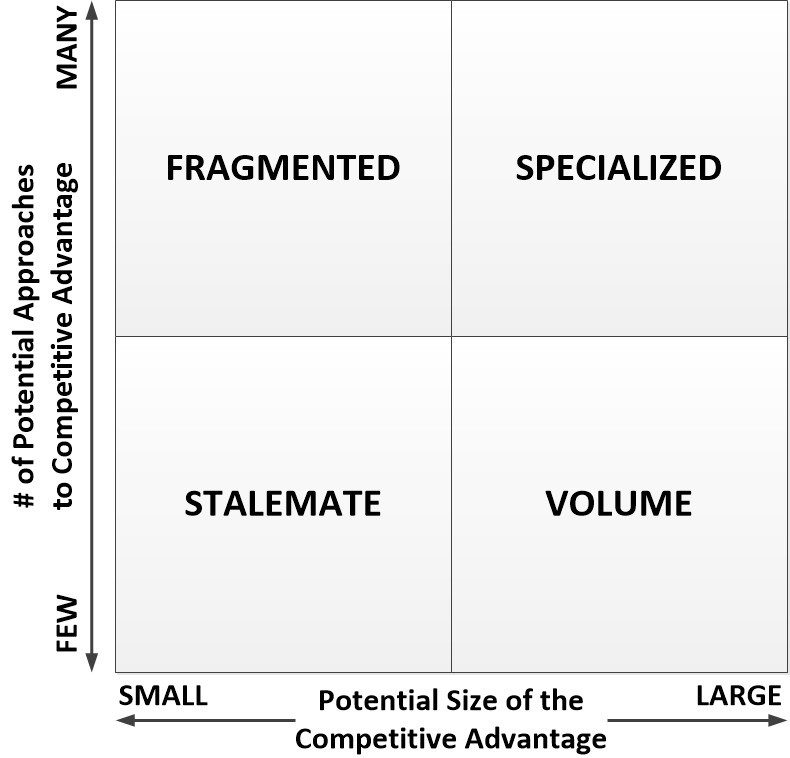
The competitive advantage matrix is over a decade old, but it’s still relevant today. With this matrix, I can analyze my company’s competitive advantage by assessing based on volume production and differentiation.

This matrix has two axes — vertical and horizontal. The vertical axis evaluates the number of opportunities available for achieving a competitive advantage, while the horizontal axis measures the potential size of the competitive advantage.

Using this information, the competitive advantage matrix is segmented into four quadrants:

  • Stalemate industries. Few opportunities to differentiate and the impact on revenue is small. The odd of profiting in these industries is low.
  • Volume industries. Few opportunities to differentiate, but the impact on revenue is high. The odds of profiting in these industries is high.
  • Fragmented industries. Many opportunities to differentiate, but limited impact. Here, businesses can have a substantial profit potential if they offer differentiated and value-added products and services.
  • Specialized industries. Many opportunities to differentiate with great profit potential, especially if the business can learn the ropes of its specialized offering and have the resources to scale.

Testing Out the Competitive Advantage Matrix

Below is how different businesses you know might fit into the four quadrants of the competitive advantage matrix.

competitive advantage matrix filled out

Stalemate (Few advantages with small potential)

  • Example: Generic local store retailer

A small and local retail store that sell everyday products like groceries might be in this category.

Since this store operates in a highly competitive market and sells similar products to others, there is little differentiation and that reduces the competitive advantage.

Growth potential is also limited because of the low profit margin of the business.

Volume (Few advantages with great potential)

  • Example: Walmart

Walmart economies of scale and vast distribution network are competitive advantages with huge profit potential. The ability to offer low prices also attracts a high volume of customers.

Fragmented (Many advantages with small potential)

  • Example: Etsy

Etsy is a niched online marketplace for handmade, vintage, and unique goods.

Its diverse product range, large number of independent sellers, and thriving community of users give it a competitive edge.

However, this advantage has limited potential since products appeal to specific and smaller customer segments rather than a mass market.

Specialized (Many advantages with great potential)

  • Example: Apple

Apple’s innovative products, user experience, strong brand loyalty, and ecosystem of superior devices and services give it enormous competitive advantages.

These advantages have significant potential, allowing Apple to command premium prices and maintain a strong market share across multiple product categories, from smartphones to laptops and wearables.

See that?

With the competitive advantage matrix, I can quickly determine if I am operating in a saturated market and assess my profit potential.

SWOT Analysis

competitive analysis graph, swot analysis example

Image Source

A SWOT analysis is one of my go-to techniques for assessing how my business compares to competitors. The acronym stands for strengths, weaknesses, opportunities, and threats. I like the SWOT framework because it is simple but incredibly powerful when you dig into it.

SWOT lets me evaluate the internal and external factors that can affect the current and future potential of my business. By identifying these elements, I create a space to capitalize on my strengths, improve my weaknesses, take advantage of opportunities, and eliminate threats.

For example, if my company has an excellent profit record, this is a strength. If my company offers a small variety of products to its customers, this could be a weakness.

But how do I determine what information goes into my SWOT analysis?

Below are some questions I consider.

Strength Questions

The following questions help me discover where my company excels. This information will help me attract and draw in new customers as well as maintain existing ones.

  • What are my assets?
  • What resources do I have?
  • What makes me better than my competitors?
  • What do my customers like about my product/services?

Weakness Questions

It’s difficult for my business or any organization to improve if there’s no system to determine its weaknesses. To remain competitive, I must discover the cracks in my business and find a way around them.

  • What do my customers dislike about my products/services?
  • What areas do my competitors have an advantage in?
  • Do I or my employees lack knowledge or skill?
  • What resources do I lack?

Opportunity Questions

Monitoring my competition is necessary; however, watching for opportunities will give my business a competitive advantage. These opportunities can come from both monitoring my competitors and industry trends.

  • What are the current trends?
  • What is my market missing?
  • Is there available talent that I could hire?
  • Are my competitors failing to satisfy their customers?
  • Is my target market changing in a way that could help me?

Threat Questions

Threats can come up within a business at any time. These can be internal or external factors that might harm my company and its operations. Identifying these threats will help my business run efficiently.

  • Who are my competitors?
  • Has there been an increase in competition?
  • What are the obstacles I am currently facing?
  • Are my employees satisfied with their pay and benefits?
  • Are government regulations going to affect me?
  • Is there a product on the market that will make mine outdated?

As shown by these questions, a SWOT analysis matrix can help your company identify elements that are often overlooked.

Competitive Profile Matrix

Competitive profile matrix

A competitive profile matrix is a tool that any company can use to compare its strengths and weaknesses to industry competitors. To use this matrix, I’ll need four elements: critical success factor, weight, rating, and score.

Critical success factors are areas that will determine my success. Examples are brand reputation, range of products, and customer retention.

After selecting these factors, I will assign a weight to each one. The weight measures the importance of each factor, ranging from 0.0 (low importance) to 1.0 (high importance). I recommend that you avoid assigning a weight of 0.3 or more, as most industries thrive based on many factors.

This high value can decrease the number of factors you’re able to list in your matrix. When assigning weight, I need to ensure the sum of all weights equals 1.0.

The third step is to rate my company and its competitors from 1 to 4 in each critical success factor where:

  • 1 = Major weakness
  • 2 = Minor weakness
  • 3 = Minor strength
  • 4 = Major strength

The last step is to calculate the score.

First, I’ll multiply the weight of each critical success factor by the rating. After this step, I’ll add each company’s score to get the total score.

This, when compared to my competitors, will show if I’m behind the curve, ahead of the curve, or on par with competitors in my industry.

Testing Out the Competitive Profile Matrix

Competitive profile matrix example

Sales Matrix

A sales matrix is a tool for gauging the urgency and viability of sales opportunities. It evaluates potential customers’ interest in my business against their fit for my services.

sales matrix example

Image Source

For instance, when I send out cold emails to potential customers, I am not 100% concerned about the open rate. What I am concerned with is the reply rate. Of course, if anyone on my list doesn’t respond, I follow up.

After getting a response, I want my prospect to fall into any of these categories within the sales matrix.

Sales matrix example

With this simple matrix, I get enormous benefits, such as:

  • Insights into what I should do and when.
  • Not getting stuck by sending content and promotions to bad-fit prospects.
  • Not wasting valuable time that could be redirected elsewhere.

The best part? I can now use my energy and resources to pursue prospects who are a good fit and interested, making selling easier.

Product Feature and Benefit Matrix

The product feature and benefits matrix evaluates how my offer matches customer needs. It’s weighted by its importance versus its perceived distinction or advantage. When using this matrix, features will fall into the following categories:

  • Irrelevant. Low importance and low distinction.
  • Overinvested. Low importance and high distinction.
  • Key liabilities. Low importance and high distinction.
  • Key differentiators. High importance and high distinction.

Pricing Strategy Matrix

Image Source

If I am building a product, this information tells me what features to keep, what features to get rid of, and where I might save money.

Consider an iPad. Say Apple spends much of the manufacturing budget to produce a high-quality camera, only to find out that most users don’t even use it.

The camera has a high perceived distinction, yet it’s of low importance to iPad users. This information would tell Apple that they overinvested in this feature and could potentially reduce it to save costs in the future.

The price matrix is useful for deciding any business’ pricing strategy. Often, this is based on its product innovativeness and the availability of competitors.

This matrix is like the competitive advantage matrix because companies can only price their product based on the edge they have.

In the price matrix, there are four quadrants:

Skimming. Skimming is best for new and innovative products with little to no competition, where customers will pay a premium. Apple uses this strategy when it launches new products like the iPhone at a high price point.

When Apple makes a more recent product, it lowers the price of the previous product to create a demand for its new product.

I found that HubSpot once used this strategy when it had far less competition in the CRM space. However, HubSpot has now slightly shifted to include the Economy model.

Premium. This works for luxury products where unique benefits or exclusivity appealing to customers. An excellent example is Rolex.

Economy. Ideal for price-sensitive customers. This also works for markets with low production costs and little differentiation. Think Walmart.

Penetration. Used to enter a competitive market with the aim of gaining market share quickly. This is popular in the software industry where I operate.

Now, when creating a pricing matrix, I’d recommend you go from:

  • Penetration to economy
  • Skimming to economy
  • Premium only (requires marketing budget to raise awareness)

To improve on it further, check what your competitors did and see if you can do the same or better.

Note: Unlike the other matrices on this list, a price matrix is a customer-facing competitive matrix type. You are creating it for your potential customer. So after deciding on your pricing strategy, go further with pricing tiers.

example of hubspot pricing tiers on marketing hub product

It’s common to have two or three levels. Once you’ve named them, create a short description. Depending on the industry, you might find it easier to include a few features associated with the category.

Once you do, list the prices. If not, create a call-to-action (CTA) for your potential customer to contact you for a quote.

Remember, as you build your tiers, the price will increase with each one. To stay on par with the perceived value, offer additional features or benefits to justify the cost.

The Benefits of Competitive Matrices

Competitive matrices are great because I can use them to compare any characteristics of my company with those of a competitor.

Sometimes these matrices will be more visual (like a competitive analysis graph), and sometimes it’s just an Excel document with the information listed in columns.

The goal of the competitive matrix is to see at a glance the competitive landscape and my position in the marketplace. This will help me see gaps and hone in on my unique value proposition.

A competitive matrix can also be a great way to brainstorm new service ideas or, if you sell a product, get new ideas for tools or features you hadn’t considered before.

You might even come out of it with ideas for improving your content marketing strategy. You can use a competitive matrix for a lot of reasons.

Then, after figuring out what to do with the information, document your ideas, develop KPIs, and regularly conduct this analysis to stay current with your strategy.

How to Find Competitor Data

The internet has democratized access to information. As such, you can easily find information about your competitors if you look at the right places online.

Here are some places I check when researching my competitors:

  • Google
  • Competitor’s website
  • Sitemap
  • Social media accounts

The process will be different for every business. But generally, I find these online and physical outlets will be helpful for gleaning information about your competitors:

  • Google
  • Competitor website
  • Website sitemap
  • Social media accounts
  • Yahoo Finance
  • Crunchbase
  • SimilarWeb
  • Angellist
  • SEC Filings
  • YouTube
  • Brochures
  • Trade shows
  • Newsletters

How to Present Competitive Analysis Data

During my time at a B2B content marketing agency, we always presented data to clients. It was always “here is what your competitors are doing” and “here is what we recommend.”

To do this, we always included set elements to present our data so it told a story that stuck:

  • Know the audience you’re presenting to. It’s okay to have different presentations for different audiences. For instance, while we created detailed documents of a client’s competitive position, we shared a quick summary with founders. However, the detailed slides go to C-level executives in the marketing or SEO department.
  • Use quality graphics. Whether it’s a matrix template, a screenshot, or an image, ensure it has high resolution.
  • Use competitor logos. Visual impact is key. Use logos to help your audience know the brand you’re referring to.
  • Show the product. Include your audience’s asset, which helps them connect the data you’re sharing to the outcome they can expect.
  • Maintain consistency. Don’t present A about Competitor 1 and then jump to B about Competitor 2. Discuss one thing about all competitors before discussing the next.
  • Be factual. Present where your client’s competitor is thriving and where they are falling short. This gives the client an obvious opportunity for what they can swoop in on immediately.

Now that you know what a competitive matrix is and how to use one, let’s review some templates you can use for your own strategy.

Competitive Matrix Templates

Ultimately, a competitive matrix is an industry-analysis tool with many benefits. To make the process even easier, use the following competitive matrix templates.

1. Two-Feature Competitive Landscape Chart

One type of competitive matrix you can do is a simple comparison of features. You can use this information to plot where your company is compared to competitors.

The features could be something like price or customization potential. Then, you’d place the logos of each company (including yours) on the competitive analysis graph, depending on how well a company executes a certain feature.

The point of this matrix is to visualize who does what better, so you can see what you have to work on and how to differentiate yourself against the competition.

Two-Feature Competitive Landscape Chart

Download this Template

2. Content Marketing Analysis Template

As a content marketer, this is my favorite template. With this, I can compare social media followers, blog strategy, email strategy, SEO, etc.

This will help me decide where I need to focus my content strategy. If you download this template, it also includes a graph and more strategies to analyze.

content marketing competitive analysis template

Download this Template

3. SWOT Analysis Template

A basic competitive matrix is the SWOT analysis. Conducting a SWOT analysis will help you identify areas where you could improve.

You should conduct a SWOT analysis for yourself and your competition. Knowing your competition’s weaknesses will help your sales reps and help you improve in those areas.

SWOT analysis template

Download this Template

4. Review Tracker

A review tracker matrix will help you see at a glance the reviews you get versus your competitors. It’s important not to forget about reviews because they can have a significant impact on a business.

With this template, you can also use a scoring system to normalize the averages.

Competitive matrix review tracker template

Download this Template

After reviewing those templates, it’s time to see what a competitive matrix looks like in action. Here are some examples below.

Competitive Matrix Examples

1. HubSpot

This is a public HubSpot competitive matrix comparing the overall pricing of our CRM versus Salesforce. It’s a standard matrix meant to help people see the difference between the CRMs at a glance.

hubspot competitive matrix example

2. SugarSync

This is a great example of what a feature matrix might look like. SugarSync compares its feature offerings against the competition in an easy-to-understand visualization.

sugarsync competitive matrix example

Image Source

3. 360iResearch

In this example, 360iResearch reports on survey management software. This is a competitor grid showing which companies have the best product satisfaction and business strategy.

hubsp360i research  competitive matrix example

Image Source

No Competition, No Progress

Innately, competition feels unpleasant; however, that’s not all it has to be. It can lead to growth, make us look deeper into our business, and improve.

Competitive matrices are great tools to help you uncover how you’re different from your competitors. Three that I really like are the competitive advantage matrix, SWOT (for its simplicity), and the sales matrix.

These — and the other matrices — show areas of improvement and where we can excel. If you’re having trouble evaluating your company’s position in your industry, use this article and the above tools to help.

Editor’s note: This post was originally published in January 2021 and has been updated for comprehensiveness.

Categories B2B

How to Use AI for Technical SEO, Straight from HubSpot’s Tech SEO Team

HubSpot’s 2024 State of Marketing Report found that marketers save around 2.5 hours per day with AI. Further, 60% of marketers see AI tools as helpful assistants in their jobs.

Download Now: The Annual State of Artificial Intelligence in 2024 [Free Report]

When it comes to technical SEO and AI, specifically, I set out to answer three burning questions: Are SEO folks using AI? If so, how? And is it actually worth it?

To find answers, I contacted members of HubSpot’s technical SEO team and practitioners from my external network.

If you’re asking yourself the same questions, you’ve come to the right place. Let’s get into the good stuff!

Table of Contents

How to Use AI for Technical SEO

Technical SEO refers to anything you do that makes your site easier for search engines to crawl and index. Technical SEO, content strategy, and link-building strategies all work together to help your pages rank highly in search.

AI can be leveraged in various ways to help your technical SEO strategy. The first five use cases are from HubSpot’s internal SEO team.

The final three are from SEO practitioners in my network doing interesting things with AI for tech SEO purposes.

1. Improve Internal Linking Architecture

I know what you’re thinking: Isn’t internal linking on-page SEO? As with most things in SEO, it depends. (You knew that was coming at some point, folks, so I got it in early for good measure.)

You might not figure out anchor text for individual links as part of your technical SEO efforts. However, you will need to factor in internal linking as part of a site’s overall link architecture. To get a clear picture, you’ll need a bird’s-eye view of any existing internal linking.

Enter Killian Kelly’s use case for AI. Kelly is a marketing manager and SEO content strategist working on HubSpot’s EN blog strategy.

“I‘m currently looking into ways we can enhance our blog’s internal linking structure by using Screaming Frog‘s Ngram tool,” says Kelly.

“It’s going to be incredibly useful for navigating through the large amount of content on HubSpot’s blog. The tool is excellent at identifying both linked and unlinked keywords within the content, which is very helpful for internal linking.”

ai technical seo: using Screaming Frog’s Ngram tool to find internal linking opportunities

Image Source

Kelly adds, “During this exploration, I stumbled upon the possibility of integrating OpenAI with Screaming Frog. This will allow us to use ChatGPT prompts during the crawl, which can help automate and optimize different aspects of SEO.”

Kelly explains that the integration should help automate tasks like writing and optimizing alt text for images, creating anchor text, and structuring data automatically.

It can also automatically classify the content into themes, which he thinks would be very helpful for understanding page intent and possible correlations between content types and performance.

Best for: Many of the AI automations mentioned above are more relevant to on-page SEO. So, I think this use case would benefit you if you have a mixture of on-page and tech in your role. And let’s face it, that’s a lot of us these days.

2. Generate Schema Tags

The next four use cases come from Sylvain Charbit, the senior marketing manager on HubSpot’s tech SEO team. He discusses using AI to generate schema tags, conduct log file analysis, and more.

“There are a few ways to use AI for technical SEO, the most common one being to generate Schema tags,” says Charbit. “These small blocks of code are used to display rich results in search (among other things).”

ai technical seo: using Jasper Chat to generate Schema tags

Image Source

There are a ton of AI-powered schema markup generators available online. If you’re already using Jasper.ai for your content efforts, you can use Jasper Chat to create schema markup.

Of course, there’s OpenAI’s ChatGPT. I know of many folks who use the free version for this task.

As with anything AI-related, you’ll want to validate what the tool spits out to make sure it’s accurate and functional.

Best for: SEO practitioners who aren’t very comfortable with coding. But even if you are, it can help you save time.

3. Log File Analysis

“Another way we leverage AI for technical SEO is to have it analyze part of our logs (the one without sensitive user data) and recognize behavior patterns,” says Charbit.

“Maybe Googlebot is getting stuck somewhere or crawling many URLs with no interest. AI allows us to know what is going on in a flash and to act accordingly.”

Disclaimer alert: I haven’t personally tested this. However, you should be able to use the Data Analysis GPT in ChatGPT to add some AI magic to your log file analysis. Theoretically, it should be as simple as dragging and dropping your log file into the GPT and asking it a question to get started.

ai technical seo: using Open AI’s Data Analysis GPT to analyze a log file

Image Source

Asking Open AI’s Data Analysis GPT questions about data from a log file

Image Source

If you’d like to explore this concept further, I found this tutorial pretty helpful!

<iframe width=“560” height=“315” src=“https://www.youtube.com/embed/8CpXdAamxeA?si=Gu_8IY8MuUpssmZX” title=“YouTube video player” frameborder=“0” allow=“accelerometer; autoplay; clipboard-write; encrypted-media; gyroscope; picture-in-picture; web-share” referrerpolicy=“strict-origin-when-cross-origin” allowfullscreen></iframe>

Best for: SEO practitioners who want to recognize behavior patterns at speed.

4. Get a Second Opinion on Your Code

HubSpot’s Sylvain Charbit shares another use case for AI in technical SEO.

“Additionally, getting an opinion from AI on a block of code can be useful to detect an issue if a manual review doesn’t provide any results,” Charbit says.

I’d say that in this case, whatever AI tool you use to validate your code, it should, as the cool kids say, function as your “intern.”

That’s opposed to taking the lead with your code. In short, for this use case, you must have the skills and knowledge to recognize whether AI is hallucinating.

Best for: SEO practitioners with a competent understanding of code but would like a second opinion.

5. Communicate Technical Ideas to Decision-Makers

“Last but not least, communication! Being able to simplify and communicate technical SEO is crucial to getting buy-in from decision-makers,” says Charbit.

He adds, “As I am constantly head down into technical stuff, I can sometimes forget that some terms or facts are not known to many people. AI reminds me of this and improves collaboration with multiple stakeholders by providing more digestible information.”

If I were to do this, I think I’d probably enlist Grammarly, one of my go-to AI-enhanced tools, for the task. Why? It’ll accomplish two things at once.

First things first, it’ll check the text for spelling, grammar, and tone. Second, you can use the new “Increase the impact of your text” feature to highlight any parts of the text that you might need to clarify for a beginner audience.

I’d also highly recommend the “Clarity” function. I’ve been really impressed with how much that’s improved in the last year or so!

Using AI for technical SEO: Setting the Audience goals in Grammarly

Image Source

I’d start by setting the “Audience” goal to “General.” I’d then click “Increase the impact of your text.”

I do have a word of warning for this Grammarly feature, though. Sometimes, it can be a little over the top with its suggestions. Then, before you know it, rather than filling in your audience’s potential knowledge gaps, you’re actually talking down to them.

I generally use this feature to highlight potential areas for improvement rather than using the solutions presented by Grammarly.

ai technical seo: using the Increase the impact of your text feature in Grammarly

Image Source

Best for: SEO practitioners who need to communicate technical ideas — including the business benefits of implementation — to non-technical stakeholders.

6. Track Headers During Audits

Next, Mike Ciffone, an SEO consultant at Ciffone Digital, shares how he’s been using AI for technical SEO audits.

“While perhaps not the most glamorous use of AI, in my audits, I’ve been using it to keep track of headers,” says Ciffone. “When I fire up Screaming Frog, I use the JavaScript execution feature to store the HTTP response of each URL. Then, with AI, I’m simply asking questions and getting told the story.”

Ciffone asks AI questions like:

  • Are there any patterns in response codes?
  • Where are we getting the most cache misses?
  • Do I have X-robots headers setting no-index/nofollow or canonicals anywhere?

He adds, “In my opinion, there’s way too much instinct involved in auditing for AI to be very useful for any sort of automation (for now at least). However, as a personal assistant, it’s drastically improved my efficiency and shortened my turnaround times.”

Best for: SEO practitioners working with the combination of having a separate mobile site (e.g., m.example.com), multiple language and geo versions, and also working with a progressive web app versus merely a responsive site.

7. Deploy Schema at Scale

I wanted to build upon the schema tag generation use case presented by Sylvain Charbit (number two on this list.)

So I contacted International SEO Consultant Aarne Salminen, who I noticed talking about generating schema templates in bulk to deploy sitewide in MostlyMarketing’s Slack community.

“I do this for sites that have hundreds of content types = schema templates and millions of URLs,” says Salminen. “If you have just a few types of content, I might not go the AI route, but on large-scale projects, it seems to speed up things, including setting everything up.”

Salminen adds, “I don’t use AI in any active component in the process because reliability is most likely still an issue. So it is in the preprocessing stage and/or planning stage, where you build up templates per content type, keeping the big picture of the website infrastructure and internal connections in mind.”

I asked Aarne to share what this process looks like. He said he feeds it the data of their site, such as Screaming Frog type of data with identified and manually verified page types, and lets the AI run the first pass of suggestions.

After that, he verifies and validates the AI input, tweaks it, and does a second pass if need be. Then, he verifies and validates again, and finally, it goes to implementation.

Best for: SEO practitioners working on sites that have large quantities of content types and URLs.

8. Visualize Google Search Console (GSC) Data

Last but not least, I learned about this use case from Sreeram Sharma, an SEO consultant and co-founder of Angleout.

“I use ChatGPT to visualize the GSC data while looking for pages that were hit or gained traffic during a specific time period,” says Sharma. “This helps me to plot a graph and visualize stuff rather than using Tables or Looker Studio. I like using this approach compared to Looker Studio.”

I asked Sharma to expand upon the process:

“I run a screaming frog audit and export it into sheets, then use vlookup to map them with clicks + impressions before/after traffic drop. Now, I upload the sheet to ChatGPT and ask it to visualize and show a correlation of the number of tech errors versus the drop in traffic.”

A correlation of pages with increased impressions and clicks from ChatGPT

Image Source

A correlation of pages with decreased impressions and clicks from ChatGPT

Image Source

Sharma adds, “This helps me get an approximate idea of traffic drop and makes it a bit easier to explain to my clients on monthly calls. So far, they’ve loved it.”

Best for: SEO practitioners looking for an alternative to Tables or Looker Studio.

Adding AI to Your Technical SEO Strategy: Yay or Nay?

Ever since OpenAI unleashed ChatGPT in the winter of 2022, there’s been a ton of hype around AI.

Upon the back of the release — and seemingly in the blink of an eye — we went from AI being a developing concept, bubbling away in the background, to it being everywhere. Integrated into anything and everything.

The floodgates had truly opened.

Now, it‘s the summer of 2024. You look to your left: AI. You look to your right: Oh, hello, that’s some more AI. But unlike 2022, the dust has settled somewhat, and maybe you’re like me, constantly asking: Is the juice really worth the squeeze?

When it comes to AI for technical SEO, the answer is both yay and nay. Honestly, it depends on your unique situation. That said, there are two things I can say with absolute confidence:

1) There‘s literally no point using AI for tech SEO simply for the sake of it. If it doesn’t add value to your process (i.e., save you time and improve efficiency), it’s hype — plain and simple.

2) If you remove the human from tech SEO at this stage, where AI is right now, you’re cooked.

On the latter point, will this change in the future? Who knows. I personally don‘t think you can ever fully remove humans from SEO. But that’s just my humble opinion.

What do you think?

Categories B2B

Top Shopping Trends of 2024 & How They’ve Changed [New Data]

Shopping trends have drastically changed over the past few years. While most of us previously browsed retail stores on a Saturday to find great deals, we now turn to Instagram to find discounts offered by influencers.

Download Now: The State of U.S. Consumer Trends [Free Report]

And rather than watching TV ads to find out about new products, nowadays, most of us stumble across ads in between YouTube videos.

Here, we’ll explore the shopping trends of 2024, as discovered in our State of Consumer Trends Survey, to ensure you’re able to meet customers where and when they’d prefer to shop. Let’s dive in. 

Table of Contents

How Shopping Trends Changed in 2024

1. Consumers prefer flexibility over subscription models.

These days, consumers have a lot of flexibility in how they purchase products.

They can make a one-time purchase or join a subscription service. Thanks to popular platforms like Afterpay and Klarna, they can also pay full price or via installments.

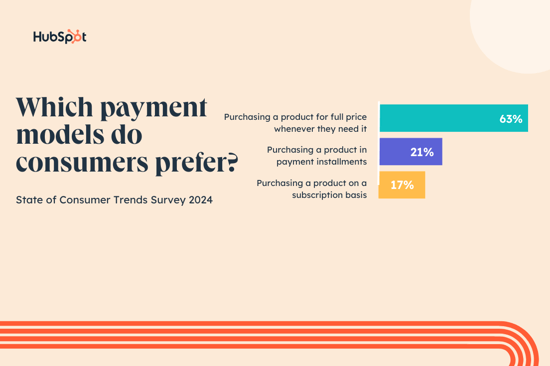
However, this flexibility may not be necessary. A staggering 63% of consumers still prefer purchasing products whenever the need arises. Only 17% actually prefer purchasing a product on a subscription basis. 

“I’ve seen a few ‘grocery subscription’ services pop up over the last year or two,” HubSpot staff writer Erica Santiago says. “Basically, you sign on to get a certain item on a monthly basis. But I prefer getting items as I need them because I don’t like getting roped into a commitment to purchase if that makes sense.”

She explains, “Let’s say I typically order a lot of fruits and veggies, so I subscribe to a service that delivers my usual quantity of fruits and veggies each month.

However, the summer rolls around, and I’m out of town a lot for vacations, weddings, etc. Now I have all the produce coming in that I might not have time to eat. Or, I have to remember to pause the subscription while away.”

Santiago says a subscription sounds like too much of a hassle to manage and is not always a guarantee that she’ll save money.

“I have too many subscriptions as it is, and I’m always getting emails from these services about subscription prices increasing,” she says.

“It can be a pain to remember what to cancel, what’s worth the investment. I’d rather just buy things as I need them.”

Moreover, consumers prefer to purchase products at full price. Only 21% of consumers prefer purchasing a product with installments.

“An installment is like another monthly payment I need to remember along with my list of other monthly payments, even if it’s temporary,” Santiago explains.

“Again, I’d rather buy something once, pay it in full, and not worry about it until the next time I need it again.”

 A staggering 63% of consumers still prefer purchasing products whenever the need arises. Only 17% actually prefer purchasing a product on a subscription basis. 

2. Baby Boomers are skeptical about shopping via social media, but they’re coming around.

According to our report, a slim 8% of Baby Boomers feel comfortable making purchases directly on social media. Though Baby Boomers are skeptical about shopping via social media, things could be turning around.

20% of Baby Boomers have discovered a new product on social media in the past 3 months — a 41% jump from May 2022. On top of that, 8% of boomers have bought a product on social media in the past three months, a more than 50% jump from May 2022.

While these stats are promising, it’s important to meet your consumers where they are right now. So, if you’re audience skews older, you might get more traction with other channels like TV ads and search.

3. A company’s stance on social issues remains important to Millennials and Gen Z’ers, but the quality of the products reigns supreme.

Consumers do want to support companies that share their values. For example, 64% of consumers want companies to reduce their environmental impact.

However, numbers suggest it’s not as big of a deciding factor as previous years:

  • 58% of consumers believe companies should donate a portion of their profits to charity, a 3% decrease from 2023. 
  • 76% of consumers believe companies should try to improve the well-being of their employees, up only 1% from May 2022.
  • Only 7% of consumers say whether companies donating the proceeds from their purchases to charity is the most important factor in their purchasing decision. 

When a company takes a genuine stand, it can be an effective way to build trust and credibility with consumers. However, consumers care most about the quality of a product or service and whether it’s worth their money. 

Our study found that 51% of consumers say the quality and price of a product are the most important factors in their purchasing decisions. Furthermore, one of the top concerns consumers (44%) have with buying items online is the quality, according to our survey. 

The Top Shopping Trends of 2024

1. For Gen Z, influencer recommendations matter more than recommendations from friends and family, but that gap is narrowing. 

According to our survey, a little over a fifth of Gen Z consumers (22%) prefer to discover new products on social media via influencers, and 29% of millennial consumers say the same.

Furthermore, 27% of Gen Z consumers say they’ve made a purchase based on an influencer’s recommendation in the last three months, and 36% of millennial consumers say the same.

Influencer marketing has remained an effective strategy for brands over the past few years, which is why 50% of marketers plan to increase their investment in it in 2024.

However, our survey shows a slight shift in the trend, at least among Gen Z consumers. Only 9% of Gen Zers in our survey said recommendations from friends and family are among the most important factors in their purchasing decisions.

This is only 2% less than the amount of Gen Zers who say the same about influencer recommendations. 

That said, most millennials and Gen Zers in our survey still have a lot of trust influencers and consider their recommendations in their purchasing decisions.

This makes sense in many ways: Influencers are traditionally considered experts in their niche. If I follow a makeup influencer, I can safely assume he or she knows more about makeup than most of my friends.

For e-commerce businesses, this is powerful news: It means you no longer need to rely on word-of-mouth alone (though word-of-mouth should still be a part of your strategy).

Instead, it’s wise to focus your efforts on influencer marketing since influencers have demonstrated a level of influence over their audiences that surpasses even that of friends and family.

2. Gen Zers prefer to discover new products via social media — but they still like to make purchases in-store.

Our State of Consumer Trends Survey found 40% of Gen Zers (ages 18-24) have discovered new products on social media in the last 3 months, followed by internet searches (28%), and word of mouth (26%). 

If your e-commerce business is targeting Gen Zers, then, it’s vital you focus your efforts on social media rather than paid ads when it comes to attracting new leads to your products and educating those leads on your products.

Additionally, when asked which content formats Gen Zers prefer for learning about a product and its features on social media, the majority (48%) said they’d like to learn about a product through a short-form video like a TikTok or Reel.

The same percentage applies to social media marketplaces where purchases happen off the app, like Facebook Marketplace.

However, 38% of Gen Zers say they’d still prefer to purchase a product in-store.

This is an important call-out: While you’ll want to focus on social media for your lead generation efforts, it’s still vital to have a strong, effective in-store shopping option for those who would like to make the final sale in person.

40% of Gen Zers (ages 18-24) have discovered new products on social media in the last 3 months.

3. When it comes to millennials and Gen X, social media is the most popular option for discovering new products.

Similar to Gen Zers, social media (34%) is the most popular method among millennial buyers for discovering new products.

However, YouTube ads (29%) are a close second for millennials, which means that if you’re targeting a millennial demographic, you might want to consider investing in YouTube and YouTube Ads to get their attention. 

And if your target audience is Gen X (35-54-year-olds), social media is also the most popular option. The majority of Gen X (28%) say they prefer to discover new products via social media.

Plus, 27% of Gen X buyers also search the internet for new products, so SEO is another good option here.

4. Millennials, Gen Xers, and Gen Zers prefer to discover new products via short-form videos.

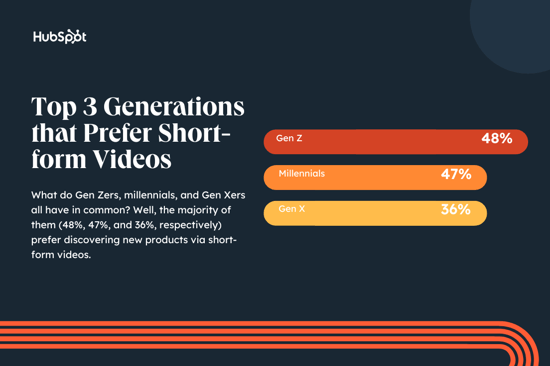
What do Gen Zers, millennials, and Gen Xers all have in common? Well, the majority of them (48%, 47%, and 36%, respectively) prefer discovering new products via short-form videos.

So, if you’re aiming to attract those three generations, you’ll want to consider short-form videos like TikTok or Instagram Reels.

What do Gen Zers, millennials, and Gen Xers all have in common? Well, the majority of them (48%, 47%, and 36%, respectively) prefer discovering new products via short-form videos.

5. Mobile phones are the most popular device for online shopping, but most consumers prefer buying in-store. 

The majority of consumers in our survey (62%) say they prefer shopping online with their mobile phone over using a tablet, computer, laptop, or other device.

You’d think this would mean they prefer making purchases via a mobile app or their phone. Surprisingly, that isn’t the case! 64% of consumers in our survey actually prefer purchasing items in-store.

“I find new products online all the time, and I’ll even do some ‘virtual window shopping,” says HubSpot’s Santiago. “Basically, I’ll peruse different online stores via my phone and not always with the intention of buying anything.”

However, like the 52% of millennials in our survey, Santiago says she prefers purchasing items in-store. 

“I like being able to hold an item in my hand to get a feel for the quality or trying on clothes in a fitting room, and those are experiences you really only get if you’re shopping in person,” she says.

Again, ensure that your in-store experience is just as delightful, easy, and effective as your digital store. 

And, if you’re an e-commerce business, it’s critical your website is mobile-optimized, and you have mobile-responsive product pages.

If I’m scrolling a company’s products and I find it’s too difficult or cumbersome on my phone, I typically ditch the website – and don’t return. So it’s vital you ensure you’re following mobile best practices (including large text, lots of white space, responsive templates, and mobile-friendly calls-to-action).

6. Price and quality matter most when it comes to making a purchasing decision — but not always in that order.

Most of our Gen Z (40%) and Boomer respondents (71%) say price is the most important factor when deciding to buy a product. 

However, our survey suggests that price is actually second to quality in the eyes of Millennials and Gen Xers. Most of our Millennial respondents (33%) rank quality as the number one factor when deciding on a purchase, and 46% of Gen Xers say the same. 

According to our survey, quality is the second most important factor for Gen Z and Boomers. No matter the order, price, and quality are the top two deciding factors, so make sure your products are fairly priced and of high quality. 

7. Short-form video offers huge advertising opportunities.

Short-form video is the most popular video length on social media. As a result, TikTok — and other short-form video platforms — are becoming viable advertising channels. In fact, 37% of consumers in our survey want to learn about products through short-form videos like TikToks or Reels.

On top of that, 52% of U.S TikTok users say the advertisements they see on the platform are fun and engaging — which are two ingredients for effective ads.

The Shopping Trends to Expect in 2025

Here are a few trends you’ll continue to see: 

  • Omnichannel retailing will be a priority. Our survey results show that mobile, online, and in-store shopping are all important to consumers across generations to varying degrees. So, expect to see businesses lean heavily into omnichannel retailing. In other words, businesses will ensure the shopping experience is consistent, connected, and delightful no matter how or where customers are shopping. 
  • Sustainable and ethical practices will be crucial in retaining consumer trust. Consumers care a lot about a company’s values and ethics. For example, we found that 64% of consumers agree that companies should try to reduce their environmental impact. So, think of ways your company can operate sustainably and ethically for both the planet and your consumers. 
  • Prepare to see a lot of micro and nano-influencers in short-form video advertisements. Short-form video is still a preferred medium for many consumers learning about new products and marketers continue to see success with micro and nano influencers. So, it makes sense you’re going to see more influencers promoting products and services on short-form video platforms like Instagram Reels, YouTube Shorts, and TikTok.

When creating an effective e-commerce strategy, it’s vital you take the time to understand how shoppers want to shop today — and into the future.

Shopping behaviors change over time. The more your business can meet the evolving needs of your consumers, the more likely you are to continue to succeed well into the future.

Categories B2B

What Jobs Will AI Replace & Which Are Safe in 2024 [+ Data]

Is AI taking over jobs in 2024?

Get Started with HubSpot's AI Campaign Assistant

A quarter of workers are worried it is.

There’s even a website called “Will Robots Take My Job?” where you can input a job title and see the likelihood of AI taking it over. I’ll admit that I’m even affected by this fear, checking the website more often than I’d like to admit.

The site is interesting to explore, but it’s important to understand the facts. So, I took a deep dive into the site to see what jobs have staying power and which don’t.

In this post, I’ll discuss the impact it’s already had, a list of jobs that AI can and cannot replace, and expert advice on how to future-proof your career and come out on top.

Table of Contents

Artificial intelligence disruption is already happening.

AI once posed the most significant disruption to assembly lines. The recent AI boom has changed that, as advancements have introduced AI to many different industries and businesses, and more and more workers leverage it to do their jobs.

For example, salespeople are using AI to analyze sales calls faster, bloggers and content creators are already using AI to streamline the writing process, and customer support reps are bringing customers faster solutions.

Salespeople are now using AI to analyze sales calls faster, marketers and digital creators are creating multi-channel content at greater speed, and customer support reps are bringing customers faster solutions.

Such functions lead to greater ROI for businesses, and this is shooting the AI optimism off the roof according to our 2023 State of AI report.

woman with sign that says only ask questions if you have already tried with chatgpt

Image Source

However, as advancements continue, will the disruption become so great that the workforce will find themselves asking, will ChatGPT replace me?

HubSpot Co-Founder and CTO Dharmesh Shah has a positive outlook on the future of AI. In fact, he thinks bots and AI will make us better at our jobs and more secure in our careers, not the other way around.

Samyutha Reddy, Jasper’s head of enterprise marketing, thinks similarly. Her teams regularly use generative AI, but she’s still actively hiring because AI can’t replace the human experience.

“We value writers in our society because they‘re able to give us a thought-provoking human perspective on the world…it’s about humans sharing opinions on very real topics that help build your perspective on how you feel about something. So an AI could really never replace that human perspective,” she says.

Despite the expert opinions of Shah and Reddy, you might still be anxious about where your career stands. I sometimes find myself lying in bed, scrolling through Reddit threads about the robot uprising. So, I put my mind at ease by turning to data.

Based on current data and the website Will Robots Take My Job?, I’ll explore what jobs AI can replace highlighting ten positions with a higher likelihood. I’ll also explore which jobs are safe from AI, highlighting ten job roles least likely to be replaced by this technology.

What jobs can AI replace?

Once in the past, concerns over machines replacing human jobs rose with the automation of physical tasks common in factories and warehouses. Now, the same is happening with AI and the fear of it replacing human intelligence in the workplace.

“Think about your position and what your position will transform to in the next 12 to 24 months. Whether you like it or not, this is happening, and it is going to happen so fast that it will change the fabric of our society. If you haven’t already done so, search for whatever your title or your position is and look at all the [AI] tools that exist within that,” Duran Inci, CEO at Optimum7 says.

Before ChatGPT exploded in 2022 and unleashed the capabilities of AI to the average user, AI had already been making inroads in the sector. Business leaders were already hiring AI specialists, devising ways to use the technology to 10x their productivity, according to a report by PwC.

Between 2012 and 2023, jobs with AI-specific skill requirements increased sevenfold. In contrast, regular jobs only doubled within the same timeframe. But while the demand for professionals with technical AI skills may be on the rise, traditional jobs with high exposure to AI may be left on the back burner.

And from a Pew Research Center study, one in five Americans work a job with “high exposure” to (this exposure is measured by how much of the job’s most important activities can be performed or supported by AI).

Job roles that involve work activities like “getting information, processing information, analyzing data and information, thinking creatively, evaluating information to determine compliance with standards, making decisions or solving problems, performing for or working directly with the public, and more” fall under that category.

And these are the jobs that AI can replace. Not entirely, but to a significant extent affecting 30% of current worked hours by 2030.

“I would say 40% to 50% of creative and generic positions are already 80% there, and you will lose millions of dollars in the next 10 to 20 years if you don’t already have the plus version of ChatGPT and if you don’t already use it,” Inci continues.

What this means is that the greater the level of AI exposure a job has, the greater the risk of replacement.

Here are some examples.

1. Telemarketers

Future of Employment Study Likelihood: 99%

Will Robots Take My Job? Likelihood: 100%

Why: You probably already receive robocalls on behalf of various products and services, and career growth in the telemarketing space is expected to decline by 18.2% by the year 2032. This is largely because of the requirements to be successful. Unlike other roles, these jobs often require repetitive and predictable tasks that can easily be automated.

However, successful human telemarketers have a level of social perceptiveness and emotional awareness that machines can never replicate.

2. Bookkeeping Clerks

Future of Employment Study Likelihood: 99%

Will Robots Take My Job? Likelihood: 100%

Why: Jobs in this role are expected to decline 4.5% by 2032, and it‘s no surprise why — most bookkeeping is becoming automated if it hasn’t been already. QuickBooks, FreshBooks, and Microsoft Office already offer software that does the bookkeeping for you, so it’s no surprise this job has such a high probability.

3. Compensation and Benefits Managers

Future of Employment Study Likelihood: 96%

Will Robots Take My Job? Likelihood: 41%

Why: As companies grow, especially across multinational markets, a human and paper-based system can present more hurdles, time delays, and costs. That’s why there is a 64% chance of full automation within the next two decades.

Automated benefits systems can save time and effort by providing benefits to large numbers of employees, and companies like Ultipro and Workday are already being widely adopted.

4. Receptionists

Future of Employment Study Likelihood: 96%%

Will Robots Take My Job? Likelihood: 93%

Why: Pam predicted this back on The Office, but in case you‘re not a fan, she said automated phone and scheduling systems can replace a lot of the traditional receptionist role — especially at modern technology companies that don’t have office-wide phone systems or multinational corporations.

But, receptionists develop relationships in the office that give them a unique advantage in providing customized support compared to an algorithmic system.

5. Couriers

Future of Employment Study Likelihood: 94%

Will Robots Take My Job? Likelihood: 95%

Why: Couriers and delivery people are already being replaced by drones and robots, so it’s only a matter of time until this space is dominated by automation altogether.

6. Proofreaders

Future of Employment Study Likelihood: 84%

Will Robots Take My Job? Likelihood: 100%

Why: Only a few jobs have a 100% risk level and this is unfortunately one of them. Proofreading software is everywhere. From Microsoft Word’s simple spelling and grammar check to Grammarly and Hemingway App, there are a lot of technologies out there that make it easy to self-check your writing.

On the other hand, the relationship a proofreader develops with a client gives them an understanding of the intention behind a writer’s work and the contextual knowledge needed to successfully complete a project.

7. Computer Support Specialists

Future of Employment Study Likelihood: 65%

Will Robots Take My Job? Likelihood: 52%

Why: The field is projected to grow by 6.2% by 2032. But with so much content on the internet with instructions, step-by-step guides, and hacks out there, it’s no surprise companies will rely more heavily on bots and automation to answer support questions from employees and customers in the future.

8. Market Research Analysts

Future of Employment Study Likelihood: 61%

Will Robots Take My Job? Likelihood: 40%

Why: Market research analysts play an incredibly important role in developing messaging, content, and products, but automated AI and surveys can compile this information more and more efficiently.

While automated research tools can have a leg up in scale, speed, and accuracy, a human researcher has hands-on knowledge and personal experience that an algorithm can’t develop. Human researchers that leverage automation tools can create a more effective process.

9. Advertising Salespeople

Future of Employment Study Likelihood: 54%

Will Robots Take My Job? Likelihood: 52%

Why: As advertising shifts away from print and TV and towards web and social media landscapes, people simply aren’t needed to manage those sales for marketers who want to buy ad space.

Social media platforms make it easy for people to buy space through free application program interfaces (APIs) and self-serve ad marketplace, removing the salesperson and making it faster and easier for users to run their ads.

Even the ads themselves are leaning more and more in artificial intelligence. When looking at actors or voice actors, we’re also seeing a trend of companies using AI voices for advertisements like commercials.

10. Retail Salespeople

Future of Employment Study Likelihood: 92%

Will Robots Take My Job? Likelihood: 66%

Why: Companies are democratizing the shopping experience with features like self-checkout, and the modern buyer is much more internet-savvy and more likely to do internet research and make a buying decision on their own.

On the other hand, the care a retail salesperson brings during a 1:1 interaction differs from automated and unemotional support, and many consumers prefer to interact with humans during the support process.

10 Jobs AI Can Replace

What jobs are safe from AI?

Although data suggests generative AI could expose over 300 million full-time jobs across the US and Europe to automation, certain roles remain largely immune to this. Going by the exposure scale, these jobs have medium to low exposure to AI.

This is because their most important work activities range from:

  • Training and teaching others
  • Performing general physical activities
  • Repairing and maintaining equipment
  • Establishing and maintaining interpersonal relationships
  • Resolving conflicts and negotiating with others
  • Developing and building teams
  • Selling or influencing others
  • Judging the qualities of objects, services, or people 

… and so much more.

What these activities revolve around are uniquely human traits like emotional intelligence, contextual creativity, discernment and manual labor that AI cannot replicate yet. This is also echoed by the World Economic Forum’s (WEF) top 10 work skills of 2025, some of which include:

  • Analytical thinking and innovation.
  • Critical thinking and analysis.
  • Creativity, originality, and initiative.
  • Leadership and social influence.
  • Complex problem-solving.

And this is true for business leaders and their hiring practices. At GuerrillaBuzz, Co-Founder Yuval Halevi, says they rely mainly on human creativity to drive their marketing efforts. “We apply AI mainly to repetitive and time-consuming tasks, removing the monotony and freeing up time for more creative work.”

In the words of Ian Shine at the WEF, these jobs are safe because “one of the human brain’s biggest advantages over AI is the fact that it is attached to a real human body.”

Without further ado, here are some jobs that are safe from AI.

1. Human Resources Managers

Future of Employment Study Likelihood: 0.55%

Will Robots Take My Job? Likelihood: 14%

Why not: It’s kind of in the name — but your company’s Human Resources department will likely always need a human at the helm to manage interpersonal conflict with the help of non-cognitive and reasoning skills. Problem solving, contextual understanding, and unique business knowledge also make a human better equipped for this job.

The field is projected to grow 7.3% by 2032 as companies scale and need more robust structures for supporting and helping employees.

2. Sales Managers

Future of Employment Study Likelihood: 1.3%

Will Robots Take My Job? Likelihood: 30%

Why not: Sales managers need high emotional intelligence to hit their monthly quotas, network and collaborate with customers, and motivate and encourage the larger sales team. Managers also have to analyze data and interpret trends. The high levels of intelligence required and the constant need to adapt to new situations make this role safe from automation.

3. Marketing Managers

Future of Employment Study Likelihood: 1.4%

Will Robots Take My Job? Likelihood: 18%

Why not: Marketing managers have to interpret data, monitor trends, oversee campaigns, and create content. They also have to nimbly adapt and respond to changes and feedback from the rest of the company and customers, making this another human-forward career AI isn’t quite ready to replicate.

A unique contextual understanding and previous business experience make a human stand out from an automated system.

4. Public Relations Managers

Future of Employment Study Likelihood: 3.7%

Will Robots Take My Job? Likelihood: 8%

Why not: Successful public relations (PR) managers rely on a network of relationships and contacts to procure press placements and buzz for the companies they represent, making this another completely safe role.

PR managers who have to raise awareness around an issue or mission need a particularly human touch to raise funds or get people to participate in a campaign, too — and jobs are expected to grow 7.6% by 2032.

Most importantly, PR managers are often on the go, attending events and being on hand to provide support if need be — a computer will never be able to do this.

5. Chief Executives

Future of Employment Study Likelihood: 1.5%

Will Robots Take My Job? Likelihood: 0%

Why not: It‘s nearly impossible to automate leadership — after all, it’s hard enough to teach it. Chief executives must inform broad strategy, represent companies’ missions and objectives, and motivate huge teams of people working for them. Executives also have years of prior experience that make them successful.

Companies may answer to stakeholders and boards of directors, who likely wouldn’t want a robot giving them an earnings report, either.

6. Event Planners

Future of Employment Study Likelihood: 3.7%

Will Robots Take My Job? Likelihood: 8%

Why not: Event planning is a growing field, and if you ask anyone on our events team here at HubSpot, whether you’re planning an event for employees, customers, or an industry event with tens of thousands of attendees, the planning process has many, many moving parts involved.

Planners have to coordinate and negotiate with vendors, contractors, and freelancers to make things come together, and the organizational and people skills involved will make this another near-impossible role to automate.

Planners also attend events, ready to step in and troubleshoot on the spot. An automated tool simply couldn’t be present.

7. Writers

Future of Employment Study Likelihood: 3.8%

Will Robots Take My Job? Likelihood: 49%

The large score difference is likely due to developments and advancements in language models post-2013 that can write entire blog posts or social media content.

Why not: Writers have to ideate, create, and produce original written material, something that AI writing tools have not yet been able to replicate in the same way as humans (see recent BuzzFeed controversy about AI-generated travel articles).

There are also many types of writers, some of which might be more at risk. An experienced journalist will likely be favored over AI, but a freelance copywriter may no longer be needed by a business that now uses AI to write Instagram captions.

8. Software Developers

Future of Employment Study Likelihood: 4.2%

Will Robots Take My Job? Likelihood: 39%

The large score difference is likely because of new back-end tools that help web developers write entirely new code, fill in gaps, and debug.

Why not: Software engineering and development is complex enough for human beings, and the time and skill investment needed to create applications, software, and websites will be tough to replicate — especially since developers need to execute perfectly to create great products for customers.

The field is expected to grow by 30.3% by 2032, so if you‘re a software developer, you’re sitting pretty for now.

what jobs will ai replace, coding

Image Source

9. Editors

Future of Employment Study Likelihood: 5.5%

Will Robots Take My Job? Likelihood: 45%

Why not: While the automated proofreading technology mentioned previously can take a load off, editors have to review writers’ submission for clarity, accuracy, comprehensiveness, and originality.

Some software can spot-check for clarity and scan for plagiarism, but the editor role must be carried out by a human in order to read work as another human would.

Today, 86.33% of marketers who use AI, for example, always make edits to the content that AI produces, according to our State of AI in Marketing survey.

10. Graphic Designers

Future of Employment Study Likelihood: 8.2%

Will Robots Take My Job? Likelihood: 34%

Why not: Image generators like Midjourney and DALL-E make it easy for people to create what they want, but graphic design is an artistic and technical field best suited for someone with fine arts training and experience. Like writing, graphic design work must be original and tailored to a unique use case.

If a graphic designer is working with a business, it also requires building a relationship between both parties throughout the design process. Plus, some image creators have been found to plagiarize artists’ work — a lawsuit is likely the last thing people want.

10 Jobs AI Can’t Replace

Navigating Artificial Intelligence

Kate O’Neill, the author of Tech Humanist and founder of KO Insights, explains that jobs that require emotional intelligence will be safer in the immediate future:

“This is going to be a continuously moving target, but for the time being, what AI can’t do well is use emotional intelligence, understand situational context, make judgment calls, and generally see nuance and meaning like we do.”

“That means any kind of job that benefits from these kinds of human attributes is better off done by a human. A computer or robot may assist you in performing efficiently, but for now, you’re the one who adds the expertise on how to perform appropriately,” she adds.

This is echoed by Halevi, who says, “Having knowledge that’s beyond the obvious is crucial. AI tools like ChatGPT and Gemini can sometimes provide inaccurate or misleading information.”

“Without a deep understanding of your specific area, you might be misled or produce subpar work. Expertise ensures you can critically evaluate AI outputs and maintain high-quality standards.”

Even for jobs that are more likely to be impacted, there are always reasons why a human with real-life experience and expertise is a better fit. The best way to navigate the fast-moving world of artificial intelligence is to stay informed and adaptable.

How to Future-Proof Your Career

Between January and May 2023, 417,500 jobs were cut. However, only 3,900 were reportedly because of artificial intelligence — less than 1%. Still, regardless of what happens, you might be wondering how to future-proof your career. The answer? Re-skilling.

On a Marketing Against The Grain Episode, Kipp Bondar, HubSpot’s chief marketing officer, says, “As I think about the evolution of AI, I think about one of the things that’s going to go part and parcel with it is the need to be amazing at re-skilling our workforce all around the world.” (Listen to the full episode here).

Re-skilling doesn’t mean preparing for the worst. Most jobs expect employees to engage in some sort of professional development, so this might be routine for you.

For example, you could explore different AI tools and how to leverage them in your day-to-day role. HubSpot’s AI tools, for instance, give you access to a suite of AI tools that could perform functions like content creation, data analysis, and even build a chatbot.

hubspot ai tools

Image Source

Or you could take a course to learn a new skill. As Shah said above, AI’s most significant impact will likely be helping us be more effective in our careers.

But, if your job is impacted, having taken the time to re-skill leaves you more prepared for future opportunities where you present yourself as a multifaceted candidate.

Learning from others is another great way to stay on top of the changing AI landscape and learn new skills. HubSpot has spoken to experts that have leaned into AI and incorporated it into their processes, and their insight is a valuable way to get ideas for re-skilling.

Here are some helpful resources:

Your experience is your greatest asset.

All technological revolutions impact how people work, and AI will simply follow this pattern, having the most impact on rote and mundane tasks to save us time.

No matter what happens, your experience is your greatest asset in the face of a changing landscape. To stay up to date on AI and the trends, HubSpot’s State of AI pillar houses all the information you need.

Categories B2B

How My Brand Went Viral: 16 Small Brands That Made It Big (And What You Can Learn)

You don’t have to be in marketing to know what it means to “go viral,” but the dream of saying, “My brand went viral”? — That’s definitely unique to our profession.

Learn how to run more impactful, measurable marketing campaigns.

Marketing managers are even credited with coining the phrase back in the 1980s, but it’s safe to say a lot has changed since then.

“Going viral” is slowly giving way to “becoming a meme” these days, but either way, we mean getting lots of attention on the Internet, especially on social media.

Think the 10,000 retweets Oreo got on its famous “You can still dunk in the dark” Super Bowl tweet in 2013 or the 154 million views Solo Stoves’ covert collaboration with Snoop Dogg generated in 2023.

But let’s be honest; these big brands have it easy.

Global brands have agencies and well-staffed marketing teams standing by to pounce on current events and trends. Plus, they have large, established audiences paying attention and ready to spread timely content.

What are the little guys supposed to do? How can we grab some of the viral glory? Let’s talk through how 16 small (or formally small) brands made it happen and what you can learn from their stories.

16 Small Brands That Went Viral On Social Media

1. Janet Heller Fine Jewelry

Everyone’s still talking about the Paris Summer Olympics — and not just about the athletes.

After winning gold in the all-around gymnastics final, gymnast Simone Biles showed off a diamond-studded gold goat pendant (representing being the GOAT or “Greatest Of All Time”) to cameras.

And then, of course, fans everywhere wanted their own.

The pendant was custom-made for Biles by Janet Heller Fine Jewelry, a jeweler of 15 years based in Southern California.

After Biles’ win, Heller received thousands of requests for the pendant but will not be replicating it. She explains, “The goat can’t be replicated. Simone is one of a kind.”

While Heller won’t be selling more goats, the attention she received from the piece has been overwhelming.

She told ABC News affiliate KABC, “I’ve made many gorgeous pieces for many beautiful people, but I have to say that this is probably the pinnacle of my career so far.”

The lesson on how to make your brand go viral? Showcase your talent in unique ways.

Sure, we can’t all get legendary athletes to show our product on globally watched television events. Sucks, I know.

But let’s dial this back to what business owner Janet Heller did do: She made something different. Heller offers lots of beautiful jewelry on her website, but Biles’ commission was unique and memorable.

It’s easy to look past products that are just like everything else out there, but if you make something people have never seen before, you’re one step closer to grabbing attention, getting shared, and going viral.

2. Mike Hege & Pridemore Properties

In July 2024, Mike Hege, a real estate agent at Pridemore Properties, asked his 27-year-old marketing manager to edit a video of him to put on his social media.

What they made was a compilation of outtakes of Mike breathing, thinking, and essentially “Millennial pausing.”

The Gen Z marketing manager proceeded to post the video to the company’s Instagram page with the caption, “Asked my Gen Z employee to edit a video for me, and this is what I got!” and the Internet loved it.

As I write this, the video has over 5.3 million likes on Instagram and almost 150K views on TikTok.

It has even sparked a trend thousands of brands have participated in, including one of my favorite local restaurants in Connecticut, Haven Hot Chicken:

The lesson on how to make your brand go viral? Humanize your brand.

Looking at Pridemore’s Instagram account, it’s clear the team is no stranger to creating light-hearted content — and this is by design.

Hege explained to TODAY.com that the team wants to expand its social media presence beyond content focused on North Carolina real estate and often shows their humanity in their content.

He shared, “We want to help people through the process of finance and real estate. [Our editor] tries to convey that we can have a good time, are real people, and have fun and be on the lighter side.” Clearly, it worked.

Learn more about humanizing your brand in our article, “How to Humanize a Brand: 15 Best Tips for Humanizing Your Voice.”

3. Dominique Ansel Bakery

Studio shot showing five of Dominque Ansel’s cronut pastries on a table.

Image Source

Pastry chef Dominique Ansel was not very familiar with doughnuts when someone pointed out that his New York bakery didn’t have one on the menu.

Originally from France, he grew up eating croissants. So, taking the inquiry seriously, Ansel returned to his roots and invented a new twist on the doughnut — the Cronut.

In 2013, Ansel’s Cronut gained steam after a food blogger from Grub Street documented their experience. Traffic to the bakery website rose by more than 300%, and hundreds lined up daily to get their hands on the trendy pastry.

The lesson on how to make your brand go viral? Capitalize on exclusivity.

Initially, each batch of Cronuts took Ansel’s team three days to prepare, which meant the numbers were limited.

Now, a decade later, you can join a pre-order list or place an order, but you’ll still find a line outside of Ansel’s bakery (really), hoping to get a hold of one of the 350 made fresh daily.

Because quantities are limited, getting a cronut is a delicious bragging right and an exclusive experience, which makes people want it even more.

If you’re wondering how your brand can go viral, try limiting production of or access to your offering to build hype. The scarcity effect can be a powerful marketing tool.

Learn more about it in our article, “The Scarcity Principle: How 7 Brands Created High Demand.”

4. Lala Hijabs

Nothing says “2020s” like the story of Lala Hijabs.

Sana and Will Saleh are a young married couple with two children who grew quite an audience on TikTok sharing videos about their everyday lives as Muslims in America and an interracial couple.

During the COVID-19 pandemic, both Salehs lost their jobs.

But when they realized the handmade tie-dye hijabs (head coverings or scarves worn by some Muslim women in public) that Sana occasionally wore in their videos were getting a lot of attention, they decided to use their life savings to start a business.

They explained, “When people began asking where we got [the hijabs] from, we decided to hype up the business before we even began forming it — people loved it and anticipated the huge launch!”

Since its launch, the family-owned business has gained over 145K followers and 4.4 million likes on TikTok, with 60% of its sales coming through the app. It also has over 27 million followers on Instagram.

The lesson on how to make your brand go viral? Build a community first.

We’ve heard it time and time again. Communities foster brand loyalty and deeper customer relationships for businesses, and that has proven very true with Lala Hijabs.

The Saleh Family had already been on TikTok for about a year before they had the idea for the business. But once they did, they already had a hoard of customers lined up for their product and rooting for their success.

How do you build a community exactly? Here are a few resources to help you get started:

5. Cards Against Humanity

Cards Against Humanity — the self-proclaimed “party game for horrible people” did not come from some hip Silicon Valley incubator.

Instead, it was the brainchild of eight high school friends from Chicago, with the goal of “being funny and having people like us,” co-creator Max Temkin explained.

Screenshot of Cards Against Humanity’s homepage showing examples of the game cards.

Image Source

The product has been available for free download on their website since day one. Eventually, they started a Kickstarter campaign to print the cards for sale as well.

The team raised 400% of its original $4,000 goal and became the number-one game on Amazon within a month of its 2011 launch.

The lesson on how to make your brand go viral? Establish your brand and stay true to it.

Cards Against Humanity has always touted itself as the game for misfits, and that unorthodox brand is carried throughout its marketing.

In 2013, they ran a satirical anti-Black Friday sale where they actually increased the price of the game, saying “Today only! Cards Against Humanity products are $5 more. Consume!” Their sales inexplicably increased.

In 2016, their Black Friday campaign featured a live video of the company “digging a holiday hole“ and asking people to donate to its ”cause.” They raised close to $30,000 with the stunt.

And in 2017, they launched their first-ever Super Bowl ad featuring nothing but a potato and a clever article about why the ad “failed.”

Cards Against Humanity is one of the clearest cases of knowing and staying true to your brand. Their copy, creative, and campaigns are unapologetically their own, just like the game.

It’s a brand that speaks to its audience and, as of 2023, Cards Against Humanity is a $500 million company.

Learn more about establishing your voice in “Creating Your Brand Voice: A Complete Guide.”

6. Metro Trains Melbourne

Even 11 years later, there’s a good chance you’re already humming this catchy little viral song in your head. It’s ok, so am I.

Melbourne’s metro system wasn’t a small brand per se, but it certainly wasn’t global when it launched the “Dumb Ways to Die” (DWTD) safety campaign.

Before the campaign, the organization had information at stations, but nothing really elicited positive changes in behavior, so tried something different.

They brought on the agency McCann Melbourne to help, and DWTD was born.

By April 2014, the campaign had been viewed 77 million times on YouTube (Today, it’s 312 million). The accompanying game became the number one free app in 101 countries. In six weeks, DWTD had garnered an estimated $60 million in earned media.

The most important change that came out of the campaign? A 21% reduction in railway accidents and near misses.

The lesson on how to make your brand go viral? Start outside your target audience.

Reflecting on the campaign‘s inception, Metro Trains’ Chloe Alsop explained, “We kept returning to the same thing: it’s really hard to get hit by a train. Wrong or careless behavior is required.”

So, rather than crafting something serious or heartbreaking, as so many safety videos would, they went with a memorable and shareable campaign that earned worldwide attention.

This global impact approach was actually by design.

McCann created the original campaign using North American voices and characters because they believed “the video had to go viral first, later it would catch the attention of the real target audience.”

Today, the campaign has become a franchise used by metro transit around the world. The takeaway for us? As McCann spokesperson John Mescall says, “It used to be ‘Think global, act local.’ That’s no longer true; we need to think and act globally.”

7. Saucemoto

Saucemoto is another Kickstarter success story by none other than a company that produces a plastic sauce holder that plugs into a car’s air vent. They earned attention on the crowdfunding platform in 2017 with an innuendo-filled video.

The campaign sought $10,000 and netted $63,308 while gaining over 50 million views across social media. Two years later, it scored a $45,000 deal with Kevin O’Leary on ABC’s “Shark Tank.” As of 2022, the company was valued at $200,000.

The lesson on how to make your brand go viral? Use humor.

Both Saucemoto’s Kickstarter video and their Shark Tank pitch were filled with jokes poking fun at how “absurd” the product was. But that humor grabbed people’s attention and made them listen.

The truth is that Saucemoto solves a real and relatable, albeit silly, problem, and if they hadn’t used humor to capture people’s interest, they might not have seen the same level of growth and popularity.

8. Datz Deli

Datz Deli was just a small, family-run corner store selling snacks and a variety of Caribbean and Guyanese dishes in Jamaica, Queens, New York, when owner Joshua Dat opened its doors in December 2022.

But then Johnny Eats posted his now famous TikTok video about the location’s signature “Mac Patty” — a Jamaican beef patty sliced, placed between coco bread filled with mac and cheese and topped with meat and sauce of your choice — and there was no turning back.

The video generated 1.3 million views, and the sandwich became the subject of hundreds more.

By August, Dat reported selling more than 10,000 sandwiches a month, roughly 400-600 a day and was projected to bring in over one million dollars in his first year in business. “We don’t sleep anymore,” Dat told Eater.

The social media hype caught the attention of Business Insider, CNBC, and The Kelly Clarkson Show, among others.

Today, Dat has opened a second location in Manhattan and plans to expand to other major cities. He also continues to sell out regularly — Trust me, I went last month, and they were already out of the jerk chicken option. I was heartbroken.

The lesson on how to make your brand go viral? Collaborate with influencers

During his interview with Kelly Clarkson, Dat recounted how he collaborated with food blogger Johnny Eats to create the video that would ultimately set the “Mac Patty” trajectory in motion.

Eats got new, unique content for his platform, and Dat was exposed to Eats’ audience of over 220,000 followers across social media.

Having only been open for a few months, this was a smart and invaluable partnership for Dat.

Want to learn more about collaboration and co-marketing? Check out these resources:

Bonus: Get personal.

While Johnny Eats’ video was the catalyst for the deli’s media attention, the family’s personal touch is what they continue to highlight in videos, interviews, and articles.

Customers regularly praise the team’s kindness and hospitality, even during long wait times and crowds.

Furthermore, Dat started the business to give his father something to call his own and to create stability and structure for his entire family, a goal he is very open about.

His personal, human story is one that people from all walks of life connect with and want to support.

9. Chubbies
Screenshot showing the Chubbies shorts selection on its website.

Image Source

Love ‘em or loathe ‘em, Chubbies have left their mark on the apparel industry.

The founders are four Stanford buddies who bonded over their mutual love of short shorts and the belief that “if you had a really cool pair of shorts, people would talk about it.”

After testing their idea for Chubbies at a Fourth of July beach party, their website launched in September 2011 without a big-budget campaign. They simply started by emailing college fraternity presidents, and they sold out in days.

Today, they generate over $13 million in revenue.

The lesson on how to make your brand go viral? Ditch the formality.

Witty emails, unapologetic copy, and “bro-friendly” photography set them apart, and their guerilla-style email tactics spread the Chubbies name and product through college towns everywhere.

Their voice, and style were casual and informal — just like their product. This caught people’s attention and kept it even as they grew, expanded their offerings, and were acquired.

When trying to go viral, especially on social media, this laidback approach grabs far more attention than sounding corporate and professional.

10. Love Your Melon

Love Your Melon is a brand I was introduced to by an old teammate many years ago, and I’ve been a fan of it ever since.

The hat and apparel brand started in 2012 as a part of a class project for Zachary Quinn and Brian Keller, two students at the University of St. Thomas in Minnesota.

Quinn and Keller set up a stand outside of Quinn’s family restaurant with 400 hats. He promised that for every 200 hats they sold, one would be donated to a local child with cancer. They sold out in two days.

As Forbes detailed, “Within a week, word of Quinn and Keller’s mission went viral. Their Facebook page blew up. Orders came in one after the other, doubling every time.”

“Within a few months, Quinn had dropped out of college, and Love Your Melon had morphed from a class project into a full-fledged start-up with the simple goal of putting a hat on every child battling cancer in America.”

Today, Love Your Melon’s website claims they have donated nearly $10 million to children’s cancer and put over 270,000 beanies on children battling it. The brand continues to donate $1 for every product they sell.
Screenshot of Love Your Melon’s website sharing details on its mission and charitable donations.

Image Source

The lesson on how to make your brand go viral? Highlight your cause or mission.

Anyone who owns a Love Your Melon product will rave about their quality and comfort, but there are no shortage of imitations on Etsy and Amazon.

What sets the company apart is their mission. When you buy a Love Your Melon product, your dollar isn’t just going to a cold retailer; it’s going towards helping children and families in need with the goal of eradicating Cancer.

You should not just embrace a cause or mission to go viral — people can sense that inauthenticity from a mile away.

However, if you have something that genuinely fits your offering or brand value, using your platform and resources gives your audience something greater to get behind.

11. Chatbooks

A four-minute viral video? That’s pretty unheard of in today’s 30-second Reel world, but it paid off for Chatbooks.

The video that put Chatbooks on the map showed viewers how to use the then-new app that turns their social media photos into albums via a funny, matter-of-fact mom running errands and spending time with her kids.

Chatbooks sold 1 million subscriptions in its first 18 months, racked up over 1 million views on YouTube, and has over 400,000 “likes” on Facebook. They also continue to post honest, pain-point-driven videos featuring the same now-recognizable mom.

The lesson on how to make your brand go viral? Showcase relatable pain points.

Why was Chatbooks video so successful? They nail their buyer persona and the problems they face.

The video features a busy, realistic mom. She speaks to the audience with all the advice, sarcasm, and “I get it, I’ve been there,“ relatability you’d look for from a fellow cool mom. It closes with a catchy tagline: ”Done is better than perfect.”

It’s easy to phone in your user personas, targeting general groups, but Chatbooks went the extra mile.

They clearly considered how their persona thinks, what she worries about, how she’s spending her time, and how photos figure into her hectic schedule.

The result? A video their target audience couldn’t help but share.

12. National Cowboy and Western Heritage Museum:

The National Cowboy and Western Heritage Museum is a museum in Oklahoma City that celebrates the history of the American West and Native American art.

Like most of us, it was forced to close its doors during the 2020 COVID-19 pandemic, but a small team, including head of security Tim Tiller, still watched over the grounds.

Tiller was recruited to run the museum’s social media while it was closed, and the internet fell in love.

A social media novice at the time, Tiller’s humor and behind-the-scenes photos across Twitter, Instagram, and Facebook drew thousands of likes and comments.

And today, the museum has over 400,000 followers across its Twitter, Instagram, and Facebook profiles.

The lesson on how to make your brand go viral? Hone in on a “creator.”

People follow brands on Instagram but are more likely to follow and engage with other people, especially people they care about and like.

A smart way for your business to capitalize on this is to recruit specific creators, like Tiller, to appear regularly in your content.

These individuals are like your “spokespeople,” giving your audience someone human to recognize and root for rather than just a cold, faceless brand.

In this scenario, the brand went viral because people were no longer just following a museum with lifeless artifacts; they were following a friendly face with a personality in Tiller.

Note: My teammate Meg Prater, who grew up in Oklahoma, can confirm Tiller remains a local hero and is the subject of much merchandise.

13. Mohawk Chevrolet

Mohawk Chevrolet, a car dealership in Malta, New Jersey, went viral after starting a spoof of the popular series “The Office” on its social media.

Episodes of “The Dealership” drop on the company’s TikTok every Tuesday, and they’ve generated over one million likes and 150k followers on the platform.

@mohawkchevrolet Replying to @Carrigan moebs Episode 6 of The Dealership, “Star Quality”⭐️
#theoffice
#cardealership
#cdk
#officelife
#officehumor
#chevy
#mohawkchevrolet
#fyp
♬ original sound – Mohawk Chevrolet

They are certainly not the first to parody the series, but they are arguably one of the most successful, grabbing the attention of USA Today and Complex, among other media outlets.

It even inspired other brands to start their own spoofs, including Pridemore Properties, which we talked about earlier.

The lesson on how to make your brand go viral? Use popular culture to connect with your audience.

Mohawk Chevrolet may have made it big with “The Dealership,” but they are no strangers to poking fun at popular culture in their content. Scroll down their feed, and you’ll find videos influenced by HBO’s “Game of Thrones” and the “Star Wars” franchise.

Using pop culture or current event references is a fun and memorable way to grab people’s attention and show personality.

Screenshot of a comment from a Mohawk Chervolet TikTok video showing a followers love of their content and services.

Image Source

This is a fun and easy way to resonate with your audience and make them want to work with you. So, get creative.

14. Eva Kor and Candles

In 2017, BuzzFeed did a profile on Auschwitz survivor Eva Kor and her Holocaust memorial museum, Candles, in Terre Haute, Indiana.

Before the video, the museum was quite small and had suffered its share of hardship. However, the profile gave Kor a global platform to share a story of heartbreak, bravery, and remembrance that connected with millions.

After its publication, a visit to the cherished local museum became a must, and many shared their experiences on social media. Many people in Terre Haute will enthusiastically tell you about their first time at Candles.

Now, millions of people know about the museum and get to spread that message.

In 2019, two Indiana natives teamed up with PBS to release a documentary highlighting Kor’s legacy.

The lesson on how to make your brand go viral? Share a human story.

Everyone has a story to tell. Candles’ story is one of strength, passion, and perseverance — feelings everyone can relate to.

By telling your story and what motivates your business, you may also capture the hearts and attention of the masses.

15. Liquid Death

Liquid Death is far from a small brand now, but when it was started in 2017, it was a bit of an anomaly.
Screenshot of the Liquid Death website showing their product selection.

Image Source

It was water — just like Poland Spring or Aquafina — but it was distributed in a can rather than a plastic, see-through bottle, and it was marketed like alcohol. It wasn’t anything new, but at the same time, it was.

Gen Z and millennials loved it.

The brand has over three million followers and 5.2 million on TikTok, and, according to NBC News, it is valued at about $1.4 Billion.

It is also reported that Liquid Death “hit $263 million in global sales and can be found in 113,000 retail outlets across the U.S. and U.K.”

The lesson on how to make your brand go viral? Challenge the norm.

It’s safe to say Liquid Death isn’t like other purified water brands.

Forget images of lakes and rivers. Liquid Death uses skulls and rock stars like Ozzie Osbourne. It even has a digital “Murder Head Death Club” filled with NFTs and merchandise giveaways for fans to enjoy.

It’s more of a lifestyle than just water, and that’s what makes it stand out.

Brad Avery, senior reporter for industry news group BevNET explained to NBC:

“When you look at branding in the bottled water category, so much of it has revolved around themes like the purity of the water, superior levels of hydration, etc. Liquid Death took off in part because it was a subversion of all the tropes of bottled water marketing that we’re familiar with.”

As sober and alcohol-free lifestyles become increasingly popular in the United States, especially among younger generations, Liquid Death’s marketing wants consumers to know that healthy alternatives can still be fast-paced and exciting.

16. Dollar Shave Club

We can’t talk about small brands that went viral and not mention Dollar Shave Club (DSC).

At this point, the razor company’s inaugural video from 2012 is a legendary case study in video marketing.

Co-founder Michael Dubin wrote and starred in the video and had a friend shoot it in a single day for less than $4,500.

It spoke flawlessly to common shaving pain points, poked fun at the company, and announced to the world that it was ready to shake up a previously forgettable industry.

90 minutes after the video went live, the company’s servers crashed due to all the traffic the video generated. Over the next two days, DSC received 12,000 orders.

DSC was bought for $1 billion in 2022, and today, its “Our Blades Are F***ing Great” video has 28 million views.

The lesson on how to make your brand go viral? Make a boring industry exciting.

Shaving has always been a part of life; it’s not really something worth talking about with your friends, but DSC made it one with its marketing.

Its video, candid voice, and revolutionary solution (quality razors shipped straight to your door for just $1) breathed new life into the shaving industry. These were all novelties worth sharing and talking about.

Not to be the bearer of bad news, but there’s no guarantee that your brand will ever go viral.

In most cases, it’s luck by chance or even an algorithm. The best thing you can do is to use the tips and lessons learned from these 16 brands to continuously create high-quality, original content and deliver great products and services.

Sound like a lot of work? Honestly, it’s what you should be doing anyway.

With this approach, if and when your small brand goes viral, people won’t just share or notice you and disappear. Rather, they’ll stick around because they know you have something valuable to offer.


Categories B2B

The YouTube Growth Strategy Mr. Beast, Cocomelon, & Like Nastya Use to Dominate the Internet (Creator Remixes 2024)

YouTube growth strategies continue to be a hot topic among marketers. In fact, most marketers plan to increase their YouTube budgets this year and say the platform has the highest growth potential in 2024.

Anytime you’re talking about YouTube growth (and I talk about growth a lot as the founder of Thompson Media Group), Jimmy Donaldson’s Mr. Beast channel is high on the list.

→ Free Templates: How to Use YouTube for Business [Download Now]

It’s easy to understand why. Today, the Mr. Beast YouTube channel has 240 million subscribers, the second most of any channel on the platform. There are many reasons why this channel is so popular, but the strategy I recommend most to my clients centers on expanding their view of who their ideal customer is.

YouTube’s Power Players Use This Growth Strategy

What’s the million-dollar strategy for growing your audience and your customer base? The answer is surprisingly straightforward: inclusion marketing. Yep, that’s it. I’ve built an entire consulting business around helping brands grow with inclusion in marketing and belonging, and I can spot a great strategy from a mile away.

For example, Mr. Beast employs inclusion marketing by offering his content in multiple languages. Reed Duchscher, his talent manager, explains that this is one of the primary forces driving his rapid growth.

screenshot of a linkedin post annoucing that Mr. Beast hit 200 million youtube subscribers

The strategy here is simple: get your content and products in front of more people who have the problem your brand solves. More qualified eyeballs mean more people consuming your content and buying your products.

Globalization as a growth lever is nothing new. That’s why you’ll see McDonald’s, Netflix, and Nike developing localized content around the globe.

Remember, a different language doesn’t mean we don’t have the same problem — or can’t benefit from the same solution.

As an inclusive marketing strategist and consultant, I tell my clients it’s never been easier or more cost-effective to grow your brand by including a broader diversity of consumers. I spend a ton of time talking about practical ways to use inclusive marketing as a growth lever on my podcast, Inclusion & Marketing.

This episode goes deep on how to grow your brand through globalization, including localizing your content.

And it’s not just Mr. Beast who’s embracing this strategy.

Cocomelon, Kids Diana Show, and Like Nastya have all snagged coveted spots in the top 10 most subscribed YouTube channels. How? Each of them makes their content available in multiple languages — and has earned millions of fans as a result.

Think this is just for kid cartoons and hype engines? Think again. Even business-focused brands such as GaryVee, VidIQ, and IKEA are embracing inclusion marketing.

How You Can Reach a Global Audience

These creators aren’t creating dozens of assets at a time. They’re creating one video and localizing it into other languages using dubbing and voiceover.

Once the dubbed content is made, there are two approaches creators use to get localized content to their audiences.

1. Language-Specific Channels

Cocomelon, Kids Diana Show, and Like Nastya all have multiple YouTube channels, each dedicated to specific languages.

Kids Diana Show has 119 million subscribers on the English language version of the channel. She’s added more than 72 million additional subscribers, with language channels hosting the same, but localized, content.

Like Nastya has 113 million subscribers on her English language channel. Her brand has more than 82 million additional subscribers on other language channels.

Business channels have seen success here as well. VidIQ has 1.78 million subscribers on their English language channel. And they’ve added an additional 351,000 subscribers on the Spanish language channel alone.

2. One Channel, Multiple Languages

The outlier here is Mr. Beast, who previously hosted several different channels dedicated to various languages. In 2022, that changed.

Around this time, YouTube began working with top creators like Mr. Beast to test out multi-language audio. This new feature allows creators to manage one channel by uploading different audio, thumbnails, and descriptions to their accounts.

When a user comes across the video, it’s automatically shown to them in their local language. This allows creators to deliver a seamless customer experience for their audience while also being more efficient content managers.

YouTube noted that creators who tested this multi-language audio feature saw 15% of their watch time come from views in the video’s non-primary language.

While this feature isn’t yet available to all accounts, YouTube plans a phased rollout of the functionality to more creators.

How To Use Localization In Your Brand

Of course, it’s important to consider the customer experience you’re delivering to your audience.

Over the years, I’ve interviewed dozens of consumers with identities from underrepresented and underserved communities. A common frustration they share is feeling like brands fall short by delivering substandard experiences to them.

One Spanish-speaking consumer told me that when brands don’t make their content available in Spanish, he feels like they send the message that “people who speak Spanish aren’t important.”

When it comes to engaging new consumer groups, I always coach my clients to be intentional about delivering experiences that make consumers feel seen, cared for, and like they are important rather than an afterthought. As a result of taking this approach, more of the people you want to serve will feel like they belong with you.

The end goal of this strategy is to create video content that’s accessible to people who speak other languages. But there are lots of ways to get there.

Here’s a quick video where I walk through a few of those options and provide examples and considerations for each one. I even drop some reactions and feedback from a Spanish-speaking consumer.

1. Use human-dubbed content.

Many of today’s top YouTube channels, including Mr. Beast, use a company called Unilingo to dub videos using professional translators and voiceover talent.

If you’ve ever watched a movie with audio in another language, you’ll notice that great care is taken to ensure the voiceover looks and sounds like the original. Tone match and synchronicity deliver a better experience to the end user.

Think of this as a moment to delight your audience by working with a human voice-over artist skilled in matching the original speaker’s energy, emotion, and intonation.

2. Use AI-dubbed content.

Ok, ok. I know I just told you to use human-dubbed content. But I realize that sometimes it’s just not possible.

If you haven’t noticed, the market is flooded with AI tools right now. That means you’ve got options for dubbing using artificial intelligence. Simply upload your video, select a voiceover you like, and in just a few minutes, you have a dubbed video.

If you use this option, it’s important to have the translated version verified by certified translators before publishing.

Although AI-powered translations are often good, there are nuances associated with localizing content. You’ll also want to maintain your brand voice and tone — something that can be difficult to capture with a language learning model.

The AI will translate your content verbatim when what you’re really after is transcreation. In a transcreation, you choose the words and phrases that capture the full intention and essence of what you’re saying.

In the podcast episode below, I go deep into translation, transcreation, and the proactive choices you must make when localizing content. For instance, should your brand be using gender neutral language (gendered language is very common in languages like Spanish and French), and if so, how should you approach nuances here? These decisions will have a big impact on how people perceive your brand.

3. Add multi-language subtitles to your video.

Subtitles are another way to make your YouTube videos more accessible. You can upload multiple subtitle files in other languages directly in your YouTube content studio.

youtube video subtitles landing page

YouTube also gives you the option to upload localized thumbnails, titles, and video descriptions to deliver a consistent experience in the end user’s local language.

When a user arrives on your video, they’ll hear your original audio while reading the subtitles in their preferred language.

image of the youtube translation popup window

The same rules apply when ensuring you have a high-quality subtitle translation that human translators either transcreated or verified.

Break Through the Noise with Inclusive Video Content

Think beyond your existing audience to grow your YouTube channel and your business.

Start where you can, and make improvements over time as you learn more about what your new global audience needs most from you.

Once you get into the groove of expanding content reach using inclusion, you’ll develop new relationships with new audiences that will allow them to reach new levels of success. And, at the end of the day, that’s your goal, right?

New call-to-action

Categories B2B

The Losing Test That Led to 4% More Leads (We Took the L so You Don’t Have To)

Today, I’ve got a special treat for you, something most companies won’t share: a peek at one of our losses.

A “best practice” that failed so hard we had to pause part of the test early. And, if I can wax clickbait-y for a moment, it’s a tactic you may be using in your calls-to-action as we speak.

So come for the trainwreck, but stick around for the lesson, because what we learned led to 4% more leads from our CTAs.

Free Download: A/B Testing Guide and Kit

And I’m going to show you how to recreate it. (The improvement, that is. Not the trainwreck.)

The Best Practice That Wasn’t

I turn to AJ Beltis, principal marketing manager of conversion strategy, when I need absolute authority on two things: 1) pop-culture movie references, and 2) content conversion.

So when I read an internal brief where a supposed best practice caused a 14% loss in conversion rate, I ran to him like Luke flying back to Obi-Wan.

Screenshot of ABC test on CTA language

It all started with a test of the wording on our CTA buttons. Long-time readers may remember that our anchor texts were once a grab-bag of different styles.

“It was up to the bloggers’ discretion because each of those CTAs was individually placed,” AJ explains. “So sometimes it was ‘Get the template,’ sometimes it was ‘Download now.’”

And because we test everything, when we set out to make our CTAs more consistent, we started by testing different language options. The test variants were:

  • The Control: “Get the [Product Type]”
    Cut and dry. Straight to the point. A great example of our old anchor text strategy. 
    Example: “Get the Template”
  • The Best Practice: “Get the Free [Product Type]”

Same as above, only now we add “free” as an enticement. A pretty non-controversial tactic you’ll see in every CTA guide.
Example: “Get the Free Template”

  • The Wildcard: “Get the Free [Specific Product]”

Here we add a description of the offer to the button itself. At the time, this felt redundant because there was already a description above the button, but hey, let’s try it.
Example: “Get the Free Social Media Calendar Template”

Author CTA variant examples

We were so confident in the results that we put our money where our mouse was and slapped the test on 25 of our highest lead-driving blogs.

“We felt pretty comfortable with the risk because we weren’t removing anything or changing anything drastic,” AJ says. “So it was a reasonably safe way to test something.”

John Hammond felt the same way in Jurassic Park.

What Went Wrong (and What Went Right)

Within two weeks, Variant B cratered our conversion rate by 14%, until we finally paused that branch to mitigate losses to our heavy-hitting lead generators.

So, why didn’t the best practice work?

“One theory is that whenever you see something labeled as ‘free’ on the internet, it might have a spammy connotation.”

In other words, like Pavlov’s dogs, we’ve all been trained to see “Free Download” and immediately scroll past what is surely a scam and/or an ED cure.

Ah, but what about Variant C? The one we dismissed as redundant?

That one actually boosted our conversion rate by 4% overall, and by 7% among new visitors.

So, why did this variant work where the other failed?

AJ believes it’s all about using visual cues to highlight keywords the reader is looking for.

“When people are reading a blog post, they’re often just kind of skimming as quickly as possible to get an answer,” he says with a shrug and a sideways smile. “I’ve been a blogger and it sucks to say, but no one is typically reading all 1,200 words that you put your time and effort into.”

(But not you, dear reader. Not you … Right?)

Say a visitor is skimming to learn about social media content calendars. Suddenly they see a big orange button that offers a social media content calendar template.

“This is the specific thing that I want and it’s free? I’ll get it.”

Quote from AJ Beltis about keywords in anchor text

The Takeaways About CTAs

To see the biggest takeaway, scroll back up and check out the CTA button right beneath the title of this very blog. You’ll see that we no longer include descriptive text above the button, and instead use the description on the button itself.

Some of AJ’s other insights:

1. Test Every-freaking-thing. (Or “Don’t take best practices at face value.”)

Trusting best practice alone would have damaged our conversion rate, and we might have never known why.

Similarly, if we hadn’t tested what we assumed was the redundant option, we would never have found a win.

“If we had just tested ‘free’ versus the control, the test wouldn’t have worked,” AJ points out. “But because we tested ‘free’ versus the control versus ‘free [specific thing]’, that extra layer worked.”

2. Use Keywords in Your Anchor Text

“If you can use those buzzwords they’re looking for, that’s going to be more successful. Using the words ‘content calendar template’ or ‘planning template’ when they’re reading a blog about social media content calendars … they’re already thinking about that word, so psychologically, it might hook them a little faster.”

Placing keywords in your anchor text is also a win for accessibility, as it helps folks who use screen readers to know what they’re clicking on.

3. DO Test on Your Biggest Lead Drivers

After getting beat worse than Rocky by Apollo, you might think we switched to testing on less important pages, but that’s not the case.

As Rocky says: “It ain‘t about how hard you’re hit, it’s about how you can get hit and keep moving forward.”

As AJ says: “When we look at testing our top pages, that’s also where the biggest opportunity for growth is. If we were to be a little safer by testing pages that don’t convert as well, we might not have been able to detect the magnitude of how successful or unsuccessful a tactic might be.”

Quote from AJ Beltis on top pages being the biggest opportunities for growth

4. Trust your audience above authority.

And that includes me, AJ, and Obi-Wan.

Always trust your audience’s reaction over what you find in any guide.

“Respond to your audience,” AJ says. “Some audiences might find a test that we ran to not be a good match. Whereas, we might look for inspiration from other companies, run it on the HubSpot blog audience, and find that their test doesn’t work for us.”

5. Test your offers, too.

Amid all this talk about CTAs, AJ drives one final point home: Your CTA is only as good as what it’s offering.

So test what you’re offering, too.

“We use templates because templates work for us. We don’t do webinars because webinars don’t work for us. Some companies, all they do is webinars, because that’s what works for their content sphere.”

How to Test Your CTA Button Text and Offers

Unlike in Rebecca’s test of paid ad landing pages, for this one you do want to test one element at a time. So be sure to test your anchor text and content offers separately.

You’ll also want to use a tool that evenly splits your traffic across the variants—something like Convert, VWO, or, hey, Content Hub!

  1.  Navigate to the test page.
  2.  Click on the file menu and then chooseNew,” then “Run A/B Test.”
  3.  Enter a name for each variation.

This should be something descriptive that will be easy to remember. If you look at the first screenshot, you’ll see we simply used “Original Page,” “Variant B – Free,” and “Variant C – Free + Description.”

  1.  Click “Create variation.”
  2.  Edit the anchor text or the destination of the link (but not both!)

For this time of optimization, you’ll get better results by testing one change at a time. (Though you can certainly test multiple variations on that one change.)

To recreate AJ’s test, try out a description of the offer within the anchor text. Heck, you may even want to try using “free.”

  1.  Click “Publish” in the upper right corner, then “Publish now.”

No matter what you decide to test, be sure to keep an eye on the results over time. Be ready to pull that emergency brake so you can avoid your own trainwreck.