Categories B2B

The Best AI Tools for Ecommerce & How They’ll Boost Your Business

As a one-woman solopreneur running her own business, I’m constantly looking for new AI tools to help save time, increase productivity, and bring about a better ROI. The ecommerce sector is no different.

Download Now: Ecommerce Planning Templates + Kit

That’s why I’ve spent some time reviewing the best AI tools for ecommerce so you can get a leg up on your competition.

If I know anything about trying out new tools, it can quickly become costly. So, instead of spending precious dollars from your budget, bookmark our list of AI tools to use whenever you need to add something new to the stack.

Before we discuss which tools are the best, let’s review why AI tools are helpful for ecommerce.

Table of Contents

Why use AI tools for ecommerce?

I like to think of AI tools as “software on steroids.”

Ecommerce software helps streamline your business, but you can do so much more in less time when AI is added to the mix.

These kinds of tools are high-performing, meaning you can achieve results, gather new insights, or finish a task much more efficiently than if you were to do it by hand.

There are plenty of reasons to consider adding AI tools for ecommerce to your sales platforms. Let’s look at a few more benefits of adding AI to your tech stack.

1. Customize and Personalize

In my opinion, customization and personalization are the way to go if you want to make a sale or keep a customer.

As technology advances and AI becomes more commonplace, your customers expect a better, more personalized experience. In fact, 73% of customers already expect it.

AI tools can help you create more personalized shopping experiences.

By analyzing your customer’s data, such as interactions and behavior, AI can help you tailor product recommendations and content and create more targeted marketing campaigns.

The more personalized the recommendations or marketing campaigns are, the more likely you’ll gain a conversion or a sale.

2. Better Customer Service Interactions

It’s no secret that chatbots are a staple for any ecommerce business. Chatbots can help answer questions or suggest products and services to your customers.

While chatbots are great, regular, run-of-the-mill chatbots come with limitations — specifically, canned responses.

AI-powered chatbots, though, are intuitive.

Because they’re trained on your customers’ data and constantly monitor new data as it comes in, they can anticipate customer needs and questions and continually improve responses with each interaction.

Another benefit I’ve found is that they can also help collect and sort important data, like contact information and interests, so you and your team can easily create customized mailing lists.

(Remember the importance of personalization? This can help!)

3. Create a Solid Marketing Strategy

Your marketing strategy is only as good as its ROI. And if you’re not using your customer data and insights to create a solid marketing strategy, what are you doing?

Of marketing leaders who have already implemented AI into their marketing campaigns, 63% say their ROI has increased since investing in AI-enabled software.

So, what makes AI tools better than your current non-AI marketing tech and better for your ROI?

Analysis and predictions.

AI tools can help you uncover insights you might miss in your customer data.

Using those valuable insights, AI can help you predict and forecast customer behavior and marketing trends, helping you and your team create a better marketing strategy with a higher likelihood of success.

4. Anticipate and Prepare for Inventory and Supply Chain Needs

Depending on your ecommerce business, you can likely pinpoint when certain services or products are going to be a hit among your customers. For example, holiday-focused products will likely become more popular during the “Ber” months (you know, September, October, November, and December) than compared to the Spring and Summer when the interest is just not there.

But what if something happens, like a news event or an influencer push, that causes your product or service to become popular overnight, and you’re caught with limited inventory? It would be nice to be able to predict demand, right?

AI tools can help you make better predictions and forecasts using historical and real-time data. The insights your AI software provides can help you make better decisions on increasing or decreasing your stock and inventory, depending on customer behavior. AI can also help you anticipate supply chain operations so you can make a plan to improve logistics and demand.

5. Save Time and Increase Productivity

One of AI tools’ biggest benefits is the time they can save your team.

Of marketers who use AI tools, 86% say they save over one hour a day by streamlining their creative tasks.

Customer service teams who use AI chatbots say they help them save an average of two hours and twenty minutes a day.

I also suggest checking out how generative AI can help your content creation efforts.

The time saved using AI software can be better used elsewhere, like interacting with customers and creating a personal relationship with your brand.

While AI tools can save your team time and help you create better, more personalized interactions with your customers, I feel I must tell you there are a few limitations you should be aware of, like:

  • The continual need for updated, fresh data.
  • The initial investment (which can be pricey at first but proves its value over time).
  • Privacy, data, and security concerns, such as compliance with data protection regulations.

Although these limitations might be a con, the pros of AI tools for ecommerce far outweigh them, in my opinion. Let’s take a look at some of the best AI tools for ecommerce on the market today.

1. Content Hub

ai tools for ecommerce, content hub

Content marketing is a key element of your ecommerce strategy. A continually updated blog can help drive sales, educate your audience about your products and services, and help you rank in the SERPs.

Content creation can take significant time and effort, so I suggest adding Content Hub to your ecommerce stack.

Content Hub is your all-in-one AI content marketing software. With Content Hub, you can quickly and efficiently generate content ideas, launch A/B testing, easily include lead capture tools in your content, and gain insights into user behavior.

Features

  • Generate content.
  • Lead capture tools.
  • Scalable CMS.
  • Video and podcast hosting.
  • SEO recommendations.
  • Advanced analytics and reporting.

Pros

  • Easily integrates into your CRM.
  • Offers automated social media features.
  • Expert support is available.

Cons

  • Limited plugins available.

What I like: If you’re already using the HubSpot CRM, using Content Hub for marketing- and content-related purposes makes sense. I like that all aspects of your ecommerce business, from sales to content creation to customer outreach, are housed in one customer-focused CRM. Say goodbye to multiple platforms!

Pricing: You can try Content Hub for free. If you like Content Hub and want to access more features, Starter plans start at $20 a month per seat.

2. Octane AI

ai tools for ecommerce, Octane AI

What if there was an AI tool that could help you identify holes in your customer journey, better understand your customers’ mindsets, and suggest new products and services to them?

The good news is that there is such a product, Octane AI.

Octane AI is an ecommerce tool that helps you get to know and better understand your customers. From collecting their contact details to getting a feel of their preferences, desires, and concerns, Octane AI can help you plan a better, more personalized customer experience.

Plus, I found out that if you operate a Shopify store, you can incorporate this tool into your site to quiz customers on their preferences, and the results will give them product recommendations based on what they like.

Features

  • Advanced quiz builder.
  • Automatically send abandoned cart messages.
  • Custom CSS.
  • Engagement analytics.

Pros

  • Easy to use.
  • Helps to increase the time customers spend on your website.
  • Doesn’t require tons of technical knowledge.

Cons

  • Limited customization choices.
  • Limited functionality of the quiz builder.

What I like: Octane AI can help improve your personalization efforts for marketing campaigns. I like that each quiz can help segment customers into various groups, so I know which groups care about which products. Using that information, I can easily send targeted messages to various segments.

Pricing: Octane AI starts at $50 a month for 200 engagements. Octane Plus, which offers more features and engagements, starts at $250 a month.

3. SearchIQ

ai tools for ecommerce, SearchIQ

SearchIQ is AI software that helps deliver better customer search results.

With this tool, you can elevate the customer experience and increase user engagement while gaining valuable insight into the kinds of products and services your users are searching for on your website.

I think this tool is best used by ecommerce businesses with many product offerings and website pages.

If you offer hundreds of thousands or even millions of products, you can still use this tool — impressive, I know. It can easily handle and sort through all of your products and services.

Features

  • Customizable user interface.
  • WordPress integration.
  • Autocomplete search on your website.
  • Partner support.
  • Results optimization to suggest relevant products or content.

Pros

  • Easy integration to your website.
  • Great customer support.

Cons

  • Can be slow at times.

What I like: Sometimes, I am the most impatient person on the planet. When searching for a product, I don’t want to spend an unreasonable amount of time searching for it. I like that SearchIQ offers lightning-fast suggestions, which helps those impatient customers like me stay on my website longer.

Pricing: You can try SearchIQ for free. Plans with access to more search features and reports start at $19 a month.

4. RetentionX

ai tools for ecommerce, RetentionX

Customer retention is a critical factor in any ecommerce business’s success.

RetentionX is an AI tool for ecommerce businesses that can prevent churn, increase retention rates, optimize customer acquisition channels, and automate certain workflows.

RetentionX helps you easily collect and analyze valuable customer data. This data can be used to create an action plan that best supports your customers and ultimately transforms them into loyal and dedicated fans of your brand.

Features

  • Customer segmentation.
  • Churn management.
  • Data analysis.

Pros

  • Provides accurate customer data.

Cons

  • Can be costly.

What I like: RetentionX is a great tool for segmenting customers based on user activity. I appreciate this tool’s detailed overview, which helps me better understand which percentage of my customers interact with my brand and which needs extra care. This information can be helpful for planning my marketing strategy.

Pricing: If you have less than 250 active customers, you can try RetentionX for free. After that, you’ll pay $0.01 per customer.

5. Marketing Hub

ai tools for ecommerce, marketing hub

Several parts of a marketing strategy can be automated, and often, those parts offer the best insights and data.

Marketing Hub, a HubSpot ecommerce software, is AI-powered marketing software that allows you to automate your strategy and generate high-quality leads efficiently.

Integrating Marketing Hub into your CRM means all of your data and tools are in one place. Use this tool to help drive revenue, save yourself time, and measure and optimize your customer journey and marketing campaigns.

Features

  • Smarter marketing analytics.
  • Campaign management within the HubSpot CRM.
  • Automate nurture campaigns, personalize emails, and cross-functional operations.

Pros

  • Helps increase sales conversions.
  • Easily track emails and create lead capture forms.
  • Excellent customer support.

Cons

  • Price may be a sticking point.

What I like: I like the ease and convenience of having my sales and marketing tools all in one place. Marketing Hub easily combines with the sales platform to help me better understand my customers and save me time with the automation features. This is a big pro for any sized business, whether big or small.

Pricing: You can try Marketing Hub for free. Try the Premium Starter version for $20 a month per seat for more features.

6. ClickUp

ai tools for ecommerce, clickup

Running an ecommerce business involves many moving parts, and it requires teamwork and collaboration from every member of your team to ensure its success. ClickUp is a one-stop shop for all things collaboration, from project management to product development to marketing and sales.

I appreciate that its AI integration allows users to summarize meeting notes and threads easily, so your team can stay on top of the nitty-gritty details of projects and product launches.

Features

  • Customer export.
  • Advanced automation.
  • Workload management.
  • Time tracking.

Pros

  • Customizable workflows.
  • Comprehensive and detailed reporting.

Cons

  • Steep learning curve.
  • Limited integrations.

What I like: As they say, “Teamwork makes the dream work.” I appreciate that ClickUp’s focus is on providing a collaborative workspace for team members to collaborate to provide the best customer experience. The AI summarization is also nice, because it helps to create an easily skimmable summary of threads and meeting notes — which can help save time and effort!

Pricing: You can try ClickUp for free. For small teams, it’s $7 a month, and for larger teams, it’s $12 a month.

7. Surfer AI

ai tools for ecommerce, surfer ai

Good copywriting is a must for any ecommerce business.

You’ll need product descriptions, landing pages, and blog content if content marketing is part of your marketing strategy. It can take some time to write all those pages. Surfer AI is here to change that.

Surfer AI helps business owners create optimized and researched content in minutes. It can also be used for competitor analysis, keyword research, and content auditing.

Features

  • Plagiarism tool.
  • AI content detection and humanization.
  • Content optimization.
  • SERP analysis.

Pros

  • Easy to use and intuitive.
  • Quickly produces well-rounded research.
  • Excellent customer service.

Cons

  • Limited number of queries.
  • Can be pricey.

What I like: AI-written content is easy to detect. As great as ChatGPT and other content writing services are, the overuse of words like “delve,” “boost,” and “transform” is almost a dead giveaway that the content was created using an AI tool. I appreciate that Surfer AI includes an AI detection and humanization feature. This can help your content feel less robotic and more personal.

Pricing: Surfer AI is $89 a month for small business owners and freelancers. A subscription is $219 a month for those looking to scale their content with AI.

8. Prisync

ai tools for ecommerce, prisync

Pricing is another important aspect of your ecommerce business.

You don’t want to overcharge your customers, nor do you want to underprice your products and services. What if there was a way to monitor competitors’ prices so you can confidently keep your prices competitive?

Enter Prisync.

Prisync is a competitor price tracking and monitoring software. Gone are the days of spending hours tracking down competitor pricing by hand.

Instead, with Prisync you can see all of your competitors’ pricing and their stock availability all in one interface.

Features

  • Undetectable bots so your competitors won’t know you’re comparing data.
  • Distributed technology that adapts to changing market conditions.
  • Batch data importing.
  • Bulk data management.

Pros

  • Easy to use.
  • Great customer service and support.
  • Accurate daily dynamic pricing reports.

Cons

  • Limited features.
  • Initial setup is time-intensive.
  • Troubleshooting with customer support can be slow.

What I like: Comparing competitor pricing can be tedious. And depending on your market and product offering, prices can change in an instant. I appreciate that Prisync keeps a tab on changing prices in real time. This way, it’s easy for you to lower or raise prices depending on the current supply and demand.

Pricing: You can monitor up to 100 products for $99 a month. If you wish to monitor more than 100 products, sign up for the Premium plan, which starts at $199 a month.

9. HubSpot’s AI Chatbot Builder

ai tools for ecommerce, chatbot builder

An AI chatbot can act as a virtual assistant to help your customers and website visitors.

With HubSpot’s AI Chatbot Builder, you can quickly and easily build an intuitive chatbot to monitor and review leads, book meetings with prospective customers, and provide helpful customer support.

Plus, if your chatbot is unable to answer a customer’s question, it can easily connect your customer with a live team member to further provide assistance.

Features

  • Automate customer support and conversations with AI.
  • Quickly generate qualified leads.
  • Customize the conversation to match your brand voice.

Pros

  • Easy to use.
  • Unlimited custom fields.
  • Built-in live chat options.
  • Connect to your website or social media.

Cons

  • Some might find the features too basic.

What I like: I am a big fan of AI, but sometimes its capabilities can be limited. I appreciate that HubSpot’s AI Chatbot Builder allows for the option to provide live chat support. This can help create better, more personal connections with your customers while still keeping your agents free from other tasks that can be automated.

Pricing: You can try the chatbot builder for free!

Grow Your Business With the Best AI Tools for Ecommerce

I know from my own small business that growing your ecommerce business is an exciting opportunity, but it often comes with a lot of work to make it a success.

AI tools for ecommerce can help automate certain tasks to free your team from more important items on their to-do list, like personally interacting with customers and solving their complex issues.

Ecommerce AI tools aren’t just for customer support, though. You can use them to optimize your landing pages, create SEO-ready content, or monitor competitor pricing. If you’re ready to grow your business, check out HubSpot AI-enabled ecommerce tools today.

Categories B2B

23 Pro Tips for Running a Successful Business — From Building Your Company Benefits to Leading a Team (+ Expert Insights)

Just about anyone can start a business … but what does it take to run a successful business? Through my personal experience, I’ve found that running a business successfully is about a lot more than filling out a few forms, getting the permits or licenses you need, and selling a product.

To the contrary, I’ve learned that running a business that thrives long-term requires a wide range of skills, strategies, and tools. In this article, I’ll share my top tips for running a successful business, based on takeaways from my own career as well as recommendations from a range of business experts. With these pro tips, you’ll have everything you need to launch — and maintain — a thriving, sustainable business.

Download Now: 3 Free Case Study Templates

Table of Contents

What does business success look like?

One of the reasons it’s so hard to run a thriving business is that there are many different ways to measure success. Each business owner must create their own unique definition — and stick to it.

For some business owners, success means profit (whether that means short-term gains or long-term wealth and growth). For some owners, it’s more about personal wealth and collecting expensive assets such as homes or cars, while others are more focused on business profits. In contrast, other owners measure their value as their ability to solve problems for their customers, while yet others define success as progress toward a larger dream or mission.

Revenue, gross profit, and cash flow management impact the present and future of every company. But to create sustained value, businesses need to make their own definitions of success.

The world is changing quickly. As such, the strategies and habits that worked in the past don’t guarantee success today. Whether you’re starting a business for the first time or working to pivot your company in a new direction, running a business today means staying open to new ideas and taking in an ever-growing flood of information. Here are some of my top tips for running a successful company in an increasingly uncertain and evolving business environment:

1. Focus on the customer experience.

Today’s customers and prospects have access to more information than ever before. According to HubSpot Research, 79% of customer service teams feel customers are more informed than they were in the past, and almost 90% of surveyed leaders say their expectations are higher than ever before.

As a result, in many situations, how you treat your customers — that is, your customer experience — has more of an impact on your business success than your pricing or even your products. Customer experience is the overall impression you give your customers, and it influences their perception of your brand across each stage and touchpoint of the customer journey.

This means that businesses need to focus on every step of the buyer journey, identifying hurdles on that path and offering new opportunities to create a great customer experience. Specifically, there are a few tactical ways you can build a customer focus into your business:

  • Make customer experience a priority by gathering insights from everyone on your team
  • Take steps to reduce friction and focus your team’s energy on what’s most important to your customers
  • Look at your product experience from customers’ point of view
  • Solve problems before they impact your customers
  • Invest in training and supporting your customer service team

Customers want and expect a great experience from beginning to end, and they’re often willing to pay a premium for it. Are you ready to provide that experience? Are you over-delivering on your CX? To run a successful business, you should be.

Featured Resources

2. A powerful business idea.

The oldest companies in the world have been around for as long as 1,400 years. But many companies struggle to last: In 2023 alone, over 18,000 U.S. businesses filed for bankruptcy.

Every business is born from an idea. Some ideas are riskier than others. Some ideas seem like a good plan but fizzle out over time. In my experience, there are a few steps you can take to identify an idea that will make your business a success.

[Video: How Sam Parr Comes Up With $10,000,000 Dollar Business Ideas (#62)]

First, start with what you know. If you’ve ever had a hobby or job you’re passionate about, you know that every niche is more complex than it seems. As you learn more, you get a clearer picture of the joys and challenges below the surface.

For example, a gamer who’s obsessed with Stardew Valley is a totally different customer from a Half-Life player. If you try to build a business that targets all video game players, rather than a more specific sub-group, you might struggle to meet the needs of this diverse customer base.

Next, you’ll want to talk to your community. Whether it’s family and friends or an online group, it’s smart to test out the value of your ideas with a group of people. This can help you refine your idea and determine common objections.

Finally, it’s essential to do your research before you launch your business idea. If you want to create a product or service that people are willing to pay for, it has to be unique, useful, and high-quality. That kind of idea may take some time to polish before it’s ready for purchase.

Featured Resources

3. Offering value to your target audience.

A great idea is important, but it isn’t enough to build a successful business. Indeed, in my experience, it’s easy to come up with a great idea. What’s difficult is executing that idea effectively.

Moreover, even if you’ve executed your current idea, no great product is ever finished. To continue to offer value, many products need constant updates in response to customer reviews and internal feedback.

Pro tip: It’s not just about the product. Even if your product or service is perfect, the foundation of any successful business is trust.

To develop trust, your business needs to go above and beyond target audience expectations. There are a few strategies that I’ve found can be particularly helpful in building and sustaining trust. First, it’s important to make sure that your product does exactly what you say it does. Never over-promise, or sell functionality your product doesn’t have.

It’s also critical to provide value throughout the customer experience, from support to instructions to your return policy. After all, value isn’t just the cost of making your product or what you ask in exchange for it. It’s customers’ perceptions and how reliably you meet or exceed their expectations.

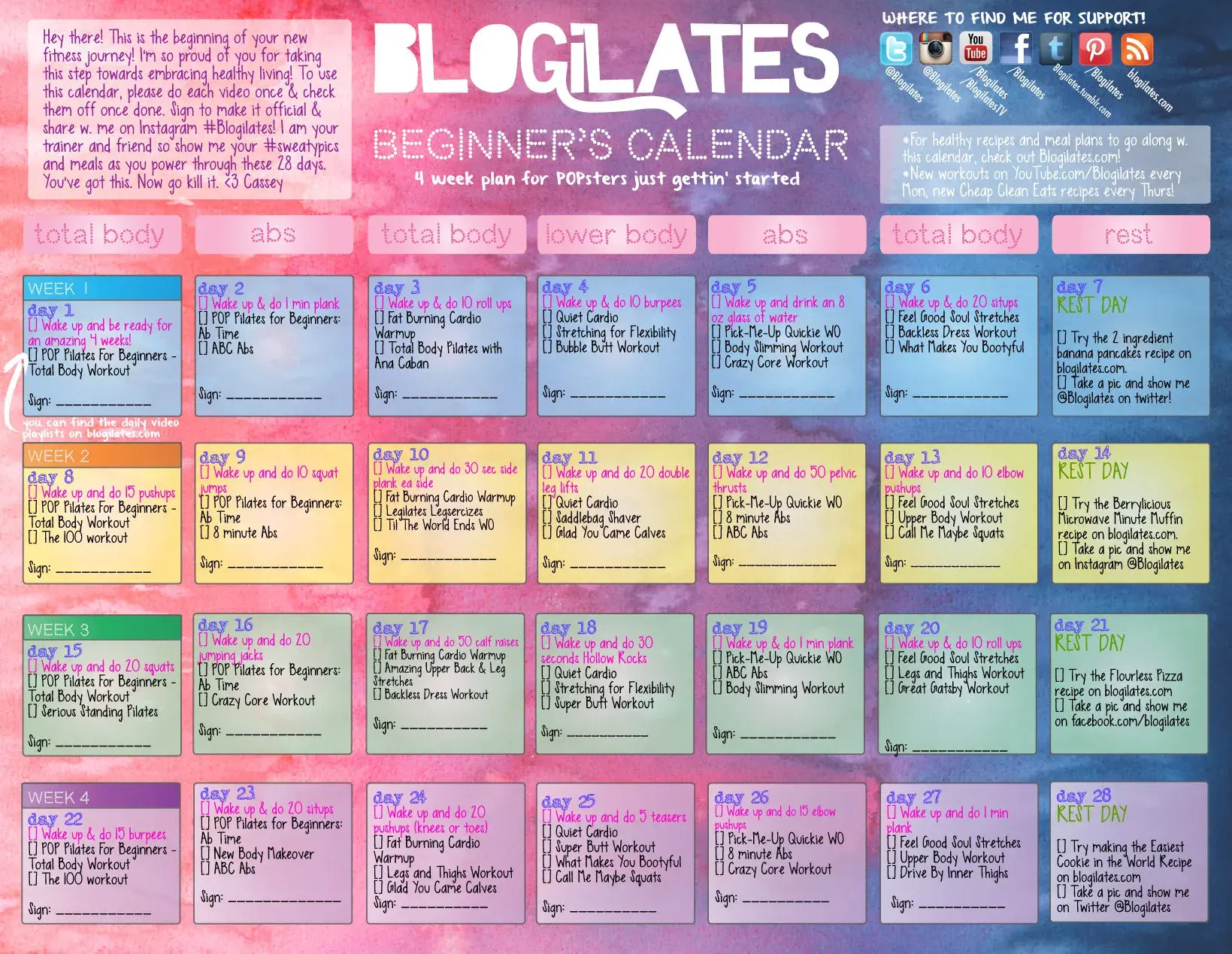
For example, the athleisure brand PopFlex doesn’t just sell clothes. It also runs a fitness blog called Blogilates that offers a wide range of additional resources to support its customers.

To run a successful business, it’s important to add value to your target audience.

Image Source

Featured Resources

4. Being flexible and quick to adapt.

In today’s business world, the only certainty is constant change. To prosper in such an environment, you’ll need to learn to shift with the times. Whether that means following evolving fashion trends, adapting to regular tech updates, or adjusting to meet new customer requirements, the ability to stay flexible is essential.

Importantly, this isn’t just about adjusting your products or marketing. Employee expectations and needs will change. Customer expectations will swing. It may feel more comfortable to stick with what you’re used to and ask other people to change instead … but I’ve learned that such an inflexible approach can limit your ability to succeed.

Adapting to change isn’t always easy, but greeting change with a positive and open attitude can improve productivity, loyalty, and engagement. It can also help your business act on new ideas early, giving you a competitive advantage.

If flexibility and adaptability don’t come naturally to you, you may need to go out of your way to practice them. One way to stretch your flexibility is to travel, as the experience of adjusting to a different language and culture can make it easier to be flexible at home. Other ways to become more comfortable with change include:

  • Making constant learning a priority.
  • Keeping up with news and trends in your industry.
  • Expanding your network.

Featured Resources

5. Bold decision-making and creative problem-solving.

Starting any business is a risk — but it’s unlikely to be the last risk you take. More often than not, running a successful business means making lots of big decisions and undertaking numerous creative experiments.

It may sound scary (especially when you’re talking about a company that supports you, your family, and your team), but that willingness to take risks is, in fact, exactly what creates a stable foundation for your business.

After all, being creative is about determining where traditional thinking has come up short and developing new ways of solving problems. Bold decisions don’t require any less planning or preparation than traditional ideas. They just take more faith, because there is usually little to no proof that these ideas will work. They might also take more trial and error, but when a creative solution works, it really works.

If you don’t think of yourself as bold or creative, this aspect of running a successful business may feel a bit daunting. That said, research shows that there are a few ways that anyone can use the creative process to improve their business decisions.

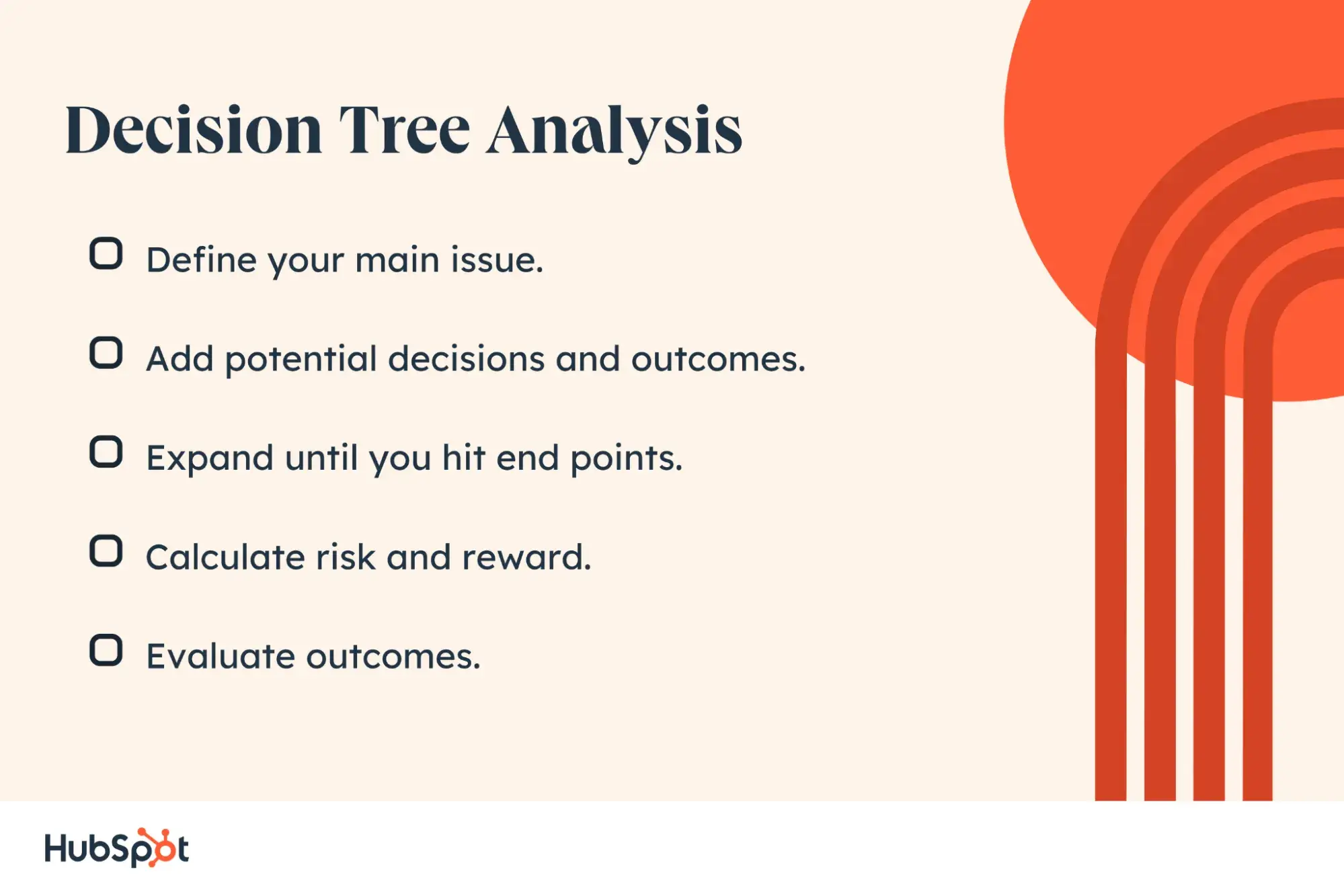
To run a successful business, use decision trees

Start by learning about the problem. Try to take in as much information as you can before you take action, and don’t be afraid to sit with what you’ve learned for a little while.

Consider the possible positive and negative impacts of different solutions, and don’t let the urgency of a deadline or external pressure rush a decision. In my experience, creative decision-making is rarely a linear process, but here are some tools that can help when you’re feeling stuck:

6. Paying attention.

Running a business takes a lot of skill, effort, and time. When your batteries are running low, it can be especially tough to give enough focus to the people and processes that need “extra” attention. But, paying attention is critical to ensure your business survives and thrives over the long term, as it can give you access to the vital insights you’ll need to grow your business.

It’s particularly vital to pay attention to your customers’ changing needs. Take it from me: People are talking about you and your brand, whether you ask them to or not. Are you listening to them and considering what they’re saying?

To make sure you’re really listening to your customers, I’ve found that it can help to complement traditional methods like calling or emailing your customers with investing in social listening or conducting feedback surveys such as net promoter score (NPS) to gather data on customer sentiment.

Pro tip: Venngage CEO Eugene Woo has consistently prioritized listening to feedback and applying that input to grow his business.

He reflects, “I’ve come to embrace a few core values. This includes realizing our mission over a long period of time instead of a quick exit, creating value for our customers by helping them solve real problems, being responsible for our own financial sustainability, scaling at our own pace, and doing the right thing over ‘it’s just business.’ This philosophy has guided every aspect of my decision-making process…over the past four years.”

7. Getting out of the office.

As Shark Tank investor Lori Greiner has famously observed, Entrepreneurs are the only people who will work 80 hours a week to avoid working 40 hours a week.”

Running a business can take over your life. But if you don’t take a break once in a while, it’ll be hard for your business to prosper. Stepping away from your office, store, or computer is essential to your continuing success.

Make time for social activities. Attend events, do some networking, or start a hobby that gets you out into the world. I’ve seen firsthand just how helpful activities like these can be in improving your energy levels and expanding your support system.

It’s also a good idea to take extra care of yourself. Try to get in some regular physical activity, travel, and take short breaks throughout the day to give yourself a rest and a change of perspective.

Remember: We all have to put on our own oxygen masks before helping others. If we don’t take care of ourselves, we won’t be able to take care of those around us. Likewise, if you don’t invest in your personal health and well-being, you won’t be as effective in running your business.

Research shows that there are countless challenges that can cause a business to fail. To steer clear of these pitfalls and maximize your chances of business success, I recommend considering the following key factors:

1. Market demand for products and services.

A great service or product will get you nowhere if there’s zero need for it. To determine who would buy your product, how often, and why, due diligence and detailed market research are essential in the early stages of starting a business.

You need concrete data on your ideal customers, the existing competition, expected growth and demand, market trends, and more. Armed with these types of invaluable insights, you’ll be empowered to make informed business decisions and set realistic, ambitious goals. Not only will you be able to find your niche, this data will help you plan inventory and forecast sales, too.

2. Building the right team.

The most successful business owners and entrepreneurs know to surround themselves with people smarter than they are. After all, if you want to scale your business, you’ll need a strong team — and the only way to build a great team is to recruit and hire great people.

Don’t just build any team. Build a super team. As much as your budget allows, surround yourself with experts in the things that you know little about and ask for their input and feedback.

Once you’ve assembled your super team, it’s important to involve those people in the decisions that will impact them, whether directly or indirectly. This will help them feel invested in what you’re building together, and it will help you all make better, more informed decisions. When you win, everyone wins.

Finally, I’ve learned that it’s critical to develop clear systems to help you scale your team. As founder of the SaaS marketing agency Crunch Marketing Nico Prins explains, “It’s important to develop a clear onboarding strategy for employees and a system for measuring results.”

He continues, “Putting systems in place will help as you scale the business, especially if you’re expanding quickly, and reduce the amount of time and work associated in dealing with inevitable staff turnover.”

3. Preparation for leadership.

Before you can run a successful business, you need to develop the leadership qualities that are necessary to build a business’s long-term vision. Great leaders exhibit:

  • Integrity.
  • Accountability.
  • Empathy.
  • Humility.
  • Vision.
  • Influence.
  • Organizational direction.

Even as a new business owner with no other employees, you are responsible for leading your business to success — and as you (hopefully) grow and others come on board, that becomes increasingly important.

The good news is leadership skills can be learned. In fact, according to a recent study from Gallup, nine out of ten leaders don’t feel that these skills come to them naturally. That means most people need to prepare to lead. As you begin to work on your leadership skills, these resources can help:

4. Network development.

You’ll need a strong community for your business to thrive. If you’re just starting out, your network can connect you to co-marketing partners, funding, and other vital opportunities. If you’re further along in running your business, your network can help you shore up areas that need work or identify extra resources.

To be sure, networking is a buzzword that can be off-putting to some. But in reality, networking is just about fostering relationships. If you support businesses that complement yours, they’re likely to return that investment and support, creating a steady stream of referrals and connections that can help your business grow.

To be a great partner to the people in your network, start with your common values. Reach out to people in your local community and online who align with the mission and ideals you strive for personally and in your business. Then, create clear expectations and maintain friendly and consistent communication.

Featured Resources

5. Competitive analysis.

Some ideas may be so unique that there’s little to no competition, but most businesses will be entering an already crowded market. To succeed in a market that’s full of established providers, you need a unique spin on your product or niche — and that means conducting a competitive analysis.

Pro tip: When it comes to beating out the competition, founder of OswaldoMedia Oleg Segal argues that “The key is to leverage your business’ uniqueness and serve a niche your larger competitor doesn’t cater to.”

A competitive analysis can help you learn about your top competitors’ products, marketing, and approaches to sales. In some cases, you may learn things that lead you to take your business in a new direction, while in others, you might find a need or problem that only your business can solve. This process can also help you set benchmarks and understand what it will take to reach your business goals.

The more organized you are, the more useful your competitive research will be. It’s also a good idea to perform this analysis on a consistent basis — ideally, as frequently as once a quarter — so you can respond quickly to changes in your industry.

Featured Resources

6. Choosing the right pricing.

In my experience, getting your pricing strategy right is one of the most important factors for building a sustainable business. If your prices are too high, you’ll struggle to sell … and if they’re too low, you won’t be able to cover your costs.

Pricing your products to sell is a skill that may take some time to learn. At the same time, setting prices is also one of the first things you’ll need to do when starting a business. As such, it’s important to think carefully about whether your products are priced appropriately.

Are you pulling in enough revenue to stay afloat? How many units will you need to sell each period to reach your revenue and profitability goals? Asking questions like these (and consistently documenting your answers) will help you keep your business running and thriving.

Featured tool: Pricing strategy calculator

7. Long-term goals and vision.

People start businesses for many different reasons. Some want to make ends meet with a side gig. Others want to replace their full-time job and be their own boss. Whatever your reason, decide upfront how you want your business to scale. If you aren’t thoughtful about your long-term plans, you might not be prepared for what could happen.

For example, marketing can be unpredictable. Businesses sometimes go viral for doing great work and aren’t prepared for the influx of new customers. Knowing in advance whether you’ll meet the moment or let it pass you by can save you from missing out on unexpected opportunities or, worse still, from having to close your business because you weren’t prepared to scale.

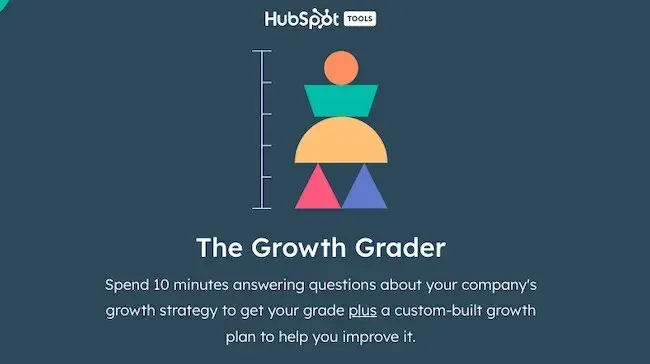
Featured tool: Growth Grader

To run a successful business, use our growth grader

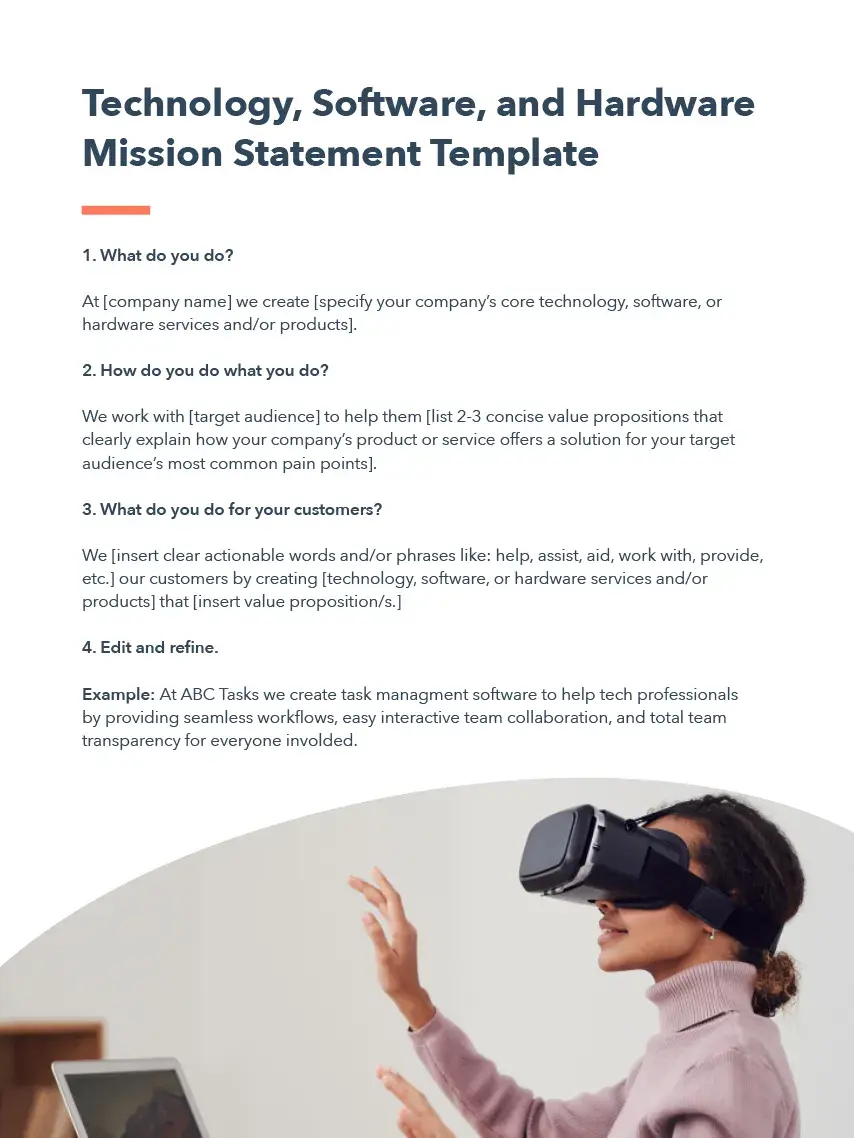
To get ahead of these challenges, I’ve found that it’s always a good idea to create a vision-based plan before you start selling. This plan should include a mission statement, such as achieving a certain amount of annual revenue, inspiring your community to take a certain action, or whatever goal makes sense for you.

Whether you’re in it for the moment or the long haul, this process will help you focus your energy and give you a center to return to when you and your team have big decisions to make.

Featured tool: Mission statement templates and examples

To run a successful business, mission statement

At the end of the day, I’ve learned that if you’re planning to start a business, it will take active work to make it successful. To run a thriving business, you’ll need to research, study, and learn about your industry, customers, and market — inside and out.

Business Success Trends [New Data]

If you’re thinking about starting a business, you might be interested in your chances of success. Below, I’ve shared some of my favorite data and statistics related to entrepreneurship and the success of new businesses.

How many people are starting new businesses?

In Q3 of 2023, 311,000 new businesses were formed in the U.S. In other words, new business is booming! And why are so many people starting new companies? Recent research suggests that entrepreneurs’ most common motivation for starting a company is feeling ready to be their own boss.

What are the top costs that come with starting a business?

Payroll is a top cost for many businesses. Depending on the nature of your business, wages alone can account for 15-50% of your overall budget.

In addition, U.S. census data shows that total compensation costs have risen by 4.2% year-over-year as of March 2024, while benefits costs have risen by 3.7%. At the same time, 51% of small businesses plan to expand their teams, suggesting that compensation will continue to represent a substantial portion of business costs.

Will my new business succeed?

According to recent data from Statista, just over one in three U.S. businesses founded between March 2013 and March 2023 were still operating in March 2023. In other words, two-thirds of businesses fail within ten years.

Of course, these numbers can vary substantially depending on the industry. Some industries, such as healthcare and social assistance, have a higher-than-average survival rate. Others, such as construction and transportation, tend to have lower survival rates.

That being said, despite many businesses failing, more than nine out of ten business owners say that they don’t regret starting their own business. Moreover, 30% of business owners become serial entrepreneurs, choosing to start two or more businesses.

I’ve learned firsthand that figuring out how to run a business isn’t the same as starting one. But as you build your buyer personas, conduct market research, and settle on a long-term vision, you’ll also start to develop the skills it takes to keep a business going. Running a business looks a little different for everyone, but the steps below can help you prepare your company for sustainable growth.

1. Make great marketing and branding.

Building a great product isn’t enough: You also need a marketing strategy to ensure your customers choose to buy your product.

Marketing spans everything from finding prospects to upselling new products and services to your loyal customers. At the end of the day, marketing is all about getting the right message to the right people at the right time.

Featured tool: Marketing plan template

To run a successful business, marketing plan

Download for Free

As you build your marketing plan, ask yourself:

  • Who are your customers?
  • What problems do they have that you can solve?
  • How do they want to engage with businesses?
  • Where do they spend their time?

Answering these questions will help you understand your target audience and buyer persona. Then, once you know who you’re talking to, you can choose the best channels for communicating with them.

Successful businesses looking to share their message usually start by building a following on one platform at a time. Here are the most common methods for communicating with potential customers:

Nowadays, most customers are online, so omnichannel marketing is a powerful option that can help you attract prospects and keep customers happy. Omnichannel integrates the various channels modern consumers use into one seamless experience.

Pro tip: As marketing expert Eric Sachs explains, “The benefits of omnichannel marketing include creating a cohesive and consistent brand experience across multiple platforms, which leads to higher customer retention and increased revenue. This integrated approach also provides valuable insights into customer behavior, allowing for more targeted and effective marketing strategies.”

In addition, strong businesses often focus their energy on a primary platform that they own (such as their own website), since these platforms enable them to promote their content anytime without dealing with algorithms or paid ads. Indeed, I’ve found that high-quality, valuable content on your website can drive traffic and leads right to your digital doorstep.

Another important element is branding. Branding is all about creating a personality for your company that your audience can trust. As such, your branding, design, tone, and personality all need to align across every marketing channel and point to your company website.

As you build your marketing strategy, be sure that you’re offering value to your customers at every stage of their journey.

“One way to validate that people are looking for solutions to their ‘problems’ is through keyword research,” says Nathan Gotch of Gotch SEO. “You can find the exact keywords your prospective customers are using with tools like UberSuggest or the Google Keyword Planner. You then need to create content around the keywords you find.”

But it doesn’t stop with keywords.

“Content is also a valuable sales tool,” explains sales leader Valerie Swenson. “While a strong sales team is essential for closing the deal, buyers are more likely to self-educate and engage with digital content before conversing with sales. A content strategy will help guide your content creation and distribution efforts to get in front of buyers first and help capture leads for your sales team.”

To run a successful business, create content

An effective content marketing strategy is one of the best ways to stand out in today’s crowded online marketplace. But as marketing expert Isaac Justesen reflects, “consistently creating high-quality content isn’t easy. That’s why many successful businesses outsource content creation instead.”

Indeed, to amplify your message, I’ve found that it can be incredibly helpful to work with partners.

For example, as CEO of Aptitude 8 Connor Jeffers explains, “In the early days of Aptitude 8, we found a lot of success with partner marketing. I recommend early-stage companies find partners that serve the same audience they’re targeting, build relationships with their marketing teams, and supply those teams with great content they can help distribute easily.”

More Resources

2. Draft a business plan.

It’s up to you whether you opt to create a formal business plan or just document your professional goals informally. But if you want to build a business that lasts, you’re going to have to record your plan for that business in one way or another — and share that plan with a wide range of stakeholders.

Business plans vary, but most will include most of the items below:

  • Summary of your business idea.
  • Company description.
  • Products or services.
  • Market research.
  • A plan for marketing and branding.
  • Sales plan.
  • Legal requirements.
  • Financial expectations.
  • Starting budget.

Your business plan also doesn’t have to be a static, private document that you just write and set aside. Instead, it can be a living document that you store in the cloud and share with all the relevant stakeholders. In this way, you can ensure that everyone who needs access can view the plan, while also making it easy to collaborate and evolve your business plan over time.

Featured tool: Free business plan template

To run a successful business, business plan

Download for Free

3. Define clear KPIs.

Without concrete goals, it can be difficult to tell how well your business is actually doing. So, setting the right KPIs — or Key Performance Indicators — is essential.

KPIs enable you to track your business performance against your goals. They can give your team a target to push toward, help you measure progress, and improve your decision-making as your business grows.

If you’re not sure where to start, I always recommend getting clear on the four Ps: product, price, promotion, and place. These four factors can guide your marketing plan and customer personas, and they can serve as a jumping-off point for setting other KPIs.

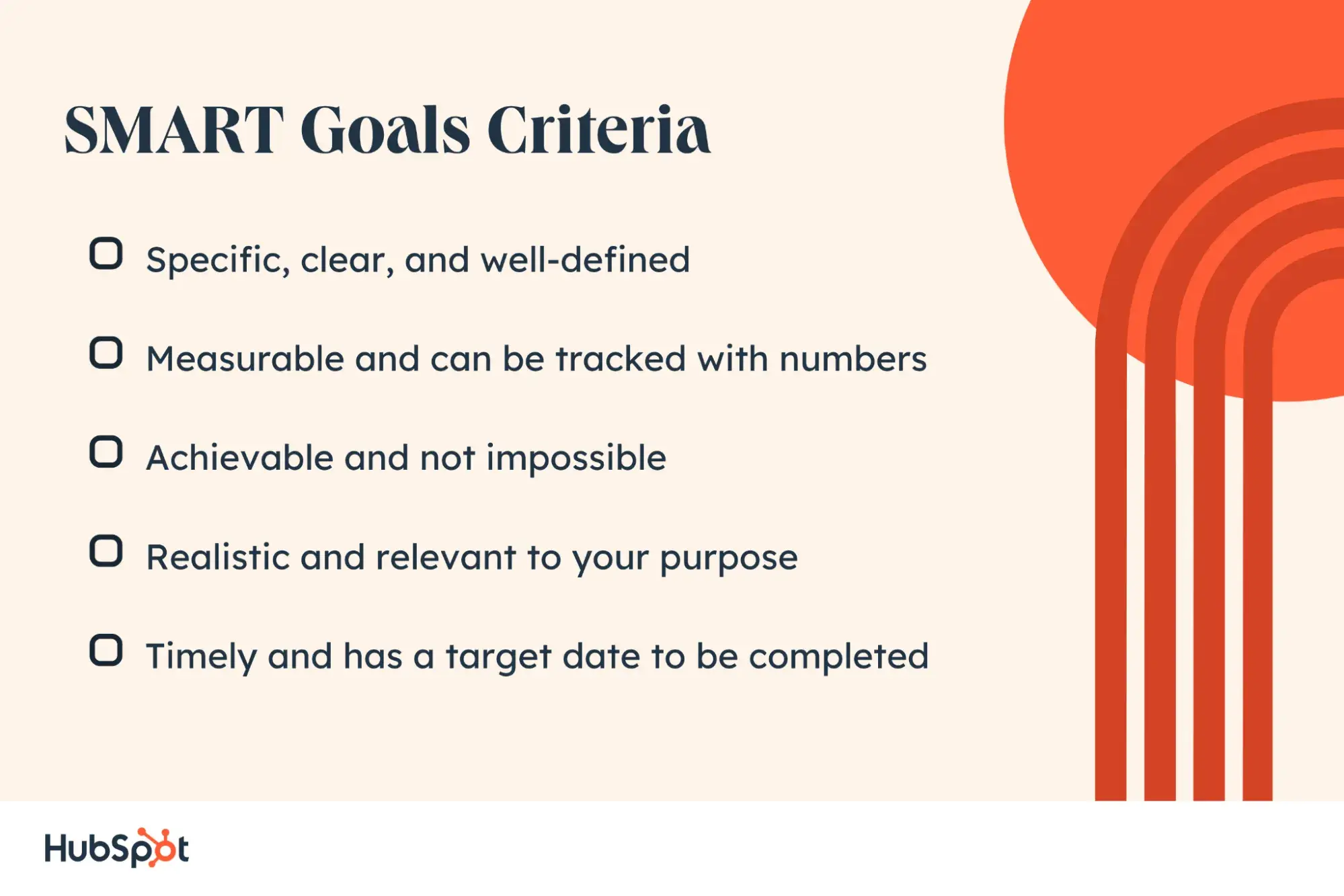
It’s also important to try not to set too many KPIs, and make sure each KPI is SMART:

  • Specific.
  • Measurable.
  • Achievable.
  • Relevant.
  • Time-Bound.

To run a successful business, use smart goals

4. Keep innovating.

Like bold decision-making, innovation is a must for business success. Regular experimentation can keep your business from growing stagnant, and it can ensure you stay ahead of the competition.

At the same time, you don’t have to keep reinventing the wheel. Some of the most powerful innovations are small changes that substantially improve the customer experience.

To make a habit of innovating, weave creative planning into your business processes. Set aside time during meetings and daily tasks for brainstorming, experiments, and researching trends. You should also make a point of keeping up with news and updates from thought leaders in your industry and niche, as these fresh insights can spark conversations that could lead to your next big idea.

5. Refine business processes.

Many business processes come about organically. Sometimes a process sticks around because of people’s habits or resistance to change, while other processes evolve in response to outside forces.

This is only natural. But to keep your business growing, it’s important to be intentional about building and refining your processes. Creating a solid plan (before habits start forming) helps to ensure that your processes are optimized for your business. It also gives you an easy way to track and adjust processes that aren’t working … before they derail your business.

Featured tool: Free sales plan template

To run a successful business, use a sales plan

Download for Free

Processes often come from the tools you use — so, if you scale your efforts with the right software, you can get more done with less. Instead of disparate platforms, spreadsheets, and email tools, condense your sales process into one streamlined CRM and sales platform. You can also consider exploring HubSpot’s Starter Bundle, which is a bundle of services built specifically for small businesses.

In my experience, the right tools can empower you to meet and exceed customer expectations. For example, 71% of customers are comfortable working with bots if it means a better experience, suggesting that a tool like live chat software can be a great way to respond to customer inquiries quickly and effectively.

6. Develop a strong company culture.

Businesses often overlook the impact that culture and employee engagement can have on every aspect of a company. But, culture is powerful, from recruiting to exit interviews.

To build a solid culture, focus on your team. As SEO consultant Ali Anderson explains, “A good HR teamed with an arsenal of great tools can change your company for the better.”

She continues, “Happy, engaged employees do great work, and company growth will quickly follow … When companies invest in their training and onboarding processes, they’ll find their employees are more prepared to do great work and take on the challenges of the business.”

Taking steps to measure and improve employee engagement as well as metrics such as employee Net Promoter Scores can increase productivity, improve employee sentiment, and make your employees more likely to recommend your business to their friends.

For example, holding monthly or quarterly performance discussions can help build team camaraderie, improve employee mental health, and create an environment of trust, all of which boosts innovation.

For more tips and ideas on building a positive company culture, check out the Culture Happens podcast.

Moreover, small businesses can attract top candidates by having a positive culture, a strong career track, and well-trained, unbiased recruiters.

“A supportive culture and a strong career track are key to attracting the best of the best,” writes marketing specialist Taylor Dumouchel. “Top professionals seek respect, not just within their immediate teams, but throughout an organization; they want to work for companies that value what they do. In order to recruit top talent, executives need to highlight their positive and supportive culture and underscore how they recognize that their positions are a part of the major drivers for company growth.”

Unfortunately, I’ve found that many business leaders don’t realize that company culture begins as soon as a company is formed. To avoid this trap, it’s vital to be intentional about building a strong culture from the get go.

Then, as you build a strong team of people, make sure that you’re providing what they need to stick around. Do what you can to help your team feel motivated, incentivized, and well taken care of, so they can effectively do their job.

A major component of this equation is benefits. As you make hiring decisions, factor in how much budget you have for employee benefits, including both perks and the benefits that are required on a federal, state, and local level. Commonly required benefits may include:

  • Unemployment taxes and insurance.
  • Time off for voting, jury duty, and active military service.
  • Workers’ compensation.
  • Compliance with Family and Medical Leave Act (FMLA).

In addition to factoring in the costs of required benefits, it’s important to think about the elective benefits you would like to offer. Remember that these benefits are often what keep an employer competitive, especially in a hot job market.

Competitive analysis can also help you see what other companies in your industry are offering their employees to ensure you measure up. These benefits may include:

  • Health insurance.
  • Retirement savings.
  • Paid vacation and/or holidays.
  • Disability insurance (required for some states).
  • Life insurance.

Pro tip: HR leader Doug Sechrist speaks powerfully to the importance of offering a competitive benefits package, explaining, “A benefits package that adds value to employees’ lives is a large part of creating that culture. The result is a happier, more engaged, and more focused workforce that feels connected to their employer and believes in the work they are doing.”

7. Focus on financial goals.

Launching and building a business is expensive. You need financing — capital, investments, loans, and revenue — to get you through the lean times.

For a business to be successful, it has to make enough money to sustain operations and turn a profit that can be reinvested for future growth. A detailed budget can help you keep track of revenue and expenses.

Featured tool: Marketing budget template

As you develop and track your financial goals, don’t forget to factor in business costs such as:

  • Sourcing.
  • Production.
  • Staff.
  • Capital.

Next, determine how much money your business needs to bring in on a monthly, quarterly, and annual basis to succeed. If you’re not comfortable with accounting, balance sheets, or financial forecasting, it’s time to start learning!

8. Use the right tools for your growth strategy.

The number of apps, products, and SaaS solutions available is growing exponentially. Thanks to the ever-decreasing cost of technology, even small businesses have access to all the tools they might need at their fingertips (for instance, a free-forever, all-in-one CRM).

That said, choosing the right tools can be challenging. To optimize your business (without drowning in technology), it’s critical to identify the tools that will be the best fit for you and your needs. According to marketing expert Manvi Agarwal, there are a few steps you can take to decide which tool is best:

  • Zero in on the processes for which you want to use each tool.
  • Determine how each tool can make that specific process easier or more efficient.
  • Choose a tool that performs a very specific task, even if it might be tempting to go for an all-in-one tool.
  • Compare how much value the tool is providing vs. the amount it will cost you.
  • Ensure the tool is scalable, i.e., that it grows along with your business and can meet your business’s changing needs.

If you haven’t yet implemented a stack of tools to streamline your business processes, HubSpot’s Starter Bundle for Small Business is a great place to start, offering the perfect foundation for an effective growth strategy.

9. Develop a support system.

Running a business can take over your life. While many thrive on the intensity, too much can create a level of stress that’s not healthy. As such, a support system is essential for the continued success of your business.

This group of people can help you manage your stress and keep a positive outlook through the highs and lows. They can be active members of your small business team, or they can be outsiders who offer vital reminders to maintain a balance between work and life.

Of course, many business owners rely on family and friends for more than moral support. One recent report found that 46% of small business owners run their businesses together with a partner or spouse, and 12% fund their businesses with resources from family and friends.

But beyond the people who are formally involved in your business, I’ve learned that it’s also always a good idea to try to cultivate a strong social circle. Shore up your sense of community by joining local social clubs, industry organizations, and charitable groups. In this way, you can develop a support system that benefits both you and those around you, ultimately boosting collaboration and productivity and empowering you to run a successful business.

Starting a Business is Easy

Running a successful company takes time, effort, and commitment. There are countless strategies that can help, from defining clear KPIs to my personal favorite: developing a strong, supportive company culture.

At the end of the day, my biggest recommendation is to take the time to study the businesses that keep their people at the forefront. Even if they’ve made a few mistakes along the way, these businesses will be the best teachers when it comes to cultivating a positive culture.

If you focus on maintaining a reputation of trustworthiness and building credibility in your industry, you’ll be on your way to running a successful business — one that will delight your customers and turn a profit.

Editor’s note: This post was originally published in March 2021 and has been updated for comprehensiveness.

Categories B2B

Professional Relationships: 4 Executive Tips to Improve Your Marketing Success

Learn how to build professional relationships that don’t just open doors — but blow them wide open.

Download Now: 101 Professional Networking Tips

Building strong professional relationships is your secret weapon for marketing success. The right connections can open you up to new ideas, reveal valuable opportunities, and give you the insights you need to solve tough problems.

As Kieran and I discuss in a recent episode of Marketing Against the Grain, however, building impactful relationships takes more than just attending networking events and exchanging business cards.

So how do you find the people who can truly elevate your game? And how do you actively add value to grow those relationships?

In this post, we dig into four strategies for improving your professional relationships. Fair warning: these aren’t your typical networking tips.

We’re talking about going deep, leading with value, and mastering the art of communication — tailored for industry leaders looking to make a real impact.

Strategies for Improving Your Professional Relationships

1. Seek out 10x conversations.

Kieran and I talk to a lot of people. It’s how we solve problems and learn. But here’s the thing: not all conversations are equal. You’ve got to seek out what we call “10x conversations.”

These conversations are the ones that shift your perspective and thinking entirely, leaving you with insights that alter the way you go about your work — and even your personal life.

When you find someone like that, don’t just have one conversation and move on. Dive in deep. Have ten more conversations with that person rather than spreading yourself thin with ten different people. The value is in the depth, not the breadth.

If you’re not sure how to find these people, here’s what I do: find a person you think is awesome at what they do — and then find out who they look up to. It’s a bit counterintuitive, but trust me, it works.

The people that everyone else in the industry thinks are the best? Figure out how to spend some time with them.

Then, go a step further — seek out the five people those experts think are even better. That’s where you’ll find the real 10x conversations.

“If you can find these people,” says Kieran, “They’re going to be absolute game-changers to your ability to learn.”

2. Rethink your networking approach.

When it comes to networking, Kieran and I both agree that it’s not about how many people you meet but how well you get to know the right ones — and that generally doesn’t happen at big, crowded networking events. Instead, real value comes from smaller, more focused 1:1 settings.

For example, I recently played golf with my friend, Dave Gerhardt. We spent about four hours together, just the two of us, and by the end of it, we’d not only come up with a YouTube show idea, but we’d also tackled a bunch of other challenges that we were both facing.

That kind of focused time lets you dig deeper into topics and really get to know the person. It’s way more valuable than trying to meet dozens of people at once.

So next time you’re thinking about how to connect with someone or expand your network, think less about quantity and more about quality. Set up some one-on-one time — a dinner, a coffee, a golf game — and you’ll see the difference it makes.

3. Add value to build trust.

The more value that you bring to a relationship, the stronger the relationship becomes. It’s that simple. But you need to clearly — and consistently — demonstrate that value with every interaction.

For example, when Kieran first started out, he made it a point to jump on every call where he thought he could offer value. “I wasn’t just looking to take; I truly wanted to give where I could,” he says. “I’d join for 30 minutes, listen, and figure out how I could help.”

It wasn’t the most efficient way to build relationships, but over time, it led to deeper, more meaningful connections.

Why? Because building relationships isn’t just about being present; it’s about being the person who others can rely on for insight, support, or whatever they might need.

And when you consistently show up with something valuable to offer, you’re not just another contact in someone’s network — you’re the person they think of first when they need help or advice.

And that’s a key ingredient for building professional relationships that last.

4. Brush up on your qualitative communication skills.

Especially when you’re interacting with high-level execs like investors or founders, it’s not enough to just throw data at them — you need to tell the story behind the numbers.

Sure, executives love their charts and metrics, but they’re often more swayed by anecdotes and real-world examples. That’s where you win their buy-in, build trust, and gain the autonomy you need.

Think of it this way: as a marketing leader, you’ve got both the data and the stories at your disposal. The trick is to use them together. The data gives you credibility, but it’s the stories and anecdotes that make your argument stick.

Let’s say you’re pitching a new marketing strategy. Don’t just roll out the potential ROI. Back it up with a customer success story or some feedback that highlights why this strategy is the right move.

Executives are often swayed by what they hear from customers or industry peers, even more so than by what they see on a spreadsheet.

And remember, this tip isn’t only relevant for today. As Kieran points out, “Communicating qualitative data is a skill set that executives are going to have to hone more in the coming years, as we’re getting less and less direct attribution.”

To watch our entire discussion about improving your professional relationships, check out the full episode of Marketing Against the Grain below:

This blog series is in partnership with Marketing Against the Grain, the video podcast. It digs deeper into ideas shared by marketing leaders Kipp Bodnar (HubSpot’s CMO) and Kieran Flanagan (SVP, Marketing at HubSpot) as they unpack growth strategies and learn from standout founders and peers.

Categories B2B

How to Write Prompts for ChatGPT, According to HubSpot’s SEO Team [+ Examples You Can Steal]

To use ChatGPT or not to use ChatGPT? Is that really the question anymore?

Download Now: 100 ChatGPT Prompts for Marketers [Free Guide]

If you’re like me, you already use this tool to amplify your awesomeness. Like improving your email writing, analyzing data faster, or firing up your social media strategy.

But I have to admit — it’s not all peaches and cream. And others seem to agree — marketers we surveyed stated ChatGPT outputs aren’t publishable 96% of the time.

Does this mean you should throw the whole AI concept away? Not at all. Your outputs are only as good as your prompting skills.

So, I spoke to HubSpot’s SEO team to understand how to write prompts for ChatGPT. Stick around to see the key elements of a good prompt, helpful ChatGPT prompt tips, and prompt writing examples.

Table of Contents

How to Write the Perfect AI Prompt

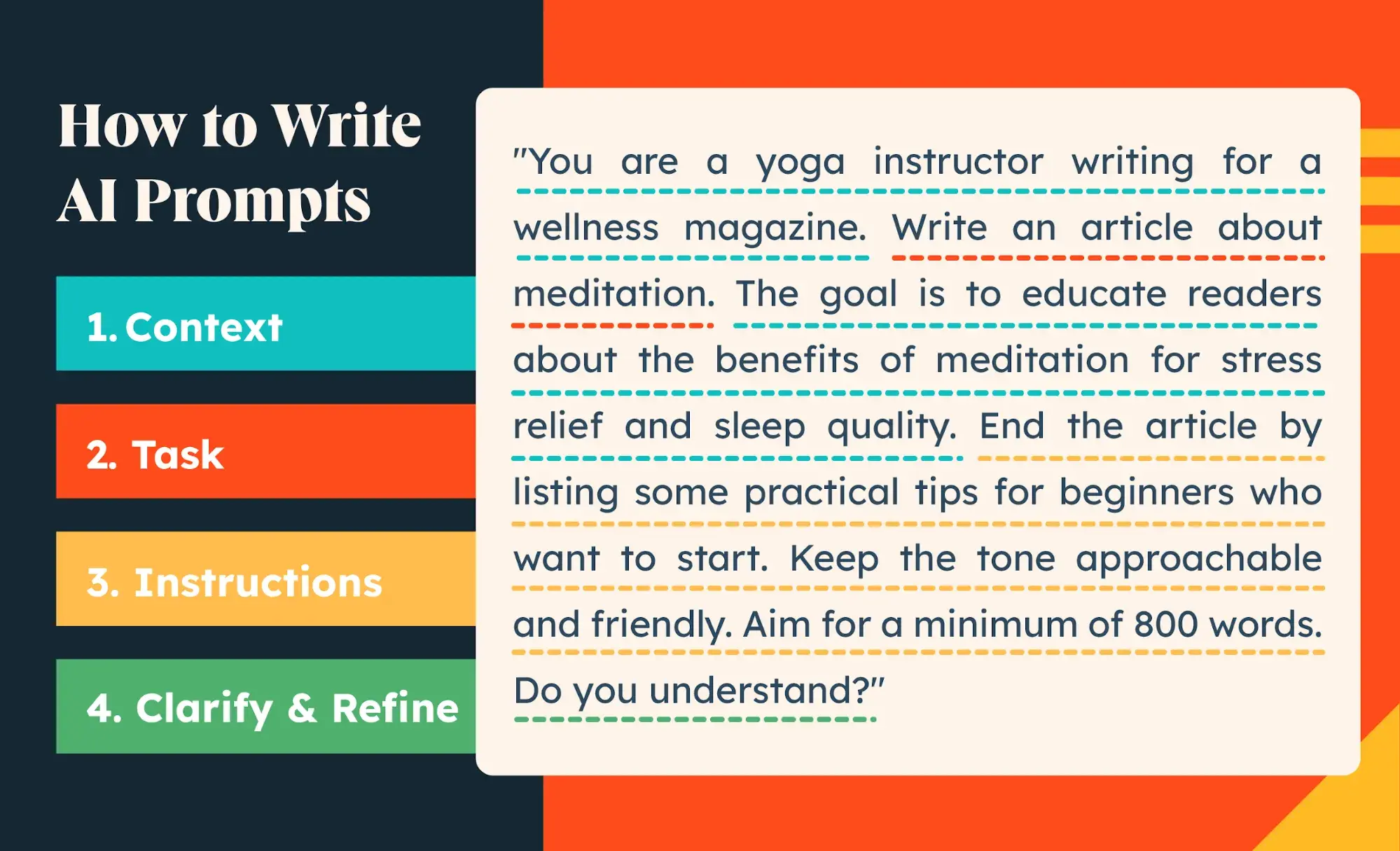
AI Prompt Writing formula: context, task, instructions, clarify & refine

1. Envision your ideal response.

It’s tempting to load up ChatGPT and jump right into the prompt. However, Josh Blyskal, Associate SEO Strategist at HubSpot, recommends a more introspective approach.

“The first thing you should do is figure out what you want. Before I type anything, I always take a moment to envision what the final output will look like,” he told me.

He gives an example of a marketer who wants to generate a marketing plan.

Instead of typing “Write me a marketing plan” into ChatGPT, she should take the time to envision what the plan looks like — how many sections it has, how many bullet points are under each section, and what information it contains.

Now that she has a better grasp of the task at hand, it becomes much easier to compose a prompt that checks all the boxes.

2. Write a specific, action-oriented task.

AI models thrive on specificity. If you feed it with vague instructions, you give it room to interpret what it thinks you want.

For example, suppose you prompt ChatGPT to “Rewrite this [article/email/Tweet],” expecting it to write something new and original. Instead, it regurgitates your original message using the same words and phrases.

The solution is to get specific and intentional with your words.

Instead of “Rewrite,” for instance, you might say reimagine, expand, simplify, or modernize. Even a small change in the way you phrase a prompt can significantly change the response.

As Blyskal points out, “A lot of people treat AI like a rigid system that can be hacked with the right words or phrases, but that’s not the case.

There are no secret keywords that can guarantee the best results. It’s like playing a game of words, and you have to think intentionally about the ones you use.”

3. Set the stage with context.

You could get away with stopping at the previous step — especially if your request is fairly straightforward (e.g., “Write five knock-knock jokes for kids”).

However, you can supercharge your prompts by padding them with context. This gives the AI model more ingredients to cook up a great response.

Bianca D’Agostino, former SEO Specialist at HubSpot, puts it this way:

“Suppose your friend asks you to go to the store and pick up a few things. You definitely need more context — which store, what things, what’s the budget, and so on. The more context you get from your friend, the easier it is to do the task. The same goes for AI!”

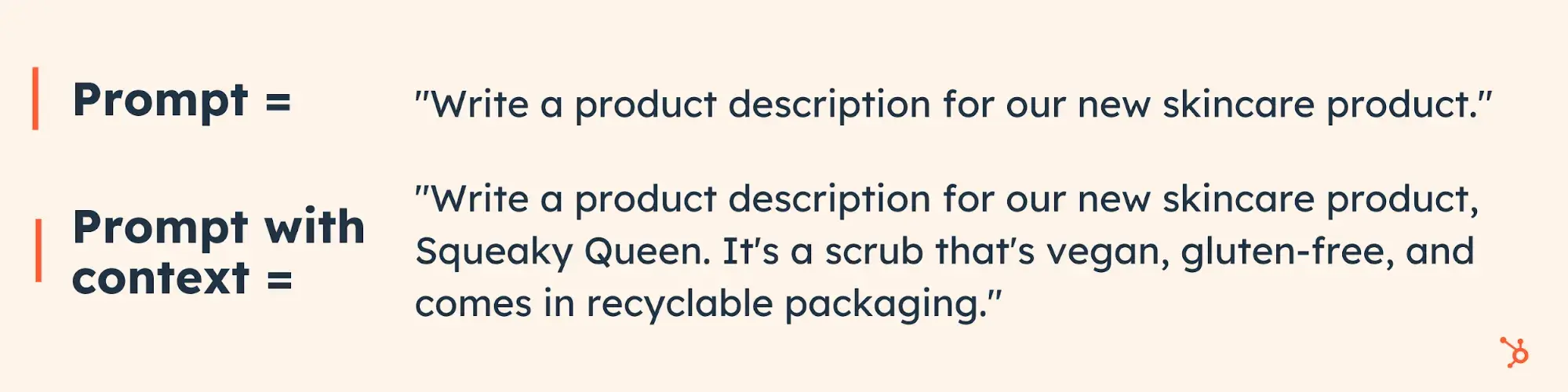
Let’s look at an example:

example of providing Prompt Writing Context for ai model

Both of these prompts might yield good results, but the second prompt will give you a more detailed and compelling description.

This is because the AI model has more context to work with, including the product’s name (“Squeaky Queen”), its form (a scrub), and its key features (vegan, gluten-free, recyclable packaging).

4. Add clear instructions.

Although AI models are powerful, they still need you to take the lead. Without clear instructions, they’re essentially a chef without a recipe or a new employee without a handbook.

Here’s an example: Imagine you need to write an article about Instagram marketing. Along with the main task (“Write an article about Instagram marketing“), you also instruct ChatGPT to:

  • “Cover the following subtopics…”
  • “Incorporate the following quote/statistic…”
  • “Add an example to demonstrate…”

Not only are you giving ChatGPT a clear topic, but you‘re also guiding and shaping the content itself. You’re adding quotes, statistics, and examples to give the output more texture.

Of course, it’s not just what you say but how you say it. The content of the article might be up to par, but it may lack a unique voice or perspective. This is where style and tones come in.

Adding Style and Tone

For Sylviain Charbit, HubSpot Senior Technical SEO Specialist, adding style to prompts is a multi-step process. He starts by letting the AI tool generate a general answer and then progressively molds its response for style.

“You can ask it to inspire itself from a situation, character, or profession, or provide it with already made examples to emulate,” he told me.

Charbit also incorporates ChatGPT tone modifiers, such as “cheerful,” “humorous,” or “authoritative,” to guide the AI further.

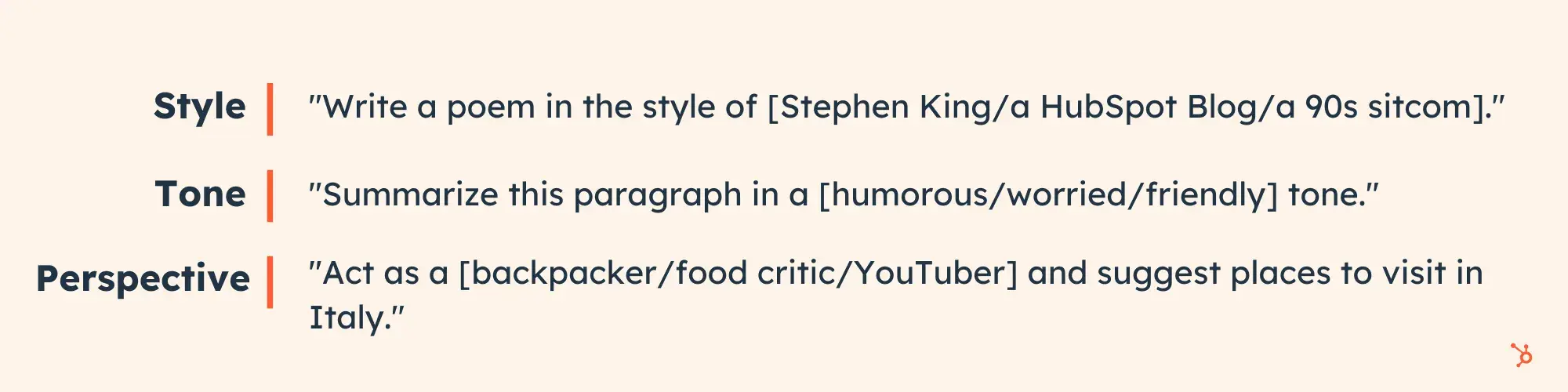
Let’s look at some examples:

chatgpt Prompt Writing examples of style, tone, and perspective

Other style parameters include length and format. You can specify the length of the response (e.g., “Keep the article under 800 characters”) and its format (e.g., “Create a list of bullet points”).

5. Clarify and refine.

Blyskal follows the 60% Rule.

He told me, “When you generate something and it’s at least 60% of what you want, you should continue refining that specific prompt. But if it falls short of that, it might be time to start from scratch.”

So, if you ask ChatGPT to generate a list of ten blog ideas and you only like two, it’s a good indication to go back to the drawing board.

Even if you meet the 60% threshold, you can still refine the output by giving follow-up instructions such as, “Make it sound more conversational” or “Condense this into one paragraph.”

Remember that prompt writing isn’t an exact science. Like any creative process, it often takes multiple revisions to get the right output.

Prompt Writing Techniques

Give It a Role

Role-playing is a technique that involves asking the AI model to adopt a specific role, job, or function.

“When you ask an AI model to play a specific role, you’re giving it a certain level of expertise,” Blyskal told me. “For instance, if you prompt it to act as a professional interviewer, it will look for examples of good interviewing skills and respond with professional-seeming questions.”

By defining a role for the AI model to play — such as a professional interviewer, a graphic designer, or a nutritionist — you’re also tapping into different viewpoints and perspectives, which can be especially helpful for marketers.

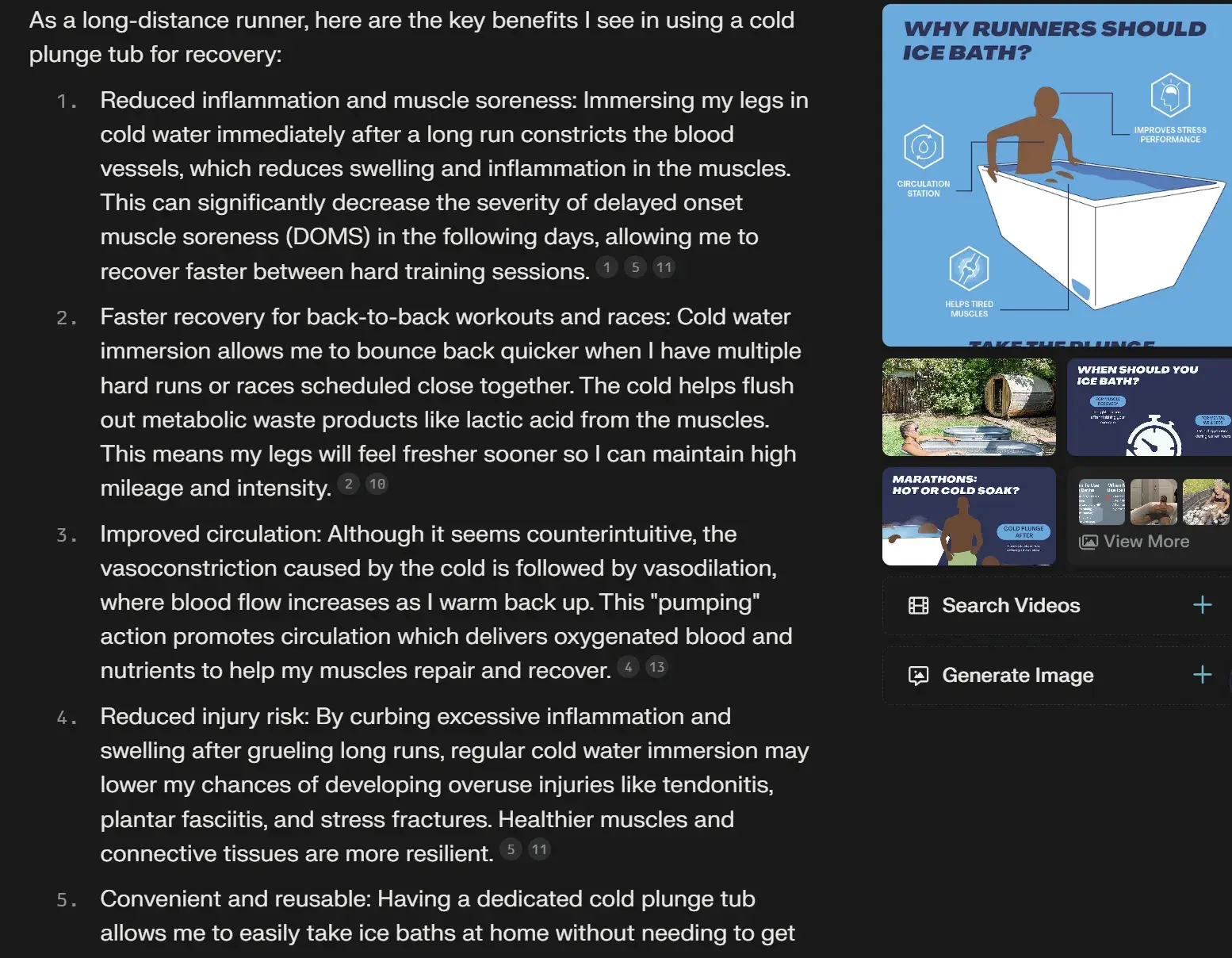
For example, let‘s say you’re launching a new product, a cold plunge tub. You need to create an ad that appeals to your target audience: long-distance runners. In this scenario, you ask the AI model to play the role of a long-distance runner and list the key benefits of your product.

Here’s an example from Perplexity (my fave AI tool) because it provides images and links to sources (peace out hallucinations):

chatgpt prompt example of advertising a cold plunge tub to long-distance runners

Now, the AI model will generate responses that align with the needs and preferences of long-distance runners. This gives you valuable insight into your audience, enabling you to create a more compelling and relevant ad.

Chain of Thought

Imagine you‘re on a road trip, and you’re relying on GPS to guide you from point A to point B. Throughout the journey, it gives you turn-by-turn directions until you reach your destination.

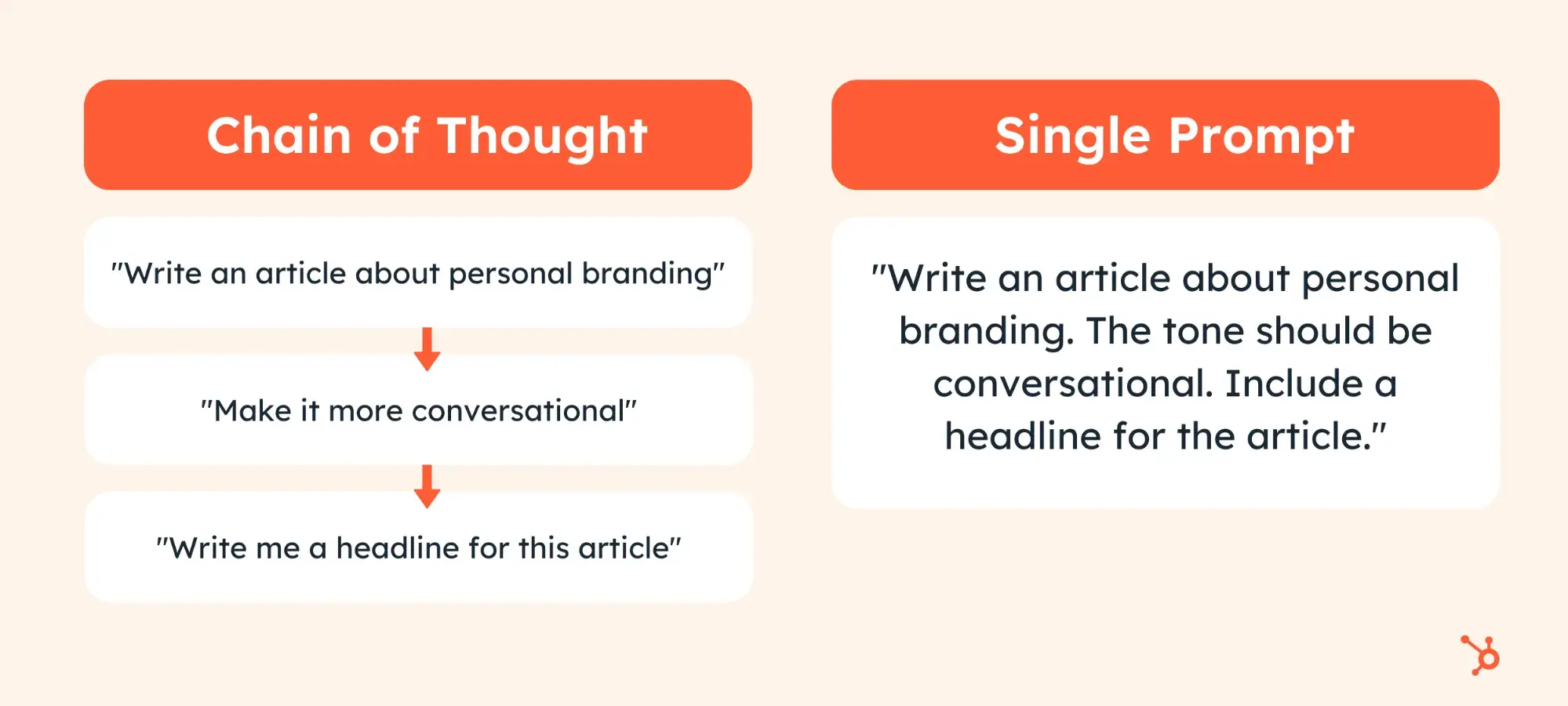
Chain of thought prompting follows a similar approach. You give the AI model one prompt after another, with each prompt building on the one before it. This keeps the model on track, giving you greater control of the output.

chatgpt prompt tips, Chain of Thought Prompting

“You’re basically asking the AI model to explain its reasoning at each step. If you don’t like any of the explanations, you can tinker with the output until it’s ready for the next prompt,” Blyskal explains.

This is ideal for tasks that can be broken down into smaller steps.

For example, consider a copywriter using AI to create an article. She first prompts it to create an outline. Once she‘s happy with the outline, she prompts it to write the article, and then the headline, and then the meta description. She doesn’t move to the next step until she’s satisfied with the current output.

That’s the power of chain prompting. By guiding the model in a logical sequence, you generate more accurate and relevant responses.

Provide Examples

“If there’s any one tip that will take your prompting to the next level, it’s providing examples to the AI model,” Blyskal told me.

You can think of examples as reference points, helping the AI model emulate a certain style, tone, structure, or format. On top of that, AI can analyze a piece of content and offer improvements.

Here are several types of examples you can provide to ChatGPT:

  1.  Style and tone reference: Don’t ask for a blog post in a specific topic and hope for the best — provide a sample paragraph or excerpt showing the style and tone you want. For instance, include a snippet of witty and conversational text, if that’s what you’re going for.
  2.  Structural guidance: Include a sample or visual outline when requesting a content outline. It should show the expected flow, sections, and key content elements (e.g., intro, X subheadings, bullet lists, etc.).
  3.  Content improvement suggestions: After drafting content with ChatGPT, provide specific examples of areas that need improvement or refinement. Highlight sentences or sections that need clarification, enhancement, or a different approach. Don’t forget to include style and tone references to ensure it stays consistent.

While AI prompting is a science, it’s also an art. So don’t be afraid to get creative with your examples and instructions to get out-of-the-box outputs.

ChatGPT Prompt Writing Examples

Here are three use cases I’m seeing many people use in content marketing today. I included the prompt, why it works, and the generated output by ChatGPT.

Social Media Campaign for a New Product Launch

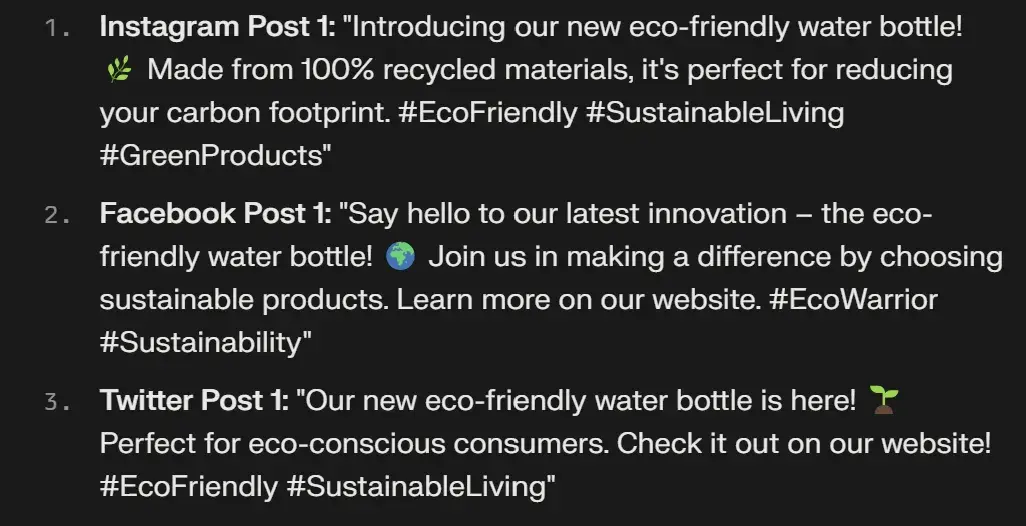
Prompt: “Create a social media campaign to launch our new eco-friendly water bottle. The campaign should include 5 Instagram posts, 3 Facebook posts, and 2 X posts. Each post should highlight the product’s sustainability features, target eco-conscious consumers, and include a call-to-action to visit our website.”

Why it works:

  • Context: Specifies the product and its unique selling point (eco-friendly water bottle).
  • Task: Clearly defines the number and type of social media posts needed.
  • Instructions: Details what each post should highlight (sustainability features) and the target audience (eco-conscious consumers).
  • Clarification: Includes a call-to-action to drive traffic to the website.

Generation:

example of how to write prompts for chatgpt

Fun fact: 31% of marketers use AI for social media post creation based on our AI marketing survey.

Email Marketing Campaign for a Seasonal Sale

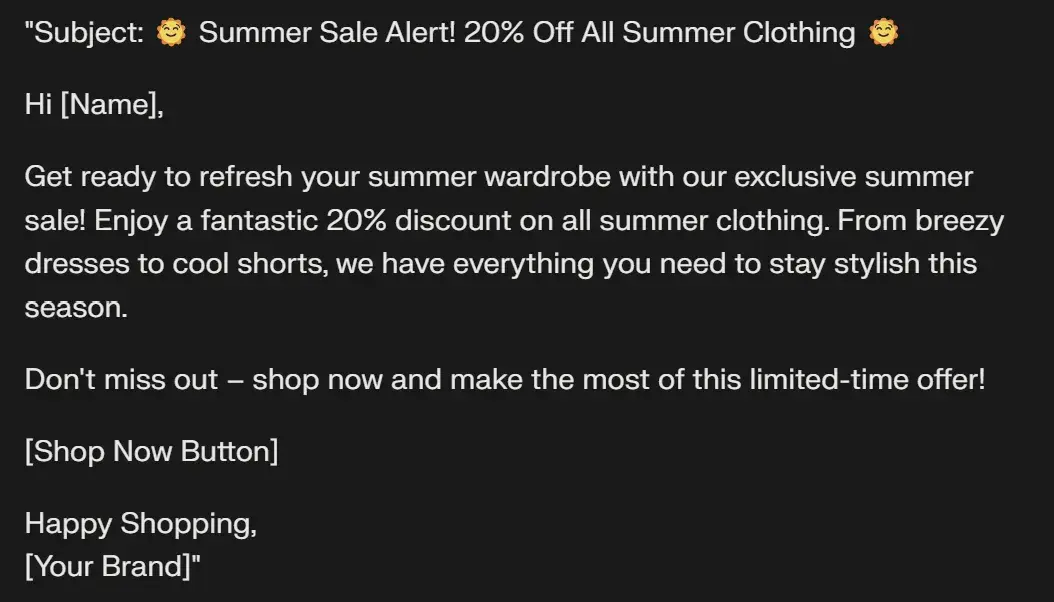
Prompt: “Draft an email marketing campaign for our upcoming summer sale. The email should be engaging, highlight the 20% discount on all summer clothing, and include a clear call-to-action to shop now. Target young adults aged 18-30.”

Why it works:

  • Context: Specifies the event (summer sale) and the discount offered.
  • Task: Defines the content of the email (engaging, highlight discount).
  • Instructions: Details the target audience (young adults aged 18-30).
  • Clarification: Includes a call-to-action to encourage immediate shopping.

Generation:

example of how to write prompts for chatgpt

Fun fact: We found 28% of marketers use ChatGPT to create and answer emails.

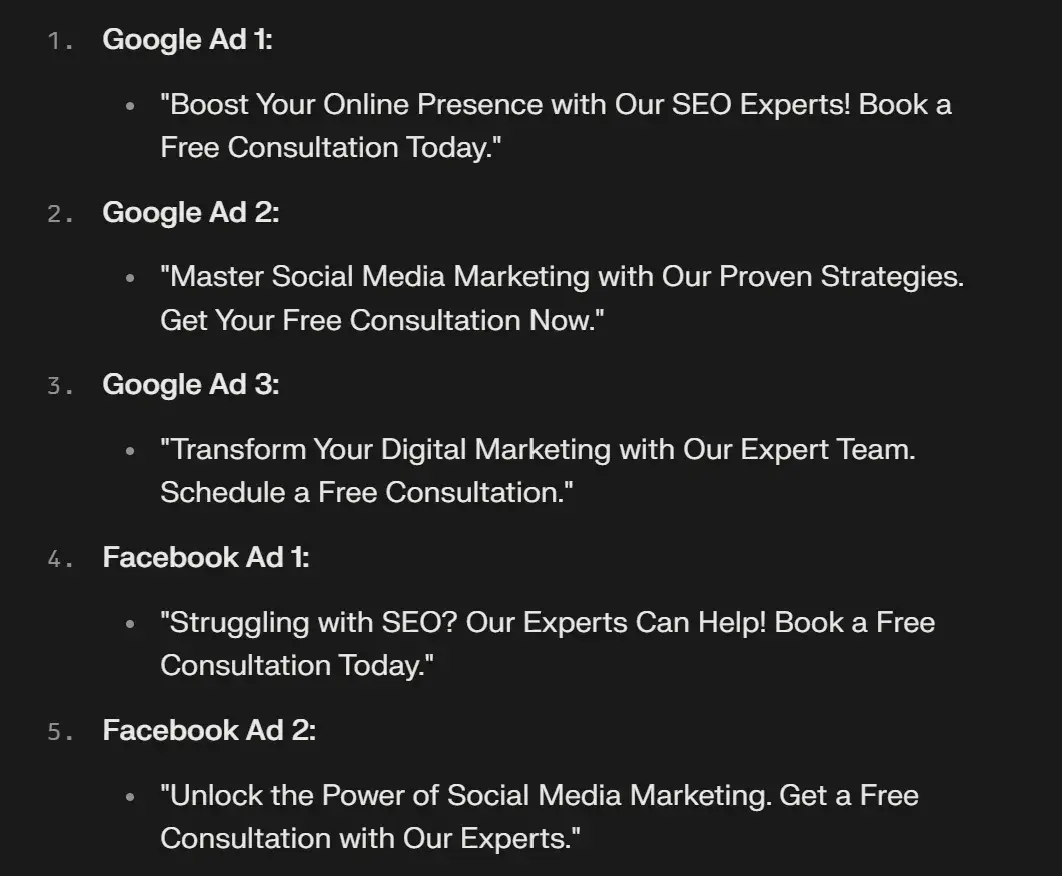
PPC Ad Campaign for a Service-Based Business

Prompt: “Create a PPC ad campaign for our digital marketing consultancy. The campaign should include 3 Google Ads and 2 Facebook Ads. Highlight our expertise in SEO and social media marketing, and include a call-to-action to book a free consultation.”

Why it works:

  • Context: Specifies the type of business and services offered.
  • Task: Defines the number and type of ads needed.
  • Instructions: Details what each ad should highlight (expertise in SEO and social media marketing).
  • Clarification: Includes a call-to-action to drive consultations.

Generation:

example of how to write prompts for chatgpt

Fun fact: 90% of marketers see AI reducing time spent on manual tasks (like creating ads).

Back to You

Blyskal said it best: “At the core of prompting is conversation.” You don’t engineer or program AI. Instead, you talk to it.

Like any conversation, you naturally adjust your tone, provide ample context, and share details, anecdotes, and examples to give your story texture. These are the same elements that make a really great prompt.

Editor’s note: This post was originally published in July 2023 and has been updated for comprehensiveness.

Categories B2B

How to Plan Your Facebook Ads Budget (And Make The Biggest Impact)

If budgeting stresses you out, we have a lot in common, my friend.

Click here to download 8 free marketing budget templates.

Whether it’s a monthly entertainment budget or a Facebook Ads budget, ensuring you allocate only what you can afford and get the most for your money is a lot of pressure.

Spending recklessly can have long-term consequences on a business’ profitability.

But thankfully, Facebook Advertising has a pretty good reputation for return when handled correctly.

According to research by WordStream, the average conversion rate in Facebook Ads for lead gen campaigns across major industries is 8.25%.

With potential access to over 3 billion monthly active users, those numbers are nothing to scoff at.

But what should your Facebook Ads budget actually look like? Let’s run the numbers and discuss how to set the right budget for your goals.

Table of Contents

What is a good budget for Facebook Ads?

A good Facebook Ads budget is a limitless one. Boom. Next question.

I’m kidding, of course. But a marketer can dream, right?

To be totally candid, Facebook Advertising is complex. Doing it well involves learning the ever-evolving offerings, interface, and setup process.

On top of that, the prices of ads are dynamic. So what they cost as you read this could be entirely different tomorrow.

I’m no Facebook Ads expert, but Founder and VP of Marketing of B2B Rizz Tim Davidson is. I worked with them to provide you with the most accurate information and some insider tips.

Davidson confirmed that what qualifies as a reasonable Facebook Ads budget depends on your goals, audience, bidding strategy, and even the time of year. “If you have a large audience, for instance, you could potentially spend unlimited,” he explained.

These are all factors that can drive the cost of Facebook Ads up or down. That’s why it’s essential to have a well-thought-out Facebook Advertising strategy before deciding how many dollars to put behind them.

If you have that, you can actually get started with Facebook Advertising for as little as $1 a day. Hard to believe that would make a difference for your business, right? But it can.

Let me explain:

Facebook bills advertisers based on an auction system where ads “compete” for impressions based on bid and performance. (To be honest, there’s a lot to it, so you can dive deeper on their website.)

But in simple terms, you’re only charged for the number of clicks or impressions your ad actually received. In other words, cost per click (CPC) and cost per mile (CPM), or the cost per 1,000 impressions.

For campaigns billed by CPM, the minimum budget for a Facebook ad is $1 per day. The minimum recommended budget for CPC is $5 per day.

Let’s assume you’re focused on building awareness with impressions with your daily $1 as an example. According to RevealBot, the average CPM on Facebook is currently $8.45 for 2024. So, how many impressions can your budget get you?

graphic depicting daily impressions formula for Facebook Ads

Your estimated number of impressions per day can be calculated using the formula:

(Daily budget x 1000) / CPM

If the average CPM is $8.45 and you have a $1 daily budget, that means:

($1 x 1000) / $8.45 Impressions per day = ~118.34 Impressions per day

To sum it all up, with a daily budget of $1 and an average CPM of $8.45, you can expect an average of 118 impressions per day or 43,070 impressions per year.

That’s not too shabby for the lowest possible ad spend. So clearly, what’s considered a “good” budget is more of a range than a single number.

Here are some other cost benchmarks to keep in mind as you’re planning:

  • The average CPC in Facebook Ads for lead gen campaigns across all industries is $1.92. This translated to an average cost per lead (CPL) in a leads campaign across all industries of $23.10.
  • Revealbot found the average CPC in lead campaigns in 2024 so far to be about $1.50, while CPL across all campaigns is $8.45.

Facebook Ads Cost Calculator

Pro tip: Need help calculating your Facebook Ads budget? Use our ads calculator.

The free HubSpot Advertising ROI Calculator can help you understand how much you can expect to make from Facebook Ads according to your current or estimated spending.

In turn, you can evaluate whether you need to spend more or less to achieve your monetary goals.

Screenshot of results from HubSpot’s Ad Budget Calculator

Simply enter your Facebook ad budget, reach, and other relevant information, and the calculator will do the rest.

Factors That Affect Your Facebook Ads Budget

As we’ve seen so far, Facebook Ads budgets don’t have to be big to be effective — but they should be thought out.

Before we get into exactly how to set your budget, let’s loop back around to the points we mentioned earlier that can affect your cost: goals, audience, bidding strategy, and time of year.

Once you have an understanding of these, you’ll be better equipped to work with the numbers.

Goals

Screenshot showing some of the goal options in Facebook Ads

Image Source

What you hope to achieve with your Facebook Ads can heavily impact how much the platform charges you. Goals can also determine whether you are charged by clicks or impressions.

Some of the goals Facebook offers include:

  • Get more messages
  • Get more engagement
  • Get more leads
  • Get more calls
  • Get more website visitors

Related resource: The Facebook Ad Types: How to Choose the Best Ad Type for Your Goals

Impressions are typically associated with goals related to increasing brand awareness or getting in front of new people.

Meanwhile, clicks are best when you’re trying to get someone to take action, like installing your app, filling out a form, or visiting your website.

More sales-focused goals (i.e. generating a lead) tend to cost more than impressions or clicks. And this makes sense considering they are of higher value to your business.

Campaign vs. Ad Set

Don’t let terms like “campaign” or “ad set” confusion you on the platform.

An ad set is simply a group of one or more ads that you’re running. A group of ads that share settings for how, when, and where to run. They also share a specific budget, target audience, placements, and bidding. 

A campaign is a collection of multiple ad sets working toward the same goal or objection. Learn more about how they work together from Facebook

Audience

Who you are trying to reach can also affect how much you’ll spend on Facebook Ads. For instance, targeting a highly populated city, specific age, or interest can drive costs up or down.

This all depends on how in demand they are with other advertisers.

Facebook has two main approaches to choosing an audience for your ads: broad and specific.

  • Broad audiences are wide nets Facebook develops based on what it knows about you and your offering, and Facebook refines them over time. This is a good approach if you’re not sure who you want to reach.
  • Specific audiences are audiences built around the details you provide. They can include custom audiences and lookalike audiences.

If you’re going for impressions, a broad audience can be a good idea. But if you’re looking for leads or sales, you’ll want to get specific.

Like targeting a buyer persona versus a general market, a specific audience on Facebook Ads is more likely to get you qualified engagement and leads.

This usually means a higher cost per click, but the quality can be worth it. (We’ll dig deeper into this a little more later.)

Bidding Strategy

Remember that auction system Facebook charges based on? Within it, the company offers five types of bidding strategies that fall into three categories.

I know — This a lot, but this chart illustrates it well:

Chat from WordStream explaining the different types of Facebook Ad Bidding Strategies.

Image Source

Spend-based bidding focuses on spending your full budget and getting the most out of it.

It does this by either delivering your ad to a large audience (highest volume bidding) or a smaller but more qualified audience (highest value bidding).

With these options, Facebook automatically makes bid adjustments for you.

Facebook also automatically adjusts goal-based bidding, but with this option, you focus on achieving a specific target conversion rate or impressions number you set.

You can choose between a cost-per-result goal or ROAS goal (return on ad spend) within this category.

Lastly, manual bidding lets you fully control how much you bid across your ad auctions through a bid cap.

According to Facebook, a bid cap is where you, the advertiser, “set the maximum bid across auctions, rather than allow Facebook to bid dynamically based on your cost or value goals.”

“[It] is meant for advertisers who have a strong understanding of predicted conversion rates and can calculate the right bid.”

According to my research, no one bidding strategy is more affordable than the next, but your selection can raise or lower prices in conjunction with your ads’ other specifics.

Time of Year

You don’t have to be a marketer to know that people shop more at different times of the year.

The cost of Facebook Ads depends heavily on competition. So if more people are trying to advertise when you are, you can expect to spend more.

During the end of the year holidays, for example, you can expect to spend more than you would if you ran them during the summer. Facebook Ads historically skyrocket in price during that time.

Now that you understand some of the larger factors that can impact your Facebook Ads costs, how much should you spend on Facebook ads?

How much should I spend on Facebook Ads?

Graphic listing 4 steps to follow to set you facebook ads budget

I can’t reiterate enough: Facebook Ads are complicated. You can certainly set a budget, but until you’re actually in the tool, it can be difficult to know how your dollars will be distributed.

Davidson recommends basing your budget on your goals and using an estimate for elements like your cost per customer, opportunity, and sale. Then, you can work backward from there.

How to Set Your Facebook Ads Budget

With that in mind, here’s a very simplified process for setting an approximate your Facebook Ads budget.

1. Identify your goal.

2. Ask yourself if this would likely be CPC or CPM?

3. Use the current averages of CPC or CPM to estimate your potential results.

4. Adjust until your results match your goals.

This should be your budget. From here, go into the Facebook platform. Make adjustments according to bidding strategy and audience.

To learn how to actually set up your budget within the Facebook Ads interface, check out our article, “How to Run Facebook Ads: Step-by-Step Guide to Advertising on Facebook.”

Pro tip: Start with enough to enable experimentation.

Davidson details, “You should start with a budget that would give you enough data to learn from and optimize. $1,000 for low ticket items and $5,000 for higher ticket items is a good place to start for a test budget.”

Tips for Getting the Most Out of Your Facebook Ads Budget

Businesses need to spend money to make money, as they say. But that doesn’t mean you can’t prioritize getting the most bang for your buck at the same time. (And frankly, this deal-seeking couponer won’t let you.)

Big or small, here are six tips to help you get the most out of your Facebook Ads budget.

1. Boost posts that are already performing well.

“Boosted” Posts on Facebook were initially made to your page or timeline as organic content but then promoted to a larger audience using Facebook Ads.

They are an easy way to get important existing content in front of more people — and really just get more out of the work you’ve already done.

Is a post on your Facebook page getting a lot of engagement or clicks? Think of that as a successful experiment proving your audience enjoys that content. It likely has great potential to perform well as an ad.

2. Narrow your target audience.

Getting more specific and niche with your audience is inbound marketing 101. Narrowing your audience focuses less on just getting people to see your ad, and more on getting the right people to see it.

For instance, let’s say you run a website that sells dog grooming services in New York City. This means you should target people aged 18+ in the New York City metropolitan area who show interest in “Petco” and “Barkbox” over simply people who live in New York City, age 18+.

You can see a real-life example in this ad I came across from retailer Shein.

Screenshot of a Facebook Ad from Shein.

Clicking “Why am I seeing this ad?”, I can see Shein opted to target users who have their gender set to female, are between ages 35 and 44, and have their location set to the United States.

Example of the “why I’m seeing this ad” pop up on Facebook, explaining how Shein targeted a Facebook Ad

But they don’t stop there. They refine even further based on my activity — previous interactions with pages and posts about apparel, food & drinks, and events.

Example of the “why I’m seeing this ad” pop up on Facebook, explaining how Shein targeted a Facebook Ad

This approach is smart as it helps make sure those most interested in their ad will see it.

For more niche audiences, your CPC or CPM will likely increase. But those who do click or see the ad are much more qualified for your offering and, in turn, more likely to buy from you.

Learn more about Facebook Ad targeting in our article, “How to Make the Best of Facebook Ad Targeting, According to HubSpot’s Paid Ad Specialist.

Pro tip: Use “Lookalike” Audiences.

Lookalike audiences are groups that are similar to people who have converted on your content or bought from you in the past.

They can include people who are similar to your email list, such as website visitors, customers, video viewers, Facebook followers, and more.

These help eliminate the guesswork involved in determining what traits to target with your ads, using data to show which ones present the best opportunities.

3. Monitor and lower your ad frequency.

I feel like no one talks about it anymore, but “banner blindness” is still alive and well. This is the idea that website visitors tend to develop a form of selective attention, where they ignore any information present as a banner or ad on a website.

They do this unconsciously or consciously, especially if they’re exposed to the same ad repeatedly. Facebook recognizes this, so it calculates and tracks your ad “frequency.”

Frequency is calculated as impressions divided by reach.

The tech giant notes that monitoring your frequency is important to ensure your ads aren’t being seen too frequently in a single campaign and your audience isn’t experiencing ad fatigue.

If your frequency is high and impressions or clicks are low, that’s a pretty good sign that your current ads aren’t working and you’re not getting the most out of your budget.

The tech giant advises, “If performance begins to drop as your frequency numbers rise, your target audience may be experiencing ad fatigue, and it may be wise to change your ad creative or targeting.”

Check out these resources for more guidance on how to improve your ad creative:

Speaking of creative …

4. Optimize your creative with A/B testing.

Testing is good advice for any marketing endeavor, but it can be especially valuable with Facebook Ads.

“Creative has become the variable for success with Facebook Ads,” shared Davidson when asked for his best advice for ads success.

“[Facebook’s] algorithm is really strong, so the targeting is not as make-or-break as it used to be. It’s now creative, creative, creative. Test as many different types of creative and messaging. And once you start seeing data, pause what’s not working, spend on what is, and continue to test to find more of what is working.”

Screenshot of the A/B testing feature in Facebook Ads.

Image Source

Facebook has A/B testing built directly into the platform. We detail how to use it in this article.

Pro tip: Facebook lets you A/B test creative, but also ad placement. Experimenting with both will help you find the most profitable and cost effective combinations long term.

5. Don’t sleep on retargeting.

Like lookalike audiences, retargeting allows you to get in front of the most qualified potential buyers with your Facebook Ads.

Related resource: What Is Retargeting? How To Set Up an Ad Retargeting Campaign

Retargeting uses the “Meta pixel” to track buyer behavior between your website and the social media platform.

That means you can target those users on Facebook with ads related to pages they’ve visited on your website or actions they’ve taken. This helps make the ads feel more personalized and relevant.

The more relevant your ads are, the more likely people are to engage.

For example, take this retargeting ad I got from the meal-delivery company Factor_.

Example of a retargeting Facebook Ad from Factor_

Knowing I’ve tried their service but am currently deactivated, they targeted me with an ad to return and take advantage of a deal.

What behaviors should you retarget? Some ideas include:

  • Abandoned carts
  • Landing page submissions
  • Demo or pricing page visits

6. Create a consistent experience.

If your goal is to generate traffic or leads, you need to make sure your Facebook ad is consistent with everything the user will experience after they click through.

We’re talking headline, call-to-action, offer, imagery, and even design.

Graphic showing how to create consistency in a Facebook Ad experience.

Image Source

Why is consistency so important? Well, you don’t want your ad to look like a bait and switch.

In other words, you don’t want people to click through expecting to get one thing, then be met with something else and bounce off your site without taking action.

This is a frustrating experience for the user and a waste of a click in your ads budget.

If someone clicks on an ad about buying a specific laptop, they should be taken to a page that lets them learn more and actually purchase that laptop.

If they click on an ad for a free guide on flying cars, they should be taken to a landing page to download that guide.

One of the easiest ways to create this consistent experience is to create dedicated landing pages for each of your Facebook Ads.

Put your budget where your buyer is.

With nearly 40% of the world’s population active on Facebook, there’s a good chance your target market is among them. But that doesn’t mean you should start spending on ads haphazardly.

Take the steps, tips, and resources shared in this article to start planning your Facebook Ads budget wisely and get the very most out of it.

Categories B2B

How HubSpot Media’s Head of Audience Development & Distribution Breaks the Marketing Mold

It’s been an interesting year in the marketing world. Advancements in AI and constant changes in Google’s algorithm have all but turned the industry on its head.

And as the marketing industry continues to evolve rapidly, marketers like HubSpot’s Head of Audience Development and Distribution, Dréa Hudson, are not only keeping up with the changing tides but also thinking far enough outside the box to be on the next wave.

So today, we’re going to pick Hudson’s brain to learn how marketers can win and stand out in the ever-shifting marketing world. We’ll explore why keeping calm is her superpower, how she ensures AI works for her, and why good ideas should always be broken down in favor of better ones. 

Click Here to Subscribe to Masters in Marketing

What Marketers Can Learn from HubSpot’s Head of Audience Development and Distribution

1. Leverage YouTube in your strategy.

According to Nielsen, YouTube topped the list for streaming time for 17 consecutive months in July. YouTube is also the biggest video-sharing platform in the world and the second largest social media platform in the world, with over 2.7 billion users.

So it’s no wonder Hudson says marketers should look to YouTube to increase visibility for their brands, especially since formerly tried-and-true channels like Google have become more volatile over the last year.

“Marketers should really be looking to sharpen their skillsets on YouTube,” she says. “It doesn’t always have to be keyword and search-based, either. YouTube is very good at understanding what videos should surface based on a few different things, like average view duration and the quality of the content. YouTube is a platform that is going to be super beneficial for any marketer looking to stay in the game.”

2. Get comfortable with AI.

“We’re in the middle of a revolutionary period right now,” she says. “Instead of being afraid, it’s time to get smart and level up your skillset when it comes to how you’re actually bringing in new customers or driving brand awareness.”

One skill marketers should absolutely hone is their proficiency in AI.

If you’re a marketer today, and you are not at least playing around with AI tools for an hour a day, you’re doing yourself a disservice,” Hudson explains.

Hudson recommends blocking off time in your calendar to play around with a tool you find the most intimidating.

“There’s nothing wrong with testing something out and trying something,” she says. “And the more you work with it, the better off you’ll be. I think people are always afraid of AI taking their job, but at the end of the day, AI is not going to be able to replace you as a human.”

She takes her own advice, even creating her own GPT that incorporates her love for music and pop culture.

It’s called ‘You Got This,’ and it’s a GPT that basically talks to you in the form of [record producer] Rick Rubin and gives motivational advice or recommendations on how to get through challenges throughout your day.”

3. Follow your instincts and look at the data.

Hudson stands out in her field by pushing boundaries and avoiding just copying and pasting from other ideas. And one of her biggest superpowers is her instinct.

“I think my natural disposition is to first go off instinct, which some marketers would advise against” she explains, “but I am very data-driven, so if someone presents me with a marketing challenge, my mind will immediately go into creative overdrive thinking about similar campaigns I’ve seen out there, or maybe campaigns that I’ve been wanting to do.”

From there, Hudson says she considers the data she has and asks what is actually within her scope.

She also leaves room for her and her team to be data-informed and not just data-driven. Hudson explains that different people can come to different conclusions while looking at the same data, so give yourself room to experiment and follow your instincts about what the data could mean.

“I think it’s a combination of pushing the boundaries, but also taking the data that you have and leveraging it to your advantage to hit your goals,” she says. “No idea is an original idea. If you think your idea is the best idea, try to break that idea and come up with an even better one. And try that one.”

4. Keep calm in the midst of chaos.

Hudson is the queen of cool. Her sense of cool doesn’t just extend to her tastes in music and pop culture; it also shows in her demeanor.

My ability to stay calm during chaos and my ability to be ‘people-first’ in everything I do is my secret weapon,” she says. “As marketers, we’re under a lot of pressure, and it can be easy to get overwhelmed by the deliverables and goals. But if you focus on the people you’re working with, it’s just easier.”

Hudson says she’s always thinking of the people who are a part of the projects she’s leading and how to best make it easier for them to do their work. So, when you’re feeling bogged down by deadlines, remember to keep calm and hone in on your team to think of solutions that will help them reach their goals.

Click Here to Subscribe to Masters in Marketing

Categories B2B

New Marketing Jobs That Focus on AI [Data + Examples]

Marketing is undergoing some major changes at the hands of AI.

Get Started with HubSpot's AI Campaign Assistant

When I last looked for a full-time content writing job in early 2022, I found a few roles that asked for AI experience, but now it seems like every other listing mentions at least one AI program they want you to be a “pro” in.

Beyond that, there are new roles in the marketing center that have AI at the center. Knowing these positions will help you stay ahead of the curve and be competitive in the market.

Who knows, you may even find a new niche that you’ll love.

With that in mind, I’ll go over how AI is impacting marketing jobs, the new AI roles popping up in the industry, and how you can keep up with all of these changes.

Let’s dive in.

Table of Contents

AI Marketing Jobs Marketing Departments are Investing In

While AI marketing jobs exist, it’s important to remember AI tends to be a part of most roles. Research from Microsoft found that 22% of recruiters already say they’re updating job descriptions to reflect the usage of generative AI in roles.

A different study from LinkedIn found that 12% of recruiters are creating new roles tied to generative AI.

To some, these numbers may seem small. However, I see this as a part of a growing trend. ChatGPT was launched to the public in November 2022, bringing the power of generative AI to everyone’s fingertips.

We’re already seeing AI’s widespread adoption impacting jobs. In the next few years, I expect these numbers to grow exponentially.

Right now, companies are focusing on highlighting the skills needed to use these programs. In the future, I expect more and more roles will explicitly mention specific software in their job postings, which will be core to the specified role.

So, even if you don’t see the words “artificial intelligence” in a job post, you may still need to use it (and may do so even more in the future). Keep that in mind as I break down which jobs in marketing use AI the most.

Content Writers With AI Expertise

While you might be worried that AI will replace content writers, we’re quickly finding the opposite is true.

In fact, according to our 2023 AI Trends for Marketers Report, only 4% out of 1,350+ marketing professionals use AI-created content without making any changes. Instead, most are probably working the way I do, using generative AI to develop ideas while editing or rewriting the AI-generated text.

Sydney Lamoureux, content lead at Leadhub, agrees that AI adds a new level of nuance to content creation.

She notes that while the initial “perceived potential of AI made it seem like it could handle anything and drastically speed up our workflows,” like most of us, she realized that AI “requires significant oversight, fact-checking, and prompt refinement to produce high-quality, nuanced content for clients.”

That said, AI speeds up the writing process and, in turn, the rate at which writers like me produce content, which is why business leaders or stakeholders are keen on hiring writers who are well-versed in AI.

Some of the content creation roles that require familiarity or experience with AI include:

  • AI Content Writer
  • Artificial Intelligence Writer
  • AI Writing Specialist
  • Editorial Director
  • AI Content Marketing Expert

48% of marketers use ai to create content

Social Media Experts and Managers

Another big area where marketers are using AI is in their social media marketing campaigns. We found that 31% of marketers used AI to create a social media post.

With AI, social media managers can quickly optimize a single piece of content for multiple platforms. Simply type in a prompt, and you’ll get dozens of engaging hashtags and a post made for every social media platform.

This saves time, which you can then devote to other needle-moving tasks in your daily work life. And it’s that time-saving perk that’s driving more and more business leaders to find managers with AI experience.

Take it from Sascha Hoffmann, an independent lifecycle marketing consultant, who sees that same benefit too.

“If I have a podcast, I can spin out a Twitter (X) thread, a LinkedIn post, a blog post, and an email with a single click/prompt. Prior to AI tools, this process took many hours and even a marketing coordinator or content manager role,” says Hoffmann.

If you’re looking for a new role in social media, keep an eye out for titles like:

  • Social Media Manager
  • Social Media and Marketing Director
  • Social Media Ad Creator

Prompt Engineers to Enhance Customer Experience and Other Areas

This role is a bit marketing-adjacent, but if you have a bachelor’s degree in computer science or data science, this new role is a great blend of creativity and data interpretation.

Prompt engineers help train AI by focusing on machine learning and how they can improve AI tools even further. Essentially, they are training the AI by seeing how they can get the program to return a specific response.

Similarly, we’ve got data training roles. These trainers focus on improving the model the AI software uses, analyzing the data created by the AI, and adjusting the prompts or code until the expected outcome is achieved.

These roles are highly data-driven, but both collaborate to bridge the gap between software and humans. They also generally require some coding knowledge, so keep that in mind.

You might find roles like:

  • AI Prompt Engineer
  • AI Data Trainer
  • Generative Prompt Engineer
  • Prompt Engineer

45% of marketers use ai to analyze or report data

General Content Marketing Roles Leveraging AI to Strategize and Create

I can’t stress enough the overarching benefits AI brings to all marketing teams. AI and automation are slowly seeping into nearly every part of the marketing cycle. In our data, we found:

  • 32% of marketers use AI for conducting research
  • 45% use AI to learn new things
  • 45% use AI to help analyze or report on data
  • 48% of marketers use AI to create content

And they’re using AI because it’s working in their marketing strategies. Up to 71% of marketers say AI has produced a positive ROI, while 72% of marketing managers say it’s made their teams more effective at their jobs.

You’ll find several marketing roles that require knowledge in AI like:

  • SEO Specialist
  • Marketing Coordinator
  • Director of Marketing
  • Senior Product Marketing Manager
  • Marketing Consultant

The takeaway? Realistically, the marketing field isn’t seeing many “AI Marketing Jobs” just yet. Rather, AI is being infused into most marketing jobs, impacting parts of their everyday roles.

AI Marketing Role Job Descriptions (+ Examples)

So, current roles in the field are already shifting, but what about new roles popping up on the market?

In the next section, I’ll share some emerging roles that I’ve noticed gained popularity. I’ll also share what the role entails and their average pay.

1. AI Data Trainer

Generative AI is a powerful tool, creating new copy in a matter of seconds. Every piece of that power was trained on human input.

The system synthesizes data from across the web to create an answer that’s ideally an amalgamation of the internet’s best.

However, we’ve seen that AI can hallucinate, give incorrect information, or fail to strike the right tone. That’s where AI data training comes in, teaching AI systems how to respond and provide helpful, correct content.

To do this, trainers craft prompts for AI systems, monitor the output, and make adjustments to train the model.

People in this line of work need strong communication and analytical skills. You may also need a strong understanding of your employer’s brand values and voice.

Below is an AI training job focused specifically on marketing copywriting. Positions in this field may be part-time or full-time.

ai careers, AI Data Trainer

Average Salary: $51,570

2. AI Content Writer/Editor

I’ve started seeing AI content writing positions open up at companies like Amazon and Braintrust. These roles are very similar to AI data trainers, with a few distinctions.

Content writer roles often require that the employee be able to cover different types of writing. One role from Amazon recommends that applicants have knowledge of a wide range of fields, included by not limited to “computer science, literature, music, mathematics, economics, and travel.”

Beyond that, the role specifies that the employee with be reviewing both human and AI-generated content. They’ll then rank the content by preference, helping train the model further.

AI editors also focus on LLMs’ output. They may be ranking content to drive preference data. They also shape the output before publication to ensure accuracy and a human touch.

ai careers, ai writer

Average Pay: $40 an hour

3. Product Marketing Manager

So perhaps you don’t want to live and breathe generative AI. There are still plenty of jobs that sit in the overlap of the AI/marketing Venn diagram. That’s especially true if you have experience in product marketing.

As more AI-driven products pop up on the market, more companies are looking for marketers that can help drive buzz about their offerings. Technical knowledge will help you navigate this role as you translate AI offerings capabilities into campaigns consumers of all levels can understand.

ai careers, product manager

Image Source

Average Salary: $112,939

4. AI Content Marketing Specialist

Content marketers, there’s no need to sound the alarm! There are still roles that use your creativity and strong writing skills.

Jobs like the AI content marketing specialist role below take your existing talents and apply them to this emerging market.

In these roles, employees tell the story of AI products. They help explain what the offering does, how it makes life easier, and who can benefit. You’ll also have the opportunity to build a content strategy across channels.

AI content Marketing Specialist job description

Image Source

Average Salary: This position is still emerging, so average salary information is not widely available. The U.S. average salary for content marketing specialists is $59,518.

5. AI/ML Enablement Content Writer

If you have a background in technical writing, this role may be the perfect fit. AI/machine learning enablement content writers help create the material to enable adoption. That can be consumer-facing or internal to a company.

The role below involves creating training materials to educate employees on how to use AI in their workflows. The job also involves staying on top of product development to communicate changes as they arise.

AI/ML Enablement Content Writer

Image Source

Average Salary: This position is still emerging, so average salary information is not widely available. The U.S. average salary for technical content writers is $83,301.

Training and Certification for AI Jobs

If you’ve reviewed a few AI marketing job results and feel that you aren’t quite up to the task of meeting all of the requirements, I’ve found a practical solution: certification.

Whether you’re looking for a new AI marketing job or just want to stay up-to-date on the latest trends, getting some more training can help. Here are some of the courses I’d recommend if you want to get started.

1. HubSpot Academy

ai careers training, hubspot

Image Source

You’ll find several AI-focused training courses in the HubSpot Academy. My favorites are:

Both of these are free courses that help give a good overview of AI and how it’s used in marketing. You’ll also learn how to use some AI tools, so you’re getting practical applications.

These courses are especially useful if you use any of HubSpot’s tools, like our CRM or CMS. We already use AI in these tools, but you can learn how to make the most of the software by taking some of our training courses.

2. Google Training

Amelia Munday, social media marketer at Custom Neon®, recommends Google’s AI for Marketers courses because “they provide a solid basis for utilizing AI in a variety of marketing contexts, which is extremely relevant to my daily responsibilities.”

Google offers dozens of AI courses, including several with certification options. I recommend trying them out to see if their style appeals to you:

3. GrowthTribe Certification

GrowthTribe offers several AI certification programs. Each program will help you understand how to use AI in your everyday work and offer more specific tips, depending on the course you take.

I like how several of GrowthTribe’s courses focus on marketers who want to gain a more data-focused understanding of AI.

Here are a couple of courses to get you started:

4. LinkedIn Learning

LinkedIn also offers hundreds of courses, videos, and certificate programs focused on AI. The courses cover every area, from programming to ethics.

Some of LinkedIn’s most popular options include:

While most of these are premium courses, LinkedIn continues to update these courses to ensure they remain relevant. You also get to know exactly when the courses were created, and the ratings are pretty transparent.

Future Proofing Your Marketing Career

AI is creeping into every aspect of the workforce, and if you don’t keep up, you’ll end up falling behind.

So whether you’re looking for an AI marketing job at the beginning of your career or hoping to move into management, keeping up with the trends in this field is a must. And who knows — you may even come up with your own AI marketing initiatives in the process.

Editor’s note: This post was originally published in May 2023 and has been updated for comprehensiveness.

Categories B2B

State of Video in 2024: Video Marketing Statistics & Insights from Wistia

In late 2023, I collaborated with an organization to increase its visibility and donations.

Download Now: Free Video Marketing Trends Report

We created straightforward yet emotionally charged videos with basic filming equipment centering around raw interviews with the people the organization helped.

As we uploaded the videos on social media, the feedback was overwhelmingly positive. Soon, the donations skyrocketed, and more people volunteered.

This project taught me the power of simple, genuine storytelling in video marketing, which truly resonates with audiences.

That said, in 2023, 91% of businesses were using video as a marketing tool, and even now, videos dominate the marketing industry in every format imaginable.

As an avid video consumer and someone who’s worked in the marketing industry, I believe it’s become important to look at video marketing statistics in 2024 to stay ahead.

Wistia set out to discover how folks made videos, which videos they made, and what they did to make their videos bring real results for their business. What did people’s video strategies look like last year?

In this article, I’ll share what worked and what didn’t. Plus, find out what companies have planned for this year as we look towards the future of video marketing.

Table of Contents

2024 State of Video Report

Wistia surveyed over 2,000 professionals, looked at how 100,000+ businesses are using their platform, dug through more than 90 million uploaded videos, and then put everything they found into their 2024 State of Video Report.

Here are some of their biggest takeaways:

  • Audiences want to learn how to use your product and gain industry expertise. By far, educational and instructional videos were the most engaging type of video content made by businesses last year. And you don’t need deep pockets to start creating them.
  • A bigger budget does not mean higher engagement. High production values and more resources aren’t the key to keeping viewers glued to your videos. Audiences willingly watch, and sometimes prefer, low-budget video content, even talking head videos recorded with just a webcam. This makes video production much more accessible for all—a big win for smaller brands!
  • Video is an effective way to generate and nurture qualified leads. By adding email capture forms and calls to action (CTAs) to the videos on your website, you can make video an integral part of the lead generation process.

In Wistia’s report, you’ll find a ton of video marketing statistics on performance, creation, distribution, and generative artificial intelligence (AI).

I’ve pulled out the most interesting insights that’ll help you build a stronger video marketing strategy and keep up with the rising need for video content. Let’s dive in!

Video Performance Statistics

For 63% of video marketers, measuring the ROI of their video content involves tracking the number of video views. So, Wistia got curious and asked around: How do you figure out if your video‘s hitting the mark?

Turns out 28% of the folks they surveyed dig into engagement graphs and heatmaps, 27% swear by a video analytics dashboard, and 19% check out where their traffic is coming from.

Tracking performance across different embed locations is key for 14%, while 12% compare different videos against each other.

What’s the most valuable performance metric for videos?

Conversion rate steals the spotlight, whether it‘s through clicks on annotations, CTAs, or email capture forms.

Engagement rate grabs the silver medal, with traffic to the video’s page not far behind. Play rate and total plays score fourth and fifth as success markers.

How are businesses putting video performance data to work?

A solid 40% use it to gauge their videos‘ role in hitting marketing goals. Another 23% let it guide their creative choices, 20% rely on it to track the impact of video on a web page, and 17% use it to prove ROI to the company’s stakeholders.

When it comes to A/B testing, what’s on the experiment table?

A hefty 31% rely on A/B testing to compare video elements (like music and video length) or structural changes (like the addition or omission of an intro).

About 26% play around with the placement or wording of CTAs or forms to see what works best, 21% pit different videos against each other, and 18% try out custom thumbnails to see which one gets the most plays.

Only a few, 4%, test the waters with player design or color changes.

Video Consumption

The amount of time people spend watching videos keeps going up beyond what Wistia’s seen in the last few years.

In 2023, companies hosting their videos on Wistia saw video plays jump by 15% and total watch time soar by 44%.

Statista also reported that in 2023, over three billion people watched videos on the internet, downloaded or streamed.

Kyle Denhoff, senior director of marketing and audience development at HubSpot, says, “There are two changes in the market indicating a need for more video content. First, the search landscape is being disrupted by AI. Second, we’re seeing a shift to a video-first consumption of content for audiences.”

So what’s the scoop on key video performance metrics like the play rate, engagement rate, and conversion rate? Time to break down the stats!

Video Play Rates

Think of the video play rate as the ratio of folks who actually press play to those who just scroll past the video.

Tons of stuff can sway this metric–like how eye-catching your thumbnail is, the length of the video, where it’s placed, the content and context surrounding it, and even the flow of traffic to the page displaying the video.

video marketing stats, play rates

Longer videos usually catch more clicks per page visit. Longer videos are normally packed with more educational info than shorter videos, and they exist on specialized pages with highly specific purposes that likely get fewer impressions. Most people coming to these pages are hunting for info, making them more inclined to press play.

Shorter videos might not get the highest play rates on a web page. Even though short videos are usually found in high-traffic areas like homepages or product pages, they don’t always attract clicks. Reasons vary—visitors might have already watched them, aren‘t quite ready to hit play, or weren’t expecting to find a video while browsing. Despite the lower play rate, their prime spots mean these short videos still get plenty of views.

Lots of things can nudge your video’s play rate. In Wistia’s full report, they dive into how factors like industry and company size impact your play rate.

Video Engagement

Next up: video engagement rate. This is a key metric that tells us what chunk of your video actually holds your viewer‘s attention.

It’s a great way to see if your audience is actively interested in your video and values the content you’re offering.

video marketing stats, engagement rates

Now that we’ve got a handle on what video engagement rate is all about, it’s time to dive into some benchmarks. How does video length play into keeping viewers hooked? Let’s find out!

Interestingly, engagement rates across various video lengths have remained steady year after year. Though, they’ve all dipped a bit in the last 5-10 years.

This dip could be because of audiences’ shrinking attention spans, which may also explain why engagement rates hold the top spot for shorter videos, start to drop for those 5-30 minute videos, and take a hit at the hour-long mark.

video marketing stats, short-form

Video Conversion

Wistia found that 41% of businesses add annotation links, CTAs, and email capture forms to their videos to crank up their conversion rates.

video marketing stats, conversion rate

Now, let’s get into the nitty-gritty: Which conversion opportunities are businesses using in their videos, and which ones work the best?

video marketing stats, opportunity type

Annotation links take the top spot at a solid 45%, with CTAs trailing right behind at 40%. Email capture forms? They’re only being used 15% of the time.

There has been a bit of a dip in CTAs and forms making their way into videos over the past few years.

It’s a bummer because when you skip out on a conversion action, you’re basically leaving your most engaged viewers hanging without a clear next step.

Here’s something pretty interesting: Email capture forms netted the highest conversion rate at 23%. CTAs are at a respectable 13%, but those popular annotation links? Just 1%.

So, even though annotation links are everywhere, they’re not quite bringing home the bacon. And forms—the least popular type—turn out to be the most effective in getting viewers to take that next step.

It‘s clear businesses should use email capture forms and CTAs more. They’re your best bet for nudging viewers closer to becoming customers.

Now that we’ve found the best ways to get viewers to take action, let’s see how much video length matters in making that happen.

Turns out videos that run over five minutes often see higher conversion rates.

This probably has to do with the fact that longer videos engage viewers more deeply with valuable content, making them more likely to act when a conversion opportunity arises.

Plus, longer videos give you the flexibility to strategically place conversion opportunities at optimal moments.

For videos under five minutes, annotations and forms don’t bring great results.

But CTAs? They still have a solid chance of converting viewers. You can get an in-depth look at this in the full report.

Average Conversion Rate by Position

On average, the best place to put a conversion opportunity is within the first or final quarter of a video or at the very end.

video marketing stats, conversion rate

Phew, we just ran through a lot of numbers, didn’t we? But—believe it or not—we’ve only scratched the surface. You’ll find a lot more video conversion stats and insights in Wistia’s full report.

Video Creation Statistics

In 2023, there was a dip in the average number of videos produced by businesses. Seems the economic squeeze, which likely led to tighter budgets and smaller creative teams for many companies, put a dent in video production.

What’s keeping businesses from making more videos?

Turns out 61% of companies point to time and bandwidth as their biggest hurdles, with team size, resources, and technical ability trailing close behind at 44%.

Only 36% of video marketers sweat over cost and budget, and 32% need to put together ideas or a solid content strategy first.

Remote collaboration is a hiccup for only 15% of companies because many have shifted back to in-person production.

Finally, 11% of in-house video creators need to get stakeholders on board before they can hit the record button.

Pro tip: I’ve found that a great way to tackle these rising marketing budgets is to look at what can be made into videos and which current videos can be repurposed into other smaller assets. Some examples might be webinar cuts, 6-second reels, YouTube shorts, or animations.

Andréa Hudson, Head of Audience Development, Distributed Platforms at HubSpot, says, “For businesses truly looking to scale: invest in creators, hire an in-house producer, and leverage AI video tools for your team.”

Are businesses embracing generative AI for video?

video marketing stats, ai

Wistia found that only 18% of businesses are weaving AI tools into their video production workflows.

video marketing stats, ai

Of these companies, 59% use AI to auto-generate captions or transcripts.

50% tap into it to draft up scripts or outlines or just to brainstorm. 35% lean on AI to generate visuals and music or fix overdubs, while 29% use it to quickly find key clips to edit.

And let’s not forget the 26% creating catchy social promo copy with AI’s help.

But get this: A whopping 66% of folks Wistia asked can’t wait to dive into AI for their 2024 video projects. They want to use it to save time on scriptwriting, video editing, creating chapters, and summing up videos.

More folks are seeing how AI simplifies the video creation process, so there might be a big jump in AI use by businesses this year.

Video Distribution Statistics

Where are businesses embedding their videos?

If you’ve ever wondered where videos get the most eyes, Wistia has answers!

Of businesses, 67% point to their own website as the best place to distribute videos. 49% give their votes to email blasts as a key channel.

video marketing stats, distribution

LinkedIn tops the list as the favorite social channel for sharing videos, chosen by 43% of businesses. YouTube is close behind, with 40% of companies posting their video content there.

Instagram and Facebook aren’t too far behind, coming in at 22% and 19%, respectively.

TikTok might be a bit behind the pack at only 7%, but it’s gaining traction fast as a valuable platform for connecting with an untapped B2B audience.

video marketing stats, tiktok

Boosting Video Accessibility

A solid 26% of businesses surveyed believe that improving video accessibility is important for the overall audience experience.

video marketing stats, captions

video marketing stats, captions

Promoting Videos on Social Media Channels

Businesses, by and large, have multiple distribution channels for their social media videos. According to Hootsuite, businesses post videos on at least two out of the four following channels: TikTok, Instagram, Facebook, and LinkedIn.

They also post videos around three to five times per week (with TikToks, Facebook stories, and Instagram Reels combined).

video marketing stats, length

When it comes to posting videos on social media, vertical formats are the most engaging. Out of all social channels, Instagram, LinkedIn, and Facebook are where most businesses see their videos perform the best.

Pro tip: From personal experience, I suggest that marketers start producing video material appropriate for each specific platform if they want to take advantage of these popular channels.

Want to unlock more insights from Hootsuite, like the best time to post videos for each social channel? Download the full report.

Video Strategy Statistics

What types of videos did companies create last year?

Wistia’s survey showed that in 2023, product videos took the lead as the most common type of video content, accounting for 43% of all videos created.

Educational and instructional videos closely followed at 38%, while live events and social media content each made up 35% of the video landscape.

Additionally, 25% were promotional videos or ads, while customer testimonials made up 18%, sales videos at 14%, original series and podcasts at 11%, and company culture videos at 10%.

It’s clear that businesses are seeing value in producing product videos, educational or instructional content, and webinars.

video marketing stats, tiktok

Factors driving the types of videos created in 2023 included product or service launches for 49% of respondents, internal requests for 47%, previous video performance for 31%, customer feedback for 28%, and competitor activity or SEO research for 14%.

What types of videos do businesses want to make more of in 2024?

Product marketing takes center stage in the year ahead.

45% of companies told Wistia that they want to create more product videos to showcase their products and expertise. Additionally, 38% are keen on educational and instructional content, while 35% are all about social media videos.

Webinars and live events are also on the radar for 32% of respondents, followed by customer testimonials at 26% and promotional videos at 27%.

Some companies also have their sights set on making more sales videos (18%), original series (17%), and company culture videos (9%).

The Future of Video

Even though businesses are making fewer videos these days, folks are watching more videos than ever. This leads Wistia to believe that audiences will continue to watch content they find useful, even if its production value is lower.

In my experience, consumers look for the value you provide regarding videos. In fact, Wistia’s survey backs this up, as more people are now keen on product demos, followed by educational and instructional content.

Video remains important for every part of the funnel, and it’s clear that people want to learn about companies this way.

I found that it’s become simpler for companies to shoot a video with a smartphone (Remember the Apple Ad for Olivia Rodrigo’s “Get Him Back!” music video, which was completely shot with an iPhone).

Even Wistia encourages smaller companies to make more videos without relying on expensive equipment.

And Wistia thinks that more companies will get comfortable with incorporating AI tools into their workflows. There are tons of ways AI can help businesses simplify the video creation process and improve their video marketing.

For starters, it can auto-generate captions and transcripts, get a video script off the ground, and create promotional copy for social media.

Unsurprisingly, we’re already anticipating AI to be a prominent aspect of the future of video marketing. I suggest you also look into AI-powered video editing and AI-driven audience targeting techniques.

As AI develops, I believe brands will have the chance to analyze vast amounts of data using AI. This allows them to learn more about their target audience and develop successful video marketing campaigns.

With a solid video marketing strategy, you can compete with bigger companies no matter what industry you’re in.

Categories B2B

RFP: How to Write a Strong Request for Proposal [Example & Template]

If I was reading a post about request for proposals (RFP), I’d want to get to the point … and fast.

Download Now: Free RFP Templates

And that’s coming from me, a former marketing consultant of about five years with three different agencies. I used to create RFPs and submit bids, so I speak from experience when I say this isn’t always the most exciting process.

That’s OK because I have a few tips up my sleeve to make your RFP development process a little less daunting (and a little more fun, hopefully).

Table of Contents

Since I struggle living in a world with a million acronyms, let’s clear up the difference between an RFP and RFI before we continue.

Here’s the TL;DR — If your business has a project and you need external support, and you already know what type of vendor you’re looking for, you can use an RFP to shop around.

When I worked for a small health communication firm, one of our government clients wanted us to create an educational video series for them.

I developed an RFP on their behalf to solicit proposals from video production companies since we didn’t have the capabilities to complete this work in house.

Hold on to this example — I’ll use it to walk you through the RFP writing process.

As a reminder, here’s the example we’re using for this walkthrough: AJC Health is developing an RFP on behalf of a government client, DoGoodGov, for educational video production services.

(The company names are made up, but the experience is real … I promise.)

1. Provide background information.

Your RFP should always start with an introduction and overview of your business. This helps set the stage for potential vendors and allows them to better understand who they’ll be working with.

Pro tip: I like to keep this section brief. Just introduce your business, highlight your mission, and discuss the products and services you provide.

Example:

AJC Health is a health communication firm based in Washington, DC. Our mission is to empower teens and young adults to lead healthier lives.

For over 10 years, we’ve helped clients achieve their goals by providing marketing and communications services including campaign development, copywriting, and multimedia project support.

2. Define your project purpose and goals.

After you introduce yourself, provide an overview of the project. This is your first opportunity to describe what you’re hoping to accomplish and the areas of expertise you’re looking for.

I like to think of this section as a way to help vendors better understand your priorities so they can tailor their proposals accordingly.

Pro tip: I’d recommend keeping this section clear and concise. Focus on the purpose of the RFP, the type(s) of vendors you’re looking for, and your goals. You’ll have an opportunity later to provide specific details about the scope of work later.

Example:

The purpose of this Request for Proposals (RFP) is to invite businesses who specialize in video production, live action, animation, and multimedia for educational purposes to submit proposals to our company.

We’re currently seeking qualified vendors to support the development of a public health video series on behalf of DoGoodGov. Our goal is to build brand awareness, drive web traffic, and increase our YouTube marketing ROI.

3. Outline the budget and scope of work.

In the last step, we described the project at a high level. This section is where you can get into the weeds a little bit. State your budget and describe the specific services you need.

For me, it’s helpful to compare this section to the “Job Responsibilities” section in a job description. Give a complete snapshot of what the role entails.

Pro tip: You can take various approaches when describing the services you’re seeking in an RFP, but I recommend incorporating bullet points or breaking up your information so that it’s easy for vendors to scan.

Example:

The budget for this project is $12,750.

The selected firm will be responsible for the ideation, production, and delivery of a three-part video series to educate teens and young adults about the benefits of living a healthy lifestyle.

Tasks include but may not be limited to the following criteria:

  • Ideating video concepts
  • Writing and editing video scripts
  • Multimedia (audio/video) content development
  • Capturing, importing, and organizing raw media
  • Editing video footage and audio files
  • Creating static and motion graphics
  • Adding music, voice-over, and sound effects
  • Delivering multi-format video files (e.g., YouTube, social media, web)
  • Meeting the requirements of Section 508 Compliance for video
  • General account management
  • Other assistance as required

4. Call out any barriers or roadblocks.

Here, you’ll want to mention any challenges specific to your project. This may include elements like limited resources or specialized requirements that the average vendor may not have or easily obtain.

This may seem counterintuitive, but I’ve found that this helps you eliminate unsatisfactory bidders and figure out which vendors have the skills to tackle those challenges.

Pro tip: It’s crucial to be transparent here. Otherwise, vendors may not fully understand the potential difficulties that may arise. This lack of knowledge could lead to delayed timelines, increased costs, or worse — an unsuccessful project.

Example:

As a federal entity, DoGoodGov requires all materials, including multimedia content, to meet the requirements of Section 508 Compliance. Vendors must have specialized knowledge in 508-Compliance for video production.

5. Highlight your selection criteria.

Now it’s time to specify which skills, services, and market expertise are required for consideration. This is the time to get specific, just like we did in the scope of work section.

Some examples of selection criteria that you can specify in an RFP are experience, qualifications, cost, availability, and technical compatibility.

Pro tip: When I’m building out this section, I focus on the objective criteria that my business will use to, well, pick a winning bid. I’ve found that clear selection criteria helps increase your chances of receiving proposals that actually meet your needs.

Example:

The ideal vendor:

  • Has experience in producing high-quality videos across various formats such as live-action, animation, screencast, whiteboard, and educational video
  • Has a clear process from ideation, production, revision, and final delivery
  • Has experience creating videos for educational purposes (public health knowledge and experience is a plus)
  • Has demonstrated knowledge in the requirements of Section 508 Compliance
  • Can provide a highly responsive, collaborative, and transparent communication process

6. Specify your submission process.

The selection criteria and the submission process outline go hand-in-hand to ensure you end up with a strong collection of proposals.

Tell vendors where to submit their bids and to whom, and give them a timeline that includes the submission deadline, date for final selection, and project completion date. Then, tell them exactly what you want them to submit.

Pro tip: I’d treat the submission process as a test for who’s capable of meeting your requirements. If a vendor can’t complete all elements of your proposal, you probably can’t trust them to finish your project, either.

Example:

Submission Information

Submissions may be sent via mail or electronically by the submission deadline.

  • Project Name or Description: Video Production Services
  • Company Name: AJC Health
  • Address: 123 Howie Ave.
  • City, State, Zip Code: Silver Spring, MD 20906
  • Procurement Contact Person: Alana Chinn
  • Telephone Number of PCP: 123-456-7890
  • Fax Number: N/A

Submission Timeline

Proposals must be submitted by February 10th. The award will be granted no later than March 1st. Final video delivery must occur by June 30th.

Submission Criteria

A submission must, at a minimum, include the following elements:

  • Description of the firm that includes a general overview, names and credentials of creative team, number of full-time employees.
  • A one-page narrative outlining the firm’s strengths and distinguishing skills or capabilities as they might relate to AJC Health.
  • A representative selection of multi-channel video content, audio samples, and project management plans created for current and past clients.

RFP Template

Below, I’ve included one of my favorite RFP templates. (It’s ours at HubSpot, so I may be a little biased.)

HubSpot's Request for Proposal (RFP) template

Download a free, editable RFP template.

You can use this template to build your initial structure, but I’d recommend tailoring your RFP to best articulate your company’s needs.

RFP Sample

1. Introduction

Background

AJC Health is a health communication firm based in Washington, DC. Our mission is to empower teens and young adults to lead healthier lives.

For over 10 years, we’ve helped clients achieve their goals by providing marketing and communications services including campaign development, copywriting, and multimedia project support.

Project Overview

The purpose of this Request for Proposals (RFP) is to invite businesses who specialize in video production, live action, animation, and multimedia for educational purposes to submit proposals to our company.

We’re currently seeking qualified vendors to support the development of a public health video series on behalf of DoGoodGov. Our goal is to build brand awareness, drive web traffic, and increase our YouTube marketing ROI.

2. Budget and Services Requested

Budget

The budget for this project is $12,750.

Scope of Work

The selected firm will be responsible for the ideation, production, and delivery of a three-part video series to educate teens and young adults about the benefits of living a healthy lifestyle.

Tasks include but may not be limited to the following criteria:

  • Ideating video concepts
  • Writing and editing video scripts
  • Multimedia (audio/video) content development
  • Capturing, importing, and organizing raw media
  • Editing video footage and audio files
  • Creating static and motion graphics
  • Adding music, voice-over, and sound effects
  • Delivering multi-format video files (e.g., YouTube, social media, web)
  • Meeting the requirements of Section 508 Compliance for video
  • General account management
  • Other assistance as required

3. Barriers to Completion

As a federal entity, DoGoodGov requires all materials, including multimedia content, to meet the requirements of Section 508 Compliance. Vendors must have specialized knowledge in 508-Compliance for video production.

4. Selection Criteria

The ideal vendor:

  • Has experience in producing high-quality videos across various formats such as live-action, animation, screencast, whiteboard, and educational video
  • Has a clear process from ideation, production, revision, and final delivery
  • Has experience creating videos for educational purposes (public health knowledge and experience is a plus)
  • Has demonstrated knowledge in the requirements of Section 508 Compliance
  • Can provide a highly responsive, collaborative, and transparent communication process

5. Submission Process

Contact Information

Submissions may be sent via mail or electronically by the submission deadline.

  • Project Name or Description: Video Production Services
  • Company Name: AJC Health
  • Address: 123 Howie Ave.
  • City, State, Zip Code: Silver Spring, MD 20906
  • Procurement Contact Person: Alana Chinn
  • Telephone Number of PCP: 123-456-7890
  • Email Address of PCP: [email protected]
  • Fax Number: N/A

Timeline

Proposals must be submitted by February 10th. The award will be granted no later than March 1st. Final video delivery must occur by June 30th.

Submission Criteria

A submission must, at a minimum, include the following elements:

  • Description of the firm that includes a general overview, names and credentials of creative team, number of full-time employees.
  • A one-page narrative outlining the firm’s strengths and distinguishing skills or capabilities as they might relate to AJC Health.
  • A representative selection of multi-channel video content, audio samples, and project management plans created for current and past clients.

Tips for Writing an RFP

Here are three tips from my arsenal to help you optimize your RFPs to achieve a high response rate from vendors.

1. Keep the lines of communication open.

Providing access to a point of contact shows that your company is invested in the vendor response process and helps you proactively establish a rapport.

And if you have flexibility in your timeline, I’d also recommend that you encourage prospective vendors to ask questions and seek clarification before submitting a proposal.

The more they understand your needs, the better their proposals will be.

2. Make sure your RFP is detailed but scannable.

If I was a vendor, I’d be a lot less likely to respond to your RFP if the project details are insufficient or unclear. However, you’ll want to strike the balance between providing enough but not too much detail.

I like to make sure each of my sections are well-defined, and the document is easily scannable. To do this, I take full advantage of formatting options, like bullet points and headings.

This allows me to provide the necessary information in a digestible way.

3. Proofread your RFP before you go live.

Last but never least? Proofread your RFP — then proofread it again. Why? Because even small mistakes could derail project timelines.

Can you imagine if you missed a zero in your budget details, or included the wrong date for your proposal deadline? Both could force a restart of the entire RFP process and waste precious time.

Just the thought of that alone is enough to make sure I never skip this step.

Go Forth and RFP

See, that was kind of exciting … right? Well, at the very least, I hope this helped simplify the RFP process for you.

Editor’s note: This post was originally published in June 2018 and has been updated for comprehensiveness.

Categories B2B

Product Launch Checklist: How to Launch a Product, According to Experts

Like a tree falling in the woods, if you plan a product launch without spreading the word — will anyone use it? Will anyone even want it?

→ Download Now: Free Product Marketing Kit [Free Templates]

These are the questions that sometimes keep me up at night. And truthfully, as much as I wish it wasn’t the case, if you fail to effectively spread the word about your product launch, it will most likely fail.

Whether you’re launching something huge, something small, or you’re updating a current offering, you’ll want to start your preparation well in advance of the launch date with a product launch checklist.

Because there are so many moving parts in this process, bringing your product to market can be intimidating and tricky. To help you, I’ve come up with a step-by-step checklist for a successful product launch and gathered the best product launch tips from a HubSpot Product Marketer.

Table of Contents

What is a product launch?

A product launch is the process of introducing a brand-new product or service to the world. It involves various marketing and promotional activities aimed at creating buzz and demand around your new offering. The ultimate goal is to get customers excited and eager to buy the new product.

Take it from me: Product launches require a lot of planning. You can’t just drop a new product out of the blue and expect everyone to buy in — well, unless you’re Beyoncé. Which is unfortunate because there’s only one Beyoncé. Instead, you’ll need a plan.

Lucas Botzen, CEO of Rivermate, says, “If you really want to launch the product, you must begin with in-depth market research, identify your target audience, and understand their needs. Next, make a comprehensive plan for the launch, which defines specific, measurable goals, a marketing strategy, and all the materials and resources required.”

During the launch, Botzen recommends reaching out to the audience via different channels, gathering feedback, and being responsive to any issues. Immediately after launch, measure results and identify key learnings, making further adjustments if necessary for continuous improvement, Botzen advises.

“Planning can take significant time, and if you’re like me and you’re not much of a planner, this can be a major bummer. Luckily, our product launch checklist can help ensure that all your t’s are crossed and i’s are dotted before your official launch date. Trust me: This checklist is a lifesaver!” Botzen says.
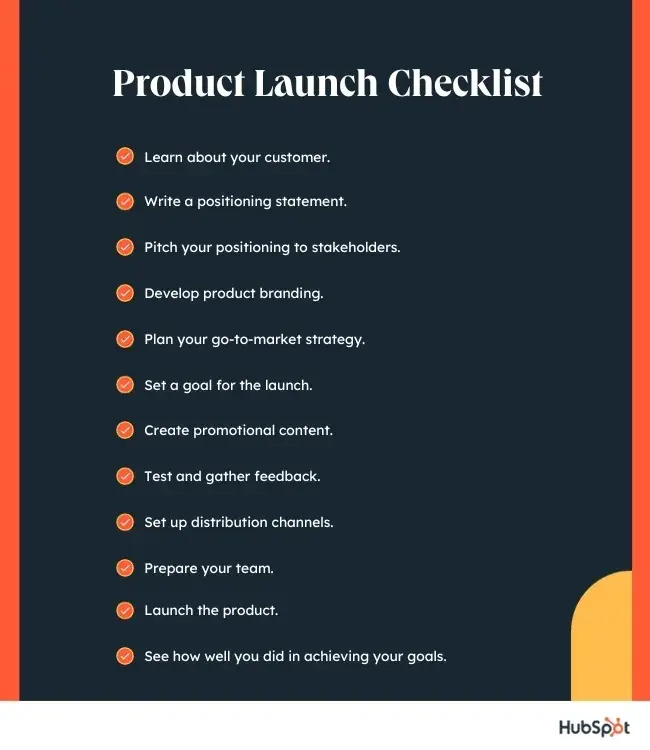
new product launch checklist

1. Learn about your customer.

Whether you call it “market research” or “customer development,” it’s key to learn about what drives your target customer. In my experience, identifying their goals, motivations, and pain points could lead you to developing and marketing a valuable solution.

You don’t need to perform years of intense research to learn about your customer. In fact, I suggest just talking to 12 to 15 current or prospective customers.

When speaking to them, pay extra attention when they start sentences with “I wish a product did this function…” or “Why can’t products do this?” When they give these statements, respond with questions that go deeper, like “Can you get more specific about that?”

If they don’t bring up any pain points, ask them a few specific questions that will encourage them to give deeper answers.

These conversations will give you a solid idea of what their biggest pain points are and how you can market a solution to them. Once you learn these key details about your customers, you can develop a buyer persona that your team can focus on serving.

2. Write a positioning statement.

When launching a new product, you must be able to clearly explain how it fills a need in the market. That’s where a positioning statement comes in.

It helps you communicate the unique value proposition and key benefits that differentiate your product from others.

I recommend writing out a statement that can clearly and concisely answer these three questions:

  • Who is the product for?
  • What does the product do?
  • Why is it different from other products out there?

If you’d like to go even deeper, create a statement that answers the following questions:

  • What is your target audience?
  • What segment of the target audience is most likely to buy the product?
  • What brand name will you give your product or service?
  • What product or service category does your product lie in?
  • How is it different from competitors in the same category?
  • What evidence or proof do you have to prove that your product is different?

Still need more guidance on how to write a positioning statement? Check out this template.

3. Pitch your positioning to stakeholders.

Once you’ve established your positioning statement, present it to stakeholders in your company so they are all on the same page. Call a meeting, send an email, or create a presentation to present.

But I should remind you, when doing this, you’ll want to emphasize how your new product aligns with your overall business strategy, customer needs, market trends, and revenue potential. Use concrete examples, stories, or data to make your pitch more persuasive.

I also suggest you think proactively about potential questions or objections they might have. Prepare thoughtful responses to address concerns around market viability, competition, target audience, or feasibility.

If your employees have a hard time buying into the product, your customers might as well. If your team loves it, that might be a great sign that the product launch will go well.

4. Develop product branding.

Take the information you gathered while conducting your market research and writing your positioning statement, and let it inspire you as you craft your product brand identity.

Creating a brand identity is my favorite part of a product launch. During this step, you’ll develop all the elements needed to create a consistent and memorable brand, including:

  • Product name, logo, and tagline.
  • Color palette, typography, and imagery.
  • Key brand, communications, and marketing guidelines.
  • Packaging.

Product branding is a little different than company branding because it focuses on creating a distinct identity for a specific product, rather than an entire organization. However, they are both still interconnected and should be aligned.

5. Plan your go-to-market strategy.

This is the strategy that you will use to launch and promote your product. While some businesses prefer to build a funnel strategy, others prefer the flywheel approach.

Regardless of which method you choose, this process contains many moving parts. To create an organized strategy for launching your product, I find it can be helpful to use a template, like this one.

As you create the strategy, I recommend you also start considering which type of content you’ll use to attract a prospective customer’s attention during the awareness, consideration, and purchase decision stages.

You’ll need to produce this content in a following step.

6. Set a goal for the launch.

Before you get started on implementing your strategy, make sure you write down your goals for the launch.

Alex Girard, a Product Marketing Manager at HubSpot, says, “Create specific goals for the launch’s success. Keeping these goals in mind will help you focus your efforts on launch tactics that will help you achieve those goals.”

For example, the goals of your product launch could be to effectively establish a new product name, build awareness, or create sales opportunities.

I think one of the best ways to set goals for your launch team is to write them out like SMART goals. A SMART goal is Specific, Measurable, Attainable, Relevant, and Time-bound. I like SMART goals because they’re easy to track and modify.

Once you have your goals in mind, you can start thinking about what KPIs you want to track, such as:

  • Sales revenue.
  • Units sold.
  • Customer acquisition.
  • Conversion rate.
  • Website traffic and engagement.
  • Social media engagement.

Identifying these metrics ahead of time will make it easier to assess whether or not you met your goals after the product is launched.

7. Create promotional content.

After planning out your go-to-market strategy and writing your SMART goals, start producing content that will support and align with those promotional efforts.

In my experience, this can include:

Our go-to-market template will also help you determine which content you should create for each phase of your prospective customer’s buyer’s journey.

Or, you can also use HubSpot’s Start Customer Platform. In this platform, you can easily create everything you’ll need for a successful launch, all while nurturing customer relationships and tracking analytics.

8. Test and gather feedback.

Before you officially launch your new product, I think it’s important to test it out to ensure your final product is the best it can be.

By testing the product in different scenarios with real users, potential bugs, usability problems, or functional issues can be discovered and resolved early on.

Fixing these problems before launching your product ensures a smoother user experience and helps maintain customer satisfaction — an invaluable step, in my opinion.

Gathering feedback from users also allows for product improvement. By listening to the opinions, suggestions, and criticisms of users, you can gain insight into what features are working well and which ones need improvement.

I’ve found this feedback-driven approach can help you make informed decisions on enhancing the product’s functionality, usability, and performance.

9. Set up distribution channels.

Before you officially launch, you’ll need to set up your distribution channels.

This step is important because it determines how and where customers can purchase your product, be it online platforms, brick-and-mortar stores, or other distribution partners.

In my experience, well-planned distribution channels help accelerate the product’s time to market. By proactively setting up channels ahead of the launch, you can quickly distribute the product once it becomes available, minimizing delays and maximizing opportunities to capture early adopters and gain market share.

If you can successfully position your product in prominent retail locations or online marketplaces, it increases visibility and boosts your chances of capturing customer attention and outperforming competitors.

Another benefit I’ve found, it also provides a foundation for future growth and scalability. As your business expands and introduces new products, you can leverage existing channel relationships and infrastructure to efficiently launch and distribute new offerings.

10. Prepare your team.

Be sure that your company and key stakeholders are ready for you to launch and begin marketing the product. In my opinion, it’s helpful to include them at the beginning of your product launch.

Before the big launch day, consider doing the following:

  • Offer your team early access to the product so they can familiarize themselves with it firsthand.
  • Provide training sessions to help your team understand the product inside and out.
  • Develop sales enablement materials such as presentations, product sheets, FAQs, and objection handling guides.
  • Conduct role-playing exercises to simulate real customer scenarios with the product.

During this process, I think it’s essential that all stakeholders are on the same page. Communicate with the company through internal presentations, Slack, or email to keep your company updated on your launch plan.

11. Launch the product.

Once you’ve completed all the above steps, you can launch the product. Here are some last-minute things I suggest you check over on launch day:

  • Double-check all the necessary details, materials, and arrangements to ensure that everything is ready and working correctly.
  • Conduct a brief team meeting to align everyone and address any last-minute questions or concerns.
  • Keep an eye on social media channels to gauge customer reactions, respond to inquiries, and engage with potential customers.
  • Ensure that your website and any systems related to the product launch, such as landing pages or checkout processes, are functioning smoothly.

Most importantly, you should take the time to celebrate the launch and the efforts of your team. This can be in the form of a team lunch, virtual celebration, or any other creative way to acknowledge everyone’s hard work.

12. See how well you did in achieving your goals.

After you launch your product, track how the go-to-market strategy is performing. Be prepared to pivot or adjust aspects of your plan if they aren’t going smoothly.

Additionally, don’t forget about the goals you set before the launch. I recommend taking the time to review the KPI targets you set ahead of the launch and assess how well you did in achieving those goals.

For instance, did you exceed your sales projections, or did you fall short? If the launch didn’t meet expectations, you can rethink your go-to-market strategy and adjust from there.

Stages of a Product Launch

I’m not trying to scare you, but a staggering number of businesses experience a failed product launch each year.

The failure likely isn’t related to the product itself falling flat (although that can happen). It’s more likely that the business did not follow a strict launch strategy or conduct proper market research before putting their product up for sale.

Before you plan for your product launch, follow this quick guide to ensure you set your product up for maximum success (meaning, sales!).

1. Determining Customer Needs

I know this likely goes without saying, but your product should be a benefit to your customer, not a hindrance.

In my opinion, there is nothing worse than trying to use a product that doesn’t actually do what I need to do.

If your product is cumbersome to use or doesn’t actually solve a problem, your audience will likely not see the benefit and will forgo making a purchase.

My suggestion is to take some time to dig deep into your customers’ needs. A solid understanding of your customers’ pain points can help you craft a better product.

If you’re unsure of their current pain points, just ask them. A well-crafted survey can help you uncover their wants, wishes, and needs.

Plus, this survey can help you understand why your customers will or will not buy your product, which can help you determine your market positioning and a promotional strategy. You can also use your CRM to collect this data.

2. Looking at Competition

Remember how your teachers would tell you to “keep your eyes on your own paper?” As a former teacher, I’m guilty of saying those exact words.

But when it comes to a product launch, forget everything your teachers told you. It’s okay to take a look at your competitors.

In fact, it’s expected, and it’s one of the best ways to understand the advantages and disadvantages of a competing brand.

Eyeing your competitors can help you create a plan to set your product apart from the competition. By doing a deep dive into your competitors, you should be able to determine a better marketing strategy and how to position your product as the solution to customer needs compared to other brands.

3. Creating, Testing, and Refining a Prototype

Hopefully, you have a few key audience members on standby that you can bounce ideas off of. Using their expertise, create a prototype of your product and ask them to beta test it.

Take it from Oindrila Mandal, a senior game product manager at Electronic Arts. says, Mandal notes that, in the video game industry, phases of launch could start with a limited beta test.

Here “marketing efforts try to reach a specific segment of potentially highly engaged customers or ‘power users’ and ask them to sign up for the product as an exclusive preview. The product launched in this stage is largely still under testing, may have limited functionality, and will probably undergo changes based on the user feedback,” Mandal says.

Regardless of your industry, a beta test is an excellent idea. Using your beta testers’ notes and feedback, you can implement their suggestions to work out any bumps in your prototype or add a new suggested feature.

Your beta testers’ feedback is invaluable and an important part of a successful product launch. Don’t skip this step!

4. Determining Numbers

Before you spend more time and money creating and launching your product, it’s not a bad idea to crunch the numbers. Spend some time looking at factors like your profit margins, your product’s performance, and potential sales volume.

Doing so will help you create a baseline for needed conversions and sales.

And, running the numbers can give you insight into whether or not your product launch is worth the time and effort.

If your needed conversations and sales feels like an impossible task, it’s okay to scrap your plan, make some tweaks, and try again.

5. Building Pre- and Post-Launch Marketing Plan

A successful launch requires a good bit of pre-marketing and planning. You’ll need the help of those within your circle to help generate buzz about your product.

You might enlist the help of a PR agency or create partnerships with influencers within your niche. Take some time to brainstorm the best course of action. This will help you achieve a better launch.

6. Checking supply chain.

One of the reasons product launches fail is not because of an awful product, but because there is not enough of it to meet demand. Double check with your suppliers and vendors to ensure you have enough product for a successful launch.

You’ll also want to nail down a plan for scaling your product, if the demand exceeds your expectations.

7. Launching your product.

Launching your product is the most exciting stage of the product launch. This is when you’re finally able to show your hard work to your audience, and, hopefully, make a sale.

I’ll talk more about the how-tos of a successful product launch later in this post.

Keep reading!

8. Ask for and analyze feedback post-launch.

The public’s perception of your product is a big indicator of its success. Their feedback is valuable and can help you better understand what went right in your launch or which aspects failed.

Now that we know the stages of a product launch, let’s take a look at how to launch a product.

How to Launch a Product With Data and Expert Insight

Now that you know all the details that go into launching a product, we need to talk about how to *actually* launch it, from setting your launch date to releasing your product into the wild and anticipating orders from your loyal client base.

Lindsay Wyskowski, brand strategy director at Identity PR says, “You only get one bite of the apple, which really translates to getting the launch right because you only get one chance. All of the parts and pieces need to align appropriately, with everyone involved on the same page following the same plan, so the product launch can really be a milestone moment for the company.”

If you’re ready to come up with your own product launch plan to get that milestone moment for your business, follow these steps.

1. Set a date for your launch.

The first thing you need to do is pick a date for your launch. Whichever day you choose, be sure to give yourself plenty of time to get all the things you need to do done. Realistically, you’ll need to set your launch date out several weeks, or even months.

Bernardo Castro, backend developer and founder of Bybrand, tells me his company usually takes three months to launch a product.

Bernardo says, “The first month is about planning. What platforms are we going to use? Will it be available all at once or staggered? What is our sales objective for the first week? The second month is about polishing the product (the software, in our case) and creating marketing content. The last month is about teasing the launch, determining the launch date, and rolling out our marketing campaign.”

With his advice in mind, you’ll need time to:

  • Craft marketing copy for emails and social media.
  • Create a landing page for your product.
  • Ensure your product’s bugs and kinks are worked out.
  • Drum up some customer hype.
  • Work out logistics.

If you’re like me, you’ll likely find picking a date and working backward to be helpful. This means once you have a good date in mind, you can mark off the weeks with deadlines detailing when and how to accomplish your pre-launch tasks.

2. Choose your marketing channels.

Where you market your product matters. It matters because if your audience is not hanging out on the platforms you’ve chosen, you’re essentially yelling into the wind.

Take some time to figure out which channels are your best marketing channels. Do your customers:

  • Read and respond to emails or SMS messages?
  • Are they active on specific social media platforms?
  • Are they easily influenced by social media influencers?

The answers to these questions will help you determine your best plan of marketing action. And remember, 88% of people are likely to trust a recommendation from people they know and trust, so word-of-mouth marketing shouldn’t be off the table.

Don’t forget, you can market your product on multiple channels. So, while one marketing platform might not be the most effective, in my opinion, it’s not a bad idea to give it a try to reach all of your customers.

3. Develop your messaging and marketing materials.

You can’t have a successful product launch without compelling marketing materials. Your marketing materials will help draw in your audience, explain the benefits and usefulness of your product, and showcase your brand’s voice and message.

These materials include:

  • Landing pages.
  • Blog posts.
  • Paid advertisements.
  • Emails.
  • SMS messages.
  • Short-form video.
  • Long-form video.

Speaking of your brand’s voice and message, though, you’ll also want to pinpoint exactly the tone you want your marketing materials to set. Ask yourself:

  • How do you want to present your product?
  • Do you want your brand to be helpful? Direct and to the point? Humorous? Optimistic?

The answer to those questions will help determine your tone of voice, which will guide you and your marketing team’s copywriting and content efforts. You can also look to your target audience, too, to help you determine your tone of voice.

Which attitude do they best respond to?

4. Create some buzz around your product.

Once your promotional materials are ready to go, it’s time to start promoting your product and its launch! Ideally, you’ll want to start promoting your product about six or eight weeks before the launch date.

In my experience, this will give you plenty of time to generate interest among your target audience, without shocking them with a surprise launch that could fall flat.

Take a look at your launch date and then count back six to eight weeks. Whichever day that falls on should be the start of your marketing campaign.

Since 80% of social media marketers say they think customers will buy products directly in social apps, don’t discount the power of social selling and promotional social media posts.

You can use social media scheduling tools to help you schedule your posts ahead of time. Or, create a content calendar detailing your posting schedule to share with your team.

To create even more buzz and better market your product, consider:

  • Hosting an exclusive pre-sale for select target audience members.
  • Creating a limited edition of your product.
  • Hosting a launch party, either in-person or online.
  • Giving early access to influencers to help promote and market your product to their audiences.

Above all, I recommend using your six to eight weeks of promotional time wisely. When done right, this time will pay off in dividends.

5. Launch your product.

On launch day, it’s officially time to release your product to the public and make some hard-earned sales! Use your preferred marketing channels to announce your product launch to your audience.

Pro tip: Don’t forget to include a link to make a purchase!

6. Track the results.

You’ll have a good indication of how well your launch performed based on sales.

However, it’s a good idea to dig into your marketing channels’ analytics to get a better idea of what worked and what didn’t.

Keep an eye on your:

  • Open rates for both emails and SMS.
  • Click-through rates.
  • Social media engagement data.

While you can’t go back and change your past marketing strategy, tracking your results can help you plan for a better launch the next time.

Plus, you can make changes to your strategy in real-time, like reviewing your open rates and editing email subject lines for a better chance at your audience opening them before you send follow-up emails.

And remember, 47% of email recipients open an email based on the subject line alone, so you really need to nail it to increase those open rates!

How to Launch a Product Online

To launch your product online, you’ll want to ensure you’ve followed the steps above. However, there are a few additional steps you’ll want to follow to gain traction primarily online.

1. Figure out the story you want to tell regarding your product’s bigger purpose.

What story do you want to tell across social platforms, landing pages, and email? This is similar to your positioning statement but needs to be geared entirely toward your target audience. Ask questions like:

  • Why should they purchase your product?
  • How will your product or service make their lives better?

Remember how I said it’s important to get your team and stakeholders involved before you start? Communicating cross-functionally ensures the communication materials you use across various online channels align — which is key when it comes to establishing a new product in the marketplace.

Consider, for instance, how Living Proof announced its new product, Advanced Clean Dry Shampoo, on its Instagram page. The story revolves around a simple nuisance common with most other dry shampoos — How consumers still want that just-washed feeling, even when using a dry shampoo.

Living Proof's new Instagram post, highlighting its new product launch

Image Source

I like how Living Proof builds excitement and demand for its new product by focusing on how the product will benefit consumers through storytelling, and using a new hashtag #NoWastedWashes.

2. Display customer testimonials, case studies, and other social evidence to positively frame your new product.

Consumers want to see that other consumers have already taken the risk and purchased your new product before doing it themselves.

I’m guilty of spending hours researching what others say about a product before I finally take the plunge. And because I’m not alone in this, this is where social proof comes into play.

In the weeks leading up to a product launch, or shortly after its launch, begin posting customer testimonials, reviews, and case studies to showcase how your new product has already helped other people.

Take this a step further and employ influencers to share the word about your product as well, if it’s a good fit for your brand.

Consumers are smart enough to know they shouldn’t trust every advertisement they see — but they can trust fellow consumers. So leverage that trust through social proof methods.

3. Create a social and email campaign.

Create a full, comprehensive social media campaign to increase interest and awareness of your new product.

I advise using paid advertising to reach new audiences, creating full product explainer videos to use across your social channels, and using email to reach existing customers and provide an exclusive first look at your new product’s features.

Since 73% of consumers prefer to watch a short-form video to learn about a product or service, I highly recommend you keep that in mind when creating your video content.

Additionally, you might consider hosting a live stream to connect directly with prospects and existing customers and invite experts from your product development team to explain the new features of your product.

It’s important to note — in this stage, you’ll want to pay attention to how consumers are interacting with the communication materials regarding your new product.

Share concerns and feedback with the product development team — it’s important to trust your consumers and use their feedback to strengthen your product.

4. Have a pre-order option.

If a consumer is excited to purchase your new product, don’t make them wait — provide an option to pre-order the product or service before it’s even available.

This helps spread out demand while enabling consumers to purchase the product whenever they’re feeling most inclined to do so.

The cost of launching a new product varies significantly.

For instance, an entrepreneur will see vastly different costs for launching a product on Amazon than an enterprise company might see for launching a product in a million-dollar market.

I’ll share two examples to explore this more closely.

Entrepreneur Product Launch Example

In the first example, let’s say you’re an entrepreneur who has invented a design app you’re hoping to sell online.

You might conduct market research to determine which marketing strategies work best for your goals, which messaging resonates best with your audience, and which design elements appeal to your desired prospects.

If you use a few focus groups to determine these answers, you might expect to spend roughly $5,000.

When you’re bringing a new app to the market, you’ll need to choose the best go-to marketing strategy for your needs. Regardless of the strategy you choose, they all cost money.

For instance, product branding could cost roughly $1,000 if you’re paying a designer to help you out, and website design could cost anywhere from $500-$3,000 if you’re paying a web designer a one-off fee.

These fees don’t include the cost you need to pay yourself and any employees if this is a full-time job. It also doesn’t include the costs of hiring an engineer to update the app’s features and ensure the app is running smoothly.

With this simplified example, you’re looking at roughly $8,000. Of course, you can cut some costs if you choose to do any of these tasks yourself, but you might risk creating a subpar customer experience.

Enterprise Product Launch Example

On the other end of the spectrum, let’s consider a large enterprise company that is launching a new product. Here, you’ll likely pay upwards of $30,000–$50,000 for market research.

Perhaps you’ll spend $15,000 on brand positioning and the marketing materials necessary to differentiate yourself against competitors, and you might pay upwards of $30,000 for all the product design and brand packaging.

Finally, your marketing team could need a budget of roughly $20,000 for SEO, paid advertising, social, content creation, etc.

All said and done, launching a product against other enterprise competitors could cost roughly $125,000. Again, that doesn’t include the costs you’ll pay your marketing, product development, and engineering teams.

Product Launch Best Practices by Industry

How to Launch a Digital Product

When launching a digital product, you’ll want to begin building anticipation with a strong content marketing strategy.

Use blog posts, email marketing, social media, and other channels of distribution to increase interest and demand for your digital product.

I also suggest you ensure you’re leveraging lead generation strategies to reach existing customers and prospects.

For instance, let’s say you’re launching an online course on SEO. In the weeks leading up to the launch, you might create SEO-related blog content to send to your email subscribers with an option to join the SEO course’s waitlist.

This helps you gauge the effectiveness of your marketing materials while reaching an audience that has already demonstrated interest in your brand.

How to Launch a Product on Amazon

Anyone who’s ever shopped on Amazon knows the importance of a good product listing. In the weeks leading up to launch, take the time to create a strong, high-converting product listing.

This includes taking high-resolution photos of your product, writing a description that outlines your product’s differentiating features, and using keywords to help your product rank on Amazon.

Additionally, product reviews are incredibly important on Amazon, so I recommend having reviews ready to go before you even launch your product on Amazon.

To do this, ensure you’ve either launched your product on your own website first (which gives you time to earn reviews before launching on Amazon).

You can also send your product to a select group of interested buyers ahead of the full launch and collect reviews from them.

Finally, ensure you’re ready for an Amazon product launch by checking inventory.

You never know how quickly your product might gain traction on the ecommerce superstore, so make sure you have enough products to fulfill Amazon orders quickly.

Pro tip: Take a look at HubSpot’s The Ultimate Guide to Selling on Amazon for more information related to Amazon.

How to Launch a SaaS Product

To launch a SaaS product, you’ll want to start by researching competitors and understanding the marketplace at large. There’s plenty of demand for SaaS products, as the industry is expected to grow by more than 16% by 2026.

However, the SaaS industry is also well-saturated, so before launching a SaaS product, I highly recommend you determine how your product differs from all the others in the industry.

To create a successful product launch, you’ll want to conduct market research and focus groups to determine the true benefits and differentiators of your product.

Next, I suggest employing a strong content marketing strategy to increase your website’s visibility on search engines and to ensure your business is appearing in search results for topics related to your product.

Since you aren’t launching a physical product, your marketing efforts need to convince businesses that your product can solve their needs. Additionally, you might want to offer free trials or a freemium option for smaller businesses on lower budgets to test out your offerings before committing.

Pro tip: For a full SaaS rundown, take a look at HubSpot’s Ultimate Guide to Software as a Service (SaaS).

How to Launch a Food Product

To launch a food product, you’ll first need to ensure you’re prepared for the costs required to do so.

This includes how much it costs to package and store the product (including packaging, warehousing, and distribution) and how much it costs to sell the product (including branding and digital marketing).

Next, you’ll want to follow federal and state food regulations. For instance, you need to ensure you’re following health department rules for food preparation surfaces, refrigeration, and sanitation.

You’ll also need to make sure the labeling you use on your product’s packaging is accurate, which requires you to send your food product to a lab for analysis and check with your state commerce to see what it requires for nutrition labels.

When launching a food product, I think it’s a good idea to hire a food broker. A food broker can foster relationships with national or local grocery stores and will create a promotional plan to help increase sales when your food hits the shelves.

Typically, a supermarket will test out your product for a few months before determining if there’s enough consumer interest to keep it stocked — which is why a food broker can be incredibly useful for using business intelligence and industry knowledge to ensure a successful food product launch.

1. Calm

product launch example: calm

Image Source

Originating in 2011 as a website called donothingfor2minutes.com, Calm is a mobile app that provides various resources and tools for meditation, sleep, relaxation, and mindfulness. Although Headspace was the leading meditation app at the time of its launch, it didn’t take long for Calm to dominate the market.

Calm found success largely because of its content marketing and SEO strategy. According to Foundation’s research, Calm has attracted over 8 million backlinks and uses blog content and YouTube content to organically attract and engage prospects.

The company also partners with celebrities to create unique content and engaging ad campaigns. Some of Calm’s most famous collaborators include Lebron James, Harry Styles, Matthew McConaughey, and Camila Cabello.

Calm’s celebrity partnerships have given them a leg up compared to their competitors. Not only their celebrity-read Sleep Stories garner millions of views, but they also boost the brand’s visibility and authority.
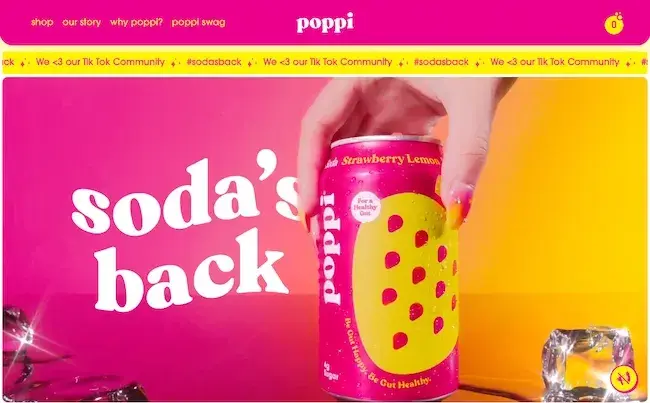
2. Poppi

product launch example: poppi

Image Source

Poppi is a “prebiotic soda,” which is a beverage that combines the fizziness and taste of a traditional soda with fruit juice, prebiotics, and apple cider vinegar. It comes in flavors such as Classic Cola, Root Beer, Orange, and Cherry Limeade.

Initially called “Mother Beverage,” Poppi was originally created when co-founder Allison Ellsworth wanted to create a drink that was both healthy and tasted good.

Not only does Poppi stand out from other beverages because of its health benefits, it also has a unique and colorful brand personality that attracts customers.

According to Ellsworth, “We had this really fun and vibrant brand and a product that people could relate to. People love it and it was created with ingredients that people knew to be effective and beneficial to their body.”

Poppi was originally slated for a retail launch in March of 2020. However, those plans changed due to the Covid-19 pandemic.

Fortunately, they were able to pivot to launch as a DTC product, selling on Amazon and other ecommerce platforms. Additionally, they used this opportunity to invest in social media marketing on Instagram and TikTok, where they gained popularity amongst Gen Z consumers.
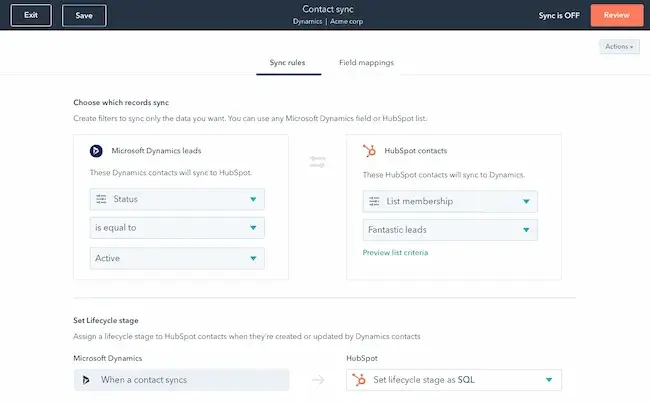
3. HubSpot Operations Hub

product launch example: operations hub

In 2021, HubSpot launched Operations Hub as part of its CRM platform. The product is designed to help businesses streamline their operational processes, improve data quality and accuracy, and enable cross-team collaboration. This allows businesses to run more smoothly and scale more effectively.

One of the reasons why this launch was successful was because it solved a problem that many customers faced.

According to HubSpot’s research, “over 60% of operations professionals have to do duplicative work because of a lack of alignment between teams.” This happens because operations professionals get hired into separate departments and get siloed and overwhelmed with tasks as their companies scale.

In response, HubSpot introduced Operations Hub so operations employees could work together out of a shared system and remove friction from their day-to-day workflows.
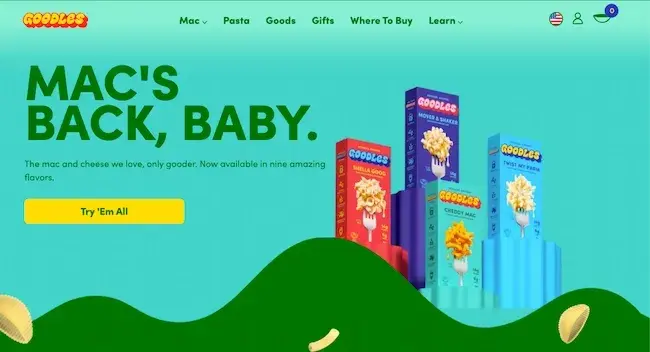
4. Goodles

product launch example: goodles

Image Source

Goodles is a noodle brand that takes boxed mac-and-cheese to the next level. This product differentiates itself by providing more nutritional value than the standard dry noodles, with 10g of protein and 7g of fiber with prebiotics in every serving.

“The pasta aisle is overflowing with golden, al dente pasta options that provide very little nutrition. There’s also an ‘alt-pasta’ section with green, brown, orange, mushy, foamy noodles that offer more nutrition but little ‘yum,’” co-founder and CEO Jen Zeszut said in a press release. “Why should you have to choose between taste and nutrition?”

Aside from its positioning as a delicious and nutritious alternative to boxed mac-and-cheese, Goodles also stands out with its vibrant and fun branding.

While other noodle brands have neutral-colored packaging, Goodles uses a bold color palette, a nostalgic typeface, and cheeky product names, like Shella Good and Here Comes Truffle, to attract consumers in the grocery aisle.

Product Launch Tips

To learn the best practices for a successful product launch, I talked to Alex Girard again.

The HubSpot Product Marketing Manager said he had three main tips for a successful product launch:

  • Your product positioning should reflect a shift you’re seeing in the world, and how your product helps your customers take advantage of that shift.
  • Create a recurring schedule for you and the core stakeholders for the launch to check in and ensure you’re all on the same page.
  • Make sure you keep the product team in the loop on your marketing plans. The product team could have insights that inform your overall marketing campaign.

However, sometimes, external factors might impact your ability to launch a product. When that happens, you might need to delay your launch.

How to Know When to Delay a Product Launch

To understand when and why, you might hold off on a product launch, Girard told me there are three key reasons why you might want to delay a product launch, including:

  • When your product itself isn’t ready and you need to change your timeline to create the best customer experience possible.
  • If a situation occurs where your current customers are having a less-than-optimal experience with one of your current products. Before launching and promoting a new product, you should make sure your current customers are satisfied with your existing product offering.
  • If something occurs on an international, national, state, or local level that requires your audience to readjust their priorities and shift focus away from your company and its product launch. Make sure that when the time comes to launch, your target audience is ready to learn about your new product.

Launching the Right Way

In my experience, a product launch involves a lot of moving parts and collaboration with a lot of people.

I’ve learned that I must keep my eye on my product, the stakeholders, our target audience, and our marketing materials to ensure a smooth and successful launch.

If you‘re looking for templates to coordinate your team efforts and align your company around your new product’s messaging, download our free product marketing kit below.

Editor’s note: This post was originally published in November 2015 and has been updated for comprehensiveness.