Categories B2B

9 Simple Ways to Write a Good Introduction Sentence

When I started my journey as a freelance writer, I struggled with writing introductions. I’d often find myself diving into the main body of the article and even wrapping up the conclusion before circling back to the beginning.

→ Download Now: 6 Free Blog Post Templates

The pressure to craft an attention-grabbing opening was overwhelming, and I’d spend days trying to figure out the right angle. The reason is that intros have to be compelling enough to make readers continue.

They have to make a good first impression.

Compelling readers to read the article is an art form in itself. And if you don‘t do it well, you’re missing out on potential subscribers, leads, and customers.

In this post, I’ll share some simple techniques that helped me write powerful introductions that turn casual browsers into readers. Article introductions matter, and here’s how you can make yours count.

Table of Contents

How to Start an Introduction

Writing a compelling introduction is crucial for grabbing your reader’s attention and setting the tone for your entire article.

While there are many approaches you can take to your introduction, here are three common but effective ways to start an intro that captivate your audience from the very first sentence:

1. Using Quotes

Starting with a quote can immediately engage your readers by introducing a voice or perspective that resonates with the theme of your article.

Whether it’s a famous quote, a line from a relevant book or movie, or a statement from an industry expert, a well-chosen quote can lend authority and context to your topic. It can also spark curiosity, encouraging readers to think about how the quote connects to the content that follows.

In the article, The Hidden Costs of Hobbies and Side Projects, the author, Sam, starts with an anonymous quote: “You have to sacrifice in life, or your life will become the sacrifice.”

good intro sentence example - using quotes: “you have to sacrifice in life, or you life will become the sacrifice.”

While the article’s title is somewhat worrying, the quote does intensify the ominous feeling readers will likely develop as they examine their own lives to see what their hobbies and side projects might be costing them and how detrimental these costs are to their overall well-being.

Another example of how quotes multiply the impact an article intro has on readers is this one in an article about the three deep books that rewired his mind.
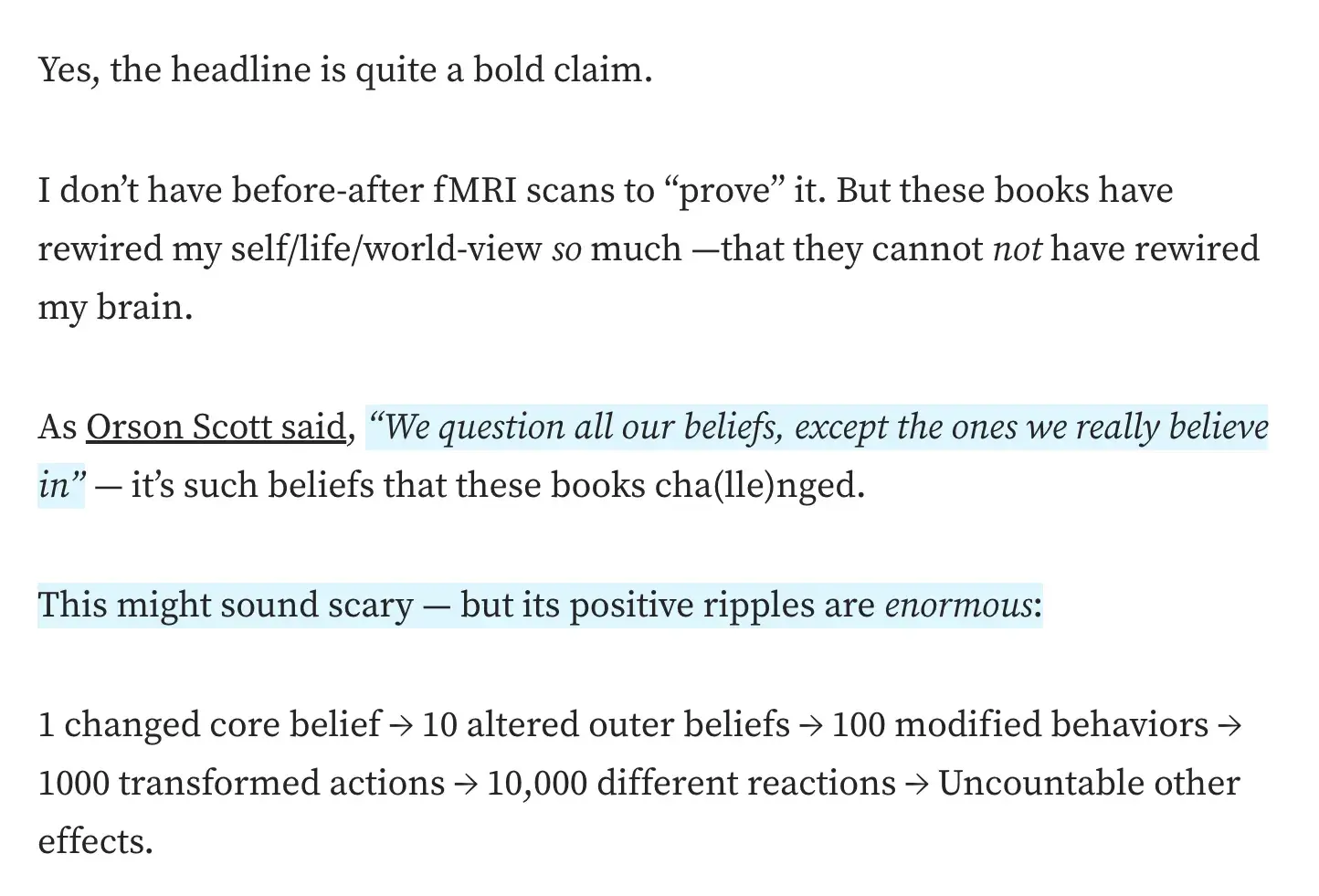
good intro sentence example - using quotes by famous people: “we question all our beliefs, except the ones we really believe in” - orson scott

While the quote is not the first sentence in the intro, it does appear quite early: “We question all our beliefs except the ones we really believe in” by Orson Scott.

This quote carries emotional weight, provoking thought and stirring curiosity in readers. It makes them want to find out the titles of these books, how exactly they rewired the author’s worldview, and if the books can help them question their own deeply held beliefs.

2. Setting a Scene

Setting a scene at the beginning of your article can draw readers into a specific moment, place, or situation. This method is particularly effective for creating a vivid mental image that makes the topic more relatable and engaging.

By painting a picture with your words, you invite your readers to step into the scenario and experience it alongside you, which can make your content more impactful and memorable.

Here’s an article titled Your OKRs Aren’t OKRs. While business-related articles can be boring and monotonous, the author of this one infuses life and color into the piece by starting with a scenario.
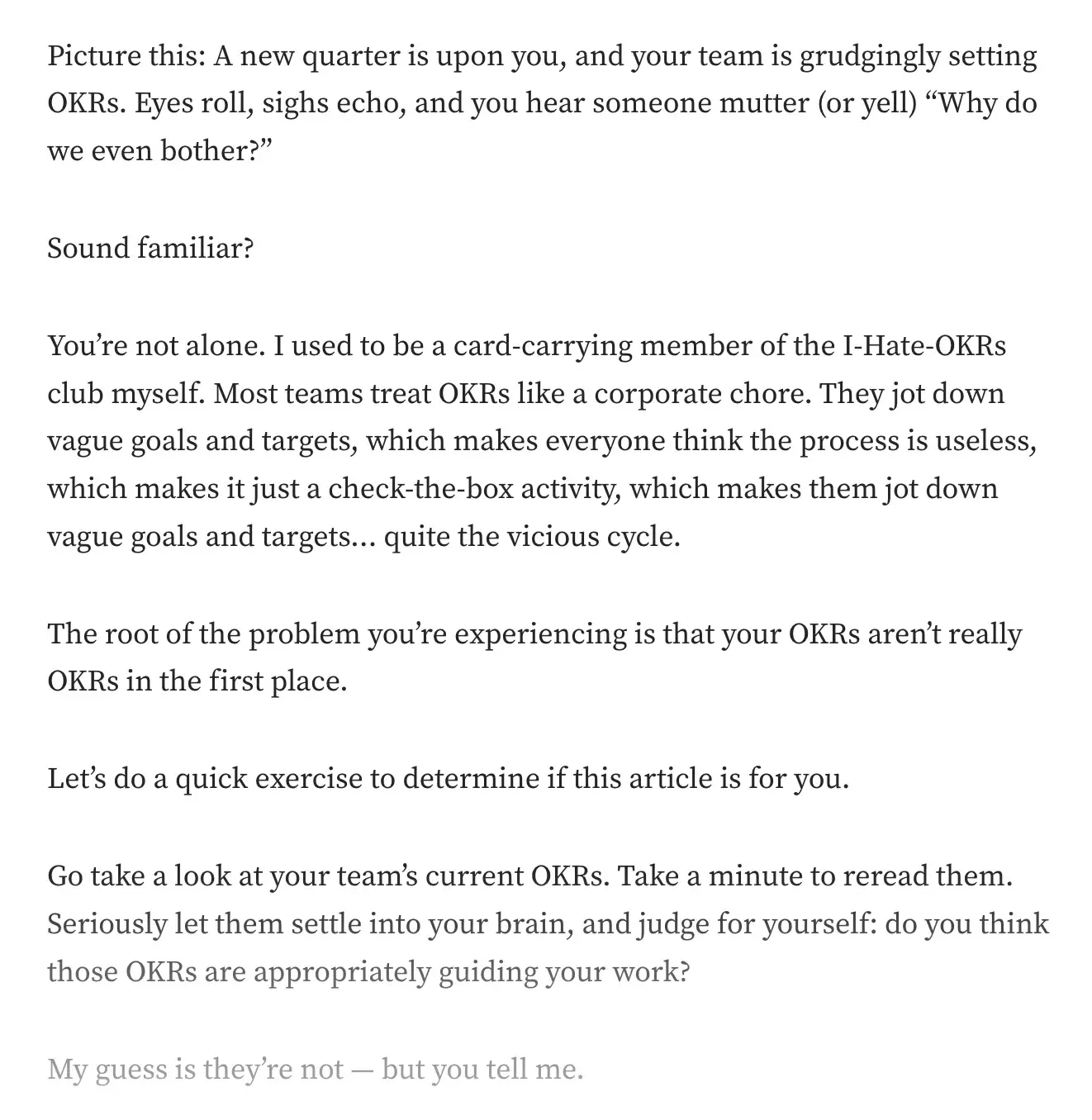
good intro sentence example - setting a scene: “Picture this: A new quarter is upon you, and your team is grudgingly setting OKRs. Eyes roll, sighs echo, and you hear someone mutter (or yell) ‘why do we even bother?’”

This scenario activates readers’ imagination, allowing them to “see” the context of the piece before consuming the main content.

It’s also written in a way that readers will likely be able to relate, especially as the author discusses their own former dislike for Objectives and Key Results (OKRs), showing that it’s something of a universal experience for managers.

When you set a scene, you’re not just describing a situation — you’re creating an atmosphere that evokes emotion.

Whether it’s tension, excitement, nostalgia, or calm, the scene you set can influence how readers feel as they begin reading. This emotional connection makes them more invested and more likely to continue reading.

Pro tip: Whenever I have a relevant personal or work experience to share (that relates to my article topic), I like to use my experience as the intro (as I did in this article). But instead of swapping one for the other, you can combine a fictional scenario with an anecdote to create a stronger impact.

3. Using Statistics or Fun Facts

Starting your introduction with a statistic or fun fact is a powerful way to grab attention by surprising your readers or providing them with a piece of information they might not have known.

This approach can quickly establish relevance and credibility, especially when the statistic or fact directly relates to the problem or topic your article addresses. It also encourages readers to think critically about the subject, making them more invested in learning more.

In this article about the benefits of eye contact, the author referenced a study by Intelligent.com that shows that over 50% of employers interpret a struggle to make eye contact as nervousness or a lack of confidence.

good intro sentence example - using statistics: “According to a recent survey from Intelligent.com, more than half of employers… interpret [struggle to make eye contact] as a lack of confidence or nervousness.”

This statistic achieves two things in this article. First, it educates readers who were not aware of this fact. Those who struggle to make eye contact, especially in interviews, will want to read the article till the end to figure out how to fix this issue and increase their chances of finding a job.

Second, it lends credibility to the piece and, by extension, the author. Instead of the author simply saying that not making eye contact can lead others to think one is nervous or lacks confidence, they find and reference an actual study to prove their point and emphasize the importance of eye contact in conversation.

Readers will more readily believe the study and other articles by the same author as they’ve seen that the author doesn’t pull claims out of thin air.

Fun facts might not be based on surveys, but using them in your intros is a, dare I say, fun way to quicken readers’ interest in your piece. The caveat is they have to be relevant to the topic you’re discussing.

Take, for example, this fun fact in the intro of an article titled, How Writing Makes The Invisible Visible (And Using This to Connect to Things Far Bigger).

good intro sentence example - sharing fun facts: “imagine being able to taste with your arms or feet. Sounds like science fiction, but for an octopus, it’s reality.”

The author uses the fact that octopuses can taste things (and thus, sample their environment) with their tentacles to draw a parallel to how writing can help folks “turn our complex worlds into structured language.”

Sure, this fun fact is great to learn, but it also provokes curiosity and helps readers think critically about the topic.

1. Keep it short.

I’m a big fan of short sentences. I love them because people can understand them easily. There’s great value in short sentences that are readable, digestible, and punchy.
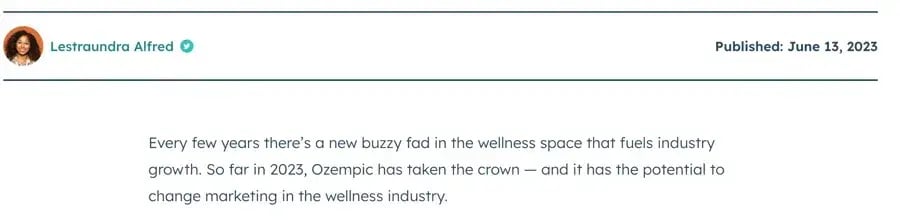
how to start an introduction, example of short sentences

Writers often get so caught up in the pressure of a good intro that they deliver long, run-on sentences. The problem with these sentences is that they make readers work hard, which isn’t a great incentive to keep reading.

While the length of an introduction can vary, it’s best to aim for brevity with up to three short paragraphs. Using AI tools like our Paragraph Rewriter tool can help make your paragraphs more impactful and concise.

Readers are impatient to get to the meat of the article, so don’t bury the lede deep in your article — cut to the chase.

A good example of a short intro is this one by Pablo Srugo for his article titled “I Was Supposed To Be a Millionaire at 25 … Instead, I Went Bankrupt.” The intro is just three sentences long and adequately complements the attention-grabbing headline, prompting readers to continue.
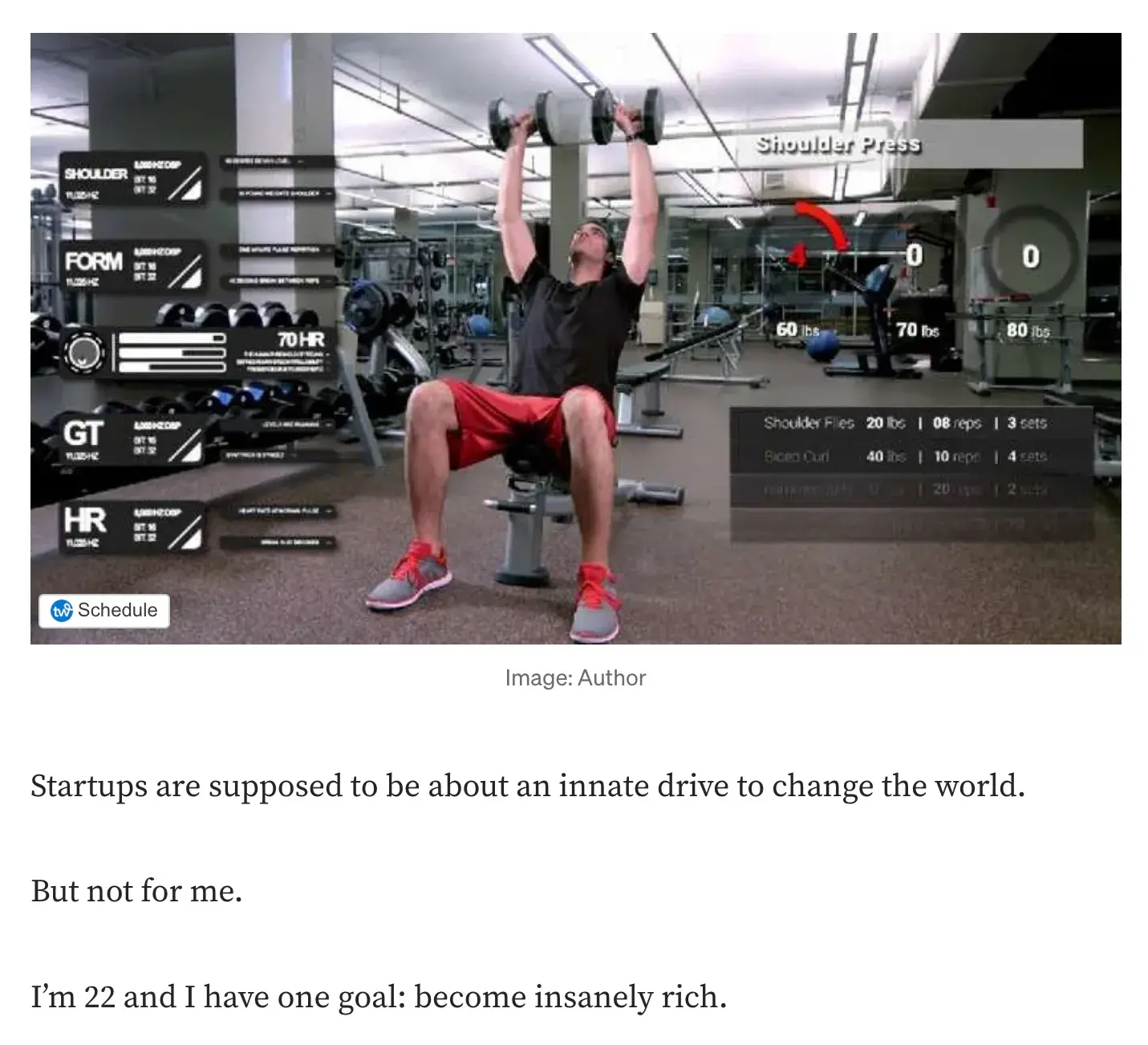
good intro sentence example - use short sentences: “Startups are supposed to be about an innate drive to change the world. But not for me. I’m 22 and I have one goal: become insanely rich.”

Another one is this listicle explaining the top 15 software development trends. The intro quickly explains why software developers must be aware of these trends and segues right into said trends.
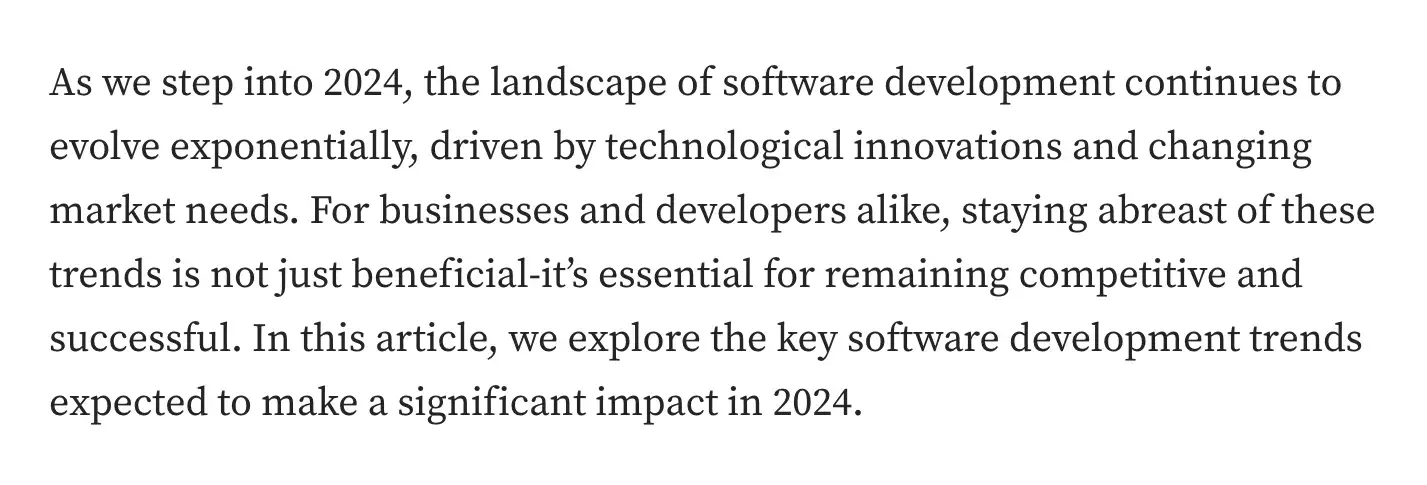
good intro sentence example - use short sentences: “As we step into 2024, the landscape of software development continues to evolve exponentially, driven by technological innovations and changing market needs.”

2. Say something unexpected.

You‘ve probably heard advice like “Create a hook” and “Grab the reader’s attention.” But what kind of stuff actually grabs someone’s attention?

The trick is to say something unexpected — something that catches the reader off guard.

This could be a personal story that’s relatable yet surprising, a question that challenges assumptions, compelling data that shifts perspectives, or a scene-setting sentence that transports the reader into a different context.

Think about it — your reader has already clicked on the headline. So, they’re interested in your topic. But now, you have to reel them in a little further.

If your very first sentence is interesting enough to make people want to read the next one, then you’ve done a good job.

For example, this intro for an article titled “Absurdism: The Philosophy That Changed My Mindset starts off with a thought that many people struggle with: Nothing good is going on in my life.

good intro sentence example - express shocking thoughts or opinions: “Nothing good is going on in my life.”

While this is a shocking way to start an article, it does communicate to readers that the author has been in their shoes and understands what they’re going through. And so, people who had never heard of absurdism before would be interested in continuing the article to see if there’s anything in it for them.

Here’s another example of a great intro, except this one sets the scene with a fictitious character named George, a recruiter whose job is to sort through thousands of resumes for new job openings.
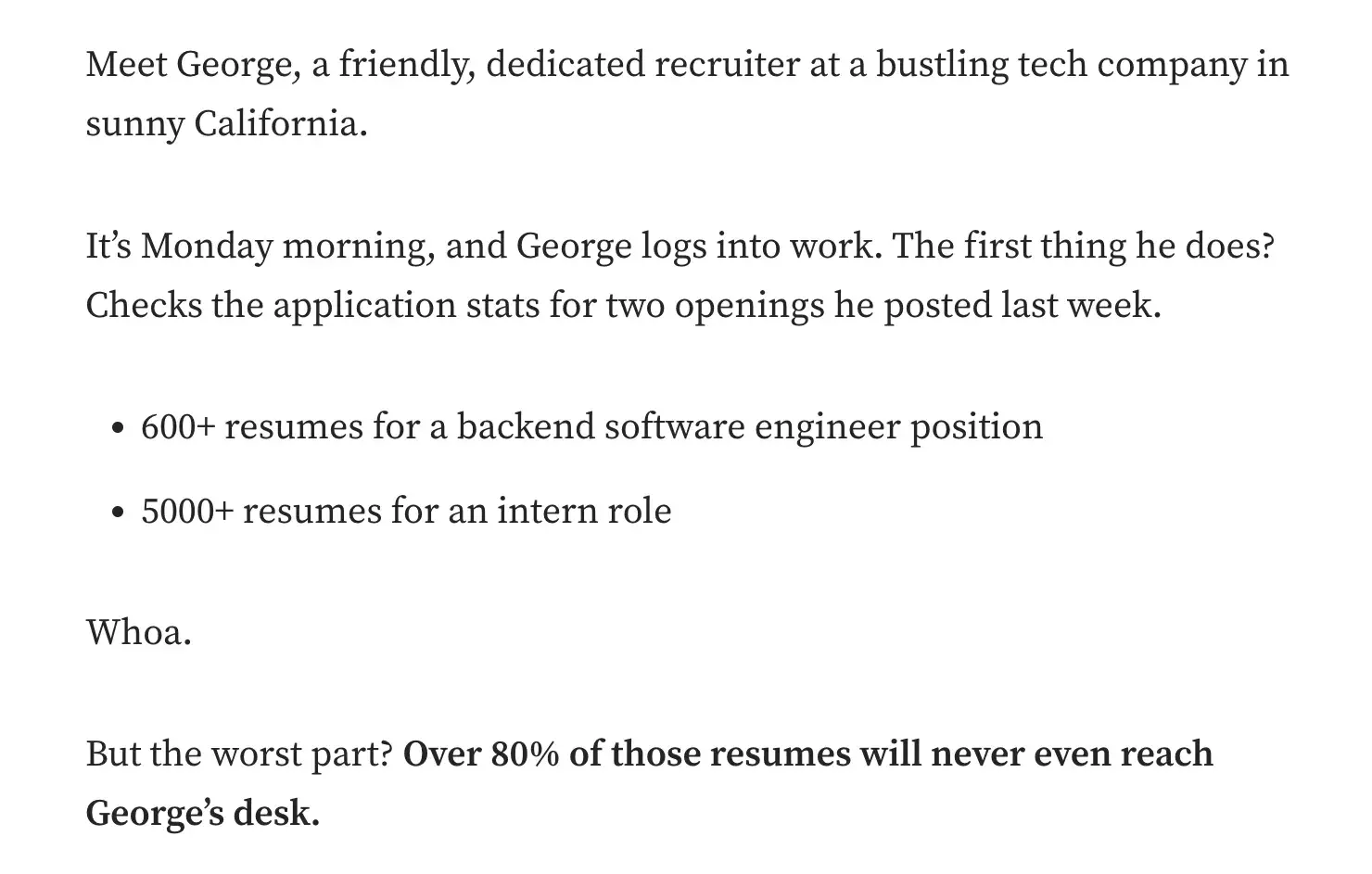
good intro sentence example - describe a scenario: “Meet George, a friendly, dedicated recruiter at a bustling tech company in sunny California.”

This scene helps readers picture an environment in which they’re key players. In this case, the character they’re relating to isn’t George but the candidates whose resumes get stuck in the Applicant Tracking System (ATS) and who wait for a response that will never come.

George’s character provides the necessary context for candidates to understand what goes on at the other end of their application once they’ve sent it.

3. Don’t repeat the title.

You only have a few seconds to make a strong impression in your introduction, so use that time wisely.

While repeating the title of your article in the opening sentence might seem like a natural way to start, it’s actually a wasted opportunity. Your reader has already seen the title and clicked on it because it intrigued them. Now, they’re looking for something more.

Instead of reiterating the headline, use your introduction to reinforce the promise made by the title and set the stage for the rest of the article.

This is your chance to expand on the topic, provide context, and highlight the value your content will bring.

4. Use the word “you” at least once.
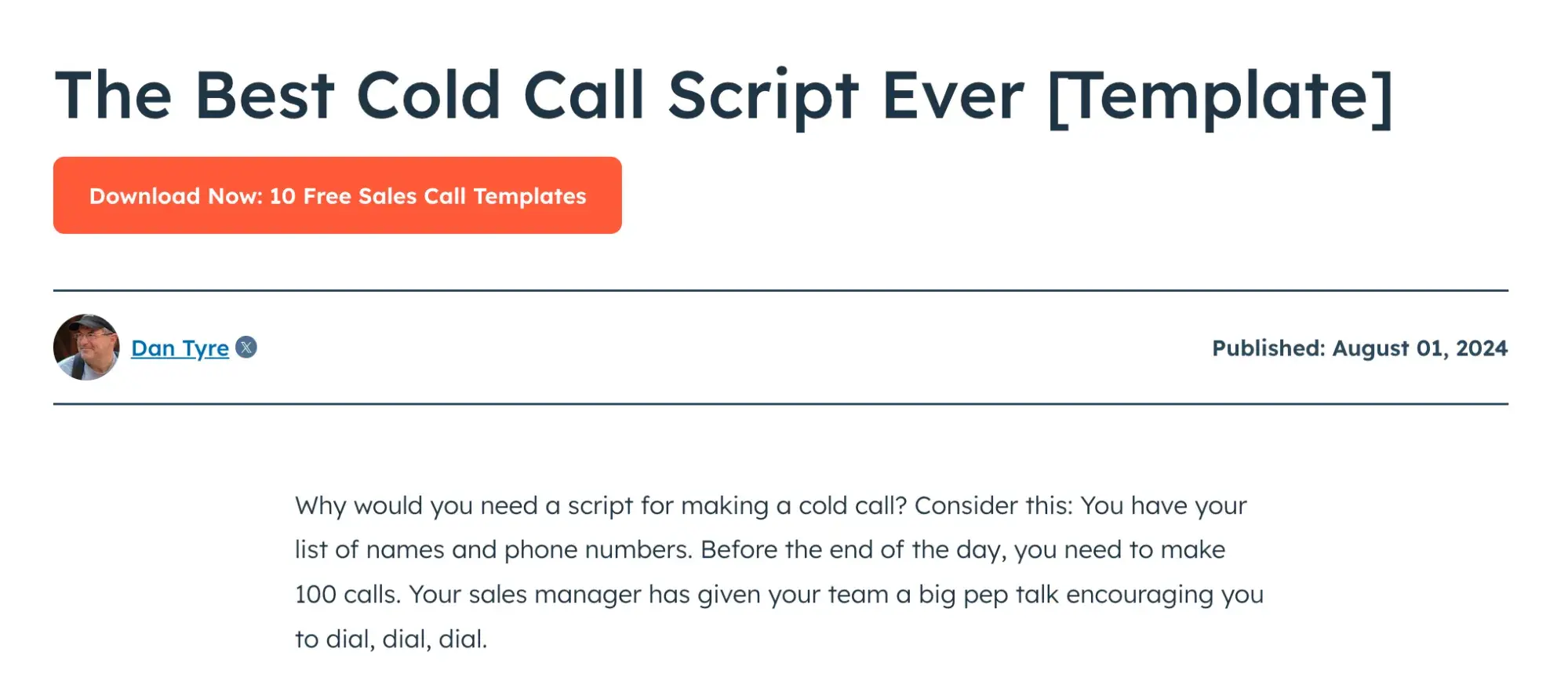
how to start an introduction example - use the word “you”: “Why would you need a script for making a phone call?”

The word “you” is a powerful word.

It tells the reader that you, the author, are writing the article with them in mind. You empathize with them, you care about them, and you want your piece to resonate with them.

It’s a simple trick that establishes a crucial connection with your reader. It can transform a piece of writing from a distant, impersonal narrative into a conversation that resonates with the reader on a deeper level.

I’m using this technique in this article itself.

After discussing my experience struggling to write introductions, I explained to you, my readers, why knowing how to write compelling introductions is important and how these techniques will help you write better intros.

5. Tell readers what’s coming next.

As you craft your introduction, guide your readers by letting them know what they can expect from the rest of your article. What will you be covering? What will the reader learn? How will this help them?
how to start an introduction example - tell readers what’s coming next: “In this post, I share how Steve Jobs managed to sway the world using simple yet powerful persuasion strategies that you can apply in your own life.”

By answering these questions in your intro, you set clear expectations and help your audience navigate your content. They might just jump to the section they’re most interested in or read the whole thing. Here are a few examples:

  • “You’re about to find out why sea turtles always lay their eggs on the beach.”
  • “And, if you’ve ever wondered why sea turtles lay their eggs on the beach, here’s everything you need to know.”
  • “This article explains the 17 reasons why these amazing creatures lay their eggs on beaches.”
  • “Fascinating, funny, and shocking, these are the reasons why sea creatures lay their eggs on the beach.”

But you don’t always have to be so explicit. Sometimes, a well-placed question is enough to help readers infer that you’re about to give them some good information or tips in the article.

Here’s an example of this from a business article about handling a low performer:
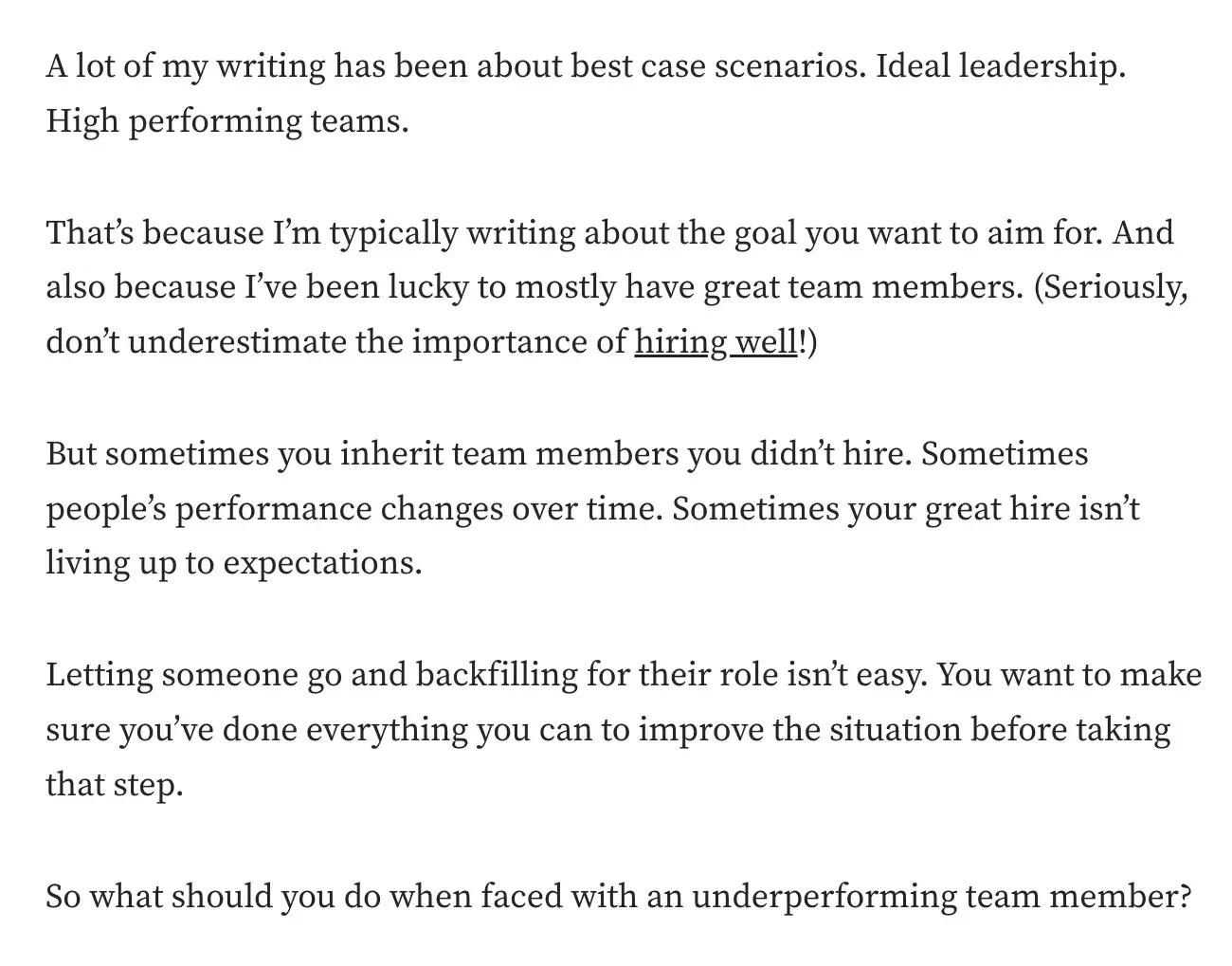
good intro sentence example - ask a question to segue into main content: “So what should you do when faced with an underperforming team member?”

After explaining how managers often inherit team members they didn’t hire, and some don’t meet the company’s expectations, the author asks, “So what should you do when faced with an underperforming team member?”

The presence of this question implies that the author will answer it in the main body of the article, so readers know to look forward to it.

6. Explain why the article is important.

It may be obvious to you why your article is important to your readers, but it’s up to you to emphasize its value and put it in context.

For instance, say you’re writing an article about TikTok written for a marketing audience. You could lead with a surprising TikTok stat about its user base. Here’s an example:

“In the past two years, TikTok’s user base has grown by 15% while other platforms are seeing stagnant or declining engagement. This suggests that marketers may want to pay more attention to this short-form video platform.”

In two sentences, you’ve presented an interesting tidbit and explained why it matters.

Take the introduction to this article. You’ll recall the following sentence: “And if you don‘t do it well, you’re missing out on potential subscribers, leads, and customers.

My goal here was to connect the topic of blog post introductions to a business’s bottom line.

This article by Rakia Ben Sassi about starting a YouTube channel does something similar:
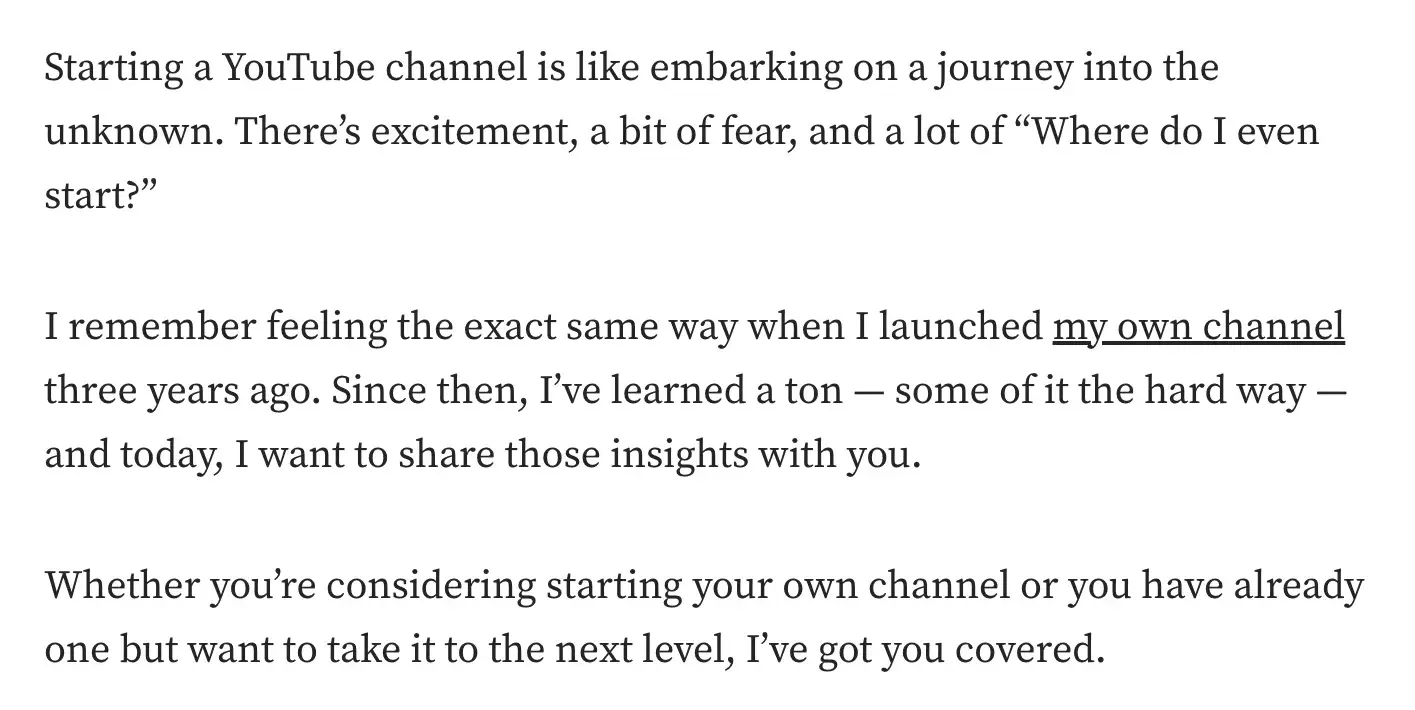
good intro sentence example - explain why the article is important: “Whether you’re considering starting your own channel or you already have one but want to take it to the next level, I’ve got you covered.”

She sets the stage by describing the fear, excitement, and uncertainty people feel when starting a YouTube channel. Then, she talks about her credentials and why readers should trust her opinion (she launched her own channel three years ago).

Then, she explains why the article is important: It’s to help readers who are starting a new channel or trying to scale an existing one.

7. Refer to a concern or problem your readers might have.

Everyone in every field has their own set of problems. You should have some listed already from when you created your buyer personas.

Addressing a specific concern or problem your readers face is a powerful way to engage them right from the start.

By acknowledging their challenges, you show empathy and immediately establish the relevance of your content. People want to solve their problems, and articles that explain how to do this will help you earn readership.
how to start an introduction example - refer to a problem or concern your readers have: “The challenges of entrepreneurship can exist well beyond any entrepreneur’s control — but those troubling  roadblocks aren’t insurmountable.”

For example, if you’re writing an article explaining how digital marketers can keep up with the ever-evolving digital landscape, you could say: “Feeling overwhelmed by the constant changes in digital marketing? You’re not alone. In this article, we’ll explore strategies to help you stay ahead without burning out.”

This empathetic approach helps you build trust and credibility, as it demonstrates your understanding of your readers’ needs. When you tap into the reader’s problem-solving mindset, they’re motivated to continue reading in search of solutions, making your content more impactful and memorable.

8. Be careful telling stories.

Many people will tell you that you need to write a story in the introduction to captivate your audience. Stories can be a powerful tool to draw readers in, as they naturally spark curiosity and create an emotional connection.

However, there are both good and bad ways to use storytelling in your introductions. The key is to tell a concise, relevant, and compelling story that piques your readers’ interest without overwhelming them with too much detail.

While it’s tempting to delve into a long and intricate story, remember that an introduction aims to grab attention quickly and set the stage for what’s to come. A long-winded story can lose readers along the way, diminishing the impact of your article.

If you choose to begin your article with a story, consider withholding the conclusion of that story until later in the article or even until the very end. By delaying the resolution, you create a narrative thread that weaves through your article, maintaining your readers’ interest as you build up to the story’s conclusion.

For example, say you’re writing an article about overcoming challenges in entrepreneurship.

If you’re an entrepreneur yourself, you might start with a short anecdote about a time you faced a significant setback in your entrepreneurial journey.

Describe the struggle you faced and how it seemed insurmountable at the time, but don’t reveal how you overcame it just yet.

Instead, use the story to illustrate the theme of resilience and promise your readers that you’ll explore how you turned things around later in the article.

9. Use a stat or a fact to convey urgency.

When journalists begin a news story, they often give readers an eye-catching stat or fact about what’s going on.
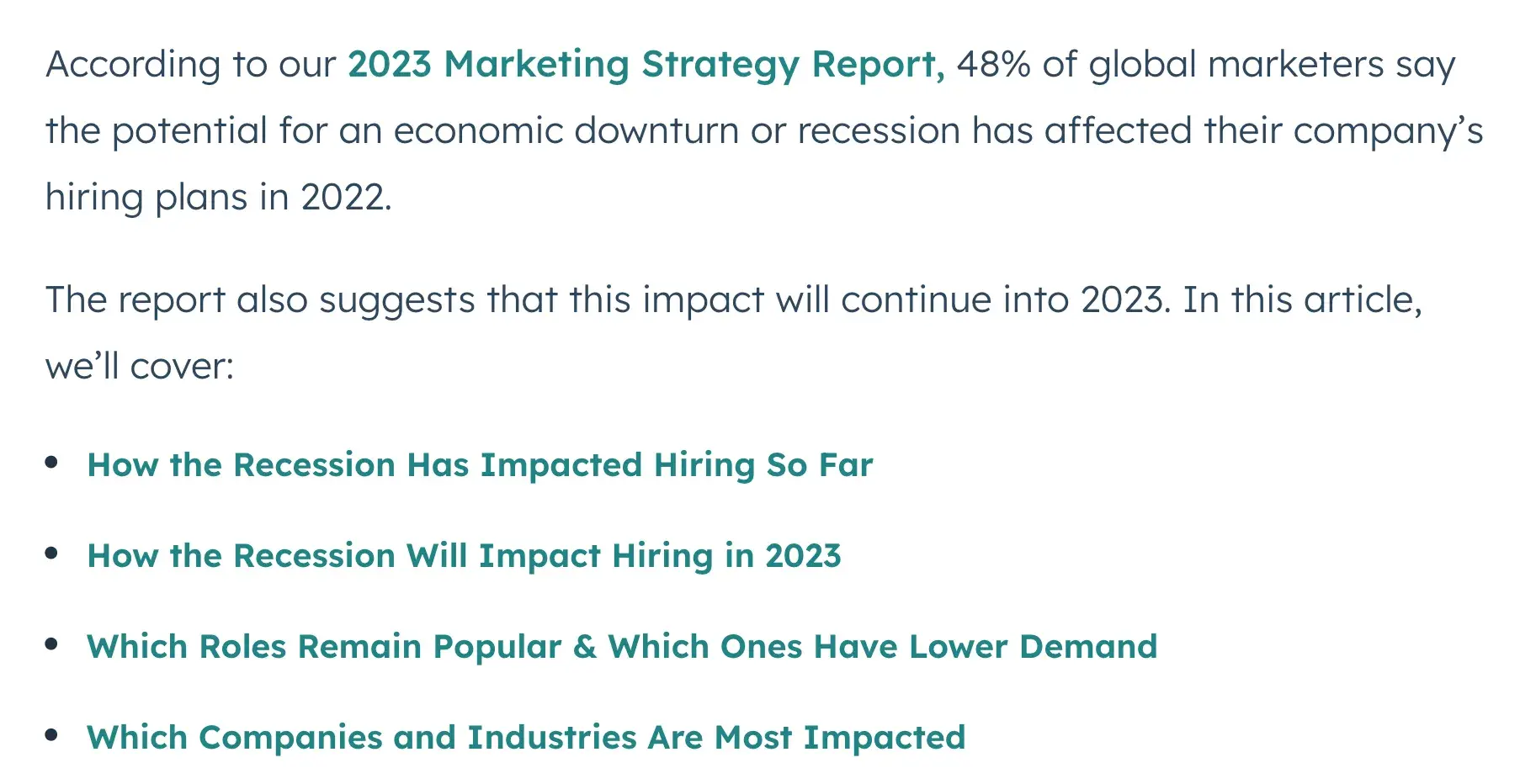
good intro sentence example - use a stat: “48% of marketers say the potential for an economic downturn or recession has affected their company’s hiring plans in 2022.”

As a blogger or any type of writer, a really interesting stat or fact will draw your reader in and show them why your topic is really important.

For example, say you’re a plumber writing a blog post on pipe replacement. You might pull in more readers if you start a post by explaining how frequently old pipes burst in the winter.

Or, if you’re writing an article showing folks how to spend more time reading instead of scrolling their phone screens, you can start by sharing statistics on how many hours young people spend on their phones daily. Like this:
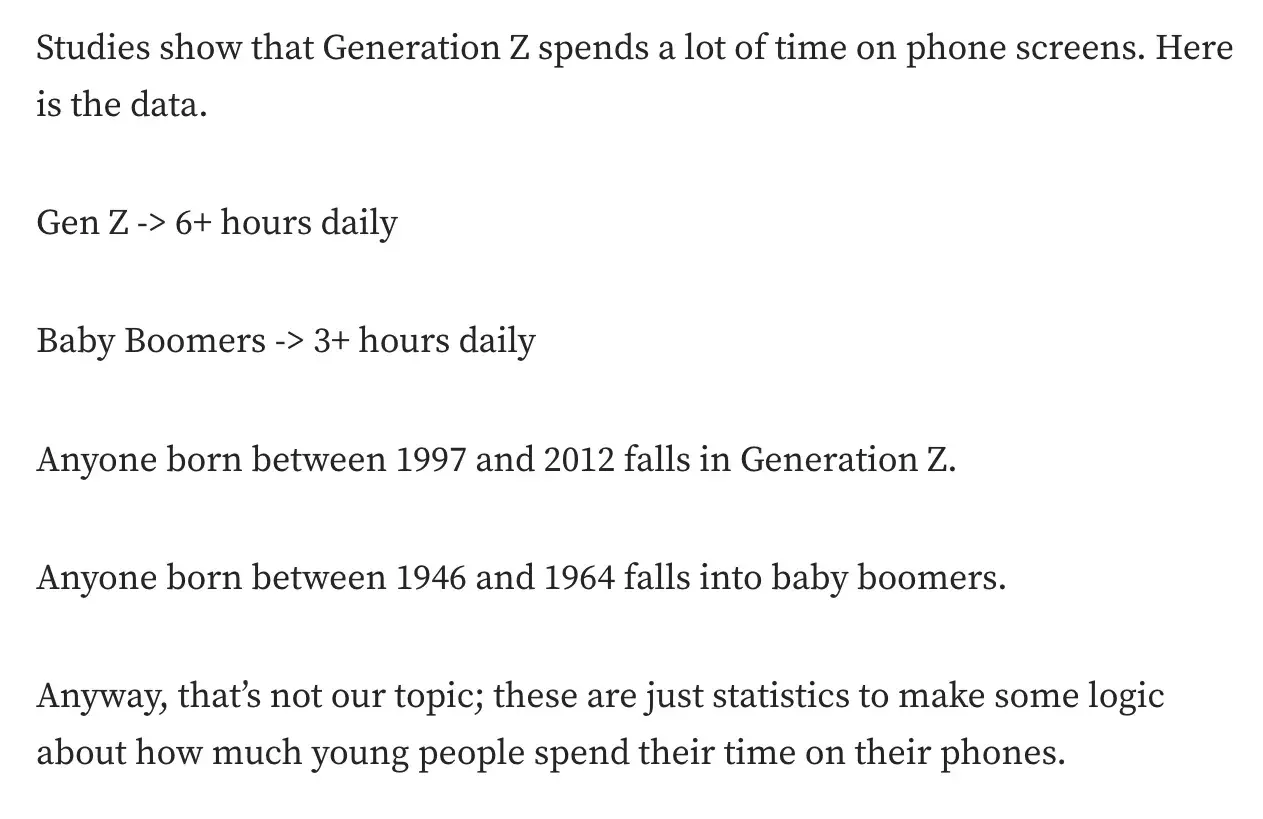
 good intro sentence example - use shocking statistics: “Gen Z spends 6+ hours on their phones daily and Baby Boomers 3+ hours daily.”

If readers see that this is a common issue that others face, they might keep reading to learn how they can avoid it.

Using Generative AI to Write Content

ChatGPT’s instant and massive popularity in late 2022 heralded serious discourse about using generative AI to write content.

While there are some polarizing opinions on how generative AI should be used, there’s no denying that AI tools like ChatGPT, Jasper, and Copy.ai have become valuable tools for content creators, including myself. These tools help writers brainstorm ideas, overcome writer’s block, and generate content drafts.

In my experience, they speed up my writing process by providing a starting point, crafting compelling introductions, and suggesting alternative phrasings.

However, while generative AI can be incredibly helpful, I don’t think you should solely rely on what it generates. AI tools can produce coherent and well-structured content, but the output often lacks the depth and nuance that come from personal experience, deep research, and subject-matter expertise.

Moreover, AI-generated text may include inaccuracies or “hallucinations” — instances where the AI presents false or misleading information as fact.

In this article, the team at IBM detailed a few examples of AI hallucinations, including the time Meta pulled its Galactica LLM (large language model) demo in 2022 after it provided users with inaccurate information that was sometimes rooted in bias and prejudice.

This is why you should always fact-check anything AI generates for you.

That said, you can use AI as a starting point in your writing process and then refine the content with your own (or third-party) expertise to create an engaging and trustworthy piece. If you struggle with intros, here are the steps to using AI to craft article introductions:

  1. Determine the type of introduction you want to create. Are you starting with a fun fact, a quote, or by setting a scene? Each approach requires a different prompt.
  2. Next, write a prompt that instructs the AI on what kind of intro you need. Be clear about the tone, style, and content you’re aiming for.
  3. Once the AI tool generates the text, read it carefully. Look for any inaccuracies or areas that might need clarification, restructuring, or additional detail. The AI’s output is just a draft; it’s up to you to refine it.
  4. Edit the AI-generated content to incorporate your own knowledge, experiences, and voice. Make sure the introduction aligns with the rest of your article and provides an engaging start.
  5. Verify any data, quotes, or facts included in the AI-generated text and personalize the content where necessary to ensure it resonates with your audience and reflects your unique perspective.

Here are a few examples of AI prompts for different intro types.

1. Stating a Fun Fact

Prompt: Write an engaging introduction for an article about the benefits of morning exercise. Start with a surprising fun fact about how exercise impacts mental health.

Possible output: Did you know that just 20 minutes of exercise in the morning can boost your mood for up to 12 hours? In this article, we’ll explore how a simple morning workout can set a positive tone for your entire day.

2. Using Quotes

Prompt: Create an introduction for an article about leadership in the workplace. Start with a powerful quote about leadership from a well-known figure.

Possible output: “The greatest leader is not necessarily the one who does the greatest things. He is the one that gets the people to do the greatest things.” This quote by Ronald Reagan perfectly captures the essence of leadership. In this article, we’ll discuss how great leaders inspire their teams to achieve extraordinary results.

3. Setting a Scene

Prompt: Write an introduction for an article about the challenges of remote work. Start by setting a scene that highlights a common struggle for remote workers.

Possible output: It’s 7:00 AM, and you’re already answering emails from the comfort of your kitchen table. The line between work and home blurs as you sip your coffee, trying to find focus in a space that was once reserved for relaxation. This is the new reality of remote work, where the challenges are as complex as they are unique.

Note: If you find it difficult or time-consuming to write a whole blog post from start to finish, check out HubSpot’s free blog post templates that help you save time without compromising on quality.

Making a Great First Impression

While setting a scene and/or sharing a relevant anecdote is my favorite way to start an article intro, I learned — and I hope you did, too — that there are several ways to write an introduction that packs a punch and prompts readers to read till the end, including using quotes and sharing fun facts.

However, while these techniques are excellent for creating interest, over the past couple of years, I realized that what really keeps people reading a piece is the empathy I, the author, infuse into it.

Letting readers know that I know and relate to their struggles and that I have a possible solution for them, be it an alternative way of doing things or a contrarian idea to help them broaden their epistemic horizons, is what keeps them engaged.

So now, whenever I write an introduction, I think about what kind of introduction would make me want to read the article. I then use that to inform the approach I take.

Introductions are hard, and writing effective ones takes time and practice. But remember, it’s all worth it if it means keeping the attention of a few more of your readers.

Editor’s note: This post was originally published in October 2015 and has been updated for comprehensiveness.


Categories B2B

Challenges Faced By Native & Indigenous Entrepreneurs [Data + Expert Tips]

Welcome to Breaking the Blueprint — a blog series that dives into the unique business challenges and opportunities of underrepresented business owners and entrepreneurs. Learn how they’ve grown or scaled their businesses, explored entrepreneurial ventures within their companies, or created side hustles, and how their stories can inspire and inform your own success.

For many Native entrepreneurs, it’s not active discrimination that proves the biggest issue in getting a business off the ground. In fact, per a recent Breaking the Blueprint HubSpot Blog survey, many Natives don’t feel like their heritage figures one way or the other into their entrepreneurship challenges.

Instead, it is the generational disadvantages that accompany past discrimination, such as a chronic lack of credit and capital access, alongside new issues like discoverability and scalability.Read more Breaking the Blueprint content

It’s unfortunate that these challenges can pose significant hurdles to entrepreneurs and business people looking to find success. But they are survivable.

I reached out to Native and Indigenous Entrepreneurs to hear their direct takes on these challenges and ask their advice for rising above and overcoming them. Here’s what they had to say.

Top Challenges Faced by Native & Indigenous Entrepreneurs

Respondents to the survey I mentioned above were asked to name their three biggest challenges.

Roughly 56 percent of respondents pointed to financial issues such as raising capital or budgeting, while 33 percent cited growing and scaling their businesses as a major issue.

Lastly, getting the word out and building awareness was an issue for 24 percent of respondents.

native-and-indigenous-challenges

1. Financial Challenges

Financial challenges make sense, says Heather Fleming (Navajo), executive director for Tuba City, Arizona-based business incubator Change Labs.

Fleming’s program works closely with Navajo and Hopi entrepreneurs to hone and grow their businesses. She sees these challenges facing participants firsthand — many of them are the symptoms of larger problems, like infrastructure issues and a chronic lack of access to credit in Indian Country.

“The financial challenges like securing capital have been a long-standing issue, just because of the way land is structured. You can’t use it as collateral if it’s reservation land, because it’s held in federal trust,” Fleming said.

“When we talk about scaling — there’s a specific challenge for many people because of the transition to e-commerce. I was just reading our annual reporting, and a lot of members talked about the lack of reliable internet. How do you grow a business if everything’s confined to your home and your internet reliability isn’t great?”

The lack of credit access is often worsened by exclusion from otherwise good-intentioned financial programs at large, nationwide banks. Chad Johnson (Cherokee), founder and president of farm logistics company The Akana Group, pointed to a shortage of such programs at nationwide financial institutions.

Due to a combination of aforementioned land laws and a lack of generational wealth, credit in Indian Country is a different beast – and without specialized financial programs, that means Indigenous entrepreneurs miss out, Johnson said.

“There are these big guys, and they have these programs, but they’re not there for Natives,” Johnson said. “The financial institutions really struggle with getting credit access to Native entrepreneurs.”

Quote 1

There are resources, such as community development financial institutions (CDFIs), which are often tailor-made for the Native communities they serve. But funding for Native CDFIs is limited – and when a business owner hits a certain point, microloans aren’t going to cover scaling costs, Johnson said.

For example, the Akana Group has partnered with farm equipment manufacturer John Deere to get equipment into Native producers’ hands and has started doing business internationally for other projects. That means scaling well beyond the capacity of many Native CDFIs to cover, Johnson said.

“There’s this missing gap between, ‘I’m a start-up,’ and ‘I need a $10 million line of credit,” Johnson said. “Where do Natives go when they need a $10 million loan?”

2. Getting the Word Out and Building Awareness

Then there’s the marketing. Justin Quis Quis (San Pasqual Band of Mission Indians) heads up Sacred Bev, a beverage company in California. Quis Quis says marketing is a complex thing that requires a lot of focus and long term vision to pan out.

He pointed to initial marketing efforts for his company’s product – a set of functional beverages using Indigenous ingredients – as a costly failure.

“I’ve already been through a marketing agency, nationwide, and it did nothing for me,” Quis Quis said. “I spent a bunch of money, and it did nothing.”

To get the word out and build awareness, Quis Quis suggests leveraging marketing, focusing on your product, starting small, and working smart.

He has since gone back to marketing his drink locally, working on finding a distributor and building success from there. He just ordered his fourth run of 20,000 cans of his product.

His advice on marketing, and securing investors, is to develop a long-term vision for the product or service and focus as much as possible on its uniqueness.

“Marketing is a necessary evil,” Quis Quis said. “You just have to be careful which route you go. Be realistic with your ideas, and don’t spend a ton of money to start off. It’s easy to get caught up in something that seems big and translates to you going big. Be judicious.”

Quote 2

Fleming said it could be difficult to stay on top of marketing trends while managing all the other aspects of starting a business. Instead, she recommended finding marketing blogs or podcasts that could do some of that legwork to keep the messaging as on-trend as possible.

Fleming said it’s also a good idea to find other Natives to collaborate with when marketing Native products or services. Change Labs has had a lot of success when pairing its program participants with Native graphic designers, for example, since it’s more likely they will understand another Native’s needs and vision.

Her third big tip was to get comfortable with digital tools. She watched many business owners struggle with moving to e-commerce during the advent of COVID-19 as flea markets and art shows shut down.

Aspiring entrepreneurs should familiarize themselves with programs like Canva, which can help design logos and visual messaging, and AI tools like ChatGPT.

“We hear a lot of people say things like ‘I don’t know what I want to say,’” Fleming said. “You have all these tools now that can help you with that – you can get the basic message out and then get it into ChatGPT and have that help you clean it up. There’s no excuse for bad copy when you have tools like that now.”

Quote 3

3. Growing and Scaling

Say the marketing efforts pay off, and it’s time to grow. That means scaling up production, shipping logistics, or service access – and that means money, said Quis Quis and Fleming.

Fleming referred back to internet connectivity. Large swathes of the Navajo reservation are offline due to scattershot physical infrastructure like signal towers and fiber optic lines.

Running an online side business from a local library or coworking space is one thing, but aiming to make a living usually means scaling that idea up.

That means consistent connectivity, which could mean anything from a hotspot to a Starlink modem, which can run around $500. Small improvements like that can create huge growth for businesses expanding into new markets.

But even with a thriving side business, many Natives, being among the poorest demographics in the United States, won’t have that spare $500 for a unit, stifling their growth.

That can be where places like Change Labs come in, Fleming said. The organization offers participants loans after completing workshops and other activities as part of a yearly cohort.

“I think it’s critical that we do that. Access to just a little bit of money would improve their ability to participate in e-commerce,” Fleming said. “I think when you‘re a business owner, it’s easy to overlook how important it is to have access to loans or financing in order to grow your business.”

Quis Quis said access to credit is crucial to getting anywhere with growth, however. That goes back to marketing: being able to present a product or service to investors or lenders as something that can scale up. Putting together a solid business plan and a clear vision can make that process much smoother.

“Money is competitive,” Quis Quis said. “You need a really good financial plan in order to look attractive to investors and to have that plan set out as tightly as you can.”Quote 4

Cherish the little victories, because those are hard to obtain.

As much of an uphill climb as Native entrepreneurship can be, the results can be incredible. As a business journalist, I’ve followed stories of people who make the climb and begin building wealth for their families and communities.

For example, I first shared a profile for Johnson’s Akana Group well before their first forays into international trade missions and overseas business.

But getting there takes patience and perseverance, says Quis Quis.

“You have to have that long-term vision – there’s no overnight success. That’s not meant to be discouraging, just to say that it takes determination and the ability to see down the road,” Quis Quis said. “There’s a lot of good things out there, but you’re going to go through a meat grinder to find it. If you understand those realities, you can fight through it and succeed.”

There are resources for Indigenous entrepreneurs at nearly any step of their journey: tribal grants for people just getting started, incubators for people hoping to learn where to go next, and financial institutions for taking bigger steps into bigger finances.

While gaps exist and the available resources have a long way to go, seeing what’s available is always a good first step.

Johnson said one of those resources should be mentorship and connectedness with other Native businesses. It’s easy to feel compartmentalized and isolated, but working with other Native businesses can help with figuring out solutions to problems that are sometimes uniquely Indigenous.

“When I talk to other Indigenous business owners, I say, you’re not going through anything that’s unique to you,” Johnson said. “We’ve got to come together and show up for each other. That’s a big part of it.”

Click the link to discover more Breaking the Blueprint Content.

Categories B2B

3 Point-of-Need Advertising Opportunities — and How to Tap Into Them

Are you hoping to bypass overcrowded channels and engage your audience at the perfect moment? If your answer is yes, you may want to learn about Point-of-Need paid advertising opportunities.

Download Now: Free Ad Campaign Planning Kit

Too many advertisers stick to the basics — they pour money into Google keywords, Facebook ads, maybe even a few billboards or podcast spots.

But here’s the problem: these channels are overcrowded, and the competition is fierce. Ultimately, you end up paying top dollar for less impact, and the returns are dwindling.

If you’re ready to set yourself further away from the competition and tap into advertising channels where your audience is actually engaged, it’s time to rethink your approach. As Kieran and I discuss in a recent episode of Marketing Against the Grain, one high-impact way to do that is Point-of-Need advertising.

In this post, we dig into exactly what Point-of-Need advertising is and how you can use it to cut through the advertising noise and capture your audience’s attention when it matters most.

What is Point-of-Need advertising and why does it matter?

I’ll be honest: Point-of-Need (PoN) advertising is a term I made up. But it’s a potent, actionable strategy that Kieran and I frequently use to maximize our ad spend.

Point-of-Need (PoN) advertising is a tactic that targets your audience at the exact moment they’re most engaged and in need of something — like getting online during a flight, waiting for a taxi ride, or while watching their favorite show.

Especially when traditional ads are becoming increasingly ignored or skipped over, PoN advertising hits when your audience is already laser-focused. So instead of fighting for attention in crowded channels, you’re placing your brand in front of people when they’re most receptive and primed to pay close attention.

This boosts engagement and increases the chances that your message will stick and drive real results.

3 Ways to Incorporate Point-of-Need Advertising Opportunities

Not sure how to get started with PoN advertising? Kieran and I have you covered.

Learn how to reshape your marketing plans with these three, high-impact approaches, along with resources from HubSpot’s Free Advertising Plan Kit.

Let’s dive in!

1. WiFi Sponsorships

One of the most effective PoN advertising opportunities is WiFi sponsorships in transportation, like in airports or on trains. In fact, one of HubSpot’s most successful ad campaigns for both brand awareness and conversion came from testing WiFi ads on airplanes.

We hypothesized that this type of advertising would hit people when and where they’re more attentive — and we were right.

Think about it: when people are on a plane, train, or subway, they’re stuck. They can’t leave, they’re looking for something to do, and most importantly, they want to get online.

If the ‘price’ of WiFi is watching a short ad, they’re going to watch it until they get access to what they wanted in the first place — and that’s what makes this such a powerful PoN moment.

2. Gig Marketplaces

Another untapped PoN opportunity is in-app ads on gig marketplace platforms like Lyft or DoorDash. These are moments when users are waiting for a time-dependent service — a ride, a delivery — and they’re again actively engaged with the app, waiting for a status update.

Take a look at the customer experience when using Uber, for example. When you open the app to call a ride, you’re immediately locked into the experience — checking the driver’s location, ETA, car description, and other details.

Suddenly, an app that was built for transportation transforms into a robust advertising platform. Yet again, this is because users are completely glued to their screens, willingly giving you their undivided attention, until they get the service they originally ordered.

3. Free or Low-Cost Streaming Services

A final, often overlooked, PoN opportunity is Over-the-Top (OTT) advertising on free or low-cost streaming services like Hulu or the ad-supported version of Peacock.

What’s particularly powerful about this strategy is that OTT allows you to reach viewers who are already open to consuming content. They’ve already settled in to watch an entire film or episode — so what’s another 30 seconds?

Plus, with free streaming services, users already expect ads as part of the experience, making them more likely to engage with your message because it’s a transparent part of the deal.

To learn more about accessing untapped advertising opportunities, check out the full episode of Marketing Against the Grain below:

This blog series is in partnership with Marketing Against the Grain, the video podcast. It digs deeper into ideas shared by marketing leaders Kipp Bodnar (HubSpot’s CMO) and Kieran Flanagan (SVP, Marketing at HubSpot) as they unpack growth strategies and learn from standout founders and peers.

Categories B2B

The Best AI Recruiting Tools in 2024

Recruiters and HR professionals have a lot on their plate. From time-consuming customer screening to scheduling interviews and predicting success, they have much to keep track of — especially when hiring at scale.

Download Now: The Annual State of Artificial Intelligence in 2024 [Free Report]

But in 2024, professionals across industries are starting to take advantage of AI as a handy assistant.

As a writer and entrepreneur, I lean on AI tools every day to help lighten my workload. Recruiters can (and should) be taking advantage of AI recruiting software to help streamline their processes, too.

AI recruiting tools can’t replace a great recruiter or HR person, but they can certainly make recruiting easier.

I’ll be diving into the benefits and limitations of AI tools for recruitment and identifying some variables to assess before you select a tool. Then I’ll take a look at 12 industry-favorite AI recruiting tools.

Table of Contents

Why use AI recruiting tools?

For recruiters and HR professionals, AI recruiting software can relieve a long list of the tasks that make up their to-do list. But AI can’t do everything. Here’s a look at the benefits — and limitations — of AI recruiting software.

Benefits

  • Improved candidate matching. Recruiting tools can read hundreds of applications and find the ones that best meet your job description, sorting by skills and experience. Some experts have found that AI can cut down on the time spent screening candidates by up to 75%.
  • Improving cost per hire (CPH). AI tools minimize the need for excessive job advertising. They also reduce the manpower necessary to hire by automating large parts of the process, driving down CPH.
  • Reaching a wider talent pool. AI recruiting software can source talent from multiple platforms and siphon through more applications than a team member could on their own, allowing HR professionals and recruiters to consider a broader variety of talent.
  • Filling positions faster. AI recruiting tools speed up the hiring process at multiple points. The screening and interview phase moves quicker with AI augmentation, and many AI tools automate various administrative tasks. In fact, AI tools may cut overall hiring time by nearly 90%.
  • Improving candidate experience. AI recruiting tools personalize communication with candidates and provide information about the company and job. But most importantly, since AI tools lead to faster hiring times, candidates don’t need to wait nearly as long to hear whether or not they got the position.

Limitations

  • Lack of personal touch. AI tools are limited in their ability to mirror humans. While they can personalize communications, messages generally won’t feel as human as they would if a person wrote them. Not to mention, these tools can’t use intuition to analyze resumes.
  • Privacy concerns. Recruiting tools may collect, store, and analyze personal data, infringing on job applicants’ privacy rights.
  • Bias. Recruiting software may be trained on biased information, which actually furthers bias, rather than improving it. In fact, Bloomberg reported AI may be worse than humans when it comes to race and gender bias.
  • Waste of time for less frequent users. There’s a learning curve that comes with many of these tools, so if an organization is a one-time user looking to analyze a small set of applications, it may not be as much of a time-saver and so not worth the cost.
  • Accuracy. Because AI technology lacks human judgment, there are times when the tool may not make accurate conclusions about best-fit candidates for a job placement. AI model error, as well as human error in building the model, contribute to questionable accuracy at times.

I spoke to Dan Kevin Roque, a senior recruiter from HRUCKUS, to hear his thoughts on the strengths and weaknesses of using AI at work.

“Anything that requires human interaction and empathy like interviews, addressing candidate concerns, deciding on who to hire, etc. — are things I will not entrust to AI,” said Roque. “But the majority of the stuff recruiters do, including sourcing and writing job descriptions, can be improved with AI.”

Each recruiter may have different reservations and comfort levels with various AI use cases, so it’s important to research your tool well so it helps — and does not hurt — your preferred hiring process.

How to Choose the Right AI Recruiting Software

Augmented vs. Automated

Before you can decide the exact right software for you, you need to consider the two broad types of AI technology: augmented or automated.

Augmented AI technologies assist humans in completing their tasks. If you’re using AI recruiting software, augmented technology would assist you in recruitment analysis and increase your productivity — but it wouldn’t replace you.

I find that augmented technology is generally a bit more comfortable to use — especially for folks who aren’t used to relying on AI. I can audit my results rather than sending them off without looking, which helps build trust for the tools.

Automated technologies complete tasks fully without any human intervention. In the case of recruiting technology, an automated tool could send emails, source profiles, and screen resumes without any human interaction.

Automated tools are faster than augmented tools, but result in lower rates of accuracy — but depending on the task, that may be okay. If your inbox is piling up with interviews to schedule or resumes to peek at, it might be worth considering finding a fully automated tool to lighten your workload.

Roque shared his preference between augmented and automated technology, stating that he likes “a combination of both.”

“I don’t believe AI would truly be able to completely replace human input any time soon,” Roque continued, “but AI automation helps with minor tasks that can take a chunk of a recruiter’s time, and AI augmentation helps support human decision-making and actions.”

Other Considerations

Some other variables I consider when I’m assessing an AI tool are:

  • Integration. Does the tool integrate well with your existing hiring process, or will it require a process overhaul?
  • Accuracy. How well does the tool identify and evaluate candidates — and how well do you need it to?

(If you’re using it as an augmentation, you won’t need as high a level of accuracy as you would if it’s fully automated.)

  • User interface. How easy is the tool to use and what’s the technological proficiency of the recruiting team using it?
  • Customization. Can the solution be tailored to fit your organization’s exact needs?
  • Support. Does the tool offer good customer support and resources for set-up, implementation, and troubleshooting?

The answers to these questions vary considerably based on the type of problem you’re tackling and the organization you’re working within. I generally prioritize user interface and accuracy when I’m assessing a tool.

Best AI Recruiting Tools

Now that you know the benefits and limitations of AI tools, as well as the type of tool you’re looking for, it’s time to find the right tool for your organization.

There are a lot of great recruiting tools on the market, so here’s a high-level list identifying the basics of the tool, what stood out to me about the software, and the pricing information.

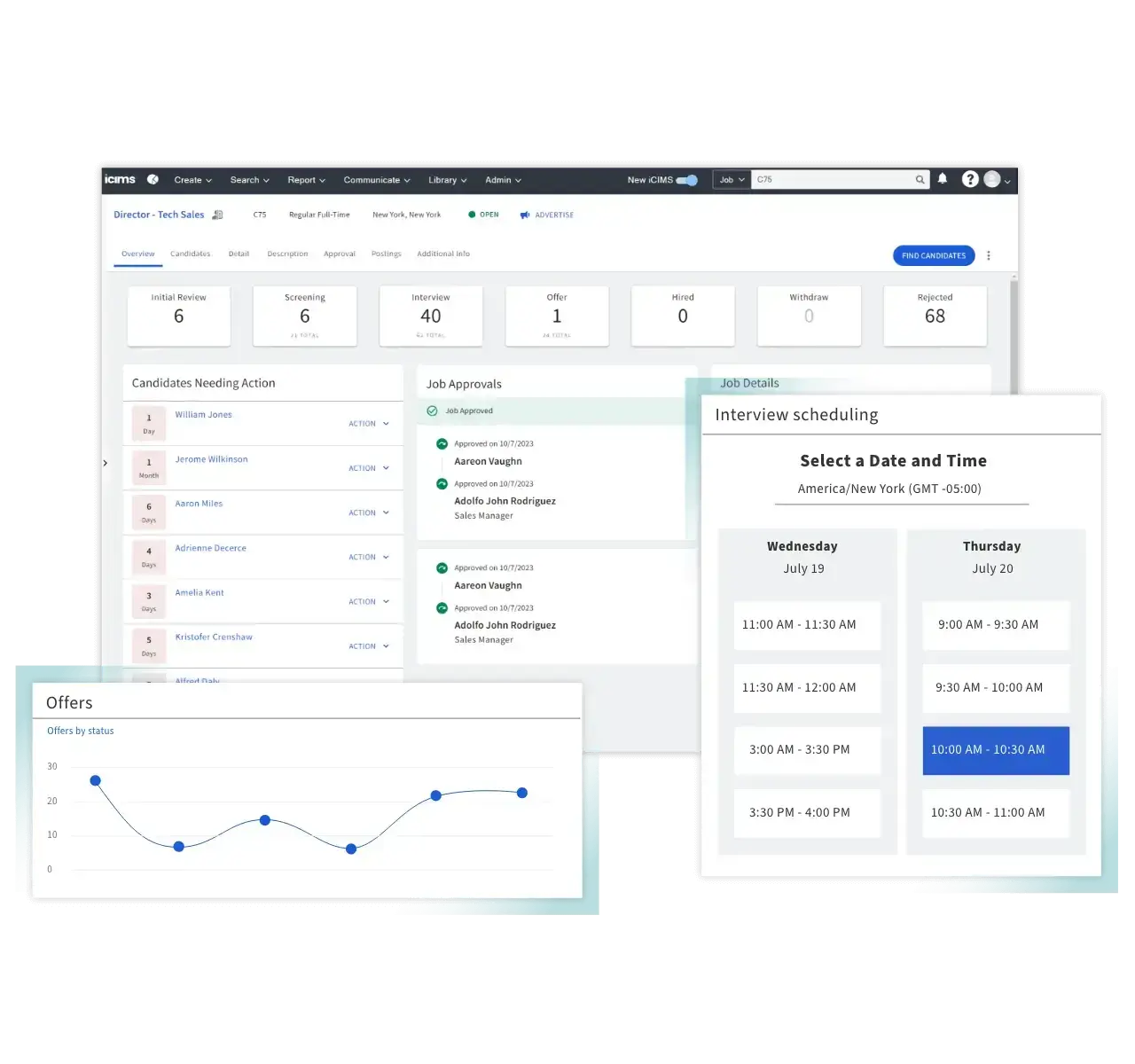
1. iCIMS

ai recruiting tool, iCIMS screen with candidate list, interview scheduling, and offers graph.

iCIMS offers a broad range of capabilities and applications, from a career suite to job postings management to a CRM.

The software is extremely comprehensive, providing end-to-end assistance for recruiters and hiring teams.

There’s an analytics dashboard, applicant tracking, email and messaging capabilities, and a video suite that allows you to personalize and humanize your hiring process.

What I like: iCIMS is a long-standing vendor with a rich history of providing great tools to users. It’s easy to use and straight-forward, so it checks the box for teams who are a bit less tech savvy. I like its broad capabilities — it’s great for companies looking for a comprehensive tool.

Pricing: Custom

2. SeekOut

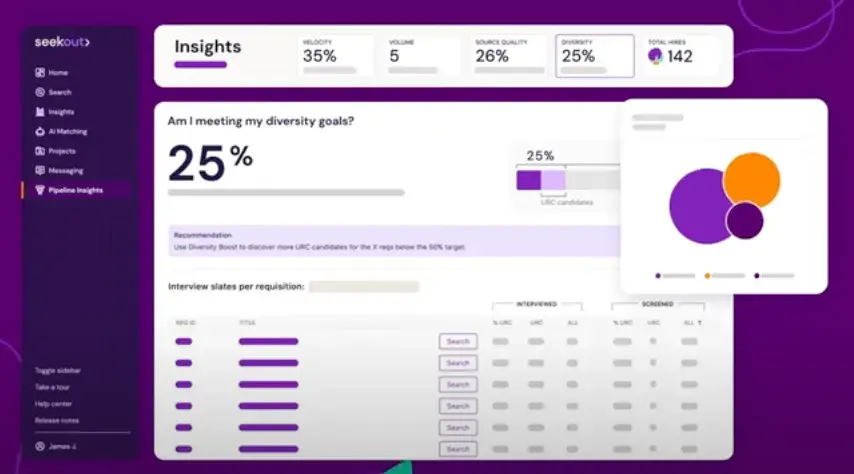
Screenshot of ai recruiting tool SeekOut’s Insight dashboard reading, “Am I meeting my diversity goals” with a percentage featured.

The SeekOut tool starts when you upload a job description. As talent applies, you can filter and sort results by things like skills, licenses, education, and diversity variables.

Once you’ve found the right candidates, you can take advantage of AI-powered engagement tools to create personalized outreach. The platform is also rich in analytics, with dashboards dedicated to helping you track your hiring goals.

What I like: SeekOut has exceptional filtering, so the tool relieves a lot of the work required to find the right candidates. I also like how the software emphasizes diversity in hiring, which shows up in multiple ways throughout their platform.

Pricing: Multi-tiered annual packages — discover price tag after demoing the software.

3. Paradox.ai

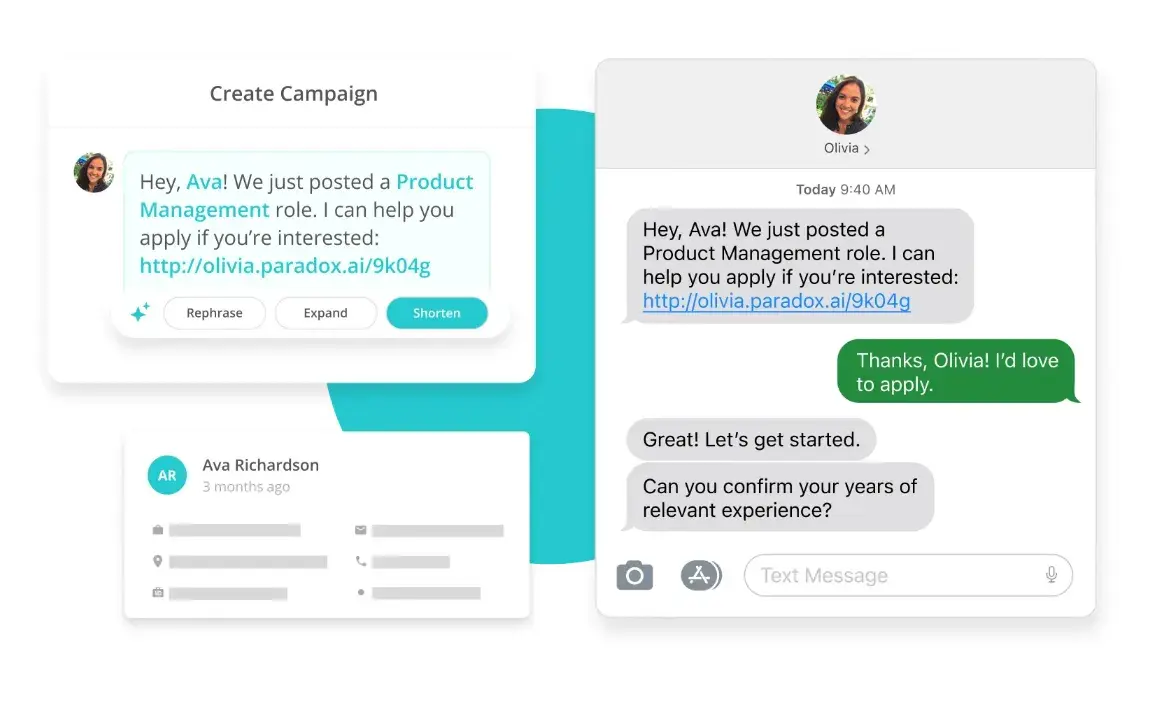
ai recruiting tool, paradox.ai’s messaging app

Paradox.ai offers a few different conversational tools, but their recruiting CRM lightens the administrative load for recruiters.

The AI tool can schedule interviews and respond to questions from candidates automatically. With an 82% decrease in time-to-hire and a 99% candidate satisfaction rating, Paradox.ai is clearly doing something right.

What I like: Everything about Paradox.ai is simple and candidate-centric. As much as I want a tool that’s easy for me to use, I also want to make sure it offers a great user experience to the end client or candidate. The Paradox.ai tool is really exceptional when it comes to creating a great candidate experience.

Pricing: Custom

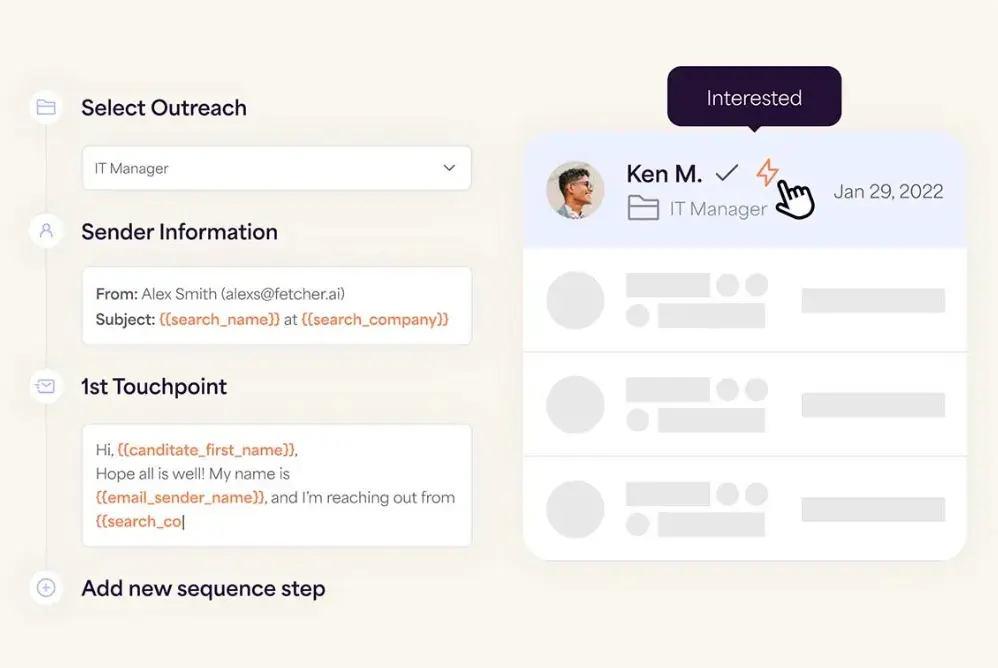
4. Fetcher

ai recruiting tool, Fetcher hiring sequence screen

Fetcher combines AI tools with recruiting experts to source great candidates for your organization. Use Fetcher to manage and create a pipeline with AI automation, then gather insights about candidate activity and demographics.

You can also integrate tools like your ATS, email, calendar, CRM, and Slack to further improve your team’s productivity.

What I like: I love how Fetcher uses in-house experts to screen your candidates in conjunction with the AI tool. That means you get all the benefits of AI automation with added accuracy from human supervision.

The other thing I like about this tool is that you can add specific diversity initiatives to the search, battling the biases that AI tools sometimes have.

Pricing: Custom

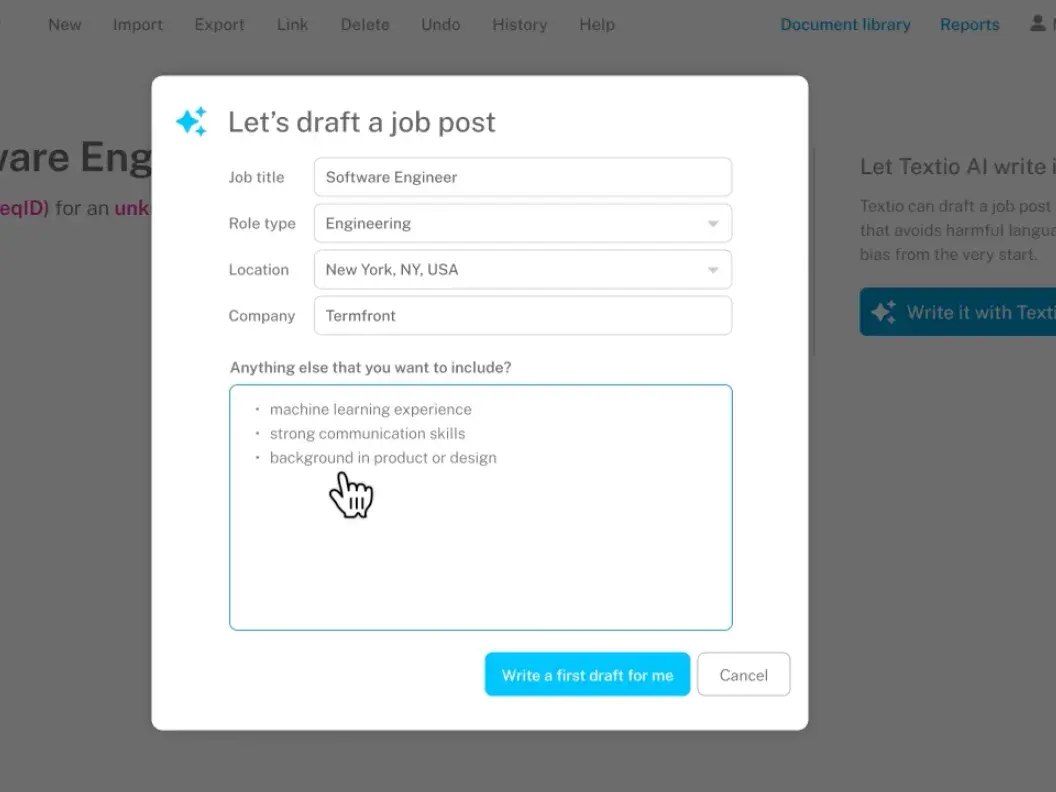
5. Textio

ai recruiting tool Textio, form that reads “Let’s draft a job post.” Includes dropdowns for job title, role type, location, and company, as well as a text box for “Anything else that you want to include?”

Textio helps you improve the quality of your job listings by giving you insights into tone and word choice.

For recruiters, this means it can also help you choose language that appeals to specific age groups and demographics. It also learns as you use it, so the more frequently you rely on it, the better the output becomes.

What I like: Most AI recruiting tools are about screening automation, but Textio helps you optimize the actual content of your job descriptions. It’s a unique tool that could fit well with other AI software.

Pricing: Tiered packages starting at $15k annually for teams of 1-199.

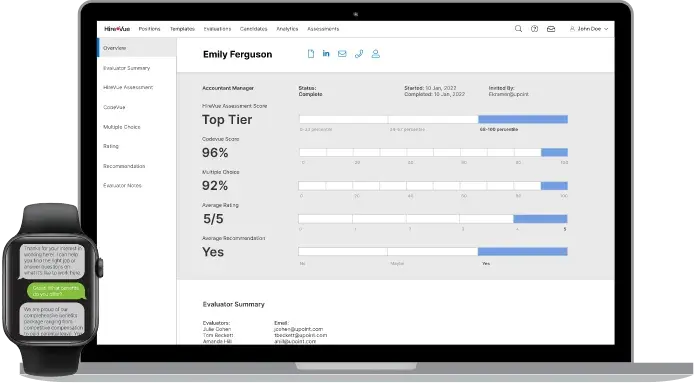
6. HireVue

ai recruiting tool, an Overview dashboard featuring various KPI charts showing satisfaction and achievement in categories from HiveVue.

HireVue is a tool for interviewing and assessing candidates.

It has a video interview feature, as well as a rich library of AI assessments that allow recruiters to evaluate candidates comprehensively — looking for potential in addition to experience.

It also automates recruitment communication, significantly speeding up the hiring process. Finally, the tool offers analytics, reports, and great customer support.

What I like: HireVue does an exceptional job of reducing bias because of the type of algorithm they use. The tool doesn’t “learn” through increased use, which means that every candidate is assessed equally as time passes. As I start leaning more and more on AI tools, it’s important to me that they’re ethical, and HireVue does a great job of ensuring that.

Pricing: Packages start at $35K.

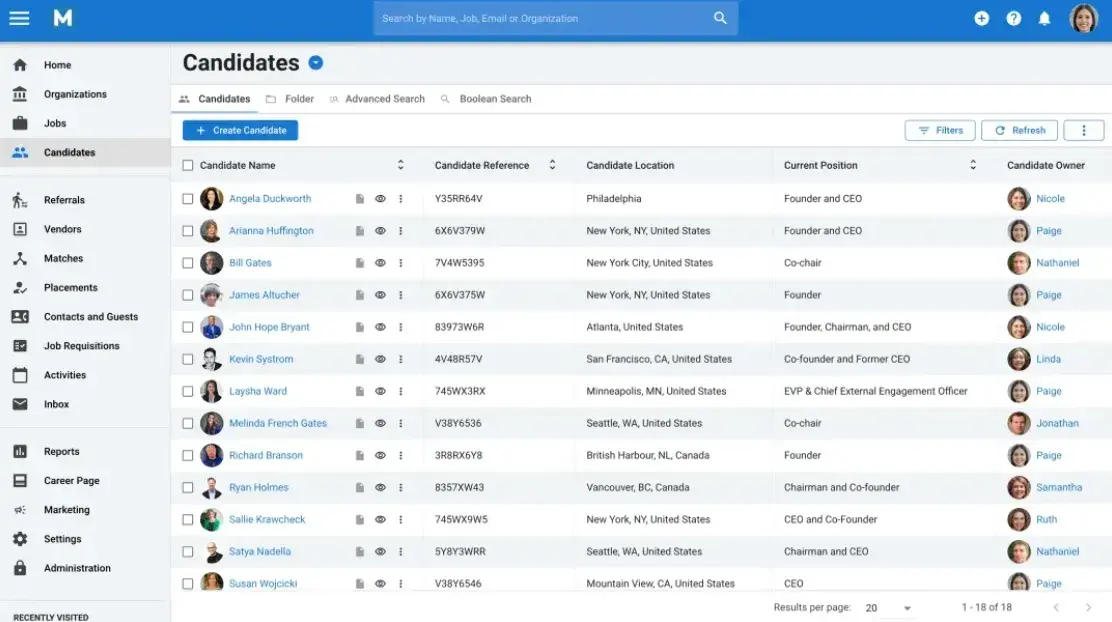
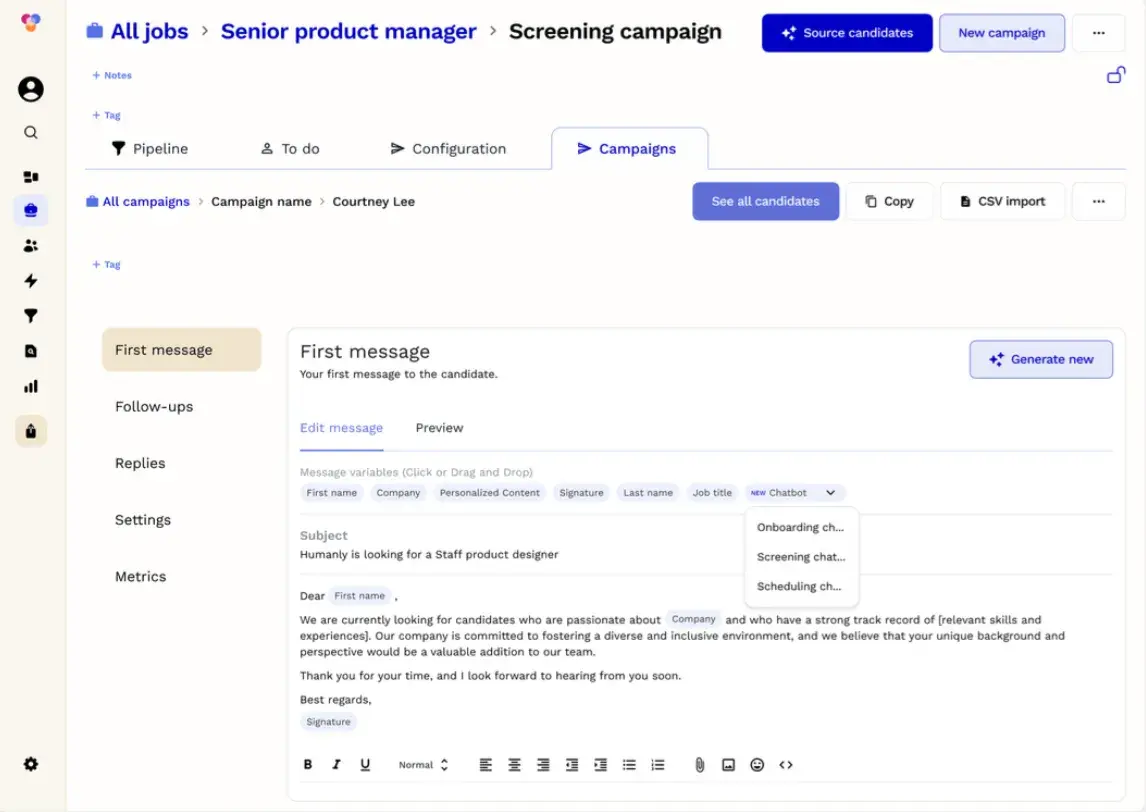
7. Manatal

best ai recruiting tools, Manatal’s candidate list screen

Manatal has a simple interface for sharing job posts and gathering a pipeline of qualified candidates.

The AI tool recommends candidates based on job requirements and helps you gather comprehensive information on the candidates from social media accounts.

What I like: Manatal pulls information from social media platforms like LinkedIn and Facebook to paint a full picture of the candidates applying to your job description. This makes for a really thorough understanding of candidates that recruiters would otherwise have had to create themselves.

Pricing: Plans start at $15 per user/month. For enterprise companies, the price reaches $55 per user/month — which is affordable compared to other options. There is also custom pricing.

8. Humanly

ai recruiting software, Humanly helping compose an email

Humanly is an automation platform for recruiters that value human interaction. It automates tasks that don’t need a human touch so recruiters can give more attention where it really counts.

The tool screens candidates and answers questions and then provides feedback for hiring teams. It’s great for companies that are hiring at scale who still want their candidates to have a personalized, positive experience.

What I like: Humanly is aptly named — it’s completely focused on a human-centric application of AI technology. The homepage of the site states that the tool is, “Loved by candidates and recruiting teams.”

I like AI tools that emphasize both the user and the customer and, for both parties to love the tool, they’re really doing something right.

Pricing: Custom

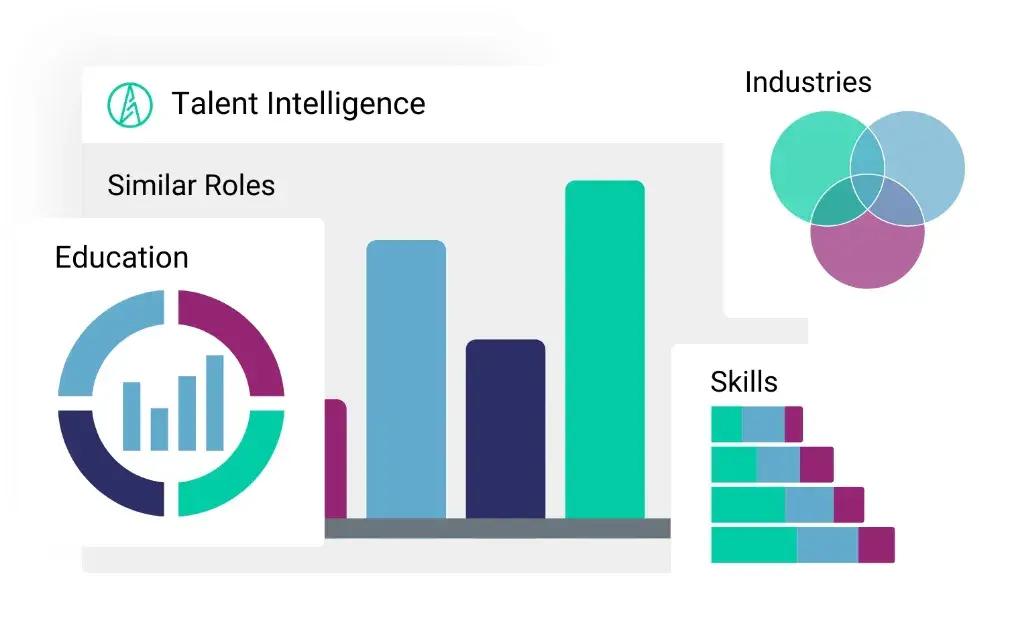
9. Arya

ai recruiting software, Arya, graphs displaying talent intelligence, education, industries, and skills.

Arya is an AI-driven candidate sourcing tool that finds great candidates quickly and automatically. The tool screens, scores, and ranks candidates based on hundreds of attributes and seven multidimensional data points to predict the candidate’s likelihood of success in the role.

What I like: Arya’s focus is data and analytics. As a result, you get extremely strategic outcomes from the tool. If you’re recruiting at scale, this sort of specificity and accuracy is incredibly important. I think Arya is a great choice for teams hiring lots of candidates on a frequent basis.

Pricing: Custom

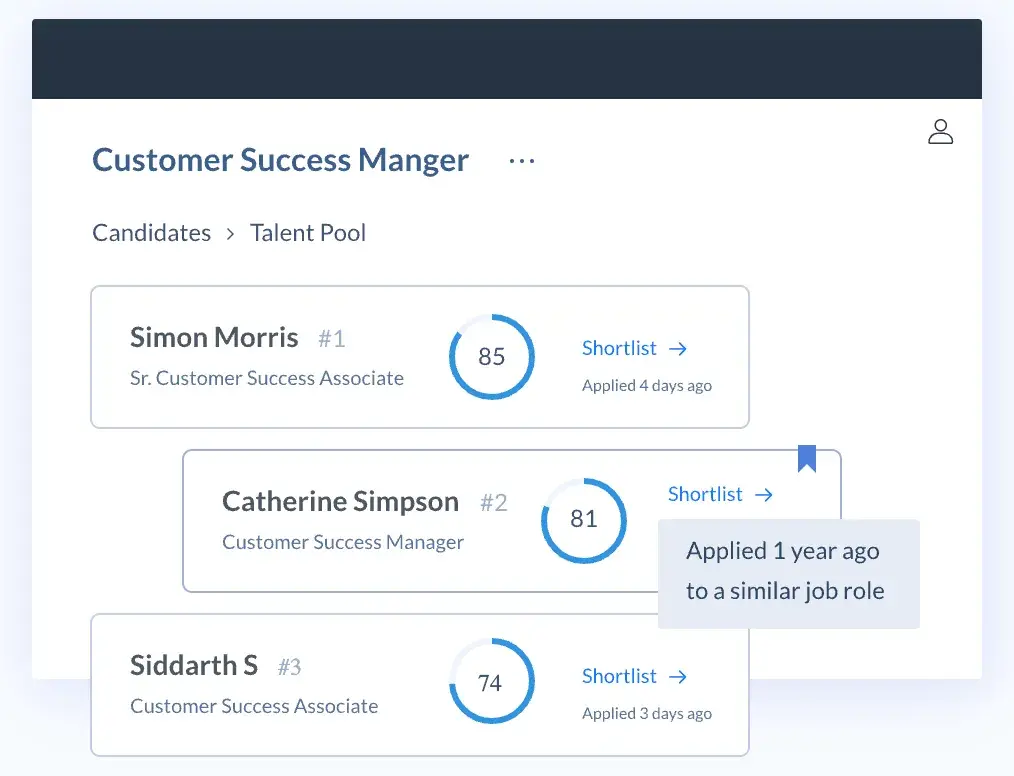
10. Skillate

ai recruiting software, screenshot of the Skillate’s Customer Success Manager widget, displaying various candidates in the talent pool and their percentage of fitness for the role.

Skillate provides candidate prescreening, automatic scheduling, job description feedback, and predictive analytics to gauge a candidate’s likelihood of taking the offer. It’s a really comprehensive tool for recruiters looking to take a data-driven approach to the entire hiring process.

What I like: Skillate provides in-depth analysis of your company’s hiring trends. You can see insights based on location, experience, education, past companies, and skills. Finding trends like these can significantly speed up the hiring process so it’s great for companies hiring often or at scale.

Pricing: Custom

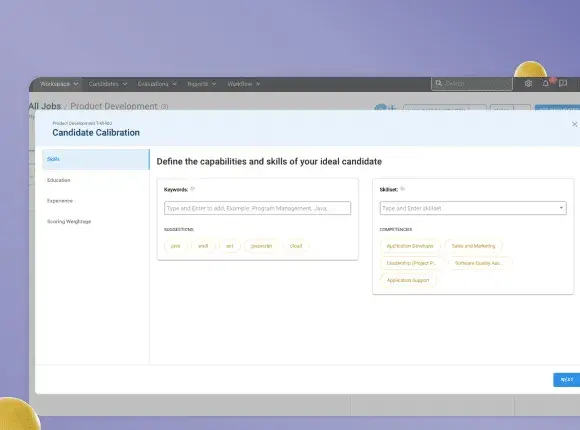
11. TurboHire

ai recruiting software, screenshot of TurboHire’s Candidate Calibration screen. The user is on the “Skills” form, which asks the user to define the capabilities and skills of their ideal candidate.

TurboHire is an end-to-end tool that optimizes the entire recruitment process from candidate sourcing to final selection.

The AI recruitment software sources talent from across channels, screens candidates, and provides workflow management. Interviews are automatically scheduled and the tool integrates with any ATS.

What I like: TurboHire claims to reduce time to hire by 78% and cost to hire by 65% while improving the quality of the hire by 5x. It’s hard not to appreciate a tool that can offer such staggering results!

Pricing: Custom

12. Workable

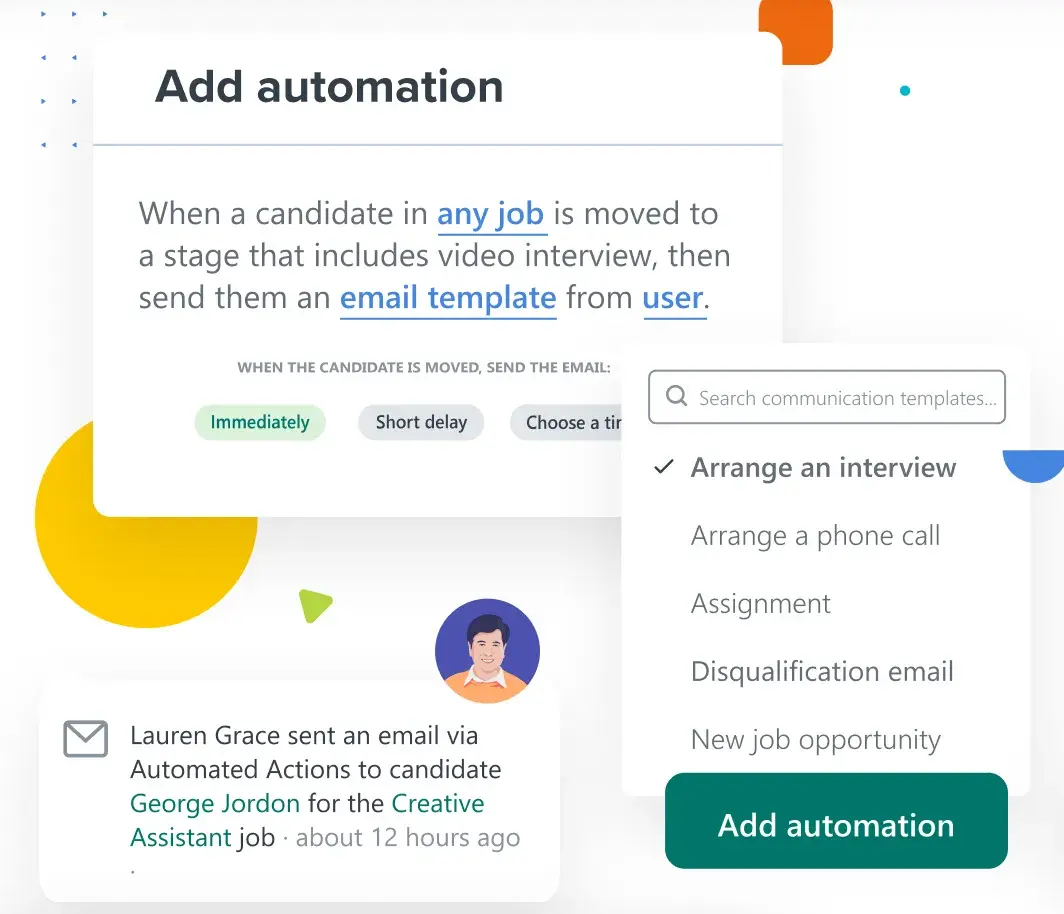
ai recruiting software, Workable’s automation capabilities

Workable helps you source, interview, and communicate with candidates throughout the hiring process.

You can use the AI tools in the recruiting software to generate job descriptions and interview questions, as well as automate time-consuming tasks like interview scheduling.

Plus, Workable helps you manage signed-on employees at no extra cost.

What I like: With one-click, your job posting can land on 200+ sites. If you’re looking for a highly specialized candidate, or if you want your applications to come in from a diverse number of pools, Workable is a great option.

Pricing: Workable offers a 15-day free trial plan followed by a tiered pricing plan that starts at $189/month.

Finding the Right Tool

There’s clearly no shortage of AI recruiting software on the market — which means teams can be confident there’s a tool out there that’s a perfect fit for their organization.

I think recruiters and HR hiring teams should start by determining what they’d like streamlined before they dive into finding the exact right tool.

Some of these tools target communication, others target job description prep, and others are more focused on administrative automation. If you can clearly define what you’d like done, you’re going to have an easier time finding the right tool.

Categories B2B

Marketing Budget Approval: How to Get Yours Greenlit, According to Marketing Experts & Data

Securing approval for a marketing budget is often tough, especially in times of economic uncertainty.

Click here to download 8 free marketing budget templates.

I haven’t been there myself, but my learnings from C-level marketers show the many complexities around marketing budgets.

Budget slicing is a common occurrence. Entire initiatives are sometimes shelved.

But there are also those glorious moments when your strategic budget proposal gets the green light.

In this post I’ll share what I learned about marketing budget approval from experts in the field, industry data, and more.

In this article:

Expert Marketers Featured in this Post

To help you navigate the budget approval process, I talked to three marketers who’ve been in the trenches for 7+ years:

Their stories not only shed light on what it takes to secure a budget, but also offer practical tips you can use right away.

headshots and titles of experts later quoted on marketing budget approval

When I spoke to Sabina Brdnik, I learned the Tretton37 team follows a 4-step budget approval process, which you can adopt.

  1.  Forecasting
  2.  Budget proposal writing
  3.  Review and revision
  4.  Execution and reporting

Forecasting

Consider this the research, planning, and brainstorming phase. It includes evaluating past performance, analyzing market trends, establishing marketing goals, building your marketing strategy, and estimating associated costs.

Brdnik believes forecasting is the most important step of the budget approval process, and for good reason. If your forecasts aren’t thorough, you’ll struggle to build a compelling case for your budget.

Budget Proposal Writing

Outline the outcome of your forecast in a concise budget proposal. An excellent proposal includes your marketing goals, initiatives, channels, proposed expenses, and, when possible, expected ROI.

For Brdnik’s team, they first “present a detailed plan showing how much money will be invested in individual parts of [the] marketing plan (social media, SEO, influencers, etc).”

Pro tip: Focus your proposal on key points to ensure executives clearly understand the situation. Be concise, as they are likely reviewing proposals from multiple departments.

Review and Revision

Present your budget proposal to the company’s senior management for review and sign-off. Sometimes, they may instantly approve the budget and allocate the required funds. Other times, you may need to provide additional information or make adjustments.

Execution and Reporting

Brdnik says, “During the year, we implement the approved plan and track the actual spent budget versus the forecasted budget.”

Brdnik recommends setting aside 10% of your annual budget as a contingency fund for unexpected circumstances or opportunities, such as a viral trend that could help enhance brand visibility or testing out the new shiny AI tool that will help the team create better and faster articles.

As Johnny Hughes said, “New tools emerge each month, along with new opportunities and risks. We have to be extremely agile and conduct weekly efficacy reports to inform spending.”

Evaluating your budget’s effectiveness and documenting lessons learned helps future budget cycles. “HubSpot — and its endless integrations and dashboards — is our MVP tool that supports this effort,” Hughes adds.

Pro tip: To track your budget, consider using free marketing budget templates. They help you track marketing spend across various channels like content, paid advertising, PR.

Benefits of a Budget Approval Workflow

Below are three primary benefits of a budget approval workflow.

1. Faster Approval Times

Without a budget approval workflow, securing your budget can feel like driving through thick fog. The journey is slow and uncertain. A standardized workflow clears the fog, clarifies the next steps, and lets you move faster.

You can further increase speed by automating your workflow. Business process management software like Jira and Monday.com can help you eliminate hours of manual budgeting activities. For instance, instead of exchanging emails endlessly, an automated workflow can notify assignees to act.

2. Compels You to Set Robust Marketing Goals

Data from CoSchedule’s 2022 Trend Report reveals marketers who set goals are 377% more successful than their peers.

Yet, 30% of marketers do not set specific goals. I have seen firsthand how this results in wasteful spending — and worse, makes it difficult to measure success.

But with a marketing strategy required in your budget approval process, setting clear marketing goals becomes a must, leading to better resource management.

3. Democratizes Decision-Making

Top leaders need to delegate decision-making so they can focus on other high-level activities. A budget approval process lets them establish boundaries and set clear guidelines for decision-making. Once the budget is approved, managers can exercise autonomy within established limits.

Marketing Budget Approval

Why Marketing Budgets Are So Hard to Get Approved

When I spoke to Pamela Bump, she told me, “It’s often hard to tie marketing efforts and KPIs (like traffic or reach) to direct ROI (like sales or renewals).” That’s why leadership is sometimes reluctant to allocate funds to marketing.

Marketing attribution helps address this challenge by allowing marketers to analyze the buyer’s journey, identify effective touchpoints, and measure the impact of each effort.

However, recent events suggest attribution is dying and becoming increasingly difficult. Apple‘s App Tracking Transparency (ATT) framework and new privacy laws in New York, California, Canada, and the EU have significantly limited marketers’ ability to track buyers.

Additionally, about one-third of internet users use ad blockers which block tracking scripts.

These developments complicate efforts to measure marketing effectiveness and convince higher-ups that marketing investments will pay off.

How to Get Your Marketing Budget Approved

I asked our marketing experts to share tips to help others secure their marketing budget. Here’s what they said.

Align Marketing Goals with Company Goals

“The key to any successful budget request is knowing what KPIs your upper leaders need to drive,” says Bump. “Spoiler: They’ll likely tie it to company revenue,” Bump adds.

Your budget proposal should show you understand your leadership’s priorities and want to achieve them. Without this, you don’t have a leg to stand on.

Show Path to ROI

Determining marketing ROI can be tricky. Still, it’s important to justify your budget and prove it’s an investment, not a black hole sucking up the company’s profit.

As Bump shared, once you know the KPIs that resonate with your executives, you can show how your investment could drive ROI directly or support those KPIs.

For example, if you pitch for more blog writers, emphasize how the content will generate leads that drive visitors further into the sales pipeline, not just increase traffic or clicks.

Hughes’s team still relies heavily on marketing attribution data to track ROI.

First, Hughes ensures alignment on the key channels driving business growth. He also ensures the attribution data is clean for accurate ROI reporting. They then track returns on a week-over-week basis.

This approach helps Hughes avoid pushback from stakeholders.

Use Data to Justify Your Budget

“Ground your request and any estimates you make in data-backed evidence,” says Bump.

Without data, all you have is an opinion. And an opinion alone might be unconvincing.

Hughes considers data a “fortress of numbers to defend against budget cuts and welcome new investments” and says, “We rely heavily on ROI metrics from previous campaigns, market trend analysis, and competitive benchmarking.”

Similarly, Brdnik says that competitive benchmarking is vital when pitching new ideas without past firsthand data.

“I had an interesting experience getting approval for a new TikTok campaign. We are not active on the platform. So, to strengthen our pitch, we used competitor analysis showing similar brands saw up to a 30% increase in engagement,” Brdnik explains.

Request a Small Budget for New Ideas.

Justifying the budget for similar/past campaigns is pretty straightforward. For instance, if a Cost Per Purchase (CPP) campaign generated $100K in revenue for a $20K spend, it easily justifies a similar budget for future initiatives.

However, as Brdnik shared, “The problem arises when we have to justify more innovative/new ideas and strategies based on no previous data.”

In such situations, be more rigorous and creative in vetting opportunities. Then, run small tests to validate your hypothesis. If successful, securing additional investment becomes easier.

Brdnik said she allocates up to “20% of the annual budget for new/innovative projects.” Data from these tests then guide the next steps.

To improve their chances of success, Brdnik sticks to best practices when testing new ideas, and Hughes recommends implementing a flexible budget model and making real-time adjustments based on performance metrics.

Get Early Support

There’s a lot of lead-up work involved in getting marketing budget buy-in. If you’re in a big company, you likely can’t walk up to a busy CMO and ask for $1 million without other leaders supporting you.

So, before investing time in research or proposal writing, casually discuss your idea with your manager.

As Bump shared, “Your manager is human and has also requested, secured, and faced rejections of budgets before. Plus, your manager is likely the most KPI-obsessed person on your team to guide you in the right direction.

So they’ll know more about how to think and talk to the executives above them.

They’ll also know what motivates those executives and the biggest KPIs they desperately want to drive.”

With this early support and guidance, you set your proposal up for success or refine the idea if needed. This saves time on budget revisions or unnecessary proof-of-concept tests.

Here are some messages that Bump shared with me to start conversations with managers.

Example 1:

Hi [Manager],

I [noticed/read/observed] that [evidence] leads to [KPI], and I’d like to pitch an idea/project to test that I think could help us explore/scale this further.

I would love to get your thoughts and see if there’s any budget available for a test like this before I start writing a deeper proposal for you in our next one-on-one.

Example 2:

Hi [Manager],

I would love to pitch a [lean budget or project] to test how [tactic] leads to social media reach. However, I know reach doesn’t directly tie to the KPIs our department ladders up to.

I’d love to get your guidance on how we could connect these KPIs or how we’ve tied reach to revenue in the past before pitching potential tactics around it.

Be Prepared for Pushback and Be Open to Compromise

“It’s important to have concrete arguments about why something is necessary when stakeholders push back,” Brdnik says. Your executives may not have the details you do, so be ready to provide additional information and data to address their objections.

Remember, marketing is just one department, and there are others competing for a share of the company’s fixed budget. So, be open to compromise wherever it is possible.

“If stakeholders think $50K of the budget is excessive for influencer marketing, propose a pilot program for 50% of it and test (and measure) its effectiveness,” Brdnik advises.

The point is to put yourself in the shoes of your higher-ups. Think like a business owner aiming to generate significant returns from marketing spend. This will allow you to be more rigorous in your analysis.

Continue to Earn Trust

If you lock down the budget, spend it responsibly and report on the results, as Bump suggests.

This keeps you accountable for spending your budget based on impact. It’ll also earn you the trust and support of executives who can decrease or increase the budget in future quarters.

Brdnik regularly updates stakeholders, mostly via monthly email reports. Her team also creates quarterly reports that show all relevant KPIs (lead generation, conversion rates, etc.) to illustrate marketing’s contribution to overall revenue.

Getting Your Budget Proposal Greenlit

Marketing budgets are among the first to be scrutinized in many companies. I’ve seen several marketers vent about this on LinkedIn, especially when they experience budget cuts.

Sometimes, this scrutiny arises when executives view marketing as less essential than other departments. However, it’s also prevalent because leadership wants efficiency, cost-effectiveness, and solid ROI.

And that’s okay! After all, it’s their job to get value for every dollar spent.

Understanding this lets you embrace the challenge. Lean into it. Anticipate objections from leadership and become more strategic.

Plan thoroughly and prioritize the most impactful initiatives. These ultimately make you more effective in driving results and securing future investments.

Bump, for example, started with $0 per year but now manages an increasing budget, a team of four direct reports, and a part-time contractor.

By applying the tips in this post, you’ll not only secure the funding you need but also strengthen your ability to drive impactful marketing initiatives.

Categories B2B

AI in Content Marketing: How Creators and Marketers are Using It in 2024 [Data]

The wild ride of AI is still on, and industries across the globe are riding it for growth. But concerns are also mounting.

Download Now: The Annual State of Artificial Intelligence in 2024 [Free Report]

For one, professionals continue to question AI’s impact on their work. This is especially true for many marketers and content creators, such as myself, who are keen to understand the role of AI in content marketing.

With the global revenue for AI in marketing pegged at over $107.5 billion by 2028, there is no doubt that AI will soon (and may already) be an integral part of the digital marketing landscape.

So, for the creator or marketer who wishes to stay ahead of the curve, knowing how to leverage this technology is a no-brainer.

Using the real experiences of marketing professionals and data from our recent State of AI for Marketers survey, I will answer your questions about how creators and marketers are using AI in 2024 and what this means for their output and productivity.

Table of Contents

What is AI in content marketing?

While there’s no standard definition of “AI in content marketing,” I will attempt to build one based on the understanding of the two concepts.

Corey Wainwright describes content marketing as a “marketing program that centers on creating, publishing, and distributing content for your target audience — usually online — the goal of which is to attract new customers.”

Google defines AI as “a set of technologies that enable computers to perform a variety of functions, including the ability to see, understand and translate spoken and written language, analyze data, make recommendations, and more.”

Combining these two concepts into one definition for AI in content marketing would look like this:

AI in content marketing involves using technologies that analyze data, understand language, and make recommendations to create, publish, and distribute content designed to engage an online audience.

Benefits of Using AI in Content Marketing

I’ve gathered some of the most popular applications of AI in content marketing, and their benefits are below.

Benefits of Using AI in Content Marketing

1. Content Creation

In our 2024 State of AI report, 43% of marketers place content creation as the most popular use case of AI in content marketing.

Content can take many forms — written, visual, video, and audio — and marketers are using generative AI to bring these to life at scale.

“As a PR professional working with high-growth SaaS startups and VC firms, AI enables us to craft more personalized stories that resonate deeply with their audiences, drive engagement, and ultimately, build stronger, more credible brands,” Sim Aulakh, founder of PR firm EstablishCred, says.

Benefits: In using generative AI to do anything from writing marketing copy to turning text into video, marketers can save time and increase productivity in the content creation process.

2. Research

Content marketers need to know enough about customers, competitors, and their industry to make confident decisions about the entire pipeline of content production.

AI tools can be quite useful in finding this information and analyzing volumes of data to identify trends, keywords, and relevant information, all in record time.

For example, HubSpot’s new AI Search Grader — a first-of-its-kind, free app that quickly analyzes your brand based on what your prospects and customers are seeing across AI search engines — gives you actionable recommendations on how to improve. Imagine the wonders this would do for any marketing team.

Benefits: Besides saving time and effort, using AI for content marketing research guarantees that decisions are made more quickly and confidently than manual research. Advanced AI models can even extract up-to-date information for more accurate content planning.

3. Brainstorming Content Ideas

I know from personal experience that to be a creative professional is to, among other things, accept the fact that good ideas may elude you once in a while.

With AI, I’ve found this creative block does not need to linger for long as there are tools that will generate or suggest creative concepts that you could tweak to your liking. As a content writer, I personally love having AI as a brainstorming partner when I get stuck.

For Aulakh, whose company undertakes several creative projects, leveraging AI for content brainstorming has been pivotal to their recent growth.

“While human creativity cannot be replaced by AI, it can be enhanced by AI. As an example, AI tools like Gemini and ChatGPT have helped us during brainstorming and ideation processes for content projects. Now, we’re able to deliver on projects at a fraction of the time it used to take us,” he says

Benefits: Brainstorming with AI will not only kickstart your creative engines but also speed up the process. Nearly 82% of the marketers surveyed say that using AI for brainstorming content ideas has saved them at least one hour of their precious time.

4. Data Analysis And Reporting

To learn how content distribution is faring in the market and impacting the business, content marketers need to rely on data analytics.

AI-powered analytics tools evaluate content performance and generate detailed reports on engagement metrics, ROI, and audience behavior.

This is, in fact, the third most popular use case of AI for marketers, according to our survey.

Benefits: Provides data-driven and actionable insights for optimizing content strategies and could also automate reporting. This improves the quality of decisions the marketer makes which, in turn, affects performance positively.

5. Self Upskilling

Ever been in the middle of work and reached a hurdle that only a quick search or YouTube video could help you cross? Well, 41% of the marketers we surveyed have and they say using AI helped them learn how to do those things.

Benefits: Besides the comfort of learning how to solve a problem and doing so in record time, this use case also ensures that marketers remain competitive and knowledgeable in the ever-evolving landscape of marketing.

How to Use AI in Content Marketing

Let’s now test some of the use cases mentioned above.

Without a good idea, it’s impossible to get the content on the road to either attract or engage audiences. So, we’ll start with brainstorming.

Assume I’m a content marketer at HubSpot who needs a cool video idea for distribution on our social media channels.

I found a cool AI brainstorming platform called Ideamap AI and asked it to brainstorm a video content idea for HubSpot, after providing context on what kind of brand HubSpot is. You’ll find that the map it produces is a bit much, considering that I already have trouble deciding what I want to do.

I chose the first idea and used the expand with AI option to generate more ideas or inspiration for marketing content.

ai in content marketing, ai idea mapping to help with brainstorming

One way AI can be used for ideas or inspiration is by creating a mood board with tools like Kive.ai.

Given the sheer range of options for expansion and transformation available, it is nearly impossible not to find something you would be willing to work on.

So, we are creating an animated explainer video showcasing how HubSpot connects marketing, sales, and customer service.

To get accurate information needed for this video, I will need to extract it from the website. This time, I will employ the research abilities of ChatGPT Plus, which can pull real-time information from the internet.

ai in content marketing, using chatgpt for research

While it does a good job of extracting the information (from six sites), the output is not exactly video material. So, the next step would be to ask it to create the video script, which would kickstart the content creation process.

ai in content marketing, chatgpt-generated video script

Since OpenAI’s Sora has still not been released to the public, I had to find available alternatives. It is worth mentioning here that 70% of the marketers we surveyed say they cannot wait to use the new tech.

However, Elai, an intuitive AI video creator, came in handy.

Creating the video with the script ChatGPT helped me create was indeed straightforward, although I must mention that there were not many video editing options to choose from.

Using an avatar, an American voice sample, and a blank background with HubSpot’s brand color were as far as I could go, especially as someone with limited video editing skills.

While I think this attempt was far from flawless, it was a solid effort. With some additional time to refine the details, I believe it has the potential to be even better.

AI in Content Marketing Examples

Generating Ideas & Inspiration: Mateo Toro

There’s an abundance of marketing professionals leveraging AI to boost their productivity and enhance their strategies.

For example, filmmaker and photographer Mateo Toro recently started using Kive.ai to design mood boards to develop treatments for his film projects.

A video treatment is a way to convey a project’s concept or story. Many video treatments involve the use of images and visual media found online or in previous works.

“Video treatments take time. You have to scrub through the video, take screenshots, and edit for the video treatment,“ Toro explained. ”[Kive.ai] just makes it so much easier for me to find the video that has a style or tone I’m looking to emulate.”

With Kive.ai, creators can paste the link of a video into the system, and Kive.ai will extract frames from the video as screenshots to import into a board. Toro says the process can save him hours of time.

“In a video treatment, I could be going through 10, 15, 20 videos to reference,“ he said. ”You add that up, and it could easily be an hour of time just scrubbing through, screenshotting, and dragging content to a treatment.”

Writing Copy: Bethany Anderson

Then there’s Bethany Anderson, a public information officer for Milton, Florida, who says ChatGPT streamlines the writing aspect of her job.

“I love it because ChatGPT is a software that learns,” Anderson explains.

She says ChatGPT can mimic her writing style, so she’ll sometimes use the tool to write press releases, social media posts, and SEO-friendly blog content.

Anderson says the tool is handy because writing is a crucial part of her job, but it’s far from the only responsibility she has to tackle daily.

“I am behind the scenes planning events and getting them out to the public,“ she says. ”So, ChatGPT allows me to get the writing done in a very easy, seamless way so that I can get to the bones of my job — which is outreach.”

Anderson admits she was wary of ChatGPT at first but tested it out during a week that was jam-packed with deadlines.

“There was this one week a couple of months ago when I had so many deadlines, so many social media calendars due, so many blogs due, and so many bios due — I was drowning,” she recalls. “So I said, ‘I’m going to give it a try.’”

Days worth of writing assignments could be completed in just a few hours thanks to the assistance of AI, according to Anderson.

Her experience aligns with the findings of our survey — nearly 80% of marketers said generative AI has a positive ROI on their content writing tasks.

“We’re talking about days of your life that you get back,” she said. “And, to me, time is valuable. It’s more valuable than money.”

Editing Drafts: Irina Nica

On the other hand, Irina Nica, HubSpot’s Senior Product Marketing Manager, uses HubSpot’s AI Content Writer to edit her drafts.

“It’s like having a second pair of eyes that helps me go through my drafts, tidy them up, and get them out there faster. Don’t get me wrong … Writing is a huge part of my job and something that AI can’t take over, but it sure helps to speed up the nitty-gritty bits like editing.”

She also uses ChatSpot, HubSpot’s AI chatbot solution designed to help businesses perform marketing and sales operations, to supercharge her research.

“I like to use ChatSpot for getting quick recommendations for products, books, or any type of resource really. Say I‘m looking for the best product marketing book for SaaS companies; normally, I’d be knee-deep in Google searches, reading articles, and checking out recommendations on Goodreads,” Nica says.

“But with the right prompt, ChatSpot can get me there 10X faster. I still give its final recommendation a quick Google check, but it’s a super handy shortcut.”

Will AI replace content creators?

A common concern surrounding the use of AI is whether the technology will replace human marketers and creators. Nima Olumi of Lightyear Strategies says it’s unlikely.

“We use AI to pull a lot of statistics, come up with interesting angles to pitch to companies, and work around certain angles that are marketing and media-friendly,” Olumi said. “I don’t think it’s a complete replacement for writers or thinkers.”

Writing and content creation are subjective fields, according to Olumi, and they still require people to do the necessary critical thinking to decide the kind of content that gets published.

Ultimately, Olumi predicts a future where AI will assist marketers and creatives in improving their output and producing content in a shorter time.

This makes sense, considering our survey found that 74% of marketers agree that AI tools can help them be more productive in their roles.

Olumi encourages professionals to embrace AI and use it to their advantage rather than shy away.

Specifically, he says creators should spend time learning and testing applications like Open.ai and ChatGPT to see their different capabilities.

“Spend hours asking question after question to see how far you can push the limits of the application to serve your needs,” he said. “You have to feed it context.”

Making the Most of AI

As the presence of AI in marketing continues to grow significantly, I suggest you take the time to discover how it can best serve your own team’s needs.

Professionals and creatives like Olumi, Aulakh, Anderson, Nica, and Toro all found ways to use AI to help them improve the efficiency and quality of their content.

Instead of worrying whether the robots will take over, I recommend finding ways to work alongside AI, so you and your company can remain competitive in the market and essential to your clients.

Editor’s note: This post was originally published in April 2023 and has been updated for comprehensiveness.

Categories B2B

Why AI Isn’t Replacing Marketers (Or Search Engines) According to Jasper’s Former Head of Enterprise Marketing

If you asked whether technology could replace marketing a few decades ago, most would look at you like you hit your head on concrete. Now, it’s no more a question but an issue that’s sparking industry-wide debate.

Download Now: The Annual State of Artificial Intelligence in 2024 [Free Report]

And we owe this specifically to the generative AI surge — which has more implications for the creative sector than many others.

But the question is, will AI replace marketers or make us better? And what about SEO? Will Googling be replaced with AI chatbots — and what does all that mean for content creation?

To answer these questions, I spoke with Samyutha Reddy, Jasper’s former Head of Enterprise Marketing, to explore her perspectives on what the future holds for AI in marketing and organic search.

Table of Contents

How do marketers use AI?

First, let’s consider how generative AI is even used in marketing.

Marketers surveyed in our 2024 State of AI in Marketing revealed the major tasks they use AI for. Top on that list are content creation, research, brainstorming, learning, and data analysis.

These tools are offering marketers the ability to generate content more quickly, analyze vast amounts of data with greater accuracy, and even come up with creative ideas through AI-powered brainstorming sessions. All leading to significantly positive ROI for their efforts.

Still, 48% of marketers in our survey are concerned about AI replacing their jobs in the next few years while a whopping 69% believes it’s a possibility that AI completely replaces human beings in the workplace one day.

But here’s why Reddy and I think that may not happen.

Why AI Won’t Replace Marketing

1. AI augments the human experience (but it doesn’t replace the human within that experience).

Generative AI can research any topic online and create original content, formatted as a blog post, email, ad, or more, based on the query — and in record time. In the future, rather than needing a team of five or ten content creators, will you just need one — someone to fact-check the AI’s content?

Fortunately, Reddy isn’t worried. In fact, even though her team used generative AI on a daily basis, she was still actively hiring and growing her team.

samyutha reddy quote, AI augments the human experience, but it doesn't replace the human within that experience.

As she puts it, “AI augments the human experience, but it doesn’t replace the human within that experience. We value writers in our society because they’re able to give us a thought-provoking human perspective on the world.

It isn’t just about summarizing facts that are out there. It’s about humans sharing opinions on very real topics that help build your perspective on how you feel about something. So an AI [tool] could really never replace that human perspective.”

2. AI still has biases.

Because generative AI is still early in its development, it is prone to potential biases and inaccuracies it cannot discern in the information it gathers. These biases can lead to skewed outputs that may not align with reality, making it essential to maintain human oversight in the process.

Reddy highlights this issue, stating, “AI has biases deeply embedded within its models that people are working on. AI has the tendency to hallucinate and start talking about random things when you’re asking it for outputs, so it would be really tough to just completely remove a human from the process.”

This tendency of AI to “hallucinate” or produce irrelevant and sometimes nonsensical content underscores the importance of human intervention to ensure accuracy and relevance.

AI is a Tool For Marketers, Not a Replacement

Instead of viewing this technology as a threat, Reddy suggests marketers do this instead:

“I think the angle you take matters on this whole generative AI front. If you’re a writer, content creator, or a marketer, you’ll want to ask yourself:

‘Am I going to be someone that embraces technology and figures out how to upskill myself and actually become the cream of the crop in terms of talent? Or am I going to be someone who pushes technology away, refuses to believe it’s happening, and clings onto an old way of life?’”

Although AI will not take your job, you must not underestimate its impact on your role as a marketer. Here’s how Reddy suggests you stay on top of this innovation.

1. Marketers will need to reskill.

As aspects of content creation become more automated, Reddy acknowledges that AI will force content creators to reskill. She told me, “I think it’ll force content creators to re-skill. And I don’t think that’s a bad thing. I think that’s what every big shift in technology has done for humans.”

She adds, “I’ve never met a content creator who has said, ‘Wait. I really want to spend more time doing all the rote tasks of reading everything I need to know on the internet about a given topic.’ AI will give marketers more time to be creative, form an opinion, and incorporate more data sources into their perspectives.”

Rather than thinking of AI as a content creator replacement, it‘s better to think of AI as a marketer’s efficient side-kick.

will marketing be replaced by AI? Tweet from Ross Simmonds

Image Source

Consider this: A marketer decides she wants to write a topic about SWOT analysis.

Rather than spending her morning chugging coffee and reading up on what SWOT analysis means, effective SWOT analysis examples, and how SWOT analyses can help businesses grow, she can simply plug the query into an AI chatbot.

Once she’s confirmed the sources the chatbot used to pull that information are accurate, she can quickly skim through the AI’s response and learn everything she needs to begin writing about the topic. She can even use the AI’s response as a first draft, and strengthen it with her own unique tone and perspective.

From there, she can leverage the AI’s proofreading skills to edit her final copy.

Additionally, if the marketer has written a piece of content that she’d like to turn into an entire campaign, she can use AI to re-format her blog post into corresponding ad copy, which she can then hand over to her sales and paid ad teams.

As Reddy puts it, “I can effectively hand over to sales an entire drip campaign, an entire outbound sequence, complete with landing pages, with the ads that people will click and see.

And it really allows me to take control back on what it means to execute a campaign. It enables me to truly be a project manager and a strategist, versus someone who is waiting on other people to deliver their end of the bargain.”

57% of our surveyed marketers also confess to feeling pressured to learn new skills so AI won’t make them irrelevant — so this checks out.

2. Marketers will need to become experts in select AI platforms.

Freelancing platform Upwork recently added a new category, ‘Generative AI’, as a specialty within their marketplace.

This means business leaders can now hire freelance content creators who have expertise with a specific AI platform — and Reddy isn’t surprised.

She continues, “Similar to how a marketer can level-up by becoming HubSpot or Salesforce certified, I think we’ll soon see marketers who demonstrate their value by saying, ‘Hey, I’m skilled in using generative AI platforms.’”

Reddy sees marketers at the forefront of a tool that will ultimately upend all roles within a business, and she believes there’s great privilege in being the first to adopt it.

samyutha reddy quote, I think there’s a certain power here that marketers can reclaim, and instead of being the victims in this story of ‘generative AI is coming for marketing’, I think we really reposition it as saying, 'generative AI has landed in the most innovative portion of the enterprise: marketing.

As she puts it, “I think there’s a certain power here that marketers can reclaim, and instead of being the victims in this story of ‘generative AI is coming for marketing’, I think we really reposition it as saying, ‘generative AI has landed in the most innovative portion of the enterprise: marketing.’”

She continues, “And we are now the stewards of this technology and how it’’l be used within the enterprise, and we get to pilot it and see how it can supercharge our work.

And the folks who lean into being the stewards of this powerful technology will reap its benefits. I consider myself and our industry extremely lucky to be in this position.”

But what about the search engines?

Away from getting quick answers to common queries, marketers use search engines to complete tasks like SEO optimization to improve website rankings, conduct keyword research to target relevant search terms and analyze competitors to improve their strategy.

Now, with research being the second most-popular use case for marketers using AI, it stands to reason that they’ll be leveraging traditional search engines less often.

And as more people move to AI search engines, tools like HubSpot’s AI Search Grader are helping marketers optimize their search performance.

It’s a free app that quickly analyzes your brand based on what your prospects and customers are seeing across AI search engines, then gives you actionable recommendations on how to improve.

But what does this mean for traditional search engines? Would we no longer need, or use, them?

Reddy begs to differ, particularly since the information supplied on search engines is what powers generative AI results. She however sees it drastically changing.

As she puts it, “Search can help battle AI’s inaccuracies. For instance, Jasper has a function where you can toggle on Google search results.

So if I say, ‘Jasper, help me write a paragraph about XYZ,’ it’ll write the paragraph, and at the bottom it’ll put in the Google search results it used while it helped me create that output.

So I have factual links which I can cite, and fact-check to ensure they’re the most reliable piece of content on a given topic.”

She continues, “I don’t see search going away. I do see a future where I don’t necessarily want to type things into a search bar, and instead, I want to use chat functionality. That, I think, is imminent.

And I think we’re already seeing that with the virality of ChatGPT. In just a couple of days, it’s become the fastest-growing consumer app.”

samyutha reddy quote, Search can help battle AI’s inaccuracies ... So I have factual links which I can cite, and fact-check to ensure they're the most reliable piece of content on a given topic.

So, will marketing be replaced by AI?

In short, our marketing jobs and search engines are safe — for now.Ultimately, my conversation with Reddy felt positive and uplifting. As marketers, we don’t need to fear AI; We need to embrace it as technology that will help us do our jobs better.

And, personally, I‘m all for any tool that minimizes the amount of time I spend doing rote tasks, so I can get back to what really matters: creating content with the intention to move, inspire, or challenge readers’ to think differently.

Think HubSpot isn’t getting in on the generative AI action? Think again. Learn about our brand-new ChatSpot and Content Assistant tools and how you can access them.

Editor’s note: This post was originally published in February 2023 and has been updated for comprehensiveness.

Categories B2B

Market by Generation: Data-Backed Content Consumption Habits To Shape Your Strategy

Let’s play a game: Tell me how old you are without telling me how old you are.

Download Now: The State of U.S. Consumer Trends [Free Report]

Not sure how to respond? Well, chances are your content consumption habits give you away.

For instance, I love Instagram and Netflix but have left my Snapchat stage behind and don’t understand Roblox.

(If you’re scratching your head, don’t worry. By the end of this article, you’ll be able to pinpoint my age, like the label on a wine bottle.)

In a world driven by content marketing, understanding how your target audience prefers to consume information is critical to getting your messages seen and heard. However, the specifics can differ dramatically based on age and generation.

Let’s break down some of each generation’s most prominent content consumption habits based on data and how to shape your strategy with them in mind.

Content Consumption Habits By Generation

To be real, I don’t like to put anyone in a box. Everyone’s different. Using me as an example again, I actually love watching television and network news, but this is uncommon with others in my generation.

All consumers are unique, but that level of personalization as a marketer isn’t really realistic. General benchmarks and statistical data, like those below, can inform a strategy you later test and refine.

Keep this in mind as we discuss:

Note: Many of these trends are pulled from HubSpot’s 2024 Consumer Trends Report, based on our survey of over 700 US consumers.

You can download the full report here.

Gen Alpha Content Consumption Habits ​​

Members of Gen Alpha (born between 2012 and 2024) may not be buyers right now, but they are big consumers.

And they’re certainly influential in the purchases of their elders. Here’s what you need to know about their content consumption habits.

Video Preference

Gen Alpha is very young. Its members have limited independence and mobility, and over 50% own an iPad, so it’s no surprise video is a popular medium.

According to research firm Beano Brain, they think YouTube is “the coolest brand.”

Consumer research platform GWI also found YouTube to be the top video streaming platform for Gen Alpha in 11 out of 14 markets, second only to Netflix in the remaining three.

There’s something for every Gen Alpha on YouTube, ranging from education to entertainment. The youngest members are still in diapers, watching Ms. Rachel and Cocomelon, while older kids are leaning toward Like Nastya or even MrBeast.

Screenshot of Ms. Rachel’s website homepage.

Image Source

What can you do as a marketer? If you’re trying to get in front of Gen Alpha, invest in YouTube Marketing or consider partnering with YouTube influencers. We’ve got a comprehensive YouTube Marketing Guide and a free course to get you started. You can also consider YouTube Ads.

Gaming As a Pastime

While on their iPads, there’s also a good chance Gen Alpha is playing a game like Roblox or Minecraft.

GWI found over 70% play digital games every day, making it their most popular pastime ahead of watching TV/movies, social media, or talking to friends on other platforms.

These games let players build virtual worlds they can explore with real-life friends who are also playing. They’re also working to enhance their worlds by purchasing new avatars, mini-games, abilities, animations, or apparel.

What can you do as a marketer? Many of the objects and experiences available for purchase in these games mimic those into real life; they’re often even branded. If you have the means, explore how you can create a brand experience in a game like Roblox, get featured in their marketing channels, or run ads.

For example, athletic brand Nike created Nikeland in the game.

A still of Nikeland, Nike’s branded space on Roblox.

Image Source

As Obsessar explains, Nikeland is “a permanent virtual space for fans to connect, create and compete, empowering users to be their own creator and design mini-games from interactive sports materials.

Users can also compete in various mini-games such as tag, the floor is lava and dodgeball with their friends.”

“Nikeland leverages accelerometers on a user’s mobile device to translate offline movement to online. Users can also get signature Nike sneakers for their avatars from the virtual shop.”

Gen Z Content Consumption Habits

With its oldest members entering their late 20s, Gen Z (born between 1997 and 2009) is rising in spending power every day — and that’s with it already sitting with over $450 million in the US alone.

What content consumption habits do you need to know to get a piece of the pie?

Learn even more about Gen Z buying habits and how to align as a marketer.

Social Media Dominance

According to the World Economic Forum, Gen Z spends an average of nearly three hours per day on social media. That’s more than any other generation, and there’s very little they don’t do there.

Graphic showing statistic about Gen Z shopping habits on social media.

HubSpot research shows social media is Gen Z’s #1 channel for product discovery, and 43% have bought something via a social media app in the past three months. They also turn to it for entertainment, education, and socializing.

Our survey also found Gen Z’s top three social media platforms are TikTok, Instagram, and YouTube, but according to Morning Consult, Snapchat is not far behind.

What can you do as a marketer? Explore different ways to establish a presence on social media. Popular options include creating video content (a favorite of Gen Z), running paid ads, user-generated content campaigns, and working with influencers.

Content Hub features like Social Inbox and Content Remix can help execute social strategies to reach Gen Z in HubSpot as well.

Trusting Influencers

When it comes to purchase decisions, our research discovered that Gen Z finds recommendations from influencers even more important than those from friends and family. And their impact doesn’t stop there.

Gen Z finds influencers and content creators relatable and trustworthy. As The Drum explained, they follow them because they “can offer connection, companionship, and aspiration.”

Because of this, they not only influence a follower’s purchase decisions but also their personal views.

What can you do as a marketer? Explore which influencers and creators your Gen Z buyers follow and if you can potentially partner with them. Perhaps you could send them a free product to post about or work on a larger content collaboration.

Learn more about your options for influencer marketing in our ultimate guide.

Millennials Content Consumption Habits

Millennials (born between 1981 and 1996) are unique among other generations in that they were born in an analog world but came of age in a digital one. This dual identity can be seen in their content consumption habits.

Mingling with Social Media

Social media started to rise during the early 2000s, making it contemporaries with millennials. Millennials have seen socials’ many evolutions and been a major player in shaping the cultures of older platforms like Facebook and X (formerly Twitter).

Graphic illustrating social media as the #1 channel for millennial product discovery

Like Gen Z, social media is the #1 channel for product discovery for millennials, but their favorite is YouTube, with Facebook and Instagram following.

45% of millennials also get their daily news from social media and over 60% their financial education.

What can you do as a marketer? Aim to educate millennial audiences on social media. This is one of the most effective ways to showcase your expertise and build the trusting relationships needed to eventually make a purchase.

Learn more about the most effective types of social media content.

Podcasts

Podcasts also came of age alongside millennials. eMarketer found that 64.2% of the generation listen to podcasts, while Edison Research found millennials and older members of Gen Z turn to them more than any other age group.

What can you do as a marketer? Consider starting a podcast for your audience or perhaps sponsoring or advertising on a podcast you know your audience already listens to. Both of these options will help you get your marketing message into millennials’ ears — literally and figuratively.

HubSpot has created several podcasts over the years, including Marketing Against the Grain.

But today, we also have a large podcast network that brings together many programs our audience can learn from.

Screenshot of the HubSpot Podcast Network webpage.

Image Source

Many podcast streaming platforms, like Spotify, also offer ads.

Speaking of streaming…

Subscription Services

A recent Kagan US Consumer Insights shows millennials spend nine hours per day on digital entertainment.

It may surprise you, however, that more of this time is spent listening to music (2.8 hours) and playing video games (2.4 hours) than watching TV/video content (4.0 hours per day).

This is despite having, on average, 6.1 online video subscription services.

Sounds to me like one generation may need a subscription detox.

Out of these video subscription services, the most popular is Netflix (77%), followed by Amazon Prime Video (64%), with Hulu and Disney+ neck-and-neck for third place.

What can you do as a marketer? Now, of course, you can’t get original content on your favorite streaming platform — that would be cool though, right? But more and more streaming services are offering ad-supported tiers, so you can still promote your product or service to viewers.

According to a study by eMarketer, individuals of all ages watch video with ad-supported subscriptions at least once a month, with 80% of Amazon Prime Video subscribers opting for ad-supported.

Depending on your millennial audience’s preferences, these could be a great option for getting their attention.

If these ads are out of your budget, you can also explore creative ways to incorporate popular streaming shows into your content. Consider how HubSpot incorporated the HBO series “And Just Like That” into its Instagram content:

Gen X Content Consumption Habits

Unlike the generations that came after them, members of Gen X (born between 1965 and 1980) are not digital natives. They grew up with more traditional media before being exposed to the internet when they were already of working age.

Television

Graphic noting how many hours a day Gen X watches television.

Though overall television viewership is trending downward in favor of streaming, the Bureau of Labor Statistics found members of Gen X watch an average of 2.5-3 hours a day.

That’s about 87%, according to Provoke Insights, making them the second largest viewer group behind only baby boomers.

Television is also Gen X’s second favorite source of daily news, behind social media.

And this makes sense. Gen X grew up during the initial arrival of home television.

What can you do as a marketer? Television ads may not be the most “inbound” strategy, but they can still be effective for reaching nostalgic Gen X audiences. Learn more about the potential in our Ultimate Guide to TV Ads.

Affinity for Mature Social Media

While of an older age when introduced to social media, Gen X have also become big fans of the medium.

In fact, it is their second most-used channel for weekly media consumption (behind television).

Like its younger successors, millennials and Gen Z, our research found social media is the #1 channel for product discovery for Gen X. However, they prefer Facebook, followed by YouTube (the same as baby boomers).

What can you do as a marketer? Don’t sleep on Facebook marketing. While waning in popularity with individuals under 45, the platform is only growing with Gen X and Baby Boomers. Here are some resources to get you started:

Baby Boomer Content Consumption Habits

Baby boomers (born between 1946 and 1964) were the largest generation in the United States until millennials arrived.

As Investopedia explains, they generally remain “economically and politically influential because of their large numbers and the relative prosperity of the U.S. economy during their working careers.”

So, their content consumption habits are worth noting.

Television

Baby boomers dramatically prefer TV to other content mediums.

93% turn to it for the majority of their weekly media consumption, and while they have subscription services, the number only hovers around 2.5 per household, four less than Gen Z or millennials.

But what are they watching? Aside from embracing shows like Yellowstone and Dancing with the Stars for entertainment, they also turn to network and cable news as their preferred channels for daily news.

46% report watching live, leading other generations by 14%.

What can you do as a marketer? Like with Gen X, television ads may be the way to go to get in front of baby boomers, but you can also consider looking into some of their favorite shows and incorporating them into your content.

Social Media Savviness

While they didn’t grow up with it, baby boomers love social media just as much as their generational successors.

Like Gen X, our report shows their top platforms to be Facebook (70% have visited the site in the last three months) and YouTube, with those two also leading for their free video consumption, according to Kagan.

Graphic showing how often baby boomers use Facebook.

Unlike other generations, however, our research found social media is their least preferred channel for product discovery.

What can you do as a marketer? Lean into long-form video content on Facebook and YouTube. With their love of television and some social media, experimenting with long-form video could be the secret to leaving a mark on baby boomers.

You can also try going live on Facebook or YouTube. Check out:

What content consumption habits do all generations have in common?

Despite their differences, all generations seem to agree on three things when it comes to consuming content:

  • They love social media.
  • They want video.
  • Artificial intelligence (AI) is going to be influential.

Bar chart illustrating consumers’ favorite social media platform by generation.

Our survey found that 87% of U.S. adults report using social media, with 40% using it to learn new things or get ideas. Perhaps they’re using it differently and frequenting different channels, but they are all using it.

So, regardless of who your target audience is, you can’t ignore social in your strategy.

Read “How to Create a Great Social Media Strategy in 2024 (+ New Data)

The same can be said for video. Across every generation, the preference for visual and auditory content is apparent, while written (i.e., newsletters and news sites) are becoming increasingly less common.

Plus, video is known to be more memorable and engaging than static text alone.

All that said, invest in video marketing — whether it’s a television ad, Instagram Reel, YouTube Channel, or a host of other options. Find the platform your audience is hanging out on and meet them there with video.

Read The Ultimate Guide to Video Marketing.

Lastly, 72% of all respondents of our survey reported planning on using gen AI-powered search for shopping in the future. 79% of those who have already used it admit it offered a better experience than traditional search engines.

So, stay apprised of these habits and how you can adapt your marketing to them.

Read AI in Digital Marketing — The Complete Guide.

Are consumers content with your content?

Content marketing is here to stay, but how consumers interact with it is evolving. As discussed earlier, no two consumers are alike — even within the same generation.

But using data-backed trends and content consumption habits, like those shared here, can help you create a smart strategy that you can test and refine over time.

Now, I just have one question for you: Did you figure out how old I am?

If not, I apologize. We millennials can be a little mysterious sometimes.

Categories B2B

Are Marketers More or Less Productive in the Office? [New Data]

The remote work productivity debate will never end, and frankly, it shouldn’t.

Download Now: Free State of Marketing Report [Updated for 2024]

Leaders and employees alike should never stop being critical of how time is spent and seeking improved productivity levels.

Is it tiring to refine and edit how we work constantly? Sure. Change is always tiring to a degree, but thankfully, marketers are resilient to change because it’s inherent to what we do.

I feel like I’ve lived nine lives as a marketer: unpaid intern, salaried in-office employee, hybrid worker, remote contractor.

Most of my experience has been completed outside of the office setting, and as a remote work enthusiast and author, I prefer it that way for my productivity and quality of life. But am I the norm? Where are other marketers most productive?

I asked more than 100 marketers if they feel more productive (and happier) working in the office or at home. Here’s what they had to say.

Table of Contents

Remote, Hybrid, In-Office: The Marketing Landscape Today

Today, millions of marketers are showing up to work across the globe. How are they working? These are the three main organizational models.

how do you currently work

Fully In-Office Teams

The concept of a fully in-office team doesn‘t need much of an introduction. Despite remote work dating back to the 1980s, completely in-office teams were still the norm until the pandemic.

However, it’s a mistake to think that “in-person” always means together. Employees naturally spend a lot of time away from their desks for internal meetings, on-site client meetings, etc.

One company monitored their in-office team and found that employees only occupied their desks 66% of the time. The 44% desk vacancy was so reliable that they reduced the number of in-office workstations.

I used to be a marketer at this company, and while the switch sounds jarring, finding an open workstation was never once an issue.

Prevalence: Only 22% of 117 marketers in our survey said they always work in the office.

While these behaviors can happen anywhere, these are the primary productivity concerns of the in-office model:

  1.  Time theft. No employee works every moment of an 8-hour workday. Workers naturally spend time chatting around the coffee machine or at their teammates’ desks, and sometimes, the amount of time wasted moves beyond the acceptable limit while still being on the clock.
  2.  Interruptions, distractions, and over-stimulation. Your focus is constantly tested by the busyness of an office setting. The stimulation will reduce productivity for some workers, particularly marketers who are neurodivergent.
  3.  Cyberslacking. Someone may be sitting at their computer looking focused while instead working on personal tasks. As the cliché goes, “Working hard, or hardly working?”

Some large corporations that require a fully in-office team include Goldman Sachs and Tesla.

Hybrid (Flexible) Teams

A flexible work model retains a physical workspace and lets employees split their time between home and the office.

Hybrid teams exist on a spectrum. On the conservative side is a leadership-mandated in-office schedule. In these cases, companies will determine a minimum amount of in-office time required, such as three days a week.

Other companies let employees choose if and when they work in person, giving each individual the option to be fully remote from 9 to 5 every day.

Even further on the spectrum is the flexibility for teams to work asynchronously, meaning that standard business hours aren‘t set, and employees can fit in their 40 hours a week whenever they’d like.

Prevalence: 49% of marketers in our survey said they work in a hybrid model.

Flexible work, like the in-office work model, has predictable productivity concerns:

  1.  Decreased team productivity. With some colleagues in the office and others working remotely, some teams will struggle to achieve the same level of creativity, collaboration, and continuity.
  2.  Disorganization. With more moving pieces comes increased odds of missing meetings and losing track of tasks.
  3.  Decreased team cohesion. The daily fluctuation that comes with a dispersed team will impact some teams’ cohesion and, therefore, creativity, flow, and even motivation. A lack of spontaneous feedback will slow down some workflows.

HubSpot believes that innovation happens everywhere, including in your home office, and leads the flexible work model by example with a hybrid team.

Other prominent companies with flexible working models include Disney and Amazon (although both Disney and Amazon’s employees made headlines when they resisted the conclusion of the 100% remote work policy).

Fully Remote Teams

At the far end of this spectrum is having a 100% remote team.

Remote teams are more technology-oriented and, ideally, more efficiency-driven. A successful case study is Automattic, WordPress’s parent company.

Automattic famously has a 100% remote team, which allows them to hire “the best talent without borders.”

Their team spans 90+ countries and operates without using email. A dispersed workforce creates the need for healthy, functioning, aggressively audited systems.

Prevalence: 29% of our survey respondents said they always work remotely.

The work-from-home grapevine is never short of productivity quips. “Take regular breaks” and “go outside at least once a day” are tattooed on remote workers’ minds. There are some pressing productivity concerns of this work style:

  1.  Time theft. Instead of wasting time chatting with colleagues around the office, at-home workers may spend time during the workday folding laundry or running errands.
  2.  Accountability. Without oversight from managers and social pressure from colleagues, some employees will struggle to clock in on time and work hard all day until it’s time to clock out.
  3.  Tool overload. Managing remote teams requires the acquisition of new tools (video conferencing software, file sharing, etc.). Not every marketer will enjoy being so software-dependent.

Many large companies employ fully remote teams, such as Buffer (fully remote since 2013) and GitLab (fully remote since 2014).

Productivity Statistics

We conducted original research with 117 marketers in the United States. Here’s what they said about their productivity:

  1.  The office has fewer distractions. Of surveyed marketers, 41% said that there were more distractions at home, while 35% said there were more distractions at the office. The remaining 24% said there was no difference.
  2.  However, the office is NOT more productive for most marketers. Only 21% of respondents said the office was the more productive environment. 45% said they were more productive at home, while 34% said the spaces were equally productive.
  3.  Morale is higher working at home. 46% of marketers said they experience higher morale at home, while 28% said it was higher at the office, and the remaining 26% said morale levels weren’t different.
  4.  Work flexibility is in demand. To 81% of surveyed marketers, work flexibility is one of the top five benefits a company can offer.

where workers experience the most distractions

Additional data from our collection of remote work statistics:

  1.  The pandemic inspired lasting change in the flexible work discussion. Pre-2020, only 8% of companies had flexible work. Post-pandemic, 58% of U.S. workers say they’re allowed to work remotely at least one day a week.
  2.  Remote workers are happy. Only 1% of survey participants in a study by Buffer reported having a negative remote work experience, and 98% of people said they would recommend remote work to others.
  3.  Artificial intelligence (AI) can help clear collaboration hurdles. About three in four marketers using AI and automation say it helps their organization share data and collaborate more effectively.

What Marketers Say About Productivity

A marketing manager has always had a big job trying to inspire productivity in their team, and their hands are even fuller with the remote work versus in-office conversation. Here’s what marketers have to say about the debate.

Productivity can be a product of any work environment.

Jay Fuchs, HubSpot Sales blog editor, says the best way to boost productivity is to get into a groove no matter where you’re working.

“One tip I have to boost productivity regardless of your work environment is to power through, he says. “Productivity and discipline go hand-in-hand. Even if you’re not feeling it, bear down and start working — and continue to work until you get in a groove.”

Fuchs continues, “Obviously, that’s often easier said than done, and grooves aren’t always readily accessible. But if you’re not willing to sit down and grind, you’re really undermining your ‘grooving’ potential.”

Marketers need to choose for themselves.

Jeff McGeary, CEO of the healthcare marketing agency PracticeVIP, has seen a hybrid model increase his team’s productivity by 25% year over year.

“I’ve found that marketers have greater productivity when they have flexibility over their schedules as well as opportunities for in-person collaboration,” he says.

“My team utilizes a hybrid model, spending 2-3 days in the office for strategic planning and brainstorming, with the option to work remotely other days to execute tactical campaigns.”

What Experts Have to Say

We’ve looked at the latest productivity data to see how the research applies to the marketing industry specifically.

But how are marketers actually leveraging these trends and tools? I asked three managers who run marketing teams to share their processes and learnings.

A hybrid culture supports marketers best.

work flexibility

This entrepreneur says that the future of work is flexible, and hybrid cultures get the best of both worlds.

Benson Varghese, the founder of the legal technology company Varghese Summersett, has a bird’s eye view of how different roles operate both in and out of the office.

When he initially started Varghese Summersett five years ago, they operated with an entirely in-office team. “But as remote capabilities developed rapidly during the pandemic, I saw an opportunity to rethink our model and boost productivity,” shared Varghese.

For brainstorming creative meetings at the office, where the energy of collaboration spurs new ideas, the team comes together in-person.

But for individual copyrighting, data analysis, project management, and other focused solitary tasks, team members now work remotely where they’re free from distractions. Varghese says that the results have been remarkable.

Is the office obsolete? Varghese thinks that spontaneous ideation and team-building still thrive best face-to-face.

“But for heads-down production, marketers can achieve significantly more output remotely when given the right structure and technology support. That’s been my experience implementing a hybrid model.”

A routine moves mountains.

Organization is easier for in-person teams (or maybe the costs of disorganization are just less noticeable).

How do remote marketers set themselves up for teamwork? Damian Reed, head of marketing at QualitySolicitors, manages a remote team of six marketers and shares his insights.

“I’ve worked either in a hybrid or remote team for the past seven years — I’ve seen what has worked and where it has failed,” Reed shared.

For his marketing team, the structure of the week creates a reliable spine for the team. Reed leads the following schedule, with meetings usually taking anywhere from 30-50 minutes per day. They follow this schedule:

  • Every morning: Scrummage meeting.
  • Monday: Discuss goals for the week and touch on goals for the quarter.
  • Tuesday: Catch-ups and daily tasks/workloads.
  • Wednesday: Check in to see where everyone’s at with the main goals for the week.
  • Thursday: Focus day for catch-ups and daily tasks/workloads. Meetings are banned after the morning scrummage.
  • Friday: Wrap the week up.

“These meetings are vital in seeing faces, getting updates on date nights, or talking TV, plans for the weekend, etc.,” Reed shared.

The only downside? Ideation meetings. “They never have the same impact online.

We realized this very early and so introduced a quarterly physical meeting, which went really well. We also meet up on occasion outside of work, going to the cinema, seeing clients, or even going for a walk.”

Some of the top tools Reed’s team uses to keep up to date and work on the same projects are Teams, WhatsApp, and Monday.com.

Personal productivity levels should dictate.

worker productivity

Show me an inflexible remote work policy, and I‘ll show you a company that’s not reaching its potential. Marketing managers who don‘t allow flexible work aren’t:

  1.  Attracting the best applicants. Every organization has a marketing team; the best applicants can be picky about the benefits they want.
  2.  Hiring the best talent. When you hire based on geography, how could you?
  3.  Maximizing their team’s productivity. Most marketers will perform better working remotely some or all of the time.

I believe remote work is a powerful equalizer. In a fair world, people with disabilities, neurodivergences, caretaking responsibilities, or those who are geographically isolated would have the same work opportunities as anyone else.

Remote work creates that fair world and companies directly benefit by hiring the best employees, regardless of location, and enabling their employees to work in their most productive environment.

Are marketers more productive when they work remotely? Not all of them — but the research is clear that companies as a whole are more productive when they offer remote work opportunities to employees.

So, is the office more productive?

So, is the office more productive, or is the cubical a thing of the past?

The data is clear: Not all workers will be more productive at home versus in the office, but leaders see their teams thrive when they allow employees to choose their most productive environment.

Remote work isn‘t a passing trend. This conversation didn’t stop (or even get started) in 2020. It‘s a discussion you’re going to be having for the rest of your career as technology and culture continue to evolve.

Our State of Marketing Report identified personalization as a 2024 marketing industry trend, with 73% of marketers saying they think personalization is important.

This trend goes beyond the content we create — the same personalization we’re giving our customers is something we want to see reflected back to us from our employers.

Categories B2B

The Oops That Proves SEO Basics Still Matter

When I asked today’s HubSpotter to share an SEO tactic, he asked if he could share a cautionary tale instead.

And I accepted because his story proves that technical SEO basics still matter — even in the face of major search changes.

It’s the scary story of how we lost, and then recovered, 41% of targeted organic traffic and conversions.

Learn More About HubSpot's SEO & Content Strategy Tool

Presented for the approval of you masters in marketing, I bring you a story I call … The Tell-Tale Tag. (The Cask of the Canonical? I’ll find the joke eventually.)

A Scary Day in Search

Our story begins with a call over to France, and a coworker whose technical skills are outmatched only by his wicked Gallic accent.

(To get the most out of this post, I suggest you read his lines aloud in your very best French.)

Sylvain Charbit, our senior technical SEO strategist, has been in SEO/content marketing for 15 years, so it takes a lot to rattle him — an 82% drop in daily organic traffic is just such a thing.

“We discovered the problem in the most common way possible,” Sylvain laughs. “Conversion and traffic were in freefall all of a sudden.”

Graph showing the loss of organic traffic due to rogue canonical tags

As you can see from the graph above, pants were soiled on or around July 25th. The drop was first noted by our conversion optimization team, who immediately called over to SEO. (I like to imagine it like a disaster movie, where the ragtag scientists inexplicably have a direct line to some high-ranking general.)

The timeline matched closely with the start of a new CRO test.

The affected URLS matched perfectly to those being tested.

But there was no reason why this test—a minor content change—should completely annihilate those pages from the search results.

With no obvious culprit, the SEO team began an audit of the technical basics.

“Do we have that tag here? Yes. Did the title tag change? No,” Sylvain ticks off a mental list. “But when I checked the canonical tag? That’s when I saw that they were duplicates, and they were giving crawl bots different instructions.”

If it’s been a hot minute since you took SEO 101, here’s what that means: whenever you have multiple versions of the same page you add a canonical tag—a bit of HTML code that tells search engines which page is the “real” one.

The test required two versions of each page and each pair had a canonical tag that referenced each other.

If that’s still confusing, imagine each page pointed to the other like the Spider-Man meme.

Illustration of self-referencing canonical tags via Spider-Man

The result? Complete removal of all test URLs from the search results.

Sylvain explains: “When Google has a doubt, it will decide to just drop the URL altogether. Saying, ‘Hey, that doesn’t make sense at all. Just in case, I will remove it because that doesn’t sound like a result I want to present to visitors.’”

In other words, even if your overall brand is as trusted as HubSpot, messing up the basics can make individual pages look untrustworthy.

“Something that could seem as trivial as a duplicate tag could have a really devastating impact.”

Quote from Sylvain about seemingly trivial things like canonical tags having devastating impact

Technical Takeaways

So how did a simple content test impact our underlying HTML code?

The rogue tags were created when we activated a third-party A/B testing tool, which shall remain nameless to protect the innocent.

Seriously, they’re innocent this time. Turns out, we were using an old version of a software integration.

Once the problem was identified, and the duplicate tags fixed, it took several days for the pages to return to their rightful place in the search results.

By that time, the damage averaged up to a 41% loss in traffic and leads.

But that fast recovery time isn’t something that everyone can count on. Search engine crawl bots tend to visit large sites like ours often. That means small brands are likely to recover more slowly.

Which makes it that much more important to be cautious with your technical basics.

I asked Sylvain if that’s the main lesson of this story. Is it “SEO basics still matter?” Is it “Keep your software up to date?”

He offers this: “Let’s not wait for a problem to surge before doing the regular checks.”

Quote from Sylvain about forgetting technical SEO basics like canonical tags

And that manifests in three ways:

1. QA tests and software-integrations before launch.

“Before I would say ‘keeping your software up to date’—yes, this is something you definitely should be doing—but first is not launching a test before reviewing everything is fine.”

Any time you’re planning a test on your existing website, be sure to give time to quality assurance.

If you can, loop your SEO and conversion teams together to make sure each interest is represented.

And while you’re at it …

2. Regularly audit sample pages for SEO basics.

SEO is not a set-it-and-forget-it game, unfortunately.

“Regularly test or review samples of your website,” Sylain recommends. “Like a few blog posts, a couple of category pages.”

But that doesn’t have to be an overwhelmingly deep task. It really can be a quick survey of the foundational basics.

“There’s a tendency of saying you need to dive into fine analysis, you need to check all the lines of code that are deep in the system, but sometimes the most common things are forgotten, because, well, you know, SEOs get accustomed to it.”

3. Consider an SEO auditing tool.

“Or even easier,” he adds. “Have a tool like Content King that will check for you and flag right away if something is out of the ordinary.”

SEO auditing tools regularly audit your site for you, and many will track changes to the underlying content or code.

“Because even if the testing software was up to date, you don’t know what kind of conflicts can occur with whatever third-party tool or extension you’re using,” Sylvain adds.

But if that’s not in the budget, you’re not out of luck. Below, I’ll run through how HubSpot users can check their canonical tags in just a few seconds.

How to Check Canonical Tags in HubSpot

By default, most pages and posts are automatically set as canonical in HubSpot. (The exception is blog listing pages, but the reason for that could be a post in itself. For now, just trust that it’s a good thing.)

If you want to change that, or if you’re concerned that something has already changed… well… ask your own Sylvain before you go messing around.

If they say it’s okay, here’s what you do:

1. Navigate to Content and then Website Pages, Landing Pages, or Blog depending on the type of page you’re checking.

2. Hover over the existing page and then click Edit.

3. In the editor, click Settings > Advanced.

Screenshot showing custom canonical URL field in HubSpot

4. If the canonical tag is set to anything other than the original page, you’ll see it displayed under “Customize Canonical URL.”

If that field is blank, chances are that your canonical tag is set to the original page, and you’re good to go.