Categories B2B

This AI prompt can transform you into an elite marketer in any field, here’s how

We all know AI assistants can help with marketing tasks. But, here’s what most people are missing: Using AI as a prompt engineer is where the real productivity gains happen.

Download Now: Full-Stack AI Marketing Toolkit

I’ve been experimenting with this approach for months, and the results are mind-blowing. Instead of crafting prompts from scratch every time you need help with a campaign or strategy, you can use AI to build an entire library of expert-level prompts that work.

The best part? It works across every area of marketing and scales with whatever you‘re working on. Below, I’m going to share the single AI prompt that will create an expert-level library of marketing prompts. With it, you can transform how you approach marketing work entirely. Let’s dive in.

This One Prompt That Will Make You a Marketing Master

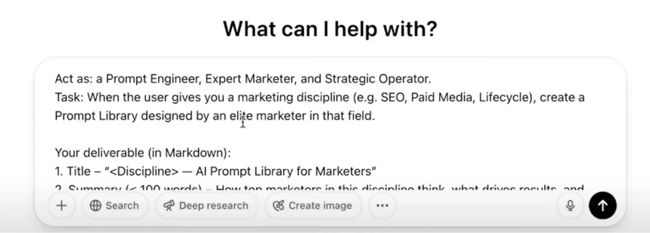
To get this prompt going, the first thing I do is open up ChatGPT and tell it to act like a prompt engineer, expert marketer, or strategic operator. Then, I give it a task:

  • “When I give you any kind of marketing discipline (e.g., SEO, paid media, lifecycle), create a prompt library designed by an elite marketer in that field.”

For the deliverables, I tell ChatGPT the format I want, including a summary of how top marketers in this discipline think, what drives results, and how they scale their work. And then, I include instructions on how to create the prompt library.

marketing prompt, act like a prompt engineer

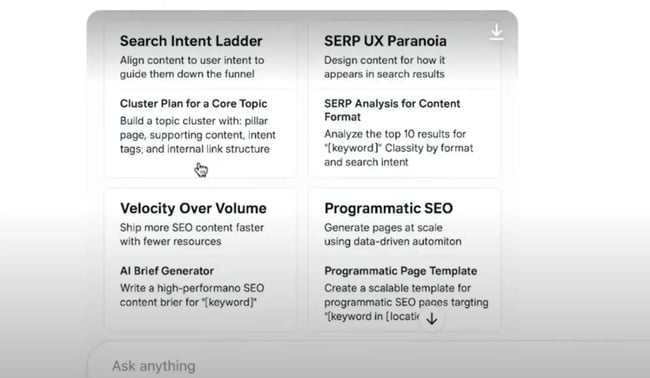
The full prompt is below for you to see. When I run it, ChatGPT comes back with ten prompts that I can just copy and paste. And, each prompt is based on the thinking of an elite marketer in the field. So, basically, it’s accumulating tactics from successful brands and giving me prompts from that company’s perspective.

Let me give you an example of how this works. After I put in the prompt, ChatGPT will ask me what discipline I want to use. If I say SEO, it first gives me a list of Winning Mental Models, citing the best tactics from the best brands. Here’s what ChatGPT generated:

  • The importance of “topic clusters,” citing HubSpot, with the lesson, “build depth-first content silos to signal topical expertise to Google.”
  • The idea of “velocity over volume,” citing Grow & Convert, with the lesson, “80% quality at 5X speed wins vs. perfectionism.”
  • Six other tactics from elite-level marketers that I can review before I dive into the prompt library.

marketing prompt, prompt library

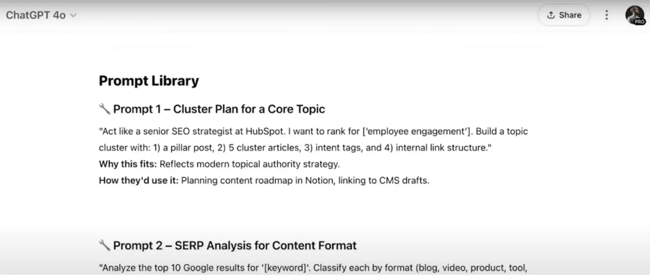
Then I get a ready-made list of ten prompts that takes the above tactics and develops strategies that I can recreate. With the SEO example, the first prompt I get is:

  • Cluster Plan for a Core Topic – “Act like a senior SEO strategist at HubSpot. I want to rank for [employee engagement]. Build a topic cluster with: (1) a pillar post, (2) five cluster articles, (3) intent tags, and (4) internal link structure.”

This prompt is ready to use just by changing the keyword in brackets to whatever I want to rank for. The output also tells me why this fits and how HubSpot would use this tactic. I then get nine more prompts with the same level of detail that I can plug into my AI assistant right now.

marketing prompt, create a prompt library

This example was for SEO, but I could do the same thing for product marketing or brand marketing, and I would get entirely different results and prompts. It’s just going through and asking, who are the elite marketers in the world? And, what AI prompts would those people use?

The great thing is that you can use this for any tactic to automate your marketing. Just copy the prompts and start to build a library that’s relevant for you and your team.

marketing prompt, prompt library

The Prompt

Act as: A prompt engineer, expert marketer, and strategic operator.

Task: When the user gives you any kind of marketing discipline (e.g., SEO, paid media, Lifecycle), create a prompt library designed by an elite marketer in that field.

Your deliverable (in Markdown):

  1. Title — “<Discipline> — AI Prompt Library for Marketers”
  2. Summary (≤ 100 words) — How top marketers in this discipline think, what drives results, and how they scale their work.
  3. Winning mental models
  4. List 5-10 key strategies or operating principles used by elite marketers in this field. For each, include: a name (e.g., “Content-Audience Fit”); a 1-line description; a practical, bite-sized lesson; a source or citation (Operator + Year, or company if applicable).

Prompt library — exactly 10 actionable prompts. Each must include:

  • Prompt <#> — <Goal>
  • <Prompt text written in the voice of an advanced operator>
  • Why this fits: (≤ 25 words — explain why this prompt reflects cutting-edge thinking in this area.)
  • How they’d use it: (How the marketer would deploy it in a real-world workflow. Include tool or channel if relevant.)

Style

  • Use clear, modern marketing language.
  • Prioritize tactics that *scale*, not fluff.
  • Be concise, punchy, operator-grade.

Sources

  • Use examples, operators, or results from trusted sources post-2015 (e.g., Growth.Design, Reforge, Demand Curve, HubSpot blog, etc).

Why It Works

This one AI prompt works because it takes the brain power of the best people in the world and turns it into easily accessible knowledge. By telling you what elite marketers do in their space, you can replicate their tactics.

I love AI because you start with one thing and then continue to build on it. For more prompts, I recommend checking out our curated prompt library, along with this list of marketing prompts. Then, you can steal our favorite AI prompts to use on your own.

A Game-Changing AI Marketing Prompt

With a single input, you come away with actionable prompts that you can use right now, save for later, or share with your team at any time. An advanced-level AI prompt that generates more expert-level prompts? That’s transformative for any marketer.

To learn more about this game-changing AI prompt, check out the full episode of Marketing Against the Grain:


Categories B2B

Content strategy red flags: What B2B marketing teams get wrong and how to course-correct

I see a lot of marketing teams stuck in the same cycle: They believe in content. They’re creating constantly. But, they’re just not seeing the results they want. Add that the CEO is asking why the competitor is “suddenly everywhere.”

Oh, and internally, there’s no real alignment on who you’re talking to, what you’re trying to say, or how you’re measuring success.

That’s usually when I get the call.

Download Now: Free Content Marketing Planning Kit

I’m Devin Reed — former head of content at Gong and Clari, now working with B2B marketing teams through my company, The Reeder. I’ve helped scale brands from $20M to $ 200M+ ARR, and I’ve worked with companies like Notion, Wiz, and FloQast to build content engines that drive tangible pipeline.

When I run a content audit, I’m not just skimming through performance dashboards. I’m digging into what’s broken, what’s missing, and what it’s going to take to turn content into a real growth lever.

In this piece, I’ll walk you through how these projects usually start, the most common mistakes I see, and what teams can do to course-correct.

Why Companies Reach Out for a Content Audit

Before I begin working with clients, a CMO or VP of marketing already has had a long-time conviction that content is important. But, they’ve had a recent realization that it’s no longer something they can take lightly. Put another way, they know they can’t afford not to invest in quality content marketing.

Usually, something went spectacularly wrong recently, or the CEO said something like, “It’s time to get our act together.”

Other times, they’ve realized there’s not one growth number they can look at confidently and say, “See, it’s working!” And even more often than ever, it’s a bigger strategic play, like launching new products, especially now with AI.

So the question becomes: How do we get our name and our product story out there in a way that makes it radically clear that we are different than our competitors?

Sometimes, it’s just competitive pressure. The CEO of their biggest competitor is active on LinkedIn. Their whole team is posting. It feels like they’re eating up all the attention. So, they start thinking, “We’ve got to do something.”

That’s where my Content Design process comes in, which always begins with an audit. Because if I were stepping into the Head of Content role at a company, that’s exactly what I’d do before publishing a single word. I’d want (and need) to know:

  • What have we been doing?
  • What’s working?
  • What’s not?
  • What are our competitors doing, and what seems to be working for them?

From there, we can build something off their strengths, avoid weaknesses, and, most importantly, create something that actually stands out.

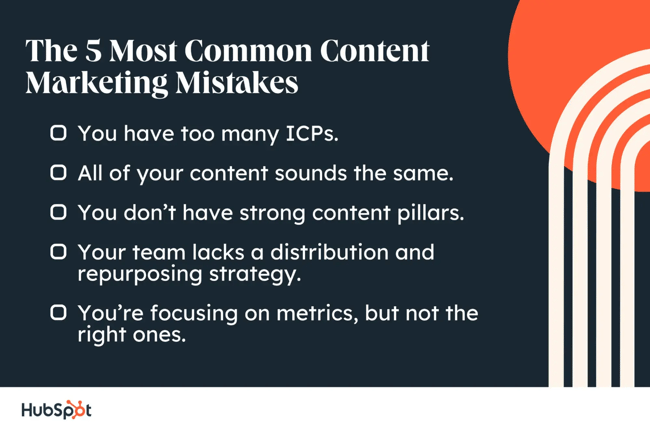
The 5 Most Common Content Marketing Mistakes I See

the 5 most common content marketing mistakes i see

I’ve done a lot of these audits, and there are a few mistakes that come up over and over again, regardless of company size or industry. Here are the most common and damaging.

1. You have too many ICPs.

I think the biggest mistake I see is having too many ideal customer personas.

There’s been so much noise (or insight, depending on how you look at it) about how buying committees are getting bigger and sales processes are more complex. So, I see a lot of marketing teams that feel pressured to market to everyone as a result.

One day, it’s the CRO. The next day, it’s the CFO. Then, it’s the sales enablement team. Before you know it, you’ve got five or seven ICPs you’re trying to speak to. But here’s the thing: You can’t have seven “ideal” customers. If everything is a priority, nothing is.

You’ve got to pick one, maybe two, and prioritize accordingly.

The other version of this is: You only have one or two ICPs, but you don’t really understand them. You’re not clear on what their world looks like, what their real problems are, or how they’re trying to solve them.

Those are the two biggest challenges: Either you’re spread too thin, or you’re not going deep enough.

2. All of your content sounds the same.

When I’m doing the audit, I always ask the client to send me recent content, usually the stuff they consider “top-performing.” (But honestly, they probably wouldn’t have hired me if it were truly performing.)

What I see most of the time is content that’s informational, but not entertaining. It’s not different. It doesn’t share a perspective that hasn’t already been said a hundred times.

And, I think that used to be fine. Maybe pre-2022, before ChatGPT and AI, information had more value. You needed to have real experience, be a researcher, or deliver something in between to say something useful.

But now, information is everywhere. You can use ChatGPT and be an “expert” in almost anything, really quickly. Just having information isn’t enough anymore.

What is enough? A unique spin. A point of view. What’s your take on this trend? What’s the connection you see that others don’t? What’s a story from your experience that makes this relatable?

So now, information has less value. The relatability becomes really important. The stories become important. That’s what people are going to remember more. That’s what makes the content stand out.

what’s your take on this trend? what’s the connection you see that others don’t? what’s a story from your experience that makes this relatable?

3. You don’t have strong content pillars.

This one’s super common: Most folks don’t have a documented content strategy.

Their topic selection gets reactive. One week, it’s product-focused. That is, until the CEO pings them and says, “Hey, our competitor just did a podcast on this. How come we don’t talk about it?”

So, now you’re chasing competitors instead of setting your own direction.

And when you play that out over time — like, a year’s worth of content — you end up with a calendar that’s all over the place. No one’s going to remember what you stand for. No one’s going to associate your brand with a single idea.

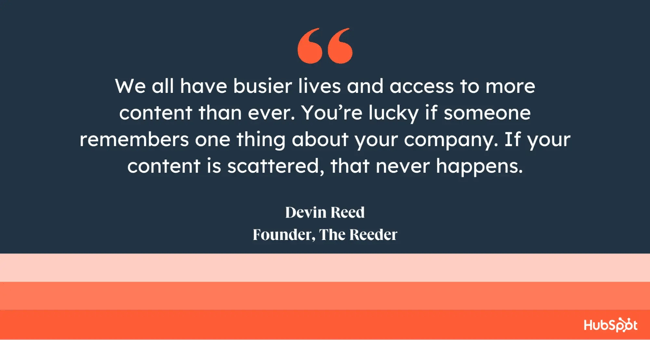
We all have busier lives and access to more content than ever. You’re lucky if someone remembers one thing about your company. If your content is scattered, that never happens.

Instead, you want guardrails. That doesn’t mean you can’t newsjack or jump on trends. But you need to be playing one beat, all year long. One drum that points to one core idea. And, 90% of your content needs to ladder up to that.

we all have busier lives and access to more content than ever. you’re lucky if someone remembers one thing about your company. if your content is scattered, that never happens.

4. Your team lacks a distribution and repurposing strategy.

I’m working on this exact problem right now.

Someone hired an SEO agency. They’re making great content. But, what happens next? They post the blog on their website. Maybe make a corporate LinkedIn post. That’s it.

So now, they’ve got all this good content sitting in a place where people aren’t actively spending time.

That’s not a distribution strategy. You’ve got to meet people where they are. Your audience may go to your website. But, you need to appear on their LinkedIn feeds, inboxes, and webinar rotations.

Otherwise, your team is investing $10K+ per month on content that’s not driving traffic, not driving conversions. You end up with great content for the sake of having it.

So, make the time to repurpose your greatest hits. You spent all this time on a smart framework, solving an urgent problem. Why not turn that into 10 LinkedIn posts? Why not make it a webinar, a keynote, or go on a podcast circuit?

We can’t assume, “If we build it, they’ll come.” We’ve got to be just as intentional about distributing and repurposing as we are about creating.

5. You’re focusing on metrics, but not the right ones.

The biggest gap I see is people who don’t understand how the work connects to business outcomes.

Let’s just take webinars as an example. I’ll ask, “Why are you doing them? Why does the number of registrations need to grow 20% quarter-over-quarter?”

Do you know your attendance rate? Let’s say it’s 25%. Cool. What’s your MQL rate? What’s your conversion rate from MQL to opportunity? What’s your ACV?

Most marketers don’t know that cascade. So, they just keep doing more. That means more webinars, more content, more stuff — without knowing why or what it’s driving.

If you’re doing content that doesn’t have a direct ROI, fine. But, you need to tie it to what I call the “CEO slide.”

Every year, the CEO gets up and says, “Here are the four or five strategic priorities this year.” Perfect. Tie your content to one of those. Then share metrics that show some form of impact. Growth over time. A directional shift. Something that says, “This matters.”

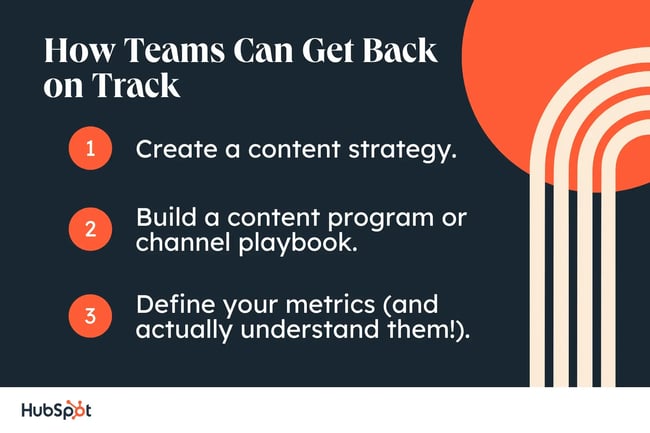
How Teams Can Get Back on Track

how teams can get back on track

If you’re trying to fix these issues, here’s where I’d start.

1. Create a cohesive content strategy.

That’s the first thing. You need a content strategy that aligns all your decision-making in one place. You can’t align your team if you don’t have a single source of truth for what you’re doing and why.

This handles a lot. It gives you focus, clarity, and a way to evaluate ideas beyond, “Does this sound cool?”

2. Build content program or channel playbooks.

You should have a step-by-step guide for how to create high-impact content every single time. That includes ideation, production, approval, distribution — start to finish. The whole process should be mapped out.

That way, once you have a good idea, you’re not reinventing the wheel. You’ve got a clear path to take it from idea to execution consistently and effectively.

3. Define your metrics (and own them!).

This should live in your content strategy, too. What are the top three metrics you care about? And then, go deeper by channel.

Like I mentioned with webinars, ask, “What does success look like? What’s the full funnel of that channel?” If your team doesn’t know it, that gives you an opportunity for learning and development.

And as a head of marketing or content, that’s something you can teach.

Get Clear Before You Create

If you’re creating consistently but still not seeing the impact you want, don’t assume the answer is to do more. Step back. Audit what’s working, fix what’s broken, and rebuild with focus.

Once you understand where things are falling short, you can make smarter decisions, realign your team, and finally start seeing the results your content was supposed to drive in the first place. And if you need more support, you know where to find me.

Categories B2B

How to create a landing page: My simple step-by-step approach

The other day, I was reading a blog post when something caught my eye: a section about how to create a landing page to promote offers like a free ebook. Naturally, I clicked the link. It took me to a clean, focused page that broke down what the ebook included, how to get it, and why it was worth checking out.

Learn More About HubSpot's Free Landing Page Builder

As I scrolled through, a few things stood out. The design was super simple — no distractions, just a clear focus on the ebook. The copy was sharp and persuasive, and it made the offer feel like a no-brainer. Best of all, they only asked me for my name and email. I got valuable insights, and they got a new subscriber. Win-win. That’s the power of a well-built landing page.

Interested? Well, in this post, I’ll walk you through the key steps for creating a landing page that builds on those principles. Personally, I love starting with a template. It saves me from dealing with any code, and I can focus on making the page look great and convert well.

I used HubSpot’s CMS, but you can use any similar software that offers landing page templates, like HubSpot’s free landing page builder or Mailchimp.

Table of Contents

Landing pages usually fall into one of two categories: reference or transactional.

  • A reference landing page is more like an informative guide — it explains a specific product or service in detail.
  • On the flip side, a transactional landing page is all about action. It’s designed to get visitors to do something, like download an ebook, sign up for a webinar, or make a purchase, which is why it’s a go-to for marketing campaigns.

For this example, let‘s say that I’m a marketer for a fictional NASA-esque space corporation, and I‘ve been tasked with making a landing page for a fantasy ebook about space to get children interested in aeronautics. This landing page’s goal is to increase leads.

1. Choose a template that will help you achieve your goal.

To build my page, I chose from a list of templates, while keeping my end goal in mind.

Knowing that increasing leads and the customer experience were top priorities, I chose a template that showcased my ebook offer and provided a form. I also wanted a unique, eye-catching structure and a simple design.

how to create a landing page; a simple template from hubspot

What I like about this landing page template — in addition to the criteria above — is that it’s labeled as “Starter.” As a marketer with little to no design experience, a beginner-level working template sounded right up my alley.

2. Name your landing page so you can find it later.

Next, it’s a good idea to name your landing page. If you plan on having multiple pages exist on the same system, be sure to name each something that will distinguish one design from future pages. For this example, I decided to name it “Ebook Offer One.”

how to create a landing page; remember to name your template so you know where to find it

That way, when I check on the performance of this particular landing page, I’ll locate it easily on my dashboard.

3. Design your page layout according to what you want your audience to see first.

After labeling your landing page, let‘s start designing. For this step, I was able to use a drag-and-drop editor. I’d decided that it was important for the leads to see the ebook’s cover, an engaging description, and the form.

designing my ebook landing page

As a visual learner, a drag-and-drop editor is a dream come true. I can spend less time trying to learn code that would fix these elements and more time visualizing the experience for the lead. I can look at how the header‘s copy will be presented and if it’s effective at keeping audiences engaged.

4. Use the free Campaign Assistant to generate engaging copy.

This is the point where I’d like to ask you: Do you already have your landing page copy ready for publishing? The reason I’m asking is that I know from experience that it can take weeks to even draft a first version. If you don’t have text for your page yet, then I suggest using HubSpot’s free Campaign Assistant to generate copy based on your campaign goals and product/service information.

How does it work? Describe:

  • The campaign you’re running.
  • Who you’re targeting.
  • What you’re offering
  • What tone of voice you’d like to use.

For example: “I’m creating a landing page for a co-working space called [X], offering 25% off your first month for freelancers and remote workers. I’d like the tone of voice to be friendly and conversational.”

You’ll see a first version of the copy, which you can easily edit out. You can also regenerate the copy if you’d like to see an alternative. What I love is that you can save all versions of your copy and improve it as time goes by and you get the first results from your campaign.

5. Communicate the benefits of completing the landing page form to the website visitor.

Somewhere on my landing page, I wanted to provide short, impactful blurbs of value that would ultimately persuade the reader to complete the process.

how to create a landing page; communicate the main benefits on your lp

In my example, the three columns at the bottom of the form communicate the value of my ebook. These columns each had their own engaging icon that was colorful, professional, and clean. I used the text to communicate a main benefit, then described it in a sentence below.

6. Personalize the page so it’s unique to the purpose and your brand.

The next step is sort of a “Choose your own adventure.” Here, I added elements that would fit with the brand of my imaginary company. I uploaded a logo image and made sure the colors were consistent throughout.

how to create a landing page; personalize your template to make sure it’s on brand

I wanted to make sure the text stayed black and white to match my logo and the images didn’t disrupt the usability of my webpage. This choice makes the page look professional and functional.

Once you‘re satisfied with the layout and design, it’s time to move on to the final steps.

7. Test your landing page for dynamic content and user experience.

Because mobile phone usage is increasing each year, it‘s a good idea to test your page to ensure it’s dynamic. When your page is “dynamic” it simply means that the content on your webpage automatically adapts according to the type of screen being used to access the content.

Here, I tested my landing page for formatting on mobile. I wanted to make sure that the content was still displaying neatly and professionally, despite being shown on a different screen type than the one I used to create the page.

landing page mobile formatting

If you‘re using a CMS to make your landing page, check if the software offers dynamic content options. For example, if you find that the logo you’re using doesn’t appear well on a smaller screen, you can make the necessary adjustments.

8. If you desire, run a test to analyze page performance before pushing it live.

Finally, consider running a test on your page. Testing can show variations of your page to audiences and analyze which variations perform better. In this case, the winning page would have the most conversions.

With the software I’m using, I can choose to run an A/B test or adaptive test. Both of them achieve the same goal, with the only difference being that the first runs two different versions and the latter runs many.

how to create a landing page; test your lp, select between a/b test and adaptive test

These tests will be running with a real audience, so make sure your pages look publish-ready before you begin. Be sure that the form fields work and your copy is free of any typos.

After completing these steps, your landing page is complete. I bet it looks fabulous.

how to create a landing page; a screen of what your design would look like after testing

Best Practices for Building a Landing Page

1. Only use one CTA per landing page.

Before you dive into building your landing page, hit pause and get clear on one thing: What’s the goal? What action do you want someone to take when they land here? Maybe it’s downloading an ebook, signing up for a free trial, or booking a call. Whatever it is, defining that goal upfront is key — it’ll guide how you write your copy, design the page, and choose the perfect call-to-action.

And while it might be tempting to include more than one CTA (I’ve seen brands like Home Chef try this), it’s rarely a good idea.

Speaking from experience as a marketer, every time I land on a page with two CTAs side by side, I catch myself rolling my eyes. It feels confusing. You want your visitors focused on one thing, not torn between options. If someone comes to download an ebook but sees another button like “Learn more about us,” they might click that instead and totally forget about the ebook.

One page, one goal, one CTA – that’s how you keep your audience on track and your landing page working the way it should.

how to create a landing page; an example from home chef which features 2 cta’s

Source

2. Only feature key information.

What’s the one thing that drives you away from a landing page the fastest? For me, it’s definitely information overload.

When I see a wall of text, I’m usually out, unless that page happens to be the only place I can get what I’m looking for. But let’s be real, that’s rarely the case. Most of the time, I can find what I need somewhere else, and I’ll always choose the site that offers a cleaner, more pleasant experience.

So, make sure your design and copy stay focused and uncluttered. Zero in on the key information your audience needs to know.

I get it, sometimes you feel like there’s just so much to say about your product or service. But trust me, you’re better off highlighting only the most important benefits. People aren’t looking to spend forever on your site — they just want to know enough to make a decision.

A strong value proposition, a few standout benefits, some testimonials, and a persuasive CTA — that’s usually all it takes to get the job done.

best practices for building a landing page

3. Stay authentic – don’t use stock images.

I can’t help but giggle a little when I see the same stock image popping up all over the internet; it definitely doesn’t do much for a brand’s authenticity.

Sure, using stock photos might seem like the most cost-effective option in the short term, but in the long run, it can really hurt your brand image. Inigo Rivero, managing director of House of Marketers and one of the first EMEA employees at TikTok, once told me that design is absolutely a key element to consider before launching any marketing campaign.

“In our work with TikTok campaigns and brand promotions, we discovered that simplicity and authenticity drive results. For one campaign, we transformed a generic landing page into a conversion powerhouse by replacing stock photos with real, engaging user-generated content (UGC),” he shared.

Instead of polished, overly staged visuals, they showcased raw clips of influencers actually using their clients’ products – straight from their TikTok campaigns. This change made the page feel alive and relatable, which resonated with audiences craving genuine connections.

“Visitors stayed longer, engaged more, and converted at higher rates. By showing real people using the product, we built trust,” Rivero added.

4. Remove top navigation.

Good landing page design really comes down to simplicity. One of the easiest ways to cut out distractions is by removing the top navigation bar. This helps keep visitors focused on what’s right in front of them on your landing page.

Brandy Hastings, SEO strategist at SmartSites, shared a great example with me about how they redesigned a page for one of their clients, MalpracticeOne.

“We removed the top navigation to eliminate distractions and keep users focused on conversion. The mobile version retains all critical elements: the logo, CTA, short copy, and form — with clear tap targets. We also used color contrast (teal + coral red) to draw the eye to the CTA buttons like ‘Get Quote’ and ‘Call Now’ without being overwhelming,” Hastings explained.

After that update, bounce rates dropped by 17% and quote submissions shot up by 29%. Plus, the mobile layout became much easier to scroll, with CTAs that stayed visible the whole time. This just goes to show that thoughtful design choices — like smart spacing and visual focus — aren’t just about looks. They make a real difference in how well your landing page converts.

5. Remove visual distractions around your CTA.

Your CTA can be in competition not only with other CTAs — it could also lose to distracting elements placed around it.

“I have optimized hundreds of landing pages for B2B and ecommerce, but one visual tweak consistently drives results was isolating the CTA in a contrasting color block with zero visual clutter,” Alan Muther, UX designer and marketing specialist at Ardoz Digital, told me.

“On a recent landing page revamp, I stripped the footer, removed secondary links, and surrounded the primary CTA in a solid white box against a dark background,” he said.

In this design, he featured no gradients, no shadows, and no icons. “That change alone boosted our form fills by 36% in 14 days.”

I agree with Muther that we shouldn’t give users reasons to wander around your site and choose a path that doesn’t end in your funnel. “When everything else fades to the background, the CTA becomes the hero,” he concluded.

6. Make the entire landing page copy engaging – not just the header.

Focusing on the above-the-fold of the site is a mistake I’ve seen quite a lot, especially from businesses that don’t have much website design or marketing experience.

Don’t get me wrong — nailing the top of your page is super important. It’s the first thing people see, and it plays a big role in whether they’ll stick around or bounce.

But here’s the thing: that top section is just the opener. Its real job is to spark enough interest for someone to keep scrolling. If the rest of the page doesn’t deliver, if it loses steam or doesn’t build on that momentum, people drop off. I think of it like a book with a killer first chapter that fizzles out, or a show that hooks you in the pilot but falls flat by episode three.

For me, the goal is to always make sure that the entire page tells a consistent story, not just the beginning.

7. Don’t forget to optimize your page for SEO.

Remember to optimize your landing page for SEO. Most CMS software is really good at pointing out SEO opportunities for web pages, and optimizing your page could get more traffic from queries on search engines.

For a quick starting point, to optimize my space ebook for SEO, I would make sure the ebook has an engaging, yet relevant title. I would also tag the post with relevant keywords in order to boost visibility on search engine results pages.

A great landing page makes a difference.

One of my favorite ways to learn and improve my own strategies is by observing what other brands are doing and seeing what I think works, and what I think doesn’t. How have you recently seen a landing page promoted? I’ve seen some while scrolling through LinkedIn and in email newsletters. Next time you do, take a closer look and analyze how the landing page was created.

After reading this article, I hope you’re feeling confident about how to create a landing page. With these high-level steps and my top-recommended best practices, you’re well on your way to creating an opportunity to earn more leads.

Editor’s note: This post was originally published in June 2020 and has been updated for comprehensiveness.

Categories B2B

Growth marketing — the campaigns that you need to know

I’m a teacher, so I’m now used to the faces of students who are scared to learn. More specifically, they’re scared to fail to learn. It’s ingrained early in our studies — As are good, Fs are bad, and you’d better learn the right answers before time runs out.

Download Now: Free Growth Strategy Template

That mentality crashes and burns in the world of growth marketing. Few other areas of life encourage you to fail as often as you will with these types of campaigns. You’re still aiming for those high marks, of course, but growth marketing experiments encourage you to try, fail, learn, and try again.

The fear of failure kills more good ideas than poor strategy ever will. But growth marketing gives you a better way forward — if you’re willing to try. Here’s what growth marketing looks like in practice and how you can start learning today.

Table of Contents

While traditional marketing might focus on awareness or running static campaigns, growth marketing extends across the full funnel, touching all aspects of the customer lifecycle from acquisition to retention.

That’s reflected in the long list of growth marketing tactics you can deploy, from retargeting and cross-targeting to email marketing and direct mail. Behind every tactic, growth marketing asks, “What’s actually working — and how do we scale it?”

Benefits of Growth Marketing

Growth marketing done well helps you create a system that delivers results and gets better with time. What other benefits can it deliver?

3 benefits of growth marketing

Scalable Results Through Testing

Growth marketing can deliver big wins that scale with your company. You earn those wins through consistent work and deliberate testing. You’re not throwing ideas at the wall; you’re learning which wall matters, what sticks, and why — which makes you a sharper marketer.

Testing lives and dies by analytics, so I encourage your marketing team to track data thoughtfully as they scale operations. McKinsey research backs up the value of analytics: Companies that effectively use analytics in service of marketing and sales performance are 1.5x more likely to achieve above-average growth rates than their peers.

Deeper Customer Understanding

Building, running, and testing growth marketing campaigns helps you deeply understand what your buyers want. You learn what they respond to, what turns them off, and how their behavior evolves.

That obsession with your customer leads to big benefits: Forrester research shows that customer-obsessed organizations reported 41% faster revenue growth, 49% faster profit growth, and 51% better customer retention than those in non-customer-obsessed organizations. And only 3% of respondent companies were categorized as “customer-obsessed.”

Nail this piece, and you’re operating in rarefied air.

Cross-Channel Impact

Connected channels compound impact: people engage more, convert faster, and feel like they’re in conversation with your brand, not being chased around by disconnected ads.

Staying cross-channel can help businesses of all types grow. For instance, research from Capital One shows that retailers using three or more channels increased consumer engagement 250% over single-channel retailers.

Whether you’re selling clothing or B2B SaaS software, you want your message to reach more people in more places.

That said, I’ve found growth marketing works best when your message shows up in places where it actually makes sense. Don’t be everywhere, but stay relevant across email, social, SMS, and in-app experiences.

Types of Growth Marketing Campaigns

There’s no single formula for a great growth marketing campaign, but most campaigns fall within one of these types.

Product-Led Growth (PLG)

Product-led growth (PLG) relies on the product to lead user acquisition, activation, conversion, and retention efforts. Instead of relying heavily on sales or marketing to push people through the funnel, PLG gives users direct access to the product and lets the product’s value drive growth.

Consider Slack as an example. You can create a workspace and start chatting with coworkers in just a few minutes. While you can add paid features, you can also use many of the typical functionalities within Slack from the get-go. You see immediate value delivery, can manage onboarding yourself, and learn as you use the product. So, when in-product prompts for upgrades or expansion appear, you’re already primed to take advantage of the opportunity.

That said, product-led growth doesn‘t happen overnight, especially if your product wasn’t built for self-service from the start.

For one project, I supported early PLG efforts for a platform that had serious potential but wasn’t quite ready for self-service. Users needed support just to get started, and onboarding required a human hand-off more often than not.

We couldn’t flip a magic PLG switch, so we focused on what we could control: shortening time to value. Working with the product team, we tightened the onboarding flow so new users could reach their first “win” without waiting for a 15-minute implementation call. We also tinkered with in-product prompts and restructured documentation to be more action-oriented.

Those changes got us moving in the right direction and taught me that PLG is not a binary switch. It’s a gradual shift from explaining value to letting the product prove that.

Referral and Viral Loops

Referral campaigns focus on incentivizing users to bring others into the mix. You’ve probably seen this before from many services in your daily life. For instance, a “give $10, get $10” offer from just about any local retailer or restaurant offers a solid example of referrals in real life.

Ideally, these campaigns drive growth by having current users help you acquire new users. The most successful campaigns take advantage of “viral loops” that drive adoption at exponential rates (aka “going viral”).

Where some marketers trip up with a referral program is they treat it like a set-it-and-forget-it opportunity. Instead, see how you can evolve a campaign midstream using engagement data to reach users’ social and emotional drivers — not just transactional ones.

That’s how Nikita Baksheev, head of marketing at Ronas IT, succeeded with a recent referral campaign. “Initially, customer retention rates were lower than expected, so we designed an experiment with targeted incentives — users earned more rewards for successful referrals,” he said.

“We used ‘smart messaging’ to highlight the mutual benefits of the referral program through personalized email sequences paired with targeted social media ads. After testing various communication styles and incentives, we made a data-driven pivot towards messaging emphasizing exclusivity and community.”

This midstream adjustment improved referral signups by 45% and kicked off a cycle of sustained growth while lowering customer acquisition costs.

Lifecycle Marketing

A common and powerful campaign, lifecycle marketing focuses on increasing retention, engagement, and long-term value by targeting outreach aligned to each customer stage in the marketing funnel.

For example: I recently left a few new dog treats in my Chewy cart. In minutes, I received the cart abandonment email reminding me to check out before my monthly Autoship was sent.

Other examples include:

  • Welcome email series
  • Reactivation emails
  • Loyalty pushes

It’s all about engaging your customers where they are now — the right message at the right time and place. Gut instinct can help; data-backed decisions are better. That’s what Mike Zima, chief marketing officer at Zima Media, found when working with a recent client.

“What made it work was constant iteration A/B testing messaging at each funnel stage, suppressing low-value audiences, and coordinating ad creatives to match CRM lifecycle stages. Rather than guessing, we let the data shape the real story,” said Zima.

“By improving signal quality, we reduced cost-per-acquisition while increasing lead quality over time. The compounding effect came not from a single channel but from harmonizing data, messaging, and timing across the stack.”

Content-Led Acquisition

As a writer, I’m always partial to content-led initiatives. Pillar pages, landing pages, lead magnets like ebooks — I love educational content. Content-led acquisition focuses on ways to build awareness and trust while capturing demand. Educational resources, SEO, and organic traffic are hallmarks of content-led acquisition.

That said, content-led growth isn’t about churning out thousands of blog posts; it’s about delivering content that meets people where they are, with the right message at the right moment. That’s a lesson some may forget in the current fervor over AI-generated slop posts.

But Jayen Ashar, CTO at Scaleup Consulting, used AI wisely in a content-led motion to reach customers for a client’s betting analytics platform, where his team used AI to auto-generate social content and headlines based on trending player data.

“The key decision was to test dozens of variations across Twitter and email — some playful, some data-heavy — using GPT to rapidly iterate and personalize. We tracked CTR and conversion per segment, then doubled down on formats that resonated (e.g., “X player crushes this stat line – here’s the bet”),” he said.

That process put AI to work positively. “What made it work was tight feedback loops: AI sped up content creation, but performance tracking let the AI optimise fast,” Ashar said. “We also coordinated the messaging across push, email, and social in real time during major sports events. That consistency, paired with AI-driven testing, boosted paid subscriber conversions by over 30% in 6 weeks.”

Community-Led Campaigns

Community-led campaigns drive growth through real users sharing, contributing, or co-creating content. You may also see this as “user-generated content” campaigns. Think hashtag campaigns, discussion boards, or community groups on Slack or Discord. It’s all about having your user espouse your value to help convince others to sign up.

Notably, community-led growth doesn‘t always start with an audience you already have. Sometimes, you build that audience by inviting people into the conversation before they’re even customers. That’s what Borets Stamenov, co-founder and CEO at SeekFast, discovered in a recent campaign.

“We ran a cold-email campaign that doubled as customer research, rather than just sales outreach. Instead of the usual “buy our product” emails, we posed an insightful, open-ended industry question relevant to our leads. Each response fed into tailored blog posts, webinars, and LinkedIn posts — all tagged and credited back to participants,” he said.

Stamenov found that this approach turned prospects into co-creators, not just leads.

“Engagement soared because people love sharing their opinions, especially publicly. As the content grew, organic traffic surged and conversions climbed steadily, compounding month-over-month,” he said.

“The key decision was treating outreach as collaboration, not sales. By involving leads directly in content creation, we boosted trust and opened doors across multiple channels. It transformed cold outreach into sustainable inbound growth.”

Elements of a Growth Marketing Campaign

A growth marketing approach requires repeatable elements you can use and tinker to develop the best system for your business. As I build and manage these campaigns, I’m evaluating these ingredients for your growth marketing recipe.

A/B Testing and Experimentation

If at first you don’t succeed, try, try again (or so the old nursery rhyme goes). That idea lies at the heart of growth marketing. Experimentation is how you find the right people, messaging, and channels to reach users and drive growth.

In particular, do a ton of A/B testing while building your campaign. And while tools exist to let you run highly sophisticated or automated testing strategies, it starts with an inquisitive and curious mind — namely, yours. And the courage and humility to say, “Is this really the best way to say it?”

While supporting that PLG motion previously mentioned, our team tested dozens of copy sets and visual combinations across several channels. And each time we tweaked a line or dropped a word, the copywriter in me fretted. But, we approached the process with clear direction, testing one variable at a time and tracking results carefully. A well-designed experiment eased my concern and helped us reach a valuable niche audience more efficiently.

Multichannel Coordination

Your users’ lives are large and contain multitudes — especially their digital footprints. Email inboxes, For You tabs, forums and posts and closed groups, they all compete for attention.

Multichannel coordination is how you reach for their attention intelligently. Instead of copy-pasting the same message across every platform, you craft a story that feels cohesive wherever people experience it.

You’ve likely seen this during one buying experience or another. The ad is compelling and makes you want to learn more. And then the landing page is as dry as the Sahara. You can just feel it when the story is misaligned.

Your goal is to help people understand what you offer and why they should choose you. When things go sideways, I recommend people not produce more content but investigate what they run now. Are you pointing to the same core benefit? Do users even understand what you offer? Answer those questions and share your responses across your channel suite.

User Feedback Loops

I often find that many marketing teams (and leadership) are so eager to talk about themselves that they forget to listen back. Launching the growth marketing rocket ship is exciting, but to keep it orbiting, you need to listen constantly once you’re live.

In digital marketing, user feedback loops are constantly available. Surveys, behavioral data, chat transcripts, and comments on social media posts offer glimpses into better ways to appeal to your user base. I once had a Facebook ad that received one comment asking about how a feature actually worked … and then another and another. One quick tweak to ad copy, and the questions vanished.

Fast Learning Cycles

I know the siren call of perfection. You want to nail your campaign and show you understand your product and audience. But over time, I’ve found that audiences will teach you quickly. Your job is to learn just as quickly.

While I wouldn’t suggest rushing your campaign just to get things moving, I would suggest cutting the lag between insight and action. For example, adjusting ad copy and spend used to give me pause. How long should I run ads before responding to low engagement or conversion metrics? What do I change — or delete?

But typically, early engagement metrics will surface one or a few solid options for further investment. Shift budgets or change copy mid-flight to support higher performing variants. Buy yourself time and space to create new and better variants, too. Small moves beat perfection all day long.

Tips for Growth Marketing Campaigns

Your growth marketing campaign won’t be perfect out the gate, and it takes a willingness to engage and to learn if you want to improve. But, if you’re looking for solid tips to help you through your learning phase, here are a few powerful insights to bring to your next campaign.

tips for growth marketing campaigns

Tip 1: Think ahead.

“Growth” doesn’t have to pertain to just growing your business — it can also be in service to your audience. The most resonant messages lead with the idea that “we are growing with you” and help people envision the future.

Linn Atiyeh, CEO of recruiting firm Bemana, followed this concept in a recent growth marketing campaign for manufacturing and equipment clients. Traditional campaigns focused on hiring for mechanical skills, but digital shifts made skills like PLC programming and robotics integration more vital — and harder to find.

“We saw the shift happening and knew we had to act quickly. So we launched a campaign that addressed the evolution both our clients and candidates were facing,” said Atiyeh.

“For employers, we framed hybrid technical roles as essential to future-proofing their workforce. For candidates, we provided guidance on the next skills to develop — certifications in controls, electrical troubleshooting, and even basic coding — positioning ourselves as a long-term partner, not just a placement firm.

“The reason this campaign resonated is that it wasn‘t just reactive — it was forward-looking. We weren’t just saying ‘we understand your current challenges,’ we were saying, ‘we see what‘s next, and we’re ready to help you get there.’”

Tip 2: Structure over spend.

Big budgets don’t equal success in growth marketing. The real secret sauce lies in organization, and how you structure your campaign makes the key difference.

Amber Porter, CEO of RankingCo, saw this exact issue pop up in a campaign for a boutique fashion store. Their traditional campaign structure was bleeding cash on underperforming product categories. Porter restructured the campaigns using category performance over individual brands instead.

“The restructuring systematically identified which product categories delivered the highest ROI, allowing us to shift budget allocation in real-time,” she said.

“This wasn‘t just a one-time fix — the campaign continued improving as our AI-powered tools learned which customer segments converted at the highest rates. The approach delivered a 20% sales increase beyond the client’s goal.”

Porter advises growth marketers to pay more attention to a campaign’s structure over ad spend alone.

“Too many businesses throw money at the problem instead of experimenting with how their campaigns are fundamentally organized. In digital marketing, it‘s rarely about spending more — it’s about spending smarter through continuous experimentation and audience refinement,” she said.

Tip 3: Kill your marketing darlings.

You can have the most creative, brilliant idea you’ve ever devised. But, in marketing, performance matters above all else.

Growth marketers should be ready to kill their darlings, even if they took weeks to build. Andrew Dunn, VP of marketing at Zentro Internet, shares more.

“At Zentro Internet, I spearheaded a multi-channel campaign that combined LinkedIn thought leadership content with targeted email nurture flows, which ultimately grew our B2B pipeline by 43%. We tested different messaging angles with small budget experiments first, finding that stories about IT leaders solving real problems performed 3x better than generic product pitches,” he said.

“I learned to let data guide our creative risks — like when we scrapped our planned corporate video series after early metrics showed our customer case study podcasts were driving more qualified leads.”

Examples of Growth Marketing Campaigns

What does growth marketing look like in practice? I’ve highlighted two campaigns that I feel really nail the spirit of growth marketing — both in driving results and engaging users and customers.

Deep Cognition

I’ve often discussed how a lack of trust in AI presents likely the largest barrier to implementing AI in companies — especially enterprises. Deep Cognition tackled that challenge head-on with a growth marketing campaign that turned a bold promise into a long-term referral engine.

John Pennypacker, the company’s VP of marketing and sales, explains the “Implementation Timeline Challenge” campaign.

“The campaign started with a bold claim: ‘Deploy AI in 30 days or implementation is free.’ This was a calculated risk, as most competitors quoted 6-9 month timelines. Behind this guarantee was our confidence in our platform‘s rapid deployment capabilities that we’d refined but hadn’t effectively communicated,” he said.

growth marketing campaign example from deepcognition, website image

Source

Pennypacker deployed a multichannel approach that targeted decision-makers with tailored messaging. For instance, CTOs received technical validation through implementation webinars, while CFOs saw case studies highlighting accelerated ROI timelines.

“The campaign’s effectiveness came from its sequential testing structure,” he continued. “We first validated messaging with a limited LinkedIn campaign, refined based on engagement metrics, then expanded to email sequences and eventually direct mail to key accounts.

“The compounding impact emerged as successful implementations created reference customers who participated in industry-specific case studies, which then fueled the next wave of acquisition.”

Pennypacker notes this campaign initiated a flywheel effect, where each successful implementation strengthened campaign messaging for the next prospect.

“Two years later, this campaign continues to generate referral business and has permanently shifted how we position against competitors in the enterprise AI space,” he said.

AIScreen

I’ve seen attempts at growth marketing stall because of perfectionism. “What if we don’t have the messaging right? Are we wasting time?”

You won’t just have the right message — you need to find it through experimentation. Nikita Sherbina, co-founder and CEO of AIScreen, shows how that process unfolded during a campaign for a B2B SaaS product built for remote teams.

“The audience was kind of all over the place … so instead of guessing, we tested three messages: saving time, smoother onboarding, and better team alignment. We ran different versions across LinkedIn, newsletter ads, and short-form content in Slack groups, just to see what stuck,” she said.

growth marketing campaign example from aiscreen.io, website image

Source

The signal came back clear: “Team alignment” outperformed every other message.

“Once we saw that, I pivoted everything — site copy, emails, paid ads — all toward that core message,” said Sherbina. “I also pushed for original content per channel rather than copy-pasting, which was a heavier lift but got way better traction.”

Iterating on messaging helped her team meet customers where they were and give them the right knowledge at the right time.

“What made it really work long-term was how we layered on smart retargeting with email follow-ups tied to what folks had clicked or watched. Demo signups jumped 40% in just a few months, and the data we collected helped us keep refining the whole flow,” she said.

“Honestly, it was the constant tweaking and listening to what people were reacting to that gave the campaign legs.”

Pro tip: When you’re ready to build your first or next growth marketing campaign, check out our growth marketing guide for a clear path to start and tips to succeed.

The only way to grow is to start.

Through this article (and several failed campaigns), I learned that growth marketing isn’t magic: it’s momentum. Teams that listen, test, and move win in this framework.

You don’t need a massive budget to run a brilliant campaign. Start with a hypothesis, a way to measure it, and the guts to try. Don’t be scared to fail; you can’t learn and grow if you never start. So, start now.

Categories B2B

70 AI prompt examples for marketers to use in 2025

If you want great results from AI, you need to master the art of crafting the right requests, and that starts with having strong AI prompt examples to work from.

After dozens of rounds of fine-tuning prompts, I’ve learned how to turn AI from a clumsy assistant into a serious creative partner. When used right, AI speeds up the boring stuff and frees your brain for the big, interesting ideas.

Download Now: 100 ChatGPT Prompts for Marketers [Free Guide]

In this article, I’ll share real-world AI prompts marketers can start using right away, plus fresh data on how your peers are leveling up with AI.

Table of Contents

How do AI prompts work?

All AI tools share one thing: “great prompt = great output.”

As you probably know, AI doesn’t do a good job of reading your mind. It mirrors whatever you throw at it. If you’re sloppy, it reflects confusion.

If you’re sharp, it reflects brilliance. Clear, complete, packed-with-relevant-info prompts are what get you powerful results.

If your prompts are vague, messy, or half-baked, you’re going to see that come back up in the response. Garbage in, garbage out.

Before sending a prompt, I like to run a quick check: Did I include context, goals, and examples that would help illustrate my request?

AI Prompts in Marketing Today

Our State of AI survey, based on responses from 1,350 U.S. business professionals, shows that hundreds of marketers are using artificial intelligence to automate tasks, save time, personalize content, and better understand customer needs.

Across every win we heard about, one thing stood out: success with AI came down to the prompts — ones that were specific, clear, and packed with the right information.

If you want the same edge, start by sharpening your prompts.

ai prompting tips

We asked marketers for their most effective strategies when writing prompts for generative AI tools like ChatGPT.

Over half (53%) recommended offering relevant context, like specifying the target audience, outlining key themes, and adding important notes.

Others pointed to using follow-up prompts (43%), giving highly specific instructions (45%), and experimenting with different prompt types (55%) as ways to sharpen AI outputs.

Each tactic helps generative AI produce results that are sharper, faster, and more accurate.

Once you’ve experimented with different prompt types, build a strategic framework for AI prompt creation to drive consistent results across teams.

ai prompting tips

Most marketers (51%) need three prompts to achieve the desired result when using generative AI to write copy.

Even then, 63% said they only need to make minor edits to the final text. In other words, the sharper your prompt, the less cleanup later.

Prompts make all the difference. To see how top marketers are getting it done, download the full State of AI report.

AI isn’t just for quick tasks anymore. Marketers are using it to brainstorm full campaigns, content series, and workflows when the prompts are structured right.

Find inspiration, try your prompts out, and test what’s possible inside HubSpot’s Content Assistant.

HubSpot's Content Assistant

Try HubSpot’s Content Assistant today.

HubSpot’s Content Assistant plugs right into the tools you already use, letting you switch between manual and AI-powered content creation for blogs, emails, and more.

Now, let’s explore the different prompts you can use for your marketing strategy.

Marketing AI Prompt Examples

These AI prompt examples cover a wide range of use cases from blog writing to social media, lead generation, and video scripts.

Examples of AI Prompts for Marketers

marketing ai prompts

Educational Prompts

These prompts are useful for writing drafts of top-of-the-funnel content about popular topics. Here are some examples:

1. What is [topic]? Write a blog post of [number] words introducing the reader to [topic].

2. Briefly explain the stages of the [topic].

3. List the key elements of effective [topic].

4. What is the difference between [topic 1] and [topic 2]?

5. Outline how [topic] trends have influenced [another topic].

Informative Prompts

Informative prompts let you generate content that offers valuable insights to readers on a topic. Here are a few examples:

6. Create content for our help page that explains how [popular software feature] works.

7. Explain what [your company] can learn from [competitor] optimization of its user experience.

8. What are some popular myths about [topic]? Write a strong essay under 1,000 words that dispels all myths.

Listicle Prompts

These prompts help you outline ideas and create drafts for a list blog post or social media post. See some examples below.

9. List [number] must-have tools for beginner [topic] enthusiasts.

10. List [number] blog post titles on the benefits of an effective [topic].

11. List the major themes in our recent customer review below: [review].

12. List [number] common misconceptions about [topic] and debunk them.

13. List [number] frequently asked customer questions about our [topic]. Provide answers under 100 words to each question.

Technical Prompts

AI tools help write drafts of technical materials. Below are some technical AI prompts.

14. Write a [user manual] for [product feature] that guides users through its use.

15. Attached is the raw data of a survey we conducted. Our company’s name is [name]. We surveyed [user groups]. Analyze the survey data and outline the key findings.

16. Create a business proposal for a new content management system in a hypothetical company. Address costs, timelines, and expected benefits.

Art AI Prompts

Creating great art with AI is both a science and an art. Before creating an art prompt, you need to set up an account with tools like Midjourney. Here’s how an AI expert, Ruben Hassid, recommends you do this:

1. Open Midjourney and Discord accounts.

  • Google Midjourney.
  • Click Join Beta.
  • Create a Discord account.
  • Subscribe to any of their plans.

2. Use Midjourney.

  • Invite Midjourney to your channel.
  • Start a prompt with “/imagine.”
  • Use descriptive words and techniques.
  • Select the best variation out of 4.
  • Upscale it or create variations of it.

3. Upscale the image or create variations.

U = Upscale = Make an image bigger.

V = Variation = 4 new images based on that one.

U1 = Upscale the top left image.

U2 = Upscale the top right image.

U3 = Upscale the bottom left image.

U4 = Upscale the bottom right image.

V1 = Create 4 variations from the top left image.

V2 = Create 4 variations from the top right image.

V3 = Create 4 variations from the bottom left image.

V4 = Create 4 variations from the bottom right image.

midjourney chatgpt prompts

Examples of AI Art Prompts

17. An image for a [content type] showing a researcher engrossed in their work.

18. An image of a bold [color] lady for a web page. Lady should wear a jacket, look forward, smile, have dark hair, fold her hands, and stand in a library setting.

19. An image of nine professionals in a Zoom call setting. Blur the images a bit. Place the image of a [color] man in front of the image. The man should have a bold, bright smile and should be in a suit.

20. Image of cartoon researching with their computer. A ghost caricature behind the cartoon shows the researcher is a ghostwriter.

Examples of AI Prompts for Lead Generation

Lead generation is attracting prospects to your business and increasing their interest in becoming customers.

AI can empower marketers to attract more potential customers based on buyer persona characteristics if specified in the AI prompt. The following AI prompt ideas show you how to get those customized results.

21. Generate ideas for a new product launch in [month] that incorporate the theme of [season] and [tone].

22. Brainstorm content ideas for a blog post about [topic] in [number] of words or fewer that is search engine optimized in formatting using H2s and H3s accordingly.

23. Suggest high-volume keyword clusters for [topic] to optimize search engine rankings.

24. Identify popular trends in the industry of [product or service] that an audience of [target audience] will be interested in this [upcoming season].

25. Generate ideas for an upcoming marketing campaign about [new product] with a marketing mix comprising [product] [price] [place] [promotion channels].

26. Suggest [number] ways to improve website traffic during [holiday season].

27. Identify potential target audiences in [location] that would be interested in buying [product] to solve [pain point].

28. Suggest new strategies for lead generation in [market] and [industry].

29. Generate ideas for creating a viral social media campaign using recent [social media platform] trending audios or popular memes from [month] [year].

30. Identify new channels for advertising [product] aside from [current platforms already in use].

Examples of AI Prompts for Social Media Posts

Did you know that AI can recognize different social media platforms? Marketers benefit from using AI prompts for their preferred channels instead of basing strategy on generalizations.

Below are AI prompt ideas tailored to different platforms so your messaging feels channel-native and effective:

ai prompts for social media

Source

31. Write a tweet promoting a new product suited for a target audience in [industry] and [location].

32. Generate a post for Instagram featuring a customer testimonial about [product] in under [number] words.

33. Write a Facebook post introducing a new product feature and rephrase its current description to sound more exciting and effective: [insert current product description text].

34. Create a LinkedIn post promoting a new job opening in [number] words or fewer with a strong call-to-action at the end.

35. Draft a Pinterest post featuring a new product line and provide tips on improving product photography for [type of aesthetic].

36. Write a YouTube video description for a new product review that links to [insert links] for viewers to go to the product landing page for more information.

37. Draft a TikTok video script showcasing a product demonstration for 2 minutes at maximum.

38. Create a Snapchat story promoting a limited-time offer and describe the type of stickers or filters that can improve it.

39. Write a blog post title to promote a new social media campaign in [number] characters or fewer.

40. Draft an email subject line to promote a new blog post that feels personal, enticing, and not spammy.

Examples of AI Prompts for Podcast or Video Content

Developing ideas for podcasts or videos on your own can be exhausting. Thankfully, AI can provide ideas for them and even walk you through the script and development process if you specify it in your prompt.

See the different prompts that can help you create multimedia content.

41. Draft a podcast episode about the latest [industry] trends and innovations that contains [number] minutes of dialogue.

42. Produce [number] of topics for a video series featuring interviews with thought leaders in [industry].

43. Develop a podcast episode discussing the benefits of [products or services] divided into four chapters.

44. Create a video series that showcases customer success stories.

45. Produce a podcast episode on the history and evolution of [brand or industry].

46. Develop a video series on best practices for using [products or services] in [number] of different ways.

47. Create a podcast episode that features an expert roundtable discussion on [industry topics].

48. Produce ideas for a video series featuring a behind-the-scenes look at your company’s operations.

49. Develop a podcast episode that offers tips and advice on succeeding in [industry] as an entrepreneur.

50. Create a video series highlighting the impact of [products or services] on the lives of customers or clients in [demographic].

Examples of AI Prompts for Content Promotion

marketing ai prompts

Marketers looking for more effective ways to promote their products or services can use AI for best practices. Explore the different channels, tips, and methods this technology can yield using solid AI prompts.

51. Suggest the best time and day of the week to publish a blog post about [topic].

52. Write a press release announcing a new product launch geared toward [target audience] that sounds confident, exciting, and interesting.

53. Generate ideas for outreach emails to promote a new product, including [number] of attention-grabbing subject lines and [number] of clear calls-to-action.

54. Write a guest post for a popular industry blog discussing the impact of [product] on [marketing strategy].

55. Suggest the [number] best hashtags for a social media campaign on [social media platform] to reach [target audience].

56. Draft a script for a 60-second podcast ad [for service/product] that has a friendly tone and witty humor fit for [target audience characteristics].

57. Create a landing page for a new product promotion divided into [number] sections about different benefits based on this description: [insert new product description].

58. Write a script for a TV commercial involving [number] actors in [setting] that promotes [product/service].

59. Draft a product description for an ecommerce site that is [number] sentences long and enticing to [target audience].

60. Generate ideas for cross-promotion with other businesses in the [market], specifically with brands such as [brand names].

Examples of AI Prompts for Repurposing Content

AI can allow marketers to reuse and refresh outdated content to make something new or more useful in the current year — a process we call historical optimization .

When making AI prompts for content repurposing, be creative and see how you can transform your old work into something new.

These AI prompt ideas are perfect for breathing new life into old assets — turning one great piece into many.

ai prompts examples

Source

61. Repurpose a blog post into a video script using this article: [insert old blog post].

62. Turn a webinar into a podcast episode using this pre-existing transcript: [insert old webinar transcript].

63. Repurpose an ebook into a series of [number] blog posts using this pre-existing text: [insert old ebook content].

64. Generate ideas for updating an outdated infographic on [topic] for [year].

65. Rewrite a blog post into a series of [number] social media post series for [social media platform].

66. Turn an old product page into a landing page for a new product using this pre-existing copy: [insert old product page content].

67. Generate ideas for repurposing a white paper into a video series about [topic] using this pre-existing text: [insert old whitepaper content].

68. Rewrite an old email campaign into a new one with updated messaging suited for [season] [year].

69. Turn a research report into a series of social media posts using this information: [facts from the research report].

70. Generate ideas for repurposing an old product demo into a webinar.

Use Thorough AI Prompts for Thorough Results

You don’t need perfect prompts.

You need real ones—clear, specific, and grounded in what you’re trying to do.

Your prompts are the difference between “meh” and “nailed it” and it often comes down to how you frame them.

These AI prompt examples aren’t just a list—they’re starting points. Steal them. Remix them. Make them yours.

When your AI prompt ideas are clear, specific, and rich in context, AI becomes more than just a tool. It becomes your creative co-pilot, the kind that’s fast, tireless, and always game to iterate.

So take these 70 and run with them. Your next best idea might just be one sharp prompt away.

Editor’s note: This post was originally published in May 2023 and has been updated for comprehensiveness.

Categories B2B

What will influencer marketing look like in 2025? Expert predictions + new data

A couple of years ago, I deleted my Instagram account (after realizing I was spending 4+ hours a day on the app).

And while I’ve proudly held firm in that decision, I did recently create a new account so I could check-in on four of my favorite influencers.

That‘s right: I didn’t create a new account so I could keep up with my college besties or siblings.

I got one so I could see what my favorite influencers are up to (and their tips on the latest clothing/beauty products to buy).

Download Now: Free Influencer Marketing Guide + Templates

That‘s the power of influencer marketing. Influencers begin to feel like friends. We watch them get married, go through breakups, start new careers, get fired, travel to faraway places, and fight with their best friend’s.

And when they partner with a brand, we’re more willing to buy.

Here, I sat down with four experts in the influencer space — Imani Ellis, The Founder of The Creative Collective and CultureCon; Olamide Olowe, The Founder and CEO of Topicals; Shannae Ingleton Smith, The Founder and CEO of Kensington Grey; Justine’s Camera Roll, Lifestyle and Beauty Influencer — to learn their tips for crafting a powerful influencer marketing in 2025 (plus, where the future is headed).

We‘ve also got data from 1,100+ social media marketers on how they’ve implemented influencer marketing at their own companies.

Table of Contents

What is influencer marketing?

Influencer marketing is a strategy that employs leading and/or niche content creators to raise brand awareness, increase traffic, and market an organization’s products or services. This collaboration between brands and creators allows businesses to expand their reach across their buyer personas.

Influencer marketing often involves using channels such as social media, blogs, columns, digital and print ads, and television. Influencer marketing is increasingly more popular among businesses because traditional advertising has become less effective in attracting leads and customers.

If you need help creating an influencer marketing strategy, don‘t panic — I’ve got you covered.

Influencer marketing works because it uses tactics like word-of-mouth marketing and social proof, which are now critical aspects of any successful marketing strategy.

Customers trust their peers, friends, and people they admire more than the companies selling the products and services they buy and use.

Types of Influencers

Next, let’s dive into the different types of influencers, before we jump into expert tips on creating a powerful influencer marketing strategy.

1. Brand Influencer

A brand influencer has a following within a niche they regularly engage with. Because of this, they have the power to impact their purchase decisions.

The significant types of brand influencers are:

  • Micro-influencers
  • Celebrity influencers
  • Blog influencers
  • Social media influencers
  • Key opinion leaders.

I’ll define each type as we move on.

For instance, Justine, a lifestyle, beauty, and skincare influencer with 195K followers on Instagram, partnered with MAC Cosmetics to promote their products. Justine tags #MACAmbassador on the posts in which she showcases MAC products with her own takeaways.

2. Brand Ambassador

A business hires a brand ambassador to work under contract to help them achieve specific goals: increase brand awareness and boost conversions and sales.

A brand ambassador’s contract is typically long-term, from several months to years. During that time, they represent the brand and its lifestyle and know deeply about the business’s products or services.

They don’t necessarily need to be an influencer before becoming an ambassador.

For example, Quest Nutrition’s brand ambassador program requires all interested individuals to apply to their program.

Quest looks for individuals who embody their brand, are positive product spokespeople, create social media posts to promote their products, and live the Quest lifestyle.

Anyone who fits their criteria can apply and has the potential of being accepted. Applicants aren’t required to have a highly successful YouTube account, thousands of followers on Instagram, or a popular blog to become a brand ambassador.

3. Micro-Influencer

Micro-influencers have a relatively modest following of thousands or tens of thousands of people.

They create relevant content for their audience and communicate with them via social media platforms, blogs, other written publications, websites, and forums.

Micro-influencers typically have high engagement rates due to the size of their following and the type of content they create.

A smaller audience allows micro-influencers to bond with the people who follow them more regularly (compared to a celebrity with millions of fans) via their channel.

This makes them appealing to work with for businesses looking to develop personal relationships among their target audience.

HubSpot blogger and content creator Erica Santiago tells me this doesn’t surprise her.

“I’m not an influencer, but I am a smaller content creator with over 7.5K followers across different platforms,” she says. “I basically created my own tight-knit community of people who want to keep up with my work and my life.”

She explains, “Because my following is smaller, it’s a lot easier and less overwhelming to reply to like or reply to their comments, repost their content if it’s relevant to my platform, or share important information with them.”

Santiago says her interactions with her followers helped her build a bond and trust with them.

“Again, I’m not an influencer—so I don’t typically make product recommendations,” she says. “But if I tell them I’m enjoying TV or comic book series, they’ll usually trust my judgment. I’ve seen people buy comics just because I did a review on my channel.”

For instance, Alphalete Athletics partnered with fitness micro-influencer Aly Gray (13.6K followers on Instagram) so Aly can wear and promote their clothing with her smaller but highly loyal and engaged audience.

In addition to sharing fashion looks and tips with their followers, they are also disability advocates and often share what it’s like being deaf.

4. Celebrity Influencer

Celebrity influencers are famous people with large followings — typically millions — known across many industries. They’re widely recognized and, therefore, have the potential to be very successful in influencing your target audience.

Even if your target audience doesn’t overlap with all of your celebrity influencer’s fans, having them promote and/or use your product or service is a powerful form of social proof.

Since celebrities are so well known, they’re effective at reaching multiple audiences across various channels.

However, I should tell you something interesting in regards to celebrity influencers: According to HubSpot research, most marketers are finding more success with micro-influencers than celebrity influencers, and only 20% of marketers currently work with mega- or celebrity influencers in 2025.

So, if you‘re not keen on shelling out a lot of money to get celebrities to promote your brand (and trust me … it’s a LOT of money), don’t feel pressured to do so.

5. Key Opinion Leader

Key opinion leaders (KOLs) are high-level experts on a specialized topic within a particular field. For example, a KOL might specialize in makeup application, the Paleo lifestyle, or Bikram yoga.

A KOL is an excellent option if your business wants to attract audience members in a specialized field.

Due to their expert knowledge on a particular topic, KOLs are trusted contributors in their industries and have followers of people who are also invested in those subjects.

Ready to get started? Let’s review how to create your own strong influencer marketing strategy — plus tips from the experts.

Platform Strategy: Where Should You Focus?

Before diving into how to run a successful influencer strategy, it’s important to note where you should run your campaigns.

The four most popular platforms for influencer marketing in 2025 are:

  • Instagram (26%)
  • YouTube (24%)
  • TikTok (15%)
  • LinkedIn (5%)

It‘s key to identify which platforms are most popular with your audience. This also helps you identify the right influencers, since you’ll want influencers that create content specifically for the platform of your choosing.

Smith also points to an often-overlooked platform that brands should consider: “The platform that I think is underrated, that I’ve been finding myself going into the deep depths of, is Reddit. Reddit drives a lot of traffic, not just for brands, but for creators’ content… Those forums can be a source of underground information that can help drive you to an authentic answer on a brand.”

For Reddit strategy, she advises: “If there is a topic related to the solution that your product or service provides, you can start a topic and talk about that specific topic in a genuine, authentic way. If you contribute to that conversation by providing your brand or service as a solution, that’s a great way to get noticed from a brand perspective.”

Influencer Marketing Challenges

To create a strong strategy, it’s equally important to know the challenges you might bump up against.

Fortunately, I have you covered. Our 2025 research identified these top challenges amongst the 1,100+ respondents:

  1. Finding and vetting the right influencers (37%)
  2. Measuring ROI (34%)
  3. Building creative strategies (28%)
  4. Keeping up with algorithm changes (28%)
  5. Managing costs (27%)

Hubspot_Assignment 1_Motion Graphic 1_060925_Final

These challenges are worth keeping in mind as you read tips on creating an effective influencer marketing strategy from our experts. Hopefully, our expert guidance will help you steer clear of any of these pitfalls.

How to Create an Effective Influencer Marketing Strategy, According to Experts

Here‘s how to create a strategy that doesn’t just look good on paper, but actually moves the needle.

1. Figure out what “winning” looks like (spoiler: it’s not just vanity metrics).

Diving into influencer marketing without clear goals is like trying to bake a cake without a recipe — messy, expensive, and probably disappointing.

Think about your objectives in terms of SMART goals. When developing influencer marketing SMART goals, there are three factors to remember: reach, relevance, and resonance. These will help you focus your goals on the different aspects of influencer marketing.

Beware: A good influencer strategy must start with a clearly defined goal.

As founder of CultureCon and The Creative Collective, Imani Ellis, explains: “The first thing we ask all of our brand partners is, What does a win look like? Because that’s going to inform our strategy for you.”

An influencer marketing strategy will look drastically different if your goal is brand awareness versus sign-ups.

Olamide Olowe, Topicals founder and CEO, told me her goals when it comes to influencer marketing aren’t solely about revenue.

Olamide Olowe on brand and culture

Instead, “Our goals are also cultural impact. We do a lot of work that might feel superfluous or not connected to being a beauty brand because we aren’t trying to build a beauty brand. We‘re trying to build a brand that’s at the center of culture.”

Need help determining what your goals are? According to our 2025 Social Media Trends report, the top goals for influencer marketing are:

  • Increasing revenue/sales (42%)
  • Increasing brand awareness (38%)
  • Improving brand reputation (29%)
  • Generating leads (27%)
  • Increasing engagement (26%)

Finally, Ellis encourages marketers to plan your campaign with the end in mind: “So that halfway through the campaign you’re not frustrated that you’re not getting what you desired.”

top goals for influencer marketing

2. Define your campaign audience.

Your campaign audience will be a subset of your buyer persona, but might also vary depending on:

  • Goals
  • Platform
  • An influencer’s audience

For instance, a marketer at a project management SaaS company might choose to target a subset of its B2B buyer persona — creative agency team leads — for a specific Instagram influencer campaign.

When thinking about audience strategy, Ellis suggests looking beyond individual influencers to entire communities, as well: “If you can tap into a community, you can see them as a vehicle for influencer marketing, rather than the traditional one-person-at-a-time approach.

For instance, let‘s say you’re selling a protein powder. Rather than targeting one fitness influencer, you might opt for identifying key communities that would respond well to your product: Like run clubs, or Reddit sub-threads.

Olowe agrees with this community-focused approach.

She told me, “About a month ago, we took roughly 20 influencers to Switzerland as part of a larger skiing event called ‘Soft Life Ski’. We treated every single person on that trip like an influencer, regardless of whether we brought them as an influencer or not.”

Creating this sense of community amongst your most loyal customers is likely a much more powerful step towards increasing brand loyalty than paying some big-name influencers to promote your brand.

3. Set your budget and figure out your influencer type.

Your budget depends on your goals, audience, and how much your CEO actually believes in this whole “influencer thing.”

For instance, if you‘re a startup with a low budget, you might choose to work with a few micro-influencers rather than one macro-influencer. If you’re a mid-sized company with more resources, you might decide to bring on a celebrity influencer or work with a KOL who’s highly regarded in their industry.

Our 2025 research shows most companies are playing the field with different influencer types:

  • Micro-influencers (10K-99K followers): The crowd favorite at 67% of marketers
  • Macro-influencers (100K-1M followers): Close second at 60%
  • Mega-influencers (1M+ followers): Only 20% go this route, proving bigger isn’t always better

Hubspot_Assignment 1_Motion Graphic 2_060925

Olowe uses a micro-influencer approach for Topicals: “We recently started working with a group of young boys who came on our radar because they made content about us. They do things that aren’t traditionally done by boys — like, they went into Sephora and tried on our products. And that video alone got almost 3 million views.”

Additionally, she points out: “Micro-influencers are cutting through the noise in a way that some larger influencers can’t because there’s a bit of saturation in their audiences.”

4. Choose your influencer.

Once you know what type of influencer you want, it‘s time for the fun part — actually finding them. It’s like dating, but with brand partnerships (and hopefully less ghosting).

Ellis has the right idea: “find the Creator that you believe in.” This should be someone whose work you genuinely admire, not just someone with decent follower numbers and a willingness to work with brands.

And then — let them do their thing.

“I have found that when brands allow the Creator to do what they do best, it performs,” Ellis explains. “The audience is getting smarter… they know when the Creator had control, and they know when the Creator didn’t. They’re rooting for the brands that are giving creative freedom to the Creators.”

One creator I follow — Corporate Natalie — recently partnered with the AI presentation builder Gamma. The partnership worked well because Gamma allowed Natalie to focus on what she does best: creating satirical, humor-filled content about corporate life.

When vetting influencers, our 2025 research shows marketers care most about:

  • Engagement rate (52%) — Are people actually paying attention?
  • Content quality (51%) — Does their stuff look good?
  • Aesthetic and branding (45%) — Do they match your vibe?
  • Follower count (44%) — Size matters, but not as much as you think
  • Values alignment (43%) — Do they align with what you stand for?
  • Industry expertise (43%) — Do they actually know their stuff?

“Quality of content” and “engagement” are the top two factors marketers consider when assessing an influencer.

Notice that follower count falls fifth, behind alignment with company values and branding.

When considering someone for a campaign, ask yourself the following questions:

  • Does this influencer and their lifestyle fit my brand image?
  • Have they worked with any of my competitors?
  • Who is this influencer’s current audience?
  • Is my target audience active on the platform/channel primarily used by this influencer?
  • Does working with this influencer make sense for my budget?
  • Has this influencer used any of my products or services before? Are they a customer?
  • Does this person have a personality I want to work with?
  • What will this influencer expect from our brand?

Screenshot 2025-06-18 at 7.17.14 AM

5. Craft your message — but let the influencer lead.

You‘ve found your influencer soulmate — congrats! Now it’s time to figure out what they’re actually going to say about your brand.

Work with your team to develop campaign messaging, but remember: you hired them for their voice, not their ability to read a script.

Justine, a lifestyle, beauty, and skincare influencer, shares her perspective on effective influencer messaging: “Success for me is about true impact — cultivating a relationship with my audience that goes beyond trending sounds and likes. I try to approach every video in a way that balances my personality, is fun, and adds value.”

This authenticity is what builds credibility with both audiences and brands.

As Justine notes, “I think this combo has earned me trust with my community while still being attractive to brands.”

Be sure to share your brand guidelines — including details about your brand voice, tag lines, and language to avoid — with your influencers so they can remain on-brand with their content.

Remember, whether influencers post about your product or service once or 100 times, they still represent your brand and business. Ensure they have the tools to do so accurately.

But don’t be afraid to let the influencer take the lead on a campaign.

Shannae Smith on creator freedom

Shannae Ingleton Smith, founder and CEO of content creator agency Kensington Grey, emphasizes the importance of creative freedom: “It’s important for brands to let Creators be Creators — to allow them to do what you’ve hired them to do, which is being themselves and connecting with their audience authentically. When it’s too prescriptive, it falls flat and nobody wins.”

Smith adds, “The audience loses, and the brand doesn’t get what they’re looking for. Although it can feel risky, it’s really important to give Creators full creative freedom to do what they’re good at.”

6. Set expectations.

Finally, review your expectations for them and any expectations they have for you. Remember, your chosen influencer may have worked with other brands before yours — meaning they may already have their processes for doing business.

Additionally, their expectations will differ depending on the type of influencer they are. For example, a micro-influencer will have different expectations for how you communicate with them versus a celebrity. A micro-influencer may speak directly with you, whereas a celebrity may have an agent share on their behalf.

You’ll want to ensure these expectations are written, agreed upon, and signed by you and the influencer — you can organize all of this information through an influencer contract. This will help you avoid any issues and discrepancies down the road.

To help get the ball rolling, here are some examples of the expectations to review:

  • How this influencer will be paid or rewarded (money, swag, discounts, coupon codes, etc.)
  • How long you’ll be working together
  • How you and the influencer will be communicating with each other
  • Any other terms of contract necessary for your specific business to review

7. Get familiar with FTC guidelines.

Yes, there are guidelines, and you must follow them for your brand, reputation, and legality. The Federal Trade Commission has rules in place to prevent issues such as false advertising and scams.

And believe me when I say you do not want your brand on the FTC’s bad side.

One rule is that influencers cannot hide their “material connections” to a brand they endorse. It must also be clear when content is an ad versus a genuine post.

For example, if an influencer finds a perfume they like and decides to talk about it on their platform, it may not count as an ad if they don’t have a deal with that brand.

However, if the brand is paying the influencer to discuss and endorse their perfume, the influencer needs to state the content is an ad. That’s why some influencers use “#Ad” in their posts.

Click here to learn more about FTC guidelines.

8. Pay your influencer.

Influencers don‘t work for free. You’ll need to discuss compensation early so you can both be on the same page about what the work will entail if you decide to move forward.

If you’re a small company with little to no influencer budget, there are still ways to collaborate with influencers. You can offer:

  • Swag (such as clothing, accessories, or product samples)
  • Access to exclusive events as a VIP
  • Free products and/or services
  • Access to discount codes and coupons

Just be mindful that it can limit your options if you‘re unable to pay influencers in actual money. At the end of the day, they’re trying to make a living.

Additionally, some influencers and creators may view being paid in products or equity as a red flag. So, be willing to negotiate and make sure the influencer gets value out of the collaboration.

If it’s helpful, here are some quick stats: HubSpot Blog Research found that marketers typically pay between $5K and $10K for nano, micro-influencers, and macro-influencers, with $10K+ budgets reserved for mostly mega influencers.

Plus, almost 50% of marketing teams that invest in influencer marketing allocate between $100K to $500K. And with 46% of companies planning to increase their influencer marketing investment in 2025, the competition for top-tier Creators continues to grow.

9. Measure your campaign results.

Lastly, you‘ll want to measure your influencer marketing strategy results. This is how you’ll determine the level of success you’ve had in reaching your audience with the help of the influencer.

The good news? Our 2025 research reveals that 85% of marketers report influencer marketing as effective (40.2% “very effective” and 44.8% “somewhat effective”).

Additionally, 76% of marketers say influencer marketing delivers better ROI than other marketing channels.

The metrics that actually matter:

  • Engagement (43.8%) — Are people actually interacting with the content?
  • Revenue/sales (42.8%) — Did anyone buy anything?
  • Impressions/views (39.7%) — How many eyeballs saw this?
  • Brand awareness (34.0%) — Are people starting to know who you are?
  • Leads (26.3%) — Did anyone raise their hand and say “tell me more”?

Hubspot_Assignment 1_Motion Graphic 4_060925_Final

Here’s what to track:

  • Engagement: All the likes, shares, comments, retweets, mentions, DMs, and reposts. Basically, did people care enough to do something?
  • Reach: How many people saw your influencer‘s content about your brand? It’s like counting heads at a concert, but digital.
  • Brand Awareness: Are people starting to know you exist? You can measure this through direct traffic, social engagement, social listening, and surveys (the quantitative and qualitative approach).
  • Clicks: Did people actually click through to your website, sign-up form, or that giveaway you’re running?
  • Conversions: The holy grail — did people actually do the thing you wanted them to do? Calculate this by dividing conversions by total visitors.
  • ROI: The ultimate question — was this worth it? Divide your return by your investment cost.
  • Follower Growth: Are more people following you because of this partnership?

HubSpot’s Social Tool can help you pull specific engagement-related data from various platforms, like reach and interactions. Your respective social platforms may also have built-in analytics tools, such as X Analytics and Instagram Insights.

Do you still need some inspiration for your influencer marketing strategy? Let’s look at three successful strategies implemented by major companies.

Influencer Marketing Examples

1. Gentle Monster x Bratz collaboration

The Gentle Monster x Bratz collaboration is a powerful example of how brands can merge nostalgia with fashion to drive buzz — and sales — through influencer marketing. This campaign brings together the eyewear brand Gentle Monster with the iconic Bratz dolls, tapping into millennial and Gen Z love for throwback culture. By distributing the product through a wide network of influencers on Instagram and TikTok, the campaign creates a flood of authentic content that bridges the line between playful and aspirational.

One particularly creative execution came from micro-influencer @miraalmomani, who received both life-size sunglasses and a Bratz doll version of herself wearing the same merch. Her Instagram Reel is a seamless blend of product reveal and storytelling, edited in a way that feels personal. It’s effective because it turns product placement into a mini-experience — one that her audience can enjoy visually, while also triggering the kind of nostalgic excitement that makes the campaign shareable.

2. Kerrygold’s influencer brand trip

Tarte Cosmetics, Revolve, and Airbnb are just a few brands that have leveraged influencer trips. And, perhaps most surprisingly: Kerrygold butter.

Kerrygold recently invited creators on an all-expenses-paid trip to Ireland, with experiences ranging from helicopter rides to culinary workshops. Their goal wasn’t just to promote their product: It was to showcase the rich Irish culture and history behind it.

What really makes this campaign work is the ripple effect beyond the invited influencers. The trip generated a wave of reaction content from creators and followers who felt a serious case of FOMO. “A butter brand trip? … Why wasn’t I there?” By grounding its luxury experience in real values (family farming, Irish heritage, premium ingredients), Kerrygold earned not just engagement, but admiration.

3. Bumble and Amelia Dimoldenberg

The Bumble and Amelia Dimoldenberg partnership is a strong example of influencer marketing done right.

By aligning with Dimoldenberg’s quirky, relatable persona—famous from “Chicken Shop Date”—Bumble taps into a younger, culturally engaged audience in a way that feels authentic and entertaining rather than promotional.

The campaign blends humor with high-quality creative direction, reinforcing Bumble’s brand as confident, modern, and approachable. This highlights the value of choosing influencers whose tone and audience naturally align with your message, and investing in content that feels like culture, not just marketing.

@sumo.london Amelia Dimoldenberg x Bumble 🤝🐝 Who better to dish out dating advice than the queen of dating herself, @ameliadimz? @bumble
♬ original sound – SUMO & SUMO Talent

How Influencer Marketing Will Change in 2025 [Expert Predictions]

Finally, I asked some of our experts: What’s going to change about influencer marketing over the next couple of years?

Here’s what they had to say.

1. Influencer marketers are no longer the heroes — they’re the guides.

When asked about any predictions for the future of influencer marketing, Imani Ellis didn’t miss a beat: “The death of the diva,” she told me with a grin.

“The people’s princess, the Emma Chamberlain’s, the Monet McMichael’s… The people who say ‘I’m not the hero, I‘m the guide’—that is the future of influencer marketing.”

A couple of years ago, I feverishly followed Selena Gomez for all fashion, makeup, and lifestyle tips. And it‘s not that I don’t still love Selena. But now, I follow with equal interest a mom from Texas who talks about deals she finds at Target (hi, Jen Reed!).

That’s where influencer marketing is headed: In a more authentic direction in which followers care more about the everyday influencer than they do the mega-celebrity.

2. AI will boost Creator output.

AI has — and will continue to — drastically change the way we work as marketers.

And the same is true for creators.

As Smith puts it, “AI is making people‘s lives a lot easier. The velocity at which people are able to pump out content has skyrocketed. Now we’re in a situation where we have to question: Is this AI-generated? Was AI used in any step of formulating this concept, creating this content, or writing out this statement?”

She points to brands like Skims as an example of a business already implementing AI-generated content in their social media ads. To Smith, that‘s the direction we’re all headed.

“Output is going to increase,” she acknowledges — but, to Smith, this doesn‘t mean a diminishment in quality. She sees creators leveraging AI for administrative tasks, freeing them up to do more of what they’re best at.

“If you are truly creative, AI is just going to superpower that, not replace it.”

3. We’ll shift from audience to community.

“There was a time where we were just watching [as an audience] and we’d think, If I can buy these yoga pants, I will be like this person,” Ellis explains.

And now, I‘m excited that we’re moving into a space where it‘s less about the yoga pants, and more about how you’re feeling about yourself.”

Imani Ellis on how influencer marketing is changing

We’ve become active participants in our influencer relationships. We DM them, we ask for advice, we comment with our own opinions and perspectives.

And by doing so, we‘ve also opened ourselves up to an entire community of like-minded people. It’s no longer just a one-way conversation between an influencer and her followers. It’s now an opportunity to connect with each other, as well.

4. One-off posts will evolve into recurring formats.

Olowe predicts a future shift towards recurring content, rather than traditional one-off sponsored posts.

“We’ve seen quite a bit of success with ‘man on the street’ content,” she says, pointing to the People Gallery as a good example of this — which is a digital fashion platform founded by Maurice Kamara that showcases street style through spontaneous interviews and outfit breakdowns.

As another example, she tells me about “Faded By Any Means“, a short film inspired by the cult classic ”Belly”, but with Topical‘s best-selling product Faded at the center as a product that’s so good it sells itself.

“It was a fun project and highlights the creativity around storytelling and how commerce and film are actually closely related,” Olowe says.

Having this recurring content format, plus an influencer — almost as if they’re actors — is what I think is really fascinating these days, versus just one-off posts.”

5. The democratization of brand experiences.

Finally, all the Creators I spoke with echoed the same point: That the future of influencer marketing is going to shift from rewarding influencers to recognizing everyday customers.

A trend I can fully get behind.

As Olowe puts it, “Customers are not as interested in watching rich and famous people go on expensive trips. They’re more interested in seeing community members, customers, everyday people go on trips. So while influencer trips are interesting, the strategy has to evolve and change.”

Olamide Olowe on influencer trips

She adds, “This idea of making an influencer experience more accessible to everyday people is what I see for influencer marketing moving forward.”

The bottom line? Influencer marketing in 2025 won‘t just look different — it’ll feel different. We’re trading glossy perfection for genuine connection, passive scrolling for active community, and exclusive experiences for inclusive ones.

The future belongs to creators who show up as real people, not polished personas.

And honestly? It’s about time.

Categories B2B

How to market your brand to budget-conscious prospects

Like many buyers in America today, I cringe whenever I swipe my credit card. Amid a “shifting economic landscape” (read: messy economic times), we’re all watching our wallets, trying to keep spending down, and questioning where our dollars go. And it’s not just consumers — businesses, too, are monitoring budgets and seeking better deals.

Download Now: Free Marketing Plan Template [Get Your Copy]

All told, these budget-conscious prospects want great value for their money, and they’re more price-motivated than others. While much of your marketing mix doesn’t necessarily need to change, you should meet these buyers where they are and talk to them using language they appreciate.

How do you reach these prospects, and what tools and resources can get you started? Read on to find out.

Table of Contents

How to Market to Budget-Conscious Consumers

We’re midway through 2025, and U.S. consumers have become the most cost-conscious they’ve been in years. Economic uncertainty and rising prices have buyers snapping their wallets shut. I know I’ve been slower before hitting the buy button on anything that isn’t an essential good.

B2C businesses are no doubt feeling the pinch. If you’re offering a non-essential good or service, you face an uphill battle to reach budget-conscious consumers. But it’s not an impossible task. It just requires more creative approaches to connecting with buyers and helping them weigh your value against the dollars. Where should marketers begin?

Frame effort as value.

Price is an easy way to communicate value, but it’s certainly not the only way. Benjamin Samaey, AI-driven performance marketeer at Benjamin Samaey Marketing, has seen effort as a framing device work well with his clients.

“One pattern I consistently observe with cost-conscious buyers in both B2B and B2C contexts is anchoring to effort, not price. When customers perceive you invested care, clarity, or customization into presenting your offer, they attribute greater value to it regardless of the fixed price point,” he said. “This psychological anchor works more effectively than simply reducing numbers.”

Samaey then shared an example for a SaaS client — an upgraded comparative feature page which revealed why they designed specific features their way, including what they intentionally excluded and their reasoning.

“This transparency didn’t minimize objections; it completely transformed the conversation,” he shared. “Instead of questioning ‘Why does this cost more?’ prospects began asking ‘Does this align with how we operate?’”

He notes that, in his experience, budget-focused customers aren’t looking for cheaper options but smarter trade-offs.

“When you clearly demonstrate what you prioritized and what you intentionally omitted, customers feel included in your thinking process and commit more readily. Price matters, but framing matters even more.”

Reflect buyer identity.

Who buys your product or service? If you do enough market research, you should have detailed information on personas and buying behaviors. But don’t overlook your consumers’ desire to align their identity to your brand, says Jason Hennessey, CEO of Hennessey Digital.

“Psychologically, budget-conscious customers crave alignment with their identity. If they see your product as misaligned, they disengage. So it’s vital your messaging reflects their lived realities,” he said.

To apply alignment, Hennessey recommends you shift away from luxury vibes and toward grounded wins. One tool they used? Short video testimonials featuring real customers in modest settings.

“No filters, no sleek sets, just real voices. That felt like a mirror, not a commercial,” he said. “We heard buyers say, ‘I felt like they got me.’ That alignment translated directly to conversions. Emotionally, it was pure recognition.”

Reduce mental load.

Dr. Rosanna Gilderthorp, clinical psychologist and director at Know Your Mind Consulting, notes that increased financial pressure has consumers seeking more psychological safety in their buying decisions. One factor many companies overlook? The impact of cognitive load.

“Parents facing financial pressure while juggling work and family responsibilities have diminished decision-making bandwidth. Simplifying choices and highlighting immediate practical benefits reduces this burden significantly,” she said.

Dr. Gilderthorp also shared with me where she’s seen this cognitive load reduction work well in marketing.

“A strategy I’ve seen work remarkably well is transparent storytelling that normalizes struggles. When Bloomsbury PLC implemented our line manager training, they didn’t focus on cost but instead shared real examples of how supporting working parents reduced their 25% early-parenthood turnover rate. Their authentic communication about difficulties created connection that price competition never could.”

How to Market to Budget-Conscious Businesses

While consumer spending quickly adapted to price fluctuations, business spending is proving a larger ship to turn. Recent reports show businesses have maintained spending even amid economic changes — though recent U.S. domestic tariffs could push a downward shift in GDP and spending.

That said, every department is not created equal. Marketing budgets are expected to hold steady or experience “anemic growth” through 2025 (and 2026, I’d wager). So, marketers will do more with less. That challenge trickles down into discretionary spending on new tools or renewing contracts.

If you’re selling to business buyers, you’ll be pressed to show value-per-dollar from day one, and you’ll really need to turn current users into internal brand champions. In short, you must build trust with your buyers. Here’s where to start now.

Simplify your value proposition.

There is such a thing as “too much of a good thing,” and I see it in B2B selling constantly. Companies throw every feature-benefit combination at their prospects, hoping one hook lands. Meanwhile, you’ve overwhelmed your buyer with choice paralysis, and they bow out entirely.

Aaron Whittaker, VP of demand generation and marketing at Thrive Digital Marketing Agency, sees decision fatigue creep in when budget-conscious buyers continuously run cost–benefit calculations. His organization changed its approach and has reaped the benefits.

“Shifting our approach to emphasize life simplification rather than savings dramatically improved engagement among price-sensitive segments. The most effective strategy has been transparent value demonstration rather than competitive price positioning,” said Whittaker.

For example, when working with a B2B software client targeting cost-conscious small businesses, they created an interactive calculator showing the actual time saved by their solution expressed as recovered billable hours. This approach framed the purchase decision around value gained rather than money spent.

He encourages others to make their products’ benefits feel more real: “When implementing similar strategies, focus on quantifying intangible benefits through concrete metrics that matter to your specific audience segment — whether that’s time saved, stress reduced, or operational simplicity.”

Let buyers take ownership early.

When you own something, you probably feel like it’s more valuable, right? Even if others disagree? Welcome to the endowment effect. You place more value on something you “own.”

Will Yang, head of growth and marketing at Instrumentl, notes the endowment effect offers a path to help bring budget-conscious businesses onboard via more personalized free trials of products and services.

“Consider structuring the trial so that users can fully customize or personalize their experience. Allowing them to set preferences or integrate the product with tools they already use can foster a stronger connection and sense of control, making them more likely to perceive value and stick around after the trial ends,” said Yang.

Yang recommends businesses focus on encouraging customers to engage with the features to bridge the gap between a temporary experience and full ownership.

“For example, educational platforms might let users save progress or educational settings, creating a sense of continuation that makes giving up the product feel like losing something personal and valuable,” he shared. He has found that this strategy builds trust and loyalty without directly competing on price, as users are persuaded by the value they’ve already begun to appreciate.

Help them feel smart, not cheap.

Being seen as “cheap” or financially unwell still carries deep social stigma and shame for many people — and that feeling extends into businesses. Even if you’re operating with tight budgets, you don’t want to feel bad about exploring budget-conscious options. And as a seller, you do not want to elicit those feelings in your prospects.

Julian Knox, marketing and PR coordinator at Web Search Optimisation, took a different approach to framing value. He explains how his organization’s “Proof of Saving” tool helped them reach cost-conscious buyers.

“Instead of pushing a limited-time discount, we showed prospects a personalized dashboard comparing their current costs with what they’d save over six months by switching. It wasn’t flashy, but it reframed the conversation from price to smart decision-making,” he said.

They paired that with third-party reviews and user stories right in the trial funnel to reinforce social proof. He shared that activation rates went up by 38%, and churn dropped noticeably within the first month.

Knox also dropped a line that’s really stuck with me: “If you can make a budget-conscious buyer feel wise instead of cheap, they’re far more likely to stick with you.”

How to Market Higher-End Products (If You Can’t Change The Price)

Maybe your product or service carries fixed costs that need recouping. Maybe your brand equity hinges on quality, durability, or prestige. Or maybe deep discounts would erode trust with your buyers.

Not every brand can — or wants to — change prices. You can still reach budget-conscious buyers (though I’d be remiss to not acknowledge it’ll be tough). How do you start?

Offer modular, customizable options.

When I bought my house, I saw the amount of money my mortgage would cost. Logically, I understood the number. Emotionally? I just tuned it out.

As it turns out, I’m not alone. Most people simply freeze when looking at big numbers. And, when budgets tighten and you sweat every dollar, your mind processes the costs of high-value products and services differently.

Daniel Lynch, the owner of digital agency Empathy First Media, recognized that trend and recommends a way to give buyers more control.

“Scarcity changes the way people process decisions — it creates tunnel vision and loss aversion. Marketing to budget-conscious audiences requires you to reduce that stress by giving them a sense of control,” said Lynch.

“One approach I’ve used successfully: offering modular solutions where the buyer customizes their spend. When we gave integrative medical clinics à la carte marketing bundles (instead of a rigid retainer), conversion rates jumped. They weren’t buying less — they were buying on their terms, which immediately built trust.”

Lynch found that trust built this way helps buyers feel empowered — which‌ keeps them in your orbit.

“Brands win long-term not by slashing prices, but by meeting people where they are without making them feel small.”

Anchor prices to highlight mid-tier value.

I geek out around the psychology of marketing — I think it’s neat to discover more about behaviors and motivations and apply those lessons practically.

So, I enjoyed it when Louis Balla, VP of sales and partner at Nuage, surfaced the “center stage pricing” approach.

“Rather than competing on price alone, we position our mid-tier option as the focal point, flanked by premium and basic offerings. This creates a psychological anchor while giving buyers control over their decision,” said Balla.

They implemented this for a food manufacturer during their digital change, resulting in 30% faster adoption rates without sacrificing margins. Balla extends this anchoring approach even further to touch on operational efficiency (a method I now want to explore for my work).

“For building trust without competing on price, focus on demonstrating frugality in your own operations. When we showcase how we manage our internal resources efficiently, budget-conscious clients recognize that mindset alignment,” he said.

“In fact, we’ve found that businesses that foster a culture of cost efficiency within their own operations have 25% higher customer retention rates than those that simply offer the lowest price.”

Tighten connections between your brand and customers.

If you’ve read Robert Cialdini (I recommend Influence: The Psychology of Persuasion), you’re familiar with reciprocity as a persuasive strategy. Basically, people feel obligated to give back to someone who’s given them something. A favor for a favor.

But that concept requires a genuine connection between two people. You need to know the other party to feel that sense of obligation and act upon it. CJ Miller, CEO of Techtonic Marketing, notes that reciprocity has all but vanished in the digital buying environment. He recommends an interesting tactic to help you reestablish connections with your customers.

“A founder’s letter can go a long way in telling the story and creating a personal connection with potential customers. ClickUp did this really well for a long time by showcasing a video of their CEO sharing his story directly with the customer on their landing page,” said Miller.

“For my own personal business, I built my founder’s letter into our proposal as the second page, and it’s by far the thing mentioned most in follow-up meetings whether the meeting is with me or the sales team.”

Tighter connections with buyers or prospects help you establish reciprocity and can help you position your brand past the price barrier.

5 Tools You Can Use to Market to Budget-Conscious Prospects

Your buyers are scrutinizing every dollar, but you don’t need to outspend them to reach them. A simple and affordable tech stack can help you build trust, showcase value, and reduce friction throughout the buying process.

Here are five no- or low-cost tools I recommend for reaching budget-conscious prospects.

1. HubSpot’s CRM

I got my start with CRMs using HubSpot’s free plan. While many offerings are often associated with mid-sized companies and enterprises, its free tools offer small teams a powerful way to build consumer trust at scale.

You can set up contact forms, email sequences, lead tracking — even live chat — without paying upfront. HubSpot gives you that polished buyer experience, helping them feel like they’re making great deals even with tight budgets.

tool for selling with budget consciousness: hubspot crm

Get started with HubSpot CRM.

What I like: HubSpot’s CRM is a comprehensive tool that lets you save lead information, track how they interact with your brand, and communicate with them seamlessly.

Pricing: HubSpot’s free CRM is free to use. You can upgrade capabilities and storage starting at $15/seat/month.

2. Google Trends

People sleep on Google Trends, but I’ve used it for years as a basic keyword finder and trend tracker. It’s barebones, but you get (very high-level) access to Google’s search volume.

You can monitor terms you choose and watch how those terms shift over time. And as you build your campaigns, you can also tighten searches to region or category to tailor your messaging appropriately.

tool for selling with budget consciousness: google trends

Source

What I like: Google Trends is great for market research and content strategy. You can see how user behavior and searches shift over time to keep your content relevant.

Pricing: Google Trends is free to access and use.

3. Outgrow

I’ve taken my fair share of Buzzfeed Quizzes before — mainly to remind me that millennials are approaching middle age. But interactivity isn’t limited to Facebook shareable quizzes, and if you can get buyers to engage with you beyond reading a pricing page, you can start moving them toward a buying decision.

That’s why I like Outgrow. You can quickly build ROI calculators, quizzes, and savings estimators — interactive content that also educates prospects on your value and makes it feel real. Plus, Outgrow integrates with many CRMs, so once a potential buyer takes your quiz, you can pursue them as a lead.

tool for selling with budget consciousness: outgrow

Source

What I like: This tool can help you build the quizzes and calculators some experts I spoke with mentioned above. With the right interactive content, you can better demonstrate the value of your offering.

Pricing: You can start with a free trial for seven days, and then you’ll need to add your credit card and commit to a plan. There’s a limited Freelancer plan, but if you’re going to invest in Outgrow, I suggest starting with the Freelancer Pro at $45/month. Custom plans include a free survey option (very limited) or a “startup special” for $55/month with much more to offer. You’ll need to apply to Outgrow for this special plan.

4. Hotjar

Even if you make great content and build a process to reach potential customers, are they actually looking at it? Tools like heatmaps, scroll tracking, and session recordings can help you understand how buyers interact with your content — and help you tweak it for optimal results.

I’ve used Hotjar for exactly that purpose on past projects. And I will say that you should dig deeply into heatmap results to understand where people clicked and why (sometimes it’s not always clear). But if you pay attention to the platform’s metrics, you’ll find a goldmine of behavioral data. Paired with A/B testing tools, Hotjar is a solid addition to your stack.

tool for selling with budget consciousness: hotjar

Source

What I like: Hotjar provides helpful insights to improve your web pages. With websites serving as virtual storefronts, I think it’s essential that this valuable real estate is optimized for success.

Pricing: Hotjar offers a “free forever” plan with up to 20,000 monthly sessions, unlimited heatmaps, one month of data access, and standard filters and integrations. Additional paid plans extend those limits.

5. Canva

I’ve sung Canva’s praises for years as it helps me bring to life the visuals that live in my head. And honestly, the platform just keeps getting better.

Canva just launched the second version of its AI studio, and you can do a ton. We’ve graduated from just social media graphics. Now, Canva can help you craft comparison charts, product tiers, and other content to show buyers what you offer. Its new AI capabilities include developing more complex options like ROI calculators using a few natural language prompts.

tool for selling with budget consciousness: canva

Source

What I like: Canva can fulfill all of your design and content marketing needs through their beautiful and streamlined software.

Pricing: I pay $15/month for Canva Pro, and it’s easily the best value in my tech stack. I even use it in my higher level marketing classes so students can practice with a useful tool they’ll encounter in the real world.

Budget-conscious prospects are still buyers — treat them well.

Economies fluctuate, and budgets shift. In time, more consumers and businesses will loosen their grips on their wallets. But for now, you’d do well to recognize economic realities and adjust your marketing.

It doesn’t take much: Budget-conscious prospects want to be treated fairly and realize value for their money. Ensure your messaging meets that need, and equip them with the language and data to have productive buying conversations in their households and boardrooms.

That’s just good marketing, no matter the economy.

Categories B2B

Master the art of going viral on LinkedIn with Hala Taha’s four-step formula

LinkedIn might be the most underrated growth channel in marketing right now. I‘ve been obsessing over this lately. While everyone’s fighting for attention on every other platform, LinkedIn remains a place where smart marketers can still build massive audiences without burning through ad budget.

Download Now: The Marketer's Guide to LinkedIn

I sat down with LinkedIn creator Hala Taha recently to see how marketers can meet the moment. Hala grew a following of 260,000+ on the platform. How? She has a four-step viral content formula that actually works. It‘s not just theory. She’s using it to consistently hit massive reach numbers.

During a recent conversation, Hala broke down her entire system. That includes the content buckets, the engagement hacks, and DM strategies that most people never talk about. Plus, we explored how she’s using AI to cut her content creation time in half. So, let’s get into it.

Mastering LinkedIn’s Algorithm, According to Hala Taha

To make the most of any platform, you need to know the algorithm. Luckily, Hala is an expert with seven years of experience as the founder and CEO of YAP Media. Today, the company is a top LinkedIn marketing agency, running over 20 influencer accounts.

According to Hala, marketers need to understand LinkedIn’s two different business models. The first focuses on advertising, meaning LinkedIn wants to keep people on the site as long as possible. The second is the job search element.

LinkedIn’s platform has to cater to both experiences. That culminates in a four-step algorithm that posts go through before they reach your feed, and mastering that algorithm means hitting key actions at each step.

linkedin algorithm

1. Spam Filters

When you first put up a post, LinkedIn checks for spam. It’s scanning for profanity, nudity, and offensive keywords, but also things like tagging more than five people or using more than five hashtags.

There are post categories for low, medium, and high. For example, profanity will put your post in the low category, which translates to low visibility. Too much tagging or too many links will put it in the medium category.

Chunky paragraphs also get filtered at this stage. “That’s why on LinkedIn you see this line-by-line style that a lot of the influencers use,” Hala says. “People are scanning their content. They want to be entertained.”

If you can pass this stage in the high category — using tricks like breaking up your text into one-sentence paragraphs and removing hashtags — then your post is approved, and you move on to the next phase.

2. User Flagging

This is called the “golden 90 minutes of LinkedIn,” Hala tells me. It’s an opportunity to test your post to see how much engagement it’s getting. Is it getting fast engagement? Are people reporting it? Are they flagging it?

It’s essential to get a lot of engagement in the first 30-90 minutes in order for your post to be served to more users. You want to get as many of your first connections as possible to like and comment at this stage.

That’s why engagement pods are a great idea, Hala offers. These pods are groups of people off LinkedIn who share links on platforms like WhatsApp, Slack, or Facebook. Members then go to LinkedIn to like and comment on each other’s posts.

“I‘ve created amazing communities using engagement pods,” Hala goes on. “And the key is, you want to make sure that there’s a reason why you guys are following each other — that you guys have similar audiences, that you‘re in the same niche, in the same field… You’re not using AI tools. It’s real humans.”

When Hala began podcasting seven years ago, this was one of the first things she learned. “I was like, who else is talking about podcasts on LinkedIn? Why don’t I invite them into a WhatsApp group and start an engagement pod? And so we did that.”

The last thing to focus on at this stage is owning your niche with interest-based keywords. “If I talk about entrepreneurship all the time, and I’ve got ‘entrepreneurship’ all over my profile … in my title and my bio and my job descriptions, LinkedIn will deem me as an expert on that topic,” Hala explains.

However, Hala notes that posters need to stick to a niche.

“If I suddenly start talking about painting, and I have no keywords and I‘ve never talked about it, LinkedIn is going to deprioritize serving that post to other users who want to see stuff about painting because they don’t think that I’m an expert,” she says.

Essentially, you want everything to connect. The keywords in your posts should also be in your profile, so you can train the algorithm and your audience that this is what you talk about.

3. Content Scoring

If you don’t get blocked by the spam filter and you get a lot of engagement in the first 90 minutes, then you move on to the stage where your post can go viral.

“Here was the big aha moment for me,” Hala says. “I realized that every single engagement on your LinkedIn post is weighted differently, and every single engagement has a weight associated with it.”

The higher the weight of the actions on the post, the more that LinkedIn will push your content in the feed.

For example, people clicking “read more” is an engagement metric tied to it. If they click “like,” that’s counted as one point. The point scale then goes up for comments, long comments, shares, and shares with captions.

“So, your goal on LinkedIn — the highest viral action — is actually to get a share with a caption,” Hala says. Telling people to like and comment isn’t going to make your post go viral because it’s a low-weight action.

“If you share something, it’s like 80% more likely for your first connections to see that you shared that post. And that’s why shares go viral,” Hala points out. “Your following has to take viral action.”

Also, if somebody reshares your original post, with or without a comment, you should take the time to like and comment on their reshare because it increases the content score.

But while shares are the highest viral action for a post, DMs are a higher viral action on LinkedIn itself. That’s why a DM strategy is so important if you want to go viral consistently.

“If you DM somebody and they DM you back, they’re 85% more likely to see your content the next time they log on,” Hala says. “That’s like the secret sauce at YAP Media is that we do DM funnels 24/7.”

4. Human Editors

The last stage is where LinkedIn’s editors review the top content of the day, which means you need to align with its editorial agenda.

“LinkedIn is actually the one that pours gasoline on all the super massively viral posts that get 30,000 likes, 50,000 likes, 100,000 likes, and usually they have to do with hiring, recruitment, promotions, internships, graduation, or anything that aligns with their editorial agenda of being a top job site,” Hala says.

Strategically, you want to think about where you can overlap your keywords with LinkedIn’s editorial agenda. In addition to topics like recruitment and hiring, positive or non-controversial news stories can sometimes be prioritized. That’s especially true if the content reinforces LinkedIn’s core business model or it’s something the platform wants to be known for.

“The only way that you can go super massively viral at this point on LinkedIn is by aligning with their editorial agenda,” Hala concludes. “And, they literally will turn the gasoline on your post, and your post will go viral for weeks.”

How to Crack the Code for LinkedIn Virality

Focus on DMs.

Since DMs are the highest-weighted action on LinkedIn, cracking the code means building a DM strategy.

“DMs are amazing on LinkedIn, and we use them every single day to drive all of our different initiatives,” says Hala. She recommends establishing common ground with potential connections through the ways that you find them.

“Let‘s say I’m looking to target people to listen to my entrepreneurship podcast, and I just interviewed Alex Hormozi. I might go on his page and see who liked and commented on his recent posts. Those are people who are interested in entrepreneurship. They also take viral action, so they’re the perfect people to invite to my network,” she says.

Then, she’ll send them a note. For example, Hala says she may write, “Hey, I noticed that you follow Alex Hormozi. He‘s amazing. I just interviewed him on my podcast. I think you’ll love the episode. I’d love to connect, to provide value on your feed.”

After listening, they might respond, “Your episode was awesome. I learned so much.” And Hala then follows up, “Great. Can you copy and paste this as an Apple podcast review?”

“You can start these little drip campaigns for all of your DM messages,” she says. “Now, I‘ve brought in a person who takes viral action, who likes my content, and who I had a conversation with. They feel like I gave them value and now they’re a fan.”

Bucket your time.

But DM strategy alone could take up all your time, so I asked Hala how she integrated it into her day.

Hala notes that having multiple people on your account is against LinkedIn’s Terms of Service. You do not want to use automation tools. You’ll get your account flagged, she says.

“But LinkedIn understands that a lot of people are busy and they‘re going to have assistants. So, the key is that the person has to be logged in from your city or state, and so long as that’s true, you can have somebody access your account and manage your DMs,” Hala explains.

But, what if you’re just starting out and don’t even have an assistant or an intern? How much of your weekly schedule should you focus on DMs versus writing posts or working on other parts of the formula?

When Hala first started her LinkedIn profile, she had a podcast and a full-time job. With a full schedule, she committed to posting every morning on the train,

“I would batch beforehand. So, I‘d have pictures banked. I’d have quotes banked. I’d have videos banked. And then when I was on the train, I could just focus on the caption and what I was going to write,” she says.

And, morning is the best time. “If your audience is mostly in your area, from 8 a.m. to 10 a.m. is the sweet spot to post.” Then, drop your link in your engagement pod if you have one.

“During lunchtime, I would just spend like 10 minutes responding to some of my comments… and on the commute home, I would do all my DMs, respond to my DMs, and retarget people in the DM,” she says. Because when you’re really serious about it, she adds, every post should have a retarget message.

Using AI to Craft Engaging Content

Spending ninety minutes to two hours per day on LinkedIn as a starting strategy wouldn’t be out of line to follow Hala’s formula. But, AI tools can speed up the process and cut it down to an hour a day max.

I recommend finding LinkedIn users with the audiences you want to engage with. You can then look at their posts and past top performers into ChatGPT. From there, you can have AI create templates for posts that have a similar format.

You can also use AI at the human editor stage. Just grab some articles that with high engagement on LinkedIn or those created by the LinkedIn editorial staff. Then, add them to Claude or ChatGPT.

When you have a post ready, ask, “Based on all the context I‘ve given you, do you think that this would be interesting to the editors on LinkedIn?” If it gives you a good grade, then you know you’ve got a better chance. And if it doesn’t, you can ask it questions about what you can adjust, Is the topic off? Am I framing the topic the wrong way?

For content generation, Hala’s team creates AI-generated images that look like real photos. “You want to batch your different photographs that you have, and then you can use AI to create more photos,” she says. For video, she loves Opus Clip, which lets you upload long-form content and then finds the most exciting parts to cut into clips.

As a final note, Hala adds that while content creation can be sped up with AI, the actual posting and engagement still need to be done by you. It will help you improve your strategy, which is especially important when you’re first starting.”

Going Viral Every Day

With an hour a day and one year of solid focus, anyone can become an influencer on LinkedIn. Following just the first three steps of Hala’s formula will put you above 95% of people on the platform. Going beyond that can make your posts go viral every day.

To learn more from Hala Taha on LinkedIn virality, check out the full episode of Marketing Against the Grain:

Categories B2B

AI in content marketing: How creators and marketers are using AI to speed up & succeed [data]

With the global revenue for AI in marketing pegged at over $107.5 billion by 2028, there is no doubt that AI in content marketing will (and may already) be an integral part of the digital marketing landscape.

Download Now: The Annual State of Artificial Intelligence in 2025 [Free Report]

Strategy, research, content generation — there is no shortage of how AI can be used. But for the creator or marketer who wishes to stay ahead of the curve, what exactly does it look like?

Using the real experiences of marketing professionals and data from our recent State of AI for Marketers survey, I will answer your questions about how creators and marketers are using AI and what this means for their output and productivity.

Table of Contents

What is AI in content marketing?

While there’s no standard definition of “AI in content marketing,” I will attempt to build one based on the understanding of the two concepts.

Corey Wainwright describes content marketing as a “marketing program that centers on creating, publishing, and distributing content for your target audience — usually online — the goal of which is to attract new customers.”

Google defines AI as “a set of technologies that enable computers to perform a variety of functions, including the ability to see, understand and translate spoken and written language, analyze data, make recommendations, and more.”

Combining these two concepts into one definition for AI in content marketing would look like this:

AI in content marketing involves using technologies that analyze data, understand language, and make recommendations to create, publish, and distribute content designed to engage an online audience.

Benefits & Most Popular Ways to Use AI in Content Marketing

graph showing the tasks marketers typically use ai in content marketing for

I’ve gathered some of the most popular applications of AI in content marketing, and their benefits are below.

1. Text-based Content Creation

In our 2025 State of AI report, 55% of marketers placed content creation as the most popular use case of AI in content marketing. This echoes what we found last year but with an impressive uptick of 12%.

Content can take many forms — written, visual, video, and audio, but let’s face it: writing isn’t everyone’s favorite task or most natural skill, so it’s no surprise to see the prominence of text-based pieces. Generative AI can bring this to life at scale.

“As a PR professional working with high-growth SaaS startups and VC firms, AI enables us to craft more personalized stories that resonate deeply with their audiences, drive engagement, and ultimately, build stronger, more credible brands,” Sim Aulakh, founder of PR firm EstablishCred, says.

But remember, don’t make the mistake of using AI-generated text without making it your own. HubSpot Principal Marketing Manager and blogger Ramona Sukhraj explains why.

“Despite the operational positives, AI is plagued by concerns about plagiarism, bias, data security, and the potential for government regulation. In other words, raw AI content can be very problematic as it is derivative by nature.

You see, AI content generators are built on existing content commonly gathered from the Internet. This is how they “learn.” Every time you enter a prompt or query into a tool, AI simply reaches into this knowledge bank and picks out what it thinks is most relevant to what you want.

That means it just compiles things already out there. There’s no guarantee that your results will be different from what the tool produces for another user or even from what’s already published online.

It also certainly won’t be written with your brand’s voice or differentiators in mind, or offer the expertise, experience, authoritativeness, or trustworthiness (EEAT) Google SERP demands of the pages it ranks.”

Our survey supported this idea, finding that only 7% of marketers use AI to create entire pieces without editing. 56% of marketers significantly revise AI-generated text or change it completely, while 38% make minor tweaks before publishing.

Benefits: In using generative AI to do anything from writing marketing copy to turning text into video, marketers can save time and increase productivity in the content creation process.

2. Research

Great marketers are also great researchers.

Content marketers, in particular, need to know enough about customers, competitors, and their industry to make confident decisions about the entire content production pipeline. That’s likely why research came in as our second most popular use case for AI in content marketing, with just over 47%.

AI tools can be quite useful in finding information and analyzing volumes of data to identify trends, keywords, and relevant information, all in record time.

For example, HubSpot’s new AI Search Grader — a first-of-its-kind, free app that quickly analyzes your brand based on what your prospects and customers are seeing across AI search engines — gives you actionable recommendations on how to improve. Imagine the wonders this would do for any marketing team.

Benefits: Besides saving time and effort, using AI for content marketing research guarantees that decisions are made more quickly and confidently than manual research. Advanced AI models can even extract up-to-date information for more accurate content planning.

3. Automated Conversational Marketing

Believe it or not, 74% of consumers prefer to talk to a chatbot when looking for quick answers. But why exactly?

“Consumers expect instant access, real conversations, and brands that respond like real people, not corporate robots,” explains Rachel R. Pitchford, Owner & Principal Consultant at Life Advisors. “It’s not just about solving problems; it’s about showing up where people already are and proving that your brand listens, cares, and acts.”

Unfortunately, fielding questions and conversing in real-time isn’t always possible, especially for small businesses. 41% of brands are using AI to help, whether it be on their website or social media.

50% of marketers already use an automated response tool to field customer service requests on social media, while others have website chatbots that start a conversation with users when they visit specific pages (e.g., pricing or demo page).

HubSpot even uses this strategy on its website:

screenshot showing the ai chatbot used on hubspot’s pricing page

Source

A chatbot like this can deliver relevant content, offers, or even just ask if the user has questions.

Pro tip: Drift, Facebook Messenger, Slack, and ManyChat are great options to set up chatbots or automated conversations for your business, but if your website is hosted on HubSpot, you can also use HubSpot Conversations.

screenshot showing the setup of a chatbot in hubspot conversations

Source

4. Media Content Creation

According to our findings, generating media content is also a popular use case for AI. (I’m honestly surprised it wasn’t #1.)

56% of marketers reported using AI to create short-form videos, while 53% are using it to generate images, and 42% are creating long-form videos.

graph showing the tasks marketers typically use ai to create for social media marketing

Benefits: Many small businesses and entrepreneurs lack the design and visual arts skills needed to produce visual content, the time to develop them, or the budget to hire them.

Artificial intelligence helps overcome these challenges to create beautiful results and keep them competitive.

5. Data Analysis and Reporting

To learn how content is faring in the market and impacting the business, marketers need data analytics. AI-powered analytics tools can evaluate content performance and generate detailed reports on engagement metrics, ROI, and audience behavior.

For instance, you can upload a spreadsheet of data into ChatGPT and ask it to summarize any prominent trends for you or ask for recommendations based on it.

It can also analyze and interpret data faster than humanly possible to:

  • Provide and explore insights
  • Segment your customers
  • Identify customer trends and preferences
  • Create dashboards and reports (and even automatically email you the report)
  • Monitor business performance

Learn more about using AI for data analysis in HubSpot’s free guide: “How to Use AI for Data Analysis.”

Benefits: Provides data-driven and actionable insights for optimizing content strategies and could also automate reporting. This improves the quality of decisions the marketer makes which, in turn, affects performance positively.

Challenges of Using AI in Content Marketing

As great as AI sounds for content marketing, it still has some challenges — especially when it comes to content generation.

Data Quality

Data quality is one of the most significant concerns when it comes to AI use of any kind.

Artificial intelligence typically generates content based on information and data gathered from the internet or learned from other users, and unfortunately, not everything out there is based on facts.

Our survey found that 43% of marketers struggle with AI generating inaccurate information.

Knowing this, you can’t always know if the content you get from AI is sound or based on reliable sources. This can be dangerous when using AI to generate things like educational blog articles or doing research.

Plagiarism

The way AI “learns” also comes with the risk of plagiarism.

If you’re using AI to generate content, it will be inherently derivative — based on things that already exist. Because of this, there’s always the possibility that your results may be similar to something already ranking or even those delivered to another user.

Imagine publishing a blog article with almost the same exact content as one of your competitors. Not only does this look back to your audience, but it also hurts you in search engine results.

Bias

Whether you’re generating content or doing research, it’s not uncommon to see bias when working with AI. 34% of our survey respondents agree, including HubSpotter Sukhraj.

screenshot showing an account of ai bias discovered by ramona sukhraj

Flori Needle, senior marketing manager at HubSpot, reflects on why, saying, “AI is biased because society is biased.”

“Since society is biased, much of the data AI is trained on contains society’s biases and prejudices…For example, an image generator asked to create an image of a CEO might produce images of white males because of the historical bias in employment in the data it learned from.”

You may also see stereotypes or bias emerge in your strategic suggestions or research. So, be wary.

Privacy

While AI can genuinely help speed up your work, you often have to share detailed information to produce worthwhile results (i.e. maybe your buyer persona, brand guidelines). AI is currently unregulated, so there is no guarantee your shared information won’t be stored or passed on to others.

41% of marketers in our survey cited data privacy concerns as the primary barrier in their AI use. 75% prioritize this when evaluating new AI tools.

How I Use AI in Content Marketing

To help illustrate how you can use AI in content marketing, let’s walk through a potential scenario from start to finish.

Without a good idea, it’s impossible to get the content on the road to either attract or engage audiences. So, we’ll start with brainstorming.

Assume I’m a content marketer at HubSpot who needs a cool video idea for distribution on our social media channels.

I found a cool AI brainstorming platform called Ideamap AI and asked it to brainstorm a video content idea for HubSpot, after providing context on what kind of brand HubSpot is. You’ll find that the map it produces is a bit much, considering that I already have trouble deciding what I want to do.

I chose the first idea and used the expand with AI option to generate more ideas or inspiration for marketing content.

screenshot of ideamap ai

One way AI can be used for ideas or inspiration is by creating a mood board with tools like Kive.ai.

Given the sheer range of options for expansion and transformation available, it is nearly impossible not to find something you would be willing to work on.

So, we are creating an animated explainer video showcasing how HubSpot connects marketing, sales, and customer service.

To get accurate information needed for this video, I will need to extract it from the website. This time, I will employ the research abilities of ChatGPT Plus, which can pull real-time information from the internet.

screenshot of chatgpt plus

While it does a good job of extracting the information (from six sites), the output is not exactly video material. So, the next step would be to ask it to create the video script, which would kickstart the content creation process.

I can also verify the claims ChatGPT made — or find more relevant information for my research — with HubSpot’s AI Search Grader. In short, this tool gauges a brand’s visibility in AI search engines and reveals any extra details AI assistants display whenever users ask something related to the brand in question.

screenshot of chatgpt plus results

For example, ChatGPT mostly covers HubSpot’s ease of use, expansive toolset, and great customer support. I could use these details in the intro of my video script.

Speaking of which, the next step would be to go back to ChatGPT and ask it to create the video script, which would kickstart the content creation process.

Since OpenAI’s Sora has still not been released to the public, I had to find available alternatives. It is worth mentioning here that 70% of the marketers we surveyed say they cannot wait to use the new tech.

However, Elai, an intuitive AI video creator, came in handy.

Creating the video with the script ChatGPT helped me create was indeed straightforward, although I must mention that there were not many video editing options to choose from.

Using an avatar, an American voice sample and a blank background with HubSpot’s brand color were as far as I could go, especially as someone with limited video editing skills.

While I think this attempt was far from flawless, it was a solid effort. With some additional time to refine the details, I believe it has the potential to be even better.

AI in Content Marketing Examples

1. Generating Images: Nazrana

Recently, OpenAI launched its most advanced AI image generator to date, and it included a style mimicking the work of Japanese animation company Studio Ghibli. Social media has since exploded with images in the style. 

One brand that jumped on the trend was New Jersey-based South Asian fashion retailer Nazrana. The retailer, known for its South Asian version of “Say Yes to the Dress,” used the tool to create and share images of some of the couples it has worked with over the years. 

2. Generating Ideas & Inspiration: Mateo Toro

There’s an abundance of marketing professionals leveraging AI to boost their productivity and enhance their strategies.

For example, filmmaker and photographer Mateo Toro recently started using Kive.ai to design mood boards to develop treatments for his film projects.

A video treatment is a way to convey a project’s concept or story. Many video treatments involve the use of images and visual media found online or in previous works.

“Video treatments take time. You have to scrub through the video, take screenshots, and edit for the video treatment,“ Toro explained. ”[Kive.ai] just makes it so much easier for me to find the video that has a style or tone I’m looking to emulate.”

With Kive.ai, creators can paste the link of a video into the system, and Kive.ai will extract frames from the video as screenshots to import into a board. Toro says the process can save him hours of time.

“In a video treatment, I could be going through 10, 15, 20 videos to reference,“ he said. “You add that up, and it could easily be an hour of time just scrubbing through, screenshotting, and dragging content to a treatment.”

3. Writing Copy: Bethany Anderson

Then there’s Bethany Anderson, a public information officer for Milton, Florida, who says ChatGPT streamlines the writing aspect of her job.

“I love it because ChatGPT is a software that learns,” Anderson explains.

She says ChatGPT can mimic her writing style, so she’ll sometimes use the tool to write press releases, social media posts, and SEO-friendly blog content.

Anderson says the tool is handy because writing is a crucial part of her job, but it’s far from the only responsibility she has to tackle daily.

“I am behind the scenes planning events and getting them out to the public,” she says. “So, ChatGPT allows me to get the writing done in a very easy, seamless way so that I can get to the bones of my job — which is outreach.”

Anderson admits she was wary of ChatGPT at first but tested it out during a week that was jam-packed with deadlines.

“There was this one week a couple of months ago when I had so many deadlines, so many social media calendars due, so many blogs due, and so many bios due — I was drowning,” she recalls. “So, I said, ‘I’m going to give it a try.’”

Days’ worth of writing assignments could be completed in just a few hours thanks to the assistance of AI, according to Anderson.

Her experience aligns with the findings of our survey — nearly 80% of marketers said generative AI has a positive ROI on their content writing tasks.

“We’re talking about days of your life that you get back,” she said. “And, to me, time is valuable. It’s more valuable than money.”

4. Editing Drafts: Irina Nica

On the other hand, Irina Nica, former HubSpot Senior Product Marketing Manager, used HubSpot’s AI Content Writer to edit her drafts.

“It’s like having a second pair of eyes that helps me go through my drafts, tidy them up, and get them out there faster. Don’t get me wrong … Writing is a huge part of my job and something that AI can’t take over, but it sure helps to speed up the nitty-gritty bits like editing.”

She also used ChatSpot, HubSpot’s AI chatbot solution designed to help businesses perform marketing and sales operations, to supercharge her research.

“I like to use ChatSpot for getting quick recommendations for products, books, or any type of resource really. Say I‘m looking for the best product marketing book for SaaS companies; normally, I’d be knee-deep in Google searches, reading articles, and checking out recommendations on Goodreads,” Nica says.

“But with the right prompt, ChatSpot can get me there 10X faster. I still give its final recommendation a quick Google check, but it’s a super handy shortcut.”

Future of AI for Content Marketing

Will AI replace content creators?

A common concern surrounding the use of AI is whether the technology will replace human marketers and creators. Nima Olumi of Lightyear Strategies says it’s unlikely.

“We use AI to pull a lot of statistics, come up with interesting angles to pitch to companies, and work around certain angles that are marketing and media-friendly,” Olumi said. “I don‘t think it’s a complete replacement for writers or thinkers.”

Writing and content creation are subjective fields, according to Olumi, and they still require people to do the necessary critical thinking to decide the kind of content that gets published.

Ultimately, Olumi predicts a future where AI will assist marketers and creatives in improving their output and producing content in a shorter time.

This makes sense, considering our survey found that 74% of marketers agree that AI tools can help them be more productive in their roles.

Olumi encourages professionals to embrace AI and use it to their advantage rather than shy away.

Specifically, he says creators should spend time learning and testing applications like Open.ai and ChatGPT to see their different capabilities.

“Spend hours asking question after question to see how far you can push the limits of the application to serve your needs,” he said. “You have to feed it context.”

Making the Most of AI

As the presence of AI in marketing continues to grow significantly, I suggest you take the time to discover how it can best serve your own team’s needs.

Professionals and creatives like Olumi, Aulakh, Anderson, Nica, and Toro all found ways to use AI to help them improve the efficiency and quality of their content.

Instead of worrying whether the robots will take over, I recommend finding ways to work alongside AI, so you and your company can remain competitive in the market and essential to your clients.

Editor’s note: This post was originally published in April 2023 and has been updated for comprehensiveness.

Categories B2B

Apple Just Silenced Cold Calling. Here’s What That Means for B2B Lead Gen.

Cold calling just got harder—again.

When Apple unveiled iOS 26 at its 2025 WWDC event, much of the attention (and groans) went toward the company’s updated interface. 

Photo by Artem Horovenko on Unsplash

While we all have our opinions on the “liquid glass” design, there’s another feature that deserves far more consideration: Call Screening.

Naturally, this has massive implications for B2B sales and marketing. 

Let’s unpack what Apple’s latest move means for modern lead generation—and why opt-in, content-first engagement models like NetLine’s are more essential than ever.

What Is Apple’s New Call Screening Feature?

At its core, iOS 26’s Call Screening feature is a way to help iPhone users manage interruptions more gracefully. 

When a call comes from an unknown number, the phone no longer rings right away. Instead, Apple uses on-device intelligence to automatically screen the call, prompting the caller to speak their name and state their reason for calling. 


That message is transcribed in real time and presented to the recipient. Only then does the phone ring, allowing the user to decide whether they want to answer, ignore, or block the call.

If you’re reading this, saying, “this sounds familiar,” you’re either reading this on a Google Pixel or have one in your pocket.

Google’s Pixel devices have featured a nearly identical screening tool since 2018. It was, and still is, one of the most beloved features in the Pixel ecosystem, praised for reducing spam, robocalls, and uninvited interruptions.

So if Apple’s playing catch-up, why is this suddenly a big deal? 

In a word: scale.

iOS Devices Dominate U.S.; North America

Here’s why that scale matters:

  • iPhone has roughly 130 million users in the U.S., controlling roughly 58% of the smartphone market.
  • In North America, iOS accounts for ~55% of mobile devices.
  • In Europe, it holds ~31.5% share.
  • Even in China, Apple maintains a solid ~25% of the mobile market.
  • Globally, Apple claims over 1.38 billion iPhone users—27–28% of the smartphone market.

When Apple rolls out a feature like this, it becomes the default experience for hundreds of millions of people (relatively) overnight. 

Why This Matters for B2B Outbound Sales

Call screening is certainly not new. But its influence has now gone mainstream.

While Apple users are likely quietly celebrating not ever needing to bother with an unwelcome caller, B2B sales and marketing teams are quite bummed. 

iIgnore

B2B buyers were already hard to reach. Now? They won’t even need to hit “ignore”. Their phone will do it for them.

And the clock is ticking.

Based on current iOS adoption rate research from TelemetryDeck, you have less than 8 months before 75% of your prospects become even harder to reach.

If your SDR motion relies heavily on cold calls, you’re now up against AI-enabled call filtration that acts before a human is ever involved.

That means fewer opportunities to open conversations, share your value prop, or even confirm whether you’re calling the right person.

When 1.38 billion people have tools to ignore you without even knowing you exist, forcing your way into a conversation no longer works. 

It’s high time to reconsider the phone as your primary outbound weapon.

Cold Calling Isn’t Dead, But It’s in Intensive Care

Apple’s Call Screening feature is just the latest feature that offers buyers the control they want, giving them the power to choose when, where, and how they engage.

Overall, this is a macro shift: from interruption to permission; from scraped signals to declared intent.

Some might argue that cold calling will never truly die. 

That may be true. But its influence is fading fast. (This might be a bad time to rewatch the first half of The Wolf of Wall Street.)

And when tech giants like Apple and Google prioritize privacy and personalization over access, it’s time to recognize that the buyer is in control.

The days of brute-force outreach are numbered.

What Marketers and Sellers Must Do Now

This isn’t the time to panic—it’s the time to adapt.

Here are three actions every marketing and sales team should take in light of Apple’s rollout:

1. Rethink your outreach mix.

If your go-to-market strategy leans heavily on cold calls, first check the year on your calendar, then begin to recalibrate. 

Audit your SDR workflows and cadences. Where do phone calls fall? Are they still your primary method of follow-up? If so, the tide is set to turn against you even further.

2. Prioritize content-first engagement.

You don’t need to guess what buyers want. Let them tell you through the content they consume. 

Leverage tools like Audience Explorer and study NetLine’s annual content consumption report.

Deliver value through research, guides, tools, and educational assets—then use that behavior to qualify and follow up.

3. Invest in declared-intent strategies.

Instead of watching who visits your site (and guessing what it means), look for prospects who are voluntarily raising their digital hands. Pay attention to who is opting in, registering, downloading, and engaging with purpose.

NetLine makes this easy by embedding qualification questions within the content experience, giving you real buyer context without needing to pick up the phone. 

Clicks may be disappearing, but hand-raises don’t lie. 

The Rise of Buyer Control and Declared Intent

Photo by Thomas Chan on Unsplash

In this world, the only thing that cuts through is relevance, timing, and trust. And all of that comes from the buyer raising their hand, not the seller guessing who might be ready.

That’s where NetLine has long stood apart. (Excuse the obvious plug, but it’s quite relevant.)

Long before first-party and intent data were in vogue, NetLine operated by waiting for prospects to raise their hand. We didn’t chase buyers then, and we certainly won’t today.

NetLine delivers 100% opt-in engagement—no call lists, scraped contacts, or cold outreach. We connect precisely when buyers signal readiness, avoiding filtering systems entirely.

Our approach features:

  • Verified professionals actively requesting content
  • Declared, first-party intent data
  • In-flow qualification embedded directly in the content experience
  • Trust built through perfect relevance and timing

NetLine embeds qualification directly into the content experience

No outreach guesswork. No cold introductions. Just qualified buyers engaging on their terms.

If Apple just rewrote the rules of outreach, we’ve been playing their game for three decades.

Conclusion: Adapt or Get Screened Out

The buyer experience is being shaped by platforms, privacy, and control. 

Apple’s Call Screening isn’t just a consumer convenience—it’s a strategic signal for anyone responsible for pipeline generation.

If you’re still building motions based on friction, interruption, and hope, you’re already falling behind.

The future of lead generation will be built on permissioned engagement, content-driven qualification, and scalable, intent-led programs.

And there are no cold calls required for any of that.