Categories B2B

16 of the Best Job Interview Questions to Ask Candidates (And What to Look for in Their Answers)

When you’re interviewing people to join your team, you have to get creative — after all, there’s only so much that questions like “What’s your biggest weakness?” and “Are you a team player?” reveal about who your candidates truly are.

But what are the best interview questions to ask that will help you uncover your candidate’s strengths, weaknesses, and interests?

To help give you some ideas for the next time you’re meeting with a job candidate, here are some of the best job interview questions to ask, plus good answers to each question.

Download Now: 100 Marketing Interview Questions [Free Access]

Questions to Test a Candidate’s Honesty and Sense of Ownership   

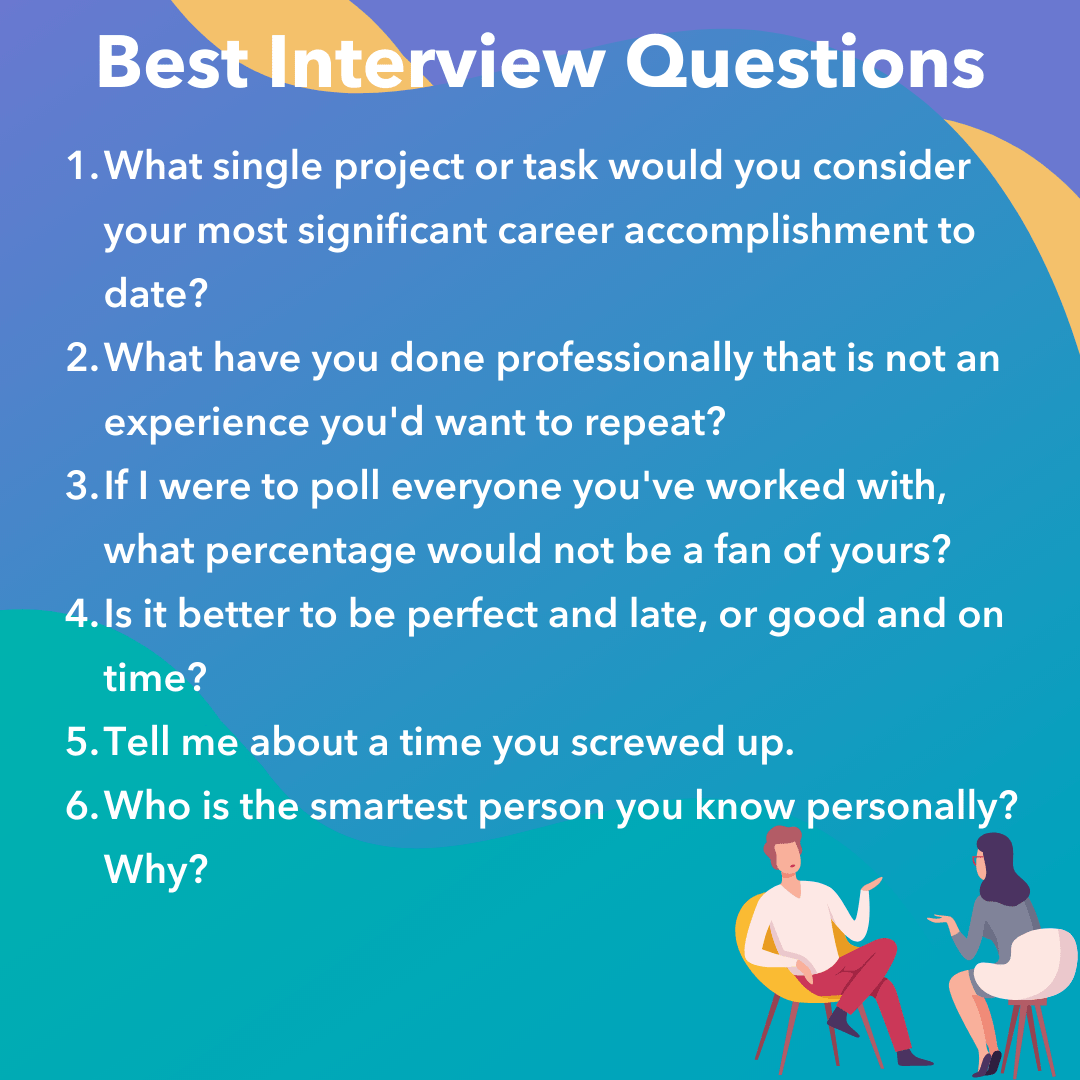
1. “What single project or task would you consider your most significant career accomplishment to date?”

Lou Adler, author of The Essential Guide for Hiring & Getting Hired and Hire With Your Head, spent 10 years searching for the single best interview question that will reveal whether to hire or not hire a candidate — and this was the one.

A good answer to this question:

Candidates’ answers will tell you about their prior success and sense of ownership. A great answer will show they are confident in their work and professional choices while being humble enough to show they care about the company’s success. For example, if a candidate built a sales or marketing campaign they’re particularly proud of, listen for them to explain how the business benefited from it. Did it help the company sign a major client?

2. “Is it better to be perfect and late, or good and on time?”

If your candidate responds with “It depends,” hear them out — the interview question itself is phrased in such a way that candidates can sense there is a right and wrong answer, and they’ll be looking for signs from you that they’re heading in the right direction.

A good answer to this question:

For most companies, the correct answer is “good and on time.” It’s important to let something be finished when it’s good enough. Let’s face it, every blog post, email, book, video, etc. can always be tweaked and improved. At some point, you’ve just got to ship it. Most managers don’t want someone who can’t hit deadlines because they’re paralyzed by perfection.

Try to remain neutral as they feel out their response, though. They might not be able to relate to work that’s measured purely by quality and deadline, but it’s important that they can express how they prioritize their tasks.

3. “Tell me about a time you screwed up.”

An oldie but goodie. This is a tried-and-true test for self-awareness. (Honestly, well-prepared candidates should see it coming and have an answer ready.) Someone who takes ownership of their mess-up and learns something from it is usually humble and mindful. Candidates who blame others or give a “fake” screw-up (something like “I worked too hard and burned out.”) are red flags.

A good answer to this question:

A good answer to this question will do two things well:

  • Admit to a genuine mistake. Often candidates will dress up a mistake with a self-compliment or excuse to avoid looking weak. For example, “I was so committed to X that I overlooked Y.” On the contrary, good answers will just show that they miscalculated, plain and simple.
  • Explain what they learned from it. It’s one thing to screw up, but it’s another thing to take that screw-up as an opportunity to improve. Great companies learn more from failure than they do from success — candidates who do too are exactly what you need to grow.

Questions to Test a Candidate’s Work Ethic

4. “Tell me about a time you set difficult goals.”

If you’re looking for a candidate who is goal-oriented and results-driven — as most hiring managers are — this question will help you gauge whether they’ll be able to handle the audacious goals you have in store for them. Ask follow-up questions like, “What did you do to achieve them?” Have the candidate walk you through the process and purpose of the goals they set out for themselves.

A good answer to this question:

A good answer to this interview question shows they understand what difficult goals are, and that they put a lot of effort into attaining their goals while maintaining a high standard of work quality. Listen for answers that describe a lofty goal and show why this goal challenged their normal targets. Responses that admit the candidate came up short of this goal can also indicate self-awareness and confidence despite a lack of success.

5. “What have you done professionally that is not an experience you’d want to repeat?”

A candidate’s answer to this question will give you an idea of how they viewed work they weren’t very happy with, which is bound to happen to everyone in every job at one point or another.

A good answer to this question:

HubSpot’s VP of Customer Service and Support Michael Redbord says candidates’ answers generally fall into a few categories:

  1. Something menial (e.g. envelope-stuffing). Pay attention to whether they understand the value of this getting done for the business, or whether they just think they’re too good for a job like that.
  2. Something really hard. Why was it hard? Was it because it was poorly planned, poorly executed, or something else? Where do they put the blame on it being such an unpleasant experience?
  3. Something team-related. Follow up with questions about the team, what their role on the team was, and so on.

Even the category of what they consider an experience they wouldn’t want to repeat is interesting, says Redbord. When you talk about extreme experiences that get people emotional, it can be very revealing. Keep in mind, however, that good answers don’t have to fall into any one category — what’s most important is if they extracted value from the experience despite their lack of interest in doing it again.

6. “What is your definition of hard work?”

Some organizations move at very different paces, and this question is an effective way to tell whether your candidate will be able to keep pace with the rest of your team and add value to your team. It also helps you identify someone who is a “hard worker in disguise,” meaning someone who might currently be at a slow-moving organization or in a role that is not well-suited to them, but wants to work somewhere where they can really get their hands dirty.

A good answer to this question:

A good answer doesn’t have to produce evidence of hard work — it should rather reveal if your candidate knows what it takes to get something done and solve the problems it was designed to solve.

Answers that talk about working hard by working smart are great, as well. Always listen for this — putting in the work to find the best way of doing something is often just as important as the task itself.

7. “Who is the smartest person you know personally? Why?”

These questions test what the candidate values and aspires to by forcing them to think of a real person they know, and then articulate what makes that person smart.

A good answer to this question:

Ideal answers vary, but could include specific examples of the person they’ve chosen’s ability to think ahead several steps and execute. They could also touch on the person’s decision-making skills, ability to connect, desire for learning, or application of the things they learned.

8. “What’s the biggest decision you’ve had to make in the past year? Why was it so big?”

Here’s a great way to figure out how a candidate approaches decision-making. Were they quick to make that big decision, or did it take them a long time? Did they spend most of their time reflecting on it by themselves or fleshing it out with others? How did they make a plan?

A good answer to this question:

Candidates’ answers could be work-related or personal. In addition to revealing their thought process, as described above, an effective response to this interview question will also show how the candidate was able to prioritize what was most important when each possible option might have had its own advantages and disadvantages.

If your candidate had hiring power in a previous position, for example, maybe they found it hard to choose between two job candidates of their own. A good answer might show that they saw immediate skill in one candidate but long-term potential in the other. Although both people had usable strengths, your candidate chose the second person because he or she offered he best return on investment.

best interview questions

Questions to Test a Candidate’s Interests, Passions, & Working Style 

9. “Tell me about the relationships you’ve had with the people you’ve worked with. How would you describe the best ones? The worst?”

Each team is different, so this question helps you tease out whether the candidate would be happy, productive, and well liked on your team. Their answer will tell you how they interact with others — and which kinds of interactions they want to happen.

A good answer to this question:

Answers to this question don’t have to focus on just professional elements of a relationship with colleagues — they can also be related to business culture. Maybe the candidate enjoyed their coworker’s positivity or thought their attitude lowered morale. Good responses aren’t one-sided, though. Look for answers that explain how their colleague’s work style thrived (or conflicted) with their own — not simply what their colleague did that benefited or offended them.

Many candidates are hesitant to bad-mouth their coworkers and bosses, so it’ll be interesting for you to hear how they navigate a question about their worst working relationships.

10. “In five minutes, could you explain something to me that is complicated but you know well?”

This is a much better test of intelligence than a college GPA, and it’s also a great gauge of a candidate’s passion and charisma outside of their core job responsibilities. Candidates who are passionate and knowledgeable about something — and can convey that well — are more likely to be enthusiastic and influential at work.

A good answer to this question:

The “something” in this question doesn’t have to be work-related — it can be a hobby, a sports team, something technical … anything, really. Good responses will tell you how well your candidate comprehends complex subjects and that they can articulate that subject to someone who doesn’t know much about it.

Explanations that use analogies also make good answers, especially if it’s a topic that is filled with industry jargon. This shows that the candidate can solve problems by drawing comparisons to things that are more universally understood.

11. “If I were to poll everyone you’ve worked with, what percentage would not be a fan of yours?”

At work, you can’t please everyone all the time. The answer to this question will help you find out if your candidate has enough drive and conviction in their own work to have ever conflicted with one or more of their colleagues.

Obviously you don’t want the candidate to be an unlikable person, though, so consider asking follow-up questions to find out why they might have alienated these coworkers: “If I were to interview these people, what words would they most frequently use to describe you?”

A good answer to this question:

The follow-up question about word choice is more important than the percentage they give in the initial question. In their answers, you should be encouraged by words like “passionate” and concerned by words like “lazy.”

Of course, not all negative words are red flags — while words that indicate a lack of work ethic might be a bad sign, words like “stubborn” could show a candidate’s self-awareness — and commitment to things their coworkers would rather move on from.

12. “What is something you’d be happy doing every single day for the rest of your career?”

While it’s important to hire for skill, it’s also important to hire someone who’s likely to be happy in the job for which you’re hiring. A question like this one will help uncover what makes each candidate happy at work — which is a great way to gauge whether they’d enjoy their role and stay at the company for a long time.

A good answer to this question:

There’s no right answer to this question — it’s more of a learning opportunity for you to see what your employees most enjoy in the industry. Nonetheless, a candidate’s answer to this question should align with the core responsibilities of the job for which they’re applying.

A sales candidate who says they could lead client kickoff meetings every day, for example, is a much better fit than a sales candidate who prefers to create lead-generating campaigns (a task that shows a bigger interest in the marketing side of things).

13. “If you had $40,000 to build your own business, what would you do?”

This question is a favorite of HubSpot Marketing Team Development Manager Emily MacIntyre. First, the type of business they choose to talk about can reveal a lot about their interests, values, and how creative they are. Second, it’ll give you insight into how business-savvy they are. By giving them a specific amount to work with (in this case, $40,000), they have the opportunity to parse out how they’d spend that money.

A good answer to this question:

The best answers to this question will get specific: They’ll offer an overview of the business and get into the logistics of where that money would go, whom they’d hire first, and so on.

Questions to Test a Candidate’s Knowledge or Interest in Your Specific Company

14. “Pitch our company to me as if I were buying our product/service.”

This is a unique and more challenging approach to the generic “What does our company do?” question. It forces candidates to not only drum up the research they’ve done to prepare for the interview, but also show they can use this research to craft a persuasive message that would be valuable in a business situation.

A good answer to this question:

This will come more naturally to some candidates than others. Above all, good answers to this interview question are able to combine an accurate definition of your company with what it offers to your core customer that they need or can’t get anywhere else.

Keep in mind that someone interviewing for a sales or marketing position might find it easier than someone interviewing for a non-client facing role — and that’s okay. You aren’t necessarily assessing their delivery. But it’ll be interesting to see how each candidate thinks through and gives their response.

15. “What has surprised you about this interview process so far?”

This is a question no candidate can really prepare for, and it’ll give you some indication of how candidates are feeling about the whole thing. Plus, you can see how they think on their feet.

A good answer to this question:

You’re looking for specifics here — something about the office space; the personality of the team; an assignment they were given to complete.

Honest answers are good answers, and answers that are directed at you are even better, as they show the candidate is confident speaking their mind in front of decision-makers. For instance, maybe the candidate was surprised you asked them about something on their resume that they don’t personally pay much attention to.

16. “Do you have any questions for me?”

This is another classic interview question, and like the one above, you’re seeing how candidates think on their feet. The answer to this question also reveals what’s important to the candidate. Are they wondering about company culture, or compensation? Are they curious about growth potential, or learning opportunities?

A good answer to this question:

There are no right or wrong answers, but personality and communication style are important factors when considering hiring someone to join your team, and you can get a sense of these factors with their answer.

marketing questions

Categories B2B

34 of the Best Website Designs to Inspire You in 2022

Your website inspiration journey starts here.

Deciding to create a web presence is a big decision, but the best websites are a culmination of many small decisions. But one major decision that takes time, diligence, and a great deal of inspiration is the design of your website.

Free Download: 77 Examples of Brilliant Web Design 

In this article, we’re sharing a few dozen of the best website designs we’ve seen. Click the links below to jump to explore website designs that crushed it in the last several years. We’ve also included a bonus section of designs that are just plain cool — so check them out, too!

Where to Get Your Design Inspiration

If you want some design inspo, the good news is that you can find it just about everywhere.

One of the best ways to get inspiration for design is through travel. When you visit new places, you’re forced to get out of your comfort zone and experience something foreign.

What makes design so interesting is that everyone sees it differently and so, there’s always more to discover.

Another way to get design inspiration IRL is through the media. Every day, we are inundated with visual content. We make decisions about what we like, what we don’t like, and continue on our day.

But what if you were more intentional about how you viewed those interactions? You could come out of it with valuable insights.

You also can’t forget to leverage design communities. From design conferences to Reddit forums, there are hundreds of groups out there that can offer inspiration as well as advice.

Now that we’ve covered some IRL design inspiration sources, let’s cover the digital ones.

Website Design Inspiration Sources

1. HubSpot’s Asset Marketplace

HubSpot’s Asset Marketplace houses hundreds of website templates that you can sift through to get inspired for your own website.

website design inspiration sources

The best part of the marketplace is that you can narrow down by industry and feature, allowing you to see the templates that are most relevant.

Once you find a template you like, you can view a live preview of the site to get a full experience then download it if you decide to use it.

2. Dribble

Dribble is where designers go to get inspired and to share their work. The website has everything from animation and branding to illustration and mobile.

website design inspiration sources dribble

Image Source

Once you navigate to the “Web Design” tab on the homepage, you can filter results by color scheme, editing software, timeframe, and tags.

Furthermore, if you find a designer whose work you like, you can save the design for future reference and follow their work to see other designs on their profile.

This is an incredible resource to use whether you’re starting from scratch or already have a solid plan in mind.

3. Bēhance

This is another digital platform full of creative inspiration to leverage ahead of your website design project.

website design inspiration sources behance

Image Source

One of the best features on this site is the ability to filter by location. This allows you to see how designers in different regions differ in technique and style.

This can be particularly helpful if you are designing a website for a foreign, unfamiliar market. You can gain interesting insights by evaluating the decisions made by Behance designers.

4. Pttrns

Want to focus on mobile web design? Pttrns is the place to go.

This subscription-based platform allows you to gain access to thousands of mobile design templates and get advice from top designers all over the world.

mobile website design inspiration pttrns

Image Source

Additional features on this platform include:

  • A favorites and collections folder to store your favorite designs.
  • A studio to interact with other designers and get advice.
  • A design guide to understand the strategy behind the designs.

From familiar corporations to small businesses, to international organizations, the following sites push the status quo on the web. Whether it’s the design aesthetic, usability, interactivity, sound design, or value that the site provides, each one is a masterpiece in its respective industry and something to aspire to.

Not surprisingly, many organizations exist to highlight these sites and the contributions they make to the web. To help surface some of the most inspirational designs, I gathered several award-winners that have made their way through several key awards organizations — including Red Dot, Awwwards, UX Awards, The Webby Awards, SiteInspire, Best Website Gallery, and FWA.

As you browse through the list, know that each site excels in its own way and seeks to serve a unique purpose. While one site may be an excellent example of visual design, another may be an excellent example of interactivity.

This means that not all of these sites may be “conversion machines” or blueprint ideas that you can easily copy over to your site. Rather, they’re great ways to gain some website design inspiration and see the cutting-edge marketing that’s happening in the different corners of the web.

Keep in mind that web designs are fluid and change often. Some of the designs in this list have changed since they were awarded, but we do our best to keep them up-to-date. We’re confident you’ll find a design here that sparks your creativity.

Read More: 77 Examples of Incredible Website Design

77 Examples of Incredible Website Design

Download this free guide to see even more examples of website blog, homepage, and landing page designs.

Beautiful Award-Winning Websites

Best Website Designs from 2021

IBM’s The Harmonic State

Award: Site of the Month (July 2021), Awwwards

When you land on this IBM web page, it’s clear to see why the design won an award.

best website designs from 2021: IBM

Image Source

The best way to describe the website is as an immersive experience. In fact, IBM uses both visual and auditory elements to draw the visitor in and keep them engaged.

When you first land on the web page, you’re prompted to put on headphones to get the full experience. Even if you skip this step, you’re drawn in by the interactive background that reacts as your mouse navigates on the page.

In addition, the page is well balanced with a large title that grabs your attention across from a small description with a bold blue CTA.

With a topic as complex as AI, IBM then uses visual storytelling to explain how its Watson tool works in the real world. Visitors can explore three stories through video game-like functions and learn more about the tool.

It’s a fun and effective way to get users engaged in a topic that can be complicated and dry.

Superlist

Award: Site of the Month (April 2021), Awwwards

Superlist is a productivity app that helps teams and individuals change the way they work.

Too often, you land on a website and have to figure out what the brand is about. With Superlist, you know exactly what to expect as soon as you get to the homepage.

best website designs from 2021: superlist

Image Source

The interactive homepage shows common work accessories, like headphones and keyboard with clear, to-the-point copy.

Superlist effectively uses white space to keep the focus on its copy. However, to facilitate navigation, they include a small button with an arrow icon to indicate that there’s more to see on the page once you scroll.

From there, the fun visuals continue – keeping you engaged as you learn more about the brand.

Hyer

Award: Website of the Month (2022), CSS Design Awards

Want to make a strong impression on your website visitors? Take a page out of Hyer’s book.

best website designs from 2021: hyer

Image Source

This striking illustration of the airplane, as it slowly moves across the screen, is sure to grab website visitors’ attention.

This page has everything you need in an effective homepage: An image that tells a story but isn’t too distracting, use of white space, easy nav bar, a tagline or slogan, and a clear CTA.

It’s a clean design that’s free of any distractions and invites visitors to learn more about the brand.

Best Website Designs from 2020

Swab the World

Award: Site of the Day (2020), Awwwards

Parallax, bold colors, and negative space shape the design and experience of Swab the World’s website. The organization brings awareness to stem cell donations. Their mission is to “Make sure every single patient finds their match. Period.” Photos of couples exhibiting love and emotions bring a human element to a historically complex and scientific process.

From a technical perspective, the design makes moving down the page feel natural, ensuring the readers reach each point of copy and every CTA on the homepage.

best website designs from 2020

Image Source

Newest Americans

Award: Honorable Mention (2020), Awwwards

An organization with a responsibility as large as honoring past, present, and future migrating identities needs a beautiful and functional website to help spread the word. Newest Americans champion immigrant experiences in cities across the state of New Jersey. The website uses beautiful imagery of people, places, and items that represent this experience in a way that flows cohesively down the homepage, telling the story of this group of America’s newest citizens.

The website is both visually appealing and functional with a simple navigation menu, stories organized by photos, and a clean press page that puts the most recent articles front and center.

best website designs from 2020 newest americans

Image Source

Spotify Design

Award: Honorable Mention (2020), Awwwards

Spotify is known for accomplishing its fair share of amazing feats, and its latest iteration of Spotify.Design is no different. Serving as the hub for all things visual and creative for Spotify, the music and podcast giant gives listeners a look into the who, what, why, and how of what makes the app so sensational.

Bright colors, drop shadows, and smooth animations give this website character and depth. The flat geometric designs with abstract accents make albums and artists practically jump off of the screen.

best website designs from 2020 spotify design

Image Source

Andy Warhol

Award: Honorable Mention (2020), Awwwards

Artist, film director, and producer Andy Warhol’s life will forever be encapsulated in a splendidly designed website that captures his art style in a digital format. As you peruse the page, your cursor becomes a spotlight that converts every image you hover over into a negative image or inverses the colors of the text you’re reading.

The big, bold text makes a statement and emphasizes just how important copy is to website design. Subtle animations help pace the site and set the tone for each section as you peruse the home page.

best website designs from 2020 andy warhol

Image Source

Human Interaction Company

Award: Corporate Website (2020), Red Dot

To see video done right on a website, look no further than the Human Interaction Company. From the moment you click on the site, the experience is lightning fast. You’re dropped directly into the action — the why, what, and how of Human Interaction and exactly what the team does.

This Red Dot Design Award winner aims to bring the study of human interaction to the masses, and in the process, show us just how engaging it can be to learn about it. Don’t get discouraged by their award status though — none of the photos on this site are photoshopped, so it’s a practical example of building quality with the resources you have available.

human interaction company best website design award winner 2020

Image Source

Garoa Skincare

Award: Site of the Day (2020), Awwwards

How do you transform the feeling of luxury and practicality into a website? Garoa Skincare provides a blueprint. Whether your product costs half the price of your closest competitor or twice the price, your site can bring a sense of extravagance to just about any product you sell.

High-quality visuals, typefaces that complement each other, and a balance of negative space with useful copy can bring a simplistic elegance to your website.

garoa skincare best website design award winner 2020

Image Source

Best Website Designs from 2019

1917: In the Trenches

Award: Awwwards’ Best Website of the Day (2019)

This website, made to promote the film 1917, allows you to walk around the trenches and perform the same mission that the characters did in the film. You can also see their maps or access other tools.

This is a great example of a site that went above and beyond with interactivity as well as a site that leverages its content and prewritten storyline to market its film. This website won Site of the Day by Awwwards, which allows designers to vote and nominate great websites they see daily.

1917: In the trenches best website design award winner 2019

Image Source

The Octopus: A design blog by IDEO

Award: Business Blog/Website 2019 Webby award

IDEO, a global design company, won the Business Blog/Website 2019 Webby award for its Octopus blog, and for good reason. The blog features a sleek, black-and-white Octopus drawing as its homepage design, and uses yellow, black, and white to create a cohesive theme as you scroll.

If you hover over a blog post, the title is highlighted in yellow. If you hover over an image, the image is pulled towards you — two small features that make a big difference in terms of creating a unique and engaging user experience.

The Octopus best website design award winner 2019

Image Source

Nomadic Tribe

Award: Awwwards’ Site of the Year nomination (2019)

This site, which was nominated for Awwards’ Site of the Year, is one of the more engaging sites I’ve seen.

The homepage immediately begins playing a stunning video featuring a man walking across a desert, followed by gorgeous landscape scenes and text like, “Are you lucky enough to call yourself an adventurer?”

The text throughout the website is playful, with colorful pinks and oranges and yellows, and the homepage is logically designed, with CTAs placed throughout that range in commitment-level from “Read More” to “Watch Now” and, finally, “Download the App”.

Ultimately, the website is beautifully designed with strong attention to detail, and tells a compelling story throughout.

website design inspiration nomadic tribe

Image Source

Diana Danieli

Award: Webby 2019

This 2019 Webby-winning site shows off imagery of art and architecture with either high contrast or heavy exposure. As a website visitor, you can click and drag your mouse to change the photos and variations. Each image shows a piece of work that highlights the artist who owns the website.

A cool plus about this website is its incorporation of audio and music. Clicking on certain buttons on the screenplays a piano note and truly immerses you in the Diana Danieli experience.

website design inspiration

Image Source

George Nakashima Woodworkers

Award: Webby 2019

This woodworking website emphasizes nature and care for the woodworking trade. It’s essentially a slideshow of beautiful forestry and farming images. As a new image comes on the screen, a new quote related to wood or trees also comes up.

This is incredibly relaxing to the visitor and shows that the woodworkers recognize the beauty of trees and the environment. This website also won a Webbie in 2019.

george nakashima woordworkers best website design award winner 2019

Image Source

Best Website Designs from 2018

crypton.trading

Award: Site of the Day (4/3/2018), Awwwards

Meet crypton.trading, your robot accountant.

Crypton.trading is a trading hub for cryptocurrencies such as Bitcoin, using artificial intelligence to predict changes in a currency’s value and identify key buying and selling opportunities. The website was rated high for its development and design, as it gradually explains more of the developer’s methods the further down visitors scroll.

This award-winning website makes tech-savvy visitors feel right at home the moment Crypton’s greeting appears across the homepage, one letter at a time.

crypton.trading best website design award winner 2018Image Source

Southwest: Heart of Travel

Award: Best Visual Design – Aesthetic, 2018 Webby Awards

When Southwest Airlines wanted to prove that its customers were “more than just a dollar sign,” the company created a website where the design was assembled using the shapes of their customers’ flight paths.

The website, called Heart of Travel, even allows visitors to create their own artwork out of a trip they might plan on taking. In this way, Southwest’s website is a product of their most loyal passengers.

Southwest best website design award winner 2018Image Source

Overflow

Award: Site of the Day (3/20/2018), Best Website Gallery

Overflow is a design tool that allows people and businesses to create story-like flow diagrams of their ideas so they’re easier for others to understand. Aside from this being just a good service, the Overflow website practices what it preaches: Along with vibrant red call-to-action buttons for downloading the tool, this website promotes its product the best way it knows how — using a flow diagram.

The website delivers this flow diagram in the form of a video. While embedded videos can look rather clunky sitting in the middle of a website’s other design elements, Overflow’s is perfectly placed and exactly what you’d want to see when landing on the site for the first time.

overflow best website design award winner 2018

Image Source

Frans Hals Museum

Award: Site of the Year (2018), Awwwards

It can be tough for a museum to present all of its artwork together on a cohesive website. That’s what makes the website of the Frans Hals Museum so impressive.

Located in the Netherlands, this museum has created a website that uses a combination of digital design elements and its own exhibits. This mixture helps visitors understand what they’ll see, when they can see it, and where else they can get a taste of what this museum has to offer.

website design inspiration frans hal museum

Image Source

Best Website Designs from 2017

Simply Chocolate

Award: Site of the Year (2017), Awwwards

You’ll get a craving for chocolate just looking at this website — and in a way, that’s Simply Chocolate‘s website working as designed.

This appetizing website is that of a Denmark chocolate maker Simply Chocolate. Its website uses a variety of colors (and creative product names) to promote each chocolate bar. And as you scroll from one product to the next, they all seem to remain consistent in brand.

The three-dimensional appearance of each chocolate bar makes you feel like you can grab it off of your computer screen, while the “Add to Box” CTA to the top-left is ideally placed for users to select the products they want while browsing.

Simply Chocolate best website design award winner 2017

Image Source

NOWNESS

Award: Best Cultural Blog/Website, 2017 Webby Awards

NOWNESS is perhaps the coolest crowdsourced video blog on the internet. That was a mouthful…what does it all mean?

NOWNESS‘ crowdsourcing is part of what makes it an award-winner. This means most of its content comes from independent creatives — an increasingly popular way for businesses to publish content.

NOWNESS is also a video channel, meaning all of its blog content is in video format. Together, these qualities help make Nowness a captivating hub for the stories that brands everywhere strive to tell.

website design inspiration nownessImage Source

Best Website Designs from 2016

Rainforest Guardians

Award: Best Activism Website, 2016 Webby Awards

Rainforest Guardians became one of the most immersive nonprofit websites of 2016. Seeking to build awareness around deforestation, the site allows users to “visit” the various villages, natives, and waterways that make up the Amazon Rainforest.

The site puts interactivity at the center of its user experience — a wise choice if your goal is to get people to connect with your cause and convert into volunteers.

website design inspiration rainforest guardians

Image Source

Protest Sportswear

Award: Site of the Year (2016), Awwwards

The Awwwards calls Protest Sportswear a “shoppable lookbook,” and that’s exactly what this site is. As a clothing outfitter, this company has reinvented the way they market its product: Rather than promoting garments of clothing, Protest Sportswear promotes “looks.”

This makes the company’s product the most appealing part of the website itself, using a collage of styles to design a homepage that changes as often as its customer’s styles do.

website design inspiration protest sportswear

Image Source

The Teacher’s Guild

Award: Best Association Website, 2016 Webby Awards

The Teacher’s Guild is a professional community of educators that addresses some of the most critical challenges in education. What makes this website award-winning is how it balances diverse content types — programs, solutions, approaches, and collaborations — without overwhelming visitors.

Not only are the background visuals prominently placed, but they also use white space to emphasize the written calls to action at the center, as shown in the screenshot below.

Teacher's Guild best website design award winner 2016

Image Source

Best Website Designs from 2015 – 2014

Virgin America

Award: Most Significant Industry Evolution, 2014 UX Awards

In a world where airline websites are known to be riddled with major usability issues, Virgin America has one of the best websites that pushes usability, accessibility, and responsive design forward.

Virgin America UX Award winner 2014Image Source

Feed

Award: Site of the Day (6/6/2015), Awwwards

Not only is Feed an interesting concept, but it also has a stunning execution that challenges our understanding of what is possible on the web. Through a creative blend of animation and video, the site immerses the user in an engaging experience.

As an atypical site, it contains several unique usability elements, including navigation that doubles as a scroll progress bar.

website design inspiration feedImage Source

ETQ

Award: Site of the Day (5/19/2015), Awwwards

ETQ takes a minimalistic approach to ecommerce with a stripped-down site. Big, compelling visuals of their product lay against simple, flat backgrounds accompanied by strong typography that keeps the focus on exactly what the user came there to see: shoes.

ETQ best website design award winner 2015Image Source

Mikiya Kobayashi

Award: Site of the Day (7/4/2015), Awwwards

Mikiya is a Product Designer with a minimalistic portfolio that showcases his work through strong photography and subtle animations. His full site was originally created in Japanese and then translated into English, helping demonstrate the international scalability of his design.

Mikiya best website design award winner 2015Image Source

Woven Magazine

Award: Site of the Day (4/4/2015), Best Website Gallery

Woven is an online publication that celebrates artists, crafters, and creators alike. They confirm that publications can (and should) have beautiful, engaging sites with easy-to-read content. Free of distractions like pop-ups and intrusive ads, this site is all about the experience of the content itself.

website design inspiration woven

Image Source

JOHO’s Bean

Award: FWA of the Day (8/7/2015), Favorite Website Awards

The website for JOHO’s Bean has incredible imagery, interactivity, storytelling, visual design, and most of all, sound engineering. These all come together to create a compelling, emotional, and engaging site that tells the story of a coffee bean’s journey.

Image Source

World of SWISS

Award: Best User Interface, 2015 Webby Awards

Another airline? Yep. SWISS airlines built an incredibly immersive site that tells the story of what it’s like to fly with them — and they did too great of a job to be ignored. Strong visuals and animations introduce the user to different sections of the site that are packed with information beyond the usual sales and marketing pitch.

World of SWISS best website design award winner 2015Image Source

Other Cool Website Designs

Guillaume Tomasi

As a Photographer in Montreal, Guillaume Tomasi has built a portfolio that’s truly fit to house his unique and awe-inspiring photography. His surreal photo style is juxtaposed by his simple, flat, empty, and minimalistic portfolio design that places all of the focus on the work itself.

His unique series navigation coupled with art-gallery-inspired work introductions and perfect scrolling interactions yield an experience reminiscent of that of a real gallery.guillaume tomasi best website design award winner

Image Source

The District

This branding agency takes its imagery seriously, and it should — it handles all channels of media for its clients. The District’s website alone is a journey through some of the most beautiful artwork and photography you’ve ever seen.

These provocative tiles change rapidly as you explore the website, and the wackier they seem, the more interested you become in learning about their past work.

website design inspiration the district

Image Source

Tej Chauhan

Tej Chauhan has turned impressionist artwork into a business model with this intriguing website. Each image on this product developer’s homepage slides out to cover the previous image, offering little context around the object you now see in front of you. But it’s that lack of context that makes you want to learn more.

Plus, the tagline, “Souvenirs of The Near Future,” suggests these objects are a part of their product line — and an opportunity for you to bring these innovative objects into your life.

tej chauhan best website design award winner

Image Source

Want a similar look for your website? Check out the new CMS Hub theme collection on the Envato marketplace.

Amanda Martocchio Architecture

An architecture firm might not specialize in web development, but its website should still demonstrate its commitment to visually pleasing design. Amanda Martocchio took that to heart with this gorgeous website.

It’s no secret that Amanda Martocchio Architecture loves its work — each picture on the homepage of its website is an enchanting shot of the houses the company designs. The website labels every house you scroll through with the type of design that was intended, along with numerous angles to each building.

amanda martpcchio best website design award winner

Image Source

Website Design Ideas

Now that you’ve seen a number of beautifully designed and award-winning platforms, keep these potential ideas in mind as you create your own.

  • Consider ways that you can make your website interactive, like the 1917 example.
  • Make a website that emphasizes the mobile experience, even while it still has a good UX on desktops.
  • Create a website that tells a story about your brand with photos, text, or video.
  • If you can’t create a heavily interactive site, consider drawing in eyes with a site that presents a slideshow of your photos.
  • Ensure your call-to-actions are easy to see and encourage visitors to continue exploring your site
  • Keep navigation clean. Ensure your visitors always know how to get back to the homepage.
  • Integrate your social media sites via social embed buttons, so site visitors can easily follow you on your various social channels.
  • Keep each of your web pages consistent in design — including font, colors, images, and messaging.
  • Test your website’s usability with a heat map, which will show you on which web pages your visitors are most likely to bounce.
  • Include a live chat or chatbot to give visitors the option to engage with you directly on your website if they prefer live chat to phone calls. Live chat can automate functions for your sales and service reps and create a better communication experience for the customer.
  • Get an SSL certificate to ensure your website is secure. SSL is part of Google’s search ranking algorithm, so an SSL certificate can help you rank higher in search.

Build a Beautiful Website for your Business

Designing a website can be simple once you have a look and feel in mind. Use these examples as a springboard to develop the layout, color palette, imagery, and animations on your website.

Once you’re ready to start coding or dragging and dropping, you’ll have a beautiful website that your visitors will enjoy.

Editor’s note: This post was originally published in January 2021 and has been updated for comprehensiveness.

examples of brilliant homepage, blog, and landing page design

Categories B2B

What Is Brand Perception? How to Measure It and 4 Examples

If you take a second to think about your shopping habits, you’ll probably realize that a majority of the products you buy are influenced by brand perception. You’re not the only one — 77% of B2C consumers make purchasing decisions based solely on the brand name.

Brand perception, or the thoughts and feelings associated with a company, impacts why people wear a certain brand of clothing or pick one pasta sauce over another at the grocery store. Once consumers adopt an attitude about a brand, it’s tough to change. That’s why brands work hard to create positive associations in people’s minds, rather than negative or neutral perceptions.

When you know how people perceive your brand, it’s easier to shape its reputation, help consumers understand what sets it apart, and develop brand equity. You do this by measuring brand perception and tracking customer sentiment over time.

But before diving into the metrics, it’s important to understand what creates brand perception and how it informs company and consumer decision-making.

What is brand perception?

Brand perception is the sum of a consumer’s feelings, experiences, and thoughts about a product or service. It’s what people believe a brand represents, rather than what a brand says it represents.

How to Understand the Value of Brand perception

Although brand perception is a mental association, it plays an essential role in creating emotional connections with consumers. People consider their attitude toward brands when choosing between competing products. They read reviews, chat with customer support, compare options with friends, or sign up for a free trial. All of these touchpoints affect brand perception and impact a company’s success.

If consumers think highly of a brand, they become more loyal to it. Consider how this dynamic plays out in everyday life. People get in meme wars over Apple versus Android products. A person who wears Nike shoes usually won’t be caught in Adidas kicks. And you probably won’t find Coca-Cola and Pepsi in the same fridge.

Companies that understand brand perception use this information to develop brand equity. While brand perception can be narrowed down to what one customer thinks about your brand, brand equity is the combination of people’s perceptions, experiences, and opinions that creates your reputation. A company with high brand equity attracts loyal customers who pick your product or service when given the choice between competitors.

When a customer is loyal to a brand, 86% will recommend it to friends or family and 66% are likely to write a positive review. Those actions drive company growth and improve brand perception, which only helps your business.

Although it may seem that brand perception is out of your hands, you can take steps to measure it and improve people’s attitudes.

How to Measure Brand Perception

Data can help you understand how consumers, employees, stakeholders, and competitors perceive your brand. Since brand perception is a combination of reviews, reputation, experience, functionality, advertising, social engagement, and customer use, you should gather metrics from multiple sources.

Here’s how to measure brand perception:

  • Conduct brand perception surveys to learn what people think of your business and how it stacks up against competitors. Ask questions that touch on emotional, cognitive, and action-oriented factors, such as these examples from Qualtrics:
    • When you think of [the brand], what comes to mind first?
    • Which of the following words describe [the brand]?
    • What kind of feelings do you experience when you think of [the brand]?
    • How would you describe your level of emotional attachment to [the brand]?
    • How would you describe [the brand] to a friend?
    • How would you describe your last experience with [the brand]?
    • On a scale of 1-10, how likely are you to recommend [the brand] to a friend or colleague?
  • Track online mentions using social listening tools or Google alerts. You want to monitor social media comments, online reviews, relevant hashtags, forums (i.e. Reddit and Quora), and news mentions. As the brand grows, so will this dataset. I recommend creating a system to handle negative mentions as soon as possible and stay on top of talk about your brand, products, and marketing campaigns.
  • Do a brand audit to evaluate how your brand perception compares to competitors’. This should include research on primary and secondary target audiences, a competitive analysis of your products or services, a thorough evaluation of your communications strategy, and a deep dive into your brand positioning. (I recommend referencing this brand audit guide from Visme).
  • Collect data from customers at each point of the buyer’s journey. This can include how buyers research information, evaluate products, compare between competitors, interact with customer support, make a purchase decision, onboard, and interact with the brand post-purchase.

Once you have enough data to measure brand perception, you can evaluate if consumer sentiment aligns with your brand identity. If so, stay the course. If not, you can learn how to improve consumer brand perception.

Brand Perception Examples

From PR campaigns to packaging, brand perception is influenced by every touchpoint people have with a company. The following brand perception examples show how businesses can shape consumer sentiments so the inner identity matches the outer image.

1. Snickers

Candy lovers can choose between dozens of chocolate-covered bars, so what makes someone grab a Snickers instead of a Kit Kat? Yes, it may be taste or preference, but the brand has designed clever campaigns to make people believe that eating Snickers will transform you from hangry and unfocused to sharp and satisfied.

2. Orangetheory

You may have driven past one of these orange-hued workout studios on your daily commute or taken an online class during the pandemic. And while fitness crazes come and go, Orangetheory has carved out a brand perception that’s kept the company going strong since 2010. The community-oriented classes make it the right fit for people looking to connect and compete with neighbors while working up a sweat. It’s more casual than Crossfit but kicks up the intensity compared to group classes at national gyms, like Planet Fitness and LA Fitness.Orange Theory Fitness Brand Perception

Image Source

3. Zoom

An innovative and beloved video platform at the start of the pandemic, Zoom quickly became the cause of remote workers’ burnout. People loved how it kept them connected to teams, families, and friends.

But the constant connection led to “Zoom fatigue,” an informal diagnosis that’s been covered by Healthline, Stanford, the New York Times, and more. While companies still rely on Zoom for virtual meetings, the brand has had to adjust from its original “Video conferencing that doesn’t suck” vibe to “How the world connects” as consumers shifted their perceptions.

Zoom Fatigue - an example of brand perception

Image Source

4. Patagonia

The outdoor gear brand became famous for its innovative clothing and focus on responsible manufacturing, but a change in consumer perception caused the company to double down on its sustainability-driven identity.

In the early 2010s, people began referring to the company as Patagucci — a satirical name that poked fun at the brand’s high prices and its adoption among high-income workers. To sway consumers from placing Patagonia in the fast-fashion category, the company has launched a number of sustainability-focused initiatives, like its Worn Wear line of recycled clothing.


Knowing what people think of your brand is an important part of developing a successful business. It gives you the information you need to shape your brand identity, create impactful marketing campaigns, and make changes when consumer perception shifts.

Now that you know how to measure brand perception, you can use it as a tool to make strategic brand decisions and drive your company forward.

brand consistency

New Call-to-action

Categories B2B

A Plain English Guide to Real Time Bidding

Because of its efficiency and cost-effectiveness, real-time bidding (RTB) has become one of the most popular ways to purchase ad inventory online.

But even for experienced marketers, real-time bidding can be a very confusing concept. So let’s break down what RTB is, how it works, and the pros and cons of using it — all while keeping it jargon-free.

Access Now: Free Media Planning Template

In this post, you’ll learn: 

Let’s get started. 

Real-time bidding is the driving force behind most programmatic advertising campaigns. Programmatic advertising is “the automated process of purchasing and selling online ads.” Real-time bidding allows advertisers to automatically buy ad inventory, place the ads online, and get a certain number of impressions in their programmatic advertising campaigns. 

⭐Don’t have time to read the entire post? Listen to our podcast below about real-time bidding and programmatic advertising: 
Click here to find more valuable content from the MarTech podcast. 

In a traditional media buying process, you have to manually buy ads. Let’s say that you find a magazine that serves your buyer persona. You ask for the media kit, choose the ad dimensions that fit your budget, and then buy the ad for a certain amount of time. Once time runs out, the ad is taken down.

Real-time bidding takes out all of that work. You can get space on that magazine and hundreds of others by letting a Demand-Side Platform (DSP) automatically choose the best publishers and ad spaces, then bid on them for you. You set several certain targeting parameters, such as maximum bid price and target audience. These parameters then determine where your ads are placed.

The publisher accepts your ad only if you place the highest bid. But remember: real-time bidding automatically does all the bidding. You don’t have to take any additional steps.

Still confused? No worries. We break down the concept further below.

How does real-time bidding work?

There are several pieces involved in the real-time bidding process. Let’s take a look at each one of them one-by-one before putting it all together.

  • Advertiser: The advertiser is the company or brand that wants to place an ad online.
  • Demand-Side Platform (DSP): The Demand-Side Platform is the service advertisers use to launch ad campaigns.
  • Publisher: The publisher is the website or online property that wants to sell ad spaces, often referred to as “ad inventory.”
  • Supply-Side Platform (SSP): The Supply-Side Platform is the service publishers use to make ad inventory available. SSPs run auctions where ad spaces are instantly purchased by the highest bidder. But this can’t happen unless an ad exchange facilitates the transaction.
  • Ad Exchanges: The ad exchange connects companies who want to advertise and publishers who want to sell ad space. Ad exchanges carry out the bidding transaction automatically in real time by connecting both Demand-Side Platforms and Supply-Side Platforms.
  • Impressions: Impressions refers to the number of times an ad is seen or scrolled past. In the real-time bidding process, advertisers don’t pay for one individual impression, but rather the cost per thousand impressions (CPM).

Now, let’s put it together. How exactly does real-time bidding work?

On the advertiser side, marketers use DSPs to set up their ad campaign and track its performance. Publishers, on the other hand, use Supply-Side Platforms (SSPs) to list their ad inventory and the price they charge. They then meet in the middle at the ad exchange, the marketplace where the real-time bidding actually takes place.

To determine what ad inventory to bid on, advertisers will set targeting parameters. For instance, a brand may only want to target users who are in a specific region or have visited their website recently.

So, advertisers, or specifically their Demand-Side Platforms, evaluate ad potential in real time and decide whether or not to place a bid and how much to bid.

Remember, advertisers set their bid through the Demand-Side Platform, while publishers’ Supply-Side Platform either accept or reject the bid. The prices are negotiated on a cost per thousand impressions, so the advertiser isn’t paying based on uptime or even dimensions. Instead, they’re paying for the amount of times, in thousands, that their ad is seen.

Let’s go through another example of how it works.

Real-Time Bidding Example

Let’s say Silk is a UK-based beauty brand that just launched a new brow line and is running a campaign. They set up their campaign on a Demand-Side Platform (DSP) and are targeting users who regularly shop for makeup products, are located in the Manchester area, and are between 18 to 30 years of age. The brand also wants its ads to only show on sites related to beauty and lifestyle.

A user visits a publisher’s site. The publisher’s Supply-Side Platform (SSP) sends a bid request to the ad exchange, where Silk’s DSP will be evaluating the value of the impression. The DSP will then determine if the user meets the parameters outlined in the campaign. If so, the DSP will submit a bid.

If Silk has the winning bid, the user will see the ad once the page loads. This process happens thousands of times on different webpages during the length of Silk’s ad campaign.

Silk’s paid ads manager will also be monitoring their ad’s performance on the DSP to see if it’s reaching the desired audience, or if the parameters should be adjusted.

Real-Time Bidding Platforms

There are no RTB platforms because real-time bidding is a method of purchasing impressions, not a channel. However, you can use tools that can help you start the real-time bidding process. These tools help you either purchase ad inventory or place ad inventory for sale through RTB.

Below, we break down some platforms you might use if you’re looking to sell or purchase ad inventory online.

Real-Time Bidding Platforms For Advertisers

As an advertiser, you’ll want to find a Demand-Side Platform that allows you to manage several ad campaigns and set specific targeting parameters — down to the user’s most visited websites and preferred brands. Here are a few options:

  • AdRoll: Self-serve Demand-Side Platform that’s a good fit for beginners in the programmatic advertising space.
  • mediasmart: Self-serve Demand-Side Platform that provides advanced targeting and segmentation capabilities. Good fit if you’ve set up ad campaigns with other tools, such as Google Ads.
  • theTradeDesk: Demand-Side Platform that allows you to place ads on multiple devices, including TV ad rolls, online videos, music streaming devices, mobile apps, and publishers across the web. Good fit if you’re planning to advertise across all of these channels.

Real-Time Bidding Platforms for Publishers

If you have ad inventory to sell, then signing up on a Supply-Side Platform is essential to take advantage of the real-time bidding process. You don’t have to speak with any advertisers, negotiate prices, or do any of the manual work that’s typically associated with account management.

Here are a few channels that will allow you to sell ad inventory through real-time bidding:

  • Magnite: Supply-Side Platform for large-scale ad inventory sellers who also want to sell ad space through Private Marketplace (PMP) and Programmatic Guaranteed (PG). Good fit if you’re an experienced ad seller that wants to upgrade to a more capable system.
  • Index Exchange: Supply-side marketplace that allows you to get started with ad inventory selling on multiple channels, including display, video, mobile, and native. Good fit if you’d like to start selling ad inventory or if you plan to take advantage of all of the available channels.

You can find more SSPs here.

Still not sure whether you should sell or buy ad space through real-time bidding? We go over the pros and cons below.

Real-Time Bidding Pros

Better Tracking

With RTB, advertisers can monitor their campaigns easily without relying on vendors. No need to reach out to multiple publishers and ask for reports, you can get them yourself on your DSP.

This also gives marketers the agility to pivot quickly if their campaign isn’t performing as expected. For instance, you might find that switching out one keyword for another may boost your campaign’s performance and align better with the audience you want to reach.

Better Targeting

When purchasing ads through RTB, you buy one impression at a time. This means that every time a website visitor or mobile app user visits a publisher’s site, you’re able to assess that person’s particular profile and see if it matches your target audience.

It makes for more accurate targeting as you can ensure your ads are only reaching the right people at the right time.

More Cost-Effective

The precision of the real-time bidding algorithm allows marketers to spend their ad dollars on high-value impressions.

Too often, brands launch marketing campaigns that only reach a portion of their target market, leaving the rest of the budget wasted on users who don’t fit the profile.

In addition, RTB takes much of the manual labor out of the online advertising process, allowing marketers to focus on other efforts.

Real-Time Bidding Cons

Compromised Brand Safety

Where your ad shows up is as important as who sees it. This is because consumers judge brands’ ads based on the surrounding content.

An Ad Colony survey reported that 60% of consumers have a negative perception of brands whose ads appear near inappropriate, hateful, or offensive content. This can be anything from a site that hosts pirated movies to sites promoting hate speech.

Due to the nature of RTB, there is a risk your ad may appear on a site with content you wouldn’t want your brand associated with. However, brands can limit this issue by putting certain keywords and sites on a “deny” list. This protects brands from showing up on webpages or mobile apps that don’t align with their identity.

Potential Ad Fraud

Ad fraud happens when scammers (or any parties with ill intent) try to trick digital ad networks by falsifying impressions and clicks using bots. Obviously, bots aren’t real people — so they aren’t potential buyers you can eventually convert into customers. Because you don’t get to hand-pick publishers through real-time bidding, there’s the very real chance your ad might be seen by bots instead of real people. The rising sophistication of bots can also cause brands to gather inaccurate data on their campaigns.

Some deceitful publishers fabricate impressions to steal from advertisers. One way to combat this is by using a DSP or ad network with fraud detection software.

Real-Time Bidding is the Easiest Way to Increase Brand Awareness

Real-time bidding makes the online advertisement process fast and easy. Marketers can skip the back-and-forth previously associated with ad buying and focus on tracking the results, increasing the ROI from your campaigns and empowering your brand to grow better.

Editor’s note: This post was originally published in March 2021 and has been updated for comprehensiveness.

paid media template

Categories B2B

How to Boost a Post on Social Media [Instagram, Facebook, and Twitter]

In the social media marketing world, marketers reminisce about the times when they could fill up on organic reach like our parents reflect on their college years with that old saying, “those were the good old days.”

As time has flown by, social media’s purge of organic reach flung marketers onto a rollercoaster ride trying to figure out how to boost a post for customers to actually see — which is a challenge when you’re up against so many competitor ads.

Download Now: Free Facebook Advertising Checklist

With almost 3 billion social media users today, millions of brands have promoted their content on these platforms for years. But the popularity of social media has flooded each platform with hoards of articles, photos, and videos, skyrocketing the supply of content while the demand for it has plateaued. This has lowered the amount of opportunities that brands can leverage to interact naturally with customers.

Needless to say, social media marketing is a pay-to-play strategy now. And one of the most effective ways to leverage paid social media advertising is by boosting your posts. So let’s talk about what post boosting is and how to do it across different platforms.

How to Boost a Post on Social Media

Instagram

1. Click the “Boost Post” button at the bottom of your post.how to boost instagram post: click the boost post button at the bottom of your post

2. Select a goal.

Before you boost your post, Instagram will ask you whether you want to attract more profile visits, website traffic, or promotion views. Whatever your goal is for the specific post you want to boost, make sure you choose the option that best aligns with it.

how to boost instagram post: select a goal

3. Choose an audience.

After choosing your goal, you can pick from three different targeting options: Automatic, Local, and Manual.

  • Automatic tells Instagram to target people who are just like your followers.
  • Local lets you target people in a specific location.
  • Manual lets you target specific people, places, or interests.

how to boost instagram post: select target audience

4. Set your budget and duration.

Instagram will estimate the expected reach and clicks that your post will attract after you set your post’s budget and ad duration.

how to boost instagram post: set your budget and duration

5. After review, boost your Instagram post.

After you’ve set your budget and duration, Instagram will prompt you to review the parameters you’ve set, and once you’re finished, you can boost your business’ Instagram post.

Next, let’s go over how to boost your post on Facebook.

Facebook

1. Pick an existing post on your Facebook business page that you want to boost.

Log in to your Facebook business page and choose the pre-existing post you wish to promote.

2. Click “Boost Post” on the bottom right corner of your Facebook post.

how to boost facebook post: click boost post on the bottom right corner of your facebook post

3. Set a goal.

You need to determine the intention or goal of your ad, and Facebook offers several different options to choose from.

how to boost facebook post: set a goal

4. Choose your call-to-action.

This is what you want your audience to interact with and provide them with a way to engage with your business.

how to boost facebook post: choose your call-to-action

5. Choose your detailed targeting.

Before you boost your Facebook post, you can either distribute your post to a recommended audience that Facebook will make for you or create a new audience based on a robust set of targeting options and distribute your post to them.

how to boost facebook post: choose your detailed targeting

6. Set your boosted post’s budget and duration.

Your budget is how much money you’ll spend to boost your post, and your duration is how long you’ll boost your post for. Facebook will estimate how many people your post will reach based on your budget and duration.

7. Review and boost your Facebook post.

When you’ve gone over the parameters set for the ad, click “Boost” and you’ve successfully boosted your Facebook post.

But if you followed these steps to boost your post and ran into an “Error”, there are a few reasons why.

Why can’t I boost my Facebook post?

If you find yourself unable to boost your Facebook post, the post may go against Facebook’s advertising policies page.

Here are two of the most common explanations:

  • Your post includes language alluding to “personal attributes” like race, gender, sexual orientation, religion of specific groups of people.
  • Your post makes assumptions about the person reading with phrases such as “Are you…” or “… in your area.”

Now that you know how to effectively boost a Facebook post, when should you do it?

When to Boost a Facebook Post

Even though there’s not an exact science to boosting posts, there’s a couple indicators to follow.

Oftentimes, Facebook will actually notify you to boost your post on your business page. When this happens, it’s in your best interest to do so, as it will push you to reach a more broad audience than you currently have.

But even if you aren’t directly notified, boosting a new post on Facebook will still yield increased engagement, but it’s not recommended to boost the same post more than seven days consecutively. You run the risk of making your audience bored or tired of your content.

Now let’s dive into how to boost your business’ Tweets.

Twitter

1. Click “View Tweet Activity” at the bottom of your Tweet.

how to boost twitter post: click view tweet activity at the bottom of your tweet

2. Click “Promote Your Tweet”. how to boost twitter post: click promote this tweet

3. Determine your goal.

State the goal you’re boosting your Tweet for.

how to boost twitter post: determine your goal

4. Customize your audience and targeting.

You can only target your audience based on:

  • Location: Country, state/province/region, or metropolitan area
  • Age: Ages 13 to 55+ years old
  • Gender: Man, woman, or any identity

how to boost twitter post: customize your audience and targeting

5. Set your budget.

After setting your budget, Twitter will estimate the amount of impressions and engagements your boosted Tweet will attract.

how to boost twitter posts: set your budget

6. Review and create your promotion.

Twitter will then prompt you to review the parameters you’ve chosen, and once you’ve finished, you’re ready to create your promotion.

Now that you know how to boost your posts across different platforms, it’s time that we went over the benefits of boosting a social media post.

Why You Should Boost a Post

1. To reach your target demographic in a cost-effective way.

Boosting a post with parameters set to reach your target market, or people that fit your ideal buyer persona, saves you money from advertising to people who won’t derive value from the product or service you’re offering.

2. To increase brand awareness on a platform.

You can make your brand’s identity more well-known and recognizable with repetition coupled with engaging content. By boosting posts on social media platforms that your target audience frequents most, you can increase brand awareness.

3. To collect useful metrics to study for your marketing strategy.

For each post you boost, you can look at the metrics each platform will provide you in terms of traffic, engagement, and demographics reached. Use that information to study which posts performed the best, and build on those strengths for future marketing campaigns.

Give Your Content the Boost It Needs

Capturing the interests of your target audience may not be as easy as it used to be, but by using paid social media advertising like the boost feature, you’re increasing your chances of finding new clients. We hope this post gave you the information you needed to boost your social media ads to achieve your next business goals.

Editor’s note: This post was originally published in April 2019 and has been updated for comprehensiveness.

New call-to-action

Categories B2B

How to Create Detailed Buyer Personas for Your Business [Free Persona Template]

Marketing Margie. Sales Sam. IT Isabel. Accounting Alan.

Do you know who your business’s buyer personas are? And if so, how much do you know about them?

Buyer personas are semi-fictional representations of your ideal customers based on data and research. They help you focus your time on qualified prospects, guide product development to suit the needs of your target customers, and align all work across your organization (from marketing to sales to service).

As a result, you’ll be able to attract high-value visitors, leads, and customers to your business who you’ll be more likely to retain over time.

More specifically, having a deep understanding of your buyer persona(s) is critical to driving content creation, product development, sales follow up, and really anything that relates to customer acquisition and retention.

“Okay, so personas are really important to my business. But … how do I actually make one?”Download Our Free Buyer Persona Guide + Templates 

Ahh … the million-dollar question. The good news is, they aren’t that difficult to create. It’s all about how you obtain your market research and customer data, and then present that information within your business.

Follow along with this guide and download these persona templates to simplify this process. Before you know it, you’ll have complete, well-planned buyer personas to show off to your entire company!

Before we dive into the buyer persona-creation process, let’s pause to understand the impact of well-developed buyer personas on your business (most specifically, your marketing efforts).

Why exactly are buyer personas so important to your business?

Buyer personas help you understand your customers (and prospective customers) better. This makes it easier for you to tailor your content, messaging, product development, and services to meet the specific needs, behaviors, and concerns of the members of your target audience.

Use HubSpot persona templates to easily organize your audience segments and make your marketing stronger

For example, you may know your target buyers are caregivers, but do you know what their specific needs and interests are? What is the typical background of your ideal buyer? In order to get a full understanding of what makes your best customers tick, it’s critical to develop detailed personas for your business.

The strongest buyer personas are based on market research as well as insights you gather from your actual customer base (through surveys, interviews, etc.).

Depending on your business, you could have as few as one or two personas, or as many as 10 or 20. But if you’re new to personas, start small — you can always develop more personas later if needed.

What about “negative” buyer personas?

While a buyer persona is a representation of your ideal customer, a negative — or “exclusionary” — persona is a representation of who you dont want as a customer.

For example, this could include professionals who are too advanced for your product or service, students who are only engaging with your content for research/ knowledge, or potential customers who are just too expensive to acquire (because of a low average sale price, their propensity to churn, or their unlikeliness to purchase again from your company).

How can buyer personas be used in marketing?

At the most basic level, developing personas allows you to create content and messaging that appeals to your target audience. It also enables you to target or personalize your marketing for different segments of your audience.

For example, instead of sending the same lead nurturing emails to everyone in your database, you can segment by buyer persona and tailor your messaging to what you know about those different personas.

Furthermore, when combined with lifecycle stage (i.e. how far along someone is in your sales cycle), buyer personas also allow you to map out and create highly targeted content. (You can learn more about how to do that by downloading our Content Mapping Template.)

And if you take the time to also create negative personas, you’ll have the added advantage of being able to segment out the “bad apples” from the rest of your contacts, which can help you achieve a lower cost-per-lead and cost-per-customer — and, therefore, see higher sales productivity.

Different Types of Buyer Personas

While beginning work on your personas, you may ask yourself, “What are the different types of buyer personas?” From there, it’d be simple to adjust one for your business — right? 

Well, that’s not exactly how it works — there isn’t a set list of universally-recognized buyer personas to choose from, nor is there a standard for the number of personas you need. This is because each business (no matter how many competitors they have) is unique — and for that reason, their buyer personas should be unique to them, too.

For these reasons, identifying and creating your different buyer personas can, at times, be slightly challenging. This is why we recommend using HubSpot’s Make My Persona generator (as well as HubSpot’s persona templates) to simplify the process of creating different personas. 

In general, companies may have the same, or similar, categories for their buyer personas (e.g. a marketer, an HR rep, an IT manager, etc.). But the different personas your business has and the number of them your business requires will be tailored to who your target audience includes and what you offer your customers.

Now, are you ready to start creating your buyer personas?

How to Create Buyer Personas

Buyer personas can be created through research, surveys, and interviews — all with a mix of customers, prospects, and those outside your contacts database who might align with your target audience.

Here are some practical methods for gathering the information you need to develop personas:

  • Look through your contacts database to uncover trends about how certain leads or customers find and consume your content.

  • Use form fields that capture important persona information when creating forms to use on your website. For example, if all of your personas vary based on company size, ask each lead for information about company size on your forms.

  • Consider your sales team’s feedback on the leads they’re interacting with most. What generalizations can they make about the different types of customers you serve best?

  • Interview customers and prospects to discover what they like about your product or service.

Now, how can you use the above research to create your personas?

Once you’ve gone through the research process, you’ll have a lot of meaty, raw data about your potential and current customers. But what do you do with it? How do you distill all of it so it’s easy for everyone to understand all the information you’ve gathered?

The next step is to use your research to identify patterns and commonalities from the answers to your interview questions, develop at least one primary persona, and share that persona with the rest of the company.

Use our free, downloadable persona template to organize the information you’ve gathered about your persona(s). Then share these slides with the rest of your company so everyone can benefit from the research you’ve done and develop an in-depth understanding of the person (or people) they’re targeting every day at work.

Here’s how to work through the steps involved in creating your buyer personas in more detail. 

1. Fill in your persona’s basic demographic information.

Ask demographic-based questions over the phone, in person, or through online surveys. (Some people are more comfortable disclosing personal information like this.)

It’s also helpful to include some descriptive buzzwords and mannerisms of your persona that you may have picked up on during your conversations to make it easier for people on your team to identify certain personas when they’re talking to prospects.

Here’s an example of how you might complete Section 1 in your template for one of your personas:

buyer persona demographic

Download this Template

2. Share what you’ve learned about your persona’s motivations.

This is where you’ll distill the information you learned from asking “why” during those interviews. What keeps your persona up at night? Who do they want to be? Most importantly, tie that all together by telling people how your company can help them.

buyer persona motivations

Download this Template

3. Help your sales team prepare for conversations with your persona.

Include some real quotes from your interviews that exemplify what your personas are concerned about, who they are, and what they want. Then create a list of the objections they might raise so your sales team is prepared to address those during their conversations with prospects.

buyer persona research

Download this Template

4. Craft messaging for your persona.

Tell people how to talk about your products/ services with your persona. This includes the nitty-gritty vernacular you should use, as well as a more general elevator pitch that positions your solution in a way that resonates with your persona.

This will help you ensure everyone in your company is speaking the same language when they’re having conversations with leads and customers.

buyer persona messaging

Download this Template

Finally, make sure you give your persona a name (e.g. Finance Manager Margie, IT Ian, or Landscaper Larry) so everyone internally refers to each persona the same way, allowing for cross-team consistency.

How to Find Interviewees for Researching Buyer Personas

One of the most critical steps to establishing your buyer persona(s) is finding some people to speak with to suss out, well, who your buyer persona is.

That means you’ll have to conduct some interviews to get to know what drives your target audience. But how do you find those interviewees? There are a few sources you should tap into:

1. Use your current customers.

Your existing customer base is the perfect place to start with your interviews because they’ve already purchased your product and engaged with your company. At least some of them are likely to exemplify your target persona(s).

Don’t just talk to people who love your product and want to spend an hour gushing about you (as good as that feels). Customers who are unhappy with your product will show other patterns that will help you form a solid understanding of your personas.

For example, you might find that some of your less happy customers have bigger teams and need greater collaboration functionality from your product. Or, you may find they find your product too technical and difficult to use. In both cases, you learn something about your product and what your customers’ challenges are.

Another benefit to interviewing current customers is that you may not need to offer them an incentive (e.g. gift card) to do so. Customers often like being heard — interviewing them gives them a chance to tell you about their world, their challenges, and what they think of your product.

Customers also like to have an impact on the products they use. So, as you involve them in interviews like this, you may find they become even more loyal to your company. When you reach out to customers, be clear that your goal is to get their feedback, and that their feedback is highly-valued by your team.

2. Use your prospects.

Be sure to interview people who have not purchased your product and don’t know much about your brand, too. Your current prospects and leads are a great option here because you already have their contact information.

Use the data you do have about them (i.e. anything you’ve collected through lead generation forms or website analytics) to figure out who might fit into your target personas.

3. Use your referrals.

You’ll probably also need to rely on some referrals to talk to people who may fit into your target personas, particularly if you’re heading into new markets or don’t have any leads or customers yet.

Use your network — such as your coworkers, existing customers, social media contacts — to find people you’d like to interview and be introduced to. It may be tough to get a large volume of people this way, but you’ll likely get some very high-quality interviews out of it.

If you don’t know where to start, try searching on LinkedIn for people who may fit into your target personas and see which results have any connections in common with you. Then, reach out to your common connections for introductions.

4. Use third-party networks.

For interviewees who are completely removed from your company, there are a few third-party networks you can recruit from. Craigslist allows you to post ads for people interested in any kind of job and UserTesting.com allows you to run remote user testing (with some follow-up questions).

You’ll have less control over sessions run through UserTesting.com, but it’s a great resource for quick user testing recruiting.

Now that how to identity interviewees, let’s look at some tips for recruiting them.

Tips for Recruiting Interviewees

As you reach out to potential interviewees, here are a few ideas to improve your response rates.

1. Use incentives.

While you may not need them in all scenarios (e.g. customers who already want to talk to you), incentives give people a reason to participate in an interview if they don’t have a relationship with you. A simple gift card is an easy option.

2. Be clear that this isn’t a sales call.

This is especially important when dealing with non-customers. Be clear that you’re doing research and that you just want to learn from them. You are not getting them to commit to a one-hour sales call; you’re getting them to commit to telling you about their lives, jobs, and challenges.

3. Make it easy to say yes.

Take care of everything for your potential interviewee — suggest times but be flexible, allow them to pick a time right off the bat, and send a calendar invitation with a reminder to block off their time.

4. Decide how many people you need to interview.

Unfortunately, the answer is, it depends. Start with at least three-to-five interviews for each persona you’re creating. If you already know a lot about your persona, then that may be enough. You may need to do multiple interviews in each category of interviewees (customers, prospects, people who don’t know your company).

The rule of thumb is when you start accurately predicting what your interviewee is going to say, it’s probably time to stop. Through these interviews, you’ll naturally start to notice patterns.

Once you start expecting and predicting what your interviewee is going to say, that means you’ve interviewed enough people to find and internalize these patterns.

5. Determine which questions you’ll ask interviewees.

It’s time to conduct the interview! After the normal small talk and thank-you’s, it’s time to jump into your questions. There are several categories of questions you’ll want to ask in persona interviews to create a complete persona profile.

20 Questions to Ask in Persona Interviews

The following questions are organized into eight categories, but, feel free to customize this list and remove or add more questions that may be appropriate for your target customers.

1. Role Questions
  • What is your job role? Your title?
  • How is your job measured?
  • What does a typical day look like?
  • What skills are required to do your job?
  • What knowledge and tools do you use in your job?
  • Who do you report to? Who reports to you?
2. Company Questions
  • In which industry or industries does your company work?

  • What is the size of your company (revenue, employees)?
3. Goal Questions
  • What are you responsible for?
  • What does it mean to be successful in your role?
4. Challenge Question
  • What are your biggest challenges?
5. Watering Hole Questions
  • How do you learn about new information for your job?
  • What publications or blogs do you read?
  • What associations and social networks do you participate in?
6. Personal Background Questions
  • Describe your personal demographics (if possible, ask their age, whether they’re married, and if they have children).
  • Describe your educational background. What level of education did you complete, which schools did you attend, and what did you study?
  • Describe your career path. How did you end up where you are today?
7. Shopping Preference Questions
  • How do you prefer to interact with vendors (e.g. email, phone, in person)?
  • Do you use the internet to research vendors or products? If yes, how do you search for information?
  • Describe a recent purchase. Why did you consider a purchase, what was the evaluation process, and how did you decide to purchase that product or service?
8. The “Why?” Question

This is the number one tip for a successful persona interview.

The follow-up question to pretty much every question in the above list should be “why?” Through these interviews, you’re trying to understand your customers’ (or potential customers’) goals, behaviors, and motivators. But keep in mind that people aren’t always great at reflecting on their behaviors to tell you what drives them at their core.

You don’t care that they measure the number of visits to their website, for example. What you care about is that they measure these visits as a way to show their higher-ups that they’re doing a good job.

Start with a simple question — for instance, “What is your biggest challenge?” Then spend a good amount of time diving deeper into that one question to learn more about that person. You learn more by asking, “why?” than more superficial questions.


Buyer Persona Examples

Let’s go over some examples of completed buyer personas to get a better understanding of what they look like. 

B2B Buyer Persona Example

The image below is a B2B buyer persona for someone who works in HR. The persona paints a clear picture of the target customer’s struggles and how the business can best meet those needs which, in this case, is HR recruiting tools that streamline processes, make recruiting easier, and help HR expertly manage their overall job duties. 

b2b buyer persona example

B2C Buyer Persona Example

The image below is a B2C buyer persona for a music streaming service. 

buyer persona examples: b2c buyer persona

Based on this persona, a streaming service would want to ensure that it has a mobile app that is user-friendly, sends new music notifications, and makes it easy for users to discover new music related to their interests and share content with friends.

Create Your Buyer Personas

Create your buyer personas to understand your target customers on a deeper level and ensure everyone on your team knows how to best target, support, and work with your customers. This will help you improve reach, boost conversions, and increase loyalty. 

And if you’re a HubSpot customer, add your persona to your HubSpot Marketing Platform by following this step-by-step setup guide.

Editor’s note: This post was originally published in May 2015 and has been updated for comprehensiveness.

Blog - Buyer Persona Template [Updated]

Categories B2B

What Are Brand Assets? 6 Examples to Inspire You

All companies that want to attract customers and stand out against competitors need strong brand assets. These elements help build an identity, maintain consistency, and create trust. Considering that trust is the second most important factor in buying from a new brand, it’s essential for companies to design brand assets that highlight their values, strengths, offerings, and identities.

Brand assets let you create customer touchpoints that are immediately recognizable. Think of Amazon packaging, the Pixar lamp, or Apple’s minimalist design.

But branding assets aren’t simply logos and slogans. They’re the combination of several elements that come together to create a unique, distinguishable identity. If well-designed, brand assets can build brand awareness, increase marketing ROI, create customer loyalty, and give you a competitive edge in the market.

Any company can develop distinct assets that draw in customers and increase sales conversations. To start, let’s walk through the basics of brand assets before jumping into examples that show you how to leverage these essential branding elements.

What are Brand Assets?

Brand assets are recognizable elements that embody a company’s identity. From logos and typography to taglines, brand assets make it easy to identify a business, help it stand out from competitors, and cue customer associations.

Examples of brand assetsBrand assets can include the following elements:

  • Brand name
  • Logo
  • Color palette
  • Packaging
  • Slogans or taglines
  • Songs or sounds
  • Brand guidelines
  • Mascots
  • Typography
  • Design elements
  • Voice and tone
  • Videos

Well-designed brand assets can help you deliver a consistent, unified experience and bring your business to the top of customers’ minds. But it should never be mistaken for a competitor’s brand. You want every element to reflect your company so it’s immediately recognizable. If you can do that, your assets will work well with one another to build your unique brand identity.

Every company has different needs and thus, different assets. For some, a mascot may be more important than packaging. But all businesses must have a few essential branding assets to distinguish themselves from competitors.

Top Three Brand Assets

  • Logo: A logo is the most significant representation of a business. Research shows that people retain information better when it’s paired with a relevant image, and a logo is the thing that helps customers recognize your brand and begin to build an emotional connection.
  • Color palette: Up to 90% of an initial impression is based on color alone. Considering that people form an opinion about people or products within the first 90 seconds, it’s easy to see why a color palette is a top brand asset. When choosing colors, research the psychology of color to see what may resonate best with your audience.
  • Tagline: “Can you hear me now? Good.” “Just do it,” and “What’s in your wallet?” are all famous taglines. A catchy slogan, when combined with a specific logo and color palette, can be a powerful brand asset for unifying marketing campaigns and turning your company into a household name. Just think of all the jingles you still remember from childhood!

Brand Assets Examples

When building out your company’s brand assets, it can be helpful to see how other businesses stand out from the crowd. Take a look through these incredibly organized and thoughtful brand assets examples for inspiration.

Zendesk

Zendesk brand guidelines

One of my favorite collections of branding assets is Brandland, the Zendesk hub for all things brand. Not only can you discover the history and attributes behind the customer support software, but you can get information on specific assets like typography, color, and voice. It truly is a magical display.

Wistia

Wistia brand guidelines

The video hosting platform outlines its brand assets in a clear, concise way. Anyone with an interest in portraying the Wistia brand can learn how to use the logo and color palette, which comes with instructions on how to combine the two. It’s simple, yet effective.

Vimeo

Vimeo grand guidelines

Compiled in a brand guideline, Vimeo shares its branding assets alongside detailed instructions on how to use them. This includes how to reference Vimeo, how to use logo color and spacing, and how to share its unique Staff Pick graphics.

Mailchimp

Mailchimp brand guidelines

Freddie is the mascot and logo for Mailchimp, which plays up the brand’s offbeat humor and conversational tone. The major brand assets are shared on Mailchimp’s website, as well as its content style guide — an important element for people who want to understand the brand’s voice and values in an in-depth way.

HubSpot

HubSpot brand guide example

It’s easy to access HubSpot brand assets through its style guide, which outlines elements like logo, color palette, tagline, graphics, and more. People can also dive into specific branding requirements so every page, product, and tool stays on-brand.

Uber

Uber brand guide

Whether someone is looking for the Uber logo or specific templates for a marketing campaign, Uber has it all in its brand playbook. The company makes it incredibly simple to understand how to use and create brand assets, which is essential for a global company that operates worldwide.

With these brand assets examples in hand, you’re ready to start designing elements that showcase your identity. If you’re wondering how assets play into your overall brand, look to this branding guide for tips on how to create a brand people know, love, and share.

brand consistency

Categories B2B

How to Improve Your Communication Skills in 5 Simple Steps

In the workplace, each employee may have their own tasks and targets, but together, you are all working toward the same end goal.

But with so many different people coming together, there’s bound to be some friction on how to implement ideas and strategies best. The key to helping your team succeed is communication.

Communication is a collaborative effort, and everyone can stand to work on their communication skills. While some workers may feel shy and won’t share their brilliant ideas, other team members may struggle to see or understand different points of view.

Download Now: 4 Free Skill Development Templates

No matter where you are with your communication skills, you can improve them with five simple steps, leading to a more collaborative and productive team.

How to Improve Communication Skills in the Workplace

5 simple ways to improve communication skillsImproving communication skills in the workplace can involve many different elements. Whether you want to be a better listener or check in with each employee, there are several ways to help your team communicate more effectively with each other. Here are five easy ways to start bettering your communication skills.

1. Be an active listener.

Are you truly listening to your team members? If you’re doodling away in a meeting, writing emails during a Zoom call, or interrupting with your own ideas or solutions, you’re not actively listening. Luckily, there are plenty of ways to improve your listening skills to ensure your co-workers feel heard.

  • Make eye contact when others are speaking.
  • Put away distractions. You can take notes, but don’t doodle, send emails, or type out texts when someone is trying to speak with you.
  • Pay attention to the other person’s tone and body language.
  • Hold your thoughts until the person is completely done speaking. When it is your turn, respond appropriately and reflect back the information just shared with you to show your attentiveness.
  • Nod and smile as appropriate while the other person is talking. If possible, try to avoid tugging at your hair, fingers, or other nearby objects.
  • Don’t plan out what to say next in your head. You can quickly become consumed by these thoughts and miss what the other person is saying.
  • Hold judgments and opinions to yourself. Avoid jumping to conclusions, and instead, let the person share everything they have to say.
  • Once the person has finished speaking, ask questions to clarify any points you are unsure about.

2. Hold effective meetings.

If you just start adding meetings to the calendar every other day, you’re probably going to have a lot of groaning and grumbling employees. Improving communication doesn’t mean hosting more meetings. The trick is to host efficient and meaningful meetings instead.

  • First thing’s first. Determine what meetings are necessary, and which ones would be better off as emails. Wasting time in unproductive meetings leaves employees with less time and energy to get their essential tasks completed.
  • Create outlines for each meeting. This helps keep everyone on topic, and you can divert back to the outline any time the conversation starts to stray.
  • Invite only the people who truly need to attend the meeting. While communication company-wide is important, it’s counterproductive to invite people to a meeting who have no need to be there. If there are a few points that pertain to someone, but they don’t need to be there for the whole meeting, invite them to attend and start with those points. Better yet, send it in an email.
  • Leave the meeting with defined action items. This helps make the meeting worthwhile.
  • Follow up with the team after the meeting. Send notes on what the meeting covered, and end with the action items expected of the team.

3. Explain the why.

When you ask an employee to start doing research for a new project or download reports, try explaining why you’re asking them to do the task. You may ask an employee to download reports for something they worked on last month.

With no explanation, they may worry that their performance was poor and they are in trouble when really you just want to apply the numbers to a new company initiative you’re working toward. 

Regardless of the task and reason, share why you are asking for certain things. This can also help avoid misunderstandings and miscommunications among the team.

4. Check-in with employees.

Even if you have an open-door policy that invites employees to speak their minds to you at any time, not everyone will take advantage of this open communication line. Some employees may feel nervous to share their thoughts or prefer to keep to themselves.

Host one-on-one meetings periodically, perhaps once a month or per quarter, to check in with each team member. Ask them about the progress on their tasks, check if they are feeling overwhelmed, and invite them to share their ideas and goals.

5. Ask for feedback.

Communication is a two-way street. In addition to leading productive meetings and checking in with employees on their tasks and project progress, you should also welcome feedback on your own performance and the company as a whole.

This can happen during one-on-one meetings, or offer regular surveys for employees to fill out. Offer an option to submit feedback anonymously as well, which can help some employees feel more comfortable speaking up.

When you receive feedback, don’t just push it to the side and forget about it. Make an action plan to work on improving your own weaknesses. If you receive feedback that applies to the company, make sure to share that information with your management as well.

Additional Options for Better Communication Skills

While these five steps are a great place to start, there are other ways to boost communication skills in the workplace. Utilize technology, such as Google Chat or Slack, to create communication channels.

If you do use an app or other communication tools, consider applying limits to when those lines are open. Constant 3 a.m. messages about a work project can lead many employees to feel burnt out if they can never switch off from work mode.

Ask your co-workers about their communication preferences, too. Surely there will be times where you have to have a meeting for everyone, but keep communication preferences in mind when you need to reach out to just one or two people. Some people retain information best when they can read it in an email, while others prefer to talk out ideas in person.

When you’re establishing effective communication among your team, make sure you include everyone. Of course, you only want to loop people into an email when it is relevant to them, but as a whole, include everyone — even if they aren’t in your section of the office or even in the same city — in your communication policies.

Finally, consider establishing an open-door policy to let employees stop by your office to discuss concerns or thoughts at any time.

Benefits of Strong Communication Skills

The benefits of improving your communication skills are seemingly endless. When everyone feels heard, there are fewer chances of tense confrontations. Plus, your team will spend less time fixing misunderstandings that happened because one person wasn’t actively listening or someone else was interrupting a meeting. That means boosted productivity and more time spent on meaningful tasks.

When your team communicates effectively across the board, you’re likely to improve the customer experience, too. Employees can meet client needs more efficiently when they can work through challenges together, and they can make sure there are minimal miscommunications that leave tasks falling through the cracks.

Better communication skills mean that every employee feels heard and more comfortable sharing their ideas. That means your team can bring more ideas to the table, which will help your company set and achieve new goals.

Communication Is Key In the Workplace

Your team is only as strong as their communication skills are. Taking time to utilize communication tools, review feedback, set meeting agendas, and conduct one-on-one sessions with employees will result in more employee engagement and productivity across the board.

Communication works both ways, so be sure to work on your own communication skills and help your team improve their communication. In the end, your company will be all the better for it.

skill improvement template

Categories B2B

The Ultimate Guide to Advertising in 2022

When you hear the word advertising, what comes to mind?

Do you think of banner ads on your favorite website? Those hilarious Super Bowl commercials? The billboards along the highway or posters in the subway stations?

While most of us have a pretty good idea of what advertising looks like, we often struggle to nail down exactly what it means — and how to do it well.

From the printing press to pop-up ads, advertising has certainly changed with the times. Despite this, though, the need for advertising hasn’t changed, and neither have the techniques and best practices that make for quality advertising. That’s what we’ll cover in this guide.

Download Now: Free Ad Campaign Planning Kit

Advertising is one of the oldest types of marketing and aims to influence the actions of its audience to buy, sell, or do something else.

Good advertising is designed to be extremely influential, memorable, and, at times, risqué.

But, how does advertising work?

How does advertising work?

Advertising has a simple principle — get people interested in a product being sold.

After arousing interest, the goal is to persuade people to purchase the product, even if they hadn’t previously thought about buying it. Ads work by using psychology to influence the way people think and feel about a product or service.

Depending on the goals of your ad campaign, advertising can go to work for your company in a variety of ways:

  • To raise awareness of your brand
  • To drive potential customers to your business
  • To promote sales for both new and existing products
  • To introduce a new product or service to the market
  • To differentiate your product from your competitors’

Advertising can also be executed in various ways. Radio commercials, billboards, branded t-shirts, and social media endorsements all count as advertising — as we’ll discuss later on in this guide.

What are advertisers?

Advertisers are the people at a company who are responsible for advertising a product or service. They promote messages about a brand’s products and services to build public preference for the brand.

“Advertiser” can also refer to the entity that’s paying for advertising on a billboard, in a magazine, or through a website or mobile application.

Advertisers are important because the whole business of advertising is dependent on them. It’s the advertiser that incurs the cost of advertisements, so if they decide it’s not worth running ads, then the advertisement industry will be in big trouble.

All advertisers are marketers, but not all marketers are advertisers. Let’s dig deeper into the differences between advertising and marketing.

Advertising is a subset of marketing, which is the umbrella term for communicating with your audience.

Marketing includes a number of different channels, such as:

Alternatively, advertising is just one component of marketing.

A company’s overarching marketing strategy will typically include an advertising plan. The advertising portion zooms in on the specific process of creating and publishing the persuasive messages to get customers to take action.

A Brief History of Advertising

Advertising is one of the oldest segments of business, save for currency and trade. Once products and services arose, so did the need to make them known.

The oldest confirmed piece of advertising dates back to 3,000 B.C. Technically, it was a print ad from ancient Egypt promoting the capture and return of an escaped slave.

Incidentally, the ad also mentioned the slave owner’s shop — a rug business — which inherently advertised his storefront, too. The slave was never caught, but the rug owner did discover a brand new method of bringing in traffic: advertising.

Let’s fast-forward about 4,000 years. Here’s a brief look at the past five centuries of advertising:

1472: The first poster advertisement is placed on church doors in London.

1650: The first newspaper ad — a reward for 12 stolen horses — is published. (What’s with these reward-based advertisements?)

1704: The Boston News-Letter prompts its readers to place ads in its paper.

1870: The Powers style of ad copy is born. This style packed a punch — it was short, to-the-point, truthful, and convincing. Powers said the focus should be on why the consumer should buy your product or service — a message that still resonates for good reason today.

1880: Postcards become one of the hottest new ways to reach customers.

1902: Unilever creates the “longest client-agency relationship in advertising history” when it hires J. Walter Thompson Company to advertise its Lifebuoy Soap.

Advertising History: Lifebuoy

1902: Mellins Food advertises its brand on 25 airship flights, becoming the first brand to take this approach.

Advertising History: Mellins Food

1904: The Campbell’s Kids are created, piloting the change in advertisement focus from a single ad to an entire campaign.

Advertising History: Campbell's Kids

1922: Radio ads are born, and businesses purchase 10 mins for $100. Two years later brands would increase their investment by sponsoring an entire radio show, a concept that would eventually become known as “sponsored content.”

1925: Advertisers start to appeal to emotions, focusing on what pleasure customers would receive from their product or service. This old Ford ad exemplifies this perfectly.

Advertising History: Ford

1975: VCRs are introduced, and consumers begin to record shows and, therefore, skip advertisements.

1990: Computers become more popular and accessible at home, with over 5 million homes connected to the internet.

1994: The first email spam campaign launches. Banner ads are also introduced.

1995: Search engines like Yahoo! and Alta Vista are born. Ask Jeeves and Google would follow in 1997 and 1998, respectively.

2005: YouTube and Facebook (for college students only) launch.

2008: Brands start to realize the importance of having an online presence for their potential customers. Procter and Gamble pilot the concept of the content hub with BeingGirl.com.

Advertising History: proctor & gamble beinggirl.com

2012: Online videos reach almost 170 million viewers.

2013: Sites like Pinterest and Instagram join the social network scene.

2020: Advertising soars on digital platforms including social media, podcasts, pay-per-click (PPC), and more. Customer data plays a larger role in advertising targeting and retargeting. Lastly, a rapid increase in mobile devices sees a boost in mobile ads and SMS marketing.

History teaches us that advertising is an ever-changing concept, just like shopping habits and how and where consumers spend their time.

Whereas almost 140 years ago, postcards were the newest form of advertising, brands today are building chatbots for Facebook Messenger and integrating artificial intelligence into their marketing and sales platforms.

Things in the advertising world move fast. Now, let’s take a look at how advertising methods have changed and what marketers and advertisers are using today.

Advertising can look like many different things. Here are the different advertising types and channels advertisers have been using over the years.

1. Print Advertising

Print advertising refers to posters, bulletins, flyers, and other physically-printed promotions. It also refers to newspaper and magazine ads.

How we design and consume print advertising has changed over the years, but it’s been a steadfast advertising medium — especially as digital advertising has evolved (which we’ll cover next).

Unlike digital media, print advertising can’t be tracked and analyzed as clearly. Fortunately, brands have found brilliant ways to incorporate print advertising into broader digital campaigns.

2. Billboards and Public Transit Ads

Billboard advertising encompasses print advertising on a much larger scale. Due to their size, the design, placement, and cost of billboard and public transit ads are different from typical print advertising.

For example, billboards are typically designed with few to no words so that viewers have time to process the message while passing by in a car or train. Also, these ads are used for brand awareness, so they usually only include a brand name or phone number (versus a website).

3. TV Commercials

TV commercials are short advertisements developed and paid for by companies and organizations looking to capture the audience of a TV show or network program. TV ads have been around since the invention of the television and have since changed drastically with the birth of streaming TV.

TV ads have a wide reach (millions) and provide viewers with a multi-sensory ad experience — something print ads and some digital ads can’t quite do. Alternatively, TV ads are expensive, avoidable by your audience, and hard to target as accurately as other channels.

4. Radio

Radio advertising refers to spoken advertising spots aired on radio channels between music and other programs. This method dates back to 1920 when commercial radio first aired.

Radio advertising is particularly powerful for local and regional advertising. Nowadays, podcast advertising is a similar but more effective method, especially for national audiences.

5. Event Advertising

Events (both in-person and virtual) are opportunities to connect with your audience while promoting your brand and products. You can host your own event (as HubSpot does with INBOUND) in the form of a conference, webinar, roundtable, or luncheon.

Another form of event advertising is by sponsoring an event or purchasing a booth at a conference or trade show. This is less expensive than hosting your own event, but you still get to engage audience members and promote your brand.

6. Direct Mail

Direct mail advertising includes postcards, pamphlets, and catalogues mailed directly to the homes of your target audience. A direct mail advertising strategy is more personal than others on this list, but it’s also very costly. (Consider the cost of postage alone.)

Another direct mail strategy is electronic mail, typically through the form of email newsletters or promotions. This overlaps with our next section — digital advertising. That’s what we’ll unpack next.

Digital Advertising: How to Advertise Online

As of today, there are over 4 billion people using the internet. This number is up 300% from 2005. Point being, internet usage is skyrocketing, and it’s not stopping.

If you’re not advertising online, you’re behind the curve. Not only does the internet offer you direct access to more than half the global population — including more than half of your target audience — but it also provides so many different advertising types and channels on which to advertise.

Marketers now have the flexibility to reach their target audiences on multiple fronts, in multiple ways, for multiple budgets. There are also a number of tools (many of which are free) that can help you execute your advertising strategy.

Here are the most common ways to advertise online:

Paid Search Advertising

Whether Google, Yahoo, or Bing, all search engines have their own paid advertising. This is referred to as pay-per-click, or PPC, and involves bidding on keywords and placing ads at the top or sides of search results.

When someone performs a query using one of those search engines, advertisers have the ability to display ads above organic search results. That’s what makes PPC so powerful — it gives your advertisements prime real estate in front of people already searching for relevant topics.

Here’s an example on Google:

paid search ad example of "appliance repair near me" in the google serp

The top listings in the red box are advertisements. Organic search results, those that came up as a result of SEO, were below the map snippet.

Download our free Ultimate Google Ads PPC Kit to learn everything you need to know about paid advertising on Google.

Social Media Advertising

Social media platforms know how valuable their content is, and that’s why they offer the option to sponsor or boost posts. Social media ads> put your message in front of your target audience and encourage them to engage, click-through, and buy.

More and more, social media sites are prioritizing ad space over organic content because, well, it brings in more revenue.

Whether you’re a budding or brand new business, consider running some social media advertisements. These will not only advertise your products and services but also promote your social media pages and grow your following.

Platforms like Facebook, Instagram, LinkedIn, and Twitter each have their own version of ads like these.

Here’s how they appear on their respective feeds:

Facebook

paid advertising example facebook

Download our free lookbook of 50 Facebook Ad Examples We Actually Clicked.

Instagram

paid advertising example instagram

Download our free guide to learn how to run Instagram ads, define goals, moderate engagement, and measure success.

LinkedIn

paid advertising example linkedin

Download our free guide on How to Run Successful LinkedIn Ads.

Twitter

paid advertising example twitter

Download our free guide on How to Use Twitter for Business.

Native Ads and Sponsored Content

Sponsored content has been around since 1922, when brands would sponsor entire radio shows. Today, sponsored content refers more to native ads and blog or article content subsidized by brands.

Have you ever read a Buzzfeed article that heavily referenced or recommended a certain product or service? It was likely sponsored by a certain brand.

Check out this article, 10 Reasons To Put Away Your Phone On Your Next Trip, promoted by agoda, a hotel or destination booking site. Does it blatantly promote agoda’s services? No. Its primary purpose is to entertain and inform, although agoda is referenced a few times throughout the content.

At the top, the byline reflects agoda’s sponsorship, just before the content starts. And, as you scroll down the page, another ad sits within the content.

Sponsored content is a great way to promote your brand in content your audience is already familiar with.

Banner and Display Ads

Banner and display ads are an extension of search ads and follow a similar PPC model. But instead of a text-based ad, consumers see a more visual advertisement.

Digital Advertising Examples: Banner and Display ad of yahoo news

Image source

Banner ads are typically the horizontal boxes on top of a web page, whereas display ads are smaller in nature and shown on the side (like in the screenshot above).

Whether you opt for traditional print ads in magazines or subway stations or choose online promotion on social media or search engines, there are a few rules that make for great advertising. Below are some advertising best practices to apply to all your ads.

Advertising Best Practices

There are a lot of best practices, tips, and tricks when it comes to advertising. It’s an art that’s been perfected over the years, and with the rise of modern types of advertising channels and new media, best practices continue to manifest.

These advertising best practices are:

  • Appeal to emotions
  • Create positive associations
  • Establish a bandwagon effect
  • Focus on benefits over features
  • Leverage storytelling

In this section, though, we’re going to cover these five famous advertising concepts that still work today — regardless of what type of advertising method or medium you’re using.

When used correctly, these advertising techniques will do wonders for your brand and products.

Appeal to emotions.

While you may not consider the ASPCA a business, their unforgettable Sarah McLachlan commercial is the perfect example of using emotional appeal to entice people to take action.

For most of us, the images in that commercial are hard to watch — we may even turn away. But since it tugs at our heartstrings, we’re more likely to donate to animals in need after seeing the horrors they’re going through.

Create positive associations.

When consumers associate your product with a feeling of happiness, state of achievement, or accomplished goal, they’re more likely to take notice, remember your product or service, and make a purchase.

Actually, you’ve probably been on the receiving end of this before without even realizing it. Have you ever seen your favorite celebrity or Instagram influencer posing with a product or brand and found that you wanted to be, do, or look the same? Companies create this subconscious connection in advertising hoping that you associate your positive feelings with the product or service they’re promoting.

For example, Under Armour uses Dwayne “The Rock” Johnson to create a subconscious connection with customers. It apparently works, since his Rock Delta shoes were the fastest-selling Under Armour shoes of 2017.

Advertising Best Practices: Under Armour

Image source

Catchy songs like “Nationwide is on your side” is an example of helping people associate friendliness with the Nationwide brand. Coca-Cola has a brand advertising campaign that associates their product with friends, family, and fun. When you consider what refreshments to serve at a party or bring on a picnic, Coca-Cola wants you to think of them.

As you create your advertisements, consider what feelings, desires, or goals with which you want your brand to be associated. Weave these feelings or goals into your advertisements through stories or videos. Look for influencers who align with your brand’s core values and demeanor and include them to promote positive association.

Establish a bandwagon effect.

People want to fit in. It’s human nature. Neither you nor I are immune to it.

And it’s this base human desire that makes the bandwagon effect so effective. People don’t want to be left out. They find value in their peers’ opinions, and they certainly don’t want to be the only ones not using the latest and greatest product.

Brands like Maybelline understand this concept well and use it to their advertising advantage. One tube of their top-selling mascara is purchased every two seconds, a statistic that establishes social proof and further supports their claim of “America’s Favorite Mascara.”

Advertising Best Practices: Maybelline

Image Source

Use customer testimonials, survey data, or shareable content to advertise your brand as one worth following or buying into. Take another approach by promoting a discount for sharing your brand with a friend or family member — so your audience will do the selling for you. Either way, use your advertising to create an inclusive environment people will want to join.

Focus on benefits over features.

Features and benefits are two very different things. Features are the details of the product or service you’re selling, such as the measurements of a couch or the ingredients of a protein bar. Benefits, on the other hand, explain why a person should buy a couch or protein bar from you and how their life would, well, benefit from such a purchase.

Advertising should focus on the benefit your product or service brings, not explain what you’re physically selling.

Consider how Southwest Airlines advertises. Instead of explaining, line by line, what a Business Select ticket offers, Southwest paints a picture of what life would be like if you made a purchase. In this advertisement, they focus on the benefits.

Advertising Best Practices: southwest

Image Source

Rather than wasting precious ad space on your product specifications or service details, talk about the ways a purchase might positively impact your customers. If you do it right, your creative, benefit-packed advertisement would then inspire them to research the features on their own.

Leverage storytelling.

Not unlike our desire to fit in is our penchant for a good story. Storytelling helps paint a bigger picture of a brand or company, not simply promote a single product or service. Also, when stories resonate with someone, it’s far easier to motivate him or her to take action.

Storytelling is the one technique you should try to infuse in all your advertising. In fact, if you haven’t started crafting your brand’s overall story, you should definitely do so. Research shows that stories that illustrate a brand as “necessary, believable, and integral” are the most effective for engaging and influencing consumers.

Dove employs storytelling in its campaign partnership with Operation Homefront. The videos feature real stories of military men and their families being reunited. The advertisements don’t directly promote Dove products but instead tell the Dove brand story (and pull on a few heartstrings, too).

Determining your brand story will help you learn how to best discuss your brand in all marketing efforts, not just advertising.

Next, let’s take a look at some of the most memorable ad campaigns, a few of which put these best practices in action.

Five Memorable Ad Campaigns

The best advertisements are the best teachers. Whether it’s the copywriting, design, medium, or target audience, well-executed campaigns can always teach you something new about advertising or positioning.

(Consider Westinghouse Electric’s “We Can Do It” ad …)

Here are five campaigns that left a noticeable mark on advertising history.

1. Nike: Just Do It

In the late 1980s, Nike launched its “Just Do It” campaign.

At the time, Reebok was outselling Nike, and Nike needed to act fast to compete against the sneaker conglomerate.

But it wasn’t just the three-word phrase that earned global attention. Their new ad campaign also focused on real people wearing and working out in their products, as opposed to simply featuring clothes and sneakers themselves.

Memorable Ad Campaigns: Nike: Just Do It

This powerful combination of people plus product helped Nike go from $800 million in 1988 to $9.2 billion just 10 years later.

2. The Absolut Vodka Bottle

Did you know Absolut’s “Bottles in the Wild” ad series is the longest uninterrupted campaign in history?

The campaign was Absolut’s attempt to grow their name internationally, especially throughout the United States. It featured the Absolut bottle in different cities and countries worldwide.

Memorable Ad Campaigns: Absolut-Rent-Branvin

It launched in 1985 and ran until 2000 — lasting an impressive 25 years.

Absolut’s campaign helped grow the company from a tiny slice of the vodka market share (2.5%) to over half the U.S. imported market share.

To this day, the Absolut brand is the fourth largest spirit company, thanks to its focus on the overall story, not just the product itself.

3. Miller Lite

The folks at Miller Lite used differentiation to reach their goal: to get “real men” to willingly drink light beers. With their “Great Taste, Less Filling” campaign, they maintained a leading position in the light beer market for several decades after this first campaign aired.

Memorable Ad Campaigns: Miller Lite

4. Volkswagen

Though Volkswagen has officially discontinued its production of Beetles, its iconic “Think Small” campaign will be forever ingrained in advertising history.

Doyle Dane & Bernbach (DDB) advertising agency knew it had to change the mind of consumers if it wanted to compete with industry leaders. So, VW admitted that though the Beetle was, in fact, tiny, it was still a force to be reckoned with and worth a purchase.

Memorable Ad Campaigns: Volkswagen Think Small

Authenticity and honesty went a long way in this seemingly small campaign.

5. Dos Equis

With its edgy, cool, and sophisticated aesthetic, it’s no surprise “The Most Interesting Man in the World” campaign put Dos Equis on the map.

This campaign created a positive association between the Dos Equis beer and the feeling of sophistication and poise. Sales quickly jumped by 22% after the campaign launched.

Memorable Ad Campaigns: Dos Equis Most Interesting Man in the world

Even more impressive was how Dos Equis found success in a time when craft beers grabbed a foothold in the market and imported beer took a 4% hit. This campaign was a major component of that success.

To learn how to grab the attention of your audience, learn from the professionals. These campaigns are a great example of how brands have used real stories, real people, and real talk to grow their businesses.

Advertising Helps You Grow Better

Equipped with a dense, dynamic history, advertising is an incredible tool to add to your marketing toolbox.

Between print ads, radio sponsorship, TV commercials, and social media promotion, the opportunities to advertise and promote your brand are endless.

To best connect and engage with your audience, speak your customer’s language, appeal to their emotions, and tap into their desire to be a part of a community, create a clear and authentic brand story to illustrate how your brand aligns with their values.

By applying these tried and true practices to your advertising, you’ll build a magnetic brand that attracts customers, establishes a following, and generates revenue.

Do this and your brand will grow into a household name that stands the test of time — just like advertising itself.

Editor’s note: This post was originally published in July 2018 and has been updated for comprehensiveness.

Improve your website with effective technical SEO. Start by conducting this  audit.  

Categories B2B

Brand Logos: 19 Logo Examples, Samples, & Sources of Inspiration

When it comes to your business’ branding strategy, establishing a logo is one of the most critical tasks.

Your logo will be pervasive throughout your marketing campaigns, and it’s one of the most prominent branding elements people will think of when someone mentions your company.

Download Now: Free Brand Building Guide

Mounting research backs up how important a logo can be to your brand. In fact, a recent study from the Journal of Marketing Research found that an effectively designed logo can “influence brand evaluations, purchase intentions, and brand performance.”

Not sure what it takes to create a killer brand logo? To give you a better idea, check out our list of stand-out logos below.

Logo Examples

1. Geometric Logos

Geometric Logos

Geometric shapes are highly effective at creating stylish and fun designs. Some can even evoke feelings of movement. It’s particularly popular amongst big brands from Google to Adidas — also proving that you don’t need to belong to a specific industry to use it. The final result is often a clean and modern design.

2. Negative Space Logos

Negative Space

Negative space logos are all about leveraging what you don’t see. Because these logos take more thought to execute, you can typically spot subtle meanings. For instance, you may see hidden letters, icons, or names. A great example is the FedEx logo which uses negative space to create an arrow between the “e” and “x” letters.

fedexImage Source

You don’t have to be super obvious with your negative space. Often, these logos use it to add small details that complement the main visual.

3. Typography-Based Logos

Typography Logos

Typography can add a clever spin on traditional logos. We often see two varieties — one where typography enhances the imagery (see Hatchet), and the other where typography is incorporated within the imagery, giving it structure (see Burger King).

In the examples above, we see the text and graphics working in harmony — in other words, you can’t have one without the other.

4. Hand-Drawn Logos

Hand-drawn logos

Hand-drawn logos feel similar to a personal signature. It gives brands an authentic, rustic, down-to-earth, and even child-like feeling. Most incorporate a sketch of a scene, object, idea, or symbol. Because no two hand-drawn designs are alike, this style almost guarantees a unique and original logo.

5. Overlapping Logos

Overlapping Logos

By using multiple layers, you can create more complex and colorful logos without overwhelming the viewer. It’s an effective strategy that “interrupts” visual elements — or even text — within a design. That said, these logos can be hard to pull off without a designer, so we recommend leaving this trend to the professionals.

Logo Examples in Ads

6. McDonald’s

McDonalds Logo

Image Source

McDonald’s “Follow the Arches” campaign highlights the power of logos — even if you can’t see all of it.

It features a portion of its golden arches logo along with a simple line of text — such as “On your left” and “On your right.” With the creative use of its logo and signature colors, consumers instantly recognize the brand — and know that it’s just around the corner.

7. Curtis

Curtis logo

Image Source

Curtis brings the smell and taste of fruit to life. Add the steam on top, and your mouth begins to water. The yellow logo on the tea label also brings a nice contrast to an otherwise monotone color scheme.

8. Nescafé

Nescafe logo

This black-and-white ad for Nescafé features rows and rows of zig-zags. It seems confusing at first, until you read the tagline, “Nothing wakes you up as Nescafé.”

Suddenly, these zig-zags become Z’s to represent sleep, and they eventually “wake up” and transform into the Nescafé logo. It’s a playful ad that uses symbols to illustrate the relationship between sleep and coffee.

Logo Examples in Literature

9. Underhill Press

Underhill Press logo

Image Source

Here’s another example of an ad that uses the power of symbolism in its logo. Books are born from trees — which is an obvious comparison. But trees also symbolize wisdom, growth, and learning — which artfully plays into the brand’s ethos. Trees are also a critical resource to the environment, as books are to people.

10. Rosebery

Rosebery logo

Image Source

You can see a logo a hundred times without recognizing its full meaning — which is why I like this logo in particular.

Not only does it depict a child reading, but the book also doubles as wings. You can interpret it in multiple ways — for example, books can give kids wings to unleash their imagination or understand the world around them. It’s an effective logo that calls for a second — or even third — glance.

Sources for Logo Inspiration

Arguably the hardest part of creating a logo is knowing where to start. To light your creative spark, we’ve compiled a list of logo inspiration to get the ball rolling.

1. Creative Market

Creative Market

Creative Market is a designer’s playground with over 3 million unique fonts, graphics, themes, photos, and templates.

Use the search bar to browse through logos that match your style or profession. If something catches your eye, you can purchase and download designs right on the platform — or simply use it to gather inspiration.

2. Dribble

Dribble operates as an online portfolio for designers. In fact, it’s one of the largest platforms for designers to share and promote their work — making it an ideal hub for finding inspiration.

Plus, if you want to hire a professional, you can contact artists directly on Dribble or use its Project Board to post a job.

3. Logoimport

Logoimport

Logoimport is an Instagram account that shares designs, illustrations, and graphic inspo from various designers. The account does a great job of tagging the artist on each post, so if something piques your interest, you can view more of an artists’ work with just a few taps.

4. Behance

Owned by Adobe, Behance is a social media platform for artists to showcase and share their creative work.

What’s unique about Behance is its advanced search functionality. Want to browse logos that are all blue? No problem. Want to browse logos that are solely made with Photoshop? You can do that, too. With Behance, you can quickly narrow your searches to see the most relevant designs.

Logo Samples That Anyone Can Use

You don’t need to hire a professional designer — or have an extensive background in graphic design – to create an eye-catching logo. Instead, online resources can help you design one in just a few steps. Take a look at our list below:

1. Canva Templates

Canva logo-1

If you can’t pin down exactly what you want your logo to look like, try browsing through Canva’s premade design templates. Once you land on a design you like, simply click to download it. This will open the Canva editor where you can customize the text and color scheme of your logo.

Keep in mind that some Canva templates are free, while others may require a Pro account.

2. Logomakr

Logomakr is a tool that allows you to design a logo from scratch with thousands of stock icons and hundreds of fonts. If that’s too much of a feat, you can simply use one of its templates and customize the text, color, and graphics to match your branding.

Although Logomakr is a free tool, you have the option to pay for professional assistance should you need help designing your logo.

3. Logo Garden

Logo Garden

If you think it takes days to create a logo, Logo Garden, a design tool, says it can be done in minutes. Its software contains a vast library of graphics, fonts, and colors to build even the most intricate logos. If you get stuck along the way, it also offers design tips and videos to guide you.

After the design is complete, just download it to your computer for a small fee.

4. Designimo

Designimo is a great starting point for anyone feeling overwhelmed by the design process. When you visit the website, you are prompted to share your company name. Once you do so, it will open a new screen with a variety of logos that feature your company name.

From here, you can visualize what style and colors best fit your brand. Or, narrow down your search results by industry — such as real estate, health care, or apparel. This will populate the most relevant designs to pick from.

5. GraphicSprings

GraphicSprings

GraphicSprings is a design software that promises beautiful logos in three easy steps — first, pick a template from its library, which are categorized under different industries. Then, edit the graphic and text of your logo with its easy drag-and-drop menu. Lastly, download your design for a small fee. Voila, it’s just that simple.

Creating an Effective Logo

Even if you think you’ve landed on a perfect design that’s classic, memorable, and valuable to your messaging, it can be helpful to look at what brands around you are doing to modernize, evolve, or improve their own designs. This way, when it’s time for your logo to get a refresher, you’ll be ready with some great ideas.

brand consistency