
Welcome to The Signal Drop: your bite-sized transmission from the frontlines of the B2B universe to help you take action and drive results.
This series distills the most important insights from NetLine’s 2026 State of B2B Content Consumption and Demand Report, filtered through Luna’s Lens.
Our resident astronaut and B2B expert orbits above the noise to zero in on what actually matters. She’s been floating through millions of data points, tracking shifts in demand, engagement, and intent—so you don’t have to.
Strap in, fellow explorer. Luna’s found something you don’t want to miss.
The Drop
“47.7 hours. The gap is real—and it’s never been wider.”
The Signal
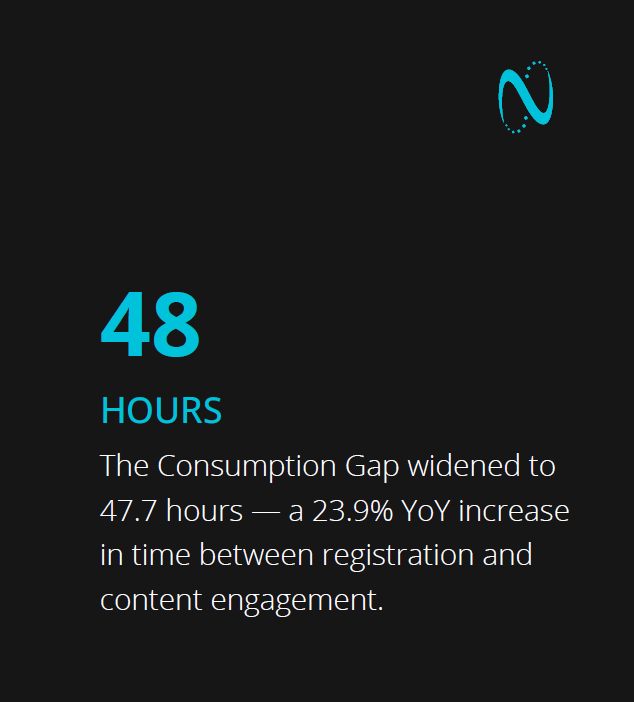
Way back in 2017, NetLine’s GM David Fortino told the B2B world something it wasn’t ready to hear: Let your prospects actually read what they requested before your sales team starts knocking. How long did Dave suggest?
48 hours.
He’s basically a prophet… like Galileo, but without the telescope.
Why This Matters
In 2025, the average B2B professional waited 47.7 hours between registering for content and actually opening it. That’s a 9.2-hour jump year over year—a 23.9% increase from 2024—and the widest Consumption Gap NetLine has measured in ten years of tracking.
I checked the math. Then I checked it again, because #Science. It’s correct.
The market is recalibrating. Think of it like the reclassification of Pluto—hey, another great philosopher mentioned!—things shift, categories evolve, and what was once a simple solar system gets a little more complicated. (Sorry. I’ve had this helmet on too long.)
Here’s what I need you to hear, though: 47.7 hours is not a distress signal. It’s a delay signal.
There’s a massive difference between a buyer who doesn’t care and a buyer who cares deeply but hasn’t gotten there yet. The Consumption Gap measures the second one.
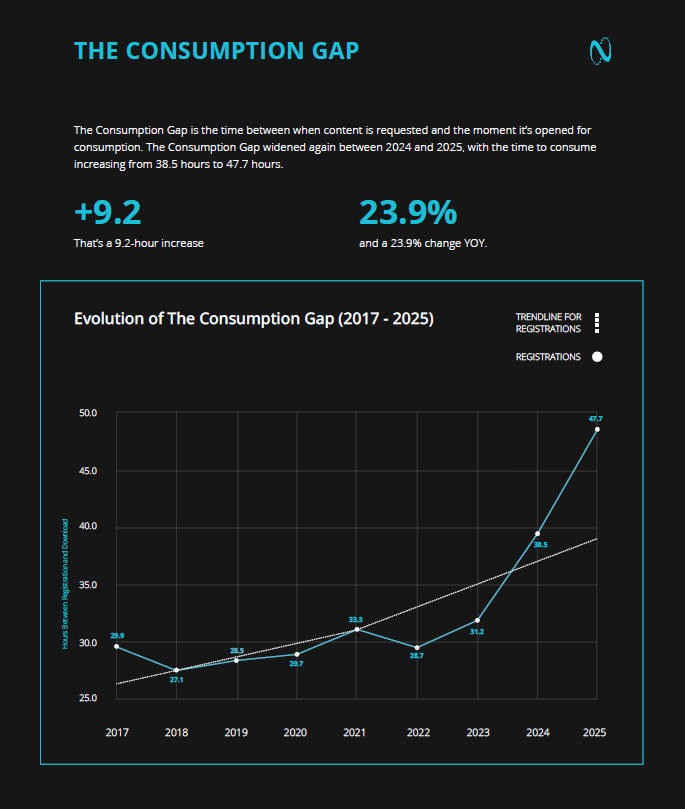
Since 2021, the Gap has expanded 43.2%. Over that same period, demand for gated content grew 57.6%. Those aren’t opposing forces—they’re the same story. Buyers want the content. They’re just busier, more distracted, and more overwhelmed than ever. The culprit isn’t apathy. It’s a lack of urgency. And urgency, unlike interest, cannot be manufactured.
What your content can do is make sure that when urgency finally arrives—and it will—you’re already trusted and already in the room.
What’s on Luna’s Radar
There’s a lot of signal in these numbers. But keep on target, Explorer. Here’s what the radar’s revealed.
- You have two clocks. Stop mixing them up. Clock One starts at registration—peak brand recall. They’ve seen your title and your logo (if it’s not on the cover of your gated content, that’s your next mission), and they cared enough to hit submit.
This is not your moment to pitch. It’s your moment to say hello and nothing else. Acknowledge, wish them well, disappear. Then wait 48 hours.
Clock Two begins when the download occurs—when they’ve actually decided it’s time to consume the content—and the conversation has context.
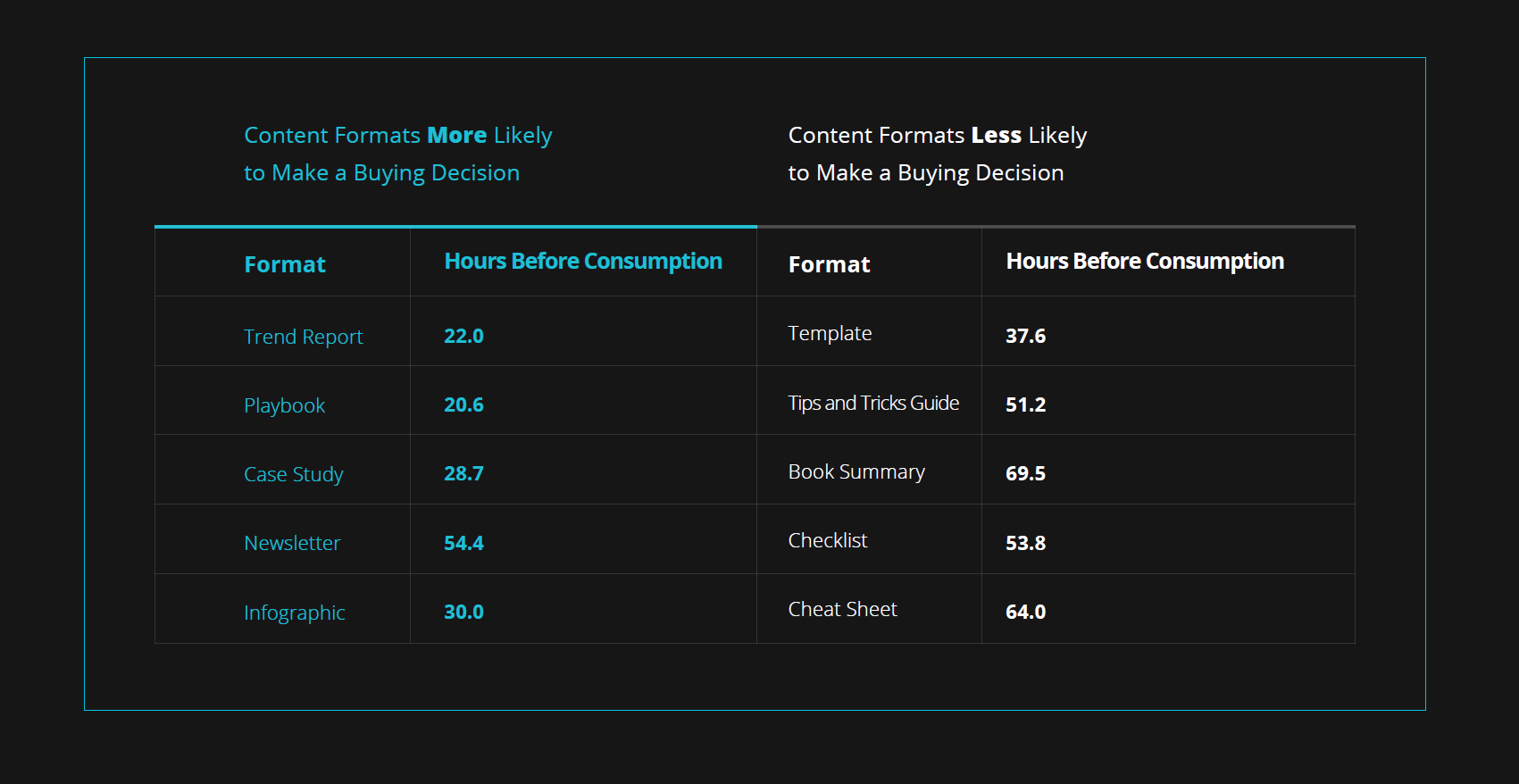
So, what happens if you confuse these clocks? Well, you’ve surely seen a space movie or six, but confusing these clocks is a big problem big enough to tell Houston. You’ve either gone silent when a nudge would have landed, or you’ve pushed for a discovery call with someone still on the first paragraph. Neither outcome serves you. Neither moves the deal. - The format your buyer chose is a tell. Read it. I’m an astronaut, which means I know a thing or two about reading instrument panels.A Playbook registrant who opens in 20.6 hours? That’s urgency—a buyer with a problem to solve right now. A Cheat Sheet sitting unopened for 64 hours? Real interest, zero urgency.Don’t expect a purchase decision from that lead for at least two quarters. Treating both registrants the same way is like wearing the same spacesuit on Mars and the Moon. It fits neither mission.
- The higher the title, the longer the wait—but don’t write them off. C-suite professionals clocked a 48.3-hour Consumption Gap in 2025. Owners hit 59.0 hours. VP and Senior Director gaps ballooned 43% and 50% year over year. But the fastest consumers? Executive VPs (31.4 hrs), Senior VPs (31.7 hrs), and Directors (39.5 hrs).
These are the people building the internal case, vetting vendors, and preparing C-suite recommendations. They’re moving fast because the pressure is on them. Engage those fast movers quickly and substantively.
Give the C-suite the patience and proof points they’ll need when their moment comes—because when it does, they won’t be slow at all.
Looking Through the Telescope
- Buyers aren’t saying no. They’re saying not yet. Nearly half of B2B professionals (45.9%) expect to make a purchase decision within the next 12 months. But near-term intent (within 3 months) dropped 15.7% year over year, while mid-range intent—the 6–12 month window—surged 78.6%.
The average B2B customer journey spans 211 days and 76 touches before a deal closes. No amount of AI-compressed research eliminates the stakeholders, politics, and competing priorities standing between a registration and a signature. Stop trying to rush it. - A registration is research in motion, not a transaction in progress. Your job isn’t to manufacture urgency. It’s to be so consistently present and genuinely useful that when the moment arrives, you’re the obvious choice.
Ask yourself: which of your assets are pulling real qualified traffic, and which ones are just taking up space debris? Don’t be afraid to scrub the launch and begin again.
Your Mission Checklist
- Audit your follow-up sequences. Are you reaching out at Clock One or Clock Two? Shift to Two—and make sure your Clock One message asks for absolutely nothing.
- Let format dictate your follow-up timing. A Playbook registrant and a Checklist registrant are not on the same trajectory. Stop treating them like they are.
- Build nurture programs for both fast movers and slow ones. EVPs and SVPs are doing the legwork—meet them with substance. C-suite needs patience and proof points. Give both what they actually need.
- Stop trying to manufacture urgency. Start earning presence. The 48-Hour Rule is the first step. Wait for the gap to close before you try to bridge it.
The 2026 content universe is not waiting for anyone to catch up.
The Consumption Gap isn’t a crisis. It’s a reality—and the B2B programs that build around it, rather than fight it, are already light-years ahead of the competition.
Don’t forget, cadet, there’s plenty more to be discovered amongst the stars…oh, and also, the 2026 State of B2B Content Consumption and Demand Report!