
We’ve established what the Recall Gap is and the three core problems that make it nearly inevitable under most current follow-up models.
Now it’s time to get into why, from a neurological perspective.
What’s Happening Inside Your Prospect’s Brain?
In the hours between registration and the moment your SDR attempts to make first contact, life doesn’t stop. A lot can happen in just a few minutes, let alone 48 hours (the average amount of time it takes for B2B registrants to consume the content they’ve requested).
So, what is actually happening inside your prospect’s brain?
The answer draws from six bodies of peer-reviewed research, none of which is new science. All of it is directly applicable to what’s happening at scale across B2B demand generation, and almost none of it has been applied to this context before.
The Cognitive Forces Affecting Your Prospect

While most of us are on our phones from the moment we wake til the moment we sleep, most B2B content registrations happen at a homebase—a laptop or desktop, complete with a browser full of “I’ll definitely come back to this later” tabs.
That context matters enormously: the cognitive forces that determine whether a buyer remembers you overwhelmingly occur at a desktop.
And memory doesn’t wait politely for your follow-up.
- In 1885, Hermann Ebbinghaus first documented the Forgetting Curve, demonstrating that newly formed memories decay most rapidly in the hours immediately after encoding. 130 years later, Ebbinghaus’s work was replicated in a 2015 PLOS ONE study.
That’s just for general memory, mind you. What about something more closely associated with business? Glad you asked.
- A 2017 Nielsen study bridged memory and marketing research, showing participants video ads, then tested a separate group 24 hours later. Their findings revealed that branded recognition dropped by roughly half in the first 24 hours after exposure.
Half the brand memory evaporated overnight.
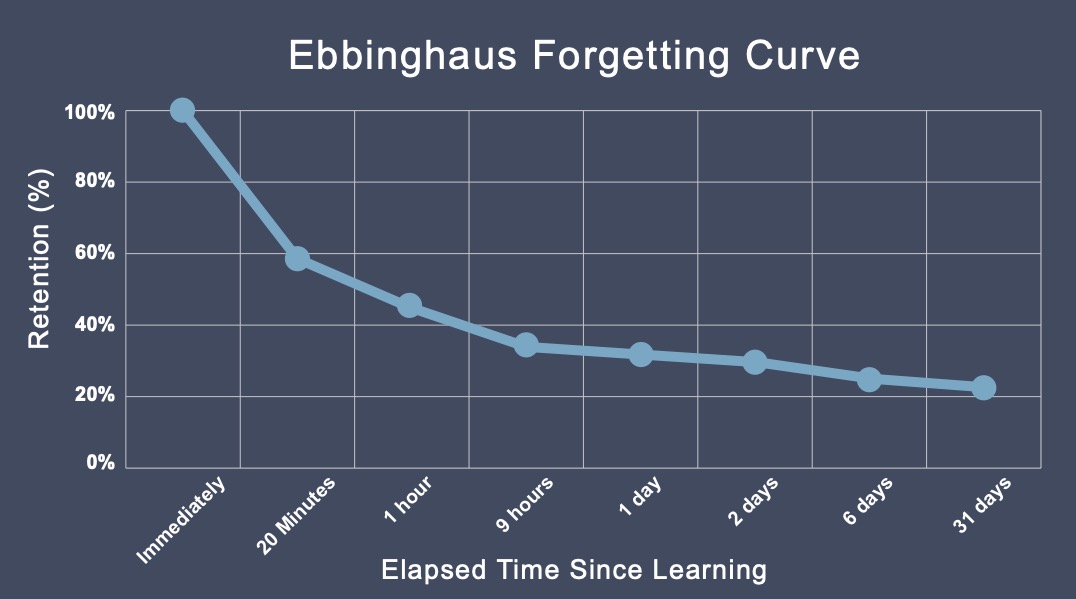
Image: Amplifire
Now map that onto the 48-hour Consumption Gap, and by the time your prospect finally opens the content they registered for, roughly half of whatever brand memory formed at registration is already gone.
When your SDR calls after that, they’re reaching someone whose brain has already cut your brand loose.
“Cold lead” is still the wrong diagnosis… but let’s keep digging into the why.
01 / The Google Effect

In 2011, Columbia and Harvard researchers Sparrow, Liu, and Wegner published a landmark study in Science that should have fundamentally changed how every B2B marketer thinks about lead follow-up. (Emphasis on should.)
It demonstrated three findings that, taken together, are pretty uncomfortable:
- People instinctively reach for search engines first.
- When confronted with a difficult question—even one they already know the answer to—the default behavior is to search. This is automatically and deeply conditioned. (Generative AI tools almost certainly fall into this same category now.)
- People don’t remember what they expect to find later.
- When the brain believes information will be retrievable, it deprioritizes encoding it. It’s not negligence. It’s efficient cognitive resource allocation.
- People remember where over what.
- The internet has become a vast external hard drive for human memory. People are more likely to remember the access route than the information itself.
The original experiments were conducted on desktop computers, by the way.
Now, let’s apply this to a B2B registration:
Your prospect fills out your gated form → Their brain tags your vendor name as “findable later” → Encoding of your company name is deprioritized immediately → Your SDR calls 48 hours later → “Who are you again?”
The Google Effect describes exactly what happens to a focused knowledge worker sitting at their own machine—the same environment in which nearly all B2B content registrations occur.
Hit button. Get content. Move on.
Your brand never had a real chance to stick.
02 / Source Memory Failure

Photo by Tim Mossholder on Unsplash
This is the finding that tends to land hardest.
Harvard memory researcher Daniel Schacter’s “Seven Sins of Memory” framework identifies one failure mode that matters enormously for gated content: Misattribution.
Misattribution in this context is the failure to remember the source of something you genuinely remember learning correctly.
- In his 2021 paper Media, Technology, and the Sins of Memory (Cambridge University Press), Schacter reviewed decades of evidence showing that digital media consumption produces reliable source-memory errors.
People absorb a fact, a statistic, or an idea—and genuinely forget where they got it.
A finding from your white paper may, a week later, feel like something they read “somewhere, maybe on LinkedIn.” Your insight travels. Your brand doesn’t always come with it.
Misattribution doesn’t mean the content failed. It means the brand memory failed independently of the content memory.
These are two separate encoding events. They don’t always succeed or fail together—which is the part that stings. It gets worse when competitive brand salience enters the picture.
- Research by Braun-LaTour & LaTour (2004) and Holden & Vanhuele (1999) documented that consumers will sometimes “remember” encountering a well-known brand when they actually encountered a lesser-known one. The brain, searching for a plausible source to attach to a half-encoded memory, defaults to whichever brand in the category has the strongest existing mental availability.
For B2B marketers, this is the worst-case version of the Recall Gap.
Your prospect remembers the insight; great. They may be quoting it in internal meetings right now; fantastic! But the credit—in their mental model of the category—has quietly migrated to whichever competitor they’ve heard of more often; brutal.
Your content did the work. Their brand got the credit.
03 / Desktop Attention Fragmentation

Photo by Unseen Studio on Unsplash
If the Google Effect explains why brand names get deprioritized, Dr. Gloria Mark’s two-decade research program at UC Irvine explains why anything struggles to get encoded in the first place.
Mark has tracked attention spans on computer screens since 2004. The numbers are stark:
- In 2004: the average knowledge worker stayed on a single screen for 2.5 minutes before switching.
- By 2012: 75 seconds.
- From 2016 to 2020: 47 seconds on average. The median was 40 seconds—meaning half of all observed focus sessions were shorter than that.
A 2022 Harvard Business Review analysis by Soroco researchers quantified the switching itself: the average Fortune 500 employee toggles between applications and browser windows approximately 1,200 times per day.
Each meaningful interruption costs roughly 23 minutes to fully recover from.
Your prospect registered for your content inside that environment.
The form submission was one of over a thousand micro-switches that day, competing for encoding against Slack, email, and whatever else was open in the next tab.
Frankly, it’s a minor miracle if your registration becomes fully encoded.
Because, more likely than not, they probably will not remember you.
What Else is Causing Brand Blindness?
The three findings above carry the most practical weight. But the complete picture of the Recall Gap requires three more.
Banner Blindness and the Goal-Directed Eye

When a desktop user is in task mode—actively searching for a specific resource—their visual system filters out anything that looks peripheral.
This is known as banner blindness, documented since 1998 and confirmed across dozens of eye-tracking studies. Even among users who do fixate on a branded element, only about 8% could accurately recall what was advertised.
Under goal-directed browsing, the brain screens out logos, company names, and branded headers sitting at the edge of a form before they’re ever encoded. Your prospect may have technically seen your brand. They almost certainly didn’t notice it in a way that lasts.
Competitive Interference

Photo by Michael Dziedzic on Unsplash
The likelihood that your prospect registered for your asset and only your asset is low. Burke & Srull (1988) established that the presence of competing brands actively erodes recall, and that simple repetition is a poor defense against it.
Teixeira et al. (2014) extended the finding to digital environments: in cluttered content spaces, consumers encode fewer brands and retain them more weakly.
Every other vendor your prospect encountered in the same 48-hour window was compounding the problem. Unsurprisingly, your brand isn’t only fighting the forgetting curve and all the other cognitive noise. Your competition is also looking for its shot.
The Memorability Effect
Here’s the one finding that puts something in your control.
In 2011, MIT researchers demonstrated that images have a measurable, intrinsic property called memorability—and that it’s consistent across viewers. Some images are reliably remembered; others are reliably forgotten.
The key takeaway is that polish does not equate to memorability. Convention is essentially the opposite of it.
The research identified predictable signals: human faces over objects, unusual over conventional, specific over generic.
Most B2B content defaults to clean gradients, abstract geometric patterns, and stock imagery of people in conference rooms. These visuals are professional. They are also boring and interchangeable.
The Von Restorff effect documents that items deviating from their surroundings get encoded more distinctly than items that blend in. This is why “action” colors are so crucial whenever there is a call-to-action.

Image: Laws of UX
In a cognitively hostile registration environment (which is basically daily life), interchangeable means invisible.
A quick self-check: pull the cover images for your five most-registered assets. Ask honestly whether a prospect could recognize any of them 48 hours later—or whether they could belong to any competitor in your category. The assets where the answer is “any competitor” are your highest-priority redesigns.
The cognitive environment at registration is working against your prospect’s ability to remember you. Your visual design doesn’t have to make it worse.
What This Looks Like in Sequence
Fortunately, each of these findings can be stacked together so that we can strategically address the Recall Gap.
At the moment of registration…
…attention averages 47 seconds on screen. Working memory is split across multiple open tasks. The Google Effect fires, tagging your vendor as findable-later and deprioritizing encoding. Banner blindness filters out peripheral brand elements. Encoding strength—before any time has passed—is already weak.
In the 47.7 hours that follow…
…1,200 more daily app switches accumulate. The forgetting curve’s steepest section passes. Source attribution decays faster than content memory. Competitive interference builds as your prospect continues researching the category.
When your SDR calls…
…your prospect may remember the insight from your asset. They are unlikely to remember where it came from. And if a more familiar competitor lives in the same mental neighborhood, misattribution may have already done its work.
This Is a Design Problem, Not a Performance Problem
As we have established, “Who are you?” is not evasion.
It is simply the most likely outcome of a cognitively fragmented desktop environment operating on a neurologically normal person.
The six findings above shift the framing of the Recall Gap from a performance problem to a design problem.
It’s not a lead quality problem—the lead was real, and their brain responded exactly as any normal brain would to that environment.
It’s not a follow-up speed problem, at least not primarily—speed helps at the margins, but it doesn’t address the structural encoding failure that happened before your team entered the picture.
And it’s not a content quality problem—source misattribution makes clear that strong content and strong brand recall are independent outcomes that require independent design decisions.
What it is, is a memory architecture problem.
And memory architecture can be designed for.
The next article turns to one of the most underused signals in demand generation: the format your registrant chose. That single choice—Playbook versus eBook, Trend Report versus Cheat Sheet—predicts not just their intent level, but the likely width of their Recall Gap. And once you know that, your entire follow-up strategy changes.