Categories B2B

What Jobs Will AI Replace & Which Are Safe in 2024 [+ Data]

Is AI taking over jobs in 2024?

Get Started with HubSpot's AI Campaign Assistant

A quarter of workers are worried it is.

There’s even a website called “Will Robots Take My Job?” where you can input a job title and see the likelihood of AI taking it over. I’ll admit that I’m even affected by this fear, checking the website more often than I’d like to admit.

The site is interesting to explore, but it’s important to understand the facts. So, I took a deep dive into the site to see what jobs have staying power and which don’t.

In this post, I’ll discuss the impact it’s already had, a list of jobs that AI can and cannot replace, and expert advice on how to future-proof your career and come out on top.

Table of Contents

Artificial intelligence disruption is already happening.

AI once posed the most significant disruption to assembly lines. The recent AI boom has changed that, as advancements have introduced AI to many different industries and businesses, and more and more workers leverage it to do their jobs.

For example, salespeople are using AI to analyze sales calls faster, bloggers and content creators are already using AI to streamline the writing process, and customer support reps are bringing customers faster solutions.

Salespeople are now using AI to analyze sales calls faster, marketers and digital creators are creating multi-channel content at greater speed, and customer support reps are bringing customers faster solutions.

Such functions lead to greater ROI for businesses, and this is shooting the AI optimism off the roof according to our 2023 State of AI report.

woman with sign that says only ask questions if you have already tried with chatgpt

Image Source

However, as advancements continue, will the disruption become so great that the workforce will find themselves asking, will ChatGPT replace me?

HubSpot Co-Founder and CTO Dharmesh Shah has a positive outlook on the future of AI. In fact, he thinks bots and AI will make us better at our jobs and more secure in our careers, not the other way around.

Samyutha Reddy, Jasper’s head of enterprise marketing, thinks similarly. Her teams regularly use generative AI, but she’s still actively hiring because AI can’t replace the human experience.

“We value writers in our society because they‘re able to give us a thought-provoking human perspective on the world…it’s about humans sharing opinions on very real topics that help build your perspective on how you feel about something. So an AI could really never replace that human perspective,” she says.

Despite the expert opinions of Shah and Reddy, you might still be anxious about where your career stands. I sometimes find myself lying in bed, scrolling through Reddit threads about the robot uprising. So, I put my mind at ease by turning to data.

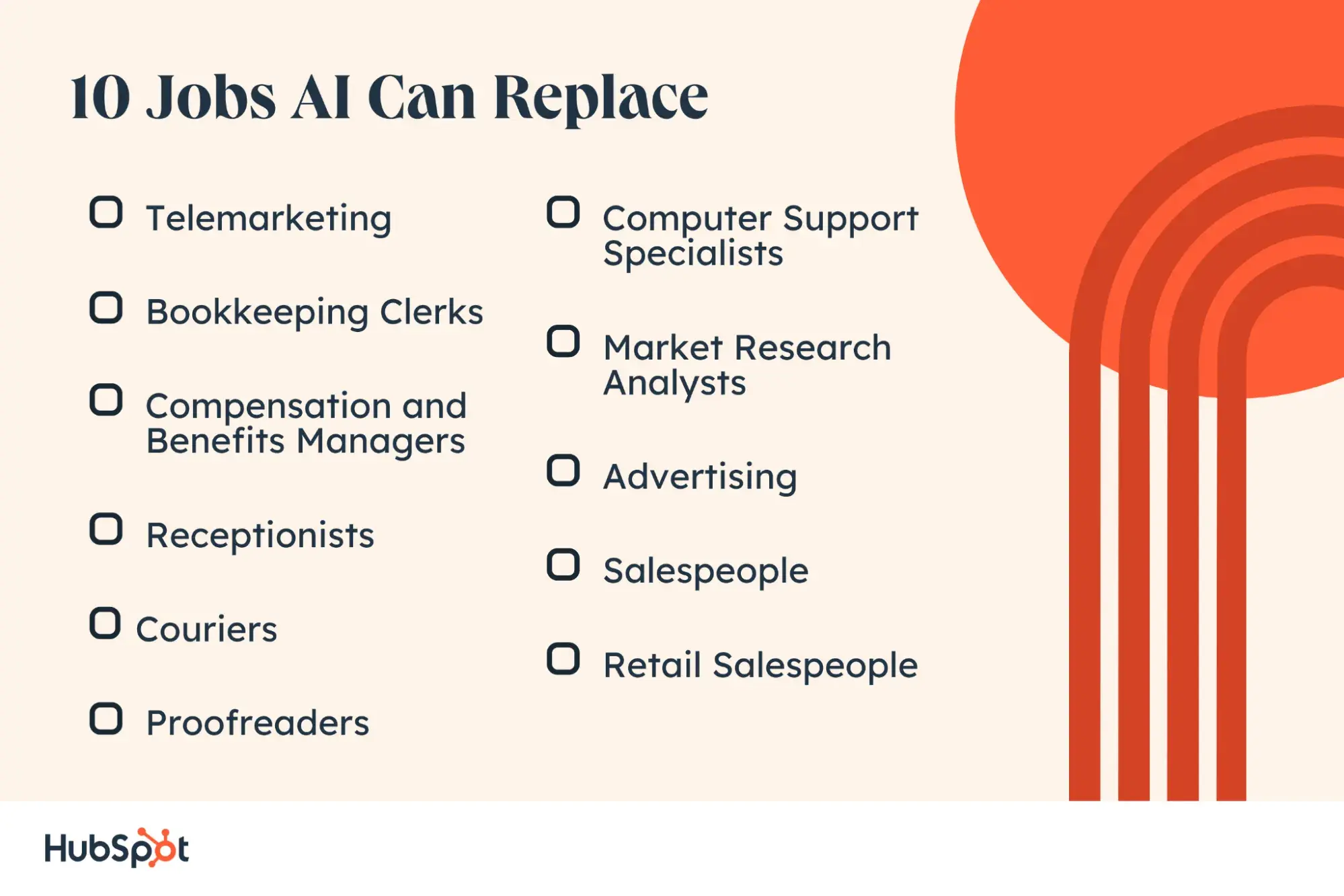
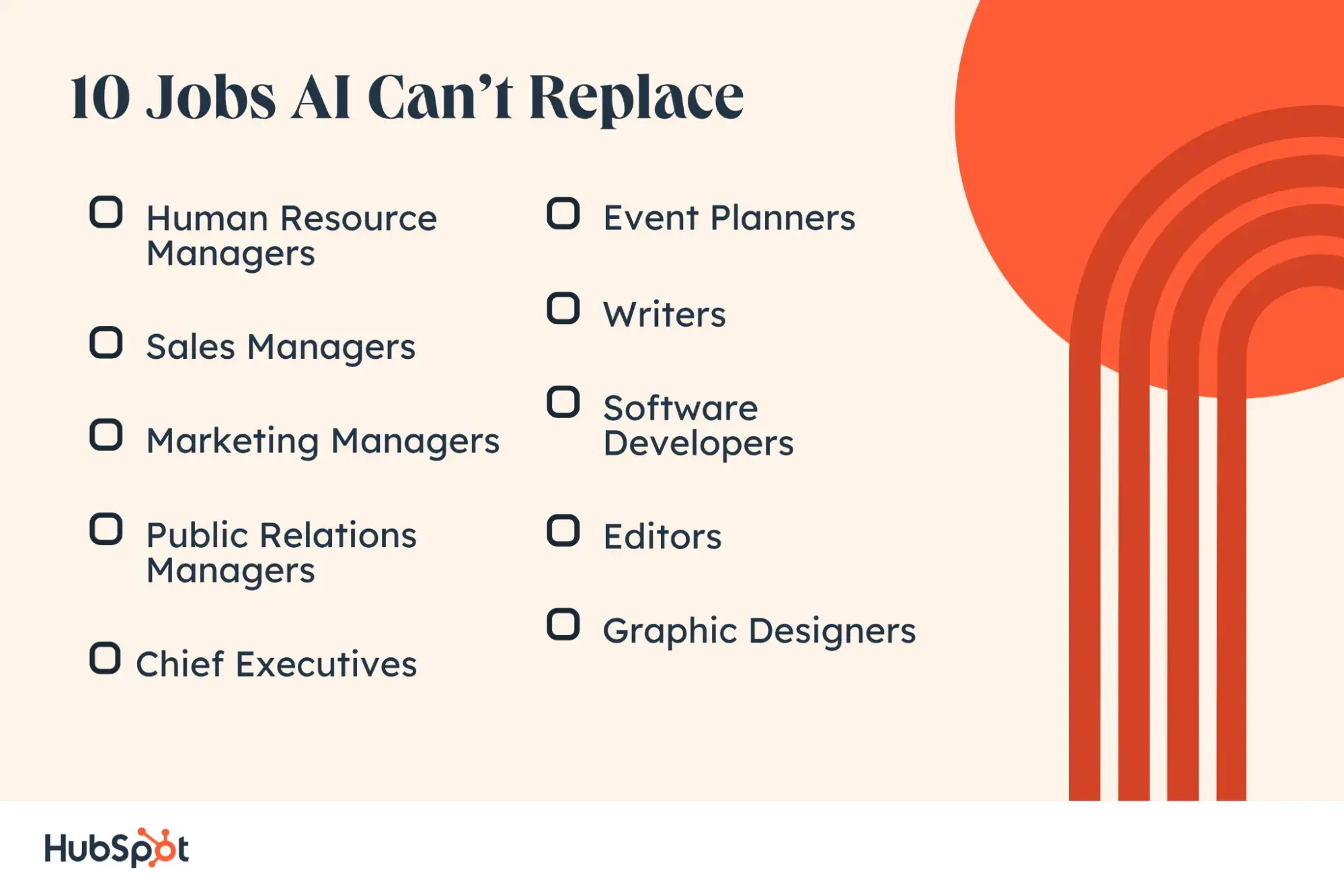
Based on current data and the website Will Robots Take My Job?, I’ll explore what jobs AI can replace highlighting ten positions with a higher likelihood. I’ll also explore which jobs are safe from AI, highlighting ten job roles least likely to be replaced by this technology.

What jobs can AI replace?

Once in the past, concerns over machines replacing human jobs rose with the automation of physical tasks common in factories and warehouses. Now, the same is happening with AI and the fear of it replacing human intelligence in the workplace.

“Think about your position and what your position will transform to in the next 12 to 24 months. Whether you like it or not, this is happening, and it is going to happen so fast that it will change the fabric of our society. If you haven’t already done so, search for whatever your title or your position is and look at all the [AI] tools that exist within that,” Duran Inci, CEO at Optimum7 says.

Before ChatGPT exploded in 2022 and unleashed the capabilities of AI to the average user, AI had already been making inroads in the sector. Business leaders were already hiring AI specialists, devising ways to use the technology to 10x their productivity, according to a report by PwC.

Between 2012 and 2023, jobs with AI-specific skill requirements increased sevenfold. In contrast, regular jobs only doubled within the same timeframe. But while the demand for professionals with technical AI skills may be on the rise, traditional jobs with high exposure to AI may be left on the back burner.

And from a Pew Research Center study, one in five Americans work a job with “high exposure” to (this exposure is measured by how much of the job’s most important activities can be performed or supported by AI).

Job roles that involve work activities like “getting information, processing information, analyzing data and information, thinking creatively, evaluating information to determine compliance with standards, making decisions or solving problems, performing for or working directly with the public, and more” fall under that category.

And these are the jobs that AI can replace. Not entirely, but to a significant extent affecting 30% of current worked hours by 2030.

“I would say 40% to 50% of creative and generic positions are already 80% there, and you will lose millions of dollars in the next 10 to 20 years if you don’t already have the plus version of ChatGPT and if you don’t already use it,” Inci continues.

What this means is that the greater the level of AI exposure a job has, the greater the risk of replacement.

Here are some examples.

1. Telemarketers

Future of Employment Study Likelihood: 99%

Will Robots Take My Job? Likelihood: 100%

Why: You probably already receive robocalls on behalf of various products and services, and career growth in the telemarketing space is expected to decline by 18.2% by the year 2032. This is largely because of the requirements to be successful. Unlike other roles, these jobs often require repetitive and predictable tasks that can easily be automated.

However, successful human telemarketers have a level of social perceptiveness and emotional awareness that machines can never replicate.

2. Bookkeeping Clerks

Future of Employment Study Likelihood: 99%

Will Robots Take My Job? Likelihood: 100%

Why: Jobs in this role are expected to decline 4.5% by 2032, and it‘s no surprise why — most bookkeeping is becoming automated if it hasn’t been already. QuickBooks, FreshBooks, and Microsoft Office already offer software that does the bookkeeping for you, so it’s no surprise this job has such a high probability.

3. Compensation and Benefits Managers

Future of Employment Study Likelihood: 96%

Will Robots Take My Job? Likelihood: 41%

Why: As companies grow, especially across multinational markets, a human and paper-based system can present more hurdles, time delays, and costs. That’s why there is a 64% chance of full automation within the next two decades.

Automated benefits systems can save time and effort by providing benefits to large numbers of employees, and companies like Ultipro and Workday are already being widely adopted.

4. Receptionists

Future of Employment Study Likelihood: 96%%

Will Robots Take My Job? Likelihood: 93%

Why: Pam predicted this back on The Office, but in case you‘re not a fan, she said automated phone and scheduling systems can replace a lot of the traditional receptionist role — especially at modern technology companies that don’t have office-wide phone systems or multinational corporations.

But, receptionists develop relationships in the office that give them a unique advantage in providing customized support compared to an algorithmic system.

5. Couriers

Future of Employment Study Likelihood: 94%

Will Robots Take My Job? Likelihood: 95%

Why: Couriers and delivery people are already being replaced by drones and robots, so it’s only a matter of time until this space is dominated by automation altogether.

6. Proofreaders

Future of Employment Study Likelihood: 84%

Will Robots Take My Job? Likelihood: 100%

Why: Only a few jobs have a 100% risk level and this is unfortunately one of them. Proofreading software is everywhere. From Microsoft Word’s simple spelling and grammar check to Grammarly and Hemingway App, there are a lot of technologies out there that make it easy to self-check your writing.

On the other hand, the relationship a proofreader develops with a client gives them an understanding of the intention behind a writer’s work and the contextual knowledge needed to successfully complete a project.

7. Computer Support Specialists

Future of Employment Study Likelihood: 65%

Will Robots Take My Job? Likelihood: 52%

Why: The field is projected to grow by 6.2% by 2032. But with so much content on the internet with instructions, step-by-step guides, and hacks out there, it’s no surprise companies will rely more heavily on bots and automation to answer support questions from employees and customers in the future.

8. Market Research Analysts

Future of Employment Study Likelihood: 61%

Will Robots Take My Job? Likelihood: 40%

Why: Market research analysts play an incredibly important role in developing messaging, content, and products, but automated AI and surveys can compile this information more and more efficiently.

While automated research tools can have a leg up in scale, speed, and accuracy, a human researcher has hands-on knowledge and personal experience that an algorithm can’t develop. Human researchers that leverage automation tools can create a more effective process.

9. Advertising Salespeople

Future of Employment Study Likelihood: 54%

Will Robots Take My Job? Likelihood: 52%

Why: As advertising shifts away from print and TV and towards web and social media landscapes, people simply aren’t needed to manage those sales for marketers who want to buy ad space.

Social media platforms make it easy for people to buy space through free application program interfaces (APIs) and self-serve ad marketplace, removing the salesperson and making it faster and easier for users to run their ads.

Even the ads themselves are leaning more and more in artificial intelligence. When looking at actors or voice actors, we’re also seeing a trend of companies using AI voices for advertisements like commercials.

10. Retail Salespeople

Future of Employment Study Likelihood: 92%

Will Robots Take My Job? Likelihood: 66%

Why: Companies are democratizing the shopping experience with features like self-checkout, and the modern buyer is much more internet-savvy and more likely to do internet research and make a buying decision on their own.

On the other hand, the care a retail salesperson brings during a 1:1 interaction differs from automated and unemotional support, and many consumers prefer to interact with humans during the support process.

10 Jobs AI Can Replace

What jobs are safe from AI?

Although data suggests generative AI could expose over 300 million full-time jobs across the US and Europe to automation, certain roles remain largely immune to this. Going by the exposure scale, these jobs have medium to low exposure to AI.

This is because their most important work activities range from:

  • Training and teaching others
  • Performing general physical activities
  • Repairing and maintaining equipment
  • Establishing and maintaining interpersonal relationships
  • Resolving conflicts and negotiating with others
  • Developing and building teams
  • Selling or influencing others
  • Judging the qualities of objects, services, or people 

… and so much more.

What these activities revolve around are uniquely human traits like emotional intelligence, contextual creativity, discernment and manual labor that AI cannot replicate yet. This is also echoed by the World Economic Forum’s (WEF) top 10 work skills of 2025, some of which include:

  • Analytical thinking and innovation.
  • Critical thinking and analysis.
  • Creativity, originality, and initiative.
  • Leadership and social influence.
  • Complex problem-solving.

And this is true for business leaders and their hiring practices. At GuerrillaBuzz, Co-Founder Yuval Halevi, says they rely mainly on human creativity to drive their marketing efforts. “We apply AI mainly to repetitive and time-consuming tasks, removing the monotony and freeing up time for more creative work.”

In the words of Ian Shine at the WEF, these jobs are safe because “one of the human brain’s biggest advantages over AI is the fact that it is attached to a real human body.”

Without further ado, here are some jobs that are safe from AI.

1. Human Resources Managers

Future of Employment Study Likelihood: 0.55%

Will Robots Take My Job? Likelihood: 14%

Why not: It’s kind of in the name — but your company’s Human Resources department will likely always need a human at the helm to manage interpersonal conflict with the help of non-cognitive and reasoning skills. Problem solving, contextual understanding, and unique business knowledge also make a human better equipped for this job.

The field is projected to grow 7.3% by 2032 as companies scale and need more robust structures for supporting and helping employees.

2. Sales Managers

Future of Employment Study Likelihood: 1.3%

Will Robots Take My Job? Likelihood: 30%

Why not: Sales managers need high emotional intelligence to hit their monthly quotas, network and collaborate with customers, and motivate and encourage the larger sales team. Managers also have to analyze data and interpret trends. The high levels of intelligence required and the constant need to adapt to new situations make this role safe from automation.

3. Marketing Managers

Future of Employment Study Likelihood: 1.4%

Will Robots Take My Job? Likelihood: 18%

Why not: Marketing managers have to interpret data, monitor trends, oversee campaigns, and create content. They also have to nimbly adapt and respond to changes and feedback from the rest of the company and customers, making this another human-forward career AI isn’t quite ready to replicate.

A unique contextual understanding and previous business experience make a human stand out from an automated system.

4. Public Relations Managers

Future of Employment Study Likelihood: 3.7%

Will Robots Take My Job? Likelihood: 8%

Why not: Successful public relations (PR) managers rely on a network of relationships and contacts to procure press placements and buzz for the companies they represent, making this another completely safe role.

PR managers who have to raise awareness around an issue or mission need a particularly human touch to raise funds or get people to participate in a campaign, too — and jobs are expected to grow 7.6% by 2032.

Most importantly, PR managers are often on the go, attending events and being on hand to provide support if need be — a computer will never be able to do this.

5. Chief Executives

Future of Employment Study Likelihood: 1.5%

Will Robots Take My Job? Likelihood: 0%

Why not: It‘s nearly impossible to automate leadership — after all, it’s hard enough to teach it. Chief executives must inform broad strategy, represent companies’ missions and objectives, and motivate huge teams of people working for them. Executives also have years of prior experience that make them successful.

Companies may answer to stakeholders and boards of directors, who likely wouldn’t want a robot giving them an earnings report, either.

6. Event Planners

Future of Employment Study Likelihood: 3.7%

Will Robots Take My Job? Likelihood: 8%

Why not: Event planning is a growing field, and if you ask anyone on our events team here at HubSpot, whether you’re planning an event for employees, customers, or an industry event with tens of thousands of attendees, the planning process has many, many moving parts involved.

Planners have to coordinate and negotiate with vendors, contractors, and freelancers to make things come together, and the organizational and people skills involved will make this another near-impossible role to automate.

Planners also attend events, ready to step in and troubleshoot on the spot. An automated tool simply couldn’t be present.

7. Writers

Future of Employment Study Likelihood: 3.8%

Will Robots Take My Job? Likelihood: 49%

The large score difference is likely due to developments and advancements in language models post-2013 that can write entire blog posts or social media content.

Why not: Writers have to ideate, create, and produce original written material, something that AI writing tools have not yet been able to replicate in the same way as humans (see recent BuzzFeed controversy about AI-generated travel articles).

There are also many types of writers, some of which might be more at risk. An experienced journalist will likely be favored over AI, but a freelance copywriter may no longer be needed by a business that now uses AI to write Instagram captions.

8. Software Developers

Future of Employment Study Likelihood: 4.2%

Will Robots Take My Job? Likelihood: 39%

The large score difference is likely because of new back-end tools that help web developers write entirely new code, fill in gaps, and debug.

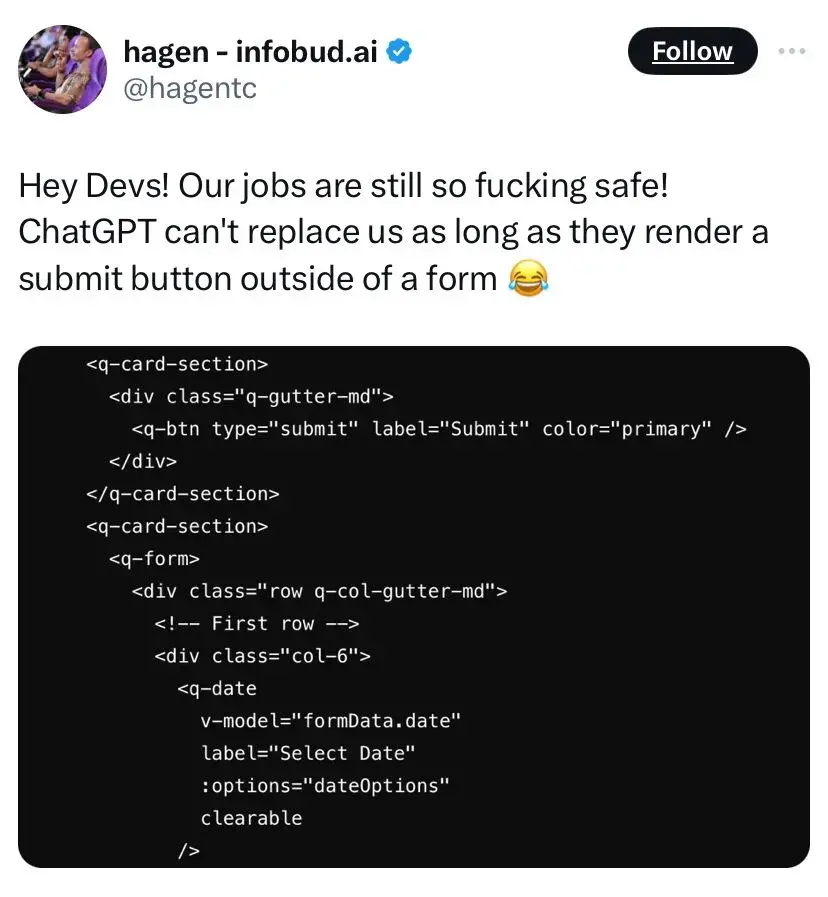
Why not: Software engineering and development is complex enough for human beings, and the time and skill investment needed to create applications, software, and websites will be tough to replicate — especially since developers need to execute perfectly to create great products for customers.

The field is expected to grow by 30.3% by 2032, so if you‘re a software developer, you’re sitting pretty for now.

what jobs will ai replace, coding

Image Source

9. Editors

Future of Employment Study Likelihood: 5.5%

Will Robots Take My Job? Likelihood: 45%

Why not: While the automated proofreading technology mentioned previously can take a load off, editors have to review writers’ submission for clarity, accuracy, comprehensiveness, and originality.

Some software can spot-check for clarity and scan for plagiarism, but the editor role must be carried out by a human in order to read work as another human would.

Today, 86.33% of marketers who use AI, for example, always make edits to the content that AI produces, according to our State of AI in Marketing survey.

10. Graphic Designers

Future of Employment Study Likelihood: 8.2%

Will Robots Take My Job? Likelihood: 34%

Why not: Image generators like Midjourney and DALL-E make it easy for people to create what they want, but graphic design is an artistic and technical field best suited for someone with fine arts training and experience. Like writing, graphic design work must be original and tailored to a unique use case.

If a graphic designer is working with a business, it also requires building a relationship between both parties throughout the design process. Plus, some image creators have been found to plagiarize artists’ work — a lawsuit is likely the last thing people want.

10 Jobs AI Can’t Replace

Navigating Artificial Intelligence

Kate O’Neill, the author of Tech Humanist and founder of KO Insights, explains that jobs that require emotional intelligence will be safer in the immediate future:

“This is going to be a continuously moving target, but for the time being, what AI can’t do well is use emotional intelligence, understand situational context, make judgment calls, and generally see nuance and meaning like we do.”

“That means any kind of job that benefits from these kinds of human attributes is better off done by a human. A computer or robot may assist you in performing efficiently, but for now, you’re the one who adds the expertise on how to perform appropriately,” she adds.

This is echoed by Halevi, who says, “Having knowledge that’s beyond the obvious is crucial. AI tools like ChatGPT and Gemini can sometimes provide inaccurate or misleading information.”

“Without a deep understanding of your specific area, you might be misled or produce subpar work. Expertise ensures you can critically evaluate AI outputs and maintain high-quality standards.”

Even for jobs that are more likely to be impacted, there are always reasons why a human with real-life experience and expertise is a better fit. The best way to navigate the fast-moving world of artificial intelligence is to stay informed and adaptable.

How to Future-Proof Your Career

Between January and May 2023, 417,500 jobs were cut. However, only 3,900 were reportedly because of artificial intelligence — less than 1%. Still, regardless of what happens, you might be wondering how to future-proof your career. The answer? Re-skilling.

On a Marketing Against The Grain Episode, Kipp Bondar, HubSpot’s chief marketing officer, says, “As I think about the evolution of AI, I think about one of the things that’s going to go part and parcel with it is the need to be amazing at re-skilling our workforce all around the world.” (Listen to the full episode here).

Re-skilling doesn’t mean preparing for the worst. Most jobs expect employees to engage in some sort of professional development, so this might be routine for you.

For example, you could explore different AI tools and how to leverage them in your day-to-day role. HubSpot’s AI tools, for instance, give you access to a suite of AI tools that could perform functions like content creation, data analysis, and even build a chatbot.

hubspot ai tools

Image Source

Or you could take a course to learn a new skill. As Shah said above, AI’s most significant impact will likely be helping us be more effective in our careers.

But, if your job is impacted, having taken the time to re-skill leaves you more prepared for future opportunities where you present yourself as a multifaceted candidate.

Learning from others is another great way to stay on top of the changing AI landscape and learn new skills. HubSpot has spoken to experts that have leaned into AI and incorporated it into their processes, and their insight is a valuable way to get ideas for re-skilling.

Here are some helpful resources:

Your experience is your greatest asset.

All technological revolutions impact how people work, and AI will simply follow this pattern, having the most impact on rote and mundane tasks to save us time.

No matter what happens, your experience is your greatest asset in the face of a changing landscape. To stay up to date on AI and the trends, HubSpot’s State of AI pillar houses all the information you need.

Categories B2B

The YouTube Growth Strategy Mr. Beast, Cocomelon, & Like Nastya Use to Dominate the Internet (Creator Remixes 2024)

YouTube growth strategies continue to be a hot topic among marketers. In fact, most marketers plan to increase their YouTube budgets this year and say the platform has the highest growth potential in 2024.

Anytime you’re talking about YouTube growth (and I talk about growth a lot as the founder of Thompson Media Group), Jimmy Donaldson’s Mr. Beast channel is high on the list.

→ Free Templates: How to Use YouTube for Business [Download Now]

It’s easy to understand why. Today, the Mr. Beast YouTube channel has 240 million subscribers, the second most of any channel on the platform. There are many reasons why this channel is so popular, but the strategy I recommend most to my clients centers on expanding their view of who their ideal customer is.

YouTube’s Power Players Use This Growth Strategy

What’s the million-dollar strategy for growing your audience and your customer base? The answer is surprisingly straightforward: inclusion marketing. Yep, that’s it. I’ve built an entire consulting business around helping brands grow with inclusion in marketing and belonging, and I can spot a great strategy from a mile away.

For example, Mr. Beast employs inclusion marketing by offering his content in multiple languages. Reed Duchscher, his talent manager, explains that this is one of the primary forces driving his rapid growth.

screenshot of a linkedin post annoucing that Mr. Beast hit 200 million youtube subscribers

The strategy here is simple: get your content and products in front of more people who have the problem your brand solves. More qualified eyeballs mean more people consuming your content and buying your products.

Globalization as a growth lever is nothing new. That’s why you’ll see McDonald’s, Netflix, and Nike developing localized content around the globe.

Remember, a different language doesn’t mean we don’t have the same problem — or can’t benefit from the same solution.

As an inclusive marketing strategist and consultant, I tell my clients it’s never been easier or more cost-effective to grow your brand by including a broader diversity of consumers. I spend a ton of time talking about practical ways to use inclusive marketing as a growth lever on my podcast, Inclusion & Marketing.

This episode goes deep on how to grow your brand through globalization, including localizing your content.

And it’s not just Mr. Beast who’s embracing this strategy.

Cocomelon, Kids Diana Show, and Like Nastya have all snagged coveted spots in the top 10 most subscribed YouTube channels. How? Each of them makes their content available in multiple languages — and has earned millions of fans as a result.

Think this is just for kid cartoons and hype engines? Think again. Even business-focused brands such as GaryVee, VidIQ, and IKEA are embracing inclusion marketing.

How You Can Reach a Global Audience

These creators aren’t creating dozens of assets at a time. They’re creating one video and localizing it into other languages using dubbing and voiceover.

Once the dubbed content is made, there are two approaches creators use to get localized content to their audiences.

1. Language-Specific Channels

Cocomelon, Kids Diana Show, and Like Nastya all have multiple YouTube channels, each dedicated to specific languages.

Kids Diana Show has 119 million subscribers on the English language version of the channel. She’s added more than 72 million additional subscribers, with language channels hosting the same, but localized, content.

Like Nastya has 113 million subscribers on her English language channel. Her brand has more than 82 million additional subscribers on other language channels.

Business channels have seen success here as well. VidIQ has 1.78 million subscribers on their English language channel. And they’ve added an additional 351,000 subscribers on the Spanish language channel alone.

2. One Channel, Multiple Languages

The outlier here is Mr. Beast, who previously hosted several different channels dedicated to various languages. In 2022, that changed.

Around this time, YouTube began working with top creators like Mr. Beast to test out multi-language audio. This new feature allows creators to manage one channel by uploading different audio, thumbnails, and descriptions to their accounts.

When a user comes across the video, it’s automatically shown to them in their local language. This allows creators to deliver a seamless customer experience for their audience while also being more efficient content managers.

YouTube noted that creators who tested this multi-language audio feature saw 15% of their watch time come from views in the video’s non-primary language.

While this feature isn’t yet available to all accounts, YouTube plans a phased rollout of the functionality to more creators.

How To Use Localization In Your Brand

Of course, it’s important to consider the customer experience you’re delivering to your audience.

Over the years, I’ve interviewed dozens of consumers with identities from underrepresented and underserved communities. A common frustration they share is feeling like brands fall short by delivering substandard experiences to them.

One Spanish-speaking consumer told me that when brands don’t make their content available in Spanish, he feels like they send the message that “people who speak Spanish aren’t important.”

When it comes to engaging new consumer groups, I always coach my clients to be intentional about delivering experiences that make consumers feel seen, cared for, and like they are important rather than an afterthought. As a result of taking this approach, more of the people you want to serve will feel like they belong with you.

The end goal of this strategy is to create video content that’s accessible to people who speak other languages. But there are lots of ways to get there.

Here’s a quick video where I walk through a few of those options and provide examples and considerations for each one. I even drop some reactions and feedback from a Spanish-speaking consumer.

1. Use human-dubbed content.

Many of today’s top YouTube channels, including Mr. Beast, use a company called Unilingo to dub videos using professional translators and voiceover talent.

If you’ve ever watched a movie with audio in another language, you’ll notice that great care is taken to ensure the voiceover looks and sounds like the original. Tone match and synchronicity deliver a better experience to the end user.

Think of this as a moment to delight your audience by working with a human voice-over artist skilled in matching the original speaker’s energy, emotion, and intonation.

2. Use AI-dubbed content.

Ok, ok. I know I just told you to use human-dubbed content. But I realize that sometimes it’s just not possible.

If you haven’t noticed, the market is flooded with AI tools right now. That means you’ve got options for dubbing using artificial intelligence. Simply upload your video, select a voiceover you like, and in just a few minutes, you have a dubbed video.

If you use this option, it’s important to have the translated version verified by certified translators before publishing.

Although AI-powered translations are often good, there are nuances associated with localizing content. You’ll also want to maintain your brand voice and tone — something that can be difficult to capture with a language learning model.

The AI will translate your content verbatim when what you’re really after is transcreation. In a transcreation, you choose the words and phrases that capture the full intention and essence of what you’re saying.

In the podcast episode below, I go deep into translation, transcreation, and the proactive choices you must make when localizing content. For instance, should your brand be using gender neutral language (gendered language is very common in languages like Spanish and French), and if so, how should you approach nuances here? These decisions will have a big impact on how people perceive your brand.

3. Add multi-language subtitles to your video.

Subtitles are another way to make your YouTube videos more accessible. You can upload multiple subtitle files in other languages directly in your YouTube content studio.

youtube video subtitles landing page

YouTube also gives you the option to upload localized thumbnails, titles, and video descriptions to deliver a consistent experience in the end user’s local language.

When a user arrives on your video, they’ll hear your original audio while reading the subtitles in their preferred language.

image of the youtube translation popup window

The same rules apply when ensuring you have a high-quality subtitle translation that human translators either transcreated or verified.

Break Through the Noise with Inclusive Video Content

Think beyond your existing audience to grow your YouTube channel and your business.

Start where you can, and make improvements over time as you learn more about what your new global audience needs most from you.

Once you get into the groove of expanding content reach using inclusion, you’ll develop new relationships with new audiences that will allow them to reach new levels of success. And, at the end of the day, that’s your goal, right?

New call-to-action

Categories B2B

The Losing Test That Led to 4% More Leads (We Took the L so You Don’t Have To)

Today, I’ve got a special treat for you, something most companies won’t share: a peek at one of our losses.

A “best practice” that failed so hard we had to pause part of the test early. And, if I can wax clickbait-y for a moment, it’s a tactic you may be using in your calls-to-action as we speak.

So come for the trainwreck, but stick around for the lesson, because what we learned led to 4% more leads from our CTAs.

Free Download: A/B Testing Guide and Kit

And I’m going to show you how to recreate it. (The improvement, that is. Not the trainwreck.)

The Best Practice That Wasn’t

I turn to AJ Beltis, principal marketing manager of conversion strategy, when I need absolute authority on two things: 1) pop-culture movie references, and 2) content conversion.

So when I read an internal brief where a supposed best practice caused a 14% loss in conversion rate, I ran to him like Luke flying back to Obi-Wan.

Screenshot of ABC test on CTA language

It all started with a test of the wording on our CTA buttons. Long-time readers may remember that our anchor texts were once a grab-bag of different styles.

“It was up to the bloggers’ discretion because each of those CTAs was individually placed,” AJ explains. “So sometimes it was ‘Get the template,’ sometimes it was ‘Download now.’”

And because we test everything, when we set out to make our CTAs more consistent, we started by testing different language options. The test variants were:

  • The Control: “Get the [Product Type]”
    Cut and dry. Straight to the point. A great example of our old anchor text strategy. 
    Example: “Get the Template”
  • The Best Practice: “Get the Free [Product Type]”

Same as above, only now we add “free” as an enticement. A pretty non-controversial tactic you’ll see in every CTA guide.
Example: “Get the Free Template”

  • The Wildcard: “Get the Free [Specific Product]”

Here we add a description of the offer to the button itself. At the time, this felt redundant because there was already a description above the button, but hey, let’s try it.
Example: “Get the Free Social Media Calendar Template”

Author CTA variant examples

We were so confident in the results that we put our money where our mouse was and slapped the test on 25 of our highest lead-driving blogs.

“We felt pretty comfortable with the risk because we weren’t removing anything or changing anything drastic,” AJ says. “So it was a reasonably safe way to test something.”

John Hammond felt the same way in Jurassic Park.

What Went Wrong (and What Went Right)

Within two weeks, Variant B cratered our conversion rate by 14%, until we finally paused that branch to mitigate losses to our heavy-hitting lead generators.

So, why didn’t the best practice work?

“One theory is that whenever you see something labeled as ‘free’ on the internet, it might have a spammy connotation.”

In other words, like Pavlov’s dogs, we’ve all been trained to see “Free Download” and immediately scroll past what is surely a scam and/or an ED cure.

Ah, but what about Variant C? The one we dismissed as redundant?

That one actually boosted our conversion rate by 4% overall, and by 7% among new visitors.

So, why did this variant work where the other failed?

AJ believes it’s all about using visual cues to highlight keywords the reader is looking for.

“When people are reading a blog post, they’re often just kind of skimming as quickly as possible to get an answer,” he says with a shrug and a sideways smile. “I’ve been a blogger and it sucks to say, but no one is typically reading all 1,200 words that you put your time and effort into.”

(But not you, dear reader. Not you … Right?)

Say a visitor is skimming to learn about social media content calendars. Suddenly they see a big orange button that offers a social media content calendar template.

“This is the specific thing that I want and it’s free? I’ll get it.”

Quote from AJ Beltis about keywords in anchor text

The Takeaways About CTAs

To see the biggest takeaway, scroll back up and check out the CTA button right beneath the title of this very blog. You’ll see that we no longer include descriptive text above the button, and instead use the description on the button itself.

Some of AJ’s other insights:

1. Test Every-freaking-thing. (Or “Don’t take best practices at face value.”)

Trusting best practice alone would have damaged our conversion rate, and we might have never known why.

Similarly, if we hadn’t tested what we assumed was the redundant option, we would never have found a win.

“If we had just tested ‘free’ versus the control, the test wouldn’t have worked,” AJ points out. “But because we tested ‘free’ versus the control versus ‘free [specific thing]’, that extra layer worked.”

2. Use Keywords in Your Anchor Text

“If you can use those buzzwords they’re looking for, that’s going to be more successful. Using the words ‘content calendar template’ or ‘planning template’ when they’re reading a blog about social media content calendars … they’re already thinking about that word, so psychologically, it might hook them a little faster.”

Placing keywords in your anchor text is also a win for accessibility, as it helps folks who use screen readers to know what they’re clicking on.

3. DO Test on Your Biggest Lead Drivers

After getting beat worse than Rocky by Apollo, you might think we switched to testing on less important pages, but that’s not the case.

As Rocky says: “It ain‘t about how hard you’re hit, it’s about how you can get hit and keep moving forward.”

As AJ says: “When we look at testing our top pages, that’s also where the biggest opportunity for growth is. If we were to be a little safer by testing pages that don’t convert as well, we might not have been able to detect the magnitude of how successful or unsuccessful a tactic might be.”

Quote from AJ Beltis on top pages being the biggest opportunities for growth

4. Trust your audience above authority.

And that includes me, AJ, and Obi-Wan.

Always trust your audience’s reaction over what you find in any guide.

“Respond to your audience,” AJ says. “Some audiences might find a test that we ran to not be a good match. Whereas, we might look for inspiration from other companies, run it on the HubSpot blog audience, and find that their test doesn’t work for us.”

5. Test your offers, too.

Amid all this talk about CTAs, AJ drives one final point home: Your CTA is only as good as what it’s offering.

So test what you’re offering, too.

“We use templates because templates work for us. We don’t do webinars because webinars don’t work for us. Some companies, all they do is webinars, because that’s what works for their content sphere.”

How to Test Your CTA Button Text and Offers

Unlike in Rebecca’s test of paid ad landing pages, for this one you do want to test one element at a time. So be sure to test your anchor text and content offers separately.

You’ll also want to use a tool that evenly splits your traffic across the variants—something like Convert, VWO, or, hey, Content Hub!

  1.  Navigate to the test page.
  2.  Click on the file menu and then chooseNew,” then “Run A/B Test.”
  3.  Enter a name for each variation.

This should be something descriptive that will be easy to remember. If you look at the first screenshot, you’ll see we simply used “Original Page,” “Variant B – Free,” and “Variant C – Free + Description.”

  1.  Click “Create variation.”
  2.  Edit the anchor text or the destination of the link (but not both!)

For this time of optimization, you’ll get better results by testing one change at a time. (Though you can certainly test multiple variations on that one change.)

To recreate AJ’s test, try out a description of the offer within the anchor text. Heck, you may even want to try using “free.”

  1.  Click “Publish” in the upper right corner, then “Publish now.”

No matter what you decide to test, be sure to keep an eye on the results over time. Be ready to pull that emergency brake so you can avoid your own trainwreck.

Categories B2B

The Top 4 Roadblocks to Your Team’s Productivity and How AI Can Solve Them, According to Asana’s Head of Corporate Marketing

You open your computer on a Monday morning, and you have a few Slack messages about a campaign you’re launching on Tuesday.

Download Now: The Annual State of Artificial Intelligence in 2024 [Free Report]

After you‘ve answered those, you check your inbox and see you’ve been tagged in some slides for that same campaign.

Once you’re done responding, you hop on a Zoom call to chat with stakeholders about last-minute tasks that need to be completed for launch. A few of the stakeholders would like you to email a follow-up from the meeting, so you do.

But others would rather you tag them in the appropriate Google docs, so you do that, too.

Suddenly it‘s 1pm, and you’ve done nothing substantial on your to-do list to get this project launched. Your entire day has been hopping in and out of various messaging apps, slide decks, and Zoom calls, just trying to get everyone aligned.

Sound familiar?

I spoke with Jake Cerf, Head of Corporate Marketing at Asana, to untangle the biggest challenges most teams face when it comes to productivity in 2024 – and how you can solve them.

What Teams Get Wrong When It Comes to Productivity

Jake empathizes with the chaos that can ensue when you don’t focus on creating efficient processes for team-wide productivity.

“It can get chaotic,” he told me, adding, “Before I joined Asana, I reflected back on how I spent my time coordinating with folks — and it was a mess. We would be on email, Slack, and Google docs, and slides. And you never really knew who was doing what, and when, and it was too easy to lose sight of the objective we were all after.”

Which sounds painfully relatable. Fortunately, he has some tried-and-true tips for cleaning up your team’s processes and creating more scalable options to improve cross-functional collaboration.

1. Each team leader needs to know how their work ladders up to corporate objectives — and they need to make it clear in their workflows.

People always want to know how their work connects to broader strategic initiatives. They want to feel seen, valued, and know they are making an impact. So much of a leader’s job is about making sure people are working on the right priorities, and aligning to goals that move the needle.

That’s what makes a product like Asana so crucial. Jake has an easy time ensuring he isn‘t micro-managing his team on specific tasks, and that’s because in Asana he can see how each sub-task his team is responsible for ladders up to the company’s key objectives for 2024.

Additionally, to solve for conflicting cross-department goals, it can be helpful to use one centralized productivity tool that highlights the top-down priorities for the company.

“As a leader, so much of our job is making sure people are working on the right things, helping unblock team members and enabling them to have a North star. It’s good for productivity because when folks feel like they’re working on things that matter, they do better work,” Jake says.

He adds, “You don’t have to be as in-the-weeds on the details. You can tell team members the what and the why, and they can figure the rest out. But being clear about big picture objectives unlocks productivity up, down, and across the organization.”

If you‘re dealing with productivity issues, start by ensuring each leader is aligned on the major company objectives for 2024 – and then task them with demonstrating how all of their team’s projects ladder up to that ultimate goal. If a task doesn‘t fit, it’s time to consider re-focusing on the activities that do.

2. Assign your AI a “role” to uplevel your team’s productivity.

There’s been plenty of conversation surrounding AI over the past two years, but people are still skeptical about the improvements it can make to their daily lives.

In fact, 62% of marketers globally believe people should use some AI in their roles. For Jake, AI has proven much more useful as a teammate rather than just a tool.

“My life changed drastically when I stopped prompting AI with generic requests like, ‘Please write this blog post‘, and instead honed in on who I wanted AI to be: ’Please write this blog post as if you’re a tech writer at a large-scale SaaS company.‘”

Jake highly recommends assigning AI a “role” when leveraging AI for productivity.

“When teams are working on an important initiative, and you give each AI bot its own specific role, the output is much greater. Let’s say you’re writing a blog post — you can assign AI to be the editor, the fact-checker, or the content strategist.”

“Or,” He adds, “if you use tools like Asana, you’ll have access to AI that is one of the world’s greatest project managers. It can help you unblock issues and triage requests and make sure people are working on the right things.”

Ideally, the productivity tools you leverage already have AI capabilities built-in. If not, look into which plug-ins or external tools you might use to increase efficiency.

3. Leverage AI to minimize busywork.

The antithesis of productivity is busywork.

If your team is bogged down by menial tasks, they likely don‘t have the energy or time to focus on the big picture objectives that account for most of your team’s impact.

That’s a major roadblock – and one that can be solved with AI.

Jake offers the example of repurposing content as one opportunity for increased productivity. He says, “With AI, you can take a keynote presentation and ask AI to draft a blog post on the keynote. Or, you can take your keynote script and ask AI to design the presentation itself.”

He continues, “Finding new avenues to increase the longevity and impact of your content is one of the best ways to use AI.”

Additionally, Jake encourages marketers to leverage AI for content creation, as well as more creative outputs like manager reviews, sending feedback to teammates, riffing on ideas, role playing scenarios, and more.

4. Have one centralized workspace for teams to work cross-functionally.

Finally, none of this is possible without creating a strong foundation for efficient, scalable cross-functional collaboration.

Remember those slide decks and Google docs and Slack messages and emails I mentioned earlier? Why not try to put more of your work in one centralized place?

“Productivity comes down to visibility,” Jake says. “Your team needs to be rowing in the same direction. Having a tool like Asana has been super helpful for our team productivity — you need a place where you can set your goals and then track all of the team’s work and hold people accountable.”

“Plus,” he adds, “It’s crucial you use the same centralized workspace when you’re setting strategy so that you have alignment around the tasks and initiatives that will help you achieve your goals.”

In other words – jumping between 30 different messaging and content creation apps and tools isn‘t conducive to long-term productivity. As a leader, it’s your job to figure out how to centralize as much as you can in one place – and then use AI to supercharge it all.

To learn more about how HubSpot and Asana are helping marketers drive productivity, take a look at the HubSpot and Asana integration available today.

Categories B2B

AI Email Marketing: How to Use It Effectively [Research + Tools]

Email marketing is integral to any marketing strategy because it’s a great way to generate leads and convert audiences.

Download Now: The Annual State of Artificial Intelligence in 2024 [Free Report]

Whether you’re creating your first strategy or looking to modify your process, AI email marketing tools can help you save time, optimize your strategy, and meet your email goals.

In this piece, I’ll go over how AI email marketing tools work, new data about how marketers currently use AI for email marketing, and a list of tools you can leverage in your role.

Table of Contents

What is AI email marketing?

AI email marketing is a machine-learning-powered process that helps marketers create email campaigns that reach the right audiences at the right time with the right messages.

AI email marketing tools use data (like your historical performance data) to help you optimize your email strategy, automation to help you save time on repetitive tasks (like triggering an email workflow), and generative AI to help you create email content.

When using AI in email marketing, you can do things like:

  • Analyze past email performance to identify how to optimize your email strategies, like the best time to send your emails or the subject lines that get the most clicks.
  • Compile email analytics so you understand the health of your campaigns.
  • Trigger email workflows after people take a specific action.
  • Clean up your email lists to improve deliverability.
  • Write compelling copy that speaks to your audience.
  • Personalize email content to specific audience segments.

Some tools have one specific function, like a generative AI email tool, while others offer multiple features.

Why should you use AI in email marketing?

I’ve found that the most significant benefit of using AI in email marketing is that it saves time while improving performance. The routine processes you spend time on can happen instantly, and you can launch your optimized campaigns faster.

Most AI email marketing tools are also powered by machine learning, meaning that they use data points (from your business and sometimes your industry) to help you optimize your email strategy.

You won’t be left to guess what works best because the AI can look at your past emails, and you can benchmark your performance against competitors to see where you can improve.

If you’re interested in learning more about the impact of AI on marketing, check out this Marketing Against The Grain episode about marketing opportunities that AI unlocks for business.

Marketing Against the Grain

Click here to listen to the full episode.

What are the challenges with AI in email marketing?

Of course, using AI in email marketing is not without its challenges. AI tools are still relatively new in terms of technology, so they’re not perfect.

Here are a few challenges marketers face when using AI in email marketing and how they solve those issues.

Tone

Anyone who’s asked ChatGPT to write an email for them knows the first output will usually sound formal. Tone is undoubtedly the biggest challenge marketers face when using generative AI for email marketing.

Most AI tools need to be trained to match your brand’s voice and tone, and even then, you’ll probably still need to edit it to sound exactly how you want.

Meg O’Neill, co-founder of Intuitive Marketing Collective, gets around this challenge by using clear and specific prompts.

“I want [my emails] to sound like I’m talking to a friend,” says O’Neill. “I’ve added this requirement to my prompt, and it’s helped a lot. Sometimes, I’ll give [the AI tool] the name of a famous business person and ask it to write in a similar tone.”

Quality

Whether you use AI to write the body copy of your email, generate subject line ideas, or outline an email funnel structure, the quality of the overall content isn’t going to be perfect the first time around.

“The quality is not always there,” says Jeanne Jennings, Founder and Chief Strategist for Email Optimization Shop, an email marketing consultancy.

To overcome this challenge, Jennings takes a collaborative approach by “micro-managing the AI tool at each stage to get the quality content I need. Without my collaborative approach, the output is usually junk,” she states.

Data Accuracy

Ben Schreiber, Head of ecommerce at Latico Leathers, says the biggest challenge he’s faced using AI in email marketing is data accuracy and integration.

“Good quality data is paramount to the success of using AI systems since any inaccuracies may lead to wrong output results,” says Schreiber.

“We have had issues with outdated or incomplete data, which directly affects how well or poorly our campaigns perform.”

How Marketers Are Using AI in Email Marketing [New Research]

Our State of AI in Marketing report surveyed 1,062 U.S. marketing and advertising professionals about how they’re currently using AI.

For starters, AI usage for marketing has increased significantly since 2023.

74% of marketers who responded to the survey said they use at least one AI marketing tool.

While chatbots are the most popular marketing tool used by marketers, 25% of marketers use AI through existing CRM and marketing tools with AI-enhanced features.

Here are a few specific ways marketers are using AI for email marketing.

Content Creation

By far, the most common use case for AI tools among marketers is content creation. Of respondents who report using AI, 43% say they use it for content creation.

Of respondents who report using AI, 43% say they use it for content creation.

While marketers use AI for everything from creating images to creating outlines, the most popular type of content to create is written content.

There’s no denying AI’s ability to generate text — both long-form and short-form — in an instant, making it a great tool for email campaigns.

In fact, 47% of marketers use AI to create email marketing content such as newsletters or campaigns.

Testing

From subject lines to body copy to design elements, testing is essential to increase engagement and ultimately improve your email marketing performance.

Of marketers, 27% say they use AI tools for brainstorming, and it’s safe to say testing email content falls into that category.

Not sure how to use AI for experimenting or brainstorming?

“Ask AI to provide you with specific testing ideas so you always have a fantastic list to choose from to continue improving your email performance,” recommends email marketer Bethany Fiocchi Root, CEO and founder of Oceanview Marketing.

Data Collection

Email marketing relies on data, but data collection can be a time-consuming process for busy marketers. That’s where AI comes in.

Not only can AI tools help automate data collection — decreasing time spent on these tasks significantly — they can be more precise with the information.

A majority of marketers (including those who don’t currently use AI) agree that AI can help their organizations share data more effectively.

From a leadership standpoint, 39% of marketing directors agree that AI and automation tools help employees make data-driven decisions.

And the more data you have, the more you can personalize your email marketing.

In fact, 69% of marketers agree that AI tools can help them personalize the experience their customers get.

Automation

Finally, marketers use generative AI to automate their processes. With AI, everything from scheduling email campaigns to email data entry is taken care of.

Of the marketers surveyed, 75% say using AI for automation helps them reduce time spent on manual tasks and more time on critical or creative tasks.

In other words, AI helps them focus on the aspects of the job they enjoy rather than on administrative tasks.

15 AI Email Marketing Tools

1. HubSpot AI Tools

ai email marketing tools: HubSpot

Click here to learn more about HubSpot AI tools.

HubSpot has multiple email marketing tools and features to leverage to drive clicks and conversions.

AI Features

  • Email Marketing Software that helps you easily create email workflows and triggers to reach your target audiences with the right messages at all stages of their journey.
  • Inbox automation tool that scans your emails and recommends tasks based on email content and can auto-populate contact properties (like name and phone number) from every first-time email to create a customer profile.
  • Content assistant uses generative AI to help you write high-quality email content, and you can ask ChatSpot to quickly write things like professional follow-up emails or thank you notes to prospects.

Price: Free tools are available. Starter plans cost $20 per month. Professional plans cost $890 per month. Enterprise plans cost $3,600 per month.

2. Mailchimp

ai for email marketing: Mailchimp

Mailchimp’s email automation software helps ecommerce businesses create automated email workflows that reach audiences at the best possible time.

AI Features

  • Its Content Optimizer compares your email data to industry benchmarks to give you recommendations for optimizing your campaigns and email content.
  • You can choose from different versions of AI-generated content that match your intent and brand tone.
  • Its Creative Assistant leverages your brand assets to create unique email designs you can personalize to different contacts.

Price: Free forever plans are available. Essential plans cost $13 per month. Standard plans cost $20 per month. Premium plans cost $350 per month.

3. Sendgrid

ai email marketing tools: Sendgrid

Sendgrid helps you create an automated email marketing process with custom workflows and triggers.

AI Features

  • Its real-time API scans your email lists and removes junk or undeliverable email addresses to lower your bounce rate and ensure you reach more people.
  • Get data-driven insights and recommendations for improvement based on your historical metrics and email performance.
  • AI paces your email send and monitors your reputation with ISPs.

Price: Free trials are available. Basic plans cost $15 per month. Advanced plans cost $60 per month.

4. Phrasee

ai email marketing tools: Phrasee

Phrasee uses AI to help you create effective email campaigns and content to share with your audience.

AI Features

  • Its deep learning model and language insights leverage your historical data to tell you what works best with your audience and what inspires clicks for an optimized campaign.
  • The Magic Button helps you generate email content (like subject lines or in-email CTAs) that will resonate with your audience.
  • It always uses your custom guidelines and messaging to ensure everything you create is on-brand.

Price: Contact for pricing.

5. Drift

ai for email marketing Drift

Drift offers an AI-powered inbox management tool that helps you clean up your email lists and improve deliverability.

AI Features

  • Its Email Bots leverage machine learning to interpret emails and help you reply with engaging, conversational emails that inspire responses.
  • AI can qualify a lead as ready for sales and automatically introduce the prospect to the right salesperson for seamless marketing to sales handoff.
  • Use different Email Bots for your unique business need, like the follow-up email bot, abandoned chat email bot, and webinar email bot.

Price: $2,500 per month.

6. GetResponse

ai email marketing tools: GetResponse

Use Get Response to design behavior-based email workflows to engage with audiences at key moments with content personalized to their needs.

AI Features

  • Share keywords or phrases, email goals, and tone with the GPT-powered email generator that leverages industry data to produce emails most likely to increase your conversions.
  • Display different images, text, or AI-driven product recommendations in each email.
  • The AI subject line generator helps you test subject lines and learn what stands out in your subscribers’ inboxes.

Price: A free 30-day trial is available; paid plans start at $19 per month.

7. Levity

ai email marketing tools Levity

Levity’s software helps you manage your inbox, understand your email health, and save time.

AI Features

  • Build an AI tool unique to your business by uploading your data that it will learn from and use to make human-level decisions.
  • Create different AI blocks for every email workflow you want to run (like a workflow for responding to emails).
  • Share unique categorization criteria with your AI to automatically sort emails as soon as you receive them.

Price: A 30-day free trial is available. Startup plans cost $49 per month. Business plans cost $139 per month.

8. Superhuman

ai for email marketing: Superhuman

Superhuman is an AI-powered inbox management tool that helps you streamline your processes. Best for teams that use Gmail or Outlook.

AI Features

  • Immediately sort incoming emails into a split inbox based on your custom rules so you can sort spam from genuine humans and focus on what needs attention.
  • Use its Snippets tool to create pre-built templates for phrases, paragraphs, or entire emails that you can quickly add to emails to automate responses.
  • Set reminders for email tasks, like following up on unanswered emails or a reminder to respond to a message you snoozed for later.

Price: Starter plans cost $30 per month. Growth plans cost $45 per month. Enterprise pricing is available.

Most of the tools listed above have multiple AI features, like email writing help to automated inbox sorting. Below, we’ll go over AI email marketing tools that only offer generative features.

9. Hive

ai email marketing tools Hive

Hive offers an easy-to-use and time-saving tool for your email marketing. Simply share a brief prompt of what you’re looking for with its Notes AI, and it’ll help you generate a perfect response.

Price: There is a free forever plan. Teams plans cost $12 per user a month. Enterprise pricing is available.

10. ChatGPT

ai email marketing tools ChatGPT

ChatGPT is a generative AI tool that you can use to write your marketing emails, and all you have to do is enter a descriptive prompt into the chat. It’s a conversational tool, so you can ask it to rewrite the email until you’re satisfied.

Price: There is a free research preview. ChatGPT Plus costs $20 per month.

11. Zapier

ai email marketing tools Zapier

Zapier runs on Zaps, automated workflows you can customize to your needs. You can create an email-based Zap to generate email copy with an API key from OpenAI.

Whenever you receive an email matching your Zaps rules, it’ll prompt GPT-3 to write an appropriate response.

Price: A free forever plan is available. Professional plans cost $19.99 per month. Team plans cost $69 per month. Contact Zapier for Enterprise pricing.

12. Copy.ai

ai for email marketing copy ai

Copy.ai is an email copywriting tool you can use to create high-converting emails. It can write email content for you, suggest subject lines, and help you stay on track with suggestions to improve email quality.

Price: A free forever plan is available. Starter plans cost $36 per month. Advanced plans cost $186 per month. Enterprise pricing is available.

13. Compose.ai

ai for email marketing: compose.ai

Compose.ai is powered by GPT-3 and helps you write personalized and on-brand emails.

Its autocomplete feature suggests how you can finish what you’re writing, and its suggestions and generations are always tone- and brand-relevant because it learns your unique brand voice.

It’s an always-free Chrome extension, so you can easily use it on your favorite sites.

Price: A free forever plan is available. Premium plans cost $9.99 per month. Ultimate plans cost $29.99 per month. Enterprise pricing is available.

14. Grammarly

ai email marketing tools: grammarly

Grammarly’s machine-learning copy-editing tool recognizes in-text errors and suggests how to fix them. I use this feature all the time to assist in my content writing.

GrammarlyGo extracts the context from short prompts and helps you instantly generate appropriate email replies. Leverage the tools on its website, as a Chrome extension, or within your favorite email client.

Price: A free forever plan is available. Premium plans cost $12 per month. Business plans cost $15 per month.

15. Jasper

ai email marketing tools jasper

Jasper Commands helps you create effective marketing emails quickly with machine learning algorithms.

Use it to write entire emails or email subject lines, and its outputs always match your business’ unique writing style and tone for brand consistency.

Price: Free trial is available. Creator plans cost $39 per month. Pro plans cost $59 per month. Custom business pricing is available.

Leveling Up Your Emails With AI

From writing copy to generating subject lines and even collecting and organizing data to improve personalization, a majority of marketers agree that using AI for email marketing makes their job easier.

When AI tools are used as just that — tools — they can improve your email marketing campaigns and give you more time to spend on creative tasks that make you better at your job.

Categories B2B

Marketing for the lulz

It often surprises people to learn just how unfunny making comedy can be. I worked with this week’s master of marketing some years ago out of The Onion’s HQ, so we’ve both been behind the scenes. A business is still a business, and marketing is still marketing.

Which isn’t to say it can’t be a helluva lot of fun.

Click Here to Subscribe to Masters in Marketing

I talked to Hassan S. Ali, the creative director of brand at Hootsuite, where he describes his job as “leading a team of creatives to ruffle B2B marketing feathers for an equally feather-ruffling product.”

Case in point: His team recently produced a (mostly) SFW commercial that promises to “uncover social media insights” by repositioning a local green space as a nudist park.

Lesson 1: Comedy begins with empathy.

Since I last saw him, Ali’s had stints as the brand creative director for Potbelly’s and now Hootsuite. At both places, he’s brought his sometimes wry, sometimes absurdist humor into play.

I ask him to spill his secrets. What can I tell our readers that will make them funnier marketers?

His answer is no joke: If you want to successfully use humor in marketing, start by building trust and practicing empathy. He gives me this example:

Say you’ve got an idea for a hilarious new ad campaign, but you keep hearing that the stakeholders “don’t want to have fun.” (Cyndi Lauper weeps.)

Ali asks, “Is it that, or is it that they’re kind of worried that they’re going to spend money on this,” and if it flops, they’ll be reprimanded — or worse?

“That’s a very human emotion. So if we go into these conversations with, ‘Listen, I hear this might be a little outside of your norm,’” you’re immediately showing empathy, even if the person hasn’t voiced their fears.

Lesson 2: Data can make you funnier.

“Data helps inform and persuade and build that trust,” Ali says. He’s “definitely gotten a CEO who’s shifted in their chair a little bit” during a pitch, so he knows something about persuading the risk-averse.

When you’re asking stakeholders to work outside their comfort zones, you “oftentimes need the data to show to them that this is actually what surveyed people want.” Ali points me to Hootsuite’s 2024 social media consumer report: 55% of the 6000+ respondents enjoy brand content that “makes me laugh.”

Screencap of Hootsuite’s Social Media Consumer Report.

Image Source

A practical tip ties this all together: Ali will sometimes shoot a funny version and a straighter version of an ad, and test both. Building trust means showing “that you’re able to communicate the needs of the business in a way your audience cares about.”

Lesson 3: Use the peanut butter method.

“Everyone hates advertising, but they’re okay being sold to,” Ali says.

It’s like using peanut butter to sneak your dog a pill. “If people are willing to be sold to, pitch the pill in something yummy. People will watch it.” (Let’s ignore for a moment that we are all the hapless dogs in this analogy.)

“I often think that the best ads are ones we can’t measure, because they’re shared in a group chat with friends.” I sincerely hope nobody is working on a pixel that can track my group chats, but it’s true that if somebody shares an ad, it’s because it’s both funny and emotionally resonant.

Maybe you see a funny ad for diapers. Your sister’s just had a baby, and you share the ad in the family group chat. “All of a sudden, there’s a bond formed through this piece of advertising.” And it goes beyond “here, buy this thing,” Ali says.

Without that (hopefully imaginary) group-chat tracking pixel, traditional marketing metrics won’t necessarily be of much use.

“But what did you solve for the customer?” Ali asks. “Those are the real results.” The more we can focus on that, “the better we’ll be as marketers.”

Lingering Questions

Each person we interview gives us a question for our next master of marketing. Last week, Wistia CEO Chris Savage asked:

What’s something you’re doing that’s working so well, you’re afraid to tell others about it?

Ali: I have to say that the creative brand team at Hootsuite is working so well that it‘s like a secret. Just to watch the collaboration and the teamwork that occurs here — it’s something I’ve never experienced before.

And Ali’s question for our next master in marketing:

What advice would you give yourself when you were first starting out?

Come back next Monday for the answer!

Click Here to Subscribe to Masters in Marketing

Categories B2B

8 Best AI Video Editing Tools to Use in 2024

I’ve been editing videos for almost a decade, both professionally and for my passion projects. So, believe me when I say I know how tedious editing even the shortest videos can be.

Download Now: The Annual State of Artificial Intelligence in 2024 [Free Report]

Fortunately, many AI video editing tools can help speed up the process of editing, whether you’re a beginner or an expert videographer.

Here are 8 of the best AI video editing tools I’ve found and what I like most about them.

Best AI Video Editing Tools

1. Adobe Premiere Pro

I’ve been using Adobe Premiere Pro for work and for my own passion projects for 10 years, so I was intrigued when the video editing software announced that new AI tools are available on its platform and that more are on the way.

These are a few of my favorite AI tools within Adobe Premiere Pro:

  • Text-based editing

This feature allows users to auto-generate their transcripts, highlight text to add clips to their timeline, edit, reorder, and refine their clips like they would a text document.

  • AI audio category tagging

I love this feature because it makes audio editing a breeze by recognizing if a clip is music, sound effects, dialogue, or ambient sound and providing access to relevant tools for editing based on the sound type.

  • Speech to text

To make your videos more accessible, Adobe Premiere Pro‘s speech-to-text feature automatically generates transcripts in up to 18 languages. It can also distinguish between speakers and create captions that match the video’s cadence and speech pattern.

Price: Plans start at $22.99 per month.

Best For: Intermediate to professional video editors. Though beginners can use Adobe Premiere, it does have a bit of a learning curve.

2. DaVinci Resolve

DaVinci Resolve has many AI tools and has incorporated AI into its platform for years. The one I find the most interesting is its facial recognition. Now, bear in mind I have very minimal experience with DaVinci Resolve, so I don’t have much experience with this feature.

That said, its facial recognition allows users to group clips based on the people who appear in them. All I’d have to do is select a group of clips and right-click to select “Analyze Clips for People.” From there, DaVinci Resolve will scan the clips, assess the faces that appear, and group clips with the same faces together.

If you’re editing video of an event with a lot of people and you want to narrow down your clips to include a specific group, this feature will save time and effort.

Price: Users can download DaVinci Resolve for free, or buy the studio version for $295.

Best for: Beginner to expert video editors.

3. CapCut

I can‘t scroll through TikTok for over a minute without seeing a video edited with CapCut. I’ve never used CapCut, but I’m truly amazed by the quality of the videos people churn out using the app.

CapCut is known for being a user-friendly video editing app that is suitable for anyone, regardless of their level of editing experience. Part of what makes CapCut so easy to use is its AI tools, which can do most of the work for you.

For example, let’s say I have a long-form video I want to shorten so I can upload it to a short-form video platform like Instagram Reels or YouTube Shorts. I can take that long-form video, upload it to CapCut, and identify standout moments, and the app will generate a shorter version of the video.

Price: CapCut is free to use but paid options start at $20.84 per month.

Best for: Short-form video editing for platforms like TikTok, Instagram Reels, or YouTube Shorts.

4. Runway

Runway is a platform specializing in creating AI tools for video editing and other aspects of visual art. To be honest, I wouldn’t recommend Runway for beginner video editors or those with no experience at all.

The platform can do a lot, but its plethora of tools and their uses can be overwhelming. Even I, an experienced video editor, was only able to assess the tip of the iceberg of what Runway can do.

That said, its AI video generator is simple to use. To test it out, I entered a prompt asking for a video of a cat frolicking in a forest and chasing after a butterfly. The images weren’t perfect, but I can see them being used to figure out concepts or inspiration for shots or art.

A generated tabby cat chases a red and black butterfly through a forest.

Price: Runway is free with limited features, and paid plans start at $12 per user per month.

Best for: Expert video editors.

5. InVideo

I’m pretty familiar with InVideo after using it to create a TikTok video a while back. You can read all about it here if you want to know my experience with InVideo.

In short, I enjoy InVideo because it’s very simple to use. Unlike Runway, I definitely recommend it for marketers and creators who want to churn out simple short-form videos with little to no video editing experience.

My favorite feature of InVideo is its AI text-to-video tool. When I used InVideo to create a TikTok, I entered a script into the text box, selected a few images, and the platform generated a video based on the script in just a minute.

Price: InVideo is Free, and price plans start at $15 per month.

Best for: Editing and generating short-form videos on a tight schedule with little to no experience.

6. ClipChamp

Clipchamp is a video editing app by Microsoft that allows users to easily make videos even if they have no video-editing experience. A standout AI tool is its AI text-to-speech, which boasts over 400 voice styles in 170 languages.

Users can choose a mood, pitch, accent, and gender for the voice.

Price: Free for beginners, and prices start at $11.99 for everyday editors.

Best for: Beginners looking to make short-form videos.

Screenshot of ClipChamp's AI text-to-speech

Image Source

7. Descript

I found Descript to be pretty easy to use. It‘s a platform boasting a variety of AI tools, and one I find the most convenient is its AI transcript generator. Uploaded a video of myself talking to my cat (don’t judge me), and the AI transcribed it perfectly.

Transcription of a video of a cat.

I then uploaded a clip from a concert I went to where the singer shouted the name of the next song over a crowd of screaming fans. The AI misheard the singer, so the transcription was incorrect (the song’s name is actually “Space Ghost Coast to Coast”).

However, Descript allows me to edit the transcription so it’s correct.

Transcription of a rock concert.

Price: Limited features available for free and pricing starts at $12 per person per month.

Best for: Beginners editing quick-hit videos.

8. Wondershare Filmora

Wondershare Filmora is a cross-platform video-editing software that is known to be ideal for beginner and intermediate video editors and creators. I was impressed by the number of versatile AI tools available I found while browsing its site.

One tool that sticks out to me is the AI Frame Interpolation. This feature enhances video visuals without losing quality, increases low frame rate automatically, and supports a variety of video formats including GIFs.

If I want to slow down a video without deteriorating its appearance, the AI Frame Interpolation would be most useful.

Wondershare Filmora’s AI Vocal Remover is also interesting. User can separate vocal and music from a song and keep high quality audio while removing vocals.

Price: There is free version with limited features, and pricing starts at $49.99 per year.

Best for: Beginners and intermediate editors looking to create long or short-form videos.

Video editing can take anywhere from from several minutes to a few hours, depending on the project. If you’re curious about how AI can streamline the process for you and give some of your time back, you now have new tools you can test out for yourself.

Categories B2B

What We Didn’t Do Boosted Our Paid Ad CVR by 11% [Expert Interview]

Our CRO team made a change that lifted the performance of our paid ads by almost 11% — and they didn’t have to make any deals with supernatural beings to do it.

So while I’m a little bummed that I don’t get to use my Ouija board, the good news is that you’ve already got everything you need to try this out for yourself.

In fact, this tactic is all about what you don’t include on the landing page. Below, I chat with our sorceress supreme of conversion rate optimization to find out what that cryptic advice actually means.

Learn More About HubSpot's Free Landing Page Builder

But first, a grave warning …

Measure Twice, Cut Once

Before you go cutting content from your website, a word of warning:

“Yes, this works for us,” says Rebecca Hinton, CRO strategist and principal marketing manager at HubSpot. “But it may or may not work for you, so you always want to test it.”

Rebecca’s tests have helped my program hit triple-digit growth, so I’m going to politely insist you take her word on that.

At HubSpot, we never dive into changes without having the proof to back it up, and neither should you. Your audience could react very differently from ours.

The tactic I’m about to share came from the results of a rigorous experiment, and later on, I’ll show you how to run one just like it.

Okay, now onto the good stuff.

What She Cut

The first change, surprisingly, was to stop sending paid ad traffic to our product pages. Why? Because those pages have too many jobs already.

“Your website has to appeal to all of your customer personas,” Rebecca explains. “People who are new, people who are seasoned, people who are already customers.”

That adds up to a lot of content. And for visitors who landed on your site via a paid ad, it’s a lot of distraction.

To illustrate her point, Rebecca gives the example of a user clicking on an ad that says ‘Download our ebook.’

Quote about paid ad visitors getting distracted by product pages

“If you were to send them to a website with full navigation, maybe they get distracted, maybe they feel like ‘Ah! I just wanted the ebook!’” She throws her hands up in the air in mock frustration.

“But with a dedicated landing page where the primary CTA is about downloading the ebook, now they’ve had a logical experience.”

So her team set out to make a dedicated landing page for each ad being tested. But, as I mentioned above, what’s on those pages isn’t nearly as interesting as what isn’t.

And what isn’t there is about 90% of our website’s navigational links.

Here’s a screenshot of what one of our product pages currently looks like:

Screenshot of HubSpot’s free email tracking product page

Like your Gran’s holiday dinner, there’s a little something for everybody.

Now here’s the paid ad landing page for the same product:

Screenshot of HubSpot’s free email tracking paid ad landing page

If we stick with the food metaphor, this one would be a working lunch. You get exactly what you came for and you get it fast.

On the dedicated landing page, visitors can only sign up or request a demo. (Or leave, I suppose. But let’s think positive.)

“The point of a landing page is to focus users, so we don’t really want to be linking them out everywhere,” Rebecca says.

And the proof is in the results — which I’ve actually been underselling, because one regional market saw an incredible 83% increase in CVR.

Even if you’re not sold on nixing the nav, you should still be using dedicated landing pages. Rebecca explains why:

“If we send paid ad traffic to product pages, we can’t do any CRO testing. I don’t own those pages.”

Chances are, your team isn’t the only one with an interest in your product pages. That can limit what you’re allowed to change, add, or experiment on.

By creating a dedicated landing page, you’re also creating a sandbox you don’t have to share. (The dream of every middle child.)

“We’d call that a win even if the results were flat because it opened up green space for future testing.”

But now that I’ve covered what not to include, what should you put in those shiny, new green spaces?

How to Make Landing Pages that Land

Since the details depend on your business and what you’re advertising, you’ll need to do a little experimentation. But Rebecca’s got some tips to get you started — and they upend what I’ve always heard about A/B testing.

1. DON’T test one element at a time. Start with big swings and radical changes.

Most A/B testing guides tell you to pick one small change at a time. And if you’re just trying to optimize an already high-performing page, that’s sound advice. But to get these results, Rebecca tossed that out the window.

Start with wildly different versions that will quickly identify trends within your users’ preferences.

“You want to take big swings, and say, ‘These pages are radically different, and it looks like our users are more attracted to this one.’”

Once you’ve got a clear winner, then you can narrow in on smaller details like color choices, CTA language, image placement, etc.

Quote about taking big swings when testing paid ad landing pages

2. Consider the journey, and not just the destination.

Many landing pages mistakenly swing to one of these extreme opposites:

  •  Marketers assume conversion will happen on its own, and include too little content.
  •  Marketers assume they need to convince every visitor and include too much content.

“Think about the journey starting from seeing your ad to taking the action you want them to take.”

While you want a clear path to the CTA, your landing page should also include content that helps guide that journey.

That may take the shape of testimonials, trust indicators, customer stats, or other kinds of social proof. It may be language that romances the call to action. It may even simply be basic company info.

“Set the stage before you dive into a specific product.”

The exact details will depend on what you’re advertising, but no matter what you include, make sure it creates a logical path to conversion.

But remember that the journey doesn’t stop at the conversion.

“What’s the post-conversion experience?” Rebecca asks. “Is it a thank you page? Is it a purchase confirmation?”

If the landing page is dinner, your post-conversion confirmation is dessert. Nail this, and your visitors will come back for more.

3. Don’t assume you’re going to get a winner.

I’m definitely guilty of this one. If you only have two choices, one of them is going to win, right?

Not necessarily. You could have an inconclusive test with equal results. You could fail to get statistical significance. Your visitors could reject both choices.

“If you have the traffic to support it, test a couple different landing pages,” she says.

More variants won’t necessarily guarantee a winner, but they will help you work through your options faster.

Just be sure you’re not spreading your traffic too thin. Which brings me to the next point …

4. Pay attention to statistical significance.

With too small an audience, your results could just be random chance. Did landing page two really convert better? Or did it just happen to get the visitors who were ready to click?

To know that, you need to make sure your test reaches statistical significance (the probability that your results are due to real factors and not chance.)

Without considering significance, Rebecca’s test may have sent us in the wrong direction entirely.

While her experiment increased the number of signups, it actually appeared to reduce the number of demos by 11.6%.

However, while the team was 99% confident in the signup conversion results, they only achieved 64% significance for the demo results.

(There’s no magic target for statistical significance, but the higher the number, the more confident the results. Imagine crossing the road if you were only 64% confident a car wasn’t barreling toward you.)

So if we hadn’t considered significance, we may have been spooked by the reduced demos and chosen the wrong landing page.

Quote about considering the journey from paid ad to conversion

Okay, but how do you figure out what’s significant?

“That’s where you want to use a calculator,” Rebecca says. “I use Convert’s calculator. You plug in your weekly traffic, your weekly conversions, and what percent change you think you’re going to see.”

(For big swings, Rebecca recommends aiming for at least a 10% difference in results.)

The tool then suggests how long you should run your experiment to reach statistically significant results.

“Two weeks is our minimum. We don’t like to go under that. And we try not to go over eight weeks.”

5. Don’t assume that regional successes equal global successes.

In our case, regional testing refers quite literally to different geographic markets. For you, it may mean different store locations, different business units, or different products.

Either way, the lesson is the same: Don’t assume what works for one audience will work for all of them.

“When we get a win in our English-speaking region, we still test in our other regions,” Rebecca explains. “We know that all of them can perform differently, so we can’t just assume that because something won in EN, we can roll it out globally.”

Case in point, the same test saw an 83% increase in our Spanish-speaking market, but only a 33% increase in our French-speaking market.

And while it’s lucky this test enjoyed increases in all markets, it could have easily gone the other way, reducing conversion in one region. If we hadn’t tested it, that’s something we wouldn’t have noticed until we lost enough leads to raise red flags.

How to A/B Test Your Landing Pages

There are two main ways you can test different landing pages:

  1.  A/B testing evenly splits your traffic between the variant pages.
  2.  Lookback analysis means simply making the change and then comparing the results before and after.

“A/B testing is really the gold standard,” Rebecca advises. “But if you’re unable to do that — maybe you don’t have the traffic, maybe you don’t have the tools — a lookback is your next best option. And it’s certainly better than not testing at all.”

That’s because an A/B test makes sure that any external influences (think holidays, Google updates, kaiju attack, etc.) will impact each variation equally. But if Godzilla strikes during a lookback analysis, you’ll have to scrap your data and start over again.

Since Content Hub’s got a really top-notch landing page testing tool, I’ll show you how to do it there, but you should still be able to follow along if you’re using another tool like VWO or Optimizely.

1. Either create a new page or choose an existing page as the control for your split test.

If you’re already running paid ad campaigns, you might as well test your existing landing page as the control. Even if it’s your product page.

Again, don’t just take my word for it. Try it out!

2. Click on the name of your page.

3. Click the “File Menu” and select “New” then “Run A/B test.”

4. Enter a name for each page variation.

This is an internal name that your audience won’t see, so instead of something editorial, choose something descriptive that will make sense to you long after you’ve forgotten the reason for the test.

Bonus points if you choose something that will make sense to stakeholders who want to peek in on the results.

5. Click “Create variation.”


6. Edit the variation page with your big swings and radical changes.

To faithfully recreate Rebecca’s test, you’ll want to try a version with navigation and one without.

Other than removing extra content (like SEO inclusions and FAQs), that’s all that changed during this experiment.

“The goal was to match the landing page as much as possible,” Rebecca says. “So we did not change the copy and we tried to keep the layouts very, very similar. We wanted it to be an apples-to-apples comparison.”

However, if you’re just getting started with dedicated landing pages, here are some other big swings you might consider:

  • Formatting content in paragraphs versus bullet points.
  • Including videos versus static images.
  • Showing customer logos versus testimonials.

7. To start the test, click “Publish” and then “Publish now.”

Both variations will now be live.

Voilà! You’re ready to make marketing magic.

And if you don’t do what we don’t do, you just might get the results we got.


Categories B2B

How Wistia earned absurd growth with two-pizza teams

Chris Savage once raised $17.3m in debt to do a leveraged buyout of his own company.

Today, that company is a $67k video marketing platform. I caught up with the Wistia CEO to learn how he sextupled — that’s 6X — Wistia’s product updates.

Click Here to Subscribe to Masters in Marketing

Lesson 1: Sometimes, just go with your gut.

Two-pizza team” is a Jeff Bezos term that describes a scrappy business strategy. Basically, your teams should be small enough to suffice on two pizzas. That’s roughly five to eight people. (Unless, of course, one is a college student. Then it’s about one to two people haha.)

After years of over-processed approaches, Savage put Bezos’ philosophy into practice.

Before switching to two-pizza teams, Wistia released 12 product updates annually. This included a new webinar tool and new interactive video elements like in-video quizzes.

After restructuring its product teams and simplifying its strategies in 2023, Wistia released 72 updates — 6X over the year before.

How? By turning away from flawless road maps and exceptional internal comms, and toward innovating based on customer feedback every two weeks.

“This change fostered a more dynamic approach to product development and feedback, and it encouraged constant evolution and learning within the teams,” Savage tells me.

His two-pizza teams consist of product managers, designers, tech leads, and engineers. At their core, they work like a small business within a business.

The key to innovation is building these small teams that work the way a startup can — in fast sprints,” he says.

Screen cap of Wistia updates.

Image Source

That’s the how. But what I find most interesting is the why: Before, Savage says his employees consistently pitched bulletproof, data-driven projects — but the instinct-driven items, often based on limited customer feedback, were ignored.

“The ideas might’ve had very little data, so they were never at the top of the list,” he says. “But it turns out some of those ideas were the most impactful. It’s completely changed Wistia as a business.”

If your employees are endlessly updating internal docs and polishing fancy slide decks to pitch to leadership, you might want to ask: Is all of this getting in the way of driving bigger impact?

Lesson 2: If a few people like something, go build it.

Savage has a hot take: If you can get 10 people to love your product, you can get a thousand people to love it.

He‘s so confident in this concept that he claims there’s “no need for further testing” once you‘ve proven a few people think it’s a good idea: “We tend to underestimate how universal an experience can be, and we rely too heavily on quantitative data.

Sometimes, instinct-driven ideas are unvoiced because you don’t feel you have the data to back them up. But if you rely too heavily on quantitative data, you risk ignoring real-time feedback that could lead to your next great idea. (Uber famously started with very little data to support its concept.)

“Zone in on your first happy customers, figure out what they like — and keep doing it.”

Lesson 3: Go all-in on what’s working to grow faster.

Savage is open about his mistakes in the early days: “In the beginning, I really didn’t understand how far we could take Wistia. It’s a very simple mistake: When leaders get something that’s working, instead of doubling down on that type of experience, they diversify instead to mitigate risk.

While Savage understands the temptation to add new features or products to your repertoire, he fervently believes that only a few offerings drive customer behavior.

“If you could just double down on those things, you would grow faster.”

Keep it simple, stay hyper-focused on that one product or feature that’s likely driving 90% of your adoption, and you’ll soar.

Interested in how AI is changing video forever? Check out my interview with Chris Lavigne, Head of Production at Wistia

Lingering Questions

Each person we interview gives us a question for our next master of marketing.

Last week, Anna Sokratov, the brand manager for a particularly vile-tasting liqueur called Jeppson’s Malört, gave us this question for Savage:

What unconventional marketing approach would you like to take, and how would you go about doing something you haven’t done before?

Savage: My instinct goes to trying to get an awkward product placement in a summer blockbuster — the dream would be like the next Mission Impossible. Ethan Hunt has to use Wistia to decode something.

And it’s egregious — it’d have to be an over-the-top obvious product placement.

Savage’s question for our next master in marketing: What‘s something that you’re doing that‘s working so well, you’re afraid to tell others about it?

Come back next Monday for the answer!

Click Here to Subscribe to Masters in Marketing

Categories B2B

13 Best Free (& Private) Email Accounts & Service Providers for 2024

When I was growing up, your first email address was a rite of passage (I see you, smileygirl747 and thegrouchy1). Today, it’s simply a necessity for many daily activities. Need a free email address?

Create a new, on-brand email signature in just a few clicks. Get started here.  (It's free.)

There are dozens of free email service providers available that offer security, ample storage space, and accessibility on both your mobile devices and desktops. But they each have their use cases, and I’d recommend them for different reasons.

In this guide, I’ll explain what each free email account entails, as well as which options offer the best privacy. You’ll also learn about the best email service providers that host your account and integrate with your business website for free right now.

(But if you’re looking for the best email marketing services, check out this article instead.)

Table of Contents

Types of Email Accounts

There are two main types of email service providers to choose from for personal emails: email clients and webmail.

Most options offer both alternatives to best match the end-user’s needs, but it’s still important to understand the different terms.

What are email clients?

Email clients are software applications you install onto your computer to manage the email you send and receive. To access this email, the client interacts with a remote email server.

Examples of email clients include Mozilla Thunderbird and Apple Mail.

What is a webmail?

Webmail is an email you access only from the internet, so it exists primarily on the cloud rather than your computer. Instead of an installed application fetching your email, you can manage your inbox right from your internet browser.

Examples of webmail providers include Gmail, Yahoo! Mail, and Hotmail.

Now, let’s explore the best free email service providers (and the best free email accounts for privacy) you can use — both webmail and email clients included.

I’ve highlighted unique features for each email service provider to help you find the best fit, but remember, regardless of which you choose, you can use our free email signature generator to add that little extra professional touch.

1. Gmail: Best for Productivity and Accessibility

Graphic illustrating what the Gmail inbox can look like and other Google tools that you can access with a Gmail account.

Image Source

Type of email: Webmail

Core Features

  • 15 GB free email storage.
  • 99.9% protection from suspicious/spam emails.
  • Text suggestions that help you write emails faster.
  • Allows users to un-send emails within seconds of emailing.
  • Accessible on all internet-connected devices and browsers.
  • AI features to aid in productivity.

Who should use it: Anyone who already uses and loves the rest of Google’s products.

It might seem like an obvious top pick, but Gmail is too versatile not to get our first slot.

Gmail is the most popular email provider globally, with an estimated 1.8 billion users. And according to Litmus Labs, it has the second-highest email client market share.

Ironically, however, one reason Gmail is so popular has nothing to do with email.

Gmail is an email inbox tool you can access once you have a Google account. Since it’s built into Google Workspace (formerly G Suite), creating a Gmail account is more than creating an email account.

With Gmail, you can access a suite of free applications to chat, run video conferences, and share files with the people on your contact list. These applications include Google Play, Google Spreadsheet, Google Docs, and more.

For example, Google Hangouts, available from your inbox’s left sidebar (or the right — you can customize how your inbox is displayed), lets you text and video chat with other Gmail users if you don’t want to send an email.

Note: You can also use a free product like HubSpot Meetings to schedule meetings without back-and-forth emails.

Like most email accounts today, Gmail also has an intuitive calendar where you can set meetings and reminders.

Setup experience: First, Google built Gmail’s privacy settings into the user agreement. So, if you have specific security preferences, cater to them before using your new email account.

After you create your email address, Gmail redirects you to a homepage with more privacy settings.

This section asks about your YouTube preferences because the platforms are connected through your Google account.

Unlike other email accounts, you can use your Gmail address to log in to and manage your YouTube account. You’ll also use this account to collaborate on shared documents and spreadsheets from a cloud-based Google Drive.

I like Gmail’s offer of 15 GB of free email storage. This allows me to keep things that are important without worrying too much about hitting the limit.

This email service also has extensive customization options as well. Personalizing your inbox is more than selecting graphics or themes — it lets you decide how you want your email inbox to function.

You can also choose whether you want a reading pane, which emails show up at the top of your inbox, and more.

What I Like

  • Each Google account comes with a range of helpful tools and resources.
  • You can use “Labels” to create folders to organize your inbox. This helps you organize many emails, especially if you’re using your Gmail account for business.
  • There are many ways to personalize your email inbox for your specific needs.
  • AI tools

What I Don’t Like

  • The tie-ins with other Google products can feel overwhelming if you just want to create a simple email account.
  • Primary, Promotions, and Social sections of the inbox can be helpful, but emails don’t always end up where I expect them to, so I often direct all emails to the primary inbox and sort them myself.
  • Some settings and options are more intuitive than others, so getting used to this email experience may take longer than you’d like.
  • Some settings require you to click “Save” to make changes, while others happen automatically, which can get confusing.
  • Nested labels don’t always work properly on mobile.

Pro tip: Google offers a number of free AI tools in Gmail that you can use to be more productive.

Some of these tools, like Tabbed Inbox, which automatically organizes your received messages into different buckets, still need work, but others are quite useful.

For example, Smart Compose uses generative AI to make suggestions about what to write next as you’re composing an email, while Summary Cards organize and showcase all of the crucial information from transactional emails.

Screenshot showing how the Smart Compose feature in Gmail works, suggesting text as you type in faint gray text.

Image Source

If you are a member of the Workspace Labs program, you can also play around with the “help me write” feature to create emails from simple prompts.

2. AOL: Best for Interface Organization

Screenshot showing what an AOL Mail inbox can look like.

Image Source

Type of email: Webmail (Email client available with paid plans)

Core Features

  • 1 TB free email storage.
  • One-tap unsubscribe.
  • In-app spellchecker to reduce errors.
  • Protection from suspicious/spam emails.
  • Ability to import contacts in any file format.
  • Attachments tab with files you’ve sent or received.
  • Accessible from any internet-connected device and browser.

Who should use it: Anyone who uses email for most of their communication.

“You’ve got mail!”

America Online (AOL) — I feel nostalgic just typing those words — was many’s first introduction to email in the United States. And it has quietly kept up with today’s standards for a good user experience, making it still one of the best free email accounts available.

Operating as a division of Yahoo! Inc., AOL delivers your email from its classic news-driven homepage and offers the contemporary spam filters and virus protection you’d expect from an email provider.

You can also send text and instant messages from specific windows in your email inbox.

And AOL does have something over Gmail: more storage. Also, you can import email contacts from a CSV, TXT, or LDIF file, so you’re not creating your “buddy list” from scratch.

Setup experience: The sign-up experience is simple, but it seems arbitrary that there is a limit on characters in the email address. This provider also requires a phone number for verification. I got an error message on my first try signing up.

On the second try, everything went smoothly, and I could easily create my new AOL email account.

Screenshot showing the AOL account creation page.

Image Source

Onboarding is quick and simple — it’s just choosing a theme and text settings. Then, the homepage for my new email account was full of news and ads, which I wasn’t expecting.

Screenshot showing what an AOL mail homepage can look like.

There was also an ad at the top of my inbox. When I clicked “Compose” to create a new email, a helpful set of pop-ups showed me how to create emails with their tools.

The AOL inbox also offers spaces to save contacts, photos, documents, subscriptions, and travel.

What I Like

  • Large text option is great for accessibility.
  • Simplified tools make it easy for many users to create, organize, and send emails.
  • The “Views” section offers spaces to save contacts, photos, documents, subscriptions, and travel.
  • Huge amount of storage.

What I Don’t Like

  • Some add-on features feel dated.
  • Ads and headlines distract and fill a sizable portion of the screen.
  • Helpful icons on the right sidebar are for calendar features, but they’re small and difficult to see compared to clickable ads.

3. Outlook: Best for Multiple App Integrations

Screenshot showing what an Outlook inbox can look like.

Image Source

Type of email: Webmail and Email Client

Core Features

  • 15 GB free email storage.
  • Option to use add-ins to access other Microsoft apps like Skype.
  • Excellent filters to organize and group important emails in folders.
  • Provides aliases that add anonymity to your email and protect your identity and inbox from malicious spam.
  • Data encryption in your mailbox and after you send an email.

Who should use it: Anyone who uses many platforms to connect with others.

If you ever cringed at the sight of a “Hotmail.com” email address, you can thank Outlook for keeping it alive and well.

Microsoft bought Hotmail in 2012 and relaunched it as Outlook. But there’s good news: The tech giant reinvented the free email service and added many advanced features.

While it touts a calendar and message filter like Gmail, Outlook also integrates with several popular communication apps.

For example, you can connect Skype, Facebook, PowerPoint, PayPal, and even task management software such as Trello. This makes it easy to reach and work with non-Outlook users without leaving your inbox.

Another perk: Outlook offers 15 GB of free storage for each user, along with a super-clean interface.

Setup experience: Creating an email address was super easy. However, the verification puzzle wasn’t very intuitive. So, if you take a non-traditional approach to puzzles, this step may take longer than you expect.

When I opened my Outlook inbox, an ad was already at the top with many others on the right sidebar.

The second email was a “welcome” with details about the Outlook mobile app, extra tools, security, and how to personalize your inbox. Then, a “Get Started” panel appeared in the inbox with a six-point checklist for setup.

Screenshot showing what the Outlook “Get Started” process looks like.

If customizing your inbox is important, make some time to set up your Outlook inbox.

You can access personalization choices not in this checklist, like dark mode, notifications, and accessibility, by clicking on the gear icon at the top left of your Outlook inbox.

What I Like

  • Outlook is a streamlined, professional tool for business email.
  • It’s easy and intuitive to create new folders, label or flag emails, and draft new emails.
  • Includes many useful features for sending professional emails, like buttons to prioritize emails and customize your signature.
  • Icons at the top right for Skype, OneNote, Calendar, and tips are useful add-ons for users.

What I Don’t Like

  • Promotion for other Microsoft products within this free email account can feel distracting.
  • Onboarding doesn’t seem as user-focused and comprehensive as other tools.

4. Yahoo! Mail: Best for Lots of Storage

Graphic showing what the Yahoo! Mail inbox can look like displayed on a laptop screen.

Image Source

Type of email: Webmail (Email Client available for iOS)

Core Features

  • A mammoth 1 TB free email storage.
  • Instant notifications for new emails.
  • Connects seamlessly with the Yahoo Calendar.
  • Accessible from all internet-connected devices and browsers.
  • Advanced sorting and organization of media and documents.

Who should use it: Creatives and anyone who sends and receives attachments frequently via email.

Yahoo! Mail, another well-known platform, sits beside AOL in storage space, but this should be no surprise, as Yahoo! and AOL are under the same parentage. It offers a whopping 1 TB for free, along with a few key social media integrations.

You can have custom background themes and search for key information from your inbox with Yahoo! Mail.

Yahoo! Mail makes it easy to find every photo, video, and document you’ve ever attached or received via email in the tabs on your inbox’s sidebar.

This makes the platform appealing to those who share documents regularly or want an album made of every photo they’ve ever shared.

Setup experience: Overall, this was a similar sign-up experience to AOL. I ran into the same error messages, too. The theme selection pop-up was also similar, but there wasn’t an option to choose larger or smaller text.

Once you’ve completed the theme selection, you’ll be in your Yahoo! Mail inbox. Again, there is already an ad at the top of your inbox and an ad on the right sidebar.

The “Views” menu on the right side works the same way it does on AOL, but it also includes sections for “Emails to myself,” “Shopping,” “Wallet,” and “Receipts.” As someone who frequently sends myself emails as reminders, this is a helpful addition.

If you want more personalization, click the gear icon at the top right. Scroll past themes, message layout, inbox spacing, and message tabs, then click on “More Settings.”

Screenshot the Yahoo! Mail inbox and customization options.

What I Like

  • Simple and easy-to-use tool that comes with a free email account and tons of storage.
  • Clicking on email draft text connects to Grammarly GO for writing suggestions.
  • Easy to use “Views” feature for organizing email and attachments.
  • Email is one tab within the larger Yahoo! property for easy access to other resources.

What I Don’t Like

  • Not much of an onboarding experience, but the tool is intuitive if you’re already familiar with email.
  • It takes several clicks to update your preferences for notifications, security, filters, and more.

5. iCloud Mail: Best for Data Encryption

Screenshot showing what an AOL Mail inbox can look like through the webmail.

Type of email: Webmail (Email client available via Apple Mail)

Core Features

  • 5 GB free email storage.
  • One-click “Unsubscribe” feature.
  • Native to Apple products and services.
  • Search functionality to find info about an email.
  • VIP flagging for automatic filtering of important messages.

Who should use it: People who use a Mac or iPhone and want everything in one system.

If you’re Team Apple, iCloud Mail may be on your list of email service providers as the email address is often needed for Apple tools.

Their free email account has 5 GB of storage that you can use to sync your photos, files, or email.

However, it’s important to note that because the storage is shared between all of your apps and devices, you may eat into your email storage allowance for the month.

Upgraded plans start at $0.99 a month and go up to $9.99 a month.

While it’s free to create an iCloud email address, you’ll need two things to create an account:

  • An Apple ID.
  • An Apple device that your Apple ID is connected to.

If you have both things, it’s easy to create your new iCloud email account.

You can use this account through the Mail app on your Apple computer desktop or online through iCloud Mail.

The features of these two interfaces are slightly different. For example, it’s easiest to create an out-of-office auto-reply email online.

One of the most significant advantages of using iCloud over other email providers is the ease of integration.

Apple builds its desktop and iPhone mail apps with all email clients in mind, but it pays special attention to making the experience delightful for iCloud users.

What I Like

  • This email account has the clean and visually appealing design Apple is known for.
  • It’s simple, easy, and familiar to use for Apple fans.

What I Don’t Like

  • Apple is more of an ecosystem than a service provider. This interconnection offers extra value, but it can also be frustrating if you’re looking for a simple standalone email service.
  • Very little email storage.

6. Mozilla Thunderbird: Best for Managing Multiple Accounts

Graphic showing what the Mozilla Thunderbird inbox can look like displayed on a laptop screen.

Type of email: Email client

Core Features

  • Smart email organization into folders.
  • Browser-like tabs for working on multiple emails.
  • Integration with your Google Calendar for task management and meeting scheduling.
  • Large extension library to customize your experience with several apps and services.

Who should use it: Anyone looking for a simple but customizable email inbox.

Thunderbird is a free email client from Mozilla (known primarily for Firefox) that offers a quick email inbox setup and a simple, easy-to-use user interface.

However, it is important to note that it isn’t free to create an email address on this platform. If you need one, the tool allows you to create an email address via Mailfence or gandi, but at a cost.

If you’ve already created a free email account on another service, like Gmail, however, you can use this tool to create, check, and send emails from multiple accounts.

The app offers customizable features, such as theme settings and app extensions, to improve your email experience. The email app also allows you to open multiple emails in tabs, like how you would open various web pages in Firefox browsers.

Setup experience: To use this tool, you’ll need to download Thunderbird, so it may not be a fit if you’re looking for an online email platform.

It’s exciting that this is an open-source tool, but the many pop-ups and donation requests added to the confusion I was feeling as I tried to set up my email.

Screenshot showing what the Mozilla Thunderbird set-up process looks like.

What I Like

  • Smart streamlined tool for receiving, sending, and organizing emails.
  • Great features for privacy, chat, and more.
  • Excellent tool for tech-savvy email users.

What I Don’t Like

  • The text in the inbox interface is small. It’s easy to increase the font size in the reading pane for individual emails, but increasing the font size for the interface isn’t intuitive unless you’re tech-savvy.
  • Some common processes require multiple steps. For example, you need to create a template and a filter to create an out-of-office auto-reply message.

Pro Tip: While Thunderbird will charge you to create a Mailfence email account during sign up you can create one for free directly on Mailfence’s site. More on this later.

8. Mail.com: Best for Custom Domain Options

Screenshot showing what the Mail.com inbox homepage can look like.

Image Source

Type of email: Webmail

Core Features

  • 65 GB free email storage.
  • Attachments up to 30MB.
  • Choose from 100+ custom domains.
  • Alias addresses.
  • Two-factor authentication.
  • Add-free premium plans.

Who should use it: Small businesses or entrepreneurs that would like a more unique and custom domain without the price tag.

Mail.com may not be as popular or well-known as Gmail, but it offers many of the same features.

It has the basics like anti-virus and spam security and dedicated apps for your mobile devices, but also up to 10 alias addresses per account (think help@ or support@), a massive amount of storage, a calendar, and online office tools like a word processor and spreadsheet tool.

But what’s its biggest differentiator? That’s got to be its option to choose from over 100 custom domains.

Mail.com’s options make you look a little more polished and established than a Gmail or Outlook email address, but they are still short and memorable.

You can choose from general options like mail.com or myself.com or even industry or profession-focused options like engineer.com or musician.org.

What I Like

  • Lots of custom domain options.
  • Secure and professional.
  • Ample storage.
  • Free alias addresses.
  • Additional productivity and office tools.

What I Don’t Like

  • Business interface -– Between ads and the numerous navigation options, there’s a lot to sort through if you just want to read and send emails.

9. 10 Minute Mail: Best for temporary email addresses

Screenshot showing the 10 Minute Mail website and user experience.

Image Source

Type of email: Webmail

Core Features

  • Randomized email addresses.
  • Addresses are only available for 10 minutes (though you can extend by 10-minute increments).
  • Receive emails.

Who should use it: Users claiming offers or testing out forms

As a marketer, it may be blasphemous for me to include this option on our list, but hey, it can be extremely useful.

As the 10 Minute Mail website reads, “the website you are registering with could be selling your personal information; you never know where your e-mail will be published. An email address with a 10-minute lifespan is the best solution to prevent this.”

Ever needed to test out a form on your website or wanted to claim an offer from a website that has questionable security? Or maybe you’ve wanted to snoop on a competitor’s strategy without anyone knowing. 10 Minute Mail is here to help.

Every time you visit the no-frills webmail provider, you’ll be given a randomized temporary e-mail address and inbox that expires after 10 minutes.

Once the clock runs out, you can’t access the address or inbox — but you can extend the time by 10 minutes as many times as you need to, with the click of a button.

What I Like

  • Helps keep your primary inbox clean and personal information secure when filling out certain forms.

What I Don’t Like

  • No history of emails received.
  • Can only receive emails, not send them.

10. Zoho

Graphic showing what the Zoho inbox looks like on desktop and mobile.

Type of email: Webmail

Core Features

  • 100% privacy from advertisers.
  • Encrypted emails to secure sensitive information.
  • Customizable domain name.
  • Integration with Zoho CRM.

Who should use it: Startups and small businesses.

This is the first of the free email accounts for privacy to make our list, but it holds a ton of potential for businesses.

Most of Zoho’s plans are paid, some for as little as $1 a month. But they have a free forever plan, too.

The first thing you’ll notice about Zoho is its user-friendliness. From integrating with Google Drive, Box, and other cloud-based file managers to its built-in task manager, this email service offers a simple way to accomplish all your daily tasks.

Screenshot showing the Zoho templates available.

To create an email account, you need to either add a domain you own or purchase one. Then, you have to verify your domain. This can feel complicated if you just want to create a quick personal email account.

Screenshot showing what the Zoho set-up process looks like.

But if you’re looking for a free email account for your business, the real difference-maker is the ability to use a custom domain to create free email addresses for up to five users.

The first user to sign up will become the super admin for emails on your custom domain.

What I Like

  • Professional and clean interface and email experience.
  • A free domain-based email address is a professional plus for new businesses.
  • Tons of useful business apps and features.
  • Thorough onboarding that walks through 17 key features.

What I Don’t Like

  • No chance to test the features of this email service before going through a multi-step setup process.
  • The number of apps and features can be overwhelming if you’re looking for a simple tool.
  • 25 MB attachment limit, which may be a challenge if you frequently send emails with attachments.

11. ProtonMail

Screenshot showing what composing an email in ProtonMail can look like.

Type of email: Webmail

Core Features

  • 1 GB free email storage.
  • Optimized inbox for grouping messages into folders.
  • 100% privacy (personal information is not required to open an account).
  • End-to-end data encryption that eliminates third-party access to your email.
  • Compatibility with external email clients like Apple Mail, Outlook, Thunderbird, and ProtonMail.

Who should use it: Anyone who sends and receives sensitive information.

ProtonMail offers just 500 MB of free space, but for the worthy trade of encrypted email, allowing you to send messages that nobody else can see and disappear after a month.

What’s the catch? Is the service hard to use? ProtonMail is easy to use on any device, with no software to encrypt your emails, as with most webmail platforms. Like other email services on this list, its inbox interface is easy to understand.

And, the tool offers quick color-coded labels to help you further organize emails that require the most care and protection.

Setup experience: Creating an account was easy, and the captcha was simple and quick to complete. For Gmail users, Proton quickly suggests forwarding their Gmail accounts to this service.

The onboarding is also inviting and easy to understand. It offers helpful suggestions like changing app logins to your new Proton email address.

This tool is simple and intuitive, and it was easy to create useful folders and labels for my new email inbox.

What I Like

  • Streamlined tool for receiving, sending, and managing emails securely.
  • A clear focus on data protection and email protection.
  • Super easy to set and has clear instructions for forwarding.

What I Don’t Like

  • Requires a paid upgrade to remove their branded footer.
  • Uses different terms to describe some features, like “Auto-reply” for vacation or away messages, which can be confusing.

12. GMX Mail

Graphic showing what the GMX email experience can look like on mobile devices.

Type of email: Webmail

Core Features

  • 65 GB free email storage.
  • Easy-to-use email filter templates.
  • Protection from suspicious/spam emails.
  • External account integration to manage all emails (even from other service providers).

Who should use it: Anyone who needs multiple emails with one central inbox.

While you may not have heard of GMX Mail, it’s been around for quite a while (since 1997) — and it has many features that I think make it worth considering.

Now, at a glance, the GMX website will look identical to Mail.com and, frankly, I can’t explain to you why. But both are well-known and trusted email service providers with their share of differences.

Like Mail.com, GMX offers 65 GB of storage and alias addresses, but its big differentiator is privacy.

It allows for email encryption, and data is secured only in Europe according to European data protection standards — arguably some of the best in the world.

It also offers a spam filter and virus and malware scans.

Setup experience: Once I logged in, there was a big ad at the top of the inbox. This was partly confusing because the inbox and other sections have a small font that could be hard for some users to read.

To address this, their instructions recommended I adjust the text size of my browser, which wasn’t what I was hoping for.

Screenshot showing what the GMX inbox homepage can look like.

When you open an email, it opens a new window with a much larger font. This is good, because it makes the email easier to read, but overall it created a disorienting user experience.

What I Like

  • Clear and useful settings for spam detection, virus protection, blocklist, and more.
  • Settings on the left-hand sidebar are super convenient and easy to understand.
  • Supports emailing in multiple languages and has a built-in translator tool.

What I Don’t Like

  • The only way to increase font size in this email tool is to zoom in or out on the browser window.
  • Several useful features are so different from other email services they may take some getting used to.
  • Some stationery choices feel dated.

13. Tuta (formerly Tutanota)

Graphic showing what the Tuta inbox can look like.

Image Source

Type of email: Webmail (Offline Email Client Available)

Core Features

  • Full encryption to guarantee email privacy and zero tracking.
  • Sustainable email storage on secure servers powered entirely by renewable energy.
  • 1 GB free email storage.

Who should use it: Any individual looking for free encrypted emails without ads

Tuta is a great choice for folks looking for a free private email service provider. They also have business accounts available for a small cost.

This service places a premium on security with end-to-end encryption of internal and external emails, calendars, and contacts using quantum-safe encryption.

It also promises not to scan or track your emails, which we certainly believe as there are no ads on the platform.

Other security features include two-factor authentication (2FA), session handling, and phishing protection.

Setup experience: After signing up, one of the first screens you’ll see is a recovery code. Once you log into your inbox, you’ll see three emails from Tuta.

Screenshot showing what the Tuta onboarding emails look like upon arrival.

Each email details what sets this service apart and its dedication to security.

From there, you can click the settings gear at the bottom left of your screen to see menus for updating templates, appearance, and other email settings.

This tool is super simple, so there aren’t many of the extras that other platforms have, but if you’re focused on privacy, this is a plus. The interface is easy to understand and use for its primary function: receiving and sending email.

What I Like

  • Open source email account service that prioritizes user privacy.
  • Focus on sustainability and environmental impact.
  • Simple and easy-to-read interface.
  • Streamlined functions make it easy to focus on writing, sending, and organizing email.
  • No ads.

What I Don’t Like

  • You can attach images or documents, but this tool isn’t for sending images or graphic emails.
  • Folders for organization, but no flags, labels, or tags, which can make it tough to find important emails.

14. Mailfence

Graphic illustrating how Mailfence can look on multiple devices and screen sizes.

Type of email: Webmail

Core Features

  • 500 MB free email storage.
  • Excellent legal protection owing to strict Belgian privacy laws.
  • True OpenPGP end-to-end encryption on a secured infrastructure.

Who should use it: Anyone looking for a secure email account that integrates with other tools.

Mailfence is a secure browser-based email service provider based in Belgium. Given the strict privacy laws in Belgium, all your data is locked away from third-party access.

Their free plan gives you 500 MB of email space, which is admittedly quite limited, but if you’re not sending big files, you can make it work.

Fortunately, if you exceed this, you can still enjoy Mailfence for as little as €2.50 a month.

On the paid plan, you can create up to 10 aliases and have five GB of email space, among many other features.

With Mailfence, it’s easy to organize your day and business because you’d be able to easily integrate your email account with your contacts, calendar, and documents.

Setup experience: The landing page after account creation has lots of text to read, which can be a little overwhelming compared to other simpler email services. But the interface is clean and simple once you’re in the inbox.

Screenshot showing what the Mailfence set-up experience looks like.

Some functionality isn’t super intuitive. For example, to create a folder, you click the three dots to the right of your email address at the top.

Based on my experience in other email services, I would expect to add a new folder where the “Tags” option is in Mailfence’s interface.

Screenshot showing some of the organization options on Mailfence.

What I Like

  • Easy-to-read user interface.
  • Simple encryption options to protect sensitive data.
  • A welcome email with email account details is super helpful.
  • Clear icons at the top highlight other service features.

What I Don’t Like

  • Some functionality takes some getting used to, like how to use “Tags” effectively.
  • Great for plain text emails but not as useful for emails with images or animations.

Bonus: HubSpot Free Email Integration

Get Started with HubS’s Free Email Integration

Type of email: Email Integration

Core Features

  • 500 email per day limit. You can send up to 500 emails per day with a free email account. This is a great limit for businesses just starting out.
  • Log customer email responses. This tool brings communication into a single space to easily meet customer expectations. It also eases potential customer frustration by placing customer call notes and email exchanges in the same place.
  • Schedule email sequences. You might copy and paste templates for customer emails. But why copy and paste when you can schedule email sequences and send customers exactly what they need to know when they need it?
  • Update contact records. Keep up with customer contact changes with a single system that connects everything you know about your customer in one place.

Who should use it: Anyone looking for a free way to connect email accounts to customer management or marketing tools.

Like Thunderbird, HubSpot’s free email integration offers an exciting, free way to improve your email experience.

As noted above, many of these free email tools are siloed systems for email creation and management. But what if you want to send beautifully designed newsletters or manage contacts with email?

If you’re creating a free email account for your business, this tool can connect your email to customer relationship management, marketing, and more. This can help your team do more from their email inboxes.

You can track customer conversations, use sales automation for new leads, and send gorgeous marketing emails to your contact list.

Setup experience: Signing up with an existing email, like Gmail, is quick and simple. As soon as you log in, you’ll learn how to send free marketing emails and connect your email to HubSpot’s free CRM.

Get HubSpot’s Free CRM

The step-by-step onboarding process offers a lot of information, so make sure you’re ready to start using this tool when you sign up.

What I Like

  • Super tool for sending graphic emails, like newsletters.
  • Useful feature add-ons for small businesses looking for free email.
  • Excellent walkthroughs to make the most of marketing and integration features.
  • Connects to HubSpot CRM and other powerful business tools.

What I Don’t Like

  • This free account’s huge range of features can be a lot to take in.
  • May not be a fit for someone looking for a personal email account.

How to Make an Email Account

No matter which provider you choose, creating an email is a simple process. But it’s still important to know best practices so you can have one that fits your needs the best.

The purpose of an email is to provide a space for you to have easy, secure communications. Follow the steps below to create an email:

1. Choose an email provider.

Select an email provider based on your user needs. Consider which features, such as top-tier security, email scheduling capabilities, or integrations, are the most important to you.

Also, consider how much storage you will need and what type of provider works best.

2. Choose a username.

Select a username based on the purpose of the account. If it is a professional account, then your name with a significant number will do.

The name of your business will do if it’s a business account. You might also consider [email protected] for professional accounts.

3. Create a secure password.

Email providers generally have minimum requirements for how secure your password must be. These often include a number or a special character.

Follow these guidelines and choose a password that’s unique and has a variety of letters, numbers, and characters to make it extra secure.

4. Secure your account.

Many email providers include ways to add extra security to your account. Take advantage of these features to keep your account and data safe. Setting up two-factor authentication is a great place to start.

5. Write a signature.

Set up an email signature for your account. This saves a lot of time as you are writing emails and helps keep your closing consistent. Include information like your name, your title, and your contact information.

HubSpot’s free email signature generator includes all of these along with social media links and a headshot.

Frequently Asked Questions About Email

What’s the best email service provider (ESP)?

This is a tricky question with no direct answer. The best email service provider is one that addresses your unique needs.

For instance, if you want an ESP with a large storage space, Yahoo! Mail may be ideal because it offers you one TB. If you want an ESP that seamlessly works with Google’s products, Gmail will be your top pick.

If you are a Microsoft fan, you would want to opt for Outlook. And, if you seek an ESP with uber-high privacy and security, ProtonMail may be best for you.

Why does your email service provider matter?

Whether you’re an individual or a business owner, your choice of ESP can impact your email deliverability. A reliable ESP ensures your emails land in your recipients’ inboxes and avoid the spam folders.

If you have a business, you’d want an ESP that goes beyond delivering emails. At some point, you’d need email templates, automation capabilities, and analytics to track your subscribers’ email engagement.

While many ESPs falter at this, HubSpot, a platform used by 194,000+ customers in over 120 countries, excels.

How do I pick the best email service provider for my team?

Several variables must be considered when choosing an email service provider for your team. First, you need to identify your needs and select those that are most important. These needs could include integration options, ease of automation, and customization.

With these needs, you can research ESPs, evaluate their features, check their pricing, and read customer reviews. If your preferred ESPs offer trials, take advantage of that and test them.

Every team has hopes of scaling in the future, so consider picking an ESP that can work irrespective of your team’s size.

Making the Most of Your Email

And with that, you have some of the best options for free email accounts this year. But who knows? Your next email address could be entirely different while giving you just what you need to succeed.

Editor’s note: This post was originally published in March 2018 and has been updated for comprehensiveness.