Categories B2B

13 YouTube Description Templates That Have Helped Our Videos Go Viral [+ Examples]

With 2.5 billion active users, YouTube is an undeniably important channel for your marketing efforts. Knowing how to optimize your YouTube descriptions (both channel and video) can help you increase your chances of discoverability and reach more people.

As a YouTuber and HubSpot‘s resident creator economy expert, I know a lot about YouTube and how to go viral on the platform. So, believe me when I say it’s not just keywords you must consider.

→ Download Now: 7 YouTube Video Description Templates [Free Prompts]

Creating engaging YouTube descriptions is one of the most important tactics for optimizing your YouTube channel. We’ll discuss creating compelling descriptions for your YouTube channel and videos here.

Table of Contents

The goal of a YouTube description is to help viewers understand what the content is about. It can also help optimize videos for search. There are two types of YouTube descriptions: the overall description of the channel and the descriptions of an individual video.

YouTube Channel Descriptions

YouTube channel descriptions are a little like the About Page of a website. It appears under the “About” tab of your channel’s YouTube page.
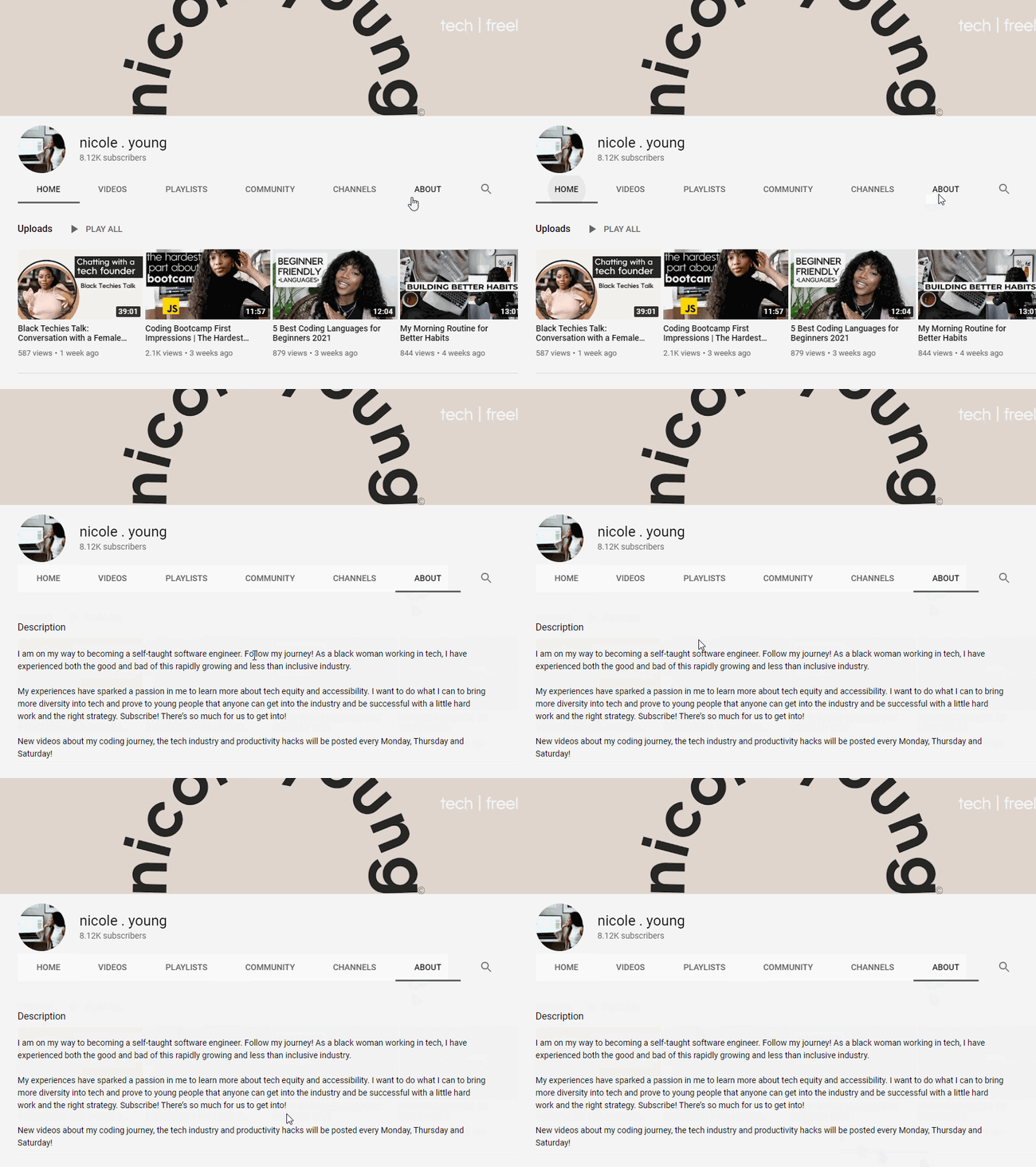
youtube channel description example

Your YouTube channel description conveys to potential viewers what your content will cover, including the issues you tackle and the communities you serve. You can add this when setting up your YouTube channel.

Take a look at my YouTube channel’s description, for example.
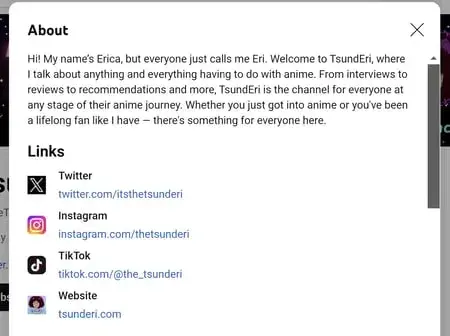
youtube description, erica

Notice how I introduce myself, state the kind of content viewers can expect, and reference my target audience. I also have links to other platforms connected to my channel, such as Instagram, X, TikTok, and my website.

As YouTube creators, our primary goal is to attract and turn viewers into subscribers, often using the channel description. With that in mind, use keywords your intended audience would use to search for your content.

See how “anime” is used multiple times in my channel’s description.

YouTube Video Descriptions

Every YouTube video includes a description that can be found under the viewport of the video. It’s crucial that each of your YouTube videos include a unique description to increase the likelihood of your video being found when someone is searching for a particular topic.

As a YouTube content creator, I always craft my video descriptions, knowing they can attract and convert an audience. So, I always optimize my video descriptions for SEO — and you should, too.

Keep reading if you‘re unsure how to start crafting compelling YouTube descriptions. I’ll explore tactics you can employ and provide templates to ensure you have everything you need to excel on YouTube.

What makes a great YouTube description?

Whether for your channel or a video, a great YouTube description accomplishes three things:

  • Explains your value
  • Piques interest
  • Presents a call-to-action

Explains the value of your content: Why should someone watch your video or subscribe to your channel? What unique value are you providing in the content you’re sharing? Your YouTube description should be clear about that.

Piques interest: This is where you’ve got to flex some of those marketing and copywriting skills of yours. As you’re explaining your value, make sure not to give it all away.

Leave some mystery to give the visitor a reason to watch or subscribe. Prompt a question that can only be answered by watching your video. Share an idea that they can only learn more about by subscribing to future videos. Bottomline: Leave them wanting more.

Presents a call-to-action: Whether that be a view, like, subscribe, or comment, your YouTube description should tell the visitor what to do next to get the promised value. And don’t be afraid to include multiple. YouTube descriptions can include links, so use this space to ask people to follow you on social, download an offer on your website, shop a product, etc.

In the rest of this article, I’ll explain how to optimize your YouTube channel and video descriptions with these things in mind.

YouTube Description Tips

1. Describe your unique value.

My colleague, Caroline Forsey, spoke with Eric Peters, former Senior Growth Product Manager on HubSpot’s Academy team, to explore the best tactics for writing YouTube descriptions.

He said, “[YouTube descriptions] are one of the primary ways YouTube knows what your video is about. Include links, additional resources, links to other videos and playlists, etc. Make sure the description box is easy to read.”

Peters explained that your YouTube video description and closed captioning should incorporate keywords into your description.

It also helps with accessibility for people who are deaf or hard of hearing. Hence, adding closed captioning to your videos is essential for accessibility. For instance, take a look at one of HubSpot Marketing’s YouTube video descriptions:
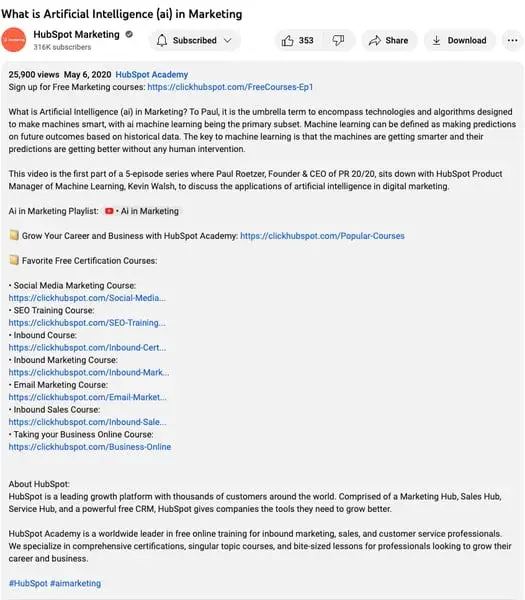
youtube description, hubspot

A YouTube description differs from a web page meta description. Some content creators explain their entire videos in their descriptions.

This may help with search engine optimization in addition to accessibility, but remember, if views are your goal, keep this short. The best way to get views is to make sure it has value the visitor can’t get anywhere else.

YouTube limits the number of characters in your description area to 5,000 characters.

Peters says:

“You get 5,000 characters total, so make use of it. YouTube creators use asterisks or all-caps to differentiate titles from body copy because it’s all plain text. Consider writing up a text version of the key points from the video or even copying the transcription and paste it into the description.”

Most of my most recent YouTube videos consist of interviews from my podcast.

So, I‘ll often save time by writing out the description I’d use for my podcast episode that would appear on Spotify or Apple Podcasts, then copying and pasting the same description into YouTube.

I‘d then tweak it to include more keywords or important links to other platforms. I’ll also customize my YouTube video description with the bold, italic, or strikethrough options at the bottom of the description box. For information, click here.

Pro tip: YouTube allows creators to use emojis in titles, descriptions, and comments. This can make your YouTube descriptions more playful and skimmable and add visual context.

2. Infuse your personality.

A YouTube description should be fun and demonstrate your brand’s unique personality and voice. This is something I never neglect. It’s what keeps people watching and subscribing to their favorite YouTubers, after all.

I love Brian Dean’s YouTube channel, for example. His YouTube descriptions often mirror the way he speaks. I enjoy his descriptions because they are candid and casual, and he makes it feel like he’s writing to a friend.
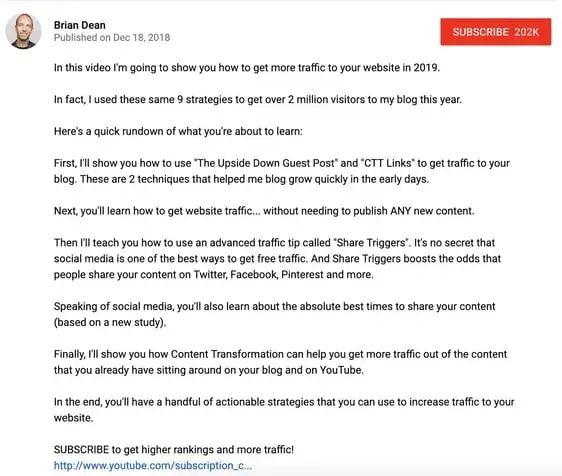
youtube description, draft

Consider checking out HubSpot Academy’s comprehensive YouTube Marketing course to learn more about using YouTube for marketing purposes.

3. Share your journey.

A lot of YouTubers are documenting journeys on their channels.

For instance, if your YouTube channel focuses on streaming video game content, you may invite subscribers to watch you as you attempt to win a particular game. Or if you’re a home chef, maybe you’re chronicling your progress through a cookbook or learning a new type of cuisine.

Explaining this goal in your YouTube channel description (or even reminding people of it in each of your YouTube video descriptions), adds depth to your content. It gives people something consistent to root for and get invested in.

4. Define your niche.

Whether you‘re writing a description for your channel or a video, define your niche. Start by introducing yourself or your brand, then highlight what you offer and what makes you different from other creators.

Be sure to incorporate relevant keywords used to search for content in your niche so your target audience has a better chance of finding you. (More on that soon.)

5. Create anticipation for new content.

What’s coming up next for you? What are you talking about in your future content? Detail this in your YouTube video descriptions and tease them in your channel descriptions.

Giving visitors an idea of what is to come creates a sense of urgency and anticipation. It gives them something specific to look forward to and want to subscribe or come back for.

Want some extra oomph? Try hosting giveaways, conducting polls, and inviting special guests to participate in the videos to keep your content fresh and build excitement.

Pro tip: Clip Creator, HubSpot’s AI-powered video maker, can help you create fun content to fill your YouTube calendar. Check out the free tool.

6. Include a call-to-action

What do you want people to do after watching your video or landing on your YouTube channel? Subscribe? Download a guide? Whatever it is, tell them that in your description and include a link if applicable.

Experience has shown me it’s best practice to format the description so that the most critical information, like a call-to-action, is first.

Peters advises, “The first 200 characters are above the ‘more’ fold on the description box, so if you want your CTA/link to be seen by most people, keep it within the first 200 characters.”

youtube description, academy

After the first 200 characters, the text will be cut off, and viewers must click “Show more” to see the rest. I know I don‘t always click “Show more” when watching a video, so your audience likely won’t either. Therefore, you must count your first 200 characters.

But don’t stop there …

7. Lead viewers to other resources.

When crafting your descriptions, make sure to link to related content that viewers might find interesting or helpful. For example, if you have a blog, you can link to a blog post that goes more in-depth on the topic you’re discussing.

Want to connect with people on other platforms? Drop the handles or links in your description. Mention or use one of your products or services in your content? Link to its landing page. Have an affiliate link or promo code? That should be in your description, too.
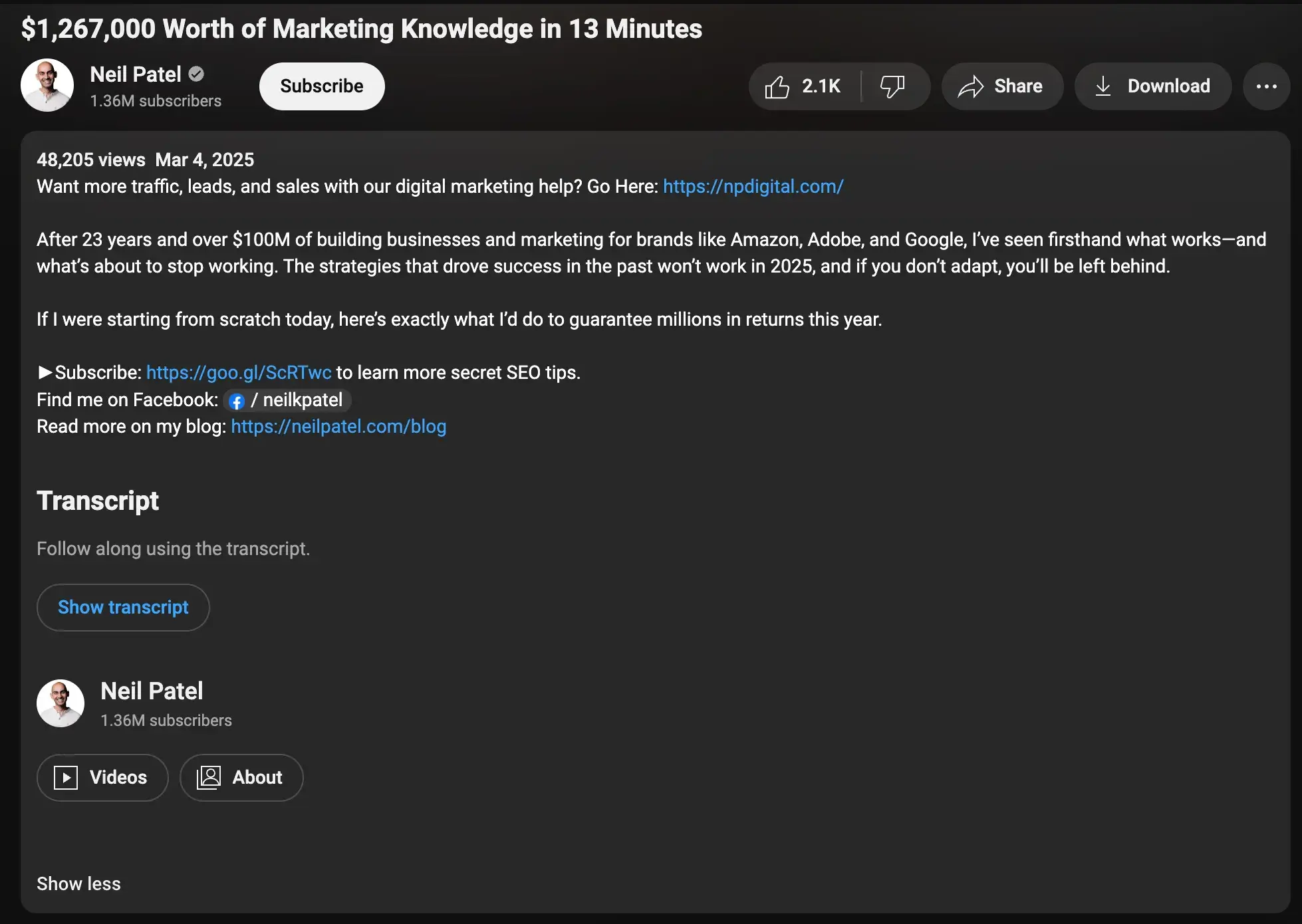
Source

I include links even in my YouTube Shorts descriptions, though they are not currently clickable.
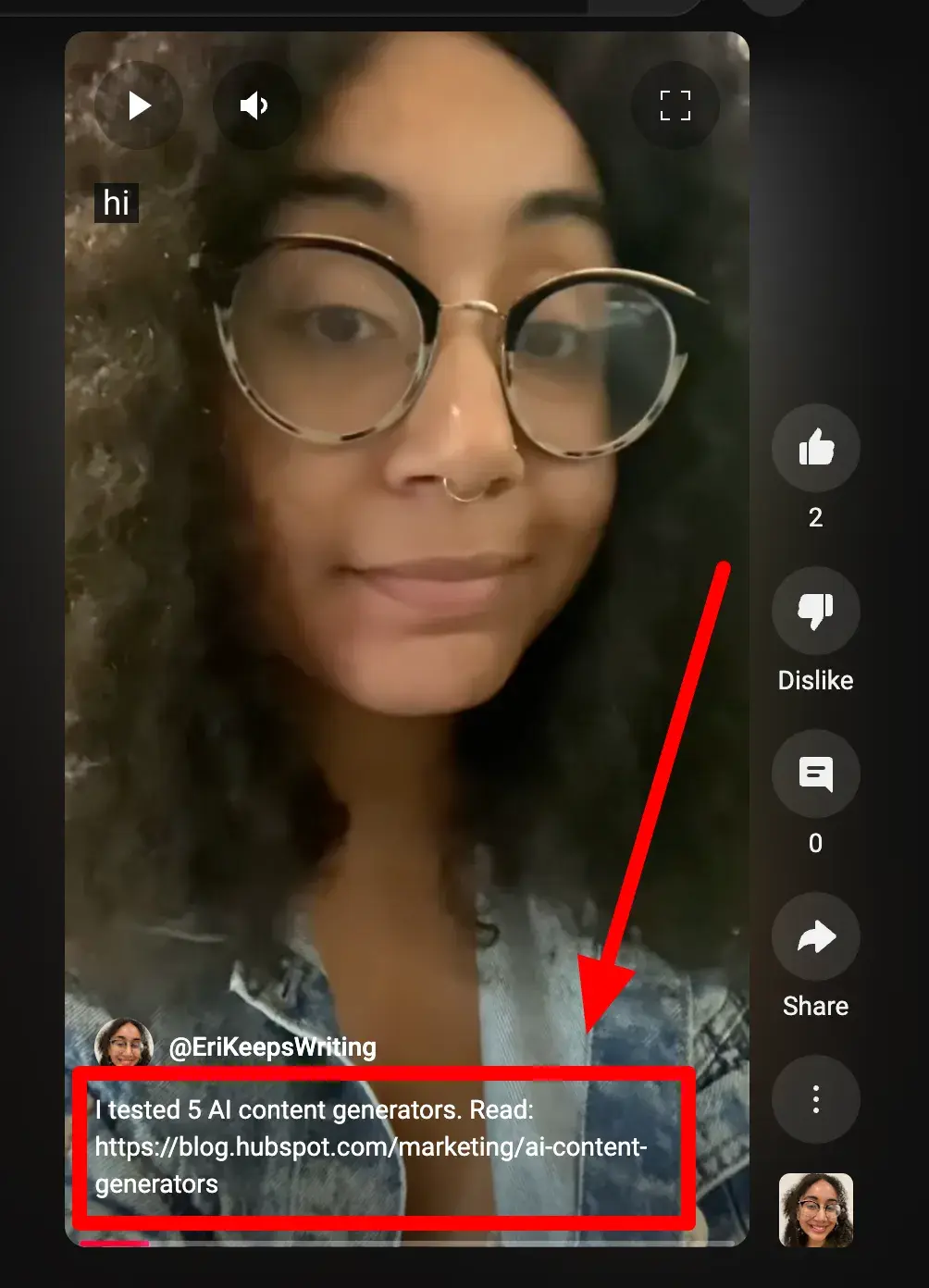
All of these resources help provide additional context to the viewer and bring more traffic to your website and goals.

8. Make it search-friendly.

As a child company of Google, YouTube is often touted as the world’s second-largest search engine. Search any term and you’ll see YouTube videos at the top of your results page.

As a content creator, it would be a huge mistake not to use this to your advantage to help your videos get found. Use keywords in your descriptions to increase the visibility of your YouTube channel and videos. Include relevant hashtags.

Like with written content, you‘ll need to conduct keyword research to determine which keywords you should target. Also, you’ll want to avoid repeating the keywords too much. Insert your keywords and hashtags where they would naturally. This will keep it easy to read and help you avoid keyword stuffing.

Read: YouTube SEO: How to Optimize Videos for YouTube Search

9. Prompt engagement.

Keeping your audience engaged is crucial for getting them to return for more content and also building a sense of community. YouTube descriptions can play a huge part in this.

Use your descriptions to spark conversation. Ask questions. Share an opinion and ask people to weigh in on the comments. Ask people to tag friends who may like the content shared. Sometimes, the easiest way to get engagement is simply to ask.

10. Test out different formats.

If your videos aren’t accomplishing your goals, try experimenting with different description formats and templates.

Maybe your descriptions are too long, and they get cut off on certain devices, or perhaps there are better keywords you can optimize for. Testing out different styles of descriptions will help find what works for your brand or even the video at hand. Different videos may need different styles!

Pro tip: Use YouTube description templates. [Free Prompts]

HubSpot compiled several YouTube video description templates to help your business provide context to your viewers, rank better in search, organize your team, and link to relevant web pages on your site.

We’ll also share 13 of our favorites later in this article.

11. Use timestamps to make videos scannable.

Now, this one’s specific to your YouTube video descriptions, but make use of timestamps.
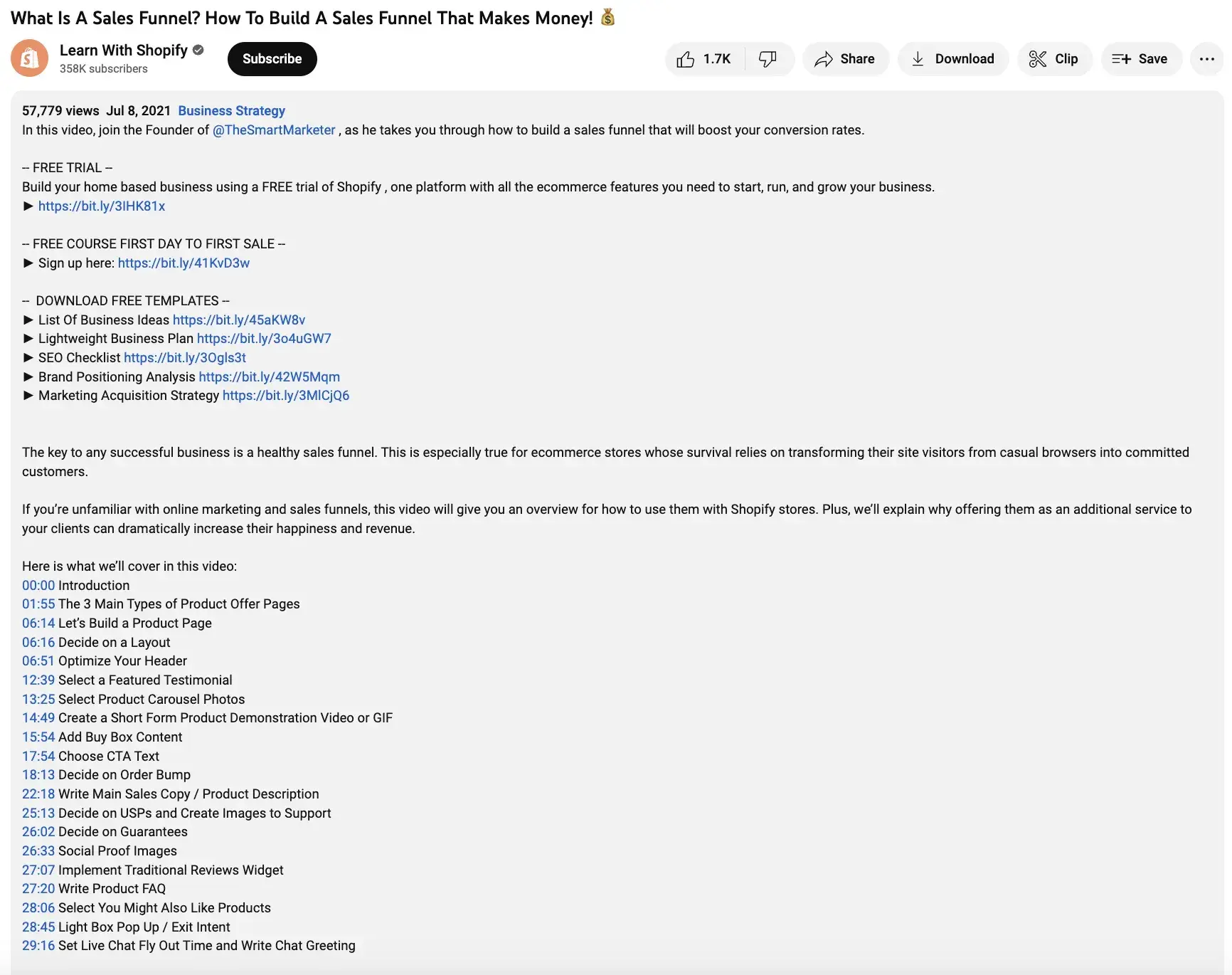
Source

Timestamps in your video description enable viewers to jump the specific content they need, making it more user-friendly and easy to digest. YouTube video timestamps also appear within search results, helping your video get found by those who need it.
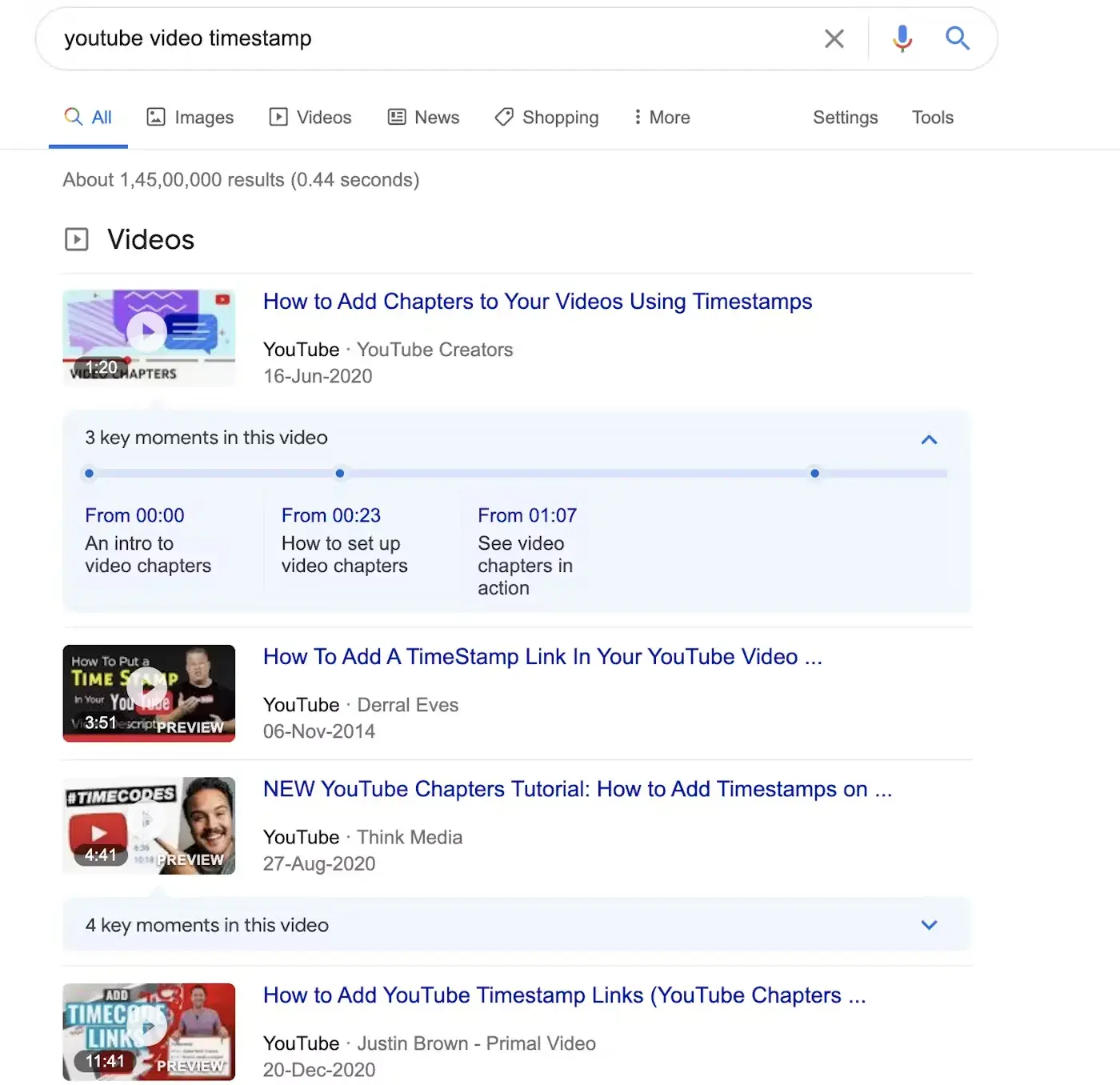
Source

YouTube Description Templates

Now that we’ve covered the basics look at a few templates you can use to craft a compelling YouTube description.

YouTube Channel Description Templates

1. Playful YouTube Channel Description Template

You might create a playful, easy-going channel ‘About Me’ description, like this one:

Hi, I’m [Name]. This is my channel about increasing your sales, effectively targeting your audience, and growing an email list that you can use to grow your business.

If you’re a marketer who wants to learn marketing strategies to get [result, i.e., more traffic to your site], subscribe to my channel.

My channel publishes videos that focus on storytelling content that connects X, shows you how to infuse your authenticity in your brand, and gives you a marketing strategy that feels organic.

If that sounds like it could be helpful for you, please join me!

2. Third-Person YouTube Channel Description Template

Alternatively, you can craft a YouTube description that describes what your company does from a third-person point of view, like this one:

[Company] is the worldwide leader in X, Y, and Z. Since [year], [Company] has been on a mission to [insert company vision or purpose here].

To learn more about [Company], its values, and its [company offering], subscribe to our channel to stay informed.

3. Niche YouTube Channel Description Template

Tell your subscribers what you’re all about and describe your niche when writing your YouTube channel description.

[Name] and [Name] have nuanced discussions about dating, their lifestyle, and relationships. They discuss current topics that affect modern dating and how to maneuver relationship patterns. You can purchase [Name] and [Name]’s [product] to learn more about improving your knowledge of relationships.

4. Inviting YouTube Channel Description Template

Building a relationship with your followers is one of the most important things you can do as a content creator. This template invites them to join you as you grow your brand.

This channel gives everything you need to know about gaming, including the latest equipment reviews, new game reviews, and once-a-week live streams. Watch as I, [name], try to beat my high score in the latest release of [insert game name here].

5. Personal YouTube Channel Description Template

Don’t be afraid to be vulnerable with your audience. Adding personal touches to your YouTube channel description, like the template below, can help you become more authentic.

This is a personal journey of how I became a painter. Learn about what paints I purchase, the tools I use, and the techniques I learned during school. Art is my passion, and I express my love for [insert passion] through it.

6. Straight-forward YouTube Channel Description Template

Tell your audience exactly what they can expect from your channel by using this template:

This channel gives pop culture commentary through a [political ideology] political lens. We make commentary on books and current events. We also upload a new video every Wednesday and Friday.

YouTube Video Description Templates

A YouTube video description is descriptive text that includes but is not limited to keywords, themes, and special concepts/guests that the content creator wants their viewers to know.

The YouTube video description increases visibility through SEO, views, and subscriptions. In each video description, the content creator will encourage their viewers to “Like,” “Share,” and “Subscribe” to their content.

An effective video description will be persuasive and informative, prompting the audience to tune in regularly.

7. Simple YouTube Video Description Template

Rather than writing a lengthy summary of your video, keep your descriptions detailed enough to let the viewer know what to expect, yet concise enough so they don’t lose interest.

Listen to how our CEO explains the difference between X and Y, and learn best practices for implementing your own strategy.

Learn more about X and Y in our course: [course link].

8. Social Media YouTube Video Description Template

You can use a YouTube channel description like this one to help new viewers connect with you on your other channels and social media platforms:

Hi there! New to [name of channel]? If so, here’s what you need to know: I like [interests related to channel] a LOT, so I use this channel to explore X, Y, and Z to help you [desired result for viewer].

Where else you can find me:

INSTAGRAM: http://instagram.com/[accountname]

TWITTER: http://twitter.com/[accountname]

LIFESTYLE CHANNEL: http://www.youtube.com/[accountname]

Join our growing community for new videos every Tuesday and Friday!

BUSINESS INQUIRIES

Please contact [PR representative] at [email or phone number].

9. Search-Friendly YouTube Video Description Template

YouTube increases visibility within keyword searches and relevant content. As a result, videos should have buzzwords in video and channel descriptions.

If you want to craft a description that explains what your video is about and incorporates a keyword description, try this:

Hey there! This lesson is part of a free online course. Take the full course here: www.company.com/course1.

Some people are unsure what X is — at its most basic, X is [brief definition of keyword]. In this video, you‘ll learn how to X, Y, and Z, to ensure you’re able to grow your brand online.

In addition, we’ll explain how you can avoid doing A. Sometimes, A is all it takes to lose a customer.

10. Teaser YouTube Video Description Template.

Use your video descriptions as an opportunity to let your viewers know when to expect new content from you, like this template:

Join the “musical nerds” on a mission to improve our musical understanding. We upload every Wednesday and Thursday. We will have Q&A sessions to answer all of your beginner questions on Wednesdays starting next week.

11. Transparent YouTube Video Description Template

Transparency is key to gaining the trust of your audience. This template is an excellent example of how to let your viewers know when you are using affiliate links in your descriptions.

What‘s up, guys? In this video, we’ll talk about an everyday makeup look you can do in 10 minutes. I‘m not an early riser, but just like anyone, I still want to look good for the day. I’ll list the products I used in this video.

Please subscribe if you are feeling my vibe. I post content weekly, and you can always find me on Insta! I’ll drop my social media handles below.

**All opinions are my own. This video isn‘t sponsored. I’m sent products for my consideration, and I earn a small percentage from sales through affiliated links. Clicking on affiliated links doesn’t cost you anything.**

12. Engaging YouTube Video Description Template

Engaging with your audience is essential for building community with them. Here, this description encourages viewers to leave suggestions in the comments section to be featured in future videos.

Hi, everyone! We‘re the Science Kidz! Today, we are experimenting to find out which popcorn brand leaves behind the least number of kernels. Will it be Orville Redenbacher’s or Act II?

Every week, we do a new experiment as part of our initiative to highlight STEM careers in Savannah, Georgia. If you have an experiment you want to see The Science Kidz try, leave a comment below. You never know — we could pick yours!

Follow me on Instagram for more experiment ideas, and tag us in some of the experiments you do with your friends!

13. Sponsored YouTube Video Description Templates

Disclosing paid sponsorships or product placements doesn‘t have to be super jargon-heavy. A template like this can help you be candid with your audience without straying from your brand’s voice and sounding like a robot.

Hey, y‘all! Today, we’ll be rebuilding a 454 Chevy Big Block motor. We‘ll be adding 200 horses to bring the motor up to 680 horsepower. I hope y’all are ready to dive into business with Motor Boyz.

This episode is sponsored by Husky tools, and we’ll be using their latest impact and driver tools to rebuild the 454. We would like to thank Anderson Auto for donating the 1972 C10 to be our frame once the motor is rebuilt and completed.

YouTube Description Examples

YouTube Channel Description Examples

Every YouTube channel description should allude to a specific niche or central theme. You want to tell your audience what they will learn from your channel.

This will give them a reason to tune in to your channel, subscribe to it, and continue learning from you and your videos. Additionally, when you add your niche to your YouTube description, your audience can more easily find you in a sea of potentially similar creators.

1. Wes McDowell
youtube description, wes

Source

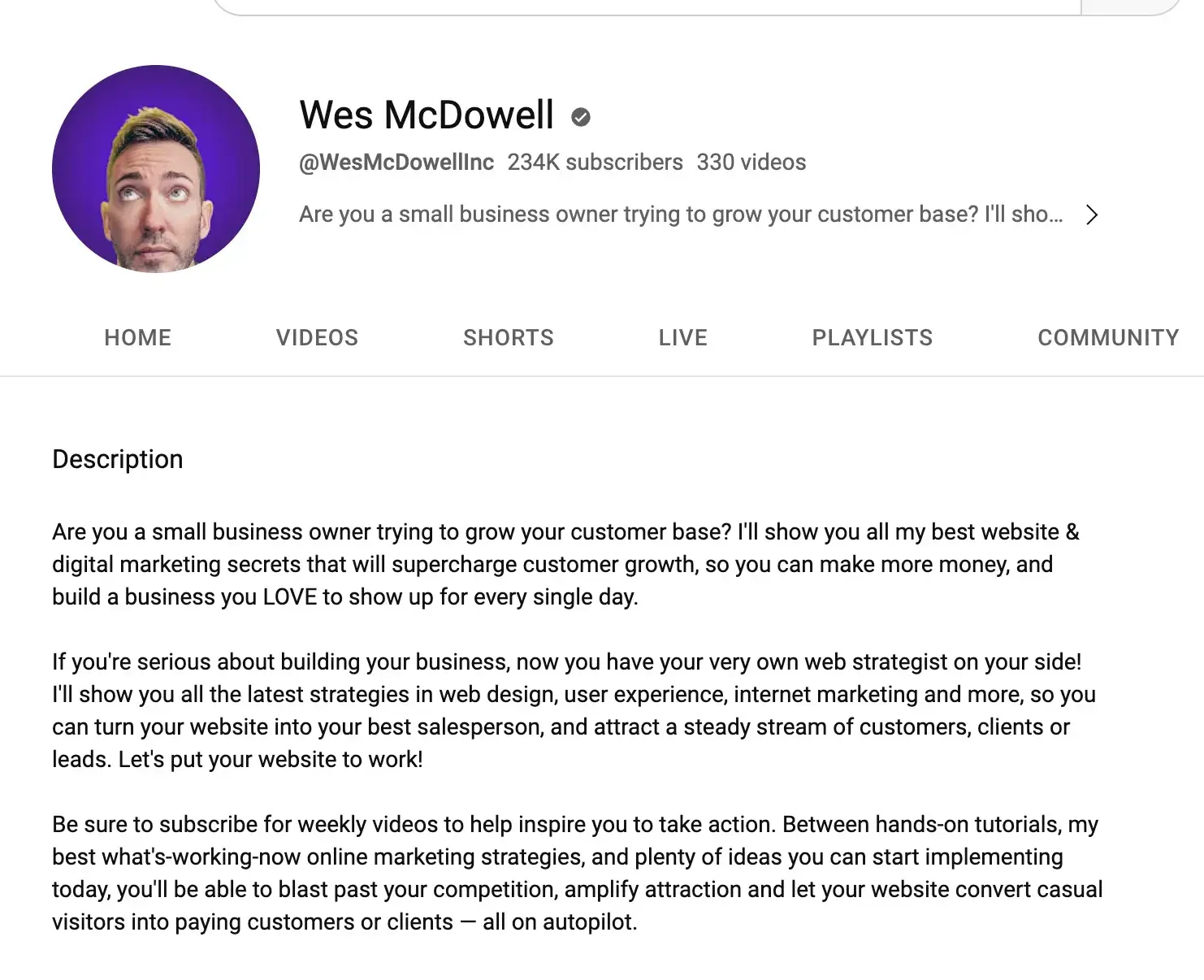
Wes McDowell ‘s YouTube channel targets viewers in the digital marketing niche. The channel description mentions its mission: teaching small business owners digital marketing strategies they can use to grow their businesses.

The description also lists topics the channel will feature in its videos, invites viewers to subscribe, and describes its benefits.

Why I Love It

This YouTube channel description is clear and direct. It details what viewers will get when they visit the channel and the marketing strategies and techniques they will learn.

Clarity goes a long way in making a channel easily searchable and rankable on YouTube.

2. Yoga With Adriene
youtube description, yoga

Source

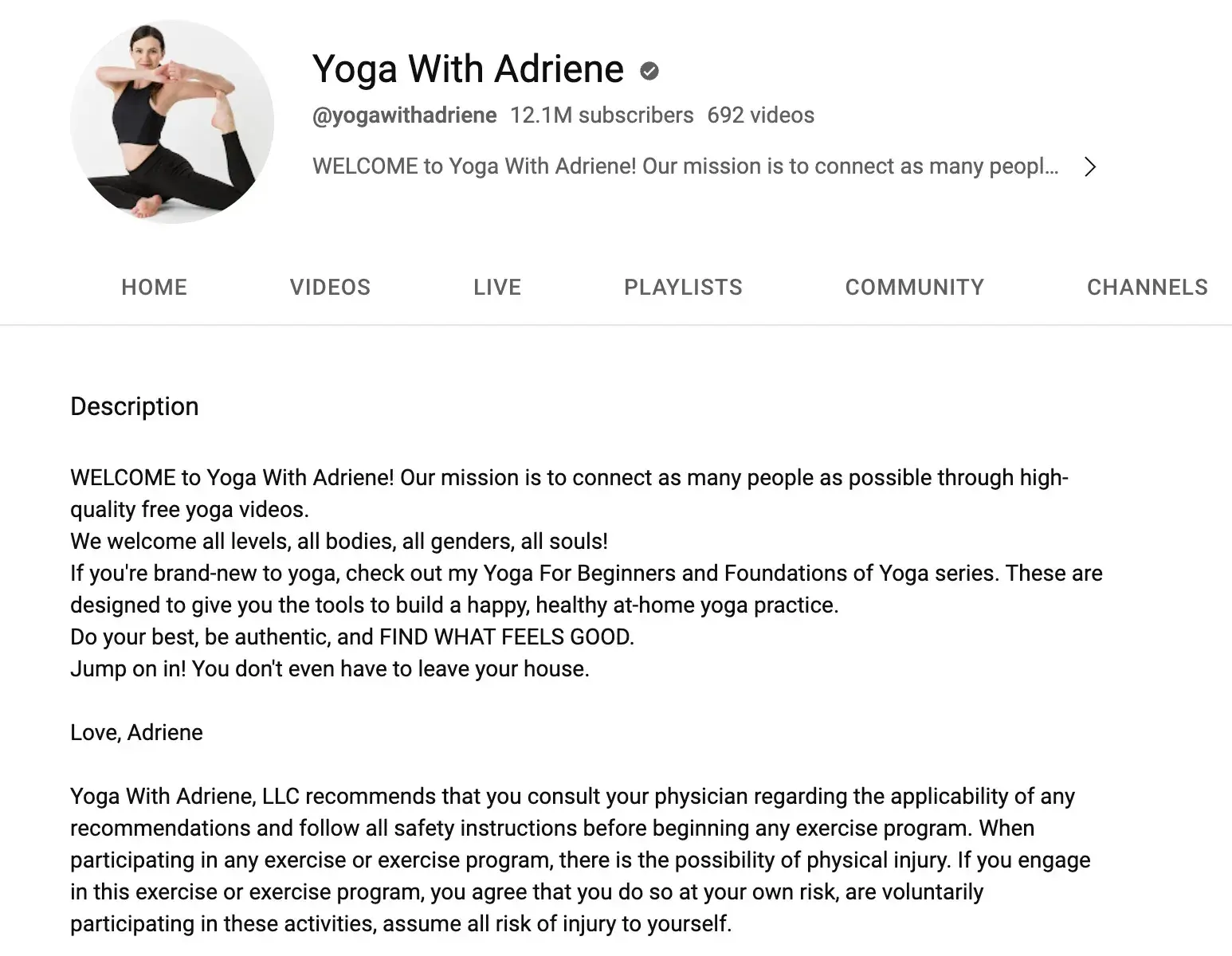
Yoga With Adriene‘s YouTube channel description highlights one of the channel’s main values: inclusion.

The channel description mentions that everyone is invited to participate and learn more about yoga through her videos, regardless of their skill level. The description also recommends videos that beginners can watch to become familiar with the content.

Why I Love It

This channel description is an excellent example of how a company‘s mission can be useful for video content. The description gives subscribers a glimpse into Yoga with Adriene’s values, creating a connection with the viewer.

This angle is helpful for ranking on YouTube because it’s aligned with morals and values that subscribers can easily identify with.

I started watching Yoga with Adriene‘s videos partially because the channel description convinced me they’d be great for beginners (and they are!).

3. Wild Wonderful Off-Grid
youtube description, wild wonderful

Source

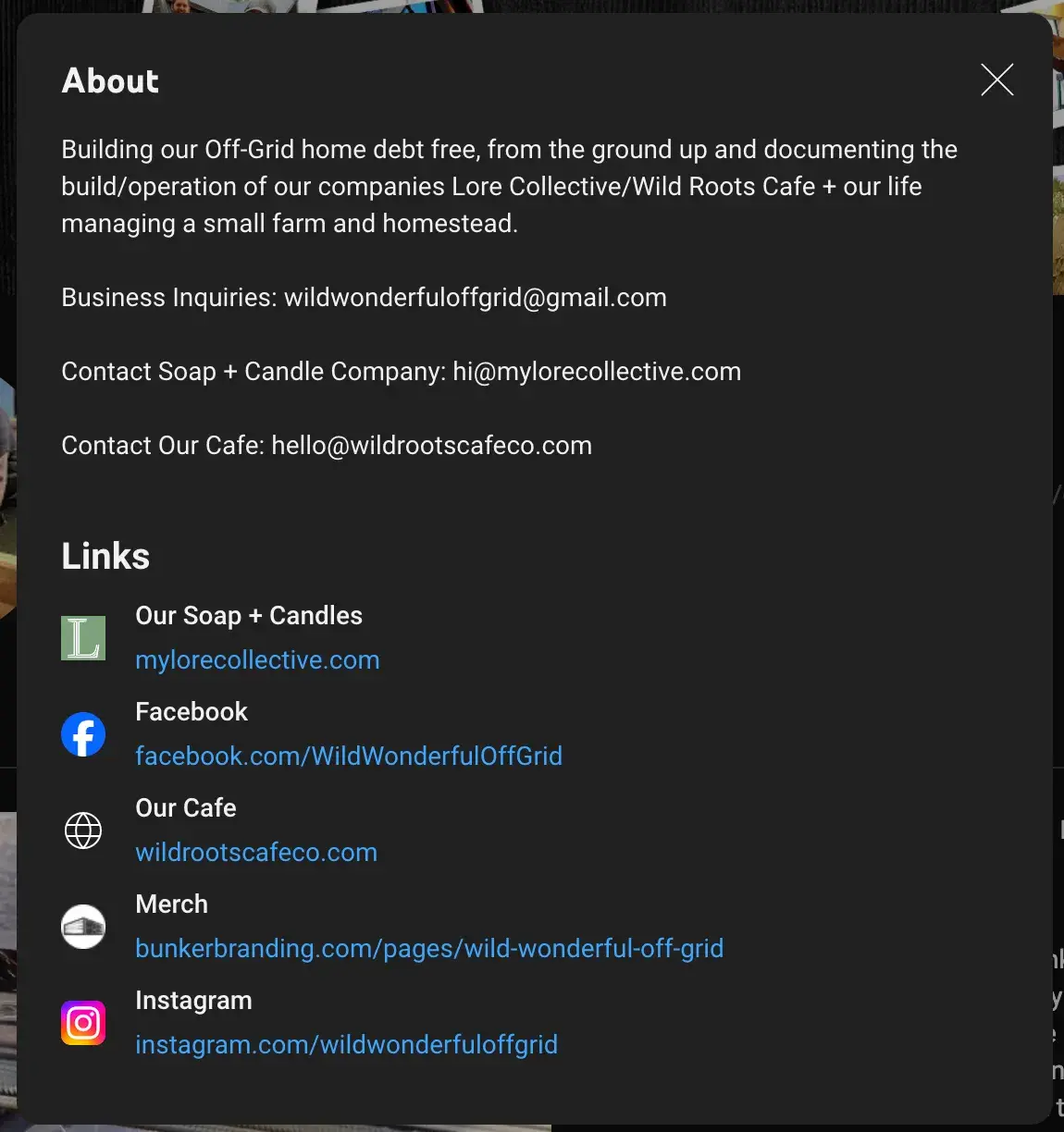
Wild Wonderful Off-Grid ‘s YouTube channel description positions the channel within a niche by using the keywords “off-grid” and “debt free,” to appeal to viewers who are interested in living off-the-grid.

The description also invites viewers to visit their online store and social media profiles.

Why I Love It

This YouTube channel description establishes a niche, describes the channel’s content, provides background information about the creators, and encourages subscribers and viewers to participate further in their brand.

I also love how the description also directs their audience to other aspects of their business, such as their store and social media platforms, which fosters value for their subscribers.

4. The Pals
youtube description, the pals

Source

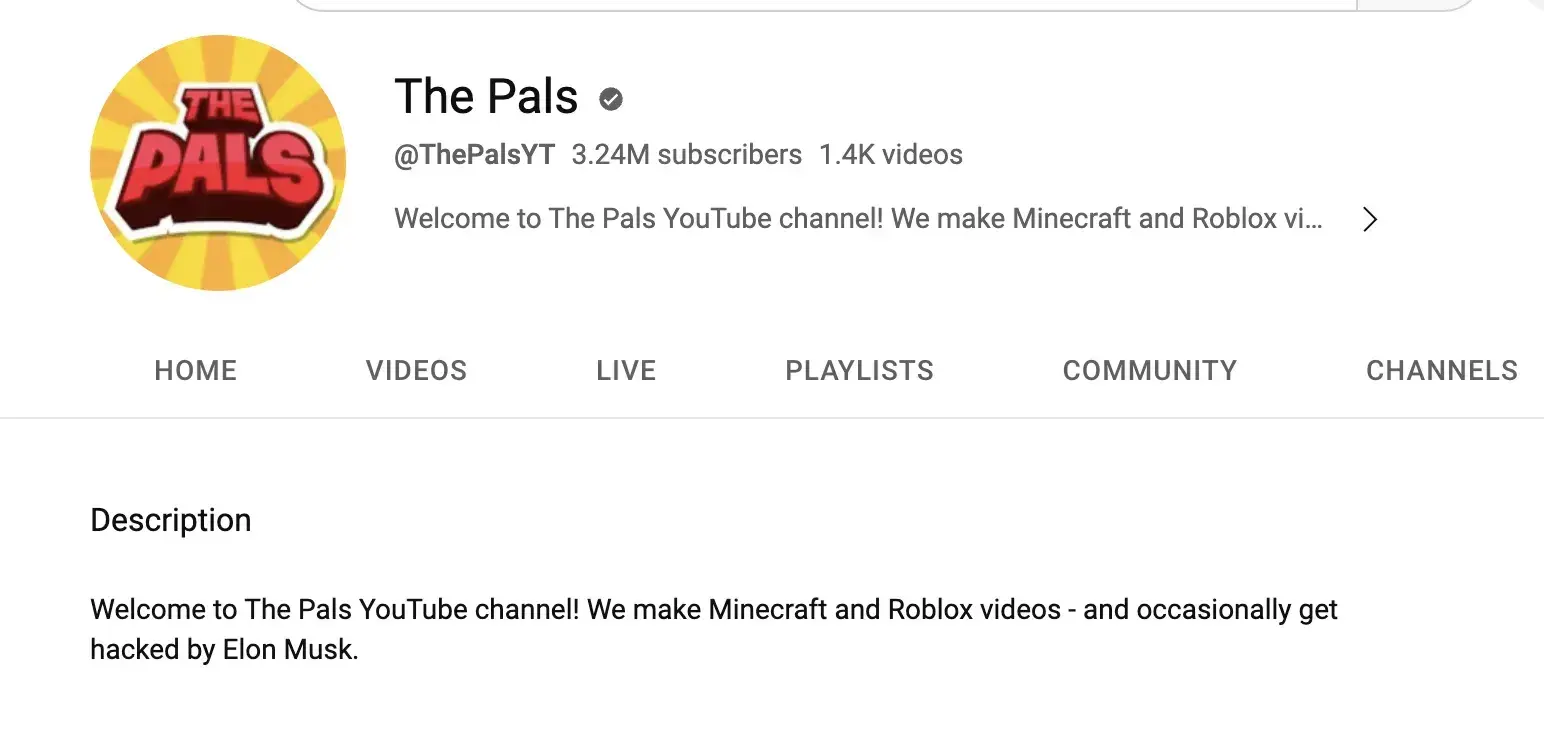
The Pals‘ YouTube channel description introduces the channel’s creators, lists the video games the channel will highlight, and provides each creator’s personal YouTube channel and Roblox username.

Why I Love It

This YouTube channel description focuses on the entertainment the channel provides.

The description targets subscribers seeking gaming knowledge and mentions the creators’ journeys to set the channel apart from others in the same niche and genre.

5. Florian Gadsby
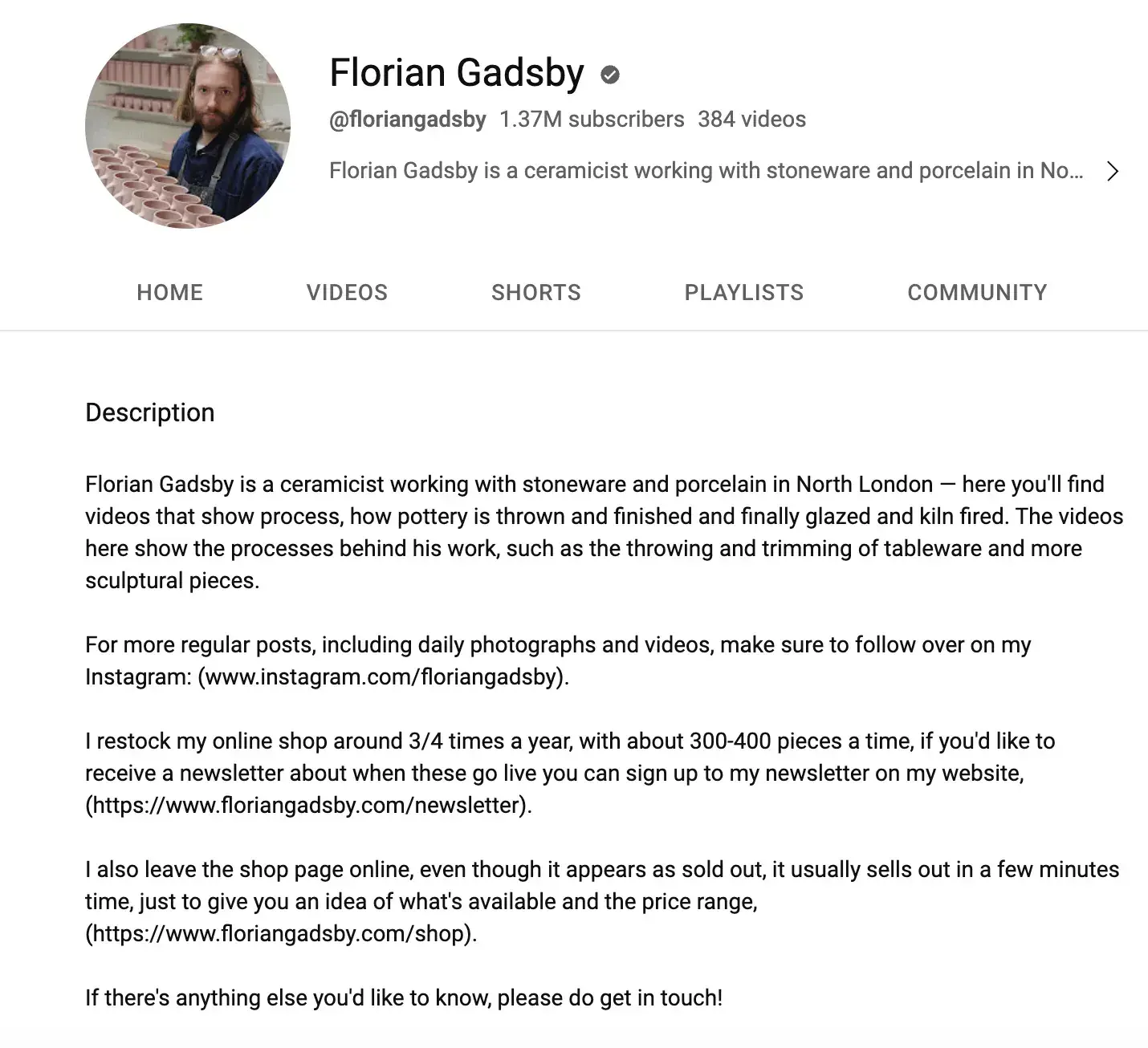
youtube description, florian

Source

Florian Gadsby‘s YouTube channel description introduces the channel’s creator and lists the topics viewers can expect to see when they subscribe.

It also links to the creator‘s social media and newsletter and provides information about the creator’s online store, including its restocking schedule.

Why I Love It

This YouTube channel description takes a personal approach to the subject matter. The description gives visitors clarity about the channel’s content and artistic focus.

It also encourages viewers to interact with the creator on their social media platforms to learn more about them and view more of their content.

6. SciShow
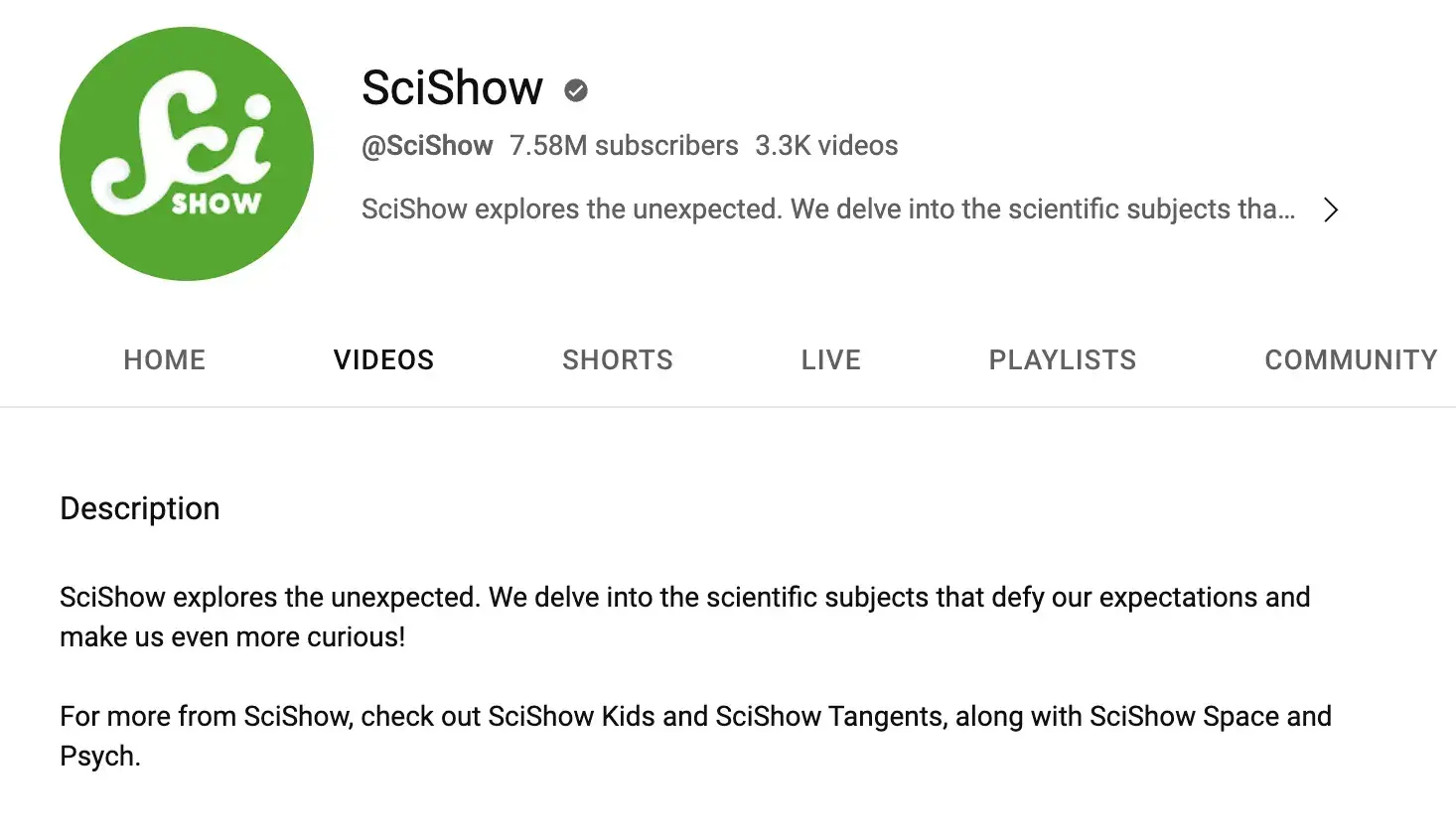
youtube description, sci show

Source

SciShow‘s YouTube channel description introduces the channel’s creators and hints at the topics viewers can expect to see weekly.

The description also outlines the channel’s posting schedule and mentions other YouTube channels associated with the brand.

Why I Love It

This YouTube channel description tells its viewers when they will see uploads. This is an excellent strategy to ensure users visit the channel right when they’re expecting to see new content.

If views go up on a page, the YouTube algorithm will likely boost your channel to a broader audience. Just make sure you stay on schedule.

I personally avoid putting the schedule for future uploads in my descriptions because mishaps happen, and I don‘t want to let my viewers down. But that’s just a personal hang-up I have.

7. Unbox Therapy
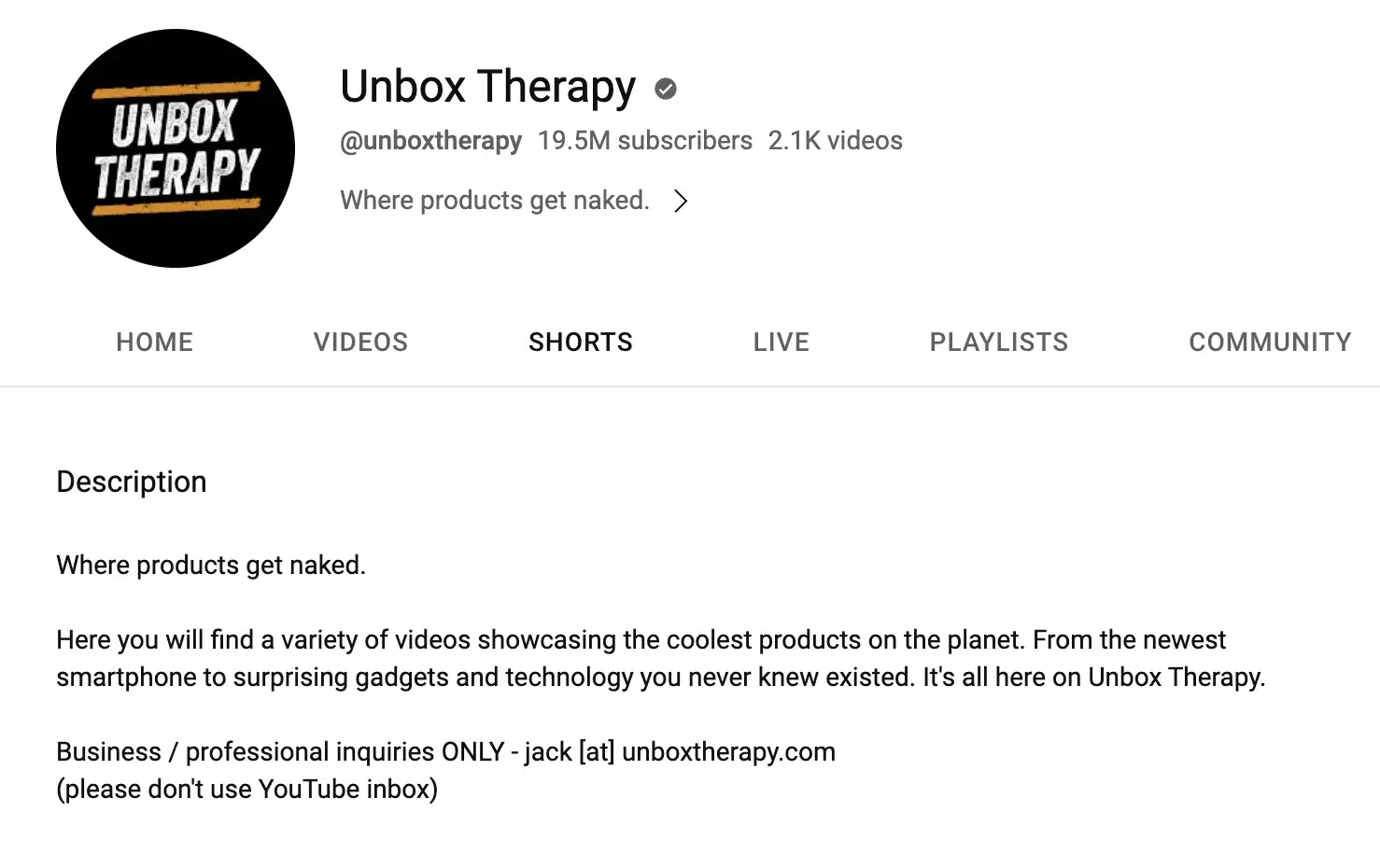
youtube description, unbox

Source

Unbox Therapy‘s YouTube channel description states the channel’s tagline, gives an overview of the channel’s content, and provides a contact email for business inquiries.

Why I Love It

This simple channel description piques viewers‘ interest with a captivating tagline and a straightforward explanation of the channel’s content.

It also includes an email that allows viewers to contact the creators to inquire about the business and ask professional questions about the channel.

8. Babish Culinary Universe
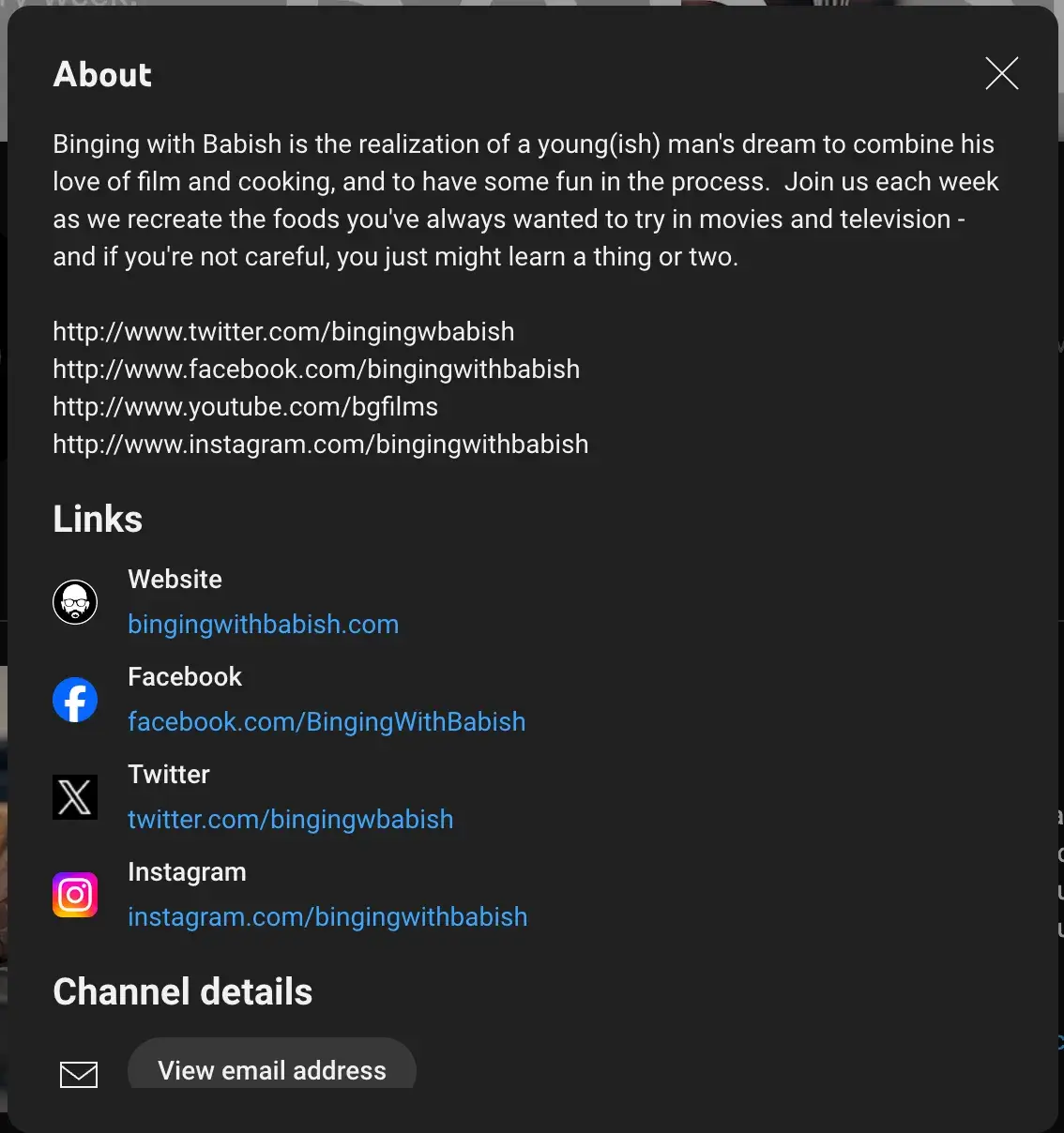
youtube description, binging with babish

Binging With Babish’s YouTube channel description is short and sweet, introducing exactly what you’ll get (a mix of food and film). He also sets expectations by mentioning there will be new content every week.

Why I Love It

I love that Babish subtly, but effectively shows his personality in this channel description. The age joke shows his humor, something that definitely comes through in his videos. I also like his use of inclusive/collective language. He says join “us,” suggesting a sense of community.

9. Sundas Khalid
youtube description, sundas khalid

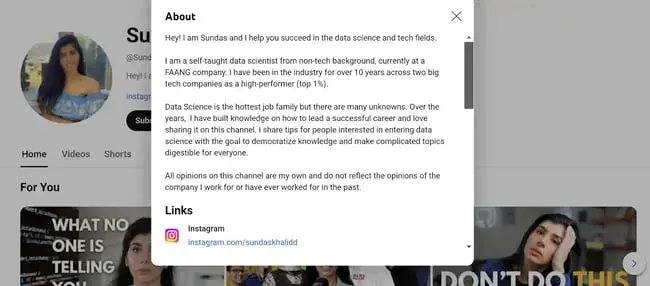
Sundas Khalid‘s YouTube channel description starts with a friendly “Hey!” before explaining who she is and what she does: “I am Sundas, and I help you succeed in the data science and tech fields.”

The description then dives into her background as a self-taught data scientist.

It also highlights her achievements as someone with 10 years of experience across two prominent companies where she was a high performer at each.

Why I Love It

I love Sundas Khalid because she relates to her audience by using a friendly tone and explaining that she is self-taught and from a non-tech background.

Her approach shows she creates content for viewers who may have little to no experience in the tech field but want to break into the industry or sharpen their knowledge.

I especially like how she includes a disclaimer at the end, letting readers know her opinions are her own and do not reflect those of the company she works for. It’s a great example of transparency while separating your work and creativity.

10. Matte Wolfe
youtube description, matt wolfe

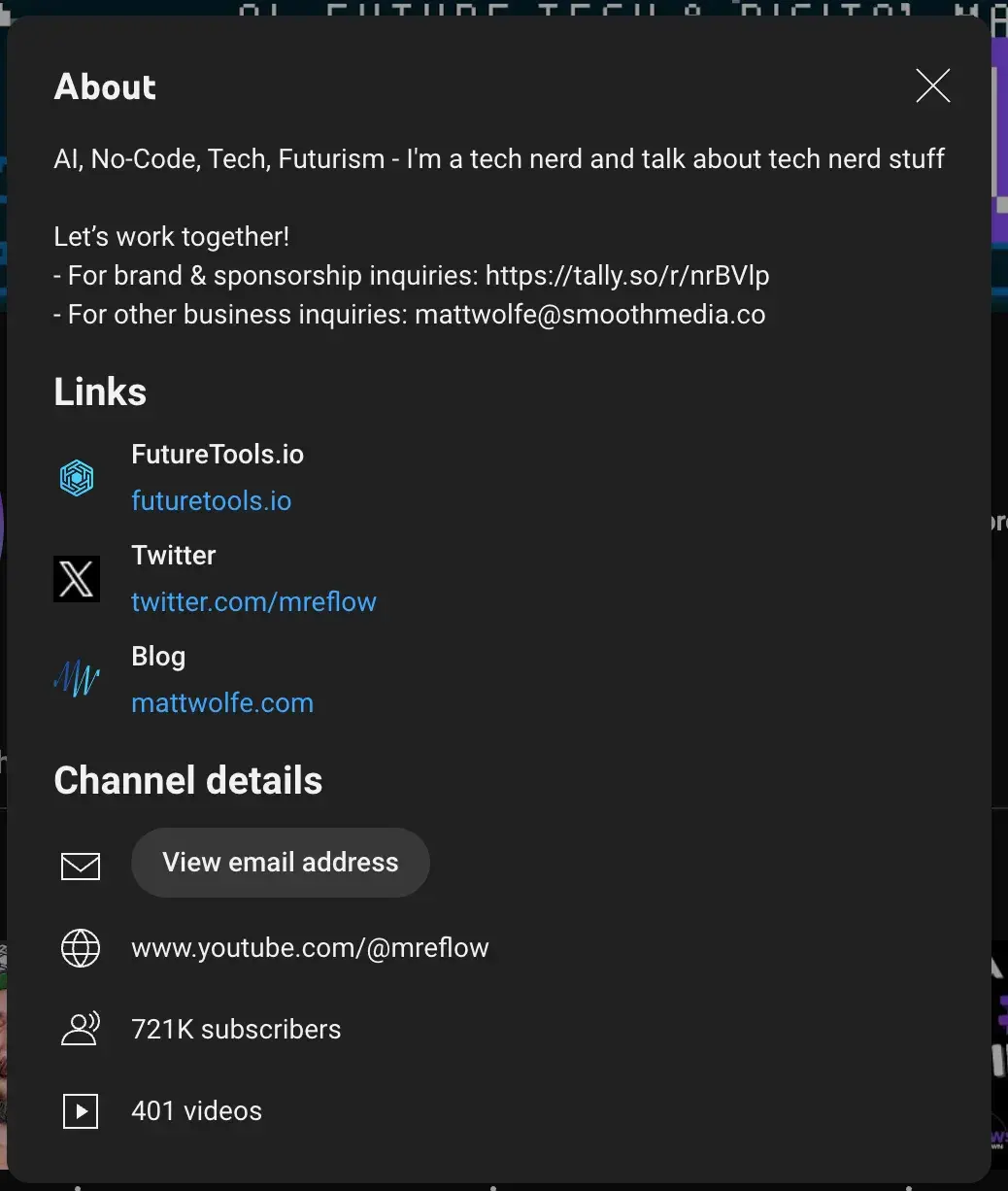
What Matte Wolfe’s description lacks in words it makes up for in key links. Wolfe’s YouTube channel includes links to his blog, Twitter (now X) account, his AI tool database, and ways to work with him.

Why I Love It

Wolfe’s channel description is a great model for how less is more, especially if your channel covers a broad spectrum of topics within your niche.

Just make sure you use the extra space saved in your channel to highlight important links, such as to your blog, social media channels, or business.

YouTube Video Description Examples

A helpful video description can spike your audience’s interest, resulting in longer watch times, better view counts, and even new subscribers.

Plus, it can help with YouTube SEO, allowing YouTube’s algorithm to understand your content and suggest it to new users, further boosting your YouTube metrics.

1. “5 Best Coding Languages for Beginners 2021” by nicole . young
youtube description, nicole . young

Source

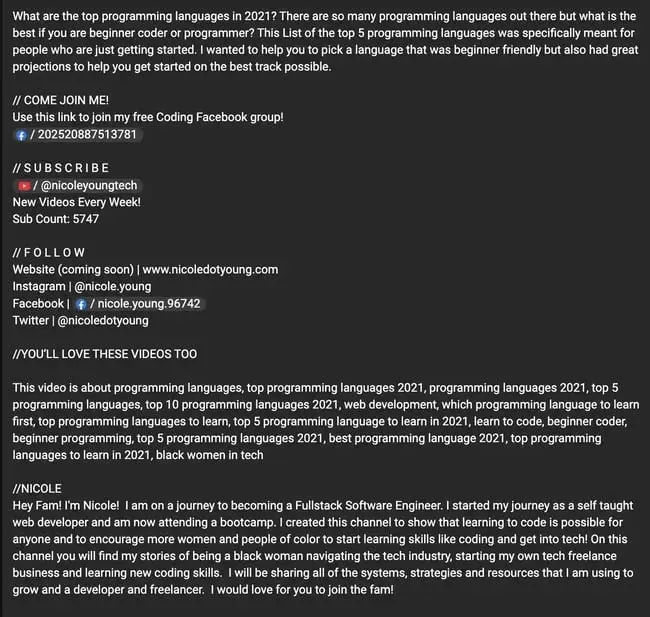
The description of nicole . young’s YouTube video, “5 Best Coding Languages for Beginners 2021,” hooks the viewer by posing a question that will be answered in the video.

The video description also includes a benefit the viewer will gain from watching the video.

Why I Love It

In this video description, the creator summarizes the video‘s title and specifies the target audience. The text will help audiences (and YouTube) understand the video’s content.

This creator understands that the channel description is prime real estate for contact information, social media handles, and calls to action, persuading viewers to stick around.

2. “How to Write Counterpoint – Music Composition” by Music Matters
youtube description, music matters

Source

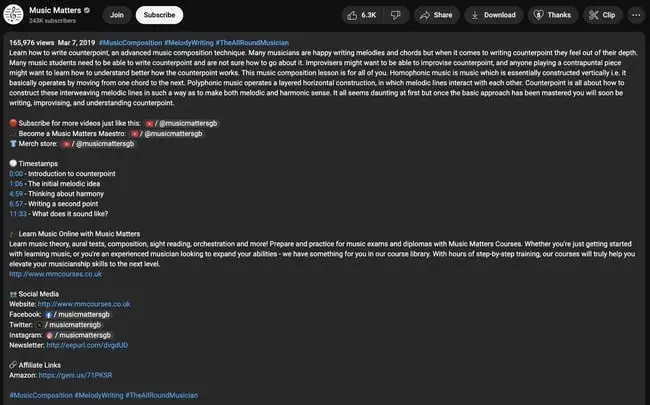
The description of Music Matters’s YouTube video, “How to Write Counterpoint – Music Composition,” uses keywords such as “writing counterpoint,” “music composition lesson,” and “understanding counterpoint” to appeal to audiences that are interested in learning the music composition technique.

The description also includes timestamps that viewers can use to skip to the portion of the video that addresses the specific topic they want to learn about.

Why I Love It

This YouTube video description uses keywords to appeal to a niche audience. The specificity makes it easily searchable on YouTube. Using keywords to make each video search-friendly will drive traffic to your video’s specific content.

3. “How to Create a 90-Day Plan for your Business (+ Free Workbook)” by Anna Clark
youtube description, anna clark

Source

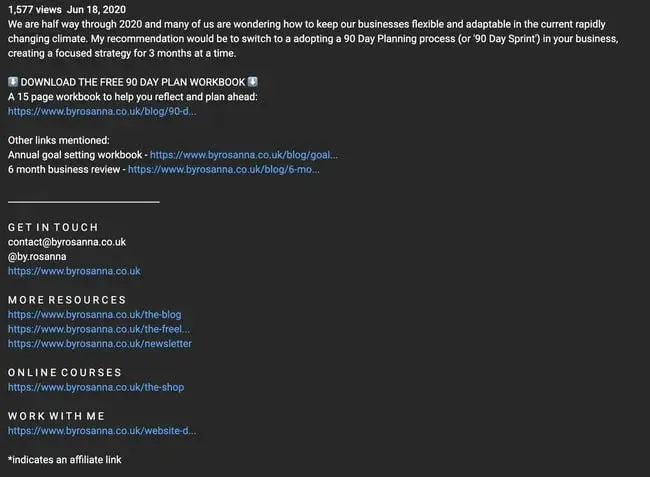
The description of Anna Clark’s YouTube video, “How to Create a 90-Day Plan for your Business (+ Free Workbook),” includes links to the creator’s website, courses, newsletter, and social media accounts, and a workbook that viewers can download and complete as they watch the video.

Why I Love It

It’s good to involve your viewers in other aspects of your business. The interaction and engagement you earn will help you rank against other active channels. Directing your viewers to other resources for your business will also help your YouTube channel drive traffic to your website, increasing your authority in your business niche.

4. “How To Create an Email Sales Funnel” by Wishpond
youtube description, wishpond

Source

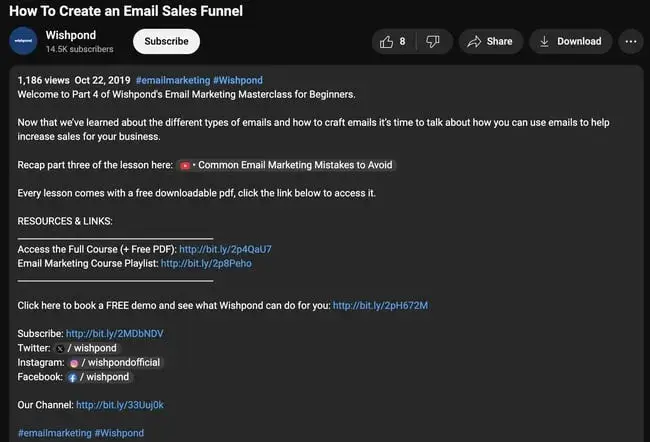
The description of Wishpond’s YouTube video, “How To Create An Email Sales Funnel,” hooks the viewer by stating that the video is the fourth installment in a series and linking to the previous video. The video description also incentivizes viewers to learn more about the company.

Why I Love It

This description segments the video as a section of a more extensive series. If subscribers learn that you provide similar content on your channel, they will be more inclined to watch your other videos.

The description also lets viewers know there’s a free demo of the service. If you sell different products or services in your business, link them in the description.

5. “How to Outline Your Novel – Part 2” by Writing with Jenna Moreci
youtube description, writing with jenna moreci

Source

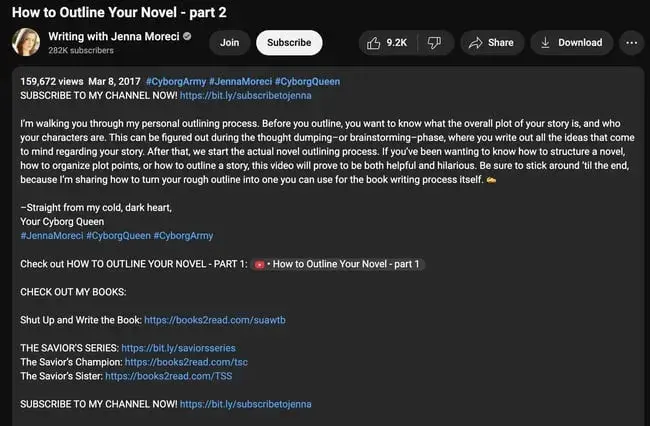
The description of Writing with Jenna Moreci’s YouTube video, “How to Outline Your Novel – Part 2,” hooks the viewer by stating that the video is the second installment in a series and linking to the previous video.

The video description also lets viewers learn more about the creator’s products.

Why I Love It

This video description is excellent because it lets viewers know what’s coming next. Inserting a “new segment” in your YouTube series lets viewers anticipate your next video.

6. “Microgreens Growing: Materials and Beginner’s Guide” by Epic Gardening
youtube description, epic gardening

Source

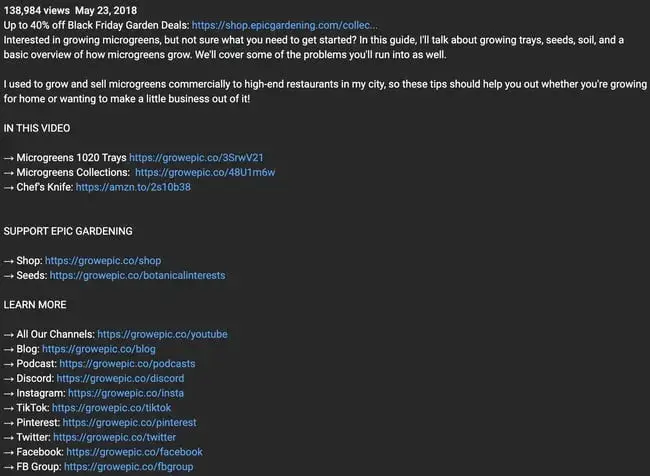
The video description tells viewers about the creator’s experience with microgreens, lists the supplies the creator mentions in the video, and lists ways that viewers can support the creator beyond watching their video.

Why I Love It

The creator provides a list of products used in the video. The viewers can research the products or purchase them immediately through the links.

7. “Budgeting for Beginners – How to Make a Budget from Scratch 2021” by Debt Free Millennials
youtube description, debt free millennials

Source

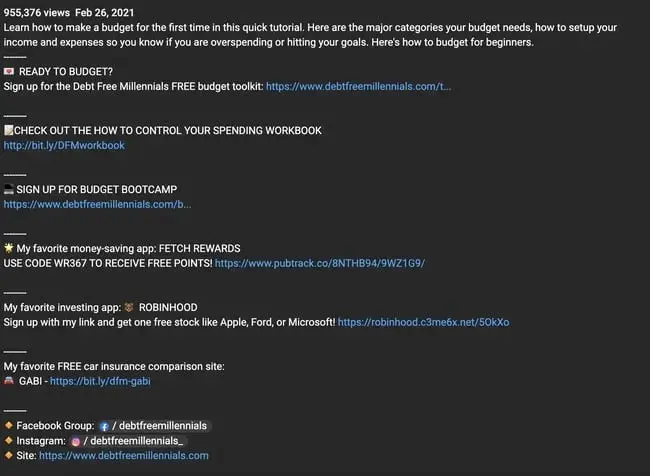
Debt Free Millennials’ YouTube video, “Budgeting for Beginners – How to Make a Budget From Scratch 2021,” teaches viewers to create a budget.

The description gives viewers an overview of the topics covered in the video and invites them to sign up for products and services through affiliated links.

It also includes links to the creator’s Instagram, Facebook group, and website so viewers can connect with the creator through different social platforms.

Why I Love It

I love that the creator has created a sense of community and togetherness. If you include your social media links in your YouTube video description, subscribers will follow you on multiple platforms to remain engaged with your content.

The content creator invites them to return for new videos and share their experiences on social media.

8. “FINALLY be consistent on social media” by Jade Beason
youtube description, jade beason

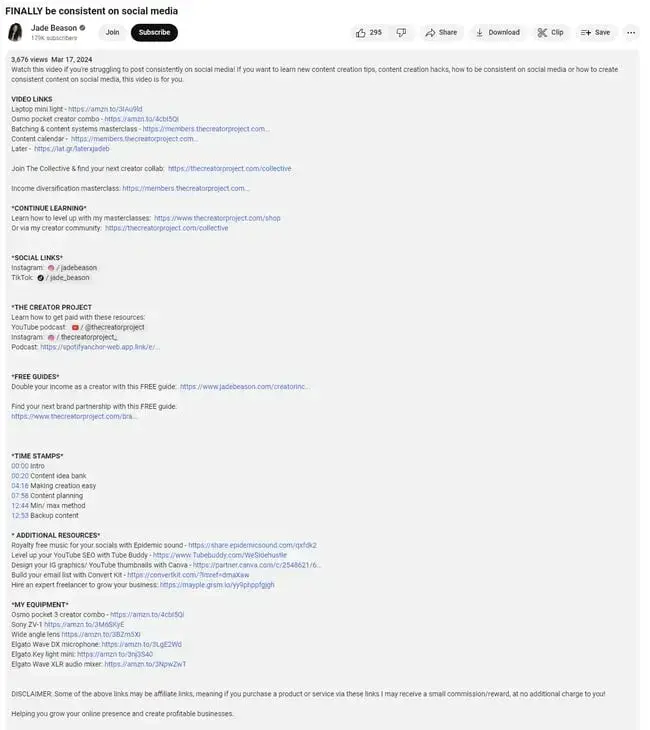
Jade Beason‘s video gives viewers tips and strategies for staying consistent on social media as a creator or business owner. Her video’s description is simple and captures who and what the video is intended for:

“Watch this video if you’re struggling to post consistently on social media!

If you want to learn new content creation tips, content creation hacks, how to be consistent on social media or how to create consistent content on social media, this video is for you.”

Why I Love It

Since Beason‘s video description is so short, it leaves plenty of room for her to list other important information, and that’s what she does.

As viewers read through the description, they‘ll find information about further learning, additional resources, Beason’s equipment, and free guides.

Even better, it’s all neatly organized into sections.

9. “The Roadmap to Making Your First $1M In SaaS (How I Did It)” by Alex Heiden
youtube description, alex heiden

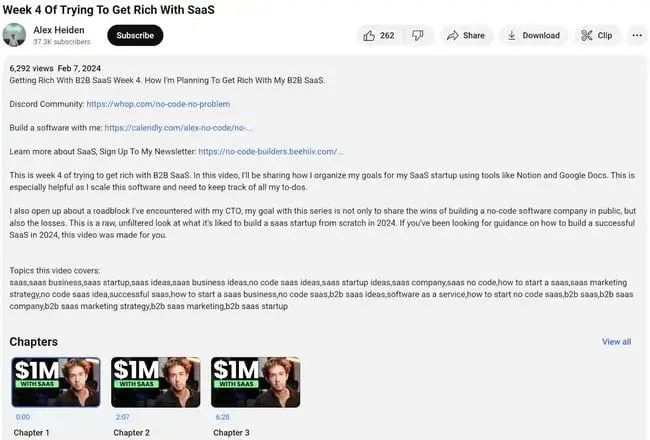
Alex Heiden‘s video documents part of his journey of trying to profit off B2B SaaS. The video’s description details how he organizes his goals and the tools he uses.

Why I Love It

Heiden‘s description is detailed in summarizing the video’s point. He has included chapters, which are great for SEO and helps YouTube rank the video higher in search results.

10. “Easiest Online Business to Make $100,000+ In 2024” by Jensen Tung
youtube description, jensen tung

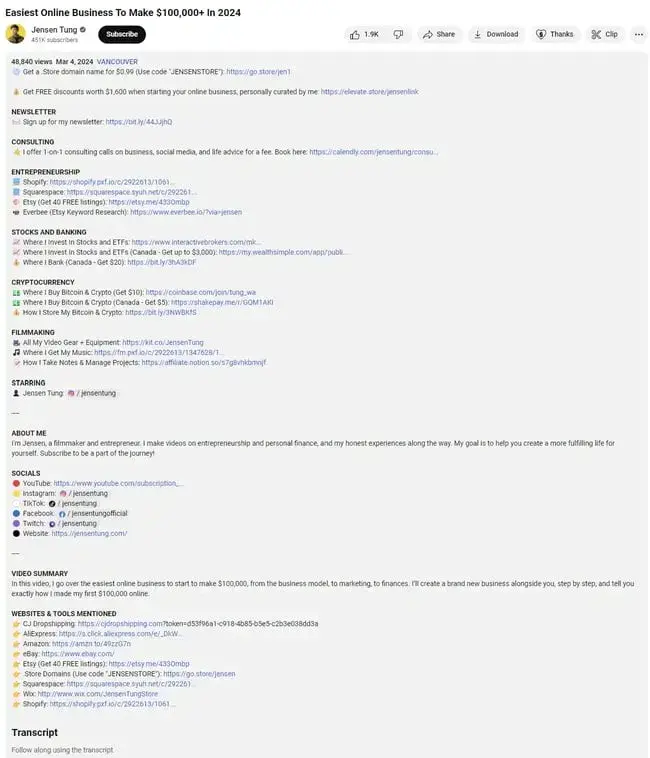
Jensen Tung‘s video discusses the easiest online business to start to make $100,000. The video’s title is self-explanatory, so it’s not as necessary for Tung to have the video summary at the top of the description.

So, he moved it toward the bottom and used the rest of the space to provide information on his gear, newsletter, crucial links, and other endeavors.

Why I Love It

Tung prioritizes the most important information in his video description, and, in this case, it‘s not the video’s summary — it’s the links and information to his other projects that views may not have been able to find as easily otherwise.

Download these YouTube description templates and help your video go viral.

These must-have YouTube video and channel description templates can help you reduce the time it takes to upload and optimize your YouTube videos, getting them out to your audience quickly and with less effort.

Be sure to customize the text to enhance the reading experience because you want to be as helpful as possible for your audience.


Categories B2B

How to Create Inclusive Case Studies That Convert, According to an Inclusive Marketing Consultant

Welcome to Creator Columns, where we bring expert HubSpot Creator voices to the Blogs that inspire and help you grow better.

Let me share something I’ve had to explain countless times as an inclusive marketing consultant: inclusive marketing isn‘t about reinventing the wheel — it’s about making what you’re already doing work harder for you.

Think about it. When potential customers are considering your product, they’re all asking the same fundamental question: “Will this work for someone like me?” This question carries even more weight for people from underrepresented communities who often face higher barriers to success.

Case studies are your perfect opportunity to answer this question with a resounding “Yes!”.

Download Now: 3 Free Case Study Templates

Why People Really Care About Seeing “Someone Like Them”

When people from marginalized communities don‘t see success stories featuring people like themselves, it’s not just disappointing — it‘s a red flag. And it’s not because these communities lack qualifications or talent. The real reasons are much more systemic and nuanced, involving everything from unconscious bias to lack of tailored support.

The most powerful marketing doesn’t just show your product works — it shows your product works for everyone you want to serve.

Let’s walk through how to publish case studies designed to answer that fundamental question, “Will this product work for people like me?” for all the customers you want to serve, including those with identities that are underserved.

Four Steps to Create Case Studies That Convert Everyone

Creating case studies that speak to the different types of customers you want to serve requires a layered and thoughtful strategy.

1. Define your audience (without trying to be everything to everyone).

Marketing inclusively doesn’t mean your brand needs to serve every single identity that has the problem your brand solves. Rather, effective inclusive marketing requires you to choose which identities you want to welcome.

This concept is foundational to inclusive marketing and one that many of my clients are relieved to hear. Focusing your efforts on specific identities increases both your impact and effectiveness.

This episode of the Inclusion and Marketing podcast goes more in-depth on this critical point.

When thinking about your case study strategy, consider which specific identities you want to target. Another option is to try this exercise:- If someone said, “I looked at your case studies and didn’t see anyone like me, so I went elsewhere”— which communities would you most hate to lose?

This step is needed for your overall marketing strategy, not just for your case studies. It allows you to focus your efforts.

For instance, online marketplace Bol made a decision that it wanted to serve neurodivergent consumers. The brand leaned into that choice by focusing on highlighting that identity in this heartwarming holiday ad.

2. Recruit authentically.

Once you know which identities you want to reach, you can begin to figure out how to incorporate them into your case studies.

It is important to acknowledge this nuance: the goal is to highlight consumers who’ve had true success with your brand. You want to present an accurate picture of the types of customers you actually have — otherwise, you’ll appear tokenistic.

This video goes more in-depth about what tokenism is and why you should avoid engaging in it.

Remember, your objective with case studies is to communicate “people like me find success here” – and it is difficult for you to answer that question with a sample size of one, especially when so many other factors could be at play.

This may feel like chicken or the egg. The more diversity you have in your case studies, the more diversity you’ll have in your customer base. But how do you attract a significant number of customers to have enough to collect case studies for them? That comes from being intentional about inviting specific types of consumers to be your customers.

This episode of the Inclusion & Marketing podcast walks you through how to win people from underrepresented and underserved communities as customers. When your marketing actively focuses on attracting people with specific identities you’ve chosen to serve, you’ll have a good amount of people with those identities as your customers.

Once you have various identities within your customer base who have success stories, the next step is to focus on recruiting them for your case studies. Reach out and give them a reason to want to share about the success they’ve had with your brand.

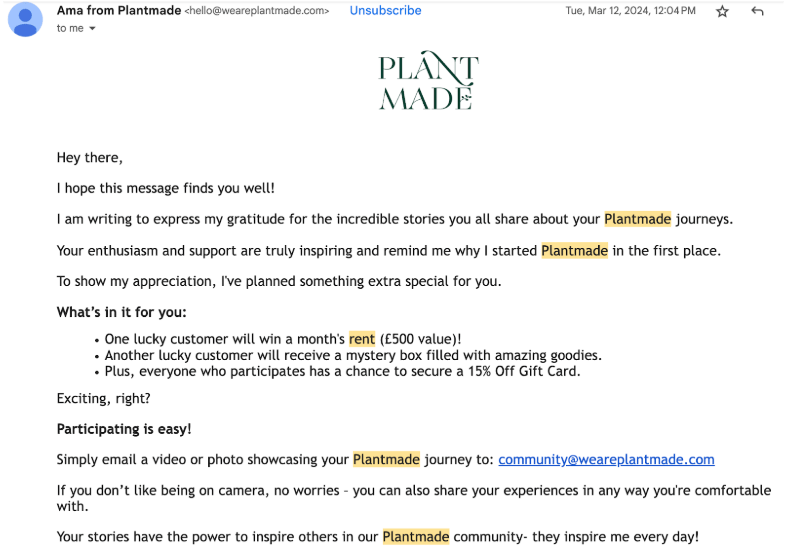
Plantmade is a holistic hair care brand that has a broad diversity of identities in its customer base.

One of the ways the brand encourages all different types of people in their customer base to submit their testimonials highlighting their hair growth and restoration (including beards), is by offering juicy incentives:

Plantmade

Whether or not you decide to incentivize your existing customers for their case studies, it is still important to ensure you’re actively seeking out people to share their stories, so you can get a broader diversity of consumers to showcase how your brand has made a difference for them.

3. Format for different preferences.

Your brand may have your own style and preferred way of producing case studies, including in written, video, and audio formats. It’s also helpful to build a format strategy based on which manner will be most impactful for the people you want to serve. That includes taking into consideration accessibility and other preferences they may have.

A little while ago, I listened to a video podcast case study, and for me, that format was ideal, as I often find myself getting bored with written ones and rarely finish.

Other customers may love a written case study, and loathe the thought of watching a longer video.

Play around with multimedia versions of your case study. If you can, start with video, and then that content can be re-formatted into audio and text, allowing your ideal customers to select which works best for them.

You’re not creating case studies just to create them. So it’s helpful to consider the different identities you want to serve and experiment with different formats that will work for them and their specific needs and preferences.

4. Display with purpose — make it easy to find “people like me”.

Remember the fundamental question we’re answering: “Do people like me find success here?” Your display strategy should make it effortless for potential customers to find those answers.

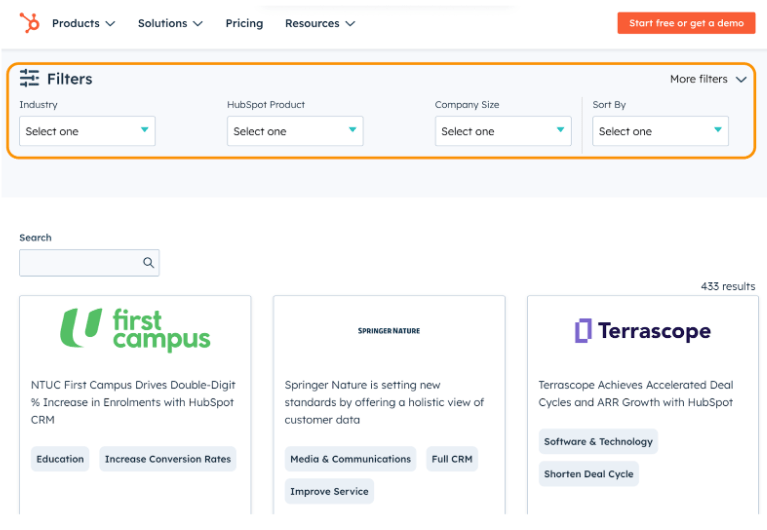
HubSpot does a good job of this. The brand has a ton of case studies from a number of customers who identify in various ways. The filter tool enables consumers to quickly and easily find a case study that is relevant to them.

HubSpot case studies

Figuring out the right way to display your case studies can also be dependent on the different types of identities you want to serve.

If, for instance, you want to ensure people of a specific race, ethnicity, or gender feel seen, including photos of people with those characteristics can help people quickly identify which case studies they want to dive into.

As a Black woman, when I’m looking into products for me or even for my business, I’m often looking to see if other Black women have found success. So I’m always delighted when I see case studies from people who look like me. Landing page builder Leadpages did this with their featured case studies by leading with women, including Black women:

One other way to show identities in your case studies, especially when those identities aren’t ones that are visibly identifiable, is through the headline.

Identity-risk platform Alloy has a case study from an employee sharing her experience working there as someone who is part of the LGBTQ+ community. A consumer looking at her photo wouldn’t be able to tell her identity, so including those relevant details is helpful for someone looking for a story from a person like them.

Make Your Case Studies Work Harder for You

You’re already creating case studies to help you convert customers. Being intentional about publishing case studies that feature a broader group of identities will ensure that more consumers, particularly those from underrepresented and underserved communities, will feel like they belong and can find success with your brand.

This component of your marketing mix will prove more effective as a result, as well.

Categories B2B

The Email Marketing Strategies Beyoncé, Royal Caribbean, and Sprinkles Cupcakes Use to Boost Conversions and Loyalty

Welcome to Creator Columns, where we bring expert HubSpot Creator voices to the Blogs that inspire and help you grow better.

Email marketing isn’t dead—it’s evolving. With an average ROI of $36 for every dollar spent, it remains a marketing powerhouse.

But here’s the twist: making your emails more inclusive isn’t just good ethics — it’s good business.

As an inclusive marketing strategist who’s analyzed countless marketing campaigns, I’ve noticed that brands that embrace inclusion in their email marketing ultimately attract, convert, and maintain even more subscribers. When people feel seen, they’re more likely to click “buy now” instead of “unsubscribe.”

Let’s explore five clever strategies that brands like Beyoncé’s Cécred and Royal Caribbean use to make their subscribers feel like VIPs.

Download Now: 10 Templates to Master Marketing Emails [Free Kit]

5 Inclusive Email Marketing Strategies

1. Sprinkles Cupcakes celebrates cultural heritage.

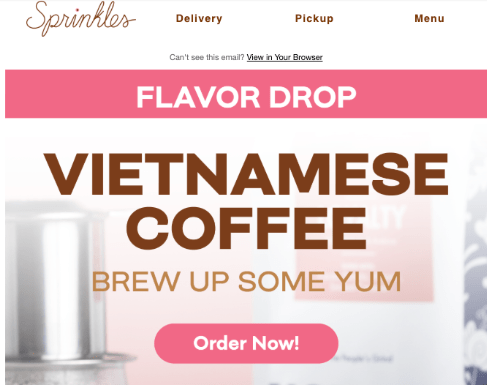
Sprinkles Cupcakes does a fantastic job making people whose heritage is traditionally underrepresented feel seen. The brand does this by communicating about various special edition cupcakes that highlight different cultures and celebrations.

Whether it’s emailing about cupcakes for Lunar New Year, Hanukkah, or other special flavors the brand has incorporated that are specific to certain communities like Cuba, Puerto Rico, or Vietnam, the variety in their offerings is a smart way to get more people to buy.

Sprinkles Cupcakes inclusive email marketing

The brand speaks to cultural heritage in both their email subject lines and in the body of the email.

When I received their email about coquito cupcakes, I immediately called my husband to suggest we buy some for his Puerto Rican coworkers and neighbors. That’s the magic — cultural recognition spreads beyond the target audience.

Try this yourself: Think about all the different cultures and identities represented as part of your customer base. Then brainstorm ways to infuse them organically into your email marketing cadence. It’s important to plan out your communications in advance (no one wants to read a hastily thrown together email in honor of International Women’s Day).

And if you’re featuring content or a product that celebrates a culture that isn’t your own, do embrace co-creating with people who are part of the communities you’re email content is about.

2. Royal Caribbean taps into the power of language.

When I booked a cruise for both my family and my Argentinian in-laws, Royal Caribbean impressed me by sending emails in Spanish to match my sister-in-law’s passport language. Smart move for a company serving global travelers!

I thought it was cool to see the email topics are very much aligned in both English and Spanish when it comes to big brand announcements, as well:

Royal Caribbean inclusive marketing example 1

This is a smart strategy because the people who go on cruises don’t only speak English. Since a lot of cruise customers are repeat cruisers (I’ve been on five), email marketing is one way the brand stays connected, introduces offers, and encourages people to book their next voyage.

As such, it is a smart approach to ensure you’re communicating with customers in their preferred language. You’ll reach a lot more people that way.

Try this yourself: Identify the most common languages spoken by your existing and desired customers. Then plan out an email marketing strategy that enables you to send them the relevant messages they need to take the next step forward with you.

Note that the emails Royal Caribbean sends are not exact translations. The headlines are similar, but they cover topic themes from different angles.

3. Beyoncé’s Cécred shows diversity in action.

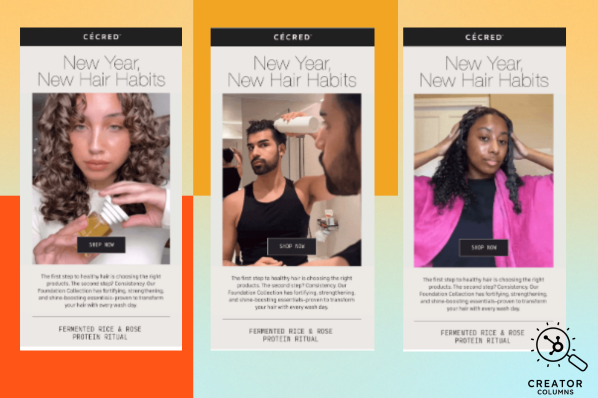
Beyoncé’s hair care brand Cécred touts that it is a brand for all hair types. In its email marketing campaigns, it uses visual imagery, often in the form of photos that animate in a sequence, to show different hair types and the identities associated with them.

Here are three images included in the animated reel inside one email:

beyonce inclusive marketing example

Representation matters. And when people are able to see photos of “people like them,” it helps to clearly and quickly answer the important question in consumers’ minds: “will this product work for someone like me?”

Try this yourself: Take note of all the different identities of the people you want to serve. Whenever you display images of people in your emails, intentionally include different identities that represent your ideal customers so people can see themselves and know that your brand is for them.

4. Tarzan Kay leans into accessibility.

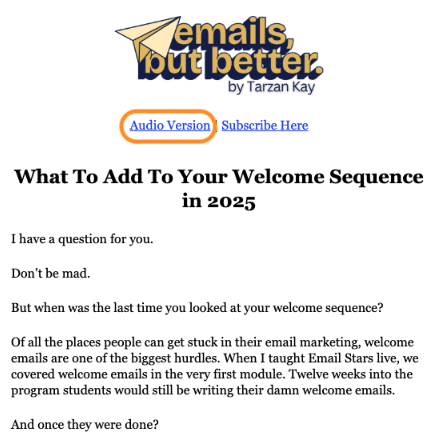
Email marketing expert Tarzan Kay brilliantly includes an “Audio Version” link at the top of her emails — narrated by her, not some robotic AI voice. This makes her content accessible to people with visual impairments and those who prefer to listen rather than read.

Tarzan Kay inclusive email marketing example

The technical term for this is “text-to-speech,” and it is commonly used for people with visual impairments. There’s a ton of written content online, and oftentimes people with visual impairments will use screen readers to translate the text into speech.

And for the past versions of her emails that are archived on her website, there’s an audio player included directly on the page, as well.

Try this yourself: Research the tech associated with adding text-to-speech capabilities for your marketing emails, and then drop it in. Bonus points if you add a real person voicing the content, rather than AI.

5. Mindstream covers AI topics through diverse lenses.

A lot of people are interested in learning about AI these days. The Mindstream Newsletter, which was recently acquired by HubSpot, educates more than 200,000 people globally with its daily emails on a range of AI topics.

I talked with Maria Gharib, one of the principal writers of the Mindstream Newsletter. She told me that the brand has been able to attract and retain such a diverse readership because they write for them. For Mindstream, that means covering AI topics related to different:

  • Geographic regions
  • Disciplines — graphic designers, content writers, and students are interested in AI from different angles
  • Degrees of knowledge — AI policy decisions on one end of the spectrum and how to get started with AI on another
  • Pop culture and mainstream topics – Swifties will open an email featuring Taylor Swift-related AI content

Try this yourself: Map the different identities within your subscriber base and create content that speaks to their specific interests and needs.

Listen to my full conversation with Maria on this episode of the Inclusion & Marketing podcast, where we go much more in-depth with how to make your email marketing newsletters more inclusive:

Inclusion Will Make Your Email Marketing Even More Effective

Inclusive email marketing isn’t just kind — it’s profitable. People from underrepresented communities tend to be more loyal to brands that actually see them, simply because so many other companies don’t bother.

Choose an inclusive strategy to experiment with that makes the most sense for your brand as a starting point.

Then monitor it over time to see how it improves your subscriber base and other success measures you track for your email marketing.

Categories B2B

Are In-Stream Video Ads Worth the Investment? [Benefits & Best Practices for Marketers]

It should come as no surprise to us marketers that short-form video was the top performing content format in 2024. As video content overtakes text-heavy content formats — whether in the form of live streams, YouTube videos, or Instagram Stories — marketers must include a plan to use in-stream video ads in their strategies.

I’m sure you know already how effective the combination of video and marketing tactics can be. In-stream ads provide the opportunity to get your brand in front of your audience when they’re already consuming content.

Download Now: HubSpot's Annual State of Marketing Report

Using the right combination of tactics — like a strong hook, compelling message, and visually exciting creative — will increase the chances of viewers engaging with your ad. But it also helps to have the right data. Below, I want to break down the basics of using in-stream videos as well as some successful tactics marketers have experimented with.

Table of Contents

What are in-stream ads?

An in-stream video ad is a promotion created by a brand that runs before or during a video on a streaming platform, such as YouTube. Aside from appearing in popular videos, these ads can also appear in Stories or live streams on platforms like Instagram and Facebook.

To give you a visual of what an in-stream ad looks like, here’s a screenshot of a Chewy Pharmacy ad that appeared during a YouTube video I recently watched:

an in-stream video ad for chewy pharmacy

Benefits of In-Stream Video Ads

When done right, there are a handful of perks to in-stream advertising. To find out exactly what the benefits are, I asked video marketing experts for their insights.

Ad Sequencing

According to Maria Harrison, the President and Co-Founder of Bullseye Strategy, the digital agency of record for The Corcoran Group, one benefit of in-stream video ads is that they allow ad sequencing. This is a powerful tool that allows marketers to control the order in which viewers see a series of video ads.

“This creates a cohesive narrative or story arc to engage audiences, enhancing brand recall, message retention, and user engagement,” says Harrison. “Ad sequencing can drive a deeper sense of engagement and affinity for a brand due to our ability to bring a brand to life through a relatable story for the target audience. These ads can truly allow prospective customers to envision themselves as part of the story being portrayed in the ads.”

Targeting Capabilities

Your video can be targeted to audiences similar to your brand‘s or can be placed in videos that match your ad’s keyword. With these types of targeting options, you can present your ad to viewers that match your audience’s demographics or interests.

Because these viewers might have similar interests and purchasing motives as your customers, a well-targeted in-stream ad could ultimately result in a higher chance of purchases.

Attention-Grabbing

Another benefit of in-stream ads is they command attention in a way other ad formats can’t.

“In-stream ads grab attention because they’re impossible to ignore,” says Justin Belmont, CEO of digital marketing agency Prose. “They’re perfect for storytelling, brand building, and driving quick actions like clicks or signups.”

Short-Form

Another perk of in-stream ads is that these videos don’t need to be incredibly long or detailed. Depending on the platform you use, you can often launch ads as short as five seconds.

While this gives marketers a limited amount of time to grab a viewer‘s attention, it also means they’ll need to produce less content than they would for a long-form marketing video.

Want to quickly create a video ad from existing content? Use Clip Creator to turn text into professional video content with just a few clicks.

Increased ROI

Aside from length and targeting capabilities, the last and most obvious perk of in-stream ads is their ROI potential.

Harrison shared with me the incredible results of an in-stream video ad holiday campaign her team created for The Corcoran Group using YouTube Video Ads and YouTube Select Reserve.

“The campaign focused on warm, inviting, and aspirational messaging, showcasing the joy of finding the perfect home during the holidays,” says Harrison. “This approach resonated strongly with the audience, driving a 198% increase in direct-to-site visitor sessions and a 48% increase in primary conversions (direct) year-over-year during the three-week campaign.”

Sounds great, right?

Although the perks above might have you ready to invest in in-stream ads, there are still a few things you’ll need to research and keep in mind.

Types of In-Stream Ads

Even though in-stream ads are shorter and can be spoon-fed to your audience with ad targeting tools, your content will still need to convince those viewers to click on the ad‘s link and buy your brand’s product. That’s why it’s important to consider the type of in-stream ad that would work best for your campaign.

Here are the most common in-stream ad types:

  • Skippable ads. These ads can be skipped after a few seconds.
  • Non-skippable ads. These ads cannot be skipped, and the viewer is forced to watch the entirety of the ad before their chosen video continues to play.
  • Bumper ads. Video ads that are six seconds or less. These cannot be skipped and are played before, during, or after a video.
  • Pre-roll ads. Ads that play before video content.
  • Mid-roll ads. These ads appear midway through a video, usually at natural intervals.
  • Post-roll ads. Ads that play after the main video content.
  • Interactive video ads. These ads have interactive elements such as polls or clickable buttons.
  • Overlay ads. Ads that appear as a banner or graphic overlay at the bottom of the video content.
  • Shoppable video ads. Ads with integrated e-commerce features, allowing viewers to click and purchase directly from the video. An example of this is the Chewy Pharmacy ad I shared earlier in the article.

Here’s an example of an in-stream video ad from Airbnb that’s both skippable and shoppable, as shown by the CTA buttons:

in-stream video ad by airbnb

The type of ad you choose will determine your overall messaging and content. For example, if you create a skippable ad, the primary message must be delivered within the first few seconds.

“Non-skippable ads allow us more time to build the story within the ads,” says Harrison. “Though they may frustrate a user who is eager to reach their chosen content.”

Best Practices for Using In-Stream Video Ads

As I’ve laid out, there are solid pros and cons to in-stream advertising. While the cons shouldn’t scare you from trying this marketing tactic, you should still keep them in mind in order to create a video that can avoid constant skips from your audience. Here are a few tips to keep in mind.

One challenge is keeping viewers engaged long enough to recognize the brand and be attentive to the message.

We address this by using exciting or interesting visuals designed to grab the viewer’s attention quickly. It is critical to deliver the core message within the first few seconds of the ad before they have the chance to either skip it or mentally disengage from it.

Another challenge is finding qualified audiences — in the case of The Corcoran Group, qualified home buyers. We overcome this by cross-referencing audience attributes, such as demographics, behaviors, and interests, to ensure we are targeting those most likely to take action. Additionally, we rely on constant testing and refinement, analyzing performance data to optimize creatives, messaging, and targeting for the best results.

Focus on the hook.

Based on what consumers told us, you have anywhere from one to five seconds to grab your viewer‘s attention before they zone out or skip your ad. You’ll rarely have more than 10 seconds to sway them.

“People usually skip ads if they find it boring, irrelevant, or too long,” says Gerti Mema, marketing manager at Equipment Finance Canada. “We address this by keeping the message short, immediately sharing the value the viewer can benefit from.”

So, begin your ad with an action-packed scene or concisely explain your product as quickly as possible. Don‘t take time to get to the point — even if the ad platform you’re using allows a 30-to-60-second video.

Refine your target audience.

Audiences will either skip your ad because they just don‘t want to see a commercial, or they’re bored by your content because it isn’t relevant to them or the video. This is why it’s important to create ads that are hyper-targeted to your target audience and focus on a brand-related topic they value.

“One challenge of in-stream ads is finding qualified audiences — in the case of The Corcoran Group, qualified home buyers,” says Harrison. “We overcome this by cross-referencing audience attributes, such as demographics, behaviors, and interests, to ensure we are targeting those most likely to take action.”

Use examples as inspiration.

Luckily, millions of brands have already tested out in-stream advertising. While this means the pool of advertising could be competitive, it also means that there are plenty of effective ads out there that you can watch for inspiration.

In my experience as a marketer, if an ad gets me to pay attention, then I know they’re doing something right.

Next time you‘re watching a video that begins or features an in-stream ad, watch the content. Take a mental note of why you do or don’t want to skip the ad. If you’re considering engaging with the ad and tapping to learn more about a product, ask yourself, “How did this content persuade me to click?”

Always test and refine your message.

Like any advertising strategy, you constantly test and analyze your in-stream video ads. Take a look at performance data and break down your creative, messaging, and targeting to optimize your ads for the best results.

“We always test different versions of the ad to see what connects best with our audience,” says Mema. “Messaging that feels personal and relatable can encourage viewers to take action and make sure to incorporate the action pages seamlessly into the ad.”

Getting the Most Out of Video Stream Ads

What I like most about in-stream video ads as a marketer is that they’re an opportunity to get in front of your audience when they’re already engaged.

To get the most out of your video stream ads, I suggest starting by figuring out which type of in-stream ad would work best for your product, message, and audience. Then, create your short ad using a strong hook and a memorable message. From there, take a look at your ad performance to understand user behavior. If you chose a skippable ad, did viewers skip right away, or did they linger for a couple of seconds? Use those insights to adjust your messaging, creativity, and hook for your future video ads.

In-stream video ads are a great way to get in front of a targeted audience and grab their attention. The next time you stop and watch a video ad that pops up before a video, I suggest jotting down what grabbed your attention. Use this as inspiration for your next in-stream ad.

Editor’s note: This post was originally published in July 2020 and has been updated for comprehensiveness.

Categories B2B

Everything Our Paid Team Learned From Attempting a Reddit Advertising Strategy

A Reddit advertising strategy used to be reserved for businesses targeting men. But the tides are turning, and I think it’s time for more brands to consider advertising on Reddit.

While Reddit has always had more male users and still has an audience of 63.6% male users, Reddit’s visibility on Google has increased since its new partnership was announced in February 2024.

Download Now: Free Ad Campaign Planning Kit

According to Backlinko, the increase in users on Reddit since Q4-2023 is undeniable. I predict the audiences will slowly balance as more women discover Reddit and find it’s not the male-only social media platform that people think.

If you’re still not convinced that Reddit has great potential for advertising, let me remind you that it has been one of the top ten most popular sites on the internet for some time. Reddit is undoubtedly an intriguing channel for advertising purposes.

In this article, learn what our team figured out about advertising on Reddit and whether it’s worth the attempt for your own company. Plus, I’ve provided a step-by-step tutorial on how you can advertise on Reddit if you determine it’s a valuable option for your own company.

Table of Contents

What is Reddit, and how has it changed?

Reddit is a social media platform with a mission “to bring community, belonging, and empowerment to everyone in the world.”

Notably, for advertisers, Reddit has communities within the platform that are called subreddits. Within subreddits, people talk about topics or special interests in detail. For example, r/pottery is home to 205,000 pottery lovers.

It’s thought that there are over 3 million subreddits on the platform, so there’s a place for everyone. The top communities are listed here.

As hinted in the intro, Reddit has grown quickly in the last year thanks to a partnership with Google. The graph from Backlinko shows considerable growth from Q4-2023 onwards. It’s not a coincidence that the Google and Reddit partnership was in Q1-2024.

graph shows daily reddit users growth, suggesting reddit could be a good place to advertise. graph significantly increases in q3-2024.

Source

Reddit appears at the top of Google more than ever, making it one of Google’s most visible social media platforms. With this, more people have discovered it, hence the recent growth.

I predict that changes in Reddit’s visibility will continue to result in more users joining the platform and the user demographics changing.

How does advertising on Reddit work?

Reddit advertising works similarly to ads on other social media platforms, but what Reddit has that others don’t is highly targeted users.

The main difference is that you can promote posts within specific communities (the subreddits). You can also target broader audiences on Reddit.

Below is a detailed step-by-step guide to setting up your Reddit advertising account.

The Strategy Behind Reddit Advertising

1. Identify subreddit topics that are well-aligned with your target audience.

To investigate the benefits of advertising on Reddit, I first spoke with Josh Chang, a Senior Marketing Manager at HubSpot. He told me HubSpot’s initial strategy on Reddit involved highly targeted campaigns on specific subreddits, including r/entrepreneur and r/sales.

“The goal of the campaign,” Chang explained, “was to drive awareness and conversion for our products. In terms of results, we saw cost-per-acquisition similar to what we’ve achieved on Facebook in North America, although we did notice a lower activation rate from Reddit — suggesting lower-quality conversions.”

If you’re interested in testing out a campaign for yourself, you’ll want to start by identifying subreddits that can likely help foster genuine connections between your brand and your ideal audience.

Consider topics your target audience is most interested in and list them out. Then, narrow your list by investigating how many subscribers each subreddit topic has, whether it’s relatively active, and whether self-promotion or sharing content is allowed on the subreddit topic.

Chang told me, “One of the main things we learned was targeting subreddits specifically was much more effective than broader interest targeting. However, this strategy requires a lot of research, and getting to know which subreddits are most relevant to your audience.

“We noticed tailoring our ad creative for individual subreddits helped improve our conversion rates.”

Pro tip: When you’ve found subreddits you like, use Reddit’s filter to find hot topics within the community. You might be able to associate such topics with your ads to encourage engagement.

2. Begin engaging with your subreddit communities.

Once you’ve cultivated a list of subreddits that are likely of interest to your target audience, it’s time to start engaging with those subreddit communities.

However, it’s critical you don’t begin by promoting your own content.

To build a level of trust and authentic connection, begin by upvoting other submissions you find interesting and that align well with your brand. Next, share valuable content — but not your own. Instead, post interesting content produced by other media outlets or blogs that you believe will be useful to your subreddit community.

I think it’s vital you genuinely use the Reddit platform as an opportunity to get to know your target audience before you offer them your own content. Not only will this show your community you’re not simply joining the site to self-promote, but it will also help you tailor your content more accurately down-the-road.

Pro tip: Transparency is really important on Reddit. In my opinion, don’t try to disguise who you are. I’ve seen some businesses go into Reddit as if they were giving genuine advice but are actually advertising the company they work for.

There’s nothing wrong about vouching for your company on Reddit, but I think it should be done transparently. Redditors don’t typically love advertising!

3. Begin promoting your own content, paid or otherwise, on the subreddit platforms.

At this point, you might consider simply posting valuable content from your company that you feel will benefit your community — for free.

However, you might alternatively try spending money on a paid sponsored post, which essentially guarantees your post will be pinned to the top of the subreddit.

Here’s what a sponsored post looks like, for context:

reddit ad examples: reddit paid sponsored post example

Alternatively, you can place ads in comments, as pictured below.

reddit ad example in reddit comments.

In many ways, this post looks similar to all other Reddit content. However, there’s a blue “Promoted” tag in the top left, signifying it’s a paid ad.

In HubSpot’s case, we decided to test out the power of paid advertising on the site. However, it’s still critical you follow the steps listed above to cultivate authentic relationships with your subreddit communities.

Think of it this way. If I begin engaging with a brand on one of the subreddit groups I’ve joined and notice they typically post helpful content (including content from other publications), then I’m much more likely to take notice when they pay for a sponsored post. If they appear out of nowhere, I have no sense of brand awareness and probably won’t trust the advertisement.

Reddit Advertising Cost

As of right now, the minimum daily spend for an ad on Reddit is $5.

Reddit uses an auction-based model, meaning your ads compete against others. Your bid and targeting choices will affect how well your ads perform. Additionally, Reddit charges on a cost-per-click (CPC) basis.

Reddit FAQ states, “Since Reddit Ads relies on real-time, live auctions to deliver ads to users, your ad group may overspend its budget by up to 20%. Changes to ad group budgets may take up to 60 minutes to take effect.”

I think this breakdown from Reddit is really helpful when it comes time to make your strategy:

reddit advertising cost table

Source

Advertising on Reddit: Worth it?

Reddit provides a lot of content on Reddit advertising, so you can determine if Reddit advertising is worth it for you.

I asked Chang whether he felt advertising on Reddit is a worthwhile investment, and he offered a candid response, admitting HubSpot has temporarily halted its efforts on Reddit.

“We saw promising results,” Chang told me. “But because we were targeting specific subreddits, it wasn’t crazy volume that could really move the needle. However, we have on our docket to re-test Reddit to see if we can improve performance and scalability in the future.”

I think it’s important to note, there have been success stories. For example, Taktical, a Reddit marketing agency, shares case studies resulting in 220% increase in customers for a skincare brand advertising in /r/SkinCareAddiction.

How to Advertise on Reddit: A Step-by-Step Guide to Setting Up Reddit Ads

1. Make a company profile.

You’ll want to ensure you’re running advertising campaigns on your company profile, not your personal Reddit account.

Along with evoking a sense of professionalism, a company Reddit profile is necessary since users can click on your account and see other content you’ve viewed and upvoted — so you want to ensure that the content aligns well with your brand.

Additionally, when responding to comments on your ad, you’ll want to be able to respond from a company profile, not a personal one.

To set up a profile, go to https://ssl.reddit.com/login and fill out the Sign-Up form, shown below:

how to advertise on reddit step one: a screenshot of reddit’s login page, the start point for advertisers.

2. Set up an advertising account.

To start advertising on Reddit, you’ll need to set up an advertising account. To do this, go to ads.reddit.com and fill out the necessary fields.

reddit advertising step two: screenshot from reddit’s advertising set up shows how advertisers will set up their account,

Note: Once I created my advertising account, I was hit with a pop-up and the promise of $500 if I spent $500. Not bad for a first-timer on Reddit who may need some time to get used to the platform.

Next, you’ll meet the dashboard, as shown below:

reddit advertising: screenshot of the reddit advertising dashboard.

Before you can begin advertising on Reddit, you’ll want to add your billing information. If your billing information isn’t added, Reddit will present a red banner at the top. Click the banner, and a pop-up for billing details will appear.

screenshot of reddit advertising asking for payment details.

Important note: If multiple people on your team will be involved in advertising on Reddit, ensure you add users by managing permissions. You can find all of your account details in your business manager.

You can find “business manager” by rolling over the settings cog:

screenshot shows reddit’s account dashboard where you can edit account and user settings.

From here, you can view your business manager (pictured below) and navigate to members. Add their emails and permission level (including “Analyst,” “Creator,” and “Administrator”):

screenshot of reddit advertising member dashboard

Once you’ve clicked the blue “Invite” button, your colleagues should receive an email with the next steps.

3. Find your audience on subreddits.

I think I should mention that you don’t want to spend money advertising on the homepage of Reddit. Reddit users visit the homepage to browse popular posts and trending news, so it’s too big of an audience for you to target your ideal persona.

Instead, I recommend exploring subreddits to find your ideal Reddit audience. For instance, let’s say you sell ecommerce software. To find an interested audience, then, you’ll want to explore retail-related subreddits, such as r/retail (25K members), r/AskRetail (9.4K members), or even r/retailmemes (2.1K members).

Make a list of subreddits that might fit your audience, and then spend some time perusing the content that already exists on that subreddit. Does it seem to match the content your customer would be interested in?

Additionally, does it look like the subreddit community could be filled with high-intent prospects (like a retail advice subreddit), or is it too superficial for your needs (like retail memes)?

To help you find your audience, I suggest trying a tool like RedditList to sort through various Reddit communities and find the ones of highest value for you.

4. Ensure the subreddit(s) you find have enough page views.

I think this is important enough to warrant its own section: You can’t necessarily advertise on any subreddit you want. Once you make your list of potential subreddits, you’ll need to ensure it has enough page views to be eligible for advertising.

To figure out whether a subreddit has enough page views, consider that one Reddit advertising campaign has a minimum spend of $5, and it costs $0.75 per thousand page views. Additionally, you can purchase up to three months out.

With those requirements, you’ll need roughly 6,700 page views over three months to achieve the $5 minimum spend.

To figure out how many page views you’re likely to receive on a subreddit, take a look at how many users are currently on the subreddit. For instance, you can see at 2 p.m. on a Monday that there are roughly 2,000 users on the r/marketing subreddit:

reddit advertising step four. screenshot shows community sizes.

Dividing 6,700 by 90, you’ll note you need roughly 74 viewers per day on a subreddit to reach the minimum requirement — r/marketing, then, is way over the daily required page views, but there are other smaller subreddits with only 5-10 users per day, which could make it more difficult for you to reach the minimum spend. Plus, you want to choose subreddits that enable you to have the highest reach possible.

5. Set up your campaign.

Once you’ve chosen your subreddits, it’s now time to set up your campaign. In my account, I started by clicking on “Dashboard” in the top left of my screen, and then selected “Create Campaign.”

reddit advertising step five. creating the campaign,

Next, you need to choose my campaign type.

6. Choose your campaign type.

Reddit gives you three options: simple create, advanced create, or import a campaign from another platform (Facebook ads, for example) — very useful, in my opinion!

reddit advertising step six: screenshot from reddit ads shows the options for setting up a reddit advertising campaign. for the purpose of this walkthrough, i chose simple.

For this section, you’ll need your ads creative: a video or photo, headlines, target URLs, etc. If you’ve run any ads before, like Google Ads, this interface should look very familiar. It’s similar.

reddit advertising step six: screenshot from reddit ads shows the options for setting up a reddit advertising campaign including creatives, headlines, etc.

After I completed the basics, I opened the toggles and narrowed down my targeting.

You’ll need to narrow down your audience — including interests, communities, and device type — your budget, and your bid (the maximum price you’re willing to pay per 1,000 impressions). Additionally, you’ll need to figure out a schedule for your ad, including what time(s) of day you want it to appear and when you want your campaign to end.

reddit advertising step seven: screenshot from reddit ads shows the options for setting up advertising audiences including subreddits that you can advertise in.

As you can see from the above, I can select specific subreddits relevant to my audience that I want my ads to appear in. At the top, I can see estimates of impressions and clicks, giving me an idea of how much budget I need to run the ad successfully.

Here, you’ll create a new post or upload an existing advertisement that you might’ve designed for another platform. Feel free to take a look at Reddit’s internal advertising resources — including Reddit’s Advertising Help page — to learn best practices when designing an ad for Reddit.

Once you’re happy with the creative assets and billing details are complete, click “Publish.”

You’ll get an email once your ad is live.

7. Analyze your campaign performance to improve over time.

Once your campaign is up and running, I highly recommend tracking its performance. You can monitor within the Reddit advertising dashboard itself, as well as through third-party tools like Google Analytics. Additionally, ensure you’re taking the time to respond to any comments left on your ad.

As with any advertising campaign you run, you’ll want to use analytics on this campaign to iterate and improve for the next one.

Ultimately, I think it’s worth considering using Reddit as a platform for sharing content for the sake of helpfulness and audience engagement rather than as a cost-effective advertising strategy.

Inspired to try Reddit advertising?

I loved how intuitive the Reddit advertising dashboard is. I found the whole process very easy, and I’m not an ads specialist. The targeted communities make Reddit feel like a great place for advertising. As mentioned above, I strongly feel that Reddit will grow and audiences will diversify, providing spaces for blossoming communities.

If you’re new to advertising, don’t fret. Just start! You’ll figure it out, and HubSpot has guides to help you every step of the way.

Editor’s note: This post was originally published in February 2019 and has been updated for comprehensiveness.

Categories B2B

How This Small Startup Outperformed a Stalling Industry

As liquor sales stagnated last year for nearly the first time in two decades, one segment of the market actually grew by a whopping 29% YoY: Pickle-flavored spirits.

If you’re like me, your first question was, “What the ever-loving fffff-?” But your second question is, “What are they doing right?”

Click Here to Subscribe to Masters in Marketing

So I sat down with the marketing director for the top-selling pickle liquor to find out how this small startup is beating the trend and outmarketing the market.

Meet the Master

erin-quinn-mim

Erin Quinn

Marketing Director, The Original Pickle Shot

  • Fun fact: Was an extra in two different “This is SportsCenter” commercials when she worked as a stats analyst at ESPN.
  • Claim to fame: Once ordered $3,000 worth of “Pickle Slut” friendship bracelets.

Lesson 1: Research your opportunities a year out.

Most people don’t think about National Pickle Day. Like, at all. But to Erin Quinn it means a lot of green. And that green is money. And also, presumably, dill.

“It was our biggest earned media impressions surge,” she says. “There are a lot of national news outlets doing National Pickle Day coverage. And from an online sales standpoint, it was definitely our biggest surge.”

But that never would have happened if Quinn hadn’t been looking down the whole length of her calendar.

“Look at the full year for what opportunities might be relevant for your brand,” she advises. Now, your brand may not be connected to any gimmicky holidays, but there will be conferences, trade shows, festivals, and fairs. The lesson remains: “Identify a few that look relevant to you. Then take a look at how those have been covered in the past by the news media.

And it’s not just about news media, but social media, too. Quinn recommends doing social listening around the events to see which ones already have your audience catching a buzz.

Those will make the most rich opportunities for seasonal campaigns.

But this isn’t an “If you build it, they will come” kind of exercise. Which brings us to lesson two.

Lesson 2: You have to have news to be news.

Media outlets aren’t going to cover your brand for the sake of you existing. You have to have news to get attention.

News outlets could have just as easily reached out to Vlasic or Frito Lay for content about National Pickle Day, right? So why did they cover this small, upstart liquor brand instead? Because Quinn gave them a reason. Two, actually.

Two big, pickle-green, mid-calf, 100% genuine leather reasons.

pickle-boots-mim

Quinn says her team asked themselves, “Who’s an unexpected brand that we can partner with to do something cool that’s going to get people talking?”

The answer was Texas-based luxury boot company Miron Crosby. And the one-of-a-kind, pickle-themed cowboy boot sweepstakes was born.

Though that makes it sound a lot easier than it was.

“We really wanted to design a custom pair of pickle cowboy boots,” Quinn recalls. “But I was met with a fair amount of silence.”

By a stroke of luck, Miron Crosby was looking to target the same audience as The Original Pickle Shot. But luck isn’t a long term strategy, so what’s a new brand with a small audience and limited budget supposed to do?

erin-quinn-mim-news

Lesson 3: Collab with brands you can grow with.

Quinn offers two pieces of advice for how emerging brands can stretch their budget and amplify their reach.

First, “Identify brands that are complementary to yours,” she says. “Brands that have a similar presence, that are looking to grow, and you can grow together.

Together, you can split the costs of campaigns and share each other’s audiences. She gives the example of how The Original Pickle Shot partnered with flavored-salt company Twang on a product giveaway. Quinn’s team handled the logistics, Twang donated products, and both companies shared the results with their social networks and influencers.

The second piece of advice is to consider what else you bring to a collaboration besides reach.

“We might not be able to offer a huge social following yet, but, hey, we’ll run the sweepstakes, we’ll pay all the fees, if you make a collab post.”

No matter the size, every brand needs good content. If you can provide relevant, eye-catching content, that can make you an attractive partner for a bigger brand with a wider audience.

“When you’re an emerging brand, sometimes that’s what partnerships have to look like.”

And, if you’re wondering, National Pickle Day falls on Fri., Nov. 14 this year. Govern yourselves accordingly.

Lingering Questions

Today’s Question

What’s one marketing mechanism that will generate the most revenue quickly for a startup? —Jennifer Waters, Co-founder, 7 Figure Dojo; Executive sensei, Seigler’s Karate Center

Today’s Answer

Quinn says: I know it’s annoying to say “it depends,” but my recommendation for quick revenue growth would likely vary depending on the startup.

For example, paid social is likely to be a cost-efficient and impactful choice for a budget-friendly DTC skincare brand targeted towards Gen Z. (There’s a reason that paid social is the first and only paid media that many brands invest in!)

Promo codes, rebates, and couponing can be an important add-on to said campaign, as these tactics provide an extra incentive for conversion and you can use redemption as a KPI.

No matter the business model, my most important “do this before anything else” recommendation would be to spend time on your consumer target, positioning, and brand identity development so that you are targeting the right people in the right place with the right messaging and creative. It won’t drive revenue in the short term, but it should increase the likelihood of long-term success.

Next Week’s Lingering Question

Quinn asks: What’s the most memorable advertisement (commercial, print ad, OOH, anything!) you can remember seeing, and why do you think it has stuck with you?Click Here to Subscribe to Masters in Marketing

Categories B2B

What is a DSP? A Full Breakdown of Demand-Side Platforms for Marketers

As a marketer, I’m no stranger to ad managers like Google Ads and Meta Ads. However, I was interested to learn that there’s a third option for ad buying: demand-side platforms (DSP).

What is a DSP, you ask? These tools are essentially an automated way to purchase and manage your online ads.

Access Now: Free Media Planning Template

If you’re like me and are curious about what a DSP is and how it can benefit your paid ad strategy, I want to cover how these platforms work, why you should use one, and the best platforms available.

Table of Contents

With a DSP, you can purchase mobile ads on apps, banner ads on search engines, and video ads on Facebook, Instagram, Google, and even more platforms. Instead of using both Google Ads and Facebook Ads, for instance, you can purchase those ads in one place on a DSP.

The purpose of this is to make ad buying faster, cheaper, and more efficient. Now, let’s dive into how DSP platforms work and why you should use them.

How do DSPs work?

DSPs work by using programmatic advertising, which is the buying and selling of ads in real time through an automated system. With real-time bidding, ad placements are auctioned off in milliseconds.

When you get started with DSP advertising, you’ll need to begin strategizing how much you want to spend. Think about what an effective cost per click and cost per action might be. This will help you set up your online ads so the platform knows how much to spend in any given auction.

The best DSP platforms will allow you to include multiple rich media ads, including video, images, and animation.

What is DSP advertising?

DSP advertising is the automated process of bidding on and buying ads through a programmatic advertising platform.

According to a study published by Statista, the US was the largest programmatic advertising market worldwide, spending an estimated $264.66 billion in 2024. Marketers are increasingly using DSPs as a way of purchasing, managing, and tracking online advertising.

Benefits of Using a DSP

To understand why marketers choose to use a DSP for their paid advertising strategy over other platforms, I spoke to Sean Edwards, the Director of Programmatic and E-Commerce Media at Exverus Media.

Seamless Ad Buying Experience

One of the main reasons for using a DSP is that it makes your digital ad experience easier and more cost-effective. You can control, track, and maximize all your digital ads in one place. This means you can manage an entire ad campaign across sites on one dashboard. For example, you can show someone an ad on Google, then show them ads on Facebook, and then across other sites they visit — all in one campaign.

“The DSP we use most often is The Trade Desk because it allows us to activate and measure media campaigns on many different channels from a single platform,” says Edwards. “This saves us and our clients time and money, while clarifying previously hard-to-see patterns in the complex customer journey.”

Access to Premium inventory

DSPs often have access to a wide range of ad inventory, including premium placements on popular websites and apps, according to Edwards. This means you can advertise on many networks, including all the major publishers. With an increased number of networks, you’ll have a more global reach.

“This access allows advertisers to reach target audiences across a variety of channels with added visibility, control, and opportunity to optimize towards the most successful tactics and placements,” he says.

More Control Over the Ad Experience

Using a DSP also provides marketers with more control over the ad experience compared to traditional platforms. This is especially important when it comes to brand safety.

“Programmatic platforms offer tools to ensure ads are displayed in brand-safe environments pre- and post-bid,” says Edwards. “These parameters can help protect a brand’s reputation by avoiding ad placement on inappropriate sites or within unsuitable content. High-quality media placements yield stronger results.”

Precision Targeting

Programmatic advertising allows you to target specific audiences based on various criteria such as demographics, interests, and behavior, says Edwards.

“This precision targeting allows advertisers to reach the right people, at the right time, with the highest likelihood to complete the desired outcome, whether that’s purchase, video view, download, or subscription,” he says.

Additionally, DSPs often partner with third-party data providers, giving you better tracking and reporting capabilities than a single network usually provides. And in the planning process, the targeting options are more personalized, meaning you can get better conversion rates.

Now that you know more about DSP advertising and how it works, let’s discuss the platforms that can help you do it.

When choosing a DSP to work with, I like to look at how many ad exchanges the DSP has access to because that affects how many people you can reach. I also like to consider cost, training (full-service or self-service), support, and ease of use. Here are some of the best DSP advertising tools to choose from:

1. Basis Technologies

dsp advertising solution basis technologies

Source

Best for: Large or enterprise-level companies

Basis Technologies is an omnichannel DSP built to generate better outcomes for your ad campaigns. In my opinion, one of the best features is that it uses AI machine learning to automatically analyze data from numerous campaign parameters to optimize your ads.

With this DSP, you can target hyper-local audiences across devices and multiple touchpoints. You‘ll also get access to the industry’s leading exchanges, along with 25,000+ audience segments across over 30 different data providers.

Why I like it: Basis Technologies harnesses the power of machine learning to analyze data and automate processes. I also like how automated monitoring helps ensure brand reputation and safety.

2. Google Marketing Platform

Google Marketing Platform is a DSP solution for small to large businesses or agenciesSource

Best for: Small to large businesses or agencies

Google Marketing Platform is Google’s unified advertising and analytics platform for smarter marketing and better results. This DSP has several products for both small businesses and enterprise companies, including Campaign Manager 360 and Display & Video 360 (formerly DoubleClick).

With this product, you can save time with cross-channel ad management to maximize insights and optimize media and creative performance across all your digital campaigns.

The flexibility is the standout feature of this DSP. You can use third-party features and integrations so you can choose the capabilities that best help you manage and measure your campaigns.

Why I like it: Google’s products are designed to work together, but also give the flexibility to use third-party features and server to server integrations.

3. Knorex

knorex is a dsp solution for large advertising agencies

Source

Best for: Mid-sized to large advertising agencies

Knorex is a universal advertising platform that automates personalized marketing across channels, devices, and ad formats. You can market on Google Search, CTV/OTT, DOOH, and social media all in one place.

This DSP also uses AI to learn from past data to predict and adjust ad budgets dynamically in real-time to drive higher efficiency.

Why I like it: Knorex values security, offering a variety of brand privacy and security tools out of the box.

4. Jampp

jampp is a dsp advertising solution for mobile-first ads

Source

Best for: Companies looking for a mobile DSP solution, such as gaming or fintech apps

Jampp is a DSP that leverages unique contextual and behavioral signals to deliver customers and in-app purchases through programmatic advertising.

The key features of this platform are user acquisition, app retargeting, geolocated ads, dynamic ads, and predictive bidding. What I like most about Jampp is its focus on mobile-first ads.

Why I like it: Jampp’s app retargeting helps re-engage existing customers and uses their previous behavior to predict whether or not they will convert.

5. Smadex

smadex is another mobile-first dsp solution for advertising

Source

Best for: Companies needing a mobile-first DSP solution

Smadex is a mobile DSP engineered for growth. The platform uses a combination of its own programmatic advertising technology, machine learning, and first-party data.

With this platform, you can reach global audiences at scale and re-engage audiences with its retargeting capabilities.

Why I like it: Smadex values security just as much as helping your brand scale. The platform is a registered member of TAG (Trustworthy Accountability Group) in the US and holds an IAB (Internet Advertising Bureau) Gold Standard certification.

6. MediaMath

dsp solution mediamath

Source

Best for: Mid-sized to large agencies that want a custom solution

MediaMath is a customizable DSP that provides brands with a myriad of options for managing their campaigns. Opt to use their built-in creative tools to run ads on their server, or choose one of your own. You can even use APIs to run on top of your core foundation.

Why I like it: The customization is the platform’s greatest feature, in my opinion. MediaMath’s product is not a one-size-fits-all DSP. Brands can tailor their components to build an advertising solution that suits their needs.

7. Amazon DSP

amazon is a dsp solution for ecommerce brands

Source

Best for: Ecommerce brands that want to advertise on Amazon (and Amazon-owned sites)

Amazon is one of the world’s largest online retailers, so it’s no surprise that brands would want to tap into their advertising audience. Both advertisers who sell products on Amazon and those who don’t can use Amazon DSP.

They offer two options: self-service and managed service. With self-service, brands are in full control of their ad campaigns. Those who are new to programmatic advertising or need guidance are advised to use the managed option; however, that comes with a $35,000 minimum spend.

Why I like it: You don’t have to be an Amazon seller to use its DSP. Amazon DSP can greatly increase brand awareness for sellers on and off Amazon.

My Takeaways About DSPs

After researching DSPs and talking to the experts, my biggest takeaway is that they are the best way to manage all of your ad campaigns across channels in one place.

However, using DSPs is not a “set it and forget it” kind of solution. Marketers must still be involved in the bidding and targeting process to ensure they’re getting the most ROI out of the tool.

When you choose a DSP, make sure you understand how many inventory sources it accesses, which third-party data integrations it offers, and what targeting criteria are available. To successfully run programmatic ads on a DSP, you’ll need to reach global audiences with personalized ads. While using a DSP simplifies paid ad management, it won’t replace customer research and having a clear idea of who your target audience is.

Editor’s note: This post was originally published in February 2021 and has been updated for comprehensiveness.

Categories B2B

8 Questions to Help You Write a Compelling Marketing Brief

If you’re staring at a blank screen (we’ve all been there) trying to figure out how to develop a marketing brief, there are a few questions you can ask yourself to get to the heart of the problems and solutions your campaign will address.

→ Free Download: Creative Brief Templates

Use these guiding questions alongside our free marketing brief templates to help you create a brief that has just enough information — but not too much — to get your team excited and on the same page.

Table of Contents

The Importance of a Marketing Brief

One of the first steps in a campaign is to draw up a marketing brief — sometimes called a creative brief or campaign brief — that serves as the single source of truth on the project.

It sets forth a single vision that everybody can buy into, and more importantly, it defines the goal, the reach, and the problem the project is trying to solve. Writing a great marketing brief will give you a strong foundation for your campaign.

How to Write a Marketing Brief

The marketing brief is the starting point with which every decision and movement made on the project should align — and that means it is also a living document.

Marketing briefs help solve any misunderstandings before you get to work. This document should clarify for everyone involved — copywriters, designers, developers, marketers — all the aspects of the project, the goals, and even the timeline. If you’re working for an external client or stakeholder, your brief should confirm that you understand their problem and have a strategy for solving it.

As campaigns and projects change, requirements are added or removed, and new insights are discovered. You can update this document as the project evolves to ensure everyone remains focused on the underlying issue and knows their responsibilities.

8 Questions to Help You Write a Great Marketing Brief

The marketing brief isn’t being published online to the masses for approval, but it does need to grab your team by the heart and get them excited — and answer any questions they might have about the campaign.

It doesn’t need to include every piece of information available. It shouldn’t take you more than five minutes to understand the project, the strategy, and the goals. It should be a useful document that’s easy to scan, clear, and actionable.

I’ve got eight questions that will help guide you through your first marketing brief. Before you ask yourself these questions, you should already have a handle on your buyer or audience persona, so that you know who your target audience is. Using our creative brief templates as you sketch out your answers may also be helpful.

8 questions to help you write a great marketing brief. 1. what problem are we solving, and why are we solving it? what’s the benefit? 2. who are we trying to reach? 3. what are the deliverables? 4. do we anticipate any internal/external factors compromising the completion of the deliverables? 5. how can we use our brand values to shape the tone of this campaign? 6. what do we want our audience to take away or feel? 7. what proof can you offer to build trust and validate your message? 8. what won’t the campaign cover?

1. What problem are we solving, and why are we solving it? What’s the benefit?

Describe the problem your campaign needs to solve. Don’t just write down what your client or internal stakeholders say — try to go deeper and approach it from different angles so that you’re accurately capturing the full scope.

To change consumer behavior, you first have to understand what they’re doing now and what options they have that they’re (not) embracing.

Let’s use the campaign brief for HubSpot’s 2025 State of Marketing report as an example. The State of Marketing report is an annual offer, and it’s compiled based on extensive research that HubSpot conducts.

The question about what problem the offer solves is directly addressed in the Target Audience section:

target audience. what problem does this offer solve? the report addresses the challenges of integrating ai into marketing workflows, meeting rising customer expectations for personalized content, and navigating data privacy concerns. it provides marketers with a roadmap for leveraging ai to optimize their strategies, enhance brand authenticity, and maintain competitive edge in a digitally native, data-driven environment.

We’re providing a resource to our readers and customers who are marketers trying to get an edge in an AI-driven business landscape. The report promises tools and insights — the benefits — and acknowledges the challenges of reckoning with the rapid rise of AI in marketing workflows.

2. Who are we trying to reach with this campaign?

Who is the target audience or persona? How is this consumer group solving their pain points now? What other options do they have?

You’ll see in the marketing brief above that we’ve also outlined our market (global English) and segments (small- and medium-sized businesses, mid-market, and enterprise). This ties into our value proposition of “helping millions of businesses grow better.”

We’ve also defined the roles our target audience is likely to occupy — marketing managers and directors, CMOs, and content strategists. As we craft the copy for this campaign, this will help us align with the people we want to target and who we think will get the most value from our State of Marketing report.

3. What are the deliverables for this campaign?

Print advertising? Social media? Trade shows? Billboards? TV ads? Podcasts? Talk shows? Video ads?

What communication channels will you use, and how will you use them? How do they build on and support each other? What are the best vehicles to reach your intended audience? What are the deliverables you have committed to?

Each communication channel needs a call-to-action (CTA) that helps the buyer move forward at that stage in their buying process. And that CTA should leverage the medium in which it’s delivered.

A video ad CTA will be different from a print ad CTA, which will differ from a CTA in a blog post. Mapping out the buyer’s journey, identifying their questions and concerns along the way, and understanding where they go for information will help you answer this question.

This is also a good time to think about the metrics you’ll use to measure success. Before you even begin, set SMART goals so everyone is clear on what really matters — getting results.

4. Do we anticipate any internal or external factors compromising the completion of the above deliverables? If so, how and why?

Be honest with yourself and your team, and do a SWOT analysis if you’re stuck. If you’re working with outside vendors on design, if you’re in a time crunch, or if there are complicated workflows and approval processes — these are all things that could compromise your deliverables.

This may or may not have a place in your final marketing brief, depending on its intended audience, but the question will still help guide your timeline and help you manage expectations.

5. What are our brand values? How can we use those to shape the tone of this campaign?

Your brand values — and your brand promise — underscore everything that you do. This marketing campaign is no different. If you’re finding that the campaign doesn’t speak to your brand values, take a step back and revisit those values. How can they reshape your campaign?

For instance, the talking points (see below) in the brief for HubSpot’s State of Marketing report are emblematic of our promise to “help millions of businesses grow better.” Even though they are specific to this product — like “AI is revolutionizing marketing workflows, enabling faster data analysis and smarter, personalized customer engagement” — each one has been carefully crafted to deliver on our brand promise.

talking points. ai is revolutionizing marketing workflows, enabling faster data analysis and smarter, personalized customer engagement. key trends for 2025 include multi-modal campaigns, ai-powered reporting, and an emphasis on brand authenticity. insights from over 1,200 global marketers across industries provide actionable strategies for staying ahead in a rapidly changing landscape. short-form video and niche influencer partnerships deliver the highest roi for marketers. hubspot’s ai tools, such as breeze and ai search grader, empower teams to drive efficient, data-driven campaigns.

6. What do we want our audience to take away from this campaign? What do we want them to feel?

Put yourself in your audience’s shoes. They don’t know the product or service you’re offering as well as you do; what would it take to persuade you to take action on it? Is your messaging clear enough that every part of your campaign will evoke the feelings you want it to?

We know that there’s an emotional component to decision-making; we often rationalize decisions after we’ve made a choice. This means you need to understand the feelings you want to evoke in buyers during their decision process and after they’ve bought what you’ve sold. What are those feelings and when do they feel them?

At this point, you have enough information to develop a brief overview of your campaign. This is the top module of the campaign brief for the 2025 State of Marketing report:

marketing-brief-5-20250313-7458785

7. What can you say that will make your audience believe in your message? What proof can you offer to build trust and validate your message?

Of course, spouting claims isn’t enough to make your audience believe in your product or service, and it’s certainly not going to build trust with them.

As you write your messaging, keep an eye out for hyperbolic language or rhetoric — you don’t want to make promises you can’t keep. Make sure you include proof or other foundational information that can help you build trust with your audience.

8. What is the campaign not going to cover? What messages, emotions, or features do you want to avoid?

Laying out what to avoid will help your team prevent missteps and misunderstandings. Perhaps there were features discussed early in the project that will no longer be part of the final product, or perhaps there are certain emotions that you want to be very sure you don’t evoke in your messaging.

Write Your First Marketing Brief

These eight questions will give you the foundation you need to write your first marketing brief. Download our free marketing brief templates to create a sharp-looking document that will get your team excited about the campaign — and provide a clear blueprint for everybody involved.

Categories B2B

Startup Marketing Strategy: 18 Ideas and Tactics That Actually Work

Running content strategy for B2B SaaS companies taught me that a digital marketing strategy for startups can’t just copy enterprise playbooks.

Content calendars, lead-scoring models, and expensive ABM campaigns? They fell apart when applied to early-stage businesses with tight budgets and small teams.

Download Now: Free Marketing Plan Template [Get Your Copy]

After working with several startups, I’ve seen exactly which scrappy marketing tactics drive leads and revenue — without draining time or budget. If you’re scaling a startup, these are the strategies that actually work.

Table of Contents

1. Use SMART goals to focus on business-critical goals upfront.

When I started helping startups with their marketing, I noticed a common pattern: many tried to do everything at once. Through trial and error, I learned that focusing on a few business-critical SMART goals works much better than spreading yourself thin. These are goals that are Specific, Measurable, Attainable, Relevant, and Timely.

In my work with early-stage companies, I’ve found these types of SMART goals particularly effective:

  • Increase organic traffic to our website by 50% by 2022
  • Create 10 new sales-focused blogs by Q3
  • Secure five placements in online media using digital PR by X date

The purpose of SMART goals is to set businesses up for success. They provide a sense of direction and help to organize efforts.

And, while SMART goals are invaluable for any organization, they’re particularly beneficial for start-ups.

Instead of trying to do everything at once, focus on the most business-critical goals, put everything you have behind them, and tackle things in a strategic way.

For instance, rather than spreading your time across several initiatives (some of which may not be important right now), focus on three or four that will lay a foundation for your activities or support your current efforts.

If you’re launching a new product, for instance, focus on the development but also set goals like:

  • Create 10 new blogs to build awareness of the product by X date
  • Publish two new web pages to promote the new product by X date
  • Secure five placements in online media using digital PR by X date

These are just some examples, but they can undoubtedly help raise the profile of your business idea without costing much — the only real expenditure is time. Instead of spreading your capabilities across several initiatives, try focusing on those that will support what you’re doing right now.

The key to sustained growth is consistency and focus, and SMART goals enable you to do just that.

2. Create detailed documents to distinguish who your target buyers are.

SMART goals give your marketing efforts direction and focus, but who are you marketing to?

For your start-up’s marketing efforts to bring in tangible results, those efforts need to be tailored to your ideal target audience.

Now you’ll probably have a good understanding of who you want to do business with, but have you articulated that to the rest of your team or — at the very least — put together a document detailing who your buyer personas are?

It‘s here where buyer personas come in handy. Buyer personas are semi-fictional representations of your ideal customers. They’re based on market research, current data, existing customers, and a few educated assumptions.

buyer persona example for your startup

Buyer personas help you understand the drivers, business challenges, and needs of those you want to market.

It’s also important to note that buyer personas are not real people but archetypes of them.

Now that we’ve briefly covered buyer personas, you might be wondering, “Okay, but what makes them so valuable to my start-up?” Buyer personas allow you to refine your marketing and segment your audience(s).

You want and need quick wins during the product development and release stages, so why waste time (and money) casting the widest net possible when you can hone in on those most likely to buy from you?

Your buyer personas give you a good idea of who these people are. Use that information to build marketing and PR campaigns focusing on the right people at the right time and place of their buyer’s journey.

3. Have clear, compelling messaging.

If you’ve ever seen a Ronseal advertisement, you’re likely already familiar with the following phrase: “It does what it says on the tin.”

In an age of slick, big-budget marketing campaigns and buzzwords, it falls to you to keep your messages clear and concise.

People don‘t want platitudes or jargon. They want to understand what your product does and how it can help them solve their business challenges. In fact — and this may sound harsh — it’s not even about your business. It’s about how you can help your potential customers.

With this in mind, any messaging that your startup creates (and this applies to all businesses of any size) needs to be created with the end user in mind. It needs to be simple, informative, and compelling. This will help convert the website traffic you generate into leads.

4. Create a content marketing strategy to generate leads.

You need a plan for bringing prospects to your site. Content marketing is all about producing high-quality content that answers your prospects and customers’ questions, and nurturing them to a point of purchase.

why marketers need a content strategy

Source

When I work with startup clients now, I always emphasize that blogs are just the beginning. Each piece needs to be optimized for long-tail keywords that your target audience actually searches for. I’ve seen this simple approach help numerous startups build their digital footprint without a massive marketing budget.

The content you create also helps to generate leads and demonstrate your expertise. You could, for instance, produce informative ebooks and gate them behind landing pages on your website. Visitors can then download your ebooks in exchange for their details.

With this approach, you know that those who do download your ebooks are interested in hearing from you. The ebooks you create will be particularly useful for targeting “early adopters” i.e., those who want to be updated when it comes to new tech.

Over time, as more and more content is created, your website becomes a repository for information. Providing it’s all optimized for the right terms, the right people will find it time and time again.

5. Distribute the content you create.

It‘s not enough to hit “Publish” and wait for customers to show up. After all, content marketing doesn’t only work for organic search engine traffic. To get the most bang for your buck, you can repurpose the content you create, distribute it on non-search channels such as social and email, and promote it to new and existing audiences alike.

Let’s take a blog post for example. If you created a listicle that outlines 10 tips, you can create a social media graphic for each of the tips and do an informational series for your followers while promoting the full article and/or a related content offer.

A social media plan like this should be part of every content marketing strategy, and every content marketing strategy should be developed with distribution in mind.

6. Run ads for short-term results.

Content marketing is a long-term play. While it can be extremely rewarding over time, you likely won‘t see immediate results. As you build your content platform, you’ll need a way to generate leads and ROI in the short term, and the best way to do that is with ads.

Ads are “pay to play,” so they’re not as scalable as content marketing, but the benefit is that your ads will be shown to users shortly after you turn on the campaign.

But which ads should you go with first? Your ad strategy will determine that, but a good rule of thumb is this:

  • Google Search Ads — Best when people are already aware of the product/service you sell and search Google to find the right provider/vendor.
  • Social Ads — Because people don’t go on social media specifically to shop, these are best when people are unaware of the product/service, and you can catch their attention in a fun/visual way. Also good for finding niche audiences.
  • Display Ads — Best for brand awareness and re-targeting.

7. Implement a digital PR strategy to increase buzz around your brand.

Now if you want to get the most out of everything you do — particularly from a content creation perspective — why not amplify it with digital PR?

Digital PR effectively takes everything good about traditional PR — like press coverage, events, outreach, and thought leadership content — and does the same for the online space. Suddenly, the assets you’ve created for your marketing activity can be retrofitted to suit PR purposes.

In fact, digital PR goes one step further: the agency you work with will do its utmost to earn backlinks back to your website (editors and publications are notoriously difficult when it comes to keeping links in content). Subsequently, those reading your content via online publications can actually find your business, and the content itself is already optimized for search because you’ve done it already.

All-in-all, digital PR will help to increase your startup’s visibility both online and offline, helping you to get featured in key trade media relating to what you do and cause a positive stir in your industry.

8. Measure and improve customer lifetime value (CLV).

Because it‘s easier and less costly to retain or re-sell to existing customers than acquire new ones, it’s critical for startups to intentionally track CLV and improve on it by:

  • Enhancing the customer experience and eliminating friction
  • Tracking customer satisfaction and working to improve retention
  • Creating a strategy for upselling and cross-selling

9. Establish and cultivate your reputation.

97% of customers read online reviews for local businesses in 2025 (Bright Local). The internet allows customers to be more informed than ever during the buying process. A poor reputation can therefore hurt your marketing and sales efforts while a good reputation may help seal the deal.

With this in mind, you should do what you can to make a positive impression:

  • Ask customers for feedback and take action on it.
  • Ask for testimonials when you’ve exceeded expectations.
  • Cultivate other types of social proof, such as case studies.
  • Respond to online reviews professionally.

10. Build a referral engine.

Despite all the digital marketing strategies and tactics out there, word of mouth is still powerful.

This is especially true for those who intentionally improve the customer experience.

Referrals often happen organically, but a referral marketing strategy can help you generate them faster. For example, you can:

  • Identify promoters and ask them if they know anyone who would benefit from your product/service.
  • Incentivize customers to refer their friends through a referral program.
  • Leverage user-generated content.
  • Build campaigns that are mutually beneficial or champion a cause your customers support.

Startup Marketing Ideas

The above strategies can give you a high-level sense of where to go, but executing them is a different story. To get a sense of how a marketing strategy can produce success for your startup, we’re going to lay out some ideas. These ideas are from real startups and will help you visualize how a successful strategy can be helpful for your own marketing goals.

1. Use paid ads to build a community.

Workwize is a B2B company that helps businesses manage hybrid workplace solutions and office resources. They use targeted paid LinkedIn ads to connect with office managers, HR leaders, and operations teams struggling with hybrid work challenges.

startup marketing example from workwize

Source

Their LinkedIn ad campaigns focus on relatable pain points like recovering IT devices.

A similar B2B startup strategy could involve making use of a social media platform’s paid ads offerings to cater to your audience. Alternatively, you can upload offers for free and use hashtags to get them seen by more prospective customers, like #B2BMarketing or #MarTech.

2. Try social media to connect with customers.

When I advise startups on social media strategy, I always emphasize that you don‘t need a big budget to make an impact. I’ve seen companies build engaged communities simply by sharing authentic content and encouraging user participation.

Take Paperless Parts, for example, a manufacturing company with a stellar Facebook page:

startup marketing example, paperless parts facebook page

Source

Creating a Facebook Business page and optimizing it is free so leads and customers can find it. The Paperless Parts feed begins with recommendations and reviews from happy customers, showing that the business has a dedicated customer user base.

After that, the business posts videos that go behind the scenes of the manufacturing process and also posts reminders for webinars and other website content.

A social media page for a startup that showcases customers, provides helpful content, and encourages audience participation is a free strategy to expand reach, bring clicks to your website, and show credibility in the industry.

3. Crowdfunding marketing, which can generate press.

Are you thinking about starting a crowdfunding campaign? If you do, you could earn great press from publications, expanding your campaign’s reach. Take Exploding Kittens, for example, which started as a simple card game with quirky artwork and a playful concept.

When the creators launched their Kickstarter campaign in 2015, they set a modest goal of $10,000. The campaign went viral, raising $8.7 million from over 219,000 backers, making it the most-backed game project in Kickstarter’s history at the time.

startup marketing example, exploding kittens kickstarter

Source

This massive success caught the attention of major media outlets, generating widespread press coverage and building a dedicated fan base before the product even launched.

Even if you have just a few customers, you can use your crowdfunding campaign as a marketing tactic to get more people interested in your business.

4. Host a virtual meetup instead of a conference.

The development platform, GitLab, hosts in-person and virtual meetups to provide developers a platform to share ideas.

startup marketing example, gitlab virtual meetups

Source

This idea is a cool, low-cost way to expand your professional network and provide valuable content for customers without hosting a conference.

5. Use user-generated content to tell your story.

Startups don’t usually have the revenue to produce big-budget social media campaigns. For travel agency Wander Women Retreats, their marketing team found that the best way to tell their story is on Instagram.

The business page is filled with clients enjoying their destination vacations, booked using the service:

wander women retreats

Source

A marketing campaign that includes user-generated content is an easy, free way to work in testimonials. You can use your social media channels to execute the campaign and include hashtags for the chance to appear in more feeds.

When thinking about campaign ideas, you might not have to look that far. You might be able to turn some of the tools you already have at your disposal to boost your campaign messages. Is there a webinar you can host about a topic or a content offer you think will resonate particularly well with your LinkedIn audience?

6. Create SEO-optimized content to attract high-intent visitors.

SEO is another free, cost-effective strategy startup marketers can use to spread the word about their business.

But here’s the caveat: This one takes the longest of all the strategies mentioned.

While it‘s not incredibly time-consuming, it does require consistent effort. I’ve watched startups boost their lead generation through SEO, but it took months of methodical optimization to get there.

At this point, SEO won’t net you leads or opportunities immediately, but it will lay the foundation for consistent success in the months and years to come. In fact, for 88% of consumers, search engines are the best way to get information.

startup marketing trends, seo by generation

Source

You use SEO to optimize your web pages (and content) for keyword terms you know prospects use to find products or services like yours.

Better yet, you identify long-tail keyword terms with low to medium competition and high search volume relevant to your product or service and use those instead.

Your main service pages will, of course, be competing with other businesses in your space on many similar terms, but you can use the content you create to link to these pages, bolstering their SEO value over time and increasing their ranking on SERP results pages.

Updating and optimizing your website will ensure it continues to grow and attract interested prospects for the long term, so it‘s an opportunity you don’t want to miss.

7. Implement a referral program.

One of the most powerful strategies I’ve discovered while working with startups is referral marketing. When my clients ask me how to get more customers with a limited budget, I always point them toward building a strong referral program.

Task management app Todoist, for example, has a Partner Program.

referral program example from todoist

Source

Here‘s what I’ve seen work consistently:

  • Collect social proof through customer reviews, testimonials, and case studies that demonstrate your track record of solving real problems
  • Incentivize referrals by offering existing customers discounts or free product trials in exchange for their advocacy
  • Give free access to tech journalists and industry influencers who can review your product and generate press coverage
  • Feature customer reviews prominently across your website to build trust with potential buyers

Make sure to strategically place these testimonials and reviews where potential customers will see them during their decision-making process. They help build trust and authenticity in a way that your own marketing messages can’t match.

8. Offer a free or trial version of your product.

One of the best ways to get your startup out there is to offer some kind of version of your product/service for free — and it’s worked for many businesses already.

Canva, Dropbox, Zapier, and HubSpot are all high-profile tech companies offering a free/trial version of their product or service to let people try before buying (or upgrading).

As people use them and realize how great these products are, they feel compelled to buy the full, “unlimited” version for all the bells and whistles. Great, right?

offer a free version of your product

But getting people to use your product — and inherently talking about how good it is as a result — is all about lowering the customer’s acquisition costs.

What many businesses do with a freemium model is offer current trial users a discount on the full price of the software. This is significantly more appealing than paying the full price and can potentially convert more leads into paying customers very, very quickly.

Also, for those who don’t convert to paying customers with this offer, it enables you to understand what features or parts of your service are lacking. You can:

  • Ask for feedback from trial users who didn’t convert to understand the pain points.
  • Make targeted changes based on user feedback and behavior patterns.
  • Roll out improvements strategically to test their impact on conversion.
  • Track which features drive the most upgrades to inform product development.

For maximum effect, cross-reference what you offer against the main issues your buyer personas have in relation to technology like yours. Consider adding features to your product/service to address these problems (where possible). Maybe produce a roadmap and show people what they’ll be getting. Transparency is a great way to increase users.

Lastly, bear in mind that this approach does come with the risk that people might not want to upgrade to the full version. That said, be as clear as you can with what users can get from the full version and highlight how valuable it can be for them. Keep your coolest features under wraps!

5 Startup Marketing Tactics to Explore in 2025

Marketing trends come and go, but 2025 is showing us which tactics drive results for early-stage companies.

These five approaches are gaining significant traction because they focus on efficient growth, helping startups build momentum without requiring massive budgets or large teams.

Build a niche community.

I‘m part of several thriving startup tool communities, and Buffer’s Discord channel stands out as a prime example. They’ve created a space where users share social media strategies, troubleshoot problems, and connect with other marketers.

build a startup tool community like buffer’s discord channel

Source

What makes these communities work isn‘t size — it’s relevance. On Slack, Reddit, or Discord, the most engaging groups focus on solving specific problems. Product Hunt runs a focused Slack community for makers, while Notion’s Reddit community shares templates and workflows that help users get more value from the tool.

Choose the right platform for your audience. Slack works well for professional communities that need real-time interaction, while Reddit is better for long-form discussions and knowledge sharing.

Pro tip: Start your community with just 10-20 highly engaged members. Give them exclusive access to your product updates and make them feel like true insiders. These early members will set the tone and help attract others.

Use generative AI to speed up your workflow.

Generative AI can help startups punch above their weight class when it comes to content production and research. I use it to brainstorm content angles, summarize market research, and turn long-form content into social posts.

But there’s a catch: AI works best as a strategic assistant, not a replacement for human insight.

I use AI to create a custom research workflow. Experimenting with different tools like Claude, ChatGPT, and Perplexity helped me pinpoint the strengths of each and create a system that improves my writing. You can also use tools like HubSpot’s Breeze platform for an AI assistant that supports your entire customer platform.

Use AI to suggest multiple headline variations. Identify repetitive tasks where AI can save you time while you focus on strategy and maintaining your brand’s unique voice.

Pro tip: Create a “prompt library” in a simple doc where you save your most effective AI prompts. Group them by task type (research, headlines, content repurposing) so you can quickly reuse what works.
Build a personal brand on LinkedIn or Instagram.

I watch founders get this wrong all the time; they hide behind their company logo instead of showing up as themselves. Yet some of my favorite startup tools caught my attention because I followed their founders’ journeys on LinkedIn or Instagram first.

Take Marie Martens from the form tool Tally. Her open posts about building in public and sharing revenue numbers built an audience — before the product took off.

example of building in public from marie martens of tally

Building your brand doesn‘t mean becoming an influencer. Share your authentic building journey, what you’re learning, and the problems you‘re solving. Use HubSpot’s Social Media Management tool to schedule and track engagement on your posts.

When you do this consistently, you create momentum for your product.

Pro tip: Block 30 minutes every Monday to batch-write three personal posts about your startup journey. Focus on specific lessons learned rather than generic advice — share the exact process, numbers, or tools that moved the needle.

Create short-form video content that converts.

I’ve been putting off creating short-form video content because I thought I needed fancy equipment and editing skills. Every time I open TikTok or LinkedIn, I see competitors getting massive engagement with simple videos shot on their phones.

I‘m finally planning to experiment with video this quarter, starting small with 60-second tutorials and behind-the-scenes glimpses of my work process. I plan to use HubSpot’s Marketing Analytics to track which social channels drive the most engagement and conversions from my videos.

My research into successful B2B videos shows three principles worth following: Keep videos under 90 seconds, open with the main takeaway, and include a clear next step for viewers.

While I can‘t share personal results yet, I’m convinced enough by other founders’ success stories to make video a priority. Sometimes, we have to push past our comfort zone to find marketing channels that work.

Pro tip: Record your first 10 videos without posting them. This practice helps you find your natural style and confidence before going live. Plus, you’ll have a content bank ready when you start posting consistently.

Use no-code tools to validate marketing experiments

I used to wait weeks for developer resources before testing new marketing ideas. But, after discovering no-code tools, I’m able to validate concepts in hours instead of months.

Last month, I wanted to test if my audience would sign up for a weekly newsletter about startup marketing metrics. Instead of building a full landing page, I used HubSpot’s Landing Page Builder to create a simple signup form in 30 minutes.

After driving some traffic to it with LinkedIn posts, I learned that open rates for “marketing metrics” resonated more than “growth tips” — a valuable insight before I invested in a full content strategy.

My go-to stack for quick marketing tests includes Webflow for landing pages, Zapier for connecting tools, and Airtable for tracking results.

The best part? Most of these tools have free plans that are perfect for early validation. When an experiment works, I can either keep using the no-code version or build a more robust solution.

Pro tip: Before building anything, create a simple spreadsheet with three columns: “Assumption to Test,” “Success Metric,” and “Minimum Viable Test.” This framework prevents overbuilding and keeps experiments focused.

The Best Strategies Use a Combination of Ideas and Tactics

If you want to get the best possible results when it comes to marketing, you need to focus on what works.

I’ve learned that while there are loads of different ways to achieve your goals, it’s always better to focus on the most high-impact and cost-effective, and as a startup owner — I’m willing to bet you already know how important that is.

The best strategies use a combination of what I’ve mentioned above and then analyze their performance to determine which ones require more or less investment. No matter what you do, remember that your marketing activities are only as good as your goals and targeting.

Editor’s note: This post was originally published in April 2020 and has been updated for comprehensiveness.

Categories B2B

The 12 Best Free Flowchart Templates [+ Examples]

During my time at university, I used flowcharts to map out my research processes so they could be clearly understood and repeated during peer review. Lately, I’ve been using flowchart templates to organize an instructional book on floral design. Today, I’ll be exploring flowcharts as they pertain to the business sector.

Flowchart templates help people easily map out business processes, improve workflows, and even clarify organizational structures. Any industry can make smart use of flowcharts for business, and templates make that work go even faster.

→ Access Now: 8 Business Flowchart Templates [Free Tool]

Bulleted lists, Word documents, or even presentations can help convey a process, but they don’t offer the same level of visual clarity and readability that a flowchart does — especially when trying to map out different steps or stages. So, let’s answer the main questions first: what is a flowchart, and what can you use it for?

Table of Contents

What is a flowchart?

Flowcharts are ideal for outlining processes, which are the backbone of a strong business. In my opinion, a clear, repeatable process has two major hurdles to successful implementation in any business: first, the development of that process, and second, getting buy-in from stakeholders on that process. (Good luck, right?)
The best way to overcome both of these potential roadblocks is to transparently and logically outline a process.

Many businesses use flowcharts to manage this, as flowcharts visually outline a process roadmap for a full-scope understanding. They can also be easily digested by employees who need to know and follow the process.

In a business, flowcharts can be used for any of the following purposes:

  • Team and organizational alignment. An organizational structure diagram clarifies who reports to whom in your team.
  • Data management. A data flow diagram will help you understand how information progresses through your business up until deletion.
  • Sales process mapping. Creating a sales process flowchart can help you shorten the sales cycle and increase revenue.
  • Email nurturing. Email campaigns are famously dependent on workflows, which are a type of flowchart that decides who to enroll in a campaign and when.
  • Customer journey mapping. A customer journey flowchart shows how customers find you and what their experience is like at your business.
  • Customer or employee onboarding. A customer onboarding process flow can help you define what messaging to send and when during your customer’s first interactions with your business.
  • A/B testing. When designing an A/B test, you’ll typically use a flowchart to figure out how many versions you’ll test and the potential results you’ll get.

You can also use flowcharts for QA work, mapping out your career progression, and much, much more. Additionally, you can take advantage of templates to reduce your workload.

How Flowchart Templates Can Help

Pre-designed flowchart templates offer multiple benefits. I’ll take a look at them below:

  • Saves time. The primary benefit is pretty straightforward. Using a template is quicker than building a flowchart from square one.
  • Applicable for different purposes. Flowchart templates are available online for varied use cases, from university application workflows to loan approval processes. Search for one that fits your requirements, modify it, save/share/export it, and you’re good to go.
  • Customizable according to individual or organizational needs. Templates usually offer numerous modification and personalization options. I’ve seen some tools that also allow you to add your brand assets to the design.

To help you create actionable flowcharts for your organization, I’ve listed the best flowchart templates for you to start using today. These can help you to create a smoother process in any area of your business. The first nine come with a download link for you to start using that template right on Google Slides.

Flowchart Templates for Business

1. Basic Process Flowchart Template

basic process flowchart template, flowchart template

Download this Template

I feel that this basic flow chart template is a great solution for those just getting started with flowcharts. Why? The template allows its designers to specify a starting point, two potential outcomes, and then the resulting processes of those decisions. Due to its limitations, this flowchart template is best suited for simple processes.

Who should use this flowchart? Anyone who needs to map out if-then processes.

What I like about this flowchart template: The basic process flowchart is easy to use and follow, and it’s ideal for documenting straightforward or simple processes.

Pro tip: This flowchart is helpful for those looking to design an A/B test to determine the best way to get the results they’re looking for.

2. Swimlane Flowchart Template

swimlane flowchart template, flow chart template

Download this Template

The swimlane flowchart template divides the steps of a process into different sectors. For your business, these different sectors could be time periods, teams, employees, or work requirements.

Who should use this flowchart? Swimlane flowcharts are particularly helpful for those who oversee cross-functional processes.

What I like about this flowchart template: This template visualizes the different process steps that take place across multiple teams or organizations.

3. Task Flowchart Template

task flowchart template, flow chart template

Download this Template

A task flowchart template simplifies complex processes with unique shapes. Each shape on the flowchart represents something different, forming a quick visual key.

This format is helpful when the work of several teams intertwines throughout a process. This is because it makes it easier for team members to figure out the tasks they’re responsible for.

These roles are often noted in a key on the flowchart for quick reference.

Who should use this flowchart? Project managers looking to keep track of various tasks and their outcomes.

What I like about this flowchart template: The task flowchart visually depicts how various contributions to a product support the end result. Each stakeholder can see how their tasks impact the flow of the project.

Pro tip: The shapes can also represent different types of actions, like back-end development of a new element and then front-end testing of those elements to create a QA process.

4. Complex Flowchart Template

complex flowchart template, flow chart template

Download this Template

For a flowchart that doesn’t need gridlines or different shapes, this template is the best solution in my opinion. It offers the option for multiple endpoints depending on which steps are taken throughout the process. Then it uses simple yes or no answers to drive you toward the endpoint.

Who should use this flowchart? Teams looking to manage processes that could have various endpoints or projects that have multiple steps and stakeholders involved.

What I like about this flowchart template: Complex processes can be difficult to keep track of. This flowchart template creates an intuitive visual for multi-step processes. This makes it easier to figure out if and when you should move forward.

5. Circular Flowchart Template

circular flowchart template, flow chart template

Download this Template

The circular flowchart template changes things up with a different shape, but it also offers a different path structure. It helps outline both short and long processes, with different outcomes depending on the number of steps required.

Who should use this flowchart? Social media managers, product marketers, and content strategists may find that this template suits their needs.

What I like about this flowchart template: This template has a cleaner appearance than some of the more complex flowcharts and may be better for visual learners.

6. Linear Flowchart Template

linear flowchart template, flow chart template

Download this Template

A linear flowchart template is a solution for when there’s only one optimal result. Every step of the process will either lead someone to that outcome or result in the process simply ending.

Who should use this flowchart? Email marketing specialists and sales teams can benefit from this template because there’s typically one goal: to earn one more subscriber or earn one more customer.

What I like about this flowchart template: With one singular goal, this flowchart format has a clear beginning and end, making it easy to outline a simple process.

Pro tip: This linear flow can be as long as you’d like it to be. I’ve personally received over 30 emails from the same source trying to get me to opt into their offer. They really hope that I will buy, and I really hope, for their sake, that they automate.

7. Tree Flowchart Template

tree flowchart template, free flowchart templates

Download this Template

A tree-style flowchart template makes the most sense for situations where there are multiple choices and when each option has a clear and distinct next step.

Who should use this flowchart? For businesses, this flowchart would be perfect for the support department — which can use this template to map out responses from automated chat support or a phone tree.

What I like about this flowchart template: Each action has a clear next step and a predetermined outcome, but you can add more than two options, which is often not applicable to other flowcharts.

8. Organizational Flowchart Template

organizational flowchart template, free flowchart templates

Download this Template

Another flowchart businesses might want to use is an organizational flowchart (or org chart) template. This is an essential chart that shows who reports to whom and helps all employees understand their position in the business.

Who should use this flowchart? Company and department heads use this template to outline the chain of command in an area of the business. Human Resources teams can also use it to inform team structure and organizational decisions.

What I like about this flowchart template: Users can see team structure at a glance and can quickly find who they need to go to for their project or to have their questions answered.

Pro tip: As people take on additional roles and report to various departments, these traditional org charts may not be flexible enough to represent reality. It may just represent a starting point that can help workers get oriented.

9. Decision Tree Flowchart Template

decision tree flowchart template, free flowchart templates

Download this Template

This template is similar to the tree-style flowchart template covered above, however, this template is specifically designed to help users arrive at a decision. Read more about decision trees and their advantages here.

Who should use this flowchart? For organizations, this template benefits any department that needs support in decision-making and evaluating different outcomes.

What I like about this flowchart template: Users can see the overarching big picture and simultaneously assess individual potential outcomes for a problem statement. It serves as a visual aid in the process of making a more informed decision.

10. Algorithm Flowchart Template From Lucidchart

algorithm flowchart template from lucidchart, free flowchart template

Source

This template helps pictorially outline the step-by-step process involved in an algorithm.

Who should use this flowchart? This flowchart template is helpful for people involved in software and app development. Job roles that can benefit from this template include programmers, software engineers, AI/ML engineers, and data analysts.

What I like about this flowchart template: This template offers a clear visual representation for a more technical process. (Note: While the template is free, advanced features of the Lucidchart platform require a paid plan).

11. Google Docs Basic Flowchart Template From Smartsheet

google docs basic flowchart template from smartsheet, free flowchart template

Source

Among the leading online word processors, Google Docs is used by businesses around the world. It makes sense that users would like to create flowcharts from within the platform. This template helps with that. It offers a basic flowchart design, editable within Google Docs.

Who should use this flowchart? This template is beneficial for people who want to build and present flowcharts within Google Docs.

What I like about this flowchart template: It simplifies flowchart creation within Google Docs. Users can click on the download link, make a copy to their Google Docs account, and get started.

12. Excel Basic Flowchart Template From Smartsheet

excel basic flowchart template from smartsheet, free flowchart template

Source

Microsoft Excel was downloaded 10.5 million times on mobile devices in Q3 of 2024. That’s in just three months — highlighting the popularity of the spreadsheet tool. Smartsheet offers a basic flowchart template for Excel that can help streamline the process of building a flowchart within the platform.

Who should use this flowchart? This template is helpful for users looking to create a flowchart within Excel.

What I like about this flowchart template: It’s quicker to get right to work rather than spending time constructing a flowchart design using the “Shape” elements on the platform.

Now that I’ve shared different flowchart templates, it’s time to look at them in action. I’ll provide examples for the first eight types — so you can visualize how they would appear when building one yourself.

Flowchart Examples for Business

1. Basic Process Flowchart Example

a/b test flowchart as a basic process flowchart example, flowchart templates

This template visualizes how a user visiting a company’s landing page could convert and become a lead. Notice how there are two potential final outcomes, but because of this chart’s simplicity, I can add as many outcomes as I want. With a flowchart like this, it’s important to have clear, defined goals in mind.

2. Swimlane Flowchart Example

customer onboarding flowchart as a swimlane flowchart example, flowchart templates

In the example above, the swimlanes are divided by department to illustrate the process of the customer journey. This is exceedingly important for determining which teams need to interact with a customer and when.

Without a swimlane flowchart outlining these roles, the customers’ experience with the company can seem haphazard and poorly planned.

3. Task Flowchart Example

landing page flowchart as a task flowchart example, flowchart templates

In the example above, the different shapes represent the start of, end of, and actions taken during the process of viewing a landing page. This task flowchart example follows an “if this, then that” format. It shows the various outcomes that could occur when a potential customer visits a landing page.

4. Complex Flowchart Example

hiring flowchart as a complex flowchart example, flowchart templates

The above hiring visual is an example of a complex flowchart with many events and potential outcomes. It offers two potential outcomes at every stage. Then, it shows with clarity what happens as a candidate moves forward. The colors also make it clear which final outcomes are positive or negative.

5. Circular Flowchart Example

social media flowchart as a circular flowchart example, flowchart templates

In the example above, a circular flowchart offers a decision-making framework.

Here, it’s used to help a social media manager figure out which site to post content on. It includes specific, targeted questions that define the assets the social media manager needs to create and which social platforms these assets are best suited for.

6. Linear Flowchart Example

email nurturing flowchart as a linear flowchart example, flowchart templates

As I mentioned earlier, linear flowcharts can be used for processes that have only one desired outcome. In the above example, it’s for an email nurturing sequence. In the image, the process ends whether someone signs up for an event or not.

A time-bound (or finite) email nurturing sequence is especially a good fit for these types of flowcharts. For continuous email marketing campaigns, I might need a more agile flowchart where I can determine when to move a subscriber to another email list.

7. Tree Flowchart Example

phone tree flowchart as a tree flowchart example, flowchart templates

In this tree flowchart example, a business depicts the choices and next steps a caller can take when contacting them by phone. Notice that there are many endpoints for the customer depending on their previous action.

A flowchart like this is useful if I’m trying to outline a process with different branches. For instance, I might create a landing page flowchart that determines which form or CTA is depicted to a customer based on their previous activity on my website.

8. Organizational Flowchart Example

organizational flowchart example, flowchart templates

While not exactly procedural, this visualization helps those within the company quickly understand who reports to whom and who handles what.

The best part of this example is that it can be as detailed or as simple as you’d like it to be; you can delve down to your junior individual contributors or simply outline your leadership map.

Free Flowchart Templates

Flowchart templates are incredibly useful for solving business problems and simplifying processes. That said, some issues need more custom solutions.

I’ve gathered up some free and paid flowchart templates, tools, and software to try out — I’ll look at the free ones first.

The software and adjustable templates I’ve hunted down can even help your team connect and work together on flowcharts. They make it simple to create unique and easy-to-read flowcharts that fit a variety of needs — including mine.

I’ll be using demos of the free tools below to establish information flows for my instructional book about floristry. Hopefully, we’ll both learn something new.

Free Flowchart Templates, Tools, and Software

1. Miro

Pricing: Free, with paid options for extended features and enterprises.

miro flowchart tool, flowchart templates

Source

Who should use this tool?

Teams that use flowcharts for a wide variety of users and stakeholders. This tool is also helpful for teams that create flow charts collaboratively or want to include multiple flowcharts in a single document.

What I like: Miro offers tools to build and plan complex flowcharts for teams. Besides visual whiteboard tools, Miro also offers templates for strategy mapping, workflows, UX design, and more. I personally loved the digital sticky note feature that makes it easy to add comments to in-progress flowcharts.

Here’s a link to their flowchart template.

2. Draw.io

Pricing: Free

draw.io flowchart tool, flowchart templates

Source

Who should use this tool?

This tool is popular with users who want diagramming software for immediate business application. This flowchart tool also includes customizable templates. I used it to create the flowchart below that maps out how to arrange a dozen red roses.

creating a flowchart on draw.io, flowchart templates

What I like: This open-source technology is simple and quick to use for practical flowcharts and process mapping. It creates process diagrams for modeling, databases, networks, wireframes, and more. It also offers tons of customization options, but I didn’t find it overwhelming to use.

3. Zen Flowchart

Pricing: Free, with paid options for extended features.

zen flowchart flowchart tool, flowchart templates

Source

Who should use this tool?

Casual users and enterprise companies looking for web-based flowchart software.

The free option is limited to 20 elements, so I was able to whip up a simple flowchart to help me decide which style centerpieces to create for an event. I didn’t find the arrows to be intuitive, but it does have icons to choose from, which was a fun touch.

creating a flowchart on zen flowchart, flowchart templates

What I like: Zen Flowchart is simple to use with a wide range of features. You can create mind maps, wireframes, or whiteboards with this drag-and-drop tool. The simple workspace helps limit distractions so you can focus on your business process. This flowchart tool also has features for collaboration and real-time commenting.

4. Lucidchart

Pricing: Free, with paid options for extended features and enterprise.

lucidchart flowchart tool, flowchart templates

Source

Who should use this tool?

Lucidchart offers features for both individual users and collaborative professional teams. There are definitely enough options to do some advanced, professional chart work. I decided to build an org chart for my ideal floral shop:

creating a flowchart on lucidchart, flowchart templates

What I like: Beyond real-time collaboration and ease of use, this diagram software also has a range of advanced features. You can personalize flowcharts with custom shapes pulling from libraries of shapes and icons.

Automated diagramming can help new users create a flowchart without time-consuming edits and tweaks. For more skilled users, there are integrations with Atlassian, Zapier, Notion, and more which are also super useful.

These connections can help integrate flowchart collaboration into your current tech stack and workflows.

5. Cacoo

Pricing: Free, with paid options for extended features and enterprises.

cacoo flowchart tool, flowchart templates

Source

Who should use this tool?

This cloud-based and user-friendly tool is useful for a variety of users and teams. Cacoo offers a host of collaboration tools — including video chat — as well as integrations with Adobe Creative Cloud and Google Drive. I used it to create this swimlane flowchart of how my ideal florist shop would manage customer complaints.

creating a flowchart on cacoo, flowchart templates

What I like: Cacoo is a comprehensive tool that makes it easy to personalize flowcharts for a range of uses. Whether you’re creating a marketing flowchart with imported images or a wireframe with custom symbols, this tool can help.

The central dashboard is also helpful for understanding everything your project needs at a glance and differentiates between private and shared folders.

Paid Flowchart Templates, Tools, and Software

6. Textografo

Pricing: Starts at $4/month.

textografo flowchart tool, flowchart templates

Source

Who should use this tool?

This text-to-diagram generator is a simple way for less visually oriented users to create flowcharts. It’s for users who understand the value of graphical flow diagrams but also may not be as quick or comfortable with visual tools.

What I like: This flowchart tool offers a different approach to flowchart creation that can save many users time and effort. Textografo can help users create a flowchart, mindmap, decision trees, or animated diagrams. Users can also collaborate on the process with this online tool.

7. Microsoft Visio

Pricing: Starts at $5/month.

microsoft visio flowchart tool, flowchart templates

Source

Who should use this tool? This option is great if you’re already embedded in the Microsoft 365 ecosystem.

What I like: This flowchart tool can help you create complex flowcharts or simple diagrams. The interface and styling are familiar to many business users, which can help speed up the process of visualizing complex ideas. It also offers themes to improve the look of your flowcharts.

Visio also comes with hundreds of templates for a range of industry needs. It also makes it simple to import data from Excel, Access, and other Microsoft sources.

What makes a great flowchart template?

There are certain components that make a flowchart template go from “just okay” to great — I’ll cover them below.

Visual Clarity, Hierarchy, and Organization

A great template follows a logical flow, with the content presented in an easy-to-digest way.

Good Design and Aesthetics

Multiple aspects go into the design of a flowchart template — color, font, sizing, shape, arrows, and spacing, among others. All must work together cohesively and legibly to make it a great template.

Consistency

Ever noticed inconsistent or jarring design instantly stands out (and not in a good way)?

I have, numerous times. Our eyes can immediately spot inconsistencies, be it just a different font size or an irregular color scheme.

The goal of flowchart design is to provide a seamless experience for the viewer, making the information visually understandable. Consistency helps with that. It also forms one of the ten usability heuristics by Jakob Nielsen, co-founder of the Nielsen Norman Group.

Ease of Use

Two questions I’d ask in this section are:

  • Are the shapes, layout, text, and formatting options user-friendly to navigate and modify?
  • Is the template simple to edit, preview, save, and download?

Hopefully, the answer is yes.

Using Business Flowchart Templates

Business flowchart templates are the fastest and easiest way to build flowcharts, even faster than tools that take some time to learn to make something custom. From among the free tools I tested today, here are my takeaways:

  • I can easily say that Cacoo was my favorite. They have far more intuitive arrows that connect to auto-docks around the shapes, keeping lines tight and clean.
  • Draw.io felt a bit like Photoshop to me, but not nearly as overwhelming. Professional graphic designers might like that one as well as Lucidchart for the familiar, double-paneled interface.
  • I would put Miro and Zen Flowchart in the same category of being easy for beginners to try out, but I think Miro edges out Zen Flowchart in terms of what you get for free. Zen Flowchart works well, but the free version is truly just for small projects — 20 elements isn’t much to work with.

I also hope that the templates discussed earlier in this post help you better illustrate and communicate processes in your company quickly and intuitively — without having to invest in or learn new software.

Editor’s note: This post was originally published in July 2018 and has been updated for comprehensiveness.