Categories B2B

Jenna Kutcher’s Guide to Selling Products on Pinterest (It’s Not Just for Bloggers!)

Welcome to Creator Columns, where we bring expert HubSpot Creator voices to the Blogs that inspire and help you grow better.

No matter what fills your schedule every week (work, parenting, school, or everything in between), here’s a truth we all feel: our time is valuable. The way we build a business for long-term success is by caring about how we spend our time.

Free Resource: 12 Pinterest Templates for Business

This is a continuous refinement process for me, as I hunt for ways to better invest my time and still generate meaningful results. I didn’t want to spend 80% of my time on an app only for it to deliver 20% or less of a return for me.

When I became a parent and my time basically evaporated, this became even more important to me. Every hour away from my kids needed to be an hour that I was confident was well spent.

So, when I saw the power of Pinterest on my business (with very little effort required from me), I was stunned. For years, I had miscategorized Pinterest as an app merely for seeking inspiration for my next bathroom remodel or reminding myself why I don’t need to get bangs every fall. Maybe you’ve done the same?

I’ve watched Pinterest grow in its efficacy and popularity over the years, and I think there are many business owners and creatives of all levels miscategorizing it just like I used to.

It’s not just for inspiration. It’s not just an ‘internet mood board.’ And it’s definitely not just for bloggers.

Let me walk you through how to utilize Pinterest to not only bring in fresh traffic to your business but also sell products on the platform in just an hour a week.

Selling Products on Pinterest in Four Steps

1. Leverage Pinterest as a search engine, not just social media.

When I first started getting curious about Pinterest, it wasn’t because I’d initiated research on it myself. My first virtual assistant, Caitlyn, asked me how I was using it, to which I rambled on about how I ‘map out my dream life’ there. She replied with, “No, how do you use it for business?” Oops. I wasn’t.

I handed over my login credentials and wished her luck. When she first started publishing dedicated pins to my content, I watched the numbers start to go from basically 0 to getting over a million views a month.

I began to redefine Pinterest as no longer a mood board or even a social media platform, but a search engine. Pinterest has over 522 million monthly active users, and 97% of top searches on Pinterest are unbranded, meaning users are actively searching for new ideas and products.

So when you drop keyword-driven pins, you have a much higher success rate of your content and offers to find the right customers.

Turns out, pins aren’t just links to pretty visuals floating around the internet. People are opening Pinterest with open-ended questions, and curiosities that they don’t quite know how to word. They’re throwing keywords and phrases into the search bar and looking for guidance rather than specific answers.

Pinterest users have fewer expectations of what they will find in their results than when they go to Google with questions. They’re open to solutions, and that means they’re even more open to you.

As Caitlyn and I saw the numbers grow and the proof that Pinterest was driving consistent traffic to my site every day, we optimized our strategy, learned to batch-create and schedule pins, and watched as our new endeavor became a 1-hour-per-week strategy that did the heavy lifting for us.

As the average entrepreneur spends about eight hours per week on social media marketing (that used to include me), one hour on Pinterest generating better results was my cup of tea.

2. Create click-worthy, branded pins.

Did you know that as a user, you can upload pins to Pinterest and point them to where you want them to go? That being said, you don’t just want to be a pinner, you want to become a contributor to Pinterest — creating your own pins and sharing them on the platform.

To start building an effective, 1-hour-per-week Pinterest strategy, you must start with creating click-worthy pins. Captivating the attention of your new audience means you need to stand out in a sea of visuals.

Pins with visually compelling designs are 60% more likely to be seen, saved, and clicked on, but you don’t need to be a professional photographer or graphic designer to create effective pins.

Studies show that pins with eye-catching visuals can boost saves by up to 50% and increase click-through rates by around 30%. This is especially true when brands create images that speak to their audience and use on-brand visuals consistently.

Rather than pressuring yourself to make every single pin unique, save time by relying on easy design templates. Canva is a lifesaver when it comes to an easy way to look pro without the platforms or experience. Load up your favorite photos (even high-quality, freshly made stock images work) and create 10-15 pin templates you can use every time you’re ready to load up new pins.

Not only do templates help us save time, but they make sure that every pin we share is fully on brand. Win-win.

I teach and show how you can take one piece of content and turn it into ten unique pins in under ten minutes in my free masterclass: 3 Ways to 20x Your Traffic Using Pinterest!

Take your weekly Pinterest hour to edit your pin templates, download them from Canva or wherever you like to design, and then upload them to Pinterest. Feel free to push yourself and let your creativity fly here, because this is your testing ground.

You can try new ideas, titles, verbiage, or designs without feeling like you’re spamming your audience or misleading them with visuals that aren’t your ‘usual’ vibe. Upload as many pins as you want, especially if the inspiration strikes, and see what hooks people the most. There’s no risk and all learning.

This simple technique allows me to create less and promote my creations more. I can take one episode of The Goal Digger Podcast and turn that into ten pins in just a few minutes, giving my content a much better chance of being found, seen, and enjoyed. It allows me to create knowing that my content has the ability to live on long after I publish it.

If you want to learn how I specifically take one piece of content, paid offer, or freebie and transform it into 10 different pins in just 10 minutes with my brand-centric pin templates, I am teaching my exact process in a free, virtual masterclass.

Spend an hour with me one time and then one hour a week after that growing your traffic with an easy, replicable template process. This is a great way to not overthink it.
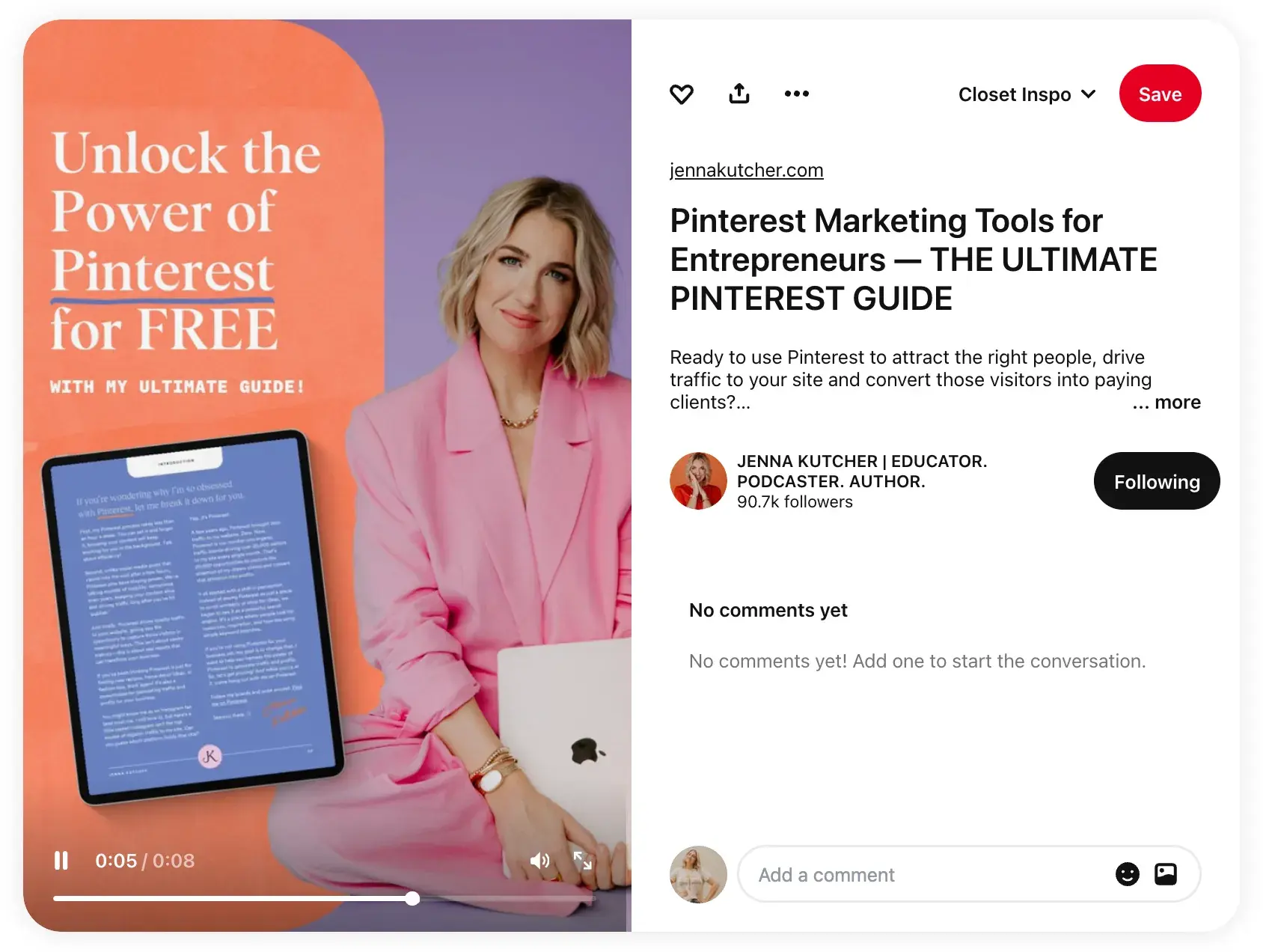
Selling products on Pinterest example: Jenna Kutcher Pinterest pin

3. Optimize for lead generation and sales.

Pinterest is the #1 organic traffic driver for us in my business, but I am not Pinterest obsessed solely because it drives traffic. I am obsessed because of what happens after that traffic lands on my website.

Because of how niche and tailored my pin audience is, they’re also coming to my site looking for my solutions, whether it’s for my free or paid offers. Pinterest isn’t a one-shot traffic generator.

Instead, the new customers landing on my pages are being invited to join my email list and stay in touch, giving me the opportunity to turn that traffic into treasure.

This effect is seen across so many industries. Around 80% of Pinterest users discover new brands or products on the platform, making it a key tool for businesses to generate new leads and grow their email lists.

Pinterest users are 2.2x more likely to click and make a purchase after interacting with products and offers they discover on Pinterest compared to other social platforms.

Driving sales through pins is a primary reason so many businesses are starting to show up on the website rather than keep their focus solely on social media.

The difference is evident in how Pinterest and social media websites function.

Apps like Instagram want to keep users ON their app, which challenges business owners to feel like they have to convince their audience to leave the app. I mean, how tired are you of typing some variation of “tap the link in my bio for more” just so you can get people out of the sea of tiny squares and into your sales funnel?

Pinterest is encouraging users to find their solution and actually leave the website altogether. They want to get people to your website, which means you have a better chance of converting and capturing new customers.

While we absolutely love the traffic we can get from Pinterest, traffic alone doesn’t always turn into treasure. We want people to not only save our pins but to go a step further and visit a page that we own (whether our website or shop!).

Using specific calls to actions and offering free value or solutions helps people want to go off of the app to get more information.

Once they click on our pin to visit the page, we want to ensure we have a plan to capture that traffic when they land on our site. For us, the main way we are able to monetize traffic coming from Pinterest is through growing our email list where we can serve our subscribers and then eventually invite them into a paid offer.

While shops with physical products can find success linking directly to their products for the people exploring the platform, as a digital company, we’re looking at ways to capture the traffic and lead them to a product aligned with the pin they clicked on originally.

4. Consistency is Key: Batch and schedule content.

Just like your elementary school teacher taught you, “Practice makes perfect,” except I’ll do a quick edit for Pinterest: Consistency makes connection.

The more you create a habit in your workflow to test and try new pins and adjustments to your strategy, the more opportunities you’ll create for the right customers to find any and all of your work.

Research shows that consistent pinning on Pinterest is essential for boosting your reach and engagement. By pinning regularly — aim for a few pins each day — you keep your content visible and perform better than if you were to post in large batches infrequently.

Active accounts that pin consistently attract more impressions and interaction because they have fresh visibility in others’ feeds. This strategy aligns perfectly with how Pinterest rewards regular engagement, making it a key component of any successful Pinterest approach.

I mentioned that we love to use Tailwind to schedule our pins, and it’s there that we save a ton of time thanks to automation.

I want my pins to flood my potential customers’ search results, which requires a lot of pins with varying keywords and eye-catching visuals. That means we’re aiming for a high daily posting rate (around 10-20 pins per day), which drives that higher engagement rate.

But don’t let that number scare you — even if you upload just one fresh pin per day, you can 20x the traffic you’re getting to your website!

I teach you how in my free masterclass, 20x Your Traffic in 1 Hour a Week with Pinterest Without Spending a Dime on Ads. I’ll show you how to take any of your offers, services, videos, social posts, or blog posts, and create click-worthy pins … even if you’re a total beginner.

Even if you’ve never even pinned a single thing on Pinterest before.

Pinterest Lets Your Hard Work Actually Work

The results we see from Pinterest might also sound like the results of many years of hard work, but I will say our results started almost immediately. When my employee Caitlyn integrated Pinterest into our workflow, I noticed some of my old blog posts started to take off. I watched as new students jumped into my programs when I wasn’t actively selling them.

I could see the numbers on my podcast, The Goal Digger Podcast, shift on the days when we would launch new pins. In fact, I know for sure that I still get book sales several years later thanks to the pins on Pinterest that pop up in just the right search results.

Pinterest’s unique and hyper-powered ability to connect your work to the right audience is unmatched. It takes less time, effort, and energy than social media and it’s far more effective and straightforward than a social media algorithm.

Finding new customers can finally have a method, rather than just feeling like a shot in the dark. Your valuable offers and impactful content no longer have a shelf-life of just a few hours or, at best, a day. Pinterest offers you weeks, months, and even years as it delivers your relevant solutions to the eyes that are seeking them.

So, Pinterest gives your work the chance to truly work for you and your business. With the help of a few good pins and 1 hour a week, what you’re already creating can help your business grow, saving you time and stress in the process.

You don’t need to do more, work harder, post more, and churn out flashy new content every few hours. Despite what the rest of the internet would have you believe, you don’t need to be a content-creation machine. You merely need to give what you do create the chance to shine.

Categories B2B

Which Types of Content Will Win Over Google AI Overviews, According to Experts & 300+ Web Strategists

Since May 2024, Google’s AI Overviews (aka SGE) have reshaped the SEO world as we know it.

While content quality has always mattered, the stakes are now higher than ever as content must be not only informative and unique, but also easily digestible by Google’s AI.

Download Now: The Annual State of Artificial Intelligence in 2024 [Free Report]

This shift leaves a big question: What happens to your traffic if some of your content becomes redundant?

Check out insights from HubSpot’s SEO experts on which content to prioritize and what to avoid in the post-SGE landscape.

Which Types of Content to Lean into Ahead of Google’s SGE

1. Lean into personality-driven, thought-provoking content.

AI has a lot going for it. But, due to the nature of it being a robot, it inherently lacks one thing: a perspective.

Which is why you’ll want to ensure you start leaning into personality-driven thought leadership content that offers personal lessons, examples, and novel concepts that drive conversations forward.

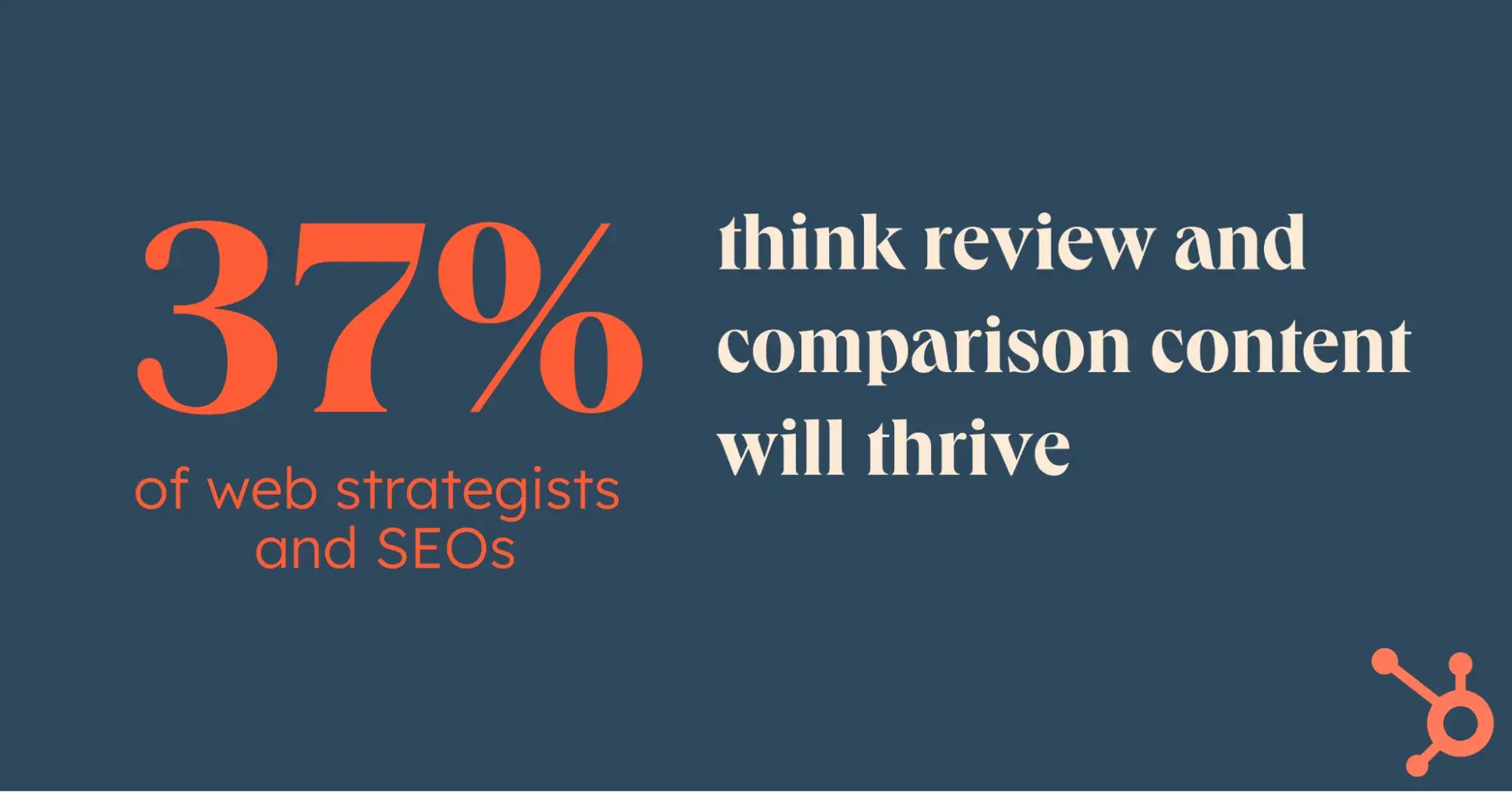
stat from post that 37% of SEOs think review and comparison content will thrive

In a survey we ran of 300+ U.S. web strategists and SEOs, we discovered that 37% think review and comparison content will thrive, while 27% see opinion pieces and thought leadership content as strong performers in this new landscape.

As Aja Frost, HubSpot’s Director of SEO Global Growth, puts it, “As a result of the AI evolution, there is an exponential increase in the amount of AI-written, low-value content. And, in response to that, Google is prioritizing first-person, credible, personality-driven content.”

This makes sense. Google needs its AI models to continue to improve based on new information on the web. And new information – including new perspectives and ideas — can only come from real people.

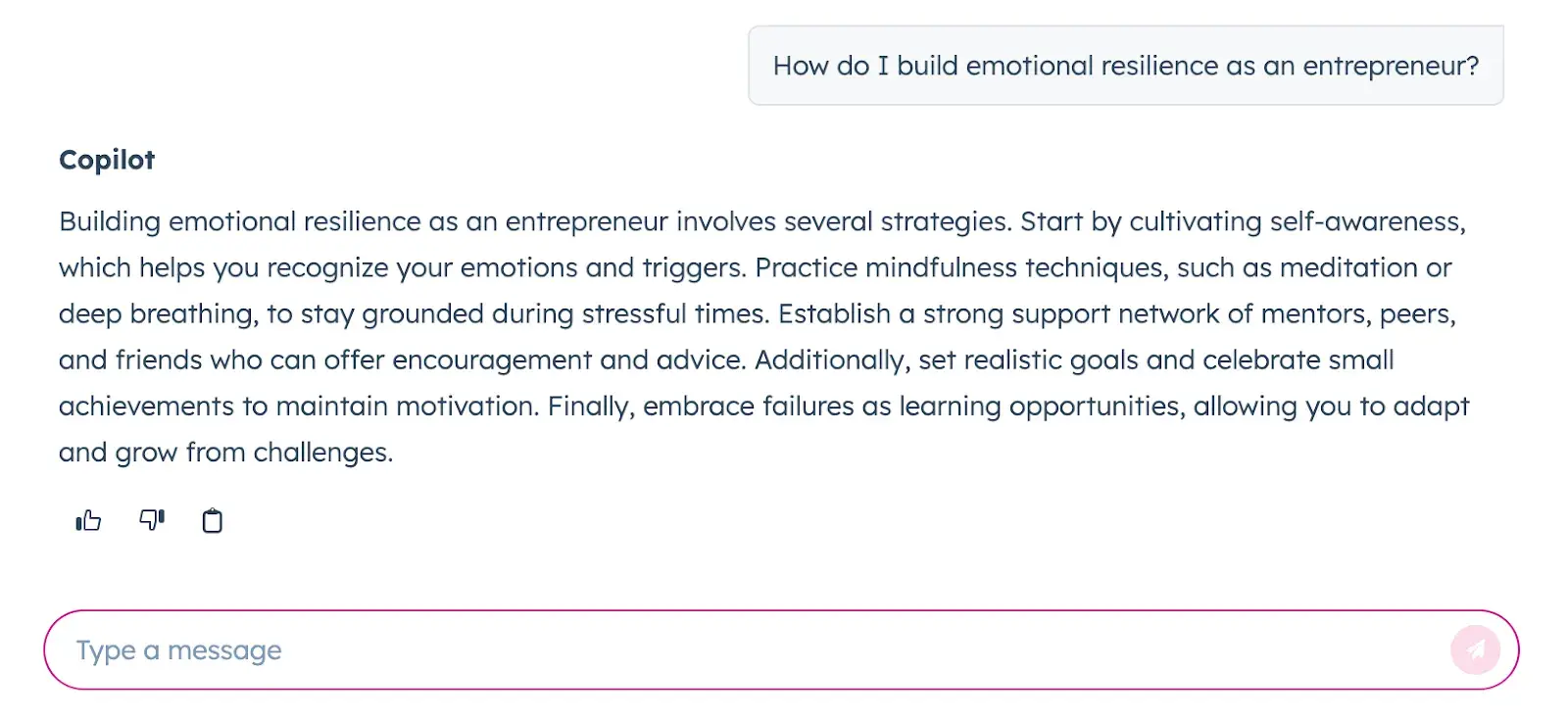
For instance, consider what happens when I ask Breeze Copilot, “How do I build emotional resilience as an entrepreneur?”

breeze copilot response

Copilot’s answer includes plenty of tangible steps toward building resilience. But it lacks the nuance and complexity of real life.

Which is why it’s more helpful for me to turn to this post: “Bounce Back: Five Founders on Building Emotional Resilience.”

In the post, one founder, Michael Plisco, says, “As founders, we often find ourselves so deeply attached to our business and its mission that it becomes difficult to distinguish ourselves from what we are building. In failure, you have to take a step back and realize that the failure of the business, regardless of the situation, does not equate to a failure of self.”

Plisco then recommends getting back in touch with the things that make you happy, from spending time with friends and family to activities you haven’t had the time for since launching your business.

Consider that advice compared to Copilot’s advice to “Embrace failures as learning opportunities, allowing you to adapt and grow from challenges.”

See the difference?

Ultimately, there are plenty of topics that deserve a quick, straightforward, cut-and-dry answer. I turn to Copilot all the time for topics like “Make me a workout plan,” “What is the top social media platform right now?” and “Please give me five questions I should ask in an interview about product development and AI.”

AI can‘t move the conversation forward into new territory with fresh, novel ideas. And it can’t fully relay the subtleties and nuances that many complex topics require. That’s where your content can truly shine.

2. First-person narratives will become increasingly crucial.

AI can round up a long list of tools and provide a comprehensive analysis of each, but it can’t describe its own unique experience testing the tools out.

Which is where first-hand perspectives will become critical.

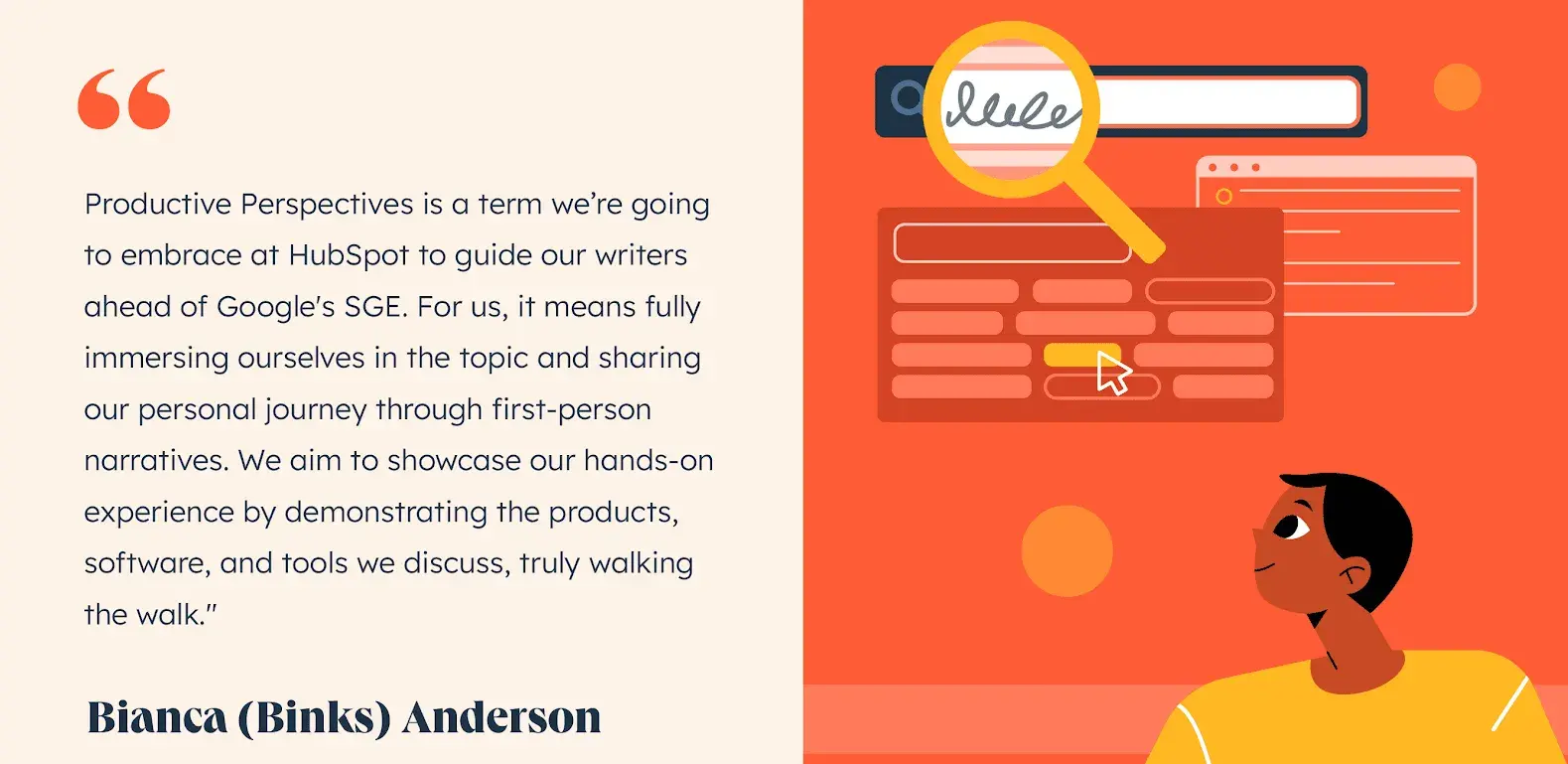
As former HubSpot Marketing Manager and SEO Strategist Bianca (Binks) Anderson told me, “Productive Perspectives is a term we’re going to embrace at HubSpot to guide our writers ahead of Google’s SGE. For us, it means fully immersing ourselves in the topic and sharing our personal journey through first-person narratives.”

google AI overview SEO tips

She continues, “We aim to showcase our hands-on experience by demonstrating the products, software, and tools we discuss, truly walking the walk.”

📍 It’s vital you take a look at your existing strategy and consider where you can incorporate first-hand expertise. Rather than writing “The Top 10 Marketing Automation Tools,” perhaps you use a first-hand angle like, “I Tried These 5 Marketing Automation Tools: Here’s My Favorite.”

Along with helping you rank in a post-SGE world, incorporating first-person expertise also helps you build brand trust. Your readers want to know you have real-life experience on the topics about which you’re writing.

Anderson adds, “We also believe in taking a clear and confident stance on a topic, supported by first-hand research and data.”

She continues, “We believe that forming and articulating insightful opinions is a hallmark of genuine expertise. With Productive Perspectives, we strive to provide valuable content that resonates with our readers.”

Here’s some interesting data on this matter: about 30% of SEOs think that content sharing personal stories and experiences is going to be hit the hardest by generative AI and LLM search engine integrations.

I can’t decide if this opinion is based on the belief that such stories will feel less authentic and personal or that LLM search engine integrations won’t be able to summarize these stories in AI Overviews well enough.

It seems both could be factors.

As generative AI relies more on general patterns instead of genuine human experiences, people worry that personal narratives will lose their impact, and most importantly — the “soul.”

3. You must incorporate E-E-A-T signals into your content.

Google’s Search Quality Evaluator Rating Guidelines rate E-E-A-T — which stands for Experience, Expertise, Authority, and Trustworthiness — as critical factors for ensuring your content ranks on Google, and E-E-A-T became increasingly important after Google’s SGE was released.

Which is why Rory Hope, HubSpot’s Head of EN Growth, advises all content creators to lean into these factors when creating content.

As he puts it, “When creating a piece of content, you’ll benefit from writing it through the real world experience of the author, whilst referencing the author or your company’s credentials to improve perceived expertise by search engines and users.”

He continues, “To improve authority, backlinks will remain important, so try to include primary research data or quotes when possible to make your content linkable and sharable. Depending on the content type, you should also add social proof or reviews onto the page, as this will help build trustworthiness.”

Hope recommends marketers read Google’s Search Quality Rater Guidelines to build a deeper understanding of E-E-A-T, which will help improve your visibility.

On the flip side, three experts from different niches and companies like Backlinko, Wistia, Rainbow Plant Life, and Angi adhere to slightly another approach — information gain. They advise writing SEO-optimized articles and adding only 10 to 40% of unique information.

Experts bake this up to the performance of their content and fear that “overloading your content with new information might make Google doubt its relevance to the query.”

My take? You should incorporate first-hand experience anyway, but that isn’t equal to information gain. Go through HubSpot blog posts, and you’ll see that our writers pour intensive research and external expertise into every post to make it unique and practical.

Yet all content incorporates keywords here and there — no SEO obsession.

4. Lean into long-tail queries.

For a while now, marketers have heard the power of long-tail queries for ranking higher in the SERPs.

As a refresh: Head terms like “blogging” are generally searched for frequently, and are harder to rank for compared to long-tail phrases. So when considering your SEO strategy, you’ll want to make a list of long-tail phrases that could help you capture more traffic.

“How to write a blog post: a beginner’s guide,” for instance, is likely easier to rank for than “blogging.”

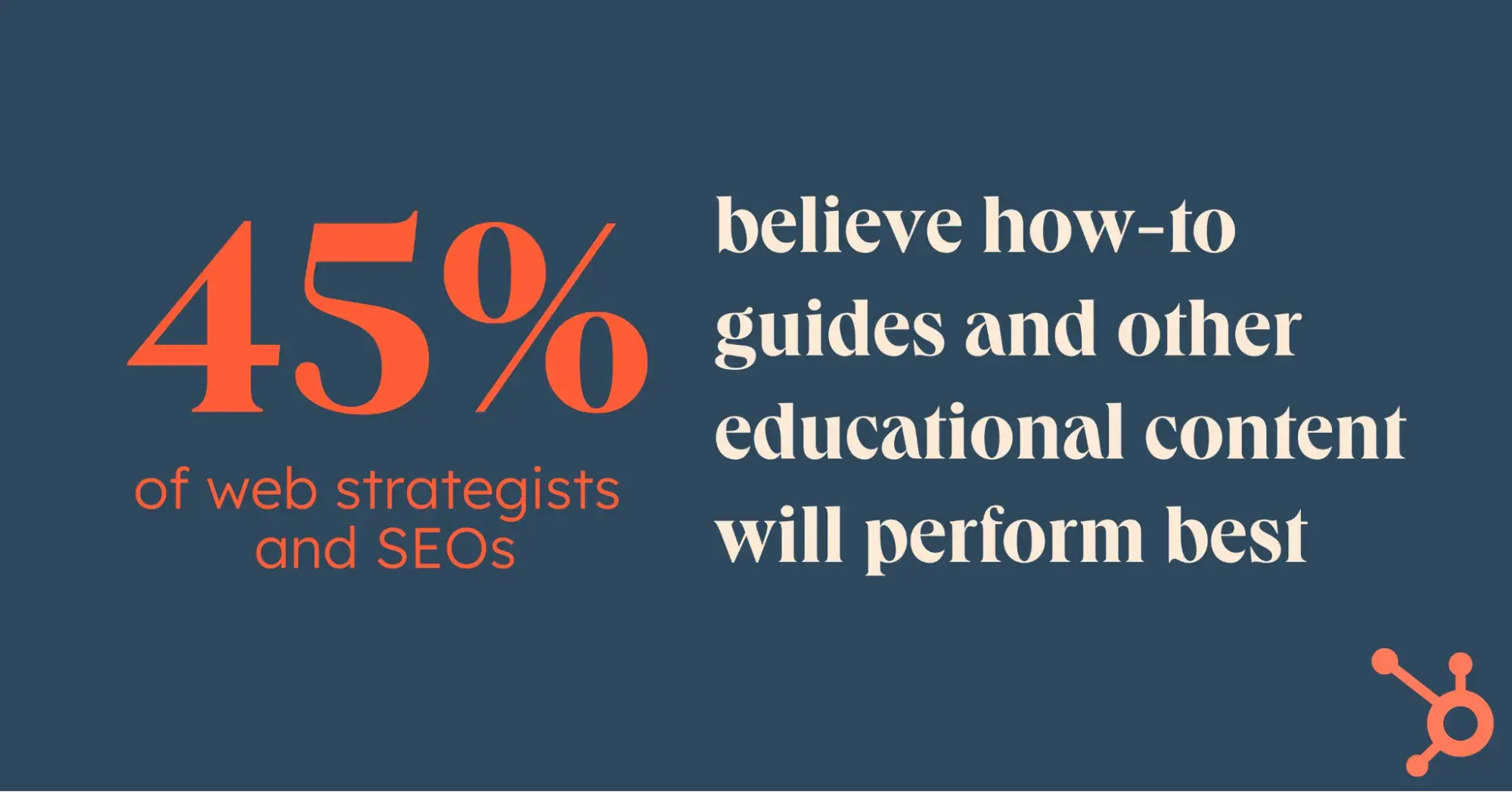
stat from post that 45% of SEOs believe “how-to” guides and other educational content will perform best in era of google AI overviews

45% of SEOs believe “how-to” guides and other educational content will perform best as generative AI and LLMs become more integrated with search engines.

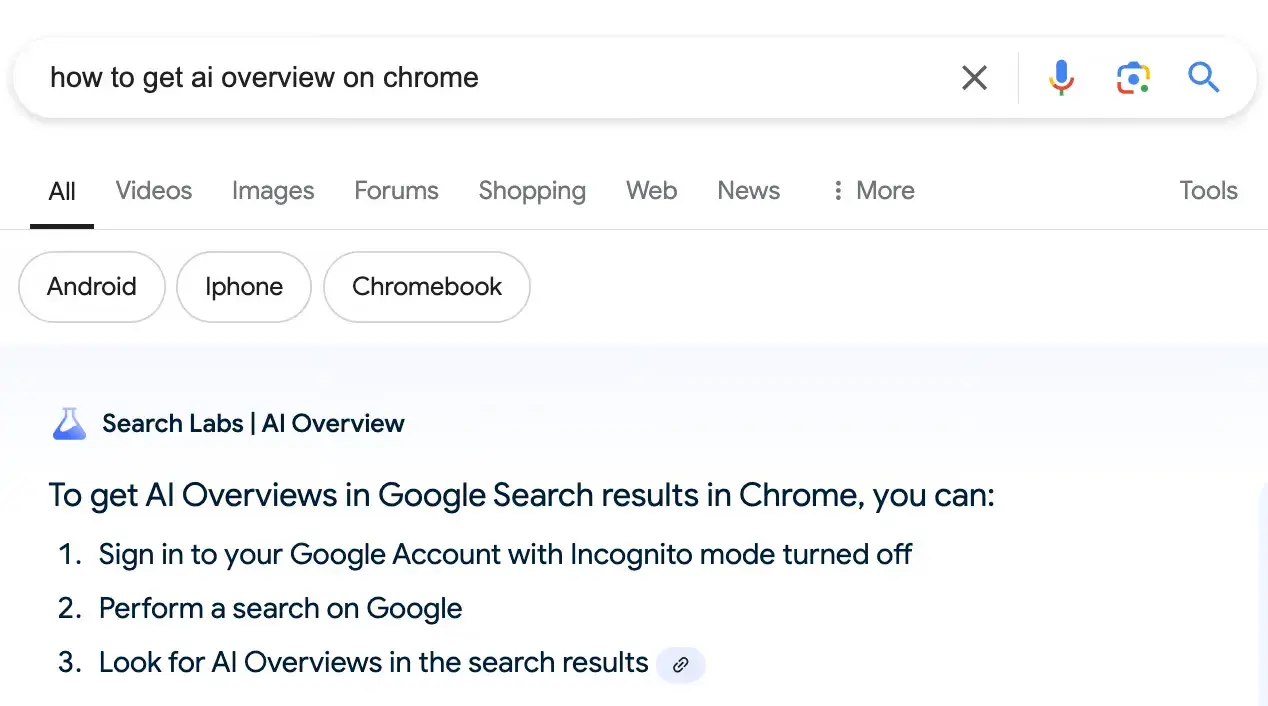
And speaking about how-to guides, you’ll often see AI overviews using ordered lists for step-by-step instructions, according to the Surfer survey.

Search Labs | AI Overview

Source

Senior Technical SEO Specialist Sylvain Charbit believes such types of queries will become increasingly important in a post-SGE world.

“Prioritizing long-tail queries will become even more important as AI answers from Google are usually better in this case,” he said. “Optimizing images and content around these more in-depth questions could lead to more visibility in the AI-generated responses.

Long story short: People are now writing long phrases to get short, straightforward, “ASAP” responses.

And when I say short, I mean that AI overviews are usually around 157 words long. That gives you only about 984 characters to answer a question directly or make the content interesting enough to get people to click and find out more.

It’s tough, but it really sharpens your focus and keeps you from wandering off-topic. You know exactly where you need to go and what to give your users.

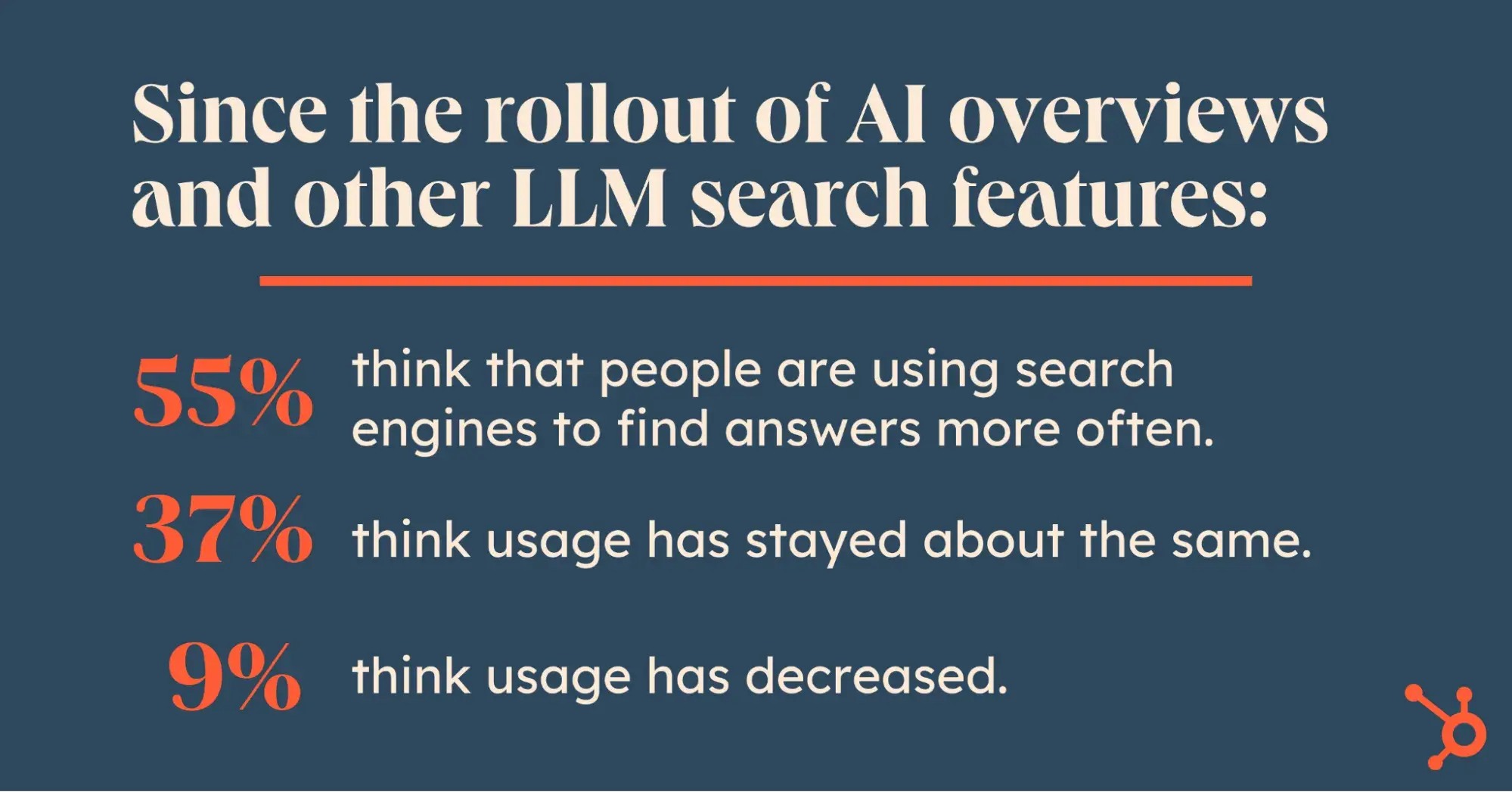
stats on search engine usage from hubspot survey

And how will all this impact search engines?

Well, 55% of SEOs from our survey believe that since the rollout of AI overviews and other LLM search features, people are using search engines to find answers more often.

Meanwhile, 37% think usage has stayed about the same, and only 9% feel it has decreased.

I’m kind of torn between thinking that people are searching for answers more frequently and believing that usage has remained roughly the same. But I’d bet that it definitely won’t go down.

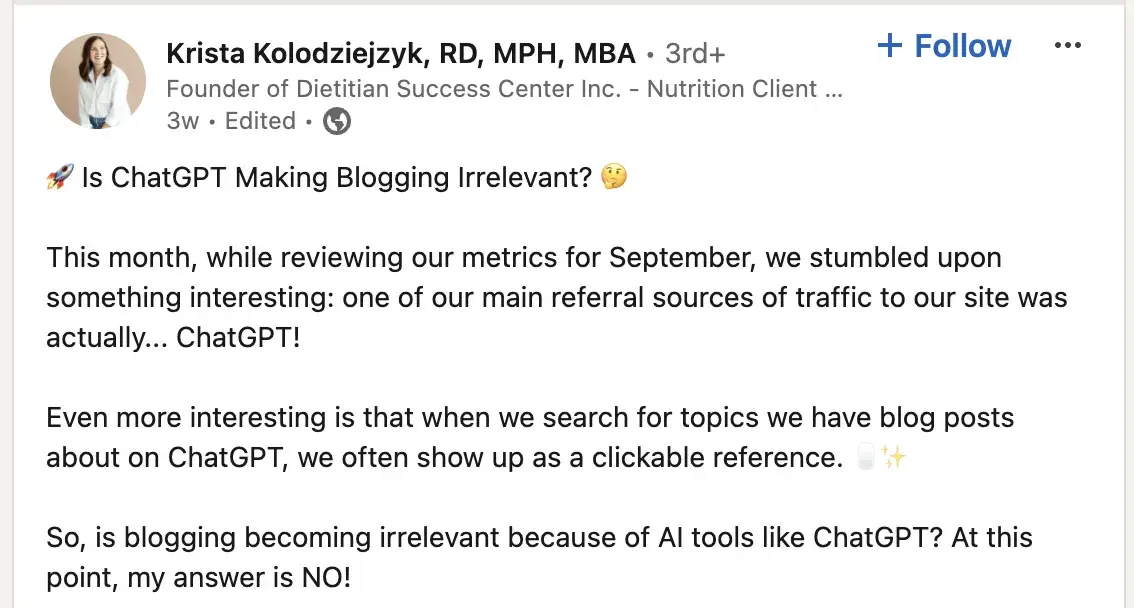
Moreover, we must take in traffic generated by AI chatbots — from ChatGPT and Gemini to Claude and Copilot. In October, I saw an influx of posts sharing that they had started getting more traffic from chatbots.

new SEO trend: referral traffic comes from chatbots

Source

Don’t Fear Change — Just Adapt Your Strategy

To rank high, you have to be ready for even more changes ahead. Google isn’t slowing down, and AI is advancing way faster than expected. But that doesn’t have to be a bad thing. We just need to prepare ourselves and stay open to change. (Good news: AI won’t take our jobs.)

Your SEO and content strategy teams are ready to test, iterate, and experiment to find out which new content strategies work best for your business.

Take a look at The SEO Evolution: Expert Insights into the Future Landscape of Search if you’re interested in learning more about how SEO will change in 2025 and beyond.

Editor’s note: This post was originally published in September 2023 and has been updated for comprehensiveness.

Categories B2B

Implementing AI in Your Marketing Tech Stack — Tips and Tricks You Need to Know

Long before ChatGPT, I worked with clients who used AI and machine learning to speed up data analysis at scale. Their enthusiasm about AI’s ability to improve everything from business operations to AI marketing funnels piqued my interest.

So when ChatGPT took over the news cycle, after my initial skepticism, I haven’t looked back.

Download Now: The Annual State of Artificial Intelligence in 2024 [Free Report]

While it’s always important to take AI with a grain of salt, it provides companies of all sizes opportunities to personalize marketing, deepen customer intimacy, and improve the efficiency and effectiveness of marketing programs.

More importantly, it lowers the barrier to entry for sophisticated marketing efforts, improving the way we can interact with and build on customer relationships. So let’s get into how you can incorporate AI into your marketing funnel.

Table of Contents

AI and the Marketing Funnel

Before you and I have any conversation about how AI can improve the marketing funnel, let’s make sure we’re on the same page about what marketing funnels are and how they work.

Why?

I strongly feel that before you can automate something, you need a solid understanding of how it works so you know the expected outcomes.

Without that foundation, you can’t know if AI recommendations are any good, you can’t identify what’s working and what’s not, and it’s tough to find a solution that works.

So, at a high level, let’s agree that the entire purpose of a marketing funnel — or flywheel — is to map out each stage of the buyer journey and then improve the way customers move through it.

From there, we can look at the different ways that AI can improve aspects of the marketing funnel — including the buyer journey (and far beyond it).

Understanding The Buyer Journey

Here’s a quick recap of what the buyer journey typically looks like, the types of tasks that are associated with it, and the opportunities for AI marketing funnel optimization.

Understanding The Buyer Journey

Awareness Stage

During this phase, prospective buyers are aware of a problem but may not yet know the solution and search for information to understand their pain points.

Marketing Tasks & Challenges

Marketers working through awareness stage tactics spend time:

  • Identifying target audiences and key messages.
  • Understanding buyer pain points.
  • Creating and optimizing content that speaks to problems and solutions.

So, where are the challenges? Some of the struggles I see other marketers face — and have struggled with myself — include:

  • Analyzing whether or not we’re reaching the right audience.
  • Ensuring content speaks to different segments and pain points.
  • Generating leads — the holy grail!
AI Marketing Funnel Opportunities

I’ve seen AI make a significant difference when it comes to prospecting and lead scoring. I’m working with a client to develop some new programs, and we’ve found the “Likely to Engage” score in ZoomInfo helpful for identifying the best possible targets for initial contact.

Some of the other ways I’ve seen AI help in the awareness stage include:

  • Segmenting audiences. This makes it easier to target specific groups based on shared interests, demographics, or problems.
  • Personalizing content. AI can identify existing content, push it to the right audience at the right time, and identify opportunities to tailor it for those audiences based on data analysis.
  • Ad targeting. Ads can be targeted based on the likelihood of engagement and lookalike audiences.
  • Using predictive analytics. This helps determine which content, channels, and formats are most likely to pay off.

Pro tip: Use AI to identify where customers are and deliver the right message at the right time.

Adam Tishman, co-founder of Helix Sleep, says, “AI allows us to know which customers are in which marketing funnel stage by using historical data to categorize them based on their behavior.” He shares that this has led to a 32% increase in engagement.

Consideration Stage

At this stage, buyers are solution-aware. They know solutions to their problem exist and are actively evaluating their options but may not be familiar with your specific product or service yet.

Marketing Tasks & Challenges

If you’re a marketer tackling buyers in the consideration stage, you’re probably focused on:

  • Developing and distributing content that helps buyers evaluate options, such as product comparisons, case studies, and expert guides.
  • Tracking engagement across channels to gauge interest levels.
  • Nurturing leads with personalized email campaigns or retargeting ads.

Common obstacles that can make this stage challenging include:

  • Determining which leads are genuinely interested versus those who are just browsing.
  • Providing the right information at the right time without overwhelming leads.
  • Balancing personalization with scale, especially with a large volume of leads.
AI Marketing Funnel Opportunities

AI offers several advantages for optimizing the consideration stage, such as:

  • Lead scoring. This can help you prioritize high-potential prospects.
  • Content recommendations. AI can identify which content is most engaging and suggest the next best content to keep them moving through the funnel.
  • Automated email nurturing. AI can segment leads and deliver content based on specific triggers without requiring constant manual input.
  • Behavior analysis. Assesses buyer intent and helps you adjust messaging based on real time interest levels.

Pro tip: Don’t rely completely on AI — the personal touch still matters.

Roland Jakob of Blazekin.Media shares, “AI spots patterns and predicts actions, but it’s on us to craft messaging that resonates personally. In my early experiences with AI, I relied on it too much for customer interactions.

It’s tempting to automate everything, but I quickly realized that complicated conversations and decisions need a human touch.”

Decision Stage

By the decision stage, buyers understand their problem, know the potential solutions, and are evaluating providers. They’re comparing products, seeking validation through demos or testimonials, and are ready to make a final decision.

Marketing Tasks & Challenges

If you’re working on initiatives to help buyers make a final decision, you may have already handed the lead over to the sales team, who focuses on:

  • Offering product demos, trials, or consultations to build confidence.
  • Personalizing discounts or promotions to help close deals.
  • Addressing buyer objections and providing quick answers to final questions.

While marketing supports the decision stage with content, the biggest problems your company faces at this stage are usually sales-related:

  • Closing high-intent leads effectively without seeming overly aggressive.
  • Personalizing the buying experience while ensuring consistency.
  • Following up at appropriate intervals.
AI Marketing Funnel Opportunities

Because so much of the challenge here relies on timing and further building the relationship, some of the ways AI can help you streamline the decision-making process include:

  • Predictive conversions. Identify which leads are most likely to convert, allowing for more effective prioritization of high-potential customers.
  • Personalized offers. Identify interested prospects based on previous behaviors to increase the likelihood of conversion.
  • Automated follow-ups. Ensure high-intent leads get the right message at the right time.
  • Chatbot support. Handle common buyer questions and objections in real-time, supporting purchase decisions.

Pro tip: Use AI to fine-tune timing and personalization to improve conversions.

John Pennypacker, vice president of sales and marketing at Deep Cognition, explains how AI has transformed his team’s approach to conversions. “We use AI-powered lead scoring to prioritize high-potential leads and AI content optimization tools to fine-tune messaging,” he says.

By combining predictive insights with tailored offers, his team increased content engagement by 35% in just two months.

Onboarding, Engagement, and Retention

While not technically part of the buyer journey, onboarding your customers and keeping them engaged is an important part of marketing operations. People are more likely to stick around if they use and like your product.

What’s more, getting new customers costs significantly more than retaining existing ones, meaning customer experience is one of the most important places to invest marketing dollars.

In fact, B2B marketers devote more energy to deepening relationships with existing companies than nurturing new leads and serious opportunities.

Marketing Tasks & Challenges

As a marketer who often works with CX teams to improve retention and customer satisfaction, I’ve found that this stage often involves:

  • Following up with customers to ensure satisfaction and offer support.
  • Creating opportunities for upsells, cross-sells, and loyalty rewards.
  • Gathering feedback through surveys or reviews to improve the customer experience.

Some of the primary challenges include:

  • Keeping the engagement momentum building.
  • Identifying the right moments to suggest upsells or cross-sells.
  • Recognizing and addressing signs people aren’t engaged early.
AI Marketing Funnel Opportunities

In my opinion, while AI has tremendous potential during the buyer stages, some of its most important impact relates to post-purchase nurturing and retention. Some of the ways it can help include:

  • Automated personalized follow-ups. These will be based on purchase history, engagement, and likely behaviors.
  • Behavior monitoring. Doing so will help detect opportunities for upselling or cross-selling based on previous purchases and browsing patterns.
  • Churn prediction. Identify customers showing signs of disengagement or dissatisfaction and trigger actions to keep them engaged.
  • Personalized product and resource recommendations. These will Improve customer experience and increase lifetime value.

Pro tip: Use AI to help customers feel valued and understood.

Consultant Nora Sudduth points out, AI shines when used to segment audiences and deliver personalized experiences that allow the relationship to deepen.”

How to Build a Marketing Funnel With AI

With those insights in mind and a deeper understanding of the challenges marketers face at each stage of the marketing funnel, I want you to know that there’s no one right way to build or optimize your marketing funnel with AI.

I know that you’ve probably already got some marketing funnel components in place — most people aren’t starting at zero. And restarting from the ground up is a nuclear option that I rarely recommend unless your systems are fundamentally broken.

With that in mind, I’m sharing a toolkit below. You can pick and choose any of these elements to enhance what you’re already using.

How to Build a Marketing Funnel With AI

Step 1: Map and analyze your current funnel.

Why is this Step 1? The best place to start is by gaining a solid understanding of what you have now, what’s working, and where you have the biggest opportunities — or the low-hanging fruit.

By mapping out your funnel and every touchpoint, you can identify strengths, weaknesses, and opportunities to optimize. AI speeds this up, giving you something to react to so you can adapt and adjust as you go.

If you use HubSpot, Breeze is an incredible tool to help you gain insights into your entire funnel — including all aspects of the customer journey. Google Analytics and Search Console are other fantastic tools that can help identify which pages perform well and where you have opportunities to optimize.

Depending on which email marketing program you use, you can also get detailed reporting on open and conversion rates.

Pro tip: Map your customer journey with AI.

Arthur Favier, founder and CEO of Oppizi, shares, “You’ve got all these stages — Awareness, Consideration, Decision, Retention — and each one has its own set of challenges. AI steps in to spot where people are dropping off and why. Maybe your potential customers love the content you’re putting out, but they’re getting lost right before making a decision.”

Step 2: Identify, define, and segment your audience.

What I really love about using AI for this stage is that it can confirm your gut feeling about your audience. Once you define who your top clients or customers are, you can use AI tools like Breeze and Copy.ai to get insights into your target market segments, trends, purchase behavior, and content preferences.

I also love using generative AI like ChatGPT or Claude to analyze customer conversations and reviews to get deeper insights into how they talk about their problems.

Pro tip: Use AI to get precise audience segmentation and targeting.

Dominick Tomanelli, co-founder and CEO of Promobile Marketing, says, “One of the first things I do is look at how AI can help us segment our audience.”

Tomanelli notes these aren’t just generic groups, like “males 25-35” here. AI can break it down into the smallest details, like “males 25-35 who’ve shown interest in sustainable products and have visited our site more than three times in the last month.”

“This kind of precision lets us serve content that’s hyper-relevant, and that’s how we keep people engaged,” Tomanelli says.

Step 3: Identify and tailor your message.

Step 2 and Step 3 go hand-in-hand. Once you know your audience and how they think about their problems, you can start tailoring your messaging to speak directly to their needs.

Where Breeze and Copy.ai can help you ensure that you’re tailoring your message to their needs, other AI content tools like Jasper and ChatGPT can suggest message themes, helping to craft content that resonates with different audience segments.

Step 4: Catalog your content and identify opportunities for repurposing.

The best way to personalize content isn’t creating an entire library of new information — it starts with making the most out of the content you’re already creating.

While you can use generative AI here, in my opinion, Breeze offers a better solution because it’s designed to work with your audience insights to help you deliver consistent, targeted experiences.

Wondering what this looks like?

AI-driven content analysis can reveal that a popular blog post might perform well as a lead magnet or that a webinar could be repurposed as short-form videos or infographics for social media. Or, it might find that it performs well as a series of emails dripped out.

Step 5: Automate lead nurturing.

AI-driven lead nurturing takes carefully designed paths and puts them on steroids, delivering content based on each lead’s activity and engagement level.

AI-enabled tools like HubSpot’s Marketing Hub, Adobe Marketo, or ActiveCampaign can trigger follow-ups and content offers automatically.

AI tools can monitor engagement signals and send relevant follow-ups when leads are most likely to take action, increasing conversion chances.

Pro tip: Timing is everything.

Rafikuzzaman Khan, co-founder and COO of Microters, says, “I’ve been personally using AI to create funnels, and AI tools allow me to analyze data in real-time and develop customer personas almost instantly. We’ve seen conversion rates increase by up to 40% when we use AI to design funnels that speak directly to the customer’s needs.”

Step 6: Analyze and optimize.

Anyone who thinks marketing doesn’t change has their head in the sand — that’s a flag I’ll happily wave. The market is always changing, customer expectations are evolving, and technology is continually maturing and leaping.

That means that you can’t set and forget any of your marketing efforts and expect consistent performance. What worked five years ago isn’t working today — and what’s working today won’t cut it 3-5 years from now.

So what do you do? Continually analyze performance using any of the tools I’ve named here and use the resulting insights to find opportunities to fine-tune targeting, messaging, and content based on performance metrics.

Pro tip: Use GA4 purchase probability to identify customers likely to buy.

Victor Karpenko, founder and CEO of SEOProfy, says, “GA4 has some amazing AI features for predictive analysis. You can set up a few filters to get insights that’ll boost your repeat purchases and optimize your marketing spend. Try creating segments based on purchase probability and predicted revenue.”

Tips for Making the Most of AI in Your Marketing Funnel and MarTech Operations

AI is an incredible tool to have in your arsenal — but it’s just that — a tool that can make you a more effective marketer (or marketing department). Here’s some top advice on how to use AI in your marketing funnel based on expert advice.

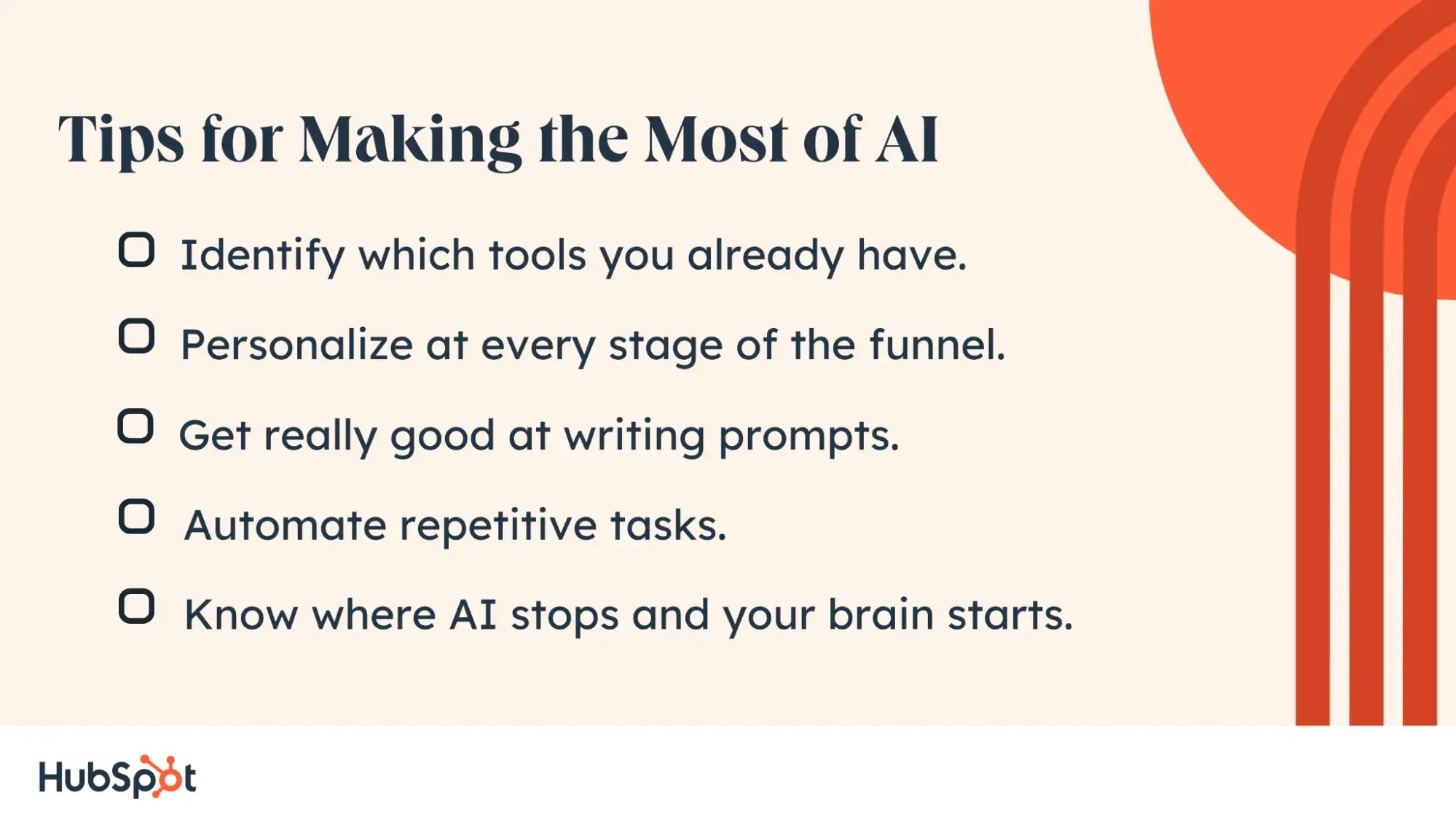
Tips for Making the Most of AI in Your Marketing Funnel and MarTech Operations

Identify which tools you already have.

If you’re using a MarTech tool, there’s a good chance it now has some AI capabilities. And while I know how tempting it is to chase shiny objects because they’re so exciting, every new tool you add to your tech stack adds complexity to your operations and processes — and another line item to your budget.

To stave off tech bloat, before you add new tools into the mix, evaluate the AI capabilities you already have access to. And when you do need new tools, look first for tools that have native integrations with your existing platforms — or that can easily integrate through Zapier or open API.

Pro tip: Choose the right tools for the job.

Khan says, “The biggest mistake most brands make is implementing too many AI tools at once, which leads to disorganization and inefficiency.”

Personalize at every stage of the funnel.

I’ve seen so many people beat the personalization drum. However, until AI, very few companies did it well due to the sheer volume of content needed. AI is the great equalizer — AI-powered personalization increases engagement and builds stronger customer relationships.

Pro tip: Tailor content based on real-time engagement.

Villam Karasti of Pardott says doing so has led to a 25% increase in response rates.

“I use Breeze Copilot to analyze engagement data and trigger personalized workflows. When leads reach specific engagement thresholds, they’re automatically entered into tailored sequences. The platform’s lead scoring and buyer intent features help me focus on high-potential leads while automating repetitive tasks like follow-ups and email sequences,” Karasti says.

Get really good at writing prompts.

As generative AI grows increasingly sophisticated, you don’t need to engineer prompts quite the way you did when it was first introduced. However, it’s still important to understand how to best interact with platforms like ChatGPT.

One of the best courses I’ve taken to date was AI for Copywriters by The Copywriter Club — I learned so much about how generative AI works and some of its capabilities.

Pro tip: Use bite-sized prompts.

Lori Highby of Keystone Click notes that asking for an entire marketing plan produces results, but they’re not well-thought-out.

“For example, rather than asking AI to create an entire marketing funnel, start by asking AI to gather data on your target audience, their pain points, and their typical customer journey. This will help you determine the next steps related to creating content that resonates with that audience while nurturing and guiding them through their preferred customer journey,” Highby says.

Automate repetitive tasks.

If you’ve spent any amount of time diving into AI and marketing funnel optimization, then you already know that one of its best features is its ability to automate repetitive tasks. So if there’s something you do that takes a ton of time, there’s likely a way AI can streamline that part of your MarTech operations.

Looking for an example? I recently shared how I created an AI-enabled ticketing system for client projects, which streamlined the project planning and assignment process. It also included setting up documents in Google Drive in specific folders, which I found to be one of the most cumbersome aspects of the process.

Pro tip: The best part of AI doesn’t have to be the complicated stuff — it can be about simplifying the simple stuff.

Sudduth shares, “One of the best use cases for AI is doing the heavy lifting on simple, repetitive, otherwise time-consuming tasks. AI-driven automation workflows can send specific follow-up emails after a certain trigger, schedule out social media posts, push an email cadence to nurture a segment of your email list, and so much more.”

Know where AI stops and your brain starts.

I’ve seen a lot of fear out there that AI is out to get our jobs.

And like with any modernization project, some jobs will be automated, while even more will be created because AI is only a tool.

You and I have two things it never will — humanity and creativity, and that’s what’s needed to manage your marketing funnel.

Pro tip: Treat AI as an assistant, not a replacement.

Abraham Ernesto, co-founder of GiantFocal, shares, “No one can deny that AI is an incredible assistant in the marketing space. However, I don‘t think AI can replace the ‘creative mind’ that plans the entire marketing funnel, or at least no AI in the market today can. The strategic decisions that drive the funnel’s overall plan still rely on human creativity and intuition.”

AI is the future of marketing funnels.

Despite the fact that there’s no one best way to use AI in marketing funnels, there are a few areas to steer clear of. Strangely enough, they lie in the extremes: not using AI at all and using AI for everything.

The best practices lie in the middle, where we balance AI with human insight. Small adjustments are the best place to start — they allow you to get a sense of AI’s capabilities without overwhelming your processes or team.

At the end of the day, one thing is abundantly clear — anyone not willing to test and iterate with AI is going to be left behind. So here’s to the future of marketing, where AI is more than just a tool — it’s the key to creating more dynamic, responsive, and impactful marketing funnels.

Categories B2B

How Internal Marketing Helps You Build a Strong Brand From the Inside Out [Experts Weigh In]

As an ‘external’ marketer, I have to say that I hadn’t given much thought to internal marketing until I started writing this article.

My first thought was … that’s not my job. But the more I dug into the subject, I realized that’s not entirely true.

Download Now: Free Marketing Plan Template [Get Your Copy]

Anytime I share a new content series or blog campaign across our internal channels and encourage my colleagues to help promote it, that’s internal marketing.

When I lead onboarding sessions for new hires or recognize my teammates for their great work as part of our performance review process, that counts too.

*quietly adds internal marketing to resume*

Here’s everything else I learned about internal marketing — the benefits, the strategies that experts recommend, and a few more examples of what it looks like in practice.

Table of Contents

A happy workforce is the key to a successful internal marketing strategy, so employee experience is a big factor here.

Every connection point that an employee has with the company — from onboarding to the exit interview — should be represented accordingly.

Internal Marketing vs Internal Communication

When I was a baby marketer, I couldn’t really understand the difference between marketing and communication because the two terms were often used interchangeably in the field.

Here’s how I used to simplify it:

  • Marketing is brand promotion.
  • Communication is information sharing.

Internal communication and internal marketing go hand in hand, but the two aren’t an exact match.

Going back to our definition of internal marketing above, it focuses on the act of promoting a brand to its employees to encourage them to buy into the company’s values and products.

For example, an internal marketing play could be giving employees free access to the company’s products for personal use. That’s in and of itself isn’t technically internal communication.

The purpose of internal communication is to keep everyone informed of company updates and aligned with core objectives.

If HR sends a company memo announcing a new process update, that’s an example of internal communication that doesn’t really fall under internal marketing.

These are very rigid examples, but the reality is that these two processes work together and often blend into each other.

Internal Marketing vs External Marketing

The main difference between internal and external marketing is the audience.

Internal marketing is focused on employees, while external marketing is for prospects and customers outside of your organization.

But the concept of promoting your brand and encouraging buy-in to your products and services is true in both cases.

comparison between internal marketing, internal communication, and external marketing

Why is internal marketing important?

Internal marketing is important because it directly supports employee engagement.

And data shows that high engagement leads to:

  • An 18% boost in employee productivity.
  • Up to 43% less turnover. Nice.

When employees feel connected to their work, they tend to work harder. All that extra effort leads to increases in customer satisfaction and loyalty, sales, and ultimately, profitability.

Remember how I said internal marketing isn’t my job?

Well, technically, it isn’t. However, I do participate in (and promote) internal marketing efforts as an employee.

*keeps internal marketing on resume*

Benefits of Internal Marketing

I mentioned employee engagement as a huge plus for investing in internal marketing. I talked to the experts and compiled a few more reasons to consider below.

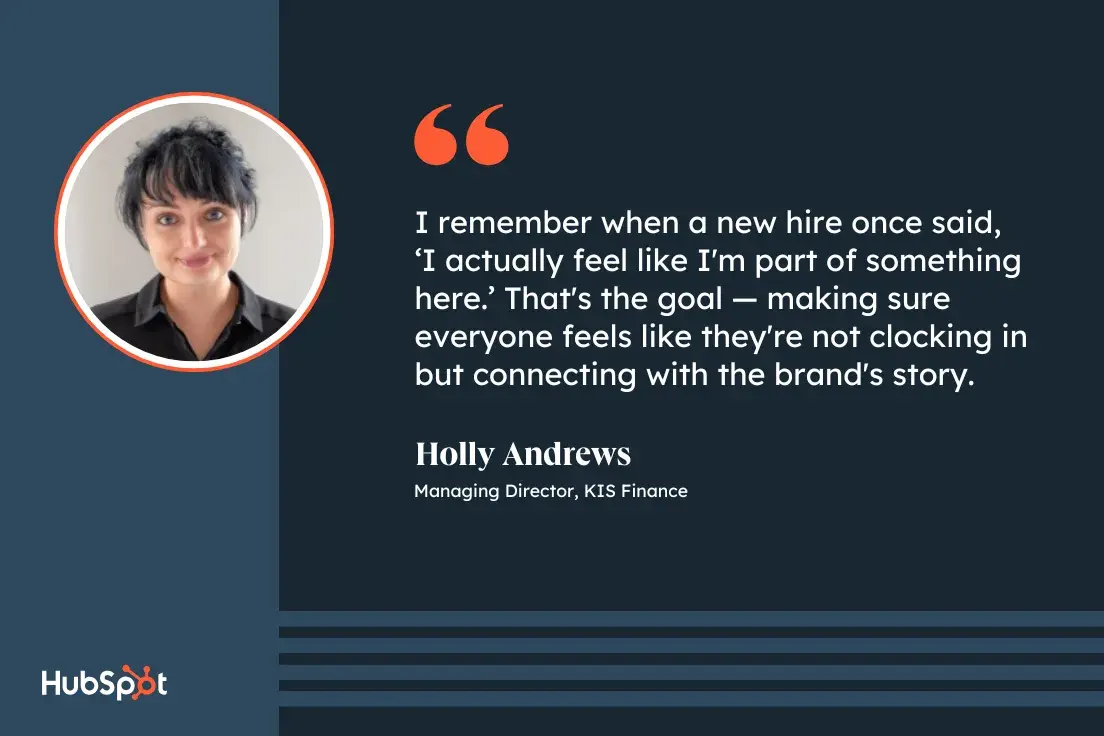
benefits of internal marketing; quote from Holly Andrews, managing director at KIS Finance; I remember when a new hire once said, ‘I actually feel like I'm part of something here.’ That's the goal — making sure everyone feels like they're not clocking in but connecting with the brand's story.

You’re building a team that (actually) cares.

Holly Andrews, managing director at KIS Finance, says the best internal marketing strategies help employees feel invested in the bigger picture.

“An effective internal marketing strategy does more than align people with company goals. It builds a team that genuinely cares,” says Andrews.

“I remember when a new hire once said, ‘I actually feel like I‘m part of something here.’ That’s the goal — making sure everyone feels like they‘re not clocking in but connecting with the brand’s story.”

You’re cultivating a sense of community at work.

Mike Szczesny, owner and vice president of EDCO Awards & Specialties, shared how internal marketing allows him to connect with his employees — and why that’s worth it.

“An internal marketing strategy that celebrates wins, shares behind-the-scenes stories, and highlights the impact of our work helps cultivate a crucial sense of belonging,” says Szczesny.

“The benefits are numerous — higher employee satisfaction and retention, a stronger employer brand that attracts top talent, and a workforce that’s truly invested in our success as a company.”

He continues, “At the end of the day, our people are our greatest asset, and an internal marketing strategy that makes them feel valued and part of something bigger pays dividends.”

You’re creating greater brand alignment.

For Remy Smidt, brand strategist at Fazer, one of the biggest benefits of internal marketing is alignment from top to bottom.

“If you walked into NASA during the ’60s and asked what they were up to and why they were there, everyone would say, ‘to put a man on the moon,’” says Smidt.

The bottom line is that everyone knows what the business is working toward, is engaged and excited about the mission, and understands their part in making it happen. That’s the result of good internal marketing.

Internal Marketing Strategies

I also talked to the experts to tease out a few internal marketing strategies that they use at their own companies. Here are five of my favorites.

1. Personalize the onboarding process.

internal marketing strategies; quote from Tetiana Hnatiuk, head of HR at Skylum; It's important to set the right tone from day one. We try to personalize our onboarding practices for each role and introduce our new hires to our values, products, and culture early on.

Each new hire has a different learning style and set of responsibilities, so make sure your onboarding process reflects that.

As Hnatiuk notes, promoting your mission and culture code during onboarding is also a great way to get employee buy-in from the start.

As an incoming marketer at HubSpot, I completed a general get-to-know-the-company onboarding track and a team-specific blog and marketing onboarding track. The format was a mix of videos, live sessions, and independent research.

It was comprehensive, engaging, and just what I needed to feel invested as a new employee.

2. Use storytelling to engage employees.

internal marketing strategies; quote from Spencer Romenco, chief growth strategist at Growth Spurt; Sharing stories about the company's journey, overcoming challenges, or highlighting individual contributions helps employees see themselves as part of something bigger.

Employees want to understand their role in your brand’s story as you progress through each chapter together.

Sounds corny, I know. But I’ve left jobs in the past because I didn’t feel like I was actually contributing to the end goal.

I couldn’t understand why the work I was doing was worth it (and nobody was telling me why, either), so I disengaged.

Building your brand’s story into your internal marketing strategy and reminding employees what you’re working toward builds transparency and trust.

Speaking of …

3. Create transparent communication channels.

internal marketing strategy; quote from Bradford Glaser, president and CEO at HRDQ; When organizations share information openly about company goals, performance, and changes, employees feel included and valued. This transparency helps build trust.

Here’s where internal communication meets internal marketing.

Keeping your employees well-informed is a special yet indirect form of promotion that inspires your employees to become your biggest ambassadors.

Your internal marketing strategy should clearly outline your communication channels and outreach process to allow you to easily share timely and relevant updates with your teams.

And don’t forget that communication is a two-way street. Be sure to create ways for employees to reach out about problems and issues or with feedback and suggestions.

As Glaser said, transparency builds trust. And the first step is effective communication.

4. Integrate values into daily actions.

internal marketing strategy; quote from Jason Stelle, digital marketer at Filterbuy; Whether it's a memo or a monthly newsletter, we make sure each message reinforces what we believe in and what we aim for.

I love this one.

Sharing your company values during onboarding is great, but it shouldn’t be the only touch point. As Stelle says, all of your internal marketing messages and materials should reinforce your mission, beliefs, and North Star.

Employees can easily advocate for your brand if they know what they’re advocating for and why.

5. Send regular employee surveys.

internal marketing strategies; quote from Michelle Burson, director of marketing at Artisan Colour; Surveys help you pinpoint internal pain points and prioritize what matters most to your team. They give you a road map for creating a strategy that actually resonates with your people.

I’m a big fan of asking people what they want instead of trying to guess. I’m willing to bet big money that the companies who give their employees pizza parties instead of tangible benefits aren’t asking the right questions.

Send employee feedback surveys often and ask specific questions about your internal marketing activities. What do they like? What do they want to see more of? What isn’t resonating with them?

Then, use these insights to refine and improve your strategy.

Internal Marketing Examples

OK, onto the fun part. I’m giving you a peek behind the curtain at some of my favorite internal marketing plays as a HubSpotter.

The Culture Code

This one’s probably a given, but HubSpot’s Culture Code is SO good. It started out as an internal document and, in the true spirit of transparency, has been publicly available for years.

HubSpot’s culture code

Our culture code has also been known to attract new employees, which feels like both an internal and external marketing win.

Product Learning Hours

Each month, our Product Marketing team hosts a “Product Learning Hour” which is a training session for the entire marketing team on the customers, products, and use cases for HubSpot’s customer platform.

From product demos to continued learning, these sessions ensure everyone is aligned on our messaging. This helps us do our jobs better as ‘external’ marketers.

Side note: I also co-led a learning and development program specifically for the HubSpot Blog team. We focused our curriculum on topics our peers were invested in the most, like technical SEO, networking, and time management.

Here’s one of the activities we did:

HubSpot learning and development example, keyword research activity

Just another example of internal marketing in action (and attempt #3 of me making the case to include internal marketing on my resume).

Peer Recognition Programs

I 🧡 my peers, so I’m always looking for opportunities to sing their praises.

At HubSpot, we have several options to provide peer feedback including the more formal submit-through-the-portal feedback loop that filters into performance reviews.

But one of my favorites is our weekly ‘Friday Props’ roundup on Slack.

Every Friday, folks across our media org have the option to tag someone they’re grateful for that week and share a word or two about what makes them special.

Here’s one someone left for me a while back:

“I’m giving my peer praise to Alana Chinn, one of the hardest-working and most versatile people on this team. If you’re on the Blog Team, you know how much of a force she is.”

BRB, crying.

Let Your Company Culture Sell Itself

Good internal marketing starts with an investment in your employees.

When you build a strategy that inspires brand advocacy at every level, you’ll be able to put some of the hard selling on autopilot while you focus on delighting your employees, prospects, and customers.

And then you, too, can add internal marketing to your resume.

Categories B2B

12 Benefits of Content Marketing [+ Examples]

As a seasoned content marketer, I can assure you that content marketing has vast benefits for any business. It is one of the most effective methods of growing audience engagement, developing brand presence, and driving sales.

If you‘re curious about content marketing and a little skeptical of its rewards, you’ve come to the right blog.

Download Now: Free Content Marketing Planning Kit

I’ll explain its importance and the kind of perks it can provide your business.

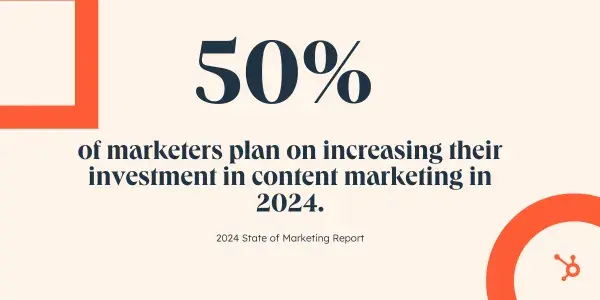
According to our 2024 State of Marketing Report, 50% of marketers set their sights on increasing their investment in content marketing this year.

Consistent, high-quality, and engaging content impacts audience decision-making more than any other technique.

Consistency in brand messaging is one of the many factors determining your business’s growth and success. Big brands know how to portray their brand consistently and at every customer touchpoint.

The same reasoning applies to content marketing—your content must have a unique and identifiable voice, style, and pitch across all distribution channels.

Content consistency establishes your credibility, builds trust, and strengthens your reputation.

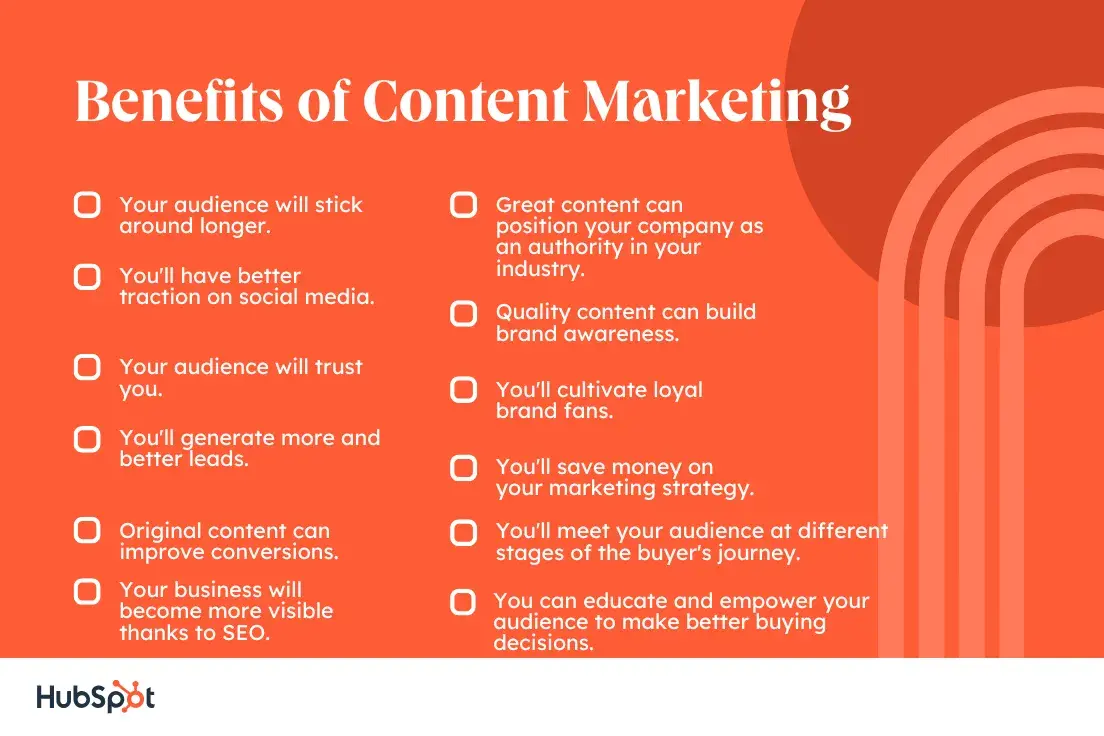
We know the content you create has to be consistent. However, why is content marketing so beneficial? Here are the top benefits of content marketing.

Why Content Marketing Works

Content marketing works because humans are highly visual creatures.

I know you probably weren‘t expecting to get into science today, but I promise it connects to marketing. More than 50% of the human brain’s cortex is dedicated to visual processing.

Furthermore, research shows that 90% of the information humans notice and send to their brains is visual. Therefore, content marketing, such as videos, graphics, visual ads, and blog posts full of graphs and charts, will surely resonate with your target audience.

Moreover, we are firmly rooted in the social media age, where content is king and more and more consumers are discovering new brands and products via social media. Our recent social media study found that 40% of Gen Z, 40% of Gen X, and 43% of Millennials have discovered new products via social media in the last three months.

You can boost brand and product awareness by creating sharable, engaging content that thrives on social media.

Benefits of Content Marketing

1. Your audience will stick around longer.

Great content is an important asset.

It can create positive experiences for your potential customers and compel them to come back for more. It‘s your ticket to capturing your audience’s attention and continually reinforcing a positive brand impression.

For example, one of my favorite social media accounts to follow is Duolingo on TikTok. The language-teaching app is known for its unique, funny, and entertaining presence on the platform.

Duolingo always provides entertainment value, so I keep it at the top of my mind whenever I get the itch to learn a new language. Whether I break my streak because learning a new language is hard is a different story.

2. You’ll have better traction on social media.

Since I brought up social media, it‘s important to remember that it’s one thing to increase your social media followers across channels, but it’s quite another to create trendy content.

If you‘re one of those businesses that doesn’t see much traction despite having a huge following, it’s time to use content marketing to your advantage. Quality content can help your business gain traction on social media.

Track the performance of your content campaigns using HubSpot’s analytics software.

3. Your audience will trust you.

I’ve found that creating content helps businesses build relationships with their audience. Engaging content can answer customer questions and interact with customers.

When a business creates value without taking anything in return, its audience will likely trust its advice and recommendations.

Ultimately, when your content shows up at the right place and at the right time with the right audience, it‘ll improve your brand’s reputation.

The more quality content customers see, the more likely they are to associate with your company positively.

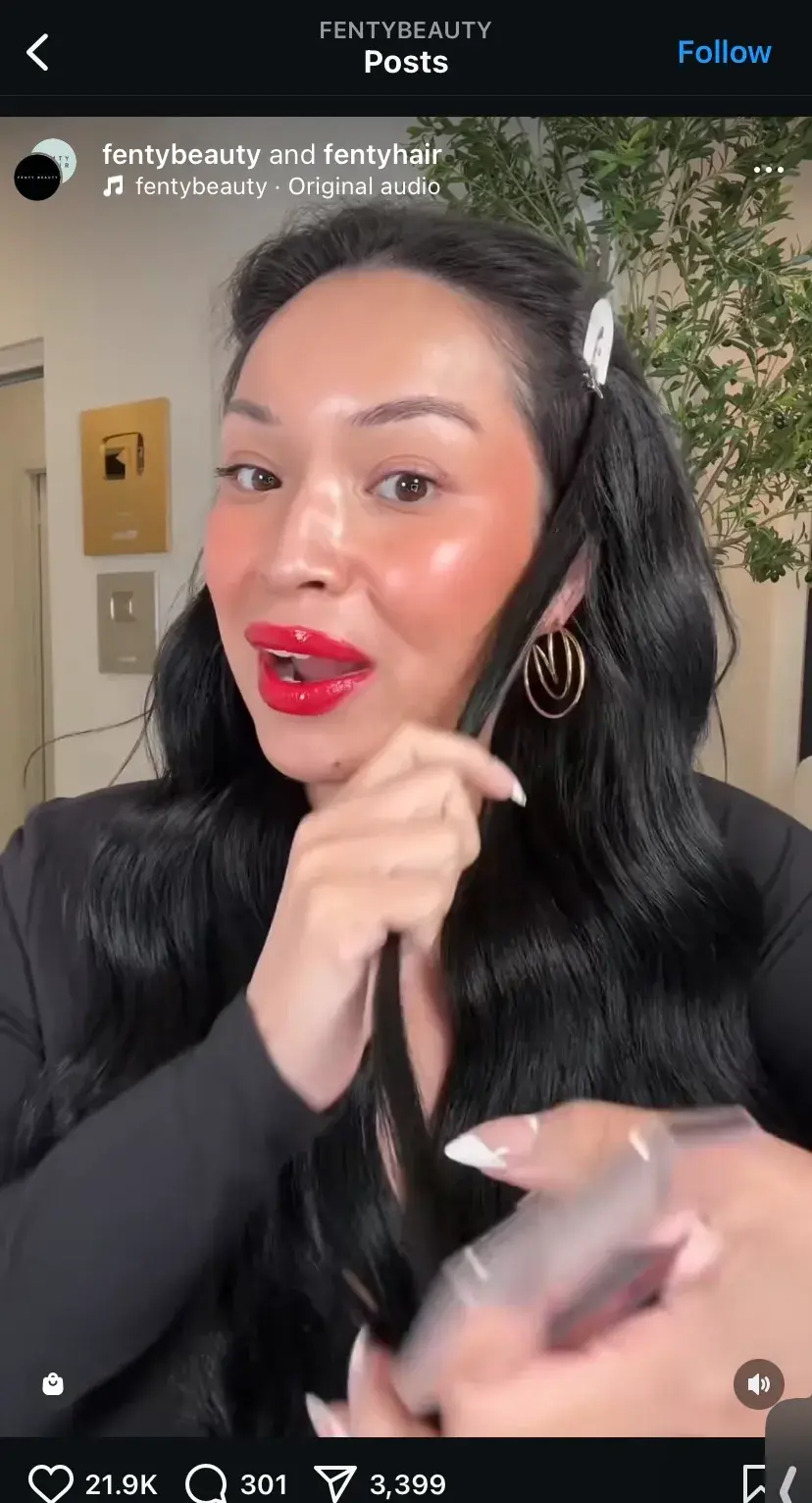
For example, I am obsessed with Fenty Beauty‘s social media content marketing strategy and how the brand places trust and audience interactions at the center of its content strategy.

Fenty’s Instagram, TikTok, Pinterest, and YouTube channels all focus heavily on providing tutorials and educational content about makeup, skincare, and their products.

The tutorials show viewers how the products work on different skin types and how to mix and match products to achieve different looks. Moreover, the brand is constantly responding to consumer comments on its platform.

These tutorials and genuine interactions build trust with its audience.

Fenty Beauty responding to comment

4. You’ll generate more and better leads.

I’ve found that Content marketing can also generate leads. When your audience views your content, they’re more likely to purchase from you in the future.

Additionally, calls-to-action (CTA) placed directly in your content can generate new leads for your sales team.

So, how can content generate leads?

According to Lindsay Kolowich, former team manager of the HubSpot Academy Acquisition Content Team, “Content is a great way to guide users to a landing page.

Typically, you create content to provide visitors with useful, free information. You can include CTAs anywhere in your content — inline, bottom-of-post, hero, or even side panel.

The more delighted visitors are with your content, the more likely they will click your call-to-action and move onto your landing page.”

For example, I’m helping a dance studio in my neighborhood by running its TikTok and posting dance content to drum up interest in the studio and attract new students.

I post videos of instructors doing gravity-defying stunts and explaining complex moves.

Each video ends with a call-to-action to sign up for classes via the studio’s web store.

The TikTok account still has a small following since it‘s new, but I’ve already seen new students register for the classes I’ve promoted. Many have told the instructors they learned about the classes via TikTok.

5. Original content can improve conversions.

A couple of examples I will bring up later will dive a bit deeper into this, but believe me when I say the content you post influences conversions.

It helps your audience connect with you and gives them the information needed to make educated purchases.

Even more, if you’re using blog content to bring in traffic, consider using original graphics rather than stock photos, as marketers report the former as least effective in helping them meet their goals.

Additionally, your content should always include a CTA and guide your readers on what they should do next.

6. Your business will become more visible thanks to SEO.

The more consistent, high-quality content you produce, the better it’ll be for your SEO efforts.

For example, I discovered the pole dance studio that sparked my dance journey via a blog post.

Again, I’ll dive much deeper into this example later, but to keep a long story short, the information I found on that blog helped me trust that studio, see it as an authority on dance, and convince me to register for classes.

Your content should help your business become visible online and build trust and authority with your audience.

7. Great content can position your company as an authority in your industry.

As I‘ve hinted, creating quality content will also help build your authority online. If your business is established as a credible place to get information, you’re more likely to rank higher in search engines.

Plus, your customers are more inclined to trust you if they view you as an industry expert. Your content should demonstrate your expertise in your field and provide valuable answers to your audience’s questions.

8. Quality content can build brand awareness.

Sure, anything can build brand awareness, but I’ve found that content marketing does it uniquely.

Our HubSpot marketing experts have written about something called the Surround Sound strategy.

In a nutshell, this content strategy does more than just rank your blog article on page one. It makes your content (and, therefore, your brand) appear everywhere your potential customers are looking for your product.

To execute this strategy, write about topics your customers are interested in so they begin to associate your great content with your brand.

9. You’ll cultivate loyal brand fans.

Taking brand awareness a step further, everyone who raved about your content and associated all those great feelings with your brand is likely to become a brand advocate before ever purchasing your product.

Wait, what?

I promise it’s true; brand fans can be just as loyal and influence their friends and family’s buying decisions as potential consumers see that a business provides value to its current audience. One of the more successful ways companies can do this is through content marketing.

For example, while I may not be in the market for children‘s meal plans because I don’t have children yet, I am obsessed with the Kids Eat In Color blog and Instagram content. I recommend it to my friends and family who have children with picky eating habits. See how well that can work?

10. You’ll save money on your marketing strategy.

Since HubSpot first assessed the cost of content marketing ten years ago, the practice has remained the most cost-effective marketing strategy available.

Upfront costs for content appear steep, and that’s a fair point.

Estimates for blog content range from $150 a post to $3,000 for a freelance writer, but you could hire a full-time staff writer to create content for you regularly.

In the long term, when compared to paid advertisements, video marketing, and traditional marketing, content wins the battle with Frank from finance every time.

11. You‘ll meet your audience at different stages of the buyer’s journey.

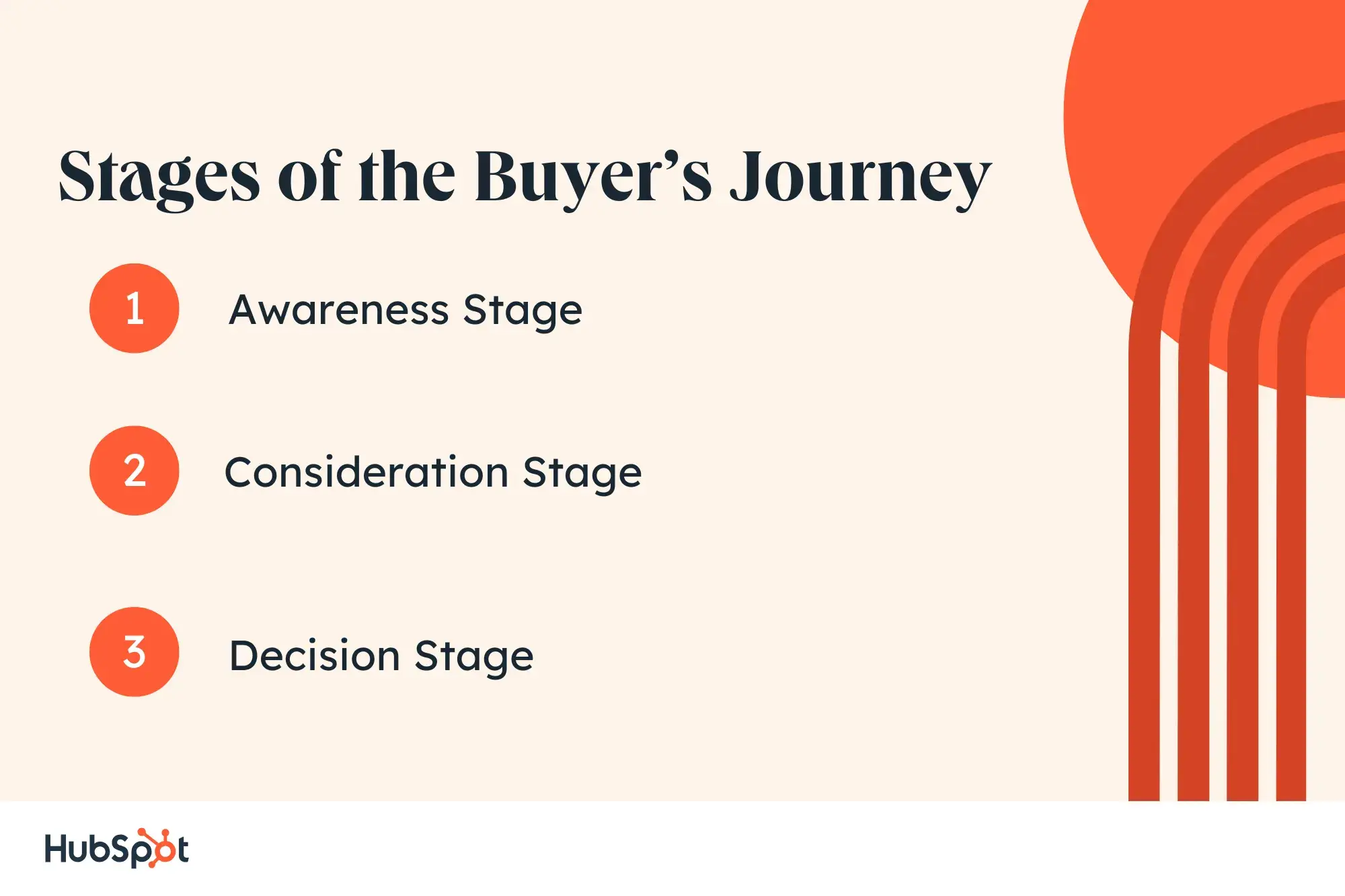
What I love most about content marketing is its ability to connect with consumers at any stage of their buyer’s journey. Remember, there are three stages:

  • Awareness
  • Consideration
  • Decision

I‘ll share my own consumer story as an example.

Years ago, I wanted to start a fitness journey but had difficulty maintaining a consistent gym routine. So, I took to Google to figure out why I couldn’t be consistent in the gym. At this point, I was aware of my buyer’s journey.

I know there‘s an issue (I can’t stick to my gym routine), and I want a solution. During this stage, I stumbled upon a blog by a local pole and aerial fitness studio that had a post called “5 reasons you’re not sticking to your fitness routine.”

I read the studio‘s post and learned that I likely didn’t stick to my routine because I found it boring and didn’t derive any joy from committing. So, I should look into alternative, more interesting exercises.

Now, I‘m in the consideration stage. I know why I can’t stick to the gym; it’s boring, and I must consider alternative exercises. So, I started researching alternative forms of fitness and what those types of exercises entail.

At some point, I stumbled upon the studio’s Instagram and found videos detailing their different alternative exercise classes, from pole dancing to aerial silks.

Even better, there were videos tailored to beginners, such as “What to wear to your first pole dance class” or “Debunking myths about aerial hoops.”

Finally, I decided pole dancing would be my best choice, which led to the decision stage. I’m compiling a list of pole dance studios near me to consider.

The initial studio I stumbled upon has been with me this entire journey, so naturally, I decided to enroll in its classes.

By utilizing content marketing, your business can be like my favorite pole studio and meet potential consumers at any stage of their journey.

12. Educate and empower your audience to make better buying decisions.

I‘ll be honest: The customer isn’t always right.

Sometimes, potential customers may make the wrong decision regarding a requested service or product or not understand a business’ method or protocol.

These misunderstandings can often cause friction between a business and its customers. Fortunately, content marketing helps level the playing field.

For example, one of my favorite creators on TikTok is Theresa Va Dam.

She‘s a hairstylist and salon owner who makes videos educating potential clients about hair health, salon dos and don’ts, and typical issues that can arise when styling hair.

The videos aim to promote her business, educate and empower potential clients to make the right decisions when booking hair appointments, trust her process, and ask the right questions about their service.

All this makes for a smoother interaction and a higher chance of the client returning.

Content creation is crucial in today‘s marketing landscape. I simply don’t believe a marketing strategy is complete or effective without incorporating engaging, shareable, and unique content.

Creating a content marketing strategy is one of your marketing team‘s most important steps. So, audit your current content (or start creating if you haven’t already) and determine what works for your business. And don’t be afraid to try something new.

Editor’s note: This post was originally published in November 2017 and has been updated for comprehensiveness.

Categories B2B

16 Video Production Tips to Enhance Quality and Drive Views

I love using videos for marketing — and today’s apps make producing video content easier than ever. Better yet, there’s a place for all types of video — highly-produced, live-streamed, and long- or short-form.

Whatever video production tips or techniques you use, your efforts can pay off in a big way. A whopping 88% of marketers share a positive ROI with video — a number that’s practically unheard of with just about any other medium.

Free Guide: How to Create Video to Increase Engagement 

I’m sharing some of the most effective video production tips below to help you dive into the world of video marketing.

Table of Contents

Understanding the Different Types of Marketing Videos

Before I go any further, I want to address the elephant in the room.

Video consumption has changed drastically over the last several years, as have consumer expectations of production quality and video format.

You can check out the latest stats on video marketing here.

Short-form videos have become increasingly popular with the rise of TikTok, Reels on Facebook and Instagram, and YouTube Shorts. These tend to be low on the production scale and create a more real-life effect.

Best of all? They can be edited quickly and easily with AI-enabled tools like Clip Creator.

That said, not all short-form videos are minimally edited. Commercials, B2B videos, and other types of short-form content (under 5 minutes) are often highly produced.

Long-form videos tend to go into more detail, sharing in-depth information, and these can be highly produced or minimally edited as well. What’s more, these longer videos can be cropped into short-form content that people are more likely to watch.

Live stream videos can be either short- or long-form, and depending on the platform, they can take a variety of different formats: stream-of-consciousness, ask-me-anything, or highly organized.

Live streams are my favorite because they help you get to know the person or people behind the brand and get a real sense of who they are and what they stand for.

Why does video type matter for video production?

When you know what type of video you’re going to create, it’s easier to identify which video production tips are most effective — and helpful — for your needs.

With that in mind, before you start planning your marketing video shoot, I recommend taking some time to identify the type of video you’re creating, where you’re going to publish it, and what your audience expects.

16 Video Production Tips for Your Next Marketing Video

Most smartphones and web cameras today make video production more accessible than ever — and 91% of businesses use video in their marketing.

This means that there’s room for all types of video content. And while big budgets still have a place in video marketing, it’s no longer a barrier to entry.

However, whether you’re going to a pro, handling your shoot in-house, or DIYing it, take note of these video production tips and identify which are most relevant to your needs. I’ve broken them out into tips and techniques for pre-production, production, and editing.

16 Video Production Tips

Video Pre-Production Tips

Be well-prepared and organized for your video shoots. If you show up to your shoot — wherever it is — unorganized and decide to “wing it,” your final product will look unprofessional and sloppy.

This is true even of live-streamed ask-me-anything videos. While you can often test ideas and play around, it’s best to — at a minimum — have a list of talking points so you don’t end up rambling.

By taking even a short time to prepare yourself, it’s easier to focus your efforts on directing your actors (or yourself) rather than figuring out last-minute logistics.

Time is of the essence, so don’t waste hours trying to figure out which angle you want or what line needs to be delivered next. Know exactly what you want before the day you film by following the steps below.

1. Be original.

The concept for your video project should be original and creative. Don’t take the easy route and copy someone else’s idea.

Instead, conduct persona and keyword research, find out which types of video content are popular and successful in your industry, and double-check to make sure another brand hasn’t covered the exact same angle already.

2. Plan it out.

While a plan is ideal for any type of video, it’s an absolute must for highly-produced brand videos. Write a script, draw out a storyboard, and create a shot list before you start filming.

Plan your B-roll shots, so you have extra footage when it comes time for editing (more on that below). If you think writing a video script is the same as writing a blog post — think again. Check out our advice here.

But, if you find yourself stressed out with the idea of creating a script, AI is making it easier than ever. I’ve used ChatGPT often to create video scripts for Facebook ads, podcast episodes, and, yes, even my live-streamed videos.

3. Be selective when choosing video subjects.

Bringing others into your video?

If you’re bringing in talent, set high standards when casting actors for your projects. Pick someone who can deliver dialogue naturally, who can memorize lines, and who isn’t stiff in front of the camera. If possible, plan time for a few run-throughs to work out any mispronunciations or giggles.

If you’re inviting people on your team or other colleagues, make sure they understand your goals and know what you expect from them. That might mean sharing talking points, sample questions, or a script to help them prepare.

Then again, if you’re shooting a video with clients or customer success stories, spend plenty of time in advance prepping them so you can get the most out of your time with them.

4. Carefully consider the set.

The post-pandemic years have dramatically changed people’s expectations of what’s professional and what constitutes a believable set.

That was even changing pre-pandemic — remember the BBC anchor whose daughter sauntered in during an interview circa 2017?

That only became more commonplace in recent years — and with TikTok, any location can now be your stage.

That said, regardless of what type of video you’re shooting (unless it’s satire), don’t try to fool your audience by “set dressing” your office to simulate another location. Choose your location and own it.

Want to show up in different places? Make sure you do that. Shoot your video projects in locations other than your office — in front of textured and interesting backdrops, but ones that also aren’t too busy.

Video Production Tips

You can always touch up your footage when you edit afterward, but remember that editing takes time.

If you can make everything look as close to perfect as possible during filming, you’ll save yourself a lot of valuable time in post-production.

If you shoot a scene and it doesn’t come out great, learn from what went wrong the first time and shoot it again. Below lays out how to do it.

5. Be cognizant of sound quality.

Don’t come off as an amateur with poor sound recording quality. Use lapel or lavaliere microphones — both of which are hands-free — when shooting sit-down interviews, or use microphone and boom setups for bigger shots.

Using your webcam? Some have built-in noise-canceling features, but I’ve found that external podcast microphones like the Blue Yeti (my personal favorite) capture the best possible sound quality.

If you’re filming a video with a smartphone, you can purchase microphones that fit into the phone’s headphone input to quickly and easily improve sound quality.

6. Set up lights.

You don’t want your footage to be under or over-exposed, so set up lights and eliminate any unwanted shadows. I’ve found ring lights to be fantastic options — just be mindful of the reflection in your glasses.

In a perfect world, a three-point lighting setup is best to illuminate video subjects from a variety of angles. Check out this video for a DIY guide to lighting:

7. Use a tripod.

Use a tripod to keep your video stable — and not wobbly, as it most certainly will be if you hold it yourself. Get a standing tripod or a tabletop tripod for tighter shots to keep your video looking professional.

8. Focus.

Make sure the camera is in focus — and then lock the exposure so it stays in focus.

Most smartphones and modern webcams do this automatically, but it’s worth your time to make sure your video quality is up to snuff. Be mindful of keeping shots white balanced to keep lighting neutral and even, too.

9. Obey the rule of thirds.

The rule of thirds involves splitting up your shot into thirds, horizontally and vertically, and framing your subject off-center. It creates movement and life in your shot the way a straight-on, centered shot won’t.

Here’s an example — try to film individuals in one of the side panels of the divided frame, like so:

Using the rule of thirds is one of the best video production trips.

Video Editing Tips

Make sure your content is remarkable and tailored to your target audience. Edit your video so that it gets to the point and doesn’t drag on.

Remember, you don‘t have long to capture (and hold) your viewer’s attention, so make sure that the beginning of your video is engaging, informative, and relevant to the viewer and that she’ll clearly understand the message.

What does that look like in action?

For example, if you’re using a platform like YouTube, you’ll want an eye-catching intro screen that draws your audience in.

Relying on the video content? Choose an interesting hook to kick things off, and then dive into your video content.

10. Align the flow of the video with the emotional response you want to evoke in viewers.

The tone, structure, and pacing of your video have a major influence on its effectiveness and the emotional impact on your audience.

Tell a compelling story — build tension and drama by arranging shots according to your storyboard and script.

However, I’d caution you to remember that, like all marketing, your video content isn’t about you or what’s interesting to you. It’s about what’s interesting, thought-provoking, or engaging for your audience.

Focus on their needs and expectations first.

11. Leverage B-roll.

Cover up your cuts with B-roll footage that complements the narration. You can find B-roll and other stock footage on sites like Vizeedy if you didn‘t film it yourself.

It’s best to keep your shots all in the same setting to maintain the video’s consistency. I recommend taking the extra time to go back and film more B-roll if you need it.

12. Use background soundtracks.

Light background music can cover any ambient sound and provide tone and emotion to your video that words and images otherwise can‘t.

You can find royalty-free stock soundtracks that you’re allowed to use on sites like AudioMicro — make sure you’re not using songs that are licensed, or else it could result in your video getting taken down.

13. Optimize video text.

Keep the style of your text and titles simple, classy, and sharp.

Choose a clear and bold font, keep words on your video screen to a minimum, and use text animations to keep the viewer engaged with new additions to the video they watch.

14. Remember to use transcripts and captions.

Where captions are helpful during the video, transcripts are highly beneficial for long-form videos like workshops and lectures. They’re closely related and should be considered for a number of reasons:

  1. Accessibility. If your audience has an audio impairment, including transcripts and captions helps them experience your content. It can also help people who speak a different language consume or translate your message.
  2. Convenience. If you’re trying to get people to slow their scroll on social media, whether at work or in situations where they don’t want the volume on, including captions makes it easier for them to understand you.
  3. SEO. Including transcripts and captions can improve your SEO performance.

Scripted videos are easy — your transcript is baked into the video production process.

Don’t have a scripted video? The good news is that with AI, most cloud-based video production services automatically transcribe your content.

If not, it’s quite easy to plug your marketing video into an online tool and produce a transcript. Even if it’s not perfect, it gives you something to edit.

Pro tip: Particularly for videos with lower production value, I love using transcripts as editing tools. I’ve tested CapCut, Loom, and HubSpot’s Clip Creator, which make video editing a breeze with AI.

Editing videos is now as easy as highlighting the transcript you want to crop out and clicking delete. Obviously, this isn’t the best solution for high-production-value videos, but it’s great for the more casual videos that are popular.

15. Don’t stress about going viral.

Sure, viral means more eyes on your video. However, just because a video goes viral doesn’t necessarily translate into huge sales. Focus on creating content that resonates with your audience first.

16. Optimize your video for the platform.

Be mindful of where your video will exist while you’re editing.

Is it for your website, YouTube, or Facebook?

Each platform has different specifications — for example, on Facebook, where 85% of viewers watch videos without the volume turned on, you‘ll want to use captions, so people can follow along without the sound.

YouTube videos don’t count views until someone watches for 30 seconds or more, so make sure the first 30 seconds are as interesting and eye-catching as possible.

Ready on the set?

Now that you’ve got all these video production techniques at your disposal, it’s time to put them to use.

Whether you’re creating high-production content or a more casual short-form or live stream video, a little preparation goes a long way when it comes to creating effective marketing videos.

Now it’s your chance to dive in!

Editor’s Note: This post was originally published in November 2011 and has been updated and for freshness, accuracy, and comprehensiveness.

Categories B2B

HubSpot’s Senior Director of Global Growth on Embracing AI, Diversifying Beyond Search, and Reviving ‘Dead’ Marketing Channels

“Just GPT it” is all the rage right now.

(Okay, okay. It hasn’t caught on just yet. But my Uber driver said it, and I hope it sticks.) 

But our marketing leader this week isn’t sweating it. She doesn’t think SEO is going anywhere.

“I remember when people were saying up to 50% of queries were going to be handled by voice assistants. The SEO industry was in a tizzy over it,” she told me with a laugh. 

“And the only thing I ask my Alexa for is the weather. So I wouldn’t write [Google] off.”

She’s also HubSpot’s senior director of global growth, so I’ll take her word over my Uber driver’s . 

Click Here to Subscribe to Masters in Marketing

Lesson 1: Go non-monogamous with Google. 

The HubSpot Blog team has been running on Google fumes for years, and we’ve racked up millions of views in organic traffic based on high-intent searches. It’s also how we attracted many of our current customers.

Aja Frost, who started on the Blog team in 2017 (back when “SEO strategy” was based on our own personal whims that day), knows Google’s value better than anyone. 

But she tells me it’s time for a new playbook. 

The encroachment of AI search has required us to lean into other channels like YouTube, micro-apps, and areas we see as more defensible against AI. And it’s pushed us to figure out new ways to be ultra-helpful to our reader,” she says.

Frost’s tip for any marketing leader? Spread the love. Test out Substack, team up with creators, or invest in your own micro-apps.

Google is still a viable channel. It’s just not the only one. 

Lesson 2: The days of reverse-engineering algorithms are over — and that’s a good thing.

I asked Frost — in the same tone of voice you’d use to avoid scaring the neighborhood cat — if she’s concerned about the future of SEO in the midst of AI search. (I asked timidly because, you know… SEO is still her job.) 

But she adamantly shook her head. “I think it’s one of the most exciting developments over the last two years. For so long, we have all just oriented toward Google, and reverse-engineering the Google algorithm has, in many ways, stifled innovation in content marketing and SEO.”

She adds, “If there is a more competitive landscape, then the relationship between SEO or content strategist and search engine could change pretty dramatically. It could be a much more collaborative, mutually beneficial relationship.”

Frost sees the future of SEO as a shift from obsessing over algorithms to building real partnerships with search engines. 

Is there a world where Google takes input from little old me, a content creator? We’ll see. 

Lesson 3: Stop writing off marketing channels as “dead.” 

One of Frost’s pet peeves is knee-jerk reactions to industry hype. 

“What bugs me is when people say any channel is dead, and this applies to search, too,” she says. 

“I definitely don’t think search is dead. I don’t think podcasts are dead. I don’t think any channels are dead. I think you can make any channel work really well for you.”

I’m seriously hoping MySpace is “no longer with us”, but I concede her point. 

She adds, “That doesn’t mean we should all go out and invest in channels that aren’t working for us — but it does mean don’t write something off if your intuition says it could work.”

Lesson 4: Focus on expertise. 

Questions like “How do I do XYZ?” get funneled straight to ChatGPT these days. So if your SEO strategy revolves around basic definitions or info keywords, brace yourself for a traffic drop.

But when it comes to complex or opinion-based topics, readers still want the human touch.

Case in point: my recent obsession with LED red light therapy. 

Those at-home LED masks cost about a bajillion dollars, so I wanted to know: Will I look like a newborn baby if I purchase the mask, or will I be shining a bright red light in my face for 10 minutes while the company’s CEO laughs all the way to the bank?

I didn’t turn to GPT for my skin aging concerns; I turned to Google, and asked, “What do dermatologists say about LED red light therapy?”

This isn’t supposed to be an infomercial for red light therapy (although any brands looking to give one away, hit me up ✋), but the point holds: People still turn to websites for answers to more complex, nuanced questions. Not AI. 

Frost is all-in on adding expertise (the extra “E” in Google’s new E-E-A-T rankings) to your posts. 

As she puts it, “You’re talking to me because I have a ton of experience in SEO. This content wouldn’t pack the same punch if you were chatting with someone who just joined the SEO team. In general, the more expertise the better.”

She has some additional advice, as well: “Make sure you really outline that expertise in the post itself with relevant information and examples. Highlight to Google — and more importantly, the reader — that you know what you’re talking about.”

Click Here to Subscribe to Masters in Marketing

Categories B2B

Bodega’s Matt Zaremba on How to Avoid Empty Calorie Marketing

Art and marketing are made for each other, and this week’s master proves that.

He’s done collabs with brands like Nike, Heineken, Crocs, and the NBA … But it’s not all about advertising.

He‘s also a serious artist in his own right, a luminary at the Isabella Stewart Gardner Museum, and his work’s been spotlighted everywhere from NBC to The Washington Post to Hypebeast.

In the venn diagram of art, pop culture, and marketing, Matt Zaremba lives smack in the bullseye.

And it makes me think I should really get a hobby.

Click Here to Subscribe to Masters in Marketing

1. Want to sell your product? Personify it.

You get the sense that Matt Zaremba’s mind is always in story mode.

Take a recent collab with ASICS on an older, previously archived running shoe: When asked how his team came up with the “Small Wins Add Up” campaign to show off the shoe, Zaremba doesn’t even blink.

“First off, we know you can run in this thing, but 98% of people buying the shoe are not running. They’re just trying to look cool, probably in a city somewhere… They want to be on-trend,” he tells me, effortlessly spinning a story of who this desired consumer would be. (He’s not wrong — I just bought $160 Cloudnova shoes to look cooler while I run … errands.)

“So then I ask myself, ‘What’s the sentiment? This product walks into a room… What does it look like and sound like? Does it have an accent? How can we personify it?'”

From there, his team starts riffing — talking about the state of the world today, and how everyone is a little burnt out, and how sometimes just getting up in the morning is a major accomplishment — and voila. A campaign is born.

“Right off the bat, we came up with this idea that small wins add up. So then we go back to the drawing board… How do we visually represent small wins? How do we give a little wink to running, but keep the human element that people have all sorts of little wins they should celebrate?”

ASICS and Bodega collaboration shoe

Zaremba does this for all his marketing campaigns, and it’s sound advice: Get to know the ins and outs of your product, and what story people will tell themselves when they buy it.

And think outside the norms when it comes to that story: Are you sure you’re selling a running shoe, or are you actually selling the message that little wins matter?

Because at the end of the day, a Stanley is just a water bottle with a really cool story.

2. Don’t use the first idea that comes to you – find the fresher angle.

One of Zaremba‘s proudest campaigns is one he did with Nike a few years back. It was a big moment for him — at the time, Nike was one of the biggest brands he’d ever worked with.

Zaremba knew it would be easy to make a splash with a big-name celebrity. He could stick the shoes on LeBron and call it a day. (Relatable, I know).

But he didn’t want to do that.

“The shoe reminded my team of our childhood — it kind of tapped into the Sandlot (the movie). So we decided to take a moment to reflect our own team. We did a yearbook shoot of all our actual employees wearing a special jacket we made, along with the sneakers. And we had the school-picture cloud background.”

We presented the campaign as ‘This is who we are, and who we are is the same as you.’”

I‘ll admit most marketers aren’t regularly working with Lebron-sized budgets, but the takeaway still matters: Your first idea is probably the too-obvious one, and you should keep thinking. Unexpected angles will surprise your audience and make them feel like they’re seeing something new.

And ideally, they’ll see pieces of themselves in your marketing then, too.

Bodega’s Nike ad evokes Sandlot vibes with an image of the shoes on a tipped-over crate of worn, old baseballs

3. Marketing should make your buyer feel confident — not insecure.

Fashion is a notoriously confidence-crushing industry. Plenty of major fashion and beauty brands thrive off making their consumers feel less-than. They want you to know you’re not cool yet, but you will be when you wear those jeans or that jacket.

But Zaremba calls that kind of marketing “empty calories and empty suits.”

“Sure, you’ll find a cohort of people who you’ll grow with because you’re showing them what they’re not. But eventually they’ll find a brand that makes them feel like they are enough, and they’ll switch to that brand,” he says.

His MO? Being as humble and relatable as possible: “Fashion brands should offer tweaks to your journey of style and culture. I don‘t want to talk down to people and say, ’Oh, you don‘t know this musician?’ I‘d rather be like, ’You gotta check this out.’ There should be no ego in it.”

Whether you’re a B2C or B2B marketer, the sentiment stands — personifying your brand as the “cool kid” works for some brands, but what works better for most is simply being helpful, curious, and encouraging.

Click Here to Subscribe to Masters in Marketing

Categories B2B

3 Holiday Shopping Trends Brands Should Expect & How to Lean Into Them [Shopper Data]

The holidays are pretty much here, and my head is still spinning from how fast 2024 went by. And if you‘re a marketer, your head may also be spinning trying to figure out this year’s holiday shopping trends.

You needn‘t worry; I’ve got you covered with insights from our most recent consumer trends report. Let‘s explore consumers’ minds and determine what marketing and shopping trends you’ll need to leverage this season.

Download Now: 15 Free Holiday Email Templates

Table of Contents

Holiday Shopping Trends

Last Christmas, I was scrolling through Instagram on my sister‘s couch (as I’m prone to do) when I saw a photo of two velvet blouses by a shop I love called Midnight Hour.

My sister had just given me money as a gift (best sister ever), so I used some of the money to buy both tops directly through the business’ Instagram.

Our 2024 Consumer Trend Tracking Report shows that my shopping experience aligns with most consumers.

More consumers will take to social media for their shopping.

Social media is the #1 channel for product discovery for Gen Z, my fellow Millennials, and Gen X. While it‘s not the top channel for Boomers, our findings indicate they’re rapidly warming up to social media shopping, too.

In fact, a third of our survey respondents say they have discovered a product on social media within the last few months.

Furthermore, our report shows that 1 in 4 social media users have bought a product directly via a social media app, a 39% increase from last year. So, this holiday season, brands and businesses should expect more consumers to discover and purchase products via social media.

So, lean into tools like Instagram Shopping, TikTok Live Shopping, or TikTok Shop so you can meet consumers where they are at (social media) and have them buy directly from your platform.

Remember when I said I was scrolling through Instagram on my sister‘s couch? I wasn’t scrolling via my laptop; I was on my phone when I discovered and purchased the blouses, which brings me to another consumer shopping trend.

1 in 4 social media users have bought a product directly via a social media app, a 39% increase from last year.

Mobile Shopping and purchasing will be on the rise this season.

Regarding online shopping, mobile phones are used more than any other device, especially among Gen Z. Our report shows that 71% of Gen Z use mobile phones most often when shopping online.

Moreover, 63% of consumers in our survey, across generations, use mobile when looking up a question in a search engine. This plays into how consumers shop because most will use their mobile phones when searching for questions about products.

For example, I Googled durable winter tights on my smartphone a few days ago and was shown a few brands to check out. After enough research, I bought a pair via my smartphone.

This holiday shopping season, ensure your website is optimized for mobile shopping and browsing since most consumers will do their online shopping and product research from their mobile devices.

71% of Gen Z use mobile phones most often when shopping online.

Consumers will seek their favorite influencer’s stamp of approval.

I don‘t follow many influencers, and I can’t recall the last time an influencer convinced me to buy something, but that marks me as an outlier as more consumers look to influencers to help make buying decisions.

Our report shows influencers impact purchasing decisions more, with over a fifth of social media users (21%) buying a product based on an influencer recommendation in the past three months.

And if you‘re trying to attract Gen Z, it’s crucial to know that Zoomers hold influencer recommendations in higher regard than recommendations from friends and family (9% vs 7%, respectively).

More consumers are also following virtual influencers. In 2024, 28% of social media users follow virtual influencers, up from 25% in 2022.

Consider finding influencers who align with your brand and vision and sparking collaboration with them so you can better connect with your audience.

Holiday Marketing Trends

So, we know what shoppers are doing this year. Let’s see what brands are doing.

Brands will provide relatable, authentic holiday content.

So, what do consumers want brands to put in their metaphorical stockings this year? Relatability!

According to our report, consumers crave relatable content, but only 63% say that the content brands post on social media seems authentic or relatable.

Of the types of content brands post on social media, 90% of consumers say funny and relatable content is the most memorable (or 52% and 38%, respectively). 63% say it’s more important for a marketing video to be authentic and relatable than polished and high-quality.

I predict that brands will address this gap this year by creating funny, relatable content that caters to consumers’ interests.

Businesses will promote corporate responsibility.

I also see more brands releasing marketing content that takes a stance on important issues or demonstrates corporate responsibility.

50% of U.S. adults say brands should do more regarding social advocacy, and I have already seen some brands answering that call.

As part of its holiday marketing, True Religion collaborated with Grammy Award-winning rapper Megan Thee Stallion for the denim company‘s holiday collection.

The company hosted an event with the rapper’s Pete & Thomas Foundation, a foundation that supports underserved communities.

The “Where Wishes Come True” event focused on providing holiday gifts to those in need, including LGBT and at-risk youth.

True Religion‘s marketing video from the event hit all the points I mentioned above. It’s authentic and relatable, featuring candid footage of Megan Thee Stallion shopping and having fun with fans and gift recipients.

Participants also shared their genuine excitement about spending time with the star and what she and True Religion mean to them. Megan Thee Stallion’s sense of humor and charisma also shine, contributing to some funny moments in the video.

And, of course, by centering the event on helping LGBT and at-risk youth, True Religion is taking a stand for the LGBT community.

Some brands may leverage AI-generated content, but be careful!

We may also see brands dabble in AI content this holiday season, but I must warn against hopping on this trend too quickly. As I said before, relatability and authenticity are vital in reaching consumers this holiday season.

An overreliance on AI can prevent authentic branding from shining through, alienating your audience. For example, Coca-Cola released its annual holiday ad, which was generated using AI. The ad received heavy backlash from viewers who found it “creepy” and impersonal.

Prepare to see more influencer and content creator collaborations.

Instead of relying heavily on AI in your ads, I suggest leveraging influencers and content creators to build authentic connections with your audience. This is another trend I expect to gain prominence this season.

For example, Fenty Beauty is leveraging influencers like Stephanie Valentine to promote products that create holiday looks.

Beauty influencer Stephanie Valentine promotes Fenty products by creating a holiday look.

Image Source

What’s Next?

Now that you‘ve learned about these key holiday trends start getting ahead of the Black Friday buzz by preparing and finalizing your holiday campaigns if you haven’t already done so.

In the meantime, I‘ll likely be back on my sister’s comfy couch this year to do more online shopping. Happy holidays!

Categories B2B

The Top Goals of Marketing Managers & Leaders in 2025 [New Data + Expert Tips]

To effectively lead a marketing team, you have to know what you’re working towards. Whether your focus is to increase revenue or improve your customers’ understanding of your products, starting with a clear priority helps guide all your efforts in 2025 and beyond.

But sometimes, you may struggle to identify your organization’s most important goals. For this reason, we surveyed 700+ marketing executives to help you make the right decisions.

Download Now: Free State of Marketing Report [Updated for 2024]

Let’s examine the top goals of marketing management for the upcoming year and share some advice from leaders at ClickUp, RocketReach, Uber, and more on how to achieve them.

Top Marketing Manager Goals in 2025

1. Increase revenue and sales.

Graphic depicting the #1 marketing manager goal for 2025 according to hubspot research

According to our survey, “increasing revenue and sales” is the top priority for most marketing leaders going into 2025, with just over 20% reporting it.

This shouldn’t come as a surprise. Our core job as marketers is to impact a business’ bottom line by attracting the right audiences and driving leads down the pipeline for sales.

Gaurav Agarwal, ClickUp’s chief operating officer, once echoed this sentiment to me: “As a fast-growing company with industry-leading NDR, adding new revenue sustainably is always a top priority. We have to be hyper-focused on building out different growth and sales capabilities to achieve that goal.”

Graphic showing quote from Gaurav Agarwal, COO at ClickUp

Tips to achieve this marketing manager goal:

To increase revenue, marketing leaders must identify areas of their customer journey that can be further optimized. Additionally, marketing leaders will want to focus on lead generation.

There is no one-size-fits-all approach to effective lead generation. To improve your lead generation strategy, you might test out new landing pages or calls to action. Try creating stronger offers or re-focus your efforts on more powerful lead nurturing campaigns.

It’s also important to continually test new platforms — like TikTok or podcasting — to reach new audiences.

Reflecting on revenue as a goal, Michelle Keene, Vice President of Product Marketing at Rocket Lawyer, told me when years are “expected to be dominated by economic uncertainty, the shift to profitable growth [rather than growth at all costs] will only be accelerated — moving from a nice idea to a requirement.”

To combat this challenge, Keene offers five key principles for marketing leaders to follow:

  1. Move from a revenue-only goal to a revenue and cost-of-acquisition goal.
  2. Find technology solutions that enable CAC measurement at the program level.
  3. Evolve your marketing attribution models.
  4. Deeply understand your target audiences and their needs to deliver the right messages at the right time.
  5. Encourage ongoing deployment of hypothesis-driven experiments and optimizations.

Graphic showing quote from Michelle Keene, VP of Product Marketing at Rocket Lawyer

She added, “As a marketing leader, I embrace this challenge, prioritizing efficient growth. While any mindset shift is challenging, the benefits far outweigh the change management costs.”

“It can transform the way senior executives view marketing — not as an expense, but as an investment — which is really empowering and energizing for me.”

2. Get a better understanding of customers and their needs.

Next, marketers leaders ranked “getting a better understanding of customers and their needs” as their second biggest priority in 2025.

This makes sense, considering they also said the industry’s biggest change in the past 12 months has been an increased focus on the customer and their experience with brands.

Graphic illustrating that marketers believe customer focus is the biggest shift in marketing in the past 12 months

Your happiest customers can be not only your most lucrative but also your strongest advocates for your brand out in the wild. Customers stay loyal to brands they love and want to recommend them on social media and to friends and family. But how do you build this kind of commitment?

Tips to achieve this marketing manager goal:

Jennifer Chou, Senior VP of Marketing at RocketReach, believes having a strong understanding of your customers is a vital first step in building brand loyalty.

She told me, “Marketing is about storytelling and helping people envision how your solutions can help them achieve their goals. Having a better understanding of your customers and their needs is critical to creating that intangible connection that builds affinity, consideration, and, ultimately, loyalty.”

Graphic showing quote from Jennifer Chou, SVP marketing at Rocket Reach

She continues, “Customers want to relate to companies in new ways. They want to feel that ‘the company understands what I’m dealing with and is building products for me’…This means we need to know their challenges and goals as well or even better than they do.”

To cultivate a strong relationship between your brand and its community, also ensure your marketing materials convey your brand’s values.

People will feel more connected to your business if they believe your company cares about issues that matter most to them.

As Daniel Godoy, Microsoft’s Global Head of Programmatic Evangelist, says, “The best way to win trust is by upfront stating the values your brand cares about and having transparent communication that highlights your purpose commitments.”

Graphic showing quote from David Godoy from Microsoft

Create better customer experiences with personalization.

As more and more marketers are realizing, loyalty also really comes back to creating a great customer experience. In fact, according to Adobe, 86% of consumers will pay more for a superior customer experience.

We marketers need to dig deeper into what our buyers are looking for from our offering and their interactions with us. What would make being your customer easier or more enjoyable?

Personalization can be key to this.

Zendesk found that 70% of customers expect anyone they interact with at a business to have the full context of their previous engagement and actions.

And, in our survey, 86% of marketers admitted a personalized experience increases sales moderately or significantly.

What are some ways you can personalize your marketing?

  • Address your buyer by name in all interactions, including email, website, phone calls, and in-person meetings.
  • Make recommendations based on their specific needs, concerns, demographics, or past behavior.
  • Have team members respond personally to all social media engagements. While AI can be very helpful with personalization, this is one use case where it can come off as robotic.

But these are just a few ideas. Don’t be afraid to ask your customers what they want and need. Ask for feedback after interactions or purchases. Good or bad, the insights can only help you improve.

Additionally, create opportunities for your customers to interact with each other.

You might create a Facebook or Slack group so your customers can engage with each other, share industry best practices, and get ideas or suggestions to help them work through their business challenges.

Back in 2019, HubSpot’s Social team created a Facebook group and has since leveraged it to foster a stronger sense of community among its members.

3. Increase brand awareness/reach new audiences.

This arguably goes along with our first two points, but according to our research, the third priority of marketers in 2025 is increasing brand awareness and reaching new audiences.

I mean, think about it. Of course, this is to help increase revenue and sales, but its success depends on understanding your audience.

If your business is entering new markets, you must take the time to understand your new customers so you can effectively show how your product helps them.

Tips to achieve this marketing manager goal:

Graphic the top 3 things marketers considering the most important to know about consumers

According to our survey, marketers think the most important information to know about their customers is:

  • How they consume content (33.43%)
  • Their demographics (31.77%)
  • Products they’re interested in buying (27.9%)

Based on this information, you can better understand the value your marketing must deliver and what new audiences would be attracted to.

Every audience is different, of course, but in general, there are some trends you can use to start testing. For instance, more than half of consumers prefer to learn about products by searching the Internet or social media.

That means a strong SEO or social media strategy is a great place to start when trying to build brand awareness and increase reach.

Creating product-led content on your website and social media can help show prospects what your product is all about and how it works long before they make a purchase.

Let’s say you work for a video editing company, for example.

By writing content like “Why Video Marketing Matters” and “5 Ways to Create Higher-Quality Videos,” people interested in video will be introduced to your brand as a player in the space.

But you don’t want to stop here. Go further by creating comparison articles that target high-intent X vs. Y keywords. Even if your software isn’t well known in buyer cycles, you can compare yourself to popular competitors and, once again, help explain your role in the industry.

Once readers learn that you are an option for them and find value in your content, they’ll be more likely to explore your site further. It’s content marketing 101.

If you’re marketing to Gen Z or millennials, it’s also imperative you use social media for product education. It’s Gen Z’s favorite channel for learning about new products and millennials’ second favorite (right behind search engines).

More on that in: Social Media Marketing: The Ultimate Guide

Top Marketing Manager Objectives Based on Trends

Our survey also revealed several emerging trends that marketing leaders are intrigued by and planning their strategies around. Here are the top three.

4. Invest in personality-led content and creator partnerships.

Where there’s social media, content creators can’t be far behind. Thus, it should come as no surprise that marketing manager objectives also include investing in influencer and creator partnerships in 2025.

Influencer marketing has been proven to foster engagement, drive traffic and clicks, and generate conversions and sales. Modern consumers tend to trust influencers more than brands, finding them authentic and relatable.

That’s likely why Sprout Social has found that 49% of all consumers make daily, weekly, or monthly purchases because of influencer posts. Knowing this, it’s wise not to sleep on the marketing power of influencers and creators.

But how do you get started?

Tips to achieve this marketing manager goal:

Influencer marketing campaigns can take place on a variety of platforms (Instagram, YouTube, etc.) and come in all different shapes and sizes, including:

  • Affiliate or Discount Codes
  • Contests and Giveaways
  • Sponsored Posts
  • Gifting
  • Takeovers
  • Collaboration

Start by identifying the platforms your audience is most active on and who they are engaged with on them. From there, fellow HubSpotter Ramona Sukhraj breaks down the different possibilities and how to develop your influencer marketing strategy in this article.

5. Diversify paid media across direct, indirect, and brand models.

With more competition on search engines and social and increasingly elusive algorithms across them all, the importance of paid media can’t be ignored.

In 2023, advertising their products and services effectively was one of the top goals of marketers, and now that focus has turned to diversification.

Advertising isn’t what it used to be. This isn’t the days of Mad Men’s Don Draper and creating quippy billboard slogans — at least, not entirely. Beyond the more classic channels like print, TV, radio, and direct mail, many brands now advertise almost exclusively on digital platforms.

Many digital advertising platforms offer helpful tools for nice targeting, creating engaging ads, and iterating quickly if something isn’t working.

Google’s responsive ads feature, for instance, tests various headlines and descriptions and ultimately displays the combination that performs best with an intended audience.

Meanwhile, Facebook allows A/B testing and is known for having one of the most robust audience-targeting tools available for social media.

Tips to achieve this marketing manager goal:

Overall, marketers today have a wealth of paid advertising options, and it’s smart to experiment with them. Like influencer marketing, start by identifying where your audience consumes content and looks for answers.

Next, see what advertising options it has that are relevant to your goals.

For instance, if you’re trying to boost downloads on a particular offer, perhaps you want to run a Facebook Lead Ad. Mix and match your options while being mindful of your budget and see what delivers the best results.

Learn more about your paid advertising options in: The Ultimate Guide to PPC Marketing

6. Update SEO strategies for AI-driven search.

You didn’t think we’d talk about 2025 and not mention artificial intelligence (AI), did you?

Rounding out the top goals for marketing leaders, according to our survey, is updating SEO strategies for AI-driven search.

AI search isn’t limited to assistants like Alexa, ChatGPT, and Claude anymore. It’s also being adopted by leaders in the space, such as Google, with AI overviews.

Screenshot showing the example of an AI overview that comes up on Google for the query, “time machine where would you go”

Source

HubSpot’s Kieran Flanagan expects AI to shift SEO in three main ways. It will:

  1. Decrease click-through rates on search engines.
  2. Force search engine experts to be more holistic digital marketers.
  3. Make customer-centric strategies more important than keyword-focused ones.

So, what can we do?

Tips to achieve this marketing manager goal:

Graphic showing quote from Kieran Flanagan, SVP Marketing at HubSpot

Here’s what Flanagan advised in a recent article:

  • Create high-quality, expert content: Your content can’t just answer common questions with relevant information anymore. Everyone can do that. Now, it needs to provide credible perspectives, authoritative tips most readers won‘t find elsewhere, and other elements that comply with Google’s EEAT philosophy.
  • Optimize for featured snippets: Structure your content so it’s easily scannable and provides direct answers to common queries. As AI overviews are slowly replacing featured snippets, we believe the criteria for appearing here may be similar.
  • Focus on user intent: Tailor your content to address specific user needs, which can improve your chances of being recommended as an answer in LLM-generated search results.
  • Build authority and backlinks: Like search rank in general, high-quality backlinks and mentions can signal to LLMs that you’re a trusted source. Keep making this a priority.

You can also check out these resources from HubSpot:

Setting (And Achieving) Goals Like a Marketing Leader

Determining your top goal depends on your company’s needs.

If your company seeks visibility, an increase in traffic may show you are moving in the right direction. If your company is struggling to meet its financial goals, revenue from your marketing initiatives may be your core goal.

Your goals and KPIs should incorporate many thoughts, but some priorities and focuses also remain universal in today‘s market. So, use the trends and advice in this article to explore your business’s possibilities and the best opportunities to achieve its goals.

Editor’s note: This post was originally published in October 2022 and has been updated for comprehensiveness.