Categories B2B

The 18 Best Abandoned Cart Emails To Win Back Customers

Several times while shopping online, I’ve abandoned my cart for various reasons. Couldn’t make a decision. Was waiting for a coupon. Got pulled away for something more pressing.

But in most cases, getting an abandoned cart email always rekindles my interest and motivates me to go back to complete those purchases.

Download Now: Free Abandoned Cart Email Templates

Globally, the average cart abandonment rate is now 74.61%. As if that’s not enough, the luxury and jewel ecommerce industry recorded the highest rate of 83.19% in November 2024. In short, businesses are losing a lot of money to this shopping behavior.

But guess what I also discovered? You can recover your money when you send cart abandonment emails to anyone who hasn’t completed their purchase.

Whether you sell to consumers or other companies, these emails actually work. According to Klaviyo, cart abandonment emails generate more engagement and revenue than any other type of email.

Want to learn more about this kind of email? Then, this guide is for you. I did a lot of research and I’m going to share 18 examples to inspire you, 12 best practices you need to know, and abandoned cart email templates to get you started.

Table of Contents

Abandoned cart emails are one way to convert lost business and turn a hesitant prospect into a customer.

If you feel you’ve lost your customer’s business once they fail to click “Check out now,” don’t fear. Customers navigate away from the checkout page for many reasons, and abandoned checkout emails can help you finally win their business.

But what kind of tools can you use to send abandoned cart emails? For non-email marketers, this may feel like a difficult question to answer. But don’t worry! I’ve identified the tools you need below.

  • Ecommerce Point-of-Sale Software: First, you need a point-of-sale software that can detect when users abandon their carts. Most tools offer this feature, and a few come with a built-in emailing tool to send abandoned cart emails.
  • Ecommerce Website Builder: If you’re a new retailer, you can benefit from switching to a dedicated ecommerce website builder. These types of site builders come bundled with point-of-sale software and attribution reporting, helping you send abandoned checkout emails to customers.
  • Email Marketing Service: Of course, you need an email marketing tool to send the emails to your contact database. Most point-of-sale software and website builders can integrate with email marketing tools, and vice versa.

Bonus tool: Try an AI email writer to get your emails drafted and out the gate faster.

Now that you know the tools required, I’m going to share some cart abandonment email templates.

Abandoned Cart Email Templates

I was excited when I discovered that you can build abandoned cart emails with available templates in any email marketing tool. Tools like Squarespace, Wix, or HubSpot have templates to help you get started.

However, while you can use a pre-made template for the layout, I suggest you customize the message, images, and design.

Here’s an example template from our marketing kit:

hubspot email template, abandoned cart email

Download HubSpot’s Abandoned Email Template

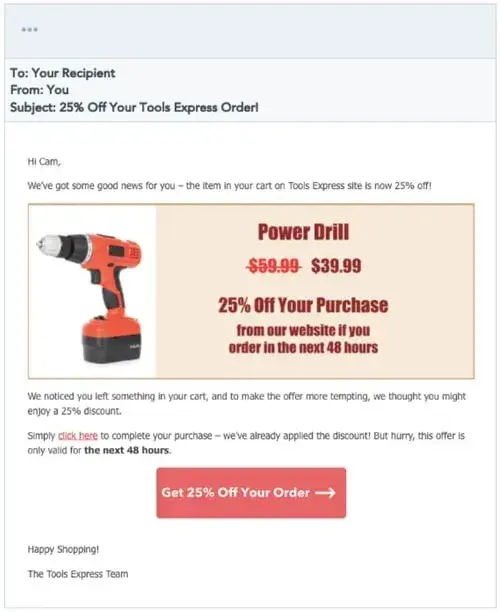
The messaging in abandoned cart emails is fairly simple. Below is an outline of the basic structure:

  • Snappy subject line
  • Introduction text
  • Items left in the cart
  • Offer or discount
  • Checkout button or call-to-action (CTA)
  • Reviews or social proof
  • Closing text

While this outline is helpful if you’re sending one abandoned cart email, consider a drip campaign for your cart recovery emails. A drip campaign is a series of automated emails.

Now, let’s take a look at the 18 best examples I found to inspire you.

Best Abandoned Cart Email Examples

1. Prose

Subject line: Your formulas are up-to-date

prose, abandoned cart email

The email above was sent to me by hair care company Prose after I left the site before completing my transaction.

This email checks several boxes: It uses a catchy tagline (“Great(er) hair ahead”) as a friendly reminder to revisit the site, it has an enticing CTA encouraging folks to “Build Your Routine,” and it uses a discount to add urgency. Combined with a friendly tone and clean graphics, this email is pretty persuasive.

What I like: The “Build Your Routine” CTA is unique and true to the brand, extending the personalized customer experience that began when I first visited the website. When crafting your abandoned cart emails, try to build upon your established branding to create a seamless CX.

2. Sonos

Subject line: Circling back

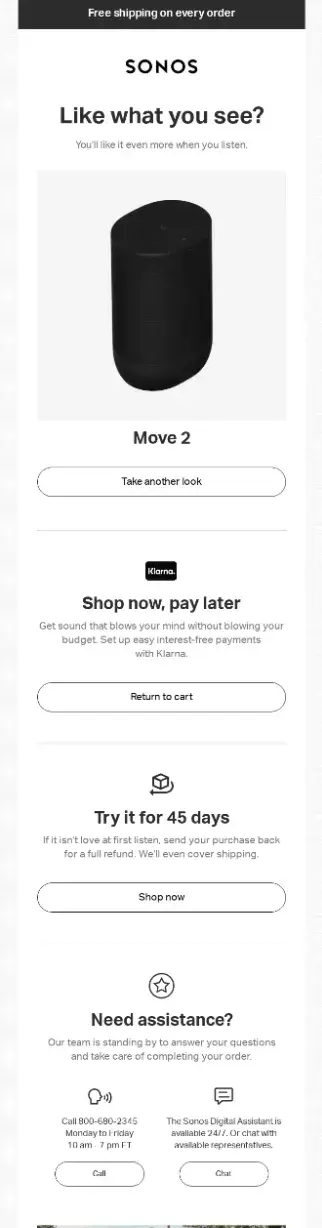
sonos, abandoned cart email

Source

This email from Sonos uses unique and engaging copywriting to entice customers to complete their purchase. They include a beautiful product image and incentives such as:

  • Free shipping on every order.
  • Shop now, pay later.
  • Try it for 45 days.

Several unique CTAs like “Take another look,” “Return to cart,” and “Shop now,” encourage customers to complete their purchase at any point in the email. And if you have questions or need assistance, their phone number and live chat link are provided. They also have links to some of their product categories at the bottom of the email so you can continue shopping and browsing.

What I like: This abandoned cart email is a great example, and I like it for many reasons. First, they offer not one, but three, juicy incentives to address reasons why shoppers abandon their carts. They also provide ways to contact them and to learn how Sonos mitigates their environmental impact.

All these elements help Sonos build trust and encourage recipients to quickly complete their purchase without hesitation.

Depending on the type of product you sell, your abandoned cart emails should both entice and inform the recipient.

3. Peel

Subject line: Still Thinking it Over?

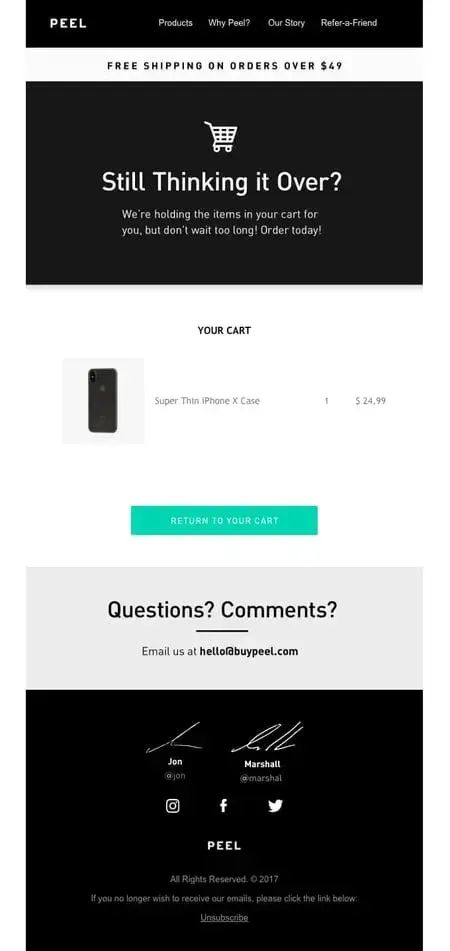
peel, abandoned cart email

Source

The best element of Peel‘s abandoned cart email is the free shipping offer. Not only do they encourage customers to purchase what’s in their cart, but they also include an incentive for buyers to add more items to their cart and complete checkout.

This is a classic and effective layout for an abandoned cart email: intro text, items in cart, CTA, questions, and footer.

What I like: Peel includes text that creates urgency for buyers, such as “Don’t wait too long!” and “Order today!” but they don’t include it as the heading. This strikes the right balance between casual (“Still thinking it over?”) and urgent.

I also like that it includes the founders’ signatures at the bottom, making the company feel personable and small. This is a good move for smaller businesses whose CEOs are involved heavily in the everyday tasks of the business.

4. Away

Subject line: Back in stock: The Bigger Carry-On

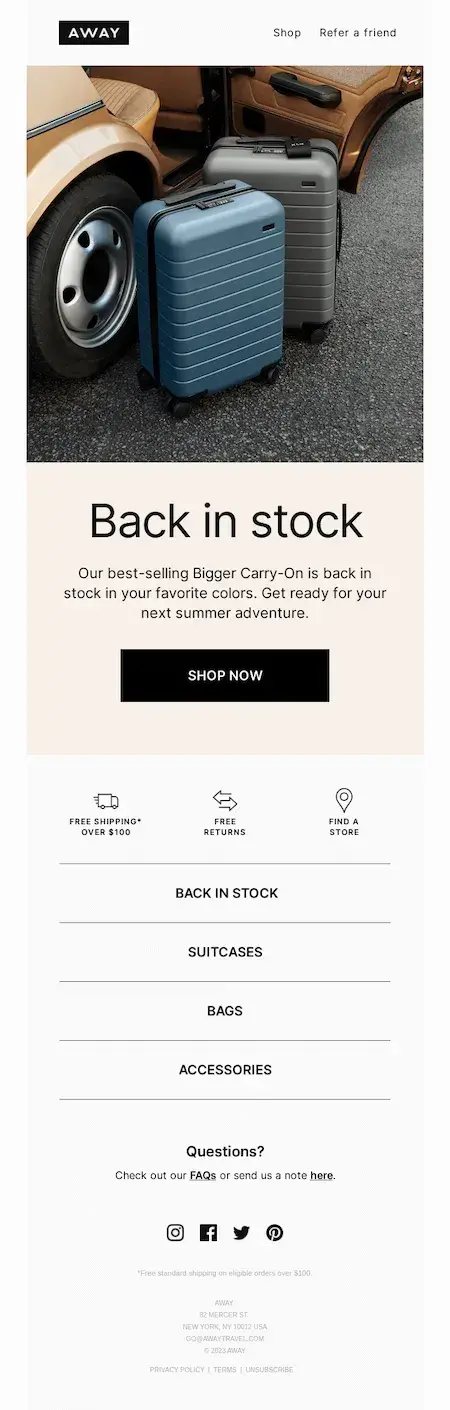
away, abandoned cart email

Source

Short, sweet, and to the point, luggage brand Away has an abandoned cart email that lets customers know they can still complete their purchase.

It features introduction text (“Back in stock”), CTA (“Shop Now”), purchase benefits (“Free Shipping Over $100,” “Free Returns”), and closing text offering more navigational paths (“New arrivals”, “Suitcases,” and so forth).

With this email, customers won’t get distracted by extraneous information and will focus on the action Away wants — purchase completion.

What I like: Away not only prompts recipients to buy an abandoned item, but also offers more avenues for purchase, such as exploring new products and other categories. No matter which link users click on, they’re bound to end up at a checkout page again.

When including links in your emails, make sure they lead to a purchase.

5. Dyson

Subject line: Items in your basket at dyson.com

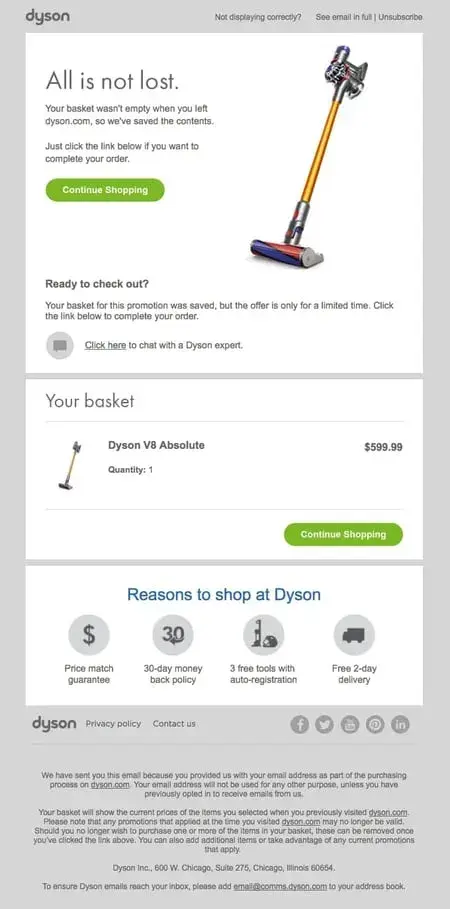
dyson, abandoned cart email

Source

In this example, I think Dyson does several things well:

  • They use clear text that is helpful and fun to read. For example, “All is not lost” and “We saved the contents” let the customer know that Dyson wants to be helpful.
  • They include an image of the product and list the item still in the customer’s cart.
  • They add a sense of urgency. The text, “Your basket for this promotion was saved, but the offer is only for a limited time” creates a sense of importance about this purchase.
  • They include two CTA buttons. This allows customers on mobile to see a CTA button even as they scroll down. These buttons make it easy to complete their purchase at every touchpoint.

Overall, this email includes the right elements, while also showcasing a sleek, clean design that makes it easy to read.

What I like: Dyson plays to one common fear of online shoppers: Losing the contents of their carts and forgetting what they meant to purchase. That alone might make the recipient feel like they should check out before all is lost. Avoiding pain is sometimes a more powerful motivator than gaining a benefit.

When creating your checkout abandonment emails, you might use a similar psychological trick.

6. Virgin Atlantic

Subject line: You’re nearly there

virgin atlantic, abandoned cart email

Source

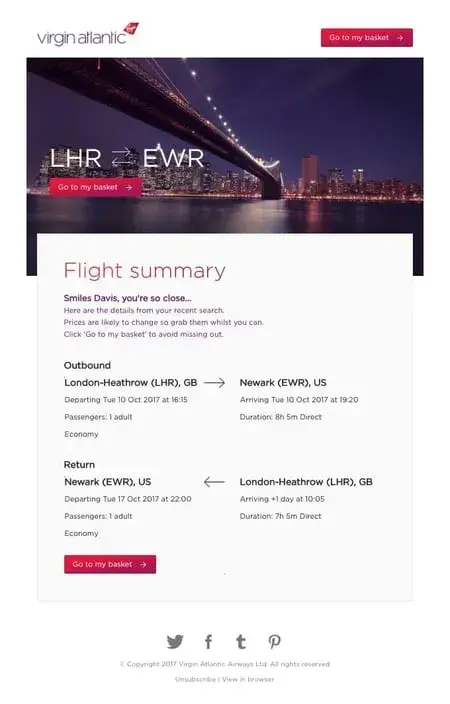
In this example, Virgin Atlantic uses engaging text and three CTA buttons to encourage customers to complete their purchase. The personalized intro text, “Smiles Davis, you’re so close…” makes customers feel like they’re being spoken to directly while also reminding them how close they are to travel.

This email also includes flight information, so they have everything they need to make a purchase. When writing your own abandoned cart emails, this is a good example to follow because it takes away any roadblocks for the customer.

What I like: I love how personalized this email is — down to the outbound and inbound locations of the flight. It also includes an image of the destination, indirectly increasing the recipient’s desire to fly. When sending abandoned cart emails, you might include an image of the customer’s “destination” — a happier self, a new product on their shelves, or any other positive result.

7. Ugmonk

Subject line: Offering you my personal email

ugmonk, abandoned cart email

Source

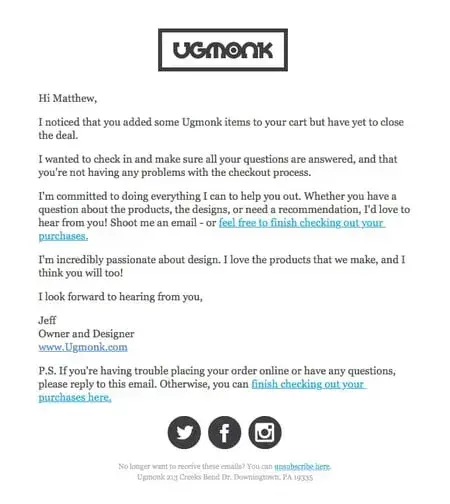
Ugmonk uses a different approach to their abandoned cart email.

They focus entirely on personalization, making it seem like the owner and designer is reaching out directly to answer any questions.

Plus, they include two in-line CTAs so the customer can finish checking out instantly if they want. This is a simple approach that your target audience may prefer.

What I like: This email feels more like a message from a friend than from a company, making it feel less like a “sales” play and more of a “get to know you” play. I especially love how it’s signed by the company’s CEO, and how he mentions his passion for design. If your company is small or sells a niche product, consider taking a friendly, frills-free approach like this one.

8. Drop

Subject line: Smiles Davis, still interested in the Massdrop x MiTo SA Pulse Custom Keycap Set?

drop, abandoned cart email

Source

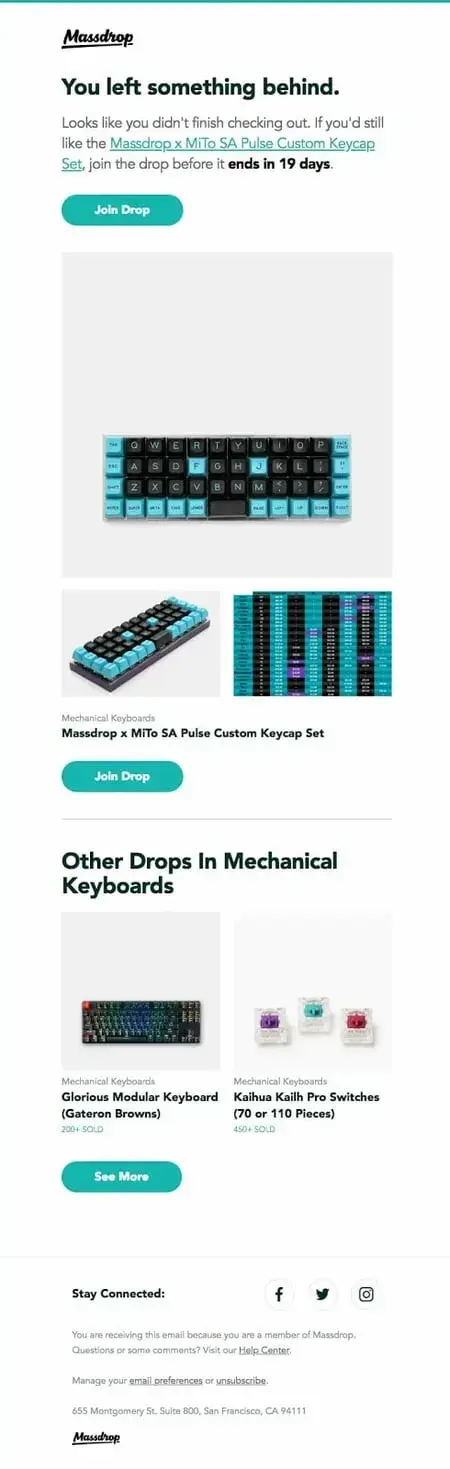
Drop‘s abandoned cart email is a good example because of its use of images and copywriting. Drop creates urgency in the bolded text “ends in 19 days.”

After they create urgency and include their CTA, they also add other items that the customer might be interested in based on what’s in their cart.

This is a good strategy to get the customer back on their site browsing other items they might want, hopefully turning into a completed purchase.

What I like: Drop creates a sense of urgency, but isn’t pushy, and it includes various product images to entice potential buyers. I especially love the extended catalog below the fold, providing additional items the recipient might want to consider.

9. Google

Subject line: The Google Wifi in your cart is going fast

google, abandoned cart email

Source

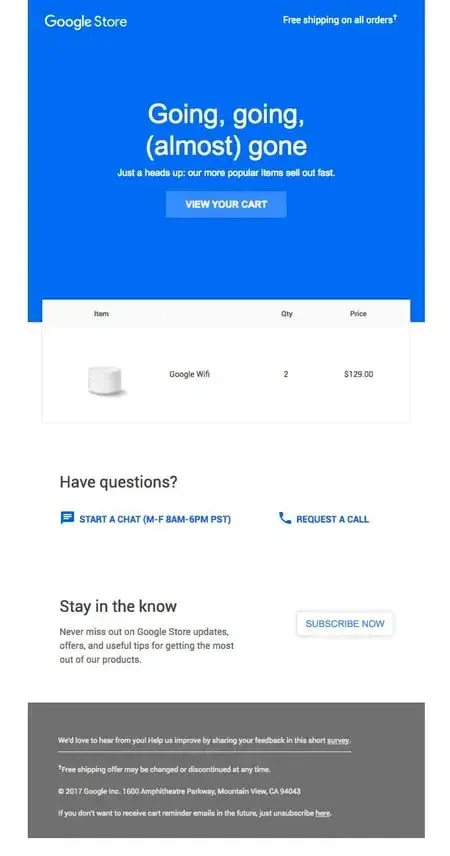
I think is a perfect example of an abandoned cart email because it includes every element: Great copywriting, clear CTA, personalization by showing the customer‘s cart, and urgency.

With text like “Going, going, (almost) gone” and “Our popular items sell out fast”, customers are engaged. They also feel compelled to complete their purchase so they don’t miss out.

What I like: This email closes with a CTA to answer questions and subscribe to their product updates. Again, Google focuses on ensuring the customer feels like they don’t want to miss out on anything.

10. Chatters Salon

Subject line: Don’t miss out! Get it before it’s gone…

chatters salon, abandoned cart email

Source

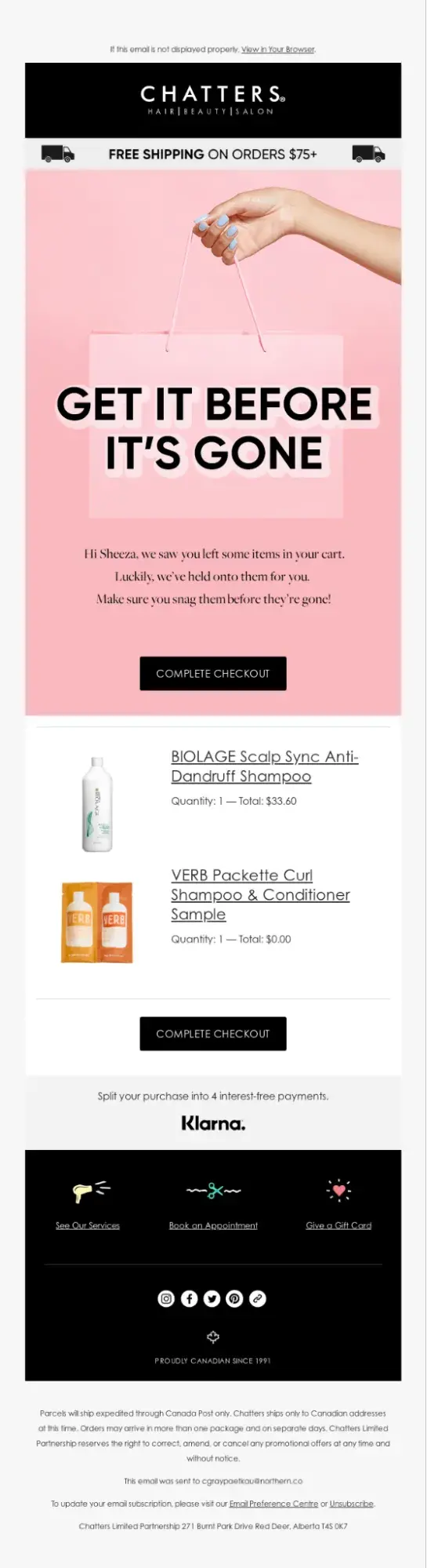
In their abandoned cart email, Chatters Salon creates a sense of urgency with the phrase,“Get it before it’s gone.” It’s in their subject line. And once you open the email, you’ll see a bigger version in capital letters.

The “Complete Checkout” CTA is also effective. To further encourage customers to quickly complete their purchases, they offer free shipping on orders that are $75+ and the irresistible option of making four interest free payments.

What I like: I love the sleek design, the sense of urgency, the convenient payment plan and the free shipping for orders above $75. All the key elements are present. As a result, I believe recipients will be motivated to quickly complete their purchase. And even buy more, so as to enjoy free shipping.

11. Casper

Subject line: Did you forget something?

casper, abandoned cart email

Source

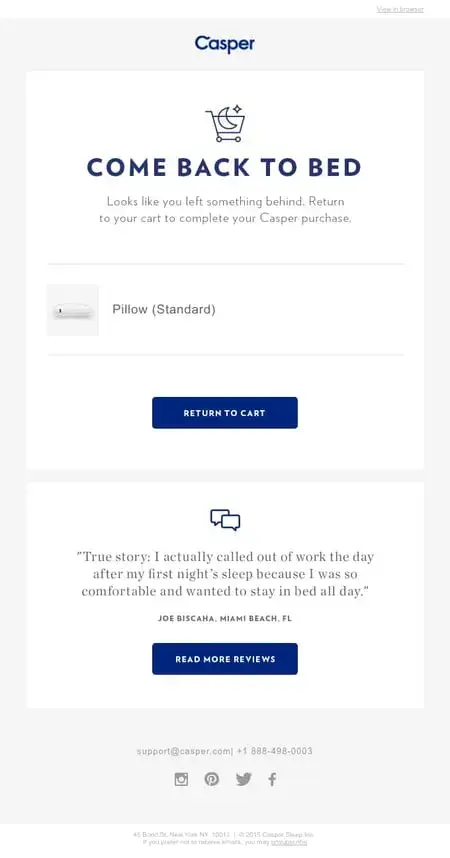
What I love about this example is that Casper uses social proof. Word of mouth and reviews are becoming increasingly important in the world of marketing. When people don‘t complete a purchase, it might be because they haven’t finished searching.

Casper’s abandoned cart email makes it easy for the customer to pick up where they left off in their research. Plus, it includes snappy text and clear CTA buttons that entice the customer to continue shopping.

What I like: Casper’s email is short, simple, and effective — and includes a clear call-to-action that’s impossible to miss. But I especially love the second call-to-action to “Read more reviews.” Someone who hesitated to finish their purchase may have done so because they’re not sure Casper is “worth it.” Reading more reviews is key to convincing this type of buyer.

12. Stetson

Subject line: Still Thinking It Over?

stetson, abandoned cart email

Source

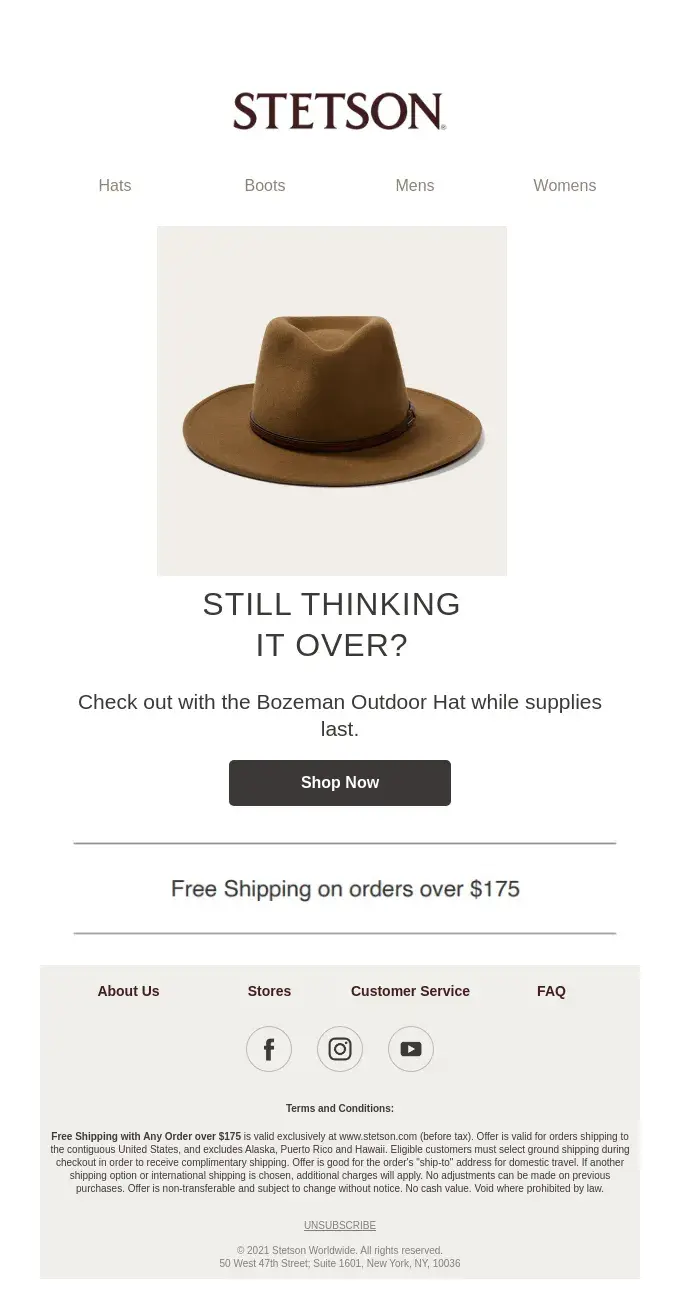
Stetson’s email has a simple no-frills design that features a lovely product picture. It creates a sense of urgency with the text, “Check out with the Bozeman Outdoor Hat while supplies last” and a “Shop Now” CTA button that’s effective.

They also offer free shipping for purchases over $175 and a navigation menu at the top for those who want to continue browsing and shopping.

What I like: I’m impressed that this email is short and sweet, and still ticks all the boxes — from the subject line to the product image to the sense of urgency and the free shipping for purchases over $175.

Pro tip: This type of free shipping is better than having none at all, since it can encourage people to buy more so as to qualify for it. If your business cannot offer free shipping for every single purchase, consider this type instead.

13. Moschino

Subject line: You left something behind

moschino, abandoned cart emailhttps://reallygoodemails.com/emails/you-left-something-behind

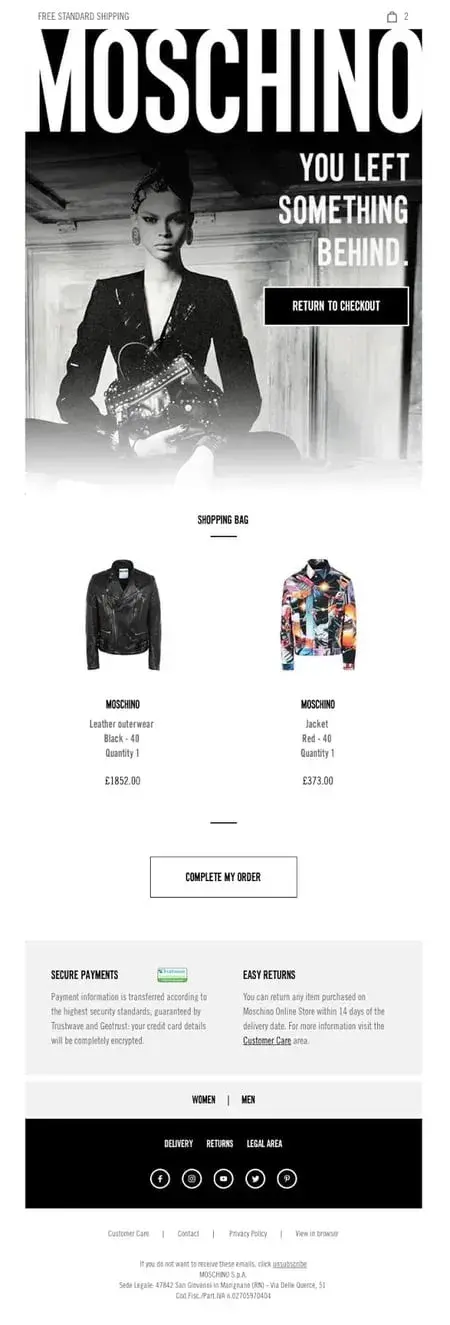
The bottom of Moschino‘s email is unique because it includes information on secure payments and easy returns. For clothing ecommerce businesses, these are some of the top reasons that customers don’t want to make a purchase online.

With their abandoned cart email, Moschino is trying to quell any doubts and take away any reason for hesitation. Plus, they list the items in the cart and use clear CTAs.

What I like: Moschino’s email is highly on-brand, down to the imagery, font, and colors. Plus, as mentioned, it includes notes on their payments being secure and their returns being simple and easy — a concern a potential buyer might have, since Moschino’s offerings are on the more expensive side.

If you sell luxury goods, you might consider a similar approach.

14. Haoma

Subject line: Any questions?

haoma, abandoned cart email

Source

Haoma is a luxury skincare brand that knows its customer might hesitate to splurge — so instead of sending an abandoned cart email that prompts users to complete their order, it prompts them to ask for help if needed.

The button at the bottom seals the deal by inviting users to add the item back to their cart. This technique is helpful if the visitor only browsed your website or removed the item from their cart before checking out.

What I like: If you run a luxury brand, you can take several steps to reassure buyers that they’re making the right choice. You can offer assurances about returns and safe transactions, as Moschino does above, and give them a second chance at learning more about their potential purchase.

These steps can sometimes be more effective at driving purchases than including a CTA to “Buy Now.”

15. Luno

Subject line: Your Luno Air Mattress Order

luno, abandoned cart email

Source

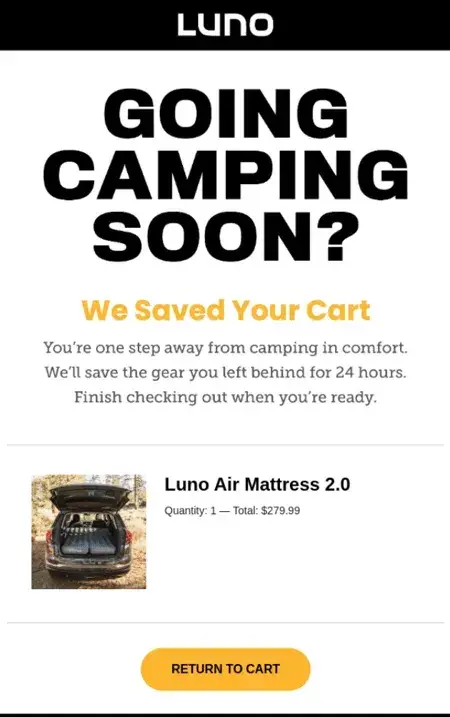
Luno’s cart abandonment email takes several steps to reel in hesitant buyers. It reminds them of an enjoyable activity they could partake in (“Going camping soon?”), tells them how they’ll benefit (“You’re one step away from camping in comfort”), and includes a gentle nudge with a time constraint (“We’ll save the gear you left behind for 24 hours”). The unmissable CTA seals the deal.

What I like: Luno’s careful and targeted copywriting makes this one of the most effective abandoned cart email examples I’ve ever seen. When creating your own email, pay attention to the copy — it can sometimes play a bigger role than imagery or other elements.

16. Le Puzz

Subject line: Missing a puzzle?

le puzz, abandoned cart email

Source

This cart abandonment email from Le Puzz hits all the right notes: It’s peppy, inviting, and probing, but not pushy. Its call-to-action, “Shop Puzzles,” gives the recipient a chance to browse through more options in case they no longer want their previous choice.

I think this is an excellent technique for brands where users might quickly change their minds about their choice, which might lead to an abandoned cart. Prompting them to browse the catalog again is an excellent way to recapture this type of lead.

What I like: Le Puzz’s playful brand voice and bright brand colors play a huge role in its abandoned cart email. From its cheery “Hello again!” to its whimsical “We found a lost puzzle. Could it be yours?” the company encapsulates the fun experience of completing one of its puzzles.

If you sell one specific product, you might want to take a similar approach — bringing the product experience to life with your copy and colors.

17. Alex Mill

Subject line: Get Them for 15% Off!

alex mill, abandoned cart email

Source

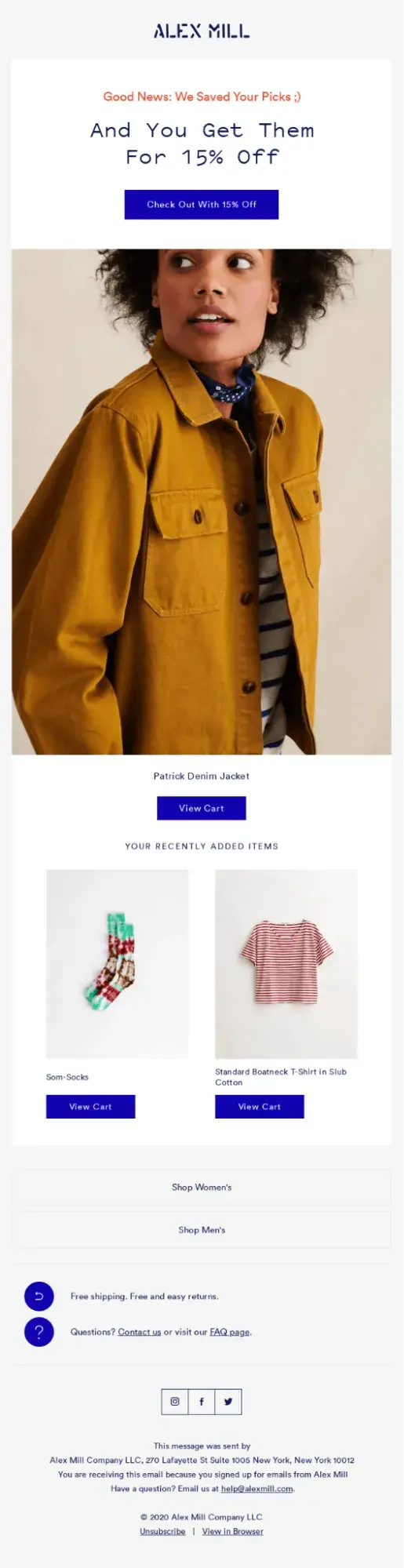
This email from Alex Mill uses a simple and clean design to communicate a compelling discount offer that’s difficult to miss. The subject line “Get them for 15% off” is good enough to get recipients to open the email.

The text, “Good News: We saved your picks” and “You Get Them For 15% Off” nudges the customer to quickly grab the discount and complete their purchase.

Beautiful pictures of items viewed by the customer are featured and more than one CTA button makes it convenient for customers to complete their purchase at any point.

What I like: I love that Alex Mill addresses their customers’ reasons for cart abandonment in this email. Added to the discount, they also offer free shipping, plus free and easy return. For those who want to continue shopping, links to shop men and women’s clothes are provided. And customers who have questions are encouraged to contact them or check out their FAQ page.

This strategy can also work for you if you take the time to understand your customers.

18. Dollar Shave Club

Subject line: Where did you go?

dollar shave club, abandoned cart email

Source

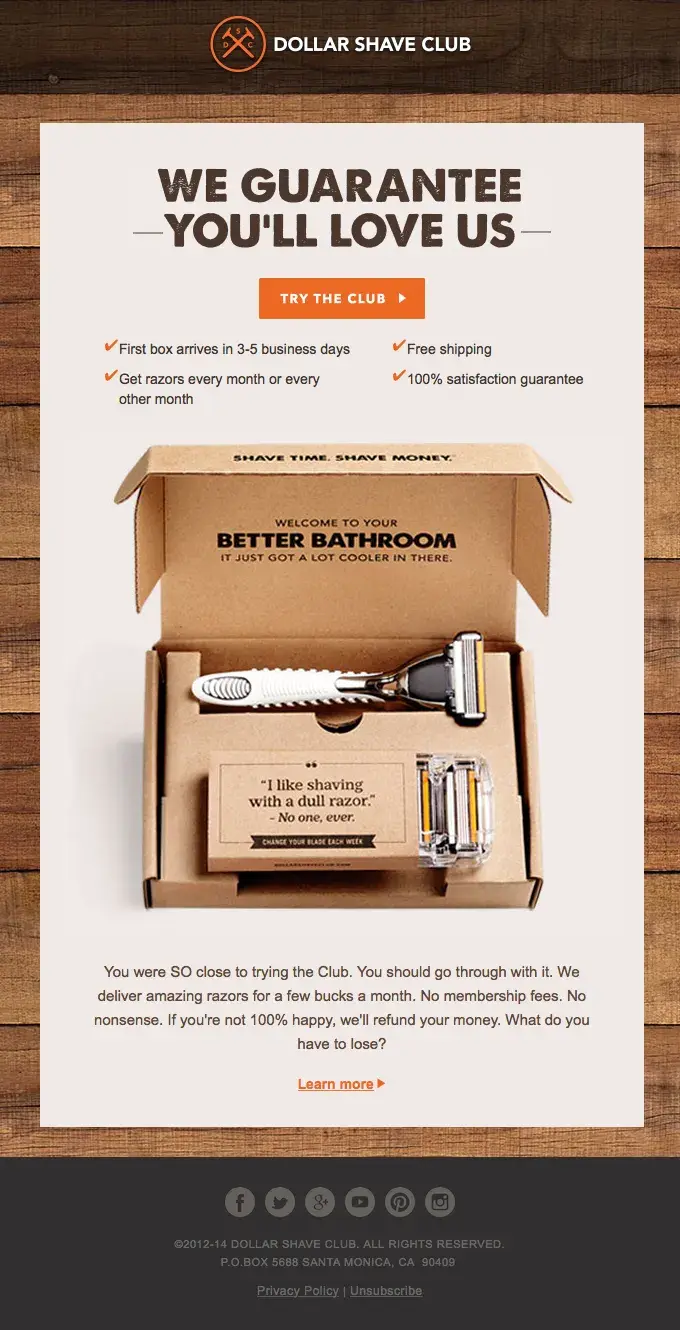
This example from the Dollar Shave Club does a great job with their interesting and engaging copywriting, plus the lovely picture of their monthly box and its content. The subject line asks a simple question, “Where did you go?” to generate interest.

Once you open the email, the bold text, “We Guarantee You’ll Love Us” cannot be missed. Plus the reasons why they’re so sure:

  • First box arrives in 3-5 business days
  • Free shipping
  • Get razors every month or every other month
  • 100% satisfaction guarantee

What I like: In this abandoned cart email, Dollar Shave Club reminds customers they have nothing to lose when they complete their purchase. And I love it because it’s effective. The delivery period is clearly stated. They also offer free shipping, and are ready to refund your money if you’re not 100% happy.

Since there’s nothing to lose, I’m sure most prospects won’t hesitate to complete their purchase.

Abandoned Cart Email Best Practices

Next, I’m going to share 12 important best practices you need to keep in mind when planning your abandoned cart emails.

1. Send an abandoned cart email sequence.

Instead of sending just a single email, a series of emails will work much better for abandoned cart emails. Also called an abandoned cart flow, the emails could be structured like this:

  • Email 1. Cart reminder (sent a few hours after cart abandonment).
  • Email 2. Follow-up (sent a few days later).
  • Email 3. Promotional discount (sent a few days after email two).

According to Klaviyo’s 2024 Benchmark Report, abandoned cart flow drives:

  • The highest revenue and conversion rates out of all automated flows.
  • High engagement across ecommerce industries.

Also, according to Omnisend, their merchants who sent just one cart abandonment email got 14.76 orders, while those who used the three email strategy achieved 24.94 orders in total.

One thing I also discovered is that you can experiment with another email sequence and frequency to find out what works best for you. For example, maybe you want to send four to six emails over a specific period of time and check your results.

Pro tip: I’d recommend taking your business goals, product line, industry, and everything you know about your target audience into consideration when deciding on your email sequence.

Want to generate your copy faster and increase your productivity? I’d suggest trying the Hubspot AI email writer.

2. Choose the correct timing.

Send your abandoned cart emails within a few hours after a customer abandons their cart. This is because your customer may still want to buy shortly after leaving the site. A timely reminder can recapture their attention and help them complete their purchase.

For example, if you work at a company like Zappos, and someone doesn’t complete their purchase, you might send an abandoned cart email anywhere from three to five hours after they leave your site without completing a purchase.

At minimum, I think you should send the first abandoned cart email within 24 hours. That said, it‘s important to test when your customers are most likely to react to that email. And make sure you’re choosing the right timing for your customers.

Analyze customer behavior.

I suggest you use tools like Google Analytics or HubSpot for insights into customer behavior. And use metrics such as:

  • How much time they’re spending on your website.
  • Common cart abandonment times.
  • Peak engagement hours.

This data can help you choose the best time to send your email. Read here to learn how to create and analyze abandoned cart data with HubSpot.

Test different send times.

Depending on your business goals, products, industry, and target audience, test different send times. In fact, I’d recommend you test specific times of the day or days of the week.

If you wait too long, your customer may lose interest or look to a competitor for the same product. But if you hit “Send” at the wrong time, your customer may feel overwhelmed or ignore your email. Both will make it tough for you to recover that sale.

Use behavioral triggers for timing.

I discovered that marketing automation tools like HubSpot can be used to add workflows and set up triggers for specific customer behaviors.

Useful triggers might include returning to your website, adding items to the cart again, or spending a certain amount of time on the site. Then, use these triggers to send automated follow-up emails.

For example, this Discogs email doesn’t have a fancy design, but it lets the owner of this abandoned cart know that they missed out on the item in their cart. At the same time, it offers a quick link to find that product again and complete the purchase.

discogs, abandoned cart email

3. Personalize, personalize, personalize.

Personalize your abandoned cart emails to customers with real-time information, such as:

  • Customer name
  • Items they left in their cart
  • Product images
  • Prices

This personalization can persuade them to go ahead and complete the purchase, since they’ve already expressed interest by adding them to their cart. It’s also a reminder of the specific items they may still want to buy.

Jordan Pritikin, who used to work as a marketing leader at HubSpot, gives this advice: “When you’re writing an abandoned cart email, personalization is key.”

Pritkin continues, “What was the actual product or service that was abandoned? What are the value propositions that most resonate with the individual you’re sending to? Why did they object to the purchase initially and how can you, as the business, help assuage those objections? The more personal your abandoned cart email, the more likely it is to succeed.”

As you personalize your abandoned cart email sequences, I’d suggest keeping these tools and tips in mind.

Use customer segments to target customers.

While you may not be able to send unique emails to each customer, I learned that useful customer segments can help you create personal emails.

Use a CRM to segment customers by demographics, purchase history, browsing behavior, and more.

Use dynamic content and other tools.

I also discovered that tools like smart content rules and dynamic content can help you personalize your abandoned cart emails and landing pages.

You can update pages across your website or display unique content for your customer segments. These tools make it easier to add unique images, prices, and product suggestions to your emails.

Create personalized offers.

Once you have the segments and tools you need to customize your emails, I suggest thinking carefully about your abandoned cart email content.

To develop specific offers for customers, HubSpot email marketing tools can help you create, personalize, and optimize your emails.

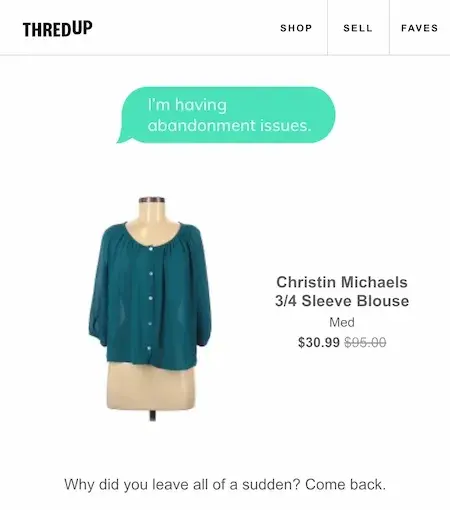
Discounts, free shipping, and limited-time promotions might appeal to anyone, but my findings reveal that these tactics will be more effective if they align with specific customer interests and needs.

Ideally, your offers should refer to their past purchases, abandoned items, or segment pain points, like this example from ThredUp:

thredup, abandoned cart email

4. Include a CTA to resume shopping.

Your abandoned cart email should encourage customers to complete their purchase. For example, the CTA might be something like “Buy Now” or “Resume Your Order.”

Creating a CTA that takes them directly to checkout will save your customers time. It will also make it easy to review their items and further encourage them to complete the purchase.

To create an effective CTA for your abandoned cart email:

Add a clear value proposition.

Your email should highlight any extra value your customer would get by completing the purchase. I’d recommend putting this value at the start of your email to motivate them to complete their order, like the offer below from Full Leaf Co.

full leaf tea, abandoned cart email

Check out these CTA examples for more inspiration.

Create urgency or scarcity.

Mention limited stock or add a time-sensitive offer to create a sense of urgency in your CTA. I found out this will give your customer a compelling reason to take action.

HubSpot customers: Deliver personalized CTAs with HubSpot’s CTA Builder.

5. Pay attention to your copywriting.

Another thing I learned is that your copy should be snappy, concise, and compelling. Great copywriting is interesting enough to entice someone to complete their purchase. It should also be friendly and mirror your brand voice.

Copywriting can make a big impact on cart abandonment if you:

Make it easy to scan.

Your copy should get to the point and be easy to read. Break up the text into short paragraphs, or bullet points, to make it more scannable.

It’s also a good idea to use great email design to create scannable cart abandonment emails.

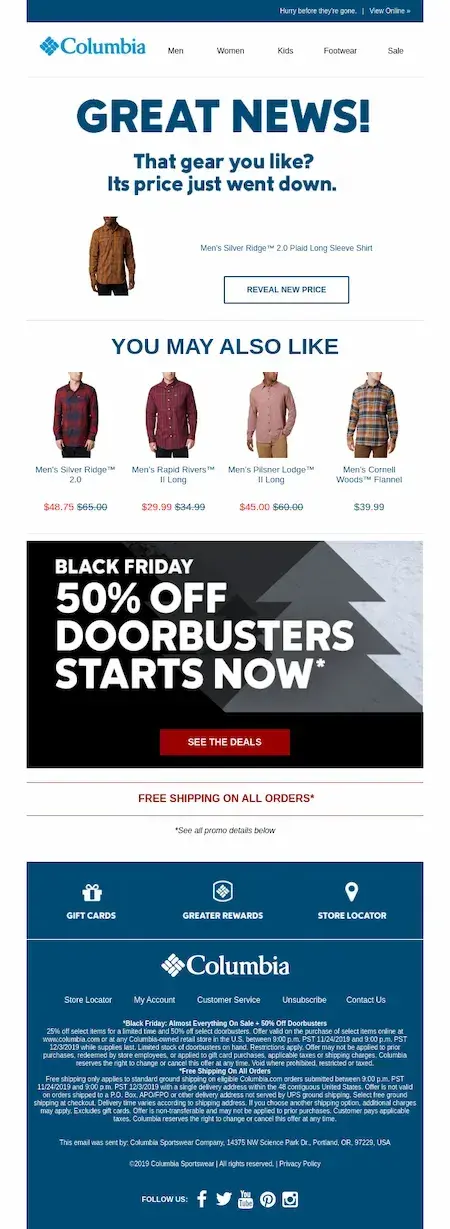
Images should be attractive and exciting but also support or enhance the message of your specific email. Product images directly from abandoned carts can be especially effective, like this abandoned cart email example from Columbia:

columbia, abandoned cart email

Source

HubSpot customers: Check out the knowledge base to learn how to add a product or abandoned cart module to your email here.

Focus on customer pain points.

It’s important to keep the copy succinct, but it must feature relevant solutions to specific customer pain points. As you highlight value and benefits, I suggest you show how that purchase solves a problem or fulfills a need.

6. Include an enticing subject line.

Your subject line should be interesting enough to get people to open the email.

For example, using something like discounts, humor, or questions could intrigue the customer enough to click. If you wanted to include a promotional offer, your subject line could be something like “20% off all purchases.”

Get local.

If your business operates in specific regions, think about tailoring the subject line with local references. Localization can build an immediate connection.

Create urgency.

Try adding limited offers like “Limited time offer” or “Only 2 left in stock” directly to your subject lines. This can motivate your customers to open the email and take quick action.

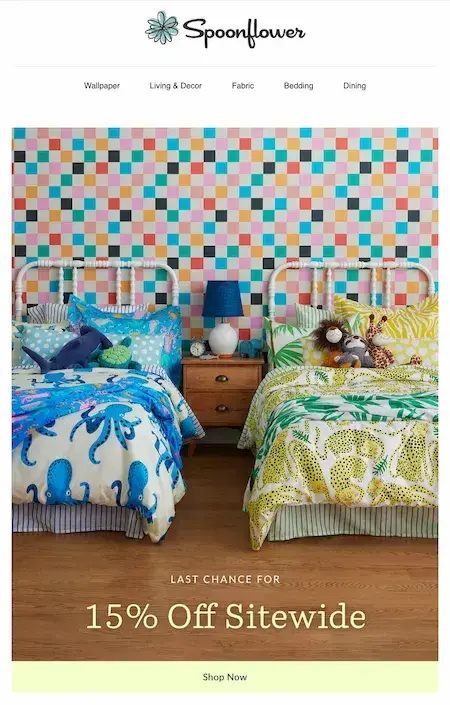
Subject line: Last day for 15% off your order 🌤

spoonflower, abandoned cart email

Add intrigue.

Try abandoned cart subject lines that arouse curiosity with questions, teasing language, or surprising statements. For example, “Can’t decide? We’ve saved your cart for you.”

Test for catchy subject lines.

It’s tough to write engaging subject lines, but I found that tools like CoSchedule’s Email Subject Line Tester or SendCheckIt can help you create powerful subject lines, for more email opens and conversions.

7. Consider adding social proof.

My findings also reveal that you can use reviews, UGC, and testimonials to strengthen your email branding. This tactic can also increase longing for abandoned products that customers left in their carts.

Offer social proof from customers.

I’d recommend adding customer feedback, images, reviews, or testimonials in your copy. This can help you build interest, trust, and credibility. It can also address any concerns your customer may have about completing their purchase.

Pro tip: I recommend tools like HubSpot, Yotpo, or Trustpilot, which can help you collect and manage customer reviews.

Add social proof from industry experts or influencers.

Quotes or endorsements from reputable sources are attractive additions to abandoned cart emails. These opinions of authority can sway a customer’s decision to complete their purchase.

Check out this influencer marketing guide to get started.

Showcase UGC.

User-generated content (UGC) might include customer photos, videos, or social media posts. If your customers are showcasing their experience with your products, find a way to include it in your email to add urgency and authenticity.

I also noticed that tools like TINT or Social Native can help you collect and curate UGC.

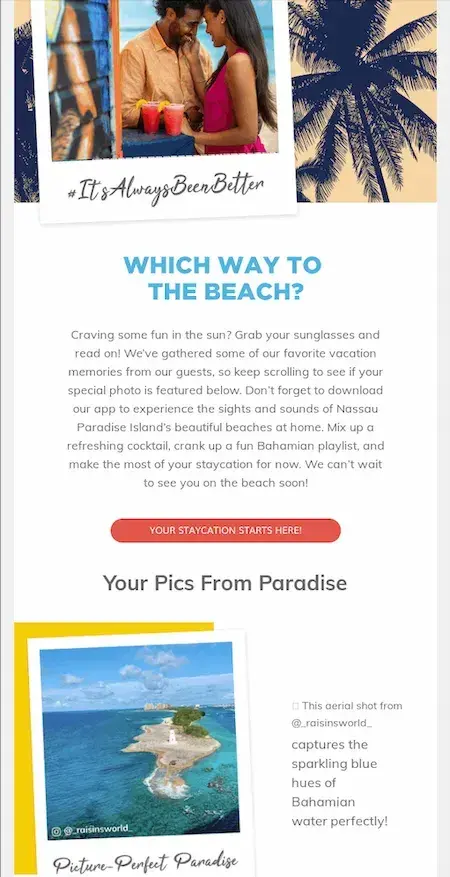
Take a look at this UGC example for inspiration:

ugc pics from paradise, abandoned cart email

Source

Highlight rankings.

Add product ratings or rankings from recognized brands to your abandoned cart emails. I found that star ratings, satisfaction scores, or product rankings quickly show customers the quality and popularity of your brand. This validates their initial emotional impulse to buy and can lead them to complete the sale.

8. Share more product options.

To rekindle their interest and help customers buy faster, I’d recommend sharing more options related to items left in their cart.

I know this can be tricky since you don’t want to overwhelm them with too many choices. But what if these related options are a better choice and they didn’t even know you had them? I’ve heard stories from people around me who have experienced something similar.

Therefore, study the items left in their cart and share:

  • Similar items and options that do basically the same thing.
  • The same item in different colors, designs, patterns, and so on.
  • A more affordable option of the same item.
  • A more expensive option of the same item with more features.
  • Complementary accessories they might find useful.

As an alternative, also think of having a product quiz in your cart abandonment email. Ask questions to find out what the customer really needs or is looking for. And use their answers to recommend products that might be great fit.

9. Provide your contact details.

I also discovered that you can encourage customers to reach out with questions, comments, complaints, and other valuable feedback, when your contact details are in your cart abandonment emails.

For example, include:

  • A live chat link.
  • An email address.
  • A telephone number.

Done right, this can convince customers that you and your team are always ready and available to attend to their needs.

10. Ask for feedback.

I think it’s important to find out why your customers abandon their cart, instead of making assumptions. According to the Baymard Institute, people abandon their cart for the following reasons:

  • I’m just browsing and not ready to buy.
  • Extra costs are too high, such as shipping, tax, fees, and so on.
  • The store wants me to create an account.
  • I don’t trust the site with my credit card information.
  • Delivery is too slow.
  • The checkout process is too complicated or long.
  • I can’t see or calculatethe total order cost upfront.
  • The return policy is not satisfactory.
  • Payment methods are not enough.
  • Website had errors or crashed.
  • Credit card was declined.

Sure, you can’t do much about people who’re not ready to buy. But did you notice all the other reasons are customer pain points you can fix?

In your email, I’d recommend using a friendly tone to ask them what happened, why did they leave without completing their purchase, and how can you help. You can encourage them to call you or reply to your email. Or maybe you can even include a survey in your email.

With this valuable feedback, you can address the root causes of cart abandonment, provide a great experience for customers, and make more money.

11. Optimize for mobile.

Because it’s so convenient, more and more people now shop online through mobile devices. According to Statista:

  • Mobile ecommerce sales reached $2.2 trillion in 2023 and now make up 60% of all ecommerce sales worldwide.
  • Mobile ecommerce sales grew from 56% in 2018 and are expected to reach 62% by 2027.

And I also found out that around 77% of shopping cart abandonment occurs on mobile devices, compared to 68% on desktop.

Here’s the truth: If your emails are not mobile friendly, they won’t display correctly on mobile devices. And I’ve seen such emails before on my tablet. Not only do they look strange, but they are difficult to read and engage with.

They also provide a terrible user experience that can frustrate and annoy people, and even cause them to unsubscribe.

So, it’s a good idea to optimize your cart abandonment emails for mobile.

For easy mobile interaction, make sure CTA buttons are also mobile-friendly, and easy to see and click.

Pro tip: To improve the mobile experience, I suggest you limit the number of clicks from CTA to checkout completion. And I’d also recommend checking your emails on different devices before sending them out.

12. A/B test your email to learn what’s most effective.

There are many different approaches to the abandoned cart email. But I’d suggest A/B testing different variations to see what works for your audience.

Do they prefer personalized emails? Discounts? Humorous text? It’s important to find out.

Test different email elements.

I highly recommend you try different placements and types of social proof in your abandoned cart emails. Or, try email variations with shorter or longer copy, bullet points or paragraphs, or multimedia like videos or GIFs.

You can also A/B test different placements and messaging of your CTAs in your abandoned cart emails. Experiment with button colors, sizes, and text to optimize CTAs for click-through rates.

Make the most of email testing tools.

I also found out that tools like HubSpot’s A/B testing feature or Split Test Automation can help you set up and measure subject line tests. While tools like Hotjar can give you insights into user behavior.

Analyze your testing results.

Here’s another thing I discovered. Don’t just run A/B tests and run with your first impressions. Instead, analyze test variations and results. Then, measure the impact on your email KPIs such as:

  • Open rates.
  • Click-through rates.
  • Conversion rates.
  • Impact on different audience segments or buyer personas.

Then, use your analysis to refine your abandoned cart email strategy.

Important note: For useful A/B testing results, test only one part of your abandoned cart email template at a time. For example, if you test your subject line, CTA, and email image at the same time, you won’t know which part of your email was the key to its success.

Here’s a free A/B testing kit that includes a guide, significance calculator, and tracking template for targeted A/B testing.

Create Abandoned Cart Emails That Convert

With stellar copywriting and branding, you can earn your customers’ trust, convince them to complete their purchases, recover lost sales, and make more money. To help you achieve all these, I’ve shared everything you need to know to create and send effective abandoned cart emails.

In fact, I’m genuinely amazed at all the email templates and other tools available for this. And I’m also impressed that most of them are free.

As an email enthusiast, I learned a lot while working on this piece and collating the email examples. I hope they inspire you as you create your abandon cart emails.

Editor’s note: This article was published in September 2019 and has been updated for comprehensive.

Categories B2B

Banking on Social: How to Create a Social Media Budget & Spend Smarter in 2025

A whopping 60% of marketers feel that the way they spend their budget — and the ROI it produces — is being scrutinized more now than in the past.

So, it’s no surprise you landed here to discover how you can better optimize your social media budget this year.

Click here to download 8 free marketing budget templates.

As a content pro (and former social media manager), I’ve got you covered. Let’s talk about what a good social media marketing budget looks like, who should be involved, and how you can data-charge your approach.

Table of Contents

What is a social media budget?

A social media budget (or social media marketing budget) is a dedicated amount of money that a business reserves for social media marketing activities like content creation and campaign analysis.

The most comprehensive social media budgets cover the following:

  • Strategy and planning: This includes setting goals and objectives, conducting audience research and competitive analysis, choosing priority channels, and establishing KPIs.
  • Content development and publishing: This includes establishing a content cadence, building a content calendar, writing content and creating multimedia content (e.g., audio and video), and scheduling/publishing content.
  • Community management: This includes building and maintaining online brand communities, tracking brand mentions, and monitoring conversations via hashtags, comments, and direct messages.
  • Data analytics and reporting: This includes evaluating post-level metrics (e.g., reach, impressions, engagements), building reports, and optimizing content performance.
  • Tools and software: This includes publishing, reporting, campaign management, social listening and monitoring, and other social media management tools. (If you want a one-stop-shop option, HubSpot’s Social Media Management Software does all of this for free.)
  • Social commerce, sponsored content, and advertising: This includes managing in-platform product sales and promotion, working with influencers or creators, and running paid ad campaigns. (And if you need help planning your ad strategy, this kit is great for that.)
  • Learning and development: This includes training new hires, offering continued education courses, and upskilling based on AI best practices or other emerging trends.
  • Miscellaneous expenses: This includes social media giveaways, contests, and other promotions that hold monetary value or require additional resources.

Importance of Creating a Social Media Budget

From marketer to marketer, I know our budgets are often limited. A well-thought-out social media budget allows us to set realistic goals, understand our priorities, organize our activities, and, ultimately, spend our money wisely.

Without a budget, you risk overspending on frivolous activities with little to no funds left over to support your core objectives. It’s kind of like blowing your paycheck on clothes and travel before realizing you haven’t paid your mortgage.

A social media marketing budget also makes sure everyone in your organization is aligned with your strategy. And by everyone, I mean …

Social Media Budget Stakeholders

Here are the usual suspects involved in the social media marketing budget process:

  • CMO and marketing managers+: Responsible for setting the strategy, communicating the requested budget to leadership, and guiding the execution of activities.
  • Social media team (all levels): The do-ers who understand what areas require the most investment and which activities are worth spending money on.
  • SEO and data analysts: Provide insights based on previous campaigns and predict trends that may have future budget implications.
  • Finance team: Track historical forecasts and spending patterns and enforce budgets across the organization.

Pro tip: It also wouldn’t hurt to run your plans by the sales team. Our data shows that one of the top challenges marketers are currently facing is sales and marketing alignment. Alignment starts with shared data and extends into collaborative goals.

How to Create a Social Media Marketing Budget

Now that we’ve covered the basics, I talked to a few marketing and social media experts about the most important factors to consider when creating a social media budget.

Here’s what they said.

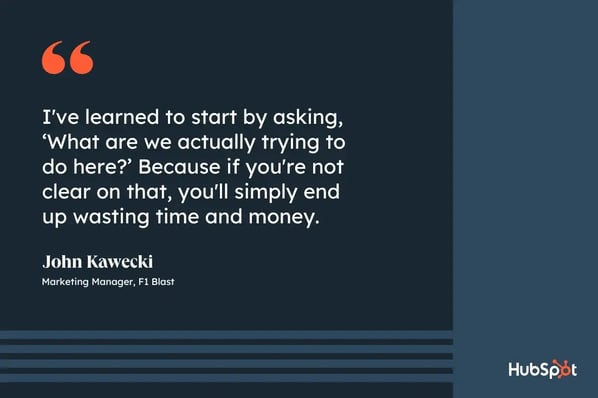
social media budget; quote graphic from john kawecki, marketing manager at f1 blast; i've learned to start by asking, ‘what are we actually trying to do here?’ because if you're not clear on that, you'll simply end up wasting time and money.

1. Start by understanding what you’re trying to achieve.

John Kawecki, marketing manager at F1 Blast, highlighted the importance of taking a step back and figuring out your goals before crunching the numbers.

Kawecki says, “I‘ve learned to start by asking, ‘What are we actually trying to do here?’ Because if you’re not clear on that, you’ll simply end up wasting time and money.

For us, it was about building a community where F1 fans could connect, talk races, and get news. So, I focused our budget on platforms where we’d actually find those fans, mainly Instagram and Twitter.”

It’s easier to map your budget to categories and activities when you know what you want to accomplish.

2. Know your audience’s social media habits.

Wisia Neo, content marketing manager at ViB, argues that knowing your audience is the single most important factor when creating your social media budget. Kawecki also hinted at this when he talked about how he found F1 fans on Instagram and Twitter.

Neo says, “It‘s easy and tempting to throw money into social channels because they’re popular among other big brands. But if your audience isn‘t engaging on [those platforms], that investment won’t pay off.”

She continues, “Make it a habit to interview your customers regularly. Understand how they use social media in their day-to-day and how it influences their buying decisions. Combine those insights with data like traffic sources, conversion rates, and engagement to ensure your budget is focused where it makes the biggest impact.”

I think I can speak for all marketers when I say we’re not in the business of throwing away money. Make sure your efforts are actually meeting your audience where they are.

3. Set realistic spending milestones.

There’s no point in creating a budget that’s impossible to adhere to. (I have to tell myself this any time I create a personal budget, too.)

Mushfiq Sarker, CEO of LaGrande Marketing, notes that being realistic about your budget involves understanding that each objective requires a different allocation of resources.

“If my goal is to boost brand awareness, I might invest more in ad spend for platforms with broad reach and engage in content creation that highlights my brand’s story and values,” says Sarker.

“On the other hand, if my focus is on lead generation, I prioritize my budget for targeted ads and landing pages designed for conversion.”

If you have a limited budget, prioritize the most important activities with an understanding that you can’t do everything. And if you have some wiggle room, add some cushion to the budget categories you tend to overspend in based on your spending history (or future predictions).

Pro tip: Social media trends change with the wind. When determining your spend breakdown, consider setting a pot aside for what I like to call “unpredictability funds” — basically, a budget that allows you to be flexible as consumer needs and interests change.

How to Allocate Your Social Media Budget

According to the latest CMO Survey, marketing budgets as a percentage of company budgets have continued to fall over time, and businesses are allocating roughly 10.1% to marketing on average. Looking at marketing budgets as a percentage of company revenues, that number drops to 7.7%.

With that in mind, marketers are spending 17% of their total budget on social media — and this is predicted to increase to 26% in the next five years.

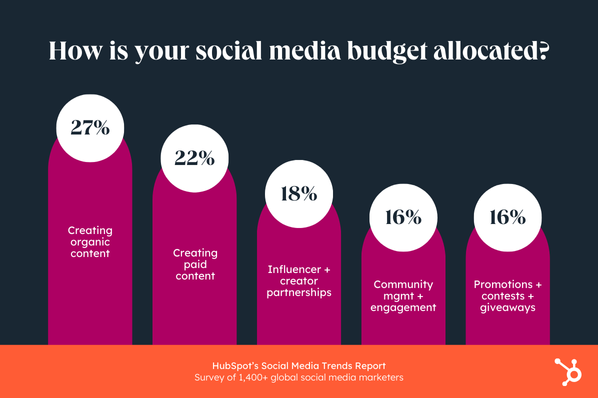
Let’s drill down even further. We also asked 1,400+ global social media marketers how their budget is allocated. The image below shows a breakdown of their top five priorities:

Copy of state of AI

That said, depending on your business type, target audience, and goals, you may choose to allocate more money to certain areas over others.

For example, when I moonlighted as a social media contractor for a national public health organization, our ‘Super Bowl’ was Healthy Vision Month each May.

We set aside a large chunk of our social media budget for the planning, execution, and evaluation of that specific campaign because it was a big community builder for us. We also focused most of that bucket on Facebook and X (formerly Twitter) to get the most ROI based on our audience.

The rest of the budget was used to maintain our regular publishing and reporting schedule throughout the year.

How to Use Data to Inform Your Social Media Budget

If you’re still trying to figure out what to allocate where, let the data speak for itself.

I mentioned using historical data to inform the future. For example, if you spent a big portion of your budget on holiday campaigns last year, you’ll probably want to leave room (or add resources) for that this time around.

Another way to leverage data is to see what’s trending in your industry among like-minded social media marketers.

We did some digging for you, and our latest social media marketing report tells us this:

  • 50% of marketers plan to increase their investment in social selling.
  • Facebook, Instagram, and YouTube are the top social media channels used by brands in 2024, with 23% of marketers citing that YouTube had the most engagement.
  • Increasing brand awareness and reaching new audiences is a top goal for social media marketers.
  • Sales/revenue and website traffic are tied for the top metric that marketers use to measure social media success.
  • 87% of marketers say using AI tools is crucial to a successful social media strategy.
  • The overwhelming majority of marketers rate long-form videos, expert interviews, temporary content (e.g., Instagram Stories), and VR/AR as having high ROI.

Poke through the full report, watch the expert social trends panel below, and use insights like these to inform your budget.

Social Media Budget Template

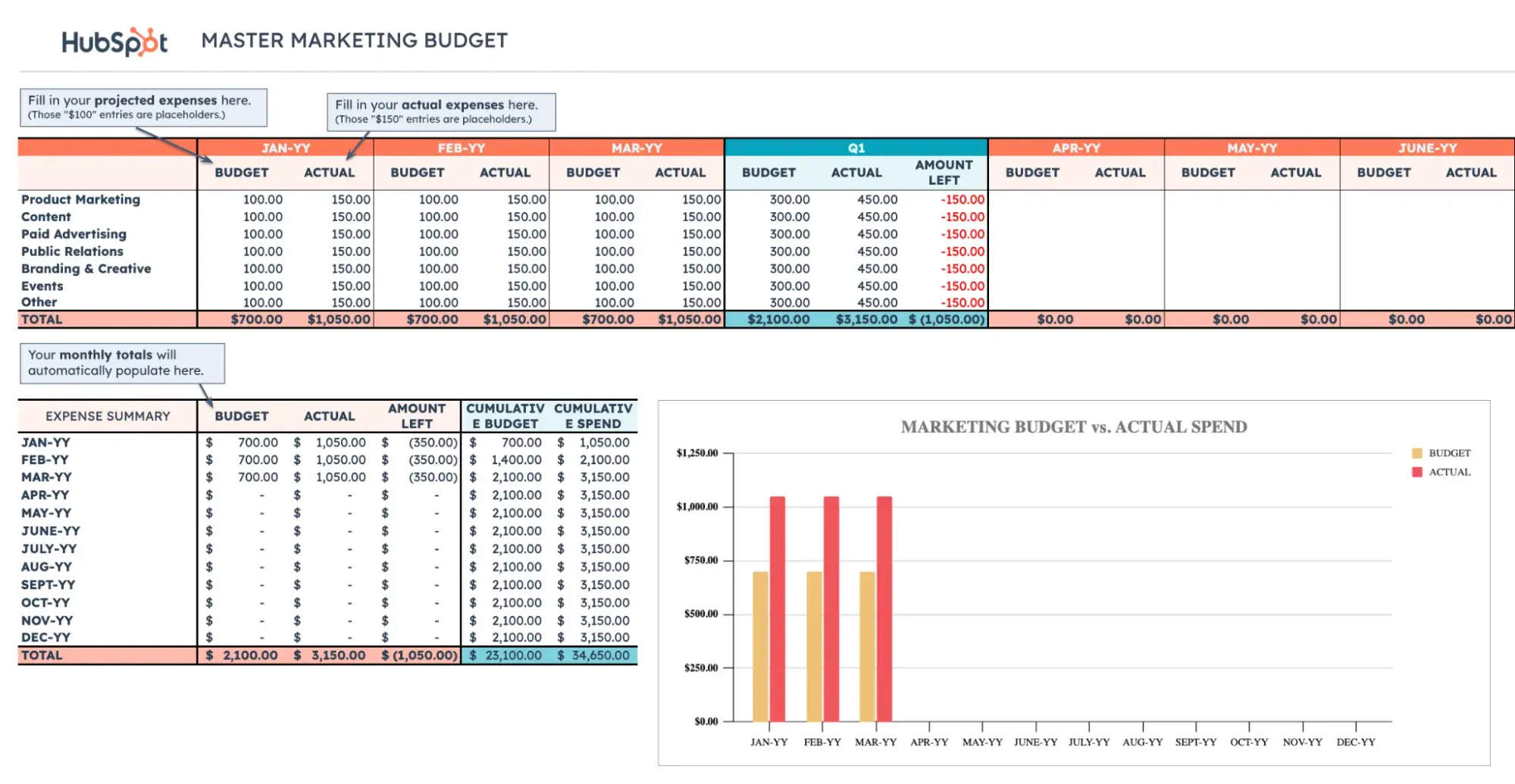
The example below is a general marketing budget template, but you can easily tailor it to your social media plan.

For example, your line items may include “strategy and planning, content creation, and monitoring and reporting” instead of buckets like “public relations.”

hubspot’s free marketing budget templates, social media budget template

Download This Template for Free

Regardless of how often you track your spending — monthly, quarterly, annually, or all of the above — this template can handle it all.

How to Measure Your Social Media Budget’s ROI

Luckily, my colleague Flori already wrote a fantastic piece detailing how to measure your social media marketing ROI, so I won’t go into too much detail here.

However, the most straightforward measurement is the social media ROI formula:

(Total Revenue – Total Investment) / Total Investment x 100

  • Total Revenue: The amount of money generated from your campaigns
  • Total Investment: The amount of money you put in when creating the campaign (resources, labor, etc.)

So, if my total revenue from social media campaigns for the year is $15,000, and my total investment is $5,000, let’s calculate the ROI:

(15,000 – 5,000) / 5,000 x 100 = 200%

That means I made $2 for every social media marketing dollar spent. Love that for me.

I’d also recommend trying out our marketing ROI calculator for a big-picture view of your social media returns.

It’s Your Year to Become a Better Budgeter

We’re doing more with less, but the expectations for marketers are higher than ever. The payoffs for good social media marketing are huge — so create a social media budget that allows you to meet business demands and keep your priorities in order.

Categories B2B

In 2025, These SaaS Landing Pages Are My Go-To for Inspiration

The first place a potential customer may hear about your brand could be from your social media, a passing ad, or even a friend‘s recommendation. And if you’re one of the lucky ones, they may even seek out your brand’s landing page looking for more.

Easy, right? You got them on your website, they’re sure to buy now! (Except it’s usually not that simple.)

Free Guide: How to Build & Optimize Landing Pages

If your landing page doesn‘t present your service or product value well enough, you could be losing out on traffic simply because your team’s UI/UX could use a facelift.

And it‘s even tougher to sell your brand when you’re selling a SaaS software service, where you can’t just flash a tangible product, and instead need to highlight features and use cases on your website.

Luckily, today, I‘ll walk you through some of the best SaaS landing pages I’ve come across, why each one is effective, and leave you with some inspiration for own site. Let’s dive in.

Table of Contents

Elements of a Great SaaS Landing Page

Some key components make up an effective landing page, here’s a few that your business should prioritize:

  • A compelling headline: A strong, clear headline that immediately communicates the main benefit or purpose of the software, capturing the visitor’s attention.
  • Social proof & trust signals: Security badges, privacy assurances, or money-back guarantees that help reduce hesitation and reassure visitors about their decision to engage with the service.
  • Features & benefits: A focused section that outlines the main features of the software and the specific benefits they deliver to users, often presented with icons or bullet points for clarity.
  • Minimal navigation: A streamlined navigation structure keeps the visitor focused on the key message and reduces distractions, often by limiting options to essential links only.
  • Pricing & contact information: Users who may have questions or require further information can easily access support or contact details. If applicable, a transparent pricing section explains different plans and pricing tiers to help potential customers understand their options.
  • Clear call-to-action (CTA): Prominently placed CTA buttons that guide visitors toward taking the next step, such as “Sign Up for Free,” “Start Your Trial,” or “Request a Demo.”

elements of a great saas landing page

What makes SaaS landing pages unique?

SaaS landing pages are unique because they are specifically tailored to promote software services delivered over the internet. Here are some elements that make them distinct:

  1. Focus on Features and Benefits: Unlike traditional product pages, SaaS landing pages emphasize the software’s features and the benefits they bring to the user, often relating to productivity, efficiency, or cost savings.
  2. Demonstrating the Experience: Because SaaS products are intangible and rely heavily on the user experience, these landing pages often incorporate live demos, interactive elements, or video walkthroughs to help potential customers visualize how the software works.
  3. Subscription Model Promotion: SaaS products are typically sold on a subscription basis. The landing pages often include pricing models that illustrate different subscription tiers, including details on features available at each level.
  4. Conversion-Oriented Design: SaaS landing pages are meticulously designed to convert visitors into users quickly. This includes strategically placed call-to-action (CTA) buttons, such as “Start Your Free Trial,” which are clear, appealing, and actionable.
  5. User Testimonials and Case Studies: To build trust and credibility, these pages often feature testimonials from satisfied customers or detailed case studies that demonstrate successful use cases of the software.
  6. Scalability Aspects: SaaS offerings are known for scalability. Landing pages frequently emphasize how the software can grow with the business, adapt to various needs, and provide continuous updates and support.
  7. Technical and Industry-Specific Content: They often address specific technical aspects or industry challenges, speaking directly to an audience that is usually more informed about technology-related solutions.
  8. SEO and Targeted Traffic Optimization: These landing pages often employ SEO strategies to attract targeted traffic inclined to seek digital solutions, further enhancing conversion rates.

These elements combine to create a marketing tool uniquely suited to the SaaS business model, focusing on quick, efficient conversion of visitors into trial users or paying customers while effectively communicating the SaaS product’s value.

So with all these qualities in mind, let’s review some of my favorite examples of successful SaaS landing pages.

1. HubSpot

saas landing page examples we love: hubspot marketing hub

Source

Not to toot our horns, but we didn’t gain 228,000+ loyal customers without nailing down a cohesive look and value proposition.

What I like: HubSpot leads with trust and emphasizes the significance of that by showing a carousel of happy customers it’s worked with. Beyond that, viewers who scroll down are then greeted with real statistics on how they can expect HubSpot software to improve their goals through figures like web traffic, inbound leads, lead generation, and more.

2. Shopify

Shopify is an ecommerce SaaS company, and its creative and jam-packed landing page shows customers that it can support your business — no matter the type of business it is.

saas landing page examples we love: shopify

Source

What I like: This landing page is dynamic in more ways than one. My eyes are drawn from a 3D model of a cash register to a shifting customer segmentation graph to the front-and-center video of entrepreneurs “building the next global empire.”

3. Adobe

While we all know Adobe has a large catalog of services, its SaaS landing page presents it in a colorful, quick, and easy way.

saas landing page examples we love: adobe

Source

What I like: Using terms like “More artwork. Less busywork.” leans into the value that Adobe is providing, instead of listing features outright, and even I wanted to learn more about the features that provide that value myself.

4. Okta

Okta is an identity and access management company and it can’t be any clearer about it than on its landing page.

saas landing page examples we love: okta

Source

What I Like: The use of imagery alluding to fingerprint scanning, and 2-step verification capabilities lets potential customers know that they, too, can get fast and secure access to their website — and even with the offer of a free trail to start.

5. Squarespace

At first glance, you may think Squarespace is a landing page for glass art? But when you know it’s actually a website builder software, you can see its painting a story for customers.

saas landing page examples we love: squarespace

Source

What I like: Squarespace leads viewers to imagine a scenario in which they‘d want to use its service with a strikingly colorful image of a glass artist’s works. I think this makes for a highly effective landing page because the look and feel of the example website match the setting we’ve been shown.

Squarespace simply leads with a CTA that specifically says, “Get started,” with no purchase necessary to begin — a unique and pressure-free introduction to a SaaS brand.

6. Asana

This SaaS company is a work management platform with a clean and clear landing page that encourages customer to learn more about it.

saas landing page examples we love: asana

Source

What I like: Asana presents its CTA front and center, along with the ability for potential customers to request a demo, all above an informative video explaining its work management software. Couple that with a color palette that matches my own wardrobe, I’m a bit biased when I say I enjoy this SaaS landing page.

7. Zoom

One of the most popular videotelephony software programs available, and its landing page shows that the brand knows it.

saas landing page examples we love: zoom

Source

What I like: This landing page wastes no time drawing me in by presenting its capabilities and AI companion. While almost everybody in a job or organization knows of the company name — they may not know all the real-life applications.

8. Bonterra

Bonterra is nonprofit software for social impact, and its landing page highlights all the good it has done for various organizations and foundations.

saas landing page examples we love: bonterra

Source

What I like: The company leads with trust figures showing the number of “lives touched” through its software and years in service to enhancing feel-good programs. This social proof and emphasis on ethical funding drew me in, and I’m sure it ill draw you in, too.

9. Gynger

Tech payments are made easy by Gynger, the first AI-powered payments platform, and its landing page is top-notch.

saas landing page examples we love: gynger

Source

What I like: With its inviting hues of green and cool toned yellow, the aesthetic and chic landing page for Gynger feels inviting. Coupled with its compatible vendors carousel, viewers are given a clear view of what their financing tech can look like from first click.

10. Enfusion

This cloud-native SaaS platform simplifies investment management operations, and its landing page simplifies how it’s done on the first click.

saas landing page examples we love: enfusion

Source

What I like: Leading with a good hook gets readers interested, and Enfusion provides an in-depth summary of the investment management operations it can provide for various customers.

11. Tarro

Tarro provides AI technology to better serve restaurant owners with a means of managing phone orders, delivery, marketing — all outlined very well through its landing page.

saas landing page examples we love: tarro

Source

What I like: The proof is in the pudding with Tarro‘s SaaS landing page — or moreso with its eye-catching statistics. Its opening headline sounds enticing, but when you look down the page and are greeted with real percentages of increased revenue, savings, and order accuracy, it’s hard not to be interested.

12. Dropbox

Dropbox is a cloud storage service that allows users to store, share, and access files with no frills — and its landing page let’s customers know just that.

saas landing page examples we love: dropbox

Source

What I like: Short and sweet is what I think of when I see Dropbox‘s landing page. Its opening statement outlines it as a Dash for Business and shows an animation on how your business can sort and organize documents according to your needs. This page proves that you don’t need to be flashy to be effective.

Help Your Landing Page Land with Your Customers

There‘s no single formula for creating the most engaging SaaS landing page, but I hope that you found some inspiration and insight to help you customize yours to your audience’s liking.

Categories B2B

The HubSpot Blog’s Marketing Leadership Report: How 720+ Brand Leaders Will Get Ahead in 2025 [+ How to Join Them]

2025 is likely going to be the most interesting year thus far for marketing leadership. In the past year alone, you’ve had to navigate the rise of AI, changing consumer trends, and tough economic times. 

56% of the marketing leaders in our recent survey say marketing has seen more change in the past three years than in the last 50. That means it’s time for marketers to prepare and adapt.

Download Now: The Marketing Leader's Field Guide

To help you create a powerful and agile strategy for 2025, we‘ve surveyed 720+ marketing executives on the biggest challenges, opportunities, and trends ahead of us. We also got insight from top marketing leaders. Let’s dive in.

Top Marketing Leadership Trends in 2025

1. Marketing leaders expect to face various data obstacles, the rapid change in their audience’s lives, and AI integration as the biggest challenges in 2025.

Collecting data is becoming increasingly difficult as consumers become more concerned with protecting their privacy. Here are specific obstacles from our survey:

  • Nearly 21% of marketing leaders say a main obstacle is decreased consumer trust in sharing personal data
  • 18% say increased data privacy regulations
  • 16% say poor data quality

Adopting a data-driven strategy in 2025 will require marketers to leverage tools and workflows that build trust and transparency surrounding user data.

Parimal Deshpande, senior director of Product Marketing at Adobe Express, says, “These challenges are front and center for marketers today. Adobe Express helps them navigate this landscape by providing tools built on the foundation of licensed content, ensuring businesses stay compliant and protect the IP of creators.”

According to Deshpande, trust also needs to be top of mind when it comes to the content marketers create. He says marketers must create “authentic, standout materials that resonate with audiences.”

“Additionally, by integrating with platforms like HubSpot, Adobe Express ensures marketers can work within trusted ecosystems to enhance data quality and campaign effectiveness,” he says.

Thanks for the shout-out, Deshpande!

21% of marketing leaders say a main obstacle is decreased consumer trust in sharing personal data

Chad Sideris, Director of Marketing Tech & Lead Acquisition at Triage Staffing, says these data concerns are absolutely headwinds his field is facing. He explains:

“Now more than ever before, there is pressure to provide value upfront via tools, processes, and low-barrier-to-entry workflows to earn trust and convince the end-user that the information shared with us will be used to enhance their experience and speed up their customer journey — not just as a means to fill up their inbox with vaguely relevant messages about a promotion for a category they aren’t even eligible for.”

2. Offering personalized customer experiences will remain crucial in 2025, but 17% of marketers say the rapidly changing lives of audiences pose a challenge for personalization.

Our survey shows that 89.64% of marketing leaders have somewhat or very personalized experiences, and 85.77% agree that personalization increases sales moderately or significantly.

However, we found that the primary challenge when creating personalized content and experiences is keeping up with consumers’ ever-changing preferences and behaviors.

So, what can marketers do to address this issue? Of course, I‘m never one to present problems without offering solutions. Moving into 2025, remember that personalization isn’t just a means for your brand to stand out; it’s now a baseline expectation.

Instead, marketers will leverage more sophisticated and dynamic strategies that are flexible and adaptable to changing consumer needs. Sarah Howard, VP of Marketing at Aunt Flow, says personalization will be crucial to customer retention in 2025.

“We’re focusing on hyper-personalization to speak directly to our diverse audiences, A/B testing subject lines to refine what resonates, and finding the right balance between education about the menstrual movement and promotion of our products and partnerships,” Howard says in regards to Aunt Flow’s email strategy.

Howard says Aunt Flow intensely focuses on building and maintaining meaningful relationships in all aspects of its business, and creating personalized experiences is integral to these relationships.

That said, personalization at scale will be a challenge as the company grows in the new year.

“Balancing meaningful personalization with efficiency, segmenting campaigns to create the right messaging, and ensuring we stay true to our mission while meeting business needs will always require constant refinement,” she says.

“However, we’re confident that our strong relationship with our growing community will continue to be a key driver in retaining customers and creating lifelong advocates!”

85% of marketing leaders agree that personalization increases sales moderately or significantly

3. Marketing leaders agree that increasing revenue and sales is a top goal for 2025.

Increasing revenue and sales is a top priority for most marketing leaders in 2025, with 20% saying it’s their number one goal.

To increase revenue, marketing leaders will want to identify areas of the customer journey that can be further optimized. For instance, perhaps you‘ve observed your audience reach plateau-ing or even shrinking.

To continue increasing revenue, you’ll need to consistently reach bigger pools of qualified leads. You might do this by testing out platforms like TikTok or podcasting.

Alternatively, maybe you notice your marketing team is attracting plenty of leads, but they‘re not converting at high rates.

To combat this challenge, you’ll want to create stronger offers or a more effective lead-generation strategy.

Marketing and sales teams must also work closely to ensure their missions are aligned.

“In our 2025 planning, we’ve aligned closely with the sales team to ensure our marketing initiatives are targeted at the right audiences and directly support our monthly revenue goals,” Howard says. “When marketing and revenue generation work hand in hand, they create a powerful engine for success.”

Increasing revenue and sales is a top priority for most marketing leaders in 2025, with 20% saying it's their number one goal.

4. Leveraging AI to turn texts into multi-modal campaigns is the top trend marketers are exploring.

Nearly a quarter of the marketing leaders in our survey (23%) say the top trend they’re exploring is using AI to convert texts into campaign content, such as video demos, product walkthroughts, and podcasts.

“In 2025, marketers face the dual challenge of making enough content for their different audiences and channels, and creating content that makes an impact,” Deshpande says. “AI can be an incredible accelerator to address both when thoughtfully designed and deployed.”

However, we found that only 52% of marketers say they have a clear understanding of using in marketing, and 53% can measure AI’s impact on marketing efforts. We these stats being so similar, I can confidently say they suggest these skills go hand-in-hand.

By possessing the techincal knowledge needed to use AI in marketing, you’ll be able to apply analytical skills to measure its impact your efforts. Marketers who familiarize themselves with AI and become confident weilders of this technology will see great returns on their investment and remain competitive.

image3-Jan-06-2025-10-16-10-3443-PM

Other Findings

  • 20% of marketing leaders say creating value-aligned content is a top trend in 2025.
  • 16% say repurposing content across channels is a key strategy.
  • Brand content featuring industry experts is gaining traction, according to 21% of marketing leaders.
  • Top three most valuable audience data comes from content consumption habits, basic demographics, and shopping habits.
  • Nearly 35% of marketing leaders say the biggest change to marketing industry is that focusing on the customer and their experience with your brand has become more important.
  • 72% of marketing leader in our survey are primarily trying to reach millennials with their marketing activities.
  • The most difficult age group to reach with marketing content is millennial, according to 40% of marketing leaders.

More Data and Insights

Categories B2B

The Marketing Executive’s Playbook: How Marketers Can Work & Level-Up Like 700+ Leaders in 2025 [New Data]

“What do you mean AI won’t fix everything?” That conversation with a marketing executive last month sparked my journey into creating this marketing executive playbook for 2025.

As I dove into data and interviewed executives across industries, I discovered something surprising: While 56% of marketing leaders believe marketing has changed more in the past three years than the previous 50, the most successful leaders are taking a much more nuanced approach than I expected.

Download Now: The Marketing Leader's Field Guide

To understand where marketing is headed, HubSpot surveyed 724 marketing leaders at the director level and above across major markets, including:

  • The U.S. (27.49%),
  • Great Britain (18.78%),
  • Netherlands (11.74%), and
  • Japan (10.91%).

Then, to bring these findings to life, I spoke with marketing executives from companies like Wrike, Atlassian, Sendoso, and more about how they’re approaching these challenges in their organizations.

Our research reveals three clear priorities for 2025:

  • Increasing revenue and sales (20%).
  • Deepening customer understanding (16%).
  • Expanding brand awareness (16%).

What fascinated me most in my conversations with marketing executives was how these priorities often create productive tension, pushing leaders to find creative solutions that balance innovation with proven fundamentals.

Let’s dive into what’s working now and what’s next, with practical insights from both our research and real-world marketing leaders.

Table of Contents

The Growth–Brand Balance: A New Playbook for 2025

Remember when marketing teams had to choose between driving immediate revenue or building long-term brand value? That line is blurring.

Our research shows marketing leaders are rejecting this false dichotomy.

While 20% prioritize increasing revenue and sales as their top goal, there’s also a strong emphasis on deeper customer understanding (16%) and brand awareness (16%).

And these aren’t either/or choices — many leaders reported pursuing multiple strategic priorities simultaneously.

marketing executive, pull quote from marketing executive sarah reece

Sarah Reece, director of demand generation at Orum, a sales acceleration platform, captures this shift perfectly.

“My philosophy is that brand is demand, and every touchpoint is a brand touchpoint,” she explains.

“From our social presence to our website to the way our sales team outbounds, we’re building a brand reputation that creates trust, builds affinity, and drives preference so that folks default to Orum when they come into the market.”

And the numbers back up this integrated approach. “We actually saw a pretty immediate impact on our demand gen goals when taking decisive action to emphasize brand,” Reece shares.

“Direct and organic web traffic increased, social reach climbed, pipeline and revenue grew, and deal velocity increased too … If anything, growth was exponential and has continued to tick up with every big brand moment we introduce.”

With this foundation of balanced priorities in place, let’s look at how marketing leaders are using AI and automation to execute these goals effectively.

How Marketing Executives Are Approaching AI and Automation

Marketing leaders are moving past the “AI will fix everything” mindset to a more strategic approach. Our research shows marketing leaders are prioritizing three key AI initiatives for 2025:

  • Leveraging AI to create multi-modal campaigns (24%).
  • Using AI agents for end-to-end marketing automation (22%).
  • Implementing AI-powered reporting tools for ROI evaluation (21%).

marketing executive, three key AI initiatives marketing executives are prioritizing in 2025

Finding the Right Balance

What fascinates me most about these numbers isn’t just the high adoption rates — it’s how leaders thoughtfully integrate AI into existing workflows.

Christine Royston, chief marketing officer at Wrike, a workflow management platform, has observed this evolution firsthand.

“We’ve certainly seen a lot of change in the past three years with the rise, popularity, and accessibility of AI,” she explains.

“The most dramatic change I’ve witnessed is an increasing shift towards delivering efficient growth through data-driven decision-making.”

According to Wrike’s 2024 Impactful Work Report, more than 80% of business leaders have named efficiency their primary focus for maintaining competitiveness.

Royston and her team are responding by investing heavily in AI-powered predictive analytics.

From Theory to Practice

While many marketing teams are still experimenting with AI, some are already seeing concrete benefits. At Goldcast, a B2B video platform, CEO Palash Soni sees AI transforming content creation and distribution.

“The fundamentals of what makes a B2B brand successful haven’t changed,” he explains.

“High-quality thought leadership, differentiated PoV, standout attention-grabbing content, and a bulletproof operations base have always won and will continue winning. Making these things scale well is where AI comes in for top brands.”

Ashley Faus, head of lifecycle marketing at Atlassian — a workplace collaboration and productivity software company — takes a targeted approach with Rovo, Atlassian’s AI-powered tool.

“We used it to work on a content audit, brainstorm topics, and even create a custom agent to add context on some of the messaging for our products,” Faus explains.

Her team plans to expand these capabilities: “I foresee us creating more agents to help analyze asset and channel performance, close gaps in our content strategy, and personalize the journey for different personas.”

At Orum, Sarah Reece has found practical applications across multiple functions.

“AI in project management has been extremely helpful for creating project boards, automating status updates, and keeping work moving forward,” she explains.

“We’re also heavy users of AI for video and podcast editing and production. AI has made everything related to editing video and audio, picking out clips for social, and transcribing for social posts, captions, and content repurposing beyond easy.”

marketing executive, marketing executive ashley faus quote about using AI in marketing going forward

Balancing AI and Human Creativity

What struck me most in my conversations with leaders was their emphasis on maintaining human oversight.

Kacie Jenkins, senior vice president of marketing at Sendoso, an enterprise gifting and marketing engagement platform, put it perfectly:

“Human connection and thoughtful personalization are the heart of everything we do at Sendoso because they’re the beating heart of good marketing. We believe that AI is an amazing way to augment human workflows, but it needs a human at the helm, and oversight is critical.”

marketing executive, pull quote from marketing executive kacie jenkins on human oversight of AI

Jenkins’ team has found success by focusing on using AI to enhance rather than replace human capabilities:

“We use AI for research, to help us target our marketing efforts more effectively, to eliminate mundane, manual work, and to deliver the right personalized gift and message to the right person at the right time across the full customer journey.”

While AI adoption is accelerating, marketing executives emphasize the importance of thoughtful implementation. Wrike’s Royston advocates for balance.

“Although we welcome AI implementation as it allows for increased opportunities for high-impact work and collaboration,” she explains, “human creativity and empathy are irreplaceable in crafting compelling storytelling, developing innovative strategies, and fostering authentic customer connections.”

This balanced approach to AI sets up one of the biggest challenges marketing leaders face in 2025: scaling personalization without losing authenticity. Let’s look at how the most successful executives are tackling this challenge.

Pro tip: Identify areas where AI can handle routine tasks, freeing your team to focus on strategic thinking and creative development.

How Marketing Executives Are Scaling Personalization

The numbers from our research tell a compelling story about personalization in 2025:

  • 90% of marketing leaders offer somewhat or very personalized experiences.
  • 86% report that personalization increases sales moderately or significantly.
  • 18% cite rapidly changing audience lives as their primary challenge.

Beyond Basic Personalization

These statistics only tell part of the story. In my conversations with marketing leaders, I discovered they’re completely rethinking what “personalized” means in 2025. VP of Marketing Deb Garber emphasizes this evolution at Kount, an Equifax company focused on fraud prevention and digital identity solutions.

“Marketing is constantly evolving, and so are our target audiences,” Garber explains. “What they want, how they behave, how they want to be communicated with is continually shifting and can make it challenging to keep up.”

marketing executive, statistics from marketing executives on personalization efforts

Data-Driven Personalization at Scale

For financial services companies, this challenge is particularly acute. Marla Pieton, senior director of influencer marketing at Alkami, a digital banking platform, has seen how sophisticated personalization drives actual business results.

“In digital banking, the faster we can analyze account holder behavior, the faster we can tailor products and services to meet their needs,” she explains. “This level of personalization can be the deciding factor in whether an account holder remains loyal to their financial institution or seeks alternatives.”

The solution? According to Pieton, it’s about modernizing your technology stack:

“To stay ahead, modernizing data technology with advanced analytics, particularly predictive analytics, can provide valuable foresight into account holder needs and preferences, enabling more proactive and personalized experiences.”

Pro tip: Focus on refining your data collection and analytics process. Prioritizing behavioral insights and predictive analytics will help you anticipate customer needs and ensure campaigns remain impactful and relevant.

Building Trust Through Transparency

One of the most interesting approaches I encountered came from Huntress, a cybersecurity company. Chief Marketing Officer Jason Marshall takes a radically transparent approach to personalization.

“We provide a full audit log so customers can see how we use their business information,” says Marshall. “We also publish detailed policies regarding data collection and how we use it.”

Marshall emphasizes that while more consumers are conscious of their data-sharing practices, having clear-minded policies and honest dialogue helps maintain trust.

This focus on trust becomes even more critical as personalization gets more sophisticated. At GRIN, a creator management platform, Senior Director of Product Marketing and Partnerships Olivia McNaughten sees co-selling as the next frontier.

“When you let creators choose products they genuinely love and share them with their audience, you create an unforgettable shopping experience for audiences who genuinely trust these creators when it comes to product recommendations.”

Pro tip: “Empower creators to take the lead to curate and promote products,” says McNaughten. “It’s more personal, more impactful, and delivers stronger results for both brands and creators.”

Scaling Personalization Without Losing the Human Touch

The real magic happens when companies find ways to personalize at scale while maintaining authenticity. Kacie Jenkins and her team at Sendoso combine AI, intent data, and automation to personalize interactions at scale, generating over $1M in outbound qualified pipeline per quarter.

This balanced approach to scaling personalization pays off. Jenkins’ team successfully uses AI and data to deliver “the right personalized gift and message to the right person at the right time across the full customer journey.”

The key? Taking data maintenance seriously. “Don’t use AI if you can’t trust your data!” Jenkins emphasizes.

This balance of technology and trust sets up another crucial challenge marketing leaders face in 2025: creating content that resonates across multiple channels while maintaining consistency and value. Let’s explore how executives are transforming their content strategies to meet this challenge.

Pro tip: Start with clean, reliable data before implementing AI-driven personalization tools. The quality of your personalization efforts can only be as good as the data that drives them.

How Marketing Executives Are Transforming Content Strategy

Our research shows marketing leaders are evolving their content strategy beyond basic product promotion. Three key trends emerged from our data:

  • 20% prioritize value-aligned content.
  • 21% are increasing brand content featuring industry experts.
  • 17% focus on repurposing content across channels.

The Rise of Authentic Video Content

One of the most dramatic shifts I’ve observed is in video marketing. Jennifer Burak, vice president of marketing at Socialive, a video content platform, explains the fundamental change in audience preferences:

“The biggest change in video marketing is the shift to short-form, authentic video as a way to attract audiences with the goal to get them to go deeper.”

This shift, she notes, is driven by evolving social media habits and growing consumer preference for relatable content over polished marketing materials.

marketing executive, statistics from marketing executives on content strategy

Building Expert Communities

At Atlassian, Ashley Faus has taken this authenticity principle even further. “We have a practices and evangelist team to help us connect with more technical audiences,” she explains.

The results speak for themselves: Their technical evangelists have built significant followings, with one receiving LinkedIn’s Top Voice badge in 2024 and another becoming a regular keynote speaker at major tech conferences.

But what really caught my attention was Atlassian’s approach to community content. Rather than limiting themselves to external experts, they’ve created a program that turns their most engaged users into content creators.

Through monthly training sessions on new features, industry trends, and platform best practices, they’re helping their community members become authentic voices for the brand.

Value-First Content Development

“Fall in love with the customer’s problem, not your product.”

This advice from Joanie Kindblade, senior director of product marketing at Lumen Technologies, a Fortune 500 tech company providing enterprise-level networking, cloud, and security solutions, captures how marketing executives are rethinking content strategy.

Rather than leading with product features, they’re focusing on understanding and addressing customer challenges first.

Pro tip: Kindblade suggests creating content that “resonates with customer values by understanding their needs, preferences, and pain points.” This customer-centric approach is reshaping how marketing executives think about content.

Ashleigh Cook, CMO at RainFocus, an event marketing platform, puts this principle into practice through direct customer engagement.

“We rely on insights from our own user conference and customer surveys to better understand where opportunities exist for broader market education as well as more technical education on our platform,” she explains.

“It’s also critical to have direct conversations with customers and a constant feedback loop between sales and marketing.”

Noah Dye, executive vice president of global strategic client engagement at global marketing agency TEAM LEWIS, reinforces this shift.

“Content remains king. However, it has become more of a ‘show, don’t tell’ approach,” he explains. He points to HubSpot’s 2024 State of Video Marketing survey, which found that 89% of consumers want to see more videos from brands, with 75% specifically preferring short-form video content on mobile devices.

Socialive VP of Marketing Jennifer Burak agrees.

“Move from selling products to solving problems by highlighting how your brand’s mission aligns with your prospects’ values, such as sustainability, diversity, or innovation,” Burak says. “Use storytelling to connect emotionally and collaborate with employees and customers to create relatable video content.”

Content Efficiency and Smart Repurposing

While high-quality content remains essential, marketing leaders are finding innovative ways to maximize its impact. At Goldcast, Palash Soni sees AI as a crucial tool for content amplification.

“High-quality video content demands a lot of work and costs a lot to create,” Soni explains. “AI can help that work and cost go a lot farther by helping take existing video assets across channels and campaigns.”

Jason Marshall at Huntress has taken a comprehensive approach to content through Huntress’s new partner portal. The platform combines cybersecurity training, product updates, and industry insights in one place, helping build customer expertise while strengthening their connection to the brand.

“By providing ongoing access to information on Huntress products alongside deep dives into industry topics and marketing and sales tips, building the cybersecurity expertise of our consumers will ideally bring them closer to our company,” explains Marshall.

Maintaining Quality at Scale

“One concern I heard repeatedly was about maintaining content quality while scaling production. Marija Kojic, director of content at CAKE.com, a company that helps businesses worldwide organize and run operations through productivity tools like Plaky, Pumble, and Clockify, offered a valuable perspective:

“Search engines are still giving precedence to well-structured content delivering high value, in-depth information, infused with original expert opinions and insights — and you should, too.”

In practice, this means being strategic about content repurposing. Jennifer Burak of Socialive recommends looking for platforms that help teams efficiently transform long-form videos into short clips for social, blogs, or email campaigns.

I’ve seen this multi-channel approach work particularly well when the core content is solid and value-driven.

Pro tip: Start building your content repurposing strategy now. Identify your most valuable content pieces and plan how they can be transformed for different channels and audiences while maintaining their core value.

Looking Ahead: Content Strategy in 2025

After analyzing hundreds of responses and speaking with dozens of marketing leaders, I’m seeing a clear pattern emerge: Successful content strategies in 2025 must balance authenticity, efficiency, and value.

The most effective approaches combine:

  • Deep understanding of customer challenges.
  • Expert and community-generated content.
  • Smart repurposing across channels.
  • Consistent quality standards.

This multi-faceted approach to content ties directly into how marketing leaders are using data to drive decisions. Let’s explore how executives are moving beyond basic metrics to understand and serve their audiences better.

How Marketing Executives Are Using Data to Drive Decisions

Our research reveals a fascinating evolution in how marketing leaders approach data. The priorities have shifted significantly, with leaders focusing on:

  • Content consumption habits (33%)
  • Basic demographics (32%)
  • Shopping habits (28%)

marketing executive, statistics of where marketing executives are focusing their data analysis

Moving Beyond Basic Demographics

I’ve noticed a significant shift in my conversations with marketing leaders: They’re no longer satisfied with knowing who their customers are — they want to understand how their customers behave and what they prefer.

“The most significant evolution in marketing in the past decade has been with the digital engagement of audiences through multiple channels and the harvesting of that data footprint for better behavior,” explains Vibhor Kapoor, chief business officer at NextRoll, a marketing and advertising technology company.

“Central to every effective marketing team’s strategy today should be leveraging the data to capture intent signals, understand behavior, make recommendations, and predict the next best actions.”

The Financial Services Example

I’ve seen this evolution play out particularly well in financial services. At Alkami, Marla Pieton shows how sophisticated data analysis drives personalization.

Her team uses advanced analytics to draw on account holder behavior, “uncovering deeper patterns in categories like transaction history, merchant spend habits, channel utilization, and engagement with past offers. This allows the data-informed digital banker to create more relevant and timely marketing campaigns.”

Navigating Data Challenges

However, marketing executives face significant hurdles in their data initiatives:

  • 21% cite decreased consumer trust in sharing personal data.
  • 18% face increasing data privacy regulations.
  • 16% struggle with poor data quality.

Sarah Reece, director of demand generation at Orum, discovered an unexpected solution: focusing on quality over quantity. Her team made the bold move to cut all its demand capture digital spend and de-emphasize low-intent conversions.

“Our overall lead volume definitely went down,” Reece explains. “But we’ve been able to show that leads are not a strong indicator of pipeline health… Only high-intent leads are useful for predicting pipeline (demo requests, contact sales, etc.).”

The results? “While overall leads decreased, we’ve been able to grow our total opportunities and improve our opportunity value by focusing our intention on maximizing the right conversions.”

Creative Solutions for 2025

Looking ahead, marketing leaders are finding innovative ways to balance data needs with privacy concerns.

Chris Williams, CMO at Arima, a cloud-based consumer insights platform that creates privacy-compliant synthetic data mirroring real consumer behavior, suggests an unconventional approach: using synthetic data to create population simulations that can inform marketing strategies while protecting individual privacy.

“Rather than try and collect massive data sets of hard-to-get data on prospects, marketers are looking to companies that create synthetic data instead,” says Williams.

This evolving approach to data sets up the broader challenge marketing leaders face as they prepare for 2025: balancing innovation with proven fundamentals. Let’s explore how executives are preparing their teams for what’s next.

Pro tip: Focus on collecting and analyzing the right data, not just more data. As our experts show, targeted, high-quality data points often prove more valuable than vast quantities of general information.

Marketing Executive Outlook: Preparing for 2025

As I’ve analyzed our research and spoken with marketing executives across industries, I’ve noticed a clear theme emerging: Success in 2025 will require a delicate balance of innovation and fundamentals.

Our research shows marketing executives are preparing for several significant shifts:

  • 20% are focusing on personality-led content and creator partnerships.
  • 21% are diversifying paid media approaches.
  • 19% are updating SEO strategies for AI-driven search.

marketing executive, areas where marketing executives are focusing for 2025

Embracing Uncertainty

“Even with the U.S. elections behind us, uncertainty will persist in 2025,” observes Noah Dye from TEAM LEWIS. “As brands prepare for the year ahead, they need to remain flexible. Make sure that marketing plans can flex in response to change.”

Strategic Resource Allocation

What’s surprised me most in these conversations isn’t just what marketing leaders plan to do — it’s how thoughtfully they approach the balance between innovation and fundamentals.

Take Kacie Jenkins, senior vice president of marketing at Sendoso, who plans to dedicate 60% of her 2025 budget to brand and category building, with the remaining 40% focused on demand generation.

Her reasoning?

“We know that is the way to create the trust and preference that will put us in the consideration set for the vast percentage of potential buyers (95%) who are not yet in the market,” she explains.

“You know when you do something today because your future self will benefit from it, like filling up the gas tank or setting up automatic savings deposits? Same idea.”

Preparing for Multiple Futures

Through my conversations with executives, three key approaches to future-proofing stand out:

  1. Value First, Technology Second. “Making these things scale well is where AI comes in for top brands,” explains Palash Soni. His team focuses on using technology to amplify proven strategies rather than replace them.
  2. Balanced Innovation. At Lumen Technologies, Joanie Kindblade and her team are “exploring possibilities of AR and LLMs in product presentation and ethical content generation” while maintaining focus on “customer interests and ethical algorithm inference.”
  3. Trust-Based Relationships. Ashley Faus emphasizes community and long-term relationships. Her team has expanded their Atlassian Creator program to incorporate more community members, hosting monthly training sessions on new features, industry trends, and platform best practices to help them increase their reach and engagement.

Pro tip: Start preparing for 2025 now by auditing your current marketing stack and identifying areas where AI can augment (not replace) your team’s capabilities.

Marketing Leadership Reimagined: Insights for 2025

As I wrapped up my conversations with these marketing executives, I found myself excited and humbled by their shared insights.

What struck me most wasn’t just their technical knowledge or strategic thinking — though both were impressive — it was their ability to stay grounded in marketing fundamentals while embracing transformation.

The data paints a clear picture of this balance: While marketing leaders are focusing on AI for multi-modal campaigns (24%) and end-to-end automation (22%), they’re simultaneously prioritizing human elements — 90% are investing in personalized experiences, and 20% are focusing on value-aligned content.

Finding Balance in Change

Our research confirms that marketing has changed more in the past three years than in the previous 50. Yet these leaders are doing more than chasing the next shiny AI tool or jumping on every new trend.

Instead, they’re thoughtfully evaluating how new technologies and approaches can amplify what already works: understanding customers, creating value, and building trust.

I started this research expecting to write about dramatic technological transformations.

Instead, I discovered something more nuanced: The most successful marketing executives are those who can balance innovation with authenticity, automation with human connection, and immediate results with long-term brand building.

Charting Your Course for 2025

As you plan your strategy for 2025, remember that the goal isn’t to implement every new tool or trend. It’s to find the right mix of innovation and fundamentals that works for your audience, your team, and your goals.

After all, as many of our experts reminded me, while the tools of marketing may change, the core principle remains the same: It’s all about creating genuine connections with the people we serve.

Editor’s note: This post was originally published in January 2023 and has been updated for comprehensiveness.

Categories B2B

Viral Video Marketing: 9 of My Favorite Viral Marketing Videos

Creating a viral marketing video isn‘t easy, but it isn’t impossible. Furthermore, viral video marketing doesn’t always require a big-budget video since more and more consumers are starting to value authenticity over staged content.

If you want to go viral in 2025 but aren‘t sure how, you’ve come to the right blog. Here are some of my favorite viral marketing videos and why they were such a success.

→ Access Now: Video Marketing Starter Pack [Free Kit]

And if, by the end of this list, you still doubt your ability to create viral content, remember that HubSpot’s Clip Creator is a free AI-powered video creator that can help you create memorable marketing videos regardless of your skill level.

9 Viral Video Examples

1. Cecred

Views: 2.1 million

Megacelebrity Beyonce released her new line of hair care products called Cecred, and her marketing was very Gen Z-coded.

Instead of glossy, highly produced videos of models flaunting shiny, beautiful hair and bouncy curls, Beyonce took her phone and filmed herself using the products. She then took viewers through her wash day routine and explained the products she uses.

So, what makes it Gen-Z coded? It’s an authentic and unpolished marketing approach that younger consumers often prefer. Studies show that 62% of Gen Z consumers prefer brands that create authentic and relatable content.

Beyonce is also known for being a private person who rarely gives fans a glimpse into her personal life, so a video of her candidly sharing her haircare routine feels exclusive.

55% of Gen Z say brands are more appealing when they create exclusive content like behind-the-scenes videos or tutorials.

What I like: For one, Beyonce is speaking directly to her fans. And if you’re a member of the BeyHive like I am, then you know how rare that is.

2. Duolingo

Views: 8.1 million

@duolingo skip a lesson and i give you one star | ib: @SassyChannie
#dti
#dresstoimpress
#duolingo
♬ original sound – Alexis ★

Duolingo has viral marketing videos down to a science on TikTok. It feels like every time I log in to the app, a new Duolingo video is viral, with millions of views and likes.

The language learning company’s secret is that it always has a pulse on trending topics and what its audience says about the brand.

For example, Dress to Impress is a popular multi-player dress-up video game created by Roblox. The game is popular among streamers and gamers, and Dress to Impress tutorials and playthroughs often go viral on TikTok.

A common joke among Duolingo users is that the language learning app is pretty consistent and playfully aggressive when it comes to reminding users to log in and learn.

So, Duolingo posted a TikTok of its mascot’s avatar floating through the game and jokingly captioned that the glammed-up bird is on its way to remind users not to break their learning streak.

What I like: Duolingo’s approach to video marketing shows the brand has tapped into what its audience is saying and the biggest trends. So, in your own quest for virality, listen closely to what your audience is saying about you and try to tie it into a popular trend.

3. Scrub Daddy

Views: 30.7 million

I never thought a video about something as mundane as a sponge would make it in my top 10 favorite viral marketing videos, yet Scrub Daddy is here. This video went viral on TikTok in 2023, and it’s easy to see why.

The video features a humorous yet relatable script that doesn’t sound overly rehearsed, giving the TikTok an air of authenticity.

It also explains how the product works and answers a frequently asked question from consumers: “Why is my Scrub Daddy Damp Duster dry when left out in the open?”

What I like: Scrub Daddy injects just the right amount of humor to keep this video engaging while still showing and explaining how the product works.

4. REM Beauty

Views: 1.8 million

@r.e.m.beauty coming tomorrow 🫧 @arianagrande our new
#rembeautyxwicked collection ♡ full video on youtube tomorrow 9.28 at 12pm est! @Wicked Movie
♬ original sound – r.e.m. beauty

Though I‘m a huge Ariana Grande fan, I promise I’m not being biased when I say the film Wicked and Grande‘s R.E.M. Beauty had one of the best collaborative marketing campaigns I’ve seen.

Although this TikTok is only 16 seconds long, it is still effective video marketing because it shows Ariana Grande speaking authentically and passionately about the Wicked-inspired R.E.M.

Beauty palette. Grande doesn’t sound rehearsed and even shows how the product appears on her skin.

What I like: Ariana Grande is the founder of R.E.M. Beauty and one of the stars of Wicked, and this video ties her passion for both projects together while appealing to different consumers, from Ariana stans to Wicked lovers to makeup users.

5. City Pups – Jeremy, the Manager

Views: 1.8 million

Jeremy is a stern-faced black cat who “manages” City Pups, a pet store in New York City. Employees at City Pups film Jeremy’s day-to-day shenanigans and dub the video over with an AI-generated British voice relaying sarcastic quips.

The cat has become so popular that people from around the world visit City Pups to meet the furry manager and often leave with a new puppy.

What I like: Well, I just love cats, so it‘s inevitable that I’d love Jeremy‘s videos. That said, videos like the one above are excellent because they’re funny, clever, and feature candid shots of the business and customers.

6. Gibson Guitar – Jason Mamoa

Likes: 74,700+

I predict celebrity marketing will still be profitable in 2025, even as influencer marketing continues to rise, and this video supports my theory. Actor Jason Momoa of Game of Thrones and Justice League fame helped score a viral moment on Instagram for the Gibson Guitar brand.

Momoa gifted his son, a guitarist and metal fan, a guitar handmade by the CEO of the iconic Gibson Guitar brand.

The process was documented on Instagram, and Momoa filmed the heartwarming moment when he finally got to give the one-of-a-kind instrument to his child.

What I like: Once again, I’m a sucker for authenticity and candid moments.

7. Deadpool and Kidpool Help SickKids

Views: 1.7 million

Speaking of celebrity marketing, Ryan Reynolds dawned his iconic Deadpool gear and teamed up with Lynda Carter (Wonder Woman) to promote the Sick Kids Foundation, a Canadian organization dedicated to the health and well-being of children.
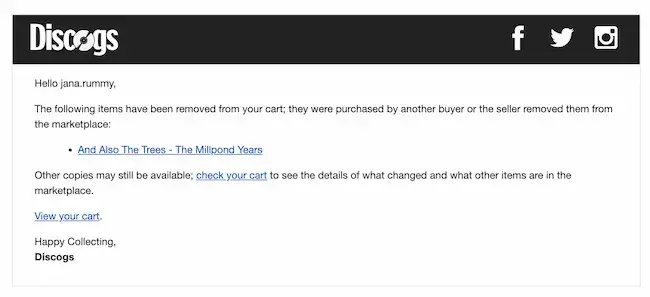
The video surpassed 1 million views in just a few days.

What I like: The video uses Deadpool‘s signature humor to explain the organization’s purpose. It’s also timely with its holiday-themed storyline. And, of course, it capitalizes on the huge fan base of celebrities Ryan Reynolds and Lynda Carter.

8. Anthropologie – #unwrapanthro

Views: 1.4 million

@anthropologieofficial Ready to win your wishlist? 🎁✨ Every week leading up to the holidays, one lucky winner will receive $500 worth of their fave Anthro products! Here’s how to enter the
#UnwrapAnthro Giveaway: 1.Follow @anthropologie on Tiktok 2.Tell us what’s on your wishlist! Either post a video on TikTok using
#UnwrapAnthro, send us a letter, or enter online! 🔗 in bio for full rules and entry details. Giveaway closes December 20th. Best of luck!
#Giveaway
#Anthropologie
#ThatAnthroMagic
♬ Christmas Is Coming – DM Production

Anthropologie kicked off its holiday giveaway with a viral TikTok video announcing the event and how audiences could participate. The video is simple and features a voiceover accompanied by footage of Anthropologie employees happily wrapping holiday gifts to be sent to the giveaway winners.

What I like: Anthropologie‘s viral video shows that you don’t need a huge production or budget to make viral content. The video is straightforward and does a great job of explaining the giveaway and drumming up excitement.

9. Nike – Vinicius Junior

@nike Winning doesn’t come easy, but @Vini Jr. all the right moves to get there. Dancing through defenders, obstacles, and doubt, all the way to the top.
#NikeFootball
♬ original sound – Nike

While I‘m not into sports, I love watching videos of athletes being silly and having fun. So it’s no surprise I really enjoyed this viral Nike video of Brazillian soccer player Vinicius Junior dancing in his Nike cleats.

What I like: This viral video is a great example of thinking outside the box.

Instead of showing Vinicius Junior using the shoes in a soccer match or showcasing his skills as an athlete, the brand tapped into Vinicius’ unique personality and culture to create a one-of-a-kind advert that shows the comfort and durability of Nike products.

So, what have we learned? Well, in this current age of video marketing, it’s less about glossy, highly stylized images and more about authenticity, humor, and clear messaging. Keep this in mind as you create your next viral hit. Good luck!

Editor’s Note: This post was originally published in September 2010 and has been updated for freshness, accuracy, and comprehensiveness.

Categories B2B

The Rise of Free SaaS Tools as Lead Magnets (& How Marketers Can Take Advantage)

As Wiz’s Head of Marketing Tom Orbach says, “Mini tools are 10x more powerful than free trials.

For the last 20 years, tech marketers have been giving away e-books and PDFs. I think Orbach would agree that this era is coming to an end.

Download Now: Free State of Marketing Report [Updated for 2024]

Thanks to AI, no-code, and outsourcing, the smartest tech marketers are now giving away mini software tools … entirely for free.

This is something I like to call ‘free tool marketing.’

Here’s how it works.

What is free tool marketing?

In MBA speak, free tools are referred to as ‘loss leaders.’ A loss leader is a free-ish mini product that gets customers to buy a bigger product.

For a perfume company, it might be a free sample of perfume at the mall. For my hometown gas station, Wawa, it was free coffee every Tuesday in 2024. Now, in tech, the norm is to give away free tools to get you in the door for paid ones.

But how do you figure out which mini tool(s) to build?

There are two main ways:

1. Look for low-difficulty, high-volume keywords.

The goal here is to snag a little bit of traffic that may be interested in your paid software.

You’re not gonna rank for your niche’s main keyword overnight, but mini tools are like mini bets. Each mini tool gives you a better shot at ranking higher for your most important main keywords.

Use tools like Ahrefs to find keywords that are low-difficulty keywords with a KD around 0-5 with as high volume as possible. Even as low as 1,000 searches/month is good to start.

For example, the keyword ‘social media manager jobs‘ has a keyword difficulty of 0 and 7,200 searches per month. If you’re an AI resume writing tool or a hiring platform like Indeed, you could spin up a free AI resume writing tool specifically for social media managers looking for jobs.

Here’s another example: The keyword ‘Instagram giveaway template’ has a keyword difficulty of 5 and 500 searches per month.

If you’re an image creation platform like Canva or an ad agency that helps brands do Instagram giveaways, you could create a free AI Instagram giveaway template generator using something like OpenAI’s DALL-E model or Midjourney.

2. Look within your product for features that could be free tools.

Do you have any existing features that could be free tools?

For example, if you’re a personal finance app, maybe it’s a compound interest calculator. Or if you’re a video editing software, maybe it’s a free video resizer. The options are endless.

Pro tip: Obviously, don’t give away all your software’s secret sauce. But most times, you’ll be able to find at least one feature to offer at no cost.

What This Looks Like in Practice

Let’s use me as an example.

I run a meme marketing software called Memelord Technologies.

Late one night, I couldn’t sleep. So, I did some deep digging for keywords on Ahrefs and saw that the keyword ‘meme png’ was low-difficulty and high-volume (0 keyword difficulty and 4,000 searches per month!).

I already built an AI background removal tool for memes, so I took that feature and spun up a Free Meme PNG Maker It’s the exact same feature — just given away for free.

And sure, I’m paying a little bit of API fees every time someone uses the tool, but I’m already seeing signups from it for free (and with zero promotion!).

free tool marketing example, free meme png maker

Source

Here’s another personal example.

I also saw that the keyword ‘marketing memes’ was both low in keyword difficulty and relatively high in search volume (2 keyword difficulty and 1,200 searches/month).

So, what did I do? I created a tool for marketers to get inspiration for memes: a basic no-code, searchable, filterable gallery of marketing meme examples.

Like the meme PNG creator, I’m already seeing signups from this free tool using just straight SEO — no promotion required.

But I’m not the only example out there.

Newsletter platform Beehiiv launched a free LTV calculator to calculate the lifetime value of your subscribers. HubSpot has a free AI search grader that helps you evaluate your brand performance in AI search results. Wiz launched a free QR code generator.

And I have good news: You don’t need to be a VC-backed business or a big brand to build free tools.

How Marketers Can Get Started

I’m a bootstrapped scrappy founder building free tools, and I first learned about this marketing tactic when I was Head of Growth at Product Hunt.

I saw these crazy solo founders, and I realized you don’t need to have a million-dollar budget anymore to build free software. (In fact, it may even be easier for solo hackers and startups because there’s less oversight, little to no bureaucracy, and minimal need to prove definite ROI.)

Marc Lou is one such solo software founder and huge advocate of free tools.

“I am a developer, and I love building apps,” he explains. “But I also need marketing to pay the bills. Free tool marketing is symbiosis. It consists of launching free and viral mini-apps to promote your main startup.”

free tool marketing example, tweet announcing Marc Lou’s free logo makerSource

Lou recommends the following guidelines for the best results:

  1. The tool must be free — that’s how you create a viral loop.
  2. One feature is enough. It must be super simple.
  3. The name should tell exactly what the tool does. That’s how people remember and search on Google.
  4. The experience must start on the homepage. Visitors shouldn’t sign up or click links.

Matt Merrick is another solo hacker building free tools.

“Over the years, I’ve built over 100 free tools. And every time, I’m amazed by how well they perform,” Matt told me via DMs on X.

“The process is simple: I start with a keyword related to the site I’m working on (like ‘color’) and ask ChatGPT for free tool ideas around it. I only target low-competition, high-search-volume keywords to rank fast and drive traffic.

Free tools naturally attract views, backlinks, and domain authority. My site Niche Tools has 20+ free tools on it and is starting to rank bringing in free sales.”

Merrick dedicated his entire career to free tool marketing.

Why?

Because we are entering the era of free tool marketing.

Free e-books are so 2010s. The 2020s and beyond are all about free software.

So, let me ask you: What free tools can you build?

Think about it for a minute. Take a minute to look through your product for free feature ideas. Head over to Ahrefs’ keyword generator (another free tool) to optimize for search.

Then, grab a Red Bull, go build some free tools, and launch ‘em!

Categories B2B

7 Soft Skills You Need to Achieve Career Growth (+ 3 Extra Skills)

I’m a former NBCUniversal Page, and I will always remember how thorough the application and interview process for the program was.

Most importantly, it taught me a valuable lesson: soft skills can be equally as — if not more coveted — than hard skills.

Download Now: 5 Free Skill Development Templates

In my experience, soft skills development is seen as a sign of metamorphosis. While hard skills are essential, they’re also typically mandatory for a role. On the other hand, soft skills require more intrinsic motivation and long-term change.

I owe a great deal of my career growth to developing and adapting my soft skills, so read on for my best tips and practices.

Table of Contents

Soft skills can be taught, but they‘re less straightforward than more technical capabilities. Hard skills are the specific qualities that can be clearly defined, measured, and taught for success in a job.

With hard skills, I can learn advanced techniques and methods that yield measurable results. They can even be tied directly to the business’s bottom line.

But when it comes to soft skills — things like small talk, empathy, and flexibility — they‘re not an exact science. However, they’re just as impactful.

I need hard skills to land a job but soft skills to progress in my career. So, I’ve rounded up a list of the soft skills most critical to building a successful career — and how to acquire them. But first, I’ll share why soft skills matter.

Why are soft skills important?

1. They prove a readiness for a promotion.

Soft skills show a willingness to go above and beyond. My managers have always told me that, when considering direct reports for promotions, they look to individuals already displaying traits of the higher role.

As a senior coordinator at Nickelodeon, I won’t always be offered the same opportunities as a manager, senior manager, director, or beyond, which may limit my ability to develop new hard skills. However, I can practice soft skills that indicate I’m ready to tackle more work and be a people leader.

2. They demonstrate situational awareness and flexibility.

Soft skills are unlike hard skills, requiring situational awareness to know when to use which skill. For example, as a freelance blog writer, I know my hard skills include:

  • Technical writing — understanding how to use correct spelling, proper grammar, and appropriate sentence structure.
  • Use of digital tools — Google Docs for writing and Grammarly for editing.
  • Research — operating search engines, fact-checking, and sourcing statistics and images.

I know I will always need to use those skills to write an effective blog post for HubSpot. However, I flex different soft skills when writing distinct blog posts, depending on the topic, style, length, and parameters.

3. They balance out automation.

What do we humans have to offer in comparison to generative AI? Our passion, creativity, enthusiasm, and personalization. This is why soft skills are so essential in the workplace. They humanize our work.

I spoke with Roger Lam, senior product marketing manager at LinkedIn, who agreed.

“While generative AI and other hard skills are all the rage these days, it’s becoming even more important to develop soft skills in parallel. As manual, repetitive tasks get automated by technology, workers will have more time to partner with real people on more strategic and relational work,” Lam says.

Skills like work ethic and growth mindset are inherent to being human. My passion for my work and desire to keep growing, learning, and getting results are ways I can set myself apart from AI.

4. They are a good judge of character.

Many soft skills are inherently tied to the type of person I am. While hard skills indicate talent, experience, and expertise, certain soft skills are a telltale sign that I will be a good person to have on the team.

For instance, exhibiting soft skills like emotional intelligence, collaboration, and active listening aren’t just nice-to-haves — they prove I’m here for more than just a job. I will be empathetic to my colleagues, open to working with and learning from them, and respect what they say.

I’ve most successfully adopted soft skills by observing the colleagues and leaders around me and understanding what their presence, opportunities, goals, and successes owe to soft skills.

Then, I can challenge myself to practice similar soft skills to progress.

If you’re wondering what the seven soft skills are that can progress your career, read on.

Soft Skill

Main Characteristics

Learn More

Emotional Intelligence

  • Manage my emotions
  • Recognize others’ emotions
  • Build relationships
  • Practice empathy

How To Improve Emotional Intelligence in Business

Team Player Attitude

  • Collaborate with others
  • Open to other perspectives
  • Contribute to team projects

How To Improve Cross-Team Collaboration

Growth Mindset

  • Believe I have the potential to grow
  • View failures as learning opportunities

Growth vs. Fixed Mindset: Nine Benefits and How To Develop One

Openness to Feedback

  • Welcome developmental input
  • Take accountability
  • Proactively seek feedback

How to Process Negative Feedback Without Triggering a Stress Response [Infographic]

Adaptability

  • Welcome change
  • Be flexible when new responsibilities arise
  • Have a “yes” attitude

How to Become a More Adaptable Leader

Active Listening

  • Listen attentively in meetings
  • Asking clarifying questions
  • Being present when others speak

Active Listening in Sales: The Ultimate Guide

Work Ethic

  • Ask for more work or how I can help
  • Put appropriate time and effort into all tasks
  • Complete tasks with enthusiasm

The Science of Productivity: How to Get More Done in a Day

Strong Communication

  • Able to communicate with people of all levels
  • Eloquently convey ideas
  • Use efficient written communication with the audience in mind

Mastering Professional Communication: The Secret Ingredient of Business Success

Problem-Solving

  • Solve problems under duress
  • Think creatively and innovatively
  • Use logic to make informed decisions

7 Problem-Solving Skills Marketing Managers Need & How to Improve Them

Time Management & Prioritization

  • Build an organized schedule for tasks
  • Prioritize tasks based on deadline and importance
  • Avoid procrastination by remaining productive

Top Time Management Tips for Work

1. Emotional Intelligence

soft skills development

I will always remember one of the questions I was asked in my final NBCUniversal Page Program interview: Name a time when you showed kindness to someone in the workplace.

I had never been asked that situational question before, and it caught me off guard. However, I quickly recovered and recalled a time when I helped cover some of the work for a fellow intern struggling with her course load.

Emotional intelligence is the ability to manage one’s emotions and recognize those of others. It’s made up of five key elements:

  • Social skills.
  • Self-awareness.
  • Self-regulation.
  • Empathy.
  • Motivation.

While I try to emulate these skills in my personal life, they also have significant value in the workplace and boil down to a few abilities:

  • Can I recognize and regulate my emotions and reactions in the workplace?
  • Can I build rapport and positive relationships with other people?
  • Can I empathize with others?

While it may not seem like the most important soft skill, emotional intelligence is actually considered twice as predictive of performance as IQ.

The World Economic Forum 2023 Future of Jobs Report also ranks emotional intelligence as the number one leadership skill since businesses highly prize qualities associated with emotional intelligence.

To drive the message home, here is a quote from Britt Andreatta, CEO of Brain Aware Training.

“Emotional intelligence drives all kinds of indicators you want. There’s some research that shows when you’ve got a … high emotionally intelligent organization, you see that financial performance goes up as a result,” Andreatta says.

2. Team Player Attitude

Growing up, I was always the student who would try to take charge of a group project and offer to attribute the work to the entire group.

I always thought this proved I was a strong leader and hard worker, but it only diminished my ability to work as part of a team.

As I’ve developed in my career, I’ve realized it’s impossible to be a heads-down, solo worker if I want to use my time efficiently and effectively.

By opening myself to support from and collaborating with my amazing teammates, I alleviate some of the pressure on myself and my workload, freeing me up to take on diverse opportunities.

According to the Monster Future of Work: 2021 Outlook survey, employers selected teamwork and collaboration as the second most essential skills in candidates. This makes sense since, regardless of whether you’re an individual contributor like me or a people manager, working with other people is imperative.

Being open to other perspectives in brainstorming meetings and splitting action items on projects shows an ability to work cross-functionally for the betterment of the company.

Operations teams are at the heart of a company, ensuring all teams complete their functions seamlessly. Tools like HubSpot’s Operations Hub enable these teams to work better together even as companies grow.

A unified toolset will help them connect apps, clean and curate customer data, and automate business processes on one central CRM platform to improve team collaboration.

3. Growth Mindset

great soft skills: growth mindset

I’ve been a writer my entire life.

My primary form of writing through childhood was fantasy fiction. Into high school, I began writing more academic papers but kept writing short stories and song lyrics on the side. In college, I embraced writing poetry.

However, when I interned at the HubSpot Blog in 2018, it was my first time signing up to write professionally about real-life topics. With a growth mindset, I took this challenge head-on, rather than worrying I didn’t have the skills and experience to handle the new assignment.

According to Carol Dweck of Stanford University, people with a growth mindset believe they have the potential to continuously grow their talent and skills through perseverance, practice, and learning.

Contrarily, people with a fixed mindset believe they have a fixed amount of talent and skills that can’t be developed or adapted.

I’m the first to admit I don’t always take failure well. However, facing obstacles, challenges, and, yes, failures is an important and unavoidable part of life in any career.

How I choose to handle these situations — either by being discouraged and giving up or by seeing them as learning opportunities — can dictate to my employer whether I can handle higher-level work.

I practice this soft skill by finding situations in my personal and professional life in which I can reframe my response to a setback as optimistic and forward-thinking. Watch Dweck’s TED Talk to learn more about the growth mindset.

HubSpot’s Sales Hub allows teams to implement a growth mindset. It empowers sales teams to be more productive by equipping them with simple tools that deliver fast results and provide important context to improve customer relationships.

This allows teams to see their potential and learn new skills and processes to enhance their work.

4. Openness to Feedback

Speaking of not taking failure well, I also have trouble accepting constructive criticism. It’s not that I don’t think I’ve done anything wrong; I just feel guilty for not doing a perfect job and fixate on the negative feedback.

This has been one of the soft skills I’ve had to work the hardest on, as I know being open to receiving development feedback is critical to success at a job — especially a new one. It shows my desire to become the best team member I can be, which is an ongoing process.

Reacting defensively or with dejection is counterproductive. I always remind myself that when a manager gives me constructive feedback, it’s a good sign. It means they see my potential and want to help me get there.

I like to get ahead of feedback by regularly and directly asking for it, rather than waiting for it to come to me. This shows I’m passionate about addressing my shortcomings and improving my performance, and it makes it easier to swallow negative feedback when I’m mentally prepared for it.

5. Adaptability

Like many of us, my world turned upside down with the COVID-19 pandemic. At the time, I was in the NBCUniversal Page Program, working five to six days a week in the office. As pages, we didn’t receive work laptops, so we didn’t have an option to work remotely.

Suddenly, March 2020 happened. All pages were required to work from home for the foreseeable future. It was a shock to suddenly lose face-to-face human interaction in a program all about learning and networking.

However, we adapted to this change by setting up virtual informational interviews where we would have typically done coffee chats.

Change is inevitable, and the pandemic is a great example of a massive change that affected us all and was uncontrollable. We had no choice but to accept the change and adapt how we worked to keep businesses moving forward.

LinkedIn listed adaptability as the “top skill of the moment” in its 2024 Most In-Demand Skills report. Lam spoke to this soft skill:

“Adaptability is often considered a top soft skill, but can also influence how quickly someone adapts to technological advances, leveraging new tools to produce more effective and efficient work,” Lam says.

I find this very insightful, as it shows how soft skills can directly impact hard skills. I practice adaptability on a smaller scale by raising my hand when new opportunities arise.

However, I also exhibit adaptability on a larger scale when I weather industry-wide shifts, such as the introduction of streaming services and generative AI.

6. Active Listening

great soft skills: active listening

Some of the best advice I’ve ever received is to avoid multitasking during meetings. It’s easy to get carried away when the to-do list is endless, and I’m booked in back-to-back meetings.

Meetings in which I don’t have to speak or take notes can be easy places to get some work done with my camera off and microphone muted.

Unfortunately, this is the least efficient use of my time. I waste my time sitting in the meeting if I’m not paying attention, and the work I get done is usually much slower than if I were doing it without any distractions. Worst of all, it tells team members I’m not practicing active listening.

Active listening is a form of communication that aims to achieve mutual understanding between two or more parties. When I actively listen to someone, I’m not just passively hearing what the speaker says. Instead, I’m fully attentive and respond directly to their statements.

A 2024 Gitnux report on listening reveals that active listeners retain 75% more information than passive listeners. The report also shares that active listening can improve team productivity by up to 25%, sales performance by up to 30%, problem-solving efficiency by up to 40%, and team collaboration by up to 50%.

Here are some ways that I practice active listening in meetings:

  • Using eye contact with meeting presenters in in-person meetings, or keeping my gaze on my meeting screen during virtual meetings.
  • Minimizing all other windows in virtual meetings.
  • Offering clarifying questions or responses.
  • Taking meeting minutes, even if I’m not the designated note-taker.
  • Referring to information from the meeting in future discussions.

Active listening is equally important when it comes to customers. Marketers want to ensure they provide valuable content to consumers, which is accomplished through actively listening to their desires. HubSpot’s Content Hub helps teams create a more memorable customer experience.

It offers tools to craft personalized content that speaks directly to audience needs and drives more engagement. With analytics and unified CRM data, Content Hub optimizes content to ensure it resonates with audiences and shows them your company is attentive to their needs.

7. Work Ethic

great soft skills: work ethic

Source

I’ve often been told that I need to do the work of the title I want if I want to be considered for a promotion. This may seem unfair. Why am I doing extra work if I’m not being paid for it or given the title deserving of it?

A strong work ethic shows a willingness to go the extra mile to complete a job well.

People with strong work ethics will put in the time to gain new hard skills to better their work. This is why I’m told to do the work of the job I want.

After all, how can my manager trust I can handle the increased workload and time commitment unless I’m already proving I can?

According to ADP’s People at Work 2024 report, work ethic is the top skill employers want in new hires. They understand hard skills can be taught but soft skills like a strong work ethic are harder to find. Those with strong work ethic tend to produce higher-quality work and have more job satisfaction.

I practice this soft skill by carefully considering each assigned project and task.

There’s often a way to do the minimum work and get the job done. While there’s a time and place for this (sometimes tasks need to be prioritized), I often look for a way to complete the task by going above and beyond.

That can involve doing extra research or design work for a slide presentation or pulling additional insights and analytics after a social media campaign.

Whatever it may be, it will signal to your manager that you take your work seriously and consider you for more growth opportunities.

Additional Soft Skills to Nurture

While the seven soft skills listed above are pivotal to growth in any career, the list doesn’t end there. Read on for more soft skills I’ve found incredibly valuable in my current and past roles.

8. Strong Communication

Communication is an extension of several soft skills listed above.

For instance, being a great team player typically involves communicating well with everyone. Good communication can benefit emotional intelligence and empathy.

However, communication skills can have even more depth.

Consider verbal versus written communication. Of course, I’m a freelance writer, so written communication is essential to my role. But, even in non-writing roles, communicating eloquently, respectfully, and concisely in emails and over chat is imperative.

One of the hardest skills I learned was using written communication to sound assertive while remaining polite.

According to MIT Sloan Management Review, oral and written communication skills are among the five most sought-after skills in new hires. Employers want individuals who can effectively convey ideas and information.

I especially find this important when communicating with people of different levels. I would share ideas with a close colleague very differently than with a C-level executive.

While strong communication is important in the workplace, it’s just as important outside. Communicating well with customers, external agencies, and partners shows an ability to read the room, bond with others, and convey information appropriately based on the audience.

A great way I practice improving my communication skills is by thinking of a piece of information I need to relay. Then, I rehearse sharing it with different audiences, both verbally and in writing. As always, confidence is key!

9. Problem-Solving

Problems arise, and my instinct is often to panic. Unfortunately, that’s not the best to handle those situations, so problem-solving is a skill I’ve nurtured over the years in my career.

This is an important soft skill as it shows an ability to make conclusions under duress. Analyzing a situation, identifying potential solutions, and selecting the best course of action show an ability to use logic and make informed decisions, whether or not the problem requires an urgent fix.

Problem-solving also exercises creativity and innovation. I’m a big ideas person, but as a lower-title individual in my workplace, I rarely have the chance to make big decisions. However, when problems arise in my environment, I get to step up and think of out-of-the-box, innovative solutions.

For instance, my team recently drafted a script for a talent shoot. However, with too many talent needs during the short time, our script got rejected. Instead of accepting the failure, I offered to cut down the script significantly, which involved rethinking the production needs.

My team ended up loving the idea, and the script was approved.

The most important parts of problem-solving are remaining calm, using critical thinking to analyze the situation, coming up with one or more solutions, and suggesting them confidently (or making the decision, if that is your responsibility!).

HubSpot’s Service Hub is a perfect example of a tool that empowers teams to problem-solve. It delivers support at scale with AI-powered self-service, an omni-channel help desk, and 24/7 availability.

Customer service teams can then provide personalized experiences and eliminate unnecessary manual processes to focus on innovative, seamless solutions for customers.

10. Time Management & Prioritization

In a previous role, I worked 10 to 12 hours a day. I became used to this schedule and felt I couldn’t complete my work in less time. Then, I challenged myself to finish working in eight hours. Whatever was left over could wait until the next day.

I quickly adapted to this new schedule and realized I could get most, if not all, of my urgent work done daily in eight hours.

This was a powerful lesson on time management and prioritization.

I can always find ways to fill up my time. By reducing the hours I allowed myself to work, I found myself more productive during those hours by adopting better time management methods.

That included blocking off time on my calendar to work on projects and prioritizing tasks based on urgency and deadline.

Timewatch’s research on time management in 2022 revealed that 90% of people believe better time management would increase productivity, and 86% say it would improve focus on work.

Personally, time management has aided me in accomplishing more at work with less time and effort, reducing stress, and improving my work-life balance.

This also has shown my managers that I’m being efficient with my time. They can trust that I’m working during working hours and will get my work done correctly and by the due date, proving an ability to continue to manage my time if promoted.

With AI-based marketing tools, HubSpot’s Marketing Hub encourages time management and prioritization by personalizing messaging and automating campaigns. Tools like this help me prioritize creative, thoughtful, strategic tasks that require my time and let automation handle the busy work.

Prove Your Potential with Soft Skills

Experience and skill can get me a role, but soft skills can get me a promotion.

I’ve always viewed soft skills as the cherry on top but learned that they are the building blocks necessary to make a job more enjoyable and worthwhile, create and maintain professional relationships, and prove an enthusiasm and capability for growth.

What weaves all of these soft skills together is a positive attitude. It might sound cheesy, but believing that there’s a positive outcome in any challenging situation helps me navigate the day-to-day of my job and work better with my team.

While soft skills are harder to learn and teach, there is immense payoff in both personal and professional life. My next goal will be evaluating the soft skills I’ve not yet mastered and practicing them until they become second nature.

Editor’s note: This post was originally published in November 2017 and has been updated for comprehensiveness.

Categories B2B

I Reviewed 17 Content Marketing Analytics Tools: Here’s Everything You Need to Know

Creating successful marketing campaigns and compelling content starts with understanding the numbers behind your strategies.

For me, content marketing analytics are like having a behind-the-scenes guide — they reveal what’s working, what’s not, and where there’s room to grow.

Get Started with HubSpot's Marketing Software for Free

By using data effectively, I gauge the impact and success of my efforts. In this blog, I’ll walk you through some of the best tools I’ve come across for doing that.

But I’ll start by discussing why content marketing analytics are absolutely essential.

Table of Contents

What are content marketing analytics?

Content marketing analytics is the process of collecting and interpreting data related to your content marketing efforts, then using key performance indicators (KPIs) to measure the effectiveness of your campaigns.

Common metrics include page views, engagement rates, conversion rates, and organic traffic. You should measure the performance of your content across all platforms and channels. The result of your analysis will help you understand what types of content perform best and how to distribute it.

The data is super important because you can use it to inform your future strategy.

Why are content marketing analytics important?

The days of simply writing a blog post, targeting a few keywords, hitting publish, and hoping for the best are long gone.

Although ranking content on the first page of Google is still a goal for many companies, content marketing analytics go beyond just blog posts.

Social media posts, video scripts, and email newsletters all rely on effective content to drive engagement and conversions. Even PR efforts, such as measuring the quality of media coverage, cost-efficiency, and conversion rates, are deeply tied to the effectiveness of the content being shared.

Content marketing analytics are important for the following reasons.

Evaluating Campaign Performance

Content marketing analytics offer actionable insights that empower data-driven decision-making. By tracking key metrics with tools like Google Analytics, you can pinpoint the strengths and weaknesses of your current strategy.

This includes identifying which types of content resonate most, which platforms yield the best results, and the ideal times to engage your audience on social media.

By analyzing metrics, I gain a deeper understanding of how my audience interacts with various types of content. To run a successful campaign, I suggest doing less and measuring more.

Measuring Progress Towards Goals

A dashboard is a powerful tool for getting data in one place and making sense of the analysis. With a dashboard open in front of me, I ask insightful questions such as:

  • Why do some metrics consistently rise or fall?
  • Are certain metrics correlating by chance, or is there a cause-and-effect relationship at play?
  • Which metrics reflect actual consumer behavior?

The answers then provide a clear picture of the audience’s true preferences and actions.

Basically, content marketing analytics makes it easier to spot trends and patterns.

Helping Create Better Strategies

Effectively leveraging content marketing analytics to evaluate campaigns serves two key purposes:

  1. It allows me to craft content strategies that resonate deeply with my audience.
  2. It helps me make more persuasive pitches (something I find valuable when offering content marketing services to clients).

This data empowers me to experiment and refine my approach. It also allows me to observe shifts in performance and to frame effective future strategies. I recommend going through this free data analytics guide to equip yourself with more knowledge on the topic.

How to Use Content Marketing Analytics Data

I’ve been tracking content marketing performance for a client to measure its effectiveness. By analyzing key metrics, I’ve been able to uncover valuable insights that guide our content strategy.

Our strategy revolves around repurposing existing blog content into engaging social media posts. We began by sharing niche-relevant content on the personal LinkedIn profile of the company’s CEO. We used a content marketing tool to gather performance data.

I then organized the data in a simple Excel sheet. I am a fan of Excel as I could write down the topic of the post and its relevant data in front. This way, I was able to do a better comparison of performance with other topics (see screenshots below).

Using this approach, I was able to identify which posts resonated with the audience and which ones fell short. The idea was to use this data to fine-tune our content marketing strategy for better results.

I’ve broken down the process of using content marketing data into three clear sections. While you’re welcome to draw inspiration from my approach, feel free to adapt it to suit your needs.

Tracking Content Details

I typically update the spreadsheet with metrics about two weeks after a post goes live, ensuring there’s enough data to analyze its performance effectively.

I include the post URL in the spreadsheet for quick and convenient access whenever needed.

how to use content marketing analytics data - tracking content details

Alongside this, I record the date and time the post was published. Tracking the posting time provides an additional layer of insight, allowing me to evaluate how timing influences engagement levels.

Tracking Metrics

I document key metrics for each post, including impressions, reactions, comments, and reposts.

how to use content marketing analytics data - tracking metrics

Whenever I notice a spike in impressions, I can easily check which topics are performing better. Remember, the idea is to use data to identify patterns and insights to guide future content strategies.

how to use content marketing analytics data - total engagements and engagement rate

For posts featuring videos, I recorded both the number of views and the total minutes watched for each video. The total engagement and the engagement rate fields are automatically calculated in Excel. I use the following formulae:

Total Engagements = SUM (Reactions + Comments + Reposts)

Engagement Rate = Total Engagements / Impressions

Tracking Audience Engagement

This aspect is perhaps the most impactful when it comes to making the most out of your data. I get the post-analytics data from Shield, which appears as follows:

content marketing post analytics data - shield

For instance, when targeting individuals in the marketing field, I make a note of the job titles of those who fit our target audience and have interacted with the post.

Similarly, by clicking on the “Industries” section, I can identify the sectors of those engaging with the content. If an industry falls within our target audience, I note it down along with its corresponding percentage.

how to use content marketing analytics data - tracking audience engagement

Note: The Shield app’s post analytics also provide data on company names, locations, and company size. However, I did not include this information in the Excel sheet, as it wasn’t directly relevant to our analysis.

My Learnings

I found this data tracking method to be highly effective, not just for its simplicity but also because it allowed our team to make data-driven recommendations to the client. When planning future posts and presenting ideas, we could base our strategy on actual performance metrics.

For example, if a particular hook outperformed previous ones, the content strategist could think of similar hooks when writing content for future posts.

Similarly, by analyzing the topics that garnered the most engagement, I reverse-engineered the framework used for that particular post. The idea is that this data helps in replicating the success for future content and discarding the framework or ideas that did not work.

If you’d prefer not to do all the manual data entry, check out the tools I tested below.

There are a number of marketing analytics tools available with customizable metrics, a variety of visualizations and dashboards, and integrations to help you measure the impact of your marketing strategy.

Let’s dive into the best options.

1. HubSpot Marketing Analytics and Dashboard Software

content marketing analytics tool - hubspot

Best for: Measuring the performance of all your campaigns and combining resulting data with your CRM platform.

What I Like About HubSpot Marketing Analytics and Dashboard Software

  • Centralized Insights. I love how all the data and insights are accessible from one location. No more hopping between platforms; I can get the information I need in seconds.
  • Custom Behavioral Tracking. The ability to trigger or schedule touchpoints and track interactions unique to my business is a game-changer. I appreciate that it conveniently highlights when a customer is ready to move to the next stage of the buyer’s journey.
  • Attribution Reporting. It connects every customer interaction to its associated record and revenue generated. It helps me see exactly which efforts are paying off and which need tweaking.
  • Visual Data Dashboards. The pre-built and customizable dashboards (including Custom Objects) make it easy to visualize data. I am able to use workflows to quickly transform insights into actionable strategies for my segments and campaigns.

In essence, HubSpot makes marketing analytics feel less like a chore and more like a strategic advantage.

Price

There are four Marketing Hub plans with different analytics features and flexibility ranging in price from free (forever) to $3,600 per month.

2. Buffer

content marketing analytics tool - buffer

Best for: Understanding channel performance in detail with customizable reports.

What I Like About Buffer

Buffer is a fantastic content marketing analytics tool for digging deep into social media performance. Here are some interesting features:

  • Effortless Sharing. Exporting reports is a breeze — which is great, especially when it’s required to share insights regularly with stakeholders.
  • Daily Updates. Knowing that the reports are updated daily gives me confidence that I’m always working with the latest and most accurate data.
  • Comprehensive Dashboard. Buffer’s single dashboard view is a time-saver. It offers a detailed breakdown of channel performance, so I can quickly assess what’s working and what needs adjustment.
  • Engagement Insights. The platform provides engagement metrics for each social account individually. This helps in understanding how customers interact with posts, stories, and hashtags and how audience demographics vary across channels.
  • Social Media Management. I like how all the social media platforms are consolidated in one place in this app. This makes posting very effective.

Price

Buffer’s Marketing Analytics product has three payment options with different features and flexibilities.

  • Free
  • Essentials – $5/month
  • Teams – $10/month

3. Google Analytics

content marketing analytics tool - google analytics

Best for: Integrating content marketing analytics seamlessly with other Google business tools and making data-driven strategic decisions.

What I Like About Google Analytics

Here’s what I appreciate about Google Analytics:

  • Intuitive Interface. Navigating Google Analytics is straightforward, even for beginners. It’s designed to help quickly understand how content is performing across multiple platforms.
  • Granular Analysis Options. I love that I can analyze my content’s performance either across my entire website or drill down to individual pages. This flexibility allows you to pinpoint which areas need improvement.
  • Comprehensive Metrics. The tool provides a wealth of data on traffic, navigation patterns, conversions, and organic search performance.
  • User-Level Insights. Allows tracking user-level interactions that give me a clear picture of how the audience is engaging with my content.
  • Seamless Integration. The integration with other Google business tools is a big plus. It’s incredibly convenient to access all my data and insights without needing to switch between platforms.

Price

Google Analytics offers a free and a paid plan. The free plan is ideal for SMBs, and you can get started using it immediately. Meanwhile, the paid plan, called Analytics 360, is ideal for enterprise-level companies and requires you to speak with a sales rep for a quote.

4. SimilarWeb

content marketing analytics tool - similarweb

Best for: Understanding where your website and content strategy stand in comparison to industry standards.

What I Like About SimilarWeb

SimilarWeb has the following benefits:

  • Competitive Insights. Provides detailed traffic and engagement metrics that show exactly where my website stands compared to others in my industry. It’s invaluable for assessing performance and identifying areas to improve.
  • Comprehensive Metrics. Gives key metrics such as daily active users, sessions per user, use-time, and rank. It also helps uncover more about the audience, such as their repetitive behaviors and interests.

Price

  • Starter – $199/month
  • Professional – $449/month

5. Semrush

content marketing analytics tool - semrush

Best for: Tracking SEO and keyword performance across your web pages and content strategy.

What I Like About Semrush

Semrush is an essential tool for managing and improving the SEO strategy. Here’s what makes it so effective:

  • Keyword Ideas. When I look for a search term in Semrush, it gives me options for a lot of secondary keywords that I didn’t think of initially. These options are usually low-hanging fruit, and they are perfect for staying ahead in search rankings.
  • Domain Overview. I can essentially get information about any competitor just by adding the website domain. It provides insights into their organic search traffic, top-performing keywords, and even backlink profiles.
  • Content Gap Analysis. One of my favorite features is the “Keyword Gap” feature that gives me the ability to compare the website I’m analyzing against competitors to see which keywords they rank for that this particular website doesn’t. I also do the same for backlinks by using the “Backlink Gap” feature.

Price

Semrush offers three plans that range in price from $119 to $449 per month.

6. Hotjar

content marketing analytics tool - hotjar

Best for: Tracking and visualizing sessions on websites with heat maps.

What I Like About Hotjar

Hotjar is an incredible tool for understanding how visitors interact with my website. Here’s why I think it’s worth using:

  • Heat Maps. I love the heat maps feature — it visually shows me exactly where customers spend their time on the website. I can easily pinpoint the most engaging content and areas that need improvement.
  • Session Recordings. The real-time videos are a game-changer. Watching how visitors navigate the site gives me deep insights into their behavior and what captures their attention.
  • Conversion Tracking. It is easy to track conversions and identify patterns in the buyer’s journey. I can quickly see which stages customers might be entering or leaving, allowing me to optimize the journey for better results.

Price

  • Free
  • Plus – $39/month
  • Business – $99/month
  • Scale – $213/month

All of these prices become a bit lower if you choose the annual billing option.

7. Moz

content marketing analytics tool - moz

Best for: Measuring your SEO content strategy and determining which keywords you should be using.

What I Like About Moz

Moz is my go-to tool for optimizing SEO content strategy. Here’s what stands out about it:

  • Keyword Insights. Moz gives me a clear understanding of which keywords are most effective.
  • Rank Tracking. I love how Moz tracks a website’s keyword rank and visibility over time. It highlights what’s working and what needs improvement — which helps you make informed adjustments.
  • Competitive Analysis. Similar to Semrush, Moz gives the ability to track how competitors rank on SERPs. It’s a great way to spot opportunities to improve and find gaps in content.
  • Detailed Reporting. Moz’s reports are incredibly thorough. They show how my content is performing, share well I’m reaching my audience, and provide actionable recommendations to enhance results.

Price

  • Local – $14/month
  • Pro – $99/month
  • Stat – $720/month

8. Parse.ly

content marketing analytics tool - parse.ly

Best for: Making it easy for the whole team to understand how content drives business.

What I Like About Parse.ly

Parse.ly is a fantastic tool for content-driven teams, and here’s why I’d recommend it:

  • User-Friendly for Everyone. Unlike more complex platforms, Parse.ly is built to be accessible to everyone on the team, even those who aren’t data experts.
  • Clear Content Insights. Parse.ly simplifies data and focuses on what matters — showing how content drives traffic, conversions, and overall ROI. It makes proving the value of my efforts a breeze.
  • Optimized Distribution. The tool helps me optimize how I distribute content across channels, ensuring it reaches the right audience in the most effective way.

Parse.ly makes understanding and acting on content performance straightforward, empowering teams to create strategies that drive real business results.

Price

Parse.ly requests potential buyers to book a demo for getting a custom quote and selecting the right plan for their company.

9. Quintly

content marketing analytics tool - quintly

Best for: Improving social planning by analyzing the success of your social media marketing strategy with customizable metrics.

What I Like About Quintly

Quintly is a powerful tool for taking social media marketing strategies to the next level. Here’s why it stands out for me:

  • Customizable Metrics. I love that Quintly allows me to tailor metrics to align with my specific goals. It’s invaluable for analyzing campaigns and making smarter decisions about social planning.
  • Automated Reports. Quintly’s automation feature is a big time-saver. It generates reports and measures their impact using a machine learning system, making data analysis seamless.
  • API Integration. With API access and integration with tools like Google Search, Quintly helps in overcoming data silos and getting a holistic view of performance.

Price

Quintly’s pricing is available on request.

10. BuzzSumo

content marketing analytics tool - buzzsumo

Best for: Visualizing and analyzing real-time marketing trends to tailor content to your target audience.

What I Like About BuzzSumo

BuzzSumo is my go-to tool for staying on top of marketing trends. Here’s why I find it so valuable:

  • Real-Time Trend Analysis. I love how BuzzSumo lets me view and analyze marketing trends in real time. It helps me stay ahead by identifying what’s likely to resonate with my audience right now.
  • Location-Based Trends. The ability to filter trends by location is incredibly useful. It helps in understanding what’s popular in different regions, making my content more tailored and relevant.
  • Customizable Feed. With a customized feed, I can cut through the noise and focus on the data that matters most to my strategy.
  • Content Inspiration. The tool shows successful content examples, making it easy to spot proven strategies and identify relevant keywords to include in campaigns.

Price

  • Content Creation – $199/month
  • PR & Comms – $299/month
  • Suite – $499/month
  • Enterprise – $999/month

11. Kissmetrics

content marketing analytics tool - kissmetrics

Best for: Discovering how your audience interacts with your website/apps and understanding their behaviors.

What I Like About Kissmetrics

Here’s why I suggest checking out the tool:

  • Journey Tracking. I love how Kissmetrics lets me track a customer’s journey across multiple devices. This gives me a complete picture of how they interact with my website and apps.
  • Behavioral Insights. Offers a deep dive into how customers engage with content, giving valuable insights into what resonates most with them.
  • Conversion Metrics. Provides detailed conversion metrics such as bounce rate and time-on-site.

Kissmetrics is perfect for refining content strategies and improving user retention by understanding what truly matters to your audience.

Price

The SaaS plan comes with four payment options — those plans are $299, $499, or a custom price (based on your custom plan).

12. Databox

content marketing analytics tool - databox

Best for: Combining all of your marketing data to track and understand the success of your strategy in a single location and in real time.

What I Like About Databox

I recommend Databox to anyone who wants a centralized way to track their marketing performance. Here’s why I think it’s a great tool:

  • All-in-One Dashboard. Makes performance tracking easy by organizing all business data into a single location.
  • Extensive Integrations. It offers over 70 integrations to bring in data, display it visually, and share insights seamlessly.
  • Goal Tracking. The SMART goals feature is a personal favorite of mine. It lets you track your progress toward specific targets, helping you stay on top of your objectives.
  • Scorecards & Alerts. The tool sends daily, weekly, or monthly updates on your KPIs. Plus, the real-time alerts ensure you can quickly act on any irregularities in your data.

Price

  • Free Forever
  • Starter – $59/month
  • Professional – $199/month
  • Growth – $399/month

13. Supermetrics

content marketing analytics tool - supermetrics

Best for: Taking marketing data from any source and moving it into Google Sheets, Google Data Studio, Microsoft Excel, Google BigQuery, or Snowflake for analysis.

What I Like About Supermetrics

If you want a powerful way to centralize and analyze your marketing data, Supermetrics is a fantastic choice. Here’s why:

  • Data Integration from Any Source. Simplifies the process of pulling data from diverse sources like SEO, PPC, social media, and web analytics tools.
  • Robust Reporting & Analytics. Serves as an all-in-one reporting, analytics, and data storage solution — especially invaluable for marketers focused on performance metrics.
  • Versatile Export Options. Easily move data into platforms such as Google Sheets, Google Data Studio, Microsoft Excel, Google BigQuery, or Snowflake for further analysis.
  • HubSpot Integration. The integration with HubSpot is an excellent bonus, especially if you’re already using HubSpot for your marketing efforts.

Price

Supermetrics and HubSpot Integration: Business Performance Tracking

Supermetrics has several products, so pricing differs depending on the product you opt for. For instance, if you are looking to move your data to any of Google Sheets, Microsoft Excel, Looker Studio, and Power BI, the starting price is $29/month.

If you’re looking to get the Supermetrics API or use any of Snowflake, Azure, BigQuery, Google Cloud Storage, you are prompted to fill out a form to request pricing.

14. Demand Sage

content marketing analytics tool - demand sage

Best for: Moving all of your HubSpot data into Google Sheets for easy analysis in your platform of choice.

What I Like About Demand Sage

Here’s what makes Demand Sage so helpful:

  • Seamless Data Sync. With just one click, Demand Sage pulls all your HubSpot data into Google Sheets. It’s fast, efficient, and hassle-free.
  • Customizable Reporting. I love the flexibility of one-click, customizable reports that highlight key insights about marketing and sales performance.
  • Granular Analysis. The table builder and record-level reporting lets you create highly detailed views tailored to your specific needs, directly within your spreadsheet.
  • Attribution and Revenue Insights. Demand Sage connects marketing and sales data in meaningful ways. It offers a clear view of pipeline performance and what’s driving revenue.

If you’re using HubSpot and need an intuitive way to analyze your data in Google Sheets, Demand Sage is a no-brainer.

Price

Demand Sage’s basic plan is free. When I checked out the Premium plan, I was prompted to reach out to a sales representative for more information.

15. Grow.com

content marketing analytics tool - grow.com

Best for: Importing and transforming business data from a variety of sources and then combining that data on custom dashboards.

What I Like About Grow.com

  • Data Visualization Flexibility. I can select from a variety of chart types to visualize my data in the way that makes the most sense for me and my team. This flexibility ensures that we always get a clear view of our performance.
  • Collaborative Sharing. The ability to share metrics and dashboards with my team ensures that everyone is aligned on where to focus efforts — something that’s key for driving results.

Price

Get a free Grow.com demo and talk to a rep about the price of the right plan for your business.

16. Plecto

content marketing analytics tool - plecto

Best for: Keeping your team on top of goals and targets with dashboard data visualization software.

What I Like About Plecto

Plecto is an excellent tool for keeping your team focused and aligned. Here’s why I recommend it:

  • Real-Time Data Insights. I really appreciate how Plecto pulls in data from an unlimited number of sources, giving real-time insights that help me stay on top of my goals and track progress seamlessly.
  • Customizable Dashboards. Ability to filter across various sources and tailor the dashboard to showcase the metrics that matter most to me.
  • Gamification for Motivation. Plecto’s gamification features are fantastic for boosting team engagement. Adding some friendly competition can serve as a motivation for the team to stay focused on targets and achieve goals faster.
  • Goal-Focused Visuals. The ability to display goal-tracking data on interactive dashboards makes it easy for everyone to see where we stand and what needs more attention.

Price

Plecto offers three payment options depending on which plan you choose:

  • Medium – $230
  • Large – $355
  • Enterprise – Custom

The pricing reduces when you opt for the yearly billing option.

17. Adverity

content marketing analytics tool - adverity

Best for: Automating data integration across hundreds of sources.

What I Like About Adverity

Adverity is a go-to marketing data analytics tool for the following reasons:

  • Eliminates Data Silos. It helps break down data silos by centralizing marketing data, making it accessible for everyone on my team. This ensures that we’re all looking at the same information when making decisions.
  • Augmented Analytics Powered by AI. Adverity’s use of AI to detect trends and insights is a game-changer. It quickly identifies areas for improvement and highlights strengths, allowing me to focus on the right actions to drive results.
  • Time-Saving Reports and Visualizations. With its automated reporting and data visualization features, Adverity removes the need for manual work, allowing me to generate and share detailed insights with ease.

If you’re looking to streamline your marketing data processes and make smarter, data-driven decisions, Adverity is definitely a tool worth considering.

Price

Adverity’s idea is that they don’t stick to rigid pricing plans. For each customer, the pricing is different, so you’re prompted to fill out a form to get a custom quote.

Content Performance: What I Recommend You Focus On

When measuring the performance of your content, I suggest going through the following steps:

  1. Decide which performance indicators you’re going to measure.
  2. Track those metrics and KPIs.
  3. Analyze and apply your findings.

Content Performance Indicators

With so many performance indicators available, I focus on figuring out which ones matter most for my goals. Here is a list of indicators to choose from:

  1. Web Traffic. The amount of traffic you get on your website and individual pages.
  2. Page Views. The number of views a web page gets from visitors.
  3. Impressions. The number of times an ad or web page is displayed to an individual.
  4. Sessions. A group of actions an individual website visitor takes while on a website during a specific amount of time.
  5. Bounce Rate. The percentage of visitors who come to your website but don’t convert in any way — rather, they bounce from your site before taking action.
  6. Search Engine Optimization (SEO). Keyword and search engine results page (SERP) success and performance.
  7. Engagement. The number of interactions that your visitors have with your content (e.g., comments, shares, likes, forwards, subscriptions) and how long engagement lasts across those channels and web pages.
  8. Social Media Engagement and Interactions. Depending on your social media platforms, there will be specific metrics related to engagement and interactions on a post and/or piece of content that you can analyze (views, shares, comments, likes, etc).
  9. Lead Generation and Conversions. The number of acquired leads, conversions, and sales that result from your content (e.g., email sign-ups, blog subscriptions, CTA clicks, downloads, and product purchases).
  10. Brand Awareness. This reflects how your target audience discovers your brand, gains insight into your products, understands your mission, and connects with what you stand for.

To truly gauge brand awareness, I suggest taking a look at other metrics on this list such as page views, social media engagement (or simply using the process of social listening), downloads, video views, referrals, and resource/document reads or shares.

  1. Customer Loyalty. The amount of content that your current customers consume and/or engage with (e.g., if a current customer is a blog subscriber who receives articles in their email inbox weekly).
  2. Upsell/Cross-sell. Sales for new, additional, or upgraded products that you offer.

Apply Content Marketing Analytics to Grow Better

I find content marketing analytics tools are indispensable for refining and optimizing your content strategy.

They have the power to help your team understand the health of your strategy, audience behaviors, interactions, and progress to goals.

As a result, you’ll have the information you need to improve the customer experience, resonate with your audience through your content, and increase conversions.

I recommend you ensure that the content you create delivers real value.

Refine your SEO strategy with tools such as Moz and Semrush. Analyze customer engagement with tools like Buffer and Hotjar. Create dashboards to view your metrics and workflows to automate manual tasks using HubSpot.

The idea is not just to collect data but to turn it into actionable insights that can shape better decision-making and drive tangible results. Leverage these tools to fine-tune your approach and enhance the customer experience.

Editor’s note: This post was originally published in June 2020 and has been updated for comprehensiveness.

Categories B2B

How to Run a Content Audit in 2025 (With Tips From Content & SEO Specialists)

It’s not enough to make content. You have to make sure what you make is performing well. That’s where content audits come in.

As a content marketer, I rely on content audits to keep track of how content is performing, understand what needs improvement, and use analytics to inform future campaigns.

Download Now: Free Content Marketing Planning Kit

In this post, I’ll talk about how you can perform a content audit for your own business and go over high-quality tools to help you streamline the process.

I’ve also sourced helpful tips from SEO and content professionals, which I’ve included throughout the article.

Keep reading, or use one of the links below to jump ahead to the section you’re looking for.

Table of Contents

Content Audit Goals

Running a content audit for your website can boost your traffic and improve the experience of your readers.

First, content audits help you take note of the areas on your website that aren‘t properly optimized for search engine rank. For example, you might add meta descriptions to your blog posts as part of your current strategy. If that always wasn’t the case, a content audit helps you locate which posts need to be updated.

Content audits also help you find new SEO opportunities for your website. For example, did you know that adding keywords to the headings on your site gives search engines more clues about what your web page is about?

If search engines have as much knowledge as possible about the content on your website, they’ll be able to suggest your web pages to browsers more accurately.

Running an audit is a chance for you to update the content on your website to improve readers’ comprehension of your site. For example, you might not know the links on one of your product pages are broken, but a content audit provides you with a reminder to update those links.

I’ll discuss some additional benefits below.

Benefits of Content Audits

Your content audit should help you bring your content up-to-date, improve the rank of your web pages, and make the website you present to readers easy to navigate and free of error. In addition, in my experience, content audits:

  • Give data-driven insight into the performance of your content, helping you make informed decisions based on factual information rather than just assumptions.
  • Identify areas for content repurposing or updating where numbers are lower than desired.
  • Highlight pieces of content that perform best that you can leverage in marketing materials.
  • Understand more about what your audience likes and dislikes.
  • Content maintenance becomes easier when you have an understanding of what you’re offering.

To make sure your website content audit is valuable, carve out enough time to complete it. I’ve put down a step-by-step guide to help you through the process.

How to Run a Content Audit

Each audit should be tailored to the needs of the organization, and I feel that the steps below can help you create a custom process to reach your content goals.

1. Think of your goals.

First, I’d think about what you want to accomplish. When you have your goals in mind, you will have a better idea of how to categorize your audit later.

For example, if my goal is to increase brand awareness, I might audit the content with the goal of increasing branded keywords.

Other goals to consider could be figuring out which pages need to be SEO-optimized or finding the best-performing website content to place on your homepage or in your email newsletters.

Ultimately, a content audit identifies engaging content for your audience. It can also include information on SEO and conversion rates. This process will help you see the strengths and weaknesses of your content and workflow.

Leading with company goals will ensure your content audit is useful for tracking and updating your strategy with improved tactics. After this is complete, then it’s time to collect your content.

2. Gather your content and create an inventory.

Which content are you going to audit? Content audits might include:

  • Blog posts.
  • Landing pages.
  • Product descriptions.
  • Video media.
  • Online publications.

Decide which content you want to audit and gather the backlog of that content. Pulling your content together in an organized spreadsheet will create a content inventory. This will make it easier to track changes and goals for your content.

To start, I’d collect URLs and other page information for the web pages I’ve chosen to audit. Page details I might want to collect to begin the audit include:

  • Page title.
  • Content type.
  • Content format.
  • Word count.
  • Date last modified.
  • Linked CTAs.

A content audit template can help you quickly pull together a content inventory to begin your audit. There are also online tools to help you collect this data, like SEMrush, Screaming Frog, and HubSpot.

Pro tip: Some tools will provide this information based on your sitemap. A site map is a file that has all your website’s information. You can usually create your sitemap for free online. For more information, check out this sitemaps guide.

3. Categorize your content.

After I gather the content, I’d categorize it on a spreadsheet. Tracking every metric for every piece of content can get overwhelming quickly. So, use your goals to guide the categories you track for your audit.

Think of categories that offer useful insights from different pieces of content. For example, an SEO audit focuses on metrics like keywords, page speed, and backlinks. But if I’m running a content conversion audit, I may want to focus on traffic, click rate, and different types of conversions.

Some online tools will include metrics in audit data as well. Tools like Google Analytics can help pull this data. Metrics can add value and context to your analysis.

Some online tools can categorize the information for you, but it’s often helpful to do it yourself. Adding relevant categories will keep you organized, so your content audit meets your needs.

In my opinion, it can be tempting to add and remove categories throughout the process, but this can give you more data than you‘re able to analyze. It’s also easy to start analyzing data before you’ve finished categorizing.

But these habits can also make the process more complex and time-consuming. They can also lead to hasty and incorrect analysis. If you notice interesting or surprising data, take a quick note, but keep categorizing before you start your analysis.

In this step, your goal is to complete a spreadsheet with the categories of data that you need to audit your content toward a specific goal.

Pro tip: Angèle Chevalier, SEO and content strategist at CharlieHR, shares a recommendation to help prevent spreadsheet overwhelm. (Quick note: this step combines both categorizing and analysis of data).

I use visualization tools like Miro to make content audits much easier, especially when it comes to identifying content gaps,” Chevalier says.

Chevalier first organizes each piece of content in a spreadsheet, ensuring it’s attributed to the right funnel stage, topic cluster, and website location. All the metrics stay on the sheet.

From there, she pulls out each page with its criteria and maps it visually. Once the pages are grouped by topic, it’s much easier to spot gaps and identify which parts of the funnel need filling.

“While this might sound time-consuming, it’s far more effective and creative than staring at spreadsheets all day. Plus, you can tackle it in batches to keep it manageable and avoid the repetitive side of it,” Chevalier says.

4. Analyze your data.

Now, it’s time to look at your data critically. This is the step that will give you a good measure of the state of your content. When analyzing your data, here are some things to take note of:

  • Content that‘s missing — What is your audience interested in that you haven’t covered?
  • Content that‘s underperforming — Which pieces of content aren’t getting the numbers you want?
  • Outdated content — If you have old content, can you update or rework it for optimization?
  • Top content — Content that has performed extremely well.
  • Word count — Is there a sweet spot for word count?

Based on the results of this analysis, organize them in the spreadsheet. A way to do this is to assign different colors based on what you’re analyzing. Then, highlight the rows with those colors so you have an idea of which category is which. This can help you see which content takes up the largest part of your content library.

It‘s also a good idea to scan your results for patterns, trends, and connections that can be hard to see when you’re looking at standard reports. For example:

  • Are there outlier posts whose performance exceeds expectations?
  • Are there new topics that are getting more attention than they did a few months ago?
  • Have organic backlinks spiked for specific content?

This information can help you recognize some of the happy accidents that are impacting your content performance. You can use this data to expand these ideas into your content strategy and tactics.

Pro tip: Georgia Tan, co-founder and head of search at Switch Key Digital, recommends another aspect to keep in mind. “Analyze user behavior to gain valuable insights into how users interact with your content and identify areas where your content falls short,” Tan says.

According to Tan, tools like heatmaps and user session recordings can reveal areas where users drop off, spend little time, or show signs of confusion.

You can then use this data to identify content that users consistently ignore or abandon, content which users have low engagement with, or that shows potential to attract their attention for longer.

“Use user behavior data to refine your content strategy by identifying opportunities to improve content structure, visual appeal, and the relevance of the information presented,” Tan says.

5. Create action items.

In this step, you will finalize and clean up your audit. You now know what to focus on based on the analysis and can go from there. Think about the posts to delete, update, re-write, or re-structure.

To organize these action items, I’d add one last column to the spreadsheet — one that’s close to the front so you can keep tabs on it. This column will let you know the action to take on a specific URL. For example, are you going to keep, update, delete, or re-write that blog post?

If you plan on ranking by priority or including a timeline for this audit, now would be the time to include that. Some organizations use editorial calendars, while others choose a more casual approach.

To make a priority timeline that fits best with your content audit, think back to your initial goals and rank the items you want to execute first.

Keep this list of action items top of mind. As a result, your next content audit will show clear progress toward your goals, based on the data you found during your audit.

Content Audit Template

You don‘t have to go through an SEO or content audit process without a compass — there are plenty of templates to guide you if you’re unsure of where to start.

To show you how a template can speed up the process, check out HubSpot’s kit on How to Run an SEO Audit. It’s a nine-step guide that acts as a template, walking you through the process of an SEO audit — with dedicated sections on content and on-page SEO. Best part? It’s completely free.

Using sections from the above kit as reference, I’ve put together a content audit template that’ll make it simple to understand what details to look for and fill in. Feel free to add or delete sections as per your or organizational needs.

To start, open a spreadsheet tool and follow along.

Page Type

page type section in a content audit template, content audit

In the first column, I’ll specify the page type for each page I’m auditing. It works for many page types, like a home page, landing page, blog post, or even a form page.

URL

url section in a content audit template, content audit

Then, I’ll fill in the URL.

Canonical Tags

canonical tags section in a content audit template, content audit

Next, I’d note any canonical tags the site may have. Remember, you can find canonical tags in your page’s source code.

Pagination

pagination section in a content audit template, content audit

After that, I’d note if the page is a part of a sequence of pages to ensure that the code is properly formatted for sequencing.

Page Title

page title section in a content audit template, content audit

Next up, I‘ll fill in some details about the page’s copy. For instance, the page title. If I included a blog post similar to this one in the audit, for example, I would put “How to Run an SEO Content Audit” in this section.

This section helps me later check that I have the primary keyword in the page title, boosting SERP rank.

Page Purpose

page purpose section in a content audit template, content audit

In this section, I’ll define the goal of each page.

So, for this blog post, I would define the purpose of this post in a short and descriptive sentence. For example, “Educating readers about how to do a content audit.”

Focus Keywords

focus keywords section in a content audit template, content audit

Then, I’d note the focus keywords of that page. My keywords for this post would be something akin to “On-Page SEO” and “Content Audits.”

Headlines

headlines section in a content audit template, content audit

After that, I’d note the headlines or title tags on your page. A good rule of thumb is to make sure at least one keyword appears in an H2 to help rank.

Meta Descriptions

meta descriptions section in a content audit template, content audit

Here, I’d note whether the page has a meta description and what it is.

Pro tip: Here’s a guide to writing meta descriptions.

Images

images section in a content audit template, content audit

Once I outline the headings and meta description, then I’ll focus on images. I’ll include the file name of the images and note the alt text.

Pro tip: Alt text tells Google what your image is about, so if your images don’t have any, this is a good reminder to add them.

Internal and Outbound Links

Next, I’m going to focus on links: internal, outbound/external. I’d include the link URL and anchor text in the spreadsheet. Note: the above image doesn’t show anchor text, but you can add it in brackets near the link.

Pro tip: During the optimization process later, remove broken internal links, and make sure your page has at least three relevant ones. Remember, internal links help you to boost the traffic of other pages on your site.

Page Speed

page speed section in a content audit template, content audit

Following link optimization, I’d note the page speed. If the page takes longer than two seconds to load, it might not keep the reader’s attention.

Social Sharing

social sharing section in a content audit template, content audit

Next, I’d note down whether the page is available for sharing on social media.

Content

content details section in a content audit template, content audit

I’d also review the contents of the page, paying special attention to the length of your copy and where and how keywords are used. This is also a chance to check for duplicate or similar content.

Mobile-friendly

mobile-optimization section in a content audit template, content audit

Finally, I’d check the page on mobile devices to help improve the accessibility of the webpage.

Once you’ve entered these details in your template, you’ll begin to get a clear picture of what you can do to optimize your page. As you add more pages to the template, you may start to notice issues that come up repeatedly or holes in your content strategy.

For example, the “Images” section may show that several posts are missing images and alt text. For those that have alt text, the copy might not be optimized for some focus keywords.

This content audit data can help you form a data-driven foundation for strategy updates and recommendations.

Content Audit Checklist

A content audit checklist helps ensure you’ve ticked off the right steps as you perform a content audit. I wouldn’t want to be midway through an audit, realize I missed a crucial step, and then have to backtrack. A checklist helps prevent that.

Here’s a quick and simple content audit checklist you can use to make sure you’re on the right track.

content audit checklist

Pro tip: Lisa Kubatzki, Senior SEO Content Manager for the DACH market at GetResponse, advises: “Don’t give up on content pieces with low SEO value so quickly. That means content pieces with low to zero organic traffic or low rankings,” Kubatzki says.

Instead of simply deleting them, think about how to repurpose them.

“Is this content really good quality-wise? Re-use it for a PR campaign or try to give it a social media push. Could it be improved? Update the information, try a new format or re-write it, looking at the topic from a new angle,” Kubatzki emphasizes.

Now, I’ll go over some content audit tools you can use to further automate your content audit process.

While not a requirement, choosing a content auditing tool can help you with your process. Rather than gathering URLs manually, the tool can automatically aggregate the content you’re looking for and display metrics for you to see.

But, I feel that the most significant value of content audit tools is that they are fast, helping you save a considerable amount of time.

SEO Tools

1. Screaming Frog

Price: First 500 links free, unlimited for $259/year.

screaming frog content audit tool, content seo audit

Screaming Frog is a website crawler. It collects URLs from your sitemap and creates an SEO audit list for you. If you have a smaller site, Screaming Frog can audit up to 500 URLs for free.

The desktop Screaming Frog website is great because it provides a ton of analysis about your website and categorizes it for you.

Pro tip: Emina Demiri-Watson, head of digital marketing at Vixen Digital, talks about a visualization tool on the platform.

“Screaming Frog’s Force-Directed Crawl Diagrams coupled with Google Search Console API data is a brilliant visual way to support your content audits. By scaling nodes based on clicks, you can easily spot high-performing pages (according to clicks) and identify those that need attention,” Demiri-Watson says.

2. Ahrefs

Price: Pricing for this tool starts at $129/month and they offer Lite, Standard, Advanced, and Enterprise plans.

ahrefs content audit tool, content audit

Source

Ahrefs makes it simple to track your SEO site performance. It also offers powerful tools for keyword research, competitor analysis, and backlink tracking.

You can export specific reports or track URLs, SEO performance, or groups of keywords with this useful audit tool.

3. SEMrush

Price: Free trial, then pricing starts from $139.95/month.

semrush content audit tool, content audit

Source

In a few steps, users of SEMrush can receive a robust site audit. By putting in the desired domain, you’ll get a customized report that shows you where you can improve your site.

SEMrush’s features also include keyword research, content gaps, rank tracking, backlink analysis, and social media analytics.

4. Google Search Console

Price: Free

google search console content audit tool, content audit

This tool makes it easy to track and analyze your website and search data. You can manually confirm that each page of your site is indexed and track URLs for useful data. The mobile usability issues features are also helpful during a content audit. You can also connect this tool to Google Analytics for more SEO insights.

Pro tip: Learn more about how to use Google Search Console with this useful post.

5. Google Analytics

Price: Free, with paid premium options.

google analytics content audit tool, content audit

Google Analytics doesn’t give you a traditional audit, but it provides good information to help formulate your audit. It lets you know who is visiting your website and from where. It also gives a rundown on the behaviors of your visitors.

Google sunsetted Universal Analytics in 2023. The new version, called Google Analytics 4 (GA4), uses data to identify (and even help predict) user behavior and give you a clearer picture of your buyer journey.

Pro tip: Another free Google tool, PageSpeed Insights, is a great way to track page speed on mobile and desktop devices.

6. WooRank

Price: Pricing for this tool starts at $19.99/month, and they offer Lite, Pro, Premium, and Enterprise plans.

woorank content audit tool, content seo audit

Source

WooRank offers multiple features for SEO and content auditing that can help you analyze your site and come up with action items for the future. This includes site crawl, keyword tracking, website scoring, and competitive analysis.

Content Organization Tools

7. Google Sheets

Price: Free

google sheets content audit tool, content seo audit

If you’re not used to spreadsheets, this useful online tool makes it easy to organize your content audit. This tool can help you:

  • Tie together different data points from your content audit
  • Let team members collaborate and comment on data
  • Offers formulas and other tools to update critical metrics

If you’re not sure how to make the most of this tool, this guide to Google Sheets can help you get started.

Pro tip: Looking for more useful tools? This list of content marketing tools can help you organize and improve your content.

Another excellent resource to check out is HubSpot’s content marketing planning kit that includes eight templates such as customer segmentation, content mapping, content marketing calendar, and SEO planning, among others.

How to Do a Content Audit That Makes an Impact

Working on this piece taught me the importance of goal setting and systematic planning when it comes to carrying out a content audit. And I hope that this post has equipped you with the knowledge needed to perform one.

I’ve gone through how to conduct content audits, tools to speed up the process, and a template to guide you. You’re fully prepared to use these audits in your organization for better content strategy and results.

Give it a try, and happy auditing!