Categories B2B

The 19 Best Content Marketing Tools in 2020

While no content marketing tool can replace a solid strategy and talented humans, having the right tech stack can certainly help you get the job done better, easier, and more efficiently.

There are hundreds of content marketing tools available – some free or cheap – and some very expensive. They also serve tons of different purposes, from content ideation to production to promotion, optimization, and more. The content marketing technology landscape is growing every year.

Download Now: 150+ Content Creation Templates [Free Kit]This is exciting, since it means that if you have a problem, you can probably find a software solution to help you solve it. But it’s also overwhelming. How do you know which of the couple of hundred tools are worth trying?

This post will help clarify those decisions for you. We’ll outline the top content marketing tools available now.

1. Marketing Hub

content marketing tools: marketing hub

Best for: Consolidating multiple content marketing tools into one centralized location.

What we like: HubSpot’s array of tools and systems grow along with your business, allowing you to scale seamlessly.

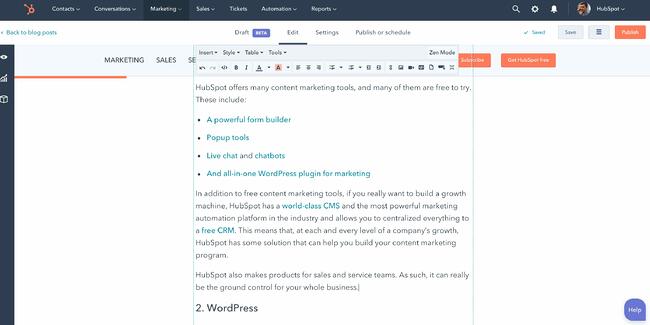
HubSpot offers many content marketing tools, and many of them are free to try. These include:

In addition to free content marketing tools, if you really want to build a growth machine, HubSpot has a world-class CMS and the most powerful marketing automation platform in the industry and allows you to centralize everything within a free CRM. This means that, at each and every level of a company’s growth, HubSpot has a solution that can help you build your content marketing program.

HubSpot also makes products for sales and service teams. As such, it can really be the ground control for your whole business.

2. WordPress

Content Marketing Tools: WordPress

Best for: Blogging, publishing editorial content, and creating portfolios.

What we like: The customizable templates are easy to use, allowing users to build a website quickly. Plus, it integrates with multiple plug-ins to take your work to the next level.

WordPress is the most widely used CMS in the world. Search Engine Journal reports that WordPress powers about 39.5% of all sites on the web.

Social proof can sometimes lead us astray, but in this case, it turns out that WordPress is a pretty powerful tool, both at the beginning stages and as you grow your content marketing program (and it’s used by sites like The New Yorker and The Next Web).

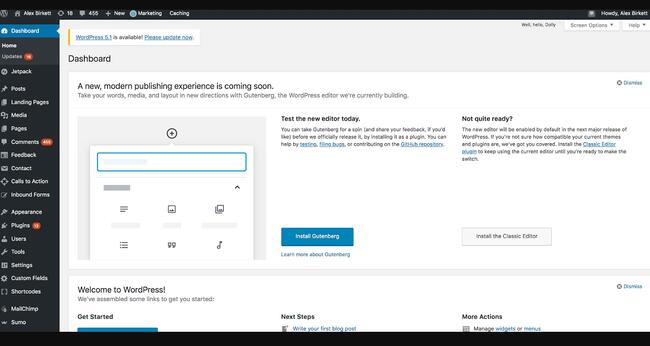
At its core, WordPress is an open-source CMS that allows you to host and build websites. You can self-host or host your site via WordPress.com. WordPress contains plugin architecture and a template system so you can customize any website to fit your business, blog, portfolio, or online store.

It’s a highly customizable platform and is widely used by bloggers.

3. Google Docs

Content Marketing Tools: Google Docs

Best for: Editing and collaborating with content writers.

Why we like it: It’s free, widely used, and simple to get started. If you can use word processor applications, Google Docs is a must-have.

Google Docs is to content marketing what a kitchen is to chefs: it’s where all of the work gets done before the final presentation.

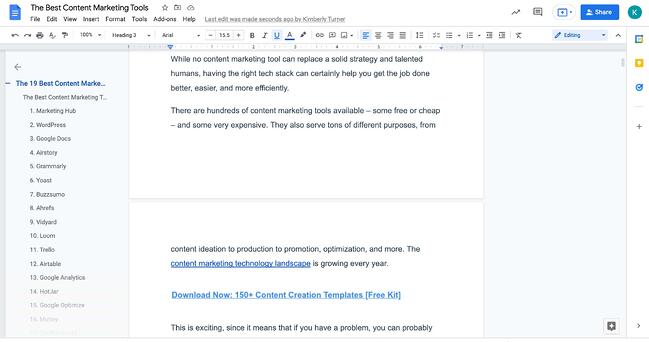
Personally, I don’t know any content marketers who don’t use Google Docs to draft their articles. It’s the best platform for collaboration by a long shot, but it’s also easy to use and has a pleasant user experience.

You can easily share documents with your team with just a few clicks. Additionally, you can give editing access to specific people and view their comments by using the “suggestions” and “comments” features.

In addition, you can usually find a way to upload Google Docs directly to your CMS. In the case of HubSpot, you can do that by default. If you use WordPress, you can use a tool like Wordable to help you out.

Google Docs is free, quite ubiquitous, and pleasant to use. Not many reasons not to use it.

4. Airstory

Content Marketing Tools: Airstory

Best for: Writing academic papers and collecting research.

Why we like it: Put writer’s block to a halt with Airstory. This app easily organizes and exports your notes, ideas, and research all in one spot.

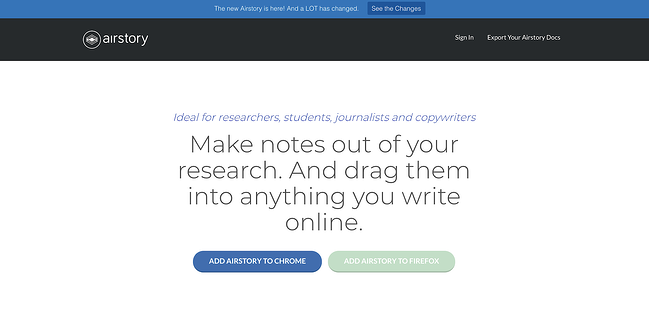
If you do want to step up your writing and collaboration game, Airstory is a more powerful platform for writers. If you find yourself moving too often between Evernote, Google Docs, Google Drive, and you always seem to have a hundred tabs open for research, it might be time to look into Airstory.

It helps you save quotes, images, and multimedia and drag and drop it into any writing application. As such, it’s an incredible tool for collaboration, but also for writers w

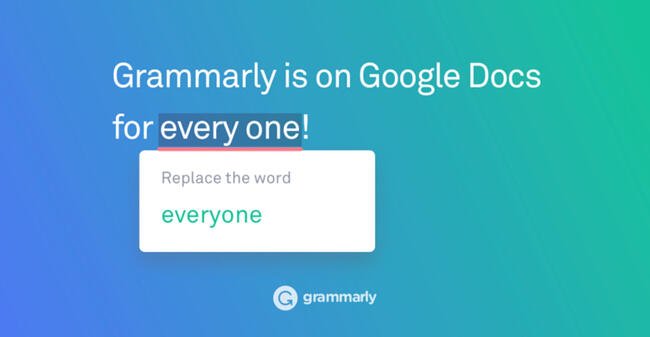
5. Grammarly

content marketing tools: Grammarly

Best for: Editing and proofreading content pieces before publication.

Why we like it: Grammarly works across multiple communication mediums, from email to documents to social media.

Grammarly has changed the game for me. I’m not naturally what you would call “detail-oriented,” so if it weren’t for talented editors, you’d be tearing me apart right now for the multitude of grammar mistakes littering my articles.

Grammarly, however, reduces my error rate by probably 50-80%. I still have some mistakes slip through, but to a large extent, Grammarly saves me from embarrassment (not just when writing articles, by the way — it also works for social media and forum comments).

Their browser extension works with Chrome, Safari, and Firefox, and offers a basic grammar and punctuation plan for free.

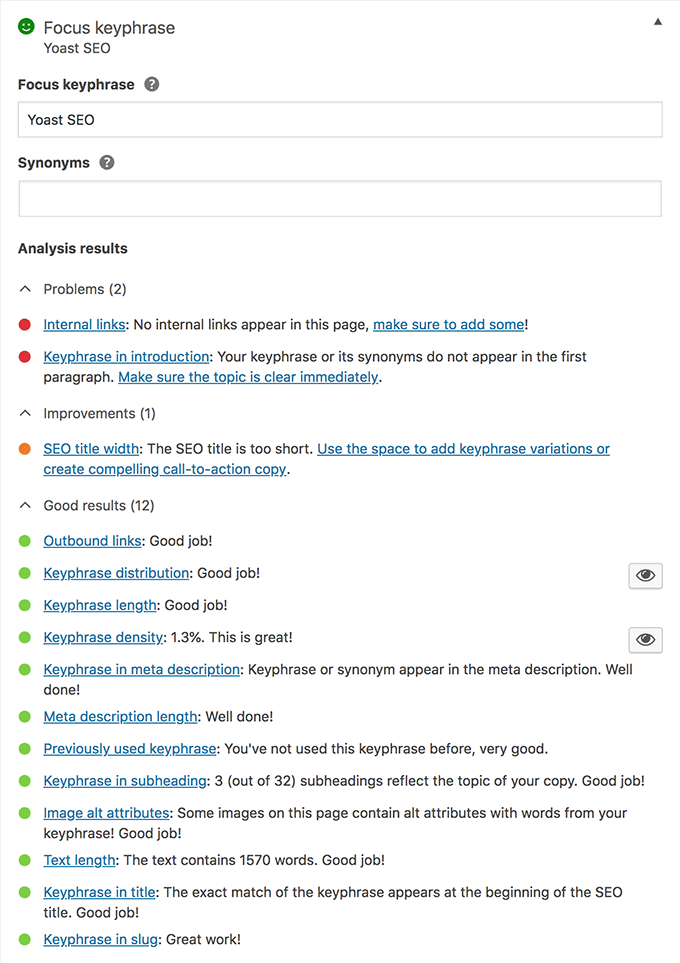
6. Yoast

content marketing tools: Yoast

Best for: Writing for search engine optimization (SEO).

Why we like it: Yoast is easy to use and one of the best SEO WordPress plugins available.

Yoast is one of my favorite tools for writing SEO-focused content.

It’s a sort of “all-in-one” WordPress plugin for SEO that helps do pretty much everything, including optimizing content for a keyword, previewing and editing meta-descriptions and URL slugs, abstracting away technical SEO tasks, and suggesting relevant internal links. The simple red, yellow, and green indicators make it easy to figure out if you’ve optimized your page correctly, or what could use more work.

They have over 9,000,000 downloads, 4.9 out of 5 stars in the WordPress marketplace, and just anecdotally, everyone I know who uses WordPress uses Yoast. It’s just a great plugin.

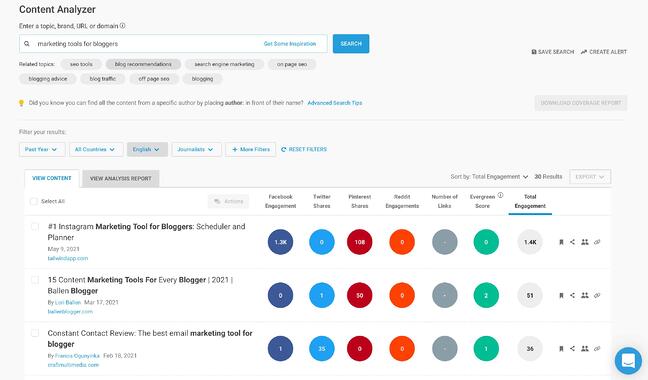
7. Buzzsumo

content marketing tools: Buzzsumo

Best for: Carrying out content research and tracking performance metrics.

Why we like it: Buzzsumo takes the guesswork out of influencer marketing and content curation, a bonus for those short on time.

Buzzsumo is a great multi-purpose content marketing research tool.

One of the main things it can do is help you analyze what content performs best for any topic or competitor. You can see metrics like social shares, backlinks, and which influencers are sharing a given piece of content.

For content strategy needs, Buzzsumo can also be used to find what topics are trending across various platforms and the kinds of headlines that are receiving the most traction with engagement.

They also have great influencer reports so you can see who the thought leaders are for a given topic area.

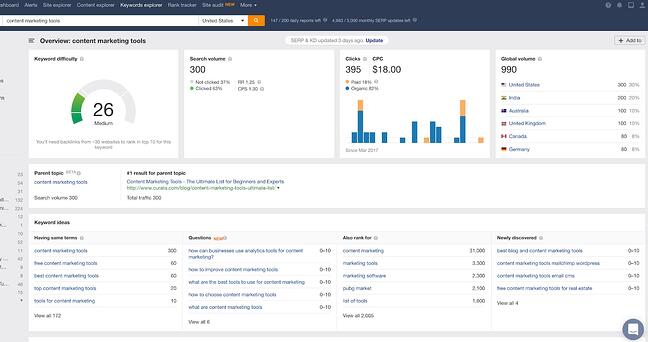
8. Ahrefs

content marketing tools: Ahrefs

Best for: Completing keyword research.

Why we like it: Ahrefs can be used for basic SEO research, but also handle more in-depth projects like performance reports. These reports can be set to the cadence of your choice so you’re always in the loop.

Ahrefs is my personal favorite SEO tool, and I use it just about every day. It’s great for everything from tracking the rankings of your keywords to analyzing your competitors’ keywords and traffic and much more.

Every time I think I’ve mastered the full functionality of Ahrefs, I find a new feature that surprises and delights me. The basics, such as keyword research or site analyzer, are wonderful. But I also love reports like “top pages” (where you can analyze the most valuable pages on a website), or “content gap” (where you can see what competitors rank for that you don’t).

9. Vidyard

content marketing tools: Vidyard

Best for: Creating B2B marketing videos, digital marketing, and content creation.

Why we like it: Vidyard’s analytics and personalization features not only help businesses understand how their content is performing, but also demonstrates how to leverage it to boost engagement.

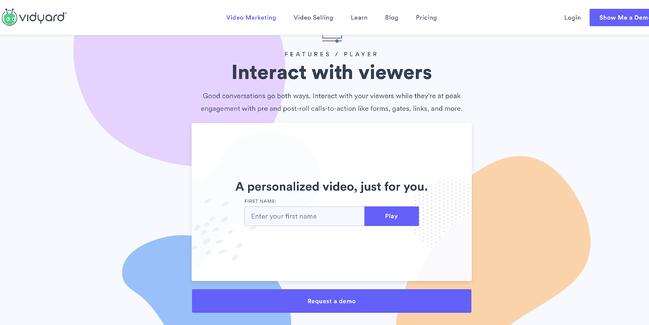
Vidyard is a video marketing platform that helps you host, share, and promote video content on your website.

They have a sales solution as well to help you close more accounts, but the marketing solution is what I’m most used to. Vidyard’s video analytics are robust.You can run A/B tests and personalize videos, and you can even gate videos at a certain time length to help capture leads.

Additionally, they’ll easily optimize your videos for SEO and integrate with various CRM, email, and social platforms.

10. Loom

content marketing tools: Loom

Best for: Creating video presentations and tutorials.

Why we like it: Loom is versatile and user-friendly. Utilize it to easily answer questions or explain complex topics that require a visual aid.

Loom is a tool that I’ve more recently begun using, but at this point it’s a staple for me.

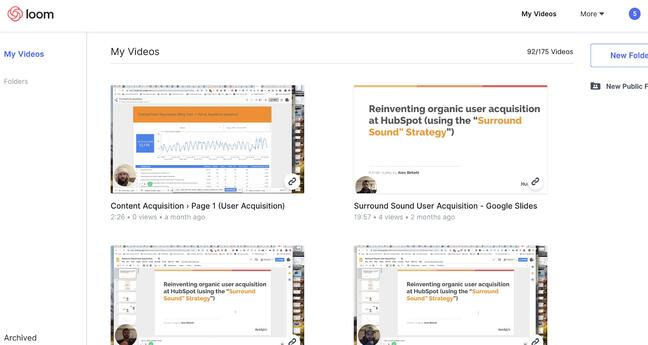
It’s a simple tool, but one with powerful use cases, even beyond content marketing. What it does is allow you to create, edit, record your screen, and share videos. For content marketing, I love this, because I can create and embed tutorials for technical walkthroughs.

Organizationally, I love it as well. It’s great for communicating quick questions or explaining concepts to other team members (without requiring a full, synchronous meeting).

11. Trello

content marketing tools: Trello

Best for: Keeping track of tasks and project management.

Why we like it: Trello puts all of your team’s projects in one place and is customizable enough to grow with your changing needs.

When you really start producing content, you’ll need some way to manage the process. This is particularly true if you’re working with many staff writers or guest writers.

My favorite tool for this is Trello.

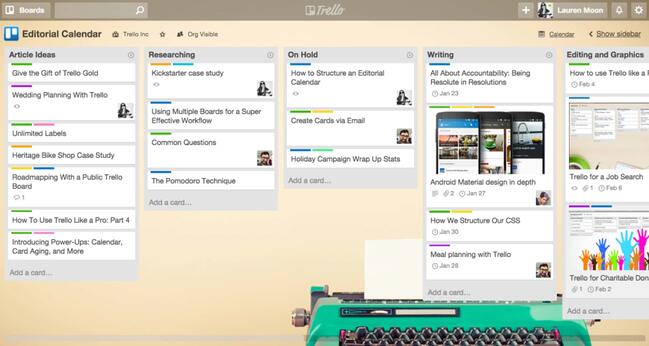
Trello is a simple kanban and project management tool, which means it can be used for many purposes. In fact, I’ve used it for tons of things, like growth experiments, sales pipelines, and product feature roadmaps.

12. Airtable

content marketing tools: Airtable

Best for: Managing tasks and databases.

Why we like it: Airtable is great for storing lots of data (hello, spreadsheets) in one place and using customized filters to sort it.

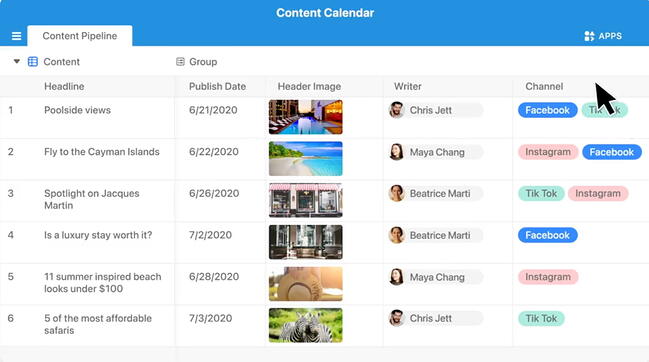
Airtable is another project management tool, though it’s a little more complicated (though also customizable). It’s kind of like a mixture between spreadsheets and Trello. Again, with Airtable, the use cases are many, but I really like it for two content marketing purposes:

  • Editorial calendars
  • Influencer/writer management
  • Marketing campaign tracking

I’ve also used Airtable for several other things in the past, including growth experiments and general team operating documents.

13. Google Analytics

content marketing tools: Google Analytics

Best for: Understanding your audience and tracking site metrics.

Why we like it: Google Analytics is ubiquitous, free, and easy to use. Use it to see how people found your site and observe visitor behavior.

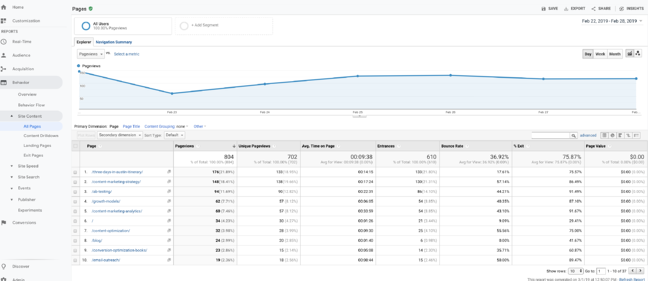
When talking about content marketing tools, you can’t leave measurement out of the discussion.

Sure, you can get some good insights from SEO tools like Google Search Console as well as previously listed tools like Ahrefs. But you’ll also want a digital analytics platform so you can track business metrics.

Google Analytics is one of the most widely used platforms online. It’s easy-to-use (at least the basic configurations), and it’s free. Two big benefits.

However, it’s also very powerful if you’re technical and know how to set up a proper configuration. Not only can you track goals, like form submissions or product purchases, but you can also set up behavioral events, like scroll-depth.

Best of all, you don’t have to do much to get access to all of this data. Simply set up your Google Analytics account, copy the code provided to your website, and you’re good to go. Google Analytics will automatically start tracking the data from your website.

14. Hotjar

content marketing tools: Hotjar

Best for: Understanding visitor behavior on your website.

Why we like it: Hotjar’s tools allow business owners to get an accurate read on how visitors experience their site. It’s great for marketers, designers, and researchers.

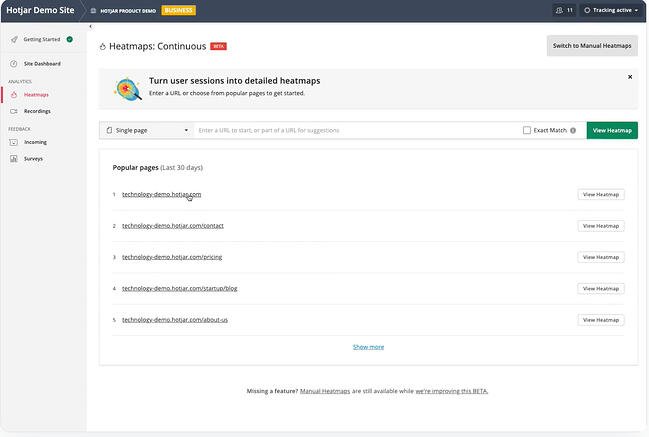
Hotjar is my favorite user experience analytics tool. It’s got some qualitative tools, such as on-site poll, surveys, and session replays. Where Google Analytics can help you uncover the “what” and “where” of user behavior, Hotjar’s tools can help you start to tiptoe into the “why.”

In addition, they also provide some quantitative tools such as heat maps. These allow you to get a good visual picture of where your visitors are clicking and scrolling.

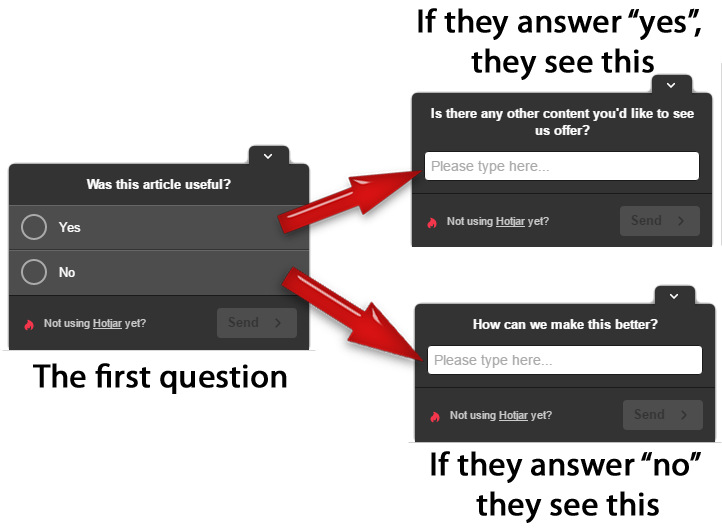
One use case I love HotJar (outside of CRO) for is to source interesting content ideas:

content marketing tools: Hotjar

In the example above, follow-up questions are asked based on what users answered to a previous question. Their responses can then be used to inform your content going forward.

15. Google Optimize

content marketing tools: Google Optimize

Best for: A/B testing changes to your site’s pages.

Why we like it: Google Optimize harnesses the power of their analytics and statistical tools to help businesses find what your site visitors engage with most and hone in on areas that need improvement. Statistical modeling tools simulate real-world performance for any tests you’d like to perform.

We’ve got a quantitative digital analytics tool (Google Analytics) and a qualitative insights platform (Hotjar), so we presumably can know a lot about our readers and our website at this point. But what if we want to make a change to our blog or landing pages?

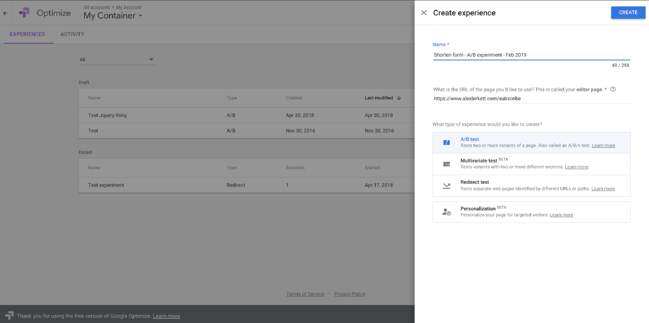
My background is in optimization, so if there’s sufficient traffic, I like to set up A/B tests for site changes.

There are many tools out there for this, but I wanted to list Google Optimize because it’s free. It’s also a good starter option to get used to. If you do want to explore other options, here’s a good article comparing the market solutions. But Google Optimize is a great start.

16. Mutiny

content marketing tools: MutinyBest for: Personalizing B2B websites.
Why we like it: Mutiny leverages smart, AI-driven technology to help guide content recommendations. Its website personalization features allow users to quickly change their website and see results in real time.

A/B testing is one thing; personalization is also an interesting avenue to explore.

Where A/B testing is a controlled experiment with a limited time-horizon, personalization allows you to deliver different unique experiences to subsets of your overall audience.

For example, you could target mobile users with different popup forms. Or you could target visitors who have read three blog posts with an offer for a specific ebook. Additionally, you could target people who scroll 75% of the way down a certain blog post with an in-text CTA.

The options are endless, only limited by your time, resources, creativity, and prioritization.

Anyway, Mutiny is my favorite platform in this space. It’s designed for B2B, so if you’re in ecommerce, you may want to look at another tool like CMS Hub . But Mutiny is a good and promising newer player with lots of functionality.

17. TheStocks.IM

content marketing tools: StocksIM

Best for: Sourcing stock images and free photos.

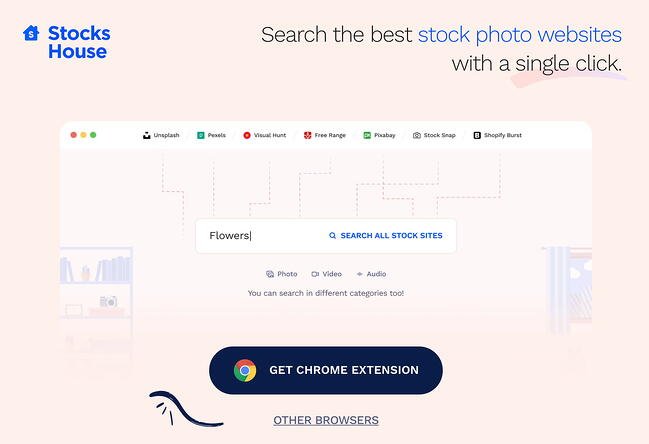
Why we like it: TheStocks.IM aggregates multiple free photo sites into one place, saving you time.

Most good content marketing includes imagery, so it only makes sense to include a stock photo site here in our list of content marketing tools.

I like TheStocks.IM because it aggregates several free stock photo sites, including Unsplash (my favorite) and Pixabay. Just type in the topic or object you’re searching for into the search box, and it will pull up images across all the platforms it sources from.

18. Canva

content marketing tools: Canva

Best for: Designing your own marketing materials.

Why we like it: Canva’s intuitive UI allows design novices to easily create infographics and other materials suitable for print materials, social media posts, and blogging platforms.

What about when a stock image doesn’t cut it, and you want to make your own imagery?

Canva is a great option here.

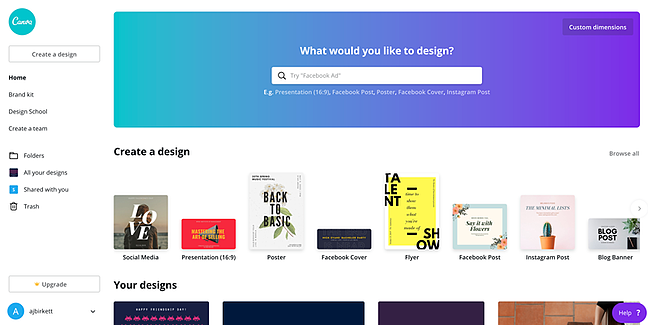
With Canva, you really don’t need to have excellent graphic design skills. I’m a horrible designer, and I can make decent looking graphics with Canva. It’s really designed for the layperson.

This tool is great for all kinds of content marketing imagery, like social media images, blog cover photos, Twitter cover photos, etc. It’s pretty all-purpose.

Start with one of their templates or create a new design from scratch. If you can drag and drop, you can create materials using Canva.

19. Adobe Photoshop

content marketing tools: Photoshop

Best for: Editing photographs and images, and designing custom materials.

Why we like it: The uses for Photoshop are endless. Mastering this design tool will make your materials look professional and give you more autonomy over the kinds of designs you can use.

Now, what if you want to make your own imagery, but you actually are good at graphic design?

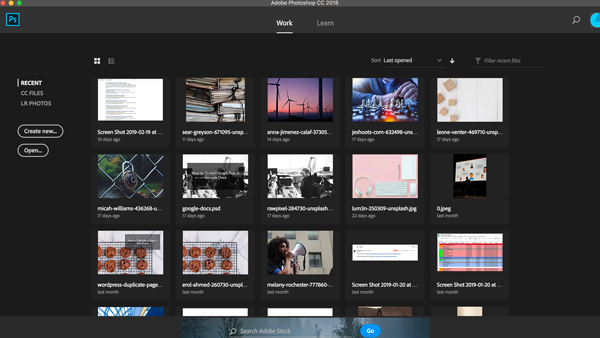
Well, in this case, Photoshop is the gold standard. It’s great for editing photographs as well as creating images such as Facebook photos, blog cover photos, and even screenshot tutorials.

I find that a little bit of skill with Photoshop goes a long way. Mastering Photoshop will allow businesses and marketing teams to create custom designs and materials to suit their needs instead of being tied to a particular template or layout.

Content Marketing Tools Won’t Save a Bad Content Strategy

… but they’ll certainly help you get the job done faster and more effectively.

Although there are many more content marketing tools out there, this list sums up the best tools for most marketing needs. Try them out and watch them enhance your content creation strategy and execution.

This article was originally published March 4, 2019 and has been updated for comprehensiveness.

content templates

Categories B2B

30 Fun (Not Cheesy) Ice Breaker Games Your Employees Will Enjoy

Asking “How is everyone?” at the beginning of every meeting isn’t always the best way to encourage team bonding. Sometimes, having a fun ice breaker can aid in that connection.

The best ice breakers have the power to strengthen coworker bonds, stimulate better brainstorming sessions, and create an atmosphere of inclusivity. To get the most value out of your team bonding moments, we’ve compiled a list of the best ice breaker games for the workplace. Next time you get together with your team, use one of these games instead of asking “How is everyone,” and you’re sure to hear some better, more insightful responses than “I’m good.”

Ice Breakers for Meetings

1. One Word Game

The One Word ice breaker allows you to provide initial context into a meeting’s topic, and get everyone in the right mindset for discussion.

To play, you’ll want to divide meeting participants into smaller groups. Then, tell them to think for a minute or two, and then share with their group one word that describes X.

For instance, let’s say you’re leading a meeting on culture. Tell the groups to describe work culture, or your office culture in particular, in one word. Once they’ve shared with their groups, you can invite them to share their word with the entire room.

This game encourages everyone to think about a certain topic in smaller groups ahead of time, which could increase participation during the meeting.

2. Pop Quiz

To successfully loosen everyone up and get them in the right mindset for a meeting, you might consider putting a short Pop Quiz on the board.

If your goal is simply to encourage team bonding, your quiz can be more fun — like, “Match the lyrics with this 80’s song.” However, you might also use the Pop Quiz as an opportunity to introduce participants to the meeting’s theme.

If you’re discussing company changes, for instance, maybe you’ll start by quizzing team members on company history facts (e.g. “What year was this company founded?”).

3. Birth Map

Place a map and a set of pins at the front of a large conference room before a big meeting. As people walk in, ask them to place a pin where they were born or raised.

As the map fills up with pins, people will learn about how diverse their teammates might be. Allow some time at the end of the meeting for your colleagues to walk up and look more closely at the map.

4. Movie Pitch

Perfect for larger groups and movie fanatics, this icebreaker is as crazy as you make it. Divide players into quads and give them 10 minutes to devise the plot of the next award-winning film. You can give them constraints by designating genres like horror, action, comedy, thriller, and more.

If your organization is meeting to brainstorm ideas for specific projects, go ahead and incorporate the topic into their movie pitch prompts to get the creative juices flowing.

Quick Ice Breakers

5. Would You Rather

A classic game played at summer camps everywhere, “Would You Rather” is an excellent, quick ice breaker for the workplace. Next time you’re settling into a meeting or team bonding outing, take turns going around the table and asking each person a “Would You Rather” question.

Here are a few “Would You Rather” questions to get you started:

  • Would you rather only have summer or winter for the rest of your life?
  • Would you rather go on a hike or see a movie?
  • Would you rather never use social media sites and apps again or never watch another movie or TV show?
  • Would you rather have a horrible short-term memory or a horrible long-term memory?

6. 18 & Under

18 & Under is an engaging and unique way to encourage team members to share fun or interesting stories with one another. Before a meeting, simply go around the room, and ask each person to share one accomplishment they had before they turned 18.

Undoubtedly you’ll get some of lesser importance, like “I bought a skateboard,” but you never know what hidden skills you might discover in your colleagues.

7. Two Truths and a Lie

One of the more classic ice breakers in the list, Two Truths and a Lie can be used anywhere from family parties to company events. To play, you simply ask each person to brainstorm three “facts” about themselves — two of the facts will be true, and one will be a lie.

For instance, I might say, “I once auditioned for the TV show Zoom. I have three brothers. I ziplined in Switzerland once.” Coworkers can take turns guessing which is the lie. (FYI, I have two brothers, not three, so that’s the lie. Unfortunately, I did audition for Zoom.)

Two Truths and a Lie is a fun and engaging game, and more importantly, it can help your team learn facts about one another, so they can begin forming deeper bonds.

8. The Handshake

One of the first ways you get to greet somebody in the workplace is with a handshake.

This ice breaker lets individuals ease up and have a little fun without a hassle. It’s simple — divide the group into pairs of two and have them make the most creative handshake they can in a couple minutes.

If you have more time on your hands, have the pairs split up after showing off their super cool shake and make even more creative ones with new partners. It’s hard to play these games without sharing a laugh, something we all could use in the workday.

Ice Breaker Games for Small Groups

9. Fun Questions

Asking fun questions is an easy and effective ice breaker game. To play, simply go around the room and have each person provide an answer to a fun question. The questions are up to you, but if you’re stuck, here are a few ideas:

  • If you’re stranded on a desert island and have the option of bringing three items with you, what three items would they be?
  • If you could be any animal, what would you be and why?
  • What was the first concert you ever went to?
  • If you could have any celebrity over for dinner, who would it be and why?

These questions serve two purposes — first, they allow your coworkers to get into a sillier, more creative mindset. Second, they encourage conversation on topics typically reserved for outside the office, which enables members of your team to get to know one another on a deeper level.

Meg Prater, Sr. Marketing Manager of the HubSpot blog, says “When I first started including ice-breaker questions in our weekly team stand-up meetings, the experience was … cringeworthy. It felt like exactly what it was: organized fun. But we kept at it. I listened to feedback and tried to incorporate it into better ice breakers.”

She continued, “For example, some folks on our team don’t watch a lot of T.V. and felt a little excluded when we’d fall down a rabbit hole of shows we were binging. Keeping the ice breakers inclusive keeps everyone engaged. Now, our ice-breakers can take 15+ minutes to get through and yield some of our biggest laughs and revelations of the week.”

10. Personality Quiz

This ice breaker can promote team bonding, and it’s one of the easier options on the list. Simply choose a brief personality quiz on your phone or computer (if you’re stuck, here’s a list), and pull it up on a projector or send the link to everyone.

Once everyone has completed the personality assessment, have each colleague mention one thing they agree or disagree with from their results. This game allows your team members to gain a new perspective on their peers, and it’s also a fun and easy way to get an interesting conversation started.

11. Who is it?

Have everyone write a unique, strange, or unexpected fact about them on a piece of paper. Then, put the pieces of paper into a hat and mix them around. Pull from the hat and read each fact.

Allow the team to try and guess who wrote it. After they guess, ask the employee who wrote the fact to identify themselves and give any further context if necessary. This could be a great way to get to know surprising new things about your teammates.

12. Marshmallow Challenge

Tom Wujec, a business visualization expert, initially presented his Marshmallow Challenge at TED. To play, you simply divide your team into groups of four and give each group 20 sticks of spaghetti, one yard of tape, one yard of string, and a marshmallow. Whichever team can build the tallest structure, wins — the trick is, the marshmallow must be on top.

There are a few reasons this game works as both a great ice breaker and a team-building exercise. First, the most successful teams are the groups of people who don’t spend time competing for power.

The game forces your colleagues to work collaboratively when brainstorming potential solutions. Second, the Marshmallow Challenge encourages people to think quickly and offer alternative solutions when their initial idea fails.

With the Marshmallow Challenge, you can strengthen your team’s brainstorming and problem-solving skills, and your team can also have some fun. A win, win.

13. Scavenger Hunt

At HubSpot, we conduct a scavenger hunt for new hires on the first day of their training. It’s fun and encourages collaboration, but additionally, it can help employees learn their way around the office.

Fortunately, you can conduct a scavenger hunt for your team even if they’ve worked at your office for years.

Simply split up your team into groups, and give each group a shortlist of items to find — if you work in a smaller space, maybe you can hide some funny items around the office ahead of time. You might even provide an incentive for the winning team, like a $50 Amazon gift card.

A scavenger hunt is also an exceptional opportunity for cross-department interaction. Consider reaching out to managers from other departments and creating groups of employees who don’t often get to work together.

14. No Smiling

This game is simple and meant to energize your team. Get your colleagues in a circle and ask one volunteer to sit or stand in the middle. Tell the volunteer that they can not laugh or smile, regardless of what happens. Then have each other colleagues take turns telling the volunteer a work-appropriate joke.

The goal of the volunteer is to hear a joke from every colleague around the circle, while the goal of the other team members is to make the volunteer laugh.

This icebreaker can be helpful in new-employee or management training to lighten the pressure of starting a new job. It can also be helpful as a way of lightening the mood on teams that regularly deal with stressful projects or situations.

15. This is Better Than That

Aside from being a fun team activity, this might be a great energizer for sales employees or others that regularly pitch, market, and sell products.

Ask your team to find four to seven items around the office and bring them to one room. These items could be something they use daily, like a pen or a chair. However, you should encourage them to find items that are more odd or unique. This will make the game more challenging.

Line the items up and split the group into sub-teams. Task each team with picking an item they would use to survive if stranded on a desert island.

Tell team members that they cannot pick more than one and must assume it is the only item they will have on that island. Allow the teams time to deliberate and then ask them to present the item they chose and why.

Virtual Icebreakers for Dispersed Teams

16. Choose Your Favorite

For this icebreaker, all you have to do is answer the question about your favorite things. You’ll ask your team to choose their favorite movie, song, T.V. show, etc. The question can change every week.

This icebreaker helps your team get to know each other even when they work remotely and can spark conversation on what everyone likes or dislikes.

17. Trivia Game

If you’re looking for a remote icebreaker that’s more of a game, and less discussion-based, you can host a trivia game.

Kahoot is a trivia platform you can use for free (hosts up to 10 people). To get started, all you’ll need to do is sign up for a free Kahoot account.

Then, you can choose a featured trivia game to play. To run this remotely, you’ll want to share your screen with your team. Everyone will need to have a separate device to use so they can enter the game and submit their answers.

18. Share an Embarrassing Photo

This is one of my favorite icebreakers because it’s a fun way to get to know your team. For this game, have everyone bring in an embarrassing photo and tell the story behind it.

Have your team members share their screen or send a file to the team leader to share with everyone.

To make this more interesting, you can have people guess whose photo it is before your team member shares their story. Doing this icebreaker is a great way to build connections remotely.

19. One Word Pulse Check

For this icebreaker, have everyone on your team go around and share a word or phrase that represents how they feel that day.

Sr. Manager, Christina Perricone, says this is her favorite icebreaker.

“The person sharing gets to decide whether or not to elaborate, and everyone listens without response. The purpose of the exercise is to give people a chance to release and/or reveal emotional setbacks, obstacles, wins, highlights, or anything else that might be impacting how they show up to work that day. It provides a space for participants to bring their entire self to work and it gives the team context for how to support that team member that day,” Perricone adds.

20. Meet my Pet

Nothing fills a meeting with smiles like photos of colleagues’ furry friends. Take turns showing off the cutest pictures and videos of your pet.

For those who don’t have any, they can either make a joke pet (the infamous pet rock) or share a dream pet they would have.

Zoom Icebreakers

21. Paint a Picture, Build a Story

In this ice breaker, playoff your teammates’ artistry and create a scenario of their masterpieces. Gartic Phone gives you a short time frame to sketch photos based on other players’ prompts — and can result in some hilarious artwork.

The more nonsensical the prompt, the funnier the drawings become. You’ll also get brownie points if you save and share some of the funniest drawings and share them with the team on Slack afterward.

22. Guess That Drawing

Drawasaurus is one of my favorite online drawing games to play with colleagues. Players get to choose from three random prompts to quickly interpret and draw their vision. Other players can score more points for identifying the word the fastest and take turns going until the timer goes out.

23. Alphabet Brainstorm

Thinking off the top of your head is a lot harder said than done in Scattegories. The host of the game can choose from topics as broad as foods and countries or as weird as “Things Granny would say.”

Each round the game will highlight a random letter of the alphabet and let players come up with any noun or phrase that starts with said letter. The best part — players can dispute answers amongst each other to take the win. A perfect icebreaker for your overly competitive colleagues.

24. Show and Tell

A rather straightforward ice breaker, team members can share an object they love over Zoom. Whether it’s a prized-collectible or an item that sparks nostalgia, there’s plenty of stories waiting to be told.

25. Bucket List

Outside of the workplace, your teammates are people with aspirations and goals you wouldn’t know about from the average coffee chat. Have team members share some bucket list items they want to achieve in the future.

Not only can these be inspirational, but they also open the floor for team members to encourage one another to pursue their dreams, too. It’s a particularly uplifting team-bonding activity that will bring your team even closer together.

26. Share the Love

While dispersed teams may not have the chance to share a handshake or hug, you can still share the love amongst each other in this icebreaker. Say something lovely with another team member, and it could be anything you want as long as it’s respectful and in good judgment.

For each person that receives a kind message, they will be the next one to share a message to a member of the group who hasn’t received one — ensuring everyone gets an equal amount of praise. Shout them out for their helpfulness in a project, for the energy they bring to the team, or for their lovely smile.

27. Arts and Crafts

Making something with your team can be a great opportunity to learn something new and keep decorative mementos in your space to remind you of your team. Have everyone follow the same instructions to make a craft like simple origami, a drawing, or painting by a designated instructor in the Zoom call or YouTube tutorial.

28. What Do We Have in Common?

This icebreaker is best suited for new hires who may feel more reserved as they virtually meet the team.

Find common ground and get the conversation going with your team members. Have a manager or team leader start the conversation by sharing something they have an interest in, like popular TV, music, foods, or whatever they love to get everyone thinking. Popcorn it over to the most enthusiastic team member with that same interest and have them share a new one.

Typical icebreaker questions can get people to say a sentence or two about the subject, but if you’re passionate about it, you’ll see more personality come out from the most unexpected colleagues in the call.

29. Name That Tune

Music brings people together, and you’d be surprised to learn how many of your coworkers are raving about the top trending song on TikTok or Spotify.

Take turns whistling, tapping, or even playing an instrument (if you gave one) to the tune of a popular song and have your teammates guess the name. Figure out who’s a fan of the classics by clapping and stomping to the tune of “We Will Rock You” by Queen, or do whatever it takes to help your colleagues recognize your favorite tunes.

30. Themed Meetings

Hosting themed meetings is the best icebreaker for the holiday season. Share a laugh and snap photos of you and your colleagues dressed up as elves with Zoom backgrounds at the North Pole, or in your spookiest costumes for Halloween.

Make sure your theme is chosen in good judgment as some holidays have cultural ties, keep this icebreaker for more commercial holidays.

Break the Ice and Get to Business

Icebreakers can seem cringeworthy, but are actually a great way to build trust within your team. Even if you work remotely, team bonding is an important part of running a productive, effective team.

Editor’s note: This post was originally published in September 2018 and has been updated for comprehensiveness.

company culture template

Categories B2B

How Benefit Segmentation Will Take Your Marketing Campaigns to the Next Level

If you’re a fan of HubSpot’s Inbound Marketing Methodology, you probably understand the importance of customer success. In fact, 70% of businesses with growing revenue prioritize customer success as “very important.” So, if you want your business to succeed you must make sure your customers do, too.

By doing so, you can stack the odds in your favor, ensuring the leads you’re passing to your sales team are a good fit for your business through benefit segmentation. In this post, we’ll go over what benefit segmentation is, why you should use it, and where it can be seen in the real world.

Learn how to run more impactful, measurable marketing campaigns.

Why should you do benefit segmentation?

Benefit segmentation will help you gain a better understanding of the different needs of your customer base in addition to the following:

1. Benefit segmentation makes it easier for sales reps to convert leads into customers.

That’s because your marketing campaigns will attract customers who are better suited for your product or service. Since the campaigns are targeted to the people who need your business the most, your sales team should have an easier time closing deals.

2. Marketers and salespeople can use benefit segmentation to engage customers.

By identifying the key value that your business provides, your team will create more compelling marketing campaigns and sales pitches. They’ll know exactly how to differentiate your product or service to make it attractive to your target audience.

3. Benefit segmentation improves customer retention.

Converting leads that are a good fit for your organization will decrease your churn rate over time. Customers will be happy your product or service is fulfilling their needs and will be less likely to shop with your competitors.

Now that we understand what benefit segmentation is and why you should use it, let’s take a look at some real examples where this marketing technique helped businesses attract and close leads.

Benefit Segmentation Examples

1. Samsung

Benefit segmentation example Samsung

Image Source

The cell phone has become one of the most fundamental products of modern technology. Almost everyone has a cell phone to get them through their day-to-day tasks. But, depending on who you are, how old you are, and where you’re from, your cell phone needs may differ dramatically from the next customer. Most of us need a cell phone, but often for a different reason. So, how do phone companies manage to fulfill these customer needs?

Samsung uses benefit segmentation to personalize ads for different target audiences. In the cell phone industry, age is a major determining factor of customer needs. As customers get older, what they need from their cell phone changes. It goes from fun features like cameras and apps to more practical benefits like battery life and security.

We can see this play out in the two advertisements pictured. The first one is aimed at a youthful audience and inspires them to “Do bigger things.” The phone comes with two cameras and lets the user draw on images using the included stylist.

Samsung Galaxy Benefit Segmentation Example

Image Source

Compare this to the next ad where Samsung focuses on the practicality of the phone. Its tagline, “Designed for humans,” lets the reader know the phone is user-friendly and easy to set up. The phone is designed for optimal performance so that it never slows down no matter how many apps are running at once. This is particularly useful for an audience that may have a busy professional schedule and is working on multiple tasks at once.

Highlights:

  • Samsung used it’s “Do bigger things” campaign to attract a younger audience by reeling them in with sleek new camera features.
  • Conversely, the company was able to attract older users who may not be as tech or gear savvy with the tagline “Designed for humans,” implying the phone is user-friendly for all.

2. Ford

benefit segmentation example FordImage Source

Car companies often use benefit segmentation to position different types of vehicles. For example, we can look at Ford to see the difference in advertisement between its Ford Fusion and F-150 models.

The Ford Fusion is a practical, four-door sedan that’s described as “sophisticated” and “cool.” Ford recognizes that people who are interested in this car will value its style in addition to its performance and price. The company highlights this by using vibrant colors in its advertisement to compliment the car’s eye-popping design.

Now, compare that image to the image of the Ford F-150 below. The F-150 is a work truck designed for people who need a powerful, durable vehicle. Customers who are interested in the F-150 would value the truck’s impressive towing capacity and ability to navigate difficult terrain. That’s why the image below shows the truck towing a large piece of equipment with a tagline of “Built Ford Tough.”

Benefit segmentation example Ford

Image Source

Highlights:

  • Ford marketed the Fusion sedan to users who were more interested in having a practical, but stylish car to get around town.
  • For the F-150, Ford used it’s “Built Ford Tough” campaign featuring the rugged outdoors to attract buyers looking for a durable, all-terrain truck that could handle the toughest jobs.

3. Airbnb

benefit segmentation example Airbnb

Image Source

Airbnb’s market segmentation is interesting because it has to account for two main target audiences: hosts and guests. Not only does the company have to find customers to book the rooms, but they must also attract welcoming hosts with desirable living spaces. This forces Airbnb to perform benefit segmentation to create ads that appeal to both guests and hosts.

In the example above, we can see how Airbnb uses benefit segmentation to attract hosts in New York City. New Yorkers have a lot of pride for their city and value companies sharing that passion. So, Airbnb created these subway ads to educate New Yorkers on why Airbnb is good for local business owners as well as community development.

We can compare that educational message to the inspirational one below. This ad is aimed at potential guests who are planning a future trip but haven’t made concrete travel plans. Airbnb capitalizes on this opportunity by creating a message that embraces uncertainty. Rather than pointing to a specific location, Airbnb makes the destination irrelevant and instead focuses on how the company will help, no matter where you go. This makes Airbnb look more trustworthy to customers who may be nervous about making a major financial decision.

Airbnb benefit segmentation example

Image Source

Highlights:

  • To attract NYC hosts to use their service, Airbnb embarked on a campaign that tapped into the pride New Yorkers have for their city and local businesses.
  • For guests, Airbnb established themselves as a trustworthy accommodation option – no matter where they decided to crash – by using the uncertainty of the audience’s destination to their advantage.

4. Nike

Nike Benefit Segmentation

Image Source

Nike offers a wide range of products to a variety of target audiences. It needs to use benefit segmentation to develop different marketing campaigns that appeal to each group of customers. The most notable example we can pull from Nike is its ads featuring tennis superstar, Serena Williams.

These ads are aimed at Nike’s female target audience, particularly at its youthful demographic. Nike understands that these customers value the athletic confidence they experience when wearing Nike products. That’s because Nike’s apparel is not only stylish but designed for elite performance. The company uses the tennis phenom, Serena Williams, as an icon to demonstrate how this added confidence can improve your athletic ability.

Highlights:

  • Nike expertly leveraged it’s reputation for creating high-performance gear by using tennis star Serena Williams.
  • Additionally the brand was able to tap into youthful nostalgia and appeal to female buyers by using images of Williams as a youth to inspire their audience to greatness.

5. Hulu

benefit segmentation example Hulu

Image Source

Amidst the “cord-cutting” phenomenon, Hulu has been able to position itself as a viable alternative to cable TV. Hulu’s users value convenience and efficiency and don’t want to spend money paying for television channels they never watch. So, the company has created an ad campaign that explains how Hulu users can save money while maintaining access to their favorite content.

In the ad above, we see how benefit segmentation influenced Hulu’s marketing campaign. For example, the copy highlights how users can view “current episodes” and “hit movies.” Since many cord-cutters worry about losing access to new content, this lets users know that Hulu’s content is updated so they’ll never miss a recent episode. That’s incredibly important for people who follow series like Game of Thrones, where it’s vital to watch the episode as soon as it airs.

Highlights:

  • Hulu’s ad campaign assures potential cord-cutters they won’t miss current episodes of their favorite shows.
  • Hulu found what was most important to their customers (missing their favorite shows) and then tailored their messaging to address their needs.

The Advantage of Using Benefit Segmentation

With benefit segmentation, you can organize your customers and leads based on the value you provide them. This ensures you’re attracting customers who will develop a strong relationship with your business over time. <>By pursuing these customers, your organization will improve lead acquisition and ensure customer success.

This article was originally published June 3, 2019 and has been updated for comprehensiveness.

New Call-to-action

Categories B2B

The Straightforward Guide to the Google Display Network

Millions of dollars are poured into the Google Display Network (GDN) every day. But why? Google offers endless options for marketers to promote their products, so how is this network different?

Frankly — because it works.

When industry competitors’ congest search engines, the GDN can be a great alternative. Here, we’ll explore why you should use Google Display Network (GDN), how GDN differs from search ads, and how you can target your GDN ads to reach the right people in the right places.

Free Guide, Template & Planner: How to Use Google Ads for Business

What is Google Display Network?

The Google Display Network is a collection of over 200 million sites, apps, and videos where your Google ads can appear. As this network reaches 90% of global internet users, joining will greatly increase the number of eyes on your ads.

Why use the Google Display Network?

what is google display network?

The value for GDN boils right down to reach and affordability. Prospecting, brand awareness, and remarketing can come with a hefty price tag when pursued for traditional search ads. GDN, by comparison, bypasses a lot of costly competition from other networks.

With Google’s search ads, you’re essentially throwing out a wide net, which can be largely hit-or-miss, both with whom you’re targeting and with how you’re spending.

Is it better to use GDN over search?

Whether or not you should choose GDN over search ads largely depends on your marketing goals. Generally, you’ll want to use GDN when the goal is to build brand awareness in a more cost-effective way.

There’s less competition for inflated keyword bids, so you’re more likely to reach users actively searching for your products and services. Though the audience intent is not as strong, you get a much lower cost-per-click and many more impressions. There are also endless options for customizing your audience targeting.

Ultimately, you don’t need a fat wallet to set up a campaign through Google Display — you just need to choose the right targeting factors for your marketing goal.

Google’s Display Network allows you to define your audience in a way search engines can’t. Since you can target more than just keywords, you aren’t limited to the Google results page. Instead, GDN allows you to target websites by audience affinities, in-market segments, and custom intent keywords. You can even hand-pick website placements that fit your target audience.

The other differentiator is volume. Where do the fancy image ads appear when you market with GDN? Across millions of websites that your prospects are visiting every day.

But really – what’s the difference between GDN and a simple search ad? Let’s explore that, now.

Google Search vs. Display Network

You need a different mentality when using Google’s Display Network than when you’re using the search network and others available on Google Ads. Let’s define some use cases and expectations.

Webmechanix display ad example

According to a study from Wordstream, the average GDN click-through- rate (CTR) was just 0.46% compared to 3.17% across search. This may seem minuscule, but it’s important to note this is because you’re targeting users that may not be familiar with your brand at all. The Google Display Network is first and foremost a tool for prospecting and brand awareness.

The standard CTR for this network is still under 0.5%. But, for targeting prospects outside of search engines and social networks, that’s still pretty good.

Webmechanix display banner ad example

The next key differentiator is the fact that the user’s primary interest is the website content itself — the display ad has an indirect, secondary role in the website’s appeal to the viewer.

Marketers are hoping the prospective user will view their GDN ad along their journey to fulfilling another purpose. That makes the user intent different than when an ad appears at the top of a Google results page for a high-intent search phrase. It should be no surprise that the click-through rate and conversion rate for GDN are below 1%.

Unlike with search, there is a variety of targeting options outside of keywords that span across a network of millions of websites. You can access the majority of internet users through website placements. Your number-one goal with GDN is finding the right audience size with strict targeting criteria.

There are ways to approach this network with tighter, more relevant targeting. Ultimately, remarketing is limitless — but it involves audience development outside the Google Ads platform. Let’s start by exploring the default prospecting options Google provides and work our way toward opportunities customized for your brand and those who have engaged with your website.

Google Display Network Remarketing or Prospecting?

On the GDN, you can target in two ways. First, you can target prospects on the internet who may have no previous knowledge of your website, brand, products, or services. Second, you can remarket to users who have engaged with your website in some form. Option two allows you to leverage the audiences you find in Google Analytics for your website. If you don’t have any Google Analytics website audiences built, doing so is incredibly easy — simply set up an audience for a user that completes specific actions.

options in google display network: demographics, affinity segments, custom interests, in-market, similar audiences, remarketing

Some of the most common remarketing audiences include:

  • General website visitors
  • Users who have submitted a form
  • Users who have downloaded content
  • Users who have viewed specific product pages
  • Users who have signed up for an account or trial offer
  • Users who have completed a transaction or purchased a product
  • Users who have begun any of the above actions but abandoned the page before completing it

Remarketing and prospecting are two vastly different initiatives that you can execute through GDN. Some businesses prefer to focus only on remarketing because reaching users familiar with one’s brand drives leads and sales for the most affordable cost. However, other businesses aren’t focused on the return as much as generating awareness of their products and services. It all comes down to your company’s marketing goals.

Google Display Ad Examples

Once you know how to target, you’ll want to create the collateral that gets the attention you need from your ad placements. Here are some great examples of Google display ads:

1. SEMrush

semrush google display ad example that reads "do you want to skyrocket your marketing like our clients did?"

SEMrush uses large white font across an eye-catching blue background with bold oranges and pinks, making it colorful and stark enough to attract attention.

Why We Like It

  • The copy of this ad does two things: states the value (“skyrocket your marketing”) and provides social proof (“like our clients did”)

2. Conversica

conversica google display ad that reads "so many leads, so little time, 451 research examines how intelligent virtual assistants can increase sales capacity. get the research"

Conversica utilizes the large vertical format, which takes up a lot of real estate space on a page, enough to hopefully stir any website visitors out of “banner blindness.” Their strategy is not to promote their company but rather an offer: research on virtual assistants in sales.

Why We Like It

  • The vertical ad is large enough to catch the attention of the person browsing the site, plus entices them with an offer rather than a hard sell.

3. E*TRADE

etrade google display ad example that reads: "$0 commissions. get up to $600."

This is one of the skinnier horizontal banners, and E*TRADE uses it to make a bold statement: “$0 commissions” in large letters across the center. The call to action (open an account) is much smaller than the value proposition so that they recognize the value first before taking action on it.

Why We Like It

  • This ad emphasizes the value of using E*TRADE — zero commissions fees. The company sets itself apart from the competition by assuring customers they won’t be nickel-and-dimed with extra fees.

Google Display Network Audience Targeting

1. In-Market Segment Targeting

In-market segments are Google users interested in broad categories of products and services, including real estate, education, home and garden, sports and fitness, and more. Google defines these segments based on users’ historical views, clicks, and conversions on previous content. There are sub-categories for specific types of each segment, but the criteria Google uses for these aren’t public. The size of each sub-category is easily millions — and sometimes billions — of users. It’s safe to say that testing a GDN in-market segment is a good starting point.

However, layering demographic qualifiers, device targeting, and other affinities is necessary to create a focused pool of users.

in-market segment for targeting

An easy way to control audience size for in-market segments is by comparing with Google Analytics data. The in-market segments on Google Analytics line up perfectly with those on Google Ads. Google Analytics should show you which in-market segments on your site have the highest conversion rates.

Educated guesses for targeting on the Google Ads platform can only go so far. Google Analytics has the tools for identifying and building data-driven audiences from which Google Ads can learn and optimize. Ultimately, using Google Analytics can help ensure you’re reaching highly qualified users.

2. Affinity Audience Targeting

Like in-market segments, affinity audiences are Google users with similar interests, including cooking, fashion, beauty, gaming, music, travel, and more. These are very expansive categories of internet users, so it’s equally important to find targeting criteria to narrow down the size of any one affinity interest, or its sub-categories.

affinity category for targeting

Strictly relying on the default options for in-market segments and affinity audiences within Google Ads can leave a giant dent in your budget for marketing spend. Google Analytics can be a huge help in pinpointing exactly which affinity audiences yield the highest conversion rates on your website.

Google Ads will also create a “similar” audience based on the Google Analytics’ audience created. These audiences are usually more focused in size, making them ideal for testing.

similar audience for targeting

3. Custom Intent Audiences

Custom intent audiences is another valuable contextual targeting method.

How does it work? Simply put, Google can show your ads to users who are “likely to be interested” in specific keywords and website URLs. It may also show your ads to people who have recently searched for your suggested keywords.

custom intent audience for targeting

The key difference between custom intent audiences and other targeting methods is that you aren’t targeting websites that use these exact keywords, and Google is not placing your ad exclusively on specified website URLs. Rather, Google serves your ads to users on various other websites that have some contextual connection to the website URL or keyword given to Google.

4. Placement Targeting

Google can show your ads on specific websites when provided with placement URLs. This option offers tighter, more controlled targeting because it limits display ad placements to custom websites selected by the marketer.

You could save money being so specific, but you could also be missing out on mainstream websites that your target audience is more actively visiting.

placement targeting

Simply put, users who visit your website also visit other websites. With custom affinity (interests) and custom intent (keyword and URL) audiences, Google can target these users at other online destinations. Picture your specified website as the center of a digital spiderweb — Google uses the central URL to target the users in other URLs within the spiderweb, amplifying your reach to include websites you may not know about.

These websites may or may not have content related to your suggested keyword or URL, but Google knows that these websites are sites that users of your suggested keywords and URLs also visit.

5. Topic Targeting

Google can show your ads on web pages only about your specified topic. Some of these topics could be similar to interests or affinities, or they may fall outside the default categories that Google offers (e.g., they may be along the lines of hiking, camping, or agriculture).

This targeting is an alternative to researching and selecting website placements for one interest without knowing the impact of those placements.

Three Key Audience-Building Factors

Now that you know the basic mechanisms for targeting and creating an audience, let’s dive into three essential tips to ensure you build those audiences better. Here are some high-impact areas for tightening audience targeting where it counts.

1. Select the right devices.

When setting up a display campaign, it’s important to consider where the target audience will be using the product and how they will be signing up. If the user experience is compromised or not nearly as good on a particular device, consider excluding that device altogether.

For example, is mobile really the right platform for your landing page offer? Can your products or services be used easily on tablets and other small devices? If your company produces games or apps, mobile is ideal. But if you’re marketing business software used on desktop computers, mobile targeting could be costly and unnecessary.

device targeting example

2. Choose the right demographics and locations.

Google lets you customize several demographics when targeting for a display campaign. For example, age and household income are broken out into seven different ranges. If you know your audience is not within 18-24 years of age, or the top 10% of household income, you can easily exclude those users when creating ad groups.

There could also be some states in the U.S. or territories internationally to which your business prefers not to drive sales. The bids of these locations can easily be adjusted to redirect your budget to more profitable locations.

location targeting example

3. Mark the box for content exclusions.

Before launching a campaign on GDN, it’s easy to make the mistake of skimming past the additional settings for websites with explicit content. Some advanced content settings are available for preventing your site from appearing on parked domains, sites with sexually suggestive content, sites with sensitive social issues, and more.

Google doesn’t mark these boxes by default, so they must be manually selected to prevent your ads from appearing on undesirable sites.

content labels for targeting example

Optimizing Your Google Display Network Results

Now that we’ve explored targeting methods as well as specific audience-building factors, let’s dive deeper into how you might optimize your GDN results.

1. Assess demographic performance, and then recalibrate if necessary.

Some of your audience demographics may be ideal for traditional marketing but could perform poorly in a digital setting. Even after setting up specific demographic and location targeting, it’s important to review the performance of what hasn’t been excluded. For example, there are some demographic categories (e.g., “unknown”) and ages (e.g., “65+”) that can become costly after launch.

demographics for targeting example

2. Assess placement performance and use those analytics to continually improve.

Google makes it easy to review where your ads are appearing on a daily or weekly basis after campaign launch. You can find this information under “Placements > Where Ads Showed.”

placements for targeting

Filtering placements by unusually high spend or CTR can quickly identify websites that are more of an immediate threat to your campaign’s health. If you’re considering bulk exclusions, you may find it helpful to export web placements within the timeframe of “all time”.

Focus on blocking the duplicate placements that yield no results, since repeat offenders are a higher priority than websites that appear once with only a few impressions. After identifying duplicates, review the relevance of these sites, how much they have spent, and whether they have led to any conversions.

3. Consider which ad style and location will yield the best results.

There are two main ad types available for a GDN campaign — standard image ads and responsive ads. Standard image ads have a number of formats, including square, rectangular, skyscraper, and banner. These ads are an image-only display option. Here’s an example:

example of a banner ad by webmechanix

Responsive ads, on the other hand, offer a combination of text and image options that display in a variety of formats, depending on where the ad appears. The complete ad is composed of three image types, up to five short headlines, one long headline, up to five descriptions, and a business name. The short headlines and descriptions rotate to find and show the best-performing combination. Here’s an example:

Webmechanix responsive google display network ad example

If you’re limited on time, budget, or creative resources, it can be tricky to know which display ads will work best for your campaign, and you might not want to risk time testing different ones. If this is the case, it’s important to note studies have shown that 300 x 250 and 728 x 90 receive more impressions than other ad formats. Half-page ads and large rectangles receive higher CTRs than other ad formats, as well. So if you’re not sure where to begin, try out the rectangular formats and leaderboards!

example of a banner ad by webmechanix

Additionally you could opt to enlist the help of an agency, like
CleverAds, to do the heavy lifting of ad creation and management.

Figure Out Whether Google Display Network Is The Right Choice For Your Business

You can amass a very powerful reach on the Google Display Network with the right attention to targeting. The network’s affordability, as well as the separation from the competition, makes it a viable marketing option.

This guide has covered several audience-building and optimization factors to help you hit the ground running with Google Display Network campaigns. Whether you’re just starting out or have some room for improvement, check out the custom audience capabilities to see if one might work for your next campaign.

Editor’s note: This post was originally published in May 2019 and has been updated for comprehensiveness.

New Call-to-action

Categories B2B

How Hunter Got 100+ Mentions in 3 Months With Cold Outreach

Google ranking factors are constantly changing, but links remain one of the most critical factors used by search engines.

If you want your website’s pages to rank in search and attract tons of organic traffic, you will undoubtedly need links.

Good links are like “votes”, which help search engines identify the best content to show for specific search queries.

There’re tons of link building strategies you can try depending on your goals and needs. With some strategies, you can get those important “votes” and increase referral traffic and gain more visibility for your company.

At Hunter, we’re constantly improving our link profile and getting more visibility for our brand. We’ve tested tons of link-building strategies, and there’s one that showed us the best results — link building via “best” listicles.

In less than three months, we got 96 new links from 54 domains, were mentioned in 33 new product listings, and upgraded our positions in 17 listings.

How did we do it? Read this guide, and I’ll show you how we implemented this strategy step-by-step.

Free Guide: How to Run a Technical SEO Audit

First things first: What are “listicles”?

A “listicle” is an article made of a list — typically with some kind of extra detail below each item. This is a popular format to review products or services as it’s easy to skim to find important information.

Titles tell you what to expect (e.g., each title could be the name of the product or service), and each paragraph/chapter has a similar format, making it easy to compare many items quickly.

Here is an excellent example of a listicle created by HubSpot: Sales Prospecting: 26 Tips, Techniques & Tools to Succeed.

This is a review of the best techniques and tools for prospecting, which has a similar structure and approach to each product.

Why is it essential for you to get featured in listicles?

Listicles are powerful tools for product comparison and independent views on specific products or services.

Just imagine: You’re new to sales prospecting. You barely know anything about the popular tools on the market, and you need to find the best one for your team. To get some information about the topic you don’t know much about, you typically go to Google and type in something like “best prospecting tools” or “best sales prospecting tools review.”

You click “search” and stumble upon a similar search result page which consists mainly of listicles:

best prospecting tools search results

At Hunter, our key product is related to sales prospecting, and we wanted to be present in many listicles (especially those that generate high organic traffic).

By appearing in those listicles, you can get:

  • More visibility for your brand: Just imagine someone searching for “best [your product/service].” You appear number one on Google in the first independent listicle and are mentioned in all top positions in the listicles below.
  • New backlinks: By appearing in those listicles in 95% of cases, you’ll get one or a couple of backlinks to your website (only in rare instances do editors not include external links).

There are also cases when you can be already featured in the listicle of “10 Best [Tools/Products] for XYZ” as the #10 item that gets minimum visibility. So, your goal might also be to improve your position in that listicle.

Now, let’s jump right into the exact steps and strategies that will help you to get dozens of mentions in the listicles in no time.

Step 1: Collect prospects for outreach.

The first step for this strategy would be to find all prospects relevant to outreach for the mention in the listicle.

There are two approaches to do it: manual and automated.

Using a manual approach, you Google all searches related to your product or service with modifiers.

For example: “best + [your product category]” or “top tools for [your product category].”

The most popular modifiers to find listicles would be:

  • Best
  • List
  • Tools
  • Top
  • Software
  • Review
  • Free
  • Toolkit
  • Services

You can use these modifiers in combination with your product or service category.

At Hunter, we created a simple spreadsheet that listed everything relevant to our product terms and a list of modifiers that can be used with those terms. Then, the most successful combinations like “best tools for email lookup” or “best free software to verify email” generate.

You might prefer using an automated approach, which allows you to find more prospects in less time (compared to Googling it all manually).

You need an Ahrefs account for it. If you don’t have a subscription, there is a $7/week trial, so that might be enough for you to find all of the prospects you need.

In Ahrefs, enter your keywords into the Keywords Explorer and export the results in CSV.

ahrefs keyword searcher for hunterRepeat it for all of the keyword ideas you generate with your spreadsheet. Then, merge all CSVs you collected with Ahrefs in one.

In the merged CSV, make sure to remove duplicates (from this point, I suggest using Google Sheets). Here, you can find a quick guide on how to remove them.

After that, it’s time to do some manual work, which is a bit time-consuming but very rewarding in the end.

Open each URL you exported. Remove the irrelevant ones or those that are not listicles. Add a sequence tag for each email. You’ll use it to personalize outreach.

In our case, we used four key tags:

  • Hunter not mentioned (our product is not mentioned in the listicle)
  • Hunter mentioned below (our product’s position is below #1 in the listicle)
  • Hunter mentioned #1 with no link (no need to pitch the product, only ask to add a backlink)
  • Hunter mentioned #1 with a link (no need to contact this website)

email list for outreach campaign for hunterBesides adding a sequence tag for each relevant listicle, you’ll want to add a sentence of personalization to your spreadsheet that you’ll be using in your automated outreach sequence as an icebreaker.

This is what it looked like in our spreadsheet:

email list for outreach with qualifier for hunter

I recommend exporting from Ahrefs monthly traffic and domain authority of the URLs you collected. That helps to set your team’s priorities better. You should focus on the pages with the highest traffic and highest domain authority.

Once you complete this step, it’s time to find decision-makers in those companies and their emails.

As we noticed, the highest response rate for the listicle outreach was from the blog editors and content managers, so I recommend focusing on these positions. In small companies, it could be marketers and business owners.

You can easily find the full name of the decision-maker from a specific company just by checking the company’s LinkedIn profile.

Once you know the full name of your prospect, enter it in Email Finder along with a company domain. You’ll get a verified email address in seconds. With Email Finder, you can search 25 emails/mo for free.

how to find someones email for outreach campaignAnother quick way to find the email addresses of the listicle authors is to use Author Finder. If you install a free Chrome extension, you can simplify the email lookup process even more.

Just open the listicle URL and click on the extension icon. You’ll get the email address of the listicle author.

finding an authors email for outreachAdd columns to your spreadsheet, such as the prospect’s name, company, and email address. You’ll use it later to personalize outreach.

Note: If you find emails with other providers, verify them. Using unverified emails may cause bounces, which can hurt your deliverability rates.

Step 2: Prepare email copy.

Now, it’s time to prepare an email copy for your cold outreach.

It’s essential to segment your outreach sequences, personalize your emails on a high level, and provide maximum value to your prospects.

For our outreach, we created three sequences:

  • Those who didn’t mention our product
  • Those who mentioned our product but below other products
  • And for those who mentioned but didn’t link back to us

Here is an example of the email we sent for those listicles that mentioned other products from our niche but didn’t mention us.

There’re a few critical things to include in your email copy when reaching out to listicles:

  1. Short and catchy subject line. No one will ever respond to you if no one opens your email in the first place. Thus, the first thing to do while working on a new cold email campaign is to create the perfect subject line. Keep it short and catchy so your reader isn’t overwhelmed or lost. Instead, make them intrigued and engaged.
  2. Quick intro and catchy opening line. After the subject line, the opening line is the second most crucial sentence in your cold email. Because you wrote a successful subject line and made prospects open your email, the next step would be to make them read your message. If you start with something blurry, dull, and generic, chances are you’ll never get a response from your prospect. At this step, it’s essential to add a personalized icebreaker. (This is the reason we added this personalized line about each article to our Google Sheet earlier.)
  3. Personalize at scale with custom attributes. When you send dozens of emails simultaneously, it might be time-consuming to do it all manually. Here is where cold outreach automation tools come in handy. Create a spreadsheet with all data to personalize your emails and then add custom attributes to email copy. Your emails will be personalized on a high level automatically, and you don’t need to do tons of manual work.
  4. Provide value in return. You can’t ask a stranger for an offer and not give anything in return. Offer them the option to participate in your affiliate program, or help with the content update or promotion. Think of anything that can bring them value.
  5. End your email with a powerful CTA. It’s essential how you end your emails since it directly impacts the response rate. Ask an open-ended question that requires no time to get an answer. Make it clear and straightforward.

Step 3: Set-up outreach campaign.

Cold outreach is a time-consuming process, but when you find the right approach to automate it, you won’t need to spend that much time on your campaigns.

For our listicle outreach campaign, we knew two things we planned to do:

  • We would need to send highly-personalized emails to our prospects.
  • We would need to send follow-ups as they significantly increase the response rate (typically).

When you have hundreds or even thousands of prospects to outreach, the thing that you don’t want to do is to write every single email from scratch.

Also, you might find it overwhelming to remember when you need to follow up with every prospect. When you have more than one follow-up for each, doing it manually may sound like a nightmare.

So, this is the point where you need to use intelligent automation.

For the listicle outreach, we used Campaigns, a free tool that helps to automate cold emailing directly from your Gmail account.

As I mentioned above, we used custom attributes to automate personalization at scale. You need to spend time collecting all data for personalization before the outreach. Then, you just import it from your spreadsheet and have highly-personalized emails in a single click.

Here is how the final email we sent looked: personal and relevant to the prospect.

We also added two automated follow-ups to the sequence that used the personalization from the spreadsheet. The rule was to send the 1st follow-up in three days to all those who didn’t respond, and a 2nd in six days after the initial email.

When scheduling cold follow-ups, it’s essential to:

  1. Not schedule too many follow-ups. Our crucial rule is to focus on writing irresistible emails instead of adding too many follow-ups. So we recommend limiting it to three follow-ups for your cold email campaigns. If you are sending too many follow-ups to someone who’s never heard about you, you may seem like an annoying person and damage your brand reputation.
  2. Use the same thread for all emails. This way, prospects quickly get reminded about the offer from the previous email. Moreover, you can use follow-ups to continue telling the story or offering additional benefits, in this case.
  3. Keep in mind a sending schedule. According to many studies, when you automate outreach, you’ll want to make sure you exclude from your sending window weekends and public holidays.

Step 4: Be proactive in negotiations.

Your cold outreach campaign doesn’t end when you hit “send.” Your negotiation skills and proactivity determine how successful your outreach campaign will be.

In the perfect world, each answer you receive to the listicle outreach campaign looks like this:

The thing is that we don’t live in a perfect world, and most of the prospects will try to get more benefits for you in exchange for a link, product mention, or position upgrade. So, be ready to negotiate!

Here are a few tips that helped us to get the most mentions after receiving answers from our prospects:

  1. Be fast and provide what you offered right away. It doesn’t mean you have to skip sleep and update your inbox regularly. Just answer as soon as you see an email.
  2. Be flexible. If you contacted a DR 90 website and the traffic to the desired listicle is 1K sessions, be flexible in negotiations. You don’t want to lose a “big fish.”
  3. Do something for them. You get more chances of being featured if you provide even more value in return. Offer to share content after the update or give free consultation on something you’re good at.
  4. Don’t forget to follow up. Make sure to schedule manual follow-ups for those who showed interest. Sometimes, people are just busy at the moment you send an email or can forget about the conversation. It’s OK. Just make sure to follow up regarding your conversation gently. You can use Gmail functionality to snooze conversations and get a reminder to follow up on a specific date.
  5. Track all negotiations. Update your spreadsheet regularly and keep track of all negotiations. If you have too many prospects to handle, use a CRM.

Link building via “best” listicles is an effective strategy that can help to get tons of mentions and links for your business — if you do it right.

Make sure to spend enough time researching your potential prospects and collecting in-depth information on them.

Prepare email sequences that are unique and relevant to each segment, and add ice breakers and information pertinent to bring value to your prospects.

Automate routine work by using tools for cold outreach, and at the same time, spend as much time as needed on negotiations.

Hopefully, you’ll begin to see powerful results from your listicle outreach almost immediately.

SEO audit

seo audit

Categories B2B

The Ultimate Guide to Successfully Rebranding in 2020

When you’re first starting a business, branding is likely the last thing on your mind. After all, it’s hard to sit down and flip through fonts when you’re still trying to figure out who your customers are (and where to find them).

Plus, even if you made creating a brand identity a priority, in the beginning, a change in business plans might have made your initial branding strategy obsolete. Whether your branding design efforts started (and ended) with a logo jotted down on a napkin, or you whiteboarded your way through the complete branding process — from brand values to logo variations — somewhere along the way things stopped working.

Download Now: Free Brand Building Guide

However you got here, you’re not happy. Fortunately, rebranding is not uncommon — many major brands, ranging from Dunkin’ Donuts to Uber, have successfully rebranded in the past. If you’re considering a rebrand, keep reading to learn how to rebrand a company, plus examples of other brands who’ve successfully rebranded their website, name, logo, or entire company mission, and purpose.

Okay, now that we know what rebranding is, let’s make sure you have the right reasons to rebrand.

The Right (and Wrong) Reasons to Rebrand

Rebrands are complicated and carry big risks.

Even big brands aren’t immune — just look at Uber. After redesigning its logo, 44% of people were unsure of what Uber’s logo represented. 

Ultimately, knowing the risks of rebranding can help you determine whether or not you’re going into a rebrand for the right reasons.

If you’re looking at rebranding your business because sales have been slow or brand awareness efforts don’t seem to be paying off, you might want to reconsider — these issues can potentially be solved by creating a new marketing strategy or conducting market research to identify the underlying cause.

But if you’re considering a rebrand because your company’s vision, mission, values, and market are no longer reflected in your brand, then a rebrand might be the right decision.

There are a few other major reasons you might consider a rebrand, including:

New locations

You might need to refresh your brand if you’re expanding to international markets that won’t identify with your current logo, messaging, etc.

Market repositioning

Brands are designed to connect companies with their customers, so if you reposition your business to target a completely new customer profile — whether through product, place, price, or promotion — your brand will need to follow suit.

New philosophy

Your business’s mission, vision, and values should govern every decision you make — including brand decisions. If your MVV are shifting and pivoting the direction of your business along with them, you’ll need to reevaluate your brand.

Mergers and acquisitions

When two companies come together, two brands come together, as well. If your company was acquired or joined with another company, you can’t just let both brands battle it out. Finding a new brand that reflects the new entity will prevent confusion and build trust.

Additionally, here are a few reasons not to rebrand: 

Boredom

Too often, people consider a rebrand because they’re sick of seeing the same logo and slogan every day. When you’re starting to feel restless with your brand, remember that your customers (who see it much less frequently) might love that signature color you’ve come to loathe.

Covering up a crisis

Whether you’re working against persistent internal issues or fending off bad press, a rebrand isn’t the answer. Most consumers and employees are smart enough to see right through your rebrand and recognize it for what it is — a cover-up.

Impact and ego

For new managers, a rebrand might seem like the fastest way to make your mark. But most new managers aren’t implementing the kind of institutional change that justifies a rebrand. More often than not, new leadership that insists on a rebrand is doing it more for themselves than the company.

Looking for attention

Maybe sales have been floundering, or perhaps brand awareness efforts aren’t picking up, but either way, jumping into a rebrand is the wrong move. At best, you’ll generate some short-term buzz, without the sales and marketing strategy to sustain it. At worst, you’ll lose whatever brand recognition you had and set back your sales and marketing efforts.

If you’ve determined a rebrand is still the right choice for you, keep reading to learn how to devise a rebranding strategy.

Rebranding Strategies

1. Change your logo.

One of the main strategies of rebranding is changing your logo. Using a new logo will let your customers know that your brand’s identity is different. You can make it sleeker, use different colors, etc. The main reason to change your logo is so it matches with the new identity that you’re marketing with the rebrand.

2. Shift brand positioning.

After changing your brand logo, it’s important to also shift your brand positioning. You can’t just change your colors and logo and call it a day. The content that you’re marketing needs to communicate a certain message, whether that’s your mission, values, or vision. Shifting your brand positioning will let your customers know what your new mission, values, or vision is.

3. Create new ads.

Once you know what your logo and messaging will sound like, it’s time to create new advertisements and content with this messaging in mind. These ads should clearly communicate the changes to your brand and what they mean for customers. This can help you draw in a new demographic and reach larger audiences.

4. Change your brand’s voice.

Finally, when it’s time to rebrand, you’ll want to change the brand’s voice. Your brand’s voice is the perspective that you write all your marketing content from. Your voice is either formal, causual, witty, etc. If you’re rebranding, it makes sense to change your brand’s voice and announce your rebrand in your new tone of voice.

Now, let’s remember that bot all rebrands are created equal, so let’s first consider whether a partial or total rebrand is the best option for your business.

Partial vs. Total Rebrand

The more established your business and brand are, the more you have to lose from a rebrand.

If your business is more mature, a partial rebrand can help you retain the brand loyalty you’ve built, while refreshing your image to keep up with changing times.

Think of a partial rebrand as an adjustment focused on your visual brand identity to suit new offerings or markets — as opposed to a complete identity crisis.

That’s not to say that a partial rebrand can’t be effective. Just look at Old Spice. The men’s deodorant company redefined its place in the market and has seen massive growth every year since repositioning the brand — all while retaining what made Old Spice cool in the first place.

However, if you’re undergoing a complete identity shift and your company’s mission, vision, and values are changing, a total rebrand might be in order. This option is typically suited to situations like mergers, product overhauls, and other similarly foundational shifts.

Here, everything is on the table — from your name to your purpose, your market, or your brand identity.

If a partial rebrand is a quick touch-up, the total rebrand is a complete makeover.

Once you’ve determined whether you need a partial or total rebrand, take a look at the following five steps you’ll want to implement to successfully rebrand.

1. Reestablish your brand’s audience and market.

After extensive market research, including focus groups and analyzing the data, you’ve noticed something startling — your customers (or competitors) aren’t who you thought they were.

Maybe it’s a demographic with which you never thought you’d engage. Alternatively, maybe there’s a new competitor on the market and its products or services are directly competing with yours.

And you have the data to prove it.

Take a look at who’s actually buying from you — and who they’re buying from, instead of you. Comparing this against your initial target market and audience might reveal some stark differences.

Once you’ve established your actual market and audience, you’re ready to start rebranding your company to connect with your customers (and outsmart your competitors).

2. Redefine your company’s vision, mission, and values.

What are you doing? How are you doing it? Why are you doing it?

When you’re re-evaluating your vision, mission, and values during a rebrand, these are the three questions you’ll need to ask yourself. While it’s easy to take your messaging foundations for granted, they can change as a company grows.

New products, priorities, services, or stakeholders can completely undo what once seemed like a given.

Here are a few major components of your company you’ll want to analyze to decide which part(s) of your company need a little TLC.

Vision

This is a big one. Vision acts as the North Star for every action your company undertakes, so it’s critical you have a firm understanding of your vision before moving forward — additionally, perhaps over time your vision has changed. That’s okay, but it’s vital you redefine your vision as quickly as possible to ensure all your employees are making decisions with that vision in mind.

When you’re rebranding, company vision will affect everything from your website redesign to your hiring process.

Mission

If vision is your what, mission is your how. Maybe you’re still going in the same direction, but the way you’re getting there has changed. Ultimately, your mission is your company’s roadmap.

When your mission changes, your messaging needs to change as well — making it just as crucial as vision during a rebrand.

For instance, Sweetgreen’s mission statement is “To inspire healthier communities by connecting people to real food.” This motto will help define everything about Sweetgreen’s brand, from the images they use in advertisements to the language they use in press releases.

Values

Your values act as the why behind your brand. They’re why you’re working towards your vision, and why you’re dedicated to your mission.

But, as brands expand and change, some of their founding values might become unsustainable. If you can’t support your old values or you’ve come to prioritize new ones, you’ll need to update them to reflect what your company actually values today.

Brand Voice

As your vision, mission, and values change while rebranding, the way you convey these aspects of your company will also have to change. The vocabulary, tone, and voice you use for your brand have to match your message. So, if what you’re saying is changing, how you’re saying it will need to change, as well.

3. Rename your company during a rebrand.

Changing names is a big undertaking, one that can cost you brand recognition and organic search traffic in one fell swoop. So, if you’re renaming your company as part of your rebrand, make sure you have a plan for recovery as part of your post-rebrand strategy.

On the whole, if your name still fits, your best course of action is to keep it. But if your current name is a mismatch for your company identity, it might be time to go back to the drawing board. To help make that drawing board a little less daunting, here are some starter ideas for the renaming process:

  • Make a new word
  • Use an old word in new ways
  • Say what you do (literally)
  • Modify a word’s spelling
  • Add a prefix or suffix
  • Look to other languages
  • Bring two words together
  • Create an acronym
  • Use a location

If you’re revisiting your name while rebranding, focus on alignment with your brand’s vision, mission, and values — more than just what sounds good. That way, your new name has a better chance of supporting your long-term growth and goals.

4. Reconsider your brand’s slogan.

A good slogan is catchy and captures your company’s mission and vision. It’s your company’s purpose, condensed. Unlike changing names, changing slogans is a little easier for your marketing efforts. But like changing names, you should still consider it carefully.

First, it’s critical you ask yourself, why do you really want to change your slogan?

It’s easy to fall into the trap of hating your slogan because you’ve heard it so many times. But it’s that same repetition that builds brand recognition. Even though you might have gotten sick of your slogan after seeing it constantly, your customers might love it.

If you’re on the fence, you can hold focus groups to see if the slogan is really resonating. If it isn’t, you can get some new ideas for slogans with these starting points:

  • Make a claim
  • Get metaphorical
  • Use poetic language
  • Provide instructions
  • Leverage labels
  • Compliment customers

5. Rebuild your brand identity.

The tangible elements you use to communicate your brand might have been in play for a few years by the time you start considering a rebrand. This means you’ve likely had plenty of time to reconsider their strengths and weaknesses before replacing them.

You might want to redesign your logo, use new colors in your brand material, or even create new brand guidelines. Here are a few common changes you might make as part of your rebranding strategy:

Your Logo

Maybe you loved your logo when you first started your company, but you’re finding your customers never really seemed to “get it”. Alternatively, perhaps your logo needs a refresh to reflect the other major changes you’ve made internally.

If you’re looking to do a logo redesign, going back to the basics of what makes a good logo will help you to get it right this time.

Stay simple. Jamming as much symbolism as possible into a logo generally doesn’t work out too well. But that’s a hard truth for young companies who are still trying to prove themselves. Now that you’re more established, show your confidence with a simple logo.

Make an impact. Maybe you went the opposite route in your original logo design and were too afraid to be bold, so you stuck with something safe. Your logo isn’t worth much if people can’t remember it, so when you’re redesigning your logo, don’t settle for something that won’t stand out.

Be adaptable. One thing you might have learned with your first logo is its limitations. Now that you know what shapes or styles might not be as versatile for the channels your business actually uses, bear those in mind during the redesign.

Aim for appropriate. As companies mature and get to know their customers better, a logo that might have made sense at launch could now be considered completely wrong for that company’s target market.

Look to the long term. As fun as rebrands might seem, you don’t want to do this every year, so really look at your vision, mission, values, and purpose and consider whether this new logo can support them in the long run.

Maintain through-lines. Like your name, your logo is one of your brand’s most memorable components. When you’re rebranding, avoid losing too much brand recognition by trying to maintain the parts of your old logo that worked. If you can maintain a sense of continuity, you’ll be able to carry over some of the brand recognition your old logo initially had.

If we look at a few logo redesigns from 2019, we can see this process in action. Take Zara and The Knot, for example, two companies that changed their logos in the last few years:

zara-new-redesign-logo

Image Source

knot-new-redesign-logo

Image Source

In these brand updates, elements of the old brand carry through. Zara kept its bold, black lettering, but pushed the kerning tighter and switched one Serif font for another. The Knot, on the other hand, stayed in the same typography family with a Script font, but swapped blue for orange in their color scheme.

Choosing Your New Color Palette

Color can have a huge impact on your brand — in fact, some colors are now synonymous with the brands that use them, like McDonald’s yellow. But choosing the right color can be difficult, and as your company develops, your color might need a brush up.

Looking at your brand colors with fresh eyes using color psychology and competitor research can help you evaluate whether they’re working with (or against) the brand image you’re looking to project.

Additionally, now that you’ve been working with your color(s) for a while, you may have noticed that the way your colors show up on-screen vs. in-print isn’t consistent. When considering colors during your rebrand, check to ensure the color looks the same on a variety of brand materials.

Typography

Like your color, your original font may have shown up differently in practice than in theory. When you’re reevaluating fonts, pay close attention to what worked and what didn’t with your old font, along with any difficulties you had — like accessing the font for web design or PowerPoints.

You might also want to consider whether your font is consistent with any markets or messages uncovered while rebranding. If your customers are more mature than you initially expected, that super hip Sans Serif font might be better off as a more traditional Serif font. After all, the medium is the message.

And now that you know your marketing channels, you’ll be able to make more educated decisions on weight and cuts — like which fonts show up well, and which leave your words looking wonky.

Shapes and Imagery Revisited

Like your logo, color palette, and typography, your imagery and shapes play a vital role in your brand identity. If you’re changing any of your brand’s other visual elements, it’s worth reconsidering your imagery and shapes to keep everything cohesive after you’ve rebranded.

But it’s not enough for your rebrand to look cohesive — it needs to support the core messages of your brand, as well. At every step in the branding design process, make sure the what, how, and why behind your brand are also behind your new brand identity.

Building New Brand Guidelines

If you’re going to go through all the trouble of creating a new brand identity for your business, you better make sure you use it correctly. Having (and actually using) brand guidelines will help you keep your brand consistent after the transition.

Brand guidelines are especially critical for logos. Logo guidelines are designed to make it as easy as possible for customers to see, recognize, and remember your logo — making up for any lost familiarity that comes with a rebrand.

Here are a few elements to consider when writing your logo guidelines:

  • Logo elements. What visual elements make up your logo? When and how are each of them used?
  • Color variations. What does the colored version of your logo look like? What about black and white? When are each of these used?
  • Clear space. Also called padding, this is the space around your logo that prevents overlap or obscuring. Aim for at least 10% of width at all times.
  • Unacceptable uses. What can never be done to your logo? What color variations, rotations, scaling, etc. do you want to avoid?

You’ll want to have your guidelines on hand if you’re doing a website redesign, creating a rebrand campaign, or creating other marketing materials.

6. Track brand sentiment along the way.

When you’re designing all the new elements to your rebrand, it’s important to get feedback from customers. You can conduct focus groups and see if the new branding images and messages communicate your new mission, value, and vision. If you don’t get positive feedback, it might be time to go back to the drawing board.

One of the most crucial steps in rebranding is tracking brand sentiment before, during, and after a rebrand launch. You can look at brand sentiment before a rebrand and see what customers feel negatively about. With this in mind, you can conduct your rebrand strategically, adding new messaging that aligns with your audience.

After you’ve evaluated the feedback before a rebrand, and tested your new rebranding elements in a focus group, it’s time to launch your rebrand.

7. Plan a successful launch.

Launching a rebrand isn’t as simple as changing the colors, fonts, or logo on your site. A rebrand is about communicating your new message: What is your new mission, values, and vision? To communicate this, it’s important to plan a successful rebranding launch.

This can include posting advertisements online, in print, on TV, on radio, etc. Then, you’ll want to announce the launch of your rebrand with a press release on your site and a post on your social media channels that says exactly why your company needed a rebrand and what this rebrand means for the future of your company.

At its best, a rebrand can act as an incentive to remain consistent and on-brand in all your marketing efforts moving forward — something that can slip in businesses over time.

Now that we’ve explored various aspects of rebranding, let’s take a look at examples for further inspiration.

1. Chobani rebrand

chobani-redesign-package

Image Source

In 2017, Chobani made a few major changes to their brand in an effort to stand out in the crowded, oftentimes homogeneous-looking yogurt industry.

First, they shifted their identity from a yogurt company to a “food-focused wellness company” with a new mission — “Fighting for happily ever after.” Under their Impact page on their website, you’ll see the statement, “The most important thing we make is a difference. It’s always been about more than yogurt.” You’ll see this focus on health and nutrition in their advertisements and their new products, including Less Sugar Greek Yogurt and Chobani Flip Yogurt.

Additionally, as shown above, Chobani changed its packaging — instead of using plain white cups with fruit photos, they redesigned their product packaging using 19th century American folk art with a variety of colors. Their rebrand helps their products stand out from the other plain white yogurt packages on the shelves.

2. Candid rebrand

candid-redesign-website

Image Source

Rebranding is often a good decision after two companies merge.

For instance, Foundation Center was the largest source of information about philanthropy globally, and GuideStar was the largest source of information on U.S. nonprofit organizations. In 2019, the two organizations joined forces to become Candid, enabling both foundations to enhance the services they offer to millions of people who rely on them to help make the world a better place.

If you visit Foundation Center’s website, you’ll see a message that reads: “Foundation Center and GuideStar are now Candid. You were redirected to candid.org from foundationcenter.org.” The old GuideStar website is still visible and usable, but there is an explanation of the new corporate entity and a link to Candid’s page.

Candid, the new merged foundation, now boasts a sleek website with a mission statement, guiding principles, and a vision that combines the best of both Foundation Center and GuideStar.

candid-redesign-mission-vision

Image Source

3. Dropbox rebrand

dropbox-redesign-logo

Image Source

In 2007, Dropbox launched as a file-storage and file-sharing web service — but in 2017, the company now wants you to think of them as ” the connective tissue for teams and businesses of all sizes”. Instead of just a file-sharing service, Dropbox is now a full suite with APIs, tools, and integrations.

Along with the internal mission shift, Dropbox refreshed its logo to reflect its new products. In a statement regarding the new logo, the Dropbox design team said, “Our old logo was a blue box that implied, ‘Dropbox is a great place to store stuff.’ The new one is cleaner and simpler. And we’ve evolved it from a literal box, to a collection of surfaces to show that Dropbox is an open platform, and a place for creation.”

4. Pet Food Experts rebrand

pet-food-experts-redesign-name
pet-food-experts-redesign-logo

Image Source

Pet Food Experts has a full timeline on their website that reflects all company changes since 1936, when the company first opened.

Among the most notable are the company’s name change from “Rumford Pet Center” to “Pet Food Experts” (in an “effort to establish itself separately from the Rumford Aquarium”), and the logo redesign in 2008. The 80-year-old company has grown significantly over the years, and is now a major distributor of pet products from coast-to-coast.

To reflect their change and growth over the years, the company has taken numerous successful steps to consistently refresh their brand to reflect their products and values as they change over time.

5. Dunkin’ Donuts rebrand

dunkin-redesign-name

Image Source

Beginning in January 2019, Dunkin’ Donuts, first introduced in 1973, adopted a new logo that dropped the “Donuts” on their name — now, signs, logos, and marketing materials simply read, “Dunkin'”.

The new name signifies the companies focus on coffee — Tony Weisman, Chief Marketing Officer, Dunkin’ U.S., said in a statement, “By simplifying and modernizing our name, while still paying homage to our heritage, we have an opportunity to create an incredible new energy for Dunkin’, both in and outside our stores.”

Despite the change in name, Dunkin’ continues to use the same pink and organic colors and iconic font to ensure long-time customers continue to recognize the brand.

6. IHOP rebrand

ihop-redesign-name

Image Source

As you’ve likely gathered from this post, a rebrand is a fantastic opportunity to refresh your public perception and get consumers’ attention.

Which is exactly why IHOP used a rebrand as a marketing ploy to get people to pay attention to their new product — burgers. In 2018, IHOP announced that it was rebranding as IHOb, the International House of Burgers. It began using IHOb on social media, its website, and in-store promotions.

Eventually, IHOP admitted its rebranding was a joke to get people to pay attention to their new line of ground Angus ground beef burgers. Their “joke rebrand” was a smart play — it incentivized people to either vehemently fight for the importance of IHOP’s most important product (pancakes), while also calling attention to their other offerings.

IHOP has since switched back to its original name and logo.

Bad Rebranding Examples

1. Comcast

Comcast has been known to have the most hated customer services in the United States. So the company decided to change their name and rebrand their logo to xfinity.

However, the company didn’t change its history of bad practices. Superficial updates like a name change and logo change won’t help your company if brand identity and brand reputation doesn’t follow.

While the company could have worked on improving customer support, they spent money on a cosmetic upgrade, which didn’t help them earn the trust back from their customers. To earn your customers trust, you have to listen to them. You can’t just rebrand your visual identity while making no substantitve changes.

bad rebranding example: comcast

Image Source

2. Gap

Remember that list of reasons to rebrand and reasons not to rebrand above? Gap made the mistake of rebranding for seemingly no reason. The company changed their logo and caused outrage among its customers. Only 6 days later, the company went back to the old design.

The new logo didn’t communicate anything about the brand, and in fact took the personality out of the brand’s logo. Additionally, customers had an emotional bond with their logo, and changing it for no reason caused upset customers.

bad rebrand examples: gap

Image Source

3. Weight Watchers

Weight Watchers changed its name and logo a few years ago to shift its focus from weight-loss to wellness. However, with their new name “Wellness that Works,” customers weren’t sure if the product offerings were going to change.

The shift from weight-loss company to wellness company left customers confused. And this wasn’t a bad idea for a rebrand, however it’s important that your product offerings either change with your new identity or don’t rebrand at all.

Changing the name of your company shouldn’t confuse customers — it should make your offerings more clear.

Additionally, if you’re going to shift your name and product offerings, it’s important to communicate that message clearly. This rebrand failed because the message wasn’t clearly communicated and customers were confused.

bad rebrand examples: weight watchers

Image Source

Are You Ready to Rebrand?

Now that you know everything a rebrand entails, it’s time to consider if and how you want to rebrand your own business. Whether you end up going with a logo redesign, a website redesign, some refreshed messaging or a complete brand overhaul, these steps can help you to consider your best strategy for building a brand that gets it right this time.

Editor’s note: This post was originally published in August 2014 and has been updated for comprehensiveness.

brand consistency

Categories B2B

How to Create Marketing Offers That Don’t Fall Flat

In marketing, offers are the gateways to lead generation. Without them, site visitors have no way of getting converted into leads. They are also a critical tool for nurturing existing leads into a position that makes them more sales-ready. But gosh, isn’t the word ‘offer’ so utterly vague and abstract? What the heck is a marketing offer, and what are the qualities of a good one?

Because we see so many marketers get tripped up on this concept, let’s discuss exactly what a marketing offer can be, highlight the characteristics of an effective offer, and explain how you can start using them the right way.

Click here to download our collection of customizable ebook templates.

What an Offer Isn’t

Sometimes the best way to explain what something is, is to first identify what it isn’t. Unfortunately, many of the things marketers sometimes consider to be marketing offers aren’t actually offers at all. First, let’s clarify. What marketers should classify as an offer is something of value that a website visitor must complete a form to get access to. And yeah, sure you can put just about anything behind a form. But there are certain things that, when put behind a form, just won’t contribute much of anything for your lead gen or lead nurturing initiatives. We’re not saying you shouldn’t bother with these types of content. What we’re saying is that you shouldn’t put them behind forms or rely on them to effectively generate and nurture leads.

Here are some great examples of things you should never consider to be a marketing offer:

  • ‘Contact Us!’: Okay, so you can put this one behind a form if it’s one that allows site visitors to email you. But this will never bring in leads as effectively as true offers will.
  • Product-Centric Content: We’re talking brochures, product videos, etc. Yes, these can be great tools to introduce to leads who are close to making a purchasing decision, but there’s no reason they should be gated behind a form. You should want your site visitors to be able to access this type of content freely and frictionlessly. And if site visitors are looking at this type of content, they’re likely already in your sales funnel and much closer to making a purchasing decision.
  • Customer Case Studies: Just like product-centric content, customer case studies are likely something you want to make it very easy for visitors to access. Making a visitor or lead fill out a form is unnecessary.
  • Fact Sheets: Simply put, fact sheets and other company-focused content is not lead generation material.
  • Press Releases: Putting a press release behind a CTA or form will lower your chances of getting the word out, defeating their main purpose.

What an Offer Is

The good news is, you have quite a few great options at your disposal in terms of the types of offers you can, well, offer your target audience. These include but are not limited to:

  • Ebooks and Guides: Providing visitors with guides or ebooks that help them solve a problem, or are tailored to their interests will help establish you (or your brand) as an authority on the topic.
  • Discounts and Promotions: Visitors to your website might be more inclined to hand over their information if it means they get a discount or promotion code in exchange.
  • Webinars and Courses: Another way to establish yourself as an authority on a certain topic is to offer a webinar or course. When visitors register, you’ll get their information and they’ll learn more about a topic or gain a skill in return.
  • Industry Case Studies and Research: Industry-specific reports and research can be a great incentive for prospects to give their contact information. You offer value by doing the research for them, making it readily available, and providing it for free.
  • Membership or Loyalty Programs: These programs provide potential customers with a sense of exclusivity — access to rewards and perks not offered to non-members.
  • Templates: Templates provide an easy way for prospects to create their own documents without having to start them from scratch. Some common template options you’re probably familiar with are resumes, proposals, and email.
  • Free Tools: Free tools such as HubSpot’s Website Grader are a great way to have site visitors test your products without having to make a purchase.
  • Free Trials: Similarly to free tools, free trials allow visitors to your site to test your services out risk-free.
  • Product Demos and Consultations: If a potential client is on the fence about using your services, offering a consultation or demonstration might help reel them in. Not only will you get their contact information when they sign up, but they’ll learn more about how your product or service can help them.

What makes a good marketing offer?

While the types of offers we mentioned above are all great options for marketing offers, there are a number of qualities that an offer should possess in order for it to be effective for lead generation and nurturing. Offers should:

1. Be High Quality and Valuable to Your Target Audience

The important thing to remember is that, if you’re requiring a site visitor to complete a form in order to obtain your offer, the value of that offer needs to be compelling enough to convince those visitors to do so. People don’t like to give up their contact information freely, and your lead-capture form will create some friction. So if you start putting mediocre, low-value offers behind your forms, your business will eventually be known for having a poor user experience and subpar offerings, seriously hurting your lead generation and nurturing goals.

In the simplest sense, an offer is valuable if it addresses the problems, needs, and interests of your target audience. This value could also mean different things for offers used in different stages of the sales process. For example, an offer you’re promoting to generate net new leads at the top of your funnel (like, say, an educational ebook or a webinar) is likely valuable because it educates your prospects and fulfills a need. A free product trial, on the other hand, may not be as educational in nature, but it’s still a very valuable offer for existing leads you’re trying to nurture and who are closer to making a purchasing decision.

2. Align With Your Business and the Products or Services You Offer

A great marketing offer complements the products and services your business sells. That educational ebook is probably not very focused on how awesome your products and services are, but it should address concepts that align with your paid offerings.

For example, HubSpot sells inbound marketing software, so our offers focus on helping prospects with their marketing challenges. These offers help set HubSpot apart as an industry thought leader and educate prospects about the problems our software helps to solve.

3. Be Tailored to the Right Buyer Persona at the Right Time

As we hinted at before, a truly great marketing offer also takes into account a person’s point in the sales process as well as that buyer persona’s specific interests and needs. How this really comes into play is in lead nurturing campaigns and how you decide which calls-to-action (CTAs) to place where on your website.

lead management interface

If you use lead management software, you can easily collect key pieces of information (AKA lead intelligence) about your prospects that will help you segment your leads into nurturing campaigns based on their buyer persona, their point in the sales process, and what you can determine their interests are based on their activity on your website. Sending them offers that appeal to those interests as well as how close they are to making a purchasing decision can help you better qualify a lead before they get handed off to sales.

For example, if your business is in plumbing and a first-time visitor comes to your site and downloads an ebook on how to unclog a minor plumbing backup, you might enter them into a lead nurturing campaign that then invites them to also attend a webinar about common plumbing problems and how to fix them. As they move further through the sales cycle, you could then offer them a coupon that discounts your services for that (apparently) not-so-minor drain problem they’re having.

The same concept applies to how you choose which calls-to-action should be placed on different pages of your website. For example, if you conduct analysis that shows that your blog is typically how new visitors find you (whether through social media, search engines, or another referrer), you can infer that many people who land on your blog are first-time visitors to your website. Therefore, on your blog, you should probably place CTAs for offers that appeal to people who are just entering the top of your funnel and know little about your company (like an educational webinar, ebook, or kit, for example).

On the other hand, a visitor on something like a product page probably indicates they are much closer to a purchasing decision. What might be more valuable to those types of visitors is a CTA for a free product trial, or a demo if you’re a software vendor.

How to Use Marketing Offers

Now that you have a much clearer understanding of what makes a good marketing offer (and what doesn’t), let’s dive into some offer best practices. After all, you can create a ton of great offers, but if you’re not using them to your best advantage, they’re not going to do much good to generate and nurture leads.

1. Create multiple types of targeted offers.

First things first. With all that talk about targeting and segmenting the right offers to the right buyer persona (at the right time), you can probably guess that what all that translates to is a need for a variety of offers. Building up an arsenal of offers can be a big lift, but it can mean the difference between good results and awesome results.

Create a spreadsheet that allows you to list the offers you currently have, highlight the holes in your group of offers ( what topic are you missing an offer for that your audience would appreciate?), and map offers to the various points in your business’ sales process. Then slowly work through your offer to-do list, gradually filling in those gaps.

2. Put offers behind lead-capture forms.

If offers are the gateways to lead generation, lead-capture forms (AKA conversion forms) are the gateways to your offers. Always place your offers on landing pages, gated by forms. This allows you to collect information that helps you qualify a new or reconverting lead and track what they’ve downloaded from you throughout the sales cycle.

3. Create calls-to-action, and place them appropriately.

We mentioned this above, but it’s an important one. Create CTAs for each of your offers, and align them with the pages on your website. If you’re that plumber we mentioned and you just wrote a blog post about the best and worst products to unclog a drain, you might place a CTA for your free guide to the best plumbing products on the market.. Once you have created awesome-looking CTA buttons for your site and you’re moving onto ninja status, you can also test different versions of your CTAs to determine which ones generate the best click-through rate.

4. Create content around your offers.

Taking things a step further, create content specifically around your new offers to help launch and promote them. If you just created that ‘Best Plumbing Products’ guide, write a blog article that highlights the top 5 products mentioned in the guide and couple that with your CTA, explaining that readers can learn more by downloading the new guide. Excerpts make for easy blog content, so you’ll be killing two birds with one stone!

Video is also a powerful tool to keep in your marketing toolbox. You could create short, how-to videos explaining to viewers how to fix common plumbing issues. Using a CTA, prompt them to subscribe to your newsletter or YouTube channel for more content and resources.

5. Promote your offers on social media.

The promotion of your offers shouldn’t be limited to just your website. Use social media as a promotional vehicle by sharing links to the landing pages for your offers and briefly explaining their value in your tweets, Facebook, Instagram, and LinkedIn posts. Spend some time to build your social media reach so you can expose your offers to as large an audience as possible.

6. Entice potential customers with contests.

A great way to leverage social media exposure is through contests. For example, surf brand Billabong ran a contest to win a trip for two to Baja, Mexico. To enter, contestants must enter their contact info into a form. You could run a promotion for free services or products that would be of interest to your target audience in exchange for them completing a form.

Billabong advertises vacation giveaway marketing offer via Instagram

Other contests may ask users to tag a friend under the contest’s post, which helps build brand awareness and acts as free promotion through word of mouth.

7. Use them in email marketing and lead nurturing.

As we mentioned above, offers are critical to a business’ lead nurturing efforts, but you can also promote them using general email marketing as dedicated sends. Promote your new offer in a dedicated email send that only highlights that one offer and conveys its value. If it’s a very general offer that every buyer persona in your audience would enjoy regardless of their point in the sales cycle, send it to your entire list. If it’s a more targeted offer, segment your list, and send it only to the people to whom it will appeal.

8. Align offers with prospects’ stage in the sales process.

This is another one we’ve already talked about, but it’s worth emphasizing. Aligning the offers you use in your lead nurturing campaigns and in the CTAs on your website with a prospect’s likely position in the sales cycle will not only help to better qualify a lead, but it may also shorten the sales cycle, as a prospect will be much closer to a purchasing decision with a ton of knowledge about your business before he/she even talks to a sales person.

9. Track performance and update strategy as needed.

Measure the performance of your offers. This will help you identify which types and topics of offers are successful in generating leads and customers so you can create more offers around those topics or in those formats, helping you become a much more effective marketer. Do your prospects prefer webinars to ebooks? Do they only care about certain topics that your offers are addressing? Use what you know to improve your lead generation and lead nurturing efforts in the future.

Using Offers in Your Marketing

How many offers are in your back pocket? How much do they factor into your business’ lead generation and nurturing efforts?

Offers are an invaluable tool for generating leads. Use them wisely and watch your business reap the benefits.


Editor’s note: This post was originally published in February, 2012 and has been updated for comprehensiveness.


New Call-to-action

Categories B2B

An Exciting Announcement to Share…

To Our Valued NetLine Customer,

For over 25 years, NetLine has been focused on helping B2B marketers achieve lead generation success. In that time, every product launch, update, and decision we’ve made has centered around providing you with the best opportunity to reach your target buyers. 
 

As we’ve continued to evolve and mature as a business, NetLine has become one of the leaders in B2B lead generation and buyer-level intent data. Just as your goal of amplifying the reach of your business widens each year, NetLine’s aspirations have also expanded. 

Today, I’m incredibly excited to share that we have completed a deal to be acquired by Informa Tech—one of the world’s largest providers of intelligence, industry forums and marketing services to the tech industry. 

As far as how this affects you and your campaigns, things aren’t changing. While we’ll now be part of a larger company, our goals remain the same: deliver the greatest volume of first-party sourced, fully permissioned, buyer-level intent data obtained by educating today’s business leaders making tomorrow’s business decisions. We believe this is good news for all of us. 

Furthermore, we aim to accelerate our audience footprint, feature development, product roadmap, and support infrastructure. You’ll continue to enjoy the same user-friendly products and features, the same resources and support, and the same brand you know and love—only better! 

It has meant the world to us that you’ve trusted NetLine to help you achieve your own goals. It’s something we are extremely grateful for and something we take seriously. If you have any questions, please reach out and chat with your account representatives with anything that might cross your mind. 

Regards,
Robert Alvin

CEO, NetLine 

Categories B2B

The Best Social Media Platforms for Video Content in 2022

As of June 2021, TikTok users on Android devices now spend more time each month watching content than YouTube users (also on Android devices). In UK countries, the difference is even more drastic than in the U.S. as TikTok users continue to watch more video content than on YouTube.

Additionally, HubSpot’s 2021 State of Marketing Report reveals that video is the top content marketing strategy used by brands while social media is ranked as the top marketing channel.

With data like that — and all the growing social media video platforms out there — it’s become obvious that social media marketing and video content go hand in hand.

While creating great social media videos for your company can be an incredibly effective marketing tactic, each social media content strategy shouldn’t be a one-size-fits-all approach. To ensure that your videos are seen and spread quality brand awareness, you’ll need to ensure you’re making the right videos for the right audiences on the right platforms.

To help you figure out where to publish your video content — and which types of videos to post — we surveyed 300+ consumers to find out where they most commonly watch videos on social media.

Below, we’ll reveal the results and a few expert tips for building the best social media video-sharing strategy for 2021 — including one from an expert at Wistia.

→ Access Now: Video Marketing Starter Pack [Free Kit]

Where are Consumers Watching Social Media Videos?

In recent years, Gen-Z-targeting platforms like TikTok and Instagram have been on the rise. But if you think that everyone’s primarily watching video on these platforms, you might be surprised by what our poll found.

When I asked consumers “On which social media platform do you most commonly watch videos?”, 35% of respondents said YouTube.

Youtube, Facebook, and TikTok are the go-to social media video platforms for consumers

Data Source

While it’s not surprising that YouTube or Facebook, some of the world’s biggest online platforms, are the preferred video viewing sites, only 8% of respondents said they primarily watch videos on Instagram — one of the pioneers of Stories and live video.

Another surprising find was that 20% of respondents — or 1 in 5 people — primarily use TikTok (the youngest social network on the list) for video viewing. While this doesn’t necessarily mean you need to shift your whole strategy to TikTok, it does show that the platform could continue to have a promising future for content marketers.

If this data has you worried that you’re publishing videos on the wrong platforms, take a breath. Remember that this is just one informal consumer survey. Had we polled a specific age group, people from a specific industry, or consumers from different regions, the results might have swayed to other platforms — like LinkedIn or Twitter.

However, even though this is just one small survey, it does remind us that a mix of older and newer platforms, like YouTube and TikTok, are the go-to video platforms for vast audiences.

In another study, we surveyed 310 social media marketers in the United States to find out which social media platforms they leverage, which formats they use, and their plans and expectations going into 2022.

In this study, we found the top format marketers leverage on social media is video content: short-form video (54%) and live videos/streaming (47%). Additionally, this format is known to be the most effective as well, as 85% of respondents said short-form videos, and 70% said live videos/streaming are most effective.

This being said, marketers reported that video content has the highest engagement levels and ROI on both Facebook and Instagram.

With this in mind, it’s not surprising that 95% of marketers who leverage short-form videos plan to increase their investment or continue investing the same amount in 2022. Additionally, 95% of marketers who leverage live videos/streaming plan to increase their investment, and 89% of marketers who leverage long-form videos plan to increase their investment or continue investing the same amount in 2022.

Now that we’ve gotten an idea of where consumers are primarily watching social media videos, we’ll walk you through a few tips for sharing the best videos for different social media audiences.

Tips for Sharing Social Media Videos

1. For most platforms, zone in on snackable content.

The world is becoming more fast-paced every day. While many people are watching social media videos in their spare time, some are watching them between meetings, while in line at the store, or on public transit. Even if people do have time to watch hours of video, there’s so much out there that they’ll want to scroll to more content almost immediately after their video starts.

That’s why one social media video strategy to focus on in 2021 is mastering the art of “snackable” or super short-form content.

“Using snackable videos on social can actually drive more engagement than static images,” says Meisha Bochicchio, Content Marketing Manager at Wistia. “A recent study found that 60% of marketers saw more clicks with video posts compared with static images.”

When it comes to creating effective snackable content, Bochicchio says, “First things first, keep in mind that most social media platforms will automatically start playing video content as viewers scroll. So, make sure your videos are autoplay-friendly. Keep them short and put your key messaging in the first few seconds. For example, take a look at this video from Wistia announcing their State of Video Report.”

“Remember that most people won’t hear your audio, so make sure your videos are also silent-friendly,”Bochicchio advises. “Consider text overlays, or upload captions directly on platforms like LinkedIn, Twitter, and Facebook.

In the video example below, Wistia marks the launch of their series “Show Business” with a captioned video that allows viewers to get key information without any sound.

To learn more about this strategy, check out this post on snackable content, or this post that highlights the latest short-form video trends.

2. Test different video formats, too.

While snackable content is a great tactic to harness in 2021, you can still publish longer videos, as long as they’re engaging and valuable to your audience.

For example, while people might not want to watch a two-hour commercial, they could watch a longer live video Q&A, an interview with a thought leader, or a video that tells a longer, but entertaining story.

While you can certainly test longer-form video, you can also test out other formats, such as live streams, interactive videos, and shopping videos on platforms like Instagram and Facebook.

As new video formats emerge, it can be helpful to determine if they might work for your brand and design a test around them.

Be sure you identify and track the right success metrics. For example, if you’re testing a longer video, look at its views and dropoff rate to see how long viewers stay tuned. Meanwhile, if you try a more interactive approach like a live stream or Q&A you can also take note of comments, engagements, and shares on the content while you’re live.

3. Meet your video audiences where they are.

As with any social media strategy, some content will perform better on some social media platforms rather than others. While snackable, consumer-facing content might perform well with YouTube, Facebook, and TikTok’s large consumer audiences, a B2B marketing video or a Q&A with a corporate thought leader might perform better on a professional-facing network like LinkedIn.

Luckily, to create a great marketing strategy, you don’t (and shouldn’t have to) place your videos on every single social media platform. However, you should research the demographics of each major network, identify which audiences might engage most with your content, and start publishing videos where it makes the most sense for your brand and goals.

Then, continue to keep an eye on platforms you’ve ruled out in case they continue to evolve and provide your brand more audience opportunities in the future.

4. Don’t always lean on repurposed content.

When I was a startup marketer, I loved to repurpose content whenever it was possible. And, back then, when social media platforms were less evolved, this strategy would work.

Today, it can still be beneficial for brands to repurpose some video content for different platforms when they have similar audiences and features. This can also be a great way to test whether your content strategy for one platform will work with one audience.

However, because knowing your social media audience is more important than ever, you might want to consider having a slightly different video strategy for your most important video platforms. While there will be times where you can easily repurpose content to save time or bandwidth, some platforms like TikTok and Instagram are evolving with algorithms that could deprioritize your content if it has a watermark from another network.

5. Embrace influencers — and customers.

Even if you’ve done all of your research and churn out videos daily, it can still be incredibly hard to post a viral piece of content that grows your audience.

Luckily, there are experts on every social media platform who know how to create videos. And, some of them will even create videos for you — and then share them with their audiences.

That’s why one great growth strategy can involve reaching out to influencers or thought leaders with expertise in your industry and either featuring them in your videos or getting them to endorse your brand in their content.

If you can’t afford to have an influencer help boost your video strategy, you can also look towards happy consumers. With this strategy, you can encourage customers to share a video about their experience with your brand on social media, or you can create a video filled with multiple pieces of user-generated content from happy customers.

Because today’s consumers crave authenticity from brands, user-generated content not only can provide you with free video content but can also spread brand awareness to prospects or people researching you on social media.

Navigating Social Media Content

More than ever, social media and content marketing are always evolving. As a marketer, it’s important to stay up to date with the latest trends and data to better inform your strategies — whether you’re investing in video or other tactics.

Editor’s note: This post was originally published in June 2021 and has been updated for comprehensiveness.

Discover videos, templates, tips, and other resources dedicated to helping you  launch an effective video marketing strategy. 

Categories B2B

Social Media Demographics for Marketers in 2022

I get it, fellow marketers —sometimes, you just need the numbers.

The new year means a lot of things: new life changes, new opportunities, chances to change lives, and, for marketers, new campaigns to plan.

The juggernaut known as social media only gets bigger with every new year, and because of that, demographics shift with it. And, ultimately, keeping on top of important numbers before your social media campaigns can help you with ROI in the long run.

Download Now: Social Media Trends in 2022 [Free Report]

Here, we’ve compiled the state of social media demographics, optimized with the most important data you need to know about your audience and shaping your personas for 2022.

General Social Media Demographics

  • Roughly 82% of Americans between 18 and 49 years old use at least one social media site. (Pew Research Center)
  • The top way marketers find their audience on social media is by researching relevant online communities, such as Facebook Groups and subreddits. (HubSpot Blog Research, 2021)
  • 84% of marketers are targeting Millennials in their social media strategy, followed by Gen X (52%), then Gen Z at 22%. Only 14% of marketers target Baby boomers. (HubSpot Blog Research, 2021)
  • Most marketers say that short-form video content is the most popular content format for Gen X, Millennials, and Gen Z. (HubSpot Blog Research, 2021)

Facebook Demographics

General

  • As of 2021, Facebook has over 2 billion monthly active users. (Statista)
  • Users spend an average of 19.5 hours a month on Facebook. (Hootsuite)

Age and Gender

  • Male consumers between 25 and 34 years of age represent the largest demographic on Facebook. (Statista)
  • Globally, 56.4% of Facebook users identify as male while 43.6% identify as female. (Statista)
  • Marketers believe Facebook is the most popular social media platform across all age groups. (HubSpot Blog Research, 2021)

Geography

  • India has the most Facebook users at 349 million, with the United States in second place with 193.9 million users. (Statista)
  • Nigeria, Egypt, and South Africa are the countries where Facebook users are growing the fastest. (eMarketer)
  • In 2020, Facebook’s user base is declined in Germany, Japan, Switzerland, and South Korea. (eMarketer)

Takeaways

As the most popular social media network, Facebook is definitely a platform worth investing in. Its largest user group is Millennials but it still has a wide range of users across all ages. Furthermore, Facebook is popular worldwide, making it a great social media network for brands of all industries and locations.

Instagram Demographics

General

  • eMarketer forecasts that Instagram will reach 1.1 billion users in 2022. (eMarketer)
  • 500+ million users are active on the platform every day. (Instagram)
  • Users spend an average of 10.3 hours a month on IG. (Hootsuite)

Age and Gender

  • Males between the ages of 18 to 24 represent the largest demographic on Instagram, followed closely by males between 25 to 34 years old. (Statista)
  • Most women on Instagram are between 18 and 34 years old. (Statista)
  • The smallest age group on Instagram is senior males 65+. (Statista)

Geography

  • For two consecutive years, the most geo-tagged city in the world on Instagram has been Los Angeles, California. (Mention + Hubspot)
  • The country with the most Instagram posts in 2020 was the the U.S., leading with 571K posts, followed by Brazil with over 300K posts. (Mention + HubSpot)
  • India and the U.S. lead the board as the countries with the largest Instagram audience sizes, similar to Facebook, (Statista)

Takeaways

Instagram is another leading social media platform with a large user base spanning all age groups. While it’s not as big as Facebook, it does offer advanced ecommerce features, making it incredibly popular among consumers and valuable to brands.

Twitter Demographics

General

  • Twitter’s user base reached over 320 million users in 2021. (Statista)
  • Roughly a quarter of Americans use Twitter. (Pew Research Center)
  • Twitter ranks #12 in the world’s most visited websites. (SEMrush)
  • Users spend an average of 5.6 hours a month on Twitter. (Hootsuite)

Age and Gender

  • Most American Twitter users (65%) are between 18 and 29 years of age. ((Pew Research Center)
  • Twitter’s user base heavily skews male with only 29.6% of users identifying as female. (Statista)

Geography

  • The U.S. is the country with the most Twitter users, at 77 million with Japan right behind at 58.2 million. (Statista)
  • 27% of U.S. adults living in urban areas use Twitter. (Pew Research Center)

Income and Education

Takeaways

If you’re looking to build a community surrounding your brand, Twitter is a great place to start. It’s particularly popular in the U.S., so that aligns with your target audience, consider setting up your virtual shop there.

TikTok Demographics

General

  • Users spend an average of 13.3 hours a month on TikTok. (Hootsuite)
  • Because TikTok’s audience is younger, most users earn between $30K to $50K. (Pew Research Center)
  • Tiktok has 1 billion monthly active users. (Influencer Marketing Hub)
  • TikTok ranks #2 on the platforms social media marketers build communities on, behind YouTube. (HubSpot Blog Research, 2021)
  • On average, consumers spend roughly 13 hours a month on TikTok. (Hootsuite)

Age and Gender

  • 25% of U.S. TikTok users are between 10 and 19 years of age. (Statista)
  • Only 18% of U.S. Tiktok users are 50+ years old. (Pew Research Center)
  • Marketers believe TikTok is the second most popular social media platform with Gen Z, behind Facebook. (HubSpot Blog Research, 2021)

Geography

  • TikTok is most popular in China with 600 million active daily users, followed by the U.S., Indonesia, and Brazil. (Business of Apps)
  • In 2020, Latin America was the fastest-growing region for TikTok usage, excluding China. (Statista)

Takeaways

TikTok’s audience heavily skews young, with a large Gen Z population. As such, it’s a great platform for B2C brands targeting this demographic. With short-form video taking off, it’s an opportunity for brands to not only hop on a growing trend but do it on a platform that caters to their target audiences.

YouTube Demographics

General

  • YouTube is the number one platform social media marketers build communities on. (HubSpot Blog Research, 2021)
  • YouTube is the second most visited website in the world. (Hootsuite)
  • 81% of U.S. consumers say they use YouTube, a 7% increase from 2019 and the biggest jump of all major social media platforms (Pew Research Center)
  • On average, consumers spend 23.2 hours a month on YouTube, more than Facebook, Instagram, TikTok, and Twitter. (Hootsuite)
  • YouTube has over 2 billion users. (Omnicore)
  • YouTube accounts for over 25% of total worldwide mobile traffic by volume. (Sandvine)

Age and Gender

  • 49% of U.S. internet users over 65 years of age say they use YouTube, compared to only 13% on Instagram, 7% on Twitter, and 4% of TikTok users. (Pew Research Center)
  • YouTube’s largest advertising audience (21.2%) is 25- to 34-year-olds, followed by 35- to 44-year-olds. (Hootsuite)

Geography

  • Roughly 15% of YouTube’s traffic comes from the U.S. (Alexa)

Takeaways

YouTube is the leading video platform, with a wide range of users from Gen Z all the way to Baby Boomers. Because it’s known for long-form content, users tend to spend much more time on this platform compared to other social networks.

With this in mind, brands should develop a long-form video strategy to capitalize on this huge traffic source and lead generator.

LinkedIn Demographics

General

  • LinkedIn’s user base in 2021 is roughly 774 million, with 21% of that being U.S. internet users. (Statista)
  • LinkedIn saw a slower user growth in 2021 (4.2%), compared to the previous year at 6.2%. (eMarketer)
  • LinkedIn makes up the largest share of B2B display advertising in the U.S. at 32.3%. (eMarketer)

Age and Gender

  • 56% of LinkedIn users identify as male while 43.1% identify as female. (Statista)
  • Roughly 60% of LinkedIn users are between 25 and 34 years of age. (DataReportal)

Geography

  • LinkedIn is used in 200 countries and territories. (LinkedIn)
  • India, China, and Brazil have the largest LinkedIn user bases after the U.S. (DataReportal)
  • Over 75% of members are outside the US. (LinkedIn)

Education/Income

  • 51% of U.S. adults who have a college education use LinkedIn. Only 12% of U.S. adults earning less than $30K use the platform. (Pew Research Center)
  • Half of U.S. adults who earn $75K+ use LinkedIn. .(Pew Research Center)

Takeaways

Although LinkedIn’s user growth has slowed down, it’s still the number one social media platform for B2B brands. It’s full of decision-makers and young adults entering the workforce prime for social selling.

Reddit Demographics

General

  • There are 430 million users on Reddit. (Statista)
  • Reddit saw 14.4% user growth in 2021. (eMarketer)
  • 18% of U.S. internet users use Reddit, growing 7% from 2019. (Pew Research Center)

Age and Gender

  • Gen Z makes up roughly 2% of Reddit users. (eMarketer)
  • Reddit is made up of 62.8% male and 37.2% female users. (Statista)
  • Only 3% of U.S. adults over 65 years of age use Reddit. However, 36% of U.S. adults between 18 and 29 years of age use it. (Pew Research Center)

Geography

  • 46% of desktop traffic to Reddit.com comes from the U.S. (SimilarWeb)
  • 21% of U.S. adults living in suburban areas use Reddit, compared to only 10% living in rural areas.

Takeaways

Along with YouTube, Reddit’s user base has grown significantly in recent years, compared to other social media platforms. This suggests that consumers are becoming more interested in what the network has to offer. From an audience perspective, it’s made up mostly of male Millennials, attracting most of its users from the U.S.

Snapchat Demographics

General

Age and Gender

Geography

Takeaway

One thing that’s clear with this Snapchat data is that young people love it. After Instagram introduced Stories, many thought Snapchat was on its way out. Turns out, it’s still a major player in the social media game. If your target audience is Millennials, you should definitely consider having a presence on that platform.

Feel free to refer to this list periodically as you’re working through your editorial calendars and audits for the new year. As this time of year calls for a fresh slate, the research behind your next incredible campaign has to be fresh, as well. Happy planning!

New call-to-action