Categories B2B

The Signal Drop: The 48-Hour Reality

Welcome to The Signal Drop: your bite-sized transmission from the frontlines of the B2B universe to help you take action and drive results.

This series distills the most important insights from NetLine’s 2026 State of B2B Content Consumption and Demand Report, filtered through Luna’s Lens.

Our resident astronaut and B2B expert orbits above the noise to zero in on what actually matters. She’s been floating through millions of data points, tracking shifts in demand, engagement, and intent—so you don’t have to.

Strap in, fellow explorer. Luna’s found something you don’t want to miss.

The Drop

“47.7 hours. The gap is real—and it’s never been wider.”

The Signal

Way back in 2017, NetLine’s GM David Fortino told the B2B world something it wasn’t ready to hear: Let your prospects actually read what they requested before your sales team starts knocking. How long did Dave suggest? 

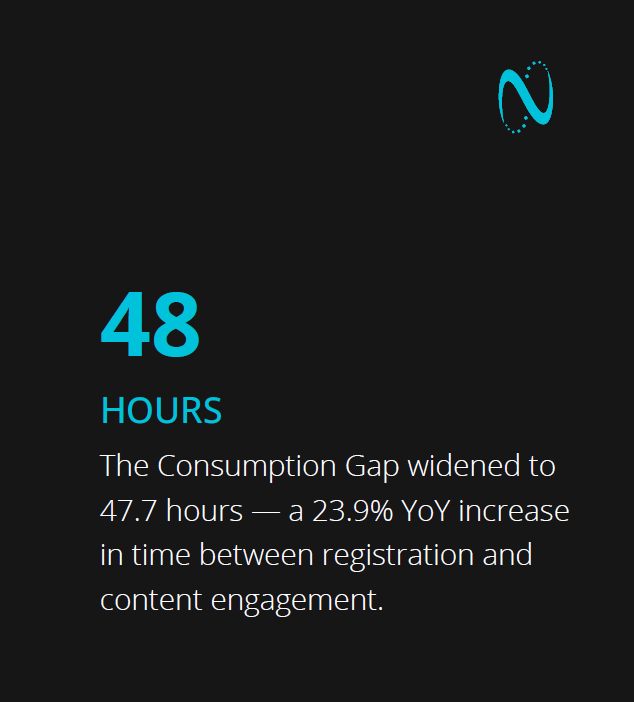
48 hours.

He’s basically a prophet… like Galileo, but without the telescope.

Why This Matters

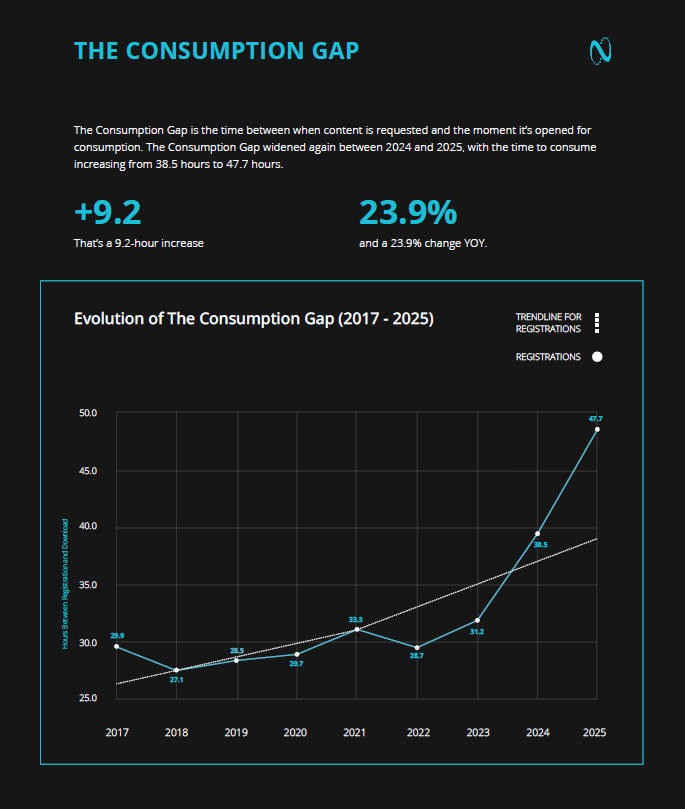
In 2025, the average B2B professional waited 47.7 hours between registering for content and actually opening it. That’s a 9.2-hour jump year over year—a 23.9% increase from 2024—and the widest Consumption Gap NetLine has measured in ten years of tracking. 

I checked the math. Then I checked it again, because #Science. It’s correct.

The market is recalibrating. Think of it like the reclassification of Pluto—hey, another great philosopher mentioned!—things shift, categories evolve, and what was once a simple solar system gets a little more complicated. (Sorry. I’ve had this helmet on too long.)

Here’s what I need you to hear, though: 47.7 hours is not a distress signal. It’s a delay signal. 

There’s a massive difference between a buyer who doesn’t care and a buyer who cares deeply but hasn’t gotten there yet. The Consumption Gap measures the second one.

Since 2021, the Gap has expanded 43.2%. Over that same period, demand for gated content grew 57.6%. Those aren’t opposing forces—they’re the same story. Buyers want the content. They’re just busier, more distracted, and more overwhelmed than ever. The culprit isn’t apathy. It’s a lack of urgency. And urgency, unlike interest, cannot be manufactured.

What your content can do is make sure that when urgency finally arrives—and it will—you’re already trusted and already in the room.

What’s on Luna’s Radar

There’s a lot of signal in these numbers. But keep on target, Explorer. Here’s what the radar’s revealed.

  • You have two clocks. Stop mixing them up. Clock One starts at registration—peak brand recall. They’ve seen your title and your logo (if it’s not on the cover of your gated content, that’s your next mission), and they cared enough to hit submit.

    This is not your moment to pitch. It’s your moment to say hello and nothing else. Acknowledge, wish them well, disappear. Then wait 48 hours.

    Clock Two begins when the download occurs—when they’ve actually decided it’s time to consume the content—and the conversation has context.

    So, what happens if you confuse these clocks? Well, you’ve surely seen a space movie or six, but confusing these clocks is a big problem big enough to tell Houston. You’ve either gone silent when a nudge would have landed, or you’ve pushed for a discovery call with someone still on the first paragraph. Neither outcome serves you. Neither moves the deal.
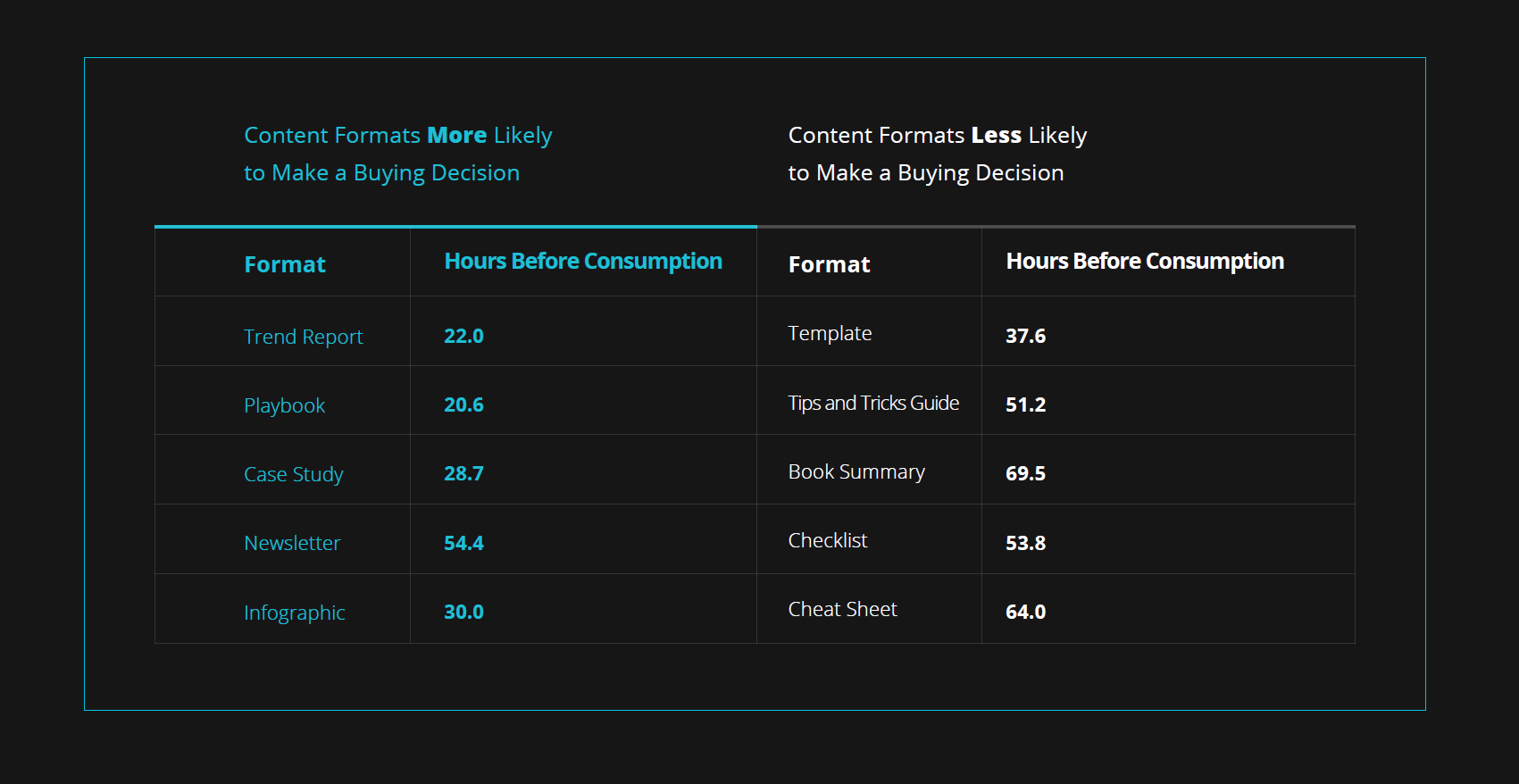
  • The format your buyer chose is a tell. Read it. I’m an astronaut, which means I know a thing or two about reading instrument panels.A Playbook registrant who opens in 20.6 hours? That’s urgency—a buyer with a problem to solve right now. A Cheat Sheet sitting unopened for 64 hours? Real interest, zero urgency.Don’t expect a purchase decision from that lead for at least two quarters. Treating both registrants the same way is like wearing the same spacesuit on Mars and the Moon. It fits neither mission.


  • The higher the title, the longer the wait—but don’t write them off. C-suite professionals clocked a 48.3-hour Consumption Gap in 2025. Owners hit 59.0 hours. VP and Senior Director gaps ballooned 43% and 50% year over year. But the fastest consumers? Executive VPs (31.4 hrs), Senior VPs (31.7 hrs), and Directors (39.5 hrs).

    These are the people building the internal case, vetting vendors, and preparing C-suite recommendations. They’re moving fast because the pressure is on them. Engage those fast movers quickly and substantively.

    Give the C-suite the patience and proof points they’ll need when their moment comes—because when it does, they won’t be slow at all.

Looking Through the Telescope

  • Buyers aren’t saying no. They’re saying not yet. Nearly half of B2B professionals (45.9%) expect to make a purchase decision within the next 12 months. But near-term intent (within 3 months) dropped 15.7% year over year, while mid-range intent—the 6–12 month window—surged 78.6%.

    The average B2B customer journey spans 211 days and 76 touches before a deal closes. No amount of AI-compressed research eliminates the stakeholders, politics, and competing priorities standing between a registration and a signature. Stop trying to rush it.
  • A registration is research in motion, not a transaction in progress. Your job isn’t to manufacture urgency. It’s to be so consistently present and genuinely useful that when the moment arrives, you’re the obvious choice.

    Ask yourself: which of your assets are pulling real qualified traffic, and which ones are just taking up space debris? Don’t be afraid to scrub the launch and begin again.

Your Mission Checklist

  • Audit your follow-up sequences. Are you reaching out at Clock One or Clock Two? Shift to Two—and make sure your Clock One message asks for absolutely nothing.
  • Let format dictate your follow-up timing. A Playbook registrant and a Checklist registrant are not on the same trajectory. Stop treating them like they are.
  • Build nurture programs for both fast movers and slow ones. EVPs and SVPs are doing the legwork—meet them with substance. C-suite needs patience and proof points. Give both what they actually need.
  • Stop trying to manufacture urgency. Start earning presence. The 48-Hour Rule is the first step. Wait for the gap to close before you try to bridge it.

The 2026 content universe is not waiting for anyone to catch up.

The Consumption Gap isn’t a crisis. It’s a reality—and the B2B programs that build around it, rather than fight it, are already light-years ahead of the competition.

Don’t forget, cadet, there’s plenty more to be discovered amongst the stars…oh, and also, the 2026 State of B2B Content Consumption and Demand Report!

Categories B2B

The AI Perception-Reality Gap

There’s a widening gap between what the market says about AI and what we actually hear from customers. The media, the VCs, the AI labs, and influencers have all talked about AI replacing humans, ripping out trusted software, and token-maxxing as ends worth pursuing. But the leaders running real businesses are increasingly asking the right questions. How do I make my people better with AI? Which systems can I trust? How can I measure the ROI of this spend? We hear these questions every day.

After three and a half years of building, shipping, and watching many of our growing customers put AI to work, the AI perspectives we are most certain of at HubSpot are the things almost no one else is saying out loud.

Here are six of them.

AI activity is not AI outcomes.

The industry has confused motion for progress. Drafting emails, generating summaries, doing research. These are activities that AI has made much easier. They are useful capabilities, and we ship them at HubSpot. But activity is the input, not the result. Activity without outcomes is theater.

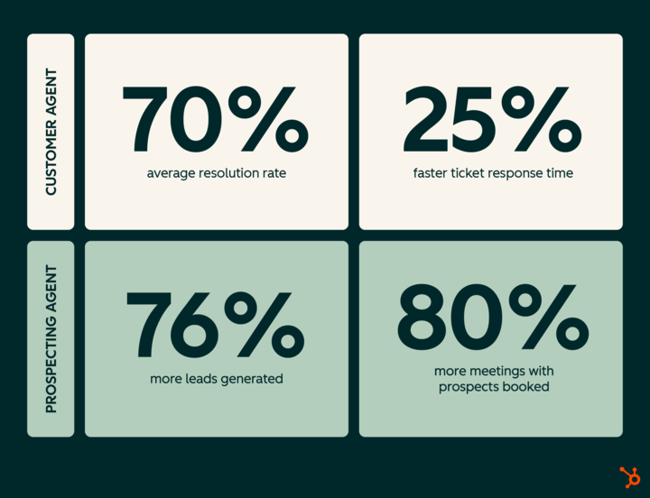
The companies winning with AI are the ones working backwards from a business problem, not forward from a model demo. For example, customers using Customer Agent are responding to tickets 25% faster, while those using Prospecting Agent are generating 76% more leads.

Graphic comparing customer agent and prospecting agent outcomes. Customer agents show a 70% average resolution rate and 25% faster ticket response time. Prospecting agents show 76% more leads generated and 80% more meetings with prospects booked

This is why we moved Customer Agent and Prospecting Agent to outcome-based pricing in April. AI outcomes are what matter. And they’re what we help growing businesses deliver. We put our pricing where our point of view is.

AI is necessary. It is not sufficient.

Generating code is certainly easier now. Anyone can build a prototype in a weekend, but it’s brittle and falls apart under real use. Lowering the floor on generating code doesn’t raise the ceiling on shipping value because the things that actually run a growing business have gotten harder, not easier.

You still need to have clean data, not another silo. You still need to integrate with tens of applications. You still need a full customer view across marketing, sales, and service, one actually powered by context.

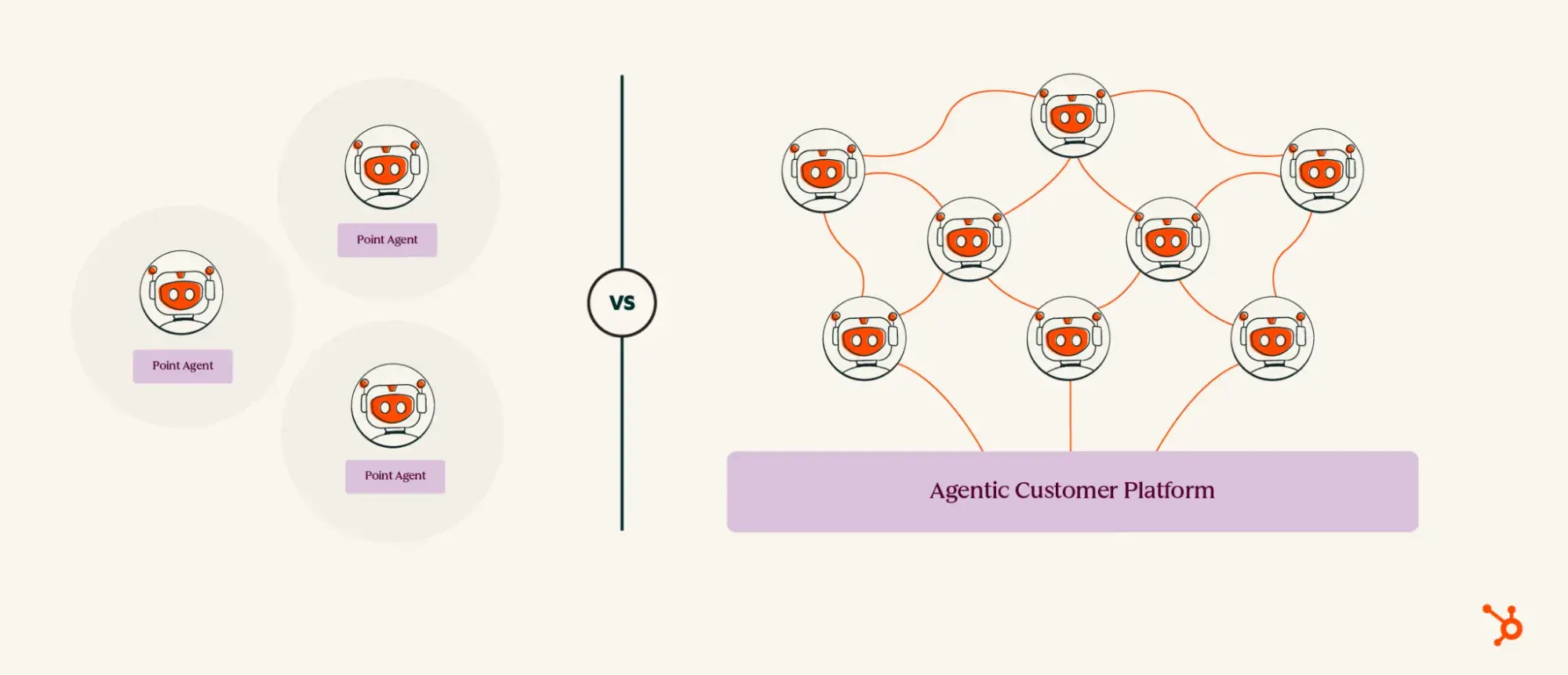
The industry will sell you a model or single-purpose agents. But it won’t sell you the system in between: the data hygiene, the workflow design, the change management. That’s left to the customer. And the more disconnected point agents pile up, the harder that work gets.

Comparison diagram showing disconnected point agents versus integrated agentic customer platform with shared network

The future belongs to the companies that build AI into a coherent system, where the data, workflows, agents, and people share context. That’s what we are building at HubSpot. AI is a new layer, not a replacement for the foundation.

AI needs to be built for the Future 5000, not just the Fortune 500.

Today’s AI roadmap is being written for the enterprise that can afford to make it work. By their own disclosures, frontier labs are spending billions of dollars on forward-deployed engineers to get AI running inside large companies.

That model works if you’re a large enterprise. It doesn’t work for the millions of growing businesses that will drive the next decade of growth. A small or midsize company can’t get forward-deployed engineers, rebuild its data pipeline, or build the context platform to make it all work.

So when the consensus says “AI is for everyone,” it’s worth asking who it actually works for today. In practice, it’s the customers who can already afford to make it work, with armies of engineers and developers behind them. That’s not democratization.

We’re optimizing for outcomes per token, not tokens per task.

There’s a business-model conflict in the AI industry that customers haven’t fully seen yet. The vendors who benefit the most from AI usage are not incentivized to make AI cheaper or more efficient. They are incentivized to keep the meter running. So customers are asked to pay for activity and told they are buying transformation.

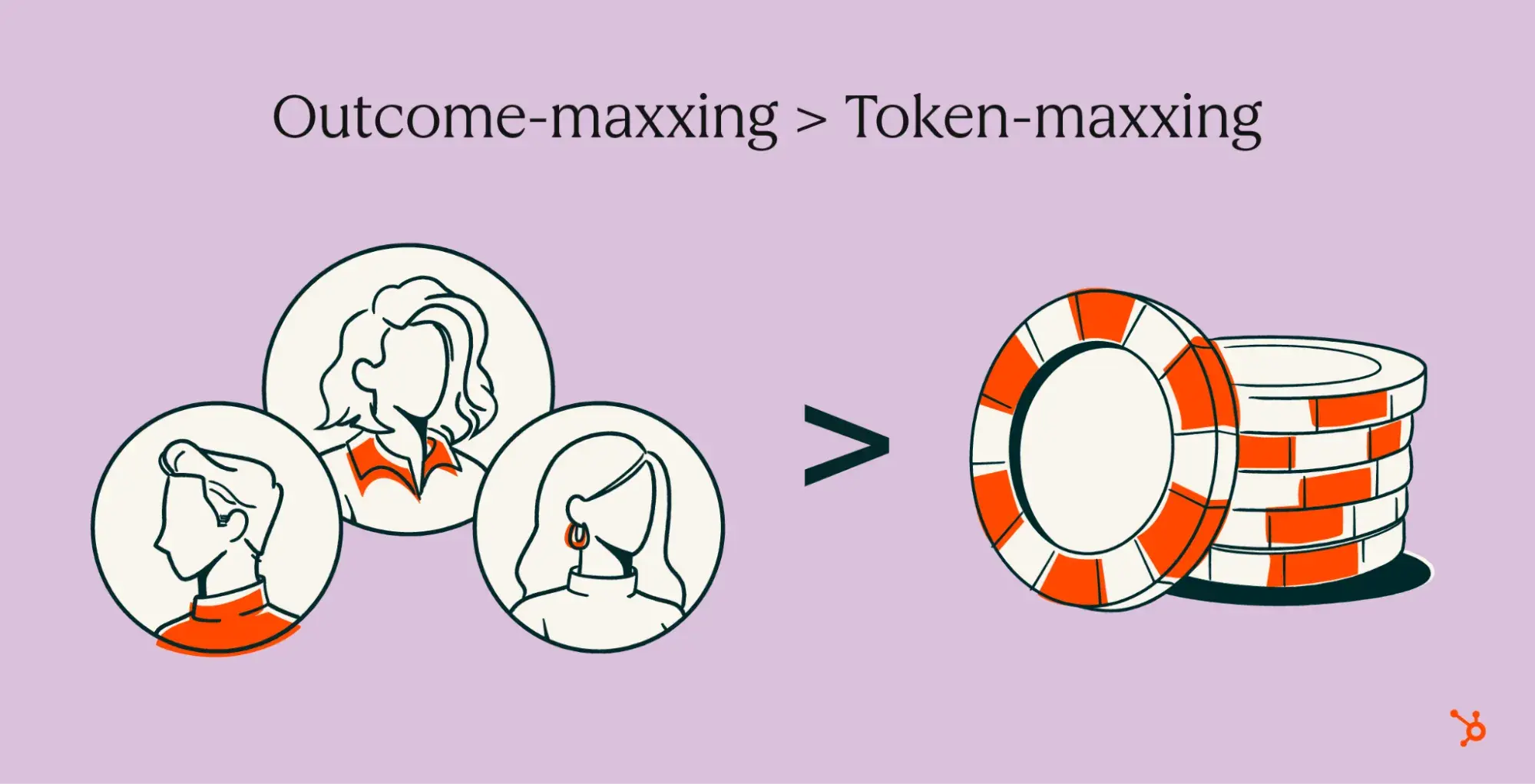
The honest version of AI economics is the inverse: be clear on the outcome the customer is trying to drive, then find the lowest-cost path to driving it. That is the customer’s job. It should also be the vendor’s. Right now, it isn’t.

Illustration comparing three people on left to database symbol on right, representing outcome-maximizing over token-maximizing

Token-maxxing is the vendor’s game. Outcome-maxxing is the customer’s. The vendors that align with the customer will win. The vendors that align with the meter may not.

AI should make people more powerful. Not more replaceable.

The loudest AI narrative is autonomy: agents replace humans, headcount goes down, the future has fewer people in it. That narrative is built for Wall Street, not Main Street. We reject that framing.

We build for the person doing the work, not the person being subtracted from the budget. The rep closing more deals. The marketer shipping more campaigns. The service person solving more complex problems. The owner running more of the business themselves. AI’s job is to make them more powerful, not make them disappear.

Yes, we ship autonomous agents. But autonomy is a capability, not a mandate. Customers decide where to delegate, where to keep humans in the workflow, and where AI suggests. Our defaults are built to serve the operator, not slash the org chart.

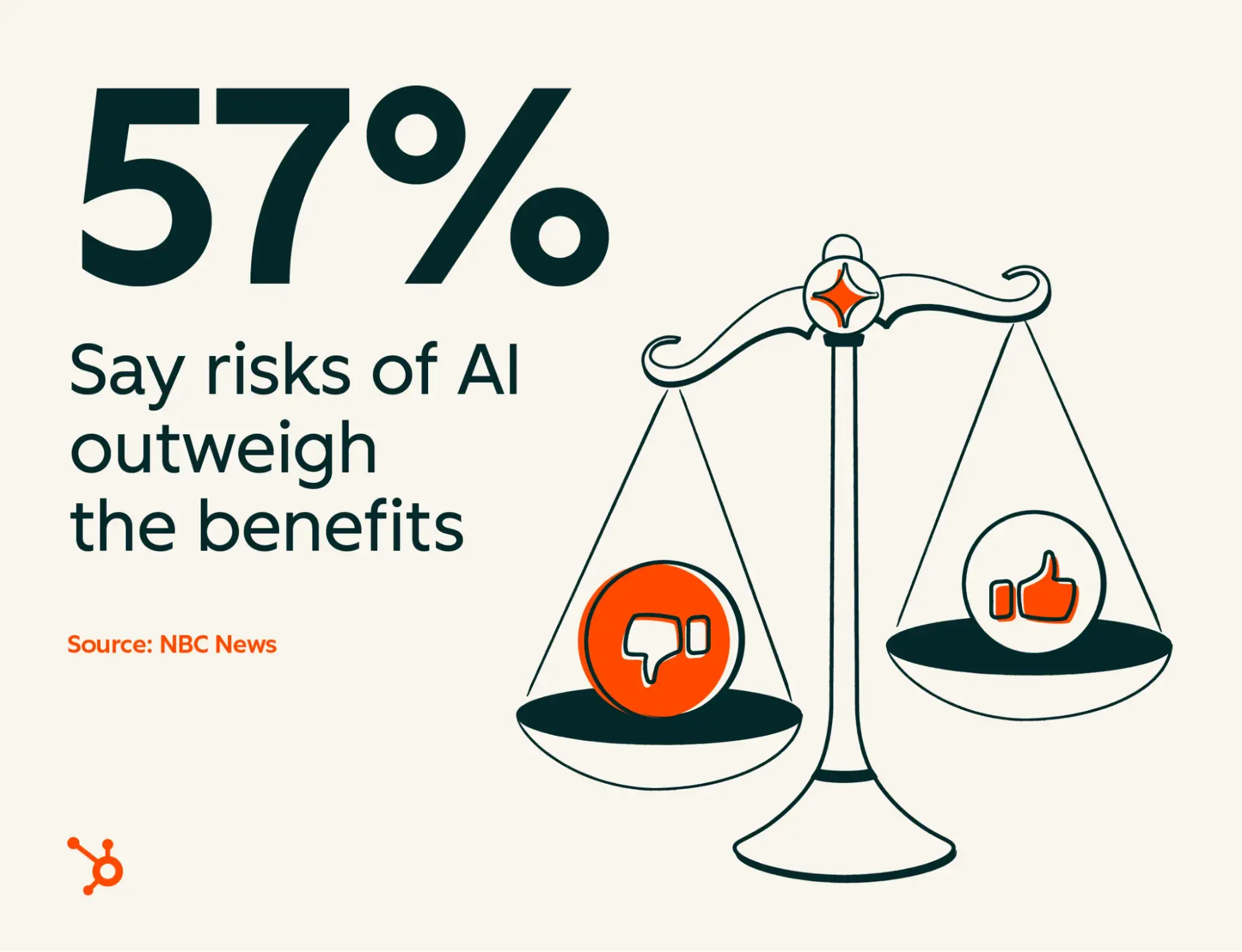
We believe in human authenticity and AI efficiency. The things AI cannot replace — trust, judgment, taste, relationship will only get more valuable as the things AI can do become ubiquitous. The companies betting against the human are going to lose the customer, the employee, and eventually the public, of which 57% already think the risks of AI outweigh its benefits.

Scale showing 57% of people say AI risks outweigh benefits, with thumbs down and thumbs up icons

Trust is more than a privacy policy.

Every AI vendor is claiming trust. But most define it as a security posture: we won’t train on your data, we’re SOC 2 compliant, we offer enterprise SSO. Those things matter. They are also table-stakes. None of them is a differentiated claim. They are what you promise.

What you prove is something else. Real trust is a complete business posture: how you choose the model and handle cost, reliability, and governance for your agents. That’s what customers are actually asking for. Can I trust the model choice? Can I trust the cost? Can I trust the reliability? Can I trust the governance?

Privacy answers what we won’t do. Trust answers what we will. Most of the industry is still answering the first question. The second is the one customers need.

What this all adds up to

The AI consensus held so long as no one in the room had to answer for it. Cut headcount. Rip out the old stack. Keep the meter running. Trust us.

Growing businesses cannot spend time cutting through what is hype versus what is reality. They do not have forward-deployed engineers to throw at implementation. They cannot absorb a pricing model that bills for activity and calls it transformation. They cannot build on a stack that treats humans as the exception.

They need AI built on a foundation that works for them, designed to empower and not eliminate their people, and delivered by a vendor whose business model is aligned with theirs, not against it.

That is what we are building at HubSpot.

Categories B2B

6 top answer engine optimization benefits for growth and enterprise marketers

The AEO benefits that matter most to marketing leaders have shifted from theoretical to measurable. As more buyers discover brands through AI tools like ChatGPT, Google AI Overviews, and Perplexity, the teams investing in AEO now are seeing real returns in conversions and long-term authority.

Free AEO Grader: See Your Brand's Visibility in Answer Engines [Free Tool]

But capturing the full benefits of answer engine optimization requires way more than just knowing it matters. B2B marketers face persistent AEO challenges: unclear ROI measurement, no standardized frameworks, friction in integrating AEO with existing SEO strategies, and gaps in structured data implementation.

Meanwhile, the landscape keeps moving. New AEO tools are maturing, optimization trends are shifting quarterly, and generative engine optimization is creating entirely new surfaces to compete on. More critically, it’s ceding authority to competitors who are already optimizing content for AI search.

This guide breaks down six tangible benefits of AEO with the actionable details you need to build a business case, overcome common blockers, and start executing. You’ll learn how AEO differs from traditional SEO, how the perks of AEO-focused tools make measurement and scaling practical, and how to integrate AEO into your existing content strategy, whether you’re working with AI agents, evaluating AI costs, or refining AEO best practices across your team.

Table of Contents:

Why Answer Engine Optimization’s (AEO’s) Benefits Are Clearer Than Ever

AEO is the practice of structuring your content so AI-powered search engines (think ChatGPT, Google AI Overviews, Perplexity, and Claude) can extract, understand, and cite your brand’s information as a direct answer to user queries.

Unlike traditional SEO, which focuses on ranking pages in a list of blue links, AEO focuses on:

  • Entity clarity
  • Structured data
  • Direct-answer formatting (so large language models can confidently surface your content)

To help you visualize the difference, here’s a comparison table I put together that compares traditional SEO and AEO side by side:

Here’s my take: AEO is fundamentally reshaping the customer journey. Buyers increasingly get their answers before they ever click through to a website, which means the brands that appear in AI-generated responses are the ones doing the following:
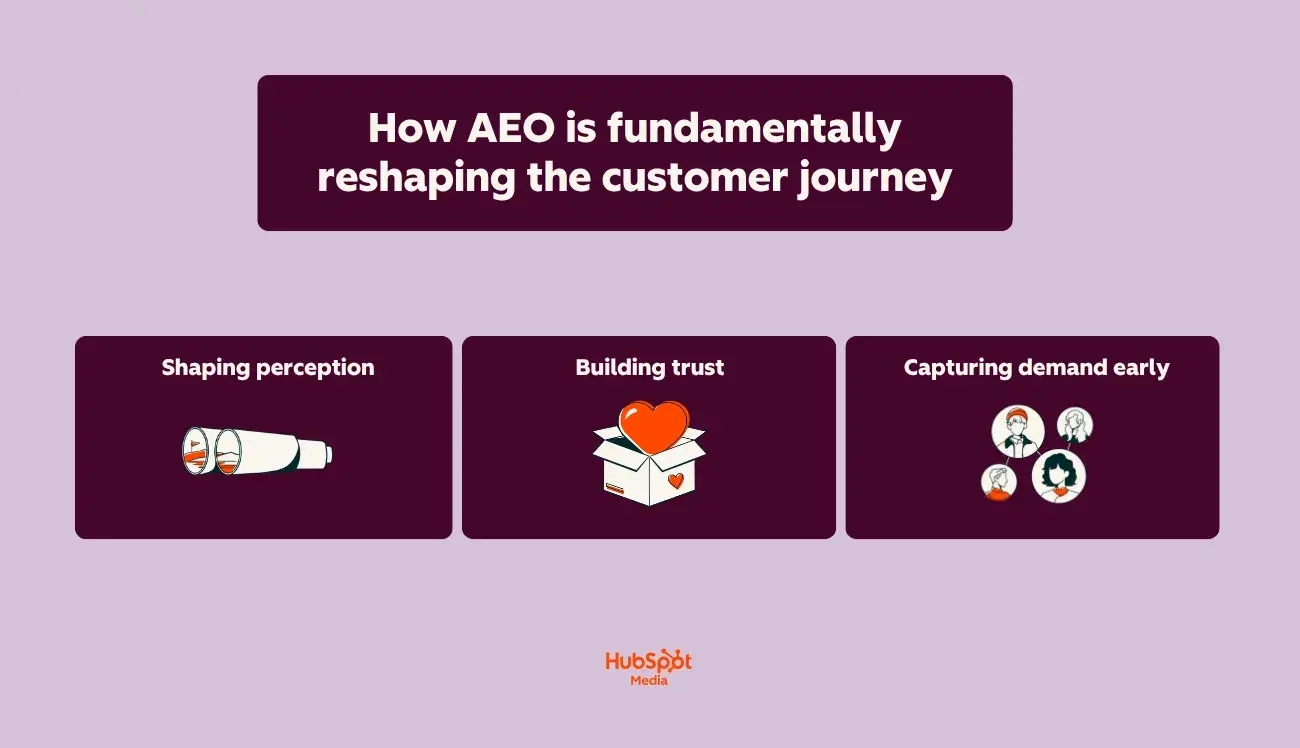
a hubspot-branded image showcasing how AEO is fundamentally reshaping the customer journey

  • Shaping perception
  • Building trust
  • Capturing demand at the earliest possible moment

AEO increases brand visibility in AI-powered search results, and that visibility compounds over time as AI systems learn to associate your brand with authoritative, well-structured answers. For marketing leaders, this isn’t a “nice-to-have” anymore. It’s a direct line to pipeline influence.

AEO’s benefits are becoming measurable in ways they weren’t even a year ago. Early adopters are reporting stronger engagement metrics, shorter sales cycles, and improved content ROI, all because their content is formatted for how people actually search today.

That said, AEO benefits don’t materialize without addressing real AEO challenges head-on. Here’s a succinct breakdown of the most common blockers for marketing teams:
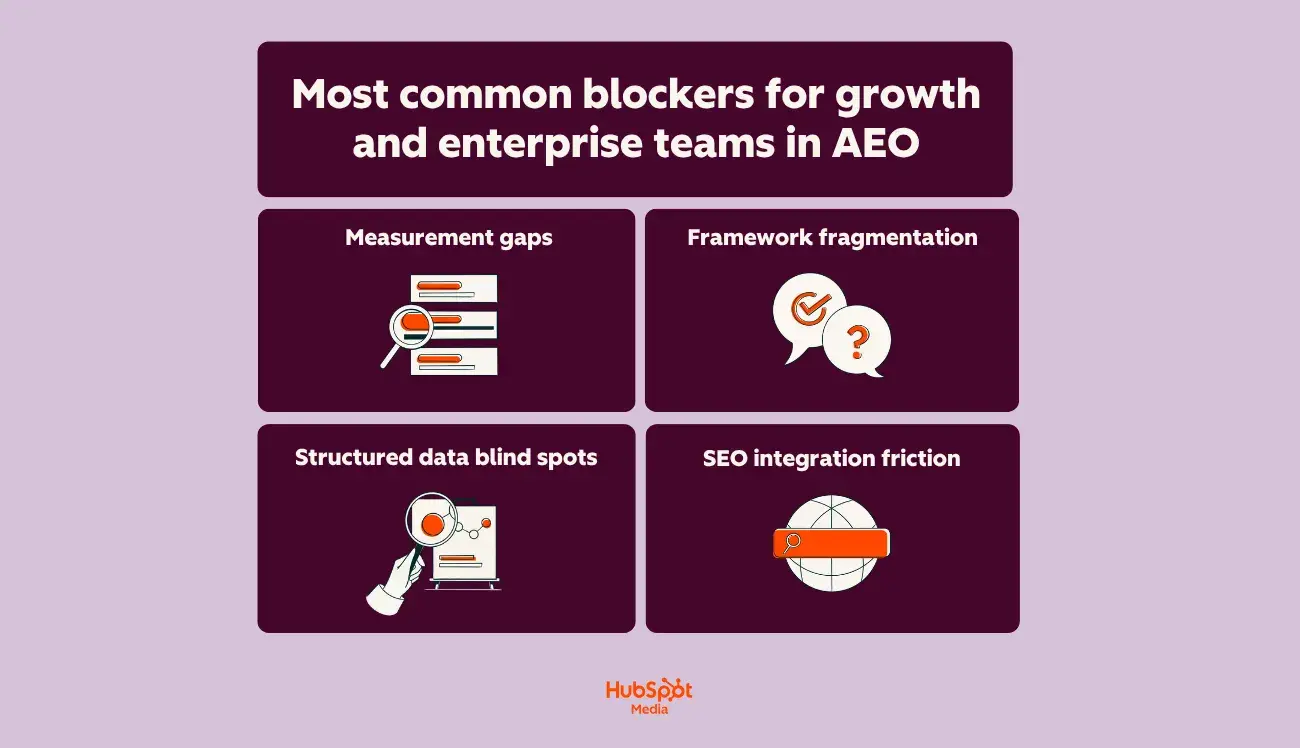
an image explaining and defining the most common blockers for growth and enterprise teams in AEO

  • Measurement gaps. Traditional rank-tracking tools weren’t built for AI answers, making it difficult to quantify AEO ROI or tie citation appearances back to revenue.
  • Framework fragmentation. Many teams lack a repeatable, actionable process for optimizing content specifically for LLM retrieval, so efforts stay ad hoc.
  • SEO integration friction. AEO differs from traditional SEO by focusing on direct answers and entity clarity, but that doesn’t mean you abandon your existing SEO stack. The challenge is layering AEO on top of what’s already working without duplicating effort or creating governance headaches.
  • Structured data blind spots. Structured data and entities support AEO by enabling AI systems to extract and cite information, yet many marketing teams still under-invest in schema markup, entity definitions, and content architecture that LLMs can parse.

But there is good news, reader: the benefits of utilizing tools designed specifically for the shift toward AEO are making each of those challenges more manageable.

The difference now? The payoff is more direct, and the feedback loop is faster.

Pro Tip: HubSpot’s AEO Grader, for example, lets you measure your AEO visibility and performance across answer engines, providing a concrete baseline, identifying gaps in your content’s answer-readiness, and offering prioritized recommendations so you can take action immediately.

Benefits of Answer Engine Optimization (AEO)

AEO’s benefits go well beyond showing up in one more channel.

For marketing leaders, AEO creates compounding advantages across:

  • Visibility
  • Lead quality
  • Long-term brand authority

These are advantages that become harder for competitors to replicate the earlier you start.

With all of this in mind, here are six AEO benefits that map directly to the metrics leadership teams care about:
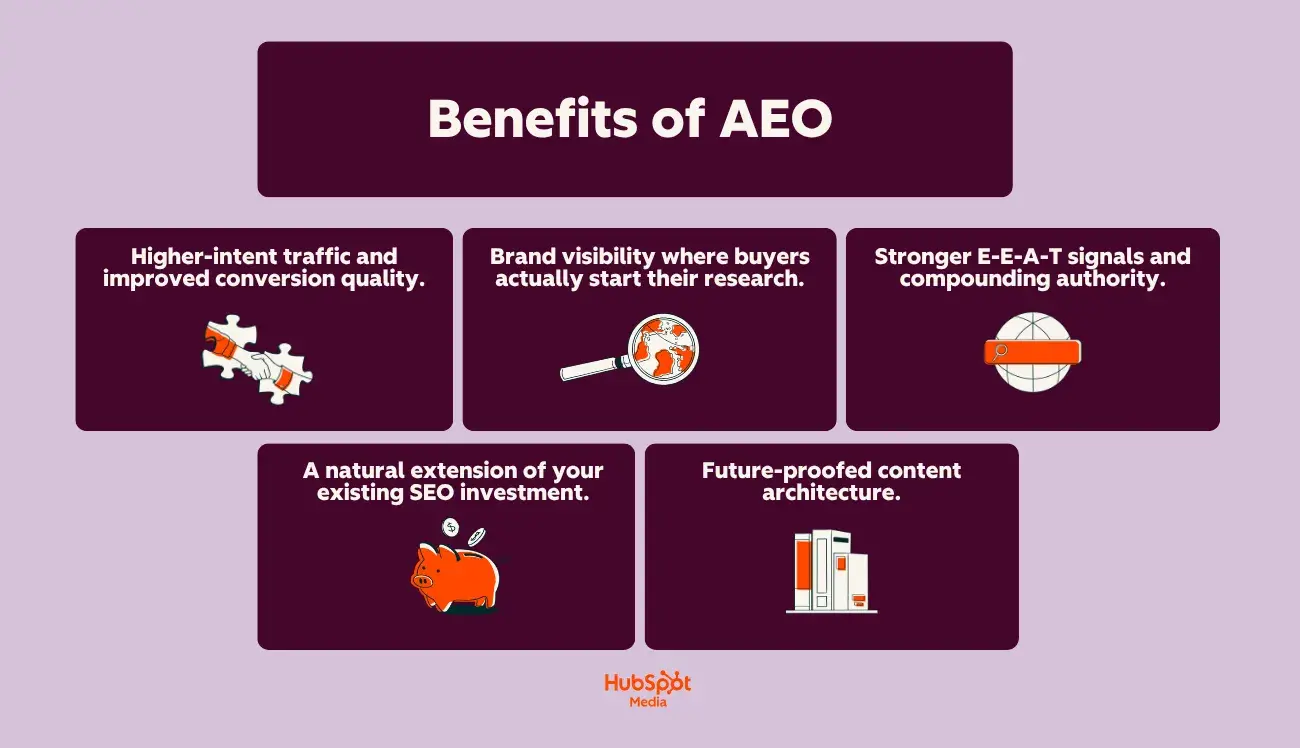
a hubspot-branded image that defines and explains six tangible benefits of AEO

1. Higher-Intent Traffic and Improved Lead Quality

AEO improves lead quality and time to value because, by the time someone clicks your link from an AI answer, the AI answer has already explained the topic, matched their intent, and positioned your content as relevant.

They’ve seen your brand positioned as the authority before they ever hit your site. The result is a shorter path from discovery to action, which means:

  • Fewer bounce-backs
  • More engaged sessions
  • A pipeline that moves faster

2. Brand visibility where buyers actually start their research.

AEO increases brand visibility in AI-powered search results, and that matters because buyer behavior has shifted.

According to HubSpot’s 2026 State of Marketing Report, nearly half of marketers (49%) agree that web traffic from search has decreased because of AI answers. However, 58% note that AI referral traffic has much higher intent than traditional search.

This means that visitors who come from LLMs such as ChatGPT are much further along in their buyer’s journey. Thus, the brands that appear inside AI-generated responses capture demand at the moment of intent formation, not after.

3. Stronger E-E-A-T Signals and Compounding Authority

AEO strengthens E-E-A-T and long-term authority because the optimization work itself (i.e., defining entities, adding structured data, publishing clear and well-sourced answers) is exactly what both traditional and answer engines reward.

Every piece of answer-optimized content reinforces your brand’s entity profile across LLMs, increasing the likelihood of future citations.

4. Measurable Performance with Purpose-Built Tools

One of the biggest AEO challenges has been proving ROI.

Legacy rank trackers weren’t designed to measure AI citations, leaving marketing teams to rely on intuition.

However, that’s changing. To get a baseline snapshot of where your brand stands in AI search today, start with HubSpot’s AEO Grader. Then, to measure your AEO visibility, use HubSpot AEO.

Combined, these tools give you:

  • A concrete score
  • Gap analysis
  • Prioritized recommendations

With this information at your disposal, you can tie optimization efforts directly to outcomes rather than guessing.

5. A Natural Extension of Your Existing SEO Investment

Let me be clear: The benefits of AEO tools become clearest when they layer onto what’s already working.

Here’s why:

  • Your highest-ranking pages become candidates for AI citation optimization.
  • Schema markup and structured data you add for AEO simultaneously improve traditional rich results.
  • Topic clusters built for SEO provide the entity relationships that LLMs need to confidently cite your content.

This means teams can adopt AEO incrementally without rebuilding their content programs from scratch, thereby directly addressing integration friction.

6. Future-Proofed Content Architecture

Voice search, multimodal AI, agent-driven commerce, and zero-click interfaces all rely on the same foundation:

  • Clearly defined entities
  • Well-structured answers
  • Machine-readable relationships

Investing in AEO now means you’re not just optimizing for today’s answer engines. More specifically, you’re building the content infrastructure that scales across every emerging channel.

AEO’s successes are no longer theoretical. They’re measurable, they compound, and they align directly with the visibility and pipeline goals that marketing teams are accountable for.

The teams that treat AEO as a core capability are the ones building defensible brand authority in a fast-evolving search landscape.

Common AEO Challenges (And How to Solve Them)

AEO’s benefits are well-documented at this point.

But knowing the upside doesn’t eliminate the friction of actually executing. Most marketing teams face the same set of AEO challenges when they try to move from experimentation to a scalable program.

Here are six of the most common blockers and, most importantly, how to solve each one:

1. You can’t measure AEO ROI with your current stack.

This is another challenge that prevents AEO programs from doing well. Traditional SEO tools track keyword rankings and organic clicks, but they weren’t built to monitor whether your brand is being cited inside AI-generated answers. Without that data, it’s nearly impossible to justify the budget or prove the impact to leadership.

How to solve it: Adopt purpose-built AEO measurement tools. HubSpot’s AEO Grader measures your AEO visibility and performance across answer engines, giving you a baseline score, a gap analysis, and prioritized actions, so you can report on AI citation presence with the same rigor you apply to organic traffic.

The pros of AEO tools like this compound quickly. Once you have a measurable baseline, every optimization becomes trackable.

Pro Tip: Also use HubSpot AEO to continuously monitor your brand visibility and presence, so you can catch visibility gains or drops in real time and connect them directly to the content changes driving them.

2. There’s no repeatable framework for optimizing content for LLMs.

Many teams attempt AEO in bursts (e.g., restructuring a handful of pages or adding some schema markup) without a systematic process. The work likely feels ad hoc because it is, and, on top of that, it doesn’t scale.

How to solve it: Build a repeatable AEO content workflow with defined steps.

To get started, do the following:

  • Audit existing high-traffic pages for answer-readiness (clear definitions, entity clarity, structured data).
  • Prioritize by search intent (start with pages that already target question-based queries).
  • Optimize by adding concise, direct-answer paragraphs at the top of each section, implementing relevant schema markup, and defining entities explicitly so LLMs can parse relationships.
  • Measure and iterate using AEO-specific tools to track citation appearances after each round of updates.

This turns AEO from a one-off project into an operational capability your team can run quarterly.

3. AEO feels like it conflicts with your existing SEO strategy.

Naturally, teams worry about duplicate effort, conflicting priorities, or cannibalizing what’s already working.

How to solve it: Treat AEO as a layer on top of SEO. Your highest-ranking pages are your best AEO candidates because they already have topical authority.

The structured data you add for AI citation eligibility simultaneously improves traditional rich results. Topic clusters you’ve built for SEO provide the entity relationships LLMs need.

When framed this way, AEO reinforces your existing investment rather than competing with it.

4. Structured data and schema markup feel too technical to implement at scale.

Many marketing teams lack the technical resources to implement schema across hundreds or thousands of pages. The gap between “knowing it’s working” and “getting it done” is, unfortunately, quite real.

How to solve it: Start with high-impact, low-effort schema types.

The following three are examples of schema types that don’t require heavy engineering lift:

  • FAQ schema for pages that answer common questions (requires minimal dev effort and directly signals answer content to LLMs).
  • Organization and author schema to reinforce E-E-A-T signals and entity identity.
  • HowTo schema for process-oriented content.

5. Leadership doesn’t understand why AEO matters, so it doesn’t get resourced.

Even when practitioners see AEO’s benefits clearly, securing buy-in from VP- and C-level stakeholders requires tying AEO to business outcomes they already track:

  • Pipeline
  • Revenue influence
  • Competitive positioning

How to solve it: Frame AEO in terms leadership already cares about. Answer engines are projected to handle a growing share of queries that previously drove organic traffic, meaning brands that aren’t cited in AI answers risk losing the visibility they’ve spent years building.

When pitching AEO to leadership, position it as risk mitigation and a competitive advantage. Then, use your AEO Grader score as a benchmark and show progress over time alongside pipeline metrics.

6. You don’t know which answer engines matter or how they select sources.

Each LLM (i.e., ChatGPT, Google AI Overviews, Perplexity, Claude) has different retrieval behaviors, which makes it unclear where to focus. This ambiguity leads to paralysis.

How to solve it: Optimize for shared fundamentals rather than platform-specific quirks.

Focus on making your content the most clear, well-structured, and authoritative answer to the queries your audience asks. In the era of AEO, that consistency extends everywhere and has a ton of influence.

The AEO challenges above are real, but none of them are unsolvable. The teams enjoying the advantage of AEO right now aren’t the ones with the biggest budgets or the most technical resources.

They’re the ones who identified these blockers early, built practical solutions for each, and committed to AEO as an ongoing capability rather than a one-time experiment.

A Checklist to Get Started With AEO

The biggest AEO challenges aren’t technical. They’re operational.

Most teams struggle with AEO because they don’t have a clear sequence of steps. This checklist gives you a repeatable, tool-supported workflow to start capturing the AEO’s benefits within your first 30 days.

Take a look:
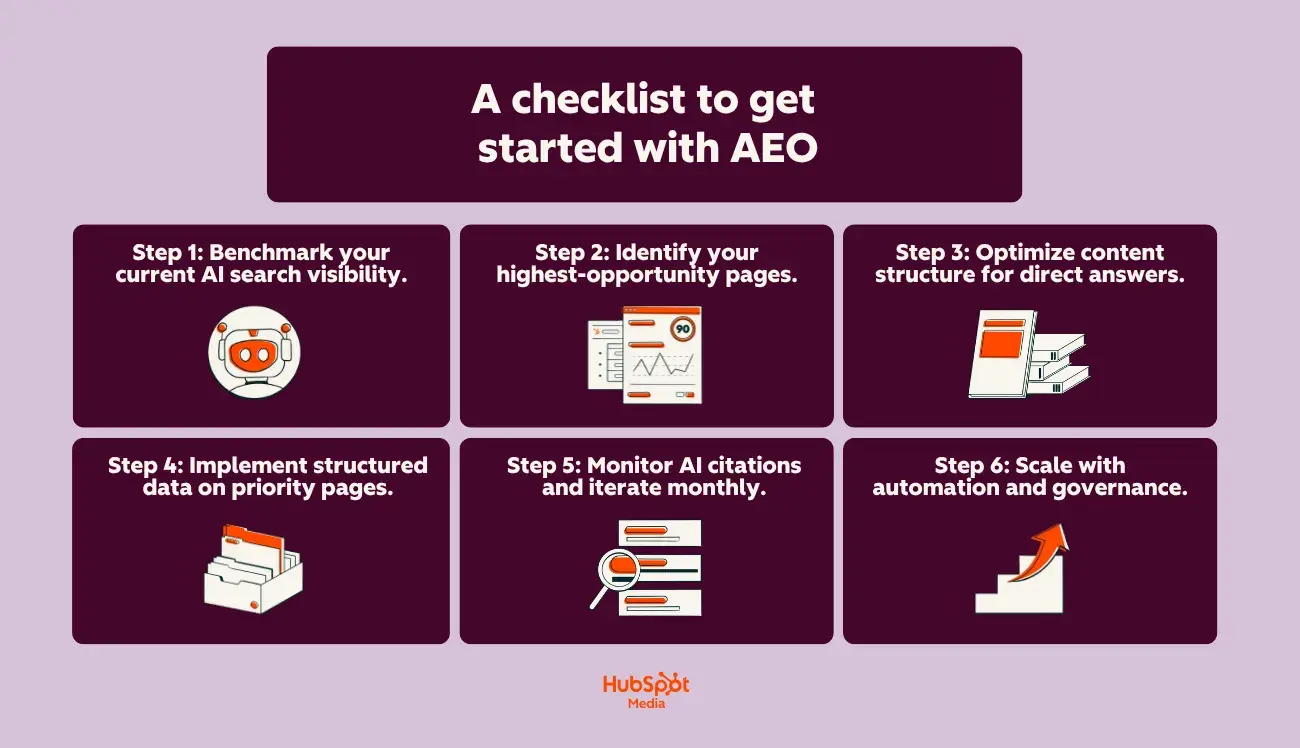
a hubspot-branded featured image defining what’s on a checklist to get started with AEO

Step 1: Benchmark your current AI search visibility.

You can’t improve what you haven’t measured.

Before optimizing anything, establish a baseline of how often (and where) your brand appears in AI-generated answers. HubSpot’s AEO Grader measures your AEO visibility and performance across major answer engines, giving you:

  • A scored assessment
  • A gap analysis
  • Prioritized recommendations in minutes

Run your domain through it first so every optimization that follows is trackable against a concrete starting point.

Tool recommendation: HubSpot’s AEO Grader for your initial visibility score and gap report.

Step 2: Identify your highest-opportunity pages.

Not every page on your site needs AEO optimization on day one.

Start with the content that already has topical authority and organic traffic. These pages have the strongest signals for LLMs to pick up.

To identify your highest-impact AEO opportunities, do the following:

  • Pull your top 20 organic pages by traffic and identify which ones answer specific questions your audience asks.
  • Cross-reference with your AEO Grader results to see which topics are already appearing (or missing) in AI answers.

Tool recommendation: AirOps for automating content audits at scale. It can programmatically evaluate pages for answer-readiness, entity clarity, and gaps in structured data across large content libraries without manual page-by-page review.

Step 3: Optimize content structure for direct answers.

AI answer engines extract information most reliably when content is clearly structured and relationships are explicitly stated.

For each priority page, make these changes:

  • Lead with a direct-answer paragraph. Open each section with a concise, definition-style response to the question the section addresses. Keep it under 50 words so it can be extracted as a standalone answer.
  • State entity relationships explicitly. Use semantic triples throughout (for example, “AEO increases brand visibility in AI-powered search results”). This way, LLMs don’t have to infer meaning from context.
  • Cap paragraphs at five sentences. Break longer passages into bullet points to improve both reader scannability and AI parseability.

Tool recommendation: HubSpot’s Content Hub enables the creation and management of answer-friendly content formats with built-in support for structured data, making it easier to publish and maintain optimized content at scale.

Step 4: Implement structured data on priority pages.

Focus on these three high-impact schema types first:

  • The FAQ schema on any page that answers two or more distinct questions.
  • Organization and Author schema to reinforce your brand entity identity and E-E-A-T signals.
  • HowTo schema on process-oriented content (guides, tutorials, walkthroughs).

You don’t need a full dev sprint for this. Most CMS platforms support schema plugins, and Content Hub handles structured data natively across templates.

Step 5: Monitor AI citations and iterate monthly.

The more obvious pros of AEO tools become most valuable in the overall feedback loop. That said, be sure to set up ongoing monitoring so you can see:

  • Which pages are earning AI citations
  • Which queries trigger them
  • Where competitors are showing up instead of you

Then, review results monthly, re-run your AEO Grader assessment quarterly, and use each cycle to prioritize the next batch of pages for optimization.

Tool recommendation: Use Perplexity as a testing surface. (Run your target queries directly in Perplexity to see whether your content is being cited, how it’s being summarized, and what competing sources appear alongside it.)

Step 6: Scale with automation and governance.

Once your initial pages are optimized and you’re seeing measurable results, the next challenge in AEO is scaling without losing quality or consistency. This is where automation tools pay for themselves.

  • Establish editorial governance by documenting your AEO standards (i.e., required schema types per content format, semantic triple density, direct-answer paragraph requirements, and review cadence).
  • AEO benefits compound fastest when optimization is systematic rather than ad hoc. Treat this checklist as a repeatable quarterly cycle.

Tool recommendation: AirOps for building automated AEO workflows (i.e., programmatic content audits, bulk schema generation, and AI-assisted optimization recommendations across your entire content library).

Again, AEO strengthens E-E-A-T and long-term authority with every optimization cycle you complete.

The teams capturing the full perks of AEO right now aren’t doing anything beyond your reach. They’re simply following a clear process, using the right tools, and committing to iteration. Start with Step 1 today and build from there.

Frequently Asked Questions (FAQ) About AEO Benefits

How long does AEO take to show results?

Most teams begin seeing measurable changes in AI citation visibility within 30 to 90 days of implementing structured optimizations, though the exact timeline depends on:

  • Your starting point
  • Content volume
  • How aggressively you optimize

Additionally, quick wins like adding FAQ schema, rewriting introductory paragraphs as direct answers, and clarifying entity definitions can surface in AI responses relatively quickly because LLMs recrawl and reindex authoritative content more frequently than many marketers expect.

Overall, the longer-term advantages of AEO compound over time. As AI systems repeatedly encounter your brand associated with clear, well-structured answers, they build stronger entity associations, which means your content gets cited more frequently and across a wider range of queries.

Pro Tip: HubSpot’s AEO Grader measures your AEO visibility and performance so you can benchmark where you are today and track progress at regular intervals rather than guessing at timelines.

Does AEO risk cannibalizing my existing rankings?

No. Optimizations actually reinforce traditional ranking signals rather than competing with them.

Here’s why:

  • Structured data you add for AEO eligibility simultaneously improves rich results in traditional search.
  • Direct-answer formatting (concise definitions, clearly stated relationships) aligns with what Google already rewards for featured snippets.
  • Entity clarity (also known as the consistent representation of your brand, products, and people across the web) and E-E-A-T improvements strengthen your domain authority across both AI and traditional answer engines.

All in all, the benefits of the AEO layer on top of your existing SEO investment. Teams that treat them as complementary, not competing, consistently see gains in both channels.

Should I change my site architecture specifically for AEO?

In most cases, you don’t need a full architectural overhaul.

If your site already uses a logical topic cluster structure with clear internal linking, you have a strong foundation. But to make that structure legible to LLMs, do this:

  • Implement schema markup (FAQ, HowTo, Organization, Author) on your highest-traffic pages first.
  • Ensure each page has a clearly defined primary entity and states relationships explicitly in the opening paragraphs.
  • Use internal links to connect related entities across your content hub so LLMs can follow the same topical paths your readers do.

Pro Tip: HubSpot’s Content Hub enables the creation and management of answer-friendly content formats with built-in support for structured data, making these changes easier to implement at scale without re-platforming.

How does AEO impact voice assistants and smart devices?

Voice assistants like Siri, Alexa, and Google Assistant pull answers from the same AI retrieval infrastructure that powers text-based answer engines, which means AEO’s capabilities extend directly to voice search.

When your content is structured as a clear, concise, direct answer with strong entity definitions, it becomes eligible for voice responses. .

This is important because voice queries tend to be conversational and question-based, which is exactly the format AEO optimizes for.

Do I need developer resources to start AEO?

Not to get started. Many of the highest-impact AEO optimizations are content-level changes that marketers can execute directly:

  • Rewriting section introductions as direct, definition-style answers to specific questions.
  • Adding explicit relationship statements (semantic triples) throughout your content so LLMs can parse meaning without ambiguity.
  • Structuring content with clear headings that mirror the questions your audience actually asks.

Overall, developer support becomes more valuable when you’re ready to scale, particularly for:

  • Implementing schema markup site-wide
  • Automating structured data across templates
  • Integrating AEO performance data into your reporting dashboards

AEO tools that are purpose-built for this type of workflow significantly reduce that technical dependency.

Whether you start with a single page or a full site rollout, the best approach is to begin with what your team can execute now and layer in technical resources as the program matures.

The benefits of AEO are evolving every day.

A year ago, most marketing teams treated AEO as an emerging trend worth watching. Today, winning plays for AEO are:

  • Measurable
  • Repeatable
  • Directly tied to the visibility and pipeline metrics that growth and enterprise leaders are accountable for

That shift happened fast, and it’s accelerating.

Here’s what this post covered and why it matters for your next move:

  • AEO is reshaping how buyers discover brands. AEO increases brand visibility in AI-powered search results at the exact moment intent forms — before a prospect ever clicks through to a website.
  • The benefits compound across channels. AEO improves conversion quality (also known as lead quality) and time to value (also known as sales cycle length) because AI-cited traffic arrives pre-qualified. It strengthens E-E-A-T and long-term authority because the optimization work (i.e., entity clarity, structured data, direct-answer formatting) reinforces signals that both AI and traditional search engines reward.
  • AEO’s biggest challenges are solvable now. Unclear ROI measurement, lack of frameworks, integration friction with existing SEO, and structured data gaps are real blockers, but each one has a practical solution. Purpose-built tools, incremental workflows, and a systematic checklist enable you to start capturing results within 30 to 90 days without rebuilding your content program from scratch.
  • AEO tools make execution scalable. From benchmarking your visibility with HubSpot’s AEO Grader to monitoring citations with Profound, automating audits with AirOps, and testing answers in Perplexity, the tooling ecosystem has matured enough to support enterprise-scale programs.

The teams winning in AI search right now aren’t waiting for the landscape to stabilize. They’re treating AEO as a core operational capability, measuring progress with real data, and iterating monthly.

What’s even more? The potential of AEO will only grow as AI systems handle a larger share of the discovery journey, and the competitive advantage will go to the brands that build their foundations now.

Ready to see where your brand stands in AI search? Get started with HubSpot’s AEO Grader.

Categories B2B

AI search behavior: What it means for your marketing strategy in 2026

AI search behavior may be causing a dip in your traffic, but it’s also sending higher-quality leads your way. For marketers, that second part is a massive win. AI search was the number one predictor of purchase intent for CRM software buyers, according to HubSpot’s State of AEO 2026 report. And there are more findings from the report that every go-to-market team needs to know.

In this article, I’ll share the latest findings on AI search behavior, its impact on brand discovery, an answer engine optimization (AEO) strategy you can implement today, and much more.

Free AEO Grader: See Your Brand's Visibility in Answer Engines [Free Tool]

Table of Contents

What is AI search behavior, and why should marketers care?

AI search behavior refers to the actions people take when they’re seeking answers using artificial intelligence, whether that’s asking ChatGPT or consulting Google AI Overviews.

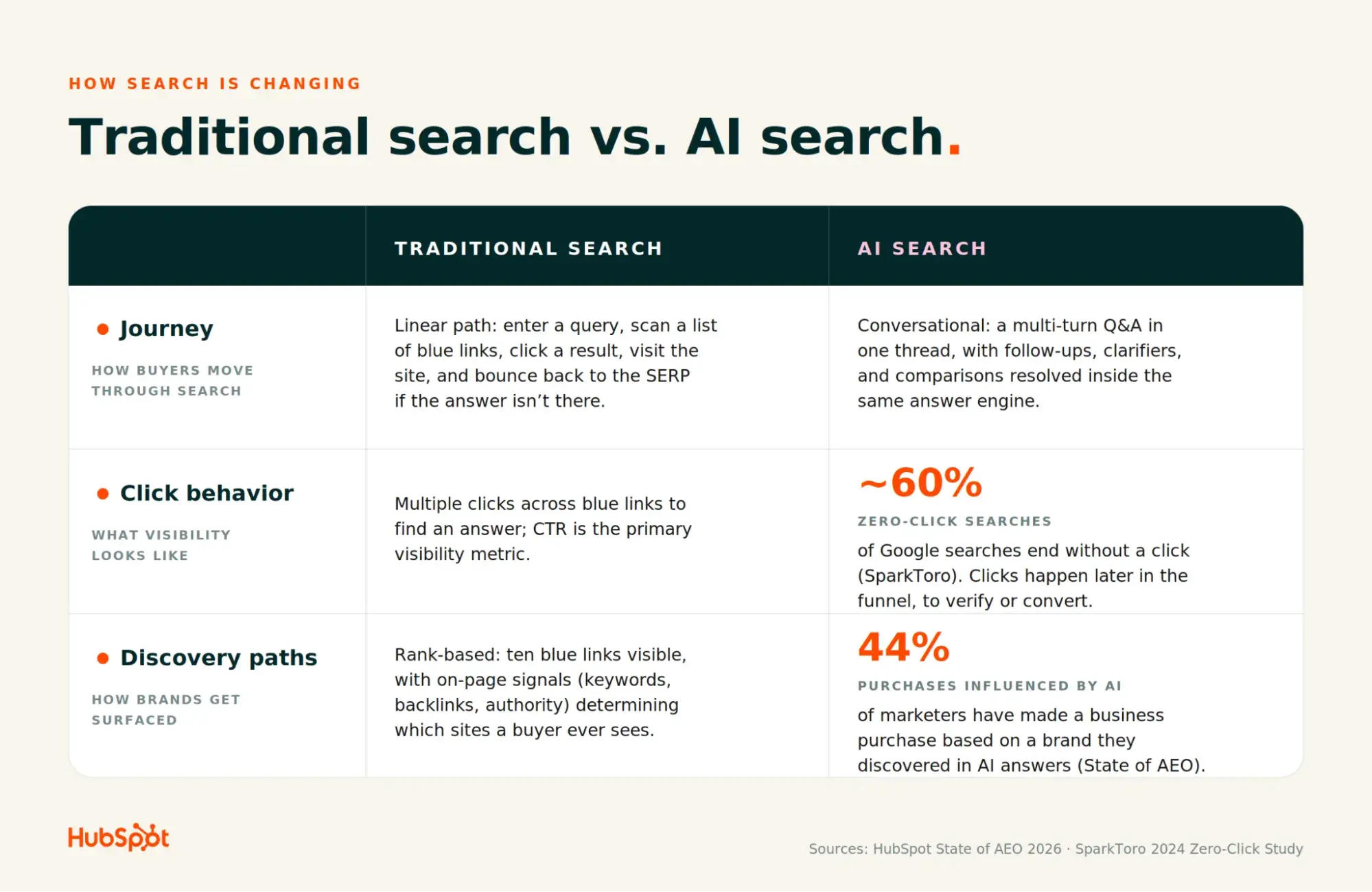
In the past, traditional search consisted of a user entering keywords into a search engine like Google, getting a list of blue links, and clicking them to find their answer. But search behaviors are changing. Today, users are increasingly turning to AI with conversational queries (usually a few sentences long) and reading AI-generated summaries that instantly fulfill their search. AI search behavior differs from traditional search behavior in that it becomes a multi-turn Q&A — an entire conversation in one chat, not just a click to a single webpage.

Comparison table of traditional search versus AI search covering journey, click behavior, and discovery paths

Marketers should care about AI search behavior because it’s a growing part of search. SEO still determines which pages rank in the underlying search index, but answer engine optimization (AEO) determines which sources AI tools cite when composing summaries. Both have to be optimized in parallel, and increasingly, AEO is what influences whether buyers ever see your site listed in the first place.

How AI Search Behavior Creates New High-Intent Discovery Paths

Yes, AI search behavior decreases organic traffic, but the good news is that the traffic that comes from AI is higher intent. HubSpot saw 3x better conversion from AI-sourced leads versus other channels in 2025. Referral traffic from tools like ChatGPT and Gemini has also tripled, according to Search Engine Land.

AI-referred traffic converts better because summary-first experiences resolve the easy questions inside the answer engine itself. A reader asking “what is AEO?” doesn’t need to click a single result; they get a definition, sometimes a list of vendors, and move on. But a reader who clicks after reading an AI answer to their query, “how can a B2B marketing team of five implement AEO on their blog,” has usually progressed past that surface layer. They’ve validated their problem, seen who got cited, and want to verify, compare, or convert.

That shift in funnel shape changes how you measure success. Clicks become a smaller, later signal in a journey that now happens partly inside the answer engine. The metrics that capture the rest of it look different: how often your brand surfaces in the summary, which competitors you appear alongside, and which prompts route the highest-intent traffic to your site.

The Impact of AI Search on Brand Discovery

AI search behavior has reshaped brand discovery, too. The old canvas was predictable: ten blue links, a few ads at the top, maybe a featured snippet. Pre-AI, ranking #1 for a category term reliably put your brand in front of buyers. But AI answer engines, chat assistants, and copilots have replaced that canvas, and most of the visible page space now goes to the AI-generated answer itself, not the links beneath it.

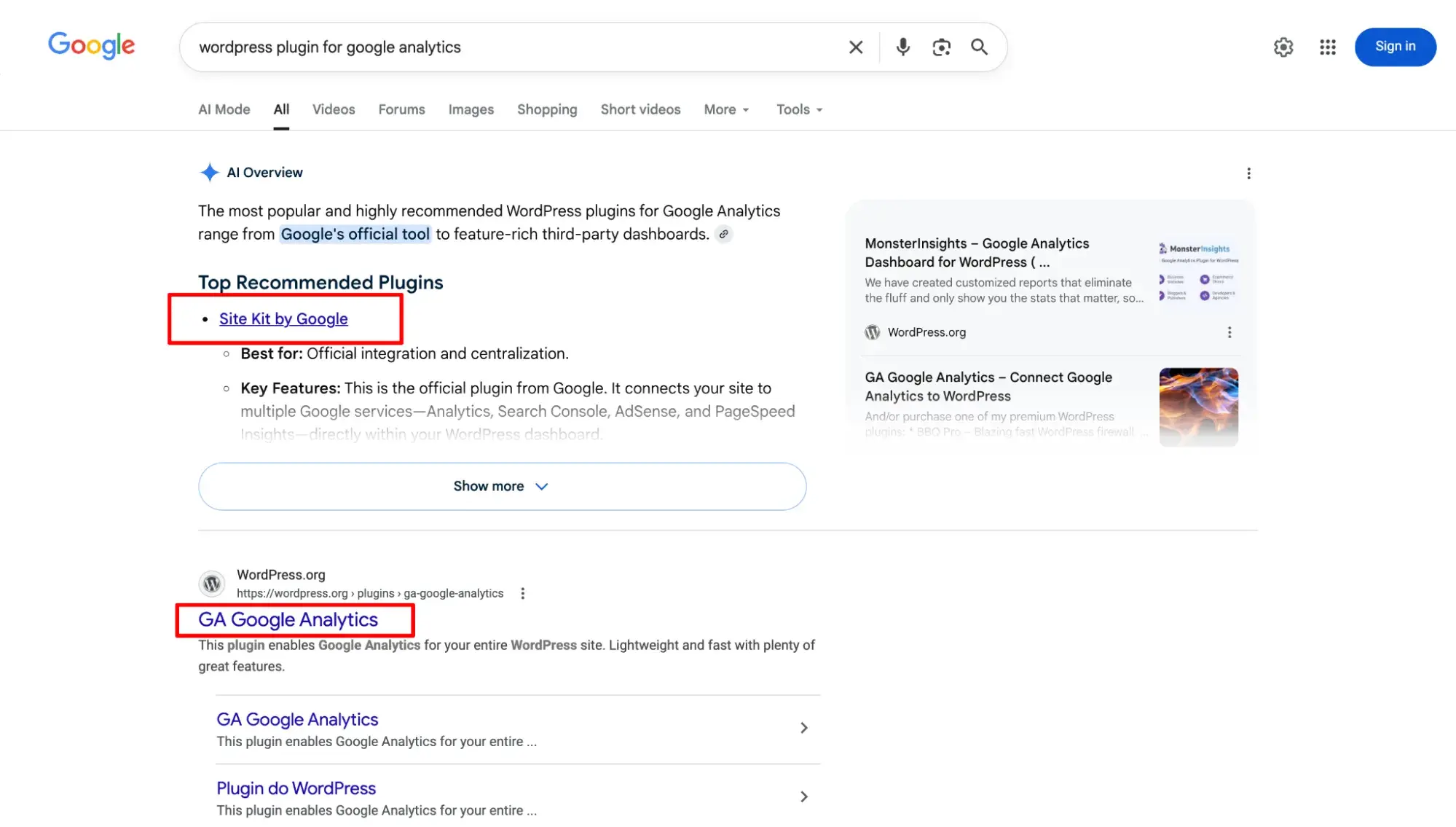
Just take a look at my recent Google search for “wordpress plugin for google analytics.” The AI Overview occupies most of the screen above the fold. Even though the page for GA Google Analytics holds position #1, it’s outranked by Site Kit in the AI Overview — and which do you think I’m more likely to click?

Google search results for WordPress plugin for google analytics with AI Overview highlighting Site Kit plugin

Brands that previously ranked #1 for a category term are competing for a smaller slice of visible real estate, and the AI Overview itself decides which sources to cite. About 60% of Google searches now end without a click, according to SparkToro. In my opinion, that number is likely to keep climbing as more queries trigger AI-generated answers.

Branded search has held up. Buyers who already know your name still type it and land on your site. Category-term discovery is where AI search has hit hardest: Google serves AI Overviews for non-branded queries 1.9x more often than for branded ones, according to Ahrefs. A query like “what is the best software for video editing” no longer returns just a list of blue links to evaluate. It returns one or two brands recommended by AI in a highly personalized output, sometimes with a comparison table, and the buyer often acts on that answer.

HubSpot’s State of AEO 2026 found that 42% of CRM software buyers used AI search to evaluate vendors. Across the full set of evaluation activities tracked in the report, AI search ranked as the strongest predictor of purchase intent for CRM buyers. When an answer engine names your competitor in that recommendation, the deal is often decided before your sales team knows the buyer exists.

Entity clarity, topical authority, and reputation signals now determine which brands answer engines surface. Each plays a distinct role:

  • Entity clarity establishes whether an answer engine recognizes your brand as a distinct, well-defined option. Without it, answer engines may struggle to associate your brand with the right category, use case, or comparison set.
  • Topical authority reflects the depth and consistency of coverage across a category. It influences which category questions, comparisons, and use cases your brand is eligible to be cited for.
  • Reputation signals, such as third-party mentions, reviews, comparison pages, news coverage, and Reddit threads, tell answer engines that you’re an entity they can trust.

In the old model, signals like links, keywords, and authority won blue-link visibility, and reputation grew from there over time. Those signals still matter, but in AI search, they get evaluated by an answer engine before a prospect ever reaches your site. By the time someone clicks through, they’ve usually weighed several options inside an AI answer — including, hopefully, you.

How to Plan Content Around AI Search Behaviors

Content planning for AI search behavior starts with prompts instead of keywords, requiring a different approach to content marketing strategy. A buyer using AI rarely asks one isolated query. They start with one, then ask a follow-up, then a clarifier, then a comparison question. To earn citations across that whole multi-turn exchange, your content has to anticipate the sequence and be more comprehensive.

Brainstorm the questions your buyers are asking AI.

Question mapping starts with a seed query and traces the follow-ups. Pick a question your category gets asked early in the funnel (“what is AEO?”), then write out the next five questions a buyer would logically ask (“how is AEO different from SEO?”, “do I need an AEO tool?”, “which AEO tools do marketers actually use?”, “how much does AEO software cost?”, “what’s the ROI of AEO?”). That sequence is what your content needs to answer collectively.

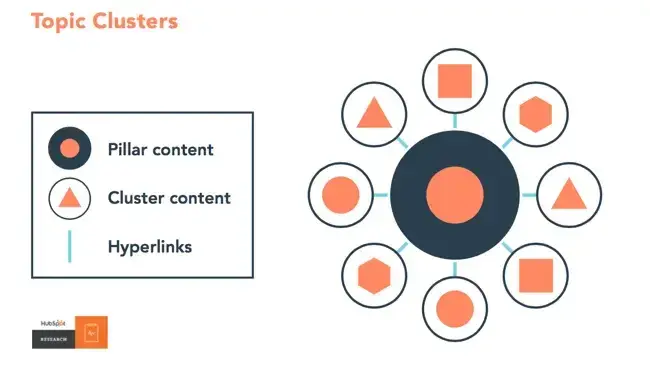
HubSpot’s topic cluster model organizes the question set into a pillar page and supporting cluster pages: one pillar for the broad seed question, cluster pages for each follow-up. That structure gives answer engines a clear entity to cite for the broad query and a clear trail of supporting pages for the long-tail follow-ups.

Topic cluster diagram showing pillar content connected to multiple cluster content pages via hyperlinks

Source: Matt Barby

HubSpot’s Content Hub helps marketing teams organize topic clusters and manage pillar pages right within its CMS.

Pro tip: Run your seed question through ChatGPT and Perplexity yourself, then track which sources they cite for each follow-up. Those brands are who you’re competing against inside the answer engine, and the citation patterns tell you what kind of content earns a mention at each step.

Restructure existing content into extractable answers.

A content audit reveals which pages already earn citations and which need work. Re-run your top 20 or so organic landing pages’ target queries through ChatGPT, Gemini, and Perplexity. Cited pages are working. Absent ones are restructure candidates.

Here are some strategies to apply to your existing content to make it more AEO-friendly:

  • Put the answer upfront. The “lost in the middle” Stanford research maps a U-shaped extraction curve: Answer engines pull most reliably from the opening and closing of a passage, not the middle. If the direct response to the target query sits four paragraphs in, cut the context-setting ahead of it and lift the answer into the first sentence of the lead.
  • Write self-contained paragraphs. Answer engines retrieve passages, not pages, so each paragraph has to make sense as a standalone chunk. Pronoun-led openers (“This is why…”) or paragraphs that braid two ideas together land in retrieval as broken context. Rewrite each one to lead with its own named subject and cover one idea. As AEO/SEO expert and founder of iPullRank Mike King puts it, “A passage that focuses on one idea will, in nearly every measurable case, retrieve better than a passage that tries to cover three.”
  • Make content skimmable with tables and bullet points. Comma-separated lists embedded in prose (“the benefits include speed, accuracy, and cost”) should be bulleted lists; embedded numeric comparisons should be tables. In Yu et al.‘s March 2026 preprint, lists and tables had 43% better extraction accuracy across six engines than the prose versions they replaced.

See how to write for AI search for more.

Why Track AI-Driven Search Engines and How to Start

Tracking AI search metrics turns declining traffic into a visibility win you can show leadership. The same metrics tell you which prompts your brand is losing, which competitors are winning them, and which content to fix first.

AI search visibility breaks down into three signals worth tracking:

  • Citations show whether an answer engine linked to your page as a cited source.
  • Brand mentions appear when an answer names your brand, even without a link.
  • Share of voice measures how often your brand surfaces compared to competitors when buyers ask category questions.

But traditional analytics tools like Google Analytics weren’t built to count brand mentions or share of voice. To do that, you can manually check within AI answer engines or get a specialized tool like HubSpot AEO to automate AI visibility tracking.

How to Audit Your AI Search Visibility

A baseline audit starts by running your 10 highest-priority prompts through ChatGPT, Gemini, and Perplexity (make sure you’re logged out in each instance or using a temporary chat). Record which sources get cited, whether your brand appears, and which competitors are pulling ahead across your most important topic clusters, branded queries, and category-level questions. Use this baseline to identify gaps between where you and your competitors sit and create a roadmap to optimize content for better AI visibility.

How to Track AI Search Visibility Over Time

AEO Grader is a free tool that gives you a quick snapshot of where your brand stands across ChatGPT, Perplexity, and Gemini, including a share of voice score.

HubSpot AEO monitors your brand visibility across answer engines over time, analyzes how competitors appear in your tracked prompts, and prioritizes recommendations to lift your citation rate. It’s the continuous-tracking layer once your baseline is set.

How AI Model Updates Impact Search Optimization

Much like Google’s algorithm changes, AI models update frequently, and each update changes the way the model weighs certain things, leading to different answer patterns and source selections.

For example, when OpenAI rolled out GPT-5 in August 2025, the update marked a substantial improvement in how ChatGPT answers health-related questions. As OpenAI wrote in its announcement of GPT-5, regarding health: “The model also now provides more precise and reliable responses, adapting to the user’s context, knowledge level, and geography, enabling it to provide safer and more helpful responses in a wide range of scenarios.”

To keep up with the changes and ensure your content is still optimized for the newest models, you can track release notes from OpenAI, Anthropic, Google, and Perplexity.

I also recommend a consistent review cadence:

  • Monthly: Re-run your core prompt set across ChatGPT, Gemini, and Perplexity. Compare citation and brand mention counts against your baseline. Flag any prompt where your presence shifted noticeably in either direction.
  • Quarterly: Audit the pages that lost citation share. Check whether the content format, schema, or entity definitions still align with how each platform is currently structuring answers.
  • On major model announcements: Run an immediate re-test on your five highest-priority prompts. OpenAI, Google, and Perplexity all publish release notes — a public model update is a signal to audit before you see the impact in your tracking data.

Pro tip: HubSpot AEO tracks brand visibility across answer engines over time, making it way less burdensome to monitor AEO efforts.

Between review cycles, here are the four content-side elements that are most worth maintaining:

  • Entities: Confirm your brand, product names, and key people are defined consistently across your site, about page, and third-party profiles like LinkedIn, Crunchbase, and G2. Inconsistent naming can confuse an answer engine.
  • Schema: Verify that relevant schema markup, such as Article, FAQPage, and Organization, is present and error-free using Google’s Rich Results Test and Schema.org’s validator.
  • Internal links: Check that pillar pages and cluster pages are still pointing to each other and that no links have broken due to URL changes or content migrations.
  • Answer summaries: Re-read the lead paragraph of each high-priority page. AI models may extract more reliably from the beginning and end of a long context, per the “lost in the middle” research, so a lead that no longer opens with a direct answer to the page’s target query is a fast fix.

What AI Search Behavior Means for Sales and Service

How AI Search Behavior Changes Sales Conversations

AI search behavior compresses the sales cycle before reps ever pick up the phone. Prospects now arrive at first calls having already read AI summaries comparing your category, competitors, and pricing.

Outreach timing and messaging have to evolve for AI-informed buyers. Generic discovery questions like “what’s your current stack?” or “what are your pain points?” often land flat with a prospect who has already walked a chatbot through those details. Reps who lead with the specific competitors and tradeoffs AI surfaced for that buyer’s category can skip past the surface-level questions that end up being redundant.

But sales reps need tools to understand what AI is saying about their brand. AEO in Marketing Hub surfaces prompts and citations that are shaping these conversations, making those signals visible to sales and marketing teams.

How AI Search Behavior Changes Service Content

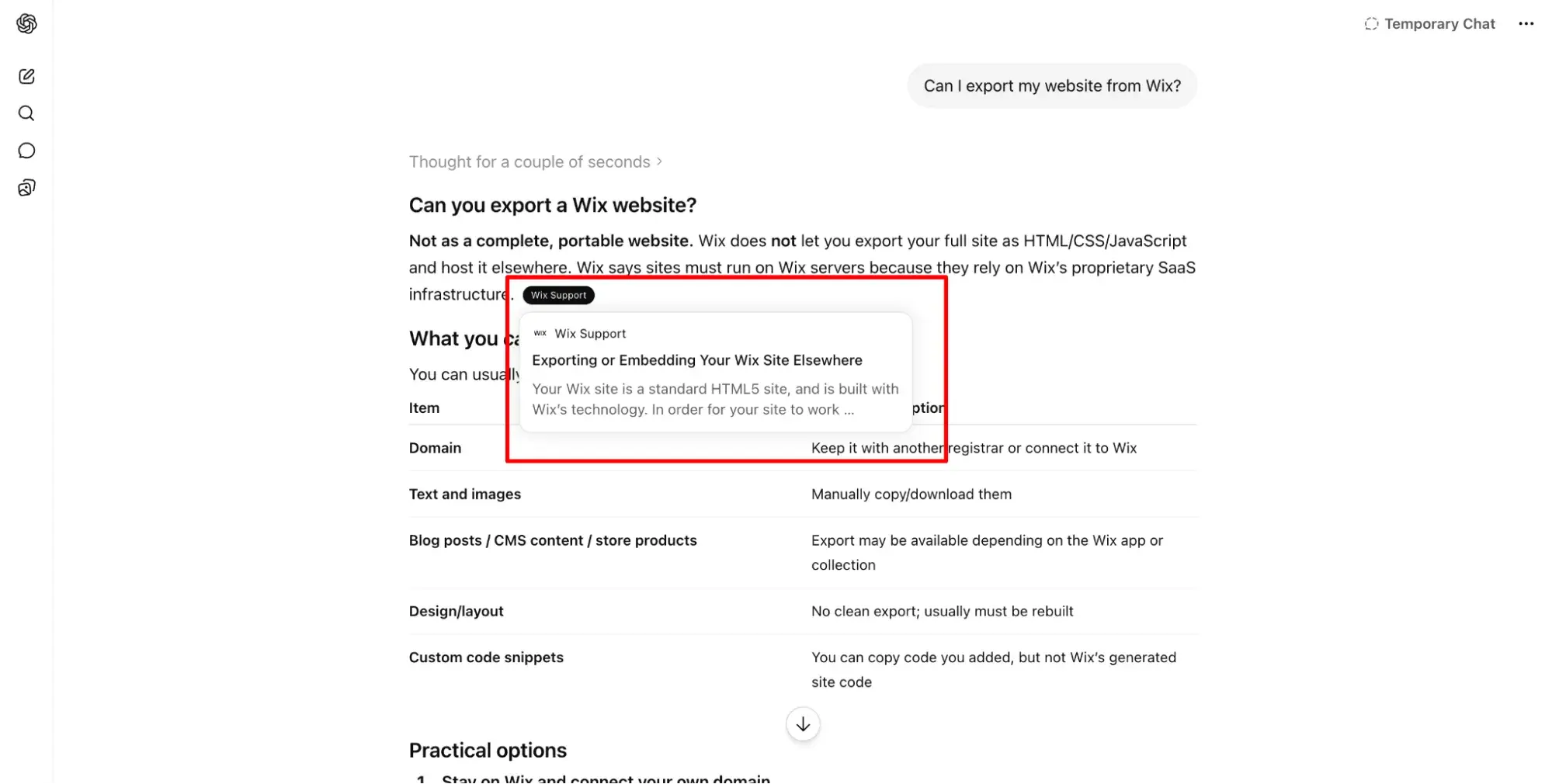
Service content is great answer-engine source material. Knowledge base articles and help center documentation feed the same answer engines buyers consult during evaluation. A well-structured support article on “how do I export X from your tool” is exactly the kind of extractable, question-format content models prefer to cite. Service teams optimizing their docs for clarity are also, by extension, optimizing for AI visibility.

Here’s a real-life example: I asked ChatGPT, “Can I export my website from Wix?” (a common buyer evaluation question), and its answer cites a Wix help center article.

ChatGPT conversation about exporting websites from Wix with cited source highlighted in red box

How Sales and Service Teams Inform AEO Content

Feedback loops between sales, service, and marketing turn buyer language into answer-engine source content. Sales and service teams hear the actual questions buyers and customers ask before those questions show up in keyword tools. A shared doc, a Slack channel, or a quarterly review routes that language back to the people creating content for AI search.

An AEO Playbook You Can Run Today

This AEO playbook covers four phases of adapting to AI search behavior: mapping buyer questions, building extractable answers, applying technical signals, and iterating against tracked data.

Step 1: Uncover the questions your customers are asking AI.

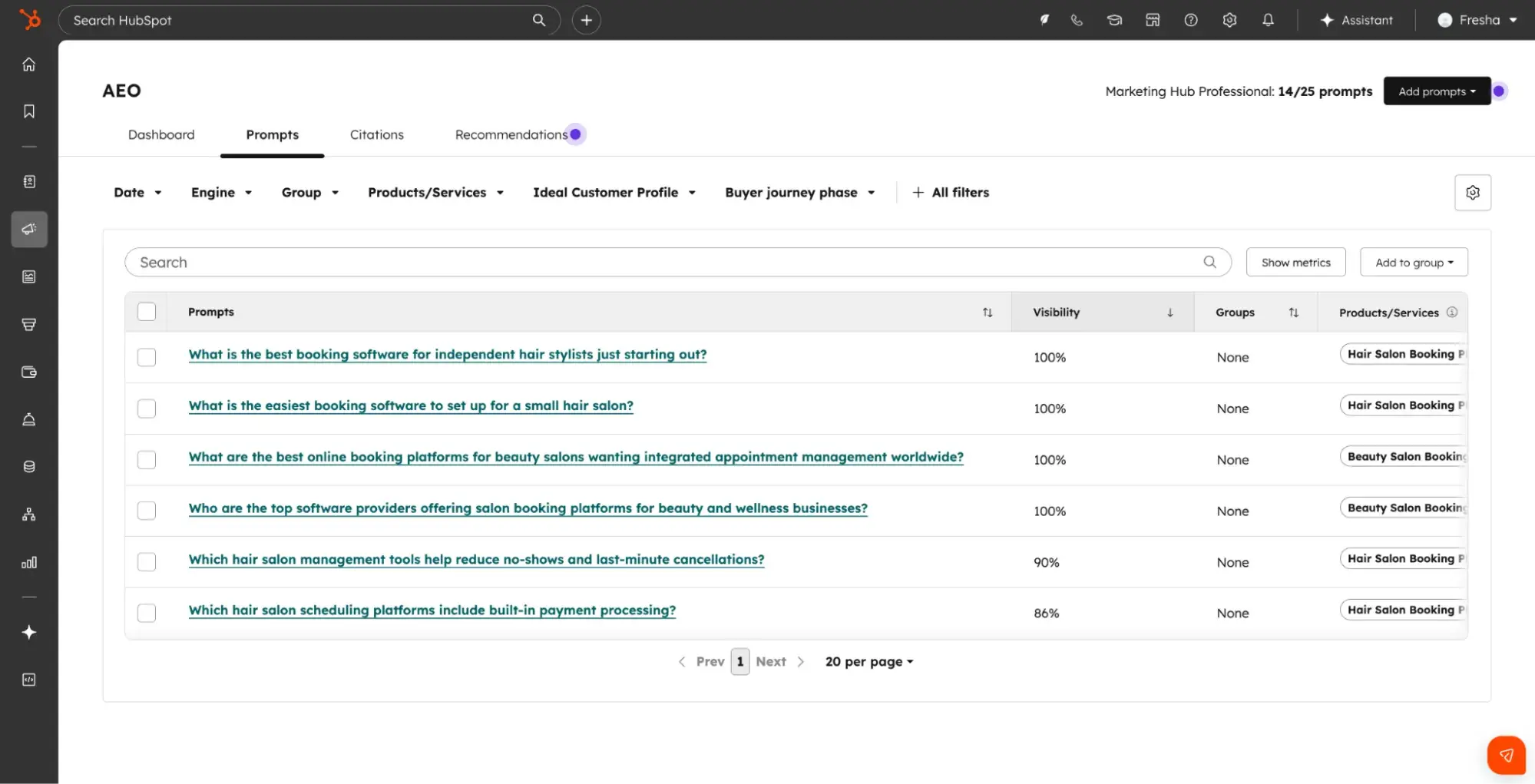
Discovering the prompts that potential customers ask AI about your brand is what anchors the rest of this playbook. You can source questions by prompting answer engines with your category’s seed queries, noting the follow-ups that AI generates in response, and asking your sales team what they’re actually hearing during calls.

Marketers who are serious about optimizing for AI search behavior benefit from using a specialized AEO tool for prompt discovery and tracking. Subscribers of Marketing Hub Professional or Enterprise plans have an advantage because they can access AEO, which can suggest prompts based on business context within the CRM.

HubSpot AEO tool prompts tab showing salon booking software queries with visibility percentage scores

Source

Step 2: Build extractive answers and entities.

Now take the questions you identified in step one and create new content (or optimize existing content) to address them. Structure each page to answer the main question in its introduction, then reinforce the brand entity behind it. AI answer engines favor content that resolves the query immediately and identifies the source clearly, and as a March 2026 preprint from Junwei Yu et al. showed, structural changes — heading hierarchy, paragraph chunking, and visual emphasis — can lift citation rates by double digits across the six engines they tested.

  • Direct-answer openers answer the target query inside the first sentence of each paragraph; anything else is preamble that pushes the answer lower than it needs to be.
  • Q&A, definition, and decision-guide formats map cleanly to the response shapes answer engines reuse when composing summaries.
  • Brand entity consistency across your domain, LinkedIn company page, Crunchbase profile, and review listings (G2, Capterra) strengthens recognition when answer engines compose responses.

Step 3: Apply schema markup and internal links.

Schema markup and internal linking give answer engines structural cues to help them interpret pages and rank source quality.

HubSpot’s State of AEO 2026 found that pages with FAQ sections are more likely to be cited in AI Overviews, and FAQ sections paired with schema markup correlate with higher citation rates in Gemini, Google AI Mode, and Perplexity. The combination that performed best in the dataset: a descriptive H2 like “Frequently Asked Questions About [Topic]” with each question formatted as an H3 below it. Generic “FAQ” headings produced weaker results.

Heading structure carries its own citation signal in the same dataset. Keyword-rich H1s correlate with more citations. Including the year in H1s and meta titles helps, and more headings overall — particularly H3s and H4s — track with higher citation rates. The sweet spot is pages with 7 to 15 H2s.

Adding schema to optimize webpages is a debated topic in AEO. “It’s not a bad idea, but it’s not going to move the needle that much,” says AEO strategist Kaleigh Moore, who prefers to focus on off-site signals on platforms like LinkedIn and YouTube. “Those kind of off-site, third-party sources that are getting really in-depth are really great at earning citations,” she adds.

Elie Berreby, head of SEO and AI search at Adorama, takes a different view on schema markup. “100% I would recommend using it,” he told me, “but not like most people use structured data — in a smart way, by interconnecting the different entities.” Schema’s value, in Berreby’s framing, is building the knowledge graphs that help answer engines map entity relationships. Even when schema is injected via JavaScript (which many AI crawlers can’t render), Googlebot can still process it, which has downstream effects. “If you have good structured data and this leads to a richer search result, it now feeds the AI scraper, which then feeds the AI-generated answer,” Berreby explains. “It’s an indirect mechanism.”

My take: Implement schema, but don’t expect it to be the single lever that wins you citations. The State of AEO 2026 data is correlational, and the citation lift only shows up reliably in combination with a well-structured FAQ section.

Lastly, don’t forget internal links; they reinforce topical authority and route ranking signals between related pages.

Step 4: Publish, monitor, and iterate.

After you publish content, make changes based on what the data tells you. Keep a spreadsheet or create a dashboard to track citation shifts, lost prompts, and competitor gains, and review this on a weekly to monthly basis. Here’s what to log:

  • Baseline snapshots capture where your brand stands at the moment of publication; without them, later movement is impossible to interpret.
  • Loss logs record which prompts your brand stopped appearing in and which competitor replaced you, surfacing the patterns worth fixing first.
  • Win logs track which new prompts your brand started showing up in after edits, helping you reverse-engineer what worked.

AEO Grader generates the baseline snapshot in minutes; HubSpot AEO handles ongoing tracking, competitor monitoring, and prompt-level reporting so you can iterate without manually prompting.

Frequently Asked Questions About AI Search Behavior

How do I measure AI visibility without relying on clicks?

AI visibility measurement tracks two metrics invisible to GA4 and Search Console: brand mentions (answers naming your brand without a link) and share of voice (how often your brand surfaces versus competitors for category questions). You can manually enter your highest-priority prompts in ChatGPT, Gemini, and Perplexity on a fixed cadence and log which sources get cited. But HubSpot AEO automatically tracks prompts and monitors shifts in those signals over time.

How often should we update AI-optimized content?

Update top-performing pages whenever you see a major drop in citations in your AEO software. Otherwise, AI-optimized content needs a monthly visibility re-check, a quarterly content audit, and an immediate re-test after any major model release. Models update often enough that it could affect your key content considerably (OpenAI, Anthropic, Google, and Perplexity all publish release notes worth watching).

How can we increase our chances of being cited by LLMs?

LLM citation likelihood rises through four content disciplines: answer-first writing, parseable structure, entity consistency, and topical authority. The Yu et al. study found that structural rewrites alone — without changing the content’s meaning — lifted citation rates across six engines by 17.3% on average

Here are four changes worth making to your content to increase LLM citations:

  • Answer-first content opens with the direct response to the query in the first paragraph, then supports it with clear definitions, original data, expert quotes, examples, and up-to-date sources. Stanford research shows language models pull most heavily from the beginning of a passage, which is why a buried answer might not earn a citation.
  • Parseable structure uses descriptive H2s and H3s, concise summaries, comparison tables, and FAQ-style sections where appropriate, paired with valid Article, Organization, Product, or FAQPage schema. Structured formats like lists and tables outperformed prose on extraction accuracy by 43% in the Yu et al. cross-engine testing.
  • Entity consistency means ensuring the same brand, product, author, and executive names across your site and others. This might include your about page, author bios, LinkedIn, Crunchbase, G2, and other trusted third-party profiles.
  • Topical authority builds through internally linked content clusters and a refresh cadence that updates high-priority pages when facts, products, pricing, rankings, or model behavior change.

Do we need to change link-building for answer engines?

No, you don’t need to change link-building for answer engines, but you do need to understand why it still matters for AEO. Backlinks help with SEO, and because answer engines use search indexes, they matter for AEO too. However, what’s different in AEO is that unlinked brand mentions influence AI answers: YouTube videos, Reddit threads, comparison roundups, and third-party reviews. So diversifying into the formats and platforms answer engines actually quote matters more than chasing raw link counts.

What’s the best way to align teams around these changes?

Sales, service, and marketing teams can align around AI search behavior changes by creating a shared dashboard and a feedback loop. Sales reps hear the AI-surfaced objections shaping early conversations, and service teams see which questions land in chat first — both signals belong in the marketing content team’s roadmap. HubSpot AEO surfaces citation and competitor data in one workspace, making it easier to pair AI search signals with the questions sales and service heard that month.