Categories B2B

The 6 Steps I Use to Create Five-Year Plans I Can Actually Stick To [+ Expert Tips]

As people, we all have big goals — both personal and professional. I’ve been asked in countless interviews about my five-year plan for my career.

Download Now: 5 Free Skill Development Templates

I’ve also had lengthy internal monologues about whether I want to buy a house, the countries I want to travel to, and the mountains (literal and figurative) I want to climb.

However, a desire without a plan is just a dream. I want to make sure I make my long-term goals a reality. That’s why I love five-year plans. That’s enough time to take the steps to prepare for lofty accomplishments.

So, in this post, I’ll share my tips for creating five-year plans that you can actually stick to. I’ll also share examples of what these steps look like in practice. Let’s dive in.

Table of Contents

Benefits of a Five-Year Plan

1. It can give you a fresh start.

Whether professional or personal, a five-year plan can serve as a reset for your life. Who doesn’t like a fresh start?

After all, that’s why New Year’s resolutions are so popular. They give us something to look forward to. There’s also something to be said about writing out a detailed plan. It can be a great motivator to put something in motion.

Personally, I’ve said countless times that I want to be fluent in Spanish. However, it’s not until I write a detailed plan for how that will happen that it feels real.

2. It gives you clarity.

Sometimes, a path seems scarier than it actually is because we don’t know what it looks like.

Creating a plan is like pointing a flashlight on a dark road. A more accurate description is that it turns that dark, twisty road into a clear path forward. This doesn’t mean there won’t be any bumps in the road, but at least you’ll know exactly where you’ll land and how to get there.

For example, working for HubSpot was a longtime goal of mine. I took the time to assess why I wanted to work for the company — the great culture and renowned blog pulled me in. Then, I made a plan on how to get here. I started by taking Academy classes and networking.

I never knew if my plan would work out precisely, but I did have time for introspection, giving me clarity on why I liked a company.

3. It serves as a reminder of what’s at stake.

In your daily life, it can be easy to forget that every day, we’re shaping our future. The decisions we make today affect what our lives will look like years from now. Having a visual reminder of this can keep you focused on your goals.

For example, I spoke to my colleague, Kaitlin Milliken about five-year goals she has had. She mentioned that she wanted to see the Philippines and explore the country her family immigrated from.

“When I first made the decision, I was still in college and didn’t have the money or time to make that trip,” Milliken says. “That goal was a great motivator for a lot of smaller choices, like saving, being smart with my vacation time, and making the space to plan the trip.”

4. It helps with professional development.

Having a five-year plan encourages you to think about and plan for the necessary skills and knowledge you will need in the future. This can guide your professional development journey and activities, such as training, education, or gaining specific experiences.

If you need a plan designed to help you with this, grab HubSpot’s free professional development plan to help you understand where you’re at, where you want to go, and how you’ll get there.

5. It helps with risk management and mitigation

If you’re a business owner, having a five-year business plan can help you manage and mitigate risks as much as possible.

By forecasting potential challenges and market changes over a five-year period, you can develop and implement contingency plans, diversify your income streams, adjust your business model in response to market demands, and maintain financial stability.

A five-year business plan makes it easier for you to navigate through potential pitfalls more effectively and sustain growth even in fluctuating economic conditions.

What to Cover in a Five-Year Plan

Before you get started with your plan, there are a few things you’ll need to figure out ahead of time.

1. Areas of Focus

Your five-year plan can cover various areas from education, career development, finance, hobbies, or even health. It’s up to you. Don’t feel stuck having to stick to one category and choose the ones that best interest you and fit your needs.

For example, one of my goals is to learn a second language, specifically Spanish. This is a personal goal for me that’s right at the intersection of education and my hobbies.

2. Values

Putting down your values in writing will help you discover your “why” (more on that later). This step will also help you narrow down what’s most important to you and shape the goals you set for yourself.

Why do I want to learn Spanish? Well, it’s a super helpful language to know if you live in the U.S. Beyond that, I really want to travel throughout Spain. Being fluent in the language would help me better connect with people throughout my journey.

3. Goal Path

Your five-year plan is only as successful as the effort put into creating it. To create a viable plan, it has to be actionable. Once you’ve got an idea of the goals you’d like to include, start researching the path to attaining them.

For example, if you’d like to set a career goal to become a marketing director, start looking at the steps and credentials required. Do you need to skill up? Is there a pathway at your current job? Doing some initial research will set you up for success.

Learning a language involves lots of steps. I decided to buy a few language textbooks and download Duolingo on my phone. Beyond that, I’m researching if there are local classes in my area that I can sign up for. A structured classroom setting can often be helpful for adults learning a second language.

4. HARD Goals

Tackling heartfelt, animated, required, and difficult (HARD) goals can be a rewarding but challenging part of a five-year plan. These types of goals will push you out of your comfort zone and help you achieve things you didn’t think were possible before. Think of these goals as highly ambitious but achievable with a five-year timeline.

Think of HARD goals this way:

  • Heartfelt — what reasons are behind achieving this goal?
  • Animated — what gets you excited about achieving this goal? Get specific.
  • Required — what is it going to take to achieve this goal? What will you need to accomplish in six months to a year to stay on track?
  • Difficult — what skills will you need to accomplish this goal, and how will you obtain them?

Let’s apply this to my desire to learn Spanish:

  • Heartfelt — I want to learn Spanish so I can communicate with folks who may not be fluent in English and so I can travel to Spanish-speaking countries.
  • Animated — the idea of visiting Spain and speaking with the locals gets me excited to learn.
  • Required — I know that finding a local Spanish class will help me stay on track and develop a basic understanding of the language. Beyond that, I want to practice every day.
  • Difficult — I need to know a substantial number of vocabulary words to become fluent. I will spend time drilling flashcards every day to help me learn more helpful verbs and nouns.

Now that we’ve covered the groundwork, we’ve got more tips to help you create a five-year plan that keeps you motivated and inspired.

Five-Year Plan Tips

If creating a plan from scratch makes your eyes glaze over, check out these tips to help you start getting some ideas on paper. I also asked Kaitlin Milliken, a senior program manager at HubSpot, to share how these tips help her shape her five-year plans.

1. Give yourself space to brainstorm.

To help you focus better when creating your plan, do a bit of pre-work.

Give yourself time to really think about what you’d like to accomplish and the things that are most important to you. For example, you could write out a list of potential goals or ideas and rank them in order of importance, including notes about why they are important.

Milliken often works through this exercise. This helps her decide what she wants to work on, which goals can be accomplished quickly, and which are most complicated and need to be a part of her five-year plan.

“I always start broad. I sit down with a note book and write out what I want to accomplish — totally blue sky. I can organize and narrow this list down later,” she says.

2. Consider separating long-term and short-term goals.

Once you’ve jotted down some goals, decide which are better suited for short or long-term ones.

Completely paying off debt might be a long-term goal, but deciding which debt to tackle first could be a short-term goal. It may also help to divide them up into a 30-60-90 day plan to help best set a timeline.

I asked Milliken how she decides which goals fall into each category. For example, Milliken says she wants to run a half marathon. However, that’s a goal she can work toward in a year.

In contrast, “I want to learn Tagalog — a language I don’t have a background in — and to build the program I run at work to support different departments at HubSpot. These are loftier goals that fit better in a five-year timespan,” she says.

3. Break down annual goals into monthly ones.

Tackling lofty goals can be overwhelming. This is why it’s important to break them down into smaller tasks that are manageable so you don’t get discouraged along the way. Let’s say you want to save $10,000 in a year. You can break that amount down into a recurring monthly payment of $833 or even split it into smaller weekly payments.

Milliken told me that she starts off each year with a lofty set of goals — like writing a few short stories, saving a certain amount of money, and getting a promotion at work.

From there, she decides which goal posts she needs throughout the year to check her progress. For example, she’ll set a savings goal every month.

“I also check in on my long-term goals every six months. Am I spending enough time on professional development to build my leadership skills? Am I on track to manage a team within the next five years?” Milliken explains.

4. Find an accountability partner.

Sometimes, life gets in the way and throws us curve balls — greatly impacting our ability to stay motivated and consistent. Having an accountability partner can help you stay on track.

This could be someone you check in with monthly, a close friend, a family member, or a mentor. Whoever you choose, just make sure it’s someone who will keep you honest. Perhaps they’ll even have their own five-year plan, and you can take this journey together.

“No matter the goal, I tell my best friend Meg. She encourages me to put in the time, celebrates my wins, and is the perfect accountability partner,” Milliken says. “If you’re looking to find your own accountability partner, you’ll want someone who can both keep you on track and be happy for you when you reach your goals.”

5. Don’t be afraid to make adjustments.

Remember that your five-year plan is yours. You can make adjustments as you see fit once you start tracking your progress. If your priorities change, update your plan.

Milliken says her first job out of school was in journalism, so her initial five-year plan for her career focused on being a great reporter. However, “as I worked in the field, I discovered that I loved editing and working with other people,” she says. “I adapted my goals to reflect those new discoveries.”

Milliken notes that her five-year plan changed from working for a top newspaper to finding a role that allows her to work with writers, giving them feedback for improving their work.

Five-Year Plan Template

If you‘re ready to create your own five-year plan, we’ve got you covered.

HubSpot created the following five-year plan template for you to download.

In it, you’ll find a short and long version, both designed to help you break down your plan into actionable goals for each year.

hubspot five year plan example]

Download this five-year plan template

Next, let’s dive into how to fill out your plan.

How to Make a Five-Year Plan

1. Know your “why.”

This is single-handedly the most important step in creating a plan.

A clear “why” is your North Star. It’s what will guide you throughout your journey and motivate you to keep moving forward.

It can take a while to narrow this down. You’ll know you have the answer when it’s linked to a core value or belief. Otherwise, you have to keep digging.

One way to get to this is by just asking the question over and over again. For instance:

  • I want to learn American Sign Language. Why?
  • To become more connected to another culture. Why?
  • To broaden my perspective. Why?
  • To be a more understanding, tolerant, and inclusive person.

Now, we’ve taken something at surface level and brought it down to a personal, human level.

2. Choose your objective.

When creating a five-year plan, you want to review your life as a whole and decide what your objective will be.

Are you focusing on your professional career, your financial goals, your business, or your spiritual growth? Or perhaps you’re taking a more holistic approach and combining all of these elements.

If you don’t know where to start, use this: “In five years, I want to be [fill in the blank].” This will help you figure out goals that you may not have vocalized before.

Here are four core pillars you should always consider:

  • Career.
  • Health (physical and mental).
  • Finances.
  • Relationships (with self and others).

Depending on your goals, you can also add categories for religious or spiritual development, recreation, and service.

Don’t forget bucket list items. Have you been wanting to learn a new language? Or perhaps you want to visit every country in the world. Bucket list items are perfect for five-year plans because you can spread them out over a long period of time and have fun tracking your progress.

3. Start with the big ideas, then narrow your focus.

When you’re first writing your five-year plan, start with an end goal for each year.

From there, break it down by:

  • Process — what steps will you take to meet this end goal?
  • Success metric — how will you gauge success?
  • Benefit — how does this end goal bring you closer to your five-year plan?
  • Resources — which resources will you leverage to achieve your goal?

This process will help you turn your broad ideas into clear action items that can be executed.

Research will play a big role in this, as you will need to identify resources and set a structure to meet your goal.

For instance, say your five-year financial plan is to be debt-free.

That’s the big idea, but you need to dive deeper. How exactly will you achieve that? Your research will likely suggest setting a budget, paying off your most expensive loan first, consolidating your debts, and more.

Once you know the key action items, you can break them down by year.

This is a S.M.A.R.T. goal in action. The more specific you are, the better you will be at fulfilling your five-year plan.

More on that in the next section.

4. Make it S.M.A.R.T.

To give you the best chances of success, every goal should pass the SMART test. That means being:

  • Specific — the vaguer your goal, the harder it will be to reach.
  • Measurable — you must be able to quantify your goals because otherwise, how will you know you’ve reached them? This doesn’t always mean assigning a figure to a goal. It can also be a feeling.
  • Achievable — while it’s good to push yourself beyond your limits, your goal should be attainable and realistic based on where you stand currently.
  • Relevant — how does this goal fit within the bigger picture? Does it align with your personal values? What’s the impact on your life?
  • Time-bound — it’s not enough to say it’s a five-year plan. You have to create a timeline and set milestones at specific points within your journey.

5. Allocate your resources.

Determining the resources (financial, human, technological, etc.) you need to achieve your goals, be it growing your business, getting a sound education, improving health, buying a home, or traveling, is a vital step in your Five-year plan. Here’s how to do this:

Financial Resources

  • Budgeting. Calculate how much money you’ll need for different phases of your plan. For instance, if you plan to buy a home within five years, you would start by budgeting for the down payment, closing costs, and any potential renovations.
  • Savings and investment. Determine how you’ll accumulate the necessary funds. This could involve setting up a savings account specifically for a large purchase or cutting back on unnecessary expenses to increase your savings. For a business plan, you’ll have to identify sources of funding, such as internal profits, loans, investors, or grants.

Human Resources

  • Staffing plans. If you’re running a business, plan for hiring based on the skills and personnel required at different phases of your plan. If your goal is to increase production capacity, you might need to hire additional production staff. Also, consider the training needs to upskill existing employees to meet future challenges.

Informational Resources

  • Research. Spend time researching the best strategies and tools for achieving your goals. This could include reading books or talking to people who have achieved similar goals. With business, you might need to allocate time and funds for ongoing market research to stay ahead of industry trends and consumer preferences.

Educational and Developmental Resources

  • Learning materials. Invest in the necessary books, courses, or seminars needed for personal development or education. For example, if you’re aiming to learn a new language, you might reach your goals quicker if you participate in advanced language classes or immersion experiences.
  • Professional development. If you’re looking to move up the career ladder, you can attend workshops, networking events, or conferences.

6. Monitor and adapt.

Finally, establish a system for regularly reviewing and evaluating your progress. There are many ways to do that, including the following.

Tracking Progress.

You can set regular intervals (monthly, quarterly, or annually) to review your progress against the goals and milestones you’ve set.

This could involve checking if you’re on schedule to save a certain amount for a down payment on a house, assessing improvements in your physical fitness, or reflecting on your advancement in learning a new skill.

Feedback Mechanisms

Use tools like apps, spreadsheets, or simple checklists to measure your progress quantitatively and qualitatively. For example, if your goal is to improve fitness, you might track workout frequency, diet changes, and body measurements.

Journaling or Documentation

Keep a journal or log of your activities and achievements. This not only helps in tracking progress but also in reflecting on what you have learned and what strategies have been most effective.

External Feedback

Sometimes, getting perspectives from your friends, family, or mentors can provide insights into how well you’re doing and what you need to adjust. They can provide objective feedback on areas you might not have considered.

Remember that circumstances change—financial situations can shift, personal interests may evolve, and unforeseen challenges might arise. Be prepared to adapt your goals and plan accordingly.

For instance, if a career opportunity requires moving to a new city, you might need to adjust your financial or personal development goals to align with this change.

Five-Year Plan Common Mistakes

We’ve covered what to do and best practices. Next, let’s talk about what not to do. Here are some five-year plan pitfalls to avoid.

1. Not Setting Clear Goals

If your goals are vague, it’s going to be nearly impossible to hit them. You can’t accomplish a goal that’s not clearly defined. When it comes to setting your five-year plan, specifics are key.

In the past, my goal was to “find a job I’m truly passionate about.” That goal was way too vague. What type of job makes me feel energized? What about my past jobs did I love, and what do I want to focus on? My broad goal didn’t cover these areas.

To refine that goal, I switched it to “find a job that allows me to build out a new content property and run that new program.” That helped me find my current role where I run HubSpot’s AI blog.

2. Not Doing Enough Research

If you’ve set any formal education or career goals, thoroughly researching requirements is a must. Skipping this step could cause you to miss important prerequisites and derail your goals completely.

One of my close friends wanted to become a licensed therapist. He needed to do the research to see what programs were available, how much they would cost, and how long they last. Without this information, he never could have moved forward and achieve his goal.

3. Failing to Set a Timeline

To achieve your goals you must track them. In order to track your progress, you need deadlines in place. Without deadlines you run the risk of aimlessly moving along (or not at all) without hitting important milestones — hindering you from accomplishing long-term goals.

I’ve tried learning Spanish in the past. However, I had no real timeline for that goal. I pushed off taking classes and working on flashcards because I had no timeframe for my goal.

4. Keeping a rigid plan that no longer suits you.

Yes, staying on task with your plan is important, but it is meant to serve you. If the plan you originally set no longer suits your needs, it is perfectly fine to make adjustments. The plan is not set in stone, and it should be revised as needed.

“One of my goals was to get a dog — one that I finally accomplished after years,” Milliken says. “Getting a dog took so long because I needed to move across the country. I was looking at shelter dogs at the time but ultimately decided to wait until after I moved.”

Milliken noted that if she had stuck to her original timeline, a pup would have made her move much harder. She also would have raised her dog in a small apartment instead of waiting for a place with a yard.

Now that we’ve covered our bases, let’s look at some plan examples and templates to help you quickly get started on your own

Five-Year Plan Example

Don’t let the task of creating a plan from scratch in Excel put you off. There are plenty of ready-to-use templates that will make light work of formatting so you can focus on hitting your goals.

1. HubSpot

Best for: Personal or professional use

Using our downloadable five-year plan template, we were able to create a detailed five-year plan, broken down by year, process, success metric, benefit, and resources.

hubspot five year plan example]

What I like: I like that this template allows you to specify your goals, the resources you need to achieve them, the process you’ll take to get there, and how these goals will benefit you.

I also love how, in addition to a five-year plan template, you also get four other templates for skill development, SMART goal-setting, management by objective, and performance improvement plan.

2. 24 Slides

Best for: Professional use

If you’re looking to create a more visual plan to help you stay on track, 24 Slides has an easy-to-customize five-year business plan template.

This template has space to include both short and long-term business goals, plus it includes a variety of charts to help you build an engaging presentation.

It’s a good option if you’d like to create a five-year plan that can be presented to stakeholders within the company.

24slides five year plan example

Image Source

What I like: I love how comprehensive this five-year business plan PowerPoint template is. With 14 slides, it allows you to define all the touchpoints in your business, where you plan to go, and how you plan to get there.

I also like how it allows you to track important metrics like revenue, gross profits, sales, tax, and interest expense over a span of five years.

3. Template.Net

Best for: Personal use

This personal five-year personal development plan from Template.Net offers a quick way to jot down your goals and strategize how to achieve them.

The categories are simple: objective, goals, timeline and activities, and have additional space for you to write out any reminders you’d like to set.

Be sure to include your “why” in the objective section to keep your reasons for creating the plan top of mind.

template.net five year plan example

Image Source

What I like: I like how this template allows you to divide your life plans into several categories and define your goals, timelines, and activities to guide you. I also like how it urges you to keep a journal that details your daily activities, aspirations, and learnings in both life and art.

Accomplish More With a Plan

If you want to add more structure to your life and play a more active role in shaping your future, consider creating a five-year plan. While things may not pan out exactly as you‘ve expected, you’ll be surprised at how close you’ll get to what you wished for.

Editor’s note: This article was originally published in May 2022 and has been updated for comprehensiveness.


Categories B2B

The OGP Framework: HubSpot’s Approach to Driving Focus and Alignment

As a business, focus and alignment are everything.

Download Now: Free Growth Strategy Template

There are so many things you can do to move the needle, but which ones should you act on? With so many people working on so many projects, how do you keep everyone moving in the same direction?

Unlocking these answers is the difference between disconnected work efforts and forward progress to achieve your mission.

As we continue to scale, we need to encourage self-motivation and execute on more cross-functional work to help our customers drive growth.

But let’s face it — autonomy without alignment leads to chaos.

That’s where the OGP framework comes in. Your strategy is only as good as how you execute against it. And having a framework to enable aligned execution is critical.

Ours allows us to continue providing autonomy with clear alignment on priorities from the top.

The OGP Framework

OGP stands for Objectives, Goals, and Plays

Before you start identifying your OGPs, you have to understand your mission, your values, and align on the strategy that guides you.

Think of it as your operating system. These are the elements that will inform your Objectives and help you understand what success looks like at each milestone.

And all of this is driven by who you serve — your customers, your buyer persona, the people you’re ultimately solving for.

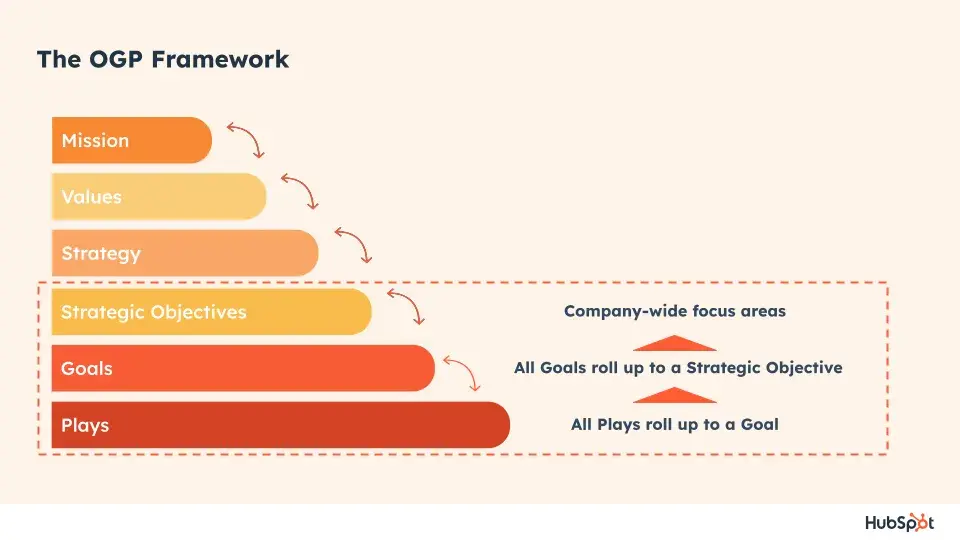
Our executive team uses the following slide to drive our OGPs from the top:

The OGP Framework; HubSpot’s Approach to Strategic Planning; Mission, Values, Strategy, Strategic Objectives, Goals, Plays

  • Mission: What is our big-picture vision?
  • Values: What beliefs and principles drive the way we work?
  • Strategy: How are we going to reach our vision?
  • Strategic Objectives: What long-term, company-wide bets are we making over the next ~3 years
  • Goals: How will we accomplish our objectives at the functional level over the next 12-18 months?
  • Plays: How will we achieve our goals at the team level through specific deliverables over the next 3-6 months?

Your Mission and Values don’t change very often (if at all). They stay pretty consistent year to year.

Your Strategy and Strategic Objectives change roughly every three years. Each year at HubSpot, we review our Objectives from the previous year and decide whether we’re going to keep them consistent for the upcoming year.

On the other hand, your Goals and Plays get updated more frequently. We update our Goals every year and revisit our Plays on a half-yearly or quarterly basis.

More on OGPs

Alignment starts with an understanding of our long-term strategy, and our Strategic Objectives are determined at the executive level.

We choose to stack rank our Objectives to provide clear prioritization for the whole business. For example, we have seven Strategic Objectives for 2025, and we have them organized by order of importance.

Why? To make sure our teams have a clear sense of priorities and guidance on how to make necessary trade-offs.

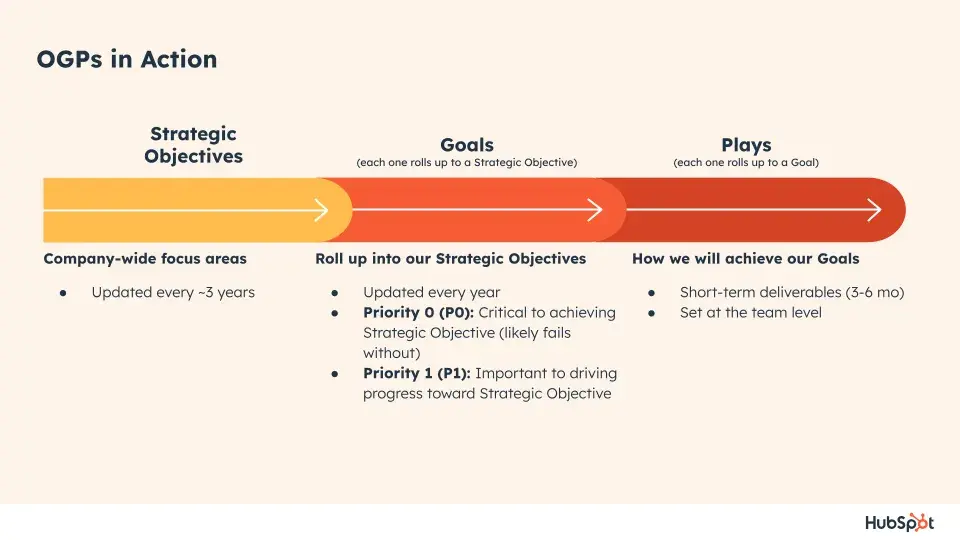
Each Objective has a certain amount of Goals associated with it. We like to categorize our Goals based on priority:

  • Priority 0 (P0): Critical to achieving Strategic Objective (likely fails without). There are fewer of these (~5 per Objective). They are often highly cross-functional, and these goals are reviewed by our C-suite on a monthly basis to ensure progress and remove any blockers.
  • Priority 1 (P1): Important to driving progress toward Strategic Objective. There are more of these (~20 per Objective). They are often specific to one function, and these goals are reviewed by our functional leaders on a monthly basis to ensure progress and remove any blockers.

Then, there are Plays that roll up into each Goal. These are associated with the “how” — the specifics around what you’re going to do to accomplish your Goals.

The OGP Framework; HubSpot’s Approach to Strategic Planning; OGPs in Action; Strategic Objectives, Goals, Plays

Sounds like a lot of work, right? It is, but trust me — it’s worth it.

An important way to keep things running smoothly is through accountability. One critical way we’re holding people accountable is through our refreshed DRI model.

The DRI Model

In the OGP framework, the DRI (or Directly Responsible Individual) is the one person responsible for moving a Strategic Objective forward. They set the vision for the objective, define the success metrics and work to be done, align cross-functional teams, and navigate any blockers that arise.

Accountability and transparency are the keys to understanding whether we’re actually executing our strategy throughout the year.

We use mechanisms — like Quarterly Business Reviews (QBRs) and monthly reports — to create space for status updates, address blockers proactively, and ensure we’re hitting our milestones.

So, there you have it. Just pop some ideas onto a few slides, and you can check strategic planning off your list!

…not so fast.

OGPs are a means to an end. They can help create focus, but true alignment comes from doing the hard work of thinking, planning, and communicating.

For us, the strategic direction is set by the executive team, but the execution of that strategy is very bottoms-up. Every VP is working with their directors, managers, and individual contributors to solve the “how” of each goal.

This is where the alignment from the top meets the autonomy of functional experts — and this is where the power of OGPs comes from.

How We Make OGPs Work For Us

At the core of strategic planning at HubSpot, we set out to identify the most important problems to solve for our customers. This allows us to focus our energy on the work that matters and align our teams on the work to be done.

The HEART of Success

What really works for us throughout this whole process is this: Direction and clarity about our priorities comes from the executive level, but the whole company is involved in the “how.”

Everyone at HubSpot is an important part of strategic planning.

Our Goal Drivers are collaborating with their teams to write memos that outline why their goals are important, how we’re going to achieve them, and what resources are needed to be successful.

And our executive leaders are setting direction at the highest view.

That’s how we create focus and alignment at every level of organization.

How We Continue to Evolve

Our approach to strategic planning evolves every year. It’s important that we tweak our framework based on new learnings and feedback from our employees.

We’re constantly using data to hold ourselves accountable to the strategy we laid out as a company. For example, we conduct eNPS surveys and interviews with people around the business to understand where we’re excelling and where we’re coming up short.

It’s comforting to slap an “approved” framework onto your business. It gives you a lot of confidence, but you can’t just stop there. You need to figure out what works for you as the industry grows and your customer needs evolve.

Focus doesn’t just happen. It’s a byproduct of shared vision. And vision comes from talking, sharing, looking at data, and updating assumptions.

If you’re not doing that work upfront, don’t bother with OGPs or any other goal-setting framework. None of them will work.

Give It a Try

In our culture code, we talk about hiring people with HEART (Humble, Effective, Adaptable, Remarkable, Transparent). We define effective as people who get sh*t done and take ownership for their success. You might also call this autonomy.

And in an autonomous culture, people can only thrive when they have a clear direction on where the company is going. This is where so many companies end up wasting top talent.

Focus and alignment are everything — and our framework is an incredibly valuable tool to keep employees focused on the path forward.

This post was adapted from MSPOTs: the Secret to Focus and Alignment, and has been updated for accuracy and comprehensiveness.

New call-to-action

Categories B2B

23 of My Favorite Free Marketing Newsletters

Whether you’re in your first marketing job (congrats, btw) or your 15th, you know that there are approximately 43,827 marketing-related newsletters all vying for your email address.

Download Now: Free Email Newsletter Guide

Let me rescue you from the overwhelm: I subscribed to several dozen marketing newsletters, talked to friends across different industries, scoured the internet, and pestered a great many HubSpotters on Slack to build this list.

Although these newsletters are either fully free or have a free version, I’ve noted the ones with paid options, since paid subscriptions = more content. I’ve also included a “recommended if you like” (RIYL) for each newsletter to help you decide whether it deserves a place in your inbox.

I don’t like boring newsletters any more than you do. So whether you want to become an SEO expert fast or stay on top of changing Insta algorithms, here are 23 free marketing newsletters that you’ll actually look forward to opening.

Table of Contents

HubSpot Newsletters

1. The Hustle

Screencap of a pie chart in The Hustle. “Workin’ 10 to 12, what a way to make a livin’.”

Image Source

I’ve been a Hustle subscriber since before I started working at HubSpot. So it’s not just professional allegiance when I say that it more than lives up to its promise to be “your five-minute brief on business and tech news.”

It’s a newsletter powerhouse that doesn’t take its readership for granted. Hustle Managing Editor Ben Berkley tells me that his favorite recurring section is Weird Patents, which “captures the entrepreneurial spirit at the heart of our audience.” Absurd visuals guaranteed.

Editor: Ben Berkley

Frequency: Six days a week (we give Ben a break on Saturdays)

The longer Sunday stories are an extra-special treat for your inbox. My recent fav was about the cat-and-mouse game that is buying Hermès bags, and it’s a wild ride.

Cost: Free

Best for: Anyone who wants to sound more interesting when they’re talking about business.

Popularity: 2M+ subscribers

Sample subject line: ✨ Is Disney losing its magic?

RIYL: weird business stories, interesting people with big ideas, wordplay

Sign me up!

2. Masters in Marketing

Screencap of Masters in Marketing.

Image Source

Masters in Marketing relaunched in June 2024 with the goal of sharing untold marketing stories, first-hand advice, and curated marketing trends. And frankly, we’re killing it.

So far, we’ve talked to the CEOs of Oatly and Liquid Death, Moz’s Chima Mmeje, and a GM at Microsoft. I just took a look at our planning spreadsheet, and we’ve got a fun few months ahead. Come join us.

Authors: Caroline Forsey and <ahem> yours truly. Yes, this is shameless self-promotion. Yes, it’s also a good newsletter.

Frequency: Every Tuesday

Cost: For you? Free.

Best for: Digital marketers, early- and mid-career marketers eyeing leadership positions.

Popularity: 350K+ subscribers

Sample subject line: 🕯️How Liquid Death reinvented marketing

RIYL: marketing stories and advice you haven’t already heard a hundred times

Sign me up!

3. Trends

Screencap of Trends.

Image Source

HubSpotter Cyan Zhong is like your chronically online friend who’s always the first to spot trends. Case in point: She tracked down the label designer of the Wirecutter-recommended Graza olive oil to talk about product design trends.

Subscribe for the latest data-backed business trends, research insights, and industry analyses. Stay for the fun.

Author: Cyan Zhong

Frequency: Every Tuesday

Cost: Free

Best for: Anyone who wants to stay ahead of the curve or build better businesses.

Popularity: 350K+ subscribers

Sample subject line: How Media Leaders Will Make AI Work in 2024, from HubSpot’s VP of Media

RIYL: internet rabbit holes, actionable business ideas, trendy niches

Sign me up!

You won’t find us gatekeeping. The newsletter platform — and other marketing tools — that we use here at HubSpot is available for your own use.

Best Free Marketing Newsletters

Heavy hitters in the “general” category include Marketing Brew, tl;dr Marketing, and Lenny’s Newsletter.

There’s a good chance you’re already subscribed to one or more of those, so here are six more we like:

4. The Black Guy in Marketing

Screencap of The Black Guy in Marketing. Subject: “White People Love Pastries!” & The Case for Building a Diverse Professional Network.

Image Source

The Black Guy in Marketing is “a resource for diverse professionals who are the first, the only, or just trying to break through at work.”

Author Andrew McCaskill tackles well-worn topics like AI, total compensation, and networking, but with a perspective I haven’t seen in any other newsletter.

For instance, the newsletter on networking has stats from recent studies, offers four actionable networking strategies, and talks about opportunities and challenges specific to professionals of color.

Author: Andrew McCaskill, a self-described “culture analyst, inclusion champion, and marketing executive.”

Frequency: Monthly, and it’s on LinkedIn — not your inbox.

Cost: Free

Best for: Although the newsletter is largely written for Black marketers at any career level, McCaskill has written issues on Pride, Latino marketers, and more.

Popularity: Nearly 13K subscribers

Sample subject line: “White People Love Pastries!” & The Case for Building a Diverse Professional Network

RIYL: LinkedIn, career advice, fresh takes

Sign me up!

5. Kevan Lee

Screencap of Kevan Lee’s newsletter. Subject: Bad ideas 🐹. How to brainstorm headlines, strategies, solutions, and more.

Image Source

Kevan Lee’s self-titled newsletter is a pastel oasis in a neon world.

A newsletter about startup marketing suggests an appetite for the hardcore, but Lee’s “playbooks, case studies, stories, and links from inside the startup marketing world” have a gentle and accessible vibe.

Even on topics like OKR templates, product versus brand differentiation, and account-based marketing, you’ll find fun reads and useful advice regardless of your marketing niche.

Author: Kevan Lee

Frequency: Every Monday

Cost: Free, with an upgrade option for $7/month or $70/year. The paid version includes access to Lee’s personal Notion workspace, discounts, and more.

Best for: People who are “into startup marketing and brand-building.”

Popularity: Unknown

Sample subject line: Bad ideas: How to brainstorm headlines, strategies, solutions, and more.

RIYL: startups, advice columns, self-titled albums

Sign me up!

6. Marketing Examples

Screencap of Marketing Examples. Subject: The marketing genius of Lil Nas X.

Image Source

Marketing Examples does exactly what it says on the tin: Each newsletter includes six examples of great marketing.

Author Harry Dry breaks that down into three short examples, two copywriting tips, and one favorite tweet. Truly a something-for-everyone newsletter, Dry’s marketing examples span social media, ads, content, SEO, and sales.

And it’s just plain fun to read. This recent opening line wouldn’t be out of place in a hardboiled detective novel: “The story starts in California. 1981.”

Author: Harry Dry

Frequency: Every Monday

Cost: Free

Best for: Marketers at any level in their career; curious non-marketers.

Popularity: 130K subscribers

Sample subject line: The marketing genius of Lil Nas X

RIYL: success stories, marketing inspo, digital marketing

Sign me up!

7. Marketing Millennials

Screencap of The Marketing Millennials.

Image Source

Marketing Millennials casts a wide net, covering product positioning, success stories, email open rates, and more.

The bouncy tone will be familiar to anybody who spends too much time online, but behind all the “marketing bestie!”s and “LOL”s is a newsletter packed with timely features and legit marketing advice.

Author: Professor Millennial, aka Daniel Murray

Frequency: Every Tuesday, Thursday, and Sunday

Cost: Free

Best for: Millennial marketers; Gen X and Boomer marketers still perplexed by millennials.

Popularity: 100K+ subscribers

Sample subject line: 🔥 You’re Doing Positioning WRONG.

RIYL: the word “bestie,” pop culture references, a sense of community

Sign me up!

8. Stand the F*ck Out

Screencap of Stand the F*ck Out. Subject: None of those make logical sense.

Image Source

With a name like this, it could’ve easily been the shock jock of marketing newsletters, but Stand the F*ck Out brings style and substance to the table, er, inbox. Each email contains one “super-practical” tip, and author Louis Grenier’s tone no-nonsense tone is straightforward but never boring.

Author: Louis Grenier, “a recovering Frenchman who helps marketers stand the f*ck out”

Frequency: Daily, Monday – Friday

Cost: Free

Best for: Freelance marketers, in-house marketers, and creative business owners.

Popularity: 13K+ subscribers

Sample subject line: 3 IRRATIONAL messages that stand the f*ck out | STFO 🤘

RIYL: swearing, contrarianism, lots of real-world marketing examples, Lady Gaga

Sign me up!

9. Why We Buy 🧠

Screencap of Why We Buy 🧠.

Image Source

🧠 Why We Buy claims it will teach you buyer psychology in three minutes a week.

Short, punchy emails describe concepts like confirmation bias with real-world examples. Author Katelyn Bourgoin follows that up with actual science, data, and conversations with experts.

The best part: She also tells you how to apply each concept.

Author: Katelyn Bourgoin, “The Buyer Psychologist”

Frequency: Weekly

Cost: Free

Best for: Anybody who wants a fun, accessible deep dive into concepts like the empathy gap, the pratfall effect, expectancy theory, and more.

Popularity: 62K+ subscribers

Sample subject line: The BIG question 🧠 Why We Buy

RIYL: psych 101 class, GIFs, practical advice, science-based knowledge

Sign me up!

Best Free Social Media Newsletters

10. Future Social

Screencap of Future Social. Subject: Sesame Street’s new Twitter Strategy.

Image Source

Future Social, a favorite of the social media managers I spoke to, delivers “award-winning case studies, theoretical social strategies, and follow-the-bouncing-ball content breakdowns to help build the best social.”

With more than 100 emails in the archive, you can catch up on trust-building, real-time influencer marketing, and so, so much more.

Author: Jack Appleby

Frequency: Weekly

Cost: Free

Best for: Social media managers and strategists; influencers and solopreneurs; digital marketers interested in social media even if it’s not their full-time job.

Popularity: 70K+ subscribers

Sample subject line: The Sesame Street Twitter Strategy: We should all be authentically Elmo.

RIYL: TikTok, #brands, impressing your boss who doesn’t use social media

Sign me up!

11. ICYMI

Screencap of ICYMI. Subject: ICYMI: 5 Brands Taking a Social-First Approach.

Image Source

ICYMI is an essential subscription for the social media manager who’s doing three jobs at once and doesn’t have time to read about every update to Instagram algorithms or new Threads features. Each newsletter has plenty of “pro insights to make you better at your job” in just a few minutes a week.

Author: Lia Haberman

Frequency: Every Friday

Cost: The free version includes a weekly email plus access to the ICYMI events database.

Upgrade for $6/month or $60/year, and get two bonus newsletters each month plus an invitation to the ICYMI Slack channel and access to social resources and reports.

Best for: Social media and audience engagement folks who want personable, highly skimmable roundups of relevant news and updates to all the major social media platforms. It’s a favorite among HubSpotters.

Popularity: 22K+ subscribers

Sample subject line: ICYMI: 5 Brands Taking a Social-First Approach

RIYL: social-first marketing, platform updates, recaps

Sign me up!

12. Link in Bio

Screencap of Link in Bio. Subject: This Politician is Very Good at Social Media.

Image Source

A wise marketer once told me, “Viral is an outcome, not a strategy.”

That person probably subscribed to Rachel Karten’s Link In Bio, a newsletter about working in social media, creating clever content, and making sure your boss never asks you to ‘go viral.’”

The free version of this email is limited to every-other-week interviews, but the interviews are so in-depth and relevant that you’ll still be thinking about them during the off weeks.

Author: Rachel Karten, who previously led the social media teams at Bon Appétit and Epicurious.

Frequency: Every other week.

Cost: The free subscription sends out every-other-week interviews “with people who actually press post.”

There’s also an upgrade option for $8/month or $80/year, which adds a Discord invite and a weekly Logged On email (sample subject line: How to Build a Content Calendar).

Karten also comps a number of paid subscriptions for students or others who can’t swing the fees.

Best for: Social media managers at any level in their career.

Popularity: Unknown

Sample subject line: This Politician is Very Good at Social Media

RIYL: case studies, pop culture, social media inspo

Sign me up!

Best Free SEO Newsletters

I tried guesstimating how many SEO newsletters are floating around the ethernet right now, but I am not confident I count that high.

It’s a lot. Which makes sense — SEO is a rapidly evolving field, and it’s essential for any digital marketer to stay informed.

But even if you live, breathe, and eat SEO, it’s impossible to consume even a fraction of these newsletters.

Here’s three winners — one for experts, one for newbies, one for those of us somewhere in the middle:

13. SEOFOMO

Screencap of SEOFOMO. Subject: 🍿 Google Leaks, AIO Updates, Impact & More.

Image Source

SEOFOMO is to SEOs what ICYMI is to social media managers. Each newsletter includes brief recaps of SEO news and updates as well as free SEO resources, trends, and tools. If your job title includes “SEO,” add this one to your inbox.

Author: Aleyda Solis

Frequency: Weekly

Cost: Free

Best for: Pro SEOs — when I asked HubSpot SEOs for their favs, SEOFOMO came up every time. “She’s amazing,” said one HubSpotter of Aleyda Solis.

Popularity: 33K+ subscribers

Sample subject line: 🍿 Google Leaks, AIO Updates, Impact & More

RIYL: search news, search updates, search trends

Sign me up!

14. SEO for the Rest of Us

Screencap of SEO for the Rest of Us.

Image Source

If your job doesn’t have “SEO” in the title, or if you’re just new to the world of search engine optimization, SEO for the Rest of Us is the newsletter you want in your inbox.

Author Brendan Hufford means it when he says “SEO for beginners.” The emails are explanatory but never patronizing, and he even provides worksheets designed to give you immediate hands-on experience.

Author: Brendan Hufford, a SaaS SEO consultant who also has 10 years of classroom teaching experience.

Cost: Free

Best for: Digital marketers who aren’t SEO experts but want to understand how it works.

Popularity: 2.4K subscribers

Sample subject line: If SEO is NOT a numbers game…?

RIYL: pop culture GIFs, doing homework for extra credit, atomic age design

Sign me up!

15. WTF is SEO?

Screencap of WTF is SEO?

Image Source

“Enjoyable” is a lofty goal in technical fields like SEO, but WTF is SEO? cranks out consistently enjoyable reads every Monday.

“A newsletter about search strategies for news publishers” somewhat undersells the community-building that’s central to WTF is SEO?’s ethos, with regular mailbag and AMA-style features among the more-typical newsletter fare.

Even if you’re not strictly a news publisher, there’s plenty here to learn and to love.

Authors: Jessie Willms and Shelby Blackley, who also host hour-long community calls for subscribers.

Frequency: Every Monday

Cost: Free

Best for: News publishers who want a one-stop shop for SEO news roundups, deep dives and how-tos, and interviews.

Popularity: Unknown

Sample subject line: Half the world votes in 2024. Our guide to election SEO

RIYL: a sense of community; current events and timely topics; long, thoughtful emails

Sign me up!

Best Free Newsletters About Newsletters

Let’s get meta. Newsletters about newsletters is another crowded category with a frankly overwhelming number of options. (Also overwhelming: Writing subject lines. Here’s 100 that we actually clicked.)

If you’re starting your own newsletter, we have a few great resources for you, like this ultimate email newsletter guide and our fav newsletter examples.

Here’s four great newsletter newsletters:

16. 9 Things Sunday

Screencap of 9 Sunday Things.

Image Source

Emily Ryan’s weekly newsletter is a sweet Sunday tidbit for your inbox. Filled with “fun, useful email tips and more cool things from around the net,” 9 Things Sunday collects ideas, inspo, and advice into a skimmable numbered list that you’ll look forward to every week.

Author: Emily Ryan, founder of Westfield Creative

Frequency: Every Sunday

Cost: Free

Best for: Email marketers, especially (but not exclusively) those who use Mailchimp.

Popularity: Unknown

Sample subject line: 8 Things Sunday 📫🙊

RIYL: Mailchimp, numbered lists, email tips

Sign me up!

17. Email Love

Animated GIF of a Polo by Ralph Lauren email from Email Love.

Image Source

If your role is more creative than technical — or if you just want a break from SEO and social algorithms — Email Love belongs in your inbox.

It’s a “newsletter crafted for marketers, designers, coders, and anyone keen on exceptional email design, content ideas, news, and interviews,” and every issue is packed full of beautiful design and creative inspo.

Better yet, author Andy King writes a brief explanation of why the design works, so you can incorporate your favorite elements into your own work.

Author: Andy King, who describes his role as “curator”

Frequency: Once or twice weekly

Cost: Free

Best for: Newsletter writers and marketers in search of design and content inspiration.

Popularity: Unknown

Sample subject line: Warning: This email may brighten up your day ☀️

RIYL: mood boards, Pinterest, typography, email

Sign me up!

18. Inbox Collective

Screencap of Inbox Collective.

Image Source

Dan Oshinsky describes Inbox Collective as “the newsletter for people who make newsletters.” With a minimalist but text-heavy design, it’s not much to look at, but that won’t matter once you dig into interviews with other newsletter writers, growth strategy advice, and some quick hits from Oshkinsky’s own reading list.

Author: Dan Oshinsky, formerly the Director of Newsletters at Buzzfeed and The New Yorker.

Cost: Free

Best for: People who make newsletters. But seriously: It’s also great if you don’t want to subscribe to a dozen newsletters about newsletters — Inbox Collective ticks a lot of boxes, with interviews, industry news and updates, a job board, and expert advice.

Popularity: 10K+ subscribers

Sample subject line: Three secrets I’ve learned about great newsletters

RIYL: real talk, clear advice, making newsletters

Sign me up!

19. Newsletter Operator

Screencap of Newsletter Operator. Subject: How To Make a Newsletter “Subscriber Flow” That Will Increase Your Conversion Rate, Open Rate, and CTR.

Image Source

Newsletter Operator is for the money-motivated marketer.

Each email has a lesson that will help you “learn how to grow and monetize your newsletter.” Some of the subject lines would be clickbait (“How To Get Your First 1,000 Newsletter Subscribers In 30 Days”) if they weren’t backed up with deep dives, step-by-step guides, and useful examples.

Author: Matt McGarry (who is, full disclosure, a former HubSpotter, though he left before I started)

Cost: Free

Best for: Solo and small-biz newsletter creators

Popularity: 20K+

Sample subject line: How To Make a “Subscriber Flow” That Will Increase Your Conversion Rate, Open Rate, and CTR

RIYL: technical details, growth strategies, making money

Sign me up!

Best Email Deliverability Newsletters

20. Send It Right

Screencap of Send It Right.

Image Source

“Email deliverability” isn’t a topic that inspires a lot of warmth. Lauren Meyer is ready to change that with her new newsletter, Send It Right, which she calls “a newsletter for marketers and email practitioners who want to reach the inboxes — and hearts — of email recipients.”

Meyer’s human-first approach is apparent in the details, like this note about Send It Right’s confirmation email:

“Please … click the link to confirm your interest before I send you more email. I respect your privacy, and you can unsubscribe at any time because sending spam is bad. If you don’t agree, this newsletter isn’t for you.”

Preach.

Author: Lauren Meyer

Frequency: Weekly

Cost: Free

Best for: Early-career email marketers or anybody looking for clear, accessible, step-by-step guidance on email deliverability.

Popularity: Unknown

Sample subject line: How to know if you have a deliverability issue

RIYL: teachers, myth-busting, avoiding spam folders

Sign me up!

21. Spam Resource

Screencap of Spam Resource. Photo of a “Wrong Way” sign.

Image Source

Spam Resource is your no-nonsense, one-stop subscription for the latest in email deliverability. Recent topics include complying with Yahoo! and Google email requirements and how to send email successfully without looking like a spammer.

And if the overabundance of deliverability-related acronyms leaves your head spinning, check out the archives, where Al Iverson decodes DMARC, DKIM, SPF, and more.

Author: Al Iverson, who has now written more than half a million words on email deliverability

Frequency: Every Monday

Cost: Free

Best for: MarTech folks, email senders, and brand marketers who are neck-deep in email deliverability and want guidance.  

Popularity: 1K+ subscribers

Sample subject line: Google sending requirements: What of B2B? + more from Spam Resource

RIYL: email marketing, troubleshooting, hating spam

Sign me up!

I know Al Iverson IRL, so I asked him why he writes a narrowly focused email newsletter.

“Deliverability guidance can slip into an unhappy groove of constantly saying ‘no’ and being endlessly negative. I intentionally wanted to turn from a negative voice to a positive voice.”

Best Creator-focused Newsletters

Digital marketing isn’t just for companies. As any content creator is well aware, marketing yourself takes a lot of time and know-how.

Here’s two newsletters with some marketing gems for content creators:

22. Passionfruit

Screencap of Passionfruit. Subject: Tik(tok) Tik(tok)...Boom Goes the Creator Economy.

Image Source

Passionfruit is a fully formed online publication for content creators, and its newsletter reflects the depth of expertise and breadth of topics you’d expect from a staff of five (a rarity in the newsletter world).

It delivers “advice from up-and-coming creators and the internet’s most seasoned business leaders” with an eye on the most recent online discourse (which, as of this writing, was brat summer).

The newsletter isn’t exclusively about marketing, but if you’re a content creator, you know that the lines between “marketing” and “everything you do” are pretty blurry.

Authors: Drew Grant, Grace Stanley, Rusama Islam, Steven Asarch, and Rachel Kiley

Cost: Free

Best for: Influencers, content creators, and digital marketers who work with influencers and content creators. Job seekers take note, because newsletters often include a job board.

Popularity: Unknown

Sample subject line: Tik(tok) Tik(tok)…Boom Goes the Creator Economy

RIYL: industry gossip, business advice, monetization, personal branding

Sign me up!

23. The Publish Press

Screencap of The Publish Press. Subject: BTS of Building a Creator Beverage Brand.

Image Source

Where Passionfruit takes a higher industry-level view of creator culture, The Publish Press gets more personal. It stays “up to date with the business of creators” with loads of creator stories about beating the YouTube algorithm, disrupting the pet industry, and more.

Authors: Hannah Doyle and Nathan Graber-Lipperman

Frequency: Three times a week

Cost: Free

Best for: Content creators and influencers.

Popularity: 100K+ subscribers

Sample subject line: BTS of Building a Creator Beverage Brand

RIYL: case studies, game streamers, inside stories

Sign me up!

Use Newsletters to Become a Better Digital Marketer

We all need a little continuing education to stay in peak condition at our jobs.

Subscribe to a few — or all 23 — of these marketing newsletters, commit to reading them, and regale your co-workers with fun facts and brilliant marketing ideas galore.

New Call-to-action

Categories B2B

How to Increase Pipeline Velocity for Your Business

If you thought velocity was only fundamental in physics, think again. 

Sales pipeline velocity is integral to the health of a company, especially for B2B sales and marketing teams.

A thorough understanding of pipeline velocity is vital for B2B lead generation. It allows you to increase conversions, close more sales, and drive more revenue. 

By tracking your current pipeline velocity—and optimizing it—you can create a higher-performing sales process that improves your bottom line.

In this post, we’ll explore the role of pipeline velocity in B2B sales and marketing, along with actionable tips to increase pipeline velocity for your business.

What is pipeline velocity in B2B sales and marketing?

Pipeline velocity in B2B sales and marketing refers to the speed with which prospects move through the sales pipeline, also called the sales funnel. 

Tracking for pipeline velocity begins the moment a lead demonstrates an expressed need and ends when they finally convert. Like an actual pipeline, any barriers within the sales funnel will slow down the pipeline velocity. Fewer barriers in the pipeline equal faster conversion speeds.

For B2B sales and marketing teams, achieving higher pipeline velocity means faster execution on profitable business objectives.

What is the goal of pipeline velocity?

Photo by Darya Sannikova via Pexels

The goal of pipeline velocity is to have prospects enter and successfully exit the sales funnel as quickly and efficiently as possible. 

However, for sales and marketing teams (even product development teams), pipeline velocity can also reveal where leads get stuck while moving through the funnel. It helps teams visualize hurdles within the nurturing and onboarding processes to identify and eliminate them.

Likewise, because pipeline velocity relies on real-time funnel data, continuous measuring helps improve the accuracy of sales forecasting.

Here’s how to increase your sales velocity pipeline

The more you increase your sales velocity pipeline, the more leads you can enter into the sales funnel (and the faster you can convert them), helping to meet and exceed sales objectives easier. Consider these ten practical steps to increase the pipeline velocity for your business.

  1. Identify where and when prospects exit the pipeline

Before you can increase your pipeline velocity, you need to determine exactly where prospects are dropping out of the funnel and slowing it down in the first place. 

Evaluate the key metrics associated with each stage of your pipeline, such as the number of qualified leads and win rate, to identify the weakest links. 

From here, investigate the reasons why prospects are leaving—is it the price of the product? Do the features not align with the marketing? 

Once you discover why leads are exiting the pipeline, you can address it. For instance, you may need to craft new marketing materials that better spotlight your product’s features.

  1. Minimize data silos between different teams

Photo by Deneen LT via Pexels

Because your sales pipeline is reliant on current data, it’s vital to minimize data silos between different departments to increase your pipeline velocity. Anytime different teams have access to differing data, the chances of informational inaccuracies skyrocket. 

Not only can these inaccuracies impact sales success, but they can also waste valuable time and resources. Instead, enact proper data sharing with a centralized customer relationship management (CRM) tool. 

For example, you can quickly minimize data silos by investing in a shared CRM that standardizes customer data across multiple departments.

  1. Eliminate points of friction in the sales cycle

Now that you’ve identified the weak links in your sales pipeline and have better informed each team, you can locate and eliminate points of friction in the sales cycle. 

Picture that you have ten qualified leads in the pipeline with an average sales cycle of 20 days. Seven of the leads converted within that time, but three have stalled due to friction in the sales cycle, such as multiple discovery calls split between various sales reps and account managers. 

To make the sales cycle seamless, ensure that you get the sales handoff right and that leads don’t have to repeat their pain points during numerous interactions.

  1. Create an ideal customer profile (ICP) to simplify targeting
How to Inform Your B2B Content Strategy with Real-Time Buyer-Level Insights

NetLine’s Audience Explorer is a terrific way to better identify who your best audience and prospects could be.

If your organization harnesses account-based marketing (ABM) for the sales cycle, you’re likely familiar with the concept of an ideal customer profile (ICP). 

An ICP consists of the behavioral, firmographic, and environmental characteristics of accounts that can become an organization’s most valuable customers. Creating an ICP with the information from your current sales funnel can help simplify targeting to easily connect with best-fit prospects. 

By using a detailed ICP, you can better personalize marketing messages on the path to purchase that help unclog your sales pipeline of unqualified leads faster. (NetLine’s Audience Explorer is one of the best tools to use to review your ICP.)

  1. Focus on higher-quality leads

With an ICP prepared for sales and marketing teams, you can focus efforts on targeting high-quality leads—even if that means attracting fewer total leads. 

High-value accounts protect against wasted resources spent on bad leads who drop off at the top of the sales funnel or midway through the pipeline. Beyond an ICP for ABM, you can also source high-quality leads by fine-tuning your top-of-funnel marketing channels. 

Assess which touchpoints your most valuable accounts accessed to enter the marketing funnel and ramp up similar initiatives, such as LinkedIn ads or PPC campaigns.

  1. Improve your win rate percentage

As the name might suggest, your win rate percentage is the number of deals you closed in relation to the number of qualified leads in your pipeline. For instance, if you closed 30 deals out of 100 last month, your win rate would be 30%. 

For most B2B businesses, a win rate above 50% is ideal. The higher your win rate, the better your pipeline velocity. To improve your win rate, you must focus on nurturing leads with expressed intent to buy. Simple tactics to nurture high-quality leads include defining clear next-steps for sales reps and involving the primary decision-maker as early in the pipeline as possible.

  1. Shorten the length of your sales cycle

Photo by Stas Knop via Pexels

Along with improving your win rate percentage, shortening the length of your sales cycle is integral to increasing pipeline velocity for your business. The best way to shorten your sales cycle is to reduce the gaps between the various steps in the sales process. 

For instance, automate repetitive tasks for sales and marketing teams to accelerate their campaigns. Set agreed-upon goals like scheduling a date for a demo for each sales call. 

Likewise, make it easy for leads to convert from any device. Offer mobile-friendly contracts and optimize your lead generation forms for all devices.

  1. Provide incentives to quicken conversions

Though shortening the length of the sales cycle is essential for increasing pipeline velocity, it’s not always easy. To help quicken conversions, consider providing incentives that sweeten the deal. 

Price, for example, can be a major point of friction in the sales funnel. 

Advise sales reps to be clear about pricing as early in the pipeline as possible and cushion the potential negative impacts of pricing with beneficial incentives, such as product discounts that can speed up conversions. 

Experiment with time-sensitive incentives—such as limited-time promotions on pricing—to help further decrease the average length of your sales cycle and boost your pipeline velocity.

  1. Increase your average deal size

While pipeline velocity hinges on the speed with which prospects move through the sales funnel, it does take into consideration the average deal size for your business. In fact, boosting your average deal size can help with increasing your pipeline velocity (but more on that math in just a moment). 

To enhance your typical deal size, focus on your prospects’ noted pain points and determine how your business can provide more value with each transaction. 

If software setup has been a typical issue for previous customers, offer after-sales services like product training to drive up your average deal size.

  1. Follow-up and remarket to stagnant leads

As with any B2B sales and marketing initiative, increasing the pipeline velocity for your business always benefits from remarketing to qualified but stagnant leads. It’s no secret that sourcing new leads is more expensive (and difficult) than retaining current ones, so remarketing to pre-qualified leads can be a lucrative process. 

To take a proactive approach to remarketing, be sure to utilize your organization’s shared CRM to keep track of all active leads. From here, keep your business top of mind for buyers by creating a segmented email list, following up in a timely manner, and sending over helpful resources like whitepapers.

4 key sales pipeline velocity metrics to track

Photo by Jeremiah Buchanan via Pexels

To calculate your sales pipeline velocity, you must track four key metrics:

  • Number of Sales Qualified Leads (SQLs) in the pipeline. Rather than the number of total leads (many of which will not convert), track the quality of leads who have already interacted with your marketing materials and explicitly expressed interest in your business’s service or product.
  • Sales win rate percentage. Monitor the number of sales won in relation to the total number of SQLs in the pipeline over a set period, such as one month, to calculate your win rate.
  • Average deal size (deal value). Track the monetary value of each sale completed (closed-won deals) over a set time period to determine the average deal size of leads in your current sales pipeline.
  • Length of the sales cycle. Assess the number of days it takes for your sales and marketing teams to move SQLs from the early stages of the sales pipeline through to conversion.

Of the above four metrics, your sales cycle is the only factor you do not want to increase when attempting to boost pipeline velocity for your business. The longer your sales cycle, the longer it takes to convert. Instead, aim for creating a more efficient sales process to shorten the sales cycle.

On the other hand, even minor improvements in your number of SQLs, win rate percentage, and average deal size can increase your general pipeline velocity. Take a look at the formula in action.

Sales pipeline velocity formula

Now that you understand which key sales pipeline velocity metrics to track, it’s time to put them to use. Like calculating velocity in physics, calculating pipeline velocity for B2B businesses means you must find the rate of change of position in relation to a specific period of time.

Here’s what you’ll need to do:

First, multiply the number of SQLs in your pipeline by your average deal size and the average win rate percentage for your sales team. Next, divide the result by the number of days in your sales cycle.

As a formula, calculating sales pipeline velocity looks like this: 

Pipeline Velocity = (# of SQLs x $ Average Deal Size x % Win Rate) ÷ (# of Sales Cycle Days)

What is an example of pipeline velocity?

To better understand the sales velocity formula in action, consider a B2B company that had 10 SQLs in their sales pipeline last month. The win rate for the SQLs was 40% with an average deal size of $5,000. This company had a sales cycle that lasted 25 days. 

In this case, the business’ sales velocity equation would look like this:

Pipeline Velocity = (10 x $5000 x 40%) ÷ (25 days)

Pipeline Velocity = (20000) ÷ (25 days)

Pipeline Velocity = $800

So, according to the above formula, this B2B company has a pipeline velocity of $800.

How NetLine can help with your pipeline velocity rate 

If you are looking to increase your pipeline velocity, a great first step is to focus on sourcing more intent data.

NetLine’s INTENTIVE is the only first-party buyer-sourced intent data platform. With 11,000+ topics, 329k keywords, and 100 million activities via Informa events, the platform is primed to support marketers and sellers, alike.

Categories B2B

Instagram Productivity Hacks That Actually Work For Me

Welcome to Creator Columns, where we bring expert HubSpot Creator voices to the Blogs that inspire and help you grow better.

Want to succeed on Instagram but struggling to see success and meet your business goals? For most business owners, the secret ingredient isn’t strategy — it’s time management. You likely know that consistent, frequent posting is key, but that’s now coupled with the need to create more complex content, like Reels.

How does anyone have time to run a business and plan, film, and edit a fun video every single day? We long for the days when a simple, singular photo could give us the engagement we were looking for!

New Data: Instagram Engagement Report [Free Download]

But I have good news, weary creator. Asking you to spend more time isn’t actually the answer (and let’s hear a big sigh of relief for that!). A goal for me as I navigate changes in the online business, digital marketing, and social media worlds is to get crafty and figure out how to make an impact without losing time.

Time is our most valuable resource, and without it, we don’t have much space to enjoy what our work is meant to give us! The “fruits of your labor” are pretty meaningless when you don’t have time to eat.

Over the last few years of navigating the Instagram and video content game, I’ve found a workflow that not only delivers results consistently but also helps me manage my time well. If you’re looking for a way to get better at (or get into) working with the Instagram algorithm without the headache, keep reading.

Save Time by Knowing Your Posting Vision

Trying to make last-minute decisions truly is not my forte. When I sit down at my computer or pull up a social media channel isn’t the best time for me to figure out my posting plan. Beyond a schedule or to-do list, I need to have a library of inspiration to pull from when I’m mapping out my content.

Start a habit of saving posts and videos you see on Instagram that grab your attention. Carve out time when you don’t have the pressure to make any quick decisions and simply scroll around the app for a few minutes, saving whatever sparks inspiration.

If your main feed isn’t serving you the inspiration you’re looking for, don’t be afraid to scroll through the search page or ask the Meta AI feature to show you fresh posts from new-to-you creators. As a helpful assist, if you have a team member, you can grant them separate access to your account to save posts, too.

The goal here isn’t to copy and paste other creators’ ideas, but to get smart about what’s working, and then fully make it your own. For example, I saw a post about the things that spark joy in someone’s life and it had nothing to do with their work.

I felt like that let me get to know them beyond their business in a 10-second video which inspired me to share some behind-the-scenes shots of my own life.

Instagram productivity example: Saved folders

When you tap the ‘flag’ icon that saves a post for you, you can drop it into a collection. I’ve separated and named my collections into categories that help me know why I’ve saved them in the first place, especially since I’ll be coming back to them later on when I’m creating content.

This also means I don’t have to hunt them down or fuss to find them in the mix of a bunch of recipes or home decor ideas.

Turn Your Inspiration into a Plan

You’ve got new ideas swirling around in your head, but now it’s time to pull them out of your Instagram saved collections and plug them into your posting plan.

Dig through what you’ve saved and organize them outside of the app, wherever you like to content plan. My team’s favorite place to batch-work our Instagram posts is on a collaborative board on Notion.

Instagram productivity example: Notion collaborative board

Batchworking your plan here is key because you don’t need to worry about the final product yet and can blaze through creating the general plan for a month’s worth of posts in a very short amount of time. The focus is on the concept, not the finished product.

In my process, I want to lock in on what I want to create so that when it’s time for me to shoot that content, I have a quick checklist of everything I need and don’t waste time overthinking or shooting content I won’t end up using.

Instagram productivity example: Reels shoot checklist

I go through each of the ideas dropped into the posting calendar in Notion and give myself whatever info I’ll need to create well. Each post gets its own planning space where I save the audio from the Instagram post and the post’s URL/link.

I drop the ‘hook’ (i.e. the angle of the text/concept that gets a follower to want to read, watch, and find out more.) I also quickly note the context for the caption of the post that is unique to me and my brand.

When you’ve got your plan, hooks, context, and links in place, you’re more likely to follow through with creating content that may be out of your comfort zone. This is the part of the plan that helps you get over the hump of “I just don’t know what to post!”

Trust your plan, because you do know what to post, and now it’s time to create.

Batch-Create Your B-Roll

Your plan is in motion, your ideas are flowing, and now you’re ready to hit the record button and capture your content. This might feel like the most time-consuming part of your process, but I’ve actually found it to be the easiest, most low-key process if done right!

Instead of overthinking your footage, flip the script and remember that it’s your hook and your caption that’ll do the heavy lifting for you.

I like to carve out a little time to capture ‘b-roll’ footage of my life. This is where I get the majority of my content and create videos that I can use for weeks to come. I’ll film short clips on my iPhone of myself doing things like getting ready in the morning, working out or stretching, gardening, meditating, or slicing up my pizza for lunch.

You don’t need to be a cinematographer to captivate your online audience — they’re not there for your camera work!

Consider what your unique b-roll could be. Shoot your daily life, whether it’s working from your desk, packing your work bag, planning your calendar, walking your dog, or watering the plants in your kitchen window. Think about the time you want to put into this part and don’t overspend.

Often, I’ll pick one or two days a week where I know I’ll have my phone out a little more to capture this footage. Beyond that, I don’t have to think about whether or not my life is ‘content-worthy’.

Instagram productivity example: B-roll

A major benefit here is that once I’ve spent a day catching little glimpses (and I mean like 10 20-second clips), I load them into a b-roll video folder in my Google Drive and always end up having clips I can re-use for other posts in the following months.

This kind of workflow is the kind that pays off even more as you go, because when you’ve got a library of content to pull from, you can spend way less time creating in the future.

If you want to see how I use the B-roll videos in my posts, here are a few posts for you to check out:

Post 1 | Post 2 | Post 3 | Post 4 | Post 5

Plan Your Drafts for Posting Day

Once your b-roll folder is looking stocked, it’s time to batch-work your video editing. If you’re not a professional video editor like myself, don’t overthink this part because you’ve got everything you need for a successful post!

I like to create my Instagram Reels right in the Instagram app and save them for safekeeping by storing them as a draft. We drop the caption into the post’s space on our Notion board and select a cover photo (also from a folder filled with photos of myself that I fill as often as I can!).

Instagram productivity example: Reels drafts

When it’s time to post, I check our publishing schedule and begin my prep. I grab everything I need from Notion, like my caption and cover photo, and then make sure my Reel is formatted correctly with the right audio.

You can optimize your post by adding a location, hashtags, and categories. You’re giving your content the chance to reach people beyond your follower community!

If you’ve followed these steps up to this point, you’re ready to hit ‘publish’ on your own post. Pull your Reel from the drafts, drop in that beautiful caption, optimize it, and share it with the world. Your video is ready, your hook is perfect, and your next month of posts is already waiting for you.

Trust Your Plan So Your Posts Can Do the Rest

A well-worked plan is not about cutting corners and making your work easier, it’s about getting your business and your results further ahead than any last-minute creation could ever do for you.

Creating from a mindset that isn’t in a hurry, isn’t trying to be decisive when you’re overwhelmed, means you’re going to create more posts that help your messages land with your audience.

Showing up on Instagram in a new way doesn’t have to suck all your time, energy, and creative ideas. Start by fueling yourself with inspiration, giving yourself the space to plan, plug in your ideas, and connect the dots for a month (or more) at a time, and you’re creating a process you can learn from.

My ultimate vision is to optimize my process as I go. I want to look at what works and what doesn’t so I can take what isn’t worth my time right off my to-do list.

I believe productivity, especially with a social media presence, can be defined as learning and refining as you go. We have to let our methods evolve as the apps and marketing techniques and digital world evolve, but that doesn’t mean we have to sacrifice our time or peace because of it.

Trust your plan and don’t be afraid to boldly tap that ‘publish’ button and see what happens next.

Improve your website with effective technical SEO. Start by conducting this  audit.  

Categories B2B

How I (Easily) Make Perfect Content Calendars in Google Sheets

I‘m far from the most organized marketer you’ll ever meet — but I‘m working on it! In my quest to become a more organized person, I’ve discovered something super helpful — I can make content calendar templates in Google Sheets.

Free Download: Marketing Editorial Calendar Template

You read that right — Google Sheets. Perhaps you use spreadsheets to collect data, track campaigns, or organize weekly assignments. But have you ever thought about using a calendar template in Google Sheets to manage and track your work?

Below, we’ll review how to make a calendar in Google Sheets and include tips to help you elevate the design. So, open up Google Sheets and prepare to create your calendar.

Table of Contents

Why Create a Calendar in Google Sheets?

I know Google Sheets may not be the first tool that comes to mind when creating a calendar.

But, the truth is that there are many compelling reasons to use Google Sheets as a calendar.

Here are my favorites:

1. Easy Collaboration: Google Sheets makes it exceedingly easy to collaborate with team members. By creating a calendar in Google Sheets, I can share it with my team, allowing everyone to contribute and make updates in real-time.

This ensures everyone is on the same page and can stay organized and informed.

2. Accessibility: With Google Sheets, my calendar is accessible from anywhere with an internet connection (and even offline! Here’s how to turn offline access for your documents). I can easily access and update my calendar on any device, whether at the office, working remotely, or on the go.

This flexibility ensures that I’m always up-to-date and can make necessary changes.

3. Customizability: Google Sheets offers a range of formatting and design options to make my calendar entirely my own (in comparison with a premade calendar tool, for instance).

I love that I can choose different colors, fonts, and styles to make my calendar visually appealing and easy to navigate. This level of customization ensures that my calendar aligns with my team’s branding or reflects my unique style.

4. Integration with Other Tools: Google Sheets seamlessly integrates with other Google tools, such as Google Calendar and Google Drive.

This means I can easily sync my Google Sheets calendar with my Google Calendar and link to and organize relevant files and documents within the spreadsheet, keeping everything in one centralized location.

5. Cost-Effective: My favorite reason to use Google Sheets as a calendar? It’s free. This is particularly important for small businesses or individuals who may not have the budget for a dedicated calendar tool.

If you’re looking for a simple yet powerful way to stay organized and manage your schedule, try Google Sheets. Next, we will cover how to create one in your Google account.

Making a calendar in a tool commonly used for spreadsheets sounds intimidating, but don’t worry; the process is pretty intuitive. And with the help of some tips, you can easily make a functional calendar that you can sync your schedule with.

At the end, your calendar will look something like this:

1. Open a new spreadsheet and choose your month.

First, open a new spreadsheet.

Then, choose your month.

I did January [YYYY] for this example and filled that into the first cell. What’s great about Google Sheets is that it automatically recognizes dates, so typing in a month, followed by the year in YYYY format, will tell Google that you will be working with dates.

2. Begin to format your calendar.

Next, format your calendar. I selected the January [YYYY] text in Column A, Row 1. I highlighted seven columns (A) and clicked Merge to span that cell across the entire column. You can find this button to the right of the Fill tool.

Here, I also center-aligned my text using the tool next to Merge. Later on, I’ll increase the font size and bold the month.

3. Use a formula to fill in the days of the week.

Next, fill in the days of the week in each column (A-G). You can do this manually, but I decided to use a formula. Sheets has a function that lets you type in recipes to complete specific actions at once.

To fill in the days of the week, in the cell where you want your first weekday to be, type: =TEXT(1, “D”). This tells Google that your number will be replaced by a date or time, and the format you’re using is weekdays.

Highlight the number 1 in the formula and replace it with COLUMN(). Then, press enter and select your first day. You will copy the formula in Sunday’s cell by dragging the selector to the end of your row (A-G) and pressing enter again.

Pressing enter should automatically fill in the rest of the week. Remember, if this doesn’t work for you, you can always fill in the days manually.

4. Fill in the numbers.

Excellent! You have your days of the week. Now, we‘re going to fill in the numerical values. Before this step, I added color to the days’ row and changed the font to one I liked a little more.

For the numerical values, we’ll simply identify the first day of the month and click and drag to fill in the rest.

How?

Place the number 1 on the box right underneath the first day of the month, then click and drag horizontally. Depending on the day of the week, you may need to follow this process using the second day of the month so you can click and drag horizontally.

For this example, we’ll use Sunday as the first day of the month, but remember that the first day will vary yearly.

5. Fill in the rest of the numbers.

Note: In this step, I filled in the calendar numbers in every other row to help with my formatting later.

Now that you’ve filled out your first row, it’s time to complete the rest. Manually insert the following number, then click and drag horizontally to fill in the rest.

Repeat the process for the following rows. You’ll insert the first number manually, then click and drag down the row. Here’s what that looks like for the next row in January.

Note: Make sure to end the month on the correct number! For January, that would be the 31st.

6. Reformat your calendar if necessary.

Everything is starting to look like a calendar, right? At this stage, I reformatted things to clean up the look of my calendar a little.

Remember those extra rows in between the numbered rows? I expanded those rows to create boxes underneath the numbers. To do this, I simply dragged the rows down to make those cells bigger.

Here are some additional formatting tips:

  • Select the empty rows underneath your numbers and center them using the center text alignment tool.
  • Select your entire calendar and vertically align all elements so they’re in the center of their cells. To do this, use the vertical alignment tool.
  • Bold your day numbers.
  • If desired, lightly shade your numbered rows.
  • If desired, gray out the Saturday and Sunday columns so that your workdays stand out.

7. Add design elements to professionalize the look.

Finally, you can add some fun design elements to personalize the look and feel of your calendar. You‘ll want to incorporate the necessary launch days here if it’s for a client or an upcoming project.

For this step, I added a few fun images, included a few hypothetical calendar events, and played with font sizes.

8. Repeat the process from February to December.

It’s time to repeat for February to December. Simply duplicate your January calendar once you’ve designed it how you want it to look. To do this, right-click the sheet’s tab and select Duplicate from the menu.

To fill in the numbers, you’ll only need to know the beginning day, then click and drag to fill in the rest of the rows. Here are the first days for every month for the year 2024:

  • January: Monday
  • February: Thursday
  • March: Friday
  • April: Monday
  • May: Wednesday
  • June: Saturday
  • July: Monday
  • August: Thursday
  • September: Sunday
  • October: Tuesday
  • November: Friday
  • December: Sunday

Next, you’ll want to know how many days you must fill in. Here are the number of days you’ll need for each month:

  • January: 31
  • February: 28 or 29
  • March: 31
  • April: 30
  • May: 31
  • June: 30
  • July: 31
  • August: 31
  • September: 30
  • October: 31
  • November: 30
  • December: 31

And then, you’re done!

It’s handy to use Sheets because you can open your calendar on your browser. You can also keep track of your schedule separately from your phone.

You can either make a calendar manually, as we covered above or use a template, as we cover below. You can also insert a calendar into Google Sheets using an add-on.

Google Sheets has a built-in timeline view that could be useful for calendar-making. By itself, though, it’s not as helpful. You can insert a timeline-view calendar containing all your events with the right add-on.

We’ll use the add-on Calendar Timeline View for this simple tutorial.

1. Install Calendar Timeline View into Google Sheets.

Make sure you’re logged into your Google account. Then, install Calendar Timeline View into your Google Workspace. Simply click Install in the upper right-hand corner.

You can also go to Extensions > Add-ons > Get add-ons on a Google Sheets spreadsheet. Search for Calendar Timeline View and install it from there.

2. Open the Calendar Timeline View sidebar.

An icon will appear on the Google Sheets sidebar for the add-on we just installed. Click it to open up the sidebar.

3. Pull your Google Calendar events into Sheets.

This add-on will pull your Google Calendar events into a Google Sheets timeline view.

The best part? You can create a Google Sheets timeline for any date range, including the next month, quarter, or year. I recommend creating a different timeline for different quarters or half-years.

In the sidebar, select a specific calendar (like your calendar, the US holiday calendar, or another calendar).

Then, at the bottom, click Pull Events.

4. Clean up your calendar data.

At first, the result might look funky. The tool pulls in everything from your Google Calendar, including Zoom descriptions, which can make your timeline look cluttered.

You can clean up the data the tool pulled directly on the spreadsheet. For example, I deleted the event descriptions so that the descriptions didn’t show up on my timeline.

I also deleted the guests because I didn’t need them.

5. Enjoy your timeline Google Sheets calendar.

The add-on automatically creates a timeline after you pull your Google Calendar events. I then changed the settings in the Timeline tab to the correct start dates, end dates, and card titles.

We’re all done! Here’s the final result.

If you don’t have the time or the patience to create a calendar from scratch or install an add-on, below are Google Sheets calendar templates to download for free.

Google Sheets Calendar Templates

Good news: You’re not limited to Google Sheets’ built-in templates, which we share below. If you need a more functional annual calendar, I’ve got you covered with these marketer-friendly options.

1. Free Editorial Calendar Template for Google Sheets

Download the Free Template

This editorial calendar template is designed for Google Sheets and covers all of your editorial planning needs. This template lets you strategically lay out daily and monthly editorials in one accessible, scannable sheet.

Designed for utmost usability and readability, it includes a vertical layout for the dates, and coluto can add details such as the Author, Topic, Content Details, and Keywords.

Best For: A vertical, year-long design like this one can also be used for other efforts, such as professional and personal goals. You can change the columns to fit your and your team’s objectives for the upcoming year.

2. Free Spreadsheet Social Media Content Calendar Template

Download the Free Template

This Excel-based social media calendar template is ideal for marketers who want to build a strong social strategy for the upcoming year. The best part? It comes bundled with a user guide for those new to social media strategy planning.

If you already have a social plan, you can use this calendar for any multi-channel effort, such as content marketing across multiple platforms and guest blogging on different publishers’ websites.

Simply change the titles on the tabs to fit your goals.

Pro Tip: This template can easily be converted into a Google Sheets document. To upload it into Google Drive, simply head to drive.google.com and drag the file from your file explorer into your list of Google Drive documents.

Alternatively, head to sheets.new to create a new Google Sheets spreadsheet. Then, click File > Import > Upload. You’ll be able to import the Excel file without losing quality.

3. Monthly Calendar for Google Sheets

Need a simple monthly calendar? No worries, this monthly calendar template from smartsheet is easy to use and allows you to keep track of deadlines, appointments, and important milestones.

Best For: Tracking simple deadlines associated with campaigns. However, you may want a more robust calendar to meet your needs.

4. Yellow Project Calendar

This Yellow Project Calendar template gives a vibrant approach to the project plan while promoting organization and efficiency.

What I Like: The calendar’s layout makes project coordination, productive resource management, and timely delivery possible.

5. Light Daily Calendar

I love this template because it‘s a simple way to track daily tasks. Plus, the cool colors create a calming vibe, making the day’s to-do list seem less daunting.

Pro-Tip: Adjust the color palette to shades that you find calming.

6. 2024 Monthly Lined Calendar Template for Google Sheets

2024 Monthly Lined Calendar Image source

A lined Google Sheet calendar template like this one from smartsheet makes it easy to track daily, monthly, and weekly tasks.

What I Like: I really love this lined template because it’s perfect if you need to make notes digitally or if you want to print them to handwrite your notes. 

7. 2024 Monthly Planner Template for Google Sheets

2024 Monthly Planner SheetsI know the print is super tiny, and you may struggle to read it, but this a planner-style Google Sheets calendar template with the days of the week types in a column on the left-hand side. 

Best for: If you need a day-by-day breakdown of your monthly tasks, this template will prove useful. 

8. 2024 Quarterly Calendar 

2024 Quarterly Calendar

Image source

What I Like: This purple, aesthetically pleasing calendar is perfect for tracking quarterly business goals. It also includes holidays to help you avoid accidentally booking a day when everyone is out of the office.

9. Yearly Calendar Template

Yearly Calendar

Image source

What I Like: This calendar gives a straightforward view of the year ahead and it includes a sidebar for additional notes.

How to Make a Calendar Using a Google Sheets Template

Google Sheets provides a built-in template for calendar-making. The only downside is that customization options are limited — you can only use Google Sheets’ themes. This is an excellent option if you’re in a hurry.

1. Go to sheets.google.com.

Ensure you’re logged into your Google account or log in when prompted. This will take you directly to the Sheets home page, where you can access the templates.

Alternatively, go to drive.google.com, tap New, click the right-hand arrow next to Google Sheets, and tap From a template.

2. Access the template gallery.

You won’t need to take this step if you access the Google Sheets templates via Google Drive.

Otherwise, tap the Template gallery in the top banner titled Start a new spreadsheet.

3. Find the annual calendar template.

Templates are divided into “Work” and “Project management.” Scroll down until you reach the Personal section, then tap Annual Calendar.

4. Change the formatting as needed.

All done! Your calendar has been created. Next, it’s time to change the formatting using Google Sheets’ available themes. You can also change the fonts as you’d prefer.

An alternative option to using Google Sheets’ built-in template is third-party templates such as HubSpot’s below, allowing you to create essential business documents such as social and editorial calendars.

Our editorial calendar helps you lay out a strong strategy daily. With a bit of customization, your editorial calendar will run smoothly, leaving you more time to focus on the quality of your content.

Pro-Tip: You can also connect your calendar to HubSpot to sync meetings, notes, and more. Just thought you should know.

Featured Resource: Free Editorial Calendar Templates

Download the Free Templates

Use a Google Sheets Calendar to Organize Your Tasks

If you’re handy with Sheets and want to give it a shot, create a Google Sheets calendar. And if you’re not so handy, I’m confident this step-by-step guide will help you out.

Google Sheets calendars are a great option if you need to create a clean calendar to track an internal marketing campaign, organize a client’s upcoming projects, or share an event calendar with critical stakeholders.

But if you don’t want to create one from scratch, I suggest checking out our editorial calendar template to jumpstart your planning and organization efforts immediately.

Editor’s note: This post was originally published in May 2020 and has been updated for comprehensiveness.

marketing editorial calendar templates

Categories B2B

The Best AI Search Engines to Try in 2024

Like most of you, I have fallen down countless rabbit holes in Google searches. “How to make a latte?” turns into “Latte vs. americano?” which turns into “How bad is caffeine for you?” and ends with “Coffee alternatives.”

Download Now: 5 Essential Resources for Using ChatGPT at Work [Free Kit]

Often, though, I’ve found myself frustrated by how many times I have to reword the same query in traditional search engines to nudge the browser to comprehend what I’m asking.

Not to mention how exasperating it is to scroll through unrelated sponsored ads before getting to the meat of my search.

Enter AI-generated search engines.

Table of Contents

What are AI search engines?

AI search engines are search engines that use some combination of web crawlers, innate artificial intelligence, and user data to improve users’ search experiences and provide more pertinent responses. They have become some of the top search engines today due to their intuitiveness.

You’ll find less of a need to clarify your query with AI search engines because they are built to better understand human intent. And, your responses will often be summed up in AI-generated copy with cited sources, rather than forcing you to click through several URLs to check their relevance.

Want to improve your company’s performance in today’s search landscape? Our new AI Search Grader takes your site and summarizes how your company will perform in AI search. The tool then recommends how you can perform your performance.

How I Test AI Search Engines

Since all these tools have the same purpose — answering your question by scouring the web for suitable sources and links that can be combined with innate AI knowledge or chat capabilities to provide the most accurate answer — it was easy for me to test them all in the same way.

I simply used the same two questions across every AI search engine and measured the success of the search engine by how it answered the questions. One being more of a straightforward, factual question and the other a broader question. Below are the seven best options from my research.

7 Best AI Search Engines

1. Perplexity

I kicked off with Perplexity, which has been all the rage lately. There’s a lot to know about this search engine, but most importantly, many are admitting Perplexity has replaced Google in their lives.

It’s like a mix of ChatGPT and Google. Meaning that it can answer your questions in a human-like manner, but it pulls its facts from a quick search of all the articles available, rather than having an innate knowledge base.

I started with my straightforward question: What’s the biggest city in America? The first thing I noted was that Perplexity has a very similar interface to ChatGPT since it uses OpenAI’s language models.

Search results from searching “What’s the biggest city in America?”

Outside of the sources linked at the top and referred to throughout the answer, Perplexity also shares relevant images on the right-hand side, with an option to search videos or generate images.

Image results from Perplexity, including a map of the top 10 largest cities in the US, and images of the Manhattan skyline.

After this search result, I tested out a more thought-provoking question. I wanted to gauge how AI search engines perform when asked a question that doesn’t have a specific, singular answer. I asked, “How do I become a better blog writer?”

A list of 13 tips to become a better blog writer, including writing consistently, reading extensively, and doing thorough research.

What I Like

  • ChatGPT users like myself will appreciate that Perplexity’s interface is familiar, as it eases the transition period.
  • Unlike ChatGPT, though, Perplexity promises answers that are always correct and cited from many sources, including academic research and Reddit threads.
  • Perplexity links to several references at the top and cites sources throughout its response. Decades of English and History teachers drilling into me to cite my sources in papers have helped me develop an appreciation for this kind of verification.
  • The visual sources are helpful for those who prefer Google Image and Video results over Web results.
  • At the bottom of your response, you will find a section called “Keep exploring,” where Perplexity suggests similar questions that you can automatically search and get an AI-generated response. For someone like me, who typically has dozens of tabs open when researching a single topic, this feature would keep all my research in one place.

What Needs Improvement

  • Honestly, nothing. I have already started using this in place of my usual relentless Google searching.

Pricing

  • Standard plan: Free
  • Professional plan: $20/month

2. Google Gemini

Gemini, formerly known as Bard, is Google’s AI chatbot, and it may be attractive to those who have grown accustomed to Google’s many revolutionary products.

Some may have noticed that Google has incorporated an “AI Overview” into some of its search results. Still, Gemini is a separate tool that can be used for specifically AI-generated responses.

best AI search engine, Gemini homepage, stating “Hello, Swetha. How can I help you today?” with suggested prompts.

In my first question test, I noted how quickly Gemini pulled up an answer, and how short it was.

Search results from searching “What’s the biggest city in America?”

In comparison, I noticed a huge difference in the results for my second question. It’s clear Gemini answers questions very differently based on how direct or abstract they are.

 Search results from searching “How do I become a better blog writer?”

What I Like

  • Gemini’s design is aesthetically pleasing, and I like that the homepage opened up with a message stating, “Hello, Swetha” which showcases its humanity and personalization.
  • Gemini answered my first question, “What’s the biggest city in America?” as short and sweet as I had hoped for. I appreciate that it didn’t try to give me any unnecessary information.
  • It has a “Double-check response” feature, in which you can have Google perform a secondary search of your question to ensure its accuracy.

What Needs Improvement

  • Gemini provides text-only responses, which is very dissimilar from Google’s image, video, and news results, so it surprised me.
  • The search engine has a disclaimer at the bottom, stating, “Gemini may display inaccurate info, including about people, so double-check its responses.” While I appreciate the honesty, it doesn’t hold up against Perplexity, which promises complete accuracy.
  • At the bottom of your search results is a “Search related topics” feature, which is helpful if you want to keep your research going. However, these take you out of Gemini and back into Google, which I saw as a sign that Gemini hasn’t been fully flushed out yet and still relies on Google.

Pricing

  • Free of charge plan: $0
  • Pay-as-you-go plan: Price varies based on a cost-per-token model.

3. Brave Search

Brave Search is a search engine that boasts security and privacy while browsing the internet. It does this by not tracking users or their queries. Brave Search can’t share or sell personal data because it never gets collected.

Thus, it already proves beneficial to those who may work on public computers or networks. But, recently, Brave Search introduced a privacy-focused AI answer engine to put it in the running against other AI search engines on this list.

Brave Search engine homepage features a search bar with text “Search the web privately....”

I dove into my first test question to see how Brave held up against Perplexity and Gemini.

 Search results from searching “What’s the biggest city in America?”

Brave Search resembles Google and other classic search engines since that’s what it inherently is. In this way, it may be more attractive for search engine traditionalists wary about trying out a brand-spanking new AI tool.

After this, I tested out my second question on the search engine and was met with a similar look and style of response.

Search results from searching “How do I become a better blog writer?”

What I Like

  • Brave Search is incredibly conventional in appearance, which I actually appreciated. I’m so used to Google’s interface when searching random queries, and it’s helpful that Brave Search is modeled similarly.
  • The emphasis on privacy and security is essential. There’s nothing more frustrating than when you mean to search something on Incognito mode and forget, or when you desperately want to avoid being served dozens of ads about Bali just because, one time, you searched “flights to Bali.”
  • Brave Search shows you “Context,” in which it links to all its references. I like that these are all at the bottom of your search result, so they don’t distract from your reading experience.
  • If you like Brave Search, you can make Brave your default browser.

What Needs Improvement

I searched normally and with the “Answer with AI” feature for both questions and received identical search results in both modes. This doesn’t exactly encourage people to use the AI feature if they feel their results will be the same.

Pricing

  • Data for AI plans:
  • Free plan: $0
  • Base plan: $5 CPM
  • Pro plan: $9 CPM
  • Data for Search plans:
  • Free plan: $0
  • Base plan: $3 CPM
  • Pro plan: $5 CPM
  • Data w/storage rights plans:
  • Base plan: $26 CPM
  • Pro plan: $45 CPM
  • Autosuggest and Spellcheck plans:
  • Free plan: $0
  • Pro plan: $0.50 CPM

4. Microsoft Copilot

Microsoft Copilot is an AI companion tool specifically meant to be paired with Microsoft 365 apps, such as Word, PowerPoint, and Excel.

It reminds me a lot of ChatSpot, HubSpot’s chatbot and AI Assistant, in that it is best used when paired with our own products.

Copilot seamlessly integrates into Microsoft 365 apps to help with the most appropriate tasks, from writing thought-starters in Word to design help in PowerPoint to email inbox efficiency in Outlook.

Microsoft Copilot web homepage.

Copilot also has a web version that functions similarly to Perplexity. You enter a question, and it curates a response by scouring the web for references.

Copilot search results for “What’s the biggest city in America?”

In my second search, Copilot included a lengthier response with a relevant video that auto-played at the bottom of the page.

Search results from searching “How do I become a better blog writer?”

What I Like

  • Copilot is, first and foremost, a companion for Microsoft 365. I use Outlook every day, so the idea of an AI tool that is both a search engine and a match to my existing apps is exciting.
  • The Copilot web interface is beautiful and inviting, with its sleek white background, colorful logo, and generated artwork.
  • The sources are linked but don’t pull away my attention. I like that they appear as short URLs, and I can hover over the URLs to see the full article name.
  • It didn’t overwhelm me with tons of images and videos but instead shared one relevant video to coincide with its text-based search results.

What Needs Improvement

  • Compared to other search engines I tested, I didn’t think the search results for my second question were as thorough or informative.
  • Being a search engine is not Copilot’s primary or best feature, so it can’t necessarily be as trusted as other tools on this list.

Pricing

  • Web-only plan: Free
  • Copilot for Microsoft 365 plan: $30/user/month

5. Komo

Komo is another AI search engine with a clean UI that pumps out detailed search results. It resembles Perplexity in its ease of use and reference to factual source information.

Komo homepage featuring a search bar and example prompts.

Komo has options to Ask, Search, Research, or Explore anything. Toggling to each of these four modes changes the format of your responses. I tested this out with my first question, searching it in all four modes.

“What’s the biggest city in America?” searched in “Ask” mode.

“What’s the biggest city in America?” searched in “Search” mode.

“What’s the biggest city in America?” searched in “Explore” mode.

“What’s the biggest city in America?” searched in “Research” mode.

For my second question, I tested it in “Ask” mode only.

Search results from searching “How do I become a better blog writer?” in “Ask” mode.

What I Like

  • Komo’s four search modes allow you to easily search any type of query. I like that the language in each version also differs. I preferred the concise language in “Ask” mode, but academics might prefer “Research” mode, for instance.
  • Search results reference several sources, which shows the importance of fact-checking and knowledge to the search engine.
  • The “Opinions” feature links to an endless stream of useful links, no matter how simple or complex the prompt may be.
  • The “Learn More” feature lists follow-up questions to continue your search.

What Needs Improvement

  • Searching in “Research” mode is very limited in the free version, with a strict once-daily limit. This mode is very unique to Komo and would be ideal if made more available to free users.

Pricing

  • Free plan: $0
  • Basic plan: $8/month
  • Premium plan: $15/month
  • Business plan: Contact the Komo team for pricing.

6. You.com

You.com, aptly named for how it can be personalized for how you best want to use it, is an AI search engine with four AI assistants and the ability to explore 16 AI models.

You.com homepage, showing options for Smart Assistant, Research Assistant, and more.

Clicking “More” above opens you up to the sheer number of assistants and models you can try out with You.com. You can see a snapshot of some of the AI models below.

List of AI models that can be explored in You.com, including GPT-4o and Claude 3.5 Sonnet.

Like Komo, you can search various queries in each AI assistant based on the prompt type. For instance, Smart Assistant is for any questions, Research Assistant is for topics requiring deep analyses and explorations, and Genius Assistant is for multi-step problems.

I used Smart Assistant to ask my first question since it’s simpler and more direct.

Search results for “What’s the biggest city in America” in Smart Assistant.

I used Research Assistant for my second question since it’s a bit more complex and can be explored more deeply.

Search results from searching “How do I become a better blog writer?” in Research Assistant.

What I Like

  • You.com’s four AI Assistants are extremely intuitive and understand their specific search mode well. It makes perfect sense what kinds of questions, topics, and prompts to search in each of the four Assistants.
  • This is the right option for any dedicated AI fanatics, as you can explore most industry-leading AI models in one place.
  • The Research Assistant is my favorite feature. I love that You.com shows exactly where it’s searching for the information, which offers me more understanding and patience while waiting for my search results to load.
  • I found my search results for “How do I become a better blog writer?” to be the most detailed and informative on this search engine.

What Needs Improvement

  • It’s not as intuitive for new users. With so many modes, Assistants, and models, it may take some time to figure out your groove and your preferred searching methods.
  • You only get three free premium queries per day, which includes any searches outside of Smart Assistant.

Pricing

  • Free plan: $0
  • YouPro plan: $20/month (or $15/month when billed annually)
  • Organizations plan: Contact the You.com team for pricing.

7. Yep

SEO Tool Ahrefs launched Yep, an AI search engine that mimics the format of a standard search engine with a unique, funky look and coloring.

Yep homepage with a search bar and note that using Yep helps pay your favorite content creators.

What sets Yep apart is that it shares 90% of its ad revenue with content creators in an effort to support high-quality content. Yep offers an unbiased, private search experience that encourages and financially supports the minds behind the content.

Outside of its positive mission, Yep looks and feels similar to Google when conducting searches. You can search any query and filter by All results, Images, or News.

Search results for “What’s the biggest city in America?”, filtering for “All” results.

You can also use the “Chat” feature on the top right-hand side if you’d prefer an AI-generated response.

Chat response to “What’s the biggest city in America?”

I searched my second question to see how it fared on Yep.

Search results from searching “How do I become a better blog writer?”

What I Like

  • Yep is the most like a traditional browser, but without any ads. I’m so used to scrolling through sponsored URLs on Google, that it’s refreshing to only receive links in order of how applicable they are to my question.
  • You can toggle between search browser and chat to maximize the best of an AI search engine and chatbot in one tool.
  • The UI is super easy to follow and learn, which is helpful for someone like me who isn’t always the most patient at learning a completely new version of a tool I already use daily.
  • The bonus of Yep’s mission to support high-quality, authentic content makes you feel good about using it as your main AI search engine.
  • If you like Yep, you can make it your default browser.

What Needs Improvement

  • While I appreciate its simplicity, it could do with a few additional features to create a more well-rounded experience. It’s still in beta mode, so I expect more updates to come, but it’s not yet on par with other options on this list.
  • It doesn’t have access to the breadth of information that Google or Bing (or even other search engines on this list) do, since I only received a handful of relevant URLs to both my questions. However, Yep is powered by two web crawlers (YepBot and AhrefsBot), so it has the potential to improve its knowledge base with time.
  • The AI chat feature doesn’t cite its sources, which has been something I’ve come to expect based on other search engines on this list.

Pricing

  • I couldn’t find information about pricing, which may indicate it only has a free plan (for now).

Where There’s A Will, There’s A(I) Way

As a marketer, I’ve realized the importance of practicing what I preach. I can’t promote a product if I don’t believe in its mission and use it — if applicable. After all, I do work for Nickelodeon and can’t say I consume kids’ television daily.

That’s why it’s important to believe in the efficiency and efficacy of the search engine you’re using, so you can best integrate it into your search engine marketing strategy.

I now see the value of AI search engines, especially Perplexity and You.com, and will absolutely incorporate these into my day-to-day as a user and marketer.

There’s no need to waste precious time explaining your queries and coaxing appropriate responses out of your browser. I was amazed by how easily I received answers to my two test questions on each of the above seven search engines when I usually would have needed to read a few articles to ensure correctness.

For those wary about AI’s impact on society, you can see how beneficial it can be for marketers and users in streamlining our work, weeding out the noise, and creating more meaningful, relevant experiences.

New call-to-action

Categories B2B

I Tried 5 AI Logo Generators. Here’s My Favorite

Welcome to “I Tried…,” the series where I try different marketing tools and strategies so you don’t have to. In this series, I document my experience and let you know if a tool or strategy is worth your time.

Get Started with HubSpot's AI Campaign Assistant

AI and marketing are becoming like peanut butter and jelly—inseparable.

According to our complete guide to AI in digital marketing, 64% of marketing professionals say they use AI in some form in their jobs. Specifically, 38% say they use it in content creation.

With AI becoming so entrenched in marketing, I became curious about its use in one of the most defining aspects of marketing—brand logos!

After a quick Google search, I found 5 AI logo generators, and I tried them all to see which one is the best and whether I would recommend using AI logo generators at all.

Keep reading to learn what I found:

How I Tested AI Logo Generators

Testing these generators was pretty simple. I thought up a business called Eri’s Cat Cafe because if you know me, then you know I love cats—and I would definitely be the owner of an adorable cat cafe in another universe.

I then entered the name of my cafe into the generators and followed each step to create my logo. I also timed how long it took to generate the logos and took into consideration aesthetics and customization options.

By the end of this blog post, you’ll know which one is my favorite and if I would recommend using an AI logo generator for your organization or business.

5 AI Logo Generators

Here are the five AI logo generators I tested and my experiences with each.

1. Adobe Express Logo Maker (BETA)

Price: Free, but you must sign up for Adobe Express to download the logo.

Using Adobe Express Logo Maker is simple and fast. After entering my business name, industry, and slogan, I simply choose the style I want for my logo. I can choose between:

  • Elegant
  • Organic
  • Bold
  • Minimal

I chose Organic for my style. From there, Adobe displays various icons I can incorporate into my logo. I could have gone with a coffee-themed icon, but it’s a cat cafe, so I chose two adorable fluffy cats.

Once I chose my icon, I scrolled through various customizable sample logos before settling on one I liked.

Now, it’s time to design. The icon of my choice is incorporated into my logo, and I can move it around the page as I see fit. I can also move the text and change its font and size. By clicking the color tab, I can cycle through different color palettes until I find one I like.

Then, bam! I have my logo. Adobe Express’ Logo Maker is free; however, you must have an account to download your creation.

Pros: Adobe Express’ Logo Maker is simple, user-friendly, and fast. I timed how long it took to design my logo, which only took 2 minutes and 10 seconds.

Cons: The AI logo generator has limited customization capabilities and icons. Therefore, it‘s difficult to really tailor your creation to make it as unique as possible for your brand.

You’re also only allowed to choose one industry for your logo, which can pose a problem if your organization fits into multiple industries.

For example, my fake cat cafe would occupy the restaurant business, as well as pet adoption or animal rental. When creating my logo, I had to choose between an image that emphasized the cat aspect of my business or the restaurant aspect.

2. Designs AI

Price: $49 to download the logo or $19 monthly for a Designs AI subscription.

I start by entering my business name and industry into the prompts. Then, I choose a logo category that suits me. Essentially, the category determines the logo‘s primary design focus, which can be an icon, initials, or the business’s name.

I love logos with unique icons, so I clicked the icon category. Then, though optional, I entered my company‘s slogan— “The purrrfect place to be.” I know, I’m so clever.

Now, it’s time to figure out my logo’s style. Designs AI presents users with various sample logo designs in different styles. Users can choose up to five to give the AI an idea of what style to incorporate into a logo.

After choosing a few, it‘s time to select a color. Purple is my favorite color, so let’s go with that.

From there, I get to my favorite part: choosing the symbols! This part ranks Designs AI a bit higher than Adobe Express, in my opinion, because I can select multiple symbols that capture different aspects of my business.

However, whichever logo I pick will only incorporate one of the five symbols. From there, I make a few more stylistic choices and in just a moment I have my logo. 

You can watch my progress by clicking through the photo gallery below.

Pros: Generating a logo with Designs AI only took exactly 3 minutes. It took a little longer than Adobe Express because it has more icons and symbols for me to choose from and slightly more thorough customization options.

I also like that it allows you to download high-quality files of your logo without subscribing, though you still have to pay a one-time fee of $49.

Cons: By now, I have a good idea of the caveat behind using AI logo generators—their customization options are limiting. Thus, it’s hard to create a logo that is truly unique to your brand. And the same goes for Designs AI.

3. Wix

Price: You must subscribe to Wix to download high-quality images of your logo, but you can download it in low resolution for free. Wix subscription plans start as low as $9.59 per month.

My favorite feature of Wix‘s logo generator is its optional chatbot.

The platform allows users to design their logos from scratch using steps similar to those of the previous two AI logo generators, or they can explain their ideas to Wix’s AI logo chatbot.

You can scroll through the images below to see how the chatbot helped design my logo. With the chatbot, it took a little less than 2 minutes to generate my logo.

The results were similar, but I enjoyed the chatbot because it suggested symbols and color schemes I hadn’t considered when I designed my logo manually.

Designing the logo on my own was a similar experience to previous generators, so it wasn’t much to write about. That said, I liked the color scheme and logo I chose a bit better than the chatbots. I even found a cat cafe-themed symbol!

You can click through the images below to see how it works. Without the chatbot, it took about 3 minutes to generate my logo. 

Pros: Both methods generated quick results, and I spent no more than a few minutes using each.

Cons: You can download your logo for free, but it is of poor quality unless you pay for a subscription.

4. Looka

Price: $20 for low-resolution files of your logo to $129 a year for a brand kit with high-quality resolutions.

At this point, I realize that most AI logo generators work the same. With Looka, and almost all other generators on this list, you do the following to generate your logo:

  • Enter your business name
  • Select a style or inspo for your logo
  • Choose your symbols and icons to incorporate
  • Add your slogan
  • Pick a generated image to tweak or customize

However, one thing I enjoyed most about Looka was that it has icons of a cat cafe! That’s right. I found icons that encompass both cats and coffee!

So that’s a win. Oh yeah, and I generated my logo in 2 minutes and 30 seconds.

Pros: It has more variety in icons and symbols, at least when it comes to my cat cafe. Looka also provides a comprehensive brand kit (more on that later).

Cons: It works about the same as other generators and has limited customization options.

5. LOGO.com

Price: Free

LOGO.com’s design process differs slightly from that of others on this list. Instead of choosing at least one symbol to include in my logo, I instead must enter keywords. Then, LOGO.com will generate logos based on those keywords.

Naturally, most of the logos generated include some type of cat or coffee symbol. After selecting the logo I want to customize, I can click the icons tab and choose other symbols by typing in keywords. The whole thing took 2 minutes flat. 

Pros: The generator is simple, intuitive, and fast. I can also download a zip file of my logo and its components for free.

Cons: Though I can enter multiple keywords, I can still only choose one type of symbol for my logo.

My Favorite AI Logo Generator

Overall, all these generators work about the same, so it‘s hard to choose my favorite. However, if I had to recommend only one of these, I’d suggest Looka mainly for its brand kit.

For $129, Looka creates an entire brand kit around your logo.

Its brand kit includes 16 downloaded file types for your logo, 2 website drafts, hundreds of products for your logo to be printed on (stickers, mugs, T-shirts, etc.), business cards, email signatures, and more!

Looka Brand KitImage search

Should your business use an AI logo generator?

If you‘re really committed to using an AI logo generator to save time or money, then I suggest Looka. However, I don’t recommend using an AI logo generator for your logo beyond brainstorming.

Your logo is supposed to be a unique symbol for your brand. When people see your logo, they should automatically connect it to your business because it‘s one of a kind.

For example, when you see the golden M against a red background, you automatically think, “McDonald’s.”

This experiment shows that most AI logo generators work similarly and generate similar results.

If you want a logo that is truly unique to your brand and can‘t be found anywhere else, it’s best to design one from scratch or work with a graphic designer with a keen eye for style.

That said, I can see using an AI log generator to brainstorm concept art for your logo and bringing these images to a designer who can put their own spin on the designs and create something special that makes your brand stand out.

What other marketing tools or methods would you like me to try? Feel free to contact me on X or LinkedIn to let me know what I should try next!

campaign-assistant

Categories B2B

How Video Consumption Is Changing in 2024 [New Research]

Video continuously evolves as an impactful form of marketing – and now is considered more important to consumers now than ever.

Download Now: Free Video Marketing Trends Report

If consumer connection and engagement are your goals, you must stay on top of video consumption trends.

Our annual State of Video Marketing survey with Wistia shows that video plays have increased for businesses of all sizes. Small- to medium-sized businesses increased plays by 13%, and large businesses increased plays by 5%.

Here, I’ll highlight seven research-backed ways video consumption habits are changing and how marketers can respond strategically.

In this article:

Online Video Consumption Statistics Marketers Should Know

As video continues to be integral to marketing strategies, marketers should keep the following statistics in mind:

Video Consumption Trends

From video length to what attracts viewers — here‘s what’s changing for video consumption in 2024.

1. Consumers increasingly rely on marketing videos from brands.

In the past, consumers would visit websites, look at online reviews, watch commercials, and maybe watch a few YouTube videos to learn about a product.

Now, with video accessible on every major social media network, they are learning to rely more heavily on this type of content in their research phase.

According to HubSpot research, 62% of consumers have watched video content (i.e., product demos, reviews, FAQs, unboxings, etc.) to learn about a brand or product.

In the latest Consumer Trends Report, HubSpot surveyed more than 700 consumers, and 37% prefer to discover products through short-form videos (such as TikTik’s or Instagram reels), 8% prefer long-form video, and 17% favor the video livestream.

The trend is clear: In 2024, consumers increasingly expect to see brand video content. Why?

Videos allow consumers to know how a product or service works, discover any flaws before purchasing the item and identify perks they might not have learned in the text-based description.

2. Conversions are made directly within the video.

Considering consumers are watching and relying on brand videos, failing to optimize your video for conversion is a missed opportunity. Conversions can be encouraged within videos using annotations, CTAs, or forms.

chart of top conversation opportunities and rates rom wistia and hubspot state of video survey

Image Source

A Wistia survey, which includes HubSpot insights, found that conversions are best placed at the end of videos for shorter form videos (less than one minute to five minutes long), but longer form videos, those over five minutes, benefit from a CTA placement early in the video.

Interestingly, videos at sixty minutes or more have the highest conversion rate at 24% when the CTA is placed at the end.

Video conversion is a video consumption trend to consider in 2024; the table shows where users are most likely to convert.

Image Source

Jack Brodie, managing director and video producer at Colada Creative, is finding conversion success through an innovative and interactive video format.

Brodie says, “This innovative video format is already used by brands like Nike, IKEA, Porsche, and more. We‘re using it with our clients, and we’re positive that businesses large and small shouldn’t sleep on interactive video.”

Brodie expects interactive video to have as much as five times more engagement and 30% higher conversions.

“Ecommerce brands can make their products literally purchasable within the video, and this leads to a 41% increase in products added to cart. The immersive nature of interactive video means consumers spend as much as 47% more time watching and engaging with the video,” Brodie recommends.

3. Brands must create relatable and authentic content.

Authentic and relatable content is a must. Our most recent survey found that 38% of consumers found that relatable content was more memorable.

Additionally, when it comes to social media content, consumers prefer to see relatable and authentic videos (63%) over polished and high-production-value videos (37%).

Even if you‘re creating informative marketing videos, bring in your brand’s authenticity and relate to your consumer.

Tristan Harris, demand generation senior marketing manager at Thrive Digital Marketing Agency, experimented with relatable and authentic video in social media content.

Harris notes there is a significant following for reels and live videos, with the value it puts on authenticity and even immediacy. Then, there are personalized videos, which cater to the preferences of specifically identified market segments.

“Short-form videos also have their share of popularity. We tried to integrate this format for thought leadership here. The insights and feedback indicated that this is how our audience wants to learn now,” Harris says.

Harris emphasizes that the audience will remain engaged in high-quality content that is both informative and entertaining: “The storytelling and production should be given good thought as well to ensure that this meets the expectations of your target viewers.”

screenshot from Thrive short-form video on linkedin

Image Source

4. Consumers prefer shorter videos.

Thanks to the rise of TikTok — and the wave of short-form content that followed — consumers are seeking quick, snappy videos. Specifically, videos under three minutes fall into a sweet spot.

If you’re new to video, starting with short-form videos can help you get your feet wet — and tell you what resonates with your audience.

You also need to set the right pace for your video content. Before you put a marketing video online, re-watch it from the point-of-view of a somewhat busy consumer. Then, ask yourself, “Does this video quickly pull viewers into the action and keep their attention?”

If you‘re worried that parts of your video seem dull, shorten it. But, if your team thinks it’s entertaining or informative the entire time, you can experiment with publishing your longer-form video and learning from its results.

Daniel Anderson, founder and editor at The Money Maniac, discovered that “Short-form videos can help improve your content’s accessibility and reach. Once I started publishing videos that section a blog post into engaging parts, it also improved our website traffic and monthly visits by up to 70% and has been consistent ever since.”

It’s worth noting that Anderson is repurposing content by adding engaging media to blog sections. This type of repurposing can save marketers a lot of time.

The key to repurposing is a) understanding your content architecture and b) organization.

HubSpot’s Content Hub will improve your ability to repurpose using AI to help you turn existing content into various video formats.

With Content Hub, you can record and embed video content on your website and across marketing channels such as emails. Plus, Content Hub’s AI will do some of the thinking and organizing for you.

The AI can generate titles and find repurposing opportunities.

Video Consumption Trends by Demographic

Naturally, different demographics think about and interact with video differently. This next section looks at video consumption trends by demographic.

1. Video Sharing on Social Media

Video marketing on social media is likely to increase brand visibility and encourage user engagement through sharing.

pie chart of percentages of people who use which social media platforms for sharing images and video

HubSpot surveyed over 700 consumers, and every social media platform was used to varying degrees for video sharing. Facebook came up top, with 40% of users prioritizing sharing videos and images on the platform.

Surprisingly, video-led platforms like YouTube, Twitch, and BeReal were used less for video sharing, but of course, these platforms are also used for video consumption.

Before posting a video to earn impressions and shares, you might want to create relatable content. Then, consider your demographic and where they will most likely share videos.

The stats from our recent survey tell us that all demographics share content on select social media channels (Snapchat, Pinterest, Instagram, Lemon8, LinkedIn, Tumblr, Twitch, Reddit, Twitter, TikTok, Facebook, and YouTube).

There are a few exceptions:

  • Gen Z and Boomers do not share videos on LinkedIn at all.
  • Gen X and Boomer do not share videos on Lemon8 at all.

Here are the stats by platform and demographic.

Facebook

Of over 700 users surveyed, 40% use Facebook to share videos.

The data by demographic:

  • Gen Z 27%
  • Millennials 34%
  • Gen X 40%
  • Boomers 44%

YouTube

Of over 700 users surveyed, 14% use YouTube to share videos.

The data by demographic:

  • Gen Z 25%
  • Millennials 17%
  • Gen X 14%
  • Boomers 9%

Instagram

Of over 700 users surveyed, 29% use Instagram to share videos.

The data by demographic:

  • Gen Z 27%
  • Millennials 27%
  • Gen X 34%
  • Boomers 21%

TikTok

Of over 700 users surveyed, 15% use TikTok to share videos.

The data by demographic:

  • Gen Z 19%
  • Millennials 14%
  • Gen X 20%
  • Boomers 2%

Twitter

Of over 700 users surveyed, 17% use Twitter to share videos.

The data by demographic:

  • Gen Z 32%
  • Millennials 19%
  • Gen X 14%
  • Boomers 12%

Reddit

Of over 700 users surveyed, 13% use Reddit to share videos.

The data by demographic:

  • Gen Z 10%
  • Millennials 19%
  • Gen X 12%
  • Boomers 8%

LinkedIn

Of over 700 users surveyed, 7% use LinkedIn to share videos.

The data by demographic:

  • Gen Z 0%
  • Millennials 17%
  • Gen X 8%
  • Boomers 0%

Tumblr

Of over 700 users surveyed, 23% use Tumblr to share videos.

The data by demographic:

  • Gen Z 33%
  • Millennials 29%
  • Gen X 13%
  • Boomers 0%

Twitch

Of over 700 users surveyed, 18% use SnapChat to share videos.

The data by demographic:

  • Gen Z 29%
  • Millennials 23%
  • Gen X 10%
  • Boomers 14%

SnapChat

Of over 700 users surveyed, 29% use SnapChat to share videos.

The data by demographic:

  • Gen Z 18%
  • Millennials 28%
  • Gen X 35%
  • Boomers 33%

Pinterest

Of over 700 users surveyed, 14% use Pinterest to share videos.

The data by demographic:

  • Gen Z 22%
  • Millennials 13%
  • Gen X 15%
  • Boomers 10%

Lemon8

Of over 700 users surveyed, 28% use Lemon8 to share videos.

The data by demographic:

  • Gen Z 25%
  • Millennials 36%
  • Gen X 0%
  • Boomers 0%

Connor Gillivan, entrepreneur, owner, and CMO at TrioSEO, values video as a shareable asset on LinkedIn and X.

He says, “Video content has been one of my best-performing in the past year on LinkedIn and X, where I‘m most active. I’ve run tests where I post content with just an image versus a short video tutorial included, and the video content gets greater impressions and engagement each time.”

For social media specifically, Gillivan hypothesized and read that channels push video content more than others because there’s a high chance of keeping users on the channel for longer, as they watch the video content.

Some of Gillivan’s best videos have earned as many as 143,000, 95,000, and 82,000 impressions.

screenshot of gillivan video that was posted on linkedin

Image Source

2. Discovering New Products

As mentioned above, video is leading consumers to discover new products, and different demographics use video in different ways.

The table below shows the percentage of those who use video to discover new products and their favorable video type.

graph of demographic sets and which video type they use for discovery

Kevin Watts, president and founder at Raincross, has seen the conversion benefits that product video has on consumers.

He says, “Our strategy involves creating targeted, optimized content that speaks directly to viewers’ needs. For example, in the e-commerce sector, product demo videos have been crucial. Videos that clearly demonstrate the use of a product, emphasizing its benefits and ease of use, have led to an average increase of 30% in conversion rates.”

3. Production Quality and Demographics

As before, production quality is generally not as important as a brand creating content that is relatable and authentic, but it is true that demographics value production quality differently.

Gen Z is the only demographic to value video production quality (52%) over relatability and authenticity (48%).

Boomers significantly value relatability and authenticity (75%) over video production quality (25%).

For Gen X and Millennials, the differences are comparatively marginal. Gen X and Millennials both value relatability and authenticity (56%) over video production quality (46%).

Paul Chow, CTO and co-founder of 3DGearZone, credits editing with engagement. He says, “We’ve seen tremendous engagement with video content, particularly through our 3D printer review video podcast on YouTube). We found that viewers highly value high-quality editing.”

Crisp visuals, clear audio, and engaging cuts keep them hooked and wanting more. This translates to increased views, Chow says. In fact, his team is only seven episodes into a series and has reached thousands of views on YouTube, as seen from YouTube Studio.

The screenshot from 3DGearZone shows video engagements which is credited to the video consumption trend and preference for high production videos.

“We can see a higher number of visits to the website (we see it in our GA4 data), and ultimately, a deeper understanding of the 3D printing process for our audience,” Chow says.

Video software like Vidyard, Bonjoro, and TwentyThree makes it easy to record and send short video messages — like pitches, welcome videos, and more — to customers without needing a Hollywood budget.

Navigating Video in 2024

The video landscape is changing in favor of marketers who can adapt to new trends. Consumers prefer to learn about brands via video content and use it as a necessary tool in the information-gathering phase and even the buying phase of their buyer’s journey.

Video isn’t going anywhere but constantly expanding, changing, and evolving to fit new consumer needs and platforms.

As this content evolves with each new generation, marketers should continue researching video consumers’ interests and behaviors.

Editor’s note: This post was originally published in July 2020 and has been updated for comprehensiveness.

video-marketing-report

Categories B2B

Understanding the Impact of Google Consent Mode For Your Business in 2024

In a report from May 2023, Google states that “with Consent Mode in place, Air France’s visible conversions rose by 9% across Europe” after experiencing a 20% drop in conversions due to recent cookie guidance compliance.

Free Resource: Website Optimization Checklist [Download Now]

How can a company benefit from more accurate measurement as privacy regulations become increasingly strict? Consent Mode is the solution proposed by Google to continue providing valuable insights in a privacy-first digital world.

This guide has everything you need to know about Consent Mode, including what it is, why it should matter to website owners or advertisers, and how to activate it in no time. Let’s dive in.

Table of Contents

For visitors who do not grant their consent, companies are still able to get some crucial trends using existing data from consenting users. More on “how” later.

In a nutshell, we can say that Consent Mode helps advertisers, publishers, or website owners comply with the consent requirements set by data protection laws (like the GDPR) while still leveraging Google services (such as Analytics and Ads).

Who is Google Consent Mode for?

Consent Mode is a solution developed by Google for customers who use audience features for the following products:

  • Google Analytics
  • Google Ads
  • Floodlight
  • Conversion Linker

If you’re an advertiser, publisher, developer, or website owner with a presence in Europe, consent is usually required to carry out marketing activities. These include serving personalized ads or collecting analytics via trackers.

If that’s your case, I’d recommend looking into Consent Mode.

How does Google Consent Mode work?

Consent Mode strikes the perfect balance between respecting user privacy and collecting valuable data insights.

To respect user consent, it adjusts how Google tags behave based on the consent status for advertising or analytics trackers given on the website’s banner. When consent is denied, tags aren’t loaded and trackers aren’t used. No data is collected on the user.

To add value for Google users, it uses a technology called conversion modeling to recover lost conversion data for users who didn’t consent and to get an improved view of performance.

More on Conversion Modeling

Without getting too much into the technical details, conversion modeling uses AI, probability, and machine learning to analyze observable data and trends from users who gave their consent.

It then models paths and quantifies the relationship between consented and unconsented users to report conversion data for all visitors.

The key takeaway here is that conversion modeling measures a significantly more accurate conversion rate without using any identifying information — so it doesn’t violate privacy.

conversion modeling comparison of a campaign with Google Consent Mode enabled vs without Google Consent Mode enabled

What are the benefits of Google Consent Mode?

Let’s start with a practical example.

Example: Volkswagen Belgium

This 2024 case study of Volkswagen Belgium is probably the best way to demonstrate the significant impact Google Consent Mode can have on your business.

As a car company, Volkswagen gathers data on potential car buyers through cookies to understand how they interact with their website.

This is crucial for them as “the more insights [they] have […], the more effective and efficient [their] campaigns can be.”

What they realized is that in the past years, users became more privacy-conscious. This led many to opt out of analytical cookies.

“For some brands, the consent acceptance rates dropped 20% in just two years,” cites the article. What did this mean? A loss of valuable data and a distorted view of reality since user activity could not be tracked.

They implemented Consent Mode and have been able to recover nearly all 20% of data lost from the drop in cookie acceptance.

In turn, this gave them a more accurate view of performance and helped with optimization, allocation, and ROI calculation of media campaigns.

Why Google Consent Mode Is Worth Using

Here are the reasons why I believe Consent Mode can become a game-changer for you:

  • With a legally-required consent banner in place on your site, users can deny consent to tracking.
  • For you, this means losing the opportunity to collect precious data on these users since you can’t track them.
  • This results in gaps in measurement and fewer insights from existing campaigns.
  • With Consent Mode activated, you respect user consent AND continue reporting conversions.
  • That means you’re learning more about your ad spend, and you can effectively attribute conversions to the right campaigns.
  • You can also leverage bids better, reallocate budget to your best-performing campaigns, or target specific audiences.

The bottom line: Google Consent Mode can allow you to better optimize your marketing efforts and boost your revenue.

How To Activate Google Consent Mode

There are various ways to implement Consent Mode, some more technical than others. That’s why I’ve decided to focus on the one method that was recommended by Google in their main user guide.

Best Practice: Use a Consent Management Platform.

A Consent Management Platform (CMP) is a software solution designed to collect, store and manage user consent for specific data collection activities (i.e., analytics, advertising, retargeting) via a consent banner on a website or app.

To simplify the Consent Mode activation process, Google has specifically selected a list of CMP Partners that can support this.

These Google-certified CMPs can help you install a banner on your website with Consent Mode built in. Some leading tools include iubenda, Didomi, consentmanager, or Osano.

These solutions are the key to a quick, simple, and reliable activation. They allow for a full banner customization that complies with major consent regulations like the GDPR and Cookie Law, as well as Google’s EUUCP policy.

When using a CMP, Consent Mode is usually enabled by default. It can also be configured via Google Tag Manager.

New Implications for 2024: Google Consent Mode Version Two

Initially introduced in 2020, Google Consent Mode was revised at a pivotal moment in the digital industry.

With a growing need for transparency and fairness online, the enforcement of a new EU law called the Digital Markets Act, and the new opportunities provided by AI, Google introduced an updated version of Consent Mode in March 2024.

What’s New in V2

The solution now runs with two new tags for better control and respect of user consent. This makes four in total:

  • analytics_storage: cookies installed for analytics purposes
  • ad_storage: cookies installed for advertising purposes
  • [New in V2] ad_personalization: defining whether personalized advertising can be enabled (e.g., for remarketing)
  • [New in V2] ad_user_data: defining whether user data can be sent to Google for advertising purposes

Now, Google also offers two levels of implementation to choose from when consent is denied:

  • Basic: Relevant tags stay entirely blocked, and no user data is collected.
  • Advanced: Relevant tags adjust their behavior, and conversion data is recovered through modeling.

The Latest Requirements

Consent Mode version two came along with new requirements for Google users in an effort to meet higher standards for consent throughout 2024.

Starting March 2024, you must do the following to keep using audience measurement and personalization features for European users within Google services:

You need to set up Consent Mode on your website to carry out activities like remarketing and conversion tracking in Google Ads and Google Analytics in Europe. If not, your access to these features will be limited.

What happens if you don’t implement Google Consent Mode?

Advertisers who don’t use Consent Mode will lose the ability to capture new European users in audience lists within Google products. In other words, you won’t be able to use audience functionalities for users in this region.

This is likely crucial to your marketing strategy and your overall performance, whether you’re serving ads or collecting analytics on your website.

You’ll also miss out on invaluable data that could be reported using conversion modeling for users who reject consent on your banner. Wouldn’t you want a more accurate view of your performance while respecting user consent?

Preserve and Enhance Your Marketing Efforts with Google Consent Mode

If you use Google services, like Google Ads or Google Analytics, it’s in your best interest to activate Consent Mode.

In fact, the release of Consent Mode version two and its new requirements have made waves in the advertising industry. This makes it major news for Google users.

As mentioned throughout this guide, its impact is a no brainer. Without it, you could lose access to audience features and miss out on valuable insights for informed decision-making.

While it is mandatory when targeting European users, every website owner, publisher, or advertiser should consider using Consent Mode.

It not only ensures compliance with privacy laws and Google’s latest requirements — it provides a more accurate view of marketing performance.

New Call-to-action