Categories B2B

Level Up Your Content Marketing Funnel — Here’s How I Make the Right Content for Each Stage

I have a confession: I’m a chronic review reader. I start every purchase with a Google search. I rely on content — both from reviewers and from companies themselves — to make my final decision.

So, here’s what I know firsthand: Shoppers are looking for different types of content at different stages of the buyer’s journey.

Download Now: Free Content Marketing Planning Kit

Here’s an example. I recently decided to automate my LinkedIn thought leadership. To find the right solution, I read listicles about social media management tools.

Once I was acquainted with the market, I looked up product overviews. Then, I watched demos to see how the tools work. When I finally chose Buffer, I had dozens of pieces of content to support my decision.

As a marketer, you need to craft a strategy that supports the different stages of your buyer’s journey. You’ll need material for every step of the content marketing funnel. Below, I’ll share strategies that work — both as a marketer and a consumer.

Let’s dive in.

Table of Contents

What is the content marketing funnel?

The content marketing funnel maps the buyer’s journey from initial awareness, through consideration, to the final purchase decision.

Understanding this division — typically top, middle, and bottom — helps you create targeted content that addresses prospects’ needs and nurtures leads through each stage of the decision-making process.

Aligning content with each stage of the buyer’s journey helps you provide value, build trust, and guide customers toward choosing your product.

Levels of the Content Marketing Funnel

As I highlighted in the previous section, you can divide your content marketing funnel into three stages.

In this section, I’ll explain what each of these levels involve and the kind of content you can create, using my own business as an example.

Top of the Funnel (ToFu)

At the top of the funnel, I focus on attracting B2B SaaS decision-makers who are just realizing they have content challenges. My goal is to educate and inform, not to pitch my services directly.

I create content like:

  • Blog posts addressing common B2B SaaS content struggles
  • Infographics showcasing content marketing ROI statistics
  • LinkedIn posts sharing quick content strategy tips
  • Short videos explaining content trends in SaaS

With these, I hope to attract potential clients and showcase my expertise in the B2B SaaS space.

Middle of the Funnel (MoFu)

In the middle of the funnel, I target B2B SaaS prospects actively seeking content solutions. They’re comparing options, so I position my services as the ideal choice.

I develop content such as:

  • In-depth guides on creating effective SaaS content strategies
  • Case studies highlighting my success with other B2B SaaS clients
  • Detailed posts exploring specific content challenges in SaaS
  • Comparison charts showing how my approach differs from in-house teams

This content helps prospects evaluate my services and builds trust in my specialized knowledge.

Bottom of the Funnel (BoFu)

At the bottom of the funnel, I focus on B2B SaaS decision-makers ready to choose a content strategist. I aim to overcome any final objections and encourage them to reach out.

I offer content like:

  • Free content audits or strategy consultations
  • Testimonials from satisfied B2B SaaS clients
  • Detailed breakdowns of my content strategy process
  • ROI projections based on previous client results

The goal of this content is to convert prospects into clients by offering the last piece of information or reassurance they need to choose my services.

Understanding the Buyer’s Journey in Marketing

Throughout my years as a content strategist for B2B SaaS companies, I‘ve personally discovered the buyer’s journey is rarely a straight path.

With the exception of impulse software purchases (which are rare in B2B), most decision-makers begin in an “unaware stage.” They typically fit the demographics of an ideal client — what I call a buyer persona — but they‘re unaware of the SaaS solution or don’t yet realize they need it.

A triggering event often changes their situation or highlights a pain point that needs solving. This is what kicks off their buyer’s journey.

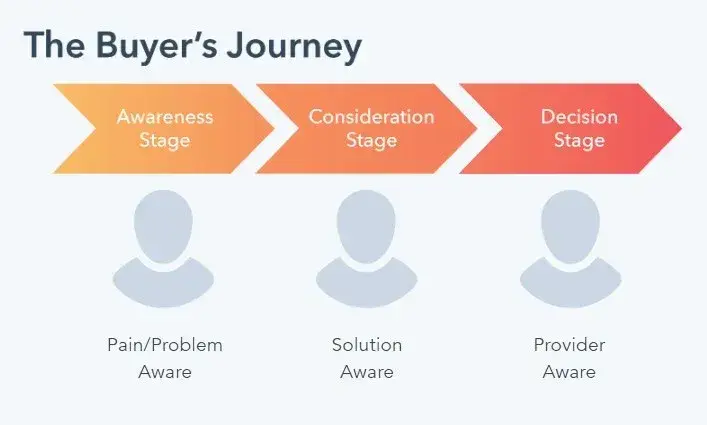
A diagram showing the three stages of the buyer's journey: Awareness, Consideration, and Decision, with corresponding buyer states below each stage.

Let me share an example I’ve used with clients: Imagine a growing startup realizes its project management is becoming chaotic. These companies rarely decide to purchase a SaaS project management tool immediately.

Instead, they often turn to the internet to learn more and make decisions as they progress through the following stages. My job is to assist them in that decision-making process through strategic content.

Awareness Stage

In the awareness stage, B2B buyers are experiencing a problem or pain point, and their goal is to alleviate it. They’re typically looking for informational resources to more clearly understand, frame, and give a name to their problem.

A common search query a prospect might begin with is: “How to improve team productivity?” At this stage, they‘re not yet thinking about specific SaaS solutions; it’s much too early for that.

Instead, they‘re looking to contextualize their problem first. As a B2B SaaS content strategist, I’ve discovered that showing up in search engine results, even in these early stages, is crucial to establishing authority and gaining the trust of buyers starting the journey.

Consideration Stage

Moving to the consideration stage, I‘ve observed that B2B buyers have usually clearly defined and named their problem.

They’re now committed to researching and understanding all available approaches and methods to solving their defined problem or opportunity. In other words, I’ve seen how they start considering potential SaaS solutions.

From my work, I know that a typical search inquiry a prospect would make at this stage might be: “Project management software vs. traditional methods?” In the consideration stage, the prospect isn’t yet ready to buy, but they are deciding on the potential solution for them.

My strategy here is to consider indirect competitors and educate prospects on the pros and cons of various SaaS options.

Decision Stage

Once they’ve progressed to the decision stage, B2B buyers have typically decided on their solution strategy, method, or approach.

Their goal now is to compile a list of available SaaS vendors, make a short list, and ultimately make a final purchase decision.

Prospects at this stage make search inquiries like: “Asana vs. Trello vs. Jira.” At this point, they‘re ready to invest in a solution.

They’ll likely go with a SaaS provider they like, know, and trust so long as that provider can meet their specific business needs.

Why Creating Content for the Buyer’s Journey Is Important

As in all marketing disciplines, it’s essential to understand your audience: how they think, the answers they seek, and the path they tend to take to find a solution.

From that research, you can begin crafting a documented content strategy that maps your content to the various stages of the buyer’s journey.

When you don‘t completely understand your audience, it creates a disconnect between your business and your potential customers.

For content marketers like me, this usually means you’re putting out content your readers don’t really relate to, which can cause you to lose them.

To avoid this, you‘ll have to consider the stage they’re at in their journey, how to meet them there, and the best channels to put the content in front of them. The internet has made it easier for marketers (and salespeople) to engage customers at the various stages of their journey using content marketing.

That’s one of the main reasons why 14% of marketers consider content marketing the marketing channel with the highest return on investment (ROI).

HubSpot’s marketing platform offers powerful automation tools that can help streamline this process. I love how you can use the platform to create personalized content experiences, see how users engage at each stage of their buying process, and send tailored content when users need it.

Creating the right content at the right time can, however, be a challenge.

Building a content strategy starts with identifying the types of content you’ll need to reach your audience according to their progression through the buyer’s journey, and we’ll guide you through it in terms of both the marketing flywheel.

Creating Content for Each Stage of the Buyer’s Journey

Once you have an idea of your buyer persona and how prospects move closer to purchase, you can begin creating content for your buyer at different stages and tailor that content per channel.

Doing so can help you map your content to the relevant stages of the buyer’s journey to make a marketing funnel.

Your journey may look very different depending on your industry, business model, product, pricing, and audience.

Some B2C customers, for example, spend very little time in the middle of the buyer’s journey compared to B2B customers, who require far more nurturing, engagement, and relationship development before a purchase is made.

A $50 pair of sneakers, for instance, requires a lot less hand-holding when it comes to making purchase decisions than a $10,000 business software investment.

Content Ideas for Each Stage of the Buyer’s Journey

Because audiences can vary widely based on industry and intent, persona research is of the utmost importance.

By understanding their unique process for awareness and evaluation, you can create a truly effective content marketing funnel and strategy packed with custom content that best supports their journey toward making a purchase.

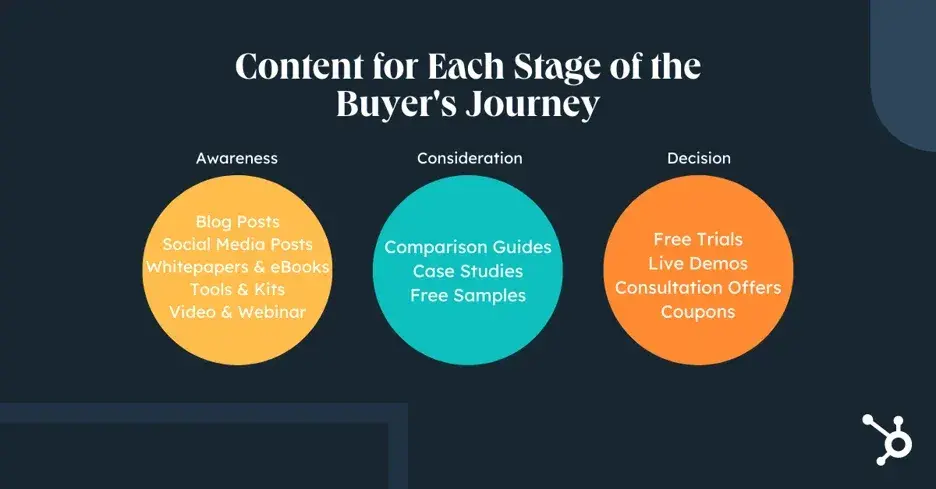
An infographic displaying content types suitable for each stage of the buyer's journey, including blog posts for Awareness, case studies for Consideration, and free trials for Decision.

So, let’s take it from the top and start from the beginning of the buyer’s journey.

At the awareness stage, a buyer is looking for top-level educational content to help direct them to a solution, like blog posts, social content, and ebooks.

Their value as a lead is low because there’s no guarantee that they’ll buy from you. But those who find your content helpful and interesting may journey on to the middle of the funnel.

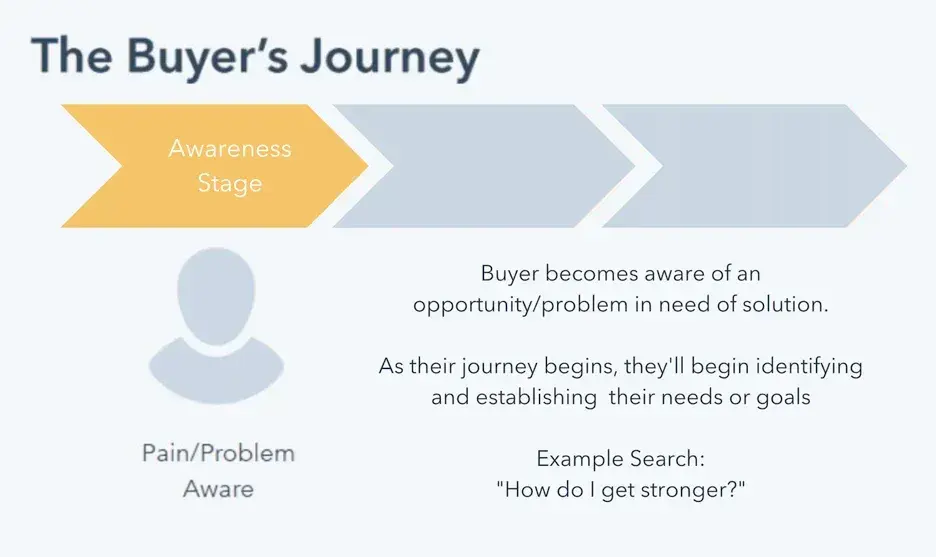
A diagram focusing on the Awareness stage of the buyer's journey, explaining that buyers become aware of a problem and begin identifying their needs.

The ideal channels for the awareness stage may include:

  • Blogging
  • Search Engine Marketing
  • Social Media Marketing

Let’s run through the different content formats best suited for these channels.

1. Blog Post

A blog post is an ideal piece of content targeting the awareness stage.

By targeting a pain, problem, or topic your target audience wants to discover and then posting it to your website, you’re creating a brand asset that’s crawlable by Google and discoverable by search engine users.

You can also promote your blog content across other channels.

When I’m having trouble ideating topics that align with my audience’s pain points, HubSpot’s Blog Ideas Generator can come in handy — just type in a few details about your audience or content, and the platform will generate catchy titles relevant to your input.

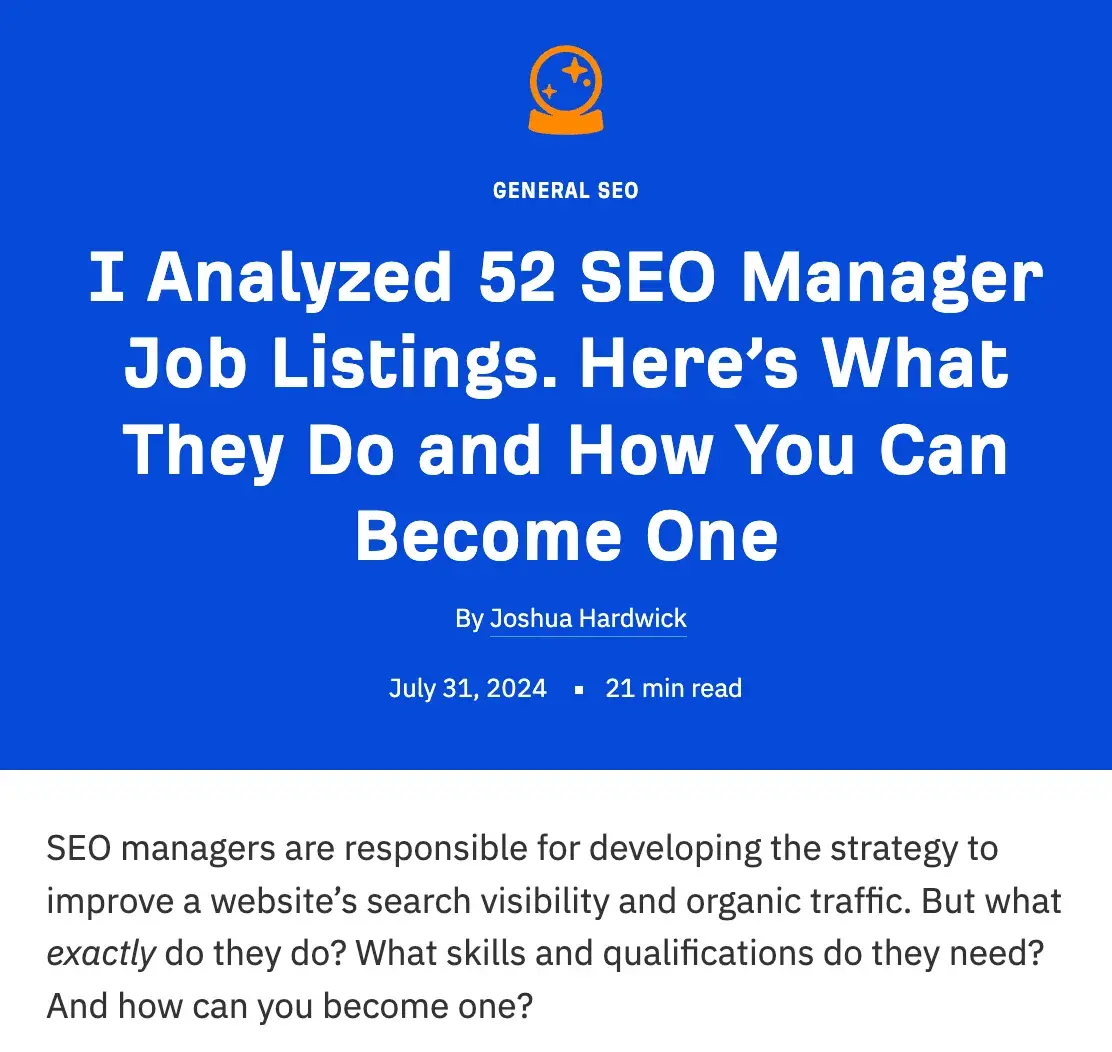
A blog post title screen about analyzing 52 SEO Manager job listings, written by Joshua Hardwick and dated July 31, 2024.

Image Source

Ahrefs does blog content right. They include original data and informational advice to create long-form articles that serve their audience.

Featured Resource: 6 Free Blog Post Templates

blog post templates

Download for Free

2. Social Media Post

You can use social media to promote your other content, and you can also create content specifically for the channel.

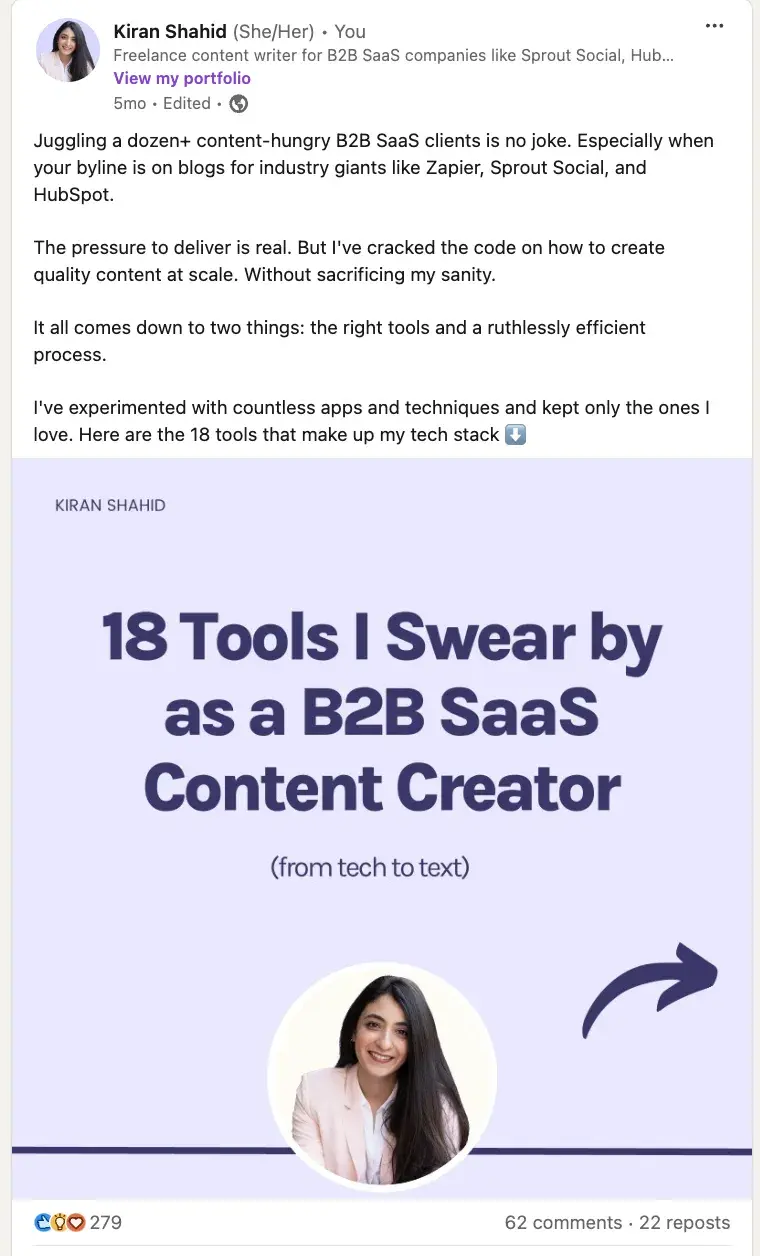
According to Backlinko, 86.1% of all eligible audiences aged 18+ are active on social media. Since I target B2B SaaS companies, my social channel of choice is LinkedIn.

A LinkedIn post by Kiran Shahid, a freelance content writer for B2B SaaS companies, discussing her content creation process and tools.

Image Source

In the above example, I’ve shared a carousel on my top tools on LinkedIn. These formats are popular on LinkedIn, as the content is created to be snackable with short-form take-aways.

3. Whitepaper

A whitepaper is an organization’s report or guide on a particular topic.

Whitepapers are especially useful as downloadable offers when readers want to go more in-depth on a specific subject they’re reading about.

I‘ve found it’s crucial to provide unique information your audience can‘t find elsewhere, which helps audiences understand the report’s value and compels them to download it.

HubSpot State of Marketing Report 2024

Image Source

Every year, HubSpot publishes a survey on the state of marketing to provide helpful guidance based on thought leadership to marketers, sales professionals, and business owners.

Inside, readers find statistics from a broad survey and industry experts’ opinions on what the data means and where the industry is going.

4. Checklist

For complicated tasks with many moving parts, your audience may simply want a blueprint that spells out what they’re supposed to do to achieve their end goal.

An infographic titled "The essential checklist for first-time home buyers" with the first step being to determine affordability.

Image Source

Buying a home is a perfect example of this, and Opendoor meets its audience’s needs by providing a handy checklist (in infographic form!) for the reader that spells out all the steps that need to be taken. The graphic is aesthetically pleasing and even allows room for a few tips along the way.

5. How-To Video

My experience has taught me that sometimes, the best way to solve a pain or problem is to learn a new skill.

While a purchase may be required along the way, your audience often needs to become more informed about the problem and potential solutions first. That‘s where I’ve seen instructional video content really shine.

HubSpot Marketing has a series of videos dedicated to teaching viewers about where SEO principles are broken down to the audience in easy-to-understand language and visuals. Knowing that SEO is a complex subject, the Marketing team aims to make it accessible to viewers.

6. Kit or Tool

I‘ve learned that informational content for a broad audience isn’t always sufficient for my buyer personas to make a decision.

In some cases, they require more utility or personalization. That‘s why I’ve found kits and tools to be excellent content pieces for guiding readers along their path to purchase.

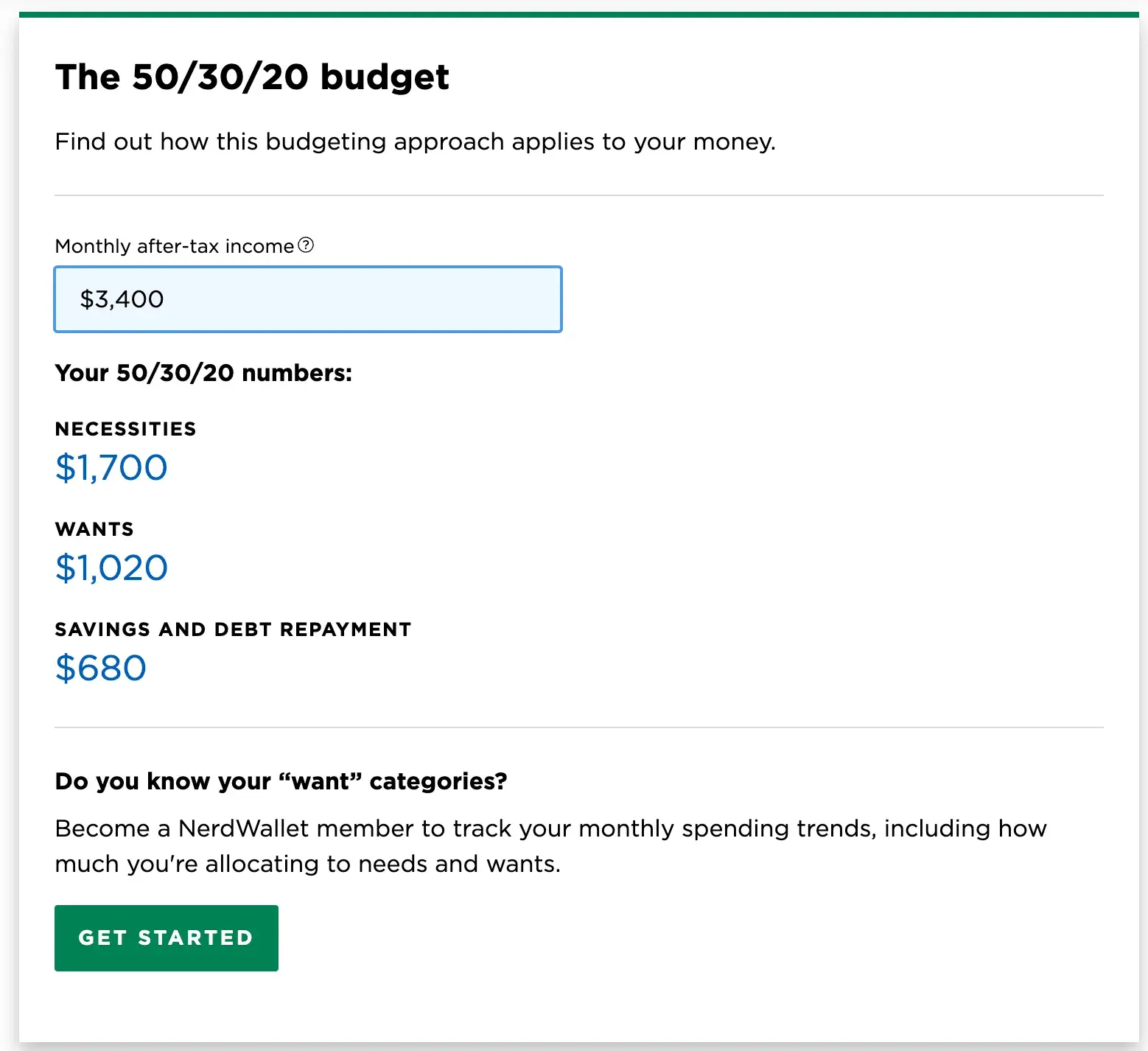
A screenshot of a 50/30/20 budget calculator showing monthly allocations for necessities, wants, and savings based on a $3,400 after-tax income.

Image Source

Nerdwallet creates content around several financial topics, budgeting being one of them. It can be challenging to create a budget, though, so they developed a calculator that allows users to provide their own numbers to receive customized recommendations.

7. Ebook or Tip Sheet

Similar to whitepapers, I’ve had success using ebooks and tip sheets as downloadable content. However, I typically make these shorter and more actionable.

A list of power words for writing emotional headlines, including terms like "free," "focus," "remarkable," and "confidential."

Image Source

CoSchedule combines a few tactics by promoting their headline analyzer tool with a blog post about writing great headlines that drive traffic.

On that blog post, they include a great tip sheet of powerful words to include in headlines if you want to catch a reader’s attention.

Featured Resource: 36 Free Ebook Templates

HubSpot's 36 free ebook templates

Download for Free

8. Educational Webinar

A webinar is a web seminar where information is typically provided through video.

A webinar can be prerecorded or streamed live, which opens up many possibilities for disseminating information to an audience that wants more visual and auditory content.

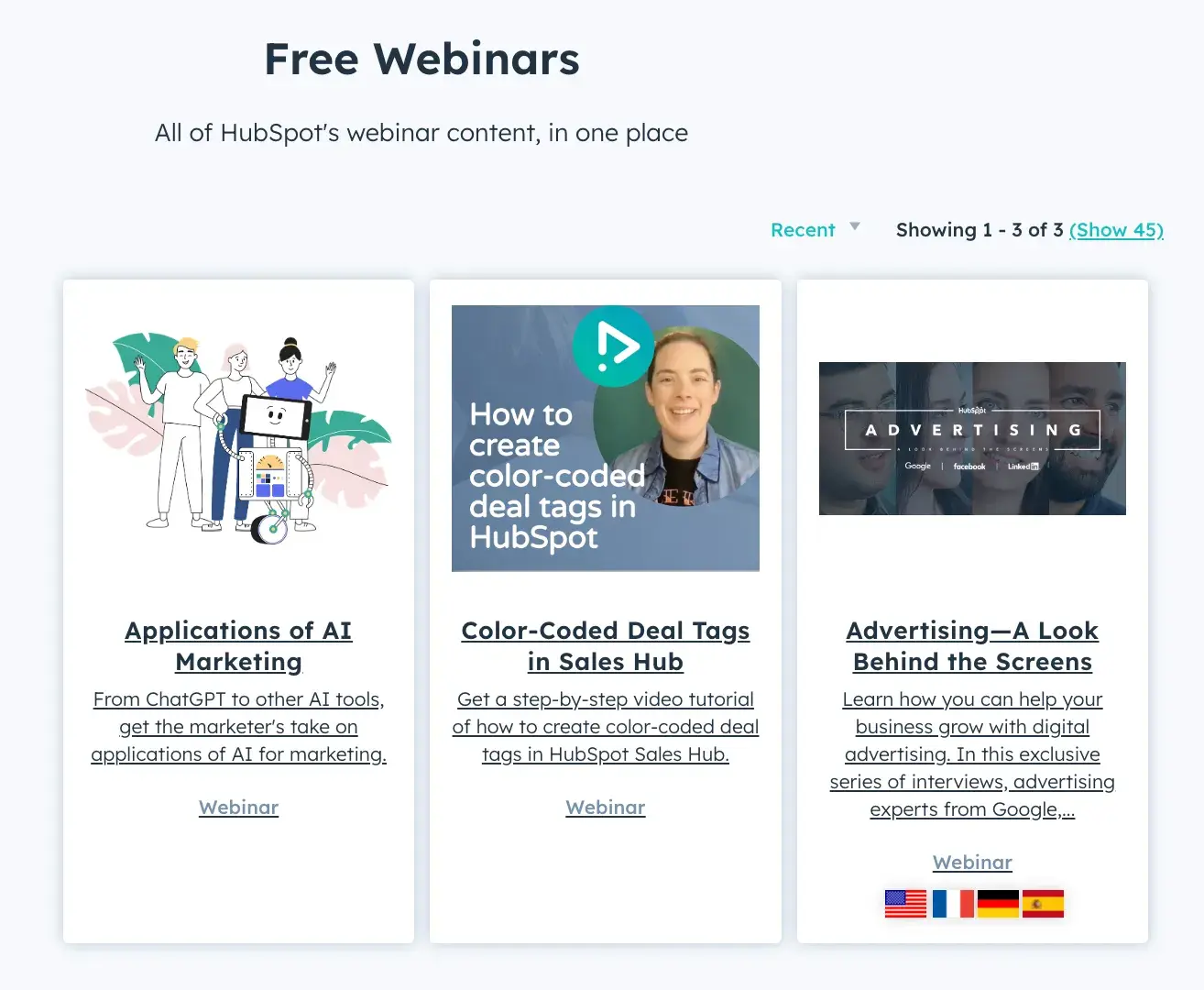
A webpage displaying HubSpot's free webinars, featuring three recent webinar topics:

At HubSpot, we create webinars as a key part of our content marketing strategy and often run a valuable topic multiple times to get more mileage out of the content.

Moving on from the awareness stage content, let’s delve into the next stage of the buyer’s journey.

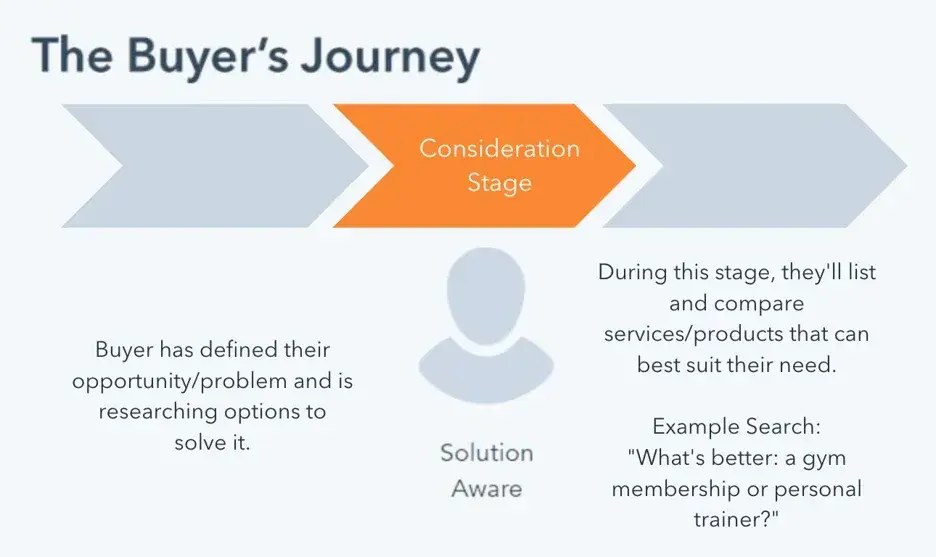
When someone moves into the consideration stage, it means you’ve captured their attention. They know they have a problem that has to be solved, and now they’re trying to discover the best solution. The need for a future purchase commitment creeps up as they’re evaluating their options.

An infographic showing the Consideration Stage of the Buyer's Journey, explaining that the buyer is researching solutions and comparing options to suit their needs.

This stage is typically a point of extended engagement where you’re nurturing a lead, building a relationship, and establishing trust between the audience and your brand.

The ideal channels for your consideration stage may include:

  • Website or Blogging
  • Search Engine Marketing
  • Email Marketing
  • Social Media

Let’s go through the best content formats for this part of the buyer’s journey.

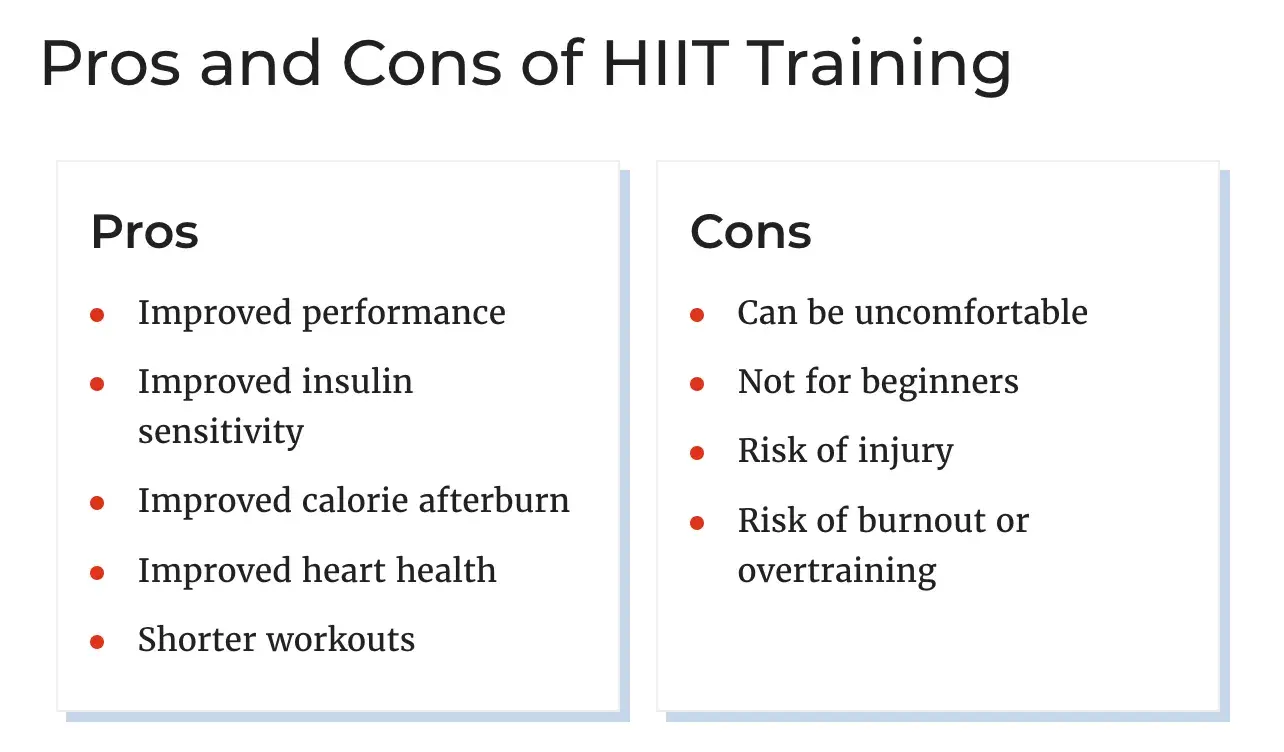
1. Product Comparison Guides

In the consideration stage, the buyer persona still considers solutions to their pain or problem. For this reason, product comparisons are a great way to help them decide.

A table listing the pros and cons of HIIT (High-Intensity Interval Training), including benefits like improved performance and heart health, and drawbacks such as discomfort and injury risk.

Image Source

For example, when I worked with a project management SaaS, we created comparison guides between different competitor tools to help our readers understand which tool might work best for their team.

2. Case Study

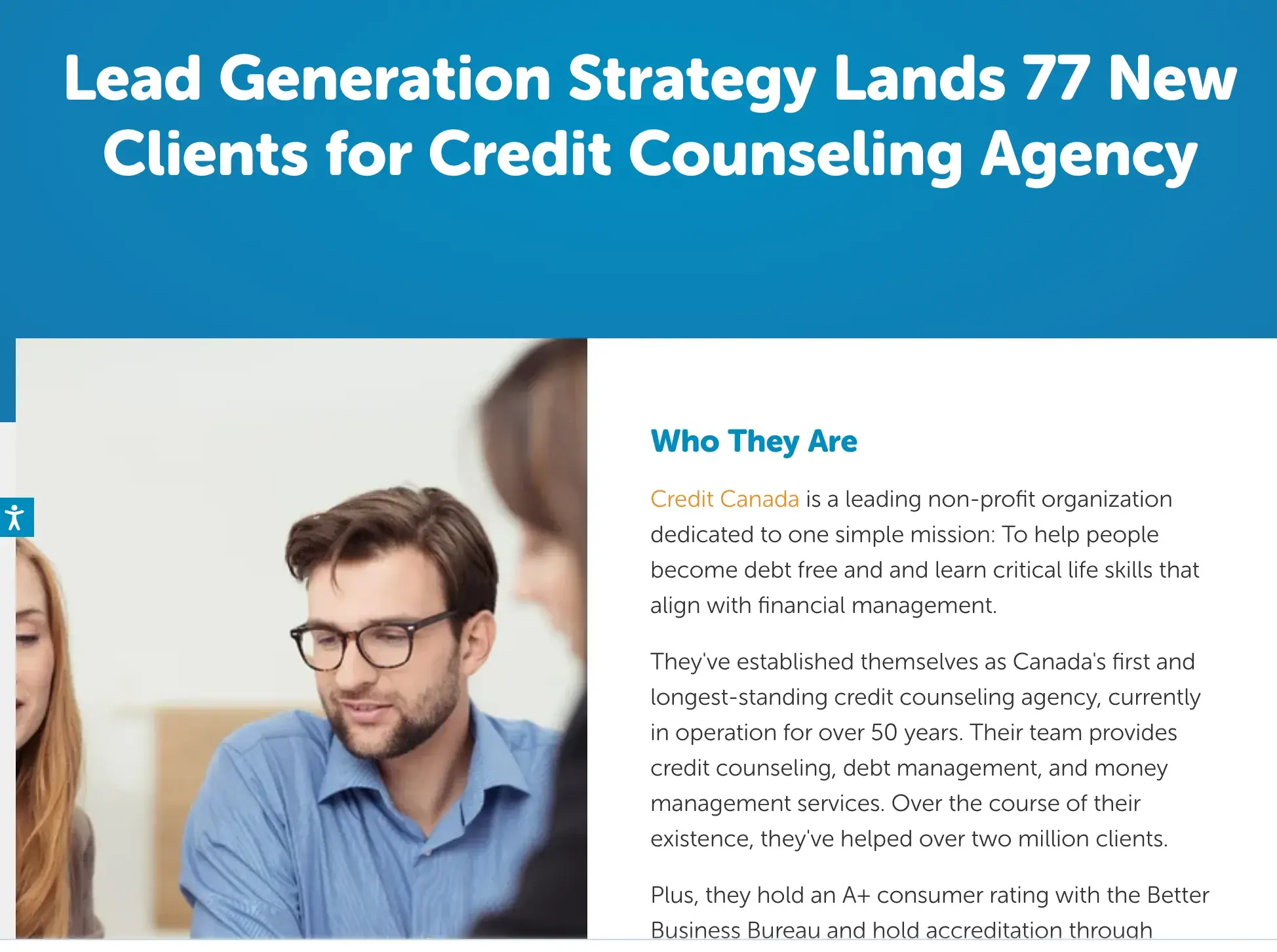
I’ve successfully used case studies in both the consideration and decision stages. In my view, a well-crafted case study convinces the reader that our solution works by showcasing real results for actual clients.

When I create case studies for my B2B SaaS clients, I make sure to appeal to both emotions and logic. I tell a compelling story about the client’s challenges while providing detailed, quantitative data on how our solution solved their problems.

A case study headline about a lead generation strategy that gained 77 new clients for a credit counseling agency, with an image of a man in glasses and the beginning of a description about Credit Canada.

Image Source

HubSpot Partner Agency Blueleadz tells a story about their client and their problems while providing a detailed account of how they solved them.

Featured Resource: 3 Free Case Study Templates

case study creation kit

Download for Free

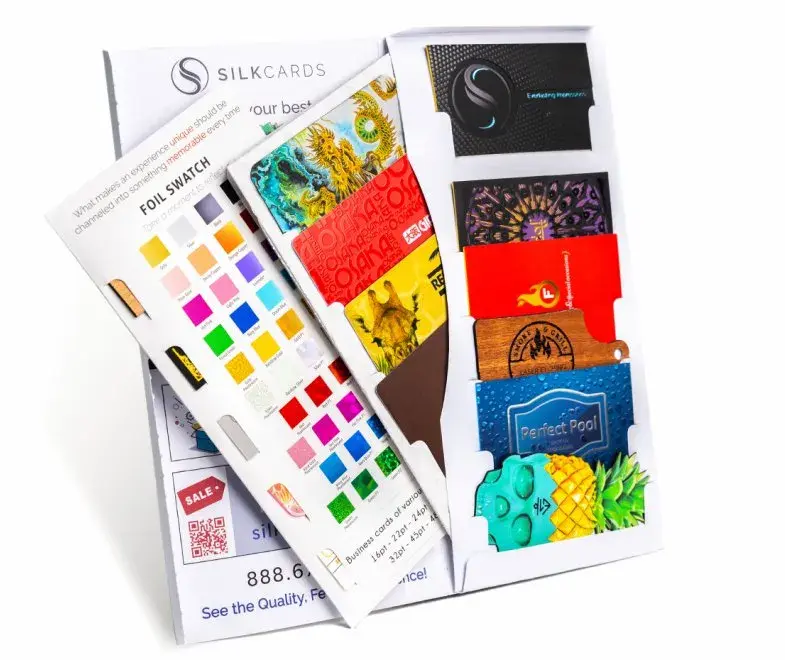
3. Free Sample

A free sample is another example of content or an offer that overlaps between the buyer’s journey stages. Consider this: An individual wants to paint the inside of their home but doesn’t know what color.

As they consider which color (the solution) to use, they pick up paint chip cards from their hardware store. A provider creates these cards based on their individual solution. When the individual falls in love with a color, they already know who the provider is that makes it.

A display of various business cards and color swatches from SilkCards, showcasing different designs, textures, and finishes available for custom business cards.

Image Source

SILKCARDS taps into this buying behavior by offering samples of their unique printing methods on the content that they create.

They know their business is tactile, and digital content alone is not enough to close a deal. Once their prospective customer holds the sample in their hands, other business cards are put to shame.

So, now that you’ve provided content to help customers list out or sample their options, it’s time to move them into the decision stage.

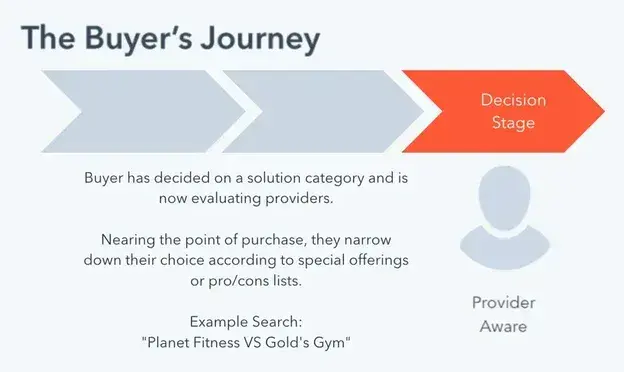
An infographic showing the Decision Stage of the Buyer's Journey, with two gray arrows leading to an orange arrow labeled

As prospects near the end of the buyer’s journey, they’re evaluating providers down to specific or specialized offerings.

Marketers, in turn, want to go above and beyond their expectations and provide an easy and frictionless customer experience that can win them over their competitors.

Handling objections, remove hesitation, position ahead of comp

In my experience, the most effective channels for decision-stage content include:

  • Website.
  • Email marketing.
  • Live chat and chatbots for service.

Here are the content formats I’ve found most effective in helping prospects get closer to purchase.

1. Free Trial or Live Demo

Most of my clients in B2B SaaS offer free trials of their products. Free trials allow potential customers to experience the power of the tools firsthand. Once they see how new tools impact productivity and efficiency, they’re much more likely to become paying customers.

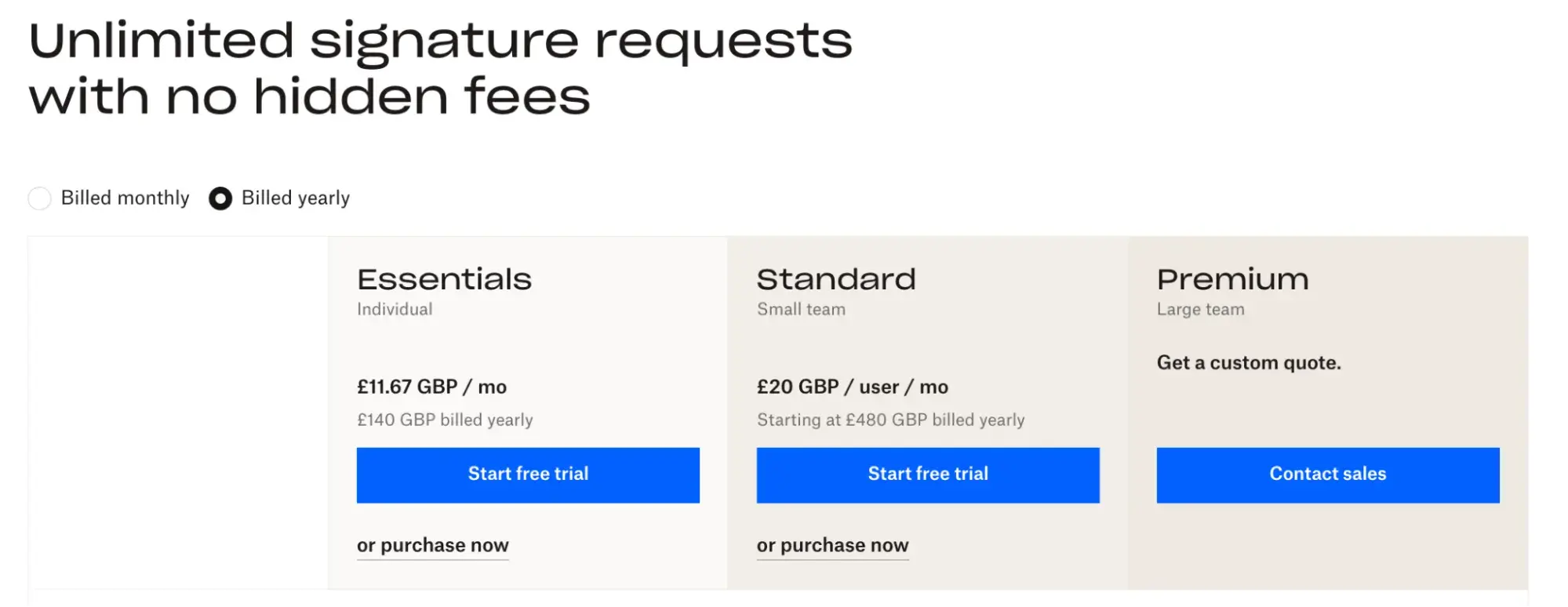
A pricing table for a signature request service with three tiers: Essentials (£11.67 GBP/mo for individuals), Standard (£20 GBP/user/mo for small teams), and Premium (custom quote for large teams).

Image Source

Dropbox Sign does this well. Though they have a free option with limitations, they know that offering a free trial upfront is the key to getting clients into their larger tiers. Their pricing page sets the prospect’s expectations and points them to the free trial.

2. Consultation Offer

A consultation is another example of providing just a little bit of service in exchange for the opportunity to close the sale.

The best consultation reduces the anxiety of entering into a sales conversation by promising something concrete they can walk away with (a strategy or actionable advice) in exchange for their time.

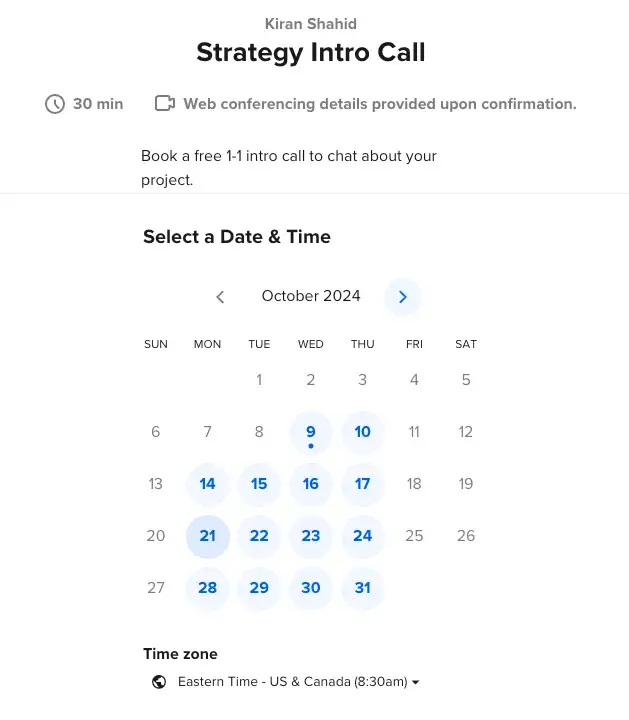
A calendar showing October 2024 with available dates for booking a 30-minute strategy intro call with Kiran Shahid.

In my B2B SaaS strategies, I often include consultation offers. I’ve found they work best when they promise concrete, actionable advice.

To increase conversions, I always make scheduling as frictionless as possible and use automated booking systems like Calendly.

3. Coupon

A coupon appeals to a fear of missing out (FOMO) mindset.

By reducing the price by a certain amount, a coupon is handing a price objection while convincing the prospect that they’re leaving money on the table if they don’t use the coupon. This inertia is enough to win the prospect’s business.

While traditional coupons aren‘t as common in B2B SaaS, I’ve had success with limited-time offers or special pricing for early adopters. This creates a sense of urgency and can be the final push a prospect needs to make a decision.

A "Spin to Win" promotional wheel interface featuring various prizes such as "$5 Off", "Free Ring", and "15% Off".

Image Source

Fragrant Jewels does this well by gamifying its coupons.

By spinning the wheel, the website visitors have the chance to get a coupon before checking out the products. They’ll likely evaluate the products that are a good deal with the coupon they won.

Beyond the decision stage, I always emphasize the importance of creating content to satisfy existing customers. In my experience, this often includes comprehensive knowledge bases, regular feature update announcements, and advanced tips and tricks to help users get the most out of the software.

Mapping Content Across All Stages of the Buying Cycle

In my years of experience as a content strategist, I’ve learned that every business has a unique buyer’s journey — one that demands a tailored approach for optimal results. I can’t simply replicate a strategy from one client to another.

And that starts by getting to know your audience and understanding their needs, pain points, and decision-making process. Once you have that understanding, you develop a strategy that maps custom content — whether it’s educational blog posts or product demos — to each phase of their journey.

When a content strategy truly matches a buyer’s journey, it improves customer relationships while boosting conversions and loyalty.

Editor’s note: This post was originally published in August 2016 and has been updated for comprehensiveness.

Categories B2B

21 Creative Lead Generation Ideas to Try (& Why Marketers Recommend Them)

Coming up with effective lead generation ideas is tough — and I’m the world’s worst at putting off this aspect of my marketing strategy.

Sending cold emails and scraping together lists for lead generation can be difficult because — let‘s face it — often, people don’t want to take the time out of their schedules to talk.

Download Now: Lead Generation Best Practices Guide

What if you could reach your lead generation goals using methods that actually add value for your prospects? And what happens when traditional lead generation methods fall flat due to internal or external circumstances?

This lead generation utopia I’m describing is a possibility. To walk you through how to achieve this for your business, I’ve asked the experts and detailed several creative methods you can add to your lead generation strategy.

These ideas provide valuable information that helps prospects rather than simply pushing them to make a purchase.

Let’s unpack these 21 creative lead generation ideas to spark activity on your content offers, email lists, websites, and conversion rates.

And for more on lead generation, you can explore all of HubSpot’s free lead generation content and resources in one place.

Social Media Lead Generation

1. Partner with influencers.

One of the quickest ways to gain traction and drum up new leads is to partner with influencers within your niche.

Influencers have a special way of connecting with their audiences, and when they showcase your brand, you expand your reach to a larger audience.

Pro tip: Nicole Rossi, Marketing Coordinator at Custom Neon, told me partnering with influencers is an effective lead generation idea, but the key is to create landing pages relevant to your campaign.

Rossi said, “Partnering with influencers has also been an incredibly successful lead-generation tool for us. Influencers that share our brand values are partnered with us, and together we develop giveaway campaigns or offer special discount codes to their audience. With this approach, we can reach unexplored markets and produce leads through forms or landing sites made specifically for the campaign.”

Networking Lead Generation Ideas

2. Do a LinkedIn audit.

If LinkedIn is your jam, you could be sitting on an untapped market — your connections.

Melissa Lohrer, Founder at Waverly Ave Consulting, said, “Sometimes, your next best opportunity is already in front of you. Audit your existing LinkedIn connections — there are likely untapped opportunities sitting directly in your network. Growth isn’t always about bringing in new people but nurturing who’s already in your corner and leveraging those relationships to create momentum. This is your fastest path to conversion.”

3. Schedule coffee chats.

When it comes down to it, gaining a qualified lead starts with connecting on a human level. No-strings-attached networking is a great way to connect with members of your audience, build meaningful relationships, and begin a slow (but warm!) conversion.

Erin Pennings, a copywriter and marketing strategist, told me coffee chats are her favorite way to connect with your target audience.

Pennings said, “In my experience, the number one lead gen strategy is building relationships with other people. It‘s not networking in the traditional sense of the word, but simply about making connections. It’s not usually a fast-burn strategy because human connections take time, but it’s a great way to create an effective referral network.

“I love reaching out to people to schedule no-pitch coffee chats where the primary goal is getting to know people — and I always ask them who I can connect them with or who would be a good referral for them, and they generally reciprocate. Often I can make connections right away to support them, and then when I need to get contracts or work at the door, I know I can reach out to see if they know anyone I know.”

4. Use customer reviews in your pop-ups.

Want to build trust and brag about your clout? Consider showing off your customer reviews. Visitors lurking on your website want to know what real customers think of your product or service before they, too, take the plunge.

That’s why Johannes Karjula, CEO at Trustmary.com, uses a customer review pop-up to drive conversions.

Karjula said, “The best strategy to generate leads is to use an exit-intent popup that features customer reviews and an offer or discount code. These work especially well if someone is very close to converting: either buying or booking a meeting. If they’re about to leave, throwing social proof to their faces is great in proving that they actually need the product or service in question.”

Content Marketing Lead Generation

5. Create valuable content (blog posts, podcasts).

Your audience wants content, whether that’s a blog post, a podcast, or a video. That’s why I think content marketing remains one of the most effective and recognizable ideas for lead generation strategies.

Roland Jakob, managing partner of BlazeKin Media, says, “The most effective lead generation idea I‘ve encountered is the strategic use of personalized content marketing. In my experience, creating tailored content that speaks directly to your target audience’s pain points and interests is incredibly powerful. I‘ve found that when we develop in-depth blog posts, engaging videos, or insightful podcasts that genuinely address our audience’s needs, we not only attract potential leads but also establish ourselves as trusted authorities in our field — which is what you ultimately want.”

6. Share success secrets from thought leaders.

Want to provide unique value in your content? Reach out to a thought leader in your industry or even your company.

By interviewing an expert to uncover their secrets, you prove to potential customers that you’re dedicated to delivering the best advice and insight out there.

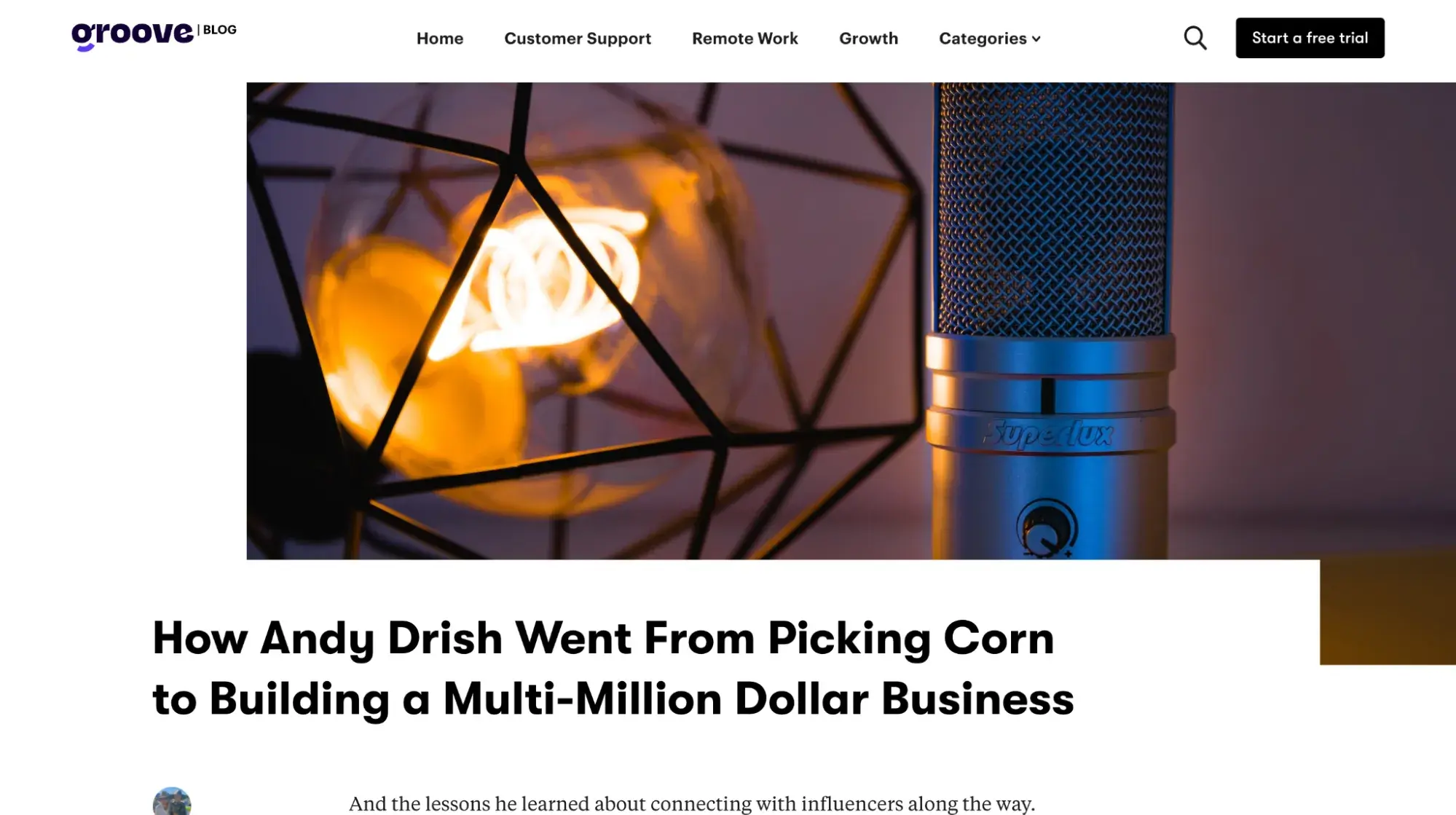
Below you‘ll see Groove’s take on this approach through an interview with the CEO of The Foundation, Andy Drish.

The folks at Groove frequently interview successful founders and ask very specific questions from which everyone can learn something. Then, Groove shares those interviews with audience members on its blog.

screenshot of Groove’s blog as a lead generation idea

Image Source

Not only is the interview with Drish chock-full of quotes, lessons, and actionable takeaways for entrepreneurs, but it also features an “Ask Me Anything” (AMA) with the interview subject in the comments section.

This touch helps further Groove’s reputation as a resource for expert information among its audience.

7. Compile real-life examples with actionable takeaways.

Finding effective examples to learn from can be equally as valuable and difficult. A list of best practices, current trends, or real-life examples in your industry is an excellent way to drive prospects to a guide or offer where they can opt-in.

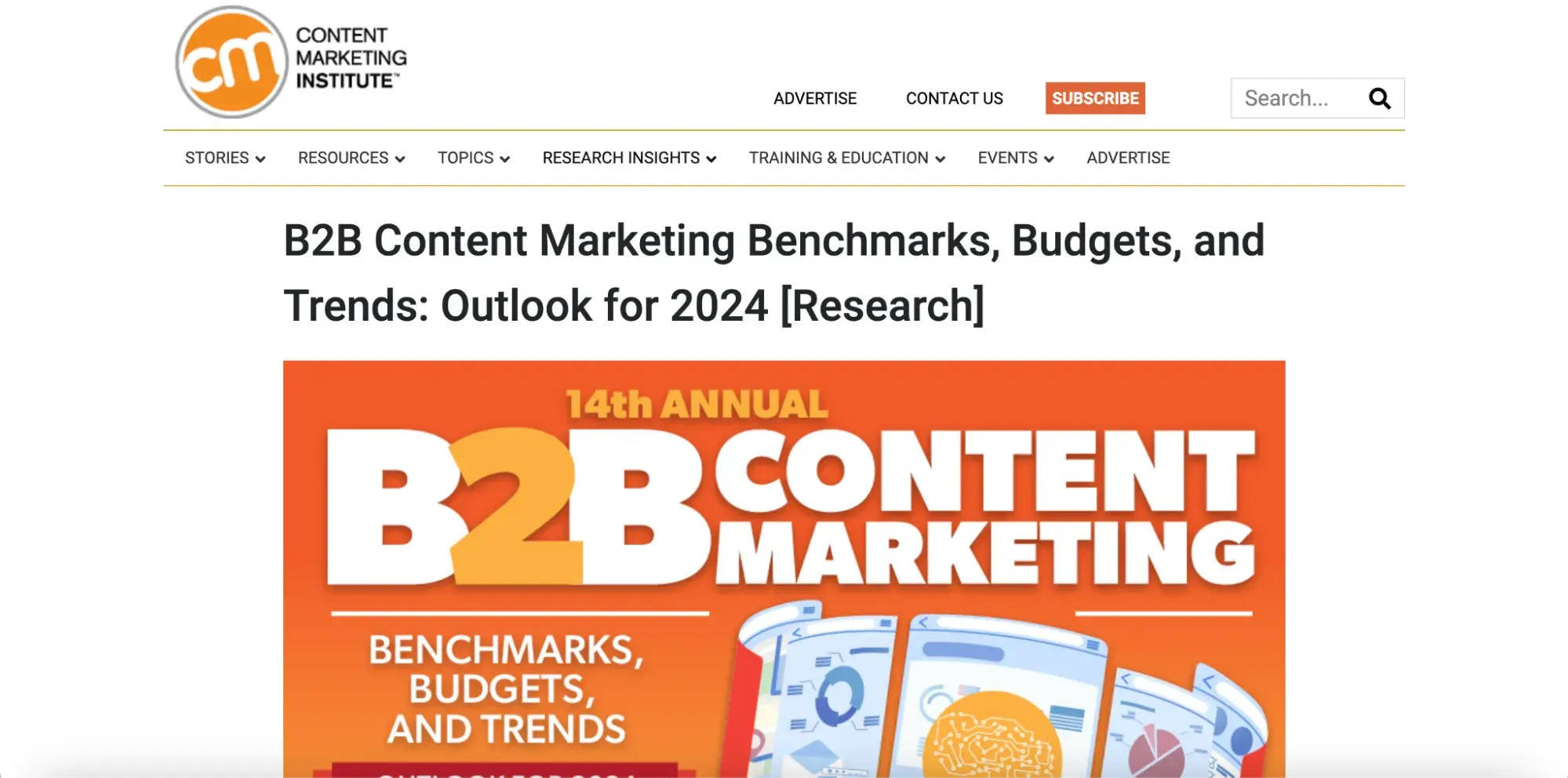
The Content Marketing Institute knows this and makes a point to share current content marketing trends every year in a blog post.

This blog post acts as a resource to inspire site visitors to be successful with their marketing strategies, and, ultimately, search their website for guides and opt-in offers to up their content game.

screenshot of the Content Marketing Institute’s blog

Image Source

8. Show what’s working for your company.

I can’t be the only marketer who’s nosey, right?

It’s why I find sharing a transparent post that pulls back the curtain on something with which you’ve seen success (or failure) interesting. And I know your potential leads find it interesting, too.

Other companies going through a similar stage of growth — or approaching your size — can gain a lot of inspiration from transparency posts and ultimately avoid making the same mistakes.

In an effort to provide an insightful resource, consider sharing how you’ve built your platform or a lesson you’ve learned along the way. You can share your insights in a blog post or a downloadable guide.

Just don’t forget to include a final call-to-action to encourage readers to join your email list.

9. Create a handy checklist.

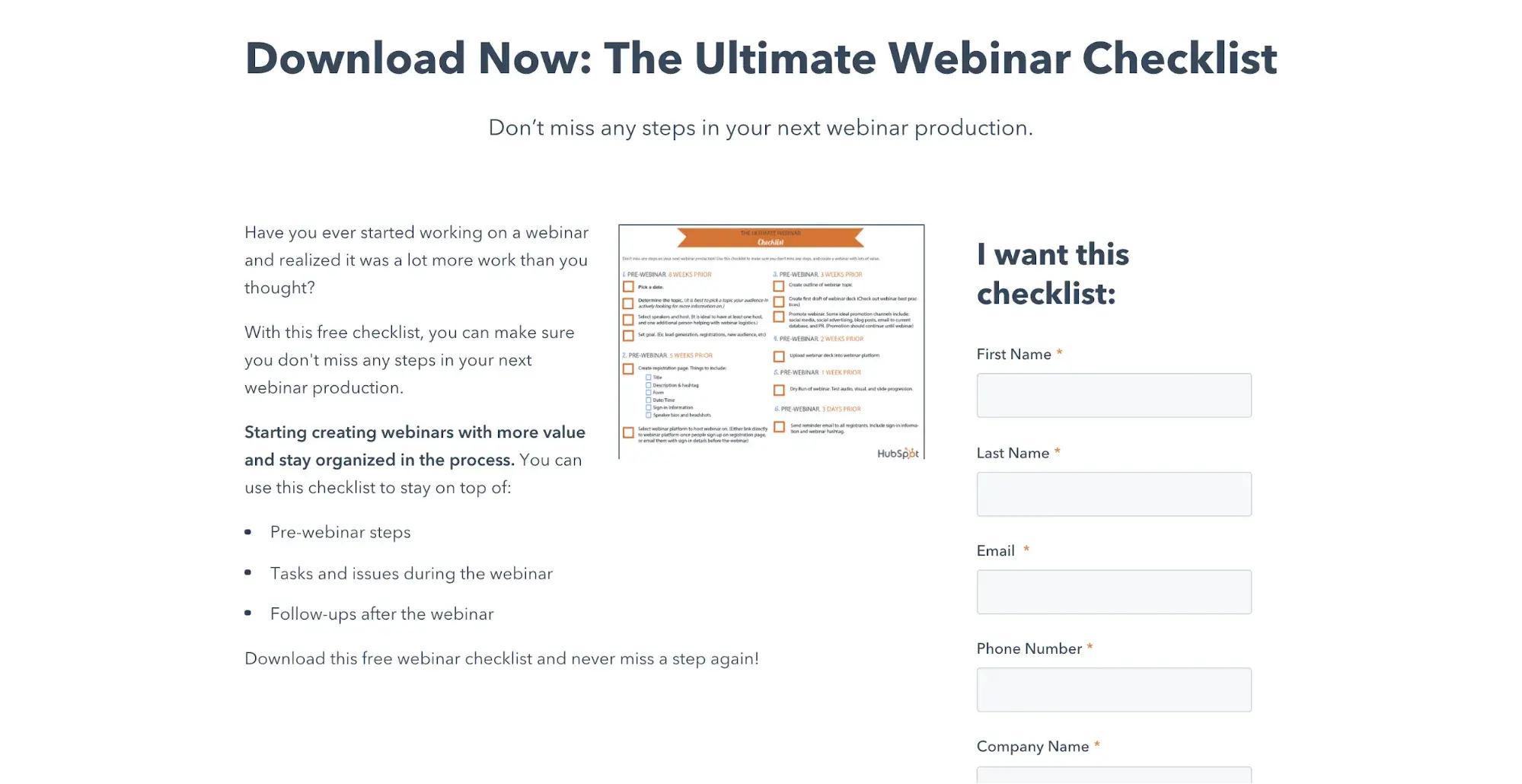
Who doesn‘t have a running to-do list that sometimes gets a little bit too long? If you’re planning an upcoming webinar, you can be sure there’s a lot that goes into it.

HubSpot created a handy webinar checklist that marketers can download and use to make sure they don’t miss any critical steps in their webinar production.

screenshot of The Ultimate Webinar Checklist landing page

Pro tip: HubSpot uses the gated offer to prove its brand’s expertise on the subject and encourage checklist downloads.

10. Offer insightful, downloadable case studies.

One of the best ways to gain new leads and spark interest in your products or services is to show how your brand is an asset to your clients. Case studies help get your message across while doubling as a lead magnet.

Krissy Selda, a digital marketing specialist at Array Marketing Agency, is a huge fan of case studies. Selda told me, “From experience, publishing case studies has been the most powerful lead generation tactic because they demonstrate how your business consistently meets customer expectations.

“By showcasing the value of your products or services, case studies allow potential clients to envision themselves benefiting from your success. When customers see tangible results from businesses or individuals similar to themselves, they are more inclined to engage with your product or service. This makes them one of the most effective content marketing tools for driving leads.”

11. Create an interactive quiz or tool.

Consider offering a quiz to your website visitors as a creative way to learn more about them and obtain their contact information.

The goal is to “bargain” the result of the quiz in return for a new lead, which can be very effective when done right.

Cassandra Gucwa, founder of Menerva Digital, says tools and quizzes are “a great way to offer something that is valuable to your potential target audience and gather their email or information. Some examples of free tools would include a cost calculator, savings calculator, or a tool that checks how secure your email address is.”

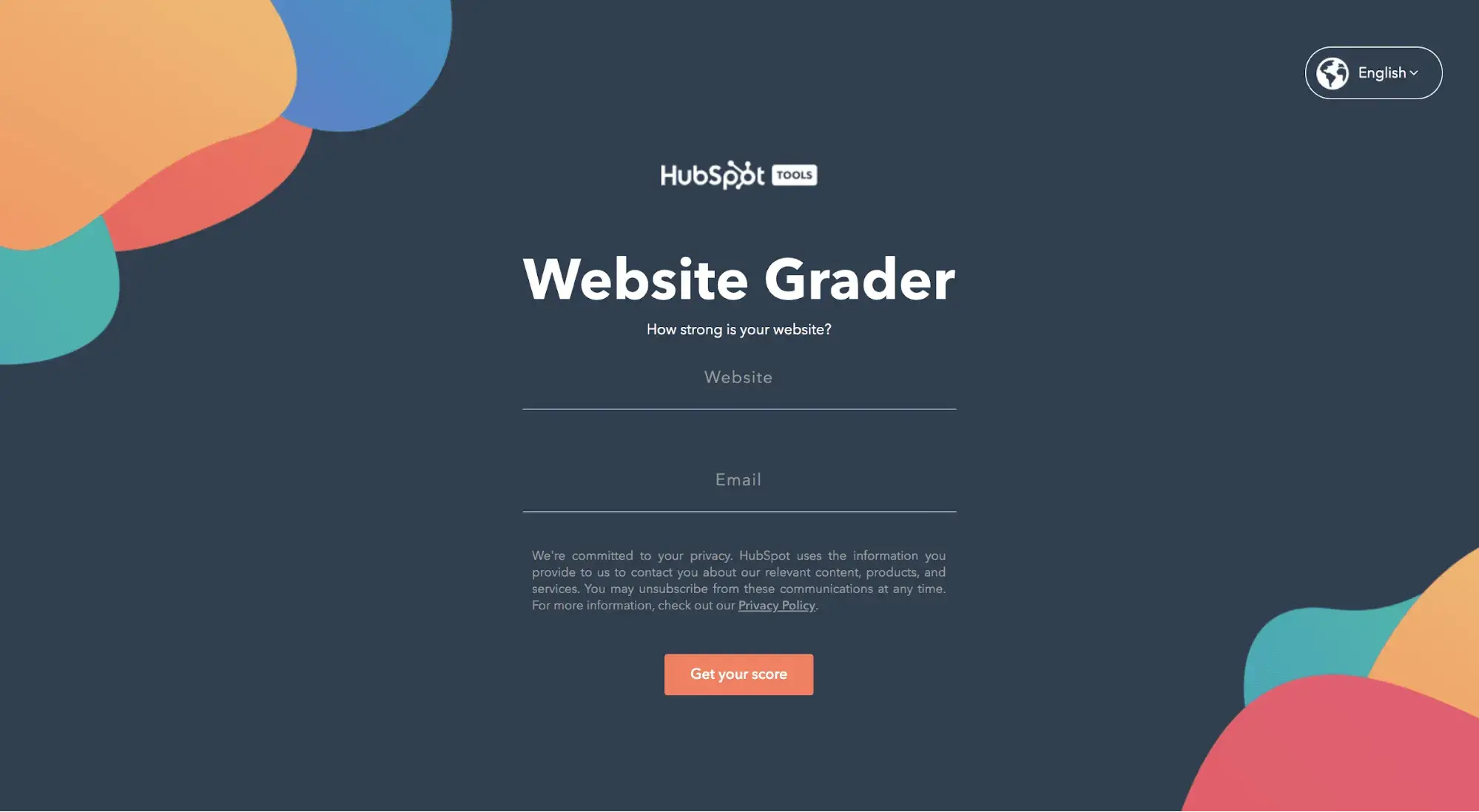
Another similar method is offering an interactive tool, such as the HubSpot Website Grader. The Website Grader is a free online tool that visitors can use to grade their websites against key metrics and discover ways to improve them.

To use the tool, visitors must submit their email — which provides HubSpot with new leads interested in improving their web presence.

screenshot of HubSpot’s Website Grader

Video Marketing Lead Generation

12. Personalize video content.

91% of businesses use video as a marketing tool. And for good reason: it’s a great way to connect with qualified leads and convert them to paying clients.

Whether you use short- or long-form video, the key to video marketing lead generation is to personalize your content.

For Mike Vannelli, Creative Director of Envy Creative, personalizing video starts with understanding the unique perspectives of your audience.

Vannelli told me, “One of my favorite lead generation tactics is leveraging personalized video content. We create tailored video messages based on specific pain points or challenges a prospect is facing. It‘s not just about sending a generic promo — it’s about showing that we understand their unique needs.

“These personalized videos are then embedded in emails or used as landing page content. Adding a clickable call-to-action at the end, like scheduling a demo or downloading a valuable resource, boosts engagement like nothing else. The human touch combined with targeted messaging has consistently driven better conversion rates for us.”

Email Marketing Lead Generation

13. Create a valuable course or guide.

A well-developed course or guide is like gaining access to a real class — for free. For busy marketers, this type of offer can prove to be incredibly valuable.

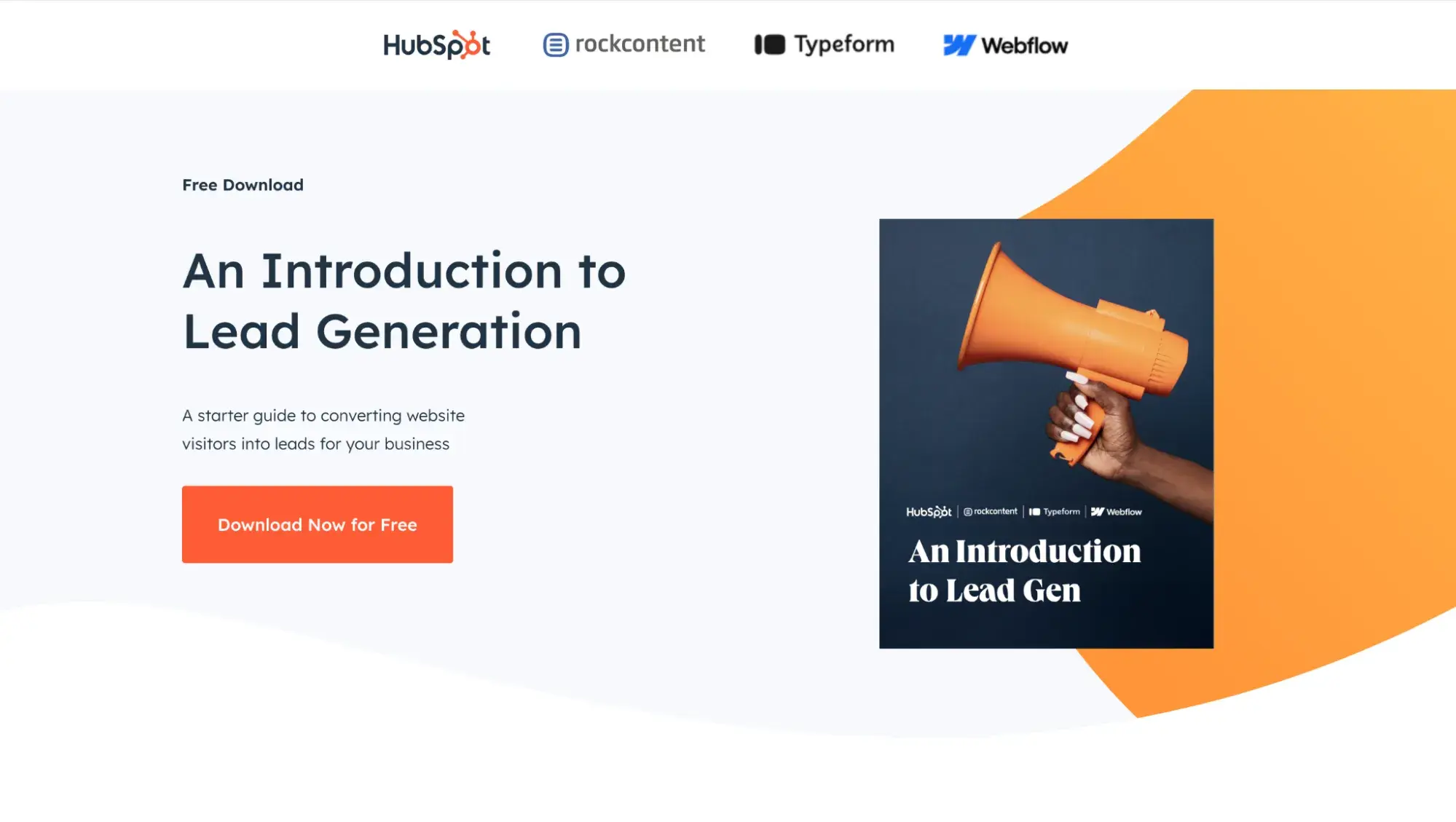
Pro tip: This approach tends to work well for in-depth topics. You can create an email course, host a course on your platform, or create a downloadable guide for visitors to read. HubSpot offers tons of free courses and downloadable guides like Introduction to Lead Generation.

screenshot of HubSpot’s Introduction to Lead Generation offer

These courses and guides help people with different content consumption styles get the same valuable information that’s on the blog, and it helps HubSpot generate new leads to engage with over email.

14. Provide gated offers with best practices.

When you explore a marketing tactic in a blog post or e-book, I find it helpful to know what others are doing to have success with the same method.

Compiling those best practices into a list is incredibly useful to a marketer looking to get started in a particular arena.

For example, HubSpot offers a comprehensive list of SEO best practices from a variety of experts, which aims to help its target audience achieve a greater return on investment from content marketing.

screenshot of HubSpot’s SEO starter pack landing page

The ebook provides value for readers trying to crack a complicated marketing strategy — and in exchange for their contact information, they get insider tips from a variety of expert sources.

Event-Based Lead Generation

15. Offer webinars and live demonstrations.

If you’re looking for another lead generation idea, consider hosting seminars or live events. Webinars and live events are perfect opportunities to mingle with your audience while also providing them with useful information and new skills (and upselling your products and services!).

Cache Merrill, founder of Zibtek, told me, “Webinars are an excellent tool for presenting one’s expertise and building trust. We try to cover the ‘correct’ topics relevant to what we do. Finally, we expect to have a very good number of conversions at the end where audiences are eager to have a closer interaction request for a consultation or a demo.”

Referral and Partnership Lead Generation

16. Create a referral ecosystem.

Lead generation doesn’t have to be a solo endeavor. I’ve mentioned working with influencers as an example of how to make conversions a team sport.

However, influencers aren’t the only people you can recruit for your lead generation efforts. Instead, ask your network for referrals.

Lohrer calls this “creating a referral ecosystem.”

Lohrer explained it to me like this: “Choose your top three clients and tell them you’re looking for more like them. Ask for introductions to their peers or advice on where to find similar high-value clients. Better yet, ask them to introduce you to someone you want to meet to make it easy for them.

On top of that, partnering with complimentary service providers — those who work with the same client base in different ways — or those who influence your clients (think advisors or coaches) can help create a steady, mutual referral stream.”

17. Solicit brand partnerships.

Like influencer partnerships, connecting with other brands is a great way to tap into other markets and connect with a larger audience. You’ll want to ensure the brands you connect with are relevant to your niche. The more relevant the niche, the more likely their audience aligns with your own.

Roland Jakob, managing partner of BlazeKin Media, agrees that brand partnerships are an effective form of lead generation.

Jakob told me, “At BlazeKin Media, I’ve connected creators with major brands like Coca-Cola, Sephora, and others, driving high-quality leads by expanding reach and boosting credibility. The key is ensuring these collaborations provide real value to the brands, creators, and audience, leading to engaged prospects who are more likely to convert into loyal customers.”

Freemium and Trial-Based Lead Generation

18. Offer a free trial or a freemium product.

Is there anyone else out there who hates a free trial or product? I am pretty sure there isn’t. Everyone loves free. It’s the reason offering a free trial or a freemium product works so well as a lead generation tactic.

Yevhenii Tymoshenko, chief marketing officer at Skylum, understands that free trials lead to qualified leads, which is why a free trial paired with personalized marketing are their go-to lead generation ideas.

Tymoshenko told me, “Once a user is signed up for a free trial, we make use of personalized marketing to ultimately convert them.”

Free trials of a brand‘s services help get a prospect’s foot halfway through the door. If the free trial helps them and provides great value, they’re more likely to purchase the full product and become a customer.

Another similar strategy is to offer a freemium product, similar to how HubSpot offers the free forever HubSpot CRM. By offering a portion of your product or service line for free, you give users a taste of your brand and build trust and awareness among your user base.

screenshot of HubSpot’s CRM software landing page]

Tymoshenko also incorporates freemium products into Skylum’s marketing operations.

He said, “We‘ve also been testing giving limited free access to certain new features of our products … This is a good way to generate qualified leads that would purchase your product in the end. And if, for some reason, that doesn’t happen, we can offer custom discounts to some users.”

SEO Lead Generation

19. Leverage the SEO power of customer reviews.

Review platforms generally have a strong presence in organic search, making them a great opportunity to expand your brand presence and get noticed by the right people.

When you encourage users to leave reviews on a third-party platform with strong SEO — like Yelp or Google — you increase the chances of being found by qualified prospects in search, without paying a dime.

Google recognizes the independent role of these sites in helping people find what they’re looking for and seems to favor review sites in search engine results.

Imagine your company on this list. There’s a high chance your product would be included in what McKinsey calls the “initial consideration set” leading to the “moment of purchase” during the consumer decision journey.

You also outmaneuver competitors in high-value keyword searches. This is crucial considering that many B2B searches start with a generic keyword phrase.

20. Optimize your website.

Here’s a hot tip for lead generation: Don’t overlook your website. Ensuring your website is optimized and ready for the search engines is a quick way to turn it into a lead generating machine.

Colton De Vos, marketing and communications specialist at Resolute Technology Solutions, told me that if your website generates lots of traffic, but only converts a few leads, then you should consider making changes to your site to encourage conversions.

De Vos said, “Invest the time to tweak your website content and design to persuade visitors to make the leap and contact your business. Make it easy for prospects to reach out. Include many easy options for them to engage, and facilitate their research of your company. Feature trust factors such as reviews, case studies, and the value your company has brought others.”

Pro tip: Consider connecting your marketing software to your website to make it easier for leads to get in contact with you.

Paid Lead Generation

21. Paid advertising.

My last lead generation idea to share is paid advertising. Think of paid ads as billboards in the online space. A great billboard catches attention and encourages the potential customer to take action of some kind.

Online paid advertising does the same thing. Plus, with the right landing page and forms, you can easily convert visitors to leads.

Sophie Musumeci, CEO and Founder of Real Entrepreneur Women, uses paid advertising as part of her lead generation efforts. But she told me there has to be a well-thought-out strategy for it to work well and convert leads.

Musumeci said, “I’m a fan of strategic paid advertising. It amplifies your reach, but it’s critical that the ads are targeted, clear, and focused on the results your audience is craving.”

You can launch paid ads on nearly every social media platform, including setting up ads on Facebook and Pinterest. You can also set up ads on Google and other search engines.

Pro tip: Wherever you decide to spend your marketing dollars, take the time to understand your audience and learn the places they hang out online. This can help you determine the best places for your ads.

Effective Lead Generation Ideas for You

I’ve found creating an effective lead generation strategy to be an art and a science. For me, the best strategy combines several lead generation ideas, like cultivating connections with my network and offering high-value content.

You might find, however, that paid advertising or partnering with brands and influencers works better for your niche.

Whichever lead generation strategy you experiment with next, make sure the content is useful to your audience so they’ll return to your website again and again.

Editor’s note: This post was originally published in February 2017 and has been updated for comprehensiveness.

Categories B2B

Optimizing B2B Conversion Rates — All My Tips and Strategies

One of my favorite things to do is watch college football. And if you think I’m going to compare optimizing B2B conversion rates to football, you’re absolutely right.

Just like each player of the team needs to work together to score a touchdown, the parts of your B2B conversion strategy need to work in harmony to catch website visitors and turn them into paying customers.

Download Now: Free 8-Week Conversion Rate Optimization Planner

If there’s a weak link in your strategy (like a player on the team not performing at their best), you’ll need to tweak it or pull it from the roster.

For this post, I sat down with Daniel Lynch, President and Owner of Empathy First Media, to discuss optimizing B2B conversion rates. Settle in as we go over the differences between B2B CRO and B2C CRO, and I’ll share some of his tips to help you plan a winning conversion strategy.

Table of Contents

What is B2B conversion rate optimization?

Before I go too far into it, let’s take a moment to define B2B conversion rate optimization.

B2B conversion rate optimization (CRO) is a strategy to improve the number of desired actions on your website and landing pages. Ideally, your desired action, whether it’s a new sign-up in your forms, a new subscriber to your channel, or a click on a demo link, leads to a new conversion.

I like the way Lynch puts it. “In my opinion, where conversion rate optimization is going for B2B is not just the form fill,” he explained.

“Instead, it’s the first impression of what your brand offers. Like customizing it to that person and then having very detailed automated responses with sequences and chatbots. Then, using conversational artificial intelligence data enrichment to foster those conversations.”

Lynch said conversion rate optimization should really be dubbed “conversation rate optimization.” He said, “A conversation rate optimization is more than just a conversion. The conversion can be a vanity metric. But, conversations are what the goals should always be with marketing.”

CRO boils down to understanding the customer journey, identifying ways to improve it, and making it more appealing to potential customers to start a conversation. As your customers journey through your sales funnel, they come in contact with elements designed to grab their attention and spur them to action.

Those touch points include:

  • Sales and landing pages
  • Sign-up forms
  • Pop-ups
  • Call-to-actions (CTAs)
  • Compelling content and copy
  • Free trials and freemium tools

Making an effort to optimize each of these things can help convert a lead to a loyal customer. You’ll want to track and analyze each part of your conversion strategy to fully understand where you need to make changes to encourage more clicks or sign-ups.

Thankfully, there are tons of conversion rate optimization tools that can help you analyze your sales funnel and optimize your strategies. These tools can help you make appropriate, meaningful changes, as changing the wrong strategy or tweaking the wrong layer of your funnel could negatively impact your CRO.

You also don’t want to make a ton of changes at once. Instead, consider using a conversion rate optimization planner to help make small, meaningful, and measurable changes.

B2B CRO vs. B2C CRO

Let’s face it: Conversion rates vary across markets.

Even though over 60% of B2B and B2C leaders are leveraging AI tools for marketing, the marketing and conversion strategies that work well for each market are very different.

This means you can’t really use the same B2C tactics to optimize your B2B conversion rates. Logically, it’s still marketing, and it seems like the strategies you’d use for B2C sales should apply, but the B2B market is a whole different ball game.

Here’s why.

Target Audience

b2b vs b2c cro, target audience

As marketers, you and I both know how important it is to understand our target audience. You’ve likely spent time creating an audience persona to gain a deeper understanding of what makes your audience tick.

But, when it comes to B2C marketing, the audience persona is likely just one individual. Instead of appealing to a broad group of people, B2C marketers can get oddly specific in their personalized marketing strategies.

This is often easier because you really only need to influence one person to convert a sale — the individual buyer.

In B2B sales, though, the target audience is a wide range of people, from the CEO to the director of marketing to the content marketing manager.

For instance, let’s pretend your company sells engagement software designed to make connecting with customers easier. To really drive home the benefits of your software, you need to think about how it improves the workflows of each department within an organization.

This means you need to segment your audience into subcategories.

Going back to the engagement software example, your sales team will use that software differently than your marketing and customer support departments.

So, to really nail down how to connect with these groups, you’ll need to think about how your software can best serve them and tailor your approach to speak to those solutions.

Segmenting your audience isn’t just a good idea for companies — it’s a great strategy to bring in more revenue. 70% of companies use segmentation to better market to their customers. And, of those who use this strategy, 80% of those businesses see an increase in their profits.

So, if you want a better ROI and optimized conversion rates, consider segmenting your target audience.

Decision-Makers and Research

b2b vs b2c cro, research

As I mentioned, in B2C sales, a purchase is usually an individual decision. However, in B2B sales, the decision to make a purchase is a group activity.

With more stakeholders involved, there are more decision-makers. If those decision-makers are anything like me and have to research a product from all angles before purchasing, it means there will be double or triple the research notes before the group as a whole decides to purchase a product or service.

With more people helping to make a decision, individual research will likely uncover more purchase options for group consideration.

According to B2B SaaS Reviews, 27% of B2B buyers consider six or more options before making a purchase, compared to just 17% of B2C buyers.

This means that to convert visitors on your website who are somewhat interested in your product, you really need to position your product or service as the solution to their B2B needs — or you risk losing a lead to your competition.

Sales Cycle

b2b vs b2c cro, sales cycle

Remember the days when you watched infomercials in the middle of the night and were persuaded to purchase new exercise equipment that would solve all your insomnia problems?

For me, it took just thirty minutes into one infomercial to decide to buy a new piece of gym equipment.

The point of that story? The B2C sales cycle is relatively short. It often goes like this: You see something that catches your eye, you think about how it’ll solve all your most pressing problems, and then you plunk your card down and go home with something new.

Seems like a relatively effective sales cycle, right? It is — for B2C.

That’s not how it works in the B2B world, though.

B2B sales often take more than 30 minutes to reach the end goal. In fact, the average B2B sales cycle is just over two months long.

During this time, your sales team will need to make every effort to convert leads, strike up a conversation, and close a sale. That might mean that you invite decision-makers to lunch, call them to follow up and re-pitch (and re-pitch!) your services, or schedule a live product demonstration.

These are all tactics you wouldn’t use to close the B2C sales cycle.

Messaging and Marketing

b2b vs b2c cro, marketing

How you market your products or services also varies slightly depending on your market. Content marketing, influencer partnerships, and social media marketing are all effective conversion methods, but some work better than others for B2B sales.

For example, influencer partnerships are a fantastic idea for promoting your brand, but they work best for B2C brands, as they can be more persuasive to the individual.

Content marketing is a great option for getting the word out about your products or services, and 91% of B2B marketers include it in their overall strategy.

For B2B marketing, writing how-to tutorials, offering case studies, or sharing videos of product walk-throughs is a great way to produce highly engaging content that converts leads to sales.

Content marketing works for B2C brands, and 86% of B2C marketers include it in their strategy. But, the more effective content they share, like short-form, trendy videos, is different.

Customer Journey

b2b vs b2c cro, customer journey

Finally, the biggest reason B2B CRO varies compared to B2C is that the customer journey is different.

B2C brands know that they’re often selling a one-time purchase product. This doesn’t mean they won’t have repeat customers — they will. However, it does mean their focus is on getting customers to their site as quickly as possible to make a low-value purchase.

B2B purchases, though, are high-value purchases. This means your customers aren’t just purchasing a product; they’re purchasing an experience.

They need to know upfront the value they’re getting from your product or service before agreeing to a contract. It’s why your B2B customer journey should be filled with as much valuable content as possible.

Instead, you should focus on providing various resources, including explainer videos, case studies, and tutorials, to help influence their purchasing decision before encouraging them to contact your sales reps.

Oddly enough, involving your sales reps too soon can be detrimental. Garner found that 44% of millennials don’t want to interact with a sales rep before making a B2B purchase.

Lynch said this is because we (as consumers) are selfish with our time. That’s why text-based marketing, like chatbots, works so well in B2B marketing and sales.

Now that we know the differences between B2B and B2C conversions, let’s look at some of Lynch’s favorite B2B conversion rate optimization strategies.

B2B Conversion Rate Optimization Strategies

B2B Conversion Rate Optimization Strategies

1. Monitor your website.

Heat Mapping and Recording Sessions

Your website is a gold mine of information, and you can uncover valuable information about your website visitors with the right AI tools.

And I’m not just talking about metrics relating to form fills or bounce rates. Lynch told me the key to optimizing B2B conversion rates is implementing AI tools for heat map tracking and session recording.

These conversion rate tools provide users with a visual representation of the most visited places on their websites. This gives you a better understanding of the kinds of things, like your calls-to-action or graphics, that catch your visitors’ eyes.

Lynch told me he likes using heat maps because they create a timeline where you determine the sequence of button clicks by users. He said, “It’s super important that you identify with their cursor. What did they highlight? What did they focus on their screen?”

Once you understand their interests, you can filter out your product or service features your leads don’t care about and only focus on the things they do. Not only does this cut down on wasted time, but by targeting their interests you’re on your way to opening a meaningful conversation (and conversion!) with your leads.

User Experience

This strategy might sound repetitive, but the user experience does affect your overall conversion rate. In our conversation, Lynch made it a point to tell me that a well-designed landing page doesn’t necessarily mean it’s chock full of interactive elements. Instead, less is more.

He said, “What a lot of people don‘t realize is that the best landing pages are the ones that don’t look the best. You want them low, quick, to serve the purpose, and have some visual aesthetic to them. But less is more.

“Minimalistic is what drives conversions. You just want to get them to sign up, so you can talk to them and move on. And the more you add to that page, the longer it takes to load. And the longer it takes to load, the lower your conversion rate will be.”

If you’re not sure which landing page converts the most users, consider A/B testing. A/B testing can help you easily identify which elements of your landing pages lend to the best user experience.

2. Optimize lead forms.

Although your lead forms are only a small part of your conversion rate optimization strategy, they still hold some weight. And a bad form will send your visitors running in the wrong direction.

According to Lynch, “There‘s plenty of data that every additional form field you add lowers your conversion rate because it’s one more field that people have to take time to complete.”

And he’s right. 27% of people will abandon a form because it’s too long. Thankfully, there are AI conversion rate tools available to help optimize your forms. He wholeheartedly recommends using them, too.

AI-optimized forms work by collecting user data as a visitor roams around on your website. Think data — like company name, industry, and position within the company. Then, when they land on a form, your AI tool can change the form to collect only the necessary data.

This can drastically reduce the number of form fields a user needs to complete, which in turn can help increase your conversion rates.

3. Use social proof.

Remember how I mentioned 44% of millennials don’t want to talk to a sales rep when making a B2B purchase? It’s important to keep this stat at the forefront of your mind when tweaking your conversion rate strategies.

One way to show off your brand without involving a salesperson is to use social proof. Lynch said, “Testimonials, reviews and trust badges help leverage your authority and position you as an expert in that industry.”

Considering 84% of B2B buyers use review sites, it’s worth it to take some time collecting customer reviews. You’ll also want to scour the internet for any mention of your product or service on review sites like G2, TechCrunch, and TechRadar.

It’s also not a bad idea to ask your loyal fans to record a short video for your website and social media platforms. If other B2B customers sing the praises of your product or services, it’s easier to convince another business to work with you.

No sales reps needed.

4. Incorporate conversational AI.

When I asked Lynch for his thoughts about millennials not wanting to speak to a salesperson, he wasn’t surprised. Instead, he told me that’s why incorporating conversational AI tools, like chatbots, into your website is so important.

He said, “A lot more people are going to be less hesitant to anonymously engage with chatbots.”

AI-powered chatbots can be trained on your visitors’ behavior and your company data, including your company’s knowledge-base library and your tutorials.

So, when a visitor lands on your website, your chatbot is equipped with the best, most up-to-date information to help guide visitors to fill out your forms or book a demo call.

Plus, chatbots provide immediate support. Lynch mentioned that potential customers, as a whole, are selfish with their time and don’t necessarily want to wait on a response from a sales rep.

He said, “They want to have real-time conversations. The beautiful thing about chatbots is you give them that instant dopamine, versus having to wait for someone to call them and schedule it. A scheduled call doesn’t respect your time as much as an instant one does.”

While AI chatbots can’t do everything to close the loop on your B2B sales cycle, they do lend a helping hand to help speed up the lead generation process before potential leads lose interest in your brand — talk about optimizing your conversion rates.

5. Dynamic content optimization.

There’s no doubt you’re creating content based on your ideal customer profile (ICP). But, because there are so many decision-makers in a B2B purchase, it can be challenging to nail down the right call-to-actions or the most effective copy.

Enter: dynamic content optimization. Using AI and its data to optimize your copy and content takes the guesswork out of your advertising. AI can detect who in the decision-making team is looking at your landing pages. Then, it can optimize your call-to-actions to better encourage sign-ups or clicks.

For example, if a CEO is on your webpage, your CTA might be “book a call.” Compared to a content manager who might need approval before scheduling a demo, the CTA might say, “Request more information.”

Lynch likes to think of this approach as “marketing with the scientific method.” He told me, “That‘s why the data is so important. If you cannot improve your copywriting optimization, unless you’re willing to assume you’re wrong. Look at the data to adjust your approach, adjust your copy, and go from there.”

6. Account-based marketing.

Going back to the football reference that I started out with, to optimize your conversion rates, you need to think of the B2B decision-makers as individuals on a team.

Each individual has their own role, whether that’s the CEO, a department manager, or a department director. Each of these roles functions differently within a company. How they interact with and use your product or service will be different, too.

It’s best to think of how each decision-maker will use your product or service and market it based on that.

But you shouldn’t just think about how they’ll individually use your product, you also need to map out who has the most buying power and pull within the team.

Lynch explained it to me like this. The CEO holds quite a bit of power in the buying decision, but they also don’t want to spend time wrestling with the decision — they’re busy. They have things to do, and they trust their team to make the best decision.

On the other hand, there will be someone in the decision team who thinks it’s better to go with your competitors. These are the people you should focus your marketing efforts on.

And, it’s where account-based marketing comes in.

Danial said, “Account-based marketing is identifying buying roles in the process that match your ICP and audience personas. You can associate the different buying roles and identify them as the gatekeeper, the champion, the blocker. The champion is the one who wants to choose you … [and] is advocating for you to the team.”

According to Danial, the blocker is someone who wants to go with someone else.

“And if they‘re a blocker and you’ve identified that, you can even put them into a list to be retargeted with certain emails, LinkedIn messages, Facebook ads, or LinkedIn ads to try to change their mind by giving them more trust with your brand,” Danial says.

This is also why it’s really important to create compelling content, like case studies and ebooks. You can send those materials to help persuade team members to start a conversation with your brand.

Optimizing B2B conversion rates starts with a conversation.

Your B2B conversion rate strategy doesn’t have to fall flat. Instead, consider using AI to help optimize your conversions and generate better leads.

After all, like Lynch told me, conversions boil down to conversations. And, using the data your AI tools collect, you’re better equipped to have more meaningful conversations with interested prospects, without needing to go over the preliminaries and risk wasting valuable time.

Categories B2B

From Pretty Logos to Real Impact: How I Shifted My Focus from Visual to Emotional Branding

Welcome to Creator Columns, where we bring expert HubSpot Creator voices to the Blogs that inspire and help you grow better.

I never wanted a business that only looked good from the outside. Creating only to satisfy the eyes of onlookers, audiences, and critics would be, and will always be, a waste of my time.

Over a decade ago, I walked away from a dull, corporate job because it felt like a trap — a suffocating environment designed to put me on a creatively draining conveyor belt headed for “Welcome to 65 and retirement!”

Frankly, that wasn’t for me. I became an entrepreneur so that I could build a business that is a free-flowing, evolving extension of who I am, rather than morphing it to fit what I think the industry wants it to be.

Download Now: 150+ Content Creation Templates [Free Kit]

For most of my career, I’ve been a “figure it out” sort of girl. I’ve DIY-ed my way to success, including creating my own logos and coding my old websites. So, when I realized the visual aspects of my business didn’t necessarily align with the heart of it, I paused, evaluated, and made a shift.

In the process, I learned the vital difference between visual and emotional branding. This evolution took time because, with my background in photography, I am a very visually-inspired person!

Eventually, I learned how to harness my obsession with pretty logos, fun fonts, and gorgeous aesthetics and integrate the deeper work of cultivating a brand that creates meaningful connections with my audience. When connection is your brand’s primary goal, it drives real (and better) results.

Your brand needs your heart and soul. Whether it’s a small side gig or your full-time work, your branding (visuals and messaging alike) can and should be the bridge between you and your audience.

Without emotionally driven branding, you’re having to bridge the gap yourself — and likely exhausting yourself in the process.

So, let’s walk through my experience in learning not only the difference between visual and emotional branding but also how I made the change in my business for the long haul.

The Difference Between Visual and Emotional Branding

I know “branding” encapsulates a lot of aspects of what you do — it’s basically the identity of your business. When you create a brand, you’re likely creating a series of logos, color stories, typography, and other visual design elements.

The visual aspects of your brand matter because they’re how your customers recognize you and differentiate you from everyone else. You can use these elements to appeal to your audience’s aesthetic, saying, “Hey, you and I probably like the same things!”

Based on design, like the appeal of a book cover, your audience will generally gravitate toward you. This is the first impression.

However, your brand’s impression doesn’t stop at the visuals. This is merely a quick glimpse, a drive-by. You want more than just a shallow connection because this can be replicated (or faked) by anyone.

We’ve all unwrapped (literally or figuratively) something only to find that what’s underneath is not what the advertisement sold to us. You can be shiny, but you want emotional depth.

That’s how you build long-term loyalty and connection in a crowded marketplace.

Most people think branding stops with the visuals, but I’d argue that’s only where it starts. A true brand is the personality behind your offers — going way beyond a font or palette.

Emotional branding allows your brand to show up with feeling, not just an appealing look. Creating an emotional brand can drive deeper bonds with your customers as you show your shared values, beliefs, and emotional experiences. Social media made this way more possible.

In fact, as brands and businesses began to show up on social media, the audience demanded a deeper connection from them. Since that day, brands have needed to become good storytellers.

Emotional branding may be about sharing yourself.

I remember the marked change that happened in my photography career when I transitioned from sharing solely client images to sharing myself.

I shared myself editing with my dogs lying over my feet, the reality of what being an entrepreneur looked like, I shared as I decorated my first home with thrift store finds, and the puppies we fostered.

I was showing who I was and ultimately what I loved and that resulted in my clients seeing an image of someone who felt like a friend. It wasn’t just about how I edited my photos; now they could see who edited the photos. They could envision me in my life, chasing dogs, or hanging pictures on the wall.

I went from a business to a brand, a personality. They wanted me there with them on their special days, not solely the results I would deliver to them. Because I understood that pretty much above all else, on a wedding day, you want good people bringing the good vibes.

And that’s exactly who I was and what I was delivering!

People want to be able to interact (or relate) with their favorite brands. Here are some easily recognizable companies that rely on emotional connections to their brand:

  • Nike: Inspiring customers to achieve their personal best.
  • Apple: Fostering a sense of innovation and belonging.
  • Coca-Cola: Associating the brand with happiness and togetherness.

While these companies are massive, global superbrands, I think we can pull a lesson or two from how they show up: they tell us a story about who they are.

They’re not just flaunting what they do, but they want us to feel good about associating with them. They create a space for a customer to enter, belong, and connect to a message, rather than just use a product or hire a service.

The difference can feel subtle, but shifting can make a (literal) world of difference.

How I Shifted to Emotional Branding

The shift started in my gut at first. I realized I’ve never felt a pull to show up as perfect, polished, or shiny. I craved more realness so that manifested in what and how I created.

From there, I examined how my audience across multiple social media platforms responded to my brand. I watched what questions I got asked over and over again — were they curious about my life, my relationships, my work, my processes?

The messages, replies, blog comments, email inquiries, client testimonials, and even podcast reviews helped me piece together the stories I was telling and the way my audience was perceiving me.

I took time to make sure that aligned with how I wanted them to perceive me. Did it align with my vision for my business and brand?

My business is me, so I want to make sure people remember that I am a real, living human who has a perspective I love to share.

What I am selling isn’t some regurgitation of what anyone could search for on Google. It’s processes that are learned, lived, and pieced together by me. That’s a major selling point and differentiator.

You could easily learn business from a million different places and people, but you can only learn my methods from ME in ONE place: my digital courses. So, I needed to make sure that the me-element is consistently visible and unmistakable in how I present my brand online.

It’s not about the name (or even the premise) of the course as much as it’s about knowing you’re going to sit down and learn from me. People want that kind of connection.

When I read the testimonials, this is extremely evident. My students rave about the course by saying things like “Learning from Jenna changed my business!” What you don’t hear is “This course changed my business” or “I loved the ads I saw for this course!” Ha, of course not, but you see the difference.

My digital course landing pages still present a results-oriented purpose to my potential students, but the brand itself is driving a connection between myself and my customers.

The way we approach copywriting, page layout, color choices, and our main offer’s primary selling points stems from the desire to make sure our customers feel seen, understood, and guided. I want them to feel a sweet relief when they read my sales pages because I build my offers to be entire solutions.

They’re complete, they’re effective, and they’re created to actually help and simplify. I want my customer to feel like I’ve met their gaze and to know without a doubt that I really do understand their needs because I used to stand where they are now.

The Impact of My Evolved Brand on My Business

Shifting to an emotional brand has led to more buy-in on the front end as my audience is excited about my offers before I even drop them. I no longer have to put all my energy into hoping an ad or announcement alone catches their eye.

Algorithms, unfortunately, don’t work like that. Warm leads going into a paid offer is far better than “Oh, I didn’t know you were working on anything!” Or “You hardly show up in my feed anymore!”

More interaction with your customers means more access to knowing what they want and need from you. Feedback is a critical part of connection. It can help you measure success and optimize your business as you go, rather than veering way off course and having to make big, sweeping changes down the road.

I am seeing a better connection to what I am all about. The questions I get about my life are evidence of that, too. I get fewer questions about what I do and more questions about how people can get involved or learn more from me.

I feel seen and understood by much of my audience which means I get to spend better, more meaningful time engaging with them, rather than explaining who I am or repeating myself.

The profit shift looks like less time and money spent on screaming about offers online (i.e. less ad spend in the wrong places, less external apps and tools needed to get the word out there).

Instead, I have customers who have emotional buy-in to my offers, my experiences, and new creative endeavors I will do in the future. They feel that my brand is being led and shaped by their needs and see it evolve with them, which means they want to stick with it!

And ultimately, I feel aligned with my brand. That’s a vital piece of the puzzle. You need to feel confident about how your business shows up online. You know when you feel good when you walk out your front door and when you don’t quite feel like yourself, right?

We all know the difference between that feeling of “Yeah, I like me!” and “Oh, please don’t perceive me today.” I wanted to have that “I like me!” feeling flood my mind every time I post a blog, publish a podcast episode, or link up my audience to a new offer. I want to know I’m showing up as clearly me.

Being able to show up through an emotional brand allows me to do that!

How to Keep Your Emotional Brand Evolving

1. Be willing to listen and learn as you go.

Yes, the internet changes all the time, but here’s what’s even more true: you are changing all the time. And if that is true, the same goes for your audience. Their needs, attitudes, lives, and circumstances are constantly shifting.

Unless you’re a rare sort of clairvoyant, the only way you’re going to know what their shifts are is by asking them. Leverage that newly strengthened connection between you and your audience by getting in the habit of keeping the conversation open.

Feedback will help you not only get information on what they want to see from you but that check-in will make your audience feel seen and known.

2. Schedule time to check in with your brand.

Instead of feeling the pressure to keep your brand in constant edit mode (that’s exhausting and unnecessary), schedule moments to check in with your brand.

Whether it’s annually or quarterly, carve out time to analyze how you feel about your brand. Assess the visuals; are they still representing who you are well? Read through your website copy and feel out the tone; is the voice still right? Review your social media posts and look for what’s been delivering results. What’s the common thread? Drop a feedback request to your audience and ask how they’re doing and what they want from you.

These check-ins might put a little homework on your list, but more often than not, you’ll get to walk away knowing your brand is doing exactly what it needs to do.

3. Focus on how you make people feel.

The visuals of your brand will always play a role but don’t get lost in the fonts or how flashy your videos are. Instead, focus on how you make people feel.

While I still get excited about color theory, fresh graphic design elements, and ways to make my website pages load quickly and flow well, I know how secondary those pieces are to my bottom line. Remember that those elements can’t go far without your vision and personality injected into them.

When your tagline feels like your mantra, then your audience won’t just have brand recognition. They’ll read your tagline, your social media posts, and your latest offers and see themselves in them, too. An emotional brand means that your mantra can become theirs.

Categories B2B

The Future of Google: Web Strategists Predict How AI Overviews & Other Search Changes Will Impact Traffic [New Data]

More than 300 marketing pros told us whether their worst fears or wildest dreams have come to fruition since the launch of Google’s AI Overviews (formerly SGE) in May 2024.

The much-hyped and much-criticized event, which Google immediately scaled back after AI Overviews (AIO) served users with incorrect and potentially harmful info, marked the wide launch of AI-generated search on the world’s biggest search engine.

Download Now: The Annual State of Artificial Intelligence in 2024 [Free Report]

Now that Google has patched up its early missteps and SEOs have had time to observe traffic changes, we conducted a survey to determine whether the white-knuckled AI anxiety is backed by any evidence.

We’ve got the numbers on AIO’s effects on traffic, what SEO changes to look for in the coming year, and pro tips from SEO experts on how to adapt and optimize your web and content strategies.

Table of Contents

What is AI Overviews?

During its beta phase, Google’s AI-powered search was called SGE, or Search Generative Experience. It’s now more commonly known as AI Overviews, and it’s Google’s response to AI-powered search engines like Perplexity, Brave, and Microsoft’s Copilot.

It runs on Google’s AI model called Gemini, formerly Google Bard.

Regular ol’ Google Search still uses a three-stage process, though Google notes that not every page will make it through each stage. Google Search first crawls web pages, downloading text, images, and videos; it then indexes that information and stores it in a database; finally, it serves search results to the user.

AI Overviews (AIO) integrates generative AI capabilities with Google Search results. Using natural language processing (NLP), AIO can effectively repackage search results as answers to your questions, not just a page of links.

Not every query will trigger an AIO response — a Google spokesperson reiterated to me that AIO is designed to appear when it’s helpful beyond the usual SERPs. And since web content changes and evolves, AIO is also dynamic.

If you’re not seeing any AIO, make sure you’re logged in to your Google account, and check Google’s growing list of countries where it’s available.

As of October 28, 2024, Google added more than 100 countries and territories to AIO list, including the U.K, Japan, Canada, Mexico, and Brazil. If you’re in Spain, France, Germany, or Ireland, you’ll still see only the traditional SERPs.

Here’s an example of how AIO differs from the usual SERPs. If I search “world without gravity,” AIO answers the questions it thinks I have, with source links for each point:

Screencap of Google results page, including an AI Overview, for the query “world without gravity.”

Image Source

Google unfortunately couldn’t have anticipated the amount of anxiety this search just caused me, but in terms of search intent, it’s done a pretty good job.

It found a number of popular science websites that have covered the question, which are listed on the right, and it used that information to organize questions and answers in natural language.

The more familiar SERPs still appear below the AIO:

Screencap of Google results page for the query “world without gravity.”

Image Source

What other changes are coming to Google Search?

It’s likely that we’ll see more changes as Google fine-tunes AIO, especially with other AI-powered search engines gaining traction among users.

Braden Becker, a former HubSpotter who’s currently the global SEO lead at Faire, began with an important caveat about the effects of evolving AI in search, generally speaking: “I will say it depends on the industry. I think that‘s one thing I don’t hear enough of — this is not going to affect everyone equally.”

Some industries may be already feeling the effects, and some may not see any noticeable traffic changes for years.

“I will say it depends on the industry. I think that's one thing I don't hear enough of — [AI search] is not going to affect everyone equally.”—Braden Becker, Global SEO lead, Faire

Amanda Sellers, manager of EN blog strategy at HubSpot, says that “AI’s increasing ability to enforce E-E-A-T standards could push marketers to create content that’s richer, more nuanced and specific, and better accounts for search intent.”

Aleyda Solís, international SEO consultant and founder at Orainti, adds that Google is in a challenging position right now.

It has to make some choices about how it proceeds in the AI search landscape, and it has to match the quality, speed, and user satisfaction of these new players in the AI search game. The paradigm shift could, for the first time ever, pose a real threat to the search giant.

In other words, if users abandoned Google for other AI-powered search engines, it would obviously be bad for Google — “but it would be equally bad if [Google] tried to compete with ChatGPT or completely change their search interface all of a sudden. They cannot do that because they have skin in the game; they have a lot of adverts to show. So they’re trying to react [to AI searches] accordingly without harming their business model, which is extra challenging.”

“Google is trying to react [to AI searches] accordingly without harming their business model, which is extra challenging.”

Google seems to be stepping up to the challenge. In October 2024, Google announced a handful of updates that suggest a focus on alternate search channels, like video and voice.

In brief, if you use the Google app on mobile, you may see these updates:

  • Generative AI now works with Google Lens, so you can point your camera, ask a question, and get an AIO response.
  • Video understanding capabilities and voice questions: You can ask a question while taking a video or a photo to get an AIO response.
  • Shop what you see: Snap a photo of a product you like, and Google’s AI models and the Google Shopping Graph will identify the item.
  • Circle to Search: Available on Android devices, this lets you identify songs without switching apps.
  • Search results pages organized with AI: Google promises that this will return “relevant results organized just for you.”

So how will AI Overviews change in 2025?

The better question might be, “How will AI Overviews change marketing in 2025?”

How will AI Overviews change marketing in 2025? Consider the following as you build and adapt your content marketing strategies: Renew your focus on search intent and follow-up queries. Evaluate where your content is reaching your customers, and whether that best serves your interests as AI searches increase. Evaluate the specificity and helpfulness of your content.

Most of the SEOs I’ve spoken with this year have noted a few patterns emerging from the last year of algorithm updates, and they generally see a need for content marketers to make these considerations:

Renew your focus on search intent and follow-up queries.

Continue writing content for your audience — not search engines — by considering user intent and follow-up queries.

Sellers says, “Google is so big as a distribution channel for primarily text-based content. And that means they are often the driver for best practices on our websites. But Google is emphasizing that we shouldn’t be writing content for Google — we should be writing content for our audience.”

“Google is often the driver for best practices on our websites. But Google is emphasizing that we shouldn’t be writing content for Google — we should be writing content for our audience.”—Amanda Sellers, Manager, EN blog strategy, HubSpot

Evaluate where your content is reaching your customers, and whether that best serves your interests as AI searches increase.

If you’re in an industry where people even think your product or service is replaceable with AI — even if they’re incorrect — “you need to pay attention, and you need to adapt,“ says Becker. “You’ll definitely need to shore up your product-market fit positioning on how you use top-of-funnel content,” he says, “to clarify how you‘re different and why you’re still valuable.”

On the other hand, if you’re in “an extremely congested market where it’s likely that folks will research their options a bit differently using AI, tofu content — top-of-funnel content — might not be your biggest lever anymore.”

In those cases, Becker says that “you might consider investing more in middle-of-funnel content, trying to reach folks when they’ve already done the bulk of the research.”

Beckers see this as a welcome change. “I think it ultimately reduces content bloat and forces businesses to take a closer look at who they’re really trying to market to.”

Evaluate the specificity and helpfulness of your content.

At the end of the day, creating as much content as possible for a very general audience isn’t going to help your brand unless you’re considering whether your content is actually helpful.

Aja Frost, senior director of global growth at HubSpot, says to take the “experience” in Google’s E-E-A-T quality rating guidelines seriously. “It does really require explaining why you or the author are uniquely positioned to give advice,” she says.

An author bio is a good starting point, but ideally, those explanations should be woven into the content itself. (And it’s why I interview experts for my own articles.)

How does AI Overviews affect web traffic?

Since the launch of AIO in May 2024, SEOs everywhere have been closely monitoring web traffic.

Good news: By and large, publishers are reporting minimal changes to traffic. Dotdash Meredith (DDM), which owns more than 40 digital properties (including People, Food & Wine, and Travel & Leisure), reported a “negligible” impact on traffic.

In its Q2 report to shareholders, DDM’s parent company, IAC, wrote (emphasis mine):

“Since Google began to roll out AI Overviews in mid-May, the impact on our traffic has been negligible. Referrals from Google search queries produce less than half of our traffic, and based on our analysis, AI-generated answers are being served on roughly 15% of searches across our categories, with the highest frequency in Health, Technology, and Finance. Click-through rate differentials between pages with and without AI Overviews are minor so far, but it is still early and products change quickly, so the past isn’t prologue.”

AI Search’s Effects on Traffic graph.

In a HubSpot survey of more than 300 marketers whose role includes SEO, website management, web strategy, and/or web analytics, 42% told us that they didn’t have reason to believe that AIO or other AI-powered search had impacted their traffic. In fact, 41% said they’ve gotten more traffic since AI search has been implemented.

One way to stay on top of your AIO/SEO game is to evaluate the types of content you’re publishing.

In our survey, here’s the type of content that our respondents think will perform the best as generative AI search becomes even more integrated (note that they could choose up to three, so totals add up to a number far higher than 100):

  • How-to, step-by-step guides, and other educational content (45%)
  • Review/comparison content (e.g., product reviews, comparing top hiking trails, etc.) (37%)
  • Opinion pieces or thought leadership content (27%)
  • Content reflecting on personal stories/experiences (24%)
  • Trendy/newsy content (19%)
  • Templates/cheat sheets (16%)
  • Webpages or posts featuring video or images (16%)
  • Case studies (13%)
  • Content featuring original data unique to your website/blog (12%)
  • Expert interviews/profiles (12%)
  • Listicle-style content (12%)
  • Webpages featuring interactive elements (9%)
  • Ecommerce or product-listing pages (8%)
  • Gated/paywalled resource landing pages with lead-generation forms (2%)
  • Other (1%)

AI Search’s Effects on Content graph.

Of course, it’s always possible that we’ll see more traffic shifts as more time passes and more data accumulates (and when and if it does, you can bet that we’ll be on top of it!). And, as Becker told me, when and how your company feels the effects of AI search will depend a lot on what industry you’re in.

Until then: Stay focused on adding personal experience to your content; consider bolstering certain types of content, like how-tos and reviews; and keep a close eye on those traffic analytics.

Editor’s note: This post was originally published in July 2023 and has been updated for comprehensiveness.

Categories B2B

5 Ways that AI Analytics Tools Can Make You a Better Marketer

There are, it would seem, as many AI marketing tools as there are stars in the sky. Do you really need to use them? Probably. Do you need a dozen of them? Probably not.

Here’s a guide to help you cut through the chaos and confusion of AI marketing analytics tools to find some that really work for your needs.

Download Now: The Annual State of Artificial Intelligence in 2024 [Free Report]

Table of Contents

How to Use AI for Marketing Analytics

Marketers are using AI in many ways: content creation, automation, efficiency and speed, and more. I talk to a lot of marketers, and it’s rare that I find somebody who isn’t using AI for something.

A lot of marketers find that AI analytics tools are tremendous time-savers. Earlier this year, I spoke with Brent D. Payne, an SEO and the CEO of Loud Interactive, who told me about the proprietary AI tools he uses: “What used to take us a month to do, we have programmed — it took us three months to program it — but we have now programmed to get done in about three hours.”

For this guide, I’ve focused on just analytics tools, though there’s often overlap with uses like content creation and efficiency.

I’ve also included a couple examples of AI-powered tools for each use case, so you can get a sense of the marketing analytics landscape (and how vast it is).

That doesn’t mean you need a different tool for every step of your marketing campaign — many of them (including, ahem, HubSpot’s) use AI to provide analytics for multiple use cases.

Let’s get into it.

1. Data Analysis and Insights

Data analysis is perhaps the most obvious use for AI marketing analytics. Here’s a couple ways current tools can provide more — and faster — insights:

Social Media and Community Monitoring

As somebody who has been known to fall down a research rabbit hole or two, I like to use a mix of community research and trusted resources. (Depending on what I’m researching, a “trusted resource” might be as simple as a company website.)

That’s great for me as a consumer and less great for me as a marketer. AI tools can illuminate the dark funnel, where your potential customers might be researching via social media, Reddit, or other typically untraceable places.

Examples: Audiense, Brand24

Customer Feedback and Sentiment Analysis

In JPMorgan’s 2024 Business Leaders Outlook, nearly half of surveyed companies reported using AI tools like ChatGPT, virtual assistants, and chatbots. And those tools are largely being met with open (human) arms.

A 2024 study of European consumers showed an overwhelming willingness to engage with AI chatbots for customer service. (Spanish consumers were the most likely to engage, with 82% willing to speak to a bot; English consumers were the least likely, at 66%.)

Screencap of HubBot, HubSpot’s AI chatbot.

Image Source

HubSpot’s chatbot uses AI to help generate leads.

Although they’re ostensibly customer service and/or lead gen bots, these AI chatbots are also able to collect enormous amounts of data that yesteryear’s marketer could only dream of — sentiment analysis (is the consumer swearing in all caps? Definitely not a happy camper), demographic info, even identifying a faulty product or breakdown in customer service before it snowballs.

Examples: SentiSum, Qualtrics

2. Brand Perception

HubSpot released a free tool in 2024 called AI Search Grader. You tell it a little bit about your brand; it tells you how your brand is perceived by AI search engines.

Screen cap of HubSpot’s AI Search grader’s sentiment analysis score.

Image Source

It uses sentiment analysis to determine how AI search engines perceive your brand, information that can be especially useful for marketers and SEOs who are navigating emerging AI trends in the search landscape.

I’ve used it for a few brands I’m familiar with, and I found its recommendations and analysis to be pretty spot-on.

Examples: HubSpot’s AI Search Grader, of course; AgoraPulse

3. AI Personalization

Marketers know that personalization is a key strategy for building consumer trust and brand loyalty. Savvy marketers know that “personalization” goes a lot deeper than just using a customer’s first name.

Predictive personalization can make your customer feel like your brand gets them. It can make product recommendations based on shopping history and past purchases, find emerging trends in customer behavior, and even forecast outcomes for marketing campaigns for more informed decision-making.

Examples: Optimizely, Albert.ai

Customer Segmentation and Targeting

If you’re using an email marketing platform, you’ve probably already seen AI at work when you add a subject line to your email — more often than not, there’s an option to generate a subject line using AI.

I’ve used some platforms that use AI to let you play with tone, generating and regenerating copy that’s funny, formal, or somewhere in between.

Example: Twilio’s Segment

Personalized Ads

AI can automate the creation of personalized ad variants, allowing for extensive testing of different creatives to determine which resonates best with specific audience segments.

Examples: Smartly.io, Google Ads

4. Email Marketing Automation

Most email marketing platforms these days use AI to some degree, including HubSpot.

If you’re skeptical, consider this: In our 2024 State of AI in Marketing report, 75% of the thousand-plus marketers we surveyed say that using AI for automation helps them reduce the time spent on manual tasks, and gives them more time for the critical or creative aspects of their job.

You know, the fun stuff.

Other examples: ActiveCampaign, Litmus

Real-Time Updates

AI analytics tools can continuously handle and process data in real time, letting you, the marketer, adapt and fine-tune your strategies.

AI tools can update sales sequences in real-time, allowing marketers to adapt their email strategies based on current data and customer interactions to increase engagement.

Advanced A/B Testing

“A/B testing, but make it more” sounds more like a meme than a marketing tool.

But in a Marketing Against the Grain podcast episode, HubSpot CMO Kipp Bodnar says that AI is poised to take marketers from “A/B testing to A/Z testing, because the AI can do many different creative versions.”

Two AI-generated images illustrating the concept of A/B testing in marketing. The first one is very simple and plain, and the second one has splashes of neon color and high-energy avatars.

Image Source

I had to know: I used Leonardo.ai to see what it would do with A/B testing and the “make it more” meme.

We’ve even got a tool below that lets you do A/B and multivariate testing with video, by using AI to replicate a video that you create, so you can test its performance. For text-based content, this can be useful to test elements like email subject lines.

5. Mapping Customer Journeys

Mapping a customer journey by hand is an excellent way to understand the concept — and it’s a good place to start if you’re new to marketing — but it’s not the most efficient way to map at scale.

Predictive Analytics

A customer journey or buyer’s journey describes the processes your customer (or buyer) goes through when they interact with your brand.

As AI gathers data on your current customers as they move through the funnel, it can predict likely next steps, anticipate obstacles, and identify opportunities for personalization.

Real-time Journey Optimization

Like real-time updates in email platforms, AI can continuously monitor and analyze customer journeys.

That might mean adapting the journey, depending on the customer’s preferences, or figuring out the best times to trigger personalized content or offers.

Examples: Glassbox, Milkymap

There are dozens (and dozens) of AI marketing tools available. Here’s a few that HubSpot AI pros are talking about:

1. Breeze by HubSpot

Screencap of HubSpot’s AI-powered SMS marketing tool

Image Source

Breeze, HubSpot’s AI, has three tools to provide assistance: Breeze Copilot, Breeze Agents, and Breeze Intelligence.

Breeze Copilot (formerly known as ChatSpot) works with AI and your CRM data to help you get work done faster without sacrificing quality.

Breeze Agents can help teams automate work and provide tactical knowledge, and Breeze Intelligence can identify your target market, gauge the intent of website visitors, and enrich contact and company data within HubSpot.

Breeze Intelligence in particular, which consists of over 200 million buyer and company profiles, has deep analytical capabilities. It can help you improve form conversion rates, identify buyer intent from companies visiting your website, and keep your database fresh with regular updates.

Screencap of Breeze social media agent.

Image Source

Breeze social media agent is one example of how analytics can save you time and brainspace: It uses your past performance, business details, and industry best practices to make your social media content more effective.

Bonus: 95% of our customers say that our AI is easy to use.

2. 1Mind

Screencap of 1Mind

Image Source

If you’ve ever started a new customer-facing job, you’ve likely had interactions where you realized that you hadn’t accumulated enough institutional knowledge to answer questions and solve problems with ease.

1Mind was designed to overcome that problem with an all-knowing (about your product or service, at least) AI avatar that can deliver a human-like chat experience to customers.

Watch HubSpot marketing SVP Kieran Flanagan talk to the AI avatar of One Mind creator Amanda Kahlow:

3. 6sense

Screencap from 6sense’s website, showing graphs and data.

Image Source

HubSpot contributor Brian Grover writes of 6sense, “I’ve found that when only a small fraction of a total addressable market is buying at any given time, having insight into who is actually looking can turn marketing from guesswork into a predictable pipeline.”

Grover says that the newest iteration of 6Sense “has AI sifting through the massive amount of intent data to surface actionable insights” — which lets your team focus on the highest-value tasks and activities.

Pro tip: Grover says that 6Sense “can help you match buying signals to accounts across devices and channels.”

4. Common Room

Screencap from Common Room’s website that shows what signals it monitors.

Image Source

One of the first things I do when researching a product or service I might want is to see what everybody else is saying.

That might be as simple as looking at Yelp reviews for a new restaurant, but I’ve also used X and Threads to ask my peers for recommendations.

HubSpot has approximately one (1) zillion Slack channels, and I’ve used it to get movie recommendations and even find a roofer.

Since that’s how most consumers do their research these days, one of Common Room’s services is an AI-powered playbook that can identify ideal customer profiles (ICP) in your community.

If you have a Slack community or use a support forum like Discourse, you can create an ICP in Common Room, which helps you “identify ideal customers in your community” and alert your team when “an ICP is active in the dark funnel,” that is, the untraceable places consumers talk about your service or product, like text messages, word of mouth, or third-party review websites.

Pro tip: Common Room integrates with HubSpot — so if you’re already a HubSpot user, check out Common Room’s HubSpot integration guide.

5. Humantic.ai and 6. TryScout.ai

Screencap of TryScout.ai

Image Source

In a Marketing Against the Grain podcast episode, Flanagan describes TryScout.ai as a tool “that allows you to ingest data and build campaigns around that data that are very personalized.”

Humantic.ai, Flanagan says, is “very similar,” helping marketers figure out their ideal customer profile.

Screencap of Humantic.ai

Image Source

These platforms are focused on extracting intelligence from buyer data and crafting personalized campaigns or messages.

Pro tip: TryScout.ai works with LinkedIn to pull leads, and it fills in the blanks that the briefcase app leaves open, like emails and phone numbers.

7. Icon

Animated GIF showing how Icon replicates videos so you can test different elements.

Image Source

HubSpot CMO Kipp Bodnar describes Icon as “basically [taking] one video — they’re even matching you with a creator — then … making 20, 50, however many versions of that video. And then testing them all against each other to see what performs the best.”

HubSpot marketing SVP Kieran Flanagan and Bodnar’s co-host on the Marketing Against the Grain podcast, notes that creator ads tend to perform better than just about anything else “because it brings in an authentic voice.”

Once a creator makes one video, Icon can turn it into 20 and do granular A/B testing on hooks, stories, and calls to action.

Pro tip: Flanagan says that if you’re in a space with a lot of creators, and if advertising is core to how you acquire new demand, you’re well positioned to use a tool like Icon. He suggests experimenting with attaching Icon to your paid advertising and seeing how well those ads run.

Save Time with AI

A lot of folks I talk to remain skeptical about AI, particularly as it’s being used in content creation and other creative tasks.

But when I talk to people who are actually using AI day in, day out, there’s a common thread: AI can’t replace human brains, but it can make a lot of mundane tasks a whole lot faster.

Any of the tools above will let you dip your toes in the AI waters — and give you some time back to do the creative and strategic tasks that you’re great at.

Categories B2B

Does Instagram Shopping Drive ROI? New Data on How to Get Approved, Add Product Tags, & Actually Make Sales

The evolution of Instagram has been action-packed. One day, we’re trying to find the perfect filter for a square-cropped photo of a cup of tea; the next, we’re exploring how to get approved for Instagram Shopping.

At least, that’s how this marketer’s story arc went.

New Data: Instagram Engagement Report [Free Download]

The platform has gone from a simple feed of blurry photos for our friends to a powerhouse for businesses looking to build awareness, generate leads, and sell.

But is it really worth the hype?

Below, we’ll explore new HubSpot research to answer this question, detail how to get approved for Instagram Shopping (with some advice from my own entrepreneurial adventures), and share some tips for selling successfully.

New to Instagram? Our free Instagram for Business Kit can help you lay the foundation for your strategy.

Table of Contents

Are Instagram Shopping tools effective in 2024?

“Effective” really depends on your business goals and resources. Still, HubSpot blog research found that 37% of social media marketers reported seeing 25-50% of viewers click through within the first 30 days of publishing a shoppable post on Instagram.

About a third of marketers said 25-50% of these clicks lead to purchases, while 40% estimated the same amount went to non-purchase-related conversions like email subscriptions or content downloads.

These numbers are nothing to scoff at, and they are only growing.

See more in “The HubSpot Blog’s Instagram Shopping Report: Data from 500+ Instagram Marketers.”

Clearly, Instagram Shopping can be effective for driving sales and leads that can be nurtured, but is it right for you?

Should you use Instagram Shopping for your business?

The simple answer is yes — and I say this as both a marketer, consumer, and aspiring entrepreneur.

For instance, the numbers show that social selling is poised to be a huge profit driver.

According to our 2024 Consumer Trends Report, social media is the #1 channel for product discovery for most consumers, and one in four users has actually bought something on a social app in the past three months.

Looking at this, 84% of my fellow marketers predict social media shopping will overtake third-party websites like Amazon and brand websites as the preferred channel for buying, and I agree with them.

Just think about your own buyer behavior. Social selling is really where things are shifting.

Our research also found modern consumers shop on their phones more than any other device, and this is where they’re most actively engaged on social media as well.

It only makes sense that the two behaviors unite to make shopping as convenient and, frankly, natural as possible.

Instagram, specifically, has an influence that can’t be ignored. According to GWI, it’s the social media platform with the highest cultural impact. It’s where billions hang out, learn, monitor news, be entertained, and even connect with brands.

Graphic comparing the reach of the most popular social media platforms to their cultural power.

Source

It’s the world’s third-most popular social media platform and the second-most used for social purchases.

Bar chart showing what social media platforms users are purchasing products from.

So, it’s certainly worth experimenting with. Plus, only about half of marketers today take advantage of Instagram shopping and social shopping in general.

That means brands that embrace them now truly have a chance to make an impact without worrying about noise or competition.

Learn more about the current state of Instagram marketing and how to adapt your strategy in our 2024 Instagram Engagement Report.

Benefits and Challenges of Instagram’s Shopping Tools

Let’s get more granular about what Instagram Shopping can look like for your business by breaking down the pros and cons.

Chart comparing the pros and cons of Instagram Shopping

Pros and Benefits of Instagram Shopping

1. Product Discoverability

When we asked marketers about the biggest benefit of using Instagram’s shopping tools, their number one answer was the increased product discoverability.

As we discussed, Instagram is the third most popular social media platform and welcomes around 2 billion monthly active users.

Also, according to the Kepios Instagram Statistics Report, 62.7% of Instagram users report following or researching brands and products on the app. Add features like the Explore tab, and the opportunity to get your product found by new buyers is massive.

2. Better Shopping Experience

Gone are the days when you needed to leave the app to make a purchase. Now, you can discover a brand and purchase all in the same breath. This means a more enjoyable process for consumers, which can lead to more sales.

In addition, Instagram’s “save” feature (similar to a wishlist) allows users to save products they’re interested in and even be notified if/when they go on sale. (I know I’ve taken advantage of this many times.)

Screenshot showing the “save” button in Instagram Shops. Screenshot showing an example of a saved products list.
3. Easier Influencer Collaboration

Another key advantage of Instagram’s shopping tools is that influencers can tag products. When you work with creators, they can easily tag the products they’re promoting in posts or Reels and send traffic directly to the brand’s Shop page to take action.

Cons and Challenges of Instagram Shopping

Now, onto the not-so-great obstacles of Instagram’s shopping tools.

1. Fees

Recent HubSpot blog research found one of the biggest challenges for marketers is the fees associated with Instagram’s shopping tools.

37% of marketers aired grievances about Instagram’s selling fees, which are currently 5% per shipment or a flat fee of $0.40 for shipments of $8.00 or less.

This is a fairly high cost, but they could very well avoid it by directing traffic to their website instead.

2. Loss of User Data

Another big concern is the loss of user data. When Instagram serves as the end-to-end sales platform, brands can lose valuable data that could inform future strategies, such as browsing behavior.

Can Instagram Shopping be your only sales channel?

Our research uncovered that Instagram Shopping was the sole ecommerce platform for many brands.

In fact, 41% of marketers surveyed said most of the brands they work with use Instagram’s shopping tools exclusively. Is exclusivity a smart move, though?

One in four marketers said launching a product exclusively on Instagram is effective due to the high discoverability and ease of purchase.

83% even said they have worked with a brand that successfully launched a new product exclusively on the platform.

However, 15% said launching a product/service exclusively on Instagram is worse than launching elsewhere. So clearly, it could be hit or miss.

Pro tip: Test the waters first.

Like many things in marketing, I recommend approaching Instagram Shopping as an experiment. Honestly, considering some of the requirements, I was surprised so many businesses were using Instagram Shopping exclusively.

(More on that in our next section.)

But if you have met all prerequisites, have the means to maintain your Shop, and can afford the fees, go for it. Try listing your products to see if it helps boost sales.

This data will help you determine if it’s worth investing more or even all your efforts into the channel.

How to Get Approved for Instagram Shopping

Now that you have an idea of what to expect from Instagram Shopping, how do you actually get started?

As someone who has tried to set up Instagram Shopping for a passion project, I can tell you it’s not exactly easy. Nevertheless, it can be summarized in three big steps.

1. Make sure you meet all of the prerequisites.

To get approved for Instagram Shopping, you need to meet some specific criteria.

Sounds pretty direct and helpful, right? Hate to break it to you, but it’s not.

Things can get tricky once you start digging into the various links and policies. Meeting the criteria is often a process in itself. Speaking of which…

Pro tip: Before applying for Instagram Shopping, focus on growing your follower numbers.

Many of Meta’s policies are frustratingly vague, particularly the “Commerce Eligibility Requirements.

Regarding them, the website states that you must have “an authentic, established presence. This may also include maintaining a sufficient follower base,” but the specifics of what this means are not listed anywhere.

When I managed to get on the phone with Meta support last year for my store, I uncovered you must have at least 100 followers on your Instagram or Facebook page before you are eligible for Instagram Shopping.

While not the 10,000 it used to be, this is still a barrier to entry for new businesses, and Meta doesn’t state it anywhere.

Full disclosure: It’s been a while since I had this call, so I’m unsure if this follower minimum is still in place. But, granted, this was similar to the Facebook Live requirements (and those are still enforced), I think it’s worth not taking any chances.

Focus on growing your presence on Instagram, then go down the shopping road. I share 17 tips in this article.

2. Submit your product catalog.

Once all the pieces from step one are in place, you can create a product catalog in the Meta Commerce Manager to connect to your Instagram.

This catalog can be manually added (steps here) or pulled from another platform, such as Shopify or BigCommerce (steps here).

Screenshot showing how to pull a catalog into Instagram Shop.

Personally, mine was pulled from a Square online store.

Screenshot showing where a product catalog will be listed in a Commerce Manager.

Note: This is actually where my Instagram Shopping journey paused.

From here, I learned I needed to have “check out on Facebook and Instagram” enabled, which required sharing personal information for taxes. It all makes sense, but definitely consider your feelings about data privacy before doing this.

3. Turn on Shopping features.

After your catalog has been reviewed and approved, you then need to actually turn on your Instagram shopping features.

To do this:

  • Go to your Instagram business profile in the app and tap the hamburger menu. (The three horizontal lines are in the right-hand corner.)
  • Hit “Settings.”
  • Then, tap “Business” and “Shopping.”

From here, you should see a message confirming your account has been approved for Instagram shopping and find the “Shop” button added to your Instagram profile. Finally!

Screenshot showing the message you’ll see when you turn on Instagram Shopping tools.

Source

Instagram Product Tagging

OK, I know that was a lot, but hey, you made it farther than I have so far. Congrats!

Now, you can start adding Instagram product tags (some call these Instagram Shopping tags) to your content.

Why should you tag products? Well, having your product catalog on Instagram is only helpful if people can find your products. Tagging is the easiest way to ensure that happens.

Plus, brands that use product tags generate 37% more sales than those that don’t.

How to Add Instagram Product Tags

You can add Instagram product tags to many different types of content on the platform, including feed posts/carousels, Stories, and Videos/Reels. Here’s how, according to Meta.

How to Tag Products in Instagram Feed Posts (Including Carousels)

  1. When creating (or editing) a feed post, tap “Tag Products” to open the tagging menu.
  2. Tap on the object you’d like to add product tags to.
  3. Search your catalog to find the product you want to tag.
  4. Select the product(s).
  5. Tap “Done.”

Dollar Shave Club is great about tagging products in its feed posts. As you can see in this example, they tag a different product on each slide of the carousel.

Screenshot showing how a tagged product appears in a feed post from Dollar Shave Club.

How to Tag Products in Instagram Stories

  1. When creating a story, tap the sticker icon.
  2. Tap the “Product” sticker and select the product you want to tag.
  3. Publish your story.

Many brands opt to link to their website in Stories to check out rather than tagging products — possibly to avoid fees — but Allbirds does a great job of including a mix of both.

Screenshot showing how a tagged product appears in an Instagram Story from Allbirds.

Again, people can only use your Instagram Shop if they know it exists. Linking to it in content that gets a lot of eyes, like Stories, is a smart way to get the word out.

How to Tag Products in Reels/Videos

  1. Once you’ve recorded your reel, tap “Tag Products.”
  2. Add the products or collections you want to feature.
  3. Tap “Done.”

South Asian fashion line HoliChic by Megha is not shy about tagging products in creative Reels. Just take this video, for example.

Screenshot showing how a tagged product appears in a Reel from HoliChic by Megha.

Watching this, many of you may be thinking, “But what if the products sell out?” Wouldn’t that make the content obsolete and create a bad customer experience?

While users may be disappointed to see a product out of stock, it’s not like they’ll get slapped with a 404 page.

Tagging products in Reels still takes viewers to your Instagram Shop even if the products are sold out, so they can explore similar options.

Who knows, maybe they’ll find something they like even better.

Note: Businesses can tag up to five products per post and include tags in captions and Instagram Lives.

Savvy Tips for Getting the Most Out of Instagram Shopping

So, you know how to tag products and lead people to your Instagram Shop, but how can you truly get the most out of it? Here are some expert tips and tricks.

1. Optimize your product detail pages (PDP).

Like you would on your website or ecommerce store, optimize the product detail pages in your Instagram Shop to create the best shopping experience.

This means including the details buyers need to know to make a smart purchase decision in your descriptions, like:

  • Pricing
  • Product size/dimensions
  • Materials/ingredients
  • Product uses/benefits
  • Shipping/return details

World Market has impressive PDPs, though they uniquely lead users to check out on their website rather than directly on Instagram.

Screenshot showing what a product detail page looks like in Instagram Shops. Screenshot showing what a product detail page looks like in Instagram Shops.

You can view full details about the product, its price, how long it takes to ship, and even return information.

Need help with writing your product descriptions? Check out our article, “8 Strategies for Writing Product Descriptions That’ll Generate Revenue.

Pro tip: Product descriptions are also a great use case for AI tools like HubSpot’s Breeze.

2. Include high-quality images and videos.

Another important part of a successful product detail page on Instagram Shopping is high-quality images and videos.

As with any online shopping, people can’t touch and feel the products they’re browsing on Instagram like they could in person.

The visuals on your product page are their only chance to get an idea of what they’re actually buying, so make them clear, detailed, and visually appealing.

Once again, I have to praise HoliChic here. Their PDPs always include multiple visuals of their products, including studio and editorial images and videos.

Screenshot showing what high-quality images look like in Instagram Shops. Screenshot showing what high-quality videos can look like in Instagram Shops.

If you’re new to product photography, don’t worry! Our article “The Beginner’s Guide to Product Photography [Tutorial + Examples]” can help.

3. Work with influencers and customers to tag products.

Another thing you’ll notice on HoliChic’s PDPs is that they include tons of influencer and user-generated content.

That’s one of the best features of Instagram Shops if you ask me — The pages automatically pull in content where the product is tagged on the platform to provide even more detail for potential buyers.

Knowing this, you absolutely want to collaborate with influencers your audience loves to promote and tag your products in their content.

Affiliating with voices your buyer’s trust speaks highly of your brand and helps you reach new audiences and increase your chances of getting sales.

Dig deeper into Instagram Influencer Marketing in The Ultimate Guide to Instagram Influencer Marketing for Brands.

Nike takes advantage of this in their Instagram Shopping strategy. As you scroll in their shop, you’ll see it highlighted in a section labeled “shop the feed.”

Screenshot showing how creator content appears in Instagram Shops.

4. Set up collections (aka categories).

Collections, or categories as they’re also listed, are one of the best ways to keep your Instagram Shop organized and make it easier for shoppers to navigate and find what they want.

Like Bath & Body Works, you can use collections to group products by themes, like new arrivals, gifts, seasonal trends, and even collaborations.

Screenshot showing what collections or categories look like in Instagram Shops. Screenshot showing what collections or categories look like in Instagram Shops.

5. Be careful not to overlap tags.

As mentioned earlier, you can tag up to five products in your Instagram posts. However, be careful not to overlap them visually.

While it can be an eye-catching experience to tap on a post and see a bunch of different links come up (at least, I think it’s a fun surprise), if one tag covers another, it can look messy and confusing.

It also makes the tags in question harder to click.

In this example, Glossier does a great job of getting a lot of product promotion out of one post, but I wish the tags were just a little more spaced to make them easier to read.

Screenshot showing what multiple product tags can look like in a feed post on Instagram.

6. Add Stories with product tags to Highlights.

Stories are Instagram’s most popular feature, so, of course, you want to tag your products in them. But remember, Stories expire after 24 hours.

Don’t let all that great content go to waste. Make sure to add any Stories that include product links to “Highlights” on your profile so they don’t just disappear.

By doing this, your audience can enjoy the content for as long as you want to feature it, and an additional link and tag to your shop is maintained.

I really like Allbirds’ strategy of using Highlights to organize tagged Stories by product.

Screenshot showing how highlights appear on an Instagram profile.

In fact, that’s where I got the example I shared earlier.

7. Promote your product content with ads.

Everything we’ve mentioned so far is a tried-and-true organic tactic, but let’s face it — it can take a while to see organic results on social media. If you have the budget, try promoting your product-focused content using Instagram ads.

instagram-shopping-bonobos-ad

Instagram ads (run through the Facebook Ads network) let you get specific about the audience you want to reach and pay to get your content in front of them.

Here are a few articles to get you started:

Pro tip: If you’re just starting out with Instagram ads, don’t start from scratch. Experiment by “boosting” a post that is already getting strong engagement. What’s a boosted post, you ask? This article can explain.

Get approved, and get results.

Shopping on Instagram may not be the most common behavior right now, but it is growing.

If you’re an ecommerce business with the funds and the followers, use the tips we outlined in the article to get approved for Instagram Shopping and start seeing what kind of results it can drive for you.

Categories B2B

10 Best Event Registration Software Tools [+ What Makes Them Great]

I won’t pretend I’m an event marketer. But my mom has been a director of special events for over 20 years (shoutout to her), so I completely understand the importance of good event registration tools.

I’ve heard her rattle off the many tasks that need to be completed before, during, and after an event. And she comes from a small team, so it’s very easy for things to feel overwhelming … and quickly.

Create surveys, contacts, and happy customers using HubSpot's free form  builder.

So, I did two things: 1) I sat down with my event pro of a mom to talk about her favorite event registration software, and 2) I scoured the internet to give you a few more options to choose from.

All I ask for in return? An invite to your next event 😉

Let’s get into it.

I’ve broken this list into three sections:

  1. Free Event Registration Tools: You may see a familiar face here since it’s one option that’s always free.
  2. An Event Director’s Favorite Tools: These are a couple of my mom’s picks based on her experience running events for a large, well-known non-profit for the last 20 years. (Here’s a hint: Great futures start there.)
  3. Best Online Registration Tools: These are all of the highly-rated event registration tools that I found in my search that offer paid or both free and paid plans.

Pro tip: Before you start your search for the perfect event registration tool, I’d recommend creating an event checklist if you haven’t already. Might I offer HubSpot’s Ultimate Event Planning Checklist? It covers everything you need to know to seamlessly execute any event.

Anywho, happy browsing!

Free Event Registration Tools

1. HubSpot Free Online Form Builder

event registration software, free event registration tools, HubSpot’s free online form builder

Download the Online Form Builder for Free

I know, I’m tooting our own horn a little bit here. But HubSpot’s Free Online Form Builder really does make it easy for you to design an event registration form.

The drag-and-drop builder lets you create, integrate, and share forms with your audience. Plus, all of the attendee contact information is automatically stored in your CRM. Nice.

What I like most: There are over 1,000 form fields and over 12 field types you can use to customize your event registration form. Plus, it’s versatile and offers plugins with tools like WordPress and integrations with tools like Gravity Forms.

You can’t really go wrong if you use a free tool like this for event registration (or as your Content Hub, CRM, Marketing Software, Sales Software, or Service Software, for that matter).

Okay, I’ll stop gushing now.

An Event Director’s Favorite Tools

2. Cvent

Real-time data and reporting_1

Image Source

Cvent’s event technology allows you to personalize your registration experience.

You can build automated workflows to collect signups. You can also customize the guest experience using targeted campaigns and Cvent’s comprehensive library of event templates.

I asked my mom, an esteemed director of special events, what she likes most about Cvent, and she said, “the great thing about it is you can do as little or as much as you need it to do.”

“The first year we used it, we had an 800-900 attendee event, and we used to do all of the registration manually. Now, we’re able to use Cvent to print badges and set up self-registration with minimal involvement from our staff.”

Overall, she’s a fan of the scalability of the platform and the support it provides to businesses with little to no resources. She notes that this tool “has been a huge help for her small but mighty resource development team.”

Price: Contact Cvent for pricing.

3. OneCause

event registration software, best event registration tools, OneCause

Image Source

OneCause offers a customized ticketing and fundraising platform. You can create custom ticket types, group packages, and promo codes for attendees. So, if you work at a non-profit or oversee donor events like my mom, this one’s for you.

Similar to Cvent, she likes OneCause because it cuts down her manual work by a ton. She says, “it allows us to sell tickets to attendees and sponsorships to our biggest donors.”

Plus, it’s really good for managing other event elements including silent auctions.

“My team sends the auction link to guests through OneCause, and winners get notified at the end of the night and pay directly via the platform. It’s super simple, and the backend is easy to navigate,” she says.

Price: Contact OneCause for pricing details.

Best Online Registration Tools

4. Google Forms

event registration software, best online registration tools, Google Forms

Image Source

I send a good amount of surveys to my team, and I always use the free version of Google Forms.

It works great for personal use, but I found that Google also offers a paid version for teams that comes with greater security and control over your data.

Google Forms allows you to:

  • Create and send event registration forms for attendees and track all sign-ups.
  • Drag and drop your form fields to customize the registration experience.
  • Add images, videos, and custom logic to your form as you see fit.

What the G2 score says: Google Workspace has a G2 score of 4.6. Here’s what users think:

  • Pros: Positive reviews say the tool allows you to easily “create a ticketing system for sign up by attendees” and “promote events through email marketing and social media platforms.”
  • Cons: Others say the “formatting and design of the forms could use an upgrade” and they’d “love integration with Gmail” and other tools so they can embed short forms during the registration process.

Note: Since I don’t have personal experience with most of these tools, I sifted through the G2 reviews to give you an idea of what works best for users and what doesn’t. I’ll include insights like the above for each tool in this section.

What I like most: Since Google Forms Workspace requires a Google Business Plan, you’ll also gain access to Google’s other products as well as more data storage, wider video hosting options, and added security and management controls for your events.

Price: Plans range in price from $6 to $18 per month.

5. Splash

event registration software, best online registration tools, Splash

Image Source

During my search, I learned that Splash was recently acquired by Cvent, but it’s still operating as an event marketing program for online, in-person, and hybrid events.

Splash allows you to:

  • Design and customize responsive web pages and emails for your event.
  • Share registration forms and RSVPs to support attendee signup.
  • Create smart guest lists, targeting, and email marketing features to streamline event registration and promotion.

What the G2 score says: Splash has a G2 score of 4.4. Here’s what users think:

  • Pros: Positive reviews say it’s a “user-friendly platform” that makes it “easy to create landing pages and registration forms.” They mention you “don’t have to be a designer or developer at all” to use it.
  • Cons: Others say that the “website builder” and “some design aspects” are a bit limited, and the reporting features aren’t “exceptionally versatile.”

What I like most: To me, Splash appears to be the integration queen. You can use Splash with your marketing automation platform and CRM (hey there, HubSpot) to analyze event data and use it to inform your future campaigns and events.

Price: Try Splash for free, request a demo, or speak with a sales rep to learn about the right plan for your team.

6. Whova

event registration software, best online registration tools, Whova

Image Source

Whova is an event management tool that comes with some pretty robust event registration features. I’m talking branded ticketing experiences, retargeting campaigns, and exhibitor or sponsor tiering.

Whova allows you to:

  • Create tickets within minutes and customize your registration workflows.
  • Offer discount pricing for early-bird or group ticket purchases) and different types of tickets (e.g., single vs. multi-day pass).
  • Ask attendees questions about your event during registration (e.g., what made them want to attend or what they’re most excited for).
  • Receive early registration payouts to help cover your event expenses.

What the G2 score says: Whova has a G2 score of … drum roll, please … 4.8. Here’s what users think:

  • Pros: Positive reviews say the platform “simplifies event management” and “solves the backup that occurs during initial event registration.” They mention it’s a “one-stop-shop” for events and a huge “time saver.”
  • Cons: Others say they got “lost in the app” given the many features, and that Whova probably needs “a few more capture points for visitors” on registration.

What I like most: From what I’ve seen, this platform works hard for that high G2 score. From embeddable registration widgets to real-time attendee tracking, you can find just about anything you need to run your event from start to finish.

Price: Contact Whova directly for a quote.

7. Eventbrite

event registration software, best online registration tools, Eventbrite

Image Source

I’ve used Eventbrite to register for local meetups in Washington, DC, and niche fitness classes like puppy yoga. On the attendee side, it’s pretty easy to use for registration and to track my upcoming events.

On the event management side, Eventbrite allows you to set up your event registration in three easy steps:

  • Enter your event details — the who, what, where, when, and why.
  • Create your tickets and select the price or type (e.g., single vs. multi-day pass). You can also offer discounts for early-bird and group purchases.
  • Open your registration and share the event via web page or social media.

What the G2 score says: Eventbrite has a G2 score of 4.3. Here’s what users think:

  • Pros: Positive reviews say Eventbrite offers “multiple types of registration setups” and “management dashboards with good analytics tools.” Users also like that you can “customize the registration look and feel” using your own graphics and logos.
  • Cons: This one actually comes from an event guru (my mom, again). She said it “doesn’t work well for large events” that require “more detailed attendee data and tracking options.”

What I like most: The simple three-step setup seems like it would work great for smaller-scale events and newer event marketers. Plus, Eventbrite is recognizable. As a consumer, I trust the platform as a reliable source to find events near me.

Price: Eventbrite offers both free and paid plans. The Essentials and Professional plans are free if you host a free event. Eventbrite will only charge you when you sell a paid ticket.

8. vFairs

event registration software, best online registration tools, vFairs

Image Source

vFairs is another end-to-end event platform that helps you manage the entire event lifecycle. I looked through the software suite, and it includes check-in and badge printing software, virtual events software, event ticketing and registration software, and more.

vFairs allows you to:

  • Create a branded event landing page to promote your event and capture registrations.
  • Customize your registration forms through a self-serve, drag-and-drop module.
  • Implement if/then conditions on the forms to personalize the data collected based on user selection.
  • Securely collect payments through popular payment platforms like Stripe and PayPal.

What the G2 score says: vFairs has a G2 score of 4.7. Here’s what users think:

  • Pros: Positive reviews say the platform is “extremely easy to use” and “incredibly user friendly” with little to no technical issues upon implementation.
  • Cons: Others say the platform is robust, but “some features could benefit from more customization options.” And because it’s very comprehensive, it can be “confusing to navigate” at times.

What I like most: With vFairs, you can automatically trigger email workflows for different user segments both within the platform and through integrations with your CRM. I always love when tools remove the manual aspects of my work and play well with others.

Price: Contact vFairs for a customized quote.

9. RSVPify

event registration software, best online registration tools, RSVPify

Image Source

I poked around the RSVPify platform, and I can tell you it’s designed to handle events of all sizes — everything from casual events to enterprise and professional conferences.

RSVPify allows you to:

  • Leverage customizable and responsive event registration and setup tools.
  • Streamline ticket sales, collect donations, create custom event check-ins QR codes.
  • Build an event website with event-specific templates and a variety of integration options.

What the G2 score says: RSVPify has a G2 score of 4.6. Here’s what users think:

  • Pros: Positive reviews say the process for keeping track of guest details was “seamless and organized.” They mention the “modern interface” and say the platform provides a “simplified experience” for both admin and attendees.
  • Cons: Others say there’s a “lack of customization for event emails and landing pages” and that added features like discount codes “weren’t easily accessible.”

What I like the most: It’s the versatility for me. Whether you need to host multiple marquee events simultaneously, an annual gala, or your wedding, RSVPify has a solution.

Price: There’s a free option available, and paid options range from $19/month (for personal events) to $39/month (for professional events).

10. Accelevents

event registration software, best online registration tools, Accelevents

Image Source

In my opinion, Accelevents is a great option for events that require advanced coordination. It’s a complete solution with ticketing and registration features like assigned seating, pre-registration, and the ability to sell add-ons like merch or subscriptions.

Accelevents allows you to:

  • Design a custom registration experience for in-person, virtual, or hybrid events.
  • Create custom flows with conditional logic, attendee segmentation, embeddable widgets, and unique link tracking.
  • Build custom API integrations or natively integrate with your CRM and marketing automation tools.

What the G2 score says: Accelevents has a G2 score of 4.7. Here’s what users think:

  • Pros: Positive reviews speak volumes about their chat support, citing that customer service is “SO FAST” and “10 seconds away and always ready to help.” They also mention it has the “best value for overall features and customization.”
  • Cons: Others say the mobile app was “a bit cumbersome” and they ran into a “few bugs“ and “minor issues” while using the platform.

What I like the most: I am a big, big fan of stellar customer service. As I looked through the reviews, I saw tons of compliments for the Accelevents support team, and I think that’s a huge win — especially for tech products.

Price: Contact Accelevents for a free trial and to schedule a demo.

RSVPs Made Easy (Well, At Least Easier)

My advice for picking event registration software is this: Think about the registration features you absolutely can’t live without, and find a tool that does them well.

Most of the tools out there (and on this list) are comprehensive, but some are better than others in certain areas. Do the research, and choose the right tool for your specific needs.

Meanwhile, I’ll be here rooting for the moment you can sit back and watch all of those hard-earned attendee sign-ups roll in.

Editor’s note: This post was originally published in January 2021 and has been updated for comprehensiveness.

Categories B2B

What Is D2C Marketing? Here Are 11 Tips I Found For Doing It Right [+ Examples]

When I first heard I had to write about D2C marketing, I did what many professionals do when presented with something they know nothing about — I quietly panicked and then asked ChatGPT.

To my surprise, however, I learned D2C marketing isn’t as foreign to me as I thought. And it likely isn’t to you, either.

Download Now: Free Marketing Plan Template [Get Your Copy]

Dollar Shave Club, Blue Apron, and Glossier are all well-known brands built on the business model and considered masterclasses in marketing — let alone D2C marketing.

With D2C business sales predicted to reach nearly $230 billion by 2025, here’s what you need to know about the model and marketing within it.

Table of Contents

B2C vs D2C Marketing

If you’re anything like me, D2C marketing probably sounds a lot like business-to-consumer (B2C) marketing. I mean, they’re both going after private consumers, right?

Well, while that’s true, D2C is still unique. ChatGPT explained it well using the metaphor of a lemonade stand.

Image Source

Lemonade stands as we know them — people making lemonade and selling it at stands outside of events or their homes — are inherently D2C. You make the lemonade (as a manufacturer), put out a sign (as a marketer), and hand it directly to the people buying it (the consumer).

However, if you decided to go B2C with your lemonade enterprise, you wouldn’t sell directly to people on the street, let alone have a stand. Instead, you’d give it to a third-party storefront or another retailer to sell it to people for you.

You see, B2C works with third parties or “middlemen” like wholesalers, retailers, or distributors to get your product into consumer hands. Retailers often even help shoulder some of the marketing to drive sales.

D2C doesn’t have any of that help. Your product goes straight from the manufacturers to the consumer who bought it through the brand’s website, store, or popup. Overall, it’s a more direct line to the buyer than B2C.

But why has this model become so popular in recent years?

Pros & Benefits of D2C Marketing

Truthfully, a lot of D2C’s rise came out of necessity.

During the COVID-19 lockdown, people couldn’t leave their homes. They were forced to shop online, and with the rough economic environment, many opted to shop small. Many D2C brands are digital or ecommerce-focused, so they thrived in this climate. (Take Peloton, for one.)

But even more established, traditional brands like L’Oreal began investing in D2C branches for a number of reasons.

Low Barriers to Entry

Thanks to services like Shopify, Square, and on-demand manufacturing, it’s pretty easy to start a D2C venture. All you need is an idea and the Internet.

In fact, as I dug deeper into this topic, I realized I’ve even dabbled in D2C with my on-demand clothing brand.

Screenshot of the Big Dil Project homepage showing a South Asian woman in sunglasses.

Image Source

I built it entirely on free tools, and every sale offsets any manufacturing expense.

Speaking of which …

Lower Costs

By cutting out the “middlemen,” D2C brands save money.

They don’t have to pay their partners, so they have lower costs and a higher profit margin. In turn, they can pass those savings on to buyers in the form of a lower price tag, and lower prices can lead to more sales. It’s a beautiful cycle.

More Control

D2C brands handle every stage of the buyer’s journey, which means they have total control over how things are done and the customer experience. This means more responsibility, of course, but it also leaves less room for inconsistency.

Better Data

By controlling the entire product cycle and buyer’s journey, D2C brands can access more, and usually better, data.

This gives them a more complete picture of their business to understand where it’s doing well and where it needs improvement. It also enables them to provide a better customer experience through personalization.

Better Customer Experience & Relationships

In a crowded market, 86% of consumers say they will pay more for a superior customer experience. In fact, 70% of customers expect anyone they interact with at a business to have the full context of their previous engagement and actions.

With their streamlined processes, control, and data, D2C brands are better equipped to offer the personalized experience and attention to detail that modern buyers look for.

Improved Brand Loyalty

Great customer experience and affordable prices foster brand loyalty and improve customer lifetime value (LTV). For brands, this means longer-term repeat business and even referrals to new customers.

Cons of D2C Marketing

Now, we can’t talk about the good things about D2C marketing and not address the bad.

With full control comes full responsibility for any issues that arise.

For example, it’s common for a D2C business to face supply and fulfillment issues.

Like if the shirt type I chose for certain designs on my website is no longer made or goes out of stock, it will halt production and fulfillment until I make adjustments.

This can be especially hard to manage if your team is small (or, like me, a team of one). You can only work on so many things, so it’s easy to feel spread thin.

D2C business also requires you to be a ‘jack of all trades.’

You need knowledge of product development, supply chain management, marketing, sales, and more. Add the highly personalized customer service people expect from D2C businesses, and you’ll find your venture challenging to scale.

It can be a lot of pressure, but it can also be extremely fulfilling. If you’re running a D2C business or considering it, familiarize yourself with D2C marketing strategy.

D2C Marketing Strategy

With much of their online presence, D2C marketing is pretty grounded in digital strategy. These include but aren’t limited to:

  • Content Marketing & Search Engine Optimization (SEO): These two strategies work together to offer value to your customers and get found in their hunts for answers.
  • Website Strategy & Conversion Rate Optimization (CRO): These are tactics centered around making your website as intuitive and helpful as possible so visitors will be more likely to convert on a form or purchase.
  • Email Marketing: Once you have someone’s contact information, you can deliver more pointed, personalized content directly to their email inboxes. These are commonly focused on sharing sale or discount information or delivering other content related to their past engagement with you.
  • Social Media Marketing: Social media is another place where D2C brands are getting found and building brand awareness through engaging content.
  • Pay-per-click (PPC): Whether on social media, search engines, or otherwise, PPC ads help brands surpass algorithms and reach their target audiences. This kind of exposure is powerful for D2C brands without a physical storefront or additional partners.
  • Influencer Marketing: Without retail or wholesale partners, having relevant influencers and creators promote your product can significantly impact how people perceive your brand.

With these areas in mind, let’s dig into some specific D2C marketing tips and D2C ecommerce best practices.

D2C Marketing Tips

1. Create a sense of community.

Building a community is a powerful strategy for brands in general, let alone D2C.

It brings like-minded people together, not just because they like your product or service for practical reasons but because they like what your brand stands for.

They share your values and mission, and your community offers them a sense of belonging.

Community gives consumers something larger and deeper to promote and want to talk about. And all of that helps your brand awareness.

Beauty brand LiveTinted has done a great job of fostering community through social media.

Brand founder Deepica Mutyala has always loved makeup but never saw the faces of people like her represented in the industry, not to mention shades or solutions for her skin tone.

She started LiveTinted to change that and foster a community where everyone could feel included and seen.

LiveTinted started as a solely D2C brand but can now also be found in ULTA stores.

The community it created is arguably one of the biggest reasons it was able to expand to such a large scale.

How do you create a sense of community around your brand?

  • Engage with your audience: Respond to comments, ask questions, and spark conversations.
  • Create shared experiences: Offer exclusive content and host live events where people can connect in person or through streaming events where people can engage in real-time online.
  • Establish a private space: Think a newsletter, a Facebook or LinkedIn Group, or even a members-only online forum.
  • Encourage user-generated content (UGC): More on that shortly.

Learn more about communities in marketing in The Ultimate Guide to Community Management [According to Experts Who Do It Daily].

2. Lean into your mission.

What does your brand care about? Does it have a unique mission? Does every purchase support a charitable cause?

Highlighting these things in your marketing makes buying from you that much more meaningful. Each sale is no longer just a transaction to a consumer but a small act of good.

For example, the shoe brand Allbirds is rooted in sustainability.

Not only are its shoes made from natural resources, but its packaging is made from 90% recycled materials. The company also works with the non-profit SOLES4SOULS® to donate lightly used products to charity.

These practices are discussed in detail on the Allbirds website.

Screenshot of Allbirds About page showing their sustainable efforts.

Image Source

The brand even releases an annual sustainability report to hold itself accountable for these claims.

But remember, don’t just embrace a cause or mission because you think it’ll help you sell more. People can sense performative activism from a mile away.

If you have something that genuinely fits your product or even inspired your founding, like Allbirds, using your platform and resources gives your audience something greater to want to support.

3. Show your sense of humor and personality.

Probably the most well-known D2C brand out there is Dollar Shave Club (DSC).

Since its launch in 2012, the brand has become a case study in marketing, largely because of the signature personality and humor it exudes in everything it does.

From its legendary launch video (above) and social media content (below) to its website copy and actual subscription boxes, Dollar Shave Club makes a boring industry fun to talk about.

Screenshot of Dollar Shave Club website showing witty copy.

Image Source

People can buy razors at pretty much any store, but they order from DSC because of the witty and relatable lifestyle they represent and the memorable personality that comes with it.

4. Share educational content to build trust.

An experiment by Conductor found consumers who read early-stage educational content are 131% more likely to buy from a brand immediately after than those who don’t. Use this to your advantage.

Think about your industry or product and what your target audience wants and needs to know about it. What do they need to know before making a purchase?

How do they choose the right option for them? Or what do you know that can improve their daily lives?

By sharing honest, valuable information like this via blog articles or social media, people will learn what you offer and begin to see you as a trusted expert in the space they want to buy from.

Fitness brand Peloton, for instance, regularly shares health tips and advice on its social media:

Electric toothbrush company Quip takes a similar approach, sharing oral health care advice on its blog.

Screenshot of Quip blog showing educational content about oral health.

Image Source

5. Encourage and highlight user-generated content (UGC).

Encourage your customers to create and post content about your brands on social media.

Aside from showing appreciation for your customers, this content is social proof for your claims. It shows potential new customers that you’re not all talk; you actually provide the results and experience you promise.

Take this example from Daily Harvest.

Not only do followers get to see what their product actually looks like and how others enjoy it, but the brand gets content for their social media.

The easiest way to source UGC is by creating a branded hashtag like Coke’s #shareacoke or Nike’s #justdoit, but you can consider creating create an ambassador or loyalty program.

This can also help with creating a sense of community, which is a nice bonus.

Check out How to Leverage User-Generated Content in Your Marketing Strategy to learn more about UGC.

6. Work with relevant creators and influencers.

69% of consumers trust information from influencers and their family and friends over brands. That means teaming up with trusted influencers or creators in your space can arguably do more for your D2C brand than other types of marketing.

Working with influencers can help you reach new audiences, build brand awareness, and generate social proof.

Influencer collaborations are a regular part of Happy Socks’ strategy:

Learn more about your options for influencer marketing.

7. Invest in paid ads.

With so much competition, getting organic traction on social media and search engines is increasingly difficult.

Paid advertising offerings like Google Ads and Facebook Ads can help you surpass algorithms and get in front of your target audience.

Glossier, for instance, is no stranger to using ads on TikTok.

Screenshot showing an example of a Glossier TikTok ad with a blue call-to-action button Screenshot showing an example of a Glossier TikTok ad with a blue call-to-action button

The D2C beauty brand uses sponsored creator content to highlight its products and includes a call to action to purchase the featured products on its website.

But make no mistake: You shouldn’t start running ads lightly. Isabelle Lam, co-founder and Chief Operating Officer of the Canadian-based snack brand Remix Snacks, urges D2C marketers to consider their costs and margins before investing in ads.

She shared in conversation, “When we first started growing our D2C platform, we put a lot of money towards hiring an ads agency and increasing our ads budget to increase our website traffic and sales. However, we slowly realized that our gross margins were making it very difficult to make a profit, no matter how many sales we made.”

“This was likely due to high shipping costs, and we ultimately had to go back to square one and re-evaluate our pricing strategy to ensure we had healthy margins.”

8. Personalize your customer experience.

One of the biggest differentiators of D2C brands is the personalized experiences they can offer their consumers. In fact, people buy from D2C brands expecting them.

Thankfully, with fewer middlemen, you likely have access to the data needed to craft these experiences in your marketing.

What are some ways you can personalize your marketing?

  • Address your buyer by name in emails or even on your website.
  • Make product recommendations based on past purchases
  • Send emails with content suggestions based on purchases or past behavior (i.e., pages they’ve visited or offers they’ve downloaded.)
  • Have team members respond to all social media engagement. Don’t automate.

Function of Beauty’s entire business is centered around personalization.

It sells haircare products customized to your specific concerns and lifestyle and it sets the stage for its personalized experience by asking you for your name before anything else.

Screenshot showing how Function of Beauty collects personal information to personalize its website experience.

Pro tip: HubSpot users can use personalization tokens to personalize their emails and even website copy. They can also use smart lists and email automation to deliver segment users and better deliver timely content.

D2C Ecommerce Best Practices

Find more ecommerce sales and marketing tools in our free Ecommerce Planning Kit.

9. Enable social shopping.

HubSpot research shows social media is the preferred product discovery channel for Gen Z, Millennials, and Gen X and one in four consumers have already bought products directly in social media apps.

That’s a large chunk of the consumer market. With this in mind, in addition to marketing your product on social media, consider setting up social shopping.

Instagram, TikTok (see below), and Facebook all have native features that allow audiences to purchase without ever leaving their platforms.

Screenshot showing an example of a product in a TikTok shop.

After someone sees your product on social media, say through an ad, a piece of your content, or even an influencer post, they can take action immediately.

Businesses get to close more deals and buyers have an easier shopping experience.

10. Reduce friction in your shopping experience.

On the subject of removing friction, work on reducing friction in all of your shopping experiences, including your website.

What does this look like?

  • Minimizing the number of clicks it takes to complete a purchase
  • Making relevant add-on suggestions
  • Having abandoned cart emails and retargeting setup
  • Enabling digital payments (i.e., Apple Pay or Google Pay)

Cornell University research found that “one-click” checkout leads to more website visits, buyers purchasing a more comprehensive range of merchandise, and an average spending of 28.5% more. And it makes sense.

The easier you make it for people to take action, the more likely they will.

Men’s clothing brand Bonobos does a great job of streamline its shopping experience with the “quick shop” option on its website.

Screenshot showing BONOBOS’ quick shop button.

Screenshot showing what happens when you click the BONOBOS’ quick shop button.

Pro tip: Thoroughly test every change you make to your website.

Isabelle Lam stressed quality testing after making UX updates, saying, “It‘s easy to miss things like features or pages not working properly, so have multiple people go through your website as if they were visitors.”

“These little mistakes may seem like nothing, but they can make a huge difference to your customer’s experience, especially if it’s their first time on your website.”

In addition to quality, test performance. Did things improve or decline after these changes? Monitor your website metrics and lean into what works.

11. Run sales, discounts, and deals.

According to Capital One, 89% of Americans say price plays a major role in their purchase decisions more than any other factor. In fact, the company found discounts are a major factor for 74% of U.S. online shoppers.

While you certainly don’t want to discount your way into ruin, don’t underestimate the power of sales or premiums. Away Suitcases uses UGC and influencers to draw attention to its sales:

Getting Closer to Consumers

At the end of the day, D2C marketing is a unique endeavor. Whether direct-to-consumer is your sole sales channel as a business or one of many, start testing out these tips and best practices to see what your audience responds to.

When done right, they can only bring you closer to your consumers and closer to even the most ambitious profit and growth goals.

Categories B2B

I’ve Discovered 160 of the Best Email Subject Lines I’ve Ever Seen

I’d venture to guess you get tons of emails in your inbox every day. From coupons to daily deal sites to family invites, it’s a lot to sift through—and you’ll likely only click if an email has one of the best subject lines to capture your attention.

According to HubSpot Research, 65% of surveyed marketers say that subject lines have the greatest impact on open rates. After all, subject line is your very first impression of the email.

Download Now: 100 Email Subject Line Examples

A good email subject line conveys urgency, curiosity, personalization, and so much more.

If you need help crafting the best email subject line, I’ve got you covered with over 60 email subject line examples to glean for inspiration, 100 you can download, plus an Out-of-Office Email Generator to make your email address even more delightful to your contacts.

Table of Contents

Retargeting Email Subject Line Examples

A retargeting email subject line is one that encourages recipients who have already interacted with a website to take action.

So, let’s say I’m shopping online at my favorite store and I place a bunch of items in my virtual cart before clicking out of the website without buying anything. 

I might get an email from that website encouraging me to complete my purchase. The subject line could be something simple like “You still have items in your cart!”

Here are some examples of retargeting email subject lines.

Best email subject line examples: Retargeting

1. “We Saw You Checking Us Out 😏”

Sender: DollsKill

A clothing brand like DollsKill uses cookies to monitor what its customers have been eyeing. Sending an email subject line reminding them of items they admired can reel customers right back into their next purchase.

What I like: The statement itself has a playful, conversational tone that comes off flirty, a reflection of its company branding.

The emoji also adds more fun and temptation to the message — reiterating that “you know you want to” feeling regarding items they have already clicked on before.

2. “Uh-oh, your prescription is expiring.”

Sender: Warby Parker

Not too long ago, a HubSpot alum received this email two weeks before he needed to renew his prescription — talk about great timing.

And when your eye prescription is expiring, it happens to be an excellent time to upgrade your glasses. By sending an email at the right time, Warby Parker increased its chances of this email getting opened.

But timing isn’t the sole reason I included this example. This subject line is brilliant because it appeared at the right time and with the right tone.

What I like: Using conversational words like “uh-oh,” keeping the subject line sentence case, and leaving out the period at the end, the subject line comes across as helpful and friendly — not as a company trying to upsell you.

3. “The timer’s going off on your cart!”

Sender: King Arthur Flour

Similar to Warby Parker, this subject line uses urgency. If I don’t take action on my King Arthur Flour shopping cart — like actually buying the items — it will be cleared, and I’ll have to start all over again.

Okay, so maybe this is a low-risk scenario. But when it comes to my baking goods, I personally don’t like to take any chance of forgetting what I was going to buy.

That’s where the personalization aspect of this subject line comes in:

King Arthur Flour — especially its online shop — tends to attract both professional and home bakers who take all things culinary a bit more seriously than, say, someone who only buys flour on occasion from the supermarket.

And wouldn’t you know? Those are the same bakers who probably don’t want to spend time building their shopping carts from scratch.

Pro tip: Know your audience when you’re writing email subject lines. Is there something that they take seriously more than others? If so, incorporate that into your copy.

4. “What Did You Think? Write a Review.”

Sender: REI

I received an email with this subject line about a week after buying a portable stove at REI. I had just gotten back from a camping trip, too. It was perfect timing for them to ask me what I thought of it.

Companies ask satisfied customers to write reviews all the time. But when you specifically send these requests to the people who just purchased something from you, you’re being smart with your mailing list and reaching recipients whose interest is still warm.

What I like: It’s not expecting a good review. REI is genuinely asking me what I thought of the stove I bought. Maybe I hated it (though I didn’t). The company just wanted me to speak up.

5. “A Sneak Peek for VIPs Only.”

Sender: Serena & Lily

Loyal subscribers can preview clothing collections via email, as seen here with Serena & Lily.

By offering a “sneak peek”, customers know they have more exclusive access and will want to click open the email to see what they want before the general public can see it.

This concept keeps the customer relationship alive and coming back for more if the email marketing is done right.

Pro tip: Incentivise your customers with exclusive deals that can be accessed via email. This will entice them to click so they don’t miss any opportunities to save. 

6. “Foxing VIP Upgrades – Brooklyn Bowl Philly”

This email subject line comes from a music venue in Philadelphia, Pennsylvania, and was found in a colleague’s inbox.

“Foxing is a band that I really enjoy,” said recipient and HubSpot staff writer Erica Santiago. “I bought a ticket to see them at Brooklyn Bowl and, a week before the show, the venue sent an email about upgrading to VIP.”

What I like: The subject line is simple and contains the most important information: the band name, the VIP opportunity, and the venue.

Straightforward Email Subject Line Examples

Sometimes it’s best to just cut through the fluff, but being straightforward doesn’t have to be boring. Straightforward email subject lines leave room for emojies, puns, and other easy ways to engage your audience.

Best email subject line examples: Straightforward

7. “👗 Free (Cool!) Clothes Alert 👖”

Sender: Clover

First of all, I have a not-so-secret love for emojis in email subject lines. Personally, I’m partial to turquoise — so when I see an email implying that I might somehow be able to obtain free turquoise clothes, chances are, I’m clicking.

That’s part of what makes this subject line work. It draws the recipients’ eye by using visual content (emojis), and it hints at an offer of something free. That hint is an incentive to open the email because there’s something to gain inside.

Pro tip: Don’t be afraid to use an emoji or two to add a little pizazz to your subject lines. Just don’t overdo it. No more than two will suffice.

8. “🐶 Want a Custom Emoji of Tullamore & 6 Months FREE Walks? Book a Walk Today for Your Chance to Win!”

Sender: Wag!

For reference, Tullamore is the name of my colleague Amanda Zantal-Wiener ‘s dog. And the subject line she received, written above, is another winning example of perfect emoji placement — especially when it’s a cute dog.

Here’s a great example of how personalization goes beyond the email recipient’s name. Wag!, an on-demand dog-walking app, includes the names of its customers’ pets in a portion of its email subject lines.

But this type of personalization is more than just a first-name basis. If there’s anything my colleague Amanda loves more than free stuff and baking goods, it’s her pup.

Wag! knows that, and by mentioning Tullamore by name in the subject line — in tandem with an offer, no less — it caught her attention and piqued her interest.

Pro tip: Add a personal touch to your subject lines that your recipients will appreciate. Just make sure you’re not being creepy only use information they gave you with consent and that is relevant to the email.

9. “Best of Groupon: The Deals That Make Us Proud (Unlike Our Nephew, Steve)”

Sender: Groupon

It’s hard to be funny in your marketing, but Groupon’s one of those brands that seems to nail it repeatedly. After all, who can forget this classic unsubscribe video?

This subject line is no exception. The quip, “(Unlike Our Nephew Steve),” actually had uslaughing out loud. Why? It’s completely unexpected.

What I like: The first part of the subject line looks like a typical subject line you’d get from Groupon, highlighting a new deal. The parenthetical content? Not so much — making this one a delightful gem to find in your inbox.

10. “Rock the color of the year.”

Sender: Etsy

In six words, Etsy was able to promote a product solely by its color, and inform you that there is apparently a “color of the year.” The email is truly too intriguing not to open.

Etsy is an e-commerce website for user-created marketplaces. I was impressed by its subject line because it uses mystery to drive value into a suite of products. This email isn’t an invitation to buy clothing or jewelry; it’s an invitation to find out what the color of the year is.

Pro tip: Take advantage of the fact that straightforward email subject lines leave room for mystery. Try not reveal too much and leave recipients wanted more so they’ll read the full email.

11. “How to Live at Home 24/7”

Sender: Feather

If you’re anything like me, the COVID-19 pandemic had you wearing PJs from day to night, only changing when you had Zoom meetings at work.

As a social distancing precaution, you likely used delivery services instead of going out and getting food on your own — which means that you were effectively living at home 24 hours per day, seven days a week.

This email from Feather, a furniture rental store, perfectly encapsulates a frustration many of us faced: How do you live at home 24/7 without feeling like you’re going crazy? With this subject line, Feather promises to help you find a solution by using furniture that makes it easier to stay at home for extended periods.

Pro tip: Use a “How To” subject line to tell recipients what they can achieve with your products. Then, in your email, include links to the products that will help them achieve those goals.

12. “Take $20 off your order of $25 or more.”

Sender: UberEats

You don’t always have to make your email subject line flashy. In this case with UberEats, just the offer alone is good enough to make any hungry customer click.

Pro tip: Your product offering, if it’s appealing, can speak for itself in your subject line. Customers know they can take advantage of the opportunity in the body of the email, as I will for dinner tonight.

13. “Where to Drink Beer Right Now”

Sender: Eater Boston

Okay, you caught me: I’m a beer lover. But that’s not what hooked me here. The subject line arrived in my inbox just at the time I needed it: at 6:45 on a Wednesday evening. Absolutely. Genius.

Think about it: You’re just over hump day and want to decompress with a few coworkers after work. Right as you’re about to head out, you get a notification on your phone that says, “Where to Drink Beer Right Now.” Perfect timing makes this subject line something you can’t help but click on.

Pro tip: For your own emails, think about how timing will affect how people perceive your emails. Even if you send an email in an off-peak hour, you could get higher engagement — if you have the right subject line.

14. “1,750 points for you. Valentine’s flowers & more for them.”

Sender: JetBlue

It’s such a specific number — 1,750 — of course you’re going to open this.

Coming from an airline, an offering of “points” might as well be gold to someone who likes to travel. And, if that recipient also has a significant other, sending this email leading up to Valentine’s Day is a home run.

What I like: The best part about the subject line above is how particular JetBlue was about the number of points available.

Instead of, say, “20% off your next return flight of 1,000 miles or more,” this subject line gives it to you straight: 1,750 points, and all you have to do is buy flowers for your loved one.

You’re already wondering how far you can fly with 1,750 points, I can tell.

15. “Free Oversized V-Neck”

Sender: Los Angeles Apparel

I don’t know about you, but free is my favorite price when it comes to apparel. This brand has a simplistic and straightforward approach to its subject line by letting customers know what they can get in their next order.

And by keeping it short, it makes the subject line even more effective because the only other context the customer can see — is when they click open the email.

16. “Here’s that discount you wanted.”

Sender: LAMODA

This subject line almost feels like it’s reading my mind. When I scroll through my endless emails, considering the businesses I want to buy from, I’m waiting for a discount or sale to be announced.

It’s straightforward and knows exactly what its customers want — key to getting clicks.

Pro tip: Nothing is more exciting to customers than a chance to save money. Spo make sure that is front and center in your subject line whenever a deal is on the table.

17. “3 Ways to Improve Your Pins”

Sender: Pinterest

For those who love to curate their social feed, Pinterest is one of the best places to do it. For those trying to grow their following, they’re probably looking for all the advice they can get from the website itself.

Providing a numeric list of strategies to use in the ever-changing algorithm can prove useful to click on Pinterest’s emails periodically.

This uncomplicated messaging in a subject line presents users with exactly what they’re looking for right in their inbox.

Pro tip: Never spell out the number! Use the numeric symbol. It saves space and captures the eye.

18. BOGO $1 Deals: Men’s Denim and Cargos👖

Sender: Rue21

Rue21 kept its subject line simple and to the point. At a mere glance you already know what you’re getting into.

Professional Email Subject Line Examples

Professional email subject lines have to strike a careful balance between authority and creativity.

These emails are often brisk and to the point. Full of transactional or time-sensitive content, there isn’t a lot of room in these emails for fun. This puts most of the creative weight on crafting a powerful email subject line.

The examples below can show you how to command, tease, and entice any subscriber to click on your professional emails.

Best email subject line examples: Professional

18. “[Client] sent you a payment – it’s arriving [date]”

Sender: Bill.com

Bill.com is a popular tool for accounts payable, expense management, and more for small businesses. One of the secrets to their popularity is their useful automations. These workflows include emails that are direct, useful, and easy to scan.

For example, this email subject line is exactly what any freelancer or vendor wants to see in their inbox. In one short phrase, it tells them they’re getting paid, who’s paying them, and when it will land in their account.

What I like: This is another valuable example of why you want to personalize your emails. This subject line saves time while creating a great user experience.

19. “Signing completed for Screening Criteria”

Sender: Urban Development + Partners

Finding a new place to live can be stressful. The application process alone can take many steps, and it also usually includes sharing private information like rental history or recent pay stubs.

It can sometimes feel like one tiny mistake will mean losing the home of your dreams.

This professional email series solves that problem with a unique email and subject line for every step in the process. The subject quickly covers which step is complete and why.

So, when the next email, like “Your Rental Application”, appears in the inbox it’s clear that’s the next step in the process.

What I like: It shows how the right subject line can simplify the entire buying process for your audience.

20. “Your TSA PreCheck Eligibility Notice”

Sender: Universal Enroll

Some professional processes take longer than others. In fact, some processes can take months before everything is set. And no matter how patient you are, you might refresh your inbox hundreds of times waiting for that important update.

TSA PreCheck can be one of those processes, especially if an exciting trip is on the horizon.

What I like: This effective subject line gets right to the point. Any reader knows that once they open this email, they’ll have the answer they’ve been waiting for.

21. “[Action Required] Verify your email address”

Sender: Amazon Chime

One of the most valuable things that a professional email can do is motivate someone to take action. Vague email subject copy can lead to a situation where someone might open and read, but then again, they might not.

By using brackets in this subject line, Amazon emphasizes that the most important thing about this email is taking action. Then, it quickly outlines what needs to happen.

But while brackets are a great way to draw attention, try to use them sparingly. If every email includes brackets it will be easy for your readers to skip over them.

And the copy you include in brackets matters.

Pro tip: Adding quirky or creative copy in brackets could be a fun creative decision, but it will erode your ability to add urgency to emails with brackets if you need to later.

22. “Parking Receipt – Parking Kitty”

Sender: Parking Kitty

Over 300 billion emails go out each day. While some users open every email, most email inboxes are an archive of emails that you don’t need to open now, but you save them because you may need them someday.

For example, email receipts. When you’re ready to find those emails in your inbox, they should be easy to find. But how many times have you scanned your inbox looking for a receipt and every email subject line is the same?

That means opening and scanning every email, and a lot of wasted time for you.

Parking Kitty is the clever name of a parking mobile pay app in the Pacific Northwest. If you’re looking for expense report receipts after a recent trip, this email is easy to find in your inbox.

It’s also smart for brand awareness because it reinforces their memorable business name.

Pro tip: Craft a message that coincides with your branding, or craft a brand that will coincide with most of your messaging. Either way, cohesion is the key.

23. “Your free PDF is attached: Great Talks Most People Have Never Heard”

Sender: James Clear

Lifetime learning is essential in the business world, and this professional email subject line is perfect for busy thought leaders. It starts with a quick reminder that a free PDF is here. Then it shares the title of the PDF.

This may seem like an obvious subject line, but that’s what makes it just right. First, it reminds the recipient that they have a gift in their inbox. Next, it reminds them what that gift is. All the details are in the subject.

It’s an enticing offer, so there’s a good chance it will get opened right away. But it’s also crisp and clear, so it will be easy to find and download later.

Pro tip: Remember, people receive tons of emails a day, so make sure to keep the most important information in your professional email subject line so it doesn’t get lost in the shuffle.

24. “Whoops — we hadn’t had our coffee this morning”

Sender: Catchafire

Accidents happen to everyone. But professional emails often go out to thousands, if not hundreds of thousands of people. This can make a small accident feel like a very big deal.

This subject line is gentle, funny, and honest. It uses a popular theme to acknowledge that the Catchafire team sent an email by mistake.

It sets the stage for a quick apology and lets the person on the other end know that they can disregard that email.

While it can be tough to acknowledge an error, it’s often a great way to build a sense of trust with your email list. It can also save the time it would take to draft more individual responses to the email they sent in error.

Pro tip: Exercise caution in cases like this. Minor mistakes can be approached with funny, affable subject lines, but more serious issues should be handled with care. So, read the room.

25. “Your Wednesday evening trip with Uber”

Sender: Uber

Uber sends emails detailing recent trips almost immediately afterward so it’s still fresh in your mind. I like this subject line because it is simple and elegant and includes the who, what, and when of the trip.

Attention-Grabbing Email Subject Line Examples

Attention-grabbing emails subject lines can contain one or more of the following elements: 

  • Sense of urgency
  • Humor
  • Emojis
  • Interesting questions
  • Engaging language

Here are some examples.

Best email subject line examples: Attention-grabbing

26. “*Don’t Open This Email*”

Sender: Manicube

Ever been told to not do something? Being asked to refrain from something can actually have the opposite effect — you now want to do that thing even more.

That’s the strategy behind Manicube’s subject line. It’s a simple but effective way to make people curious enough to open your email.

Pro tip: Just be sure that the contents of your email have something worthy of that subject line.

27. “Important Weather Advisory”

Sender: RCN

Any time we see a weather-related alert, our ears perk up. In RCN’s case, it isn’t just a way to lure recipients into opening an email.

The subject line above is RCN’s way of updating its customers about potential power outages and driving attention to the brand that provides them with cable and Wi-Fi — even during inclement weather.

Pro tip: If you can hitch your email marketing campaign to an event you know people pay attention to, and have something helpful to offer in response, you’ll see your email open rate soar.

28. “What Can You Afford?”

Sender: Zillow

Imagine getting this subject line in your inbox from a website showing apartments for rent. It’s both exciting and encouraging (“Here are a bunch of apartments right in your budget. Yay!”), but also kind of competitive — pitting your cash against what the market offers.

Would you click it? I certainly would.

Personalizing emails to cater to your audience’s emotions — for which there’s a broad spectrum when it comes to real estate — is key to getting people to open your emails.

You don’t have to be a psychologist to know how to take advantage of them, either. In addition to principles like urgency, crafting an email subject line that implies scarcity is another great way to increase your conversion rates.

What I like: This email appeals to the concerns of its recipients. 

29. “As You Wish”

Sender: UncommonGoods

When writing emails, you should also think about the recognizable names and references that make people tick.

For example, take this subject line from UncommonGoods forwarded to us from HubSpot’s Content Director, Corey Wainwright, who happens to be a die-hard fan of The Princess Bride.

Apparently, “As You Wish” is a pretty big reference to that movie, so when she saw this subject line in her inbox, she just HAD to click.

Even though she knew the email was part of a larger-scale send, it almost seemed like it was tailored for her personally — after all, why else would it include a reference to Princess Bride in the title?

UncommonGoods knows its buyer persona like the back of its metaphorical hand.

What I like: While it may not send emails to individual subscribers with references to their favorite movies in the title, it does have a general understanding of its subscribers and their interests.

30. “Not Cool, Guys”

Sender: BuzzFeed

I love BuzzFeed. If nothing else, its staff knows how to write great copy — and that sentiment includes an exceptional email marketing team.

Many of my colleagues have signed up for BuzzFeed’s daily emails, and pretty much any day of the week, it wins for best subject line in their inboxes.

While there are a few of BuzzFeed’s subject lines here and there that aren’t anything to write home about, it’s the combination of subject lines and the preview text that is golden. They’re friendly, conversational, and, above all, snarky.

Here’s the text that followed the subject line above: “Okay, WHO left the passive-aggressive sticky note on my fridge. Honestly, who acts like this?”

That conversational tone and snark pull us in over and over again — and it’s the preview text that completes the experience for me.

We’re not all equipped to be snarky writers, but most email platforms have the preview text easily available to edit. How can you use that little extra space to delight your customers (oh, and probably improve your email metrics)?

Maybe you could use the subject line as a question, and the preview text area as the answer. Or maybe it’s a dialogue: The subject line is one person, and the preview text is another.

You get the idea. By using that space, you have more opportunities to attract new subscribers.

What I like: The subject line reads like an email from a friend who has an issue that needs to be addressed. And who wouldn’t read an email from a concerend friend?

31. “DO NOT Commit These Instagram Atrocities”

Sender: Thrillist

No matter how humble people are, most don’t like to do things wrong. So why not play on that natural human tendency in an email subject line, especially if you’re in the business of helping clients (or prospective clients) succeed?

Thrillist certainly does in the subject line above, and it makes the language even more vibrant by using do not — a great takeaway for B2B marketers.

Instead of using the typical contraction “don’t,” Thrillist spells it out and adds the all-caps for effect. That way, you’ll notice the subject line in your inbox, and then find it harder to resist clicking on it.

Pro tip: Think about how going negative in your marketing emails might be a good thing. For example, many of us have anxiety about looking silly, so figure out how you can play to those emotions in subject lines.

Of course, it’s important to back up that subject line with encouraging, helpful content, so that you’re not just ranting at people all day.

Getting negative can get your subscribers’ attention — this subject line certainly caught mine.

32. “Everything you wanted to know about email copy but were too afraid to ask”

Sender: Copy Hackers

Here’s another great example of leveraging your audience’s full plate to your email marketing advantage. Who hasn’t refrained from asking a question out of fear of looking foolish or out of the loop? Excuse me while I sheepishly raise my hand.

” … but were too afraid to ask” is one of those phrases that, to us, probably won’t go out of style for a long time.

People seek insights from Copy Hackers — an organization dedicated to helping marketers and other professionals write better copy, as the name suggests — because, well, they have questions.

They want to improve. And when that audience is too afraid to ask those questions, here’s Copy Hackers, ready to come to the rescue with answers.

Pro tip: What does your audience want to know, but might be too embarrassed to ask? Use that information to craft your content — including your email subject lines.

33. “Abra-cord-abra! Yeah, we said it.”

Sender: Quircky

This punny email subject line from Quirky is plain fun. We’re suckers for puns in the right situation.

What I like most is the second part: “Yeah, we said it.”

The pun in the beginning is great and all — it refers to a new invention featured on Quirky’s site to help everyday consumers detangle their numerous plugs and cords — but the second sentence is conversational and self-referential.

That’s exactly what many of us would say after making a really cheesy joke in real life.

Many brands could stand to be more conversational and goofy in their emails. While it may not be appropriate to go as far as Quirky’s subject line, being goofy might just be the way to delight your email recipients.

Pro tip: Remember to have fun with your emails. A little personality and quirkiness never hurt anyone. 

34. “🔥 Hot freebie alert! 15 free gifts, you pick 5.”

Sender: Shutterfly

Shutterfly, a company that allows you to print your photos on interesting products or other frames, gets visual with its subject lines by occasionally using an emoji.

Due to the company’s nature and creative audience, the fire emoji in this subject line draws the eye without feeling desperate.

The email subject line also pops because it has a lot of buzzwords, including “hot,” “freebie,” “gifts,” and “alert.” In just one line, it can give the potential reader a good reason to open it, especially if they love using Shutterfly.

What I like: The content inside the email aligns perfectly with the subject line by announcing a freebie promotion. This strong alignment between the subject line and message keeps people from skimming the email.

35. “From chaos to calm ✨🏡”

Sender: Open Spaces

If you’ve ever had a cluttered home, you know how chaotic it can feel. Open Spaces takes advantage of that by suggesting how you’ll feel after you use the company’s products.

Its emoji choices also indicate how your home will look and feel: Sparkling clean. I’m not a huge fan of cleaning, but Open Spaces promises to make it easy in the simplicity of their subject line.

The brand also proves that it knows its target customer exceedingly well — if you want to create “open spaces,” you likely won’t tolerate chaos in your home.

In the same way, try to allude to the feelings that your target customers want to feel, as well as their goals and inner desires.

Pro tip: You can also let emojis speak for you. For instance, if Open Spaces had used the subject line “From chaos to calm: Get a sparkling clean home,” the focus would be off of the “from chaos to calm” piece, which is what readers most care about.

36. “Welcome Gift! Offer Inside 👀…”

Sender: EyeBuyDirect

When you subscribe to a business you’re new to, you’d hope you can get a perk before your first purchase. EyeBuyDirect makes its statement in a subject line that makes the prospect feel like subscribing was a good choice, and strikes curiosity.

What I like: Without specifying what the offer is, the customer has no choice but to click and see what they can take advantage of.

37. “Colorful things for colorful homes”

Sender: Baggu

I can’t speak for you but I’m a sucker for all things bright in color. And what makes this an attention-grabbing email subject line is that this brand is known for making reusable bags (hence the name).

What I like: This email makes its customers imagine a new type of product they could be revealing, and when I clicked, I was surprised to see all new items like towels, bedsheets, and more.

Now that we’ve covered the best subject lines in general, let’s dive into the best newsletter subject lines.

Newsletter Subject Lines

Newsletter subject lines must work harder to get the recipient’s attention because they allude to information only. In contrast, a subject line offering a discount will automatically make the recipient want to click.

Newsletter subject lines must hook the reader and get them to click. The examples below do an excellent job of it.

best-email-subject-lines-list_6

38. “China Falls, Sleepy Unicorns, And The Deals Aren’t Bigger In Texas”

Sender: Crunchbase

The Crunchbase Insights email has an interesting way of wrapping details about all the stories it will present to you in one subject line.

This is eye-catching because it seems like an odd mashup of words, but gets to the point about three complicated stories at the same time.

When it comes to email, Crunchbase is known for its longer, text-based emails. They all read like a more conversational letter to the email recipient and casually discuss and hyperlink Crunchbase’s top stories.

While the subject lines feel interesting and eye-catching, the emails often report deeper business news that cut right to the chase.

What I like: This subject line shows how you can be punchy, but also fun and creative when trying to pull in your audience.

39. “Watch Out for This Amazon Phishing Scam.”

Sender: WIRED

In this subject line, WIRED includes Amazon, a large company name.

Including the name of a big brand can be a great way to boost open rates because people who enjoy or use products from big brands might click into a subject line that discusses them.

Additionally, when a brand name is combined with negative words like “phishing” or “scam,” people might open the email much more urgently so they can learn how to avoid running into the issue being discussed.

WIRED also lists the story last in its newsletter. This is an interesting way to get your readers to scroll through the entire email and see the other stories before they get to the story that led them to click into it.

Pro tip: Experiment with having the subject hihglight the punchiest part of your newsletter, but keeping the content it’s referring to further toward the bottom. This may not work in every scenerio but there’s a strong chance it can improve your click through rate. 

40. “Buffer has been hacked — here is what’s going on”

Sender: Buffer

Next is a subject line from Buffer. A few years ago, Buffer got hacked — every tech company’s worst nightmare. But Buffer handled it exceptionally well, especially on the email front.

What I admire about the subject line is that it’s concise and direct. In a crisis, it’s better to steer clear of puns, snarky comments, and emojis. People want to see that you’re taking the situation seriously and be reassured that the world isn’t ending.

What I like: Because of the way the subject line is worded and formatted, you feel like Buffer is calm and collected about the issue, and is considering your personal safety. That’s pretty hard to do in just a few words.

41. “Google sees smartphone heroics in Oreo. It’s The Daily Crunch.”

Sender: TechCrunch

If you’re subscribed to a newsletter from a publication like TechCrunch, chances are, you signed up because you’re either interested in or want to learn more about technology.

To reflect that, the media outlet crafts its daily email roundups (“The Daily Crunch”) with a subject line that reflects one of the latest, most compelling news items in the industry.

Here’s the thing: Staying on the cutting edge is hard, especially with something that evolves as quickly as technology.

So, by writing email subject lines that reflect something recent and relevant, TechCrunch is signaling to email recipients that opening the message will help them stay informed and up-to-date on the latest industry news.

Pro tip: Think about the things that your audience struggles to keep up with — then, craft an email roundup and matching subject line that reflects the latest news in that category.

42. “Black Friday shoppers are the worst customers”

Sender: LinkedIn

This subject line is likely the boldest of the Black Friday emails you’d see in your inbox in the days before Thanksgiving.

Yes, it’s a bit judgmental, but it actually came in a LinkedIn Pulse newsletter, promoting an article one of its users wrote on the topic of holiday marketing.

And there’s no doubt the title resonates with how some people feel during the most hectic holiday shopping day of the year.

Pro tip: LinkedIn has nothing to sell on Black Friday, so the subject line above does little harm to its business. Nonetheless, commenting on a popular cultural observation can show your confidence and help you relate to your community.

43. “New recipe alert 🚨”

Sender: Hello Fresh

While Hello Fresh is a food service that delivers meal packages to its customers, it also provides customers with home kitchen tips and tricks in email newsletters.

These extra resources encourage home cooks to try new things, and being offered new recipe ideas is an exciting opportunity.

What I like: Using an emoji here is simple and draws the customer’s attention, while the offer itself can only be viewed in full when clicked — an easy way to draw in more aspiring home cooks.

44. “Tips to increase remote collaboration”

Sender: Asana

This simple subject line from Asana, a project management platform, gets straight to the point: If you open the email, you’ll find remote work tips and beyond.

The subject line also effectively capitalizes on an increasingly common trend that rose during and after the COVID-19 pandemic. Its simplicity and trendiness ensure that you’ll want to open the email.

And chances are that if you’re using Asana, you’re likely using it to collaborate with colleagues whom you might not see every day, even if you’re not fully remote.

What I like: Asana effectively appeals to a wide range of potential users and buyers with this subject line.

45. “I got Botox — & THIS is what it looked like”

Sender: Refinery29

Okay, so maybe your business doesn’t involve Botox. But still — are you intrigued? I am, and despite my better judgment, I clicked.

That’s the power of leading your emails with a story: It sparks curiosity, which works in two ways. There are times when our natural curiosity can pique our interest without context, such as the example above.

But in this case, the subject line implies that there’s an intriguing story ahead. Why the heck did this person get Botox? And what did it look like? As the saying goes, “Inquiring minds want to know.”

Pro tip: Think of the stories behind your industry, then find ways to include them in email newsletters and frame them within the subject line in a way that piques your recipients’ collective curiosity.

46. “Improve Your Website from Concept to Code 💻”

Sender: Namecheap

Want people to open your newsletter? Tell them how they’ll benefit straight away like in this newsletter subject line by Namecheap.

It used this subject line for Inspire, its monthly newsletter, and like in the WIRED example, it left the subject line story last so users would scroll through the entire email.

What I like: Like many examples on this list, it uses an emoji to draw the eye and keeps the tone of the conversation more casual and fun. In contrast, the subject line “Improve Your Website from Concept to Code” feels much more wooden and unfriendly.

47. “The best options for grocery delivery”

Sender: Wirecutter

Simple, right? But effective. This newsletter’s subject line from Wirecutter gets straight to the point and solves one of the biggest challenges we faced during the pandemic: How to get groceries while social distancing.

If you’d never used grocery delivery services up until that point, you’d likely be at a loss for what services to use.

Wirecutter realizes that and immediately invites you to open the email with a simple and actionable subject line.

What I like: Think of a challenge your consumers are likley facing and present your subject line as an introduciton to your solution. 

48. “Mark your calendar for these key dates!”

Sender: Omaze

Omaze is known for raising money for charities across the globe in the form of raffling once-in-a-lifetime opportunities with each donation. Contributors love to learn more about the charities at hand, and the sweet prizes they could win along with them on a monthly basis.

What I like: By announcing its upcoming opportunities, it can help people choose which causes they’ll want to give toward, and be excited to contribute when the time comes.

49. “‘I didn’t realize architecture was so dangerous’”

Sender: Dezeen

Dezeen is an architecture and design publication whose newsletter subject lines always feature a comment from a user. Only one comment is chosen every week.

This approach is brilliant for various reasons:

  1. It makes you wonder why the user made that comment and will make you click through.
  2. It makes you want to comment on the publication’s posts to potentially get featured.
  3. It takes the work out of writing a subject line. Indeed, Dezeen doesn’t have to write a subject line at all, because its readers do it for them.

Here are a few comments that have been featured of late:

  • “Absolute garbage”
  • “The cardboard box aesthetic”
  • “Meet The Flintstones”
  • “Does it come with a smoke machine?”

Pro tip: If you have a publication that’s often commented upon, consider using one of the comments as your subject line.

HubSpot Email Marketers’ Favorite Subject Lines

Above are some of the best subject lines we’ve gathered, but I asked both former and current marketers on our team to give some additional favorites and what makes them so good:

Best email subject line examples: HubSpot recommendations

50. “Hmm…No writing activity last week?”

Sender: Grammarly

“If or when you turn their plugin off, Grammarly’s retention strategy is great. They reach out with subject lines like these that immediately drive me to click through and turn their plugin back on. Very well done.”

Jordan Pritikin

51. “Drooling over email designs 🤤”

Sender: Really Good Emails

“Emojis always catch my eye amongst the 100+ emails I receive daily. As an email geek myself, this subject line matched my interests and piqued my curiosity.”

Ashley Riordan

52. “Can you help me name this dance, [First Name]?”

Sender: Marie Forleo

“It’s personalized and piques my interest because A) I’m being asked for input and B) I want to be in the know about this mysterious dance (#fomo).”

— Christina Perricone

53. “Who you gonna call?”

“If you can make a pun, include a social reference, or even just a familiar phrase, it’ll catch people’s attention.”

Clint Fontanella

54. “Shoes You Can Wear All Damn Day”

Sender: Everlane

“Swearing is controversial in email marketing, but I think it worked really well in this email from Everlane. Not only was it a clever and concise way to introduce their new line of footwear called ‘The Day Collection,’ but it also aligned with the brand voice they use in other emails and across their website.”

— Anna Fitzgerald

55. “You were on point last week 🎯”

Sender: Grammarly

“Grammarly is so good about rewarding you and making you feel good about your writing.”

— Jordan Pritikin

56. “Show them what you’re made of”

Sender: Canva

“Using empowering, positive, and defiant language to leverage the use of Canva tools — love it.”

— Lucy Reddan

57. “‘Not intended for swimming’”

Sender: Dezeen

“I’m a sucker for architecture, and Dezeen’s weekly newsletter tells me the top new projects that come up, as well as their reader’s responses to them. My question is: What’s not intended for swimming? And if it’s not intended for swimming, why did the architect build it? Boom, you’ve got my interest. And my click.”

Ivelisse Rodriguez

58. “Our #1 most asked question…”

Sender: Supergoop

“What an easy way to get me to click — by trailing off and leaving the rest of the content in the email. Nicely done, Supergoop.”

— Ivelisse Rodriguez

59. “[First Name]! You’re One of HubSpot’s Top Blog Readers 🎉”

Sender: HubSpot

“No one actually likes taking feedback surveys. Not unless you earn money, and not many of them offer that. When I received the above email from our very own HubSpot blog, I clicked straight through, and voila! There it was: A feedback request. Turns out, flattery does work.”

— Ivelisse Rodriguez

60. “[Artist’s Name] made you something special.”

Sender: Spotify

“Sometimes bands and artists will release exclusive merch or vinyls that are only available to Spotify listeners. When this happens, Spotify will notify fans that the artist ‘made you something special.’ It works because I only get an email if it’s an artist I listen to frequently, and I’m silly enough to think the artist knows who I am.”

The best email subject lines are simple and on-brand.

When writing subject lines for your emails, keep it engaging, simple, and on-brand.

Don’t forget to appeal to the emotions and needs of your target buyers, and most importantly, have fun — include emojis, puns, or references to pop culture. Your emails will get opened, guaranteed.

Editor’s note: This post was originally published in November 2013 and has been updated for comprehensiveness.