Categories B2B

What is a Competitive Analysis — and How Do You Conduct One?

Every time I work with a new brand, my first order of business is to conduct a competitive analysis. 

A competitive analysis report helps me understand the brand’s position in the market, map competitors’ strengths/weaknesses, and discover growth opportunities. 

Download Now: 10 Competitive Analysis Templates [Free Templates]

In this article, I’ll break down the exact steps I follow to conduct competitor analysis and identify ways to one-up top brands in the market. 

We’ll cover:

Competitive analysis gives you a clearer picture of the market landscape to make informed decisions for your growth. 

That said, you have to remember that competitive analysis is an opportunity to learn from others. It isn’t:

  • Copying successful competitors to the T.
  • Trying to undercut others’ pricing.
  • A one-and-done exercise.

Let’s look at how this exercise can help your business before breaking down my 5-step competitive analysis framework.

4 Reasons to Perform Competitive Analysis 

If you’re on the fence about investing time and effort in analyzing your competitors, know that it gives you a complete picture of the market and where you stand in it.

Here are four main reasons why I perform a competitive analysis exercise whenever working with a brand for the first time:

  • Identify your differentiators. Think of competitor analysis as a chance to reflect on your own business and discover what sets you apart from the crowd. And if you’re only starting out, it helps you brainstorm the best opportunities to differentiate your business.
  • Find competitors’ strengths. What are your competitors doing right to drive their growth? Analyzing the ins and outs of an industry leader will tell you what they did well to reach the top position in the market.
  • Set benchmarks for success. A competitor analysis gives you a realistic idea of mapping your progress with success metrics. While every business has its own path to success, you can always look at a competitor’s trajectory to assess whether you’re on the right track.
  • Get closer to your target audience. A good competitor analysis framework zooms in on your audience. It gives you a pulse of your customers by evaluating what they like, dislike, prefer, and complain about when reviewing competing brands.

The bottom line: Whether you’re starting a new business or revamping an existing one, a competitive analysis eliminates guesswork and gives you concrete information to build your business strategy.

What is competitive market research?

Competitive market research is a vital exercise that goes beyond merely comparing products or services. It involves an in-depth analysis of the market metrics that distinguish your offerings from those of your competitors.

A thorough market research doesn’t just highlight these differences but leverages them, laying a solid foundation for a sales and marketing strategy that truly differentiates your business in a bustling market.

In the next section, we’ll explore the nuts and bolts of conducting a detailed competitive analysis tailored to your brand.

Essential Aspects to Cover in Competitive Analysis Research 

Before we walk through our step-by-step process for conducting competitor analysis, let’s look at the main aspects to include for every competitor:

  • Overview. A summary of the company — where it’s located, target market, and target audience.
  • Primary offering. A breakdown of what they sell and how they compare against your brand.
  • Pricing strategy. A comparison of their pricing for different products with your pricing.
  • Positioning. An analysis of their core messaging to see how they position themselves.
    Customer feedback: A curation of what customers have to say about the brand.

Now, it’s time to learn how to conduct a competitive analysis with an example to contextualize each step. 

Competitive Analysis in Marketing

Every brand can benefit from regular competitor analysis. By performing a competitor analysis, you’ll be able to:

  • Identify gaps in the market.
  • Develop new products and services.
  • Uncover market trends.
  • Market and sell more effectively.

As you can see, learning any of these four components will lead your brand down the path of achievement.

Next, let’s dive into some steps you can take to conduct a comprehensive competitive analysis.

How to Conduct Competitive Analysis in 5 Quick Steps

As a content marketer, I’ve performed a competitive analysis for several brands to improve their messaging, plan their marketing strategy, and explore new channels. Here are the five steps I follow to analyze competitors.

1. Identify and categorize all competitors.

The first step is a simple yet strategic one. You have to identify all possible competitors in your industry, even the lesser-known ones. The goal here is to be aware of all the players in the market instead of arbitrarily choosing to ignore a few.

As you find more and more competitors, categorize them into these buckets:

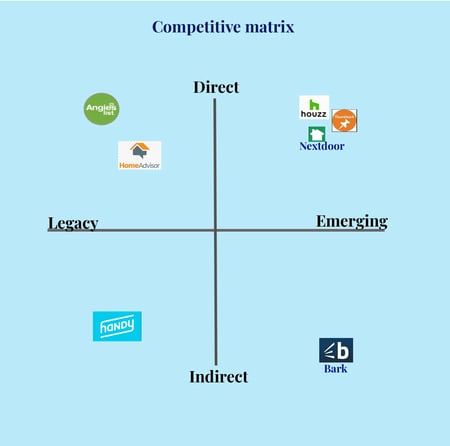
  • Direct competitors. These brands offer the same product/service as you to the same target audience. People will often compare you to these brands when making a buying decision. For example, Arcade and Storylane are direct competitors in the demo automation category.
  • Indirect competitors. These businesses solve the same problem but with a different solution. They present opportunities for you to expand your offering. For example, Scribe and Whatfix solve the problem of documentation + internal training, but in different ways.
  • Legacy competitors. These are established companies operating in your industry for several years. They have a solid reputation in the market and are a trusted name among customers. For example, Ahrefs is a legacy competitor in the SEO industry.
  • Emerging competitors. These are new players in the market with an innovative business model and unique value propositions that pose a threat to existing brands. For example, ChatGPT came in as a disruptor in the conversational AI space and outperformed several brands. 

Here’s a competitive matrix classifying brands in the community and housing space:

Alt: competitive analysis researchImage Source

Testing It Out

To help you understand each step clearly, we’ll use the example of Trello and create a competitor analysis report using these steps.

Here’s a table of the main competitors for Trello:

able of the main competitors for Trello:

Type of competitors

Competitor names 

Direct competitors

Asana, Basecamp, Monday.com, MeisterTask

Indirect competitors

Slack, Notion, Coda

Legacy competitors

Microsoft Project, Jira 

Disruptor competitors

ClickUp, Airtable

2. Determine each competitor’s market position.

Once you know all your competitors, start analyzing their position in the market. This step will help you understand where you currently stand in terms of market share and customer satisfaction. It’ll also reveal the big guns in your industry — the leading competitors to prioritize in your analysis report.

Plus, visualizing the market landscape will tell you what’s missing in the current state. You can find gaps and opportunities for your brand to thrive even in a saturated market.

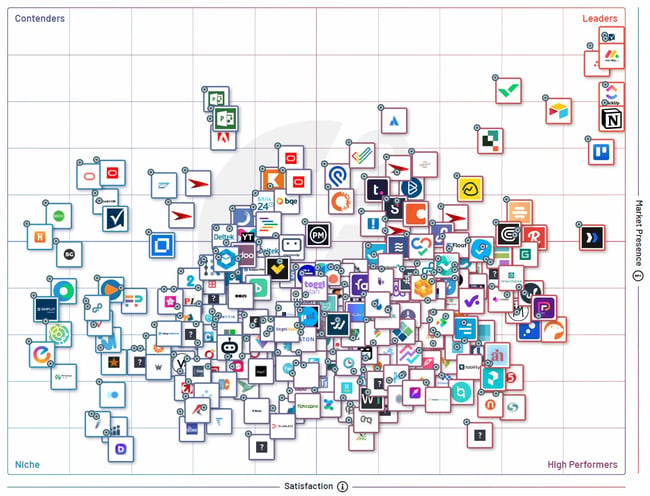
To map competitors’ market positions, create a graph with two factors: market presence (Y-axis) and customer satisfaction (X-axis). Then, place competitors in each of these quadrants:

  • Niche. These are brands with a low market share but rank high on customer satisfaction. They’re likely targeting a specific segment of the audience and doing it well.
  • Contenders. These brands rank low on customer satisfaction but have a good market presence. They might be new entrants with a strong sales and marketing strategy.
  • Leaders. These brands own a big market share and have highly satisfied customers. They’re the dominant players with a solid reputation among your audience.
  • High performers. These are another category of new entrants scoring high on customer satisfaction but with a low market share. They’re a good alternative for people not looking to buy from big brands.

This visualization will tell you exactly how crowded the market is. But it’ll also highlight ways to gain momentum and compete with existing brands.

Testing It Out

Here’s a market landscape grid by G2 documenting all of Trello’s competitors in the project management space. For a leading brand like Trello, the goal would be to look at top brands in two quadrants: “Leaders” and “High Performers.” 

matrix

Image Source

3. Extensively benchmark key competitors.

Step 2 will narrow down your focus from dozens of competitors to the few most important ones to target. Now, it’s time to examine each competitor thoroughly and prepare a benchmarking report.

Remember that this exercise isn’t meant to find shortcomings in every competitor. You have to objectively determine both the good and bad aspects of each brand.

Here are the core factors to consider when benchmarking competitors:

  • Quality. Assess the quality of products/services for each competitor. You can compare product features to see what’s giving them an edge over you. You can also evaluate customer reviews to understand what users have to say about the quality of their offering.
  • Price. Document the price points for every competitor to understand their pricing tactics. You can also interview their customers to find the value for money from users’ perspectives.
  • Customer service. Check how they deliver support — through chat, phone, email, knowledge base, and more. You can also find customer ratings on different third-party platforms.
  • Brand reputation. You should also compare each competitor’s reputation in the market to understand how people perceive the brand. Look out for anything critical people say about specific competitors.  
  • Financial health. If possible, look for performance indicators to assess a brand’s financial progress. You can find data on metrics like revenue growth and profit margins. 

This benchmarking exercise will involve a combination of primary and secondary research. Invest enough time in this step to ensure that your competitive analysis is completely airtight.

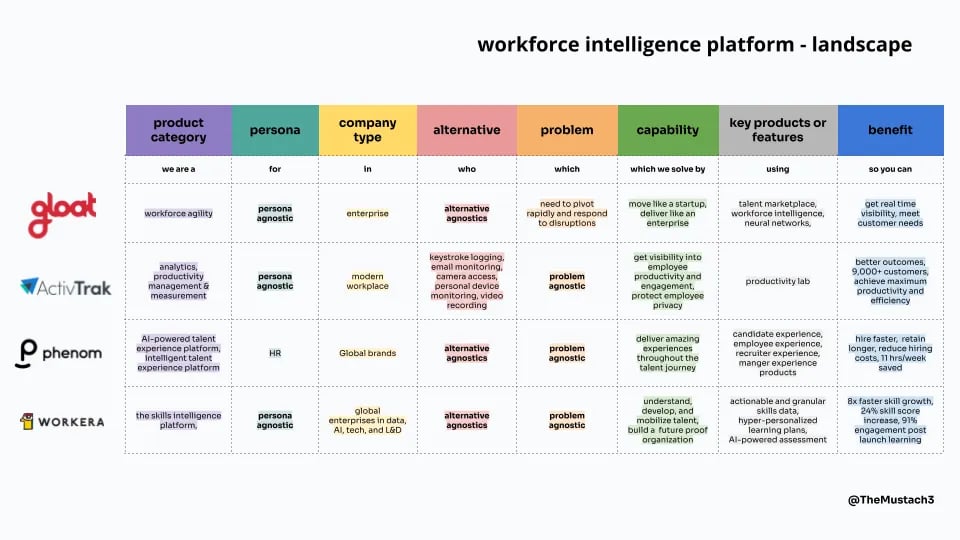
Check out this example of a competitor benchmarking report for workforce intelligence tools:

competitive analysis benchmarkingImage Source

Testing It Out

Here’s how I benchmarked Asana based on these criteria using the information I could find:

Criteria

Asana

Quality

  • 100+ integrations
  • Automation rules
  • AI features for project management
  • Highly praised for user-friendly interface

Price

Offers a free tier and paid plans starting from $10.99/month per user. Advanced features and integrations are available at higher price points​​.

Customer Service

  • Live chat
  • Phone support​​
  • Ticket-based support
  • Tutorials in Asana Academy
  • Knowledge base and community forum

Brand Reputation

Considered one of the best project management tools, with a slightly more robust feature set compared to competitors​​.

4. Deep dive into their marketing strategy.

While the first few steps will tell you what you can improve in your core product or service, you also need to find how competitors market their products.

You need to deep-dive into their marketing strategies to learn how they approach buyers. I analyze every marketing channel, then note my observations on how they speak to their audience and highlight their brand personality.

Here are a few key marketing channels to explore:

  • Website. Analyze the website structure and copy to understand their positioning and brand voice.
  • Email. Subscribe to emails to learn their cadence, copywriting style, content covered, and other aspects.
  • Paid ads. Use tools like Ahrefs and Semrush to find if any competitor is running paid ads on search engines.
  • Thought leadership. Follow a brand’s thought leadership efforts with content assets like podcasts, webinars, courses, and more.
  • Digital PR. Explore whether a brand is investing in digital PR to build buzz around its business and analyze its strategy.
  • Social media. See how actively brands use different social channels and what kind of content is working best for them.
  • Partnerships. Analyze high-value partnerships to see if brands work closely with any companies and mutually benefit each other.

You can create a detailed document capturing every detail of a competitor’s marketing strategy. This will give you the right direction to plan your marketing efforts. 

5. Perform a SWOT analysis.

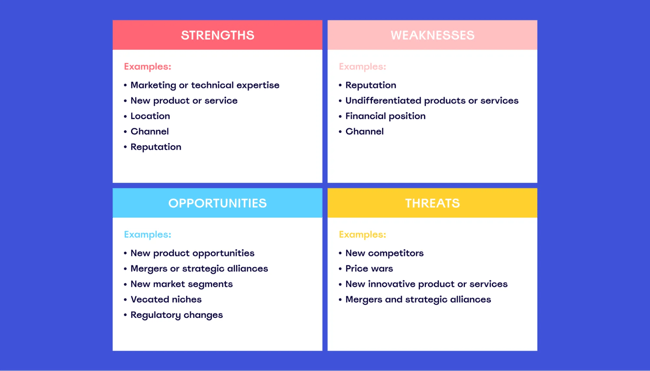
The final step in a competitive analysis exercise is creating a SWOT analysis matrix for each company. This means you‘ll take note of your competitor’s strengths, weaknesses, opportunities, and threats. Think of it as the final step to consolidate all your research and answer these questions:

  • What is your competitor doing well?
  • Where do they have an advantage over your brand?
  • What is the weakest area for your competitor?
  • Where does your brand have the advantage over your competitor?
  • In what areas would you consider this competitor a threat?
  • Are there opportunities in the market that your competitor has identified?

You can use tools like Miro to visualize this data. Once you visually present this data, you’ll get a clearer idea of where you can outgrow each competitor. 

SWOT analysis for competitors Image Source

Testing It Out

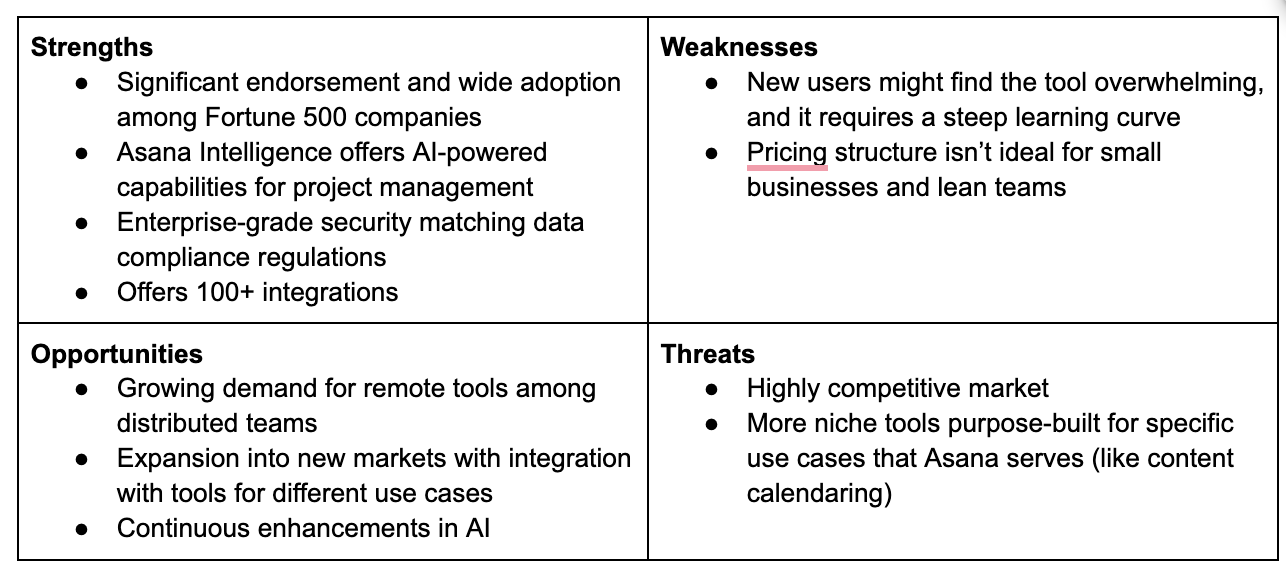
Here’s a SWOT analysis matrix I created for Asana as a competitor of Trello:

SWOT analysis for competitors

competitive analysis steps

To run a complete and effective competitive analysis, use these ten templates, which range in purpose from sales to marketing to product strategy.

Featured Resource: 10 Competitive Analysis Templates

Download Now

1. Determine who your competitors are.

First, you‘ll need to figure out who you’re competing with to compare the data accurately. What works in a business like yours may not work for your brand. Divide your “competitors” into two categories: direct and indirect.

Keep these brands on your radar since they could shift positions at any time and cross over into the direct competitor zone. Using our example, Stitch Fix could start a workout line, which would certainly change things for Fabletics.

This is also one of the reasons why you‘ll want to routinely run a competitor analysis. The market can and will shift at any time, and if you’re not constantly scoping it out, you won‘t be aware of these changes until it’s too late.

2. Determine what products your competitors offer.

You‘ll want to analyze your competitor’s complete product line and the quality of the products or services they’re offering. You should also take note of their pricing and any discounts they’re offering customers.

Some questions to consider include:

  • Are they a low-cost or high-cost provider?
  • Are they working mainly on volume sales or one-off purchases?
  • What is their market share?
  • What are the characteristics and needs of their ideal customers?
  • Are they using different pricing strategies for online purchases versus brick-and-mortar?
  • How does the company differentiate itself from its competitors?
  • How do they distribute their products/services?

3. Research your competitors’ sales tactics and results.

Running a sales analysis of your competitors can be a bit tricky.

You’ll want to track down the answers to questions such as:

  • What does the sales process look like?
  • What channels are they selling through?
  • Do they have multiple locations, and how does this give them an advantage?
  • Are they expanding? Scaling down?
  • Do they have partner reselling programs?
  • What are their customers’ reasons for not buying? For ending their relationship with the company?
  • What are their revenues each year? What about total sales volume?
  • Do they regularly discount their products or services?
  • How involved is a salesperson in the process?

These helpful pieces of information will give you an idea of how competitive the sales process is and what information you need to prepare your sales reps with to compete during the final buy stage.

For publicly held companies, you can find annual reports online, but you’ll have to do some sleuthing to find this info from privately owned businesses.

You could find some of this information by searching through your CRM and reaching out to those customers who mentioned they were considering your competitor.

Find out what made them choose your product or service over others out there.

When a competitor is identified, have your sales team dive deeper by asking why they are considering switching to your product. If you’ve already lost the deal, be sure to follow up with the prospect to determine why you lost to your competitor.

4. Take a look at your competitors’ pricing, as well as any perks they offer.

There are a few major factors that go into correctly pricing your product — and one major one is understanding how much your competitors are charging for a similar product or service.

If you feel your product offers superior features compared to those of a competitor, you might consider making your product or service more expensive than industry standards.

However, if you do that, you’ll want to ensure your sales reps are ready to explain why your product is worth the additional cost.

Alternatively, perhaps you feel there‘s a gap in your industry for affordable products. If that’s the case, you might aim to charge less than competitors and appeal to prospects who aren’t looking to break the bank for a high-quality product.

Of course, other factors go into correctly pricing a product, but it‘s critical you stay on top of industry pricing to ensure you’re pricing your product in a way that feels reasonable to prospects.

Additionally, take a look at any perks your competitors offer and how you might match those perks to compete. For instance, perhaps your competitors offer a major referral discount or a month-long free trial version.

These perks could be the reason you‘re losing customers, so if it feels reasonable for your brand, consider where you might match those perks — or provide some unique perks of your own if competitors don’t offer any.

5. Ensure you’re meeting competitive shipping costs.

Did you know expensive shipping is the number one reason for cart abandonment?

Nowadays, free shipping is a major perk that can attract consumers to choose one brand over another. If you work in an industry where shipping is a major factor — like e-commerce — you‘ll want to take a look at competitors’ shipping costs and ensure you’re meeting (if not exceeding) those prices.

If most of your competitors offer free shipping, you‘ll want to look into the option for your own company. If free shipping isn’t a practical option for your business, consider how you might differentiate in other ways — including loyalty programs, holiday discounts, or giveaways on social media.

6. Analyze how your competitors market their products.

Analyzing your competitor’s website is the fastest way to gauge their marketing efforts. This is a great way to see how accessible and engaging their assets are, and if you can, try experimenting with A/B testing your landing pages or website as well. Take note of any of the following items and copy down the specific URL for future reference:

  • Do they have a blog?
  • Are they creating whitepapers or e-books?
  • Do they post videos or webinars?
  • Do they have a podcast?
  • Are they using static visual content such as infographics and cartoons?
  • What about slide decks?
  • Do they have a FAQs section?
  • Are there featured articles?
  • Do you see press releases?
  • Do they have a media kit?
  • What about case studies?
  • Do they publish buying guides and data sheets?
  • What online and offline advertising campaigns are they running?

7. Take note of your competition’s content strategy.

Then, take a look at the quantity of these items. Do they have several hundred blog posts or a small handful? Are there five white papers and just one e-book?

Next, determine the frequency of these content assets. Are they publishing something new each week or once a month? How often does a new e-book or case study come out?

Chances are, if you come across a robust archive of content, your competitor has been publishing regularly. Depending on the topics they’re discussing, this content may help you hone in on their lead-generating strategies.

From there, you should move on to evaluating the quality of their content. After all, if the quality is lacking, it won‘t matter how often they post since their target audience won’t find much value in it.

Choose a small handful of samples to review instead of tackling every single piece to make the process more manageable.

Your sampler should include content pieces covering a variety of topics, so you’ll have a fairly complete picture of what your competitor shares with their target audience.

When analyzing your competitor’s content, consider the following questions:

  • How accurate is their content?
  • Are spelling or grammar errors present?
  • How in-depth does their content go? (Is it at the introductory level that just scratches the surface, or does it include more advanced topics with high-level ideas?)
  • What tone do they use?
  • Is the content structured for readability? (Are they using bullet points, bold headings, and numbered lists?)
  • Is their content free and available to anyone, or do their readers need to opt in?
  • Who is writing their content? (In-house team? One person? Multiple contributors?)
  • Is there a visible byline or bio attached to their articles?

As you continue to scan the content, pay attention to the photos and imagery your competitors are using.

Do you quickly scroll past generic stock photos, or are you impressed by custom illustrations and images? If they’re using stock photos, do they at least have overlays of text quotes or calls-to-action that are specific to their business?

If their photos are custom, are they sourced from outside graphic professionals, or do they appear to be done in-house?

When you have a solid understanding of your competitor‘s content marketing strategy, it’s time to find out if it’s truly working for them.

8. Learn what technology stack your competitors use.

Understanding what types of technology your competitors use can be critical for helping your own company reduce friction and increase momentum within your organization.

For instance, perhaps you‘ve seen positive reviews about a competitor’s customer service — as you’re conducting research, you learn the customer uses powerful customer service software you haven’t been taking advantage of.

This information should arm you with the opportunity to outperform your competitors’ processes.

To figure out which software your competitors use, type the company’s URL into Built With, an effective tool for unveiling what technology your competitors’ site runs on, along with third-party plugins ranging from analytics systems to CRMs.

Alternatively, you might consider looking at competitors’ job listings, particularly for engineer or web developer roles. The job listing will likely mention which tools a candidate needs to be familiar with — a creative way to gain intel into the technology your competitors use.

9. Analyze the level of engagement on your competitor’s content.

To gauge how engaging your competitor‘s content is to their readers, you’ll need to see how their target audience responds to what they’re posting.

Check the average number of comments, shares, and likes on your competitor’s content and find out if:

  • Certain topics resonate better than others.
  • The comments are negative, positive, or mixed.
  • People are tweeting about specific topics more than others.
  • Readers respond better to Facebook updates about certain content.
  • Don’t forget to note if your competitor categorizes their content using tags and if they have social media follow and share buttons attached to each piece of content.

10. Observe how they promote their marketing content.

From engagement, you‘ll move right along to your competitor’s content promotion strategy.

  • Keyword density in the copy itself
  • Image ALT text tags
  • Use of internal linking

The following questions can also help you prioritize and focus on what to pay attention to:

  • Which keywords are your competitors focusing on that you still haven’t tapped into?
  • What content of theirs is highly shared and linked to? How does your content compare?
  • Which social media platforms are your target audience using?
  • What other sites are linking back to your competitor’s site but not yours?
  • Who else is sharing what your competitors are publishing?
  • Who is referring traffic to your competitor’s site?
  • For the keywords you want to focus on, what is the difficulty level? There are several free (and paid) tools that will give you a comprehensive evaluation of your competitor’s search engine optimization.

11. Look at their social media presence, strategies, and go-to platforms.

The last area you‘ll want to evaluate when it comes to marketing is your competitor’s social media presence and engagement rates.

How does your competition drive engagement with their brand through social media? Do you see social sharing buttons with each article? Does your competitor have links to their social media channels in the header, footer, or somewhere else? Are these clearly visible? Do they use calls-to-action with these buttons?

If your competitors are using a social network that you may not be on, it’s worth learning more about how that platform may be able to help your business, too.

To determine if a new social media platform is worth your time, check your competitor’s engagement rates on those sites. First, visit the following sites to see if your competition has an account on these platforms:

  • Facebook.
  • Twitter.
  • Instagram.
  • Snapchat.
  • LinkedIn.
  • YouTube.
  • Pinterest.

Then, take note of the following quantitative items from each platform:

  • Number of fans/followers.
  • Posting frequency and consistency.
  • Content engagement. (Are users leaving comments or sharing their posts?)
  • Content virality. (How many shares, repins, and retweets do their posts get?)

With the same critical eye you used to gauge your competition’s content marketing strategy, take a fine-toothed comb to analyze their social media strategy.

What kind of content are they posting? Are they more focused on driving people to landing pages, resulting in new leads? Or are they posting visual content to promote engagement and brand awareness?

How much of this content is original? Do they share curated content from other sources? Are these sources regular contributors? What is the overall tone of the content?

How does your competition interact with its followers? How frequently do their followers interact with their content?

After you collect this data, generate an overall grade for the quality of your competitor’s content. This will help you compare the rest of your competitors using a similar grading scale.

12. Perform a SWOT Analysis to learn their strengths, weaknesses, opportunities, and threats.

As you evaluate each component in your competitor analysis (business, sales, and marketing), get into the habit of performing a simplified SWOT analysis at the same time.

This means you‘ll take note of your competitor’s strengths, weaknesses, opportunities, and threats any time you assess an overall grade.

Some questions to get you started include:

  • What is your competitor doing well? (Products, content marketing, social
  • Where does your competitor have the advantage over your brand?
  • What is the weakest area for your competitor?
  • Where does your brand have the advantage over your competitor?
  • What could they do better with?
  • In what areas would you consider this competitor a threat?
  • Are there opportunities in the market that your competitor has identified?

You‘ll be able to compare their weaknesses against your strengths and vice versa. By doing this, you can better position your company, and you’ll start to uncover areas for improvement within your own brand.

Competitive Product Analysis

Product analysis drills down to discover key differences and similarities in products that share the same general market.

If you have a competitor selling products in a similar market niche to your own — you want to ensure that you aren’t losing market share to the competition.

Leveraging the example above, we can drill down and discover some of the key differentiators in product offerings.

competitive analysis template, steps

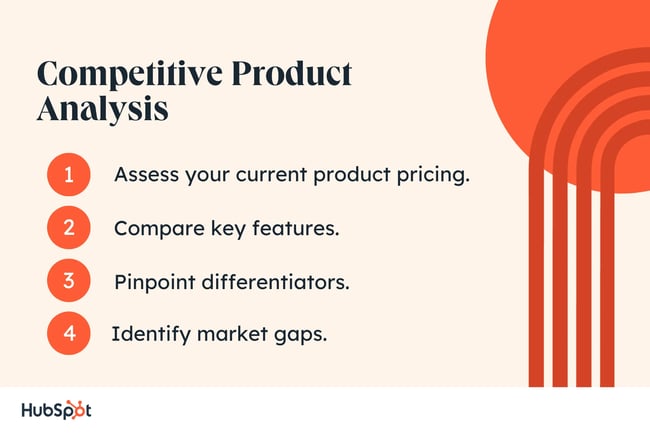
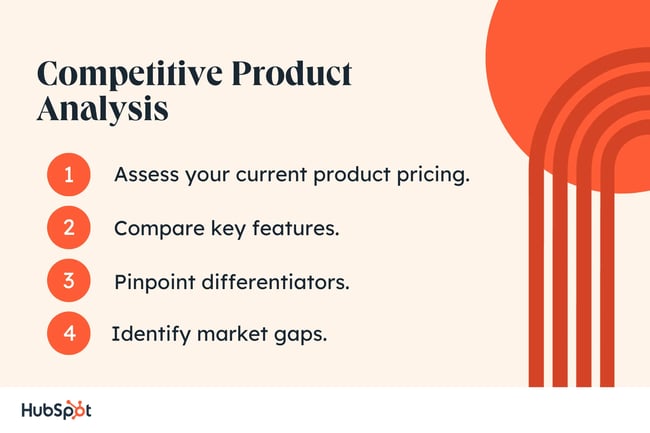
1. Assess your current product pricing.

The first step in any product analysis is to assess current pricing.

Nintendo offers three models of its Switch console: The smaller lite version is priced at $199, the standard version is $299, and the new OLED version is $349.

Sony, meanwhile, offers two versions of its PlayStation 5 console: The standard edition costs $499, and the digital version, which doesn’t include a disc drive, is $399.

2. Compare key features.

Next is a comparison of key features. In the case of our console example, this means comparing features like processing power, memory, and hard drive space.

Feature

PS5 Standard

Nintendo Switch

Hard drive space

825 GB

32 GB

RAM

16 GB

4 GB

USB ports

4 ports

1 USB 3.0, 2 USB 2.0

Ethernet connection

Gigabit

None

3. Pinpoint differentiators.

With basic features compared, it’s time to dive deeper with differentiators. While a glance at the chart above seems to indicate that the PS5 is outperforming its competition, this data only tells part of the story.

Here’s why: The big selling point of the standard and OLED Switch models is that they can be played as either handheld consoles or docked with a base station connected to a TV. What’s more, this “switching” happens seamlessly, allowing players to play whenever, wherever.

The Playstation offering, meanwhile, has leaned into market-exclusive games that are only available on its system to help differentiate them from their competitors.

4. Identify market gaps.

The last step in a competitive product analysis is looking for gaps in the market that could help your company get ahead.

When it comes to the console market, one potential opportunity gaining traction is the delivery of games via cloud-based services rather than physical hardware.

Companies like Nvidia and Google have already made inroads in this space, and if they can overcome issues with bandwidth and latency, it could change the market at scale.

Competitive Analysis Example

How do you stack up against the competition? Where are you similar, and what sets you apart? This is the goal of competitive analysis.

By understanding where your brand and competitors overlap and diverge, you’re better positioned to make strategic decisions that can help grow your brand.

Of course, it’s one thing to understand the benefits of competitive analysis, and it’s another to actually carry out an analysis that yields actionable results. Don’t worry — we’ve got you covered with a quick example.

Sony vs. Nintendo: Not all fun and games.

Let’s take a look at popular gaming system companies Sony and Nintendo.

Sony’s newest offering — the Playstation 5 — recently hit the market but has been plagued by supply shortages.

Nintendo’s Switch console, meanwhile, has been around for several years but remains a consistent seller, especially among teens and children.

This scenario is familiar for many companies on both sides of the coin; some have introduced new products designed to compete with established market leaders, while others are looking to ensure that reliable sales don’t fall.

Using some of the steps listed above, here’s a quick competitive analysis example.

1. Determine who your competitors are.

In our example, it’s Sony vs Nintendo, but it’s also worth considering Microsoft’s Xbox, which occupies the same general market vertical.

This is critical for effective analysis; even if you’re focused on specific competitors and how they compare, it’s worth considering other similar market offerings.

2. Determine what products your competitors offer.

PlayStation offers two PS5 versions, digital and standard, at different price points, while Nintendo offers three versions of its console.

Both companies also sell peripherals — for example, Sony sells virtual reality (VR) add-ons, while Nintendo sells gaming peripherals such as steering wheels, tennis rackets, and differing controller configurations.

3. Research your competitors’ sales tactics and results.

When it comes to sales tactics and marketing, Sony and Nintendo have very different approaches.

In part thanks to the recent semiconductor shortage, Sony has driven up demand via scarcity — very low volumes of PS5 consoles remain available. Nintendo, meanwhile, has adopted a broader approach by targeting families as its primary customer base.

This effort is bolstered by the Switch Lite product line, which is smaller and less expensive, making it a popular choice for children.

The numbers tell the tale: Through September 2021, Nintendo sold 14.3 million consoles, while Sony sold 7.8 million.

4. Take a look at your competitors’ pricing, as well as any perks they offer.

Sony has the higher price point: Their standard PS5 sells for $499, while Nintendo’s most expensive offering comes in at $349. Both offer robust digital marketplaces and the ability to easily download new games or services.

Here, the key differentiators are flexibility and fidelity. The Switch is flexible — users can dock it with their television and play it like a standard console or pick it up and take it anywhere as a handheld gaming system.

The PS5, meanwhile, has superior graphics hardware and processing power for gamers who want the highest-fidelity experience.

5. Analyze how your competitors market their products.

If you compare the marketing efforts of Nintendo and Sony, the difference is immediately apparent: Sony’s ads feature realistic in-game footage and speak to the exclusive nature of their game titles.

The company has managed to secure deals with several high-profile game developers for exclusive access to new and existing IPs.

Nintendo, meanwhile, uses brightly lit ads showing happy families playing together or children using their smaller Switches while traveling.

6. Analyze the level of engagement on your competitor’s content.

Engagement helps drive sales and encourage repeat purchases.

While there are several ways to measure engagement, social media is one of the most straightforward: In general, more followers equates to more engagement and greater market impact.

When it comes to our example, Sony enjoys a significant lead over Nintendo: While the official Playstation Facebook page has 38 million followers, Nintendo has just 5 million.

Competitive Analysis Templates

Competitive analysis is complex, especially when you’re assessing multiple companies and products simultaneously.

To help streamline the process, we’ve created 10 free templates that make it possible to see how you stack up against the competition — and what you can do to increase market share.

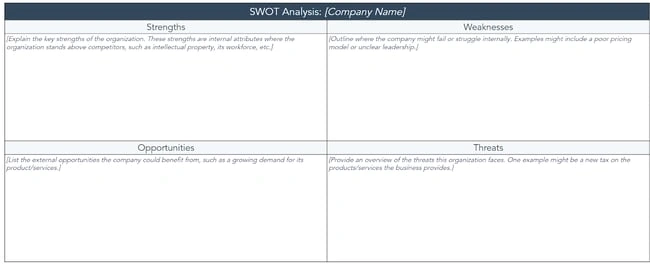
Let’s break down our SWOT analysis template. Here’s what it looks like:

Download Free Templates

Strengths. Identify your strengths. These may include specific pieces of intellectual property, products that are unique to the market, or a workforce that outperforms the competition.

Weaknesses. Here, it’s worth considering potential issues around pricing, leadership, staff turnover, and new competitors in the market.

Opportunities. This part of the SWOT analysis can focus on new market niches, evolving consumer preferences, or new technologies being developed by your company.

Threats. These might include new taxes or regulations on existing products or an increasing number of similar products in the same market space that could negatively affect your overall share.

Competitive Analysis: FAQs

What is a competitive analysis framework?

A competitive analysis framework is a structured approach used to evaluate potential competitors and understand their strengths, weaknesses, opportunities, and threats.

This framework serves as a guide for businesses to identify competitive advantages, understand market positioning, and inform strategic decisions.

Depending on the industry and the company’s objectives, this framework might focus on areas like product features, market share, pricing, customer feedback, and more.

How do you do a good competitive analysis?

Conducting a thorough competitive analysis involves several steps:

  • Identify competitors. Start by listing key competitors in your market, both direct and indirect.
  • Evaluate their products/services. Analyze what they’re selling and how it compares to your offerings.
  • Analyze market position. Determine their market share, brand perception, and unique value proposition.
  • Check their marketing strategies. Observe their advertising, content marketing, PR efforts, and online presence.
  • Assess their financial health. If available, review financial statements, annual reports, or investor presentations.
  • Gather customer feedback. Reviews, testimonials, and surveys can give insights into competitor strengths and weaknesses.
  • Regularly review and update. The market evolves, and competitors change strategies, so it’s vital to keep your analysis current.

What are the 5 parts of a competitive analysis?

The five key components of a competitive analysis include:

  1. Company overview. A brief snapshot of the competitor, including its history, size, and mission.
  2. Product/service analysis. An examination of their key products or services and how they compare to yours.
  3. Marketing strategy. Insights into their promotional tactics, target audience, and unique selling propositions.
  4. Operational analysis. An understanding of their supply chain, distribution, and customer service practices.
  5. Strengths and weaknesses. A clear breakdown of where the competitor excels and where they might be vulnerable.

What are the 3 C’s in a competitive analysis?

The 3 C’s refer to a strategic model that considers three main factors when understanding the broader business environment:

  1. Company. Understanding your own strengths, weaknesses, opportunities, and threats.
  2. Customers. Knowing who your target audience is, what they value, and how they behave.
  3. Competitors. Analyzing direct and indirect competitors to determine market dynamics and potential threats.

Is SWOT analysis a competitive analysis?

Yes, SWOT analysis is a type of competitive analysis. SWOT stands for Strengths, Weaknesses, Opportunities, and Threats. It is a strategic planning tool used to identify and analyze these four elements of a business.

While a SWOT analysis can be focused internally on a company‘s own attributes, when used as a competitive analysis tool, it assesses a competitor’s SWOT to understand where your business has advantages or might be vulnerable.

How does your business stack up?

Before you accurately compare your competition, you need to establish a baseline. This also helps when it comes time to perform a SWOT analysis.

Take an objective look at your business, sales, and marketing reports through the same metrics you use to evaluate your competition. Record this information just like you would with a competitor and use this as your baseline to compare across the board.

Editor’s Note: This post was originally published prior to July 2018 but has been updated for comprehensiveness.

New Call-to-action

Categories B2B

Boost Your Revenue: Amy Porterfield’s Tips for Adding a Digital Course to Your Business

Welcome to Creator Columns, where we bring expert HubSpot Creator voices to the Blogs that inspire and help you grow better.

Digital courses can be a game-changer for your bottom line, whether you’ve been in business for ten years or ten days.

But if you’re like many of the folks I work with, you might be wondering where to start when adding a digital course to your business. My name is Amy, and I coach entrepreneurs on how to use smart marketing strategies to grow their businesses. One of my specialties is creating digital courses — it’s something I’ve done (to the tune of $100 million) — and it’s something I love helping others do too.

→ Click here to download our free guide to digital marketing fundamentals  [Download Now].

Why add a digital course to your business?

Before we get into the how, let’s talk about the why. Digital courses offer some compelling advantages:

  • Scalability: Once you’ve created your digital course, you can sell it over and over again. It’s like having a 24/7 cash machine. This passive income stream can offer financial stability and room for your business to grow.
  • Reach and Impact: Digital courses break down geographical barriers, allowing you to reach a broader audience. This accessibility makes it easier for people who might not have the means to engage with you in person or through traditional services.
  • Become Known as the Expert: Creating a digital course allows you to maintain control over your content and brand. It can set you up as the go-to expert in your industry. You can customize the learning experience to align with your business’s identity, ensuring that it reflects your values and meets your audience’s needs.

Creating a digital course is what skyrocketed my business to new heights, has allowed me to work from anywhere and create a business that I absolutely love, 100% on my terms. I even founded Digital Course Academy so that folks spanning industries and backgrounds can find success with online course creation too.

What types of businesses are best for digital courses?

The beauty of digital courses is that they can be seamlessly integrated into almost any business model, regardless of the industry or niche.

Your knowledge and expertise can literally be transformed into a structured learning experience that’s accessible to anyone interested in your offer.

And when it comes to the digital course topic or area of interest, I’ve seen everything under the sun, from courses on urban beekeeping to speed-reading sheet music.

So, let’s talk through four approaches to adding a digital course to your existing business, along with the three most effective types of digital courses.

4 Strategies for Adding a Digital Course to Your Business

1. Coaches and Consultants

If you’re a one-on-one coach (e.g., a health or life coach), or a consultant (e.g., a stylist or social media consultant), adding a digital course to your business is a no-brainer because you’ve probably already created a lot of your course content.

Here’s how it works:

  • Take your proven roadmap or step-by-step client process and turn it into a digital course.
  • Offer your course to those who might not be able to afford your one-on-one services or prefer to work through your content on their own. You could also make this a prerequisite before working with you at a premium price.

Offering a digital course with only a handful of one-on-one coaching or consulting spots also allows you to work with best-fit clients.

2. Membership Sites

If you run a membership site, adding a digital course is a great way to diversify your content and make some extra cash.

While memberships typically offer ongoing resources, courses can dive into specific topics in greater detail, offering members a more comprehensive learning experience.

Consider these two approaches:

  • Front-End Membership: Offer a low-price membership experience to build trust and prime your audience first before offering your digital course as an upsell. Create a course related to the central theme of your membership, but offer a different angle, more in-depth guidance, and a supportive community.
  • Back-End Membership: Offer an exclusive membership to students who have completed your digital course. The key is to keep your back-end membership about supporting people in the implementation of what they’ve already learned from you — not about continuously teaching more.

Adding a digital course to your membership business is a wonderful way to keep growing with your students. It also positions your digital course as the gateway to your other offerings.

3. Service Providers

If you’re a business owner providing a service, like graphic design or dog training, leverage your expertise with a digital course. Here’s how:

  • Take your know-how and your roadmap (i.e., expertise) and turn that into a digital course.
  • Continue offering your services, and provide a course as an up-leveling option.

The benefit is that, just like the coach or consultant, you’re able to expand your reach and impact.

And don’t worry, you don’t have to give up your practice as it is. If you love working with customers, keep meeting with them. There will always be people who would rather pay for the convenience of having someone else do the work.

4. Lead with Your Digital Course

If you want your digital course to be your primary revenue source, here are some important guidelines to follow:

  • Consistently create content that is aligned with your digital course — even when you’re not actively launching.
  • Use content to attract and nurture your Ideal Customer Avatar (ICA), keeping your course featured prominently.

Digital Course Academy is my signature course and the primary revenue generator for my business. I focus on creating valuable content and nurturing my digital course audience year-round.

What type of digital course is right for your audience?

Now that you know how to add a digital course to your business, let’s consider the type of course that suits your business best. There are three primary types of digital courses:

1. Starter Course

This is a course centered around helping your students get started in your area of expertise. It is:

  • Ideal for beginners
  • Just enough information to move its audience forward
  • Typically priced between $100 and $200
  • Great for coaching, consulting, and service-based businesses

Many digital course creators will use a starter course to prepare their students for their signature course. Starter courses are also typically a lower price point product for those who want to test the waters before jumping completely into a lengthier, more expensive program.

Starter Course Example: Louisa Deasey

One of my Digital Course Academy students, Louisa, is a memoirist who teaches others her techniques and tools for writing memoirs.

She has a Starter Course called 30-Day Journaling for Memoir Course that’s priced at $247.

She created her Starter course to help her students gain the insight and fuel they need to be published. If they’d like to do a deeper dive, they can take the next steps to work with her one-on-one.

2. Spotlight Course

This type of course takes a deeper dive into your content and focuses deeply on a specific topic. It typically:

  • Provides students with in-depth knowledge
  • Is priced between $200 and $500
  • Works well with a membership experience

Spotlight Course Example: Claire Le Roy

Claire Le Roy is an Australian interior designer who worked directly with clients for seven years before diving into digital courses. She created her spotlight course, Sketchup for Interior Design Beginners, for designer clients who want to learn how to use a popular piece of design software called SketchUp.

This type of course works well because she saw very little online support offered for interior designers and decorators.

3. Signature Course

A signature course is the most in-depth course offering. It’s specific and detailed, and it includes the entire framework for a transformation or result. It’s usually:

  • A comprehensive system for a complete transformation
  • Priced higher, from $500 to thousands
  • The number one revenue generator for a business

Digital Course Academy is my signature course because it offers a comprehensive program for creating, launching, and successfully selling digital courses. Even if you have no idea where to start, it offers the roadmap and resources you need to achieve your digital course goals.

Signature Course Example: Rhea Whitney

Rhea is a wedding photographer, coach, and educator who teaches rising pro-photographers how to run a profitable photography business through her signature course, From Hobbyist To Pro.

She teaches her students how to build a solid photography business with the exact roadmap she used to become a full-time photographer.

Digital Courses: The Case for Building Your Own

Adding a digital course to your business is one of the smartest moves you can make. They are flexible, scalable, and can revolutionize your revenue streams. All you need to do is decide on the approach that resonates with you and choose the course type that aligns with your business objectives.

A digital course has transformed my business and the businesses of thousands of my students. I truly believe they are the best way to start or scale your business — and I know you’ll feel the same!

Categories B2B

How to Answer ‘What Makes You Unique?’ & Stand Out in Your Next Interview

Whenever I get asked ‘What makes you unique?’ or ‘What makes you stand out from other candidates?’ in an interview, I use it as the perfect opportunity to explain why I’m the best person for the role.

And I like to get specific. I’ve found that interviewers respond positively when I skip the generics and tie my answer back to what I have to offer based on my individual background.

Free Guide: 50 Common Interview Questions [Download Now]

Your answer could ultimately make or break your interview, so it’s important to really nail it. I’ll walk you through how to answer this question the right way.

Table of Contents

Subtle Ways Interviewers Ask ‘What makes you unique?’

There are many ways that interviewers try to tease out what makes you a stand-out candidate.

Here are some of the common questions that are actually ‘What makes you unique?’ in disguise:

  • What makes you stand out from other candidates?
  • What sets you apart from other candidates?
  • What can you bring to this role that’s different from other candidates?
  • What makes you a valuable candidate for this role?
  • Why are you the best candidate for this role?
  • Why should I choose you over other candidates?

No matter how this question manifests itself during your interview, the overarching goal remains the same.

Why do interviewers ask ‘What sets you apart from other candidates?’

The interviewer is asking you this question to give you an opportunity to showcase your value.

They want to see that you’ve done thorough research about the company and the position. And they want you to connect your skills and experience back to the role you’re interviewing for.

For example, let’s say I’m trying to land a social media role, and I notice that the company could be doing a better job on TikTok.

I can use this as an opportunity to:

  • Show that I’ve done my homework — I’m already familiar with the company’s social media presence and the platforms where they’re currently active (i.e., TikTok).
  • Highlight relevant skills — I have several years of experience managing and growing TikTok accounts, so I’ll be sure to mention that.
  • Provide a light recommendation — I’ll share how my skills and experience allows me to identify and implement that recommendation.

Think about it like this: If you can show the interviewer that you can help the company meet their goals (and that you know what their goals are in the first place), that’s one great way to set yourself apart from the rest.

Plus, it becomes clear to the interviewer that you’ve taken the time to prepare if you can provide specific examples related to the role.

These are all reasons why this is such a popular interview question — so come ready, and don’t be afraid to humble brag about yourself a little.

1. Mention skills listed in the job description.

This is one of the best ways to show the interviewer that you’ve done your research. Also, the job description is basically like your cheat sheet. Use it as a guide so you know exactly which skills to highlight throughout the interview.

My recommendation: Refer back to the job description but don’t recite it word for word. Use it in context to explain how your skillset aligns with the expectations for the role.

2. Provide specific examples from your background.

This is another smart way you can use the job description to your advantage. Reference prior accomplishments or results from past roles that relate to the position you’re interviewing for.

My recommendation: Focus on examples that tie back to the skills required for the position, and always quantify success where possible.

Using our social media example, saying ‘I ran a social media campaign which resulted in a 120% increase in traffic to our website’ is a lot more impactful than ‘I have experience running social media campaigns.’

3. Avoid generic phrases like “I’m a hard worker.”

Remember, this is a very standard interview question, so that means every candidate is likely being asked this question.

Make your answer compelling. Instead of saying you’re a ‘hard worker,’ give specific examples about the hard work you’ve accomplished related to the role.

My recommendation: Try to avoid the common buzzwords and instead replace those with real descriptions of your past work.

For example, you and every other candidate for a social media position probably consider yourselves to be “social media savvy.” 

Instead, make the case to prove that you are actually savvier than the competition based on your unique background.

4. Include key personality traits that will allow you to deliver results.

Someone else might have similar skills as you, but your personality is one of a kind. 

Being ‘social media savvy’ is one thing. But if you’re social media savvy and a tenacious person who is able to think quickly on your feet, that’s an asset.

Highlight the traits that have proven value in helping you grow as a professional.

My recommendation: You want to know one of my favorite ways to convince interviewers that I can deliver the results they’re looking for? Tell them how I’ve found similar success in the past and how my individuality supported that.

5. Tell the interviewer how your unique skills will help the company succeed.

This closely relates back to Tip #3. 

Don’t just talk about generic skills that most candidates have — always tie your skills back to specific projects you’ve worked on.

Your background is what makes you unique. There’s no one person that has the exact experience, skills, and traits that you do. Use that to your advantage.

My recommendation: You may not know the company’s internal goals, but you should always try to connect your skills back to their mission and values when possible.

7 Sample Answers to “What Makes You Unique?” and Why They Work

what makes you unique for a job

1. “I am a very good communicator and find it’s easy for me to relate to other people.”

Consider mentioning a personality trait you feel would be a good fit for the business. After reading the job description, make a list of attributes that could make you an exceptional candidate.

Additionally, including a personality trait in your answer allows you to display how you’re a good fit for a role in which you have little prior experience.

For instance, if you’re applying for a position as a team leader, it’s critical that you demonstrate strong communication skills and an ability to connect with a diverse group of people. 

If you tell the interviewer, “I am a very good communicator and find it’s easy for me to relate to other people”, you’re able to match your personality to components of a successful leader.

Why this works: Effective communication is a critical trait to emphasize in interviews. If you consider how 86% of employees cite lack of collaboration  as a main component of workplace failures, you can begin to appreciate why.

2. “I really enjoy learning new things and am constantly seeking out new learning opportunities.”

By mentioning your passion for learning new things, you’re demonstrating you’re growth-focused and unafraid of challenges.

Additionally, answering the question in this way allows you to remind the interviewer why you’re uniquely qualified for the role. 

Why this works: While other candidates might have more prior experience in the industry, you’re proving your desire to exceed expectations of the job quickly.

3. “My prior experience in customer service has provided me with unique technical skills that I can apply to this role.”

If you have prior experience in a role vastly different from the one for which you’re applying, you might use this as an opportunity to explain how your background uniquely qualifies you. 

It’s critical, however, that you provide specific examples of how your prior experience has provided you with certain transferable skills.

For instance, you might say the following:

“My prior experience in customer service provided me with an extensive knowledge base for how our product works. As a marketer, I will be able to use this knowledge to ensure we’re meeting our customers’ needs.”

It’s also important to highlight: Previous job experience has declined in importance when it comes to recruiters evaluating candidates. In fact, over the last few years, that number has dropped from 92% to 62%

So it’s okay if you feel your prior work experience doesn’t perfectly align with the role for which you’re applying — as long as you can explain how your skills will help you succeed. 

Why this works: With an answer like this one, you’re able to alleviate concerns the interviewer might have with your lack of experience in the field.

4. “Working at a startup gave me an opportunity to understand the ins-and-outs of the industry, and to take on tasks I might not have at a larger company. I think this experience gives me a slight edge over other applicants.”

Similar to the answer above, this answer is a good one if you’re attempting to switch industries. 

Consider how your background has allowed you to gain unique skills that others, who followed a more linear career trajectory, might not have. 

For instance, if you previously worked at a small startup and now you want to transfer to a large corporation, it’s important you mention how those skills will make you successful in this new role.

Why this works: If you think your prior experience could deter interviewers from seeing you as exceptionally qualified, this is an optimal chance to prove them wrong.

5. “I’m not afraid of failure. In fact, I think it is an essential part of the experimental process that gets you to success. For example … “

This answer shows your interviewer that you’re not afraid to take risks.

Of course, you’ll only want to say this if you have a positive example to reinforce the importance of failure in the workplace.

You don’t want to sound like you make mistakes all the time, but you’ll stand out if you mention how you turned a failure into a success.

For instance, you might say, “I’m not afraid of failure. In my last role, we tried to streamline our SEO process and, along the way, found we’d accidentally decreased traffic to our site. 

However, this initial failure allowed me to see the errors in our previous procedure. My team and I came up with a more successful strategy to avoid these mistakes in the future, and ended up increasing traffic by 20%.”

Why this works: With this answer, you’re showing you’re capable of remaining flexible and open-minded when something doesn’t work right away, and you know how to take failures and use them as learning opportunities.

6. “When solving problems, I apply both logic and emotional aspects in equal proportion. For instance, I’m trained in SEO and understand how to use analytics to ensure a marketing campaign is successful, but I also majored in design and know how to apply creativity to a project as well.”

If you’re stuck on deciding how to demonstrate your unique qualifications, start by thinking about how other people approach problems at your company, and how you differ.

For instance, most people are either logical and use analytics to solve problems, or emotional and use creativity. It’s rare to find someone who is both. 

Why this works: Most people focus on highlighting one skill per question in an interview. If you’re able to demonstrate that you’re comfortable combining two unique skills, it’s an impressive ability you should highlight.

7. “I’m exceptionally organized, and at my last company, I was able to apply this skill to improve our process and increase ROI by 33%.”

Remember, when your interviewer asks “what makes you unique”, they’re really wondering “how will you help our company?” 

At the end of the day, it’s critical you tie your answer back to how you will solve problems for the company. 

48% of recruiters say improving quality of hire is a top priority — so you’ll want to ensure your answer highlights how you will excel in the role for the long haul.

Consider a personality trait or skill set that helped your last company achieve results. If the results are quantitative, make sure you have the specific numbers to support your claim.

However, it’s also appropriate to share qualitative results, such as, “my organizational skills led my manager to trusting me with a major project within the first two months in my role.”

Why this works: Ultimately, providing examples shows the interviewer you’re results-driven, and aren’t just saying generic phrases to answer their question.

For even more inspiration on how to answer this question effectively, check out the video below.

Prepare Beyond ‘What Makes You Unique?’

The age-old “What makes you stand out from other candidates” question is one of many common questions that interviewers love, so it’s important to prep accordingly.

HubSpot’s comprehensive interview guide to help you tackle over 50 different interview questions like a pro, including questions related to:

  • Who you are and what skills you bring to the role
  • How you respond to challenges and conflict
  • How you’ll fit into or add to the company culture
  • Your professional goals and desired career trajectory

Download it for free here.

Stand Out in the Crowd

Essentially, ‘What makes you unique’ really means, ‘What makes you an exceptionally good fit for this role?’ Come prepared, get specific, and use examples to prove that you’re the best option in the candidate pool.

New call-to-action

Categories B2B

Best Personal Website from Marketers, Creators, and Other Business Professionals Who’ll Inspire You

An about me website is your chance to showcase your personality and credentials in an engaging format. But without strong personal website examples to guide you, you may not know how to get started or what will work best for your personal branding.

→ Download Now: 80 Professional Bio Examples [Free Templates]In this post, we’ll cover the best examples of personal websites we’ve seen from marketers, creators, and other business professionals. 

Why create a personal website?

Here’s the thing about resumes and cover letters: No matter how unique you try to make your own, for the most part, they tend to read dry. And there’s a good reason for it: It’s supposed to be a single, no-frills page that documents your work experience.

While being concise is good, there’s very little opportunity to convey your uniqueness or for your personality to shine through at all.

While a resume is a sole, largely unchanging document, a personal website can be customized and updated according to what you’re working on or what you want to emphasize. It’s both fluid and current.

In addition, 80% of businesses say a personal website is important when evaluating job candidates. Recruiters are looking you up online, and a personal website that tells the story you want to tell can make all the difference between you and a competing candidate.

For creators, you may question the need for a personal website when you already have an active social presence. A large social media presence is great, but, as we’ll dig into more below, an about me website can open you up to more opportunities for exposure, partnerships, and more.

If you’re thinking about creating a personal website of your very own, check out the examples below that hit the nail on the head. Inspired by a particular type of website?

Click one of the following links to jump to that section of this article:

Personal Websites From Marketers

1. José Rocha

About me website for marketers, Jose Rocha

Image Source

José Rocha is a designer who uses delightful parallax effects on his site to engage viewers and visitors. He introduces himself as a creative designer, marketing director, and consultant, covers his key strength areas, and then invites readers to scroll through his experience in a concise, interactive section.

The continuous scrolling effect guides visitors through José’s story and experience, which is a great way to communicate the most important things you want people to know.  

2. Caroline Forsey

About me website for marketers, Caroline Forsey

Image Source

Caroline Forsey, principal marketing manager of HubSpot’s Content Growth Team, offers a good example of how to put together an about me website. 

Caroline’s website is clean and straightforward, which I appreciate. In addition to listing her career highlights in her bio, Caroline also includes a page for her resume. This is a nice touch if she were to begin a job search and wanted to give recruiters a chance to learn about her background quicker.

3. Brent Stirling

About me website for marketers, Brent Stirling

Image Source

Brent Stirling is a growth marketing consultant who’s spent over a decade honing his marketing skills for both B2B and DTC companies. What I like most about Brent’s website is that his voice comes through in every element, even when highlighting his career experience, as shown in the screenshot above. 

4. Jason Faber

About me website for marketers, Jason Faber

Image Source

Another one of my favorite personal websites from a marketer is Jason Faber’s, a freelancing friend of mine. Jason is a growth marketing and SEO consultant with an extensive background in scaling startups, small businesses, and tech companies. I personally love how he’s tied everything together with an accent color and design element that underlines key phrases. 

5. Kaitlin Milliken

About me website for marketers, Kaitlin Milliken

Image Source

Kaitlin Milliken, a senior program manager for HubSpot’s Freelance Network, has created a great about me website for fellow marketers to take note of. In addition to the cohesive branding throughout the website, I personally like Kaitlin’s About page best. In just a few paragraphs, she sums up her current role, career highlights, and personal interests to give visitors a sense of who she is and what experience she has. 

6. Katya Varbanova

About me website for marketers, Katya Varbanova

Image Source

Katya is a branding, marketing, and AI expert and the founder of Viral Marketing Stars. One scroll through her about me website, and it’s immediately evident that she’s a branding expert. Every element on her website is cohesive with her brand, and the media logos of places she’s been featured showcase her credibility and expertise. 

What I like most about Katya’s website is the compelling call-to-action (CTA) button that encourages visitors to reach out to her for speaking gigs. She could potentially switch this CTA out to promote different goals as they change, which makes this a smart element on her marketing website. 

Best Practices for Personal Websites for Marketers

Demonstrate your skills, experience, and credibility.

As a marketing writer, I firmly believe how you communicate your experience on your about me website is as important as how it looks. Whether you use your website as a portfolio of your proudest projects, an online resume that outlines your career achievements, or a lead generation tool, it’s key to demonstrate your marketing skills and credibility.

Share your successes and achievements.

If you want your website to stand out, mention industry awards you’ve won, add logos of the companies you’ve worked with, and ensure your messaging is on brand. I also find that the best personal websites from marketers reflect the person’s chosen industry or the one they aspire to work in.

Personal Websites From Creators or Influencers 

7. Jane Claire Hervey

About me website for creators, Jane Claire Harvey

Image Source

Getting media attention is a big deal for a creator or influencer. So, it only makes sense to highlight those press mentions on a press page on your personal website. When it comes to creative examples of this, I like how Jane Claire Hervey curates the press mentions on her website.

Jane is a creative director, artist, and founder of the Austin-based nonprofit Future Front. On her press page, she doesn’t just post links to articles she’s been featured in. Instead, she includes a snippet of the article along with an image, which I find more engaging. 

8. Leah Bury

About me website for creators, Leah Bury

Image Source

Leah Bury is another Austin-based creative whose website I personally love. It not only showcases her creativity and style, but it also does a great job of communicating all of the different creative projects she’s worked on. 

9. The Everywhereist

About me website for creators, The Everywhereist

Image Source

The Everywhereist is a blog run by author and travel writer Geraldine DeRuiter. What I like about this website is that it exudes personality. Whether you’re on the blog feed or the About page, you’ll see sidebars with fun facts or a snippet of her latest book.

The blog also features a “Best Of” page that highlights some of her top posts so visitors can get acclimated to the site and her writing style. Plus, when it comes to design, the color scheme is warm, neutral, and free of excess clutter that could distract from the content.

10. Side Hustle Nation

About me website for influencers, Side Hustle Nation

Image Source

Side Hustle Nation is the business blog of Nick Loper, an advisor whose website offers tons of valuable financial advice for individual business owners.

His homepage, shown above, sets a lighthearted yet passionate tone for his readers. It suggests you’ll get friendly content committed to a single goal: financial freedom. The green CTA button, “Start Here,” helps first-time visitors know exactly how to navigate his website.

11. Salt in Our Hair

salt

Image Source

Salt in Our Hair is a travel blog with exceptional user design. The bloggers behind the website, Nick and Hannah, warm up to visitors by introducing themselves on the welcome screen and highlighting recent travel posts. 

My favorite part of this website is the dropdown button that allows you to choose a destination that you’re interested in. There’s also a user-friendly search bar at the top of the page that helps you navigate different topics on their blog.

Best Practices for Personal Websites for Creators or Influencers

Boldly show yourself and your brand.

As a creator or influencer, your website is a direct reflection of your personal brand and style. Don’t be afraid to show off your creativity, express your voice, and let visitors know exactly what kind of opportunities you’re looking for.

Include a press page.

It’s also a good idea to have a press page and/or media kit on your personal website. When I’m looking for a creator to feature or interview for an article I’m writing, I personally only reach out to those who have a website or, at the very least, a media kit. The reason is I need to get a sense of who they are, if they’ve been featured in other publications, and how credible they are before I work with them. 

Personal Websites From Other Business Professionals 

12. Rubens Cantuni

rubens

Image Source

Rubens Cantuni’s personal website hits all the right notes. First, it showcases what he does with a playful GIF showing the word “CIAO” getting edited point-by-point, just as it would in a design tool.

Second, it summarizes Cantuni’s key strengths in a personable summary. Third, it lists his experience in a user-friendly collapsible format, so if you want to read more, you can click on each individual role. There are also sections dedicated to the book he wrote, his awards, and his portfolio.

At every step, you get to appreciate Cantuni’s strong sense of design, user-first thinking, and sharp business acumen. The designer ends with a CTA for visitors to reach out to him.

He also prompts recruiters to inquire about his work by mentioning that he can only share certain pieces of his work privately. On your own site, you can leverage projects with non-disclosure agreements as “gated content.”

13. Martine Myrup

martine

Image Source

Martine Myrup is an artist who uses her website to showcase her style and perspective. The first thing that caught my eye was the bold font and the stunning visuals that popped up as I scrolled. 

The other standout element on Myrup’s website is her CV page, which highlights her degrees, exhibitions, awards, and publications. The CV is formatted in a way that is clear and easy to scan, with bold headings separating each section and dates on the left-hand side.

While artists’ CVs are formatted differently than professional CVs, Myrup’s formatting would work in virtually any field with some adjustments.

14. Johannes Schüchner

About me website for business professionals, Johannes Schuchner

Image Source

Johannes Schüchner’s personal website is an example of how to showcase your creativity and personality while still highlighting your most important professional achievements. While the copy is in German, you can still understand the actor’s key strengths.

At the bottom, casting directors have an option to download a PDF version of Schüchner’s film credits and theater work. This website shows that you can tastefully break the rules on your own site so long as you remain mindful of your target audience.

15. Hugo Bazin

About me website for business professionals, Hugo Bazin

Image Source

Hugo Bazin is a product designer whose resume website combines friendliness with engaging user design. On the top left-hand corner, he includes a sticky button to download his resume in PDF format, but if you’re interested in getting an overview, you can scroll down to the “Experience” section, where you can see his current and previous employers and work achievements.

I like that throughout the copy, Bazin uses emojis to showcase his personality, but he’s selective. He keeps emojis out of the “Experience” section of the web page, where it’s essential to maintain a serious, professional tone.

16. Christian Kaisermann

About me website for business professionals, Christian Kaisermann

Image Source

Christian Kaisermann’s about me website employs a unique theme to keep viewers on the page and showcase his strong coding skills.

On the upper right-hand side, you have the option to switch from channel to channel, like you would on an old TV, and it changes what plays in the background. He also only includes two paragraphs of copy on the homepage, proving that being brief is key if you want visitors to focus on your website’s design.

In the bottom left-hand corner, users can access Kaisermann’s crawlable HTML resume, email, Twitter, and LinkedIn. You can also activate “Space Mode,” which brings up a remote control to change the channels — very cool!

17. Seán Halpin

About me website for business professionals, Sean Halpin

Image Source

What I love about Halpin’s about me website is that it’s short, sweet, and to the point, which is authentic to his voice and personal branding outlined on the site. Instead of a lot of copy, Halpin presents large thumbnail cards so that his projects speak for themselves and allow the user to delve deeper if one catches their eye.

18. Tony D’Orio

About me website for business professionals, Tony D’Orio

Image Source

If you’re a creator like a photographer, it’s important to keep the design of your visual portfolio simple. That’s why I love how photographer Tony D’Orio lets images capture visitors’ attention by featuring bold photographs front and center on his website.

His logo and navigation menu are clear and don’t distract from his work. And, he makes it easy for potential customers to download his work free of charge. Want to give it a try? Click on the hamburger menu in the top left corner, then select + Create a PDF to select as many images as you’d like to download.

About me website for business professionals, downloading images from D’Orio’s site

Image Source

Once you open the PDF, you’ll notice that it comes fully equipped with D’Orio’s business card as the cover… just in case you need it.

19. Verena Michelitsch

About me website for business professionals, Verena Michelitsch

Image Source

When you’re a designer, not one pixel on your personal website should go unused. Verena Michelitsch’s portfolio, shown above, is covered end to end in artwork.

From her extensive library of work, she chose to exhibit multiple colors, styles, and dimensions so visitors can see just how much range she has as a designer. It’s a perfect example of the classic adage, “show, don’t tell.”

20. Gari Cruze

About me website for business professionals, Gari Cruze

Image Source

Cruze is a copywriter. But by turning his website into a portfolio featuring images from different campaigns he’s worked on, he makes visitors want to keep clicking to learn more about him. Also, there’s a great CTA at the top of the page that leads visitors to his latest blog post.

I’m also a fan of his site’s humorous copy — specifically in the “17 Random Things” and “Oh Yes, They’re Talking” sections — which showcases his skills while making him more memorable. These pages also include his contact information on the right-hand side, making it easy to reach out and connect at any point.

21. The Beast Is Back

About me website for business professionals, the beast is back

Image Source

Christopher Lee’s portfolio is busy and colorful in a way that works. When I learned about Lee on his easily navigable site, I realized that such a fun and vibrant homepage is perfect for an illustrator and toy designer.

Known by his brand name, “The Beast Is Back,” Lee’s web portfolio highlights eye-catching designs with recognizable brands, such as Target and Mario, along with links to purchase his work. This is another gallery-style portfolio with pops of color that make it fun and give it personality, thus making it more memorable.

22. Daniel Grindrod

About me website for business professionals, Daniel Grindrod

Image Source

This freelance videographer is another example of a simple but sleek personal website, allowing his potential clients to browse deeper into his “Work” and “Stills” sections. The opening video on the homepage — as shown in the still image above — also gives his site visitors an immediate preview of his work and style.

23. Byron McNally

About me website for business professionals, Bryon McNally

Image Source

In his portfolio, Byron McNally doesn’t immediately include his work but rather a photo of himself, which helps foster a connection between him and website visitors. This minimal website design also invites users to continue engaging with the website’s content and see some of his recent film, commercial, and music productions.

A still image doesn’t do this creative personal website justice — take it from me. You have to scroll through it yourself to get the full impact of Byron’s work experience, projects, and creativity. 

24. Enric Moreu

About me website for business professionals, Enric Moreu

Image Source

Enric Moreu showcases his 3D design skills by creating an interactive, gamified personal website. As users scroll, the page smoothly takes them through Moreu’s spoken languages, coding languages, skills, and work experiences. It’s engaging, light on text, and visually striking.

I like that his website embodies the medium and skills he claims to be an expert at.

25. Mariah Weathersby

About me website for business professionals, Mariah Weathersby

Image Source

Speaking of gamified, I had a lot of fun clicking around — or rather, playing with — Mariah Weathersby’s personal website.

Mariah Weathersby has coded a striking “playable” resume that pays homage to old-school games and showcases her strong design skills. If you love experiencing nostalgia, this creative personal website will reel you in. If you only want the resume, you can download a PDF version — a win-win.

26. Isaac Fayemi

About me website for business professionals, Isaac Fayemi

Image Source

Isaac Fayemi’s personal website is subtle and striking at the same time. Rather than loading the page with excessive graphics, he has created a 3D version of his head that follows your cursor as you move around. You have two options: To find out more about him or check out more of his work. This personal website is a stellar example of how to keep it simple while still delighting the senses.

Best Practices for Personal Business Professional Websites

Use your website design to share about yourself.

Whatever your profession is, your website should reflect that. For example, if you’re a graphic designer, show off your skills in a way that reflects your design style and expertise. 

Create an orderly UX.

Organization is also key. If your portfolio is full of photos, logos, and other images, make sure it’s easy for visitors to navigate to where they can contact you.

Develop your brand identity.

It’s also a good idea to brand yourself. Choose a logo or icon to make your information easily identifiable. This is especially helpful if you’re interviewing for jobs and want to stand out among the other applicants.

Make your site personal and fun.

Which leads me to my next point: Don’t be afraid to have fun. Your personal website is your personal space and should showcase parts of your personality, style, and sense of humor. 

What to Include on Your Personal Website

Based on my personal experience creating my own website, along with writing about website design for several years, I know a thing or two about what should be included on a personal website.

However, I won’t rely on my knowledge alone. To get even more insights, I talked to one of the marketers whose website I featured earlier, Katya Varbanova.

Here are the elements you must include on your personal website.

Cohesive Branding

An underrated part of having a website is a strong visual brand. Your brand is the only thing that sets you apart on the internet, so it only makes sense to invest in a brand identity that is unique and personal.

“Do not cheap out on design,” says Varbanova. “Hire a good designer and a good brand strategist to build with.”

Press Page  

Varbanova recommends that if the goal of your personal website is to showcase your expertise and generate press or speaking opportunities, you should include a media bio, media features, and a brief description of some of your products and services.

“When the media is looking for experts, they usually look at your website before determining if you’re the right expert for them,” she says. “This is how I’ve secured features in big media like Telegraph, Forbes, Business Insider, and more.”

All of these things can be added to a separate page, either a “press” page, or “speaking” page, or even an “experience” page. You can think of this page as a media kit. Think about the things a media outlet or brand partner would want to know before interviewing you or collaborating with you.

Don’t forget to add your backstory to help people get the full picture of your journey. It’s also a good idea to outline a list of topics you can speak about, whether for a podcast interview or a speaking opportunity.

Clear Messaging and Strong CTAs

The best personal websites I’ve seen have strong messaging and CTAs to match. Whether they’re a marketer, creator, or other business professional, they make it easy to understand who they are, what they’re an expert in, and what type of opportunities they’re looking for.

When it comes to CTA buttons, the best websites go beyond a simple “contact me” message. 

CTA in about me website from Katya VarbanovaImage Source

For example, Varbanova’s homepage includes a CTA button that says, “Hire Katya to Speak.” This is a direct action that someone would be encouraged to take when visiting her website. Plus, she has plenty of logos and press mentions on her site to back up her credibility and expertise. 

Personal Website vs. Social Media Page or LinkedIn

Let’s settle the age-old debate: Do you really need a website?

Depending on what your role is and what types of opportunities you’re looking for, you may be able to get away with not having an about me website. For instance, if you’re only looking for full-time opportunities and work in an industry that doesn’t lend itself to portfolio-type projects, then being active on LinkedIn is probably enough.

However, if you work in a creative field, are building a business, or are an influencer, then you’ll want to create a personal website.

“Having a strong social media presence is great, but it doesn’t replace having a website,” says Varbanova. “If your goal is to build your personal brand, you need to have a website that’s Google-friendly.”

Varbanova adds that building trust is one of the biggest benefits of having a website. “People trust people who have websites,” she says. “It really acts as a business card and introduces people to your work.”

Developing a Personal Website

Regardless of the type of personal website you’re building, there’s plenty of inspiration above on how to convey personality while connecting with your audience. Keeping the above tips in mind, remember to design for your audience’s experience, and most importantly, have fun.

Editor’s note: This post was originally published in April 2019 and has been updated for comprehensiveness.

New Call-to-action

Categories B2B

How Sales Teams Can Use Intent Data To Improve Their Sales Prospecting

Technology and data—specifically buyer-level intent data —take a lot of the guesswork out of sales prospecting, making it more precise. 

Still, there are plenty of questions surrounding intent data.

How can intent data help sales teams identify high-potential prospects more effectively?

While there may be plenty of questions, only one is asked more often than others: How can our Sales team use it effectively?

Here’s how it is done: 

  1. Identify actively researching prospects: When prospects are actively researching a product or service, they leave a trail of digital footprints.

    Buyer-intent data captures these footprints (signals) and provides insight into the research buyers are doing and what their interests are. It tells you what buyers have been searching for, where they are searching, and why.

    Oh, and most importantly, it tells you who is searching. These signals can help later on when your sales team approaches a potential buyer. It also indicates when a prospect is in the mindset to buy.
  2. Segment prospects based on their level of intent: Not all prospects have the same likelihood of converting into customers.Buyer-level intent data can be used to segment prospects into different categories, those who are probably just browsing and prospects showing strong signals of intent to buy — those who have done a lot of research and have spent a lot of time on your site and elsewhere exploring your product.This sort of segementation enables you to prioritize outreach to high-intent prospects, saving time and effort.
  3. Identify potential influencers within the buying committee: It’s important to identify the individuals who have purchase influence within the buyer committee.

    This way, Sales can approach those key individuals who are making the decisions and tailor their messaging and outreach for each decision-maker based on their position and the channels they show a preference in using. 

What are the best practices for using intent data in sales prospecting efforts?

Now that you have a few simple steps to help your sales team effectively identify high-potential prospects, it’s a good time to take a look at some of the best practices to keep in mind when you are using intent data for sales prospecting. 

The good news? You don’t have to start from scratch. 

Integrating the process

Instead, if you want to get the most out of intent data, it should be seamlessly integrated into your existing sales prospecting processes. You aren’t reinventing the wheel when you add intent data into the mix, you’re just improving what is already there. 

As an example, combining CRM data with intent data gives you a 360-degree perspective. Now, armed with vital information and context about the prospect, any cold calls are far less cold. 

  • You know who they are
  • Where they’ve been searching 
  • And what problems they are trying to solve.

Now, when that call is made, sales can tailor their messaging around this information. 

Gauging interest

Alongside integrating intent data into your existing sales processes, it’s essential to define clear parameters to gauge a prospect’s level of intent. 

Criteria like content engagement, webinar registrations, and search queries can be vital indicators of a prospect’s position in the buyer journey. 

With a well-defined framework, sales reps can focus their efforts on high-priority leads, increasing the efficiency of the overall prospecting process. 

Timeliness

Intent data has a shelf-life. 

The data that was pertinent six months ago, is likely to be far less on point today. Outdated data can lead to misguided efforts and wasted time and resources chasing a prospect that may have already solved their problems and are no longer in market. 

Or maybe that decision-maker who was showing interest four months ago has since moved on to another company. Either way, pursuing a prospect on old data often equals a whole lot of frustration with little reward.

The best way to ensure that the intent data you are using is accurate and up-to-date is to use an intent data provider that makes this a priority. 

How can intent data be used to create more targeted and relevant sales outreach?

Per a survey from Forrester and Adobe, the majority of B2B buyers have an expectation of personalization throughout their journey. 

This is especially true towards the later stages of that journey, with two-thirds saying they expect fully personalized or mostly personalized content when buying a service or product. 

Fortunately, not only does intent data aid sales prospecting by helping to identify those high-potential prospects we talked about earlier, but it also arms sales with the information they need to tailor personalized outreach. 

Because sales have that vital information about where the prospect is looking and what they are researching, sales can design outreach that focuses on that buyer’s specific needs, making communication more impactful, which leads to more meaningful engagement. 

The insights gained from intent data should be used to tailor the messaging and content of the sales outreach. Whether it’s the value proposition, product features, or case studies, every aspect of the sales message should resonate with the prospect’s unique needs and interests.

Timing plays a critical role in creating more targeted and relevant outreach as well. Hitting that sweet spot between approaching a prospect too early and too late can be tricky business. 

However, intent data can help determine the optimal time to contact a prospect, ensuring that your sales team is reaching out when the prospect when the iron is hot and is most respective.

Bonus: How to Use Tailored Messaging Strategies

To address the challenge of creating personalized messages that speak directly to the prospect’s needs, organizations can:

  • Implement Regular Training and Workshops: These sessions should educate sales teams on how to use intent data to understand buyer personas and craft messages that align with the prospect’s current stage and needs.
  • Develop Content Libraries: Create resources including email templates and call scripts that are aligned with different stages of the buyer’s journey and tailored to specific buyer personas.
  • Utilize AI and Automation Tools: Leverage advanced tools to automate parts of the messaging process, ensuring consistency and personalization at scale.

How can intent data be used to improve the sales prospecting process overall?

When used correctly, buyer-level intent data obtained from a reliable source can bring transformative improvements to your sales prospecting process. It can work to align sales and marketing teams, identify gaps in your sales funnel and help to optimize sales efforts. Let’s look at these individually. 

Aligning sales and marketing teams

We’ve covered the importance of aligning sales and marketing teams several times.

Collaboration and alignment between these two teams are vital to the success of any campaign. And, for many, intent data is the key to bringing about this alignment. 

Research from Ascend2 found that aligning sales and marketing was one of the primary goals of using intent data for 45% of B2B and B2C marketing professionals surveyed. 

This alignment is possible when marketing and sales operate in unison and create a shared understanding of what signals they need to look for in intent data so that they attract, nurture. and approach the right prospects at the right time in their buyer’s journey. 

Identifying Gaps in the Sales Funnel

Intent data can uncover areas in your sales funnel where prospects are falling out. By identifying the gaps and understanding where prospects drop out or lose interest you can implement strategies to plug them. 

Plugging the gaps may involve looking at the content you have available at that stage. Maybe it doesn’t answer the questions prospects have at that stage. Or perhaps it’s the wrong type of content altogether.

Either way, knowing where the gaps are enables you to make targeted adjustments to keep prospects engaged when they are faltering, improving overall pipeline health.

Continuously Measuring and Optimizing

Sales prospecting is far from a set-and-forget endeavor, Just like other sales and marketing processes, your sales prospecting needs to be constantly evaluated to gauge the effectiveness of your strategies.

Intent data should be used during the evaluation process as it can provide invaluable metrics to assess the efficacy of your outreach and help you refine and optimize your sales processes and strategies over time. 

Unleashing The Power of Precision Prospecting

Buyer-level intent data provides invaluable insights for sales teams aiming to enhance their prospecting efforts. Intent data can significantly improve sales by identifying high-potential prospects, enabling targeted outreach, and facilitating continuous optimization.

Take the leap into the future of sales prospecting. Reap the rewards of precision, effectiveness, and efficiency with intent data.

Categories B2B

#OpenToWork: Are LinkedIn Photo Frames Actually Helpful?

Welcome to HubSpot Perspectives, a series where HubSpotters weigh in on the latest business and marketing trends.

“The biggest red flag on LinkedIn is the ‘open to work’ symbol.” This hot take is brought to you by former Google recruiter Nolan Church.

And the dialogue continues. As I browse through my LinkedIn feed, there are still ongoing conversations about the #OpenToWork profile photo frame.

Should you use it? Does it work? Is there even a small chance it may make you look desperate or unoriginal as a job seeker?

Free Kit: Everything You Need for Your Job Search

Featured Voices:

Yes, #OpenToWork has potential.

But it’s not the only strategy job seekers should be using to land a new role.

“In my experience, it seems like the #OpenToWork frame is similar to wearing a t-shirt that says ”Open to Work” — it’ll only get seen if you make yourself seen,” says Ramona Sukhraj, Principal Marketing Writer at HubSpot.

Sukhraj was recently in the job market herself.

“It‘s a visual aid that makes it clear you’re open to employment conversations on the platform, but if you don‘t post, engage, or make yourself visible to the right groups, the effort is mostly in vain. So if you’re going to add it, be prepared to be active.”

The #OpenToWork frame is similar to wearing a t-shirt that says "Open to Work" — it'll only get seen if you make yourself seen, Ramona Sukhraj, Principal Marketing Writer, HubSpot

In other words, it’s not enough to add the photo frame, sit back, and wait for the job offers to roll in.

The Recruiter Perspective

Katelynne Bazile, Global Team Lead, Emerging Talent Programming & Operations at HubSpot, shared the same sentiment as Sukhraj when I asked about the effectiveness of LinkedIn photo frames.

“While the #OpenToWork and #Hiring photo frames initially served a useful purpose by helping individuals easily identify those seeking or offering job opportunities, the current job market’s volatility and high number of individuals using these frames have diminished their effectiveness,” says Bazile.

“As the frames have become more prevalent due to increased layoffs, they may no longer have the impact they once did when first launched.”

And she makes a good point about layoffs. So far in 2024, over 74,000 employees have been laid off, including nearly 300 tech companies.

Unpacking the Hot Takes

Regardless, Bazile said she wouldn’t categorize the #OpenToWork photo frame as “a signal of desperation or harmful to job-seeking candidates.”

Though she does suggest that there are better ways to make yourself stand out.

“Personally, I have found more impact in actively engaging on LinkedIn, interacting with content from key figures and utilizing the platform’s tools to connect with relevant job opportunities,” says Bazile.

While I wouldn't discourage the use of photo frames, I recommend incorporating additional approaches to effectively reach your target audience, Katelynne Bazile, Global Team Lead, Emerging Talent Programming & Operations, HubSpot

“It’s important to adapt and refine our strategies as the platform evolves. While I wouldn’t discourage the use of photo frames, I recommend incorporating additional approaches to effectively reach your target audience.”

Let’s face it — there are approximately 40 million people searching for jobs on LinkedIn every week. In today’s job market, it’s important to build your network, start conversations, and create a plan to make yourself stand out.

The Bright Side

Sukhraj did have some good news to share on the photo-frame front.

“I will say, when I initially posted a feed update when adding the [#OpenToWork] frame, I received messages from several recruiters within seconds,” says Ramona.

“This makes me believe some folks are tracking the hashtag or perhaps even particular job titles.”

And this makes sense — data shows that 77% of employers are still using LinkedIn to source candidates.

But I’d say the biggest takeaway here is that LinkedIn photo frames are still just one small part of a larger strategy.

The Bottom Line

To answer the overarching question posed in this article, I’d say yes — LinkedIn photo frames can actually be helpful. But they’re not made to stand on their own, and you’ll still need to do the heavy lifting to land your next gig.

Want to hear our thoughts about a specific topic? Drop your idea in this form, and we may just feature it in an upcoming post.

Apply for a job, keep track of important information, and prepare for an  interview with the help of this free job seekers kit.

Categories B2B

Which Social Media Channels are Gaining and Losing Steam in 2024? [New Consumer and Platform Data]

These days, it feels like everyone is on social media. But make no mistake, not everyone is on every channel.

As marketers, it’s important to know your audience’s favorite social channels. For instance, if you’re selling retirement homes, it’s safe to forgo Snapchat, where only 3.7% of users are over 50.

Download Now: The 2024 State of Social Media Trends [Free Report]

HubSpot surveyed over 1,400 marketers around the world find out which social media channels are gaining steam — and which are falling behind. Read on to discover which platforms are most popular with marketers and consumers in 2024.

Social Media Channels Gaining Steam in 2023

Instagram

According to SimilarWeb, the Instagram app has over 1.64 billion users, making it one of the most popular apps today.

And Instagram is expected to see more growth, and our survey results show that it’s tied for first place for the highest potential growth in 2024 and 52% plan to increase their investment in the platform. 24% of social media marketers also plan to invest the most in Instagram over any other platform.

Marketers’ affinity for Instagram makes sense, considering marketers in our survey said the app yields the highest engagement and the third-highest ROI of all social media platforms.

graph displaying the roi of the most popular social media platformsAnother reason for Instagram’s popularity among marketers is that the platform is leading the charge in leveraging the social selling trend. Instagram has the most developed in-app selling tools of any platform. Our survey shows that, in 2024, 84% of marketers believe consumers will buy products via social media apps more than from a brand’s website.

Marketers aren’t the only ones using the platform.

Although Gen Z visits TikTok the most, they rank Instagram among their favorite social media apps — as do Millennials.consumers favorite social channels

Instagram is also holding steady with older audiences. In the last few months, 47% of Gen X-ers have visited Instagram, followed by nearly a quarter of Baby Boomers. However, if you’re targeting these audiences specifically, Facebook or YouTube could be a better option.

On the marketing side, more than half of video marketers rank Instagram as the best platform for ROI, engagement, and lead generation. If you’re looking to dive more into video marketing, Instagram is an attractive option.

Facebook

Facebook is also tied with Instagram for platforms expected to see the most growth in 2024. According to our survey, 21% of social media marketers plan to invest more in Facebook than any other platform, and 53% plan to increase their investment, which is an almost 24% change from just 2023.

Furthermore, 40% of social media marketers plan to use Facebook for the first time in 2024.

Facebook currently attracts 3 billion monthly users, more than any of its competitors. A high concentration of its audience belongs to Gen X-ers and Baby Boomers.

In the last three months, 81% of Gen X-ers and 70% of Boomers have visited Facebook. On top of that, Gen X and Baby Boomers rank Facebook as their favorite social media app and most visited app. If your target audience is made up of either of those generations, Facebook is your best bet for social media marketing campaigns that reach them.

consumers favorite social channels: facebook

Now to the next-youngest generation — do millennials use Facebook? Yes. While it’s not their most visited app, it is their favorite app.

That being said, engagement drops significantly for Gen Z audiences. Just 53% have visited Facebook in the past three months, and just 13% say it’s their favorite platform.

TikTok

TikTok is known as the platform for Gen Z — and the data confirms it. In fact, in the U.S. alone, more than half of Gen Z consumers are on TikTok. Plus, Gen Z-ers say TikTok is their favorite platform, pulling ahead of YouTube, Instagram, and Facebook.

It doesn’t stop there: TikTok is also picking up steam with other demographics. 30% of TikTok users in 2024 are between 35 and 54 years old, a 7% increase from last year. Usage amongst Baby Boomers is still low, with 16% visiting the app in the last three months, but that said, their usage is steadily increasing, with a 60% change in usage since just last year (10% to 16%).

While only 34% of social media marketers use the platform, those using TikTok are strengthening their investment in 2024 – more than marketers on any other platform. In fact, 60% of them will increase their investment in marketing on TikTok in 2024, and another 34% will keep investing the same amount.

It’s also worth mentioning that TikTok has the highest engagement rate out of any other social platform, averaging 55.8 minutes per day per session. In short, TikTok’s snackable content is addictive for a variety of age groups.

YouTube

YouTube has a user base of 2.4 billion+ people and receives over 34 billion monthly visits, according to data we pulled from SimilarWeb.

consumers favorite social channels: YouTubeYouTube is popular with Gen Z, Millennial, and Gen X audiences in similar measures. In the last three months, 68% of Millennials have visited YouTube, followed by 69% of Gen Z, and 65% of Gen X. For Baby Boomers, YouTube is their second favorite social media app, just behind Facebook.

YouTube was also a top favorite amongst video marketers, and more than a quarter of video marketers planned to invest in YouTube than any other platform, according to HubSpot’s Video Marketing Report. In addition, marketers said YouTube offered the highest ROI in 2023.

Social Media Channels Losing Steam in 2023

Tumblr

After numerous acquisitions and near-revivals, Tumblr has yet to recreate its early- to mid-2000s popularity. According to our report, Tumblr is most popular with Millennials, but only 13% have visited the platform in the past three months.

tumblr usage among millennialsSurprisingly, Gen Z has visited Tumblr at nearly the same rate (10%). In fact, a report by Quartz found that 61% of new Tumblr users in 2022 were under the age of 24. This begs an important question: is another revival around the corner?

While it’s still too early to call, I recommend focusing on platforms that pull stronger numbers for the audience you want to target and remaining experimental with those that don’t.

Twitch

Although Twitch is top dog in the live-streaming space, all major streaming platforms — including Twitch, Facebook Gaming, and YouTube Live — have seen a drop in total hours watched in the past few years. For example, Facebook Gaming alone saw a -59% YoY change in hours watched.

streaming services views

Image Source

23% of Millennials, followed by only 12% of Gen Z, and 9% of Gen X have visited Twitch in the past three months.

When is the best time to post on social media?

While social media platforms will continue to fall in and out of favor with consumers and marketers, one thing remains constant — timing is everything. No matter which platform you choose to invest in, it’s critical to know the best time to post to boost your brand’s visibility.

To stay on top of a posting schedule, social media marketers told us that they use a social media schedule or calendar when they post content (72%). Tools like HubSpot’s Social Media Management Software can effectively help you craft and execute the right social media scheduling strategy; however, knowing when to post will help you boost engagement.

For example, social media marketers working in Eastern Standard Time reported 6-9 p.m. as the best time to post.

On the other hand, marketers in Pacific Standard Time said 3-6 p.m. yielded the best results.

However, the most important advice I can give on the best time to post is that it depends on your audience and when they’re the most active on social media. For example, if your audience is the most online after work hours, you’re posting for no one if you share most of your content in the early morning.

  • Facebook: 12-3 p.m., 6-9 p.m., and 9am-12 p.m.
  • YouTube: 6-9 p.m., 12-3 p.m., and 3-6 pm.
  • X (formerly Twitter): 12-3 p.m., 6-9 p.m., and 3-6 p.m.
  • Instagram: 12-3 p.m., 6-9 p.m., and 3-6 p.m.
  • LinkedIn: 3-6 p.m., 9 am-12 p.m., and 12-3 p.m.
  • TikTok: 6-9 p.m., 3-6 p.m., and 12-3 p.m.

Additionally, marketers say Saturday and Friday (respectively) are the best days to post across social media platforms.

Back to You

One question remains: what channels are best for your social media marketing? Should you stick to mature platforms, like Facebook and YouTube, or test the waters with new platforms, like TikTok?

Ultimately, your decision should hinge on one crucial factor: your target audience. Putting your audience at the center of your social media strategy means prioritizing the platforms that will reach them most effectively.

And remember, social media marketing is all about experimenting. There’s no need to commit to one platform for the rest of time — in fact, it may be useful to run side experiments on different platforms to see what results you get.

New call-to-action

Categories B2B

6 Short-Form Video Trends Marketers Should Watch in 2024 [New Data]

I see short-form videos everywhere nowadays. And now, as platforms like TikTok, Instagram Reels, YouTube Shorts, Google, LinkedIn, and Pinterest expand their short-form offerings, brands are continuing to take notice.

In the 2024 HubSpot State of Marketing Report, we found that short-form video is the number one format marketers are using and will see the most growth in 2024.

What’s more? Short-form video has the highest ROI of any social media marketing strategy in 2024.

So, how can you join in on the short-form video action to grow your business? And what are some trends to look for in the next year? In this post I’ll share advice from video marketing experts. Here’s what we’ll cover:

Brandon Sanders, former digital marketer for HubSpot Academy, highlights that what’s considered short-form can also depend on the platform.

With the rise of platforms like TikTok, Reels, and YouTube Shorts, “short-form video is actually getting shorter and lending itself more to 60-second to two-minute videos,” Sanders said.

Before YouTube Shorts, the 10-minute mark was the “sweet spot because content on YouTube tends to be more comprehensive,” but now with Shorts, you are limited to 60 seconds if you want to be featured in that media.

According to our 2024 State of Marketing Report, 36% of video marketers believe that the optimal length for a marketing video is between one and three minutes, 27% say the optimal length is four to six minutes, and 15% say it’s seven to nine.

So, shorter videos really are the star in 2024 marketing trends.


How do short-form videos fit into your content strategy?

HubSpot’s Marketing Trends Report for 2024 found that short-form video is the top leveraged media format in marketers’ content strategies.

We already know video content is increasingly becoming an important part of every brand’s content marketing strategy.

However, when we look at short-form video specifically, the data (gathered from the HubSpot 2024 State of Marketing) speak for themselves:
  • Short-form ranks #1 for return on investment ROI.
  • 56% of marketers using TikTok will increase their investment next year.
  • 25% of marketers plan to invest more in short-form video in 2024.
  • 30% of marketers who aren’t currently using short-form videos plan to start in 2024.

Sanders says short-form videos give creators an innovative way to showcase their content.

“The growth of social media is causing the human attention span to become shorter and shorter,” he said. “So, leveraging the power of short-form content will give you a leg up on your competition and help engage your audience.”

Aside from length, one thing that sets short-form videos apart is the trend culture.

TikTok, for instance, is run by viral songs, trends and challenges, and topics of interest. So, to get on the “For You” page on TikTok — which is equal to the “Explore” page on Instagram — brands must join in on the fun.

Apps like TikTok have also been influenced by AI. Users generate AI-narrated voices or use AI to ask questions and generate images. TikTok also has tools like its Creative Assistant available for its users so they can benefit from AI.

As with any new trend or platform, former HubSpot Senior Content Strategist Amanda Zantal-Wiener says you should always consider your audience first:

“It all goes back to a very old question: Which channels are your audiences using and for what? And therefore, for which channels does it make the most sense for your business to create this short-form content?”

This means that while short-form video is often known for its entertainment value, you can adapt it to align with your brand.

You should also do as much prep work as you can before a video shoot. Video marketer Tanner Francom describes this as “gathering inspiration.”

He says “helps to craft shots in both pre-production and on set. Before putting together a shot list, we gather an inspiration board full of shots that we want to replicate or have certain aspects we’d like to include in the video.”

If you consider your audience and sufficiently prep for your short-form videos, there’s no trend you can’t tackle in 2024.

Short-Form Video Trends to Look Out For

1. Brand Challenges

When short-form videos first gained popularity, it was through viral content based on dances, songs, and sounds.

Today, brands can make their own sounds, filters, and challenges go viral.

According to our social media trends report, 20% of marketers surveyed leveraged branded challenges, and 42% said they performed better than expected.

In addition, marketers rank them among the most effective social media trends of 2024.

Short-Form Video Example: Colgate

@zahra look how beautiful my momma is :’)
#MakeMomSmile @colgate_us
#ColgatePartner
♬ Children Folk Acoustic – BDKSonic

To celebrate Mother’s Day, Colgate launched the #MakeMomSmile challenge, which encourages users all around the world to share videos in which they did something special for their mothers.

It’s also a great play on words, as Colgate is all about providing beautiful smiles to its customers.

What I Like: Brand challenges, like Colgate’s, should be fun and accessible to all.

In my experience, it’s really important you announce winners in a timely fashion and feature the winning videos on your page so those who participated don’t forget about the campaign.

2. Influencer Ads

Brands have been leveraging influencer marketing for years; that’s nothing new. However, we’re now seeing more brands use them in short-form video content.

Influencer marketing is here to stay. 88% of companies using influencer marketing say it’s effective, and 55% of those surveyed said, “My company will invest more in influencer marketing in 2024.”

For instance, popular TikTok influencer TiffFoods starred in an ad for food brand Fly by Jing to promote its product.

Short-Form Video Example: Fly by Jing

With short-form content lending itself well to native advertising, brands can create videos that are more likely to generate conversions.

Pro Tip: Choosing which influencer to represent your product isn’t easy. You want someone who stands for the same values as your business. Check out this blog on how to choose the best influencer for your brand.

3. Product Teasers

Think about the average commercial you see: It’s usually anywhere between six seconds to 60 seconds. This also happens to be the average length of a short-form video.

Because of this, brands can leverage short-form video platforms to promote their products organically.

It can be incredibly effective because it doesn’t require a large budget, it has the potential to go viral, and it builds anticipation around your brand.

Short-Form Video Example: Crumbl Cookies

Crumbl cookies is notorious for teasing new products and then revealing them as the cookies of the week. They’ve even branched out into pies and cakes recently.

Product teasers are great because they create suspense by getting users to be even more invested in the launch as they wonder what the reveal is.

Pro Tip: A rotating product reveals with consistent teasers is a great marketing strategy for building anticipation. Whenever you have a new product to launch or a short-lived/seasonal product, be sure to hint at what’s coming at least a week before the launch.

As video marketer George Haddad puts it: “Consistency matters. But high-quality consistency is crucial.

4. More User-Generated Content (UGC)

Consumers generally love UGC. In fact, in a recent HubSpot survey of 500+ marketers who sell content via social shopping features, 92% said user-generated content increases their brand awareness.

According to HubSpot Blog research, UGC also offers great ROI, with 40% of marketers surveyed ranking it as a high-ROI format on social media.

Our research also suggests it’s popular with Gen Z, which is the biggest demographic on TikTok.

Why is UGC a winning strategy? Well, without using up too many resources, brands can easily publish videos that evoke emotion, and feel authentic and relatable.

Short-Form Video Example: Chipotle

@chipotle Out of this world delivery ha @cheekyboyos
#chipotle
#burrito
#space
#fyp
♬ original sound Chipotle

This video is a great example of how you can leverage user-generated content in your strategy. In this instance, Chipotle collaborated with these content producers to create a fun, viral-worthy video.

One of Chipotle’s target audiences might be young college students looking for inexpensive meals.

This video features two creators who reflect the audience they may want to attract. Brands should keep this in mind when considering UGC and ask, “Will my audience relate to this?” If the answer is yes, move forward.

What I Like: Not all UGC campaigns are equal, and it can be hard to get participation. Check out this blog for more examples of UGC campaigns that work to inspire your UGC strategy.

5. More Behind-the-Brand Videos

Consumers seek out authenticity and transparency in brands. With short-form video, you only have a few seconds to connect with your audience.

So, how do you do that? Well, there’s no exact science to it, but consumers tend to feel more connected to brands that show the people behind the brand.

In one Sprout Social study, 70% of consumers said they felt more connected to brands whose CEO is active on social media platforms.

So, going into 2024, brands should pull back the curtain and engage with their audiences on a more personal level. Not sure how to personalize your content in a way that suits your audience? I recommend A/B testing videos to see which ones perform better, and so does video content marketer Ernie Santeralli:

“What do dynamic duos such as peanut butter and jelly have in common with A/B testing and personalization? They’re better together. And in the case of A/B testing and personalization, the benefits to the online experience (and results) become exponential when you combine them.”

Short-Form Video Example: Formula One

Is there any sport that’s giving viewers as much behind-the-scenes action as Formula One? I don’t think so.

With their Netflix special and thriving social media accounts (like YouTube), Formula One uses short-form video content to engage with viewers on a daily basis.

Viewers feel extra invested because they feel like they know each driver and each car brand intimately, giving the races higher stakes.

Pro Tip: Brainstorm with your marketing team on how you can pull back the curtain on your company and let customers know more about what makes your brand tick.

This might look like an interview with your CEO or a video explaining the history of your company. Let your viewers see why you’re passionate about what you do and what you have in plan for the future.

6. More Explainer or Educational Videos

In 2024, brands will likely focus on educational content in their short-form videos — think how-to’s, DIYs, and explainer videos.

A 2024 Wyzowl report found that viewers want to see more of this video style from brands.

Wondering where we currently stand? 32% of marketers surveyed in our social media trends report say they currently leverage educational content and 57% of those who do say it’s one of the most effective content types.

Educational videos are great added-value content because they help audiences in their day-to-day lives. Brands that make education a priority in their marketing strategy can improve lead generation and build stronger brand loyalty.

Similarly, explainer videos target users who are at the decision-making stage of the buyer’s journey and if done right, they can turn decision-makers into customers.

It’s a win-win situation: Brands get to address their audience’s pain points and offer solutions, which is (surprise!) them. Not sure what I mean? See the example below.

Short-Form Video Example: Soy Yo Candle

Soy Yo Candle used the formula mentioned above to create this short-form video. Presumably, one of the biggest struggles of owning candles is making them last.

In just a few seconds, the brand presented a problem, offered a solution, and promoted its product. It can be as simple as that.

Another highlight in this video is that it caters to viewers who may be discovering the brand and those who already know it. Because of the value it offers, the brand can reach a broader audience organically.

Not sure how to sell an educational video? Short-form video marketer Charis Maimaris says you should create short and engaging content.

His top tips for engaging content include “using an emotional or intriguing hook, keeping it short and to the point, using strong visuals and sound effects, and telling a story.”

Pro Tip: Rehash and recycle your content. If you’ve written an informational piece of content in the last year, use this to create an educational video for your subscribers and customers.

There’s no reason to reinvent the wheel when you’ve already spent time perfecting content that can be reused and reinvented.

Takeaways for Video Marketers

Social Media Content Manager Kelsi Yamada says using short-form video is a low-commitment and engaging way to connect with your audience.

“You can get a good laugh or learn something new in a minute or less on TikTok or Reels,” said Yamada.

“On the flip side, it’s also relatively easy to create, which means there are more people who can share their humor or points of view. Because of this, brands should figure out what their unique point of view is, and how they can stand out in the noise.”

The desire to be on-trend is always tempting. But, Yamada stresses that brands should be selective about which trends they partake in.

“Not every viral TikTok sound or meme format will align with your content strategy or brand, so don’t force it,” she said.

“Focus on catering to your niche and staying authentic first. Don’t be afraid to make something completely from scratch – trends have to start somewhere!”

With this in mind, it’s all about finding the balance between what’s trending and what’s on-brand for your business. If you want to explore more about video marketing more broadly, check out HubSpot Academy’s courses on Video Marketing and Developing a Video Marketing Strategy.

1. TikTok

With at least 47% of its users between 10 and 29 years old, TikTok is definitely the platform for the Millennial and Gen Z population.

Image Source

The TikTok homepage features a timeline of videos separated into two tabs.

The “Following” tab has videos posted by the user’s followers, and the algorithm-driven “For You” page is based on user behavior (what they like, comment on, scroll past, etc.)

Image Source

The “Discover” tab on TikTok highlights trending topics and hashtags, and in my experience this is a great resource for marketers to generate new content ideas.

B2B marketers have been wary of using the platform, but it could be because success on the platform relies on emotional appeal. Yet, that emotional appeal may be exactly what they need.

According to a VML insight report, emotional B2B marketing can be seen as “a radical new approach to communicating with business customers.”

Still not quite convinced TikTok is a viable marketing platform for your business?

Check out this video explanation of how TikTok has grown into one of the most go-to platforms for short-form content today.

Now, it may be time to start practicing those dance moves.

2. Reels

Some call it TikTok 2.0, but Instagram Reels is proving to be its own beast.

Image Source

The Reels tab on Instagram is a scrollable video timeline, similar to what users see on their Explore page. From this page, users can click on the music the account used to see what other Reels feature that sound.

With over 1 billion active monthly users, Instagram already had consumers’ attention. When they launched Reels back in August of 2020, it became another marketing tool for brands and a worthy opponent for TikTok.

Instagram caters to a broader age demographic than TikTok, and considering their other marketing features, Reels is another way for brands to expand their reach in a minute or less.

3. YouTube Shorts

YouTube Shorts is YouTube’s venture to mobilize short-form videos on its long-form video platform. YouTube first started testing it back in September 2020, and now has over 2.3 billion monthly active users.

When using YouTube‘s mobile app, you’ll see that Shorts now has a dedicated tab on the platform. Users can create Shorts up to 60 seconds and, similarly to other short-form video platforms, can edit the videos directly within the app.

. Triller

Triller is Tiktok’s musical theater friend (or rival) — the one who bursts into song anytime, anywhere, without cause or notice.

Image Source

Triller’s homepage looks similar to other short-form video platforms. However, They have made music a prominent feature on the app by making top and trending music the main tab.

The platform is popular among musical artists and allows users to edit 60-second videos within the app.

This includes music, filters, effects, and transitions. Triller first grew in popularity when there was some uncertainty surrounding a TikTok ban in the United States, but has become a worthy competitor.

With music playing a key role in the app, marketers could use music as a storytelling element in their videos.

For instance, a few years back the song “You Got It” by Vedo — a song about unlocking your potential — made its rounds on Triller.

A recruiting firm could’ve used that sound to create a short video targeting job seekers. The song would also work great as a backdrop for a business coaching company advertising its services.

5. Hippo Video

If you want to take short-form video content beyond social media, there’s Hippo Video.

The video marketing platform gives brands a one-stop-shop to produce, distribute, and analyze their video content. Users can also embed forms, CTAs, and annotations within the video, making conversions easier.

Image Source

For example, let’s say a SaaS company is launching a new product, and the marketing team is using Hippo Video for the email campaign.

On launch day, they can send a product teaser video to current customers and include a “Schedule a Demo” CTA, leading users to a meeting scheduling page.

During the campaign, the team can track key metrics like total plays and average watch rate — taking video analytics to another level.

6. Magisto by Vimeo

Vimeo recently acquired Magisto, a video editing software that makes video marketing easy through AI.

To get started, first upload your videos. The software will then analyze the videos and put them together based on the video editing style you’re looking for.

They have over ten editing styles ranging from real estate and fitness to Facebook and YouTube ads.

Image Source

Once you select the style you’re looking for and the video is complete, you can distribute it on social media platforms and track the analytics.

This platform is ideal for brands that don’t want to spend too much time or too many resources on video marketing. This app does it so you don’t have to.

7. Lately.ai

If your brand is short on time and resources but wants to leverage short-form video, consider Lately.ai.

Image Source

This software, powered by AI, takes long-form audio, video, and text and atomizes it into snackable posts for social media. How does it know what will work? That’s where the AI comes in.

It looks at what content your audience is most likely to respond to based on historical data and creates from there. It’s a great tool for brands who are dipping their toes into short-form content and want to build from their current library.

8. Wistia

Wistia is a leader in the video hosting industry, helping more than 300,000 businesses manage their video content and grow their audience.

Image Source

When using this platform, you can build a customizable video player that matches your brand, use lead generation tools, and track your videos’ performance to gain insights.

You can also create custom ad audiences for search and social to ensure your content reaches the right audience and use integrations to sync all your tools.

There are hundreds of ways to incorporate short-form videos into your marketing strategy. But no matter which trends come and go, it will always come back to your audience.

Try a few approaches, and listen to where the data tells you to go next.

Editor’s Note: This post was originally published in Jan. 2021 and has been updated for comprehensiveness.

Categories B2B

How to Use AI For a More Effective Social Media Strategy, According to Ross Simmonds

Welcome to Creator Columns, where we bring expert HubSpot Creator voices to the Blogs that inspire and help you grow better.

It’s the age of AI, and our job as marketers is to keep up.

My team at Foundation Marketing recently conducted an AI Marketing study surveying hundreds of marketers, and more than 84% of all leaders, managers, SEO experts, and specialists confirmed that they used AI in the workplace.

AI in the workplace data graphic, Foundation Labs

If you can overlook the fear-inducing headlines, this technology is making social media marketers more efficient and effective than ever. Translation: AI is good news for social media marketers.

Download Now: The 2024 State of Social Media Trends [Free Report]

In fact, I predict that the marketers not using AI in their workplace will be using it before the end of this year, and that number will move closer and closer to 100%.

Social media and AI are two of the most revolutionizing technologies of the last few decades. Social media has changed the way we live, and AI is changing the way we work.

So, I’m going to condense and share the data, research, tools, and strategies that the Foundation Marketing Team and I have been working on over the last year to help you better wield the collective power of AI and social media.

Let’s jump into it.

What’s the role of AI in social marketing strategy?

In a recent episode of my podcast, Create Like The Greats, we dove into some fascinating findings about the impact of AI on marketers and social media professionals. Take a listen here:

Let’s dive a bit deeper into the benefits of this technology:

Benefits of AI in Social Media Strategy

AI is to social media what a conductor is to an orchestra — it brings everything together with precision and purpose. The applications of AI in a social media strategy are vast, but the virtuosos are few who can wield its potential to its fullest.

AI to Conduct Customer Research

Imagine you’re a modern-day Indiana Jones, not dodging boulders or battling snakes, but rather navigating the vast, wild terrain of consumer preferences, trends, and feedback.

This is where AI thrives.

Using social media data, from posts on X to comments and shares, AI can take this information and turn it into insights surrounding your business and industry. Let’s say for example you’re a business that has 2,000 customer reviews on Google, Yelp, or a software review site like Capterra.

Leveraging AI you can now have all 2,000 of these customer reviews analyzed and summarized into an insightful report in a matter of minutes. You simply need to download all of them into a doc and then upload them to your favorite Generative Pre-trained Transformer (GPT) to get the insights and data you need.

But that’s not all.

You can become a Prompt Engineer and write ChatGPT asking it to help you better understand your audience. For example, if you’re trying to come up with a persona for people who enjoy marathons but also love kombucha you could write a prompt like this to ChatGPT:

ChatGPT prompt example

The response that ChatGPT provided back is quite good:

GPT response example

Below this it went even deeper by including a lot of valuable customer research data:

  • Demographics
  • Psychographics
  • Consumer behaviors
  • Needs and preferences

And best of all…

It also included marketing recommendations.

The power of AI is unbelievable.

Social Media Content Using AI

AI’s helping hand can be unburdening for the creative spirit.

Instead of marketers having to come up with new copy every single month for posts, AI Social Caption generators are making it easier than ever to craft catchy status updates in the matter of seconds.

Tools like HubSpot make it as easy as clicking a button and telling the AI tool what you’re looking to create a post about:

AI social media caption generator step 1

The best part of these AI tools is that they’re not limited to one channel.

Your AI social media content assistant can help you with LinkedIn content, X content, Facebook content, and even the captions that support your post on Instagram.

It can also help you navigate hashtags:

AI social media hashtags generator example, HubSpot

With AI social media tools that generate content ideas or even write posts, it’s not about robots replacing humans. It’s about making sure that the human creators on your team are focused on what really matters — adding that irreplaceable human touch.

Enhanced Personalization

You know that feeling when a brand gets you, like, really gets you?

AI makes that possible through targeted content that’s tailored with a level of personalization you’d think was fortune-telling if the data didn’t paint a starker, more rational picture.

What do I mean?

Brands can engage more quickly with AI than ever before. In the early 2000s, a lot of brands spent millions of dollars to create social media listening rooms where they would hire social media managers to find and engage with any conversation happening online.

Thanks to AI, brands now have the ability to do this at scale with much fewer people all while still delivering quality engagement with the recipient.

Analytics and Insights

Tapping into AI to dissect the data gives you a CSI-like precision to figure out what works, what doesn’t, and what makes your audience tick. It’s the difference between guessing and knowing.

The best part about AI is that it can give you almost any expert at your fingertips.

If you run a report surrounding the results of your social media content strategy directly from a site like LinkedIn, AI can review the top posts you’ve shared and give you clear feedback on what type of content is performing, why you should create more of it, and what days of the week your content is performing best.

This type of insight that would typically take hours to understand.

Now …

Thanks to the power of AI you can upload a spreadsheet filled with rows and columns of data just to be met with a handful of valuable insights a few minutes later.

Improved Customer Service

Want 24/7 support for your customers?

It’s now possible without human touch.

Chatbots powered by AI are taking the lead on direct messaging experiences for brands on Facebook and other Meta properties to offer round-the-clock assistance.

The fact that AI can be trained on past customer queries and data to inform future queries and problems is a powerful development for social media managers.

Advertising on Social Media with AI

The majority of ad networks have used some variation of AI to manage their bidding system for years. Now, thanks to AI and its ability to be incorporated in more tools, brands are now able to use AI to create better and more interesting ad campaigns than ever before.

Brands can use AI to create images using tools like Midjourney and DALL-E in seconds.

Brands can use AI to create better copy for their social media ads.

Brands can use AI tools to support their bidding strategies.

The power of AI and social media is continuing to evolve daily and it’s not exclusively found in the organic side of the coin. Paid media on social media is being shaken up due to AI just the same.

How to Implement AI into Your Social Media Strategy

Ready to hit “Go” on your AI-powered social media revolution?

Don’t just start the engine and hope for the best. Remember the importance of building a strategy first. In this video, you can learn some of the most important factors ranging from (but not limited to) SMART goals and leveraging influencers in your day-to-day work:

The following seven steps are crucial to building a social media strategy:

  1. Identify Your AI and Social Media Goals
  2. Validate Your AI-Related Assumptions
  3. Conduct Persona and Audience Research
  4. Select the Right Social Channels
  5. Identify Key Metrics and KPIs
  6. Choose the Right AI Tools
  7. Evaluate and Refine Your Social Media and AI Strategy

Keep reading, roll up your sleeves, and follow this roadmap:

1. Identify Your AI and Social Media Goals

If you’re just dipping your toes into the AI sea, start by defining clear objectives.

Is it to boost engagement? Streamline your content creation? Or simply understand your audience better? It’s important that you spend time understanding what you want to achieve.

For example, say you’re a content marketing agency like Foundation and you’re trying to increase your presence on LinkedIn. The specificity of this goal will help you understand the initiatives you want to achieve and determine which AI tools could help you make that happen.

Are there AI tools that will help you create content more efficiently? Are there AI tools that will help you optimize LinkedIn Ads? Are there AI tools that can help with content repurposing? All of these things are possible and having a goal clearly identified will help maximize the impact. Learn more in this Foundation Marketing piece on incorporating AI into your content workflow.

Once you have identified your goals, it’s time to get your team on board and assess what tools are available in the market.

Recommended Resources:

2. Validate Your AI-Related Assumptions

Assumptions are dangerous — especially when it comes to implementing new tech.

Don’t assume AI is going to fix all your problems.

Instead, start with small experiments and track their progress carefully.

3. Conduct Persona and Audience Research

Social media isn’t something that you can just jump into.

You need to understand your audience and ideal customers. AI can help with this, but you’ll need to be familiar with best practices. If you need a primer, this will help:

Once you understand the basics, consider ways in which AI can augment your approach.

4. Select the Right Social Channels

Not every social media channel is the same.

It’s important that you understand what channel is right for you and embrace it.

The way you use AI for X is going to be different from the way you use AI for LinkedIn. On X, you might use AI to help you develop a long-form thread that is filled with facts and figures. On LinkedIn however, you might use AI to repurpose a blog post and turn it into a carousel PDF. The content that works on X and that AI can facilitate creating is different from the content that you can create and use on LinkedIn.

The audiences are different.

The content formats are different.

So operate and create a plan accordingly.

Recommended Tools and Resources:

5. Identify Key Metrics and KPIs

What metrics are you trying to influence the most?

Spend time understanding the social media metrics that matter to your business and make sure that they’re prioritized as you think about the ways in which you use AI.

These are a few that matter most:

  • Reach: Post reach signifies the count of unique users who viewed your post. How much of your content truly makes its way to users’ feeds?
  • Clicks: This refers to the number of clicks on your content or account. Monitoring clicks per campaign is crucial for grasping what sparks curiosity or motivates people to make a purchase.
  • Engagement: The total social interactions divided by the number of impressions. This metric reveals how effectively your audience perceives you and their readiness to engage.

Of course, it’s going to depend greatly on your business.

But with this information, you can ensure that your AI social media strategy is rooted in goals.

6. Choose the Right AI Tools

The AI landscape is filled with trash and treasure.

Pick AI tools that are most likely to align with your needs and your level of tech-savviness.

For example, if you’re a blogger creating content about pizza recipes, you can use HubSpot’s AI social caption generator to write the message on your behalf:

AI social media generator example

The benefit of an AI tool like HubSpot and the caption generator is that what at one point took 30-40 minutes to come up with — you can now have it at your fingertips in seconds. The HubSpot AI caption generator is trained on tons of data around social media content and makes it easy for you to get inspiration or final drafts on what can be used to create great content.

Consider your budget, the learning curve, and what kind of support the tool offers.

7. Evaluate and Refine Your Social Media and AI Strategy

AI isn’t a magic wand; it’s a set of complex tools and technology.

You need to be willing to pivot as things come to fruition.

If you notice that a certain activity is falling flat, consider how AI can support that process.

Did you notice that your engagement isn’t where you want it to be? Consider using an AI tool to assist with crafting more engaging social media posts.

Make AI Work for You — Now and in the Future

AI has the power to revolutionize your social media strategy in ways you may have never thought possible. With its ability to conduct customer research, create personalized content, and so much more, thinking about the future of social media is fascinating.

We’re going through one of the most interesting times in history.

Stay equipped to ride the way of AI and ensure that you’re embracing the best practices outlined in this piece to get the most out of the technology.

New call-to-action

Categories B2B

16 Best Bulk Email Services for 2024

You’ve seen that email marketing works wonders for your business. So, you doubled down and built a massive email list. However, you’ve now hit a roadblock. You can’t send bulk emails through providers like Gmail or Outlook.

Enter: Bulk email service providers.

Over the years of working as an email copywriter, I have had the opportunity to use some of these bulk email services. I was impressed to see how they are equipped to manage large volumes of email while offering top features to track performance.

In this blog, I have listed the key features to look for in a bulk email service and some of the top bulk email software available on the market.

Get Started with HubSpot's Email Marketing Software for Free

Table of Contents

A mass email software helps you reach a large audience and nurture them one email at a time. In addition to getting direct access to your customer base, you can track how your emails perform and test various methods to increase clicks and conversions.

While traditional advertising methods, such as print ads and direct mail, can have a high return on investment (ROI), it can be challenging to understand how consumers interact with your materials. With a mass email software, you can find out what attracts consumers and what elements lead to more conversions.

Furthermore, many bulk email software offer automation tools — think workflows and sequences. You can more easily move leads down the funnel and retain your current clients.

My experience with email marketing has taught me that using a personal or business email can work in the first few months of starting a business but will quickly become ineffective as you grow. Bulk email services offer a long-term solution.

Reasons to Send Bulk Emails

Not sure if it’s the right time to try a bulk email software? The first question you should ask is, “Is our brand investing in email marketing this quarter/year?”

If the answer is yes, then I believe that’s your sign to invest in an email service.

Here are specific examples of when you would send out a mass email to your subscribers:

  • Sales promotions. Say you want to promote discounts on specific products or services. Sending a mass email to your subscribers is a great way to generate sales.
  • Newsletters. Do you want to send out exclusive content to your subscribers? Then, a newsletter is the way to go.
  • Product updates. A great way to announce a new product feature or line is via email. You can include previews to build up excitement and include calls-to-action (CTAs) for conversions.
  • Announcements. Are you updating your hours, prices, or services? Or perhaps there’s been a change in your policy. Notifying your subscribers in an email blast is an effective way to spread the news.

With every email you send to subscribers, you’ll want to remember your goals, audience, time and day, personalization, and compliance with data protection laws.

Best Bulk Email Services

1. HubSpot’s Email Marketing Tool

bulk emailing software, Hubspot's email marketing tool

Start using HubSpot’s free Email tools.

I absolutely love how you can create, customize, and optimize your emails with HubSpot without coding or design experience.

Here is how you can do that:

You can send up to 2,000 emails monthly, which doesn’t include test emails to check functionality. In addition, the platform offers a user-friendly interface, tools like drag-and-drop to design your email easily, tokens to personalize every email, and an A/B testing feature.

This is how the drag-and-drop feature works on the tool:

bulk emailing software, Hubspot's drag-and-drop email builder interface

You can also use their AI Email Writer to help you write copy for your emails. In addition, you can create custom reports based on the data you want to collect and analyze.

What I like: I like how this tool allows you to personalize your bulk emails based on each subscriber’s lifecycle stage. This enables you to deliver better content and effective CTAs that boost engagement.

Pricing: The best part? It’s free.

2. Sendermass email software, Sender's email marketing tool

Image Source

Bulk emailing allows your brand to save time and effort by sending mass emails to your target audience at once. Leveraging your email lists increases sales and engagement with promotional offers, flash sales, product updates, newsletters, etc. You can do all that and much more with Sender.

You can not only send it to a large audience at once but also target the right subgroups with smart segmentation and automated triggers. That way, your audience will receive the message they want to receive and when they want to receive it.

This is an example of various automated triggers available in this tool. You can notice that there are different workflows for different events — for example, when a new subscriber gets added to your list or if an online store user abandons their cart.

bulk emailing software, Sender's email automation triggers

You can also customize the automation workflow according to your needs.

bulk email software, Sender's email automation workflow

Additionally, Sender provides premade, mobile-responsive templates for professional-looking emails with a drag-and-drop email builder. Their platform also offers various features such as SMS campaigns, high-converting popups, detailed analytics, a heatmap, and even more. 

What I like: I’m impressed by Sender’s omnichannel approach. It combines email and SMS marketing to deliver effective campaigns that produce great results.

Pricing: Sender offers a free plan with 2,500 subscribers and 15,000 emails per month. Paid plans start at $15.83 a month, billed annually.

3. ConvertKit

bulk emailing software, Convertkit's email marketing tool

Image Source

As their name suggests, the platform is designed to help you earn more conversions and generate more revenue. ConvertKit is known for its advanced automation tools, including custom email funnels, smart filters, and link triggers.

Furthermore, the platform has a 98% delivery rate, ensuring that your emails will always reach your subscribers. In addition, the average open rate for ConvertKit emails is an astonishing 30%, according to their website.

What I like: I love how ConvertKit provides a visual automation library of pre-designed templates. This helps you kickstart your email campaign with ease, without worrying much about the designs of the bulk emails.

Pricing: ConvertKit offers a free version of its platform for up to 10,000 subscribers. Paid plans start at $25 a month, billed annually.

Here is an example of the various visual automation templates offered:

bulk emailing software, Convertkit's email automation templates library

4. Mailchimp

bulk email software, Mailchimp's email marketing tool

Image Source

I highly recommend Mailchimp if you’re just starting out in email marketing. The platform offers a user-friendly interface and over 100 templates to choose from.

In just a few simple steps, Mailchimp lets you get started with your bulk email campaign. 

mass emailing software, Mailchimp's email marketing tool

Using its prebuilt journeys, you can set up your email automation with ease.

bulk emailing software, Mailchimp's email marketing pre-built journeys

With their free plan, you can send up to 10,000 emails monthly to 2,000 contacts — an ideal option for small to midsize businesses.

Then, as your business grows, you can scale to the premium version. Here, you’ll have unlimited audiences, multivariate testing, and advanced segmentation with up to 200,000 contacts.

What I like: I love how you can customize emails for your prospects based on specific factors, such as spending amount, buying patterns, or predicted characteristics. This makes sure your communications are always targeted.

Pricing: A free plan is available. Paid plans range from $9.18 to $274.30 per month.

5. Drip

bulk email software, Drip's email marketing tool

Image Source

If you have an ecommerce business, I strongly suggest trying Drip for your mass email marketing. The platform offers pre-built email templates that you can customize and a user-friendly workflow builder for automation.

bulk emailing software, Drip's email marketing automation templates

Here is an example of their “Welcome Series” template:

mass emailing software, Drip's email marketing welcome series workflow

In addition, you can schedule automation based on actions your subscribers take (like viewing a product, abandoning their cart, and making a purchase).
With Drip, you can easily integrate your online store (like Shopify, Magento, and WooCommerce) to make gathering data easier.

What I like: Drip claims a 99.8% delivery rate, which I find to be very impressive for a bulk email software. Furthermore, I love the ease with which the tool creates behavioral and lifecycle segments that update automatically. This lets you send targeted emails to your audience easily.

Pricing: Prices start at $39 and go up based on your number of subscribers.

6. Insycle

mass emailing software, Insycle’s homepage

Image Source

Insycle doesn’t fall under the email provider list. However, this software does work in tandem with providers like HubSpot and Mailchimp to keep your contact list clean.

mass emailing software, Insycle data management

In my opinion, one of the major downsides of having a subscriber list is the potential for duplicate contacts. This can impact your metrics and make it difficult to tailor your emails. Insycle allows you to clean your contacts in bulk, merge duplicate ones, and avoid overwriting data.

What I like: One of the things I like about Insycle is that it makes data exploration easy. Additionally, its Grid Edit is a great feature that simplifies data corrections, saving you hours of manual work.

Pricing: Pricing starts at $30 per month and scales up to custom pricing based on the services you want.

7. Brevo

brevo-2

Image Source

Brevo (formerly Sendinblue) is one of the best bulk email software for small and large businesses. A drag-and-drop editor is one of the must-have features for a good email service, and Brevo features one of the most powerful editors on the market.

 bulk emailing software, Brevo's drag-and-drop email builder interface

Aside from that, the service has segmentation features that let you send emails to a targeted audience. This feature helps to improve overall engagement with customers.

What I like: Brevo has a solid reporting system that gives insights about what your readers like. This helps you make better decisions and improve your bulk email campaigns.

Pricing: Brevo has free and premium plans. The free plan lets you send up to 300 emails daily, albeit with the Brevo watermark. The premium plan begins at $25 monthly.

8. Constant Contact

bulk emailing software, Constant Contact's email marketing toolImage Source

Constant Contact is a bulk email service that’s great for small businesses and individuals. I love its simplicity and ease of use, features that make it great for beginners.

The service features built-in social media sharing tools, easy tracking and reporting, and integrations with ecommerce centers like Facebook and Shopify.

Its advanced features, like coupons, surveys, and event marketing automation, make it one of the best bulk email services.

What I like: Constant Contact has a wide range of email templates and design samples that fit every business. With just a few clicks, your email campaign will be ready to launch.

Pricing: This bulk email software offers a 30-day free trial, which you can upgrade to a premium plan. Paid plans start at $12 monthly for the Lite plan and can be further upgraded to the Standard plan or Premium plan for $35 per month and $80 per month, respectively.

 bulk email service, Constant Contact's email marketing templates

9. Mailmodo

bulk emailing service, Mailmodo’s building blocks interface

Image Source

Mailmodo offers a free plan that allows you to send up to 10,000 emails monthly, making it an ideal choice for individuals and small businesses. However, if you want more, you can choose from four premium plans that let you send more emails monthly.

Mailmodo’s no-code, drag-and-drop editor makes crafting emails a breeze. Additionally, this bulk email software offers users several customizable templates.

If you ever run into problems while using the service, Mailmodo offers 24/7 customer support.

What I like: I love the MailModos Building Blocks feature, where you can customize your own template for your email campaigns. 
As shown below, you can select every section of your email, from the header to the final CTA and footer.

bulk emailing service, Mailmodo’s building blocks interface

Pricing: A free plan is available. Premium plans start at $35 monthly.

10. AWeberbulk emailing software, AWeber’s email marketing tool

Image Source

AWeber is a flexible service that only charges users based on their number of subscribers. This flexibility is one of the reasons some users prefer this service.

AWeber also has one of the most extensive libraries of customizable, mobile-responsive email templates. These templates allow you to create and send emails very quickly and easily.

aweber2

Image Source

The platform offers sales tracking and lets you check out the performance of your emails and subscriber information.

What I like: Apart from all their helpful features, their quick and efficient customer service stood out to me. I had some issues with signing up for the tool initially, and their customer service agent connected and assisted me in just a few seconds.

Pricing: They offer a free plan for up to 500 subscribers, and the paid plan starts at $12.50 a month.

11. Mailgun

mailgun

Image Source

Mailgun’s email solutions for email marketing, tracking, parsing, and more make it one of the best bulk email services. In addition, Mailgun’s email API allows developers to easily integrate it into their apps. Furthermore, Mailgun’s email analytics feature ensures email delivery.

What I like: I am a huge fan of Mailgun’s Real-Time Email Validation API which makes sure that your email list always has valid addresses. This saves you time and money by letting you send bulk emails to just valid users. This will also boost your sender reputation in the long run.

bulk email service, Mailgun’s email validation API

Pricing: Mailgun offers a free plan that allows sending up to 5,000 monthly emails. You can opt for its premium plans which start at $35 monthly if you want even more features.

12. SendPulse

mass emailing service, Sendpulse’s bulk email marketing tool

Image Source

SendPulse is an omnichannel tool that allows you to send emails, push notifications, Facebook messages, and more.

When it comes to emails, this service allows you to create responsive emails without writing a line of code. And if you prefer, you can use any of the 130+ templates available on the platform.

bulk emailing service, Sendpulse’s email marketing templates

Additionally, SendPulse has a drag-and-drop editor that lets you design subscription forms that can then be integrated into a website. 

Aside from regular websites, SendPulse also supports integration with PipeDrive, WordPress, Zapier, and other tools.

bulk emailing software, Sendpulse’s drag-and-drop email builder interface

What I like: I find SendPulse’s user-friendly mobile app very useful. It makes managing and tracking your email campaigns effortless. The app lets you access all your reports and statistics from your mobile.

Pricing: SendPulse has a free version available, while paid plans start at $8 per month.

13. Stripo

stripo

Image Source

Looking for an all-in-one email design platform? Then, I highly recommend using Stripo.

This service offers hundreds of easy-to-use email templates that make your emails look better and help improve conversion rates.

bulk emailing software, Stripo’s email marketing design tool

Stripo gives users the tools they need to create all types of emails. After creating the email, Stripo lets you test how it’ll look on different platforms. You can also have colleagues or clients view potential emails before sending them off to subscribers.

What I like: While most tools offer just the drag-and-drop email builder, I love that Stripo offers both a drag-and-drop email builder and an HTML code editor. This lets you design email layouts while also allowing you to add custom code elements to the bulk emails.

Pricing: Stripo has four plans, from free to $95 per month, priced according to the number of recipients and features.

bulk emailing software, Stripo’s drag-and-drop email builder and HTML code editor

14. SendGrid

sendgrid

Image Source

SendGrid is the go-to choice for users looking to create and send transactional emails. It allows you to add contacts via CSV upload, signup forms, or APIs.

In keeping with its focus on transactional emails, SendGrid has features like anti-spam regulations to protect you and your subscribers.

What I like: SendGrid has the ability to easily handle high email volumes. I was really impressed to know that they processed over 64 billion emails during their Cyber Week and 148+ billion emails every month in 2023.

Pricing: SendGrid has a free plan that lets you send up to 100 emails a day. For more features, you’ll need to upgrade to either the $19.95 or $89.95 monthly plans.

15. Mailjet

mailjet

Image Source

Our penultimate choice is a user-friendly bulk email software best for marketers and development teams. Mailjet has a drag-and-drop email builder that lets you quickly create emails and templates.

Mailjet also features an interactive design, so you can give team members access and let them work on it individually.

What I like: Mailjet offers email tracking, which lets you monitor how your sent emails are doing. You can check metrics such as email delivery, bounce rate, and open rate.

Pricing: If you decide to use Mailjet, you can choose between a free plan that lets you send up to 6,000 emails or any of the four premium plans starting at $15 monthly.

mass emailing software, Mailjet’s real time analytics

16. Omnisend

bulk emailing software, Omnisend’s email marketing tool

Image Source

The last, but not least, bulk email service on our list is Omnisend.

Omnisend combines emails, SMS, and other channels. You can also create customizable forms for collecting information from website visitors, as shown below.

bulk emailing software, Omnisend’s drag-and-drop form builder interface

Additionally, Omnisend makes it easy to divide subscribers into segments, improving the ability to send the right emails to them. With its all-in-one features, automation, and numerous template options, Omnisend is one of the best bulk email services of the year.

What I like: Omnisend offers pre-built automation for email marketing scenarios. From welcome series to abandoned carts and post-purchase engagement, these ready-to-use workflows allow you to create targeted bulk email campaigns easily.

Pricing: New users can use this service for free. However, to fully enjoy the tool, you’ll need to subscribe to a premium plan whose pricing starts at $16 a month.

So, you’re ready to invest in bulk email software. What are the top features to look out for?

I have listed the key features you should look for in a bulk email service. Some of these features will only be available in a premium package. Others will be included in the standard or free versions.

Here’s your complete guide to what factors to consider.

1. User Behavior Tracking

In my opinion, reporting capabilities will be the number one tool you’ll need in any bulk email service you select. What’s the point of investing your time in designing and sending emails if you can’t see how they perform?

You should be able to track key email metrics, such as:

  • Open rate.
  • Unique clicks.
  • Click-to-open rate (CTOR).
  • Clickthrough rate (CTR).
  • Unsubscribe rate.
  • List growth rate.
  • Bounce rate.

Email providers with advanced reporting features also allow you to track revenue per subscriber and revenue per email.

2. Drag-and-Drop

Email drag and drop tool in bulk email service

A drag-and-drop tool makes designing your email easy. This intuitive feature allows you to select an element from the sidebar, like an image, quote, or button, and drag it to a section of your email.

This will save you time as you determine the best flow for your email and move things around.

3. Email Segmentation and Personalization

Segmentation ensures that your emails are reaching the right people at the right time.

You should look for a bulk email software that allows you to segment your subscriber list based on the following:

  • Location.
  • Actions taken in the email.
  • Purchase history.
  • Type of subscriber (e.g., prospect versus current customer).

You can get higher engagement rates when you segment your list, as the content will be more relevant to your recipients.

Furthermore, personalization is one of the key factors in improving email engagement and advancing customer relationships.

4. Split Testing

Split testing, also known as A/B testing, is a great way to understand what resonates with your audience.

bulk emailing software, a/b test

Image Source

This feature is beneficial if you need help generating high open rates and converting subscribers.

By testing out different subject lines and elements within the body of your email, you can determine what works best.

5. Automation

When you’re scaling your email list, the name of the game is automation.

Say you have a content offer and want to send an email sequence to leads after they download the offer. With an automation tool, you can pre-select which emails will go out, in what order, and after how much time for each email.

bulk emailing software, automation

Image Source

Once you complete the setup, the automation does all the work for you — nurturing your subscribers and moving them through the buyer’s journey.

This hands-off approach allows you to focus on strategy instead of the tedious work of sending out emails. With automation, you can take the guesswork out of the process.

6. Design Templates

If you’re like me, designing isn’t your forte. So, when designing an email, you’ll take all the help you can get.

Bulk email service, design template example from HubSpot

Image Source

A design template based on the type of email you want to send can save you time and ensure you’re following email best practices. This is particularly helpful if you have limited experience designing emails and are just starting out.

What’s great about having a template is that it’s a foundation. You can customize it to fit your needs, but it provides a blueprint from which to work.

7. High Email Delivery Rates

Imagine you work so hard on an email campaign, and it never reaches your subscribers’ inboxes. Frustrating, right?

That’s why verifying your provider’s email delivery rates is essential. You’ll want to select a service with high email delivery rates, as close to 100% as possible.

Grow Your Business

Knowing what to look for in an email service is half the battle.

Now that you have a list of key features and a few tools to choose from, you can find a platform to grow your email list and generate revenue.