
We’ve covered a lot of ground around the Recall Gap.
Why Your Best Leads Keep Forgetting You Exist named the problem; The Three Problems No One Wants to Own in B2B established the structural conditions that make it inevitable; and Why the Brain Forgets Your Brand went inside the neuroscience (six bodies of peer-reviewed research!).
Now it’s time to address how content type influences a registrant’s mindset.
Your Registrant’s Format Choices and the Signals They Send
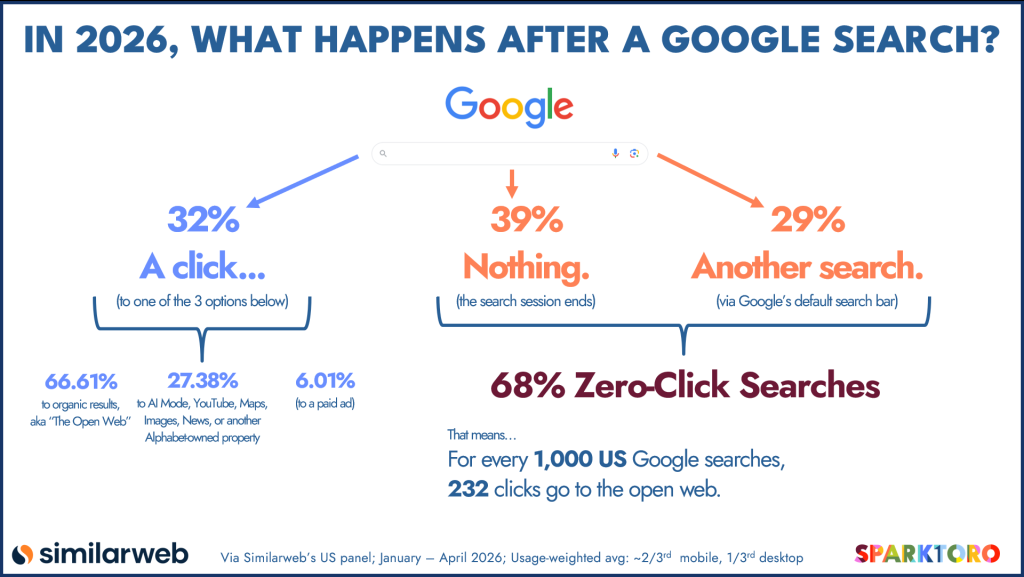
Research from Similarweb and Sparktoro (April 2026) revealed that 68% of Google searches within the United States now end without a click. That’s up from 60.45% just two years ago.
Of the 32% of clicks that do yield a click, 66.61% of those clicks go out into the Open Web. That actually means that only 21.3% of U.S. Google searches actually get beyond the search results.
So, what does this mean for gated content and its relationship to the Recall Gap?
Just Getting “There” is an Achievement and a Signal
The number of people getting to and clicking on our stuff has dropped. Is that a problem? Yes and no.
If you’re a media business reliant on traffic, yes. (Same goes for branding, too, but that’s for the next article.) Otherwise, it’s not a massive issue.
The point is, the people who DO get to your content likely WANT to be there. The likelihood of this traffic converting is much greater.
Buried inside every content registration are signals that most demand gen teams treat as an afterthought or ignore entirely.

These signals reveal:
- Depth of intent
- Engagement timeline
- Remarkably useful information about how to follow up (once you understand it through the lens of the Recall Gap)
Essentially, every content registration is technically a self-selection event.
Format Preference is a Proxy for Cognitive Investment
Nobody fills out a gated form for a White Paper just for fun these days.
Assuming that information on a topic is available across multiple formats, users choose one format over another for a reason.
Each choice provides a clue as to where they are in their buying journey—as well as a registrant’s mental state. How can we make this assumption? Because, as we’ve detailed in our first-party intent research and the Consumption Gap by format, each registration relays a different level of attention and willingness to sit with complexity.
The reason we’ve banged the drum so loudly around the connection between intent and format is due to the thought process required of the registrant.
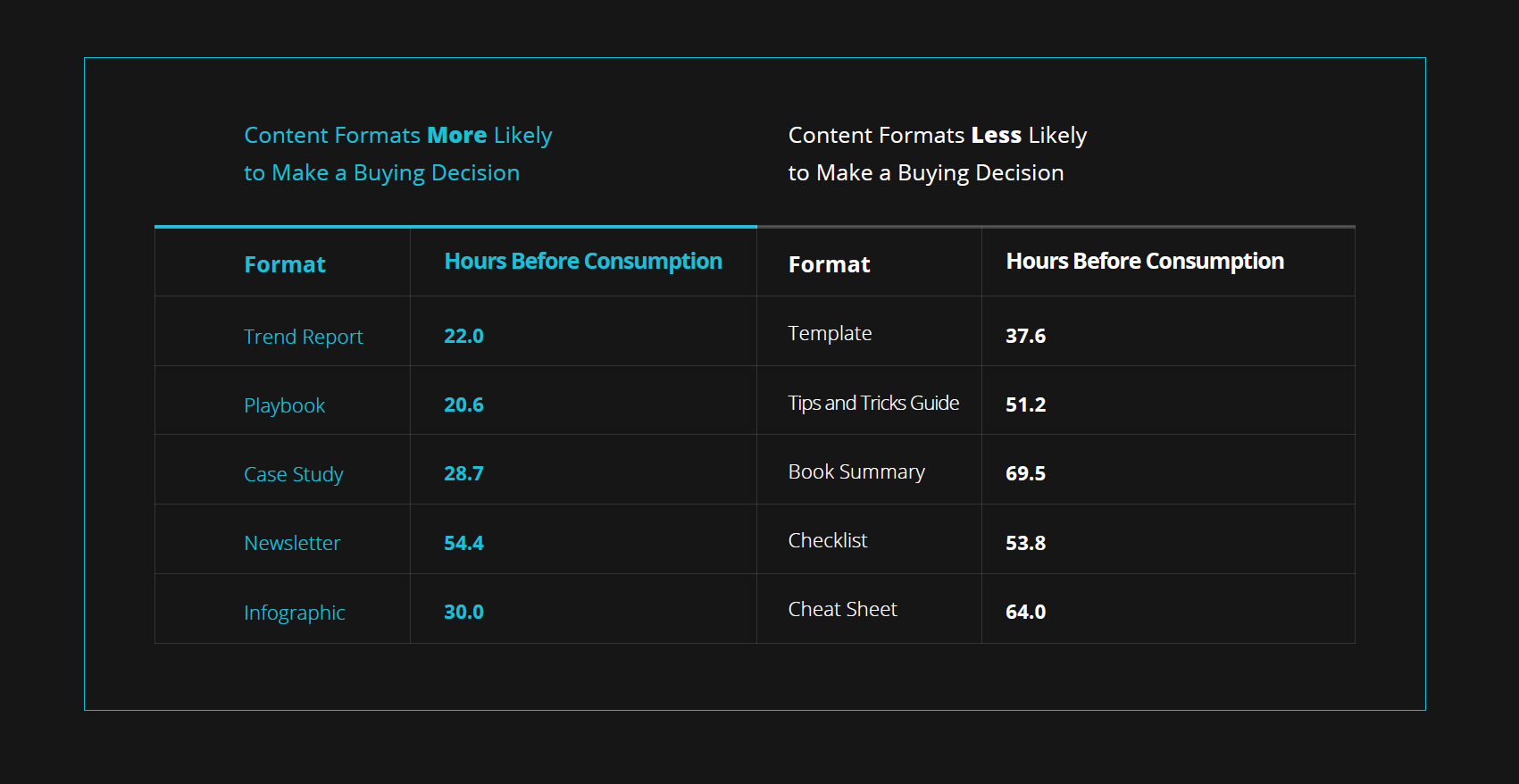
Their selection, whatever format it may be, signals an expectation of depth, a commitment of time, and a question serious enough to warrant an investment beyond a Google search or an AI overview. That distinction matters enormously for how your follow-up should work.
And it matters even more once you factor in the Recall Gap.
This creates a practical framework that most teams don’t have: the format of a registration predicts the likely width of the Recall Gap. And the likely width of the Recall Gap should determine the intensity and structure of the follow-up.
What the Data Actually Shows
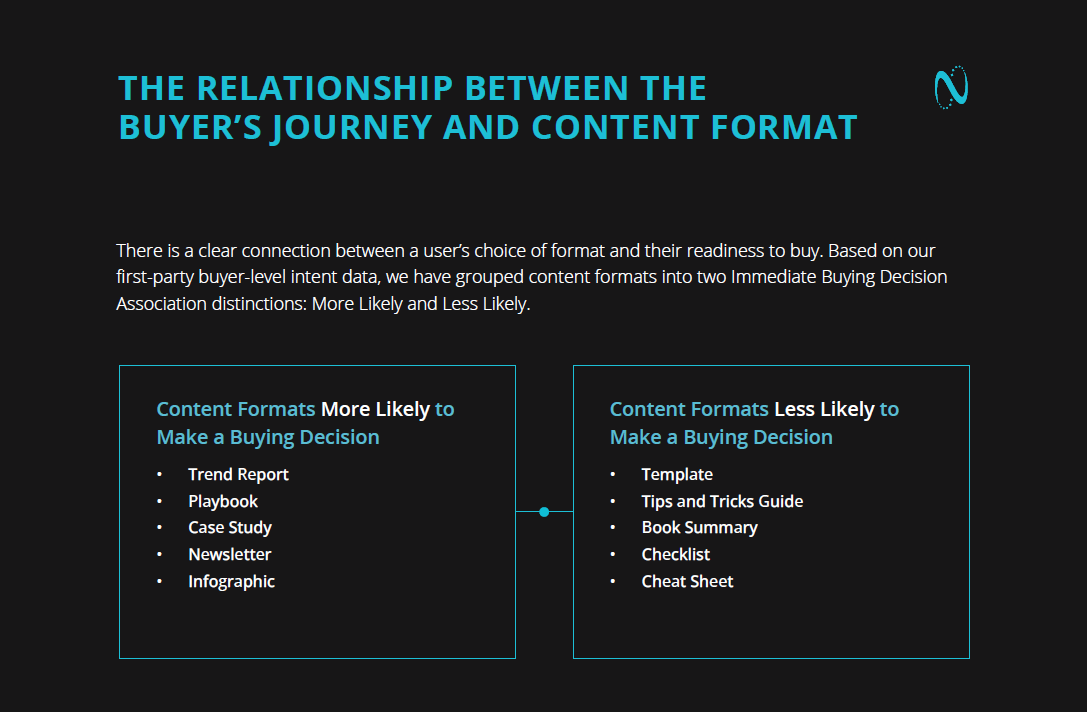
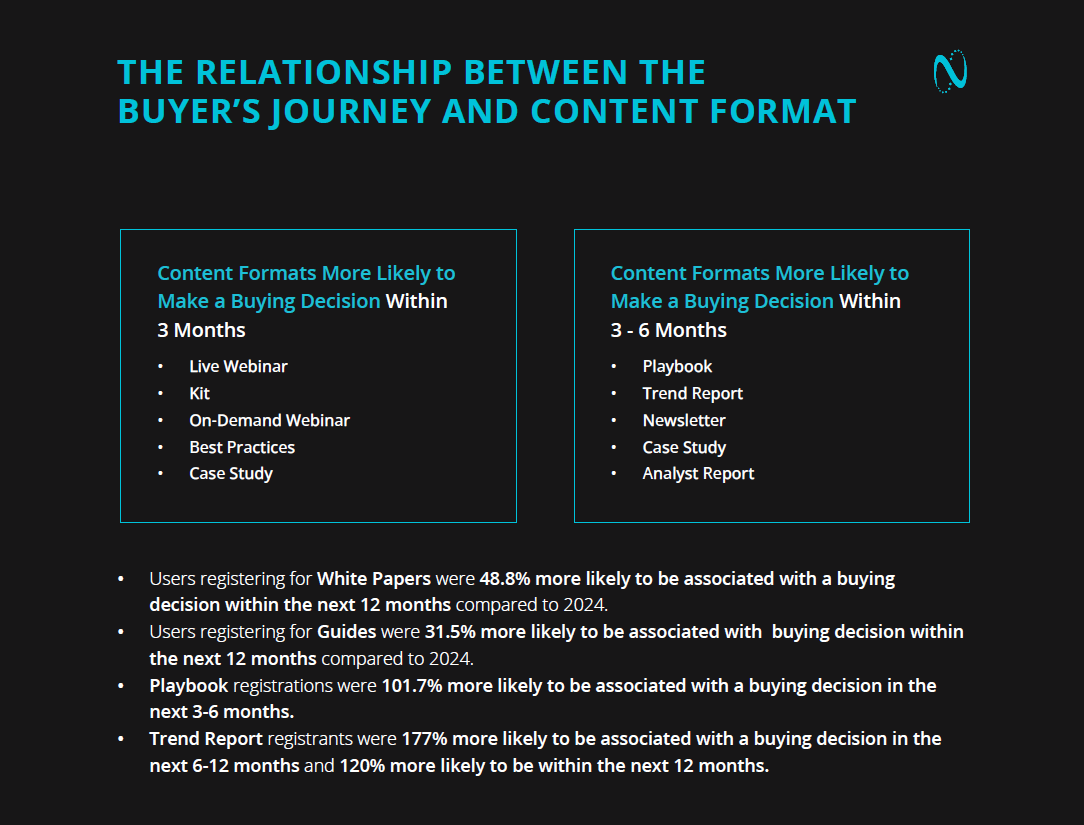
This isn’t just a conceptual argument. NetLine’s first-party intent research, drawn from millions of B2B content registrations overlaid with self-reported purchase timelines, reveals a consistent, reproducible pattern: the format a registrant chooses is a reliable predictor of whether they’re in an active buying decision.
The data segments cleanly into two groups.
Formats more likely to be associated with an active purchase decision:
Research Reports, White Papers, Webinars, eBooks, and similar long-form or high-commitment formats consistently correlate with registrants who report a purchase decision within the next six months.
Formats less likely to be associated with an active purchase decision:
Cheat Sheets, Infographics, Tip Sheets, and other short-form or reference-style formats correlate with registrants in earlier, more exploratory phases of the buying journey.
The logic tracks intuitively. Nobody registers for a technical White Paper unless they’re trying to solve something specific (or better understand something technical). Nobody attends a Webinar unless the topic is directly relevant to a problem they’re working on right now. The commitment required to engage with these formats is the commitment of someone who is in the decision.
Short-form formats tell a different story.
They’re discovery assets—the content a buyer reaches for when they’re building category awareness, not evaluating vendors. Still worth having? Absolutely! Especially with the essential need to have more content exposing your brand to professionals even if they’re not in market.
These leads are still worth following up on, too. But the timeline and approach need to reflect what the format is actually signaling.
Introducing the Format Signal Framework
Based on NetLine’s research into content consumption and purchase intent, here is how to think about format as a predictor of both intent depth and Recall Gap width:
HIGHER INTENT / NARROWER RECALL GAP
Formats associated with active purchase decisions
| FORMAT | WHAT IT SIGNALS |
|---|---|
| White Paper | Evaluating solutions; late-stage research |
| Research/Trend Report | Building internal business case; seeking data to justify |
| Webinar | Active engagement; problem is live and urgent |
| eBook | Curious about a topic; committed to understanding |
| Playbook | Looking for implementation guidance; decision likely in progress |
Registrants in this group are closer to a purchase decision and are making a higher cognitive investment at the moment of registration. The Recall Gap still exists—the six forces from Article 3 don’t stop working—but its width is narrower, and the window for effective follow-up is more forgiving.
EXPLORATORY INTENT / WIDER RECALL GAP
Formats associated with active purchase decisions
| Format | What It Signals |
| Cheat Sheet | Quick reference; awareness stage; low commitment |
| Infographic | Casual discovery; building general category knowledge |
| Tip Sheet / How-To Guide | Tactical curiosity; problem not yet fully defined |
| Checklist | Self-assessment; early in the evaluation process |
| Template | Practical utility; problem defined, solution not yet selected |
Registrants in this group are real—their curiosity is genuine—but they are earlier in the journey, and their cognitive investment at registration was lower. The Recall Gap is wider. The nurture clock is longer. And the follow-up approach needs to be built for patience, not urgency.
The Mistake Most Teams Make
Look at your current nurture sequences.
Chances are, a prospect who downloaded your Cheat Sheet enters the same 30-day email cadence as the one who attended your Webinar. They get the same first-touch message (which assumes they remember you), the same follow-up timing, and hit the same SDR handoff threshold.
That’s a problem in both directions.
Conversely, the Webinar registrant is being underserved—they’re closer to a decision, and a 30-day generic nurture sequence isn’t designed for where they actually are. The Cheat Sheet registrant is being over-pressured—they’re not ready, and pushing them through a short, aggressive cadence just burns the relationship before it has a chance to develop.
And both are being reached by a follow-up model that, as we established in Articles 2 and 3, assumes they remember you. Which, on average, they don’t.
Format-informed nurturing fixes this, not by adding complexity, but by using a signal that was already there.
What This Means for How You Follow Up

Photo by Pablo Gentile on Unsplash
The practical implications break down simply.
For high-intent formats:
The Recall Gap is narrower but still real.
Your first-touch communication should rebuild context (don’t assume they remember the asset), your follow-up cadence can be shorter, and your SDR handoff threshold can be lower. These registrants are closer to the conversation you want to have.
For exploratory formats:
The Recall Gap is wider and the buying timeline is longer.
Your nurture sequence needs to be rebuilt for a 6–12 month horizon—not 30 days. The goal isn’t to convert; it’s to stay present and credible until their buying timeline catches up with their curiosity. Every touchpoint should add value without assuming readiness.
The Consumption Gap adds another layer here. Even high-intent registrants wait an average of 47.7 hours to open what they registered for. That 48-hour window is your most important follow-up decision point—and format should be informing what you send and how you frame it.
One More Thing the Format Tells You

There’s a subtler implication worth naming.
If source memory failure (from Article 3) is most likely to occur when cognitive investment at registration was low, then Cheat Sheet and Infographic registrants are your highest-risk Recall Gap candidates. They’re the most likely to have no memory of your brand by the time your SDR calls. They’re also the most likely to have their attribution migrate to a more familiar competitor.
That’s not a reason to deprioritize them. It’s a reason to design their nurture experience specifically around rebuilding brand context at every touch—not just delivering content and hoping they connect the dots.
The format signal doesn’t just tell you how ready a buyer is. It tells you how hard the cognitive environment worked against you at registration—and therefore how much work your nurture program needs to do to overcome it.
The Bridge to What Comes Next
We now have a complete picture of the Recall Gap and the forces that shape it.
- We know what it is: the measurable distance between registration and reliable brand recall.
- We know why it exists: three structural problems and six cognitive forces, all working in concert against the standard follow-up playbook.
- We know who it affects most: every registrant, but with widths that vary predictably by format, buying timeline, and cognitive conditions at registration.
The next article turns to what to actually do about it. Three pillars—each one a design decision, not a tactical tweak—that address the Recall Gap at its root causes rather than its symptoms.
- Pillar one: assume zero recall.
- Pillar two: rebuild the nurture clock.
- Pillar three: the olive branch.