
Before you can fix a broken follow-up strategy, you have to agree on what’s actually broken… and most post-mortem conversations in demand gen don’t get there.
They stop at the symptoms—cold leads, low connect rates, SDRs questioning data quality—without asking what structural conditions produced those symptoms in the first place. The answers aren’t flattering, which is probably why they don’t get asked often enough.
The Real Problems Disrupting Demand
There are three problems quietly dismantling the standard B2B follow-up playbook.
None of them is new, and none of them is your fault. And, unfortunately, none of them go away by running the same plays harder. Here are the issues in greater detail that lead to the Recall Gap.
Problem 1: The Buying Cycle Is Getting Longer

Photo by Felix Mittermeier on Unsplash
The playbook most teams are running was designed for a world in which leads moved in weeks.
That world is gone.
For years, demand generation’s greatest promise to revenue teams was speed.
- Faster follow-up.
- Faster conversion.
- Faster pipeline.
The problem with this promise is that buyers only care about their own timeline. Who can blame them? Buyers have a lot to consider, after all. And those considerations take time.
- NetLine’s 2026 State of B2B Content Consumption and Demand Report found that near-term purchase intent—buyers planning a decision within three months—declined 15.7% in 2025.
- At the same time, 6–12-month purchase intent surged by 78.6%.
- Dreamdata’s 2026 LinkedIn Ads Benchmarks Report echoes our findings. Their research revealed that the average B2B sales cycle now runs 272 days from first touch to closed-won.
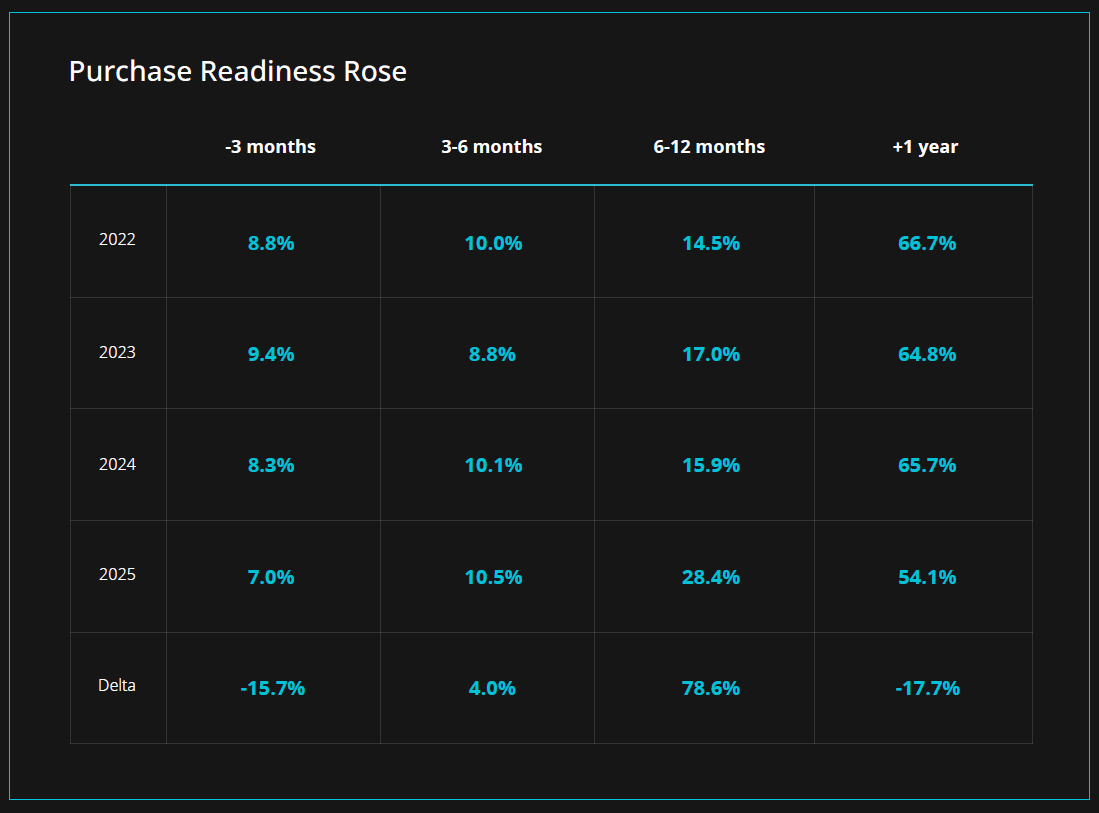
In chronological terms, a lead who registered on January 1st is most likely to be ready to buy sometime around late September. That’s almost nine months exactly.
The good news is that buyers aren’t saying no. They’re only saying not yet.
Therefore, the moment someone raises their hand for content does not equate to the moment they’re ready to buy. And follow-up strategies based on the assumption that registrations do signal near-term intent misfires on the vast majority of your pipeline before a single email is sent.
Problem 2: Engagement Is Taking Longer Than Ever

Photo by Usukhbayar Gankhuyag on Unsplash
Setting aside the buying cycle, there’s a more immediate problem hiding in the window between registration and the moment a prospect actually opens what they signed up for.
NetLine calls this the Consumption Gap. It’s the measurable distance between curiosity and action—between the moment someone raises their hand and the moment they actually engage with the content.
In 2025, the Consumption Gap hit a record 47.7 hours. That’s up nearly 10 hours from 2024 (38.5 hours) and an increase of 23.9% year-over-year. You can see in the chart below just how consistent this widening has become.
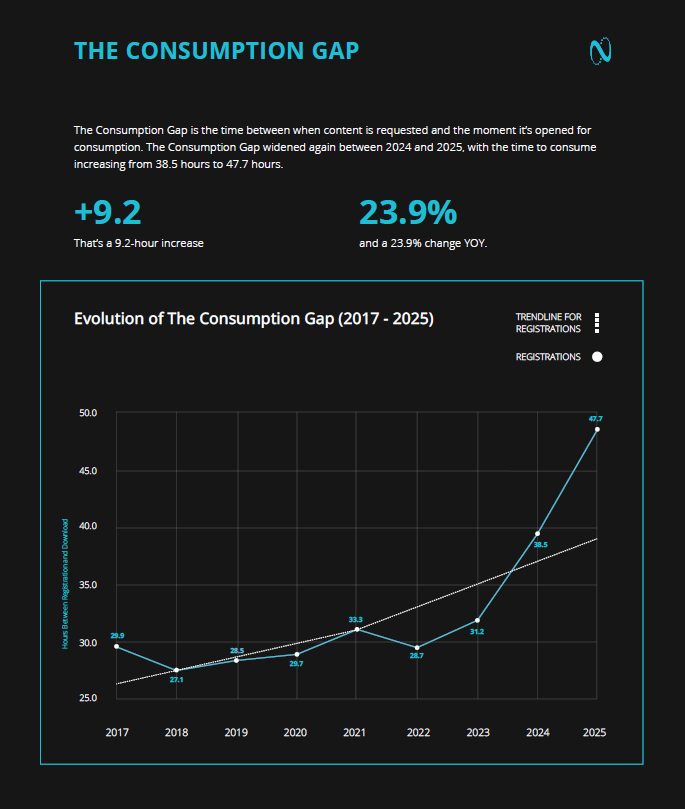
Most teams treat the Consumption Gap as a timing inconvenience; a reason to wait a day before following up. That framing understates the problem considerably. The Consumption Gap’s significance goes deeper than scheduling—it eventually becomes a memory problem.
The longer a registrant takes to consume content, the greater the likelihood they’ll forget everything. By the time your prospect sits down to consume what they registered for, a significant portion of whatever brand memory formed at the moment of registration has already decayed.
The Forgetting Curve

Photo by Andrew Pons on Unsplash
Newly formed memories don’t fade gradually and evenly. These memories decay most steeply in the hours immediately following encoding.
Hermann Ebbinghaus first documented the Forgetting Curve in 1885. A 2015 PLOS ONE study replicated his findings almost exactly, 130 years later.
A 2017 Nielsen study brought it into a directly relevant context: branded recognition dropped by roughly half in the first 24 hours after exposure. Researchers showed participants video ads, then tested a separate group 24 hours later.
Half the brand memory evaporated overnight.
Now add the 48 hours your prospect waits, on average, before engaging with the content they registered for to these psychological elements, and you’re left with a real mess.
By that point, the steepest part of the forgetting curve has already passed. By the time your SDR calls after content consumption, they’re likely reaching someone whose brain has already cut your brand loose.
“Who are you?” starts to look less like a bad lead and a lot more like an expected outcome.
(Now would be a good time to ask how visible and distinctive your branding actually is across your content. The Nielsen finding cuts both ways: if recognition is dropping by half overnight, the strength and memorability of that initial brand impression matters more than most content teams treat it.)
Problem 3: Registrant Recall Is Weaker Than You Think
Speaking of “who are you?” most teams chalk these calls up to a bad lead and move on. As we’ve begun to establish, cognitive science suggests otherwise.
The Google Effect

Photo by Mitchell Luo on Unsplash
You know how there are things throughout the day that we acknowledge and then immediately put on the mental back burner? Your prospects are doing the same thing.
A landmark 2011 study from Columbia and Harvard demonstrated that when people believe information will be retrievable later, the brain deprioritizes encoding it in the first place.
Your prospect’s brain tagged your vendor name as “findable later” the moment they hit submit, meaning that the act of completing your form may have actively reduced the likelihood of remembering you.
Hit button. Get content. Move on.
Citation Needed
And if that weren’t enough: Harvard memory researcher Daniel Schacter’s work on source misattribution documents a pattern where people absorb a fact or insight and later forget where they got it.
It’s entirely possible and rather likely that once your prospect consumes your content, they may be quoting your statistic in an internal meeting with no conscious awareness that it came from you. Meanwhile, if a more recognizable competitor name lives in the same cognitive neighborhood, Schacter’s research suggests the brain will sometimes reassign the credit.
This is the overlooked companion problem to everything above. It’s not just that your prospect forgot your brand—it’s that they may have remembered your content while losing the attribution entirely.
The Distractions of the Digital Environment

Photo by Austin Distel on Unsplash
Let’s look at what’s actually happening on the other end of your registration form.
Your prospect is at their desk—laptop open, browser stacked with tabs, Slack active, calendar notification just dismissed. The average knowledge worker stays focused on a single screen for just 47 seconds before switching, down from 2.5 minutes in 2004.
Miraculously, throughout all of this mess, they completed your form. Your registration didn’t get a moment of undivided attention. It got less than a minute, competing against everything else on the screen—one of more than 1,200 applications and browser switches they’ll make that day.
The Wrong Diagnosis

Photo by Sarah Kilian on Unsplash
The three most common responses to the “cold lead” problem are: increase follow-up speed, increase follow-up volume, or question lead quality. All three misdiagnose the root cause.
Speed doesn’t address a structural memory problem—and trying to catch a lead before the forgetting curve steepens requires reaching them within hours of registration, which most teams aren’t operationally equipped to do.
Volume makes it worse: five identical “checking in” emails don’t rebuild brand memory; they build brand fatigue. (And the lead was real. The cognitive environment was the problem.)
The correct diagnosis requires accepting something uncomfortable: your prospects aren’t failing to remember you because of anything your team did wrong. They’re failing because the modern digital environment, the one your leads live and work in every day, is structurally hostile to the kind of memory encoding your follow-up strategy depends on.
That’s not a lead quality problem. It’s a Recall Gap problem.
What These Three Problems Have in Common

The buying cycle is longer. The Consumption Gap is wider. And registrant recall is weaker than the current playbook assumes.
Each of these problems is real on its own. Together, they form a compounding structure.
- A longer buying cycle means more elapsed time between registration and purchase readiness.
- A wider Consumption Gap means brand memory is already decaying before the content is consumed.
- A weak registrant recall means your follow-up is operating on the wrong assumption from the first touchpoint.
Labeling these as lead quality problems misses (and dismisses) the larger point. These are structural problems, and they have structural explanations.
This brings us to the question worth sitting with before the next article: if the environment is cognitively hostile to brand memory, what exactly is happening inside your prospect’s brain at the moment of registration? And what does that mean for how you show up afterward?
The science on this is more precise than most marketers realize—and more useful.